英語でのこの国の正式名称は「Republic of China」です。1912年に中華民国が設立された直後、まだ中国本土に位置していた頃、政府は自らを指すのに「China」( Zhōngguó、中國)という略称を使用していました。これはzhōng(「中央」または「中間」)とguó(「国家、国民国家」)から派生したものです。[ q ]この用語は周王朝時代に王室領地を指す言葉として発展し、[ r ]その後、東周時代には洛義(現在の洛陽)周辺地域に適用され、後に中国の中央平原に適用され、清朝時代には国家の同義語として時折使用されるようになりました。[ 70 ]共和国の名称は、1905年の同盟会の党綱領に由来しており、そこには中国革命の4つの目標として「満州族の支配者を追放し、中華を復興し、共和国を樹立し、土地を人民に平等に分配する」と記されている。[ III ]革命指導者の孫文は、革命が成功した際の新しい国の仮称として中華民国という名称を提案した。
↑落ちた、ダフィッド (2006)。台湾の政党政治。ラウトレッジ。 p. 85.ISBN978-1-134-24021-0。
↑ Achen, Christopher H.; Wang, TY (2017). "台湾の有権者:入門". Achen, Christopher H.; Wang, TY (編)『台湾の有権者』所収。ミシガン大学出版局、pp. 1–25。doi : 10.3998 / mpub.9375036。ISBN978-0-472-07353-5。1~2ページ。
↑ Rosemary Gillespie; Rosemary G. Gillespie; DA Clague (2009). Encyclopedia of Islands . University of California Press. p. 904. ISBN978-0-520-25649-12024年10月2日にオリジナルからアーカイブされました。2023年7月25日に取得。
↑バギョ・プラセチョ。ティティ・スルティ・ナスティティ。トルーマン・シマンジュンタク(2021)。オーストロネシアのディアスポラ: 新しい視点。 UGMプレス。 p. 125.ISBN978-602-386-202-32024年10月2日にオリジナルからアーカイブされました。2023年7月25日に取得。
↑ Olsen, John W.; Miller-Antonio, Sari (1992). "中国南部の旧石器時代" . Asian Perspectives . 31 (2): 152. hdl : 10125/17011 . 2024年4月16日のオリジナルからアーカイブ済み。 2024年5月15日取得。
↑ Diamond, Jared M (2000). "台湾の世界への贈り物" (PDF) . Nature . 403 (6771): 709– 710. Bibcode : 2000Natur.403..709D . doi : 10.1038/35001685 . PMID 10693781 . S2CID 4379227 . 2006年9月16日にオリジナル(PDF)からアーカイブ済み。
↑ Fox, James J (2004). Current Developments in Comparative Austronesian Studies (PDF) . Symposium Austronesia. The Australian National University . Archived (PDF) from the original on August 30, 2013 . Retrieved 1 April 2012 .
↑ Koo, Hui-wen (2015). "Weather, Harvests, and Taxes: A Chinese Revolt in Colonial Taiwan" . The Journal of Interdisciplinary History . 46 (1): 39– 59. doi : 10.1162/JINH_a_00795 . JSTOR 43829712 .
↑ Andrade, Tonio (2006). "The Rise and Fall of Dutch Taiwan, 1624–1662: Cooperative Colonization and the Statist Model of European Expansion". Journal of World History . 17 (4): 429– 450. doi : 10.1353/jwh.2006.0052 . JSTOR 20079399 . S2CID 162203720 .
↑ Koo, Hui-wen (2011). "オランダ植民地時代の台湾における鹿狩りと共有地の保全". The Journal of Interdisciplinary History . 43 (2): 185– 203. doi : 10.1162/JINH_a_00211 . JSTOR 41291189 . S2CID 145423135 .
↑ Hang, Xing (2010). Between Trade and Legitimacy, Maritime and Continent: The Zheng Organization in Seventeenth-Century East Asia (PhD). University of California, Berkeley. Archived from the original on 23 February 2022. Retrieved 24 December 2022 .
↑ Hang, Xing (2016). "矛盾する偶発性:17世紀の鄭家と争われる両岸の遺産". American Journal of Chinese Studies . 23 : 173– 182. JSTOR 44289147 .
↑ 「台湾の歴史」。Windows on Asia。ミシガン州立大学アジア研究センター。2006年9月1日時点のオリジナルよりアーカイブ。 2014年12月3日取得。
↑Hsu, Mutsu (1991). Culture, Self and Adaptation: The Psychological Anthropology of Two Malayo-Polynesian Groups in Taiwan. Institute of Ethnology, Academia Sinica. ISBN978-957-9046-78-7.
↑Chou, Chuing Prudence; Ho, Ai-Hsin (2007). "Schooling in Taiwan". In Postiglione, Gerard A.; Tan, Jason (eds.). Going to school in East Asia. Greenwood Publishing Group. pp.344–377. ISBN978-0-313-33633-1. Archived from the original on 19 April 2010.
↑Tierney, Robert (2010). Tropics of Savagery: The Culture of Japanese Empire in Comparative Frame. University of California Press. pp.8–9. ISBN978-0-520-94766-5.
↑吕, 正惠 (18 November 2014). 吕正惠: 战后台湾左翼思想状况漫谈一——日本剥削下的台湾社会. 观察者. Archived from the original on 14 September 2017. Retrieved 9 June 2017.
12"2". The Japanese Wartime Empire, 1931-1945. Princeton, NJ: Princeton University Press. 2021. ISBN9781400844371.
↑Grajdanzev, A. J. (1942). "Formosa (Taiwan) Under Japanese Rule". Pacific Affairs. 15 (3): 311–324. doi:10.2307/2752241. JSTOR2752241.
↑"Shu LinKou Air Station: World War II: U.S. Bombing Raids on Linkou and Taiwan". Shulinkou Air Station Taiwan. 10 October 2019. Archived from the original on 16 June 2011. Retrieved 1 April 2012.
↑Cheung, Han (16 September 2018). "Taiwan in Time: Abandoned by the rising sun". Taipei Times. Archived from the original on 2 October 2024. Retrieved 12 January 2023.
↑Hou, Elaine (14 August 2013). "Protesters demand justice from Japan on 'comfort women' (update)". Focus Taiwan. Archived from the original on 25 June 2020.
↑Morris, Andrew D. (30 July 2015). Japanese Taiwan: Colonial Rule and its Contested Legacy. Bloomsbury Publishing. pp.115–118. ISBN978-1-4725-7674-3. Archived from the original on 16 August 2024. Retrieved 25 July 2023.
↑China: Five Thousand Years of History and Civilization. City University Of Hong Kong Press. 2007. p.116. ISBN978-962-937-140-1. Archived from the original on 10 April 2023. Retrieved 9 September 2014.
↑Roy, Denny (2003). Taiwan: A Political History. Cornell University Press. pp.55, 56. ISBN978-0-8014-8805-4.
↑"Cairo Communiqué, December 1, 1943". Birth of the Constitution of Japan. National Diet Library. Archived from the original on 26 July 2017. Retrieved 29 November 2021. It is their purpose that Japan shall be stripped of all the islands in the Pacific which she has seized or occupied since the beginning of the first World War in 1914, and that all the territories Japan has stolen from the Chinese, such as Manchuria, Formosa, and The Pescadores, shall be restored to the Republic of China.
↑Ballantine (1952), p.162: "United States Government replied on this point as follows:... Cairo Declaration provided that Manchuria, Formosa, and the Pescadores, shall be restored to the Republic of China".
↑"Potsdam Declaration". The Atomic Heritage Foundation. The Atomic Heritage Foundation and the National Museum of Nuclear Science & History. Archived from the original on 30 November 2021. Retrieved 29 November 2021. The terms of the Cairo Declaration shall be carried out and Japanese sovereignty shall be limited to the islands of Honshu, Hokkaido, Kyushu, Shikoku and such minor islands as we determine.
↑"Japanese Instrument of Surrender". The National Archives Foundation. The National Archives. Archived from the original on 30 November 2021. Retrieved 29 November 2021. We hereby undertake for the Emperor, the Japanese Government and their successors to carry out the provisions of the Potsdam Declaration in good faith
↑"Far East (Formosa and the Pescadores)". Hansard. 540 (cc1870–4). 4 May 1955. Archived from the original on 18 October 2017. Retrieved 1 September 2010. The sovereignty was Japanese until 1952. The Japanese Treaty came into force, and at that time Formosa was being administered by the Chinese Nationalists, to whom it was entrusted in 1945, as a military occupation.
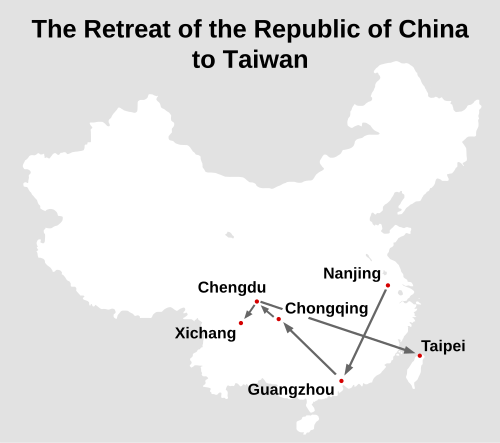
↑Charney, Jonathan I.; Prescott, J. R. V. (2000). "Resolving Cross-Strait Relations Between China and Taiwan". American Journal of International Law. 94 (3): 453–477. doi:10.2307/2555319. JSTOR2555319. S2CID144402230. After occupying Taiwan in 1945 as a result of Japan's surrender, the Nationalists were defeated on the mainland in 1949, abandoning it to retreat to Taiwan.
↑"Treaty of Peace with Japan"(PDF). United Nations Treaties Collection. The United Nations. Archived(PDF) from the original on 29 September 2017. Retrieved 29 November 2021.
↑Alagappa, Muthiah (2001). Taiwan's presidential politics. M.E. Sharpe. p.265. ISBN978-0-7656-0834-5. Archived from the original on 16 August 2024. Retrieved 25 July 2023.
↑"Treaty of Peace between the Repuiblic of China and Japan"(PDF). United Nations Treaties Collection. The United Nations. Archived(PDF) from the original on 9 December 2021. Retrieved 29 November 2021.
↑Makinen & Woodward (1989): "Yet, the Chinese Nationalist government attempted to isolate Taiwan from the mainland inflation by creating it as an independent currency area. And during the later stages of the civil war it was able to end the hyperinflation on Taiwan, something it was unable to do on the mainland despite two attempts."
↑"Formosa in transition". The World Today. Vol.4, no.5. Royal Institute of International Affairs. 1948. p.213.
↑"China: Snow Red & Moon Angel". Time. 7 April 1947. Archived from the original on 11 January 2007.
↑Shackleton, Allan J. (1998). Formosa Calling: An Eyewitness Account of Conditions in Taiwan during the February 28th, 1947 Incident(PDF). Taiwan Publishing Company. OCLC40888167. Archived from the original(PDF) on 5 February 2011. Retrieved 18 December 2014.
↑"Taiwan takes first steps to explain 1947 massacre". United Press International. 28 February 1991. Archived from the original on 30 January 2022. Retrieved 30 January 2022.
↑Kubek, Anthony (1971) [1963]. How the Far East was lost: American policy and the creation of Communist China. Intercontex Publishers (England) Limited. ISBN978-0-85622-000-5.
↑Huang, Fu-san (2010). 臺灣簡史-麻雀變鳳凰的故事[A Brief History of Taiwan: A Sparrow Transformed into a Phoenix] (in Chinese). Government Information Office, Republic of China. Archived from the original on 29 April 2011. Retrieved 13 September 2009. 1949年, 國民政府退守臺灣後, 以臺北為戰時首都
↑"Taiwan Timeline– Retreat to Taiwan". BBC News. 2000. Archived from the original on 24 June 2009. Retrieved 21 June 2009.
↑Dunbabin, J.P.D. (2008). The Cold War. Pearson Education. p.187. ISBN978-0-582-42398-5. In 1949 Chiang Kai-shek had transferred to Taiwan the government, gold reserve, and some of the army of his Republic of China.
↑Ng, Franklin (1998). The Taiwanese Americans. Greenwood Publishing Group. p.10. ISBN978-0-313-29762-5. Archived from the original on 16 August 2024. Retrieved 25 July 2023.
↑Yang, Lavai (July 2011). "Taiwan's Love Affair with Gold". Taiwan Panorama. Translated by Williams, Scott. Archived from the original on 28 March 2023. Retrieved 5 February 2023.
↑"Money Value of the New Taiwan Currency". Taiwan Today. 1 June 1954. Archived from the original on 16 August 2024. Retrieved 5 February 2023.
↑Li, Shih-hui (2005). "The Currency Conversion in Postwar Taiwan: Gold Standard from 1949 to 1950". The Kyoto Economic Review. 74 (2): 191–203. doi:10.11179/KER.74.191.
12三、 台灣戒嚴令[III. Decree to establish martial law in Taiwan] (in Chinese). National Archives Administration, National Development Council. 2 October 2009. Archived from the original on 10 October 2012. Retrieved 15 September 2017.
↑"28 February 1947– Taiwan's Holocaust Remembered– 60th Commemoration". New Taiwan, Ilha Formosa. 2007. Archived from the original on 31 October 2018. Retrieved 2 July 2009.
↑"Taiwan president apologises for 'white terror' era". Reuters. Archived from the original on 1 April 2019. Retrieved 2 July 2009.
↑US Department of Defense (1950). "Classified Teletype Conference, dated 27 June 1950, between the Pentagon and General Douglas MacArthur regarding authorization to use naval and air forces in support of South Korea. Papers of Harry S. Truman: Naval Aide Files". Truman Presidential Library and Museum. p.1 and 4. Archived from the original on 19 April 2006. Retrieved 9 March 2006. Page 1: In addition 7th Fleet will take station so as to prevent invasion of Formosa and to insure that Formosa not be used as base of operations against Chinese mainland." Page 4: "Seventh Fleet is hereby assigned to operational control CINCFE for employment in following task hereby assigned CINCFE: By naval and air action prevent any attack on Formosa, or any air or sea offensive from Formosa against mainland of China.
↑Jacoby, Neil H. (January 1966). "An Evaluation of U.S. Economic Aid to Free China, 1951–1965"(PDF). A.I.D. Discussion Paper. United States Agency for International Development. Archived from the original(PDF) on 28 March 2023. Retrieved 15 May 2022.
↑Makinen & Woodward 1989: "It was the fiscal regime change on Taiwan, as in the European episodes, that finally brought price stability. It was the aid policy that brought the budget to near balance, and when the aid programme reached its full proportions in 1952, prices stabilized."
↑"The Land Reform Movement in China". Taiwan Today. 1 June 1951. Archived from the original on 5 February 2023. Retrieved 5 February 2023.
↑Ralph Clough, "Taiwan under Nationalist Rule, 1949–1982," in Roderick MacFarquar et al., ed., Cambridge History of China, Vol 15, The People's Republic Pt 2 (Cambridge: Cambridge University Press, 1991), p. 837
↑Liu, Da-Nien; Shih, Hui-Tzu (4 December 2013). "The Transformation of Taiwan's Status Within the Production and Supply Chain in Asia". Brookings. Archived from the original on 12 June 2018. Retrieved 6 January 2021.
↑Zhu, Tianbiao (2006). "Rethinking Import-substituting Industrialization: Development Strategies and Institutions in Taiwan and China". Research Paper 2006/076. UNU-WIDER. Archived from the original on 5 February 2023. Retrieved 5 February 2023.
↑Smura, Tomasz (17 October 2016). "In the shadow of Communistic missiles – Air and Missile Defence in Taiwan". Casimir Pulaski Foundation. Archived from the original on 10 January 2023. Retrieved 10 January 2023.
↑Halperin, M.H. (1966). "Memorandum RM-4900-ISA (Abridged), The 1958 Taiwan Straits Crisis: A Documented History (U)"(PDF). RAND Corporation. Archived(PDF) from the original on 20 December 2022. Retrieved 10 January 2023.
↑"Taiwan Timeline– Cold war fortress". BBC News. 2002. Archived from the original on 1 April 2019. Retrieved 2 July 2009.
↑Wu, Tsong-Min (2016). "From Economic Controls to Export Expansion in Postwar Taiwan: 1946–1960". RIETI. Archived from the original on 5 February 2023. Retrieved 5 February 2023.
↑Sun, Yat-sen; Julie Lee Wei; Ramon Hawley Myers; Donald G. Gillin (1994). Julie Lee Wei; Ramon Hawley Myers; Donald G. Gillin (eds.). Prescriptions for saving China: selected writings of Sun Yat-sen. Hoover Press. p.36. ISBN978-0-8179-9281-1. Archived from the original on 16 August 2024. Retrieved 25 July 2023. The party first applied Sun's concept of political tutelage by governing through martial law, not tolerating opposition parties, controlling the public media, and using the 1947 constitution drawn up on the China mainland to govern. Thus, much of the world in those years gave the government low scores for democracy and human rights but admitted it had accomplished an economic miracle.
↑Chao, Linda; Ramon Hawley Myers (1997). Democracy's new leaders in the Republic of China on Taiwan. Hoover Press. p.3. ISBN978-0-8179-3802-4. Archived from the original on 16 August 2024. Retrieved 25 July 2023. Although this party [the KMT] had initiated a democratic breakthrough and guided the democratic transition, it had also upheld martial law for thirty-six years and severely repressed political dissent and any efforts to establish an opposition party.... How was it possible that this party, so hated by opposition politicians and long regarded by Western critics as a dictatorial, Leninist-type party, still remained in power?
↑Fung (2000), p.67: "Nanjing was not only undemocratic and repressive but also inefficient and corrupt.... Furthermore, like other authoritarian regimes, the GMD sought to control people's mind."
↑Fung (2000), p.85: "The response to national emergency, critics argued, was not merely military, it was, even more important, political, requiring the termination of one-party dictatorship and the development of democratic institutions."
↑Copper, John Franklin (2005). Consolidating Taiwan's democracy. University Press of America. p.8. ISBN978-0-7618-2977-5. Archived from the original on 16 August 2024. Retrieved 25 July 2023. Also, the "Temporary Provisions" (of the Constitution) did not permit forming new political parties, and those that existed at this time did not seriously compete with the Nationalist Party. Thus, at the national level the KMT did not permit competitive democratic elections.
↑Chou, Yangsun; Nathan, Andrew J. (1987). "Democratizing Transition in Taiwan". Maryland Series in Contemporary Asian Studies. 1987 (3). Archived from the original on 12 January 2023. Retrieved 12 January 2023.
↑Ko, Jim W. (2004). "Cold War Triumph – Taiwan Democratized in Spite of U.S. Efforts". Case Western Reserve Journal of International Law. 36 (1): 137–181. Archived from the original on 11 March 2023. Retrieved 12 January 2023.
↑Richard Kagan. Taiwan's Statesman: Lee Teng-hui and Democracy in Asia. Naval Institute Press, 2014. p. 91–93. ISBN978-1-61251-755-1
↑"Out with the old". BBC News. 2002. Archived from the original on 23 February 2019. Retrieved 30 October 2009.
↑"Taiwan President to Propose End to Island's Martial Law". The Washington Post. 8 October 1986. Archived from the original on 28 March 2023. Retrieved 12 January 2023.
↑Southerl, Daniel (15 July 1987). "After 38 Years, Taiwan Lifts Martial Law". The Washington Post. Archived from the original on 28 March 2023. Retrieved 10 December 2022.
↑"Compensation Act for Wrongful Trials on Charges of Sedition and Espionage during the Martial Law Period". Laws and Regulations Database of the Republic of China (Taiwan). Archived from the original on 10 December 2022. Retrieved 10 December 2022. if the case took place in Kinmen, Matsu, Dongsha and Nansha, the term "martial law period" refers to the period of time from December 10, 1948 to November 6, 1992.
↑"Taiwan Leader Chiang Dies; Pushed Reform". Los Angeles Times. 14 January 1988. Archived from the original on 14 January 2023. Retrieved 14 January 2023.
↑Chiou, C.L. (1993). "The 1990 National Affairs Conference and the future of democracy in Taiwan". Bulletin of Concerned Asian Scholars. 25 (1): 17–33. doi:10.1080/14672715.1993.10408343.
↑Tang, Dennis Te-chung (1999). Constitutional Reforms in Taiwan in the 1990s(PDF). 5th World Congress of the International Association of Constitutional Law. Erasmus University. Archived(PDF) from the original on 14 January 2023. Retrieved 14 January 2023.
↑Leng, Shao-chuan; Lin, Cheng-yi (1993). "Political Change on Taiwan: Transition to Democracy?". The China Quarterly. 136 (136): 805–839. doi:10.1017/S0305741000032343. JSTOR655592. S2CID154907110.
↑Chang, Bi-yu (2004). "From Taiwanisation to De-sinification". China Perspectives. 56 (6). doi:10.4000/chinaperspectives.438.
↑Klöter, Henning (2004). "Language Policy in the KMT and DPP eras". China Perspectives. 56 (6). doi:10.4000/chinaperspectives.442.
↑Richburg, Keith B. (24 March 1996). "China Fails to Sway Election in Taiwan". The Washington Post. Archived from the original on 28 March 2023. Retrieved 14 January 2023.
↑Ching, Heng-wei (22 May 2000). "Lee Teng-hui and the workings of the political machine". Taipei Times. Archived from the original on 14 January 2023. Retrieved 14 January 2023.
↑Fell, Dafydd (2005). "Political and Media Liberalization and Political Corruption in Taiwan"(PDF). The China Quarterly. 184 (184): 875–893. doi:10.1017/S0305741005000548. JSTOR20192543. S2CID153762560. Archived(PDF) from the original on 11 July 2022. Retrieved 16 January 2023.
↑Chung, Lawrence (30 July 2020). "Lee Teng-hui, a controversial figure hailed as Taiwan's "father of democracy"". South China Morning Post. Archived from the original on 14 January 2023. Retrieved 14 January 2023.
↑"39% – A-bian wins – just". Taipei Times. 19 March 2000. Archived from the original on 14 January 2023. Retrieved 14 January 2023.
↑Huang, Tong-yi (2002). "Taiwan's 2001 Elections and Its Ongoing Democratic Consolidation". American Journal of Chinese Studies. 9 (1): 43–57. JSTOR44288689.
↑Rigger, Shelley (2003). "Taiwan in 2002: Another Year of Political Droughts and Typhoons". Asian Survey. 43 (1): 41–48. doi:10.1525/as.2003.43.1.41.
↑"Controversial victory for Chen". Taipei Times. 21 March 2004. Archived from the original on 14 January 2023. Retrieved 14 January 2023.
↑"President Chen's Interview by the Washington Post". The Office of the President. 30 March 2004. Archived from the original on 16 August 2024. Retrieved 14 January 2023.
↑"Taiwan scraps unification council". BBC News. 27 February 2006. Archived from the original on 9 April 2022. Retrieved 9 June 2017.
↑"State-run firms begin name change". Taipei Times. 10 February 2007. Archived from the original on 16 August 2024. Retrieved 18 January 2023.
12Lam, Willy (28 March 2008). "Ma Ying-jeou and the Future of Cross-Strait Relations". China Brief. 8 (7). Archived from the original on 13 April 2008.
12Wong, Edward (12 March 2008). "Taiwan's Independence Movement Likely to Wane". The New York Times. Archived from the original on 1 July 2017. Retrieved 20 February 2017.
↑"The Nationalists are back in Taiwan". The Economist. 23 March 2008. Archived from the original on 16 November 2018.
↑"Straitened times: Taiwan looks to China". Financial Times. 25 March 2008. Archived from the original on 29 March 2008. Retrieved 2 April 2012.
↑"Going Straight Ahead". Taiway Today. 1 December 2009. Archived from the original on 11 February 2023. Retrieved 18 January 2023.
↑"WHO invites "Chinese Taipei" to WHA". Taipei Times. 30 April 2009. Archived from the original on 31 January 2023. Retrieved 18 January 2023.
↑Gluck, Caroline (16 July 2008). "Taiwan sorry for white terror era". BBC News. Archived from the original on 3 April 2012. Retrieved 2 April 2012.
↑Stolojan, Vladimir; Guill, Elizabeth (2017). "Transitional Justice and Collective Memory in Taiwan: How Taiwanese Society is Coming to Terms with Its Authoritarian Past". China Perspectives. 2017/2 (2 (110)): 27–35. doi:10.4000/chinaperspectives.7327. JSTOR26380503.
↑Mearsheimer, John J. (25 February 2014). "Say Goodbye to Taiwan". The National Interest. Archived from the original on 29 June 2021. Retrieved 18 January 2023.
↑Ho, Ming-sho (2015). "Occupy Congress in Taiwan: Political Opportunity, Threat, and the Sunflower Movement". Journal of East Asian Studies. 15 (1): 69–97. doi:10.1017/S1598240800004173.
↑Ho, Ming-sho (2 August 2018). "The Activist Legacy of Taiwan's Sunflower Movement". Carnegie Endowment for International Peace. Archived from the original on 16 August 2024. Retrieved 4 March 2021.
↑Chow, Jermyn (17 January 2016). "Historic change as KMT loses long-held Parliament majority". The Straits Times. Archived from the original on 1 November 2022. Retrieved 1 November 2022.
↑"Photos: Taiwan holds closely watched presidential and parliamentary polls". Al Jazeera. Archived from the original on 15 January 2024. Retrieved 15 January 2024.
↑"No party gets majority in Legislature; KMT wins most seats – Focus Taiwan". Focus Taiwan – CNA English News. 13 January 2024. Archived from the original on 4 February 2024. Retrieved 15 January 2024.
↑Dinerstein, Eric; etal. (2017). "An Ecoregion-Based Approach to Protecting Half the Terrestrial Realm". BioScience. 67 (6): 534–545. doi:10.1093/biosci/bix014. PMC5451287. PMID28608869.
↑Grantham, H. S.; etal. (2020). "Anthropogenic modification of forests means only 40% of remaining forests have high ecosystem integrity – Supplementary Material". Nature Communications. 11 (1): 5978. Bibcode:2020NatCo..11.5978G. doi:10.1038/s41467-020-19493-3. PMC7723057. PMID33293507.
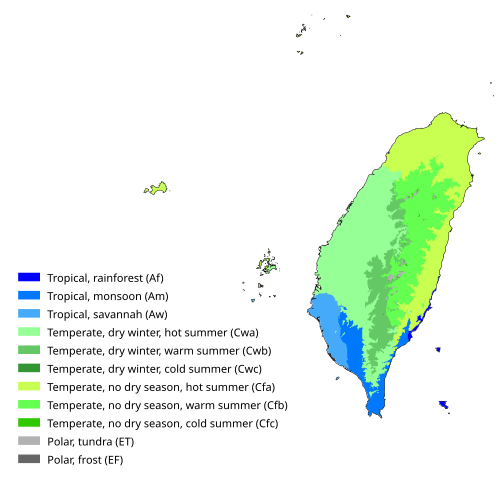
↑"Climate of Taiwan". USA Today. Archived from the original on 29 July 2021. Retrieved 18 September 2020.
↑Yi Ling Roy Ngerng (19 August 2020). "Is Taiwan Doing Enough to Address Climate Change in The Hottest Summer Ever?". CommonWealth Magazine. Archived from the original on 6 July 2021. Retrieved 18 September 2020.
↑Anderson, Megan (2001). "Taiwan". University of Arizona. Archived from the original on 5 December 2010. Retrieved 1 August 2010.
↑Clift, Schouten and Draut (2003) in Intra-Oceanic Subduction Systems: Tectonic and Magmatic Processes, ISBN1-86239-147-5 p84–86
↑"USGS seismic hazard map of Eastern Asia". Seismo.ethz.ch. Archived from the original on 3 March 2000. Retrieved 30 May 2011.
1234567"Chapter 4: Government". The Republic of China Yearbook. Government Information Office, Republic of China (Taiwan). 2011. pp.55–65. Archived from the original(PDF) on 12 May 2008.
↑"Taiwan assembly passes changes". BBC News. 7 June 2005. Archived from the original on 23 February 2019. Retrieved 9 June 2005.
↑Jayasuriya, Kanishka (1999). Law, capitalism and power in Asia. Routledge. p.217. ISBN978-0-415-19743-4. Archived from the original on 2 October 2024. Retrieved 25 July 2023.
↑Wang, Yang-yu; Kao, Evelyn (10 December 2019). "Legislature passes revised law to shrink Examination Yuan". Central News Agency. Archived from the original on 19 February 2020. Retrieved 19 February 2020.
↑Yang, Mien-chieh; Chung, Jake. "Examination Yuan at odds with self". Taipei Times. Archived from the original on 17 April 2021. Retrieved 10 March 2021.
↑Ginsburg, Tom (2003). Judicial review in new democracies. Cambridge University Press. p.111. ISBN978-0-521-52039-3. Archived from the original on 2 October 2024. Retrieved 25 July 2023.
↑Yeh, Jiunn-rong (2016). The Constitution of Taiwan. Bloomsbury. pp.3–4. ISBN978-1-84946-512-0.
↑Chang, Ming-hsuan; Mazzetta, Matthew. "DPP lawmakers seek removal of 'national unification' from Constitution". Central News Agency (Taiwan). No.3 September 2020. Archived from the original on 28 March 2021. Retrieved 8 March 2021.
↑"蒙古不是中華民國固有之疆域". 自由時報 Liberty Times. Archived from the original on 3 February 2021. Retrieved 6 February 2021.
↑"Constitution of the Republic of China (Taiwan)". Archived from the original on 23 October 2020. Retrieved 14 February 2021.
↑Chang, Yin-t'ang (1933). The Economic Development and Prospects of Inner Mongolia (Chahar, Suiyuan, and Ningsia). Commercial Press, Limited. p.62.
↑Clark, Keith Allan II (3 September 2018). "Imagined Territory: The Republic of China's 1955 Veto of Mongolian Membership in the United Nations". Journal of American-East Asian Relations. 25 (3): 263–295. doi:10.1163/18765610-02503003. S2CID240274376.
↑"Taiwan 'embassy' changes anger China". BBC News. 26 February 2002. Archived from the original on 26 May 2004. Retrieved 14 February 2021.
↑"Mongolia not within national boundary under ROC Constitution: MAC". Central News Agency (Taiwan). 21 May 2012. Archived from the original on 17 April 2021. Retrieved 8 March 2021.
↑"Article 4 of the constitution". Archived from the original on 22 May 2024. Retrieved 8 July 2017.
↑"The Rise and Fall of the Taiwan Provincial Government". Taiwan Panorama. January 1999. Archived from the original on 14 July 2022. Retrieved 9 March 2025.
↑Cheung, Han (19 July 2020). "Taiwan in Time: A provincial government that ruled no land". Taipei Times. Retrieved 9 March 2025.
↑"Taiwan rejects South China Sea claims of the Philippines, China". Focus Taiwan. 12 November 2024. Retrieved 9 March 2025.
↑Lin, Gang; Wu, Weixu (2017). "The Transition of Party System in Taiwan: Divergence or Convergence?". China Review. 17 (3): 141–166. JSTOR44371801.
↑Mo, Yan-chih; Chung, Jake (10 October 2011). "Tsai affirms recognition of the ROC". Taipei Times. ...Democratic Progressive Party (DPP) Chairperson Tsai Ing-wen... said the ROC was Taiwan and Taiwan was the ROC...
↑Shih, Hsiao-kuang; Xie, Dennis (20 June 2020). "KMT task force unveils four pillars for stable, peaceful cross-strait relations". Taipei Times. Retrieved 20 June 2020. ...the KMT and the Chinese Communist Party (CCP)... acknowledge that there is 'one China,' with each side having its own interpretation of what 'China' means.
↑Shi, Jiangtao (20 September 2022). "Beijing may use Anti-Secession Law to seek Taiwan reunification, Wang says". South China Morning Post. Archived from the original on 14 March 2023. Retrieved 7 June 2023. The 2005 Anti-Secession Law provides a legal framework for Beijing to use non-peaceful means to guard against pro-independence forces in Taiwan.
↑"The Official Position of the Republic of China (Taiwan) on the People's Republic of China's Anti-Secession (Anti-Separation) Law". Mainland Affairs Council. Mainland Affairs Council. 29 March 2005. Archived from the original on 8 June 2023. Retrieved 7 June 2023. [The intention of the 'Anti-Secession Law' is] to establish a legal basis for the military invasion of Taiwan: Through the 'Anti-Secession Law', China has changed its Taiwan policy from a mere political statement to a legal basis, paving the way for an invasion of Taiwan.
↑"Taiwan Flashpoint: Independence Debate". BBC News. BBC. Archived from the original on 2 April 2019. Retrieved 6 March 2021.
↑"Taiwan party asserts separate identity from China". The Associated Press. 30 September 2007. Archived from the original on 11 February 2023. Retrieved 18 January 2023.
↑Crisis Group (6 June 2003). "Taiwan Strait I: What's Left of 'One China'?". International Crisis Group. Archived from the original on 9 July 2008. Retrieved 29 May 2009.
↑"Taiwanese premier's independence stance incurs Beijing's wrath". TODAYonline. 28 September 2017. Archived from the original on 6 October 2017. Retrieved 6 October 2017.
↑Shirk, Susan L. (2007). China: Fragile Superpower. Oxford University Press. ISBN978-0-19-530609-5.
↑"讓全球綠黨的願景在台灣實現, 守護公平正義的最佳第三勢力". The News Lens. 27 December 2019. Archived from the original on 27 June 2023. Retrieved 19 January 2023. 台灣綠黨是最早表態支持蔡總統連任的小黨, 護台抗中、反紅禦韓的立場鮮明, 頻頻出戰, 讓綠黨被對手批評是小綠、側翼, 甚至還被柯文哲羞辱是比皇帝還著急的太監.
12Pares, Susan (24 February 2005). A political and economic dictionary of East Asia. Routledge. p.267. ISBN978-1-85743-258-9. The Pan-Blue coalition on the whole favours a Chinese nationalist identity and policies supporting reunification and increased economic links with the People's Republic of China.
↑Huang, Chin-Hao; James, Patrick (2014). "Blue, Green or Aquamarine? Taiwan and the Status Quo Preference in Cross-Strait Relations". The China Quarterly. 219 (219): 670–692. doi:10.1017/S0305741014000745. JSTOR24740633. S2CID40724777.
↑Cho, Young Chul; Ahn, Mun Suk (2017). "Taiwan's international visibility in the twenty-first century: A suggestive note". International Journal. 72 (1): 79–90. doi:10.1177/0020702017692608. JSTOR26414076. S2CID151892075.
↑"Impulsa Taiwan la reconciliación". El Sol de México (in Spanish). 2 September 2008. Archived from the original on 4 March 2016. Retrieved 9 June 2009. Esencialmente, no definiríamos la relación a través del estrecho de Taiwan como una relación de dos países o dos Chinas, porque nuestra Constitución no lo permite. Nosotros definiríamos está relación como una relación muy especial, ya que la Constitución nuestra, igual que la Constitución de China continental, no permite la existencia de otro país dentro del territorio.
↑"Taiwan and China in 'special relations': Ma". China Post. 4 September 2008. Archived from the original on 6 September 2008. Retrieved 11 September 2008.
↑Ko, Shu-Ling (8 October 2008). "Ma refers to China as ROC territory in magazine interview". Taipei Times. Archived from the original on 3 June 2009. Retrieved 8 October 2008.
↑Enav, Peter (16 May 2008). "Unification with China unlikely 'in our lifetimes': president-elect". China Post. Archived from the original on 16 June 2009. Retrieved 13 June 2009. 'It is very difficult for us to see any unification talks even in our lifetimes,' Ma said. 'Taiwanese people would like to have economic interactions with the mainland, but obviously they don't believe their political system is suitable for Taiwan.'
↑Smith, Courtney Donovan (21 June 2022). "How pro-China is the KMT now?". Taiwan News. Archived from the original on 29 January 2023. Retrieved 29 January 2023.
↑Shambaugh, David L. (2006). Power shift. University of California Press. pp.179–183. ISBN978-0-520-24570-9.
↑Okazaki, Hisahiko (30 December 2008). "No sign of a 'peace agreement'". Japan Times. Archived from the original on 14 July 2014. Retrieved 15 July 2009. For one thing, I believe there is recognition that the awareness of Taiwanese identity is now irreversible. The KMT government did things like rename the "Taiwan Post" to "Chunghwa Post" as soon as it came in. But it did not take much time to perceive that it would cause a backlash among the Taiwan populace. The cross-strait exchanges have also brought about opposition demonstrations from time to time. This appears to be one of the reasons for the abrupt decline in the approval rating of the Ma administration.
↑"10 Questions: Ma Ying-jeou". Time. 10 July 2006. Archived from the original on 24 October 2007. Retrieved 15 July 2009. I am Taiwanese as well as Chinese.
12"Taiwanese / Chinese Identity(1992/06~2021/06)". Election Study Center. National Chengchi University. Archived from the original on 6 March 2021. Retrieved 27 October 2021.
↑"Survey on President Ma's Approval Rating and Cross-Strait Relations After First Year of Direct Flights"(PDF). Global Views Survey Research Center. 24 July 2009. Archived from the original(PDF) on 29 April 2011. Retrieved 3 December 2014.
↑"Taiwan Independence vs. Unification with the Mainland". Election Study Center, National Chengchi University. Archived from the original on 26 October 2021. Retrieved 27 October 2021.
12Horton, Chris (26 November 2018). "Taiwan Asked Voters 10 Questions. It Got Some Unexpected Answers. (Published 2018)". The New York Times.
↑"Taiwan flashpoint: Introduction – Present status". BBC. 2009. Archived from the original on 5 December 2020. Retrieved 6 December 2020. But Taiwan's leaders say it is clearly much more than a province, arguing that it is a sovereign state. It has its own constitution, democratically-elected leaders, and 400,000 troops in its armed forces.
↑Chang, Bi-yu (2015). Place, Identity, and National Imagination in Post-war Taiwan. University of London: Routledge. pp.35–40, 46–60. ISBN978-1-317-65812-2. Archived from the original on 2 October 2024. Retrieved 25 July 2023.
↑"Countries– China". US Department of State, Office of the Historian. Archived from the original on 15 April 2021. Retrieved 28 May 2009.
↑Wolf, David C. 'To Secure a Convenience': Britain Recognizes China – 1950Archived 15 December 2023 at the Wayback Machine. Journal of Contemporary History, vol. 18, no. 2, 1983, pp. 299–326. JSTOR.
↑"General Assembly, 26th session: 1976th plenary meeting, Monday, 25 October 1971, New York (A/PV.1976)". United Nations Digital Library. 1974. p.41. Archived from the original on 15 February 2020. Retrieved 28 October 2021.
↑Henckaerts, Jean-Marie (1996). The international status of Taiwan in the new world order. Martinus Nijhoff Publishers. pp.96–97. ISBN978-90-411-0929-3. Archived from the original on 2 October 2024. Retrieved 28 September 2020.
↑Lee, Tzu-wen (1996). "The International Legal Status of the Republic of China on Taiwan". UCLA Journal of International Law and Foreign Affairs. 1 (2): 351–392. JSTOR45302055.
↑"Nauru switches diplomatic recognition from Taiwan to China". ABC News. Associated Press. 15 January 2024. Archived from the original on 15 January 2024. Retrieved 15 January 2024.
↑Pajtinka, Erik (2017). "Between Diplomacy and Paradiplomacy: Taiwan's Foreign Relations in Current Practice". Journal of Nationalism, Memory & Language Politics. 11 (1). Matej Bel University: 39–57. doi:10.1515/jnmlp-2017-0003. S2CID158957023.
↑"China: US spat over Taiwan could hit co-operation". Agence France-Presse. 2 February 2010. Archived from the original on 6 February 2010. Retrieved 17 July 2014.
↑"Obama to push ahead on Taiwan frigate sales despite Chinese anger". CNBC. Reuters. 14 December 2015. Archived from the original on 29 May 2017. Retrieved 15 September 2017.
↑Cheng, Jonathan (6 December 2025). "Trump's National-Security Strategy Softens Language on China". The Wall Street Journal. Retrieved 23 December 2025.
↑Kan, Shirley (December 2009). Taiwan: Major U.S. Arms Sales Since 1990. DIANE Publishing. p.52. ISBN978-1-4379-2041-3. Archived from the original on 16 August 2024. Retrieved 22 November 2023.
↑Sana Hashmi (5 February 2021). "Perfecting Taiwan's New Southbound Policy". The Diplomat. Archived from the original on 21 February 2021.
↑"Southbound Policy options discussed". Taipei Times. 30 August 2021. Archived from the original on 25 January 2023. Retrieved 25 January 2023.
↑Ralph Jennings (28 February 2019). "Illegal immigration disrupts Taiwan's economic shift away from China and towards Southeast Asia". South China Morning Post. Archived from the original on 28 February 2019. Retrieved 25 January 2023.
↑Mimi Leung (7 January 2019). "Indonesia suspends student internships to Taiwan". University World News. Archived from the original on 25 January 2023. Retrieved 25 January 2023.
↑Kyodo (29 August 2019). "Migrant worker's death at hands of Taiwan police highlights failings in labour system". South China Morning Post. Archived from the original on 21 October 2023. A combination of factors – rules of employment, limited education, poor Chinese-language skills and corruption – have long made such workers targets of abuse, leading foreign governments to express concern about their citizens employed in Taiwan.
↑Ja Ian Chong (10 April 2019). "Taiwan's New Southbound Policy: Accomplishments and Perceptions". East-West Center. National University of Singapore. Archived from the original on 25 January 2023. Retrieved 25 January 2023.
↑Chou, Bryan (5 November 2020). "Taiwan, Indonesia Spar Over Migrant Worker Fees". The News Lens. Archived from the original on 25 January 2023. Retrieved 25 January 2023.
↑"Perbudakan ABK di Taiwan Mendapat Perhatian Khusus Dewan"[ABK slavery in Taiwan Receives Special Attention from the Council]. People's Representative Council (in Indonesian). 7 February 2017. Archived from the original on 25 January 2023. Retrieved 25 January 2023.
↑Han Cheung (25 April 2021). "Taiwan in Time: The 'communist rebellion' finally ends". Taipei Times. Archived from the original on 22 October 2021. ...Most importantly, with the repeal of the temporary provisions, the Chinese Communist Party would no longer be seen as a rebel group. "From now on, we will see the Chinese Communist Party as a political entity that controls the mainland region and we will call them the 'mainland authorities' or the 'Chinese Communist authorities'," President Lee said during the press conference
↑"China/Taiwan: Evolution of the "One China" Policy—Key Statements from Washington, Beijing, and Taipei". www.everycrsreport.com. Archived from the original on 16 August 2024. Retrieved 7 January 2022.
↑"President Tsai issues statement on China's President Xi's "Message to Compatriots in Taiwan"". Office of the President, ROC (Taiwan). 2 January 2019. Archived from the original on 22 May 2023. Retrieved 4 July 2023.
↑Kawashima, Shin (29 November 2024). "Lai Ching-te and the 'Republic of China' and 'Motherland' Theories". The Diplomat. Archived from the original on 2 December 2024. Retrieved 27 February 2025.
↑Wood, Richard (27 November 2021). "What is behind the China-Taiwan dispute?". Nine News. Archived from the original on 27 November 2021. Retrieved 27 November 2021. Experts agree a direct conflict is unlikely, but as the future of self-ruled Taiwan increasingly becomes a powder keg, a mishap or miscalculation could lead to confrontation while Chinese and American ambitions are at odds.
↑Huang, Jing (2017). "Xi Jinping's Taiwan Policy: Boxing Taiwan In with the One-China Framework". In Dittmer, Lowell (ed.). Taiwan and China: Fitful Embrace (1sted.). University of California Press. pp.239–248. JSTOR10.1525/j.ctt1w76wpm.
↑Shattuck, Thomas J. (2020). "The Race to Zero?: China's Poaching of Taiwan's Diplomatic Allies". Orbis. 64 (2): 334–352. doi:10.1016/j.orbis.2020.02.003. PMC7102519. PMID32292214.
↑Chao, Chien-Min (1987). ""One Country, Two Systems": A Theoretical Analysis". Asian Affairs: An American Review. 14 (2): 107–124. doi:10.1080/00927678.1987.10553643. JSTOR30172037.
↑Lin, Gang (2016). "Beijing's New Strategies toward a Changing Taiwan"(PDF). Journal of Contemporary China. 25 (99): 321–335. doi:10.1080/10670564.2015.1104863. S2CID155357074. Archived(PDF) from the original on 17 December 2022. Retrieved 17 December 2022.
↑Chung, Lawrence (27 September 2014). "'One country, two systems' right formula for Taiwan, Xi Jinping reiterates". South China Morning Post. Archived from the original on 12 April 2015. Retrieved 14 April 2015.
↑"China-Taiwan tensions: We will not bow to Beijing pressure, says leader". BBC News. BBC. 10 October 2021. Archived from the original on 10 October 2021. Retrieved 10 October 2021.
↑Molloy, Shannon (13 October 2021). "Proof China has been practising for years for a war that would spark mass global conflict". News.com.au. Archived from the original on 13 October 2021. Retrieved 13 October 2021.
↑Martin, Peter (10 November 2021). "U.S. Lawmakers' Visit to Taiwan Tests Detente With China". Bloomberg. Archived from the original on 12 November 2021. Retrieved 13 November 2021.
↑Yahoo News Staff (13 November 2021). "'Inconceivable': Peter Dutton warns of major China move". Yahoo News. Yahoo. Archived from the original on 13 November 2021. Retrieved 13 November 2021.
↑"Liancheng / Lianfeng Airbase– Chinese Military Forces". Federation of American Scientists. Archived from the original on 23 August 2021. Retrieved 7 June 2009. In March 2000 it was reported that the PLA Air Force was deploying new air-defense missiles [possibly batteries of Russian-made S-300 missiles] opposite Taiwan at the coastal cities of Xiamen and Shantou, and at Longtian, near Fuzhou.
↑"2004 National Defense Report"(PDF). ROC Ministry of National Defense. 2004. Archived(PDF) from the original on 28 November 2021. Retrieved 27 November 2021.
↑"Luftraumverletzungen in Taiwan: Es geht um Einschüchterung"[Airspace intrusion in Taiwan: It's about intimidation]. Schweizer Radio und Fernsehen (in Swiss High German). 5 October 2021. Archived from the original on 16 August 2024. Retrieved 10 October 2021.
↑Hickey, Dennis V. (1997). "U.S. Policy and Taiwan's Bid to Rejoin the United Nations". Asian Survey. 37 (11): 1031–1043. doi:10.2307/2645739. JSTOR2645739.
↑Winkler, Sigrid (20 June 2012). "Taiwan's UN Dilemma: To Be or Not To Be". The Brookings Institution. Archived from the original on 31 March 2020. Retrieved 16 November 2022.
↑Tkacik, John (13 May 2009). "John Tkacik on Taiwan: Taiwan's 'undetermined' status". Taipei Times. Archived from the original on 2 May 2019. Retrieved 28 May 2009.
↑Li, Chien-pin (2006). "Taiwan's Participation in Inter-Governmental Organizations: An Overview of Its Initiatives". Asian Survey. 46 (4): 597–614. doi:10.1525/as.2006.46.4.597. JSTOR10.1525/as.2006.46.4.597. Archived from the original on 24 September 2023. Retrieved 19 September 2023.
↑"Minister Chiu leads our WHA delegation to actively hold bilateral talks with delegations from other nations. This event has been the most successful medical-related diplomatic record over the past years". Ministry of Health and Welfare. 18 June 2014. Archived from the original on 10 February 2015. Retrieved 27 January 2015.
↑"ROC urges world public to support WHO bid". Taiwan Info. 3 May 2002. Archived from the original on 10 February 2015. Retrieved 27 January 2015.
↑Reid, Katie (18 May 2009). "Taiwan hopes WHO assembly will help boost its profile". Reuters. Archived from the original on 15 October 2013. Retrieved 11 June 2013.
↑"Taiwan delegation to participate in WHA". Taiwan Today. 14 May 2010. Archived from the original on 19 January 2012. Retrieved 2 January 2015.
↑David Green (18 May 2018). "WHO Bows to China Pressure, Contravenes Human Rights in Refusing Taiwan Media". international.thenewslens.com. Retrieved 31 March 2020.
↑Davidson, Helen (30 March 2020). "Senior WHO adviser appears to dodge question on Taiwan's Covid-19 response". The Guardian.
↑Blanchard, Ben (24 January 2020). "Parties unite over Taiwan's exclusion from WHO anti-virus planning". Reuters. Retrieved 31 March 2020.
↑Brownell, Susan (14 June 2008). "Could China stop Taiwan from coming to the Olympic Games?". History News Network. Retrieved 26 August 2014.
↑Lin, Catherine K. (5 August 2008). "How 'Chinese Taipei' came about". Taipei Times.
↑"Taiwan insists on 'Chinese Taipei'". China Post. 25 July 2008. Archived from the original on 29 June 2017. Retrieved 28 May 2009.
↑"Taiwan flags in Salt Lake ruffle a few feelings". The Deseret News. 10 February 2002. Archived from the original on 8 October 2018. Retrieved 19 January 2012.
↑Chu, Ming-chin Monique (2016). "No Need to Beg China? Taiwan's Membership of the Asia-Pacific Economic Cooperation as a Contested State"(PDF). The China Quarterly. 225 (225): 169–189. doi:10.1017/S030574101500171X. JSTOR24743040. S2CID155769358.
↑"Separate Customs Territory of Taiwan, Penghu, Kinmen and Matsu (Chinese Taipei) and the WTO". World Trade Organization. Retrieved 7 June 2009.
↑"Taiwan". UNPO. Archived from the original on 23 December 2008. Retrieved 7 May 2009.
↑"About TFD". TFD. Archived from the original on 18 March 2008.
↑Fravel, M. Taylor (2002). "Towards Civilian Supremacy: Civil-Military Relations in Taiwans's Democratization"(PDF). Armed Forces & Society. 29 (1): 57–84. doi:10.1177/0095327X0202900104. S2CID146212666. Archived from the original(PDF) on 12 February 2020.
↑"Committed to Taiwan". The Wall Street Journal. 26 April 2001. Retrieved 28 May 2009.
↑"Taiwan Yearbook 2004". Government Information Office, Republic of China. Archived from the original on 6 January 2012. Retrieved 28 May 2009.
↑"ROC National Defense Report 2021"(PDF). Ministry of National Defense, R.O.C. October 2021. pp.64, 116. Retrieved 27 August 2022.
↑"Asia-Pacific | Military alternative in Taiwan". BBC News. 1 May 2000. Retrieved 28 May 2009.
↑"Taiwan to extend conscription to one year, citing rising China threat". Reuters. 27 December 2022. Retrieved 28 December 2022.
↑"Relax rules to boost reservist numbers: lawmakers". Taipei Times. 27 February 2022. Retrieved 27 August 2022.
↑"SIPRI Military Expenditure Database". SIPRI. Archived from the original on 3 May 2025. Retrieved 28 December 2022.
↑Li, Steven X. (2020). Why So Little? The Curious Case of Taiwan's Defense Spending (PhD). University of Washington. Retrieved 27 August 2022.
↑"Opinion: Taiwan Must Come to its Own Defense". The News Lens. 1 December 2017. Retrieved 27 August 2022.
↑"Defense budget fails to meet Tsai campaign pledge". Taipei Times. 16 July 2018. Retrieved 27 August 2022.
↑"Lai pledges to raise Taiwan's defense spending to over 3% of GDP". Focus Taiwan. 24 February 2025. Retrieved 27 February 2025.
↑"Defense spending to top NT$640 billion". Taipei Times. 23 August 2024. Retrieved 27 February 2025.
↑Shortall, Dominick; Johnson, Jesse (28 October 2020). "Once unimaginable, some now debating return of U.S. forces to Taiwan". The Japan Times. Retrieved 6 January 2021.
↑Cabestan, Jean-Pierre (2001). "France's Taiwan Policy: A Case of Shopkeeper Diplomacy"(PDF). CERI. Retrieved 5 June 2009. By excluding the French companies from the bidding lists of many contract, Peking wanted above all to stop a growing trend... to disregard its objections and interests in the Taiwan issue.... In spite of the ban of arms sales to Taiwan approved by the French government in January 1994, discreet and small-sized deals have continued to be concluded since then.
↑"Taiwan trying to shore up weapons support". USA Today. 24 September 2004. Retrieved 28 May 2009.
↑"China Threat to Attack Taiwan Alarms Asia". Associated Press. 14 March 2005. Archived from the original on 11 April 2005.
↑Kapstein, Ethan B.; Michael Mastanduno (1999). Unipolar politics. Columbia University Press. p.194. ISBN978-0-231-11309-0. The Japanese leadership openly split on whether a crisis in Taiwan was included in the geographic expression "area surrounding Japan." In the event, Japan refused to stipulate the contingencies under which it would provide rear area support for U.S. forces or even the geographic scope of the "area surrounding Japan".... The two sides have not articulated clearly what the alliance stands for, nor who it is defined to protect against.
↑Tow, William (2005). "ANZUS: Regional versus Global Security in Asia?". International Relations of the Asia-Pacific. 5 (2): 197–216. doi:10.1093/irap/lci113.
↑Seidel, Jamie (31 October 2021). "China reacts to Peter Duttons 'jaw-dropping' promise to defend Taiwan". news.com.au. Nationwide News. Retrieved 13 November 2021. The Republic of China autocracy-turned-democracy didn't surrender to the Communist Party uprising during the 1949 civil war. It has no intention of doing so now. Now Taipei's own defence minister, Chiu Kuo-cheng, says his country is prepared to defend itself alone, if necessary. "The country must rely on itself," he told media Thursday. "If any friends or other groups can help us, then we're happy to have it. But we cannot completely depend on it."
↑"China and Taiwan: flashpoint for a war". The Sydney Morning Herald. 14 July 2004. Retrieved 13 June 2009.
↑Mirski, Sean (12 February 2013). "Stranglehold: The Context, Conduct and Consequences of an American Naval Blockade of China". Carnegie Endowment for International Peace. Journal Of Strategic Studies. Retrieved 15 January 2021.
↑Lague, David; Kang Lim, Benjamin (30 April 2019). "China's fear of an American blockade". Reuters. Retrieved 15 January 2021.
↑Axe, David. "To Defeat China In War, Strangle Its Economy: Expert". Forbes. Retrieved 15 January 2021.
↑Williams (29 September 2020). "After "the War that Never Was"—The Real Beginning". U.S. Naval Institute. Retrieved 15 January 2021.
↑Mehra, Jyotsna. "The Australia-India-Japan-US Quadrilateral: Dissecting the China Factor". Observer Research Foundation. Retrieved 15 January 2021.
↑Wu, J. R. (24 May 2017). "Taiwan court rules in favor of same-sex marriage, first in Asia". Reuters.
↑"Taiwan gay marriage: Parliament legalises same-sex unions". BBC. 17 May 2019. Archived from the original on 17 May 2019.
↑"Taiwan legalizes same-sex marriage in historic first for Asia". CNN. 17 May 2019.
↑Steger, Isabella (17 May 2019). "In a first for Asia, Taiwan legalized same-sex marriage—with caveats". Quartz.
↑Watt, Louise (31 October 2020). "Taiwan hosts biggest in-person LGBTQ Pride event of post-Covid 2020". NBC News. Retrieved 24 May 2022.
↑Lin, Sean (27 October 2019). "Thousands join Taiwan's 17th LGBT Pride parade". Taipei Times. Retrieved 15 January 2024.
↑"Data Explorer". data.imf.org. Retrieved 5 February 2026.
↑"US-Taiwan FTA would have limited impact". bilaterals.org. Archived from the original on 10 May 2006. Retrieved 28 May 2009.
↑"SMEs Serve as the Backbone of Taiwan's Stable Economic Development". Ministry of Economic Affairs, R.O.C. 28 October 2022. Archived from the original on 5 February 2023. Retrieved 5 February 2023.
12"Japan, South Korea and Taiwan are suffering industrial rot". The Economist. 27 May 2026. ISSN0013-0613. Retrieved 30 May 2026.
↑"Reserves of foreign exchange and gold". World Fact Book. CIA. 4 September 2008. Archived from the original on 13 June 2007. Retrieved 3 January 2011. Rank 5 Taiwan $274,700,000,000 31 December 2007
↑"Taiwan's exports, imports, trade surplus smash records in 2025". Focus Taiwan. 9 January 2026. Retrieved 5 February 2026.
↑"Trade Statistices". International Trade Administration, MOEA. Retrieved 5 February 2026.
↑Tung, Chen-yuan (2005). "Trade Relations between Taiwan and China". In Luo, Jing (ed.). China Today: An Encyclopedia of Life in the People's Republic. Greenwood Press. pp.625–628.
↑"Taiwan's FDI: Why outflows are greater than inflows". Taiwan Insight. 23 April 2018.
↑"Statistics". Investment Commission, Ministry of Economic Affairs. Archived from the original on 5 February 2023. Retrieved 5 February 2023.
↑"Taiwan now invests more in South and Southeast Asia than in China: Economic Ministry". Radio Taiwan International. 30 November 2023. Retrieved 5 February 2026.
↑Chiang, Min-hua (5 February 2025). "Taiwan's Investment Relocation in Response to the New Dynamism of Geopolitical Uncertainties". Taiwan Insight. Retrieved 5 February 2026.
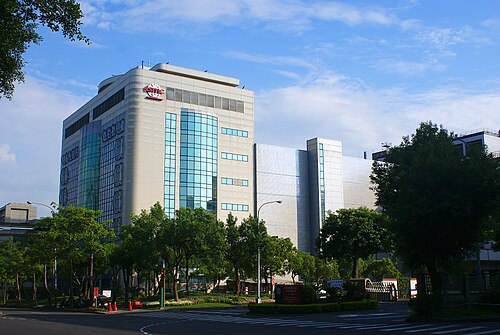
↑"TSMC expansion pushes Taiwanese working in U.S. to record high". Focus Taiwan. 19 November 2025.
↑Feigenbaum, Evan A. (2020). "Historical Context of Taiwan's Technological Success". Assuring Taiwan's Innovation Future. Carnegie Endowment for International Peace. pp.5–9.
↑How Taiwan Created TSMC, 6 December 2020, retrieved 23 May 2022
↑Mak, Robyn (17 December 2021). "Breakingviews – TSMC can fix Taiwan's stalled green transition". Reuters. Retrieved 20 June 2022.
↑"TSMC (TSM) – Market capitalization". companiesmarketcap.com. Retrieved 20 May 2022.
↑"TSMC Announces Intention to Build and Operate an Advanced Semiconductor Fab in the United States". Taiwan Semiconductor Manufacturing Company Limited. 15 May 2020. Retrieved 23 May 2022.
↑LaPedus, Mark (9 September 2009). "GlobalFoundries to give UMC a run for its money". EETimes. Retrieved 22 May 2022.
↑"What is Foxconn? Only the world's No. 1 contract electronics maker". Chicago Tribune. 27 July 2017. Retrieved 27 May 2022.
↑Bengtsen, Peter (1 February 2025). "The bicycle industry's dirty secret". Le Monde diplomatique. Retrieved 16 March 2025.
↑Van Schaik, Jan-Willem (13 February 2025). "法媒《世界外交》描繪台灣自行車行業黑暗面". Bike Europe.
↑交通部統計查詢網. stat.motc.gov.tw (in Chinese). Archived from the original on 5 March 2016. Retrieved 6 May 2019.
↑"2018 Annual Report of the Maritime and Port Bureau, MOTC"(PDF) (in Chinese). Maritime and Port Bureau, MOTC. p.33. Archived from the original(PDF) on 4 October 2022. Retrieved 5 October 2022.
↑"Port throughput soars to record". Taipei Times. Central News Agency. 15 February 2022. Retrieved 5 October 2022.
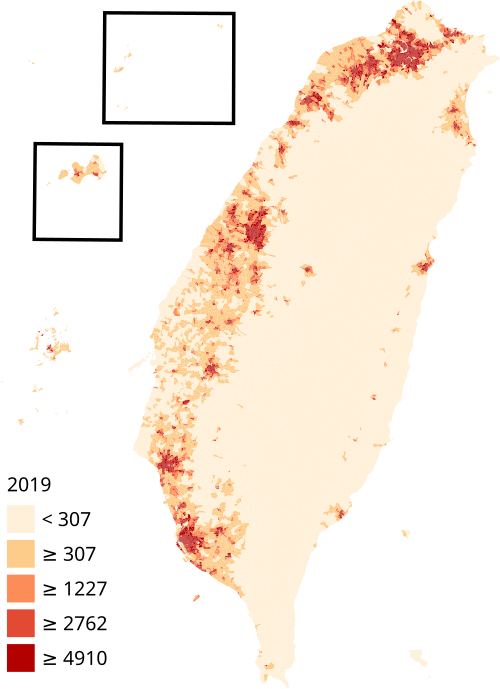
↑"Statistics Table 6. Population Density and Total Area for Counties and Cities". Dept. of Household Registration, Ministry of the Interior. May 2018. Retrieved 5 February 2026.
↑"Taiwan's birth rate is now the lowest in the world". liveaction.org. 21 January 2026. Retrieved 24 May 2026.
↑"Taiwan's population shrinks for 28 consecutive months". rti.org.tw. 8 May 2026. Retrieved 24 May 2026.
↑"Why Taiwan could run out of workers in just two decades". tvbs.com. 27 March 2026. Retrieved 24 May 2026.
↑"PEOPLE". Government Portal of the Republic of China (Taiwan). 21 February 2024. Retrieved 21 February 2024.
↑Yan, Margaret Mian (2006). Introduction to Chinese Dialectology. LINCOM Europa. p.169. ISBN978-3-89586-629-6.
↑Lo, Yun-Hua (2021). "Detecting Genetic Ancestry and Adaptation in the Taiwanese Han People". Molecular Biology and Evolution. 38 (10): 4149–4165. doi:10.1093/molbev/msaa276. PMC8476137. PMID33170928. Retrieved 18 October 2022. Consequently, our results showed that the ISEA ancestry in the Taiwanese Han was the outcome of population mixtures rather than shared ancestry, and the admixture event likely occurred before the Taiwanese Han ancestors migrated to Taiwan (fig. 2A). If the admixture occurred only after the Han people migrated to Taiwan, then the observed results would only be seen in the Taiwanese Han. However, similar F3 outcomes were found in the Chinese Han (supplementary fig. S2, Supplementary Material online), supporting that admixture occurred prior to migration to Taiwan. Moreover, signatures of population admixture were also detected between the ancestors of Taiwanese Han and the Ami Austronesian-speaking population using the F4 test; significant positive F4 values were observed when most Sino-Tibetan speaking populations were individually included in the analysis, except for the Chinese Singapore and Chinese Cantonese (table 1). These two populations appear to be genetically closest to the Taiwanese Han among all other Sino-Tibetan speaking populations (fig. 1B), which is consistent with the hypothesis of population mixture before the ancestors of Taiwanese Han migrated to Taiwan.
↑Liu, Ting-Yuan; Lu, Hsing-Fang; Chen, Yu-Chia; etal. (2025). "Diversity and longitudinal records: Genetic architecture of disease associations and polygenic risk in the Taiwanese Han population". Science Advances. 11 (23) eadt0539. Bibcode:2025SciA...11..539L. doi:10.1126/sciadv.adt0539. PMC12136033. PMID40465716.
↑Lin, Marie; Trejaut, Jean A. (2023). "Diversity and distribution of mitochondrial DNA in non-Austronesian-speaking Taiwanese individuals". Human Genome Variation. 10 (2): 2. doi:10.1038/s41439-022-00228-3. PMC9849472. PMID36653363.
↑"原住民人口數統計資料". Council of Indigenous Peoples (in Chinese). 20 December 2010. Retrieved 31 January 2023.
↑"Indigenous People". MOI Statistical Information Service. February 2012. Archived from the original on 20 June 2017. Retrieved 14 April 2012.
↑"An Overview of Taiwan's Indigenous Groups". Government Information Office. 2006. Archived from the original on 11 April 2012. Retrieved 14 April 2012.
↑Juan, Shao-Chiu; Awerbuch-Friedlander, Tamara; Levins, Richard (3 October 2016). "Ethnic density and mortality: aboriginal population health in Taiwan". Public Health Reviews. 37 11. doi:10.1186/s40985-016-0028-1. PMC5810052. PMID29450053.
123"Chapter 2: People and Language"(PDF). The Republic of China Yearbook 2011. Government Information Office, Republic of China (Taiwan). Archived from the original(PDF) on 14 May 2012.
↑"Official documents issued in Aboriginal languages". Taipei Times. Retrieved 20 July 2017.
↑Zeitoun, Elizabeth; Yu, Ching-Hua. "The Formosan Language Archive: Linguistic Analysis and Language Processing"(PDF). Computational Linguistics and Chinese Language Processing. 10 (2): 168. Archived from the original(PDF) on 20 July 2011. Retrieved 4 August 2012.
↑Tsao, Feng-fu (2000). "The language planning situation in Taiwan". In Baldauf, Richard B.; Kaplan, Robert B. (eds.). Language planning in Nepal, Taiwan, and Sweden. Vol.115. Multilingual Matters. pp.60–106. ISBN978-1-85359-483-0. pages 75–76.
↑Cheong, Ching (2001). Will Taiwan break away: the rise of Taiwanese nationalism. World Scientific. p.187. ISBN978-981-02-4486-6.
↑"法律統一用語表-常見公文用語說明"(PDF) (in Chinese). Archived from the original(PDF) on 2 June 2021. Retrieved 2 June 2021.
↑"《法律白話文運動》掀起一場法律革命" (in Chinese). 4 February 2018. Retrieved 9 July 2021.
↑"Taiwan to host regional religious freedom forum". Taipei Times. 18 November 2020. Retrieved 28 February 2023.
↑"Freedom of religion, Scale". World Bank. 2020. Archived from the original on 28 March 2023. Retrieved 19 March 2023.
↑"Taiwan Yearbook 2006". Government of Information Office. 2006. Archived from the original on 8 July 2007. Retrieved 1 September 2007.
↑Stainton, Michael (2002). "Presbyterians and the Aboriginal Revitalization Movement in Taiwan". Cultural Survival Quarterly 26.2, 5 May 2010. Retrieved 3 December 2014.
↑Athena Tacet (31 December 2014). "Islam in Taiwan: Lost in tradition". Al Jazeera.
12"表23各宗教教務概況" (in Chinese). Retrieved 2 June 2021.
↑Steven Crook (15 May 2020). "Highways and Byways: Bastions of the Unity Sect". Taipei Times. Retrieved 16 May 2024. Few countries can match Taiwan's density of religions and religious buildings.
↑Michelle Yun (25 August 2018). "Dragons and steamed buns at Taiwan's temple-like church". The Jakarta Post. Agence France-Presse. Retrieved 16 May 2024. Taiwan embraces freedom of religion and has one of the highest densities of temples in the world, with close to 70 percent of the population believers in Taoism, Buddhism, and Chinese folk traditions.
↑Scott Morgan (1 November 2018). "Taiwan highly-ranked as good place to live as an atheist: report". Taiwan News. Retrieved 28 February 2023.
↑Halpin, Hayley (28 October 2018). "These are the best and worst countries in the world to be an atheist". journal.ie. Retrieved 2 November 2018.
↑Sampurna, Rizki Hegia (31 December 2019). "Accommodating Religious Practices in the Workplace: The Case of Indonesian Workers in Taiwan". Society. 7 (2). University of Bangka Belitung: 159–172. doi:10.33019/society.v7i2.93. S2CID214260850.
↑"QS World University Rankings – 2023". QS Quacquarelli Symonds Limited. Retrieved 27 October 2022.
↑Chou, Chuing Prudence (2014). "A matter of trust: shadow education in Taiwan". Revue Internationale d'Éducation de Sèvres. doi:10.4000/ries.3800.
12"Fears over over-education in Taiwan". The Australian. 3 September 2012.
12Chou, Chuing (12 November 2014). "Education in Taiwan: Taiwan's Colleges and Universities".
↑Wiese, Elizabeth (7 May 2015). "Taiwan's problem? Too many college graduates, too few machinists". USA Today. Retrieved 19 August 2019.
12Hsueh, Chia-Ming (5 August 2018). "Higher Education Crisis in Taiwan". Inside Higher Ed. Retrieved 19 August 2019.
12Sechiyama, Kaku (2013). Patriarchy in East Asia: A Comparative Sociology of Gender. Brill Publishers. p.254. ISBN978-90-04-23060-6.
↑"5 mil. Taiwanese hold degrees from higher education institutions". China Post. 13 March 2016. Archived from the original on 19 March 2022. Retrieved 19 August 2019.
↑Lee, Pearl (13 April 2015). "University degrees: Mindset shift needed". asiaone.com. The Straits Times. Archived from the original on 18 January 2017. Retrieved 15 January 2017.
↑"Taiwan's higher education enrolment starts a downward slide". ICEF Monitor. 16 August 2016.
↑Sui, Cindy (23 September 2013). "The draw of blue collar jobs in Taiwan". BBC News.
↑Taiwan Country: Strategic Information and Developments. International Business Publications. 2012. p.25. ISBN978-1-4387-7570-8.
↑"Over 70% of Taiwanese parents send kids to English bushibans". Invest in Taiwan, Department of Investment Services. 2 September 2005. Archived from the original on 8 June 2008. Retrieved 28 May 2009.
↑C. Smith, Douglas (1997). Middle education in the Middle Kingdom. Greenwood Publishing Group. p.119. ISBN978-0-275-95641-7.
↑Ihara, Kensaku (3 December 2020). "Taiwan loses 3,000 chip engineers to 'Made in China 2025'". Nikkei Asia. Retrieved 11 November 2020.
↑Kyng, James (4 December 2020). "Taiwan's brain drain: semiconductor engineers head to China". ft.com. The Financial Times. Archived from the original on 10 December 2022. Retrieved 11 November 2020.
↑Strong, Matthew (1 October 2020). "Taiwan's 'Godfather of DRAM' leaves China". taiwannews.com. Retrieved 11 November 2020.
↑國人教育水準. gender.ey.gov.tw (in Chinese). Retrieved 3 October 2021.
↑Fanchiang, Cecilia."New IC health insurance card expected to offer many benefits"Archived 6 June 2008 at the Wayback Machine, Taiwan Journal, 2 January 2004 Accessed 28 March 2008
↑"Premium Contribution". National Health Insurance Administration. October 2016. Archived from the original on 7 August 2022. Retrieved 7 August 2022.
↑衛生福利部中央健康保險署 (October 2016). "How Premiums Are Calculated". National Health Insurance Administration. Archived from the original on 7 August 2022. Retrieved 7 August 2022.
↑衛生福利部中央健康保險署 (October 2016). "Copayments". National Health Insurance Administration. Archived from the original on 7 August 2022. Retrieved 7 August 2022.
↑"Taiwanese Hospital Public Satisfaction Poll" (in Chinese). Taiwan Department of Health. October 2004. Archived from the original on 21 September 2009.
↑"Center for Disease Control". Taiwan CDC. 18 July 2006. Archived from the original on 7 August 2016.
↑"Statistics of Medical Care Institution's Status & Hospital Utilization 2019". 17 July 2020.
↑"Infant mortality rate". Archived from the original on 17 August 2020. Retrieved 16 August 2020.
↑Hunt, Katie (13 January 2016). "Meet Freddy Lim, the death metal star running for political office in Taiwan". CNN.
↑McVeigh, Tracy (26 December 2015). "Taiwan's heavy metal star rallies fans to run for parliament on anti-China platform". The Observer– via The Guardian.
↑"Museum". MSN Encarta. Archived from the original on 28 October 2009.
↑"KTV: A Space for Sharing". taiwantoday.tw. 1 June 2011.
↑American Chamber of Commerce in Taipei. "Convenience Stores Aim at Differentiation". Taiwan Business Topics. 34 (11). Archived from the original on 16 May 2008.
↑"FamilyMart rolls out laundry service in Taiwan". Taiwan News. 24 January 2019.
↑"TRA tickets collectable at stores". taipeitimes.com. 5 December 2011.
↑"台灣高鐵 Taiwan High Speed Rail". en.thsrc.com.tw. Retrieved 5 April 2021.
↑Nguyen-Okwu, Leslie (6 March 2019). "16 Dishes That Define Taiwanese Food". Eater. Archived from the original on 13 April 2020.
↑Wong, Maggie Hiufu (29 April 2020). "The rise of bubble tea, one of Taiwan's most beloved beverages". CNN.
↑Gillan, Audrey (17 May 2014). "Taiwan, home to the best street food markets in the world". The Guardian. Archived from the original on 16 May 2020.
↑Sontag, Elazar (25 August 2020). "Michelin Announces 2020 Stars for Taiwan". Eater. Archived from the original on 26 September 2020.
↑Hwang, Dong-Jhy; Chiu, Wei-Cheng (October 2010). "Sport and National Identity in Taiwan: Some Preliminary Thoughts"(PDF). East Asian Sport Thoughts. Vol.1. Archived from the original(PDF) on 20 June 2022. Retrieved 20 June 2022.
↑藍, 宗標 (13 November 2022). "五人制世界盃奪下季軍 各級中華隊都進前3創紀錄". 聯合新聞網 (in Chinese). 聯合線上公司.
↑"Taiwan in Time: The beleaguered big league". Taipei Times. 13 March 2022.
↑"Field of dreams". Focus Taiwan. 11 October 2025. Retrieved 5 February 2026.
↑"Players by birthplace: Taiwan Baseball Stats and Info". baseball-reference.com. Retrieved 5 February 2026.
↑Yen, William (14 July 2022). "Taiwan women bag World Games softball bronze". Focus Taiwan. Retrieved 1 January 2023.
↑Wang, Audrey (1 June 2008). "A Passion for Hoops". The Taiwan Review. Archived from the original on 15 February 2012. Retrieved 8 April 2012.
↑"TPBL 2024–25 season to tip off Oct. 19". Focus Taiwan. 19 October 2024. Retrieved 18 November 2024.
↑"SBL to tip off tomorrow for men's, women's teams". Taipei Times. 6 January 2023.
↑"Netherlands Retains World Youth Korfball Champion; Taiwan is on the Way to the World". Reuters Newswire. 8 November 2008. Archived from the original on 3 February 2012.
↑Lee, Vito; Chuang, Kung-ju (April 2011). "Fighting Adversity:Taiwan's Taekwondo Community Looks to Innovate". Taiwan Panorama. Translated by Williams, Scott. Archived from the original on 28 March 2023. Retrieved 20 June 2022.
↑Goh, ZK. "Meet Tai Tzu-ying, Chinese Taipei's Badminton Star". Who is Tai Tzu-ying. Olympic Channel Services S.L. Retrieved 29 July 2020.
↑"BWF World Rankings". Rankings. Badminton World Federation. Retrieved 29 July 2020.
↑"Participations by athlete". olympedia.org. Retrieved 20 June 2022.
↑"At Only 22, Tseng Wins Fifth Major". The New York Times. Associated Press. 1 August 2011.
↑"Stacy Lewis wins, now No. 1 in world". ESPN. Associated Press. 17 March 2013.
↑"Su-Wei Hsieh". wtatennis.com. Retrieved 21 June 2022.
↑"Hsieh & Peng: Co-Doubles No.1s". WTA. 10 May 2014.
↑Chen, Christie (30 August 2017). "UNIVERSIADE: Foreign athletes praise Taipei's efforts as host city". Focus Taiwan. Archived from the original on 25 May 2018.
↑王, 燕華 (17 July 2024). "申辦成功!花蓮取得2026國際少年運動會主辦權 各國選手將齊聚". udn.com. Retrieved 18 July 2024.
↑"National symbols". president.gov.tw. Taiwan: Office of the President. Archived from the original on 9 December 2025. Retrieved 31 December 2025.
↑"Chinese (Traditional Han, Taiwan) (zh-Hant-TW)". IBM Knowledge Center. Retrieved 8 May 2019.
↑"Holidays and Festivals in Taiwan". Government Information Office, ROC. Archived from the original on 9 October 2009. Retrieved 28 May 2009.
Works cited
Andrade, Tonio (2008). How Taiwan Became Chinese. Gutenberg-e E-book. Columbia University Press. ISBN978-0-231-50368-6.
Bird, Michael I; Hope, Geoffrey; Taylor, David (2004). "Populating PEP II: the dispersal of humans and agriculture through Austral-Asia and Oceania"(PDF). Quaternary International. 118–119: 145–163. Bibcode:2004QuInt.118..145B. doi:10.1016/s1040-6182(03)00135-6. Archived from the original(PDF) on 12 February 2014.
Chang, Mau-kuei (2003). On the Origins and Transformation of Taiwanese National Identity.
Chang, Maukuei (2005). "The Movement to Indigenize to Social Sciences in Taiwan: Origin and Predicaments". In Makeham, John; Hsiau, A-chin (eds.). Cultural, Ethnic, and Political Nationalism in Contemporary Taiwan: Bentuhua. Palgrave Macmillan. ISBN978-1-4039-7020-6.
Davidson, James W. (1903). The Island of Formosa, Past and Present: history, people, resources, and commercial prospects: tea, camphor, sugar, gold, coal, sulphur, economical plants, and other productions. Macmillan. OL6931635M.
DoIT (2008). "2008 White Paper on Taiwan Industrial Technology"(PDF). Department of Industrial Technology. Archived from the original(PDF) on 29 April 2011.
Exec. Yuan (2014). The Republic of China Yearbook 2014(PDF). Executive Yuan, R.O.C. ISBN978-986-04-2302-0.
Fenby, Jonathan (2009). The Penguin History of Modern China: The Fall and Rise of a Great Power, 1850–2009. Penguin Books. ISBN978-0-7139-9832-0.
Fung, Edmund S. K. (2000). In search of Chinese democracy: civil opposition in Nationalist China, 1929–1949. Cambridge modern China series. Cambridge University Press. ISBN978-0-521-77124-5.
Gold, Thomas B. (1985). State and Society in the Taiwan Miracle. M.E. Sharpe. ISBN978-1-317-45940-8.
Gordon, Leonard H.D. (2007), Confrontation Over Taiwan, Lexington Books
Hill, Catherine; Soares, Pedro; Mormina, Maru; Macaulay, Vincent; Clarke, Dougie; Blumbach, Petya B.; Vizuete-Forster, Matthieu; Forster, Peter; Bulbeck, David; Oppenheimer, Stephen; Richards, Martin (January 2007). "A Mitochondrial Stratigraphy for Island Southeast Asia". The American Journal of Human Genetics. 80 (1): 29–43. Bibcode:2007AmJHG..80...29H. doi:10.1086/510412. PMC1876738. PMID17160892.
Hsiau, A-Chin (2005). "The Indigenization of Taiwanese Literature: Historical Narrative, Strategic Essentialism, and State Violence". In Makeham, John; Hsiau, A-chin (eds.). Cultural, Ethnic, and Political Nationalism in Contemporary Taiwan: Bentuhua. Palgrave Macmillan. ISBN978-1-4039-7020-6.
Hsu, Wen-hsiung (1980). "From Aboriginal Island to Chinese Frontier: The Development of Taiwan before 1683". In Knapp, Ronald G. (ed.). China's Island Frontier: Studies in the Historical Geography of Taiwan. The University of Hawaii. pp.3–28. hdl:10125/62865. ISBN978-0-8248-8005-7.
Jiao, Tianlong (2007). The Neolithic of southeast China: cultural transformation and regional interaction on the coast. Cambria Press. ISBN978-1-934043-16-5.
Li, Xiaobing (2019). The history of Taiwan. Greenwood.
Liu, Yingsheng (2012). The Taiwan Strait between the Twelfth and Sixteenth Centuries and the Maritime Route to Luzon. Harrassowitz Verlag.
Makeham, John (2005). "Indigenization Discourse in Taiwanese Confucian Revivalism". In Makeham, John; Hsiau, A-chin (eds.). Cultural, Ethnic, and Political Nationalism in Contemporary Taiwan: Bentuhua. Palgrave Macmillan. ISBN978-1-4039-7020-6.
Makinen, Gail E.; Woodward, G. Thomas (1989). "The Taiwanese hyperinflation and stabilization of 1945–1952". Journal of Money, Credit and Banking. 21 (1): 90–105. doi:10.2307/1992580. JSTOR1992580.
Rubinstein, Murray A. (1999). Taiwan: A New History. East Gate Books.
Thompson, Lawrence G. (1964). "The earliest eyewitness accounts of the Formosan aborigines". Monumenta Serica. 23: 163–204. doi:10.1080/02549948.1964.11731044. JSTOR40726116.
Twitchett, Denis (2002). The Cambridge History of China 9 Volume 1.
Valentijn, François (1992) [1903]. "History of the Dutch Trade". In Campbell, William (ed.). Formosa under the Dutch: described from contemporary records, with explanatory notes and a bibliography of the island. Kegan Paul. pp.25–75. ISBN978-957-638-083-9. OCLC644323041. First published 1724 in Oud en Nieuw Oost-Indiën
Wang, Gabe T. (2006). China and the Taiwan Issue: Impending War at Taiwan Strait. University Press of America.
Wills, John E. Jr. (2006). "The Seventeenth-century Transformation: Taiwan under the Dutch and the Cheng Regime". In Rubinstein, Murray A. (ed.). Taiwan: A New History (expandeded.). M.E. Sharpe. pp.84–106. ISBN978-0-7656-1495-7.
Winckler, Edwin (1994). Harrell, Stevan; Huang, Chun-chieh (eds.). Cultural Policy in Postwar Taiwan. Cultural Change in Postwar Taiwan (10–14 April 1991; Seattle). Westview Press. ISBN978-0-8133-8632-4.
Wong, Young-tsu (2017). China's Conquest of Taiwan in the Seventeenth Century: Victory at Full Moon. Springer.
Wong, Tin (2022). Approaching Sovereignty over the Diaoyu Islands. Springer.
Ye, Ruiping (2019). The Colonisation and Settlement of Taiwan. Routledge.
Yip, June (2004). Envisioning Taiwan: Fiction, Cinema and the Nation in the Cultural Imaginary. Duke University Press. ISBN978-0-8223-3357-9.
Ballantine, Joseph (1952). Formosa: A Problem for United States Foreign Policy. The Brookings Institution.
United States (1949). United States relations with China, with special reference to the period 1944–1949, based on the files of the Department of State. U.S. Government Printing Office.
Hsü, Immanuel Chung-yueh (1982). China Without Mao: The Search for a New Order. Oxford University Press.
Zhang, Yufa (1998). Zhonghua Minguo shigao中華民國史稿. Lian jing (聯經). ISBN957-08-1826-3.
Further reading
"Taiwan Flashpoint". BBC News. 2005.
Bush, R.; O'Hanlon, M. (2007). A War Like No Other: The Truth About China's Challenge to America. Wiley. ISBN978-0-471-98677-5.
Bush, R. (2006). Untying the Knot: Making Peace in the Taiwan Strait. Brookings Institution Press. ISBN978-0-8157-1290-9.
Carpenter, T. (2006). America's Coming War with China: A Collision Course over Taiwan. Palgrave Macmillan. ISBN978-1-4039-6841-8.
Clark, Cal; Tan, Alexander C. (2012). Taiwan's Political Economy: Meeting Challenges, Pursuing Progress. Lynne Rienner Publishers. ISBN978-1-58826-806-8.
Cole, B. (2006). Taiwan's Security: History and Prospects. Routledge. ISBN978-0-415-36581-9.
Copper, John Franklin (2019). Taiwan: Nation-state or province?. Routledge.
Copper, J. (2006). Playing with Fire: The Looming War with China over Taiwan. Praeger Security International General Interest. ISBN978-0-275-98888-3.
Copper, John F, ed. (1993). Historical dictionary of Taiwan. Scarecrow Press. ISBN978-0-8108-2608-3.
Federation of American Scientists; etal. (2006). "Chinese Nuclear Forces and US Nuclear War Planning"(PDF). Archived from the original(PDF) on 3 August 2019. Retrieved 2 July 2015.
Feuerwerker, Albert (1968). The Chinese Economy, 1912–1949. University of Michigan Press.
Fravel, M. Taylor (2002). "Towards Civilian Supremacy: Civil-military Relations in Taiwan's Democratization". Armed Forces & Society. 29 (1): 57–84. doi:10.1177/0095327x0202900104. S2CID146212666.
Horton, Chris (2025). Ghost Nation: The Story of Taiwan and Its Struggle for Survival. Macmillan.
Kuo, Shirley W.Y.; Ranis, Gustav (2020). The Taiwan Success Story: Rapid Growith With Improved Distribution In The Republic Of China, 1952–1979. Routledge.
Lasater, Martin L. (2019). The Taiwan Issue in Sino-American Strategic Relations. Routledge.
Selby, Burnard (March 1955). "Formosa: The Historical Background". History Today. 5 (3): 186–194.
Shirk, S. (2007). China: Fragile Superpower: How China's Internal Politics Could Derail Its Peaceful Rise. Oxford University Press. ISBN978-0-19-530609-5.
Tinn, Honghong (2025). Island Tinkerers: Innovation and Transformation in the Making of Taiwan's Computing Industry. MIT Press. ISBN9780262380270.
Tsang, S. (2006). If China Attacks Taiwan: Military Strategy, Politics and Economics. Routledge. ISBN978-0-415-40785-4.
Tucker, N.B. (2005). Dangerous Strait: the US-Taiwan-China Crisis. Columbia University Press. ISBN978-0-231-13564-1.















 Wikimedia Atlas of Taiwan


