
Loading article…


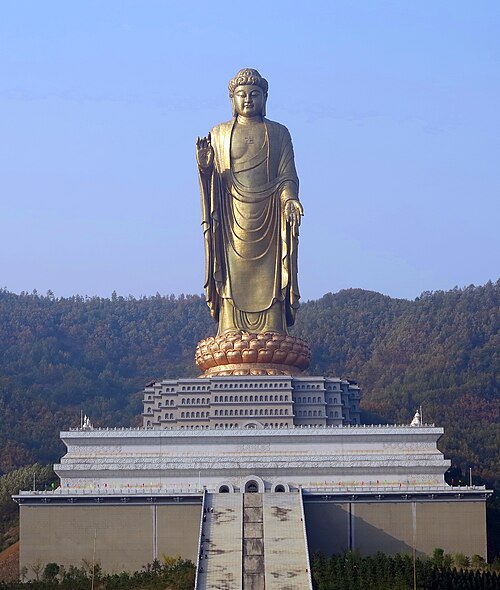

中国の宗教は多様であり、ほとんどの中国人は無宗教であるか、仏教と道教を儒教の世界観と組み合わせた宗教を実践しており、これらは総称して中国の民間宗教と呼ばれています。[1]
中華人民共和国は公式には無神論国家であるが[4]、政府は仏教、道教、キリスト教(カトリックとプロテスタントは別々に認められている)、イスラム教の5つの宗教を正式に認めている。[5]中国共産党の指導を堅持し、習近平思想を実践し、宗教の中国化を推進することが国内のすべての宗教機関に求められている。[6]
概要
中国文明は歴史的に見て、世界で最も永続的な様々な宗教哲学的伝統の発祥地であり、そのホストとなってきた。儒教と道教は、後に仏教と合流し、中国文化を形成した「三つの教え」を構成している。これらの絡み合った宗教体系の間には明確な境界はなく、排他性を主張することもなく、それぞれの要素が民間の宗教を豊かにしている。中国の皇帝は天命を主張し、中国の宗教的慣習に参加した。20世紀初頭、改革志向の官僚や知識人は、宗教全般を迷信的であると攻撃した。1949年以来、公式には無神論国である中国共産党(CCP)が国内で権力を握っており、CCPメンバーが在職中に宗教を実践することを禁じている。[7] 19世紀後半に始まった一連の反宗教運動は、古い習慣、古い考え、古い慣習、古い文化という「四旧」に対する文化大革命(1966年~1976年)で最高潮に達した。文化大革命は多くの儀式や宗教団体を破壊したり、地下に潜らせたりした。[8] [9] : 138 毛沢東の死後、その後の指導者たちは中国の宗教団体にさらなる自治権を与えた。
中国の民間宗教は、同国で最も広く普及している信仰と慣習の体系であり、少なくとも紀元前2千年紀の商王朝と周王朝の時代から発展し、適応してきた。中国の神学と宇宙論の基本的要素はこの時代に遡り、枢軸時代にはより精巧になった。一般的に、中国の民間宗教には、様々な神や仙人を含む神(「精霊」)への忠誠が含まれる。これらは、環境に属する自然の神々、または人類集団の古代の祖先、礼儀の概念、または文化的英雄であり、その多くは中国の歴史と神話を通じて取り上げられている。[10]後周の時代には、孔子の哲学と儀式の教えが中国全土に広がり始め、漢王朝までに道教の制度が発達した。唐の時代には中国で仏教が広く普及し、[11]儒教思想家たちはそれに応えて新儒教哲学を展開した。中国の救済宗教や地方のカルトが繁栄した。
キリスト教とイスラム教は7世紀に中国に伝来した。キリスト教は16世紀にイエズス会の宣教師によって再導入されるまでは定着しなかった。[12] 20世紀初頭には、キリスト教コミュニティが成長した。しかし、1949年以降、外国人宣教師は追放され、教会は政府の管理下に置かれるようになった。1970年代後半以降、キリスト教徒の宗教の自由は改善され、新しい中国人グループが出現した。[13] : 508, 532 イスラム教は1,400年にわたって中国社会で実践されてきた。[14]イスラム教徒は中国の少数民族であり、最新の推計によると、総人口の0.45%から1.8%を占める。[2] [15]回族が最も数が多いサブグループであるが、 [16]イスラム教徒が最も集中しているのは新疆ウイグル自治区で、そこには相当数のウイグル族の人口がいる。中国は人道主義と世俗主義の本拠地とも考えられており、これらの思想は孔子の時代にこの地域に定着し始めました。
多くの漢民族は、自分たちの精神的な信仰や実践を「宗教」とは考えておらず、他のものを排除してそのどれか一つを実践しなければならないとは感じていないため、明確で信頼できる統計を集めることは難しい。ある学者によると、「中国の人口の大多数」は、いかなる宗教機関にも属さずに、宗教(太陰暦の儀式や祭り)に参加している。[17] 21世紀初頭に実施された全国調査では、中国人口の約80%が何らかの形の民間宗教を実践しており、その総数は10億人を超えると推定されている。人口の13~16%が仏教徒、10%が道教徒、2.53%がキリスト教徒、0.83%がイスラム教徒である。民間救済運動には、人口の2~13%が関与している。知識階級の多くは、宗教的アイデンティティとして儒教を信奉している。中国の少数民族の中には、チベット仏教や、回族とウイグル族のイスラム教など、特定の宗教を信仰している者もいる。
アメリカの中国学者で歴史家のジョン・キング・フェアバンクによると、中国の生態系は同国の宗教的景観に影響を与えた可能性がある。フェアバンクは、同国の河川氾濫原の気候によって生じた課題が人々の間に不安を助長し、それがキリスト教の人間中心主義とは対照的に、仏教のような比較的非人格的な宗教的信条への傾向につながった可能性があると示唆している。[18]
歴史
帝国以前


東アジアに世界宗教が広まる以前は、地元の部族はアニミズム、シャーマニズム、トーテム的な世界観を共有していました。シャーマンは祈り、犠牲、供物を霊界に直接仲介しました。この遺産は中国全土のさまざまな現代の宗教に残っています。[22]これらの特徴は特に紅山文化などの文化に関連しています。[23]
フランドルの哲学者ウルリッヒ・リブブレヒトは、道教のいくつかの特徴の起源を、ヤン・ヤコブ・マリア・デ・グロートが「武教」と呼んだもの、つまり中国のシャーマニズムに求めています。[25]リブブレヒトは、中国神学の発展における2つの層を区別しています。それぞれ、商王朝(紀元前1600-1046年)と周王朝(紀元前1046-256年)に由来しています。商の国教は、死後も目に見えない力として生き続ける祖先と神王の崇拝に基づいていました。彼らは超越的な存在ではありませんでした。なぜなら、宇宙は「それ自体でそうなっている」ためであり、外部の力によって作られたのではなく、内部のリズムと宇宙の力によって生成されたからです。後の周王朝は、世界観がより農業的であり、代わりに天と呼ばれる天国の普遍的な概念を強調しました。[25]商が商帝を祖神とみなすことで、神からの権威を主張したが、周はこの主張を道徳的な力、すなわち天命に基づく正当性に変えた。周の王たちは、商に対する勝利は自分たちが高潔で民を愛していたからであり、商は暴君であったため天によって権力を奪われたと宣言した。[26]
紀元前6世紀までに、神権はもはや周王家の独占的特権ではなくなった。天の修辞的権力は「拡散」し、周の国々のさまざまな君主が政治的野心を正当化するために主張したが、天の権威にアクセスするために必要な複雑な儀式や新旧の儀式を行うことができる人なら誰でもそれを買うことができた。人々はもはや公式の伝統を天と交信する効果的な方法とは考えていなかった。「九野」と易経の伝統が栄えた。[27]その後、中国の思想家たちは「百家思想」に分かれ、それぞれが周の道徳秩序を再構築するための独自の理論を提唱した。この退廃と疑問の時代に孔子が登場した。彼は商周神学の教育を受け、彼の新しい定式化は、自己修養、人間の行為、[26]および他者の自己確立を支援する自立した個人の教育力に重点を置いた。[28]周が崩壊すると、伝統的な価値観は放棄された。天に近づくための儀式が広く俗化していることに幻滅した孔子は、伝統的な周の宗教の倫理的解釈を説き始めた。孔子の見解では、天の力は内在的であり、社会政治的調和を回復するために必要な基盤として孔子が考えていた人道、正義、礼儀、利他主義の資質によって動かされる誠実な心に積極的に反応する。彼はまた、儀式行為に従事するには事前に瞑想状態が必要であると考えた。[29]孔子は、帝国以前の時代から受け継がれた古典を修正して再体系化し、『春秋』を編纂した。[30]
秦と漢
短命だった秦王朝は法家を国家イデオロギーとして選び、他のすべての学派を禁止し、迫害した。儒教は厳しく弾圧され、儒教の古典は焚書され、儒教を信奉する学者は殺害された。[31] [32]秦の国家儀式は、次の漢王朝のものと似ていた。[33]始皇帝は、夏の前から最高神を崇拝する場所であった泰山と首都咸陽郊外で、狄への供物を自ら行った。[34] [35]秦の皇帝はまた、以前は別々の場所で行われていた五つの神の崇拝を、統一された寺院群に集中させた。[36]漢の普遍的な宗教は、五方上帝の中心人物である黄帝としての神の化身という考えに焦点を当てていた。神の化身という考えは目新しいものではなく、商の王朝も自分たちを神とみなしていた。これらの発展に加えて、後漢王朝は、国家の正統性の外での道教の出現、土着の千年王国の宗教運動の勃興、仏教の導入など、新しい宗教現象によって特徴づけられた。漢王朝では、神話上の黄帝は太夷の輝きによって妊娠した処女の扶宝によって身ごもったと理解されていた。
漢の武帝は天人相做の教義を定式化し、[37]著名な方氏について論じたが、国教の外では黄神が黄老宗教運動の中心となり、原始道教に影響を与えた。[38]武帝の儒教への転向以前とそれ以降、前漢と後漢では黄老が様々な皇帝の下で国教となり、老子が黄帝とみなされ皇帝からの犠牲が捧げられた。[39]東漢は内部の不安定さと帝国の外縁からの非中国人による脅威に苦しんだ。このような厳しい状況の中で、皇帝崇拝が宇宙の神々への犠牲を捧げ続ける一方で、国教の合理主義から疎外された一般の人々は、啓蒙された師匠や、土着のアイデンティティをよりよく表す、国、地域、地方の神々の、多かれ少なかれ放棄された崇拝を復活させ、存続させることに慰めを見出しました。漢の国教は、宇宙の神々を地域住民に関連付けることで「民族化」されました。[40]東漢末期までに、大衆宗教運動の最も古い記録は、東北地方で西王母が間もなく降臨するという信仰によって引き起こされた興奮を証明しています。エリート層の観点からは、この運動は、陰の過剰の特徴と見られる一連の異常な宇宙現象と関連していました。[41]
184年から205年の間に、中原の無安道は漢に対する黄巾の乱を組織した。 [42]その後、漢の国である蜀では道教の宗教運動が盛んになった。張秀という名のシャーマンが蜀の信者たちを率いて184年の反乱を起こしたことが知られている。191年、張秀は明らかに無関係の張魯とともに、軍人としてこの省に再び現れた。漢寧での軍事任務中、秀は戦闘で死亡した。143年から198年の間に、祖父の張道陵から始まり、張魯に至るまで、張家系は初期の天師教会を設立した。張は216年か217年に亡くなり、215年から219年の間に漢中の人々は徐々に北方に散らばり、天師の道教を帝国の他の地域に広めた。[43]
三国時代から唐時代まで
仏教は後漢の時代に伝来し、65年に初めて言及され、西域に住んでいた仏教徒、次にインド・ヨーロッパ人(主にトカラ人とサカ人)によってシルクロードを経由して中国に入りました。仏教は、漢王朝の崩壊後、政治的分裂の時期にのみ、中国本土で大きな影響力を持つようになりました。[37]仏教が国教になると、仏教論争では軽視されていた中国土着の宗教や道教運動と競合し始めました。[44]三国時代(220-280年)の最初の段階の後、中国は金によって部分的に統一されました。311年に洛陽が匈奴に陥落すると、宮廷と天のマスターの僧侶は南方へと移住しました。江南は「南方伝統」の天師道教の中心地となり、「一を守る」という瞑想法、つまり人間の有機体の中に統一神を視覚化する方法を発展させた。[45] : 3.2 江南の代表者たちは、天師道教の広がりに応えて、自らの伝統を再構築し、現在の南京で364年から370年の間に起こった啓示に基づく上清道教と、 397年から402年の間に啓示に基づき陸秀静によって再体系化された霊宝道教を生み出した。霊宝は仏教から「普遍救済」の考えを取り入れ、「天」をランク付けし、共同の儀式に焦点を当てた。[45] : 3.3
唐代には、天の概念が帝を犠牲にしてより一般的になり、漢代に始まった傾向が続いた。どちらも意味が広がり、帝は最高権力を指すのではなく、神の名前の接尾辞としてより頻繁に使用されるようになった。また、天は楽園としての「天国」の意味とより結び付けられるようになった。唐代における外国の宗教、特に仏教宗派の急増は、それぞれの宗派が独自の理想の「天国」を思い描くことを意味した。言語的には、「天」自体は「天国の」または「神聖な」を意味する複合名の接尾辞として使われるようになった。これは仏教の文脈でも同様であり、多くの寺院の名前にこの要素が含まれている。[46]仏教と道教はどちらも、形而上的(天上的)存在と物理的(地上的)存在を融合させた階層的な神々を発展させ、人間と神の境界を曖昧にし、神々と信者が互いに支え合うという宗教的信念を強化しました。[47]
人間と神の相互関係の原理は、社会の変化を反映した神々の集合の変化をもたらした。唐代後期には、都市の商業の中心地としての発展と商人階級の影響力の高まりと直接結びついて、都市神崇拝が広まった。商業旅行は中国を外国文化の影響を受けやすくした。[48]
近世
16世紀、イエズス会の中国宣教団は、中国と西洋の対話を始める上で重要な役割を果たした。イエズス会は西洋の科学を持ち込み、天文学に関して朝廷の顧問となり、数学と機械工学を教えたが、孔子への尊敬や祖先崇拝などの中国の宗教的考えを、中国で教える宗教的教義に取り入れた。 [13] : 384 満州人が率いる清朝は、孔子の教えを他のすべてに勝る文献の伝統として推進した。清朝は、それ以前のどの王朝よりも厳しく家父長制的な法律を作り、仏教と道教は格下げされた。それにもかかわらず、この時期にチベット仏教が中国で大きな存在感を持ち始め、西ではチベットの影響、北ではモンゴルと満州の影響が及んだ。[49]その後、太平天国の乱で多くの民間宗教寺院と組織宗教寺院が破壊された。[50]これは、清朝に対抗して中国南東部に独立国家を樹立したキリスト教運動によって組織された。キリスト教に影響を受けた太平天国では、中国の宗教を排除し、キリスト教の形態に置き換えるという公式政策がとられた。この取り組みにより、長江デルタの仏教寺院の図書館はほぼ完全に破壊された。[51]
19世紀末の義和団の乱は、キリスト教宣教師(義和団は彼らを「悪魔」と呼んだ)と西洋の植民地主義の影響に対する中国人土着の運動に触発されたものである。当時、中国は徐々に欧米列強に侵略されつつあり、1860年以降、キリスト教宣教師は建物を建てたり借りたりする権利を持ち、多くの寺院を占拠した。尖塔の高い教会や外国人のインフラ、工場、鉱山は風水を乱すものと見なされ、中国人にとって「非常に不快」なものだった。義和団の行動は、これらのインフラを妨害したり、完全に破壊することを目的としていた。[52]
20世紀から現在まで

中国は、満州族が率いる清朝の統治下で20世紀を迎えた。清朝の統治者は伝統的な中国の宗教を好み、公の宗教儀式に参加した。チベット仏教徒はダライ・ラマを精神的および世俗的な指導者と認めていた。人気のあるカルトは帝国の政策によって規制され、特定の神を推進する一方で他の神を抑圧した。[53]外国人およびキリスト教反対の義和団の乱の間、何千人もの中国人キリスト教徒と外国人宣教師が殺害されたが、報復侵攻の余波で、改革志向の中国人の多くがキリスト教に改宗した。[54] 1898年から1904年にかけて、政府は「寺院の財産で学校を建設する」という措置を出した。[55] : 3 [56]
辛亥革命後、新しい知識階級にとっての問題は、もはや帝国時代のように神々を崇拝することではなく、近代化の障害としての宗教そのものの非合法化であった。[56]新文化運動の指導者たちは儒教に反抗し、反キリスト教運動は キリスト教を外国帝国主義の道具として拒絶する運動の一環であった。[57]それにもかかわらず、中国の改革者たちの霊的・神秘的な事柄への関心は1940年代を通じて高まり続けた。[58]中華民国国民政府は、地元の宗教の弾圧を強化し、寺院を破壊または収用し、[59]禹大帝、関羽、孔子などの人間の英雄を除いて、すべての神々の崇拝を正式に廃止した。[60]孫文とその後継者の蒋介石はともにキリスト教徒であった。1937年から1945年にかけての日本軍による中国侵攻の間、多くの寺院が兵士の兵舎として使用され、戦争で破壊されました。[50] [61]
中華人民共和国は国家無神論政策をとっている。当初、新政府は宗教の実践を抑圧しなかったが、民衆の宗教運動は扇動的である可能性があるとみなした。政府は宗教組織を非難し、迷信的であるとレッテルを貼った。「適切」とみなされ自由を与えられた宗教は、統合された国家統治の祖先の伝統を伴うものであった。[62]さらに、マルクス主義は宗教を封建的なものとみなした。三自愛国運動はプロテスタント教会を公式組織として制度化した。カトリック教徒は国家統制とバチカンからの独立への動きに抵抗した。[63]文化大革命は宗教[50] [60]と新儒教を破壊するための組織的な取り組みを伴った。
この政策は1970年代後半にかなり緩和された。1978年以来、中華人民共和国憲法は信教の自由を保障している。1980年、中国共産党中央委員会は、宗教団体の全国会議を設立するという中央統一戦線工作部の要請を承認した。 [64] : 126–127 参加した宗教団体は、天主教愛国協会、中国イスラム協会、中国道教協会、三自愛国運動、中国仏教協会であった。[64] : 127 数十年にわたって、中国共産党は宗教の復興を黙認し、あるいは奨励さえしていた。1980年代、政府は、教師を装って入国する外国人宣教師に関して寛容な姿勢をとった。[65] : 41 同様に、改革開放以降、政府は民間宗教の慣習に対してより寛容になっている。[66] : 175–176 1999年以来、法輪功などの「異端の教え」は禁止され、実践者は迫害されてきたが、地方当局は他の宗教に対しては不干渉の政策をとる傾向にあった。
20世紀後半には、黄帝と紅帝を崇拝する国家カルトが再活性化した。[67] 2000年代初頭、中国政府は特に大乗仏教、道教、民間信仰などの伝統的な宗教に対してオープンになり、儒教的調和社会の構築における宗教の役割を強調した。[68] [69] [70]政府は中国文化を促進するために2004年に孔子学院を設立した。中国は、2006年の第1回世界仏教フォーラム、いくつかの国際道教会議、民間宗教に関する地方会議など、宗教会議や会議を主催した。中国の人類学者が「宗教文化」を重視することに合わせて、[55] : 5–7 政府はこれらを国家の「中国文化」の不可欠な表現と見なしている。[71]
2005年に転機が訪れ、無形文化遺産政策のもとで民間信仰が保護・推進され始めた。[55] : 9 数十年にわたって中断されていた伝統が再開されただけでなく、何世紀にもわたって忘れ去られていた儀式が再発明された。例えば、古代蜀の国の神である瞻聡への毎年の崇拝が、四川省の三星堆遺跡近くの儀式施設で再開された。[72]現代中国の政治指導者は、中国共通の神殿に神格化されている。[73]国際社会は、中国が法輪功学習者や、キリスト教徒、ウイグル族イスラム教徒などの他の宗教的少数派から臓器を摘出しているという疑惑を懸念している。[74] 2012年、習近平は伝統文化への回帰を通じて道徳的空虚と腐敗と闘うことを政府の主要な課題の一つに据えた。[75] 2023年に政府は、すべての礼拝所は中国共産党の指導を堅持し、習近平思想を実践し、宗教の中国化を推進しなければならないと布告した。[6]
人口統計
人口統計学的分析と一般的な結果


宗教を信仰する人の数を数えることはどこでも難しいが、中国ではさらに難しい。回答率の低さ、無作為抽出ではないサンプル、政治的・文化的風土の悪さが根強い問題である。[77]ある学者は 、中国における宗教信者の統計は「真の科学的意味では正確ではない」と結論付けている。なぜなら、「宗教」の定義には、宗教団体のメンバーとは見なしていないが、日常の行動や基本的な信念においては「宗教的」である人々は含まれないからである。[78]中国人の宗教的表現の形態は融合的である傾向があり、ある宗教に従うことは必ずしも他の宗教を拒否または否定することを意味するわけではない。[79]調査では、自分を「道教徒」と認識する人はほとんどいない。なぜなら、ほとんどの中国人にとってこの用語は宗教の僧侶を指すからである。伝統的に、中国語には道教の在家の信者を指す言葉は含まれていない。[80]この意味での「道教徒」という概念は、教会組織への所属という西洋の「宗教」の概念から派生した新しい言葉だからである。
中国の伝統宗教の分析は、中国語と西洋の言語で使用される用語の不一致によってさらに複雑になっている。英語の現在の用法では「民間宗教」は広く神と祖先に対する一般的なカルトのあらゆる形態を意味するが、中国語の用法と学問の世界ではこれらのカルトには包括的な名前がない。中国の学者は「民間宗教」(民間宗教 mínjiān zōngjiào)または「民間信仰」(民間信仰 mínjiān xìnyǎng )という言葉で、通常、民間宗教組織と救済運動(民間宗教宗派)を意味している。[ 81] [82]さらに、1990年代には、これらの組織のいくつかが公式の道教協会の支部として登録され、「道教」というラベルの下に収まるようになった。[83]この用語の混乱に対処するために、一部の中国の知識人は、国家による土着宗教の法的承認と管理を提案し、「中国の土着(または土着)宗教」(民俗宗教 mínsú zōngjiào)または「中国の民族宗教」(民族宗教 mínzú zōngjiào)、[84]またはその他の名称を採用することを提案した。[注4]
中国のキリスト教徒の数については、西洋の著者らが多くの推測を行っている。クリス・ホワイトは、マックス・プランク協会の宗教と民族の多様性の研究のためのマックス・プランク研究所の2017年の論文で、これらの著者らが提示したデータと物語を批判している。彼は、これらの著者らが、特に米国の大衆メディアによる報道に反映された「西洋の福音主義的偏見」に基づいて研究していることに気付いており、その報道は中国のキリスト教徒の「かなりのロマンチック化」に依存している。彼らのデータはほとんど根拠がないか、不当な解釈によって操作されており、「調査結果は著者らの主張を裏付けていない」。[87]
- 中国国務院新聞弁公室が1995年に実施した公式国勢調査の結果によれば、当時中国の伝統的な宗教はすでに10億人近くの間で普及していた。[78]
- 2005年:北京、上海、南通、武漢、保定の5都市の中国都市部の宗教性に関する調査が姚新中教授によって実施され、調査対象者のわずか5.3%が宗教団体に属し、51.8%はいかなる宗教団体にも属さない無宗教者であることがわかった。しかし、人口の23.8%は定期的に神を崇拝し、祖先を崇め、23.1%は仏陀を崇拝するか仏教徒であると自認し、38.5%は風水や天の力への信仰など民間信仰に関連した信仰や慣習を持っており、確信的な無神論者はわずか32.9%であった。[88]
- ホライゾン・リサーチ・コンサルタンシー・グループが2005年、2006年、2007年にそれぞれ都市部と郊外のサンプルを対象に実施した3回の調査では、仏教徒は全人口の11%から16%、キリスト教徒は2%から4%、イスラム教徒は約1%を占めていることが判明した。[89]調査ではまた、人口の約60%が運命や幸運など、民間信仰に関連する概念を信じていることも判明した。[89]
- 2007年:華東師範大学が中国のさまざまな地域の人々を対象に実施した調査では、宗教を信じる人は約3億人(全人口の約31%)おり、その大部分は仏教、道教、民間宗教であると結論付けられました。
- 2008年:オックスフォード大学の于涛が、中国農業政策センターと北京大学が主導・監督した調査計画に基づいて同年に実施した調査では、中国の異なる地理的・経済的地域を代表する江蘇省、四川省、陝西省、吉林省、河北省、福建省の6つの省の農村人口を分析し、中国の民間宗教の信者は分析対象人口の31.9%、仏教徒は10.85%、キリスト教徒は3.93%(うちプロテスタント3.54%、カトリック0.39%)、道教徒は0.71%であることが判明した。[90]残りの人口の53.41%は無宗教であると主張した。[90]
- 2010年、パデュー大学の宗教と中国社会センターが主導した中国人の精神生活調査では、さまざまな種類の中国の民間宗教と道教がおそらく数億人の人々によって実践されているという結論が出ています。総人口の56.2%、つまり7億5400万人が中国の祖先宗教を実践していますが[注5]、祖先の存在を「信じている」と主張するのはわずか16%です[注6]。12.9%、つまり1億7300万人が民間宗教と区別がつかないレベルで道教を実践しています。0.9%、つまり1200万人がもっぱら道教徒であると自認しています。13.8%、つまり1億8500万人が仏教徒であると自認しており、そのうち1.3%、つまり1730万人が正式な灌頂を受けています。 2.4%または3300万人がキリスト教徒で、そのうち2.2%または3000万人がプロテスタント(そのうち公式の教会で洗礼を受けたのは38%のみ)、0.02%または300万人がカトリック教徒であり、さらに1.7%または2300万人がイスラム教徒であった。[93]
- 2012年、中国家族パネル研究(CFPS)が中国の25省を対象に調査を実施した。調査対象となった省は漢民族が多数派を占め、内モンゴル、寧夏、チベット、新疆の各自治区、香港、マカオは含まれていなかった。[94] : 11–12 調査では、組織化された宗教に属する人口は全体の約10%に過ぎないことが判明した。具体的には、仏教徒が6.75%、キリスト教徒が2.4%(うちプロテスタントが1.89%、カトリックが0.41%)、道教徒が0.54%、イスラム教徒が0.46%、その他の宗教に属すると回答した人が0.40%であった。[94] : 12 人口の約90%がいかなる宗教にも属していないと宣言したが、調査では(1992年の数字によると)無神論者はわずか6.3%で、残りの81%(約10億人)は民間信仰のように神や祖先に祈ったり崇拝したりしていると推定された。[94] : 13
- 中国人民大学の中国一般社会調査(CGSS)の一環として、2006年、2008年、2010年、2011年にそれぞれ実施された4回の調査では、中国人の平均6.2%が仏教徒、2.3%がキリスト教徒(うちプロテスタント2%、カトリック0.3%)、2.2%が民間宗教宗派、1.7%がイスラム教徒、0.2%が道教徒であると判明した。[94] : 13
- 2012-2014年:フェンガン・ヤンとアンニング・フーによる研究で発表された分析によると、中国の成人人口(15歳以上)の55.5%、つまり絶対数で5億7800万人が民間宗教を信じ、実践しており、そのうち20%が祖先崇拝や神々の共同崇拝を実践し、残りはヤンとフーが定義する「個人」の民間宗教、つまり財神などの特定の神への信仰を実践している。民間宗教宗派の信者は考慮されていない。[95]同年、ケネス・ディーンは、民間宗教に関わっている人が6億8000万人、つまり全人口の51%と推定した。[注7]同年、中国政府の報告書によると、民間宗教宗派の信者数は、国家公認の5つの宗教を合わせた数とほぼ同じである(約13%≒1億8000万人)という。[97]
- 2017年初めに発表されたCFPS 2014調査によると、中国人の15.87%が仏教徒、5.94%がその他の宗教(不特定)、0.85%が道教、0.81%が一般宗派、2.53%がキリスト教徒(プロテスタント2.19%、カトリック0.34%)、0.45%がイスラム教徒であると回答した。人口の73.56%は国が認可した宗教に属していない。[2] CFPS 2014では、調査の精度を高めるために、宗教団体への所属ではなく、特定の神の概念に対する信仰について中国人に質問した。[3]
- 2023年:2010年代から2020年代初頭にかけて行われた信頼性の高い人口統計分析をまとめた2023年に発表された研究によると、中国国民の70%が中国の民間宗教を信仰または実践しており、そのうち33.4%が仏教徒、19.6%が道教徒、17.7%がその他の民間宗教の信者であると特定されている。[1]残りの人口のうち、25.2%は完全に無神論者または無神論者、2.5%はキリスト教の信者、1.6%はイスラム教の信者である。[1]
[注 1]
現地調査に基づく調査のほかに、ピュー研究所が2010年に世界の宗教情勢に関する調査の一環として、予測を用いた推計が発表されている。この調査では、中国の人口の21.9%が民間宗教を信じており、18.2%が仏教徒、5.1%がキリスト教徒、1.8%がイスラム教徒、0.8%がその他の宗教を信仰しており、無宗教の人が人口の52.2%を占めていると推定されている。[98] Adherents.comに掲載されたフィル・ザッカーマンの調査によると、1993年には中国の人口の59%が無宗教であり、2005年には8%から14%が無神論者(1億人以上から1億8千万人)であった。[77] WIN/GIAが2012年に実施した調査では、中国では無神論者が人口の47%を占めていることが判明した。[99]
于涛の2008年の調査では、宗教コミュニティの社会的特徴の詳細な分析が行われた。[90]それによると、民間信仰者、道教信者、カトリック教徒の間では男性信者の割合が平均よりも高く、プロテスタントの間では平均よりも低いことがわかった。仏教徒コミュニティでは、男性と女性の信者のバランスがより取れている。信者の年齢に関しては、民間信仰者とカトリック教徒は平均よりも若い傾向があり、プロテスタントと道教コミュニティは年配の人々で構成されていた。キリスト教コミュニティは、他の宗教よりも少数民族に属するメンバーがいる可能性が高い。この研究では、中国共産党の地方支部のメンバーである信者の割合を分析し、道教信者の間でその割合が非常に高く、プロテスタントの間で最も低いことがわかった。教育と富については、調査によると、最も裕福なのは仏教徒、特にカトリック教徒であり、最も貧しいのはプロテスタントである。宗教コミュニティの中では、道教徒とカトリック教徒はより教育水準が高く、プロテスタント教徒はより教育水準が低かった。これらの調査結果は、フランシス・チンワー・イップが1990年代から2000年代初頭にプロテスタント人口は主に農村部の人々、文盲および半文盲の人々、高齢者、女性で構成されていたという記述を裏付けている。[100] 2017年に武漢のキリスト教コミュニティを対象に行われた調査でも、同様の社会経済的特徴が判明したが、さらにキリスト教徒は一般の人々よりも身体的および精神的な病気に苦しむ可能性が高いことも付け加えられた。[101]
2012年の中国家族パネル研究の結果によると、仏教徒は若く教育水準が高い傾向にあるのに対し、キリスト教徒は年齢が高く、読み書きができない傾向にある。[94] : 17–18 さらに、仏教徒は一般的に裕福であるのに対し、キリスト教徒は最も貧しい層に属する場合が多い。[94] : 20–21 河南省は、中国のどの省よりもキリスト教徒の割合が高く、約6%である。[94] : 13 紀哲によると、禅仏教と、個人的で非制度的な民間宗教は、現代の中国の若者の間で特に人気がある。[102]
地理的分布

■ 中国の民間宗教(および儒教、道教、中国仏教のグループ)
■ 仏教 全般
■ イスラム教
■ 少数民族の土着宗教
■ モンゴルの民間宗教
■ ツングースと満州シャーマニズムの影響を受けた中国東北部の民間宗教、広範囲にわたる山人道

中国の宗教の多様性は、程度の差はあれ、中国全土に広がっている。中国民間宗教は、南部諸省で最も顕著に復活を遂げたが[114] [115]、道教、法師団、儒教、諾儀礼、シャーマニズム、その他の宗教的潮流と絡み合い、中国全土に多様な形で存在している。全真道教は主に北部に存在し、四川省は天師道教が発展し、初期の天師が本拠を置いていた地域である。南東海岸沿いでは、登録されている形態と登録されていない形態(正一道教と未承認の法師団)の両方で、道教が民間宗教の儀式活動を支配していると伝えられている。1990年代以降、道教はこの地域で大きく発展してきた。[116] [117]
多くの学者は「華北の宗教」を南部の慣習とは異なるものと見ている。[118]南部および南東部の省の民間宗教は、主に宗族とその教会(zōngzú xiéhuì 宗族协会)および祖先神の崇拝に焦点を当てている。一方、中国中北部(華北平原)の民間宗教は、創造と自然の守護神をアイデンティティのシンボルとして共同で崇拝することに焦点を当てており、さまざまな姓の家族が住む村々で、[119]「神のコミュニティ」(shénshè 神社、または「 協会」)として構成され、[120]行列や巡礼を含む寺院の儀式( miaohui 庙会)を組織し、[121]土着の儀式の指導者( fashi )によって主導され、彼らはしばしば世襲的で世俗の権威とつながっている。[注 8]北方と南方の民間宗教にも異なる神々が存在し、北方の神々は中国神話のより古い神々で構成されています。[122]
民間宗教による救済運動は、歴史的に見て中国南部よりも中原や東北地方でより成功しており、中北部の民間宗教は、母なる女神崇拝やシャーマニズムを非常に重視するなど、一部の宗派の特徴を共有している。 [123]また、経典の伝承も重視している。[118] : 92 また、儒教の教会や教化組織は、歴史的に東北地方の住民の間で大きな反響を呼んでいる。1930年代には、普道徳教会だけで満州国の人口の少なくとも25%を占めており[124]、現代の山東省は民間儒教団体が急速に成長した地域として分析されている。[125]
グーサートは、この区別が単純化しすぎているとは認めながらも、「道教の南部」と「村落宗教/儒教の中心北部」との区別について語っており、[118] : 47 北部の状況は、重要な「民間道教」の儀式指導者の組織、そのひとつが陰陽生 ( yinyangshēng ) の組織であり、[118] : 86 [126]宗派の伝統があり、[118] : 92 また、仏教と公式の道教の影響が低いことも特徴としている。[118] : 90
中国東北部の民間宗教は、漢民族の宗教とツングース族や満州族のシャーマニズムとの相互作用から生まれた独特の特徴を持っている。これには、出馬仙(仙人を求めて乗馬する)の慣習、キツネ神やその他の動物の神々の崇拝、そして通常神々の頂点に位置付けられる三狐大王(胡三太爷Húsān Tàiyé)と三狐大妃(胡三太奶Húsān Tàinǎi)の崇拝が含まれる。[127]その他、内モンゴルの宗教的文脈では、漢民族がこの地域の伝統的な民間宗教に大きく統合されてきた。
中国全土で、漢民族の宗教はチベットの民間信仰の神々 、特に富の神々を取り入れている。 [128]チベット、中国西部全域、内モンゴルでは、中国政府の明確な支援を受けてケサル信仰が広まっている。ケサルは漢民族、チベット民族、モンゴル民族、満州民族の混血の神であり、漢人は彼を関帝と同様に軍神の一側面とみなしている。また、その神話は文化的に重要な叙事詩に具体化されている文化的英雄でもある。[129]
漢民族の仏教宗派は、主にチベット東部で信仰されている。一方、チベット仏教はチベットで支配的な宗教であり、チベット民族が人口のかなりの部分を占める他の西部諸省でも顕著に存在し、北部の内モンゴルでも強い影響力を持っている。チベットの伝統も漢民族の間で影響力を増しつつある。[130]
キリスト教徒は特に河南省、安徽省、浙江省の3省に集中している。[100]後者2省は太平天国の乱の影響を受けた地域にあり、浙江省は河南省とともに19世紀から20世紀初頭にかけてプロテスタントの布教活動が活発だった。香港では1841年からキリスト教が信仰されている。2010年現在[131] 、香港には843,000人のキリスト教徒がいる(全人口の11.8%)。2010年現在、マカオの人口の約5%がキリスト教徒であり、その大部分はカトリック教徒である。[132]
イスラム教は、回族イスラム教徒が居住する地域、特に寧夏省と、ウイグル族が居住する新疆ウイグル自治区で多数派の宗教である。中国の多くの少数民族グループは、独自の伝統的な民族宗教を信仰している。ペー族の本宗教、イ族の毗毛教、チベット族のボン教、ナシ族の東巴教、ミャオ族の民間信仰、チャン族の民間信仰、ヤオ族の民間信仰、チワン族の民間信仰、モンゴル族のシャーマニズムまたはテンゲル教、満州族の満州シャーマニズムなどで ある。
州別の宗教
歴史的記録と現代の学術的フィールドワークは、中国の中央部と北部の特定の省が民間宗教宗派と儒教宗教団体の温床であったことを証明しています。
- 河北省:トーマス・デイヴィッド・デュボアによるフィールドワーク[133]は、河北省の諸県の宗教生活において、特に天地教会と至高至上教会といった民間宗教運動が「1970年代以来の精力的な復活」(13ページ)以来、支配的であったことを証明している。河北省の農村部の宗教生活は、慈善教会と呼ばれる一種の組織によっても特徴づけられており、在来主義として知られる救済主義運動は、1990年代から活発に復活している。
- 河南省: ヘベラーとヤコビ (2000) [134]によると、河南省は何世紀にもわたり、同省の宗教生活の重要な中心地を構成する民間宗教宗派 (p. 7) の中心地となっている。この地域に存在する宗派には、八卦道または天理 (「天の秩序」) 宗派、大道会、天仙妙道、一貫道などがある。河南省では、儒教の傾向が強い (p. 5)。
- 中国東北部:当時の政府の公式記録によると、 1930年代の満州、つまり中国東北部には世界教会とその徳道協会の信者が800万人おり、その地域(満州国には現在の内モンゴルの東端も含まれていた)の総人口の約25%を占めていた。[124]儒教的な性質を持つ民間宗教運動、つまり儒教教会は、実際、東北部で非常に成功していた。
- 山東省:この省は伝統的に儒教の拠点であり、普道徳教会、皈依道Guīyīdào、一貫道Yīguàndàoなど、近代の多くの民間宗教宗派や儒教教会の発祥地である。アレックス・ペイエット( 2016 )は、 2010年代にこの省で儒教団体が急速に成長したことを証言している。[125]
2012年の中国総合社会調査によると、[135]中国の総人口の約2.2%(約3000万人)が民間宗教宗派に属していると主張しており、これらの宗派は中国中北部と北東部で歴史的に優位を維持している可能性が高い。
中国における精神的、宗教的なものの定義


中心化と祖先性
漢民族の文化は、世界と人類の外に存在し、それらに対して完全な力を持つ全能の神への信仰に基づくアブラハムの伝統に共通する宗教の概念とは異なる宗教概念を体現している。 [142]中国の宗教は一般的に、キリスト教ほど排他性や教義を重視していない。[143]
漢民族の文化は「調和のとれた全体主義」[144]を特徴としており、宗教的表現は融合的であり、宗教システムは成長、変化、変容する要素を包含しながらも有機的な全体性を維持している。儀式 (礼 lǐ ) の遂行は一般的な中国宗教の重要な特徴であり、学者はそれが新石器時代にまで遡ると考えている。学者のステファン・フォイヒトヴァングによると、儀式は「目に見えないものを目に見えるようにするもの」と考えられており、人間が自然の根底にある秩序を培うことを可能にする。儀式が正しく行われると、社会は地上と天界 (アストラル) の力と調和し、天、地、人間の 3 つの領域の調和を確立する。この実践は「中心化」(央陽または中正) と定義される。儀式 は、政府関係者、家族の長老、一般的な儀式の達人、道教徒によって行われることがあり、道教徒は地元の神を育てて宇宙の力を特定の地域に集中させる。あらゆる創造物の中で、人間自身が「中心的」であるのは、人間には自然の力を育み、中心に据える能力があるからである。[145]
この原始的な儀式感覚は道徳と宗教を結びつけ、家族生活、社会生活、政治生活の間に境界線を引かなかった。中国人は、最も古い時代から、さまざまな宗教的伝統を別個かつ独立したものとして扱うのではなく、すべてを包括する傾向があった。学者の姚新中は、「中国の宗教」という用語は、したがって、1つの宗教体系しかないことを意味するのではなく、「さまざまな信仰と実践の方法は、文化的に共通のテーマと特徴に根ざしており、それによって定義できる」こと、そして「さまざまな宗教の流れと流れが、基本的な概念と実践が関連している文化的に統一された単一の伝統を形成している」ことを示唆していると主張している。[144]
数千年、数千平方マイルに渡る中国文明の継続は、知識伝達システムとして理解される中国の宗教的伝統によって可能になった。[146]立派な中国人は、過去の膨大な情報を覚えていて、この過去を利用して道徳的推論を形成することが期待されている。[146]過去と祖先の記憶は、個人とグループにとって重要である。血統に基づくグループのアイデンティティは、物語、書かれた系図(祖先書)、寺院の活動、そして歴史と結びつく村の演劇によって形作られる。 [ 147]
集団の記憶への依存は、先史時代にまで遡る中国の祖先崇拝(拜祖 bàizǔまたは敬祖 jìngzǔ )の習慣の基盤であり、中国の宗教の中心的な側面である。 [147]「中国人の本質的な宗教」と定義される祖先崇拝は、記憶の手段であり、したがって中国文明全体の文化的活力の手段である。[148]儀式、シンボル、物、アイデアは、グループと個人のアイデンティティを構築し、伝達する。[149]儀式と犠牲は、祖先の祝福を求めるためだけでなく、人々が栄光ある歴史としっかりと結びついている共同体および教育的な宗教環境を作り出すためにも使用される。祖先は神として呼び出され、これらの儀式で生き続け、幸運をもたらし、邪悪な力や幽霊から守られる。[150]
祖先崇拝に関わる2つの主要な祭りは清明節と重陽の節句ですが、結婚式、葬儀、三合会など、他の多くの儀式でも祖先を崇拝しています。崇拝者は通常、食べ物を供え、線香とろうそくに火を灯し、線香を燃やす精霊祭で祈りを捧げます。これらの行事は通常、祖先の墓や墓所、祖先の寺院、または家庭の神棚で行われます。
毛沢東主義後の中国の民間信仰で発達した慣習は、孔子の子孫の家系である孔子一族が管理する孔子廟から1990年代に始まったもので、祖先を祖先の廟に祀る際、名前を刻んだ石板だけでなく、彫像で祖先を表すようになった。彫像は、以前は仏教の菩薩と道教の神々のみに使用されていた。[151]
姓氏や血族の祖先を信仰する血統信仰は、宗教的な小宇宙であり、より大きな有機体の一部である。つまり、地域や民族の祖先神を信仰する宗教であり、さらに大きな大宇宙の一部である。中国の歴史に重要な影響を与えた高潔な歴史上の人物を信仰する宗教で、その有名な例としては、孔子、関帝、黄帝、延帝、蚩尤などがある。後者の3人は、漢民族(黄帝と延帝)と西洋の少数民族や外国人(蚩尤)の祖先神とみなされている。この階層は、宇宙の神々、地球、そして天そのものにまで及んでいる。言い換えれば、祖先は人間社会において天と同等とみなされており、[152]そのため、「最上の祖先」(曾祖父 曽祖夫)として天につながる手段となっている。[153]
神学と宇宙論の議論
天 (「天国」または「空」)は、中国の一般的な宗教と哲学において、絶対的な原理または神が空の北の山頂と星空として現れるという概念である。 [ 154 ]儒教、道教、その他の思想流派によって様々な解釈が展開されてきた。[155]天国の一般的な表現は玉帝(玉帝Yùdì)または玉皇(玉皇Yùhuáng)である。[156] [注 10]天はさまざまな方法で定義され、多くの名前がありますが、よく知られているものにはTàidì太帝(「偉大な神」)やShàngdì上帝(「最高の神」)または単にDì帝(「神」)があります。[注 11]
- 黄 天皇天—「黄色い天」または「輝く天」とも呼ばれ、創造の神として崇拝されています。
- Hào Tiān 昊天- 「広大な天」、その生命の息(気)の広大さに関して。
- Mín Tiān 旻天—「慈悲深い天」。天の下にあるすべてのものの要求を聞き、正義に応じる。
- 上天—「最高の天」または「最初の天」。天の下にあるすべてを監督 する原始的な存在であるため。
- Cāng Tiān 苍天- 計り知れないほど深いことから「深緑の天国」と呼ばれています。
帝 は「神」または「皇帝」と訳され、それが生み出すものに対して父のような支配力を及ぼす神聖な原理を表します。[163] テングリはアルタイの シャーマニズムの宗教における天に相当します。ステファン・フォイヒトヴァングの言葉によれば、中国の宇宙論では「宇宙は物質エネルギーの基本的な混沌(混沌と 気)から自らを創造し」 、あらゆる物や生命を特徴付ける陰と陽の極性として組織化します。したがって、創造は継続的な秩序であり、無からの創造ではありません。陰と陽は、目に見えないものと目に見えるもの、受容的なものと活動的なもの、形のないものと形のあるものであり、年周期(冬と夏)、風景(日陰と明るい)、性別(女性と男性)、さらには社会政治的歴史(無秩序と秩序)を特徴付けます。[145]
儒教神学は、人間社会において天の星の秩序を実現する必要性を強調するが、道教神学は、一言で言えば、自然界における源泉とその自発的な発生の両方を意味する「道」を強調する。[ 164 ]荀子の「正論」という儒教のテキストでは、天神は創造を動かす能動的な力として論じられている。[165]新文儒教の伝統では、孔子は天神の「玉座のない王」であり、世界の救世主と見なされている。一方、古文学派は、孔子を過去の偉大な王朝の伝統に新しい解釈を与えた賢者と見なしている。[166]朱熹(1130–1200)などの新儒教の思想家は、陰陽の極性で展開される天の「理性」、「秩序」である理理の概念を展開した。 [167]道教の神学では、天の神は玉清(Yùqīng)、「最初の始まりの天尊」(元始天尊Yuánshǐ Tiānzūn )であり、宇宙の中心とその2つの顕現様式を表す三清者の中心であると論じられている。中国仏教でさえ、釈迦、阿弥陀、弥勒をそれぞれ悟り、救済、終末後の楽園を表す三位一体の至高の概念と並行させることで、一般的な中国の宇宙論に適応しました。 [168]一方、真如zhēnrú( 「そのようなもの」)は、一般的に最高の存在そのものであると考えられています。[169]
中国の宗教では、天は超越的であると同時に内在的であり、 [ 170 ]自然の多様な現象(多神教または宇宙神論、yǔzhòu shénlùn 宇宙神論)に内在している。[171]神とは、 『 説文解子』で説明されているように、「天の霊である。万物を引き出す」ものである。[172]神と祖先(祖祖)は、天の秩序を明らかにしたり再現したりする現象を生み出す主体である。学者のスティーブン・タイザーが定義したように、神は文脈に応じて少なくとも3つの異なる方法で英語に翻訳する必要がある用語である。「精神」、「霊魂」、「霊的な」である。最初の「精神」は、「人間の精神」または「精神」の意味で使用されている。 2 つ目の用法は「精霊」または「神」である。後者は小文字で書かれているが、これは「中国の精霊や神は全能、超越、または世界の創造主として見られる必要はない」ためである。これらの「精霊」は星、山、川と関連付けられており、自然界や人間の世界で起こることに直接影響を与える。物や存在が「霊的」であるのは、畏敬の念や驚きを抱かせるときである。これは「神」の 3 番目の意味である。 [173]
神は鬼鬼 (幽霊、悪魔)といくつかの点で対立している。神は陽阴、 鬼は陰阴である。[ 173]鬼は、家族の霊廟に呼び戻されて生き返った先祖の霊魂である可能性がある。[174]しかし、鬼神guǐshén (幽霊と精霊)の組み合わせには、善と悪、幸運と不運、善意と悪意、生き物の天と悪魔の側面の両方が含まれる。この鬼神の二重性は 、岩、木、惑星、動物と人間など、すべての生き物に生命を与える。この意味で、「アニミズム」は中国の世界観を特徴づけると言える。さらに、人間、神、鬼はすべて気気(原始的な物質)でできているため、善霊と悪霊、あるいはこれらの霊と人間の間には隔たりや障壁はありません。神と悪魔の間に存在論的な違いはなく、人間は神を模倣して神々の神殿に加わることができます。[173]これらの霊が無視されたり捨てられたり、人間であった場合は死の儀式が行われなかった場合、彼らは飢え、死んだ場所に閉じ込められ、生き物にとって危険になり、悪魔払いが必要になります。[175]
宗教、伝統、教義の概念
| 「北斗七星を指す主星」魁星点斗 Kuíxīng diƎn Dòu | |
|---|---|
 | |
| 試験の神様である奎星は、儒教の四徳(四德)を表す文字で構成され、 鰲(試験で一番になることを表す)の亀の頭の上に立ち、斗(北斗七星)を指しています。[注 12] |
古典中国語には「宗教」に相当する言葉はなかった。[177]現在「宗教」に相当する「宗」と「教」の組み合わせは、唐代から禅宗の間で仏教の教義を定義するために使われていた。西洋の概念「宗教」の翻訳としてこの言葉が選ばれたのは、19世紀末になってからで、このとき中国の知識人は日本語の「宗教」という用語を採用した。[ 178 ]西洋の合理主義、そして後にはマルクス主義の影響を受けて、今日中国人のほとんどが宗教と呼んでいるものは「組織化された教義」、つまり「迷信、教義、儀式、制度からなる上部構造」である。[179]中国の学者のほとんどは「宗教」(宗教)という用語を、正式な制度、特定の信念、聖職者、聖典を含むものとして使用しているが、西洋の学者はこの用語をより緩く使用する傾向がある。[180]
宗(「祖先」、「モデル」、「様式」、「師」、「パターン」、また「目的」)は、究極の理解は偉大な祖先や先祖の変容した姿から生まれ、彼らは子孫を支え続け、それに応じて子孫に依存し、相互に利益を交換することを意味します。[ 181] 教(「教え」)は孝行(「孝」 )と関連しており、年長者から若者への知識の伝達と若者から年長者への支援を意味します。[181]
中国人は宗教を主に祖先の伝統として理解しており、社会的、政治的、精神的に機能する神との関係を持っています。[142]中国人の「宗教」の概念は、神を人間の世界に近づけます。[142]「宗教」は人間と神の絆を指すため、この絆が壊れる危険が常にあります。[181]しかし、宗教という用語は、分離ではなく、祖先と子孫、師匠と弟子、道(タオ、自然界の神の道)とその道との間のコミュニケーション、通信、相互関係を強調しています。[181]祖先は天国の仲介者です。[182]言い換えれば、中国人にとって、最高の原理は、各現象と各人間の親族の主神によって明らかにされ、具体化されており、最高の神への崇拝は各祖先の寺院でも可能になります。[142]
中国の宗教観はユダヤ教やキリスト教の観念とは異なる、と学者のジュリア・チンは言う。ユダヤ教やキリスト教は「父祖の宗教」、つまり家父長制の宗教であるが、中国の宗教は「家父長制の宗教であるだけでなく、祖先の宗教でもある」。イスラエルは「父祖の神を信じていたが、神格化された父祖は信じていなかった」。古代中国人の間では、周王朝の神は統治家の祖先であったようだ。「天を偉大な祖先の霊として信じることは、ユダヤ教とキリスト教、そして後にイスラム教が創造主の神を信じるのとは異なっていた」。初期キリスト教の教父たちは、第一戒律「汝は我を別に神とすべからず」はすべての崇拝を唯一の神に留保し、したがってユダヤ教、キリスト教、イスラム教は死者のための祈りを奨励していたが、死者への祈りは捧げられてはならないと指摘した。[183] 神が無から生物を創造するというアブラハムの伝統とは異なり、中国の宗教では、すべての生物は以前に存在した生物の子孫である。これらの祖先は、現在の生物と将来の生物のルーツである。彼らは自分が生み出した血統の中で生き続け、子孫によって模範として育てられる。[184]
先祖伝来の伝統を世代から世代へと継承していくためには、年長者と若者の相互支援が必要である。[181]宗教を教えと教育と理解する中国人は、人間の変容と完成、悟り、不死の能力に確固たる自信を持っている。[185]中国の宗教では、人間は永遠に対する肯定的な態度で、自らを向上させる能力を何度も確認される。[185] ハンス・キュンは中国の宗教を「知恵の宗教」と定義し、それによって「予言の宗教」(ユダヤ教、キリスト教、イスラム教)や「神秘主義の宗教」(ヒンズー教、ジャイナ教、仏教)と区別した。[185]
近年(もともと西洋の)文献で「中国の民間宗教」に分類されている神や祖先の崇拝は、伝統的に共通の名前を持たず、宗教(「教義」)ともみなされていない。[186]中国の地方および土着の崇拝を概念化する包括的な名前がないため、学術文献で使用されている用語に多少の混乱が生じている。中国語では、英語で「民間宗教」(ie民間宗教 mínjiān zōngjiào)または「民間信仰」(ie民間信仰 mínjiān xìnyǎng )と通常翻訳されている用語は、一般的に救済の民間宗教運動を指し、地方および土着の神や祖先の崇拝を指すものではない。この問題を解決するために、一部の中国の知識人は、中国の地方土着のカルトを表す単一の名称として、「中国土着宗教」または「中国土着宗教」(ie民俗 宗教mínsú zōngjiào )、「中国民族宗教」(ie民族宗教 mínzú zōngjiào)、さらには「中国宗教」(中華教 Zhōnghuájiào )と「神仙教 」(Shénxiānjiào)を正式に採用することを提案している。[187]
寺院と儀式の宗教経済

中国の民間宗教の経済的側面も重要である。[188] メイフェア・ヤン(2007)は、儀式と寺院がどのように絡み合って、地域社会の福祉のための草の根の社会経済資本のネットワークを形成し、富の循環と寺院、神、祖先の「神聖な資本」への投資を促進するかを研究した。[189]
This religious economy already played a role in periods of imperial China, plays a significant role in modern Taiwan, and is seen as a driving force in the rapid economic development in parts of rural China, especially the southern and eastern coasts.[190]
According to Law (2005), in his study about the relationship between the revival of folk religion and the reconstruction of patriarchal civilisation:
- "Similar to the case in Taiwan, the practice of folk religion in rural southern China, particularly in the Pearl River Delta, has thrived as the economy has developed. ... In contrast to Weberian predictions, these phenomena suggest that drastic economic development in the Pearl River Delta may not lead to total disenchantment with beliefs concerning magic in the cosmos. On the contrary, the revival of folk religions in the Delta region is serving as a countervailing re-embedding force from the local cultural context, leading to the coexistence of the world of enchantments and the modern world."[191]
Yang defined it as an "embedded capitalism", which preserves local identity and autonomy, and an "ethical capitalism" in which the drive for individual accumulation of money is tempered by religious and kinship ethics of generosity that foster the sharing and investment of wealth in the construction of civil society.[192] Hao (2017) defined lineage temples as nodes of economic and political power which work through the principle of crowdfunding (zhongchou):[193]
- "A successful family temple economy expands its clientele from lineage relatives to strangers from other villages and kin groups by shifting from the worship of a single ancestor to embrace diverse religions. In this way, the management of a temple metamorphoses into a real business. Most Shishi villages have associations for the elderly (laorenhui), which are formed through a 'civil election' (minxuan) among prosperous businessmen representing their family committees. This association resembles the local government of a village, with responsibilities for popular rituals as well as public order."
Main religions

In China, many religious believers practice or draw beliefs from multiple religions simultaneously and are not exclusively associated with a single faith.[196]: 48–49 Generally, such syncretic practices fuse Taoism, Buddhism, and folk religion.[196]: 48–49
Chinese popular religion
.jpg/500px-Temple_of_the_Highest_Goddess_in_Fuding,_Ningde,_Fujian,_China_(1).jpg)


Chinese popular or folk religion, usually referred to as traditional faith (chuantong xinyang)[196]: 49 is the "background" religious tradition of the Chinese, whose practices and beliefs are shared by both the elites and the common people. This tradition includes veneration of forces of nature and ancestors, exorcism of harmful forces, and a belief that a rational order structures the universe, and such order may be influenced by human beings and their rulers. Worship is devoted to gods and immortals (shén and xiān), who may be founders of human groups and lineages, deities of stars, earthly phenomena, and of human behavior.[197]
Chinese popular religion is "diffused", rather than "institutional", in the sense that there are no canonical scriptures or unified clergy—though it relies upon the vast heritage represented by the Chinese classics—, and its practices and beliefs are handed down over the generations through Chinese mythology as told in popular forms of literature, theatre, and visual arts, and are embedded in rituals which define the microcosm of the nuclear families, the kins or lineages (which are peoples within the Chinese people, identified by the same surnames and by the same ancestor-god), and professional guilds, rather than in institutions with merely religious functions.[186] It is a meaning system of social solidarity and identity, which provides the fabric of Chinese society, uniting all its levels from the lineages to the village or city communities, to the state and the national economy.
Because this common religion is embedded in Chinese social relations, it historically has never had an objectifying name.[186] Since the 2000s, Chinese scholars have proposed names to identify it more clearly, including "Chinese native religion" or "Chinese indigenous religion" (民俗宗教 mínsú zōngjiào), "Chinese ethnic religion" (民族宗教 mínzú zōngjiào), or simply "Chinese religion" (中華教 Zhōnghuájiào), "Shenism" (神教 Shénjiào) and "Shenxianism" (神仙教 Shénxiānjiào, "religion of deities and immortals"). This search for a precise name is meant to solve terminological confusion, since "folk religion" (民间宗教 mínjiān zōngjiào) or "folk belief" (民间信仰 mínjiān xìnyǎng) have historically defined the sectarian movements of salvation and not the local cults devoted to deities and progenitors, and it is also meant to identify a "national Chinese religion" similarly to Hinduism in India and Shinto in Japan.[187]
Taoism has been defined by scholar and Taoist initiate Kristofer Schipper as a doctrinal and liturgical framework for the development of indigenous religions.[198]: 105–106 The Zhengyi school is especially intertwined with local cults, with Zhengyi daoshi (道士, "masters of the Tao", otherwise commonly translated simply the "Taoists", since common followers and folk believers who are not part of Taoist orders are not identified as such) performing rituals for local temples and communities. Various vernacular orders of ritual ministers often identified as "folk Taoists", operate in folk religion but outside the jurisdiction of the state's Taoist Church or schools clearly identified as Taoist. Confucianism advocates the worship of gods and ancestors through appropriate rites.[199][200] Folk temples and ancestral shrines, on special occasions, may use Confucian liturgy (儒 rú or 正统 zhèngtǒng, "orthoprax") led by Confucian "sages of rites" (礼生 lǐshēng), who in many cases are the elders of a local community. Confucian liturgies are alternated with Taoist liturgies and popular ritual styles.[201] Taoism in its various currents, either comprehended or not within Chinese folk religion, has some of its origins from Chinese shamanism (Wuism).[25]
Despite this great diversity, all experiences of Chinese religion have a common theological core that may be summarized in four cosmological and moral concepts:[202] Tian (天), Heaven, the "transcendently immanent" source of moral meaning; qi (气), the breath or energy–matter that animates the universe; jingzu (敬祖), the veneration of ancestors; and bao ying (报应), moral reciprocity; together with two traditional concepts of fate and meaning:[203] ming yun (命运), the personal destiny or burgeoning; and yuan fen (缘分), "fateful coincidence",[204] good and bad chances and potential relationships.[204]
In Chinese religion yin and yang constitute the polarity that describes the order of the universe,[167] held in balance by the interaction of principles of growth or expansion (shen) and principles of waning or contraction (gui),[10] with act (yang) usually preferred over receptiveness (yin).[205] Ling (numen or sacred) coincides with the middle way between the two states, that is the inchoate order of creation.[205] It is the force establishing responsive communication between yin and yang, and is the power of gods, masters of building and healing, rites and sages.[168]
The present-day government of China, like the erstwhile imperial dynasties of the Ming and Qing, tolerates popular religious cults if they bolster social stability, but suppresses or persecutes cults and deities which threaten moral order.[206] After the fall of the empire in 1911, governments and elites opposed or attempted to eradicate folk religion in order to promote "modern" values while overcoming "feudal superstition". These attitudes began to change in the late 20th century, and contemporary scholars generally have a positive vision of popular religion.[207]
Since the 1980s Chinese folk religions experienced a revival in both mainland China and Taiwan. Some forms have received official approval as they preserve traditional Chinese culture, including the worship of Mazu and the school of Sanyiism in Fujian,[208] Huangdi worship,[209] and other forms of local worship, for instance the worship of Longwang, Pangu or Caishen.[210] In mid-2015 the government of Zhejiang began the registration of the province's tens of thousands of folk religious temples.[211]
According to the most recent demographic analyses, an average 80% of the population of China, approximately 1 billion people, practises cults of gods and ancestors or belongs to folk religious movements. Moreover, according to one survey approximately 14% of the population claims different levels of affiliation with Taoist practices.[93] Other figures from the micro-level testify the wide proliferation of folk religions: in 1989 there were 21,000 male and female shamans (shen han and wu po respectively, as they are named locally), 60% of them young, in the Pingguo County of Guangxi alone;[212] and by the mid-1990s the government of the Yulin Prefecture of Shaanxi counted over 10,000 folk temples on its territory alone,[213] for a population of 3.1 million, an average of one temple per 315 persons.
According to Wu and Lansdowne:[214]
- "... numbers for authorised religions are dwarfed by the huge comeback of traditional folk religion in China. ... these actually may involve the majority of the population. Chinese officials and scholars now are studying "folk faiths" ... after decades of suppressing any discussion of this phenomenon. Certain local officials for some time have had to treat regional folk faiths as de facto legitimate religion, alongside the five authorized religions."
According to Yiyi Lu, discussing the reconstruction of Chinese civil society:[215]
- "... the two decades after the reforms have seen the revival of many folk societies organized around the worshipping of local deities, which had been banned by the state for decades as 'feudal superstition'. These societies enjoy wide local support, as they carry on traditions going back many generations, and cater to popular beliefs in theism, fatalism and retribution ... Because they build on tradition, common interest, and common values, these societies enjoy social legitimacy ... ."
In December 2015, the Chinese Folk Temples' Management Association was formally established with the approval of the government of China and under the aegis of the Ministry of Cultural Affairs.[216]
Folk religious movements of salvation

China has a long history of sectarian traditions, called "salvationist religions" (救度宗教 jiùdù zōngjiào) by some scholars, which are characterized by a concern for salvation (moral fulfillment) of the person and the society, having a soteriological and eschatological character.[217] They generally emerged from the common religion but are separate from the lineage cults of ancestors and progenitors, as well as from the communal worship of deities of village temples, neighborhood, corporation, or national temples.[218] The 20th-century expression of such religions has been studied under Prasenjit Duara's definition of "redemptive societies" (救世团体 jiùshì tuántǐ),[219][220] while modern Chinese scholarship describes them as "folk religious sects" (民間宗教 mínjiān zōngjiào, 民间教门 mínjiān jiàomén or 民间教派 mínjiān jiàopài),[221] overcoming the ancient derogatory definition of xiéjiào (邪教), "evil religion".[222]
These religions are characterized by egalitarianism, charismatic founding figures claiming to have received divine revelation, a millenarian eschatology and voluntary path of salvation, an embodied experience of the numinous through healing and cultivation, and an expansive orientation through good deeds, evangelism and philanthropy. Their practices are focused on improving morality, body cultivation, and on the recitation of scriptures.[217]
Many redemptive religions of the 20th and 21st century aspire to embody and reform Chinese tradition in the face of Western modernism and materialism.[223] They include[224] Yiguandao and other sects belonging to the Xiantiandao (先天道 "Way of Former Heaven"), Jiugongdao (九宮道 "Way of the Nine Palaces"), the various branches of Luoism, Zailiism, and more recent ones such as the Church of Virtue, Weixinism, Xuanyuanism and Tiandiism. Also the qigong schools are developments of folk salvationist movements.[225] All these movements were banned in the early Republic of China (1912–49) and later People's Republic. Many of them still remain underground or unrecognized in China, while others—for instance the Church of Virtue, Tiandiism, Xuanyuanism, Weixinism and Yiguandao—operate in China and collaborate with academic and non-governmental organizations.[208] Sanyiism is another folk religious organization founded in the 16th century, which is present in the Putian region (Xinghua) of Fujian where it is legally recognized.[208] Some of these movements began to register as branches of the Taoist Association since the 1990s.[226]
Another category that has been sometimes confused with that of the folk salvationist movements by scholars is that of the secret societies (會道門 huìdàomén, 祕密社會 mìmì shèhuì, or 秘密結社 mìmì jiéshè).[227] They are religious communities of initiatory and secretive character, including rural militias such as the Red Spears (紅槍會) and the Big Knives (大刀會), and fraternal organizations such as the Green Gangs (青幫) and the Elders' Societies (哥老會).[228] They were very active in the early republican period, and often identified as "heretical doctrines" (宗教異端 zōngjiào yìduān).[228] Recent scholarship has coined the category of "secret sects" (祕密教門 mìmì jiàomén) to distinguish positively-viewed peasant secret societies of the Yuan, Ming and Qing dynasties, from the negatively-viewed secret societies of the early republic which were regarded as anti-revolutionary forces.[228]
A further type of folk religious movements, possibly overlapping with the "secret sects", are the martial sects. They combine two aspects: the wénchǎng (文场 "cultural field"), which is a doctrinal aspect characterised by elaborate cosmologies, theologies, and liturgies, and usually taught only to initiates; and the wǔchǎng (武场 "martial field"), that is the practice of bodily cultivation, usually shown as the "public face" of the sect.[229] These martial folk religions were outlawed by Ming imperial decrees which continued to be enforced until the fall of the Qing dynasty in the 20th century.[229] An example of martial sect is Meihuaism (梅花教 Méihuājiào, "Plum Flowers"), a branch of Baguaism which has become very popular throughout northern China.[229][230] In Taiwan, virtually all folk salvationist movements operate freely since the late 1980s.
Confucianism

.jpg/500px-Confucius'_statue_in_China_(1).jpg)

Confucianism in Chinese is called, 儒教 Rújiào, the "teaching of scholars", or 孔教 Kǒngjiào, the "teaching of Confucius". It is both a teaching and a set of ritual practices. Yong Chen calls the question on the definition of Confucianism "probably one of the most controversial issues in both Confucian scholarship and the discipline of religious studies".[231]
Guy Alitto points out that there was "literally no equivalent for the Western (and later worldwide) concept of 'Confucianism' in traditional Chinese discourse". He argues that the Jesuit missionaries of the 16th century selected Confucius from many possible sages to serve as the counterpart to Christ or Muhammad in order to meet European religion categories. They used a variety of writings by Confucius and his followers to coin a new "-ism"—"Confucianism"—which they presented as a "rationalist secular-ethical code", not as a religion. This secular understanding of Confucianism inspired both the Enlightenment in Europe in the 18th century, and Chinese intellectuals of the 20th century. Liang Shuming, a philosopher of the May Fourth Movement, wrote that Confucianism "functioned as a religion without actually being one". Western scholarship generally accepted this understanding. In the decades following the Second World War, however, many Chinese intellectuals and academic scholars in the West, among whom Tu Weiming, reversed this assessment. Confucianism, for this new generation of scholars, became a "true religion" that offered "immanent transcendence".[232]
According to Herbert Fingarette's conceptualization of Confucianism as a religion which proposes "the secular as sacred",[233] Confucianism transcends the dichotomy between religion and humanism. Confucians experience the sacred as existing in this world as part of everyday life, most importantly in family and social relations.[234] Confucianism focuses on a this worldly awareness of Tian (天 "Heaven"),[235] the search for a middle way in order to preserve social harmony and on respect through teaching and a set of ritual practices.[236] Joël Thoraval finds that Confucianism expresses on a popular level in the widespread worship of five cosmological entities: Heaven and Earth (Di 地), the sovereign or the government (jūn 君), ancestors (qīn 親) and masters (shī 師).[237] Confucians cultivate family bonds and social harmony rather than pursuing a transcendental salvation.[238] The scholar Joseph Adler concludes that Confucianism is not so much a religion in the Western sense, but rather "a non-theistic, diffused religious tradition", and that Tian is not so much a personal God but rather "an impersonal absolute, like dao and Brahman".[234]
Broadly speaking, however, scholars agree that Confucianism may be also defined as an ethico-political system, developed from the teachings of the philosopher Confucius (551–479 BCE). Confucianism originated during the Spring and Autumn period and developed metaphysical and cosmological elements in the Han dynasty (206 BCE–220 CE),[239] to match the developments in Buddhism and Taoism which were dominant among the populace. By the same period, Confucianism became the core idea of Chinese imperial politics. According to He Guanghu, Confucianism may be identified as a continuation of the Shang-Zhou (~1600 BCE–256 BCE) official religion, or the Chinese aboriginal religion which has lasted uninterrupted for three thousand years.[240]
By the words of Tu Weiming and other Confucian scholars who recover the work of Kang Youwei (a Confucian reformer of the early 20th century), Confucianism revolves around the pursuit of the unity of the individual self and Heaven, or, otherwise said, around the relationship between humanity and Heaven.[241] The principle of Heaven (Li or Dao) is the order of the creation and the source of divine authority, monistic in its structure.[241] Individuals may realize their humanity and become one with Heaven through the contemplation of this order.[241] This transformation of the self may be extended to the family and society to create a harmonious fiduciary community.[241] Confucianism conciliates both the inner and outer polarities of spiritual cultivation, that is to say self-cultivation and world redemption, synthesised in the ideal of "sageliness within and kingliness without".[241] As defined by Stephan Feuchtwang, Heaven is thought to have an ordering law which preserves the world, which has to be followed by humanity by means of a "middle way" between yin and yang forces; social harmony or morality is identified as patriarchy, which is the worship of ancestors and progenitors in the male line, in ancestral shrines.[164]
In Confucian thought, human beings are always teachable, improvable, and perfectible through personal and communal endeavor of self-cultivation and self-creation. Some of the basic Confucian ethical and practical concepts include rén, yì, lǐ, and zhì. Ren is translated as "humaneness", or the essence proper of a human being, which is characterized by compassionate mind; it is the virtue endowed by Heaven and at the same time what allows man to achieve oneness with Heaven—in the Datong shu it is defined as "to form one body with all things" and "when the self and others are not separated ... compassion is aroused".[242] Yi is "righteousness", which consists in the ability to always maintain a moral disposition to do good things. Li is a system of ritual norms and propriety of behavior which determine how a person should act in everyday life. Zhi is the ability to see what is right and what is wrong, in the behavior exhibited by others. Confucianism holds one in contempt when he fails to uphold the cardinal moral values of ren and yi.
Confucianism never developed an institutional structure similar to that of Taoism, and its religious body never differentiated from Chinese folk religion. Since the 2000s, Confucianism has been embraced as a religious identity by a large numbers of intellectuals and students in China.[243] In 2003, the Confucian intellectual Kang Xiaoguang published a manifesto in which he made four suggestions: Confucian education should enter official education at any level, from elementary to high school; the state should establish Confucianism as the state religion by law; Confucian religion should enter the daily life of ordinary people, a purpose achievable through a standardization and development of doctrines, rituals, organizations, churches and activity sites; the Confucian religion should be spread through non-governmental organizations.[243] Another modern proponent of the institutionalization of Confucianism in a state church is Jiang Qing.[244]
In 2005, the Center for the Study of Confucian Religion was established[243] and guoxue ("national learning") started to be implemented in public schools. Being well received by the population, even Confucian preachers started to appear on television since 2006.[243] The most enthusiast New Confucians proclaim the uniqueness and superiority of Confucian Chinese culture, and have generated some popular sentiment against Western cultural influences in China.[243]
The idea of a "Confucian Church" as the state religion of China has roots in the thought of Kang Youwei (1858–1927), an exponent of the early New Confucian search for a regeneration of the social relevance of Confucianism at a time when it fell out of favour with the fall of the Qing dynasty and the end of the Chinese empire.[245] Kang modeled his ideal "Confucian Church" after European national Christian churches, as a hierarchic and centralized institution, closely bound to the state, with local church branches devoted to the worship of Confucius and the spread of his teachings.[245]

In contemporary China, the Confucian revival has developed into various interwoven directions: the proliferation of Confucian schools or academies (shuyuan 书院 or 孔学堂 Kǒngxuétáng, "Confucian learning halls"),[244] the resurgence of Confucian rites (chuántǒng lǐyí 传统礼仪),[244] and the birth of new forms of Confucian activity on the popular level, such as the Confucian communities (shèqū rúxué 社区儒学). Some scholars also consider the reconstruction of lineage churches and their ancestral temples, as well as of cults and temples of natural gods and national heroes within broader Chinese traditional religion, as part of the renewal of Confucianism.[246]
Other forms of revival are folk religious movements of salvation[247] with a Confucian focus, or Confucian churches, for example the Yidan xuetang (一耽学堂) of Beijing,[248] the Mengmutang (孟母堂) of Shanghai,[249] Confucian Shenism (儒宗神教 Rúzōng Shénjiào) or the phoenix churches,[250] the Confucian Fellowship (儒教道坛 Rújiào Dàotán) of northern Fujian,[250] and ancestral temples of the Kong (Confucius') lineage operating as churches for Confucian teaching.[249]
Also the Hong Kong Confucian Academy, one of the direct heirs of Kang Youwei's Confucian Church, has expanded its activities to the mainland, with the construction of statues of Confucius, the establishment of Confucian hospitals, the restoration of temples and other activities.[251] In 2009, Zhou Beichen founded another institution which inherits the idea of Kang Youwei's Confucian Church, the Sacred Hall of Confucius (孔圣堂 Kǒngshèngtáng) in Shenzhen, affiliated with the Federation of Confucian Culture of Qufu City.[252][253] It was the first of a nationwide movement of congregations and civil organisations that was unified in 2015 in the Church of Confucius (孔圣会 Kǒngshènghuì). The first spiritual leader of the church is the scholar Jiang Qing, the founder and manager of the Yangming Confucian Abode (阳明精舍 Yángmíng jīngshě), a Confucian academy in Guiyang, Guizhou.
Chinese folk religious temples and kinship ancestral shrines may, on peculiar occasions, choose Confucian liturgy (called 儒 rú or 正统 zhèngtǒng, "orthoprax") led by Confucian ritual masters (礼生 lǐshēng) to worship the gods, instead of Taoist or popular ritual.[201] "Confucian businessmen" (儒商 rúshāng, also "refined businessman") is a recently rediscovered concept defining people of the economic-entrepreneurial elite who recognise their social responsibility and therefore apply Confucian culture to their business.[254]
Taoism


Taoism (道教 Dàojiào) (also romanised as Daoism in the current pinyin spelling) encompasses a variety of related orders of philosophy and rite in Chinese religion. They share elements that go back to the 4th century BCE and to the prehistoric culture of China, such as the School of Yin and Yang and the thought of Laozi and Zhuangzi. Taoism has a distinct scriptural tradition, with the Dàodéjīng (道德经 "Book of the Way and its Virtue") of Laozi being regarded as its keystone. Taoism may be described, as does the scholar and Taoist initiate Kristofer Schipper in The Taoist Body (1986), as a doctrinal and liturgical framework or structure for developing the local cults of indigenous religion.[198] Taoist traditions emphasize living in harmony with the Tao (also romanised as Dao). The term Tao means "way", "path" or "principle", and may also be found in Chinese philosophies and religions other than Taoism, including Confucian thought. In Taoism, however, Tao denotes the principle that is both the source and the pattern of development of everything that exists. It is ultimately ineffable: "The Tao that can be told is not the eternal Tao" says the first verse of the Tao Te Ching.[255] According to the scholar Stephan Feuchtwang, the concept of Tao is equivalent to the ancient Greek concept of physis, "nature", that is the vision of the process of generation and regeneration of things and of the moral order.[164]
By the Han dynasty (206 BCE – 220 CE) the various sources of Taoism coalesced into a coherent tradition of religious organizations and orders of ritualists. In earlier China, Taoists were thought of as hermits or ascetics who did not participate in political life. Zhuangzi was the best known of them, and it is significant that he lived in the south, where he was involved in local shamanic traditions.[256] Women shamans played an important role in this tradition, which was particularly strong in the state of Chu. Early Taoist movements developed their own institution in contrast to shamanism, but absorbing fundamental shamanic elements. Shamans revealed texts of Taoism from early times down to at least the 20th century.[257]
Taoist institutional orders evolved in strains that in recent times are conventionally grouped in two main branches: Quanzhen Taoism and Zhengyi Taoism.[258] Taoist schools traditionally feature reverence for Laozi, immortals or ancestors, along with a variety of rituals for divination and exorcism, and techniques for achieving ecstasy, longevity or immortality. Ethics and appropriate behavior may vary depending on the particular school, but in general all emphasize wu wei (effortless action), "naturalness", simplicity, spontaneity, and the Three Treasures: compassion, moderation, and humility.
Taoism has had profound influence on Chinese culture over the course of the centuries, and Taoists (Chinese: 道士; pinyin: dàoshi, "masters of the Tao") usually take care to mark the distinction between their ritual tradition and those of vernacular orders which are not recognised as Taoist.
Taoism was suppressed during the Cultural Revolution of the 1960s and early 1970s but its traditions endured in secrecy and revived in following decades. In 1956 a national organisation, the Chinese Taoist Association, was established to govern the activity of Taoist orders and temples. According to demographic analyses, approximately 13% of the population of China claims a loose affiliation with Taoist practices, while self-proclaimed "Taoists" (a title traditionally attributed only to the daoshi, i.e. the priests, who are experts of Taoist doctrines and rites, and to their closest disciples) might be 12 million (c. 1%).[93] The definition of "Taoist" is complicated by the fact that many folk sects of salvation and their members began to be registered as branches of the Taoist association in the 1990s.[226]
There are two types of Taoists, following the distinction between the Quanzhen and Zhengyi traditions.[258] Quanzhen daoshi are celibate monks, and therefore the Taoist temples of the Quanzhen school are monasteries.[258] Contrariwise, Zhengyi daoshi, also known as sanju daoshi ("scattered" or "diffused" Taoists) or huoju daoshi (Taoists "who live at home"), are priests who may marry and have other jobs besides the sacerdotal office; they live among the population and perform Taoist rituals within common Chinese religion, for local temples and communities.[258]
While the Chinese Taoist Association started as a Quanzhen institution, and remains based at the White Cloud Temple of Beijing, that also functions as the headquarters of the Quanzhen sects, from the 1990s onwards it started to open registration to the sanju daoshi of the Zhengyi branch, who are more numerous than the Quanzhen monks. The Chinese Taoist Association had already 20.000 registered sanju daoshi in the mid-1990s,[259] while the total number of Zhengyi priests including the unregistered ones was estimated at 200.000 in the same years.[260] The Zhengyi sanju daoshi are trained by other priests of the same sect, and historically received formal ordination by the Celestial Master,[258][261] although the 63rd Celestial Master Zhang Enpu fled to Taiwan in the 1940s during the Chinese Civil War. Taoism, both in registered and unregistered forms, has experienced a strong development since the 1990s, and dominates the religious life of coastal provinces.[258]
Vernacular ritual mastery traditions
Chinese vernacular ritual masters, also referred to as practitioners of Faism (法教 Fǎjiào, "rites/laws' traditions"),[262] also named Folk Taoism (民间道教 Mínjiàn Dàojiào), or "Red Taoism" (in southeast China and Taiwan), are orders of priests that operate within the Chinese folk religion but outside any institution of official Taoism.[261] Such "masters of rites", fashi (法師), are known by a variety of names including hongtou daoshi (紅頭道士), popular in southeast China, meaning "redhead" or "redhat" daoshi, in contradistinction to the wutou daoshi (烏頭道士), "blackhead" or "blackhat" daoshi, as vernacular Taoists call the sanju daoshi of Zhengyi Taoism that were traditionally ordained by the Celestial Master.[261] In some provinces of north China they are known as yīnyángshēng (阴阳生 "sages of yin and yang"),[118]: 86 [126] and by a variety of other names.
Although the two types of priests, daoshi and fashi, have the same roles in Chinese society—in that they may marry and they perform rituals for communities' temples or private homes—Zhengyi daoshi emphasise their Taoist tradition, distinguished from the vernacular tradition of the fashi.[261][263] Some Western scholars have described vernacular Taoist traditions as "cataphatic" (i.e. of positive theology) in character, while professional Taoism as "kenotic" and "apophatic" (i.e. of negative theology).[264]
Fashi are tongji practitioners (southern mediumship), healers, exorcists and they officiate jiao rituals of "universal salvation" (although historically they were excluded from performing such rites[261]). They are not shamans (wu), with the exception of the order of Mount Lu in Jiangxi.[265] Rather, they represent an intermediate level between the wu and the Taoists. Like the wu, the fashi identify with their deity, but while the wu embody wild forces, vernacular ritual masters represent order like the Taoists. Unlike the Taoists, who represent a tradition of high theology which is interethnic, both vernacular ritual masters and wu find their institutional base in local cults to particular deities, even though vernacular ritual masters are itinerant.[266]
Chinese shamanic traditions

Shamanism was the prevalent modality of pre-Han dynasty Chinese indigenous religion.[267] The Chinese usage distinguishes the Chinese "Wuism" tradition (巫教 Wūjiào; properly shamanic, in which the practitioner has control over the force of the god and may travel to the underworld) from the tongji tradition (童乩; southern mediumship, in which the practitioner does not control the force of the god but is guided by it), and from non-Han Chinese Altaic shamanisms (萨满教 sàmǎnjiào) which are practiced in northern provinces.
With the rise of Confucian orthodoxy in the Han period (206 BCE – 220 CE), shamanic traditions found an institutionalized and intellectualized form within the esoteric philosophical discourse of Taoism.[267] According to Chirita (2014), Confucianism itself, with its emphasis on hierarchy and ancestral rituals, derived from the shamanic discourse of the Shang dynasty (c. 1600 BCE – 1046 BCE).[267] What Confucianism did was to marginalize the features of old shamanism which were dysfunctional for the new political regime.[267] However, shamanic traditions continued uninterrupted within the folk religion and found precise and functional forms within Taoism.[267]
In the Shang and later Zhou dynasty (c. 1046 BCE – 256 BCE), shamans had an important role in the political hierarchy, and were represented institutionally by the Ministry of Rites (大宗拍). The emperor was considered the supreme shaman, intermediating between the three realms of heaven, earth and humanity.[267] The mission of a shaman (巫 wu) is "to repair the dysfunctionalities occurred in nature and generated after the sky had been separated from earth":[267]
The female shamans called wu as well as the male shamans called xi represent the voice of spirits, repair the natural disfunctions, foretell the future based on dreams and the art of divination ... "a historical science of the future", whereas shamans are able to observe the yin and the yang ...[This quote needs a citation]
Since the 1980s the practice and study of shamanism has undergone a great revival in Chinese religion as a mean to repair the world to a harmonious whole after industrialization.[267] Shamanism is viewed by many scholars as the foundation for the emergence of civilisation, and the shaman as "teacher and spirit" of peoples.[268] The Chinese Society for Shamanic Studies was founded in Jilin City in 1988.[268]
Buddhism


In China, Buddhism (佛教 Fójiào) is represented by a large number of people following the Mahayana, divided between two different cultural traditions, namely the schools of Chinese Buddhism followed by the Han Chinese, and the schools of Tibetan Buddhism followed by Tibetans and Mongols, but also by minorities of Han. The vast majority of Buddhists in China, counted in the hundreds of millions, are Chinese Buddhists, while Tibetan Buddhists are in the number of the tens of millions. Small communities following the Theravada exist among minority ethnic groups who live in the southwestern provinces of Yunnan and Guangxi, bordering Myanmar, Thailand and Laos, but also some among the Li people of Hainan follow such tradition.
With the establishment of the People's Republic of China in 1949, religion came under the control of the new government, and the Buddhist Association of China was founded in 1953. During the Cultural Revolution, Buddhism was suppressed and temples closed or destroyed. Restrictions lasted until the reforms of the 1980s, when Buddhism began to recover popularity and its place as the largest organised faith in the country. While estimates of the number of Buddhists in China vary, the most recent surveys found an average 10–16% of the population of China claiming a Buddhist affiliation, with even higher percentages in urban agglomerations.
Han Chinese Buddhism
First introduced to China during the Han dynasty and promoted by multiple emperors since then, Han or Chinese Buddhism is a Chinese form of Mahayana Buddhism which draws on the Chinese Buddhist canon[269] as well as numerous Chinese traditions. Chinese Buddhism focuses on studying Mahayana sutras and Mahāyāna treatises and draws its main doctrines from these sources. Some of the most important scriptures in Chinese Buddhism include: Lotus Sutra, Flower Ornament Sutra, Vimalakirtī Sutra, Nirvana Sutra, and Amitābha Sutra.[270] Chinese Buddhism is the largest institutionalized religion in mainland China.[271] Currently, there are an estimated 185 to 250 million Chinese Buddhists in the People's Republic of China.[271]
Tibetan Buddhism
Tibetan Buddhism evolved as a form of Mahayana Buddhism stemming from the later stages of Buddhism (which included many Vajrayana elements). It thus preserves many Nepali Buddhist and Indian Buddhist tantric practices of the post-Gupta early medieval period (500–1200 CE), along with numerous native Tibetan developments.[272][273] In the pre-modern era, Tibetan Buddhism spread outside of Tibet primarily due to the influence of the Mongol Yuan dynasty (1271–1368), founded by Kublai Khan, who ruled China, Mongolia, and parts of Siberia. In the modern era, practitioners of Tibetan Buddhism can be found in the Chinese autonomous regions of Inner Mongolia and Xinjiang, in addition to the areas around the Tibetan Plateau.
Theravada Buddhism
Theravada Buddhism is the oldest existing school of Buddhism, which is practiced mainly in the Yunnan region of China, by ethnic minorities such as the Tai-speaking Dai people. According to historical records, Theravada Buddhism was brought from Myanmar to Yunnan in the mid-7th century. At first, the classics were transmitted only by word of mouth. Around the 11th century, Buddhist sutras were introduced to Xishuangbanna through Burma. Currently, Theravada Buddhism in Yunnan can be divided into four schools: Run, Baozhuang, Duolie, and Zuozhi.[274]
Other forms of Buddhism
Besides Tibetan Buddhism and the Vajrayana streams found within Chinese Buddhism, Vajrayana Buddhism is practised in China in some other forms. For instance, Azhaliism (Chinese: 阿吒力教 Āzhālìjiào) is a Vajrayana Buddhist religion practised among the Bai people.[275] The Vajrayana current of Chinese Buddhism is known as Tangmi (唐密 "Tang Mysteries"), as it flourished in China during the Tang dynasty (618–907) just before the great suppression of Buddhism by imperial decision. Another name for this body of traditions is "Han Chinese Transmission of the Esoteric (or Mystery) Tradition" (汉传密宗 Hànchuán Mìzōng, where Mizong is the Chinese for Vajrayana). Tangmi, together with the broader religious tradition of Tantrism (in Chinese: 怛特罗 Dátèluō or 怛特罗密教 Dátèluó mìjiào; which may include Hindu forms of religion)[55]: 3 has undergone a revitalisation since the 1980s together with the overall revival of Buddhism.
Ethnic minorities' indigenous religions
Various Chinese non-Han minority populations practise unique indigenous religions. The government of China protects and valorises the indigenous religions of minority ethnicities as the foundations of their culture and identity.[276]
Benzhuism (Bai)

Benzhuism (本主教 Běnzhǔjiào, "religion of the patrons") is the indigenous religion of the Bai people, an ethnic group of Yunnan. It consists in the worship of the ngel zex, Bai word for "patrons" or "source lords", rendered as benzhu (本主) in Chinese. They are local gods and deified ancestors of the Bai nation. Benzhuism is very similar to Han Chinese religion.
Bimoism (Yi)
Bimoism (毕摩教 Bìmójiào) is the indigenous religion of the Yi people, the largest ethnic group in Yunnan after the Han Chinese. This faith is represented by three types of religious specialists: the bimo (毕摩, "ritual masters", "priests"), the sunyi (male shamans) and the monyi (female shamans).[277]
What distinguishes the bimo and the shamans is the way through which they acquire their authority.[278] While both are regarded as the "mediators between humanity and the divine", the shamans are initiated through a "spiritual inspiration" (which involves illness or vision)[278] whereas the bimo—who are always males with few exceptions[279]—are literates, who may read and write traditional Yi script, have a tradition of theological and ritual scriptures, and are initiated through a tough educational process.[280]
Since the 1980s, Bimoism has undergone a comprehensive revitalization,[277] both on the popular level and on the scholarly level,[277] with the bimo now celebrated as an "intellectual class"[281] whose role is that of creators, preservers and transmitters of Yi high culture.[282] Since the 1990s, Bimoism has undergone an institutionalization, starting with the foundation of the Bimo Culture Research Center in Meigu County in 1996.[283] The founding of the centre received substantial support from local authorities, especially those whose families were directly affiliated with one of the many bimo hereditary lineages.[283] Since then, large temples and ceremonial complexes for Bimoist practices have been built.
Bon (Tibetans)

"Bon" (Tibetan: བོན་; Chinese: 苯教 Běnjiào) is the post-Buddhist name of the pre-Buddhist folk religion of Tibet.[284] Buddhism spread into Tibet starting in the 7th and 8th century,[285] and the name "Bon" was adopted as the name of the indigenous religion in Buddhist historiography.[284] Originally, bon was the title of the shamans of the Tibetan indigenous religion.[284] This is in analogy with the names of the priests of the folk religions of other peoples related to the Tibetans,[286] such as the dong ba of the Nakhi or the bø of Mongolians and other Siberian peoples.[287] Bonpo ("believers of Bon") claim that the word bon means "truth" and "reality".[284]
The spiritual source of Bon is the mythical figure of Tonpa Shenrab Miwoche.[285] Since the late 10th century, the religion then designated as "Bon" started to organise itself adopting the style of Tibetan Buddhism, including a monastic structure and a Bon Canon (Kangyur), which made it a codified religion.[285] The Chinese sage Confucius is worshipped in Bon as a holy king, master of magic and divination.[288]
Dongbaism (Nakhi)

Dongbaism (東巴教 Dōngbajiào, "religion of the eastern Ba") is the main religion of the Nakhi people. The "dongba" ("eastern ba") are masters of the culture, literature and the script of the Nakhi. They originated as masters of the Tibetan Bon religion ("Ba" in Nakhi language), many of whom, in times of persecution when Buddhism became the dominant religion in Tibet, were expelled and dispersed to the eastern marches settling among Nakhi and other eastern peoples.[289]: 63
Dongbaism historically formed as beliefs brought by Bon masters commingled with older indigenous Nakhi beliefs. Dongba followers believe in a celestial shaman called Shi-lo-mi-wu, with little doubt the same as the Tibetan Shenrab Miwo.[289]: 63 They worship nature and generation, in the form of many heavenly gods and spirits, chthonic Shu (spirits of the earth represented in the form of chimera-dragon-serpent beings), and ancestors.[289]: 86
Manchu folk religion
Manchu folk religion is the ethnic religion practised by most of the Manchu people, the major of the Tungusic peoples, in China. It may also be called "Manchu Shamanism" (满族萨满教 Mǎnzú sàmǎnjiào) by virtue of the word "shaman" being originally from Tungusic šamán ("man of knowledge"),[290]: 235 later applied by Western scholars to similar religious practices in other cultures.
It is a pantheistic system, believing in a universal God called Apka Enduri ("God of Heaven") that is the omnipotent and omnipresent source of all life and creation.[291] Deities (enduri) enliven every aspect of nature, and the worship of these gods is believed to bring favour, health and prosperity.[290]: 236 Many of the deities are original Manchu kins' ancestors, and people with the same surname are viewed as being generated by the same god.[292]
Miao folk religion
Most Miao people in China have retained their traditional folk religion. It is pantheistic and deeply influenced by Chinese religion, sharing the concept of yin and yang representing, respectively, the realm of the gods in potentiality and the manifested or actual world of living things as a complementary duality.[293]: 59
The Miao believe in a supreme universal God, Saub, who may be defined a deus otiosus who created reality and left it to develop according to its ways, but nonetheless may be appealed in times of need. He entrusted a human, Siv Yis, with healing powers so that he became the first shaman.[293]: 60 After his death, Siv Yis ascended to heaven, but he left behind his ritual tools that became the equipment of the shaman class. They (txiv neeb) regard Siv Yis as their archetype and identify as him when they are imbued by the gods.[293]: 60–61
Various gods (dab or neeb, the latter defining those who work with shamans) enliven the world. Among them, the most revered are the water god Dragon King (Zaj Laug), the Thunder God (Xob), the gods of life and death (Ntxwj Nyug and Nyuj Vaj Tuam Teem), Lady Sun (Nkauj Hnub) and Lord Moon (Nraug Hli), and various deified human ancestors.[293]: 60–62
Mongolian folk religion


Mongolian folk religion, alternatively named Tengerism (腾格里教 Ténggélǐjiào),[294] is the native and major religion among the Mongols of China, mostly residing in the region of Inner Mongolia.
It is centered on the worship of gods called tngri, and the Qormusta Tengri, the highest such deity. In Mongolian folk religion, Genghis Khan is considered one of the embodiments, if not the most important, of the Tenger.[295]: 402–404 In worship, communities of lay believers are led by shamans (called böge if males, iduγan if females), who are intermediaries of the divine.
Since the 1980s there has been an unprecedented development of Mongolian folk religion in Inner Mongolia, including böge, the cult of Genghis Khan and the Heaven in special temples, many of which built to resemble yurts,[296] and the cult of aobao as ancestral shrines. Han Chinese of Inner Mongolia have easily assimilated into the spiritual heritage of the region.[297] The cult of Genghis is also shared by the Han, claiming his spirit as the founding principle of the Yuan dynasty.[295]: 23
敖包; áobāo are sacrificial altars of the shape of axis mundi that are traditionally used for worship by Mongols and related ethnic groups.[298] Every aobao represents a god; there are aobaoes dedicated to heavenly gods, mountain gods, other gods of nature, and also to gods of human lineages and agglomerations.
The aobaoes for worship of ancestral gods may be private shrines of an extended family or kin, otherwise they are common to villages, banners or leagues. Sacrifices to the aobaoes are made offering slaughtered animals, joss sticks, and libations.[298]
Qiang folk religion

Qiang people are mostly followers of a native Qiang folk religion.[299]: 14 It is pantheistic, involving the worship of a variety of gods of nature and of human affairs, including Qiang progenitors. White stones are worshipped as it is believed that they may be invested with the power of the gods through rituals.[299]: 14 Qiang people believe in an overarching God, called Mubyasei ("God of Heaven"), which is related with the Chinese concept of Tian and clearly identified by the Qiang with the Taoist-originated Jade Deity.[300]: 140–144
Religious ceremonies and rituals are directed by priests called duāngōng in Chinese. They are shamans who acquire their position through years of training with a teacher. Duāngōng are the custodians of Qiang theology, history and mythology. They also administer the coming of age ceremony for 18 years-old boys, called the "sitting on top of the mountain", which involves the boy's entire family going to mountain tops, to sacrifice a sheep or cow and to plant three cypress trees.[299]: 14–15
Two of the most important religious holidays are the Qiang New Year, falling on the 24th day of the sixth month of the lunar calendar (though now it is fixed on 1 October), and the Mountain Sacrifice Festival, held between the second and the sixth month of the lunar calendar. The former festival is to worship the God of Heaven, while the latter is dedicated to the god of mountains.[299]: 14
Yao folk religion
The Yao people, who reside in and around Guangxi and Hunan, follow a folk religion that is deeply integrated with Taoism since the 13th century, so much that it is frequently defined as "Yao Taoism".[301] Yao folk religion was described by a Chinese scholar of the half of the 20th century as an example of deep "Taoisation" (道教化 Dàojiàohuà). In the 1980s it was found that the Yao clearly identified themselves with Chinese-language Taoist theological literature, seen as a prestigious statute of culture.[302]: 290
The reason of such strong identification of Yao religion with Taoism is that in Yao society every male adult is initiated as a Taoist. Yao Taoism is therefore a communal religion, not identifying just a class of priests but the entire body of the society; this contrasts with Chinese Taoism, which mostly developed as a collection of sacerdotal orders. The shared sense of Yao identity is further based on tracing back Yao origins to a mythical ancestor, Panhu.[302]: 48–49
Zhuang folk religion
Zhuang folk religion, sometimes called Moism (摩教; Mójiào) or Shigongism (师公教; Shīgōngjiào; 'religion of the ancestral father'), after two of its forms, is practised by most of the Zhuang people, the largest ethnic minority of China, who live mainly throughout Guangxi.[303] It is polytheistic, monistic, and shamanic, centred on a creator god, usually expressed as the mythical Buluotuo, progenitor of the Zhuang. Beliefs are codified into mythology and the sacred he "Buluotuo Epic" scripture. A similar religion by the same name is practised by the Buyei people, who are related to the Zhuang. ince the 1980s, there has been a revival of Zhuang folk religion, which has followed two directions. The first is a grass-roots revival of cults dedicated to local deities and ancestors, led by shamans; the second way is a promotion of the religion on the institutional level, through a standardisation of Moism elaborated by Zhuang government officials and intellectuals.[304]
Zhuang religion is intertwined with Taoism.[305] Chinese scholars divide the Zhuang religion into several categories including Shigongism, Moism, Daogongism, and shamanism, according to the type of specialists conducting the rites.[306] "Shigongism" refers to the dimension led by the shigong (师公) ritual specialists, variously translated as 'ancestral father' or 'teaching master', and which refers both to the principle of the Universe and to men able to represent it. Shigong specialists dance in masks and worship the Three Primordials: the generals Tang, Ge and Zhou.[306] "Moism" refers to the dimension led by mogong (摩公), vernacular ritual specialists able to transcribe and read texts written in Zhuang characters and lead the worship of Buluotuo and the goddess Muliujia.[307] "Daogongism" is Zhuang Taoism, the indigenous religion of Zhuang Taoists, known as daogong (道公 'lords of the Tao') in Zhuang.[308] Zhuang shamanism entails the practices of mediums who provide direct communication between the material and the spiritual worlds; these shamans are known as momoed if female and gemoed if male.[308]
Abrahamic religions
Christianity


Christianity (基督教 Jīdūjiào, "Religion of Christ") in China comprises Roman Catholicism (天主教 Tiānzhǔjiào, "Religion of the Lord of Heaven"), Protestantism (基督教新教 Jīdūjiào Xīnjiào, "New-Christianity"), and a small number of Orthodox Christians (正教 Zhèngjiào). Mormonism (摩门教 Móménjiào) also has a tiny presence.[309] The Orthodox Church, which has believers among the Russian minority and some Chinese in the far northeast and far northwest, is officially recognized in Heilongjiang.[310] The category of "Protestantism" in China also comprehends a variety of heterodox sects of Christian inspiration, including Zhushenism (主神教 Zhǔshénjiào, "Church of Lord God"), Linglingism (灵灵教 Línglíngjiào, "Numinous Church"), Fuhuodao, the Church of the Disciples (门徒会 Méntúhuì) and Eastern Lightning or the Church of Almighty God (全能神教 Quánnéngshénjiào).[311]
Christianity existed in China as early as the 7th century, living multiple cycles of significant presence for centuries, then disappearing for other centuries, and then being re-introduced by foreign missionaries. The arrival of the Persian missionary Alopen in 635, during the early period of the Tang dynasty, is considered by some to be the first entry of Christianity in China. What Westerners referred to as Nestorianism flourished for centuries, until Emperor Wuzong of the Tang in 845 ordained that all foreign religions (Buddhism, Christianity and Zoroastrianism) had to be eradicated from the Chinese nation. Christianity was reintroduced in China in the 13th century, in the form of Nestorianism, during the Mongol Yuan dynasty, which also established relations with the papacy, especially through Franciscan missionaries in 1294. When the native Han Chinese Ming dynasty overthrew the Yuan dynasty in the 14th century, Christianity was again expelled from China as a foreign influence.
At the end of the Ming dynasty in the 16th century, Jesuits arrived in Beijing via Guangzhou. The most famous amongst them was Matteo Ricci, an Italian mathematician who came to China in 1588 and lived in Beijing. Ricci was welcomed at the imperial court and introduced Western learning into China. The Jesuits followed a policy of adaptation of Catholicism to traditional Chinese religious practices, especially ancestor worship. However, such practices were eventually condemned as polytheistic idolatry by the popes Clement XI, Clement XII and Benedict XIV. Roman Catholic missions struggled in obscurity for decades afterwards.
Christianity began to take root in a significant way in the late imperial period, during the Qing dynasty, and although it has remained a minority religion in China, it influenced late imperial history. Waves of missionaries came to China in the Qing period as a result of contact with foreign powers. Russian Orthodoxy was introduced in 1715, and Protestant missions began entering China in 1807. The pace of missionary activity increased considerably after the First Opium War in 1842. Christian missionaries and their schools, under the protection of the Western powers, went on to play a major role in the Westernisation of China in the 19th and 20th centuries.
The Taiping Rebellion (1850–1871) was influenced to some degree by Christian teachings, and the Boxer Rebellion (1899–1901) was in part a reaction against Christianity in China. Christians in China established the first clinics and hospitals practising modern medicine,[312] and provided the first modern training for nurses. Both Roman Catholics and Protestants founded numerous educational institutions in China from the primary to the university level. Some of the most prominent Chinese universities began as religious institutions. Missionaries worked to abolish practices such as foot binding,[313] and the unjust treatment of maidservants, as well as launching charitable work and distributing food to the poor. They also opposed the opium trade[314] and brought treatment to many who were addicted. Some of the early leaders of the early republic (1912–49), such as Sun Yat-sen, were converts to Christianity and were influenced by its teachings. By 1921, Harbin, the northeast's largest city, had a Russian population of around 100,000, constituting a large part of Christianity in the city.[315]
Christianity, especially in its Protestant form, gained momentum in China between the 1980s and the 1990s, but, in the following years, folk religion recovered more rapidly and in greater numbers than Christianity (or Buddhism).[316] The scholar Richard Madsen noted that "the Christian God then becomes one in a pantheon of local gods among whom the rural population divides its loyalties".[317] Similarly, Gai Ronghua and Gao Junhui noted that "Christianity in China is no longer monotheism" and tends to blend with Chinese folk religion, as many Chinese Christians take part in regional activities for the worship of gods and ancestors.[137]: 816
Protestants in the early 21st century, including both official and unofficial churches, had between 25 and 35 million adherents. Catholics were not more than 10 million.[318][319] In the 2010s the scholarly estimate was of approximately 30 million Christians, of whom fewer than 4 million were Catholics. In the same years, about 40 million Chinese said they believed in Jesus Christ or had attended Christian meetings, but did not identify themselves with the Christian religion.[320] Demographic analyses usually find an average 2–3% of the population of China declaring a Christian affiliation. According to the Pew Forum on Religion & Public Life, before 1949, there were approximately 4 million Christians (3 million Catholics and 1 million Protestants), and by 2010, China had roughly 67 million Christians, representing about 5% of the country's total population.[321][322] Christians were unevenly distributed geographically, the only provinces in which they constituted a population significantly larger than 1 million persons being Henan, Anhui and Zhejiang. Protestants were characterized by a prevalence of people living in the countryside, women, illiterates and semi-literates, and elderly people.[100] While according to the Yu Tao survey the Catholic population were characterized by a prevalence of men, wealthier, better educated, and young people.[100] A 2017 study on the Christian community of Wuhan found the same socio-economic characteristics, with the addition that Christians were more likely than the general population to suffer from physical and mental illness.[101] In 2018, the government published a report saying that there are over 44 million Christians (38M Protestants; 6M Catholics) in China.[323]
A significant number of members of churches unregistered with the government, and of their pastors, belong to the Koreans of China.[324] Christianity has a strong presence in the Yanbian Korean Autonomous Prefecture, in Jilin.[325]: 29–31 Yanbian Koreans' Christianity has a patriarchal character; Korean churches are usually led by men, in contrast to Chinese churches that most often have female leadership. For instance, of the twenty-eight registered churches of Yanji, only three of which are Chinese congregations, all the Korean churches have a male pastor while all the Chinese churches have a female pastor.[325]: 33 Also, Korean church buildings are stylistically very similar to South Korean churches, with big spires surmounted by red crosses.[325]: 33 Yanbian Korean churches have been a matter of controversy for the Chinese government because of their links to South Korean churches.[325]: 37
According to a report by the Singapore Management University, from the 1980s onwards, more people in China and other Asian countries have converted to Christianity, and these new converts are mostly "upwardly mobile, urban, middle-class Chinese".[326] According to the Council on Foreign Relations the "number of Chinese Protestants has grown by an average of 10 percent annually since 1979".[327] According to The Economist, "Protestant Christianity is booming in China".[328] If the current trend continues, China will have the largest Christian population in the world as some have estimated.[329]
In recent decades the CCP has remained intolerant of Christian churches outside party control,[330] looking with distrust on organizations with international ties. The government and Chinese intellectuals tend to associate Christianity with subversive Western values, and many churches have been closed or destroyed. In addition, Western and Korean missionaries are being expelled.[331] Since the 2010s policies against Christianity have been extended also to Hong Kong.[332]
In September 2018, the Holy See and the Chinese government signed the 2018 Holy See-China Agreement, a historic agreement concerning the appointment of bishops in China. The Vatican spokesman Greg Burke described the agreement as "not political but pastoral, allowing the faithful to have bishops who are in communion with Rome but at the same time recognized by Chinese authorities".[333][334]
As of 2023, there are approximately 44 million Chinese Christians registered with government-approved Christian groups.[196]: 51
Islam


The introduction of Islam (伊斯兰教 Yīsīlánjiào or 回教 Huíjiào) in China is traditionally dated back to a diplomatic mission in 651, eighteen years after Muhammad's death, led by Sa'd ibn Abi Waqqas. Emperor Gaozong is said to have shown esteem for Islam and to have founded the Huaisheng Mosque (Memorial Mosque) at Guangzhou, in memory of the Prophet himself.[335]
Muslims, mainly Arabs, travelled to China to trade. In the year 760, the Yangzhou massacre killed large numbers of these traders, and a century later, in the years 878–879, Chinese rebels fatally targeted the Arab community in the Guangzhou massacre. Yet, Muslims virtually came to dominate the import and export industry by the Song dynasty (960–1279). The office of Director General of Shipping was consistently held by a Muslim. Immigration increased during the Yuan dynasty (1271–1368), when hundreds of thousands of Muslims were relocated throughout China for their administrative skills. A Muslim, Yeheidie'erding, led the construction project of the Yuan capital of Khanbaliq, in present-day Beijing.[336]
During the Ming dynasty (1368–1644), Muslims continued to have an influence among the high classes. Hongwu Emperor's most trusted generals were Muslim, including Lan Yu, who led a decisive victory over the Mongols, effectively ending the Mongol dream to re-conquer China. The admiral Zheng He led seven expeditions to the Indian Ocean. The Hongwu Emperor even composed The Hundred-word Eulogy in praise of Muhammad. Muslims who were descended from earlier immigrants began to assimilate by speaking Chinese dialects and by adopting Chinese names and culture, mixing with the Han Chinese. They developed their own cuisine, architecture, martial arts' styles and calligraphy (sini). This era, sometimes considered a Golden Age of Islam in China, also saw Nanjing become an important center of Islamic study.
The rise of the Qing dynasty saw numerous Islamic rebellions, including the Panthay Rebellion which occurred in Yunnan from 1855 to 1873, and the Dungan Revolt, which occurred mostly in Xinjiang, Shaanxi and Gansu from 1862 to 1877. The Manchu government ordered the execution of all rebels, killing a million Muslims after the Panthay Rebellion,[336] and several million after the Dungan Revolt.[336] However, many Muslims like Ma Zhan'ao, Ma Anliang, Dong Fuxiang, Ma Qianling and Ma Julung, defected to the Qing dynasty side and helped the Qing general Zuo Zongtang to exterminate the rebels. These Muslim generals belonged to the Khufiyya sect, while rebels belonged to the Jahariyya sect. In 1895, another Dungan Revolt (1895–96) broke out, and loyalist Muslims like Dong Fuxiang, Ma Anliang, Ma Guoliang, Ma Fulu, and Ma Fuxiang massacred the rebel Muslims led by Ma Dahan, Ma Yonglin, and Ma Wanfu. A few years later, an Islamic army called the Kansu Braves, led by the general Dong Fuxiang, fought for the Qing dynasty against the foreigners during the Boxer Rebellion.
After the fall of the Qing, Sun Yat-sen proclaimed that the country belonged equally to the Han, Manchu, Mongol, Tibetan and Hui peoples. In the 1920s, the provinces of Qinghai, Gansu and Ningxia came under the control of Muslim warlords known as the Ma clique, who served as generals in the National Revolutionary Army. During the Cultural Revolution, mosques were often defaced, closed or demolished, and copies of the Quran were destroyed by the Red Guards.[337]
After the 1980s Islam experienced a renewal in China, with an upsurge in Islamic expression and the establishment Islamic associations aimed to coordinate inter-ethnic activities among Muslims. Muslims are found in every province of China, but they constitute a majority only in Xinjiang, and a large amount of the population in Ningxia and Qinghai. Of China's recognised ethnic minorities, ten groups are traditionally Islamic. Accurate statistics on China's Muslim population are hard to find; various surveys found that they constitute 1–2% of the Chinese population, or between 10 and 20 million people. In the 2010s they were served by 35,000 to 45,000 mosques, 40,000 to 50,000 imams (ahong), and 10 Quranic institutions.[93]
Judaism
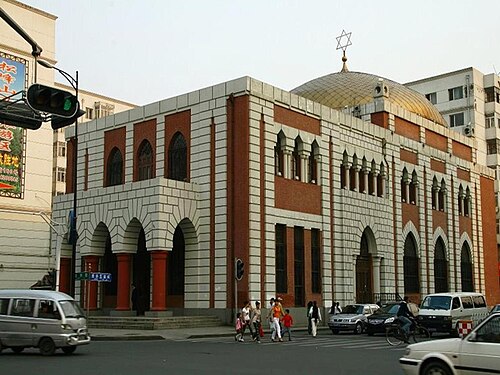

Judaism (犹太教 Yóutàijiào) was introduced during the Tang dynasty (618–907) or earlier, by small groups of Jews settled in China. The most prominent early community were the so-called Kaifeng Jews, in Kaifeng, Henan province. In the 20th century many Jews arrived in Hong Kong, Shanghai, and Harbin, during a period of great economic development of these cities. Many of them sought refuge from anti-Semitic pogroms in the Russian Empire (early 1900s), the communist revolution and civil war in Russia (1917–1918), and anti-Semitic Nazi policy in central Europe, chiefly in Germany and Austria (1937–1940). The last wave of Jewish refugees came from Poland and other eastern European countries in the early 1940s.[338]
Shanghai was particularly notable for its numerous Jewish refugees, who gathered in the so-called Shanghai Ghetto. Most of them left China after the war, the rest relocating prior to, or immediately after, the establishment of the People's Republic. Today, the Kaifeng Jewish community is functionally extinct. Many descendants of the Kaifeng community still live among the Chinese population, mostly unaware of their Jewish ancestry, while some have moved to Israel. Meanwhile, remnants of the later arrivals maintain communities in Shanghai and Hong Kong. In recent years a community has also developed in Beijing through the work of the Chabad-Lubavitch movement.
Since the late 20th century, along with the study of religion in general, the study of Judaism and Jews in China as an academic subject has blossomed with the establishment of institutions such as Diane and Guilford Glazer Institute of Jewish Studies and the China Judaic Studies Association.[339]
Baháʼí Faith
The Baháʼí Faith (巴哈伊信仰 Bāhāyī xìnyǎng, 巴哈伊教 Bāhāyījiào, or, in old translations, 大同教 Dàtóngjiào) has had a presence in China[309] since the 19th century.
Other religions
Hinduism

Hinduism (印度教 Yìndùjiào) entered China around the same time as Buddhism, generally imported by Indian merchants, from different routes. One of them was the "Silk Route by Sea" that started from the Coromandel Coast in southeast India and reached Southeast Asia and then southeastern Chinese cities; another route was that from the ancient kingdom of Kamrupa, through upper Burma, reaching Yunnan; a third route is the well-known Silk Route reaching northwest China, which was the main route through which Buddhism spread into China. Archeological remains of Hindu temples and typical Hindu icons have been found in coastal cities of China and in Dali, Yunnan.[340]: 125–127 It is recorded that in 758 there were three Hindu temples in Guangzhou, with resident Hindus, and Hindu temples in Quanzhou.[340]: 136–137 Remains of Hindu temples have also been discovered in Xinjiang, and they are of an earlier date than those in southeast China.[340]: 135
Hindu texts were translated into Chinese, including a large number of Indian Tantric texts and the Vedas, which are known in Chinese as the Minglun or Zhilun, or through phonetic transliteration as the Weituo, Feituo or Pituo.[340]: 127 Various Chinese Buddhist monks dedicated themselves to the study of Hindu scriptures, thought and practice.[340]: 128–129 In the Sui (581–618) and later Tang dynasty (618–907), Hindu texts translated into Chinese included the Śulvasūtra, the Śulvaśāstra and the Prescriptions of Brahmin Rishis. The Tibetans contributed with the translation into Chinese of the Pāṇinisūtra and the Rāmāyaṇa.[340]: 134
In the 7th century there was an intellectual exchange between Taoists and Shaktas in India, with the translation of the Daodejing in Sanskrit. Some breathing techniques practised in Shaktism are known as Cīnācāra ("Chinese Practice"), and the Shakta tantras that discuss them trace their origin to Taoism. Two of these tantras report that the Shakta master Vaśiṣṭha paid visit to China specifically with the purpose of learning Cīnācāra from the Taoists.[340]: 133–134 According to the Tamil text Śaivāgama of Pashupata Shaivism, two of the eighteen siddha of southern Shaktism, Bogar and Pulipani, were ethnically Chinese.[340]: 133–134 Shaktism itself was practised in China in the Tang period.[340]: 135
The effect of Hinduism in China is also evident in various gods, originally of Hindu origin, which have been absorbed into the Chinese folk religion. A glaring example is the god Hanuman, who gave rise to the Chinese god Hóuwáng (猴王 "Monkey King"), known as Sun Wukong in the Journey to the West.[340]: 135 In the last decades there has been a growth of modern, transnational forms of Hinduism in China: Yogic ("Yoga" is rendered as 瑜伽 Yújiā, literally the "Jade Maiden"), Tantric,[55]: 3 and Krishnaite groups (the Bhagavad Gita has been recently translated and published in China) have appeared in many urban centres including Beijing, Shanghai, Chengdu, Shenzhen, Wuhan and Harbin.[341]
Manichaeism


Manichaeism (摩尼教 Móníjiào or 明教 Míngjiào, "bright transmission") was introduced in China together with Christianity in the 7th century, by land from Central Asia and by sea through south-eastern ports.[9]: 127 Based on Gnostic teachings and able to adapt to different cultural contexts, the Manichaean religion spread rapidly both westward to the Roman Empire and eastward to China. Historical sources speak of the religion being introduced in China in 694, though this may have happened much earlier.[343] Manichaeans in China at the time held that their religion was first brought to China by Mōzak under Emperor Gaozong of Tang (650–83). Later, the Manichaean bishop Mihr-Ohrmazd, who was Mōzak's pupil, also came to China, where he was granted an audience by empress Wu Zetian (684–704), and according to later Buddhist sources he presented at the throne the Erzongjing ("Text of the Two Principles") that became the most popular Manichaean scripture in China.[344]
Manichaeism had a bad reputation among Tang dynasty authorities, who regarded it as an erroneous form of Buddhism. However, as a religion of the Western peoples (Bactrians, Sogdians) it was not outlawed, provided that it remained confined to them not spreading among Chinese. In 731 a Manichaean priest was asked by the current Chinese emperor to make a summary of Manichaean religious doctrines, so that he wrote the Compendium of the Teachings of Mani, the Awakened One of Light, rediscovered at Dunhuang by Aurel Stein (1862–1943); in this text Mani is interpreted as an incarnation of Laozi.[344] As time went on, Manichaeism conflicted with Buddhism but appears to have had good relations with the Taoists; an 8th-century version of the Huahujing, a Taoist work polemical towards Buddhism, holds the same view of the Manichaean Compendium, presenting Mani as Laozi's reincarnation among the Western barbarians.[345]
In the early 8th century, Manichaeism became the official religion of the Uyghur Khaganate. As Uyghurs were traditional allies of the Chinese, also supporting the Tang during the An Lushan Rebellion at the half of the century, the Tangs' attitude towards the religion relaxed and under the Uyghur Khaganate's patronage Manichaean churches prospered in Nanjing, Yangzhou, Jingzhou, Shaoxing and other places. When the Uyghur Khaganate was defeated by the Kyrgyz in 840, Manichaeism's fortune vanished as anti-foreign sentiment arose among the Chinese. Manichaean properties were confiscated, the temples were destroyed, the scriptures were burnt and the clergy was laicised, or killed, as was the case of seventy nuns who were executed at the Tang capital Chang'an.[345] In the same years all foreign religions were suppressed under Emperor Wuzong of Tang (840–846).
The religion never recovered from the persecutions, but it has persisted as a distinct syncretic, and underground movement at particularly in southeastern China. Manichaean sects historically have been known for resurfacing from their hiding from time to time, supporting peasant rebellions.[345] The Song dynasty (960–1279) continued to suppress Manichaeism as a subversive cult.[346] In 1120, a rebellion led by Fang La was believed to have been caused by Manichaeans, and widespread crackdown of unauthorised religious assemblies took place.[344] During the subsequent Mongol Yuan dynasty (1271–1368), foreign religions were generally granted freedom,[344] but the following Ming dynasty (1368–1644) renewed discriminations against them.[344] Despite this, small Manichaean communities are still active in modern China.[347] Manichaeism is thought to have exerted a strong influence on some of the currents of popular sects, such as that which gave rise to Xiantiandao.
Zoroastrianism


Zoroastrianism (琐罗亚斯德教 Suǒluōyàsīdéjiào or 祆教 Xiānjiào, "Heaven worship teaching"; also named 波斯教 Bōsījiào, "Persian teaching"; also 拜火教 Bàihuǒjiào, "fire-worshippers' transmission"; also 白頭教 Báitóujiào, "old age teaching")[349][350]: 149 was first introduced in northern China in the 4th century, or even earlier, by the Sogdians, and it developed through three stages.[350]: 148–149 Some scholars provide evidences that would attest the existence of Zoroastrianism, or broader Iranian religion, in China, as early as the 2nd and 1st century BCE. Worship of Mithra was indeed performed at the court of Emperor Wu of Han (157-87 BCE).[350]: 149
The first phase of Zoroastrianism in China started in the Wei and Jin dynasties of the Northern and Southern dynasties' period (220–589), when Sogdian Zoroastrians advanced into China. They did not proselytise among Chinese, and from this period there are only two known fragments of Zoroastrian literature, both in Sogdian language. One of them is a translation of the Ashem Vohu recovered by Aurel Stein in Dunhuang and now preserved at the British Museum. The Tang dynasty (618–907) prohibited Chinese people to profess Zoroastrianism, so it remained primarily a religion of foreign residents. Before the An Lushan Rebellion (756–763), Sogdians and Chinese lived as segregated ethnic groups; however, after the rebellion intermarriage became common and the Sogdians were gradually assimilated by the Chinese.[350]: 150
In addition to the Sogdian Zoroastrians, after the fall of the Sasanid dynasty (651), through the 7th and 8th centuries Iranian Zoroastrians, including aristocrats and magi,[350]: 151 migrated to northern China.[350]: 148 Fleeing the Islamisation of Iran, they settled in the cities of Chang'an, Luoyang, Kaifeng, Yangzhou, Taiyuan and elsewhere.[349] In the Tang period it is attested that there were at least twenty-nine Zoroastrian fire temples in northern urban centres.[350]: 150 During the great purge of foreign religions under Emperor Wuzong of Tang also Zoroastrianism was target of suppression.
The second phase of Zoroastrianism in China was in the Five Dynasties and Ten Kingdoms period (907–960), and saw the development of an indigenous Chinese Zoroastrianism that lasted until modern times. During this period, the gods of Sogdian Zoroastrianism were assimilated into the Chinese folk religion; Zoroastrian currents of the Chinese folk religion were increasingly practised by the Chinese and survived until the 1940s.[350]: 149 Chinese Zoroastrian temples were witnessed to be active in Hanyang, Hubei until those years.[350]: 153
The third phase started in the 18th century when Parsi merchants sailed from Mumbai to Macau, Hong Kong and Guangzhou. Parsi cemeteries and fire temples were built in these coastal cities, in east China. The Parsis were expelled when the CCP rose to power in 1949.[350]: 149 A Parsi fire temple was built in Shanghai in 1866, and was destroyed during the Cultural Revolution.[350]: 154 Starting in the 1980s there has been a new wave of Parsis settling in China.[350]: 155
In Classical Chinese, Zoroastrianism was first referred to as 胡天 Hútiān, which in the Wei-Jin period became the appellation of all northern nomads. In the early Tang, a new character was invented specifically for Zoroastrianism, 祆 xiān, meaning the "worship of Heaven". Curiously, in the Far East the Zoroastrians were regarded as "Heaven worshippers" rather than "fire worshippers" (in Japanese the name of the religion is Kenkyō, the same as in Chinese). At the time it was rare for the Chinese to create a character for a foreign religion, and this is an evidence of the effect of Zoroastrians in Tang Chinese society.[350]: 149
Japanese Shinto
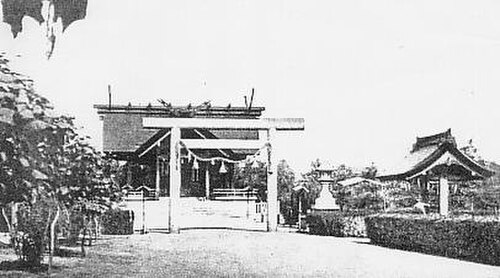
Between 1931 and 1945, with the establishment of the Japanese-controlled Manchukuo ("Manchu Country") in northeast China (Manchuria), many shrines of State Shinto (神社, Chinese: shénshè, Japanese: jinja) were established in the area.
They were part of the project of cultural assimilation of Manchuria into Japan, or Japanisation, the same policy that was being applied to Taiwan. With the end of the Second World War and of the Manchu Country (Manchukuo) in 1945, and the return of Manchuria to China under the Kuomintang, Shinto was abolished and the shrines were destroyed.
During Japanese rule also many Japanese new religions, or independent Shinto sects, proselytised in Manchuria establishing hundreds of congregations. Most of the missions belonged to the Omoto teaching, the Tenri teaching and the Konko teaching of Shinto.[351]
Irreligion and antireligious persecution
Presently, the PRC government officially promotes atheism,[4] and has engaged in antireligious campaigns.[8] Many churches, temples and mosques were destroyed during the Cultural Revolution, which also criminalized the possession of religious texts.[352] Monks were also beaten or killed.[353] As such, China has the most atheists in the world.[354]
China has a history of schools of thought not relying upon conceptions of an absolute, or putting absolutes into question.[clarification needed] Mark Juergensmeyer observes that Confucianism itself is primarily pragmatic and humanist, in it the "thisworldliness" being the priority.[355] Given the differences between Western and Chinese concepts of "religion", Hu Shih stated in the 1920s what has been translated in Western terminology as "China is a country without religion and the Chinese are a people who are not bound by religious superstitions".[356]
The Classic of Poetry contains several catechistic poems in the Decade of Dang questioning the authority or existence of the God of Heaven. Later, philosophers such as Xun Zi, Fan Zhen, Han Fei, Zhang Zai, and Wang Fuzhi also criticised contemporaneous religious practices. During the efflorescence[peacock prose] of Buddhism in the Southern and Northern dynasties, Fan Zhen wrote On the Extinction of the Soul (神灭论; Shénmièlùn) to criticise ideas of body-soul dualism, samsara and karma. He wrote that the soul is merely an effect or function of the body, and that there is no soul without the body—after the death and destruction of the body.[357] He considered that cause-and-effect relationships claimed to be evidence of karma were merely the result of coincidence and bias. For this, he was exiled by Emperor Wu of Liang (502–549).
See also



Wikimedia Commons has media related to Religion in China.

Wikiquote has quotations related to Religion in China.
Other
- Chinese folk religion in Southeast Asia
- East Asian religions
- Northeast China folk religion
- Religion in Inner Mongolia
- Religion in Hong Kong
- Religion in Macau
- Religion in Northeast China
- Religion in Taiwan
- Religion in Tibet
Notes
- ^ a b CFPS 2014 surveyed a sample of 13,857 families and 31,665 individuals.[3]: 27, note 4 As noted by Katharina Wenzel-Teuber of China Zentrum, a German institute for research on religion in China, compared to CFPS 2012, CFPS 2016 asked the Chinese about personal belief in certain conceptions of divinity (i.e. "Buddha", "Tao", "Allah", "God of the Christians/Jesus", "Heavenly Lord of the Catholics") rather than membership in a religious group.[3]: 27 It also included regions, such as those in the west of China, that were excluded in CFPS 2012,[3]: 27, note 3 and unregistered Christians.[3]: 28 For these reasons, she concludes that CFPS 2014 results are more accurate than 2012 ones.
- ^ CFPS 2014 found that 5.94% of the population declared that they belonged to "other" religious categories besides the five state-sanctioned religions. An additional 0.85% of the population responded that they were "Taoists". Note that the title of "Taoist", in common Chinese usage, is generally attributed only to the Taoist clergy. CFPS 2014 found that a further 0.81% declared that they belonged to the popular sects, while CFPS 2012 found 2.2%, and CGSS 2006-2010 surveys found an average 3% of the population declaring that they belonged to such religions, while government estimates give higher figures (see "Statistics").
- ^ CFPS 2014 surveyed predominantly people of Han ethnicity. This may have resulted in an underestimation of Muslims. CGSS 2006–2010 surveys found an average 2–3% of the population of China declaring to be Muslim.
- ^ Other names that have been proposed are:[85]
- Simply "Chinese religion" (中華教 Zhōnghuájiào), viewed as comparable to the usage of "Hinduism";
- "Shenxianism" (神仙教 Shénxiānjiào), "religion of gods and immortals", partly inspired to Allan J. A. Elliott's "Shenism".[86]
- ^ These numerical results for practitioners of the folk religions exclude those who identified with one of the institutional religions, even the 173 million folk Taoists. p. 34 of Wenzel-Teuber (2011): "The CSLS questioned people on popular religious beliefs and practices as well, and came to the following estimates (excluding those who identified themselves with an institutional religion)."[91]
- ^ However, there is considerable discrepancy between what Chinese and Western cultures intend with the concepts of "belief", "existence" and "practice". The Chinese folk religion is often considered one of "belonging" rather than "believing".[92]
- ^ Scholar Kenneth Dean estimates 680 million people involved in folk temples and rituals. Quote: "According to Dean, 'in the rural sector... if one takes a rough figure of 1000 people per village living in 680,000 administrative villages and assume an average of two or three temples per village, one arrives at a figure of over 680 million villagers involved in some way with well over a million temples and their rituals'."[96]
- ^ Overmyer (2009, p. 73), says that from the late 19th to the 20th century few professional priests (i.e. licensed Taoists) were involved in local religion in the central and northern provinces of China, and discusses various types of folk ritual specialists including: the yuehu 樂戶, the zhuli 主禮 (p. 74), the shenjia 神家 ("godly families", hereditary specialists of gods and their rites; p. 77), then (p. 179) the yinyang or fengshui masters (as "[...] folk Zhengyi Daoists of the Lingbao scriptural tradition, living as ordinary peasants. They earn their living both as a group from performing public rituals, and individually [...] by doing geomancy and calendrical consultations for fengshui and auspicious days"; quoting: S. Jones (2007), Ritual and Music of North China: Shawm Bands in Shanxi). He also describes shamans or media known by different names: mapi 馬裨, wupo 巫婆, shen momo 神嬤嬤 or shen han 神漢 (p. 87); xingdao de 香道的 ("practitioners of the incense way"; p. 85); village xiangtou 香頭 ("incense heads"; p. 86); matong 馬童 (the same as southern jitong), either wushen 巫神 (possessed by gods) or shenguan 神官 (possessed by immortals; pp. 88–89); or "godly sages" (shensheng 神聖; p. 91). Further (p. 76), he discusses, for example, the sai 賽, ceremonies of thanksgiving to the gods in Shanxi with roots in the Song era, whose leaders very often corresponded to local political authorities. This pattern continues today with former village Communist Party secretaries elected as temple association bosses (p. 83). He concludes (p. 92): "In sum, since at least the early twentieth century the majority of local ritual leaders in north China have been products of their own or nearby communities. They have special skills in organization, ritual performance or interaction with the gods, but none are full-time ritual specialists; they have all 'kept their day jobs'! As such they are exemplars of ordinary people organizing and carrying out their own cultural traditions, persistent traditions with their own structure, functions and logic that deserve to be understood as such."
- ^ The statistics for Chinese ancestorism, that is the worship of ancestor-gods within the lineage system, are from the Chinese Spiritual Life Survey of 2010.[136] The statistics for Buddhism and Christianity are from the China Family Panel Studies survey of 2012.[137] The statistics for Islam are from a survey conducted in 2010.[138] The populations of Chinese ancestorism and Buddhism may overlap, even with the large remaining parts of the population whose belief is not documented in the table. The latter, the uncharted population, may practise other forms of Chinese religion, such as the worship of gods, Taoism, Confucianism, and folk salvationisms, or may be atheist. According to the CFPS 2012, only 6.3% of the Chinese were irreligious in the sense of "atheism", while the rest practised the worship of gods and ancestors.[94]: 13
- ^ The characters yu 玉 (jade), huang 皇 ("emperor, sovereign, august"), wang 王 ("king"), as well as others pertaining to the same semantic field, have a common denominator in the concepts of gong 工 ("work, art, craft, artisan, bladed weapon, square and compass; gnomon, interpreter") and wu 巫 ("shaman, medium")[157] in its archaic form ☩, with the same meaning of wan 卍 (swastika, ten thousand things, all being, universe).[158] A king is a man or an entity who is able to merge himself with the axis mundi, the centre of the universe, bringing its order into reality. The ancient kings or emperors of the Chinese civilisation were shamans or priests, that is to say mediators of the divine rule.[159]
- ^ Tian, besides Taidi ("Great Deity") and Shangdi ("Highest Deity"), Yudi ("Jade Deity"), and Taiyi ("Great Oneness"), identified as the ladle of the Big Dipper (Great Chariot),[160] is defined by many other names attested in the Chinese literary tradition.[161] Tian is both transcendent and immanent, manifesting in the three forms of dominance, destiny and nature. In the Wujing Yiyi (《五經異義》, "Different Meanings in the Five Classics"), Xu Shen explains that the designation of Heaven is quintuple:[162]
- ^ The image is a good synthesis of the basic virtues of Chinese religion and Confucian ethics, that is to say "to move and act according to the harmony of Heaven". The Big Dipper or Great Chariot in Chinese culture (as in other traditional cultures) is a symbol of the axis mundi, Heaven in its way of manifestation, order of creation (li or Tao).
The symbol, also called the Gate of Heaven (天门 Tiānmén), is widely used in esoteric and mystical literature. For example, an excerpt from Shangqing Taoism's texts:
- "Life and death, separation and convergence, all derive from the seven stars. Thus when the Big Dipper impinges on someone, he dies, and when it moves, he lives. That is why the seven stars are Heaven's chancellor, the yamen where the gate is opened to give life."[176]
- ^ Huángdì (黄帝 "Yellow Emperor" or "Yellow Deity") or Huángshén (黄神 "Yellow God"), also known as Huángshén Běidǒu (黄神北斗 "Yellow God of the Northern Dipper"), Xuānyuánshì (轩辕氏 "Master of the Chariot Shaft") and Zhōngyuèdàdì (中岳大帝 "Great Deity of the Central Peak"), is the creator of Huaxia, the spiritual foundation of the civilisation of China. He represents the man who embodies or grasps the axis mundi (Kunlun Mountain), the hub of creation, identifying with the principle of the universe (天 Tiān), bringing the divine order into physical reality and thus opening the gateways to immortality.[194] The character 黄 huáng, for the color "yellow", also means, by homophony and shared etymology with 皇 huáng, "august", "creator" and "radiant", other attributes that identify the Yellow Emperor with Shàngdì (上帝 "Highest Deity") in his human form.[194] As a human, Xuanyuan was the fruit of virginal birth, since his mother Fubao conceived him when she was aroused, while walking in the countryside, by seeing a yellow lightning revolving around the Big Dipper. She gave birth to her son on the mount of Shou (Longevity) or mount Xuanyuan (Chariot Shaft), after which he was named.[195]
- ^ The Silver Turtle Temple (银龟神庙 Yínguīshénmiào) of Qiang folk religion was consecrated in 2014. It is a complex of temples dedicated to various gods: it hosts a Great Temple of Yandi (炎帝大殿 Yándì dàdiǎn), a Great Temple of Dayu (大禹大殿 Dàyǔ dàdiàn) and a Great Temple of Li Yuanhao (李元昊大殿 Lǐyuánhào dàdiàn), considered the most important deities of the Qiang people.
- ^ The man (with the physical features of an Indo-European) wearing a distinctive cap and face veil, is possibly a camel rider or even a Zoroastrian priest engaging in a ritual at a fire temple, since face veils were used to avoid contaminating the holy fire with breath or saliva. The statue is preserved at the Turin's Museum of Oriental Art, Italy.[348]
References
Citations
- ^ a b c d 2023 approximations of the statistics from the China Family Panel Studies (CFPS) of the year 2018, as contained in the following analyses:
- "Measuring Religion in China" (PDF). Pew Research Center. 30 August 2023. Archived (PDF) from the original on 9 September 2023."Measuring Religions in China". 30 August 2023. Archived from the original on 30 September 2023. A compilation of statistics from reliable surveys held throughout the 2010s and early 2020s, with an emphasis on the CFPS 2018.
- Wenzel-Teuber, Katharina (2023). "Statistics on Religions and Churches in the People's Republic of China – Update for the Year 2022" (PDF). Religions & Christianity in Today's China. XIII. China Zentrum: 18–44. ISSN 2192-9289. Archived (PDF) from the original on 23 June 2023.
- Zhang, Chunni; Lu, Yunfeng; He, Sheng (2021). "Exploring Chinese folk religion: Popularity, diffuseness, and diversities" (PDF). Chinese Journal of Sociology. 7 (4). SAGE Publications: 575–592. doi:10.1177/2057150X211042687. ISSN 2057-150X. Archived (PDF) from the original on 15 October 2023. Cite error: The named reference "religion2023" was defined multiple times with different content (see the help page).
- ^ a b c For China Family Panel Studies 2014 survey results, see release No. 1 (archived) and release No. 2 (archived). The tables also contain the results of CFPS 2012 (sample 20,035) and Chinese General Social Survey (CGSS) results for 2006, 2008, and 2010 (samples ~10.000/11,000). For comparison, see 卢云峰:当代中国宗教状况报告——基于CFPS(2012)调查数据 (CFPS 2012 report), The World Religious Cultures, issue 2014. "Archived copy" (PDF). Archived from the original (PDF) on 9 August 2014. Retrieved 7 August 2014.
{{cite web}}: CS1 maint: archived copy as title (link) p. 13, reporting the results of the CGSS 2006, 2008, 2010, and 2011, and their average (fifth column of the first table). - ^ a b c d e f g h Wenzel-Teuber, Katharina. "Statistics on Religions and Churches in the People's Republic of China – Update for the Year 2016" (PDF). Religions & Christianity in Today's China. VII (2): 26–53. Archived from the original (PDF) on 22 July 2017.
- ^ a b Dillon, Michael (2001). Religious Minorities and China (PDF). Minority Rights Group International.
- ^ Albert, Eleanor; Maizland, Lindsay. "Religion in China". Foreign Affairs. Council on Foreign Relations. Retrieved 4 May 2022. In the early 21st century, there has been increasing official recognition of Confucianism and Chinese folk religion as part of China's cultural heritage.
- ^ a b Willemyns, Alex (26 June 2024). "US: China still arresting 'thousands' each year for practicing faith". Radio Free Asia. Retrieved 27 June 2024.
- ^ "The State of Religion in China". Council on Foreign Relations. Retrieved 12 August 2023.
- ^ a b Buang, Sa'eda; Chew, Phyllis Ghim-Lian (9 May 2014). Muslim Education in the 21st Century: Asian Perspectives. Routledge. p. 75. ISBN 978-1-317-81500-6.
Subsequently, a new China was found on the basis of Communist ideology, i.e. atheism. Within the framework of this ideology, religion was treated as a 'contorted' world-view and people believed that religion would necessarily disappear at the end, along with the development of human society. A series of anti-religious campaigns was implemented by the Chinese Communist Party from the early 1950s to the late 1970s. As a result, in nearly 30 years between the beginning of the 1950s and the end of the 1970s, mosques (as well as churches and Chinese temples) were shut down and Imams involved in forced 're-education'.
- ^ a b Woodhead, Linda; Kawanami, Hiroko; Partridge, Christopher H., eds. (2009). Religions in the Modern World: Traditions and Transformations (2nd ed.). London: Routledge. ISBN 978-0-415-45890-0. OCLC 237880815.
- ^ a b Teiser (1996).
- ^ "Six facts about Buddhism in China". Pew Research Center. 21 September 2023. Retrieved 21 September 2023.
- ^ Bays (2012), pp. 7–15, 18–21.
- ^ a b Blainey, Geoffrey (2011). A Short History of Christianity.
- ^ Gladney, Dru C. (2003). "The China Quarterly - Islam in China: Accommodation or Separatism? - Cambridge Journals Online". The China Quarterly. 174: 451–467. doi:10.1017/S0009443903000275. S2CID 154306318.
- ^ "The World Factbook". Central Intelligence Agency. Retrieved 30 May 2007.
- ^ "China halts mosque demolition due to protest". The Times of India. Archived from the original on 11 August 2018. Retrieved 10 August 2018.
- ^ Feuchtwang (2016), p. 144.
- ^ Fairbank, John; Goldman, Merle (2006). China: A New History. Harvard University Press. p. 17. ISBN 0-674-11673-9.
- ^ Pankenier (2013), p. 55.
- ^ Didier (2009), pp. 73–83, Vol. II, comprising the sections "The Taotie and the Northern Celestial Pole" and "The Significance of the Rectangle and Square in Shang Bronzes".
- ^ Didier (2009), p. 137 ff, Vol. III.
- ^ Yang & Lang (2012), p. 112.
- ^ Nelson, Sarah M.; Matson, Rachel A.; Roberts, Rachel M.; Rock, Chris; Stencel, Robert E. (2006). "Archaeoastronomical Evidence for Wuism at the Hongshan Site of Niuheliang".
- ^ De Groot (1892), passim Vol. 6.
- ^ a b c Libbrecht (2007), p. 43.
- ^ a b Fung (2008), p. 163.
- ^ Didier (2009), pp. xxxvii–xxxviii, Vol. I.
- ^ Zhou (2012), p. 2.
- ^ Didier (2009), p. xxxviii, Vol. I.
- ^ Zhou (2012), p. 1.
- ^ Lagerwey & Kalinowski (2008), p. 771, chapter: Nylan, Michael. "Classics Without Canonization: Learning and Authority in Qin and Han".
- ^ Zhou (2012), p. 3.
- ^ Lagerwey & Kalinowski (2008), p. 766, chapter: Nylan, Michael. "Classics Without Canonization: Learning and Authority in Qin and Han".
- ^ Zhou (2005), p. 5.
- ^ Lagerwey & Kalinowski (2008), p. 783, chapter: Bujard, Marianne. "State and Local Cults in Han Religion".
- ^ Lagerwey & Kalinowski (2008), p. 784, chapter: Bujard, Marianne. "State and Local Cults in Han Religion".
- ^ a b Zhou (2012), p. 4.
- ^ Espesset (2008), pp. 22–28.
- ^ Espesset (2008), p. 19.
- ^ Espesset (2008), pp. 1–2.
- ^ Espesset (2008), pp. 2–3.
- ^ Espesset (2008), pp. 6–10.
- ^ Espesset (2008), pp. 11–15.
- ^ Espesset (2008), p. 18.
- ^ a b Pregadio (2016).
- ^ Chang (2000), pp. 40–41.
- ^ Chang (2000), p. 42.
- ^ Chang (2000), p. 43. Cit. Ebrey, Patricia Buckley, and Peter N. Gregory, ed. Religion and Society in Tang and Song China. Honolulu: University of Hawaii Press, 1993. p. 29.
- ^ Feuchtwang (2016), p. 148.
- ^ a b c Fan & Chen (2013), p. 9.
- ^ Tarocco, Francesca (2008), The Cultural Practices of Modern Chinese Buddhism: Attuning the Dharma, London: Routledge, p. 48, ISBN 978-0-415-59617-6
- ^ Preston, Diana (2000). The Boxer Rebellion: The Dramatic Story of China's War on Foreigners That Shook the World in the Summer of 1900. New York: Walker. pp. 25–30. ISBN 0-8027-1361-0.
- ^ Overmyer (2009), p. 46.
- ^ Bays (2012), pp. 84–87.
- ^ a b c d e Liang, Yongjia (2016). "The Anthropological Study of Religion in China: Contexts, Collaborations, Debates and Trends" (PDF). Asia Research Institute Working Paper Series (250): 25. Archived from the original (PDF) on 23 October 2017.
- ^ a b Overmyer (2009), p. 50.
- ^ Bays (2012), pp. 107–113.
- ^ Bernardi Junqueira, Luis Fernando (8 June 2021). "Revealing Secrets: Talismans, Healthcare and the Market of the Occult in Early Twentieth-century China". Social History of Medicine. 34 (4): 1068–1093. doi:10.1093/shm/hkab035. ISSN 0951-631X. PMC 8653939. PMID 34899068.
- ^ Overmyer (2009), p. 43.
- ^ a b Overmyer (2009), p. 51.
- ^ Overmyer (2009), p. 45.
- ^ Woodhead, Linda; Partridge, Christopher; Kawanami, Hiroko, eds. (2016). Religions in the Modern World: Traditions and Transformations (3rd ed.). Routledge. p. 159.
- ^ Bays (2012), pp. 159–166.
- ^ a b Guoyou, Wu; Xuemei, Ding (2020). Zheng, Qian (ed.). An Ideological History of the Communist Party of China. Translated by Sun, Li; Bryant, Shelly. Montreal, Quebec: Royal Collins Publishing Group. ISBN 978-1-4878-0392-6.
- ^ Brown, Kerry (2023). China Incorporated: The Politics of a World Where China is Number One. London: Bloomsbury Academic. ISBN 978-1-350-26724-4.
- ^ Santos, Gonçalo (2021). Chinese Village Life Today: Building Families in an Age of Transition. Seattle: University of Washington Press. ISBN 978-0-295-74738-5.
- ^ Sautman (1997), pp. 79–84.
- ^ Marsh, Christopher (2011). Religion and the State in Russia and China: Suppression, Survival, and Revival. Bloomsbury Academic. p. 239. ISBN 978-1-4411-1247-7.
- ^ Solé-Farràs, Jesús (2013). New Confucianism in Twenty-First Century China: The Construction of a Discourse. Routledge. p. 56. ISBN 978-1-134-73915-8.
- ^ Bell, Daniel A. (2010). China's New Confucianism: Politics and Everyday Life in a Changing Society. Princeton University Press. p. 14. ISBN 978-0-691-14585-3.
- ^ Koesel, Karrie J. (2014). Religion and Authoritarianism: Cooperation, Conflict, and the Consequences. Cambridge University Press. p. 8. ISBN 978-1-139-86779-5.
- ^ Te Winkle, Kimberley S. (2005). "A Sacred Trinity: God, Mountain and Bird. Cultic Practices of the Bronze Age Chengdu Plain" (PDF). Sino-Platonic Papers (149). Victor H. Mair. ISSN 2157-9687.
- ^ Feuchtwang (2016), p. 162.
- ^ Sonia Elks (19 June 2021). "China is harvesting organs from Falun Gong members, finds expert panel". reuters.com. Retrieved 6 October 2021.
- ^ Johnson (2017), p. 280.
- ^ Pregadio (2013), p. xv.
- ^ a b Zuckerman, Phil (2006). "Atheism: Contemporary Numbers and Patterns". In Martin, Michael (ed.). The Cambridge Companion to Atheism. Cambridge University Press. ISBN 1-139-82739-1.
- ^ a b Yao (2010), p. 9.
- ^ Yao (2010), p. 10.
- ^ Pregadio (2013), p. 326.
- ^ Palmer (2011), p. 12, quoting: "Chinese sectarianism, millennialism and heterodoxy, called 'popular religious sects' (minjian zongjiao 民間宗教, minjian jiaomen 民間教門, minjian jiaopai 民間教派) in the Chinese scholarship, often inextricable from debates on the exact nature of the so-called 'White Lotus' tradition."; p. 14: "The local and anthropological focus of these studies, and their undermining of rigid distinctions between 'sectarian' groups and other forms of local religiosity, tends to draw them into the category of 'popular religion' 民間信仰.".
- ^ Clart (2014), p. 393: "[...] The problem started when the Taiwanese translator of my paper chose to render 'popular religion' literally as minjian zongjiao 民間宗教. The immediate association this term caused in the minds of many Taiwanese and practically all mainland Chinese participants in the conference was of popular sects (minjian jiaopai 民間教派), rather than the local and communal religious life that was the main focus of my paper."
- ^ Goossaert & Palmer (2011), p. 347, quoting: "[Since the 1990s] [...] a number of [...] lay salvationist groups (such as Xiantiandao in southern China and Hongyangism [弘阳教 Hóngyáng jiào] in Hebei) also successfully registered with the Taoist association, thus gaining legitimacy.".
- ^ Clart (2014), pp. 402–406.
- ^ Clart (2014), p. 409.
- ^ Shi (2008).
- ^ White, Chris (2017). "Counting Christians in China: A critical reading of A star in the East: The rise of Christianity in China" (PDF). MMG Working Paper. MMG Working Paper 17-03. Göttingen: Max Planck Institute for the Study of Religious and Ethnic Diversity. ISSN 2192-2357. Archived from the original (PDF) on 13 June 2018.
- ^ Yao, Xinzhong (May 2007). "Religious Belief and Practice in Urban China 1995-2005". Journal of Contemporary Religion. 22 (2): 169–185. doi:10.1080/13537900701331031. S2CID 144500936. pp. 169-185.
- ^ a b "Religion in China on the Eve of the 2008 Beijing Olympics". Religion and Public Life Project. Pew Research Center. 2008.
- ^ a b c Yu Tao (2012). "A Solo, a Duet, or an Ensemble? Analysing the Recent Development of Religious Communities in Contemporary Rural China". ECRAN – Europe-China Research and Advice Network, University of Nottingham.
- ^ Wenzel-Teuber, Katharina; Strait, David (2012). "People's Republic of China: Religions and Churches Statistical Overview 2011" (PDF). Religions & Christianity in Today's China. II (3): 29–54. ISSN 2192-9289. Archived from the original (PDF) on 27 April 2017.
- ^ Fan & Chen (2013), p. 5.
- ^ a b c d e 2010 Chinese Spiritual Life Survey, Purdue University's Center on Religion and Chinese Society. Data reported in Wenzel-Teuber, Katharina; Strait, David (2012). "People's Republic of China: Religions and Churches Statistical Overview 2011" (PDF). Religions & Christianity in Today's China. II (3): 29–54. ISSN 2192-9289. Archived from the original (PDF) on 27 April 2017.
- ^ a b c d e f g h i China Family Panel Studies 2012. Reported and compared with Chinese General Social Survey (CGSS) 2006, 2008, 2010 and 2011 in Lu (2014)
- ^ Yang & Hu (2012), p. 514.
- ^ Fan & Chen (2013), p. 8, citing: Dean, Kenneth (2011). "Local Ritual Traditions of Southeast China: A Challenge to Definitions of Religion and Theories of Ritual". In Yang, Fenggang; Lang, Graeme. Social Scientific Study of Religion in China: Methodology, Theories, and Findings. Leiden: Brill. p. 134.
- ^ 大陆民间宗教管理变局 [Mainland folk religion management change]. Phoenix Weekly (500). Pu Shi Institute for Social Science. July 2014. Archived from the original on 4 March 2016.
- ^ "The Global Religious Landscape" (PDF). Pew Research Center. December 2012. p. 46. Archived from the original (PDF) on 24 September 2015. Retrieved 18 February 2014.
- ^ "Global Index of Religion and Atheism 2012" (PDF). Win-Gallup International. Archived from the original (PDF) on 12 August 2012.
- ^ a b c d Francis Ching-Wah Yip, in Miller, 2006. p. 186.
- ^ a b Han, Junqiang; Meng, Yingying; Xu, Chengcheng; Qin, Siqi (2017). "Urban Residents' Religious Beliefs and Influencing Factors on Christianity in Wuhan, China". Religions. 8 (244): 244. doi:10.3390/rel8110244. pp. 9–11.
- ^ Ji Zhe (2006). "Non-institutional Religious Re-composition among the Chinese Youth" (PDF). Social Compass. 53 (4). SAGE Publications: 535–549. doi:10.1177/0037768606070418. S2CID 144425470. Archived from the original (PDF) on 1 January 2018.
- ^ Yao, Xinzhong (May 2007). "Religious Belief and Practice in Urban China 1995-2005". Journal of Contemporary Religion. 22 (2): 169–185. doi:10.1080/13537900701331031. S2CID 144500936. pp. 169-185.
- ^ 2010 Chinese Spiritual Life Survey, Purdue University's Center on Religion and Chinese Society. Data reported in Wenzel-Teuber, Katharina; Strait, David (2012). "People's Republic of China: Religions and Churches Statistical Overview 2011" (PDF). Religions & Christianity in Today's China. 2 (3): 29–54. ISSN 2192-9289. Archived from the original (PDF) on 27 April 2017.
- ^ "Religion in China on the Eve of the 2008 Beijing Olympics". Religion and Public Life Project. Pew Research Center. 2008.
- ^ a b China Family Panel Studies 2012. Reported and compared with Chinese General Social Survey (CGSS) 2006, 2008, 2010 and 2011 in Lu 卢, Yunfeng 云峰 (2014). "卢云峰:当代中国宗教状况报告——基于CFPS(2012)调查数据" [Report on Religions in Contemporary China – Based on CFPS (2012) Survey Data] (PDF). World Religious Cultures (1). Archived from the original (PDF) on 9 August 2014.
- ^ Yu Tao (2012). "A Solo, a Duet, or an Ensemble? Analysing the Recent Development of Religious Communities in Contemporary Rural China". 4th International Forum for Contemporary Chinese Studies. ECRAN – Europe-China Research and Advice Network, University of Nottingham.
- ^ Sun, Shangyang; Li, Ding. "Chinese Traditional Culture Study Fever, Scarcity of Meaning and the Trend of University Students' Attitudes towards Religions: A Survey in Beijing". Journal of Sino-Western Studies (2011): 53–68.
- ^ Yang, Fenggang; Tamney, Joseph (2011). Confucianism and Spiritual Traditions in Modern China and Beyond. Brill. ISBN 978-9004212398.. p. 67.
- ^ Dumortier, Brigitte (2002). "Religions en Chine" (Map). Atlas des religions. Croyances, pratiques et territoires. Atlas/Monde (in French). Paris, France: Autrement. p. 34. ISBN 2-7467-0264-9. Archived from the original on 27 April 2017.
- ^ "Religions in China" (Map). Narody Vostochnoi Asii [Ethnic Groups of East Asia]. 1965. Archived from the original on 27 April 2017. Zhongguo Minsu Dili [Folklore Geography of China], 1999; Zhongguo Dili [Geography of China], 2002.
- ^ a b Gao 高, Wende 文德, ed. (1995). "Religions in China" (Map). 中国少数民族史大辞典 [Chinese Dictionary of Minorities' History] (in Chinese). Changchun: Jilin Education Press (吉林教育出版社). Archived from the original on 27 April 2017.
- ^ a b Yin 殷, Haishan 海山; Li 李, Yaozong 耀宗; Guo 郭, Jie 洁, eds. (1991). "Religions in China" (Map). 中国少数民族艺术词典 [Chinese Minorities' Arts Dictionary] (in Chinese). Beijing: National Publishing House (民族出版社). Archived from the original on 27 April 2017.
- ^ Zhao, Litao; Tan, Soon Heng (2008). "Religious Revival in China" (PDF). East Asian Institute Background Brief. No. 368. Archived from the original (PDF) on 1 January 2018. pp. i–ii: "Their revival is most evident in South-east China, where annual festivals for local and regional gods often mobilize the entire village population for elaborate rites and rituals. The deep and rich ritual traditions share close similarities with those of Taiwan and overseas Chinese and financial help from these connections make coastal Fujian a frontrunner in reviving local communal religion."
- ^ Waldron (1998), p. 325.
- ^ Chan (2005), p. 93, quoting: "By the early 1990s Daoist activities had become popular especially in rural areas, and began to get out of control as the line between legitimate Daoist activities and popular folk religious activities – officially regarded as feudal superstition – became blurred. [...] Unregulated activities can range from orthodox Daoist liturgy to shamanistic rites. The popularity of these Daoist activities underscores the fact that Chinese rural society has a long tradition of religiosity and has preserved and perpetuated Daoism regardless of official policy and religious institutions. With the growth of economic prosperity in rural areas, especially in the coastal provinces where Daoist activities are concentrated, with a more liberal policy on religion, and with the revival of local cultural identity, Daoism – be it the officially sanctioned variety or Daoist activities which are beyond the edge of the official Daoist body – seems to be enjoying a strong comeback, at least for the time being.".
- ^ Overmyer (2009), p. 185: about Taoism in southeastern China: "Ethnographic research into the temple festivals and communal rituals celebrated within these god cults has revealed the widespread distribution of Daoist ritual traditions in this area, including especially Zhengyi (Celestial Master Daoism) and variants of Lushan Daoist ritual traditions. Various Buddhist ritual traditions (Pu'anjiao, Xianghua married monks and so on) are practised throughout this region, particularly for requiem services". (quoting Dean, Kenneth (2003). "Local Communal Religion in Contemporary Southeast China". In Overmyer, Daniel L. (ed.). Religion in China Today. Cambridge University Press. pp. 32–34.)
- ^ a b c d e f g Goossaert, Vincent (2011). "Is There a North China Religion? A Review Essay". Journal of Chinese Religions. 39 (1): 83–93. doi:10.1179/073776911806153907. ISSN 0737-769X. S2CID 170749557.
- ^ Overmyer (2009), pp. 12–13: "As for the physical and social structure of villages on this vast flat expanse; they consist of close groups of houses built on a raised area, surrounded by their fields, with a multi-surnamed population of families who own and cultivate their own land, though usually not much more than twenty mou or about three acres. [...] Families of different surnames living in one small community meant that lineages were not strong enough to maintain lineage shrines and cross-village organizations, so, at best, they owned small burial plots and took part only in intra-village activities. The old imperial government encouraged villages to manage themselves and collect and hand over their own taxes. [...] leaders were responsible for settling disputes, dealing with local government, organizing crop protection and planning for collective ceremonies. All these factors tended to strengthen the local protective deities and their temples as focal points of village identity and activity. This social context defines North China local religion, and keeps us from wandering off into vague discussions of 'popular' and 'elite' and relationships with Daoism and Buddhism."
- ^ Overmyer (2009), p. xii.
- ^ Overmyer (2009), p. 10: "There were and are many such pilgrimages to regional and national temples in China, and of course such pilgrimages cannot always be clearly distinguished from festivals for the gods or saints of local communities, because such festivals can involve participants from surrounding villages and home communities celebrating the birthdays or death days of their patron gods or saints, whatever their appeal to those from other areas. People worship and petition at both pilgrimages and local festivals for similar reasons. The chief differences between the two are the central role of a journey in pilgrimages, the size of the area from which participants are attracted, and the role of pilgrimage societies in organizing the long trips that may be involved. [...] pilgrimage in China is also characterized by extensive planning and organization both by the host temples and those visiting them."
- ^ Overmyer (2009), p. 3: "[...] there are significant differences between aspects of local religion in the south and north, one of which is the gods who are worshiped."; p. 33: "[...] the veneration in the north of ancient deities attested to in pre-Han sources, deities such as Nüwa, Fuxi and Shennong, the legendary founder of agriculture and herbal medicine. In some instances these gods were worshiped at places believed to be where they originated, with indications of grottoes, temples and festivals for them, some of which continue to exist or have been revived. Of course, these gods were worshiped elsewhere in China as well, though perhaps not with the same sense of original geographical location."
- ^ Overmyer (2009), p. 15: "[...] Popular religious sects with their own forms of organization, leaders, deities, rituals, beliefs and scripture texts were active throughout the Ming and Qing periods, particularly in north China. Individuals and families who joined them were promised special divine protection in this life and the next by leaders who functioned both as ritual masters and missionaries. These sects were more active in some communities than in others, but in principle were open to all who responded to these leaders and believed in their efficacy and teachings, so some of these groups spread to wide areas of the country. [...] significant for us here though is evidence for the residual influence of sectarian beliefs and practices on non-sectarian community religion where the sects no longer exist, particularly the feminization of deities by adding to their names the characters mu or Laomu, Mother or Venerable Mother, as in Guanyin Laomu, Puxianmu, Dizangmu, etc., based on the name of the chief sectarian deity, Wusheng Laomu, the Eternal Venerable Mother. Puxian and Dizang are bodhisattvas normally considered 'male', though in Buddhist theory such gender categories don't really apply. This practice of adding mu to the names of deities, found already in Ming period sectarian scriptures called baojuan 'precious volumes' from the north, does not occur in the names of southern deities."
- ^ a b Ownby (2008).
- ^ a b Payette (2016).
- ^ a b Jones, Stephen (2011). "Yinyang: Household Daoists of North China and Their Rituals". Daoism: Religion, History & Society. 3 (1): 83–114.
- ^ Deng, Claire Qiuju (2014). Action-Taking Gods: Animal Spirit Shamanism in Liaoning, China (Master in East Asian Studies thesis). Montreal: McGill University, Department of East Asian Studies. Archived from the original on 16 January 2018.
- ^ Juergensmeyer, Mark; Roof, Wade Clark (2011). Encyclopedia of Global Religion. SAGE Publications. ISBN 978-1-4522-6656-5. p. 202.
- ^ Penny, Benjamin (2013). Religion and Biography in China and Tibet. Routledge. ISBN 978-1-136-11394-9. pp. 185–187.
- ^ Jones, A. D. (2011). "Contemporary Han Chinese Involvement in Tibetan Buddhism: A Case Study from Nanjing". Social Compass. 58 (4): 540–553. doi:10.1177/0037768611421134. S2CID 144510373.
- ^ Hong Kong Year Book (2011): Chapter 18 – Religion and Custom.
- ^ Zheng, VWT; Wan, PS. Religious beliefs and life experiences of Macao's residents 澳門居民的宗教信仰與生活經驗. On: Modern China Studies by Center for Modern China, 2010, v. 17 n. 4, p. 91-126. ISSN 2160-0295. «Drawing on empirical data obtained from three consecutive territory-wide household surveys conducted in 2005, 2007, and 2009 respectively, this paper attempts to shed light on the current religious profile of Macao residents.»
- ^ Dubois (2005).
- ^ Heberer, Thomas; Jakobi, Sabine (2000). "Henan – The Model: From Hegemonism to Fragmentism. Portrait of the Political Culture of China's Most Populated Province" (PDF). Duisburg Working Papers on East Asian Studies. No. 32. Archived from the original (PDF) on 19 January 2021. Retrieved 15 February 2016.
- ^ Lu (2014), p. 13. The report compares the data of the China Family Panel Studies 2012 with those of the Renmin University's Chinese General Social Survey (CGSS) of the years 2006, 2008, 2010 and 2011.
- ^ a b c d e f g h Data from the Chinese Spiritual Life Survey (CSLS) 2010 for Chinese ancestorists, and from the Chinese General Social Survey (CGSS) 2009 for Christians. Reported in Wang, Xiuhua (2015). "Explaining Christianity in China: Why a Foreign Religion has Taken Root in Unfertile Ground" (PDF). Baylor University. p. 15. Archived from the original (PDF) on 25 September 2015.
- ^ a b c d Data from the China Family Panel Studies (CFPS) 2012. Reported in Gai, Rong Hua; Gao, Jun Hui (22 December 2016). "Multiple-Perspective Analysis on the Geological Distribution of Christians in China". PEOPLE: International Journal of Social Sciences. 2 (1): 809–817. doi:10.20319/pijss.2016.s21.809817. ISSN 2454-5899.
- ^ a b Data from Yang, Zongde (2010). "Study on Current Muslim Population in China" (PDF). Jinan Muslim (2). Archived from the original (PDF) on 27 April 2017. Reported in Min, Junqing (2013). "The Present Situation and Characteristics of Contemporary Islam in China" (PDF). JISMOR (8): 29. Archived from the original (PDF) on 24 June 2017.
- ^ Lai, Hongyi (2016). China's Governance Model: Flexibility and Durability of Pragmatic Authoritarianism. Routledge. ISBN 978-1-317-85952-9. p. 167.
- ^ "Internazional Religious Freedom Report 2012" (PDF). US Government. p. 20, quoting: "Most ethnic Tibetans practice Tibetan Buddhism, although a sizeable minority practices Bon, an indigenous religion, and very small minorities practice Islam, Catholicism, or Protestantism. Some scholars estimate that there are as many as 400,000 Bon followers across the Tibetan Plateau. Scholars also estimate that there are up to 5,000 ethnic Tibetan Muslims and 700 ethnic Tibetan Catholics in the TAR".
- ^ Wu, Jiayu; Fang, Yong (January 2016). "Study on the Protection of the Lama Temple Heritage in Inner Mongolia as a Cultural Landscape". Journal of Asian Architecture and Building Engineering. 15 (1): 9–16. doi:10.3130/jaabe.15.9. S2CID 53994697. Note that the article, in an evident mistranslation from Chinese, reports 30 million Tibetan Buddhists in Inner Mongolia instead of 3 million.
- ^ a b c d Yao (2010), p. 39.
- ^ Adler (2005), p. 2.
- ^ a b Yao (2010), pp. 10–11.
- ^ a b Feuchtwang (2016), p. 150.
- ^ a b Jing (1996), p. 17.
- ^ a b Jing (1996), p. 18.
- ^ Yang (1961), p. 53.
- ^ Jing (1996), pp. 144–153.
- ^ Yao (2010), pp. 114, 177.
- ^ Jing (1996), pp. 152–153.
- ^ Zhong (2014), pp. 76–77.
- ^ Zhong (2014), p. 84, note 282.
- ^ Didier (2009), passim.
- ^ Adler (2011), pp. 4–5.
- ^ Pregadio (2013), p. 1197.
- ^ Lewis, Mark (1999). Writing and Authority in Early China. SUNY Press. pp. 205–206. ISBN 0-7914-4114-8.
- ^ Didier (2009), p. 268, Vol. III.
- ^ Needham, Joseph (1959). Science and Civilisation in China. Volume III: Mathematics and the Sciences of the Heavens and Earth. p. 23.
- ^ Lagerwey & Kalinowski (2008), pp. 30 ("Introduction"), 73 (Ch. Eno, Robert. "Shang State Religion"), 240 (Ch. Cook, Constance A. "Ancestor Worship During the Eastern Zhou"), 985 (Ch. Pirazzoli-T'serstevens, Michèle. "Death and the Dead").
- ^ Lü & Gong (2014), pp. 63–66. Ch. Zhuo, Xinping. "Theories of Religion in Contemporary China".
- ^ Lü & Gong (2014), p. 65. Ch. Zhuo, Xinping. "Theories of Religion in Contemporary China".
- ^ Lü & Gong (2014), p. 64. Ch. Zhuo, Xinping. "Theories of Religion in Contemporary China".
- ^ a b c Feuchtwang (2016), p. 146.
- ^ Lü & Gong (2014), p. 64.
- ^ Chai, Ch'u; Chai, Winberg (1965). The Sacred Books of Confucius and Other Confucian Classics. University Books. ASIN B0006BN5QY.
- ^ a b Adler (2011), p. 13.
- ^ a b Feuchtwang (2016), p. 151.
- ^ Lü & Gong (2014), p. 71.
- ^ Adler (2011), p. 5.
- ^ Lü & Gong (2014), p. 71. Ch. Zhuo, Xinping. "Theories of Religion in Contemporary China".
- ^ Teiser (1996), p. 33.
- ^ a b c Teiser (1996), pp. 31–32.
- ^ Yao (2010), p. 81.
- ^ Feuchtwang (2016), p. 152.
- ^ Bai Bin (2014). "Daoism in Graves". In Marsone, Pierre; Lagerwey, John (eds.). Modern Chinese Religion I: Song-Liao-Jin-Yuan (960-1368 AD). Brill. ISBN 978-90-04-27164-7. p. 579.
- ^ Yao (2010), p. 25.
- ^ Chen (2012), pp. 14–15.
- ^ Yao (2010), p. 28.
- ^ Clart (2014), pp. 394–395.
- ^ a b c d e Yao (2010), p. 40.
- ^ Yao (2010), p. 116.
- ^ Ching (1993), pp. 18–19.
- ^ Yao (2010), pp. 114–116.
- ^ a b c Yao (2010), p. 41.
- ^ a b c Shahar & Weller (1996), p. 1.
- ^ a b Clart (2014), pp. 393–409.
- ^ Lang, Graeme; Chan, Selina Ching; Ragvald, Lars Ragvald (2005). "Folk Temples and the Chinese Religious Economy" (PDF). Interdisciplinary Journal of Research on Religion. 1. Archived from the original (PDF) on 30 December 2017.
- ^ Yang (2007), p. 226.
- ^ Yang (2007), pp. 226–230.
- ^ Law (2005), p. 90.
- ^ Yang (2007), p. 223.
- ^ Hao, Lizhou (12 January 2017). "Crowdfunding and the Family Temple Economy". Realising Eurasia: Civilisation and Moral Economy in the 21st Century. Max Planck Institute for Social Anthropology. Archived from the original on 16 January 2018.
- ^ a b Fowler (2005), pp. 200–201.
- ^ Bonnefoy, Yves (1993). Asian Mythologies. University of Chicago Press. ISBN 0-226-06456-5. pp. 241, 246.
- ^ a b c d Klára, Dubravčíková (2023). "Religions, Traditions, and Values". In Kironska, Kristina; Turscanyi, Richard Q. (eds.). Contemporary China: a New Superpower?. Routledge. ISBN 978-1-03-239508-1.
- ^ Teiser (1995), p. 378.
- ^ a b Wu, Nengchang (2014). "Religion and Society. A Summary of French Studies on Chinese Religion". Review of Religion and Chinese Society. 1 (1): 104–127. doi:10.1163/22143955-04102008.
- ^ Littlejohn (2010), pp. 35–37.
- ^ Shen & Shun (2007), pp. 278–279.
- ^ a b Clart (2003), pp. 3–5.
- ^ Fan & Chen (2013), pp. 5–6.
- ^ Fan & Chen (2013), p. 21.
- ^ a b Fan & Chen (2013), p. 23.
- ^ a b Do (2003), pp. 10–11.
- ^ Madsen (2010), pp. 62–64.
- ^ Gaenssbauer (2015), pp. 28–37.
- ^ a b c "Religions & Christianity in Today's China" (PDF). Religion & Christianity in Today's China. IV (1). China Zentrum. 2014. ISSN 2192-9289. Archived from the original (PDF) on 27 April 2017. pp. 22–23.
- ^ Sautman (1997), pp. 80–81.
- ^ Chau, Adam Yuet (2005). "The Politics of Legitimation and the Revival of Popular Religion in Shaanbei, North-Central China" (PDF). Modern China. 31 (2): 236–278. doi:10.1177/0097700404274038. S2CID 144130739. Archived from the original (PDF) on 8 August 2017.
- ^ 浙江省启动民间信仰活动场所登记编号 昨颁首张证书 [Zhejiang started yesterday to award registration certificates to folk religious activities]. Zhejiang News. 16 April 2015. Archived from the original on 27 April 2017.
- ^ Jing (1996), p. 175.
- ^ Chau (2005), p. 49.
- ^ Wu, Guoguang; Lansdowne, Helen (2009). Socialist China, Capitalist China: Social tension and political adaptation under economic globalization. China Policy Series. Routledge. ISBN 978-0-415-48226-4. p. 92.
- ^ Lu, Yiyi (2008). Non-Governmental Organisations in China. China Policy Series. Routledge. p. 21. ISBN 978-0-415-45858-0.
- ^ 民间寺庙文化管理协会挂牌仪式 [Folk Temples' Management Association Registration Ceremony]. minjiansimiao.com. 17 December 2015. Archived from the original on 27 April 2017.
- ^ a b Palmer (2011), p. 19.
- ^ Palmer (2011), pp. 19–20.
- ^ Palmer (2011), p. 17.
- ^ Clart (2014), p. 395.
- ^ Palmer (2011), p. 12.
- ^ Palmer (2011), p. 23.
- ^ Palmer (2011), p. 29.
- ^ Palmer (2011), pp. 4–6.
- ^ Palmer (2011), p. 11.
- ^ a b Goossaert & Palmer (2011), p. 347.
- ^ Palmer (2011), pp. 12–13.
- ^ a b c Palmer (2011), p. 13.
- ^ a b c Ambrosi, Raymond P. (2013). "Towards the City! Towards the Country! Old Martial Art Strengthens Social Cohesion in Chinese Rural Areas". Goethe-Institut China. Archived from the original on 4 January 2015.
- ^ Ambrosi, Raymond P. (2015). "Interconnections amongst Folk Religions, Civil Society and Community Development: Meihua Boxers as Constructors of Social Trust and the Agrarian Public Sphere". Modern China. Sage Publishing.
- ^ Chen (2012), p. 9.
- ^ Alitto, Guy, ed. (2015). Contemporary Confucianism in Thought and Action. Springer. pp. 2–3. ISBN 978-3-662-47750-2.
- ^ Fingarette (1972).
- ^ a b Adler (2014), p. 12.
- ^ Adler (2014), p. 10.
- ^ Littlejohn (2010), pp. 34–36.
- ^ Thoraval, Joël (2016). "Heaven, Earth, Sovereign, Ancestors, Masters: Some Remarks on the Politico-Religious in China Today". Occasional Papers. No. 5. Paris, France: Centre for Studies on China, Korea and Japan. Archived from the original on 16 January 2018.
- ^ Fingarette (1972), pp. 1–2.
- ^ Craig (1998), p. 550.
- ^ Chen (2012), p. 105, note 45.
- ^ a b c d e Tay (2010), p. 100.
- ^ Tay (2010), p. 102.
- ^ a b c d e Yang, Fenggang (July 2007). "Cultural Dynamics in China: Today and in 2020". Asia Policy. 4 (4): 41–52. doi:10.1353/asp.2007.0012. S2CID 154192782. p. 48.
- ^ a b c Chen (2012), p. 175.
- ^ a b Chen (2012), p. 174.
- ^ Fan & Chen (2015a), p. 7.
- ^ Billioud (2010), pp. 203–214.
- ^ Billioud (2010), p. 219.
- ^ a b Fan & Chen (2015), p. 29.
- ^ a b Fan & Chen (2015), p. 34.
- ^ Billioud & Thoraval (2015), p. 148.
- ^ Payette (2014).
- ^ Billioud & Thoraval (2015), pp. 152–156.
- ^ Billioud (2010), p. 204.
- ^ Tao Te Ching. Translated by Kohn, Livia. 1993.
- ^ Nadeau (2012), p. 42.
- ^ Despeux, Catherine (2000). "Women in Daoism". In Kohn, Livia (ed.). Daoism Handbook. Leiden: Brill. ISBN 90-04-11208-1. pp. 403–404.
- ^ a b c d e f Chan (2005), p. 93.
- ^ Overmyer (2003), p. 118.
- ^ Goossaert & Palmer (2011), p. 332.
- ^ a b c d e Pas (1998), p. 259.
- ^ 法教與民俗信仰學術研討會論文集: 2009 [Faism and Folk Religion: 2009]. Wenjin, Taipei: Taiwan Folk Religion Society. 2011. ISBN 978-957-668-945-1.
- ^ Davis, Edward L. (2009). "Daoism (Zhengyi tradition)". Encyclopedia of Contemporary Chinese Culture. Taylor & Francis. ISBN 978-0-415-77716-2.
- ^ Coakley, Sarah (2000). Religion and the Body. Cambridge Studies in Religious Traditions. Vol. 8. Cambridge University Press. ISBN 0-521-78386-0. p. 246.
- ^ Palmer, Shive & Wickeri (2011), p. 46.
- ^ Lagerwey (2010), p. 80.
- ^ a b c d e f g h Chirita, Andreea (2014). "Antagonistic Discourses on Shamanic Folklore in Modern China" (PDF). Annals of Dimitrie Cantemir Christian University (1). Archived from the original (PDF) on 30 June 2017.
- ^ a b Kun, Shi (1993–2007). "Shamanistic Studies in China: A Preliminary Survey of the Last Decade" (PDF). Shaman. 1 (1–2). Ohio State University: 104–106. Archived from the original (PDF) on 26 September 2017.
- ^ Jiang Wu, "The Chinese Buddhist Canon" in The Wiley Blackwell Companion to East and Inner Asian Buddhism, p. 299, Wiley-Blackwell (2014).
- ^ Chün-fang Yü (2020). Chinese Buddhism: A Thematic History, pp. 29–70. University of Hawaii Press
- ^ a b Cook, Sarah (2017). The Battle for China's Spirit: Religious Revival, Repression, and Resistance under Xi Jinping. Archived 2021-08-08 at the Wayback Machine Freedom House Report. Rowman & Littlefield.
- ^ White, David Gordon, ed. (2000). Tantra in Practice. Princeton University Press. p. 21. ISBN 0-691-05779-6.
- ^ Davidson, Ronald M. (2004). Indian Esoteric Buddhism: Social History of the Tantric Movement. Motilal Banarsidass. p. 2.
- ^ "南傳上座部佛教在云南". 中國佛教協會. Archived from the original on 4 November 2020. Retrieved 11 May 2016.
- ^ Huang, Zhengliang; Zhang, Xilu (2013). "Research Review of Bai Esoteric Buddhist Azhali Religion Since the 20th Century". Journal of Dali University.
- ^ Yang & Lang (2012), pp. 181–194.
- ^ a b c Kraef (2014), pp. 146–147.
- ^ a b Kraef (2014), p. 148.
- ^ Kraef (2014), p. 149.
- ^ Kraef (2014), p. 150.
- ^ Kraef (2014), p. 158.
- ^ Kraef (2014), pp. 158–159.
- ^ a b Kraef (2014), p. 164.
- ^ a b c d Kværne, Per (2013). "Bon". In Kitagawa, Joseph (ed.). The Religious Traditions of Asia: Religion, History, and Culture. Routledge. pp. 217–218. ISBN 978-1-136-87597-7.
- ^ a b c Kværne, Per (2013). "The Bon Religion of Tibet". In Tuttle, Gray; Schaeffer, Kurtis R. (eds.). The Tibetan History Reader. Columbia University Press. ISBN 978-0-231-51354-8.
- ^ Tucci, Giuseppe (2012). Religions of Tibet. Routledge. p. 272. ISBN 978-1-136-17952-5.
- ^ Ermakov, Dmitry (2008). Bø and Bön: Ancient Shamanic Traditions of Siberia and Tibet in Their Relation to the Teachings of a Central Asian Buddha. Vajra Publications. ISBN 978-9937-506-11-3.
- ^ Lin, Shen-yu (2005). "The Tibetan Image of Confucius" (PDF). Revue d'Études Tibétaines (12): 105–129. Archived from the original (PDF) on 13 September 2017.
- ^ a b c Jackson, Anthony (1979). Na-khi Religion: An Analytical Appraisal of the Na-khi Ritual Texts. Walter de Gruyter. ISBN 3-11-080411-5.
- ^ a b Elliott, Mark C. (2001). The Manchu Way: The Eight Banners and Ethnic Identity in Late Imperial China. Religious Studies in Contemporary China Collection. Vol. 1. Stanford University Press. ISBN 0-8047-4684-2.
- ^ Shirokogorov, Sergeĭ Mikhaĭlovich (1929). Social Organization of the Northern Tungus. Garland. p. 204. ISBN 0-8240-9620-7.
- ^ Ma, Xisha; Meng, Huiying (2011). Popular Religion and Shamanism. Religious Studies in Contemporary China Collection. Vol. 1. Brill. p. 381. ISBN 978-90-04-17455-9.
- ^ a b c d Tapp, Nicholas (1989). "Hmong Religion". Asian Folklore Studies. 48 (1): 59–94. doi:10.2307/1178534. JSTOR 1178534. Archived from the original on 3 March 2016. Retrieved 5 August 2016.
- ^ Stausberg, Michael (2010). Religion and Tourism: Crossroads, Destinations and Encounters. Routledge. p. 162. ISBN 978-0-415-54932-5.
- ^ a b Man, John (2004). Genghis Khan: Life, Death and Resurrection. London: Bantam Press. ISBN 978-0-553-81498-9.
- ^ 成吉思汗召. qianguo.gov.cn. Archived from the original on 24 July 2013. 成吉思汗祠. gsqab.com. Archived from the original on 12 August 2017.
- ^ Goossaert & Palmer (2011), p. 369.
- ^ a b Li, Xing (2006). Festivals of China's Ethnic Minorities. China Intercontinental Press. pp. 58–59. ISBN 7-5085-0999-4.
- ^ a b c d LaPolla, Randy; Huang, Chenglong (2003). A Grammar of Qiang: With Annotated Texts and Glossary. Walter de Gruyter. ISBN 3-11-017829-X. Chapter 1.3.6 "Religion".
- ^ Wang, Mingke (2002). "Searching for Qiang Culture in the First Half of the Twentieth Century". Inner Asia. 4 (1–2). White Horse Press for the Mongolia and Inner Asia Studies Unit, University of Cambridge: 134–148. doi:10.1163/146481702793647588. Excerpts.
- ^ Alberts, Eli (2006). A History of Daoism and the Yao People of South China. Cambria Press. ISBN 1-934043-14-1. pp. 1–3.
- ^ a b Litzinger, Ralph A. (2000). Other Chinas: The Yao and the Politics of National Belonging. Duke University Press. ISBN 0-8223-2549-7.
- ^ Kao (2014).
- ^ Kao (2014), p. 107.
- ^ Kao (2014), p. 108.
- ^ a b Kao (2014), p. 116.
- ^ Kao (2014), pp. 116–117.
- ^ a b Kao (2014), p. 117.
- ^ a b Goossaert & Palmer (2011), p. 349.
- ^ Goossaert & Palmer (2011), p. 348.
- ^ Kupfer, Kristin (October 2001). "'Geheimgesellschaften' in der VR China: Christlich inspirierte, spirituell-religiöse Gruppierungen seit 1978" (PDF). China Analysis (8). Trier University's Center for East Asian and Pacific Studies. Archived from the original (PDF) on 12 October 2013.
- ^ Gulick, Edward V. (1975). "Peter Parker and the Opening of China". Journal of the American Oriental Society. 3 (95): 561–562.
- ^ Burgess, Alan (1957). The Small Woman. New York, Dutton. p. 47.
- ^ Austin, Alvyn (2007). China's Millions: The China Inland Mission and Late Qing Society, 1832-1905. Wm. B. Eerdmans Publishing. ISBN 978-0-8028-2975-7.
- ^ Wu, Yulin (1995). Memories of Dr. Wu Lien-teh, Plague Fighter. World Scientific. p. 68. ISBN 981-02-2287-4.
- ^ Ruokanen & Huang (2011), p. 171, ch. "The Impact of Contemporary Chinese Folk Religions on Christianity".
- ^ Madsen (2010), p. 66.
- ^ Overmyer (2003), p. 185.
- ^ Francis Ching-Wah Yip in Miller, 2006, p. 185.
- ^ Feuchtwang (2016), p. 145.
- ^ "Global Christianity – A Report on the Size and Distribution of the World's Christian Population" (PDF). Pew Research Center.
- ^ The Pew Forum on Religion and Public Life: "Global Christianity: A Report on the Size and Distribution of the World's Christian Population - Appendix C: Methodology for China"
- ^ "《中国保障宗教信仰自由的政策和实践》白皮书(全文)". 3 April 2018. Archived from the original on 8 May 2018. Retrieved 2 May 2020.
- ^ "Uncovering China's Korean Christians". Dui Hua (46). Winter 2012. Archived from the original on 26 December 2016.
- ^ a b c d Carpenter, Joel; Den Dulk, Kevin R., eds. (2004). Christianity in Chinese Public Life: Religion, Society, and the Rule of Law. Palgrave Pivot. ISBN 1-137-42787-6.
- ^ "Understanding the rapid rise of Charismatic Christianity in Southeast Asia". Singapore Management University. 27 October 2017.
- ^ "Christianity in China". Council on Foreign Relations.
- ^ "Protestant Christianity is booming in China". The Economist. 15 September 2020.
- ^ "Christianity in China". Council on Foreign Relations. Retrieved 2 February 2021.
- ^ "China cracks down on religion, crosses burned at Christian churches, Xi Jinping photos installed". ABC News. Australia. 25 September 2018.
- ^ Cheng, June. "Expelled from China". world.wng.org. Archived from the original on 2 April 2019. Retrieved 19 May 2019.
- ^ Hernández, Javier C.; Tseaug, Crystal (27 August 2015). "Hong Kong Christians Draw New Scrutiny From Mainland". The New York Times.
- ^ "Vatican and China sign agreement on bishop appointments". the Guardian. Vilnius. Reuters. 22 September 2018. Retrieved 2 February 2021.
- ^ "Vatican announces deal with China on bishop appointments". NBC News. 22 September 2018. Retrieved 2 February 2021.
- ^ Lipman, Jonathan Newman (1997). Familiar Strangers, a History of Muslims in Northwest China. University of Washington Press. p. 25. ISBN 0-295-97644-6.
- ^ a b c Gernet, Jacques (1996). A History of Chinese Civilization. Vol. 2. New York: Cambridge University Press. ISBN 0-521-49712-4.
- ^ Goldman, Merle (1986). "Religion in Post-Mao China". The Annals of the American Academy of Political and Social Science. 1 (486): 145–156.
- ^ Xu Xin (2004). "Jewish Diaspora in China". In Ember, Melvin; Ember, Carol R.; Skoggard, Ian (eds.). Encyclopedia of Diasporas. Immigrant and Refugee Cultures Around the World. Vol. I. Springer. pp. 152–163. ISBN 0-306-48321-1.
- ^ Official website: "China Judaic Studies Association".
- ^ a b c d e f g h i j Huang, Xinchuan (1986). "Hinduism and China". In K. Satchidananda Murty; R. Balasubramanian; Sibajiban Bhattacharyya (eds.). Freedom, Progress, and Society: Essays in Honour of Professor K. Satchidananda Murty. Motilal Banarsidass Publisher. ISBN 81-208-0262-4.
- ^ Sutirtho Patranobis (1 September 2016). "Lord Krishna's popularity rising in Communist China". Hindustan Times. Archived from the original on 14 January 2018.
- ^ Lieu, Samuel N. C.; Perry, Ken (26 September 2013). "Manichaean and (Nestorian) Christian Remains in Zayton (Quanzhou, South China)". Macquarie University. Archived from the original on 8 August 2014. ARC DP0557098.
- ^ Ching (1993), pp. 172–174.
- ^ a b c d e Lieu, Sammuel L.C. (2002). "Manicheism v. in China". Encyclopædia Iranica. Archived from the original on 17 November 2017.
- ^ a b c Ching (1993), p. 173.
- ^ Lieu, Sammuel L. C. (1980). Polemics Against Manichaeism as a Subversive Cult in Sung China (A.D. c. 960 – c. 1200). John Rylands University Library of Manchester. ISBN 0-905578-49-X.
- ^ Char Yar (2012). Monijiao (Manichaeism) in China. Worldwide Conference for Historical Research.
- ^ Lawrence, Lee (3 September 2011). "A Mysterious Stranger in China". The Wall Street Journal.
- ^ a b Ching (1993), p. 171.
- ^ a b c d e f g h i j k l m Stausberg, Michael; Vevaina, Yuhan Sohrab-Dinshaw (2015). The Wiley-Blackwell Companion to Zoroastrianism. John Wiley & Sons. ISBN 978-1-118-78627-7.
- ^ Stalker, Nancy K. (2008). Prophet Motive: Deguchi Onisaburō, Oomoto, and the Rise of New Religions in Imperial Japan. University of Hawaii Press. p. 164. ISBN 978-0-8248-3226-1.
- ^ Grim, Brian J.; Finke, Roger (2010). The Price of Freedom Denied: Religious Persecution and Conflict in the Twenty-First Century. Cambridge University Press. ISBN 978-1-139-49241-6.
Seeking a complete annihilation of religion, places of worship were shut down; temples, synagogues, churches, and mosques were destroyed; artifacts were smashed; sacred texts were burnt; and it was a criminal offence even to possess a religious artifact or sacred text. Atheism had long been the official doctrine of the Chinese Communist Party, but this new form of militant atheism made every effort to eradicate religion completely.
- ^ Pittman, Don Alvin (2001). Toward a Modern Chinese Buddhism: Taixu's Reforms. University of Hawaii Press. ISBN 978-0-8248-2231-6.
Yet in the first years after Liberation there were places in China where monasteries were destroyed, monks were beaten or killed, copies of the Buddhist canon were burned, and sacred images were melted down for their metal.
- ^ Noack, Rick (14 April 2015). "Map: These are the world's least religious countries". The Washington Post.
China tops the list of the world's least religious nations by far; it's followed by countries in Europe – about three fourth of all Swedish and Czech also said that they were either atheists or not religious. Although China's society has deep religious traditions, decades of Communist rule have installed a widespread atheistic materialism that still surprises many visitors.
- ^ Juergensmeyer, Mark (2005). Juergensmeyer, Mark (ed.). Religion in Global Civil Society. Oxford University Press. p. 70. doi:10.1093/acprof:oso/9780195188356.001.0001. ISBN 0-19-518835-7.
- ^ Chen (2012), p. 127.
- ^ Zuckerman, Phil (2009). Atheism and Secularity. ABC-CLIO. p. 213.
Works cited
- Adler, Joseph A. (2005), "Chinese Religion: An Overview", in Lindsay Jones (ed.), Encyclopedia of Religion (2nd ed.), Detroit: Macmillan Reference USA
- Adler, Joseph A. (2014), Confucianism as a Religious Tradition: Linguistic and Methodological Problems (PDF), Gambier, Ohio: Kenyon College.
- Adler, Joseph A. (2011). The Heritage of Non-Theistic Belief in China (PDF). (Conference paper) Toward a Reasonable World: The Heritage of Western Humanism, Skepticism, and Freethought. San Diego, CA.
- Bays, Daniel H. (2012). A New History of Christianity in China. Chichester, West Sussex; Malden, MA: Wiley-Blackwell. ISBN 978-1-4051-5954-8.
- Billioud, Sébastien (2010). "Carrying the Confucian Torch to the Masses: The Challenge of Structuring the Confucian Revival in the People's Republic of China" (PDF). OE. 49.
- Billioud, Sébastien; Thoraval, Joël (2015). The Sage and the People: The Confucian Revival in China. Oxford University Press. ISBN 978-0-19-025814-6.
- Chan, Kim-Kwong (2005). "Religion in China in the Twenty-first Century: Some Scenarios". Religion, State & Society. 33 (2): 87–119. doi:10.1080/09637490500118570. S2CID 73530576.
- Chang, Ruth H. (2000). "Understanding Di and Tian: Deity and Heaven from Shang to Tang Dynasties" (PDF). Sino-Platonic Papers (108). Victor H. Mair. ISSN 2157-9679.
- Chau, Adam Yuet (2005). Miraculous Response: Doing Popular Religion in Contemporary China. Stanford University Press. ISBN 978-0-8047-5160-5.
- Chen, Yong (2012). Confucianism as Religion: Controversies and Consequences. Brill. ISBN 978-90-04-24373-6.
- Ching, Julia (1993). Chinese Religions. Houndsmills; London: Macmillan. ISBN 978-0-333-53174-7.
- Clart, Philip (2014), "Conceptualizations of "Popular Religion" in Recent Research in the People's Republic of China" (PDF), in Wang, Chien-chuan; Li, Shiwei; Hong, Yingfa (eds.), Yanjiu xin shijie: "Mazu yu Huaren minjian xinyang" guoji yantaohui lunwenji, Taipei: Boyang, pp. 391–412, ISBN 978-0-19-959653-9
- Clart, Philip (2003). "Confucius and the Mediums: Is There a "Popular Confucianism"?" (PDF). T'oung Pao. LXXXIX. Leiden, South Holland: Brill.
- Craig, Edward (1998), Routledge Encyclopedia of Philosophy, vol. 7, Taylor & Francis, ISBN 978-0-415-07310-3
- De Groot, J.J.M. (1892). The Religious System of China: Its Ancient Forms, Evolution, History and Present Aspect, Manners, Customs and Social Institutions Connected Therewith. Leiden, South Holland: Brill. 6 volumes. Online: Les classiques des sciences sociales, Université du Québec à Chicoutimi; Scribd: Vol. 1, Vol. 2, Vol. 3, Vol. 4, Vol. 5, Vol. 6.
- Didier, John C. (2009). "In and Outside the Square: The Sky and the Power of Belief in Ancient China and the World, c. 4500 BC – AD 200". Sino-Platonic Papers (192). Victor H. Mair. Volume I: The Ancient Eurasian World and the Celestial Pivot, Volume II: Representations and Identities of High Powers in Neolithic and Bronze China, Volume III: Terrestrial and Celestial Transformations in Zhou and Early-Imperial China.
- Do, Thien (2003). Vietnamese Supernaturalism: Views from the Southern Region. Anthropology of Asia. Routledge. ISBN 0-415-30799-6.
- Dubois, Thomas David (2005). The Sacred Village: Social Change and Religious Life in Rural North China (PDF). University of Hawaii Press. ISBN 0-8248-2837-2. Archived from the original (PDF) on 10 January 2017. Retrieved 15 February 2016.
- Espesset, Grégoire (2008), "Latter Han Mass Religious Movements and the Early Daoist Church", in Lagerwey, John; Kalinowski, Marc (eds.), Early Chinese Religion: Part One: Shang Through Han (1250 BC-220 AD), Leiden: Brill, pp. 1117–1158, ISBN 978-90-04-16835-0
- Fan, Lizhu; Chen, Na (18–23 March 2015a), "Revival of Confucianism and Reconstruction of Chinese Identity", The Presence and Future of Humanity in the Cosmos, Tokyo: ICU
- Fan, Lizhu; Chen, Na (2014). "'Conversion' and the Resurgence of Indigenous Religion in China". In Lewis R. Rambo; Charles E. Farhadian (eds.). The Oxford Handbook of Religious Conversion. Oxford Academic. doi:10.1093/oxfordhb/9780195338522.013.024.
- Fan, Lizhu; Chen, Na (2015). "The Religiousness of "Confucianism" and the Revival of Confucian Religion in China Today". Cultural Diversity in China. 1 (1). De Gruyter Open: 27–43. doi:10.1515/cdc-2015-0005. ISSN 2353-7795.
- Fingarette, Herbert (1972). Confucius: The Secular as Sacred. New York, NY: Harper. ISBN 978-1-4786-0866-0.
- Feuchtwang, Stephan (2016), "Chinese religions", in Woodhead, Linda; Kawanami, Hiroko; Partridge, Christopher H. (eds.), Religions in the Modern World: Traditions and Transformations (3nd ed.), London: Routledge, pp. 143–172, ISBN 978-1-317-43960-8.
- Fowler, Jeanine D. (2005). An Introduction to the Philosophy and Religion of Taoism: Pathways to Immortality. Sussex Academic Press. ISBN 1-84519-086-6.[permanent dead link]
- Fung, Yiu-ming (2008), "Problematizing Contemporary Confucianism in East Asia", in Richey, Jeffrey (ed.), Teaching Confucianism, Oxford University Press, ISBN 978-0-19-804256-3.
- Gaenssbauer, Monika (2015). Popular Belief in Contemporary China: A Discourse Analysis. Projekt Verlag. ISBN 978-0-226-30416-8.
- Goossaert, Vincent; Palmer, David (2011). The Religious Question in Modern China. University of Chicago Press. ISBN 978-0-226-30416-8.
- Jing, Jun (1996). The Temple of Memories: History, Power, and Morality in a Chinese Village. Stanford University Press. ISBN 0-8047-2756-2.
- Johnson, Ian (2017). The Souls of China: The Return of Religion after Mao. New York, NY: Pantheon Books. ISBN 978-1-101-87005-1.
- Kao, Yaning (2014). "Religious Revival among the Zhuang People in China: Practising "Superstition" and Standardizing a Zhuang Religion". Journal of Current Chinese Affairs. 43 (2): 107–144. ISSN 2353-7795.
- Keightley, David N. (2004), "The Making of the Ancestors: Late Shang Religion and Its Legacy", in Lagerwey, John (ed.), Religion and Chinese Society, vol. 1, Shatin: Chinese University Press, pp. 3–63, ISBN 962-996-123-7
- Kraef, Olivia (2014). "Of Canons and Commodities: The Cultural Predicaments of Nuosu-Yi "Bimo Culture"". Journal of Current Chinese Affairs. 43 (2): 145–179. doi:10.1177/186810261404300209.
- Lagerwey, John (2010). China: A Religious State. Hong Kong: University of Hong Kong Press. ISBN 978-988-8028-04-7.
- Lagerwey, John; Kalinowski, Marc (2008). Early Chinese Religion: Part One: Shang Through Han (1250 BC-220 AD). Brill. ISBN 978-90-04-16835-0.
- Lagerwey, John; Lü, Pengzhi (2009). Early Chinese Religion, Part Two: The Period of Division (220-589 AD). Brill. ISBN 978-90-474-2929-6.
- Lagerwey, John; Marsone, Pierre (2014). Modern Chinese Religion I: Song-Liao-Jin-Yuan (960-1368 AD). Brill. ISBN 978-90-04-27164-7.
- Lagerwey, John; Goossaert, Vincent; Kiely, Jan (2015). Modern Chinese Religion II: 1850 – 2015. Brill. ISBN 978-90-04-30464-2.
- Laliberté, André (2011). "Religion and the State in China: The Limits of Institutionalization". Journal of Current Chinese Affairs. 40 (2): 3–15. doi:10.1177/186810261104000201.
- Law, Pui-Lam (2005). "The Revival of Folk Religion and Gender Relationships in Rural China: A Preliminary Observation". Asian Folklore Studies. 64: 89–109.[permanent dead link]
- Libbrecht, Ulrich (2007). Within the Four Seas...: Introduction to Comparative Philosophy. Peeters Publishers. ISBN 978-90-429-1812-2.
- Littlejohn, Ronnie (2010). Confucianism: An Introduction. I. B. Tauris. ISBN 978-1-84885-174-0.
- Lu, Yunfeng 卢云峰 (2014). 卢云峰:当代中国宗教状况报告——基于CFPS(2012)调查数据 [Report on Religions in Contemporary China – Based on CFPS (2012) Survey Data] (PDF). World Religious Cultures (1). Archived from the original (PDF) on 9 August 2014.
- Lü, Daji; Gong, Xuezeng (2014). Marxism and Religion. Religious Studies in Contemporary China. Brill. ISBN 978-90-474-2802-2.
- Madsen, Richard (2010). "The Upsurge of Religion in China" (PDF). Journal of Democracy. 21 (4): 58–71. doi:10.1353/jod.2010.0013. S2CID 145160849. Archived from the original (PDF) on 14 July 2017. Retrieved 13 March 2021.
- Miller, James (2006). Chinese Religions in Contemporary Societies. ABC-CLIO. ISBN 1-85109-626-4.
- Nadeau, Randal L. (2012). The Wiley-Blackwell Companion to Chinese Religions. Malden, MA: Blackwell. ISBN 978-1-4443-6143-8.
- Overmyer, Daniel L. (2009). Local Religion in North China in the Twentieth Century the Structure and Organization of Community Rituals and Beliefs (PDF). Leiden; Boston, MA: Brill. ISBN 978-90-474-2936-4. Archived from the original (PDF) on 16 June 2015. Retrieved 18 May 2015.
- Overmyer, Daniel L. (1986). Religions of China: The World as a Living System. New York, NY: Harper & Row. ISBN 978-1-4786-0989-6.
- Overmyer, Daniel (2003). Religion in China Today. Cambridge University Press. ISBN 0-521-53823-8.
- Ownby, David (2008). "Sect and Secularism in Reading the Modern Chinese Religious Experience". Archives de sciences sociales des religions. 144 (144). doi:10.4000/assr.17633.
- Palmer, David A.; Shive, Glenn L.; Wickeri, Philip L. (2011). Chinese Religious Life. Oxford University Press. ISBN 978-0-19-973138-1.
- Palmer, David A. (2011). "Chinese Redemptive Societies and Salvationist Religion: Historical Phenomenon or Sociological Category?" (PDF). Journal of Chinese Ritual, Theatre and Folklore. 172: 21–72.
- Pankenier, David W. (2013). Astrology and Cosmology in Early China. Cambridge University Press. ISBN 978-1-107-00672-0.
- Pas, Julian F. (1998). Historical Dictionary of Taoism. Historical Dictionaries of Religions, Philosophies, and Movements Series. Scarecrow Press. ISBN 0-8108-6637-4.
- Payette, Alex (February 2016). "Local Confucian Revival in China: Ritual Teachings, 'Confucian' Learning and Cultural Resistance in Shandong". China Report. 52 (1): 1–18. doi:10.1177/0009445515613867. S2CID 147263039.[permanent dead link]
- Payette, Alex (2014). "Shenzhen's Kongshengtang: Religious Confucianism and Local Moral Governance" (PDF). International Political Science Association. Archived from the original (PDF) on 23 October 2017. Retrieved 8 May 2015.
- Pregadio, Fabrizio (2013). The Encyclopedia of Taoism. Routledge. ISBN 978-1-135-79634-1.
- Pregadio, Fabrizio (2016). "Religious Daoism". In Zalta, Edward N. (ed.). Stanford Encyclopedia of Philosophy (Fall 2016 ed.). Stanford University.
- Ruokanen, Miikka; Huang, Paulos Zhanzhu, eds. (2011), Christianity and Chinese Culture, William B. Eerdmans Publishing, ISBN 978-0-8028-6556-4
- Riegel, Jeffrey (Summer 2013). "Confucius". In Zalta, Edward N. (ed.). The Stanford Encyclopedia of Philosophy. Metaphysics Research Lab, Stanford University.
- Sautman, Barry (1997), "Myths of Descent, Racial Nationalism and Ethnic Minorities in the People's Republic of China", in Dikötter, Frank (ed.), The Construction of Racial Identities in China and Japan: Historical and Contemporary Perspectives, Honolulu: University of Hawaii Press, pp. 75–95, ISBN 962-209-443-0
- Shahar, Meir; Weller, Robert Paul (1996). Unruly Gods: Divinity and Society in China. University of Hawaii Press. ISBN 0-8248-1724-9.
- Shen, Qingsong; Shun, Kwong-loi (2007). Confucian Ethics in Retrospect and Prospect. Council for Research in Values & Philosophy. ISBN 978-1-56518-245-5.
- Shi, Yilong 石奕龍 (2008). "中国汉人自发的宗教实践 – 神仙教 (Zhongguo Hanren zifadi zongjiao shijian: Shenxianjiao)" [The Spontaneous Religious Practices of Han Chinese Peoples – Shenxianism]. 中南民族大学学报 – 人文社会科学版 [Journal of South-Central University for Nationalities – Humanities and Social Sciences]. 28 (3): 146–150. Archived from the original on 31 August 2019. Retrieved 28 August 2016.
- Tay, Wei Leong (2010). "Kang Youwei: The Martin Luther of Confucianism and His Vision of Confucian Modernity and Nation" (PDF). Secularization, Religion and the State. University of Tokyo Center of Philosophy.
- Teiser, Stephen F. (1988). The Ghost Festival in Medieval China. Princeton, NJ: Princeton University Press. ISBN 0-691-05525-4.
- Teiser, Stephen F. (1996), "The Spirits of Chinese Religion" (PDF), in Donald S. Lopez Jr. (ed.), Religions of China in Practice, Princeton, NJ: Princeton University Press
- Teiser, Stephen F. (1995). "Popular Religion". Journal of Asian Studies. 54 (2): 378–395. doi:10.2307/2058743. JSTOR 2058743. S2CID 156063450.
- Waldron, Arthur (1998). "Religious Revivals in Communist China". Orbis. 42 (2): 325–334. doi:10.1016/S0030-4387(98)90009-6.
- Xie, Zhibin (2006). Religious Diversity and Public Religion in China. Ashgate Publishing. ISBN 978-0-7546-5648-7.
- Yang, C.K. (1961). Religion in Chinese Society: A Study of Contemporary Social Functions of Religion and Some of Their Historical Factors. Berkeley, CA: University of California Press. ISBN 0-520-01371-9.
- Yang, Fenggang; Hu, Anning (2012). "Mapping Chinese Folk Religion in Mainland China and Taiwan". Journal for the Scientific Study of Religion. 51 (3): 505–521. doi:10.1111/j.1468-5906.2012.01660.x.
- Yang, Fenggang; Lang, Graeme (2012). Social Scientific Studies of Religion in China. Brill. ISBN 978-90-04-18246-2.
- ——— (2018). Atlas of Religion in China. Boston: Brill. ISBN 978-90-04-35885-0. JSTOR 10.1163/j.ctv29sfv39.
- Yang, Mayfair Mei-hui (2007). "Ritual Economy and Rural Capitalism with Chinese Characteristics" (PDF). In Held, David; Moore, Henrietta (eds.). Cultural Politics in a Global Age: Uncertainty, Solidarity and Innovation. Oxford, England: Oneworld Publications. ISBN 978-1-85168-550-9. Archived from the original (PDF) on 3 March 2016. Retrieved 31 July 2011.
- Yao, Xinzhong (2010). Chinese Religion: A Contextual Approach. London: A&C Black. ISBN 978-1-84706-475-2.
- Zhong, Xinzi (2014). A Reconstruction of Zhū Xī's Religious Philosophy Inspired by Leibniz: The Natural Theology of Heaven (Thesis). Open Access Theses and Dissertations. Hong Kong Baptist University Institutional Repository. Archived from the original on 9 June 2019. Retrieved 28 February 2018.
- Zhou, Jixu (2005). "Old Chinese "*tees" and Proto-Indo-European "*deus": Similarity in Religious Ideas and a Common Source in Linguistics" (PDF). Sino-Platonic Papers (167). Victor H. Mair.
- Zhou, Youguang (2012). "To Inherit the Ancient Teachings of Confucius and Mencius and Establish Modern Confucianism" (PDF). Sino-Platonic Papers (226). Victor H. Mair.
Further reading
- Ch'en, Kenneth K. S. (1972). Buddhism in China, a Historical Survey. Princeton, NJ: Princeton University Press. ISBN 0-691-00015-8.
- Paper, Jordan D. (1995). The Spirits are Drunk: Comparative Approaches to Chinese Religion. Albany, NY: State University of New York Press. ISBN 0-7914-2315-8.
- Sterckx, Roel. Ways of Heaven. An Introduction to Chinese Thought. New York: Basic Books, 2019.
- Wright, Arthur F. (1959). Buddhism in Chinese History. Stanford University Press. ISBN 0-8047-0548-8.