
Loading article…
| ロック | |
|---|---|
| 文体の起源 | |
| 文化的起源 | 1950年代~1960年代、アメリカとイギリス |
| 代表的な楽器 |
|
| 派生形 | |
| サブジャンル | |
| フュージョンジャンル | |
| 地域の情勢 | |
| |
| 地元の風景 | |
| その他のトピック | |
 ロックミュージックの2024年 ロックミュージックの2024年 | |
ロックは、1950年代後半から1960年代前半にかけて米国だけでなく英国でも生まれたポピュラー音楽の幅広いジャンルであり、ヘビーメタルやパンクロックなど多くのサブジャンルを生み出しました。そのルーツは、ブルース、リズムアンドブルース、カントリーミュージックのジャンルから直接影響を受けた1940年代と1950年代のロックンロールにあります。ロックは、エレクトリックブルースやフォークなどのジャンルからも強く影響を受け、ジャズやその他の音楽スタイルの影響も取り入れています。楽器編成としては、ロックはエレクトリックギターを中心に、通常はエレクトリックベースギター、ドラム、1人以上の歌手を含むロックグループの一部として演奏されます。通常、ロックは歌をベースとした音楽で、4
4ロックは、ヴァース・コーラス形式を用いた拍子記号で表現されますが、ジャンルは非常に多様化しています。ポップミュージックと同様に、歌詞はロマンチックな愛を強調することが多いですが、社会的または政治的なさまざまなテーマも取り上げています。ロックは、1950年代から2010年代にかけて、米国および西洋諸国の多くで最も人気のある音楽ジャンルでした。
1960年代半ばのロックミュージシャンは、録音された音楽の表現と消費の支配的な形態として、シングルよりもアルバムを推進し始め、ビートルズがこの発展の最前線にいた。彼らの貢献により、このジャンルは主流で文化的正当性を獲得し、その後数十年にわたって音楽業界でロックに影響を受けたアルバム時代が始まった。1960年代後半の「クラシックロック」[3]の時代までに、ブルースロック、フォークロック、カントリーロック、サザンロック、ラガロック、ジャズロックなどのハイブリッドを含むいくつかの明確なロック音楽のサブジャンルが登場し、カウンターカルチャーのサイケデリックとヒッピーシーンの影響を受けたサイケデリックロックの発展に貢献した。登場した新しいジャンルには、芸術的要素を拡大したプログレッシブロックや、ショーマンシップと視覚的スタイルを強調したグラムロックなどがある。 1970 年代後半、パンク ロックは、簡素でエネルギッシュな社会批評や政治批評を生み出すことでこれに反応しました。パンクは、1980 年代にニュー ウェイヴ、ポスト パンク、そして最終的にはオルタナティヴ ロックに影響を与えました。
1990年代から、オルタナティヴ・ロックがロック音楽を支配し始め、グランジ、ブリットポップ、インディー・ロックの形で主流に躍り出た。その後、ポップ・パンク、エレクトロニック・ロック、ラップ・ロック、ラップ・メタルなどの融合サブジャンルがさらに登場した。2000年代のガレージ・ロック/ポスト・パンクのリバイバルなど、一部のムーブメントはロックの歴史を再訪する意識的な試みであった。2010年代以降、ロックは世界文化における卓越したポピュラー音楽ジャンルとしての地位を失ったが、商業的には成功し続けている。ヒップホップとエレクトロニック・ダンス・ミュージックの影響の増大は、ロック音楽、特に2010年代初頭のテクノポップシーンと2020年代のポップ・パンク・ヒップホップのリバイバル に見ることができる。
ロックは文化的、社会的運動を体現し、その媒体としての役割を果たし、英国のモッズやロッカー、ヒッピー運動、そして1960年代に米国サンフランシスコから広がったより広範な西洋のカウンターカルチャー運動などの主要なサブカルチャーにつながった。後者は今日まで続いている。同様に、1970年代のパンク文化は、ゴス、パンク、エモのサブカルチャーを生み出した。プロテストソングの民俗伝統を受け継いだロック音楽は、政治活動や、人種、性別、薬物使用に対する社会的態度の変化と関連付けられており、大人の消費主義や同調に対する若者の反乱の表現と見なされることも多い。同時に、ロックは商業的に大成功を収めており、裏切り者との非難につながっている。
特徴

ロックのサウンドは伝統的に増幅されたエレキギターを中心に展開され、ロックンロールの人気とともに1950年代に現代的な形で登場しました。[5]また、エレクトリックブルースギタリストのサウンドにも大きく影響を受けています。 [6]ロックミュージックにおけるエレキギターのサウンドは、同時代にジャズミュージックの先駆けとなったエレクトリックベースギターや、[7]ドラムとシンバルを組み合わせたドラムキットから生み出されるパーカッションによって支えられているのが一般的です。 [8]この楽器トリオは、ピアノ、ハモンドオルガン、シンセサイザーなどのキーボードなど、他の楽器が加わることで補完されることがよくありました。[9]基本的なロックの楽器編成は、基本的なブルースバンドの楽器編成(主要なリードギター、第2コード楽器、ベース、ドラム)から派生したものです。[6]ロックミュージックを演奏するミュージシャンのグループは、ロックバンドまたはロックグループと呼ばれます。古典的なロックバンドは、ボーカリスト、リードギタリスト、リズムギタリスト、ベースギタリスト、ドラマー、そして多くの場合キーボード奏者や他の楽器奏者など、1つ以上の役割をメンバーが担うカルテットの形をとります。 [10]
![\version "2.22.0" \header { tagline = ##f} \score { \drums \with {midiInstrument = "drums"} \with { \numericTimeSignature } { \repeat volta 2 { << \tempo 4 = 80- 160 \bar ".|:" { cymra8 [cymra] cymra [cymra] cymra [cymra] cymra [cymra] }\\{bd4 sne bd sne} >>\break } } \layout {} } \score { \unfoldRepeats { \drums \with {midiInstrument = "drums"}{ \repeat volta 2 { << \tempo 4 = 80-160 \bar ".|:" { cymra8 [cymra] cymra [cymra] cymra [cymra] cymra [cymra] }\\{bd4 sne bd sne} >>\break } } } \midi { \tempo 4 = 90 } }](https://img-server.japedia.wiki/score/q/7/q7zgk58fk50qw5gy319yyae70kywto9/q7zgk58f.png)
シンプルな4
4ロック音楽でよく使われるドラムパターン
4ロック音楽でよく使われるドラムパターン
ロック音楽は伝統的に、4
4 ロックは、1950年代後半から60年代半ばにかけて、ブルースやフォークミュージックから派生したヴァース・コーラス構造を採用することが多くなったが、このモデルからはかなりの変化があった。 [13]批評家はロックの折衷主義とスタイルの多様性を強調してきた。 [14]その複雑な歴史と他の音楽や文化の形式から借用する傾向があることから、「ロックミュージックを厳密に定義された音楽的定義に縛り付けることは不可能である」と主張されてきた。[15]音楽ジャーナリストのロバート・クリストガウの意見では、「最高のロックは、フォークアートの美徳である直接性、実用性、自然な聴衆を、現代のテクノロジーとモダニズムの分離という要素とともに現代に蘇らせている」 [16]。
ロックンロールは、思春期の憧れのはけ口として考えられました...ロックンロールを作ることは、セックス、愛、暴力、そして楽しみの交差点を探り、地域の喜びと限界を広め、大衆文化自体の略奪と利益に対処するための理想的な方法でもあります。
—ロバート・クリストガウ著『クリストガウのレコードガイド』(1981年)[17]
以前の多くのスタイルのポピュラー音楽とは異なり、ロックの歌詞は、恋愛、セックス、「体制」に対する反抗、社会問題、ライフスタイルなど、幅広いテーマを扱ってきました。[11]これらのテーマは、ティン・パン・アレーのポップスの伝統、フォークミュージック、リズムアンドブルースなど、さまざまなソースから受け継がれました。[18]クリストガウは、ロックの歌詞を、シンプルな言葉遣いと繰り返されるリフレインを備えた「クールな媒体」と特徴づけ、ロックの主な「機能」は「音楽、またはより一般的にはノイズに関係している」と主張しています。[19]ロック音楽では、白人男性で、多くの場合中流階級のミュージシャンが優位であることがよく指摘されており、[20]ロックは、若い白人で主に男性の聴衆のために黒人の音楽形式を流用したものと見なされてきました。[21]その結果、スタイルと歌詞の両方でこのグループの懸念を明確に表現していると見られてきました。[22] 1972年に執筆したクリストガウは、いくつかの例外はあるものの、「ロックンロールは通常、男性のセクシュアリティと攻撃性を暗示している」と述べている。[23]
1960年代後半から「ロック」という用語が「ロックンロール」よりも好んで使われるようになって以来、ロックは多くの特徴を共有するポップミュージックと対比されることが多くなったが、音楽性、ライブパフォーマンス、そしてジャンルの歴史と発展への認識としばしば結びつく真正性のイデオロギーの一部としての深刻で進歩的なテーマへの焦点によって、しばしばポップミュージックから遠ざけられている。 [24]サイモン・フリスによると、ロックは「ポップ以上のもの、ロックンロール以上のもの」であり、「ロックミュージシャンは、技術とテクニックの重視と、独創的で誠実な芸術的表現としてのロマンチックな芸術の概念を組み合わせた」。[24]
新世紀に入り、ロックという用語は、ポップミュージック、レゲエミュージック、ソウルミュージック、さらにはヒップホップなどの形式を含む包括的な用語として使用されることが多くなりました。ロックはこれらの形式から影響を受けてきましたが、その歴史の大部分を通じて対照的であることも多々ありました。[25]クリストガウは、この用語を「ロックンローラー」としての彼の感性に応えるポピュラー音楽やセミポピュラー音楽を指すために広く使用しており、そこには良いビート、ウィットのある意味深い歌詞、そして「永遠の魅力」を持ち、非常に客観的であるため「すべてのユースミュージックは社会学とフィールドレポートを共有している」という青春のテーマが含まれています。クリストガウは『レコードガイド:80年代』(1990年)の中で、この感性は、チャック・ベリー、ラモーンズ、リプレイスメンツの音楽と同様に、フォークシンガーソングライターのミシェル・ショックト、ラッパーのLLクールJ、シンセポップデュオのペット・ショップ・ボーイズの音楽(「自分たちのアイデンティティを模索している子供たち」)にも顕著に表れていると述べている。[26]
1940年代~1950年代: ロックンロールの誕生
ロックンロール

ロック音楽の基礎はロックンロールにあり、これは1940年代後半から1950年代前半にかけてアメリカで生まれ、すぐに世界中に広まりました。その直接の起源は、リズム・アンド・ブルースやゴスペル音楽、カントリー・アンド・ウエスタンなど、当時のさまざまな黒人音楽のジャンルが融合したことにあります。[27]

「最初のロックンロールのレコード」とされている多くの録音については議論がある。候補には、シスター・ロゼッタ・サープの「 Strange Things Happening Every Day」(1944年)、[28]アーサー・クラダップの「That's All Right」(1946年)[29](後にエルヴィス・プレスリーが1954年にカバー)、 [30]エラ・メイ・モースとフレディ・スラックの「 The House of Blue Lights」(1946年)、 [30]ワイノニー・ハリスの「Good Rocking Tonight」(1948年)、[31]ゴリー・カーターの「Rock Awhile」(1949年)、[32]ジミー・プレストンの「Rock the Joint 」(1949年)(これも1952年にビル・ヘイリー・アンド・ヒズ・コメッツがカバー)などがある。 [ 33]ジャッキー・ブレンストンと彼のデルタ・キャッツ(実際はアイク・ターナーと彼のバンド、キングス・オブ・リズム)による「ロケット88」は、 1951年にチェス・レコードでサム・フィリップスによって録音されました。 [34]
1951年、オハイオ州クリーブランドのディスクジョッキー、アラン・フリードが、多人種の聴衆に向けてリズム・アンド・ブルース(当時は「人種音楽」と呼ばれていた)の演奏を開始し、この音楽を表現するのに「ロックンロール」という語句を初めて使ったとされている。 [35] 4年後、ビル・ヘイリーの「ロック・アラウンド・ザ・クロック」(1954年)は、ビルボード誌の主要な売上チャートとエアプレイチャートでトップを飾った最初のロックンロールの曲となり、この新しい大衆文化の波への扉を世界中に開いた。[36] [37]初期のロックンロールヒットを出した他のアーティストには、チャック・ベリー、ボ・ディドリー、ファッツ・ドミノ、リトル・リチャード、ジェリー・リー・ルイス、ジーン・ヴィンセントがいる。[34]すぐにロックンロールはアメリカのレコード売上の主力となり、エディ・フィッシャー、ペリー・コモ、パティ・ペイジなど、前10年間のポピュラー音楽を支配していたクルーナーたちは、ポップチャートへのアクセスが大幅に制限されたことに気付きました。[38]
ロックンロールは、ロックンロールと「ヒルビリー」カントリーミュージックを組み合わせたロカビリーを含む、多くの異なるサブジャンルの先駆けとなったと見られてきた。ロカビリーは、1950年代半ばにカール・パーキンス、ジェリー・リー・ルイス、バディ・ホリー、そして最も商業的に成功したエルヴィス・プレスリーなどの白人歌手によって通常演奏され、録音された。[39] 最終的に米国内でラテンロックとチカーノロックの成功につながる、ロックンロールにおけるヒスパニック系およびラテン系アメリカ人の動きは、南西部で勃興し始めた。ロックンロールのスタンダードミュージシャンであるリッチー・ヴァレンスや、アル・ハリケーンとその兄弟であるタイニー・モリー、ベイビー・ギャビーなど他の伝統的なジャンルのミュージシャンも登場し、伝統的なニューメキシコ音楽の中でロックンロールとカントリーウエスタンを組み合わせ始めた。[40]さらに、1950年代にはエレキギターの人気が高まり、チャック・ベリー、リンク・レイ、スコッティ・ムーアなどの奏者によってロックンロール特有の演奏スタイルが生まれました。[41]ジュニア・バーナード[42]やエルドン・シャンブリンなどのウエスタン・スウィング・ギタリストによって開拓されたディストーションの使用は、 1950年代半ばにチャック・ベリーによって普及しました。[ 43] 19世紀にフランシスコ・タレガとエイトル・ヴィラ=ロボスによって、後に1950年代初頭にウィリー・ジョンソンとパット・ヘアによって開拓されたパワーコードの使用は、1950年代後半にリンク・レイによって普及しました。[44]
評論家たちは伝統的に、1950年代後半から1960年代前半にかけてロックンロールの衰退を感じてきた。1959年までに、バディ・ホリー、ビッグ・ボッパー、リッチー・ヴァレンスの飛行機事故での死、エルヴィスの軍隊への入隊、リトル・リチャードの引退と牧師への転身、ジェリー・リー・ルイスとチャック・ベリーの訴追、そしてペイオラ・スキャンダル(アラン・フリードを含む主要人物が個々のアーティストや曲の宣伝で賄賂や汚職に関与していたとされる)の暴露により、その時点で確立されたロックンロールの時代は終わったという印象が生まれた。[45]
世界的な広がり

ロックは、第二次世界大戦後の急速なアメリカ化と関連して、米国発祥から急速に広まった。[46]クリフ・リチャードは、「 Move It」(1959年)で北米以外で最初のロックンロールヒットの一つとされ、事実上イギリスのロックサウンドの先駆けとなった。[47]最も有名なのはイギリスのトミー・スティールであるが、数人のアーティストは、レコーディングが国際的に広まる前に、アメリカのロックンロールのヒット曲のカバーで成功を収め、必要に応じて現地の言語に翻訳することが多かった。 [48] [49]特にスティールは、1955年から1957年にかけてイギリス、スカンジナビア、オーストラリア、ソ連、南アフリカをツアーし、ロックのグローバル化に影響を与えた。[48]ジョニー・オキーフの1958年のレコード「Wild One」は、オーストラリアのロックンロールの最も初期のヒットの一つである。[50] 1950年代後半には、アメリカの影響を受けた西側諸国だけでなく、ユーゴスラビア[51]やソ連[52]などの共産主義国や南米などの地域でもロックは人気を博しました。[49]
1950年代後半から1960年代前半にかけて、アメリカでのロックンロールの台頭に追い抜かれていたアメリカのブルース音楽やブルースロックのアーティストたちは、イギリスで新たな人気を博し、ツアーで成功を収めた。 [53] ロニー・ドネガンの1955年のヒット曲「ロック・アイランド・ライン」は大きな影響を与え、全国でスキッフル音楽グループの流行を後押しした。その多くは、ジョン・レノンのクオリーメン(後のビートルズ)を含め、ロックンロールに移行した。[54]アメリカのかつてのロックンロール市場が軽いポップやバラードに支配されるようになった一方で、クラブや地元のダンスパーティーで活動するイギリスのロックグループは、ブルースロックの先駆者たちの影響をより強く受けたスタイルを展開し、アメリカの白人アーティストにはめったに見られない激しさと勢いで演奏し始めた。[55]この影響は、ブリティッシュ・インヴェイジョンを通じてロック音楽の未来を形作ることになる。[53]
1960年代: ブリティッシュ・インヴェイジョンとサウンドの広がり
1960年代の最初の4年間は、伝統的にロックンロールの休止期と見なされてきた。[56]最近では、一部の著者[曖昧な表現]がこの時期に重要な革新と傾向があり、それらがなければ将来の発展は不可能であったと強調している。[57] [58]初期のロックンロールは、特にロカビリーの出現により、男性と白人のパフォーマーが最大の商業的成功を収めたが、この時代、このジャンルは黒人と女性のアーティストによって支配されていた。ロックンロールは1950年代末には音楽から完全に消えたわけではなく、チャビー・チェッカーのレコード「The Twist 」(1960年)に始まった1960年代初期のさまざまなダンスブームに、そのエネルギーの一部を見ることができる。[58] [nb 1]音楽史家の中には、ジョー・ミークのような革新者による音響の電子化や、フィル・スペクターが追求したウォール・オブ・サウンドの精巧な制作方法など、この時期のロックンロールを基盤とした重要かつ革新的な技術開発を指摘する者もいる。[58]
インストゥルメンタルロックとサーフ

デュアン・エディ、リンク・レイ、ベンチャーズなどの演奏家によるインストゥルメンタル・ロックンロールは、ディック・デイルによってさらに発展させられ、独特の「ウェット」リバーブ、素早いオルタネート・ピッキング、中東やメキシコの影響が加えられた。彼は1961年に「 Let's Go Trippin ' 」という地域ヒット曲をプロデュースし、サーフミュージックの流行を巻き起こし、その後「 Misirlou」(1962年)などの曲を出した。 [62]デイルと彼のデル・トーンズのように、ベルエアーズ、チャレンジャーズ、エディ・アンド・ザ・ショーメンなど、初期のサーフバンドのほとんどは南カリフォルニアで結成された。[62] チャンテイズは1963年に「パイプライン」で全米トップ10ヒットを記録し、おそらく最も有名なサーフ・チューンは1963年のサーファリスによる「ワイプ・アウト」で、1965年のビルボード・チャートで第2位と第10位を獲得した。[63]サーフ・ロックもこの時期にヨーロッパで人気があり、イギリスのグループ、シャドウズは1960年代初頭に「アパッチ」や「コンティキ」などのインストゥルメンタルでヒットを記録し、スウェーデンのサーフ・グループ、スポットニクスはスウェーデンとイギリスの両方で成功を収めた。
サーフミュージックは、ボーカルポップミュージックとして、特に1961年に南カリフォルニアで結成されたザ・ビーチ・ボーイズの作品として、最も大きな商業的成功を収めた。彼らの初期のアルバムには、インストゥルメンタルサーフロック(ディック・デイルの曲のカバーを含む)と、ロックンロールやドゥーワップ、フォー・フレッシュメンのようなボーカルポップバンドの密接なハーモニーを取り入れたボーカルソングの両方が含まれていた。[64]ザ・ビーチ・ボーイズの最初のヒット曲「サーフィン」は、 1961年にビルボードのトップ100にランクインし、サーフミュージックの流行を全国的な現象にした。[65]サーフミュージックの流行とほぼすべてのサーフバンドのキャリアは、1964年のブリティッシュ・インヴェイジョンの到来によって事実上終わったとよく言われる。なぜなら、サーフミュージックのヒット曲のほとんどが1960年から1965年の間に録音され、リリースされたからである。[66] [注 2]
ブリティッシュ・インヴェイジョン

1962年末までに、後にイギリスのロックシーンとなるものが、リバプールのビートルズ、ジェリー&ザ・ペースメーカーズ、ザ・サーチャーズ、マンチェスターのフレディ&ザ・ドリーマーズ、ハーマンズ・ハーミッツ、ザ・ホリーズなどのビートグループから始まっていた。彼らは1950年代のロックンロール、ソウル、リズム&ブルース、サーフミュージックなど、幅広いアメリカの影響を受けており、[67]当初はアメリカのスタンダードな曲を再解釈し、ダンサー向けに演奏していた。ニューカッスルのアニマルズやベルファストのゼムのようなバンド、[68]特にロンドンのローリング・ストーンズやヤードバーズのようなバンドは、リズム&ブルース、そして後にブルース音楽からより直接的な影響を受けていた。[69]すぐにこれらのグループはアメリカの音楽形式を組み合わせ、それに高エネルギーのビートを吹き込んだ独自の曲を作曲するようになった。ビートバンドは「弾むような、抗えないメロディ」を好む傾向があり、一方、初期のイギリスのブルースバンドは性的に無邪気ではなく、攻撃的な曲を好む傾向があり、反体制的な姿勢を取ることが多かった。しかし、特に初期の段階では、この2つの傾向の間には音楽的にかなりの重複があった。[70] 1963年までに、ビートルズに先導されて、ビートグループはイギリスで全国的な成功を収め始め、すぐにリズムアンドブルースに重点を置いたバンドがチャートに登場した。[71]
「抱きしめたい」はビートルズにとってビルボードホット100で初の1位を獲得したヒット曲であり、[72] 7週間トップの座を維持し、合計15週間チャートインした。[73] [74] 1964年2月9日のエド・サリバン・ショーへの初出演は、推定7300万人の視聴者(当時のアメリカのテレビ番組の記録)を集め、アメリカのポップカルチャーにおける画期的な出来事とみなされている。1964年4月4日の週に、ビートルズはビルボードホット100シングルチャートでトップ5すべてを含む12のポジションを占めた。ビートルズはその後、史上最も売れたロックバンドとなり、多くのイギリスのバンドがアメリカのチャートに名を連ねた。[70]次の2年間、イギリスのアーティストが自国と米国のチャートを独占し、ピーター・アンド・ゴードン、アニマルズ、[75] マンフレッド・マン、ペトゥラ・クラーク、[75]フレディ・アンド・ザ・ドリーマーズ、ウェイン・フォンタナ・アンド・ザ・マインドベンダーズ、ハーマンズ・ハーミッツ、ローリング・ストーンズ、[76] トロッグス、ドノヴァン[77]はすべて1曲以上のナンバーワンシングルを獲得しました。[73]この侵略に参加した他の主要アーティストには、キンクスやデイヴ・クラーク・ファイブがいました。[78] [79]
ブリティッシュ・インヴェイジョンはロックンロールの制作の国際化に貢献し、その後の英国(およびアイルランド)のアーティストが国際的な成功を収める道を開いた。[80]アメリカでは、 1950年代後半から1960年代にかけてアメリカのチャートを席巻していたインストゥルメンタル・サーフ・ミュージック、ボーカル・ガール・グループ、そして(一時期)ティーン・アイドルの終焉を告げたと言っても過言ではない。 [81]ファッツ・ドミノやチャビー・チェッカーなど定評のあるR&Bアーティストのキャリアに打撃を与え、エルヴィスを含む生き残ったロックンロールアーティストのチャートでの成功を一時的に阻んだ。[82]ブリティッシュ・インヴェイジョンは、ロック音楽という独特のジャンルの台頭にも大きな役割を果たし、ギターとドラムを基盤とし、シンガーソングライターとして独自の楽曲を制作するロックグループの優位性を確固たるものにした。[83]ビートルズの1965年のLP 『ラバー・ソウル』の例に倣い、ローリング・ストーンズの『アフターマス』、ビートルズの『リボルバー』、ザ・フーの『ア・クイック・ワン』、アメリカのビーチ・ボーイズの『ペット・サウンズ』やボブ・ディランの『ブロンド・オン・ブロンド』など、他のイギリスのロックバンドも1966年に芸術的な声明を意図したロックアルバムをリリースした。[84]
ガレージロック
ガレージロックは、1960年代半ばに北米で特に流行したロックミュージックの原型であり、郊外の家庭のガレージでリハーサルされていたことからそう呼ばれた。[85] [86]ガレージロックの曲は、高校生活のトラウマを中心に展開されることが多く、「嘘つき女子」や不公平な社会的状況についての曲が特に多かった。[87]歌詞と歌い方は、当時一般的だったものよりも攻撃的になる傾向があり、しばしば唸り声や叫び声が支離滅裂な叫び声に変化した。[85]粗雑なワンコード音楽(シーズなど)から、スタジオミュージシャンに近い品質(ニッカボッカーズ、リメインズ、フィフスエステートなど)まで多岐にわたる。また、カリフォルニア州とテキサス州を中心に、国内の多くの地域で地域的な違いがあり、特にカリフォルニア州とテキサス州でシーンが栄えていた。[87]太平洋岸北西部のワシントン州とオレゴン州は、おそらく[誰によると? ]最も明確な地域サウンドを持っていた。[ 88]
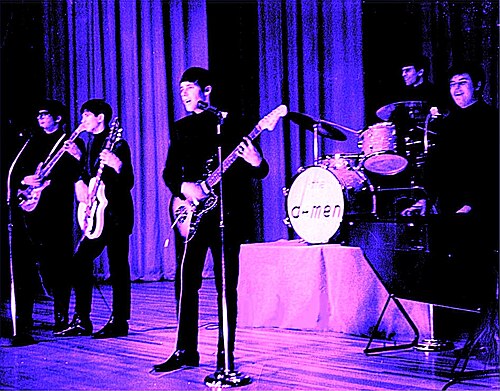
このスタイルは、1958年には早くも地方のシーンから発展し始めていた。ウェイラーズの「Tall Cool One」(1959年)やキングスメンの「Louie Louie」(1963年)は、このジャンルの形成段階における主流の例である。[89] 1963年までに、ポール・リビア・アンド・ザ・レイダーズ(ボイジー)[90] 、トラッシュメン(ミネアポリス)[91]、リヴィエラズ(インディアナ州サウスベンド)[92]など、ガレージバンドのシングルが全国チャートに徐々にランクインし始めた。ソニックス(ワシントン州タコマ)などの他の影響力のあるガレージバンドは、ビルボードホット100にランクインすることはなかった。[93]
ブリティッシュ・インヴェイジョンはガレージ・バンドに大きな影響を与え、全国的な聴衆を獲得し、多くの(サーフやホットロッドのグループが多い)バンドがイギリスの影響を取り入れ、さらに多くのバンドが結成されるきっかけとなった。[87]この時代、アメリカとカナダには何千ものガレージ・バンドが存在し、何百ものバンドが地方ヒットを飛ばした。[87]多数のバンドが大手または地方の大手レーベルと契約したにもかかわらず、ほとんどが商業的に失敗した。ガレージ・ロックは1966年頃に商業的にも芸術的にもピークを迎えたというのが一般的な見解である。[87] 1968年までに、アマチュア・ミュージシャンが大学、仕事、徴兵に直面したため、このスタイルは全国チャートからも地方レベルからもほぼ姿を消した。[87]ガレージ・ロックに代わる新しいスタイルが生まれた。[87] [注 3]
ブルースロック

ブリティッシュ・インヴェイジョンがアメリカのポピュラー音楽に最初に影響を与えたのはビートやR&Bをベースにしたバンドだったが、その勢いはすぐにローリング・ストーンズやヤードバーズなど、アメリカのブルースから直接インスピレーションを得た第二波のバンドに引き継がれた。[95] 1950年代後半から1960年代前半のイギリスのブルース・ミュージシャンは、スキッフル流行に大きな影響を与えたリード・ベリーやロバート・ジョンソンなどのアコースティック演奏に触発されていた。[96]彼らはシカゴ・ブルースをベースにした、エレキギターを中心とした大音量の増幅音をますます取り入れるようになり、特に1958年のマディ・ウォーターズによるイギリス・ツアーがきっかけで、シリル・デイヴィスとギタリストのアレクシス・コーナーはブルース・インコーポレイテッドというバンドを結成した。[97]このバンドは、ローリング・ストーンズやクリームのメンバーを含む、その後のイギリスのブルースブームの多くの人物を巻き込み、影響を与え、ブルースのスタンダードや形式をロックの楽器や強調と組み合わせた。[55]
ブリティッシュ・ブルースのもうひとつの重要な焦点はジョン・メイオールだった。彼のバンド、ブルースブレイカーズにはエリック・クラプトン(クラプトンのヤードバーズ脱退後)や後にピーター・グリーンが所属していた。特に重要なのは、エリック・クラプトンとのブルース・ブレイカーズ(Beano)アルバム(1966年)のリリースである。これはブリティッシュ・ブルースの重要なレコーディングの1つとされ、そのサウンドは英国と米国の両方で大いに模倣された。[98]エリック・クラプトンはその後、クリーム、ブラインド・フェイス、デレク・アンド・ザ・ドミノスといったスーパーグループを結成し、その後、ブルース・ロックを主流に押し上げるのに貢献した長いソロ活動を行った。[97]グリーンは、ブルースブレイカーズのリズム隊、ミック・フリートウッドとジョン・マクヴィーと共にピーター・グリーンのフリートウッド・マックを結成し、ブルース・ロック界で最も商業的な成功を収めたバンドの1つとなった。[97] 1960年代後半、ヤードバーズの卒業生でもあるジェフ・ベックは、自身のバンド、ジェフ・ベック・グループでブルース・ロックをヘビー・ロックの方向に推し進めた。[97]ヤードバーズの最後のギタリストはジミー・ペイジで、彼はその後ニュー・ヤードバーズを結成し、それがすぐにレッド・ツェッペリンとなった。彼らの最初の3枚のアルバムの曲の多くは、そして彼らのキャリアの後半にも時折、伝統的なブルースの曲を拡張したものであった。[97]
アメリカでは、ブルースロックは1960年代初頭にギタリストのロニー・マックによって開拓されていたが、[99]このジャンルは1960年代半ばにイギリスのブルースミュージシャンに似たサウンドを展開するアーティストが現れ、人気が出始めた。主なアーティストにはポール・バターフィールド(彼のバンドはイギリスでメイオールズ・ブルースブレイカーズのような活動を行い、多くの成功したミュージシャンの出発点となった)、キャンド・ヒート、初期のジェファーソン・エアプレイン、ジャニス・ジョプリン、ジョニー・ウィンター、J・ガイルズ・バンド、ジミ・ヘンドリックスとそのパワートリオ、ジミ・ヘンドリックス・エクスペリエンス(イギリス人メンバーが2人含まれ、イギリスで結成された)、そしてギターの妙技とショーマンシップでその10年間で最も模倣されるバンドの一つとなったバンド・オブ・ジプシーズなどがいる。[97]オールマン・ブラザーズ・バンド、レーナード・スキナード、ZZトップなどの南部のブルースロックバンドは、カントリーの要素を自分たちのスタイルに取り入れ、独特のジャンルであるサザンロックを生み出した。[100]
初期のブルースロックバンドはジャズを真似て、長く複雑な即興演奏を演奏することが多く、これは後にプログレッシブ・ロックの大きな要素となった。1967年頃から、クリームやジミ・ヘンドリックス・エクスペリエンスなどのバンドは、純粋なブルースベースの音楽からサイケデリックへと移行していった。[101] 1970年代までには、レッド・ツェッペリンやディープ・パープルの作品に代表されるように、ブルースロックはよりヘビーでリフベースになり、バンドがロックスタイルのアルバムを録音し始めたため、ブルースロックとハードロックとの境界線は「ほとんど見えなくなった」[101]。[101]このジャンルは1970年代にジョージ・ソログッドやパット・トラヴァースなどの人物によって継承されましたが、[97]特にイギリスのシーンでは(おそらく、高エネルギーで反復的なブギーロックに移行したステイタス・クォーやフォガットなどのグループの出現を除いて)、バンドはヘビーメタルの革新に焦点を当てるようになり、ブルースロックは主流から外れ始めました。[102]
フォークロック

1960年代までに、アメリカのフォーク音楽の復興から生まれたシーンは、伝統的な音楽と新しい作曲を伝統的なスタイルで、通常はアコースティック楽器で演奏する大きな運動に成長しました。[103]アメリカでは、このジャンルはウディ・ガスリーやピート・シーガーなどの人物によって開拓され、進歩主義や労働政治と結び付けられることが多かった。[103] 60年代初頭には、ジョーン・バエズやボブ・ディランなどの人物がシンガーソングライターとしてこの運動の先頭に立っていました。[104]ディランは「風に吹かれて」(1963年)や「戦争の覇者」(1963年)などのヒット曲で主流の聴衆に届き始め、これにより「抗議歌」がより広い聴衆に広まりました。[105]しかし、ロックとフォーク音楽は互いに影響し合い始めていたものの、互いに排他的な聴衆を持つ、ほとんど別のジャンルのままでした。[106]
フォークとロックの要素を融合させようとする初期の試みには、アニマルズの「ハウス・オブ・ザ・ライジング・サン」( 1964年)がある。これはロックンロールの楽器で録音された最初の商業的に成功したフォークソングだった[107] 。ビートルズの「アイム・ア・ルーザー」(1964年)は、おそらくディランから直接影響を受けた最初のビートルズの曲である。[ 108]フォークロック運動は、 1965年にチャートのトップに立ったディランの「ミスター・タンバリン・マン」をバーズが録音したことから始まったと通常考えられている。 [106]ロサンゼルスのカフェを拠点とするフォークシーンに参加していたメンバーで、バーズはドラムや12弦のリッケンバッカーギターなどのロック楽器を採用し、それがこのジャンルのサウンドの大きな要素となった。[106]その年、ディランは多くのフォーク純粋主義者の怒りを買ってエレクトリック楽器を採用し、「ライク・ア・ローリング・ストーン」が米国でヒットシングルとなった。[106]リッチー・ウンターバーガーによると、ディランは(電子楽器を導入する前から)ビートルズのようなロックミュージシャンに影響を与え、「ロック世代全体にアルバムがヒットシングルなしでも独立した大きな声明になり得ることを示した」と述べており、その一例として『フリーホイーリン・ボブ・ディラン』(1963年)が挙げられます。[109]
フォーク・ロックは特にカリフォルニアで人気が高まり、ママス&パパスやクロスビー、スティルス&ナッシュがエレクトリック楽器に移行するきっかけとなった。ニューヨークでは、ラヴィン・スプーンフルやサイモン&ガーファンクルなどのアーティストが生まれ、サイモン&ガーファンクルのアコースティック曲「サウンズ・オブ・サイレンス」(1965年)はロック楽器でリミックスされ、多くのヒット曲の最初のものとなった。[106]これらのアーティストは、ドノヴァンやフェアポート・コンベンションなどのイギリスのアーティストに直接影響を与えた。[106] 1969年、フェアポート・コンベンションはアメリカのカバー曲とディランの影響を受けた曲を混ぜたスタイルをやめ、伝統的なイギリスのフォーク音楽をエレクトリック楽器で演奏するようになった。[110]このイギリスのフォークロックは、ペンタングル、スティーライ・スパン、アルビオン・バンドなどのバンドに取り入れられ、それが今度はホースリップスのようなアイルランドのグループや、 JSDバンド、スペンサーズ・フィート、後にファイヴ・ハンド・リールのようなスコットランドのバンドに、彼らの伝統音楽を使って1970年代初頭にケルトロックのブランドを作り出すきっかけとなった。[111]
フォークロックは1967年から68年にかけて商業的人気がピークに達し、その後多くのアーティストが様々な方向へ進み、ディランやバーズはカントリーロックを展開し始めた。[112]しかし、フォークとロックの融合はロック音楽の発展に大きな影響を与え、サイケデリックの要素を取り入れ、シンガーソングライター、プロテストソング、そして「本物」という概念の発展に貢献したと考えられている。[106] [113]
サイケデリックロック
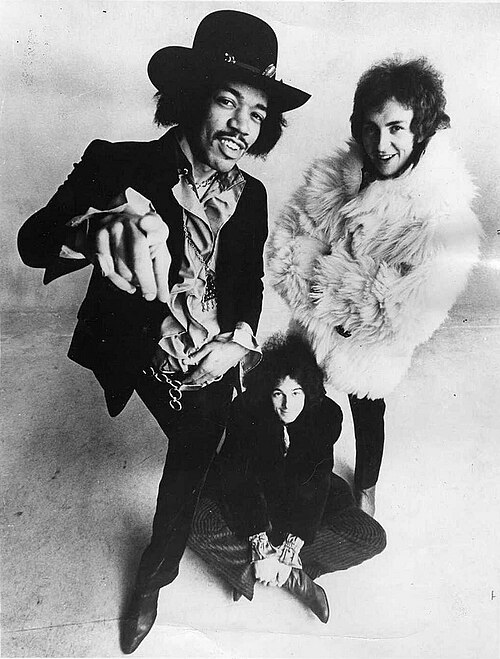
サイケデリック音楽のLSDに触発された雰囲気は、フォークシーンで始まった。[114]サイケデリック・ロックとして自らを宣伝した最初のグループは、テキサスの13thフロア・エレベーターズだった。[114]ビートルズは、ギターのフィードバック、インドのシタール、バックマスキング 効果音など、サイケデリックサウンドの主要な要素の多くをこの時期に聴衆に紹介した。[ 115]サイケデリック・ロックは、 1965年にバーズがフォークからフォークロックへと転換した後を追随するグループが続いたため、特にカリフォルニアの新興音楽シーンで人気が高まった。 [115]幻覚剤を中心としたサイケデリックなライフスタイルは、サンフランシスコで既に発展しており、そのシーンで特に目立ったのは、ビッグ・ブラザー・アンド・ザ・ホールディング・カンパニー、グレイトフル・デッド、ジェファーソン・エアプレインだった。[115] [116]ジミ・ヘンドリックス・エクスペリエンスのリードギタリスト、ジミ・ヘンドリックスは、歪んだフィードバックに満ちたジャムセッションを長時間行い、それがサイケデリック音楽の重要な特徴となった。[115]サイケデリック・ロックは、1960年代の最後の数年間に頂点に達した。1967年、ビートルズは『サージェント・ペパーズ・ロンリー・ハーツ・クラブ・バンド』で決定的なサイケデリック・ステートメントを発表し、これには物議を醸したトラック「ルーシー・イン・ザ・スカイ・ウィズ・ダイアモンズ」が含まれる。ローリング・ストーンズは同年後半に『ザ・サタニック・マジェスティーズ・リクエスト』でこれに応え、[115]ピンク・フロイドは『夜明けの口笛吹き』でデビューした。重要なレコーディングには、ジェファーソン・エアプレインの『シュールレアリスト・ピロウ』やドアーズのデビューアルバムがある。これらのトレンドは、ほとんどの主要なサイケデリックバンドが出演した1969年のウッドストックフェスティバルでピークに達した。[115]
『サージェント・ペパーズ』は後に史上最高のアルバムとされ、アルバム時代の始まりとなった。この時代、ロック音楽はシングル形式からアルバム形式へと移行し、主流の中で文化的正当性を獲得した。[117] 1960年代半ばにビートルズが先導し、[118]ロックミュージシャンはLPを録音音楽の表現と消費の主流として推進し、その後数十年にわたって音楽業界でロックに影響を受けたアルバム時代を開始した。[119]
プログレッシブ・ロック

プログレッシブ・ロックは、アート・ロックと互換的に使われることもある用語で、様々な楽器、曲の種類、形式を実験することで、確立された音楽の公式を超えていった。[120] 1960年代半ばから、レフト・バンク、ビートルズ、ローリング・ストーンズ、ビーチ・ボーイズは、録音にハープシコード、管楽器、弦楽器セクションを取り入れてバロック・ロックの形式を生み出した先駆者であり、バッハに触発されたイントロを持つプロコル・ハルムの「A Whiter Shade of Pale」(1967年)などのシングルで聞くことができる。[121]ムーディー・ブルースは、アルバム「 Days of Future Passed 」(1967年)でフルオーケストラを使用し、その後シンセサイザーでオーケストラのサウンドを作成した。[120]その後のプログレッシブ・ロックでは、ギター、ベース、ドラムという確立されたロック形式に、クラシックなオーケストレーション、キーボード、シンセサイザーが頻繁に追加された。[122]
インストゥルメンタルが一般的だったが、歌詞のある曲は概念的、抽象的、またはファンタジーやSFをベースにしたものもあった。[123] プリティ・シングスの『SFソロウ』(1968年)、キンクスの『アーサー(あるいは大英帝国の衰亡史)』(1969年)、ザ・フーの『トミー』 (1969年)は、ロックオペラの形式を導入し、壮大な物語を語ったり、壮大な包括的なテーマに取り組んだりするコンセプトアルバムへの扉を開いた。 [124] キング・クリムゾンの1969年のデビューアルバム『クリムゾン・キングの宮殿』は、力強いギターリフとメロトロンをジャズや交響曲と融合させており、プログレッシブ・ロックの重要なレコーディングとされることが多く、1970年代初頭に既存のブルースロックやサイケデリックバンドだけでなく、新しく結成されたバンドの間でこのジャンルが広く採用されるのを助けた。[120]活気に満ちたカンタベリーのシーンでは、サイケデリックからジャズの影響を経て、より拡張的なハードロックへと向かうソフト・マシーンに続くアーティストが登場し、キャラヴァン、ハットフィールド・アンド・ザ・ノース、ゴング、ナショナル・ヘルスなどがいた。[125]ドラマーのクリスチャン・ヴァンダーを中心としたフランスのグループ、マグマは、1970年代初頭に最初のアルバムで新しい音楽ジャンルであるズールをほぼ独力で生み出した。[126]
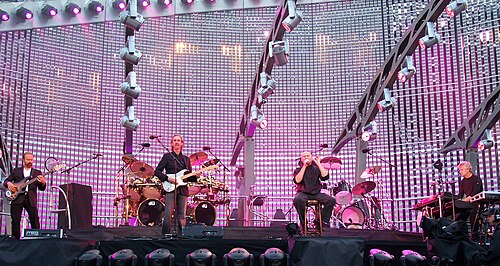
より大きな商業的成功を収めたのはピンク・フロイドで、彼らも1968年のシド・バレット脱退後サイケデリックから遠ざかり、ジャンルの最高傑作と見なされている『狂気』(1973年)は史上最も売れたアルバムの1つとなった。[127]楽器の技巧に重点が置かれ、イエスはギタリストのスティーヴ・ハウとキーボード奏者のリック・ウェイクマンの両者のスキルを披露し、エマーソン・レイク・アンド・パーマーはジャンルの中でも最も技術的に要求の厳しい作品のいくつかを制作したスーパーグループであった。[120] ジェスロ・タルとジェネシスはどちらも非常に異なるが明らかに英国的なブランドの音楽を追求した。[128]元ヤードバーズのジム・マッカーティとキース・レルフによって1969年に結成された ルネッサンスは、アニー・ハスラムの3オクターブの声をフィーチャーしたハイコンセプトのバンドへと進化した。[129]イギリスのバンドのほとんどは比較的小規模なカルト的なファンに依存していたが、ピンク・フロイド、ジェネシス、ジェスロ・タルなど少数のバンドは国内でトップ10シングルを生み出し、アメリカ市場を席巻した。[ 130]アメリカ発のプログレッシブ・ロックは、フランク・ザッパ、キャプテン・ビーフハート、ブラッド・スウェット・アンド・ティアーズなどの折衷的で革新的なバンドから、[131]ボストン、フォリナー、カンサス、ジャーニー、スティクスなどのよりポップロック志向のバンドまで多岐にわたる。[120]イギリスのバンド、スーパートランプやELOと並んで、これらはすべてプログレッシブ・ロックの影響を示し、1970年代の最も商業的に成功したバンドに数えられ、華やかなアリーナ・ロックの時代の到来を告げた。この時代は、複雑なショー(劇場のようなステージングや特殊効果を伴うことが多い)の費用がかさむため、 1990年代に主要なライブ会場としてより経済的なロックフェスティバルが台頭するまで続いた。 [要出典]
このジャンルのインストゥルメンタルの流れは、マイク・オールドフィールドの『チューブラー・ベルズ』(1973年)のようなアルバムを生み出した。これはヴァージン・レコード・レーベルにとって初のレコードであり、世界的なヒットとなり、同レーベルはこのジャンルの主力となった。[120]インストゥルメンタル・ロックは特に大陸ヨーロッパで重要であり、クラフトヴェルク、タンジェリン・ドリーム、カン、フォーカス(バンド)、ファウストなどのバンドが言語の壁を乗り越えることを可能にした。[132]彼らのシンセサイザーを多用した「クラウトロック」は、ブライアン・イーノ(一時期ロキシー・ミュージックでキーボード奏者を務めた)の作品とともに、その後のエレクトロニック・ロックに大きな影響を与えた。[120] 1970年代後半のパンク・ロックの出現とテクノロジーの変化により、プログレッシブ・ロックはますます気取っていて大げさだと見なされるようになった。[133] [134]多くのバンドが解散したが、ジェネシス、ELP、イエス、ピンク・フロイドなど、定期的にトップ10アルバムを獲得し、世界ツアーも成功したバンドもあった。[94]スージー・アンド・ザ・バンシーズ、ウルトラヴォックス、シンプル・マインズなど、パンクの余波で登場したバンドの中には、より一般的に認識されているパンクの影響に加え、プログレッシブ・ロックの影響も見られた。[135]
ジャズロック

1960年代後半、ブルースロック、サイケデリック、プログレッシブロックのシーンから、ロックのパワーとジャズの音楽的複雑さや即興的要素を融合させたジャズロックが独自のサブジャンルとして登場した。オールミュージックは、ジャズロックという用語は「ジャズ陣営の最も騒々しく、ワイルドで、エレクトリックなフュージョンバンドを指すこともあるが、ほとんどの場合、ロック側の演奏者を指す」と述べている。ジャズロックは「一般的に、60年代後半から70年代前半の最も芸術的に野心的なロックのサブジャンルから生まれた」もので、シンガーソングライター運動もその1つである。[136]初期のアメリカのロックンロールミュージシャンの多くはジャズからスタートし、これらの要素のいくつかを新しい音楽に取り入れた。イギリスでは、ブルースロックのサブジャンルと、エリック・クラプトン率いるクリームのジンジャー・ベイカーやジャック・ブルースなど、その主要人物の多くがイギリスのジャズシーンから登場した。最初の真のジャズロック録音としてしばしば取り上げられるのは、比較的無名のニューヨークを拠点とするフリースピリッツによる唯一のアルバム『アウト・オブ・サイト・アンド・サウンド』(1966年)である。この呼称を意識的に使用した最初のバンドグループは、エレクトリック・フラッグ、ブラッド・スウェット・アンド・ティアーズ、シカゴなど、ジャズのホーンセクションを活用したR&B志向の白人ロックバンドであり、1960年代後半から1970年代前半にかけて最も商業的に成功したバンドのいくつかとなった。[137]
同時期にブルース界から登場し、ジャズの音色と即興性の側面を活用したイギリスのアーティストには、ニュークリアス[138]や、グラハム・ボンドとジョン・メイオールのスピンオフであるコロシアムなどがいる。サイケデリック・ロックとカンタベリー界からはソフト・マシーンが登場し、2つのジャンルを芸術的にうまく融合させたバンドの1つを生み出したと言われている。おそらく最も高い評価を得た融合はジャズ界からのもので、特にヘンドリックスの作品に影響を受けたマイルス・デイビスが、アルバム「ビッチェズ・ブリュー」 (1970年)でロックの楽器演奏を自身のサウンドに取り入れた。これはハービー・ハンコック、チック・コリア、ウェザー・リポートなど、その後のロックに影響を受けたジャズ・アーティストに大きな影響を与えた。[137]このジャンルは1970年代後半に衰退し始め、より穏やかなフュージョンが聴衆を獲得し始めましたが、[136]スティーリー・ダン、[136]フランク・ザッパ、ジョニ・ミッチェルなどのアーティストがこの時期にジャズの影響を受けた重要なアルバムを録音し、ロック音楽に大きな影響を与え続けています。[137]
1970年代~1980年代: 商業化
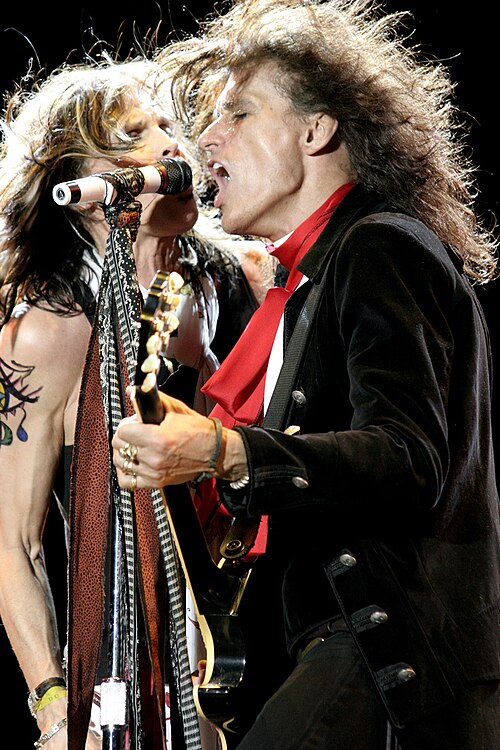
1970年代初頭のロック音楽の発展を振り返り、ロバート・クリストガウは『クリストガウのレコードガイド:70年代のロックアルバム』(1981年)の中で次のように書いている。 [17]
もちろん、10 年というのはそれ自体が恣意的な図式であり、時間は 10 年ごとに未来に向かってきれいに方向転換するわけではない。しかし、多くの人工的な概念 (たとえばお金) と同様に、このカテゴリは、人々がそれをどのように活用するかを理解すると、それ自体の現実性を獲得する。「60 年代は終わった」というスローガンは、1972 年頃にようやく聞かれるようになり、理想主義は時代遅れになったと信じたがるすべての人々を動員した。そして、彼らが動員されると、理想主義は時代遅れになった。ポピュラー音楽では、70 年代を受け入れることは、乱雑なコンサートやカウンターカルチャーのシーンからエリート主義的に撤退することと、 FM ラジオやアルバム ロックの最低共通分母を追求する利益追求の両方を意味した。
ロックはこの10年間で商品化が進み、数十億ドル規模の産業に変貌し、市場規模は倍増したが、クリストガウが指摘したように、大きな「文化的威信の喪失」に見舞われた。「ビージーズはビートルズより人気があったかもしれないが、イエスより人気があったことは一度もない」と彼は言う。「音楽が神話的な力を持っていたとしても、その神話は自己言及的なものだった。ロックンロールの人生についての歌はたくさんあったが、ロックが世界を変えることができるという歌はほとんどなく、新しい鎮痛剤としてしかなかった。70年代には権力者が支配権を握り、ロック産業家たちは国民の気分を利用して、強力な音楽をしばしば反動的な娯楽に貶め、ロックの人気基盤を聴衆から市場へと変えた。」[17]
ルーツロック
ルーツ・ロックとは、サイケデリック・シーンの過剰と見られるものから、ブルース、カントリー、フォークなど、ロックンロール本来の影響を取り入れたより基本的な形式へと移行し、カントリー・ロックやサザン・ロックが生まれた現象を指す言葉として現在では使われている。[139] 1966年、ボブ・ディランはアルバム『ブロンド・オン・ブロンド』を録音するためにナッシュビルを訪れた。[140]このアルバムと、その後の『ナッシュビル・スカイライン』など、よりカントリーの影響がはっきりと表れたアルバムは、カントリー・フォークというジャンルを生み出したと見られており、この方向性は、主にアコースティック・フォークを演奏する多くのミュージシャンによって追求された。[140]基本回帰のトレンドに従った他のバンドには、カナダのバンド、ザ・バンドやカリフォルニアを拠点とするクリーデンス・クリアウォーター・リバイバルがあり、どちらも基本的なロックンロールにフォーク、カントリー、ブルースを融合させ、1960年代後半の最も成功し影響力のあるバンドの一つとなった。[141]同じ動きから、ライ・クーダー、ボニー・レイット、ローウェル・ジョージといったカリフォルニアのソロアーティストのレコーディングキャリアが始まり、[142]ローリング・ストーンズの『ベガーズ・バンケット』(1968年)やビートルズの『レット・イット・ビー』(1970年)といった有名アーティストの作品にも影響を与えた。[115]過去数年間のロック音楽のトレンドの変化を振り返り、クリストガウは1970年6月の「コンシューマー・ガイド」コラムで、この「新しい正統派」と「文化的遅れ」が即興的でスタジオで装飾された制作を放棄し、「タイトで簡素な楽器」と曲の構成に重点を置くようになったと書いている。「その対象は50年代のロック、カントリーミュージック、リズムアンドブルースであり、その主なインスピレーションはザ・バンドである。」[143]

1968年、グラム・パーソンズはインターナショナル・サブマリン・バンドと共に『セーフ・アット・ホーム』を録音した。これはおそらく最初の真のカントリー・ロック・アルバムである。 [144]その年、彼はバーズに参加し、 『スウィートハート・オブ・ザ・ロデオ』(1968年)をリリースした。これはこのジャンルで最も影響力のあるレコードの1つと一般に考えられている。[144]バーズは同じ流れを続けたが、パーソンズは脱退し、同じく元バーズのメンバーであるクリス・ヒルマンと合流してフライング・ブリトー・ブラザーズを結成し、このジャンルの尊敬と基準を確立するのに貢献した後、パーソンズはソロ活動へと移った。[144]カリフォルニアでカントリー・ロックを取り入れたバンドには、ハーツ・アンド・フラワーズ、ポコ、ニュー・ライダーズ・オブ・ザ・パープル・セージ、[144]ボー・ブランメルズ、[144]ニッティー・グリッティ・ダート・バンドなどがある。[145]カントリーサウンドを取り入れることでルネッサンスを楽しんだアーティストもいた。エヴァリー・ブラザーズ、ストーン・キャニオン・バンドのフロントマンとなったかつてのティーンアイドル、リック・ネルソン、ファースト・ナショナル・バンドを結成した元モンキーズのマイク・ネスミス、ニール・ヤングなどである。[144]ディラーズは珍しくカントリーバンドだったが、ロックミュージックへと転向した。[144]カントリーロックが最も商業的に成功したのは1970年代で、ドゥービー・ブラザーズ、エミルー・ハリス、リンダ・ロンシュタット、イーグルス(ブリトーズ、ポコ、ストーン・キャニオン・バンドのメンバーで構成)などのアーティストが活躍し、イーグルスは史上最も成功したロックバンドの一つとして登場し、『ホテル・カリフォルニア』(1976年)などのアルバムを制作した。[146]
サザンロックの創始者は、オールマン・ブラザーズ・バンドであると一般に考えられている。彼らは、1970年代初頭に、主にブルースロックから派生しながらも、ブギー、ソウル、カントリーの要素を取り入れた独特のサウンドを生み出した。 [100]彼らに続く最も成功したバンドはレーナード・スキナードで、このサブジャンルの「古き良き男」のイメージと、1970年代のギターロックの一般的な形を確立するのに貢献した。[100]その後継者には、フュージョン/プログレッシブ楽器奏者のディキシー・ドレッグス、よりカントリーの影響を受けたアウトローズ、ファンク/R&B寄りのウェット・ウィリー、そして(R&Bとゴスペルの要素を取り入れた)オザーク・マウンテン・デアデビルズがいる。 [ 100]オールマン・ブラザーズとレーナード・スキナードのオリジナルメンバーが亡くなった後、このジャンルの人気は1970年代後半に衰え始めましたが、1980年代には.38スペシャル、モリー・ハチェット、マーシャル・タッカー・バンドなどのアーティストによって維持されました。[100]
グラムロック
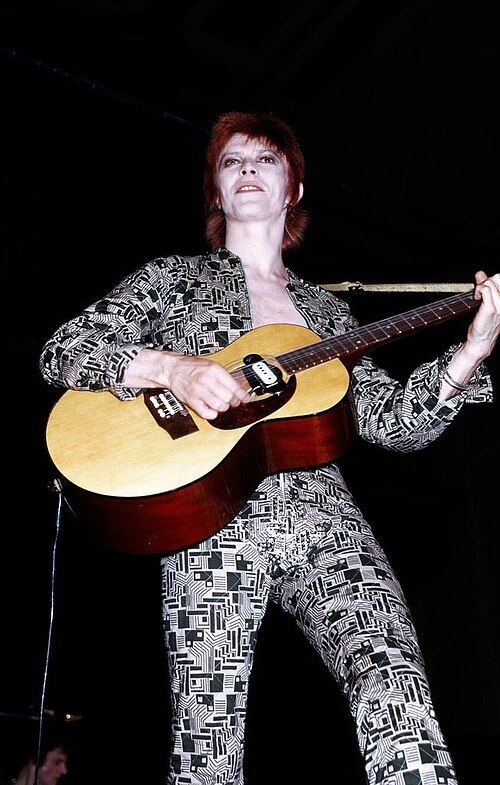
グラムロックは、1960年代後半のイギリスのサイケデリックとアートロックのシーンから生まれ、これらのトレンドの延長と反動の両方として見ることができます。[147]音楽的には多様で、アルヴィン・スターダストのような人物のシンプルなロックンロールリバイバルから、ロキシー・ミュージックの複雑なアートロックまでさまざまであり、音楽のサブジャンルであると同時にファッションとしても見ることができます。[147]視覚的には、1930年代のハリウッドの魅力から、1950年代のピンナップセックスアピール、戦前のキャバレーの演劇、ビクトリア朝の文学と象徴主義のスタイル、SF、古代とオカルトの神秘主義と神話に至るまで、さまざまなスタイルが混ざり合っており、奇抜な服、メイク、ヘアスタイル、厚底ブーツに表れています。[148]グラムロックは、演劇の広範な使用に加えて、性的およびジェンダーの曖昧さと両性具有の表現で最も知られています。 [149]これは、コケッツやアリス・クーパーなどのアメリカのアーティストによるショーマンシップとジェンダー・アイデンティティの操作によって予見されていました。[150]
グラムロックの起源はマーク・ボランと関連がある。彼は1960年代末までに自身のフォークデュオをT.レックスに改名し、エレクトリック楽器も始めた。グラムロックの始まりとしてよく挙げられるのは、1971年3月にBBCの音楽番組「トップ・オブ・ザ・ポップス」にグリッターとサテンの衣装で出演し、2曲目の全英トップ10ヒット(そして初の全英ナンバーワンヒット)となる「ホット・ラブ」を演奏した時である。[151] 1971年から、すでにマイナースターだったデヴィッド・ボウイは、ジギー・スターダストのペルソナを展開し、プロのメイクアップ、パントマイム、パフォーマンスの要素を演技に取り入れていった。[152]これらのパフォーマーに続いて、すぐにロキシー・ミュージック、スウィート、スレイド、モット・ザ・フープル、マッド、アルヴィン・スターダストなどのアーティストがこのスタイルを採用した。[152]イギリスのシングルチャートでは大成功を収めたものの、アメリカで大きな影響を与えられたミュージシャンはごくわずかであった。ボウイは大きな例外で、国際的なスーパースターとなり、ルー・リード、イギー・ポップ、ニューヨーク・ドールズ、ジョブライアスなどのアーティストの間でグラムロックのスタイルが取り入れられるきっかけとなった。グラムロックは「グリッターロック」とも呼ばれ、イギリスのアーティストよりも暗い歌詞の内容を持つ。[153]英国では、グリッターロックという用語は、ゲイリー・グリッターと彼のサポートミュージシャンであるグリッターバンドが追求したグラムの極端なバージョンを指すために最もよく使われていました。彼らは1972年から1976年の間に英国で18曲のトップ10シングルを達成しました。[154]スージー・クアトロ、ロイ・ウッドのウィザード、スパークスを含むグラムロックの第二波は、 1974年から1976年頃まで英国のシングルチャートを独占しました。 [152]ロッド・スチュワート、エルトン・ジョン、クイーン、そして一時期はローリング・ストーンズなど、通常はこのジャンルの中心とは見なされていない既存のアーティストもグラムスタイルを採用しました。 [152]また、キッスやアダム・アントなど、後に有名になったアーティストに直接的な影響を与えたほか、ゴシック・ロックやグラム・メタルの形成、パンク・ロックにも直接的な影響を与え、1976年頃からグラムの流行に終止符を打った。[153]グラムはその後、チェーンソー・キトゥンズ、ザ・ダークネス[155]やR&Bクロスオーバーバンドのプリンス[156]にも参加している。
チカーノロック

1960年代にラテンロックが初期の成功を収めた後、カルロス・サンタナやアル・ハリケーンのようなチカーノのミュージシャンは1970年代を通して成功したキャリアを持ち続けた。サンタナは1970年のアルバム『アブラクサス』に収録されたシングル「ブラック・マジック・ウーマン」でこの10年を成功に導いた。[157] 3枚目のアルバム『サンタナIII』からはシングル「ノー・ワン・トゥ・ディペンド・オン」が収録され、4枚目のアルバム『キャラバンセライ』では彼のサウンドを実験的に取り入れたものの、評価はまちまちだった。[158] [159]その後、 Welcome、Borboletta、Amigos、Festiválの4枚のアルバムをリリースし、いずれもゴールドディスクを獲得した。アル・ハリケーンはロック音楽とニューメキシコ音楽を融合させ続けたが、ジャズ音楽にもより力を入れ、特にアルバム『Vestido Mojado 』で「Vestido Mojado」や「Por Una Mujer Casada」、「Puño de Tierra」など数々のヒットシングルを生み出した。また、兄弟のニューメキシコ音楽シングルには、タイニー・モリーの「La Del Moño Colorado」やベイビー・ギャビーの「La Cumbia De San Antone」がある。[160]アル・ハリケーン・ジュニアも1970年代にロック調のニューメキシコ音楽のレコーディングキャリアを開始し、1976年に「Flor De Las Flores」をカバーした。[161] [162]ロス・ロボスもこの時期に人気を博し、1977年に初のアルバム『Los Lobos del Este de Los Angeles』をリリースした。
ソフトロック、ハードロック、初期のヘビーメタル
1971 年は奇妙な時代でした。ロックのジャンルへの細分化がかなり進んでいたにもかかわらず、キャッチフレーズを区別するのは困難でした。「アート ロック」は、ヴェルヴェッツからムーディー ブルースまであらゆるものを意味し、レッド ツェッペリンが誕生し、ブラック サバスが称賛されていたにもかかわらず、「ヘビー メタル」は漠然とした概念のままでした。
—ロバート・クリストガウ[163]
1960年代後半から、主流のロック音楽をソフトロックとハードロックに分けることが一般的になった。ソフトロックはフォークロックから派生したものが多く、アコースティック楽器を使用し、メロディーとハーモニーに重点が置かれていた。[164]主なアーティストには、キャロル・キング、キャット・スティーヴンス、ジェームス・テイラーなどがいた。[164] 1970年代半ばから後半にかけて、ビリー・ジョエル、アメリカ、再結成したフリートウッド・マックなどのアーティストの活躍により、商業的なピークを迎え、フリートウッド・マックの『噂』(1977年)は、その10年間で最も売れたアルバムとなった。[165]対照的に、ハードロックはブルース・ロックから派生したものであることが多く、より大音量でより激しく演奏された。[166]エレキギターを強調することが多く、単純な反復リフを使用するリズム楽器としても、ソロリード楽器としても使用され、ディストーションなどのエフェクトが使用されることが多かった。[166]主要アーティストには、キンクスのようなブリティッシュ・インヴェイジョンのバンドや、クリーム、ジミ・ヘンドリックス、ジェフ・ベック・グループのようなサイケデリック時代のアーティストが含まれます。[166] 1970年代後半に国際的な成功を収めたハードロックの影響を受けたバンドには、クイーン、[167] シン・リジィ、[168] エアロスミス、AC/DC、[166]ヴァン・ヘイレンが含まれます。
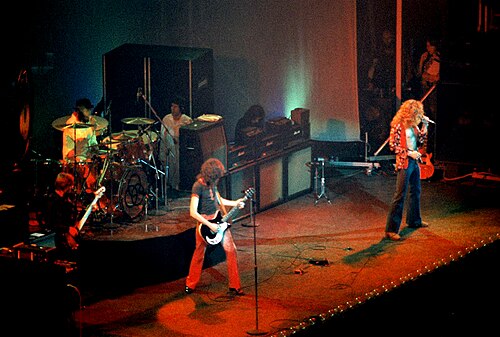
1960年代後半から、「ヘビーメタル」という用語は、最初は形容詞として、1970年代初頭には名詞として、さらに音量と激しさを増して演奏されるハードロックを表すために使われるようになった。[169]この用語は、ステッペンウルフの「Born to Be Wild 」(1967年)で初めて音楽で使用され、サンフランシスコのブルー・チアー、クリーブランドのジェイムス・ギャング、ミシガン州のグランド・ファンク・レイルロードなどの先駆的なバンドに関連付けられるようになった。[170] 1970年までに、3つの主要なイギリスのバンドが、このサブジャンルの形成に役立つ特徴的なサウンドとスタイルを開発していた。レッド・ツェッペリンはリフの多いブルース・ロックにファンタジーの要素を加え、ディープ・パープルはプログレッシブ・ロックの時代から交響曲と中世への興味を持ち込み、ブラック・サバスはゴシックとモードのハーモニーの側面を導入して、「よりダークな」サウンドを生み出すのに貢献した。[171]これらの要素は、1970年代後半まで「第二世代」のヘビーメタルバンドに取り入れられ、イギリスのジューダス・プリースト、UFO、モーターヘッド、レインボー、アメリカのキッス、テッド・ニュージェント、ブルー・オイスター・カルト、カナダのラッシュ、ドイツのスコーピオンズなど、サブジャンルの人気の拡大を象徴するバンドが続いた。[171]ラジオでの放送が少なく、シングルチャートにもほとんど入らなかったにもかかわらず、1970年代後半のヘビーメタルは、特に北米とヨーロッパの労働者階級の青年男性の間でかなりの支持を集めた。[172] 1980年代には、ボン・ジョヴィ、ガンズ・アンド・ローゼズ、スキッド・ロウ、デフ・レパードなどのバンドが、ハードロックやハードロックとポップスの融合で主流の成功を収めた。 1990年代、ガンズ・アンド・ローゼズの「November Rain」などの大ヒット曲を除けば、ハードロックの人気は若干低下しました。しかし、2000年代初頭、ボン・ジョヴィの「It's My Life」によってロックとポップロックの人気が急上昇し、このジャンルを新しいファン層に紹介するのに役立ちました。
クリスチャンロック

ロック、特にヘビーメタルのジャンルは、一部のキリスト教指導者から、不道徳、反キリスト教的、さらには悪魔的であると非難されてきた。[173]しかし、クリスチャンロックは1960年代後半、特に南カリフォルニアで始まったジーザス運動から発展し始め、1970年代にはラリー・ノーマンなどのアーティストによってサブジャンルとして登場し、通常、クリスチャンロックの最初の主要な「スター」と見なされている。[174]このジャンルは主に米国で現象となった。[175]多くのクリスチャンロックのパフォーマーは、現代のクリスチャンミュージックシーンとつながりがある。1980年代から、クリスチャンポップのパフォーマーが主流の成功を収めるようになった。これらのアーティストはキリスト教コミュニティで広く受け入れられたが、1980年代にかなりの主流の成功を収めたストライパーなどのバンドによるヘビーロックやグラムメタルのスタイルを取り入れたことは、より物議を醸した。[176] [177] 1990年代からは、 PODを含め、クリスチャンバンドというラベルを避け、自分たちもクリスチャンであるグループとして見られることを好むバンドが増えてきました。[178]
ハートランドロック

アメリカの労働者階級志向のハートランド・ロックは、率直な音楽スタイルと、普通のブルーカラーのアメリカ人の生活への関心を特徴とし、1970年代後半に発展した。ハートランド・ロックという用語は、カンサス、REOスピードワゴン、スティックスなどの中西部の アリーナ・ロック・グループを表すために最初に使用されたが、フォーク、カントリー、ロックンロールの影響をより直接的に受けた、より社会的関心の高いルーツ・ロックと関連付けられるようになった。[179]これは、アメリカ中西部およびラストベルトにおける、西海岸カントリー・ロックやアメリカ南部のサザン・ロックの対応物とみなされてきた。[180]当初はパンクやニューウェイヴと同一視されていた人物によって率いられ、ボブ・ディラン、バーズ、クリーデンス・クリアウォーター・リバイバル、ヴァン・モリソンなどのアーティスト、および1960年代のガレージのベーシック・ロックやローリング・ストーンズの影響を最も強く受けた。[181]
ブルース・スプリングスティーン、ボブ・シーガー、トム・ペティといったシンガーソングライターの商業的成功や、サウスサイド・ジョニー・アンド・ザ・アズベリー・ジュークス、ジョー・グルシェッキー・アンド・ザ・ハウスロッカーズといったあまり知られていないアーティストに代表されるように、ロックは東部と中西部のポスト工業化都市の衰退に対する反応でもあり、一種の楽しいロックンロール復興と並んで、社会的崩壊と孤立の問題にこだわることが多かった。[181]このジャンルは1980年代半ばに商業的、芸術的、影響力のピークを迎え、スプリングスティーンの『ボーン・イン・ザ・USA』(1984年)が世界中のチャートで1位を獲得し、トップ10シングルを次々に生み出したほか、ジョン・メレンキャンプ、スティーヴ・アールなどのアーティストや、ブルース・ホーンズビーなどのより穏やかなシンガーソングライターが登場した。[181]また、ビリー・ジョエル[182] 、キッド・ロック[183] 、キラーズ[184]など、多様なアーティストに影響を与えたともいえる。
1990年代初頭までに、ハートランド・ロックは認知されたジャンルとしては消えていった。ロック音楽全般、特にブルーカラーや白人労働者階級をテーマにしたものが若い聴衆から影響力を失い、ハートランドのアーティストがより個人的な作品に目を向けるようになったためである。[181]多くのハートランド・ロック・アーティストは、ブルース・スプリングスティーン、トム・ペティ、ジョン・メレンキャンプなど、批評的にも商業的にも成功を収めながらレコーディングを続けたが、彼らの作品はより個人的で実験的なものとなり、もはや特定のジャンルに当てはまらなくなった。[185]
パンクロック

パンク・ロックは1974年から1976年にかけてアメリカとイギリスで発展した。ガレージ・ロックや現在プロトパンク音楽として知られている他の形式に根ざしたパンク・ロックバンドは、1970年代の主流ロックの過剰とみなされるものを避けた。[186]彼らは、典型的には短い曲、簡素化された楽器編成、そしてしばしば政治的で反体制的な歌詞を伴う、速くてエッジの効いた音楽を生み出した。パンクはDIY(自分でやる)倫理を受け入れており、多くのバンドがレコーディングを自ら制作し、非公式のチャネルを通じて配布している。[187]

1976年後半までには、ニューヨークのラモーンズやパティ・スミス、ロンドンのセックス・ピストルズやクラッシュといったアーティストが、新しい音楽運動の先駆者として認知されるようになった。 [186]翌年、パンク・ロックが世界中に広まった。パンクはすぐにイギリスで大きな文化的現象となった。1976年12月1日のセックス・ピストルズとビル・グランディのテレビでの生討ちは、レコード店がレコードの取り扱いを拒否し、ラジオでのオンエアが困難であったにもかかわらず、イギリスのパンクが大きなメディア現象へと変貌する分岐点となった。[188] 1977年5月、セックス・ピストルズは、エリザベス2世女王の即位25周年記念式典で「ゴッド・セイヴ・ザ・クイーン」と題した曲で、新たな論争の的となり(シングルチャートで2位を獲得した)、[ 189]パンクは主に、主流との結びつきを拒む傾向のある地元のシーンに根付いた。若者の反抗心を表現し、独特の服装スタイルとさまざまな反権威主義的イデオロギーを特徴とするパンクサブカルチャーが出現した。[190]
1980年代初頭までに、ハードコアやOi!などのより速く、より攻撃的なスタイルがパンク・ロックの主流となった。[191]これにより、Dビート(英国のバンドDischargeの影響を受けたディストーションを多用したサブジャンル)、アナルコ・パンク( Crassなど)、グラインドコア( Napalm Deathなど) 、クラスト・パンクなど、ハードコア・パンクから進化した系統がいくつか生まれた。[192]パンクに共感したり、パンクにインスピレーションを受けたミュージシャンは、幅広いバリエーションを追求し、ニューウェーブ、ポストパンク、オルタナティヴ・ロック運動を生み出した。[186]
新しい波
_One.jpg/500px-Blondie_(Debbie_Harry)_One.jpg)
パンク・ロックは社会的、音楽的に重要な現象であったが、レコードの売り上げ(スティッフ・レコードなどの小規模な専門レーベルによって流通された)やアメリカのラジオでの放送(ラジオシーンはディスコやアルバム志向のロックなどの主流フォーマットが引き続き支配していたため)の点ではそれほど大きな成果をあげなかった。[194]パンク・ロックは芸術界や大学界の熱狂者を魅了し、すぐにトーキング・ヘッズやディーヴォなど、より教養があり芸術的なアプローチを誇示するバンドがパンクシーンに浸透し始めた。一部では、これらのあまりパンクではないバンドを区別するために「ニューウェーブ」という表現が使われるようになった。[195]パンク運動にほとんど困惑していたレコード会社の重役たちは、より親しみやすいニューウェーブのバンドの可能性を認識し、パンクやニューウェーブと少しでもつながりがあると主張できるバンドと積極的に契約し、宣伝し始めた。[196]カーズやゴーゴーズなど、これらのバンドの多くは、ニューウェーブとして宣伝されたポップバンドと見なすことができる。[197]ポリス、プリテンダーズ、エルヴィス・コステロなどの他の既存のアーティストは、ニューウェイヴ運動を比較的長く批評的に成功したキャリアへの足がかりとして利用しました。[ 198 ] 一方、ナックに代表される「スキニータイ」バンド、[199]や写真映えするブロンディは、パンクバンドとして始まり、より商業的な領域に移行しました。[200]
1979年から1985年の間、クラフトワーク、イエロー・マジック・オーケストラ、デヴィッド・ボウイ、ゲイリー・ニューマンの影響を受け、イギリスのニューウェイヴは、スパンダー・バレエ、ウルトラヴォックス、ジャパン、デュラン・デュラン、ア・フロック・オブ・シーガルズ、カルチャー・クラブ、トーク・トーク、ユーリズミックスなどのニューロマンティックの方向に進み、時には他のすべての楽器の代わりにシンセサイザーを使用することもあった。[201]この時期はMTVの台頭と重なり、このタイプのシンセポップは大きな注目を集め、第二次ブリティッシュ・インヴェイジョンと呼ばれる現象を生み出した。[202]いくつかのより伝統的なロックバンドはビデオ時代に適応し、MTVのエアプレイから利益を得た。最も明白なのはダイアー・ストレイツで、「マネー・フォー・ナッシング」は、彼らが国際的なスターになるのに貢献したにもかかわらず、MTVをやさしく揶揄した。[203]しかし、一般的にギター志向のロックは商業的に影を潜めていた。[204]
ポストパンク

ハードコアがパンクの削ぎ落とされた美学を最も直接的に追求し、ニューウェイヴがその商業的な側面を代表するようになったとすれば、ポストパンクは1970年代後半から1980年代前半にかけて、より芸術的で挑戦的な側面として登場した。パンクバンド以外で大きな影響を与えたのは、ヴェルヴェット・アンダーグラウンド、フランク・ザッパ、キャプテン・ビーフハート、そしてパフォーマンスを重視したニューヨークを拠点とするノーウェイヴシーンで、ジェイムス・チャンス・アンド・ザ・コントーションズ、DNA、ソニック・ユースなどのバンドがいた。[205]このジャンルの初期の貢献者には、米国のバンド、ペール・ウブ、ディーヴォ、ザ・レジデンツ、トーキング・ヘッズが含まれていた。[205]
イギリスのポストパンクの第一波には、ギャング・オブ・フォー、スージー・アンド・ザ・バンシーズ、ジョイ・ディヴィジョンなどが含まれ、彼らはアメリカのバンドに比べ芸術性よりも音楽の暗く感情的な性質を重視していた。[205]スージー・アンド・ザ・バンシーズ、バウハウス、ザ・キュアー、シスターズ・オブ・マーシーなどのバンドは、この方向にますます進んでゴシック・ロックを創始し、 1980年代初頭までに主要なサブカルチャーの基礎となっていた。 [206]同様の感情的な領域は、バースデイ・パーティーやニック・ケイヴなどのオーストラリアのバンドによって追求された。[205]バウハウスとジョイ・ディヴィジョンのメンバーは、それぞれラヴ・アンド・ロケッツとニュー・オーダーとして新しいスタイルの領域を模索した。[205]ポストパンクの初期のムーブメントのもう一つは、イギリスのバンド、スロッビング・グリッスルやキャバレー・ヴォルテール、ニューヨークを拠点とするスーサイドによって開発されたインダストリアル・ミュージック[207]であり、工業製品のサウンドを模倣した様々な電子音楽やサンプリング技術を用いており、1980年代には様々な形態のポストインダストリアル・ミュージックに発展しました。 [208]
1980年代初頭にブレイクしたザ・フォール、ザ・ポップ・グループ、ザ・メコンズ、エコー・アンド・ザ・バニーメン、ザ・ティアドロップ・エクスプローズなどのイギリスのポストパンクバンドの第二世代は、暗い音の世界から離れていく傾向があった。[205]ポストパンクから登場したバンドの中でおそらく最も成功したのはアイルランドのU2だろう。彼らは宗教的なイメージの要素と政治的なコメントをアンセムのような音楽に取り入れ、1980年代後半には世界最大のバンドの一つになっていた。[209]多くのポストパンクバンドがレコーディングや演奏を続けたものの、1980年代半ばにはバンドが解散したり他の音楽分野を模索したりしたため、ムーブメントとしては衰退したが、ロックミュージックの発展に影響を与え続け、オルタナティブロックムーブメントの創造における主要な要素と見なされてきた。[210]
オルタナティブロックの出現

オルタナティヴ・ロックという用語は、1980年代初頭に、当時の主流のジャンルに当てはまらないロックアーティストを表すために作られた造語である。「オルタナティヴ」と名付けられたバンドは統一されたスタイルを持っていなかったが、すべて主流の音楽とは異なるものと見なされていた。オルタナティヴ・バンドは、ハードコア、ニューウェイヴ、ポストパンク運動を通じて、パンク・ロックに集団的に影響を受けていたことで結び付けられていた。[211] 1980年代の米国の重要なオルタナティヴ・ロックバンドには、 REM、ハスカー・ドゥ、ジェーンズ・アディクション、ソニック・ユース、ピクシーズなどがあり、[211]英国では、ザ・キュアー、ニュー・オーダー、ジーザス&メリー・チェイン、ザ・スミスなどがあった。[212]アーティストは主に独立系レコードレーベルに限定され、大学ラジオ、ファンジン、ツアー、口コミに基づいた大規模なアンダーグラウンド音楽シーンを構築していた。 [213]彼らは1980年代初頭に主流だったシンセポップを拒否し、グループベースのギターロックへの回帰を示した。[214] [215] [216]
これらの初期のバンドで主流の成功を収めたものはほとんどなかったが、例外として REM、ザ・スミス、ザ・キュアーが挙げられる。アルバムの売り上げが目覚ましいというわけではないが、元祖オルタナティブロックバンドは、1980年代に成人し、1990年代に主流の成功を収めた世代のミュージシャンに多大な影響を与えた。1980年代の米国のオルタナティブロックのスタイルには、 1960年代半ばのポップやロックの鳴り響くギターを取り入れた REM の初期のレコーディングに関連するジャングルポップや、 10,000マニアックスやザ・フィーリーズなどの大学サーキットや大学ラジオで始まったオルタナティブロックバンドを表すカレッジロックなどがあった。[211]イギリスでは、1980年代前半はゴシック・ロックが主流だったが、80年代の終わりには、プライマル・スクリーム、ボグシェッド、ハーフ・マン・ハーフ・ビスケット・アンド・ザ・ウェディング・プレゼントなどのインディーズやドリームポップ[217]や、マイ・ブラッディ・ヴァレンタインズ、スロウダイヴ、ライド、ラッシュなどのシューゲイザーバンドが登場した。[218]特に活気があったのはマッドチェスターシーンで、ハッピー・マンデーズ、インスパイラル・カーペッツ、ザ・ストーン・ローゼズなどのバンドを輩出した。[212] [219]次の10年間は、米国ではグランジ、英国ではブリットポップが成功し、オルタナティヴ・ロックが主流となった。
1990年代~2000年代: オルタナティブカルチャーの台頭
グランジ

1980年代半ば、商業化され、高度にプロデュースされたポップやロックに不満を抱いたワシントン州(特にシアトル地域)のバンドは、当時の主流音楽とは対照的な新しいスタイルのロックを生み出した。[220]この発展途上のジャンルは「グランジ」と呼ばれるようになった。これは、音楽の汚い音と、他のアーティストの過度に手入れされたイメージに積極的に反抗したほとんどのミュージシャンのだらしない外見を表す言葉である。 [220]グランジは、ハードコアパンクとヘビーメタルの要素を1つのサウンドに融合し、ギターのディストーション、ファズ、フィードバックを多用した。[220]歌詞は典型的には無関心で不安に満ちており、社会的疎外や閉じ込めなどのテーマを扱うことが多かったが、ブラックユーモアや商業ロックのパロディでも知られていた。[220]
グリーン・リヴァー、サウンドガーデン、メルヴィンズ、スキン・ヤードなどのバンドがこのジャンルの先駆者となり、10年後にはマッドハニーが最も成功した。1991年、ニルヴァーナのアルバム『ネヴァーマインド』が大ヒットし、アンセミックな曲「スメルズ・ライク・ティーン・スピリット」が収録されるまで、グランジは主にローカルな現象に留まった。[221] 『 ネヴァーマインド』は前作よりもメロディアスで、ゲフィン・レコードと契約したこのバンドは、MTVビデオ、店内ディスプレイ、主要な主流ロック局での放送を促進するラジオ「コンサルタント」の活用など、伝統的な企業プロモーションやマーケティングの仕組みを最初に採用したバンドの1つであった。 1991年から1992年にかけて、パール・ジャムの『Ten』、サウンドガーデンの『Badmotorfinger』、アリス・イン・チェインズの『Dirt』、そしてパール・ジャムとサウンドガーデンのメンバーが参加したアルバム『Temple of the Dog 』など、他のグランジ・アルバムもベストセラー・アルバム100にランクインした。[222]大手レコード会社はシアトルに残っていたグランジ・バンドのほとんどと契約し、第二波のアーティストが成功を期待してシアトルに移住してきた。[223]しかし、 1994年のカート・コバーンの死とそれに続くニルヴァーナの解散、パール・ジャムのツアー問題、1998年のアリス・イン・チェインズのリードシンガー、レイン・ステイリーの脱退により、このジャンルは衰退し始め、ブリットポップやよりコマーシャルなポスト・グランジに影を落とされた。[224]
ブリットポップ

ブリットポップは1990年代初頭のイギリスのオルタナティブロック界から生まれ、特に1960年代と1970年代のイギリスのギター音楽に影響を受けたバンドが特徴であった。[212] スミスや、 1990年代初頭に解散したマッドチェスター界のバンドが大きな影響を与えた。 [80]このムーブメントは、1980年代後半から1990年代初頭の様々なアメリカを拠点とした音楽や文化のトレンド、特にグランジ現象に対する反応として、またイギリスのロックアイデンティティの再主張として見なされてきた。[212]ブリットポップはスタイルが多様であったが、キャッチーな曲調やフックがよく使われ、歌詞には特にイギリス的な懸念が込められ、モッズが以前使っていたイギリスのアイデンティティのシンボルを含む1960年代のブリティッシュインベイジョンの図像が取り入れられている。[225] 1993年頃にスウェードやブラーなどのグループのリリースで開始され、すぐにオアシス、パルプ、スーパーグラス、エラスティカなどのグループが加わり、一連のヒットアルバムとシングルを制作しました。[212]しばらくの間、ブラーとオアシスの競争は大衆メディアによって「ブリットポップの戦い」にまで発展し、最初はブラーが勝利しましたが、オアシスはより長期的かつ国際的な成功を収め、オーシャン・カラー・シーンやクーラ・シェイカーなどの後のブリットポップバンドに直接影響を与えました。[226]ブリットポップグループはイギリスのオルタナティブロックを主流に持ち込み、クール・ブリタニアとして知られるより大きなイギリスの文化運動のバックボーンを形成しました。[227]より人気のあるバンド、特にブラーとオアシスは海外、特に米国で商業的な成功を広めることができましたが、この運動は10年代の終わりまでにほぼ崩壊しました。[212]
ポストグランジ
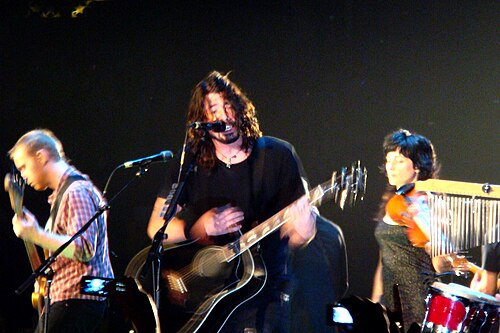
The term post-grunge was coined for the generation of bands that followed the emergence into the mainstream and subsequent hiatus of the Seattle grunge bands. Post-grunge bands emulated their attitudes and music, but with a more radio-friendly commercially oriented sound.[224] Often they worked through the major labels and came to incorporate diverse influences from jangle pop, pop-punk, alternative metal or hard rock.[224] The term post-grunge originally was meant to be pejorative, suggesting that they were simply musically derivative, or a cynical response to an "authentic" rock movement.[228] Originally, grunge bands that emerged when grunge was mainstream and were suspected of emulating the grunge sound were pejoratively labelled as post-grunge.[228] From 1994, former Nirvana drummer Dave Grohl's new band, the Foo Fighters, helped popularize the genre and define its parameters.[229]
Some post-grunge bands, like Candlebox, were from Seattle, but the subgenre was marked by a broadening of the geographical base of grunge, with bands like Los Angeles' Audioslave, and Georgia's Collective Soul and beyond the US to Australia's Silverchair and Britain's Bush, who all cemented post-grunge as one of the most commercially viable subgenres of the late 1990s.[211][224] Although male bands predominated post-grunge, female solo artist Alanis Morissette's 1995 album Jagged Little Pill, labelled as post-grunge, also became a multi-platinum hit.[230] Post-grunge morphed during the late 1990s as post-grunge bands like Creed and Nickelback emerged.[228] Bands like Creed and Nickelback took post-grunge into the 21st century with considerable commercial success, abandoning most of the angst and anger of the original movement for more conventional anthems, narratives and romantic songs, and were followed in this vein by newer acts including Shinedown, Seether, 3 Doors Down and Puddle of Mudd.[228]
Pop-punk

The origins of 1990s pop-punk can be seen in the more song-oriented bands of the 1970s punk movement like Buzzcocks and the Clash, commercially successful new wave acts such as the Jam and the Undertones, and the more hardcore-influenced elements of alternative rock in the 1980s.[231] Pop-punk tends to use power-pop melodies and chord changes with speedy punk tempos and loud guitars.[232] Punk music provided the inspiration for some California-based bands on independent labels in the early 1990s, including Rancid and Green Day.[231] In 1994 Green Day moved to a major label and produced the album Dookie, which found a new, largely teenage, audience and proved a surprise diamond-selling success, leading to a series of hit singles, including two number ones in the US.[211] They were soon followed by the eponymous debut from Weezer, which spawned three top ten singles in the US.[233] This success opened the door for the multi-platinum sales of metallic punk band the Offspring with Smash (1994).[211] This first wave of pop punk reached its commercial peak with Green Day's Nimrod (1997) and the Offspring's Americana (1998).[234]
A second wave of pop-punk was spearheaded by Blink-182, with their breakthrough album Enema of the State (1999), followed by bands such as Good Charlotte, Simple Plan and Sum 41, who made use of humour in their videos and had a more radio-friendly tone to their music, while retaining the speed, some of the attitude and even the look of 1970s punk.[231] Later pop-punk bands, including All Time Low, the All-American Rejects and Fall Out Boy, had a sound that has been described as closer to 1980s hardcore, while still achieving commercial success.[231]
Indie rock

In the 1980s the terms indie rock and alternative rock were used interchangeably.[235] By the mid-1990s, as elements of the movement began to attract mainstream interest, particularly grunge and then Britpop, post-grunge and pop-punk, the term alternative began to lose its meaning.[235] Those bands following the less commercial contours of the scene were increasingly referred to by the label indie.[235] They characteristically attempted to retain control of their careers by releasing albums on their own or small independent labels, while relying on touring, word-of-mouth, and airplay on independent or college radio stations for promotion.[235] Linked by an ethos more than a musical approach, the indie rock movement encompassed a wide range of styles, from hard-edged, grunge-influenced bands like the Cranberries and Superchunk, through do-it-yourself experimental bands like Pavement, to punk-folk singers such as Ani DiFranco.[211][212] It has been noted that indie rock has a relatively high proportion of female artists compared with preceding rock genres, a tendency exemplified by the development of feminist-informed Riot grrrl music.[236] Many countries have developed an extensive local indie scene, flourishing with bands with enough popularity to survive inside the respective country, but virtually unknown outside them.[237]
By the end of the 1990s many recognisable subgenres, most with their origins in the late 1980s alternative movement, were included under the umbrella of indie. Lo-fi eschewed polished recording techniques for a D.I.Y. ethos and was spearheaded by Beck, Sebadoh and Pavement.[211] The work of Talk Talk and Slint helped inspire both post rock, an experimental style influenced by jazz and electronic music, pioneered by Bark Psychosis and taken up by acts such as Tortoise, Stereolab, and Laika,[238][239] as well as leading to more dense and complex, guitar-based math rock, developed by acts like Polvo and Chavez.[240] Space rock looked back to progressive roots, with drone heavy and minimalist acts like Spacemen 3, the two bands created out of its split, Spectrum and Spiritualized, and later groups including Flying Saucer Attack, Godspeed You! Black Emperor and Quickspace.[241] In contrast, Sadcore emphasised pain and suffering through melodic use of acoustic and electronic instrumentation in the music of bands like American Music Club and Red House Painters,[242] while the revival of baroque pop reacted against lo-fi and experimental music by placing an emphasis on melody and classical instrumentation, with artists like Arcade Fire, Belle and Sebastian and Rufus Wainwright.[243]
Alternative metal, rap rock and nu metal
Alternative metal emerged from the hardcore scene of alternative rock in the US in the later 1980s, but gained a wider audience after grunge broke into the mainstream in the early 1990s.[244] Early alternative metal bands mixed a wide variety of genres with hardcore and heavy metal sensibilities, with acts like Jane's Addiction and Primus using progressive rock, Soundgarden and Corrosion of Conformity using garage punk, the Jesus Lizard and Helmet mixing noise rock, Ministry and Nine Inch Nails influenced by industrial music, Monster Magnet moving into psychedelia, Pantera, Sepultura and White Zombie creating groove metal, while Biohazard, Limp Bizkit and Faith No More turned to hip hop and rap.[244]
Hip hop had gained attention from rock acts in the early 1980s, including the Clash with "The Magnificent Seven" (1980) and Blondie with "Rapture" (1980).[245][246] Early crossover acts included Run DMC and the Beastie Boys.[247] Detroit rapper Esham became known for his "acid rap" style, which fused rapping with a sound that was often based in rock and heavy metal.[248][249] Rappers who sampled rock songs included Ice-T, the Fat Boys, LL Cool J, Public Enemy and Whodini.[250] The mixing of thrash metal and rap was pioneered by Anthrax on their 1987 comedy-influenced single "I'm the Man".[250]
In 1990, Faith No More broke into the mainstream with their single "Epic", often seen as the first truly successful combination of heavy metal with rap.[251] This paved the way for the success of existing bands like 24-7 Spyz and Living Colour, and new acts including Rage Against the Machine and Red Hot Chili Peppers, who all fused rock and hip hop among other influences.[250][252] Among the first wave of performers to gain mainstream success as rap rock were 311,[253] Bloodhound Gang,[254] and Kid Rock.[255] A more metallic sound – nu metal – was pursued by bands including Limp Bizkit, Korn and Slipknot.[250] Later in the decade this style, which contained a mix of grunge, punk, metal, rap and turntable scratching, spawned a wave of successful bands like Linkin Park, P.O.D. and Staind, who were often classified as rap metal or nu metal, the first of which are the best-selling band of the genre.[256]
In 2001, nu metal reached its peak with albums like Staind's Break the Cycle, P.O.D's Satellite, Slipknot's Iowa and Linkin Park's Hybrid Theory. New bands also emerged like Disturbed, Godsmack and Papa Roach, whose major label début Infest became a platinum hit.[257] Korn's long-awaited fifth album Untouchables, and Papa Roach's second album Lovehatetragedy, did not sell as well as their previous releases, while nu metal bands were played more infrequently on rock radio stations and MTV began focusing on pop punk and emo.[258] Since then, many bands have changed to a more conventional hard rock, heavy metal, or electronic music sound.[258]
Post-Britpop
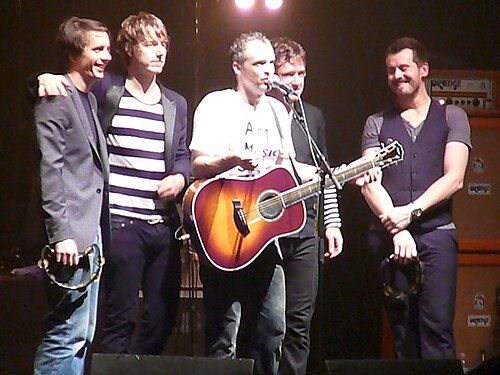
From about 1997, as dissatisfaction grew with the concept of Cool Britannia, and Britpop as a movement began to dissolve, emerging bands began to avoid the Britpop label while still producing music derived from it.[259][260] Many of these bands tended to mix elements of British traditional rock (or British trad rock),[261] particularly the Beatles, Rolling Stones and Small Faces,[262] with American influences, including post-grunge.[263][264] Drawn from across the United Kingdom (with several important bands emerging from the north of England, Scotland, Wales and Northern Ireland), the themes of their music tended to be less parochially centered on British, English and London life and more introspective than had been the case with Britpop at its height.[265][266] This, beside a greater willingness to engage with the American press and fans, may have helped some of them in achieving international success.[267] Several alternative bands that had enjoyed some success during the mid-1990s, but did not find major commercial success until the late 1990s included the Verve and Radiohead. After the decline of Britpop they began to gain more critical and popular attention. The Verve's album Urban Hymns (1997) was a worldwide hit, and Radiohead achieved near-universal critical acclaim with their experimental third album OK Computer (1997), as well as its follow-up Kid A (2000).
Post-Britpop bands have been seen as presenting the image of the rock star as an ordinary person and their increasingly melodic music was criticised for being bland or derivative.[268] Post-Britpop bands like Travis from The Man Who (1999), Stereophonics from Performance and Cocktails (1999), Feeder from Echo Park (2001), and particularly Coldplay from their debut album Parachutes (2000), achieved much wider international success than most of the Britpop groups that had preceded them, and were some of the most commercially successful acts of the late 1990s and early 2000s, arguably providing a launchpad for the subsequent garage rock revival and post-punk revival, which has also been seen as a reaction to their introspective brand of rock.[264][269][270][271]
Post-hardcore and emo
Post-hardcore developed in the US, particularly in the Chicago and Washington, DC areas, in the early to mid-1980s, with bands that were inspired by the do-it-yourself ethics and guitar-heavy music of hardcore punk, but influenced by post-punk, adopting longer song formats, more complex musical structures and sometimes more melodic vocal styles.[272]
Emo also emerged from the hardcore scene in 1980s Washington, D.C., initially as "emocore", used as a term to describe bands who favored expressive vocals over the more common abrasive, barking style.[273] The early emo scene operated as an underground, with short-lived bands releasing small-run vinyl records on tiny independent labels.[273] Emo broke into mainstream culture in the early 2000s with the platinum-selling success of Jimmy Eat World's Bleed American (2001) and Dashboard Confessional's The Places You Have Come to Fear the Most (2003).[274] The new emo had a much more mainstream sound than in the 1990s and a far greater appeal amongst adolescents than its earlier incarnations.[274] At the same time, use of the term emo expanded beyond the musical genre, becoming associated with fashion, a hairstyle and any music that expressed emotion.[275] By 2003 post-hardcore bands had also caught the attention of major labels and began to enjoy mainstream success in the album charts.[citation needed] A number of these bands were seen as a more aggressive offshoot of emo and given the often vague label of screamo.[276]
Garage rock and post-punk revivals

In the early 2000s, a new group of bands that played a stripped down and back-to-basics version of guitar rock, emerged into the mainstream. They were variously characterised as part of a garage rock, post-punk or New Wave revival.[277][278][279][280] Because the bands came from across the globe, cited diverse influences (from traditional blues, through New Wave to grunge), and adopted differing styles of dress, their unity as a genre has been disputed.[281] There had been attempts to revive garage rock and elements of punk in the 1980s and 1990s and by 2000 scenes had grown up in several countries.[282]
The commercial breakthrough from these scenes was led by four bands: the Strokes, who emerged from the New York club scene with their début album Is This It (2001); the White Stripes, from Detroit, with their third album White Blood Cells (2001); the Hives from Sweden after their compilation album Your New Favourite Band (2001); and the Vines from Australia with Highly Evolved (2002).[283] They were christened by the media as the "The" bands, and dubbed "The saviours of rock 'n' roll", leading to accusations of hype.[284] A second wave of bands that gained international recognition due to the movement included Black Rebel Motorcycle Club, the Killers, Interpol and Kings of Leon from the US,[285] the Libertines, Arctic Monkeys, Bloc Party, Kaiser Chiefs and Franz Ferdinand from the UK,[286] Jet and Wolfmother from Australia,[287] and the Datsuns and the D4 from New Zealand.[288]
Digital electronic rock
In the 2000s, as computer technology became more accessible and music software advanced, it became possible to create high quality music using little more than a single laptop computer.[289] This resulted in a massive increase in the amount of home-produced electronic music available to the general public via the expanding internet,[290] and new forms of performance such as laptronica[289] and live coding.[291] These techniques also began to be used by existing bands and by developing genres that mixed rock with digital techniques and sounds, including indie electronic, electroclash, dance-punk and new rave.[citation needed]
2010s–present: Commercial stagnation and revival scenes
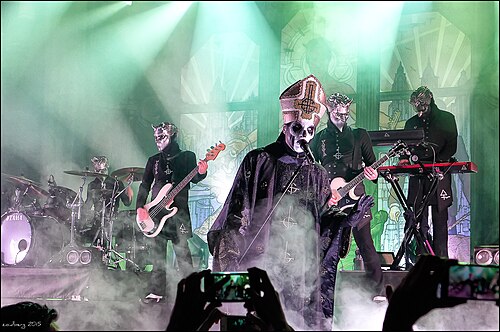
During the 2010s, rock music declined from its position as the major popular music genre, now sharing with electronic dance and hip hop, the latter of which had surpassed it as the most consumed musical genre in the United States by 2017.[292][293][294] The rise of streaming and the advent of technology, which changed approaches toward music creation, were cited as major factors.[295] Ken Partridge of Genius suggested that hip-hop became more popular because it is a more transformative genre and does not need to rely on past sounds, and that there is a direct connection to the stagnation of rock music and changing social attitudes during the 2010s.[293] Bill Flanagan, in a 2016 opinion piece for The New York Times, compared the state of rock during this period to the state of jazz in the early 1980s, "slowing down and looking back."[296]
The rock bands which had chart success in the 2010s were mostly associated with the trends that had been popular in the 2000s and earlier decades rather than reflecting new scenes and sounds.[297] Some pop rock and hard rock bands continued to see commercial success during this period, including Ghost, Maroon 5, Twenty One Pilots, Fall Out Boy, Imagine Dragons, Halestorm, Panic! at the Disco, Black Veil Brides, Greta Van Fleet, and The Black Keys.[298][299][300] Outside of the charts, the commercialisation of rock festivals was a major theme of the decade, with both global megafestivals such as Coachella, Glastonbury and Roskilde, and smaller-scale local festivals expanding.[301]
In 2020, the COVID-19 pandemic brought extreme changes to the rock scene worldwide. Restrictions, such as quarantine rules, caused widespread cancellations and postponements of concerts, tours, festivals, album releases, award ceremonies, and competitions.[302][303][304][305][306] Some artists resorted to giving online performances to keep their careers active.[307] Another scheme to circumvent the quarantine limitations was used at a concert of Danish rock musician Mads Langer: the audience watched the performance from inside their cars, much like in a drive-in theater.[308] Musically, the pandemic led to a surge in new releases from the slower, less energetic, and more acoustic subgenres of rock music.[309][310] The industry raised funds to help itself through efforts such as Crew Nation, a relief fund for live music crews organised by Livenation.[311]
Psychedelic and progressive revivals

Psychedelic and progressive styles in rock would see a major resurgence in popularity during the 2010s and 2020s. Some of the most notable acts in neo-psychedelia originated in Australia; Kevin Parker's Tame Impala released the single "Elephant" in 2012, which became a hit on alternative radio in various countries, and would be followed by the release of critically acclaimed albums by Parker such as Lonerism (2012) and Currents (2015).[312][313][314] This new style of Australian psychedelic music not only built on the psychedelic and progressive rock acts of the '60s and '70s, but also incorporated new and unique musical influences from various subgenres of rock, heavy metal, EDM, and world music.[315] A 2014 article in The Guardian described Australia as a place where "independently minded rock bands are free to develop at their own pace".[316] Other Australian psychedelic and progressive revival acts of the 2010s and 2020s include King Gizzard & the Lizard Wizard, Psychedelic Porn Crumpets, Rolling Blackouts Coastal Fever, Bananagun, Jay Watson, The Murlocs, Stonefield, and Tropical Fuck Storm.[317][318]
Psychedelic trends in rock have also seen a revival in Europe, with European and American stoner rock groups such as Uncle Acid & the Deadbeats, Graveyard, Kadavar, All Them Witches, and True Widow performing a heavier, more riff-based version of neo-psychedelia containing stronger blues and metal influences.[319] Europe has been described as "really good" for new psychedelic music, with many American stoner rock bands choosing to tour in Europe as opposed to North America.[320]
Pop-punk and post-punk revivals
At the start of the 2020s, recording artists in both pop and rap music released popular pop-punk-influenced recordings, many of them produced or assisted by Blink-182 drummer Travis Barker. Representing a commercial resurgence for the genre, these acts included Machine Gun Kelly, Willow Smith, Trippie Redd, Halsey, Yungblud, and Olivia Rodrigo. The popularity of the social media platform TikTok helped spark nostalgia for the angst-driven musical style among young listeners during the pandemic. Among the most successful of these releases have been Machine Gun Kelly's 2020 album Tickets to My Downfall, which topped the Billboard 200, and Rodrigo's number-one hit single "Good 4 U" (2021).[321]
In the mid-to-late 2010s and early 2020s, a new wave of post-punk bands from Britain and Ireland emerged. The groups in this scene have been described with the term "Crank Wave" by NME and The Quietus in 2019, and as "Post-Brexit New Wave" by NPR writer Matthew Perpetua in 2021.[322][323][324] Artists that have been identified as part of the style include Black Midi, Wet Leg, Squid, Black Country, New Road, Dry Cleaning, Shame, Sleaford Mods, Fontaines D.C., The Murder Capital, Idles and Yard Act.[322][323][324][325] Post-punk artists that attained prominence in the 2010s and early 2020s from other countries besides the UK included Parquet Courts, Protomartyr and Geese (United States), Preoccupations (Canada), Iceage (Denmark), and Viagra Boys (Sweden).[326][327][328]
Classic rock revival
During the mid-to-late 2010s, some mainstream rock bands began to gain notoriety for performing in a back-to-basics style of rock music meant to emulate the sound of legacy acts popular on classic rock radio. The release of Greta Van Fleet's Anthem of the Peaceful Army (2018) saw a renewed mainstream interest in earlier rock styles of the 1960s and 1970s, with Revolver describing this classic rock revival sound as "hard-hitting, swaggering, riff-driven rock 'n' roll built around a core vocal-guitar-bass-drum configuration".[329] Other groups considered to be a part of this trend include Rival Sons, the Struts, Dirty Honey, Crown Lands, Larkin Poe, and White Reaper.[330]
Social impact

Different subgenres of rock were adopted by, and became central to, the identity of a large number of sub-cultures. In the 1950s and 1960s, respectively, British youths adopted the Teddy Boy and Rocker subcultures, which revolved around US rock and roll.[331] The counterculture of the 1960s was closely associated with psychedelic rock.[331] The mid-late 1970s punk subculture began in the US, but it was given a distinctive look by British designer Vivienne Westwood, a look which spread worldwide.[332] Out of the punk scene, the Goth and Emo subcultures grew, both of which presented distinctive visual styles.[333]
When an international rock culture developed, it supplanted cinema as the major sources of fashion influence.[334] Paradoxically, followers of rock music have often mistrusted the world of fashion, which has been seen as elevating image above substance.[334] Rock fashions have been seen as combining elements of different cultures and periods, as well as expressing divergent views on sexuality and gender, and rock music in general has been noted and criticised for facilitating greater sexual freedom.[334][335] Rock has also been associated with various forms of drug use, including the amphetamines taken by mods in the early to mid-1960s, through the LSD, mescaline, hashish and other hallucinogenic drugs linked with psychedelic rock in the mid-late 1960s and early 1970s; and sometimes to cannabis, cocaine and heroin, all of which have been eulogised in song.[336][337]
Rock has been credited with changing attitudes to race by opening up African-American culture to white audiences; but at the same time, rock has been accused of appropriating and exploiting that culture.[338][339] While rock music has absorbed many influences and introduced Western audiences to different musical traditions,[340] the global spread of rock music has been interpreted as a form of cultural imperialism.[341] Rock music inherited the folk tradition of protest song, making political statements on subjects such as war, religion, poverty, civil rights, justice and the environment.[342] Political activism reached a mainstream peak with the "Do They Know It's Christmas?" single (1984) and Live Aid concert for Ethiopia in 1985, which, while raising awareness of world poverty and funds for aid, have also been criticised (along with similar events), for providing a stage for self-aggrandisement and increased profits for the rock stars involved.[343]
Since its early development, rock music has been associated with rebellion against social and political norms, most in early rock and roll's rejection of an adult-dominated culture, the counterculture's rejection of consumerism and conformity and punk's rejection of all forms of social convention,[344] however, it can also be seen as providing a means of commercial exploitation of such ideas and of diverting youth away from political action.[345][346]
Role of women

Professional women instrumentalists are uncommon in rock genres such as heavy metal although bands such as Within Temptation have featured women as lead singers with men playing instruments. According to Schaap and Berkers, "playing in a band is a male homosocial activity, that is, learning to play in a band is a peer-based ... experience, shaped by existing sex-segregated friendship networks.[347] They note that rock music "is often defined as a form of male rebellion vis-à-vis female bedroom culture."[348] (The theory of "bedroom culture" argues that society influences girls to not engage in crime and deviance by virtually trapping them in their bedroom; it was identified by a sociologist named Angela McRobbie.) In popular music, there has been a gendered "distinction between public (male) and private (female) participation" in music.[348] "Several scholars have argued that men exclude women from bands or from the bands' rehearsals, recordings, performances, and other social activities".[349] "Women are regarded as passive and private consumers of slick, prefabricated – hence, inferior – pop music ..., excluding them from participating as high status rock musicians".[349] One of the reasons that there are mixed gender bands is that "bands operate as tight-knit units in which homosocial solidarity – social bonds between people of the same sex ... – plays a crucial role".[349] In the 1960s rock music scene, "singing was sometimes an acceptable pastime for a girl, but playing an instrument ... simply wasn't done".[350]
"The rebellion of rock music was a male rebellion; the women – often, in the 1950s and '60s, girls in their teens – in rock sang songs as personæ dependent on their macho boyfriends ...". Philip Auslander says that "Although there were many women in rock by the late 1960s, most performed only as singers, a feminine position in popular music". Though some women played instruments in American all-female garage rock bands, none of these bands achieved more than regional success. So they "did not provide viable templates for women's on-going participation in rock".[351] In relation to the gender composition of heavy metal bands, it has been said that "[h]eavy metal performers are almost exclusively male"[352] "...at least until the mid-1980s"[353] apart from "...exceptions such as Girlschool".[352] However, "...now [in the 2010s] maybe more than ever–strong metal women have put up their dukes and got down to it",[354] "carv[ing] out a considerable place for [them]selves."[355] When Suzi Quatro emerged in 1973, "no other prominent female musician worked in rock simultaneously as a singer, instrumentalist, songwriter, and bandleader".[351] According to Auslander, she was "kicking down the male door in rock and roll and proving that a female musician ... and this is a point I am extremely concerned about ... could play as well if not better than the boys".[351]
An all-female band is a musical group in genres such as rock and blues which is composed of female musicians. This is distinct from a girl group, in which the female members are vocalists, though this terminology is not universally followed.[356]
See also
- List of rock genres
- List of mainstream rock performers
- Rock Against Racism
- Rock Against Sexism
- Rock for the Rainforest
Notes
- ^ Having died down in the late 1950s, doo wop enjoyed a revival in the same period, with hits for acts like the Marcels, the Capris, Maurice Williams and the Zodiacs, and Shep and the Limelights.[59] The rise of girl groups like the Chantels, the Shirelles and the Crystals placed an emphasis on harmonies and polished production that was in contrast to earlier rock and roll.[60] Some of the most significant girl group hits were products of the Brill Building Sound, named after the block in New York where many songwriters were based, which included the number 1 hit for the Shirelles "Will You Love Me Tomorrow" in 1960, penned by the partnership of Gerry Goffin and Carole King.[61]
- ^ Only the Beach Boys were able to sustain a creative career into the mid-1960s, producing a string of hit singles and albums, including the highly regarded Pet Sounds in 1966, which made them, arguably, the only American rock or pop act that could rival the Beatles.[65]
- ^ In Detroit, garage rock's legacy remained alive into the early 1970s, with bands such as the MC5 and the Stooges, who employed a much more aggressive approach to the form. These bands began to be labelled punk rock and are now often seen as proto-punk or proto-hard rock.[94]
References
- ^ "Power Pop Guide: A Brief History of Power Pop". MasterClass. 4 March 2022. Archived from the original on 24 May 2022. Retrieved 23 May 2022.
- ^ Azerrad, Michael (16 April 1992). "Grunge City: The Seattle Scene". Rolling Stone. Archived from the original on 20 September 2023. Retrieved 2 November 2018.
- ^ W. E. Studwell and D. F. Lonergan, The Classic Rock and Roll Reader: Rock Music from its Beginnings to the mid-1970s (Abingdon: Routledge, 1999), ISBN 0-7890-0151-9 p.xi
- ^ Wyman, Bill (20 December 2016). "Chuck Berry Invented the Idea of Rock and Roll". Vulture.com. New York Media, LLC. Archived from the original on 11 March 2021. Retrieved 19 March 2017.
- ^ J.M. Curtis, Rock Eras: Interpretations of Music and Society, 1954–1984 (Madison, WI: Popular Press, 1987), ISBN 0-87972-369-6, pp. 68–73.
- ^ a b Campbell, Michael; Brody, James (2007). Rock and Roll: An Introduction (2nd ed.). Belmont, CA: Thomson Schirmer. pp. 80–81. ISBN 978-0-534-64295-2.
- ^ R.C. Brewer, "Bass Guitar" in Shepherd 2003, p 56.
- ^ R. Mattingly, "Drum Set" in Shepherd 2003, p 361.
- ^ P. Théberge, Any Sound you can Imagine: Making Music/Consuming Technology (Middletown, CT, Wesleyan University Press, 1997), ISBN 0-8195-6309-9, pp. 69–70.
- ^ D. Laing, "Quartet" in Shepherd 2003, p 56.
- ^ a b c C. Ammer, The Facts on File Dictionary of Music (New York: Infobase, 4th edn., 2004), ISBN 0-8160-5266-2, pp. 251–52.
- ^ Campbell & Brody 2007, p. 117
- ^ J. Covach, "From craft to art: formal structure in the music of the Beatles", in K. Womack and Todd F. Davis, eds, Reading the Beatles: Cultural Studies, Literary Criticism, and the Fab Four (New York: SUNY Press, 2006), ISBN 0-7914-6715-5, p. 40.
- ^ T. Gracyk, Rhythm and Noise: an Aesthetics of Rock, (London: I.B. Tauris, 1996), ISBN 1-86064-090-7, p. xi.
- ^ P. Wicke, Rock Music: Culture, Aesthetics and Sociology (Cambridge: Cambridge University Press, 1990), ISBN 0-521-39914-9, p. x.
- ^ Christgau, Robert (1981). "Genesis: Selling England by the Pound". Christgau's Record Guide: Rock Albums of the Seventies. Ticknor & Fields. ISBN 0-89919-025-1. Archived from the original on 6 April 2023. Retrieved 16 October 2021 – via robertchristgau.com.
- ^ a b c Christgau, Robert (1981). "The Decade". Christgau's Record Guide: Rock Albums of the Seventies. Ticknor & Fields. ISBN 0-89919-025-1. Archived from the original on 2 April 2019. Retrieved 6 April 2019 – via robertchristgau.com.
- ^ Farber, Barry A. (2007). Rock 'n' roll Wisdom: What Psychologically Astute Lyrics Teach About Life and Love. Westport, CT: Praeger. pp. xxvi–xxviii. ISBN 978-0-275-99164-7.
- ^ Christgau, Robert; et al. (2000). McKeen, William (ed.). Rock & Roll Is Here to Stay: An Anthology. W.W. Norton & Company. pp. 564–65, 567. ISBN 0-393-04700-8.
- ^ McDonald, Chris (2009). Rush, Rock Music and the Middle Class: Dreaming in Middletown. Bloomington, IN: Indiana University Press. pp. 108–09. ISBN 978-0-253-35408-2.
- ^ S. Waksman, Instruments of Desire: the Electric Guitar and the Shaping of Musical Experience (Cambridge, MA: Harvard University Press, 2001), ISBN 0-674-00547-3, p. 176.
- ^ Frith, Simon (2007). Taking Popular Music Seriously: Selected Essays. Aldershot, England: Ashgate Publishing. pp. 43–44. ISBN 978-0-7546-2679-4. Archived from the original on 6 April 2023. Retrieved 27 March 2023.
- ^ Christgau, Robert (11 June 1972). "Tuning Out, Tuning In, Turning On". Newsday. Archived from the original on 20 September 2023. Retrieved 17 March 2017.
- ^ a b T. Warner, Pop Music: Technology and Creativity: Trevor Horn and the Digital Revolution (Aldershot: Ashgate, 2003), ISBN 0-7546-3132-X, pp. 3–4.
- ^ R. Beebe, D. Fulbrook and B. Saunders, "Introduction" in R. Beebe, D. Fulbrook, B. Saunders, eds, Rock Over the Edge: Transformations in Popular Music Culture (Durham, NC: Duke University Press, 2002), ISBN 0-8223-2900-X, p. 7.
- ^ Christgau, Robert (1990). "Introduction: Canons and Listening Lists". Christgau's Record Guide: The '80s. Pantheon Books. ISBN 0-679-73015-X. Archived from the original on 9 July 2023. Retrieved 6 April 2019.
- ^ R. Unterberger, "Birth of Rock & Roll", in Bogdanov et al., 2002, pp. 1303–04.
- ^ Wald, Gayle (2007). Shout, Sister, Shout!: The Untold Story of Rock-and-Roll Trailblazer Sister Rosetta Tharpe. Beacon Press. p. 68. ISBN 9780807009895.
- ^ "World's First Rock-and-Roll Song Identified - Seeker". 23 January 2021. Archived from the original on 23 January 2021. Retrieved 18 April 2024.
- ^ "The First Rock and Roll Song". LiveAbout. Archived from the original on 27 October 2022. Retrieved 11 November 2022.
- ^ Will the creator of modern music please stand up? Alexis Petridis The Guardian 16 April 2004
- ^ Robert Palmer, "Church of the Sonic Guitar", pp. 13–38 in Anthony DeCurtis, Present Tense, Duke University Press, 1992, p. 19. ISBN 0-8223-1265-4
- ^ Bill Dahl, "Jimmy Preston", AllMusic, archived from the original on 20 May 2016, retrieved 27 April 2012
- ^ a b Campbell, Michael (2008). Popular Music in America: The Beat Goes On (3rd ed.). Boston, MA: Cengage Learning. pp. 157–58. ISBN 978-0-495-50530-3.
- ^ T. E. Scheurer, American Popular Music: The Age of Rock (Madison, WI: Popular Press, 1989), ISBN 0-87972-468-4, p. 170.
- ^ Gilliland 1969, show 55, track 2.
- ^ P. Browne, The Guide to United States Popular Culture (Madison, WI: Popular Press, 2001), ISBN 0-87972-821-3, p. 358.
- ^ R. S. Denisoff, W. L. Schurk, Tarnished Gold: the Record Industry Revisited (New Brunswick, NJ: Transaction, 3rd edn., 1986), ISBN 0-88738-618-0, p. 13.
- ^ "Rockabilly", AllMusic, archived from the original on 11 February 2011.
- ^ Lucero, Mario J. (3 January 2020). "The problem with how the music streaming industry handles data". Quartz. Archived from the original on 31 March 2023. Retrieved 14 February 2020.
- ^ J. M. Curtis, Rock Eras: Interpretations of Music and Society, 1954–1984 (Madison, WI: Popular Press, 1987), ISBN 0-87972-369-6, p. 73.
- ^ Davis, Lance (8 March 2011). "Get It Low: The Dirty Guitar of Junior Barnard". The Adios Lounge. Archived from the original on 12 July 2018. Retrieved 11 November 2022.
- ^ Collis, John (2002). Chuck Berry: The Biography. Aurum. p. 38. ISBN 978-1-85410-873-9. Archived from the original on 8 February 2023. Retrieved 17 October 2015.
- ^ Hicks, Michael (2000). Sixties Rock: Garage, Psychedelic, and Other Satisfactions. University of Illinois Press. p. 17. ISBN 0-252-06915-3.
- ^ Campbell 2008, p. 99
- ^ Horn, Adrian (2009). Juke Box Britain: Americanisation and Youth Culture, 1945–60. Manchester: Manchester University Press. ISBN 978-0719083662.
- ^ D. Hatch and S. Millward (1987). From Blues to Rock: An Analytical History of Pop Music. Manchester: Manchester University Press. p. 78. ISBN 0-7190-1489-1.
- ^ a b Mitchell, G. A. M. (2011). "A Very 'British' Introduction to Rock 'n' Roll: Tommy Steele and the Advent of Rock 'n' Roll Music in Britain, 1956–1960". Contemporary British History, 25(2), 205–225.
- ^ a b Meyers, J. P. (2015). "The Beatles in Buenos Aires, Muse in Mexico City: Tribute Bands and the Global Consumption of Rock Music". Ethnomusicology Forum (Vol. 24, No. 3, pp. 329–348). Routledge.
- ^ Smith, Barnaby (30 September 2014). "The Wild One by Johnny O'Keefe – Australia's first rock'n'roll hit". The Guardian. ISSN 0261-3077. Retrieved 18 April 2024.
- ^ Vuletic, D. (2008). "Generation Number One: Politics and Popular Music in Yugoslavia in the 1950s". Nationalities Papers, 36(5), 861–879.
- ^ Rauth, R. (1982). "Back in the USSR—Rock and roll in the Soviet Union". Popular Music & Society, 8(3–4), 3–12.
- ^ a b Schwartz, Roberta F. (2007). How Britain Got the Blues: The Transmission and Reception of American Blues Style in the United Kingdom. Aldershot, England: Ashgate Publishing. p. 22. ISBN 978-0-7546-5580-0.
- ^ Roberts, J. (2001). The Beatles. Mineappolis, MN: Lerner Publications. p. 13. ISBN 0-8225-4998-0.
- ^ a b Eder, B. "British Blues", in V. Bogdanov, C. Woodstra, S.T. Erlewine, eds, All Music Guide to the Blues: The Definitive Guide to the Blues (Milwaukee, WI: Backbeat Books, 3rd ed., 2003), p. 700. ISBN 0-87930-736-6.
- ^ Gilliland 1969, shows 20–21.
- ^ B. Bradby, "Do-talk, don't-talk: the division of the subject in girl-group music" in S. Frith and A. Goodwin, eds, On Record: Rock, Pop, and the Written Word (Abingdon: Routledge, 1990), ISBN 0-415-05306-4, p. 341.
- ^ a b c K. Keightley, "Reconsidering rock" in S. Frith, W. Straw and J. Street, eds, The Cambridge Companion to Pop and Rock (Cambridge: Cambridge University Press, 2001), ISBN 0-521-55660-0, p. 116.
- ^ R. Unterberger, "Doo Wop", in Bogdanov et.al., 2002, pp. 1306–07.
- ^ R. Dale, Education and the State: Politics, Patriarchy and Practice (London: Taylor & Francis, 1981), ISBN 0-905273-17-6, p. 106.
- ^ R. Unterberger, "Brill Building Sound", in Bogdanov et.al., 2002, pp. 1311–12.
- ^ a b J. Blair, The Illustrated Discography of Surf Music, 1961–1965 (Ypsilanti, MI: Pierian Press, 2nd edn., 1985), ISBN 0-87650-174-9, p. 2.
- ^ J. Blair, The Illustrated Discography of Surf Music, 1961–1965 (Ypsilanti, MI: Pierian Press, 2nd edn., 1985), ISBN 0-87650-174-9, p. 75.
- ^ "Throwback tune of the day: Nowhere to Go – The Four Freshmen". Buzz.ie. Archived from the original on 8 March 2021. Retrieved 25 February 2021.
- ^ a b W. Ruhlman, et al., "Beach Boys", in Bogdanov et al., 2002, pp. 71–75.
- ^ "Surf Music". Nostalgia Central. 3 July 2014. Archived from the original on 23 July 2019. Retrieved 29 July 2019.
- ^ R. Stakes, "Those boys: the rise of Mersey beat", in S. Wade, ed., Gladsongs and Gatherings: Poetry and its Social Context in Liverpool Since the 1960s (Liverpool: Liverpool University Press, 2001), ISBN 0-85323-727-1, pp. 157–66.
- ^ I. Chambers, Urban Rhythms: Pop Music and Popular Culture (Basingstoke: Macmillan, 1985), ISBN 0-333-34011-6, p. 75.
- ^ J.R. Covach and G. MacDonald Boone, Understanding Rock: Essays in Musical Analysis (Oxford: Oxford University Press, 1997), ISBN 0-19-510005-0, p. 60.
- ^ a b R. Unterberger, "British Invasion", in Bogdanov et al., 2002, pp. 1316–17.
- ^ R. Unterberger, "British R&B", in Bogdanov et al., 2002, pp. 1315–16.
- ^ Gilliland 1969, show 28.
- ^ a b I.A. Robbins, "British Invasion", Encyclopædia Britannica, archived from the original on 21 December 2010
- ^ H. Bill, The Book Of Beatle Lists (Poole, Dorset: Javelin, 1985), ISBN 0-7137-1521-9, p. 66.
- ^ a b Gilliland 1969, show 29.
- ^ Gilliland 1969, show 30.
- ^ Gilliland 1969, show 48.
- ^ T. Leopold (5 February 2004), When the Beatles hit America CNN February 10, 2004, CNN, archived from the original on 11 April 2010
- ^ "British Invasion", AllMusic, archived from the original on 11 February 2011.
- ^ a b "Britpop", AllMusic, archived from the original on 12 February 2011.
- ^ K. Keightley, "Reconsidering rock" in, S. Frith, W. Straw and J. Street, eds, The Cambridge Companion to Pop and Rock (Cambridge: Cambridge University Press, 2001), ISBN 0-521-55660-0, p. 117.
- ^ F.W. Hoffmann, "British Invasion" in F.W. Hoffmann and H. Ferstler, eds, Encyclopedia of Recorded Sound, Volume 1 (New York: CRC Press, 2nd edn., 2004), ISBN 0-415-93835-X, p. 132.
- ^ R. Shuker, Popular Music: the Key Concepts (Abingdon: Routledge, 2nd edn., 2005), ISBN 0-415-34770-X, p. 35.
- ^ Simonelli, David (2013). Working Class Heroes: Rock Music and British Society in the 1960s and 1970s. Lanham, MD: Lexington Books. pp. 96–97. ISBN 978-0-7391-7051-9. Archived from the original on 16 November 2023. Retrieved 4 June 2021.
- ^ a b R. Shuker, Popular Music: the Key Concepts (Abingdon: Routledge, 2nd edn., 2005), ISBN 0-415-34770-X, p. 140.
- ^ E.J. Abbey, Garage Rock and its Roots: Musical Rebels and the Drive for Individuality (Jefferson, NC: McFarland, 2006), ISBN 0-7864-2564-4, pp. 74–76.
- ^ a b c d e f g R. Unterberger, "Garage Rock", in Bogdanov et al., 2002, pp. 1320–21.
- ^ N. Campbell, American Youth Cultures (Edinburgh: Edinburgh University Press, 2nd edn., 2004), ISBN 0-7486-1933-X, p. 213.
- ^ Otfinoski, Steven. "The Golden Age of Rock Instrumentals". Billboard Books, (1997), p. 36, ISBN 0-8230-7639-3
- ^ W.E. Studwell and D.F. Lonergan, The Classic Rock and Roll Reader: Rock Music from its Beginnings to the mid-1970s (Abingdon: Routledge, 1999), ISBN 0-7890-0151-9, p. 213.
- ^ J. Austen, TV-a-Go-Go: Rock on TV from American Bandstand to American Idol (Chicago IL: Chicago Review Press, 2005), ISBN 1-55652-572-9, p. 19.
- ^ Waksman, Steve (2009). This Ain't the Summer of Love: Conflict and Crossover in Heavy Metal and Punk. Berkeley CA: University of California Press. p. 116. ISBN 978-0-520-25310-0.
- ^ F.W. Hoffmann "Garage Rock/Punk", in F.W. Hoffman and H. Ferstler, Encyclopedia of Recorded Sound, Volume 1 (New York: CRC Press, 2nd edn., 2004), ISBN 0-415-93835-X, p. 873.
- ^ a b Thompson, Graham (2007). American Culture in the 1980s. Edinburgh, UK: Edinburgh University Press. p. 134. ISBN 978-0-7486-1910-8.
- ^ H.S. Macpherson, Britain and the Americas: Culture, Politics, and History (Oxford: ABC-CLIO, 2005), ISBN 1-85109-431-8, p. 626.
- ^ V. Coelho, The Cambridge Companion to the Guitar (Cambridge: Cambridge University Press, 2003), ISBN 0-521-00040-8, p. 104.
- ^ a b c d e f g R. Uterberger, "Blues Rock", in V. Bogdanov, C. Woodstra, S.T. Erlewine, eds, All Music Guide to the Blues: The Definitive Guide to the Blues (Milwaukee, WI: Backbeat Books, 3rd edn., 2003), ISBN 0-87930-736-6, pp. 701–02.
- ^ T. Rawlings, A. Neill, C. Charlesworth and C. White, Then, Now and Rare British Beat 1960–1969 (London: Omnibus Press, 2002), ISBN 0-7119-9094-8, p. 130.
- ^ P. Prown, H.P. Newquist and J.F. Eiche, Legends of Rock Guitar: the Essential Reference of Rock's Greatest Guitarists (Milwaukee, WI: Hal Leonard Corporation, 1997), ISBN 0-7935-4042-9, p. 25.
- ^ a b c d e R. Unterberger, "Southern Rock", in Bogdanov et al., 2002, pp. 1332–33.
- ^ a b c "Blues-rock", AllMusic, archived from the original on 12 February 2011.
- ^ P. Prown, H.P. Newquist and J.F. Eiche, Legends of Rock Guitar: the Essential Reference of Rock's Greatest Guitarists (Milwaukee, WI: Hal Leonard Corporation, 1997), ISBN 0-7935-4042-9, p. 113.
- ^ a b Mitchell, Gillian (2007). The North American Folk Music Revival: Nation and Identity in the United States and Canada, 1945–1980. Aldershot, England: Ashgate Publishing. p. 95. ISBN 978-0-7546-5756-9.
- ^ Mitchell 2007, p. 72
- ^ J.E. Perone, Music of the Counterculture Era American History Through Music (Westwood, CT: Greenwood, 2004), ISBN 0-313-32689-4, p. 37.
- ^ a b c d e f g R. Unterberger, "Folk Rock", in Bogdanov et al., 2002, pp. 1308–09.
- ^ Perone, James E. (2009). Mods, Rockers, and the Music of the British Invasion. Westport, CT: Praeger Publishers. p. 128. ISBN 978-0-275-99860-8.
- ^ R. Unterberger, "The Beatles: I'm a Loser", AllMusic, archived from the original on 12 February 2011.
- ^ Unterberger, Richie (31 December 2018). "2018". Folkrocks. Archived from the original on 20 September 2023. Retrieved 3 June 2021.
- ^ M. Brocken, The British Folk Revival 1944–2002 (Ashgate, Aldershot, 2003), ISBN 0-7546-3282-2, p. 97.
- ^ C. Larkin, The Guinness Encyclopedia of Popular Music (London: Guinness, 1992), ISBN 1-882267-04-4, p. 869.
- ^ G.W. Haslam, A.H. Russell and R. Chon, Workin' Man Blues: Country Music in California (Berkeley CA: Heyday Books, 2005), ISBN 0-520-21800-0, p. 201.
- ^ K. Keightley, "Reconsidering rock" in, S. Frith, W. Straw, and J. Street, eds, The Cambridge Companion to Pop and Rock (Cambridge: Cambridge University Press, 2001), ISBN 0-521-55660-0, p. 121.
- ^ a b M. Hicks, Sixties Rock: Garage, Psychedelic, and Other Satisfactions (Chicago, IL: University of Illinois Press, 2000), ISBN 0-252-06915-3, pp. 59–60.
- ^ a b c d e f g R. Unterberger, "Psychedelic Rock", in Bogdanov et al., 2002, pp. 1322–23.
- ^ Gilliland 1969, shows 41–42.
- ^ DeRogatis, Jim; Kot, Greg (2010). The Beatles vs. The Rolling Stones: Sound Opinions on the Great Rock 'n' Roll Rivalry. Voyageur Press. pp. 70, 75. ISBN 978-1610605137.
- ^ Whitburn, Joel (2003). Joel Whitburn's Top Pop Singles 1955-2002. Record Research. p. xxiii. ISBN 9780898201550.
- ^ Pareles, Jon (5 January 1997). "All That Music, and Nothing to Listen To". The New York Times. Archived from the original on 27 December 2017. Retrieved 10 March 2020.
- ^ a b c d e f g R. Unterberger, "Progressive Rock", in Bogdanov et al., 2002, pp. 1330–31.
- ^ J.S. Harrington, Sonic Cool: the Life & Death of Rock 'n' Roll (Milwaukee, WI: Hal Leonard Corporation, 2003), ISBN 0-634-02861-8, p. 191.
- ^ E. Macan, Rocking the Classics: English Progressive Rock and the Counterculture (Oxford: Oxford University Press, 1997), ISBN 0-19-509887-0, pp. 34–35.
- ^ E. Macan, Rocking the Classics: English Progressive Rock and the Counterculture (Oxford: Oxford University Press, 1997), ISBN 0-19-509887-0, p. 64.
- ^ "Prog rock", AllMusic, archived from the original on 12 February 2011.
- ^ E. Macan, Rocking the Classics: English Progressive Rock and the Counterculture (Oxford: Oxford University Press, 1997), ISBN 0-19-509887-0, p. 129.
- ^ Jeff Wagner (2010). Mean Deviation: Four Decades of Progressive Heavy Metal. Bazillion Points Books. p. 242. ISBN 978-0-9796163-3-4.
- ^ R. Reising, Speak to Me: The Legacy of Pink Floyd's The Dark Side of the Moon (Aldershot: Ashgate, 2005), ISBN 0-7546-4019-1.
- ^ M. Brocken, The British Folk Revival, 1944–2002 (Aldershot: Ashgate, 2003), ISBN 0-7546-3282-2, p. 96.
- ^ B. Eder, "Renaissance", AllMusic, archived from the original on 12 February 2011.
- ^ K. Holm-Hudson, Progressive Rock Reconsidered (London: Taylor & Francis, 2002), ISBN 0-8153-3715-9, p. 9.
- ^ N.E. Tawa, Supremely American: Popular Song in the 20th Century: Styles and Singers and What They Said About America (Lanham, MA: Scarecrow Press, 2005), ISBN 0-8108-5295-0, pp. 249–50.
- ^ P. Bussy, Kraftwerk: Man, Machine and Music (London: SAF, 3rd end., 2004), ISBN 0-946719-70-5, pp. 15–17.
- ^ K. Holm-Hudson, Progressive Rock Reconsidered (London: Taylor & Francis, 2002), ISBN 0-8153-3715-9, p. 92.
- ^ Knight, Brian L., "Rock in the Name of Progress (Part VI -"Thelonius Punk")", The Vermont Review, archived from the original on 17 July 2011
- ^ T. Udo, "Did Punk kill prog?", Classic Rock Magazine, vol. 97, September 2006.
- ^ a b c "Jazz-Rock Music Genre Overview", AllMusic, archived from the original on 16 February 2011
- ^ a b c R. Unterberger, "Jazz Rock", in Bogdanov et al., 2002, pp. 1328–30.
- ^ I. Carr, D. Fairweather and B. Priestley, The Rough Guide to Jazz (London: Rough Guides, 3rd edn., 2004), ISBN 1-84353-256-5, p. iii.
- ^ Auslander, Philip (2008). Liveness: Performance in a Mediatized Culture (2nd ed.). Abingdon, England: Routledge. p. 83. ISBN 978-0-415-77353-9.
- ^ a b K. Wolff and O. Duane, Country Music: The Rough Guide (London: Rough Guides, 2000), ISBN 1-85828-534-8, p. 392.
- ^ R. Unterberger, "The Band", and S.T. Erlewine, "Creedence Clearwater Revival", in Bogdanov et al., 2002, pp. 61–62, 265–66.
- ^ Hoskyns, Barney (2007). Hotel California: The True-Life Adventures of Crosby, Stills, Nash, Young, Mitchell, Taylor, Browne, Ronstadt, Geffen, the Eagles, and Their Many Friends. Hoboken, NJ: John Wiley & Sons. pp. 87–90. ISBN 978-0-470-12777-3.
- ^ Christgau, Robert (18 June 1970). "Consumer Guide (11)". The Village Voice. Archived from the original on 6 April 2023. Retrieved 18 February 2020 – via robertchristgau.com.
- ^ a b c d e f g R. Unterberger, "Country Rock", in Bogdanov et al., 2002, p. 1327.
- ^ B. Hinton, "The Nitty Gritty Dirt Band", in P. Buckley, ed., Rock: The Rough Guide (London: Rough Guides, 1st edn., 1996), ISBN 1-85828-201-2, pp. 612–13.
- ^ N.E. Tawa, Supremely American: Popular Song in the 20th Century: Styles and Singers and What They Said About America (Lanham, MA: Scarecrow Press, 2005), ISBN 0-8108-5295-0, p. 227–28.
- ^ a b R. Shuker, Popular Music: the Key Concepts (Abingdon: Routledge, 2nd edn., 2005), ISBN 0-415-34770-X, pp. 124–25.
- ^ P. Auslander, Performing Glam Rock: Gender and Theatricality in Popular Music (Ann Arbor, MI: University of Michigan Press, 2006), ISBN 0-7546-4057-4, pp. 57, 63, 87 and 141.
- ^ "Glam rock", AllMusic, archived from the original on 12 February 2011.
- ^ P. Auslander, Performing Glam Rock: Gender and Theatricality in Popular Music (Ann Arbor, MI: University of Michigan Press, 2006), ISBN 0-472-06868-7, p. 34.
- ^ Mark Paytress, Bolan – The Rise And Fall of a 20th Century Superstar (Omnibus Press 2002) ISBN 0-7119-9293-2, pp. 180–181.
- ^ a b c d P. Auslander, "Watch that man David Bowie: Hammersmith Odeon, London, July 3, 1973" in I. Inglis, ed., Performance and Popular Music: History, Place and Time (Aldershot: Ashgate, 2006), ISBN 0-7546-4057-4, p. 72.
- ^ a b P. Auslander, "Watch that man David Bowie: Hammersmith Odeon, London, July 3, 1973" in Ian Inglis, ed., Performance and Popular Music: History, Place and Time (Aldershot: Ashgate, 2006), ISBN 0-7546-4057-4, p. 80.
- ^ D. Thompson, "Glitter Band" and S. Huey, "Gary Glitter", in Bogdanov et al., 2002, p. 466.
- ^ R. Huq, Beyond Subculture: Pop, Youth and Identity in a Postcolonial World (Abingdon: Routledge, 2006), ISBN 0-415-27815-5, p. 161.
- ^ P. Auslander, Performing Glam Rock: Gender and Theatricality in Popular Music (Ann Arbor, MI: University of Michigan Press, 2006), ISBN 0-7546-4057-4, p. 227.
- ^ Billboard. 27 June 1970 https://books.google.com/books?id=eikEAAAAMBAJ&q=pacific+high+recording+studioas&pg=PA55. Retrieved 24 August 2015.
{{cite magazine}}: Missing or empty|title=(help) - ^ referred to as career suicide, as recalled in a 2013 interview by drummer and album co-producer Michael Shrieve
- ^ Gleason, Ralph J. (8 December 1976). "Santana: Caravanserai : Music Reviews : Rolling Stone". Rolling Stone. Archived from the original on 5 June 2017. Retrieved 14 April 2012.
- ^ La Herencia Del Norte (in Spanish). Gran Via. 1998. Retrieved 14 February 2020.
- ^ Koskoff, E. (2017). The Garland Encyclopedia of World Music: The United States and Canada. Taylor & Francis. p. 1253. ISBN 978-1-351-54414-6. Archived from the original on 10 June 2024. Retrieved 14 February 2020.
- ^ Hurricane, Al Jr. "Flor De Las Flores". Frontera Project. Archived from the original on 20 September 2023. Retrieved 14 February 2020.
- ^ Christgau, Robert (1995). "The Move: Great Move! The Best of the Move". Details. Archived from the original on 9 July 2023. Retrieved 10 September 2018.
- ^ a b J.M. Curtis, Rock Eras: Interpretations of Music and Society, 1954–1984 (Madison, WI: Popular Press, 1987), ISBN 0-87972-369-6, p. 236.
- ^ J. Kennaugh, "Fleetwood Mac", in P. Buckley, ed., Rock: The Rough Guide (London: Rough Guides, 1st edn., 1996), ISBN 1-85828-201-2, pp. 323–24.
- ^ a b c d "Hard Rock", AllMusic, archived from the original on 12 February 2011.
- ^ S.T. Erlewine, "Queen", AllMusic, archived from the original on 12 February 2011.
- ^ J. Dougan, "Thin Lizzy", AllMusic, archived from the original on 12 February 2011.
- ^ R. Walser, Running With the Devil: Power, Gender, and Madness in Heavy Metal Music (Middletown, CT: Wesleyan University Press, 1993), ISBN 0-8195-6260-2, p. 7.
- ^ R. Walser, Running With the Devil: Power, Gender, and Madness in Heavy Metal Music (Middletown, CT: Wesleyan University Press, 1993), ISBN 0-8195-6260-2, p. 9.
- ^ a b R. Walser, Running With the Devil: Power, Gender, and Madness in Heavy Metal Music (Middletown, CT: Wesleyan University Press, 1993), ISBN 0-8195-6260-2, p. 10.
- ^ R. Walser, Running With the Devil: Power, Gender, and Madness in Heavy Metal Music (Middletown, CT: Wesleyan University Press, 1993), ISBN 0-8195-6260-2, p. 3.
- ^ J.J. Thompson, Raised by Wolves: the Story of Christian Rock & Roll (Toronto: ECW Press, 2000), ISBN 1-55022-421-2, pp. 30–31.
- ^ J.R. Howard and J.M. Streck, Apostles of Rock: The Splintered World of Contemporary Christian Music (Lexington, KY: University Press of Kentucky, 2004), ISBN 0-8131-9086-X, p. 30.
- ^ J.R. Howard and J.M. Streck, Apostles of Rock: The Splintered World of Contemporary Christian Music (Lexington, KY: University Press of Kentucky, 2004), ISBN 0-8131-9086-X, pp. 43–44.
- ^ J.J. Thompson, Raised by Wolves: the Story of Christian Rock & Roll (Toronto: ECW Press, 2000), ISBN 1-55022-421-2, pp. 66–67 and 159–161.
- ^ M.B. Wagner, God's Schools: Choice and Compromise in American Society (Rutgers University Press, 1990), ISBN 0-8135-1607-2, p. 134.
- ^ J.J. Thompson, Raised by Wolves: the Story of Christian Rock & Roll (Toronto: ECW Press, 2000), ISBN 1-55022-421-2, pp. 206–07.
- ^ Kirkpatrick, Rob (2007). The Words and Music of Bruce Springsteen. Westport, CT: Praeger. p. 51. ISBN 978-0-275-98938-5.
- ^ Thompson 2007, p. 138
- ^ a b c d "Heartland Rock", AllMusic, archived from the original on 13 February 2011.
- ^ J.A. Peraino (30 August 1987), "Heartland rock: Bruce's Children", The New York Times, archived from the original on 12 May 2011
- ^ A. DeCurtis (18 October 2007), "Kid Rock: Rock n' Roll Jesus", Rolling Stone, archived from the original on 14 May 2011
- ^ S.T. Erlewine, "The Killers: Sam's Town", Rolling Stone, archived from the original on 29 April 2011
- ^ S. Peake, "Heartland Rock", About.com, archived from the original on 12 May 2011
- ^ a b c J. Dougan, "Punk Music", in Bogdanov et al., 2002, pp. 1335–36.
- ^ A. Rodel, "Extreme Noise Terror: Punk Rock and the Aesthetics of Badness", in C. Washburne and M. Derno, eds, Bad Music: The Music We Love to Hate (New York: Routledge), ISBN 0-415-94365-5, pp. 235–56.
- ^ Savage (1992), pp. 260, 263–67, 277–79; Laing (1985), pp. 35, 37, 38.
- ^ Young, Charles M. (20 October 1977). "Rock Is Sick and Living in London". Rolling Stone. Archived from the original on 14 September 2006. Retrieved 10 October 2006.
- ^ R. Sabin, "Rethingking punk and racism", in R. Sabin, ed., Punk Rock: So What?: the Cultural Legacy of Punk (Abingdon: Routledge, 1999), ISBN 0-415-17029-X, p. 206.
- ^ Skott-Myhre, Hans A. (2009). Youth and Subculture as Creative Force: Creating New Spaces for Radical Youth Work. Toronto, Canada: University of Toronto Press. p. xi. ISBN 978-1-4426-0992-1.
- ^ T. Gosling, "'Not for sale': The Underground network of Anarcho-punk" in A. Bennett and R.A. Peterson, eds, Music Scenes: Local, Translocal and Virtual (Nashville TN: Vanderbilt University Press, 2004), ISBN 0-8265-1451-0, pp. 168–86.
- ^ Waksman 2009, p. 157
- ^ E. Koskoff, Music Cultures in the United States: an Introduction (Abingdon: Routledge, 2005), ISBN 0-415-96589-6, p. 358.
- ^ Campbell 2008, pp. 273–74
- ^ R. Shuker, Popular Music: the Key Concepts (Abingdon: Routledge, 2nd edn., 2005), ISBN 0-415-34770-X, pp. 185–86.
- ^ M. Janosik, ed., The Greenwood Encyclopedia of Rock History: The Video Generation, 1981–1990 (London: Greenwood, 2006), ISBN 0-313-32943-5, p. 75.
- ^ M.K. Hall, Crossroads: American Popular Culture and the Vietnam Generation (Rowman & Littlefield, 2005), ISBN 0-7425-4444-3, p. 174.
- ^ Borack 2007, p. 25
- ^ S.T. Erlewine, "New Wave", in Bogdanov et al., 2002, pp. 1337–38.
- ^ S. Borthwick and R. Moy (2004), Popular Music Genres: an Introduction, Edinburgh: Edinburgh University Press, pp. 121–23, ISBN 0-7486-1745-0, archived from the original on 10 June 2024, retrieved 19 November 2020
- ^ S. Reynolds, Rip It Up and Start Again Postpunk 1978–1984 (London: Penguin Books, 2006), ISBN 0-14-303672-6, pp. 340, 342–43.
- ^ M. Haig, Brand Royalty: How the World's Top 100 Brands Thrive & Survive (London: Kogan Page Publishers, 2006), ISBN 0-7494-4826-1, p. 54.
- ^ Young, Jon (2007). "Roll over guitar heroes, synthesizers are here". In Cateforis, Theo (ed.). The Rock History Reader (1st ed.). London, UK: Routledge. pp. 21–38. ISBN 978-0-415-97501-8.
- ^ a b c d e f S.T. Erlewine, "Post Punk", in Bogdanov et al., 2002, pp. 1337–8.
- ^ Goodlad & Bibby 2007, p. 239
- ^ C. Gere, Digital Culture (London: Reaktion Books, 2002), ISBN 1-86189-143-1, p. 172.
- ^ "Industrial rock", AllMusic, archived from the original on 1 January 2011
- ^ F.W. Hoffmann and H. Ferstler, Encyclopedia of Recorded Sound, Volume 1 (New York: CRC Press, 2nd edn., 2004), ISBN 0-415-93835-X, p. 1135.
- ^ D. Hesmondhaigh, "Indie: the institutional political and aesthetics of a popular music genre" in Cultural Studies, 13 (2002), p. 46.
- ^ a b c d e f g h S.T. Erlewine, "American Alternative Rock / Post Punk", in V. Bogdanov, C. Woodstra and S.T. Erlewine, All Music Guide to Rock: the Definitive Guide to Rock, Pop, and Soul (Milwaukee, WI: Backbeat Books, 3rd edn., 2002), ISBN 0-87930-653-X, pp. 1344–6.
- ^ a b c d e f g S.T. Erlewine, "British Alternative Rock", in V. Bogdanov, C. Woodstra and S.T. Erlewine, All Music Guide to Rock: the Definitive Guide to Rock, Pop, and Soul (Milwaukee, WI: Backbeat Books, 3rd edn., 2002), ISBN 0-87930-653-X, pp. 1346–47.
- ^ T. Frank, "Alternative to what?", in C.L. Harrington and D.D. Bielby, eds, Popular Culture: Production and Consumption (Oxford: Wiley-Blackwell, 2001), ISBN 0-631-21710-X, pp. 94–105.
- ^ S.T. Erlewine, "The Smiths", AllMusic, archived from the original on 16 July 2011
- ^ S.T. Erlewine, "R.E.M.", AllMusic, archived from the original on 28 June 2011
- ^ "College rock", AllMusic, archived from the original on 29 December 2010
- ^ N. Abebe (24 October 2005), "Twee as Fuck: The Story of Indie Pop", Pitchfork Media, archived from the original on 3 February 2011
- ^ "Shoegaze", AllMusic, archived from the original on 24 February 2011
- ^ R. Shuker, Popular Music: the Key Concepts (Abingdon: Routledge, 2nd edn., 2005), ISBN 0-415-34770-X, p. 7.
- ^ a b c d "Grunge", AllMusic, archived from the original on 13 February 2011.
- ^ E. Olsen (4 September 2004), 10 years later, Cobain continues to live on through his music, MSNBC, archived from the original on 11 March 2011
- ^ J. Lyons, Selling Seattle: Representing Contemporary Urban America (London: Wallflower, 2004), ISBN 1-903364-96-5, p. 136.
- ^ M. Azerrad, Our Band Could Be Your Life: Scenes from the American Indie Underground, 1981–1991 (Boston, MA: Little Brown and Company, 2001), ISBN 0-316-78753-1, pp. 452–53.
- ^ a b c d "Post-grunge", AllMusic, archived from the original on 13 February 2011.
- ^ H. Jenkins, T. McPherson and J. Shattuc, Hop on Pop: the Politics and Pleasures of Popular Culture (Durham NC: Duke University Press, 2002), ISBN 0-8223-2737-6, p. 541.
- ^ E. Kessler, "Noelrock!", NME, 8 June 1996.
- ^ W. Osgerby, Youth Media (Abingdon: Routledge, 2004), ISBN 0-415-23808-0, pp. 92–96.
- ^ a b c d T. Grierson, "Post-Grunge: A History of Post-Grunge Rock", About.com, archived from the original on 14 May 2011
- ^ S.T. Erlewine, "Foo Fighters", in Bogdanov et al., 2002, p. 423.
- ^ S.T. Erlewine, "Alanis Morissette", in Bogdanov et al., 2002, p. 761.
- ^ a b c d W. Lamb, "Punk Pop", About.com, archived from the original on 16 May 2011
- ^ "Punk Pop", AllMusic, archived from the original on 17 February 2011.
- ^ S.T. Erlewine, "Weezer", AllMusic, archived from the original on 13 February 2011.
- ^ S.T. Erlewine, "Green Day", and "Offspring", in Bogdanov et al., 2002, pp. 484–85, 816.
- ^ a b c d "Indie rock", AllMusic, archived from the original on 5 January 2011
- ^ Leonard, Marion (2007). Gender in the Music Industry: Rock, Discourse and Girl Power. Aldershot, England: Ashgate Publishing. p. 2. ISBN 978-0-7546-3862-9.
- ^ J. Connell and C. Gibson, Sound Tracks: Popular Music, Identity, and Place (Abingdon: Routledge, 2003), ISBN 0-415-17028-1, pp. 101–03.
- ^ S. Taylor, A to X of Alternative Music (London: Continuum, 2006), ISBN 0-8264-8217-1, pp. 154–55.
- ^ "Post rock", AllMusic, archived from the original on 14 February 2011.
- ^ "Math rock", AllMusic, archived from the original on 14 February 2011.
- ^ "Space rock", AllMusic, archived from the original on 12 June 2022
- ^ "Sadcore", AllMusic, archived from the original on 14 February 2011.
- ^ "Chamber pop", AllMusic, archived from the original on 14 February 2011.
- ^ a b "Alternative Metal", AllMusic, archived from the original on 14 February 2011.
- ^ W. Ruhlmann, "Blondie", AllMusic, archived from the original on 15 January 2011
- ^ D.A. Guarisco, "The Clash: The Magnificent Seven", AllMusic, archived from the original on 14 February 2011.
- ^ K. Sanneh (3 December 2000), "Rappers Who Definitely Know How to Rock", The New York Times, archived from the original on 14 July 2012
- ^ C.L. Keyes, Rap Music and Street Consciousness (Chicago, IL: University of Illinois Press, 2002), ISBN 0-252-07201-4, p. 108.
- ^ W.E. Ketchum III (15 October 2008), "Mayor Esham? What?", Metro Times, archived from the original on 4 May 2011
- ^ a b c d "Rap-Metal", AllMusic, 15 October 2008, archived from the original on 2 April 2012
- ^ S. T. Erlewine, et al., "Faith No More", in Bogdanov et al., 2002, pp. 388–89.
- ^ T. Grierson, "What Is Rap-Rock: A Brief History of Rap-Rock" Archived 29 December 2016 at the Wayback Machine, About.com. Retrieved 31 December 2008.
- ^ C. Nixon (16 August 2007), "Anything goes", The San Diego Union-Tribune, archived from the original on 4 May 2011
- ^ T. Potterf (1 October 2003), "Turners blurs line between sports bar, dance club", The Seattle Times, archived from the original on 3 May 2011
- ^ "Long Live Rock n' Rap: Rock isn't dead, it's just moving to a hip-hop beat. So are its mostly white fans, who face questions about racial identity as old as Elvis", Newsweek, 19 July 1999, archived from the original on 1 February 2022, retrieved 7 January 2019
- ^ L. McIver, Nu-metal: The Next Generation of Rock & Punk (London, Omnibus Press, 2002), ISBN 0-7119-9209-6, p. 10.
- ^ B. Reesman, "Sustaining the success", Billboard, 23 June 2001, 113 (25), p. 25.
- ^ a b J. D'Angelo, Will Korn, Papa Roach and Limp Bizkit evolve or die: a look at the Nu Metal meltdown, MTV, archived from the original on 21 December 2010
- ^ J. Harris, Britpop!: Cool Britannia and the Spectacular Demise of English Rock (Cambridge MA: Da Capo, 2004), ISBN 0-306-81367-X, pp. 369–70.
- ^ S. Borthwick and R. Moy, Popular Music Genres: an Introduction (Edinburgh: Edinburgh University Press, 2004), ISBN 0-7486-1745-0, p. 188.
- ^ "British Trad Rock", AllMusic, archived from the original on 17 February 2011.
- ^ A. Petridis (14 February 2004), "Roll over Britpop ... it's the rebirth of art rock", The Guardian, archived from the original on 25 June 2010
- ^ M. Wilson, "Stereophonics: You Gotta Go There to Come Back", AllMusic, archived from the original on 14 February 2011.
- ^ a b H. Phares, "Travis", AllMusic, archived from the original on 14 February 2011.
- ^ Cloonan, Martin (2007). Popular Music and the State in the UK: Culture, Trade or Industry?. Aldershot, England: Ashgate Publishing. p. 21. ISBN 978-0-7546-5373-8.
- ^ A. Begrand (17 May 2007), "Travis: The boy with no name", Pop Matters, archived from the original on 19 February 2011
- ^ S. Dowling (19 August 2005), "Are we in Britpop's second wave?", BBC News, archived from the original on 17 March 2010
- ^ A. Petridis (26 February 2004), "And the bland played on", The Guardian, archived from the original on 21 April 2010
- ^ M. Roach, This Is It-: the First Biography of the Strokes (London: Omnibus Press, 2003), ISBN 0-7119-9601-6, pp. 42, 45.
- ^ A. Ogg, "Stereophonics", AllMusic, archived from the original on 21 January 2011
- ^ A. Leahey, "Coldplay", AllMusic, archived from the original on 14 January 2011
- ^ "Post-hardcore", AllMusic, archived from the original on 5 May 2011
- ^ a b "Emo", AllMusic, archived from the original on 15 February 2011.
- ^ a b J. DeRogatis (3 October 2003), "True Confessional?", Chicago Sun-Times, archived from the original on 1 May 2011
- ^ H.A.S. Popkin (26 March 2006), What exactly is 'emo,' anyway?, MSNBC, archived from the original on 7 August 2017, retrieved 10 November 2019
- ^ "Screamo", AllMusic, archived from the original on 21 March 2012, retrieved 25 May 2011
- ^ H. Phares, "Franz Ferdinand: Franz Ferdinand (Australia Bonus CD)", AllMusic, archived from the original on 16 February 2011.
- ^ J. DeRogatis, Turn on your Mind: Four Decades of Great Psychedelic Rock (Milwaukee, WI: Hal Leonard Corporation, 2003), ISBN 0-634-05548-8, p. 373.
- ^ "New Wave/Post-Punk Revival", AllMusic, archived from the original on 16 February 2011.
- ^ M. Roach, This Is It-: the First Biography of the Strokes (London: Omnibus Press, 2003), ISBN 0-7119-9601-6, p. 86.
- ^ E.J. Abbey, Garage Rock and its Roots: Musical Rebels and the Drive for Individuality (Jefferson, NC: McFarland, 2006), ISBN 0-7864-2564-4, pp. 108–12.
- ^ P. Simpson, The Rough Guide to Cult Pop (London: Rough Guides, 2003), ISBN 1-84353-229-8, p. 42.
- ^ P. Buckley, The Rough Guide to Rock (London: Rough Guides, 3rd edn., 2003), ISBN 1-84353-105-4, pp. 498–99, 1024–26, 1040–41, 1162–64.
- ^ Smith, Chris (2009). 101 Albums That Changed Popular Music. Oxford, UK: Oxford University Press. p. 240. ISBN 978-0-19-537371-4.
- ^ S.J. Blackman, Chilling Out: the Cultural Politics of Substance Consumption, Youth and Drug Policy (Maidenhead: McGraw-Hill International, 2004), ISBN 0-335-20072-9, p. 90.
- ^ Else, David; et al. (2007). Lonely Planet Great Britain (7th ed.). London, UK: Lonely Planet. p. 75. ISBN 978-1-74104-565-9.
- ^ Smitz, Paul (2005). Lonely Planet Australia (14th ed.). Footscray, Victoria: Lonely Planet. p. 58. ISBN 978-1-74059-740-1.
- ^ Rawlings-Way, Charles; et al. (2008). Lonely Planet New Zealand (14th ed.). Footscray, Victoria: Lonely Planet. p. 52. ISBN 978-1-74104-816-2.
- ^ a b Emmerson, Simon (2007). Living Electronic Music. Aldershot, England: Ashgate Publishing. pp. 80–81. ISBN 978-0-7546-5548-0.
- ^ R. Shuker, Popular Music: the Key Concepts (Abingdon: Routledge, 2nd edn., 2005), ISBN 0-415-34770-X, pp. 145–48.
- ^ Emmerson 2007, p. 115
- ^ McIntyre, Hugh. "Report: Hip-Hop/R&B Is The Dominant Genre In The U.S. For The First Time". Forbes. Archived from the original on 17 July 2017. Retrieved 27 November 2019.
- ^ a b "Why Rock Can't Compete With Hip-Hop in 2017". Genius. Archived from the original on 20 September 2023. Retrieved 15 August 2020.
- ^ Whitecloud, Shane (15 May 2018). "Why Did Rock Music Decline and Can It Make a Comeback?". KDOT. Archived from the original on 11 July 2018. Retrieved 11 July 2018.
- ^ Ross, Danny. "Rock 'N' Roll Is Dead. No, Really This Time". Forbes. Archived from the original on 9 April 2023. Retrieved 27 November 2019.
- ^ Flanagan, Bill (19 November 2016). "Opinion | Is Rock 'n' Roll Dead, or Just Old?". The New York Times. ISSN 0362-4331. Archived from the original on 20 September 2023. Retrieved 27 November 2019.
- ^ "Hot Rock Songs – Decade-End". Billboard. Archived from the original on 16 December 2019. Retrieved 25 June 2021.
- ^ Team, uDiscover (24 August 2020). "Maroon 5". uDiscover Music. Archived from the original on 28 March 2024. Retrieved 28 March 2024.
- ^ McDermott, Maeve. "News & views: How Imagine Dragons' faceless rock music became the genre's future". USA Today. Archived from the original on 27 February 2024. Retrieved 28 March 2024.
- ^ Baltin, Steve. "Why Twenty One Pilots Are Such A Vital Band For Rock". Forbes. Archived from the original on 8 July 2023. Retrieved 28 March 2024.
- ^ Curtis-Horsfall, Thomas. "Festival Trends of The 2010s: Representation and Inclusivity". FestTicket. Retrieved 10 February 2023.[permanent dead link]
- ^ "Here Are All the Major Music Events Canceled Due to Coronavirus (Updating)". Billboard. 3 April 2020. Archived from the original on 11 April 2020. Retrieved 4 April 2020.
- ^ Yang, Rachel; Huff, Lauren; Nolfi, Joey; Kinane, Ruth (26 March 2020). "BTS, Madonna, Khalid, Billie Eilish, and more artists canceling shows over coronavirus". Entertainment Weekly.
- ^ "Concerts Canceled Due To Coronavirus: Ongoing List". Billboard. 3 March 2020. Retrieved 2 April 2020.
- ^ "Coronavirus: Updated List of Tours and Festivals Canceled or Postponed Due to COVID-19". Pitchfork. 20 March 2020. Retrieved 3 April 2020.
- ^ Leight, Elias (30 March 2020). "They Were Going to Be Spring's Biggest Albums – Until COVID-19 Hit". Rolling Stone. Retrieved 1 April 2020.
- ^ Blistein, Jon; Legaspi, Althea (19 March 2020). "Common Performs Classics, Freestyles During 'Together at Home' Concert". Rolling Stone. Retrieved 5 April 2020.
- ^ Nikel, David (29 April 2020). "In Photos: Denmark's Drive-In Venue Gets Around Coronavirus Event Ban". Forbes.
- ^ Hissong, Samantha (7 April 2020). "'Hey Siri, Play Songs to Calm Me Down': What the World Is Listening to Amid COVID-19". Rolling Stone. Retrieved 7 May 2020.
- ^ Joven, Jason; Rosenborg, Rutger A.; Seekhao, Nuttiiya; Yuen, Michelle (23 April 2020). "COVID-19's Effect on the Global Music Business, Part 1: Genre". Chartmetric.
- ^ Millman, Ethan (12 August 2020). "Aerosmith, BTS, U2 Among Contributors to Live Nation Charity Fund". Rolling Stone. Retrieved 21 September 2020.
- ^ Bassil, Ryan (19 September 2012). "Tame Impala - "Elephant" Music Video". Vice (in Swedish). Retrieved 7 April 2024.
- ^ "Tame Impala: Lonerism". Pitchfork. Retrieved 7 April 2024.
- ^ Cox, Jamieson (14 July 2015). "Review: Tame Impala's Currents is a journey to the center of a single mind". The Verge. Retrieved 7 April 2024.
- ^ Keith, Cup of (9 October 2023). "King Gizzard and the Lizard Wizard have Set a Path to World Domination". Medium. Retrieved 7 April 2024.
- ^ True, Everett (13 November 2014). "Tame Impala kickstart the Australian psychedelic explosion". The Guardian.
- ^ "Jay Watson takes us through the recording of Gum's new album". Mixdown Magazine. 16 June 2020. Retrieved 7 April 2024.
- ^ "Psychedelic Porn Crumpets - Fronzoli". DIY. 8 November 2023. Retrieved 7 April 2024.
- ^ "Panorama: A brief guide to Neo-psychedelia in Europe". Europavox. Retrieved 7 April 2024.
- ^ "Doomed & Stoned". doomedandstoned.com. Retrieved 18 April 2024.
- ^ Jefferson, J'na (5 June 2021). "Olivia Rodrigo, MGK and Willow Smith among pop-punk revivalists". USA Today. Retrieved 9 June 2021.
- ^ a b Beaumont, Mark (10 September 2019). "Mark, My Words: I give you crank wave, the start of the subculture revival". NME. Retrieved 7 December 2021.
- ^ a b Doran, John (26 November 2019). "The Quietus: Black Sky Thinking - Idle Threat: Who Are The True Champions Of DIY Rock In 2020?". The Quietus. Retrieved 7 December 2021.
- ^ a b Perpetua, Matthew (6 May 2021). "The Post-Brexit New Wave". NPR. Retrieved 7 December 2021.
- ^ DeVille, Chris (22 April 2022). "We Dug Through The Pile Of British And Irish Buzz Bands On Callin Me Maybe". Stereogum. Retrieved 23 April 2022.
- ^ Dolan, Jon (28 October 2021). "Geese Are Legit Indie-Rock Prodigies, Straight Out of High School". Rolling Stone. Retrieved 31 December 2021.
- ^ "Deeper, espoirs post-punk à Chicago". RTBF radio (in French). 5 December 2021. Retrieved 31 December 2021.
- ^ "Viagra Boys Set the Bar High with Brash Post-Punk Hijinks on 'Welfare Jazz' (ALBUM REVIEW)". Glide Magazine. 7 January 2021. Retrieved 31 December 2021.
- ^ Brad Angle (9 July 2021). "The new wave of classic rock: 15 guitar bands you need to know about". guitarworld. Retrieved 10 July 2024.
- ^ Schaffner, Lauryn SchaffnerLauryn (17 January 2023). "11 Bands That Are Leading the Classic Rock Revival". Loudwire. Retrieved 10 July 2024.
- ^ a b M. Brake, Comparative Youth Culture: the Sociology of Youth Cultures and Youth Subcultures in America, Britain, and Canada (Abingdon: Routledge, 1990), ISBN 0-415-05108-8, pp. 73–79, 90–100.
- ^ P.A. Cunningham and S.V. Lab, Dress and Popular Culture (Madison, WI: Popular Press, 1991), ISBN 0-87972-507-9, p. 83.
- ^ Goodlad, Lauren M. E.; Bibby, Michael, eds. (2007). Goth: Undead Subculture. Durham, NC: Duke University Press. ISBN 978-0-8223-3921-2.
- ^ a b c S. Bruzzi and P. C. Gibson, Fashion Cultures: Theories, Explorations, and Analysis (Abingdon: Routledge, 2000), ISBN 0-415-20685-5, p. 260.
- ^ G. Lipsitz, Time Passages: Collective Memory and American Popular Culture (Minneapolis MN: University of Minnesota Press, 2001), ISBN 0-8166-3881-0, p. 123.
- ^ R. Coomber, The Control of Drugs and Drug Users: Reason or Reaction? (Amsterdam: CRC Press, 1998), ISBN 90-5702-188-9, p. 44.
- ^ P. Peet, Under the Influence: the Disinformation Guide to Drugs (New York: The Disinformation Company, 2004), ISBN 1-932857-00-1, p. 252.
- ^ Fisher, Marc (2007). Something in the Air: Radio, Rock, and the Revolution that Shaped a Generation. New York, NY: Random House. p. 53. ISBN 978-0-375-50907-0.
- ^ M.T. Bertrand, Race, Rock, and Elvis (Chicago IL: University of Illinois Press, 2000), ISBN 0-252-02586-5, pp. 95–96.
- ^ J. Fairley, "The 'local' and 'global' in popular music" in S. Frith, W. Straw and J. Street, eds, The Cambridge Companion to Pop and Rock (Cambridge: Cambridge University Press, 2001), ISBN 0-521-55660-0, pp. 272–89.
- ^ R. Shuker, Understanding Popular Music (Abingdon: Routledge, 1994), ISBN 0-415-10723-7, p. 44.
- ^ T.E. Scheurer, American Popular Music: The Age of Rock (Madison, WI: Popular Press, 1989), ISBN 0-87972-468-4, pp. 119–20.
- ^ D. Horn and D. Bucley, "Disasters and accidents", in J. Shepherd, Continuum Encyclopedia of Popular Music of the World: Media, Industry and Society (London: Continuum, 2003), ISBN 0-8264-6321-5, p. 209.
- ^ P. Wicke, Rock Music: Culture, Aesthetics and Sociology (Cambridge: Cambridge University Press, 2nd edn., 1995), ISBN 0-521-39914-9, pp. 91–114.
- ^ E.T. Yazicioglu and A.F. Firat, "Clocal rock festivals as mirrors into the futures of cultures", in R.W. Belk, ed., Consumer Culture Theory (Bingley: Emerald Group Publishing, 2007), ISBN 0-7623-1446-X, pp. 109–14.
- ^ Yazicioglu, E. T.; Firat, A. F. (7 June 2007). "Clocal Rock Festivals as Mirrors into the Futures of Cultures". In Belk, Russell W.; Sherry, John F. (eds.). Consumer Culture Theory: Volume 11. Bingley: Emerald Group Publishing. pp. 109–14. ISBN 978-0-7623-1446-1.
- ^ J. Schaap and P. Berkers, "Grunting Alone? Online Gender Inequality in Extreme Metal Music", IASPM Journal, vol.4(1) (2014), pp. 101–02.
- ^ a b J. Schaap and P. Berkers. "Grunting Alone? Online Gender Inequality in Extreme Metal Music", IASPM Journal, Vol.4 (1), (2014), p. 102,
- ^ a b c J. Schaap and P. Berkers, "Grunting Alone? Online Gender Inequality in Extreme Metal Music", IASPM Journal, Vol.4(1), (2014), p. 104.
- ^ White, Erika (28 January 2015). "Music History Primer: 3 Pioneering Female Songwriters of the '60s | REBEAT Magazine". Rebeatmag.com. Retrieved 20 January 2016.
- ^ a b c Auslander, Philip (28 January 2004). "I Wanna Be Your Man: Suzi Quatro's musical androgyny" (PDF). Popular Music. 23 (1). United Kingdom: Cambridge University Press: 1–16. doi:10.1017/S0261143004000030. ISSN 0261-1430. S2CID 191508078. Archived from the original (PDF) on 24 May 2013. Retrieved 25 April 2012.
- ^ a b Brake, Mike (1990). "Heavy Metal Culture, Masculinity and Iconography". In Frith, Simon; Goodwin, Andrew (eds.). On Record: Rock, Pop and the Written Word. Routledge. pp. 87–91.
- ^ Walser, Robert (1993). Running with the Devil:Power, Gender and Madness in Heavy Metal Music. Wesleyan University Press. p. 76.
- ^ Eddy, Chuck (1 July 2011). "Women of Metal". Spin. SpinMedia Group.
- ^ Kelly, Kim (17 January 2013). "Queens of noise: heavy metal encourages heavy-hitting women". The Telegraph.
- ^ For example, vocalists Girls Aloud are referred to as a "girl band" in OK magazine Archived 1 November 2012 at the Wayback Machine and the Guardian, while Girlschool are termed a "girl group" at the imdb and Belfast Telegraph.
Further reading and listening
- Bogdanov, V.; Woodstra, C.; Erlewine, S. T., eds. (2002). All Music Guide to Rock: the Definitive Guide to Rock, Pop, and Soul (3rd ed.). Milwaukee, WI: Backbeat Books. ISBN 0-87930-653-X.
- Christgau, Robert (1992). "B.E.: A Dozen Moments in the Prehistory of Rock and Roll". Details.
- Gilliland, John (1969). "Crammer: A lively cram course on the history of rock and some other things" (audio). Pop Chronicles. University of North Texas Libraries.
- Robinson, Richard. Pop, Rock, and Soul. New York: Pyramid Books, 1972. ISBN 0-0515-2660-3.
- Shepherd, J., ed. (2003). Continuum Encyclopedia of Popular Music of the World: Volume II: Performance and Production. New York: Continuum. ISBN 0-8264-6322-3.
- Szatmary, David P. Rockin' in Time: a Social History of Rock-and-Roll. Third ed. Upper Saddle River NJ: Prentice-Hall, 1996. xvi, 320 p., ill., mostly with b&w photos. ISBN 0-13-440678-8.
External links
Rock music at Wikipedia's sister projects
 Definitions from Wiktionary
 Media from Commons
 Quotations from Wikiquote
 Textbooks from Wikibooks
 Data from Wikidata
- Rock music at Curlie