
Loading article…

ブレグジット(Brexit 、 / ˈ b r ɛ k s ɪ t 、 ˈ b r ɛ ɡ z ɪ t /、 [ 1]「British exit」の合成語)は、英国(UK)が欧州連合(EU)から離脱することであった。 2016年6月23日に英国で行われた国民投票の結果、Brexitは2020年1月31日23:00 GMT (2020年2月1日00:00 CET)に正式に実施された。[a] 1973年1月1日にEUの前身である欧州共同体(EC)に加盟した英国は、EUから離脱した唯一の加盟国である。Brexitに伴い、EU法および欧州連合司法裁判所は英国法に対して優先権を持たない。 2018年欧州連合(離脱)法は、関連するEU法を国内法として保持し、英国はそれを改正または廃止することができます。
EUとその諸機関は、設立後、徐々に発展してきた。英国が加盟していた間、英国にはEUとその前身に反対する欧州懐疑派のグループが存在していた。労働党首相ハロルド・ウィルソンの親EC政権は、1975年にEC加盟継続の是非を問う国民投票を実施し、投票者の67.2%がEU残留を選んだ。 1975年から2016年にかけて、特に1980年代から2000年代にかけて保守党の諸派から「より緊密な連合」を目指すさらなる欧州統合に対する政治的反対が高まったにもかかわらず、この問題に関する国民投票はそれ以上実施されなかった。
2010年代までには、英国独立党(UKIP)の人気の高まりと、党内の欧州懐疑派からの圧力により、保守党のデイヴィッド・キャメロン首相は、政権が再選された場合、英国のEU加盟に関する国民投票を実施すると約束した。2015年の総選挙では、与党・保守党がわずかながら予想外の過半数を獲得し、約束されていたEU加盟継続の国民投票は2016年6月23日に実施された。残留キャンペーンの著名な支持者には、キャメロン首相、将来の首相となるテリーザ・メイ首相とリズ・トラス首相、元首相のジョン・メージャー首相、トニー・ブレア首相、ゴードン・ブラウン首相がいた。離脱キャンペーンの著名な支持者には、将来の首相となるボリス・ジョンソン首相とリシ・スナック首相がいた。有権者は51.9%の得票率でEU離脱に投票し、ロンドンを除くイングランドとウェールズのすべての地域で離脱に賛成、スコットランドと北アイルランドでは反対となった。この結果を受けてキャメロン首相は突然辞任し、テリーザ・メイ首相が後任となり、離脱条件と将来の関係についてEUと4年間の交渉が行われ、この間、政権は保守党に残されたまま、ボリス・ジョンソン政権下で完了した。
交渉プロセスは政治的に困難で、英国内で深刻な分裂を引き起こし、2017年と2019年の2度の解散総選挙につながった。1つの合意は英国議会で圧倒的多数で拒否され、大きな不確実性を引き起こし、合意なしのEU離脱を回避するために離脱日が延期された。英国は、議会で離脱協定が可決された後、2020年1月31日にEUを離脱したが、離脱後の関係の詳細がすべて合意され実施されるまで、摩擦のない貿易を確保するために、11か月の移行期間中、多くのEU機関(単一市場や関税同盟を含む)に参加し続けた。貿易協定交渉は、移行期間の予定終了日から数日以内に継続され、EUと英国の貿易および協力協定は2020年12月30日に署名された。Brexitの影響は、 2021年1月1日から暫定的に適用され、2021年5月1日に正式に発効した協力協定によって部分的に決定される。 [2]
タイムライン
2016年6月23日の英国全土で実施された国民投票では、51.89%がEU離脱に賛成、48.11%が加盟国残留に賛成し、デイヴィッド・キャメロン首相は辞任した。2017年3月29日、テリーザ・メイ首相率いる新政府はEUに対し正式に離脱の意思を通知し、ブレグジット交渉のプロセスを開始した。離脱は当初2019年3月29日に予定されていたが、 2017年6月の総選挙後の英国議会の膠着状態により延期された。総選挙の結果、保守党は過半数を失ったものの第一党のままとなり、議会は宙吊り状態となった。この膠着状態により、英国のEU離脱交渉は3度延期された。
その後の総選挙が2019年12月に実施され、膠着状態は解消された。その選挙では、ボリス・ジョンソン率いる「改訂」離脱協定を支持する運動を展開した保守党が80議席で過半数を獲得した。2019年12月の選挙後、英国議会は最終的に2020年欧州連合(離脱協定)法で離脱協定を批准した。英国は2020年1月31日(中央ヨーロッパ時間午後11時)末にEUを離脱した。 [ 3 ]これにより、2020年12月31日(中央ヨーロッパ時間午後11時)に終了した移行期間が始まり、その間に英国とEUは将来の関係について交渉した。[4]移行期間中、英国はEU法の対象であり、欧州連合関税同盟および欧州単一市場の一部であり続けた。しかし、英国はもはやEUの政治団体や機関の一部ではなかった。[5] [6]
離脱は強硬な欧州懐疑派によって提唱され、親欧州派と軟弱な欧州懐疑派によって反対され、議論の双方が政治的スペクトルにまたがっていた。1973年、英国は欧州共同体(EC)、主に欧州経済共同体(EEC)に加盟し、1975年の加盟国民投票で加盟継続が承認された。1970年代と1980年代には、ECからの離脱は主に左派によって提唱され、例えば労働党の1983年選挙マニフェストに示された。EUの設立となった1992年のマーストリヒト条約は1993年に英国議会で批准されたが、国民投票は行われなかった。保守党の欧州懐疑派は条約批准をめぐって蜂起し、英国独立党(UKIP)や超党派の人民の誓約運動とともに共同キャンペーンを展開した。特に、2008年の欧州連合(改正)法によってリスボン条約も批准された後、廃棄された欧州憲法の批准を問う国民投票を行うという以前の約束(結局行われなかった)の後、国民投票が行われなかった。保守党のデービッド・キャメロン首相は、政権が誕生すれば2度目の加盟国民投票を行うと約束し、2016年にこの国民投票を実施した。残留を訴えていたキャメロン首相は結果を受けて辞任し、テリーザ・メイ首相が後を継いだ。
2017年3月29日、英国政府は議会の許可を得て欧州連合条約第50条を発動し、正式に離脱手続きを開始した。メイ首相は2017年6月に早期の総選挙を呼びかけ、民主統一党(DUP)が支持する保守党の少数政権が誕生した。英国とEUの離脱交渉はその月の後半に始まった。英国はEUの関税同盟と単一市場から離脱する交渉を行った。その結果、2018年11月に離脱協定が成立したが、英国議会は3度にわたり批准に反対票を投じた。労働党は関税同盟を維持するいかなる協定も求め、多くの保守党は協定の財政的解決や、北アイルランドとアイルランド共和国間の国境管理を防ぐための「アイルランド・バックストップ」に反対した。自由民主党、スコットランド民族党(SNP)などは、提案された2度目の国民投票を通じてBrexitを覆そうとした。
2019年3月14日、英国議会はメイ首相にEUに対し、ブレグジットを6月まで延期し、その後10月以降に延期するよう要請することを決議した。[7]メイ首相は合意の承認に失敗したため、7月に首相を辞任し、ボリス・ジョンソン首相が後任となった。ジョンソン首相は合意の一部を差し替え、新たな期限までにEUを離脱することを誓った。2019年10月17日、英国政府とEUは、北アイルランドに関する新たな取り決めを含む、改訂された離脱協定に合意した。[8] [9]議会は合意を承認し、さらなる精査を行ったが、10月31日の期限前に法律として可決することを拒否し、政府に(「ベン法」を通じて)3度目のブレグジット延期を求めるよう強制した。その後、12月12日に前倒しの総選挙が実施された。この選挙では保守党が大多数を獲得し、ジョンソン首相は英国が2020年初頭にEUを離脱すると宣言した。[10]離脱協定は英国が1月23日に、EUが1月30日に批准し、2020年1月31日に発効した。[11] [12] [13]
用語と語源
2016年6月23日の国民投票の後、多くの新しいBrexit関連の専門用語が一般的に使われるようになった。[14] [15] Brexitという言葉は「British exit(英国の離脱)」というフレーズを組み合わせた造語である。[16]オックスフォード英語辞典によると、この用語は2012年5月15日にBSkyBの欧州政策ディレクターであるピーター・ワイルディング氏がウェブサイトEuractivのブログ投稿で作ったものである。 [17]ワイルディング氏は英国のEU離脱を意味するBrexitという言葉を作ったが、2016年までにこの言葉の使用は1年で3,400%増加した。 [18] 2016年11月2日、コリンズ英語辞典はBrexitを2016年の年間最優秀語に選んだ。[19]
背景:英国とEC/EU加盟
1951年、ヨーロッパの「インナーシックス」諸国はパリ条約に署名し、欧州石炭鉄鋼共同体(ECSC)を設立した。1955年のメッシーナ会議はECSCが成功であるとみなし、その概念をさらに拡大することを決議し、1957年のローマ条約で欧州経済共同体(EEC)と欧州原子力共同体(ユーラトム)を設立した。1967年、これらは欧州共同体(EC)として知られるようになった。英国は1963年と1967年に加盟を試みたものの、英国が米国の影響力を行使するためのトロイの木馬となることを恐れたフランス大統領シャルル・ド・ゴールによってこれらの申請は拒否された。[20] [21]
1969年にドゴールが辞任してしばらく経った後、英国は欧州共同体(EC)への加盟を申請し、成功した。当時のEEC加盟は、1971年10月に下院で行われた長時間の討論で徹底的に議論され、356対244で加盟に決定的な票決が下された。歴史家ピアーズ・ラドローが指摘したように、1971年の議会討論は質の高いもので、あらゆる問題が検討された。英国人は「EECが将来発展する可能性のある政治プロジェクトであることを知らずに、狭い商業団体への加盟を受け入れるよう誤解されたり説得されたりすることはなかった」[22]。保守党の首相エドワード・ヒースは1972年に加盟条約に署名した[23]。議会はその年の後半に欧州共同体法を可決し[24]、英国はデンマークとアイルランド共和国に続き、国民投票なしで1973年1月1日に加盟した[25] 。
1970年代から1980年代にかけて、二大政党のうち労働党はより欧州懐疑派で、保守党はより欧州愛好家だった。労働党は1974年2月の総選挙で過半数を得ずに勝利し、その後の1974年10月の総選挙では、英国のEC加盟条件が不利であると考え、再交渉し、新しい条件でECに残留するかどうかを問う国民投票を行うという公約を掲げて出馬した。[ 26 ]労働党は再び選挙に勝利し(今度はわずかな過半数で)、1975年に英国はECに残留すべきかどうかを問う史上初の国民投票を実施した。与党労働党内で大きな分裂があったにもかかわらず、[27]すべての主要政党と主流メディアはEC加盟継続を支持した。 1975年6月5日、有権者の67.2%と2つを除くすべての[28]英国の郡と地域が残留に投票しました。[29] 1975年に英国のEC離脱を支持したことは、2016年の国民投票での離脱支持とは無関係のようです。[30]
1979年、英国は初のオプトアウトを獲得したが、この表現は当時はまだ現代的ではなかった。英国は欧州通貨システムに参加しない唯一のEEC諸国であった。
労働党は1983年の総選挙で国民投票なしで欧州連合から脱退することを公約に掲げた。[31]選挙で大敗した後、労働党は政策を変更した。[31] 1985年、第二次マーガレット・サッチャー政権は、ローマ条約の最初の大きな改正である単一欧州議定書を国民投票なしで批准した。[32]

1990年10月、上級大臣からの圧力とサッチャー首相の強い懸念にもかかわらず、英国は欧州為替相場メカニズム(ERM)に加盟し、ポンドはドイツマルクに固定された。サッチャー首相は翌月、彼女の欧州懐疑主義的見解の高まりから保守党内の分裂が進む中、首相を辞任した。 1992年9月の暗黒の水曜日、通貨投機によりポンドが圧力を受けた後、英国はERMからの脱退を余儀なくされた。[33]イタリアは同月に脱退したが、すぐに別のバンドで再加盟した。英国は再加盟を求めず、ERMの外部にとどまった。
1993年11月1日、英国と他の11の加盟国が批准した後、ECはマーストリヒト条約[34]に基づいてEUになった。これは、より深い統合を求める加盟国と、経済的および政治的な統合においてより大きな国家統制を維持したいと望む加盟国との間の妥協であった。 [35] デンマーク、フランス、アイルランド共和国は、マーストリヒト条約の批准を問う国民投票を実施した。英国憲法、特に議会主権の憲法に従い、英国における批准は国民投票による承認の対象とはならなかった。それにもかかわらず、英国の憲法史家ヴァーノン・ボグダノールは、国会議員は有権者から立法権を委任されているものの、その権力を移譲する権限は与えられていないため、「国民投票を必要とする明確な憲法上の根拠」があると書いている(英国の過去3回の国民投票はすべてこの点に関するものであった)。さらに、条約の批准は三大政党のマニフェストに含まれていたため、批准に反対する有権者は、その意思を表明する選択肢が限られていた。ボグダノールにとって、下院による批准は合法かもしれないが、国民の同意を必要とする正当性はないだろう。条約の批准方法は、「英国の政治と英国とECとの関係の両方に根本的な影響を及ぼす可能性が高い」と彼は判断した。[36] [37]
英国における欧州懐疑主義
.jpg/500px-Margaret_Thatcher_(1983).jpg)
_(cropped).jpg/500px-Nigel_Farage_(45718080574)_(cropped).jpg)
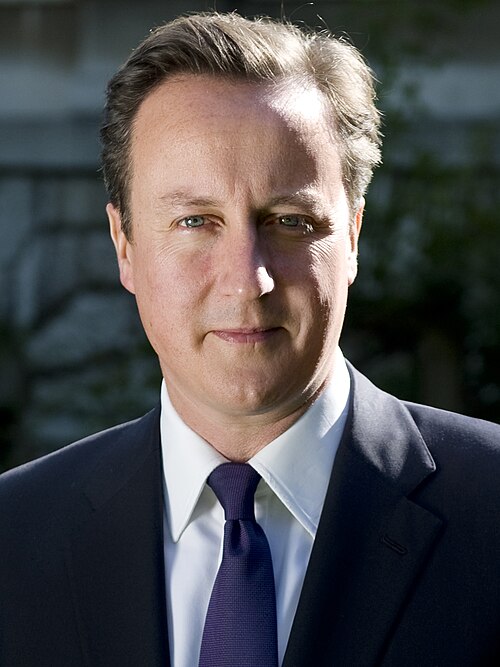
保守党のマーガレット・サッチャー首相(左)とデービッド・キャメロン首相(右)は、英国のEU加盟と欧州単一市場の発展を支持しながら、欧州懐疑主義的なレトリックを使った。欧州懐疑主義、特に英国独立党(写真中央は元党首のナイジェル・ファラージ氏)が保守党の選挙結果に与えた影響は、キャメロン首相による2015~16年の英国のEU加盟再交渉の試み、そして最終的には2016年の国民投票の実施につながった。
以前は共通市場と単一欧州議定書を支持していたサッチャーは、 1988年のブルージュ演説で「ブリュッセルから新たな支配力を行使するヨーロッパの超国家」に警告した。彼女はダニエル・ハナンに影響を与え、彼は1990年にオックスフォード独立英国キャンペーンを設立した。「後から考えると、これをブレグジット運動の始まりと見る人もいる」とフィナンシャル・タイムズは後に書いている。[38] 1993年のマーストリヒト条約承認の投票は強力な欧州懐疑派の反応を引き起こし、保守党を分裂させ、多くの元支持者が別の欧州懐疑派政党を結成することにつながった。これには、ジェームズ・ゴールドスミス卿が1994年に国民投票党を結成し、英国とEUの他の国々との関係の性質に関する国民投票を実施するという綱領で1997年の総選挙に出馬したことも含まれる。 [39] [40]同党は選挙で547の選挙区に候補者を立て、810,860票(総投票数の2.6% [41] )を獲得したが、投票が全国に分散していたため議席を獲得できなかった。国民投票党は1997年にゴールドスミスが死去したことを受けて解散した。[要出典]。欧州懐疑派の政党である英国独立党(UKIP)は、1993年のマーストリヒト条約への反応として結成された。1997年、ナイジェル・ファラージがイングランドの中道右派ポピュリスト運動として同党の指導権を引き継いだ。[42]
2013年以前は、EU加盟問題は有権者の優先事項に関する調査で5%を超えるスコアを獲得したことがなく、2013年にはわずか6%[43]、2014年には11%[44]でした。しかし、移民と亡命を重要視する有権者の割合は増加しました。[45]強硬な反移民政策を採用し、この問題をEU加盟と混同することで、UKIPは選挙で成功を収めることができ、2004年の欧州選挙では英国で3位、2009年の欧州選挙では2位、 2014年の欧州選挙では27.5%の得票率で1位になりました。これは、 1910年の総選挙以来、労働党と保守党以外の政党が全国選挙で最大の得票率を獲得した初めてのことでした。[46]この選挙での成功と、与党保守党内に残る多くのマーストリヒトの反乱者を含む内部からの圧力は、党首で首相のデイヴィッド・キャメロンにプレッシャーを与え、 2015年の英国総選挙でUKIPへの潜在的な有権者の離反が敗北の脅威となった。この脅威は、2014年に2つの補欠選挙(保守党議員の離反によって引き起こされたクラクトンとロチェスターとストロード)でUKIPが勝利したことで強調された。 [47]
世論調査 1977–2015
1977年から2015年まで、EU賛成派と反対派の両方の意見が、さまざまな時期に多数派の支持を得ていた。 [48] 1975年のEC加盟国民投票では、英国有権者の3分の2がEC加盟継続を支持した。英国とEUの数十年間の加盟期間中、欧州懐疑主義は英国政治の左派と右派の両方に存在した。[49] [50] [51]
ストラスクライド大学のジョン・カーティス教授が2016年4月に発表した統計分析によると、調査では欧州懐疑主義(EUを離脱したい、またはEUに残留してEUの権限を縮小したいという願望)が1993年の38%から2015年には65%に増加したことが示された。2015年7月から11月までのBSA調査では、60%が加盟国として継続する選択肢を支持し、30%が離脱を支持した。[52]
2016年の国民投票
会員制度改革交渉
2012年、デイヴィッド・キャメロン首相は当初、英国のEU加盟を問う国民投票の要請を拒否したが[53]、その後、英国とEUの他の国々との関係を再交渉するという自身の提案を承認するために、将来的に国民投票を実施する可能性を示唆した。[54] BBCによると、「首相は、英国の[再交渉された]EU内での立場が『英国国民の心からの支持』を得ることの必要性を認識したが、英国国民は『戦術的かつ戦略的な忍耐』を示す必要があった」とのことである。[55] 2013年1月23日、多くの国会議員やUKIPの台頭による圧力を受け、キャメロン首相はブルームバーグでの演説で、 2015年5月7日の総選挙で保守党政権が選出されれば、再交渉されたパッケージに基づいて、2017年末までにEU加盟の是非を問う国民投票を実施すると約束した。[56]これは保守党の選挙マニフェストに含まれていた。[57] [58]
保守党は過半数を獲得して選挙に勝利した。その後すぐに、国民投票を可能にするために2015年欧州連合国民投票法が議会に提出された。キャメロンは改革されたEUに残留することを支持し、非ユーロ圏諸国の単一市場の保護、「官僚主義」の削減、「ますます緊密化する連合」からの英国の免除、およびEUの他の国々からの移民の制限という4つの主要点について再交渉しようとした。[59]
2015年12月の世論調査では、EU残留を支持する人が明らかに多数派であることが示された。また、キャメロン首相がユーロ圏外の国々に対する適切な保障措置[定義が必要]と、英国以外のEU市民に対する給付の制限について交渉しなければ、支持は低下するとも示された。[60]
再交渉の結果は2016年2月に明らかになった。EUからの新規移民に対する就労中の給付金に一定の制限を設けることで合意したが、それを適用する前に、英国などの加盟国は欧州委員会から許可を得てから、加盟各国の首脳で構成される欧州理事会から許可を得る必要がある。 [61]
2016年2月22日の下院での演説で、キャメロン首相は国民投票の実施日を2016年6月23日と発表し、再交渉の合意についてコメントした。[62]彼は、離脱投票後すぐに第50条の手続きを開始する意向と、「離脱の取り決めを交渉するための2年間の期間」について語った。[63]
国民投票の質問の当初の文言が異議を唱えられた後、[64]政府は公式の国民投票の質問を「英国は欧州連合に残留すべきか、それとも欧州連合から離脱すべきか」に変更することに同意した。
国民投票の結果
国民投票では、51.89%がEU離脱(離脱派)に賛成し、48.11%がEU残留(残留派)に賛成した。[65] [66]この結果を受けて、キャメロン首相は2016年7月13日に辞任し、党首選の末、テリーザ・メイ氏が首相に就任した。2度目の国民投票を求める請願書には400万以上の署名が集まったが、[67] [68] 7月9日に政府によって否決された。[69]
英国の投票地域別(左)と議会地区/単一自治体別(英国)および英国議会選挙区別(北アイルランド)(右)の結果
離れる
残る
有権者の人口統計と傾向
2017年にEconomic Policy誌に掲載された研究によると、所得が低く失業率が高く、製造業雇用の伝統が強く、資格保有者が少ない地域では離脱票が多くなる傾向がある。また、東欧からの移民(主に低技能労働者)が、低技能労働者の割合が高い地域に大量に流入した地域でも離脱票が多くなる傾向があった。 [71]社会的階層が低い人(特に労働者階級)は離脱票が多く、社会的階層が高い人(特に上流中流階級)は残留票が多かった。[72] [73] [74]研究では、経済衰退、 [75]自殺率や薬物関連死率が高い地域、[76] 2010年に導入された緊縮財政改革の影響を受けた地域では離脱票が多くなる傾向があることがわかった。[77]
研究によると、高齢者は離脱に投票する傾向が高く、若者は残留に投票する傾向が高いことが示唆されている。[78]ロンドン・スクール・オブ・エコノミクスの経済学者トーマス・サンプソンによると、「高齢者や教育水準の低い有権者は『離脱』に投票する傾向が高かった [...] 白人有権者の大多数は離脱を望んでいたが、アジア系有権者の33%と黒人有権者の27%だけが離脱を選んだ。 [...] 欧州連合からの離脱は、政治的立場を問わず支持された [...] 欧州連合からの離脱に投票することは、社会的に保守的な政治信条を持つこと、コスモポリタニズムに反対すること、イギリスでの生活が悪化していると考えることと強く関連していた。」[79]
YouGovが実施した世論調査はこれらの結論を裏付けており、年齢、政党支持、教育、世帯収入などの要素が、人々の投票行動を示す主な要素であることが示された。例えば、保守党の投票者が離脱に投票する可能性は61%であるのに対し、労働党の投票者は35%であった。年齢は、人が離脱に投票するかどうかに影響を与える最大の要素の1つであり、65歳以上の人の64%が離脱に投票する可能性が高いのに対し、18~24歳が離脱に投票する可能性はわずか29%であった。教育は、投票の可能性を示すもう1つの要素であり、GCSEまたはそれ以下の教育レベルの人が離脱に投票する可能性は70%であるのに対し、大学卒業生が離脱に投票する可能性はわずか32%であった。世帯収入ももう1つの重要な要素であり、収入が2万ポンド未満の世帯が離脱に投票する可能性は62%であるのに対し、収入が6万ポンド以上の世帯が離脱に投票する可能性はわずか35%であった。[80]
それぞれの支持地域には大きなばらつきがあった。スコットランドと北アイルランドはともに残留が過半数となったが、イングランドの人口の方がはるかに多いため、全体の結果に及ぼす影響は比較的小さかった。イングランド内でも地域差が大きく、ロンドンの大半では残留が過半数となり、マンチェスターやリバプールなどイングランド北部の都市部でもそれぞれ60%と58%の残留が多数となった。イングランド北部の工業地帯とポスト工業地帯では逆の傾向が見られ、ノースリンカンシャーやサウスタインサイドなどの地域ではともに離脱を強く支持した。[81]
世論調査によると、EU離脱派はEUを離脱することで「移民制度の改善、国境管理の改善、福祉制度の公平化、生活の質の向上、自国の法律をコントロールする能力がもたらされる可能性が高い」と考えていたが、残留派はEU加盟が「経済、国際投資、そして世界における英国の影響力にとって良い」と考えていた。世論調査によると、人々が離脱に投票した主な理由は「英国に関する決定は英国で下されるべきであるという原則」と「離脱は英国が移民と国境を再びコントロールする最良の機会を提供する」ことだった。人々が残留に投票した主な理由は「経済、雇用、価格などに関してEU離脱に投票するリスクが大きすぎるように思えた」ことだった。[82]
国民投票後の調査
国民投票後、選挙管理委員会は選挙資金に関する一連の不正を調査し、その後大量の罰金を科した。2017年2月、「離脱」票の主なキャンペーングループであるLeave.EUは、許可なくマーケティングメッセージを送ったとして5万ポンドの罰金を科された。[83] 2017年12月、選挙管理委員会は、国民投票キャンペーン中に選挙資金規則に違反したとして、2つの親EUグループ、自由民主党(1万8000ポンド)とオープンブリテン(1250ポンド)に罰金を科した。[84] 2018年5月、選挙管理委員会は、違法な超過支出と、合計600万ポンドに上るアロン銀行からの融資の不正確な報告をしたとして、Leave.EUに7万ポンドの罰金を科した。[85]不正確な報告をしたとして、親EUキャンペーングループBest for Our Futureと2つの労働組合の寄付者に対しても、より少額の罰金が科された。[86] 2018年7月、Vote Leaveは、過剰支出、 BeLeaveとの資金共有の申告漏れ、調査への不服により61,000ポンドの罰金を科せられた。[87]
2017年11月、選挙管理委員会は、ロシアがツイッターやフェイスブックなどのソーシャルメディアプラットフォームを利用して国民投票に関する世論を左右しようとしたとの主張について調査を開始した。 [88]
2019年2月、議会のデジタル・文化・メディア・スポーツ委員会は、ブレグジット投票における「外国の影響、偽情報、資金提供、有権者の操作、データの共有」に関する調査を求めた。[89]
2020年7月、議会の情報安全保障委員会は、英国政府がロシアによる世論介入の調査を積極的に回避していると非難する報告書を発表した。報告書では、ロシアの情報活動が結果に影響を与えたかどうかについては判断していない。[90]
撤退手続き

Wikisource にはこの記事に関連する原文があります:
欧州連合条約第50条
欧州連合からの離脱は、欧州連合条約第50条によって規定されている。この条項は、もともとキンロチャード卿カーによって起草され、[91] 2009年に発効したリスボン条約によって導入された。[92]この条項では、加盟国はいずれも、欧州理事会に離脱の意思を通知することにより、「自国の憲法上の要件に従って」離脱できるとされている。 [93]この通知により2年間の交渉期間が開始され、EUは「[欧州]連合との将来の関係の枠組みを考慮しつつ、離脱の取り決めを定めた協定を[離脱]国と交渉し締結しなければならない」。[94] 2年以内に合意に達しない場合は、離脱国を含むすべてのEU加盟国の間で延長が全会一致で合意されない限り、合意なく加盟が終了する。[94] EU側では、協定は欧州理事会の特定多数と欧州議会によって批准される必要がある。[94]
第50条の発動

2015年の国民投票法は、第50条の発動を明示的に要求していなかったが[94]、国民投票前に英国政府はその結果を尊重すると述べていた。[95]国民投票後に辞任したキャメロン首相は、第50条の発動は新首相の責任だと述べた。[96] [97]新首相のテリーザ・メイは、交渉の準備のため、2017年までこの条項の発動を待つと述べた。 [98] 2016年10月、メイ首相は、英国は2017年3月に第50条を発動すると述べ、[99] 12月にスケジュールについて国会議員の支持を得た。[100]
2017年1月、英国最高裁判所はミラー事件で、政府は議会の許可を得た場合にのみ第50条を発動できるとの判決を下した。[101]その後、政府はこの目的のための法案を提出し、3月16日に2017年欧州連合(離脱通知)法として可決された。[102] 3月29日、テリーザ・メイ首相は、駐EU英国大使のティム・バローが欧州理事会議長のドナルド・トゥスクに発動書を手渡したことで第50条を発動した。これにより、2019年3月29日が英国のEU離脱予定日となった。[103] [104]
2017年英国総選挙
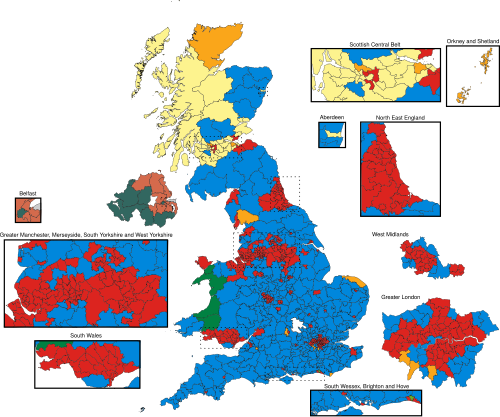
2017年4月、テリーザ・メイ首相は、交渉における「立場を強化する」ために、6月8日に突然の総選挙を実施すると発表しました。 [105]保守党、労働党、UKIPは国民投票を実施することをマニフェストで約束しましたが、労働党のマニフェストは、EU移民に永住権を一方的に提供するなど、Brexit交渉へのアプローチが異なっていました。[106] [107] [108]自由民主党と緑の党のマニフェストは、 2回目の国民投票でEUに残留する政策を提案しました。[109] [110] [111]スコットランド民族党(SNP)のマニフェストは、Brexit交渉の結果を待ってからスコットランド独立の国民投票を実施する政策を提案しました。[112] [113]
この結果、予想外の宙吊り議会が生まれ、与党保守党は得票数を増やして第一党の座を維持したものの、下院での議席と過半数を失った。労働党は得票数と議席数で大幅に伸び、第二党の地位を維持した。自由民主党は2015年と比べて得票率がわずかに低下したものの、6議席を獲得した。緑の党は国会議員1名を維持したが、全国での得票率は低下した。得票数と議席数を減らしたのは、21議席を失ったスコットランド国民党(SNP)と、-10.8%の変動で唯一の国会議員を失った英国独立党(UKIP)である。民主統一党(DUP)とシン・フェイン党も得票数と議席数を伸ばした。[114]
2017年6月26日、保守党とDUPは信頼と供給の合意に達し、議会期間中、下院での重要な投票でDUPが保守党を支持することになった。合意には、北アイルランドへの10億ポンドの追加資金提供、ブレグジットと国家安全保障への相互支援、聖金曜日合意へのコミットメントの表明、公的年金のトリプルロックや冬季燃料支払いなどの政策が維持されることが示された。[115] [116]
2017年と2018年の英国とEUの交渉
交渉に先立ち、メイ首相は英国政府は単一市場の恒久的な加盟を求めず、欧州司法裁判所の管轄権を終了し、新たな貿易協定を求め、人々の自由な移動を終わらせ、アイルランドとの共通旅行地域を維持すると述べた。[117] EUは5月に交渉指令を採択し、 [118]ミシェル・バルニエを首席交渉官に任命した。 [119] EUは交渉を2段階で行うことを望んでいた。まず英国が財政的コミットメントと英国在住のEU市民に対する生涯にわたる給付に同意し、その後将来の関係に関する交渉を始めることができる。[120]第1段階では、加盟国は英国に「離婚代金」の支払いを要求する。当初520億ポンドと見積もられていた。[121] EUの交渉担当者は、英国とEUは2018年10月までに合意に達しなければならないと述べた。 [122]
交渉は2017年6月19日に開始された。[119]交渉グループは、英国に住むEU市民の権利とその逆、英国のEUに対する未払いの財政的義務、北アイルランドとアイルランド共和国の国境の3つのトピックについて設立された。[123] [124] [125] 2017年12月、部分的合意に達した。アイルランドに厳格な国境を設けないこと、EU内の英国市民の権利と英国内のEU市民の権利を保護すること、金銭的和解額を350億~390億ポンドと見積もった。[126]メイ首相は「すべてが合意されるまで何も合意されない」と強調した。[127]この部分的合意を受けて、EU首脳は交渉の第2段階、つまり将来の関係、移行期間、および貿易協定の可能性について議論することに進むことに同意した。[128]
2018年3月、21か月の移行期間とその条件が暫定的に合意された。[129] 2018年6月、アイルランドのレオ・バラッカー首相 は、EUが移行期間の終了までに包括的な貿易協定が締結されなかった場合に発効するバックストップを提案したアイルランド国境問題についてはほとんど進展がなく、10月に全面的な協定が合意される前に解決策が見つかる可能性は低いと述べた。[130] 2018年7月、英国政府は、交渉で決定される将来の関係の目標を含むチェッカーズ計画を発表した。この計画は、独立した貿易政策を可能にしながら、物品については英国に単一市場へのアクセスを維持することを目指したが、サービスについては必ずしもそうではなかった。[131]この計画により、デイビッド・デイビスEU離脱担当大臣[132]やボリス・ジョンソン外相を含む閣僚が辞任した。[133]
メイ首相の合意と批准の失敗
Wikisource にはこの記事に関連する原文があります:
2018年離脱協定案
2018年11月13日、英国とEUの交渉担当者は離脱協定案の文言で合意し、[134]メイ首相は翌日、内閣の支持を確保したが、[135]離脱担当大臣のドミニク・ラーブ氏は協定の「致命的な欠陥」を理由に辞任した。[136]英国議会での批准は困難になると予想されていた。[137] [138] [139] 11月25日、残りのEU加盟国27カ国の首脳全員が協定を承認した。[137] [138]
2018年12月10日、メイ首相は下院でのEU離脱協定案の採決を延期した。これは首相官邸が採決を実施すると確認した数分後のことだった。[140]下院での敗北の可能性に直面したメイ首相は、この選択肢によって、保守党議員やEUと交渉する時間をさらに得た。ただし、彼らはさらなる協議を否定していた。[141]この決定に対して、多くのウェールズ労働党議員が政府不信任決議案の提出を求めた。 [142]
また、2018年12月10日、欧州司法裁判所(ECJ)は、英国がまだ加盟国であり、離脱協定に合意していない限り、離脱通知を一方的に撤回できるとの判決を下した。その決定は「明確かつ無条件」で、「民主的なプロセスに従う」ものでなければならない。[143]英国が通知を撤回した場合、英国は現在の加盟条件でEUに留まることになる。この訴訟はスコットランドの政治家によって提起され、スコットランド高等法院によってECJに付託された。[144]
欧州懐疑派の保守党議員による研究支援団体である欧州研究グループ(ERG)は、首相が提案した離脱協定に反対した。メンバーは、離脱協定にアイルランドのバックストップが含まれていることに強く反対した。[145] [146] ERGメンバーはまた、EUとの390億ポンドの財政的和解案にも反対し、この合意により、英国は主要な政策分野でEUの規制に従い続けることに同意することになり、また、合意および英国に依然として適用される欧州法の解釈に関してECJの管轄権が継続することになると述べた。[147] [148]
2019年1月15日、下院は432対202でこの合意に反対票を投じたが、これは英国政府に対する反対票としては過去最大の多数決であった。[149] [150]その後すぐに、野党は英国政府に対する不信任決議を提出したが[151]、325対306で否決された。[152]
2月24日、メイ首相は離脱協定に関する次回の採決を、ブレグジット日まで17日後の2019年3月12日に行うことを提案した。[153] 3月12日、この提案は391票対242票で否決された。これは、1月に協定が提案されたときの230票から149票減少したことになる。[154]
2019年3月18日、議長は下院に対し、1604年に遡る議会の判例を引用し、前回とは大きく異なる動議についてのみ、3回目の意味のある投票を行うことができると通知した。[155]
離脱協定は3月29日に付属了解事項なしで下院に再提出された。[156]離脱協定を支持する政府の動議は344票対286票で否決された。これは3月12日に協定が提案されたときの149票から58票減少した。[157]
第50条の延長とジョンソンの合意
2019年3月20日、メイ首相は欧州理事会のトゥスク議長に書簡を送り、2019年6月30日までBrexitを延期するよう要請した。 [158] 2019年3月21日、メイ首相はブリュッセルで開催された欧州理事会首脳会議で自らの主張を述べた。メイ首相が会議を去った後、残りのEU首脳の間で議論が行われ、6月30日の日付は拒否され、代わりに2つの新たなBrexitの代替日付の選択肢が提示された。2019年3月22日、英国政府と欧州理事会の間で延期の選択肢が合意された。[159]最初に提示された代替案は、メイ首相の合意案を翌週に議員らが拒否した場合、合意の有無にかかわらず2019年4月12日までにBrexitが実施される、あるいは別の延期を求め、2019年の欧州議会選挙に参加する約束をするというものだった。提案された2番目の代替案は、メイ首相の離脱協定を議員が承認した場合、ブレグジットは2019年5月22日に行われるというものだった。後者の日付は、欧州議会選挙の開始前日だった。[160]政府は前日、提案された変更の合法性に関する懸念(離脱日が2つ含まれていたため)は不当であると判断した後、[161] 2019年3月27日、貴族院(投票なし)[162]と庶民院(441対105)の両院は、離脱協定が承認された場合は離脱日を2019年5月22日、承認されなかった場合は2019年4月12日に変更する法令を承認した。[163]修正案は翌日の午後12時40分に署名され、法律となった。[159]
英国議会が3月29日までに離脱協定を承認できなかったため、英国は2019年4月12日にEUを離脱する必要があった。2019年4月10日、ブリュッセルでの深夜の協議の結果、離脱期限は2019年10月31日まで延長された。テリーザ・メイ首相は再び6月30日までの延長を要請していた。この新たな延長条件では、離脱協定が10月までに可決された場合、翌月1日にEUを離脱することになる。そうなると、英国は5月に欧州議会選挙を実施するか、6月1日に合意なしでEUを離脱する義務が生じる。[164] [165]
EUは、第50条の延長を認めるにあたり、離脱協定の「再開」(つまり再交渉)を拒否する姿勢をとった。[166]ボリス・ジョンソンが2019年7月24日に首相に就任し、EU首脳らと会談した後、EUは姿勢を変えた。2019年10月17日、英国とEUの「トンネル協議」を経て、 [167]交渉者レベルで改訂された離脱協定が合意され、英国政府とEU委員会によって承認された。[168]改訂された協定には、新しい北アイルランド議定書と、関連条項の技術的修正が含まれていた。 [8]さらに、政治宣言も改訂された。[169]改訂された協定と政治宣言は、同日遅くに欧州理事会によって承認された。 [170]発効するには、欧州議会と英国議会の批准が必要だった。[171]
英国議会は、2019年9月9日に国王の裁可を受けた2019年欧州連合(離脱)(第2号)法案を可決し、2019年10月の次回欧州理事会で合意に達しなかった場合、首相は3回目の延長を求める義務を負うことになった。 [172]首相の要請により延長が認められるためには、他のすべてのEU加盟国首脳の全会一致の同意が必要となる。[173] 2019年10月28日、EUは3回目の延長に同意し、新たな離脱期限は2020年1月31日となった。[174]英国法の「離脱日」は、2019年10月30日の法令によりこの新しい日付に改正された。[175]
2019年英国総選挙
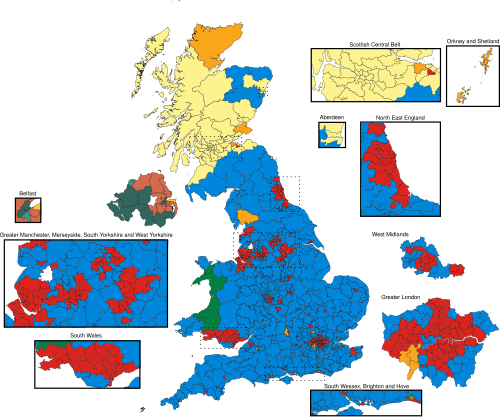
ジョンソン首相は、10月末までに議会で離脱協定の修正案を承認させることができなかったため、早期総選挙を呼びかけることにした。 2011年議会任期固定法に基づく早期総選挙を求める3つの動議が可決に必要な3分の2の超多数を獲得できなかったため、政府は代わりに現行法を回避するために、下院で単純過半数の賛成投票のみを必要とする「選挙法案」を提出し、438対20で可決され、選挙日は12月12日木曜日に設定された。 [176]投票日までの 世論調査では、選挙期間中、保守党が労働党に対して確固たるリードを示していた。[177]
2019年12月12日の総選挙を前に、保守党は2019年10月に交渉された離脱協定でEUを離脱することを約束した。労働党は前述の協定を再交渉し、再交渉された協定と残留のどちらかを有権者が選択できるように国民投票を実施すると約束した。自由民主党は第50条を撤回することを誓約し、スコットランド国民党は2度目の国民投票を実施する意向だが、代替案が合意なしの離脱であれば第50条を撤回する。民主統一党はブレグジットを支持したが、北アイルランドに関する不満の部分については変更を求めるとしていた。プライド・カムリ党と緑の党は、英国はEUに留まるべきだと考え、2度目の国民投票を支持した。ブレグジット党は、英国が合意なしでEUを離脱することを望んで選挙に出馬した唯一の主要政党だった。[178]
選挙の結果はボリス・ジョンソンにとって決定的なものとなり、保守党は365議席(47議席増)を獲得し、全体の過半数である80議席を獲得した。労働党は60議席を失い、202議席となり、スコットランドでは1議席しか残らず、1935年以来最悪の選挙敗北を喫した。自由民主党は、党首ジョー・スウィンソンが議席を失い、わずか11議席しか獲得できなかった。スコットランド国民党は、スコットランドで14議席を獲得し、48議席を獲得した。
この結果により、英国議会の膠着状態が打破され、離脱協定に関する国民投票が実施される可能性はなくなり、英国は2020年1月31日に欧州連合を離脱することが確実となった。
批准と出発
.jpg/500px-Westminster_(49470617471).jpg)
その後、政府は離脱協定を批准する法案を提出した。この法案は2019年12月20日に下院で2回目の読会を358対234の投票で通過し、[179] 2020年1月23日に「2020年欧州連合(離脱協定)法」として法律となった。[180]
離脱協定は2020年1月23日に欧州議会の憲法委員会の支持を受け、後の投票で全議会が承認するとの見通しが立った。[181] [182] [183] 翌日、ブリュッセルでウルズラ・フォン・デア・ライエンとシャルル・ミシェルが離脱協定に署名し、それはロンドンに送られ、そこでボリス・ジョンソンが署名した。[11]欧州議会は1月29日に621対49の投票で批准に同意した。[184] [12]投票承認の直後、欧州議会議員は手をつないで「オール・ラング・サイン」を歌った。[185]欧州連合理事会は翌日、EUの批准を結論付けた。[186] 2020年1月31日午後11時(グリニッジ標準時)、イギリスは加盟から47年を経て欧州連合(EU)からの脱退を余儀なくされた。[13]欧州司法裁判所がEP対Préfet du Gers事件で確認したように、[187]すべての英国国民はEU市民ではなくなった。[188]
移行期間と最終貿易協定
2020年1月31日の英国のEU離脱後、英国は2020年の残りの期間、移行期間に入った。この期間中、貿易、旅行、移動の自由はほとんど変わらない。[189]
離脱協定はこの日以降も適用される。[ 190]この協定は、英国から北アイルランドに入る物品の検査が行われることを条件に、北アイルランドとアイルランド共和国の間で物品の自由なアクセスを提供する。英国政府は、英国議会で国内法である域内市場法案を可決することで、この約束を撤回しようとした[191]。9月、北アイルランド大臣のブランドン・ルイスは次のように述べた。
私は私の名誉ある友人にこう言いたい。確かにこれは非常に具体的かつ限定的な形で国際法に違反している。[192]
その結果、政府法務局の常任秘書官であるジョナサン・ジョーンズ卿[193]とスコットランドの法務官であるキーン卿[194]が辞任した。欧州委員会は法的措置を開始した。[190]
移行期間中、デイヴィッド・フロストとミシェル・バルニエは恒久的な貿易協定の交渉を続けた。[195] 2020年12月24日、両党は合意に達したと発表した。[196]この協定は12月30日に英国議会の両院で可決され、翌日の早朝に国王の裁可が与えられた。下院では、与党保守党と主要野党労働党が協定に賛成票を投じたが、他のすべての野党は反対票を投じた。[197]移行期間は翌日の夕方、その条件で終了した。[198]英国が北アイルランドとグレートブリテン間の貿易に対する審査を制限する猶予期間を一方的に延長すると発表した後、欧州議会は協定の批准日の設定を延期した。[199]投票はその後4月27日に予定され、圧倒的多数の票で可決された。[200] [201]
2021年7月1日までは関税の移行措置が実施されていた。この期間中、EUから英国に標準品を輸入する貿易業者は、税関申告書の提出とHMRCへの輸入関税の支払いを最大6か月間延期することができた。この措置により、新たな状況の初期の数ヶ月間はほとんどの輸入規制が簡素化され回避され、COVID-19による健康危機の際に輸入貿易を促進し、短期的には国内サプライチェーンの大きな混乱を回避するように設計された。[202]国境インフラの準備ができていないという報告を受けて、英国政府は進行中のCOVID危機中の供給問題を回避するために、EUから英国への輸入検査を年末までさらに延期した。[203]その後、トラック運転手不足の状況で輸入規制が再び延期され、2022年に段階的に導入される予定である。[204]
第50条通知後の英国の立法
2018年欧州連合(離脱)法
2016年10月、テリーザ・メイ首相は「大撤回法案」を約束した。これは1972年の欧州共同体法を廃止し、EU法の下でこれまで施行されていたすべての制定法を英国法で再制定するものである。その後、この法案は欧州連合(離脱)法案と改名され、2017年7月13日に下院に提出された。[205]
2017年9月12日、この法案は下院で326票対290票の差で第1回投票と第2回読会を通過した。[206]この法案は両院での一連の投票でさらに修正された。この法律が2018年6月26日に法律となった後、欧州理事会は6月29日に加盟国と欧州連合機関に対し、あらゆるレベルとあらゆる結果に対する備えを強化するよう改めて要請することを決定した。[207]
離脱法は、離脱協定と英国とEUの将来の関係の枠組みの両方について交渉が原則合意に達しなかった場合、政府がどう進めるかを決定する期間を2019年1月21日までと定めた。その一方で、離脱協定を英国とEU間の条約として将来批准するには、離脱交渉が完了した時点で最終的な離脱条件を承認するための別の議会法が事前に制定されることを条件としていた。いずれにせよ、この法律は、英国がそれまでに離脱協定を批准していなかったり、交渉期間の延長に同意していなかったりした場合は遅くとも2019年3月29日までに終了する、第50条で認められた2年間の交渉期間を変更するものではなかった。[208]
2018年6月に成立した離脱法は、交渉による解決なしを含むさまざまな結果を認めている。同法は、第25条に基づく命令により、政府が「離脱日」を定めた条項と1972年欧州共同体法の廃止を発効させる権限を与えているが、離脱日はEU条約が英国に適用されなくなった日と時間と同じでなければならない。[209]
退場日
離脱日は2020年1月31日(中央ヨーロッパ時間)の末(グリニッジ標準時午後11時)であった。[175] 2018年欧州連合(離脱)法(2019年4月11日に英国の法令により改正)第20条(1)では、「離脱日」を2019年10月31日午後11時と定義している。 [159]当初、「離脱日」は2019年3月29日午後11時(グリニッジ標準時(UTC+0))と定義されていた。[208] [210] [211]
追加の政府法案
2017年3月に政府研究所が発表した報告書では、EU(離脱)法案に加えて、関税、移民、農業などの政策分野のギャップを埋めるために、一次および二次立法が必要になると指摘している。[212]また、この報告書では、地方分権された議会の役割が不明確で問題を引き起こす可能性があり、15もの新たなBrexit法案が必要になる可能性があり、厳格な優先順位付けと、新しい法律の詳細な検討のための議会の時間の制限が必要になると指摘している。[213]
2016年と2017年に、貴族院はBrexit関連の主題に関する一連の報告書を発表しました。
- ブレグジット:貿易の選択肢
- ブレグジット:英国とアイルランドの関係
- ブレグジット:英国とEUの将来の安全保障と警察の協力
- ブレグジット:漁業
- ブレグジット:環境と気候変動
- ブレグジット:王室属国
- Brexit:家族、個人、企業にとっての正義か?
- ブレグジット:非金融サービス貿易
2018年核保障措置法
ユーラトムからの脱退に関連する2018年核保障措置法は、2017年10月に議会に提出された。この法律は、核保障措置および関連する目的について規定している。国務大臣は、規則(「核保障措置規則」)により、(a)適格な核物質、施設または機器が民間活動(英国内または他の場所を問わず)での使用にのみ利用可能であることを保証する、または(b)関連する国際協定の条項を実施する目的で規定を制定することができる。[214]
2020年欧州連合(離脱協定)法
2020年欧州連合(離脱協定)法は、ブレグジット離脱協定を批准し、それを英国の国内法に組み込むための法的規定を定めている。 [215]この法案は、政府によって2019年10月21日に初めて提出された[216] 。この法案はそれ以上議論されることはなく、 2019年の総選挙に備えて議会が解散された11月6日に失効した。この法案は総選挙直後に再提出され、第58議会の最初の会期で下院に提出された最初の法案となり、 [217]再選された政府によって前回の法案から変更され、無法者法案の第一読会直後、女王の演説に関する議論が始まる前の12月19日に第一読会が行われた。 2回目の審議は12月20日に、3回目の審議は2020年1月9日に行われました。この法律は、英国が欧州連合を離脱する9日前の2020年1月23日に国王の裁可を受けました。
ブレグジット国民投票後の世論
2020年以前
世論調査では全体的に、国民投票から2016年後半にかけてEU離脱支持が当初は低下し、支持と反対が半々になったことが示されている。その後、支持は再び上昇して多数派となり、2017年の総選挙までその状態が続いた。それ以降、世論調査ではEU残留支持、あるいはEU離脱は間違いだったという見解が多数派となる傾向があり、推定差は2019年にわずかに減少するまで増加している(2019年10月現在、残留53%、離脱47%[update])。[218]これは主に、2016年の国民投票で投票しなかった人々(2019年10月時点で推定250万人が当時は投票するには若すぎた[update])がEU残留を希望したことによるものと思われる。 [219] [220]他に提案されている理由としては、残留派より離脱派がわずかに多いこと(それぞれ14%と12%、2019年10月現在)[221]、投票方法の変化(特に労働党の地域で)や、高齢有権者の死亡(そのほとんどがEU離脱に投票した) [218]などが挙げられる。人口動態の変化に関するある推定(他の影響は無視)によると、EU離脱の是非を問う国民投票が2019年10月に行われていたとしたら、離脱派は80万~90万人減少し、残留派は60万~70万人増加し、残留派が過半数を占めていただろうと示唆されている。[219][update][update]
2019年3月、英国議会の請願ウェブサイトに提出された、政府に第50条を撤回してEUに残留するよう求める請願書は、610万件を超える署名という記録的な数に達した。 [222] [223]
- 国民投票後の世論調査(2016年~2020年)
-
 英国がEU離脱に投票したのは正しかったか間違っていたかに関する世論調査
 -
 英国がEUを離脱すべきか残留すべきかに関する世論調査(「どちらでもない」回答を含む)
 -
 英国がEUを離脱すべきか残留すべきかに関する世論調査(「どちらでもない」の回答を除く)
2020年~現在
YouGovの世論調査では、Brexitの利点に関する国民の認識が徐々に低下していることが示されており、Brexit決定の正しさについての全体的な感情の幅は、2016年のわずかに肯定的であったのに対し、2022年には-11%に低下している。[224] 2022年5月の世論調査では、意見を表明した回答者の大多数が、Brexitは「うまくいかなかった」または「非常にうまくいかなかった」と考えていることが示された。[225]新しい調査では、Brexit以降、他のヨーロッパ諸国の市民は2016年以降よりもEU離脱に反対していることが示された。 [226] 2023年1月に英国で行われた世論調査でもこれらの数字が反映されており、回答者の54%がEU離脱は間違っていたと考え、35%が正しい決定だったと考えている。[227] 2023年6月と7月に実施された6つの世論調査の平均では、有権者の58%がEUへの再加盟に賛成し、42%の有権者がEUへの再加盟に反対していることが示されています。[228]
世論調査会社は2020年以来、回答者に対し、EUに再加盟するかどうかの2度目の国民投票が行われた場合、どう投票するかを尋ねてきた。

合意なしの計画
2018年12月19日、EU委員会は、英国が「100日後」にEUを離脱することに関して、特定の分野における「合意なし」の緊急時対応計画を明らかにした。[229]
英国のEU離脱投票を受けて、メイ首相は2016年7月13日の就任直後に、英国と非EU諸国間の貿易協定の締結と延長を担当する国際貿易省(DIT)を設立した。 [230] 2017年までに、同省は約200人の貿易交渉担当者を雇用し[231] 、当時の国際貿易大臣 リアム・フォックスが監督した。 2019年3月、英国政府は合意なきEU離脱となった場合、多くの輸入関税をゼロにすると発表した。[232]英国産業連盟は、この動きは「我が国の経済にとって大打撃となる」と述べ、[233] [234] [235]全国農業組合も強く批判した。[236]さらに、この計画は標準的なWTO規則に違反しているように思われた。[237] [238] [239]
2020年6月2日、ドイツのアンゲラ・メルケル首相は、 EUは英国とのEU離脱交渉が失敗する可能性に備えなければならないと述べた。彼女は、年末までに批准できる合意に達するために交渉を加速させていると付け加えた。彼女の警告は、交渉延長の期限が過ぎ、合意の有無にかかわらず交渉は12月31日に終了すると見込まれていたときに出された。[240]
訴訟
R (ミラー) 対 EU 離脱担当国務長官(単に「ミラー事件」として知られる) および 2017 年通知法の 後に、Brexit の憲法上の根拠を探る訴訟が起こっています。
- R. (ウェブスター) 対 欧州連合離脱担当大臣事件では、グロス判事とグリーン上級顧問からなる小法廷が、2017年3月29日に通知されたEU離脱の実質的な決定は、実際には通知法によって首相に委任されたと判明した法定決定権を用いた首相の行政決定であると判断した。これは、この事件に関する庶民院図書館の解説によって確認されている。 [241]この事件は控訴院に上訴され[242]、判決の第15段落と、この決定の引用可能性が支持された。この事件は、ロンドン・スクール・オブ・エコノミクスで法学を教えるロバート・クレイグによって学術的に批判されたが[243] 、事件の分析の側面は、最高裁判所のミラー2の段落57で支持され、次のことを確認した。
...議会、特に民主的に選出された国民の代表である下院には、その変化がどのように起こるかについて発言する権利があることは疑いの余地がない。[244]
— 英国最高裁判所(UKSC/2019/41)
- この決定が行政行為であったという確認は、 R. (ウィルソン) 対首相[245]の根拠の一部であり、この点は国民投票の不正に関する懸念と結び付けられました。高等法院の審理は2018年12月7日にオーズリー判事の前で行われ[246]、判決が下されたとき、裁判所の仕事は「離脱」キャンペーンの不正について判断することではなく、それらは法律問題ではないと判断されたと述べられました。また、この訴訟は早すぎただけでなく遅すぎたとも言われました。[241]以前の控訴院の判決 (ヒッキンボトム判事とハドンケイブ判事の前で) も、申請者に不利なものでした。[247]
- 第50条に基づく通知の取り消し可能性については、ワイトマン他対欧州連合離脱担当大臣の訴訟が欧州連合司法裁判所に付託された。[248]英国政府はこの付託を阻止しようと最高裁判所に上訴したが失敗した。[249] 2018年12月10日、欧州司法裁判所は英国が第50条に基づく通知を一方的に撤回できるとの判決を下した。[250]
インパクト
ブレグジットの影響の多くは、英国が離脱協定を結んで離脱するか、それとも協定が批准される前に離脱するか(「合意なしの」ブレグジット)によって左右された。[251] 2017年、フィナンシャル・タイムズは、英国がEUを離脱すると、EU非加盟国168カ国にまたがる約759の国際協定の締約国ではなくなると報じた。[252]
経済効果
経済学者たちは、Brexitが英国と少なくともEU27の一部の経済に悪影響を及ぼすだろうと推測した。特に、経済学者や経済文献の間では、Brexitが中長期的に英国の一人当たり実質所得を減少させる可能性が高く、Brexitの国民投票自体が経済にダメージを与えるだろうという幅広いコンセンサスがあった。[79] [253] [254]研究によると、Brexitによって引き起こされた不確実性により、2016年6月以降、英国のGDP、英国の国民所得、企業による投資、雇用、英国の国際貿易が減少した。[255] [256] [257]
2019年の分析によると、英国企業はEU離脱の国民投票後にEUへのオフショアリングを大幅に増加させたのに対し、欧州企業は英国への新規投資を減らした。 [258] [259] 2018年1月に漏洩した英国政府のEU離脱分析では、英国の経済成長はEU離脱後の15年間で2~8%阻害されると示されており、その程度は離脱シナリオによって異なる。[260] [261]経済学者は、国際金融センターとしてのロンドンの将来はEUとのパスポート協定にかかっていると警告した。[262] [263]離脱支持派の活動家や政治家は、「CANZUK」諸国(カナダ、オーストラリア、ニュージーランド、英国の4か国)との貿易および移民協定の交渉を主張しているが[264] [265]、経済学者は、これらの国との貿易協定は英国にとってEU加盟国であることよりはるかに価値が低いと述べている。[266] [267] [268]研究では、Brexitはすでに苦境に立たされている地域に最も大きな打撃を与え、英国の地域間の経済格差を悪化させると予測されている。[269]
2024年1月11日、ロンドン市長室は「市長がロンドン経済へのBrexitのダメージを強調」を発表した。[270]この発表では、ケンブリッジ・エコノメトリクスによる独立レポートを引用し、Brexitの直接的な結果としてロンドンでは約30万件、全国では200万件の雇用が減るとしている。[270] Brexitは2023年の生活費危機の主因として認識されており、Brexitの結果、2023年には平均的な市民は約2,000ポンド、平均的なロンドン市民は約3,400ポンドの損失を被ることになる。[270]さらに、2023年の英国の実質総付加価値は、英国が単一市場に留まっていた場合よりも約1,400億ポンド減少した。[270]
地域的および地理的影響

北アイルランドとアイルランド共和国の国境への潜在的な影響は、議論を呼んでいる問題である。2005年以来、国境は基本的に見えなかった。[271] Brexit後、それは英国とEUの唯一の陸上国境となった[272](EU加盟国であるスペインとキプロスが英国の海外領土と持つ陸上国境は除く)。すべての関係者は、北アイルランド紛争を終結させた聖金曜日合意を損なう可能性があるため、厳格な国境設定は避けるべきであると合意した。[274] [275] [276]これを未然に防ぐため、EUは、永続的な解決策が見つかるまで英国を関税同盟に留め、北アイルランドを単一市場の一部に留める「バックストップ協定」を提案した。 [277]英国議会はこの提案を拒否した。2019年秋のさらなる交渉の後、英国とEUの間で代替モデルであるアイルランド/北アイルランド議定書が合意された。議定書によれば、北アイルランドは正式にはEU単一市場の外にあるが、EUの物品の自由な移動規則とEU関税同盟規則は依然として適用され、これにより北アイルランドと島の他の地域との間で税関検査や管理が行われないことが保証される。議定書は、アイルランドと北アイルランドの陸上国境の代わりに、イギリスからの(イギリスへのではない)物品のための事実上の税関「アイリッシュ海国境」を創設したが、[278] [279]著名なユニオニストらはこれに不安を表明している。[280]
ブレグジット国民投票の後、スコットランド国民党(SNP) 率いるスコットランド政府は、スコットランドがEU残留に投票したのに対し、イングランドとウェールズは離脱に投票したため、再度の独立住民投票を計画した。 [281]政府はブレグジット国民投票の前にこれを提案していた。[282]スコットランドのニコラ・スタージョン首相は、英国の離脱前に住民投票を行うよう要請したが、[283]英国首相はこの時期を拒否したが、住民投票自体は拒否しなかった。[284] 2014年の住民投票では、55%の有権者が英国残留を決定したが、英国のEU離脱に関する国民投票は2016年に行われ、スコットランドの有権者の62%が反対した。2017年3月、スコットランド議会は再度の独立住民投票の実施に賛成票を投じた。[285] 2017年、北アイルランドがEUとの関係を維持した場合(例えば関税同盟に残留した場合)、スコットランドも特別待遇を主張するだろうと主張するアナリストもいた。[286]しかし、その場合、英国で特別待遇を受けるのは北アイルランドだけだった。[287]
2018年3月21日、スコットランド議会はスコットランド継続法案を可決した。[288]これは、スコットランド政府と英国政府の間で、ブレグジット後に権限委譲された政策分野の権限をどこに帰属させるかについての交渉が行き詰まったために可決された。この法律は、すべての権限委譲された政策分野をスコットランド議会の権限内に留め、英国離脱法案が離脱日に国王大臣に与えている執行権限を削減した。[289]この法案は英国最高裁判所に付託され、スコットランド議会が法案を可決してから最高裁判所の判決までの間に国王の裁可を得た2018年欧州連合(離脱)法は、 1998年スコットランド法 の附則4に基づき、スコットランド議会による修正が不可能と指定されているため、法案は発効できないとの判決が下された。[290]そのため、この法案は国王の裁可を得ていない。[291]

スペインと国境を接するイギリスの海外領土であるジブラルタルも、ブレグジットの影響を受ける。スペインはジブラルタルの領有権を主張している。国民投票後、スペインの外務大臣はスペインとイギリスの共同統治を改めて求めた。[292] 2018年後半、イギリスとスペインの政府は、ジブラルタルをめぐるいかなる紛争もブレグジット交渉に影響を与えないことで合意し、[293]イギリス政府は、ブレグジット後に締結されたイギリスとEUの条約が自動的にジブラルタルに適用されないことに同意した。[294] 2020年12月、スペインとイギリスはブレグジットの将来の取り決めについて原則合意に達し、欧州委員会に条約として正式化するよう要請した。
フランス政府と英国政府は、英国の国境検査をフランスで完了させ、その逆も可能とする(並行管理)ル・トゥケ協定を引き続き遵守すると述べている。[295]両政府は2018年1月にサンドハースト条約に署名しており、これによりカレーから英国に入国しようとする移民の審査にかかる時間が6か月から1か月に短縮される。英国はまた、イギリス海峡の国境警備にさらに4,450万ポンドを投資すると発表した。[295]
欧州連合への影響
ブレグジットにより、欧州連合は第2位の経済大国、第3位の人口を有する国、[296]そしてEU予算に対する第2位の純拠出国を失った。[297]
英国は16%の株式を保有していた欧州投資銀行の株主ではなくなった。 [298]欧州投資銀行理事会は、残りの加盟国が資本出資を比例的に増加させ、全体の出資済み資本(2,433億ユーロ)を同じレベルに維持することを決定した。[299] 2020年3月現在、EIBの出資済み資本は、2つの加盟国(ポーランドとルーマニア)が資本出資を増やすことを決定したことを受けて、さらに55億ユーロ増加した。したがって、EIBの総出資済み資本は2,488億ユーロに達した。BrexitはEIBグループのAAA信用格付けに影響を与えなかった。[300]
Analyses indicated that the departure of the relatively economically liberal UK would reduce the ability of remaining economically liberal countries to block measures in the Council of the EU.[301][302] In 2019, ahead of Brexit, the European Medicines Agency and European Banking Authority moved their headquarters from London to Amsterdam and Paris, respectively.[303][304][305]
Sectorial effects
The UK has left the Common Agricultural Policy (CAP),[306] which provides government financial support to farmers in the EU.[307] Brexit allowed the UK to develop its own agriculture policy[308] and the Agriculture Act 2020 replaced the CAP with a new system.[309] The UK also left the Common Fisheries Policy (CFP)[310] that lets all EU countries fish within 12 nautical miles of the British coast[311] and lets the EU set catch quotas.[312] The combined EU fishing fleets landed about six million tonnes of fish per year, as of 2016,[313] about half of which were from British waters.[314] By leaving the CFP, the UK could develop its own fisheries policy.[312] The UK did also leave the London Fisheries Convention that lets Irish, French, Belgian, Dutch and German vessels fish within six nautical miles of the UK's coast.[315]
Brexit poses challenges to British academia and research, as the UK loses research funding from EU sources and sees a reduction in students from the EU. Academic institutions find it harder to hire researchers from the EU and British students will face greater difficulties with studying abroad in the EU.[316] The UK was a member of the European Research Area and likely to wish to remain an associated member following Brexit.[317] The British government has guaranteed funding for research currently funded by EU.[318]
An early 2019 study found that Brexit would deplete the National Health Service (NHS) workforce, create uncertainties regarding care for British nationals living in the EU, and put at risk access to vaccines, equipment, and medicines.[319] The Department of Health and Social Care has said it has taken steps to ensure the continuity of medical supplies after Brexit.[320] The number of non-British EU nurses registering with the NHS fell from 1,304 in July 2016 to 46 in April 2017.[321][needs update]In June 2016, 58,702 NHS staff recorded a non-British EU nationality, and in June 2022, 70,735 NHS staff recorded an EU nationality. However, "to present this as the full story would be misleading, because there are over 57,000 more staff for whom nationality is known now than in 2016"[322][323]
Under the European Union (Withdrawal) Act 2018, EU laws will no longer have supremacy over British laws after Brexit.[324] To maintain continuity, the Act converts EU law into British law as "retained EU law". After Brexit, the British parliament (and the devolved legislatures) can decide which elements of that law to keep, amend or repeal.[324] Furthermore, British courts will no longer be bound by the judgments of the EU Court of Justice after Brexit.
After Brexit, the UK is able to control immigration from the EU and EEA,[325] as it can end EU freedom of movement. The current British government intends to replace it with a new system[needs update] The government's 2018 white paper proposes a "skills-based immigration system" that prioritises skilled migrants. EU and EEA citizens already living in the UK can continue living there after Brexit by applying to the EU Settlement Scheme, which began in March 2019. Irish citizens will not have to apply to the scheme.[326][327][328] Studies estimate that Brexit and the end of free movement will likely result in a large decline in immigration from EEA countries to the UK.[329][330] After Brexit, any foreigner wanting to do so more than temporarily would need a work permit.[331][332]
By leaving the EU, the UK would leave the European Common Aviation Area (ECAA), a single market in commercial air travel,[333] but could negotiate a number of different future relationships with the EU.[333] British airlines would still have permission to operate within the EU with no restrictions, and vice versa. The British government seeks continued participation in the European Aviation Safety Agency (EASA).[333] The UK has its own air service agreements with 111 countries, which permit flights to-and-from the country, and further 17 countries through its EU membership.[334] These have since been replaced. Ferries will continue, but with obstacles such as customs checks.[335] New ferry departures between the Republic of Ireland and the European mainland have been established.[335] As of August 2020[update], the government's Goods Vehicle Movement Service, an IT system essential to post-Brexit goods movements, was still only in the early stages of beta testing, with four months to go before it is required to be in operation.[336]
Concerns were raised by European lawmakers, including Michel Barnier, that Brexit might create security problems for the UK given that its law enforcement and counter-terrorism forces would no longer have access to the EU's security databases.[337]
Some analysts have suggested that the severe economic impact of the COVID-19 pandemic in the UK has masked the economic impact of Brexit in 2021.[338] In December 2021, the Financial Times quoted a range of economists as saying that the economic impact of Brexit on the UK economy and living standards "appears to be negative but uncertain".[339] According to the Office for Budget Responsibility, the new trade agreement between the EU and UK could, over time, result in a 4% reduction in British productivity, compared with its level had the 2016 EU referendum gone the other way.[340]
Brexit was widely described as a factor contributing to the 2021 United Kingdom natural gas supplier crisis, in which panic buying led to serious disruption of road fuel supplies across the UK, as it exacerbated the UK's shortage of HGV drivers.[341][342][343] In a July 2021 report, the Road Haulage Association estimated the UK faced a shortage of up to 100,000 truck drivers.[344][345][346]
Forecasts were made at the time of the referendum that Brexit would impose trade barriers, leading to a decline in trade between the United Kingdom and the European Union: however after a dip in 2020 as result of worldwide lockdowns, by 2022 trade in both directions had risen to higher levels than before Brexit.[347]
Cultural references
Brexit has inspired many creative works, such as murals, sculptures, novels, plays, movies and video games. The response of British artists and writers to Brexit has in general been negative, reflecting a reported overwhelming percentage of people involved in Britain's creative industries voting against leaving the European Union.[348] Despite issues around immigration being central in the Brexit debate, British artists left the migrants' perspective largely unexplored. However, Brexit also inspired UK-based migrant artists to create new works and "claim agency over their representation within public spaces and create a platform for a new social imagination that can facilitate transnational and trans-local encounters, multicultural democratic spaces, sense of commonality, and solidarity."[349]
See also


- International reactions to the 2016 United Kingdom European Union membership referendum
- Opposition to Brexit
- Potential re-accession of the United Kingdom to the European Union
- United Kingdom–European Union relations
- Referendums related to the European Union
- Multi-speed Europe
- Interpretation of EU Treaty law by European Court of Justice
- 2010s in United Kingdom political history
- 2020s in United Kingdom political history
- Danish withdrawal from the European Union
- Dutch withdrawal from the European Union
- Frexit
- Greek withdrawal from the eurozone
- Hungarian withdrawal from the European Union
- Polish withdrawal from the European Union
- Romanian withdrawal from the European Union
- Withdrawal from the European Union
Notes
- ^ The UK also left the European Atomic Energy Community (EAEC or Euratom).
References
- ^ Hall, Damien (11 August 2017). "'Breksit' or 'bregzit'? The question that divides a nation". The Conversation. Archived from the original on 4 July 2019. Retrieved 22 March 2019.
- ^ "EU-UK trade and cooperation agreement: Council adopts decision on conclusion". www.consilium.europa.eu. 29 April 2021. Archived from the original on 17 August 2021. Retrieved 11 July 2021.
- ^ Sparrow, Andrew (1 February 2020). "Brexit day: end of an era as United Kingdom leaves EU – as it happened". The Guardian.
- ^ Bennett, Asa (27 January 2020). "How will the Brexit transition period work?". The Telegraph. Archived from the original on 28 January 2020. Retrieved 28 January 2020.
- ^ Tom Edgington (31 January 2020). "Brexit: What is the transition period?". BBC News. Archived from the original on 31 January 2020. Retrieved 1 February 2020.
- ^ "Questions and Answers on the United Kingdom's withdrawal from the European Union on 31 January 2020". European Commission. 24 January 2020. Archived from the original on 1 February 2020. Retrieved 1 February 2020.
- ^ "House of Commons votes to seek Article 50 extension". 14 March 2019. Archived from the original on 7 March 2020. Retrieved 11 May 2020.
- ^ a b "Revised Withdrawal Agreement" (PDF). European Commission. 17 October 2019. Archived (PDF) from the original on 17 October 2019. Retrieved 17 October 2019.
- ^ "New Brexit deal agreed, says Boris Johnson". BBC News. 17 October 2019. Archived from the original on 13 December 2019. Retrieved 17 October 2019.
- ^ Landler, Mark; Castle, Stephen (12 December 2019). "Conservatives Win Commanding Majority in U.K. Vote: 'Brexit Will Happen'". The New York Times. New York City. Archived from the original on 13 December 2019. Retrieved 12 December 2019 – via MSN.
- ^ a b Boffey, Daniel; Proctor, Kate (24 January 2020). "Boris Johnson signs Brexit withdrawal agreement". The Guardian. Archived from the original on 24 January 2020. Retrieved 24 January 2020.
- ^ a b Sparrow, Andrew (30 January 2020). "Brexit: MEPs approve withdrawal agreement after emotional debate and claims UK will return – live news". The Guardian. Archived from the original on 29 January 2020. Retrieved 30 January 2020.
- ^ a b "Brexit: UK leaves the European Union". BBC News. 1 February 2020. Archived from the original on 14 March 2020. Retrieved 11 April 2020.
- ^ "Brexit jargon: From backstop to no-deal, the key terms explained". Al Jazeera. 17 October 2019. Archived from the original on 8 November 2020. Retrieved 29 March 2019.
- ^ "Brexit: 12 key words you need to know". BBC News. 11 December 2020. Archived from the original on 2 July 2021. Retrieved 29 March 2019.
- ^ Lewis-Hargreave, Sam (21 January 2019). "Is 'Brexit' the Worst Political Portmanteau in History?". HuffPost UK. London. Archived from the original on 10 March 2023. Retrieved 10 March 2023.
- ^ Tempest, Matthew (10 January 2017). "Oxford English Dictionary: The man who coined 'Brexit' first appeared on Euractiv blog". Euractiv. Brussels. Archived from the original on 7 October 2019. Retrieved 10 March 2023.
- ^ Davis, Lindsay (3 November 2016). "'Brexit' tops the list of Collins Dictionary's 2016 words of the year". New York City: Mashable. Archived from the original on 25 February 2023. Retrieved 10 March 2023.
- ^ Flood, Alison (2 November 2016). "Brexit named word of the year, ahead of Trumpism and hygge". The Guardian. London. Archived from the original on 27 February 2023. Retrieved 22 February 2023.
- ^ "1967: De Gaulle says "non" to Britain – again". BBC News. 27 November 1976. Archived from the original on 2 February 2019. Retrieved 9 March 2016.
- ^ "Did Charles de Gaulle foresee Brexit?". France 24. 13 October 2019. Archived from the original on 9 March 2023. Retrieved 9 March 2023.
- ^ Ludlow, N. Piers (January 2015). "Safeguarding British Identity or Betraying It? The Role of British 'Tradition' in the Parliamentary Great Debate on EC Membership, October 1971: Safeguarding British identity or betraying it?". JCMS: Journal of Common Market Studies. 53 (1): 18–34. doi:10.1111/jcms.12202. ISSN 0021-9886. S2CID 145092199. Archived from the original on 20 August 2022. Retrieved 20 August 2022.
- ^ "Into Europe". Parliament of the United Kingdom. Archived from the original on 28 March 2019. Retrieved 25 February 2017.
- ^ "English text of EU Accession Treaty 1972, Cmnd. 7463" (PDF). Archived from the original (PDF) on 21 December 2016. Retrieved 24 February 2017.
- ^ "1973: Britain joins the EEC". BBC News. 1 January 1973. Archived from the original on 14 January 2019. Retrieved 9 March 2016.
- ^ May, Alex (1999). Britain and Europe since 1945. Seminar studies in history. Longmand. ISBN 9780582307780.
- ^ "BBC on this day – 26 – 1975: Labour votes to leave the EEC". BBC. Archived from the original on 12 December 2018. Retrieved 20 May 2017.
- ^ the Shetland Islands and the Outer Hebrides
- ^ Miller, Vaughne (13 July 2015). "The 1974–75 UK Renegotiation of EEC Membership and Referendum". commonslibrary.parliament.uk (Research briefing). House of Commons Library. Archived from the original on 5 March 2021.
- ^ "Who Voted for Brexit? A comprehensive district level analysis". Becker, Fetzer, Novy, University of Warwick. Archived from the original on 1 April 2019. Retrieved 22 November 2016.
- ^ a b Vaidyanathan, Rajini (4 March 2010). "Michael Foot: What did the "longest suicide note" say?". BBC News. Archived from the original on 2 September 2017. Retrieved 21 October 2015.
- ^ Bismarck, Dr Helene Von (4 May 2016). "Margaret Thatcher: the critical architect of European integration". UK in a changing Europe. Archived from the original on 26 March 2023. Retrieved 9 March 2023.
- ^ Dury, Hélène. "Black Wednesday" (PDF). Archived (PDF) from the original on 1 October 2018. Retrieved 24 February 2016.
- ^ "EU treaties". Europa (web portal). Archived from the original on 13 September 2016. Retrieved 15 September 2016.
- ^ "EUROPA The EU in brief". Europa (web portal). Archived from the original on 26 July 2016. Retrieved 19 May 2016.
- ^ Bogdanor also quotes John Locke's The Second Treatise of Government: 'The Legislative cannot transfer the power of making laws to any other hands. For it being but a delegated power from the People, they who have it cannot pass it to others.' – Bogdanor, Vernon (8 June 1993). Why the people should have a vote on Maastricht: The House of Lords must uphold democracy and insist on a referendum Archived 29 June 2019 at the Wayback Machine. The Independent.
- ^ Bogdanor, Vernon (26 July 1993). Futility of a House with no windows Archived 8 July 2019 at the Wayback Machine. The Independent.
- ^ Kuper, Simon (20 June 2019). "How Oxford university shaped Brexit – and Britain's next prime minister". Financial Times. Archived from the original on 21 June 2019. Retrieved 21 June 2019.
- ^ Heath, Anthony; Jowell, Roger; Taylor, Bridget; Thomson, Katarina (1 January 1998). "Euroscepticism and the referendum party". British Elections & Parties Review. 8 (1): 95–110. doi:10.1080/13689889808413007. ISSN 1368-9886.
- ^ Carter, N.; Evans, M.; Alderman, K.; Gorham, S. (1 July 1998). "Europe, Goldsmith and the Referendum Party". Parliamentary Affairs. 51 (3): 470–485. doi:10.1093/oxfordjournals.pa.a028811. ISSN 0031-2290.
- ^ "UK Election 1997". Politicsresources.net. Archived from the original on 21 September 2011. Retrieved 16 July 2015.
- ^ D'Arcy M. (29 November 2019) Nigel Farage: The story of 'Mr Brexit' Archived 20 February 2022 at the Wayback Machine BBC.com.
- ^ "Economist/Ipsos January 2013 Issues Index". Ipsos. 22 January 2013. Archived from the original on 7 March 2022. Retrieved 21 March 2022.
- ^ "Economy, immigration and healthcare are Britons' top three issues deciding general election vote". Ipsos. 15 September 2014. Archived from the original on 7 March 2022. Retrieved 21 March 2022.
- ^ "Does Migration Cause Extreme Voting?" (PDF). Becker and Fetzer, University of Warwick. 18 October 2016. Archived (PDF) from the original on 14 November 2016. Retrieved 30 November 2016.
- ^ "10 key lessons from the European election results". The Guardian. 26 May 2014. Archived from the original on 2 April 2019. Retrieved 31 May 2014.
- ^ Matt Osborn (7 May 2015). "2015 UK general election results in full". The Guardian. Archived from the original on 2 April 2019. Retrieved 11 December 2016.
- ^ Mortimore, Roger. "Polling history: 40 years of British views on "in or out" of Europe". The Conversation. Archived from the original on 3 April 2019. Retrieved 25 October 2016.
- ^ Gifford, Chris. The Making of Eurosceptic Britain. Ashgate Publishing, 2014. pp. 55, 68
- ^ Foster, Anthony. Euroscepticism in Contemporary British Politics: Opposition to Europe in the Conservative and Labour Parties since 1945. Routledge, 2003. pp. 68–69
- ^ Taylor, Graham. Understanding Brexit: Why Britain Voted to Leave the European Union. Emerald Group Publishing, 2017. p. 91. Quote: "The coalition that came together to secure Brexit, however, included a diverse range of individuals, groups and interests. [...] There were also supporters of Brexit on the left ..."
- ^ Tarran, Brian (8 April 2016). "The Economy: a Brexit vote winner?". Significance. 13 (2): 6–7. doi:10.1111/j.1740-9713.2016.00891.x.
- ^ Nicholas Watt (29 June 2012). "Cameron defies Tory right over EU referendum: Prime minister, buoyed by successful negotiations on eurozone banking reform, rejects "in or out" referendum on EU". The Guardian. London. Archived from the original on 26 December 2015. Retrieved 2 July 2012.
David Cameron placed himself on a collision course with the Tory right when he mounted a passionate defence of Britain's membership of the EU and rejected out of hand an "in or out" referendum.
- ^ Sparrow, Andrew (1 July 2012). "PM accused of weak stance on Europe referendum". The Guardian. London. Archived from the original on 4 June 2016. Retrieved 2 July 2012.
Cameron said he would continue to work for "a different, more flexible and less onerous position for Britain within the EU".
- ^ "David Cameron 'prepared to consider EU referendum'". BBC News. 1 July 2012. Archived from the original on 2 July 2012. Retrieved 2 July 2012.
Mr Cameron said ... he would 'continue to work for a different, more flexible and less onerous position for Britain within the EU'.
- ^ "David Cameron promises in/out referendum on EU". BBC News. 23 January 2013. Archived from the original on 4 April 2019. Retrieved 23 April 2016.
- ^ "At-a-glance: Conservative manifesto". BBC News. 15 April 2015. Archived from the original on 3 April 2019. Retrieved 21 September 2018.
- ^ Perraudin, Frances (14 April 2015). "Conservatives election manifesto 2015 – the key points". The Guardian. Archived from the original on 2 April 2019. Retrieved 27 January 2019.
- ^ "David Cameron sets out EU reform goals". BBC News. 11 November 2015. Archived from the original on 2 April 2019. Retrieved 16 January 2016.
- ^ "New Open Europe/ComRes poll: Failure to win key reforms could swing UK's EU referendum vote". openeurope.org. 16 December 2015. Archived from the original on 15 June 2018.
- ^ Spaventa, Eleanore (22 February 2016). "Explaining the EU deal: the "emergency brake"". Archived from the original on 29 March 2019. Retrieved 25 October 2016.
- ^ "Prime Minister sets out legal framework for EU withdrawal". UK Parliament. 22 February 2016. Archived from the original on 15 February 2019. Retrieved 29 February 2016.
- ^ "The process for withdrawing from the European Union" (PDF). Government of the United Kingdom. Archived (PDF) from the original on 24 February 2018. Retrieved 24 June 2016.
- ^ "Three years since the Brexit vote, meet the man behind Leave and Remain". ITV News. 23 June 2019. Archived from the original on 25 June 2019. Retrieved 25 June 2019.
- ^ "EU referendum: BBC forecasts UK votes to leave". BBC News. 24 June 2016. Archived from the original on 24 July 2019. Retrieved 24 June 2016.
- ^ "EU Referendum Results". Sky (United Kingdom). Archived from the original on 24 June 2016. Retrieved 24 June 2016.
- ^ Hooton, Christopher (24 June 2016). "Brexit: Petition for second EU referendum so popular the government site's crashing". The Independent. Independent Print Limited. Archived from the original on 26 July 2019. Retrieved 24 June 2016.
- ^ Boult, Adam (26 June 2016). "Petition for second EU referendum attracts thousands of signatures". The Daily Telegraph. Archived from the original on 24 June 2016. Retrieved 26 June 2016.
- ^ "Brexit: Petition for second EU referendum rejected". BBC News. 9 July 2016. Archived from the original on 26 July 2019. Retrieved 9 July 2016.
- ^ "EU referendum results". Electoral Commission. Archived from the original on 30 June 2016.
- ^ Becker, Sascha O; Fetzer, Thiemo; Novy, Dennis (1 October 2017). "Who voted for Brexit? A comprehensive district-level analysis". Economic Policy. 32 (92): 601–650. doi:10.1093/epolic/eix012. hdl:10419/161877.
We find that fundamental characteristics of the voting population were key drivers of the Vote Leave share, in particular, their education profiles, their historical dependence on manufacturing employment as well as low income and high unemployment. At the much finer level of wards within cities, we find that areas with deprivation in terms of education, income and employment were more likely to vote Leave. [...] A larger flow of migrants from Eastern Europe reaching a local authority area with a larger share of unqualified people or a larger share of manufacturing workers is also associated with a larger Vote Leave share
- ^ Uberoi, Elise; Johnston, Neil (25 February 2021). "Political disengagement in the UK: who is disengaged?" (PDF). researchbriefings.files.parliament.uk (Briefing paper). House of Commons Library. pp. 25–26, 28. Number CBP-7501. Archived (PDF) from the original on 8 October 2021.
- ^ Hobolt, Sara B. (20 October 2016). "The Brexit vote: a divided nation, a divided continent" (PDF). Journal of European Public Policy. 23 (9): 1259–1277. doi:10.1080/13501763.2016.1225785. ISSN 1350-1763. S2CID 158006844. Archived (PDF) from the original on 6 October 2019. Retrieved 4 September 2019.
- ^ Becker, Sascha O.; Fetzer, Thiemo; Novy, Dennis (1 October 2017). "Who voted for Brexit? A comprehensive district-level analysis". Economic Policy. 32 (92): 601–650. doi:10.1093/epolic/eix012. hdl:10419/161877. ISSN 0266-4658.
- ^ Carreras, Miguel (1 December 2019). "'What do we have to lose?': Local economic decline, prospect theory, and support for Brexit". Electoral Studies. 62: 102094. doi:10.1016/j.electstud.2019.102094. ISSN 0261-3794. S2CID 211461199.
- ^ Koltai, Jonathan; Varchetta, Francesco Maria; McKee, Martin; Stuckler, David (2020). "Deaths of Despair and Brexit Votes: Cross-Local Authority Statistical Analysis in England and Wales". American Journal of Public Health. 110 (3): e1–e6. doi:10.2105/AJPH.2019.305488. ISSN 0090-0036. PMC 7002930. PMID 31855481.
- ^ Fetzer, Thiemo (2019). "Did Austerity Cause Brexit?". American Economic Review. 109 (11): 3849–3886. doi:10.1257/aer.20181164. hdl:10419/181359. ISSN 0002-8282.
- ^ Spratt, Vicky (26 September 2018). "The truth about young people and Brexit". BBC Three. Archived from the original on 25 November 2019. Retrieved 4 December 2019.
- ^ a b Sampson, Thomas (2017). "Brexit: The Economics of International Disintegration" (PDF). Journal of Economic Perspectives. 31 (4): 163–184. doi:10.1257/jep.31.4.163. ISSN 0895-3309. S2CID 158102705. Archived (PDF) from the original on 14 December 2019. Retrieved 20 October 2019.
The results I summarize in this section focus on long-run effects and have a forecast horizon of 10 or more years after Brexit occurs. Less is known about the likely dynamics of the transition process or the extent to which economic uncertainty and anticipation effects will impact the economies of the United Kingdom or the European Union in advance of Brexit.
- ^ Moore, Peter (27 June 2016). "How Britain Voted at the EU referendum". YouGov. Archived from the original on 2 September 2021.
- ^ "EU Referendum results". bbc.co.uk. BBC. 2016. Archived from the original on 4 March 2021.
- ^ "How the United Kingdom voted on Thursday ... and why" Archived 1 April 2019 at the Wayback Machine. Lord Ashcroft Polls. 24 June 2016.
- ^ "EU campaign firm fined for sending spam texts". Information Commissioner's Office. 11 May 2016. Archived from the original on 5 July 2017.
- ^ Maidment, Jack (19 December 2017). "Liberal Democrats fined £18,000 for breaching campaign finance rules relating to EU referendum". The Daily Telegraph. Archived from the original on 12 July 2021. Retrieved 10 July 2021.
- ^ Weaver, Matthew (11 May 2018). "Leave.EU fined £70k over breaches of electoral law". The Guardian. Archived from the original on 13 July 2023. Retrieved 11 May 2018.
- ^ "Campaigners and political parties fined for breaching political finance rules". The Electoral Commission. 15 May 2018. Archived from the original on 1 April 2019.
- ^ "Vote Leave fined and referred to the police for breaking electoral law" Archived 29 July 2019 at the Wayback Machine. The Electoral Commission. 17 July 2018
- ^ Gillett, Francesca. "Electoral Commission launches probe into Russian meddling in Brexit vote using Twitter and Facebook". Evening Standard. Archived from the original on 23 April 2021. Retrieved 29 April 2021.
- ^ "Theresa May must investigate 'foreign influence and voter manipulation' in Brexit vote, say MPs". The Independent. 18 February 2019. Archived from the original on 18 February 2019. Retrieved 18 February 2019.
- ^ Ellehuus, Rachel. "Did Russia Influence Brexit?". Center for Strategic and International Studies. Archived from the original on 1 May 2021. Retrieved 29 April 2021.
- ^ Kentish, Benjamin (29 March 2017). "Article 50 was designed for European dictators, not the UK, says man who wrote it". The Independent. Archived from the original on 29 December 2019. Retrieved 29 December 2019.
- ^ "Article 50 author Lord Kerr says Brexit not inevitable". BBC News. 3 November 2016. Archived from the original on 25 March 2018. Retrieved 20 June 2018.
After leaving the foreign office, he was secretary-general of the European [C]onvention, which drafted what became the Lisbon treaty. It included Article 50 which sets out the process by which any member state can leave the EU.
- ^ Rankin, Jennifer; Borger, Julian; Rice-Oxley, Mark (25 June 2016). "What is article 50 and why is it so central to the Brexit debate?". The Guardian. Archived from the original on 29 December 2019. Retrieved 29 December 2019.
- ^ a b c d Renwick, Alan (19 January 2016). "What happens if we vote for Brexit?". The Constitution Unit Blog. Archived from the original on 31 July 2019. Retrieved 14 May 2016.
- ^ In a leaflet sent out before the referendum, the UK government stated "This is your decision. The Government will implement what you decide." "Why the Government believes that voting to remain in the European Union is the best decision for the UK. The EU referendum, Thursday, 23 June 2016" (PDF). Archived (PDF) from the original on 24 March 2018. Retrieved 28 November 2016.
- ^ "Brexit: David Cameron to quit after UK votes to leave EU". BBC News. 24 June 2016. Archived from the original on 24 July 2019. Retrieved 24 June 2016.
- ^ Cooper, Charlie (27 June 2016). "David Cameron rules out second EU referendum after Brexit". The Independent. London. Archived from the original on 16 June 2019. Retrieved 27 June 2016.
- ^ Mason, Rowena; Oltermann, Philip (20 July 2016). "Angela Merkel backs Theresa May's plan not to trigger Brexit this year". The Guardian. Archived from the original on 20 July 2016. Retrieved 29 December 2019.
- ^ Spence, Alex (2 October 2016). "Theresa May to begin Brexit process by end of March". Politico. Archived from the original on 29 December 2019. Retrieved 29 December 2019.
- ^ Cooper, Charlie (9 December 2016). "British MPs back Theresa May's Brexit timetable". Politico. Archived from the original on 29 December 2019. Retrieved 29 December 2019.
- ^ Bowcott, Owen; Mason, Rowena; Asthana, Anushka (24 January 2017). "Supreme court rules parliament must have vote to trigger article 50". The Guardian. Archived from the original on 27 May 2019. Retrieved 9 February 2017.
- ^ "Queen gives royal assent to Article 50 Bill, clearing way for Theresa May to start European Union exit talks". The Telegraph. 16 March 2017. Archived from the original on 29 December 2019. Retrieved 29 December 2019.
- ^ "Article 50: UK set to formally trigger Brexit process". BBC. 29 March 2017. Archived from the original on 27 July 2019. Retrieved 29 December 2019.
- ^ "'No turning back' on Brexit as Article 50 triggered". BBC News. 30 March 2017. Archived from the original on 27 July 2019. Retrieved 29 December 2019.
- ^ McAuley, James (9 June 2017). "After shocking British vote result, Europe ponders fate of Brexit negotiations". The Washington Post. Archived from the original on 29 December 2019. Retrieved 29 December 2019.
- ^ Asthana, Anushka; Walker, Peter (19 April 2017). "Theresa May calls for general election to secure Brexit mandate". The Guardian. Archived from the original on 12 July 2019. Retrieved 19 April 2017.
- ^ "General election 2017: UKIP needed to stop Brexit 'backsliding'". BBC News. 28 April 2017. Archived from the original on 27 July 2019. Retrieved 29 April 2017.
- ^ "General Election 2017: Labour's 'day one' pledge to EU nationals". BBC News. 25 April 2017. Archived from the original on 27 July 2019. Retrieved 25 April 2017.
- ^ "'This is your chance,' Lib Dems tell voters opposed to Hard Brexit". The Herald. 18 April 2017. Archived from the original on 25 August 2018. Retrieved 23 April 2017.
- ^ "Green Party leader Caroline Lucas calls for second EU referendum". The Independent. 2 September 2016. Archived from the original on 12 June 2019. Retrieved 19 April 2017.
- ^ "Lib Dem leader Tim Farron responds to Theresa May's general election announcement". The Independent. 18 April 2017. Archived from the original on 5 July 2019. Retrieved 19 April 2017.
- ^ "Stronger for Scotland" (PDF). SNP website. 1 June 2017. Archived (PDF) from the original on 9 June 2017. Retrieved 13 June 2018.
- ^ "SNP manifesto summary: Key points at-a-glance". BBC News. 30 May 2017. Archived from the original on 6 December 2018. Retrieved 13 June 2018.
- ^ "Election 2017 Results". BBC News. 9 June 2017. Archived from the original on 31 May 2019. Retrieved 13 June 2018.
- ^ "Conservatives agree pact with DUP to support May government". BBC News. 26 June 2017. Archived from the original on 28 July 2019. Retrieved 26 June 2017.
- ^ Hunt, Alex (26 June 2019). "Theresa May and the DUP deal: What you need to know". BBC News. Archived from the original on 26 June 2019. Retrieved 30 December 2019.
- ^ "The government's negotiating objectives for exiting the EU: PM speech". Gov.uk. 17 January 2017. Archived from the original on 22 January 2017. Retrieved 24 January 2017.
- ^ "Council (Art 50) authorises the start of Brexit talks and adopts negotiating directives – Consilium". Europa (web portal). Archived from the original on 28 September 2017. Retrieved 23 May 2017.
- ^ a b Roberts, Dan (20 June 2017). "Brexit: UK caves in to EU demand to agree divorce bill before trade talks". The Guardian. London. Archived from the original on 20 June 2019. Retrieved 9 September 2017.
- ^ Foster, Peter (29 April 2017). "EU Brexit guidelines: What's in the document, and what it really means". The Daily Telegraph. Archived from the original on 2 April 2019. Retrieved 14 May 2017.
- ^ "Divorce settlement or leaving the club? A breakdown of the Brexit bill" March 2017, A breakdown of the Brexit bill (2017) Archived 9 July 2018 at the Wayback Machine
- ^ "The Latest: EU's Brexit Chief Welcomes 'Constructive' Speech". USNews.com. Archived from the original on 30 March 2019. Retrieved 1 November 2017.
- ^ "Terms of Reference for the Article 50 TEU negotiations" (PDF). European Commission. 19 June 2017. Archived (PDF) from the original on 29 August 2017. Retrieved 29 August 2017.
- ^ Lang, Arabella; Curtis, John; Walker, Nigel; Keen, Richard; Hinson, Suzanna; McGuinness, Terry; Miller, Vaughne (12 July 2017). "Brexit: the talks begin". commonslibrary.parliament.uk (Research briefing). House of Commons Library. Archived from the original on 21 November 2021.
- ^ "Let the Brussels games begin". Economist.com. Archived from the original on 23 September 2018. Retrieved 22 September 2018.
- ^ "Brexit breakthrough: May pledges 'no hard border' as commission says 'sufficient progress' made". The Irish Times. 8 December 2017. Archived from the original on 10 April 2024. Retrieved 8 December 2017.
- ^ Hope, Christopher (11 December 2017). "Theresa May to tell Ireland 'nothing is agreed' on terms of Brexit as row over deal intensifies". The Telegraph. Archived from the original on 17 October 2019. Retrieved 18 October 2019.
- ^ Boffey, Daniel (15 December 2017). "EU leaders agree Brexit talks can move on to phase two". The Guardian. Archived from the original on 17 October 2019. Retrieved 18 October 2019.
- ^ Castle, Stephen (19 March 2018). "U.K. Reaches Brexit Transition Deal With E.U." The New York Times. Archived from the original on 29 June 2018. Retrieved 30 August 2018.
- ^ "Border deal is not likely until October, Taoiseach claims". The Irish Times. 11 June 2018. Archived from the original on 11 July 2018. Retrieved 11 June 2018.
- ^ Carswell, Simon (12 October 2018). "Brexit explained: What is Theresa May's Chequers plan?". The Irish Times. Archived from the original on 15 August 2019. Retrieved 18 October 2019.
- ^ Stewart, Heather (9 July 2018). "Brexit secretary David Davis resigns plunging government into crisis". The Guardian. Archived from the original on 31 July 2018. Retrieved 1 August 2018.
- ^ Stewart, Heather; Crerar, Pippa; Sabbagh, Dan (9 July 2018). "May's plan 'sticks in the throat', says Boris Johnson as he resigns over Brexit". The Guardian. Archived from the original on 31 August 2018. Retrieved 31 August 2018.
- ^ Cooper, Charlie; Bayer, Lili; Barigazzi, Jacopo (14 November 2018). "Theresa May calls Cabinet meeting to approve Brexit 'draft agreement'". Politico. Archived from the original on 30 December 2019. Retrieved 30 December 2019.
- ^ "Brexit: Cabinet backs draft agreement". BBC News. 14 November 2018. Archived from the original on 19 April 2019. Retrieved 15 November 2018.
- ^ "Brexit: Dominic Raab and Esther McVey among ministers to quit over EU agreement". BBC News. 15 November 2018. Archived from the original on 17 June 2019. Retrieved 15 November 2018.
- ^ a b "EU leaders agree UK's Brexit deal at Brussels summit". BBC News. 25 November 2019. Archived from the original on 10 September 2019. Retrieved 30 December 2019.
- ^ a b Cook, Lorne; Lawless, Jill; Casert, Raf (25 November 2018). "EU seals Brexit deal as May faces a hard sell at home". Associated Press. Archived from the original on 30 December 2019. Retrieved 30 December 2019.
- ^ Stewart, Heather (25 November 2018). "Not sad but defiant: Theresa May makes case for Brexit deal". The Guardian. Archived from the original on 30 December 2019. Retrieved 30 December 2019.
- ^ "Theresa May calls off vote on Brexit deal after massive opposition from Tory rebels". The Independent. 10 December 2018. Archived from the original on 19 June 2019. Retrieved 11 December 2018.
- ^ Boffey, Daniels (10 December 2018). "EU figures rule out concessions as May postpones Brexit vote". The Guardian. Archived from the original on 22 May 2019. Retrieved 29 December 2018.
- ^ "Welsh Labour MPs call for no confidence vote". ITV News. Archived from the original on 8 July 2019. Retrieved 11 December 2018.
- ^ "Brexit ruling: UK can cancel decision, EU court says". BBC News. 10 December 2018. Archived from the original on 3 January 2020. Retrieved 29 December 2019.
- ^ Taylor, Robert; Wilson, Adelyn (11 December 2018). "Revoking Article 50 after the ECJ's ruling". The UK in a Changing Europe. Archived from the original on 10 July 2019. Retrieved 29 December 2019.
- ^ Elgot, Jessica; Stewart, Heather (28 January 2019). "Theresa May splits Tories over anti-backstop Brexit deal". The Guardian. Archived from the original on 26 February 2019.
- ^ Hughes, Laura (13 December 2018). "Eurosceptics still defiant over May's Brexit deal". Financial Times. Archived from the original on 26 February 2019.
- ^ Booth, William (25 November 2018). "May's plan for phasing Britain out of the E.U." Washington Post. Archived from the original on 26 February 2019.
- ^ Maidment, Jack (18 November 2018). "Eurosceptic Tories publish analysis of Theresa May's Brexit deal and claim UK could pay EU £39bn 'for nothing'". The Daily Telegraph. Archived from the original on 26 February 2019.
- ^ "Brexit: Theresa May's deal is voted down in historic Commons defeat". BBC News. 15 January 2019. Archived from the original on 30 April 2019. Retrieved 16 January 2019.
- ^ Voce, Antonio; Clarke, Seán; Voce, Antonio; Clarke, Seán. "How did your MP vote on May's Brexit deal?". The Guardian. ISSN 0261-3077. Archived from the original on 14 July 2019. Retrieved 15 January 2019.
- ^ Stewart, Heather (15 January 2019). "Theresa May loses Brexit deal vote by majority of 230". The Guardian. ISSN 0261-3077. Archived from the original on 13 July 2019. Retrieved 15 January 2019.
- ^ Rayner, Gordon; Maidment, Jack; Crisp, James; Yorke, Harry (16 January 2019). "No confidence vote result: Theresa May wins confidence vote but is snubbed by Jeremy Corbyn over cross-party Brexit talks". The Telegraph. ISSN 0307-1235. Archived from the original on 16 April 2019. Retrieved 17 January 2019.
- ^ "Another delay: Britain's May promises Brexit vote in parliament by March 12". Reuters. 24 February 2019. Archived from the original on 24 May 2019. Retrieved 23 January 2020.
- ^ "Brexit: MPs reject Theresa May's deal for a second time". BBC News. 13 March 2019. Archived from the original on 13 March 2019. Retrieved 19 March 2019.
- ^ "Third Brexit vote must be different – Speaker". BBC News. 18 March 2019. Archived from the original on 18 March 2019. Retrieved 18 March 2019.
- ^ "Brexit: MPs face new vote on withdrawal deal". BBC News. 29 March 2019. Archived from the original on 29 March 2019. Retrieved 29 March 2019.
- ^ "Brexit: Brexit: MPs reject May's EU withdrawal agreement". BBC News. 29 March 2019. Archived from the original on 29 March 2019. Retrieved 29 March 2019.
- ^ "Brexit: 'Tired' public needs a decision, says Theresa May". BBC News. 20 March 2019. Archived from the original on 21 March 2019. Retrieved 21 March 2019.
- ^ a b c "Statutory Instruments – 2019 No. 859 – Exiting The European Union – The European Union (Withdrawal) Act 2018 (Exit Day) (Amendment) (No. 2) Regulations 2019" (PDF). The Stationery Office Limited. 11 April 2019. Archived (PDF) from the original on 17 April 2019. Retrieved 13 April 2019.
- ^ "Brexit: Theresa May to urge MPs to back deal as delay agreed". BBC News. 22 March 2019. Archived from the original on 22 March 2019. Retrieved 22 March 2019.
- ^ "Amendment to the Motion – Business of the House – Motion to Agree – in the House of Lords at 3:06 pm on 26th March 2019". TheyWorkForYou. 26 March 2019. Archived from the original on 28 March 2019. Retrieved 28 March 2019.
... Lord Pannick: ... A number of lawyers have expressed concern about the legality of this statutory instrument. The concern is that it sets out two alternative exit days: 12 April or 22 May.
- ^ Sparrow, Andrew; Otte, Jedidajah (27 March 2019). "All eight indicative vote options on Brexit defeated by MPs – as it happened". The Guardian. Archived from the original on 28 March 2019. Retrieved 28 March 2019.
The statutory instrument needs to be passed by both the Commons and the Lords. In the Lords peers passed it earlier today, without a division
- ^ Thomas, Daniel (27 March 2019). "MPs vote down rival Brexit plans as May offers to resign – as it happened". Financial Times. Archived from the original on 28 March 2019. Retrieved 28 March 2019.
MPs delay Brexit date by 441 to 105
- ^ "New Brexit deadline set for 31 October". 11 April 2019. Archived from the original on 11 April 2019. Retrieved 11 April 2019.
- ^ European Council (10 April 2019). "Special meeting of the European Council (Art. 50) (10 April 2019) – Conclusions" (PDF). Archived (PDF) from the original on 11 April 2019. Retrieved 11 April 2019.
- ^ "European Council Art. 50 conclusions, 21 March 2019". European Council. 21 March 2019. Archived from the original on 23 October 2019. Retrieved 20 December 2019.
- ^ Walker, Peter (11 October 2019). "Entering 'the tunnel': what does it mean for the Brexit talks?". The Guardian. Archived from the original on 17 October 2019. Retrieved 17 October 2019.
- ^ "European Commission Recommendation" (PDF). European Commission. 17 October 2019. Archived (PDF) from the original on 17 October 2019. Retrieved 17 October 2019.
- ^ "Revised Political Declaration" (PDF). European Commission. 17 October 2019. Archived (PDF) from the original on 17 October 2019. Retrieved 17 October 2019.
- ^ Kirby, Jen (17 October 2019). "The UK and EU have a new Brexit agreement. But it's not a done deal yet". Vox. Archived from the original on 2 January 2020. Retrieved 1 February 2020.
- ^ Herszenhorn, David M.; Casalicchio, Emilio; Courea, Eleni (17 October 2019). "EU and UK say they have Brexit deal". Politico. Archived from the original on 17 October 2019. Retrieved 17 October 2019.
- ^ European Union (Withdrawal) (No. 2) Act 2019. 9 September 2019. Archived from the original on 29 September 2019. Retrieved 14 October 2019. "European Union (Withdrawal) (No. 2) Act 2019". Archived from the original on 29 September 2019. Retrieved 14 October 2019.
{{cite web}}: CS1 maint: bot: original URL status unknown (link) - ^ Kraemer, Daniel (27 September 2019). "Can a no-deal Brexit still happen?". Archived from the original on 1 October 2019. Retrieved 1 October 2019.
- ^ "Brexit: European leaders agree extension to 31 January". 28 October 2019. Archived from the original on 28 October 2019. Retrieved 28 October 2019.
- ^ a b "The European Union (Withdrawal) Act 2018 (Exit Day) (Amendment) (No. 3) Regulations 2019". legislation.gov.uk. The National Archives. 30 October 2019. SI 2019 No. 1423. Archived from the original on 15 November 2019.
- ^ "UK set for 12 December general election". 29 October 2019. Archived from the original on 3 November 2019. Retrieved 22 December 2019.
- ^ Stewart, Heather (12 December 2019). "Exit poll predicts 86-seat majority for Boris Johnson and Conservatives". The Guardian. Archived from the original on 13 December 2019. Retrieved 19 December 2020.
- ^ "Where do the parties stand on Brexit?". BBC News. 5 December 2019. Archived from the original on 30 November 2019. Retrieved 13 September 2020.
- ^ Stewart, Heather (20 December 2019). "Brexit: parliament passes withdrawal agreement bill by 124 majority". The Guardian. ISSN 0261-3077. Archived from the original on 20 December 2019. Retrieved 20 December 2019.
- ^ "Brexit bill receives Royal Assent". BBC News. 23 January 2020. Archived from the original on 1 February 2020. Retrieved 2 February 2020.
- ^ Wishart, Ian (23 January 2020). "Brexit Deal Passes Penultimate EU Hurdle With Committee Approval". Bloomberg. Archived from the original on 26 January 2020. Retrieved 27 January 2020.
- ^ "Brexit: Boris Johnson signs withdrawal agreement in Downing Street". BBC News. 24 January 2020. Archived from the original on 25 January 2020. Retrieved 27 January 2020.
- ^ Castle, Stephen (22 January 2020). "U.K. Takes a Major Step Toward Brexit". The New York Times. Archived from the original on 26 January 2020. Retrieved 27 January 2020.
- ^ McGuinness, Alan (29 January 2020). "European Parliament ratifies Boris Johnson's Brexit deal ahead of exit day". Sky News. Archived from the original on 29 January 2020. Retrieved 29 January 2020.
- ^ Payne, Adam (30 January 2020). "The European Parliament joined hands and sang Auld Lang Syne in an emotional Brexit farewell to the UK". Business Insider. Reuters. Archived from the original on 31 January 2020. Retrieved 1 February 2020.
- ^ Stevis-Gridneff, Matina (30 January 2020). "Press send for Brexit: E.U. seals U.K. withdrawal by email". The New York Times. Archived from the original on 31 January 2020. Retrieved 8 July 2020.
- ^ EP v Préfet du Gers and Institut national de la statistique et des études économiques (INSEE), 9 June 2022, archived from the original on 21 July 2023, retrieved 24 July 2023
- ^ Lashyn, Serhii (2022). "Sacrificing EU citizenship on the altar of Brexit". Maastricht Journal of European and Comparative Law. 29 (6): 736–744. doi:10.1177/1023263X221146465. ISSN 1023-263X.
- ^ Edgington, Tom (20 December 2019). "Brexit: What is the transition period?". BBC News. Archived from the original on 1 February 2020.
- ^ a b Boffey, Daniel; O'Carroll, Lisa (1 October 2020). "Brexit: EU launches legal action against UK for breaching withdrawal agreement". The Guardian. Archived from the original on 17 December 2020. Retrieved 1 November 2020.
- ^ "Brexit: Britain says it may break international law in 'limited way'". The Irish Times. 8 September 2020. Archived from the original on 18 September 2020. Retrieved 1 November 2020.
- ^ "Northern Ireland Protocol: UK Legal Obligations". TheyWorkForYou. 8 September 2020. Retrieved 1 November 2020.
- ^ "Senior government lawyer quits over Brexit plans". BBC News. 8 September 2020. Archived from the original on 6 November 2020. Retrieved 1 November 2020.
- ^ "Lord Keen: Senior law officer quits over Brexit bill row". BBC News. 16 September 2020. Archived from the original on 1 November 2020. Retrieved 1 November 2020.
- ^ Boffey, Daniel; Borger, Julian (21 October 2020). "Brexit talks to resume after Michel Barnier speech breaks impasse". The Guardian. Archived from the original on 7 June 2021. Retrieved 2 May 2021.
- ^ Boffey, Daniel; O'Carroll, Lisa (24 December 2020). "UK and EU agree Brexit trade deal". The Guardian. Archived from the original on 29 December 2020. Retrieved 25 December 2020.
- ^ "Brexit: MPs overwhelmingly back post-Brexit deal with EU". BBC News. 30 December 2020. Archived from the original on 30 December 2020. Retrieved 30 December 2020.
- ^ "Brexit: New era for UK as it completes separation from European Union". BBC News. 31 December 2020. Archived from the original on 14 January 2021. Retrieved 1 January 2021.
- ^ "EU postpones setting date for ratifying Brexit trade deal". The Guardian. 4 March 2021. Archived from the original on 15 April 2021. Retrieved 15 March 2021.
- ^ Blenkinsop, Philip (22 April 2021). "EU parliament agrees to April 27 vote on EU-UK trade deal". Reuters. Archived from the original on 28 April 2021. Retrieved 28 April 2021.
- ^ "Brexit: European Parliament backs UK trade deal". BBC News. 28 April 2021. Archived from the original on 27 April 2021. Retrieved 28 April 2021.
- ^ Rankin, Jennifer; O'Carroll, Lisa (12 June 2020). "Brexit: full controls on goods entering UK will not apply until July 2021". The Guardian. Archived from the original on 1 May 2021. Retrieved 1 May 2021.
- ^ Partridge, Joanna (11 March 2021). "UK forced to delay checks on imports from EU by six months". The Guardian. Archived from the original on 24 June 2021. Retrieved 22 June 2021.
- ^ Holton, Kate (14 September 2021). "Britain delays post-Brexit import trade controls again". Reuters. Archived from the original on 25 September 2021. Retrieved 25 September 2021.
- ^ "European Union (Withdrawal) Bill 2017–19 – UK Parliament". Parliament of the United Kingdom. Archived from the original on 25 July 2019. Retrieved 23 July 2017.
- ^ "EU repeal bill wins first Commons vote". BBC News. 12 September 2017. Archived from the original on 27 July 2019. Retrieved 1 November 2017.
- ^ "Conclusions adopted by the European Council (Art. 50), 29 June 2018" (PDF). europa.eu. Archived (PDF) from the original on 14 February 2019. Retrieved 2 July 2018.
- ^ a b "European Union (Withdrawal) Act 2018". legislation.gov.uk. 2018. sec. 20(1). Archived from the original on 6 February 2019. Retrieved 13 February 2019.
"exit day" means 29 March 2019 at 11.00 p.m.(and see subsections (2) to (5));
Subsections (2) to (5) provide the option of amending the date by a Ministerial Regulation "if the day or time on or at which the Treaties are to cease to apply to the United Kingdom in accordance with Article 50(3) of the Treaty on European Union is different from that specified in the definition of 'exit day' in subsection (1)." (Article 50(3) of the Treaty on European Union states: "The Treaties shall cease to apply to the State in question from the date of entry into force of the withdrawal agreement or, failing that, two years after the notification referred to in paragraph 2, unless the European Council, in agreement with the Member State concerned, unanimously decides to extend this period".) - ^ Cowie, Graeme (19 March 2019). "What is "exit day"? Dispelling misconceptions about the extension of Article 50". commonslibrary.parliament.uk. House of Commons Library. Archived from the original on 16 May 2021.
- ^ "Key dates in Brexit process". Reuters. 2 February 2018. Archived from the original on 24 September 2018. Retrieved 13 February 2019.
- ^ Walker, Nigel (6 January 2021). "Brexit timeline: events leading to the UK's exit from the European Union". commonslibrary.parliament.uk (Research briefing). House of Commons Library. Archived from the original on 13 August 2021.
- ^ White, Hannah; Rutter, Jill (March 2017). "Legislating Brexit: The Great Repeal Bill and the wider legislative challenge" (PDF). instituteforgovernment.org.uk. p. 9. Archived (PDF) from the original on 21 March 2017.
- ^ "Brexit could place 'huge burden' on Parliament". BBC News. 20 March 2017. Archived from the original on 27 July 2019. Retrieved 29 July 2018.
- ^ "Nuclear Safeguards Act 2018" (PDF). www.legislation.gov.uk. Archived (PDF) from the original on 14 December 2019. Retrieved 3 September 2019.
- ^ "New Bill to implement Withdrawal Agreement". Government of the United Kingdom. 13 November 2017. Archived from the original on 18 February 2022. Retrieved 18 February 2022.
- ^ "European Union (Withdrawal Agreement) Bill 2019 — UK Parliament". services.parliament.uk. Archived from the original on 11 November 2020. Retrieved 18 February 2022.
- ^ "European Union (Withdrawal Agreement) Bill 2019–20 — UK Parliament". services.parliament.uk. Archived from the original on 27 January 2020. Retrieved 18 February 2022.
- ^ a b Cecil, Nicholas (10 October 2019). "Brexit news latest: Poll of polls says Britain is now against leaving EU as most want to stay". Evening Standard. London Evening Standard. Archived from the original on 16 October 2019. Retrieved 19 October 2019.
- ^ a b Kellner, Peter (10 October 2019). "Everyone says they know what the public think about Brexit – here's the polling data that tells you who's right". The Independent. Archived from the original on 16 October 2019. Retrieved 16 October 2019.
- ^ Curtice, John (8 February 2019). "Has There Been a Shift in Support for Brexit?". What UK Thinks. Archived from the original on 16 May 2019. Retrieved 16 May 2019.
Until the 2017 general election typically more people said that the decision to leave the EU was right than stated it was wrong. Since then the oppose has been the case ... The reason why the balance of opinion had shifted in favour of Remain, even though very few Leave voters had changed their minds, was because those who had not voted before (in some cases because they had been too young to do so) were now decisively in favour of Remain.
- ^ Curtice, John (17 October 2019). "Have UK voters changed their minds on Brexit?". BBC News. Archived from the original on 23 October 2019. Retrieved 23 October 2019.
On average, during the last month, polls that ask people how they would vote in another referendum suggest that 88% of those who backed Remain would do so again. Among those who voted Leave, 86% have not changed their minds.
- ^ "Article 50 petition to cancel Brexit passes 6m signatures". The Guardian. Archived from the original on 3 April 2019. Retrieved 5 June 2019.
- ^ "Article 50: MPs debate six-million-signature petition". BBC News. Archived from the original on 10 April 2019. Retrieved 5 June 2019.
- ^ "EU Tracker Questions (GB): In hindsight, do you think Britain was right or wrong to vote to leave the European Union?" (PDF). YouGov. July 2022. Archived (PDF) from the original on 2 June 2022. Retrieved 5 June 2022.
- ^ "Daily Question | 10 May 2022 | YouGov". yougov.co.uk. Archived from the original on 3 June 2022. Retrieved 5 June 2022.
- ^ "Support for leaving EU has fallen significantly across bloc since Brexit". The Guardian. 12 January 2023. Archived from the original on 12 January 2023. Retrieved 12 January 2023.
- ^ "Brexit opinion poll 2023". Statista. Archived from the original on 12 January 2023. Retrieved 12 January 2023.
- ^ "Post-Brexit Poll of Polls". What UK Thinks: EU. Archived from the original on 21 July 2023. Retrieved 21 July 2023.
- ^ "European Commission – PRESS RELEASES – Press release – Brexit: European Commission implements "no-deal" Contingency Action Plan in specific sectors". europa.eu. Archived from the original on 5 September 2019. Retrieved 5 September 2019.
- ^ "Theresa May signals Whitehall rejig with two new Cabinet posts". civilserviceworld.com. CSW. Archived from the original on 14 July 2016. Retrieved 14 July 2016.
- ^ Trading places / Negotiating post-Brexit deals. Economist, 4–10 February 2017, p. 25
- ^ "Temporary tariff regime for no deal Brexit published". GOV.UK. 13 March 2019. Archived from the original on 29 March 2019. Retrieved 14 March 2019.
- ^ O'Carroll, Lisa; Boffey, Daniel (13 March 2019). "UK will cut most tariffs to zero in event of no-deal Brexit". The Guardian. Archived from the original on 14 March 2019. Retrieved 14 March 2019.
- ^ Glaze, Ben; Bloom, Dan; Owen, Cathy (13 March 2019). "Car prices to rise by £1,500 as no-deal tariffs are revealed". walesonline. Archived from the original on 29 March 2019. Retrieved 14 March 2019.
- ^ "No-deal tariff regime would be 'sledgehammer' to UK economy, CBI warns". Aol.co.uk. Archived from the original on 29 March 2019. Retrieved 14 March 2019.
- ^ "This is why farmers are suddenly very worried about a no-deal Brexit". The Independent. 13 March 2019. Archived from the original on 29 March 2019. Retrieved 14 March 2019.
- ^ "No-deal plans a bid 'to break EU unity'". BBC News. 13 March 2019. Archived from the original on 31 March 2019. Retrieved 14 March 2019.
- ^ Sandford, Alisdair (13 March 2019). "UK zero-tariff plan for no-deal Brexit would not spare some EU imports" (PDF). Euronews.com. Archived from the original on 29 March 2019. Retrieved 14 March 2019.
- ^ "EU to apply normal tariffs on trade with UK in case of no-deal Brexit". Reuters. 13 March 2019. Archived from the original on 29 March 2019. Retrieved 14 March 2019.
- ^ "Brexit: EU must prepare for no-deal, Merkel warns". Independent. Archived from the original on 1 July 2020. Retrieved 2 June 2020.
- ^ a b de Mars, Sylvia; Miller, Vaughne (1 November 2019). "Brexit questions in national and EU courts". commonslibrary.parliament.uk (Research briefing). House of Commons Library. Archived from the original on 24 February 2021.
- ^ "Article 50 Challenge". CrowdJustice. Archived from the original on 22 May 2019. Retrieved 20 November 2018.
- ^ "Robert Craig: New Article 50 Case Resoundingly Rejected by the Divisional Court". UK Constitutional Law Association. 26 June 2018. Archived from the original on 8 July 2019. Retrieved 20 November 2018.
- ^ R (on the application of Miller) v The Prime Minister; Cherry and Others v Advocate General for Scotland [2019] UKSC 41 (24 September 2019)
- ^ "Grounds for Judicial Review in Susan Wilson & others -and- The Prime Minister" (PDF). croftsolicitors.com. 13 August 2018. CO/3214/2018. Archived (PDF) from the original on 25 August 2018.
- ^ "UKEU Challenge Update" (PDF). UKEU Challenge. Archived (PDF) from the original on 1 April 2019. Retrieved 20 November 2018.
- ^ "Wilson & others –v- The Prime Minister (Respondent 1) and The Electoral Commission (Respondent 2)". www.judiciary.uk. Archived from the original on 30 March 2019. Retrieved 4 January 2020.
- ^ Maugham, Jolyon (21 September 2018). "Today's ruling shows the triggering of article 50 can be reversed". The Guardian. Archived from the original on 1 April 2019. Retrieved 20 November 2018.
- ^ UK Supreme Court. "Reasons for the determination in the matter of Secretary of State for Exiting the European Union (Appellant) v Wightman and others (Respondents)" (PDF). UK Supreme Court. Archived (PDF) from the original on 20 November 2018. Retrieved 20 November 2018.
- ^ "The United Kingdom is free to revoke unilaterally the notification of its intention to withdraw from the EU" (PDF). Court of Justice of the European Union. 10 December 2018. Archived (PDF) from the original on 12 June 2019. Retrieved 18 January 2019.
- ^ "What is a no-deal Brexit? Here are the consequences of the UK leaving the EU without a deal". inews.co.uk. 4 September 2019. Archived from the original on 10 June 2019. Retrieved 20 May 2019.
- ^ McClean, Paul (30 May 2017). "After Brexit: the UK will need to renegotiate at least 759 treaties". Financial Times. Archived from the original on 31 May 2017. Retrieved 31 May 2017.
Through analysis of the EU treaty database, the FT found 759 separate EU bilateral agreements with potential relevance to Britain, covering trade in nuclear goods, customs, fisheries, trade, transport and regulatory co-operation in areas such as antitrust or financial services. This includes multilateral agreements based on consensus, where Britain must re-approach 132 separate parties. Around 110 separate opt-in accords at the UN and World Trade Organization are excluded from the estimates, as are narrow agreements on the environment, health, research and science. Some additional UK bilateral deals, outside the EU framework, may also need to be revised because they make reference to EU law. Some of the 759 are so essential that it would be unthinkable to operate without them. Air services agreements allow British aeroplanes to land in America, Canada or Israel; nuclear accords permit the trade in spare parts and fuel for Britain's power stations. Both these sectors are excluded from trade negotiations and must be addressed separately.
- ^ Giles, Chris (16 April 2017). "Brexit will damage UK standards of living, say economists". Financial Times. Archived from the original on 22 July 2019. Retrieved 22 November 2017.
Unlike the short-term effects of Brexit, which have been better than most had predicted, most economists say the ultimate impact of leaving the EU still appears likely to be more negative than positive. But the one thing almost all agree upon is that no one will know how big the effects are for some time.
- ^ Latorre, María C.; Olekseyuk, Zoryana; Yonezawa, Hidemichi; Robinson, Sherman (March 2019). "Brexit: Everyone Loses, but Britain Loses the Most". PIIE. Archived from the original on 27 March 2019. Retrieved 17 March 2019.
- ^ Crowley, Meredith; Exton, Oliver; Han, Lu (21 January 2019). "The impact of Brexit uncertainty on UK exports". VoxEU. Archived from the original on 8 July 2019. Retrieved 21 January 2019.
- ^ Soegaard, Christian; Huw Edwards, Terence; Douch, Mustapha (23 October 2018). "Brexit has already hurt EU and non-EU exports by up to 13% – new research". The Conversation. Archived from the original on 5 November 2018. Retrieved 5 November 2018.
- ^ Douch, Mustapha; Edwards, T. Huw; Soegaard, Christian (2018). "The Trade Effects of the Brexit Announcement Shock". The Warwick Economics Research Paper Series. Archived from the original on 6 November 2018. Retrieved 5 November 2018 – via IDEAS/RePEc.
- ^ Breinlich, Holger; Leromain, Elsa; Novy, Dennis; Sampson, Thomas (12 February 2019). "Voting with their money: Brexit and outward investment by UK firms". VoxEU. Archived from the original on 12 February 2019. Retrieved 13 February 2019.
- ^ Bruce, Andy (11 February 2019). Heavens, Louise (ed.). "Brexit referendum spurs British companies into investing in EU". Reuters. Archived from the original on 13 February 2019. Retrieved 13 February 2019.
- ^ Nardelli, Alberto (29 January 2018). "This Leaked Government Brexit Analysis Says The UK Will Be Worse Off In Every Scenario". BuzzFeed. Archived from the original on 29 January 2018. Retrieved 30 January 2018.
- ^ Parker, George (30 January 2018). "Secret data show Britain worse off under all Brexit scenarios". Financial Times. Archived from the original on 4 September 2019. Retrieved 30 January 2018.
- ^ Eichengreen, Barry (7 January 2019). "The international financial implications of Brexit". International Economics and Economic Policy. 16: 37–50. doi:10.1007/s10368-018-0422-x. ISSN 1612-4812. S2CID 159090073.
- ^ Armour, John (1 March 2017). "Brexit and financial settrvices". Oxford Review of Economic Policy. 33 (suppl_1): S54–S69. doi:10.1093/oxrep/grx014. ISSN 0266-903X.
- ^ Andrew Roberts (13 September 2016). "CANZUK: after Brexit, Canada, Australia, New Zealand and Britain can unite as a pillar of Western civilisation". The Daily Telegraph. Archived from the original on 14 January 2019. Retrieved 3 September 2018.
- ^ Bennett, James C. (24 June 2016). "Brexit boosts 'CANZUK' replacement for European Union: Column". USA Today. Archived from the original on 25 July 2018. Retrieved 3 September 2018.
- ^ Krugman, Paul (10 July 2018). "Opinion | Brexit Meets Gravity". The New York Times. ISSN 0362-4331. Archived from the original on 15 January 2019. Retrieved 14 January 2019.
- ^ "Long read: Can Brexit defy gravity? It is still much cheaper to trade with neighbouring countries". LSE BREXIT. 21 August 2018. Archived from the original on 15 January 2019. Retrieved 14 January 2019.
- ^ Sampson, Thomas; Dhingra, Swati; Ottaviano, Gianmarco; Reenen, John Van (2 June 2016). "How 'Economists for Brexit' manage to defy the laws of gravity". VoxEU.org. Archived from the original on 15 January 2019. Retrieved 14 January 2019.
- ^ Carter, Andrew; Swinney, Paul (2019). "Brexit and the Future of the UK's Unbalanced Economic Geography". The Political Quarterly. 90: 72–83. doi:10.1111/1467-923X.12649. ISSN 1467-923X.
What all of these studies agree on is that whichever Brexit deal is struck, even the most advantageous will have a negative impact on future economic growth for all places across the UK in the short to medium term. And they also agree that over the longer term its places that are already struggling that are likely to struggle the most, further exacerbating the country's unbalanced economic geography.
- ^ a b c d "Mayor highlights Brexit damage to London economy". Mayor of London.
- ^ "FactCheck: What are the options for the Irish border after Brexit?". Channel4.com. 29 November 2017. Archived from the original on 14 September 2018. Retrieved 25 October 2018.
- ^ Lyons, Niamh (31 January 2017). "Brexit will not mean hard border, leaders vow". The Times, Ireland edition. Archived from the original on 31 January 2017. Retrieved 29 April 2017.
- ^ "Britain does not want return to Northern Ireland border controls, says May". The Irish Times. 26 July 2016. Archived from the original on 12 October 2016. Retrieved 12 October 2016.
- ^ Robertson, Nic (6 April 2018). "Brexit: the unexpected threat to peace in Northern Ireland". CNN. Archived from the original on 14 June 2018.
- ^ "George Mitchell: UK and Ireland need to realise what's at stake in Brexit talks". Belfast Telegraph. 8 April 2018. Archived from the original on 29 March 2019.
- ^ Smith, David (14 March 2018). "Brexit threatens Good Friday agreement, Irish PM warns". The Guardian. Archived from the original on 31 July 2018.
- ^ "Brexit: What are the backstop options?". BBC News. 13 September 2019. Archived from the original on 25 July 2018. Retrieved 24 July 2018.
- ^ "Brexit: What is in Boris Johnson's new deal with the EU?". BBC News. 21 October 2019. Archived from the original on 22 December 2019. Retrieved 2 January 2020.
- ^ Parker, George; Brunsden, Jim (11 October 2019). "How Boris Johnson moved to break the Brexit deadlock". Financial Times. Archived from the original on 7 December 2019. Retrieved 2 January 2020.
- ^ "Good Friday Agreement negotiators call for NI Protocol suspension". BBC News. 7 May 2021. Archived from the original on 11 January 2023. Retrieved 10 March 2022.
- ^ "Scotland Says New Vote on Independence Is 'Highly Likely'". The New York Times. 25 June 2016. Archived from the original on 16 February 2017. Retrieved 17 April 2017.
- ^ Simons, Ned (24 January 2016). "Nicola Sturgeon Denies She Has "Machiavellian" Wish For Brexit". The Huffington Post UK. Archived from the original on 3 February 2016. Retrieved 3 February 2016.
- ^ "Nicola Sturgeon says Scotland will pursue EU membership after independence". The Independent. 20 March 2017. Archived from the original on 28 April 2019. Retrieved 20 March 2017.
- ^ Stewart, Heather (16 March 2017). "Theresa May rejects Nicola Sturgeon's referendum demand". The Guardian. Archived from the original on 31 May 2017. Retrieved 15 May 2017.
- ^ "Sturgeon: independent Scotland may need "phased" return to EU". The Guardian. 14 May 2017. Archived from the original on 18 May 2019. Retrieved 15 May 2017.
- ^ "Scotland, Wales and London want special Brexit deal if Northern Ireland gets one". Reuters. 4 December 2017. Archived from the original on 8 October 2019. Retrieved 8 October 2019.
- ^ "Brexit: What is the Northern Ireland Protocol and why are there checks?". BBC News. 15 March 2021. Archived from the original on 20 April 2021. Retrieved 21 April 2021.
- ^ "Whitehall lawyers drawing up plans to challenge Continuity Bill in courts". Herald Scotland. 2018. Archived from the original on 3 April 2018. Retrieved 3 April 2018.
- ^ "Forging a new UK-wide agricultural framework post-Brexit". LSE. 2018. Archived from the original on 3 April 2018. Retrieved 3 April 2018.
- ^ "European Union (Withdrawal) Act 2018". www.legislation.gov.uk. Archived from the original on 6 August 2019. Retrieved 6 August 2019.
- ^ "EU Continuity Bill was within competence of Scottish Parliament when it was passed". Holyrood Magazine. 13 December 2018. Archived from the original on 6 August 2019. Retrieved 6 August 2019.
- ^ "Brexit: Spain calls for joint control of Gibraltar". BBC News. Archived from the original on 26 June 2016. Retrieved 26 June 2016.
- ^ "UK, Spain reach Brexit deal over Gibraltar: Spanish PM". Digital Journal. 18 October 2018. Archived from the original on 28 March 2019. Retrieved 12 September 2019.
- ^ "Spanish PM lifts effective veto on Brexit deal after Gibraltar 'guarantee'". The Irish Times. 24 November 2018. Archived from the original on 25 November 2018.
- ^ a b "Calais migrants: UK and France sign new treaty" Archived 9 March 2022 at the Wayback Machine. BBC News. 19 January 2018.
- ^ "EU-Austritt des UK: Diese Folgen hat der Brexit für Deutschland und die EU" [UK Exit from EU: Brexit has these consequences for Germany and the EU]. Merkur.de (in German). 22 August 2016. Archived from the original on 9 December 2016. Retrieved 30 November 2016.
Die Briten haben sich für einen Abschied entschieden, Europa wird nun anders aussehen. Der Kontinent verliert seine (neben Frankreich) stärkste Militärmacht samt Atomwaffenarsenal, seine zweitgrößte Volkswirtschaft, das Land mit der drittgrößten Bevölkerung, die Finanzhauptstadt der Welt und einen von zwei Plätzen im UN-Sicherheitsrat. [The British have decided to leave. Europe will now look different. The continent will be losing its strongest military power (alongside France), ... its second largest economy, the country with the third largest population, the financial capital of the world, and one of two seats on the UN Security Council.]
- ^ Hendrik Kafsack (8 August 2016). "EU-Haushalt: Deutschland überweist das meiste Geld an Brüssel". Frankfurter Allgemeine Zeitung (in German). Archived from the original on 9 October 2016. Retrieved 9 October 2016.
- ^ "Brexit wird teuer für Deutschland". Frankfurter Allgemeine Zeitung (in German). Reuters/Deutsche Presse-Agentur. 10 September 2016. Archived from the original on 9 October 2016. Retrieved 9 October 2016.
- ^ "EIB President regrets Brexit and welcomes EU 27 united support for EIB Group". European Investment Bank. Archived from the original on 28 April 2021. Retrieved 28 April 2021.
- ^ "EU member states avert €100bn Brexit 'disaster' for European Investment Bank". The Independent. 31 January 2020. Archived from the original on 28 April 2021. Retrieved 28 April 2021.
- ^ Huhe, Narisong; Naurin, Daniel; Thomson, Robert (2020). "Don't cry for me Britannia: The resilience of the European Union to Brexit" (PDF). European Union Politics. 21: 1465116519882096. doi:10.1177/1465116519882096. hdl:10852/76151. ISSN 1465-1165. S2CID 211381583. Archived (PDF) from the original on 24 February 2020. Retrieved 30 January 2020.
- ^ Gruyter, Caroline de. "There Is Life for the EU After Brexit". Carnegie Europe. Archived from the original on 5 December 2018.
- ^ "EMA now operating from Amsterdam" (Press release). European Medicines Agency. 11 March 2019. Archived from the original on 16 October 2019. Retrieved 3 February 2020.
- ^ "EMA gets keys to new HQ". The Pharma Letter. 18 November 2019. Archived from the original on 3 February 2020. Retrieved 3 February 2020.
- ^ "European bank regulator arrives in Paris in boost to Macron's financial vision for city". The Local. 5 June 2019. Archived from the original on 3 February 2020. Retrieved 3 February 2020.
- ^ Davis, Fergal; Finlay, Jonathan; Coe, Sarah (18 October 2019). "Farm payments in a no-deal Brexit". commonslibrary.parliament.uk. House of Commons Library. Archived from the original on 21 November 2021.
- ^ "Common Agricultural Policy". Institute for Government. 16 May 2017. Archived from the original on 6 September 2019.
- ^ Downing, Emma; Audickas, Lukas; Coe, Sarah (11 September 2018). "Brexit: UK agriculture policy". commonslibrary.parliament.uk (Research briefing). House of Commons Library. Archived from the original on 25 February 2021.
- ^ "Agriculture Act 2020".
- ^ Ares, Elena (30 October 2019). "Fisheries and Brexit" (PDF). researchbriefings.files.parliament.uk (Briefing paper). House of Commons Library. p. 4. Number 8396. Archived (PDF) from the original on 9 October 2021.
- ^ "Reality Check: How would Brexit affect the UK's fishing waters?". BBC News. 31 May 2016. Archived from the original on 1 October 2019.
- ^ a b "Common Fisheries Policy". Institute for Government. 17 February 2017. Archived from the original on 18 May 2019.
- ^ "Main world producers (2007)" (PDF). Archived (PDF) from the original on 12 August 2016. Retrieved 23 July 2018.
- ^ Daniel Boffey (15 February 2017). "UK fishermen may not win waters back after Brexit, EU memo reveals". The Guardian. London. Archived from the original on 2 July 2017. Retrieved 3 July 2017.
Source: House of Lords, NAFC Marine Centre, University of the Highlands and Islands.
- ^ "UK to withdraw from international fishing arrangement". BBC News. 2 July 2017. Archived from the original on 10 September 2019.
- ^ Mayhew, Ken (1 March 2017). "UK higher education and Brexit". Oxford Review of Economic Policy. 33 (suppl_1): S155–S161. doi:10.1093/oxrep/grx012. ISSN 0266-903X.
- ^ "It is likely that the UK would wish to remain an associated member of the European Research Area, like Norway and Iceland, in order to continue participating in the EU framework programmes."UNESCO Science Report: towards 2030 (PDF). Paris: UNESCO Publishing. 2015. p. 269. ISBN 978-92-3-100129-1. Archived (PDF) from the original on 30 June 2017. Retrieved 20 February 2017.
- ^ Elgot, Jessica; Elliott, Larry; Davis, Nicola (13 August 2016). "Treasury to guarantee post-Brexit funding for EU-backed projects". The Guardian. Archived from the original on 14 April 2017. Retrieved 14 April 2017.
- ^ McKee, Martin; Galsworthy, Mike; Stuckler, David; Jarman, Holly; Greer, Scott; Hervey, Tamara; Fahy, Nick (25 February 2019). "How will Brexit affect health services in the UK? An updated evaluation" (PDF). The Lancet. 393 (10174): 949–958. doi:10.1016/S0140-6736(19)30425-8. ISSN 0140-6736. PMID 30819519. S2CID 72334219.
- ^ "Continuity of supplies". NHS England. Archived from the original on 12 December 2019.
- ^ Siddique, Haroon (12 June 2017). "96% drop in EU nurses registering to work in Britain since Brexit vote". The Guardian. Archived from the original on 2 April 2019. Retrieved 1 November 2017.
- ^ Baker, Carl (22 November 2022). "NHS staff from overseas: statistics". commonslibrary.parliament.uk.
- ^ "NHS Workforce Statistics – June 2022 (Including selected provisional statistics for July 2022)". NDRS. Retrieved 20 January 2023.
- ^ a b "Explanatory notes on the European Union (Withdrawal) Act 2018" (PDF). The Stationery Office. pp. 4, 8. Archived from the original (PDF) on 30 September 2019.
- ^ Owen, Joe; Jack, Maddy Thimont; Iacobov, Adela; Christensen, Elliott (8 March 2019). "Managing migration after Brexit". Institute for Government. Archived from the original on 29 September 2019.
- ^ "The post-Brexit immigration plans at a glance". The Guardian. 19 December 2018. Archived from the original on 26 July 2019.
- ^ Wilkins, Hannah; Macdonald, Melissa; Johnston, Neil; Kennedy, Steven; Hubble, Susan; Powell, Tom (25 February 2020). "EU Settlement Scheme". commonslibrary.parliament.uk (Research briefing). House of Commons Library. Archived from the original on 8 June 2021.
- ^ "Future skills-based immigration system: executive summary". Home Office. 19 December 2018. Archived from the original on 29 September 2019.
- ^ Forte, Giuseppe; Portes, Jonathan (1 May 2017). Macroeconomic Determinants of International Migration to the UK (Report). Rochester, NY. SSRN 2979949.
- ^ Portes, Jonathan (1 November 2016). "Immigration after Brexit". National Institute Economic Review. 238 (1): R13–R21. doi:10.1177/002795011623800111. ISSN 0027-9501. S2CID 157228784.
- ^ "Brexit: What effect could leaving the European Union have on football transfers?". BBC Sport. 31 October 2018. Archived from the original on 12 January 2019. Retrieved 11 January 2019.
- ^ "How Brexit will affect Premier League football". Goal.com. 22 March 2019. Archived from the original on 12 January 2019. Retrieved 11 January 2019.
- ^ a b c "Aviation and the European Common Aviation Area (ECAA)". Institute for Government. 10 September 2017. Archived from the original on 30 September 2019.
- ^ "Flights to and from the UK if there's no Brexit deal". Government of the United Kingdom. 24 September 2018. Archived from the original on 10 February 2019. Retrieved 9 February 2019.
- ^ a b "Getting to Europe Post Brexit – The Impact on Ferry Companies". Atc-logistics.ie. 23 April 2018. Archived from the original on 23 March 2019. Retrieved 22 September 2018.
- ^ "U.K. Starts Research on Brexit Customs System Due in Four Months". Bloomberg.com. 27 August 2020. Retrieved 29 August 2020.
- ^ "Why Brexit may be good for terrorists and the Kremlin and bad for European security". The Washington Post. 2018. Archived from the original on 15 January 2019.
- ^ Giles, Chris (1 July 2021). "Covid pandemic masks Brexit impact on UK economy". Financial Times. Retrieved 13 October 2021.
- ^ Giles, Chris (23 December 2021). "Brexit one year on: the impact on the UK economy". Financial Times. Retrieved 31 December 2021.
- ^ "The initial impact of Brexit on UK trade with the EU". Office for Budget Responsibility. 27 October 2021. Retrieved 15 January 2022.
- ^ "Brexit has been a 'factor' in fuel crisis, Grant Shapps admits". The Independent. 28 September 2021. Retrieved 6 October 2021.
- ^ "How serious is the shortage of lorry drivers?". BBC News. 14 July 2021. Archived from the original on 29 September 2021. Retrieved 1 October 2021.
- ^ Waterfield, Bruno (29 September 2021). "EU single market avoids supply problems". The Times. Archived from the original on 29 September 2021. Retrieved 30 September 2021.
- ^ "A Report on the Driver Shortage" (PDF). Road Haulage Association. July 2021. Archived (PDF) from the original on 31 May 2022. Retrieved 31 May 2022.
- ^ "UK warned visa plan to fix truck driver shortage will not solve crunch". Reuters. 26 September 2021.
- ^ "'Brexit made clear Eastern Europeans are not welcome in UK'". Deutsche Welle. 5 October 2021.
- ^ Total UK exports and imports (goods and services) by EU and non-EU, seasonally adjusted, current price – UK trade in numbers: Office for National Statistics
- ^ Jankowicz, Mia (20 March 2017). "Britain's thriving art scene strangled by Brexit chaos". Politics.co.uk. Archived from the original on 24 September 2018.
- ^ Lech, K. (2020). "Claiming Their Voice: Foreign Memories on the Post-Brexit Stage". In Meerzon, Y.; Dean, D.; McNeil, D. (eds.). Migration and Stereotypes in Performance and Culture. Contemporary Performance InterActions. Palgrave Macmillan. pp. 215–234. doi:10.1007/978-3-030-39915-3_12. ISBN 978-3-030-39914-6. S2CID 226721346.
Further reading
- Ansorg, N. & Haastrup, T.: "Brexit Beyond the UK's Borders: What It Means for Africa", GIGA Focus Afrika No. 03/2016
- Barnier, Michel (2021). My Secret Brexit Diary: A Glorious Illusion. Cambridge: Polity Press. ISBN 978-1509550869.
- Carl, N., Dennison, J. & Evans, G.: "European but not European Enough: An Explanation for Brexit", European Union Politics Volume: 20 issue: 2, page(s): 282-304
- Clarke, Harold D.; Goodwin, Matthew; Whiteley, Paul (2017). Brexit: Why Britain Voted to Leave the European Union. Cambridge: Cambridge University Press. ISBN 978-1316605042.
- Clarke, John; Newman, Janet (2 January 2017). "'People in this country have had enough of experts': Brexit and the paradoxes of populism". Critical Policy Studies. 11 (1): 101–116. doi:10.1080/19460171.2017.1282376. ISSN 1946-0171. S2CID 152164548.
- Culkin, Nigel; Simmons, Richard (2018). Tales of Brexits Past and Present: Understanding the Choices, Threats and Opportunities In Our Separation from the EU. Bingley: Emerald Publishing. ISBN 978-1787694385.
- Evans, Geoffrey; Menon, Anand (2017). Brexit and British Politics. Cambridge: Polity Press. ISBN 978-1509523863.
- Freedland, Jonathan, "Fools Rush Out", The New York Review of Books, vol. LXVI, no. 14 (26 September 2019), pp. 30, 32, 34–35.
- Freedman, Lawrence D. "Britain Adrift: The United Kingdom's Search for a Post-Brexit Role". Foreign Affairs (May/June 2020) 39#3 pp. 118–130.
- Hayton, Richard. "British conservatism after the vote for Brexit: The ideological legacy of David Cameron". British Journal of Politics and International Relations 20.1 (2018): 223–238. online
- Hobolt, Sara B. (2016). "The Brexit vote: a divided nation, a divided continent" (PDF). Journal of European Public Policy. 23 (9): 1259–1277. doi:10.1080/13501763.2016.1225785. ISSN 1350-1763. S2CID 158006844.
- Oliver, Tim (2018). Understanding Brexit: A concise introduction. Bristol: Policy Press. ISBN 978-1447346395.
- O'Rourke, Kevin (2019). A Short History of Brexit: From Brentry to Backstop. London: Pelican. ISBN 978-0241398272.
- O'Toole, Fintan (2018). Heroic Failure: Brexit and the Politics of Pain. London: Apollo. ISBN 978-1789540987.
- Outhwaite, William (ed.) Brexit: Sociological Responses. (London: Anthem Press, 2017). ISBN 978-1783086443
- Peers, Steve (2016). The Brexit: The Legal Framework for Withdrawal from the EU or Renegotiation of EU Membership. Oxford: Hart Publishing. ISBN 978-1-84946-874-9. OCLC 917161408.
- Rogers, Ivan (2019). 9 Lessons in Brexit. London: Short Books. ISBN 978-1780723990.
- Shaw, Martin (2022). Political Racism: Brexit and Its Aftermath. Agenda. ISBN 978-1-78821-508-4.
- Shipman, Tim. All Out War: The Full Story of How Brexit Sank Britain's Political Class (2016) excerpt
- Shipman, Tim. Fall Out: A Year of Political Mayhem (William Collins, 2018), on Brexit debates in 2017
External links
Brexit at Wikipedia's sister projects
 Definitions from Wiktionary
 Media from Commons
 News from Wikinews
- Texts from Wikisource
 Resources from Wikiversity
 Data from Wikidata
- Early Parliamentary General Election Bill 2019–20, Progress in Parliament Archived 31 October 2019 at the Wayback Machine
- British government's Brexit information
- British government's official negotiation documents
- European Parliament – Brexit impact studies
- Brexit news on Eur-Lex website
- Legal Effect of the Protocol on Ireland/Northern Ireland, Attorney General's advice to Prime Minister, 13 November 2018
- British government's Explainer (for the withdrawal agreement) 14 November 2018
- House of Lords report analysing the proposed Withdrawal Agreement, 5 December 2018
- EU's official negotiation documents
- British Parliament – Brexit News
- Reading list of post-EU Referendum publications by Parliament and the Devolved Assemblies – House of Commons Library
- Record of Brexit-related business in the devolved legislatures (Northern Ireland, Scotland and Wales) – House of Commons Library
- Gov.UK – Department for Exiting the European Union
- BBC: "Brexit: What are the options?" (10 October 2016)
- BBC: "Brexit vote: What could happen next?" (17 December 2018)
- The Brexit Papers, Bar Council, December 2016
- "Plan for Britain: The government's negotiating objectives for exiting the EU": PM's speech delivered and published on 17 January 2017 – transcript of speech as delivered at Lancaster House, London
- The United Kingdom's exit from and new partnership with the European Union, February 2017 ("White paper")
- Brexit at Curlie
- Quotes about Brexit Archived 14 November 2017 at the Wayback Machine on Euronews
- European Council Brexit Guidelines
- "The economic effects of the government's proposed Brexit deal" Archived 27 December 2020 at the Wayback Machine—National Institute of Economic and Social Research, November 2018
- How will Brexit affect the UK's manufacturing industry? UK Trade Policy Observatory, February 2018
- The real post-Brexit options Archived 19 October 2019 at the Wayback Machine Lecture by Ivan Rogers at the University of Glasgow, 23 May 2018
- "What are the options for the UK's trading relationship with the EU after Brexit?" Archived 22 October 2019 at the Wayback Machine UK in a Changing Europe, King's College London, December 2018
- "Brexit phrasebook: a guide to the talks' key terms"—The Guardian, 23 November 2018
- "Lord Ashcroft: How the United Kingdom voted on EU referendum day – and why" Conservative Home, 17 March 2019
- Explanatory Memorandum for the Withdrawal of the United Kingdom from the European Union (Consequential Provisions) Bill 2019 introduced by the Irish government in the legislature (Oireachtas)
- EU Council decision, 22 March 2019, extending the negotiating period
- Garrahan, Daniel (2022). The Brexit effect: how leaving the EU hit the UK. FT Film. Financial Times. Retrieved 25 October 2022.
- Constitutional implications of the Withdrawal Agreement legislation – House of Commons Library February 2020
About court cases
- Judgment of the Supreme Court of the United Kingdom in R (Miller) v Secretary of State for Exiting the European Union
- Judgment of the European Court of Justice in the Wightman case: Right of unilateral revocation of the notification
- Wilson v Prime Minister (2018) EWHC 3520 (Admin) Archived 16 January 2019 at the Wayback Machine
- Ewan McGaughey "Could Brexit be Void?" King's Law Journal, Volume 29, 2018, Issue 3
- UK withdrawal from the European Union: Legal and procedural issues European Parliamentary Research Service, March 2017
- Ronan McCrea. "The legal issues of revoking the notification to leave the EU – but then notifying to leave again". London School of Economics, 20 December 2018