Loading article…
エルヴィス・プレスリー | |
|---|---|
 1957年の映画『監獄ロック』の宣伝写真 | |
| 生まれる | エルヴィス・アーロン・プレスリー[a] 1935年1月8日 テューペロ、ミシシッピ州、米国 |
| 死亡 | 1977年8月16日(42歳) メンフィス、テネシー州、米国 |
| 休憩所 | グレースランド、メンフィス 35°2′46″N 90°1′23″W / 35.04611°N 90.02306°W / 35.04611; -90.02306 |
| その他の名前 | ロックンロールの王 |
| 職業 |
|
| 作品 | |
| 配偶者 | |
| 子供たち | リサ・マリー・プレスリー |
| 親族 | ライリー・キーオ(孫娘) ブランドン・プレスリー(従兄弟) ハロルド・レイ・プレスリー(従兄弟の直系) |
| 音楽キャリア | |
| ジャンル | |
| 楽器 |
|
| 活動年数 | 1953–1977 |
| ラベル | |
| 兵役[1] | |
| 忠誠 | アメリカ合衆国 |
| 支店 | アメリカ陸軍 |
| 勤続年数 | 1958–1960 |
| ランク | 軍曹 |
| ユニット | 第3機甲師団第32機甲師団第1中戦車大隊本部中隊 |
| 受賞歴 | 善行勲章 |
| サイン | |
 | |
エルヴィス・アーロン・プレスリー( 1935年1月8日 - 1977年8月16日)は、通称エルヴィスとして知られるアメリカの歌手、俳優である。「ロックンロールの王様」として知られる彼は、 20世紀で最も重要な文化的人物の一人とみなされている。人種関係の変革期に、人種の垣根を超えた影響力の並外れた組み合わせと相まって、プレスリーの歌とパフォーマンスのエネルギッシュな解釈、性的に挑発的な ダンスの動きは、大きな成功と当初の論争の両方をもたらした。
プレスリーはミシシッピ州テューペロで生まれ、 13歳の時に家族はテネシー州メンフィスに移住した。彼の音楽キャリアは、アフリカ系アメリカ人の音楽をより幅広い聴衆に届けたいと考えていたプロデューサーのサム・フィリップスと共に、1954年にサン・レコードで始まった。リードギタリストのスコッティ・ムーアとベーシストのビル・ブラックを伴奏にギターを担当したプレスリーは、カントリーミュージックとリズム・アンド・ブルースを融合させたアップテンポでバックビート主導の音楽であるロカビリーの先駆者であった。1955年、ドラマーのDJフォンタナが加入し、プレスリーのクラシックカルテットのラインナップが完成し、RCAビクターがトム・パーカー大佐の取り決めによりフォンタナの契約を獲得した。パーカーはプレスリーの終身のマネージメントを務めた。プレスリーのRCAビクターからの初のシングル「ハートブレイク・ホテル」は、1956年1月に発売され、米国でナンバーワンヒットとなった。 1年以内にRCAビクターはプレスリーのシングルを1000万枚売り上げた。テレビ出演やヒットチャートのトップに立つレコードが相次ぎ、プレスリーは新たに人気が高まっていたロックンロールの立役者となった。しかし、彼のパフォーマンススタイルと、当時は疎外されていたアフリカ系アメリカ人のサウンドの宣伝[6]により、彼はアメリカの白人の若者の道徳的幸福に対する脅威と広くみなされるようになった[7] 。
1956年11月、プレスリーは『ラブ・ミー・テンダー』で映画デビューを果たした。1958年に徴兵され、その2年後にレコーディング活動を再開し、最も商業的に成功した作品のいくつかを世に送り出した。しかしながら、コンサートはほとんど行わず、パーカーの指導の下、1960年代の大半をハリウッド映画やサウンドトラック・アルバムの制作に費やしたが、そのほとんどは批評家から酷評された。プレスリーの最も有名な映画には、『監獄ロック』(1957年)、『ブルー・ハワイ』 (1961年)、『ビバ・ラスベガス』 (1964年)などがある。1968年、プレスリーはNBCテレビの絶賛されたカムバック特別番組『エルヴィス』で舞台に復帰し、ラスベガスでのコンサートが延長され、一連の非常に収益性の高いツアーが行われた。1973年、プレスリーはソロ・アーティストによるコンサートとしては初めて、世界中で放送された『アロハ・フロム・ハワイ』を行った。しかし、長年の処方薬の乱用と不健康な食生活により健康状態が著しく悪化し、プレスリーは1977年8月にグレイスランドの邸宅で42歳で突然亡くなった。
プレスリーは史上最も売れた音楽アーティストの一人であり、全世界でのレコード売上枚数は推定5億枚である。 [b]ポップ、カントリー、ロカビリー、リズム・アンド・ブルース、アダルト・コンテンポラリー、ゴスペルなど、多くのジャンルで商業的に成功した。グラミー賞を3回受賞し、36歳でグラミー賞生涯業績賞を受賞したほか、複数の音楽の殿堂入りを果たしている。RIAA認定のゴールド・プラチナ・アルバム最多記録、ビルボード200にチャートインしたアルバム最多記録、全英アルバムチャートでソロ・アーティストによるナンバーワン・アルバム最多記録、全英シングル・チャートであらゆるアーティストによるナンバーワン・シングル最多記録など、数々の記録を保持している。2018年、プレスリーは死後、大統領自由勲章を授与された。
人生とキャリア
1935–1953: 初期
エルヴィス・アーロン・プレスリーは、1935年1月8日、ミシシッピ州テューペロで、グラディス・ラヴ(旧姓 スミス)とヴァーノン・プレスリーの子として生まれた。 [8] [9]エルヴィスの双子のジェシー・ガロンは、その35分前に死産した。 [ 10]プレスリーは両親、特に母親と親しくなった。家族はアッセンブリーズ・オブ・ゴッド教会に通い、そこで彼は音楽のインスピレーションを得た。[11]ヴァーノンは、次から次へと奇妙な仕事を転々とし、 [12] [13]家族は、近所の人や政府の食糧援助に頼ることが多かった。1938年、ヴァーノンが小切手改ざんの罪で有罪となり、8ヶ月間投獄された後、彼らは家を失った。 [11]
1941年9月、プレスリーはイースト・テューペロ統合高校の1年生になったが、教師たちは彼を「平凡」とみなしていた。[14]彼が初めて人前でパフォーマンスしたのは、1945年10月3日、ミシシッピ・アラバマ・フェア・アンド・デイリー・ショーでの歌唱コンテストで、当時彼は10歳だった。彼は「オールド・シェップ」を歌い、5位になったことを覚えている。[15]数ヵ月後、プレスリーは誕生日に初めてのギターをもらった。 [16] [17]彼は家族の教会で2人の叔父と牧師からギターのレッスンを受けた。プレスリーは「ギターを手に取り、人々を見て、少し弾けるようになった。でも人前で歌うことはなかった。とても恥ずかしかったんだ」と回想している。[18]
1946年9月、プレスリーはミラムという新しい学校に6年生として入学した。翌年、彼は学校で歌い、ギターを弾き始めた。彼はよく、田舎者音楽を演奏する「下品な」子供としてからかわれた。[19]プレスリーはミシシッピ・スリムのラジオ番組の熱狂的なファンだった。プレスリーのクラスメイトの1人であるスリムの弟は、彼を「音楽に夢中」と評した。スリムはプレスリーにコードテクニックを教えた。[20]彼の弟子が12歳のとき、スリムは彼に2回のオンエア公演を予定した。プレスリーは最初の公演で舞台恐怖症に襲われたが、翌週には公演を行った。[21]
1948年11月、家族はテネシー州メンフィスに引っ越した。[22] LCヒュームズ高校に入学したプレスリーは、8年生のときに音楽でCの成績を取った。音楽教師から歌の才能がないと言われたとき、彼はギターを持ち込み、最近のヒット曲「Keep Them Cold Icy Fingers Off Me」を歌った。[23]彼は大抵、人前で演奏するにはあまりにも恥ずかしがり屋で、時々「マザコン」という理由でクラスメイトからいじめられた。 [24] 1950年、プレスリーは近所のリー・デンソンの指導の下でギターの練習を始めた。彼らと、将来ロカビリーの先駆者となるドーシーとジョニー・バーネット兄弟を含む他の3人の少年たちは、ゆるやかな音楽集団を結成した。[25]
3年生の頃、プレスリーはクラスメイトの間で目立つようになり始めた。それは主に、もみあげを生やし、髪を整えていたためである。メンフィスの活気あるブルースシーンの中心地であるビールストリートに繰り出し、ランスキー・ブラザーズの派手で派手な衣装を賞賛した。4年生になる頃には、プレスリーもその衣装を着ていた。[26] 1953年、彼はヒュームズの毎年恒例の「ミンストレル」ショーに出場し、テレサ・ブリューワーのヒット曲「ティル・アイ・ワルツ・アゲイン・ウィズ・ユー」を歌い、演奏した。プレスリーは、このパフォーマンスが自分の評判に大きく貢献したと回想している。
私は学校で人気者ではありませんでした。音楽で落第しました。音楽だけが私の唯一の落ちこぼれでした。そして、彼らは私をタレントショーに出場させました。私がステージに上がると、人々がざわめいたり、ささやいたりしているのが聞こえました。誰も私が歌っていることさえ知らなかったからです。その後、私が学校でどれほど人気者になったかは驚くべきことでした。[27]
楽譜が読めなかったプレスリーは、耳で演奏し、ジュークボックスや試聴ブースを備えたレコード店によく通っていた。彼はハンク・スノウの曲をすべて知っていたし[28] 、ロイ・エイカフ、アーネスト・タブ、テッド・ダファン、ジミー・ロジャース、ジミー・デイビス、ボブ・ウィルスといったカントリー歌手のレコードも大好きだった。[29]南部ゴスペル歌手のジェイク・ヘスは彼のお気に入りの歌手のひとりで、彼のバラード調の歌い方に多大な影響を与えた。[30] [31]プレスリーはダウンタウンで毎月行われるオールナイト・シンギングスの常連で、そこで演奏する白人ゴスペル・グループの多くは、アフリカ系アメリカ人の霊歌の影響を反映していた。[32]プレスリーは、当時「人種レコード」と呼ばれていた霊歌、ブルース、そしてバックビートを多用した現代のリズム・アンド・ブルースを流すWDIAなどの地域ラジオ局を聴いていた。[33]同世代の一部の人々と同様、彼もブルースの会場に足を運ぶのは白人専用の夜だけだったかもしれない。[34]彼の将来のレコーディングの多くは、アーサー・クラダップやルーファス・トーマスなど地元のアフリカ系アメリカ人ミュージシャンにインスピレーションを受けたものである。[35] [36] BBキングは、プレスリーが人気者になる前から彼を知っていて、二人ともビールストリートによく出入りしていたと回想している。[37] 1953年6月に高校を卒業する頃には、プレスリーは将来音楽を志していた。[38] [39]
1953–1956: 最初の録音
サム・フィリップスとサン・レコード
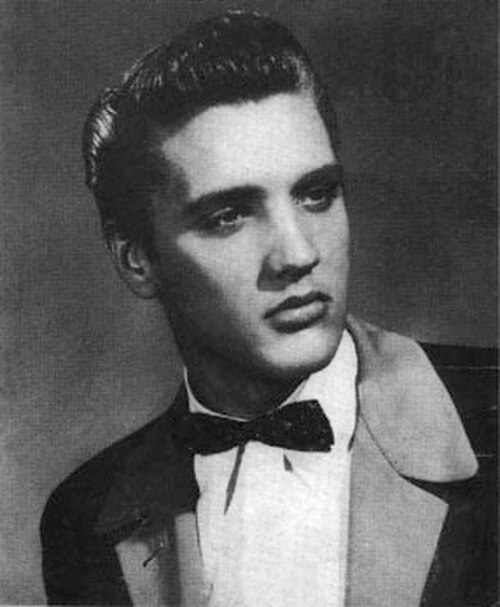
1953年8月、プレスリーは、サン・レコードを設立する前にサム・フィリップスが経営していたメンフィス・レコーディング・サービスに入社した。彼はスタジオ使用料を払い、両面アセテート盤「マイ・ハピネス」と「ザッツ・ホエン・ユア・ハートエイクス・ビギン」を録音しようとした。彼は後に、このレコードは母親の誕生日プレゼントにするつもりだった、あるいは単に自分の「音」に興味があっただけだと主張した。伝記作家のピーター・グラルニックは、プレスリーがサンを選んだのは、発見されることを期待していたからだと主張した。[40] 1954年1月、プレスリーはサンで2枚目のアセテート盤「アイル・ネヴァー・スタンド・イン・ユア・ウェイ」と「イット・ウーント・ビー・ザ・セイム・ウィズアウト・ユー」を録音したが、これもまた成果はなかった。[41]それから間もなく、彼は地元のボーカル・カルテット、ソングフェローズのオーディションに落ちた。[42]また、エディ・ボンドのバンドのオーディションにも落ちた。[43]

一方、フィリップスは、サンが注目していた黒人ミュージシャンのサウンドをより幅広い聴衆に届けられる人物を常に探していた。[45] 6月、彼はジミー・スウィーニーによるバラード「ウィズアウト・ユー」のデモ音源を入手し、プレスリーに合うかもしれないと思った。10代の歌手がスタジオにやって来たが、十分に歌えなかった。それにもかかわらず、フィリップスはプレスリーに他の曲を歌うよう依頼し、聞いた曲に感銘を受けた2人の地元のミュージシャン、ギタリストのウィンフィールド・「スコッティ」・ムーアとアップライト・ベース奏者のビル・ブラックを招待して、プレスリーとのレコーディング・セッションを行った。[46] 7月5日の夕方に行われたセッションは、夜遅くまで全く成果が上がらなかった。彼らが中止して家に帰ろうとしたとき、プレスリーは1946年のブルース曲、アーサー・クラダップの「ザッツ・オール・ライト」を歌い始めた。ムーアは「突然、エルヴィスがこの曲を歌い始め、飛び跳ねたり、おどけたりした。するとビルがベースを手に取り、彼もおどけた演技を始めた。それで僕も一緒に演奏し始めたんだ」と回想している。フィリップスはすぐに録音を始めた。これは彼が探していた音だった。[47] 3日後、メンフィスの人気ディスクジョッキー、デューイ・フィリップス(サム・フィリップスとは血縁関係はない)が、自身の番組『レッド・ホット・アンド・ブルー』で「ザッツ・オールライト」を演奏した。[48]リスナーの関心は高く、フィリップスは番組の残り2時間、このレコードを繰り返し演奏した。オンエアでプレスリーにインタビューしたフィリップスは、黒人だと思い込んでいた多くの電話の相手に肌の色を明らかにするため、どの高校に通っていたのかを尋ねた。[49]次の数日間に、3人はブルーグラスの曲、ビル・モンローの「ブルー・ムーン・オブ・ケンタッキー」を、独特のスタイルで、サム・フィリップスが「スラップバック」と名付けた、間に合わせの エコー効果を使って録音した。シングル盤はA面に「ザッツ・オール・ライト」、裏面に「ブルー・ムーン・オブ・ケンタッキー」を収録してプレスされた。[50]
初期のライブパフォーマンスとRCAビクターとの契約
1954年7月17日、トリオはボン・エア・クラブで初めて公の場で演奏した。[51]その月の後半、彼らはオーバートン・パーク・シェルに出演し、スリム・ホイットマンがヘッドライナーを務めた。ここでエルヴィスは彼のトレードマークである「ラバー・レッグス」を初めて披露した。 [52] [53]リズムに対する強い反応と緊張から、プレスリーは演奏中に足を振るようになった。ワイドカットのパンツが動きを強調し、観客の若い女性が叫び始めた。[54]ムーアは「楽器パートの間、彼はマイクから離れて演奏しながら体を揺らし、観客は大騒ぎになった」と回想している。[55]
その後すぐに、ムーアとブラックはプレスリーと定期的に演奏するために古いバンドを離れ、ディスクジョッキー兼プロモーターのボブ・ニールがトリオのマネージャーになった。8月から10月にかけて、彼らはメンフィスのダンス会場であるイーグルズ・ネスト・クラブで頻繁に演奏した。プレスリーが演奏すると、ティーンエイジャーがプールからクラブに駆け込んできて満員になり、ハウス・ウエスタン・スウィング・バンドが再開するとまた去っていった。[56]プレスリーはすぐにステージ上で自信を深めた。ムーアによると、「彼の動きはとても自然だったが、彼はまた、何が反応を呼ぶかということに非常に気を配っていた。彼は一度何かをすると、すぐにそれを展開していくのだった。」[57]これらのライブ演奏の合間に、プレスリーはサン・スタジオに戻り、さらにレコーディング・セッションを行った。[58]プレスリーは10月2日にナッシュビルのグランド・オール・オプリーに出演したが、これが彼にとって唯一の出演となった。オプリーのマネージャー、ジム・デニーはフィリップスに、彼の歌手は「悪くはない」がプログラムには合わないと語った。[59] [60]
ルイジアナ ヘイライド、ラジオコマーシャル、そしてテレビ初出演
1954年11月、プレスリーは、オプリーの主要かつより冒険的なライバル番組『ルイジアナ・ヘイライド』に出演した。この番組は、28州の198のラジオ局で放送された。緊張した様子の第一セットは、反応が控えめだった。しかし、落ち着き払ってエネルギッシュな第二セットは、熱狂的な反応を呼び起こした。 [61]番組終了後まもなく、ヘイライドは、プレスリーを1年間分の土曜夜の出演に雇った。プレスリーは、古いギターを8ドルで売り、マーティンの楽器を175ドル(2023年の2,000ドルに相当)で購入し、彼のトリオは、テキサス州ヒューストンやアーカンソー州テクサーカナなど、新たな場所で演奏し始めた。 [62]プレスリーがテレビに初出演したのは、 KSLA-TVで放送された『ルイジアナ・ヘイライド』だった。その後まもなく、プレスリーは、 CBSテレビ局の『アーサー・ゴッドフリーのタレント・スカウト』のオーディションを受けたが、不合格となった。 1955年初頭までに、プレスリーはヘイライドへの定期的な出演、絶え間ないツアー、そして好評を博したレコードリリースにより、地域のスターとなった。[63] [64]

1月にニールはプレスリーと正式なマネージメント契約を結び、音楽業界で最高のプロモーターとみなしていたトム・パーカー大佐にプレスリーを紹介した。トップカントリースターのエディ・アーノルドのマネージメントに成功したパーカーは、新しいナンバーワンカントリーシンガーのハンク・スノーとも仕事をしていた。パーカーはスノーの2月のツアーにプレスリーを招いた。[63] [64]
8月までに、サンは「エルヴィス・プレスリー、スコッティ、ビル」の名義で10曲をリリースした。最新の録音にはドラマーも参加していた。「That's All Right」のような曲は、メンフィスのあるジャーナリストが「黒人フィールドジャズのR&B的表現」と表現したもので、「Blue Moon of Kentucky」のような曲は「カントリー寄り」で、「しかし、両方に2つの異なる音楽の奇妙な融合があった」。[65]このスタイルの融合により、プレスリーの音楽はラジオで流されにくくなった。ニールによると、カントリーミュージックのディスクジョッキーの多くは、プレスリーが黒人アーティストに似すぎているためにこの曲をかけず、R&B局は「プレスリーが田舎者のように聞こえすぎる」ため、どの局も彼に手を出さなかったという。 [ 66]この融合は「ロカビリー」として知られるようになった。当時、プレスリーは「ウェスタン・バップの王様」、「ヒルビリー・キャット」、「メンフィス・フラッシュ」と呼ばれていた。[67]
プレスリーは1955年8月にニールとのマネージメント契約を更新し、同時にパーカーを特別顧問に任命した。[68]グループは広範囲にわたるツアースケジュールを維持した。[69]ニールは「エルヴィスに対する10代の少年たちの反応は恐ろしいほどだった。彼らの多くは、ある種の嫉妬から、彼を憎んでいるようだった。テキサスのいくつかの町では、誰かがいつもエルヴィスを攻撃しようとするので、警察の警備員を配置しなければならないこともあった」と回想している。[70]ヘイライドのドラマー、フォンタナが正式メンバーとして加入し、トリオはカルテットになった。10月中旬、彼らはビル・ヘイリーの前座として数回のショーを行った。ヘイリーの「ロック・アラウンド・ザ・クロック」は前年にナンバーワンヒットとなった。ヘイリーはプレスリーがリズム感覚に恵まれていることに気づき、バラードをあまり歌わないようにアドバイスした。[71]
11月初旬のカントリー・ディスク・ジョッキー・コンベンションで、プレスリーは今年最も有望な男性アーティストに選ばれた。[72] 3つの大手レーベルが最高2万5千ドルのオファーをしてきた後、パーカーとフィリップスは11月21日にRCAビクターと契約を結び、前代未聞の4万ドルでプレスリーのサン・レコードとの契約を獲得した。[73] [c]当時20歳のプレスリーは法的にはまだ未成年であったため、父親が契約書に署名した。[74]パーカーはヒル・アンド・レンジ・パブリッシングの所有者であるジーンとジュリアン・アバーバックと協力して、エルヴィス・プレスリー・ミュージックとグラディス・ミュージックという2つの会社を設立し、プレスリーが新たに録音したすべての素材を扱わせることにした。作詞家は、プレスリーに自分の曲を演奏してもらう代わりに、慣習的な印税の3分の1を放棄する義務があった。 [75] [d] 12月までにRCAは新歌手のプロモーションを大々的に行い、月末までにサン・レコードに収録された彼の録音の多くを再発行した。[78]
1956年~1958年: 商業的ブレイクと論争
初の全国テレビ出演とデビューアルバム

1956年1月10日、プレスリーはナッシュビルでRCAビクターのために最初のレコーディングを行った。[79]ムーア、ブラック、フォンタナ、ヘイライドのピアニスト、フロイド・クレイマー(プレスリーのライブ・クラブ公演で共演していた)という、今では恒例となっているバックアップ陣にさらに手を加えたRCAビクターは、ギタリストのチェット・アトキンスと、人気のジョーダネアーズ・カルテットのゴードン・ストーカーを含む3人のバック・シンガーを起用した。[80]このセッションから、ムーディーな「ハートブレイク・ホテル」が生まれ、1月27日にシングルとしてリリースされた。 [79]パーカーはプレスリーを全国放送のテレビ局に招き入れ、CBSのステージ・ショーに2か月間に6回出演させた。ニューヨークで制作されたこの番組は、ビッグ・バンドのリーダーで兄弟のトミーとジミー・ドーシーが隔週で司会を務めた。1月28日の初出演後、プレスリーはニューヨークに滞在し、RCAビクターのニューヨーク・スタジオでレコーディングを行った。このセッションでは、カール・パーキンスのロカビリー・アンセム「ブルー・スエード・シューズ」のカバーを含む8曲が生まれた。2月には、前年8月にサンからリリースされたプレスリーの「I Forgot to Remember to Forget 」がビルボードのカントリー・チャートのトップに達した。[81]ニールとの契約は終了し、パーカーがプレスリーのマネージャーになった。[82]
RCAビクターは3月23日にプレスリーのセルフタイトルのデビューアルバムをリリースした。サンの未発表音源5曲に加え、最近録音された7曲には、カントリーソング2曲、弾むようなポップチューン、そしてロックンロールの進化のサウンドの中心となる「ブルースエードシューズ」(評論家のロバート・ヒルバーンによると「ほぼすべての点でパーキンスの曲より優れている」)と、プレスリーのステージレパートリーの一部であったR&Bナンバー3曲(リトル・リチャード、レイ・チャールズ、ドリフターズのカバー)が含まれていた。ヒルバーンの説明によると、これらは
最も示唆に富んだのは、この3曲である。50年代にオリジナルのR&Bバージョンの曲のざらざらとしたエッジを薄めた多くの白人アーティストとは異なり、プレスリーはそれを再形成した。彼は曲に自身のボーカルの特徴を注入しただけでなく、3曲すべてでピアノではなくギターをリード楽器にした。[83]
このアルバムはビルボードチャートでトップに立った最初のロックンロールアルバムとなり、その地位を10週間維持した。[79]プレスリーはムーアや同時代のアフリカ系アメリカ人ロッカーのボ・ディドリーやチャック・ベリーのような革新的なギタリストではなかったが、文化史家ギルバート・B・ロッドマンはアルバムのカバーイメージである「エルヴィスがギターを手にステージで最高の時間を過ごしている様子が、ギターをこの新しい音楽のスタイルと精神を最もよく捉えた楽器として位置付ける上で重要な役割を果たした」と主張した。[84]
ミルトン・バール・ショーそして「ハウンド・ドッグ」

4月3日、プレスリーはNBCのミルトン・バール・ショーに2回出演したうちの1回目を行った。カリフォルニア州サンディエゴのUSSハンコックのデッキで行われた彼のパフォーマンスは、水兵とそのデート客からなる観客から歓声と悲鳴を呼んだ。[85]数日後、プレスリーとバンドはレコーディング・セッションのためテネシー州ナッシュビルへ向かう飛行機に乗っていたが、エンジンが故障し、飛行機はアーカンソー州上空で墜落しそうになった。[86]発売から12週間後、「ハートブレイク・ホテル」はプレスリー初のナンバーワン・ポップ・ヒットとなった。4月下旬、プレスリーはラスベガス・ストリップのニュー・フロンティア・ホテル・アンド・カジノで2週間の常駐公演を開始した。[ 87 ]ニューズウィーク誌の批評家は、ショーは保守的な中年のホテル客から「シャンパン・パーティでのコーン・リキュールのジョッキのような」不評だったと書いている。[88]ラスベガスでの活動期間中、俳優としての野望を抱いていたプレスリーはパラマウント映画と7年契約を結んだ。[89] 5月中旬には中西部ツアーを開始し、数日間で15都市を回った。 [90]ラスベガスでフレディ・ベルとベルボーイズのショーを何度か観劇し、作詞家ジェリー・リーバーとマイク・ストーラーがブルース歌手ビッグ・ママ・ソーントンの曲として1953年にヒットさせた「ハウンド・ドッグ」のカバーに衝撃を受けた。この曲はプレスリーの新たなエンディングナンバーとなった。[91]
ウィスコンシン州ラクロス での公演後、地元のカトリック教区の新聞の便箋に書かれた緊急メッセージがFBI長官のJ・エドガー・フーバーに送られた。そこには次のような警告が書かれていた。
プレスリーは米国の安全保障にとって明らかに危険である。…[彼の]行動や動作は、10代の若者の性的欲望をかき立てるほどだった。…公演後、1,000人以上の若者が講堂のプレスリーの部屋に押し入ろうとした。…ラクロスでプレスリーが引き起こした危害の証拠は、2人の高校生の腹部と太ももにプレスリーのサインがあったことである。[92]
プレスリーの2度目のミルトン・バール・ショー出演は、またもや忙しいツアーの最中、6月5日にNBCのハリウッドスタジオで行われた。ミルトン・バールはプレスリーにギターを舞台裏に置いていくよう説得した。[93]演奏中、プレスリーは突然「ハウンド・ドッグ」のアップテンポな演奏を止め、大げさな体の動きを強調したスローで激しい演奏を始めた。[93]彼の回転は論争の嵐を巻き起こした。[94] ニューヨーク・タイムズのジャック・グールドは次のように書いている。
プレスリー氏には目立った歌唱力はない。… 彼のフレージングは、もしそう呼べるのであれば、バスタブで初心者が歌うアリアに付随する決まりきったバリエーションで構成されている。… 彼の唯一の特技は、アクセントのある体の動きである。… 主にバーレスクのランウェイを歩く金髪美女たちのレパートリーと同一視されている。[95]
ニューヨーク・デイリー・ニュースのベン・グロスは、ポピュラー音楽は「エルヴィス・プレスリーの『うなり声と股間』のふざけた行動で最低の水準に達した」と論評した。「骨盤を回転させるエルヴィスは、酒場や売春宿に限定されるべき動物的な色を帯びた、挑発的で下品なパフォーマンスを見せた」。[96] 国内で最も人気のあるバラエティ番組を制作したエド・サリバンは、プレスリーを「家族で見るには不適切」と評した。 [97]プレスリーはすぐに「エルヴィス・ザ・ペスリー」と呼ばれるようになり、それを「子供じみている」と呼んだ。[98]
スティーブ・アレン・ショーそしてサリバン初登場

バールの番組は視聴率が高かったため、プレスリーは7月1日にニューヨークでNBCの『スティーブ・アレン・ショー』に出演することが決まった。ロックンロールのファンではないアレンは、白い蝶ネクタイと黒い燕尾服を着た「新しいエルヴィス」を紹介した。プレスリーはシルクハットと蝶ネクタイをつけたバセットハウンドに向かって1分もかからず「ハウンド・ドッグ」を歌った。テレビ史家のジェイク・オースティンは「アレンはプレスリーが才能がなく馬鹿げていると考えていた... [彼は] プレスリーが悔悟を示すように仕向けた」と述べている。[99]アレンは後に、プレスリーの「奇妙でひょろ長い田舎者のカリスマ性、定義しがたい可愛らしさ、そして魅力的な奇行に興味をそそられた」と書き、彼を自分の番組の「コメディ要素」に取り入れたと記している。[100]ショーの最終リハーサルの直前、プレスリーは記者に「人々に嫌われるようなことはしたくない。テレビは重要だと思うので、やります。でも、個人的に出演するときには、私がするようなショーはできないでしょう」と語った。[101]プレスリーは、アレン・ショーをキャリアの中で最も馬鹿げたパフォーマンスだったと振り返ることになる。[102]その夜遅く、プレスリーは地元の人気テレビ番組「ハイ・ガードナー・コーリング」に出演した。自分への批判から何かを学んだかと問われると、プレスリーは「いいえ、学んでいません。音楽が音楽である限り、どんな種類の音楽でも人々に悪い影響を与えるとは思えません。ロックンロール音楽がどうして親に反抗させるのでしょうか」と答えた。[96]
翌日、プレスリーは「ハウンド・ドッグ」、「エニー・ウェイ・ユー・ウォント・ミー」、「ドント・ビー・クルーエル」を録音した。ジョーダネアーズは『スティーヴ・アレン・ショウ』で歌ったようにハーモニーを歌い、1960年代を通じてプレスリーと仕事をすることになる。数日後、プレスリーはメンフィスで野外コンサートを行い、「ニューヨークの連中は俺を少しも変えられない。今夜、本物のエルヴィスがどんなものか見せてやる」と宣言した。 [103] 8月、フロリダ州ジャクソンビルの判事がプレスリーに演技を抑えるよう命じた。その後のパフォーマンス中、プレスリーは命令をあざ笑うかのように小指を意味ありげに動かす以外は、ほとんど動かなかった。[104]「ドント・ビー・クルーエル」と「ハウンド・ドッグ」を組み合わせたシングルは11週間チャートのトップに君臨し、この記録はその後36年間破られることはなかった。[105]プレスリーの2枚目のアルバムのレコーディングセッションは9月初旬にハリウッドで行われた。『ハウンド・ドッグ』の作曲者であるリーバーとストーラーが「ラヴ・ミー」を提供した。[106]
アレンとプレスリーの番組は、初めてエド・サリバン・ショーの視聴率を上回った。サリバンは、前代未聞の5万ドルでプレスリーを3回出演させた。[107]最初の出演は1956年9月9日で、視聴者数は約6千万人、テレビ視聴者の82.6%という記録的な数字となった。[108]俳優のチャールズ・ロートンが番組の司会を務め、サリバンが交通事故から回復するまでの代役を務めた。[97]伝説によると、プレスリーは腰から上しか撃たれていない。アレンとバールの番組のクリップを見て、サリバンはプレスリーが「ズボンの股下の下に何らかの装置をぶら下げていて、足を前後に動かすとペニスの輪郭が見えるようになっている。…コーラの瓶だと思う。…日曜の夜にこんな番組は無理だ。これは家族向けの番組だ!」と語っていた。[109]サリバンはTVガイドに「彼の回転に関しては、カメラのショットで全てをコントロールできる」と公に語った。[107]実際、プレスリーは頭からつま先まで映された。デビュー時のカメラワークは比較的控えめで、ダンスの際には脚を隠すクローズアップだったが、スタジオの観客は悲鳴を上げて反応した。[110] [111]プレスリーの次のシングル、バラード「ラブ・ミー・テンダー」のパフォーマンスは、記録を破る100万枚の前売りを呼んだ。[112]他のどの出来事よりも、このエド・サリバン・ショーへの初出演がプレスリーを全国的な有名人にした。[97]
プレスリーの名声が高まるにつれ、彼が刺激を与え、象徴する文化的な変化が起こりました。歴史家のマーティ・ジェザーは、プレスリーがグレン・ミラーやフランク・シナトラ以来の「最大のポップブーム」を引き起こし 、ロックンロールを主流文化にもたらしたと書いています。
プレスリーが芸術のペースを決めると、他のアーティストもそれに続いた。...プレスリーは他の誰よりも、若者たちに自分たちが明確で統一された世代であるという信念を与えた。アメリカで初めて統合された若者文化の力を感じた人物である。[113]
熱狂的な群衆と映画デビュー

プレスリーのライブショーに対する観客の反応は、ますます熱狂的になっていった。ムーアは「彼は『お前はハウンド・ドッグに過ぎない』と歌い始めると、観客はただパニックになる。いつも同じような反応をする。毎回暴動が起きるんだ」と回想している。[114] 9月にミシシッピ・アラバマ・フェア・アンド・デイリー・ショーで行った2回のコンサートでは、騒ぎを防ぐために50人の州兵が警察に配属された。[115]プレスリーの2枚目のRCAビクター・アルバム 『エルヴィス』は10月にリリースされ、すぐに1位になった。アルバムには、1945年のタレントショーで彼が歌った「オールド・シェップ」が収録されており、これが彼がRCAビクターのセッションでピアノを演奏した初めての曲となった。グラルニックによれば、「途切れ途切れのコードと、ややつまずくリズム」は、「紛れもない感情と、同様に紛れもなく技術よりも感情を重んじる姿勢」を示しているという。[116]ロック評論家のデイブ・マーシュは、 「ザッツ・オールライト」からエルヴィスまでのプレスリーの録音の音楽的、文化的影響を評価し、「これらのレコードは、他のどのレコードよりも、ロックンロールが何であったか、何であったか、そしておそらくはそれが将来どうなるかの種を含んでいる」と書いている。[117]

プレスリーは10月28日、今度は同名の司会者が司会を務める『エド・サリバン・ショー』に復帰した。公演後、ナッシュビルとセントルイスの観衆は彼の人形を燃やした。[97]彼の最初の映画『ラブ・ミー・テンダー』は11月21日に公開された。彼は主役ではなかったが、映画の元のタイトルである『ザ・リノ・ブラザーズ』は、彼の最新のナンバーワン・レコードに便乗するため変更された。『ラブ・ミー・テンダー』はその月の初めにヒットチャートのトップに躍り出た。プレスリーの人気をさらに利用するため、当初は普通の俳優の役だった部分に4つのミュージカルナンバーが追加された。この映画は批評家からは酷評されたが、興行成績は非常に良かった。[89]プレスリーはその後出演したすべての映画で主役を務めることになった。[118]
12月4日、プレスリーはカール・パーキンスとジェリー・リー・ルイスがレコーディングしていたサン・レコードに立ち寄り、ジョニー・キャッシュと即興でジャムセッションを行った。フィリップスはプレスリーの楽曲をリリースする権利を失っていたが、セッションがテープに録音されたことは確認した。その結果は25年間公式にリリースされることはなかったが、「ミリオン・ダラー・カルテット」レコーディングとして知られるようになった。[119]この年は、ウォール・ストリート・ジャーナル紙の一面記事で、プレスリーのグッズが彼のレコードの売り上げに加えて2200万ドルの売り上げをもたらしたと報じられ、[120]ビルボード紙は、レコードが初めてチャート入りして以来、プレスリーがトップ100に最も多くの曲をランクインさせたアーティストであると宣言した。[121]当時レコード業界最大の企業であったRCAビクターでの最初のフルイヤーで、プレスリーはレーベルのシングル売り上げの50%以上を占めた。[112]
ライバーとストーラーの協力とドラフト通知
プレスリーは1957年1月6日、エド・サリバン・ショーに3度目にして最後の出演を果たしたが、このときは腰までしか露出していなかった。評論家の中には、パーカーが宣伝効果を上げるために検閲を装ったと主張する者もいる。 [111] [122]いずれにせよ、評論家のグレイル・マーカスが述べているように、プレスリーは「自分を縛り付けなかった。最初の2回のショーで着ていた地味な服を捨て、ハーレムガールではないにしても、パシャのような突飛な衣装で登場した。目の上の化粧、顔にかかる髪、圧倒的に性的な口元から、彼は『シーク』のルドルフ・ヴァレンチノを全力で演じていた。」[97]最後に、プレスリーは自身の幅広い声域を披露し、サリバンの意に反して、穏やかな黒人霊歌「谷間の平和」を歌った。番組の最後に、サリバンはプレスリーを「本当にまともな、立派な少年」と評した。[123] 2日後、メンフィスのドラフト委員会はプレスリーを1-Aに分類し、おそらくその年のどこかでドラフトされるだろうと発表した。[124]
1957年前半にリリースされたプレスリーのシングル3枚、「Too Much」、「All Shook Up」、「(Let Me Be Your) Teddy Bear」はいずれも第1位を獲得した。すでに国際的なスターとなっていた彼は、音楽が公式にリリースされていない場所でもファンを魅了していた。ニューヨーク・タイムズ紙は、廃棄されたX線プレートにプレスされたプレス曲がレニングラードで高値で取引されていると報じた。[125]プレスリーは1957年3月19日、18部屋の邸宅、グレイスランドを購入した。 [126]購入前に、エルヴィスは7月に公開された2作目の映画『監獄ロック』のサウンドトラック『ラヴィング・ユー』を録音した。これは彼にとって3作連続の第1位アルバムとなった。タイトル曲はライバーとストーラーが作曲し、彼らはその後、プレスリーの次の映画『監獄ロック』のセッションで録音された6曲のうち4曲の作曲を依頼された。作曲チームは監獄のセッションを効果的にプロデュースし、プレスリーと緊密な協力関係を築き、プレスリーはそれを「幸運のお守り」とみなすようになった。[127]「彼は速かった」とライバーは言う。「どんなデモでも10分で暗記したんだ」[128]タイトル曲は監獄ロックEPと同様にもう一つのナンバーワンヒットとなった。[129]

プレスリーはその年、3回の短いツアーを行い、観客の熱狂的な反応を引き起こし続けた。[130]デトロイトの新聞は「エルヴィス・プレスリーを見に行くと、殺される危険がある」と報じた。[131]フィラデルフィアでは ヴィラノバ大学の学生が歌手に卵を投げつけ、[131]バンクーバーではショー終了後に群衆が暴動を起こし、ステージを破壊した。[132] 1940年代に10代の少女の失神と悲鳴を誘ったフランク・シナトラは、ロックンロールを「残忍で、醜く、退廃的で、残忍だ。…若者にほぼ完全に否定的で破壊的な反応を促している。偽物で偽りの匂いがする。大部分は愚かな愚か者によって歌われ、演奏され、書かれている。…この悪臭を放つ媚薬を私は嘆く」と非難した。[133]返答を求められたプレスリーは次のように答えた。
私は彼を尊敬しています。彼には言いたいことを言う権利があります。彼は大成功を収め、素晴らしい俳優ですが、彼はそんなことを言うべきではなかったと思います。…これは彼が数年前に始めたときに直面したのと同じ傾向です。[134]
ライバーとストーラーは再びスタジオに入り、エルヴィスのクリスマス・アルバムのレコーディングを行った。セッションの終盤、彼らはプレスリーのリクエストに応じて、ほのめかしに満ちたブルース「サンタクロースが街に帰ってきた」をその場で作曲した。[135]このクリスマス・アルバムにより、プレスリーのナンバーワン・アルバムの連続は4枚となり、アメリカ史上最も売れたクリスマス・アルバムとなり、[136] [137]最終的に全世界で2000万枚以上を売り上げた。[138]セッション後、ムーアとブラックは、プレスリーの莫大な経済的成功にまったくあずかることなく、週給もわずかしか受け取っていないまま辞職したが、数週間後に日当制で復帰した。[139]
12月20日、プレスリーは徴兵通知を受け取ったが、近々公開予定の映画『キング・クレオール』の完成まで猶予が与えられた。年が明けて数週間後、リーバーとストーラーの別の曲「ドント」がプレスリーの10番目のヒット曲となった。『キング・クレオール』のサウンドトラックのレコーディング・セッションは1958年1月中旬にハリウッドで行われた。リーバーとストーラーは3曲を提供したが、これがプレスリーと2人が密接に仕事をした最後の機会となった。[140]ストーラーが後に回想しているように、プレスリーのマネージャーと取り巻きは彼を締め出そうとした。[141] 2月11日の短いサウンドトラック・セッションが、ブラックがプレスリーと共演した最後の機会となった。[142]
1958年~1960年: 兵役と母の死

1958年3月24日、プレスリーはアーカンソー州フォート・チャフィーでアメリカ陸軍に徴兵された。彼の到着は大きなメディアイベントとなった。バスから降りたプレスリーに何百人もの人々が群がり、カメラマンが入隊式に同行した。 [143]プレスリーは、他の誰とも違う扱いを受けたくないと述べ、兵役を楽しみにしていると発表した。[144]
1958年3月28日から9月17日にかけて、プレスリーはテキサス州フォートフッドで基礎訓練と上級訓練を修了し、一時的に第37機甲連隊第2中戦車大隊A中隊に配属された。6月初旬の基礎訓練と上級訓練の間の2週間の休暇中に、彼はナッシュビルで5曲を録音した。[145] 8月初旬、プレスリーの母親が肝炎と診断され、容態は急速に悪化した。プレスリーは母親を見舞うために緊急休暇を与えられ、8月12日にメンフィスに到着した。2日後、母親は心不全で46歳で亡くなった。プレスリーは打ちのめされ、以前のような気持ちではいられなくなった。[146] [147] 2人の関係は非常に親密なままで、彼が成人してからも、お互いに赤ちゃん言葉で話し、プレスリーは彼女を愛称で呼んだ。[4]

1958年10月1日、プレスリーは西ドイツのレイ兵舎にある第3機甲師団第32機甲部隊第1中戦車大隊に配属され、機甲情報スペシャリストとして勤務した。 [1] 11月27日、彼は一等兵に昇進し、1959年6月1日にはスペシャリスト四等兵に昇進した。演習中、プレスリーはアンフェタミンを処方され、「その効能について熱心に説くようになった」。その効能はエネルギーだけではなく、「強さ」と減量にも役立つという。[148]空手は生涯の趣味となり、ユルゲン・ザイデルに師事し、[149] [150]後にはライブパフォーマンスに取り入れた。[151] [152] [153]同僚の兵士たちは、プレスリーが名声にもかかわらず有能な普通の兵士として見られたいと望んでいたこと、そして彼の寛大さを証言している。彼は陸軍の給料を慈善事業に寄付し、基地にテレビを購入し、部隊の全員のために余分な作業服を購入した。[154]プレスリーは1960年2月11日に軍曹に昇進した。 [1]
バート・ナウハイムにいる間、24歳だったプレスリーは、14歳のプリシラ・ボーリューと出会った。[155]ふたりは7年半の交際の末に結婚した。プリシラは自伝の中で、プレスリーは24ヶ月の兵役が自身のキャリアを台無しにすることを心配していたと述べている。特別部隊に所属していれば、演奏活動もでき、大衆との交流も維持できただろうが、パーカーは、大衆の尊敬を得るには、普通の兵士として従軍すべきだと説得した。[156]メディアの報道もプレスリーのキャリアに対する懸念を反映していたが、RCAビクターのプロデューサー、スティーヴ・ショールズとヒル・アンド・レンジのフレディ・ビエンストックは入念な準備を整えていた。大量の未発表素材を武器に、彼らは定期的にヒット作をリリースし続けた。[157]入隊から除隊までの間に、プレスリーは1958年の「Wear My Ring Around Your Neck」、ベストセラーとなった「Hard Headed Woman」や「One Night」、1959年の「(Now and Then There's) A Fool Such as I」やナンバーワンヒットとなった「A Big Hunk o' Love」など、トップ40ヒットを10曲出した。 [158] RCAビクターもこの時期に、以前に発行された素材を集めたアルバムを4枚制作しており、最も成功したのはLPチャートで3位を獲得した『エルヴィスのゴールデン・レコード』(1958年)である。[159]
1960年~1968年: 映画に注力
エルヴィスが帰ってきた

プレスリーは1960年3月2日に米国に戻り、3日後に名誉除隊となった。 [161]ニュージャージー州からテネシー州まで彼を運んだ列車は終始混雑し、プレスリーはファンを楽しませるために予定の停車駅で登場するよう求められた。[162] 3月20日の夜、彼はRCAのナッシュビルスタジオに入り、新しいアルバムのトラックを録音した。シングル「Stuck on You」は急遽リリースされ、瞬く間にナンバーワンヒットとなった。[163] 2週間後のナッシュビルでの別のセッションでは、バラード「 It's Now or Never」と「Are You Lonesome Tonight? 」の2つのベストセラーシングルと、エルヴィス・イズ・バック!の残りの曲が生まれた。このアルバムには、グレイル・マーカスがシカゴ・ブルースの「脅威」に満ちていると評した曲がいくつか収録されている。「プレスリー自身の超マイク・アコースティック・ギター、スコッティ・ムーアの見事な演奏、ブーツ・ランドルフの悪魔のようなサックス演奏によって牽引されている。エルヴィスの歌はセクシーではなく、ポルノ的だった。」[164]音楽史家ジョン・ロバートソンによると、このレコードは「すべてになれるパフォーマーのビジョンを呼び起こした」。「金の心を持った軽薄な十代のアイドル、激しい、危険な恋人、ガッツのあるブルース歌手、洗練されたナイトクラブのエンターテイナー、[1]騒々しいロッカー」。[165]レコーディングが完了してからわずか数日後にリリースされ、アルバム・チャートで2位に達した。[166] [167]

プレスリーは5月12日、フランク・シナトラ・タイメックス・スペシャルのゲストとしてテレビに復帰した。ウェルカム・ホーム・エルヴィスとしても知られるこの番組は3月下旬に収録されたもので、プレスリーが観客の前でパフォーマンスしたのはこの年が最後だった。パーカーは8分間の歌唱で前代未聞の12万5千ドルを獲得した。この放送は膨大な視聴者を集めた。[168]
復帰後初の映画のサウンドトラックとなった『G.I.ブルース』は、10月にアルバム・チャートで1位を獲得した。2ヵ月後には、宗教曲を収録した初のLP 『ヒズ・ハンド・イン・マイン』が発売され、米国のポップ・チャートで13位、英国では3位に達した。これはゴスペル・アルバムとしては異例の数字である。1961年2月、プレスリーはメンフィスで24の地元慈善団体へのチャリティー公演を2回行った。このイベントに先立つ昼食会で、RCAビクターはプレスリーに、全世界で7,500万枚以上のレコード販売を証明する盾を贈呈した。 [169] 3月中旬のナッシュビルでの12時間のセッションでは、プレスリーの次のスタジオ・アルバム『サムシング・フォー・エヴリバディ』のほぼ全曲が完成した。 [ 170]ジョン・ロバートソンによると、このアルバムは1960年代のカントリー・ミュージックを定義する、抑制されたコスモポリタンなスタイルであるナッシュビル・サウンドを体現しているという。このアルバムは、その後5年間にプレスリーが発表するであろう作品の多くを予感させるもので、主に「かつてエルヴィスが生来持っていた音楽の、心地よく、気取らない寄せ集め」である。 [171]これは彼の6枚目のナンバーワンLPとなる。3月25日には、ハワイで真珠湾攻撃の追悼コンサートが開催された。これはプレスリーにとって7年間最後の公の場での演奏となった。 [172]
ハリウッドで迷子
パーカーはこの頃までにプレスリーを過密な映画製作スケジュールに押し込んでおり、定型的で低予算のミュージカルコメディーに注力していた。プレスリーは当初、重要な役柄を追求することを主張していたが、よりドラマチックな2本の映画、フレイミング・スター(1960年)とワイルド・イン・ザ・カントリー(1961年)が商業的にあまり成功しなかったため、定型的なやり方に戻った。1960年代に彼が製作した27本の映画の中には、さらにいくつかの例外があった。[173]彼の映画はほぼ例外なく酷評され、批評家のアンドリュー・ケインはそれらを「悪趣味の集大成」として切り捨てた。[174]それでも、それらの映画は事実上すべて利益を上げた。9本のプロデューサーを務めたハル・ウォリスは、「プレスリーの映画はハリウッドで唯一の確実なものだ」と断言した。[175]
1960年代のプレスリーの映画のうち、15本にはサウンドトラックアルバムが、さらに5本にはサウンドトラックEPが付属していた。映画の製作と公開スケジュールが急ピッチで、プレスリーは1年に3本の映画に出演することが多かったため、彼の音楽にも影響が出た。ジェリー・ライバーによると、サウンドトラックの方式はプレスリーが陸軍に入隊する前からすでに決まっていた。「バラード3曲、ミディアムテンポの曲1曲、アップテンポの曲1曲、そしてブレイクブルースブギー1曲」。[176] 10年が経つにつれ、サウンドトラックの曲の質は「次第に悪くなっていった」。[177] パラダイス、ハワイアンスタイル(1966)に出演したジュリー・パリッシュは、プレスリーは多くの曲を嫌っていたと語っている。[178]ジョーダネアーズのゴードン・ストーカーは、プレスリーがスタジオのマイクから身を引いていた様子を次のように語っている。「素材があまりにもひどくて、歌えないと感じていた」[179]映画のアルバムのほとんどには、ドック・ポマスやモート・シューマンのチームのような尊敬される作曲家による1、2曲の曲が含まれていた。しかし、伝記作家のジェリー・ホプキンスによると、全体的には、曲は「エルヴィスやロックンロールを本当に理解したことのない男たちが注文に応じて書いた」ようだった。[180]

1960年代前半には、プレスリーのサウンドトラックアルバムのうち3枚がポップチャートで1位を獲得し、彼の最も人気のある曲のいくつかは、映画からのものであり、「Can't Help Falling in Love」(1961年)や「Return to Sender」(1962年)などであった。しかし、商業的な利益は着実に減少した。1964年から1968年にかけて、プレスリーのトップ10ヒットは1960年に録音されたゴスペル曲「Crying in the Chapel」(1965年)のみであった。映画以外のアルバムについては、1962年6月のPot Luckのリリースから、彼のカムバックを告げるテレビスペシャルのサウンドトラックが1968年11月にリリースされるまでの間に、プレスリーによる新しい素材のLPは1枚しか発行されなかった。ゴスペルアルバムHow Great Thou Art(1967年)である。マーシュが述べたように、プレスリーは「おそらく当時最も偉大な白人ゴスペル歌手であり、世俗的な歌と同じくらいゴスペルを彼の音楽的個性の重要な要素にした最後のロックンロールアーティスト」でした。[181]
1966年のクリスマス直前、初めて会ってから7年以上が経った頃、プレスリーはプリシラ・ボーリューにプロポーズした。2人は1967年5月1日、ラスベガスのアラジンホテルのスイートルームで短い挙式を挙げて結婚した。 [182]型にはまった映画と大量生産のサウンドトラックの流れは続いた。1967年10月、クラムベイクのサウンドトラックLPがプレスリーの新作アルバムとしては記録的な最低売上を記録したとき、RCAビクターの幹部はようやく問題に気付いた。「もちろん、その時までにダメージは出ていた」と歴史家のコニー・キルヒバーグとマーク・ヘンドリックスは述べている。「エルヴィスは、熱心な音楽ファンからは冗談のように見られ、最も忠実なファン以外には過去の人と見なされていた。」[183]
1968年~1973年: カムバック
エルヴィス: '68 カムバックスペシャル

プレスリーの唯一の子供であるリサ・マリーは、彼がキャリアに深く不満を抱いていた時期の1968年2月1日に生まれた。[186] 1967年1月から1968年5月の間にリリースされたプレスリーのシングル8枚のうち、トップ40にランクインしたのは2枚だけで、いずれも28位より上にはならなかった。 [187]次のサウンドトラックアルバム「スピードウェイ」は82位にランクインした。パーカーはすでに計画をテレビに移しており、NBCと契約を結び、ネットワークに劇場映画の資金援助とクリスマススペシャルの放送を約束させた。[188]
6月下旬にカリフォルニア州バーバンクで収録され、単にエルヴィスと題されたこの特別番組は、1968年12月3日に放送された。後に'68カムバックスペシャルとして知られるこの番組は、豪華なスタジオ制作のステージや、少人数の観客の前でバンドと共に演奏された歌を特集した。これはプレスリーにとって1961年以来初のライブパフォーマンスだった。ライブのコーナーでは、プレスリーは体にぴったりとした黒い革の服を着て、初期のロックンロール時代を彷彿とさせる気ままなスタイルで歌い、ギターを弾いていた。監督兼共同プロデューサーのスティーブ・バインダーは、パーカーが当初計画していたクリスマスソングの1時間からは程遠い番組を制作するために尽力した。[189]この番組は、そのシーズンのNBCの最高視聴率となり、全視聴者の42%を獲得した。[190] Eye誌のジョン・ランドーは次のように述べている。
自分を見失った男が故郷に帰る道を見つけるのを見るのは、魔法のようだ。彼は、人々がロックンロール歌手に期待しなくなったような力強さで歌った。彼は、ジム・モリソンが羨むような、気取りや努力のない体の動きをした。[191]
マーシュはこのパフォーマンスを「感情的な壮大さと歴史的な共鳴」の一つと呼んでいる。[192]
1969年1月までに、この特別番組のために書かれたシングル「イフ・アイ・キャン・ドリーム」は12位に達した。サウンドトラックアルバムはトップ10入りした。友人のジェリー・シリングによると、この特別番組はプレスリーに「何年もできなかったこと、つまり出演者を選ぶこと、曲を選ぶこと、そしてサウンドトラックに何を入れるべきか指示されないことを思い出させた。…彼は刑務所から出てきたんだ」と語った。[190]バインダーはプレスリーの反応について、「私はエルヴィスに60分のショーを聞かせた。すると彼は試写室でこう言ったんだ。『スティーヴ、これは私が人生でやったことの中で最高のことだ。私は自分が信じていない曲は絶対に歌わないと誓うよ』」と述べている。 [190]
メンフィスのエルヴィスよりそして国際
カムバック・スペシャルの経験に勇気づけられたプレスリーは、アメリカン・サウンド・スタジオで一連のレコーディング・セッションに取り組み、その結果、高く評価された『フロム・エルヴィス・イン・メンフィス』が生まれた。1969年6月にリリースされたこのアルバムは、プレスリーが8年ぶりにスタジオで制作したサウンドトラック以外の世俗的なアルバムだった。マーシュが言うには、このアルバムは「プレスリーが、映画時代には見逃していたように思えたポップミュージックのトレンドに即座に追いついた傑作だ。カントリー、ソウル、ロックを本物の信念を持って歌い、驚くべき成果だ」[194]このアルバムには、4月にリリースされたヒットシングル「イン・ザ・ゲットー」が収録されており、ポップチャートで3位に達しました。これは、1963年の「ボサノバ・ベイビー」以来のプレスリーの非ゴスペルのトップ10ヒットでした。アメリカンサウンドセッションからは、「サスピシャス・マインド」、「ドント・クライ・ダディ」、「ケンタッキー・レイン」などのヒットシングルがさらに生まれました。[195]
プレスリーは定期的なライブ活動を再開することに熱心だった。カムバック・スペシャルの成功を受けて、世界中からオファーが舞い込んだ。ロンドン・パラディアムはパーカーに1週間の出演料として2万8千ドル(2023年時点で23万3千ドルに相当)を提示した。パーカーは「僕にはそれでいい。ではエルヴィスにはいくら出せる?」と返答した。[196] 5月、ラスベガスに新しくオープンした、市内最大のショールームを誇るインターナショナル・ホテルが、7月31日から4週間で57回の公演をプレスリーに予約した。ムーア、フォンタナ、ジョーダンネアーズは、ナッシュビルで得ていた高収入のセッションの仕事を失うことを恐れて参加を辞退した。プレスリーは、ギタリストのジェームズ・バートンをリーダーに、インペリアルズとスウィート・インスピレーションズの2つのゴスペル・グループを加えた、一流の伴奏陣を新たに編成した。[197]カムバック・スペシャルの強烈なレザー・スタイリングを担当した衣装デザイナーのビル・ブリューは、プレスリーの空手への情熱に触発されて、新しいステージ・ルックを考案した。[198]それでも、プレスリーは緊張していた。1956年にラスベガスで行った唯一の公演が惨憺たる結果に終わっていたからだ。パーカーは大々的な宣伝活動を取り仕切り、インターナショナル・ホテルのオーナー、カーク・カーコリアンは、デビュー公演のためにロック・ジャーナリストをニューヨークに呼び寄せるため、自ら飛行機を送る手配をした。[199]
プレスリーは紹介なしでステージに上がった。多くの著名人を含む2,200人の観客は、彼が一曲歌う前と演奏後にスタンディングオベーションを送った。アンコールの「Can't Help Falling in Love」(この曲は彼の残りの人生の大半の締めくくりの曲となる)の後も3曲目が続いた。[200]ショーの後の記者会見で、記者がプレスリーを「キング」と呼んだとき、プレスリーはその光景を見ていたファッツ・ドミノを身振りで示した。「いや、」プレスリーは言った。「彼こそがロックンロールの真のキングだ。」[201]翌日、パーカーとホテルの交渉の結果、プレスリーは毎年2月と8月に演奏する5年契約を結び、年俸は100万ドルとなった。[202] ニューズウィーク誌は「エルヴィスには信じられないことがいくつもあるが、最も信じられないのは、流星のように消えていくキャリアを持つ世界での彼の持続力だ」と評した。[203] ローリングストーン誌はプレスリーを「超自然的、彼自身の復活」と評した。[204] 11月、プレスリーの最後の非コンサート映画『チェンジ・オブ・ハビット』が公開された。ダブルアルバム『フロム・メンフィス・トゥ・ベガス/フロム・ベガス・トゥ・メンフィス』も同じ月に発売された。最初のLPはインターナショナルのライブパフォーマンスで構成され、2枚目はアメリカンサウンドセッションからのカットがさらに含まれていた。「サスピシャス・マインド」はチャートのトップに到達し、プレスリーにとって7年以上ぶりの、そして最後の全米ポップナンバー1となった。 [205]
後にテレビのエルヴィラ役を演じるカサンドラ・ピーターソンは、この時期にラスベガスでプレスリーと出会った。彼女は2人の出会いを次のように回想している。「私が彼に会ったとき、彼は薬物に非常に反対でした。私がマリファナを吸っていると言ったら、彼はただ愕然としていました。」[206]プレスリーはめったに酒を飲まなかった。彼の家族の何人かはアルコール依存症だったが、彼はその運命を避けようとしていた。[207]
ツアーに戻りニクソンと会う
1970年初頭、プレスリーはインターナショナル・シアターに戻り、その年の最初の2か月に及ぶ公演を行った。この公演では、一晩に2回の公演を行った。これらの公演の音源は、アルバム『オン・ステージ』に収録されている。[208] 2月下旬、プレスリーはヒューストン・アストロドームで観客動員数記録を破る6公演を行った。[209] 4月、シングル「ワンダー・オブ・ユー」が発売され、イギリスで1位を獲得したほか、アメリカのアダルト・コンテンポラリー・チャートでも1位を獲得した。メトロ・ゴールドウィン・メイヤー(MGM)は、8月にインターナショナル・シアターで行われたリハーサルとコンサートの映像を、ドキュメンタリー『エルヴィス:ザッツ・ザ・ウェイ・イット・イズ』用に撮影した。プレスリーはジャンプスーツを着てパフォーマンスしており、これが彼のライブ・パフォーマンスのトレードマークとなった。この公演中、プレスリーは5万ドル(2023年の39万2千ドルに相当)を支払わなければ殺すと脅された。プレスリーは1950年代から多くの脅迫の標的となっていたが、その多くは本人の知らないところで行われていた。 [210] FBIはこの脅迫を深刻に受け止め、次の2回の公演では警備を強化した。プレスリーは右足のブーツにデリンジャー、腰に.45口径の 拳銃を忍ばせてステージに上がったが、コンサートは何も起こらずに成功した。[211] [212]
ドキュメンタリーに合わせて制作され、スタジオ録音とライブ録音の両方を収録した『That's the Way It Is』は、スタイルの転換点となった。音楽史家ジョン・ロバートソンは次のように述べている。
プレスリーの歌の威厳は、アルバムがメンフィスでのセッションのアメリカのルーツのインスピレーションから決定的に離れ、より中道的なサウンドへと向かったという事実を隠すのに役立った。カントリーは後回しにされ、ソウルとR&Bはメンフィスに残されたため、残ったのは非常に上品で非常にクリーンな白人ポップであり、ラスベガスの観客には最適だったが、エルヴィスにとっては明らかに後退した一歩だった。[213]
9月7日に国際公演を終えた後、プレスリーは1958年以来初めて、主に南部を回る1週間のコンサートツアーに出発した。11月には西海岸を回るもう1週間のツアーが続いた。[214]
.jpg/500px-Elvis-nixon_(crop).jpg)
1970年12月21日、プレスリーはホワイトハウスでリチャード・ニクソン米大統領との会談を画策し、ヒッピーたちに働きかけて、自分と大統領が忌み嫌う麻薬文化と戦う手助けができると考えていることを説明した。プレスリーはニクソンに麻薬取締局のバッジを要求し、自分の努力が公式に認められたことを知らせた。ニクソンは明らかにこの会談を気まずいと感じたが、プレスリーなら若者に前向きなメッセージを送れると信じており、そのためには「信用を保つ」ことが重要だと述べた。[215]プレスリーはニクソンに、当時コンサートで定期的に演奏していたビートルズの曲は[216] 、彼が反米主義の傾向と見なすものを体現していると伝えた。[217]プレスリーと友人たちは、 1965年8月にカリフォルニア州ベルエアの自宅でビートルズと4時間にわたって集まっていた。ポール・マッカートニーは後に「少し裏切られたような気がした。…最高のジョークは、私たちが[違法]薬物を飲んでいたのに、彼に何が起こったか見てみろってことだった」と語っており、これは処方薬の乱用に関連したプレスリーの早すぎる死を指している。[218]
全米青年商工会議所は1971年1月16日、プレスリーを毎年恒例の「全米で最も優れた若者10人」の一人に選出した。 [219]その後間もなく、メンフィス市はグレイスランドがあるハイウェイ51号線南側の一帯を「エルビス・プレスリー・ブルバード」と名付けた。同年、プレスリーはロックンロール歌手として初めてグラミー賞生涯功労賞(当時はビング・クロスビー賞と呼ばれていた)を受賞した。[220] [221] 1971年には、映画作品ではないプレスリーのスタジオアルバムが3枚リリースされた。批評家から最も好評だったのは、ジャンルのスタンダードに焦点を当てたコンセプトレコードの『エルビス・カントリー』だった。 [222]最も売れたのは『エルビス・シングス・ザ・ワンダフル・ワールド・オブ・クリスマス』だった。グレイル・マーカスによると、
10曲の痛々しいほど上品なクリスマスソングの真ん中で、そのどれもが驚くほど誠実で謙虚に歌われているが、エルヴィスはチャールズ・ブラウンの猥褻なブルース「メリー・クリスマス・ベイビー」を6分間も熱唱している。[...] [プレスリーの]罪が彼の生気のなさであったとすれば、彼の罪深さが彼に生気を与えたのだ。[223]
結婚の破綻とハワイからアロハ
MGMは1972年4月にエルヴィス・オン・ツアーの撮影を行い、同年ゴールデングローブ賞の最優秀ドキュメンタリー映画賞を受賞した。同月リリースされたゴスペルアルバム「He Touched Me」は、彼に2度目のグラミー賞最優秀インスピレーションパフォーマンス賞をもたらした。14日間のツアーは、ニューヨークのマディソンスクエアガーデンでの前例のない4連続完売公演で幕を開けた。[224] 7月10日の夜のコンサートは、1週間後にLPでリリースされた。エルヴィス:マディソンスクエアガーデンでの録音は、プレスリーの最も売れたアルバムの1つとなった。ツアー後、シングル「バーニング・ラヴ」がリリースされ、プレスリーの米国ポップチャートで最後のトップ10ヒットとなった。「『オール・シュック・アップ』以来、エルヴィスが作った最もエキサイティングなシングル」とロック評論家のロバート・クリストガウは評した。[225]

プレスリーと妻は次第に疎遠になり、ほとんど同棲もしていなかった。1971年、プレスリーはジョイス・ボヴァと浮気をし、その結果、彼女は妊娠し、中絶した。[226]プレスリーはジョイスがグレイスランドに引っ越す可能性をしばしば持ち出した。[227] 1972年2月23日、プレスリー夫妻は別居した。これは、プリシラがプレスリーが勧めた空手インストラクターのマイク・ストーンとの関係を明かした後のことである。プリシラによると、プレスリーは彼女にそのことを告げると、力ずくで愛し合い、「これが男が女を愛する方法だ」と言ったという。[228]プリシラは後にインタビューで、この出来事を説明する言葉の選択を後悔しており、誇張していたと述べた。[229] 5ヵ月後、プレスリーの新しい恋人で、作詞家でメンフィスのミスコンの優勝者でもあったリンダ・トンプソンが彼と同居するようになった。[230]プレスリーと妻は8月18日に離婚を申請した。[231]インペリアルズのジョー・モシェオによると、プレスリーの結婚生活の失敗は「彼にとって立ち直れないほどの打撃だった」という。[232]その年の6月に行われた珍しい記者会見で、記者がプレスリーに自分のイメージに満足しているかと尋ねた。プレスリーは「そうですね、イメージと人間性は別物です...イメージにふさわしい生き方をするのはとても難しいことです」と答えた。[233]

1973年1月、プレスリーは、画期的なテレビ特別番組『アロハ・フロム・ハワイ』に関連して、クイ・リー・キャンサー基金のためのチャリティー・コンサートを2回行った。このコンサートは、ソロ・アーティストによるコンサートとしては初めて世界的に放送された。最初のショーは、2日後の生放送で技術的な問題が発生した場合に備えて、予行演習とバックアップとして機能した。1月14日、アロハ・フロム・ハワイは、日本、韓国、タイ、フィリピン、オーストラリア、ニュージーランドのゴールデンタイムの視聴者と、東南アジア各地に駐留する米軍兵士に向けて衛星中継で生放送された。全国的なエルヴィス・プレスリー・ウィークの締めくくりとなった日本では、視聴率記録を破った。翌夜、ヨーロッパ28か国で同時放送され、4月には米国で延長版が放送され、テレビ視聴者の57%を獲得した。[235]パーカーの10億人以上が見たという主張[236]は時が経つにつれて広く受け入れられるようになったが[237] [238] [239]、その数字は全くの作り話だったようだ。[240] [241]プレスリーのステージ衣装は、彼の後年のペルソナと密接に結びついた手の込んだコンサート衣装の最もよく知られた例となった。ボビー・アン・メイソンは「ショーの終わりに、彼がアメリカン・イーグルのケープを広げると、背中に鷲の翼がいっぱいに伸びて、彼は神の姿になる」と表現した。[242] 2月にリリースされた付随ダブルアルバムは全米で1位になり、最終的に500万枚以上を売り上げた。 [243]これはプレスリーの生涯で最後の全米ナンバーワン・ポップ・アルバムとなった。 [244]
同月、深夜のショーで、4人の男がステージに乱入し、明らかに襲撃した。警備員がプレスリーを弁護し、プレスリーは侵入者の1人を自らステージから追い出した。ショーの後、プレスリーは、男たちがマイク・ストーンに殺されるために送り込まれたという考えに取り憑かれた。男たちは単に熱狂的なファンだっただけだったが、プレスリーは「俺には痛みが多すぎる...ストーンは死ななければならない」と激怒した。彼の激怒は激しさを増し、大量の薬を投与したにもかかわらず、医師は彼を落ち着かせることができなかった。さらに丸2日間激怒した後、友人でボディガードのレッド・ウェストは、殺人の報酬を得なければならないと感じ、プレスリーが「ああ、今は放っておこう。ちょっと重すぎるかもしれない」と決断したのでほっとした。[245]
1973年~1977年: 健康状態の悪化と死亡
医療危機と最後のスタジオセッション
プレスリーの離婚は1973年10月9日に成立した。[246]そのころには、彼の健康状態は深刻に悪化していた。その年、彼は2度バルビツール酸系の薬を過剰摂取し、最初の事件の後、ホテルのスイートルームで3日間昏睡状態を過ごした。1973年後半、彼はペチジン中毒の影響で入院した。主治医のジョージ・C・ニコポロスによると、プレスリーは「医者から薬をもらうことで、街で何かを手に入れるようなありふれたジャンキーではないと感じていた」という。[247]復帰後、彼は年を追うごとにライブショーを増やし、1973年には168回のコンサートを行い、これまでで最も忙しいスケジュールとなった。 [248]健康状態が悪化しているにもかかわらず、彼は1974年に再び集中的なツアースケジュールをこなした。[ 249 ]
プレスリーの容態はその年の9月に急激に悪化した。キーボード奏者のトニー・ブラウンは、メリーランド大学のコンサートに彼が到着した時のことを次のように回想している。「彼はリムジンから落ちて膝をついた。人々が助けようと飛びかかったが、彼は『助けないで』と言わんばかりに彼らを押しのけた。彼はステージに上がり、最初の30分間はマイクを柱のように握っていた。誰もが『ツアーは開催されるのだろうか』とお互いに顔を見合わせていた」[250]ギタリストのジョン・ウィルキンソンは次のように回想している。
彼は完全に意気消沈していた。ろれつが回らない。彼はひどく酔っていた。… 彼が薬物を飲んでいるのは明らかだった。彼の体に何かひどい異常があるのは明らかだった。状況はひどく、歌詞はほとんど聞き取れなかった。… 泣いていたのを覚えている。彼はイントロダクションをほとんど聞き取れなかった。[251]
プレスリーのレコーディング・スタジオへの興味が薄れていくにつれ、RCAは不安を募らせ始めた。1973年12月のセッションで18曲が制作され、これはアルバム2枚分に相当したが、その後プレスリーは1974年には公式のスタジオ録音を行わなかった。[252]パーカーはRCAに別のコンサート・レコード『エルヴィス・レコーディング・ライヴ・オン・ステージ・イン・メンフィス』を納品した。[253] 3月20日に録音されたこのアルバムには、「ハウ・グレート・ザウ・アート」のカバーが収録されており、プレスリーはこれで3度目にして最後のグラミー賞最優秀インスピレーション・パフォーマンス賞を受賞した。 [254] [255]プレスリーがグラミー賞で受賞した3つの競争の激しい賞は、計14回のノミネートのうち、すべてゴスペルの録音によるものだった。[255]プレスリーは1975年3月にレコーディング・スタジオに戻ったが、パーカーは年末に別のセッションを手配しようとしたが、失敗に終わった。[256] 1976年、RCAはグレイスランドに移動式レコーディング・ユニットを送り、2回の本格的なレコーディング・セッションを可能にした。[257]しかし、レコーディングの過程は彼にとって苦労の種となっていた。[258]
最後の数ヶ月
プレスリーはリンダ・トンプソンとの関係が終わった後、[260] 1976年11月にジンジャー・アルデンと交際を始め、2ヵ月後にアルデンにプロポーズした。[261]
ジャーナリストのトニー・シャーマンは、1977年初頭までに「プレスリーは、かつての滑らかでエネルギッシュな自分とはかけ離れたグロテスクな似顔絵になってしまった。ひどく太り、毎日摂取していた薬物で頭が鈍くなり、短縮されたコンサートをなんとかやり遂げることができた」と書いている。[262]ローリングストーン誌のアンディ・グリーンによると、プレスリーの最後のパフォーマンスは、ほとんどが「悲しく、だらしないもので、太り、薬漬けになったプレスリーは、歌詞を思い出そうと、倒れずに夜を過ごすのに苦労していた...彼の人生の最後の3年間のほとんどすべてが悲しく、見るのがつらいものだった」という。[263]ルイジアナ州アレクサンドリアでは、彼は1時間もステージに立っていなかったが、「理解不可能だった」。[264] 3月31日、彼はホテルのベッドから起き上がれず、バトンルージュでの公演をキャンセルした。 4つの公演はキャンセルされ、日程が変更された。[265]
健康状態が急速に悪化していたにもかかわらず、プレスリーはツアーのほとんどの約束を果たした。グラルニックによると、ファンは「失望を声高に訴えるようになっていったが、プレスリーの心は、そのすべてにまったく気づかなかったようだった。プレスリーの世界は、今やほとんど完全に自分の部屋と心霊術の本の中に閉じこめられていたのだ」。[266]プレスリーの従兄弟であるビリー・スミスは、プレスリーが自分の部屋に座って何時間もおしゃべりし、時にはお気に入りのモンティ・パイソンのスケッチや過去の冒険を語り、もっと頻繁に妄想にとらわれていたことを思い出した。[267]
プレスリーの生前最後のシングルとなった「ウェイ・ダウン」は、1977年6月6日に発売された。同月、CBSは10月に放送されるテレビ特別番組「エルヴィス・イン・コンサート」用に2つのコンサートを録画した。6月19日にオマハで撮影された最初のコンサートでは、プレスリーの声は「ほとんど認識できないほど小さく、子供のような声で、ほとんどの曲を歌うよりもしゃべり、他の曲ではメロディーを不確実に探り、発音や投射が事実上不可能」だったとグラルニックは書いている。[268] 2日後、サウスダコタ州ラピッドシティでは、「彼はより健康的に見え、少し体重が減ったようで、声も良くなった」が、公演が終わる頃には、彼の顔は「青白く腫れた頬に汗が流れ落ちる、青黒い髪のヘルメットに囲まれていた」。[268]プレスリーの最後のコンサートは1977年6月26日にインディアナポリスのマーケットスクエアアリーナで開催された。 [269]
死

1977年8月16日、プレスリーはメンフィスからメイン州ポートランドへ向かう夕方の便に乗り、新たなツアーを開始する予定だった。しかしその日の午後、婚約者のジンジャー・アルデンが、プレスリーがグレイスランドの邸宅のバスルームの床で意識不明になっているのを発見した。[270]蘇生の試みは失敗し、午後3時30分にバプティスト記念病院で死亡が宣告された。 [271]享年42歳。[272]
ジミー・カーター大統領は、プレスリーが「アメリカの大衆文化の様相を永久に変えた」と称賛する声明を発表した。[273]何千人もの人々がグレイスランドの外に集まり、開いた棺を見物した。プレスリーのいとこの一人、ビリー・マンは、遺体の写真を秘密裏に撮影する報酬として1万8000ドル(2023年の価値で9万1000ドルに相当)を受け取った。その写真はナショナル・エンクワイラー史上最大の売り上げとなった号の表紙を飾った。 [274]オールデンは、彼女の記事のためにエンクワイラーと10万5000ドル(2023年の価値で52万8000ドルに相当)の契約を結んだが、彼女が独占契約を破ったため、それ以下の金額で妥協した。[275]プレスリーは遺言で彼女に何も残さなかった。[276]
プレスリーの葬儀は8月18日にグレイスランドで行われた。門の外で車がファンの集団に突っ込み、2人の若い女性が死亡、3人目が重傷を負った。[277]約8万人がフォレスト・ヒル墓地への葬列の沿道に並び、プレスリーは母親の隣に埋葬された。[278]数週間のうちに、「ウェイ・ダウン」はカントリーとイギリスのシングルチャートでトップになった。[279] [280] 8月下旬にプレスリーの遺体を盗もうとする試みがあった後、プレスリーと母親の遺体は掘り起こされ、10月2日にグレイスランドのメディテーション・ガーデンに再埋葬された。[275]
死因
プレスリーが亡くなったその日に行われた検死がまだ進行中だったが、メンフィスの検死官ジェリー・フランシスコは、直接の死因は心停止であり、「プレスリーの死に薬物は関係していない」と発表した。[281]実際、プレスリーの死には「薬物使用が大きく関与していた」とグラルニックは書いている。検死を担当した病理学者は、例えば、プレスリーが「歯科医からもらったコデイン錠剤によるアナフィラキシーショックを起こした可能性があると考えた。彼はコデイン錠剤に軽いアレルギーがあったことが知られている」。2か月後に提出された検査報告書は、多剤併用が死因の主因であることを強く示唆しており、ある報告書では「エルヴィスの体内には14種類の薬物があり、そのうち10種類は相当な量だった」と報告されている。[282] 1979年、法医病理学者シリル・ウェクトが報告書を検討し、複数の鎮静剤の組み合わせがプレスリーの事故死の原因であると結論付けた。[281]法医学史家であり病理学者でもあるマイケル・バーデンは、状況を複雑だとみなした。「エルヴィスは長い間心臓肥大を患っていた。それが薬物依存と相まって彼の死因となった。しかし、診断は難しく、判断に委ねられていた。」[283]
中心的に関与した医療専門家のうち2名の能力と倫理観が深刻に疑問視された。フランシスコは検死が完了する前に死因を提示し、基礎疾患は不整脈であると主張した。不整脈は生きた人間でしか判断できない。また、毒物検査の結果が出る前は薬物がプレスリーの死に何らかの関係があったことを否定した。[281]隠蔽の疑惑は広く拡散した。[283]プレスリーの主治医ジョージ・C・ニコポロスの1981年の裁判では刑事責任は免れたが、事実は驚くべきものだった。「1977年の最初の8か月だけで、彼は1万回以上の鎮静剤、アンフェタミン、麻薬を処方していた。すべてエルヴィスの名義で。」ニコポロスの医師免許は3か月間停止された。 1990年代にテネシー州医療委員会が過剰処方の新たな告発を行った後、この法律は永久に廃止された。[247]
1994年、プレスリーの検死報告書が再開された。マイアミ・デイド郡の検死官として何千もの検死を指揮してきたジョセフ・デイビス[284]は、報告書の完成時に「薬物による死を裏付けるデータは何もない。実際、すべてが突然の激しい心臓発作を示している」と宣言した。 [247]最近の調査では、フランシスコが病理学チーム全体を代表して発言したわけではないことが明らかになった。他のスタッフは「研究室から結果が返ってくるまでは、自信を持って何も言えなかった」[285]。検死官の一人であるE・エリック・ミュアヘッドは、
フランシスコは耳を疑った。フランシスコは病院の病理学者チームを代表して発言しただけでなく、彼らが達していない結論を発表した。… 早い段階で、遺体の綿密な解剖により… エルヴィスは糖尿病、緑内障、便秘の慢性疾患を患っていたことが確認された。彼らが調査を進めると、医師たちは彼の体が何年にもわたって大量の薬物の絶え間ない投与によって蝕まれていた証拠を見つけた。彼らはまた、薬物解毒とメタドン治療のための2回の入院を含む彼の病院記録を調べた。[285]
その後の展開
1977年から1981年にかけて、プレスリーの死後にリリースされたシングルのうち6曲がカントリー・ミュージックのトップ10ヒットとなった。[279]グレイスランドは1982年に一般公開された。年間50万人以上の訪問者を集め、ホワイトハウスに次いで米国で2番目に訪問者の多い邸宅となった。[286]この邸宅は2006年に国定歴史建造物に指定された。 [287]
プレスリーは、ロックの殿堂(1986年)、カントリーミュージックの殿堂(1998年)、ゴスペルミュージックの殿堂(2001年)、ロカビリーの殿堂(2007年)、メンフィス音楽の殿堂(2012年)の5つの音楽の殿堂入りを果たしている。1984年にはブルース財団からWCハンディ賞、カントリーミュージックアカデミーの初となるゴールデンハット賞を受賞した。1987年にはアメリカンミュージックアワードの功労賞を受賞した。[288]
プレスリーの「 A Little Less Conversation」(クレジットは「Elvis Vs JXL」)のジャンキーXLリミックスは、2002 FIFAワールドカップのナイキの広告キャンペーンで使用された。この曲は20か国以上でチャートのトップとなり、プレスリーのナンバーワンヒット曲を集めたコンピレーションアルバム「ELV1S」にも収録され、これも国際的に成功した。このアルバムにより、プレスリーは30年ぶりにビルボードチャートのトップに返り咲いた。 [289]
2003年、1969年の録音である「ラバーネッキン」のリミックスが米国のセールスチャートで首位を獲得し、翌年には「ザッツ・オールライト」の50周年記念再発盤も首位を獲得した。[290]後者はイギリスで大ヒットし、ポップチャートで初登場3位を獲得した。また、カナダでもトップ10入りを果たした。[291] 2005年には、「監獄ロック」、「ワン・ナイト」/「アイ・ガット・スタング」、「イッツ・ナウ・オア・ネバー」の3つの再発シングルがイギリスで1位を獲得した。これらは、プレスリーのこれまでのイギリスのチャートトップシングル18枚すべてを再リリースするキャンペーンの一環であった。最初の「オール・シュック・アップ」はコレクターズボックス付きで発売されたため、チャートに再びランクインすることはできなかったが、他の17枚の再発盤はいずれもイギリスのトップ5に入った。[292]
2005年、フォーブス誌は、総収入4500万ドルで、5年連続でプレスリーを最も稼いでいる故人著名人に選んだ。 [293] 2006年には2位となり、[294]次の2年もトップの座に返り咲き、[295] [296] 2009年には4位となった。[297]翌年、プレスリーは75歳の誕生日のお祝いと、ラスベガスでのシルク・ドゥ・ソレイユのショー「ビバ・エルヴィス」の立ち上げによって、過去最高の年間収入である6000万ドルで2位となった。 [298] 2010年11月、彼の声に新たに録音されたインストゥルメンタル曲を収録したアルバム「ビバ・エルヴィス: ザ・アルバム」がリリースされた。[299] [300] 2011年半ばの時点で、プレスリーのライセンス商品は推定15,000点あり、[301]彼は再び亡くなった有名人の中で2番目に稼いでいる人物となった。[302] 6年後、彼は3,500万ドルの収入で4位にランクインした。これは、新しいエンターテイメント複合施設「エルヴィス・プレスリーズ・メンフィス」とホテル「ザ・ゲスト・ハウス・アット・グレイスランド」のオープンのこともあり、2016年から800万ドル増加した。[303]
In 2018, RCA/Legacy released Elvis Presley – Where No One Stands Alone, a new album focused on Presley' love of gospel music. Produced by Joel Weinshanker, Lisa Marie Presley and Andy Childs, the album introduced newly recorded instrumentation along with vocals from singers who had performed in the past with Elvis. It included a reimagined duet with Lisa Marie, on the album's title track.[304]
In 2022, Baz Luhrmann's film Elvis, a biographical film about Presley's life, was released. Presley is portrayed by Austin Butler and Parker by Tom Hanks. As of August 2022, the film had grossed $261.8 million worldwide on a $85 million budget, becoming the second-highest-grossing music biopic of all-time behind Bohemian Rhapsody (2018), and the fifth-highest-grossing Australian-produced film. For his portrayal of Presley, Butler won the Golden Globe and was nominated for the Oscar for Best Actor.[305] In January 2023, his 1962 Lockheed 1329 JetStar sold at an auction for $260,000.[306]
Artistry
Influences
Presley's earliest musical influence came from gospel. His mother recalled that from the age of two, at the Assembly of God church in Tupelo attended by the family, "he would slide down off my lap, run into the aisle and scramble up to the platform. There he would stand looking at the choir and trying to sing with them."[307] In Memphis, Presley frequently attended all-night gospel singings at the Ellis Auditorium, where groups such as the Statesmen Quartet led the music in a style that, Guralnick suggests, sowed the seeds of Presley's future stage act:
The Statesmen were an electric combination ... featuring some of the most thrillingly emotive singing and daringly unconventional showmanship in the entertainment world ... dressed in suits that might have come out of the window of Lansky's. ... Bass singer Jim Wetherington, known universally as the Big Chief, maintained a steady bottom, ceaselessly jiggling first his left leg, then his right, with the material of the pants leg ballooning out and shimmering. "He went about as far as you could go in gospel music," said Jake Hess. "The women would jump up, just like they do for the pop shows." Preachers frequently objected to the lewd movements ... but audiences reacted with screams and swoons.[308]
As a teenager, Presley's musical interests were wide-ranging, and he was deeply informed about both white and African-American musical idioms. Though he never had any formal training, he had a remarkable memory, and his musical knowledge was already considerable by the time he made his first professional recordings aged 19 in 1954. When Jerry Leiber and Mike Stoller met him two years later, they were astonished at his encyclopedic understanding of the blues,[309] and, as Stoller put it, "He certainly knew a lot more than we did about country music and gospel music."[141] At a press conference the following year, he proudly declared, "I know practically every religious song that's ever been written."[132]
Musicianship
Presley played guitar, bass, and piano; he received his first guitar when he was 11 years old. He could not read or write music and had no formal lessons, and played everything by ear.[310] Presley often played an instrument on his recordings and produced his own music. Presley played rhythm acoustic guitar on most of his Sun recordings and his 1950s RCA Victor albums. Presley played piano on songs such as "Old Shep" and "First in Line" from his 1956 album Elvis.[311] He is credited with playing piano on later albums such as From Elvis in Memphis and "Moody Blue", and on "Unchained Melody", which was one of the last songs that he recorded.[312] Presley played lead guitar on one of his successful singles called "Are You Lonesome Tonight".[313] At one point during the '68 Comeback Special, Elvis took over on lead electric guitar, the first time he had ever been seen with the instrument in public, playing it on songs such as "Baby What You Want Me to Do" and "One Night".[314] The album Elvis is Back! features Presley playing a lot of acoustic guitar on songs such as "I Will Be Home Again" and "Like a Baby".[315]
Musical styles and genres

Presley was a central figure in the development of rockabilly, according to music historians. "Rockabilly crystallized into a recognizable style in 1954 with Elvis Presley's first release, on the Sun label," writes Craig Morrison.[316] Paul Friedlander described rockabilly as "essentially ... an Elvis Presley construction", with the defining elements as "the raw, emotive, and slurred vocal style and emphasis on rhythmic feeling [of] the blues with the string band and strummed rhythm guitar [of] country".[317] In "That's All Right", the Presley trio's first record, Scotty Moore's guitar solo, "a combination of Merle Travis–style country finger-picking, double-stop slides from acoustic boogie, and blues-based bent-note, single-string work, is a microcosm of this fusion".[317] While Katherine Charlton calls Presley "rockabilly's originator",[318] Carl Perkins, another pioneer of rock'n'roll, said that "[Sam] Phillips, Elvis, and I didn't create rockabilly".[319] According to Michael Campbell, the first major rockabilly song was recorded by Bill Haley.[320] In Moore's view, "It had been there for quite a while, really. Carl Perkins was doing basically the same sort of thing up around Jackson, and I know for a fact Jerry Lee Lewis had been playing that kind of music ever since he was ten years old."[321]
At RCA Victor, Presley's rock and roll sound grew distinct from rockabilly with group chorus vocals, more heavily amplified electric guitars,[322] and a tougher, more intense manner.[323] While he was known for taking songs from various sources and giving them a rockabilly/rock and roll treatment, he also recorded songs in other genres from early in his career, from the pop standard "Blue Moon" at Sun Records to the country ballad "How's the World Treating You?" on his second RCA Victor LP to the blues of "Santa Claus Is Back in Town". In 1957, his first gospel record was released, the four-song EP Peace in the Valley. Certified as a million-seller, it became the top-selling gospel EP in recording history.[324] Presley would record gospel periodically for the rest of his life.
After his return from military service in 1960, Presley continued to perform rock and roll, but the characteristic style was substantially toned down. His first post-Army single, the number-one hit "Stuck on You", is typical of this shift. RCA Victor publicity referred to its "mild rock beat"; discographer Ernst Jorgensen calls it "upbeat pop".[327] The number five "She's Not You" (1962) "integrates the Jordanaires so completely, it's practically doo-wop".[328] The modern blues/R&B sound captured with success on Elvis Is Back! was essentially abandoned for six years until such 1966–67 recordings as "Down in the Alley" and "Hi-Heel Sneakers".[329] Presley's output during most of the 1960s emphasized pop music, often in the form of ballads such as "Are You Lonesome Tonight?", a number-one in 1960. "It's Now or Never", which also topped the chart that year, was a classically influenced variation of pop based on the Neapolitan song "'O sole mio" and concluding with a "full-voiced operatic cadence".[330] These were both dramatic numbers, but most of what Presley recorded for his many film soundtracks was in a much lighter vein.[331]
While Presley performed several of his classic ballads for the '68 Comeback Special, the sound of the show was dominated by aggressive rock and roll. He recorded few new straight rock and roll songs thereafter; as he explained, they had become "hard to find".[332] A significant exception was "Burning Love", his last major hit on the pop charts. Like his work of the 1950s, Presley's subsequent recordings reworked pop and country songs, but in markedly different permutations. His stylistic range now began to embrace a more contemporary rock sound as well as soul and funk. Much of Elvis in Memphis, as well as "Suspicious Minds", cut at the same sessions, reflected this new rock and soul fusion. In the mid-1970s, many of his singles found a home on country radio, the field where he first became a star.[333]
Vocal style and range

The developmental arc of Presley's singing voice, as described by critic Dave Marsh, goes from "high and thrilled in the early days, [to] lower and perplexed in the final months."[334] Marsh credits Presley with the introduction of the "vocal stutter" on 1955's "Baby Let's Play House".[335] When on "Don't Be Cruel", Presley "slides into a 'mmmmm' that marks the transition between the first two verses," he shows "how masterful his relaxed style really is."[336] Marsh describes the vocal performance on "Can't Help Falling in Love" as one of "gentle insistence and delicacy of phrasing", with the line "'Shall I stay' pronounced as if the words are fragile as crystal".[337]
Jorgensen calls the 1966 recording of "How Great Thou Art" "an extraordinary fulfillment of his vocal ambitions", as Presley "crafted for himself an ad-hoc arrangement in which he took every part of the four-part vocal, from [the] bass intro to the soaring heights of the song's operatic climax", becoming "a kind of one-man quartet".[338] Guralnick finds "Stand by Me" from the same gospel sessions "a beautifully articulated, almost nakedly yearning performance", but, by contrast, feels that Presley reaches beyond his powers on "Where No One Stands Alone", resorting "to a kind of inelegant bellowing to push out a sound" that Jake Hess of the Statesmen Quartet had in his command. Hess himself thought that while others might have voices the equal of Presley's, "he had that certain something that everyone searches for all during their lifetime."[339] Guralnick attempts to pinpoint that something: "The warmth of his voice, his controlled use of both vibrato technique and natural falsetto range, the subtlety and deeply felt conviction of his singing were all qualities recognizably belonging to his talent but just as recognizably not to be achieved without sustained dedication and effort."[340]
Marsh praises his 1968 reading of "U.S. Male", "bearing down on the hard guy lyrics, not sending them up or overplaying them but tossing them around with that astonishingly tough yet gentle assurance that he brought to his Sun records."[341] The performance on "In the Ghetto" is, according to Jorgensen, "devoid of any of his characteristic vocal tricks or mannerisms", instead relying on the exceptional "clarity and sensitivity of his voice".[342] Guralnick describes the song's delivery as of "almost translucent eloquence ... so quietly confident in its simplicity".[343] On "Suspicious Minds", Guralnick hears essentially the same "remarkable mixture of tenderness and poise", but supplemented with "an expressive quality somewhere between stoicism (at suspected infidelity) and anguish (over impending loss)".[344]
Music critic Henry Pleasants observes that "Presley has been described variously as a baritone and a tenor. An extraordinary compass ... and a very wide range of vocal color have something to do with this divergence of opinion."[345] He identifies Presley as a high baritone, calculating his range as two octaves and a third, "from the baritone low G to the tenor high B, with an upward extension in falsetto to at least a D-flat. Presley's best octave is in the middle, D-flat to D-flat, granting an extra full step up or down."[345] In Pleasants' view, his voice was "variable and unpredictable" at the bottom, "often brilliant" at the top, with the capacity for "full-voiced high Gs and As that an opera baritone might envy".[345] Scholar Lindsay Waters, who figures Presley's range as two-and-a-quarter octaves, emphasizes that "his voice had an emotional range from tender whispers to sighs down to shouts, grunts, grumbles, and sheer gruffness that could move the listener from calmness and surrender, to fear. His voice can not be measured in octaves, but in decibels; even that misses the problem of how to measure delicate whispers that are hardly audible at all."[346] Presley was always "able to duplicate the open, hoarse, ecstatic, screaming, shouting, wailing, reckless sound of the black rhythm-and-blues and gospel singers", writes Pleasants, and also demonstrated a remarkable ability to assimilate many other vocal styles.[345]
Public image
Relationship with the African-American community

When Dewey Phillips first aired "That's All Right" on Memphis' WHBQ, many listeners who contacted the station to ask for it again assumed that its singer was black.[49] From the beginning of his national fame, Presley expressed respect for African-American performers and their music, and disregard for the segregation and racial prejudice then prevalent in the South. Interviewed in 1956, he recalled how in his childhood he would listen to blues musician Arthur Crudup—the originator of "That's All Right"—"bang his box the way I do now, and I said if I ever got to the place where I could feel all old Arthur felt, I'd be a music man like nobody ever saw."[35] The Memphis World, an African-American newspaper, reported that Presley "cracked Memphis' segregation laws" by attending the local amusement park on what was designated as its "colored night".[35] Such statements and actions led Presley to be generally hailed in the black community during his early stardom.[35] In contrast, many white adults "did not like him, and condemned him as depraved. Anti-negro prejudice doubtless figured in adult antagonism. Regardless of whether parents were aware of the Negro sexual origins of the phrase 'rock 'n' roll', Presley impressed them as the visual and aural embodiment of sex."[6]
Despite the largely positive view of Presley held by African Americans, a rumor spread in mid-1957 that he had announced, "The only thing Negroes can do for me is buy my records and shine my shoes." A journalist with the national African American weekly Jet, Louie Robinson, pursued the story. On the set of Jailhouse Rock, Presley granted Robinson an interview, though he was no longer dealing with the mainstream press. He denied making such a statement:
I never said anything like that, and people who know me know that I wouldn't have said it. ... A lot of people seem to think I started this business. But rock 'n' roll was here a long time before I came along. Nobody can sing that kind of music like colored people. Let's face it: I can't sing like Fats Domino can. I know that.[347]
Robinson found no evidence that the remark had ever been made, and elicited testimony from many individuals indicating that Presley was anything but racist.[35][348] Blues singer Ivory Joe Hunter, who had heard the rumor before he visited Graceland, reported of Presley, "He showed me every courtesy, and I think he's one of the greatest."[349] Though the rumored remark was discredited, it was still being used against Presley decades later.[350]
The persistence of such attitudes was fueled by resentment over the fact that Presley, whose musical and visual performance idiom owed much to African-American sources, achieved the cultural acknowledgement and commercial success largely denied his black peers.[348] Into the 21st century, the notion that Presley had "stolen" black music still found adherents.[351][350][352] Notable among African-American entertainers expressly rejecting this view was Jackie Wilson, who argued, "A lot of people have accused Elvis of stealing the black man's music, when in fact, almost every black solo entertainer copied his stage mannerisms from Elvis."[353] Moreover, Presley acknowledged his debt to African-American musicians throughout his career. Addressing his '68 Comeback Special audience, he said, "Rock 'n' roll music is basically gospel or rhythm and blues, or it sprang from that. People have been adding to it, adding instruments to it, experimenting with it, but it all boils down to [that]."[354] Nine years earlier, he had said, "Rock 'n' roll has been around for many years. It used to be called rhythm and blues."[355]
Sex symbol

Presley's physical attractiveness and sexual appeal were widely acknowledged. "He was once beautiful, astonishingly beautiful", according to critic Mark Feeney.[356] Television director Steve Binder reported, "I'm straight as an arrow and I got to tell you, you stop, whether you're male or female, to look at him. He was that good looking. And if you never knew he was a superstar, it wouldn't make any difference; if he'd walked in the room, you'd know somebody special was in your presence."[357] His performance style was equally responsible for Presley's eroticized image. Critic George Melly described him as "the master of the sexual simile, treating his guitar as both phallus and girl".[358] In his Presley obituary, Lester Bangs credited him with bringing "overt blatant vulgar sexual frenzy to the popular arts in America".[359] Ed Sullivan's declaration that he perceived a soda bottle in Presley's trousers was echoed by rumors involving a similarly positioned toilet roll tube or lead bar.[360]
While Presley was marketed as an icon of heterosexuality, some critics have argued that his image was ambiguous. In 1959, Sight and Sound's Peter John Dyer described his onscreen persona as "aggressively bisexual in appeal".[361] Brett Farmer places the "orgasmic gyrations" of the title dance sequence in Jailhouse Rock within a lineage of cinematic musical numbers that offer a "spectacular eroticization, if not homoeroticization, of the male image".[362] In the analysis of Yvonne Tasker, "Elvis was an ambivalent figure who articulated a peculiar feminised, objectifying version of white working-class masculinity as aggressive sexual display."[363]
Reinforcing Presley's image as a sex symbol were the reports of his dalliances with Hollywood stars and starlets, from Natalie Wood in the 1950s to Connie Stevens and Ann-Margret in the 1960s to Candice Bergen and Cybill Shepherd in the 1970s. June Juanico of Memphis, one of Presley's early girlfriends, later blamed Parker for encouraging him to choose his dating partners with publicity in mind.[206] Presley never grew comfortable with the Hollywood scene, and most of these relationships were insubstantial.[364]
Legacy
I know he invented rock and roll, in a manner of speaking, but ... that's not why he's worshiped as a god today. He's worshiped as a god today because in addition to inventing rock and roll he was the greatest ballad singer this side of Frank Sinatra—because the spiritual translucence and reined-in gut sexuality of his slow weeper and torchy pop blues still activate the hormones and slavish devotion of millions of female human beings worldwide.
—Robert Christgau
December 24, 1985[365]
Presley's rise to national attention in 1956 transformed the field of popular music and had a huge effect on the broader scope of popular culture.[366] As the catalyst for the cultural revolution that was rock and roll, he was central not only to defining it as a musical genre but in making it a touchstone of youth culture and rebellious attitude.[367] With its racially mixed origins—repeatedly affirmed by Presley—rock and roll's occupation of a central position in mainstream American culture facilitated a new acceptance and appreciation of black culture.[368]
In this regard, Little Richard said of Presley, "He was an integrator. Elvis was a blessing. They wouldn't let black music through. He opened the door for black music."[369] Al Green agreed: "He broke the ice for all of us."[370]
President Jimmy Carter remarked on Presley's legacy in 1977: "His music and his personality, fusing the styles of white country and black rhythm and blues, permanently changed the face of American popular culture."[273] Presley also heralded the vastly expanded reach of celebrity in the era of mass communication: within a year of his first appearance on American network television, he was regarded as one of the most famous people in the world.[371]

Presley's name, image, and voice are recognized around the world.[372] He has inspired a legion of impersonators.[373] In polls and surveys, he is recognized as one of the most important popular music artists and influential Americans.[e] American composer and conductor Leonard Bernstein said, "Elvis Presley is the greatest cultural force in the twentieth century. He introduced the beat to everything and he changed everything—music, language, clothes."[382] John Lennon said that "Nothing really affected me until Elvis."[383] Bob Dylan described the sensation of first hearing Presley as "like busting out of jail".[370]

For much of his adult life, Presley, with his rise from poverty to riches and fame, had seemed to epitomize the American Dream.[384][385] In his final years, and following the revelations about his circumstances after his death, he became a symbol of excess and gluttony.[386][387] Increasing attention was paid to his appetite for the rich, heavy Southern cooking of his upbringing, foods such as chicken-fried steak and biscuits and gravy.[388][389] In particular, his love of fried peanut butter, banana, and (sometimes) bacon sandwiches,[390][388] now known as "Elvis sandwiches",[391] came to symbolize this characteristic.[392]
Since 1977, there have been numerous alleged sightings of Presley. A long-standing conspiracy theory among some fans is that he faked his death.[393][394] Adherents cite alleged discrepancies in the death certificate, reports of a wax dummy in his original coffin, and accounts of Presley planning a diversion so he could retire in peace.[395] An unusually large number of fans have domestic shrines devoted to Presley and journey to sites with which he is connected, however faintly.[396] On the anniversary of his death, thousands of people gather outside Graceland for a candlelight ritual.[397] "With Elvis, it is not just his music that has survived death", writes Ted Harrison. "He himself has been raised, like a medieval saint, to a figure of cultic status. It is as if he has been canonized by acclamation."[396]
On the 25th anniversary of Presley's death, The New York Times asserted:
All the talentless impersonators and appalling black velvet paintings on display can make him seem little more than a perverse and distant memory. But before Elvis was camp, he was its opposite: a genuine cultural force. ... Elvis' breakthroughs are underappreciated because in this rock-and-roll age, his hard-rocking music and sultry style have triumphed so completely.[398]
He was ranked third on Rolling Stone's list of greatest artists. Bono wrote in appreciation:
In Elvis, you have the blueprint for rock & roll. The highness — the gospel highs. The mud — the Delta mud, the blues. Sexual liberation. Controversy. Changing the way people feel about the world. It's all there with Elvis.[399]
Not only Presley's achievements but his failings as well, are seen by some cultural observers as adding to the power of his legacy, as in this description by Greil Marcus:
Elvis Presley is a supreme figure in American life, one whose presence, no matter how banal or predictable, brooks no real comparisons. ... The cultural range of his music has expanded to the point where it includes not only the hits of the day, but also patriotic recitals, pure country gospel, and really dirty blues. ... Elvis has emerged as a great artist, a great rocker, a great purveyor of schlock, a great heart throb, a great bore, a great symbol of potency, a great ham, a great nice person, and, yes, a great American.[400]
Achievements
Having sold about 500 million records worldwide, Presley is one of the best-selling music artists of all time.[b] Presley's rankings for top ten and number-one hits vary depending on how the double-sided "Hound Dog/Don't Be Cruel" and "Don't/I Beg of You" singles, which precede the inception of Billboard's unified Hot 100 chart, are analyzed.[f] According to Whitburn's analysis, Presley holds the record with 38, tying with Madonna;[404] per Billboard's current assessment, he ranks second with 36.[405] Whitburn and Billboard concur that the Beatles hold the record for most number-one hits with 20, and that Mariah Carey is second with 19.[406] Whitburn has Presley with 18:[404] Billboard has him third with 17.[407] According to Billboard, Presley has 79 cumulative weeks at number one: alone at 80, according to Whitburn and the Rock and Roll Hall of Fame,[408][409] with only Mariah Carey having more with 91 weeks.[410] He holds the records for most number-one singles on the UK chart with 21 and singles reaching the top ten with 76.[411][412]
As an album artist, Presley is credited by Billboard with the record for the most albums charting in the Billboard 200: 129, far ahead of second-place Frank Sinatra's 82. He also holds the record for most cumulative weeks at number one on the Billboard 200 for a male solo artists: 67 weeks[413] In 2015 and 2016, two albums setting Presley's vocals against music by the Royal Philharmonic Orchestra, If I Can Dream and The Wonder of You, both reached number one in the UK. This gave him a new record for number-one UK albums by a solo artist with 13, and extended his record for longest span between number-one albums by anybody—Presley had first topped the British chart in 1956 with his self-titled debut.[414]
As of 2023[update], the Recording Industry Association of America (RIAA) credits Presley with 146.5 million certified album sales in the US, third all time behind the Beatles and Garth Brooks.[415] He holds the records for most gold albums (101, nearly double second-place Barbra Streisand's 51),[416] and most platinum albums (57).[417] His 25 multi-platinum albums is second behind the Beatles' 26.[418] His total of 197 album certification awards (including one diamond award), far outpaces the Beatles' second-best 122.[419] He has the 9th-most gold singles (54, tied with Justin Bieber),[420] and the 16th-most platinum singles (27).[421]
In 2012, the spider Paradonea presleyi was named in his honor.[422] In 2018, President Donald Trump awarded Presley the Presidential Medal of Freedom posthumously.[423]
There is a street named after Presley in San Antonio, Texas.[424]
Discography
A vast number of recordings have been issued under Presley's name. The number of his original master recordings has been variously calculated as 665[425] and 711.[356] His career began and he was most successful during an era when singles were the primary commercial medium for pop music. For his albums, the distinction between "official" studio records and other forms is often blurred.[citation needed]
Filmography
- Films starred
- Love Me Tender (1956)
- Loving You (1957)
- Jailhouse Rock (1957)
- King Creole (1958)
- G.I. Blues (1960)
- Flaming Star (1960)
- Wild in the Country (1961)
- Blue Hawaii (1961)
- Follow That Dream (1962)
- Kid Galahad (1962)
- Girls! Girls! Girls! (1962)
- It Happened at the World's Fair (1963)
- Fun in Acapulco (1963)
- Kissin' Cousins (1964)
- Viva Las Vegas (1964)
- Roustabout (1964)
- Girl Happy (1965)
- Tickle Me (1965)
- Harum Scarum (1965)
- Frankie and Johnny (1966)
- Paradise, Hawaiian Style (1966)
- Spinout (1966)
- Easy Come, Easy Go (1967)
- Double Trouble (1967)
- Clambake (1967)
- Stay Away, Joe (1968)
- Speedway (1968)
- Live a Little, Love a Little (1968)
- Charro! (1969)
- The Trouble with Girls (1969)
- Change of Habit (1969)
- Elvis: That's the Way It Is (1970)
- Elvis on Tour (1972)
- TV concert specials
- Elvis (1968)
- Aloha from Hawaii via Satellite (1973)
- Elvis in Concert (1977)
See also
Explanatory notes
- ^ a b Although some pronounce his surname /ˈprɛzli/ PREZ-lee, Presley himself pronounced it /ˈprɛsli/ PRESS-lee, as did his family and those who worked with him.[2]
The correct spelling of his middle name has long been a matter of debate. The physician who delivered him wrote "Elvis Aaron Presley" in his ledger.[3] The state-issued birth certificate reads "Elvis Aron Presley". The name was chosen after the Presleys' friend and fellow congregation member Aaron Kennedy, though a single-A spelling was probably intended by Presley's parents to parallel the middle name of Presley's stillborn brother, Jesse Garon.[4] It reads Aron on most official documents produced during his lifetime, including his high school diploma, RCA Victor record contract, and marriage license, and this was generally taken to be the proper spelling.[5] In 1966, Presley expressed the desire to his father that the more traditional biblical rendering, Aaron, be used henceforth, "especially on legal documents".[3] Five years later, the Jaycees citation honoring him as one of the country's Outstanding Young Men used Aaron. Late in his life, he sought to officially change the spelling to Aaron and discovered that state records already listed it that way. Knowing his wishes for his middle name, Aaron is the spelling his father chose for Presley's tombstone, and it is the spelling his estate has designated as official.[5]
- ^ a b The estimates of Elvis Presley's record sales vary from 500 million – 1 billion records worldwide.[401][402][403]
- ^ Of the $40,000, $5,000 covered back royalties owed by Sun.[73]
- ^ In 1956–57, Presley was also credited as a co-writer on several songs where he had no hand in the writing process: "Heartbreak Hotel"; "Don't Be Cruel"; all four songs from his first film, including the title track, "Love Me Tender"; "Paralyzed"; and "All Shook Up".[76] (Parker, however, failed to register Presley with such musical licensing firms as ASCAP and its rival BMI, which eventually denied Presley annuity from songwriter's royalties.) Presley received credit on two other songs to which he did contribute: he provided the title for "That's Someone You Never Forget" (1961), written by his friend and former Humes schoolmate Red West; they collaborated with another friend, guitarist Charlie Hodge, on "You'll Be Gone" (1962).[77]
- ^ VH1 ranked Presley No. 8 among the "100 Greatest Artists of Rock & Roll" in 1998.[374] The BBC ranked him as the No. 2 "Voice of the Century" in 2001.[375] Rolling Stone placed him No. 3 in its list of "The Immortals: The Fifty Greatest Artists of All Time" in 2004.[376] CMT ranked him No. 15 among the "40 Greatest Men in Country Music" in 2005.[377] The Discovery Channel placed him No. 8 on its "Greatest American" list in 2005.[378] Variety put him in the top ten of its "100 Icons of the Century" in 2005.[379] The Atlantic ranked him No. 66 among the "100 Most Influential Figures in American History" in 2006.[380] Rolling Stone ranked him No. 17 on its 2023 list of the 200 Greatest Singers of All Time.[381]
- ^ Whitburn follows actual Billboard history in considering the four songs on the "Don't Be Cruel/Hound Dog" and "Don't/I Beg of You" singles as distinct. He tallies each side of the former single as a number-one (Billboard's sales chart had "Don't Be Cruel" at number one for five weeks, then "Hound Dog" for six) and reckons "I Beg of You" as a top ten, as it reached number eight on the old Top 100 chart. Billboard now considers both singles as unified items, ignoring the historical sales split of the former and its old Top 100 chart entirely. Whitburn thus analyzes the four songs as yielding three number ones and a total of four top tens. Billboard now states that they yielded just two number ones and a total of two top tens, voiding the separate chart appearances of "Hound Dog" and "I Beg of You".
References
Citations
- ^ a b c US Department of Defense 1960.
- ^ Elster 2006, p. 391.
- ^ a b Nash 2005, p. 11.
- ^ a b Guralnick 1994, p. 13.
- ^ a b Adelman 2002, pp. 13–15.
- ^ a b Billboard writer Arnold Shaw, cited in Denisoff 1975, p. 22.
- ^ Brown & Broeske 1997, p. 55.
- ^ Eames 2022a.
- ^ Eames 2022b.
- ^ Earl 2017.
- ^ a b Guralnick 1994, pp. 12–14.
- ^ Guralnick 1994, pp. 11–12, 23–24.
- ^ Victor 2008, p. 419.
- ^ Guralnick 1994, pp. 15–16.
- ^ Guralnick 1994, pp. 17–18.
- ^ Guralnick 1994, p. 19.
- ^ Dundy 2004, p. 101.
- ^ Guralnick 1994, p. 23.
- ^ Guralnick 1994, pp. 23–26.
- ^ Guralnick 1994, pp. 19–21.
- ^ Dundy 2004, pp. 95–96.
- ^ Guralnick 1994, pp. 32–33.
- ^ Guralnick 1994, p. 36.
- ^ Guralnick 1994, pp. 35–38.
- ^ Guralnick 1994, pp. 40–41.
- ^ Guralnick 1994, pp. 44, 46, 51.
- ^ Guralnick 1994, pp. 52–53.
- ^ Guralnick 1994, p. 171.
- ^ Matthew-Walker 1979, p. 3.
- ^ Guralnick 1994, pp. 46–48, 358.
- ^ Wadey 2004.
- ^ Guralnick 1994, pp. 47–48, 77–78.
- ^ Guralnick 1994, pp. 38–40.
- ^ Guralnick 1994, p. 51.
- ^ a b c d e Guralnick 2004.
- ^ Bertrand 2000, p. 205.
- ^ Szatmary 1996, p. 35.
- ^ Guralnick 1994, p. 54.
- ^ Jorgensen 1998, p. 8.
- ^ Guralnick 1994, pp. 62–64.
- ^ Guralnick 1994, p. 65.
- ^ Guralnick 1994, p. 77.
- ^ Guralnick 1994, p. 83.
- ^ Marcus 1982, p. 174.
- ^ Miller 2000, p. 72.
- ^ Jorgensen 1998, pp. 10–11.
- ^ Guralnick 1994, pp. 94–97.
- ^ Ponce de Leon 2007, p. 43.
- ^ a b Guralnick 1994, pp. 100–101.
- ^ Guralnick 1994, pp. 102–104.
- ^ Guralnick 1994, pp. 105, 139.
- ^ Miller 2021.
- ^ Rodman 2013, p. 151.
- ^ Guralnick 1994, pp. 106, 108–111.
- ^ Guralnick 1994, p. 110.
- ^ Guralnick 1994, p. 139.
- ^ Guralnick 1994, p. 119.
- ^ Guralnick 1994, pp. 117–127, 131.
- ^ Guralnick 1994, pp. 128–130.
- ^ Mason 2007, pp. 37–38.
- ^ Guralnick 1994, pp. 127–128, 135–142.
- ^ Guralnick 1994, pp. 152, 156, 182.
- ^ a b Guralnick 1994, pp. 144, 159, 167–168.
- ^ a b Nash 2003, pp. 6–12.
- ^ Guralnick 1994, p. 163.
- ^ Bertrand 2000, p. 104.
- ^ Hopkins 2007, p. 53.
- ^ Guralnick & Jorgensen 1999, p. 45.
- ^ Jorgensen 1998, p. 29.
- ^ Rogers 1982, p. 41.
- ^ Guralnick 1994, pp. 217–219.
- ^ Jorgensen 1998, p. 31.
- ^ a b Stanley & Coffey 1998, pp. 28–29.
- ^ Escott 1998, p. 421.
- ^ Jorgensen 1998, pp. 36, 54.
- ^ Jorgensen 1998, pp. 35, 51, 57, 61, 75.
- ^ Jorgensen 1998, pp. 157–158, 166, 168.
- ^ Stanley & Coffey 1998, p. 29.
- ^ a b c Stanley & Coffey 1998, p. 30.
- ^ Guralnick 1994, pp. 235–136.
- ^ Slaughter & Nixon 2004, p. 21.
- ^ Guralnick & Jorgensen 1999, pp. 50, 54, 64.
- ^ Hilburn 2005.
- ^ Rodman 1996, p. 28.
- ^ Guralnick 1994, pp. 262–263.
- ^ Guralnick 1994, p. 267.
- ^ Koch, Manning & Toplikar 2008.
- ^ Guralnick 1994, p. 274.
- ^ a b Victor 2008, p. 315.
- ^ Guralnick & Jorgensen 1999, pp. 72–73.
- ^ Guralnick 1994, pp. 273, 284.
- ^ Fensch 2001, pp. 14–18.
- ^ a b Burke & Griffin 2006, p. 52.
- ^ Jorgensen 1998, p. 49.
- ^ Gould 1956.
- ^ a b Guralnick & Jorgensen 1999, p. 73.
- ^ a b c d e Marcus 2006.
- ^ Marsh 1982, p. 100.
- ^ Austen 2005, p. 13.
- ^ Allen 1992, p. 270.
- ^ Rock 'N Roll Stars 1956, p. 5.
- ^ Keogh 2004, p. 73.
- ^ Jorgensen 1998, p. 51.
- ^ Guralnick & Jorgensen 1999, pp. 80–81.
- ^ Whitburn 1993, p. 5.
- ^ Jorgensen 1998, pp. 60–65.
- ^ a b Austen 2005, p. 16.
- ^ Edgerton 2007, p. 187.
- ^ Brown & Broeske 1997, p. 93.
- ^ Guralnick 1994, p. 338.
- ^ a b Gibson 2005.
- ^ a b Victor 2008, p. 439.
- ^ Jezer 1982, p. 281.
- ^ Moore & Dickerson 1997, p. 175.
- ^ Guralnick 1994, p. 343.
- ^ Guralnick 1994, p. 335.
- ^ Marsh 1980, p. 395.
- ^ O'Malley 2016.
- ^ Jorgensen 1998, p. 71.
- ^ Palladino 1996, p. 131.
- ^ Stanley & Coffey 1998, p. 37.
- ^ Clayton & Heard 2003, pp. 117–118.
- ^ Keogh 2004, p. 90.
- ^ Guralnick & Jorgensen 1999, p. 95.
- ^ Salisbury 1957, p. 4.
- ^ Guralnick 1994, pp. 395–397.
- ^ Guralnick 1994, pp. 406–408, 452.
- ^ Fox 1986, p. 178.
- ^ Leigh 2017, p. 187.
- ^ Guralnick 1994, pp. 399–402, 428–430, 437–440.
- ^ a b Guralnick 1994, p. 400.
- ^ a b Guralnick 1994, p. 430.
- ^ Turner 2004, p. 104.
- ^ Guralnick 1994, p. 437.
- ^ Guralnick 1994, p. 431.
- ^ Grein 2008.
- ^ Caulfield 2016.
- ^ Baird 2017.
- ^ Guralnick 1994, pp. 431–435.
- ^ Guralnick 1994, pp. 448–449.
- ^ a b Fox 1986, p. 179.
- ^ Jorgensen 1998, pp. 99, 105.
- ^ Guralnick 1994, pp. 461–474.
- ^ Victor 2008, p. 27.
- ^ Jorgensen 1998, pp. 106–111.
- ^ Guralnick 1994, pp. 474–480.
- ^ Neibaur 2014, p. 51.
- ^ Guralnick 1999, p. 21.
- ^ Tillery 2013, p. 60.
- ^ Eiland 2018.
- ^ Corcoran 1998.
- ^ Tillery 2013, Chapter 5: Patriot.
- ^ Guralnick 1999, pp. 47, 49, 55, 60, 73.
- ^ Clayton & Heard 2003, p. 160.
- ^ Jeffrey & Kaplan 2022.
- ^ Presley 1985, p. 40.
- ^ Jorgensen 1998, p. 107.
- ^ Whitburn 2010, p. 520.
- ^ Marcus 1982, p. 278.
- ^ Matthew-Walker 1979, p. 49.
- ^ Slaughter & Nixon 2004, p. 54.
- ^ Matthew-Walker 1979, p. 19.
- ^ Slaughter & Nixon 2004, p. 57.
- ^ Marcus 1982, pp. 279–280.
- ^ Robertson 2004, p. 50.
- ^ "Red Carpet" 1960.
- ^ Jorgensen 1998, pp. 124–127, 414.
- ^ Guralnick 1999, pp. 44, 62–63.
- ^ Gordon 2005, pp. 110, 114.
- ^ Jorgensen 1998, p. 148.
- ^ Robertson 2004, p. 52.
- ^ Gordon 2005, pp. 110, 119.
- ^ Ponce de Leon 2007, p. 133.
- ^ Caine 2005, p. 21.
- ^ Fields 2007.
- ^ Guralnick 1994, p. 449.
- ^ Kirchberg & Hendrickx 1999, p. 67.
- ^ Lisanti 2000, pp. 19, 136.
- ^ Jorgensen 1998, p. 201.
- ^ Hopkins 2002, p. 32.
- ^ Marsh 2004, p. 650.
- ^ Guralnick 1999, pp. 261–263.
- ^ Kirchberg & Hendrickx 1999, p. 73.
- ^ a b Keogh 2004, p. 263.
- ^ Rolling Stone 2009.
- ^ Guralnick 1999, p. 171.
- ^ Whitburn 2010, p. 521.
- ^ Kubernick 2008, p. 4.
- ^ Guralnick 1999, pp. 293, 296.
- ^ a b c Kubernick 2008, p. 26.
- ^ Hopkins 2007, p. 215.
- ^ Marsh 2004, p. 649.
- ^ Jorgensen 1998, p. 277.
- ^ Marsh 1980, p. 396.
- ^ Jorgensen 1998, p. 419.
- ^ Gordon 2005, p. 146.
- ^ Jorgensen 1998, p. 283.
- ^ Guralnick 1999, p. 343.
- ^ Guralnick 1999, pp. 346–347.
- ^ Gordon 2005, pp. 149–150.
- ^ Cook 2004, p. 39.
- ^ Guralnick & Jorgensen 1999, pp. 259, 262.
- ^ Moyer 2002, p. 73.
- ^ Jorgensen 1998, p. 287.
- ^ Whitburn 2010, pp. 521–522.
- ^ a b Stein 1997.
- ^ Mason 2007, p. 81.
- ^ Stanley & Coffey 1998, p. 94.
- ^ Stanley & Coffey 1998, p. 95.
- ^ Hopkins 2007, p. 253.
- ^ Hopkins 2007, p. 254.
- ^ Stanley & Coffey 1998, p. 96.
- ^ Robertson 2004, p. 70.
- ^ Stanley & Coffey 1998, p. 99.
- ^ Guralnick 1999, pp. 419–422.
- ^ Jorgensen 1998, pp. 284, 286, 307–308, 313, 326, 338, 357–358.
- ^ Guralnick 1999, p. 420.
- ^ The Beatles 2000, p. 192.
- ^ Jorgensen 1998, p. 321.
- ^ McPhate 2017.
- ^ Guralnick & Jorgensen 1999, pp. 299–300.
- ^ Jorgensen 1998, p. 319.
- ^ Marcus 1982, pp. 284–185.
- ^ Guralnick & Jorgensen 1999, p. 308.
- ^ Marcus 1982, p. 283.
- ^ Williamson 2015, pp. 253–254.
- ^ Guralnick 1999, pp. 451, 446, 453.
- ^ Guralnick 1999, p. 456.
- ^ Marsh 2015.
- ^ Hopkins 2007, p. 291.
- ^ Guralnick 1999, p. 474.
- ^ Moscheo 2007, p. 132.
- ^ Keogh 2004, pp. 234–235.
- ^ Guralnick 1999, p. 478.
- ^ Hopkins 2002, pp. 61, 67, 73.
- ^ Hopkins 2002, p. 73.
- ^ Victor 2008, p. 10.
- ^ Brown & Broeske 1997, p. 364.
- ^ Guralnick 1999, p. 475.
- ^ Fessier 2013.
- ^ Sun, Bruce Fessier. "Director remembers landmark Elvis Presley performance". USA TODAY. Retrieved August 12, 2024.
Those figures now seem dubious. Aloha was transmitted to 38 nations, the combined populations of those countries was 1.3 billion. The Guinness Book of World Records says the largest TV audience for a performance was the 1993 Super Bowl halftime show by Michael Jackson, which drew 133.4 million viewers.
- ^ Mason 2007, p. 141.
- ^ RIAA 2010.
- ^ Jorgensen 1998, pp. 422–425.
- ^ Guralnick 1999, pp. 488–490.
- ^ Guralnick & Jorgensen 1999, p. 329.
- ^ a b c Higginbotham 2002.
- ^ Keogh 2004, p. 238.
- ^ Guralnick 1999, pp. 481, 487, 499, 504, 519–520.
- ^ Guralnick 1999, p. 547.
- ^ Hopkins 1986, p. 136.
- ^ Guralnick 1999, p. 560.
- ^ Guralnick & Jorgensen 1999, p. 336.
- ^ Jorgensen 1998, p. 381.
- ^ a b Grammy 2014.
- ^ Guralnick 1999, pp. 584–585.
- ^ Guralnick 1999, pp. 593–595.
- ^ Guralnick 1999, p. 595.
- ^ Jorgensen 1998, p. 397.
- ^ Gostin 2023.
- ^ Speakman 2023.
- ^ Scherman 2006.
- ^ Greene 2018.
- ^ Guralnick 1999, p. 628.
- ^ Guralnick 1999, pp. 628–630.
- ^ Guralnick 1999, p. 634.
- ^ Guralnick 1999, pp. 212, 642.
- ^ a b Guralnick 1999, p. 638.
- ^ Harrison 2016, p. 23.
- ^ Alden 2014.
- ^ Guralnick 1999, pp. 645–648.
- ^ Harrison 2016, p. 242.
- ^ a b Woolley & Peters 1977.
- ^ Hopkins 2007, p. 386.
- ^ a b Guralnick 1999, p. 660.
- ^ Victor 2008, pp. 581–582.
- ^ Matthew-Walker 1979, p. 26.
- ^ Pendergast & Pendergast 2000, p. 108.
- ^ a b Whitburn 2006, p. 273.
- ^ Warwick, Kutner & Brown 2004, pp. 860–866.
- ^ a b c Ramsland 2010.
- ^ Guralnick 1999, pp. 651–653.
- ^ a b Baden & Hennessee 1990, p. 35.
- ^ Tennant 2013, p. 2.
- ^ a b Williamson 2015, pp. 11–14.
- ^ Brown & Broeske 1997, p. 433.
- ^ National Park Service 2010.
- ^ Cook 2004, p. 33.
- ^ Garrity 2002.
- ^ Bronson 2004, p. 1.
- ^ "Hits of the World" 2004.
- ^ Sexton 2007.
- ^ Goldman & Ewalt 2007.
- ^ Rose 2006.
- ^ Goldman & Paine 2007.
- ^ Hoy 2008.
- ^ Pomerantz et al. 2009.
- ^ Rose et al. 2010.
- ^ Baillie 2010.
- ^ Bouchard 2010.
- ^ Lynch 2011.
- ^ Pomerantz 2011.
- ^ Greenburg 2017.
- ^ Legacy 2018.
- ^ Box Office Mojo.
- ^ Walker 2023.
- ^ Guralnick 1994, p. 14.
- ^ Guralnick 1994, pp. 47–48.
- ^ Bertrand 2000, p. 211.
- ^ Graceland Blog 2015.
- ^ Osborne 2017, p. 73.
- ^ Duffett 2018, p. 189.
- ^ Murray 1961, p. 65.
- ^ Marcus 2015, p. 341.
- ^ Eder 2013, p. 149.
- ^ Morrison 1996, p. x.
- ^ a b Friedlander 1996, p. 45.
- ^ Charlton 2006, p. 103.
- ^ Jancik 1998, p. 16.
- ^ Campbell 2009, p. 161.
- ^ Guralnick 1989, p. 104.
- ^ Gillett 2000, p. 113.
- ^ Jorgensen 1998, p. 39.
- ^ Wolfe 1994, p. 14.
- ^ Wolfe 1994, p. 22.
- ^ Keogh 2004, p. 184.
- ^ Jorgensen 1998, p. 123.
- ^ Marsh 1982, p. 145.
- ^ Jorgensen 1998, pp. 213, 237.
- ^ Guralnick 1999, p. 65.
- ^ Jorgensen 1998, pp. 142–143.
- ^ Jorgensen 1998, p. 343.
- ^ Ponce de Leon 2007, p. 199.
- ^ Marsh 1982, p. 234.
- ^ Marsh 1989, p. 317.
- ^ Marsh 1989, p. 91.
- ^ Marsh 1989, p. 490.
- ^ Jorgensen 1998, p. 212.
- ^ Guralnick 1999, p. 232.
- ^ Guralnick 1999, p. 231.
- ^ Marsh 1989, p. 424.
- ^ Jorgensen 1998, p. 271.
- ^ Guralnick 1999, p. 332.
- ^ Guralnick 1999, p. 335.
- ^ a b c d Pleasants 2004, p. 260.
- ^ Waters 2003, p. 205.
- ^ Williams 2012.
- ^ a b Pilgrim 2006.
- ^ Guralnick 1994, p. 426.
- ^ a b Kolawole 2002.
- ^ Ushe, Naledi (June 30, 2022). "Appropriation or appreciation? How 'Elvis' highlights his complicated history with Black music". USA Today. Retrieved April 8, 2024.
- ^ Myrie 2009, pp. 123–124.
- ^ Masley 2002.
- ^ Osborne 2000, p. 207.
- ^ Bertrand 2000, p. 198.
- ^ a b Feeney 2010.
- ^ Ashley 2009, p. 76.
- ^ Rodman 1996, p. 58.
- ^ Rodman 1996, pp. 58–59.
- ^ Garber 1997, p. 366.
- ^ Dyer 1959–1960, p. 30.
- ^ Farmer 2000, p. 86.
- ^ Tasker 2007, p. 208.
- ^ Kirchberg & Hendrickx 1999, p. 109.
- ^ Christgau 1985.
- ^ Collins 2002.
- ^ Sadie 1994, p. 638.
- ^ Bertrand 2000, p. 94.
- ^ Rodman 1996, p. 193.
- ^ a b Victor 2008, p. 356.
- ^ Arnett 2006, p. 400.
- ^ Doss 1999, p. 2.
- ^ Lott & Uebel 1997, p. 192.
- ^ VH1 1998.
- ^ BBC News 2001.
- ^ Rolling Stone 2004.
- ^ CMT 2005.
- ^ Discovery Channel 2005.
- ^ Variety 2005.
- ^ Atlantic 2006.
- ^ Rolling Stone 2023.
- ^ Keogh 2004, p. 2.
- ^ Davies 1996, p. 19.
- ^ Nash 2005, p. xv.
- ^ Harrison 2016, p. 149.
- ^ Cosby 2016, p. 144.
- ^ Doll 2016, p. 186.
- ^ a b Martin 2000.
- ^ Smith 2002.
- ^ Dundy 2004, pp. 227, 256.
- ^ Wilson 2010, p. 121.
- ^ Slater 2002.
- ^ Harrison 1992, pp. 42, 157–160, 169.
- ^ Clarke 2006, pp. 77, 80.
- ^ Harrison 1992, pp. 159–160.
- ^ a b Harrison 2016, p. 10.
- ^ Segré 2002.
- ^ New York Times 2002.
- ^ Bono 2010, "Elvis".
- ^ Marcus 1982, pp. 141–142.
- ^ Reuters 2022.
- ^ Liz Nickles, Savita Iyer. Brandstorm: Surviving and Thriving in the New Consumer-Led Marketplace. Macmillan Publishers. p. 77.
- ^ "An iconic guitar from Elvis Presley's Comeback Special is up for auction". CNN. March 14, 2021.
- ^ a b Whitburn 2010, p. 875.
- ^ Hasty 2008.
- ^ Trust 2022.
- ^ Moody 2008.
- ^ Whitburn 2010, p. 876.
- ^ RRHF 2010.
- ^ Trust 2023.
- ^ Myers 2022.
- ^ Myers 2021.
- ^ Trust 2015.
- ^ Sexton 2016.
- ^ RIAA 2020a.
- ^ RIAA 2020b.
- ^ RIAA 2020c.
- ^ RIAA 2020d.
- ^ Lewis 2017.
- ^ RIAA 2020e.
- ^ RIAA 2020f.
- ^ Miller et al. 2012.
- ^ BBC News 2018.
- ^ Brown, Merrisa (September 30, 2014). "San Antonio street names and groupings". mysanantonio.com.
- ^ Victor 2008, p. 438.
General sources
- Adelman, Kim (2002). The Girls' Guide to Elvis: The Clothes, the Hair, the Women, and More!. Random House. ISBN 978-0-7679-1188-7.
- Alden, Ginger (2014). Elvis & Ginger: Elvis Presley's Fiancée and Last Love Finally Tells her Story. Berkeley Publishing. ISBN 978-1-101-61613-0.
- Allen, Steve (1992). Hi-Ho, Steverino!: My Adventures in the Wonderful Wacky World of TV. Thorndike Press. ISBN 978-1-56054-521-7.
- Arnett, Jeffrey Jensen (2006). Adolescence and Emerging Adulthood: A Cultural Approach (3rd ed.). Pearson Prentice Hall. ISBN 978-0-13-195071-9.
- Ashley, Martin (2009). How High Should Boys Sing?. Ashgate. ISBN 978-0-7546-6475-8.
- "The Top 100". The Atlantic. December 2006. Archived from the original on September 16, 2014. Retrieved January 19, 2018.
- Austen, Jake (2005). TV-A-Go-Go: Rock on TV from American Bandstand to American Idol. Chicago Review Press. ISBN 978-1-55652-572-8.
- Baden, Michael M.; Hennessee, Judith Adler (1990). Unnatural Death: Confessions of a Medical Examiner. Ballantine. ISBN 978-0-8041-0599-6.
- Baillie, Russell (November 6, 2010). "Album Review: Elvis Presley Viva Elvis The Album". The New Zealand Herald. Archived from the original on August 6, 2020. Retrieved November 9, 2010.
- Baird, Robert (December 23, 2017). "Elvis and the Royal Philharmonic". Stereophile. Archived from the original on January 18, 2018. Retrieved January 17, 2018.
- "Sinatra Is Voice of the Century". BBC News. April 18, 2001. Archived from the original on January 6, 2009. Retrieved December 29, 2009.
- "Elvis Presley gets US Presidential Medal of Freedom". BBC News. November 16, 2018. Archived from the original on November 16, 2018. Retrieved November 17, 2018.
- The Beatles (2000). The Beatles Anthology. Chronicle Books. ISBN 978-0-8118-2684-6.
- Bertrand, Michael T. (2000). Race, Rock, and Elvis. University of Illinois Press. ISBN 978-0-252-02586-0.
- Bono (December 3, 2010). "100 Greatest Artists". Rolling Stone. Archived from the original on January 31, 2024. Retrieved January 31, 2024.
- Bouchard, Dany (November 5, 2010). "Priscilla Presley Keeps King Alive". Toronto Sun. Archived from the original on March 14, 2017. Retrieved November 9, 2010.
- "Elvis (2022)". Box Office Mojo. Archived from the original on July 13, 2022. Retrieved August 15, 2022.
- Bronson, Fred (July 3, 2004). "Chart Beat". Billboard. p. 57.
- Brown, Peter Harry; Broeske, Pat H. (1997). Down at the End of Lonely Street: The Life and Death of Elvis Presley. Signet. ISBN 978-0-451-19094-9.
- Duffett, Mark (2018). Counting Down Elvis: His 100 Finest Songs. Rowman & Littlefield Publishers. ISBN 978-1-4422-4805-2.
- Burke, Ken; Griffin, Dan (2006). The Blue Moon Boys: The Story of Elvis Presley's Band. Chicago Review Press. ISBN 978-1-55652-614-5.
- Caine, Andrew (2005). Interpreting Rock Movies: The Pop Film and Its Critics in Britain. Palgrave Macmillan. ISBN 978-0-7190-6538-5.
- Campbell, Michael (2009). Popular Music in America (3rd ed.).
- Caulfield, Keith (November 25, 2016). "Popular Demand". Billboard. Archived from the original on January 5, 2018. Retrieved January 17, 2018.
- Charlton, Katherine (2006). Rock Music Styles: A History (5th ed.). McGraw-Hill. ISBN 978-0-07-312162-8.
- Christgau, Robert (December 24, 1985). "Christgau's Consumer Guide". The Village Voice. Archived from the original on October 16, 2023. Retrieved August 26, 2012.
- Clarke, Steve (2006). "Conspiracy Theories and Conspiracy Theorizing". In Coady, David (ed.). Conspiracy Theories: The Philosophical Debate. Ashgate. ISBN 978-0-7546-5250-2.
- Clayton, Dick; Heard, James (2003). Elvis: By Those Who Knew Him Best. Virgin Publishing. ISBN 978-0-7535-0835-0.
- "40 Greatest Men in Country Music". CMT. 2005. Archived from the original on June 6, 2011. Retrieved December 29, 2009.
- Coffey, Frank (1997). The Complete Idiot's Guide to Elvis. Alpha Books.
- Collins, Dan (August 7, 2002). "How Big Was The King?". CBS News. Associated Press. Archived from the original on July 23, 2009. Retrieved December 27, 2009.
- Cook, Jody (2004). Graceland National Historic Landmark Nomination Form (PDF). United States Department of the Interior. Archived from the original on October 13, 2020. Retrieved October 13, 2020.
- Corcoran, John (March 1, 1998). "The King and Karate". Black Belt. pp. 48–54. Retrieved December 17, 2017.
- Cosby, James A. (2016). Devil's Music, Holy Rollers and Hillbillies: How America Gave Birth to Rock and Roll. McFarland. ISBN 978-1-4766-6229-9.
- Davies, Hunter (1996). The Beatles (2nd rev. ed.). W. W. Norton. ISBN 978-0-393-31571-4.
- Denisoff, R. Serge (1975). Solid Gold: The Popular Record Industry. Transaction Books. ISBN 978-0-87855-586-4.
- "Greatest American". Discovery Channel. 2005. Archived from the original on January 29, 2010. Retrieved December 29, 2009.
- Doll, Susan (2016). Understanding Elvis: Southern Roots vs. Star Image. Routledge. ISBN 978-0-8153-3164-3.
- Doss, Erika Lee (1999). Elvis Culture: Fans, Faith, and Image. University of Kansas Press. ISBN 978-0-7006-0948-2.
- Dundy, Elaine (2004). Elvis and Gladys (2nd ed.). University Press of Mississippi. ISBN 978-1-57806-634-6.
- Dyer, Peter John (Winter 1959–1960). "The Teenage Rave". Sight and Sound.
- Eames, Tom (May 20, 2022a). "Who was Elvis Presley's father Vernon and what happened to him after his son's death?". Smooth Radio. Archived from the original on November 6, 2023. Retrieved November 6, 2023.
- Eames, Tom (May 20, 2022b). "Who was Elvis Presley's mother Gladys? The heartbreaking story behind her life and death". Smooth Radio. Archived from the original on November 6, 2023. Retrieved November 6, 2023.
- Earl, Jennifer (February 14, 2017). "19 celebrities you didn't know were twins (Elvis and Jesse Presley)". CBS News. Archived from the original on July 15, 2020. Retrieved July 12, 2020.
- Eder, Mike (2013). Elvis Music FAQ: All That's Left to Know About the King's Recorded Works. Backbeat Books. ISBN 978-1-61713-580-4.
- Edgerton, Gary R. (2007). The Columbia History of American Television. Columbia University Press. ISBN 978-0-231-12165-1.
- Eiland, Murray (2018). "Elvis Presley's Coat of Arms". The Armiger's News. Vol. 41, no. 1. p. 6. Archived from the original on February 21, 2023. Retrieved December 27, 2022 – via academia.edu.
- Elster, Charles Harrington (2006). The Big Book of Beastly Mispronunciations. Houghton Mifflin. ISBN 978-0-618-42315-6.
- Escott, Colin (1998). "Elvis Presley". In Kingsbury, Paul (ed.). The Encyclopedia of Country Music. Oxford University Press. ISBN 978-0-19-517608-7.
- Farmer, Brett (2000). Spectacular Passions: Cinema, Fantasy, Gay Male Spectatorships (2nd ed.). Duke University Press. ISBN 978-0-8223-2589-5.
- Feeney, Mark (January 3, 2010). "Elvis at 75: Can We Ever Again See the Performer, Not the Punch Line?". The Boston Globe. Archived from the original on January 15, 2010. Retrieved February 1, 2010.
- Fensch, Thomas (2001). The FBI Files on Elvis Presley. New Century Books. ISBN 978-0-930751-03-6.
- Fessier, Bruce (May 10, 2013). "Director Remembers Landmark Elvis Presley Performance". USA Today. Archived from the original on January 28, 2021. Retrieved January 19, 2018.
- Fields, Curt (August 3, 2007). "A Whole Lotta Elvis Is Goin' to the Small Screen". The Washington Post. Archived from the original on November 2, 2012. Retrieved December 27, 2009.
- Fox, Ted (1986). In the Groove: The People Behind the Music. St Martin's Press. ISBN 978-0-312-01776-7.
- Friedlander, Paul (1996). Rock and Roll: A Social History. Westview. ISBN 978-0-8133-2725-9.
- Garber, Marjorie (1997). Vested Interests: Cross-Dressing and Cultural Anxiety. Routledge. ISBN 978-0-415-91951-7.
- Garrity, Brian (October 12, 2002). "King's Crown Shines: First No. 1 Debut". Billboard. pp. 1, 3.
- Gibson, Christine (December 6, 2005). "Elvis on Ed Sullivan: The Real Story". American Heritage. Archived from the original on May 15, 2009. Retrieved December 31, 2009.
- Gillett, Charlie (2000). "The Five Styles of Rock'n'Roll". In McKeen, William (ed.). Rock and Roll Is Here To Stay: An Anthology. W. W. Norton. ISBN 978-0-393-04700-4.
- Goldman, Lea; Ewalt, David M. (October 29, 2007). "Top-Earning Dead Celebrities". Forbes. Archived from the original on June 11, 2008. Retrieved January 5, 2010.
- Goldman, Lea; Paine, Jake (October 29, 2007). "Top-Earning Dead Celebrities". Forbes. Archived from the original on April 26, 2011. Retrieved June 5, 2011.
- Gordon, Robert (2005). The King on the Road. Bounty Books. ISBN 978-0-7537-1088-3.
- Gostin, Nicki (June 27, 2023). "Elvis Presley's ex slams step-brother's claim that singer killed himself". Page Six. Archived from the original on July 14, 2023.
- Gould, Jack (June 6, 1956). "TV: New Phenomenon – Elvis Presley Rises to Fame as Vocalist Who Is Virtuoso of Hootchy-Kootchy" (PDF). The New York Times. Archived (PDF) from the original on May 29, 2023. Retrieved December 31, 2009.
- "Elvis Presley, the Musician". Graceland Blog. December 3, 2015. Archived from the original on November 1, 2019. Retrieved July 1, 2019.
- "Elvis Presley". Grammy Awards. March 17, 2014. Archived from the original on April 6, 2019. Retrieved January 9, 2019.
- Greenburg, Zack O'Malley (October 30, 2017). "The Top-Earning Dead Celebrities of 2017". Forbes. Archived from the original on February 5, 2019. Retrieved January 8, 2018.
- Greene, Andy (July 31, 2018). "Flashback: Elvis Presley's 'Aloha From Hawaii' Marks His Final Truly Great Moment". Rolling Stone. Archived from the original on January 17, 2023. Retrieved January 17, 2023.
- Grein, Paul (December 5, 2008). "Chart Watch Extra: The Top 40 Christmas Albums". Yahoo! Music. Archived from the original on December 24, 2011. Retrieved February 1, 2010.
- Guralnick, Peter (1989). Lost Highway: Journeys & Arrivals of American Musicians. Vintage. ISBN 978-0-394-75215-0.
- Guralnick, Peter (1994). Last Train to Memphis: The Rise of Elvis Presley. Little, Brown. ISBN 978-0-316-33225-5.
- Guralnick, Peter (1999). Careless Love: The Unmaking of Elvis Presley. Back Bay Books. ISBN 978-0-316-33297-2.
- Guralnick, Peter (January 8, 2004). "How Did Elvis Get Turned into a Racist?". The New York Times. Archived from the original on May 12, 2021. Retrieved August 11, 2007.
- Guralnick, Peter; Jorgensen, Ernst (1999). Elvis Day by Day: The Definitive Record of His Life and Music. Ballantine. ISBN 978-0-345-42089-3.
- Harrison, Ted (1992). Elvis People: The Cult of the King. Fount. ISBN 978-0-00-627620-3.
- Harrison, Ted (2016). The Death and Resurrection of Elvis Presley. Reaktion. ISBN 978-1-78023-637-7.
- Hasty, Katie (May 7, 2008). "Madonna Leads Busy Billboard 200 with 7th No. 1". Billboard. Archived from the original on May 23, 2013. Retrieved January 20, 2018.
- Higginbotham, Alan (August 11, 2002). "Doctor Feelgood". The Observer. Archived from the original on September 22, 2017. Retrieved December 29, 2009.
- Hilburn, Robert (February 6, 2005). "From the Man Who Would Be King". Los Angeles Times. Archived from the original on July 11, 2010. Retrieved January 4, 2010.
- Hilburn, Robert (October 30, 2007). "This Fan of Charts Is No. 1, with a Bullet". Los Angeles Times. Archived from the original on May 23, 2010. Retrieved January 17, 2010.
- "Hits of the World". Billboard. Vol. 116, no. 30. July 24, 2004. p. 62.
- Hopkins, Jerry (1986). Elvis: The Final Years. Berkley. ISBN 978-0-425-08999-6.
- Hopkins, Jerry (2002). Elvis in Hawaii. Bess Press. ISBN 978-1-57306-142-1.
- Hopkins, Jerry (2007). Elvis – The Biography. Plexus. ISBN 978-0-85965-391-6.
- Hoy, Peter (October 27, 2008). "Top-Earning Dead Celebrities". Forbes. Archived from the original on July 10, 2011. Retrieved June 5, 2011.
- Jancik, Wayne (1998). The Billboard Book of One-Hit Wonders.
- Jeffrey, Joyann; Kaplan, Anna (June 27, 2022) [Updated November 6, 2023]. "Priscilla Presley and Elvis Presley's relationship story, in their own words". Today. Retrieved February 26, 2023.
- Jezer, Marty (1982). The Dark Ages: Life in the United States 1945–1960. South End Press. ISBN 978-0-89608-127-7.
- Jorgensen, Ernst (1998). Elvis Presley – A Life in Music: The Complete Recording Sessions. St Martin's Press. ISBN 978-0-312-18572-5.
- Keogh, Pamela Clarke (2004). Elvis Presley: The Man, The Life, The Legend. Simon & Schuster. ISBN 978-0-7434-5603-6.
- Kirchberg, Connie; Hendrickx, Marc (1999). Elvis Presley, Richard Nixon, and the American Dream. McFarland. ISBN 978-0-7864-0716-3.
- Koch, Ed; Manning, Mary; Toplikar, Dave (May 15, 2008). "Showtime: How Sin City evolved into 'The Entertainment Capital of the World'". Las Vegas Sun. Archived from the original on March 6, 2019. Retrieved March 3, 2019.
- Kolawole, Helen (August 15, 2002). "He Wasn't My King". The Guardian. Archived from the original on May 14, 2023. Retrieved December 27, 2009.
- Kubernick, Harvey (2008). The Complete '68 Comeback Special. CD Booklet RCA/BMG. UPC 88697306262.
- "Groundbreaking New Elvis Presley Album, 'Where No One Stands Alone', To Be Released August 10". Legacy. Sony Music Entertainment. June 21, 2018. Archived from the original on January 30, 2022. Retrieved January 30, 2022.
- Leigh, Spencer (2017). Elvis Presley: Caught in a Trap. McNidder and Grace. ISBN 978-0-85716-166-6.
- Lewis, Randy (August 16, 2017). "40 Years After His Death, Elvis Presley Is Still the King in the YouTube Age". Los Angeles Times. Archived from the original on January 20, 2018. Retrieved January 19, 2018.
- Lisanti, Tom (2000). Fantasy Femmes of 60s Cinema: Interviews with 20 Actresses from Biker, Beach, and Elvis Movies. McFarland. ISBN 978-0-7864-0868-9.
- Lott, Eric; Uebel, Michael (1997). "All the King's Men: Elvis Impersonators and White Working-Class Masculinity". In Stecopoulos, Harry (ed.). Race and the Subject of Masculinities. Duke University Press. ISBN 978-0-8223-1966-5.
- Lynch, Rene (August 16, 2011). "Elvis Presley, Who Died 34 Years Ago Today, Spurs Fresh Tears". Los Angeles Times. Archived from the original on May 27, 2022. Retrieved August 17, 2011.
- Marcus, Greil (1982). Mystery Train: Images of America in Rock 'n' Roll Music (Revised ed.). E.P. Dutton. ISBN 978-0-525-47708-2.
- Marcus, Greil (2006). Elvis Presley: The Ed Sullivan Shows. DVD Booklet Image Entertainment. UPC 01438137302. Archived from the original on December 19, 2011. Retrieved February 1, 2010.
- Marcus, Greil (2015). Mystery Train: Images of America in Rock 'n' Roll Music. Plume. ISBN 978-0-14-218158-4.
- Marsh, Dave (1980). "Elvis Presley". In Marsh, Dave; Swenson, John (eds.). The Rolling Stone Record Guide (2nd ed.). Virgin. ISBN 978-0-907080-00-8.
- Marsh, Dave (1982). Elvis. Times Books. ISBN 978-0-8129-0947-0.
- Marsh, Dave (1989). The Heart of Rock & Soul: The 1001 Greatest Singles Ever Made. Penguin Books. ISBN 978-0-14-012108-7.
- Marsh, Dave (2004). "Elvis Presley". In Brackett, Nathan; Hoard, Christian (eds.). The New Rolling Stone Album Guide (4th ed.). Simon & Schuster. ISBN 978-0-7432-0169-8.
- Marsh, Stefanie (December 21, 2015). "Did Elvis indoctrinate me? Probably – but I don't see it as a bad thing". The Times. Archived from the original on June 19, 2022. Retrieved April 5, 2018.
- Martin, Douglas (June 5, 2000). "Mary Jenkins Langston, 78, Cook for Presley". The New York Times. Archived from the original on January 21, 2018. Retrieved January 20, 2018.
- Masley, Ed (August 15, 2002). "It's Good To Be King". Pittsburgh Post-Gazette. Archived from the original on August 19, 2023. Retrieved January 31, 2010.
- Mason, Bobbie Ann (2007). Elvis Presley. Penguin. ISBN 978-0-14-303889-4.
- Matthew-Walker, Robert (1979). Elvis Presley. A Study in Music. Midas Books. ISBN 978-0-85936-162-0.
- McPhate, Tim (August 15, 2017). "Elvis: Do You Know These 5 Facts?". Grammy Awards. Archived from the original on December 27, 2019. Retrieved January 9, 2019.
- Miller, Jeremy A.; Griswold, Charles E.; Scharff, Nikolaj; Rezac, Milan; Szuts, Tamas; Marhabaie, Mohammad (May 18, 2012). "The velvet spiders: an atlas of the Eresidae (Arachnida, Araneae)". ZooKeys (195): 1–144. Bibcode:2012ZooK..195....1M. doi:10.3897/zookeys.195.2342. ISSN 1313-2970. PMC 3361087. PMID 22679386.
- Miller, James (2000). Flowers in the Dustbin: The Rise of Rock and Roll, 1947–1977. Fireside. ISBN 978-0-684-86560-7.
- Miller, Madison (March 23, 2021). "Elvis Presley: How the King of Rock 'n' Rolling Developed His Signature Dance Moves". Outsider. Archived from the original on February 14, 2022. Retrieved February 14, 2022.
- Moody, Nekesa Mumbi (April 2, 2008). "Mariah Carey Surpasses Elvis in No. 1s". USA Today. Associated Press. Archived from the original on May 12, 2023. Retrieved April 14, 2010.
- Moore, Scotty; Dickerson, James (1997). That's Alright, Elvis. Schirmer Books. ISBN 978-0-02-864599-5.
- Morrison, Craig (1996). Go Cat Go!: Rockabilly Music and Its Makers. University of Illinois Press. ISBN 978-0-252-02207-4.
- Moscheo, Joe (2007). The Gospel Side of Elvis. Center Street. ISBN 978-1-59995-729-6.
- Moyer, Susan M. (2002). Elvis: The King Remembered. Sports Publishing LLC. ISBN 978-1-58261-558-5.
- Murray, Don (October 1961). "One Million Times 98¢". HiFi/Stereo Review. Vol. 7, no. 4. Ziff-Davis Publishing Company. pp. 63–66.
- Myers, Justin (September 30, 2022). "Artists with the most Number 1 singles on the UK chart". Official Charts Company. Archived from the original on February 26, 2022. Retrieved October 15, 2022.
- Myers, Justin (September 17, 2021). "Artists with the most Top 10 singles in the UK". Official Charts Company. Archived from the original on June 17, 2022. Retrieved October 15, 2022.
- Myrie, Russell (2009). Don't Rhyme for the Sake of Riddlin': The Authorized Story of Public Enemy. Canongate. ISBN 978-1-84767-182-0.
- Nash, Alanna (2003). The Colonel: The Extraordinary Story of Colonel Tom Parker and Elvis Presley. Simon & Schuster. ISBN 978-0-7432-1301-1.
- Nash, Alanna (2005). Elvis and the Memphis Mafia. Aurum. ISBN 978-1-84513-128-9.
- "Graceland". National Park Service. 2010. Archived from the original on December 30, 2011. Retrieved January 7, 2010.
- Neibaur, James L. (2014). The Elvis Movies. Rowman & Littlefield. ISBN 978-1-4422-3074-3. Archived from the original on March 21, 2024. Retrieved March 21, 2024.
- "Long Live the King". The New York Times. August 16, 2002. Archived from the original on January 19, 2008. Retrieved December 30, 2009.
- O'Malley, Sheila (April 4, 2016). "Love Me Tender". Bright Wall/Dark Room. Archived from the original on January 18, 2018. Retrieved January 17, 2018.
- Osborne, Jerry (2000). Elvis: Word for Word. Harmony. ISBN 978-0-609-60803-6.
- Osborne, Jerry (2017). Presleyana VIII – the Elvis Presley Record, CD, and Memorabilia Price Guide. Jerry Osborne Enterprises. ISBN 978-0-932117-97-7. Archived from the original on March 21, 2024. Retrieved March 21, 2024.
- Palladino, Grace (1996). Teenagers: An American History. Westview. ISBN 978-0-465-00766-0.
- Pendergast, Sara; Pendergast, Tom (2000). St. James Encyclopedia of Popular Culture (4th ed.). St. James Press. ISBN 978-1-55862-404-7.
- Pilgrim, David (March 2006). "Question of the Month: Elvis Presley and Racism". Jim Crow Museum of Racist Memorabilia. Archived from the original on January 6, 2012. Retrieved December 28, 2009.
- Pleasants, Henry (2004). "Elvis Presley". In Frith, Simon (ed.). Popular Music: Critical Concepts in Media and Cultural Studies, Volume 3: Popular Music Analysis. Routledge. ISBN 978-0-415-33269-9.
- Pomerantz, Dorothy (October 25, 2011). "The Top-Earning Dead Celebrities". Forbes. Archived from the original on April 7, 2019. Retrieved January 6, 2012.
- Pomerantz, Dorothy; Lacey, Rose; Lauren, Streib; Thibault, Marie (October 27, 2009). "Top-Earning Dead Celebrities". Forbes. Archived from the original on December 5, 2012. Retrieved January 5, 2010.
- Ponce de Leon, Charles L. (2007). Fortunate Son: The Life of Elvis Presley. Macmillan. ISBN 978-0-8090-1641-9.
- Presley, Priscilla (1985). Elvis and Me. G.P. Putnam's Sons. ISBN 978-0-399-12984-1.
- Ramsland, Katherine (2010). "Cyril Wecht: Forensic Pathologist – Coverup for a King". TruTV. Archived from the original on November 5, 2013.
- "Top 100 Albums". Recording Industry Association of America. 2010. Archived from the original on July 1, 2007. Retrieved January 31, 2010.
- "Gold & Platinum: Top Artists (Albums)". Recording Industry Association of America. 2020. Archived from the original on December 3, 2017. Retrieved February 8, 2020.
- "Gold & Platinum: Artists – Albums/EPs (Gold)". Recording Industry Association of America. 2020. Archived from the original on April 24, 2020. Retrieved February 8, 2020.
- "Gold & Platinum: Artists – Albums/EPs (Platinum)". Recording Industry Association of America. 2020. Archived from the original on April 24, 2020. Retrieved February 8, 2020.
- "Gold & Platinum: Artists – Albums/EPs (Multi-Platinum)". Recording Industry Association of America. 2020. Archived from the original on April 24, 2020. Retrieved February 8, 2020.
- "Gold & Platinum: Artists – Singles (Gold)". Recording Industry Association of America. 2020. Archived from the original on June 13, 2020. Retrieved February 8, 2020.
- "Gold & Platinum: Artists – Singles (Platinum)". Recording Industry Association of America. 2020. Archived from the original on June 13, 2020. Retrieved February 8, 2020.
- "Red Carpet for Elvis LP". Billboard. April 18, 1960. p. 11.
- "Universal Music can't help falling for Elvis Presley, to manage song catalog". Reuters. April 12, 2022. Archived from the original on July 18, 2022. Retrieved March 19, 2023.
- Robertson, John (2004). Elvis Presley: The Complete Guide to His Music. Omnibus Press. ISBN 978-1-84449-711-9.
- "Elvis Presley". Rock and Roll Hall of Fame. 2010. Archived from the original on June 29, 2016. Retrieved July 22, 2010.
- "Elvis Presley: 'King of Rock'". Rock 'N Roll Stars. 1956. pp. 2–13. via Rabbers, Jans (July 11, 2013). "Rock 'N Roll Stars (1956)". Smelly Paper Vintage Magazines. Archived from the original on October 7, 2023. Retrieved December 5, 2013.
- Rodman, Gilbert B. (1996). Elvis After Elvis, The Posthumous Career of a Living Legend. Routledge. ISBN 978-0-415-11002-0.
- Rodman, Gilbert B. (2013). Elvis After Elvis The Posthumous Career of a Living Legend. Taylor & Francis. ISBN 978-1-136-15506-2.
- Rogers, Dave (1982). Rock 'n' Roll. Routledge & Kegan Paul. ISBN 978-0-7100-0938-8.
- "The Immortals: The First Fifty". Rolling Stone. April 15, 2004. Archived from the original on June 25, 2008. Retrieved December 29, 2009.
- "1969 Rolling Stone Covers". Rolling Stone. 2009. Archived from the original on July 5, 2008. Retrieved November 20, 2015.
- "The 200 Greatest Singers of All Time". Rolling Stone. January 1, 2023. Archived from the original on October 24, 2023. Retrieved October 11, 2023.
- Rose, Lacey (October 24, 2006). "Top-Earning Dead Celebrities". Forbes. Archived from the original on December 8, 2012. Retrieved June 5, 2011.
- Rose, Lacey; Pomerantz, Dorothy; Greenburg, Zack O'Malley; Paine, Jake (October 25, 2010). "In Pictures: The 13 Top-Earning Dead Celebs – No. 2 Elvis Presley". Forbes. Archived from the original on July 30, 2012. Retrieved June 5, 2011.
- Sadie, Stanley, ed. (1994). The Norton/Grove Concise Encyclopedia of Music (Revised ed.). W. W. Norton. ISBN 978-0-393-03753-1.
- Salisbury, Harrison (February 3, 1957). "Presley Records a Craze in Soviet". The New York Times.
- Scherman, Tony (August 16, 2006). "Elvis Dies". American Heritage. Archived from the original on October 8, 2023. Retrieved December 29, 2009.
- Segré, Gabriel (2002). "Le rite de la Candlelight". Ethnologie française. 32: 149. doi:10.3917/ethn.021.0149. ISSN 0046-2616.
- Sexton, Paul (August 3, 2007). "New Presley Reissue Campaign Aimed at U.K." Billboard. Archived from the original on May 10, 2018. Retrieved January 21, 2018.
- Sexton, Paul (October 28, 2016). "The King Reigns Again as Elvis Presley Takes U.K. Album Honors". Billboard. Archived from the original on November 11, 2021. Retrieved January 20, 2018.
- Slater, Nigel (August 11, 2002). "Grease Is the Word". The Guardian. Archived from the original on January 21, 2018. Retrieved January 20, 2018.
- Slaughter, Todd; Nixon, Anne E. (2004). The Elvis Archives. Omnibus Press. ISBN 978-1-84449-380-7.
- Smith, Liz (November 10, 2002). "Ain't Nothin' but a Chow Hound". The New York Times. Archived from the original on August 24, 2023. Retrieved January 20, 2018.
- Speakman, Kimberlee (January 13, 2023). "Elvis Presley's Former Fiancée Ginger Alden Pays Tribute to Lisa Marie: 'You Were Loved'". People.
- Stanley, David; Coffey, Frank (1998). The Elvis Encyclopedia. Virgin Books. ISBN 978-0-7535-0293-8.
- Stein, Ruthe (August 3, 1997). "Girls! Girls! Girls!". SFGate. Archived from the original on August 30, 2023. Retrieved December 29, 2009.
- Szatmary, David (1996). A Time to Rock: A Social History of Rock 'n' Roll. Schirmer Books. ISBN 978-0-02-864670-1.
- Tasker, Yvonne (2007). "Cowgirl Tales". In Codell, Julie F. (ed.). Genre, Gender, Race, and World Cinema: An Anthology. Blackwell. ISBN 978-1-4051-3232-9.
- Tennant, Forest (June 2013). "Elvis Presley: Head Trauma, Autoimmunity, Pain, and Early Death". Practical Pain Management. Archived from the original on October 28, 2021. Retrieved January 9, 2018.
- Tillery, Gary (2013). The Seeker King: A Spiritual Biography of Elvis Presley. Quest Books. ISBN 978-0-8356-0915-9. Archived from the original on March 21, 2024. Retrieved February 2, 2018.
- Trust, Gary (January 8, 2015). "Elvis Presley's Billboard Chart Records". Billboard. Archived from the original on April 5, 2023. Retrieved April 5, 2023.
- Trust, Gary (January 1, 2019). "Elvis Presley Earns Highest-Charting Billboard Hot 100 Hit Since 1981 as 'Blue Christmas' Jingles In at No. 40". Billboard. Archived from the original on January 1, 2019. Retrieved July 1, 2019.
- Trust, Gary (June 27, 2022). "Drake & 21 Savage's 'Jimmy Cooks' Soars in at No. 1 on Billboard Hot 100". Billboard. Archived from the original on July 1, 2022. Retrieved March 19, 2023.
- Trust, Gary (January 3, 2023). "Mariah Carey's 'All I Want for Christmas Is You' Adds 12th Week Atop Hot 100, Nat King Cole Hits Top 10". Billboard. Archived from the original on January 3, 2023. Retrieved March 19, 2023.
- Turner, John Frayn (2004). Frank Sinatra. Taylor Trade Publications. ISBN 978-1-58979-145-9.
- Presley, Elvis Aron; DD 214: Armed Forces of the United States Report of Transfer or Discharge. United States Department of Defense. March 5, 1960.
- "100 Icons of the Century". Variety. 2005. Archived from the original on December 30, 2009. Retrieved December 29, 2009.
- "100 Greatest Artists of Rock & Roll". VH1. 1998. Archived from the original on November 19, 2019. Retrieved December 29, 2009.
- Victor, Adam (2008). The Elvis Encyclopedia. Overlook Duckworth. ISBN 978-1-58567-598-2.
- Wadey, Paul (January 8, 2004). "Jake Hess". The Independent. Archived from the original on July 13, 2010.
- Walker, Howard (January 9, 2023). "Elvis Presley's Dilapidated Private Jet Sat in the Desert for 40 Years. It Just Sold for $260,000". Robb Report. Archived from the original on February 16, 2024. Retrieved February 16, 2024.
- Warwick, Neil; Kutner, Jon; Brown, Tony (2004). The Complete Book of the British Charts: Singles & Albums (3rd ed.). Omnibus Press. ISBN 978-1-84449-058-5.
- Waters, Lindsay (Spring 2003). "Come Softly, Darling, Hear What I Say: Listening in a State of Distraction – A Tribute to the Work of Walter Benjamin, Elvis Presley, and Robert Christgau". Boundary 2. 30: 199–212. doi:10.1215/01903659-30-1-199. S2CID 161635612. Archived from the original on May 18, 2022. Retrieved February 25, 2017.
- Whitburn, Joel (1993). Billboard Top 1000 Singles 1955–1992. Billboard Books. ISBN 978-0-7935-2072-5.
- Whitburn, Joel (2006). The Billboard Book of Top 40 Country Hits (2nd ed.). Billboard Books. ISBN 978-0-8230-8291-9.
- Whitburn, Joel (2010). The Billboard Book of Top 40 Hits (9th ed.). Billboard Books. ISBN 978-0-8230-8554-5.
- Williams, Todd (August 20, 2012). "Why I Stopped Hating Elvis Presley". Creative Loafing. Archived from the original on July 4, 2016. Retrieved January 20, 2018.
- Williamson, Joel (2015). Elvis Presley: A Southern Life. Oxford University Press. ISBN 978-0-19-986317-4.
- Wilson, Bee (2010). Sandwich: A Global History. Reaktion. ISBN 978-1-86189-771-8.
- Wolfe, Charles (1994). Amazing Grace: His Greatest Sacred Performances. CD Booklet RCA/BMG. UPC 7863664212.
- Woolley, John T.; Peters, Gerhard (August 17, 1977). "Jimmy Carter: Death of Elvis Presley Statement by the President". American Presidency Project. University of California, Santa Barbara. Archived from the original on March 21, 2024. Retrieved May 15, 2021.
Further reading
- Allen, Lew (2007). Elvis and the Birth of Rock. Genesis. ISBN 978-1-905662-00-5.
- Bennet, Mark (August 15, 2017). "Elvis impersonator reviews his career highlights, wardrobe". Daily Herald. Archived from the original on May 4, 2018. Retrieved February 2, 2018.
- "Elvis Presley: Chart History – Classical Albums". Billboard. 2018. Archived from the original on May 7, 2018. Retrieved January 9, 2018.
- Bloom, Nate (2010). "The Jews Who Wrote Christmas Songs". 18Doors. Archived from the original on November 9, 2011. Retrieved February 6, 2011.
- Cantor, Louis (2005). Dewey and Elvis: The Life and Times of a Rock 'n' Roll Deejay. University of Illinois Press. ISBN 978-0-252-02981-3.
- Dickerson, James L. (2001). Colonel Tom Parker: The Curious Life of Elvis Presley's Eccentric Manager. Cooper Square Press. ISBN 978-0-8154-1267-0.
- Gatto, Kimberly; Racimo, Victoria (2017). All the King's Horses: the Equestrian Life of Elvis Presley. Regnery History. ISBN 978-1-62157-603-7.
- Goldman, Albert (1981). Elvis. McGraw-Hill. ISBN 978-0-07-023657-8.
- Goldman, Albert (1990). Elvis: The Last 24 Hours. St. Martin's. ISBN 978-0-312-92541-3.
- Klein, George (2010). Elvis: My Best Man: Radio Days, Rock 'n' Roll Nights, and My Lifelong Friendship with Elvis Presley. Virgin Books. ISBN 978-0-307-45274-0
- Marcus, Greil (1991). Dead Elvis: A Chronicle of a Cultural Obsession. Doubleday. ISBN 978-0-385-41718-1.
- Marcus, Greil (2000). Double Trouble: Bill Clinton and Elvis Presley in a Land of No Alternative. Picador. ISBN 978-0-571-20676-6.
- Mawer, Sharon (2007a). "Album Chart History – 1974". Official Charts Company. Archived from the original on December 17, 2007. Retrieved February 1, 2010.
- Mawer, Sharon (2007b). "Album Chart History – 1977". Official Charts Company. Archived from the original on April 15, 2008. Retrieved February 1, 2010.
- Nash, Alanna (2010). Baby, Let's Play House: Elvis Presley and the Women Who Loved Him. It Books. ISBN 978-0-06-169984-9.
- Roy, Samuel (1985). Elvis: Prophet of Power. Branden, ISBN 978-0-8283-1898-3.
- "Southern Genealogy Yields Surprises". Voice of America. October 27, 2009. Archived from the original on April 19, 2016. Retrieved January 19, 2018.
- Wertheimer, Neil (1997). Total Health for Men. Rodale Press.
- Whitburn, Joel (2007). Joel Whitburn Presents the Billboard Albums (6th ed.). Record Research. ISBN 978-0-89820-166-6.
- Whitburn, Joel (2008). Joel Whitburn Presents Hot Country Albums: Billboard 1964 to 2007. Record Research. ISBN 978-0-89820-173-4.
- Red West, Sonny West, and Dave Hebler as told to Steve Dunleavy (1977). Elvis: What Happened? Bantam Books. ISBN 978-0-345-27215-7.
External links

Wikimedia Commons has media related to Elvis Presley.

Wikiquote has quotations related to Elvis Presley.
- Elvis Presley at Curlie
- Elvis Presley at IMDb
- Elvis Presley at the TCM Movie Database
- Elvis Presley at AllMovie
- Elvis The Music official record label site
- Elvis Presley Interviews on officially sanctioned Elvis Australia site
- "The All American Boy: Enter Elvis and the Rock-a-billies" episode of 1968 Pop Chronicles radio series