Loading article…
 | |||
| |||
| 臨床データ | |||
|---|---|---|---|
| 発音 | / æ m ˈ f ɛ t ə m iː n / | ||
| 商号 | イブケオ、アデロール、[注1]その他 | ||
| その他の名前 | α-メチルフェネチルアミン | ||
| AHFS / Drugs.com | モノグラフ | ||
| メドラインプラス | a616004 | ||
| ライセンスデータ |
| ||
| 扶養 義務 | 身体的:なし 心理的:中程度[1] | ||
| 依存症の 責任 | 適度 | ||
投与経路 | 医療:経口(摂取)[2] 娯楽:経口、吸入、直腸、静脈内、筋肉内 | ||
| 薬物クラス | |||
| ATCコード | |||
| 生理学的データ | |||
| 受容体 | TAAR1、VMAT2、5HT1A | ||
| 代謝 | CYP2D6、[3] DBH、[4] [5] FMO3 [4] [6] [7] | ||
| 法的地位 | |||
| 法的地位 |
| ||
| 薬物動態データ | |||
| バイオアベイラビリティ | 経口: ~90% [10] | ||
| タンパク質結合 | 20% [11] | ||
| 代謝 | CYP2D6、[3] DBH、[4] [5] FMO3 [4] [6] [7] | ||
| 代謝物 | 4-ヒドロキシアンフェタミン、ゲペフリン、 3-ヒドロキシノルエフェドリン、 n-ヒドロキシアンフェタミン、 4-ヒドロキシノルエフェドリン、 4-ヒドロキシフェニルアセトン、安息香酸、馬尿酸、ノルエフェドリン、フェニルアセトン[3] [12] | ||
| 作用発現 | IR投与:30~60 分[13] XR投与:1.5~2 時間[14] [15] | ||
| 消失半減期 | D-アンフェタミン: 9~11 時間[3] [16] L-アンフェタミン: 11~14 時間[3] [16] pH依存: 7~34 時間[17] | ||
| 作用持続時間 | IR投与:3~6 時間[1] [14] [18] XR投与:8~12 時間[1] [14] [18] | ||
| 排泄 | 主に腎臓由来; pH依存範囲:1~75% [3] | ||
| 識別子 | |||
| |||
| CAS番号 |
| ||
| パブケム CID |
| ||
| 国際連合食糧農業機関(IUPHAR) |
| ||
| ドラッグバンク |
| ||
| ケムスパイダー |
| ||
| ユニ |
| ||
| ケッグ |
| ||
| チェビ |
| ||
| チェムBL |
| ||
| NIAID 化学データベース |
| ||
| CompTox ダッシュボード ( EPA ) |
| ||
| ECHA 情報カード | 100.005.543 | ||
| 化学および物理データ | |||
| 式 | 炭素9水素13窒素 | ||
| モル質量 | 135.210 グラムモル−1 | ||
| 3Dモデル(JSmol) |
| ||
| キラリティー | ラセミ混合物[19] | ||
| 密度 | 25℃で0.936 g/cm3 [ 20] | ||
| 融点 | 146℃(295℉)[21] | ||
| 沸点 | 203 °C (397 °F) 760 mmHgで [22] | ||
| |||
| |||
| (確認する) | |||

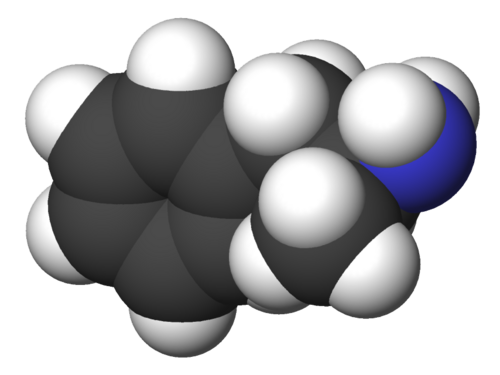

アンフェタミン[注 2](アルファ-メチルフェニルアミンの略)は、注意欠陥多動性障害( ADHD )、ナルコレプシー、肥満の治療に使用される中枢神経系(CNS)刺激薬です。アンフェタミンは1887年にラザール・エデレアヌによって化学物質として発見され、1920年代後半に医薬品として発見されました。[25]アンフェタミンには2つのエナンチオマー([注 3]レボアンフェタミンとデキストロアンフェタミン)があります。アンフェタミンは正確には特定の化学物質、ラセミ体遊離塩基を指し、これは2つのエナンチオマーの純粋なアミン形態の等量部分です。この用語は非公式にはエナンチオマーの任意の組み合わせ、またはどちらか一方を指すために頻繁に使用されます。歴史的には、鼻づまりやうつ病の治療に使用されてきました。アンフェタミンは、運動能力向上剤や認知機能向上剤として、また娯楽目的では媚薬や陶酔剤としても使用されています。多くの国で処方薬となっており、娯楽目的の使用に伴う重大な健康リスクのため、アンフェタミンの無許可の所持や流通は厳しく管理されることが多いです。[出典 1]
最初のアンフェタミン医薬品はベンゼドリンで、さまざまな症状の治療に使用されていたブランドです。現在、医薬品のアンフェタミンはラセミアンフェタミン、アデロール、[注 4] デキストロアンフェタミン、または不活性プロドラッグのリス デキサンフェタミンとして処方されています。アンフェタミンは脳内のモノアミンと興奮性 神経伝達を増加させ、その最も顕著な効果はノルエピネフリンとドーパミン 神経伝達物質システムを標的としています。[出典 2]
治療用量のアンフェタミンは、多幸感、性欲の変化、覚醒の増加、認知制御の改善などの感情的および認知的効果を引き起こします。反応時間の改善、疲労耐性、食欲減退、心拍数の上昇、筋力の増強などの身体的効果も誘発します。アンフェタミンの大量投与は認知機能を損ない、急速な筋肉分解を引き起こす可能性があります。アンフェタミンを娯楽目的で大量に使用すると依存症になるリスクが高くなりますが、治療用量での長期医療使用では依存症になる可能性は低いです。非常に高用量では精神病(幻覚、妄想、偏執症など)を引き起こす可能性がありますが、治療用量では長期使用でもめったに発生しません。娯楽用量は一般に処方された治療用量よりもはるかに多く、深刻な副作用のリスクがはるかに高くなります。[出典 3]
アンフェタミンはフェネチルアミン類に属します。また、アンフェタミンは、ブプロピオン、カチノン、MDMA、メタンフェタミンなどの著名な物質を含む、同じ構造クラスである置換アンフェタミン類の親化合物でもあります。フェネチルアミン類の一員として、アンフェタミンは、天然に存在する微量アミン神経調節物質、具体的にはフェネチルアミンとN-メチルフェネチルアミンとも化学的に関連しており、どちらも人体内で生成されます。フェネチルアミンはアンフェタミンの親化合物であり、N-メチルフェネチルアミンはメチル基の位置のみが異なるアンフェタミンの位置異性体です。[出典 4]
用途
医学
アンフェタミンは、注意欠陥多動性障害(ADHD)、ナルコレプシー(睡眠障害)、肥満の治療に使用され、特にうつ病や慢性疼痛に対する過去の医学的適応症に対して適応外処方されることもあります。[1] [36] [51]
注意欠陥多動性障害
一部の動物種では、十分な高用量のアンフェタミンを長期にわたって摂取すると、ドーパミン系の異常な発達や神経損傷を引き起こすことが知られていますが、[52] [53] ADHDのヒトでは、治療用量の医薬品アンフェタミンを長期にわたって使用すると、脳の発達と神経の成長が改善するようです。[54] [55] [56]磁気共鳴画像法(MRI)による研究のレビューでは、アンフェタミンを長期にわたって投与すると、ADHDの被験者に見られる脳の構造と機能の異常が減少し、大脳基底核の右尾状核など、脳のいくつかの部位の機能が改善されることが示唆されています。[54] [55] [56]
臨床的な刺激薬研究のレビューにより、ADHDの治療における長期にわたる連続的なアンフェタミンの使用の安全性と有効性が確立されている。[44] [57] [58] ADHDの治療に対する2年間にわたる連続的な刺激薬療法のランダム化比較試験は、治療の有効性と安全性を実証した。 [ 44] [57] 2件のレビューでは、ADHDに対する長期にわたる連続的な刺激薬療法は、ADHDの中核症状(多動性、不注意、衝動性)を軽減し、生活の質と学業成績を向上させ、学業、反社会的行動、運転、非医療用薬物の使用、肥満、職業、自尊心、サービス利用(学業、職業、健康、金融、法律サービス)、社会的機能に関連する9つのカテゴリーにわたる多数の機能的アウトカムの改善をもたらすことが示された。[44] [58]あるレビューでは、小児のADHDに対するアンフェタミン治療の9か月間のランダム化比較試験が取り上げられ、平均4.5ポイントの IQの上昇、注意力の継続的な増加、破壊的行動と多動性の継続的な減少が見られました。[57]別のレビューでは、これまでに実施された最長の追跡調査に基づいて、小児期に開始された生涯にわたる刺激療法は、ADHDの症状を継続的に制御し、成人になってから物質使用障害を発症するリスクを軽減することが示されました。[44]
ADHDの現在のモデルは、それが脳の神経伝達物質系のいくつかの機能障害に関連していることを示唆している。[59]これらの機能障害には、中脳皮質辺縁系投射におけるドーパミン神経伝達障害と、青斑核から前頭前野へのノルアドレナリン投射におけるノルエピネフリン神経伝達障害が関与している。[59]メチルフェニデートやアンフェタミンなどの精神刺激薬は、これらの系の神経伝達物質の活動を高めるため、ADHDの治療に効果的である。[27] [59] [60]これらの刺激薬を使用する人の約80%でADHD症状の改善が見られる。[61]刺激薬を使用するADHDの子供は、一般的に仲間や家族との関係が良好で、学校の成績が良く、注意散漫や衝動性が低く、注意力が持続する。[62] [63]小児、青年、成人のADHDに対する医薬品アンフェタミンの治療に関するコクランレビュー[注 7]では、短期研究ではこれらの薬剤が症状の重症度を軽減することが実証されているが、副作用のため非刺激薬よりも中止率が高いと述べている。[ 65 ] [66]トゥレット症候群などのチック障害のある小児のADHDの治療に関するコクランレビューでは、一般的に刺激薬はチックを悪化させないが、高用量のデキストロアンフェタミンは一部の人のチックを悪化させる可能性があることが示された。[67]
ナルコレプシー
ナルコレプシーは慢性の睡眠覚醒障害であり、日中の過度の眠気、脱力発作、および睡眠麻痺を伴う。[68]ナルコレプシー患者はタイプ1またはタイプ2と診断され、前者のみが脱力発作の症状を呈する。[69]タイプ1ナルコレプシーは、側方視床下部の約70,000個のオレキシン放出ニューロンの喪失によって起こり、脳脊髄液オレキシン濃度の大幅な低下につながる。 [18] [70]この低下はタイプ1ナルコレプシーの診断バイオマーカーである。[69]側方視床下部のオレキシンニューロンは、覚醒を促進するノルアドレナリン、ドーパミン、ヒスタミン、およびセロトニンの核を含む上行性網様体賦活系(ARAS)のすべての成分を支配している。[70] [71]
ナルコレプシーにおけるアンフェタミンの治療作用機序は、主にARASにおけるモノアミン神経伝達物質の活性を高めることである。 [18] [72] [73]これには、青斑核のノルアドレナリン作動性ニューロン、腹側被蓋野のドーパミン作動性ニューロン、結節乳頭核のヒスタミン作動性ニューロン、および背側縫線核のセロトニン作動性ニューロンが含まれる。[71] [73]アンフェタミンのよりドーパミン作動性のエナンチオマーであるデキストロアンフェタミンは、他のモノアミンと比較して、ドーパミンの放出が皮質の活性化と認知覚醒に最も大きな影響を与えるため、覚醒を促進するのに特に効果的である。[18]対照的に、レボアンフェタミンは、ノルエピネフリンとセロトニンの作用に敏感な症状である脱力発作に対してより大きな効果を発揮する可能性がある。[18] ARASのノルアドレナリン核とセロトニン核は、 REM睡眠サイクルの調節に関与し、「REMオフ」細胞として機能し、アンフェタミンのノルエピネフリンとセロトニンに対する作用は、REM睡眠の抑制に寄与し、高用量では脱力発作を軽減する可能性がある。[18] [69] [71]
アメリカ睡眠医学会(AASM)の2021年臨床診療ガイドラインでは、1型および2型ナルコレプシーの両方の治療にデキストロアンフェタミンを条件付きで推奨しています。[74]医薬品アンフェタミンによる治療は、他の精神刺激薬(例、モダフィニル)に比べて一般的にあまり好まれず、第三選択の治療選択肢と考えられています。[47] [75] [76]医学的レビューでは、アンフェタミンはナルコレプシーの治療に安全かつ効果的であることが示されている。[18] [47] [74]アンフェタミンは過眠に関連する症状の改善に最も効果的であると見られ、3件のレビューではナルコレプシー患者の日中の眠気が臨床的に有意に軽減したことが明らかになっています。[18] [47] [74]さらに、これらのレビューでは、アンフェタミンが用量依存的に脱力発作の症状を改善する可能性があることが示唆されています。[18] [47] [74]しかし、これらの知見の証拠の質は低く、その結果、AASMはナルコレプシーの治療選択肢としてデキストロアンフェタミンを条件付きで推奨している。[74]
パフォーマンスの向上
認知能力
2015年に行われた質の高い臨床試験の系統的レビューとメタアナリシスにより、低用量(治療用量)で使用した場合、健常成人において、アンフェタミンは作業記憶、長期エピソード記憶、抑制制御、注意のいくつかの側面を含む認知機能に、適度ながらも明確な改善をもたらすことが判明した。 [77] [78]アンフェタミンのこれらの認知機能向上効果は、前頭前野のドーパミン受容体D1とアドレナリン受容体α2の両方の間接的な活性化を介して部分的に媒介されることが知られている。[27] [77] 2014年の系統的レビューでは、低用量のアンフェタミンは記憶の固定も改善し、ひいては情報の想起を改善することが判明した。[79]アンフェタミンの治療用量は皮質ネットワークの効率も高め、この効果がすべての個人の作業記憶の改善を媒介する。[27] [80]アンフェタミンやその他のADHD刺激薬も、課題遂行意欲(課題遂行の動機)を高め、覚醒度(覚醒度)を高め、目標指向行動を促進する。[27] [81] [82]アンフェタミンなどの刺激薬は、困難で退屈な課題のパフォーマンスを向上させることができ、一部の学生は勉強や試験の補助として使用している。[27] [82] [83]自己申告による違法刺激薬の使用に関する研究によると、大学生の5~35%が転用ADHD刺激薬を使用しており、娯楽目的ではなく主に学業成績の向上に使用されている。[ 84] [85] [86]しかし、治療範囲を超える高用量のアンフェタミンは、作業記憶やその他の認知制御の側面を妨げる可能性がある。[27] [82]
身体能力
アンフェタミンは、持久力や覚醒度の向上など、心理的および運動能力向上効果のために、一部のアスリートによって使用されています。 [28] [40]しかし、大学、国内、および国際アンチ・ドーピング機関によって規制されているスポーツイベントでは、非医療目的のアンフェタミンの使用は禁止されています。[87] [88]健康な人の場合、経口治療用量のアンフェタミンは、筋力、加速、無酸素状態での運動能力、および持久力(疲労の発現を遅らせる)を高め、反応時間を改善することが示されています。[28] [89] [90]アンフェタミンは、主に中枢神経系でのドーパミンの再取り込み阻害と放出を通じて、持久力と反応時間を改善します。 [89] [90] [91]アンフェタミンやその他のドーパミン作動薬も、「安全スイッチ」を無効にして、通常は立ち入り禁止の予備容量にアクセスするために体幹温度の上限を上昇させることで、知覚される運動強度の一定レベルでの出力を増加させる。 [90] [92] [93]治療用量では、アンフェタミンの副作用は運動能力を妨げない。[28] [89]しかし、はるかに高い用量では、アンフェタミンは急速な筋肉分解や体温の上昇など、パフォーマンスを著しく低下させる影響を引き起こす可能性がある。[29] [89]
レクリエーション
アンフェタミン、特にドーパミン作動性の右旋性光学異性体(デキストロアンフェタミン)は、陶酔剤や媚薬としても娯楽目的で使用され、他のアンフェタミンと同様に、活力と多幸感を与えるため、クラブ ドラッグとしても使用されています。デキストロアンフェタミン(d-アンフェタミン)は、服用後に陶酔感、注意力、活力を感じると報告されることが多いため、娯楽目的での乱用の可能性が高いと考えられています。 [94] [95] [96] 1960 年代の英国のモッズ サブカルチャーで注目すべき点は、マンチェスターのTwisted Wheelなどのクラブで一晩中踊るために使用された娯楽目的のアンフェタミンの使用でした。新聞報道では、午前 5 時に瞳孔が開いた状態でクラブから出てくるダンサーについて説明されていました。[97]モッズたちは、この薬物を刺激と覚醒のために使用しており、アルコールや他の薬物によって引き起こされる酩酊状態とは異なるものとみなしていた。 [97]アンドリュー・ウィルソン博士は、かなりの少数派にとって「アンフェタミンは、スマートで機敏でクールなイメージを象徴していた」と主張し、彼らは「酩酊ではなく刺激、逃避ではなくより高い意識」と「前の世代の酔っぱらいの騒々しさ」ではなく「自信と明瞭さ」を求めた。 [97]デキストロアンフェタミンのドーパミン作動性(報酬)特性は、中皮質辺縁系回路に影響を与える。中皮質辺縁系回路は、インセンティブの顕著性(つまり、「欲求」、報酬や動機に対する欲求または渇望)、正の強化、特に快楽を伴う正価の感情を担う神経構造のグループである。[98] デキストロアンフェタミンを娯楽目的で大量に摂取すると、デキストロアンフェタミンの過剰摂取の症状を引き起こす可能性がある。[96]娯楽目的の使用者は、デキセドリンカプセルを開けて中身を砕き、吸入(鼻から吸う)したり、その後水に溶かして注射したりすることがある。[96]即放性製剤は、より好ましい薬物動態プロファイルと簡単に砕けること(特に錠剤)のため、吸入(鼻から吸う)または静脈注射による乱用の可能性が高い。[99] [100]血流への注射は、錠剤内の不溶性充填剤が小血管を塞ぐ可能性があるため、危険である可能性がある。[96]デキストロアンフェタミンの慢性的な過剰使用は、重度の薬物依存につながる可能性がある。薬物の使用を中止すると離脱症状が現れる。[96]
禁忌
国際化学物質安全性計画(IPCS)と米国食品医薬品局(FDA)によると、 [注 8]アンフェタミンは薬物乱用の履歴、[注 9]心血管疾患、重度の興奮、または重度の不安のある人には禁忌です。[ 36] [29] [102]また、進行した動脈硬化症(動脈の硬化)、緑内障(眼圧の上昇)、甲状腺機能亢進症(甲状腺ホルモンの過剰産生)、または中等度から重度の高血圧の人にも禁忌です。[36] [29] [102]これらの機関は、他の刺激物にアレルギー反応を経験したことがある人、またはモノアミン酸化酵素阻害剤(MAOI)を服用している人はアンフェタミンを服用すべきではないと示していますが、[36] [29] [102]アンフェタミンとモノアミン酸化酵素阻害剤の安全な併用が文書化されています。[103] [104]これらの機関はまた、神経性無食欲症、双極性障害、うつ病、高血圧、肝臓や腎臓の問題、躁病、精神病、レイノー現象、発作、甲状腺の問題、チック、またはトゥレット症候群のある人は、アンフェタミンを服用している間は症状を監視する必要があると述べています。[29] [102]人間の研究からの証拠は、治療目的でのアンフェタミンの使用は胎児や新生児の発達異常を引き起こさないこと(すなわち、それは人間の催奇形性物質ではない)を示していますが、アンフェタミンの乱用は胎児にリスクをもたらします。[102]アンフェタミンは母乳に移行することも示されているため、IPCSとFDAは母親がアンフェタミンを使用する場合は授乳を避けるようにアドバイスしています。[29] [102]可逆的な成長障害の可能性があるため、[注10] FDAはアンフェタミン系医薬品を処方された小児および青少年の身長と体重をモニタリングすることを推奨している。[29]
副作用
アンフェタミンの副作用は多種多様であり、アンフェタミンの使用量こそが副作用の可能性と重症度を決定する主な要因である。[29] [40]アデロール、デキセドリンなどのアンフェタミン製品およびそのジェネリック医薬品は、現在、米国FDAにより長期治療用として承認されている。[37] [29]アンフェタミンの 娯楽目的の使用では、通常、治療目的で使用される用量よりもはるかに大量の用量が使用され、重篤な薬物副作用のリスクが大きくなる。[40]
物理的な
心血管系の副作用には、血管迷走神経反応による高血圧や低血圧、レイノー現象(手足への血流減少)、頻脈(心拍数増加)などがあります。[29] [40] [105]男性の性的副作用には、勃起不全、頻繁な勃起、または持続的な勃起などがあります。[29]消化器系の副作用には、腹痛、便秘、下痢、吐き気などがあります。[1] [29] [106]その他の潜在的な身体的副作用には、食欲不振、かすみ目、口渇、過度の歯ぎしり、鼻血、多量の発汗、薬剤性鼻炎(薬剤誘発性の鼻づまり)、発作閾値の低下、チック(運動障害の一種)、体重減少などがあります。[出典5]一般的な医薬品用量では、危険な身体的副作用はまれです。[40]
アンフェタミンは延髄呼吸中枢を刺激し、呼吸を速く深くする。[40]正常な人の場合、治療量を服用してもこの効果は通常は目立たないが、呼吸がすでに低下している場合は明らかである。[40]アンフェタミンはまた、排尿を制御する筋肉である膀胱括約筋の収縮も誘発し、排尿困難を引き起こす可能性がある。 [40]この効果は、夜尿症や膀胱制御喪失の治療に役立つ可能性がある。[40]アンフェタミンの消化管への影響は予測できない。[40]腸の活動が活発な場合、アンフェタミンは消化管の運動性(内容物が消化器系を移動する速度)を低下させる可能性がある。[40]ただし、消化管の平滑筋が弛緩している場合は、アンフェタミンが運動性を高める可能性がある。[40]アンフェタミンにはわずかな鎮痛作用もあり、オピオイドの鎮痛効果を高めることができる。[1] [40]
2011年にFDAが委託した研究では、小児、若年成人、成人において、深刻な心血管疾患(突然死、心臓発作、脳卒中)とアンフェタミンやその他のADHD刺激薬の医療使用との間に関連性はないことが示されている。[出典6]しかし、アンフェタミン医薬品は心血管疾患のある人には禁忌である。[出典7]
心理的
通常の治療用量では、アンフェタミンの最も一般的な精神的副作用には、覚醒、不安、集中力、積極性、自信、社交性、気分変動(高揚した気分の後に軽い抑うつ気分が続く)、不眠症または覚醒状態、疲労感の減少などがある。[29] [40]あまり一般的ではない副作用には、不安、性欲の変化、誇大妄想、神経過敏、反復行動または強迫行動、落ち着きのなさなどがある。[出典 8]これらの影響は、使用者の性格や現在の精神状態に依存する。[40] アンフェタミン精神病(妄想や被害妄想など)は、ヘビーユーザーに発生する可能性がある。[29] [41] [42]非常にまれではあるが、この精神病は長期治療中に治療用量で発生することもある。[29] [42] [43] FDAによれば、覚醒剤が攻撃的な行動や敵意を生み出すという「体系的な証拠はない」とのこと。[29]
アンフェタミンは治療用量を摂取した人間に条件付け場所嗜好性を生み出すことも示されており、 [65] [113]、個人は以前にアンフェタミンを使用した場所で時間を過ごすことを好むようになることを意味します。[113] [114]
強化障害
中毒
| 依存症と依存の用語集[114] [115] [116] | |
|---|---|
| |
| 転写因子用語集 | |
|---|---|
| |
依存症は娯楽目的でのアンフェタミンの大量使用に深刻なリスクがあるが、治療用量での長期の医療使用では起こる可能性は低い。[45] [46] [47]実際、小児期に開始したADHDに対する生涯にわたる刺激療法は、成人になってからの物質使用障害の発症リスクを軽減する。 [44]腹側被蓋野と側坐核を結ぶドーパミン経路である中脳辺縁系経路 の病的な過剰活性化は、アンフェタミン依存症において中心的な役割を果たす。[123] [124]高用量のアンフェタミンを頻繁に自己投与する人は、高用量での慢性的な使用が依存症の「分子スイッチ」および「マスターコントロールタンパク質」である側坐核ΔFosBのレベルを徐々に上昇させるため、アンフェタミン依存症を発症するリスクが高い。[115] [125] [126]側坐核ΔFosBが十分に過剰発現すると、その発現がさらに増加すると、依存性行動(すなわち、強迫的な薬物探索)の重症度が増加し始めます。[125] [127]現在、アンフェタミン中毒を治療するための効果的な薬はありませんが、定期的に持続的な有酸素運動を行うことで、そのような中毒を発症するリスクが軽減されるようです。[128] [129]運動療法は臨床治療の結果を改善し、依存症の行動療法の補助療法として使用できます。[128] [130] [出典 9]
生体分子メカニズム
過剰量のアンフェタミンを慢性的に使用すると、中脳皮質辺縁系投射における遺伝子発現の変化が引き起こされ、これは転写およびエピジェネティックなメカニズムを介して生じる。[126] [131] [132]これらの変化を引き起こす最も重要な転写因子[注11]は、デルタFBJマウス骨肉腫ウイルス癌遺伝子ホモログB(ΔFosB)、cAMP応答配列結合タンパク質(CREB)、および核因子カッパB(NF-κB)である。[126] ΔFosBは依存症における最も重要な生体分子メカニズムである。なぜなら、側坐核のD1型中型有棘ニューロンにおけるΔFosBの過剰発現(すなわち、顕著な遺伝子関連表現型を生み出す異常に高いレベルの遺伝子発現)は、多くの神経適応に必要かつ十分であり[注 12] 、依存症に関与する複数の行動効果(例えば、報酬感作および薬物自己投与の増加)を制御するからである。[115] [125] [126] ΔFosBが十分に過剰発現すると、ΔFosB発現のさらなる増加に伴ってますます重篤になる依存症状態を誘発する。[115] [125]アルコール、カンナビノイド、コカイン、メチルフェニデート、ニコチン、オピオイド、フェンシクリジン、プロポフォール、置換アンフェタミンなどの依存症に関与していることが示唆されている。 [出典10]
転写因子であるΔJunDとヒストンメチルトランスフェラーゼ酵素であるG9aは、どちらもΔFosBの機能に拮抗し、その発現の増加を阻害する。[115] [126] [136]ウイルスベクターを用いて側坐核でΔJunDを十分に過剰発現させると、慢性薬物乱用で見られる神経および行動の変化の多く(すなわち、ΔFosBによって媒介される変化)を完全に阻止することができる。[126]同様に、側坐核のG9a過剰発現はヒストン3リジン残基9のジメチル化(H3K9me2)の顕著な増加をもたらし、慢性的な薬物使用によるΔFosBを介した神経および行動の可塑性の誘導を阻害する。 [出典11]これは、 ΔFosBの転写因子のH3K9me2を介した抑制と、様々なΔFosB転写標的(例: CDK5)のH3K9me2を介した抑制を介して起こる。 [126] [136] [137] ΔFosBはまた、おいしい食べ物、セックス、運動などの自然報酬に対する行動反応を制御する上で重要な役割を果たしている。 [127] [126] [140]自然な報酬と依存性薬物は両方ともΔFosBの発現を誘発する(すなわち、脳内でΔFosBの産生を増加させる)ため、これらの報酬を慢性的に獲得すると、同様の病的な依存症状態に至る可能性がある。 [127] [126]その結果、ΔFosBは、アンフェタミン依存症とアンフェタミン誘発性性的依存症の両方に関与する最も重要な要因であり、これらは過度の性行為とアンフェタミンの使用に起因する強迫的な性行動である。[127] [141] [142]これらの性的依存症は、ドパミン作動薬を服用している一部の患者に発生するドパミン調節異常症候群に関連している。[127] [140]
アンフェタミンの遺伝子調節への影響は、用量と投与経路の両方に依存します。[132]遺伝子調節と依存症に関する研究のほとんどは、非常に高用量の静脈内アンフェタミン投与による動物実験に基づいています。[132]同等の(体重調整された)ヒト治療用量と経口投与を使用した少数の研究では、これらの変化が起こったとしても比較的軽微であることが示されています。[132]これは、アンフェタミンの医療用途が遺伝子調節に大きな影響を与えないことを示唆しています。[132]
薬物療法
2019年12月現在、アンフェタミン依存症に効果的な薬物療法は[update]存在しない。[143] [144] [145] 2015年と2016年のレビューでは、 TAAR1選択的作動薬が精神刺激薬依存症の治療薬として大きな治療効果があることが示された。[39] [146]しかし、2016年2月現在、TAAR1選択的作動薬として機能することが知られている化合物は実験薬のみである。[39] [146]アンフェタミン依存症は主に、側坐核におけるドーパミン受容体と共局在するNMDA受容体[注 13]の活性化の増加を介して媒介される。 [124]マグネシウムイオンは、受容体カルシウムチャネルを遮断することによりNMDA受容体を阻害する。[124] [147]あるレビューでは、動物実験に基づいて、病的な(依存症を誘発する)精神刺激薬の使用は、脳全体の細胞内マグネシウム濃度を著しく低下させることが示唆されている。 [124 ]マグネシウム補給[注 14]治療は、ヒトにおけるアンフェタミン自己投与(すなわち、自分自身に投与する量)を減らすことが示されているが、アンフェタミン依存症に対する効果的な単独療法ではない。[124][update]
2019年の系統的レビューとメタアナリシスでは、アンフェタミンとメタンフェタミン依存症に対するランダム化比較試験(RCT)で使用された17種類の薬物療法の有効性を評価しました。[144]メチルフェニデートがアンフェタミンまたはメタンフェタミンの自己投与を減らす可能性があるという低強度の証拠しか見つかりませんでした。[144] RCTで使用された他の薬剤のほとんどについては、低~中程度の効果がないことの証拠があり、その中には抗うつ薬(ブプロピオン、ミルタザピン、セルトラリン)、抗精神病薬(アリピプラゾール)、抗けいれん薬(トピラマート、バクロフェン、ガバペンチン)、ナルトレキソン、バレニクリン、シチコリン、オンダンセトロン、プロメタ、リルゾール、アトモキセチン、デキストロアンフェタミン、モダフィニルが含まれていた。[144]
行動療法
2018年に行われたアンフェタミン、メタンフェタミン、コカイン依存症に対する12種類の心理社会的介入を含む50件の試験の系統的レビューとネットワークメタアナリシスでは、コンティンジェンシー管理とコミュニティ強化アプローチの両方を組み合わせた療法が最も高い有効性(禁断率)と受容性(最低の脱落率)を示したことがわかった。[148]この分析で検討された他の治療法には、コンティンジェンシー管理またはコミュニティ強化アプローチによる単独療法、認知行動療法、12ステッププログラム、非コンティンジェンシー報酬ベース療法、精神力動的療法、およびこれらを含むその他の併用療法が含まれていた。[148]
さらに、身体運動の神経生物学的効果に関する研究では、毎日の有酸素運動、特に持久力運動(マラソンなど)は薬物依存症の発症を防ぎ、アンフェタミン依存症の効果的な補助療法(すなわち、補足的治療)になることが示唆されている。[出典 9]運動は、特に精神刺激薬依存症の補助治療として使用された場合、より良い治療結果につながる。[128] [130] [149]特に、有酸素運動は精神刺激薬の自己投与を減らし、薬物探索の再発を減らし、線条体のドーパミン受容体D 2(DRD2)密度の増加を誘発する。[127] [149]これは、線条体のDRD2密度の減少を誘発する病的な刺激薬使用とは逆である。[127]あるレビューでは、運動は線条体や報酬系の他の部分におけるΔFosBやc-Fosの免疫反応を変化させることで薬物依存症の発症を予防する可能性があることも指摘されている。[129]
依存と離脱
アンフェタミン乱用(すなわち、娯楽目的のアンフェタミン使用)では薬物耐性が急速に発達するため、乱用期間が長くなると、同じ効果を得るために薬物の用量を次第に増やさなければならない。[150] [151]アンフェタミンとメタンフェタミンを強迫的に使用している人の離脱症状 に関するコクランレビューによると、「慢性的な大量使用者が突然アンフェタミンの使用を中止すると、多くの人が最後の服用から24時間以内に発生する期間限定の離脱症候群を報告している。」[152]このレビューでは、慢性的な大量使用者の離脱症状は頻繁に発生し、約88%の症例で発生し、最初の1週間に顕著な「クラッシュ」段階が発生し、 3〜4 週間持続すると指摘されている。[152]アンフェタミン離脱症状には、不安、薬物渇望、抑うつ気分、疲労、食欲増進、動きの増加または減少、意欲の欠如、不眠または眠気、明晰夢などがある。[152]このレビューでは、離脱症状の重症度は個人の年齢や依存の程度と正の相関関係にあることが示された。[152]治療用量でのアンフェタミン治療の中止による軽度の離脱症状は、用量を徐々に減らすことで回避できる。[1]
過剰摂取
アンフェタミンの過剰摂取はさまざまな症状を引き起こす可能性があるが、適切な治療を受ければ命に関わることはまれである。[1] [102] [153]過剰摂取症状の重症度は投与量とともに増し、アンフェタミンに対する薬剤耐性とともに減少する。[40] [102]耐性のある人は1日に5グラムものアンフェタミンを摂取することが知られており、これは1日の最大治療用量の約100倍である。[102]中程度および極めて大量の過剰摂取の症状を以下に挙げる。致死的なアンフェタミン中毒には通常、けいれんや昏睡も伴う。[29] [40] 2013年には、アンフェタミン、メタンフェタミン、および「アンフェタミン使用障害」に関係する他の化合物の過剰摂取により、世界中で推定3,788人が死亡した(3,425〜4,145 人、95%の信頼区間)。[注 15] [154]
毒性
げっ歯類や霊長類では、十分に高用量のアンフェタミンはドーパミン神経毒性、つまりドーパミンニューロンの損傷を引き起こし、ドーパミン末端の 変性とトランスポーターおよび受容体の機能低下を特徴とします。 [156] [157]アンフェタミンがヒトに対して直接神経毒性があるという証拠はありません。[158] [159]しかし、大量のアンフェタミンは、高発熱、活性酸素種の過剰な形成、およびドーパミンの自動酸化の増加の結果として、間接的にドーパミン神経毒性を引き起こす可能性があります。[出典 13]高用量アンフェタミン曝露による神経毒性の 動物モデルは、高発熱(すなわち、体幹温度 ≥ 40 °C)の発生がアンフェタミン誘発性神経毒性の発現に必要であることを示しています。[157]脳温度が40℃以上に長時間上昇すると、活性酸素種の生成が促進され、細胞タンパク質の機能が阻害され、一時的に血液脳関門の透過性が高まり、実験動物におけるアンフェタミン誘発性神経毒性の発症が促進される可能性がある。[157]
精神病
アンフェタミンの過剰摂取は、妄想や偏執症などのさまざまな症状を伴う覚醒剤精神病を引き起こす可能性があります。[41] [42]アンフェタミン、デキストロアンフェタミン、メタンフェタミン精神病の治療に関するコクランレビューでは、使用者の約5〜15%が完全に回復しないと述べています。[41] [162]同じレビューによると、抗精神病薬が急性アンフェタミン精神病の症状を効果的に解消することを示す試験が少なくとも1つあります。 [41]治療目的での使用によって精神病が発生することはめったにありません。[29] [42] [43]
薬物相互作用
多くの種類の物質がアンフェタミンと相互作用することが知られており、その結果、アンフェタミン、相互作用物質、またはその両方の薬物作用または代謝が変化する。 [29]アンフェタミンを代謝する 酵素の阻害剤(例:CYP2D6およびFMO3 )は、アンフェタミンの消失半減期を延長し、その効果がより長く続くことを意味する。[6] [29]アンフェタミンはMAOI、特にモノアミン酸化酵素A阻害剤とも相互作用し、MAOIとアンフェタミンは両方とも血漿カテコールアミン(すなわち、ノルエピネフリンおよびドーパミン)を増加させるため、[29]両者の同時使用は危険である。[29]アンフェタミンはほとんどの向精神薬の活性を調節する。特に、アンフェタミンは鎮静剤および抑制剤の効果を減少させ、覚醒剤および抗うつ剤の効果を増大させる可能性がある。[29]アンフェタミンは血圧とドーパミンに作用するため、降圧剤と抗精神病薬の効果を低下させる可能性がある。 [29] ADHDの治療に使用される場合、亜鉛補給によりアンフェタミンの最小有効用量が減少する可能性がある。 [注 16] [167]
一般的に、アンフェタミンを食物と一緒に摂取しても有意な相互作用はありませんが、胃腸内容物と尿のpHはそれぞれアンフェタミンの吸収と排泄に影響します。[29]酸性物質はアンフェタミンの吸収を減らし、尿中排泄を増やし、アルカリ性物質はその逆の効果があります。[29] pHが吸収に影響を与えるため、アンフェタミンはプロトンポンプ阻害薬やH2抗ヒスタミン薬などの胃酸減少剤とも相互作用し、胃腸のpHを上昇させます(つまり、酸性度を低下させます)。[29]
薬理学
薬力学
アンフェタミンは、脳内の神経信号としてのモノアミンの使用を変化させることによって、行動効果を発揮します。主に脳の報酬および実行機能経路のカテコールアミンニューロンで作用します。 [38] [60]報酬回路と実行機能に関与する主な神経伝達物質であるドーパミンとノルエピネフリンの濃度は、モノアミントランスポーターに対するアンフェタミンの作用により、用量依存的に劇的に増加します。[38] [60] [168]アンフェタミンの強化効果と動機付けの顕著性促進効果は、主に中脳辺縁系経路におけるドーパミン作動性活動の増強によるものです。[27]アンフェタミンの陶酔感と運動刺激効果は、線条体におけるシナプスドーパミンとノルエピネフリンの濃度を上昇させる大きさと速度に依存します。[2]
アンフェタミンは、2001年に発見されたG s結合およびG q結合のGタンパク質結合受容体(GPCR)である微量アミン関連受容体1(TAAR1)の強力な完全作動薬として同定されており、脳のモノアミンの調節に重要である。[38] [174] TAAR1の活性化はcAMPを増加させる。 TAAR1はアデニル酸シクラーゼの活性化を介して産生を抑制し、モノアミントランスポーターの機能を阻害する。[38] [175]モノアミン自己受容体(例えば、D 2 short、シナプス前α 2、シナプス前5-HT 1A)はTAAR1と逆の効果があり、これらの受容体が一緒になってモノアミンの制御システムを提供する。[38] [39]注目すべきことに、アンフェタミンと微量アミンはTAAR1に対して高い結合親和性を有するが、モノアミン自己受容体に対してはそうではない。[38] [39]画像研究は、アンフェタミンと微量アミンによるモノアミン再取り込み阻害は部位特異的であり、関連するモノアミンニューロンにおけるTAAR1の共局在の存在に依存することを示している。 [38]
アンフェタミンは、神経モノアミントランスポーターに加えて、小胞モノアミントランスポーターであるVMAT1とVMAT2、およびSLC1A1、SLC22A3、SLC22A5も阻害します。[出典14] SLC1A1は興奮性アミノ酸トランスポーター3(EAAT3)で、ニューロンに位置するグルタミン酸トランスポーターです。SLC22A3はアストロサイトに存在する神経外モノアミントランスポーターです。SLC22A5は高親和性カルニチントランスポーターです。[出典14]アンフェタミンは、コカインおよびアンフェタミン調節転写(CART)遺伝子発現を強く誘導することが知られています。[11] [181]摂食行動、ストレス、報酬に関与する神経ペプチドで、 in vitro でのニューロンの発達と生存の顕著な増加を引き起こします。[11] [182] [183] CART受容体はまだ特定されていないが、CARTがユニークなG i /G o共役 GPCRに結合するという重要な証拠がある。[183] [184]アンフェタミンはまた、非常に高用量でモノアミン酸化酵素を阻害し、モノアミンおよび微量アミンの代謝を減少させ、結果としてシナプスモノアミンの濃度を高める。[23] [185]ヒトでは、アンフェタミンが結合することが知られている唯一のシナプス後受容体は5-HT1A受容体であり、そこでは低マイクロモル親和性のアゴニストとして作用する。[186] [187]
ヒトにおけるアンフェタミンの短期的な薬効の完全なプロファイルは、主にドーパミン[38]、セロトニン[38]、ノルエピネフリン[38] 、エピネフリン[ 168]、ヒスタミン[168]、CARTペプチド[11]、[181] 、内因性オピオイド[188]、[189]、[190]、副腎皮質刺激ホルモン[191]、[ 192 ] 、コルチコステロイド[ 191] 、[192]、およびグルタミン酸[ 172] [177]の細胞間コミュニケーションまたは神経伝達の増加を通じて得られ、 CART、5-HT1A、EAAT3、TAAR1、VMAT1、VMAT2、およびおそらく他の生物学的標的との相互作用を介して影響を与えます。[出典 15]アンフェタミンはまた、7つのヒト炭酸脱水酵素を活性化し、そのうちのいくつかはヒトの脳で発現している。[193]
デキストロアンフェタミンは、レボアンフェタミンよりも強力なTAAR1作動薬である。[194]その結果、デキストロアンフェタミンはレボアンフェタミンよりも約3~4倍の強い中枢神経系刺激を引き起こすが、レボアンフェタミンは心血管系および末梢系への影響がわずかに強い。[40] [194]
ドーパミン
特定の脳領域では、アンフェタミンはシナプス間隙のドーパミン濃度を上昇させる。[38]アンフェタミンは、 DATを介して、または神経細胞膜を直接透過してシナプス前ニューロンに入ることができる。[38] DATの取り込みの結果として、アンフェタミンはトランスポーターで競合的再取り込み阻害を生成する。[38]シナプス前ニューロンに入ると、アンフェタミンはTAAR1を活性化し、これがタンパク質キナーゼA(PKA)およびタンパク質キナーゼC(PKC)シグナリングを介して、DATのリン酸化を引き起こす。[38]いずれかのタンパク質キナーゼによるリン酸化はDATの内部化(非競合的再取り込み阻害)をもたらす可能性があるが、PKCを介したリン酸化のみがDATを介したドーパミン輸送の逆転(すなわち、ドーパミン排出)を引き起こす。 [注 16] [38] [195]アンフェタミンは細胞内カルシウムを増加させることでも知られており、この効果は未確認のCa2+/カルモジュリン依存性タンパク質キナーゼ(CAMK)依存性経路を介したDATリン酸化と関連しており、その結果ドーパミン流出が生じる。[174] [172] [173] Gタンパク質共役型内向き整流性カリウムチャネルを直接活性化することで、TAAR1はドーパミンニューロンの発火率を低下させ、ドーパミン過剰状態を防ぐ。[170] [171] [196]
アンフェタミンはシナプス前小胞モノアミントランスポーターVMAT2の基質でもある。[168] [169] VMAT2でのアンフェタミンの取り込みに続いて、アンフェタミンは小胞pH勾配の崩壊を誘導し、その結果、VMAT2を介したドーパミン流出を介してシナプス小胞から細胞質へのドーパミン分子の放出を引き起こす。[168] [169] その後、細胞質ドーパミン分子はDATでの逆輸送を介してシナプス前ニューロンからシナプス間隙に放出される。[38] [168] [169]
ノルエピネフリン
ドーパミンと同様に、アンフェタミンは用量依存的にエピネフリンの直接の前駆体であるシナプスノルエピネフリンのレベルを増加させる。[48] [60]ニューロンのTAAR1 mRNA発現に基づいて、アンフェタミンはドーパミンと同様にノルエピネフリンに影響を及ぼすと考えられている。 [38] [168] [195]言い換えれば、アンフェタミンはリン酸化NETでのTAAR1媒介排出と非競合的再取り込み阻害、競合的NET再取り込み阻害、およびVMAT2からのノルエピネフリン放出を誘導する。[38] [168]
セロトニン
アンフェタミンはドーパミンやノルエピネフリンと同様にセロトニンに対しても類似した、しかしそれほど顕著ではない効果を発揮する。[38] [60]アンフェタミンはVMAT2を介してセロトニンに影響を与え、ノルエピネフリンと同様にTAAR1を介してSERTをリン酸化させると考えられている。[38] [168]ドーパミンと同様に、アンフェタミンはヒト5-HT1A受容体に対して低いマイクロモル親和性を有する。[186] [187]
その他の神経伝達物質、ペプチド、ホルモン、酵素
ヒトにおける急性アンフェタミン投与は、報酬系のいくつかの脳構造における内因性オピオイド放出を増加させる。[188] [189] [190]脳内の主要な興奮性神経伝達物質であるグルタミン酸の細胞外レベルは、アンフェタミン曝露後に線条体で増加することが示されている。 [172]この細胞外グルタミン酸の増加は、おそらく、ドーパミンニューロンにおけるグルタミン酸再取り込みトランスポーターであるEAAT3のアンフェタミン誘発性内部化を介して起こる。 [172] [177]アンフェタミンはまた、 VMAT2を介して肥満細胞からのヒスタミンの選択的放出とヒスタミン作動性ニューロンからの流出を誘導する。[168]急性アンフェタミン投与は、視床下部‐下垂体‐副腎系を刺激することにより、血漿中の副腎皮質刺激ホルモンおよびコルチコステロイドのレベルを増加させることもできる。[36] [191] [192]
2017年12月、アンフェタミンとヒト炭酸脱水酵素との相互作用を評価する最初の研究が発表されました。[193]調査した11の炭酸脱水酵素のうち、アンフェタミンは7つの酵素を強力に活性化し、そのうち4つはヒトの脳で高度に発現しており、低ナノモルから低マイクロモルの活性化効果があることがわかりました。[193]前臨床研究に基づくと、脳の炭酸脱水酵素活性化には認知機能を高める効果があります。[198]しかし、炭酸脱水酵素阻害剤の臨床使用に基づくと、他の組織での炭酸脱水酵素活性化は、緑内障を悪化させる眼の活性化などの副作用と関連している可能性があります。[198]
薬物動態
アンフェタミンの経口バイオアベイラビリティは、胃腸の pH によって異なります。[29]アンフェタミンは腸からよく吸収され、バイオアベイラビリティは通常 90% です。 [10]アンフェタミンはp Kaが9.9 の弱塩基です。 [3]したがって、pH が塩基性の場合、薬物の脂溶性遊離塩基の形態が多くなり、腸上皮の脂質に富む細胞膜からより多くの薬物が吸収されます。[3] [29]逆に、酸性 pH は、薬物が主に水溶性の陽イオン(塩)の形態であることを意味し、吸収される量は少なくなります。[3]血流中を循環するアンフェタミンの約20%は、血漿タンパク質に結合しています。[11]吸収後、アンフェタミンは体内のほとんどの組織に容易に分布し、脳脊髄液と脳組織で高濃度になります。[17]
アンフェタミンのエナンチオマーの半減期は異なり、尿のpHによって異なります。[3]通常の尿pHでは、デキストロアンフェタミンとレボアンフェタミンの半減期はそれぞれ9~11 時間と11~14 時間です。[3]酸性度の高い尿では、エナンチオマーの半減期は7時間に短縮されます。[17]アルカリ度の高い尿では、半減期は最大34時間まで延長されます。[17]両異性体の塩の即放性および徐放性変異体は、それぞれ投与後3時間および7時間で最高血漿濃度に達します。 [3]アンフェタミンは腎臓から排泄され、通常の尿pHでは薬物の30~40%が変化せずに排泄されます。 [3]尿pHが塩基性の場合、アンフェタミンは遊離塩基の形であるため、排泄量は少なくなります。[3]尿のpHが異常な場合、尿中へのアンフェタミンの回収率は、尿がアルカリ性か酸性かによって、最低1%から最高75%の範囲になります。[3]経口投与後、アンフェタミンは3時間以内に尿中に現れます。[17]摂取したアンフェタミンの約90%は、最後の経口投与から3日後に排泄されます。[17]
リスデキサンフェタミンはデキストロアンフェタミンのプロドラッグである。 [199] [200]消化管で吸収される際、アンフェタミンほどpHに敏感ではない。[200]血流に吸収された後、リスデキサンフェタミンは赤血球によって未確認のアミノペプチダーゼ酵素による加水分解によってデキストロアンフェタミンとアミノ酸の L-リジンに完全に変換される。[200] [199] [201]これはリスデキサンフェタミンの生体内活性化における律速段階である。[199]リスデキサンフェタミンの消失半減期は通常1時間未満である。[200] [199]リスデキサンフェタミンはデキストロアンフェタミンに変換される必要があるため、リスデキサンフェタミンを投与した場合のデキストロアンフェタミン濃度は、同用量の即放性デキストロアンフェタミンを投与した場合よりも約1時間遅くピークに達します。[199] [201]おそらく赤血球による律速活性化のため、リスデキサンフェタミンの静脈内投与では、同用量のデキストロアンフェタミンの静脈内投与と比較して、ピーク到達時間が大幅に遅れ、ピーク濃度が低下します。 [199]リスデキサンフェタミンの薬物動態は、経口投与、鼻腔内投与、静脈内投与のいずれの場合でも同様です。 [199] [201]したがって、デキストロアンフェタミンとは対照的に、非経口投与ではリスデキサンフェタミンの主観的効果は増強されません。[199] [ 201]プロドラッグとしての挙動と薬物動態の違いにより、リスデキサンフェタミンは即放性デキストロアンフェタミンよりも治療効果の持続時間が長く、乱用される可能性が低い。[199] [201]
CYP2D6、ドーパミンβ-ヒドロキシラーゼ(DBH)、フラビン含有モノオキシゲナーゼ3(FMO3)、酪酸CoAリガーゼ(XM-リガーゼ)、およびグリシンN-アシルトランスフェラーゼ(GLYAT)は、ヒトにおいてアンフェタミンまたはその代謝物を代謝することが知られている酵素である。 [出典16]アンフェタミンには、4-ヒドロキシアンフェタミン、4-ヒドロキシノルエフェドリン、4-ヒドロキシフェニルアセトン、安息香酸、馬尿酸、ノルエフェドリン、フェニルアセトンなど、さまざまな排泄代謝産物がある。[ 3] [12]これらの代謝物のうち、活性交感神経刺激薬は、 4-ヒドロキシアンフェタミン、[202] 4-ヒドロキシノルエフェドリン、[203]およびノルエフェドリンである。[204]主な代謝経路には、芳香族パラヒドロキシル化、脂肪族α-およびβ-ヒドロキシル化、N-酸化、N-脱アルキル化、および脱アミノ化が含まれます。[3] [205]ヒトにおける既知の代謝経路、検出可能な代謝物、および代謝酵素には以下が含まれます。
薬理微生物学
ヒトのメタゲノム(すなわち、個体および個体の体表または体内に生息するすべての微生物の遺伝子構成)は、個人間で大きく異なります。[211] [212]ヒトの体内の微生物およびウイルス細胞の総数(100兆個以上)は、ヒト細胞(数十兆個)を大幅に上回っているため、[注 18] [211] [213]薬剤と個体のマイクロバイオームとの間に相互作用が生じる可能性がかなりあります。これには、薬剤がヒトマイクロバイオームの構成を変えること、微生物酵素による薬剤代謝が薬剤の薬物動態プロファイルを変更すること、微生物薬剤代謝が薬剤の臨床効果と毒性プロファイルに影響を与えることが含まれます。[211] [212] [214]これらの相互作用を研究する分野は、ファーマコマイクロバイオミクスとして知られています。[211]
ほとんどの生体分子や他の経口投与される 異物(すなわち薬物)と同様に、アンフェタミンは血流に吸収される前に、ヒトの消化管微生物叢(主に細菌)による乱交代謝を受けると予測されている。[214]最初のアンフェタミン代謝微生物酵素は、ヒトの腸内によく見られる大腸菌株由来のチラミン酸化酵素であり、2019年に特定された。[214]この酵素は、アンフェタミン、チラミン、フェネチルアミンを、3つの化合物すべてに対してほぼ同じ結合親和性で代謝することが判明した。[214]
関連する内因性化合物
アンフェタミンは、人体や脳で生成される天然の神経調節分子である内因性微量アミンと非常によく似た構造と機能を持っています。 [38] [48] [215]このグループの中で、最も関連が深い化合物は、アンフェタミンの親化合物であるフェネチルアミンと、アンフェタミンの構造異性体である(つまり、同一の分子式を持つ)N-メチルフェネチルアミンです。 [38] [48] [216]ヒトでは、フェネチルアミンは芳香族アミノ酸脱炭酸酵素(AADC)によってL-フェニルアラニンから直接生成され、この酵素はL-DOPAをドーパミンに変換します。[48] [216]次に、N-メチルフェネチルアミンは、ノルエピネフリンをエピネフリンに代謝する同じ酵素であるフェニルエタノールアミンN-メチルトランスフェラーゼによってフェネチルアミンから代謝されます。 [48] [216]アンフェタミンと同様に、フェネチルアミンとN-メチルフェネチルアミンは両方ともTAAR1を介してモノアミン神経伝達を制御します。[38] [215] [216]アンフェタミンとは異なり、これらの物質は両方ともモノアミン酸化酵素Bによって分解されるため、アンフェタミンよりも半減期が短くなります。[48] [216]
化学
アンフェタミンは、哺乳類の神経伝達物質フェネチルアミンのメチル 同族体で、化学式はC 9 H 13 Nです。第一級アミンに隣接する炭素原子は立体中心であり、アンフェタミンは2つのエナンチオマーのラセミ1:1混合物で構成されています。[11]このラセミ混合物は、光学異性体であるレボアンフェタミンとデキストロアンフェタミンに分離できます。[11]室温では、アンフェタミンの純粋な遊離塩基は、特徴的な強いアミン臭と、刺激的で焼けるような味を持つ、流動性があり、無色の揮発性液体です。 [22]よく調製されるアンフェタミンの固体塩には、アジピン酸アンフェタミン、[217] アスパラギン酸塩、[29]塩酸塩、[218]リン酸塩、[219]サッカラート、[29]硫酸塩、[29]およびタンニン酸塩があります。[220]デキストロアンフェタミン硫酸塩は最も一般的なエナンチオ純粋な塩である。[49]アンフェタミンは、多くの精神活性誘導体を含む独自の構造クラスの親化合物でもある。[4] [11]有機化学において、アンフェタミンは1,1'-ビ-2-ナフトールの立体選択的合成のための優れたキラル配位子である。[221]
置換誘導体
アンフェタミンの置換誘導体、または「置換アンフェタミン」は、アンフェタミンを「骨格」として含む幅広い化学物質です。[4] [50] [222]具体的には、この化学物質クラスには、アンフェタミンコア構造の1つ以上の水素原子を置換基で置き換えることによって形成される誘導体化合物が含まれます。[4] [50] [223]このクラスには、アンフェタミン自体、メタンフェタミンなどの覚醒剤、MDMAなどのセロトニン作動性感情刺激物質、エフェドリンなどの充血除去薬、およびその他のサブグループが含まれます。[4] [50] [222]
合成
1887年に最初の製法が報告されて以来、[224]アンフェタミンの合成経路が数多く開発されてきた。[225] [226]合法および違法両方のアンフェタミン合成の最も一般的な経路は、ロイカート反応(方法1)として知られる非金属還元を利用するものである。 [49] [227]最初のステップでは、還元剤として追加のギ酸またはホルムアミド自体を使用して、フェニルアセトンとホルムアミドとの反応により、 N-ホルミルアンフェタミンが得られる。次に、この中間体を塩酸で加水分解し、続いて塩基性化し、有機溶媒で抽出し、濃縮し、蒸留して遊離塩基を得る。次に、遊離塩基を有機溶媒に溶解し、硫酸を加えると、硫酸塩としてアンフェタミンが沈殿する。[227] [228]
アンフェタミンの2つのエナンチオマーを分離するために、多くのキラル分割法が開発されている。[225]例えば、ラセミ体のアンフェタミンをd-酒石酸で処理してジアステレオマー塩を形成し、これを分別結晶化してデキストロアンフェタミンを得ることができる。[229]キラル分割は、光学的に純粋なアンフェタミンを大規模に得るための最も経済的な方法である。[230]さらに、アンフェタミンのいくつかのエナンチオ選択的合成法が開発されている。一例では、光学的に純粋な ( R )-1-フェニルエタナミンをフェニルアセトンと縮合させてキラルなシッフ塩基を得る。重要なステップでは、この中間体を触媒水素化によって還元し、アミノ基のα位の炭素原子にキラリティーを転移させる。水素化によってベンジルアミン結合を切断すると、光学的に純粋なデキストロアンフェタミンが得られる。[230]
古典的な有機反応に基づいて、アンフェタミンの代替合成経路が多数開発されている。[225] [226]一例は、ベンゼンを塩化アリルでアルキル化してβ-クロロプロピルベンゼンを得て、これをアンモニアと反応させてラセミ体のアンフェタミンを得るフリーデル・クラフツ反応である(方法 2)。 [231]別の例では、リッター反応(方法 3)を用いる。この経路では、アリルベンゼンを硫酸中のアセトニトリルと反応させて有機硫酸塩を得て、これを水酸化ナトリウムで処理してアセトアミド中間体を経てアンフェタミンを得る。[232] [233] 3番目の経路はエチル 3-オキソブタノエートから始まり、これをメチルヨウ化物と続いてベンジルクロリドで二重アルキル化することで、 2-メチル-3-フェニルプロパン酸に変換できる。この合成中間体は、ホフマン転位またはクルチウス転位(方法4)のいずれかを使用してアンフェタミンに変換することができる。[234]
アンフェタミン合成の多くは、ニトロ、イミン、オキシム、またはその他の窒素含有官能基の還元を特徴としている。[226]そのような例の1つでは、ベンズアルデヒドとニトロエタンのクネーヴェナーゲル縮合によりフェニル-2-ニトロプロペンが得られる。この中間体の二重結合とニトロ基は、接触水素化またはリチウムアルミニウムヒドリド処理(方法5)によって還元される。 [227] [235]別の方法は、フェニルアセトンとアンモニアの反応であり、パラジウム触媒またはリチウムアルミニウムヒドリド上で水素を使用して第一級アミンに還元されるイミン中間体を生成する(方法6)。[227]
体液中の検出
アンフェタミンは、スポーツ、雇用、中毒診断、法医学のための薬物検査の一環として、尿や血液で頻繁に測定されます。 [出典 17]アンフェタミン検査の最も一般的な形式である免疫測定などの技術は、多くの交感神経刺激薬と交差反応する可能性があります。[239]偽陽性の結果を防ぐために、アンフェタミンに特有のクロマトグラフィー法が採用されています。[240]キラル分離技術は、処方アンフェタミン、処方アンフェタミンのプロドラッグ(例:セレギリン)、レボメタンフェタミンを含む市販薬製品、[注 20]または違法に入手された置換アンフェタミンのいずれであっても、薬物の供給源を区別するのに役立つ場合があります。[240] [243] [244]ベンツフェタミン、クロベンゾレックス、ファムプロファゾン、フェンプロポレックス、リスデキサンフェタミン、メソカルブ、メタンフェタミン、プレニラミン、セレギリンなど、いくつかの処方薬は代謝物としてアンフェタミンを生成します。 [2] [245] [246]これらの化合物は、薬物検査でアンフェタミンの陽性結果をもたらす可能性があります。[245] [246]アンフェタミンは、通常、標準的な薬物検査で約24時間しか検出されませんが、高用量では2〜4 日間検出されることがあります。[239]
分析法については、ある研究で、アンフェタミンとメタンフェタミンの酵素増幅免疫測定法(EMIT)は、液体クロマトグラフィー-タンデム質量分析法よりも偽陽性が多くなる可能性があることが指摘されている。[243] 誘導体化剤(S)-(−)-トリフルオロアセチルプロリルクロリドを用いたアンフェタミンとメタンフェタミンのガスクロマトグラフィー-質量分析(GC-MS)により、尿中のメタンフェタミンを検出できる。[240]キラル誘導体化剤モッシャー酸塩化物を用いたアンフェタミンとメタンフェタミンのGC-MSにより、尿中のデキストロアンフェタミンとデキストロメタンフェタミンの両方を検出できる。[240]したがって、後者の方法は、他の方法で陽性反応を示したサンプルに使用して、薬物のさまざまな供給源を区別するのに役立つ可能性がある。[240]
歴史、社会、文化
アンフェタミンは1887年にドイツでルーマニアの化学者ラザール・エデレアヌによって初めて合成され、フェニルイソプロピルアミンと名付けられました。 [224] [248] [249]その興奮作用は1927年まで不明でしたが、ゴードン・アレスによって独立して再合成され、交感神経刺激作用があると報告されました。 [249]アンフェタミンは、1933年後半にスミス・クライン・アンド・フレンチ社がベンゼドリンというブランド名で充血除去薬として吸入器で販売し始めるまで、医療用途はありませんでした。[30] 3年後にベンゼドリン硫酸塩が導入され、ナルコレプシー、肥満、低血圧、性欲減退、慢性疼痛など、さまざまな病状の治療に使用されました。[51] [30]第二次世界大戦中、アンフェタミンとメタンフェタミンは、興奮作用とパフォーマンス向上作用のため、連合国軍と枢軸国軍の両方で広く使用されました。 [224] [250] [251]この薬物の中毒性が知られるようになると、政府はアンフェタミンの販売を厳しく管理し始めました。[224]たとえば、1970年代初頭、米国では、アンフェタミンは規制物質法の下でスケジュールIIの規制物質になりました。[252] [253]政府の厳しい管理にもかかわらず、アンフェタミンは、作家、 [254]ミュージシャン、[255]数学者、[256]スポーツ選手など、さまざまな背景を持つ人々によって合法的または違法に使用されてきました。[28]
アンフェタミンは今日でも秘密の研究室で違法に合成され、主にヨーロッパ諸国の闇市場で売られている。 [257] 2018年の欧州連合(EU)加盟国では、15~64[update]歳の成人1190万人が生涯で少なくとも1回はアンフェタミンまたはメタンフェタミンを使用しており、過去1年間にどちらかを使用した人は170万人に上る。[258] 2012年には、EU加盟国で約5.9 トンの違法アンフェタミンが押収された。[259] 同時期のEU内での違法アンフェタミンの「路上価格」は1グラムあたり6~38ユーロであった。 [259]ヨーロッパ以外では、アンフェタミンの違法市場はメタンフェタミンやMDMAの市場よりもはるかに小さい。[257]
法的地位
1971年の国連向精神薬条約の結果、アンフェタミンは条約で定義されているスケジュールIIの規制物質となり、183の締約国すべてで規制されています。 [31]その結果、ほとんどの国で厳しく規制されています。 [260] [261]韓国や日本など、一部の国では、医療用であっても代替アンフェタミンを禁止しています。[262] [263]カナダ(スケジュールI薬物)、[264]オランダ(リストI薬物)、[265]米国(スケジュールII薬物)、[29]オーストラリア(スケジュール8)、[266]タイ(カテゴリ1麻薬)、[267]英国(クラスB薬物)[268]などの他の国では、アンフェタミンは医療用として使用することが許可されている制限的な国家薬物スケジュールにあります。[257] [32]
医薬品
現在市販されているアンフェタミン製剤のいくつかには、Adderall、Adderall XR、Mydayis、[注 1] Adzenys ER、Adzenys XR-ODT、Dyanavel XR、Evekeo、Evekeo ODT などのブランド名で販売されているものを含め、両方のエナンチオマーが含まれています。これらのうち、Evekeo (Evekeo ODT を含む) は、ラセミ体のアンフェタミン (アンフェタミン硫酸塩) のみを含む唯一の製品であり、したがって、その活性部分を単に「アンフェタミン」と正確に呼ぶことができる唯一の製品です。[1] [36] [106] Dexedrine および Zenzedi というブランド名で販売されているデキストロアンフェタミンは、現在入手可能な唯一のエナンチオ純粋なアンフェタミン製品です。デキストロアンフェタミンのプロドラッグ形態であるリスデキサンフェタミンも利用可能であり、Vyvanse というブランド名で販売されています。リズデキサンフェタミンはプロドラッグであるため、デキストロアンフェタミンとは構造が異なり、デキストロアンフェタミンに代謝されるまで不活性である。[37] [200]ラセミアンフェタミンの遊離塩基は、以前はベンゼドリン、サイケドリン、およびシンパテドリンとして利用可能であった。[2]レボアンフェタミンは以前はシドリルとして利用可能であった。[2]現在のアンフェタミン医薬品の多くは、遊離塩基の揮発性が比較的高いため、塩である。 [2] [37] [49]しかし、遊離塩基で構成される経口懸濁液と口腔内崩壊錠(ODT)の剤形は、それぞれ2015年と2016年に導入された。[106] [269] [270]現在のブランドとそのジェネリック同等品のいくつかを以下に示す。
注記
- ^ ab アデロールや Mydayis などの他の混合アンフェタミン塩製品はラセミアンフェタミンではなく、ラセミ体とデキストロアンフェタミンの等量混合物です。混合物の詳細については混合アンフェタミン塩
を参照してください。現在市販されているアンフェタミン鏡像異性体のさまざまな混合物についてはこのセクションを参照してください。 - ^ 同義語および別表記には、1-フェニルプロパン-2-アミン(IUPAC名)、α-メチルフェネチルアミン、アンフェタミン(国際一般名[INN])、β-フェニルイソプロピルアミン、チラミン、スピードなどがある。[23] [11] [24]
- ^ エナンチオマーは互いに鏡像関係にある分子であり、構造的に同一であるが、向きが反対である。[26]レボアンフェタミンとデキストロアンフェタミンは、それぞれL-アンフェタミンまたはレバムフェタミン(INN)、D-アンフェタミン
またはデキサンフェタミン(INN)としても知られている。[23] - ^この記事では、 アデロールというブランド名が、含まれるアンフェタミン4塩混合物(デキストロアンフェタミン硫酸塩25%、デキストロアンフェタミンサッカラート25%、アンフェタミン硫酸塩25%、アンフェタミンアスパラギン酸塩25%)を指すために使用されています。4つの有効成分化学物質をすべて列挙したこの一般名は長すぎます。[37]
- ^ 「アンフェタミン」という用語も化学クラスを指すが、置換アンフェタミンのクラスとは異なり、[4]「アンフェタミン」クラスは学術文献で標準化された定義を持っていない。[19]このクラスのより限定的な定義の1つは、アンフェタミンとメタンフェタミンのラセミ体とエナンチオマーのみを含む。 [19]このクラスの最も一般的な定義は、薬理学的および構造的に関連する化合物の広い範囲を網羅している。 [ 19 ]
複数形の使用から生じる可能性のある混乱のため、この記事では、ラセミアンフェタミン、レボアンフェタミン、およびデキストロアンフェタミンを指すために「アンフェタミン」および「アンフェタミン」という用語のみを使用し、「置換アンフェタミン」という用語をその構造クラスに留保する。 - ^ 長期にわたる継続的な刺激療法により有意に改善したアウトカムの割合が最も高いADHD関連アウトカム領域には、学業(学業アウトカムの約55%が改善)、運転(運転アウトカムの100%が改善)、非医療用薬物使用(依存症関連アウトカムの47%が改善)、肥満(肥満関連アウトカムの約65%が改善)、自尊心(自尊心アウトカムの50%が改善)、社会的機能(社会的機能アウトカムの67%が改善)などがある。[58]長期にわたる刺激療法によるアウトカム改善の効果サイズが
最も大きいのは、学業(例:成績平均点、達成度テストのスコア、教育期間、教育レベル)、自尊心(例:自尊心質問票評価、自殺未遂の回数、自殺率)、社会的機能(例:仲間からの推薦スコア、社会的スキル、仲間、家族、恋愛関係の質)に関わる領域である。[58] ADHDに対する長期の併用療法(すなわち、刺激薬と行動療法の両方による治療)は、長期の刺激薬療法単独と比較して、結果改善の効果サイズがさらに大きくなり、各領域にわたる結果の改善の割合が大きくなります。[58]
- ^ コクランレビューはランダム化比較試験の高品質なメタ分析システマティックレビューである。[64]
- ^ USFDAが支持する声明は処方情報から得たもので、これは製造業者の著作権で保護された知的財産であり、USFDAによって承認されている。USFDAの禁忌は必ずしも医療行為を制限することを意図しているのではなく、製薬会社の主張を制限することを意図している。[101]
- ^ ある調査によると、アンフェタミンは、処方医から毎日薬を受け取ることを要求するなど、適切な薬物管理が採用されている限り、乱用歴のある個人に処方することができる。[2]
- ^ 身長や体重の増加が正常範囲を下回る場合、刺激薬療法を一時的に中断すると、正常レベルへのリバウンドが起こることが予想される。[44] [57] [105]刺激薬療法を3年間継続した場合の最終的な成人身長の平均減少は2cmである。[105]
- ^転写因子は特定の遺伝子の 発現を増加または減少させるタンパク質である。[133]
- ^ 簡単に言えば、この必要かつ十分な関係とは、側坐核における ΔFosB の過剰発現と依存症関連の行動および神経適応が常に一緒に発生し、単独で発生することはないことを意味します。
- ^ NMDA受容体は電圧依存性のリガンド依存性イオンチャネルであり、イオンチャネルを開くためにはグルタミン酸と共作動薬(D-セリンまたはグリシン)の同時結合を必要とする。 [147]
- ^ このレビューでは、L-アスパラギン酸マグネシウムと塩化マグネシウムが依存性行動に大きな変化をもたらすことが示唆されているが、[124]他の形態のマグネシウムについては言及されていない。
- ^ 95% 信頼区間は、実際の死亡者数が 3,425 人から 4,145 人の間にある可能性が 95% あることを示しています。
- ^ ab ヒトドーパミントランスポーター(hDAT)には、高親和性、細胞外、アロステリック Zn 2+(亜鉛イオン)結合部位が含まれており、亜鉛が結合するとドーパミンの再取り込みを阻害し、アンフェタミン誘発性のhDATの内部化を阻害し、アンフェタミン誘発性のドーパミン流出を増幅します。[163] [164] [165] [166]ヒトのセロトニントランスポーターとノルエピネフリントランスポーターには亜鉛結合部位がありません。[165]
- ^ 4-ヒドロキシアンフェタミンは、試験管内でドーパミンβ-ヒドロキシラーゼ(DBH)によって4-ヒドロキシノルエフェドリンに代謝されることが示されており、生体内でも同様に代謝されると推定されている。[4] [206]ヒトにおける血清DBH濃度の4-ヒドロキシアンフェタミン代謝への影響を測定した研究の証拠は、異なる酵素が4-ヒドロキシアンフェタミンから4-ヒドロキシノルエフェドリンへの変換を媒介する可能性があることを示唆している。[206] [208]しかし、動物実験からの他の証拠は、この反応が脳内のノルアドレナリンニューロン内のシナプス小胞内のDBHによって触媒されることを示唆している。[209] [210]
- ^ マイクロバイオームの構成と微生物濃度は、解剖学的部位によって大きく異なります。[211] [212]人間の結腸液は、解剖学的部位の中で最も高い微生物濃度を誇り、1mlあたり約1兆(10^12)個の細菌細胞が含まれています。[211]
- ^ エナンチオマーは互いに鏡像関係にある分子であり、構造的に同一であるが、向きが反対である。[26]
- ^ 米国の一部のOTC吸入器の有効成分はレボメタンフェタミン(INNおよびUSANはレボメタンフェタミン)として記載されている。[241] [242]
- ^ 均一性を保つために、モル質量はLenntech分子量計算機[280]を使用して計算され、公表されている医薬品の値の0.01g/mol以内であった。
- ^ アンフェタミン塩基の割合 = 分子量塩基/ 分子量合計。アデロールのアンフェタミン塩基の割合 = 成分の割合の合計 / 4。
- ^ 投与量 = (1 / アンフェタミン塩基の割合) × スケーリング係数 = (分子量合計/ 分子量塩基) × スケーリング係数。この列の値は、デキストロアンフェタミン硫酸塩の 30 mg 投与量にスケーリングされています。これらの薬剤間の薬理学的差異 (放出、吸収、変換、濃度、エナンチオマーの異なる効果、半減期など) のため、記載されている値は等効力投与量とは見なされません。
- 画像の凡例
参考資料
- ^ [2] [19] [27] [28] [29] [30] [31] [32] [ 33] [34] [35] [36]
- ^ [2] [16] [27] [30] [36] [38] [39]
- ^ [16] [27] [28] [29] [33] [40 ] [41] [42] [ 43] [44] [ 45] [46] [47]
- ^ [48] [49] [50]
- ^ [1] [29] [40] [105] [106] [107]
- ^ [108] [109] [110] [111]
- ^ [29] [102] [108] [110]
- ^ [33] [29] [40] [112]
- ^ [127] [128] [129] [130] [149]
- ^ [125] [127] [126] [134] [135]
- ^ [126] [137] [138] [139]
- ^ [24] [29] [40] [153] [155]
- ^ [52] [157] [160] [161]
- ^ [168] [172] [176] [177] [178] [179] [180]
- ^ [38] [168] [176 ] [177] [181] [186]
- ^ ab [3] [4] [5] [6] [7] [12] [206] [207]
- ^ [28] [236] [237] [238]
参考文献
- ^ abcdefghij Stahl SM (2017年3月)。「アンフェタミン(D、L)」。処方者ガイド:Stahlのエッセンシャル精神薬理学(第6版)。ケンブリッジ、イギリス:ケンブリッジ大学出版局。pp. 45–51。ISBN 9781108228749. 2017年8月5日閲覧。
- ^ abcdefghijklm Heal DJ、Smith SL、Gosden J、Nutt DJ (2013 年 6 月)。「アンフェタミンの過去と現在 – 薬理学的および臨床的観点」。Journal of Psychopharmacology。27 (6): 479–496。doi : 10.1177 /0269881113482532。PMC 3666194。PMID 23539642。d-アンフェタミンやその他の覚醒剤の静脈内投与は 、この習慣に耽溺する個人にとって依然として大きな安全上の
リスクをもたらします。この静脈内乱用の一部は、英国で依然として重度のナルコレプシーやその他の過度の鎮静障害の制御のために時々処方される d-アンフェタミンのアンプルの転用から生じています。 ...これらの理由から、臨床現場では処方薬d-アンフェタミンへの依存や乱用が観察されることは稀であり、処方薬を毎日受け取るなどの一定の管理が実施されていれば、薬物乱用の履歴がある人にもこの覚醒剤を処方することができます(JasinskiとKrishnan、2009b)。
- ^ abcdefghijklmnopqrs 「Adderall XRの処方情報」(PDF)。米国食品医薬品局。Shire US Inc. 2013年12月。pp. 12–13 。2013年12月30日閲覧。
- ^ abcdefghi Glennon RA (2013)。「フェニルイソプロピルアミン刺激薬:アンフェタミン関連薬剤」。Lemke TL、Williams DA、Roche VF、Zito W (編)。Foyeの医薬品化学の原理(第 7 版)。フィラデルフィア、米国: Wolters Kluwer Health/Lippincott Williams & Wilkins。pp. 646–648。ISBN 9781609133450最も単純な非置換フェニルイソプロピルアミン
、1-フェニル-2-アミノプロパン、またはアンフェタミンは、幻覚剤や精神刺激剤の共通の構造テンプレートとして機能します。アンフェタミンは中枢刺激、食欲抑制、および交感神経刺激作用を示し、このクラスのプロトタイプメンバーです (39)。... アンフェタミン類似体のフェーズ 1 代謝は、シトクロム P450 とフラビンモノオキシゲナーゼの 2 つのシステムによって触媒されます。... アンフェタミンは、芳香族水酸化を受けてp -ヒドロキシアンフェタミンになることもあります。... その後、DA β-ヒドロキシラーゼによるベンジル位の酸化により、p -ヒドロキシノルエフェドリンが生成されます。あるいは、DA β-ヒドロキシラーゼによるアンフェタミンの直接酸化により、ノルエフェドリンが生成されます。
- ^ ab Taylor KB (1974年1月). 「ドーパミン-β-ヒドロキシラーゼ。反応の立体化学的過程」(PDF) . Journal of Biological Chemistry . 249 (2): 454–458. doi : 10.1016/S0021-9258(19)43051-2 . PMID 4809526. 2014年11月6日閲覧。
ドーパミン-β-ヒドロキシラーゼは、
d-アンフェタミンからプロ
-R
水素原子の除去と1-ノルエフェドリン、(2
S
,1
R
)-2-アミノ-1-ヒドロキシ-1-フェニルプロパンの生成を触媒した
。
- ^ abc Krueger SK、Williams DE (2005 年6月)。「哺乳類のフラビン含有モノオキシゲナーゼ:構造/機能、遺伝的多型および薬物代謝における役割」。 薬理学と治療学。106 (3): 357–387。doi :10.1016/ j.pharmthera.2005.01.001。PMC 1828602。PMID 15922018。
表5: FMOによって酸素化された窒素含有薬剤および異物 - ^ ab Cashman JR、Xiong YN、Xu L、Janowsky A (1999年3月)。「ヒトフラビン含有モノオキシゲナーゼ(フォーム3)によるアンフェタミンとメタンフェタミンのN-酸素化:生体活性化と解毒における役割」。薬理学と実験治療学ジャーナル。288 (3):1251–1260。PMID 10027866 。
- ^ 「FDA提供のブラックボックス警告付き全医薬品リスト(全結果のダウンロードとクエリの表示リンクを使用してください。)」nctr-crs.fda.gov . FDA . 2023年10月22日閲覧。
- ^ Anvisa (2023 年 3 月 31 日)。 「RDC No. 784 - Listas de Substâncias Entorpecentes、Psicotropicas、Precursoras e Outras sob Controle Especial」[大学理事会決議 No. 784 - 特別管理下の麻薬、向精神薬、前駆体、およびその他の物質のリスト] (ブラジルポルトガル語)。Diário Oficial da União (2023 年 4 月 4 日発行)。 2023年8月3日のオリジナルからアーカイブ。2023 年8 月 3 日に取得。
- ^ ab Patel VB、Preedy VR編(2022年)。薬物乱用と依存症ハンドブック。Cham:Springer International Publishing。p。2006。doi : 10.1007 / 978-3-030-92392-1。ISBN 978-3-030-92391-4アンフェタミン
は通常、ラセミ混合物(レボアンフェタミンとデキストロアンフェタミン)またはデキストロアンフェタミン単独の形で、吸入または経口で摂取されます(Childress et al. 2019)。一般に、すべてのアンフェタミンは経口摂取すると高いバイオアベイラビリティを示し、アンフェタミンの特定のケースでは、摂取量の90%が消化管で吸収され、2つのエナンチオマー間で吸収速度と吸収量に有意差はありません(Carvalho et al. 2012; Childress et al. 2019)。作用の発現は摂取後約30~45分で起こりますが、摂取量と純度、または特定の食品の同時摂取によって異なります(European Monitoring Centre for Drugs and Drug Addiction 2021a; Steingard et al. 2019)。胃腸管の酸性化を促進する物質はアンフェタミンの吸収を減少させると説明されており、一方で胃腸管のアルカリ化は化合物の吸収の増加に関係している可能性がある (Markowitz and Patrick 2017)。
- ^ abcdefghi Wishart DS、Djombou Feunang Y、Guo AC、Lo EJ、Marcu A、Grant JR、他。 「アンフェタミン | ドラッグバンクオンライン」。ドラッグバンク。 5.0。
- ^ abcd Santagati NA、Ferrara G、Marrazzo A、Ronsisvalle G (2002 年 9 月)。「電気化学検出による HPLC によるアンフェタミンとその代謝物の 1 つの同時測定」。Journal of Pharmaceutical and Biomedical Analysis。30 (2): 247–255。doi : 10.1016 /S0731-7085(02)00330-8。PMID 12191709 。
- ^ 「薬理学」。アンフェタミン/デキストロアンフェタミン。Medscape - WebMD 。 2016年1月21日閲覧。
作用発現時間: 30~60分
- ^ abc Millichap JG (2010)。「第9章: ADHDの薬」。Millichap JG (編)。注意欠陥多動性障害ハンドブック: 医師のためのADHDガイド(第2版)。ニューヨーク: Springer。p. 112。ISBN 9781441913968表
9.2 覚醒剤のデキストロアンフェタミン製剤
デキセドリン [ピーク:2~3 時間] [持続時間:5~6 時間] ...
アデロール [ピーク:2~3 時間] [持続時間:5~7 時間]
デキセドリンスパンスル [ピーク:7~8 時間] [持続時間:12 時間] ...
アデロール XR [ピーク:7~8 時間] [持続時間:12 時間]
ビバンセ [ピーク:3~4 時間] [持続時間:12 時間] - ^ Brams M、Mao AR、Doyle RL(2008年9月)。「小児注意欠陥・多動性障害における長期作用型精神刺激薬の有効性の発現」。Postgraduate Medicine。120 (3 ):69–88。doi : 10.3810 /pgm.2008.09.1909。PMID 18824827。S2CID 31791162 。
- ^ abcd 「アデロール-デキストロアンフェタミンサッカレート、アンフェタミンアスパラギン酸、デキストロアンフェタミン硫酸塩、およびアンフェタミン硫酸塩錠」。DailyMed。Teva Pharmaceuticals USA, Inc. 2019年11月8日。 2019年12月22日閲覧。
- ^ abcdef 「代謝/薬物動態」。アンフェタミン。有害物質データバンク。米国国立医学図書館 – 毒物学データネットワーク。2017年10月2日にオリジナルからアーカイブ。2017年10月2日に取得。
効果の持続時間は、薬剤と尿のpHによって異なります。排泄は、より酸性の尿で促進されます。半減期は7〜34時間で、尿のpHに部分的に依存します(半減期はアルカリ性尿で長くなります)。...アンフェタミンは、脳と脳脊髄液で高濃度になり、ほとんどの体組織に分布します。アンフェタミンは、経口投与後約3時間以内に尿中に現れます。...(+または-)-アンフェタミンを投与してから3日後、ヒト被験者は尿中の(14)Cの91%を排泄しました。
- ^ abcdefghij Mignot EJ (2012 年 10 月). 「ナルコレプシーおよび過眠症候群の治療に関する実践ガイド」. Neurotherapeutics . 9 (4): 739–752. doi :10.1007/s13311-012-0150-9. PMC 3480574. PMID 23065655.病態生理学的レベルでは、カタプレキシーを伴うナルコレプシー症例のほとんど、およびカタプレキシーを
伴わない症例や非定型カタプレキシー様症状を伴う症例の少数 (5~30%) は、おそらく自己免疫起源のヒポクレチン (オレキシン) の欠乏によって引き起こされることが明らかになっています。これらの症例では、病気が発症すると、ヒポクレチン産生細胞 70,000 個の大部分が破壊され、障害は回復不能になります。 ...
アンフェタミンは例外的に覚醒を促進する効果があり、高用量ではナルコレプシー患者の脱力発作も軽減します。この効果は、アドレナリンおよびセロトニンシナプスへの作用によって最もよく説明されます。...
D 異性体は DA 伝達に特異性が高く、より優れた刺激化合物です。アドレナリン作用に続いて脱力発作に対する効果 (特に L 異性体) は、高用量で発生します。...
多数の研究により、ドーパミン放出の増加が覚醒促進を説明する主な特性であることが示されていますが、ノルエピネフリン効果も寄与しています。
- ^ abcde 吉田 孝文 (1997) 「第 1 章: アンフェタミンの使用と乱用: 国際的概要」 Klee H (編) 『アンフェタミン乱用: 国際的視点から見た最新動向』 アムステルダム、オランダ: Harwood Academic Publishers、p. 2。ISBN 9789057020810.
Amphetamine, in the singular form, properly applies to the racemate of 2-amino-1-phenylpropane. ... In its broadest context, however, the term [amphetamines] can even embrace a large number of structurally and pharmacologically related substances.
- ^ "Density". Amphetamine. United States National Library of Medicine – National Center for Biotechnology Information. PubChem Compound Database. 5 November 2016. Retrieved 9 November 2016.
- ^ Amphetamine. American Chemical Society. CAS Common Chemistry. Retrieved 25 October 2022.
- ^ a b "Chemical and Physical Properties". Amphetamine. United States National Library of Medicine – National Center for Biotechnology Information. PubChem Compound Database. Retrieved 13 October 2013.
- ^ a b c "Compound Summary". Amphetamine. United States National Library of Medicine – National Center for Biotechnology Information. PubChem Compound Database. 11 April 2015. Retrieved 17 April 2015.
- ^ a b Greene SL, Kerr F, Braitberg G (October 2008). "Review article: amphetamines and related drugs of abuse". Emergency Medicine Australasia. 20 (5): 391–402. doi:10.1111/j.1742-6723.2008.01114.x. PMID 18973636. S2CID 20755466.
- ^ Rasmussen N (January 2015). Taba P, Lees A, Sikk K (eds.). "Amphetamine-Type Stimulants: The Early History of Their Medical and Non-Medical Uses". International Review of Neurobiology. The Neuropsychiatric Complications of Stimulant Abuse. 120. Academic Press: 9–25. doi:10.1016/bs.irn.2015.02.001. PMID 26070751.
- ^ a b "Enantiomer". IUPAC Compendium of Chemical Terminology. International Union of Pure and Applied Chemistry. IUPAC Goldbook. 2009. doi:10.1351/goldbook.E02069. ISBN 9780967855097. Archived from the original on 17 March 2013. Retrieved 14 March 2014.
One of a pair of molecular entities which are mirror images of each other and non-superposable.
- ^ a b c d e f g h i j Malenka RC, Nestler EJ, Hyman SE (2009). "Chapter 13: Higher Cognitive Function and Behavioral Control". In Sydor A, Brown RY (eds.). Molecular Neuropharmacology: A Foundation for Clinical Neuroscience (2nd ed.). New York, US: McGraw-Hill Medical. pp. 318, 321. ISBN 9780071481274.
Therapeutic (relatively low) doses of psychostimulants, such as methylphenidate and amphetamine, improve performance on working memory tasks both in normal subjects and those with ADHD. ... stimulants act not only on working memory function, but also on general levels of arousal and, within the nucleus accumbens, improve the saliency of tasks. Thus, stimulants improve performance on effortful but tedious tasks ... through indirect stimulation of dopamine and norepinephrine receptors. ...
Beyond these general permissive effects, dopamine (acting via D1 receptors) and norepinephrine (acting at several receptors) can, at optimal levels, enhance working memory and aspects of attention. - ^ a b c d e f g Liddle DG, Connor DJ (June 2013). "Nutritional supplements and ergogenic AIDS". Primary Care: Clinics in Office Practice. 40 (2): 487–505. doi:10.1016/j.pop.2013.02.009. PMID 23668655.
Amphetamines and caffeine are stimulants that increase alertness, improve focus, decrease reaction time, and delay fatigue, allowing for an increased intensity and duration of training ...
Physiologic and performance effects
• Amphetamines increase dopamine/norepinephrine release and inhibit their reuptake, leading to central nervous system (CNS) stimulation
• Amphetamines seem to enhance athletic performance in anaerobic conditions 39 40
• Improved reaction time
• Increased muscle strength and delayed muscle fatigue
• Increased acceleration
• Increased alertness and attention to task - ^ a b c d e f g h i j k l m n o p q r s t u v w x y z aa ab ac ad ae af ag ah ai aj ak al am an "Adderall XR- dextroamphetamine sulfate, dextroamphetamine saccharate, amphetamine sulfate and amphetamine aspartate capsule, extended release". DailyMed. Shire US Inc. 17 July 2019. Retrieved 22 December 2019.
- ^ a b c d Rasmussen N (July 2006). "Making the first anti-depressant: amphetamine in American medicine, 1929–1950". Journal of the History of Medicine and Allied Sciences. 61 (3): 288–323. doi:10.1093/jhmas/jrj039. PMID 16492800. S2CID 24974454.
However the firm happened to discover the drug, SKF first packaged it as an inhaler so as to exploit the base's volatility and, after sponsoring some trials by East Coast otolaryngological specialists, began to advertise the Benzedrine Inhaler as a decongestant in late 1933.
- ^ a b "Convention on psychotropic substances". United Nations Treaty Collection. United Nations. Archived from the original on 31 March 2016. Retrieved 11 November 2013.
- ^ a b Wilens TE, Adler LA, Adams J, Sgambati S, Rotrosen J, Sawtelle R, et al. (January 2008). "Misuse and diversion of stimulants prescribed for ADHD: a systematic review of the literature". Journal of the American Academy of Child & Adolescent Psychiatry. 47 (1): 21–31. doi:10.1097/chi.0b013e31815a56f1. PMID 18174822.
Stimulant misuse appears to occur both for performance enhancement and their euphorogenic effects, the latter being related to the intrinsic properties of the stimulants (e.g., IR versus ER profile) ...
Although useful in the treatment of ADHD, stimulants are controlled II substances with a history of preclinical and human studies showing potential abuse liability. - ^ a b c Montgomery KA (June 2008). "Sexual desire disorders". Psychiatry. 5 (6): 50–55. PMC 2695750. PMID 19727285.
- ^ "Amphetamine". Medical Subject Headings. United States National Library of Medicine. Retrieved 16 December 2013.
- ^ "Guidelines on the Use of International Nonproprietary Names (INNS) for Pharmaceutical Substances". World Health Organization. 1997. Archived from the original on 9 January 2015. Retrieved 1 December 2014.
In principle, INNs are selected only for the active part of the molecule which is usually the base, acid or alcohol. In some cases, however, the active molecules need to be expanded for various reasons, such as formulation purposes, bioavailability or absorption rate. In 1975 the experts designated for the selection of INN decided to adopt a new policy for naming such molecules. In future, names for different salts or esters of the same active substance should differ only with regard to the inactive moiety of the molecule. ... The latter are called modified INNs (INNMs).
- ^ a b c d e f g h i "Evekeo- amphetamine sulfate tablet". DailyMed. Arbor Pharmaceuticals, LLC. 14 August 2019. Retrieved 22 December 2019.
- ^ a b c d e f g h "National Drug Code Amphetamine Search Results". National Drug Code Directory. United States Food and Drug Administration. Archived from the original on 16 December 2013. Retrieved 16 December 2013.
- ^ a b c d e f g h i j k l m n o p q r s t u v w x y z aa ab ac ad Miller GM (January 2011). "The emerging role of trace amine-associated receptor 1 in the functional regulation of monoamine transporters and dopaminergic activity". Journal of Neurochemistry. 116 (2): 164–176. doi:10.1111/j.1471-4159.2010.07109.x. PMC 3005101. PMID 21073468.
- ^ a b c d e Grandy DK, Miller GM, Li JX (February 2016). ""TAARgeting Addiction"-The Alamo Bears Witness to Another Revolution: An Overview of the Plenary Symposium of the 2015 Behavior, Biology and Chemistry Conference". Drug and Alcohol Dependence. 159: 9–16. doi:10.1016/j.drugalcdep.2015.11.014. PMC 4724540. PMID 26644139.
When considered together with the rapidly growing literature in the field a compelling case emerges in support of developing TAAR1-selective agonists as medications for preventing relapse to psychostimulant abuse.
- ^ a b c d e f g h i j k l m n o p q r s t u v w Westfall DP, Westfall TC (2010). "Miscellaneous Sympathomimetic Agonists". In Brunton LL, Chabner BA, Knollmann BC (eds.). Goodman & Gilman's Pharmacological Basis of Therapeutics (12th ed.). New York, US: McGraw-Hill. ISBN 9780071624428.
- ^ a b c d e Shoptaw SJ, Kao U, Ling W (January 2009). Shoptaw SJ, Ali R (eds.). "Treatment for amphetamine psychosis". Cochrane Database of Systematic Reviews. 2009 (1): CD003026. doi:10.1002/14651858.CD003026.pub3. PMC 7004251. PMID 19160215.
A minority of individuals who use amphetamines develop full-blown psychosis requiring care at emergency departments or psychiatric hospitals. In such cases, symptoms of amphetamine psychosis commonly include paranoid and persecutory delusions as well as auditory and visual hallucinations in the presence of extreme agitation. More common (about 18%) is for frequent amphetamine users to report psychotic symptoms that are sub-clinical and that do not require high-intensity intervention ...
About 5–15% of the users who develop an amphetamine psychosis fail to recover completely (Hofmann 1983) ...
Findings from one trial indicate use of antipsychotic medications effectively resolves symptoms of acute amphetamine psychosis.
psychotic symptoms of individuals with amphetamine psychosis may be due exclusively to heavy use of the drug or heavy use of the drug may exacerbate an underlying vulnerability to schizophrenia. - ^ a b c d e Bramness JG, Gundersen ØH, Guterstam J, Rognli EB, Konstenius M, Løberg EM, et al. (December 2012). "Amphetamine-induced psychosis—a separate diagnostic entity or primary psychosis triggered in the vulnerable?". BMC Psychiatry. 12: 221. doi:10.1186/1471-244X-12-221. PMC 3554477. PMID 23216941.
In these studies, amphetamine was given in consecutively higher doses until psychosis was precipitated, often after 100–300 mg of amphetamine ... Secondly, psychosis has been viewed as an adverse event, although rare, in children with ADHD who have been treated with amphetamine
- ^ a b c Greydanus D. "Stimulant Misuse: Strategies to Manage a Growing Problem" (PDF). American College Health Association (Review Article). ACHA Professional Development Program. p. 20. Archived from the original (PDF) on 3 November 2013. Retrieved 2 November 2013.
- ^ a b c d e f g Huang YS, Tsai MH (July 2011). "Long-term outcomes with medications for attention-deficit hyperactivity disorder: current status of knowledge". CNS Drugs. 25 (7): 539–554. doi:10.2165/11589380-000000000-00000. PMID 21699268. S2CID 3449435.
Several other studies,[97-101] including a meta-analytic review[98] and a retrospective study,[97] suggested that stimulant therapy in childhood is associated with a reduced risk of subsequent substance use, cigarette smoking and alcohol use disorders. ... Recent studies have demonstrated that stimulants, along with the non-stimulants atomoxetine and extended-release guanfacine, are continuously effective for more than 2-year treatment periods with few and tolerable adverse effects. The effectiveness of long-term therapy includes not only the core symptoms of ADHD, but also improved quality of life and academic achievements. The most concerning short-term adverse effects of stimulants, such as elevated blood pressure and heart rate, waned in long-term follow-up studies. ... The current data do not support the potential impact of stimulants on the worsening or development of tics or substance abuse into adulthood. In the longest follow-up study (of more than 10 years), lifetime stimulant treatment for ADHD was effective and protective against the development of adverse psychiatric disorders.
- ^ a b Malenka RC, Nestler EJ, Hyman SE, Holtzman DM (2015). "Chapter 16: Reinforcement and Addictive Disorders". Molecular Neuropharmacology: A Foundation for Clinical Neuroscience (3rd ed.). New York: McGraw-Hill Medical. ISBN 9780071827706.
Such agents also have important therapeutic uses; cocaine, for example, is used as a local anesthetic (Chapter 2), and amphetamines and methylphenidate are used in low doses to treat attention deficit hyperactivity disorder and in higher doses to treat narcolepsy (Chapter 12). Despite their clinical uses, these drugs are strongly reinforcing, and their long-term use at high doses is linked with potential addiction, especially when they are rapidly administered or when high-potency forms are given.
- ^ a b Kollins SH (May 2008). "A qualitative review of issues arising in the use of psycho-stimulant medications in patients with ADHD and co-morbid substance use disorders". Current Medical Research and Opinion. 24 (5): 1345–1357. doi:10.1185/030079908X280707. PMID 18384709. S2CID 71267668.
When oral formulations of psychostimulants are used at recommended doses and frequencies, they are unlikely to yield effects consistent with abuse potential in patients with ADHD.
- ^ a b c d e f Barateau L, Lopez R, Dauvilliers Y (October 2016). "Management of Narcolepsy". Current Treatment Options in Neurology. 18 (10): 43. doi:10.1007/s11940-016-0429-y. PMID 27549768.
The usefulness of amphetamines is limited by a potential risk of abuse, and their cardiovascular adverse effects (Table 1). That is why, even though they are cheaper than other drugs, and efficient, they remain third-line therapy in narcolepsy. Three class II studies showed an improvement of EDS in that disease. ...
Despite the potential for drug abuse or tolerance using stimulants, patients with narcolepsy rarely exhibit addiction to their medication. ...
Some stimulants, such as mazindol, amphetamines, and pitolisant, may also have some anticataplectic effects. - ^ a b c d e f g Broadley KJ (March 2010). "The vascular effects of trace amines and amphetamines". Pharmacology & Therapeutics. 125 (3): 363–375. doi:10.1016/j.pharmthera.2009.11.005. PMID 19948186.
- ^ a b c d "Amphetamine". European Monitoring Centre for Drugs and Drug Addiction. Retrieved 19 October 2013.
- ^ a b c d Hagel JM, Krizevski R, Marsolais F, Lewinsohn E, Facchini PJ (2012). "Biosynthesis of amphetamine analogs in plants". Trends in Plant Science. 17 (7): 404–412. Bibcode:2012TPS....17..404H. doi:10.1016/j.tplants.2012.03.004. PMID 22502775.
Substituted amphetamines, which are also called phenylpropylamino alkaloids, are a diverse group of nitrogen-containing compounds that feature a phenethylamine backbone with a methyl group at the α-position relative to the nitrogen (Figure 1). ... Beyond (1R,2S)-ephedrine and (1S,2S)-pseudoephedrine, myriad other substituted amphetamines have important pharmaceutical applications. ... For example, (S)-amphetamine (Figure 4b), a key ingredient in Adderall and Dexedrine, is used to treat attention deficit hyperactivity disorder (ADHD) [79]. ...
[Figure 4](b) Examples of synthetic, pharmaceutically important substituted amphetamines. - ^ a b Bett WR (August 1946). "Benzedrine sulphate in clinical medicine; a survey of the literature". Postgraduate Medical Journal. 22 (250): 205–218. doi:10.1136/pgmj.22.250.205. PMC 2478360. PMID 20997404.
- ^ a b Carvalho M, Carmo H, Costa VM, Capela JP, Pontes H, Remião F, et al. (August 2012). "Toxicity of amphetamines: an update". Archives of Toxicology. 86 (8): 1167–1231. Bibcode:2012ArTox..86.1167C. doi:10.1007/s00204-012-0815-5. PMID 22392347. S2CID 2873101.
- ^ Berman S, O'Neill J, Fears S, Bartzokis G, London ED (October 2008). "Abuse of amphetamines and structural abnormalities in the brain". Annals of the New York Academy of Sciences. 1141 (1): 195–220. doi:10.1196/annals.1441.031. PMC 2769923. PMID 18991959.
- ^ a b Hart H, Radua J, Nakao T, Mataix-Cols D, Rubia K (February 2013). "Meta-analysis of functional magnetic resonance imaging studies of inhibition and attention in attention-deficit/hyperactivity disorder: exploring task-specific, stimulant medication, and age effects". JAMA Psychiatry. 70 (2): 185–198. doi:10.1001/jamapsychiatry.2013.277. PMID 23247506.
- ^ a b Spencer TJ, Brown A, Seidman LJ, Valera EM, Makris N, Lomedico A, et al. (September 2013). "Effect of psychostimulants on brain structure and function in ADHD: a qualitative literature review of magnetic resonance imaging-based neuroimaging studies". The Journal of Clinical Psychiatry. 74 (9): 902–917. doi:10.4088/JCP.12r08287. PMC 3801446. PMID 24107764.
- ^ a b Frodl T, Skokauskas N (February 2012). "Meta-analysis of structural MRI studies in children and adults with attention deficit hyperactivity disorder indicates treatment effects". Acta Psychiatrica Scandinavica. 125 (2): 114–126. doi:10.1111/j.1600-0447.2011.01786.x. PMID 22118249. S2CID 25954331.
Basal ganglia regions like the right globus pallidus, the right putamen, and the nucleus caudatus are structurally affected in children with ADHD. These changes and alterations in limbic regions like ACC and amygdala are more pronounced in non-treated populations and seem to diminish over time from child to adulthood. Treatment seems to have positive effects on brain structure.
- ^ a b c d Millichap JG (2010). "Chapter 9: Medications for ADHD". In Millichap JG (ed.). Attention Deficit Hyperactivity Disorder Handbook: A Physician's Guide to ADHD (2nd ed.). New York, US: Springer. pp. 121–123, 125–127. ISBN 9781441913968.
Ongoing research has provided answers to many of the parents' concerns, and has confirmed the effectiveness and safety of the long-term use of medication.
- ^ a b c d e Arnold LE, Hodgkins P, Caci H, Kahle J, Young S (February 2015). "Effect of treatment modality on long-term outcomes in attention-deficit/hyperactivity disorder: a systematic review". PLOS ONE. 10 (2): e0116407. doi:10.1371/journal.pone.0116407. PMC 4340791. PMID 25714373.
The highest proportion of improved outcomes was reported with combination treatment (83% of outcomes). Among significantly improved outcomes, the largest effect sizes were found for combination treatment. The greatest improvements were associated with academic, self-esteem, or social function outcomes.
Figure 3: Treatment benefit by treatment type and outcome group - ^ a b c Malenka RC, Nestler EJ, Hyman SE (2009). "Chapter 6: Widely Projecting Systems: Monoamines, Acetylcholine, and Orexin". In Sydor A, Brown RY (eds.). Molecular Neuropharmacology: A Foundation for Clinical Neuroscience (2nd ed.). New York, US: McGraw-Hill Medical. pp. 154–157. ISBN 9780071481274.
- ^ a b c d e Bidwell LC, McClernon FJ, Kollins SH (August 2011). "Cognitive enhancers for the treatment of ADHD". Pharmacology Biochemistry and Behavior. 99 (2): 262–274. doi:10.1016/j.pbb.2011.05.002. PMC 3353150. PMID 21596055.
- ^ Parker J, Wales G, Chalhoub N, Harpin V (September 2013). "The long-term outcomes of interventions for the management of attention-deficit hyperactivity disorder in children and adolescents: a systematic review of randomized controlled trials". Psychology Research and Behavior Management. 6: 87–99. doi:10.2147/PRBM.S49114. PMC 3785407. PMID 24082796.
Only one paper53 examining outcomes beyond 36 months met the review criteria. ... There is high level evidence suggesting that pharmacological treatment can have a major beneficial effect on the core symptoms of ADHD (hyperactivity, inattention, and impulsivity) in approximately 80% of cases compared with placebo controls, in the short term.
- ^ Millichap JG (2010). "Chapter 9: Medications for ADHD". In Millichap JG (ed.). Attention Deficit Hyperactivity Disorder Handbook: A Physician's Guide to ADHD (2nd ed.). New York, US: Springer. pp. 111–113. ISBN 9781441913968.
- ^ "Stimulants for Attention Deficit Hyperactivity Disorder". WebMD. Healthwise. 12 April 2010. Retrieved 12 November 2013.
- ^ Scholten RJ, Clarke M, Hetherington J (August 2005). "The Cochrane Collaboration". European Journal of Clinical Nutrition. 59 (Suppl 1): S147–S149, discussion S195–S196. doi:10.1038/sj.ejcn.1602188. PMID 16052183. S2CID 29410060.
- ^ a b Castells X, Blanco-Silvente L, Cunill R (August 2018). "Amphetamines for attention deficit hyperactivity disorder (ADHD) in adults". Cochrane Database of Systematic Reviews. 2018 (8): CD007813. doi:10.1002/14651858.CD007813.pub3. PMC 6513464. PMID 30091808.
- ^ Punja S, Shamseer L, Hartling L, Urichuk L, Vandermeer B, Nikles J, et al. (February 2016). "Amphetamines for attention deficit hyperactivity disorder (ADHD) in children and adolescents". Cochrane Database of Systematic Reviews. 2016 (2): CD009996. doi:10.1002/14651858.CD009996.pub2. PMC 10329868. PMID 26844979.
- ^ Osland ST, Steeves TD, Pringsheim T (June 2018). "Pharmacological treatment for attention deficit hyperactivity disorder (ADHD) in children with comorbid tic disorders". Cochrane Database of Systematic Reviews. 2018 (6): CD007990. doi:10.1002/14651858.CD007990.pub3. PMC 6513283. PMID 29944175.
- ^ Mahlios J, De la Herrán-Arita AK, Mignot E (October 2013). "The autoimmune basis of narcolepsy". Current Opinion in Neurobiology. 23 (5): 767–773. doi:10.1016/j.conb.2013.04.013. PMC 3848424. PMID 23725858.
- ^ a b c Barateau L, Pizza F, Plazzi G, Dauvilliers Y (August 2022). "Narcolepsy". Journal of Sleep Research. 31 (4): e13631. doi:10.1111/jsr.13631. PMID 35624073.
Narcolepsy type 1 was called "narcolepsy with cataplexy" before 2014 (AASM, 2005), but was renamed NT1 in the third and last international classification of sleep disorders (AASM, 2014). ... A low level of Hcrt-1 in the CSF is very sensitive and specific for the diagnosis of NT1. ...
All patients with low CSF Hcrt-1 levels are considered as NT1 patients, even if they report no cataplexy (in about 10–20% of cases), and all patients with normal CSF Hcrt-1 levels (or without cataplexy when the lumbar puncture is not performed) as NT2 patients (Baumann et al., 2014). ...
In patients with NT1, the absence of Hcrt leads to the inhibition of regions that suppress REM sleep, thus allowing the activation of descending pathways inhibiting motoneurons, leading to cataplexy. - ^ a b Malenka RC, Nestler EJ, Hyman SE, Holtzman DM (2015). "Chapter 10: Neural and Neuroendocrine Control of the Internal Milieu". Molecular Neuropharmacology: A Foundation for Clinical Neuroscience (3rd ed.). New York: McGraw-Hill Medical. pp. 456–457. ISBN 9780071827706.
More recently, the lateral hypothalamus was also found to play a central role in arousal. Neurons in this region contain cell bodies that produce the orexin (also called hypocretin) peptides (Chapter 6). These neurons project widely throughout the brain and are involved in sleep, arousal, feeding, reward,aspects of emotion, and learning. In fact, orexin is thought to promote feeding primarily by promoting arousal. Mutations in orexin receptors are responsible for narcolepsy in a canine model, knockout of the orexin gene produces narcolepsy in mice, and humans with narcolepsy have low or absent levels of orexin peptides in cerebrospinal fluid (Chapter 13). Lateral hypothalamus neurons have reciprocal connections with neurons that produce monoamine neurotransmitters (Chapter 6).
- ^ a b c Malenka RC, Nestler EJ, Hyman SE, Holtzman DM (2015). "Chapter 13: Sleep and Arousal". Molecular Neuropharmacology: A Foundation for Clinical Neuroscience (3rd ed.). McGraw-Hill Medical. p. 521. ISBN 9780071827706.
The ARAS consists of several different circuits including the four main monoaminergic pathways discussed in Chapter 6. The norepinephrine pathway originates from the LC and related brainstem nuclei; the serotonergic neurons originate from the RN within the brainstem as well; the dopaminergic neurons originate in the ventral tegmental area (VTA); and the histaminergic pathway originates from neurons in the tuberomammillary nucleus (TMN) of the posterior hypothalamus. As discussed in Chapter 6, these neurons project widely throughout the brain from restricted collections of cell bodies. Norepinephrine, serotonin,dopamine, and histamine have complex modulatory functions and, in general, promote wakefulness. The PT in the brainstem is also an important component of the ARAS. Activity of PT cholinergic neurons (REM-on cells) promotes REM sleep, as noted earlier. During waking, REM-on cells are inhibited by a subset of ARAS norepinephrine and serotonin neurons called REM-off cells.
- ^ Shneerson JM (2009). Sleep medicine a guide to sleep and its disorders (2nd ed.). John Wiley & Sons. p. 81. ISBN 9781405178518.
All the amphetamines enhance activity at dopamine, noradrenaline and 5HT synapses. They cause presynaptic release of preformed transmitters, and also inhibit the re-uptake of dopamine and noradrenaline. These actions are most prominent in the brainstem ascending reticular activating system and the cerebral cortex.
- ^ a b Schwartz JR, Roth T (2008). "Neurophysiology of sleep and wakefulness: basic science and clinical implications". Current Neuropharmacology. 6 (4): 367–378. doi:10.2174/157015908787386050. PMC 2701283. PMID 19587857.
Alertness and associated forebrain and cortical arousal are mediated by several ascending pathways with distinct neuronal components that project from the upper brain stem near the junction of the pons and the midbrain. ...
Key cell populations of the ascending arousal pathway include cholinergic, noradrenergic, serotoninergic, dopaminergic, and histaminergic neurons located in the pedunculopontine and laterodorsal tegmental nucleus (PPT/LDT), locus coeruleus, dorsal and median raphe nucleus, and tuberomammillary nucleus (TMN), respectively. ...
The mechanism of action of sympathomimetic alerting drugs (eg, dextro- and methamphetamine, methylphenidate) is direct or indirect stimulation of dopaminergic and noradrenergic nuclei, which in turn heightens the efficacy of the ventral periaqueductal grey area and locus coeruleus, both components of the secondary branch of the ascending arousal system. ...
Sympathomimetic drugs have long been used to treat narcolepsy - ^ a b c d e Maski K, Trotti LM, Kotagal S, Robert Auger R, Rowley JA, Hashmi SD, et al. (September 2021). "Treatment of central disorders of hypersomnolence: an American Academy of Sleep Medicine clinical practice guideline". Journal of Clinical Sleep Medicine. 17 (9): 1881–1893. doi:10.5664/jcsm.9328. PMC 8636351. PMID 34743789.
The TF identified 1 double-blind RCT, 1 single-blind RCT, and 1 retrospective observational long-term self-reported case series assessing the efficacy of dextroamphetamine in patients with narcolepsy type 1 and narcolepsy type 2. These studies demonstrated clinically significant improvements in excessive daytime sleepiness and cataplexy.
- ^ Dauvilliers Y, Barateau L (August 2017). "Narcolepsy and Other Central Hypersomnias". Continuum. 23 (4, Sleep Neurology): 989–1004. doi:10.1212/CON.0000000000000492. PMID 28777172.
Recent clinical trials and practice guidelines have confirmed that stimulants such as modafinil, armodafinil, or sodium oxybate (as first line); methylphenidate and pitolisant (as second line [pitolisant is currently only available in Europe]); and amphetamines (as third line) are appropriate medications for excessive daytime sleepiness.
- ^ Thorpy MJ, Bogan RK (April 2020). "Update on the pharmacologic management of narcolepsy: mechanisms of action and clinical implications". Sleep Medicine. 68: 97–109. doi:10.1016/j.sleep.2019.09.001. PMID 32032921.
The first agents used to treat EDS (ie, amphetamines, methylphenidate) are now considered second- or third-line options because newer medications have been developed with improved tolerability and lower abuse potential (eg, modafinil/armodafinil, solriamfetol, pitolisant)
- ^ a b Spencer RC, Devilbiss DM, Berridge CW (June 2015). "The Cognition-Enhancing Effects of Psychostimulants Involve Direct Action in the Prefrontal Cortex". Biological Psychiatry. 77 (11): 940–950. doi:10.1016/j.biopsych.2014.09.013. PMC 4377121. PMID 25499957.
The procognitive actions of psychostimulants are only associated with low doses. Surprisingly, despite nearly 80 years of clinical use, the neurobiology of the procognitive actions of psychostimulants has only recently been systematically investigated. Findings from this research unambiguously demonstrate that the cognition-enhancing effects of psychostimulants involve the preferential elevation of catecholamines in the PFC and the subsequent activation of norepinephrine α2 and dopamine D1 receptors. ... This differential modulation of PFC-dependent processes across dose appears to be associated with the differential involvement of noradrenergic α2 versus α1 receptors. Collectively, this evidence indicates that at low, clinically relevant doses, psychostimulants are devoid of the behavioral and neurochemical actions that define this class of drugs and instead act largely as cognitive enhancers (improving PFC-dependent function). ... In particular, in both animals and humans, lower doses maximally improve performance in tests of working memory and response inhibition, whereas maximal suppression of overt behavior and facilitation of attentional processes occurs at higher doses.
- ^ Ilieva IP, Hook CJ, Farah MJ (June 2015). "Prescription Stimulants' Effects on Healthy Inhibitory Control, Working Memory, and Episodic Memory: A Meta-analysis". Journal of Cognitive Neuroscience. 27 (6): 1069–1089. doi:10.1162/jocn_a_00776. PMID 25591060. S2CID 15788121.
Specifically, in a set of experiments limited to high-quality designs, we found significant enhancement of several cognitive abilities. ... The results of this meta-analysis ... do confirm the reality of cognitive enhancing effects for normal healthy adults in general, while also indicating that these effects are modest in size.
- ^ Bagot KS, Kaminer Y (April 2014). "Efficacy of stimulants for cognitive enhancement in non-attention deficit hyperactivity disorder youth: a systematic review". Addiction. 109 (4): 547–557. doi:10.1111/add.12460. PMC 4471173. PMID 24749160.
Amphetamine has been shown to improve consolidation of information (0.02 ≥ P ≤ 0.05), leading to improved recall.
- ^ Devous MD, Trivedi MH, Rush AJ (April 2001). "Regional cerebral blood flow response to oral amphetamine challenge in healthy volunteers". Journal of Nuclear Medicine. 42 (4): 535–542. PMID 11337538.
- ^ Malenka RC, Nestler EJ, Hyman SE (2009). "Chapter 10: Neural and Neuroendocrine Control of the Internal Milieu". In Sydor A, Brown RY (eds.). Molecular Neuropharmacology: A Foundation for Clinical Neuroscience (2nd ed.). New York, US: McGraw-Hill Medical. p. 266. ISBN 9780071481274.
Dopamine acts in the nucleus accumbens to attach motivational significance to stimuli associated with reward.
- ^ a b c Wood S, Sage JR, Shuman T, Anagnostaras SG (January 2014). "Psychostimulants and cognition: a continuum of behavioral and cognitive activation". Pharmacological Reviews. 66 (1): 193–221. doi:10.1124/pr.112.007054. PMC 3880463. PMID 24344115.
- ^ Twohey M (26 March 2006). "Pills become an addictive study aid". JS Online. Archived from the original on 15 August 2007. Retrieved 2 December 2007.
- ^ Teter CJ, McCabe SE, LaGrange K, Cranford JA, Boyd CJ (October 2006). "Illicit use of specific prescription stimulants among college students: prevalence, motives, and routes of administration". Pharmacotherapy. 26 (10): 1501–1510. doi:10.1592/phco.26.10.1501. PMC 1794223. PMID 16999660.
- ^ Weyandt LL, Oster DR, Marraccini ME, Gudmundsdottir BG, Munro BA, Zavras BM, et al. (September 2014). "Pharmacological interventions for adolescents and adults with ADHD: stimulant and nonstimulant medications and misuse of prescription stimulants". Psychology Research and Behavior Management. 7: 223–249. doi:10.2147/PRBM.S47013. PMC 4164338. PMID 25228824.
misuse of prescription stimulants has become a serious problem on college campuses across the US and has been recently documented in other countries as well. ... Indeed, large numbers of students claim to have engaged in the nonmedical use of prescription stimulants, which is reflected in lifetime prevalence rates of prescription stimulant misuse ranging from 5% to nearly 34% of students.
- ^ Clemow DB, Walker DJ (September 2014). "The potential for misuse and abuse of medications in ADHD: a review". Postgraduate Medicine. 126 (5): 64–81. doi:10.3810/pgm.2014.09.2801. PMID 25295651. S2CID 207580823.
Overall, the data suggest that ADHD medication misuse and diversion are common health care problems for stimulant medications, with the prevalence believed to be approximately 5% to 10% of high school students and 5% to 35% of college students, depending on the study.
- ^ Bracken NM (January 2012). "National Study of Substance Use Trends Among NCAA College Student-Athletes" (PDF). NCAA Publications. National Collegiate Athletic Association. Archived (PDF) from the original on 9 October 2022. Retrieved 8 October 2013.
- ^ Docherty JR (June 2008). "Pharmacology of stimulants prohibited by the World Anti-Doping Agency (WADA)". British Journal of Pharmacology. 154 (3): 606–622. doi:10.1038/bjp.2008.124. PMC 2439527. PMID 18500382.
- ^ a b c d Parr JW (July 2011). "Attention-deficit hyperactivity disorder and the athlete: new advances and understanding". Clinics in Sports Medicine. 30 (3): 591–610. doi:10.1016/j.csm.2011.03.007. PMID 21658550.
In 1980, Chandler and Blair47 showed significant increases in knee extension strength, acceleration, anaerobic capacity, time to exhaustion during exercise, pre-exercise and maximum heart rates, and time to exhaustion during maximal oxygen consumption (VO2 max) testing after administration of 15 mg of dextroamphetamine versus placebo. Most of the information to answer this question has been obtained in the past decade through studies of fatigue rather than an attempt to systematically investigate the effect of ADHD drugs on exercise.
- ^ a b c Roelands B, de Koning J, Foster C, Hettinga F, Meeusen R (May 2013). "Neurophysiological determinants of theoretical concepts and mechanisms involved in pacing". Sports Medicine. 43 (5): 301–311. doi:10.1007/s40279-013-0030-4. PMID 23456493. S2CID 30392999.
In high-ambient temperatures, dopaminergic manipulations clearly improve performance. The distribution of the power output reveals that after dopamine reuptake inhibition, subjects are able to maintain a higher power output compared with placebo. ... Dopaminergic drugs appear to override a safety switch and allow athletes to use a reserve capacity that is 'off-limits' in a normal (placebo) situation.
- ^ Parker KL, Lamichhane D, Caetano MS, Narayanan NS (October 2013). "Executive dysfunction in Parkinson's disease and timing deficits". Frontiers in Integrative Neuroscience. 7: 75. doi:10.3389/fnint.2013.00075. PMC 3813949. PMID 24198770.
Manipulations of dopaminergic signaling profoundly influence interval timing, leading to the hypothesis that dopamine influences internal pacemaker, or "clock," activity. For instance, amphetamine, which increases concentrations of dopamine at the synaptic cleft advances the start of responding during interval timing, whereas antagonists of D2 type dopamine receptors typically slow timing;... Depletion of dopamine in healthy volunteers impairs timing, while amphetamine releases synaptic dopamine and speeds up timing.
- ^ Rattray B, Argus C, Martin K, Northey J, Driller M (March 2015). "Is it time to turn our attention toward central mechanisms for post-exertional recovery strategies and performance?". Frontiers in Physiology. 6: 79. doi:10.3389/fphys.2015.00079. PMC 4362407. PMID 25852568.
Aside from accounting for the reduced performance of mentally fatigued participants, this model rationalizes the reduced RPE and hence improved cycling time trial performance of athletes using a glucose mouthwash (Chambers et al., 2009) and the greater power output during a RPE matched cycling time trial following amphetamine ingestion (Swart, 2009). ... Dopamine stimulating drugs are known to enhance aspects of exercise performance (Roelands et al., 2008)
- ^ Roelands B, De Pauw K, Meeusen R (June 2015). "Neurophysiological effects of exercise in the heat". Scandinavian Journal of Medicine & Science in Sports. 25 (Suppl 1): 65–78. doi:10.1111/sms.12350. PMID 25943657. S2CID 22782401.
This indicates that subjects did not feel they were producing more power and consequently more heat. The authors concluded that the "safety switch" or the mechanisms existing in the body to prevent harmful effects are overridden by the drug administration (Roelands et al., 2008b). Taken together, these data indicate strong ergogenic effects of an increased DA concentration in the brain, without any change in the perception of effort.
- ^ "Commonly Abused Prescription Drugs Chart". National Institute on Drug Abuse. Retrieved 7 May 2012.
- ^ "Stimulant ADHD Medications – Methylphenidate and Amphetamines". National Institute on Drug Abuse. Archived from the original on 2 May 2012. Retrieved 7 May 2012.
- ^ a b c d e "National Institute on Drug Abuse. 2009. Stimulant ADHD Medications – Methylphenidate and Amphetamines". National Institute on Drug Abuse. Retrieved 27 February 2013.
- ^ a b c Wilson A (2008). "Mixing the Medicine: The Unintended Consequence of Amphetamine Control on the Northern Soul Scene" (PDF). The Internet Journal of Criminology. SSRN 1339332. Archived from the original (PDF) on 13 July 2011.
- ^ Schultz W (2015). "Neuronal reward and decision signals: from theories to data". Physiological Reviews. 95 (3): 853–951. doi:10.1152/physrev.00023.2014. PMC 4491543. PMID 26109341.
Rewards in operant conditioning are positive reinforcers. ... Operant behavior gives a good definition for rewards. Anything that makes an individual come back for more is a positive reinforcer and therefore a reward. Although it provides a good definition, positive reinforcement is only one of several reward functions. ... Rewards are attractive. They are motivating and make us exert an effort. ... Rewards induce approach behavior, also called appetitive or preparatory behavior, sexual behavior, and consummatory behavior. ... Thus any stimulus, object, event, activity, or situation that has the potential to make us approach and consume it is by definition a reward. ... Rewarding stimuli, objects, events, situations, and activities consist of several major components. First, rewards have basic sensory components (visual, auditory, somatosensory, gustatory, and olfactory) ... Second, rewards are salient and thus elicit attention, which are manifested as orienting responses. The salience of rewards derives from three principal factors, namely, their physical intensity and impact (physical salience), their novelty and surprise (novelty/surprise salience), and their general motivational impact shared with punishers (motivational salience). A separate form not included in this scheme, incentive salience, primarily addresses dopamine function in addiction and refers only to approach behavior (as opposed to learning) ... Third, rewards have a value component that determines the positively motivating effects of rewards and is not contained in, nor explained by, the sensory and attentional components. This component reflects behavioral preferences and thus is subjective and only partially determined by physical parameters. Only this component constitutes what we understand as a reward. It mediates the specific behavioral reinforcing, approach generating, and emotional effects of rewards that are crucial for the organism's survival and reproduction, whereas all other components are only supportive of these functions. ... Rewards can also be intrinsic to behavior. They contrast with extrinsic rewards that provide motivation for behavior and constitute the essence of operant behavior in laboratory tests. Intrinsic rewards are activities that are pleasurable on their own and are undertaken for their own sake, without being the means for getting extrinsic rewards. ... Intrinsic rewards are genuine rewards in their own right, as they induce learning, approach, and pleasure, like perfectioning, playing, and enjoying the piano. Although they can serve to condition higher order rewards, they are not conditioned, higher order rewards, as attaining their reward properties does not require pairing with an unconditioned reward. ... These emotions are also called liking (for pleasure) and wanting (for desire) in addiction research and strongly support the learning and approach generating functions of reward.
- ^ Canadian ADHD Practice Guidelines (PDF) (Fourth ed.). Canadian ADHD Resource Alliance. 2018. p. 67. Archived from the original (PDF) on 2 May 2023. Retrieved 2 May 2023.
- ^ Bright GM (May 2008). "Abuse of medications employed for the treatment of ADHD: results from a large-scale community survey". Medscape Journal of Medicine. 10 (5): 111. PMC 2438483. PMID 18596945.
- ^ Kessler S (January 1996). "Drug therapy in attention-deficit hyperactivity disorder". Southern Medical Journal. 89 (1): 33–38. doi:10.1097/00007611-199601000-00005. PMID 8545689. S2CID 12798818.
statements on package inserts are not intended to limit medical practice. Rather they are intended to limit claims by pharmaceutical companies. ... the FDA asserts explicitly, and the courts have upheld that clinical decisions are to be made by physicians and patients in individual situations.
- ^ a b c d e f g h i j k Heedes G, Ailakis J. "Amphetamine (PIM 934)". INCHEM. International Programme on Chemical Safety. Retrieved 24 June 2014.
- ^ Feinberg SS (November 2004). "Combining stimulants with monoamine oxidase inhibitors: a review of uses and one possible additional indication". The Journal of Clinical Psychiatry. 65 (11): 1520–1524. doi:10.4088/jcp.v65n1113. PMID 15554766.
- ^ Stewart JW, Deliyannides DA, McGrath PJ (June 2014). "How treatable is refractory depression?". Journal of Affective Disorders. 167: 148–152. doi:10.1016/j.jad.2014.05.047. PMID 24972362.
- ^ a b c d Vitiello B (April 2008). "Understanding the risk of using medications for attention deficit hyperactivity disorder with respect to physical growth and cardiovascular function". Child and Adolescent Psychiatric Clinics of North America. 17 (2): 459–474. doi:10.1016/j.chc.2007.11.010. PMC 2408826. PMID 18295156.
- ^ Ramey JT, Bailen E, Lockey RF (2006). "Rhinitis medicamentosa" (PDF). Journal of Investigational Allergology & Clinical Immunology. 16 (3): 148–155. PMID 16784007. Retrieved 29 April 2015.
Table 2. Decongestants Causing Rhinitis Medicamentosa
– Nasal decongestants:
– Sympathomimetic:
• Amphetamine - ^ a b "FDA Drug Safety Communication: Safety Review Update of Medications used to treat Attention-Deficit/Hyperactivity Disorder (ADHD) in children and young adults". United States Food and Drug Administration. 1 November 2011. Archived from the original on 25 August 2019. Retrieved 24 December 2019.
- ^ Cooper WO, Habel LA, Sox CM, Chan KA, Arbogast PG, Cheetham TC, et al. (November 2011). "ADHD drugs and serious cardiovascular events in children and young adults". New England Journal of Medicine. 365 (20): 1896–1904. doi:10.1056/NEJMoa1110212. PMC 4943074. PMID 22043968.
- ^ a b "FDA Drug Safety Communication: Safety Review Update of Medications used to treat Attention-Deficit/Hyperactivity Disorder (ADHD) in adults". United States Food and Drug Administration. 12 December 2011. Archived from the original on 14 December 2019. Retrieved 24 December 2013.
- ^ Habel LA, Cooper WO, Sox CM, Chan KA, Fireman BH, Arbogast PG, et al. (December 2011). "ADHD medications and risk of serious cardiovascular events in young and middle-aged adults". JAMA. 306 (24): 2673–2683. doi:10.1001/jama.2011.1830. PMC 3350308. PMID 22161946.
- ^ O'Connor PG (February 2012). "Amphetamines". Merck Manual for Health Care Professionals. Merck. Retrieved 8 May 2012.
- ^ a b Childs E, de Wit H (May 2009). "Amphetamine-induced place preference in humans". Biological Psychiatry. 65 (10): 900–904. doi:10.1016/j.biopsych.2008.11.016. PMC 2693956. PMID 19111278.
This study demonstrates that humans, like nonhumans, prefer a place associated with amphetamine administration. These findings support the idea that subjective responses to a drug contribute to its ability to establish place conditioning.
- ^ a b Malenka RC, Nestler EJ, Hyman SE (2009). "Chapter 15: Reinforcement and Addictive Disorders". In Sydor A, Brown RY (eds.). Molecular Neuropharmacology: A Foundation for Clinical Neuroscience (2nd ed.). New York: McGraw-Hill Medical. pp. 364–375. ISBN 9780071481274.
- ^ a b c d e Nestler EJ (December 2013). "Cellular basis of memory for addiction". Dialogues in Clinical Neuroscience. 15 (4): 431–443. PMC 3898681. PMID 24459410.
Despite the importance of numerous psychosocial factors, at its core, drug addiction involves a biological process: the ability of repeated exposure to a drug of abuse to induce changes in a vulnerable brain that drive the compulsive seeking and taking of drugs, and loss of control over drug use, that define a state of addiction. ... A large body of literature has demonstrated that such ΔFosB induction in D1-type [nucleus accumbens] neurons increases an animal's sensitivity to drug as well as natural rewards and promotes drug self-administration, presumably through a process of positive reinforcement ... Another ΔFosB target is cFos: as ΔFosB accumulates with repeated drug exposure it represses c-Fos and contributes to the molecular switch whereby ΔFosB is selectively induced in the chronic drug-treated state.41. ... Moreover, there is increasing evidence that, despite a range of genetic risks for addiction across the population, exposure to sufficiently high doses of a drug for long periods of time can transform someone who has relatively lower genetic loading into an addict.
- ^ Volkow ND, Koob GF, McLellan AT (January 2016). "Neurobiologic Advances from the Brain Disease Model of Addiction". New England Journal of Medicine. 374 (4): 363–371. doi:10.1056/NEJMra1511480. PMC 6135257. PMID 26816013.
Substance-use disorder: A diagnostic term in the fifth edition of the Diagnostic and Statistical Manual of Mental Disorders (DSM-5) referring to recurrent use of alcohol or other drugs that causes clinically and functionally significant impairment, such as health problems, disability, and failure to meet major responsibilities at work, school, or home. Depending on the level of severity, this disorder is classified as mild, moderate, or severe.
Addiction: A term used to indicate the most severe, chronic stage of substance-use disorder, in which there is a substantial loss of self-control, as indicated by compulsive drug taking despite the desire to stop taking the drug. In the DSM-5, the term addiction is synonymous with the classification of severe substance-use disorder. - ^ a b c Renthal W, Nestler EJ (September 2009). "Chromatin regulation in drug addiction and depression". Dialogues in Clinical Neuroscience. 11 (3): 257–268. doi:10.31887/DCNS.2009.11.3/wrenthal. PMC 2834246. PMID 19877494.
[Psychostimulants] increase cAMP levels in striatum, which activates protein kinase A (PKA) and leads to phosphorylation of its targets. This includes the cAMP response element binding protein (CREB), the phosphorylation of which induces its association with the histone acetyltransferase, CREB binding protein (CBP) to acetylate histones and facilitate gene activation. This is known to occur on many genes including fosB and c-fos in response to psychostimulant exposure. ΔFosB is also upregulated by chronic psychostimulant treatments, and is known to activate certain genes (eg, cdk5) and repress others (eg, c-fos) where it recruits HDAC1 as a corepressor. ... Chronic exposure to psychostimulants increases glutamatergic [signaling] from the prefrontal cortex to the NAc. Glutamatergic signaling elevates Ca2+ levels in NAc postsynaptic elements where it activates CaMK (calcium/calmodulin protein kinases) signaling, which, in addition to phosphorylating CREB, also phosphorylates HDAC5.
Figure 2: Psychostimulant-induced signaling events - ^ Broussard JI (January 2012). "Co-transmission of dopamine and glutamate". The Journal of General Physiology. 139 (1): 93–96. doi:10.1085/jgp.201110659. PMC 3250102. PMID 22200950.
Coincident and convergent input often induces plasticity on a postsynaptic neuron. The NAc integrates processed information about the environment from basolateral amygdala, hippocampus, and prefrontal cortex (PFC), as well as projections from midbrain dopamine neurons. Previous studies have demonstrated how dopamine modulates this integrative process. For example, high frequency stimulation potentiates hippocampal inputs to the NAc while simultaneously depressing PFC synapses (Goto and Grace, 2005). The converse was also shown to be true; stimulation at PFC potentiates PFC–NAc synapses but depresses hippocampal–NAc synapses. In light of the new functional evidence of midbrain dopamine/glutamate co-transmission (references above), new experiments of NAc function will have to test whether midbrain glutamatergic inputs bias or filter either limbic or cortical inputs to guide goal-directed behavior.
- ^ Kanehisa Laboratories (10 October 2014). "Amphetamine – Homo sapiens (human)". KEGG Pathway. Retrieved 31 October 2014.
Most addictive drugs increase extracellular concentrations of dopamine (DA) in nucleus accumbens (NAc) and medial prefrontal cortex (mPFC), projection areas of mesocorticolimbic DA neurons and key components of the "brain reward circuit". Amphetamine achieves this elevation in extracellular levels of DA by promoting efflux from synaptic terminals. ... Chronic exposure to amphetamine induces a unique transcription factor delta FosB, which plays an essential role in long-term adaptive changes in the brain.
- ^ a b c Robison AJ, Nestler EJ (November 2011). "Transcriptional and epigenetic mechanisms of addiction". Nature Reviews Neuroscience. 12 (11): 623–637. doi:10.1038/nrn3111. PMC 3272277. PMID 21989194.
ΔFosB serves as one of the master control proteins governing this structural plasticity. ... ΔFosB also represses G9a expression, leading to reduced repressive histone methylation at the cdk5 gene. The net result is gene activation and increased CDK5 expression. ... In contrast, ΔFosB binds to the c-fos gene and recruits several co-repressors, including HDAC1 (histone deacetylase 1) and SIRT 1 (sirtuin 1). ... The net result is c-fos gene repression.
Figure 4: Epigenetic basis of drug regulation of gene expression - ^ a b c Nestler EJ (December 2012). "Transcriptional mechanisms of drug addiction". Clinical Psychopharmacology and Neuroscience. 10 (3): 136–143. doi:10.9758/cpn.2012.10.3.136. PMC 3569166. PMID 23430970.
The 35-37 kD ΔFosB isoforms accumulate with chronic drug exposure due to their extraordinarily long half-lives. ... As a result of its stability, the ΔFosB protein persists in neurons for at least several weeks after cessation of drug exposure. ... ΔFosB overexpression in nucleus accumbens induces NFκB ... In contrast, the ability of ΔFosB to repress the c-Fos gene occurs in concert with the recruitment of a histone deacetylase and presumably several other repressive proteins such as a repressive histone methyltransferase
- ^ Nestler EJ (October 2008). "Transcriptional mechanisms of addiction: Role of ΔFosB". Philosophical Transactions of the Royal Society B: Biological Sciences. 363 (1507): 3245–3255. doi:10.1098/rstb.2008.0067. PMC 2607320. PMID 18640924.
Recent evidence has shown that ΔFosB also represses the c-fos gene that helps create the molecular switch—from the induction of several short-lived Fos family proteins after acute drug exposure to the predominant accumulation of ΔFosB after chronic drug exposure
- ^ Kanehisa Laboratories (10 October 2014). "Amphetamine – Homo sapiens (human)". KEGG Pathway. Retrieved 31 October 2014.
- ^ a b c d e f Nechifor M (March 2008). "Magnesium in drug dependences". Magnesium Research. 21 (1): 5–15. doi:10.1684/mrh.2008.0124 (inactive 11 September 2024). PMID 18557129.
{{cite journal}}: CS1 maint: DOI inactive as of September 2024 (link) - ^ a b c d e Ruffle JK (November 2014). "Molecular neurobiology of addiction: what's all the (Δ)FosB about?". The American Journal of Drug and Alcohol Abuse. 40 (6): 428–437. doi:10.3109/00952990.2014.933840. PMID 25083822. S2CID 19157711.
ΔFosB is an essential transcription factor implicated in the molecular and behavioral pathways of addiction following repeated drug exposure.
- ^ abcdefghijk Robison AJ、Nestler EJ(2011年11月)。「依存症の転写およびエピジェネティックメカニズム」。Nature Reviews Neuroscience。12(11):623〜637。doi :10.1038/nrn3111。PMC 3272277。PMID 21989194。ΔFosBは、依存症に関連するいくつかの行動に直接関連しています...重要なのは、ΔFosBやその他のAP-1媒介転写活性に
拮抗するJunDの優性負性変異体であるΔJunDの遺伝的またはウイルス的過剰発現が、NAcまたはOFCで薬物曝露のこれらの主要な効果をブロックすることです
14、22〜24 。これは
、ΔFosBが慢性的な薬物曝露によって脳にもたらされる多くの変化に必要かつ十分であることを示しています。 ΔFosB は、ショ糖、高脂肪食品、セックス、回し車走行など、いくつかの自然報酬の慢性的な摂取によっても D1 型 NAc MSN で誘導され、これらの摂取を促進します
14,26–30
。これは、正常な状態、そしておそらくは病的な中毒のような状態における自然報酬の調節に ΔFosB が関与していることを示唆しています。... ΔFosB は、この構造的可塑性を制御するマスター制御タンパク質の 1 つとして機能します。
- ^ abcdefghijklmnopqrstu v Olsen CM (2011 年 12 月). 「自然な報酬、神経可塑性、および非薬物依存症」. Neuropharmacology . 61 (7): 1109–1122. doi :10.1016/j.neuropharm.2011.03.010. PMC 3139704. PMID 21459101. 環境
エンリッチメントと同様に、運動は乱用薬物の自己投与と再発を減らすことが研究でわかっています (Cosgrove ら、2002 年; Zlebnik ら、2010 年)。また、これらの前臨床研究結果が人間にも当てはまるという証拠もいくつかあります。たとえば、運動をすると禁煙中の喫煙者の禁断症状や喫煙の再発が軽減されます (Daniel ら、2006 年、Prochaska ら、2008 年)。また、ある薬物依存症回復プログラムでは、プログラムの一環としてマラソンのトレーニングと競技に参加した参加者に効果がありました (Butler、2005 年)。... 人間では、ドーパミン作動薬を服用している一部の患者にドーパミン調節不全症候群が認められたことで、インセンティブ感作プロセスにおけるドーパミンシグナル伝達の役割が最近注目されています。この症候群は、ギャンブル、買い物、セックスなどの非薬物報酬への関与が薬物によって誘発される (または強迫的に) 増加することを特徴とします (Evans ら、2006 年、Aiken、2007 年、Lader、2008 年)。
- ^ abcd Lynch WJ、Peterson AB、Sanchez V、Abel J、Smith MA (2013 年 9 月)。「薬物依存の新しい治療法としての運動: 神経生物学的および段階依存の仮説」。Neuroscience & Biobehavioral Reviews。37 (8): 1622–1644。doi :10.1016/j.neubiorev.2013.06.011。PMC 3788047。PMID 23806439。これらの知見は、運動が薬物への長期アクセス中および アクセス後
に発生する行動および神経適応の変化をブロック/逆転させることにより、おそらく「程度」依存的に依存表現型の発達を防ぐ可能性があることを示唆しています。... 運動は薬物依存の治療法として提案されており、薬物への渇望と再発のリスクを軽減する可能性があります。再発予防のための運動の有効性を調査した臨床研究はほとんどないが、実施された数少ない研究では、一般的に薬物渇望の減少と治療結果の改善が報告されている...これらのデータを総合すると、再発中の運動の潜在的な利点、特に精神刺激薬の再発に対する利点は、クロマチンリモデリングを介して媒介され、より良い治療結果につながる可能性があることが示唆される。
- ^ abc Zhou Y, Zhao M, Zhou C, Li R (2015 年 7 月). 「薬物依存と運動介入への反応における性差: ヒトから動物まで」. Frontiers in Neuroendocrinology . 40 : 24–41. doi :10.1016/j.yfrne.2015.07.001. PMC 4712120. PMID 26182835. 総合
すると、これらの知見は、運動が報酬系における ΔFosB または cFos 免疫反応性を変化させ、その後のまたは過去の薬物使用から保護することで、薬物乱用の代替または競合として機能する可能性があることを示しています。... 運動が薬物依存に対する理想的な介入として機能するという仮説は、ヒトおよび動物のリハビリテーションで広く認識され、使用されています。
- ^ abc Linke SE、Ussher M(2015年1月)。「運動に基づく物質使用障害の治療:証拠、理論、および実用性」。アメリカ薬物・アルコール乱用ジャーナル。41 (1):7–15。doi : 10.3109 /00952990.2014.976708。PMC 4831948。PMID 25397661。実施された限られた研究は、運動がSUDの効果的な補助治療 である可能性があることを示唆している。今日までの介入試験の少なさとは対照的に、この
トピックの調査を支持する理論的および実践的理由に関する文献は比較的豊富に発表されている。...心理学的、行動学的、神経生物学的、ほぼ普遍的な安全性プロファイル、および全体的な健康へのプラス効果など、数多くの理論的および実践的理由がSUDの運動に基づく治療を支持している。
- ^ Hyman SE、Malenka RC、Nestler EJ (2006年7月)。「依存症の神経メカニズム:報酬関連学習と記憶の役割」(PDF) 。Annual Review of Neuroscience。29:565–598。doi:10.1146/annurev.neuro.29.051605.113009。PMID 16776597。S2CID 15139406。2018年9月19日時点の オリジナル(PDF)からアーカイブ。
- ^ abcde Steiner H、Van Waes V(2013年1月)。「依存症関連遺伝子調節:認知機能向上剤と他の精神刺激剤への曝露のリスク」。Progress in Neurobiology。100 :60–80。doi : 10.1016 / j.pneurobio.2012.10.001。PMC 3525776。PMID 23085425。
- ^ Malenka RC、Nestler EJ、Hyman SE (2009)。「第 4 章: 脳におけるシグナル伝達」。Sydor A、Brown RY (編)。分子神経薬理学: 臨床神経科学の基礎(第 2 版)。米国ニューヨーク: McGraw-Hill Medical。p. 94。ISBN 9780071481274。
- ^ 金久研究所 (2014年10月29日). 「アルコール依存症 - ホモサピエンス (ヒト)」. KEGG Pathway . 2014年10月31日閲覧。
- ^ Kim Y, Teylan MA, Baron M, Sands A, Nairn AC, Greengard P (2009年2月). 「メチルフェニデート誘導性樹状突起棘形成および側坐核におけるDeltaFosB発現」. Proceedings of the National Academy of Sciences . 106 (8): 2915–2920. Bibcode :2009PNAS..106.2915K. doi : 10.1073/pnas.0813179106 . PMC 2650365. PMID 19202072 .
- ^ ab Nestler EJ (2014年1月). 「薬物依存のエピジェネティックメカニズム」. Neuropharmacology . 76 (Pt B): 259–268. doi :10.1016/j.neuropharm.2013.04.004. PMC 3766384. PMID 23643695 .
- ^ ab Biliński P、Wojtyła A、Kapka-Skrzypczak L、Chwedorowicz R、Cyranka M、Studziński T (2012)。 「薬物中毒におけるエピジェネティックな制御」。農業および環境医学の年報。19 (3): 491–496。PMID 23020045。
- ^ Kennedy PJ、Feng J、Robison AJ、Maze I、Badimon A、Mouzon E、他 (2013 年 4 月)。「クラス I HDAC 阻害は、ヒストンのメチル化を標的とした変化によってコカイン誘発性の可塑性をブロックする」。Nature Neuroscience。16 ( 4 ) : 434–440。doi : 10.1038/nn.3354。PMC 3609040。PMID 23475113。
- ^ Whalley K (2014年12月). 「精神障害:エピジェネティックエンジニアリングの偉業」. Nature Reviews. Neuroscience . 15 (12): 768–769. doi : 10.1038/nrn3869 . PMID 25409693. S2CID 11513288.
- ^ ab Blum K, Werner T, Carnes S, Carnes P, Bowirrat A, Giordano J, et al. (2012年3月). 「セックス、ドラッグ、ロックンロール:報酬遺伝子多型の関数としての中脳辺縁系の共通活性化を仮説する」Journal of Psychoactive Drugs . 44 (1): 38–55. doi :10.1080/02791072.2012.662112. PMC 4040958 . PMID 22641964.
NAcのdeltaFosB遺伝子は性的報酬の強化効果に重要であることが判明している。 Pitchers ら (2010) は、性体験によって、内側前頭前野、内側視床下部、尾状核、および被殻を含むいくつかの大脳辺縁系領域に DeltaFosB が蓄積するが、内側視索前核には蓄積しないことが示されたと報告しました。... これらの発見は、性行動の強化効果および性体験による性行為の促進において、NAc における DeltaFosB 発現が重要な役割を果たしていることを裏付けています。... 薬物依存と性依存はどちらも、主に脳の報酬回路における一連の神経化学的変化を伴う異常行動の出現とともに、神経可塑性の病的な形態を表しています。
- ^ Pitchers KK、Vialou V、Nestler EJ、Laviolette SR、Lehman MN、Coolen LM (2013 年 2 月)。「自然報酬と薬物報酬は、ΔFosB を主要な媒介として、共通の神経可塑性メカニズムに作用する」。The Journal of Neuroscience。33 ( 8 ) : 3434–3442。doi :10.1523/JNEUROSCI.4881-12.2013。PMC 3865508。PMID 23426671。
- ^ Beloate LN、Weems PW、 Casey GR 、 Webb IC、Coolen LM (2016 年 2 月)。「雄ラットの性的経験後の側坐核 NMDA 受容体活性化がアンフェタミン交差感作および deltaFosB 発現を制御する」。Neuropharmacology。101 : 154–164。doi : 10.1016 / j.neuropharm.2015.09.023。PMID 26391065。S2CID 25317397。
- ^ Malenka RC、Nestler EJ、Hyman SE、Holtzman DM (2015)。「第16章:強化と嗜癖性障害」。分子神経薬理学:臨床神経科学の基礎(第3版)。ニューヨーク:McGraw-Hill Medical。ISBN 9780071827706精神刺激薬依存症に対する薬物治療は、一般的に満足のいくものではありません。
前述のように、依存症患者がコカインやその他の精神刺激薬の使用を中止しても、身体的な離脱症候群は生じませんが、不快感、無快感症、薬物使用を再開したいという強い欲求が生じる可能性があります。
- ^ abcd Chan B、Freeman M、Kondo K、Ayers C、Montgomery J、Paynter R、et al. (2019年12月)。「メタンフェタミン/アンフェタミン使用障害に対する薬物療法-系統的レビューとメタ分析」。中毒 。114 ( 12 ) : 2122–2136。doi :10.1111/add.14755。PMID 31328345。S2CID 198136436 。
- ^ Stoops WW、Rush CR(2014年5月)。「覚醒剤使用障害に対する薬物療法の併用:臨床所見のレビューと今後の研究への提言」。Expert Review of Clinical Pharmacology。7(3):363–374。doi :10.1586/17512433.2014.909283。PMC 4017926。PMID 24716825。覚醒剤使用障害を管理するための薬物療法を特定するため
の共同の取り組みにもかかわらず、広く有効な薬剤は承認されていません
。 - ^ a b Jing L, Li JX (August 2015). "Trace amine-associated receptor 1: A promising target for the treatment of psychostimulant addiction". European Journal of Pharmacology. 761: 345–352. doi:10.1016/j.ejphar.2015.06.019. PMC 4532615. PMID 26092759.
Existing data provided robust preclinical evidence supporting the development of TAAR1 agonists as potential treatment for psychostimulant abuse and addiction.
- ^ a b Malenka RC, Nestler EJ, Hyman SE (2009). "Chapter 5: Excitatory and Inhibitory Amino Acids". In Sydor A, Brown RY (eds.). Molecular Neuropharmacology: A Foundation for Clinical Neuroscience (2nd ed.). New York, US: McGraw-Hill Medical. pp. 124–125. ISBN 9780071481274.
- ^ a b c Carroll ME, Smethells JR (February 2016). "Sex Differences in Behavioral Dyscontrol: Role in Drug Addiction and Novel Treatments". Frontiers in Psychiatry. 6: 175. doi:10.3389/fpsyt.2015.00175. PMC 4745113. PMID 26903885.
Physical Exercise
There is accelerating evidence that physical exercise is a useful treatment for preventing and reducing drug addiction ... In some individuals, exercise has its own rewarding effects, and a behavioral economic interaction may occur, such that physical and social rewards of exercise can substitute for the rewarding effects of drug abuse. ... The value of this form of treatment for drug addiction in laboratory animals and humans is that exercise, if it can substitute for the rewarding effects of drugs, could be self-maintained over an extended period of time. Work to date in [laboratory animals and humans] regarding exercise as a treatment for drug addiction supports this hypothesis. ... Animal and human research on physical exercise as a treatment for stimulant addiction indicates that this is one of the most promising treatments on the horizon. - ^ Perez-Mana C, Castells X, Torrens M, Capella D, Farre M (September 2013). "Efficacy of psychostimulant drugs for amphetamine abuse or dependence". Cochrane Database of Systematic Reviews. 9 (9): CD009695. doi:10.1002/14651858.CD009695.pub2. PMID 23996457.
- ^ "Amphetamines: Drug Use and Abuse". Merck Manual Home Edition. Merck. February 2003. Archived from the original on 17 February 2007. Retrieved 28 February 2007.
- ^ a b c d Shoptaw SJ, Kao U, Heinzerling K, Ling W (April 2009). Shoptaw SJ (ed.). "Treatment for amphetamine withdrawal". Cochrane Database of Systematic Reviews. 2009 (2): CD003021. doi:10.1002/14651858.CD003021.pub2. PMC 7138250. PMID 19370579.
The prevalence of this withdrawal syndrome is extremely common (Cantwell 1998; Gossop 1982) with 87.6% of 647 individuals with amphetamine dependence reporting six or more signs of amphetamine withdrawal listed in the DSM when the drug is not available (Schuckit 1999) ... The severity of withdrawal symptoms is greater in amphetamine dependent individuals who are older and who have more extensive amphetamine use disorders (McGregor 2005). Withdrawal symptoms typically present within 24 hours of the last use of amphetamine, with a withdrawal syndrome involving two general phases that can last 3 weeks or more. The first phase of this syndrome is the initial "crash" that resolves within about a week (Gossop 1982;McGregor 2005) ...
- ^ a b Spiller HA, Hays HL, Aleguas A (June 2013). "Overdose of drugs for attention-deficit hyperactivity disorder: clinical presentation, mechanisms of toxicity, and management". CNS Drugs. 27 (7): 531–543. doi:10.1007/s40263-013-0084-8. PMID 23757186. S2CID 40931380.
Amphetamine, dextroamphetamine, and methylphenidate act as substrates for the cellular monoamine transporter, especially the dopamine transporter (DAT) and less so the norepinephrine (NET) and serotonin transporter. The mechanism of toxicity is primarily related to excessive extracellular dopamine, norepinephrine, and serotonin.
- ^ Collaborators (2015). "Global, regional, and national age-sex specific all-cause and cause-specific mortality for 240 causes of death, 1990–2013: a systematic analysis for the Global Burden of Disease Study 2013". The Lancet. 385 (9963): 117–171. doi:10.1016/S0140-6736(14)61682-2. hdl:11655/15525. PMC 4340604. PMID 25530442.
Amphetamine use disorders ... 3,788 (3,425–4,145)
- ^ Albertson TE (2011). "Amphetamines". In Olson KR, Anderson IB, Benowitz NL, Blanc PD, Kearney TE, Kim-Katz SY, Wu AH (eds.). Poisoning & Drug Overdose (6th ed.). New York: McGraw-Hill Medical. pp. 77–79. ISBN 9780071668330.
- ^ Advokat C (July 2007). "Update on amphetamine neurotoxicity and its relevance to the treatment of ADHD". Journal of Attention Disorders. 11 (1): 8–16. doi:10.1177/1087054706295605. PMID 17606768. S2CID 7582744.
- ^ a b c d Bowyer JF, Hanig JP (November 2014). "Amphetamine- and methamphetamine-induced hyperthermia: Implications of the effects produced in brain vasculature and peripheral organs to forebrain neurotoxicity". Temperature. 1 (3): 172–182. doi:10.4161/23328940.2014.982049. PMC 5008711. PMID 27626044.
Hyperthermia alone does not produce amphetamine-like neurotoxicity but AMPH and METH exposures that do not produce hyperthermia (≥40 °C) are minimally neurotoxic. Hyperthermia likely enhances AMPH and METH neurotoxicity directly through disruption of protein function, ion channels and enhanced ROS production. ... The hyperthermia and the hypertension produced by high doses amphetamines are a primary cause of transient breakdowns in the blood-brain barrier (BBB) resulting in concomitant regional neurodegeneration and neuroinflammation in laboratory animals. ... In animal models that evaluate the neurotoxicity of AMPH and METH, it is quite clear that hyperthermia is one of the essential components necessary for the production of histological signs of dopamine terminal damage and neurodegeneration in cortex, striatum, thalamus and hippocampus.
- ^ "Amphetamine". United States National Library of Medicine – Toxicology Data Network. Hazardous Substances Data Bank. Archived from the original on 2 October 2017. Retrieved 2 October 2017.
Direct toxic damage to vessels seems unlikely because of the dilution that occurs before the drug reaches the cerebral circulation.
- ^ Malenka RC, Nestler EJ, Hyman SE (2009). "Chapter 15: Reinforcement and addictive disorders". In Sydor A, Brown RY (eds.). Molecular Neuropharmacology: A Foundation for Clinical Neuroscience (2nd ed.). New York, US: McGraw-Hill Medical. p. 370. ISBN 9780071481274.
Unlike cocaine and amphetamine, methamphetamine is directly toxic to midbrain dopamine neurons.
- ^ Sulzer D, Zecca L (February 2000). "Intraneuronal dopamine-quinone synthesis: a review". Neurotoxicity Research. 1 (3): 181–195. doi:10.1007/BF03033289. PMID 12835101. S2CID 21892355.
- ^ Miyazaki I, Asanuma M (June 2008). "Dopaminergic neuron-specific oxidative stress caused by dopamine itself" (PDF). Acta Medica Okayama. 62 (3): 141–150. doi:10.18926/AMO/30942. PMID 18596830.
- ^ Hofmann FG (1983). A Handbook on Drug and Alcohol Abuse: The Biomedical Aspects (2nd ed.). New York, US: Oxford University Press. p. 329. ISBN 9780195030570.
- ^ Hasenhuetl PS, Bhat S, Freissmuth M, Sandtner W (March 2019). "Functional Selectivity and Partial Efficacy at the Monoamine Transporters: A Unified Model of Allosteric Modulation and Amphetamine-Induced Substrate Release". Molecular Pharmacology. 95 (3): 303–312. doi:10.1124/mol.118.114793. PMID 30567955. S2CID 58557130.
Although the monoamine transport cycle has been resolved in considerable detail, kinetic knowledge on the molecular actions of synthetic allosteric modulators is still scarce. Fortunately, the DAT catalytic cycle is allosterically modulated by an endogenous ligand (namely, Zn2+; Norregaard et al., 1998). It is worth consulting Zn2+ as an instructive example, because its action on the DAT catalytic cycle has been deciphered to a large extent ... Zn+ binding stabilizes the outward-facing conformation of DAT ... This potentiates both the forward-transport mode (i.e., DA uptake; Li et al., 2015) and the substrate-exchange mode (i.e., amphetamine-induced DA release; Meinild et al., 2004; Li et al., 2015). Importantly, the potentiating effect on substrate uptake is only evident when internal Na+ concentrations are low ... If internal Na+ concentrations rise during the experiment, the substrate-exchange mode dominates and the net effect of Zn2+ on uptake is inhibitory. Conversely, Zn2+ accelerates amphetamine-induced substrate release via DAT. ... t is important to emphasize that Zn2+ has been shown to reduce dopamine uptake under conditions that favor intracellular Na+ accumulation
—Fig. 3. Functional selectivity by conformational selection. - ^ Krause J (April 2008). "SPECT and PET of the dopamine transporter in attention-deficit/hyperactivity disorder". Expert Review of Neurotherapeutics. 8 (4): 611–625. doi:10.1586/14737175.8.4.611. PMID 18416663. S2CID 24589993.
Zinc binds at ... extracellular sites of the DAT [103], serving as a DAT inhibitor. In this context, controlled double-blind studies in children are of interest, which showed positive effects of zinc [supplementation] on symptoms of ADHD [105,106]. It should be stated that at this time [supplementation] with zinc is not integrated in any ADHD treatment algorithm.
- ^ a b Scholze P, Nørregaard L, Singer EA, Freissmuth M, Gether U, Sitte HH (June 2002). "The role of zinc ions in reverse transport mediated by monoamine transporters". Journal of Biological Chemistry. 277 (24): 21505–21513. doi:10.1074/jbc.M112265200. PMID 11940571. S2CID 10521850.
The human dopamine transporter (hDAT) contains an endogenous high affinity Zn2+ binding site with three coordinating residues on its extracellular face (His193, His375, and Glu396). ... Although Zn2+ inhibited uptake, Zn2+ facilitated [3H]MPP+ release induced by amphetamine, MPP+, or K+-induced depolarization specifically at hDAT but not at the human serotonin and the norepinephrine transporter (hNET). ... Surprisingly, this amphetamine-elicited efflux was markedly enhanced, rather than inhibited, by the addition of 10 μM Zn2+ to the superfusion buffer (Fig. 2 A, open squares). ... The concentrations of Zn2+ shown in this study, required for the stimulation of dopamine release (as well as inhibition of uptake), covered this physiologically relevant range, with maximum stimulation occurring at 3–30 μM. ... Thus, when Zn2+ is co-released with glutamate, it may greatly augment the efflux of dopamine.
- ^ Kahlig KM, Lute BJ, Wei Y, Loland CJ, Gether U, Javitch JA, et al. (August 2006). "Regulation of dopamine transporter trafficking by intracellular amphetamine". Molecular Pharmacology. 70 (2): 542–548. doi:10.1124/mol.106.023952. PMID 16684900. S2CID 10317113.
Coadministration of Zn(2+) and AMPH consistently reduced WT-hDAT trafficking
- ^ Scassellati C, Bonvicini C, Faraone SV, Gennarelli M (October 2012). "Biomarkers and attention-deficit/hyperactivity disorder: a systematic review and meta-analyses". Journal of the American Academy of Child & Adolescent Psychiatry. 51 (10): 1003–1019.e20. doi:10.1016/j.jaac.2012.08.015. PMID 23021477.
With regard to zinc supplementation, a placebo controlled trial reported that doses up to 30 mg/day of zinc were safe for at least 8 weeks, but the clinical effect was equivocal except for the finding of a 37% reduction in amphetamine optimal dose with 30 mg per day of zinc.110
- ^ a b c d e f g h i j k l m n Eiden LE, Weihe E (January 2011). "VMAT2: a dynamic regulator of brain monoaminergic neuronal function interacting with drugs of abuse". Annals of the New York Academy of Sciences. 1216 (1): 86–98. doi:10.1111/j.1749-6632.2010.05906.x. PMC 4183197. PMID 21272013.
VMAT2 is the CNS vesicular transporter for not only the biogenic amines DA, NE, EPI, 5-HT, and HIS, but likely also for the trace amines TYR, PEA, and thyronamine (THYR) ... [Trace aminergic] neurons in mammalian CNS would be identifiable as neurons expressing VMAT2 for storage, and the biosynthetic enzyme aromatic amino acid decarboxylase (AADC). ... AMPH release of DA from synapses requires both an action at VMAT2 to release DA to the cytoplasm and a concerted release of DA from the cytoplasm via "reverse transport" through DAT.
- ^ a b c d Sulzer D, Cragg SJ, Rice ME (August 2016). "Striatal dopamine neurotransmission: regulation of release and uptake". Basal Ganglia. 6 (3): 123–148. doi:10.1016/j.baga.2016.02.001. PMC 4850498. PMID 27141430.
Despite the challenges in determining synaptic vesicle pH, the proton gradient across the vesicle membrane is of fundamental importance for its function. Exposure of isolated catecholamine vesicles to protonophores collapses the pH gradient and rapidly redistributes transmitter from inside to outside the vesicle. ... Amphetamine and its derivatives like methamphetamine are weak base compounds that are the only widely used class of drugs known to elicit transmitter release by a non-exocytic mechanism. As substrates for both DAT and VMAT, amphetamines can be taken up to the cytosol and then sequestered in vesicles, where they act to collapse the vesicular pH gradient.
- ^ a b Ledonne A, Berretta N, Davoli A, Rizzo GR, Bernardi G, Mercuri NB (July 2011). "Electrophysiological effects of trace amines on mesencephalic dopaminergic neurons". Frontiers in Systems Neuroscience. 5: 56. doi:10.3389/fnsys.2011.00056. PMC 3131148. PMID 21772817.
Three important new aspects of TAs action have recently emerged: (a) inhibition of firing due to increased release of dopamine; (b) reduction of D2 and GABAB receptor-mediated inhibitory responses (excitatory effects due to disinhibition); and (c) a direct TA1 receptor-mediated activation of GIRK channels which produce cell membrane hyperpolarization.
- ^ a b "TAAR1". GenAtlas. University of Paris. 28 January 2012. Retrieved 29 May 2014.
• tonically activates inwardly rectifying K(+) channels, which reduces the basal firing frequency of dopamine (DA) neurons of the ventral tegmental area (VTA)
- ^ a b c d e f Underhill SM, Wheeler DS, Li M, Watts SD, Ingram SL, Amara SG (July 2014). "Amphetamine modulates excitatory neurotransmission through endocytosis of the glutamate transporter EAAT3 in dopamine neurons". Neuron. 83 (2): 404–416. doi:10.1016/j.neuron.2014.05.043. PMC 4159050. PMID 25033183.
AMPH also increases intracellular calcium (Gnegy et al., 2004) that is associated with calmodulin/CamKII activation (Wei et al., 2007) and modulation and trafficking of the DAT (Fog et al., 2006; Sakrikar et al., 2012). ... For example, AMPH increases extracellular glutamate in various brain regions including the striatum, VTA and NAc (Del Arco et al., 1999; Kim et al., 1981; Mora and Porras, 1993; Xue et al., 1996), but it has not been established whether this change can be explained by increased synaptic release or by reduced clearance of glutamate. ... DHK-sensitive, EAAT2 uptake was not altered by AMPH (Figure 1A). The remaining glutamate transport in these midbrain cultures is likely mediated by EAAT3 and this component was significantly decreased by AMPH
- ^ a b Vaughan RA, Foster JD (September 2013). "Mechanisms of dopamine transporter regulation in normal and disease states". Trends in Pharmacological Sciences. 34 (9): 489–496. doi:10.1016/j.tips.2013.07.005. PMC 3831354. PMID 23968642.
AMPH and METH also stimulate DA efflux, which is thought to be a crucial element in their addictive properties [80], although the mechanisms do not appear to be identical for each drug [81]. These processes are PKCβ– and CaMK–dependent [72, 82], and PKCβ knock-out mice display decreased AMPH-induced efflux that correlates with reduced AMPH-induced locomotion [72].
- ^ a b Maguire JJ, Davenport AP (2 December 2014). "TA1 receptor". IUPHAR database. International Union of Basic and Clinical Pharmacology. Archived from the original on 29 June 2015. Retrieved 8 December 2014.
- ^ Borowsky B, Adham N, Jones KA, Raddatz R, Artymyshyn R, Ogozalek KL, et al. (July 2001). "Trace amines: identification of a family of mammalian G protein-coupled receptors". Proceedings of the National Academy of Sciences. 98 (16): 8966–8971. Bibcode:2001PNAS...98.8966B. doi:10.1073/pnas.151105198. PMC 55357. PMID 11459929.
- ^ a b "SLC18 family of vesicular amine transporters". IUPHAR database. International Union of Basic and Clinical Pharmacology. Retrieved 13 November 2015.
- ^ a b c d "SLC1A1 solute carrier family 1 (neuronal/epithelial high affinity glutamate transporter, system Xag), member 1 [ Homo sapiens (human) ]". NCBI Gene. United States National Library of Medicine – National Center for Biotechnology Information. Retrieved 11 November 2014.
Amphetamine modulates excitatory neurotransmission through endocytosis of the glutamate transporter EAAT3 in dopamine neurons. ... internalization of EAAT3 triggered by amphetamine increases glutamatergic signaling and thus contributes to the effects of amphetamine on neurotransmission.
- ^ Zhu HJ, Appel DI, Gründemann D, Markowitz JS (July 2010). "Interaction of organic cation transporter 3 (SLC22A3) and amphetamine". Journal of Neurochemistry. 114 (1): 142–149. doi:10.1111/j.1471-4159.2010.06738.x. PMC 3775896. PMID 20402963.
- ^ Rytting E, Audus KL (January 2005). "Novel organic cation transporter 2-mediated carnitine uptake in placental choriocarcinoma (BeWo) cells". Journal of Pharmacology and Experimental Therapeutics. 312 (1): 192–198. doi:10.1124/jpet.104.072363. PMID 15316089. S2CID 31465243.
- ^ Inazu M, Takeda H, Matsumiya T (August 2003). "[The role of glial monoamine transporters in the central nervous system]". Nihon Shinkei Seishin Yakurigaku Zasshi (in Japanese). 23 (4): 171–178. PMID 13677912.
- ^ a b c Vicentic A, Jones DC (February 2007). "The CART (cocaine- and amphetamine-regulated transcript) system in appetite and drug addiction". Journal of Pharmacology and Experimental Therapeutics. 320 (2): 499–506. doi:10.1124/jpet.105.091512. PMID 16840648. S2CID 14212763.
The physiological importance of CART was further substantiated in numerous human studies demonstrating a role of CART in both feeding and psychostimulant addiction. ... Colocalization studies also support a role for CART in the actions of psychostimulants. ... CART and DA receptor transcripts colocalize (Beaudry et al., 2004). Second, dopaminergic nerve terminals in the NAc synapse on CART-containing neurons (Koylu et al., 1999), hence providing the proximity required for neurotransmitter signaling. These studies suggest that DA plays a role in regulating CART gene expression possibly via the activation of CREB.
- ^ Zhang M, Han L, Xu Y (June 2012). "Roles of cocaine- and amphetamine-regulated transcript in the central nervous system". Clinical and Experimental Pharmacology and Physiology. 39 (6): 586–592. doi:10.1111/j.1440-1681.2011.05642.x. PMID 22077697. S2CID 25134612.
Recently, it was demonstrated that CART, as a neurotrophic peptide, had a cerebroprotective against focal ischaemic stroke and inhibited the neurotoxicity of β-amyloid protein, which focused attention on the role of CART in the central nervous system (CNS) and neurological diseases. ... The literature indicates that there are many factors, such as regulation of the immunological system and protection against energy failure, that may be involved in the cerebroprotection afforded by CART
- ^ a b Rogge G, Jones D, Hubert GW, Lin Y, Kuhar MJ (October 2008). "CART peptides: regulators of body weight, reward and other functions". Nature Reviews Neuroscience. 9 (10): 747–758. doi:10.1038/nrn2493. PMC 4418456. PMID 18802445.
Several studies on CART (cocaine- and amphetamine-regulated transcript)-peptide-induced cell signalling have demonstrated that CART peptides activate at least three signalling mechanisms. First, CART 55–102 inhibited voltage-gated L-type Ca2+ channels ...
- ^ Lin Y, Hall RA, Kuhar MJ (October 2011). "CART peptide stimulation of G protein-mediated signaling in differentiated PC12 cells: identification of PACAP 6–38 as a CART receptor antagonist". Neuropeptides. 45 (5): 351–358. doi:10.1016/j.npep.2011.07.006. PMC 3170513. PMID 21855138.
- ^ Monoamine oxidase (Homo sapiens). Technische Universität Braunschweig. BRENDA. 1 January 2014. Retrieved 4 May 2014.
- ^ a b c "Targets". Amphetamine. University of Alberta: T3DB. Retrieved 24 February 2015.
- ^ a b Toll L, Berzetei-Gurske IP, Polgar WE, Brandt SR, Adapa ID, Rodriguez L, et al. (March 1998). "Standard binding and functional assays related to medications development division testing for potential cocaine and opiate narcotic treatment medications". NIDA Research Monograph. 178: 440–466. PMID 9686407.
- ^ a b Finnema SJ, Scheinin M, Shahid M, Lehto J, Borroni E, Bang-Andersen B, et al. (November 2015). "Application of cross-species PET imaging to assess neurotransmitter release in brain". Psychopharmacology. 232 (21–22): 4129–4157. doi:10.1007/s00213-015-3938-6. PMC 4600473. PMID 25921033.
More recently, Colasanti and colleagues reported that a pharmacologically induced elevation in endogenous opioid release reduced [11C]carfentanil binding in several regions of the human brain, including the basal ganglia, frontal cortex, and thalamus (Colasanti et al. 2012). Oral administration of d-amphetamine, 0.5 mg/kg, 3 h before [11C]carfentanil injection, reduced BPND values by 2–10%. The results were confirmed in another group of subjects (Mick et al. 2014). However, Guterstam and colleagues observed no change in [11C]carfentanil binding when d-amphetamine, 0.3 mg/kg, was administered intravenously directly before injection of [11C]carfentanil (Guterstam et al. 2013). It has been hypothesized that this discrepancy may be related to delayed increases in extracellular opioid peptide concentrations following amphetamine-evoked monoamine release (Colasanti et al. 2012; Mick et al. 2014).
- ^ a b Loseth GE, Ellingsen DM, Leknes S (December 2014). "State-dependent μ-opioid modulation of social motivation". Frontiers in Behavioral Neuroscience. 8: 430. doi:10.3389/fnbeh.2014.00430. PMC 4264475. PMID 25565999.
Similar MOR activation patterns were reported during positive mood induced by an amusing video clip (Koepp et al., 2009) and following amphetamine administration in humans (Colasanti et al., 2012).
- ^ a b Colasanti A, Searle GE, Long CJ, Hill SP, Reiley RR, Quelch D, et al. (September 2012). "Endogenous opioid release in the human brain reward system induced by acute amphetamine administration". Biological Psychiatry. 72 (5): 371–377. doi:10.1016/j.biopsych.2012.01.027. PMID 22386378. S2CID 18555036.
- ^ a b c Gunne LM (2013). "Effects of Amphetamines in Humans". Drug Addiction II: Amphetamine, Psychotogen, and Marihuana Dependence. Berlin, Germany; Heidelberg, Germany: Springer. pp. 247–260. ISBN 9783642667091. Retrieved 4 December 2015.
- ^ a b c Oswald LM, Wong DF, McCaul M, Zhou Y, Kuwabara H, Choi L, et al. (April 2005). "Relationships among ventral striatal dopamine release, cortisol secretion, and subjective responses to amphetamine". Neuropsychopharmacology. 30 (4): 821–832. doi:10.1038/sj.npp.1300667. PMID 15702139. S2CID 12302237.
Findings from several prior investigations have shown that plasma levels of glucocorticoids and ACTH are increased by acute administration of AMPH in both rodents and humans
- ^ a b c d e f g h i j Angeli A, Vaiano F, Mari F, Bertol E, Supuran CT (December 2017). "Psychoactive substances belonging to the amphetamine class potently activate brain carbonic anhydrase isoforms VA, VB, VII, and XII". Journal of Enzyme Inhibition and Medicinal Chemistry. 32 (1): 1253–1259. doi:10.1080/14756366.2017.1375485. PMC 6009978. PMID 28936885.
Here, we report the first such study, showing that amphetamine, methamphetamine, phentermine, mephentermine, and chlorphenteramine, potently activate several CA isoforms, some of which are highly abundant in the brain, where they play important functions connected to cognition and memory, among others26,27. ... We investigated psychotropic amines based on the phenethylamine scaffold, such as amphetamine 5, methamphetamine 6, phentermine 7, mephentermine 8, and the structurally diverse chlorphenteramine 9, for their activating effects on 11 CA isoforms of human origin ... The widespread hCA I and II, the secreted hCA VI, as well as the cytosolic hCA XIII and membrane-bound hCA IX and XIV were poorly activated by these amines, whereas the extracellular hCA IV, the mitochondrial enzymes hCA VA/VB, the cytosolic hCA VII, and the transmembrane isoform hCA XII were potently activated. Some of these enzymes (hCA VII, VA, VB, XII) are abundant in the brain, raising the possibility that some of the cognitive effects of such psychoactive substances might be related to the activation of these enzymes. ... CAAs started to be considered only recently for possible pharmacologic applications in memory/cognition therapy27. This work may bring new lights on the intricate relationship between CA activation by this type of compounds and the multitude of pharmacologic actions that they can elicit.
—Table 1: CA activation of isoforms hCA I, II, IV, VII, and XIII [5: amphetamine]
—Table 2: CA activation of isoforms hCA VA, VB, VI, IX, XII, and XIV [5: amphetamine] - ^ a b Lewin AH, Miller GM, Gilmour B (December 2011). "Trace amine-associated receptor 1 is a stereoselective binding site for compounds in the amphetamine class". Bioorganic & Medicinal Chemistry. 19 (23): 7044–7048. doi:10.1016/j.bmc.2011.10.007. PMC 3236098. PMID 22037049.
- ^ a b Maguire JJ, Parker WA, Foord SM, Bonner TI, Neubig RR, Davenport AP (March 2009). "International Union of Pharmacology. LXXII. Recommendations for trace amine receptor nomenclature". Pharmacological Reviews. 61 (1): 1–8. doi:10.1124/pr.109.001107. PMC 2830119. PMID 19325074.
- ^ Revel FG, Moreau JL, Gainetdinov RR, Bradaia A, Sotnikova TD, Mory R, et al. (May 2011). "TAAR1 activation modulates monoaminergic neurotransmission, preventing hyperdopaminergic and hypoglutamatergic activity". Proceedings of the National Academy of Sciences. 108 (20): 8485–8490. doi:10.1073/pnas.1103029108. PMC 3101002. PMID 21525407.
- ^ a b "Amphetamine: Biological activity". IUPHAR/BPS Guide to Pharmacology. International Union of Basic and Clinical Pharmacology. Retrieved 31 December 2019.
- ^ a b Bozdag M, Altamimi AA, Vullo D, Supuran CT, Carta F (2019). "State of the Art on Carbonic Anhydrase Modulators for Biomedical Purposes". Current Medicinal Chemistry. 26 (15): 2558–2573. doi:10.2174/0929867325666180622120625. PMID 29932025. S2CID 49345601.
CARBONIC ANHYDRASE INHIBITORS (CAIs). The design and development of CAIs represent the most prolific area within the CA research field. Since the introduction of CAIs in the clinical use in the 40', they still are the first choice for the treatment of edema [9], altitude sickness [9], glaucoma [7] and epilepsy [31]. ... CARBONIC ANHYDRASE ACTIVATORS (CAAs) ... The emerging class of CAAs has recently gained attraction as the enhancement of the kinetic properties in hCAs expressed in the CNS were proved in animal models to be beneficial for the treatment of both cognitive and memory impairments. Thus, CAAs have enormous potentiality in medicinal chemistry to be developed for the treatment of symptoms associated to aging, trauma or deterioration of the CNS tissues.
- ^ a b c d e f g h i Ermer JC, Pennick M, Frick G (May 2016). "Lisdexamfetamine Dimesylate: Prodrug Delivery, Amphetamine Exposure and Duration of Efficacy". Clinical Drug Investigation. 36 (5): 341–356. doi:10.1007/s40261-015-0354-y. PMC 4823324. PMID 27021968.
- ^ a b c d e f g "Vyvanse- lisdexamfetamine dimesylate capsule Vyvanse- lisdexamfetamine dimesylate tablet, chewable". DailyMed. Shire US Inc. 30 October 2019. Retrieved 22 December 2019.
- ^ a b c d e Dolder PC, Strajhar P, Vizeli P, Hammann F, Odermatt A, Liechti ME (2017). "Pharmacokinetics and Pharmacodynamics of Lisdexamfetamine Compared with D-Amphetamine in Healthy Subjects". Front Pharmacol. 8: 617. doi:10.3389/fphar.2017.00617. PMC 5594082. PMID 28936175.
Inactive lisdexamfetamine is completely (>98%) converted to its active metabolite D-amphetamine in the circulation (Pennick, 2010; Sharman and Pennick, 2014). When lisdexamfetamine is misused intranasally or intravenously, the pharmacokinetics are similar to oral use (Jasinski and Krishnan, 2009b; Ermer et al., 2011), and the subjective effects are not enhanced by parenteral administration in contrast to D-amphetamine (Lile et al., 2011) thus reducing the risk of parenteral misuse of lisdexamfetamine compared with D-amphetamine. Intravenous lisdexamfetamine use also produced significantly lower increases in "drug liking" and "stimulant effects" compared with D-amphetamine in intravenous substance users (Jasinski and Krishnan, 2009a).
- ^ "Compound Summary". p-Hydroxyamphetamine. PubChem Compound Database. United States National Library of Medicine – National Center for Biotechnology Information. Retrieved 15 October 2013.
- ^ "Compound Summary". p-Hydroxynorephedrine. PubChem Compound Database. United States National Library of Medicine – National Center for Biotechnology Information. Retrieved 15 October 2013.
- ^ "Compound Summary". Phenylpropanolamine. PubChem Compound Database. United States National Library of Medicine – National Center for Biotechnology Information. Retrieved 15 October 2013.
- ^ "Pharmacology and Biochemistry". Amphetamine. Pubchem Compound Database. United States National Library of Medicine – National Center for Biotechnology Information. Retrieved 12 October 2013.
- ^ a b c Sjoerdsma A, von Studnitz W (April 1963). "Dopamine-beta-oxidase activity in man, using hydroxyamphetamine as substrate". British Journal of Pharmacology and Chemotherapy. 20 (2): 278–284. doi:10.1111/j.1476-5381.1963.tb01467.x. PMC 1703637. PMID 13977820.
Hydroxyamphetamine was administered orally to five human subjects ... Since conversion of hydroxyamphetamine to hydroxynorephedrine occurs in vitro by the action of dopamine-β-oxidase, a simple method is suggested for measuring the activity of this enzyme and the effect of its inhibitors in man. ... The lack of effect of administration of neomycin to one patient indicates that the hydroxylation occurs in body tissues. ... a major portion of the β-hydroxylation of hydroxyamphetamine occurs in non-adrenal tissue. Unfortunately, at the present time one cannot be completely certain that the hydroxylation of hydroxyamphetamine in vivo is accomplished by the same enzyme which converts dopamine to noradrenaline.
- ^ a b Badenhorst CP, van der Sluis R, Erasmus E, van Dijk AA (September 2013). "Glycine conjugation: importance in metabolism, the role of glycine N-acyltransferase, and factors that influence interindividual variation". Expert Opinion on Drug Metabolism & Toxicology. 9 (9): 1139–1153. doi:10.1517/17425255.2013.796929. PMID 23650932. S2CID 23738007.
Figure 1. Glycine conjugation of benzoic acid. The glycine conjugation pathway consists of two steps. First benzoate is ligated to CoASH to form the high-energy benzoyl-CoA thioester. This reaction is catalyzed by the HXM-A and HXM-B medium-chain acid:CoA ligases and requires energy in the form of ATP. ... The benzoyl-CoA is then conjugated to glycine by GLYAT to form hippuric acid, releasing CoASH. In addition to the factors listed in the boxes, the levels of ATP, CoASH, and glycine may influence the overall rate of the glycine conjugation pathway.
- ^ Horwitz D, Alexander RW, Lovenberg W, Keiser HR (May 1973). "Human serum dopamine-β-hydroxylase. Relationship to hypertension and sympathetic activity". Circulation Research. 32 (5): 594–599. doi:10.1161/01.RES.32.5.594. PMID 4713201. S2CID 28641000.
The biologic significance of the different levels of serum DβH activity was studied in two ways. First, in vivo ability to β-hydroxylate the synthetic substrate hydroxyamphetamine was compared in two subjects with low serum DβH activity and two subjects with average activity. ... In one study, hydroxyamphetamine (Paredrine), a synthetic substrate for DβH, was administered to subjects with either low or average levels of serum DβH activity. The percent of the drug hydroxylated to hydroxynorephedrine was comparable in all subjects (6.5-9.62) (Table 3).
- ^ Freeman JJ, Sulser F (December 1974). "Formation of p-hydroxynorephedrine in brain following intraventricular administration of p-hydroxyamphetamine". Neuropharmacology. 13 (12): 1187–1190. doi:10.1016/0028-3908(74)90069-0. PMID 4457764.
In species where aromatic hydroxylation of amphetamine is the major metabolic pathway, p-hydroxyamphetamine (POH) and p-hydroxynorephedrine (PHN) may contribute to the pharmacological profile of the parent drug. ... The location of the p-hydroxylation and β-hydroxylation reactions is important in species where aromatic hydroxylation of amphetamine is the predominant pathway of metabolism. Following systemic administration of amphetamine to rats, POH has been found in urine and in plasma.
The observed lack of a significant accumulation of PHN in brain following the intraventricular administration of (+)-amphetamine and the formation of appreciable amounts of PHN from (+)-POH in brain tissue in vivo supports the view that the aromatic hydroxylation of amphetamine following its systemic administration occurs predominantly in the periphery, and that POH is then transported through the blood-brain barrier, taken up by noradrenergic neurones in brain where (+)-POH is converted in the storage vesicles by dopamine β-hydroxylase to PHN. - ^ Matsuda LA, Hanson GR, Gibb JW (December 1989). "Neurochemical effects of amphetamine metabolites on central dopaminergic and serotonergic systems". Journal of Pharmacology and Experimental Therapeutics. 251 (3): 901–908. PMID 2600821.
The metabolism of p-OHA to p-OHNor is well documented and dopamine-β hydroxylase present in noradrenergic neurons could easily convert p-OHA to p-OHNor after intraventricular administration.
- ^ a b c d e f ElRakaiby M, Dutilh BE, Rizkallah MR, Boleij A, Cole JN, Aziz RK (July 2014). "Pharmacomicrobiomics: the impact of human microbiome variations on systems pharmacology and personalized therapeutics". Omics. 18 (7): 402–414. doi:10.1089/omi.2014.0018. PMC 4086029. PMID 24785449.
The hundred trillion microbes and viruses residing in every human body, which outnumber human cells and contribute at least 100 times more genes than those encoded on the human genome (Ley et al., 2006), offer an immense accessory pool for inter-individual genetic variation that has been underestimated and largely unexplored (Savage, 1977; Medini et al., 2008; Minot et al., 2011; Wylie et al., 2012). ... Meanwhile, a wealth of literature has long been available about the biotransformation of xenobiotics, notably by gut bacteria (reviewed in Sousa et al., 2008; Rizkallah et al., 2010; Johnson et al., 2012; Haiser and Turnbaugh, 2013). This valuable information is predominantly about drug metabolism by unknown human-associated microbes; however, only a few cases of inter-individual microbiome variations have been documented [e.g., digoxin (Mathan et al., 1989) and acetaminophen (Clayton et al., 2009)].
- ^ a b c Cho I, Blaser MJ (March 2012). "The human microbiome: at the interface of health and disease". Nature Reviews Genetics. 13 (4): 260–270. doi:10.1038/nrg3182. PMC 3418802. PMID 22411464.
The composition of the microbiome varies by anatomical site (Figure 1). The primary determinant of community composition is anatomical location: interpersonal variation is substantial23,24 and is higher than the temporal variability seen at most sites in a single individual25. ... How does the microbiome affect the pharmacology of medications? Can we "micro-type" people to improve pharmacokinetics and/or reduce toxicity? Can we manipulate the microbiome to improve pharmacokinetic stability?
- ^ Hutter T, Gimbert C, Bouchard F, Lapointe FJ (2015). "Being human is a gut feeling". Microbiome. 3: 9. doi:10.1186/s40168-015-0076-7. PMC 4359430. PMID 25774294.
Some metagenomic studies have suggested that less than 10% of the cells that comprise our bodies are Homo sapiens cells. The remaining 90% are bacterial cells. The description of this so-called human microbiome is of great interest and importance for several reasons. For one, it helps us redefine what a biological individual is. We suggest that a human individual is now best described as a super-individual in which a large number of different species (including Homo sapiens) coexist.
- ^ a b c d Kumar K, Dhoke GV, Sharma AK, Jaiswal SK, Sharma VK (January 2019). "Mechanistic elucidation of amphetamine metabolism by tyramine oxidase from human gut microbiota using molecular dynamics simulations". Journal of Cellular Biochemistry. 120 (7): 11206–11215. doi:10.1002/jcb.28396. PMID 30701587. S2CID 73413138.
Particularly in the case of the human gut, which harbors a large diversity of bacterial species, the differences in microbial composition can significantly alter the metabolic activity in the gut lumen.4 The differential metabolic activity due to the differences in gut microbial species has been recently linked with various metabolic disorders and diseases.5–12 In addition to the impact of gut microbial diversity or dysbiosis in various human diseases, there is an increasing amount of evidence which shows that the gut microbes can affect the bioavailability and efficacy of various orally administrated [sic] drug molecules through promiscuous enzymatic metabolism.13,14 ... The present study on the atomistic details of amphetamine binding and binding affinity to the tyramine oxidase along with the comparison with two natural substrates of this enzyme namely tyramine and phenylalanine provides strong evidence for the promiscuity-based metabolism of amphetamine by the tyramine oxidase enzyme of E. coli. The obtained results will be crucial in designing a surrogate molecule for amphetamine that can help either in improving the efficacy and bioavailability of the amphetamine drug via competitive inhibition or in redesigning the drug for better pharmacological effects. This study will also have useful clinical implications in reducing the gut microbiota caused variation in the drug response among different populations.
- ^ a b Khan MZ, Nawaz W (October 2016). "The emerging roles of human trace amines and human trace amine-associated receptors (hTAARs) in central nervous system". Biomedicine & Pharmacotherapy. 83: 439–449. doi:10.1016/j.biopha.2016.07.002. PMID 27424325.
- ^ a b c d e Lindemann L, Hoener MC (May 2005). "A renaissance in trace amines inspired by a novel GPCR family". Trends in Pharmacological Sciences. 26 (5): 274–281. doi:10.1016/j.tips.2005.03.007. PMID 15860375.
- ^ "Determination That Delcobese (Amphetamine Adipate, Amphetamine Sulfate, Dextroamphetamine Adipate, Dextroamphetamine Sulfate) Tablets and Capsules Were Not Withdrawn From Sale for Reasons of Safety or Effectiveness". Federal Register. 10 November 2003. Retrieved 3 January 2020.
- ^ Amphetamine Hydrochloride. United States National Library of Medicine – National Center for Biotechnology Information. Pubchem Compound Database. Retrieved 8 November 2013.
- ^ Amphetamine Phosphate. United States National Library of Medicine – National Center for Biotechnology Information. Pubchem Compound Database. Retrieved 8 November 2013.
- ^ Cavallito J (23 August 1960). "Amphetamine Tannate. Patent Application No. 2,950,309" (PDF). United States Patent Office. Archived (PDF) from the original on 9 October 2022.
- ^ Brussee J, Jansen AC (May 1983). "A highly stereoselective synthesis of s(−)-[1,1'-binaphthalene]-2,2'-diol". Tetrahedron Letters. 24 (31): 3261–3262. doi:10.1016/S0040-4039(00)88151-4.
- ^ a b Schep LJ, Slaughter RJ, Beasley DM (August 2010). "The clinical toxicology of metamfetamine". Clinical Toxicology. 48 (7): 675–694. doi:10.3109/15563650.2010.516752. ISSN 1556-3650. PMID 20849327. S2CID 42588722.
- ^ Lillsunde P, Korte T (March 1991). "Determination of ring- and N-substituted amphetamines as heptafluorobutyryl derivatives". Forensic Science International. 49 (2): 205–213. doi:10.1016/0379-0738(91)90081-s. PMID 1855720.
- ^ a b c d "Historical overview of methamphetamine". Vermont Department of Health. Government of Vermont. Archived from the original on 5 October 2012. Retrieved 29 January 2012.
- ^ a b c Allen A, Ely R (April 2009). "Review: Synthetic Methods for Amphetamine" (PDF). Crime Scene. 37 (2). Northwest Association of Forensic Scientists: 15–25. Archived from the original (PDF) on 2 March 2014. Retrieved 6 December 2014.
- ^ a b c Allen A, Cantrell TS (August 1989). "Synthetic reductions in clandestine amphetamine and methamphetamine laboratories: A review". Forensic Science International. 42 (3): 183–199. doi:10.1016/0379-0738(89)90086-8.
- ^ a b c d "Recommended methods of the identification and analysis of amphetamine, methamphetamine, and their ring-substituted analogues in seized materials" (PDF). United Nations Office on Drugs and Crime. United Nations. 2006. pp. 9–12. Retrieved 14 October 2013.
- ^ Pollard CB, Young DC (May 1951). "The Mechanism of the Leuckart Reaction". The Journal of Organic Chemistry. 16 (5): 661–672. doi:10.1021/jo01145a001.
- ^ US patent 2276508, Nabenhauer FP, "Method for the separation of optically active alpha-methylphenethylamine", published 17 March 1942, assigned to Smith Kline French
- ^ a b Gray DL (2007). "Approved Treatments for Attention Deficit Hyperactivity Disorder: Amphetamine (Adderall), Methylphenidate (Ritalin), and Atomoxetine (Straterra)". In Johnson DS, Li JJ (eds.). The Art of Drug Synthesis. New York, US: Wiley-Interscience. p. 247. ISBN 9780471752158.
- ^ Patrick TM, McBee ET, Hass HB (June 1946). "Synthesis of arylpropylamines; from allyl chloride". Journal of the American Chemical Society. 68 (6): 1009–1011. doi:10.1021/ja01210a032. PMID 20985610.
- ^ Ritter JJ, Kalish J (December 1948). "A new reaction of nitriles; synthesis of t-carbinamines". Journal of the American Chemical Society. 70 (12): 4048–4050. doi:10.1021/ja01192a023. PMID 18105933.
- ^ Krimen LI, Cota DJ (March 2011). "The Ritter Reaction". Organic Reactions. Vol. 17. p. 216. doi:10.1002/0471264180.or017.03. ISBN 9780471264187.
- ^ US patent 2413493, Bitler WP, Flisik AC, Leonard N, "Synthesis of isomer-free benzyl methyl acetoacetic methyl ester", published 31 December 1946, assigned to Kay Fries Chemicals Inc.
- ^ Collins M, Salouros H, Cawley AT, Robertson J, Heagney AC, Arenas-Queralt A (June 2010). "δ13C and δ2H isotope ratios in amphetamine synthesized from benzaldehyde and nitroethane". Rapid Communications in Mass Spectrometry. 24 (11): 1653–1658. doi:10.1002/rcm.4563. PMID 20486262.
- ^ Kraemer T, Maurer HH (August 1998). "Determination of amphetamine, methamphetamine and amphetamine-derived designer drugs or medicaments in blood and urine". Journal of Chromatography B. 713 (1): 163–187. doi:10.1016/S0378-4347(97)00515-X. PMID 9700558.
- ^ Kraemer T, Paul LD (August 2007). "Bioanalytical procedures for determination of drugs of abuse in blood". Analytical and Bioanalytical Chemistry. 388 (7): 1415–1435. doi:10.1007/s00216-007-1271-6. PMID 17468860. S2CID 32917584.
- ^ Goldberger BA, Cone EJ (July 1994). "Confirmatory tests for drugs in the workplace by gas chromatography-mass spectrometry". Journal of Chromatography A. 674 (1–2): 73–86. doi:10.1016/0021-9673(94)85218-9. PMID 8075776.
- ^ a b "Clinical Drug Testing in Primary Care" (PDF). University of Colorado Denver. Technical Assistance Publication Series 32. United States Department of Health and Human Services – Substance Abuse and Mental Health Services Administration. 2012. p. 55. Archived (PDF) from the original on 14 May 2018. Retrieved 31 October 2013.
A single dose of amphetamine or methamphetamine can be detected in the urine for approximately 24 hours, depending upon urine pH and individual metabolic differences. People who use chronically and at high doses may continue to have positive urine specimens for 2–4 days after last use (SAMHSA, 2010b).
- ^ a b c d e Paul BD, Jemionek J, Lesser D, Jacobs A, Searles DA (September 2004). "Enantiomeric separation and quantitation of (±)-amphetamine, (±)-methamphetamine, (±)-MDA, (±)-MDMA, and (±)-MDEA in urine specimens by GC-EI-MS after derivatization with (R)-(−)- or (S)-(+)-α-methoxy-α-(trifluoromethyl)phenylacetyl chloride (MTPA)". Journal of Analytical Toxicology. 28 (6): 449–455. doi:10.1093/jat/28.6.449. PMID 15516295.
- ^ "Part 341 – cold, cough, allergy, bronchodilator, and antiasthmatic drug products for over-the-counter human use". Code of Federal Regulations Title 21: Subchapter D – Drugs for human use. United States Food and Drug Administration. 1 April 2019. Archived from the original on 25 December 2019. Retrieved 24 December 2019.
Topical nasal decongestants --(i) For products containing levmetamfetamine identified in 341.20(b)(1) when used in an inhalant dosage form. The product delivers in each 800 milliliters of air 0.04 to 0.150 milligrams of levmetamfetamine.
- ^ "Identification". Levomethamphetamine. United States National Library of Medicine – National Center for Biotechnology Information. Pubchem Compound Database. Retrieved 2 January 2014.
- ^ a b Verstraete AG, Heyden FV (August 2005). "Comparison of the sensitivity and specificity of six immunoassays for the detection of amphetamines in urine". Journal of Analytical Toxicology. 29 (5): 359–364. doi:10.1093/jat/29.5.359. PMID 16105261.
- ^ Baselt RC (2011). Disposition of Toxic Drugs and Chemicals in Man (9th ed.). Seal Beach, US: Biomedical Publications. pp. 85–88. ISBN 9780962652387.
- ^ a b Musshoff F (February 2000). "Illegal or legitimate use? Precursor compounds to amphetamine and methamphetamine". Drug Metabolism Reviews. 32 (1): 15–44. doi:10.1081/DMR-100100562. PMID 10711406. S2CID 20012024.
- ^ a b Cody JT (May 2002). "Precursor medications as a source of methamphetamine and/or amphetamine positive drug testing results". Journal of Occupational and Environmental Medicine. 44 (5): 435–450. doi:10.1097/00043764-200205000-00012. PMID 12024689. S2CID 44614179.
- ^ "Annual prevalence of use of drugs, by region and globally, 2016". World Drug Report 2018. United Nations Office on Drugs and Crime. 2018. Retrieved 7 July 2018.
- ^ Rassool GH (2009). Alcohol and Drug Misuse: A Handbook for Students and Health Professionals. London, England: Routledge. p. 113. ISBN 9780203871171.
- ^ a b Sulzer D, Sonders MS, Poulsen NW, Galli A (April 2005). "Mechanisms of neurotransmitter release by amphetamines: a review". Progress in Neurobiology. 75 (6): 406–433. doi:10.1016/j.pneurobio.2005.04.003. PMID 15955613. S2CID 2359509.
- ^ Rasmussen N (August 2011). "Medical science and the military: the Allies' use of amphetamine during World War II". Journal of Interdisciplinary History. 42 (2): 205–233. doi:10.1162/JINH_a_00212. PMID 22073434. S2CID 34332132.
- ^ Defalque RJ, Wright AJ (April 2011). "Methamphetamine for Hitler's Germany: 1937 to 1945". Bulletin of Anesthesia History. 29 (2): 21–24, 32. doi:10.1016/s1522-8649(11)50016-2. PMID 22849208.
- ^ "Controlled Substances Act". United States Food and Drug Administration. 11 June 2009. Archived from the original on 2 March 2017. Retrieved 4 November 2013.
- ^ "Controlled Substance Schedules". DEA Diversion Control Division. Retrieved 25 December 2019.
- ^ Gyenis A. "Forty Years of On the Road 1957–1997". wordsareimportant.com. DHARMA beat. Archived from the original on 14 February 2008. Retrieved 18 March 2008.
- ^ Wilson A (2008). "Mixing the Medicine: The unintended consequence of amphetamine control on the Northern Soul Scene" (PDF). Internet Journal of Criminology. Archived from the original (PDF) on 13 July 2011. Retrieved 25 May 2013.
- ^ Hill J (4 June 2004). "Paul Erdos, Mathematical Genius, Human (In That Order)" (PDF). Retrieved 2 November 2013.
- ^ a b c Mohan J, ed. (June 2014). "World Drug Report 2014" (PDF). United Nations Office on Drugs and Crime. p. 3. Retrieved 18 August 2014.
- ^ "Statistical Bulletin 2018 − prevalence of drug use". European Monitoring Centre for Drugs and Drug Addiction. Retrieved 5 February 2019.
- ^ a b European Monitoring Centre for Drugs Drug Addiction (May 2014). European drug report 2014: Trends and developments (PDF) (Report). Lisbon, Portugal: European Monitoring Centre for Drugs and Drug Addiction. pp. 13, 24. doi:10.2810/32306. ISSN 2314-9086. Archived (PDF) from the original on 9 October 2022. Retrieved 18 August 2014.
1.2 million or 0.9% of young adults (15–34) used amphetamines in the last year
- ^ United Nations Office on Drugs and Crime (2007). Preventing Amphetamine-type Stimulant Use Among Young People: A Policy and Programming Guide (PDF). New York, US: United Nations. ISBN 9789211482232. Retrieved 11 November 2013.
- ^ "List of psychotropic substances under international control" (PDF). International Narcotics Control Board. United Nations. August 2003. Archived from the original (PDF) on 5 December 2005. Retrieved 19 November 2005.
- ^ "Importing or Bringing Medication into Japan for Personal Use". Japanese Ministry of Health, Labour and Welfare. 1 April 2004. Retrieved 3 November 2013.
- ^ "Controlled Drugs and Substances Act". Canadian Justice Laws Website. Government of Canada. Archived from the original on 22 November 2013. Retrieved 11 November 2013.
- ^ "Opiumwet". Government of the Netherlands. Retrieved 3 April 2015.
- ^ "Schedule 8". Poisons Standard. Australian Government Department of Health. October 2015. Retrieved 15 December 2015.
- ^ "Table of controlled Narcotic Drugs under the Thai Narcotics Act" (PDF). Thailand Food and Drug Administration. 22 May 2013. Archived from the original (PDF) on 8 March 2014. Retrieved 11 November 2013.
- ^ "Class A, B and C drugs". Home Office, Government of the United Kingdom. Archived from the original on 4 August 2007. Retrieved 23 July 2007.
- ^ a b "Adzenys XR-ODT- amphetamine tablet, orally disintegrating". DailyMed. Neos Therapeutics, Inc. 9 February 2018. Retrieved 22 December 2019.
ADZENYS XR-ODT (amphetamine extended-release orally disintegrating tablet) contains a 3 to 1 ratio of d- to l-amphetamine, a central nervous system stimulant.
- ^ "Mydayis- dextroamphetamine sulfate, dextroamphetamine saccharate, amphetamine aspartate monohydrate, and amphetamine sulfate capsule, extended release". DailyMed. Shire US Inc. 11 October 2019. Retrieved 22 December 2019.
- ^ "Drug Approval Package: Mydayis (mixed salts of a single-entity amphetamine product)". United States Food and Drug Administration. 6 June 2018. Retrieved 22 December 2019.
- ^ "Adzenys ER- amphetamine suspension, extended release". DailyMed. Neos Therapeutics, Inc. 8 December 2017. Retrieved 25 December 2019.
- ^ "Drug Approval Package: Adzenys XR-ODT (amphetamine)". United States Food and Drug Administration. Retrieved 22 December 2019.
- ^ "Evekeo". United States Food and Drug Administration. Retrieved 11 August 2015.
- ^ "Evekeo ODT- amphetamine sulfate tablet, orally disintegrating". DailyMed. Arbor Pharmaceuticals, LLC. 7 June 2019. Retrieved 25 December 2019.
- ^ "Zenzedi- dextroamphetamine sulfate tablet". DailyMed. Arbor Pharmaceuticals, LLC. 14 August 2019. Retrieved 22 December 2019.
- ^ "Drug Approval Package: Vyvanse (Lisdexamfetamine Dimesylate) NDA #021977". United States Food and Drug Administration. 24 December 1999. Retrieved 22 December 2019.
- ^ "Xelstrym- dextroamphetamine patch, extended release". DailyMed. 28 March 2023. Retrieved 3 May 2023.
- ^ "Molecular Weight Calculator". Lenntech. Retrieved 19 August 2015.
- ^ a b "Dextroamphetamine Sulfate USP". Mallinckrodt Pharmaceuticals. March 2014. Retrieved 19 August 2015.
- ^ a b "D-amphetamine sulfate". Tocris. 2015. Retrieved 19 August 2015.
- ^ a b "Amphetamine Sulfate USP". Mallinckrodt Pharmaceuticals. March 2014. Retrieved 19 August 2015.
- ^ "Dextroamphetamine Saccharate". Mallinckrodt Pharmaceuticals. March 2014. Retrieved 19 August 2015.
- ^ "Amphetamine Aspartate". Mallinckrodt Pharmaceuticals. March 2014. Retrieved 19 August 2015.
External links
- "Amphetamine". Drug Information Portal. United States National Library of Medicine.
- CID 5826 from PubChem – Dextroamphetamine
- CID 32893 from PubChem – Levoamphetamine
- Comparative Toxicogenomics Database entry: Amphetamine
- Comparative Toxicogenomics Database entry: CARTPT