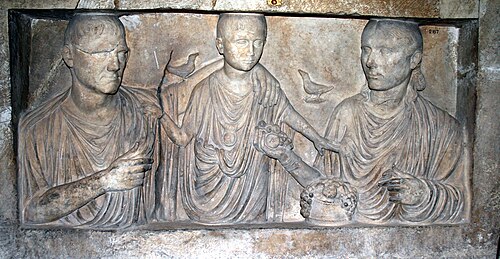
ローマの保守主義は、紀元前92年の監察官の勅令に簡潔に表現されており、2世紀の歴史家スエトニウスによって保存されている。「我々の祖先の慣習や慣例に反して行われる新しいことはすべて、正しくないと思われる。」[ 9 ]しかし、mos maiorumは成文法ではなく慣習の問題であったため、それが体現する複雑な規範は時間の経過とともに進化しました。変化する状況に適応しながら、強く中央集権的なアイデンティティの感覚を維持する能力は、ローマを都市国家から世界的な強国へと押し上げた拡張主義を可能にしました。[ 10 ] mos maiorumの維持は、権力と地位をめぐる競争によって脅かされていた支配エリート間の合意と穏健さに依存していました。[ 11 ]
Democratic politics, driven by the charismatic appeal of individuals (populares) to the Roman people (populus), potentially undermined the conservative principle of the mos.[12] Because the higher magistracies and priesthoods were originally the prerogative of the patricians, the efforts of plebeians (the plebs) for access could be cast as a threat to tradition (see Conflict of the Orders). Reform was accomplished by legislation, and written law replaced consensus.[13] When plebeians gained admission to nearly all the highest offices, except for a few arcane priesthoods, the interests of plebeian families who ascended to the elite began to align with those of the patricians, creating Rome's nobiles, an elite social status of nebulous definition during the Roman Republic.[14] The plebs and their support of popular politicians continued as a threat to the mos and elite consensus into the late Republic, as noted in the rhetoric of Cicero.[15]
During the transition to the Christian Empire, Quintus Aurelius Symmachus argued that Rome's continued prosperity and stability depended on preserving the mos maiorum, and the early Christian poet Prudentius dismissed the conservative adherence to native Roman traditions as "the superstition of old grandpas" (superstitio veterum avorum) and inferior to the new revealed truth of Christianity.[16]
↑第二次サムニウム戦争は、この新しいエリート層の形成において重要な時期でした。ET Salmon著『Samnium and the Samnites』(Cambridge University Press、1967年)、217ページ、およびErich S. Gruen著「 Patrocinium and Clientela」、『 The Hellenistic World and the Coming of Rome 』 (University of California Press、1984年)、163ページ(オンライン版)を参照してください。
↑ TP Wiseman、『Clio's Cosmetics』(Leicester University Press、1979年)、67~69ページ、85ページ、および随所。