
Loading article…


ミトラ教はミトラ秘儀あるいはミトラス崇拝としても知られ、ミトラス神を中心としたローマの 秘儀宗教である。イランのゾロアスター 教の神(ヤザタ)ミトラ崇拝に触発されたものの、ローマのミトラスは新しい独特のイメージと結びついており、ペルシャとギリシャ・ローマの慣習の連続性のレベルは議論の余地がある。[a] ミトラ秘儀は紀元1世紀から4世紀にかけてローマ帝国軍の間で人気があった。 [2]
ミトラスの崇拝者たちは、7段階の入会儀式と共同の儀式食という複雑なシステムを持っていた。入会者たちは自分たちを「握手で結ばれた者」を意味するシンデキシオイと呼んだ。 [b]彼らは、現在も数多く残っている地下神殿、ミトラエア(単数形はミトラエウム)に集まった。このカルトはローマを中心としていたようで、[3]ローマ帝国の西半分、南はローマ領アフリカとヌミディア、東はローマ領ダキア、北はローマ領ブリテン島にまで広まっていた[4] (pp 26–27) 、東はローマ領シリアでも小規模ながら広まっていた[3] 。
ミトラ教は初期キリスト教のライバルと見なされている。[5] (p 147) 4世紀にはミトラ教徒はキリスト教徒からの迫害に直面し、その後この宗教はローマ帝国でその世紀末までに抑圧され、排除された。[6]
ローマ帝国全土で、集会場所、記念碑、遺物など、数多くの考古学的発見がミトラ教に関する現代の知識に貢献してきました。[c]ミトラスの象徴的な場面は、 彼が岩から生まれ、雄牛を屠り、太陽神と宴を共にする様子を示しています。約 420 の遺跡からこの信仰に関連する資料が発見されています。発見された品々の中には、約 1000 の碑文、雄牛を殺す場面 (タウロクトニー) の 700 の例、および約 400 のその他の記念碑があります。[4] (p xxi)ローマ市内には少なくとも 680 のミトラ教 があったと推定されています 。 [8] [全文引用が必要]この宗教に関する文書による物語や神学は残っておらず、碑文やギリシャ語およびラテン語の文献の短いまたは一瞥的な言及から得られる情報は限られています。物理的証拠の解釈は依然として問題があり、議論の的となっています。[d]
名前
「ミトラ教」という用語は現代の慣例である。ローマ時代の著述家は、この宗教を「ミトラ教の秘儀」「ミトラスの秘儀」「ペルシャ人の秘儀」などの語句で呼んでいた。[1] [e]現代の文献では、ギリシャ・ローマの宗教をペルシャのミトラ崇拝と区別するために、ローマのミトラ教または西方ミトラ教 と呼ぶことがある。[1] [f]
語源

ミトラス(ラテン語、ギリシャ語のΜίθραςに相当[11])という名前は、ミトラ(ゾロアスター教以前の古代、後にゾロアスター教となった神の名前)の一種である[g] [h]。この関係はフランツ・キュモントの時代からミトラ教の学者によって理解されていた[i]。 この名前のギリシャ語形の初期の例は、紀元前4世紀のクセノポンの著作『キュロパエディア』にある。これはペルシャ王キュロス大王の伝記である[13]。
ラテン語や古典ギリシャ語の単語の正確な形は、文法的な語形変化の過程により変化する。ラテン語の崇拝者が神の名前の主格を「ミトラス」と書いたという考古学的証拠がある。ポルピュリオスのギリシャ語テキスト『禁欲論』(Περὶἀποχῆς ἐμψύχων)には、現在は失われているエウブロスとパラスのミトラ教の秘儀の歴史への言及があり、その文言から、これらの著者が「ミトラ」という名前を不可用な外国語として扱っていたことが示唆されている。[j]
他の言語での関連する神の名前には以下のものがあります:
- ヴェーダ語のサンスクリット語のミトラは「友人、友情」を意味し、リグ・ヴェーダで称賛される神の名前である。[15] [16] [k] [17]
サンスクリット語では、ミトラは太陽神の珍しい名前であり、主に「スーリヤ」または「アディティヤ」として知られています。[18]
- mi-it-ra-という形は、紀元前1400年頃のヒッタイトとミタンニ王国の間の平和条約の碑文に見られる。 [l]ヒッタイトの王スッビルリウマとミタンニの王マティヴァザの間の条約。...これは小アジアにおけるミトラスの最古の証拠である。[18] [19]
イラン語のミトラとサンスクリット語のミトラは、インド・イラン語の「契約、合意、契約」を意味するミトラスに由来すると考えられている。 [20]
現代の歴史家は、これらの名前が同じ神を指しているかどうかについてさまざまな考えを持っています。ジョン・R・ヒンネルズは、ミトラ/ミトラ/ミトラスを、いくつかの異なる宗教で崇拝されている単一の神として書いています。 [21]一方、デイヴィッド・ウランジーは、雄牛を殺すミトラスは紀元前1世紀に崇拝され始めた新しい神であり、古い名前が付けられたと考えています。[m]
古代イランの宗教を研究する学術研究者のメアリー・ボイスは、ローマのミトラ教は古代ローマ人や現代の歴史家が考えていたほどイラン的要素は少なかったようだが、それでも「ミトラスという名前だけでもわかるように、この要素はある程度重要だった」と書いている。[n]
図像学

ミトラス信仰については、レリーフや彫刻からしかほとんど知られていません。この資料を解釈する試みは数多く行われてきました。
ローマ帝国におけるミトラス崇拝は、神が雄牛を屠る像によって特徴づけられた。ローマの神殿には、ミトラスがソルと宴会をする像や、岩からミトラスが生まれる様子を描いた像など、ミトラスの他の像も見られる。しかし、雄牛を屠る像(タウロクトニー)は常に中央の壁龕にある。[9] (p 6)この図像学の背後にある神学を再構築するための文献資料は非常に少ない。[o] (以下の「雄牛を屠る場面の解釈」のセクションを参照。)
神が雄牛を殺す様子を描くという習慣は、ローマのミトラ教に特有のものと思われる。デイビッド・ウランジーによれば、これは「おそらくイランとローマの伝統の明らかな違いの最も重要な例」である。「イランの神ミトラが雄牛を殺すことと何らかの関係があったという証拠はない」[9] (p 8)
雄牛を殺すシーン
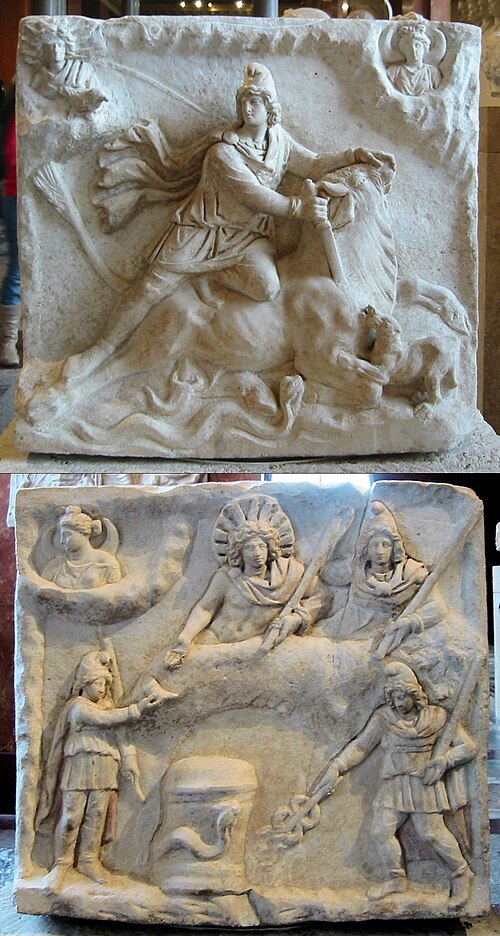
どのミトラ神殿でも、中央にはミトラスが神聖な雄牛を殺す、タウロクトニーと呼ばれる行為を描いたものがあった。[p] [q] この像は浮彫りか独立型で、側面の細部はあったり省略されていたりする。中央にはアナトリアの衣装を着てフリギア帽をかぶったミトラスが描かれている。彼は疲れ果てた雄牛の上にひざまずき、左手で雄牛の鼻孔をつかみ[4] (p 77)、右手で雄牛を刺している。そうしながら、彼は肩越しにソルの像の方を見ている。犬と蛇が血の方に手を伸ばしている。サソリが雄牛の性器を掴んでいる。ワタリガラスが飛び回っているか、雄牛の上に止まっている。雄牛の尻尾、時には傷口から、1つまたは3つの麦の穂が出ているのが見える。雄牛は白色であることが多かった。神は不自然な姿勢で雄牛の上に座り、右足で雄牛の蹄を押さえ、左足は曲げて雄牛の背中か脇腹に乗せている。[r]両側にいる二人の松明持ちはミトラスのような服装をしている。カウテスは松明を上に向けており、カウトパテスは松明を下に向けている。[4] (p 98–99) [24]カウテスとカウトパテスは松明の代わりに羊飼いの杖を持っていることもある。[25]

この出来事は洞窟で起こる。ミトラスは牡牛を狩り、乗り、その力を圧倒した後、その牡牛を洞窟に運び込んだのである。[4] (p 74)洞窟は円で囲まれることもあり、その円には黄道十二星座が描かれている。洞窟の外、左上には太陽の神ソルがいて、燃える冠をかぶり、四輪馬車に乗っていることが多い。光線が下に向かって伸びてミトラスに触れることもよくある。右上には三日月をつけたルナがいて、ビガに乗っている姿で描かれることもある。[26]
いくつかの描写では、中央のタウロクトニーは、ミトラス物語の出来事を描いた一連の補助的な場面によって左、上、右に囲まれている。その場面とは、岩から生まれたミトラス、水の奇跡、雄牛の狩猟と乗り、彼にひざまずくソルとの出会い、ソルと握手して彼と雄牛の部分を分け合うこと、そして戦車に乗って天に昇ることなどである。[26]ローマのサンタ・プリスカ・ミトラエウムのスタッコのイコンの場合のように、いくつかの例では、神は勇敢な裸体で示されている。[s]これらのレリーフのいくつかは、軸を中心に回転できるように構築されました。裏側には、別の、より精巧な饗宴の場面がありました。これは、雄牛を殺す場面が祝典の最初の部分で使用され、その後レリーフが回転され、2番目の場面が祝典の2番目の部分で使用されたことを示しています。[28] 主要な崇拝の象徴の他に、多くのミトラス像にはいくつかの二次的なタウロクトニーがあり、おそらく個人的な信仰のために意図された小さな持ち運び可能なバージョンもいくつか発見されています。[29]
バンケット
ミトラ教美術においてタウロクトニーに次いで二番目に重要な場面は、いわゆる宴会の場面である。 [ 30 ] (pp 286–287 )宴会の場面では、ミトラスとソル・インウィクトゥスが屠殺された雄牛の皮の上で宴会をしている。[30] (pp 286–287)フィアーノ・ロマーノのレリーフに描かれたこの宴会の場面では、松明持ちの一人がカドゥケウスを祭壇の土台に向けており、そこから炎が湧き上がっているように見える。ロバート・トゥルカンは、カドゥケウスはメルクリウスの属性であり、神話ではメルクリウスは霊魂の導き手として描かれているため、この場面で炎が燃え上がることは人間の魂の放出を意味し、このことに関するミトラ教の教義を表現していると主張した。[31]トゥルカヌスはまた、この出来事をタウロクトニーと結び付けています。殺された雄牛の血が祭壇の土台部分の地面を濡らし、その血から魂がカドゥケウスの炎によって引き出されたのです。[31]
岩からの誕生
ミトラスは岩から生まれた姿で描かれている。彼は若く、片手に短剣、もう片手に松明を持ち、岩から現れた姿で描かれている。彼は裸で、足を閉じて立っており、フリギア帽をかぶっている。[32]
いくつかのバリエーションでは、彼は子供の姿で岩から現れ、片手に地球儀を持っているか、時には雷が見られる。岩から炎が噴き出している描写や、ミトラスの帽子から炎が噴き出している描写もある。ある像は、噴水として機能できるように台座に穴が開けられており、別の像の台座には水神の仮面がある。ミトラスは弓矢などの他の武器を持っていることがあり、犬、蛇、イルカ、ワシ、その他の鳥、ライオン、ワニ、ロブスター、カタツムリなどの動物も周囲にいる。いくつかのレリーフには、水の神オケアノスであると特定されるひげを生やした人物がおり、他のレリーフには四方の風の神々がいる。これらのレリーフでは、4つの要素が一緒に呼び出されることがある。ビクトリア、ルナ、ソル、サターンも役割を果たしているように見えることがある。特にサトゥルヌスは、後にタウロクトニーで使用される短剣や短剣をミトラスに渡す場面がよく見られます。[32]
いくつかの描写では、カウテスとカウトパテスも登場し、羊飼いとして描かれることもある。[33]
いくつかの例ではアンフォラが見られ、卵の誕生や木の誕生などのバリエーションがいくつか示されています。いくつかの解釈では、ミトラスの誕生は松明やろうそくを灯して祝われたことを示しています。[32] [34]
ライオンの頭の像


ミトラ教の秘儀の最も特徴的でありながらあまり理解されていない特徴の 1 つは、ミトラ教の寺院によく見られる裸のライオンの頭の像であり、現代の学者はこれを、 leontocephaline (ライオンの頭) やleontocephalus (ライオンの頭) などの説明的な用語で名付けています。
ライオンの体は裸の男の体で、蛇(またはカドゥケウスのような二匹の蛇)が絡みついており、蛇の頭はライオンの頭の上に載っていることが多い。ライオンの口は開いていることが多い。通常、四つの翼、二つの鍵(時には一つの鍵)、そして手に王笏を持っている姿で表現される。時には、斜めの十字が刻まれた地球儀の上に立っている。オスティア・アンティカ・ミトラエウムの像(左、CIMRM [35] 312)では、四つの翼に四季のシンボルが描かれ、胸には雷が刻まれている。像の台座には、ウルカヌスの槌と火ばし、メルクリウスの ペニスと杖(カドゥケウス)がある。同じ像の珍しいバリエーションとして、胸から人間の頭とライオンの頭が生えているものもある。[36] [37]
動物の頭を持つ人物像は現代のエジプトやグノーシス派の神話表現では一般的であるが、ミトラ教のレオントセファリンの人物像と完全に一致するものは発見されていない。[36]
祭壇に奉納された碑文に基づいて、この像の名前はアリマニウスであると推測される。これは、ゾロアスター教の神々の中の悪魔的存在であるアフリマン[t]のラテン語形 である。アリマニウスは、碑文からミトラ教の神であったことが知られており、例えば、オスティアのCIMRM [35] 222 、ローマのCIMRM 369、パンノニアのCIMRM [35] 1773と1775などのミトラ教の碑文と記念碑(CIMRM [35] )の画像に見られる。[38]
学者の中には、ライオンの男をアイオン、ズルヴァン、クロノス、クロノスと特定する者もいるが、ゾロアスター教のアフラマナ、あるいはより温和なヴェーダのアリヤマンの一種であると主張する者もいる。[u] ライオンの頭を持つ人物の正確な正体は学者の間で議論されているが、この神は時間と季節の変化に関連しているという点では大方の意見が一致している。[40] (p 94)
儀式と礼拝
MJ ヴェルマセレンとCC ヴァン・エッセンによれば、ミトラ教の新年とミトラスの誕生日は12月25日であった。[v] [w] ベックはこれに強く反対した。[43] (p 299、注12) クラウスは次のように述べている。
- 「ミトラ教の秘儀には独自の公的な儀式はなかった。 12月25日に行われたナタリス・インヴィクティ祭は太陽の一般的な祭典であり、決してミトラスの秘儀に特有のものではなかった。」[44]
ミトラ教の入信者は秘密と献身の誓いを立てることが求められた。[45]
ミトラスはギリシャの英雄に似た「戦士の英雄」であると考えられていた。[46]
ミトラ教の教理問答
どうやら、いくつかの位階の儀式には教理問答の暗唱が含まれていたようで、その中で入会者は入会の象徴に関する一連の質問を受け、具体的な答えを返す必要があった。獅子座位階に関すると思われるそのような教理問答の例が、エジプトのパピルスの断片(パピルス・ベロリネンシス 21196)[45] [47]で発見され、次のように書かれている。

ミトラ教の聖典やその極秘儀式に関する直接の記録はほとんど残っていない。[o]前述の誓約書と教理問答書、および4世紀エジプトのミトラス典礼として知られる文書は例外で、フランツ・キュモントなどの学者によってミトラス教の文書としての地位が疑問視されている。[x] [48]ミトラ教の壁は一般的に白塗りで、それが残っている場所では落書きが大量に残されている傾向があり、これらとミトラス教の記念碑の碑文がミトラス教の文書の主な情報源となっている。[49]
ごちそう
数多くのミトラ教の考古学から、ほとんどの儀式が祝宴と関連していたことは明らかである。食器や食物の残渣がほぼ例外なく発見されているからである。これらには動物の骨だけでなく、非常に大量の果物の残渣も含まれる傾向がある。[4] (p 115)特に大量のチェリーの種が存在することは、夏至 (6 月下旬から 7 月上旬) がミトラ教の祝祭と特に関連のある季節であったことを裏付ける傾向がある。碑文入りの青銅板の形のヴィルヌム アルバムには、184 年 6 月 26 日に行われたミトラ教の記念祭が記録されている。ベックは、この日に宗教的な祝祭が行われることは夏至に特別な意味が与えられていることを示しているが、この時期は夏至に太陽活動が最大になると古代に認識されていた時期と一致しており、この時期にはリサ、聖ヨハネの前夜、ヤニなどの図像的に同一の祝日も祝われる。
ミトラ教の信者は、宴会では、ミトラ神殿の長い辺に沿って並べられた石のベンチに横になった。通常は15人から30人が食事できるスペースがあったが、40人以上が座れることは非常に稀だった。[4] (p 43)ローマ帝国のほぼすべての寺院や宗教的聖域の地上には、対応する食堂、つまりトリクリニアがあり、そのような部屋はローマの「クラブ」、つまりコレッギアによる定期的な宴会によく使われていた。ミトラ教の宴会は、おそらく、コレッギアが参加資格のある人々にとって果たしたのと非常によく似た機能をミトラ教徒にとって果たしていた。実際、ローマのコレッギアへの参加資格は特定の家族、地域、または伝統的な職業に限定される傾向があったため、ミトラ教は、クラブを持たない人々にクラブを提供するという機能もあったのかもしれない。[50]ミトラ神殿の大きさは、必ずしも信徒の数を示すものではない。[27] (12ページ、36ページ)
祭壇、図像、そして教義の多様性の疑い
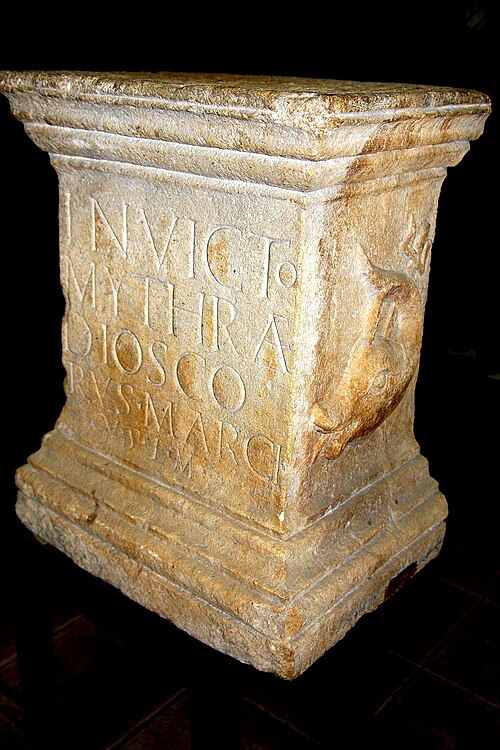
各ミトラエウムには、タウロクトニーの表現の下の奥にいくつかの祭壇があり、また、ミトラエウムの主室と控え室またはナルテクスの両方にかなりの数の補助祭壇が含まれているのが一般的でした。[4] (p 49)これらの祭壇は標準的なローマのパターンで、それぞれ特定の入信者による献呈碑文が刻まれており、入信者は「誓いの達成」として、受けた恩恵への感謝として、ミトラスに祭壇を捧げました。
動物の内臓の焼けた残骸が主祭壇でよく見つかっており、定期的に犠牲が捧げられていたことを示しているが、ミトラエには儀式的に犠牲動物を屠殺する設備(ローマの宗教では高度に専門化された機能)が備えられていたようには見えない。ミトラエウムは市民崇拝の専門の犠牲者[51] (p 568)と協力してこのサービスを提供するための手配をしていたと推測できる。祈りは1日3回太陽に捧げられ、日曜日は特に神聖であった[52] 。
ミトラ教が単一で内部的に一貫した教義を持っていたかどうかは疑わしい。[y] 場所によって異なっていたかもしれない。[30] (p 16)図像は比較的首尾一貫している。[26]支配的な聖域や宗教の中心地はなく、各ミトラ教団には独自の役員や役人がいたものの、中央の監督機関はなかった。ドゥラ・エウロポスにあるミトラ教団など、一部のミトラ教団では、壁画に巻物を携えた預言者が描かれているが、[54]名前の知られたミトラ教の賢者はおらず、ミトラ教の聖典や教えの題名を示す文献もない。入信者は階級とともにミトラ教団から別のミトラ教団に移ることができたことが知られている。[4] (p 139)
ミトラエウム

ミトラスの神殿は地下に埋め込まれ、窓がなく、非常に特徴的である。都市では、アパートの地下室を改造したこともあるし、他の場所では、掘削してアーチ型天井にしたり、自然の洞窟を改造したりしたこともある。ミトラス神殿は帝国で一般的であるが、分布は不均一で、ローマ、オスティア、ヌミディア、ダルマチア、ブリテン、ライン川/ドナウ川の国境沿いにかなりの数があり、ギリシャ、エジプト、シリアではやや少ない。[4] (pp 26–27)ウォルター・ブルケルトによると、ミトラスの儀式の秘密の性質は、ミトラ教がミトラエウム内でのみ実践できることを意味していた。[55]ティーネンでの新しい発見のいくつかは、大規模な祝宴の証拠を示しており、この神秘的な宗教が一般に信じられていたほど秘密主義ではなかった可能性があることを示唆している。[z]
ほとんどの場合、ミトラは小さく、外観は目立たず、安価に建設される傾向がある。ミトラ教団は、既存のセンターを拡張するよりも、新しいセンターを建設することを一般的に好んだ。ミトラエウムは、ミトラスが雄牛を運び殺した洞窟を表しており、石造りの天井を作る余裕がない場合は、木枠と漆喰でその効果を模倣した。ミトラエウムは、泉や小川の近くに建てられるのが一般的である。一部のミトラ教の儀式には真水が必要だったようで、構造物に水盤が組み込まれることが多い。[4] (p 73)入り口には通常、ナルテックスまたは控えの間があり、貯蔵や食事の準備のための補助的な部屋が他にもあることが多い。現存するミトラは、ミトラ教の神聖な空間の建築構造の実際の物理的な遺跡を私たちに提供している。ミトラエウムは現代の造語であり、ミトラ教徒は彼らの神聖な建造物を、スペレウムまたはアントラム(洞窟)、クリプタ(地下の廊下)、ファヌム(神聖な場所)、さらにはテンプルム(寺院または神聖な空間)と呼んでいました。[aa]
基本的な形態において、ミトラは他のカルトの寺院や神社とは全く異なっていた。ローマの宗教的境内の標準的なパターンでは、寺院の建物は神の家として機能し、開かれた扉と円柱の柱廊を通して、中庭に設置された祭壇で捧げられる犠牲の礼拝を神が見ることができるように意図されていた。祭壇はカルトの入信者だけでなく、コリトーレスや入信者でない崇拝者もアクセス可能だった。[51] (p 493)ミトラはこれとは正反対であった。[51] (p 355)
入門の程度
スーダの「ミトラス」の項には、「段階的なテストを受けて神聖で堅固な者であることを示さない限り、誰もそれら(ミトラスの秘儀)に参入することは許されなかった」と記されている。[56] グレゴリー・ナジアンゼンは「ミトラスの秘儀におけるテスト」について言及している。[57]
ミトラ教の入門には 7 つの位階があり、聖ヒエロニムスがそれを列挙している。[58]マンフレート・クラウスは、位階の数である 7 は惑星と関連しているに違いない、と述べている。オスティア・アンティカのフェリチシモスのミトラエウムにあるモザイク画には、位階と関連しているか惑星のシンボルである象徴的な紋章とともにこれらの位階が描かれている。位階の横には、各位階をさまざまな惑星の神々の保護に委ねる碑文もある。[4] : 132–133 重要性の昇順で並べると、入門位階は以下のとおりである。[4] (p 133–138)
ドゥラ・エウロポスなど他の場所では、ミトラ教の落書きが会員名簿とともに残っており、そこにはミトラ教の位階とともにミトラ教の入会者の名前が記されている。ヴィルヌムでは、会員名簿、つまりアルバム・サクラトルムが銘板として保管され、毎年新しい会員が入会するたびに更新されていた。これらの名簿を相互参照することで、あるミトラ教から別のミトラ教へと入会者を追跡することができる。また、推測ではあるが、ミトラ教の入会者を、兵役名簿や非ミトラ教の聖域の信者名簿など、同時代の他の名簿に載っている人物と特定することもできる。入会者の名前は、祭壇やその他の崇拝物の奉納碑文にも見られる。
クラウスは1990年に、西暦250年以前に刻まれたミトラ教の名前のうち、入信者の位階を示すものはわずか14%程度であると指摘し、すべての入信者が7つの位階のいずれかに属していたという伝統的な見解に疑問を呈した。[59]クラウスは、位階は司祭、つまり聖職者の明確な階級を表していると主張している。ゴードンはメルケルバッハらの以前の理論を支持しており、特にドゥラなどの名前がすべてミトラ教の位階に関連付けられている例を指摘している。一部の学者は、慣習は時代とともに、あるいはミトラ教団ごとに異なっていた可能性があると主張している。
最高位のパテルは、献呈文や碑文に見られる最も一般的な位階であり、ミトラエウムにこの位階の男性が複数いるのは珍しいことではなかったようだ。パテル・パトルム(父の父)という形がよく見られ、これはパテルが第一位の地位にあることを示しているようだ。特に4世紀の「異教復興」期のローマでは、社会的地位の高い人がパテルの地位でミトラエウムに加わった例がいくつかある。一部のミトラエウムは、同情的な高官に名誉パテルの地位を与えた可能性もあると示唆されている。[60]
各階級の入会者は、熱や寒さ、または危険にさらされる特定の試練や試験を受けることが求められたようです。 [4] (p 103) 3世紀初頭に遡る「試練の穴」が、カラバラのミトラエウムで確認されています。皇帝コモドゥスの残酷さに関する記述では、彼が殺人の形でミトラ教の入会試練を実行して楽しんでいたことが記されています。3世紀後半までに、「試練の穴」が床で覆われたため、実行された試練の厳しさは緩和されたようです。
共同体への入会は、ミトラスとソルが握手したように、パテルとの握手で完了した。そのため、入会者はsyndexioi (握手で結ばれた者)と呼ばれた。この用語はプロフィケンティウス[b]の碑文で使用されており、フィルミクス・マテルヌス によって、 異教を攻撃した 4 世紀のキリスト教の著作「De errore profanarum religionum」[61]で嘲笑されている。 [62]古代イランでは、右手を握ることは、条約を締結したり、2 者間の厳粛な合意を示す伝統的な方法であった。[63]
儀式の再現

ミトラ教の場面で最も目立つ神々であるソルとミトラスの活動は、カルトの階層構造における最上級の2人の役人であるパテルとヘリオドロモスによって儀式で模倣されました。[30] ( p 288–289)入信者は、ミトラスとソルの饗宴を再現した聖餐の宴会を開催しました。[30] (p 288–289)
マインツで発見されたカップのレリーフ[64] [65]は、ミトラ教の入信儀式を描いているようです。カップには、入信者が、弓を引き絞ったミトラスの姿のパテルが座っている場所に導かれる様子が描かれています。入信者には秘伝官が同行し、入信者に象徴と神学を説明します。この儀式は、ミトラスが岩に矢を放ち、岩から水が噴き出す「水の奇跡」と呼ばれるようになったものを再現したものと考えられています。
ロジャー・ベックは、マインツの杯とポルフィリスに基づいて、3番目のミトラ教の行列儀式を仮説しました。「太陽を走る者の行列」と呼ばれるこの場面では、ヘリオドロモスがカウテスとカウトパテスを表す2人の人物(下記参照)に護衛され、その前にマイルス階級の入信者が、宇宙を表すことを意図したミトラエウムの周りを太陽が旅する儀式を先導しています。[66]
その結果、ミトラ教の儀式の大半は、ミトラス物語のエピソードを入信者が再現したものだったと主張されてきた。[4] (pp 62–101)この物語の主な要素は、岩からの誕生、矢を放って石から水を射抜くこと、雄牛の殺害、ソルのミトラスへの服従、ミトラスとソルによる雄牛の宴、ミトラスの戦車による天への昇天である。この物語 (および現存するレリーフ彫刻の通常の描写) の顕著な特徴は、女性人物がいないことである (唯一の例外は、ヘリオスの反対側の上隅でタウロクトニーを見守るルナと、ニンフ階級 の守護神としておそらくヴィーナスが存在していることである)。[4] (p 33)
メンバーシップ

現存する会員名簿には男性の名前のみが記載されている。キュモントやリチャード・ゴードンを含む歴史家は、このカルトは男性のみを対象としていたと結論付けている。[ab] [ac]
古代学者ポルピュリオスは、ミトラ教の儀式に女性が参加したと述べている。[ad] 20世紀初頭の歴史家ASゲデンは、これは誤解によるものかもしれないと書いている。[2]ゲデンによると、女性が儀式に参加することは東方カルトでは珍しいことではなかったが、ミトラ教では軍事力が優勢であるため、この場合はありそうにない。[2]最近、デイヴィッド・ジョナサンは「帝国の少なくとも一部の地域では、女性がミトラ教のグループに関わっていた」と示唆している。[69] (p 121)
ミトラ教徒の中には兵士が多く、商人、税関職員、下級官僚も多かった。4世紀半ばの「異教復興」までは、有力貴族や元老院議員の家族から入信者が出たことはほとんどなかったが、解放奴隷や奴隷の数は常に相当数いた。[4] (p 39)
倫理
クラウスは、ポルピュリオスの「ライオン階級に入会した人々は、痛みや害をもたらす不純なものすべてから手を清く保たなければならない」という発言は、会衆のメンバーに道徳的要求が課されたことを意味すると示唆している。[ae]
背教者ユリアヌスの『皇帝列伝』の一節には「ミトラスの戒律」について言及されている。[af]テルトゥリアヌスは、その論文「軍冠について」の中で、軍隊のミトラス信者は、ミトラスの入会儀式で差し出された冠を拒否する規定があったため、祝賀用の冠の着用を公式に免除されていたと記録している。なぜなら「彼らの唯一の冠はミトラスのものだった」からである。[70]
歴史と発展
ローマ秘儀以前のミトラス


考古学者マールテン・ヴェルマセレンによれば、紀元前1世紀のコンマゲネ遺跡から発見された証拠は「ミトラス神への崇敬」を示しているが、「秘儀」については言及していない。[ag]アンティオコス1世(紀元前69年 - 紀元前34年)がネムルート山に 建てた巨大な彫像では、ミトラスは髭がなく、フリギア帽[3] [73] (または同様の頭飾りであるペルシャのティアラ)をかぶり、イラン(パルティア)の衣装を着て[71]、もともとは他の神々や王自身とともに玉座に座っていた。[74] 玉座の裏にはギリシャ語で刻まれており、アポロ・ミトラス・ヘリオスの複合名が属格で記されている(Ἀπόλλωνος Μίθρου Ἡλίου)。[75] ヴェルマセレンは紀元前3世紀のファイユームにおけるミトラス信仰についても報告している 。 [39] (p 467) RDバーネットは紀元前 1450年頃のミタンニのソーサタール 王の王印章にはタウロクトンのミトラスが描かれていると主張している。[ah]
ローマのミトラ教の始まり
秘儀の起源と広がりについては、学者の間で激しい議論が交わされており、これらの問題については根本的に異なる見解がある。[76]クラウスによれば、ミトラスの秘儀は紀元後 1 世紀まで行われていなかった。[4]ウランセイによれば、ミトラスの秘儀に関する最も古い証拠は、紀元前 1 世紀中頃に出現したとされている。歴史家プルタルコスは、紀元前 67 年にキリキア(小アジア南東海岸の属州で、隣接するコンマゲネへの海路を担っていた) の海賊がミトラスの「秘密の儀式」を行っていたと述べている。[ai] CM ダニエルズによれば、[78]これらのことが秘儀の起源に関係しているかどうかは不明である。[aj] 独特の地下神殿、つまりミトラは、紀元後 1 世紀の最後の四半期に考古学に突然登場する。[79] (p 118)
最古の考古学
ミトラ教の秘儀に関する碑文や記念碑は、マールテン・J・ヴェルマセレンの2巻本『ミトラ教の碑文と記念碑集』(CIMRM)に収録されている。[35]ミトラスが牡牛を殺す様子を描いた最古の記念碑は、ローマで発見されたCIMRM 593と考えられている。日付は記されていないが、碑文には、ティモシー・クラウディウス・リウィアヌスの執事アルキムスによって奉納されたことが記されている。ヴェルマセレンとゴードンは、このリウィアヌスとは、紀元101年に親衛隊の指揮官を務めていたリウィアヌスであると信じており、最古の年代は紀元98~99年となる。[80]
クリミア半島のケルチ近郊で、雄牛の上にナイフを構える人物像を描いた小さなテラコッタ板が 5 枚発掘され、ベスコフとクラウスは紀元前 1 世紀後半[ak]、ベックは紀元前 50 年から紀元後 50 年頃のものと推定している。ミトラス神を描いたものと認められれば、これらは最も古いタウロクトニーである可能性がある。[al]
牛を殺している像はフリギア帽をかぶっているが、ベックとベスコフは、タウロクトニーの標準的な描写とは異なると述べている。これらの遺物をミトラ教の秘儀と関連づけないもう 1 つの理由は、これらの銘板の最初のものが女性の墓で発見されたことである。[am]
ローマのエスクイリーノにある聖ピエトロ・エ・マルチェリーノ教会付近の祭壇またはブロックには、おそらく西暦80年から100年の間に、帝国の解放奴隷T.フラウィウス・ヒュギヌスによってバイリンガルの碑文が刻まれている。それはソル・インウィクトゥス・ミトラスに捧げられている。[an]
CIMRM [35] 2268は、モエシア・インフェリオルのノヴァエ/ステクレンから発見された、紀元100年頃の壊れた台座または祭壇で、カウテスとカウトパテスが描かれています。
その他の初期の考古学上の遺物としては、ヴェノシアで発見されたサガリス・アクトールによるギリシャ語の碑文(おそらく紀元100~150年)、ミトラスの司祭テオドトスがアスクレピオスに捧げたシドンの碑文(紀元140~141年)、そしてドナウ川沿いのカルヌントゥムで発見された、おそらく紀元114年以前の、アポリナリス15世の百人隊長、C.サキディウス・バルバルスによる最古の軍事碑文などがある。[14] (150ページ)
CM ダニエルズによると、[78]カルヌントゥムの碑文はドナウ川流域で作られた最も古いミトラ教の奉納物であり、ドナウ川流域はイタリアとともにミトラ教が最初に根付いた 2 つの地域のうちの 1 つです。[ao] ローマ以外で年代が判明している最も古いミトラ神殿は西暦 148 年のものです。[ap]カエサレア・マリティマのミトラ神殿はパレスチナで唯一のもので、年代は推測です。[aq]
最も古いカルトの場所
ロジャー・ベックによれば、ローマの崇拝の最も初期の段階(紀元 80~120年頃)における証明された場所は以下の通りである。[30] (pp 34~35)
陶器から年代が判明したミトラエア
- ニダ/ヘデルンハイム III (ゲルマニアSup.)
- モゴンティアクム(ゲルマニア属)
- ノリクム橋
- カイサリア・マリティマ(ユダヤ)
日付指定可能な献辞
- ニダ/ヘデルンハイム I (ゲルマニア補助) ( CIMRM [35] 1091、1092、および 1098)
- Carnuntum III (パンノニアスープ) ( CIMRM [35] 1718)
- ノバエ(モエシアInf.) ( CIMRM [35] 2268 & 2269)
- オエスカス(モエシア国際空港) ( CIMRM 2250)
- ローマ(CIMRM [35] 362、593、594)
ミトラスと神秘に関する古典文学

ボイスによれば、秘儀に関する最も古い文学的言及は、西暦80年頃のラテン詩人スタティウスと、西暦100年頃のプルタルコスによるものである。[22] [ar]
スタティウス
スタティウスの叙事詩『テーバイド』(紀元 80年頃[9] (p 29) )には、洞窟の中で角のあるものと格闘するミトラスの姿が描かれている。[85] 文脈は、ポイボス神への祈りである。[86] 洞窟はperseiと表現されており、この文脈では通常ペルシャ語と訳される。翻訳者の JH モズリーによると、これは文字通りペルシア語を意味し、ペルセウスとアンドロメダの息子ペルセースを指している。[9] (p 29)このペルセースは、ギリシャの伝説によるとペルシャ人の祖先である。[9] (pp 27–29)
殉教者ジャスティス
紀元145年頃、初期キリスト教の弁護者 ユスティノス殉教者は、ミトラ教がキリスト教の聖体拝領を模倣していると非難した。
- 邪悪な悪魔たちは、ミトラスの秘儀を真似て、同じことをするように命じました。というのも、パンと一杯の水が、特定の呪文とともに、入会者の秘儀に置かれることは、あなたがたも知っているか、あるいは学ぶことができるからです。[87]
プルタルコス
ギリシャの伝記作家プルタルコス(紀元46年 - 127年)は、紀元前1世紀に活動していたアナトリア南東部の沿岸地方キリキアの海賊が「ミトラスの秘密の秘儀」を行っていたと述べている。「彼らは同様に奇妙な供儀を捧げた。つまりオリンポスの供儀だ。また、彼らはいくつかの秘密の秘儀を執り行っていたが、その中にはミトラスの秘儀があり、もともと彼らによって制定されたもので、今日まで続いている。」[88] 彼は、海賊が特に活発に活動していたのは、ローマ共和国とポントス王ミトリダテス6世の間のミトリダテス戦争で、海賊は王を支援したと述べている。[88]ミトリダテスと海賊の関係は、古代の歴史家アッピアノスも言及している。[89]セルウィウスによる4世紀のウェルギリウス 注釈では、ポンペイウスがこれらの海賊の一部をイタリア南部のカラブリアに定住させたと述べている。[90]
ディオ・カッシウス
歴史家ディオ・カッシウス(紀元2~3世紀)は、ネロの治世中にアルメニアのティリダテス1世がローマを公式訪問した際に、ミトラスの名前がどのように語られたかを述べている。(ティリダテスはパルティアのヴォノネス2世の息子であり、紀元66年にネロによって戴冠されたことでパルティアとローマの戦争は終結した。)ディオ・カッシウスは、ティリダテスが戴冠を受ける直前にローマ皇帝に「ミトラスとして」崇拝していると語ったと書いている。[91]ロジャー・ベックは、このエピソードがローマでミトラ教が大衆宗教として出現する一因となった可能性があると考えている。[as]
斑岩

哲学者ポルピュリオス(紀元3~4世紀)は、著書『ニンフの洞窟』の中で、ミトラスの秘儀の起源について述べている。 [93]ポルピュリオスは、エウブロスを出典として、ミトラスの元々の神殿は、ゾロアスターがペルシアの山中で見つけた泉のある自然の洞窟だったと書いている。ゾロアスターにとって、この洞窟は全世界の象徴であったため、彼はそれを世界の創造主であるミトラスに奉納した。同じ著作の後半で、ポルピュリオスは、ミトラスと牡牛を惑星や星座と結び付けている。ミトラス自身は牡羊座と火星と関連付けられており、牡牛は金星と関連付けられている。[at]
ポルピュリオスはミトラ教の終焉間近に著作を執筆しており、ロバート・トゥルカンはポルピュリオスのミトラ教に関する記述が正確であるという考えに異議を唱えている。彼の主張は、ポルピュリオスの記述はミトラ教徒の信仰を代弁するどころか、4世紀後半に新プラトン主義者が密儀に読み解くのに都合のよいものを代弁したにすぎないというものである。[94] メルケルバッハとベックは、ポルピュリオスの著作は「実際、密儀の教義に完全に染まっている」と考えた。[43] (p 308 注 37) ベックは、古典学者がポルピュリオスの証拠を無視し、ポルピュリオスに対して不必要に懐疑的な見方をしてきたと主張する。[95] ベックによると、ポルピュリオスの『神への道』は、ミトラ教の密儀の意図とその意図がどのように実現されたかを語る古代からの唯一の明確なテキストである。[au] デイヴィッド・ウランジーは、ポルピュリオスが「ミトラ教においてアストラル概念が重要な役割を果たしていたことを裏付けている」ことを重要視している。[9] (p 18)
ミトラス典礼
後期古代では、ミトラスのギリシャ名 (Μίθρας) が、パリのギリシャ魔術パピルスの一部である「ミトラス典礼」として知られる文書に登場します。 [97] ここで、ミトラスは「偉大な神」という称号を与えられ、太陽神ヘリオスと同一視されています。[99] [100] この文書がミトラ教そのものの表現であるかどうかについては、学者の間でさまざまな見解があります。フランツ・キュモントはそうではないと主張しました。 [101] (p 12)マーヴィン・マイヤーはそうであると考えています。[98] (pp 180–182) 一方、ハンス・ディーター・ベッツは、これをギリシャ、エジプト、ミトラ教の伝統の統合と見ています。[101] [102]
起源に関する現代の議論
キュモンの仮説:ペルシャの国教から

ミトラスに関する研究は、フランツ・キュモンが1894年から1900年にかけて、フランス語で原典と記念碑の画像を収録した2巻本のコレクション『ミトラスの秘儀に関するテキストと記念碑図』を出版したことに始まる。[104]この作品の一部は、1903年に『ミトラスの秘儀』というタイトルで英訳されて出版された。[105]キュモンの仮説は、著者が著書の最初の32ページで要約しているように、ローマの宗教は「東から広まったペルシャの国教であるマズダ教のローマ版」[43] (p 298)であるというものである。彼は、ペルシャ文学にミトラスとして登場する古代アーリア人の神を、ヴェーダの賛歌に登場するヒンドゥー教の神ミトラと同一視した。[106]キュモントによれば、ミトラ神は「マズデアのパンテオンの大きな表現を伴って」ローマにやって来た。[107]キュモントは、この伝統は「西洋でいくらかの修正を受けたが...受けた変化は主に表面的なものだった」と考えている。[108]
キュモンに対する批判と再評価
キュモンの理論は、1971年に開催された第一回国際ミトラ教研究会議で、ジョン・R・ヒンネルズとRL・ゴードンから厳しい批判を受けた。[av]ジョン・ヒンネルズはイラン起源説を完全に否定する気はなかったが、[109]「彼の再構成は単純に成り立たないと結論せざるを得ない。それはイランの資料からは何の裏付けもなく、現存する文書に表現されているその伝統の考えと実際に矛盾している。何よりも、それは実際のローマの図像とは一致しない理論的な再構成である」と書いた。[aw]彼はキュモンによる牛殺しの場面の再構成について論じ、「キュモンによるミトラスの描写はイランの文書に裏付けられていないだけでなく、実際に既知のイランの神学と深刻な矛盾を生じている」と述べた。[ax] RLゴードンの別の論文では、キュモンが資料を彼のゾロアスター教の起源のモデルに無理やり当てはめることで、入手可能な証拠をひどく歪曲したと主張した。ゴードンは、ペルシャ起源説は完全に無効であり、西洋のミトラ教の秘儀はまったく新しい創造物であると示唆した。[111]
同様の見解は、ルター・H・マーティンによって表明されている。「言い換えれば、神の名前とは別に、ミトラ教はローマ文化の文脈で大きく発展したようであり、したがって、ローマ文化の文脈から最もよく理解される。」[112] (p xiv)
ホプフェによれば、「ミトラ教の起源に関するすべての理論は、漠然とではあるが、古代アーリア人の宗教のミトラ/ミトラ像とのつながりを認めている」。[17] 1975年の第2回国際ミトラ教研究会議の報告で、ウーゴ・ビアンキは「東西ミトラ教の関係を歴史的観点から疑問視する傾向」を歓迎するが、「ローマ人自身にとって明らかなこと、つまりミトラスが『ペルシャ人』(より広い視点ではインド・イラン人)の神であることを消し去ることを意味するべきではない」と述べている。[113]
ボイスは、「ゾロアスター以前、イラン人の間に最高神の概念が存在したという、あるいはイラン人の間でミトラ神、あるいは他の神が、古代あるいはゾロアスター教の神々の外で独自の信仰を持っていたということを示す十分な証拠はまだ示されていない」と書いている。[114]また、最近の研究では、自覚的にペルシア的であったこの宗教のイラン化の側面は「少なくともローマ帝国下で達成された形態においては」軽視されているが、ミトラスという名前は「この側面がある程度重要である」ことを示すのに十分であると述べた。また、「ミステリーのペルシア的関係は、それらに関する最も初期の文献で認められている」とも述べている。[22]
ベックは、1970年代以降、学者たちは一般的にキュモンを否定してきたが、紀元前時代のゾロアスター教のあり方に関する最近の理論は、キュモンの東西転移の新たな形を可能にしていると付け加えている。[ay]彼は次のように述べている。
... ペルシアの秘儀の紛れもない名残と、実際のマズダ教を構成するものについてのより深い知識により、現代の学者はローマのミトラ教にイランの神学が継続していると仮定できるようになりました。これは確かにミトラ学の主流であり、後続の学者が受け入れたり、修正したり、拒否したりするキュモンのモデルです。イランの教義を東から西に伝えるために、キュモンは、仮説的ではあっても、ありそうな仲介者を仮定しました。アナトリアのイラン系移民のマゴサエアンです。より問題なのは、そしてキュモンやその後継者によって適切に扱われなかったのは、現実のローマのミトラ教徒がその後、西洋の外観の背後で非常に複雑で洗練されたイランの神学を維持した方法です。巻物を持った2人の「マギ」のドゥラの像以外には、そのような教義の担い手に関する直接的で明確な証拠はありません。 ...ある点までは、キュモンのイランのパラダイム、特にトゥルカンの修正された形態は、確かにもっともらしい。[115] [116] [117]
彼はまた、「アナトリアにおける形成とアナトリアからの拡散に関する古いクモントのモデルは決して死んではいないし、そうあるべきでもない」とも述べている。[118]
現代の理論

ベックは、このカルトはギリシャと東洋の宗教の両方に多少の知識を持つ一人の創始者によってローマで創始されたと理論づけているが、使用された思想の一部はヘレニズム王国から伝わったかもしれないと示唆している。彼は、「ミトラス、しかもギリシャの太陽神ヘリオスと同一視されたミトラス」は、紀元前1世紀半ばにコンマゲネのアンティオコス1世によって創設された、ネムルートにおけるギリシャ・アルメニア・イランの融合した王室カルトの神々の中にいたと述べている。 [119]この理論を提唱する一方で、ベックは、彼のシナリオは2つの点でクモン派とみなされる可能性があると述べている。第一に、アナトリアとアナトリア人を再び取り上げている点、そしてさらに重要な点として、クモンが最初に使用した方法論に回帰している点である。[120]
メルケルバッハは、その秘儀は本質的に特定の人物によって創造されたと示唆している[121]。また、特定の場所、ローマ市で、イラン神話を詳細に知っていた東部の州または国境の国の出身者によって創造され、それを新しいイニシエーションの段階に織り込んだが、ギリシャのプラトン主義の要素を組み込んだことから、その人はギリシャ人でギリシャ語を話していたに違いないと主張している。神話は帝国官僚の環境の中で、その構成員のために創造された可能性が高いと彼は示唆している[122] 。クラウスもこれに同意する傾向にある。ベックはこれを「最もありそうなシナリオ」と呼び、「これまで、ミトラ教は一般的に、イランの先駆者からトプシーのように進化したかのように扱われてきたが、明確に述べられると、これは最もありそうもないシナリオである」と述べている[43] (pp 304, 306)
考古学者ルイス・M・ホプフェは、西方に比べてローマ時代のシリアにはミトラ教が 3 つしかないと指摘している。彼は次のように書いている。「考古学によれば、ローマのミトラ教はローマを震源地としていた。ミトラ教として知られる完全に発達した宗教はローマで始まり、兵士や商人によってシリアにもたらされたようだ。」[az]
ウランセイは、他の現代の学者とは異なる視点から、ミトラ教の秘儀はギリシャの天文学者ヒッパルコスによる春分点歳差運動という天文現象の発見に対する宗教的反応としてギリシャ・ローマ世界で始まったと主張している。この発見は、宇宙全体がこれまで知られていなかった方法で動いていることを発見したに等しいものだった。ミトラ教の創始者たちは、この新しい宇宙の動きが、宇宙の球体を動かして宇宙をコントロールできる強力な新しい神の存在を示すものだと考えていたと、ウランセイは示唆している。[9] (pp 77 ff)
ADHビバール、LAキャンベル、G.ウィデングレンらは、ローマのミトラ教はイランのミトラ崇拝の何らかの形の継続を表していると主張している。[123]最近では、パルヴァネ・プールシャリアティも同様の主張をしている。[124]
アントニア・トリポリティスによれば、ローマのミトラ教はヴェーダ時代のインドに起源を持ち、西方への旅の途中で出会った文化の多くの特徴を取り入れた。[ba]

その後の歴史
帝国における秘儀の最初の重要な拡大は、アントニヌス・ピウス(紀元121年生まれ、紀元161年没)の治世末期、マルクス・アウレリウス帝の治世中に、かなり急速に起こったようだ。この時までに、秘儀の重要な要素はすべて整っていた。[bb]
ミトラ教は2世紀から3世紀にかけて人気が最高潮に達し、ソル・インウィクトゥスの崇拝が国家支援のカルトに取り入れられたのと同じ時期に「驚くべき」速度で広まりました。[43] (p 299) [bc] この時期にパラスという人物がミトラスに関するモノグラフを執筆し、少し後にエウブロスがミトラスの歴史を執筆しましたが、どちらの作品も現在では失われています。[127] 4世紀のヒストリア・アウグスタによると、皇帝コモドゥスがミトラスの秘儀に参加しましたが[128]、ミトラスが国家カルトの一つになることはありませんでした。[bd]
歴史家ヤコブ・ブルクハルトはこう書いている。
ミトラスは魂の導き手であり、魂は堕落した地上の生活から、彼らが発した光へと再び導かれる。…地上での生活は単に高次の生活への移行に過ぎないという考えは、ローマ人によって、キリスト教どころか東洋人やエジプト人の宗教や知恵から生まれたものだけではない。彼ら自身の苦悩と老化の自覚は、地上での生活がすべて苦難と苦悩であることを明確にしていた。ミトラス崇拝は、衰退する異教における救済の宗教の1つ、そしておそらく最も重要なものとなった。[129]
迫害とキリスト教化
ミトラ教とその信者は4世紀にキリスト教化による迫害に直面し、ミトラ教は最後の10年から5世紀の間に終焉を迎えた。ウランセイは「ミトラ教はキリスト教の台頭とともに衰退し、5世紀初頭にはキリスト教がミトラ教などのライバル宗教を武力で根絶できるほど強くなった」と述べている。[be] シュピーデルによると、キリスト教徒はこの恐ろしい敵と激しく戦い、4世紀後半にこれを鎮圧した。ミトラ教の聖域は破壊され、宗教はもはや個人の選択の問題ではなくなった。[bf] [bg] LH マーティンによると、ローマのミトラ教は4世紀最後の10年間にキリスト教徒の皇帝テオドシウスの反異教徒法令 によって終焉を迎えた。[bh]
クラウスは、4世紀後半のエリート層の間で起こった「異教復興」の一環として、キリスト教に改宗しなかったローマの元老院議員が書いた碑文に、ミトラス教が挙げられていると述べています。 [bi] ベックは、「[4]世紀のかなり初期には、この宗教は帝国全体で死んだも同然だった」と述べています。[43] (p 299)考古学的証拠は、ミトラス教が4世紀末まで続いたことを示しています。特に、ガリア・ベルギーのポンス・サッラヴィ (サルブール) のミトラエウムで、ガリエヌス(在位253-268) からテオドシウス1世(在位379-395) までの一連の、崇拝者によって納められた大量の奉納貨幣が発見されています。ミトラ神殿が破壊されたとき、キリスト教徒はコインを汚れたものとみなしていたようで、コインは床に散らばっていました。そのため、世紀の終わり近くまでミトラ神殿が機能していたことを示す信頼できる日付が提供されています。[4] (pp 31–32)
フランツ・キュモントは、ミトラ教は5世紀までアルプス山脈やヴォージュ山脈の遠隔地のいくつかの州で生き残っていた可能性があると述べている。 [133]マーク・ハンフリーズによると、一部の地域でミトラ教の崇拝物が意図的に隠されていたことは、キリスト教徒の攻撃に対する予防措置が取られていたことを示唆している。ライン川の国境のような地域では、蛮族の侵入もミトラ教の終焉に影響を与えた可能性がある。[134]
サンタ・プリスカ・ミトラエウムやサン・クレメンテ・ミトラエウムなど、教会の下に発見されたミトラエウムのいくつかでは、教会の平面図はキリスト教によるミトラ教の支配を象徴するように作られていた。[135] この崇拝はイシス崇拝よりも早く消滅した。イシスは中世でも異教の神として記憶されていたが、ミトラスは古代後期にはすでに忘れ去られていた。[4] (p 171)
牛殺しの場面の解釈

キュモントによれば、タウロクトニーのイメージは、9世紀のゾロアスター教の文献であるブンダヒシュンに記述されているゾロアスター教の宇宙論における出来事をギリシャ・ローマ風に表現したものである。この文献では、悪霊のアフラマン(ミスラではない)が、牛として表現されている原始の生き物ガヴァエヴォダタを殺す。 [bj] キュモントは、アフラマンではなくミスラが牛を殺したという神話のバージョンが存在したに違いないと主張した。しかし、ヒンネルズによれば、そのような神話のバリエーションは知られておらず、これは単なる推測に過ぎない。「イランの文献(ゾロアスター教の文献もそうでない文献も)には、ミスラが雄牛を殺すという記述はない。」[137] (p 291)
デイヴィッド・ウランジーは、ミトラエウム自体から天文学的な証拠を発見した。[138]彼は、プラトンの作家ポルピュリオスが紀元3世紀に、洞窟のようなミトラエ神殿は「世界のイメージ」を描いていたと書き、ゾロアスターはミトラスが作り上げた世界に似た洞窟を聖別したと記していることを思い起こさせる。[bl]カエサレア ・マリティマ・ミトラエウムの天井には青い塗料の痕跡が残っており、天井は空と星を描くために塗られていたのかもしれない。[140]
ベックはタウロクトニーの天体構成を次のように述べている。[141]
タウロクトノス・ミトラス(TM)自身については、いくつかの天上の正体が提案されている。ベックはそれらを以下の表にまとめている。[142]

Ulansey has proposed that Mithras seems to have been derived from the constellation of Perseus, which is positioned just above Taurus in the night sky. He sees iconographic and mythological parallels between the two figures: both are young heroes, carry a dagger, and wear a Phrygian cap. He also mentions the similarity of the image of Perseus killing the Gorgon and the tauroctony, both figures being associated with caverns and both having connections to Persia as further evidence.[9](pp 25–39) Michael Speidel associates Mithras with the constellation of Orion because of the proximity to Taurus, and the consistent nature of the depiction of the figure as having wide shoulders, a garment flared at the hem, and narrowed at the waist with a belt, thus taking on the form of the constellation.[132]
In opposition to the theories above, which link Mithras to specific constellations, Jelbert suggests that the deity represented the Milky Way.[143] Jelbert argues that within the tauroctony image, Mithras' body is analogous to the path of the Milky Way that bridges Taurus and Scorpius, and that this bifurcated section mirrors the shape, scale and position of the deity relative to the other characters in the scene. The notion of Mithras as the Milky Way would have resonated with his status as god of light and lord of genesis, suggests Jelbert, due to the luminosity of this celestial feature, as well as the location of the traditional soul gates at Taurus-Gemini and Scorpius- Sagittarius, portals once believed to represent the points of entry for the soul at birth and death respectively.
Beck has criticized Speidel and Ulansey of adherence to a literal cartographic logic, describing their theories as a "will-o'-the-wisp" that "lured them down a false trail".[30] He argues that a literal reading of the tauroctony as a star chart raises two major problems: it is difficult to find a constellation counterpart for Mithras himself (despite efforts by Speidel and Ulansey) and that, unlike in a star chart, each feature of the tauroctony might have more than a single counterpart. Rather than seeing Mithras as a constellation, Beck argues that Mithras is the prime traveller on the celestial stage (represented by the other symbols of the scene), the Unconquered Sun moving through the constellations.[30] But again, Meyer holds that the Mithras Liturgy reflects the world of Mithraism and may be a confirmation for Ulansey's theory of Mithras being held responsible for the precession of equinoxes.[bm]
Peter Chrisp posits that the killing was of a "sacred bull" and that the "act [was] believed" to create the universe's life force and maintain it.[145]
Comparable belief systems

The cult of Mithras was part of the syncretic nature of ancient Roman religion. Almost all Mithraea contain statues dedicated to gods of other cults, and it is common to find inscriptions dedicated to Mithras in other sanctuaries, especially those of Jupiter Dolichenus.[4](p 158) Mithraism was not an alternative to Rome's other traditional religions, but was one of many forms of religious practice, and many Mithraic initiates can also be found participating in the civic religion, and as initiates of other mystery cults.[146]
Christianity
Early Christian apologists noted similarities between Mithraic and Christian rituals, but nonetheless took an extremely negative view of Mithraism: they interpreted Mithraic rituals as evil copies of Christian ones.[147][148] For instance, Tertullian wrote that as a prelude to the Mithraic initiation ceremony, the initiate was given a ritual bath and at the end of the ceremony, received a mark on the forehead. He described these rites as a diabolical counterfeit of the baptism and chrismation of Christians.[149] Justin Martyr contrasted Mithraic initiation communion with the Eucharist:[150]
- Wherefore also the evil demons in mimicry have handed down that the same thing should be done in the Mysteries of Mithras. For that bread and a cup of water are in these mysteries set before the initiate with certain speeches you either know or can learn.[151]
Ernest Renan suggested in 1882 that, under different circumstances, Mithraism might have risen to the prominence of modern-day Christianity. Renan wrote: "If the growth of Christianity had been arrested by some mortal malady, the world would have been Mithraic".[152][bn] This theory has since been contested. Leonard Boyle wrote in 1987 that "too much ... has been made of the 'threat' of Mithraism to Christianity",[154] pointing out that there are only fifty known mithraea in the entire city of Rome. J.A. Ezquerra holds that since the two religions did not share similar aims, there was never any real threat of Mithraism taking over the Roman world.[bo] Mithraism had backing from the Roman aristocracy during a time when their conservative values were seen as under attack during the rising tides of Christianity.[156]
According to Mary Boyce, Mithraism was a potent enemy for Christianity in the West, though she is sceptical about its hold in the East.[bp][158][159] F. Coarelli (1979) has tabulated forty actual or possible Mithraea and estimated that Rome would have had "not less than 680–690" mithraea.[8][bq] L.M. Hopfe states that more than 400 Mithraic sites have been found. These sites are spread all over the Roman empire from places as far as Dura-Europos in the east, and England in the west. He, too, says that Mithraism may have been a rival of Christianity.[br] David Ulansey thinks Renan's statement "somewhat exaggerated",[bs] but does consider Mithraism "one of Christianity's major competitors in the Roman Empire".[bs]
See also
- London Mithraeum
- Maitreya
- Mithra
- Mehregan
- Roman–Iranian relations
- Santo Stefano al Monte Celio#Mithraeum
- Tienen Mithraeum
Footnotes
- ^ "The term "Mithraism" is of course a modern coinage: In antiquity the cult was known as "the mysteries of Mithras"; alternatively, as "the mysteries of the Persians". ... The Mithraists, who were manifestly not Persians in any ethnic sense, thought of themselves as cultic "Persians". ... the ancient Roman Mithraists themselves were convinced that their cult was founded by none other than Zoroaster, who "dedicated to Mithras, the creator and father of all, a cave in the mountains bordering Persia", an idyllic setting "abounding in flowers and springs of water"."(Porphyry, On the Cave of the Nymphs, 6)[1]
- ^ a b "That the hand-shaken might make their vows joyfully forever". — Clauss (2000).[4](p 42)
- ^ "We know a good deal about them because archaeology has disinterred many meeting places together with numerous artifacts and representations of the cult myth, mostly in the form of relief sculpture" — Beck (2011).[7]
- ^ ... in the absence of any ancient explanations of its meaning, Mithraic iconography has proven to be exceptionally difficult to decipher. — Ulansey (1991)[9](p 3)
- ^
"After this, Celsus, desiring to exhibit his learning in his treatise against us, quotes also certain Persian mysteries, where he says: 'These things are obscurely hinted at in the accounts of the Persians, and especially in the mysteries of Mithras, which are celebrated among them ...' "
Chapter 24: "After the instance borrowed from the Mithraic mysteries, Celsus declares that he who would investigate the Christian mysteries, along with the aforesaid Persian, will, on comparing the two together, and on unveiling the rites of the Christians, see in this way the difference between them".[10] - ^ "For most of the twentieth century, the major problem addressed by scholarship on both Roman Mithraism and the Iranian god Mithra was the question of continuity."[1]
- ^ It is therefore highly likely that it was in the context of Mithridates' alliance with the Cilician pirates that there arose the synchretistic link between Perseus and Mithra which led to the name Mithras (a Greek form of the name Mithra) being given to the god of the new cult. — D. Ulansey (1991)[9](p 90)
- ^ ... Mithra is the next most important deity and may even have occupied a position of near equality with Ahura Mazde. He was associated with the Sun, and in time the name Mithra became a common word for "Sun". Mithra functioned preeminently in the ethical sphere; he was the god of the covenant, who oversaw all solemn agreements that people made among themselves ... In later times Mithra gave his name to Mithraism, a mystery religion.[12]
- ^ Cumont's ... argument was straightforward and may be summarized succinctly: The name of the god of the cult, Mithras, is the Latin (and Greek) form of the name of an ancient Iranian god, Mithra; in addition, the Romans believed that their cult was connected with Persia (as the Romans called Iran); therefore we may assume that Roman Mithraism is nothing other than the Iranian cult of Mithra transplanted into the Roman Empire. — D. Ulansey (1991)[9](p 8)
- ^ Quoting from Gordon:[14](p 160) "The usual western nominative form of Mithras' name in the mysteries ended in -s, as we can see from the one authentic dedication in the nominative, recut over a dedication to Sarapis (463, Terme de Caracalla), and from occasional grammatical errors such as deo inviato Metras (1443). But it is probable that Euboulus and Pallas, at least, used the name 'Mithra' as an indeclinable [foreign word] (ap. Porphyry, De abstinentia II.56 and IV.16)."[14]
- ^ India's sacred literature refers to him since the hymns of the Rig Veda. But it was in Iran where Mithras rose to the greatest prominence: Rebounding after the reforms of Zarathustra, Mithras became one of the great gods of the Achaemenian emperors and to this very day he is worshipped in India and Iran by Parsees and Zarathustrians.[16]
- ^ The name Mithras comes from a root mei- (which implies the idea of exchange), accompanied by an instrumental suffix. It was therefore a means of exchange, the 'contract' which rules human relations and is the basis of social life. In Sanskrit, mitra means 'friend' or 'friendship', like mihr in Persian. In Zend, mithra means precisely the 'contract', which eventually became deified, following the same procedure as Venus, the 'charm' for the Romans. We find him invoked with Varuna in an agreement concluded circa
- ^ ... the intimate alliance between the pirates and Mithridates Eupator, named after Mithra and mythically descended from Perseus, led to the pirates adopting the name Mithras for the new god. — D. Ulansey (1991)[9](p 94)
- ^ "The theory that the complex iconography of the characteristic monuments (of which the oldest belong to the second century A.C.) could be interpreted by direct reference to Iranian religion is now widely rejected; and recent studies have tended greatly to reduce what appears to be the actual Iranian content of this "self consciously 'Persian' religion", at least in the form which it attained under the Roman empire. Nevertheless, as the name Mithras alone shows, this content was of some importance; and the Persian affiliation of the Mysteries is acknowledged in the earliest literary reference to them.[22]
- ^ a b ... we possess virtually no theological statements either by Mithraists themselves or by other writers. — Clauss (2000)[4](p xxi)
- ^ English tauroctony is an adaption of the Greek word tauroktónos (ταυροκτόνος, "bull killing").
- ^ "Although the iconography of the cult varied a great deal from temple to temple, there is one element of the cult's iconography which was present in essentially the same form in every mithraeum and which, moreover, was clearly of the utmost importance to the cult's ideology; namely the so-called tauroctony, or bull-slaying scene, in which the god Mithras, accompanied by a series of other figures, is depicted in the act of killing the bull." — D. Ulansey (1991)[9](p 6)
- ^ "The god's right leg, appearing on the left as one faces the tauroctony, is nearly always straight as it pins the bull's hoof to the ground, while his left leg, which is usually resting on the back or flank of the bull, is bent at the knee with his foot often partially obscured beneath the folds of his tunic. Anyone familiar with the cult's iconography will immediately recognize this awkward and possibly unnatural posture as a typical or even essential aspect of the tauroctony. The remarkable consistency of this particular feature is underscored by comparison with the subtle variability of others ..." — Z. Mazur (c. 2011)[23]
- ^ The figure of Mithras himself is usually attired in an oriental costume of Phrygian cap, tunica manicata (a long-sleeved tunic), anaxyrides (eastern style trousers), and a cape, though in some cases, he is depicted heroically nude or even, in a unique example from Ostia, in what seems to be a Greek chiton. Like the general trend in Graeco-Roman art, most if not all tauroctony scenes, regardless of the medium they were executed in, were painted, and the different items of Mithras' clothing was usually colored in either blue or red, often, as in the painting at Marino, with most of the costume in red with only the inside of the cape being blue and star-speckled. The bull was often white, sometimes wearing the dorsuale, the Roman sacrificial band in reds or browns, while the torchbearers could be depicted in a variety of colors with reds and greens being the most common. — Bjørnebye (2007).[27]: chapter: The Mithraic icon in fourth century Rome: The composition of the Mithraic cult icon
- ^ Note, however, that no inscription naming Arimanius has been found engraved on a lion-headed figure. All of the dedications to the name Arimanius are inscribed on altars without figures.[citation needed]
- ^ According to some, the lion man is Aion (Zurvan, or Kronos); according to others, Ahriman.[39](p 467 ff)
- ^ One should bear in mind that the Mithraic New Year began on Natalis Invicti, the birthday of their invincible god, i.e., December 25th, when the new light ... appears from the vault of heaven. — Vermaseren & van Essen (1965)[41]
- ^ "For a time, coins and other monuments continued to link Christian doctrines with the worship of the Sun, to which Constantine had been addicted previously. But even when this phase came to an end, Roman paganism continued to exert other, permanent influences, great and small. ... The ecclesiastical calendar retains numerous remnants of pre-Christian festivals — notably Christmas, which blends elements including both the feast of the Saturnalia and the birthday of Mithra."[42]
- ^ The original editor of the text, Albrecht Dieterich, claimed that it recorded an authentic Mithraic ritual, but this claim was rejected by Cumont, who felt that the references to Mithras in the text were merely the result of an extravagant syncretism evident in magical traditions. Until recently, most scholars followed Cumont in refusing to see any authentic Mithraic doctrine in the Mithras Liturgy. — D. Ulansey (1991)[9](p 105)
- ^ "Nevertheless, the fact that Porphyry and / or his sources would have had no scruples about adapting or even inventing Mithraic data to suit their arguments does not necessarily mean that they actually did so. It is far more likely that Mithraic doctrine (in the weak sense of the term!) really was what the philosophers said it was ... there are no insuperable discrepancies between Mithraic practice and theory as attested in Porphyry and Mithraic practice and theory as archaeology has allowed us to recover them. Even if there were major discrepancies, they would matter only in the context of the old model of an internally consistent and monolithic Mithraic doctrine.[53](p 87)
- ^ The discovery of a large quantity of tableware as well as animal remains in a pit outside the newly excavated mithraeum at Tienen, Belgium, has also attracted new attention to the topic of Mithraic processions and large-scale feasts, begging a re-examination of the secrecy of the cult and its visibility in local society ... provides evidence for large-scale, semi-public feasts outside of the mithraeum itself, suggesting that each mithraeum might have had a far larger following than its relative size would imply. — Bjørnebye (2007).[27](pp 12, 36)
- ^ The extant mithraea present us with actual physical remains of the architectural structures of the sacred spaces of the Mithraic cult. While the Mithraists themselves never used the word mithraeum as far as we know, but preferred words like speleum or antrum (cave), crypta (underground hallway or corridor), fanum (sacred or holy place), or even templum (a temple or a sacred space), the word mithraeum is the common appellation in Mithraic scholarship and is used throughout this study. — Bjørnebye (2007).[27]: chapter: The mithraea as buildings
- ^ Whilst the majority of the Oriental cults accorded to women a considerable role in their churches, and sometimes even a preponderating one, finding in them ardent supporters of the faith, Mithra forbade their participation in his Mysteries and so deprived himself of the incalculable assistance of these propagandists. The rude discipline of the order did not permit them to take the degrees in the sacred cohorts, and, as among the Mazdeans of the Orient, they occupied only a secondary place in the society of the faithful. Among the hundreds of inscriptions that have come down to us, not one mentions either a priestess, a woman initiate, or even a donatress.[67]
- ^ ... Moreover, not a single woman is listed: The repeated attempts to show that women might belong to the cult are wishful thinking (Piccottini, 1994).[68]
- ^ Porphyry moreover seems to be the only writer who makes reference to women initiates into the service and rites of Mithra, and his allusion is perhaps due to a misunderstanding.... The participation of women in the ritual was not unknown in the Eastern cults, but the predominant military influence in Mithraism seems to render it unlikely in this instance.[2]
- ^ "Justin's charge does at least make clear that Mithraic commandments did exist."[4](pp 144–145)
- ^
Hermes addresses Julian:
- "As for you ... I have granted you to know Mithras the Father. Keep his commandments, thus securing for yourself an anchor-cable and safe mooring all through your life, and, when you must leave the world, having every confidence that the god who guides you will be kindly disposed." — Clauss (2000).[4](p 144) citing Caesares (336c in the translation of W.C. Wright).
- ^ Other early evidence of the first decades BCE refers only to the reverence paid to Mithras without mentioning the mysteries: examples which may be quoted are the tomb inscriptions of King Antiochus I of Commagene at Nemrud Dagh, and of his father Mithridates at Arsameia on the Orontes. Both the kings had erected on vast terraces a number of colossal statues seated on thrones to the honour of their ancestral gods. At Nemrud we find in their midst King Antiochus (69–34 BCE) and in the inscription Mithras is mentioned ... — Vermaseren (1963)[72]
- ^ "I ... see these figures or some of them in the impression of the remarkable royal seal of King Saussatar of Mitanni (c. 1450 BCE great-great-grandfather of Kurtiwaza), the only royal Mitannian seal that we possess ... Mithra-tauroctonos, characteristically kneeling on the bull to despatch it. We can even see also the dog and snake ... below him are twin figures, one marked by a star, each fighting lions ... below a winged disc between lions and ravens, stands a winged, human-headed lion, ..."[39](pp 467–468)
- ^ "Our earliest evidence for the Mithraic mysteries places their appearance in the middle of the 1st century BCE: The historian Plutarch says that in 67 BCE a large band of pirates based in Cilicia (a province on the southeastern coast of Asia Minor) were practicing "secret rites of Mithras". The earliest physical remains of the cult date from around the end of the 1st century CE, and Mithraism reached its height of popularity in the third century."[77]
- ^
"Traditionally there are two geographical regions where Mithraism first struck root in the Roman empire: Italy and the Danube. Italy I propose to omit, as the subject needs considerable discussion, and the introduction of the cult there, as witnessed by its early dedicators, seems not to have been military. Before we turn to the Danube, however, there is one early event (rather than geographical location) which should perhaps be mentioned briefly in passing. This is the supposed arrival of the cult in Italy as a result of Pompey the Great's defeat of the Cilician pirates, who practised 'strange sacrifices of their own ... and celebrated certain secret rites, amongst which those of Mithra continue to the present time, having been first instituted by them'.
- ^
"Another possible piece of evidence is offered by five terracotta plaques with a tauroctone, found in Crimea and taken into the records of Mithraic monuments by Cumont and Vermaseren. If they are Mithraic, they are certainly the oldest known representations of Mithras tauroctone; the somewhat varying dates given by Russian archaeologists will set the beginning of the 1st century CE as a terminus ad quem, which is also said to have been confirmed by the stratigraphic conditions."[81](p 14)
- ^ ... the area [the Crimea] is of interest mainly because of the terracotta plaques from Kerch (five, of which two are in CIMRM[35] as numbers 11 and 12): These show a bull-killing figure and their probable date (second half of 1st century BCE to first half of 1st century CE) would make them the earliest tauroctonies – if it is Mithras that they portray. Their iconography is significantly different from that of the standard tauroctony (e.g. in the Attis-like exposure of the god's genitals).[83]
- ^
"The plaques are typical Bosporan terracottas ... At the same time it must be admitted that the plaques have some strange features which make it debatable if this is really Mithra(s). Most striking is the fact that his genitals are visible as they are in the iconography of Attis, which is accentuated by a high anaxyrides. Instead of the tunic and flowing cloak he wears a kind of jacket, buttoned over the breast with only one button, perhaps the attempt of a not so skillful artist to depict a cloak. The bull is small and has a hump and the tauroctone does not plunge his knife into the flank of the bull but holds it lifted. The nudity gives it the character of a fertility god and if we want to connect it directly with the Mithraic mysteries it is indeed embarrassing that the first one of these plaques was found in a woman's tomb."[81](p 15)
- ^
CIMRM[35] 362 a, b = el l, VI 732 = Moretti, lGUR I 179:
- SOLI | INVICTO MITHRAE | T . FLAVIUS AUG. LIB. HYGINUS | EPHEBIANUS | D.D."
- ^
"The considerable movement [of civil servants and military] throughout the empire was of great importance to Mithraism, and even with the very fragmentary and inadequate evidence that we have it is clear that the movement of troops was a major factor in the spread of the cult. Traditionally there are two geographical regions where Mithraism first struck root: Italy and the Danube. Italy I propose to omit, as the subject needs considerable discussion, and the introduction of the cult there, as witnessed by its early dedicators, seems not to have been military. Before we turn to the Danube, however, there is one early event (rather than geographical location) which should perhaps be mentioned briefly in passing. This is the supposed arrival of the cult in Italy as a result of Pompey the Great's defeat of Cilician pirates, who practiced 'strange sacrifices of their own ... and celebrated certain secret rites, amongst which those of Mithras continue to the present time, have been first instituted by them'." (ref. Plutarch, Pompey 24–25)
- ^ The first dateable Mithraeum outside Italy is from Böckingen on the Neckar, where a centurion of the legion VIII Augustus dedicated two altars, one to Mithras and the other (dated 148) to Apollo.[78](p 263)
- ^
"At present this is the only Mithraeum known in Roman Palestine."[84](p 154)
- ^ ... the Persian affiliation of the Mysteries is acknowledged in the earliest literary reference to them. This is by the Latin poet Statius: Writing about 80 CE, he described Mithras as one who "twists the unruly horns beneath the rocks of a Persian cave". Only a little later (c. 100 CE) Plutarch attributed an Anatolian origin to the mysteries, for according to him the Cilician pirates whom Pompey defeated in 67 BCE. "celebrated certain secret rites, amongst which those of Mithras continue to the present time, having been first instituted by them".[22](pp 468–469)
- ^ In the Cumontian scenario this episode cannot mark the definitive moment of transfer, for Mithraism in that scenario was already established in Rome, albeit on a scale too small to have left any trace in the historical or archaeological record. Nevertheless, it could have been a spur to Mithraism's emergence on to the larger stage of popular appeal.[92]
- ^ "Hence, a place near to the equinoctial circle was assigned to Mithra as an appropriate seat. And on this account he bears the sword of Aries, which is a martial sign. He is likewise carried in the Bull, which is the sign of Venus. For Mithra. as well as the Bull, is the Demiurgus and lord of generation." — Porphyry[93]
- ^ [Porphyry's] De antro 6 is actually the sole explicit testimony from antiquity as to the intent of Mithraism's mysteries and the means by which that intent was realized. Porphyry, moreover, was an intelligent and well-placed theoretician of contemporary religion, with access to predecessors' studies, now lost.[96]
- ^ In the course of the First International Congress, two scholars in particular presented devastating critiques of Cumont's Iranian hypothesis ... One, John Hinnells, was the organizer of the conference ... Of more importance in the long run, however, was the even more radical paper presented by R.L. Gordon ... — Ulansey (1991)[9](p 10)
- ^ "Since Cumont's reconstruction of the theology underlying the reliefs in terms of the Zoroastrian myth of creation depends upon the symbolic expression of the conflict of good and evil, we must now conclude that his reconstruction simply will not stand. It receives no support from the Iranian material and is in fact in conflict with the ideas of that tradition as they are represented in the extant texts. Above all, it is a theoretical reconstruction which does not accord with the actual Roman iconography. What, then, do the reliefs depict? And how can we proceed in any study of Mithraism? I would accept with R. Gordon that Mithraic scholars must in future start with the Roman evidence, not by outlining Zoroastrian myths and then making the Roman iconography fit that scheme. ... Unless we discover Euboulus' history of Mithraism we are never likely to have conclusive proof for any theory. Perhaps all that can be hoped for is a theory which is in accordance with the evidence and commends itself by (mere) plausibility."[110](pp 303–304)
- ^ "Indeed, one can go further and say that the portrayal of Mithras given by Cumont is not merely unsupported by Iranian texts but is actually in serious conflict with known Iranian theology. Cumont reconstructs a primordial life of the god on earth, but such a concept is unthinkable in terms of known, specifically Zoroastrian, Iranian thought where the gods never, and apparently never could, live on earth. To interpret Roman Mithraism in terms of Zoroastrian thought and to argue for an earthly life of the god is to combine irreconcilables. If it is believed that Mithras had a primordial life on earth, then the concept of the god has changed so fundamentally that the Iranian background has become virtually irrelevant."[110](p 292)
- ^ "Since the 1970s scholars of western Mithraism have generally agreed that Cumont's master narrative of east-west transfer is unsustainable"; although he adds that "recent trends in the scholarship on Iranian religion, by modifying the picture of that religion prior to the birth of the western mysteries, now render a revised Cumontian scenario of east-west transfer and continuities now viable."[40]
- ^ "Beyond these three Mithraea [in Syria and Palestine], there are only a handful of objects from Syria that may be identified with Mithraism. Archaeological evidence of Mithraism in Syria is therefore in marked contrast to the abundance of Mithraea and materials that have been located in the rest of the Roman Empire. Both the frequency and the quality of Mithraic materials is greater in the rest of the empire. Even on the western frontier in Britain, archaeology has produced rich Mithraic materials, such as those found at Walbrook.
If one accepts Cumont's theory that Mithraism began in Iran, moved west through Babylon to Asia Minor, and then to Rome, one would expect that the cult left its traces in those locations. Instead, archaeology indicates that Roman Mithraism had its epicenter in Rome. Wherever its ultimate place of origin may have been, the fully developed religion known as Mithraism seems to have begun in Rome and been carried to Syria by soldiers and merchants. None of the Mithraic materials or temples in Roman Syria except the Commagene sculpture bears any date earlier than the late first or early second century. [footnote in cited text: 30. Mithras, identified with a Phrygian cap and the nimbus about his head, is depicted in colossal statuary erected by King Antiochus I of Commagene, 69–34 BCE. (see Vermaseren, CIMRM[35] 1.53–56). There are no other literary or archaeological evidences to indicate that the religion of Mithras as it was known among the Romans in the second to fourth centuries AD was practiced in Commagene]. While little can be proved from silence, it seems that the relative lack of archaeological evidence from Roman Syria would argue against the traditional theories for the origins of Mithraism."[3] - ^ It originated in Vedic, India, migrated to Persia by way of Babylon, and then westward through the Hellenized East, and finally across the length and breadth of the Hellenistic-Roman world. On its westward journey, it incorporated many of the features of the cultures in which it found itself.[125]
- ^ "The first important expansion of the mysteries in the Empire seems to have occurred relatively rapidly late in the reign of Antoninus Pius and under Marcus Aurelius (9). By that date, it is clear, the mysteries were fully institutionalised and capable of relatively stereotyped self-reproduction through the medium of an agreed, and highly complex, symbolic system reduced in iconography and architecture to a readable set of 'signs'. Yet we have good reason to believe that the establishment of at least some of those signs is to be dated at least as early as the Flavian period or in the very earliest years of the second century. Beyond that we cannot go ..."[126](pp150–151)
- ^ "... the astonishing spread of the cult in the later 2nd and early 3rd centuries AD ... This extraordinary expansion, documented by the archaeological monuments ..."[4](p 25)
- ^ "The cult of Mithras never became one of those supported by the state with public funds, and was never admitted to the official list of festivals celebrated by the state and army – at any rate as far as the latter is known to us from the Feriale Duranum, the religious calendar of the units at Dura-Europos in Coele Syria;" [where there was a Mithraeum] "the same is true of all the other mystery cults too." He adds that at the individual level, various individuals did hold roles both in the state cults and the priesthood of Mithras.[4](p 24)
- ^ "Mithraism declined with the rise to power of Christianity, until the beginning of the fifth century, when Christianity became strong enough to exterminate by force rival religions such as Mithraism."[130]
- ^ "As a mystery religion it engulfed the Roman empire during the first four centuries of our era. Mithraic sanctuaries are found from Roman Arabia to Britain, from the Danube to the Sahara, wherever the Roman soldier went. Christian apologetics fiercely fought the cult they feared., and during the late 4th century CE, as a victim of the Judaeo-Christian spirit of intolerance, Roman Mithraism was suppressed, its sanctuaries destroyed together with the last vestiges of religious freedom in the empire."[131]
- ^ Michael Speidel, who specializes in military history, associates Mithras with Orion.[132]
- ^ The cult was vigorously opposed by Christian polemicists, especially by Justin and Tertullian, because of perceived similarities between it and early Christianity. And with the anti-pagan decrees of the Christian emperor Theodosius during the final decade of the fourth century, Mithraism disappeared from the history of religions as a viable religious practice.[6]
- ^ "Mithras also found a place in the 'pagan revival' that occurred, particularly in the western empire, in the latter half of the 4th century CE. For a brief period, especially in Rome, the cult enjoyed, along with others, a last efflorescence, for which we have evidence from among the highest circles of the senatorial order. One of these senators was Rufius Caeionius Sabinus, who in 377 CE dedicated an altar" to a long list of gods that includes Mithras.[4](pp 29–30)
- ^ "19. He let loose Greed, Needfulness, [Pestilence,] Disease, Hunger, Illness, Vice and Lethargy on the body of Gav' and Gayomard. 20. Before his coming to the 'Gav', Ohrmazd gave the healing Cannabis, which is what one calls 'banj', to the' Gav' to eat, and rubbed it before her eyes, so that her discomfort, owing to smiting, [sin] and injury, might decrease; she immediately became feeble and ill, her milk dried up, and she passed away."[136]
- ^ 10: "Since, however, a cavern is an image and symbol of the world ..."[139]
- ^ 2: "For, as Eubulus says, Zoroaster was the first who consecrated in the neighbouring mountains of Persia, a spontaneously produced cave, florid, and having fountains, in honour of Mithra, the maker and father of all things; 12: a cave, according to Zoroaster, bearing a resemblance of the world, which was fabricated by Mithra. But the things contained in the cavern being arranged according to commensurate intervals, were symbols of the mundane elements and climates."[93]
- ^ ... The Mithras Liturgy reflects the world of Mithraism, but precisely how it relates to other expressions of the mysteries of Mithras is unclear. ... With the leg of the bull, interpreted astronomically, the Mithraic god, or Mithras, turns the sphere of heaven around, and if the text suggests that Mithras "moves heaven and turns it back (antistrephousa)," Mithras may be responsible for the astronomical precession of the equinoxes, the progressive change in the earth's orientation in space caused by a wobble in the earth's rotation (so Ulansey).[144]
- ^ "I sometimes permit myself to say that, if Christianity had not carried the day, Mithraicism would have become the religion of the world. It had its mysterious meetings: its chapels, which bore a strong resemblance to little churches. It forged a very lasting bond of brotherhood between its initiates: it had a Eucharist, a Supper ..." — Renan (2004)[153]
- ^ "Many people have erroneously supposed that all religions have a sort of universalist tendency or ambition. In the case of Mithraism, such an ambition has often been taken for granted and linked to a no less questionable assumption, that there was a rivalry between Mithras and Christ for imperial favour. ... If Christianity had failed, the Roman empire would never have become Mithraist."[155]
- ^ "Mithraism proselytized energetically to the west, and for a time presented a formidable challenge to Christianity; but it is not yet known how far, or how effectively, it penetrated eastward. A Mithraeum has been uncovered at the Parthian fortress-town of Dura-Europos on the Euphrates; but Zoroastrianism itself may well have been a barrier to its spread into Iran proper."[157]
- ^ A useful topographic survey, with map, by F. Coarelli (1979) lists 40 actual or possible mithraea (the latter inferred from find-spots, with the sensible proviso that a mithraeum will not necessarily correspond to every find). Principally from comparisons of size and population with Ostia, Coarelli calculates that there will have been in Rome "not less than 680–690" mithraea in all ... .[8]
- ^ Today more than four hundred locations of Mithraic worship have been identified in every area of the Roman Empire. Mithraea have been found as far west as Britain and as far east as Dura-Europas. Between the second and fourth centuries C.E. Mithraism may have vied with Christianity for domination of the Roman world.[5](p 147)
- ^ a b ... the study of Mithraism is also of great important for our understanding of what Arnold Toynbee has called the 'Crucible of Christianity', the cultural matrix in which the Christian religion came to birth out of the civilization of the ancient Mediterranean. For Mithraism was one of Christianity's major competitors in the Roman Empire ... No doubt Renan's statement is somewhat exaggerated. — D. Ulansey (1991)[9](pp 3–4)
References
- ^ a b c d Beck, Roger (20 July 2002). "Mithraism". Encyclopaedia Iranica (Online ed.). Archived from the original on 20 May 2020. Retrieved 14 March 2011.
- ^ a b c d Geden, A.S. (15 October 2004) [1925]. Select Passages Illustrating Mithraism. Kessinger Publishing. p. 51ff. ISBN 978-1-4179-8229-5. Retrieved 28 March 2011.
- ^ a b c d Hopfe, Lewis M. (1994). "Archaeological indications on the origins of Roman Mithraism". In Hopfe, Lewis M. (ed.). Uncovering Ancient Stones: Essays in memory of H. Neil Richardson. Eisenbrauns. pp. 147–158, 156.
- ^ a b c d e f g h i j k l m n o p q r s t u v w x y z aa ab ac ad ae af ag
Clauss, Manfred (2000). The Roman Cult of Mithras: The god and his mysteries. Edinburgh University Press. ISBN 0-415-92977-6. ISBN 0-7486-1396-X - ^ a b Hopfe, Lewis M.; Richardson, Henry Neil (September 1994). "Archaeological Indications on the Origins of Roman Mithraism". In Hopfe, Lewis M. (ed.). Uncovering Ancient Stones: Essays in memory of H. Neil Richardson. Eisenbrauns. ISBN 978-0-931464-73-7. Retrieved 19 March 2011.
- ^ a b Martin, Luther H. (30 December 2004). "Foreword". Beck on Mithraism: Collected works with new essays. Ashgate Publishing. p. xiii. ISBN 978-0-7546-4081-3.
- ^ Beck, Roger (17 February 2011). "The pagan shadow of Christ?". BBC-History. Archived from the original on 23 October 2019. Retrieved 4 June 2011.
- ^ a b c Coarelli, Filippo; Beck, Roger; Haase, Wolfgang (1984). Aufstieg und niedergang der römischen welt [The Rise and Decline of the Roman World] (in German). Walter de Gruyter. p. 202 ff. ISBN 978-3-11-010213-0. Retrieved 20 March 2011.
- ^ a b c d e f g h i j k l m n o p q r Ulansey, David (1991). Origins of the Mithraic Mysteries. New York, NY: Oxford University Press. ISBN 0-19-506788-6.
- ^ Origen. "Contra Celsus". Book 6, Chapter 22. Archived from the original on 3 July 2017. Retrieved 11 November 2012 – via newadvent.org.
- ^ Lewis, Charlton T.; Short, Charles (eds.). "Mithras". A Latin Dictionary. Archived from the original on 3 October 2020. Retrieved 20 February 2021 – via Tufts University.
- ^ Encyclopedia of World Religions. Encyclopædia Britannica, Inc. 2006. p. 509. ISBN 978-1-59339-491-2.
- ^ Xenophon. Cyropaedia. 7.5.53. cited in
Liddell, Henry George; Scott, Robert (eds.). "Μίθρας". A Greek-English Lexicon. Tufts University. Archived from the original on 24 January 2023. Retrieved 24 January 2023 – via perseus.tufts.edu. - ^ a b c d Gordon, Richard L. (1978). "The date and significance of CIMRM 593 (British Museum, Townley collection)" (PDF). Journal of Mithraic Studies. II: 148–174. Archived from the original (PDF) on 25 May 2010.
- ^ E.g. in "Hymn 59". Rig Veda. Vol. 3. Archived from the original on 12 March 2019. Retrieved 13 May 2011.
- ^ a b Speidel, Michael (1980). Mithras-Orion: Greek hero and Roman army god. Brill. p. 1 ff. ISBN 978-90-04-06055-5 – via Google Books.
- ^ a b
Hopfe, Lewis M.; Richardson, Henry Neil (September 1994). "Archaeological indications on the origins of Roman Mithraism". In Hopfe, Lewis M. (ed.). Uncovering Ancient Stones: Essays in memory of H. Neil Richardson. Eisenbrauns. p. 150. ISBN 978-0-931464-73-7. Retrieved 19 March 2011.
All theories of the origin of Mithraism acknowledge a connection, however vague, to the Mithra / Mitra figure of ancient Aryan religion.
- ^ a b Turcan, Robert (1996). The cults of the Roman Empire. Wiley-Blackwell. p. 196. ISBN 978-0-631-20047-5. Retrieved 19 March 2011.
- ^ Thieme, Paul (October–December 1960). "The 'Aryan' gods of the Mitanni treaties". Journal of the American Oriental Society. 80 (4): 301–317. doi:10.2307/595878. JSTOR 595878.
- ^ "Mithraism" at Encyclopædia Iranica
- ^ Hinnells, John R. (1990). "Introduction: The questions asked and to be asked". In Hinnells, John R. (ed.). Studies in Mithraism. Rome: L'Erma di Bretschneider. p. 11.
The god is unique in being worshipped in four distinct religions: Hinduism (as Mitra), in Iranian Zoroastrianism and Manicheism (as Mithra), and in the Roman Empire (as Mithras).
- ^ a b c d Boyce, Mary; Grenet, Frantz (1975). Zoroastrianism under Macedonian and Roman Rule. Vol. Part 1. Brill. pp. 468–469. ISBN 90-04-09271-4. Retrieved 16 March 2011.
- ^ Mazur, Zeke. "Harmonious Opposition (Part I): Pythagorean themes of cosmogonic mediation in the Roman mysteries of Mithras" (PDF). Archived from the original (PDF) on 21 November 2011. Retrieved 14 June 2011.
- ^ Näsström, Britt-Marie. "The sacrifices of Mithras" (PDF). Archived (PDF) from the original on 9 April 2016. Retrieved 4 April 2011.
He is wearing a Phrygian cap and a wind-filled cloak, and, most remarkable of all, his head is turned in the other direction as if he would not look at his own deed. Still, this sacrifice is a guarantee of salvation for the participants.
- ^ Hinnells, J.R. (1976). "The iconography of Cautes and Cautopates: The data". Journal of Mithraic Studies. 1: 36–67.
See also Malandra, William W. "Cautes and Cautopates". Encyclopædia Iranica.[permanent dead link] - ^ a b c Griffith, Alison (1996). "Mithraism". L'Ecole Initiative. Archived from the original on 27 April 2004. Retrieved 2 April 2004.
- ^ a b c d Bjørnebye, Jonas (2007). Hic locus est felix, sanctus, piusque benignus: The cult of Mithras in fourth century Rome (PhD thesis).
- ^ Klauck, Hans-Josef; McNeil, Brian (December 2003). The Religious Context of Early Christianity: A guide to Graeco-Roman religions. T & T Clark Ltd. pp. 146ff. ISBN 978-0-567-08943-4. Retrieved 4 September 2011.
- ^ Beck, Roger (2006). The Religion of the Mithras Cult in the Roman Empire. Oxford, UK: Oxford University Press. p. 21. ISBN 978-0-19-814089-4.
Often, the mithraeum was embellished elsewhere with secondary exemplars of the tauroctony, and there also seem to have been small portable versions, perhaps for private devotion.
- ^ a b c d e f g h Beck, Roger (2004). "In the place of the lion: Mithras in the tauroctony". Beck on Mithraism: Collected works with new essays. Ashgate Publishing. pp. 270–276. ISBN 978-0-7546-4081-3. Archived from the original on 14 April 2023. Retrieved 23 February 2023.
- ^ a b Beck, Roger (2007). The Religion of the Mithras Cult in the Roman Empire. London, UK: Oxford University Press. pp. 27-28. ISBN 978-0-19-921613-0.
- ^ a b c Vermaseren, M.J. (1951). "The miraculous birth of Mithras". In Gerevich, László (ed.). Studia Archaeologica. Brill. pp. 93–109. Retrieved 4 October 2011.
- ^ Vermaseren, M.J. (1951). Gerevich, László (ed.). Studia Archaeologica. Brill. p. 108. Retrieved 4 October 2011.
- ^ Commodian. Instructiones. 1.13.
The unconquered one was born from a rock, if he is regarded as a god.
See also the image of "Mithras petra genetrix Terme", inset above. - ^ a b c d e f g h i j k l m n o Vermaseren, Maarten Jozef (1960) [1956]. Corpus inscriptionum et monumentorum religionis mithriacae. The Hague: Martinus Nijhoff.
- ^ a b von Gall, Hubertus (1978). "The lion-headed and the human-headed god in the Mithraic mysteries". In Duchesne-Guillemin, Jacques (ed.). Études mithriaques. p. 511.
- ^ Cumont, Franz. The Mysteries of Mithras. p. 105. Archived from the original on 2 July 2017. Retrieved 13 February 2011.
- ^ Jackson, Howard M. (July 1985). "The meaning and function of the leontocephaline in Roman Mithraism". Numen. 32 (1): 17–45. doi:10.1163/156852785X00148. S2CID 144419653.
- ^ a b c Barnett, R.D. (1975). "[no title cited]". In Hinnells, John R. (ed.). Mithraic Studies. International Congress of Mithraic Studies. Vol. II. Manchester, UK: Manchester University Press. pp. 467–468.
- ^ a b Beck, Roger B. (2004). "Cumont's master narrative". Beck on Mithraism: Collected works with new essays. Aldershot: Ashgate. p. 28. ISBN 0-7546-4081-7. Archived from the original on 4 May 2023. Retrieved 23 February 2023.
- ^ Vermaseren, Maarten Jozef; van Essen, Carel Claudius (1965). The Excavations in the Mithraeum of the Church of Santa Prisca in Rome. Brill. p. 238. Retrieved 3 April 2011.
- ^ "Roman religion". Encyclopædia Britannica (online ed.). Archived from the original on 3 September 2011. Retrieved 4 July 2011.
- ^ a b c d e f g Beck, Roger (1987). "Merkelbach's Mithras". Phoenix. 41 (3): 296–316. doi:10.2307/1088197. JSTOR 1088197.
- ^ Clauss, Manfred (1990). Mithras: Kult und Mysterien (in German). München, DE: Beck. p. 70.
- ^ a b "Mithraism". Sodalitas Graeciae (Nova Roma) / Religion from the Papyri. Nova Roma. 11 March 2009. Archived from the original on 18 May 2013. Retrieved 7 September 2013.
- ^ Janson, Horst Woldemar; Janson, Anthony F. (2004). Touborg, Sarah; Moore, Julia; Oppenheimer, Margaret; Castro, Anita (eds.). History of Art: The Western Tradition. Vol. 1 (Revised 6th ed.). Upper Saddle River, New Jersey: Pearson Education. p. 220. ISBN 0-13-182622-0.
- ^ Brashear, William M. (1992). A Mithraic catechism from Egypt: (P. Berol. 21196). Supplementband Tyche. Vol. 1. Staatliche Museen Preußischer Kulturbesitz (contributor). Verlag Adolf Holzhausens. ISBN 9783900518073. Archived from the original on 26 March 2023. Retrieved 6 August 2022 – via Google Books.
- ^ Meyer, Marvin W. (1976). The "Mithras liturgy". Missoula, MT: Scholars Press for the Society of Biblical Literature. ISBN 0891301135.
- ^ Francis, E.D. (1971). "Mithraic graffiti from Dura-Europos". In Hinnells, John R. (ed.). Mithraic Studies. Vol. 2. Manchester University Press. pp. 424–445.
- ^ Burkert, Walter (1987). Ancient Mystery Cults. Harvard University Press. p. 41. ISBN 0-674-03387-6.
- ^ a b c Price, S.; Kearns, E. (eds.). Oxford Dictionary of Classical Myth and Religion.
- ^ Tripolitis, Antonía (2002). Religions of the Hellenistic-Roman Age. Wm. B. Eerdmans Publishing. p. 55. ISBN 978-0-8028-4913-7.
- ^ Beck, Roger (2006). The Religion of the Mithras Cult in the Roman Empire. London, UK: Oxford University Press. pp. 16, 85–87, 288–289. ISBN 978-0-19-921613-0.
- ^ Hinnells, John R., ed. (1971). Mithraic Studies. Vol. 2. Manchester University Press. plate 25.
- ^ Burkert, Walter (1987). Ancient Mystery Cults. Harvard University Press. p. 10. ISBN 0-674-03387-6.
- ^ The Suda reference given is 3: 394, M 1045 (Adler).[4](p 102)
- ^ The Gregory reference given is to Oratio 4.70 .[4](p 102)
- ^ Jerome. "To Laeta, ch. 2". Letters. Vol. 107. Archived from the original on 7 October 2008.
- ^ Clauss, Manfred (1990). "Die sieben Grade des Mithras-Kultes" [The seven grades of the Mithras cult]. Zeitschrift für Papyrologie und Epigraphik (in German). 82: 183–194.
- ^ Griffith, Alison. "Mithraism in the private and public lives of 4th-c. senators in Rome". Electronic Journal of Mithraic Studies. Archived from the original on 28 September 2010. Retrieved 10 January 2010.
- ^ ... "the followers of Mithras were the 'initiates of the theft of the bull, united by the handshake of the illustrious father'." (Err. prof. relig. 5.2)[4](p 105)
- ^ Healy, Patrick J., ed. (1909). "Firmicus Maternus". Catholic Encyclopedia. New York, NY: Robert Appleton Company. Archived from the original on 2 July 2017. Retrieved 8 April 2011 – via newadvent.org.
- ^
Burkert, Walter (1987). Ancient mystery cults. Harvard University Press. p. 16. ISBN 978-0-674-03387-0. Retrieved 4 November 2011.
Taking the right hand is the old Iranian form of a promise of allegiance, ...
- ^ Beck, Roger (2000). "Ritual, myth, doctrine, and initiation in the Mysteries of Mithras: New evidence from a cult vessel". The Journal of Roman Studies. 90 (90): 145–180. doi:10.2307/300205. JSTOR 300205. S2CID 161475387.
- ^ Merkelbach, Reinhold (1995). "Das Mainzer Mithrasgefäß" [The Mithras vessel from Mainz] (PDF). Zeitschrift für Papyrologie und Epigraphik (in German) (108): 1–6. Archived (PDF) from the original on 18 July 2020. Retrieved 17 October 2008.
- ^ Martin, Luther H. (2004). "Ritual competence and Mithraic ritual". In Wilson, Brian C. (ed.). Religion as a Human Capacity: A festschrift in honor of E. Thomas Lawson. BRILL. p. 257.
- ^ Cumont, Franz (1903). The Mysteries of Mithras. p. 173. Retrieved 6 July 2011.
- ^ cited in Gordon, Richard (2005). "Mithraism". In Jones, Lindsay (ed.). Encyclopedia Of Religion. Vol. 9 (2nd ed.). Thomas Gale, Macmillan Reference USA. p. 6090.
- ^ David, Jonathan (2000). "The Exclusion of women in the Mithraic Mysteries: Ancient or modern?". Numen. 47 (2): 121–141. doi:10.1163/156852700511469.
- ^ Tertullian. De Corona Militis. 15.3.
- ^ a b c Grenet, Franz (2016). "Mithra (ii). Iconography in Iran and Central Asia". Encyclopædia Iranica (online ed.). Retrieved 19 May 2016.
- ^ Vermaseren, M.J. (1963). Mithras: the Secret God. London, UK: Chatto and Windus. p. 29.
- ^
Vermaseren, M.J. (1956). Corpus inscriptionum et monumentorum religionis mithriacae. The Hague: Martinus Nijhoff. CIMRM 29.
Head of a beardless Mithras in Phrygian cap, point of which is missing.
- ^
Vermaseren, M.J. (1956). Corpus inscriptionum et monumentorum religionis mithriacae. The Hague: Martinus Nijhoff. CIMRM 28.
The gods are represented in a sitting position on a throne and are: Apollo-Mithras (see below); Tyche-Commagene; Zeus-Ahura-Mazda; Antiochus himself and finally Ares-Artagnes.
- ^ Vermaseren, M.J. (1956). Corpus inscriptionum et monumentorum religionis mithriacae. The Hague: Martinus Nijhoff. CIMRM 32, verse 55.
- ^ Beck, Roger. "On Becoming a Mithraist New Evidence for the Propagation of the Mysteries". In Leif E. Vaage; et al. (eds.). Religious Rivalries in the Early Roman Empire and the Rise of Christianity. p. 182.
The origins and spread of the Mysteries are matters of perennial debate among scholars of the cult.
- ^ Ulansey, David. "The Cosmic Mysteries of Mithras". Archived from the original on 15 April 2008. Retrieved 20 March 2011.
- ^ a b c d e Daniels, C.M. (1971). "The role of the Roman army in the spread and practice of Mithraism". In Hinnells, John R. (ed.). Mithraic Studies. The First International Congress of Mithraic Studies. Vol. 2. Manchester University Press (published 1975). pp. 249–274.
- ^ Beck, R. (1998). "The mysteries of Mithras: A new account of their genesis". Journal of Roman Studies. 88: 115–128. doi:10.2307/300807. JSTOR 300807. S2CID 162251490.
- ^ Gordon, Richard L. (1978). "The date and significance of CIMRM 593 (British Museum, Townley Collection" (PDF). Journal of Mithraic Studies. II: 148–174. Archived from the original (PDF) on 25 May 2010.
- ^ a b Beskow, Per. "The routes of early Mithraism". In Duchesne-Guillemin, Jacques (ed.). Études mithriaques.
- ^ Blawatsky, W.; Kolchelenko, G. (1966). Le culte de Mithra sur la cote spetentrionale de la Mer Noire. Leiden. p. 14 ff.
{{cite book}}: CS1 maint: location missing publisher (link) - ^ Beck, Roger (1984). "Mithraism since Franz Cumont". Aufsteig und Niedergang der romischen Welt [Ascent and Descent in the Roman World]. Religion Heidentum: Römische Götterkulte, Orientalische Kulte in der Römischen Welt. Vol. II. p. 2019. 17.4. Archived from the original on 14 April 2023. Retrieved 6 August 2022 – via Google Books.
- ^ a b Hopfe, Lewis M. (1994). "Archaeological indications on the origins of Roman Mithraism". In Hopfe, Lewis M. (ed.). Uncovering Ancient Stones: Essays in memory of H. Neil Richardson. Eisenbrauns. pp. 147–158.
- ^ Statius. Thebaid. 1.719–720.
- "Latin text". The Latin Library. Archived from the original on 9 September 2017. Retrieved 12 April 2011.
- "English translation". Classical e-Text. Translated by Mozey, J.H. Archived from the original on 29 September 2017. Retrieved 12 April 2011 – via theoi.com.
- ^ The prayer begins at
Statius. Thebaid. 1.696.- "Latin text". The Latin Library. Archived from the original on 9 September 2017. Retrieved 12 April 2011.
- "English translation". Classical e-Text. Translated by Mozey, J.H. Archived from the original on 29 September 2017. Retrieved 12 April 2011 – via theoi.com.
- ^ Justin Martyr. First and Second Apologies of Justin Martyr. Chapter 66.
- ^ a b Plutarch. "Life of Pompey". Lives. 24. Archived from the original on 31 July 2022. Retrieved 19 February 2021 – via penelope.uchicago.edu. — refers to events c. 68 BCE
- ^ Appian Mith 14.92 cited in[9](p 89)
- ^ Francis, E.D. (1971). "Plutarch's Mithraic pirates: An appendix to the article by Franz Cummont "The Dura Mithraeum"". In Hinnells, John R. (ed.). Mithraic Studies. The First International Congress of Mithraic Studies. Vol. 1. Manchester University Press (published 1975). pp. 207–210.
- The reference to Servius is in a
- ^ Dio Cassius. [no title cited]. 63.5.2.
- ^ Beck, Roger (20 July 2002). "Mithraism". Encyclopaedia Iranica (online ed.). Archived from the original on 20 May 2020. Retrieved 15 May 2011.
- ^ a b c Porphyry. De Antro Nympharum [On the Cave of the Nymphs]. 2. Archived from the original on 22 August 2017. Retrieved 9 October 2009.
- ^
Turcan, Robert (1975). Mithras Platonicus. Leiden, NL.
{{cite book}}: CS1 maint: location missing publisher (link)- cited by Beck (1987)[43](p 301–302)
- ^ Beck, Roger; Martin, Luther H.; Whitehouse, Harvey (2004). Theorizing Religions Past: Archaeology, history, and cognition. Rowman Altamira. p. 101 ff. ISBN 978-0-7591-0621-5. Retrieved 28 March 2011.
- ^ Beck, Roger (2006). The Religion of the Mithras Cult in the Roman Empire. Oxford, UK: Oxford University Press. p. 17. ISBN 978-0-19-814089-4.
- ^ Greek Magical Papyrus. Paris, FR: Bibliothèque Nationale. Suppl. gr. 574.
- ^ a b Meyer, Marvin (2006). "The Mithras Liturgy". In Levine, A.J.; Allison, Dale C. Jr.; Crossan, John Dominic (eds.). The Historical Jesus in Context. New Jersey: Princeton University Press. ISBN 0-691-00991-0.
- ^ The reference is at line 482 of the Great Magical Papyrus of Paris.[98](p 180) The entire Mithras Liturgy comprises lines 475–834 of the papyrus.
- ^ Dieterich, Albrecht (1910). Eine Mithrasliturgie (in German) (2nd ed.). Leipzig, DE: B.G. Teubner. pp. 1–2. ark:/13960/t03x8jd9d. — Greek source with German translation
- ^ a b The "Mithras Liturgy": Text, translation, and commentary. Tübingen, DE: Mohr Siebeck. 2003.
- ^ Gordon, Richard (March 2005). "Probably not Mithras". The Classical Review. 55 (1): 99–100. doi:10.1093/clrevj/bni059.
- ^ Franz Grenet, 2016. "Mithra ii. Iconography in Iran and Central Asia", Encyclopædia Iranica, online edition (accessed 19 May 2016).
- ^ Cumont, Franz (1894–1900). Textes et monuments figurés relatifs aux mystères de Mithra. Brussels: H. Lamertin.
- ^ Cumont, Franz (1903). The Mysteries of Mithra. Translated by Thomas J. McCormack. Chicago: Open Court. Accessible online at Internet Sacred Text Archive: The Mysteries of Mithra Index Archived 6 October 2017 at the Wayback Machine (accessed 13 February 2011)
- ^ Hopfe, Lewis M.; Richardson, Henry Neil (September 1994). "Archaeological indications on the origins of Roman Mithraism". In Hopfe, Lewis M. (ed.). Uncovering ancient stones: Essays in memory of H. Neil Richardson. Eisenbrauns. pp. 148ff. ISBN 978-0-931464-73-7. Retrieved 19 March 2011 – via Google Books.
Franz Cumont, one of the greatest students of Mithraism, theorized that the roots of the Roman mystery religion were in ancient Iran. He identified the ancient Aryan deity who appears in Persian literature as Mithras with the Hindu god Mitra of the Vedic hymns.
- ^ Cumont, Franz (1903). The Mysteries of Mithra. p. 107. Archived 2 July 2017 at the Wayback Machine (accessed 13 February 2011)
- ^ Cumont, Franz (1903). The Mysteries of Mithra. p. 104. Archived 2 July 2017 at the Wayback Machine (accessed 13 February 2011)
- ^ John R. Hinnells, "Reflections on the bull-slaying scene" in Mithraic studies, vol. 2, pp. 303–304: "Nevertheless we would not be justified in swinging to the opposite extreme from Cumont and Campbell and denying all connection between Mithraism and Iran."
- ^ a b Hinnells, John R. (1975). "Reflections on the bull-slaying scene". Mithraic Studies. Vol. 2. Manchester University Press. ISBN 9780719005367.
- ^ Gordon, R.L. "Franz Cumont and the doctrines of Mithraism". In Hinnells, John R. (ed.). Mithraic Studies. Vol. 1. pp. 215 ff.
- ^ Martin, Luther H. (2004). "Foreword". Beck on Mithraism: Collected works with new essays. Aldershot: Ashgate. ISBN 0-7546-4081-7.
- ^ Bianchi, Ugo. "The Second International Congress of Mithraic Studies, Tehran, September 1975" (PDF). Archived from the original (PDF) on 24 July 2011. Retrieved 20 March 2011.
I welcome the present tendency to question in historical terms the relations between Eastern and Western Mithraism, which should not mean obliterating what was clear to the Romans themselves, that Mithras was a 'Persian' (in wider perspective: an Indo-Iranian) god.
- ^ Boyce, Mary (2001). "Mithra the King and Varuna the Master". Festschrift für Helmut Humbach zum 80. Trier: WWT. pp. 243, n.18
- ^ Beck, Roger (2006). The Religion of the Mithras cult in the Roman empire. Great Britain: Oxford University Press. pp. 48–50. ISBN 978-0-19-814089-4.
- ^ Edwell, Peter. "Roger Beck, The Religion of the Mithras Cult in the Roman Empire: Mysteries of the Unconquered Sun. Reviewed by Peter Edwell, Macquarie University, Sydney". Archived from the original on 10 August 2011. Retrieved 14 June 2011.
The study of the ancient mystery cult of Mithraism has been heavily influenced over the last century by the pioneering work of Franz Cumont followed by that of M. J. Vermaseren. Ever since Cumont's volumes first appeared in the 1890s, his ideas on Mithraism have been influential, particularly with regard to the quest for Mithraic doctrine. His emphasis on the Iranian features of the cult is now less influential with the Iranising influences generally played down in scholarship over the last thirty years. While the long shadow cast by Cumont is sometimes susceptible to exaggeration, recent research such as that of Robert Turcan demonstrates that Cumont's influence is still strong.
- ^ Belayche, Nicole. "Religious Actors in Daily Life: Practices and Related Beliefs". In Jörg Rüpke (ed.). A Companion to Roman Religion. p. 291.
Cumont, who still stands as an authoritative scholar for historians of religions, analyzed the diffusion of "oriental religions" as filling a psychological gap and satisfying new spiritualistic needs (1929: 24–40).
- ^ Beck, Roger. "On Becoming a Mithraist New Evidence for the Propagation of the Mysteries". In Leif E. Vaage; et al. (eds.). Religious Rivalries in the Early Roman Empire and the Rise of Christianity. p. 182.
The old Cumontian model of formation in, and diffusion from, Anatolia (see Cumont 1956a, 11–32; cf. pp. 33–84 on propagation in the West) is by no means dead – nor should it be. On the role of the army in the spread of Mithraism, see Daniels 1975.
- ^ Beck, Roger (2002). "Mithraism". Encyclopædia Iranica. Costa Mesa: Mazda Pub. Archived from the original on 20 May 2020. Retrieved 28 October 2007.
Mithras – moreover, a Mithras who was identified with the Greek Sun god Helios – was one of the deities of the syncretic Graeco-Iranian royal cult founded by Antiochus I (q.v.), king of the small but prosperous buffer state of Commagene (q.v.) in the mid 1st century BCE.
- ^ Beck, Roger. "The mysteries of Mithras: A new account of their genesis" (PDF). Retrieved 23 March 2011.
... It may properly be called a 'Cumontian scenario' for two reasons: First, because it looks again to Anatolia and Anatolians; Secondly, and more importantly, because it hews to the methodological line first set by Cumont.
- ^ Beck, R., 2002: "Discontinuity's weaker form of argument postulates re-invention among and for the denizens of the Roman empire (or certain sections thereof), but re-invention by a person or persons of some familiarity with Iranian religion in a form current on its western margins in the first century CE. Merkelbach (1984: pp. 75–77), expanding on a suggestion of M. P. Nilsson, proposes such a founder from eastern Anatolia, working in court circles in Rome. So does Beck (1998), with special focus on the dynasty of Commagene (see above). Jakobs 1999 proposes a similar scenario."
- ^ Reinhold Merkelbach, Mithras, Konigstein, 1984, ch. 75–77
- ^ Beck, Roger (20 July 2002). "Mithraism". Encyclopaedia Iranica, Online Edition. Archived from the original on 20 May 2020. Retrieved 16 May 2011.
The time has come to review the principal scholarship which has argued for transmission and continuity based on the postulated similarities ... three argue for continuity in the strongest terms. A.D.H. Bivar (1998, and earlier studies mentioned there) argues that western Mithraism was but one of several manifestations of Mithra-worship current in antiquity across a wide swathe of Asia and Europe. L.A. Campbell (1968) argues in the Cumontian tradition ... extraordinarily detailed and learned form of Zoroastrian Mazdaism. A continuity as thoroughgoing, though not quite so systematic ideologically, was proposed in several studies by G. Widengren (1965: pp. 222–232; 1966; 1980).
- ^ Pourshariati, Parvaneh (September 2019). The Literary Holy Grail of Mithraic Studies, East and West: The Parthian Epic of Samak-e ʿAyyar. 9th European Conference of Iranian Studies (video). Berlin. Archived from the original on 31 January 2021. Retrieved 5 February 2021.
- ^ Tripolitis, Antonía (2002). Religions of the Hellenistic-Roman Age. Wm.B. Eerdmans Publishing. p. 3. ISBN 978-0-8028-4913-7.
- ^ Gordon, Richard L. (1978). "The date and significance of CIMRM 593 (British Museum, Townley Collection)". Journal of Mithraic Studies. II: 148–174.
- ^ Clauss (2000),[4](p 25) referring to Porphyry, De Abstinentia, 2.56 and 4.16.3 (for Pallas) and De antro nympharum 6 (for Euboulus and his history).
- ^ Loeb, D. Magie (1932). Scriptores Historiae Augustae: Commodus. pp. IX.6: Sacra Mithriaca homicidio vero polluit, cum illic aliquid ad speciem timoris vel dici vel fingi soleat "He desecrated the rites of Mithras with actual murder, although it was customary in them merely to say or pretend something that would produce an impression of terror".
- ^ Burckhardt, Jacob (1852). The Age of Constantine the Great. University of California Press. p. 176. ISBN 978-0-520-04680-1.
- ^ Ulansey, David. "The Cosmic Mysteries of Mithras". Archived from the original on 15 April 2008. Retrieved 20 March 2011.
- ^ Speidel, Michael (1980). Mithras-Orion: Greek hero and Roman army god. Brill. p. 1. ISBN 978-90-04-06055-5. Retrieved 27 March 2011.
- ^ a b Speidel, Michael P. (August 1997) [1980]. Mithras-Orion: Greek hero and Roman army god. Brill Academic Publishers. ISBN 90-04-06055-3.
- ^ Cumont, Franz (1903). McCormack, Thomas J. (trans.) (ed.). The Mysteries of Mithra. Chicago: Open Court. ISBN 0-486-20323-9. pp. 206 Archived 6 October 2017 at the Wayback Machine: "A few clandestine conventicles may, with stubborn persistence, have been held in the subterranean retreats of the palaces. The cult of the Persian god possibly existed as late as the fifth century in certain remote cantons of the Alps and the Vosges. For example, devotion to the Mithraic rites long persisted in the tribe of the Anauni, masters of a flourishing valley, of which a narrow defile closed the mouth." This is unreferenced; but the French text in Textes et monuments figurés relatifs aux mystères de Mithra tom. 1, p. 348 has a footnote.
- ^ humphries, mark (10 December 2008). Susan Ashbrook Harvey, David G. Hunter (ed.). The Oxford handbook of early Christian studies. Oxford University Press. pp. 95–. ISBN 978-0-19-927156-6. Retrieved 3 April 2011.
In some instances, the deliberate concealment of Mithraic cult objects could suggest precautions were being taken against Christian attacks; but elsewhere, such as along the Rhine frontier, coin sequences suggest that Mithraic shrines were abandoned in the context of upheavals resulting from barbarian invasions, and that purely religious considerations cannot explain the end of Mithraism in that region (Sauer 1996).
- ^ Vermaseren, M. J. (1965). The Excavations in the Mithraeum of the Church of Santa Pricsa in Rome. Brill. p. 115. Retrieved 3 April 2011.
The ground-plan ... shows clearly that the presbytery of the Church lies over the ante-Room V of the Mithraeum and that the apse covers the first part of the main hall W, including the niches of Cautes and Cautopates. One cannot fail to see the symbolism of this arrangement, which expresses in concrete terms that Christ keeps Mithras "under". The same also applies at S. Clemente.
- ^ The Greater [Bundahishn]. IV.19-20. Archived from the original on 20 October 2017. Retrieved 9 October 2009.
- ^ Hinnels, John R. "Reflections on the bull-slaying scene". Mithraic Studies. The First International Conference on Mithraic Studies. Vol. II. Manchester University Press. pp. 290–312.
- ^ Ulansey, David (1989). The Origins of the Mithraic Mysteries. Oxford University Press. ISBN 0-19-505402-4. (1991 revised edition[9])
- ^ Porphyry. De Antro Nympharum [On the Cave of the Nymphs]. 10. Archived from the original on 22 August 2017. Retrieved 9 October 2009.
- ^ Hopfe, Lewis M. (1994). "Archaeological indications on the origins of Roman Mithraism". In Hopfe, Lewis M. (ed.). Uncovering Ancient Stones: Essays in memory of H. Neil Richardson. Eisenbrauns. pp. 147–158, 154.
- ^ Beck, Roger (2004). "Astral symbolism in the tauroctony: A statistical demonstration of the extreme improbability of unintended coincidence in the selection of elements in the composition". Beck on Mithraism: Collected works with new essays. Ashgate Publishing. p. 257. ISBN 978-0-7546-4081-3.
- ^ a b Beck, Roger (2004). "The rise and fall of astral identifications of the tauroctonous Mithras". Beck on Mithraism: Collected works with new essays. Ashgate Publishing. p. 236. ISBN 978-0-7546-4081-3.
- ^ Jelbert, Rebecca (2022). "Illuminating Mithraic Iconography: Mithras, God of Light, as the Milky Way". Culture and Cosmos. 26: 51–78. doi:10.46472/CC.0126.0205. S2CID 258253505.
- ^ Meyer, Marvin (2006). "The Mithras Liturgy". In Levine, A.J.; Allison, Dale C. Jr.; Crossan, John Dominic (eds.). The historical Jesus in context. New Jersey: Princeton University Press. pp. 179–180. ISBN 0-691-00991-0.
- ^ McIntosh, Jane; Chrisp, Peter; Parker, Philip; Gibson, Carrie; Grant, R. G.; Regan, Sally (October 2014). History of the World in 1,000 Objects. New York: DK and the Smithsonian. p. 83. ISBN 978-1-4654-2289-7.
- ^ Burkert, Walter (1987). Ancient Mystery Cults. Harvard University Press. p. 49. ISBN 0-674-03387-6.
- ^ Hopfe, Lewis M.; Richardson, Henry Neil (September 1994). "Archaeological indications on the origins of Roman Mithraism". In Hopfe, Lewis M. (ed.). Uncovering Ancient Stones: Essays in memory of H. Neil Richardson. Eisenbrauns. pp. 147–. ISBN 978-0-931464-73-7. Retrieved 19 March 2011.
... The Christian's view of this rival religion is extremely negative, because they regarded it as a demonic mockery of their own faith.
- ^
Gordon, Richard. "FAQ". Archived from the original on 24 July 2011. Retrieved 22 March 2011.
In general, in studying Mithras, and the other Greco-oriental mystery cults, it is good practice to steer clear of all information provided by Christian writers: they are not 'sources', they are violent apologists, and one does best not to believe a word they say, however tempting it is to supplement our ignorance with such stuff.
- ^ Bouyer, Louis (10 September 2004). The Christian Mystery. A&C Black. p. 70. ISBN 9780567043405. Retrieved 28 May 2011.
- ^ Graf, Fritz (2011). "Baptism and Graeco-Roman mystery cults". Ablution, Initiation, and Baptism: Late antiquity, early Judaism, and early Christianity. Walter de Gruyter. § Rituals of Purification, Rituals of Initiation, p 105.
- ^ Legge, Francis (1950). Forerunners and Rivals of Christianity: Being studies in religious history from 330 B.C.–330 A.D. Retrieved 12 April 2011.
- ^
Renan, E. (1882). Marc-Aurele et la fin du monde antique [Marcus Aurelius and the End of the Antique World] (in French). Paris, FR. p. 579.
On peut dire que, si le christianisme eût été arrêté dans sa croissance par quelque maladie mortelle, le monde eût été mithriaste.
{{cite book}}: CS1 maint: location missing publisher (link) - ^ Renan, Ernest (October 2004). The Hibbert Lectures 1880: Lectures on the Influence of the Institutions, Thought and Culture of Rome on Christianity and the Development of the Catholic Church 1898. Kessinger Publishing. pp. 35 ff. ISBN 978-1-4179-8242-4. Retrieved 22 March 2011.
- ^ Boyle, Leonard (1987). A short guide to St. Clement's, Rome. Rome, IT: Collegio San Clemente. p. 71.
- ^ Ezquerra, J.A. (2008). Romanising Oriental Gods: Myth, salvation and ethics in the cults of Cybele, Isis and Mithras. Translated by Gordon, R. Brill. pp. 202–203. ISBN 978-9004132931. Archived from the original on 4 May 2023. Retrieved 23 February 2023 – via Google Books.
- ^ North, J.D. (1988). The Roman Cult of Mithras. Routledge. ISBN 9780415929783.
- ^ Boyce, Mary (2001) [1979]. Zoroastrians: Their religious beliefs and practices. Routledge. p. 99. ISBN 978-0-415-23902-8. Retrieved 17 March 2011.
- ^
Vermaseren, M.J. (1965). The Excavations in the Mithraeum of the Church of Santa Pricsa in Rome. Brill. p. 9. Retrieved 4 September 2011.
This Mithraeum was discovered in 1934 ... they found a sanctuary of one of the most formidable antagonists of Christianity.
- ^ "Mithra". Encyclopædia Britannica (Online ed.). Archived from the original on 3 May 2015. Retrieved 9 April 2011.
Mithra, also spelled Mithras, Sanskrit Mitra, ... In the 3rd and 4th centuries AD, the cult of Mithra, carried and supported by the soldiers of the Roman Empire, was the chief rival to the newly developing religion of Christianity.
Further reading
- Cumont, Franz (1894–1896). Textes et monuments figurés relatifs aux Mystères de Mithra : pub. avec une introduction critique – via Archive.org.
Published in 2 volumes, and still of some value: Vol. 1 is an introduction. Vol. 2 is a collection of primary data.
- Jitărel, Alin (2005). "Social Aspects of Mithraic Cult in Dacia" (PDF). Analele Banatului, Seria Arheologie-Istorie (The Annals of Banat) (in Romanian and English). Timișoara, Romania: Editura Grafite. ISSN 1221-678X. Archived from the original (PDF) on 10 February 2012.
- Turcan, Robert (2000). Mithra et le mithriacisme. Paris, FR.
{{cite book}}: CS1 maint: location missing publisher (link) - Meyer, Marvin (1987). The Ancient Mysteries: A sourcebook of sacred texts. University of Pennsylvania Press. ISBN 9780812216929 – via Google Books.
- Ulansey, David. Mithras and the hypercosmic sun (PDF). Archived from the original (PDF) on 22 June 2013.
- Ulansey, David. The Mithraic lion-headed figure and the Platonic world-soul. Archived from the original on 7 June 2011. Retrieved 28 May 2011.
- Beck, Roger. The seat of Mithras at the equinoxes: Porphyry, De Antro Nympharum 241 (PDF). Archived from the original (PDF) on 24 July 2011. Retrieved 31 March 2011.
- Mazhjoo, Nina (2024). "Taking the Bull by His Horn: Augustus Slays the Mithraic Bull". DABIR. 10 (2): 61–77. doi:10.1163/29497833-20230003.
- Méndez, Israel Campos. "In the Place of Mithras: Leadership in the Mithraic Mysteries" (PDF). Archived from the original (PDF) on 22 July 2011.
- Méndez, Israel Campos. "Elementos de continuidad entre el culto del dios Mithra en Oriente y Occidente" [Elements of continuity between the worship of the god Mithra in East and West]. Archived from the original on 4 October 2020. Retrieved 11 June 2011 – via Google Translate.
- Gordon, Richard; Mastrocinque, Attilio; et al. (15 April 2008). Rüpke, Jörg (ed.). A Companion to Roman Religion. Wiley. ISBN 9780470766453 – via Google Books.[full citation needed]
- Malloch, D.K. (2006). Christ and the Taurobolium - Lord Mithras in the Genesis of Christianity. Scotland: Lochan. ISBN 9780954078614. Archived from the original on 14 April 2023. Retrieved 21 March 2023.
- Mastrocinque, Attilio, Studi sul mitraismo:il mitraismo e la magia.
- Mastrocinque, Attilio, Des Mysteres de Mithra Aux Mysteres de Jesus.
- Turcan, Robert, The Gods of Ancient Rome: Religion in everyday life from archaic to imperial Archived 26 March 2023 at the Wayback Machine.
- Turcan, Robert, Note sur la liturgie mithriaque Archived 30 November 2011 at the Wayback Machine [Note on the Mithraic Liturgy].
- Hutton, Ronald, The Pagan Religions of the Ancient British Isles:Their Nature and Legacy.
- Gawlikowski, Michal, Hawarte Preliminary Report.
- Gawlikowski, Michal, Hawarte Excavations, 1999.
- Majcherek, Grzegorz, Hawarte:Excavation and restoration work in 2003.
- Gawlikowski, Michal, The mithraeum at Hawarte and its paintings Archived 29 September 2012 at the Wayback Machine, Journal of Roman archaeology, ISSN 1047-7594, Vol. 20, Nº. 1, 2007, pp. 337–361.
- Moga, Iulian, Mithra în asia mică şi în regiunile limitrofe. Mirajul originilor. [Mithra in Asia Minor and in regions close].
- Sauer, Eberhard, The end of paganism in the north-western provinces of the Roman Empire:The example of the Mithras cult Archived 14 April 2023 at the Wayback Machine.
- Walsh, David (2018). The Cult of Mithras in Late Antiquity: Development, Decline and Demise ca. A.D. 270-430. Brill. ISBN 978-90-04-38080-6.
- Walters, Vivienne J., The cult of Mithras in the Roman provinces of Gaul Archived 4 May 2023 at the Wayback Machine, Brill
- Bianchi, Ugo, The history of religions Archived 26 March 2023 at the Wayback Machine.
- Bivar, A. D. H., The personalities of Mithra in archaeology and literature
- Bivar, A. D. H., Mithraic symbols on a medallion of Buyid Iran?.
- Bromiley, Geoffrey W., revised edition edited by Kyle, Melvin Grove, The international standard Bible encyclopedia Archived 26 March 2023 at the Wayback Machine
- Duchesne-Guillemin, Jacques, Etudes mithriaques: actes du 2e congrès international Archived 4 May 2023 at the Wayback Machine. (Some portions are in English).
- Harris, J. R. "Mithras at Hermopolis and Memphis", in Donald M. Bailey (ed), Archaeological Research in Roman Egypt (2004). Journal of Roman Archaeology.
- Kaper, Olaf E., "Mithras im ptolemäischen Ägypten", in Peter C. Bol, Gabriele Kaminski, and Caterina Maderna (eds), Fremdheit-Eigenheit: Ägypten, Griechenland und Rom : Austausch und Verständnis (2004). Prestel.
- Lane Fox, Robin, Pagans and Christians.
- Nicholson, Oliver, The end of Mithraism, Antiquity, Volume: 69 Number: 263 Page: 358–362.
- Romero Mayorga, Claudina (2017). "Music and Theatrical Performance in the Mysteries of Mithras". Music in Art: International Journal for Music Iconography. 42 (1–2): 33–45. ISSN 1522-7464.
- Roll, Israel, The mysteries of Mithras in the Roman Orient:the problem of origin.
- Mary Beard, John A. North, S. R. F. Price, Religions of Rome: A history Archived 4 May 2023 at the Wayback Machine.
- Mary Beard, John A. North, S. R. F. Price, Religions of Rome: A Sourcebook Archived 4 May 2023 at the Wayback Machine.
- Will, Ernest, Le relief cultuel gréco-romain, (1955).
- Nilsson, Martin P., Geschichte der griechischen Religion, Volume 2.
- Marleen Martens, Guy De Boe, Roman Mithraism, (2004).
- Athanassiadi, P. A contribution to Mithraic Theology: The Emperor Julian's Hymn to King Helios.
- Gwynn, David M., Religious diversity in late antiquity.
- Weitzmann, Kurt, ed., Age of spirituality: late antique and early Christian art, third to seventh century Archived 26 April 2015 at the Wayback Machine, no. 173-175, 1979, Metropolitan Museum of Art, New York, ISBN 9780870991790; full text available online from The Metropolitan Museum of Art Libraries
External links

Wikimedia Commons has media related to Mithraism.

- "Electronic Journal of Mithraic Studies". Archived from the original on 17 May 2011. Retrieved 28 March 2011.
The Electronic Journal of Mithraic Studies (EJMS) is a revival of the Journal of Mithraic Studies edited by Dr. Richard Gordon. It is a place where researchers on Roman Mithraism can publish the product of their research and make it freely available for other interested people.
- Ostia Antica Mithraeum at the Baths of Mithras Archived 9 August 2016 at the Wayback Machine. (YouTube video)
- Mithraeum Archived 14 November 2022 at the Wayback Machine A website with a collection of monuments and bibliography about Mithraism.
- Cumont, "The Mysteries Of Mithra" Archived 2 May 2017 at the Wayback Machine
- Google Maps: Map of the locations of Mithraea
- Archaeology magazine Archived 20 December 2012 at the Wayback Machine A publication of the Archaeological Institute of America
- A list of Mithraea
- Article on Franz Cumont Archived 17 May 2017 at the Wayback Machine
- Ostia Mithraea Archived 3 May 2017 at the Wayback Machine
- Literary sources Archived 17 May 2017 at the Wayback Machine
- A gallery of monuments and inscriptions Archived 27 September 2017 at the Wayback Machine
- Cult of Mithras Explained Archived 15 October 2022 at the Wayback Machine (YouTube video - with references)