
Loading article…
III vir RPC ( triumvir rei publicae constituendae )の銘が刻まれた、三頭政治家 (アントニー、オクタヴィアン、レピドゥス) のコイン。
第二回三頭政治は、ローマ共和国の末期にマルクス・アントニウス、レピドゥス、オクタヴィアヌスに事実上絶対的な権力を与えるために創設された臨時委員会および行政官職であった。 [1]紀元前43年11月27日に5年の任期で正式に法律により設置され、紀元前37年にさらに5年間更新され、紀元前32年に失効した。ティティア法によって設置された三頭政治には、立法の制定または廃止、適正手続きや上訴権なしでの司法罰の発令、その他すべての行政官の任命など、広範な権限が与えられた。三頭政治はまた、ローマ世界を3つの属州に分割した。
アントニーと元老院との対立の余波で形成された三頭政治は、西部諸州に対するカエサルの支配を再び主張し、ユリウス・カエサルを暗殺した者たちが率いる解放軍に対して戦争を仕掛ける勢力として現れた。追放、元老院と騎士団の粛清、残忍な内戦の後、解放軍はフィリッピの戦いで敗北した。[2]フィリッピの後、アントニーとオクタヴィアヌスがそれぞれ東と西を制圧し、レピドゥスはアフリカに閉じ込められた。三頭政治に対する最後の抵抗勢力は、シチリア、コルシカ、サルデーニャ島を支配していたポンペイウス大王の息子、セクストゥス・ポンペイウスであった。
オクタヴィアヌスとアントニーは、兵士たちの圧力もあって協力を迫られ、紀元前37年に三頭政治の法的取り決めがさらに5年間延長された。最終的に、パルティアでアントニーが敗北し、オクタヴィアヌスがセクストゥス・ポンペイウスに勝利した後、オクタヴィアヌスは紀元前36年にレピドゥスを三頭政治から追放した。残った2人の三頭政治の関係は紀元前30年代後半に決裂し、その後最終戦争が勃発し、オクタヴィアヌスが勝利した。
名前
「第二の三頭政治」という名称は、ポンペイウス、クラッスス、カエサルの政治同盟(紀元前 59年頃成立)を「第一の」三頭政治と称したことに由来する現代の誤称である。この名称はルネッサンス期以前には知られておらず、17世紀後半に初めて確認され、翌世紀になって初めて広く使用されるようになった。[3]最近の書籍では、「第一の」三頭政治と「第二の」三頭政治という伝統的な名称を避け始めている。[4]たとえば、オックスフォード古典辞典は、「『第一の』および『第二の』三頭政治は現代的で誤解を招く用語である」と警告している。[1]
トリウムウイルス時代

紀元前44年3月15日のユリウス・カエサルの暗殺後、当初はリベラトーレスを自称する加害者と、残ったカエサル支持者の間で和解が成立した。この和解には、暴君殺害に対する恩赦、カエサルの公式行動の確認、独裁制の廃止が含まれていた。[5]紀元前44年春の終わりまでに、カエサルが死ぬ前に割り当てた属州(多くは後に彼を殺害した者たちに割り当てられた)は、ほぼ確認された。[6]
マルクス・アントニウスは紀元前44年の執政官の一人で、紀元前44年6月2日、ガリア・キサルピナとガリア・トランスアルピナの属州を自らに割り当て、既存の総督を解任するという違法な法案を可決した。[7]これらの総督職は、アントニウスに政治的将来をもたらし、ルビコン川の向こう側から元老院とイタリアを威嚇することができた。アントニウスはまた、マルクス・ブルートゥスとカッシウス(2人の暴君殺しのリーダー)の武装解除を元老院に説得し、彼らに穀物供給の任務を与えた。2人ともこの任務を侮辱とみなし、後に法務官職を退いた後に小属州に配属されたことでさらに侮辱が増した。[8]
アントニーとカエサルの法定相続人オクタヴィアヌスとの関係も崩れ始めた。オクタヴィアヌスはアントニー陣営からカエサルの退役軍人を引き入れることに成功し、アントニーの軍事的支援を弱めた。[8]アントニーはまた、その年の後半にキケロを政治的に孤立させようとした。雄弁な元執政官は名声があり、貴族の大部分と友好関係にあったからである。[9]オクタヴィアヌスは過激なカエサル派の獲得合戦を開始し、アントニーとの関係を断ち、私兵を組織した。紀元前44年12月、キケロは元老院にオクタヴィアヌスの努力を称え、キサルピナとトランスアルピナのガリアの現知事がアントニーに対抗して属州を保持するのを支援するよう説得した。[10] 2人の執政官とオクタヴィアヌスが率いる元老院の軍は、紀元前43年4月21日のムティナの戦いでアントニーを敗走させた。[11] [12]勝利の知らせを受けたキケロは元老院にアントニウスを公敵と宣言させた。しかし両執政官が死亡したため、オクタヴィアヌスは元老院に対抗し(両陣営は相手を利用しているだけだとわかっていた)、彼らの死によって空いた執政官の地位を確保するために南へ進軍した。[13]
創造、紀元前43年
オクタヴィアヌスとその軍は紀元前43年8月19日にローマに到着すると、従弟のクィントゥス・ペディウスとともに執政官に選出された。彼らはすぐに、オクタヴィアヌスをカエサルの後継者として採用し、欠席中のカエサル暗殺者を非難する法廷を設立する法律を制定した。[14] [15]彼らはまた、アントニーを公敵と宣言したことを撤回した。オクタヴィアヌスはその後、レピドゥスの保護下でアントニーと交渉するために北に移動した。カエサルの兵士たちの勧めにより、オクタヴィアヌスとアントニーは和解し、オクタヴィアヌスはアントニーの継娘クローディアとも結婚した。[14]そして3人は5年間、共和国再建のための委員会を意味する「三人衆の憲法修正委員会」を率いた。 [16]これは彼らの要請に応じて友好的な護民官によって提案されたティティア法によって確認された。 [17]
この法律は、スッラの独裁政権を確立した紀元前82年のヴァレリア法をモデルにしたものである。 [18]彼らは法的拘束力のある勅令を発布する権限を与えられ、[19]通常の属州知事を無視して勝利の功績を自分のものにする権限を与えられ、[ 20 ] [21]挑発なしに行動する権限も与えられた。[22]彼らはまた、元老院を召集し、政務官と属州知事を直接任命する権限も与えられた。[23]通常の執政官を超える法的権限が与えられたことは、執政官よりも上位の三頭政治を列挙するカピトリーノの断食書に記されている。[24]
オクタヴィアヌスとアントニーは、合計 40 の軍団を率いてリベラトーレスと戦う準備をしました。彼らは西ローマ帝国を分割しました。
- アントニーはガリア・キサルピナとガリア・トランスアルピナを占領し、
- レピドゥスはナルボネンシスとスペインを獲得し、
- オクタヴィアヌス(当時は下位パートナー)は、アフリカ、サルデーニャ、シチリアを獲得しました。[14]
三頭政治の権力は当初紀元前38年12月31日に失効することになっていたが、法的権力は(紀元前38年に更新された後)紀元前27年にオクタヴィアヌスが政務官の職を退位するまで保持されていた可能性がある。[25]
禁止事項
資金不足に陥った三人は、アッピアノによればカエサルの恩赦は失敗だったとする宣言文を出し、死者名簿を添えた。[26]約300人の元老院議員と2,000人の騎士が殺害された。[27]犠牲者の中には、マケドニアやシチリア(それぞれブルートゥスとセクストゥス・ポンペイウスが支配)に逃げた者や、恩赦を嘆願して成功した者もいた。それでも資金不足に陥った三頭政治は、イタリアの裕福な町18か所を占領し、兵士たちに再分配した。[14]
追放の対象は三頭政治の敵と友人だった。オクタヴィアヌスが尊敬していたキケロは、兄、甥、息子とともに死刑リストに載せられた。キケロはフィリッピカイでアントニーに反対したため、報復の対象となった。三頭政治の敵は、友人や家族と引き換えに、死刑リストに敵を加えるよう仕向けた。追放リストに載った人物は財産を没収され、売却された。フリーランスの暗殺者、賞金稼ぎ、密告者は、殺害を手助けしたことで現金報酬を受け取った。[28]
解放者の内戦、紀元前42年


僭主殺戮者に対する戦争の準備は速やかに開始された。ローマでは新年を迎え、ユリウス・カエサルが神として崇められた。[29]三頭政治の指導者たちはイタリアで政敵を虐殺し、約40の軍団を率いて東のブルータスとカッシウスに攻め入った。レピドゥスは2人のアントニー派の総督の監督の下イタリアに留まり、アントニーとオクタヴィアヌスはアドリア海を渡ってマケドニアに向かった。[29]
その年の初めに8個軍団がアドリア海を渡っていたが、解放軍とセクストゥス・ポンペイウスの海軍は三頭政治の輸送船を阻止することができた。オクタヴィアヌスはクィントゥス・サルウィウス・サルウィディエヌス・ルフスをシチリアのセクストゥス・ポンペイウスの拠点に派遣し、メッサナ近郊で血なまぐさい決着のつかない戦いとなった。[30]三頭政治が全軍をマケドニアに移動させるまでには夏までかかった。[31]紀元前42年初頭まで、ブルートゥスとカッシウスはアジアで活動し、都市を略奪し、属州民から自軍の兵士に支払うための貢物を強要していた。[32]解放軍は多忙だったため西への進軍を遅らせ(今にして思えばそれは間違いだったのかもしれない)、アントニーとオクタヴィアヌスを阻止するために動いたのは7月中旬になってからだった。[33]
三頭政治の先遣隊が最初にフィリッピに到着したが、戦術的に劣勢で撤退を余儀なくされた。ブルートゥスとカッシウスは先遣隊をはるかに上回る数で9月初旬にフィリッピに到着し、三頭政治の先遣隊を撤退させた。アントニーとオクタヴィアヌスは数日後に到着した。解放軍は三頭政治の補給状況の弱さを考慮して、最初は戦闘を避けようとした。しかしアントニーはカッシウスの側面に土塁を築き、戦闘を強いることに成功した。[34]
リベラトーレスは戦いを受け入れ、最初の戦いが始まった。ブルータスはオクタヴィアヌスと戦い、カッシウスはアントニーと戦った。ブルータスの軍は成功し、オクタヴィアヌスの陣営を襲撃し、オクタヴィアヌスの軍団3個を破壊した。しかし、カッシウスの軍はそれほど成功しなかった。アントニーはほぼ同時にカッシウスの陣営を襲撃することができた。戦いに負けたと信じたカッシウスは自殺した。[35]その後、カッシウスの軍はブルータスの軍に統合された。[36]
Three weeks later, on 23 October 42 BC, Brutus offered battle again, fearing desertions and possible cutting of his supply lines.[35] In this second battle, the combined forces of Antony and Octavian defeated Brutus' army. Antony was largely the victor – Octavian apparently spent most of the first battle hiding in a marsh[37] – and had forced the liberatores to battle and defeat twice.[35] In the aftermath, Brutus committed suicide.[38]
Antony turns east
In the aftermath of Philippi, Antony moved to reorganise the wealthy eastern provinces. His provinces and legions were also adduced: retaining Transalpine Gaul, he took Narbonensis from Lepidus, though he gave up Cisalpine Gaul to Italy. Octavian's assignment was less easy: he would have the privilege of settling the veterans of Philippi in Italy and carrying on the war against Sextus Pompey in Sicily. Lepidus, however, not sharing in the glory, gave Spain to Octavian in return for Africa only.[39] This new strategic position placed Antony at the head of an enormous advantage. His position in the east allowed him enormous resources with which he could overwhelm the west as Sulla had. His position in Gaul gave him easy access to Italy, just as Caesar had before his civil war. Moreover, while Antony would be in the east, his trusted lieutenants controlled the Gallic provinces. This strategic position placed him firmly at the head of the triumvirate.[40]
Antony moved first against Parthia, which had aided the liberatores and was harbouring the Pompeian commander Quintus Labienus, (son of Titus Labienus who had served with Caesar during the Gallic wars and fought against him during the civil war).[41] In the preparations for war, however, Antony found most of the east largely sucked dry by the previous armies of Dolabella, Cassius, and Brutus. Antony, however, was gentle with the areas that Brutus and Cassius had pillaged. He also displayed favour for great cultural centres and toured the eastern provinces seeking to buttress popular support.[42]
Moving down the Mediterranean coast, Antony confirmed a number of rulers – in spite of their previous support for the liberatores or for Parthia – in Palestine and called Cleopatra to attend to him in Cilicia.[43] Cleopatra quickly entered into an affair with Antony, which proved useful to her: Antony helped her secure her throne with the death of her sister Arsinoe and against other Ptolemaic claimants. While ancient writers speculated on Antony being manipulated by the Egyptian queen, it is more likely in this period he was merely attempting to strengthen Cleopatra's position in Egypt as part of his policy of favouring strong allied monarchs. Regardless, he left her in the spring of 40 to embark on a campaign against Parthia.[44]
The Parthians, in the winter of 41 BC, knowing that Antony was preparing an offensive, struck first. Invading Asia Minor and Syria under the command of Pacorus and Quintus Labienus in the early spring of 40 BC, the Parthian forces were largely unchallenged: Pacorus moved south for Palestine while Labienus moved west through Cilicia for Ionia.[45] Antony at the time was wholly distracted from the Parthian invasion due to the Perusine War.[46]
Perusine War, 41–40 BC



The veterans' demands for lands in Italy – in the midst of a famine, which itself was exacerbated by Sextus Pompey's naval blockade of Italy, – caused protests and unrest throughout the Italian countryside.[47] Antony's brother, Lucius Antonius, serving as consul for 41 BC, and Antony's wife Fulvia fanned the flames of this unrest to undermine Octavian.[48] They spread propaganda indicting Octavian's regime with stomping on citizen rights and favouring Octavian's veterans over Antony's. Although there was little truth behind these charges, they were largely able to build up support for a militant rising against Octavian.[49]
Antony attempted to remain largely aloof to the goings-on, probably so he could exploit the outcome, but his supporters in Italy were largely uninformed of his intentions and readied for conflict. The consul Lucius, in the summer of 41 BC, occupied Rome with an army; however, he was beaten back by Octavian's forces and besieged in Perusia. Unsure of Antony's intentions, the pro-Antony governors in the two Gauls and in southern Italy stood by. Eventually, Perusia was captured: Octavian let Lucius Antonius and Fulvia go and spared Lucius' soldiers when Octavian's own soldiers interceded; Octavian, however, sacked the town, massacred its councillors, and had it burnt to the ground.[50]
After the death of one of the pro-Antony governors in Gaul in the summer of 40 BC, Octavian occupied the province. He also gained the support of the legions in southern Italy. Antony, concerned, hurried back to Italy from the east that same summer with substantial forces.[51]
Treaties of Brundisium and Misenum, 40–39 BC

As relations deteriorated between Antony and Octavian, Octavian moved to woo Sextus Pompey over to his side. As part of this, he married Scribonia, Sextus' sister-in-law, in the summer of 40 BC. At the same time, however, Sextus was attempting to broker an agreement with Antony; receiving a positive response from Antony, he raided the Italian coast and took Sardinia from Octavian. Another ex-republican naval commander, Gnaeus Domitius Ahenobarbus, was also induced to join Antony's side.[51]
When Antony sailed to Brundisium, Octavian's garrison of five legions refused to admit him. It was then besieged. Octavian's lieutenant Marcus Vipsanius Agrippa arrived with reinforcements but was turned back after some skirmishing. The troops on both sides, however, urged their leaders to come to terms. Octavian and Antony conducted negotiations through intermediaries (the envoys were Gaius Maecenas and Gaius Asinius Pollio, respectively). Negotiations for the treaty completed in September 40 BC:[52]
- Octavian's occupation of Gaul was recognised; he also would be granted Illyricum.
- Antony would be confirmed as master of the east.
- Lepidus retained Africa.
- Antony would lead a military expedition against Parthia to avenge Crassus' defeat at Carrhae.
- Octavian would either reach an agreement with or defeat Sextus Pompey.
- Amnesty would be granted for former republicans.
- Italy would be shared, but Octavian's personal presence on the peninsula made it de facto one of his territories.[52]
The treaty would be sealed by another marriage: Antony would wed Octavian's sister Octavia. The announcement of peace was greatly celebrated by the people of Italy. Both dynasts celebrated ovations when entering Rome in October. But public opinion soured when they also announced new higher taxes amid further disruption of grain ships from Sextus' fleet.[53] While in Rome, they also secured the senate's rubber stamp for a required dispensation for Octavia's marriage (she was not yet out of mourning for her previous husband) and for triumviral political and territorial settlements generally.[54]
The dynasts also negotiated peace with Sextus Pompey at Misenum in the summer of 39 BC: they confirmed him in Corsica, Sardinia, Sicily, and the Peloponnese for five years. They promised him the consulship in 33 BC on expiration of his commands and had him elected augur. In exchange, Sextus would guarantee free passage of Italian grain ships and suppress Mediterranean piracy; his supporters also would receive amnesty and compensation for seized properties; his soldiers received the same retirement benefits as those of the triumvirs and his runaway slaves were granted freedom.[54] The last concessions to Sextus' soldiers and slave forces were especially important for the triumvirs: with the soldiers and slaves' main grievances resolved, Sextus' military power was permanently neutered.[55] After celebrations for this agreement, Antony departed for the east on 2 October 39 BC.[56]
Renewal of the triumvirate
Antony in the east
While Antony was in Italy, his lieutenant Publius Ventidius scored major victories against the Parthian invasion of Asia Minor: he defeated Labienus' forces and presumably had him killed. He also won the Battle of Amanus Pass against Phranipates, the Parthian satrap of Syria, killing the satrap and forcing the Parthians to retreat beyond the Euphrates. All of these victories were won before the autumn of 39 BC.[56]
Antony wintered in Athens and returned eastward in the spring of 38 BC. With the defence of the provinces largely complete, he prioritised reorganisations in the eastern provinces and client states. Among other boundary adjustments, he gave Cleopatra portions of eastern Cilicia and Cyprus with which to harvest timber to build a fleet. He also started to publicly identify with the god Dionysus.[57] But before he moved further east he was drawn back to Brundisium by Octavian to discuss a worsening situation in Italy; when Octavian did not arrive promptly, he issued a public rebuke and sailed east for Syria, where he found Ventidius' victories uninterrupted.[58] Ventidius was relieved of command by Antony and then returned to Rome to celebrate a triumph on 27 November 38 BC before dying shortly thereafter.[59]
Octavian in the west
The agreement between Sextus Pompey and Octavian, without Antony's presence to balance the two, started to break down in autumn 39 BC. That winter, the famine in Italy and pirate raids on grain ships continued. One of Sextus' admirals also defected to Octavian, giving Octavian back the islands of Sardinia and Corsica, along with three legions and sixty ships. Sextus, outraged, declared war.[59]
Two large naval battles were fought in the spring of 38 BC near Cumae and near Messana. Both resulted in victories for Sextus, but he did not exploit his advantage and allowed Octavian to retire to Campania. Antony likely sought to maintain the power balance between both Octavian and Sextus for his own advantage. Octavian now requested some support after these defeats. To preserve the balance of power, Antony prepared to move west and provide support. There also was a rebellion in Gaul, which Agrippa put down by the end of 38 BC. Agrippa, loyal to Octavian and in light of Octavian's inglorious defeat, tactfully went without a triumph.[60]
Treaty of Tarentum
In the spring of 37 BC, Antony sailed for Italy with 300 ships. Denied entrance at Brundisium (the townsfolk suspected an invasion), he docked at Tarentum instead. Octavian travelled there to meet him. Negotiations dragged on until late July or early August. Antony apparently had to be persuaded by his wife Octavia to support Octavian against Sextus.[61]
They agreed to strip Sextus of his augurate and future consulship. Octavian would wait a year to attack Sextus and would receive 120 ships from Antony in exchange for 20,000 men and 1,000 elite troops.[62] The triumvirate also had uncomfortably expired at the end of 38 BC. Normal republican practice had magistrates abdicate their offices at the close of their terms; the triumvirs' terms had ended, but they had not abdicated. Nor were any successors appointed. Regardless, the legal position of the triumvirs was of little practical relevance. Making a show of constitutionalism, the triumvirate was then renewed by law for another five years, to expire on the last day of 33 BC.[63]
Parthia and Sicily, 36 BC

Preparations for war continued apace. Agrippa, serving as consul in 37 BC, built a large harbour (the portus Julius) to train and supply troops against Sextus in Sicily.[64] In the east, Roman client Herod retook most of Judaea; even better for the Romans, the Parthian threat disappeared amid a dynastic struggle when Orodes II abdicated in favour of his chosen successor Phraates IV, who promptly murdered his father, all of his brothers, and his own son, precipitating a revolt.[65]
Amid a general reorganisation of the east which again strengthened client kingdoms – among a number of changes, Cleopatra received Crete and Cyrene, – Antony fathered a son with Cleopatra and publicly acknowledged his paternity of two twins born in 40 BC. This may have been related to strengthening Antony and Cleopatra's positions in Egypt and building popular support there; even if so, the relationship was unpopular in Italy and Antony should have known this.[66]
Parthian campaign
Antony demanded the return of Crassus' eagles from Phraates; Phraates, needing to ensure his own position, refused.[67] Antony struck north towards Armenia, where he was joined by detachments from allied kings and a Roman governor. With sixteen legions and many auxiliaries, he drove south into Persia.[68] Moving quickly without his siege engines, he arrived to Phraata, the Parthian capital, but then discovered that his slow-moving siege engines had been intercepted and destroyed. He was then abandoned by Artavasdes, the Armenian king; Antony, while successful in some defences, was unable to effectively counter the swift Parthian cavalry.[69]
Abandoning the siege, he was forced into a difficult retreat with few supplies and harried by Parthian archers. Over 27 days, the army returned after a famous display of resilience and valour, to Armenia. Reaching an agreement with Artavasdes, Antony continued to retreat through the winter until he reached Cappadocia.[69] In total, he lost around a third of his entire army.[70]
The failure of the Parthian campaign fatally damaged Antony's military prestige and power. If it had been successful, it would clearly placed him above Octavian; but after its failure, Antony's fortunes turned for the worse.[70]
Sicily


Agrippa prepared exhaustively for Octavian's campaign against Sicily.[70] Octavian also was able to secure support from Lepidus in Africa, who possibly had plans of his own. In July 36 BC, Octavian and Lepidus launched a three-pronged attack on Sicily with Octavian's forces landing in the north and east while Lepidus landed in the south.[70]
Initially, Octavian's naval forces were beset by storms. Lepidus' forces, however, successfully effected a landing in his theatre and placed one of Sextus' lieutenants under siege in Lilybaeum. In the north and east, there were naval battles: Octavian was personally defeated off Tauromenium while Agrippa was victorious off Mylae. Even so, Sextus' forces were stretched thin and Octavian was able to effect landings of 21 legions onto the island. A decisive naval battle ended the campaign, with Agrippa defeating Sextus near Naulochus on 3 September 36 BC. Sextus, able to muster only 17 ships, fled for Antony in the east.[71]
Lepidus, buoyed by victory, attempted to suborn Octavian's troops. After accepting the surrender of Sextus Pompey's legions, he attempted to negotiate with Octavian to exchange Sicily and Africa for his old provinces of Narbonensis and Spain. Octavian, walking into Lepidus' camp almost unaccompanied, secured the loyalty of the soldiers; defeated, Lepidus was then stripped of membership in the triumvirate and his provincial commands. Kept in his property, life, and the title of pontifex maximus, Lepidus was forced into exile and retirement.[72]
Breakdown
With the three reduced to two, Octavian started to prepare for a showdown against Antony. He furthered his attempts to link Antony with Cleopatra and drilled his troops in Illyricum near the dividing line of the provinces. Antony, however, was slow to respond and was focused on the far east against Armenia.[73] In the interim, Sextus arrived in Antony's provinces, where he was caught and executed, though Antony erected some cover of plausible deniability for the actions.[74]
Octavian's troops, believing Octavian's propaganda about having brought to an end the civil wars and restoring peace, started to demand demobilisation. While some of the longest-serving were released, Octavian was keenly aware of his need to keep his men mobilised. To that end, he offered some donatives and a ploy about spoils in Illyricum.[75] He also offered an embassy led by Octavia to transfer to Antony about half of his lent ships and 2, 000 elite men – nowhere near the 20, 000 promised at Tarentum – which had the effect of forcing Antony to choose between accepting Octavian's so-called repayment or insulting his wife in the eyes of the Italians. Antony accepted his wife's troops but bade her to winter in Athens while he went back to Alexandria to stay with Cleopatra.[76]
Propaganda war, 34 BC
Antony, through treacherous means, tricked the Armenian king Artavasdes into a meeting in 34 BC. Capturing the Armenian king, he occupied his country and then paraded him in a Dionysiac procession in Alexandria. Octavian's propaganda seized on the procession as a sacrilege and betrayal of Rome's gods.[77] Antony also engaged on an unwise ceremony, the "donations of Alexandria", where he crowned his children with Cleopatra as oriental monarchs.[78] These antics went down very poorly in Rome. In a political climate which blamed the civil wars on a collapse of public morality, Octavian was able to link Antony with oriental immorality under Cleopatra's influence.[79]
Antony and his supporters, of course, responded: they alleged Octavian to be a coward; they objected to Octavian's shabby treatment of Lepidus; they accused Octavian of monopolising all the land in Italy for his own veterans; they also made allegations that Octavian was stealing ex-consuls' wives and prostituting his daughter Julia to foreign kings.[80]
While the propaganda war was raging, Octavian campaigned in Illyricum; he was successful at defeating, with overwhelming force, a number of barbarian tribes. Able to keep his soldiers in arms and build their experience, he celebrated with friendly generals a large number of triumphs; those triumphs also financed, from the spoils, building and renovation projects in Rome. Octavian and Antony competed on building new public works in the city. Octavian's ally Agrippa also engaged in renovations of the sewers and aqueducts; and during a term as aedile in 33 BC, sponsored spectacular games and public donations.[81]
End of the triumvirate, 32–30 BC

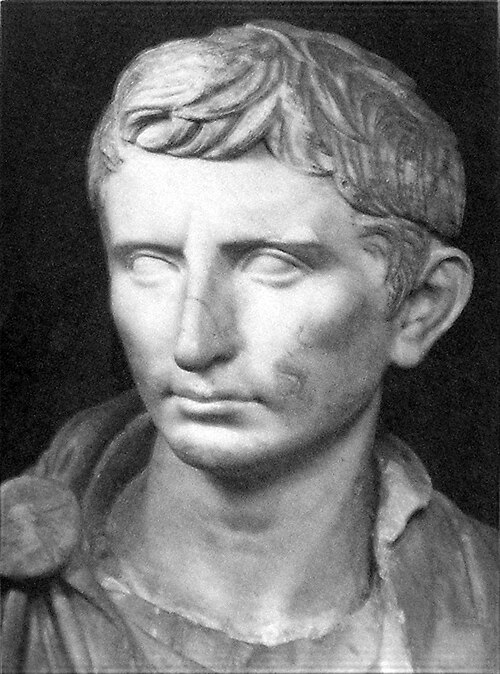
The triumvirate's legal term expired on 31 December 33 BC (Octavian's holding of his triumviral legal powers may have continued to 27 BC).[82] In the new year, Octavian used force to drive the potentially resurgent consuls from Rome after one of the consuls started to publicly attack him.[83] The consuls fled to the east and Antony with several hundred senators, which Antony organised into a "counter-senate".[84]
Antony started to move his massive army, of some 100,000 men and 800 ships, west towards Greece. His men debated whether or not they should permit Cleopatra to stay with them: the main argument to remove her was that her presence would further Octavian's propaganda depicting a war on the east;[85] however, removing her would also demoralise some of their own forces, who were fighting for their queen against Rome rather than for Antony, a Roman general. Arriving in Athens, Antony divorced Octavia; the choice of removing his Roman wife to stay with his Egyptian mistress alienated Italian public opinion.[86]
Lucius Munatius Plancus then fled Antony's camp for Octavian's. Upon his arrival, he recommend that Octavian open Antony's will, legally sealed with the Vestal Virgins. Opening it, Octavian allegedly found that Antony planned to be buried in Alexandria, would recognise Caesarion as Caesar's son, and give large portions of Roman lands to his children with Cleopatra. It is likely that Octavian may have invented provisions: the Vestals in Rome would not have seen the sealed will; some provisions may have been alleged which Antony would find uncomfortable to deny (losing eastern support) or admit (losing western support).[87]
Antony's forces in Greece provoked panic in Italy; Octavian, no longer calling himself triumvir (but retaining his provincial commands) organised defence of the peninsula. He organised a civil oath to his personal leadership, unprecedented in republican history. Declaring war on Cleopatra, Octavian also had the republic strip Antony of his legal position.[88]
Early in the campaigning season of 31 BC, Agrippa launched a series of surprise attacks on the western Greek harbours under Antony's control. Octavian moved quickly to take beachheads on the Greek mainland near Corcyra.[89] After cutting off Antony's supplies and escape by land, Antony and Cleopatra engaged in a sea battle, attempting to break out with his remaining fleet. They fought Octavian on 2 September 31 BC at the Battle of Actium.[90] Antony and Cleopatra were able to flee through a gap in the line, which was the plan, but most of his fleet did not follow and returned to port. After the battle, most of his forces in Greece surrendered.[91]
After a number of defections to Octavian – both Roman governors and client kings – through the winter of 31 and 30 BC, Antony's remaining forces were only those in the Ptolemaic Kingdom.[92] Troubled by demands from his soldiers for land, and only able to solve them with large-scale land purchases, Octavian marched on Egypt in pursuit of its booty. He marched overland on the Mediterranean coast. He engaged negotiations with Cleopatra but they broke down by July 30 BC.[93] Later that month, Octavian arrived at Alexandria and on 1 August, took and sacked the city.[94] He killed Caesarion and Antony's heir, Antyllus, but captured Cleopatra's children for his triumph. Cleopatra and Antony committed suicide.[95]
Legacy
In formation of the Principate
The ascendancy of Octavian at the triumvirate's close was closely followed by his constitutional "settlements" and the formation of the Principate and the Roman empire.[96] The creation of the triumvirate and its system of absolute rule, however, was not then known to be permanent. Even in the imperial period, writers like Tacitus reflected on how the republic had been dominated by single men before.[97] Moreover, it was not inevitable that the triumvirs were going to defeat the liberatores.[98] Their successful campaign, culminating at Philippi, was recognised in coming generations as a turning point in the republic's history. Tacitus, for example, dates the end of the republic to the triumviral victory there, which left the republic defenceless and nulla iam publica arma (i.e., the republic was disarmed).[99][100] Erich Gruen, in Last generation of the Roman republic, attributes the republic's collapse to the long and brutal conflicts after Caesar's assassination, largely fought by (and then between) the triumvirs, which eventually "made it impossible to pick up the pieces".[101]
The mass violence of triumviral rule and their untraditional form of government was contemporaneously seen as illegitimate.[102] To combat such charges, the triumvirs attempted to preserve the appearance of republican practices and legality.[102] Of course, the extent to which the triumvirate heeded republican traditions changed over time. Over time, as the political situation stabilised, Octavian in Rome resumed the normal operation of the consulship (rather than appointment of many and multiple suffect consulships in a single year).[103]
The traditional magistrates did not yield all of their duties to the triumvirs; they were still expected to and did conduct public business. Moreover, the consuls still exercised some degree of independent political authority.[104] The traditional means of moving legislation before the senate and the assemblies also was not abandoned: the triumvirs moved multiple laws before the people on diverse subjects such as extending citizenship, ratification of Antony's eastern settlements, extension of the triumvirate, and expanding the patriciate.[105] While the mere operation of the republic's institutional machinery did not represent a free state, the triumvirs made a show of following traditional legal niceties.[106] The triumvirs at various times also made repeated promises or offers to give their powers back to the senate and people, though of course these promises were never kept.[107] Most especially, the triumvirs' powers to appoint all provincial governors served as part of the division between military and civic provinces later adopted in Augustus' political settlements.[108]
In Roman culture
The political chaos of the triumviral years proved a ladder for many provincials, veterans, and former slaves. Many of the great works of Latin literature were produced in this unstable period, such as Horace's Epodes and Satires, Virgil's Eclogues and Georgics, and the histories of Sallust and Asinius Pollio.[102] The political competition between Octavian and Antony provided the impetus for Octavian's ally, Gaius Maecenas, to support many leading artists of his day.[109]
Virgil's Eclogues, for example, shed light on the fears of shepherds and herdsmen in rural Italy during Octavian's land confiscations when he sought lands to settle veterans in the aftermath of Philippi. The proscriptions also proved a topic of embellishment; many stories are told of the plight of victims and their attempts to escape. Cicero's plight during the proscriptions, especially, was a recurrent topic in ancient schools of oratory.[110]
Timeline
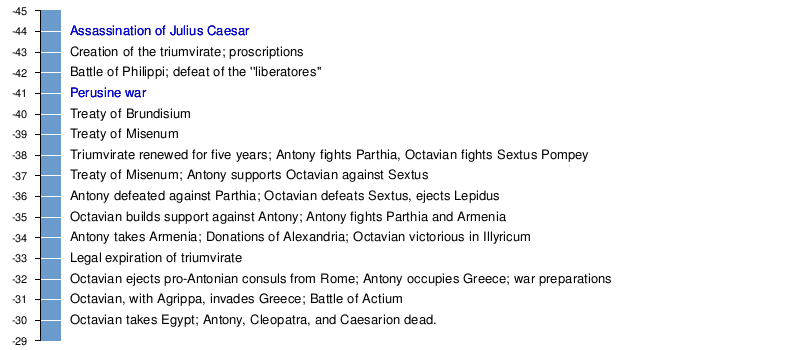
The following years are taken from the narrative in Pelling 1996.
See also
- Triumvirate § Modern triumvirates named after the Roman one
References
Citations
- ^ a b Cadoux & Lintott 2012.
- ^ Goldsworthy 2006, p. 511.
- ^ Ridley, R (1999). "What's in the Name: the so-called First Triumvirate". Arctos: Acta Philological Fennica. 33: 133–44. Specifically, "first triumvirate" is first attested in 1681.
- ^ Russell, Amy (30 June 2015). "Triumvirate, First". Encyclopedia of Ancient History. Wiley. pp. 1–3. doi:10.1002/9781444338386.wbeah26425. ISBN 978-1-4051-7935-5.
- ^ Tempest 2017, p. 241; Goldsworthy 2006, p. 509.
- ^ Tempest 2017, p. 242.
- ^ Rawson 1992, p. 474. The bill was "trebly irregular because it was not a dies comitialis, due notice had not been given, and violence was used".
- ^ a b Rawson 1992, p. 475.
- ^ Rawson 1992, p. 477.
- ^ Rawson 1992, p. 479.
- ^ Tempest 2017, p. 243.
- ^ Rawson 1992, p. 483.
- ^ Rawson 1992, p. 485.
- ^ a b c d Rawson 1992, p. 486.
- ^ Welch, Kathryn (2014). "The lex Pedia of 43 BCE and its aftermath". Hermathena (196/197): 137–162. ISSN 0018-0750. JSTOR 26740133.
- ^ Vervaet 2020, pp. 24, 30.
- ^ Broughton 1952, pp. 337, 340.
- ^ Vervaet 2020, pp. 36–37.
- ^ Vervaet 2020, pp. 34–35, also noting a connection between the Second Triumvirate's legislative powers and the powers of triumvirates established with constitutive powers for Roman colonies.
- ^ Vervaet 2020, p. 39, summum imperium auspiciumque.
- ^ Vervaet 2020, p. 46.
- ^ Vervaet 2020, p. 36; Pelling 1996, p. 1.
- ^ Millar 1973, pp. 51 et seq.
- ^ Vervaet 2020, p. 39.
- ^ Vervaet 2020, p. 32.
- ^ Rawson 1992, p. 486, citing App. BCiv., 4.8–11.
- ^ Thein 2018, citing App. BCiv., 4.5.
- ^ Thein 2018.
- ^ a b Pelling 1996, p. 5.
- ^ Pelling 1996, pp. 5–6.
- ^ Pelling 1996, p. 6.
- ^ Tempest 2017, pp. 245–46.
- ^ Pelling 1996, pp. 6–7. "It would surely have been better to move west quickly... and seek to isolate the advanced force on the west coast of Greece [and] play the 48 campaign over again ... the Liberators' brutal treatment [of Asia] did nothing for their posthumous moral reputation. Perhaps it also cost them the war".
- ^ Pelling 1996, pp. 7–8.
- ^ a b c Pelling 1996, p. 8.
- ^ Tempest 2017, pp. 203–4.
- ^ Pelling 1996, p. 8; Tempest 2017, p. 202.
- ^ Tempest 2017, p. 208.
- ^ Pelling 1996, p. 9.
- ^ Pelling 1996, pp. 9–10.
- ^ Pelling 1996, p. 10.
- ^ Pelling 1996, pp. 10–11.
- ^ Pelling 1996, pp. 11–12.
- ^ Pelling 1996, p. 12.
- ^ Pelling 1996, p. 13.
- ^ Pelling 1996, pp. 13–14.
- ^ Pelling 1996, p. 14.
- ^ Pelling 1996, pp. 14–15.
- ^ Pelling 1996, pp. 15–16.
- ^ Pelling 1996, p. 16.
- ^ a b Pelling 1996, p. 17.
- ^ a b Pelling 1996, p. 18.
- ^ Pelling 1996, p. 19.
- ^ a b Pelling 1996, p. 20.
- ^ Pelling 1996, pp. 20–21.
- ^ a b Pelling 1996, p. 21.
- ^ Pelling 1996, pp. 21–22.
- ^ Pelling 1996, p. 23.
- ^ a b Pelling 1996, p. 24.
- ^ Pelling 1996, p. 25.
- ^ Pelling 1996, p. 26, citing Plut. Ant., 35, among others.
- ^ Pelling 1996, p. 26.
- ^ Pelling 1996, pp. 26–27.
- ^ Pelling 1996, p. 27.
- ^ Pelling 1996, p. 28.
- ^ Pelling 1996, p. 30.
- ^ Pelling 1996, p. 31.
- ^ Pelling 1996, p. 32.
- ^ a b Pelling 1996, p. 33.
- ^ a b c d Pelling 1996, p. 34.
- ^ Pelling 1996, p. 35.
- ^ Pelling 1996, p. 36.
- ^ Pelling 1996, pp. 36–37.
- ^ Pelling 1996, p. 38.
- ^ Pelling 1996, p. 37.
- ^ Pelling 1996, p. 39.
- ^ Pelling 1996, p. 40.
- ^ Pelling 1996, pp. 40–41.
- ^ Pelling 1996, p. 42.
- ^ Pelling 1996, p. 43.
- ^ Pelling 1996, pp. 46–47.
- ^ This is disputed. Pelling 1996, pp. 67 et seq discusses the matter. Aug. RG, 7.1 implies he held the trimvirate continually for ten years, which Pelling finds "decisive". Others argue that the triumvirate, as a magistracy without a specific term, ended only with the abdication of its members; Octavian abdicated in 27 BC, long after expiration of the second quinquennium. Vervaet 2020, pp. 29–32.
- ^ Pelling 1996, pp. 48–49.
- ^ Pelling 1996, p. 50, noting that some scholars, including Syme, infer more than 300 senators; Pelling calls that inference "most precarious".
- ^ Pelling 1996, p. 50.
- ^ Pelling 1996, p. 51.
- ^ Pelling 1996, p. 52.
- ^ Pelling 1996, pp. 52–54.
- ^ Pelling 1996, p. 56.
- ^ Pelling 1996, pp. 57–58.
- ^ Pelling 1996, p. 59.
- ^ Pelling 1996, p. 61.
- ^ Pelling 1996, p. 62.
- ^ Pelling 1996, p. 63.
- ^ Pelling 1996, pp. 64–65.
- ^ Scholars over the last decades have increasingly challenged the older view that Augustus "restored the republic whilst hiding his powers behind [a] façade". They emphasise that the "Principate" emerged only with Tiberius' success in making the position hereditary. See eg Cooley, Alison (24 February 2022). "Augustus, Roman emperor, 63 BCE–14 CE". Oxford Classical Dictionary. Oxford University Press. doi:10.1093/acrefore/9780199381135.013.979. ISBN 978-0-19-938113-5. Retrieved 30 September 2022.
- ^ Pelling 1996, p. 1, citing Tac. Ann. 1.
- ^ Rawson 1992, p. 488. "The cause of the 'liberators' might have triumphed; its defeat at Philippi was not a foregone conclusion".
- ^ Rawson 1992, p. 488.
- ^ Tacitus (1931). Annals. Loeb Classical Library 249. Vol. 3. Translated by Moore, Clifford H. Cambridge: Harvard University Press. 2. ISBN 978-0-674-99274-0.
- ^ Gruen, Erich (1995). The last generation of the Roman republic. Berkeley: University of California Press. p. 504. ISBN 0-520-02238-6.
- ^ a b c Welch 2016.
- ^ Millar 1973, p. 52.
- ^ Millar 1973, p. 53, citing App. BCiv., 4.37 (mentioning that Lucius Munatius Plancus passed legislation striking some victims from the proscription lists).
- ^ Millar 1973, p. 53.
- ^ Millar 1973, p. 54.
- ^ Millar 1973, pp. 54, 65.
- ^ Millar 1973, p. 62.
- ^ Welch 2016; Pelling 1996, p. 45.
- ^ Beard, Mary (2015). SPQR: a history of ancient Rome (1st ed.). New York: Liveright Publishing. pp. 341–344. ISBN 978-0-87140-423-7. OCLC 902661394. Also references App. BCiv., 4 and Sen. Suas., 6–7 (on Cicero).
Modern sources
- Beard, Mary (2015). SPQR: a history of ancient Rome (1st ed.). New York: Liveright Publishing. ISBN 978-0-87140-423-7. OCLC 902661394.
- Broughton, Thomas Robert Shannon (1952). The magistrates of the Roman republic. Vol. 2. New York: American Philological Association.
- Cadoux, Theodore John; Lintott, Andrew (2012). "triumviri". In Hornblower, Simon; et al. (eds.). The Oxford classical dictionary (4th ed.). Oxford University Press. doi:10.1093/acrefore/9780199381135.013.6576. ISBN 978-0-19-954556-8. OCLC 959667246.
- Crawford, Michael (1974). Roman Republican Coinage. Cambridge University Press. ISBN 978-0-521-07492-6. OCLC 450398085.
- Goldsworthy, Adrian (2006). Caesar: Life of a Colossus. Yale University Press. ISBN 978-0-300-13919-8.
- Millar, Fergus (1973). "Triumvirate and Principate". The Journal of Roman Studies. 63: 50–67. doi:10.2307/299165. ISSN 0075-4358. JSTOR 299165. S2CID 161712594.
- Pelling, C (1996). "The triumviral period". In Bowman, Alan K; Champlin, Edward; Lintott, Andrew (eds.). The Augustan empire, 43 BC–AD 69. Cambridge Ancient History. Vol. 10 (2nd ed.). Cambridge University Press. pp. 1–69. ISBN 0-521-26430-8.
- Rawson, Elizabeth (1992). "The aftermath of the Ides". In Crook, John; Lintott, Andrew; Rawson, Elizabeth (eds.). The last age of the Roman Republic, 146–43 BC. Cambridge Ancient History. Vol. 9 (2nd ed.). Cambridge University Press. pp. 468–90. ISBN 0-521-85073-8. OCLC 121060.
- Tempest, Kathryn (2017). Brutus: the noble conspirator. New Haven: Yale University Press. ISBN 978-0-300-18009-1. OCLC 982651923.
- Thein, Alexander (2018). "Proscriptions". The Encyclopedia of Ancient History. Wiley. pp. 1–2. doi:10.1002/9781444338386.wbeah30481. ISBN 9781405179355. S2CID 242094148.
- Vervaet, Fredrick (2020). "The triumvirate rei publicae constituendae". In Pina Polo, Francisco (ed.). The triumviral period: civil war, political crisis and socioeconomic transformations. Prensas de la Universidad de Zaragoza. pp. 23–48. ISBN 9788413400969.
- Welch, Kathryn (2016). "Triumvirate, Second". The Encyclopedia of Ancient History. Wiley. pp. 1–3. doi:10.1002/9781444338386.wbeah30085. ISBN 9781405179355.
Ancient sources
- Appian (1913) [2nd century AD]. Civil Wars. Loeb Classical Library. Translated by White, Horace. Cambridge: Harvard University Press – via LacusCurtius.
- Augustus (1924) [before AD 14]. Res Gestae Divi Augusti. Loeb Classical Library. Translated by Shipley, Frederick W. Cambridge: Harvard University Press – via LacusCurtius.
- Dio (1914–27) [2nd century AD]. Roman History. Loeb Classical Library. Translated by Cary, Earnest. Cambridge: Harvard University Press – via LacusCurtius.
- Plutarch (1920) [1st century AD]. Life of Antony. Loeb Classical Library. Vol. 9. Translated by Perrin, Bernadotte. Cambridge: Harvard University Press – via LacusCurtius.
- Seneca (1928) [1st century AD]. Suasoriae of Seneca the Elder. Translated by Edward, WA. Cambridge University Press – via Attalus.
External links
- Lendering, Jona (2003). "Second Triumvirate". Livius.org. Retrieved 26 November 2022.
- Wasson, Donald L (2016). "Second Triumvirate". World History Encyclopedia. Retrieved 26 November 2022.