↑The term basileus eventually replaced augustus as the official title of the emperor, although both were seen as equals already by the times of Constantine I.[12]
↑The Byzantine Empire is universally recognized as the remnant, continuation or later stage of the Roman Empire. There is no universally agreed date used to separate the ancient Roman and "Byzantine" empires, with proposed dates ranging in age from 284 to 717.[13] Some authors reject the term "Byzantine" entirely.[14]
↑Spain was lost in 625[16] and Africa in 698.[17] A large portion of Italy was conquered by the Lombards already under Justinian I's successor, Justin II.[18] Rome and its surroundings remained under imperial control until 756, when they became the Papal States,[19] though the last Italian holdouts were not lost until 1071 with the fall of Bari.[20] The seventh century also saw much of the empire's eastern and southern territories lost permanently to Arab Muslim conquests.[21]
↑There is no generally-accepted count of Roman emperors given that different scholars sometimes include and omit different emperors (see Legitimacy). This list includes 174 emperors, 11 of whose legitimacy is disputed in scholarship (also including the four emperors of Nicaea, who are often seen as the "legitimate" emperors during the interregnum of 1204–1261),[22] and 4 ruling empresses for a total of 178 monarchs. Also included are 34 junior co-emperors, 1 junior co-empress (Thekla), and 2 co-empresses in Thessalonica. All in all, this list thus includes a total of 215 occupants of the Roman imperial office.
↑This was one of the titles used for the emperors in Constantinople by Ottoman writers prior to 1453.[23]
↑Entries also include the regnal name of each emperor. These generally differed from their birth name, often adopting elements from the previous emperor.[45]Augustus's full name would be "Gaius Julius Caesar Augustus" according to Roman naming conventions ("Octavian" was a nickname), but he styled himself as "Imperator Caesar Augustus", treating "Caesar" as a family name.[46] Given that "Imperator" was only a victory title, it will be omitted from the emperors' full nomenclature.
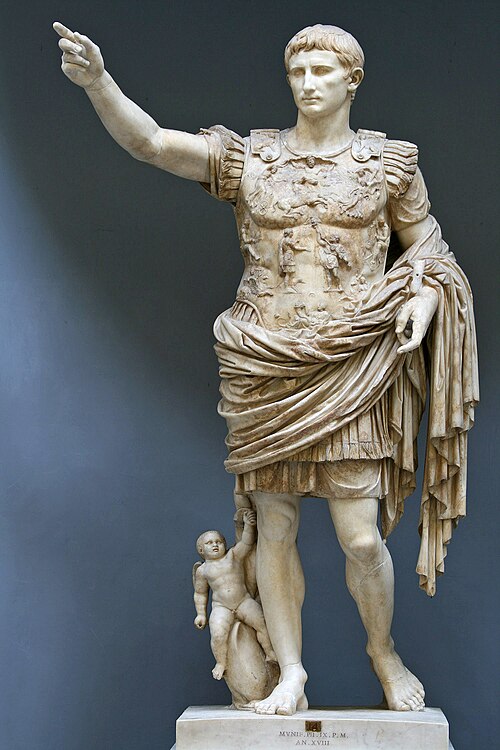
↑The conventional date for the Empire's founding is 27 BC,[47] when the Senate awarded Octavian the title and name Augustus alongside one of several grants of power.[48] Ancient writers, however, give him a rule of 56 years.[47] He became de facto monarch in 31BC, after defeating his last remaining opposition at the Battle of Actium.[49] This is a date also used by some writers.[47] Augustus himself dated his accession to legal power to 7January 43 BC, when he first received imperium.[48] Later that year he became consul (19 August) and then triumvir (27November) alongside Mark Antony and Lepidus. Augustus thus ruled the Roman state for exactly 56 years, but only 40 as "emperor".[48]
↑By this time, 'Caesar' and 'Augustus' are regarded less as personal names and more as imperial titles, with the former denoting the heir-apparent and the latter indicating the emperor himself.[65]
↑The date of his acclamation is usually given as 27 November 176. This is the day in which he was proclaimed imperator and Commodus himself appears to have considered it the beginning of his reign. Some scholars argue that his actual reign as augustus began later, as he does not appear in official documents of early 177.[69][70][71]
12The junior co-emperors marked as being of "varying ascribed status" are figures, mostly children, who are usually not counted as "true" emperors given their submissive status to the senior emperor, but are still present in some lists of rulers.[41]
12345678Unless otherwise noted to be some other ambiguity, the emperors marked to be of ambiguous legitimacy are those who fulfill one or more of the inclusion criteria above, but who are not universally regarded by scholars to count as legitimate. In most cases, such figures are those who held power only briefly, and/or who in times of more than one emperor held one of the capitals but never achieved the full recognition of the other emperor(s).[82][83][84][85]
↑On account of the limited surviving source material, almost all dates used here are just approximate. The chronology of the whole period is dubious and sources rarely agree on each other, in part due to the fact that many reigns overlap due to most emperors starting as rivals. For an analysis of the chronology, see Rea 1972, Peachin 1990 and Burgess 2014.
↑Unattested in coinage; only briefly mentioned by Aurelius Victor and Cyprian (the latter indirectly).
↑Unmentioned in literary sources and known only from two coins seemingly issued in Rome, implying he was proclaimed emperor in the capital, probably between Aemilianus and Valerian, or against either.[103][104][105]
↑Made caesar by his father and only referred to as augustus in a single series of coins, issued while he was besieged in Cologne in 260. Coinage issued after his death lack any title; probably because Gallienus did not want to advertise the death of a second emperor in one year.[109][110] It is unclear whether his acclamation was ever recognized (or even known) by Gallienus, but if he had survived it would surely have been recognized (like Valentinian II, who was proclaimed by the army but was accepted by Gratian).
↑The chronology of Maximian's career is disputed. Some authors argue that he was promoted to augustus without ever being caesar, as claimed by many others. Another possible date for his accession as emperor (and the first division of the Roman Empire) is 13 December 285.[122]
↑The extent to which Constantine supported Domitius Alexander is disputed. It appears that Constantine never officially recognized him as emperor, but still offered some cautious support as a way to pressure Maxentius.[127]
12Legitimately appointed as co-emperor by Licinius, though as western emperor (in opposition to ConstantineI). Referred as caesar in literary sources, but called augustus in coinage. Did not actually rule anything given that Licinius did not control the west.[132]
↑Although technically recognized by Constantius II, who even sent him the imperial diadem, Vetranio is often regarded as a usurper.[140]
↑From the fourth century, emperors and other high-profile men of non-aristocratic birth often bore the name "Flavius", the family name of the Constantinian dynasty. Because it was often used as a status marker rather than personal name,[144] "Flavius" will generally be omitted in the following entries for simplicity.
↑Distinction between nomen, praenomen and cognomen, the core elements of Roman naming conventions, began to fade away from the 3rd century onwards. Given that "new Romans" —that is, barbarians turned citizens— adopted the names of their masters, many citizens adopted the names Julius, Flavius (notable the Constantinians) and Marcus Aurelius (notable the 3rd century emperors), thus making them obsolete as surnames. As a result, most citizens of the Empire, even emperors, reverted back to single-names by the 5th century.[146]
12345678910111213141516171819Although they constitutionally held the same supreme power as their senior counterpart, it is customary among scholars of the later empire to only regard those who actually ruled as emperors, omitting junior co-emperors who only exercised power nominally and never governed in their own name. Most of these co-emperors were children that barely appear in historical records.[151][152]
123There is particular confusion surrounding the name "Constantine III", as it has been applied to both a Western (Constantine) and an Eastern emperor (Heraclius Constantine). Heraclius Constantine is often enumerated as 'Constantine III',[159] but this name is also often applied to the earlier western emperor and has also been used for Heraclius Constantine's son Constans II (who actually ruled under the name 'Constantine', 'Constans' being a nickname).[160]
↑From 629 onwards, Heraclius issued administrative documents in Greek.[188] Latin continued to be used in communication with Western Europe until the end of the empire and coins continued to be struck with Latin inscriptions until the early eighth century.[189]
↑Tiberius and Heraclius were crowned by their father Constans II on 2 June 659, likely as babies. Constantine tried to get rid of his brothers as soon as they came of age, but the army rioted. He initially accepted, but quickly turn against the leaders of the revolt and executed them. Then, around October 681, cut Tiberius and Heraclius’ noses, a common Byzantine punishment that disqualified anyone from the throne.[194]
↑Latin ceased being used in coin inscriptions under Leo III.[189]
12Most of miniature portraits used for the 9th to 11th centuries are not contemporary, but taken from the 12th-century Madrid Skylitzes. The portrait of Nikephoros I is taken from the Manasses Chronicle (c.1345), while the portrait of Nikephoros II is taken from a 15th-century miniature of uncertain origin. All of these portraits are almost certainly imaginary. The 15th-century Mutinensis gr. 122 is used for some 11th-century emperors with no surviving portrait, although these are probably imaginary as well.
↑Theodora's daughter Thekla appears to have been formally associated with Theodora and Michael III in the government of the Empire, although almost nothing is known about her actual role during her mother's rule.[215][216]
↑Son of Christopher and grandson of Romanos I; unattested in official documents and only briefly mentioned by Michael Psellos and Joannes Zonaras. He was probably crowned as a baby but died shortly after, certainly before 927.[221]
12Most emperors began to officially use family names from Constantine IX Monomachos onwards. Michael VI notably avoided using his surname, Bringas, because it was far less distinguished than those of the other imperial families.[234]
↑Some historians regard Eudokia as an empress regnant, while others consider her as a regent.
↑Unattested in official documents; Leo is only called emperor in a singular letter, while his brother's status can only be deduced from the fact that he was born in the purple and that he also used the "imperial tokens".[240]
↑Constantine Doukas notably served as junior co-emperor of two emperors, first his father MichaelVII and then Alexios I, who briefly restored his rights. As always, this was only symbolical, as Constantine remained a minor during both tenures, having been crowned as a newborn. He died on 12 August 1094, aged around 20 years old.[244]
12Many of the miniature portraits used for the late Byzantine period are not contemporary, but taken from the Codex Mutinensis graecus 122, completed c.1425 and expanded after 1453. The codex depicts almost every single Roman emperor from Augustus to Constantine XI, but only the later portraits are considered reliable, especially those of the Palaiologoi. The accuracy of earlier portraits is disputed, but at least from Heraclius onwards they appear to be based on sources available to their author.[253]
↑Alexios III used the name Alexios Komnenos Angelos (Ἀλέξιος Κομνηνός Ἄγγελος) prior to his accession but reigned as Alexios Komnenos, dropping his own family name in order to stress his matrilineal descent from the Komnenos dynasty.[255]
↑Unattested in coins, Nicholas is called "emperor and heir" in a single document. He died soon after, less than 10 years old.[261]
↑It has been argued that Constantine Laskaris, Theodore's brother, ruled for a time after April 1204. According to Nicetas Choniates, Constantine was proclaimed emperor by the remaining Varangian Guard at Hagia Sophia. However, he also notes that Constantine ultimately refused the imperial insignia, and the populace and army quickly ignored him.[262] Constantine is not attested as emperor of Nicaea in any known source.[263] The date of Theodore's proclamation as emperor is also uncertain. Modern authors often date it to 1205.[264] However, contemporary sources imply a late date in 1204. One manuscript credits Theodore with a rule of 17 years and 3 months, while the historian George Akropolites gives him 18 years.[263]
12During the last years of the Empire, the territory of Thessalonica was effectively ruled as separate realm from Constantinople. Two empresses, Irene and Anna, took residence there, even having their own courts and ruling as de facto empresses regnant. Anna notably ruled in Thessalonica in opposition to John VI Kantakouzenos, who later recognized her portion of the empire.[270][271]
↑Michael IX is often listed as full emperor (rather than co-emperor) in modern sources, although he never reigned in his own name. He appears to have used the title of autokrator alongside his father, which implied an equal status.[273]
↑Matthew Kantakouzenos, already an adult, was given part of Thrace by his father John VI Kantakouzenos as an appanage in 1343. He was crowned co-emperor in April 1353, during his father's war against John V Palaiologos. Matthew retained his Thracian domains until December 1357, when he abdicated following a military defeat against the Serbs. John V later appointed him as despot of the Morea.[277]
↑John VII inherited his father's lands around Selymbria and, as per a 1381 agreement with Andronikos IV that legitimized his role as co-emperor and heir. He ruled there with the title of emperor (basileus), although he ruled heavily influenced by the Ottomans and Genoese.[280]
↑Manuel, who previously had been given governorship over Thessalonica and had already been crowned co-emperor, set up an independent court and ruled there as basileus instead of despotes. Manuel ruled in opposition of his father's soft policies towards the Ottomans, waging war upon them. However, the city eventually fell and Manuel had to flee in shame.[282]
↑Hammond, Mason (1938). "The Tribunician Day during the Early Empire". Memoirs of the American Academy in Rome. 15: 23–61 (49–53). doi:10.2307/4238599. ISSN0065-6801. JSTOR4238599.
↑Hammond, Mason (1956). "The Transmission of the Powers of the Roman Emperor from the Death of Nero in A.D. 68 to That of Alexander Severus in A.D. 235". Memoirs of the American Academy in Rome. 24: 61–133 (104–105). doi:10.2307/4238640. ISSN0065-6801. JSTOR4238640.
↑British Museum Department of Manuscripts (1907). Greek Papyri in the British Museum. pp. xxxix, Pap. 845. ISBN9780714104867
↑Spatharakis, Ioannis (1976). The Portrait in Byzantine Illuminated Manuscripts. Brill. pp.210–230. ISBN9004047832.
↑Hennessy, Cecily (2006). A child bride and her representation in the Vatican Epithalamion, cod. gr. 1851. Brill. pp.177–183. doi:10.1163/9789004346239_010.
↑Iacobini, Antonio (1995). Arte profana e arte sacra a Bisanzio. Argos. ISBN9788885897496.
↑Jeffreys, Elizabeth; Haldon, John F.; Cormack, Robin, eds. (2008). The Oxford Handbook of Byzantine Studies. Oxford University Press. p.292. ISBN978-0-19-925246-6.
↑Philippides, Marios (2019). Constantine XI Dragaš Palaeologus (1404–1453): The Last Emperor of Byzantium. Taylor & Francis. pp.29–34. ISBN9781351055406.
Angelov, Dimiter G. (2009). "Emperors and Patriarchs as Ideal Children and Adolescents: Literary Conventions and Cultural Expectations". In Papaconstantinou, Arietta; Talbot, Alice-Mary (eds.). Becoming Byzantine: Children and Childhood in Byzantium. Dumbarton Oaks. ISBN978-0-8840-2356-2.
Angelov, Dimiter (2019). The Byzantine Hellene: The Life of Emperor Theodore Laskaris and Byzantium in the Thirteenth Century. Cambridge: Cambridge University Press. ISBN978-1-1084-8071-0.
Arnold, Jonathan J.; Bjornlie, M. Shane; Sessa, Kristina (2016). "Introduction". In Arnold, Jonathan J.; Bjornlie, M. Shane; Sessa, Kristina (eds.). A Companion to Ostrogothic Italy. Leiden: BRILL. ISBN978-9-0043-1376-7.
Barnes, Timothy D. (1982). The New Empire of Diocletian and Constantine. Harvard: Harvard University Press. ISBN0-6742-8066-0.
Becker, C. H. (1913). "The Expansion of the Saracens—The East". In Gwatkin, H. M.; Whitney, J. P. (eds.). The Cambridge Medieval History: Volume II: The Rise of the Saracens and the Foundation of the Western Empire. New York: The Macmillan Company. OCLC14739796.
Bucossi, Alessandra; Rodriguez Suarez, Alex, eds. (2016). John II Komnenos, Emperor of Byzantium. London: Routledge. ISBN978-1-4724-6024-0.
Burgess, Richard W. (2023). "Cutting the ‹Herculian› Knot: When Did Maximian Become Caesar and Augustus?". In Schuler; Haensch; Killen (eds.). Chiron 53. Walter de Gruyter GmbH & Co KG. pp.1–39. doi:10.34780/74h5-hc1b. ISBN978-3-11-125249-0.
Burgess, Richard W. (2014). Roman imperial chronology and early-fourth-century historiography. Historia Einzelschriften. Stuttgart: Steiner. ISBN978-3-515-10732-7.
Cameron, Alan (1988). "Flavius: a Nicety of Protocol". Latomus. 47 (1): 26–33. JSTOR41540754.
Chalandon, Ferdinand (1923). "The Earlier Comneni". In Tanner, J. R.; Previté-Orton, C. W.; Brooke, Z. N. (eds.). The Cambridge Medieval History: Volume IV: The Eastern Roman Empire (717–1453). New York: The Macmillan Company. OCLC14739796.
Claes, Liesbeth (2015). "Coins with power?: imperial and local messages on the coinage of the usurpers of the second half of the third century". Jaarboek voor Munt- en Penningkunde. 102: 15–60. OCLC948592865.
Çolak, Hasan (2014). "Tekfur, fasiliyus and kayser: Disdain, Negligence and Appropriation of Byzantine Imperial Titulature in the Ottoman World". In Hadjianastasis, Marios (ed.). Frontiers of the Ottoman Imagination. Leiden: Brill. ISBN978-9-0042-8351-0.
Collins, Roger (2004). Visigothic Spain, 409–711. Oxford: Blackwell. ISBN978-0-6311-8185-9.
Cooley, Alison E. (2012). "Appendix 2; Augustus−Justinian". The Cambridge Manual of Latin Epigraphy. Cambridge: Cambridge University Press. pp.488–509. ISBN978-0-5218-4026-2.
Cotsonis, John A. (2020). The Religious Figural Imagery of Byzantine Lead Seals I. Oxford: Routledge. ISBN978-0-3673-4696-6.
Craven, Maxwell (2019). The Imperial Families of Ancient Rome. Fonthill Media. ISBN978-1781557389.
Croke, Brian (1995). The Chronicle of Marcellinus: A translation with commentary. London: Brill. ISBN978-9-0043-4463-1.
Croke, Brian (2004). "The Imperial Reigns of Leo II". Byzantinische Zeitschrift. 96 (2): 559–575. doi:10.1515/BYZS.2003.559. S2CID191460505.
Dragon, Gilbert (2003). Emperor and Priest: The Imperial Office in Byzantium. Cambridge University Press. ISBN978-0-5218-0123-2.
Elton, Charles A. (1825). A History of the Roman Emperors. Baldwin, Cradock and Joy.
Estiot, Sylviane (1996). "L'empereur Silbannacus, un second antoninien"[Emperor Silbannacus, a second Antoninianus]. Revue numismatique (in French). 6 (151): 105–117. doi:10.3406/numi.1996.2087.
Feiller, Albert (1976). "Nouvelle note sur la chronologie du règne de Jean Cantacuzène"[New note on the chronology of the reign of John Kantakouzenos]. Études byzantines. 34: 119–124. doi:10.3406/rebyz.1976.2046.
Grant, Michael (1985). The Roman Emperors: A Biographical Guide to the Rulers of Imperial Rome, 31 BC–AD 476. New York: Charles Scribner's Sons. ISBN0-6841-8388-9.
Grant, Michael (1998). From Rome to Byzantium: The Fifth Century. New York: Psychology Press. ISBN978-0-4151-4753-8.
Goldsworthy, Adrian Keith (2009). How Rome Fell: Death of a Superpower. New Haven: Yale University Press. ISBN978-0-3001-3719-4.
Grierson, Philip (1968). Catalogue of the Byzantine Coins in the Dumbarton Oaks Collection and in the Whittemore Collection. Vol.2. Dumbarton Oaks. ISBN978-0-8840-2024-0.
Grierson, Philip (1973). Catalogue of Byzantine Coins, vol. 3: Leo III to Nicephorus III, 717-1081. Washington D.C.: Dumbarton Oaks. ISBN0-8840-2012-6.
Halsall, Guy (2018). "Transformations of Romanness: The northern Gallic case". In Pohl, Walter; Gantner, Clemens; Grifoni, Cinzia; Pollheimer-Mohaupt, Marianne (eds.). Transformations of Romanness: Early Medieval Regions and Identities. Berlin: De Gruyter. ISBN978-3-1105-9838-4.
Hammond, Mason (1957). "Imperial Elements in the Formula of the Roman Emperors during the First Two and a Half Centuries of the Empire". Memoirs of the American Academy in Rome. 25: 19–64. doi:10.2307/4238646. JSTOR4238646.
Hartmann, L. M. (1913). "Italy under the Lombards". In Gwatkin, H. M.; Whitney, J. P. (eds.). The Cambridge Medieval History: Volume II: The Rise of the Saracens and the Foundation of the Western Empire. New York: The Macmillan Company. OCLC14739796.
Hartmann, Udo (2002). Rezension zu: C. Körner: Philippus Arabs[Review of C. Körner: Philip the Arab]. H-Soz-Kult. Kommunikation und Fachinformation für die Geschichtswissenschaften (in German). Walter de Gruyter. ISBN3-1101-7205-4. Retrieved 11 April 2021.
Hekster, Olivier (2008). Rome and Its Empire: AD 193–284. Edinburgh: Edinburgh University Press. ISBN978-0-7486-2304-4.
Kienast, Dietmar; Werner Eck & Matthäus Heil (2017) [1990]. Römische Kaisertabelle: Grundzüge einer römischen Kaiserchronologie[Roman imperial table: Basics of the Roman imperial chronology] (in German) (6thed.). Darmstadt: WBG. ISBN978-3-5342-6724-8.
Lascaratos, J.; Marketos, S. (1997), "The fatal disease of the Byzantine Emperor Andronicus III Palaeologus (1328-1341 A.D.)", Journal of the Royal Society of Medicine, 90 (2): 106–109, doi:10.1177/014107689709000215, PMC1296151, PMID9068444
Lascaratos, J. (1999). ""Eyes" on the Thrones: Imperial Ophthalmologic Nicknames". Survey of Ophthalmology. 44 (1): 73–78. doi:10.1016/S0039-6257(99)00039-9. ISSN0039-6257. PMID10466590.
Lawler, Jennifer (2004). Encyclopedia of the Byzantine Empire. Jefferson: McFarland. ISBN978-0-7864-6616-0.
Maynard, Daniel R.F. (2021). "Nicephorus III". De Imperatoribus Romanis. Archived from the original on 11 March 2022.
Meijer, Fik (2004). Emperors Don't Die in Bed. Translated by Leinbach, S. J. London: Routledge. ISBN0-4153-1201-9.
Mosshammer, Alden (2008). The Easter Computus and the Origins of the Christian Era. Oxford University Press. ISBN978-0-1915-6236-5.
Mladenov, Momchil (2003). "John VII Palaiologos and the Bulgarian Lands in 1390". Journal Epohi (in Bulgarian). 11 (1): 189–196. ISSN2534-8418.
Nicol, Donald M. (1967). "The Byzantine View of Western Europe". Greek, Roman and Byzantine Studies. 8 (4): 315–339.
Nicol, Donald M. (1992). The Immortal Emperor: The Life and Legend of Constantine Palaiologos, Last Emperor of the Romans. Cambridge: Cambridge University Press. ISBN978-0-511-58369-8.
Oikonomides, Nicolas (1977). "John VII Palaeologus and the Ivory Pyxis at Dumbarton Oaks". Dumbarton Oaks Papers. 31: 329–337. doi:10.2307/1291411. JSTOR1291411.
Omissi, Adrastos (2018). Emperors and Usurpers in the Later Roman Empire. Oxford: Oxford University Press. ISBN978-0-1988-2482-4.
Peachin, Michael (1990). Roman Imperial Titulature and Chronology, A.D. 235–284. Amsterdam: Gieben. ISBN9-0506-3034-0.
Rea, J. R. (1972). "O. Leid. 144 and the Chronology of A. D. 238". Zeitschrift für Papyrologie und Epigraphik. 9: 1–19. JSTOR20180380.
Richardson, John (1984). Roman Provincial Administration. Bristol: Bristol Classical Press. ISBN978-0-8629-2128-6. OCLC1067756325.
Sandberg, Kaj (2008). "The So-Called Division of the Roman Empire in AD 395: Notes on a Persistent Theme in Modern Historiography". Arctos. 42: 199–213. ISSN0570-734X.
Schreiner, Peter (1977). Die byzantinischen Kleinchroniken II: Historischer Kommentar[Byzantine small chronicles 2: Historical commentary]. CFHB (in German). Vienna: ÖAW. ISBN978-3-7001-0206-9.
Seibt, Werner (2018). "Wer war Niketas Nobellisimos und Komes von Opsikion (8. Jahrhundert)?"[Who was Niketas Nobellisimos and Komes of Opsikion (8th century)?](PDF). Jahrbuch der Österreichischen Byzantinistik (in German). 67: 213–216. doi:10.1553/joeb67s213.
Shiel, Norman (1979). "The Coinage of Saloninus as Augustus". Museum Notes (American Numismatic Society). 24: 117–122. JSTOR43573579.
Smolin, Nathan I. (2021). Christ the Emperor: Roman Emperor and Christian Theology in the 4th Century AD (Doctoral thesis). University of North Carolina. doi:10.17615/wg7y-3h07.
Syme, Ronald (1958), "Imperator Caesar: A Study in Nomenclature", Historia, vol.7, no.2, pp.175–188, JSTOR4434568
Tilemachos, Lounghis (2015). "Review Article: Juan Signes Codoner, The emperor Theophilos and the East, 829-842: Court and frontier in Byzantium during the last phase of Iconoclasm, Birmingham Byzantine and Ottoman Studies, vol 13, Ashgate 2014". Byzantina Symmeikta. 25: 237–260. doi:10.12681/byzsym.8773.
Trapp, Erich, ed. (2001). Prosopographisches Lexikon der Palaiologenzeit[Prosopographical Lexicon of the Palaiologan era] (in German). Vienna: ÖAW. ISBN978-3-7001-1462-8.(see PLP)
Treadgold, W. (1990). "A Note on Byzantium's Year of the Four Emperors". Byzantinische Zeitschrift. 83 (2): 431–33. doi:10.1515/byzs.1990.83.2.431. S2CID194092611.
Treadgold, Warren (1997). A History of the Byzantine State and Society. Stanford: Stanford University Press. ISBN978-0-8047-2630-6.