
Loading article…
.jpg/500px-Nomadic_Camping_(266139768).jpg)
Pastoralism is a form of animal husbandry where domesticated animals (known as "livestock") are released onto large vegetated outdoor lands (pastures) for grazing, historically by nomadic people who moved around with their herds.[2] The animal species involved include cattle, camels, goats, yaks, llamas, reindeer, horses, and sheep.[3]
Pastoralism occurs in many variations throughout the world, generally where environmental characteristics such as aridity, poor soils, cold or hot temperatures, and lack of water make crop-growing difficult or impossible. Operating in more extreme environments with more marginal lands means that pastoral communities are very vulnerable to the effects of global warming.[4]
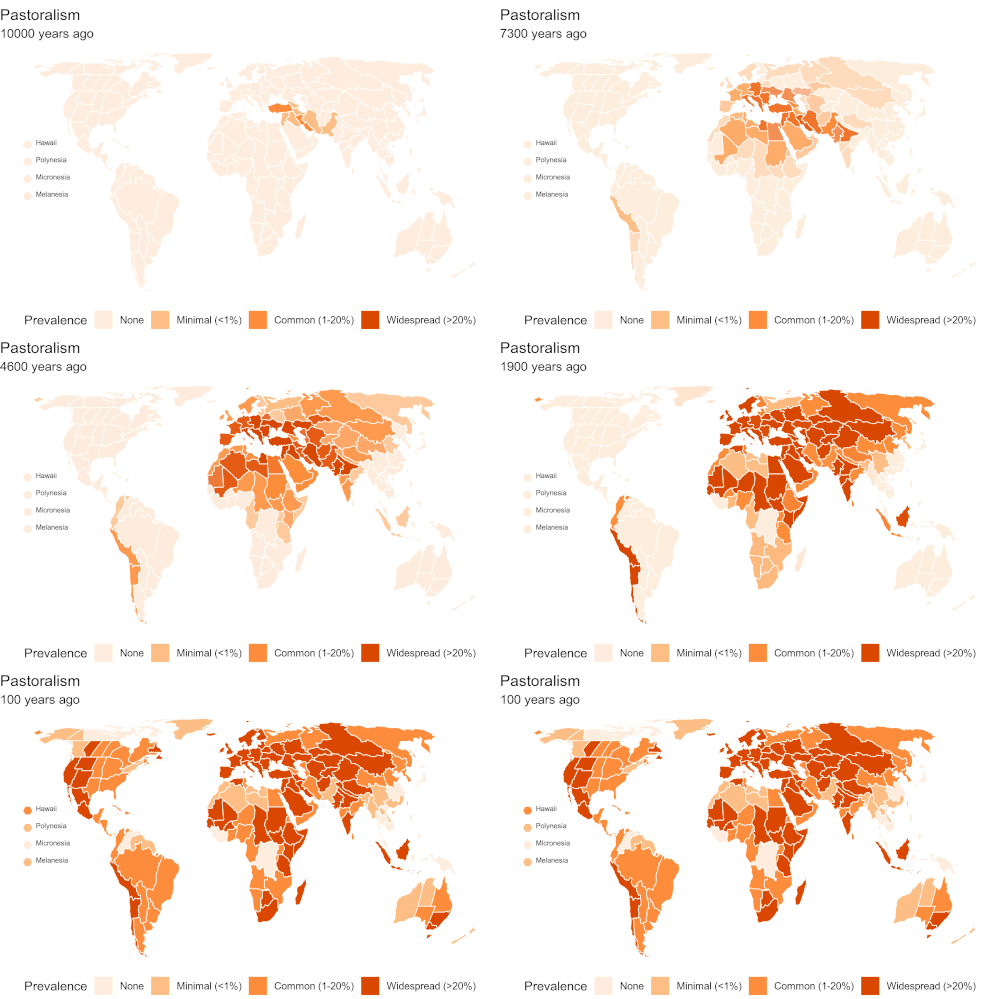
Pastoralism remains a way of life in many geographic areas, including Africa, the Tibetan plateau, the Eurasian steppes, the Andes, Patagonia, the Pampas, Australia and many other places. As of 2019[update], between 200 million and 500 million people globally practiced pastoralism, and 75% of all countries had pastoral communities.[4]
Pastoral communities have different levels of mobility. Sedentary pastoralism has become more common as the hardening of political borders, land tenures, expansion of crop farming, and construction of fences and dedicated agricultural buildings all reduce the ability to move livestock around freely, leading to the rise of pastoral farming on established grazing-zones (sometimes called "ranches"). Sedentary pastoralists may also raise crops and livestock together in the form of mixed farming, for the purpose of diversifying productivity, obtaining manure for organic farming, and improving pasture conditions for their livestock. Mobile pastoralism includes moving herds locally across short distances in search of fresh forage and water (something that can occur daily or even within a few hours); as well as transhumance, where herders routinely move animals between different seasonal pastures across regions; and nomadism, where nomadic pastoralists and their families move with the animals in search for any available grazing-grounds—without much long-term planning. Grazing in woodlands and forests may be referred to as silvopastoralism.[5] Those who practice pastoralism are called "pastoralists".
Pastoralist herds interact with their environment, and mediate human relations with the environment as a way[citation needed] of turning uncultivated plants (like wild grass) into food. In many places, grazing herds on savannas and in woodlands can help maintain the biodiversity of such landscapes and prevent them from evolving into dense shrublands or forests. Grazing and browsing at the appropriate levels often can increase biodiversity in Mediterranean climate regions.[6][7] Pastoralists shape ecosystems in different ways: some communities use fire to make ecosystems more suitable for grazing and browsing animals.
Origins


One theory suggests that pastoralism developed from mixed farming. Bates and Lees proposed that the incorporation of irrigation into farming resulted in specialization.[8] Advantages of mixed farming include reducing risk of failure, spreading labour, and re-utilizing resources. The importance of these advantages and disadvantages to different farmers or farming societies differs according to the sociocultural preferences of the farmers and the biophysical conditions as determined by rainfall, radiation, soil type, and disease.[9] The increased productivity of irrigation agriculture led to an increase in population and an added impact on resources. Bordering areas of land remained in use for animal breeding. This meant that large distances had to be covered by herds to collect sufficient forage. Specialization occurred as a result of the increasing importance of both intensive agriculture and pastoralism. Both agriculture and pastoralism developed alongside each other, with continuous interactions.[8]
A different theory suggests that pastoralism evolved from the hunting and gathering. Hunters of wild goats and sheep were knowledgeable about herd mobility and the needs of the animals. Such hunters were mobile and followed the herds on their seasonal rounds. Undomesticated herds were chosen to become more controllable for the proto-pastoralist nomadic hunter and gatherer groups by taming and domesticating them. Hunter-gatherers' strategies in the past have been very diverse and contingent upon the local environmental conditions, like those of mixed farmers. Foraging strategies have included hunting or trapping big game and smaller animals, fishing, collecting shellfish or insects, and gathering wild-plant foods such as fruits, seeds, and nuts.[10] These diverse strategies for survival amongst the migratory herds could also provide an evolutionary route towards nomadic pastoralism.[citation needed]
Resources
Pastoralism occurs in uncultivated areas. Wild animals eat the forage from the marginal lands and humans survive from milk, blood, and often meat of the herds and often trade by-products like wool and milk for money and food.[11]
Pastoralists do not exist at basic subsistence. Pastoralists often compile wealth and participate in international trade. Pastoralists have trade relations with agriculturalists, horticulturalists, and other groups. Pastoralists are not extensively dependent on milk, blood, and meat of their herd. McCabe noted that when common property institutions are created, in long-lived communities, resource sustainability is much higher, which is evident in the East African grasslands of pastoralist populations.[12] However, the property rights structure is only one of the many different parameters that affect the sustainability of resources, and common or private property per se, does not necessarily lead to sustainability.[13]
Some pastoralists supplement herding with hunting and gathering, fishing and/or small-scale farming or pastoral farming.
Mobility

Mobility allows pastoralists to adapt to the environment, which opens up the possibility for both fertile and infertile regions to support human existence. Important components of pastoralism include low population density, mobility, vitality, and intricate information systems. The system is transformed to fit the environment rather than adjusting the environment to support the "food production system."[14] Mobile pastoralists can often cover a radius of a hundred to five hundred kilometers.[citation needed]
Pastoralists and their livestock have impacted the environment. Lands long used for pastoralism have transformed under the forces of grazing livestock and anthropogenic fire. Fire was a method of revitalizing pastureland and preventing forest regrowth. The collective environmental weights of fire and livestock browsing have transformed landscapes in many parts of the world. Fire has permitted pastoralists to tend the land for their livestock. Political boundaries are based on environmental boundaries.[15] The Maquis shrublands of the Mediterranean region are dominated by pyrophytic plants that thrive under conditions of anthropogenic fire and livestock grazing.[16]
Nomadic pastoralists have a global food-producing strategy depending on the management of herd animals for meat, skin, wool, milk, blood, manure, and transport. Nomadic pastoralism is practiced in different climates and environments with daily movement and seasonal migration. Pastoralists are among the most flexible populations. Pastoralist societies have had field armed men protect their livestock and their people and then to return into a disorganized pattern of foraging. The products of the herd animals are the most important resources, although the use of other resources, including domesticated and wild plants, hunted animals, and goods accessible in a market economy are not excluded. The boundaries between states impact the viability of subsistence and trade relations with cultivators.[17]

Pastoralist strategies typify effective adaptation to the environment.[18] Precipitation differences are evaluated by pastoralists. In East Africa, different animals are taken to specific regions throughout the year that corresponds to the seasonal patterns of precipitation.[19] Transhumance is the migration of livestock and pastoralists between seasonal pastures.