
Loading article…
サウジアラビア王国 アル・マムラカ・アル・アラビーヤ・アズ・スーディヤ | |
|---|---|
| 座右の銘: لا إله إلا الله، محمد رسول الله Lā ilāha illallāh、Muḥammadun rasurullāh 「神 以外に神はいない、ムハンマドは神の使徒である」[1] [a] ( shahada ) | |
| 国歌: النشيد الوطني السعودي " an-Našīd al-Waṭanīy as-Saʿudī " 「サウジ国民の聖歌」 | |
.svg/500px-Saudi_Arabia_(orthographic_projection).svg.png) _-_SAU_-_UNOCHA.svg/500px-Saudi_Arabia_-_Location_Map_(2013)_-_SAU_-_UNOCHA.svg.png) | |
| 資本 そして最大の都市 | リヤド 北緯24度39分 東経46度46分 / 北緯24.650度 東経46.767度 / 24.650; 46.767 |
| 公用語 | アラビア語[5] |
| 民族グループ (2014)[6] [b] | 90%アラブ人 10%アフロアラブ人 (サウジアラビア国民のみ) |
| 宗教 (2010年)[7] | |
| 異名 |
|
| 政府 | イスラムの絶対君主制 |
• 王 | サルマン |
| ムハンマド・ビン・サルマン | |
| 立法府 | なし[c] |
| 設立 | |
| 1727 | |
• ネジド首長国 | 1824 |
• リヤド首長国 | 1902年1月13日 |
• 統一 | 1932年9月23日 |
| 1945年10月24日 | |
• 現憲法 | 1992年1月31日 |
| エリア | |
• 合計 | 2,149,690 [11] km 2 (830,000 平方マイル) ( 12 位) |
• 水 (%) | 0.0 |
| 人口 | |
• 2022年国勢調査 |  32,175,224 [12] ( 46位) 32,175,224 [12] ( 46位) |
• 密度 | 15/km 2 (38.8/平方マイル) ( 174位) |
| GDP (購買力平価) | 2024年推定 |
• 合計 |  2兆3,540億ドル[13](17位) 2兆3,540億ドル[13](17位) |
• 一人当たり | 70,333ドル[13] ( 15日) |
| GDP (名目) | 2024年推定 |
• 合計 | 1兆1,060億ドル[13](19位) |
• 一人当たり | 33,040ドル[13] ( 34位) |
| ジーニ (2013) |  45.9 [14] 45.9 [14]中程度の不平等 |
| HDI (2022) | 0.875 [15]非常に高い (40位) |
| 通貨 | サウジアラビアリヤル(SR) [d] ( SAR ) |
| タイムゾーン | UTC +3 ( AST ) |
| 日付形式 | 年/月/日 ( AH ) |
| ドライブを続ける | 右 |
| 呼び出しコード | +966 |
| ISO 3166 コード | 南アフリカ |
| インターネットTLD | |


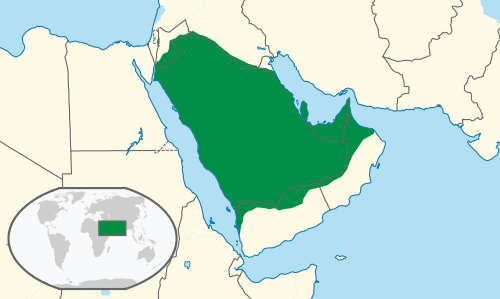
サウジアラビア[e]、正式にはサウジアラビア王国(KSA)[f]は、西アジアの国である。アラビア半島の大部分を占め、陸地面積は約2,150,000 km 2(830,000平方マイル)で、アジアで5番目に大きく、中東では最大の国である。西は紅海、北はヨルダン、イラク、クウェート、東はペルシャ湾、バーレーン[17]カタール、アラブ首長国連邦、南東はオマーン、南はイエメンと国境を接している。北西部のアカバ湾はサウジアラビアをエジプトとイスラエルから隔てている。サウジアラビアは紅海とペルシャ湾の両方に海岸線を持つ唯一の国であり、国土の大部分は乾燥した砂漠、低地、ステップ、山岳地からなる。首都で最大の都市はリヤドである。その他の主要都市には、ジッダ、イスラム教の二大聖地であるメッカとメディナがあり、人口は約3,220万人で、アラブ世界で4番目に人口の多い国です。
現在のサウジアラビアを構成する領域であるイスラム以前のアラビアには、いくつかの古代文化と文明が存在した。サウジアラビアの先史時代は、アフリカ以外での人類の活動の最も古い痕跡を示している。[18] 世界で2番目に人口の多い宗教であるイスラム教は、 [19] 7世紀初頭に現在のサウジアラビアで誕生した。イスラムの預言者ムハンマドはアラビア半島の人々を団結させ、単一のイスラム教の宗教国家を創設した。632年に彼が死去した後、信奉者たちはイスラム教の支配をアラビアを越えて拡大し、数十年以内に北アフリカ、中央アジア、南アジア、イベリア半島の領土を征服した。[20] [21] [22]現在のサウジアラビアに起源を持つアラブの王朝は、ラシドゥーン朝(632年 - 661年)、ウマイヤ朝(661年 - 750年)、アッバース朝(750年 - 1517年)、ファーティマ朝(909年 - 1171年)のカリフ制を建国したほか、アジア、アフリカ、ヨーロッパに数多くの王朝を建国した。
サウジアラビア王国は1932年にアブドゥルアズィーズ国王(イブン・サウードとしても知られる)によって建国された。アブドゥルアズィーズ国王は、1902年に自身の一族であるサウード家の祖先の故郷であるリヤドを占領したことに始まる一連の征服を通じて、ヒジャズ、ナジュド、東アラビア(アフマド)の一部、南アラビア(アスィール)の地域を単一国家に統合した。サウジアラビアはそれ以来、国民の意見を反映させない権威主義体制によって統治される絶対君主制となっている。 [23]サウジアラビアは基本法において、イスラム教を国教、アラビア語を公用語とする主権アラブ・イスラム国家であると規定している。2000年代まで、イスラム教スンニ派内の超保守的なワッハーブ派の宗教運動が、この国の政治的、文化的勢力を支配していた。[24] [25]サウジアラビア政府は、イエメン内戦への介入、テロ支援疑惑、広範囲にわたる人権侵害など、様々な政策で批判を集めている。[26] [27]
サウジアラビアは、地域大国であると同時に中規模国でもあると考えられている。[28] [29] 1938年に同国で石油が発見されて以来、[30] [31]同王国は世界第3位の石油生産国かつ有数の石油輸出国となり、世界第2位の石油埋蔵量と世界第6位のガス埋蔵量を管理している。[32]サウジアラビアは世界銀行の高所得国に分類されており、 G20主要経済国の中で唯一のアラブ諸国である。[33] [34]サウジアラビアの経済は中東最大であり、名目GDPでは世界第19位、購買力平価では第17位である。人間開発指数で非常に高い評価を得ており、[35]サウジアラビアは大学教育の授業料無料、個人所得税なし、[36]無料の国民皆保険制度を提供している。外国人労働力への依存度が高いため、サウジアラビアは世界第3位の移民人口を抱えている。サウジアラビア人は世界で最も若い国民の一つであり、その約半数が25歳未満である。[37] [38]サウジアラビアは、湾岸協力会議、国際連合、イスラム協力機構、アラブ連盟、石油輸出国機構の創設メンバーとして積極的に活動しており、上海協力機構の対話パートナーでもある。
語源
ヒジャズ王国とネジド王国の合併に続いて、アブドゥルアズィーズ・ビン・サウードは1932年9月23日に国王勅令を発布し、新国家をアラビア語で「サウジアラビア王国」と名付けた。これは通常英語では「サウジアラビア王国」と訳されるが[ 39]、文字通りには「サウジアラビア王国」[40] 、あるいは「サウジアラビア王国」(ヨルダン・ハシミテ王国と比較のこと)を意味する。
「サウジ」という語は、アラビア語の国名の要素である「 as-Suʿūdīyya」に由来する。これは、サウジ王家の王朝名であるアル・サウド(アラビア語:آل سعود )から形成された、ニスバと呼ばれる形容詞の一種である。この語句が含まれることは、国が王家の私有物であるという見解を表している。[41] [42]アル・サウドは、アラビア語の名前で、「家族」または「家」を意味する「Al 」という単語を先祖の個人名に追加して形成されたものである。 [43]アル・サウドの場合、これは18世紀の王朝の創始者であるムハンマド・ビン・サウドの父であるサウド・イブン・ムハンマド・イブン・ムクリンである。[44]
歴史
先史時代

アラビア半島における人類の居住は約125 , 000年前に遡る証拠がある。[45] 2011年の研究では、アジアを東に渡って広がった最初の現代人は、アフリカの角とアラビアを結ぶバブ・エル・マンデブ山脈を越えて約75 ,000年前にアフリカを離れたことが判明した。[46]アラビア半島は、人類の進化と拡散を理解する上で中心的な場所とみなされている。アラビアは第四紀に極端な環境変動を経験し、それが大きな進化と人口動態の変化をもたらした。アラビアには豊富な前期旧石器時代の記録があり、この地域のオルドワン石器のような遺跡の多さは、アラビアがユーラシアの初期の人類の植民地化において重要な役割を果たしたことを示している。[47]
新石器時代には、現在のナジュド南西部を中心とするアル・マガールなどの著名な文化が栄えた。アル・マガールは、人類の知識と手工芸技術における「新石器時代革命」とみなすことができる。 [48]この文化は、新石器時代に動物、特に馬の広範な家畜化を伴った世界初の文化の一つとして特徴付けられる。[49] [50]アル・マガールの像は地元の石で作られており、住人の社会的、宗教的生活において重要な役割を果たしていたと思われる中央の建物に固定されていたようだ。[51]
2017年11月、サウジアラビア北西部の丘陵地帯シュワイミスで、おそらく飼いならされた犬(カナン・ドッグに似ている)がリードをつけている狩猟シーンが発見された。この岩絵は8000年以上前のもので、世界で最も古い犬の描写となっている。[52]
紀元前4千年紀の終わりに、アラビアは青銅器時代に入りました。金属が広く使用され、この時代は高さ2メートルの埋葬地が特徴で、同時に、元々赤色で塗られた多くの独立した彫刻を含む多数の寺院が存在していました。[53]
2021年5月、考古学者らは、ハイル地方にある35万年前のアシューリアン遺跡「アン・ナシム」が、サウジアラビア北部で最古の人類居住地である可能性があると発表した。手斧や石器を含む354点の遺物は、南西アジアに住んでいた最古の人類の道具作りの伝統に関する情報を提供した。旧石器時代の遺物は、ネフード砂漠のアシューリアン遺跡で発見された物質的遺物と似ている。[54] [55] [56] [57]
イスラム以前

サウジアラビアにおける最古の定住文化は、ドサリヤのウバイド朝時代に遡る。気候変動と乾燥化の始まりがこの定住段階の終焉をもたらした可能性があり、次の千年紀の考古学的証拠はほとんど残っていない。[59]この地域の定住は、3千年紀初期のディルムン時代に再び活発になる。ウルクの既知の記録には、ディルムンと呼ばれる場所が言及されており、銅と何度か関連付けられており、後期には南メソポタミアへの輸入木材の供給源であった。学者たちは、ディルムンはもともとサウジアラビアの東部州を指し、特に内陸部のウンム・アン・ヌッシとウンム・アル・ラマド、海岸部のタルートといった主要なディルムン人の定住地と関連していたと示唆している。タルート島がディルムンの主要港であり首都であった可能性が高い。[58]メソポタミアの粘土板に刻まれた碑文は、ディルムンの初期には階層的な政治組織が存在していたことを示唆している。1966年、タルートの土塁で古代の墓地が発見され、そこからディルムン時代(紀元前3千年紀中頃)の大きな像が発見された。この像は、ディルムンの芸術原理に強いメソポタミアの影響を受けて地元で作られたものである。[58]
紀元前2200年までに、ディルムンの中心地は、理由は不明だがタルートとサウジアラビア本土からバーレーン島へと移り、高度に発達した集落がそこに出現し、この時代に遡る寺院群と数千の古墳が発見された。[58]
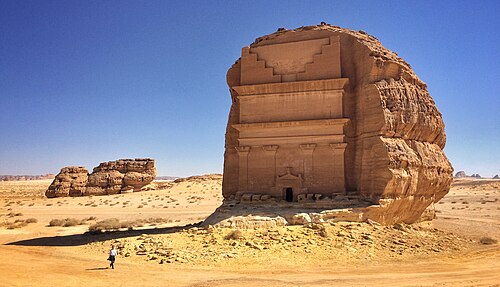
青銅器時代後期までには、サウジアラビア北西部に歴史的に記録された人々と土地(ミディアンとミディアン人)が聖書に詳しく記されている。タブークを中心とし、北はワディ・アラバから南はアル・ウェジュの地域まで広がっていた。 [60]ミディアンの首都はクライヤで、[61] 35ヘクタールの広大な要塞化された城塞と、その下15ヘクタールの壁で囲まれた集落で構成されていた。この都市には1万2千人もの住民が住んでいた。[62]聖書には、紀元前11世紀初頭のどこかでイスラエルがミディアンと2度戦争をしたことが記されている。政治的には、ミディアン人は5人の王(エビ、レケム、ツル、フル、レバ)が率いる分散型構造をとっていたとされている。これらの名前は、重要なミディアン人の居住地の地名であると思われる。[63]ミディアンとは部族連合を指し、定住者はヒジャーズに定住し、遊牧民は遠くパレスチナまで放牧し、時には略奪を行ったと見るのが良いだろう。[64]遊牧民のミディアン人は、この地域の厳しい地形を移動できるようにラクダを家畜化した最も初期の開拓者の一つであった。[64]

紀元前7世紀末、アラビア北西部に新興王国が出現した。それはデダンの首長国として始まり、リヒャン王国へと発展した。[66] [67]この時期に、デダンはより広い領域を包含する王国へと変貌した。[66]紀元前3世紀初頭、南北間の経済活動が活発になり、リヒャンは隊商の道の戦略的な位置にふさわしい大きな影響力を獲得した。[68]リヒャン人は、南はヤスリブから北はレバントの一部まで、広大な領域を支配した。 [69]古代では、アカバ湾はリヒャン湾と呼ばれていたが、これはリヒャンが獲得した広範な影響力の証である。[70]
リヒャン人は紀元前65年頃、ヘグラを占領し、その後タイマに進軍し、紀元前9年に首都デダンに陥落した際にナバテア人の手に落ちた。ナバテア人は北アラビアの大部分を支配していたが、その領土はローマ帝国に併合され、アラビア・ペトラエアと改名され、630年までローマの支配下にあった。[71]
中世とイスラム教の台頭

イスラム教の到来直前、都市の交易集落(メッカやメディナなど)を除けば、後にサウジアラビアとなる地域の多くは遊牧民の部族社会で占められていた。[74]イスラムの預言者ムハンマドは、西暦570年頃にメッカで生まれた。7世紀初頭、ムハンマドは半島の様々な部族を統合し、単一のイスラム教の宗教国家を創設した。[75] 632年に彼が死去した後、彼の信奉者はイスラム支配下の領土をアラビアを越えて拡大し、数十年の間に西はイベリア半島から東は中央アジアと南アジアの一部までを征服した[要出典] 。 [20] [21] [22] 焦点が新たに征服された土地に移るにつれ、アラビアはイスラム世界の政治的に周辺的な地域となった。[75]
現在のサウジアラビアに起源を持つアラブ人、特にヒジャズは、ラシドゥーン朝(632年 - 661年)、ウマイヤ朝(661年 - 750年)、アッバース朝(750年 - 1517年)、ファーティマ朝(909年 - 1171年)のカリフ朝を建国した。10世紀から20世紀初頭にかけて、メッカとメディナはメッカのシャリフとして知られる地元のアラブ人支配者の支配下にあったが、ほとんどの場合、シャリフはバグダッド、カイロ、イスタンブールに拠点を置く主要なイスラム帝国の支配者に忠誠を誓っていた。サウジアラビアとなった残りの地域のほとんどは、伝統的な部族統治に戻った。[76] [77]

10世紀の大半、ペルシア湾ではイスマーイール派シーア派のカルマティア人が最強の勢力だった。930年、カルマティア人はメッカを略奪し、特に黒石を盗んだことでイスラム世界を激怒させた。[78] 1077年から1078年にかけて、アブドゥッラー・ビン・アリー・アル・ウユニという名のアラブのシェイクがセルジューク朝の助けを借りてバーレーンやアル・ハサでカルマティア人を破り、ウユニド朝を建国した。[79] [80]ウユニド首長国はその後拡大し、その領土はナジュドからシリア砂漠にまで広がった。[81]彼らは1253年にウスフリード朝によって倒されました。 [ 82 ] 1320年にホルムズ諸島のペルシャ支配者がバーレーンおよびカティーフを占領した後、ウスフリード朝の支配は弱まりました。[83]オルムズ朝の家臣であるシーア派のジャールワーン朝は14世紀に東アラビアを支配するようになりました。[84] [85]ジャーブル朝は15世紀にジャールワーン朝を倒した後、この地域を支配し、20年以上にわたってホルムズ諸島の経済収入をめぐって衝突し、最終的に1507年に貢物を払うことに同意しました。 [84]その後、アル・ムンタフィーク族がこの地域を占領し、オスマン帝国の宗主権下にありました。[86]彼らの支配は最盛期にはイラクからオマーンにまで及び、彼らもまたオスマン帝国の宗主権下に入った。[87] [88]
オスマン帝国ヒジャズ
16世紀、オスマン帝国は紅海とペルシャ湾沿岸(ヒジャズ、アスィール、アル=アハサー)を帝国に加え、内陸部の宗主権を主張した。理由の1つは、ポルトガルが紅海(ヒジャズの由来)とインド洋を攻撃しようとするのを阻止するためだった。[89]オスマン帝国によるこれらの土地の支配の程度は、帝国の中央権力の変動する強さや弱さに応じて、その後4世紀にわたって変化した。[90] [91]これらの変化は、マアンとアカバの都市を含むマアンのサンジャクの編入をめぐるトランスヨルダンとの紛争など、後の不確実性の一因となった。[要出典]
サウド王朝と統一
アル・サウードとして知られるサウード王家の誕生は、1727年2月22日にアラビア中央部のネジド地方のディルイーヤでムハンマド・ビン・サウードが首長に就任したことから始まった。 [92] [93] 1744年に彼は宗教指導者ムハンマド・イブン・アブド・アル・ワッハーブと手を組んだ。[94]ワッハーブ運動の創始者で、ワッハーブ運動はイスラム教スンニ派の厳格な一派である。 [95]この同盟はサウジの拡大に思想的推進力を与え、今日でもサウジアラビア王朝統治の基盤となっている。 [ 96 ]
リヤド周辺に設立されたディルイーヤ首長国は急速に拡大し、現在のサウジアラビアの領土のほとんどを一時的に支配し、1802年にカルバラーを略奪し、 1803年にメッカを占領した。 1818年、オスマン帝国のエジプト総督ムハンマド・アリー・パシャによって破壊された。[97]はるかに小さなネジド首長国は1824年に設立された。19世紀の残りの期間、アル・サウード家は、ジャバル・シャマル首長国を統治していた別のアラブ人統治者一族、アル・ラシード家と、後にサウジアラビアとなる地域の支配権を争った。1891年までにアル・ラシード家が勝利し、アル・サウード家はクウェートに亡命した。[76]

20世紀初頭、オスマン帝国は半島の大部分を支配し、あるいは宗主権を有し続けた。この宗主権のもと、アラビアは部族の支配者たちによって統治され、[98] [99]メッカのシャリフが優勢でヒジャズを支配していた。[100] 1902年、アブドゥル・ラーマンの息子、アブドゥル・アズィーズ(後にイブン・サウードとして知られる)がリヤドの支配権を奪還し、アル・サウードをネジドに戻し、第三の「サウジ国家」を樹立した。[76]イブン・サウードは、ワッハーブ主義に影響を受けたファイサル・アル=ダウィーシュ率いる部族軍であるイフワーンの支援を得た。イフワーンは1912年の創設後急速に成長していた。[101]イフワーンの援助を受けて、イブン・サウードは1913年にオスマン帝国からアハサーを奪取した。
1916年、第一次世界大戦でオスマン帝国と戦っていたイギリスの支援と激励を受けて、メッカのシャリフ、フセイン・ビン・アリーは、オスマン帝国に対する汎アラブ反乱を起こし、統一アラブ国家を樹立した。 [102]反乱は目的を達成できなかったが、第一次世界大戦における連合国の勝利により、オスマン帝国のアラビアにおける宗主権と支配は終わり、フセイン・ビン・アリーはヒジャズの王となった。[103]
イブン・サウードはアラブ反乱への関与を避け、代わりにアル・ラシードとの闘争を続けた。アル・ラシードの最終的な敗北の後、彼は1921年にネジド王国のスルタンの称号を得た。イフワーンの助けを借りて、ヒジャズ王国は1924年から25年にかけて征服され、1926年1月10日、イブン・サウードはヒジャズの王を宣言した。[104]その後5年間、彼は二重王国の2つの部分を別々の単位として統治した。[76]
ヒジャズ征服後、イフワーン指導部の目標はワッハーブ派の領土をイギリス保護領であるトランスヨルダン、イラク、クウェートに拡大することへと変わり、それらの領土を襲撃し始めた。これはイギリスとの直接衝突の危険性を認識したイブン・サウードの反対に遭った。同時に、イフワーンは近代化と国内の非イスラム教徒外国人の増加を支持するように見えるイブン・サウードの国内政策に幻滅した。その結果、イフワーンはイブン・サウードに背き、2年間の闘争の後、1929年にサビラの戦いで敗北し、指導者たちは虐殺された。[105]イブン・サウードに代わってファイサル王子が1932年9月23日に統一を宣言し、ヒジャズとネジドの2つの王国はサウジアラビア王国として統一された。[76]その日は現在ではサウジアラビア建国記念日と呼ばれる国民の祝日となっている。[106]
20世紀

新しい王国は限られた農業と巡礼からの収入に依存していた。[107] 1938年、ペルシャ湾沿岸のアル・アハサー地域で膨大な石油埋蔵量が発見され、1941年に米国管理下のアラムコ(アラビアン・アメリカン石油会社)の下で本格的な油田開発が始まった。石油はサウジアラビアに経済的繁栄と国際的に大きな政治的影響力をもたらした。[76]新聞やラジオの中心地であったヒジャズを中心に、文化生活が急速に発展した。しかし、石油産業への外国人労働者の大量流入により、以前からあった外国人排斥の傾向が強まった。同時に、政府はますます浪費と贅沢をするようになった。1950年代までに、これは大きな政府赤字と過剰な対外借り入れにつながった。[76] 1953年、サウジアラビアのサウードがサウジアラビア国王として即位した。 1964年、サウジ王家の能力に対する疑念から激しい対立が起こり、彼は異母兄弟のサウジアラビアのファイサルに王位を譲った。1972年、サウジアラビアはアラムコの20%の支配権を獲得し、それによってサウジの石油に対する米国の支配力を低下させた。 [108] 1973年、サウジアラビアは、ヨム・キプール戦争でエジプトとシリアに対してイスラエルを支援した西側諸国に対する石油ボイコットを主導し、石油価格を4倍に引き上げた。[76] 1975年、ファイサルは甥のファイサル・ビン・ムサイド王子に暗殺され、異母兄弟のハーリド国王が後を継いだ。[109]

1976年までに、サウジアラビアは世界最大の石油生産国となった。[110]ハーリドの治世下では、経済と社会の発展が極めて急速に進み、国のインフラと教育システムが変革した。[76]外交政策では、米国との緊密な関係が構築された。[109] 1979年には、政府を大いに懸念させ[111]、サウジアラビアの外交政策と国内政策に長期的な影響を与えた2つの出来事が起こった。1つ目はイラン・イスラム革命である。東部州(油田がある場所でもある)のシーア派少数派が、イラン人の同宗教者の影響を受けて反乱を起こすのではないかと懸念された。 1979年のカティーフ蜂起など、この地域では反政府蜂起が数回発生した。[112] 2つ目は、イスラム過激派によるメッカの大モスク占拠である。関与した過激派は、サウジ政府の腐敗と非イスラム的性質に憤慨していた。[112]政府は10日後にモスクを奪還し、捕らえられた人々は処刑された。王室の対応の一環として、国内の伝統的な宗教的・社会的規範の遵守を厳格化し(例えば映画館の閉鎖)、ウラマーに政府でより大きな役割を与えることとなった。[113]どちらも、イスラム主義が勢力を増し続ける中で、完全には成功しなかった。[114]

1980年、サウジアラビアはアラムコのアメリカの権益を買収した。[115]ハーリド国王は1982年6月に心臓発作で死去。その後を継いだのは弟のファハド国王で、1986年に国王名に「二聖モスクの守護者」の称号が加えられた。これは、神以外のものに対して「威厳」という言葉を使うのを避けるよう原理主義者から強い圧力がかかったためである。ファハド国王はアメリカとの緊密な関係を築き続け、アメリカやイギリスの軍事装備の購入を増やした。[76]石油収入によって生み出された莫大な富は、サウジ社会にさらに大きな影響を及ぼし始めていた。それは急速な技術的(文化的ではない)近代化、都市化、大衆教育、そして新しいメディアの創造をもたらした。これと、ますます増える外国人労働者の存在は、伝統的なサウジの規範と価値観に大きな影響を与えた。国の社会的、経済的生活に劇的な変化があったにもかかわらず、政治権力は引き続き王室によって独占され[76]、多くのサウジアラビア国民の不満を招き、政府へのより広範な参加を求めるようになりました[116] 。
1980年代、サウジアラビアとクウェートはイラン・イラク戦争(1980-1988年)でサダム・フセインを支援するために250億ドルを費やした。 [117]しかし、サウジアラビアは1990年のクウェート侵攻を非難し、米国に介入を求めた。[76]ファハド国王はアメリカ軍と連合軍のサウジアラビア駐留を許可した。彼はクウェート政府と多くの国民にサウジアラビアに留まるよう招いたが、イエメンとヨルダンの国民は両国の政府がイラクを支援していることを理由に追放した。1991年、サウジアラビア軍はイラクへの爆撃とクウェート解放を助けた地上侵攻の両方に関与し、湾岸戦争(1990-1991年)として知られるようになった。[108]
サウジアラビアと西側諸国との関係は、サウジアラビアにおけるイスラム主義テロの増加、および西側諸国におけるサウジ国民によるイスラム主義テロ攻撃の増加につながった問題の一つである。オサマ・ビン・ラディンはサウジ国民であり(1994年に国籍を剥奪されるまで)、1998年の東アフリカにおける米国大使館爆破事件、2000年のイエメンのアデン港付近でのUSSコール号爆破事件の犯人である。9月11日の攻撃に関与したハイジャック犯のうち15人はサウジ国民であった。[118]イスラム主義テロリストを支持しなかった多くのサウジ国民は、それでも政府の政策に深く不満を抱いていた。[119]
イスラム主義は政府に対する敵意の唯一の源泉ではなかった。21世紀までに非常に裕福になったにもかかわらず、サウジアラビアの経済はほぼ停滞していた。高い税金と失業率の上昇は不満を招き、市民の不安や王室への不満の高まりに反映された。これに対応して、ファハド国王はいくつかの限定的な改革を開始した。1992年3月、彼は統治者の義務と責任を強調した「基本法」を導入した。1993年12月、諮問評議会が発足した。評議会は議長と60人の委員で構成され、全員が国王によって選出された。ファハド国王は民主主義を念頭に置いていないことを明確にし、「選挙に基づく制度は、協議による政府(シュラー)を承認するイスラム教の信条に反する」と述べた。[76]
1995年、ファハドは脳卒中で衰弱し、アブドラ皇太子が事実上の摂政の役割を引き継いだ。しかし、彼の権威はファハドの同腹の兄弟(ファハドとともに「スダイリ・セブン」として知られる)との対立によって妨げられた。[120]
21世紀
不満の兆候としては、2003年と2004年にリヤド、ジェッダ、ヤンブー、コバールで起きた一連の爆破事件や武装暴力が挙げられます。[121] 2005年2月から4月にかけて、サウジアラビアで史上初の全国的な市議会選挙が行われました。女性の参加は認められませんでした。[76]
2005年にファハド国王が死去し、アブドラ国王が後を継ぎ、最小限の改革と抗議活動の取り締まり政策を継続した。国王は、石油収入への依存を減らすことを目的とした経済改革、すなわち限定的な規制緩和、外国投資の奨励、民営化を導入した。2009年2月、アブドラ国王は司法、軍、およびさまざまな省庁に対する一連の政府改革を発表し、これらの機関の近代化を図った。これには、司法およびムタウィーン(宗教警察)の上級任命者をより穏健派の人物と入れ替え、国初の女性副大臣を任命することなどが含まれていた。[76]
2011年1月29日、洪水で11人が死亡した後、数百人の抗議者がジェッダに集まり、市のインフラの貧弱さを非難する珍しいデモが行われた。 [122]警察は約15分後にデモを中止させ、30人から50人を逮捕した。[123]
2011年以来、サウジアラビアはアラブの春の抗議活動の影響を受けてきた。[124]これを受けて、アブドラ国王は2011年2月22日、国民に対する総額360億ドルの給付を発表し、そのうち107億ドルは住宅に充てられた。[125] [126] [127]政治改革は含まれなかったが、金融犯罪で起訴された囚人の一部は恩赦を受けた。[128]アブドラ国王はまた、670億ドルの費用で50万戸の新築住宅を建設し、さらに6万人の新たな警備職を創出するなど、総額930億ドルのパッケージを発表した。 [129] [130] 2011年9月29日に男性のみの市議会選挙が実施されたにもかかわらず、[131] [132]アブドラ大統領は、 2015年の市議会選挙で女性の投票と選出を認め、また、シューラ評議会への指名も認めた。[133]
地理


サウジアラビアは、アラビア半島(世界最大の半島)の約80%を占め、[136]北緯16度から33度、東経34度から56度の間に位置しています。アラブ首長国連邦およびオマーンとの南東および南部の国境は正確には示されていないため、国の正確な大きさは不明です。[136]国連統計局は、サウジアラビアの面積を2,149,690 km 2 ( 830,000平方マイル)と推定し 、世界で12番目に大きい国として挙げています。地理的には中東およびアラビアプレート上で最大の国です。[137]
サウジアラビアの地理は、アラビア砂漠、それに付随する半砂漠、低木地帯、ステップ、いくつかの山脈、火山性溶岩原、高地で占められている。国土の南東部にある647,500 km 2 ( 250,001平方 マイル) のルブアルハリ砂漠(「空の四分の一」) は、世界最大の連続砂漠である。[138] [139]国内には湖もあるが、サウジアラビアは恒久的な河川のない面積では世界最大の国である。しかし、ワディ (非恒久的な河川) は、王国中に非常に多く存在する。肥沃な地域は、ワディ、盆地、オアシスの沖積堆積物の中にある。[138]紅海とアラビア湾には約 1,300 の島がある。 [140]
主な地形的特徴は、紅海から急に隆起し、ネジド川とアラビア湾に向かって徐々に下る中央台地である。紅海沿岸には、ティハマとして知られる狭い海岸平野があり、それに平行して印象的な断崖が走っている。南西部のアスィール州は山岳地帯で、標高3,002 メートル(9,849 フィート)のジャバル・フェルワがあり、これは国内最高地点である。[138]サウジアラビアには2,000を超える休火山がある。[134]地元ではアラビア語でハラート(単数形はハラ)と呼ばれるヒジャズの溶岩原は、地球最大のアルカリ玄武岩地域の一つを形成し、約180,000平方キロメートル(69,000平方マイル)を覆っている。[135]
アシールなどの南西部を除いて、サウジアラビアは砂漠気候で、夏は日中の気温が非常に高く、夜間は急激に気温が下がる。夏の平均気温は45℃(113℉)程度だが、54℃(129℉)まで上がることもある。冬は、特にタブーク州の山岳地帯では毎年降雪が珍しくない北部地域を除いて、気温が0℃(32℉)を下回ることはめったにない。[141]記録された最低気温はトゥライフで−12.0℃(10.4℉)だった。[142]
春と秋の暑さは穏やかで、平均気温は約29℃(84℉)です。年間降水量は非常に少ないです。南部地域は、通常10月から3月にかけて発生するインド洋モンスーンの影響を受けるという点で異なります。この期間の平均降水量は300mm(12インチ)で、これは年間降水量の約60%に相当します。[143]
生物多様性
サウジアラビアには、アラビア半島沿岸の霧砂漠、南西アラビアの丘陵地帯のサバンナ、南西アラビアの山岳地帯の森林地帯、アラビア砂漠、紅海ヌボシンディアの熱帯砂漠と半砂漠の5つの陸上生態地域がある。[144]野生生物には、アラビアヒョウ、[145] [146] アラビアオオカミ、シマハイエナ、マングース、ヒヒ、ケープウサギ、スナネコ、トビトビなどがいる。ガゼル、オリックス、ヒョウ、チータ[147]などの動物は、19世紀まで比較的数が多かったが、大規模な狩猟によりこれらの動物はほぼ絶滅した。文化的に重要なアジアライオンは、野生では狩猟により絶滅するまで19世紀後半までサウジアラビアに生息していた。[148]鳥類にはハヤブサ(狩猟用に捕獲され訓練される)、ワシ、タカ、ハゲワシ、サケイ、ヒヨドリなどが含まれる。ヘビには数種あり、その多くは有毒である。家畜には伝説上のアラビア馬、アラビアラクダ、羊、ヤギ、牛、ロバ、鶏など が含まれる。
紅海は豊かで多様な生態系で、1,200種以上の魚類[149]が生息し、そのうち約10%が固有種です[150]。これには42種の深海魚も含まれます[149]。この豊かな多様性は 、海岸線に沿って広がる2,000km ( 1,240マイル)のサンゴ礁によるところが大きいです。これらの裾礁は主にイシモチサンゴとハマサンゴでできています。サンゴ礁は海岸沿いにプラットフォームや時にはラグーンを形成し、時には円筒形などの他の地形も形成します(ダハブのブルーホールなど)。これらの沿岸のサンゴ礁には、 44種いるサメの一部を含む遠洋種も訪れます。いくつかの環礁を含む多くの沖合のサンゴ礁があります。珍しい沖合のサンゴ礁の形成の多くは、従来の(つまりダーウィンの)サンゴ礁の分類体系に当てはまらず、一般的にその地域を特徴付ける高レベルの地殻活動に起因すると考えられています。
国土の大部分が砂漠地帯であることを反映し、植物は水をほとんど必要としない草本植物や低木がほとんどである。ナツメヤシ(Phoenix dactylifera)は広く分布している。[138]
政府と政治
サウジアラビアは絶対君主制国家であるが[151]、 1992年に国王令で採択されたサウジアラビア基本法によれば、国王はシャリーア(イスラム法)とコーランを遵守しなければならず、コーランとスンナ(ムハンマドの伝統)は国の憲法であると宣言されている。[152]いかなる政党や国政選挙も認められていない。[151]批評家の中にはサウジアラビアを全体主義国家とみなす者もいるが[153]、[154]全体主義の側面を欠いていると見なしながらも、権威主義体制に分類する者もいる。[155] [156] [157] エコノミスト誌は、 2022年の民主主義指数でサウジアラビア政府を167カ国中150位にランク付けし、[158]フリーダムハウスはサウジアラビアに最低の「自由ではない」評価を与え、2023年には100点満点中8点を与えた。[159] 2023年のV-Dem民主主義指数によると、サウジアラビアは中東で最も民主的でない国である。[160]
国政選挙や政党が存在しないサウジアラビアでは、 [151]政治は2つの異なる舞台で行われている。王室、アル・サウド家の内部と、王室とサウジ社会の残りの人々との間で行われている。 [161]アル・サウド家以外では、政治プロセスへの参加は比較的少数の国民に限られており、王室がウラマー、部族のシェイク、有力な商業一族のメンバーと協議して重要な決定を下すという形をとっている。[138]このプロセスはサウジのメディアでは報道されていない。[162]

慣習により、成人男性はすべて、マジリスと呼ばれる伝統的な部族会議を通じて国王に直接請願する権利がある。[163]多くの点で、政治への取り組み方は伝統的な部族統治システムとほとんど変わらない。部族のアイデンティティは依然として強く、王室以外では、政治的影響力は部族の所属によって決まることが多く、部族のシェイクは地方や国の行事に対してかなりの影響力を保持している。[138]近年では、1990年代初頭の諮問評議会や2003年の国民対話フォーラムの設立など、政治参加を広げるための限定的な措置があった。 [164] 2005年に、最初の市議会選挙が実施された。2007年には、継承を規制するために忠誠評議会が設立された。 [164] 2009年、国王は改革派を主要ポストに任命し、女性初の大臣を任命することで、政府に大きな人事異動を行った。[165] [166]しかし、これらの変更は遅すぎる、あるいは単に表面的なものであるとして批判されている。[167]
サウード家の統治は、4つの政治的反対勢力に直面している。スンニ派イスラム活動家、リベラルな批判者、特に東部州のシーア派少数派、そして長年にわたる部族的および地域主義的な特殊主義的反対者(例えばヒジャズ)である。[168]これらのうち、少数派活動家は政府にとって最も顕著な脅威であり、近年、国内で暴力事件に関与している。[121]しかし、たとえ平和的なものであっても、政府に対する公然の抗議は容認されない。[169]
君主制と王室

国王は立法、行政、司法の機能を兼ねており[138]、国王令が国の立法の基礎となっている。[170]首相はサウジアラビア閣僚会議とサウジアラビア諮問議会を主宰する。国王は通常首相を兼ねているが、例外が2つある。サウード国王の治世中に首相を務めたファイサル皇太子[171]と、 2022年から現首相を務めるムハンマド・ビン・サルマン皇太子である。 [172]王室が政治システムを支配している。王室の膨大な数により、王国の重要な役職のほとんどを掌握し、政府のあらゆるレベルに関与し、存在感を示すことができる。[173]王子の数は少なくとも7,000人と推定され、ほとんどの権力と影響力はイブン・サウードの約200人の男性の子孫が握っている。[174]主要な省庁は一般的に王室のために留保されており、[151] 13の地方知事職も同様です。[175]

サウジアラビア政府[176] [177] [178]と王室[179] [180] [181]は長年にわたり汚職の疑いをかけられてきたが[182]、この疑惑は21世紀に入っても続いている。[183] 王室に「属する」と言われ、王室の名前を冠した国では[42] 、国家資産と高位の王子たちの個人資産の境界線は曖昧である。[174]汚職の程度は組織的[184]かつ風土病的[185]と評されており、その存在は2001年のインタビューでバンダル・ビン・スルタン王子(王室の高位メンバー)[188]によって認められ[186]、擁護された[187] 。 [189]
トランスペアレンシー・インターナショナルは、2010年の腐敗認識指数で、サウジアラビアに4.7点を付けた(0から10の尺度で、0は「非常に腐敗している」、10は「非常にクリーン」)。[190]サウジアラビアは、公共の透明性と良好な統治の向上など、政治的および社会的改革のプロセスを経てきたが、国内でビジネスを行う際には縁故主義とパトロネージが蔓延しており、反腐敗法の執行は選択的であり、公務員は罰せられることなく腐敗に関与している。2017年11月には、反腐敗キャンペーンで、サウジアラビアの著名な王子、政府大臣、実業家を含む500人が逮捕された。 [191]
アル・アッシュ・シェイクとウラマーの役割

サウジアラビアは、ウラマー(イスラムの宗教指導者と法学者の団体)に政府で直接的な役割を与えている点で独特である。[192]好まれるウラマーはサラフィー運動のウラマーである。ウラマーは、1973年の石油禁輸措置や1990年のサウジアラビアへの外国軍の招待など、政府の重要な決定に重要な影響力を及ぼしてきた。[193]さらに、ウラマーは司法制度と教育制度において主要な役割を担っており[194]、宗教的および社会的道徳における権威を独占している。[195]
1970年代までに、石油による富とファイサル国王が始めた近代化の結果、サウジ社会に重要な変化が起こり、ウラマーの権力は衰退した。[196]しかし、 1979年にイスラム過激派がメッカのグランドモスクを占拠すると状況は一変した。[197]政府はこの危機に対応し、ウラマーの権限を強化し、財政支援を増額した。[113]特に、ウラマーは教育制度に対する権限を強化し、 [197]ワッハーブ派の道徳的および社会的行動の規則をより厳格に遵守することを許可された。[113] 2005年に即位した後、アブドラ国王はウラマーの権限を縮小する措置を講じ、例えば女子教育の権限を教育省に移譲した。[198]
ウラマーは歴史的に、国の主要な宗教家であるアル・アッシュ・シェイク[ 199]によって率いられてきた。 [195]アル・アッシュ・シェイクは、現在サウジアラビアで主流となっているスンニ派イスラム教のワッハーブ派を18世紀に創始したムハンマド・イブン・アブドゥル・ワッハーブの子孫である。 [200]この一族は、アル・サウード(王族)[201]に次ぐ名声を誇り、約300年前にアル・サウードと「相互支援協定」[202]および権力分担協定を結んだ。[193]今日まで続くこの協定[202]は、アル・サウードが宗教問題におけるアル・アッシュ・シェイクの権威を維持し、ワッハーブ派の教義を支持し広めることに基づいている。その代わりに、アル・アッシュ・シェイクはアル・サウードの政治的権威を支持し[203]、その宗教的・道徳的権威を利用して王室の統治を正当化している。[204]ここ数十年でアル・アッシュ・シェイクのウラマーに対する支配力は弱まっているが[205] 、彼らは依然として最も重要な宗教的役職を占めており、高い婚姻関係によってアル・サウードと密接に結びついている。[195]
法制度
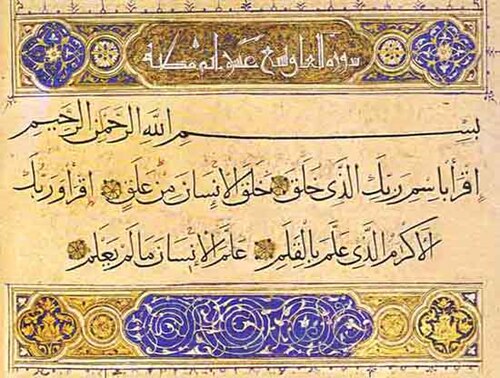
主な法源は、コーランとスンナ(預言者の伝統)の教えに由来するイスラム法シャリーアである。 [170]サウジアラビアは、シャリーアが成文化されておらず、判例制度も存在せず、裁判官が独自の法的推論を使用して決定を下すことができるという点で、現代のイスラム諸国の中では独特である。そのため、一見同一の事件であっても相反する判決が生じ、[207]法解釈の予測可能性が困難になっている。[208]サウジアラビアの裁判官は、前近代の文献に見られるハンバル法学派(フィクフ)の原則に従う傾向があり、 [209]コーランとハディースの文字通りの解釈で知られている。[210]しかし、2021年にサウジアラビアは、矛盾をなくす完全に成文化された法律につながる司法改革を発表した。[211]
国王の勅令はもう一つの主要な法源であるが、シャリーアに従属するため、法律ではなく規則と呼ばれている。 [170]国王の勅令は、労働法、商法、会社法などの分野でシャリーアを補完する。さらに、伝統的な部族法や慣習も重要な意味を持つ。[212]シャリーア外の政府裁判所は通常、特定の国王の勅令に関連する紛争を扱う。[213]シャリーア裁判所と政府裁判所の両方からの最終的な上訴は国王に対して行われ、すべての裁判所と裁判所はシャリーアの証拠と手続きの規則に従う。[214]
報復刑、いわゆるキサスも行われている。例えば、自分の目を失った被害者の強い要望により、片方の目を外科手術で摘出することもある。[215]不法に殺害された人の家族は、死刑を求めるか、加害者によるディヤ(血の代償金)の支払いと引き換えに恩赦を与えるかを選択できる。[216]
行政区分
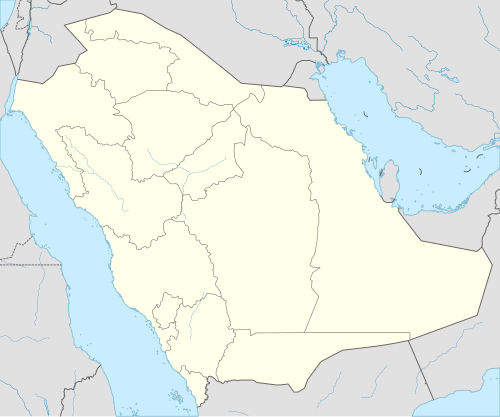
サウジアラビアは13の地域に分かれている[217](アラビア語: مناطق إدارية ; manatiq idāriyya、歌う。منطقة إدارية; mintaqah idariyya)。地域はさらに 118 の行政区(アラビア語: محافظات ; muhafazat、 sing. محافظة; muhafazah ) に分かれています。この数には、市長 (アラビア語: أمين ; amin )が首長を務める地方自治体 (アラビア語: أمانة ; amanah )としての異なる地位を持つ 13 の地方首都が含まれています。県はさらに下位の県(アラビア語:مراكز ; marakiz、単数形:مركز; markaz)に分割される。
外交関係
サウジアラビアは1945年に国連に加盟し[39] [218] 、アラブ連盟、湾岸協力会議、イスラム世界連盟、イスラム諸国会議機構(現イスラム協力機構)の創設メンバーでもある。[219]国際通貨基金や世界銀行でも重要な役割を果たしており、2005年には世界貿易機関に加盟した。[39]
1960年以来、 OPECの創設メンバーとして、その原油価格政策は、一般的に世界の石油市場を安定させ、西側諸国の経済を危険にさらさないように急激な価格変動を和らげることであった。[39] [220] 1973年、サウジアラビアと他のアラブ諸国は、1973年10月のヨムキプール戦争でイスラエルを支援した米国、英国、日本、その他の西側諸国に対して石油禁輸措置を課した。 [221]この禁輸措置は石油危機を引き起こし、世界政治と世界経済に多くの短期的および長期的な影響を及ぼした。[222]サウジアラビアと米国は戦略的同盟国であり、サウジアラビアは親西側であると考えられている。[223] [224] [225] [226] 2017年5月20日、ドナルド・トランプ大統領とサルマン国王は、サウジアラビアが10年間で総額3500億ドル相当の武器を米国から購入するための一連の意向書に署名した。 [227] [228] 1991年の湾岸戦争におけるサウジアラビアの役割、特に1991年からのサウジアラビア領土への米軍の駐留は、国内で敵対的なイスラム主義の反応の発展を促した。[229]その結果、サウジアラビアはある程度米国から距離を置き、例えば2003年の米国主導のイラク侵攻への支援や参加を拒否した。[138]
中国とサウジアラビアは主要な同盟国であり、両国の関係はここ数十年で著しく成長している。サウジアラビア人の相当数も中国に対して肯定的な見方を示している。[230] [ 231] [232] 2019年2月、ムハンマド皇太子は中国のウイグル人イスラム教徒のための新疆ウイグル自治区再教育キャンプを擁護した。[233] [234]ザ・ディプロマットによると、サウジアラビアの人権記録は「海外で頻繁に攻撃されており、中国を擁護することは自国を擁護する遠回りになっている」という。[235]
2003年の侵攻とアラブの春の結果、サウジアラビア王国内では、この地域におけるイランの影響力が増大していることに対する警戒感が高まった。[236]これらの懸念は、アブドラ国王の発言に反映されており、[198]彼は米国に対し、イランを攻撃して「蛇の頭を切り落とす」よう個人的に促した。[237]

サウジアラビアは、定期的にイスラエルとパレスチナの間の和平案を提案し、ヒズボラを非難するなど、アラブ・イスラエル紛争の緩和的な影響力を持つと見られてきた。[238]サウジアラビアは、2018年8月6日に同国が女性の権利活動家サマール・バダウィを逮捕したことをめぐる紛争が劇的に激化したため、カナダとの新たな貿易・投資取引を停止し、外交関係を停止した。[239] [240]
2017年、サウジアラビアは原子力発電 計画の一環として、国内でウランを採掘する計画を立て、核燃料の自給自足に向けた一歩を踏み出した。[241]
国際テロ支援の疑惑
サウジアラビアはイスラムテロを支援していると非難されている。[242] [243] 2014年3月のイラク首相ヌーリ・アル・マリキによると、サウジアラビアはカタールとともにイラク政府に反対するテロリストに政治的、財政的、メディア的な支援を提供した。[244]同様に、シリアのバシャール・アル・アサド大統領は2015年に、テロ組織ISISやその他のサラフィー主義過激派グループ の過激なイデオロギーの源は、サウジアラビア王室が支援してきたワッハーブ主義であると指摘した。[245]
米国との関係は9/11のテロ攻撃後緊張した。[246]米国の政治家やメディアは、サウジ政府がテロを支援し、ジハード文化を容認していると非難した。[247] 2010年12月のヒラリー・クリントン元米国務長官によると、「サウジアラビアは、アルカイダ、タリバン、LeT、その他のテロ組織にとって依然として重要な資金源である...サウジアラビアの援助国は、世界中のスンニ派テロ組織にとって最も重要な資金源である」。[248]サウジ政府はこれらの主張や、宗教的または文化的過激主義を輸出しているという主張を否定している。[249] 2016年9月、米国議会は、 9月11日の攻撃の犠牲者の遺族が、サウジアラビア政府が攻撃に関与したとしてサウジアラビアを訴えることを可能にするテロ支援者対策法案を可決した。[250] 2014年、サウジアラビアのグランド・ムフティーであり、高等学者評議会議長であるシェイク・アブドゥルアズィーズ・ビン・アブドラ・アルシェイクは、 ISISやアルカイダなどのテロ組織への参加や支援を明確に禁止するファトワを発布した。[251]米国務省によると、「サウジアラビアは、地域の平和で繁栄した未来に向けて取り組む上で重要な役割を果たしており、安全保障とテロ対策の取り組み、軍事、外交、金融協力の強力なパートナーである」。[252]サウジアラビアの対テロ活動の大きな成功は、2010年の貨物機爆弾計画の阻止であった。[253] 2015年12月、サウジアラビアは、テロと過激主義と戦うことを目的としたイスラム教徒が多数を占める国の同盟であるイスラム軍事対テロ連合の結成を発表した。[254]
しかし、2016年以降、王国はイスラム主義のイデオロギーから撤退し始めました。 [ 255]宗教警察の権限の制限、[256]外国のモスクへの資金提供の停止など、いくつかの改革が行われました。[257]
軍隊
サウジアラビアの軍隊には、国防省の管轄下にあるサウジアラビア軍(王立サウジ陸軍(王立衛兵を含む)、空軍、海軍、防空軍、戦略ミサイル部隊で構成される)、国家衛兵省の管轄下にあるサウジアラビア国家衛兵、内務大臣の管轄下にある準軍事組織(サウジアラビア国境警備隊、施設警備隊を含む)、国家安全保障局の管轄下にある準軍事組織(特別治安部隊、緊急軍を含む)がある。2023年現在、軍には127,000人、国家衛兵には130,000人、準軍事組織治安部隊には24,500人の現役隊員がいる。国家衛兵はサウジ王室に忠誠を誓う部族勢力で構成されており、国内の治安と対外防衛の両方の役割を担っている。[258] [259]サウジアラビアは米国、英国、フランスと安全保障関係を結んでおり、これらの国から訓練や武器の提供を受けている。[260]
サウジアラビアは、2020年のストックホルム国際平和研究所の推計によると、 GDPの約8%を軍事費に費やしており、世界で最も高い割合の軍事費を誇っています。 [261]これにより、サウジアラビアは米国と中国に次ぐ世界第3位の軍事費支出国となり、[262] 2015年から2019年まで世界最大の武器輸入国となり、中東への米国の武器輸出の半分を受け入れました。[263] [264]防衛と安全保障への支出は1990年代半ばから大幅に増加し、2019年の時点で約784億米ドルでした。 [262] BICCによると、サウジアラビアは世界で28番目に軍事化された国であり、イスラエルに次いで地域で質的に2番目に優れた軍事装備を保有しています。[265]サウジアラビアは、最新のハイテク兵器庫により、世界で最も軍備が密集した国の一つとなっています。[266]
サウジアラビアはパキスタンと長年にわたる軍事関係を維持しており、サウジアラビアが秘密裏にパキスタンの原爆計画に資金提供し、近い将来パキスタンから核兵器を購入しようとしていると長い間推測されてきた。[267] [268]
2015年3月、サウジアラビアは15万人の兵士と100機の戦闘機を動員し、隣国イエメンの内戦への介入を支援した。[269] [270] 2016年初頭までに、サウジアラビアの地上部隊とその同盟国連合はアデンとイエメン南西部の一部を占領したが、フーシ派は引き続きイエメン北部と首都サナアを支配した。そこからフーシ派は国境を越えてサウジアラビアへの攻撃を成功させた。[271]サウジ軍はまた、フーシ派への武器輸送を阻止することを目的とした空爆作戦と海上封鎖を実施した。[272] [273]
人権
サウジ政府は、サウード家の絶対的な統治の下、イスラム教徒と非イスラム教徒にシャリーア法の遵守を義務付けており、国内で人権を侵害しているとして、さまざまな国際機関や政府から非難されている。[274]この権威主義体制は、フリーダム・ハウスの政治的権利と市民的権利に関する年次調査で、一貫して「最悪の中の最悪」にランクされている。[275]アムネスティ・インターナショナルによると、治安部隊は、裁判で証拠として使用される自白を引き出すために、被拘禁者を拷問し、虐待し続けている。[276]サウジアラビアは、シャリーアに反するとして、世界人権宣言を採択する国連の投票を棄権した。 [277] 2016年、2019年、2022年に行われたような大量処刑は、国際人権団体によって非難されている。[278]
2001年以来、サウジアラビアは広範囲にわたるインターネット検閲を行っている。ほとんどのオンライン検閲は、一般的に2つのカテゴリーに分類される。1つは「不道徳」なウェブサイト(主にポルノやLGBT支持のウェブサイト、スンニ派イスラム教以外の宗教的イデオロギーを推進するウェブサイト)を検閲するもので、もう1つはサウジアラビアのメディア省が運営するブラックリストに基づくもので、主にサウジ政権に批判的なウェブサイトや、サウジアラビアに反対または反対する政党に関連するウェブサイトを検閲する。[279] [280] [281]
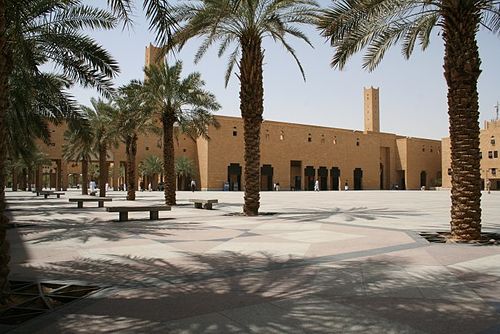
サウジアラビアの法律は性的指向や宗教の自由を認めておらず、非イスラム教の宗教を公に実践することは積極的に禁止されている。[283]司法制度は定期的に死刑を執行しており、その中には斬首による公開処刑も含まれている。[284] [285]サウジの司法制度ではシャリーアに従い、理論的には殺人、強姦、武装強盗、麻薬の常用、棄教、[287]姦通、[288]魔術や呪術、[289]を含む幅広い犯罪に対して死刑を科すことができ、剣で斬首、[287]石打ちまたは銃殺隊、[288]に続いて磔刑(処刑後に死体をさらすこと)によって執行することができる。[289] 2022年にサウジ皇太子は、死刑は「コーランに記載されている1つのカテゴリー、すなわち殺人を除いて」廃止されると述べた。殺人には一定の条件が適用されなければならない。[290] 2020年4月、サウジ最高裁判所は、サウジアラビアの裁判制度から鞭打ち刑を廃止し、懲役刑または罰金刑に置き換える指令を出した。[291] [292]
歴史的に、サウジアラビアの女性は生活の多くの面で差別に直面しており、男性後見制度の下では事実上、法的に未成年者として扱われていた。[293]女性の扱いは「性別による隔離」[294] [295]や「ジェンダー・アパルトヘイト」と呼ばれてきた。[296] [297] 2023年6月現在、同王国は女性が「弁護士、エンジニア、地質学者になること」を禁止する規制を撤回し、「積極的な積極的差別是正措置プログラム」を確立し、女性の労働力参加率を倍増させたと報じられている。また、サウジアラビア証券取引所の女性トップやサウジアラムコの取締役を擁し、「初の女性新聞編集者、外交官、テレビキャスター、検察官」を擁している。[298] さらに、2018年6月24日、サウジアラビア政府は女性の運転を正式に認める法律を公布した。[299]
サウジアラビアは、奴隷労働や商業的性的搾取の目的で人身売買される男女の主な移住先国である。 [300]アジア、アフリカ、中東からの移民は、カファラ制度の下、建設、接客、家事労働の分野で雇用されているが、人権団体は、この制度が現代の奴隷制度を含む虐待と関連していると主張している。[301] [302]
経済
2018年10月現在[update]、サウジアラビアは中東最大の経済大国であり、世界でも第18位の経済大国である。[303]世界で2番目に大きな石油埋蔵量を有し、最大の石油輸出国である。[304] [305]この国は世界第2位の石油埋蔵量[306]と、第6位の天然ガス埋蔵量を有している。[32]サウジアラビアは「エネルギー超大国」とみなされており、[307] [308]天然資源の推定総価値は2016年に34.4兆米ドルと世界で2番目に高い。[309]
統制経済は石油を基盤としており、予算収入の約63% [310]と輸出収入の67% [311]は石油産業から得られている。石油産業はサウジアラビアの名目国内総生産の約45%を占め、民間部門は40%を占めている。石油産業は外国人労働者に大きく依存しており、民間部門で雇用されている人の約80%は非サウジアラビア人である。[312] [313]経済の課題としては、一人当たり所得の減少を食い止める、または逆転させること、若者を労働力として準備するための教育を改善し雇用を提供すること、経済の多様化、民間部門と住宅建設の刺激、汚職と不平等の減少などが挙げられる。[314]
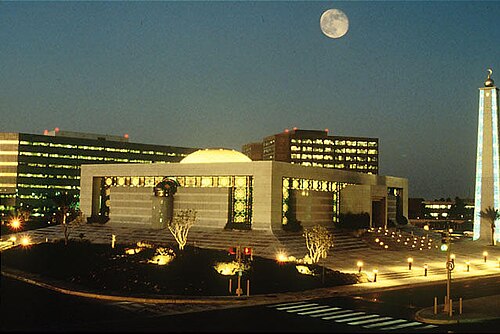
OPEC(石油輸出国機構)は、加盟国の石油生産量を「証明済み埋蔵量」に基づいて制限している。サウジアラビアの公表埋蔵量は1980年以降ほとんど変化がなく、主な例外は1987年から1988年の間に約1000億 バレル(1.6 × 10¹⁰m3 )増加したことである。 [315]マシュー・シモンズは、サウジアラビアは埋蔵量を大幅に誇張しており、まもなく生産量が減少する可能性があると示唆している(ピークオイルを参照)。[316]

.gif/500px-Oil_and_Gas_Infrastructure_Persian_Gulf_(large).gif)
2003年から2013年にかけて、「いくつかの主要サービス」が民営化された。水道、電力、通信などである。また、教育や医療、交通管制、自動車事故報告の一部も民営化された。アラブニュースのコラムニスト、アブデル・アジズ・アルワイシェグ氏によると、「これらの分野のほぼすべてにおいて、消費者は民営化された事業体の業績について深刻な懸念を表明している」という。[317] 2005年11月、サウジアラビアは世界貿易機関の加盟が承認された。加盟交渉は、サウジアラビアが外国製品への市場アクセスをどの程度拡大するかに焦点が当てられ、2000年に政府はサウジアラビアへの外国直接投資を奨励するためにサウジアラビア総合投資庁を設立した。サウジアラビアは外国投資が禁止されている分野のリストを維持しているが、政府は通信、保険、送電・配電などの閉鎖された分野を徐々に開放する予定である。政府はまた、外国人労働者をサウジアラビア国民に置き換える経済の「サウジ化」を試みているが、成功は限定的である。 [318]

石油とガスに加えて、サウジアラビアにはマハド・アド・ザハブ地域での重要な金鉱業、その他の重要な鉱物産業、野菜、果物、ナツメヤシなどと家畜を基盤とする農業部門(特に南西部)、そして年間約200万人のハッジ巡礼者によって生み出される多数の臨時雇用がある。[314]サウジアラビアは1970年以来5カ年「開発計画」を持っている。その計画の中には、経済の多様化と雇用の創出を目指して「経済都市」(例:キング・アブドラ経済都市)を立ち上げることが含まれていた。各地域と経済の多様化を促進するために都市はサウジアラビア全土に広がり、GDPに1500億ドルの貢献をすると予測されている。
サウジアラビアは、石油輸送に加えて、欧州と中国間の貿易に参加するために港湾の活性化を進めている。この目的のために、ジェッダ・イスラム港やキング・アブドラ経済都市などの港湾が急速に拡張され、物流への投資が行われている。この国は歴史的にも現在も海のシルクロードの一部である。[320] [321] [322] [323]
サウジアラビアの貧困に関する統計は、サウジ政府が統計を発行していないため、国連の資料からは入手できない。[324]サウジ政府は貧困について注意を喚起したり不満を述べたりすることを奨励していない。2011年12月、サウジ内務省は、この問題に関するビデオをYouTubeにアップロードした3人の記者を逮捕し、尋問のために2週間近く拘留した。[325] [326] [327]ビデオの著者は、サウジ人の22%が貧困である可能性があると主張している。[328]この問題を調査している観察者は、逮捕されるリスクがあるため、匿名を希望している[329]。
COVID-19パンデミックが経済に与えた予想外の影響と、サウジアラビアの人権状況の悪さは、同国の開発計画に予期せぬ課題をもたらし、「ビジョン2030」に基づくプログラムの一部も影響を受けると予想された。[330] 2020年5月、サウジアラビアの財務大臣は、パンデミックと世界的な原油市場の下落により、同国の経済が数十年ぶりに深刻な経済危機に直面していることを認めた。モハメド・アル・ジャダーン氏は、同国は「痛みを伴う」措置を講じ、影響に対処するためにあらゆる選択肢を残しておくと述べた。[331]
2024年7月、サウジアラビアの再生可能エネルギーローカリゼーションカンパニー(RELC)は、同国のクリーンエネルギーインフラを推進するため、中国企業と3つの合弁会社を設立した。サウジアラビアの2030年目標の一環として、公共投資基金は再生可能エネルギー部品のローカリゼーションを積極的に推進している。政府系ファンドの一部門であるRELCは、世界のメーカーとサウジアラビアの民間企業との提携を促進し、現地のサプライチェーンを強化している。合弁会社には、風力タービン部品のEnvision Energy、太陽電池のJinko Solar、太陽光発電インゴットとウェーハのLumetechとの提携が含まれる。これらの取り組みは、2030年までにサウジアラビアの再生可能プロジェクトで使用される部品の最大75%をローカリゼーションすることを目指しており、同国を再生可能技術の世界的主要輸出国に位置付けている。[332]
サウジの経済計画大臣ファイサル・アル・イブラヒム氏は、ニューヨークで開催された2024年持続可能な開発のためのハイレベル政治フォーラムで、サウジアラビアの世界的気候目標の進捗状況を強調し、サウジ・ガゼットが報じたように、同国のグリーン経済のための80以上の取り組みと1800億ドルを超える投資を挙げた。同氏は、これらの取り組みがビジョン2030の目標と一致していることを強調し、地域の持続可能性、セクター統合、社会の進歩に焦点を当てた。[333]
農業

商業規模での酪農開発の最初の試みは、1950年代にアル・ハルジ地区(リヤドのすぐ南)で行われました。 [334]本格的な大規模農業開発は1970年代に始まり、[335]特に小麦が中心でした。[336]政府は、近代的な農業技術を促進し、農村道路、灌漑ネットワーク、貯蔵・輸出施設を設立し、農業研究・研修機関を奨励するための広範なプログラムを開始しました。その結果、すべての基本食品の生産が驚異的に増加しました。サウジアラビアは、肉、牛乳、卵など、多くの食品を自給自足しています。同国は、ナツメヤシ、乳製品、卵、魚、鶏肉、果物、野菜、花を輸出しています。かつてはサウジの食生活の主食であったナツメヤシは、現在では主に世界的な人道支援のために栽培されています。さらに、サウジの農家は、大麦、モロコシ、キビなどの他の穀物も大量に栽培しています。 2016年現在、貴重な水資源を保護するため、輸出していた小麦の国内生産は終了しました。[337]再生不可能な地下水の消費により、2012年までに地下水総埋蔵量の5分の4が失われたと推定されています。[338]
王国には中東で最も近代的かつ最大の酪農場がいくつかある。牛乳生産量は1頭あたり年間6,800リットル(1,800米ガロン)と非常に高く、世界でもトップクラスである。地元の乳製品製造会社アルマライは中東最大の垂直統合型乳製品会社である。[339]
オリーブの木はサウジアラビア原産である。アル・ジュフ地域には数百万本のオリーブの木があり、その数は2000万本に増加すると予想されている。[340]
海岸沿いにマングローブの苗木100本を植えるという同国の進行中の計画の一環として、国立植生被覆開発・砂漠化防止センターは1,300万本の苗木を植えたと発表した。 [341]
給水と衛生
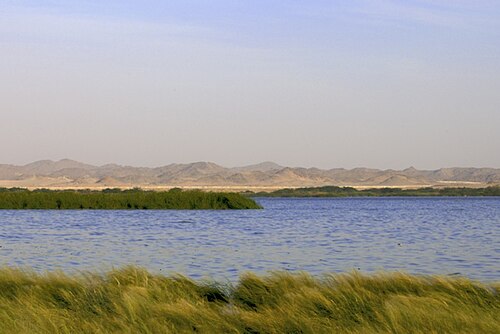
サウジアラビアにとっての主な課題の1つは水不足である。海水淡水化、給水、下水道、廃水処理に多額の投資が行われてきた。現在、飲料水の約50%は淡水化、40%は再生不可能な地下水の採掘、10%は同国南西部の山岳地帯の表層水から得られている。[342]サウジアラビアは地下帯水層の水の大幅な枯渇に苦しんでおり、その結果、農業が崩壊し、崩壊している。[343] [344]この大惨事の結果、サウジアラビアは米国、[345] [346]アルゼンチン、[347]アフリカで農地を購入した。[348] [349] [350] [351]サウジアラビアは外国で農地の主要な購入国にランクされている。[352] [353]
.svg/500px-Water_Stress,_Top_Countries_(2020).svg.png)
WHOとユニセフの水供給と衛生に関する共同監視プログラム(JMP)によると、サウジアラビアにおける水と衛生へのアクセスに関する最新の信頼できる情報源は2004年の国勢調査である。人口の97%が改善された飲料水源にアクセスでき、99%が改善された衛生設備にアクセスできたことが示されている。2015年には、JMPは衛生設備へのアクセスが100%に増加したと推定している。衛生設備は主に現場での解決策を通じて提供され、人口の約40%が下水道に接続されていた。[355] 2015年には、886,000人が「改善された」水にアクセスできなかった。[356] [357]
観光
2019年、サウジアラビアは非イスラム教徒の訪問を認める一般観光旅行ビザを導入した。 [358]観光のほとんどは宗教的な巡礼を伴うが、レジャー観光部門も成長している。世界銀行によると、2012年にサウジアラビアを訪れた人の数は約1,430万人で、世界で19番目に訪問者が多い国となっている。[359]観光はサウジビジョン2030の重要な要素であり、 BMIリサーチが2018年に実施したレポートによると、宗教観光と非宗教観光の両方に大きな拡大の可能性がある。[360]
The kingdom offers an electronic visa for foreign visitors to attend sports events and concerts.[361] In 2019, the kingdom announced its plans to open visa applications for visitors, where people from about 50 countries would be able to get tourist visas to Saudi.[362] In 2020 it was announced that holders of a US, UK or Schengen visa are eligible for a Saudi electronic visa upon arrival.[363]
-
 Thee Ain village located in Al Bahah Province
 -
 The desert of Al-Rub' Al-Khali (The Empty Quarter)
 -
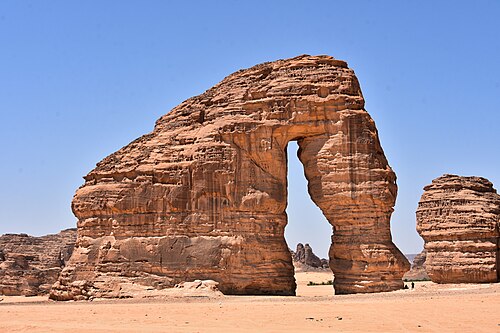 Elephant Rock in Al-'Ula
 -
 Ummahat islands, The Red Sea Project
 -

-

-
 Salwa Palace in At-Turaif District, Diriyah
 -

-
 Rijal Almaa historic village
 -
 Qasr al-Farid Tomb in Mada'in Salih
 -
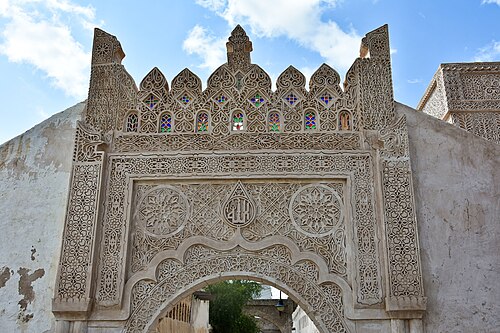 Al-Rifai House gate in Farasan Islands

.jpg/500px-Al-Naseef_House_(6573572949).jpg)

.jpg/500px-Masmak_Fort_(12753717253).jpg)

Demographics

Saudi Arabia's reported population is 32,175,224 as of 2022,[364] making it the fourth most populous country in the Arab world.[365] Close to 42% of its inhabitants are immigrants,[366] mostly from the Middle East, Asia, and Africa.[367]
The Saudi population has grown rapidly since 1950, when it was estimated at 3 million.[368] For much of the 20th century, the country had one of the highest population growth rates in the world, at around 3% annually;[369] it continues to grow at a rate of 1.62% per year,[370] slightly higher than the rest of the Middle East and North Africa. Consequently, the Saudi people are quite young by global standards, with over half the population under 25 years old,[371]
The ethnic composition of Saudi citizens is 90% Arab and 10% Afro-Arab.[372] Most Saudis are concentrated in the southwest; Hejaz, which is the most populated region,[373] is home to one-third of the population, followed by neighbouring Najd (28%) and the Eastern Province (15%).[374] As late as 1970, most Saudis lived a subsistence life in the rural provinces, but in the last half of the 20th century, the kingdom has urbanized rapidly: as of 2023, about 85% of Saudis live in urban metropolitan areas—specifically Riyadh, Jeddah, and Dammam.[375][376]As recently as the early 1960s, Saudi Arabia's slave population was estimated at 300000.[377] Slavery was officially abolished in 1962.[378][379]
Language
The official language is Arabic.[11][5] There are four main regional dialect groups spoken by Saudis: Najdi (about 14.6 million speakers[390]), Hejazi (about 10.3 million speakers[391]), Gulf (about 0.96 million speakers[392]) including Baharna dialects, and Southern Hejaz and Tihama[393] dialects. Faifi is spoken by about 50000. The Mehri language is also spoken by around 20000 Mehri citizens.[394] Saudi Sign Language is the principal language of the deaf community, amounting to around 100000 speakers. The large expatriate communities also speak their own languages, the most numerous of which, according to 2018 data, are Bengali (~1 500000), Tagalog (~900000), Punjabi (~800000), Urdu (~740000), Egyptian Arabic (~600000), Rohingya, North Levantine Arabic (both ~500000)[395] and Malayalam.[396]
Religion
Virtually all Saudi citizens[397] and residents are Muslim;[398][399] by law, all citizens of the country are Muslim. Estimates of the Sunni population range between 85% and 90%, with the remaining 10 to 15% being Shia Muslim,[400][401][402][403] practicing either Twelver Shi'ism or Sulaymani Ismailism. The official and dominant form of Sunni Islam is Salafism, commonly known as Wahhabism,[404][405][g] which was founded in the Arabian Peninsula by Muhammad ibn Abd al-Wahhab in the 18th century. Other denominations, such as the minority Shia Islam, are systematically suppressed.[406] Shia Muslims in Saudi Arabia are largely found in the Eastern Province, particularly in Qatif and Al–Ahsa.[407]
There are an estimated 1.5 million Christians in Saudi Arabia, almost all foreign workers.[408] Saudi Arabia allows Christians to enter the country as temporary foreign workers but does not allow them to practice their faith openly. There are officially no Saudi citizens who are Christians,[409] as Saudi Arabia forbids religious conversion from Islam (apostasy) and punishes it by death.[410] According to the Pew Research Center, there are 390000 Hindus in Saudi Arabia, almost all foreign workers.[411] There may be a significant fraction of atheists and agnostics,[412][413] although they are officially called "terrorists".[414] In its 2017 religious freedom report, the U.S. State Department named Saudi Arabia a Country of Particular Concern, denoting systematic, ongoing, and egregious violations of religious freedom.[415]
Najran was home to local Christian and Jewish communities.[416] Prior to establishment of Israel, Najran was home to 260 Jews and had friendly relations with Ibn Saud.[416] They had a Yemenite Jewish background.[416] After the establishment of Israel and the 1948 Arab–Israeli war, all the Jews fled for Yemen and from there headed to Israel.[416]
Education

Education is free at all levels, although higher education is restricted to citizens only.[417] The school system is composed of elementary, intermediate, and secondary schools. Classes are segregated by sex. At the secondary level, students are able to choose from three types of schools: general education, vocational and technical, or religious.[418] The rate of literacy is 99% among males and 96% among females in 2020.[419][420] Youth literacy rose to approximately 99.5% for both sexes.[421][422]

Higher education has expanded rapidly, with large numbers of universities and colleges being founded particularly since 2000. Institutions of higher education include King Saud University, the Islamic University at Medina, and the King Abdulaziz University in Jeddah. Princess Norah University is the largest women's university in the world. King Abdullah University of Science and Technology, known as KAUST, is the first mixed-gender university campus in Saudi Arabia and was founded in 2009. Other colleges and universities emphasize curricula in sciences and technology, military studies, religion, and medicine. Institutes devoted to Islamic studies, in particular, abound. Women typically receive college instruction in segregated institutions.[138]

The Academic Ranking of World Universities, known as Shanghai Ranking, ranked five Saudi institutions among its 2022 list of the 500 top universities in the world.[423] The QS World University Rankings lists 14 Saudi universities among the 2022 world's top universities and 23 universities among the top 100 in the Arab world.[424] The 2022 list of U.S. News & World Report Best Global University Ranking ranked King Abdulaziz University among the top 50 universities in the world and King Abdullah University of Science and Technology among the top 100 universities in the world.[425]
In 2018, Saudi Arabia ranked 28th worldwide in terms of high-quality research output according to the scientific journal Nature.[426] This makes Saudi Arabia the best performing Middle Eastern, Arab, and Muslim country.[citation needed] Saudi Arabia spends 8.8% of its gross domestic product on education, compared with the global average of 4.6%.[427] Saudi Arabia was ranked 48th in the Global Innovation Index in 2023, up from 68th in 2019.[428][429][430]
The Saudi education system has been accused of encouraging Islamic terrorism, leading to reform efforts.[431][432] Following the 9/11 attacks, the government aimed to tackle the twin problems of encouraging extremism and the inadequacy of the country's university education for a modern economy, by slowly modernizing the education system through the "Tatweer" reform programme.[431] The Tatweer programme is reported to have a budget of approximately US$2 billion and focuses on moving teaching away from the traditional Saudi methods of memorization and rote learning towards encouraging students to analyse and problem-solve. It also aims to create an education system which will provide a more secular and vocationally based training.[433][434]
In 2021, the Washington Post reported on the measures taken by Saudi Arabia to clean textbooks from paragraphs considered antisemitic and sexist. The paragraphs dealing with the punishment of homosexuality or same-sex relations have been deleted, and expressions of admiration for the extremist martyrdom. Antisemitic expressions and calls to fight the Jews became fewer. David Weinberg, director of international affairs for the Anti-Defamation League, said that references to demonizing Jews, Christians, and Shiites have been removed from some places or have toned down. The U.S. State Department expressed in an email that it welcomed the changes. The Saudi Ministry of Foreign Affairs supports a training programme for Saudi teachers.[435]
Health care

Saudi Arabia has a national health care system in which the government provides free health care services through government agencies. Saudi Arabia has been ranked among the 26 best countries in providing high quality healthcare.[436] The Ministry of Health is the major government agency entrusted with the provision of preventive, curative, and rehabilitative health care. The ministry's origins can be traced to 1925, when several regional health departments were established, with the first in Makkah. The various healthcare institutions were merged to become a ministerial body in 1950.[437] The Health Ministry created a friendly competition between each of the districts and between different medical services and hospitals. This idea resulted in the creation of the "Ada'a" project launched in 2016. The new system is a nationwide performance indicator, for services and hospitals. Waiting times and other major measurements improved dramatically across the kingdom.[438]

A new strategy has been developed by the ministry, known as Diet and Physical Activity Strategy or DPAS for short,[439] to address bad lifestyle choices. The ministry advised that there should be a tax increase on unhealthy food, drink and cigarettes. This additional tax could be used to improve healthcare offerings. The tax was implemented in 2017.[440] As part of the same strategy, calorie labels were added in 2019 to some food and drink products. Ingredients were also listed as an aim to reduce obesity and inform citizens with health issues, to manage their diet.[441] As part of the ongoing focus on tackling obesity, women-only gyms were allowed to open in 2017. Sports offered in each of these gyms include bodybuilding, running and swimming to maintain higher standards of health.[442][443]
Smoking in all age groups is widespread. In 2009 the lowest median percentage of smokers was university students (~13.5%) while the highest was elderly people (~25%). The study also found the median percentage of male smokers to be much higher than that of females (~26.5% for males, ~9% for females). Before 2010, Saudi Arabia had no policies banning or restricting smoking.
The MOH has been awarded "Healthy City" certificates by the World Health Organization (WHO) for the cities of Unayzah and Riyadh Al Khabra as 4th and 5th Healthy Cities in Saudi Arabia.[444] The WHO had earlier classified three Saudi Arabian cities, Ad Diriyah, Jalajil, and Al-Jamoom as "Healthy city", as part of the WHO Healthy Cities Programme. Recently Al-Baha has also been classified as a healthy city to join the list of global healthy cities approved by the World Health Organization.[445]
In May 2019, the then Saudi Minister of Health Tawfiq bin Fawzan AlRabiah received a global award on behalf of the Kingdom for combatting smoking through social awareness, treatment, and application of regulations.[446] The award was presented as part of the 72nd session of the World Health Assembly, held in Geneva in May 2019. After becoming one of the first nations to ratify the WHO Framework Convention on Tobacco Control in 2005, it plans to reduce tobacco use from 12.7% in 2017, to 5% in 2030.[446]
Saudi Arabia has a life expectancy of 74.99 years (73.79 for males and 76.61 for females) according to the latest data for the year 2018 from the World Bank.[447] Infant mortality in 2019 was 5.7 per 1000.[447] In 2016, 69.7% of the adult population was overweight and 35.5% was obese.[448]
Foreigners
The Central Department of Statistics & Information estimated the foreign population at the end of 2014 at 33% (10.1 million).[449] The CIA Factbook estimated that as of 2013[update] foreign nationals living in Saudi Arabia made up about 21% of the population.[11] Other sources report differing estimates.[450] Indian: 1.5 million, Pakistani: 1.3 million,[451] Egyptian: 900000, Yemeni: 800000, Bangladeshi: 400000, Filipino: 500000, Jordanian/Palestinian: 260000, Indonesian: 250000, Sri Lankan: 350000, Sudanese: 250000, Syrian: 100000 and Turkish: 80000.[452]
According to The Guardian, as of 2013[update] there were more than half a million foreign-born domestic workers. Most have backgrounds in poverty and come from Africa, the Indian subcontinent and Southeast Asia.[453] To go to work in Saudi Arabia, they must often pay large sums to recruitment agencies in their home countries. The agencies then handle the necessary legal paperwork.[454]
As the Saudi population grows and oil export revenues stagnate, pressure for "Saudization" (the replacement of foreign workers with Saudis) has grown, and the Saudi government hopes to decrease the number of foreign nationals in the country.[455] Saudi Arabia expelled 800000 Yemenis in 1990 and 1991[456] and has built a Saudi–Yemen barrier against an influx of illegal immigrants and against the smuggling of drugs and weapons.[457] In November 2013, Saudi Arabia expelled thousands of illegal Ethiopian residents from the kingdom. Various Human Rights entities have criticized Saudi Arabia's handling of the issue.[458]
Over 500000 undocumented migrant workers—mostly from Somalia, Ethiopia, and Yemen—have been detained and deported since 2013.[459] An investigation led by The Sunday Telegraph, exposed the condition of African migrants who were detained in Saudi Arabia allegedly for containing COVID-19 in the kingdom. They were beaten, tortured, and electrocuted. Many of the migrants died due to heatstroke or by attempting suicide, after being severely beaten and tortured. The migrants lack proper living conditions, provision of food and water.[460]
Foreigners cannot apply for permanent residency, though a specialized Premium Residency visa became available in 2019.[461] Only Muslims can become Saudi citizens.[462] Foreigners who have resided in the kingdom and hold degrees in various scientific fields may apply for Saudi citizenship,[463][464] and exception made for Palestinians who are excluded unless married to a male Saudi national, because of Arab League instructions barring the Arab states from granting them citizenship. Saudi Arabia is not a signatory to the 1951 UN Refugee Convention.[465]
Culture

Saudi Arabia has millennia-old attitudes and traditions, often derived from Arab civilization. Some of the major factors that influence the culture are Islamic heritage and Arab traditions as well as its historical role as an ancient trade centre.[466] The Kingdom also has a very family-oriented culture[467] with an emphasis on preserving family traditions and kinship ties.[468]
Religion in society
Religion is a core aspect of everyday life in Saudi Arabia; it plays a dominant role in the country's governance and legal system, and deeply influences culture and daily life, although the power of the religious establishment has been significantly eroded in the 2010s.[469] The Hejaz region, where the Islamic holy cities of Mecca and Medina are located, is the destination of the Ḥajj pilgrimage, and often deemed to be the cradle of Islam.[470][h]
Islam is the state religion of Saudi Arabia. There is no law that requires all citizens to be Muslim, but non-Muslims and many foreign and Saudi Muslims whose beliefs are deemed not to conform with the government's interpretation of Islam must practice their religion in private and are vulnerable to discrimination, harassment, detention, and, for foreigners, deportation.[481] Neither Saudi citizens nor guest workers have the right of freedom of religion.[482] The dominant form of Islam in the kingdom—Wahhabism—arose in the central region of Najd, in the 18th century. Proponents call the movement "Salafism",[405] and believe that its teachings purify the practice of Islam of innovations or practices that deviate from the seventh-century teachings of Muhammad and his companions.[483] The Saudi government has often been viewed as an active oppressor of Shia Muslims because of the funding of the Wahhabi ideology which denounces the Shia faith.[484][485] Prince Bandar bin Sultan, Saudi ambassador to the United States, stated: "The time is not far off in the Middle East when it will be literally 'God help the Shia'. More than a billion Sunnis have simply had enough of them."[486]

Saudi Arabia is one of the few countries that have "religious police" (known as Haia or Mutaween), who patrol the streets "enjoining good and forbidding wrong" by enforcing dress codes, strict separation of men and women, attendance at prayer (salat) five times each day, the ban on alcohol, and other aspects of Sharia. However, since 2016 the power of religious police was curbed, which barred them from pursuing, questioning, requesting identification or arresting suspects.[487][256] In the privacy of homes, behaviour can be far looser, and reports from WikiLeaks indicate that low ranked members of the ruling Saudi Royal family indulge in parties with alcohol, drugs, and prostitutes.[488]
Women in society

Throughout history, women did not have equal rights to men in the kingdom; the U.S. State Department considers Saudi Arabian government's discrimination against women a "significant problem" and notes that women have few political rights because of the government's discriminatory policies.[489] However, since Mohammed bin Salman was appointed Crown Prince in 2017, a series of social reforms have been witnessed regarding women's rights.
Under previous Saudi law, all females were required to have a male guardian (wali), typically a father, brother, husband, or uncle (mahram). In 2019, this law was partially amended to exclude women over 21 years old from the requirement of a male guardian.[490] The amendment also granted women rights in relation to the guardianship of minor children.[490][491] Previously, girls and women were forbidden from travelling, conducting official business, or undergoing certain medical procedures without permission from their male guardians.[492] In 2019, Saudi Arabia allowed women to travel abroad, register for divorce or marriage, and apply for official documents without the permission of a male guardian.
In 2006, Wajeha al-Huwaider, a leading Saudi feminist and journalist said "Saudi women are weak, no matter how high their status, even the 'pampered' ones among them, because they have no law to protect them from attack by anyone."[493] Following this, Saudi Arabia implemented the anti-domestic violence law in 2014.[494] Furthermore, between 2017 and 2020, the country addressed issues of mobility, sexual harassment, pensions, and employment-discrimination protections.[495][496][497] al-Huwaider and other female activists have applauded the general direction in which the country was headed.[498]

Women face discrimination in the courts, where the testimony of one man equals that of two women in family and inheritance law.[489] Polygamy is permitted for men,[499] and men have a unilateral right to divorce their wives (talaq) without needing any legal justification.[500] A woman can only obtain a divorce with the consent of her husband or judicially if her husband has harmed her.[501] However, in 2022, women were granted the right to divorce and without the approval of a legal guardian under the new Personal Status Law.[502] With regard to the law of inheritance, the Quran specifies that fixed portions of the deceased's estate must be left to the Qur'anic heirs[503] and generally, female heirs receive half the portion of male heirs.[503]
Heritage sites

Saudi Wahhabism is hostile to any reverence given to historical or religious places of significance for fear that it may give rise to 'shirk' (idolatry), and the most significant historic Muslim sites (in Mecca and Medina) are located in the western Saudi region of the Hejaz.[470] As a consequence, under Saudi rule an estimated 95% of Mecca's historic buildings, most over a thousand years old, have been demolished for religious reasons.[504] Critics claim that over the last 50 years, 300 historic sites linked to Muhammad, his family or companions have been lost,[505] leaving fewer than 20 structures remaining in Mecca that date back to the time of Muhammad.[506] Demolished structures include the mosque originally built by Muhammad's daughter Fatima, and other mosques founded by Abu Bakr (Muhammad's father-in-law and the first caliph), Umar (the second caliph), Ali (Muhammad's son-in-law and the fourth caliph), and Salman al-Farsi (another of Muhammad's companions).[507]

Seven cultural sites in Saudi Arabia are designated as UNESCO World Heritage Sites: Al-Hijr Archaeological Site (Madâin Sâlih);[508] the Turaif district in Diriyah;[509] Historic Jeddah, the Gate to Mecca;[510] Al-Ahsa Oasis;[511] Rock Art in the Hail Region;[512] Ḥimā Cultural Area;[513] and 'Uruq Bani Ma'arid.[514] Ten other sites submitted requests for recognition to UNESCO in 2015.[515] There are six elements inscribed on UNESCO's Intangible Cultural Heritage of Humanity list:[516] Al-Qatt Al-Asiri, female traditional interior wall decoration in Asir; Almezmar, drumming and dancing with sticks; Falconry, a living human heritage; Arabic coffee, a symbol of generosity; Majlis, a cultural and social space; Alardah Alnajdiyah, dance, drumming and poetry in Saudi Arabia.
In June 2014, the Council of Ministers approved a law that gives the Saudi Commission for Tourism and National Heritage the means to protect Saudi Arabia's ancient relics and historic sites. Within the framework of the 2016 National Transformation Programme, also known as Saudi Vision 2030, the kingdom allocated 900 million euros to preserve its historical and cultural heritage.[517] Saudi Arabia also participates in the International Alliance for the Protection of Heritage in Conflict Areas, created in March 2017, with a contribution of 18.5 million euros.[518]
In 2017, Crown Prince Mohammad bin Salman promised to return Saudi Arabia to the "moderate Islam" of the era before the 1979 Iranian revolution.[519] A new centre, the King Salman Complex for the Prophet's Hadith, was established that year to monitor interpretations of the Prophet Mohammed's hadiths to prevent them being used to justifying terrorism.[520]
In March 2018, the Crown Prince met the Archbishop of Canterbury during a visit to the UK, pledging to promote interfaith dialogue. In Riyadh the following month King Salman met the head of the Vatican's Pontifical Council for Interreligious Dialogue.[521] In July 2019, UNESCO signed a letter with the Saudi Minister of Culture in which Saudi Arabia contributed US$25 million to UNESCO for the preservation of heritage.[522]
Dress

Saudi Arabian dress strictly follows the principles of hijab (the Islamic principle of modesty, especially in dress). The predominantly loose and flowing, but covering, garments are suited to Saudi Arabia's desert climate. Traditionally, men usually wear a white ankle-length garment woven from wool or cotton (known as a thawb), with a keffiyeh (a large checkered square of cotton held in place by an agal) or a ghutra (a plain white square made of a finer cotton, also held in place by an agal) worn on the head. For rare chilly days, Saudi men wear a camel-hair cloak (bisht) over the top. In public women are required to wear a black abaya or other black clothing that covers everything under the neck with the exception of their hands and feet, although most women cover their head in respect of their religion. This requirement applies to non-Muslim women too and failure to abide can result in police action, particularly in more conservative areas of the country. Women's clothes are often decorated with tribal motifs, coins, sequins, metallic thread, and appliques.[523]
Arts and entertainment

During the 1970s, cinemas were numerous in the kingdom although they were seen as contrary to Wahhabi norms.[524] During the Islamic revival movement in the 1980s, and as a political response to an increase in Islamist activism including the 1979 seizure of the Grand Mosque in Mecca, the government closed all cinemas and theatres. However, with King Abdullah and King Salman's reforms, cinemas re-opened,[525] including one in KAUST.
From the 18th century onward, Wahhabi fundamentalism discouraged artistic development inconsistent with its teaching. In addition, Sunni Islamic prohibition of creating representations of people have limited the visual arts, which tend to be dominated by geometric, floral, and abstract designs and by calligraphy. With the advent of the oil-wealth in the 20th century came exposure to outside influences, such as Western housing styles, furnishings, and clothes. Music and dance have always been part of Saudi life. Traditional music is generally associated with poetry and is sung collectively. Instruments include the rabābah, an instrument not unlike a three-string fiddle, and various types of percussion instruments, such as the ṭabl (drum) and the ṭār (tambourine). The national dance is a native sword dance known as ardah. Originating from Najd, it involves lines or circles of men and singing poetry.[526] Bedouin poetry, known as nabaṭī, is popular.[138]
Censorship has limited the development of Saudi literature, although several Saudi novelists and poets have achieved critical and popular acclaim in the Arab world—albeit generating official hostility in their home country. These include Ghazi Algosaibi, Mansour al-Nogaidan, Abdelrahman Munif, Turki al-Hamad and Rajaa al-Sanea.[527][528][529] In 2016, the General Entertainment Authority (GEA) was formed to oversee the expansion of the Saudi entertainment sector.[530] The first concerts in Riyadh for 25 years took place the following year.[531] Other events since the GEA's creation have included comedy shows, professional wrestling events and monster truck rallies.[532] In 2018 the first public cinema opened after a ban of 35 years, with plans to have more than 2000 screens running by 2030.[533]
Developments in the arts in 2018 included Saudi Arabia's debut appearances at the Cannes Film Festival and the Venice Biennale.[534]
TV and media

Television was introduced in Saudi Arabia in 1954. Saudi Arabia is a major market for pan-Arab satellite and pay-TV. It controls the largest share of the pan-Arab broadcasting market; among the major Saudi-owned broadcasting companies are the Middle East Broadcasting Center, Rotana and the Saudi Broadcasting Authority.[535] The Saudi government closely monitors media and restricts it under official state law. Changes have been made to lessen these restrictions; however, some government-led efforts to control information have also drawn international attention. As of 2022, Reporters Without Borders rates the kingdom's press a "very serious" situation.[536]
Most of the early newspapers in the Persian Gulf region were established in Saudi Arabia.[537] The first newspaper founded in the country and in the Persian Gulf area is Al Fallah, which was launched in 1920,[537] and the first English-language newspaper is Arab News, which was launched in 1975.[538] All of the newspapers published in Saudi Arabia are privately owned.[539]
According to World Bank, as of 2020, 98% of the population of Saudi Arabia are internet users which puts it in the 8th rank among countries with the highest percentage of internet users.[540] Saudi Arabia has one of the fastest 5G internet speeds in the world.[541][542] The kingdom is the 27th largest market for e-commerce with a revenue of US$8 billion in 2021.[543]
Cuisine
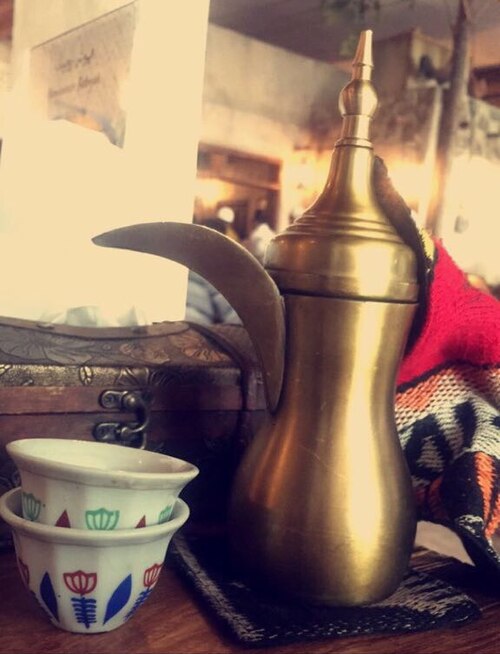
Saudi Arabian cuisine is similar to that of the surrounding countries in the Arabian Peninsula and the wider Arab world, and has influenced and been influenced by Turkish, Indian, Persian, and African food. Islamic dietary laws are enforced: pork is not allowed, and other animals are slaughtered in accordance with halal. Kebabs and falafel are popular, as is shawarma, a marinated grilled meat dish of lamb, mutton, or chicken. Kabsa, a rice dish with lamb, chicken, fish or shrimp, is among the national dishes as is mandi. Flat, unleavened taboon bread is a staple of virtually every meal, as are dates, fresh fruit, yoghurt, and hummus. Coffee, served in the Arabic style, is the traditional beverage, but tea and various fruit juices are popular as well.[138] The earliest substantiated evidence of either coffee drinking or knowledge of the coffee tree is from the 15th century, in the Sufi monasteries of Arabia.
Sport

Football is the national sport in Saudi Arabia. The Saudi Arabia national football team is considered one of Asia's most successful national teams, having reached a joint record six AFC Asian Cup finals, winning three of those finals (1984, 1988, and 1996) and having qualified for the World Cup four consecutive times ever since debuting at the 1994 tournament. In the 1994 FIFA World Cup under the leadership of Jorge Solari, Saudi Arabia beat both Belgium and Morocco in the group stage before falling to defeat Sweden in the round of 16. During the 1992 FIFA Confederations Cup, which was played in Saudi Arabia, the country reached the final, losing 1–3 to Argentina.
Scuba diving, windsurfing, sailing and basketball (which is played by both men and women) are also popular with the Saudi Arabian national basketball team winning bronze at the 1999 Asian Championship.[544][545][546] More traditional sports such as horse racing and camel racing are also popular. The annual King's Camel Race, begun in 1974, is one of the sport's most important contests and attracts animals and riders from throughout the region. Falconry is another traditional pursuit.[138]
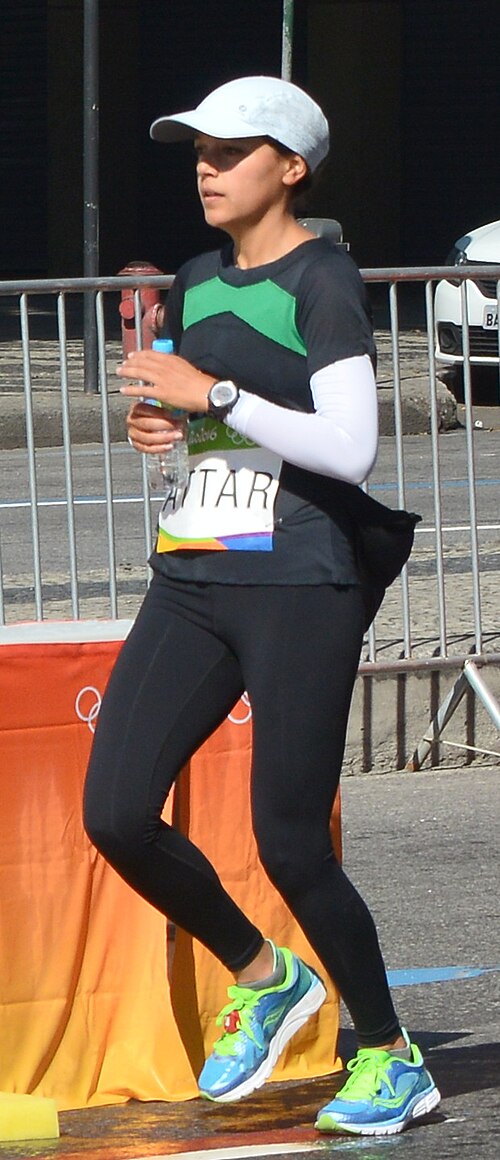
Women's sport is controversial because of the suppression of female participation in sport by conservative Islamic religious authorities,[547] however the restrictions have eased.[548][549][550] Until 2018 women were not permitted in sport stadiums. Segregated seating, allowing women to enter, has been developed in three stadiums across major cities.[551] Since 2020, the progress of women's integration into the Saudi sport scene began to develop rapidly.[552][553] 25 Saudi sport federations established a national women's team,[554] including a national football and basketball team. In November 2020, the Saudi Arabian Football Federation announced the launch of the first nationwide Saudi women's premier league.[555]
In its vision for modernization the nation has introduced many international sporting events, bringing sports stars to the kingdom. However, in August 2019, the kingdom's strategy received criticism for appearing as a method of sportswashing soon after Saudi's US-based 2018 lobbying campaign foreign registration documentations got published online. The documents showed Saudi Arabia as allegedly implementing a sportswashing strategy, including meetings and official calls with authorities of associations like Major League Soccer, World Wrestling Entertainment, and the National Basketball Association.[556]
See also
.svg/500px-Asia_(orthographic_projection).svg.png)
Notes
- ^ The Shahādah (Statement of faith) is sometimes translated into English as 'There is no god but Allah', using the romanization of the Arabic word Allāh instead of its translation. The word Allāh (Arabic: اللَّٰه) literally translates as God.[2][3][4]
- ^ For Saudi citizens only.
- ^ There is a Consultative Assembly, or Shura Council, which has no legislative power.[9] As its role is only consultative it is not considered to be a legislature.[10]
- ^ Pegged to the United States dollar (USD) at 3.75 riyals per USD since 1986[16]
- ^ /ˌsɔːdi əˈreɪbiə/ SAW-dee ə-RAY-bee-ə, /ˌsaʊdi-/ SOW-dee-; Arabic: ٱلسُّعُودِيَّة, romanized: Suʿūdiyya
- ^ Arabic: ٱلْمَمْلَكَة ٱلْعَرَبِيَّة ٱلسُّعُودِيَّة, romanized: al-Mamlaka al-ʿArabiyya as-Suʿūdiyya,
- ^ Proponents prefer the name Salafist, considering Wahhabi derogatory.
- ^ A number of Muslims, using justifications from the Quran,[471][472][473] insist that Islam did not begin with Muhammad, but that it represents even previous Prophets such as Abraham,[474][475][476][477] who is credited with having established the sanctuary of Mecca.[478][479][480]
References
- ^ "About Saudi Arabia: Facts and figures". The Royal Embassy of Saudi Arabia, Washington, DC. Archived from the original on 17 April 2012.
- ^ "God". Islam: Empire of Faith. PBS. Archived from the original on 27 March 2014. Retrieved 3 September 2017.
- ^ 'Islam and Christianity', Encyclopedia of Christianity (2001): Arabic-speaking Christians and Jews also refer to God as Allah.
- ^ L. Gardet. "Allah". Encyclopaedia of Islam Online.
- ^ a b "Basic Law of Governance". Ministry of Education. Ministry of Education – Kingdom of Saudi Arabia. Archived from the original on 5 December 2022. Retrieved 1 September 2020.
- ^ "The World Factbook". 2 July 2014. Archived from the original on 2 July 2014.
- ^ "Religious Composition by Country" (PDF). Archived from the original (PDF) on 23 March 2018. Retrieved 10 August 2021.
- ^ "Saudi Arabia – The World Factbook". CIA. Archived from the original on 19 March 2021. Retrieved 30 May 2021.
- ^ Hefner, Robert W. (2009). Remaking Muslim Politics: Pluralism, Contestation, Democratization. Princeton University Press. p. 202. ISBN 978-1-4008-2639-1.
- ^ "Analysts: Saudi Arabia Nervous About Domestic Discontent". www.voanews.com. VoA News – English. Archived from the original on 6 June 2021. Retrieved 6 June 2021.
- ^ a b c Saudi Arabia. The World Factbook. Central Intelligence Agency.
- ^ "Saudi Census 2022". portal.saudicensus.sa. General Statistics Authority - Kingdom of Saudi Arabia. Archived from the original on 28 July 2023. Retrieved 16 July 2023.
- ^ a b c d "World Economic Outlook Database, April 2024 Edition. (Saudi Arabia)". www.imf.org. International Monetary Fund. 16 April 2024. Retrieved 16 April 2024.
- ^ "The World Factbook". CIA.gov. Central Intelligence Agency. Archived from the original on 19 March 2021. Retrieved 28 May 2019.
- ^ "Human Development Report 2023/24" (PDF). United Nations Development Programme. 13 March 2024. p. 288. Archived (PDF) from the original on 13 March 2024. Retrieved 13 March 2024.
- ^ Strohecker, Karin (27 April 2016). "Saudi riyal peg pressure eases, but not gone". reuters.com. Reuters. Archived from the original on 3 October 2023. Retrieved 30 September 2023.
- ^ Through a maritime border marked by an artificial island.
- ^ "88,000-Year-Old Finger Bone Pushes Back Human Migration Dates". National Geographic.
- ^ "The Global Religious Landscape". Pew Forum. 18 December 2012. Archived from the original on 26 December 2018. Retrieved 23 August 2018.
- ^ a b Abbas, Tahir (March 2011). "Preface and Introduction". Islamic Radicalism and Multicultural Politics: The British Experience. Taylor & Francis. ISBN 9781136959592. Archived from the original on 28 March 2023. Retrieved 21 January 2024.
The unprecedented initial expansion of Islam led to half of the known world being conquered with huge swathes of territory…
- ^ a b Reichl, Karl, ed. (2012). Medieval Oral Literature. De Gruyter. p. 633. ISBN 9783110241129. Archived from the original on 28 March 2024. Retrieved 21 January 2024.
With the unprecedented victorious spread of Islam within only a few years over a huge territory…
- ^ a b Barber, Malcolm (2 August 2012). "Chapter 2: Syria and Palestine". The Crusader States. Yale University Press. ISBN 9780300189315.
After his [Muhammad's] death in 632, his successors, driven by what had become a dynamic new religion, committed themselves to an unprecedented territorial expansion.
- ^ Alhussein, Eman (2023), "Saudi Arabias centralized political structure: prospects and challenges", Handbook of Middle East Politics, Edward Elgar Publishing, pp. 144–157, ISBN 978-1-80220-563-3
- ^ Tripp, Culture Shock, 2003: p. 14
- ^ Malbouisson, p. 23
- ^ "Saudi Arabia has carried out 800 executions since 2015, says rights group". Independent.co.uk. 15 April 2020. Archived from the original on 21 April 2020. Retrieved 6 March 2023.
- ^ "Death Penalty Worldwide". Archived from the original on 16 June 2019.
- ^ Buzan, Barry (2004). The United States and the Great Powers. Cambridge: Polity Press. p. 71. ISBN 978-0-7456-3375-6.
- ^ "The erosion of Saudi Arabia's image among its neighbours". Middle East Monitor. 7 November 2013. Archived from the original on 9 November 2013.
- ^ Caryl, Sue (20 February 2014). "1938: Oil Discovered in Saudi Arabia". National Geographic. National Geographic Society. Archived from the original on 12 December 2016. Retrieved 27 November 2016.
- ^ Learsy, Raymond (2011). Oil and Finance: The Epic Corruption. p. 89.
- ^ a b "International – U.S. Energy Information Administration (EIA)". eia.gov. Archived from the original on 7 May 2015. Retrieved 27 March 2015.
- ^ Wynbrandt, James (2004). A Brief History of Saudi Arabia. Infobase Publishing. p. 242. ISBN 978-1-4381-0830-8. Archived from the original on 11 February 2023. Retrieved 20 June 2015.
- ^ Soldatkin, Vladimir; Astrasheuskaya, Nastassia (9 November 2011). "Saudi Arabia to overtake Russia as top oil producer-IEA". Reuters. Archived from the original on 18 October 2022. Retrieved 5 July 2021.
- ^ Human Development Report 2014 (PDF). United Nations. 2013. p. 159. Archived (PDF) from the original on 23 February 2022. Retrieved 13 October 2014.
- ^ "Tax in Saudi Arabia | Saudi Arabia Tax Guide – HSBC Expat". www.expat.hsbc.com. Archived from the original on 17 May 2022. Retrieved 26 June 2022.
- ^ "بوابة الهيئة - الصفحة الرئيسية". portal.saudicensus.sa (in Arabic). Archived from the original on 3 October 2023. Retrieved 7 June 2023.
- ^ "Why Saudi Arabia". Invest Saudi. Archived from the original on 13 February 2020. Retrieved 17 February 2019.
- ^ a b c d "Background Note: Saudi Arabia". U.S. State Department. Archived from the original on 9 June 2019. Retrieved 21 May 2019.
- ^ Lewis, Bernard (2003). The Crisis of Islam. Modern Library. pp. xx. ISBN 978-0-679-64281-7.
- ^ Wilson, Peter W.; Graham, Douglas (1994). Saudi Arabia: the coming storm. M.E. Sharpe. p. 46. ISBN 978-1-56324-394-3. Archived from the original on 28 March 2024. Retrieved 27 August 2015.
- ^ a b Kamrava, Mehran (2011). The Modern Middle East: A Political History Since the First World War. University of California Press. p. 67. ISBN 978-0-520-26774-9. Archived from the original on 28 March 2024. Retrieved 27 August 2015.
- ^ Wynbrandt, James; Gerges, Fawaz A. (2010). A Brief History of Saudi Arabia. Infobase. p. xvii. ISBN 978-0-8160-7876-9.
- ^ Hariri-Rifai, Wahbi; Hariri-Rifai, Mokhless (1990). The heritage of the Kingdom of Saudi Arabia. GDG Exhibits Trust. p. 26. ISBN 978-0-9624483-0-0.
- ^ Callaway, Ewen (27 January 2011). "Early human migration written in stone tools : Nature News". Nature. doi:10.1038/news.2011.55. ISSN 0028-0836. Archived from the original on 5 April 2017. Retrieved 25 November 2016.
- ^ Armitage, S. J.; Jasim, S. A.; Marks, A. E.; Parker, A. G.; Usik, V. I.; Uerpmann, H.-P. (2011). "Hints Of Earlier Human Exit From Africa". Science. 331 (6016). Science News: 453–456. Bibcode:2011Sci...331..453A. doi:10.1126/science.1199113. PMID 21273486. S2CID 20296624.
- ^ Mirazon Lahr, M. (2010), "Saharan Corridors and their role in the Evolutionary Geography of 'Out of Africa I'", in Fleagle, J.G.; et al. (eds.), Out of Africa I: The First Hominim Colonization of Eurasia, Springer, pp. 27–46, ISBN 978-90-481-9035-5, archived from the original on 28 March 2024, retrieved 28 March 2024
- ^ "Al Magar – Paleolithic & Neolithic History". paleolithic-neolithic.com. Archived from the original on 17 August 2019. Retrieved 19 November 2018.
- ^ Sylvia, Smith (26 February 2013). "Desert finds challenge horse taming ideas". BCC. Archived from the original on 14 August 2021. Retrieved 13 November 2016.
- ^ John, Henzell (11 March 2013). "Carved in stone: were the Arabs the first to tame the horse?". thenational. thenational. Archived from the original on 13 July 2021. Retrieved 12 November 2016.
- ^ "Discovery points to roots of arabian breed – Features". Horsetalk.co.nz. 27 August 2011. Archived from the original on 19 May 2022. Retrieved 7 May 2022.
- ^ Grimm, David (16 November 2017). "These may be the world's first images of dogsand they're wearing leashes". Science Magazine. Archived from the original on 4 January 2022. Retrieved 18 June 2018.
- ^ طرق التجارة القديمة، روائع آثار المملكة العربية السعودية pp. 156–157
- ^ Scerri, Eleanor M. L.; Frouin, Marine; Breeze, Paul S.; Armitage, Simon J.; Candy, Ian; Groucutt, Huw S.; Drake, Nick; Parton, Ash; White, Tom S.; Alsharekh, Abdullah M.; Petraglia, Michael D. (12 May 2021). "The expansion of Acheulean hominins into the Nefud Desert of Arabia". Scientific Reports. 11 (1): 10111. Bibcode:2021NatSR..1110111S. doi:10.1038/s41598-021-89489-6. ISSN 2045-2322. PMC 8115331. PMID 33980918.
- ^ "Saudi Arabia discovers new archaeological site dating back to 350,000 years". Saudigazette. 12 May 2021. Archived from the original on 17 May 2021. Retrieved 17 May 2021.
- ^ "Saudi Arabia discovers a 350,000-year-old archaeological site in Hail". The National. 13 May 2021. Archived from the original on 17 May 2021. Retrieved 17 May 2021.
- ^ "Ancient site in Nefud Desert offers glimpse of early human activity in Saudi Arabia". Arab News. Archived from the original on 13 May 2021. Retrieved 17 May 2021.
- ^ a b c d Roads of Arabia p. 180
- ^ Roads of Arabia p. 176.
- ^ Koenig 1971; Payne 1983: Briggs 2009
- ^ The World around the Old Testament: The People and Places of the Ancient Near East Archived 28 March 2024 at the Wayback Machine. Baker Publishing Group; 2016. ISBN 978-1-4934-0574-9 p. 462.
- ^ Michael D. Coogan. The Oxford History of the Biblical World Archived 28 March 2024 at the Wayback Machine. Oxford University Press; 2001. ISBN 978-0-19-988148-2. p. 110.
- ^ Knauf, 1988
- ^ a b Midian, Moab and Edom: The History and Archaeology of Late Bronze and Iron Age Jordan and North-West Arabia p. 163.
- ^ Farag, Mona (7 September 2022). "Louvre Museum in Paris to display Saudi Arabia's ancient AlUla statue". The National. Archived from the original on 24 September 2022. Retrieved 24 September 2022.
- ^ a b The State of Lihyan: A New Perspective – p. 192
- ^ J. Schiettecatte: The political map of Arabia and the Middle East in the third century AD revealed by a Sabaean inscription Archived 9 July 2023 at the Wayback Machine – p. 183
- ^ The State of Lihyan: A New Perspective
- ^ "Lion Tombs of Dedan". Saudi Arabia Tourism Guide. 19 September 2017. Archived from the original on 20 November 2018. Retrieved 19 November 2018.
- ^ Discovering Lehi Archived 28 March 2024 at the Wayback Machine. Cedar Fort; 1996. ISBN 978-1-4621-2638-5. p. 153.
- ^ Taylor, Jane (2005). Petra. London: Aurum Press Ltd. pp. 25–31. ISBN 978-9957-451-04-2.
- ^ Taagepera, Rein (September 1997). "Expansion and Contraction Patterns of Large Polities: Context for Russia". International Studies Quarterly. 41 (3): 475–504. doi:10.1111/0020-8833.00053. JSTOR 2600793. Archived from the original on 19 November 2018. Retrieved 26 September 2018.
- ^ Blankinship, Khalid Yahya (1994), The End of the Jihad State, the Reign of Hisham Ibn 'Abd-al Malik and the collapse of the Umayyads, State University of New York Press, p. 37, ISBN 978-0-7914-1827-7
- ^ Gordon, Matthew (2005). The Rise of Islam. Greenwood Publishing. p. 4. ISBN 978-0-313-32522-9.
- ^ a b Lindsay, James E. (2005). Daily Life in the Medieval Islamic World. Greenwood Press. p. 33. ISBN 978-0-313-32270-9.
- ^ a b c d e f g h i j k l m n o "History of Arabia". Encyclopædia Britannica. Archived from the original on 3 May 2015. Retrieved 18 January 2011.
- ^ William Gordon East (1971). The changing map of Asia. Methuen. pp. 75–76. ISBN 978-0-416-16850-1.
- ^ Glassé, Cyril (2008). The New Encyclopedia of Islam. Walnut Creek CA: AltaMira Press p. 369
- ^ Commins, David (2012). The Gulf States: A Modern History. I.B. Tauris. p. 28. ISBN 978-1-84885-278-5.
- ^ C.E. Bosworth, The New Islamic Dynasties, (Columbia University Press, 1996), 94–95.
- ^ Khulusi, Safa (1975). "A Thirteenth Century Poet from Bahrain". Proceedings of the Seminar for Arabian Studies. 6: 91–102. JSTOR 41223173. (registration required)
- ^ Joseph Meri, Medieval Islamic Civilization, Taylor and Francis, 2006, p. 95
- ^ Curtis E. Larsen. Life and Land Use on the Bahrain Islands: The Geoarchaeology of an Ancient Society University Of Chicago Press, 1984 pp66-8
- ^ a b Juan Ricardo Cole (2002). Sacred space and holy war: the politics, culture and history of Shi'ite Islam. Bloomsbury Academic. p. 35. ISBN 978-1-86064-736-9. Archived from the original on 28 March 2024. Retrieved 27 September 2017.
- ^ "Arabia". Archived from the original on 22 February 2012.
- ^ Zāmil Muḥammad al-Rashīd. Suʻūdī relations with eastern Arabia and ʻUmān, 1800–1870 Luzac and Company, 1981 pp. 21–31
- ^ Yitzhak Nakash (2011)Reaching for Power: The Shi'a in the Modern Arab World p. 22
- ^ "Arabia, history of." Archived 29 August 2006 at the Wayback Machine Encyclopædia Britannica Online. 30 November 2007.
- ^ Bernstein, William J. (2008) A Splendid Exchange: How Trade Shaped the World. Grove Press. pp. 191 ff Archived 7 August 2023 at the Wayback Machine
- ^ Chatterji, Nikshoy C. (1973). Muddle of the Middle East, Volume 2. Abhinav Publications. p. 168. ISBN 978-0-391-00304-0.
- ^ Bowen 2007, p. 68.
- ^ "Saudi Arabia to commemorate 'Founding Day' on Feb. 22 annually: Royal order". Al Arabiya English. 27 January 2022. Archived from the original on 1 October 2022. Retrieved 15 February 2022.
- ^ "History of the Kingdom | kingdom of Saudi Arabia – Ministry of Foreign Affairs". www.mofa.gov.sa. Archived from the original on 2 March 2022. Retrieved 15 February 2022.
- ^ Bowen 2007, p. 69–70.
- ^ Harris, Ian; Mews, Stuart; Morris, Paul; Shepherd, John (1992). Contemporary Religions: A World Guide. Longman. p. 369. ISBN 978-0-582-08695-1.
- ^ Faksh, Mahmud A. (1997). The Future of Islam in the Middle East. Greenwood Publishing. pp. 89–90. ISBN 978-0-275-95128-3.
- ^ "The Saud Family and Wahhabi Islam Archived 16 March 2017 at the Wayback Machine". Library of Congress Country Studies.
- ^ Murphy, David (2008). The Arab Revolt 1916–18: Lawrence Sets Arabia Ablaze. Bloomsbury USA. pp. 5–8. ISBN 978-1-84603-339-1.
- ^ Madawi Al Rasheed (1997). Politics in an Arabian Oasis: The Rashidis of Saudi Arabia. Bloomsbury Academic. p. 81. ISBN 978-1-86064-193-0.
- ^ Anderson, Ewan W.; William Bayne Fisher (2000). The Middle East: Geography and Geopolitics. Routledge. p. 106. ISBN 978-0-415-07667-8.
- ^ R. Hrair Dekmejian (1994). Islam in Revolution: Fundamentalism in the Arab World. Syracuse University Press. p. 131. ISBN 978-0-8156-2635-0.
- ^ Tucker, Spencer; Priscilla Mary Roberts (205). The Encyclopedia of World War I. p. 565. ISBN 978-1-85109-420-2.
- ^ Hourani, Albert (2005). A History of the Arab Peoples. Faber & Faber. pp. 315–319. ISBN 978-0-571-22664-1.
- ^ Wynbrandt, James; Gerges, Fawaz A. (2010). A Brief History of Saudi Arabia. Infobase. p. 182. ISBN 978-0-8160-7876-9.
- ^ Lacey, Robert (2009). Inside the Kingdom. Arrow. pp. 15–16. ISBN 978-0-09-953905-6.
- ^ "History of Saudi Arabia. ( The Saudi National Day 23, Sep )". Prince Mohammad Bin Fahd University. Archived from the original on 6 December 2018. Retrieved 21 September 2018.
- ^ Mohamad Riad El-Ghonemy (1998). Afluence and Poverty in the Middle East. Routledge. p. 56. ISBN 978-0-415-10033-5.
- ^ a b "Saudi Arabia profile - Timeline". bbc.com. BBC News. 4 October 2019. Archived from the original on 29 September 2023. Retrieved 21 September 2023.
- ^ a b Al-Rasheed, pp. 136–137
- ^ Joy Winkie Viola (1986). Human Resources Development in Saudi Arabia: Multinationals and Saudization. International Human Resources Development Corporation. p. 37. ISBN 978-0-88746-070-8.
- ^ Rabasa, Angel; Benard, Cheryl; Chalk, Peter (2005). The Muslim world after 9/11. Rand Corporation. p. 42. ISBN 978-0-8330-3712-1.
- ^ a b Toby Craig Jones (2010). Desert Kingdom: How Oil and Water Forged Modern Saudi Arabia. Harvard University Press. pp. 218–219. ISBN 978-0-674-04985-7.
- ^ a b c Hegghammer, p. 24
- ^ Cordesman, Anthony H. (2003). Saudi Arabia Enters the 21st Century. p. 174. ISBN 978-0-275-98091-7.
- ^ El-Gamal, Mahmoud A. & Amy Myers Jaffe (2010). Oil, Dollars, Debt, and Crises: The Global Curse of Black Gold. Cambridge University Press. p. 41. ISBN 978-0-521-72070-0.
- ^ Abir 1993, p. 114.
- ^ Robert Fisk (2005) The Great War For Civilisation. Fourth Estate. p. 23. ISBN 978-1-4000-7517-1
- ^ Blanchard, Christopher (2009). Saudi Arabia: Background and U.S. Relations. United States Congressional Research Service. pp. 5–6.
- ^ Hegghammer, p. 31
- ^ Al-Rasheed, p. 212
- ^ a b Cordesman, Anthony H. (2009). Saudi Arabia: National Security in a Troubled Region. Abc-Clio. pp. 50–52. ISBN 978-0-313-38076-1.
- ^ "Flood sparks rare action". Reuters via Montreal Gazette. 29 January 2011. Archived from the original on 1 February 2011.
- ^ "Dozens detained in Saudi over flood protests". The Peninsula (Qatar)/Thomson-Reuters. 29 January 2011. Archived from the original on 2 March 2011.
- ^ Fisk, Robert (5 May 2011). "Saudis mobilise thousands of troops to quell growing revolt". The Independent. London. Archived from the original on 6 March 2011.
- ^ "Saudi ruler offers $36bn to stave off uprising amid warning oil price could double". The Daily Telegraph. London. 24 February 2011. Archived from the original on 10 January 2022.
- ^ "Saudi king gives billion-dollar cash boost to housing, jobs – Politics & Economics". Arabian Business. Bloomberg via ArabianBusiness.com. 23 February 2011. Archived from the original on 2 July 2017. Retrieved 24 September 2013.
- ^ "King Abdullah Returns to Kingdom, Enacts Measures to Boost the Economy". U.S.-Saudi Arabian Business Council. 23 February 2011. Archived from the original on 28 September 2013.
- ^ "Saudi king announces new benefits". Al Jazeera. 23 February 2011. Archived from the original on 6 August 2011. Retrieved 15 March 2011.
- ^ "Saudi Arabia's king announces huge jobs and housing package". The Guardian. Associated Press. 18 March 2011. Archived from the original on 18 October 2017. Retrieved 13 December 2016.
- ^ Abu, Donna (18 March 2011). "Saudi King to Spend $67 Billion on Housing, Jobs in Bid to Pacify Citizens". Bloomberg. Archived from the original on 26 January 2015. Retrieved 28 March 2024.
- ^ al-Suhaimy, Abeed (23 March 2011). "Saudi Arabia announces municipal elections". Asharq al-Awsat. Archived from the original on 1 May 2011. Retrieved 14 December 2012.
- ^ Abu-Nasr, Donna (28 March 2011). "Saudi Women Inspired by Fall of Mubarak Step Up Equality Demand". Bloomberg. Archived from the original on 2 April 2011.
- ^ "Saudis vote in municipal elections, results on Sunday". Oman Observer. Agence France-Presse. 30 September 2011. Archived from the original on 19 January 2012.
- ^ a b "The Tourists Guide To The 10 Amazing Volcanoes in Saudi Arabia". insidesaudi.com. Archived from the original on 14 April 2021. Retrieved 9 January 2021.
- ^ a b "VOLCANIC ARABIA: It started with tremors". archive.aramcoworld.com. Archived from the original on 11 February 2021. Retrieved 9 January 2021.
- ^ a b Stokes, Jamie (2009). Encyclopedia of the Peoples of Africa and the Middle East, Volume 1. Facts On File. p. 605. ISBN 978-0-8160-7158-6.
- ^ University Microfilms (2004). Dissertation Abstracts International: The sciences and engineering. p. 23.
- ^ a b c d e f g h i j k l "Encyclopædia Britannica Online: Saudi Arabia". Encyclopædia Britannica. 28 May 2023. Archived from the original on 25 December 2018. Retrieved 25 January 2011.
- ^ Vincent, Peter (2008). Saudi Arabia: an environmental overview. Taylor & Francis. p. 141. ISBN 978-0-415-41387-9. Archived from the original on 28 March 2024. Retrieved 27 December 2021.
- ^ ElKholy, Lamiaa (3 August 2017). "VIDEO: Do you know there are 1,300 islands in Saudi Arabia?". Al Arabiya. Archived from the original on 22 September 2020. Retrieved 26 October 2019.
- ^ Mehio, Reem (13 January 2020). "Snow City: Saudi Arabia's Tabuk region dresses in white to mesmerize people". Step Feed. Archived from the original on 18 February 2021. Retrieved 9 January 2021.
- ^ "Second National Communication: Kingdom of Saudi Arabia" (PDF). UNFCCC. p. 2. Archived (PDF) from the original on 24 October 2016. Retrieved 24 October 2016.
- ^ "Saudi Arabia". Weather Online. Archived from the original on 16 January 2013. Retrieved 24 January 2011.
- ^ Dinerstein, Eric; et al. (2017). "An Ecoregion-Based Approach to Protecting Half the Terrestrial Realm". BioScience. 67 (6): 534–545. doi:10.1093/biosci/bix014. ISSN 0006-3568. PMC 5451287. PMID 28608869.
- ^ Judas, J.; Paillat, P.; Khoja, A.; Boug, A. (2006). "Status of the Arabian leopard in Saudi Arabia" (PDF). Cat News. Special Issue 1: 11–19. Archived (PDF) from the original on 3 October 2020. Retrieved 5 August 2018.
- ^ Spalton, J.A. & Al-Hikmani, H.M. (2006). "The Leopard in the Arabian Peninsula – Distribution and Subspecies Status" (PDF). Cat News (Special Issue 1): 4–8. Archived from the original on 16 December 2020. Retrieved 5 August 2018.
{{cite journal}}: CS1 maint: unfit URL (link) - ^ Nowell, K.; Jackson, P. (1996). "Asiatic cheetah" (PDF). Wild Cats: Status Survey and Conservation Action Plan. Gland, Switzerland: IUCN/SSC Cat Specialist Group. pp. 41–44. ISBN 978-2-8317-0045-8. Archived (PDF) from the original on 29 May 2005. Retrieved 5 August 2018.
- ^ Nader, I. A. (1989). "Rare and endangered mammals of Saudi Arabia" (PDF). In Abu-Zinada, A. H.; Goriup, P. D.; Nader, L. A (eds.). Wildlife conservation and development in Saudi Arabia. Riyadh: National Commission for Wildlife Conservation and Development Publishing. pp. 220–228. Archived (PDF) from the original on 26 January 2019. Retrieved 28 March 2024.
- ^ a b Froese, Ranier; Pauly, Daniel (2009). "FishBase". Archived from the original on 17 December 2020. Retrieved 12 March 2009.
- ^ Siliotti, A. (2002). Verona, Geodia (ed.). Fishes of the red sea. Geodia Edizioni Internazionali. ISBN 978-88-87177-42-8.
- ^ a b c d World and Its Peoples: the Arabian Peninsula. Marshall Cavendish. 2007. p. 78. ISBN 978-0-7614-7571-2.
- ^ Robbers, Gerhard (2007). Encyclopedia of world constitutions, Volume 1. p. 791. ISBN 978-0-8160-6078-8.
- ^ Bandow, Doug (19 May 2020). "Time to Cut Off Saudi Arabia". Cato Institute. Archived from the original on 29 March 2021. Retrieved 19 March 2022.
- ^ Alkhaled, Sophia (27 January 2021). "Women's entrepreneurship in Saudi Arabia: Feminist solidarity and political activism in disguise?". Gender, Work & Organization. 28 (3): 950–972. doi:10.1111/gwao.12626.
- ^ Schlager, Weisblatt, Neil, Jayne; A. Faksh, Hendrickson, Mahmud, Mary (2006). "Kingdom of Saudi Arabia". World Encyclopedia of Political Systems and Parties (4th ed.). New York City: Facts on File. p. 1171. ISBN 978-0-8160-5953-9.
Saudi Arabia is not totalitarian. Travel outside the country is common, political crimes and violence are rare, people are not in constant fear of the police, and the state does not try to take over all existing organizations, such as philanthropic, religious, commercial, and industrial groups. Saudi rulers still see themselves in a parental role, much like a sheikh of a tribe who is in close touch with the concerns of his tribesmen and keeps those concerns in balance. For so long a time, a relatively benign monarchy has ruled over this populace that it has become used to being looked after in this manner. Therefore, until recently, calls for a more open, representative political system did not win wide support.
{{cite book}}: CS1 maint: multiple names: authors list (link) - ^ Oliver Collin, L. Martin, Richard, Pamela (2013). An Introduction to World Politics. United Kingdom: Rowman & Littlefield. p. 269. ISBN 978-1-4422-1803-1.
{{cite book}}: CS1 maint: multiple names: authors list (link) - ^ A. Dobratz, Betty; K. Waldner, Lisa; Buzzel, Timothy (2016). "2: Role of the state". Power, Politics, and Society: An Introduction to Political Sociology. NY 10017, New York, USA: Routledge. p. 50. ISBN 978-0-205-48629-8.
{{cite book}}: CS1 maint: location (link) - ^ "Democracy Index 2022: Frontline democracy and the battle for Ukraine" (PDF). Economist Intelligence Unit. 2023. p. 11. Archived from the original (PDF) on 3 February 2023.
- ^ "Freedom House. Saudi Arabia". Freedom House. 2023. Archived from the original on 30 May 2023. Retrieved 30 May 2023.
- ^ V-Dem Institute (2023). "The V-Dem Dataset". Archived from the original on 8 December 2022. Retrieved 14 October 2023.
- ^ Noreng, Oystein (2005). Crude power: politics and the oil market. p. 97. ISBN 978-1-84511-023-9.
- ^ Long, p. 85
- ^ World and Its Peoples: the Arabian Peninsula. Marshall Cavendish. 2007. pp. 92–93. ISBN 978-0-7614-7571-2.
- ^ a b Al-Rasheed, pp. 180, 242–243, 248, 257–258
- ^ "Saudi king speeds reforms". Financial Times. 15 February 2009. Archived from the original on 10 December 2022.
- ^ "Prince Naif appointed deputy Saudi PM". Financial Times. 27 March 2009. Archived from the original on 10 December 2022.
- ^ "Reform in Saudi Arabia: At a snail's pace". The Economist. 30 September 2010. Archived from the original on 14 October 2017. Retrieved 20 February 2020.
- ^ Barenek, Ondrej (2009). "Divided We Survive: A Landscape of Fragmentation in Saudi Arabia" (PDF). Middle East Brief (33). Archived (PDF) from the original on 19 February 2009. Retrieved 3 December 2010.
- ^ "Open sectarianism in Saudi Arabia frightens Shi'ites". Reuters. 26 October 2015. Archived from the original on 3 October 2023. Retrieved 7 May 2022.
- ^ a b c Campbell, Christian (2007). Legal Aspects of Doing Business in the Middle East. Lulu Enterprises Incorporated. p. 265. ISBN 978-1-4303-1914-6. Archived from the original on 17 January 2023. Retrieved 22 August 2020.
- ^ "Saud Names His Brother Prime Minister of Nation". The New York Times. Jeddah. Associated Press. 17 August 1954. ProQuest 112933832.
- ^ "Saudi Arabia's Crown Prince to become Kingdom's Prime Minister: Royal decree". Al Arabiya English. 27 September 2022. Archived from the original on 27 September 2022. Retrieved 27 September 2022.
- ^ Library of Congress, Federal Research Division (2006). "Country Profile: Saudi Arabia" (PDF). Archived (PDF) from the original on 28 June 2011. Retrieved 10 December 2010.
- ^ a b "The House of Saud: rulers of modern Saudi Arabia". Financial Times. 30 September 2010. Archived from the original on 2 April 2015. Retrieved 12 March 2015.
- ^ Bowen 2007, p. 15.
- ^ Curtis, Michael (1986). The Middle East reader. Transaction Books. p. 235. ISBN 978-0-88738-101-0.
- ^ M. Jane Davis (1996). Security issues in the post-cold war world. Edward Elgar. p. 81. ISBN 978-1-85898-334-9.
- ^ Alianak, Sonia (2007). Middle Eastern leaders and Islam: a precarious equilibrium. Peter Lang. p. 67. ISBN 978-0-8204-6924-9.
- ^ Holden, William (1982). Saudi Arabia and its royal family. Secaucus, N.J. : L. Stuart. pp. 154–156. ISBN 978-0-8184-0326-2.
- ^ Jennifer Bond Reed; Lange, Brenda (2006). Saudi Royal Family. Chelsea House. p. 14. ISBN 978-0-7910-9218-7.
- ^ "The corrupt, feudal world of the House of Saud". The Independent. London. 14 May 2003. Archived from the original on 10 October 2011.
- ^ Abir 1993, p. 73; Bowen 2007, p. 108.
- ^ Cordesman, Anthony H. (2003). Saudi Arabia Enters the 21st Century. pp. 47, 142. ISBN 978-0-275-98091-7.
- ^ Burbach, Roger; Clarke, Ben (2002). September 11 and the U.S. war: beyond the curtain of smoke. City Lights Publishers. p. 32. ISBN 978-0-87286-404-7.
- ^ Freedom House (2005). Freedom in the Middle East and North Africa: A Freedom in the World Special Edition. Rowman & Littlefield. p. 63. ISBN 978-0-7425-3775-0.
- ^ Bergman, Lowell (9 October 2001). "A Nation Challenged: The Plots; Saudi Arabia Also a Target Of Attacks, U.S. Officials Say". The New York Times. Archived from the original on 14 June 2018. Retrieved 23 February 2017.
- ^ Ottaway, David (2008). The King's Messenger. Prince Bandar Bin Sultan and America's Tangled Relationship with Saudi Arabia. Walker & Company. p. 162. ISBN 978-0-8027-1690-3.
- ^ Robertson, David (7 June 2007). "Saudi bribe claims delay £20bn fighter deal". The Times. London. Archived from the original on 17 January 2023. Retrieved 29 June 2011.
- ^ "Interview: Bandar Bin Sultan". PBS. 2001. Archived from the original on 31 March 2019. Retrieved 3 September 2017.
- ^ "Corruption Perceptions Index 2010". Transparency International. 15 December 2010. Archived from the original on 26 December 2018. Retrieved 2 December 2010.
- ^ Kirkpatrick, David (4 November 2017). "Saudi Arabia Arrests 11 Princes, Including Billionaire Alwaleed bin Talal". The New York Times. Archived from the original on 8 November 2017. Retrieved 28 March 2024.
- ^ Goldstein, Natalie (2010). Religion and the State. Facts On File. p. 118. ISBN 978-0-8160-8090-8.
- ^ a b Obaid, Nawaf E. (September 1999). "The Power of Saudi Arabia's Islamic Leaders". Middle East Quarterly. VI (3): 51–58. Archived from the original on 6 August 2011. Retrieved 8 December 2010.
- ^ Farsy, Fouad (1992). Modernity and tradition: the Saudi equation. Knight Communications. p. 29. ISBN 978-1-874132-03-5.
- ^ a b c Ron Eduard Hassner (2009). War on sacred grounds. Cornell University Press. p. 143. ISBN 978-0-8014-4806-5.
- ^ Abir (1987), p. 30
- ^ a b Abir 1993, p. 21.
- ^ a b Bakri, Nada (29 November 2010). "Abdullah, King of Saudi Arabia". The New York Times. Archived from the original on 27 July 2013. Retrieved 29 June 2011.
- ^ Abir (1987), p. 4
- ^ Wilson, Peter W.; Graham, Douglas (1994). Saudi Arabia: the coming storm. M.E. Sharpe. p. 16. ISBN 978-1-56324-394-3.
- ^ Long, p. 11
- ^ a b Saudi Arabia King Fahd Bin Abdul Aziz Al-Saud Handbook. International Business Publications. 2011. ISBN 978-0-7397-2740-9.
- ^ Nyrop, Richard F. (2008). Area Handbook for the Persian Gulf States. Wildside Press LLC. p. 50. ISBN 978-1-4344-6210-7.
- ^ Bligh, Alexander (1985). "The Saudi religious elite (Ulama) as participant in the political system of the kingdom". International Journal of Middle East Studies. 17: 37–50. doi:10.1017/S0020743800028750. S2CID 154565116.
- ^ Mattar, Philip (2004). Encyclopedia of the Modern Middle East & North Africa: Vol. 1 A–C. Macmillan Reference USA. p. 101. ISBN 978-0-02-865770-7.
- ^ Bowen 2007, p. 13.
- ^ Otto, pp. 161–162
- ^ The Report: Saudi Arabia. Oxford Business Group. 2009. p. 202. ISBN 978-1-902339-00-9.
it is not always possible to reach a conclusion on how a Saudi court or judicial committee would view a particular case [because] decisions of a court or a judicial committee have no binding authority with respect to another case, [and] in general there is also no system of court reporting in the Kingdom.
- ^ Hefner, Robert W. (2011). Shari'a Politics: Islamic Law and Society in the Modern World. Indiana University Press. p. 58. ISBN 978-0-253-22310-4.
- ^ Juan Eduardo Campo (2006). Encyclopedia of Islam. Facts On File. p. 288. ISBN 978-0-8160-5454-1.
- ^ Turak, Natasha (9 February 2021). "Saudi Arabia announces major legal reforms, paving the way for codified law". CNBC. Archived from the original on 4 March 2021. Retrieved 20 September 2022.
- ^ Otto, p. 157
- ^ Esposito, John L. (1998). Islam and politics. Syracuse University Press. pp. 110–112. ISBN 978-0-8156-2774-6.
- ^ Campbell, Christian (2007). Legal Aspects of Doing Business in the Middle East. Lulu Enterprises Incorporated. pp. 268–269. ISBN 978-1-4303-1914-6.
- ^ "Saudi Arabian justice: Cruel, or just unusual?". The Economist. 14 June 2001. Archived from the original on 8 April 2018. Retrieved 20 February 2020.
- ^ "Saudis Face Soaring Blood-Money Sums". The Washington Post. 27 July 2008. Archived from the original on 12 November 2012. Retrieved 3 September 2017.
- ^ "Saudi Arabia: Administrative divisions". arab.net. Archived from the original on 9 November 2019. Retrieved 13 May 2008.
- ^ "United Nations Member States". United Nations. Archived from the original on 30 December 2013. Retrieved 29 June 2017.
- ^ "The foreign policy of the Kingdom of Saudi Arabia". Ministry of Foreign Affairs, Saudi Arabia. 5 July 2005. Archived from the original on 19 December 2012. Retrieved 31 July 2011.
- ^ "OPEC : Brief History". OPEC.org. Organization of the Petroleum Exporting Countries. Archived from the original on 28 February 2013. Retrieved 20 May 2015.
- ^ "The Arab Oil Threat". The New York Times. 23 November 1973. Archived from the original on 22 July 2019. Retrieved 22 July 2019.
- ^ "The price of oil – in context". CBC News. 18 April 2006. Archived from the original on 9 June 2007.
- ^ "How strained are US-Saudi relations?". BBC News. 20 April 2016. Archived from the original on 17 April 2019. Retrieved 22 June 2018.
- ^ "Saudi-US Relations | The Embassy of The Kingdom of Saudi Arabia". www.saudiembassy.net. Archived from the original on 3 December 2023. Retrieved 29 September 2023.
- ^ "United States-Saudi Arabia Relationship: Eight Decades of Partnership". United States Department of State. Archived from the original on 23 February 2024. Retrieved 29 September 2023.
- ^ Ménoret, Pascal (2005). The Saudi enigma: a history. Zed Books. p. 22. ISBN 978-1-84277-605-6.
- ^ David, Javier E. (20 May 2017). "US-Saudi Arabia ink historic 10-year weapons deal worth $350 billion as Trump begins visit". CNBC. Archived from the original on 21 May 2019. Retrieved 28 October 2018.
- ^ "The truth about President Trump's $110 billion Saudi arms deal". ABC News. Archived from the original on 7 June 2017. Retrieved 28 July 2021.
- ^ Wiktorowicz, Quintan (2004). Islamic activism: a social movement theory approach. Indiana University Press. p. 255. ISBN 978-0-253-34281-2.
- ^ "YouGov Cambridge Globalism 2019/20" (PDF). YouGov. Archived (PDF) from the original on 21 September 2021.
- ^ "China's Alliance With Russia Weakens Its Position in Eastern Europe". Morning Consult. 4 August 2022. Archived from the original on 14 February 2024.
Besides Russia, the five countries with the most favorable views of China are Pakistan, Nigeria, Bangladesh, Peru and Colombia, just ahead of two of China's major fossil fuel sources, Saudi Arabia and the United Arab Emirates.
- ^ "Fewer global citizens believe China will have positive influence on world affairs in coming decade". Ipsos. November 2020. Archived from the original on 2 October 2021.
- ^ "Saudi Arabia's Mohammed bin Salman Defends China's Use of Concentration Camps for Muslims During Visit to Beijing". Newsweek. 22 February 2019. Archived from the original on 10 October 2019. Retrieved 10 March 2019.
- ^ "Saudi crown prince defends China's right to fight 'terrorism'". Al-Jazeera. 23 February 2019. Archived from the original on 19 June 2019. Retrieved 10 March 2019.
- ^ "Which Countries Are For or Against China's Xinjiang Policies?". The Diplomat. 15 July 2019. Archived from the original on 11 October 2019. Retrieved 19 July 2019.
For other states, such as Russia, Saudi Arabia, and North Korea, their own human rights records at home have come under frequent attack abroad and so defending China becomes a roundabout way of defending themselves.
- ^ "WikiLeaks Shows a Saudi Obsession With Iran Archived 25 January 2017 at the Wayback Machine". The New York Times. 16 July 2015.
- ^ Black, Ian; Tisdall, Simon (28 November 2010). "Saudi Arabia urges US attack on Iran to stop nuclear programme". The Guardian. London. Archived from the original on 16 February 2017. Retrieved 13 December 2016.
- ^ Watson, Mark (2008). Prophets and princes: Saudi Arabia from Muhammad to the present. John Wiley & Sons. p. 2. ISBN 978-0-470-18257-4.
- ^ "Saudi-Canada trade row: What business is at stake?". AMEinfo.com. 6 August 2018. Archived from the original on 17 May 2019. Retrieved 7 August 2018.
- ^ "Welcome to the Saudi Arabia vs. Canada Troll War". Vice. 7 August 2018. Archived from the original on 28 October 2018. Retrieved 28 October 2018.
- ^ "Pompeo pressed on claims China is helping build Saudi uranium facility". The Guardian. 19 August 2020. Archived from the original on 19 August 2020. Retrieved 19 August 2020.
- ^ Edward Clifford (6 December 2014). "Financing Terrorism: Saudi Arabia and Its Foreign Affairs". brownpoliticalreview.org. Archived from the original on 18 October 2015. Retrieved 19 September 2015.
- ^ Walsh, Declan (5 December 2010). "WikiLeaks cables portray Saudi Arabia as a cash machine for terrorists". The Guardian. Archived from the original on 15 December 2016. Retrieved 11 December 2016.
- ^ "Maliki: Saudi and Qatar at war against Iraq". Al Jazeera. Archived from the original on 1 October 2015. Retrieved 14 September 2015.
- ^ "Syria conflict: BBC exclusive interview with President Bashar al-Assad" with Jeremy Bowen Archived 16 February 2020 at the Wayback Machine (9 February 2015)
- ^ Al-Rasheed, Madawi (2010). A History of Saudi Arabia. Cambridge University Press. p. 233. ISBN 978-0-521-74754-7.
- ^ Kaim, Markus (2008). Great powers and regional orders: the United States and the Persian Gulf. Ashgate Publishing. p. 68. ISBN 978-0-7546-7197-8.
- ^ Walsh, Declan (5 December 2010). "WikiLeaks cables portray Saudi Arabia as a cash machine for terrorists". The Guardian. London. Archived from the original on 15 December 2016. Retrieved 13 December 2016.
- ^ Malbouisson, p. 27
- ^ "Why Obama doesn't want 9/11 families suing Saudi Arabia Archived 13 January 2019 at the Wayback Machine". USA Today. 23 September 2016.
- ^ ""هيئة كبار العلماء" السعودية تحرم الالتحاق "بالقاعدة" وتنظيم "الدولة الإسلامية"". فرانس 24 / France 24 (in Arabic). 17 September 2014. Retrieved 7 August 2024.
- ^ "U.S. Relations With Saudi Arabia". United States Department of State. Retrieved 10 August 2024.
- ^ Borger, Julian; McGreal, Chris; Finn, Tom (1 November 2010). "Cargo plane bomb plot: Saudi double agent 'gave crucial alert'". The Guardian. ISSN 0261-3077. Retrieved 10 August 2024.
- ^ "Saudi Arabia forms Islamic anti-terror coalition – DW – 12/15/2015". dw.com. Retrieved 10 August 2024.
- ^ Khalilzad, Zalmay (14 September 2016). "'We Misled You': How the Saudis Are Coming Clean on Funding Terrorism". POLITICO Magazine. Archived from the original on 19 October 2021. Retrieved 11 October 2021.
- ^ a b "Saudi cabinet curbs powers of religious police". Reuters. 13 April 2016. Archived from the original on 11 October 2021. Retrieved 11 October 2021.
- ^ "Saudi Arabia to stop funding mosques in foreign countries". Middle East Monitor. 25 January 2020. Archived from the original on 11 October 2021. Retrieved 11 October 2021.
- ^ IISS (2023). The Military Balance 2023. International Institute for Strategic Studies. pp. 351–354.
- ^ "Saudi Arabia". CIA World Factbook. Archived from the original on 19 March 2021. Retrieved 4 February 2024.
- ^ "Saudi Arabia: The Gulf's Best-Equipped Military". Defense News. 26 March 2015. Archived from the original on 28 March 2024. Retrieved 28 March 2024.
- ^ Military expenditure by country as a percentage of gross domestic product, 1988–2019 © SIPRI 2020 (PDF). SIPRI.ORG. 2020. p. 14. Archived (PDF) from the original on 5 August 2020. Retrieved 25 July 2020.
- ^ a b Global defence spending: the United States widens the gap Archived 25 July 2020 at the Wayback Machine (IISS) – 14 February 2020
- ^ "USA and France dramatically increase major arms exports; Saudi Arabia is largest arms importer, says SIPRI". SIPRI. 9 March 2020. Archived from the original on 27 May 2020. Retrieved 25 July 2020.
- ^ Wezeman, Pieter D.; Kuimova, Alexandra (May 2019). "Military Spending and Arms Imports by Iran, Saudi Arabia, Qatar and the UAE" (PDF). SIPRI Fact Sheet: 1. Archived (PDF) from the original on 9 August 2020. Retrieved 25 July 2020.
- ^ "Global Militarisation Index 2019" (PDF). BICC: 8 and 14. 2019. Archived from the original (PDF) on 6 August 2021. Retrieved 28 July 2020.
- ^ "About this Collection | Country Studies | Digital Collections | Library of Congress". Library of Congress. Archived from the original on 13 February 2015. Retrieved 9 August 2020.
- ^ Venter, Al J. (2007). Allah's Bomb: The Islamic Quest for Nuclear Weapons. Globe Pequot. pp. 150–153. ISBN 978-1-59921-205-0.
- ^ "Saudi Arabia's nuclear gambit". Asia Times. 7 November 2003. Archived from the original on 7 November 2003.
{{cite web}}: CS1 maint: unfit URL (link) - ^ "Yemen Crisis: Saudi Arabia Masses 150,000 Troops to Support Airstrikes". NBC News. 26 March 2015. Archived from the original on 4 February 2024. Retrieved 4 February 2024.
- ^ "What Military Target Was in My Brother's House – Unlawful Coalition Airstrikes in Yemen". Human Rights Watch. 26 November 2015. Archived from the original on 27 November 2015.
{{cite journal}}: Cite journal requires|journal=(help) ("PDF download" (PDF). Archived (PDF) from the original on 27 November 2015.) - ^ Almeida, Alex; Knights, Michael (25 March 2016). "Gulf Coalition Operations in Yemen (Part 1): The Ground War". The Washington Institute for Near East Policy. Archived from the original on 6 December 2017. Retrieved 4 February 2024.
{{cite web}}: CS1 maint: multiple names: authors list (link) - ^ Knights, Michael (25 March 2016). "Gulf Coalition Operations in Yemen (Part 2): The Air War". The Washington Institute for Near East Policy. Archived from the original on 4 February 2024. Retrieved 4 February 2024.
- ^ Pollak, Nadav; Knights, Michael (25 March 2016). "Gulf Coalition Operations in Yemen (Part 3): Maritime and Aerial Blockade". The Washington Institute for Near East Policy. Archived from the original on 4 February 2024. Retrieved 4 February 2024.
{{cite web}}: CS1 maint: multiple names: authors list (link) - ^ Unattributed (28 February 2005). "Country Reports on Human Rights Practices – 2004". US Department of State, Bureau of Democracy, Human Rights, and Labour. Archived from the original on 7 November 2021. Retrieved 2 June 2008.
- ^ Worst of the Worst 2010. The World's Most Repressive Societies Archived 24 October 2021 at the Wayback Machine. freedomhouse.org
- ^ "SAUDI ARABIA 2016/2017". Archived from the original on 15 August 2017. Retrieved 4 November 2017.
- ^ Nisrine Abiad (2008). Sharia, Muslim states and international human rights treaty obligations: a comparative study. BIICL. pp. 60–65. ISBN 978-1-905221-41-7. Archived from the original on 18 January 2023. Retrieved 28 March 2024.
- ^ Valerie Anishchenkova (1 June 2020). Modern Saudi Arabia. ABC-CLIO. pp. 74–. ISBN 978-1-4408-5705-8. OCLC 1137212712. Archived from the original on 28 March 2024. Retrieved 16 January 2022.
- ^ "Saudi Arabia". freedomhouse.org. 1 November 2018. Archived from the original on 22 February 2020. Retrieved 31 March 2019.
- ^ Alisa, Shishkina; Issaev, Leonid (14 November 2018). "Internet Censorship in Arab Countries: Religious and Moral Aspects" (PDF). Religions. 9 (11): 358. doi:10.3390/rel9110358. Archived from the original on 31 March 2019. Retrieved 31 March 2019. Alt URL
- ^ "Saudi internet rules, 2001". al-bab.com. Archived from the original on 31 March 2019. Retrieved 31 March 2019.
- ^ al-Omar, Asmaa; Hubbard, Ben (13 August 2021). "For a Crime at 14, He Faces Death in a Case Casting Doubt on Saudi Reforms". The New York Times. ISSN 0362-4331. Archived from the original on 3 October 2023. Retrieved 19 January 2022.
A former site of public executions in Riyadh, Saudi Arabia's capital.
- ^ "2009 Human Rights Report: Saudi Arabia". United States Department of State. Archived from the original on 15 March 2010.
- ^ "Saudi Arabia: An upsurge in public executions". Amnesty International. 30 June 1993. Archived from the original on 22 November 2018. Retrieved 21 November 2018.
- ^ "Rights group condemns Saudi beheadings". Associated Press. 14 October 2008. Archived from the original on 4 November 2013. Retrieved 14 October 2008.
- ^ Whitaker, Brian (9 August 2003). "Saudi system condemned". The Guardian. London. Archived from the original on 13 March 2013. Retrieved 27 July 2011.
- ^ a b "Saudi executioner tells all". BBC News. 5 June 2003. Archived from the original on 1 April 2009. Retrieved 11 July 2011.
- ^ a b Federal Research Division (2004). Saudi Arabia A Country Study. p. 304. ISBN 978-1-4191-4621-3.
- ^ a b Miethe, Terance D.; Lu, Hong (2004). Punishment: a comparative historical perspective. Cambridge University Press. p. 63. ISBN 978-0-521-60516-8.
- ^ "Saudi Arabia puts 81 to death in its largest mass execution". AP NEWS. 12 March 2022. Archived from the original on 24 October 2022. Retrieved 24 October 2022.
Well about the death penalty, we got rid of all of it, except for one category, and this one is written in the Quran
- ^ "Saudi Arabia to abolish flogging – supreme court". BBC News. 24 April 2020. Archived from the original on 24 April 2020. Retrieved 24 April 2020.
- ^ "In landmark decision, Saudi Arabia to eliminate flogging punishment". Al Arabiya English. 24 April 2020. Archived from the original on 28 April 2020. Retrieved 24 April 2020.
- ^ "Boxed In — Women and Saudi Arabia's Male Guardianship System". Human Rights Watch. 16 July 2016. Archived from the original on 26 August 2016. Retrieved 22 May 2018.
- ^ "Human Rights Tribune – ed. Spring 2001" (PDF). Human Rights Tribune. International Human Rights Documentation Network. Spring 2001. Archived from the original (PDF) on 2 October 2008. Retrieved 21 August 2007.
- ^ Andrea Dworkin (1978). "A Feminist Looks at Saudi Arabia". Andrea Dworkin on nostatusquo.com. Archived from the original on 29 August 2012. Retrieved 2 June 2008.
- ^ Handrahan LM (Spring 2001). "Gender Apartheid and Cultural Absolution: Saudi Arabia and the International Criminal Court". Human Rights Tribune'. 8 (1). Human Rights Internet. [dead link]
- ^ "The Australian who has become a prisoner of gender apartheid". The Sydney Morning Herald. 14 November 2009. Archived from the original on 17 February 2010. Retrieved 6 March 2010.
- ^ GFOELLER, MICHAEL; RUNDELL, DAVID H. (5 June 2023). "Saudi Arabia and the U.S. Are More Than Just Oil and Water". Newsweek. Archived from the original on 6 June 2023. Retrieved 6 June 2023.
- ^ "Saudi Arabia's ban on women driving officially ends". 23 June 2018.
- ^ "Trafficking In Persons". cia.gov. The World Factbook. Archived from the original on 8 December 2015. Retrieved 4 December 2015.
- ^ "Saudi Arabia: "It's like we are not human": Forced returns, abhorrent detention conditions of Ethiopian migrants in Saudi Arabia". Amnesty International. 16 December 2022. p. 6. Archived from the original on 14 March 2024. Retrieved 14 March 2024.
Under Saudi Arabia's repressive sponsorship (kafala) system, migrant workers are only able to obtain a work permit or residency through an employer, and they are only able to terminate their contracts or change employers under certain conditions without the consent of their employer. Those who lose their residency status, either because they leave their jobs without the consent of the employer or overstay their work permits, and those who are unable to find employment in the formal sector are at risk of arbitrary detention, deportation to their home country by the authorities, as well as abuses such as forced labour and physical and sexual assault.
- ^ "French prosecutors probe slavery claims against Saudi prince". Middle East Eye. 6 July 2021. Archived from the original on 14 March 2024. Retrieved 14 March 2024.
Human rights groups have often criticised Saudi Arabia's kafala system, a policy they say is exploitative and a form of modern slavery.
- ^ "World Economic Outlook Database, October 2022". IMF.org. International Monetary Fund. October 2022. Retrieved 11 October 2022.
- ^ "Saudi Arabia". OPEC. 1 January 1995. Retrieved 28 September 2012.
- ^ "OPEC Decides Not To Increase Oil Production", Jeff Brady. NPR. 8 June 2011. Retrieved 19 August 2011
- ^ "World Proved Reserves of Oil and Natural Gas, Most Recent Estimates". Eia.doe.gov.
- ^ "Saudi Arabia's first step towards clean energy technologies". UNDP. Archived from the original on 28 May 2012. Retrieved 5 February 2012.
- ^ Balamir Coşkun, Bezen (Winter 2009). "Global Energy Geopolitics and Iran" (PDF). Uluslararası İlişkiler. 5 (20): 179–201. Archived from the original on 1 April 2014.
{{cite journal}}: CS1 maint: unfit URL (link) - ^ Anthony, Craig (12 September 2016). "10 Countries With The Most Natural Resources". Investopedia.
- ^ By Nayla Razzouk and Claudia Carpenter (19 December 2017). "Saudi Arabia Sees Higher Oil Revenue as OPEC Cuts Boost Prices". Bloomberg.com.
- ^ "OEC – Saudi Arabia (SAU) Exports, Imports, and Trade Partners". oec.world. Retrieved 15 August 2019.
- ^ Coy, Peter (16 July 2014). "Online Education Targets Saudi Arabia's Labor Problem, Starting With Women". Bloomberg Businessweek. Archived from the original on 17 July 2014.
Saudi citizens account for two-thirds of employment in the high-paying, comfortable public sector, but only one-fifth of employment in the more dynamic private sector, according to the International Monetary Fund (PDF).
- ^ Economists "estimate only 30–40 percent of working-age Saudis hold jobs or actively seek work," the official employment rate of around 12 percent notwithstanding: McDowall, Angus (19 January 2014). "Saudi Arabia doubles private sector jobs in 30-month period". Reuters.
- ^ a b Tripp, Culture Shock, 2009: p. 206
- ^ "Crude Oil Reserves". Archived from the original on 22 November 2010.
- ^ Simmons, Matthew (2005) [10 June 2005]. Twilight in the Desert: The Coming Saudi Oil Shock and the World Economy. Wiley. ISBN 978-0-471-73876-3.
- ^ Abdel Aziz Aluwaisheg (29 September 2014). "When privatization goes wrong". Arab News.
- ^ House, p. 161: "Over the past decade, the government has announced one plan after another to 'Saudize' the economy, but to no avail. The foreign workforce grows, and so does unemployment among Saudis. .... The previous plan called for slashing unemployment to 2.8% only to see it rise to 10.5% in 2009, the end of that plan period. Government plans in Saudi are like those in the old Soviet Union, grandiose but unmet. (Also, as in the old Soviet Union, nearly all Saudi official statistics are unreliable, so economists believe the real Saudi unemployment rate is closer to 40%)"
- ^ Mohammad Taqi al-Modarresi (26 March 2016). The Laws of Islam (PDF). Enlight Press. p. 471. ISBN 978-0-9942409-8-9. Archived from the original (PDF) on 2 August 2019. Retrieved 22 December 2017.
- ^ "Ancient silk road port found in Saudi Arabia". nationthailand. 24 March 2018.
- ^ "How Saudi Arabia revived the ancient Silk Road". Arab News. 3 September 2016.
- ^ "China to Boost Belt and Road Links with Saudi Arabia". The Maritime Executive.
- ^ "Insights". www.business.hsbc.ae. 25 March 2022.
- ^ "Poverty Hides Amid Saudi Arabia's Oil Wealth". NPR.org. NPR.
- ^ "Mal3ob 3alena : Poverty in Saudi Arabia English Version". YouTube. Archived from the original on 20 October 2011.
- ^ Gutman, Roy (4 December 2011). "Saudi dissidents turn to YouTube to air their frustrations". McClatchy Newspapers.
- ^ Hill, Amelia (23 October 2011). "Saudi film-makers enter second week of detention". The Guardian. London.
- ^ "A foreign Saudi plot to expose foreign poverty in foreign Saudi". Lebanon Spring. 19 October 2011. Archived from the original on 3 January 2012.
- ^ "Poverty exists in Saudi Arabia too | The Observers". France 24. 28 October 2008.
- ^ "Saudi Prince's Year of Prestige Is Unraveling in Front of Him". Bloomberg.com. 29 April 2020. Retrieved 29 April 2020.
- ^ "Saudi Arabia Looks at 'Painful' Measures, Deep Spending Cuts". Bloomberg.com. 2 May 2020. Retrieved 2 May 2020.
- ^ "Saudi Arabia, China sign three renewable energy deals". gulfnews.com. 17 July 2024. Retrieved 17 July 2024.
- ^ "Saudi Arabia signs $180 billion deals for its green economy". gulfnews.com. 17 July 2024. Retrieved 17 July 2024.
- ^ Wippel, Steffen (4 October 2023). Branding the Middle East: Communication Strategies and Image Building from Qom to Casablanca. De Gruyter. ISBN 9783110741155.
- ^ Foreign Agriculture 1992. Foreign Agricultural Service. December 1992. p. 118.
- ^ Roberts, David B. (18 April 2023). Security Politics in the Gulf Monarchies: Continuity Amid Change. Columbia University Press. ISBN 9780231555913.
- ^ "Saudi Arabia ends domestic wheat production program". Retrieved 8 October 2018.
- ^ "Saudi Arabia Stakes a Claim on the Nile – Water Grabbers – National Geographic". 19 December 2012. Retrieved 16 September 2015.
- ^ "Innovation Drive Al-Marai". Elopak. Archived from the original on 13 November 2008. Retrieved 3 October 2008.
- ^ "Inside the Saudi olive farm, the largest in the world". Dubai: Al Arabiya English. 3 May 2018. Retrieved 8 October 2018.
- ^ "Saudi Arabia plants 13 million mangrove seedlings". gulfnews.com. 24 July 2024. Retrieved 24 July 2024.
- ^ "Desalination in Saudi Arabia: An attractive investment opportunity". Arab News. 25 November 2018.
- ^ "What California can learn from Saudi Arabia's water mystery". 22 April 2015. Retrieved 26 March 2019.
- ^ "Saudi Arabia's Great Thirst". National Geographic. 10 January 2017. Retrieved 26 March 2019.
- ^ RYOT (9 November 2015). "Saudi Farmers Buy Up US Land After Drying Out Theirs". Retrieved 26 March 2019 – via YouTube.[dead YouTube link]
- ^ "Saudi dairy giant Almarai buys agricultural land in USA". english.alarabiya.net. 9 March 2014. Retrieved 26 March 2019.
- ^ "Saudi firm buys farmland in Argentina to secure animal feed". USATODAY.COM. Retrieved 26 March 2019.
- ^ "Outsourcing's third wave". The Economist. 21 May 2009. Retrieved 26 March 2019.
- ^ Wilkerson, Michael (15 July 2009). "Why is Saudi Arabia buying up African farmland?". Retrieved 26 March 2019.
- ^ Aburawa, Arwa (26 June 2012). "African Land Grab Continues – Middle East Is Major Buyer". Green Prophet. Retrieved 26 March 2019.
- ^ "An incredible image shows how powerful countries are buying up much of the world's land". The Washington Post. 21 May 2015. Retrieved 26 March 2019.
- ^ Khetani, Sanya. "These 14 Countries Are Buying Incredible Amounts Of Foreign Land In Deals You Never Hear About". Business Insider. Retrieved 26 March 2019.
- ^ Demick, Barbara (29 March 2014). "China looks abroad for greener pastures". Los Angeles Times. Retrieved 26 March 2019.
- ^ FAO. 2023. World Food and Agriculture – Statistical Yearbook 2023. Rome. p. 41–42
- ^ "WHO/UNICEF Joint Monitoring Program". Archived from the original on 16 February 2008. Retrieved 27 October 2007.
- ^ "WASHWatch Saudi Arabia". washwatch.org. Retrieved 22 March 2017.
- ^ WHO/UNICEF Joint Monitoring Programme for Water Supply and Sanitation
- ^ Hiltner, Stephen (5 June 2024). "Surprising, Unsettling, Surreal: Roaming Through Saudi Arabia". The New York Times. ISSN 0362-4331. Retrieved 5 June 2024.
- ^ Tourism in Saudi Arabia: Wish you were here, economist.com.
- ^ Tourism key to Saudi Arabia's Vision 2030 plans, arabianbusiness.com
- ^ "Saudi Arabia to offer visitor visa for special events from December". Reuters. Retrieved 25 September 2018.
- ^ "Tourist Visa to Saudi Arabia: Revising Age-Old Policies for Visitors". Mirror Herald. Retrieved 8 September 2019.[permanent dead link]
- ^ "Saudi visa on arrival for tourists with UK, US, EU visas". Arab News. 4 January 2020. Retrieved 21 June 2021.
- ^ "Saudi Arabia's population crosses 32 million, census results show". Saudigazette. 31 May 2023. Retrieved 31 May 2023.
- ^ "@stats_saudi". Twitter. Retrieved 31 May 2023.
- ^ "The World Factbook: Saudi Arabia". Central Intelligence Agency. 21 December 2021. Archived from the original on 19 March 2021. Retrieved 4 January 2022.
- ^ Thiollet, Hélène (2 August 2021). "Migrants and monarchs: regime survival, state transformation and migration politics in Saudi Arabia". Third World Quarterly. 43 (7): 1645–1665. doi:10.1080/01436597.2021.1948325. S2CID 238794883.
- ^ "World Population Prospects: The 2010 Revision". United Nations. Archived from the original on 7 May 2011. Retrieved 7 December 2016.
- ^ Long, p. 27
- ^ "The World Factbook: Saudi Arabia". Central Intelligence Agency. 21 December 2021. Archived from the original on 19 March 2021. Retrieved 4 January 2022.
- ^ One journalist states that 51% of the Saudi population is under the age of 25: Caryle Murphy (7 February 2012). "Saudi Arabia's Youth and the Kingdom's Future". Woodrow Wilson International Center for Scholars' Environmental Change and Security Program. Two other sources state that 60% is under the age of 21: "Out of the comfort zone". The Economist. 3 March 2012., House, p. 221
- ^ "Saudi Arabia". The World Factbook. Cia.gov. 8 February 2022.
- ^ "Mecca: Islam's cosmopolitan heart". Archived from the original on 14 December 2018. Retrieved 8 July 2014.
The Hijaz is the largest, most populated, and most culturally and religiously diverse region of Saudi Arabia, in large part because it was the traditional host area of all the pilgrims to Mecca, many of whom settled and intermarried there.
- ^ "Saudi Arabia Population Statistics 2011 (Arabic)" (PDF). p. 11. Archived from the original (PDF) on 15 November 2013.
- ^ House, p. 69: "Most Saudis only two generations ago eked out a subsistence living in rural provinces, but ... urbanization over the past 40 years [so now] .... fully 80% of Saudis now live in one of the country's three major urban centers – Riyadh, Jeddah, and Dammam."
- ^ Tripp, Culture Shock, 2003: p. 31
- ^ Willem Adriaan Veenhoven and Winifred Crum Ewing (1976) Case studies on human rights and fundamental freedoms: a world survey, Brill, p. 452. ISBN 978-90-247-1779-8
- ^ "Religion & Ethics – Islam and slavery: Abolition". BBC.
- ^ "Slavery". Encyclopædia Britannica. Archived from the original on 1 February 2012.
- ^ "About ArRiyadh". High Commission for the Development of Ar-Riyadh. Archived from the original on 6 December 2018. Retrieved 14 June 2017.
- ^ a b c d e f "Population Distribution (Saudi and Non Saudi) in Governorates of Eastern Region, 2013 A.D." Stats.gov.sa. Archived from the original on 31 May 2019. Retrieved 14 June 2017.
- ^ a b c d "Population Distribution (Saudi and Non Saudi) in Governorates of Makkah Al-Mokarramah Region, 2014 A.D." Stats.gov.sa. Archived from the original on 2 March 2016. Retrieved 14 June 2017.
- ^ a b "Population Distribution (Saudi and Non Saudi) in Governorates of Aseer Region, 2013 A.D." Stats.gov.sa. Archived from the original on 31 May 2019. Retrieved 14 June 2017.
- ^ "Population Distribution (Saudi and Non Saudi) in Governorates of Hail Region, 2013 A.D." Stats.gov.sa. Archived from the original on 25 November 2020. Retrieved 14 June 2017.
- ^ a b "Population Distribution (Saudi and Non Saudi) in Governorates of Al-Madinah Al-Monawarah Region, 2013 A.D." Stats.gov.sa. Archived from the original on 31 May 2019. Retrieved 14 June 2017.
- ^ "Population Distribution (Saudi and Non Saudi) in Governorates of Al-Riyad Region, 2013 A.D." Stats.gov.sa. Archived from the original on 31 May 2019. Retrieved 14 June 2017.
- ^ "Population Distribution (Saudi and Non Saudi) in Governorates of Al-Qaseem Region, 2013 A.D." Stats.gov.sa. Archived from the original on 31 May 2019. Retrieved 14 June 2017.
- ^ "Population Distribution (Saudi and Non Saudi) in Governorates of Najran Region, 2013 A.D." Stats.gov.sa. Archived from the original on 31 May 2019. Retrieved 14 June 2017.
- ^ "Population Distribution (Saudi and Non Saudi) in Governorates of Tabouk Region, 2013 A.D." Stats.gov.sa. Archived from the original on 12 November 2020. Retrieved 14 June 2017.
- ^ Arabic, Najdi Spoken. Ethnologue
- ^ Arabic, Hijazi Spoken. Ethnologue
- ^ Arabic, Gulf Spoken. Ethnologue
- ^ Prochazka, Theodore (2015). Saudi Arabian dialects (First issued in paperpack ed.). London: Routledge. p. 3. ISBN 9781138981294.
- ^ الحيدري, فيصل (20 June 2012). "20 ألف سعودي يتحدثون "المهرية"". Watanksa (in Arabic). Retrieved 19 September 2022.
- ^ "Saudi Arabia". Ethnologue. Retrieved 19 January 2021.
- ^ Basheer, K P M (14 September 2017). "Market for Malayalam films unfolding in Saudi". The Hindu. Retrieved 17 November 2021.
- ^ "Mapping the World Muslim Population" (PDF). Archived from the original (PDF) on 8 November 2009.
- ^ Mapping the World Muslim Population Archived 19 June 2018 at the Wayback Machine(October 2009), Pew Forum on Religion & Public Life. p. 16 (p. 17 of the PDF).
- ^ Data for Saudi Arabia comes primarily from general population surveys, which are less reliable than censuses or large-scale demographic and health surveys for estimating minority-majority ratios.
- ^ "Mapping the Global Muslim Population. Countries with More Than 100,000 Shia Muslims". Pew Forum. 7 October 2009. Retrieved 12 March 2015.
Saudi Arabia ... Approximate Percentage of Muslim Population that is Shia .... 10–15
- ^ al-Qudaihi, Anees (24 March 2009). "Saudi Arabia's Shia press for rights". bbc.
Although they only represent 15% of the overall Saudi population of more than 25 million ...
- ^ Beehner, Lionel (16 June 2006). "Shia Muslims in the Mideast". Council on Foreign Relations. Archived from the original on 11 April 2010. Retrieved 12 March 2015.
Small but potentially powerful Shiite are found throughout the Gulf States ... Saudi Arabia (15 percent)
- ^ Nasr, Shia Revival, (2006) p. 236
- ^ Esposito, John L. (2011). What Everyone Needs to Know about Islam: Second Edition. Oxford University Press, US. p. 54. ISBN 978-0-19-979413-3.
- ^ a b The Daily Star Archived 27 November 2010 at the Wayback Machine| Lamine Chikhi| 27 November 2010.
- ^ "Saudi Arabia: Treat Shia Equally". Human Rights Watch. 3 September 2009. Retrieved 14 September 2016.
- ^ Ibn Ghannam, Hussien (1961). Tarikh najd. Cairo. p. 438.
{{cite book}}: CS1 maint: location missing publisher (link) - ^ House, Karen Elliott (2012). On Saudi Arabia : Its People, past, Religion, Fault Lines and Future. Knopf. p. 235.
- ^ Central Intelligence Agency (28 April 2010). "Saudi Arabia". The World Factbook. Retrieved 22 May 2010.
- ^ Cookson, Catharine (2003). Encyclopedia of religious freedom. Taylor & Francis. p. 207. ISBN 978-0-415-94181-5.
- ^ Table: Religious Composition by Country, in Numbers Pew Research Center, Washington D.C. (December 2012)
- ^ WIN-Gallup 2012 Global Index of Religion and atheism Archived 12 August 2012 at the Wayback Machine
- ^ Fisher, M. & Dewey, C. (2013) A surprising map of where the world's atheists live. Washington Post, online
- ^ "All atheists are terrorists, Saudi Arabia declares". The Independent. 1 April 2014. Retrieved 30 December 2016.
- ^ "International Religious Freedom Report, 2017" (PDF). U.S. Department of State. Retrieved 26 October 2017.
- ^ a b c d Assegaf, Faisal (27 October 2022). "I am among a few Jews originated from Saudi Arabia still alive". albalad.co. Retrieved 22 July 2024.
- ^ "Saudi Education System". UKEssays.com. Retrieved 28 April 2019.
- ^ "K 12 Education System of Saudi Arabia Classes 1 to 12". www.saudiarabiaeducation.info. Retrieved 21 June 2022.
- ^ "Literacy rate, adult male (% of males ages 15 and above) | Data". data.worldbank.org. Retrieved 23 July 2022.
- ^ "Literacy rate, adult female (% of females ages 15 and above) | Data". data.worldbank.org. Retrieved 23 July 2022.
- ^ "Literacy rate, youth male (% of males ages 15–24) – Saudi Arabia | Data". data.worldbank.org. Retrieved 16 January 2022.
- ^ "Literacy rate, youth female (% of females ages 15–24) – Saudi Arabia | Data". data.worldbank.org. Retrieved 16 January 2022.
- ^ "Shanghai Ranking's Academic Ranking of World Universities". www.shanghairanking.com. Retrieved 20 April 2023.
- ^ "QS Arab Region University Rankings 2022". Top Universities. Retrieved 21 June 2022.
- ^ "King Abdulaziz University Wins Global 'Zero Project Award' for 2024". english.aawsat.com. Retrieved 26 April 2024.
- ^ "2018 tables: Countries/territories". Nature Index. Archived from the original on 19 October 2021. Retrieved 23 August 2018.
- ^ "Saudi Arabia most improved economy for business". Arab News. 28 May 2019. Retrieved 28 May 2019.
- ^ WIPO (2 January 2024). Global Innovation Index 2023, 15th Edition. World Intellectual Property Organization. doi:10.34667/tind.46596. ISBN 9789280534320. Retrieved 28 October 2023.
{{cite book}}:|website=ignored (help) - ^ "Global Innovation Index 2019". www.wipo.int. Retrieved 2 September 2021.
- ^ "Global Innovation Index". INSEAD Knowledge. 28 October 2013. Archived from the original on 2 September 2021. Retrieved 2 September 2021.
- ^ a b Reforming Saudi Education Slate 7 September. 2009.
- ^ Lake, Eli (25 March 2014). "U.S. Keeps Saudi Arabia's Worst Secret". The Daily Beast.
- ^ "Saudi Arabia's Education Reforms Emphasize Training for Jobs" The Chronicle of Higher Education, 3 October 2010.
- ^ Al-Kinani, Mohammed SR9 billion Tatweer project set to transform education Archived 11 May 2011 at the Wayback Machine. The Saudi Gazette.
- ^ "Saudi Arabia scrubs school textbooks of some offensive text". The Washington Post. 30 January 2021.
- ^ Al-Hanawi, Mohammed Khaled; Khan, Sami A.; Al-Borie, Hussein Mohammed (27 February 2019). "Healthcare human resource development in Saudi Arabia: emerging challenges and opportunities—a critical review". Public Health Reviews. 40 (1): 1. doi:10.1186/s40985-019-0112-4. ISSN 2107-6952. PMC 6391748. PMID 30858991.
- ^ David E. Long (1 January 2005). Culture and Customs of Saudi Arabia. Greenwood Publishing Group. p. 15. ISBN 978-0-313-32021-7.
- ^ "Saudi Arabia's 937 Service Center received 80,007 calls last week". Arab News. 15 October 2018.
- ^ "It's time to tip the scale against Saudi Arabia's obesity problem". Arab News. 1 August 2018.
- ^ Shalhoub, Lulwa (12 June 2017). "New tax doubles the price of cigarettes, energy drinks in Saudi Arabia". Arab News.
- ^ Gillett, Katy (2 January 2019). "Saudi Arabia brings in mandatory calorie labels on menus". The National.
- ^ White, Charles (13 February 2017). "Saudi Arabia to allow women to use gyms to lose weight". Metro.
- ^ "Fitness First confirms launch of ladies-only gyms in KSA". Arab News. 4 March 2017.
- ^ @whoemro (22 May 2019). "#WHA72: Dr Al-Mandhari presented #HealthyCity certificates to Dr Hani Jokhadar @jokhdarh Undersecretary @SaudiMOH to award Unayzah & Riyadh Al Khabra as 4th and 5th healthy cities in The cities were qualified after successful evaluation by @WHO & external experts in March 2019" (Tweet) – via Twitter.
- ^ @SaudiMOH (4 October 2020). "سمو أمير منطقة #الباحة يتسلم شهادة #المندق الصحية من معالي وزير الصحة بعد تصنيفها كمدينة صحية لتنضم إلى قائمة المدن الصحية العالمية المعتمدة من منظمة الصحة العالمية. وكانت كل من #الدرعية و #جلاجل و #الجموم و #عنيزة و #رياض_الخبراء قد أعلن عنها سابقًا كمدن صحية" [His Highness, the Emir of Al-Baha region, receives the Al-Mandaq health certificate from His Excellency the Minister of Health after classifying it as a healthy city to join the list of global healthy cities approved by the World Health Organization. Al-Diriyah, Jalajil, Al-Jumum, Onaizah, and Riyadh Al-Khubra were previously declared healthy cities.] (Tweet) (in Arabic) – via Twitter.
- ^ a b "Saudi Arabia receives global anti-smoking award". Arab News. 24 May 2019.
- ^ a b "Life expectancy at birth, total (years) – Saudi Arabia | Data". data.worldbank.org. Retrieved 14 December 2019.
- ^ "Overweight and obesity". World Health Organization. Retrieved 25 August 2018.
- ^ "KSA population is 30.8m; 33% expats". ArabNews.com. 31 January 2015. Retrieved 6 November 2015.
- ^ جريدة الرياض. "جريدة الرياض : سكان المملكة 27 مليوناً بينهم 8 ملايين مقيم". Alriyadh.com.
- ^ "Number of Pakistani expats exceeds 1.5 m". Arabnews.com. 29 August 2012.
- ^ "Arab versus Asian migrant workers in the GCC countries" (PDF). p. 10.
- ^ Chamberlain, Gethin (13 January 2013). "Saudi Arabia's treatment of foreign workers under fire after beheading of Sri Lankan maid". The Guardian. Archived from the original on 12 June 2018. Retrieved 14 January 2013.
- ^ Human Rights Watch (14 July 2004). "'Bad Dreams:' Exploitation and Abuse of Migrant Workers in Saudi Arabia". United Nations High Commissioner for Refugees. Archived from the original on 12 March 2020. Retrieved 14 January 2013.
- ^ P.K. Abdul Ghafour (21 October 2011). "3 million expats to be sent out gradually". Archived from the original on 8 November 2011. Retrieved 7 December 2016.
Nearly three million expatriate workers will have to leave the Kingdom in the next few years as the Labour Ministry has put a 20% ceiling on the country's guest workers
- ^ "Yemen's point of no return". The Guardian. 1 April 2009.
- ^ al-Kibsi, Mohammed (12 January 2008). "Saudi authorities erect barriers on Yemeni border". Yemen Observer.
- ^ "Saudi Arabia: Amnesty International calls for end to arrests and expulsions "Persecution of Ahmadiyya Muslim Community". Persecutionofahmadis.org.
- ^ "'Dogs Are Better Than You': Saudi Arabia Accused of Mass Abuses During Migrant Worker Crackdown". Vice News. 11 May 2015.
- ^ Brown, Will; Zelalem, Zecharias (30 August 2020). "Investigation: African migrants 'left to die' in Saudi Arabia's hellish Covid detention centres". The Telegraph. Archived from the original on 10 January 2022. Retrieved 30 August 2020.
- ^ "Saudi Arabia Charges Foreigners $213,000 for Permanent Residency". Bloomberg. 23 June 2019.
- ^ Doumato, Eleanor (2005). "Saudi Arabia". In Nazir, Sameena; Tomppert, Leigh (eds.). Women's Rights in the Middle East and North Africa: Citizenship and Justice. Rowman & Littlefield. p. 259. ISBN 978-0-7425-4992-0.
- ^ "تفاصيل النظام". laws.boe.gov.sa. Retrieved 6 June 2021.
- ^ 2004 law passed by Saudi Arabia's Council of Ministers. "Expatriates Can Apply for Saudi Citizenship in Two-to-Three Months". Arabnews.com. 14 February 2005.
- ^ "Saudi Arabia says criticism of Syria refugee response 'false and misleading'". The Guardian. 12 September 2015.
- ^ "Culture, Traditions and Art". Saudi Arabian Cultural Mission | SACM. Retrieved 24 April 2019.
- ^ Rodrigo Basco, Andrea Calabrò, Albert E. James, Jeremy Cheng, Luis Díaz Matajira, Nupur Pavan Bang, Georges Samara, ed. (13 May 2022). Family Business Case Studies Across the World. Edward Elgar Publishing. ISBN 9781800884250.
{{cite book}}: CS1 maint: multiple names: editors list (link) - ^ Jambi, Rahaf (3 October 2023). "Maintaining family traditions and ties plays an important role in Riyadh social life". Arab News. Riyadh. Retrieved 25 October 2023.
- ^ Dadouch, Sarah (3 August 2021). "Saudi Crown Prince Mohammed seeks to reduce influential clerics' power". The Washington Post. Archived from the original on 3 August 2021.
- ^ a b Arabia: the Cradle of Islam, 1900, S.M.Zwemmer
- ^ Quran 2:7-286
- ^ Quran 3:96
- ^ Quran 22:25-37
- ^ Esposito, John (1998). Islam: The Straight Path (3rd ed.). Oxford University Press. pp. 9, 12. ISBN 978-0-19-511234-4.
- ^ Esposito (2002b), pp. 4–5.
- ^ Peters, F.E. (2003). Islam: A Guide for Jews and Christians. Princeton University Press. p. 9. ISBN 978-0-691-11553-5.
- ^ Alli, Irfan (26 February 2013). 25 Prophets of Islam. eBookIt.com. ISBN 978-1-4566-1307-5.
- ^ Michigan Consortium for Medieval and Early Modern Studies (1986). Goss, V.P.; Bornstein, C.V. (eds.). The Meeting of Two Worlds: Cultural Exchange Between East and West During the Period of the Crusades. Vol. 21. Medieval Institute Publications, Western Michigan University. p. 208. ISBN 978-0-918720-58-0.
- ^ Mustafa Abu Sway. "The Holy Land, Jerusalem and Al-Aqsa Mosque in the Qur'an, Sunnah and other Islamic Literary Source" (PDF). Central Conference of American Rabbis. Archived from the original (PDF) on 28 July 2011.
- ^ Dyrness, W.A. (2013). Senses of Devotion: Interfaith Aesthetics in Buddhist and Muslim Communities. Vol. 7. Wipf and Stock Publishers. p. 25. ISBN 978-1-62032-136-2.
- ^ "Saudi Arabia". U.S. Department of State. Retrieved 3 November 2021.
- ^ "International Religious Freedom Report 2004". US Department of State. Retrieved 22 September 2012.
- ^ 'The Islamic Traditions of Wahhabism and Salafiyya', US Congressional Research Service Report, 2008, by Christopher M. Blanchard available from the Federation of American Scientists website
- ^ "You Can't Understand ISIS If You Don't Know the History of Wahhabism in Saudi Arabia". HuffPost. 27 August 2014.
- ^ syedjaffar. "The Persecution of Shia Muslims in Saudi Arabia". 4 August 2013. CNN Report. Archived from the original on 23 January 2015. Retrieved 1 May 2014.
- ^ "Iraq crisis: How Saudi Arabia helped Isis take over the north of the country," The Independent, 13 July 2014.
- ^ "Changing times for Saudi's once feared morality police". France 24. 14 January 2022. Retrieved 17 July 2022.
- ^ WikiLeaks cables: Saudi princes throw parties boasting drink, drugs and sex. The Guardian (7 December 2010). Retrieved on 9 May 2012. "Royals flout puritanical laws to throw parties for young elite while religious police are forced to turn a blind eye."
- ^ a b "2010 Human Rights Report: Saudi Arabia". U.S. State Department. 8 April 2011. Archived from the original on 12 April 2011. Retrieved 11 July 2011.
- ^ a b Chulob, Martin (3 August 2019). "'We feel empowered': Saudi women relish their new freedoms". The Guardian. ISSN 0261-3077. Retrieved 3 August 2019.
- ^ "Saudi Arabia to allow adult women to travel, register divorce". The Nation. 2 August 2019. Retrieved 3 August 2019.
- ^ "World Report 2013 – Saudi Arabia". Human Rights Watch. 9 January 2013. Archived from the original on 9 January 2014. Retrieved 22 February 2014.
- ^ Dankowitz, Aluma (28 December 2006). "Saudi Writer and Journalist Wajeha Al-Huwaider Fights for Women's Rights". MEMRI.
- ^ Dewey, Caitlin (1 May 2013). "Saudi Arabia launches powerful ad campaign against domestic violence". Washington Post. Retrieved 8 August 2022.
- ^ World Bank (2020). World Bank's Women, Business and the Law 2020 report (PDF). Washington, DC: World Bank Publications. p. 11. doi:10.1596/978-1-4648-1532-4. hdl:10400.14/39334. ISBN 978-1-4648-1533-1. LCCN 2020901241. S2CID 214418106.
- ^ Ellen Wulfhorst (14 January 2020). "Saudi Arabia leads in women's legal gains at work, World Bank says". Reuters. Retrieved 16 January 2020.
- ^ Nadworny, Katie (18 October 2019). "Saudi Arabia's Legal Reforms Help Women in the Workforce". Society for Human Resources Management. Archived from the original on 14 August 2023. Retrieved 8 August 2022.
- ^ "'I am so happy': Activist reacts to end of ban on female drivers in Saudi Arabia". Canadian Broadcasting Corporation. 26 September 2017. Retrieved 16 December 2021.
- ^ Long, p. 66
- ^ Otto, p. 164
- ^ Otto, p. 163
- ^ "Saudi Arabia Reforms Marriage Laws To Empower Women". About Her. 9 March 2022. Retrieved 8 August 2022.
- ^ a b Otto, p. 165
- ^ 'The destruction of Mecca: Saudi hardliners are wiping out their own heritage', The Independent, 6 August 2005. Retrieved 17 January 2011
- ^ 'Islamic heritage lost as Makkah modernises' Center for Islamic Pluralism
- ^ 'Shame of the House of Saud: Shadows over Mecca', The Independent, 19 April 2006
- ^ Destruction of Islamic Architectural Heritage in Saudi Arabia: A Wake-up Call, The American Muslim. Retrieved 17 January 2011 Other historic buildings that have been destroyed include the house of Khadijah, the wife of Muhammad, the house of Abu Bakr, now the site of the local Hilton hotel; the house of Ali-Oraid, the grandson of Muhammad, and the Mosque of Abu-Qubais, now the location of the King's palace in Mecca. (source: 'Shame of the House of Saud: Shadows over Mecca', The Independent, 19 April 2006)
- ^ "Al-Hijr Archaeological Site (Madâin Sâlih)". UNESCO World Heritage Centre. Retrieved 24 April 2019.
- ^ "At-Turaif District in ad-Dir'iyah". UNESCO World Heritage Centre. Retrieved 24 April 2019.
- ^ "Historic Jeddah, the Gate to Makkah". UNESCO World Heritage Centre. Retrieved 24 April 2019.
- ^ "Al-Ahsa Oasis, an Evolving Cultural Landscape". UNESCO World Heritage Centre. Retrieved 24 April 2019.
- ^ "Rock Art in the Hail Region of Saudi Arabia". UNESCO World Heritage Centre. Retrieved 24 April 2019.
- ^ "Ḥimā Cultural Area". UNESCO World Heritage Centre. Retrieved 12 August 2021.
- ^ "'Uruq Bani Ma'arid". UNESCO World Heritage Centre. Retrieved 12 March 2024.
- ^ KSA Properties inscribed on the World Heritage List (4), Unesco, 2017
- ^ "UNESCO – Saudi Arabia". ich.unesco.org. Archived from the original on 20 May 2021. Retrieved 24 April 2019.
- ^ Saudi Arabia to Spend $1Bn On Cultural Heritage Archived 3 September 2017 at the Wayback Machine, KSA Mission EU, 30 June 2016
- ^ Destruction du patrimoine : une résolution historique du Conseil de Sécurité, Sciences et Avenir, 28 March 2017
- ^ Chulov, Marin (24 October 2017). "I will return Saudi Arabia to moderate Islam, says crown prince". The Guardian. Retrieved 24 September 2018.
- ^ Al Wasmi, Naser (20 June 2018). "Saudi Crown Prince Mohammed bin Salman's dynamic year of reform". The National. Retrieved 24 September 2018.
- ^ "Catholic cardinal meets Saudi King in historic visit to Riyadh". Reuters. Archived from the original on 27 May 2018. Retrieved 24 September 2018.
- ^ "Saudi Arabia commits US$25 million to UNESCO for the protection of heritage". UNESCO. 12 July 2019. Retrieved 18 July 2019.
- ^ "Traditional dress of the Kingdom of Saudi Arabia". 29 September 2015. Archived from the original on 18 October 2015.
- ^ World Focus. 5 January 2009
- ^ "Babylon & Beyond". Los Angeles Times. 23 December 2008.
- ^ "Folk Music & Dance". saudiembassy.net. The Embassy of the Kingdom of Saudi Arabia Washington, DC. Retrieved 28 September 2023.
- ^ Mostyn, Trevor (24 August 2010). "Ghazi al-Gosaibi obituary". The Guardian. London.
- ^ "Triumphant Trilogy", by Malu Halasa, Time, 17 January 2005
- ^ "Sex and the Saudi Girl". The Times. 8 July 2007
- ^ "Saudi Arabia allows concerts—even country music". The Economist. 1 June 2017. Retrieved 24 September 2018.
- ^ "Mohammed Abdu to perform live in Riyadh". Arab News. 2 September 2016. Retrieved 24 September 2018.
- ^ Mazzetti, Mark; Hubbard, Ben (15 October 2016). "Rise of Saudi Prince Shatters Decades of Royal Tradition". The New York Times. Retrieved 24 September 2018.
- ^ Reid, David (11 December 2011). "Saudi Arabia to reopen public cinemas for the first time in 35 years". CNBC. Retrieved 24 September 2018.
- ^ Nick, Vivarelli (9 April 2018). "Saudi Arabia to Debut at Cannes With Its First National Pavilion". Variety. Retrieved 24 September 2018.
- ^ The Report: Saudi Arabia 2008. Oxford Business Group. 2008. p. 173. ISBN 978-1-902339-00-9.
- ^ "Index | RSF". rsf.org. Retrieved 8 June 2022.
- ^ a b Aarti Nagraj (26 March 2013). "Revealed: 10 Oldest Newspapers In The GCC". Gulf Business. Archived from the original on 11 October 2014. Retrieved 14 January 2014.
- ^ "How Arab News, Saudi Arabia's first English-language newspaper, was born". Arab News. Retrieved 8 June 2022.
- ^ "Arab Media Influence Report". AMIR. Archived from the original on 12 September 2014. Retrieved 12 September 2014.
- ^ "Individuals using the Internet (% of population) – Saudi Arabia | Data". data.worldbank.org. Retrieved 8 June 2022.
- ^ "Saudi 5G Is Fast, and New Spectrum Allocations Should Make it Faster". Ookla – Providing network intelligence to enable modern connectivity. 19 April 2021. Retrieved 8 June 2022.
- ^ "This country has the world's fastest 5G download speed". Zee News. 20 October 2020. Retrieved 8 June 2022.
- ^ "The eCommerce market in Saudi Arabia". ecommerceDB. 8 June 2022. Retrieved 8 June 2022.
- ^ "Saudi Arabian Slam Dunk, Fall 1997, Winter 1998, Volume 14, Number 4, Saudi Arabia". Saudiembassy.net. Archived from the original on 28 October 2011.
- ^ Al, Joud. "Saudi women show greater interest in sports and games". Arab News. Archived from the original on 20 January 2012.
- ^ Krastev, Todor (21 September 2011). "Men Basketball Asia Championship 1999 Fukuoka (JPN)- 28.08–05.09 Winner China". Todor66.com. Archived from the original on 18 January 2012.
- ^ "Saudi women push for right to play sports – Sport". Arabian Business. ArabianBusiness.com. 1 March 2012.
- ^ "Saudi Arabia opens first sports centre for women". GulfNews.com. 3 June 2013. Retrieved 28 June 2013.
- ^ "Saudi government sanctions sports in some girls' schools". CNN.com. 5 May 2013.
- ^ "Saudi Arabia: No women on Asian Games Team". Human Rights Watch. 18 September 2014.
- ^ Grinberg and Hallam, Emanuella and Jonny (30 October 2017). "Saudi Arabia to let women into sports stadiums". www.cnn.com/2017/10/29/middleeast/saudi-arabia-women-sports-arenas/index.html. CNN. Retrieved 11 December 2017.
- ^ "Empowered through sports, Saudi females take the sector by storm". Al Arabiya English. 5 December 2021. Retrieved 30 October 2022.
- ^ "Saudi women's sport grows by leaps and bounds". Arab News. 8 March 2021. Retrieved 30 October 2022.
- ^ "Female athletes change the game in Saudi". www.visitsaudi.com. Retrieved 30 October 2022.
- ^ "Saudi Arabia stages first-ever nationwide women's league". www.fifa.com. Retrieved 30 October 2022.
- ^ "Sportswashing: how Saudi Arabia lobbies the US's largest sports bodies". The Guardian. 2 September 2019. Retrieved 2 September 2019.
Bibliography
- Abir, Mordechai (1987). Saudi Arabia in the oil era: regime and elites : conflict and collaboration. Croom Helm. ISBN 978-0-7099-5129-2.
- Abir, Mordechai (1993). Saudi Arabia: Government, Society, and the Persian Gulf Crisis. Routledge. ISBN 978-0-415-09325-5.
- Mordechai, Abir (2019). Saudi Arabia In The Oil Era: Regime And Elites; Conflict And Collaboration. Taylor & Francis. ISBN 978-1-00-031069-6.
- Al-Rasheed, Madawi (2010). A History of Saudi Arabia. Cambridge University Press. ISBN 978-0-521-74754-7.
- Bowen, Wayne H. (2007). The History of Saudi Arabia. Greenwood Press. ISBN 978-0-313-34012-3.
- Hegghammer, Thomas (2010). Jihad in Saudi Arabia: Violence and Pan-Islamism Since 1979. Cambridge University Press. ISBN 978-0-521-73236-9.
- House, Karen Elliott (2012). On Saudi Arabia: Its People, Past, Religion, Fault Lines—and Future. Alfred A. Knopf. ISBN 978-0-307-27216-4.
- Long, David E. (2005). Culture and Customs of Saudi Arabia. Bloomsbury Academic. ISBN 978-0-313-32021-7.
- Malbouisson, Cofie D. (2007). Focus on Islamic issues. Nova Publishers. ISBN 978-1-60021-204-8.
- Otto, Jan Michiel (2010). Sharia Incorporated: A Comparative Overview of the Legal Systems of Twelve Muslim Countries in Past and Present. ISBN 978-90-8728-057-4.
- Tausch, Arno; Heshmati, Almas; Karoui, Hichem (2015). The political algebra of global value change. General models and implications for the Muslim world (1st ed.). New York: Nova Science. ISBN 978-1-62948-899-8. Available at: [1]
- Tausch, Arno (2021). The Future of the Gulf Region: Value Change and Global Cycles. Gulf Studies, Volume 2, edited by Prof. Mizanur Rahman, Qatar University (1st ed.). Cham, Switzerland: Springer. ISBN 978-3-030-78298-6., especially Chapter 8: Saudi Arabia—Religion, Gender, and the Desire for Democracy. In: The Future of the Gulf Region. Gulf Studies, vol 2. Springer, Cham. The Future of the Gulf Region: Value Change and Global Cycles
- Tripp, Harvey; North, Peter (2009). CultureShock! A Survival Guide to Customs and Etiquette. Saudi Arabia (3rd ed.). Marshall Cavendish.
- Tripp, Harvey; North, Peter (2003). Culture Shock, Saudi Arabia. A Guide to Customs and Etiquette. Singapore; Portland, Oregon: Times Media Private Limited.
External links
Saudi Arabia at Wikipedia's sister projects
 Definitions from Wiktionary
 Media from Commons
 News from Wikinews
 Quotations from Wikiquote
 Texts from Wikisource
 Textbooks from Wikibooks
 Resources from Wikiversity
 Travel information from Wikivoyage
 Data from Wikidata
- Saudi Arabia. Archived 30 September 2021 at the Wayback Machine official government website.
- Saudi Arabia. The World Factbook. Central Intelligence Agency.
- Saudi Arabia at Curlie
- Saudi Arabia profile from the BBC News
 Wikimedia Atlas of Saudi Arabia
- Saudi Arabia web resources provided by GovPubs at the University of Colorado Boulder Libraries
- Key Development Forecasts for Saudi Arabia from International Futures
24°N 45°E / 24°N 45°E / 24; 45