
Loading article…
| ルイ14世 | |||||
|---|---|---|---|---|---|
 ルイ14世の肖像画、1701年 | |||||
| フランス国王 | |||||
| 治世 | 1643年5月14日 – 1715年9月1日 | ||||
| 戴冠式 | 1654年6月7日 ランス大聖堂 | ||||
| 前任者 | ルイ13世 | ||||
| 後継 | ルイ15世 | ||||
| 摂政 | アンヌ・ドートリッシュ(1643–1651) | ||||
| 首相 | リストを見る
| ||||
| 生まれる | 1638 年 9 月 5 日 サン ジェルマン アン レー城、サン ジェルマン アン レー、フランス | ||||
| 死亡 | 1715年9月1日(76歳)フランス、ヴェルサイユ、 ヴェルサイユ宮殿 | ||||
| 埋葬 | 1715年9月9日 | ||||
| 配偶者たち | |||||
| さらに問題 ... | |||||
| |||||
| 家 | バーボン | ||||
| 父親 | ルイ13世 | ||||
| 母親 | アンヌ・ドートリッシュ | ||||
| 宗教 | カトリック | ||||
| サイン |  | ||||
ルイ 14世(ルイ・デュドネ、1638年9月5日 - 1715年9月1日)は、ルイ大帝(ルイ・ル・グラン)あるいは太陽王(le Roi Soleil)としても知られ、1643年から1715年に亡くなるまでフランス国王であった。彼の72年と110日の検証された治世は、どの君主よりも長い。[1] [a]ヨーロッパ絶対主義の時代を象徴する人物であるルイ14世の遺産は、フランスの植民地拡大、ハプスブルク家が関わった八十年戦争の終結、そして委託された芸術作品や建物で特徴づけられる建築遺産によって広く特徴づけられる。彼の華やかさ、豪奢なライフスタイル、華麗で洗練されたイメージは、彼に永続的な賞賛をもたらした。ルイ14世はフランスを近世の模範的な国民国家に育て上げ、その後数世紀にわたり今日まで続く文化的威信を確立しました。
ルイは1661年、宰相マザラン枢機卿の死後、自らが後を継ぐと宣言し、自らフランスを統治し始めた。[4]王権神授説の信奉者だったルイは、首都から統治される中央集権国家を創るという前任者たちの仕事を引き継いだ。彼はフランス各地に残る封建制の名残を排除しようとし、貴族の多くを豪華なヴェルサイユ宮殿に居住させることで、彼が未成年だったときにフロンドの乱に参加していた貴族たちを鎮圧することに成功した。こうして彼はフランスで最も強力な君主の一人となり、フランス革命まで続いた絶対王政の体制をフランスで確立した。ルイはまた、カトリック教会の下で宗教の統一を強制した。ナントの勅令の撤回により、ユグノー・プロテスタント少数派の権利が剥奪され、彼らは一連の竜騎兵攻撃にさらされ、事実上ユグノーは国外への移住または改宗を余儀なくされ、フランスのプロテスタント共同体は事実上壊滅した。
ルイ16世の長い統治の間、フランスはヨーロッパの主要国として台頭し、定期的に戦争を起こした。スペインとの紛争はルイ16世の幼少期のほとんどを占め、ルイ16世自身の統治下では、フランス・オランダ戦争、九年戦争、スペイン継承戦争という、それぞれ強力な外国同盟との大陸紛争3件を戦った。さらに、フランスは、王位継承戦争や再統合戦争などの短期戦争にも参加した。戦争は、栄光と権力への個人的な野望に突き動かされたルイ16世の外交政策を特徴づけた。それは「商業、復讐、そして憤怒の混合」であった。戦争はフランスの資源を極限まで圧迫したが、平時には次の戦争の準備に集中した。彼は外交官たちに、フランス軍に戦術的および戦略的優位性をもたらすことが彼らの仕事であると教えた。[5] 1715年にルイ14世が亡くなると、 1701年以来激化していたスペイン継承戦争の後、強力だが戦争に疲れた王国と多額の負債を曾孫で後継者のルイ15世に残しました。
彼のその他の注目すべき業績としては、ミディ運河 の建設、芸術家の後援、フランス科学アカデミーの設立などがある。
幼少期


ルイ 14世は1638年9月5日、サンジェルマンアンレー城でルイ13世とアンヌドートリッシュの子として生まれた。ルイ・デュドネ(神から授かったルイ)[6]と名付けられ、フランスの王位継承者の伝統的な称号であるドーファン[7]を与えられた。彼が生まれたとき、両親は結婚して23年が経っていた。母親は1619年から1631年の間に4度の死産を経験していた。そのため、当時の有力者たちは彼を神からの賜物、彼の誕生を神の奇跡とみなした。[8]
ルイと母親の関係は、当時としては珍しく愛情深かった。同時代の人々や目撃者は、女王はルイとずっと一緒に過ごしていたと主張している。[9]二人とも食べ物と演劇に非常に興味があり、ルイがこれらの興味を母親との親密な関係を通じて育んだ可能性が非常に高い。この長く続く愛情深い関係は、ルイの日記の抜粋によって証明されている。例えば、
「私と母を結びつけた最初の絆は自然によるものでした。しかし、後に共通の精神性によって形成された絆は、血縁関係によって形成された絆よりもはるかに壊れにくいのです。」[10]
ルイ14世に絶対的かつ神聖な君主の権力への信仰を与えたのは母親であった。[11]

幼少期、彼は家庭教師のフランソワーズ・ド・ランサックとマリー・カトリーヌ・ド・セヌセに育てられた。1646年、ニコラ5世・ド・ヴィルロワが若き王の家庭教師となった。ルイ14世はヴィルロワの幼い子供たち、特にフランソワ・ド・ヴィルロワ と親しくなり、パレ・ロワイヤルと近くのホテル・ド・ヴィルロワを行き来して過ごした。
少数派とフロンド
加入
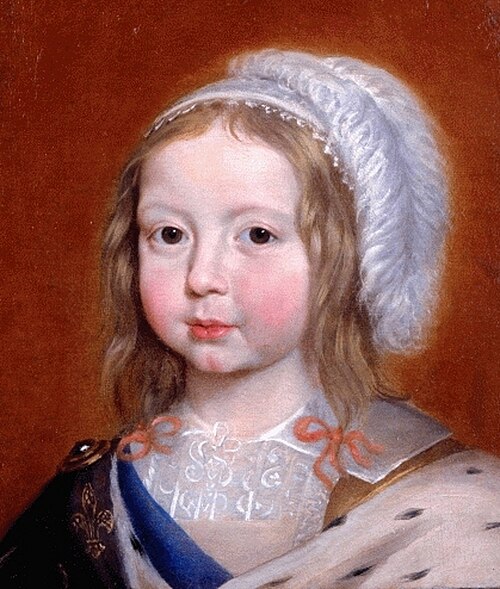
1643年の春、死期が迫っていることを察したルイ13世は、4歳の息子ルイ14世のために身辺整理をすることにした。本来ならフランスの唯一の摂政 となるスペイン人の妻アンヌ女王の判断を信用せず、ルイ14世に代わってアンヌ女王を長とする摂政会議を発令した。[12]
ルイ13世は1643年5月14日に死去した。5月18日[13]、アン女王は夫の遺言をパリ高等法院(貴族と高位聖職者からなる司法機関)で無効にし、[14]自らが単独の摂政となった。アン女王は夫の大臣であるシャヴィニーとブティリエを追放し、ブリエンヌ伯を外務大臣に任命した。[15]アン女王は息子が1661年に成人するまで宗教政策の指揮をしっかりと執り行った。
アンヌはマザラン枢機卿を首席大臣に任命し、日常の政策管理を彼に委ねた。彼女は亡き夫とリシュリュー枢機卿からの迫害にもかかわらず、フランスで絶対的な権力を獲得し、息子のために海外で勝利を得るために、彼らの政策を継続した。アンヌは、1643年に陰謀を企てたボーフォール公とマリー・ド・ロアンという支持者を追放することでマザランを守った。 [16]
アンヌのフランスへの忠誠心の最も良い例は、リシュリューの部下の一人、宰相ピエール・セギエに対する彼女の対応である。セギエは、1637年にアンヌがスペインにいる父に軍事機密を渡していたことが発覚した後、アンヌを(彼女の記憶によれば「普通の犯罪者」のように)無愛想に尋問し、アンヌは事実上何年も自宅軟禁状態にあった。有能なセギエをその地位に留めておくことで、アンヌはフランスと息子ルイの利益のために自分の感情を犠牲にした。
女王はカトリック諸国間の永続的な平和を求めたが、それはフランスが母国スペインに勝利した後のことだった。また、女王はフランスの外交政策に部分的にカトリック志向をもたらした。これはフランスのプロテスタント同盟国であるオランダにも感じられ、1648年にスペインと単独講和交渉を行った。[17]
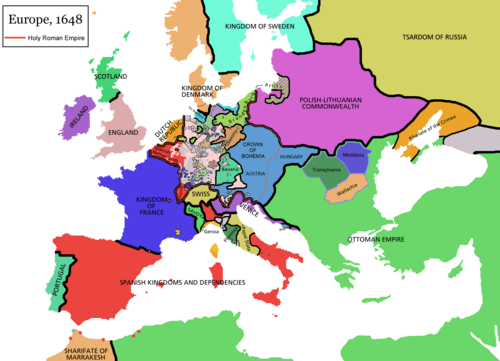
1648年、アンヌとマザランはウェストファリア条約の交渉に成功し、三十年戦争は終結した。[18]条約の条項により、オランダはスペインからの独立が確保され、神聖ローマ帝国のドイツ諸侯に一定の自治権が与えられ、スウェーデンは帝国議会に議席を持ち、オーデル川、エルベ川、ヴェーザー川の河口を支配する領土を獲得した。[19]しかし、この和平から最も利益を得たのはフランスであった。ハプスブルク家の皇帝フェルディナント3世が統治するオーストリアは、アルザスにおけるハプスブルク家のすべての領土と請求権をフランスに割譲し、メス、ヴェルダン、トゥールの3司教区に対するフランスの事実上の主権を承認した。[20]さらに、多くの小ドイツ諸国はハプスブルク家の支配からの解放を切望し、フランスの保護を求めた。これは1658年のライン同盟の結成を予期するもので、これにより帝国の権力はさらに弱まった。
初期の行為
三十年戦争が終結に近づくと、フランスではフロンドの乱と呼ばれる内戦が勃発した。この内戦は、ウェストファリア条約を悪用するフランスの能力を事実上阻止した。アンヌとマザランは、主にリシュリュー枢機卿の政策を推し進め、貴族と高等法院を犠牲にして王権を強めていた。アンヌは外交よりも内政に関心があり、フランス国王の神聖な権利を主張する非常に誇り高い女王であった。[21]
こうしたことから、彼女は国王の権威に関わるあらゆる問題において、マザランが提案したものよりはるかに過激なやり方で、強硬な政策を主張するようになった。枢機卿はアンヌの支援に全面的に頼っており、王妃の過激な行動を和らげるために、アンヌに対する影響力をフルに活用しなければならなかった。アンヌは、自分の意志に異議を唱える貴族や国会議員を投獄した。彼女の主な目的は、財政と司法に関する絶対的な権限を息子に移譲することだった。彼女が投獄したパリ高等法院の指導者の一人は、獄中で死亡した。[22]
不満を抱いた封建貴族の政治的後継者であるフロンドール家は、中央集権化が進む王政から伝統的な封建特権を守ろうとした。さらに、彼らは、王国を統治し、王政がますます頼りにするようになった、最近貴族に列せられた官僚(ノーブレス・ド・ローブ、つまり「ローブの貴族」)によって、伝統的な影響力と権威が奪われていると信じていた。この考えは貴族たちの憤りを強めた。[要出典]
1648年、アンヌとマザランはパリ高等法院の議員に課税しようとした。議員らは従わず、国王の以前の財政布告をすべて焼却するよう命じた。ランスの戦いでアンギャン公ルイ(後のコンデ公)が勝利したことに勢いづいたマザランは、アンヌ女王の強い要請に応じ、武力示威として議員の一部を逮捕した。[23]アンヌの観点から最も重要な逮捕は、パリ高等法院で最も重要な指導者の一人であるピエール・ブルッセルの逮捕であった。

フランス国民は、王権の拡大、税率の高さ、パリ高等法院やその他の地方代表機関の権限の縮小に不満を募らせていた。その結果パリでは暴動が勃発し、アンヌは強い圧力を受け、ブルッセルを解放せざるを得なくなった。さらに、ルイが12歳だった1651年2月9日から10日の夜、怒ったパリ市民の暴徒が王宮に押し入り、国王に会うよう要求した。王室の寝室に案内され、眠ったふりをしているルイを見つめた後、なだめられ、静かに立ち去った。[24]王室への脅威を感じたアンヌは、国王とその廷臣たちとともにパリから逃亡した。
その後まもなく、ウェストファリア条約の締結により、コンデ公の軍隊がルイ14世と宮廷の救援のためパリに戻ることが認められた。当時コンデ公の家族はアンヌと親しく、アンヌが王権を回復しようとするのを手伝うことに同意した。[25]コンデ公が率いる王妃の軍隊はパリの反乱軍を攻撃した。反乱軍はアンヌの旧友マリー・ド・ロアンの政治的統制下にあった。5年前にアンヌに投獄された牢獄から脱走したボーフォールがパリの軍事指導者であり、名目上はコンティの統制下にあった。数回の戦闘の後、政治的妥協が成立し、リュエイユ条約が調印され、宮廷はパリに戻った。
アンヌにとって不幸なことに、彼女の部分的な勝利は、王妃を支配しマザランの影響力を破壊しようとしていたコンデ公にかかっていた。王妃に背くよう彼を圧力をかけたのはコンデ公の妹だった。アンヌは、旧友のマリー・ド・ロアンと取引をし、シャトーヌフ侯爵シャルル・ド・ローブスピーヌを法務大臣に任命させた後、コンデ公とその弟のコンティ公アルマン・ド・ブルボン、そして彼らの妹の夫でロングヴィル公爵夫人アンヌ・ジュヌヴィエーヴを逮捕した。この状況は長くは続かず、マザランの不人気から、主にマリー・ド・ロアンとロングヴィル公爵夫人が率いる連合が結成された。この貴族連合は、王子たちを解放し、マザランを追放し、アンヌ女王に事実上の自宅軟禁という条件を課すのに十分な力を持っていた。

ルイはこれらの出来事をすべて目撃しており、それが後に彼がパリと上流貴族に不信感を抱くようになった大きな理由となった。[26]「ある意味では、ルイの幼少時代はフロンドの乱の勃発とともに終わった。生活が不安定で不快になっただけでなく、あらゆる時代の多くの子供たちに与えられた運命だったが、ルイは深く理解できない政治や軍事の問題を母親とマザランに任せざるを得なかった」。[27]「パリを放棄しなければならなくなったとき、家族の家は監獄のようになった。他の城への気楽な外出ではなく、屈辱的な逃避だった」。[27]王室はこのようにしてパリから2度追い出され、ある時点でルイ 14世とアンヌは事実上パリの王宮に監禁された。フロンドの乱の年はルイにパリへの憎しみを植え付け、その結果、古都からできるだけ早く出て二度と戻らないという決意を抱くようになった。[28]
最初のフロンドの乱( 1648年~1649年の議会フロンドの乱)が終わると同時に、第二のフロンドの乱( 1650年~1653年の王子のフロンドの乱)が始まった。それ以前の乱とは異なり、この第二段階の上流階級の反乱は、卑劣な陰謀と気の進まない戦争の物語で特徴づけられた。貴族にとって、この反乱は、臣下から廷臣への政治的降格の覆しを求める抗議を意味していた。反乱を率いたのは、ルイ14世の叔父であるオルレアン公ガストンと、従妹でラ・グランド・マドモアゼルとして知られるモンパンシエ公爵夫人アンヌ・マリー・ルイーズ、血統主義の君主であるコンデ公、その兄弟であるコンティ公アルマン・ド・ブルボン、その妹であるロングヴィル公爵夫人などであった。ロングヴィル公アンリやボーフォール公フランソワなどの正当な王家の血統を持つ公爵、ブイヨン公フレデリック・モーリスとその兄弟テュレンヌ元帥、シュヴルーズ公爵夫人マリー・ド・ロアンなどのいわゆる「外国の王子」、そしてフランソワ・ド・ラ・ロシュフーコーなどのフランス最古の家系の子孫。
アンヌ女王は、絶対的な権力を息子に委譲したかったため、フロンドの乱を鎮圧する上で最も重要な役割を果たしました。また、ほとんどの王子は、数年間亡命生活を送るマザランとの交渉を拒否しました。フロンドの人々は、ルイの母親とマザランに対して、ルイの利益のために行動していると主張しました。
アンヌ女王は枢機卿と非常に親密な関係にあり、多くの観察者はマザランが アンヌ女王との秘密結婚によってルイ14世の義父になったと信じていた。[29]しかし、ルイ14世の成人とそれに続く戴冠により、フロンド派は反乱を起こす口実を失った。こうしてフロンドの乱は徐々に勢いを失い、1653年にマザランが亡命先から凱旋帰国した時に終結した。その時から死ぬまで、マザランはもはや摂政ではなくなったアンヌの日常的な監督なしに外交政策と財政政策を担当した。[30]
この間、ルイはマザランの姪マリー・マンシーニに恋をしたが、アンヌとマザランはマンシーニを宮廷から遠ざけ、イタリアで結婚させることで国王の熱愛に終止符を打った。マザランはしばらくの間、姪をフランス王と結婚させようと思ったかもしれないが、アンヌ王妃はこれに断固反対だった。彼女は王朝と政治的な理由から、息子を兄であるスペイン国王フェリペ4世の娘と結婚させたかったのだ。マザランはすぐに王妃の立場を支持するようになった。なぜなら、彼の権力と外交政策に対する彼女の支持は、強い立場からスペインと和平を結ぶこととスペインとの結婚にかかっていると知っていたからである。さらに、マザランとマリー・マンシーニの関係は良好ではなく、彼は彼女が自分の立場を支持してくれるとは信じていなかった。ルイが涙を流し、母に懇願しても、彼女の考えは変わらなかった。スペインとの結婚は、フランスとスペインの戦争を終わらせる上で重要な役割を果たした。なぜなら、ルイ16世の次の50年間の外交政策の主張や目的の多くはこの結婚に基づいていたからであり、また、この結婚を通じてスペインの王位が最終的にブルボン家に引き継がれることになったからである。[31]
個人的な統治と改革
成人と初期の改革

ルイ14世は1651年9月7日に成人したと宣言された。1661年3月にマザランが死去すると、ルイは自ら政権を握り、宰相なしで統治すると宣言して宮廷を驚かせた。「これまで私は、故枢機卿に政務を託してきました。これからは私が自ら統治する時です。あなた方[秘書官と大臣]は、私が頼めば助言を与えて私を助けてください。私の命令がない限り、いかなる命令にも署名しないようお願いします。パスポートでさえもです。私の命令がない限り、何にも署名しないようお願いします。毎日、私に個人的に報告し、誰にも有利にならないように。」[32]数十年にわたる外交紛争と内戦の後の平和と秩序への国民の広範な切望を利用し、若き王は封建貴族を犠牲にして中央の政治権力を強化した。歴史家シャトーブリアンは、才能ある人々を選び、奨励する彼の能力を称賛し、「ルイの墓から聞こえるのはあらゆる種類の天才の声だ」と述べた。[33]
ルイは自らの統治を行政および財政改革から始めた。1661年、財務省は破産寸前だった。この状況を改善するため、ルイは1665年にジャン=バティスト・コルベールを財務総監に選んだ。しかし、ルイはまず、権力を持つ財務長官ニコラ・フーケを無力化しなければならなかった。フーケの財政上の無分別さは、それ以前のマザランやそれ以降のコルベールのそれと大差なかったが、その野心はルイを悩ませた。フーケは、豪華なヴォー・ル・ヴィコント城で国王を豪勢にもてなし、政府資金の横領以外ではほとんど蓄えたことのない富を誇示した。
フーケはマザランとリシュリューの権力を継承することに熱心だったようで、無分別に遠く離れたベル・イル島を購入し、個人的に要塞化した。これらの行為が彼の運命を決定づけた。フーケは横領の罪で告発され、高等法院は彼を有罪とし、追放を宣告した。最終的にルイは判決を終身刑に変更した。
フーケの失脚により、コルベールは課税の効率化を通じて国家債務を削減する自由を得た。主な税は、アイドとドゥアン(ともに関税)、ガベル(塩税)、タイユ(土地税)であった。タイユはまず削減され、特定の徴税契約は少数の有力者に私的に売却されるのではなく、競売にかけられた。財務官僚は定期的に会計をつけて目録を改訂し、無許可の免除を廃止することが義務付けられた。1661年まで、王領からの収入のうち国王に渡ったのはわずか10%だった。改革では既得権益を克服する必要があった。タイユは、高値で職を購入した王室の役人によって徴収され、不正行為に対する処罰は必然的に購入額を下げた。それでもコルベールは素晴らしい成果を上げ、1661年の赤字は1666年までに黒字に転じ、債務利息は5,200万リーブルから2,400万リーブルに減少した。タイユは1661年に4200万ポンド、1665年には3500万ポンドに減少し、間接税収入は2600万ポンドから5500万ポンドに増加した。王領の収入は1661年の8万リーブルから1671年には550万ポンドに増加した。1661年の収入は2600万ポンドに相当し、そのうち1000万ポンドが国庫に納まった。支出は約1800万ポンドで、800万ポンドの赤字が残った。1667年には、純収入は2000万ポンドに増加したが、支出は1100万ポンドに減少し、900万ポンドの黒字が残った。

再編され拡大した軍隊、ベルサイユ宮殿の装備、そして拡大する民政にとって、資金は欠かせない支えだった。財政は常にフランス王政の弱点だった。徴税は費用がかかり非効率的だった。直接税は多くの中間役人の手を経て減少し、間接税は税金徴収人と呼ばれる民間請負業者によって徴収され、かなりの利益を上げていた。国庫はあらゆる継ぎ目から漏れていた。
主な弱点は、フランス王室と貴族の間の古い取引から生じた。つまり、王は貴族を免除すれば、国民の同意なしに税金を引き上げることができるということだ。直接税を支払ったのは「非特権階級」だけだったが、ほとんどのブルジョワが何らかの方法で免除を巧みに利用したため、直接税を支払うのは農民だけになった。この制度は、国家支出の負担をすべて貧しく無力な人々の背中に負わせた。1700 年以降、ルイの敬虔な秘密の妻、マントノン夫人の支持を得て、国王は財政政策を変更するよう説得された。貴族に課税する気はあったものの、ルイは見返りに貴族が要求する政治的譲歩を恐れた。ルイは、戦争という極度の緊急事態の下で、フランス史上初めて貴族に直接税を課すことができた。これは法の下の平等と健全な財政に向けた一歩であったが、貴族やブルジョワ階級の執拗な努力によって勝ち取られた譲歩や免除によって予想通りその効果は薄れていった。[34]
ルイとコルベールは、フランスの商業と貿易を発展させる幅広い計画も持っていた。コルベールの重商主義政権は、リヨンの絹織物製造業者やゴブラン織りのタペストリー製造所など、新しい産業を設立し、製造業者や発明家を奨励した。彼は、ムラーノのガラス製造業者、スウェーデンの鉄工、オランダの造船業者など、ヨーロッパ各地の製造業者や職人をフランスに招いた。彼は輸入を減らし、フランスの輸出を増やし、フランスからの貴金属の純流出を減らすことを目指した。
ルイは、ミシェル・ル・テリエとその息子でルーヴォワ侯爵を継いだフランソワ=ミシェル・ル・テリエを通じて軍政改革を実施した。彼らは貴族の独立心を抑え、宮廷と軍隊に秩序を課すことに貢献した。将軍たちが先例を巡って口論し、首都の命令や大局的な戦略図を無視して国境で戦争を長引かせ、旧来の軍事貴族(剣の貴族)が軍の上級職や上級階級を独占していた時代は過ぎ去った。ルーヴォワは軍隊を近代化し、専門的で規律正しく、よく訓練された部隊に再編した。彼は兵士たちの物質的な幸福と士気に尽力し、作戦の指揮さえ試みた。
主要植民地との関係

ルイの法改革は、数多くの大勅令として制定された。それ以前のフランスは、伝統的な法制度の数は州の数と同じで、北部では慣習法、南部ではローマ民法という2つの法制度が共存する、さまざまな法制度が混在していた。 [35] 1667年の民事訴訟大法典、通称ルイ法典は、王国全土で民事訴訟手続きの統一的な規制を課す包括的な法典であった。とりわけ、洗礼、結婚、死亡の記録は教会ではなく国家の登記簿に記載することを規定し、高等法院の抗議権を厳しく規制した。[36]ルイ法典は後にナポレオン法典の基礎となり、それが多くの現代の法典に影響を与えた。
ルイ14世の最も悪名高い法令の1つは、 1685年の植民地大法典、通称黒法典である。この法令は奴隷制を容認していたが、家族の分離を禁じることで奴隷制を人間的なものにしようとした。さらに、植民地ではローマカトリック教徒だけが奴隷を所有でき、奴隷は洗礼を受けなければならなかった。
ルイは数々の会議を通じて統治した。
- Conseil d'en haut (「高等評議会」、国家の最も重要な事柄に関するもの) は、国王、皇太子、財務総監、および各部門を担当する国務長官で構成されていました。この評議会のメンバーは国務大臣と呼ばれていました。
- Conseil des dépêches(各州からの通知と行政報告に関する「メッセージ評議会」)。
- Conseil de Conscience(良心評議会、宗教問題と司教任命に関するもの)。
- 王立財政評議会(「王立財政評議会」)は「財政評議会長」(ほとんどの場合名誉職)が率いており、これは評議会内で高位貴族が就ける数少ない役職の1つであった。[37]
低地諸国における初期の戦争
スペイン


1665年にルイ14世の母方の叔父であるスペイン国王フェリペ4世が死去したことで王位継承戦争が勃発した。1660年、ルイ14世は1659年のピレネー条約の条項の一つとして、フェリペ 4世の長女マリア・テレジアと結婚していた。[38]この結婚条約では、マリア・テレジアは自分とその子孫全員に対するスペイン領土に対するすべての権利を放棄すると規定されていた。[38]しかし、マザランとリオンヌは、スペインからの持参金50万エキュの全額支払いを放棄の条件とした。[39]この持参金は支払われず、後に母方の従兄弟であるスペイン国王カルロス2世が、ルイ14世とマリア・テレジアの孫であるアンジュー公フェリペ(後のスペイン国王フェリペ5世)に帝国を譲るよう説得する役割を果たすことになる。
継承戦争は持参金の支払いに焦点が当てられたわけではなく、むしろルイ 14世は持参金の支払いがないことを口実にマリア・テレジアの権利放棄を無効にし、その土地を「継承」させた。ブラバント(紛争のあった土地の場所)では、初婚の子供は伝統的に親の再婚で不利にならず、依然として財産を相続していた。ルイ14世の妻はフェリペ 4世の最初の結婚で生まれた娘であり、スペインの新王、カルロス2世はフェリペ4世の再婚で生まれた息子であった。したがって、ブラバントはマリア・テレジアに「継承」され、フランスがスペイン領ネーデルラントを 攻撃する正当性が与えられたとされている。
オランダとの関係
.jpg/500px-Louis_XIV_crosses_the_Rhine_at_Lobith_-_Lodewijk_XIV_trekt_bij_het_Tolhuis_bij_Lobith_de_Rijn_over,_12_juni_1672_(Adam_Frans_van_der_Meulen).jpg)
スペインとの八十年戦争の間、フランスはハプスブルク家に対抗するという一般的な政策の一環としてネーデルラント連邦共和国を支援した。1653年から1672年までオランダ大公を務めたヨハン・デ・ウィットは、これをオランダの安全保障にとって極めて重要であり、国内のオラニエ派の反対派に対する対抗勢力であるとみなした。ルイは1665年から1667年の第二次英蘭戦争で支援を行ったが、その機会を利用して1667年にスペイン領ネーデルラントの継承戦争を開始した。この戦争によりフランシュ=コンテとスペイン領ネーデルラントの大部分が占領され、この地域におけるフランスの拡大はオランダの経済的利益に対する直接的な脅威となった。[40]
オランダはフランスに対する共通の外交戦線でイングランド国王チャールズ2世と交渉を開始し、イングランド、オランダ、スウェーデンの三国同盟が結ばれた。緊張が高まり、スペインの王位を主張するもう1人の有力者、レオポルド皇帝とスペイン領土を分割する秘密条約が結ばれる恐れがあったため、ルイ14世は1668年のエクス・ラ・シャペル条約で獲得した領土の多くを放棄した。[41]
ルイはレオポルドとの協定をあまり信用せず、フランスとオランダの目的が直接対立していることが明らかになったため、まず共和国を倒し、次にスペイン領ネーデルラントを占領することを決定した。これには三国同盟の解体が必要だった。ルイはスウェーデンに中立を保つために金銭を支払い、1670年にカールとドーバー秘密条約を締結し、ネーデルラント共和国に対抗する英仏同盟を結んだ。1672年5月、フランスはミュンスターとケルン選帝侯の支援を受けて共和国に侵攻した。[42]

フランス軍の急速な進撃によりクーデターが起こり、デ・ウィットが打倒されてヴィルヘルム3世が権力を握った。レオポルドは、特に1670年にフランスが戦略上重要なロレーヌ公国を奪取して以降、ラインラントへのフランスの拡大が増大する脅威とみなした。オランダの敗北の可能性から、レオポルドは6月23日にブランデンブルク=プロイセンと同盟を結び、続いて25日にはオランダ共和国とも同盟を結んだ。 [43]ブランデンブルクは1673年6月のフォッセム条約によって戦争から脱退を余儀なくされたが、8月にはオランダ、スペイン、レオポルド皇帝、ロレーヌ公によって反フランス同盟が結成された。[44]
フランスとの同盟はイングランドでは非常に不評だったが、ミヒール・デ・ロイテル艦隊との戦闘で失望させられた後、さらに不評になった。イングランド王チャールズ2世は1674年2月のウェストミンスター条約でオランダと和平を結んだ。しかし、フランス軍は敵に対して大きな優位性を持っていた。それは、分割されていない指揮、テュレンヌ、コンデ、ルクセンブルクのような有能な将軍、そしてはるかに優れた兵站であった。陸軍大臣ルーヴォワが導入した改革により、はるかに迅速に動員できる大規模な野戦軍を維持することができ、敵が準備を整える前の早春に攻勢を仕掛けることが可能になった。[45]
それでもフランス軍はネーデルラント共和国の大半から撤退を余儀なくされ、ルイは大きな衝撃を受けた。ルイはしばらくサンジェルマンに撤退し、少数の親しい者を除いて邪魔をすることは許されなかった。 [46]しかしフランス軍は軍事的に優位に立っていたため、フランシュ=コンテを奪還する間、アルザスとスペイン領ネーデルラントで地歩を固めることができた。1678年までに双方の疲弊からナイメーヘン条約が締結され、概ねフランス有利に決着し、ルイはスコーネ戦争に介入することができた。軍事的敗北にもかかわらず、同盟国スウェーデンは1679年にデンマーク=ノルウェーとブランデンブルクに課されたサンジェルマン=アン=レー、フォンテーヌブロー、ルンドの条約の下で失ったものの多くを取り戻した。 [47]しかしルイの2つの主要目標、ネーデルラント共和国の破壊とスペイン領ネーデルラントの征服は失敗に終わった。[48]
ルイは権力の絶頂にあったが、敵対者を団結させるという犠牲を払っていた。領土拡大を続けるにつれ、その犠牲は増大した。1679年、ルイは外務大臣のシモン・アルノー・ポンポンヌ侯爵を、同盟国と妥協しすぎたとみなされて解任した。ルイは軍の強さを維持したが、次の一連の領土主張では軍事力のみを使うことは避けた。むしろ、王国の境界を拡大するために、法的な口実と組み合わせた。当時の条約は意図的に曖昧な表現になっていた。ルイはそれらの条約に基づく権利と義務の全範囲を決定するために、再統合会議を設立した。
ルクセンブルクやカザーレなどの都市や領土は、国境の戦略的な位置と重要な水路へのアクセスのために高く評価されました。ルイは、ライン川左岸の重要な戦略的交差点であり、それまで神聖ローマ帝国の帝国自由都市であったストラスブールも求め、1681年に他の領土とともに併合しました。ストラスブールはアルザスの一部でしたが、ハプスブルク家の支配するアルザスの一部ではなかったため、ウェストファリア条約でフランスに割譲されませんでした。
これらの併合に続いてスペインは宣戦布告し、再統合戦争が勃発した。しかし、皇帝(大トルコ戦争に気をとられていた)がスペインを見捨て、オランダも最低限の支援しかしなかったため、スペインは急速に敗北した。 1684年のラティスボン休戦により、スペインは征服した領土のほとんどをフランスが占領することを20年間黙認せざるを得なくなった。[49]
ルイ14世のレユニオン政策は、彼の治世中にフランスを最大の規模と権力にまで押し上げたかもしれないが、ヨーロッパの多くの国々を疎外した。この悪い世論は、バルバリ海岸沖とジェノバでのフランスの行動によってさらに悪化した。まず、ルイ14世は、有利な条約とキリスト教徒奴隷の解放を得るために、2つのバルバリ海賊の拠点であるアルジェとトリポリを砲撃した。次に、1684年には、以前の戦争でスペインを支援したことへの報復として、ジェノバに対する懲罰使節団が派遣された。ジェノバ人は従い、ドージェは公式の謝罪使節団を率いてヴェルサイユに向かったが、フランスは残忍で傲慢という評判を得た。ヨーロッパ人はフランスの力が増大することを懸念し、また、後述の竜巻攻撃の影響の大きさに気づいたため、多くの国々がフランスとの同盟を破棄した。[50]そのため、1680年代後半までに、フランスはヨーロッパでますます孤立していった。
非ヨーロッパ諸国との関係と植民地

ルイ1世の治世中、アフリカ、アメリカ大陸、アジアにフランス植民地が拡大し、フランス人探検家が北アメリカで重要な発見をした。1673年、ルイ・ジョリエとジャック・マルケットがミシシッピ川を発見した。1682年、ルネ・ロベール・カヴリエ・ド・ラ・サールがミシシッピ川をたどってメキシコ湾に至り、広大なミシシッピ川流域をルイ1世の名の下に領有権を主張し、ルイジアナと名付けた。インドのシャンデルナゴールとポンディシェリ、インド洋のブルボン島にもフランスの交易拠点が設立された。これらの地域で、ルイとコルベールはヴェルサイユやパリのスタイルと王国の「栄光」を反映することを目的とした大規模な建築と都市計画に着手した。[51]

その一方で、遠方の国々との外交関係も開始された。1669年、スレイマン・アガはオスマン帝国の使節団を率いて、かつてのフランス・オスマン同盟を復活させた。[52]その後、1682年にモハメッド・テニムのモロッコ大使館がフランスに来訪した後、モロッコ国王ムーレイ・イスマイルはモロッコ国内にフランス領事館と商業施設を設置することを許可した。[53] 1699年、ルイ14世は再びモロッコ大使のアブダラ・ビン・アイシャを迎え、1715年にはモハメッド・レザー・ベグ率いるペルシャ大使館を迎えた。
遠方からは、シャムが1684年に使節団を派遣し、翌年フランスもアレクサンドル・ド・ショーモン騎士団の指揮のもと、見事に応対した。これに続いて、コサ・パン指揮下のシャム使節団が派遣され、1686年にヴェルサイユで盛大に迎えられた。ルイは1687年にシモン・ド・ラ・ルーベール指揮下の別の使節団を派遣し、シャム宮廷におけるフランスの影響力が高まり、シャム宮廷はメルギーをフランスに海軍基地として認めた。しかし、アユタヤ王ナライの死、親仏派の大臣コンスタンティーヌ・フォールコンの処刑、そして1688年のバンコク包囲により、このフランスの影響の時代は終わった。[54]
フランスはまた、中国へのイエズス会宣教にも積極的に参加しようとした。ポルトガルの支配を打ち破るため、ルイは1685年に康熙帝の宮廷にジャン・ド・フォンタネー、ジョアシャン・ブーヴェ、ジャン=フランソワ・ジェルビヨン、ルイ・ル・コント、クロード・ド・ヴィズデルといったイエズス会宣教師を派遣した。[55]ルイはまた、 1684年にヴェルサイユで中国人イエズス会員のミカエル・シェン・フー・ツンを迎えた。[56]さらに、ルイの司書兼翻訳者のアルカディオ・ホアンも中国人だった。[57] [58]
権力の頂点
権力の集中化

1680 年代初頭までに、ルイは世界におけるフランスの影響力を大幅に拡大しました。国内では、国王の影響力と教会および貴族に対する権威を高めることに成功し、フランスの絶対王政を強化しました。
ルイ16世は当初、フランスにおける教皇の権威を制限する伝統的なガリア主義を支持し、 1681年11月にフランス聖職者会議を招集した。8か月後の解散前に、会議は教皇の権力を犠牲にして国王の権威を高めるフランス聖職者宣言を承認した。国王の承認がなければ、司教はフランスを離れることができず、教皇に訴えることもできなかった。さらに、政府高官は職務遂行中に犯した行為を理由に破門されることもなかった。国王は教会法を制定できなかったが、国王の承認のない教皇の規則はすべてフランスでは無効であった。当然のことながら、教皇は宣言を否認した。[4]

ルイは、貴族をヴェルサイユ宮殿に配属することで、フランス貴族に対する統制力を強化しました。歴史家フィリップ・マンセルによると、国王は宮殿を次のように変えました。
- 結婚市場、職業紹介所、貴族階級のヨーロッパの娯楽の中心地が魅力的に組み合わさった場所であり、最高の演劇、オペラ、音楽、ギャンブル、セックス、そして(最も重要な)狩猟を誇っています。[59]
王に廷臣となる者を住まわせるために、部屋が建てられた。[60]しかし、身分にふさわしい生活を送るために必要な年金や特権は、ルイに絶えず仕えることによってのみ可能であった。[61]この目的のために、王が注目の的となり、一日中民衆に観察されるという手の込んだ宮廷儀式が作られた。ルイは優れた記憶力で、宮廷で誰が侍従し、誰が不在かを把握することができ、その後の恩恵や地位の分配を容易にした。ルイが貴族を支配するために使ったもう一つの手段は検閲であり、手紙を開封してその作者が政府と王についてどう思っているかを見極めることがよく含まれていた。[60]さらに、贅沢やその他の娯楽で貴族を楽しませ、感銘を与え、飼い慣らすことで、ルイは自分に対する世論を醸成しただけでなく、貴族が常に自分の監視下に置かれるようにした。
ルイのヴェルサイユにおける浪費は、宮廷の精緻な儀式の範囲をはるかに超えていた。彼はポルトガル王からアフリカ象を贈り物として受け取った。 [62]彼は有力貴族にヴェルサイユに住むよう奨励した。これは私兵の禁止と相まって、貴族が自分の領地や地方の権力基盤で時間を過ごすことを妨げた。彼らは歴史的に、そこから地方戦争を繰り広げ、王権への抵抗を企ててきた。このようにしてルイは、古い軍事貴族(「剣の貴族」)を強制的に誘惑し、自分の儀礼的な廷臣に仕立て上げ、彼らの権力をさらに弱めた。その代わりに、彼は平民や最近貴族に叙せられた官僚貴族(「衣服の貴族」)を育てた。彼は、これらの人物を高官や行政官に就かせることで、古い血統と根強い影響力を持つ貴族よりも簡単に解雇できるため、王権はより確実に繁栄すると判断した。ルイの政策は、高貴な生まれの人々が、実は一部の人々の親族であった王に対して反乱を起こしたフロンドの乱の経験に根ざしていると考えられています。貴族に対するこの勝利により、約 1 世紀後のフランス革命まで、フランスにおける大規模な内戦は終結したと考えられます。
戦争の要としてのフランス

ルイの治世下、フランスはヨーロッパの主要国であり、ほとんどの戦争はフランスの攻撃性を中心に展開した。人口でフランスを上回る国はヨーロッパになく、富、中心地の立地、非常に強力な専門軍で対抗できる国はなかった。フランスは三十年戦争の壊滅をほぼ免れた。フランスの弱点には、軍事冒険の費用を捻出するのに苦労する非効率な金融システムと、他のほとんどの大国がフランスに対抗する傾向があった。
ルイ14世の治世中、フランスは3つの大きな戦争、すなわち仏蘭戦争、九年戦争、スペイン継承戦争を経験した。また、王位継承戦争と再統合戦争という2つの小さな紛争もあった。[63]これらの戦争は非常に費用がかかったが、ルイ 14世の外交政策を決定づけ、彼の性格がそのアプローチを形作った。「商業、復讐、憤怒の混合」に突き動かされたルイは、戦争が彼の栄光を高める理想的な方法であると感じた。平時には、彼は次の戦争の準備に集中した。彼は外交官たちに、彼らの仕事はフランス軍に戦術的および戦略的優位性をもたらすことだと教えた。[5] 1695年までに、フランスはその優位性の多くを維持したが、海の支配権をイングランドとオランダに奪われ、プロテスタントとカトリックの両方のほとんどの国がフランスに対抗する同盟を結んでいた。フランスの代表的な軍事戦略家セバスチャン・ル・プレストル・ド・ヴォーバンは、1689年にルイ14世に、敵対的な「同盟」は海上で強力すぎると警告した。彼は、フランスの商船に私掠船を許可し、敵の海軍を避けながら敵の商船を拿捕することで反撃することを勧めた。
- フランスには、公然と敵国とされている国がある。ドイツとその包摂国すべて、スペインとそのヨーロッパ、アジア、アフリカ、アメリカの属国すべて、サヴォイア公国(イタリア)、イングランド、スコットランド、アイルランド、東インドと西インドにあるそれらの植民地すべて、そして、世界各地に大拠点を持つオランダとその領土すべてである。フランスには、公然と敵国とされている国があり、間接的に敵対し、フランスの偉大さを妬んでいるデンマーク、スウェーデン、ポーランド、ポルトガル、ヴェネツィア、ジェノヴァ、スイス連邦の一部などである。これらの国はすべて、軍隊を雇ったり、資金を貸したり、貿易を保護したりすることで、フランスの敵を密かに支援している。[64]
ヴォーバンはフランスのいわゆる友好国や同盟国について悲観的だった。
- フランスには、冷淡で役立たずで無力な友人として、無関心な教皇、 国外追放されたイングランド王(ジェームズ2世)、トスカーナ大公、マントヴァ公、モデナ公、パルマ公(すべてイタリア)、そしてスイス人の他の派閥がいる。これらの中には、長年の平和から生まれた優しさに浸っている者もいれば、愛情が冷めている者もいる...。イギリス人とオランダ人が同盟の主な支柱である。彼らは他の列強と協力して我々に対して戦争をすることでそれを支援し、毎年同盟国に支払うお金によってそれを維持しています...したがって、我々は戦争を遂行する方法として私掠船に頼らなければなりません。これは最も実行可能で、単純で、安価で、安全で、国家にとって最も費用がかからない方法です。国王は損失を感じず、事実上何も危険を冒さないのでなおさらです...それは国を豊かにし、国王のために多くの優秀な士官を訓練し、短期間で敵に和平を申し入れさせるでしょう。[65]
フォンテーヌブロー勅令
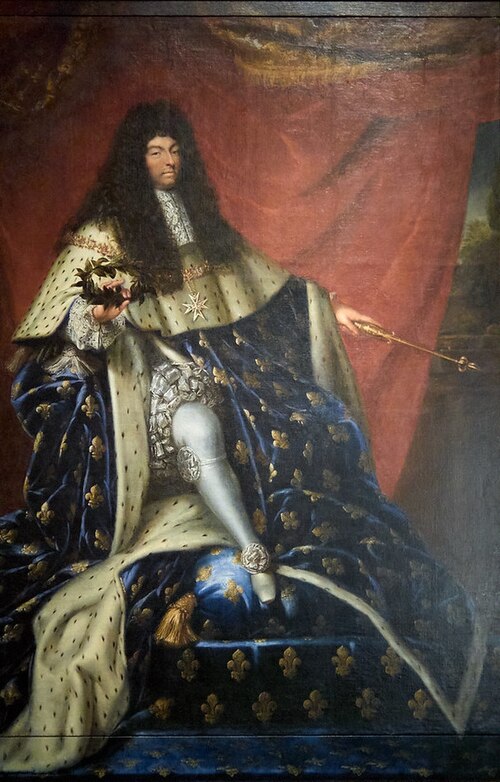
ルイはプロテスタントを迫害し、ユグノーに政治的・宗教的自由を与えた1598年のナントの勅令を撤回することを決めた。彼はプロテスタントの存続を、王の無力さを不名誉に思い起こさせるものとみなした。結局のところ、この勅令は、彼の祖父アンリ4世が長きにわたるフランス宗教戦争を終わらせるために実際に譲歩したものだった。ルイの考えのもう1つの要素は、社会政治的安定を保証する当時のヨーロッパの原則、cuius regio, eius religio (「誰の国、彼の宗教」)、つまり統治者の宗教は国の宗教であるべきという考えであった(中央ヨーロッパでは1555年のアウクスブルクの和約で最初に確認された)。[66]
請願に応じて、ルイは当初プロテスタントを公職から排除し、教会会議の開催を制限し、勅令で定められた地域外の教会を閉鎖し、プロテスタントの野外説教を禁止し、国内のプロテスタント移住を禁じた。また、第三者が反対するプロテスタントとカトリックの結婚を禁止し、プロテスタントへの布教を奨励し、カトリックへの改宗者に報奨を与えた。[67]この差別はプロテスタントの抵抗に遭うことはほとんどなく、特に貴族階級の間でプロテスタントの改宗が着実に進んだ。
1681年、ルイはプロテスタント迫害を劇的に強化した。「領土に帰属すれば宗教も消滅」の原則は、改宗を拒否する臣民は一般に移住できることも意味していたが、ルイは移住を禁止し、事実上すべてのプロテスタントは改宗しなければならないと主張した。第二に、ルネ・ド・マリヤックとルーヴォワ侯爵の提案に従い、ルイはプロテスタントの家に竜騎兵を宿舎として置き始めた。これはルイの法的権利の範囲内であったが、竜騎兵による迫害はプロテスタントに深刻な経済的負担と残虐な虐待をもたらした。30万人から40万人のユグノーが、金銭的報酬と竜騎兵による迫害の免除を伴って改宗した。[68]

1685年10月15日、ルイはフォンテーヌブロー勅令を発布した。この勅令では、大規模な改宗によりプロテスタントが持つ特権が不足していることを理由に、特権の過剰を指摘した。フォンテーヌブロー勅令はナントの勅令を撤回し、そこから生じた特権をすべて撤廃した。[4]この勅令により、ルイはフランスにおけるプロテスタントの団体、牧師、教会の存在を容認しなくなった。教会はこれ以上建設せず、既存の教会は取り壊すこととなった。牧師は亡命か世俗生活のどちらかを選べることになった。改宗に抵抗したプロテスタントは、強制的に国教会に洗礼を受けさせられることになった。 [69]
歴史家たちは、ルイがフォンテーヌブロー勅令を発布した理由について議論している。彼は、関係が緊張しており、ケルン選帝侯国の継承危機の帰結を決めるために教皇インノケンティウス11世の助けが必要だったため、教皇をなだめようとしたのかもしれない。また、ルイの助けなしにトルコ軍を破ったレオポルド1世皇帝の地位を奪い、国際的威信を取り戻すために行動したのかもしれない。あるいは、彼は単に、フランス社会に宗教戦争以来残っていた分裂を、異端を根絶するという戴冠式の誓いを果たすことで終わらせたかっただけかもしれない。[70] [71]
多くの歴史家はフォンテーヌブロー勅令がフランスに重大な損害を与えたと非難している。[72]それを裏付ける証拠として、彼らは約20万人の高度な技能を持つユグノー(プロテスタント人口の約4分の1、フランス人口の1%)が国王の勅令に背き、フランスから様々なプロテスタント国家に逃亡し、フランス経済を弱体化させ、プロテスタント国家の経済を豊かにしたことをあげている。一方、一部の歴史家はこれを誇張とみなしている。彼らは、フランスの著名なプロテスタントの実業家や産業家のほとんどはカトリックに改宗し、フランスに残ったと主張している。[73]
確かなのは、この勅令に対する反応が複雑だったということだ。フランスのカトリック指導者たちが歓喜する一方で、教皇インノケン ティウス11世は依然としてガリア主義をめぐってルイ14世と論争し、暴力の使用を批判した。ヨーロッパ中のプロテスタントは同宗教者の扱いに恐怖を覚えたが、フランスのカトリック教徒の大半はこの措置を称賛した。とはいえ、ヨーロッパの大半、特にプロテスタント地域でルイ14世の公的なイメージが深刻な打撃を受けたことは疑いようがない。
しかし、最終的には、治世の終わりに南中央フランスのカミザール派との緊張が再燃したにもかかわらず、ルイは、後継者が先祖を悩ませた宗教に基づく騒乱を経験することが少なくなるように尽力したのかもしれない。彼の子孫であるルイ16世の時代までにフランス社会は十分に変化し、1787年のヴェルサイユ勅令(寛容勅令としても知られる)の形で寛容を歓迎するようになった。これにより、非カトリック教徒は公民権と公然と礼拝する自由を回復した。[74] 1789年のフランス革命の到来とともに、プロテスタントはローマカトリック教徒と同等の権利を与えられた。
九年戦争
戦争の原因と経緯
.jpg/500px-Batalla_de_Fleurus_(1690).jpg)

1688年から1697年まで続いた九年戦争は、ルイ14世の政治的、外交的運命の衰退期の始まりとなった。それはラインラントにおける2つの出来事から生じた。まず、1685年にプファルツ選帝侯カール2世が死去し た。彼の直系家族で残されたのはルイ14世の義理の妹、エリザベート・シャルロッテだけだった。ドイツの法律は表面上、彼女が兄の領地と選帝侯の地位を継承することを禁じていたが、エリザベート・シャルロッテを支持する主張が成功する可能性があるほど不明確だった。逆に、王女には明らかに家族の個人財産を分割する権利があった。ルイ14世は、少なくとも動産だけは与えられることを期待して、土地と動産に対する彼女の主張を主張した。[75]その後、1688年にフランスの同盟者であるケルン大司教マクシミリアン・ヘンリー・フォン・バイエルンが死去した。大司教職は伝統的にバイエルン・ヴィッテルスバッハ家が務めていたが、マクシミリアン・ヘンリーの後任としてバイエルンから指名されたバイエルン公ヨーゼフ・クレメンスは当時17歳にも満たず、叙階もされていなかった。ルイは代わりに自らの候補者であるヴィルヘルム・エゴン・フォン・フュルステンベルクを任命し、ライン地方の主要国が同盟国であり続けるよう努めた。[76]
1680年代前半のルイ14世の外交政策と国内政策は攻撃的とみなされていたが、1680年代後半の継承危機によって助長されたルイ14世の行動は、ヨーロッパの多くの国で懸念と警戒を引き起こした。これが、神聖ローマ皇帝、スペイン、スウェーデン、ザクセン、バイエルンによる1686年のアウクスブルク同盟の結成につながった。同盟の表明された意図は、フランスを少なくともナイメーヘン条約で合意された国境に戻すことだった。[77]レオポルト1世がラティスボン休戦協定を恒久条約に変えることを頑なに拒否したことで、ルイ14世は、バルカン半島の問題を解決した後、フランスに背を向けてレユニオンを攻撃するのではないかと恐れた。[78]
ルイが脅威と感じたもう一つの出来事は、1688年のイングランドの名誉革命であった。国王ジェームズ2世はカトリックであったが、2人の英国国教会信者の娘メアリーとアンが、イングランド国民にプロテスタントの王位継承を保証した。しかし、ジェームズ 2世の息子ジェームズ・フランシス・エドワード・スチュアートが生まれると、彼は姉妹よりも王位継承権を優先した。これは、イングランドにおけるカトリック君主の時代の到来を告げるものと思われた。プロテスタントの領主たちは、イングランド国王チャールズ1世の孫であるオランダ王子オラニエ公ウィリアム3世に救援を求めた。ルイ1世は、フランスが挑発行為とみなすだろうと警告したが、ウィリアム3世は軍隊を率いてイングランドへ向かった。自分に最も近い者たちの間でさえも多数の脱走や亡命が見られるのを目撃したジェームズ2世は、イングランドから逃亡した。議会は王位空位を宣言し、ジェームズの娘メアリー2世と、義理の息子で甥のウィリアムに王位を与えた。ウィリアム(現在のイングランド王ウィリアム3世)は、熱烈な反フランス主義者で、新しい王国を戦争に駆り立て、アウクスブルク同盟を大同盟に転換した。これが起こる前に、ルイはウィリアムのイングランド遠征が彼と同盟国のエネルギーを吸い取ると予想し、ラティスボン休戦協定の確認と継承危機に関する彼の要求の受け入れを要求するドイツ諸侯への最後通牒の期限が切れた後、ラインラントに軍隊を派遣した。この軍事行動は、敵軍の糧を奪うことで帝国の侵略から東部の州を守ることも目的としており、これが南西ドイツの多くで行われた先制焦土作戦(「プファルツの荒廃」)の説明となる。[79]

フランス軍は、バルカン半島における帝国の関与、フランスの兵站上の優位性、そしてコンデ公の有名な弟子であるリュクサンブール公フランソワ・アンリ・ド・モンモランシー=ブーテヴィルのようなフランスの将軍たちの質のおかげで、戦争を通じて概ね勝利を収めた。[80]彼は1690年のフルリュスの戦い、1692年のスティーンケルクの戦い、 1693年のランデンの戦いで勝利を収めたが、これらの戦いは戦略的にはほとんど意味をなさなかった。 [81] [82]これは主に17世紀後半の戦争の性質によるものである。[83]

ジェームズ2世の復位の試みは1690年のボイン川の戦いで失敗したが、フランスは北はフランドル、東はドイツ、南はイタリアとスペインから外洋や植民地に至るまで、一連の勝利を積み重ねた。ルイは1691年のモンス、 1692年のナミュールの占領を自ら指揮した。ルクセンブルクは1693年にシャルルロワを占領し、フランスにサンブル川の防衛線を与えた。フランスはまた、1693年のマルサリアの戦いとスタッファルデの戦いの後、サヴォワ公国の大部分を制圧した。 1690年のビーチー岬の戦いでのフランスの勝利と1692年のバルフルール・ラ・ウーグでの連合軍の勝利の後、海軍は膠着状態が続いたが、 1694年のトッロエラの戦いでカタルーニャはフランスの侵略にさらされ、バルセロナの占領で頂点に達した。 1693年にオランダがポンディシェリを占領したが、1697年にフランスがスペインの宝物港カルタヘナを襲撃し、1000万リーブルの財産を手に入れた。
1695年7月、フランス軍に3年間占領されていたナミュール市は、ウィリアム3世率いる連合軍に包囲された。ルイ14世は、フランス軍の注意をそらすために、フランドルの都市を奇襲で破壊するよう命じた。これがブリュッセルの砲撃につながり、市の中心部全体を含む4,000以上の建物が破壊された。この戦略は失敗し、3週間後にナミュールは陥落したが、ルイ14世の評判は傷ついた。1世紀後、ナポレオンはこの砲撃を「無益であると同時に野蛮」とみなした。[84]
1690年にスウェーデンが和平を提案した。1692年までに双方が和平を望んでいたことは明らかで、秘密裏に二国間交渉が始まったが、成果はなかった。[ 85]ルイ14世は個々の敵と交渉することで同盟を解体しようとしたが、サヴォワ人がトリノ条約に同意して寝返った1696年までその目的は達成されなかった。その後、アウクスブルク同盟のメンバーが和平交渉のテーブルに駆けつけ、全面和平交渉が本格的に始まり、1697年のライスウィック条約で最高潮に達した。 [86]
ライスウィックの平和
ライスウィックの和約により、アウクスブルク同盟戦争は終結し、大同盟は解散した。ルイは敵対関係と疑念を巧みに利用して敵を分裂させ、その力を弱めた。
この条約はフランスに多くの利益をもたらした。ルイはストラスブールを含むアルザス全域に対するフランスの永久的な主権を確保し、ライン川をフランスとドイツの国境とした(現在もそうである)。ポンディシェリとアカディアはフランスに返還され、ルイのサン=ドマングの事実上の領有は合法と認められた。しかし、彼はカタルーニャとレユニオンの大部分を返還した。
フランスの軍事的優位性により、ルイはより有利な条件を迫ることができたかもしれない。したがって、カタルーニャに関する彼のスペインへの寛大さは、親フランス感情を育むための譲歩と解釈され、最終的には国王シャルル2世がスペイン王位継承者にルイの孫であるアンジュー公フィリップを指名するように促したのかもしれない。 [87]金銭的補償と引き換えに、フランスはケルン選帝侯領とプファルツにおける権益を放棄した。1670年以来フランスに占領されていたロレーヌは、フランス軍への通行権付きではあったが、正当な公爵レオポルドに返還された。ウィリアムとメアリーはブリテン諸島の共同君主として認められ、ルイはジェームズ 2世への支援を撤回した。オランダ人は、フランスの侵略に対する防御壁として機能するスペイン領ネーデルラントの砦を駐屯させる権利を与えられた。ライスウィック条約は、ある意味ではルイ14世にとって外交上の敗北のように見えるかもしれない。なぜなら、ルイ14世はプファルツやケルン選帝侯の支配権を従属君主に委ねることができなかったからである。しかし、ルイ14世は1688年の最後通牒で掲げた目的の多くを達成した。[88]いずれにせよ、1697年の和平は、フランスが戦争の費用で疲弊していたため、ルイ14世にとって望ましいものであった。
スペイン継承戦争
戦争の原因と経緯
_-_Google_Art_Project.jpg/500px-Hyacinthe_Rigaud_-_Philippe_V,_roi_d'Espagne_(1683-1746)_-_Google_Art_Project.jpg)
ライスウィックの和約のころまで、スペインの王位継承は40年以上もヨーロッパの指導者たちの悩みの種となっていた。カルロス2世はスペイン、ナポリ、シチリア、ミラノ、スペイン領ネーデルラント、そして数多くのスペイン植民地からなる広大な帝国を統治していた。しかし、彼には子供がいなかったため、直系の後継者はいなかった。
スペインの王位継承者の主な主張者は、フランスとオーストリアの王族であった。フランスの主張は、ルイ14世の母アンヌ・ドートリッシュ(スペイン国王フェリペ4世 の姉)と妻マリア・テレジア(フェリペ4世の長女)に由来する。長子相続の法に基づき、フランスは2世代にわたる長女に由来するため、より有利な主張を持っていた。しかし、彼女たちの継承権放棄が問題を複雑にした。しかしながら、マリア・テレジアの場合、スペインがルイとの婚姻契約を破ったため、その放棄は無効とみなされた。対照的に、フェリペ3世の末娘マリア・アンナの孫であるレオポルド1世の息子オーストリア大公カールの主張は、いかなる放棄によっても損なわれなかった。イギリス人とオランダ人は、フランスやオーストリア生まれのスペイン王が勢力均衡を脅かすことを恐れ、レオポルト1世の最初の妻であるスペインのマルガリータ・テレサ(フェリペ4世の次女)の孫であるバイエルン王子ヨーゼフ・フェルディナンドを王位に就かせようとした。
戦争を避けるため、ルイは1698年にイングランド王ウィリアム3世とハーグ条約を結んだ。この協定では、スペインのイタリア領土をルイの息子である大ドーファンと大公シャルルの間で分割し、帝国の残りの部分をジョセフ・フェルディナンドに与えた。ウィリアム3世は、大公が父の王位を継承したときに、大公の新しい領土がフランスの一部となることを承認した。[89]しかし、署名者はこれらの土地の統治者に相談することを怠り、チャールズ2世は帝国の分割に激しく反対した。1699年、彼はジョセフ・フェルディナンドを唯一の後継者に指名した1693年の遺言を再確認した。[90]
半年後、ヨーゼフ・フェルディナンドが死去した。そのため、1700年にルイ14世とウィリアム 3世は新たな分割協定であるロンドン条約を締結した。これにより、スペイン、低地諸国、スペイン植民地は大公の所有となった。ドーファンはスペインのイタリア領土すべてを受け取ることになった。[91]カール 2世は、帝国を分割せずに残すには、フランス人かオーストリア人に完全に遺贈する必要があることを認めた。ドイツ人の妻マリア・アンナ・フォン・ノイブルクの圧力により、カール 2世はカール大公を唯一の相続人に指名した。
チャールズ2世の遺言の受諾とその結果

1700年、スペイン国王カルロス2世は死の床で、 予期せず遺言を変更した。それまでの数十年間にフランス軍が明らかに優勢であったこと、スペイン宮廷の親フランス派、さらには教皇インノケンティウス12世の存在から、フランスが帝国を無傷で維持する可能性が高いと確信した。そこでカルロス2世は、分割されないことを条件に、帝国全体をドーファンの次男アンジュー公フィリップに提供した。アンジューはフランス継承権の直系ではなかったため、彼が即位してもフランスとスペインの統合は起こらなかった。[91]アンジューが拒否した場合、王位は弟のベリー公シャルルに提供される。ベリー公が拒否した場合は、シャルル大公に、シャルルが拒否した場合は遠縁のサヴォイア家に渡される。[92]
ルイは難しい選択に直面した。スペイン領土の分割に同意して全面戦争を避けるか、シャルル 2世の意志を受け入れてヨーロッパの大部分を孤立させるかだ。当初は分割条約に従うつもりだったかもしれないが、王太子の強い主張でそうはならなかった。[93]さらに、ルイの外務大臣、ジャン=バティスト・コルベール・トルシー侯爵は、ルイが分割条約を受け入れるかシャルル2世の意志を受け入れるかに関わらず、皇帝との戦争はほぼ確実に起こるだろうと指摘した 。彼は、戦争になった場合、ウィリアム 3世は「戦争を避けるために条約を結んだのであり、条約を実行するために戦争するつもりはない」ので、フランス側に立つ可能性は低いと強調した。[90]実際、戦争になった場合、紛争地域をすでに支配している方が望ましいかもしれない。そのため、最終的にルイはシャルル 2世の意志を受け入れることにした。こうして、アンジュー公フィリップは スペイン国王フィリップ5世となった。
ヨーロッパの支配者の大半はフィリップを国王として受け入れたが、中には不本意ながら受け入れた者もいた。戦争の不可避性に対する見方によって、ルイの行動は合理的、あるいは傲慢であったと言える。 [94] 彼は、フィリップ5世がスペインにおける新たな立場にもかかわらずフランスの権利を保持していることを確認した。確かに、彼は理論上の事態を想定していただけで、フランスとスペインの統合を試みていたわけではないかもしれない。しかし、彼の行動が利害関係のないものとは決して受け取られなかった。さらに、ルイはスペイン領ネーデルラントに軍隊を派遣 し、オランダの駐屯地を追い出し、フィリップ5世に対するオランダの承認を確保した。1701年、フィリップは、両国の結びつきが深まっていることの証として、アシエント(スペイン植民地に奴隷を供給する権利)をフランスに譲渡した。緊張が高まる中、ルイはジェームズ2世の死後、その息子ジェームズ・ スチュアートをイングランド、スコットランド、アイルランドの王として承認することを決定し、ウィリアム 3世を激怒させた。[95]神聖ローマ皇帝とドイツの小国と再び大同盟を結成し、1702年にフランスに宣戦布告した。フランスの外交によりバイエルン、ポルトガル、サヴォイアがフランスとスペインの同盟国となった。[96]
戦闘開始
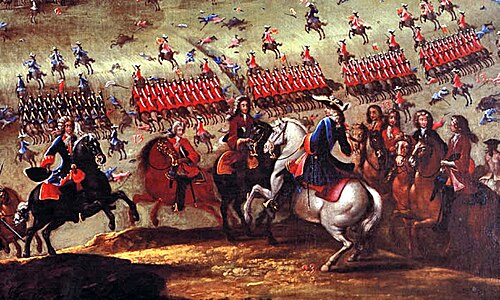

戦争が正式に宣言される前から、イタリアにおける帝国の侵略により敵対行為は始まっていました。スペイン継承戦争がようやく宣言されると、ルイ14世とフランスに多大な犠牲を強いながら、ルイ14世の死までほぼ続きました。
戦争はフランスの勝利で始まったが、マールバラ公ジョン・チャーチルとサヴォイア伯ウジェーヌの才能がこれらの勝利を抑え、フランス無敵の神話を打ち砕いた。この二人はブレナムの戦いで勝利した後、プファルツとオーストリアによるバイエルンの占領を許した。バイエルン選帝侯マクシミリアン2世エマヌエーレはスペイン領ネーデルラントに逃亡しなければならなかった。この勝利の影響でポルトガルとサヴォイアの支持を得た。その後、ラミリーズの戦いで低地諸国が連合国の手に渡り、トリノの戦いでルイ14世はイタリアからの撤退を余儀なくされ、イタリアは連合軍の攻撃にさらされることになった。マールバラ公とウジェーヌはオーデナルデの戦いで再会し、フランス侵攻が可能になった。
フランスはフランツ2世ラーコーツィと接触し、彼がハンガリー独立の大義を掲げるならば支援することを約束した。
敗北、飢餓、そして借金の増大により、フランスは大きく弱体化した。1693年から1710年の間に、200万人以上が2度の飢餓で亡くなり、食料調達軍が村から食糧を奪ったことで状況は悪化した。[97]絶望したルイは、1704年秋、豊作を奪う目的で、イングランド領ガーンジー島への悲惨な侵攻を命じた。1708年から1709年の冬までには、ルイはどんな犠牲を払ってでも和平を受け入れる用意があった。スペイン帝国全体をカール大公に明け渡すことに同意し、ウェストファリア条約の国境に戻り、60年以上かけて獲得した領土をすべて放棄することにも同意した。しかし、フィリップ 5世がこの条件を受け入れるとは約束できなかったため、連合国はルイが単独で孫を攻撃してこの条件を強制するよう要求した。1年以内にこれを達成できない場合は、戦争が再開されることになった。ルイはこの条件を受け入れなかった。[98]
転機
スペイン継承戦争の最終段階では、フランスがフェリペ5世のためにスペインの継承地をすべて保持できなかったのと同様に、連合国がスペインにカール大公を維持できなかったことが実証された。 1710年のビリャビシオサとブリウエガの戦いでフランスとスペインが勝利したことで、連合国はスペイン中部から完全に追い出された。フランス軍は他の地域では敗北にもかかわらず頑固な態度を貫いた。連合国はマルプラケの戦いで21,000人の死傷者を出し、フランスの2倍のピュロスの勝利を収めた。 [99]最終的に、フランスは1712年のドナンでの決定的な勝利で軍事的誇りを取り戻した。
戦争末期のフランス軍の勝利は、オーストリアの政情の変化を背景にして起こった。1705年、皇帝レオポルト 1世が死去。長男で後継者のヨーゼフ1世が1711年に即位した。後継者は他でもないカール大公で、彼は兄のオーストリア領地のすべてを掌握した。スペイン帝国がカール大公の手に落ちれば、16世紀の神聖ローマ皇帝カール5世の領土に匹敵する広大な領土が復活することになる。イギリスやネーデルラント共和国といった海洋国家にとって、これはフランスとスペインの連合と同じくらい望ましくないことだっただろう。[100]
和平の締結

ヨーロッパの勢力均衡に対するイギリスの新たな見解の結果、英仏会談が始まり、1713年にルイ14世、スペイン王フェリペ5世、イギリス女王アンヌ、ネーデルラント連邦共和国の間でユトレヒト条約が締結された。1714年、ランダウとフライブルクを失った後、神聖ローマ皇帝はラシュタット条約とバーデン条約でフランスとも和平を結んだ。
全体的な和議では、フェリペ 5世はスペインとその植民地を保持し、オーストリアはスペイン領ネーデルラントを獲得し、スペイン領イタリアをサヴォイアと分割した。イギリスはジブラルタルとメノルカ島 を保持した。ルイは、ジェームズ2世の息子でグレートブリテンおよびアイルランドの王位請求者であるジェームズ・ステュアートへの支援を撤回し、アメリカ大陸のニューファンドランド、ルパートランド、アカディアをアンに割譲することに同意した。この条約で最大の利益を得たのはイギリスだったが、最終条件は1709年と1710年の和平交渉で話し合われたものよりはるかにフランスに有利なものとなった。[要出典]フランスはサンジャン島とロワイヤル島を保持し、ルイはオランジュ公国やイタリアに通じるアルプス山脈の峠を覆うウバイエ渓谷など、いくつかの小さなヨーロッパの領土を獲得した。ルイのおかげで、同盟国であるバイエルン選帝侯とケルン選帝侯は戦前の状態に回復し、領土を返還された。[101]
私生活
結婚と子供

ルイ14世と妻マリア・テレジア・デ・スペインは、 1660年に結ばれた結婚で6人の子供をもうけた。しかし、成人まで生き残ったのは最年長のルイ14世、モンセニョールとして知られる大王太子だけだった。マリア・テレジアは1683年に亡くなり、ルイは、マリア・テレジアが他のいかなる機会にも不安を与えたことはなかったと述べた。
Despite evidence of affection early on in their marriage, Louis was never faithful to Maria Theresa. He took a series of mistresses, both official and unofficial. Among the better documented are Louise de La Vallière (with whom he had five children; 1661–1667), Bonne de Pons d'Heudicourt (1665), Catherine Charlotte de Gramont (1665), Françoise-Athénaïs, Marquise de Montespan (with whom he had seven children; 1667–1680), Anne de Rohan-Chabot (1669–1675), Claude de Vin des Œillets (one child born in 1676), Isabelle de Ludres (1675–1678), and Marie Angélique de Scorailles (1679–1681), who died at age 19 in childbirth. Through these liaisons, he produced numerous illegitimate children, most of whom he married to members of cadet branches of the royal family.
Louis proved relatively more faithful to his second wife, Françoise d'Aubigné, Marquise de Maintenon. He first met her through her work caring for his children by Madame de Montespan, noting the care she gave to his favourite, Louis Auguste, Duke of Maine.[102] The king was, at first, put off by her strict religious practice, but he warmed to her through her care for his children.[102]
When he legitimized his children by Madame de Montespan on 20 December 1673, Françoise d'Aubigné became the royal governess at Saint-Germain.[102] As governess, she was one of very few people permitted to speak to him as an equal, without limits.[102] It is believed that they were married secretly at Versailles on or around 10 October 1683[103] or January 1684.[104] This marriage, though never announced or publicly discussed, was an open secret and lasted until his death.[105]
Piety and religion

Louis was a pious and devout king who saw himself as the head and protector of the Catholic Church in France. He made his devotions daily regardless of where he was, following the liturgical calendar regularly.[106] Under the influence of his very religious second wife, he became much stronger in the practice of his Catholic faith.[107] This included banning opera and comedy performances during Lent.[107]
Towards the middle and the end of his reign, the centre for the King's religious observances was usually the Chapelle Royale at Versailles. Ostentation was a distinguishing feature of daily Mass, annual celebrations, such as those of Holy Week, and special ceremonies.[108] Louis established the Paris Foreign Missions Society, but his informal alliance with the Ottoman Empire was criticised for undermining Christendom.[109]
Patronage of the arts


Louis generously supported the royal court of France and those who worked under him. He brought the Académie Française under his patronage and became its "Protector". He allowed Classical French literature to flourish by protecting such writers as Molière, Racine, and La Fontaine, whose works remain influential to this day. Louis also patronised the visual arts by funding and commissioning artists such as Charles Le Brun, Pierre Mignard, Antoine Coysevox, and Hyacinthe Rigaud, whose works became famous throughout Europe. Composers and musicians such as Jean-Baptiste Lully, Jacques Champion de Chambonnières, and François Couperin thrived. In 1661, Louis founded the Académie Royale de Danse, and in 1669, the Académie d'Opéra, important driving events in the evolution of ballet. He also attracted, supported and patronized such artists as André Charles Boulle, who revolutionised marquetry with his art of inlay, today known as "Boulle work". Always on the lookout for new talent, the king launched music competitions: in 1683, Michel-Richard de Lalande thus became deputy master of the Royal Chapel, composing his Symphonies for the Soupers du Roy along with 77 large scale Grand Motets.
Over the course of four building campaigns, Louis converted a hunting lodge built by Louis XIII into the spectacular Palace of Versailles. Except for the current Royal Chapel (built near the end of his reign), the palace achieved much of its current appearance after the third building campaign, which was followed by an official move of the royal court to Versailles on 6 May 1682. Versailles became a dazzling, awe-inspiring setting for state affairs and the reception of foreign dignitaries. At Versailles, the king alone commanded attention.
Several reasons have been suggested for the creation of the extravagant and stately palace, as well as the relocation of the monarchy's seat. The memoirist Saint-Simon speculated that Louis viewed Versailles as an isolated power centre where treasonous cabals could be more readily discovered and foiled.[61] There has also been speculation that the revolt of the Fronde caused Louis to hate Paris, which he abandoned for a country retreat, but his sponsorship of many public works in Paris, such as the establishment of a police force and of street-lighting,[110] lend little credence to this theory. As a further example of his continued care for the capital, Louis constructed the Hôtel des Invalides, a military complex and home to this day for officers and soldiers rendered infirm either by injury or old age. While pharmacology was still quite rudimentary in his day, the Invalides pioneered new treatments and set new standards for hospice treatment. The conclusion of the Treaty of Aix-la-Chapelle in 1668 also induced Louis to demolish Paris's northern walls in 1670 and replace them with wide tree-lined boulevards.[111]
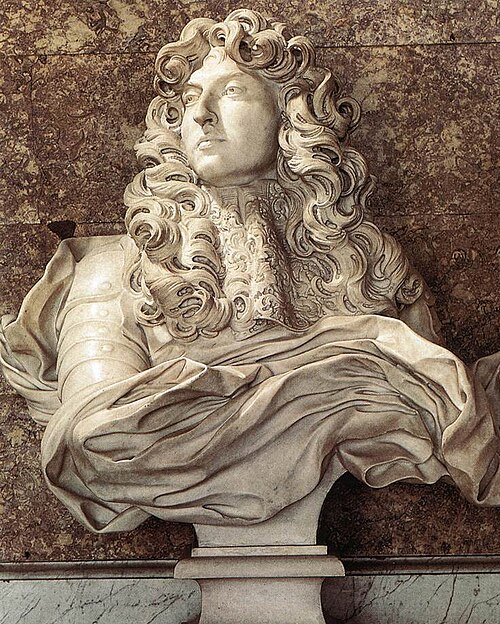
Louis also renovated and improved the Louvre and other royal residences. Gian Lorenzo Bernini was originally to plan additions to the Louvre; however, his plans would have meant the destruction of much of the existing structure, replacing it with an Italian summer villa in the centre of Paris. Bernini's plans were eventually shelved in favour of the elegant Louvre Colonnade designed by three Frenchmen: Louis Le Vau, Charles Le Brun, and Claude Perrault. With the relocation of the court to Versailles, the Louvre was given over to the arts and the public.[112] During his visit from Rome, Bernini also executed a renowned portrait bust of the king.
Image and depiction

Few rulers in world history have commemorated themselves in as grand a manner as Louis.[113] He cultivated his image as the Sun King (le Roi Soleil), the centre of the universe "without equal". Louis used court ritual and the arts to validate and augment his control over France. With his support, Colbert established from the beginning of Louis's personal reign a centralised and institutionalised system for creating and perpetuating the royal image. The King was thus portrayed largely in majesty or at war, notably against Spain. This portrayal of the monarch was to be found in numerous media of artistic expression, such as painting, sculpture, theatre, dance, music, and the almanacs that diffused royal propaganda to the population at large.
Evolution of royal portraiture

Over his lifetime, Louis commissioned numerous works of art to portray himself, among them over 300 formal portraits. The earliest portrayals of Louis already followed the pictorial conventions of the day in depicting the child king as the majestically royal incarnation of France. This idealisation of the monarch continued in later works, which avoided depictions of the effect of smallpox that Louis contracted in 1647. In the 1660s, Louis began to be shown as a Roman emperor, the god Apollo, or Alexander the Great, as can be seen in many works of Charles Le Brun, such as sculpture, paintings, and the decor of major monuments.
The depiction of the king in this manner focused on allegorical or mythological attributes, instead of attempting to produce a true likeness. As Louis aged, so too did the manner in which he was depicted. Nonetheless, there was still a disparity between realistic representation and the demands of royal propaganda. There is no better illustration of this than in Hyacinthe Rigaud's frequently-reproduced Portrait of Louis XIV of 1701, in which a 63-year-old Louis appears to stand on a set of unnaturally young legs.[114]
Rigaud's portrait exemplified the height of royal portraiture during Louis's reign. Although Rigaud crafted a credible likeness of Louis, the portrait was neither meant as an exercise in realism nor to explore Louis's character. Certainly, Rigaud was concerned with detail and depicted the king's costume with great precision, down to his shoe buckle.[115]
However, Rigaud intended to glorify the monarchy. Rigaud's original, now housed in the Louvre, was originally meant as a gift to Louis's grandson, Philip V of Spain. However, Louis was so pleased with the work that he kept the original and commissioned a copy to be sent to his grandson. That became the first of many copies, both in full and half-length formats, to be made by Rigaud, often with the help of his assistants. The portrait also became a model for French royal and imperial portraiture down to the time of Charles X over a century later. In his work, Rigaud proclaims Louis's exalted royal status through his elegant stance and haughty expression, the royal regalia and throne, rich ceremonial fleur-de-lys robes, as well as the upright column in the background, which, together with the draperies, serves to frame this image of majesty.
Other works of art
In addition to portraits, Louis commissioned at least 20 statues of himself in the 1680s, to stand in Paris and provincial towns as physical manifestations of his rule. He also commissioned "war artists" to follow him on campaigns to document his military triumphs. To remind the people of these triumphs, Louis erected permanent triumphal arches in Paris and the provinces for the first time since the decline of the Roman Empire.
Louis's reign marked the birth and infancy of the art of medallions. Sixteenth-century rulers had often issued medals in small numbers to commemorate the major events of their reigns. Louis, however, struck more than 300 to celebrate the story of the king in bronze, that were enshrined in thousands of households throughout France.
He also used tapestries as a medium of exalting the monarchy. Tapestries could be allegorical, depicting the elements or seasons, or realist, portraying royal residences or historical events. They were among the most significant means to spread royal propaganda prior to the construction of the Hall of Mirrors at Versailles.[116]
Ballet


Louis loved ballet and frequently danced in court ballets during the early half of his reign. In general, Louis was an eager dancer who performed 80 roles in 40 major ballets. This approaches the career of a professional ballet dancer.[117]
His choices were strategic and varied. He danced four parts in three of Molière's comédies-ballets, which are plays accompanied by music and dance. Louis played an Egyptian in Le Mariage forcé in 1664, a Moorish gentleman in Le Sicilien in 1667, and both Neptune and Apollo in Les Amants magnifiques in 1670.
He sometimes danced leading roles that were suitably royal or godlike (such as Neptune, Apollo, or the Sun).[117] At other times, he would adopt mundane roles before appearing at the end in the lead role. It is considered that, at all times, he provided his roles with sufficient majesty and drew the limelight with his flair for dancing.[117] For Louis, ballet may not have merely been a tool for manipulation in his propaganda machinery. The sheer number of performances he gave as well as the diversity of roles he played may serve to indicate a deeper understanding and interest in the art form.[117][118]
Ballet dancing was used by Louis as a political tool to hold power over his state. He integrated ballet deeply into court social functions and fixated his nobles' attention on upholding standards in ballet dancing, effectively distracting them from political activities.[119] In 1661, the Royal Academy of Dance was founded by Louis to further his ambition. Pierre Beauchamp, his private dance instructor, was ordered by Louis to come up with a notation system to record ballet performances, which he did with great success. His work was adopted and published by Feuillet in 1700 as Choregraphie. This major development in ballet played an important role in promoting French culture and ballet throughout Europe during Louis's time.[120]
Louis greatly emphasized etiquettes in ballet dancing, evidently seen in "La belle danse" (the French noble style). More challenging skills were required to perform this dance with movements very much resembling court behaviours, as a way to remind the nobles of the king's absolute power and their own status. All the details and rules were compressed in five positions of the bodies codified by Beauchamp.[121]
Unofficial image
Besides the official depiction and image of Louis, his subjects also followed a non-official discourse consisting mainly of clandestine publications, popular songs, and rumours that provided an alternative interpretation of Louis and his government. They often focused on the miseries arising from poor government, but also carried the hope for a better future when Louis escaped the malignant influence of his ministers and mistresses, and took the government into his own hands. On the other hand, petitions addressed either directly to Louis or to his ministers exploited the traditional imagery and language of monarchy. These varying interpretations of Louis abounded in self-contradictions that reflected the people's amalgamation of their everyday experiences with the idea of monarchy.[122]
In fiction
Literature
- Alexandre Dumas portrayed Louis in his two sequels to his 1844 novel The Three Musketeers: first as a child in Twenty Years After (1845), then as a young man in The Vicomte de Bragelonne (1847–1850), in which he is a central character. The final part of the latter novel recounts the legend that a mysterious prisoner in an iron mask was actually Louis's twin brother and has spawned numerous film adaptations generally titled The Man in the Iron Mask.
- In 1910, the American historical novelist Charles Major wrote "The Little King: A Story of the Childhood of King Louis XIV".
- Louis is a major character in the 1959 historical novel Angélique et le Roy ("Angélique and the King"), part of the Angélique series. The protagonist, a strong-willed lady at Versailles, rejects the King's advances and refuses to become his mistress. A later book, the 1961 Angélique se révolte ("Angélique in Revolt"), details the dire consequences of her defying this powerful monarch.
- A character based on Louis plays an important role in The Age of Unreason, a series of four alternate history novels written by American science fiction and fantasy author Gregory Keyes.
- Louis features significantly in Neal Stephenson's Baroque Cycle, specifically in the 2003 novel The Confusion, the greater part of which takes place at Versailles.
- In the 39 Clues series universe, it has been noted that Louis was part of the Cahill branch, Tomas.
- He is called the son of Apollo in Rick Riordan's Trials of Apollo series.
- Louis XIV is portrayed in Vonda N. McIntyre's 1997 novel The Moon and the Sun.
Films
- The film, The Taking of Power by Louis XIV (1966), directed by Roberto Rossellini, shows Louis's rise to power after the death of Cardinal Mazarin.
- The film Man in the Iron Mask (1998), directed by Randall Wallace, focused on the identity of an anonymous masked prisoner who spent decades in the Bastille and other French prisons, and his true identity remains somewhat a mystery till date. The monarch was played by Leonardo DiCaprio.
- The film, Le Roi Danse (2000; translated: The King Dances), directed by Gérard Corbiau, reveals Louis through the eyes of Jean-Baptiste Lully, his court musician.
- Julian Sands portrayed Louis in Roland Jaffe's Vatel (2000).
- Alan Rickman directed, co-wrote, and stars as Louis XIV in the film, A Little Chaos, which centres on construction in the gardens of Versaille, at the time immediately before and after the death of Queen Maria Theresa.
- The 2016 film The Death of Louis XIV, directed by Albert Serra, is set during the last two weeks of Louis XIV's life before dying of gangrene, with the monarch played by Jean-Pierre Léaud.
Television
- Louis XIV is portrayed by Thierry Perkins-Lyautey in the British television film Charles II: The Power and the Passion.
- The 15-year-old Louis XIV, as played by the Irish actor Robert Sheehan, is a major character of the short-lived historical fantasy series Young Blades from January to June 2005.
- George Blagden portrays Louis XIV in the Canal+ series Versailles which aired for three seasons from 2015.
Musicals
- Emmanuel Moire portrayed Louis XIV in the 2005-07 Kamel Ouali musical Le Roi Soleil.
Health and death

Despite the image of a healthy and virile king that Louis sought to project, evidence exists to suggest that his health was not very good. He had many ailments: for example, symptoms of diabetes, as confirmed in reports of suppurating periostitis in 1678, dental abscesses in 1696, along with recurring boils, fainting spells, gout, dizziness, hot flushes, and headaches.
From 1647 to 1711, the three chief physicians to the king (Antoine Vallot, Antoine d'Aquin, and Guy-Crescent Fagon) recorded all of his health problems in the Journal de Santé du Roi (Journal of the King's Health), a daily report of his health. On 18 November 1686, Louis underwent a painful operation for an anal fistula that was performed by the surgeon Charles Felix de Tassy, who prepared a specially shaped curved scalpel for the occasion. The wound took more than two months to heal.[123]

Louis died of gangrene at Versailles on 1 September 1715, four days before his 77th birthday, after 72 years on the throne. Enduring much pain in his last days, he finally "yielded up his soul without any effort, like a candle going out", while reciting the psalm Deus, in adjutorium me festina (O Lord, make haste to help me).[124] His body was laid to rest in Saint-Denis Basilica outside Paris. It remained there undisturbed for about 80 years until revolutionaries exhumed and destroyed all of the remains found in the Basilica.[125] In 1848, at Nuneham House, a piece of Louis's mummified heart, taken from his tomb and kept in a silver locket by Lord Harcourt, Archbishop of York, was shown to the Dean of Westminster, William Buckland, who ate it.[126]
Cardinal Armand Gaston Maximilien de Rohan gave Last Rites (confession, viaticum, and unction) to king Louis XIV.[127]
Succession
Louis outlived most of his immediate legitimate family. His last surviving legitimate son, Louis, Dauphin of France, died in 1711. Barely a year later, the Duke of Burgundy, the eldest of the Dauphin's three sons and then heir-apparent to Louis, followed his father. Burgundy's elder son, Louis, Duke of Brittany, joined them a few weeks later. Thus, on his deathbed, Louis's heir-apparent was his five-year-old great-grandson, Louis, Duke of Anjou, Burgundy's younger son.
Louis foresaw an underaged successor and sought to restrict the power of his nephew Philip II, Duke of Orléans, who, as his closest surviving legitimate relative in France, would probably become regent to the prospective Louis XV. Accordingly, the king created a regency council as Louis XIII had in anticipation of Louis XIV's own minority, with some power vested in his illegitimate son Louis-Auguste de Bourbon, Duke of Maine.[128] Orléans, however, had Louis's will annulled by the Parlement of Paris after his death and made himself sole regent. He stripped Maine and his brother, Louis-Alexandre, Count of Toulouse, of the rank of Prince of the Blood, which Louis had granted them, and significantly reduced Maine's power and privileges.[129]
Line of succession in 1715
Line of succession to the French throne upon the death of Louis XIV in 1715. Louis XIV's only surviving legitimate grandson, Philip V, was not included in the line of succession due to having renounced the French throne after the war of the Spanish Succession, which lasted for 13 years after the death of Charles II of Spain in 1700.[130]
 Louis XIII (1601–1643)
 Louis XIV (1638–1715)
- Louis, Grand Dauphin (1661–1711)
- Louis, Duke of Burgundy (1682–1712)
- Louis, Duke of Brittany (1707–1712)
- (1) Louis, Duke of Anjou (1710–1774)
- Philip V of Spain (1683–1746)
- Charles, Duke of Berry (1686–1714)
- Louis, Duke of Burgundy (1682–1712)
- Louis, Grand Dauphin (1661–1711)
- Philippe I, Duke of Orléans (1640–1701)
- (2) Philippe II, Duke of Orléans (1674–1723)
- (3) Louis, Duke of Chartres (1703–1752)
- (2) Philippe II, Duke of Orléans (1674–1723)
Further down the French line of succession in 1715 was the House of Condé, followed by the House of Conti (a cadet branch of the House of Condé). Both of these royal houses were descended in the male line from Henri II, Prince of Condé, a second cousin of French King Louis XIII (the father of Louis XIV) in the male line.
Legacy
Reputation
According to Philippe de Courcillon's Journal, Louis on his deathbed advised his heir with these words:
Do not follow the bad example which I have set you; I have often undertaken war too lightly and have sustained it for vanity. Do not imitate me, but be a peaceful prince, and may you apply yourself principally to the alleviation of the burdens of your subjects.[131]

Some historians point out that it was a customary demonstration of piety in those days to exaggerate one's sins. Thus they do not place much emphasis on Louis's deathbed declarations in assessing his accomplishments. Rather, they focus on military and diplomatic successes, such as how he placed a French prince on the Spanish throne. This, they contend, ended the threat of an aggressive Spain that historically interfered in domestic French politics. These historians also emphasise the effect of Louis's wars in expanding France's boundaries and creating more defensible frontiers that preserved France from invasion until the Revolution.[131]
Arguably, Louis also applied himself indirectly to "the alleviation of the burdens of [his] subjects." For example, he patronised the arts, encouraged industry, fostered trade and commerce, and sponsored the founding of an overseas empire. Moreover, the significant reduction in civil wars and aristocratic rebellions during his reign are seen by these historians as the result of Louis's consolidation of royal authority over feudal elites. In their analysis, his early reforms centralised France and marked the birth of the modern French state. They regard the political and military victories as well as numerous cultural achievements as how Louis helped raise France to a preeminent position in Europe.[132] Europe came to admire France for its military and cultural successes, power, and sophistication. Europeans generally began to emulate French manners, values, goods, and deportment. French became the universal language of the European elite.
Louis's detractors have argued that his considerable foreign, military and domestic expenditure impoverished and bankrupted France. His supporters, however, distinguish the state, which was impoverished, from France, which was not. As supporting evidence, they cite the literature of the time, such as the social commentary in Montesquieu's Persian Letters.[133]
Alternatively, Louis's critics attribute the social upheaval culminating in the French Revolution to his failure to reform French institutions while the monarchy was still secure. Other scholars counter that there was little reason to reform institutions that largely worked well under Louis. They also maintain that events occurring almost 80 years after his death were not reasonably foreseeable to Louis and that in any case, his successors had sufficient time to initiate reforms of their own.[134]

Louis has often been criticised for his vanity. The memoirist Saint-Simon, who claimed that Louis slighted him, criticised him thus:
There was nothing he liked so much as flattery, or, to put it more plainly, adulation; the coarser and clumsier it was, the more he relished it.
For his part, Voltaire saw Louis's vanity as the cause for his bellicosity:
It is certain that he passionately wanted glory, rather than the conquests themselves. In the acquisition of Alsace and half of Flanders, and of all of Franche-Comté, what he really liked was the name he made for himself.[135]
Nonetheless, Louis has also received praise. The anti-Bourbon Napoleon described him not only as "a great king", but also as "the only King of France worthy of the name".[136] Leibniz, the German Protestant philosopher, commended him as "one of the greatest kings that ever was".[137] And Lord Acton admired him as "by far the ablest man who was born in modern times on the steps of a throne".[138] The historian and philosopher Voltaire wrote: "His name can never be pronounced without respect and without summoning the image of an eternally memorable age".[139] Voltaire's history, The Age of Louis XIV, named Louis's reign as not only one of the four great ages in which reason and culture flourished, but the greatest ever.[140][141]
Quotes
Numerous quotes have been attributed to Louis XIV by legend.
The well-known "I am the state" ("L'État, c'est moi.") was reported from at least the late 18th century.[142] It was widely repeated but also denounced as apocryphal by the early 19th century.[143][b][144]
He did say, "Every time I appoint someone to a vacant position, I make a hundred unhappy and one ungrateful."[145][146] Louis is recorded by numerous eyewitnesses as having said on his deathbed: "Je m'en vais, mais l'État demeurera toujours." ("I depart, but the State shall always remain.")[147]
Arms
Order of Saint Louis
On 5 April 1693, Louis also founded the Royal and Military Order of Saint Louis (French: Ordre Royal et Militaire de Saint-Louis), a military order of chivalry.[149][150] He named it after Louis IX and intended it as a reward for outstanding officers. It is notable as the first decoration that could be granted to non-nobles and is roughly the forerunner of the Légion d'honneur, with which it shares the red ribbon (though the Légion d'honneur is awarded to military personnel and civilians alike).
Family
Ancestry
Patrilineal descent
Issue
This is an incomplete list of Louis XIV's illegitimate children. He reputedly had more, but the difficulty in fully documenting all such births restricts the list only to the better-known and/or legitimised.
See also


.svg/500px-Europe_(orthographic_projection).svg.png)
- Charles de Lorme, personal medical doctor to Louis XIV
- Fundamental laws of the Kingdom of France
- House of France
- Levée (ceremony)
- List of French monarchs
- Outline of France
- Louis XIV style
- Nicolas Fouquet
- French forestry Ordinance of 1669
- Potager du Roi
- Éléphante de Louis XIV
Notes
- ^ Some monarchs of states that were not fully sovereign for most or all of their reign ruled for longer. For example, Sobhuza II of Swaziland at 82 years and Lord Bernard VII of Lippe in the Holy Roman Empire at 81 years.[2]
- ^ The anecdote as circulated after the French Revolution, designed to illustrate the tyrannical character of the absolutism of the Ancien Régime, held that the president of the parlement began to address the king with the words Sire, l'État [...] but was cut off by the king interjecting L'État, c'est moi.
References
- ^ "Louis XIV". MSN Encarta. 2008. Archived from the original on 28 October 2009. Retrieved 20 January 2008.
- ^ Buchanan, Rose Troup (29 August 2015). "Longest serving rulers ever". The Independent. Archived from the original on 14 February 2020. Retrieved 4 July 2017.
- ^ Spielvogel 2016, p. 419.
- ^ a b c "Louis XIV". Catholic Encyclopedia. 2007. Archived from the original on 16 December 2021. Retrieved 19 January 2008.
- ^ a b Nathan 1993, p. 633.
- ^ Brémond, Henri (1908). La Provence mystique au XVIIe siècle (in French). Paris, France: Plon-Nourrit. pp. 381–382.
- ^ Bluche 1990, p. 11.
- ^ Barentine 2016, p. 129.
- ^ Panhuysen 2016, p. 26.
- ^ Fraser 2006, pp. 14–16.
- ^ Petitfils 2002, pp. 30–40
- ^ Reinhardt 2016, p. 20.
- ^ Kleinman 1985, p. 145.
- ^ Bély 2001, p. 57.
- ^ Sonnino 1998, pp. 217–218.
- ^ Petitfils 2002, pp. 34–37
- ^ Petitfils 2002, pp. 29–36
- ^ Beem 2018, p. 83.
- ^ Barentine 2016, p. 131.
- ^ Dvornik 1962, p. 456.
- ^ Kleinman 1985, p. [page needed].
- ^ Petitfils 2002, pp. 70–75
- ^ Petitfils 2002, pp. 80–85
- ^ Blanning 2008, p. 306.
- ^ Petitfils 2002, pp. 84–87.
- ^ Petitfils 2002, pp. 88–90, 91–98.
- ^ a b Hatton 1972, p. 22.
- ^ Hatton 1972, p. 31.
- ^ Hatton 1972, p. 18.
- ^ Petitfils 2002, pp. 148–150.
- ^ Bluche 1990, pp. 128–129.
- ^ "Louis XIV - the Sun King: Absolutism". louis-xiv.de. Archived from the original on 28 October 2013. Retrieved 6 December 2013.
- ^ Dunlop 2000, p. xii.
- ^ Petitfils 2002, pp. 250–253, 254–260.
- ^ Merryman 2007, p. [page needed].
- ^ Antoine 1989, p. 33.
- ^ Petitfils 2002, pp. 223–225
- ^ a b Wolf 1968, p. 117.
- ^ Dunlop 2000, p. 54.
- ^ Israel 1990, pp. 197–199.
- ^ Hutton 1986, pp. 299–300.
- ^ Lynn 1999, pp. 109–110.
- ^ McKay 1997, p. 206.
- ^ Young 2004, p. 133.
- ^ Black 2011, pp. 97–99.
- ^ Panhuysen 2009, pp. 396–398.
- ^ Frost 2000, p. 213.
- ^ Panhuysen 2009, pp. 451.
- ^ Lynn 1999, pp. 161–171.
- ^ Merriman 2019, p. 319.
- ^ Bailey 2018, p. 14.
- ^ Faroqhi, Suraiya (2006). The Ottoman Empire and the World Around It. Bloomsbury Academic. p. 73. ISBN 978-1-8451-1122-9.
- ^ Bluche 1986, p. 439.
- ^ Keay 1994, pp. 201–204.
- ^ Pagani 2001, p. 182.
- ^ Sullivan, Michael (1989). The Meeting of Eastern and Western Art. University of California Press. p. 98. ISBN 978-0-5202-1236-7.
- ^ Barnes 2005, p. 85.
- ^ Mungello 2005, p. 125.
- ^ Philip Mansel, King of the World: The Life of Louis XIV (2020) cited in Tim Blanning, "Solar Power," The Wall Street Journal, 17 October 2020, p. C9.
- ^ a b Saint-Simon, Louis de Rouvroy, duc de (1876). The Memoirs of the Duke de Saint-Simon on the Reign of Louis XIV. and the Regency. Vol. 2. Translated by St. John, Bayle. London: Chatto and Windus. pp. 363, 365. Archived from the original on 13 July 2023. Retrieved 22 March 2023.
{{cite book}}: CS1 maint: multiple names: authors list (link) - ^ a b Halsall, Paul (August 1997). "Modern History Sourcebook: Duc de Saint-Simon: The Court of Louis XIV". Internet Modern History Sourcebook. History Department of Fordham University. Archived from the original on 10 April 2008. Retrieved 19 January 2008.
- ^ Daubenton, Louis-Jean-Marie (2009) [1755]. "Elephant". Encyclopedia of Diderot & d'Alembert Collaborative Translation Project. Translated by Eden, Malcolm. Michigan Publishing, University of Michigan Library. Retrieved 1 April 2015.
- ^ Lynn 1999, p. 46.
- ^ Quoted in Symcox 1974, pp. 236–237
- ^ Quoted in Symcox 1974, pp. 237, 242
- ^ Sturdy 1998, pp. 89–99.
- ^ Sturdy 1998, pp. 92–93.
- ^ Sturdy 1998, p. 96, citing Pillorget, Suzanne; Pillorget, René (1996). France Baroque, France Classique (in French). Vol. I. Bouquins. p. 935. ISBN 978-2-2210-4868-9.
- ^ Nolan 2008, p. 132.
- ^ Sturdy 1998, pp. 96–97.
- ^ Bluche 1986, pp. 20–21.
- ^ "Louis XIV, king of France". The Columbia Encyclopedia (6th ed.). 2007. Archived from the original on 7 January 2008. Retrieved 19 January 2008.
- ^ Sturdy 1998, p. 98, citing Scoville, Warren C. (1960). The Persecution of Huguenots and French Economic Development, 1680–1720. University of California Press. OCLC 707588406.
- ^ Edwards 2007, pp. 212–213.
- ^ Durant & Durant 1963, p. 691.
- ^ Lynn 1999, p. 192.
- ^ Dunlop 2000, p. 313.
- ^ Lynn 1999, pp. 189–191.
- ^ Lynn 1999, pp. 192–193.
- ^ Lynn 1999, p. [page needed].
- ^ Wijn 1950, pp. 28, 58, 71–72.
- ^ Lynn 1999, pp. 209, 227, 235.
- ^ Lynn 1999, p. 209.
- ^ Quoted in Terlinden, Ch. (1958). "Les rapports de l'internonce Piazza sur le bombardement de Bruxelles en 1695". Cahiers bruxellois (in French). III (II): 85–106.
aussi barbare qu'inutile
- ^ Lynn 1999, p. 232.
- ^ Lynn 1999, p. 253.
- ^ Bluche 1986, p. 653.
- ^ Lossky 1994, p. 255.
- ^ Lynn 1999, p. 267.
- ^ a b Dunlop 2000, p. 353.
- ^ a b Lynn 1999, p. 268.
- ^ Kamen 2001, p. 6.
- ^ Dunlop 2000, p. 358.
- ^ Lynn 1999, p. 269, see footnote 1.
- ^ Lynn 1999, pp. 269–270.
- ^ Merryman 2007, p. 321.
- ^ Ó Gráda & Chevet 2002, pp. 706–733.
- ^ Lynn 1999, p. 326.
- ^ Lynn 1999, p. 334.
- ^ Lynn 1999, p. 342.
- ^ Lynn 1999, pp. 356–360.
- ^ a b c d Bryant 2004, p. 80.
- ^ Buckley 2008, p. 276.
- ^ Bryant 2004, p. 77.
- ^ Velde, François (11 November 2003). "Morganatic and Secret Marriages in the French Royal Family". Heraldica.org. Archived from the original on 30 December 2012. Retrieved 10 July 2008.[self-published source][better source needed] The description of the marriage as morganatic is inaccurate as French law does not define such marriages.
- ^ Wolf 1968, p. 280.
- ^ a b Bryant 2004, p. 83.
- ^ Gaudelus 2000, pp. 513–526.
- ^ Claydon 2007, p. 182.
- ^ Dunlop 2000, pp. 242–251.
- ^ Dunlop 2000, p. 247.
- ^ Bluche 1986, p. 497.
- ^ Burke 1992.
- ^ Perez 2003, pp. 62–95.
- ^ See also Schmitter, Amy M. (2002). "Representation and the Body of Power in French Academic Painting". Journal of the History of Ideas. 63 (3): 399–424. doi:10.1353/jhi.2002.0027. ISSN 0022-5037. JSTOR 3654315. S2CID 170904125.
- ^ Sabatier 2000, p. 527–560.
- ^ a b c d Prest 2001, pp. 283–298.
- ^ See also Louis' commissioned academy of dance, discussed in Needham, Maureen (1997). "Louis XIV and the Académie Royale de Danse, 1661: A Commentary and Translation". Dance Chronicle. 20/2 (2): 173–190. doi:10.1080/01472529708569278. ISSN 0147-2526. JSTOR 1568065.
- ^ Homans 2010, p. 52.
- ^ Homans 2010, pp. 64–66.
- ^ Homans 2010, pp. 66–72.
- ^ Jens Ivo 2003, pp. 96–126.
- ^ Régnier 2009, p. 318.
- ^ Dunlop 2000, p. 468.
- ^ Schama 1990, p. 829.
- ^ "William Buckland". Westminster Abbey. Archived from the original on 24 July 2017. Retrieved 17 January 2016.
- ^ Marquis de Dangeau 1858.
- ^ Dunlop 2000, pp. 454–455.
- ^ Antoine 1989, pp. 33–37.
- ^ Holsti 1991, p. 74.
- ^ a b Bluche 1986, p. 890.
- ^ Dunlop 2000, p. 433, citing Montesquieu: "Louis established the greatness of France by building Versailles and Marly."
- ^ Bluche 1986, p. 876.
- ^ Bluche 1986, pp. 506, 877–878.
- ^ Sommerville, J. P. "The wars of Louis XIV". History 351 – Seventeenth-Century Europe. Archived from the original on 3 June 2012. Retrieved 4 May 2012.
- ^ Napoleon Bonaparte, Napoleon's Notes on English History made on the Eve of the French Revolution, illustrated from Contemporary Historians and referenced from the findings of Later Research by Henry Foljambe Hall. New York: E. P. Dutton & Co., 1905, 258.
- ^ Bluche 1986, p. 926.
- ^ Durant & Durant 1963, p. 721.
- ^ Rogers Neill Sehnaoui 2013, p. 4.
- ^ Montoya 2013, p. 47.
- ^ Delon 2013, p. 1227.
- ^ Erhard, C. D. (1791). Betrachtungen über Leopolds des Weisen Gesetzgebung in Toscana [Reflections on Leopold's Wise Legislation in Toscana] (in German). Richter. p. 30.
- ^ Marignié, Jean Etienne François (1818). Le roi ne peut jamais avoir tort, le roi ne peut mal faire [The king was not wrong, the king can do no wrong] (in French). Le Normant. p. 12.
- ^ "Staatswissenschaften". Jenaische Allgemeine Literatur-Zeitung (in German). 14.1 (31): 241. February 1817.
- ^ Blanning 2008, p. 286.
- ^ Wilson 2000, p. 54.
- ^ Marquis de Dangeau 1858, p. 24.
- ^ Velde, François (22 April 2010). "Arms of France". heraldica.org. Archived from the original on 14 April 2014. Retrieved 11 May 2014.[self-published source]
- ^ * Hamilton, Walter (1895). Dated Book-plates (Ex Libris) with a Treatise on Their Origin. A.C. Black. p. 37. Archived from the original on 13 July 2023. Retrieved 22 March 2023.
- ^ Edmunds 2002, p. 274.
- ^ a b Anselme de Sainte-Marie 1726, pp. 145–146.
- ^ a b Wurzbach, Constantin von, ed. (1860). . Biographisches Lexikon des Kaiserthums Oesterreich [Biographical Encyclopedia of the Austrian Empire] (in German). Vol. 6. p. 152 – via Wikisource.
- ^ a b Anselme de Sainte-Marie 1726, pp. 143–144.
- ^ a b Marie de Médicis at the Encyclopædia Britannica
- ^ a b Wurzbach, Constantin von, ed. (1861). . Biographisches Lexikon des Kaiserthums Oesterreich [Biographical Encyclopedia of the Austrian Empire] (in German). Vol. 7. p. 120 – via Wikisource.
- ^ a b Wurzbach, Constantin von, ed. (1861). . Biographisches Lexikon des Kaiserthums Oesterreich [Biographical Encyclopedia of the Austrian Empire] (in German). Vol. 7. p. 13 – via Wikisource.
- ^ Marek, Miroslav. "Capet 40". euweb.cz. Archived from the original on 14 October 2013. Retrieved 13 February 2009.[self-published source]
- ^ Bluche 2005, p. [page needed].
- ^ Petitfils 2011, p. [page needed].
- ^ "Suzanne de Mésenge". roglo.eu. Archived from the original on 11 April 2016. Retrieved 14 September 2009.[unreliable source]
Works cited
- Anselme de Sainte-Marie, Père (1726). Histoire généalogique et chronologique de la maison royale de France [Genealogical and chronological history of the royal house of France] (in French). Vol. 1 (3rd ed.). Paris: La compagnie des libraires. Archived from the original on 31 March 2022. Retrieved 30 August 2018.
- Antoine, Michel (1989). Louis XV (in French). Paris: Fayard. ISBN 978-2-2130-2277-2.
- Bailey, Gauvin Alexander (2018). Architecture and Urbanism in the French Atlantic Empire: State, Church and Society, 1604–1830. Kingston, Ontario: McGill-Queen's University Press. ISBN 978-0-7735-5376-7.
- Barentine, John C. (2016). Uncharted Constellations: Asterisms, Single-Source and Rebrands. Springer Publishing. ISBN 978-3-3192-7619-9.
- Barnes, Linda L. (2005). Needles, Herbs, Gods, and Ghosts: China, Healing, and the West to 1848. Harvard University Press. ISBN 978-0-6740-1872-3.
- Beem, Charles (2018). Queenship in Early Modern Europe. Red Globe Press. ISBN 978-1-1370-0506-9. Archived from the original on 24 November 2023. Retrieved 30 October 2023.
- Bély, Lucien (2001). The History of France. Paris: Editions Jean-Paul Gisserot. ISBN 978-2-8774-7563-1.
- Black, Jeremy (2011). Beyond the Military Revolution: War in the Seventeenth Century World. Palgrave Macmillan. ISBN 978-0-2302-5156-4.
- Blanning, Tim (2008). The Pursuit of Glory: The Five Revolutions That Made Modern Europe. Penguin Books. ISBN 978-0-1431-1389-8.
- Bluche, François (1986). Louis XIV (in French). Paris: Hachette Littératures. ISBN 978-2-0101-3174-5.
- Bluche, François (1990). Louis XIV. Translated by Greengrass, Mark. New York: Franklin Watts. p. 11. ISBN 978-0-5311-5112-9.
- Bluche, François (2005). Dictionnaire du Grand Siècle 1589–1715 (in French). Fayard. ISBN 978-2-2136-2144-9.
- Bryant, Mark (2004). "Partner, Matriarch, and Minister: Mme de Maintenon of France, Clandestine Consort, 1680–1715". In Campbell Orr, Clarissa (ed.). Queenship in Europe 1660–1815: The Role of the Consort. Cambridge University Press. pp. 77–106. ISBN 978-0-5218-1422-5.
- Buckley, Veronica (2008). Madame de Maintenon: The Secret Wife of Louis XIV. London: Bloomsbury. ISBN 978-0-7475-8098-0.
- Burke, Peter (1992). "The Fabrication of Louis XIV". History Today. 42 (2).
- Claydon, Tony (2007). Europe and the Making of England, 1660–1760. Cambridge University Press. ISBN 978-0-5218-5004-9.
- Delon, Michel (2013). Encyclopedia of the Enlightenment. Routledge. ISBN 978-1-1359-5998-2.
- Dunlop, Ian (2000). Louis XIV. London: Pimlico. ISBN 978-0-7126-6709-8.
- Durant, Will; Durant, Ariel (1963). The Story of Civilization. Vol. 8: The Age of Louis XIV. Boston: Simon & Schuster.
- Dvornik, Francis (1962). The Slavs in European History and Civilization. Rutgers University Press. ISBN 978-0-8135-0799-6. Archived from the original on 17 October 2023. Retrieved 21 August 2021.
- Edmunds, Martha (2002). Piety and Politics. University of Delaware Press. ISBN 0-8741-3693-8.
- Edwards (2007). "Edict of Versailles (1787)". In Fremont-Barnes, Gregory (ed.). Encyclopedia of the Age of Political Revolutions and New Ideologies, 1760–1815. Greenwood Publishing. ISBN 978-0-3130-4951-4.
- Fraser, Antonia (2006). Love and Louis XIV: The Women in the Life of the Sun King. New York: Random House, Inc. ISBN 978-1-4000-3374-4.
- Frost, Robert (2000). The Northern Wars; State and Society in Northeastern Europe 1558–1721. Routledge. ISBN 978-0-5820-6429-4.
- Gaudelus, Sébastien (2000). "La Mise en Spectacle De La Religion Royale: Recherches sur la Devotion de Louis XIV". Histoire, Économie et Société (in French). 19 (4): 513–526. doi:10.3406/hes.2000.2133. Archived from the original on 22 May 2020. Retrieved 9 October 2020.
- Hatton, Ragnhild Marie (1972). Louis XIV and His World. New York: Putnam.
- Holsti, Kalevi J. (1991). Peace and War: Armed Conflicts and International Order, 1648–1989. Cambridge Studies in International Relations. Cambridge University Press. ISBN 978-0-5213-9929-6.
- Homans, Jennifer (2010). Apollo's Angels: A History of Ballet (1st ed.). New York: Random House. ISBN 978-1-4000-6060-3. OCLC 515405940.
- Hutton, R (1986). "The Making of the Secret Treaty of Dover, 1668–1670". The Historical Journal. 29 (2): 297–318. doi:10.1017/S0018246X00018756. JSTOR 2639064. S2CID 159787254.
- Israel, Jonathan (1990) [1989]. Dutch Primacy in World Trade, 1585–1740. Oxford University Press. ISBN 978-0-1982-1139-6.
- Jens Ivo, Engels (July–September 2003). "Dénigrer, espérer, assumer la réalité. Le roi de France perçu par ses sujets, 1680–1750" [Disparaging, Hoping, Taking on Reality: the French King as Perceived by His Subjects, 1680–1750]. Revue d'Histoire Moderne et Contemporaine (in French). 50 (3): 96–126. JSTOR 20530985.
- Kamen, Henry (2001). Philip V of Spain: The King Who Reigned Twice. Yale University Press. ISBN 0-3000-8718-7.
- Keay, John (1994). The Honourable Company: A History of the English East India Company. London: Macmillan.
- Kleinman, Ruth (1985). Anne of Austria: Queen of France. Ohio State University Press. ISBN 978-0-8142-0429-0.
- Lossky, Andrew (1994). Louis XIV and the French Monarchy. New Brunswick, NJ: Rutgers University Press. ISBN 978-0-8135-2081-0.
- Lynn, John (1999). The Wars of Louis XIV, 1667–1714 (Modern Wars in Perspective). Longman. ISBN 978-0-5820-5629-9.
- Marquis de Dangeau, Philippe de Courcillon (1858). Mémoire sur la mort de Louis XIV [Recollections of the Death of Louis XIV] (in French). Didot frères, fils. Retrieved 29 November 2009.
- McKay, Derek (1997). Oresko, Robert; Gibbs, G.C. (eds.). Small Power Diplomacy in the Age of Louis XIV. In Royal and Republican Sovereignty: Essays in Memory of Ragnhild Hatton. Cambridge University Press. ISBN 978-0-5214-1910-9.
- Mansel, Philip. King of the World: The Life of Louis XIV (University of Chicago Press, 2020) scholarly biography; online review Archived 20 October 2020 at the Wayback Machine
- Merriman, John (2019) [1996]. A History of Modern Europe (4th ed.). W.W. Norton & Co. ISBN 978-0-3939-6888-0.
- Merryman, John Henry (2007). The Civil Law Tradition: An Introduction to the Legal Systems of Europe and Latin America (3rd ed.). Stanford University Press. ISBN 978-0-8047-5568-9.
- Montoya, Alicia (2013). Medievalist Enlightenment: From Charles Perrault to Jean-Jacques Rousseau. DS Brewer. ISBN 978-1-8438-4342-9.
- Mungello, David E. (2005). The Great Encounter of China and the West, 1500–1800. Rowman & Littlefield. ISBN 978-0-7425-3815-3.
- Nathan, James (Autumn 1993). "Force, Order, and Diplomacy in the Age of Louis XIV". Virginia Quarterly Review. 69 (4). Charlottesville: University of Virginia. Archived from the original on 11 December 2019. Retrieved 11 September 2019.
- Nolan, Cathal J. (2008). Wars of the Age of Louis XIV, 1650–1715: An Encyclopedia of Global Warfare and Civilization. Greenwood Press. ISBN 978-0-3133-3046-9.
- Norton, Lucy (1982). The Sun King and His Loves. The Folio Society.
- Ó Gráda, Cormac; Chevet, Jean-Michel (2002). "Famine And Market In Ancient Régime France" (PDF). The Journal of Economic History. 62 (3): 706–733. doi:10.1017/S0022050702001055 (inactive 25 September 2024). hdl:10197/368. PMID 17494233. S2CID 8036361. Archived (PDF) from the original on 23 July 2018. Retrieved 20 April 2018.
{{cite journal}}: CS1 maint: DOI inactive as of September 2024 (link) - Pagani, Catherine (2001). Eastern Magnificence and European Ingenuity: Clocks of Late Imperial China. University of Michigan Press. ISBN 978-0-4721-1208-1.
- Panhuysen, Luc (2009). Rampjaar 1672: Hoe de Republiek aan de ondergang ontsnapte (in Dutch). Uitgeverij Atlas. ISBN 978-9-0450-1328-2.
- Panhuysen, Luc (2016). Oranje tegen de Zonnekoning: De strijd van Willem III en Lodewijk XIV om Europa (in Dutch). Atlas Contact. ISBN 978-9-0450-2329-8.
- Perez, Stanis (July–September 2003). "Les rides d'Apollon: l'évolution des portraits de Louis XIV" [Apollo's Wrinkles: The Evolution of Portraits of Louis XIV]. Revue d'Histoire Moderne et Contemporaine. 50 (3): 62–95. doi:10.3917/rhmc.503.0062. ISSN 0048-8003. JSTOR 20530984.
- Petitfils, Jean-Christian (2002). Louis XIV (in French). Paris: Perrin. OCLC 423881843.
- Petitfils, Jean-Christian (2011). Louise de La Vallière (in French). Tempus Perrin. ISBN 978-2-2620-3649-2.
- Prest, Julia (2001). "Dancing King: Louis XIV's Roles in Molière's Comedies-ballets, from Court to Town". Seventeenth Century. 16 (2): 283–298. doi:10.1080/0268117X.2001.10555494. ISSN 0268-117X. S2CID 164147509.
- Régnier, Christian (2009). "Famous French diabetics". Medicographia. 31 (3). ISSN 0243-3397.[permanent dead link]
- Reinhardt, Nicole (2016). Voices of Conscience: Royal Confessors and Political Counsel in Seventeenth-Century Spain and France. Oxford University Press. ISBN 978-0-1910-0870-2.
- Rogers Neill Sehnaoui, Caroline (Cally) (2013). Victorious Charles: A Ladies' Man: A Biography of King Charles VII of France (1403–1461). Strategic Book Publishing. ISBN 978-1-6251-6049-2.
- Roosen, William J. The Age of Louis XIV: The Rise of Modern Diplomacy (1976) online.
- Sabatier, Gérard (2000). "La Gloire du Roi: Iconographie de Louis XIV de 1661 a 1672". Histoire, Économie et Société (in French). 19 (4): 527–560. doi:10.3406/hes.2000.2134. Archived from the original on 22 May 2020. Retrieved 9 October 2020.
- Schama, Simon (1990). Citizens: A Chronicle of the French Revolution (Reprint ed.). Vintage. ISBN 978-0-6797-2610-4.
- Symcox, Geoffrey, ed. (1974). War, Diplomacy, and Imperialism, 1618–1763. Walker & Co. ISBN 978-0-8027-2056-6.
- Sonnino, Paul (1998). "Prelude to the Fronde: The French Delegation at the Peace of Westphalia". In Duchhardt, Heinz (ed.). Der Westfälische Friede: Diplomatie–Politische Zäsur–Kulturelles Umfeld–Rezeptionsgeschichte. München: Oldenberg Verlag GmbH. ISBN 978-3-4865-6328-3.
- Spielvogel, Jackson J. (2016). Western Civilization: A Brief History, Volume I: To 1715. Cengage Learning. ISBN 978-1-3058-8842-5.
- Sturdy, David J. (1998). Louis XIV. St Martin's Press. ISBN 978-0-3122-1427-2.
- Wilson, Peter H. (2000). Absolutism in Central Europe. Routledge. ISBN 978-0-4152-3351-4.
- Wolf, John B. (1968). Louis XIV. W.W. Norton & Co., Inc.: a standard scholarly biography;
- Young, William (2004). International Politics and Warfare in the Age of Louis XIV and Peter the Great. iUniverse. ISBN 978-0-5953-2992-2.
- Wijn, J.W. (1950). Het Staatsche Leger: Deel VII (The Dutch States Army: Part VII) (in Dutch). Martinus Nijhoff.
Further reading
- Cambridge Modern History: Vol. 5 The Age of Louis XIV (1908), old, solid articles by scholars; complete text online Archived 10 February 2014 at the Wayback Machine
- Lynn, John A. "Food, funds, and fortresses: resource mobilization and positional warfare in the campaigns of Louis XIV." in Feeding Mars: Logistics in Western Warfare from the Middle Ages to the Present (Taylor and Francis, 2019) pp. 150–172.
- Ashley, Maurice P. Louis XIV and the Greatness of France (1965) ISBN 0029010802
- Beik, William. Louis XIV and Absolutism: A Brief Study with Documents (2000) ISBN 031213309X
- Beik, William. "The Absolutism of Louis XIV as Social Collaboration." Past & Present 2005 (188): 195–224. online Archived 22 April 2024 at the Wayback Machine at Project MUSE
- Campbell, Peter Robert. Louis XIV, 1661–1715 (London, 1993)
- Church, William F., ed. The Greatness of Louis XIV. (1972).
- Cowart, Georgia J. The Triumph of Pleasure: Louis XIV and the Politics of Spectacle University of Chicago Press, 2008. ISBN 978-0-2261-1638-9
- Cronin, Vincent. Louis XIV. London: HarperCollins, 1996. ISBN 978-1-8604-6092-0
- Félix, Joël. "'The most difficult financial matter that has ever presented itself': paper money and the financing of warfare under Louis XIV." Financial History Review 25.1 (2018): 43–70 online Archived 26 February 2021 at the Wayback Machine.
- Goubert, Pierre (197). Louis XIV and Twenty Million Frenchmen. social history from Annales School. ISBN 978-0-3947-1751-7.
- Jones, Colin. The Great Nation: France from Louis XIV to Napoleon (1715–1799) (2002)
- Klaits, Joseph. Printed propaganda under Louis XIV: absolute monarchy and public opinion (Princeton University Press, 2015).
- Le Roy Ladurie, Emmanuel. The Ancien Régime: A History of France 1610–1774 (1999), survey by leader of the Annales School ISBN 0631211969
- Lewis, W. H. The Splendid Century: Life in the France of Louis XIV (1953) ISBN 0881339210
- Mitford, Nancy (1966). The Sun King: Louis XIV at Versailles (2012 ed.). New York Review of Books. ISBN 978-1-5901-7491-3.
- Prest, Julia, and Guy Rowlands, eds. The Third Reign of Louis XIV, c. 1682–1715 (Taylor & Francis, 2016).
- Rothkrug, Lionel. Opposition to Louis XIV: The Political and Social Origins of French Enlightenment (Princeton University Press, 2015).
- Rowlands, Guy. The Dynastic State and the Army under Louis XIV: Royal Service and Private Interest, 1661–1701 (2002)
- Rubin, David Lee, ed. Sun King: The Ascendancy of French Culture during the Reign of Louis XIV. Washington: Folger Books and Cranbury: Associated University Presses, 1992.
- Rule, John C., Louis XIV and the craft of kingship 1969.
- Shennan, J. H. Louis XIV (1993)
- Thompson, Ian. The Sun King's Garden: Louis XIV, André Le Nôtre And the Creation of the Gardens of Versailles. London: Bloomsbury Publishing, 2006 ISBN 1-5823-4631-3
- Treasure, Geoffrey. The Making of Modern Europe, 1648–1780 (3rd ed. 2003). pp. 230–296.
- Wilkinson, Rich. Louis XIV (Routledge, 2007). ISBN 978-0-4153-5815-6
- Cénat, Jean-Philippe. Le roi stratège: Louis XIV et la direction de la guerre, 1661–1715 (Presses universitaires de Rennes, 2019).
- Croix, Alain. "Vingt millions de Français et Louis XIV." Revue dhistoire moderne contemporaine 2 (2020): 27–46.
- Engerand, Fernand, editor (1899). (in French) Inventaire des tableaux du Roy rédigé en 1709 et 1710 par Nicolas Bailly. Paris: Ernest Leroux. Copy Archived 7 March 2016 at the Wayback Machine at Gallica.
External links
Louis XIV at Wikipedia's sister projects
 Media from Commons
 Quotations from Wikiquote
 Texts from Wikisource
 Data from Wikidata
- Ranum, Orest, ed. (1972). The Century of Louis XIV. Archived from the original on 7 February 2018. Retrieved 7 July 2017.
- Works by or about Louis XIV at the Internet Archive
- Works by Louis XIV at LibriVox (public domain audiobooks)

- Louis XIV Archived 22 June 2017 at the Wayback Machine at History.com
- Full text of marriage contract, France National Archives transcription (in French)
- Le Siècle de Louis XIV by Voltaire, 1751, hosted by French Wikisource