
Loading article…
ユグノー(/ ˈ h juː ɡ ə n ɒ t s / HEW -gə-nots、英国では/- n oʊ z / -nohzとも表記、フランス語: [ yɡ(ə)no])は、プロテスタントの改革派 (カルヴァン派) の伝統を信奉するフランスのプロテスタントの宗教団体である。この用語は、スイスの政治指導者であるジュネーヴの市長ブザンソン・ユーグ(1491–1532) の名前に由来すると考えられており、16世紀半ばには一般的に使用されていた。ユグノーは、宗教改革の時代から、フランス改革派教会の信者を指して頻繁に使用された。対照的に、フランス東部のアルザス、モーゼル、モンベリアールのプロテスタント人口は、主にルター派であった。
ハンス・ヒラーブランドは著書『プロテスタント百科事典』の中で、1572年の聖バルテルミの虐殺の前夜、ユグノー教徒はフランス人口の10%を占めていたと記している。[1] 1600年までにその数は7~8%に減少し[要出典]、16世紀後半にはルイ14世による迫害が再燃し、プロテスタントを強制的に改宗させる竜騎兵隊を制定し、1685年のフォンテーヌブロー勅令でプロテスタントの権利を剥奪すると、さらに減少した。1986年には、プロテスタント人口は人口の1%にまで減少した。[2]
ユグノーはフランス王国の南部と西部に集中していた。ユグノーが影響力を増し、信仰をより公然と示すようになると、カトリックの敵意が高まった。フランス宗教戦争として知られる一連の宗教紛争が1562年から1598年まで断続的に続いた。ユグノーを率いたのはジャンヌ・ダルブレ、その息子で後のアンリ4世(後に国王となるためカトリックに改宗)、そしてコンデ公たちだった。戦争は1598年のナントの勅令で終結し、ユグノーにかなりの宗教的、政治的、軍事的自治権が与えられた。
1620年代のユグノー反乱により、彼らの政治的および軍事的特権は廃止された。彼らはナントの勅令の宗教的規定を保持したが、ルイ14世の統治下となり、徐々にプロテスタントの迫害が強まり、ついにはフォンテーヌブロー勅令(1685年)が出された。これによりフランスにおけるプロテスタントの法的承認は終了し、ユグノーはカトリックに改宗するか(おそらくニコデミットとして)、難民として逃亡するかを余儀なくされ、暴力的な竜騎兵攻撃の対象となった。ルイ14世は、フランスのユグノー人口が約90万人または80万人からわずか1,000人または1,500人にまで減少したと主張した。彼は減少を誇張していたが、竜騎兵攻撃はフランスのプロテスタントコミュニティにとって壊滅的なものであった。ユグノーの多くが社会の重要な地位を占めていたため、フランスからのユグノーの脱出により頭脳流出が生じた。[3] [4] [5]
残りのユグノー教徒はルイ15世の統治下でも迫害を受け続けた。1774年にルイ15世が死去するまでに、カルヴァン主義はフランスからほぼ排除されていた。プロテスタントに対する迫害は、1787年にルイ16世が署名したヴェルサイユ勅令によって正式に終結した。2年後の1789年、革命による人権宣言および市民権宣言によって、プロテスタントは市民として平等な権利を獲得した。[6]
語源

ユグノーはもともと嘲笑の意味で使われた言葉で、その起源ははっきりしない。さまざまな仮説が提唱されている。この言葉は、スイスの政治家ブザンソン・ユーグ(1532年死去)と、当時のスイスの共和主義の宗教的対立の性質を組み合わせたものかもしれない。ユーグという名前を軽蔑的にしゃれにして、オランダ語のHuisgenoten (文字通り「同居人」)と掛け合わせたもので、ドイツ語のEidgenosse(「同盟者」で「スイス同盟の1つの州の市民」という意味)のやや類似した語の意味合いを指している。 [7]
ジュネーヴはジャン・カルヴァンの第二の故郷であり、カルヴァン派運動の中心地であった。ジュネーヴでは、ユーグはカトリック教徒であったが、サヴォワ公爵からの独立を支持していたことから「同盟党」と呼ばれた党の指導者であった。同盟党はジュネーヴ市とスイス連邦の同盟を模索していた。ユグノーという呼称は、フランスで1560年のアンボワーズ陰謀に関わった陰謀家たち(全員が改革派教会の貴族)に初めて付けられたとされている。アンボワーズ陰謀とは、影響力があり熱心なカトリック教徒であるギーズ家からフランスの権力を奪おうとしたが失敗した陰謀である。この陰謀はスイスとの関係を育むものであったと思われる。
OIA ロッシュは歴史家の間でこの考えを広めました。彼は著書『正義の時代、ユグノーの歴史』(1965 年)の中で、ユグノーについて次のように述べています。
オランダ語とドイツ語を組み合わせた言葉。オランダ語圏の北フランスでは、密かに互いの家に集まって勉強する聖書研究生はHuis Genooten (「同居人」)と呼ばれ、スイスとドイツの国境ではEid Genossen (「誓いの仲間」)、つまり互いに誓いを交わした人々と呼ばれた。ガリア語でHuguenotと訳され、軽蔑的に使われることが多かったこの言葉は、2 世紀半にわたる恐怖と勝利の時代において、永続的な名誉と勇気の象徴となった。
こうしたフランス語以外の言語起源説に異論を唱える人もいる。ジャネット・グレイは、この語がフランスで一般的に使われるようになったのは、フランス語に由来しているに違いないと主張している。「ユーグ仮説」は、この名前はフランス王ユーグ・カペー[8]との関連で生まれたと主張している。カペーは宗教改革よりずっと前に君臨していた。ガリア人からは、ユーグは人々の尊厳と命を尊重する高貴な人物とみなされていた。ジャネット・グレイとこの仮説を支持する人々は、ユグノーという名前は「小さなユーゴ」または「ユーゴを求める人々」とほぼ同義であると示唆している。[8]
ポール・リステルフーバーは、1879年に出版された、物議を醸し検閲されたが人気のある[9]アンリ・エティエンヌ[10]の1566年の著作『ヘロドトスの弁明』の新版の序文で、これらの理論や意見に言及しているが、完全にカトリックの起源を支持する傾向がある。ある伝説によると、トゥールの通りの入り口付近には、ユグノー王(これらの霊の総称)の幽霊が出没した。「なぜなら、彼らは、昔のトゥール伯爵ユゴンにちなんで名付けられた門の近くに集まるのが常だったからである。ユゴンは悪行の記録を残し、一般の空想では一種の邪悪で悪意のある天才となった。この伯爵は、臆病なために嫌われていたトゥールのユーグだったのかもしれない。さらに、(これらの霊は)煉獄で過ごす代わりに、夜中にドアをガタガタと鳴らし、人々を悩ませて害を及ぼすために戻ってくると信じられていたと伝えられている。プロテスタントは夜になると淫らな集会に出かけたので、司祭や人々はトゥールで、そしてその後他の場所でも彼らをユグノーと呼ぶようになった。」[11]ユグノーという名前は、「他の場所ではルター派と呼ばれていた人々を憎悪し、嘲笑して人々が付けた名前で、トゥーレーヌからフランス全土に広まった。」[12]改革派と目される人々は、政治的な目的のため、また祈りや賛美歌を歌うために、夜になるとトゥールに集まっていたと言われている。[13]レギエ・ド・ラ・プランシャ(1560年没)は著書『フランス国家論』の中で、名前の由来について次のように述べている。 『ケープ・マンスリー』は次のように引用している。
レギエ・デ・ラ・プランシャは、その名前について次のように説明しています。「ユグナンという名前は、アンボワズ事件の際、宗教の信者に与えられたもので、それ以来ずっとその名前が使われてきました。その起源を求めて迷い込んだ人々の疑問を解消するために、この名前について一言述べます。先祖の迷信は、20~30年ほど前までは、王国のほとんどすべての町で、死後この世で煉獄に通う霊がいて、夜になると町を歩き回り、通りで出会った多くの人々を殴ったり暴行したりするという考えがありました。しかし、福音の光によって、その霊は姿を消し、これらの霊は街をさまよう悪党であったことが分かります。パリでは、その霊はル・モワン・ブールと呼ばれ、オルレアンではル・ミュレ・オデ、ブロワではル・ルー・ガロン、トゥールではル・ロイ・ユゲと呼ばれていました。 ; そして他の場所でも同様のことが起こった。ところで、当時、ルター派と呼ばれた人々は、日中は厳しく監視されていたため、神に祈ったり、説教したり、聖体拝領をしたりするために集まるのは夜まで待たなければならなかった。そのため、彼らは誰も怖がらせたり傷つけたりしなかったが、司祭たちは嘲笑して、彼らを夜をさまよう霊の後継者とした。こうして、その名前は、トゥレーヌとアンボワズ地方の福音派のユグナンドを指すために民衆の間で非常によく使われるようになり、この事業の後に流行した。」[14]
この名前は、ヤン・フスの猿(les guenon de Hus)から意図的に軽蔑して付けられたものだと主張する人もいます。 [15] [16] 1911年になっても、この解釈については米国ではまだ合意が得られていませんでした。[17]
シンボル

ユグノー十字はユグノーの特徴的な紋章である(croix huguenote )。現在はフランスのプロテスタント教会であるÉglise des Protestants réformésの公式シンボルとなっている。ユグノーの子孫は、互いの偵察(認識)の印としてこのシンボルを掲げることがある。[18] [19]
人口統計
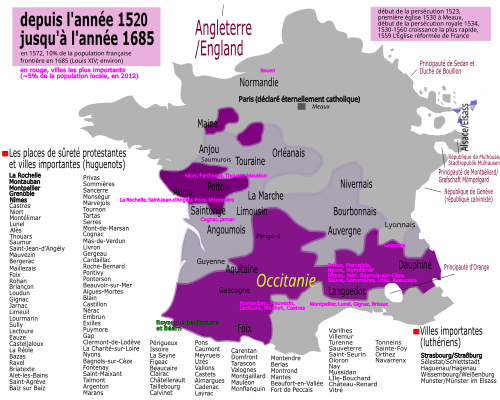
ユグノー貴族による支配
ユグノーとカトリックの間で争われた
カトリックの貴族によって支配されている
ルーテル派が多数を占める地域
フランスにおける改革派の人口構成と地理的広がりの問題は、さまざまな資料で取り上げられてきた。そのほとんどは、1572年の聖バルトロメオの虐殺の前夜にはユグノーの人口が全人口の10%、つまり約200万人に達したことに同意している。[20] [21]
貴族とのつながり
ジャン・カルヴァンの新しい教えは、貴族や都市ブルジョワジーのかなりの部分を引き付けました。[22]ジャン・カルヴァンがフランスで宗教改革を導入した後、1560年から1570年までの10年間で、フランスのプロテスタントの数は着実に増加し、人口の10%、つまり約180万人に達しました。[20]同じ時期に、フランスでは約1,400の改革派教会が活動していました。[20]この分野の専門家であるハンス・J・ヒラーブランドは、著書『プロテスタント百科事典:4巻セット』の中で、聖バルトロメオの虐殺の前夜にはユグノーコミュニティがフランス人口の10%にも達したが、16世紀末には7~8%に減少し、1685年にルイ14世がナントの勅令を廃止して再び激しい迫害が始まった後は、さらに減少したと主張している。[20]貴族の間では、聖バルトロメオの虐殺の前夜にカルヴァン主義がピークに達した。それ以降、ユグノーがフランス王室とカトリック大衆の両方から容認されなくなったため、カルヴァン主義は急激に減少した。16世紀末までに、ユグノーは全人口の7~8%、つまり120万人を占めた。 1685年にルイ14世がナントの勅令を廃止した時点で、ユグノー教徒の数は80万から100万人に達していた。[20]
ユグノーは南フランスと西フランスのかなり広い地域を支配していた。さらに、特に国の中央部では、多くの地域がフランスの改革派とカトリックの貴族の間で争いもあった。人口統計的に、全住民が改革派であった地域もあった。これには、マッシフ・サントラル周辺の村落や、かつてはほぼ完全に改革派であったドルドーニュ周辺の地域が含まれる。ジャン・カルヴァンはフランス人で、フランスにおける改革派の伝統の導入と普及に大きく貢献した。 [23]彼はフランス語で著作を書いたが、ルター派の著作が広く配布され、一般の人々が読むことができたドイツでのプロテスタントの発展とは異なり、フランスではそうではなく、貴族だけが新しい信仰を受け入れ、民衆はカトリックのままだった。[20]これは、ユグノー貴族が支配していた西部と南部の多くの地域に当てはまる。そこでは農民人口の比較的大きな部分が改革派になったが、全体としては依然として大多数の人々がカトリックのままであった。[20] [24]
全体的に見て、ユグノーの存在はフランス王国の西部と南部に集中しており、そこの貴族たちは新しい信仰を実践していた。これらにはラングドック=ルシヨン、ガスコーニュ、さらにはドーフィネまで広がる一帯が含まれていた。ユグノーはラ・ロシェルの大西洋岸に住み、ノルマンディーとポワトゥーの州にも広がった。南部では、カストル、モントーバン、モンペリエ、ニームなどの町がユグノーの拠点だった。さらに、プロテスタントの村々の密集したネットワークがセヴェンヌの田舎の山岳地帯に広がっていた。カミザールが住んでいたこの地域は、現在もフランスのプロテスタントの中心地となっている。歴史家は、ユグノー全体のおよそ80%がフランスの西部と南部に住んでいたと推定している。
今日、世界中にはユグノーのアイデンティティーを今も保持している改革派コミュニティーがいくつかある。フランスでは、フランス合同プロテスタント教会のカルヴァン派と、アルザス・ロレーヌ改革派教会の一部が自らをユグノーとみなしている。 1702年に反乱を起こしたセヴェンヌ地方の農村部のユグノーコミュニティーは、特に歴史的文脈では今でもカミザールと呼ばれている。イギリス、アメリカ、南アフリカ、オーストラリア、その他多くの国に亡命したユグノーは、今も自分たちのアイデンティティーを保持している。 [25] [26]
移民とディアスポラ
ユグノー亡命者の大半は、ネーデルラント連邦共和国、イングランドおよびウェールズ(主にケントとロンドン)、プロテスタント支配下のアイルランド、チャンネル諸島、スコットランド、デンマーク、スウェーデン、スイス、神聖ローマ帝国のブランデンブルク選帝侯領およびプファルツ選帝侯領、プロイセン公国などのプロテスタント諸国に移住した。難民としてオランダ領ケープ植民地、オランダ領東インド、さまざまなカリブ海植民地、および北アメリカのオランダとイギリスの植民地のいくつかに逃れた者もいた。[27]少数の家族は正教会のロシアとカトリックのケベックに渡った。
数世紀後、ユグノーのほとんどは定住したさまざまな社会や文化に同化しました。セヴェンヌのカミザールの残存コミュニティ、フランス統一プロテスタント教会の改革派の大半、主にドイツ人で構成されるアルザス・ロレーヌ改革派教会のフランス人、およびイギリスとオーストラリアのユグノーの離散民は、すべて今でもその信仰とユグノーの呼称を保持しています。
歴史
起源

フランスにおけるプロテスタント運動の広がりと改革派教会の発展にとって、聖書が母国語で入手できることは重要だった。プロテスタントによる宗教改革がようやく到来したころ、フランスは教皇庁との長い闘争の歴史を持っていた(例えばアヴィニョン教皇庁を参照)。1294年頃、ローマカトリックの司祭ギヤール・デ・ムーランによって聖書のフランス語版が作成された。彼の原稿に基づいたジャン・ド・レリによる2巻本の挿絵入りフォリオ・パラフレーズ版は1487年にパリで印刷された。[30] [31]
フランスの地方言語の一つであるアルピタン語またはフランコ・プロヴァンス語への最初の聖書翻訳は、12世紀のプレプロテスタント改革者ピーター・ワルド(ピエール・ド・ヴォー)によって準備されました。[32]ワルドー派は、おそらく修道院を攻撃して、カブリエールのような要塞化された地域を作りました。 [33]彼らは1545年にフランソワ1世によってメリンドールの虐殺で鎮圧されました。[34]
改革派教会の他の先駆者には、ジャック・ルフェーブル(1455年頃-1536年)のような改革派とガリア派のローマ・カトリック教徒がいた。ガリア派は、フランスの宗教はローマ司教という外国勢力によって支配されるべきではないという原則に基づき、フランス教会の独立を短期間達成した。 [35]宗教改革の間、パリ大学教授のルフェーブルは1523年に新約聖書のフランス語訳を出版し、続いて1530年に聖書全体をフランス語で出版した。[36]ウィリアム・ファレルはルフェーブルの弟子で、後にスイス宗教改革の指導者となり、ジュネーブにプロテスタント共和政府を樹立した。パリ大学の別の学生、ジャン・コーヴァン(ジャン・カルヴァン)もプロテスタントに改宗した。フランソワ1世によってこの宗派が鎮圧されてからずっと後、当時リュベロン地方に住んでいたフランスの残っていたワルド派は、ファレル、カルヴァン、そして宗教改革に加わろうとし、オリヴェタンは彼らのためにフランス語の聖書を出版した。1559年のフランス信仰告白には明らかにカルヴァン主義の影響が見られる。[37]
通常、ユグノーは1つのグループにまとめられるが、実際には2種類のユグノーが出現した。[38]ユグノーは政治的および宗教的な目標を持っていたため、カルヴァン派を「宗教のユグノー」、王政に反対した人々を「国家のユグノー」と呼ぶのが一般的であった。国家のユグノーのほとんどは貴族であった。[39]
- 宗教界のユグノーはジャン・カルヴァンの著作に影響を受け、カルヴァン派の教会会議を設立しました。彼らは宗教的抑圧を終わらせることを決意しました。
- 国のユグノーはギーズ家の権力独占に反対し、王権を攻撃しようとした。南フランスのこのユグノーの集団は、ジャン・カルヴァンがラングドックの教会会議に送った手紙の多くに概説されている厳格なカルヴァン主義の教義にしばしば異議を唱えた。
カトリック教会に対する批判と対立
当時の他の宗教改革者と同様に、ユグノーはカトリック教会は徹底的に不純物を浄化する必要があり、教皇は神のものを嘲笑する暴政を敷く現世の王国を代表しており、最終的には滅びる運命にあると感じていた。このようなレトリックは、事件が進むにつれて激しさを増し、最終的にはカトリック教会の体制内で反発を巻き起こした。
カトリック教会に熱狂的に反対したユグノーは、司祭、修道士、尼僧を殺害し、修道院制度を攻撃し、聖像、聖遺物、教会の建物を破壊した。ユグノーが勢力を握った都市のほとんどで偶像破壊 暴動が起こり、教会の祭壇や聖像、時には建物自体が破壊された。古代の聖遺物や文書は破壊され、聖人の遺体は掘り起こされて焼かれた。ブールジュ、モントーバン、オルレアンの各都市では、この点で大きな動きが見られた。
ユグノーはその後、明確な政治運動へと変貌を遂げた。プロテスタントの説教師たちは、ガスパール・ド・コリニー提督の指揮のもと、相当な軍隊と強力な騎兵隊を結成した。ナバラ王アンリとブルボン家はユグノーと同盟を組み、プロテスタントの勢力に富と領土を加えた。プロテスタントの勢力は最盛期には60の要塞都市にまで拡大し、その後30年間にわたりカトリックの王室とパリに深刻かつ継続的な脅威を与えた。
フランスのカトリック教会とその信者の多くはユグノーに反対した。ユグノーの説教者や信徒の中には、礼拝のために集まろうとした際に襲撃された者もいた。[40]この迫害の頂点は1572年8月の聖バルトロメオの虐殺であり、5,000人から30,000人が殺害されたが、これには政治的な理由も潜んでいた。ユグノーの中には南フランスに別の権力の中心を築こうとした貴族もいた。フランスのカトリック教徒に報復するため、ユグノーは独自の民兵を組織した。[41]
改革と成長
フランソワ1世(在位 1515-1547年)は治世初期に、フランス南東部の古いプレプロテスタント運動であるワルド派を迫害した。フランソワは当初、ユグノーの反体制派を議会の根絶策から保護した。しかし、1534年のプラカード事件の後、[42] [43]ユグノーとその保護から距離を置くようになった。[44]
1555年から1561年の間に、ユグノーの数は主に貴族と都市住民の間で急速に増加した。この間、彼らの反対者は最初にプロテスタントをユグノーと呼んだが、彼らは自分たちを「改革派」、つまり「改革者」と呼んだ。彼らは1558年にパリで最初の全国会議を組織した。[45]
1562 年までに、ユグノー教徒の推定数は約 200 万人に達し、主にフランスの西部、南部、および中央部に集中していました。一方、同時期のカトリック教徒の数はおよそ 1,600 万人でした。迫害により、フランスに残るユグノー教徒の数は減少しました。
宗教戦争
ユグノーが影響力を増し、信仰をより公然と示すようになると、フランス王室がますます寛容な政治的譲歩と寛容の布告を示したにもかかわらず、ユグノーに対するローマカトリックの敵意は高まっていった。 [要出典]
1559年にヘンリー2世が事故死した後、その息子であるフランソワ2世が、妻でスコットランド女王メアリーとしても知られる王妃とともに国王位を継承した。フランソワ2世の治世の18か月間、メアリーはフランスのユグノー教徒を異端の罪で一斉に逮捕し、カトリックの裁判官の前に引き立て、反対者には拷問と火刑を科す政策を奨励した。[要出典]メアリーは1561年の夏に未亡人となってスコットランドに戻った。[46]
1561年、オルレアン勅令により迫害の終結が宣言され、 1562年1月のサンジェルマン勅令によりユグノーが初めて正式に認められた。しかし、これらの措置はプロテスタントとカトリック教徒の間で高まる緊張を隠蔽するものであった。[要出典]
内戦
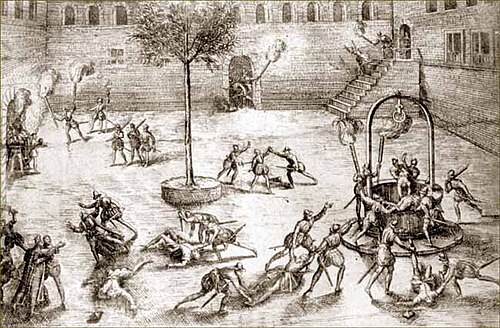
こうした緊張関係により、1562年から1598年の間に、比較的平穏な時期を挟みつつ、8回の内戦が勃発した。平和が途切れるたびに、ユグノーのカトリック王位への信頼は薄れ、暴力は激化し、プロテスタントの要求はより厳しくなったが、1598年にようやく公然の敵意が永続的になくなった。戦争は次第に王朝間の性格を帯び、ブルボン家とギーズ家の間の長期にわたる確執へと発展した。両家は、宗教的見解が対立していたことに加え、フランス王位を主張していた。ヴァロワ家が占める王位は、一般的にカトリック側を支持していたが、政治的に都合がよい場合はプロテスタント側に鞍替えすることもあった。[47] [48]

フランス宗教戦争は、1562年3月1日のヴァシー虐殺で始まった。この虐殺では、数十人[49](一部の資料では数百人[50]とも言われている)のユグノーが殺害され、約200人が負傷した。この年、一部のユグノーが、初期の教会の父であり司教で、ポリュカルポスの弟子であった聖イレネオ(202年没)の墓と遺体を破壊した。[51]ユグノーによるカトリック教徒に対するミチェラードの襲撃は、その後1567年9月29日に起こった。[52]
聖バルトロメオの虐殺

1572年8月24日から10月3日にかけて起こった聖バルトロメオの虐殺では、カトリック教徒がパリで数千人のユグノー教徒を殺害し、その後数週間で他の町でも同様の虐殺が起こった。虐殺が起きた主な地方の町や都市は、エクス、ボルドー、ブールジュ、リヨン、モー、オルレアン、ルーアン、トゥールーズ、トロワであった。[53]
全国での正確な死者数は不明だが、8月23日から24日にかけて、パリでは2,000人[54]から3,000人[55] [56] [57]のプロテスタントが殺害され、さらにフランスの地方では3,000人[58]から7,000人[59]が殺害された。9月17日までに、パリだけで25,000人近くのプロテスタントが虐殺された。 [60] [61]パリ以外でも、虐殺は10月3日まで続いた。[60] 1573年に認められた恩赦により、加害者は赦免された。殺害の後、多くのプロテスタントがケント海岸などへ逃げた。[62]
ナントの勅令

戦争とそれに続く短い平和の期間というパターンは、その後ほぼ四半世紀続いた。戦争は1598年に完全に鎮圧された。アンリ4世としてフランス王位を継承したナバラ王アンリが、フランス王位を得るためにプロテスタントを捨ててローマカトリックに転向し、ナントの勅令を発布したのだ。この勅令は、ローマカトリックをフランスの国教として再確認したが、プロテスタントには王位下でカトリックと平等であり、領土内ではある程度の宗教的および政治的自由が認められた。同時に、この勅令はカトリック支配地域で新しいプロテスタント教会の設立を阻止することでカトリックの利益を保護した。[要出典]
ナントの勅令が発布され、ユグノーの権利が保護されたことで、フランスを去る圧力は弱まった。しかし、勅令の執行は時とともに不規則になり、生活が耐え難いものとなり、多くの人が国外に逃亡した。フランスのユグノー人口は1660年代半ばまでに85万6000人にまで減少し、その大部分は農村部に住んでいた。[要出典]当時、ユグノーが最も集中していたのは、ギエンヌ、サントンジュ=オーニス=アングモワ、ポワトゥーの各地域であった。[63]
モンペリエは、1598 年の勅令でユグノーに与えられた66 の保護都市(「保護都市」または「保護された都市」) の中で最も重要な都市の 1 つでした。市の政治機関と大学はすべてユグノーに引き渡されました。パリとの緊張により、1622 年に王軍による包囲が起こりました。和平条件では市の要塞の解体が求められました。王室の城塞が建設され、大学と領事館はカトリック党に引き継がれました。アレス勅令 (1629 年) 以前から、プロテスタントの支配は終焉し、保護都市は存在していませんでした。[出典が必要]

1620年までにユグノーは守勢に立たされ、政府は圧力を強めていった。 1621年から1629年にかけて、主にフランス南西部で、改革派の地域が王権に対して反乱を起こしたユグノー反乱と呼ばれる3つの小さな内戦が勃発した。この反乱は、1610年にカトリックの狂信者に暗殺されたアンリ4世の死から10年後に起こった。彼の後継者ルイ13世は、イタリア系カトリック教徒の母マリー・ド・メディシスの摂政の下で、プロテスタントに対してより不寛容であった。ユグノーは、独立した政治・軍事組織を設立し、外国勢力との外交関係を確立し、中央政府に対して公然と反乱を起こすことでこれに対抗した。反乱はフランス王室によって容赦なく鎮圧された。[要出典]
フォンテーヌブロー勅令
ルイ14世は1643年に王位を継承し、ユグノー教徒に改宗を強制する行動をますます強めた。最初は、ローマカトリックへの改宗者に金銭的な報酬を与える基金を後ろ盾に宣教師を派遣した。次に、罰則を課し、ユグノーの学校を閉鎖し、好ましい職業から排除した。さらにエスカレートし、ユグノー教徒を強制的に改宗させるために、軍隊によるユグノー教徒の家の占拠と略奪を含む竜騎兵の取り締まりを実施した。1685年、彼はナントの勅令を撤回し、プロテスタントを違法とするフォンテーヌブロー勅令を発布した。[64]
この撤回により、プロテスタントの礼拝が禁止され、子供はカトリック教徒として教育を受けることが義務付けられ、移民も禁止された。これはユグノーにとって悲惨な結果となり、フランスにとっては高くついた。内乱が起こり、商業が破綻し、数十万人のプロテスタントが国外に不法に逃亡した。その多くは知識人、医師、ビジネスリーダーで、その技術はイギリスやオランダ、スイス、プロイセン、南アフリカなどに伝えられた。4,000人が13植民地に移住し、特にニューヨーク、東ペンシルベニアのデラウェア川流域、ニュージャージー、[27]、バージニアに定住した。イギリス当局はフランス人難民を歓迎し、政府と民間機関の両方から移住支援金を出した。フランスに残ったユグノーはその後強制的にローマカトリックに改宗させられ、「新改宗者」と呼ばれた。[65]
その後、ユグノー(推定20万から100万人[7])はプロテスタント諸国、すなわちイングランド、ネーデルラント、スイス、ノルウェー、デンマーク、プロイセンへと逃れた。プロイセンのカルヴァン派選帝侯フリードリヒ・ヴィルヘルムは、戦争で荒廃し人口の少ない国の再建にユグノーを歓迎した。この脱出の後、ユグノーが大量に残ったのはフランス南部の険しいセヴェンヌ地方だけだった。当時神聖ローマ帝国に属していたアルザス地方にもカルヴァン派がいた。18世紀初頭、カミザール(山岳地帯の中央高地のユグノー)として知られる地域集団がカトリック教会に対して暴動を起こし、教会を焼き払い聖職者を殺害した。フランス軍がカミザールの一団を全て追跡し壊滅させるのに、1702年から1709年の間に何年もかかった。[66]
迫害の終焉
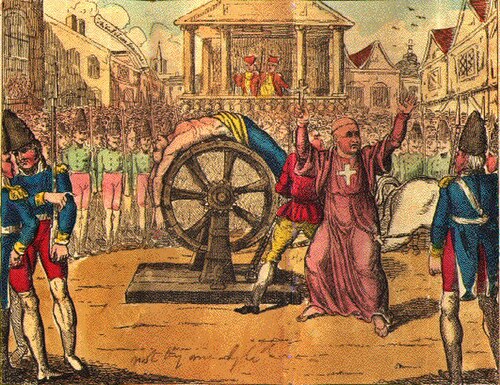
1760年代までに、プロテスタントはもはやエリート層のお気に入りの宗教ではなくなった。その頃、プロテスタントのほとんどはセヴェンヌの農民だった。それは依然として違法であり、法律が執行されることはめったになかったが、プロテスタントにとって脅威または迷惑となることがあった。カルヴァン派は主にミディに住んでいた。約20万人のルター派と一部のカルヴァン派は、新たに獲得したアルザスに住んでいた。彼らは1648年のウェストファリア条約によって事実上保護されていた。[67]
1724年以降、フランスにおけるプロテスタント迫害は減少し、1787年にルイ16世が署名したヴェルサイユ勅令(一般に寛容勅令と呼ばれる)によってようやく終結した。2年後の1789年の人権宣言により、プロテスタントは市民として平等な権利を獲得した。[6]
19世紀と20世紀のフランスへの帰還権
政府は亡命者の子孫の帰国を奨励し、1790年12月15日の法律で彼らにフランス国籍を与えた。
外国で生まれ、宗教上の理由で国外追放されたフランス人男性または女性の子孫であるすべての人は、フランス国民(naturels français)と宣言され、フランスに戻って居住地を定め、市民の宣誓を行えば、その資格に付随する権利を享受できます。[68]
1889年6月26日の国籍法第4条は次のように規定している。「ナントの勅令の撤回により追放された家族の子孫は、1790年12月15日の法律の恩恵を引き続き受けるが、すべての請願者に対して名目上の勅令が発布されることが条件となる。その勅令は将来に向けてのみその効果を発揮する。」[69]
ユグノーの外国人子孫は、1945年にフランス国籍の自動的な権利を失った(1945年10月19日の法令第45-2441号により、1889年の国籍法は廃止された)。[70]第3条には「ただし、この適用は、本人の過去の行為の有効性や、第三者が以前の法律に基づいて取得した権利には影響しない」とある。[71]
現代
1920年代から1930年代にかけて、極右のアクション・フランセーズ運動のメンバーは、ユグノーや他のプロテスタント全般、そしてユダヤ人やフリーメイソンに対して強い敵意を表明した。彼らはアクション・フランセーズが打倒しようとしていたフランス共和国を支持するグループとみなされていた。[72]
第二次世界大戦では、セヴェンヌ県ル・シャンボン=シュル=リニョン村のアンドレ・トロクメ率いるユグノーが多くのユダヤ人の救出に貢献した。彼らはユダヤ人を秘密の場所に隠したり、ヴィシー政権下のフランスから脱出するのを手伝ったりした。アンドレ・トロクメは、隣国ドイツでナチスが勢力を強めていたときに差別に反対する説教をし、プロテスタントのユグノー会衆にホロコーストから逃れたユダヤ人難民を隠すよう促した。[73]
21世紀初頭、フランスには約100万人のプロテスタントがおり、人口の約2%を占めていた。[74]そのほとんどはフランス北東部のアルザス地方と南部のセヴェンヌ山地に集中しており、彼らは今日でも自分たちをユグノーとみなしている。[要出典]調査によると、近年プロテスタントは成長しているが、これは主に、フランスのユグノー人口とは一般に異なると考えられている移民グループの中に信者がいる福音派プロテスタント教会の拡大によるものである。[75]
フランス系オーストラリア人の離散民は、何世紀にもわたる亡命生活を経てもなお、自らをユグノー教徒とみなしている。オーストラリア社会に長く溶け込んできたこの人々は、オーストラリア・ユグノー協会の系譜調査サービスを受けながら、その文化遺産を受け入れ、保護するよう奨励されている。[76]
アメリカ合衆国には、ユグノーの礼拝グループや協会がいくつかある。アメリカユグノー協会はニューヨーク市に本部を置き、全国に幅広い会員がいる。最も活動的なユグノー団体の一つはサウスカロライナ州チャールストンにある。アメリカのユグノー団体の多くは借りた教会で礼拝を行っているが、チャールストンの会衆は独自の教会を持っている。礼拝は主に英語で行われるが、教会は毎年、ヌーシャテル(1737年)とヴァランジャン(1772年)の典礼を翻案して完全にフランス語で行われる年次フランス語礼拝を行っている。通常、年次フランス語礼拝は、ナントの勅令の調印を記念して、復活祭後第1または第2日曜日に行われる。
出エジプト
フランスのユグノー教徒のほとんどは、ローマカトリックへの強制改宗を避けるため、移住することができなかったか、移住を望まなかった。
植民地への初期の移住
The first Huguenots to leave France sought freedom from persecution in Switzerland and the Netherlands.[77] A group of Huguenots was part of the French colonisers who arrived in Brazil in 1555 to found France Antarctique. A couple of ships with around 500 people arrived at the Guanabara Bay, present-day Rio de Janeiro, and settled on a small island. A fort, named Fort Coligny, was built to protect them from attack from the Portuguese troops and Brazilian natives. It was an attempt to establish a French colony in South America. The fort was destroyed in 1560 by the Portuguese, who captured some of the Huguenots. The Portuguese threatened their Protestant prisoners with death if they did not convert to Roman Catholicism. The Huguenots of Guanabara, as they are now known, produced what is known as the Guanabara Confession of Faith to explain their beliefs. The Portuguese executed them.
South Africa
Individual Huguenots settled at the Cape of Good Hope from as early as 1671; the first documented was the wagonmaker François Vilion (Viljoen). The first Huguenot to arrive at the Cape of Good Hope was Maria de la Quellerie, wife of commander Jan van Riebeeck (and daughter of a Walloon church minister), who arrived on 6 April 1652 to establish a settlement at what is today Cape Town. The couple left for Batavia ten years later.
But it was not until 31 December 1687 that the first organised group of Huguenots set sail from the Netherlands to the Dutch East India Company post at the Cape of Good Hope.[78] The largest portion of the Huguenots to settle in the Cape arrived between 1688 and 1689 in seven ships as part of the organised migration, but quite a few arrived as late as 1700; thereafter, the numbers declined and only small groups arrived at a time.[79] Many of these settlers were given land in an area that was later called Franschhoek (Dutch for 'French Corner'), in the present-day Western Cape province of South Africa. A large monument to commemorate the arrival of the Huguenots in South Africa was inaugurated on 7 April 1948 at Franschhoek. The Huguenot Memorial Museum was also erected there and opened in 1957.
The official policy of the Dutch East India governors was to integrate the Huguenot and the Dutch communities. When Paul Roux, a pastor who arrived with the main group of Huguenots, died in 1724, the Dutch administration, as a special concession, permitted another French cleric to take his place "for the benefit of the elderly who spoke only French".[80] But with assimilation, within three generations the Huguenots had generally adopted Dutch as their first and home language.
Many of the farms in the Western Cape province in South Africa still bear French names. Many families, today, mostly Afrikaans-speaking, have surnames indicating their French Huguenot ancestry. Examples include: Blignaut, Cilliers, Cronje (Cronier), de Klerk (Le Clercq), de Villiers, du Plessis, Du Preez (Des Pres), du Randt (Durand), du Toit, Duvenhage (Du Vinage), Franck, Fouché, Fourie (Fleurit), Gervais, Giliomee (Guilliaume), Gous/Gouws (Gauch), Hugo, Jordaan (Jourdan), Joubert, Kriek, Labuschagne (la Buscagne), le Roux, Lombard, Malan, Malherbe, Marais, Maree, Minnaar (Mesnard), Nel (Nell), Naudé, Nortjé (Nortier), Pienaar (Pinard), Retief (Retif), Roux, Rossouw (Rousseau), Taljaard (Taillard), TerBlanche, Theron, Viljoen (Vilion) and Visagie (Visage).[81][82] The wine industry in South Africa owes a significant debt to the Huguenots, some of whom had vineyards in France, or were brandy distillers, and used their skills in their new home.
North America
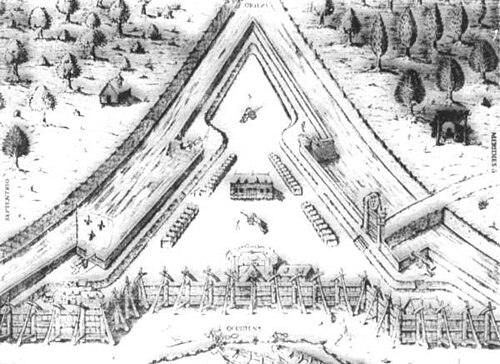
French Huguenots made two attempts to establish a haven in North America. In 1562, naval officer Jean Ribault led an expedition that explored Florida and the present-day Southeastern US, and founded the outpost of Charlesfort on Parris Island, South Carolina. The French Wars of Religion precluded a return voyage, and the outpost was abandoned. In 1564, Ribault's former lieutenant René Goulaine de Laudonnière launched a second voyage to build a colony; he established Fort Caroline in what is now Jacksonville, Florida. War at home again precluded a resupply mission, and the colony struggled. In 1565 the Spanish decided to enforce their claim to La Florida, and sent Pedro Menéndez de Avilés, who established the settlement of St. Augustine near Fort Caroline. Menéndez' forces routed the French and executed most of the Protestant captives.

Barred by the government from settling in New France, Huguenots led by Jessé de Forest, sailed to North America in 1624 and settled instead in the Dutch colony of New Netherland (later incorporated into New York and New Jersey); as well as Great Britain's colonies, including Nova Scotia. A number of New Amsterdam's families were of Huguenot origin, often having emigrated as refugees to the Netherlands in the previous century. In 1628 the Huguenots established a congregation as L'Église française à la Nouvelle-Amsterdam (the French church in New Amsterdam). This parish continues today as L'Eglise du Saint-Esprit, now a part of the Episcopal Church (Anglican) communion, and welcomes Francophone New Yorkers from all over the world.[83] Upon their arrival in New Amsterdam, Huguenots were offered land directly across from Manhattan on Long Island for a permanent settlement and chose the harbour at the end of Newtown Creek, becoming the first Europeans to live in Brooklyn, then known as Boschwick, in the neighbourhood now known as Bushwick.

Huguenot immigrants settled throughout pre-colonial America, including in New Amsterdam (New York City), some 21 miles north of New York in a town which they named New Rochelle, and some further upstate in New Paltz. The "Huguenot Street Historic District" in New Paltz has been designated a National Historic Landmark site and contains one of the oldest streets in the United States of America. A small group of Huguenots also settled on the south shore of Staten Island along the New York Harbor, for which the current neighbourhood of Huguenot was named. Huguenot refugees also settled in the Delaware River Valley of Eastern Pennsylvania and Hunterdon County, New Jersey in 1725. Frenchtown in New Jersey bears the mark of early settlers.[27]
New Rochelle, located in the county of Westchester on the north shore of Long Island Sound, seemed to be the great location of the Huguenots in New York. It is said that they landed on the coastline peninsula of Davenports Neck called "Bauffet's Point" after travelling from England where they had previously taken refuge on account of religious persecution, four years before the revocation of the Edict of Nantes. They purchased from John Pell, Lord of Pelham Manor, a tract of land consisting of six thousand one hundred acres with the help of Jacob Leisler. It was named New Rochelle after La Rochelle, their former strong-hold in France. A small wooden church was first erected in the community, followed by a second church that was built of stone. Previous to the erection of it, the strong men would often walk twenty-three miles on Saturday evening, the distance by the road from New Rochelle to New York, to attend the Sunday service. The church was eventually replaced by a third, Trinity-St. Paul's Episcopal Church, which contains heirlooms including the original bell from the French Huguenot Church Eglise du St. Esperit on Pine Street in New York City, which is preserved as a relic in the tower room. The Huguenot cemetery, or the "Huguenot Burial Ground", has since been recognised as a historic cemetery that is the final resting place for a wide range of the Huguenot founders, early settlers and prominent citizens dating back more than three centuries.
Some Huguenot immigrants settled in central and eastern Pennsylvania. They assimilated with the predominantly Pennsylvania German settlers of the area.
In 1700 several hundred French Huguenots migrated from England to the colony of Virginia, where the King William III of England had promised them land grants in Lower Norfolk County.[84] When they arrived, colonial authorities offered them instead land 20 miles above the falls of the James River, at the abandoned Monacan village known as Manakin Town, now in Goochland County. Some settlers landed in present-day Chesterfield County. On 12 May 1705, the Virginia General Assembly passed an act to naturalise the 148 Huguenots still resident at Manakintown. Of the original 390 settlers in the isolated settlement, many had died; others lived outside town on farms in the English style; and others moved to different areas.[85] Gradually they intermarried with their English neighbours. Through the 18th and 19th centuries, descendants of the French migrated west into the Piedmont, and across the Appalachian Mountains into the West of what became Kentucky, Tennessee, Missouri, and other states. In the Manakintown area, the Huguenot Memorial Bridge across the James River and Huguenot Road were named in their honour, as were many local features, including several schools, including Huguenot High School.
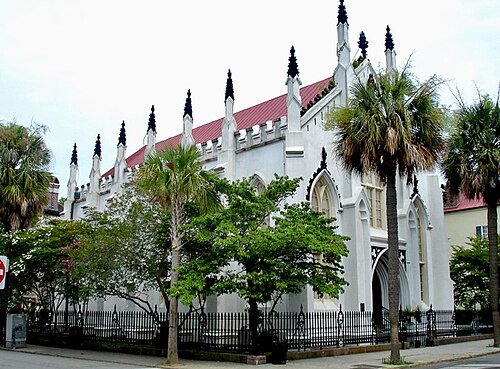
In the early years, many Huguenots also settled in the area of present-day Charleston, South Carolina. In 1685, Rev. Elie Prioleau from the town of Pons in France, was among the first to settle there. He became pastor of the first Huguenot church in North America in that city. After the Revocation of the Edict of Nantes in 1685, several Huguenots including Edmund Bohun of Suffolk, England, Pierre Bacot of Touraine France, Jean Postell of Dieppe France, Alexander Pepin, Antoine Poitevin of Orsement France, and Jacques de Bordeaux of Grenoble, immigrated to the Charleston Orange district. They were very successful at marriage and property speculation. After petitioning the British Crown in 1697 for the right to own land in the Baronies, they prospered as slave owners on the Cooper, Ashepoo, Ashley and Santee River plantations they purchased from the British Landgrave Edmund Bellinger. Some of their descendants moved into the Deep South and Texas, where they developed new plantations.
The French Huguenot Church of Charleston, which remains independent, is the oldest continuously active Huguenot congregation in the United States. L'Eglise du Saint-Esprit in New York, founded in 1628, is older, but it left the French Reformed movement in 1804 to become part of the Episcopal Church.
Most of the Huguenot congregations (or individuals) in North America eventually affiliated with other Protestant denominations with more numerous members. The Huguenots adapted quickly and often married outside their immediate French communities.[86] Their descendants in many families continued to use French first names and surnames for their children well into the nineteenth century. Assimilated, the French made numerous contributions to United States economic life, especially as merchants and artisans in the late Colonial and early Federal periods. For example, E.I. du Pont, a former student of Lavoisier, established the Eleutherian gunpowder mills.[87] Howard Hughes, famed investor, pilot, film director, and philanthropist, was also of Huguenot descent and descendant from Rev. John Gano.
Paul Revere was descended from Huguenot refugees, as was Henry Laurens, who signed the Articles of Confederation for South Carolina. Other descendants of Huguenots included Jack Jouett, who made the ride from Cuckoo Tavern to warn Thomas Jefferson and others that Tarleton and his men were on their way to arrest him for crimes against the king; Reverend John Gano, a Revolutionary War chaplain and spiritual advisor to George Washington; Francis Marion; and a number of other leaders of the American Revolution and later statesmen. The last active Huguenot congregation in North America worships in Charleston, South Carolina, at a church that dates to 1844. The Huguenot Society of America maintains the Manakin Episcopal Church in Virginia as a historic shrine with occasional services. The Society has chapters in numerous states, with the one in Texas being the largest.
After the British Conquest of New France, British authorities in Lower Canada tried to encourage Huguenot immigration in an attempt to promote a Francophone Protestant Church in the region, hoping that French-speaking Protestants would be more loyal clergy than those of Roman Catholicism. While a small number of Huguenots did come, the majority switched from speaking French to English. As a result, Protestants are still a religious minority in Quebec today.[88]
Spoken language
The Huguenots originally spoke French on their arrival in the American colonies, but after two or three generations, they had switched to English. They did not promote French-language schools or publications and "lost" their historic identity.[89] In upstate New York they merged with the Dutch Reformed community and switched first to Dutch and then in the early 19th century to English.[90] In colonial New York City they switched from French to English or Dutch by 1730.[91]
Netherlands
Some Huguenots fought in the Low Countries alongside the Dutch against Spain during the first years of the Dutch Revolt (1568–1609). The Dutch Republic rapidly became a destination for Huguenot exiles. Early ties were already visible in the Apologie of William the Silent, condemning the Spanish Inquisition, which was written by his court minister, the Huguenot Pierre L'Oyseleur, lord of Villiers. Louise de Coligny, daughter of the murdered Huguenot leader Gaspard de Coligny, married William the Silent, leader of the Dutch (Calvinist) revolt against Spanish (Catholic) rule. As both spoke French in daily life, their court church in the Prinsenhof in Delft held services in French. The practice has continued to the present day. The Prinsenhof is one of the 14 active Walloon churches of the Dutch Reformed Church (now of the Protestant Church in the Netherlands). The ties between Huguenots and the Dutch Republic's military and political leadership, the House of Orange-Nassau, which existed since the early days of the Dutch Revolt, helped support the many early settlements of Huguenots in the Dutch Republic's colonies. They settled at the Cape of Good Hope in South Africa and New Netherland in North America.
Stadtholder William III of Orange, who later became King of England, emerged as the strongest opponent of King Louis XIV after the French attacked the Dutch Republic in 1672. William formed the League of Augsburg as a coalition to oppose Louis and the French state. Consequently, many Huguenots considered the wealthy and Calvinist-controlled Dutch Republic, which also happened to lead the opposition to Louis XIV, as the most attractive country for exile after the revocation of the Edict of Nantes. They also found many French-speaking Calvinist churches there (which were called the "Walloon churches").
After the revocation of the Edict of Nantes in 1685, the Dutch Republic received the largest group of Huguenot refugees, an estimated total of 75,000 to 100,000 people. Amongst them were 200 pastors. Most came from northern France (Brittany, Normandy, and Picardy), as well as West Flanders (subsequently French Flanders), which had been annexed from the Southern Netherlands by Louis XIV in 1668–78.[92] Many came from the region of the Cévennes, for instance, the village of Fraissinet-de-Lozère.[93] This was a huge influx as the entire population of the Dutch Republic amounted to c. 2 million at that time. Around 1700, it is estimated that nearly 25% of the Amsterdam population was Huguenot.[citation needed] In 1705, Amsterdam and the area of West Frisia were the first areas to provide full citizens rights to Huguenot immigrants, followed by the whole Dutch Republic in 1715. Huguenots intermarried with Dutch from the outset.
One of the most prominent Huguenot refugees in the Netherlands was Pierre Bayle. He started teaching in Rotterdam, where he finished writing and publishing his multi-volume masterpiece, Historical and Critical Dictionary. It became one of the 100 foundational texts of the US Library of Congress. Some Huguenot descendants in the Netherlands may be noted by French family names, although they typically use Dutch given names. Due to the Huguenots' early ties with the leadership of the Dutch Revolt and their own participation, some of the Dutch patriciate are of part-Huguenot descent. Some Huguenot families have kept alive various traditions, such as the celebration and feast of their patron Saint Nicolas, similar to the Dutch Sint Nicolaas (Sinterklaas) feast.
Great Britain and Ireland
England

As a major Protestant nation, England patronized and helped protect Huguenots since at least the mid-1500s. Kent hosted the first congregation of Huguenots in England in around 1548.[94] During the reign of Mary I (1553–1558) they were expelled but, with the accession of Elizabeth I, returned to London in 1559 and Kent in 1561.[95] An early group of Huguenots settled in Colchester in 1565.[96][97] There was a small naval Anglo-French War (1627–1629), in which the English supported the French Huguenots against King Louis XIII.[98] London financed the emigration of many to England and its colonies around 1700. Some 40,000–50,000 settled in England, mostly in towns near the sea in the southern districts, with the largest concentration in London where they constituted about 5% of the total population in 1700.[99][100][101] Many others went to the American colonies, especially South Carolina.[102][103] The immigrants included many skilled craftsmen and entrepreneurs who facilitated the economic modernization of their new home, in an era when economic innovations were transferred by people rather than through printed works. The British government ignored the complaints made by local craftsmen about the favoritism shown to foreigners.[104][105] The immigrants assimilated well in terms of using English, joining the Church of England, intermarriage and business success. They founded the silk industry in England.[106][107] Many became private tutors, schoolmasters, travelling tutors and owners of riding schools, where they were hired by the upper class.[108]
Both before and after the 1708 passage of the Foreign Protestants Naturalization Act, an estimated 50,000 Protestant Walloons and French Huguenots fled to England, with many moving on to Ireland and elsewhere. In relative terms, this was one of the largest waves of immigration ever of a single ethnic community to Britain.[109] Andrew Lortie (born André Lortie), a leading Huguenot theologian and writer who led the exiled community in London, became known for articulating their criticism of the Pope and the doctrine of transubstantiation during Mass.
Of the refugees who arrived on the Kent coast, many gravitated towards Canterbury, then the county's Calvinist hub. Many Walloon and Huguenot families were granted asylum there. Edward VI granted them the whole of the western crypt of Canterbury Cathedral for worship. In 1825, this privilege was reduced to the south aisle and in 1895 to the former chantry chapel of the Black Prince. Services are still held there in French according to the Reformed tradition every Sunday at 3 pm.
Other evidence of the Walloons and Huguenots in Canterbury includes a block of houses in Turnagain Lane, where weavers' windows survive on the top floor, as many Huguenots worked as weavers. The Weavers, a half-timbered house by the river, was the site of a weaving school from the late 16th century to about 1830. (It has been adapted as a restaurant—see illustration above. The house derives its name from a weaving school which was moved there in the last years of the 19th century, reviving an earlier use.) Other refugees practiced the variety of occupations necessary to sustain the community as distinct from the indigenous population. Such economic separation was the condition of the refugees' initial acceptance in the city. They also settled elsewhere in Kent, particularly Sandwich, Faversham and Maidstone—towns in which there used to be refugee churches.
The French Protestant Church of London was established by Royal Charter in 1550. It is now located at Soho Square.[110] Huguenot refugees flocked to Shoreditch, London. They established a major weaving industry in and around Spitalfields (see Petticoat Lane and the Tenterground) in East London.[111] In Wandsworth, their gardening skills benefited the Battersea market gardens. The flight of Huguenot refugees from Tours, France drew off most of the workers of its great silk mills which they had built.[citation needed] Some of these immigrants moved to Norwich, which had accommodated an earlier settlement of Walloon weavers. The French added to the existing immigrant population, then comprising about a third of the population of the city.
Some Huguenots settled in Bedfordshire, one of the main centres of the British lace industry at the time. Although 19th-century sources have asserted that some of these refugees were lacemakers and contributed to the East Midlands lace industry,[112][113] this is contentious.[114][115] The only reference to immigrant lace makers in this period is of twenty-five widows who settled in Dover,[112] and there is no contemporary documentation to support there being Huguenot lace makers in Bedfordshire. The implication that the style of lace known as 'Bucks Point' demonstrates a Huguenot influence, being a "combination of Mechlin patterns on Lille ground",[113] is fallacious: what is now known as Mechlin lace did not develop until the first half of the eighteenth century and lace with Mechlin patterns and Lille ground did not appear until the end of the 18th century, when it was widely copied throughout Europe.[116]
Many Huguenots from the Lorraine region also eventually settled in the area around Stourbridge in the modern-day West Midlands, where they found the raw materials and fuel to continue their glassmaking tradition. Anglicized names such as Tyzack, Henzey and Tittery are regularly found amongst the early glassmakers, and the region went on to become one of the most important glass regions in the country.[117]
Winston Churchill was the most prominent Briton of Huguenot descent, deriving from the Huguenots who went to the colonies; his American grandfather was Leonard Jerome.
Ireland

Following the French crown's revocation of the Edict of Nantes, many Huguenots settled in Ireland in the late 17th and early 18th centuries, encouraged by an act of parliament for Protestants' settling in Ireland.[118][119][120][121][122] Huguenot regiments fought for William of Orange in the Williamite War in Ireland, for which they were rewarded with land grants and titles, many settling in Dublin.[123] Significant Huguenot settlements were in Dublin, Cork, Portarlington, Lisburn, Waterford and Youghal. Smaller settlements, which included Killeshandra in County Cavan, contributed to the expansion of flax cultivation and the growth of the Irish linen industry.
For over 150 years, Huguenots were allowed to hold their services in Lady Chapel in St. Patrick's Cathedral. A Huguenot cemetery is located in the centre of Dublin, off St. Stephen's Green. Prior to its establishment, Huguenots used the Cabbage Garden near the cathedral. Another Huguenot cemetery is located off French Church Street in Cork.
A number of Huguenots served as mayors in Dublin, Cork, Youghal and Waterford in the 17th and 18th centuries. Numerous signs of Huguenot presence can still be seen with names still in use, and with areas of the main towns and cities named after the people who settled there. Examples include the Huguenot District and French Church Street in Cork City; and D'Olier Street in Dublin, named after a High Sheriff and one of the founders of the Bank of Ireland. A French church in Portarlington dates back to 1696,[124] and was built to serve the significant new Huguenot community in the town. At the time, they constituted the majority of the townspeople.[125]
One of the more notable Huguenot descendants in Ireland was Seán Lemass (1899–1971), who was appointed as Taoiseach, serving from 1959 until 1966.
Scotland
With the precedent of a historical alliance — the Auld Alliance — between Scotland and France; Huguenots were mostly welcomed to, and found refuge in the nation from around the year 1700.[126] Although they did not settle in Scotland in such significant numbers as in other regions of Britain and Ireland, Huguenots have been romanticised, and are generally considered to have contributed greatly to Scottish culture.[127] John Arnold Fleming wrote extensively of the French Protestant group's impact on the nation in his 1953 Huguenot Influence in Scotland,[128] while sociologist Abraham Lavender, who has explored how the ethnic group transformed over generations "from Mediterranean Catholics to White Anglo-Saxon Protestants", has analyzed how Huguenot adherence to Calvinist customs helped facilitate compatibility with the Scottish people.[129]
Wales
A number of French Huguenots settled in Wales, in the upper Rhymney valley of the current Caerphilly County Borough. The community they created there is still known as Fleur de Lys (the symbol of France), an unusual French village name in the heart of the valleys of Wales. Nearby villages are Hengoed, and Ystrad Mynach. Apart from the French village name and that of the local rugby team, Fleur De Lys RFC, little remains of the French heritage.
Germany, Poland and Scandinavia

After the St. Bartholomew's Day massacre of 1572, some persecuted Huguenots fled to Poland, taking advantage of its religious tolerance confirmed by the Warsaw Confederation, marking the first significant historical wave of French migration to Poland.[130]
Around 1685, Huguenot refugees found a safe haven in the Lutheran and Reformed states in Germany and Scandinavia. Nearly 50,000 Huguenots established themselves in Germany, 20,000 of whom were welcomed in Brandenburg-Prussia, where Frederick William (r. 1649–1688), granted them special privileges (Edict of Potsdam of 1685) and churches in which to worship (such as the Church of St. Peter and St. Paul, Angermünde and the French Cathedral, Berlin). The Huguenots furnished two new regiments of his army: the Altpreußische Infantry Regiments No. 13 (Regiment on foot Varenne) and 15 (Regiment on foot Wylich). Another 4,000 Huguenots settled in the German territories of Baden, Franconia (Principality of Bayreuth, Principality of Ansbach), Landgraviate of Hesse-Kassel, Duchy of Württemberg, in the Wetterau Association of Imperial Counts, in the Palatinate and Palatine Zweibrücken, in the Rhine-Main-Area (Frankfurt), in modern-day Saarland; and 1,500 found refuge in Hamburg, Bremen and Lower Saxony. Three hundred refugees were granted asylum at the court of George William, Duke of Brunswick-Lüneburg in Celle.
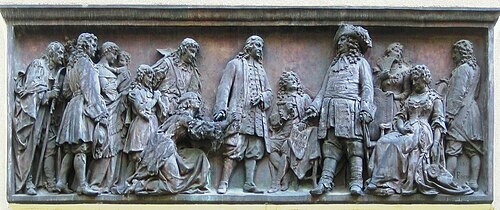
In Berlin the Huguenots created two new neighborhoods: Dorotheenstadt and Friedrichstadt. By 1700 one fifth of the city's population was French-speaking. The Berlin Huguenots preserved the French language in their church services for nearly a century. They ultimately decided to switch to German in protest against the occupation of Prussia by Napoleon in 1806–07. Many of their descendants rose to positions of prominence. Several congregations were founded throughout Germany and Scandinavia, such as those of Fredericia (Denmark), Berlin, Stockholm, Hamburg, Frankfurt, Helsinki, and Emden.

Prince Louis de Condé, along with his sons Daniel and Osias,[citation needed] arranged with Count Ludwig von Nassau-Saarbrücken to establish a Huguenot community in present-day Saarland in 1604. The Count supported mercantilism and welcomed technically skilled immigrants into his lands, regardless of their religion. The Condés established a thriving glass-making works, which provided wealth to the principality for many years. Other founding families created enterprises based on textiles and such traditional Huguenot occupations in France. The community and its congregation remain active to this day, with descendants of many of the founding families still living in the region. Some members of this community emigrated to the United States in the 1890s.
In Bad Karlshafen, Hessen, Germany is the Huguenot Museum and Huguenot archive. The collection includes family histories, a library, and a picture archive.
Effects
The exodus of Huguenots from France created a brain drain, as many of them had occupied important places in society. The kingdom did not fully recover for years. The French crown's refusal to allow non-Catholics to settle in New France may help to explain that colony's low population compared to that of the neighboring British colonies, which opened settlement to religious dissenters. By the start of the French and Indian War, the North American front of the Seven Years' War, a sizeable population of Huguenot descent lived in the British colonies, and many participated in the British defeat of New France in 1759–1760.[131]
Frederick William, Elector of Brandenburg, invited Huguenots to settle in his realms, and a number of their descendants rose to positions of prominence in Prussia. Several prominent German military, cultural and political figures were ethnic Huguenot, including the poet Theodor Fontane,[132] General Hermann von François,[133] the hero of the First World War's Battle of Tannenberg, Luftwaffe general and fighter ace Adolf Galland,[134] the Luftwaffe flying ace Hans-Joachim Marseille, WWII Wehrmacht Lieutenant Colonel/Inspector General of the Bundeswehr Ulrich de Maizière and the famed U-boat Captains Lothar von Arnauld de la Perière and Wilhelm Souchon.[135] Related to Ulrich de Maizière were also the last prime minister of East Germany, Lothar de Maizière[136] and the former German Federal Minister of the Interior, Thomas de Maizière. A 2014 study in the American Economic Review linked Huguenot migration to Prussia with a boost in industrial productivity.[137]
The persecution and the flight of the Huguenots greatly damaged the reputation of Louis XIV abroad, particularly in England. Both kingdoms, which had enjoyed peaceful relations until 1685, became bitter enemies and fought each other in a series of wars, called the "Second Hundred Years' War" by some historians, from 1689 onward.
1985 apology
.jpg/500px-Reagan_Mitterrand_1984_(cropped).jpg)
In October 1985, to commemorate the tricentenary of the Revocation of the Edict of Nantes, President François Mitterrand of France announced a formal apology to the descendants of Huguenots around the world.[138] At the same time, the government released a special postage stamp in their honour reading "France is the home of the Huguenots" (Accueil des Huguenots).
Legacy
Huguenot legacy persists both in France and abroad.
France
Several French Protestant churches are descended from or tied to the Huguenots, including:
- Reformed Church of France (l'Église Réformée de France), founded in 1559, the historical and principal Reformed church in France since the Protestant Reformation until its 2013 merger into the United Protestant Church of France
- Evangelical Reformed Church of France (Union nationale des églises protestantes réformées évangéliques de France), founded in 1938
- Some French members of the largely German Protestant Reformed Church of Alsace and Lorraine
United States
- Bayonne, New Jersey[139]
- Four-term Republican United States Representative Howard Homan Buffett was of Huguenot descent.
- Charleston, South Carolina, is home to the only active Huguenot congregation in the United States
- John Sevier, the first governor of the state of Tennessee, and the only governor of the State of Franklin was of Huguenot descent.
- In 1924, the US issued a commemorative half dollar, known as the "Huguenot-Walloon half dollar",[140] to celebrate the 300th anniversary of the Huguenots' settlement in what is now the United States.
- Frenchtown, New Jersey, part of the larger Delaware River Valley, was a settling area in the early 1700s.
- The neighborhood of Huguenot in New York City's borough of Staten Island, straddling Huguenot Avenue
- Huguenot Memorial Park in Jacksonville, Florida.[141]
- The early leaders John Jay and Paul Revere were of Huguenot descent.
- Francis Marion, an American Revolutionary War guerrilla fighter in South Carolina, was of predominantly Huguenot ancestry.
- New Paltz, New York[142]
- New Rochelle, New York, named for the city of La Rochelle, a known former Huguenot stronghold in France. The Huguenot and Historical Association of New Rochelle was organized in 1885 for the purpose of perpetuating the history of its original Huguenot settlers. The mascot of New Rochelle High School is the Huguenot; and one of the main streets in the city is called Huguenot Street.
- John Pintard (1759–1854), a descendant of Huguenots and prosperous New York City merchant who was involved in various New York City organizations. Pintard was credited with establishing the modern conception of Santa Claus.
- Arthur C. Mellette (23 June 1842 – 25 May 1896), the last governor of the Dakota territory and the first governor of South Dakota was of Huguenot descent.
- Charles Shumway (1806–1898), an early member of the Church of Jesus Christ of Latter-day Saints, member of the Council of Fifty and part of the Utah Legislature for one term in 1851, was a descendent of Huguenot settlers.
- In Richmond, Virginia, and the neighboring Chesterfield County, there is a Huguenot Road. A Huguenot High School in Richmond and Huguenot Park in Chesterfield County, along with several other uses of the name throughout the region, commemorate the early refugee settlers.
- The Manakintown Episcopal Church in Midlothian, Virginia serves as a National Huguenot Memorial.
- Walloon Settlers Memorial (located in Battery Park) is a monument given to the City of New York by the Belgian Province of Hainaut in honor of the inspiration of Jessé de Forest in founding New York City. Baron de Cartier de Marchienne, representing the government and Albert I, King of Belgium, presented the monument to Mayor John F. Hylan, for the City of New York 18 May 1924.
- Oxford, Massachusetts
England
- There is a Huguenot society in London, as well as a French Protestant Church of London, founded in 1550 in Soho Square, which is still active, and has also been a registered charity since 1926.[143][144]
- Huguenots of Spitalfields is a registered charity promoting public understanding of the Huguenot heritage and culture in Spitalfields, the City of London and beyond. They arrange tours, talks, events and schools programmes to raise the Huguenot profile in Spitalfields and raise funds for a permanent memorial to the Huguenots.[145]
- Huguenot Place in Wandsworth is named after the Huguenot Burial Site or Mount Nod Cemetery, which was used by the Huguenots living in the area. The site was in use from 1687 to 1854 and graves can still be observed today.
- Canterbury Cathedral retains a Huguenot Chapel in the 'Black Prince's Chantry', part of the Crypt which is accessible from the exterior of the cathedral. The chapel was granted to Huguenot refugees on the orders of Queen Elizabeth I in 1575. To this day, the chapel still holds services in French every Sunday at 3 pm.[146]
- Strangers' Hall in Norwich got its name from the Protestant refugees from the Spanish Netherlands who settled in the city from the 16th century onwards and were referred to by the locals as the 'Strangers'.[147] The Strangers brought with them their pet canaries, and over the centuries the birds became synonymous with the city. In the early 20th century, Norwich City F.C. adopted the canary as their emblem and nickname.[148]
Prussia
- Huguenot refugees in Prussia are thought to have contributed significantly to the development of the textile industry in that country. One notable example was Marthe de Roucoulle, governess of Prussian kings Frederick William I and Frederick the Great.
Ireland
- Sean Francis Lemass, Taoiseach of Ireland from 1959 to 1966, was of Huguenot descent.
- The poet Samuel Beckett was also of Huguenot descent.
South Africa
- Most South African Huguenots settled in the Cape Colony, where they became assimilated into the Afrikaner and Afrikaans population. Many modern Afrikaners have French surnames, which are given Afrikaans pronunciation and orthography. The early immigrants settled in Franschhoek ("French Corner") near Cape Town. The Huguenots contributed greatly to the wine industry in South Africa.[149]
Australia
- The majority of Australians with French ancestry are descended from Huguenots. Some of the earliest to arrive in Australia held prominent positions in English society, notably Jane Franklin and Charles La Trobe.[150]
- Others who came later were from poorer families, migrating from England in the 19th and early 20th centuries to escape the poverty of London's East End Huguenot enclaves of Spitalfields and Bethnal Green. Their impoverishment had been brought on by the Industrial Revolution, which caused the collapse of the Huguenot-dominated silk-weaving industry. Many French Australian descendants of Huguenots still consider themselves very much Huguenots or French, even in the 21st century.[151]
See also





- Bible translations into French
- French Confession of Faith
- Guillebeau House
- Industrial Revolution
- Les Huguenots (opera)
- List of Huguenots
- Salzburg Protestants – German Protestants expelled from the Archbishopric of Salzburg
Notes
- ^ McKay, John P. (2018). A History of World Societies, Combined Volume. Bedford/St.Martin's. p. 430. ISBN 9781319058951.
...Huegenots made up perhaps as much as 10% of the French population
- ^ "Catholicisme et protestantisme en France – Analyses sociologiques et données de l'Institut CSA pour La Croix" [Catholicism and Protestantism in France – Sociological analysis and data from the CSA Institute for La Croix] (PDF) (in French). CSA. 2010. Archived from the original (PDF) on 6 September 2017.
- ^ Baofu, Peter (2013). The Future of Post-Human Migration: A Preface to a New Theory of Sameness, Otherness, and Identity. Cambridge Scholars Publishing. p. 243. ISBN 9781443844871.
- ^ Le Hir, Marie-Pierre (2020). French Immigrants and Pioneers in the Making of America. McFarland. p. 64. ISBN 9781476684420.
The exodus of Huguenots who left France to settle in England, Holland, Switzerland, and German principalities before sailing to British North America, created a brain drain ...
- ^ Andrews, Kerry (2020). The Collected Works of Ann Yearsley. Taylor & Francis. p. 332. ISBN 9781000743791.
The exodus of Huguenots from France caused an early kind of 'brain drain' whereby France lost many of its most skilled workers and artisans
- ^ a b Aston, Religion and Revolution in France, 1780–1804 (2000) pp. 245–250
- ^ a b Encyclopædia Britannica, 11th ed, Frank Puaux, Huguenot
- ^ a b Gray, Janet G. (1983). "The Origin of the Word Huguenot". Sixteenth Century Journal. 14 (3): 349–359. doi:10.2307/2540193. JSTOR 2540193. S2CID 163264114.
- ^ "Henri II Estienne | Humanist, Latinist, Translator | Britannica". www.britannica.com. 29 February 2024.
- ^ Estienne, Henri; Ristelhuber, Paul (6 September 1879). "Apologie pour Hérodote; satire de la société au XVIe siècle. Nouv. éd., faite sur la première et augm. de remarques par P. Ristelhuber". Paris I. Liseux – via Internet Archive.
- ^ "Pollution and Purgation in the Reformation". 11 April 2017.
- ^ "Catholic Encyclopedia: Huguenots". www.newadvent.org.
- ^ "Who Were the Huguenots?" Archived 28 December 2017 at the Wayback Machine, The National Huguenot Society
- ^ De l'Estat de France 1560, by Reguier de la Plancha, quoted by The Cape Monthly (February 1877), No. 82 Vol. XIV on p. 126. The Cape Monthly at the Internet Archive
- ^ Bibliothèque d'humanisme et Renaissance, by Association d'humanisme et renaissance, 1958, p. 217
- ^ William Gilmore Simms, The Huguenots in Florida; Or, The Lily and the Totem, 1854, p. 470
- ^ George Lunt, "Huguenot – The origin and meaning of the name", New England Historical & Genealogical Register, Boston, 1908/1911, 241–246
- ^ "Cross of Languedoc". The National Huguenot Society. Retrieved 7 December 2018.
- ^ "The Huguenot Cross". www.hugenoot.org.za. Archived from the original on 31 December 2010. Retrieved 26 October 2020.
- ^ a b c d e f g Hans J. Hillerbrand, Encyclopedia of Protestantism: 4-volume Set, paragraphs "France" and "Huguenots"
- ^ The Huguenot Population of France, 1600–1685: The Demographic Fate and Customs of a Religious Minority by Philip Benedict; American Philosophical Society, 1991. p. 164
- ^ Gwynn, R. (1985). "England's 'First Refugees' Robin Gwynn examines the arrival of Huguenot French to England in the 17th century". History Today. Retrieved 24 October 2023.
- ^ "The National Huguenot Society – Who Were the Huguenots?". Archived from the original on 28 December 2017. Retrieved 29 December 2006.
- ^ The Huguenots: Or, Reformed French Church. Their Principles Delineated; Their Character Illustrated; Their Sufferings and Successes Recorded by William Henry Foote; Presbyterian Committee of Publication, 1870. p. 627
- ^ The Huguenots: History and Memory in Transnational Context: Essays in Honour and Memory of by Walter C. Utt
- ^ From a Far Country: Camisards and Huguenots in the Atlantic World by Catharine Randall
- ^ a b c Calvin, Claude (1945). The Calvin Families. University of Wisconsin. pp. 47–53, 57–71.
- ^ Huldrych Zwingli began the Reformed tradition in Zürich, Switzerland in 1519 (see Reformation in Zürich and History of Calvinism). John Calvin converted to it either in the late 1520s or the early 1530s.
- ^ Reformed Church of France membership at the time of its 2013 merger into the United Protestant Church of France.
- ^ Darling, Charles William (1894). Historical account of some of the more important versions and editions of the Bible. University of Wisconsin-Madison. p. 18.
- ^ Bullen, G. (1877). Catalogue of the loan collection of antiquities, curiosities, and appliances connected with the art of printing. N. Trübner and Co. p. 107 (item 687).
- ^ "The Sectarized People of God" (PDF). 12 May 2014. Archived from the original (PDF) on 12 May 2014. Retrieved 4 June 2021.
- ^ Malcolm D. Lambert, Medieval Heresy: Popular Movements from the Gregorian Reform to the Reformation, p. 389
- ^ Hanna, William (1872). The wars of the Huguenots. New York: Robert Carter & Brothers. p. 27. Retrieved 7 September 2009.
- ^ Margaret Ruth Miles, The Word Made Flesh: A History of Christian Thought, Blackwell Publishing, 2005, p. 381 [ISBN missing]
- ^ Paul Arblaster, Gergely Juhász, Guido Latré (eds) Tyndale's Testament, Turnhout: Brepols, 2002, ISBN 2-503-51411-1, pp. 130–135
- ^ John Calvin, tr. Emily O. Butler. "The French Confession of Faith of 1559". Creeds.net. Archived from the original on 3 March 2018. Retrieved 2 August 2010.
- ^ Tylor, Charles (1892). The Huguenots in the seventeenth century: including the history of the Edict of Nantes, from its enactment in 1598 to its revocation in 1685. London: Simpkin, Marshall, Hamilton, Kent. p. 3. Retrieved 15 September 2018.
- ^ "The Huguenots". www.renaissance-spell.com. Retrieved 7 January 2020.
- ^ margaret kilner. "Huguenots". Orange-street-church.org. Retrieved 2 August 2010.
- ^ Lucien Bély (2001). The History of France. Editions Jean-paul Gisserot. p. 48. ISBN 9782877475631.
- ^ "L'affaire des placards, la fin de la belle Renaissance". Archived from the original on 18 March 2010.
- ^ "18 octobre 1534: l'affaire des placards". Herodote.net. Retrieved 2 August 2010.
- ^ Geoffrey Treasure, The Huguenots (New Haven CT: Yale University Press, 2013), 70–71. ISBN 9780300196191
- ^ "Catholic Encyclopedia: Huguenots". Newadvent.org. Archived from the original on 18 August 2009. Retrieved 2 August 2010.
- ^ Fischer, David Hackett, Champlain's Dream, 2008, Alfred A. Knopf Canada [ISBN missing]
- ^ Irene Scouloudi, Huguenots in Britain and France (Springer, 1987). [ISBN missing]
- ^ Rebecca Jane McKee, and Randolph Vigne, The Huguenots: France, Exile and Diaspora (Apollo Books, 2013). [ISBN missing]
- ^ Antoine Dégert, "Huguenots" Archived 18 August 2009 at the Wayback Machine, The Catholic Encyclopedia, 1911
- ^ Thomas Martin Lindsay, A History of the Reformation, 1907, p. 190: "six or seven hundred Protestants were slain"
- ^ John F. Nash Christianity: The One, the Many (2008) p. 104 [ISBN missing]
- ^ French, Lawrence Armand (2014). Frog Town: A Portrait of a French Canadian Paris in New England by Lawrence Armand French. University Press of America. p. 17. ISBN 978-0761867760.
- ^ Parker, G. (ed.) (1994), Atlas of World History, 4th ed., BCA (HarperCollins), London, p. 178
- ^ Alastair Armstrong: France 1500–1715 (Heinemann, 2003) pp. 70–71;
- ^ "This Day in History 1572: Saint Bartholomew's Day Massacre". History.com. Archived from the original on 12 February 2010. Retrieved 2 August 2010.
- ^ Parker, G. (ed.) (1998), Oxford Encyclopedia World History, Oxford University Press, Oxford, ISBN 0-19-860223-5 hardback, p. 585;
- ^ Chadwick, H. & Evans, G.R. (1987), Atlas of the Christian Church, Macmillan, London, ISBN 0-333-44157-5 hardback, p. 113;
- ^ Alastair Armstrong: France 1500–1715 (Heinemann, 2003) pp. 70–71
- ^ Moynahan, B. (2003) The Faith: A History of Christianity, Pimlico, London, ISBN 0-7126-0720-X paperback, p. 456;
- ^ a b Partner, P. (1999), Two Thousand Years: The Second Millennium, Granda Media (Andre Deutsch), Britain, ISBN 0-233-99666-4 hardback, pp. ;
- ^ Upshall, M. (ed.) (1990), The Hutchinson Paperback Encyclopedia, Arrow Books, London, ISBN 0-09-978200-6 paperback;
- ^ Kershaw, Samuel W. (1885). Protestants from France in their English Home. London: Samson Low, Marston, Searle & Rivington. pp. 106–107.
- ^ Benedict, Philip (1991). The Huguenot Population of France, 1600–1685: The Demographic Fate and Customs of a Religious Minority. Philadelphia: The American Philosophical Society. p. 8. ISBN 0-87169-815-3.
- ^ see article: – Revocation of the Edict of Nantes
- ^ John Wolf, Louis XIV, ch 24; Bertrand Van Ruymbeke, "Escape from Babylon", Christian History 2001 20(3): 38–42. ISSN 0891-9666 Fulltext: Ebsco
- ^ "Le Temple du Rouve". Archived from the original on 16 July 2013. Retrieved 7 January 2020.
- ^ Nigel Aston, Religion and Revolution in France, 1780–1804 (2000) pp 61–72
- ^ Sir Thomas Barclay (1888). Nationality, domicile and residence in France: Decree of October 2, 1888 concerning foreigners, with notes and instructions and the laws of France relating to nationality, admission to domicile, naturalization and the sojourn in France of foreigners generally. pp. 23–.
- ^ Great Britain. Foreign Office (1893). Nationality and Naturalization: Reports by Her Majesty's Representatives Abroad Upon the Laws of Foreign Countries. Her Majesty's Stationery Office. p. 47.
- ^ Nicolas Boring (2019). The Revocation of Huguenot Rights to French Citizenship. Law Library of Congress.
- ^ Ordonnance n° 45-2441 du 19 octobre 1945 portant code de la nationalité française [Decree number 45-2441 of 19 October 1945 on the subject of French nationality]. Provisional Government of the French Republic. 1945.[permanent dead link]
- ^ "Anti-Protestantism". museeprotestant.org. Retrieved 4 April 2024.
- ^ "Protestant Pastor Andre Trocme | The Righteous Among the Nations". www.yadvashem.org. Retrieved 4 April 2024.
- ^ "France". United States Department of State. 1 January 2004. Retrieved 2 August 2010.
- ^ "Rise of 'neo-Protestantism' under Macron challenges traditional Catholic-secular approach to politics". The Tablet. Retrieved 2 May 2019.
- ^ "Welcome to The Huguenot Society of Australia". The Huguenot Society of Australia. Retrieved 30 April 2016.
- ^ "The Huguenot Refuge". Musée protestant. Retrieved 14 February 2022.
- ^ Botha, Colin Graham. The French refugees at the Cape. p. 7. Retrieved 21 July 2009.
- ^ Botha, Colin Graham. The French refugees at the Cape. p. 10. Retrieved 21 July 2009.
- ^ Walker, Eric (1968). "Chapter IV – The Diaspora". A History of Southern Africa. Longmans.
- ^ Bernard Lugan (1996). Ces Français qui ont Fait l'Afrique du Sud [The French People Who Made South Africa]. C. de Bartillat. ISBN 2-84100-086-9.
- ^ Watkinson, William Lonsdale; Davison, William Theophilus, eds. (1875). "William Shaw and South Africa". The London Quarterly Review. Vol. 44. J.A. Sharp. p. 274. Retrieved 7 July 2017 – via Google Books.
- ^ "Chronology – French Church du Saint-Esprit". Retrieved 29 March 2019.
- ^ Westward into Kentucky The Narrative of Daniel Trabue. The University Press of Kentucky. 1981. p. 160. ISBN 9780813149264. Retrieved 16 July 2019.
- ^ "Huguenots in Manakintown" (PDF). Library of Virginia. Archived from the original (PDF) on 17 December 2008. Retrieved 2 August 2010.
- ^ Gevinson, Alan. "Protestant Immigration to Louisiana". Teachinghistory.org Archived 17 October 2018 at the Wayback Machine, accessed 2 September 2011.
- ^ article on EIDupont says he did not even emigrate to the US and establish the mills until after the French Revolution, so the mills were not operating for theAmerican revolution
- ^ "Huguenots | The Canadian Encyclopedia". www.thecanadianencyclopedia.ca. Retrieved 28 January 2022.
- ^ Thera Wijsenbeek, "Identity Lost: Huguenot refugees in the Dutch Republic and its former colonies in North America and South Africa, 1650 to 1750: a comparison". South African Historical Journal 59.1 (2007): 79–102.
- ^ Eric J. Roth, "From Protestant International to Hudson Valley Provincial: A Case Study of Language Use and Ethnicity in New Paltz, New York, 1678–1834". Hudson River Valley Review (2005) 21#2 pp 40–55.
- ^ Joyce D. Goodfriend, "The social dimensions of congregational life in colonial New York city". William and Mary Quarterly (1989) 48#2: 252–278.
- ^ "French Huguenots and their descendants genealogy project". geni_family_tree. Retrieved 21 February 2021.
- ^ Ghislain Baury,La dynastie Rouvière de Fraissinet-de-Lozère. Les élites villageoises dans les Cévennes protestantes d'après un fonds d'archives inédit (1403–1908), t. 1: La chronique, t. 2: L'inventaire, Sète, Les Nouvelles Presses du Languedoc, 2011.
- ^ Cross, Francis W. (1898). History of the Walloon & Huguenot Church at Canterbury. Canterbury: Printed for the Huguenot Society of London. p. 3.
- ^ Smiles, Samuel (1867). The Huguenots: their Settlements, Churches, & Industries in England and Ireland. London: John Murray, Albermarle Street. p. 104.
- ^ D.J.B. Trim, . "The Secret War of Elizabeth I: England and the Huguenots during the early Wars of Religion, 1562–77." Proceedings of the Huguenot Society of Great Britain and Ireland 27.2 (1999): 189–199.
- ^ "Colchester". Huguenots of Spitalfields. Archived from the original on 23 March 2017. Retrieved 5 April 2021.
- ^ G.M.D. Howat, Stuart and Cromwellian Foreign Policy (1974) p. 156.
- ^ Roy A. Sundstrom, "French Huguenots and the Civil List, 1696–1727: A Study of Alien Assimilation in England." Albion 8.3 (1976): 219–235.
- ^ Robin Gwynn, "The number of Huguenot immigrants in England in the late seventeenth century." Journal of Historical Geography 9.4 (1983): 384–395.
- ^ Robin Gwynn, "England's First Refugees" History Today (May 1985) 38#5 pp. 22–28.
- ^ Jon Butler, The Huguenots in America: A refugee people in New World society (1983).
- ^ Kurt Gingrich, "'That Will Make Carolina Powerful and Flourishing': Scots and Huguenots in Carolina in the 1680s." South Carolina Historical Magazine 110.1/2 (2009): 6–34. online
- ^ Heinz Schilling,"Innovation through migration: the settlements of Calvinistic Netherlanders in sixteenth-and seventeenth-century Central and Western Europe." Histoire Sociale/Social History 16.31 (1983). online
- ^ Mark Greengrass, "Protestant exiles and their assimilation in early modern England." Immigrants & Minorities 4.3 (1985): 68–81.
- ^ Irene Scouloudi, ed. Huguenots in Britain and Their French Background, 1550–1800 (1987)
- ^ Lien Bich Luu, "French-speaking refugees and the foundation of the London silk industry in the 16th century." Proceedings-Huguenot Society of Great Britain and Ireland 26 (1997): 564–576.
- ^ Michael Green, "Bridging the English Channel: Huguenots in the educational milieu of the English upper class." Paedagogica Historica 54.4 (2018): 389–409 online[dead link]
- ^ "The Huguenots in England". The Economist. 28 August 2008. Retrieved 2 August 2010.
- ^ "French Protestant Church of London". Egliseprotestantelondres.org. Archived from the original on 17 May 2009. Retrieved 2 August 2010.
- ^ Bethnal Green: Settlement and Building to 1836, A History of the County of Middlesex: Vol. 11: Stepney, Bethnal Green (1998), pp. 91–95 Date accessed: 21 May 2008
- ^ a b Palliser, Mrs. Bury (1865). History of Lace. London: Sampson Low, Son and Marston. p. 299.
A nest of refugee lace-makers, 'who came out of France by reason of the late "troubles" yet continuing,' were congregated at Dover (1621–22). A list of about twenty-five 'widows being makers of Bone lace is given...'
- ^ a b Wright, Thomas (1919). The Romance of the Lace Pillow. Olney, Bucks: H.H. Armstrong. pp. 37–38.
- ^ Seguin, Joseph (1875). J. Rothschild (ed.). La dentelle: Histoire, description fabrication, bibliographie (in French). Paris: J. Rothschild. p. 140.
There is a tradition that the art of bobbin lace was brought to England by the Flemish emigrants who, fleeing from the tyranny of the Duke of Alba, went to settle in England. This tradition is entirely false for the lace industry did not exist in Flanders when the Duke of Alba went there.
- ^ Yallop, H.J. (1992). The History of the Honiton Lace Industry. Exeter: University of Exeter Press. p. 18. ISBN 0859893790.
- ^ Levey, Santina (1983). Lace, A History. London: Victoria and Albert Museum. p. 90. ISBN 090128615X.
Until the late 18th century, the lace made at Lille was indistinguishable from the other copies of Michelin and Valencienne, but, at that time, it appears to have adopted—along with a number of other centres—the simple twist-net ground of the plainer blonde and thread laces.
- ^ Ellis, Jason (2002). Glassmakers of Stourbridge and Dudley 1612–2002. Harrogate: Jason Ellis. ISBN 1-4010-6799-9.
- ^ Grace Lawless Lee (2009), The Huguenot Settlements in Ireland, Page 169
- ^ Raymond Hylton (2005), Ireland's Huguenots and Their Refuge, 1662–1745: An Unlikely Haven, p. 194, Quote: "The Bishop of Kildare did come to Portarlington to consecrate the churches, backed by two prominent Huguenot Deans of ... Moreton held every advantage and for most of the Portarlington Huguenots there could be no option but acceptance ...
- ^ Raymond P. Hylton, "Dublin's Huguenot Community: Trials, Development, and Triumph, 1662–1701", Proceedings of the Huguenot Society of London 24 (1983–1988): 221–231
- ^ Raymond P. Hylton, "The Huguenot Settlement at Portarlington, ...
- ^ C. E. J. Caldicott, Hugh Gough, Jean-Paul Pittion (1987), The Huguenots and Ireland: Anatomy of an Emigration, Quote: "The Huguenot settlement at Portarlington, 1692–1771. Unique among the French Protestant colonies established or augmented in Ireland following the Treaty of Limerick (1691), the Portarlington settlement was planted on the ashes of an ..."
- ^ The Irish Pensioners of William III's Huguenot Regiments
- ^ 300 years of the French Church, St. Paul's Church, Portarlington.
- ^ Portarlington, Grant Family Online
- ^ Kathy Chater (2012). Tracing Your Huguenot Ancestors: A Guide for Family Historians. Pen & Sword. ISBN 978-1848846104.
Combined with what was called the 'Auld Alliance' between Scotland and France (England's traditional enemy), this meant that French Huguenots found Scotland a welcoming refuge.
- ^ "The Scots Magazine" (Volume 60 ed.). DC Thomson.
Scotland owes a great deal to the Huguenots. They were the flower of France, and the persecution, epitomised by the massacre of St Bartholomew's Day, 1572, which drove so many to seek refuge abroad, enriched our nation
{{cite journal}}: Cite journal requires|journal=(help) - ^ John Arnold Fleming (1953). Huguenot influence in Scotland. W. Maclellan.
- ^ Abraham Lavender (1989). French Huguenots: From Mediterranean Catholics to White Anglo-Saxon Protestants. Peter Lang. ISBN 978-0820411361.
In Scotland, the Huguenots 'became part of the warp and woof of the Scottish nation. They followed the tenets of John Calvin and made their contribution social, religious and commercial' (Reaman 1966; 95).
- ^ Stosunki polsko–francuskie w toku dziejów (in Polish). 1941. p. 3.
- ^ "Cooperative religion in Quebec". Journal of Ecumenical Studies. Goliath. 22 March 2004. Retrieved 2 August 2010.
- ^ Steinhauer, Harry. Twelve German Novellas, p. 315. University of California Press, 1977. ISBN 0-520-03002-8
- ^ Pawly, Ronald. The Kaiser's Warlords, p. 44. Osprey Publishing, 2003. ISBN 1-84176-558-9
- ^ Galland 1954, p. vii.
- ^ Miller, David. U-boats, p. 12. Brassey's, 2002. ISBN 1-57488-463-8
- ^ Leiby, Richard A. The Unification of Germany, 1989–1990, p. 109. Greenwood Publishing Group, 1999. ISBN 0-313-29969-2
- ^ Hornung, Erik (2014). "Immigration and the Diffusion of Technology: The Huguenot Diaspora in Prussia". American Economic Review. 104 (1): 84–122. doi:10.1257/aer.104.1.84. hdl:10419/37227. ISSN 0002-8282.
- ^ "Allocution de M. François Mitterrand, Président de la République, aux cérémonies du tricentenaire de la Révocation de l'Edit de Nantes, sur la tolérance en matière politique et religieuse et l'histoire du protestantisme en France, Paris, Palais de l'UNESCO, vendredi 11 octobre 1985". vie-publique.fr. Archived from the original on 30 June 2015. Retrieved 30 April 2016.
- ^ "Bayonne Online The first reference to Bayonne in history is in 1609 when Henry Hudson stopped there before proceeding on his journey up the river which would later bear his name. He called this tip of the peninsula which jutted out into Newark Bay, "Bird's Point". The Dutch as part of New Amsterdam later claimed this land, along with New York and the rest of New Jersey. In 1646, the land was granted to Jacob Jacobson Roy, a gunner at the fort in New Amsterdam (now Manhattan), and named "Konstapel's Hoeck" (Gunner's Point in Dutch). In 1654, additional grants were given and shelters were built as centers for trading with the Leni-Lennapes. Soon, they became enraged with the Dutch trading tactics, and drove out the settlers. A peace treaty was arranged in 1658, and the Dutch returned". 5 March 2016. Archived from the original on 5 March 2016. Retrieved 7 January 2020.
- ^ "Huguenot Half Dollar". Commem.com. Retrieved 2 August 2010.
- ^ "444 Years: The Massacre of the Huguenot Christians in America". CBN.com – The Christian Broadcasting Network. 2 July 2008. Retrieved 15 April 2018.
- ^ "Historic Huguenot Street". Retrieved 30 April 2016.
- ^ "Huguenots of Spitalfields heritage tours & events in Spitalfields – Huguenot Public Art Trust". Retrieved 30 April 2016.
- ^ "Eglise Protestante Française de Londres". Retrieved 30 April 2016.
- ^ "Huguenots of Spitalfields heritage tours & events in Spitalfields – Huguenot Public Art Trust". Retrieved 30 April 2016.
- ^ "The Huguenot Chapel (Black Prince's Chantry)". Archived from the original on 28 November 2018. Retrieved 28 November 2018.
- ^ "The Strangers who enriched Norwich and Norfolk life". Retrieved 21 December 2019.
- ^ "The strangers and the canaries – Football Welcomes 2018". Retrieved 21 December 2019.
- ^ "Paths to Pluralism: South Africa's Early History". Michigan State University. Retrieved 21 April 2009.
- ^ The Huguenot Society of Australia. "Famous people". Retrieved 30 April 2016.
- ^ The Huguenot Society of Australia. "Who were the Huguenots?". Retrieved 30 April 2016.
Further reading
- Baird, Charles W. History of the Huguenot Emigration to America. Genealogical Publishing Company, Published: 1885, Reprinted: 1998, ISBN 978-0-8063-0554-7
- Butler, Jon. The Huguenots in America: A Refugee People in New World Society (1992)
- Cottret, Bernard, The Huguenots in England. Immigration and Settlement, Cambridge & Paris, Cambridge University Press, 1991.
- Davis, Stephen M. The French Huguenots and Wars of Religion: Three Centuries of Resistance for Freedom of Conscience (2021)
- Diefendorf, Barbara B. Beneath the Cross: Catholics and Huguenots in Sixteenth-Century Paris (1991) excerpt and text search
- Gerson, Noel B. The Edict of Nantes (Grosset & Dunlap, 1969), for secondary schools.
- Gilman, C. Malcolm. The Huguenot Migration in Europe and America, its Cause and Effect (1962)
- Glozier, Matthew and David Onnekink, eds. War, Religion and Service. Huguenot Soldiering, 1685–1713 (2007)
- Glozier, Matthew The Huguenot soldiers of William of Orange and the Glorious Revolution of 1688: the lions of Judah (Brighton, 2002)
- Gwynn, Robin D. Huguenot Heritage: The History and Contribution of the Huguenots in England (Routledge & Kegan Paul, 1985).
- Kamil, Neil. Fortress of the Soul: Violence, Metaphysics, and Material Life in the Huguenots' New World, 1517–1751 Johns Hopkins U. Press, 2005. 1058 pp.
- Lachenicht, Susanne. "Huguenot Immigrants and the Formation of National Identities, 1548–1787", Historical Journal 2007 50(2): 309–331,
- Lotz-Heumann, Ute: Confessional Migration of the Reformed: The Huguenots, European History Online, Mainz: Institute of European History, 2012, retrieved: 11 July 2012.
- McClain, Molly. "A Letter from Carolina, 1688: French Huguenots in the New World." William and Mary Quarterly. 3rd. ser., 64 (April 2007): 377–394.
- Mentzer, Raymond A. and Andrew Spicer. Society and Culture in the Huguenot World, 1559–1685 (2007) excerpt and text search
- Murdoch, Tessa, and Randolph Vigne. The French Hospital in England: Its Huguenot History and Collections Cambridge: John Adamson, 2009 ISBN 978-0-9524322-7-2
- Parsons, Jotham, ed. The Edict of Nantes: Five Essays and a New Translation (National Huguenot Society, 1998).
- Ruymbeke, Bertrand Van. New Babylon to Eden: The Huguenots and Their Migration to Colonial South Carolina. U. of South Carolina Press, 2006. 396 pp
- Scoville, Warren Candler. The persecution of Huguenots and French economic development, 1680–1720 (U of California Press, 1960).
- Scoville, Warren C. "The Huguenots and the diffusion of technology. I." Journal of political economy 60.4 (1952): 294–311. part I online; Part2: Vol. 60, No. 5 (Oct., 1952), pp. 392–411 online part 2
- Soman, Alfred. The Massacre of St. Bartholomew: Reappraisals and Documents (The Hague: Martinus Nijhoff, 1974)
- Treasure, G. R. R. Seventeenth Century France (2nd ed., 1981) pp. 371–396.
- VanRuymbeke, Bertrand and Sparks, Randy J., eds. Memory and Identity: The Huguenots in France and the Atlantic Diaspora, U. of South Carolina Press, 2003. 352 pp.
- Wijsenbeek, Thera. "Identity Lost: Huguenot Refugees in the Dutch Republic and its Former Colonies in North America and South Africa, 1650 To 1750: A Comparison", South African Historical Journal 2007 (59): 79–102
- Wolfe, Michael. The Conversion of Henri IV: Politics, Power, and Religious Belief in Early Modern France (1993).
In French
- Augeron Mickaël, Didier Poton et Bertrand Van Ruymbeke, dir., Les Huguenots et l'Atlantique, vol. 1: Pour Dieu, la Cause ou les Affaires, préface de Jean-Pierre Poussou, Paris, Presses de l'Université Paris-Sorbonne (PUPS), Les Indes savantes, 2009
- Augeron Mickaël, Didier Poton et Bertrand Van Ruymbeke, dir., Les Huguenots et l'Atlantique, vol. 2: Fidélités, racines et mémoires, Paris, Les Indes savantes, 2012.
- Augeron Mickaël, John de Bry, Annick Notter, dir., Floride, un rêve français (1562–1565), Paris, Illustria, 2012.
External links

Wikimedia Commons has media related to Huguenots.


Look up huguenots in Wiktionary, the free dictionary.
- The Huguenot Library at University College London contains approximate 6500 books and pamphlets including 1500 rare books
- Historic Huguenot Street
- Huguenot Fellowship
- The Huguenot Society of Australia
- Library for Huguenot History, Germany
- The National Huguenot Society Archived 27 October 2017 at the Wayback Machine
- The Huguenot Society of America
- Huguenot Society of Great Britain & Ireland
- Mitterrand's Apology to the Huguenots (in French)
- Who were the Huguenots? Archived 31 December 2010 at the Wayback Machine
- Huguenots of Spitalfields
Texts
- Huguenots and Jews of the Languedoc About the inhabitants of Southern France and how they came to be called French Protestants
- Early Prayer Books of America: Being a Descriptive Account of Prayer Books Published in the United States, Mexico and Canada by Rev. John Wright, D.D. St Paul, MN: Privately Printed, 1898. Pages 188 to 210 are entitled "The Prayer Book of the French Protestants, Charleston, South Carolina." (597 pdfs)
- The French Protestant (Huguenot) Church in the city of Charleston, South Carolina. Includes history, text of memorial tablets, and the rules adopted in 1869. (1898, 40 pdfs)
- La Liturgie: ou La Manière de célébrer le service Divin; Qui est établie Dans le Eglises de la Principauté de Neufchatel & Vallangin. (1713, 160 pdfs)
- La Liturgie: ou La Manière de célébrer le service Divin; Qui est établie Dans le Eglises de la Principauté de Neufchatel & Vallangin. Revised and corrected second edition. (1737, 302 pdfs)
- La Liturgie: ou La Manière de Célébrer le Service Divin, Comme elle est établie Dans le Eglises de la Principauté de Neufchatel & Vallangin. Nouvelle édition, Augmentée de quelques Prieres, Collectes & Cantiques. (1772, 256 pdfs)
- La Liturgie: ou La Manière de Célébrer le Service Divin, qui est établie Dans le Eglises de la Principauté de Neufchatel & Vallangin. Cinquieme édition, revue, corrigée & augmentée. (1799, 232 pdfs)
- La Liturgie, ou La Manière de Célébrer le Service Divin, dans le églises du Canton de Vaud. (1807, 120 pdfs)
- The Liturgy of the French Protestant Church, Translated from the Editions of 1737 and 1772, Published at Neufchatel, with Additional Prayers, Carefully Selected, and Some Alterations: Arranged for the Use of the Congregation in the City of Charleston, S. C. Charleston, SC: James S. Burgess, 1835. (205 pdfs)
- The Liturgy of the French Protestant Church, Translated from the Editions of 1737 and 1772, Published at Neufchatel, with Additional Prayers Carefully Selected, and Some Alterations. Arranged for the Use of the Congregation in the City of Charleston, S. C. New York: Charles M. Cornwell, Steam Printer, 1869. (186 pdfs)
- The Liturgy, or Forms of Divine Service, of the French Protestant Church, of Charleston, S. C., Translated from the Liturgy of the Churches of Neufchatel and Vallangin: editions of 1737 and 1772. With Some Additional Prayers, Carefully Selected. The Whole Adapted to Public Worship in the United States of America. Third edition. New York: Anson D. F. Randolph & Company, 1853. 228 pp. Google Books and the Internet Archive. Available also from Making of America Books as a DLXS file or in hardcover.
- The Liturgy Used in the Churches of the Principality of Neufchatel: with a Letter from the Learned Dr. Jablonski, Concerning the Nature of Liturgies: To which is Added, The Form of Prayer lately introduced into the Church of Geneva. (1712, 143 pdfs)
- Manifesto, (or Declaration of Principles), of the French Protestant Church of London, Founded by Charter of Edward VI. 24 July, A.D. 1550. By Order of the Consistory. London, England: Messrs. Seeleys, 1850.
- Preamble and rules for the government of the French Protestant Church of Charleston: adopted at meetings of the corporation held on the 12th and the 19th of November, 1843. (1845, 26 pdfs)
- Synodicon in Gallia Reformata: or, the Acts, Decisions, Decrees, and Canons of those Famous National Councils of the Reformed Churches in France by John Quick. Volume 1 of 2. (1692, 693 pdfs)
- Synodicon in Gallia Reformata: or, the Acts, Decisions, Decrees, and Canons of those Famous National Councils of the Reformed Churches in France by John Quick. Volume 2 of 2. (1692, 615 pdfs)
- Judith Still. "Huguenot". Words of the World. Brady Haran (University of Nottingham). Archived from the original on 18 February 2020. Retrieved 3 January 2016.