
Loading article…
ケベック
ケベック(フランス語) | |
|---|---|
| モットー: | |
| 座標: 52°N 72°W / 52°N 72°W / 52; -72 [1] | |
| 国 | カナダ |
| 連邦成立前 | カナダ東部 |
| 連合 | 1867年7月1日(第1回、ニューブランズウィック、ノバスコシア、オンタリオ) |
| 資本 | ケベック市 |
| 最大の都市 | モントリオール |
| 最大の地下鉄 | グレーターモントリオール |
| 政府 | |
| • タイプ | 議会制立憲君主制 |
| • 副知事 | マノン・ジャンノット |
| • プレミア | フランソワ・ルゴー |
| 立法府 | ケベック州議会 |
| 連邦代表 | カナダ議会 |
| 下院議席 | 338人中78人(23.1%) |
| 上院議席 | 105人中24人(22.9%) |
| エリア | |
| • 合計 | 1,542,056 km 2 (595,391 平方マイル) |
| • 土地 | 1,365,128 km 2 (527,079 平方マイル) |
| • 水 | 176,928 km 2 (68,312 平方マイル) 11.5% |
| • ランク | 2番目 |
| カナダの15.4% | |
| 人口 (2021年) | |
| • 合計 | 8,501,833 [2] |
| • 見積もり (2024年第3四半期) | 9,056,044 [3] |
| • ランク | 2番目 |
| • 密度 | 6.23/km 2 (16.1/平方マイル) |
| 異名 | 英語: Quebecer、Quebecker、Québécois フランス語: Québécois ( m )、[4] Québécoise ( f ) [4] |
| 公用語 | フランス語[5] |
| 国内総生産 | |
| • ランク | 2番目 |
| • 合計(2022年) | 5527億3700万カナダドル[6] |
| • 一人当たり | 63,651カナダドル(9位) |
| HDI | |
| • HDI(2019) | 0.916 [7] —非常に高い(9位) |
| タイムゾーン | UTC−05:00(州の大部分の東部標準時[8]) |
| • 夏 ( DST ) | UTC−04:00 |
| カナダの郵便略語。 | 品質管理[9] |
| ランキングにはすべての州と準州が含まれる | |
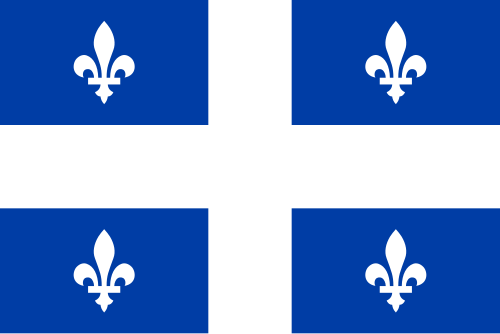


ケベック[a] (フランス語: Québec [kebɛk] )[12]13の州および準州のうち。面積[b]人口では2番目に大きい州あり、カナダの最北端の州でもあります。
ケベック州は、面積150万平方キロメートル(58万平方マイル)で、国境線は12,000キロメートル(7,500マイル)を超え、[13] [14]北米の中央カナダに位置しています。この州は、西はオンタリオ州、北東はニューファンドランド・ラブラドール州、南東はニューブランズウィック州と陸地で接しており、海岸沿いではヌナブト準州と接しています。北はジェームズ湾、ハドソン湾、ハドソン海峡、アンガヴァ湾、北極海、大西洋に面し、南はアメリカ合衆国と国境を接しています。[c]
ケベック州の人口の大部分は、最も人口の多い都市モントリオール、トロワリヴィエール、州都ケベックの間にあるセントローレンス川流域に住んでいます[15]。

1534年から1763年の間、現在のケベックはカナダのフランス植民地であり、ヌーベルフランスで最も発展した植民地でした。七年戦争の後、カナダはイギリスの植民地となり、最初はケベック州(1763年 - 1791年)、次にローワーカナダ(1791年 - 1841年)、そして最後にローワーカナダの反乱の結果、カナダ州(1841年 - 1867年)の一部となりました。 1867年にオンタリオ州、ノバスコシア州、ニューブランズウィック州と連合しました。 1960年代初頭まで、カトリック教会はケベックの社会的、文化的制度において大きな役割を果たしていました。しかし、 1960年代から1980年代の静かな革命により、ケベック州政府がケベック州の公的機関( l'État québécois)において果たす役割が増大しました。
ケベック州政府はウェストミンスター制度のもとで機能しており、自由民主主義と立憲君主制の両方を兼ね備えています。ケベック州首相が政府の長を務めます。独立論争はケベックの政治において大きな役割を果たしてきました。ケベック社会の結束と特異性は、ケベック人権自由憲章、フランス語憲章、ケベック民法という 3 つの独自の法定文書に基づいています。さらに、カナダの他の地域とは異なり、ケベックの法律は混在しており、私法は大陸法制度の下で施行され、公法は慣習法制度の下で施行されています。
ケベック州の公用語はフランス語で、地方語はケベック・フランス語です。ケベック州はフランス語圏の州としては唯一です。ケベック州の経済は、大規模なサービス部門と多様な工業部門によって支えられています。輸出では、世界第6位の輸出量を誇る航空産業、[16]、水力発電、鉱業、医薬品、アルミニウム、木材、製紙といった主要産業に依存しています。ケベック州はメープルシロップの生産地として有名で、コメディーや、ホッケーをカナダで最も人気のあるスポーツの一つにしていることで知られています。また、文化でも有名で、州では文学、音楽、映画、テレビ番組、フェスティバルなどが制作されています。
語源
ケベックという名前は、アルゴンキン語で「狭い水路」または「海峡」を意味する言葉に由来しています。 [17]この名前はもともと、セントローレンス川が崖に囲まれた峡谷に狭まるケベック市周辺の地域を指していました。初期の綴りには、QuébecqやKébecがありました。[18]フランスの探検家サミュエル・ド・シャンプランは、1608年にヌーベルフランスの行政の中心地として使用する植民地の前哨基地にケベックという名前を選びました。[19]
歴史
先住民とヨーロッパの探検隊(1608年以前)

古インディアンは、2万年前から1万4千年前にアジアからアメリカに移住したと理論づけられており、ローレンタイド氷床がおよそ1万1千年前に溶けた後、ケベックの地に定住した最初の人々であった。 [20] [21]彼らから多くの民族文化集団が生まれた。1500年代のヨーロッパ人の探検までには、11の先住民族が存在していた。イヌイットと10の先住民族 、すなわちアベナキ族、アルゴンキン族(またはアニチナベ族)、アティカメク族、クリー族、ヒューロン・ワイアンドット族、マリシート族、ミクマク族、イロコイ族、イヌ族、ナスカピ族である。[22]アルゴンキン族は7つの政治団体に組織され、狩猟、採集、漁労を基本とした遊牧生活を送っていた。[23]イヌイットはハドソン湾とアンガヴァ湾の沿岸で漁業やクジラやアザラシの狩猟を行っていた。[24]
15世紀にビザンチン帝国が崩壊し、西欧人は極東への新たな航路を模索し始めた。[25] 1522年から1523年頃、ジョヴァンニ・ダ・ヴェラッツァーノはフランス国王フランソワ1世を説得し、北西航路を経由してカタイ(中国)への西航路を見つけるための遠征を命じさせた。この遠征は成功しなかったものの、北アメリカ北東部をヌーベルフランスと呼ぶようになった。 [26]フランス王国から命じられた最初の遠征で、ジャック・カルティエは1534年7月24日にガスペに上陸し、ケベックを発見して地図を作成した最初のヨーロッパ人探検家となった。[27] 1535年の2回目の遠征で、カルティエはスタダコナの地を探検し、村とその周辺地域をカナダ(イロコイ語で「村」を意味するカナタに由来)と名付けた。カルティエは、ドンナコナ酋長を含む約10人のセントローレンス・イロコイ族を連れてフランスに戻った。1540年、ドンナコナはサグネ王国の伝説を王に語り、王はこれに感銘を受けて3回目の遠征を命じた。今回はジャン=フランソワ・ド・ラ・ロック・ド・ロベルヴァルが指揮したが、王国発見の目的は達成されなかった。[28]
これらの遠征の後、フランスは財政危機のため、50年間北アメリカからほとんど離れ、イタリア戦争や宗教戦争にも関与した。[29] 1580年頃、毛皮貿易の勃興によりフランスの関心が再燃し、ヌーベルフランスは植民地交易拠点となった。[30] 1603年、サミュエル・ド・シャンプランはセントローレンス川まで旅し、サンマチュー岬でイヌイ族、マリシート族、ミクマク族と防衛協定を結んだ。これは「イギリス軍に対して圧倒的な数の不利にもかかわらず、アメリカにおけるフランス植民地事業の維持に決定的な要因となった」。[31]こうして、アルゴンキン族とヒューロン族に対するイロコイ族の攻撃に対するフランス軍の支援も始まった。これはイロコイ戦争として知られ、1600年代初頭から1700年代初頭まで続いた。[32]
ヌーベルフランス(1608年 - 1763年)

1608年、サミュエル・ド・シャンプラン[33]が探検隊の隊長としてこの地域に戻った。1608年7月3日、アンリ4世の支援を受けて、彼はケベック居住区(現在のケベック市)を設立し、ここをヌーベルフランスとその地域の首都とした。[30]この集落は毛皮交易の恒久的な拠点として建設され、先住民はここで毛皮を金属製品、銃、酒、衣類などのフランスの商品と交換した。[34]ケベック市の設立後、宣教師団がヌーベルフランスに到着した。森の使者とカトリックの宣教師は川カヌーを使って内陸部を探検し、毛皮交易の砦を築いた。[35] [36]
1627年にヌーベルフランスの管理を国王から委任されたセントアソシエ会社は、パリ慣習と領主制度を導入し、カトリック教徒以外の入植を禁じた。[37] 1629年、ケベック市は英仏戦争中に戦闘することなくイギリスの私掠船に降伏した。1632年、イギリス国王はサンジェルマンアンレー条約でケベック市を返還することに同意した。トロワリヴィエールは1634年にシャンプランの要請により設立された。 [38]ポール・ド・ショムデイ・ド・メゾヌーヴは1642年にヴィルマリー(現在のモントリオール)を設立した。
1663年、ヌーベルフランス会社はカナダをルイ14世に譲渡し、国王はヌーベルフランスをフランス王室属州とした。[39]ヌーベルフランスは今や、ケベック市を拠点とするヌーベルフランス主権評議会によって統治される真の植民地となった。総督がカナダとその行政上の従属地であるアカディア、ルイジアナ、プレザンスを統治した。[40]フランス人入植者はほとんどが農民で、「カナディアン」または「アビタン」と呼ばれていた。移民は少なかったが、[41]アビタンの高い出生率のおかげで植民地は成長した。[42] [43] 1665年、カリニャン・サリエール連隊はイロコイ族の侵略から守るために「砦の谷」として知られる一連の要塞を開発し、1,200人の新兵を連れてきた。[44]男女比の不均衡を是正し、人口増加を促進するため、ルイ14世は、約800人の若いフランス人女性(王の娘たち)の植民地への渡航を後援した。[39] 1666年、総督ジャン・タロンは最初の国勢調査を実施し、3,215人の住民を数えた。タロンは農業の多様化と出生促進の政策を制定し、1672年には人口は6,700人に増加した。[45]
ヌーベルフランスの領土はハドソン湾からメキシコ湾まで広がり、五大湖を取り囲むようになった。[46] 1700年代初頭、カリエール総督はモントリオールの大和議を締結し、アルゴンキン語族とヌーベルフランスの同盟を確認しただけでなく、イロコイ戦争に決定的な終止符を打った。[47] 1688年以降、フランスとイギリスは北アメリカの内陸部を支配し毛皮貿易を独占しようと激しく競争し、ヌーベルフランスとその同盟先住民はイロコイ族とイギリスに対して、アメリカ人がフレンチ・インディアン戦争、ケベック州での植民地間戦争と呼ぶ4つの戦争を連続して起こした。[48]最初の3つはウィリアム王戦争(1688年 - 1697年)、アン女王戦争(1702年 - 1713年)、ジョージ王戦争(1744年 - 1748年)である。 1713年、ユトレヒト条約に続いてオルレアン公はアカディアとプレザンス湾をイギリスに割譲したが、サンジャン島と、後にルイブール要塞が建設されたイル・ロワイヤルは保持した。プレザンス湾はヌーベルフランスとフランスを結ぶ主要な交通路であり、アカディアには5,000人のアカディア人が住んでいたため、これらの損失は重大であった。[ 49] [50]ルイブール包囲戦(1745年)ではイギリス軍が勝利したが、戦争による譲歩の後、この都市をフランスに返還した。[51]

フレンチ・インディアン戦争の最後は七年戦争(ケベックでは「征服戦争」)で、1754年から1763年まで続いた。[52] [53] 1754年、ヌーベルフランスの当局がイギリスの貿易業者や入植者を追い出すために攻撃的になったため、オハイオ渓谷の支配をめぐって緊張が高まった。 [54] 1754年、ジョージ・ワシントンは眠っているカナダ兵の集団に奇襲を仕掛けた。これはジュモンヴィル・グレンの戦いとして知られ、戦争の最初の戦いとなった。1755年、チャールズ・ローレンス総督とロバート・モンクトン士官はアカディア人の強制排除を命じた。1758年、イル・ロワイヤルではイギリス軍のジェームズ・ウルフ将軍がルイブール要塞を包囲し占領した。[55] 1759年、ウルフはオルレアン島から3か月間ケベックを包囲した。[56]その後、ウルフはケベックを襲撃し、アブラハム平原の戦いでモンカルムと市の支配権を争った。イギリス軍が勝利した後、国王の副官でラムゼー領主はケベック降伏条約を締結した。1760年の春、レヴィ騎士がケベック市を包囲し、サントフォワの戦いでイギリス軍を塹壕に隠れさせた。しかし、レスティグーシュの戦いでケベック市が陥落した後、ヌーベルフランスに補給するために送られたフランス船が失われたことで、フランスの植民地奪還の努力は終わりを告げた。ピエール・ド・リゴー総督、ヴォードルイユ・カヴァニャル侯爵は1760年9月8日に モントリオール降伏条約に署名した。
ヨーロッパでの七年戦争の結果を待つ間、ヌーベルフランスはジェームズ・マレー総督率いるイギリス軍政下に置かれていた。[57] 1762年、ジェフリー・アマースト司令官はシグナルヒルの戦いでニューファンドランドにおけるフランス軍の駐留を終わらせた。フランスはフォンテーヌブロー条約によりルイジアナ西部とミシシッピ川デルタをスペインに秘密裏に割譲した。1763年2月10日、パリ条約で戦争は終結した。フランスは北アメリカの領土をイギリスに割譲した。[58]こうしてフランスはヌーベルフランスに終止符を打ち、残っていた6万人のカナダ人を見捨てた。彼らはカトリックの聖職者側に付き、イギリス王室への忠誠の誓いを拒否した。[59]フランスとの決別はカナダ人の子孫に変革をもたらし、最終的には新国家の誕生につながることとなった。[60]
イギリス領北アメリカ(1763–1867)
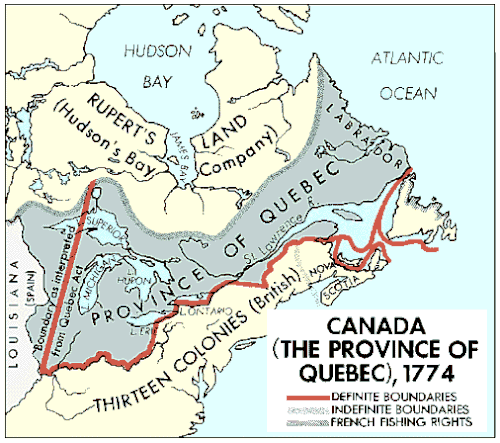
1763年にイギリスがカナダを獲得した後、イギリス政府は王室宣言に基づき、新たに獲得した領土の憲法を制定した。[61]カナダ人は大英帝国政府に従属し、セントローレンス渓谷とアンティコスティ島のケベック州と呼ばれる地域に限定された。南部の植民地で不安が高まる中、イギリスはカナダ人がアメリカ独立戦争となるものを支持するのではないかと懸念した。イギリス王室への忠誠を確保するため、ジェームズ・マレー総督と後にガイ・カールトン総督は妥協の必要性を訴え、 1774年にケベック法[62]が制定された。この法律により、カナダ人は市民慣習を取り戻し、領主制度に戻り、フランス語の使用を含む特定の権利を取り戻し、古い領土であるラブラドール、五大湖、オハイオ渓谷、イリノイ地方、インディアン準州を再取得することができた。[63]
1774年という早い時期に、分離主義者の13植民地による大陸会議は、カナダ人を結集させようと試みた。しかし、 1775年のケベック侵攻で、大陸会議の軍隊はイギリス軍の反撃を阻止できなかった。カナダ人のほとんどは中立を保ったが、 1777年のサラトガ作戦では、いくつかの連隊がアメリカ軍と同盟を結んだ。1783年のパリ条約調印でイギリスは反乱植民地の独立を承認し、イリノイとオハイオ渓谷を新設のアメリカ合衆国に譲渡し、北緯45度線を国境として定め、ケベックの面積を大幅に縮小した。
アメリカからイギリス帝国ロイヤリストの一部がケベックに移住し、さまざまな地域に居住した。 [64]ケベックに適用されていたフランスの領主制度下の法的権利に不満を持ち、慣れ親しんだイギリスの法制度の使用を望んだロイヤリストは、 1791年の憲法が制定されるまでイギリス当局に抗議し、オタワ川から始まる2つの異なる植民地、西のアッパー・カナダ(主にアングロ・プロテスタント)と東のローワー・カナダ(フランコ・カトリック)にケベック州を分割した。ローワー・カナダの土地はセントローレンス川の沿岸、ラブラドール、アンティコスティ島で構成され、領土は北はルパート・ランド、南、東、西はアメリカ、ニューブランズウィック、アッパー・カナダとの国境まで広がった。アッパーカナダとローワーカナダの創設により、ロイヤリストはイギリスの法律と制度の下で生活することができ、カナダ人はフランスの市民法とカトリックの信仰を維持できました。ハルディマンド総督は、ジョージ3世に忠誠を誓う意思のある人にはオンタリオ湖の北岸の土地を無料で提供することで、ケベック市とモントリオールからロイヤリストを引き離しました。米英戦争中、シャルル=ミシェル・ド・サラベリーはシャトーゲーの戦いでカナダ軍を勝利に導き、英雄となりました。この敗北により、アメリカ軍はカナダ征服の主要な戦略的取り組みであるセントローレンス方面作戦を断念しました。

次第に、人々を代表する下カナダ立法議会は、国王およびその任命された代表者の上位権威と対立するようになった。1791年以降、下カナダ政府はカナダ党から批判され、異議を唱えられた。1834年、カナダ党は92の決議案を提出し、イギリス王室への信頼喪失を表明した。1837年の公開集会を通じて不満が高まり、1837年に下カナダ反乱が始まった。 [66] 1837年、ルイ=ジョセフ・パピノーとロバート・ネルソンは下カナダの住民を率いて愛国者と呼ばれる武装集団を結成した。彼らは1838年に独立宣言を行い、すべての市民に差別なく権利と平等を保証した。[67]彼らの行動は、下カナダと上カナダの両方で反乱を引き起こした。パトリオット軍は最初の戦いであるサン=ドニの戦いで勝利を収めた。しかし、彼らは組織化されておらず装備も不十分だったため、サン=シャルルの戦いでイギリス軍に敗れ、サン=トゥスタシュの戦いでも敗北した。[65]
反乱への対応として、ダーラム卿は調査を行い、解決策を英国議会に提示する報告書を作成するよう依頼された。 [68]ダーラムは、カナダ人を文化的に同化させ、英語を唯一の公用語とすることを推奨した。これを実行するため、英国は1840年の統合法を可決し、アッパー・カナダとローワー・カナダを1つの植民地、カナダ州に統合した。ローワー・カナダはフランス語を話し人口密度の高い東カナダとなり、アッパー・カナダは英語を話し人口密度の低い西カナダとなった。この統合は、当然ながら、1867年まで政治的不安定の主な原因であった。人口の差にもかかわらず、東カナダと西カナダはカナダ州の立法議会で同数の議席を獲得し、代表権の問題を引き起こした。当初、人口規模が優勢だったため、東カナダの代表権は低かった。しかし、時が経つにつれて、イギリス諸島から西カナダへの大規模な移民が発生した。両地域は引き続き同等の代表権を持っていたため、今度はカナダ西部が代表権が不足していた。代表権の問題は「人口による代表権」に関する議論で疑問視された。イギリス人は居住地であるカナダを指して「カナダ人」という用語を使い始めた。これまで「カナダ人」として認識されていたフランス人は、「カナダのフランス人」として「フランス系カナダ人」という名前で民族コミュニティと同一視されるようになった。 [69]
新しい土地へのアクセスは依然としてシャトー一派によって独占されていたため問題が残っていたため、カナダ人のニューイングランドへの脱出が始まり、その後100年間続いた。この現象は大流血として知られ、カナダ国家の存続を脅かした。反乱の失敗に続いてロンドンから命じられた大規模なイギリス人移民は、この状況を悪化させた。これに対抗するため、教会は揺りかごの復讐政策を採用した。1844年、カナダ州の州都はキングストンからモントリオールに移された。[70]
1849年、1837年から1838年の反乱で財産を破壊されたフランス系カナダ人に補償する法律である反乱損失法案が成立した後、英語系カナダ人の暴徒がモントリオールの国会議事堂に放火したことにより、政情不安は頂点に達した。 [71]ボールドウィン=ラフォンテーヌ連合とエルギン卿の助言から生まれたこの法案は、責任ある政府の概念を確立した点で重要であった。[72] 1854年、領主制度が廃止され、グランド・トランク鉄道が建設され、カナダ・アメリカ相互条約が実施された。1866年、下カナダ民法典が採択された。[73] [74] [75]
カナダの州(1867年~現在)
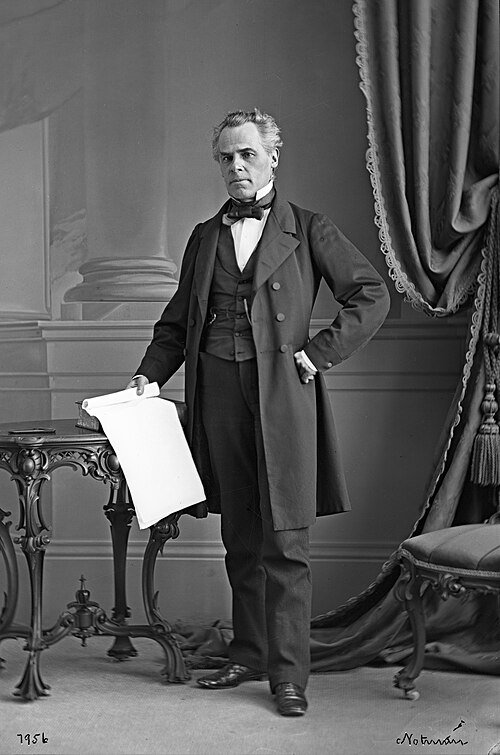
1864年、シャーロットタウン会議とケベック会議において、カナダ州、ニューブランズウィック州、ノバスコシア州の間でカナダ連邦設立の交渉が始まりました。
ジョルジュ=エティエンヌ・カルティエは愛国者として戦った後、カナダ州の政界に入り、共同首相の一人となり、イギリス領北アメリカ州の統合を主張した。彼はケベック会議で指導的立場に就き、カナダ連邦の基礎となるケベック決議を作成した。 [76]連邦成立の父として認められた彼は、当初はフランス系カナダ人の領土の歴史的中心地から成り、フランス系カナダ人が多数派の地位を維持する可能性が高いケベック州の設立を主張し、成功した。
1866年のロンドン会議の後、ケベック決議は1867年のイギリス領北アメリカ法として実施され、1867年7月1日に発効し、カナダが誕生しました。カナダは、ニューブランズウィック、ノバスコシア、オンタリオ、ケベックの4つの創設州で構成されていました。最後の2つは、カナダ州を分割してできたもので、ケベックにはローワーカナダ、オンタリオにはアッパーカナダの古い境界線を使用しました。1867年7月15日、ピエール=ジョセフ=オリヴィエ・ショーヴォーがケベックの初代首相になりました。
連邦成立から第一次世界大戦まで、カトリック教会は最盛期を迎えた。聖職者国家主義者の目的は、家族、フランス語、カトリック教会、田舎暮らしといった伝統的社会の価値を促進することだった。北西部反乱、マニトバ州学校問題、オンタリオ州規則17などの出来事により、フランス系カナダ人の権利の促進と擁護が重要な問題となった。[77]カトリック教会の庇護とアンリ・ブラッサの政治活動の下、カリヨンの旗や、聖ジャン・バティスト記念日に作曲された愛国歌「オー・カナダ」など、国家の誇りのシンボルが作られた。 1900年のデジャルダン人民銀行、1909年のカナダホッケークラブ、1910年のル・ドゥヴォワール、1912年のカナダフランス語会議、1917年の国民行動など、多くの組織がフランス系カナダ人の承認を奉献した。1885年、自由主義派と保守派の国会議員は、ルイ・リエルの処刑に介入しなかった前政権への怒りから国民党を結成した。[78]
1898年、カナダ議会は1898年ケベック境界拡張法を制定し、カナダが1870年にハドソン湾会社から購入したルパートランドの一部をケベックに与えた。 [79]この法律により、ケベックの境界は北に拡大した。1909年、政府は木材とパルプをケベックで加工することを義務付ける法律を可決し、ケベックの労働力ではなく完成品を米国に輸出することを認めることで、大流血の減少を遅らせるのに役立った。 [80] 1910年、アルマン・ラヴェルニュはケベック初の言語立法であるラヴェルニュ法を可決した。この法律は、運輸会社や公共事業会社が発行する切符、書類、請求書、契約書に英語に加えてフランス語の使用を義務付けた。[81] 1911年の連邦選挙では、聖職者国家主義者は最終的に支持を失い始めました。1912年、カナダ議会は1912年ケベック境界拡大法を制定し、ケベックにルパートランドの別の部分、アンガヴァ地区を与えました。[82]これにより、ケベックの境界はハドソン海峡の北まで拡大されました。
第一次世界大戦が勃発すると、カナダは自動的に参戦し、多くの英語系カナダ人が志願兵として参加した。しかし、彼らはイギリス帝国とのつながりを感じておらず、カナダへの直接の脅威もなかったため、フランス系カナダ人は戦う理由を見出せなかった。1916年後半には、死傷者により増援に問題が生じ始めた。連邦政府内では、ほぼすべてのフランス語圏議員が徴兵に反対し、ほぼすべての英語圏議員が徴兵を支持したため、多大な困難が生じたが、1917年8月29日に兵役法が制定された。 [83]フランス系カナダ人は、現在1917年の徴兵危機と呼ばれているものに抗議し、ケベック暴動につながった。[84]
1919年、州の住民投票の結果、蒸留酒の禁止が制定された。[85]しかし、1921年にアルコール飲料法によりケベック酒類委員会が設立され、この禁止は廃止された。[86] 1927年、英国枢密院司法委員会はケベック北東部とラブラドール南部の間に明確な境界線を引いた。しかし、ケベック政府は司法委員会の裁定を認めず、現在も続く境界紛争を引き起こした。1931年にウェストミンスター規程が制定され、カナダとその州を含む自治領の英国からの自治権と、連邦における自由な連合が確認された。[87] 1930年代、ケベック経済は大恐慌の影響を受けた。これは、ケベックの輸出品に対する米国の需要が大幅に減少したためである。 1929年から1932年の間に失業率は8%から26%に上昇した。この状況を改善するために、ケベック州政府はインフラ整備プロジェクト、遠隔地への植民地化キャンペーン、農民への財政援助、そしてカナダの雇用保険の前身である雇用保険制度を制定した。[88]
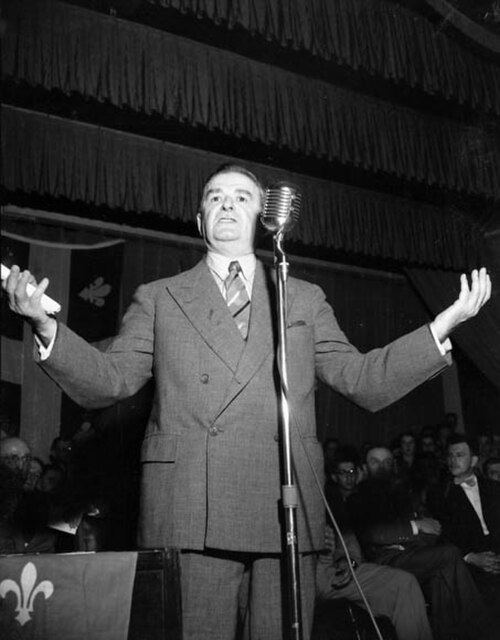
フランス系カナダ人は第二次世界大戦中も徴兵に反対し続けた。カナダが1939年9月に宣戦布告したとき、連邦政府は海外での任務のために兵士を徴兵しないと誓約した。戦争が進むにつれて、フランス系カナダ人の強い反対にもかかわらず、ますます多くの英語系カナダ人が徴兵を支持するようになった。1942年の世論調査で、ケベック州の住民の73%が徴兵に反対し、他のすべての州では80%以上が徴兵に賛成したのを受けて、連邦政府は海外での任務に関する法案80を可決した。抗議運動が爆発し、徴兵に反対するブロック・ポピュレールが出現した。 [83]フランス系カナダと英語系カナダの価値観の著しい違いから、「二つの孤独」という 表現が広まった。
徴兵危機の後、ユニオン・ナショナル党のモーリス・デュプレシが権力を握り、グランド・ノワールサールとして知られる保守的な政策を実施した。彼は、台頭しつつある福祉国家ではなく、州の自治、ケベックのカトリックとフランス語圏の伝統、自由放任主義のリベラリズムを守ることに重点を置いた。[89]しかし、1948年には早くも、フランス系カナダ人社会は、テレビ、ベビーブーム、労働者の対立、田舎の電化、中流階級の出現、田舎からの脱出と都市化、大学と官僚機構の拡大、高速道路の建設、文学と詩のルネッサンスなどの社会的変化に対応して、新しいイデオロギーと願望を発展させ始めた。
現代のケベック(1960年~現在)

静かな革命は近代化、世俗化、社会改革の時代であり、フランス系カナダ人は劣悪な社会経済的地位と、英語が多数派を占める州におけるフランス語を話す少数派の文化的同化に対する懸念と不満を表明した。その結果、現代のケベック人のアイデンティティとケベック・ナショナリズムが形成された。[90] [91] 1960年、ケベック自由党は「今こそ変化の時」というスローガンを掲げ、2議席の多数派で政権を握った。この政府は社会政策、教育、健康、経済発展の改革を行った。ケベック貯蓄貸付金庫、労働法、社会省、教育省、ケベックフランス語局、賃貸人協会、金融一般社団法人が設立された。1962年、ケベック州政府はサンジャック通りの金融シンジケートを解体した。ケベック州は電力の国有化を開始した。ケベック州は、民間電力会社をすべて買収し、新しいハイドロ・ケベック・ダムを建設するために、1962年に米国から3億ドル、 [92] 1964年にブリティッシュコロンビア州から1億ドルの融資を受けた。[93]
静かな革命は、1962年に自由党が掲げた「我が家の主人」というスローガンによって特に特徴づけられ、経済と天然資源を支配していた英米の複合企業に対し、フランス系カナダ人の自由を求める集団的意志を表明した。[94]下級聖職者と信徒の対立の結果、国家機関は教会の援助なしにサービスを提供するようになり、市民社会の多くの部分がより世俗的になり始めた。1965年、二言語・二文化主義に関する王立委員会[95]は、ケベックの独特の性格を強調する予備報告書を書き、ケベックに最低限の配慮を保証する政治的姿勢である開かれた連邦主義を推進した。[96] [97]静かな革命中のケベックに有利になるように、レスター・B・ピアソンは開かれた連邦主義の政策を採用した。[98] [99] 1966年、ユニオン・ナショナルが再選され、大規模な改革を続けた。[100]

1967年、フランスのシャルル・ド・ゴール大統領が、万博に出席するためケベックを訪れた。そこで、彼は10万人以上の聴衆に演説し、最後に「自由なケベック万歳」と叫んだ。この宣言は、ケベックに多大な影響を与え、急成長を遂げていた現代のケベック主権運動を後押しし、フランスとカナダの間に政治的危機をもたらした。これに続いて、さまざまな民間団体が発展し、 1970年の十月危機のように、時には公権力と対立した。[101] 1967年のフランス系カナダ三部会の会議は、アメリカのフランス語話者、特にカナダのフランス語話者との関係が断絶する転換点となった。この崩壊はケベック社会の発展に影響を与えた。[102]
1968年、階級闘争と意識の変化が激化した。[103] 「ケベックの選択」は、連邦主義と主権主義の教義を対立させることで、州の政治的将来に関する憲法論争を引き起こした。1969年、ケベックの発展に資する言語的背景を導入するために、連邦公用語法が可決された。 [104] [105] 1973年、ロバート・ブラッサの自由主義政権は、ラ・グランド川でジェームズ湾プロジェクトを開始した。1974年、政府は公用語法を制定し、フランス語をケベックの公用語とした。1975年には、人権と自由の憲章とジェームズ湾およびケベック北部協定を確立した。

ケベック州初の近代的主権主義政府は、ルネ・レヴェスク率いるケベック党が1976年ケベック州総選挙で政権を握ったことで実現した。[106]翌年、フランス語憲章が発効し、フランス語の使用が増加した。1966年から69年にかけて、フランス系カナダ三部会は、ケベック州が国の基本的な政治的環境であり、自決権を持つことを確認した。[107] [108] 1980年の主権に関する国民投票では、60%が反対した。[109]国民投票後、レヴェスクはオタワに戻り、憲法改正の交渉を開始した。1981年11月4日、キッチン合意が成立した。他の9州の代表団と連邦政府は、ケベック代表団が夜中に帰省したため欠席のまま合意に達した。[110]このため、国会はカナダ憲法を国有化し修正を加えた1982年の新憲法を承認しなかった。 [111] 1982年の改正はケベック州が同意しなかったにもかかわらず、ケベック州に適用された。[112]
1982年から1992年にかけて、ケベック州政府の姿勢は連邦改革を優先する方向に変わった。マルロニー政権とブラッサ政権による憲法改正の試みは、1987年のミーチ・レイク協定と1992年のシャーロットタウン協定で失敗に終わり、ブロック・ケベコワの創設につながった。[113] [114] 1995年、ジャック・パリゾーはケベック州のカナダからの独立に関する国民投票を求めた。この協議は独立派にとって失敗に終わったが、結果は50.6%の「反対」と49.4%の「賛成」という僅差だった。[115] [116] [117]
1998年、カナダ最高裁判所がケベック州分離独立事件で下した判決を受けて、カナダ議会とケベック州議会は、それぞれの政府が次の国民投票で行動するための法的枠組みを定義した。2003年10月30日、国民議会は満場一致で「ケベック州の人々は国家を形成する」ことを確認する投票を行った。[118] 2006年11月27日、庶民院は「本院はケベック人が統一カナダの中で国家を形成することを認める」と宣言する象徴的な動議を可決した。 [119] 2007年、ケベック党は国民議会で野党に転落し、自由党が主導権を握った。2011年のカナダ連邦選挙で、ケベック州の有権者はブロック・ケベコワを拒否し、それまでは少数派だった新民主党(NDP)を支持した。 NDPのロゴがオレンジ色であることから、これは「オレンジの波」と呼ばれた。[120]その後3回の自由党政権を経て、2012年にケベック党が政権を取り戻し、党首のポーリーヌ・マロワがケベック初の女性首相となった。[121]ケベック自由党はその後2014年に政権に復帰した。 [122] 2018年、ケベック未来連合が州総選挙で勝利した。[123] 2020年から2021年にかけて、ケベック州はCOVID-19パンデミック対策を講じた。[124] 2022年、ケベック州首相フランソワ・ルゴー率いるケベック未来連合は、州総選挙で議席の過半数を増やした。 [125]
_Location_Map.svg/500px-Canada_(New_France)_Location_Map.svg.png)


地理
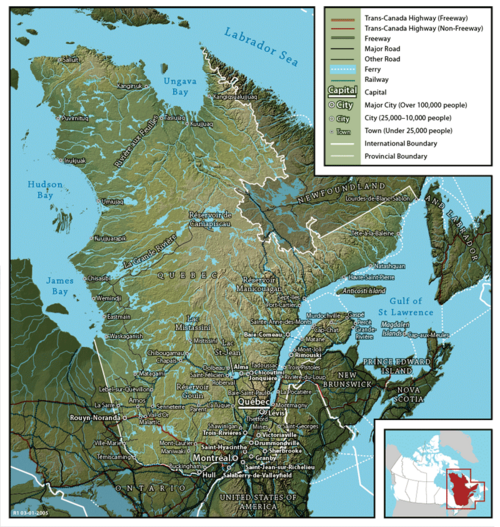
カナダ東部に位置するケベック州は、フランスやテキサス州のほぼ3倍の面積を占めています。ケベック州の大部分は人口が非常にまばらです。[126]最も人口の多い自然地理学的地域は、五大湖・セントローレンス低地です。肥沃な土壌と低地の比較的温暖な気候の組み合わせにより、この渓谷はケベック州で最も農業が盛んな地域となっています。田園地帯は、川から伸びる狭い長方形の土地に分かれており、その歴史は領主制度にまで遡ります。
ケベック州の地形は、土壌の構成、気候、水辺への近さが異なるため、地域によって大きく異なります。ラブラドル半島を含むケベック州の領土の95%以上は、カナダ楯状地内にあります。[127]一般的に、非常に平坦で露出した山岳地帯で、ケベック南部のローレンシャン山脈、ケベック中央部のオティッシュ山脈、アンガヴァ湾近くのトルンガット山脈などの高地が点在しています。低・中高度の山頂はケベック州西部から最北端まで伸びていますが、高高度の山々は最東端の首都圏にそびえています。ケベック州の最高地点は、英語でマウント・コーブヴィックとして知られるモン・ディベルヴィルで、標高1,652メートル(5,420フィート)です。[128]楯状地のラブラドル半島部分では、ヌナヴィクの最北端地域にはウンガヴァ半島が含まれ、主にイヌイットが住む平坦な北極ツンドラで構成されています。さらに南には、東カナダ楯状地のタイガ生態地域と中央カナダ楯状地の森林があります。アパラチア地域には、ケベック州の南東の境界に沿って古代の山々が狭く連なっています。[129]

ケベック州は世界最大級の淡水埋蔵量を誇り[130]、州表面の12% [131]を占め、世界の再生可能な淡水の3%を占めています[132]。50万以上の湖と4,500の川[ 130]が、セントローレンス湾と北極海を通り、ジェームズ湾、ハドソン湾、ウンガヴァ湾から大西洋に注いでいます。最大の内陸水域はカニアピスカウ貯水池で、ミスタシニ湖は最大の自然湖です[133] 。セントローレンス川には、世界最大級の内陸大西洋港がいくつかあります。1959年以来、セントローレンス水路は大西洋と五大湖の間を航行可能な形で結んでいます。
ケベック州の公有地は州土の約92%を占め、ほぼすべての水域を含む。保護地域は、約20の異なる法的指定に分類できる(例:例外的な森林生態系、保護された海洋環境、国立公園、生物多様性保護区、野生生物保護区、開発管理区域(ZEC)など)。[134]現在、ケベック州では2,500以上の場所が保護地域となっている。[135] 2013年現在、保護地域はケベック州の領土の9.14%を占めている。[136]
気候
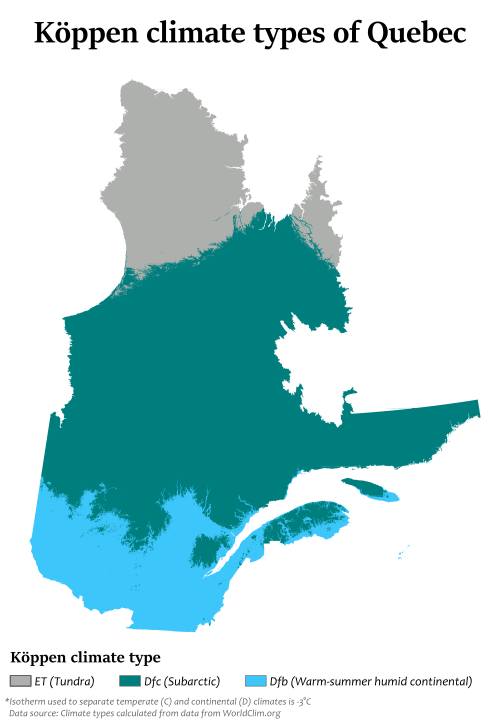
ケベック州の気候は一般的に寒く湿気が多いが、緯度、海、標高の影響で変化する。[137]北アメリカ大陸の中心部と大西洋の両方からの嵐の影響で、年間を通じて降水量が多く、ほとんどの地域で1,000 mm (39インチ) 以上の降水量があり、多くの地域では300 cm (120インチ) 以上の降雪がある。[138]夏には、竜巻や激しい雷雨などの厳しい気象パターンが時折発生する。[139]

ケベック州は、北極圏、亜北極圏、湿潤大陸性、東部海洋性の4つの気候帯に分かれています。南から北にかけて、平均気温は夏は25〜5℃(77〜41℉)、冬は−10〜−25℃(14〜−13℉)です。[140] [141]猛暑や猛寒の時期には、夏には気温が35℃(95℉)[142]、ケベック州の冬には−40℃(−40℉)[142]に達することがあります。北緯51度〜58度に及ぶケベック州中央部のほとんどは亜北極気候(ケッペンのDfc)です。 [137]冬は長く、非常に寒く、雪が降り、カナダ東部で最も寒い部類に入ります。一方、夏は暖かいですが、緯度が高く北極気団の影響が大きいため非常に短いです。降水量も、標高の高い場所を除いて、南部よりもやや少ないです。ケベック州北部は北極気候(ケッペンのET)で、冬は非常に寒く、夏は短く非常に涼しいです。[137]この地域への主な影響は、北極海流(ラブラドル海流など)と高緯度北極圏からの大陸性気団です。
最高気温は40.0 °C (104.0 °F)、最低気温は-51.0 °C (-59.8 °F) でした。[143]冬の降水量史上最高記録は2007年から2008年の冬で、ケベック市周辺では5メートルを超える積雪となりました。[144]しかし、1971年3月には「世紀の大吹雪」が発生し、ケベック州南部の多くの地域で24時間以内にモントリオールで40cm (16インチ)、モン・アピカで80cm (31インチ) を超える積雪となりました。2010年の冬は過去60年以上で最も暖かく、最も乾燥した冬となりました。[146]
動植物

1. 中部北極圏ツンドラ
2. 低北極ツンドラ
3. トルンガット山ツンドラ
4. 東カナダ楯状地タイガ
5. 南ハドソン湾タイガ
6. カナダ中部楯状地森林
7. カナダ東部の森林
8. 東部森林/寒帯移行
9. 五大湖東部低地森林
10. ニューイングランド/アカディアの森
11. セントローレンス湾低地森林
州の地質とさまざまな気候のため、ケベック州には多くの広大な植生地域がある。これらの地域は、最北から最南の順に、ツンドラ、タイガ、カナダ北方林(針葉樹)、混合林、落葉樹林となっている。[127]アンガヴァ湾とハドソン海峡の端にはツンドラがあり、その植物は地衣類に限られ、年間の成長日は50日未満である。さらに南に行くと、気候はカナダ北方林の成長に適しており、北はタイガに接している。ツンドラほど乾燥していないタイガは、カナダ楯状地の亜北極地域に関連しており[147]、植物(600種)と動物(206種)の両方がより多く生息していることが特徴です。タイガはケベック州の総面積の約20%を占めています。[127]カナダ北方林は、ケベック州のカナダ楯状地と州の上部低地にまたがる3つの森林地帯のうち、最北に位置し、最も生物が豊富だ。気候が温暖なため、生物の多様性も高く、約850種の植物と280種の脊椎動物がいる。混交林は、カナダ北方林と落葉樹林の移行地帯である。この地域には、比較的涼しい気温にもかかわらず、植物(1000種)と脊椎動物(350種)の多様性がある。生態帯混交林は、ローレンシャン山脈、アパラチア山脈、東部低地の森林に特徴的である。[147] 3番目に北にある森林地帯は、落葉樹林が特徴である。その気候のため、この地域には1600種を超える維管束植物と440種の脊椎動物 を含む、種の多様性が最も大きい。
ケベック州の森林総面積は750,300 km 2 (289,700 sq mi)と推定されている。[148]アビティビ・テミスカマングからノースショアにかけての森林は、主にモミ、ジャックパイン、アメリカトウヒ、アメリカトウヒ、アメリカアメリカギリなどの針葉樹で構成されている。五大湖・セントローレンス低地の落葉樹林は、主にサトウカエデ、アカカエデ、アメリカトネリコ、アメリカブナ、バターナット(白クルミ)、アメリカニレ、バスウッド、ビターナットヒッコリー、ノーザンレッドオークなどの落葉樹種と、イースタンホワイトパインやノーザンホワイトシダーなどの針葉樹で構成されている。カバノキ、トネリコ、ナナカマドの分布域はケベック州の領土の半分以上を占めています。[149]
セントローレンス川の河口と湾の生物多様性[150]には、シロナガスクジラ、シロイルカ、ミンククジラ、ハープアザラシ(ミミズアザラシ)などの水生哺乳類の野生生物が含まれます。北欧の海洋動物には、セイウチとイッカクが含まれます。[151]内水面には、オオクチバス、アメリカカワカマス、ウォールアイ、Acipenser oxyrinchus、マスキールング、大西洋タラ、ホッキョクイワナ、カワマス、トムコッド(トムコッド)、大西洋サケ、ニジマスなどの小型から大型の淡水魚が生息しています。[152]
ケベック州南部でよく見られる鳥類には、アメリカコマツグミ、スズメ、ハゴロモガラス、マガモ、コガラ、アオカケス、アメリカガラス、コガラ、一部のウグイス類やツバメ類、ムクドリ、カワラバトなどがいます。[153]鳥類には、イヌワシ、ハヤブサ、シロフクロウ、ハクトウワシなどの猛禽類が含まれます。ケベック州で見られる海鳥や半水生鳥類は、主にカナダガン、ミミヒダカウ、カツオドリ、セグロカモメ、オオアオサギ、カナダヅル、ニシツノメドリ、アビ類です。[ 154 ]
大型の陸上野生動物には、オジロジカ、ヘラジカ、ジャコウウシ、カリブー(トナカイ)、アメリカクロクマ、ホッキョクグマなどがいます。中型の陸上野生動物には、クーガー、コヨーテ、東部オオカミ、ボブキャット、ホッキョクギツネ、キツネなどがいます。最もよく見られる小動物には、東部灰色リス、カンジキウサギ、グラウンドホッグ、スカンク、アライグマ、シマリス、カナダビーバーなどがいます。
政府と政治
.jpg/500px-Quebec_City_(14765614666).jpg)
ケベック州はウェストミンスター制度に基づいており、自由民主主義と議会制の立憲君主制の両方を採用している。ケベック州の政府長は首相(フランス語ではプレミア・ミニストルと呼ばれる)であり、一院制の国民議会(Assemblée Nationale)で最大政党を率いており、この議会からケベック州執行評議会が任命される。国庫大臣は、国家の管理機能を果たす執行評議会の大臣をサポートする。副総督はカナダ国王を代表する。[155] [156]
ケベック州には、カナダ下院に78人の国会議員がいる。[157]彼らは連邦選挙で選出される。カナダ上院レベルでは、ケベック州はカナダ首相の助言に基づいて任命される24人の上院議員によって代表される。[158]
ケベック州政府は、その専属管轄区域内で行政および警察権を有する。第43回議会は、ケベック未来連合(CAQ)、ケベック自由党(PLQ)、ケベック連帯(QS)、ケベック党(PQ)の各党と無所属議員によって構成されている。ケベック州には25の公式政党がある。[159]
ケベック州には、カナダ国内で州を代表し、州の利益を守るための3つの事務所がある。モンクトンに東部全州を、トロントに西部全州を、そしてオタワに連邦政府をそれぞれ1つずつ設置している。これらの事務所の使命は、他のカナダ政府の近くにケベック州政府の組織的存在を確保することである。[160] [161]
区分
2021年に森林・野生生物・公園省が制定したケベック州の生態学的分類は9段階で示されており、植生(生理、構造、構成)の特徴と物理的環境(起伏、地質、地形、水路)の両方を考慮しながら、ケベック州全体の陸上生態系の多様性を網羅しています。[129]
- 植生帯
- 植生サブゾーン
- 生物気候領域
- 生物気候サブドメイン
- 生態地域
- 生態学的サブリージョン
- 地域景観ユニット
- エコロジカル地区
- 植生段階
ケベック州の領土は、以下の17の行政地域 に分かれています。 [162] [163]
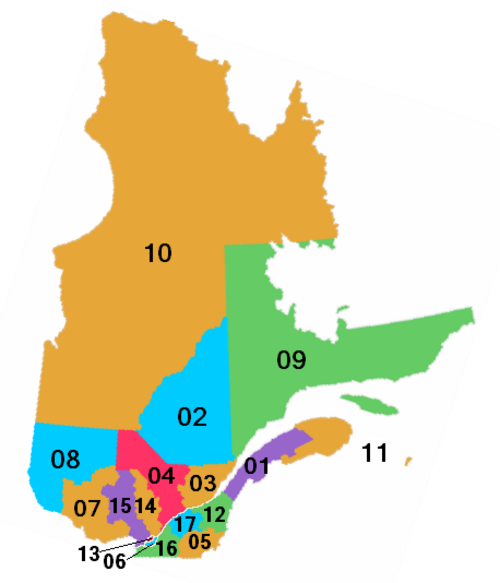
この州には以下の区分もあります。
ケベック州は、自治体として以下のもので構成されています。
- 1,117の各種地方自治体:
- 89の地方郡自治体または RCM (自治体地域自治体、MRC )
- 2 つの都市コミュニティ( communautés métropolitaines )
- 地方カティヴィク行政
- 未編入地域[ 165]
省庁と政策
ケベック州憲法は、一連の司法判決と立法文書で定義された一連の社会的、文化的伝統に定められており、その中には、国民議会法( Loi sur l'Assemblée Nationale)、行政法( Loi sur l'éxecutif)、ケベック選挙法( Loi électorale du Québec)などがある。[166]その他の注目すべき例としては、人権自由憲章、フランス語憲章、ケベック民法などがある。[167]
ケベックの国際政策は、1965年に策定されたジェラン=ラジョワ原則 [ 168]に基づいている。ケベックの国際関係省が国際政策を調整する一方、ケベックの代表団が外国における主な交渉相手である。ケベックは、カナダで唯一、国際関係に関する州の権限を独占的に執行する省庁を設置している州である。[169]
ケベック州は2006年以来、気候変動に関する京都議定書の目的を達成するためにグリーンプランを採用している。 [170]持続可能な開発、環境、気候変動対策省(MELCC)は、環境政策の適用を担当する主な機関である。ケベック自然保護協会(SEPAQ)は、国立公園と野生生物保護区の管理を担当する主な機関である。[171] 2019年、モントリオールの路上で約50万人が気候抗議に参加した。[172]
ケベック州の農業は、1978年以来、農業地域規制の対象となっている。[173]都市の無秩序な拡大という問題に直面し、ケベック州総面積の2%を占める肥沃な土地を保護するために農業地域が設定された。ケベック州の森林森林管理局の責任である。[174]農業生産者組合( UPA)は、林業労働者を含む組合員の利益を保護することを目指しており、農業・漁業・食糧省(MAPAQ)およびエネルギー・天然資源省と共同で活動している。
ケベック州従業員社会連帯省は、ケベック州従業員とその地域雇用センター (CLE) を通じて社会と労働力の開発を監督する任務を負っています。[175]この省は、親の安全保障制度(QPIP) の管理や、困っている人々への最後の手段の経済的支援も担当している。規範委員会、フランス安全保障委員会[176]と、従業員の組合と雇用主の間で締結された協定の執行を担当する主要機関です。 。[177]
ケベック州税務局は税金を徴収する責任機関である。同局は累進課税、9.975%の売上税、[178]その他の州税(炭素税、法人税、キャピタルゲイン税など)、均等化支払い、他州からの移転支払い、直接支払いを通じて収入を得ている。[179]いくつかの基準によると、ケベック州の住民は最も税金を課せられている。[180] 2012年の調査では、「ケベック州の企業はカナダの平均よりも26%多く税金を支払っている」と示されている。[181]
ケベック州の移民政策は、多元主義と異文化間主義の原則に基づいています。ケベック州移民・文化共同体省が移民の選抜と統合を担当しています。[182]移民プログラムは、フランス語が話せ、犯罪者になるリスクが低く、需要のあるスキルを持つ移民を優遇しています。
ケベック州の保健社会サービスネットワークは、保健社会サービス省によって管理されている。このネットワークは、95の地域サービスネットワーク(RLS)と18の保健社会サービス機関(ASSS)から構成されている。ケベック州の保健システムは、ケベック州民全員がサービスを受けられるようにするために活動するケベック医療保険機構(RAMQ)によって支えられている。[183]
ケベック州家族福祉省は、小中学生センター( ;「幼児のためのセンター」)を運営している。ケベックの教育制度は、教育高等教育省(小学校と中学校)、高等教育省(CEGEP)、ケベック州教育評議会(大学とカレッジ)によって運営されている。 [184] 2012年の高等教育の年間授業料は2,168カナダドル(1,700ユーロ)で、カナダの平均授業料の半分以下だった。その理由の1つは、静かな革命中にCEGEPSが設立されたときに、授業料が比較的低いレベルに固定されていたことである。2012年にジャン・シャレスト政権が大学の授業料を大幅に値上げすることを決定したとき、学生の抗議が勃発した。[185]これらの抗議活動のおかげで、ケベック州の授業料は比較的低いままです。
外部関係
ケベックの最も親密な国際パートナーは米国であり、ケベックは米国と長く良好な歴史を共有しています。歌、映画、ファッション、食べ物など、アメリカ文化の産物はケベックの文化に大きな影響を与えています。
ケベックはフランス帝国の一部であり、両地域で同じ言語を使用しているため、ケベックとフランスには歴史的な関係があります。フランス・ケベック連邦とフランコフォニーは、ケベックとフランスの関係を築くために使用されているツールの一部です。パリでは、 1980年にケベック広場が開設されました。 [186]ケベックはイギリスとも歴史的な関係があり、大英帝国の一部でした。ケベックとイギリスは、同じ国家元首である国王シャルル3世を共有しています。
ケベック州は、18か国に32の事務所のネットワークを持っています。これらの事務所は、外国でケベック州を代表する目的で設置されており、ケベック州国際関係省[update]の監督下にあります。ケベック州は、他のカナダの州と同様に、いくつかのカナダ大使館や総領事館にも代表者を置いています。2019年現在、ケベック州政府は、ブリュッセル、ロンドン、メキシコシティ、ミュンヘン、ニューヨーク、パリ、東京に総代表(総代理人) 、アトランタ、ボストン、シカゴ、ヒューストン、ロサンゼルス、ローマに代表を置いています。また、バルセロナ、北京、ダカール、香港、ムンバイ、サンパウロ、上海、ストックホルム、ワシントンには、より限定的なサービスを提供するディレクターが率いる事務所があります。さらに、ベルリン、フィラデルフィア、青島、ソウル、シリコンバレーに、アンテナと呼ばれる名誉領事に相当する役職の者がいます。
ケベック州はユネスコにも代表を置き、米州機構にも参加している。[187]ケベック州はフランコフォニー国会議員会議および国際フランコフォニー機構の加盟国である。
法

ケベック州法は連邦政府と州政府が共同で責任を負っている。連邦政府は刑法、外交問題、カナダの商業、州間交通、電気通信の規制に関する法律を担当している。[188]州政府は私法、司法行政、社会扶助、医療、教育、天然資源などのいくつかの社会分野を担当している。[188]
ケベック州法は、2つの司法伝統(大陸法とコモンロー)と4つの古典的な法源(立法、判例法、学説、慣習法)の影響を受けています。[189]ケベック州の私法は、個人(自然人または法人)間のすべての関係に影響を及ぼし、主にケベック州議会の管轄下にあります。カナダ議会も、特に銀行、破産、結婚、離婚、海事法に対する権限を通じて、ケベック州の私法に影響を与えています。[190]ケベック民事法[ は、ケベック州の私法の主要な構成要素であり、ケベック州民法典に成文化されています。[191]ケベック州の公法は、主にコモンローの伝統に由来しています。[192]ケベック州憲法は、ケベック州政府、ケベック州議会、ケベック州の裁判所を取り巻く規則を規定しています。ケベック行政法は、個人とケベック行政との関係を規定する。ケベックには刑法に関する限定的な管轄権もある。最後に、ケベックは連邦政府と同様に、税法の権限も有する。[193]ケベック法の特定の部分は、混在していると考えられている。例えば、人権と自由は、政府と市民の両方に適用されるケベック人権自由憲章によって規定されている。 [194] [195]
英語はケベック州法の公用語ではない。[196]しかし、1867年憲法では法律や規則の制定には英語とフランス語の両方の使用が義務付けられており、国会や裁判所では誰でも英語またはフランス語を使用できる。国会の帳簿や記録も両言語で保管されなければならない。[197] [198]
裁判所
ケベック州は大陸法の管轄区域であるが、裁判制度が主題ごとに分かれている他の大陸法制度のパターンには従っていない。その代わりに、裁判所制度はイギリスの単一一般管轄裁判所のモデルに従っている。州裁判所は、民事、刑事、憲法問題を含む連邦法だけでなく州法に基づく問題を決定する管轄権を持つ。[199]一般管轄の原則に対する大きな例外は、連邦裁判所と連邦控訴裁判所が、連邦行政機関の審査、連邦税、国家安全保障に関する問題など、連邦法の一部の分野に対して排他的管轄権を持っていることである。[200]
ケベック州の裁判所はピラミッド型に組織されています。最下層には、市裁判所、職業審判所、人権審判所、行政審判所があります。これらの機関の決定は、ケベック州裁判所とケベック州上級裁判所の2つの裁判所で審査されます。ケベック州裁判所は主要な刑事裁判所であり、また、少額民事訴訟の裁判所でもあります。上級裁判所は、刑事問題と民事問題の両方において一般管轄権を持つ裁判所です。これらの裁判所の決定に対しては、ケベック州控訴院に上訴することができます。最後に、事件が非常に重要である場合は、カナダ最高裁判所に上訴することができます。
控訴院には2つの目的がある。第一に、下級裁判所からのすべての法的問題に対する一般控訴裁判所である。上級裁判所とケベック裁判所の判決に対する控訴を審理する。また、市裁判所と行政審判所に関する控訴または司法審査問題に関して、これら2つの裁判所が下した判決に対する控訴も審理することができる。[201]第二に、控訴院はケベック内閣から提起された参考質問に回答する権限を有するが、これは非常に稀である。控訴院は年間1,500件以上の判決を下している。[202]
法執行
ケベック警察はケベック州の主要な警察組織である。ケベック警察は、市警察やカナダ王立騎馬警察(RCMP)などの他の警察組織に対する支援や調整の役割を果たすこともできる。[203] [204] RCMPはケベック州で特定の連邦法を執行する権限を持っている。しかし、ケベック警察の存在を考えると、その役割は他の州よりも制限されている。[205]
モントリオール市警察やケベック市警察などの市町村警察は、それぞれの市町村における法執行に責任を負っている。ケベック州警察は、市町村警察を持たない1038の市町村で市町村警察の役割を果たしている。[206]ケベック州の先住民コミュニティは独自の警察を持っている。[207]
ケベック州の州法または連邦法(刑法を含む)に違反した罪については、刑事刑事訴追局長が検察官を通じて法廷で犯人を起訴する責任がある。カナダ司法省も犯人を起訴する権限を持っているが、それは特定の連邦法に違反した罪(麻薬の販売など)に限られる。ケベック州は2年未満の刑期の刑務所制度の運営に責任を持ち、連邦政府は2年以上の刑期の刑務所を運営している。[208]
人口統計
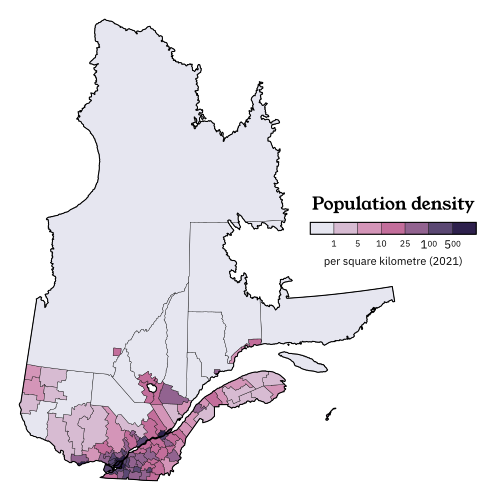
2016年の国勢調査では、ケベック州の人口は8,164,361人で、2011年の人口7,903,001人から3.3%増加した。面積は1,356,625.27 km 2 (523,795.95 平方マイル)で、2016年の人口密度は6.0/km 2 (15.6/平方マイル)であった。ケベック州はカナダの人口の23%弱を占めている。ケベック州で最も人口の多い都市は、モントリオール(1,762,976人)、ケベックシティ(538,738人)、ラヴァル(431,208人)、ガティノー(281,501人)である。[209]
2016年のケベック州の平均年齢は41.2歳でした。2020年現在、人口の20.8%が20歳未満、59.5%が20歳から64歳、19.7%が65歳以上でした。2019年、ケベック州では出生数が前年と比較して増加し(84,200人対83,840人)、合計特殊出生率は女性1人あたり約1.6人でした。2020年現在、平均寿命は82.3歳でした。2019年のケベック州の人口増加率は1972年以来最高で、11万人増加しました。これは主に移民の大量流入によるものです。2019年現在、国際移民のほとんどは中国、インド、フランスから来ています。[210] 2016年には、人口の30%が高等教育の学位またはディプロマを取得していた。住民のほとんど、特にカップルは不動産所有者である。2016年には、不動産所有者と賃借人の両方の80%が住宅を「手頃な価格ではない」と考えていた。[211] 2021年のカナダ国勢調査では、ケベック州の人口の29.3%が祖先がカナダ起源であると回答し、21.1%が祖先がフランス起源であると回答した。[212] 2021年現在、ケベック州の人口の18%が可視性マイノリティである。[213]
宗教

2021年の国勢調査によると、ケベック州で最も多く挙げられた宗教は以下の通りである。[214]
- キリスト教(5,385,240人、64.8%)
- 無宗教(2,267,720人、27.3%)
- イスラム教(421,710人、5.1%)
- ユダヤ教(84,530人、1.0%)
- 仏教(48,365人、0.6%)
- ヒンズー教(47,390人、0.6%)
- シク教(23,345人、0.3%)
- 先住民の精神性(3,790または<0.1%)
- その他(26,385または0.3%)
1608年にケベック市が設立されて以来、ローマカトリック教会は長い間ケベック社会の中心的かつ不可欠な位置を占めてきました。しかし、ケベックを世俗化した静かな革命以来、無宗教が著しく増加しています。[215]
北米最古の教区教会は、ケベックのノートルダム大聖堂である。1647年に建設が始まり、当時はノートルダム・ド・ラ・ペと呼ばれ、1664年に完成した。[216]ケベックで最も多くの人が訪れる礼拝所は、サンタンヌ・ド・ボープレ大聖堂である。この大聖堂には、毎年何百万人もの人々が訪れる。聖ヨセフ礼拝堂は、聖ヨセフに捧げられた世界最大の礼拝所である。多くの巡礼地には、サン・ベネディクト修道院、ノートルダム・デュ・キャップ聖堂、ノートルダム・ド・モントリオール大聖堂、マリー・レーヌ・デュ・モンド・ド・モントリオール大聖堂、サン・ミシェル大聖堂、サン・パトリック大聖堂などがある。ケベック州のもう一つの重要な礼拝所は、1800年から1804年の間に建てられた聖公会のホーリー・トリニティ大聖堂である。これはイギリス諸島以外で建てられた最初の聖公会の大聖堂であった。[217]
言語
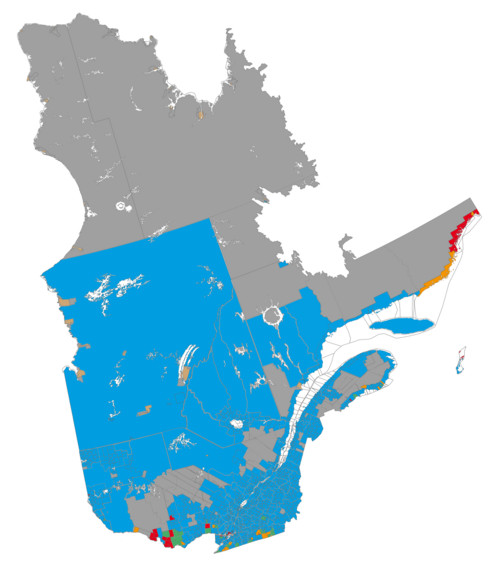
ケベック州は、フランス語が唯一の公用語かつ優勢な言語である点でカナダの他の州と異なり、カナダの他の地域では英語が主流である。[218]フランス語は共通語であり、人口の94.4%が理解し、話している。[219] [220]ケベック・フランス語は、この言語の地方的な変種である。カナダにはおよそ30の地方フランス語のアクセントがあると推定されており、[221] [222]そのうち17がケベック州で確認されている。[223]ケベック・フランス語局は、フランス語上級評議会およびケベック地名委員会と共同で、領土におけるフランス語に関する言語政策の適用を監督している。これらの言語政策の基礎は1968年にジャンドロン委員会によって作られ、1977年以来フランス語憲章(「法案101」)に付随してきた。これらの政策は、ケベック州が英語圏の隣国(カナダの残りの地域と米国)に同化されることから保護するために実施されている[224] [ 225]。また、ケベック州がイギリス帝国の植民地であったため後者が優遇されていた、フランス語を話す多数派と英語を話す少数派の間の歴史的な不公平を是正するためにも作成された。[226]
ケベック州はカナダで唯一、住民のほとんどがフランス語話者であり、フランス語が母国語である州である。2011年の国勢調査では、6,102,210人(人口の78.1%)がフランス語を唯一の母国語としており、6,249,085人(80.0%)が自宅で最も頻繁にフランス語を話していると回答した。[227]
英語を母国語とする人々はアングロ・ケベック人と呼ばれ、ケベック州で2番目に大きな言語グループを構成しています。2011年には、英語を母国語とするケベック人は約65万人(人口の8%)でした。[228]アングロ・ケベック人は主にモントリオール島の西部(ウェスト島)、モントリオールのダウンタウン、ポンティアックに住んでいます。
Three families of Indigenous languages encompassing eleven languages exist in Quebec: the Algonquian language family (Abenaki, Algonquin, Maliseet-passamaquoddy, Mi'kmaq, and the linguistic continuum of Atikamekw, Cree, Innu-aimun, and Naskapi), the Inuit–Aleut language family (Nunavimmiutitut, an Inuktitut dialect spoken by the Inuit of Nord-du-Québec), and the Iroquoian language family (Mohawk and Wendat). In the 2016 census, 50,895 people said they knew at least one Indigenous language[229] and 45,570 people declared having an Indigenous language as their mother tongue.[230] In Quebec, most Indigenous languages are transmitted quite well from one generation to the next with a mother tongue retention rate of 92%.[231]
As of the 2016 census, the most common immigrant languages claimed as a native language were Arabic (2.5% of the total population), Spanish (1.9%), Italian (1.4%), Creole languages (mainly Haitian Creole) (0.8%), and Mandarin (0.6%).[232]
As of the 2021 Canadian Census, the ten most spoken languages in the province were French (spoken by 7,786,735 people, or 93.72% of the population), English (4,317,180 or 51.96%), Spanish (453,905 or 5.46%), Arabic (343,675 or 4.14%), Italian (168,040 or 2.02%), Haitian Creole (118,010 or 1.42%), Mandarin (80,520 or 0.97%), Portuguese (65,605 or 0.8%), Russian (55,485 or 0.7%), and Greek (50,375 or 0.6%).[233] The question on knowledge of languages allows for multiple responses.
Indigenous peoples

Algonquins
Attikameks
Abenakis
Crees
Hurons-Wendat
Innus
Maliseets
Micmacs
Mohawks
Naskapis
Inuit
In 2021, the Indigenous population of Quebec numbered 205,010 (2.5% of the population), including 15,800 Inuit, 116,550 First Nations people, and 61,010 Métis.[234] There is an undercount, as some Indian bands regularly refuse to participate in Canadian censuses. In 2016, the Mohawk reserves of Kahnawake and Doncaster 17 along with the Indian settlement of Kanesatake and Lac-Rapide, a reserve of the Algonquins of Barriere Lake, were not counted.[235]
The Inuit of Quebec live mainly in Nunavik in Nord-du-Québec. They make up the majority of the population living north of the 55th parallel. There are ten First Nations ethnic groups in Quebec: the Abenaki, the Algonquin, the Attikamek, the Cree, the Wolastoqiyik, the Mi'kmaq, the Innu, the Naskapis, the Huron-Wendat and the Mohawks. The Mohawks were once part of the Iroquois Confederacy. Aboriginal rights were enunciated in the Indian Act and adopted at the end of the 19th century. This act confines First Nations within the reserves created for them. The Indian Act is still in effect today.[236] In 1975, the Cree, Inuit and the Quebec government agreed to an agreement called the James Bay and Northern Quebec Agreement that would extended indigenous rights beyond reserves, and to over two-thirds of Quebec's territory. Because this extension was enacted without the participation of the federal government, the extended indigenous rights only exist in Quebec. In 1978, the Naskapis joined the agreement when the Northeastern Quebec Agreement was signed. Discussions have been underway with the Montagnais of the Côte-Nord and Saguenay–Lac-Saint-Jean for the potential creation of a similar autonomy in two new distinct territories that would be called Innu Assi and Nitassinan.[237]
A few political institutions have also been created over time:
- The Assembly of First Nations Quebec-Labrador[238]
- The Grand Council of the Crees[239]
- The Makivik Corporation[240]
Acadians
The subject of Acadians in Quebec is an important one as more than a million people in Quebec are of Acadian descent, with roughly 4.8 million people possessing one or multiple Acadian ancestors in their genealogy tree, because a large number of Acadians had fled Acadia to take refuge in Quebec during the Great Upheaval. Furthermore, more than a million people have a patronym of Acadian origin.[241][242][243][244]
Quebec houses Acadian communities. Acadians mainly live on the Magdalen Islands and in Gaspesia, but about thirty other communities are present elsewhere in Quebec, mostly in the Côte-Nord and Centre-du-Québec regions. An Acadian community in Quebec can be called a "Cadie", "Petite Cadie" or "Cadien".[245]
Economy
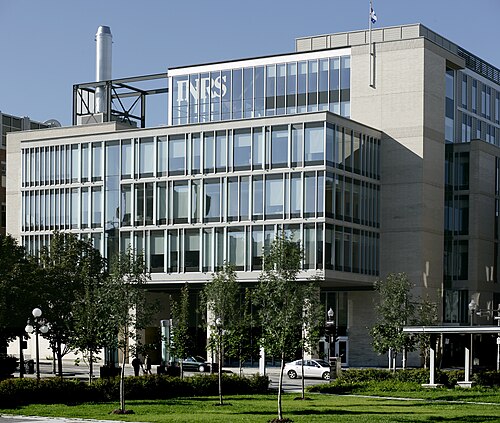
Quebec has an advanced, market-based, and open economy. In 2022, its gross domestic product (GDP) was US$50,000 per person at purchasing power parity.[246] The economy of Quebec is the 46th largest in the world behind Chile and 29th for GDP per person.[247][248] Quebec represents 19% of the GDP of Canada. The provincial debt-to-GDP ratio peaked at 51% in 2012–2013, and declined to 43% in 2021.[249]
Like most industrialized countries, the economy is based mainly on the services sector. Quebec's economy has traditionally been fuelled by abundant natural resources and a well-developed infrastructure, but has undergone significant change over the past decade.[250] Firmly grounded in the knowledge economy, Quebec has one of the highest growth rates of GDP in Canada. The knowledge sector represents about 31% of Quebec's GDP.[251] In 2011, Quebec experienced faster growth of its research-and-development (R&D) spending than other Canadian provinces.[252] Quebec's spending in R&D in 2011 was equal to 2.63% of GDP, above the European Union average of 1.8%.[253] The percentage spent on research and technology is the highest in Canada and higher than the averages for the Organisation for Economic Co-operation and Development and the G7 countries.[254]
Some of the most important companies from Quebec are: Bombardier, Desjardins, the National Bank of Canada, the Jean Coutu Group, Transcontinental média, Quebecor, the Métro Inc. food retailers, Hydro-Québec, the Société des alcools du Québec, the Bank of Montreal, Saputo, the Cirque du Soleil, the Caisse de dépôt et placement du Québec, the Normandin restaurants, and Vidéotron.
Exports and imports
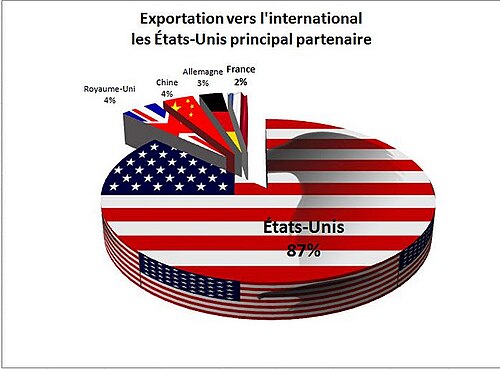
Thanks to the World Trade Organization (WTO) and the North American Free Trade Agreement (NAFTA), Quebec had, as of 2009[update], experienced an increase in its exports and in its ability to compete on the international market. International exchanges contribute to the strength of the Quebec economy.[255] NAFTA is especially advantageous as it gives Quebec, among other things, access to a market of 130 million consumers within a radius of 1,000 kilometres.
In 2008, Quebec's exports to other provinces in Canada and abroad totalled 157.3 billion CND$, or 51.8% of Quebec's gross domestic product (GDP). Of this total, 60.4% were international exports, and 39.6% were interprovincial exports. The breakdown by destination of international merchandise exports is: United States (72.2%), Europe (14.4%), Asia (5.1%), Middle East (2.7%), Central America (2.3%), South America (1.9%), Africa (0.8%) and Oceania (0.7%).[255]
In 2008, Quebec imported $178 billion worth of goods and services, or 58.6% of its GDP. Of this total, 62.9% of goods were imported from international markets, while 37.1% of goods were interprovincial imports. The breakdown by origin of international merchandise imports is as follows: United States (31.1%), Europe (28.7%), Asia (17.1%), Africa (11.7%), South America (4.5%), Central America (3.7%), Middle East (1.3%) and Oceania (0.7%).[255]
Primary sector

Quebec produces most of Canada's hydroelectricity and is the second biggest hydroelectricity producer in the world (2019).[256] Because of this, Quebec has been described as a potential clean energy superpower.[257] In 2019, Quebec's electricity production amounted to 214 terawatt-hours (TWh), 95% of which comes from hydroelectric power stations, and 4.7% of which come from wind energy. The public company Hydro-Québec occupies a dominant position in the production, transmission and distribution of electricity in Quebec. Hydro-Québec operates 63 hydroelectric power stations and 28 large reservoirs.[258] Because of the remoteness of Hydro-Québec's TransÉnergie division, it operates the largest electricity transmission network in North America. Quebec stands out for its use of renewable energy. In 2008, electricity ranked as the main form of energy used in Quebec (41.6%), followed by oil (38.2%) and natural gas (10.7%).[259] In 2017, 47% of all energy came from renewable sources.[260] The Quebec government's energy policy seeks to build, by 2030, a low carbon economy.
Quebec ranks among the top ten areas to do business in mining in the world.[261] In 2011, the mining industry accounted for 6.3% of Quebec's GDP[262] and it employed about 50,000 people in 158 companies.[263] It has around 30 mines, 158 exploration companies and 15 primary processing industries. While many metallic and industrial minerals are exploited, the main ones are gold, iron, copper and zinc. Others include: titanium, asbestos, silver, magnesium and nickel, among many others.[264] Quebec is also as a major source of diamonds.[265] Since 2002, Quebec has seen an increase in its mineral explorations. In 2003, the value of mineral exploitation reached $3.7 billion.[266]
The agri-food industry plays an important role in the economy of Quebec, with meat and dairy products being the two main sectors. It accounts for 8% of the Quebec's GDP and generate $19.2 billion. In 2010, this industry generated 487,000 jobs in agriculture, fisheries, manufacturing of food, beverages and tobacco and food distribution.[267]
Secondary sector

In 2021, Quebec's aerospace industry employed 35,000 people and its sales totalled C$15.2 billion. Many aerospace companies are active here, including CMC Electronics, Bombardier, Pratt & Whitney Canada, Héroux-Devtek, Rolls-Royce, General Electric, Bell Textron, L3Harris, Safran, SONACA, CAE Inc., and Airbus, among others. Montreal is globally considered one of the aerospace industry's great centres, and several international aviation organisations seat here.[268] Both Aéro Montréal and the CRIAQ were created to assist aerospace companies.[269][270]
The pulp and paper industry accounted for 3.1% of Quebec's GDP in 2007 [271] and generated annual shipments valued at more than $14 billion.[272] This industry employs 68,000 people in several regions of Quebec.[273] It is also the main -and in some circumstances only- source of manufacturing activity in more than 250 municipalities in the province. The forest industry has slowed in recent years because of the softwood lumber dispute.[274] In 2020, this industry represented 8% of Quebec's exports.[275]
As Quebec has few significant deposits of fossil fuels,[276] all hydrocarbons are imported. Refiners' sourcing strategies have varied over time and have depended on market conditions. In the 1990s, Quebec purchased much of its oil from the North Sea. Since 2015, it now consumes almost exclusively the crude produced in western Canada and the United States.[277] Quebec's two active refineries have a total capacity of 402,000 barrels per day, greater than local needs which stood at 365,000 barrels per day in 2018.[276]
Thanks to hydroelectricity, Quebec is the world's fourth largest aluminum producer and creates 90% of Canadian aluminum. Three companies make aluminum here: Rio Tinto, Alcoa and Aluminium Alouette. Their 9 alumineries produce 2,9 million tons of aluminum annually and employ 30,000 workers.[278]
Tertiary sector
The finance and insurance sector employs more than 168,000 people. Of this number, 78,000 are employed by the banking sector, 53,000 by the insurance sector and 20,000 by the securities and investment sector.[279] The Bank of Montreal, founded in 1817 in Montreal, was Quebec's first bank but, like many other large banks, its central branch is now in Toronto. Several banks remain based in Quebec National Bank of Canada, the Desjardins Group and the Laurentian Bank.

The tourism industry is a major sector in Quebec. The Ministry of Tourism ensures the development of this industry under the commercial name "Bonjour Québec".[280] Quebec is the second most important province for tourism in Canada, receiving 21.5% of tourists' spending (2021).[281] The industry provides employment to over 400,000 people.[282] These employees work in the more than 29,000 tourism-related businesses in Quebec, most of which are restaurants or hotels. 70% of tourism-related businesses are located in or close to Montreal or Quebec City. It is estimated that, in 2010, Quebec welcomed 25.8 million tourists. Of these, 76.1% came from Quebec, 12.2% from the rest of Canada, 7.7% from the United States and 4.1% from other countries. Annually, tourists spend more than $6.7 billion in Quebec's tourism industry.[283]
Quebec's IT sector has 7,600 businesses and employs 140,000 people.[284][285][286] Its most developed sectors are telecommunications, multimedia and video game software, computer services, microelectronics, and the components sector. There are currently 115 telecommunications companies established in the province, including Motorola, Ericsson and Mitec.[287] The multimedia and video game sector has been growing fast since the early 2000s. The Digital Alliance, which claims 191 active members in video games, online education, mobility and Internet services, estimates the annual revenue of the sector at $827 million in 2014.[288] The microelectronics sector is made up of more than 100 companies employing 13,000 people. Computer services, software development, and consulting engineering employ 60,000 skilled workers. While the largest IT employers are CMC Electronics, IBM, and Matrox, many other tech companies are present here, including Ubisoft, Electronic Arts, Microids, Strategy First, Eidos, Activision, A2M, Frima Studio, etc.[289]

Approximately 1.1 million Quebecers work in the field of science and technology.[290] In 2007, the Government of Quebec launched the Stratégie québécoise de la recherche et de l'innovation (SQRI) aiming to promote development through research, science and technology. The government hoped to create a strong culture of innovation in Quebec for the next decades and to create a sustainable economy.[291]
Quebec is considered one of world leaders in fundamental scientific research, having produced ten Nobel laureates in either physics, chemistry, or medicine.[292] It is also considered one of the world leaders in sectors such as aerospace, information technology, biotechnology and pharmaceuticals, and therefore plays a significant role in the world's scientific and technological communities.[293] Between 2000 and 2011, Quebec had over 9,469 scientific publications in biomedical research and engineering.[294] The contribution of Quebec in science and technology represented approximately 1% of the research worldwide between the 1980s and 2009.[295]
The province is one of the world leaders in the field of space science and contributed to important discoveries in this field.[296] One of the most recent is the discovery of the complex extrasolar planets system HR 8799. HR 8799 is the first direct observation of an exoplanet in history.[297][298] The Canadian Space Agency was established in Quebec due to its major role in this research field. A total of four Quebecers have been in space since the creation of the CSA: Marc Garneau, Julie Payette, and David Saint-Jacques as CSA astronauts, plus Guy Laliberté as a private citizen who paid for his trip. Quebec has also contributed to the creation of some Canadian artificial satellites including SCISAT-1, ISIS, Radarsat-1 and Radarsat-2.[299][300][301]
Quebec ranks among the world leaders in the field of life science.[302] William Osler, Wilder Penfield, Donald Hebb, Brenda Milner, and others made significant discoveries in medicine, neuroscience and psychology while working at McGill University in Montreal. Quebec has more than 450 biotechnology and pharmaceutical companies which together employ more than 25,000 people and 10,000 highly qualified researchers.[302] Montreal is ranked fourth in North America for the number of jobs in the pharmaceutical sector.[302][303]
Education
The education system of Quebec, administered by the government of Quebec's Ministry of Education and Higher Education, differs from those of other Canadian provinces. The province has five levels of education: first preschool, then primary school, then secondary school; then CEGEP (see College education in Quebec); and finally university or college. Attached to these levels are the options to also attend professional development opportunities, classes for adults, and continuing education. For every level of teaching, there exists a public network and private network: the public network is financed by taxes while the private options must be paid for by the student. In 2020, school boards were replaced by school service centres.[304]
All universities in Quebec exist by virtue of laws adopted by the National Assembly of Quebec in 1967 during the Quiet Revolution. Their financing mostly comes from public taxes, but the laws under which they operate grants them more autonomy than other levels of education.[305]
Infrastructure
Transportation
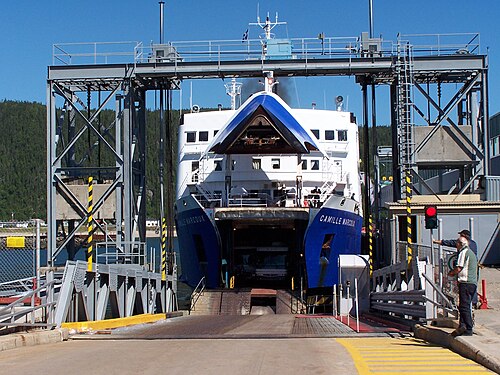
Development and security of land transportation in Canada are provided by Transports Québec.[306] Other organizations, such as the Canadian Coast Guard and Nav Canada, provide the same service for the sea and air transportation. The Commission des transports du Québec works with the freight carriers and the public transport.
The réseau routier québécois (Quebec road network) is managed by the Société de l'assurance automobile du Québec (SAAQ; Quebec Automobile Insurance Corporation) and consists of about 185,000 km (115,000 mi) of highways and national, regional, local, collector and forest roads. In addition, Quebec has almost 12,000 bridges, tunnels, retaining walls, culverts and other structures[307] such as the Quebec Bridge, the Laviolette Bridge and the Louis-Hippolyte Lafontaine Bridge–Tunnel.
In the waters of the Saint Lawrence there are eight deep-water ports for the transhipment of goods. In 2003, 3886 cargo and 9.7 million tonnes of goods transited the Quebec portion of the Saint Lawrence Seaway.[308]
Concerning rail transport, Quebec has 6,678 km (4,150 mi) of railways[309] integrated in the large North American network. Although primarily intended for the transport of goods through companies such as the Canadian National (CN) and the Canadian Pacific (CP), the Quebec railway network is also used by inter-city passengers via Via Rail Canada and Amtrak. In April 2012, plans were unveiled for the construction of an 800 km (497 mi) railway running north from Sept-Îles, to support mining and other resource extraction in the Labrador Trough.[310]
Quebec's air network includes 43 airports that offer scheduled services on a daily basis.[308] In addition, the Government of Quebec owns airports and heliports to increase the accessibility of local services to communities in the Basse-Côte-Nord and northern regions.[311]
Various other transport networks crisscross the province of Quebec, including hiking trails, snowmobile trails and bike paths. The Green Road is the largest at nearly 4,000 km (2,500 mi) in length.[312]
Healthcare
Quebec has a health policy that emphasizes prevention, is based on the analysis of health-related data, and evolves with the needs of the population. Similar to other developed economies, the public health policies implemented in Quebec have extended the life expectancy of its population since the mid-20th century.[313]
Health and social services are part of the same administration. The Quebec health system is also public, which means that the government acts as the main insurer and administrator, that funding is provided by general taxation, and that patients have access to care regardless of their income level.
There are 34 health establishments in Quebec, 22 of which are an Integrated Health and Social Services Centre (CISSS). They ensure the distribution of different services on the territories they are assigned to. Quebec has approximately 140 hospitals for general or specialised care (CHSGS). Quebec also has other types of establishments in its healthcare system, such as Centre local de services communautaires (CLSC), Centre d'hébergement et de soins de longue durée (CHSLD), Centre de réadaptation and Centre de protection de l'enfance et de la jeunesse. Finally, there are private healthcare establishments (paid for directly by the patient) like Groupe de médecine de famille, pharmacies, private clinics, dentists, community organisations and retirement homes.[314]
A 2021 Ipsos poll found that 85% of Quebecers agree that their health care system is too bureaucratic to respond to the needs of the population[315] and in 2023 found that less than half of Quebecers are satisfied with the provincial health care system.[316]
Housing
In 2021, 59.9% of Quebec's residents were property owners.[317] In 2019, among property owners, 34% were couples with kids, 33% were couples without children, 22% lived alone, 8% were single parents, and 3% were something else. Among renters, 16% were couples with kids, 13% were couples without children, 51% lived alone, 13% were single parents, and 7% were something else.[211]
Since the 1980s, the average price of a single-family home has doubled every 10 years, going from $48,715 in 1980 to $424,844 in 2021. Since the average salary did not follow these increases, Quebec homes are 10 times more expensive then they were 40 years ago.[318] In 2022, the cities with the most severe housing shortages were Granby, with a vacancy rate of 0,1%, followed by Marieville (0,1%), Rimouski (0,2%), Drummondville (0,2%) and Rouyn-Noranda (0,3%).[319]
Culture
Quebec has developed its own unique culture from its historic New France roots. Its culture also symbolizes a distinct perspective: being a French-speaking nation surrounded by a bigger English-speaking culture.
The Quartier Latin (English: Latin Quarter) of Montreal, and Vieux-Québec (English: Old Quebec) in Quebec City are two hubs of metropolitan cultural activity. Life in the cafés and "terrasses" (outdoor restaurant terraces) reveals a Latin influence in Quebec's culture, with the théâtre Saint-Denis in Montreal and the Capitole de Québec theatre in Quebec City being among the principal attractions.
A number of governmental and non-government organizations support cultural activity in Quebec. The Conseil des arts et des lettres du Québec (CALQ) is an initiative of the Ministry of Culture and Communications (Quebec). It supports creation, innovation, production, and international exhibits for all cultural fields of Quebec. The Société de développement des entreprises culturelles (SODEC) works to promote and fund individuals working in the cultural industry. The Prix du Québec is an award given by the government to confer the highest distinction and honour to individuals demonstrating exceptional achievement in their respective cultural field. Other awards include the Athanase David Awards (Literature), Félix Awards (Music), Gémeaux Awards (Television and film), Jutra Awards (Cinema), Masques Awards (Theatre), Olivier Guimond Awards (Humour) and the Opus Awards (Concert music).
Performing arts
Traditional music is imbued with many dances, such as the jig, the quadrille, the reel and line dancing. Traditional instruments include harmonica, fiddle, spoons, jaw harp and accordion. The First Nations and the Inuit of Quebec also have their own traditional music. Quebec's most popular artists of the last century include the singers Félix Leclerc, Gilles Vigneault, Kate and Anna McGarrigle and Céline Dion.[320] The Association québécoise de l'industrie du disque, du spectacle et de la vidéo (ADISQ) was created in 1978 to promote the music industry in Quebec.[321] The Orchestre symphonique de Québec and the Montreal Symphony Orchestra are respectively associated with the Opéra de Québec and the Opéra de Montreal whose performances are presented at the Grand Théâtre de Québec and at Place des Arts. The Ballets Jazz de Montreal, the Grands Ballets and La La La Human Steps are three important professional troupes of contemporary dance.
Among the theatre troupes are the Compagnie Jean-Duceppe, the Théâtre La Rubrique, and the Théâtre Le Grenier. In addition to the network of cultural centres in Quebec,[322] the venues include the Monument-National and the Rideau Vert (green curtain) Theatre in Montreal, and the Trident Theatre in Quebec City. The National Theatre School of Canada and the Conservatoire de musique et d'art dramatique du Québec form the future players.

Several circus troupes were created in recent decades, the most important being the Cirque du Soleil.[323] Among these troops are contemporary, travelling and on-horseback circuses, such as Les 7 Doigts de la Main, Cirque Éloize, Cavalia, Kosmogonia, Saka and Cirque Akya.[324] The National Circus School and the École de cirque de Québec were created to train future Contemporary circus artists. Tohu, la Cité des Arts du Cirque was founded in 2004 to disseminate the circus arts.[325]
Comedy is a vast cultural sector. Quebec has created and is home to several different comedy festivals, including the Just for Laughs festival in Montreal, as well as the Grand Rire festivals of Quebec, Gatineau and Sherbrooke.[326] The Association des professionnels de l'industrie de l'humour (APIH) is the main organization for the promotion and development of the cultural sector of humour in Quebec and the National School of Humour, created in 1988, trains future humorists in Quebec.
Media
The Cinémathèque québécoise has a mandate to promote the film and television heritage of Quebec. The National Film Board of Canada (NFB), a federal Crown corporation, provides for the same mission in Canada. The Association of Film and Television in Quebec (APFTQ) promotes independent production in film and television.[327] While the Association of Producers and Directors of Quebec (APDQ) represents the business of filmmaking and television, the Association of Community Radio Broadcasters of Quebec (ARCQ) (French acronym) represents the independent radio stations.[328] Several movie theatres across Quebec ensure the dissemination of Quebec cinema. With its cinematic installations, such as the Cité du cinéma and Mel's studios, the city of Montreal is home to the filming of various productions.[329] The state corporation Télé-Québec, the federal Crown corporation CBC, general and specialized private channels, networks, independent and community radio stations broadcast the various Quebec téléromans, the national and regional news, and other programming.[330][331] Les Rendez-vous du cinéma québécois is a festival surrounding the ceremony of the Jutra Awards Night that rewards work and personalities of Quebec cinema.[332] The Artis and the Gemini Awards gala recognize the personalities of television and radio industry in Quebec and French Canada. The Film Festival of the 3 Americas, the Festival of International Short Film, the World Film Festival and the Festival of New Cinema are other annual events surrounding the film industry in Quebec.
Popular comedy shows include Cré Basile, Le zoo du Capitaine Bonhomme, Lundi des Ha! Ha !, Démons du midi, La petite vie, Les Bougon, and Le sketch show. There are also many comedy and cartoon shows created for children, such as La boîte à surprise, Bobino, Le pirate Maboule, Fanfreluche, La Ribouldingue, Les 100 Tours de Centour, Patofville, Passe-Partout, Robin et Stella, Iniminimagimo, Vazimolo, Télé-Pirate, Bibi et Geneviève, Watatatow, Caillou, Cornemuse, Macaroni tout garni, Toc toc toc, Ramdam, and Tactik.
In the realm of literature and international publishing, the Québec Édition group is a committee created by the National Association of Book Editors dedicated to the international influence of French-language publishings from Quebec and Canada.[333]
Literature and folklore
.jpg/500px-La_Chasse-galerie_(1906).jpg)
Quebec's French-speaking populace has the second largest body of folktales in Canada (the first being First Nations).[334] When the early settlers arrived from France in the 17th century, they brought with them popular tales from their homeland, which were adapted to the local context. Many were passed on through generations by raconteurs, or storytellers.[335] Almost all of the stories native to Quebec were influenced by Christian dogma and superstitions. The Devil, for instance, appears often as either a person, an animal or monster, or indirectly through Demonic acts.[336] Various tales and stories are told through oral tradition, such as, among many others, the legends of the Bogeyman, the Chasse-galerie, the Black Horse of Trois-Pistoles, the Complainte de Cadieux, the Corriveau, the dancing devil of Saint-Ambroise, the Giant Beaupré, the monsters of the lakes Pohénégamook and Memphremagog, of Quebec Bridge (called the Devil's Bridge), the Rocher Percé and of Rose Latulipe, for example.[337]
From New France, Quebec literature was first developed in the travel accounts of explorers. The Moulin à paroles traces the great texts that have shaped the history of Quebec. The first to write the history of Quebec, since its discovery, was the historian François-Xavier Garneau. Many Quebec poets and prominent authors marked their era and today remain anchored in the collective imagination, like, among others, Philippe Aubert de Gaspé, Octave Crémazie, Honoré Beaugrand, Émile Nelligan, Lionel Groulx, Gabrielle Roy, Hubert Aquin, Michel Tremblay, Marie Laberge, Fred Pellerin and Gaston Miron. The regional novel from Quebec is called Terroir novel and is a literary tradition[338] specific to the province.
Popular French-language contemporary writers include Louis Caron, Suzanne Jacob, Yves Beauchemin, and Gilles Archambault. Well-known English-language writers from Quebec include Leonard Cohen, Mordecai Richler, and Neil Bissoondath.
Art and architecture

The art of Quebec has developed around the specific characteristics of its landscapes and cultural, historical, social and political representations. The development of Quebec masterpieces in painting, printmaking and sculpture is marked by the contribution of artists such as Louis-Philippe Hébert, Cornelius Krieghoff, Alfred Laliberté, Marc-Aurèle Fortin, Marc-Aurèle de Foy Suzor-Coté, Jean Paul Lemieux, Clarence Gagnon, Adrien Dufresne, Alfred Pellan, Jean-Philippe Dallaire, Charles Daudelin, Arthur Villeneuve, Jean-Paul Riopelle, Paul-Émile Borduas and Marcelle Ferron.
The fine arts of Quebec are displayed at the Quebec National Museum of Fine Arts, the Montreal Museum of Contemporary Art, the Montreal Museum of Fine Arts, the Quebec Salon des métiers d'art and in many art galleries. The Montreal School of Fine Arts forms the painters, printmakers and sculptors of Quebec.
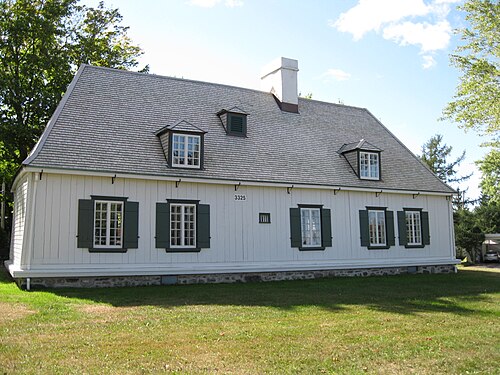
Quebec's architecture is characterized by its unique Canadien-style buildings as well as the juxtaposition of a variety of styles reflective of Quebec's history. When walking in any city or town, one can come across buildings with styles congruent to Classical, Neo-Gothic, Roman, Neo-Renaissance, Greek Revival, Neo-Classical, Québécois Neo-Classical, Victorian, Second Empire, Modern, Post-modern or Skyscrapers.
Canadien-style houses and barns were developed by the first settlers of New France along the banks of the Saint Lawrence River. These buildings are rectangular one-storey structures with an extremely tall and steep roof, sometimes almost twice as tall as the house below. Canadien-style churches also developed and served as landmarks while traversing rural Quebec.
Heritage

Several sites, houses and historical works reflect the cultural heritage of Quebec, such as the Village Québécois d'Antan, the historical village of Val-Jalbert, the Fort Chambly, the national home of the Patriots, the Chicoutimi pulp mill (Pulperie de Chicoutimi), the Lachine Canal and the Victoria Bridge. As of December 2011, there are 198 National Historic Sites of Canada in Quebec.[340] These sites were designated as being of national historic significance.[341]
Various museums tell the cultural history of Quebec, like the Museum of Civilization, the Museum of French America, the McCord Museum or the Montreal Museum of Archaeology and History in Pointe-à-Callière, displaying artifacts, paintings and other remains from the past of Quebec. Notable schools include the Conservatoire de musique et d'art dramatique du Québec, the École nationale de théâtre du Canada and the École nationale de cirque. Notable public agencies to catalogue and further develop Quebec's culture include the Bibliothèque et Archives nationales du Québec, the Conseil des arts et des lettres du Québec and Télé-Québec. The Association Quebecoise des Loisirs Folkloriques is an organization committed to preserving and disseminating Quebec's folklore heritage.[342]
Cuisine
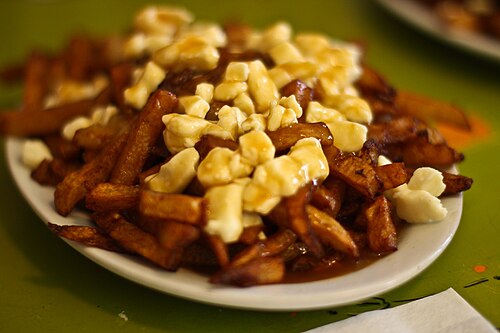
The traditional Quebecois cuisine descends from 16th-century French cuisine, the fur trade and a history of hunting. Quebec's cuisine has also been influenced by learning from First Nation, by English cuisine and by American cuisine. Quebec is most famous for its tourtière, pâté chinois, poutine, and St. Catherine's taffy among others. "Le temps des sucres" is a period during springtime when many Quebecers go to the sugar shack (cabane à sucre) for a traditional meal.
Quebec is the world's biggest maple syrup producer.[343] The province has a long history of producing maple syrup, and creating new maple-derived products. Other major food products include beer, wine (including ice wine and ice cider), and cheese.
Sports

Sports in Quebec constitutes an essential dimension of Quebec culture. Ice hockey remains the national sport. This sport was played for the first time on March 3, 1875, in Montreal and has been promoted over the years by numerous achievements, including the centenary of the Montreal Canadiens.[344] Other major sports include Canadian football with the Montreal Alouettes, soccer with Club de Foot Montréal, the Grand Prix du Canada Formula 1 racing with drivers such as Gilles Villeneuve and Jacques Villeneuve, and professional baseball with the former Montreal Expos. Quebec has hosted several major sporting events, including the 1976 Summer Olympics, the Fencing World Championships in 1967, track cycling in 1974, and the Transat Québec-Saint-Malo race created in 1984.
Quebec athletes have performed well at the Winter Olympics over recent years. They won 12 of Canada's 29 medals at the most recent Winter Olympics in Pyeongchang (2018); they won 12 of the 27 Canadian medals in Sochi (2014); and 9 of the 26 Canadian medals in Vancouver (2010).[345]
Holidays and symbols
St-Jean-Baptiste Day is one of Quebec's biggest holidays. In 1977, the Quebec Parliament declared June 24, the day of La Saint-Jean-Baptiste, to be Quebec's National Holiday. La Saint-Jean-Baptiste, or La St-Jean, honours French Canada's patron saint, John the Baptist. On this day, the song "Gens du pays", by Gilles Vigneault, is often heard. The song À la claire fontaine[346] was the anthem of the New France, Patriots and French Canadian, then replaced by O Canada, but "Gens du pays" is preferred by many Quebecers to be the national anthem of Quebec.
National Patriots' Day, a statutory holiday in Quebec, is also a unique public holiday, which honours the patriotes with displays of the patriote flag, music, public speeches, and ceremonies.[347] Le Vieux de '37 ("The Old Man of '37"), an illustration by Henri Julien that depicts a patriot of this rebellion,[348] is sometimes added at the centre of Patriote flags. Moving Day is a tradition where leases terminate on July 1. This creates a social phenomenon where everyone seems to be moving out at the same time.[349]
Other distinct holiday traditions include the Réveillon, a giant feast and party which takes place during Christmas Eve and New Year's Eve and goes on until midnight. Traditional dishes like tourtière or cipâte are offered, and rigaudon, spoon or violin may be played.[350] Finally, April Fools' Day is called Poisson d'Avril ("April's Fish") because while pulling pranks is still important, there is another major tradition: sticking fish-shaped paper cutouts to people's backs without them noticing.[351]
In 1939, the government of Quebec unilaterally ratified its coat of arms to reflect Quebec's political history: French rule (gold lily on blue background), followed by British rule (lion on red background), followed by Canadian rule (maple leaves).[352] Je me souviens ("I remember") is an official part of the coat of arms and has been the official licence plate motto since 1978, replacing the previous motto: La belle province ("the beautiful province"), still used as a nickname for the province. The fleur-de-lis, one of Quebec's most common symbols, is an ancient symbol of the French monarchy. Finally, the Great Seal of Quebec is used to authenticate documents issued by the government of Quebec.
The first members of the Saint-Jean-Baptiste Society created the Carillon Sacré-Coeur flag, which consisted of a white cross on an azure background with white fleur-de-lis in each corner and a Sacred Heart surrounded by maple leaves in the centre; it was based on the French merchant flag flown by Champlain and the Flag of Carillon. The Carillon Sacré-Coeur and French merchant flag went on to be the major inspirations for creating Quebec's current flag in 1903, called the Fleurdelisé. The Fleurdelisé replaced the Union Jack on Quebec's Parliament Building on January 21, 1948.
Emblems of Quebec
There are three official emblems in Quebec:
- Emblems
-
Iris versicolor Flower
-
 Bubo scandiacus, Snowy owl
 -

-

.jpeg/500px-Snowy_Owl_(240866707).jpeg)
- Iris versicolor Linné. — Iris versicolore. — Clajeux. — (Larger blue-flag), the floral emblem of Quebec since 1999.
Through the variety and harmony of the colors of its flower, the versicolor iris perfectly illustrates the cultural diversity of Quebec. It also underlines the importance of water and wetlands for the balance of nature.
- Bubo scandiacus. — Harfang des neiges. — Snowy owl, the avian emblem of Quebec since 1987.
The owl symbolizes the whiteness of Quebec winters, roots in a semi-northern climate and extension over a very vast territory.
- Betula alleghaniensis Britton. — Bouleau des Alléghanys. — Merisier. — Yellow birch, forest emblem 1993.
Colloquially called Merisier, yellow birch, in addition to being one of the best-known noble woods in Quebec, is distinguished by the variety of its uses and by its commercial value. It was picked to emphasize the importance Québécois give to the forests.[353][354]
-
 St-Jean-Baptiste Day celebrations at Maisonneuve park in Montréal
 -
 The Fleurdelisé flying at Place d'Armes in Montreal

Quebec's diaspora
The earliest immigrants to the Canadian prairies were French Canadians from Quebec. Many Franco-Albertans, Fransaskois and Franco-Manitobans are descended from them.
From the mid-1800s to the Great Depression, Quebec experienced the Grande Hémorragie ("Great Hemorrhaging"), a massive emigration of 900,000 people from Quebec to New England.[355] French Canadians often established themselves in Little Canadas in many industrial New England centres. Of the 900,000 Québécois who emigrated, about half returned.[356] Most of the descendants of those who stayed are now assimilated, though a few Franco-Americans remain, speaking New England French.
Some tried to slow the Grande Hémorragie by redirecting people north, which resulted in the founding of many regions in Quebec (ex. Saguenay-Lac-St-Jean, Val-d'Or) but also in Northeastern Ontario. The northeastern Franco-Ontarians of today, who live in Timmins, Hearst, Moosonee and Sault Sainte Marie, among others, are the descendants of emigrants from Quebec who worked in the mines of the area.[357]
In recent times, snowbirds often migrate to southern Florida during the winter, resulting in the emergence of temporary "Québécois regions".
Notes
- ^ /k(w)ɪˈbɛk/ k(w)ih-BEK, /kɛˈbɛk/ keh-BEK, /keɪˈbɛk/ kay-BEK[10][11] Pronunciation varies.
- ^ The territory of Nunavut is larger
- ^ Quebec shares a border with four American states: Maine, New Hampshire, Vermont, and New York
References
- ^ "Quebec". Geographical Names Data Base. Natural Resources Canada.
- ^ "Population and dwelling counts: Canada, provinces and territories". Statistics Canada. February 9, 2022. Retrieved February 9, 2022.
- ^ "Population estimates, quarterly". Statistics Canada. September 27, 2023. Archived from the original on September 28, 2023. Retrieved September 28, 2023.
- ^ a b Fee, Margery; McAlpine, Janice (2001). Oxford Guide to Canadian English Usage. Oxford University Press. p. 335. ISBN 0-19-541619-8.
- ^ "Status of the French language". Government of Quebec. Archived from the original on May 14, 2011. Retrieved November 10, 2010.
- ^ "Quarterly indicators, Québec and Canada". Institut de la Statistique du Québec. September 20, 2023.
- ^ "Sub-national HDI - Subnational HDI - Global Data Lab".
- ^ See Time in Canada
- ^ "Canada Postal Codes". postal.codesofcountry.com. Retrieved April 6, 2024.
- ^ Barber, Katherine, ed. (2004). "Quebec". The Canadian Oxford Dictionary. Oxford University Press. ISBN 9780195418163.
- ^ Jones, Daniel (2011). Roach, Peter; Setter, Jane; Esling, John (eds.). "Quebec". Cambridge English Pronouncing Dictionary (18th ed.). Cambridge University Press. ISBN 978-0-521-15255-6.
- ^ According to the Canadian government, Québec (with the acute accent) is the official name in Canadian French and Quebec (without the accent) is the province's official name in Canadian English "Geographical Names of pan-Canadian significance". Natural Resources Canada. Archived from the original on September 18, 2015.
- ^ "Geography of Quebec territory" (in French). Government of Quebec. March 28, 2024. Retrieved June 26, 2024.
Quebec is divided into 17 administrative regions which bring together 104 regional county municipalities (MRC) and several independent municipalities.
- ^ "Land and freshwater area, by province and territory". web.archive.org. May 24, 2011. Retrieved July 25, 2024.
- ^ "Population Density, Québec, 2006". statcan.gc.ca. Retrieved January 21, 2024.
- ^ Canada, Global Affairs (October 20, 2015). "Sector Snapshots - Canadian Trade Commissioner Service - Quebec". GAC. Retrieved January 21, 2024.
- ^ "Origin of the names of Canada and its provinces and territories". Natural Resources Canada. March 27, 2020.
- ^ Afable, Patricia O.; Beeler, Madison S. (1996). "Place Names". In Goddard, Ives (ed.). Languages. Handbook of North American Indians. Vol. 17. Smithsonian Institution. p. 191.
- ^ "The birth of Quebec". Canada: A People's History. Canadian Broadcast Corporation. 2001. Retrieved September 12, 2021.
- ^ Lacoursière, Jacques; Provencher, Jean; Vaugeois, Denis (2000). Septentrion (ed.). Canada-Quebec 1534–2000: historical summary. ISBN 2-89448-156-X.
- ^ "Bering Land Bridge". National Geographic.
- ^ "The Amerindians and Inuits [sic] of Quebec: 11 contemporary nations". Secretariat for Native Affairs. 2001. p. 28. ISBN 2-550-38480-6.
- ^ Native Peoples A to Z: A Reference Guide to Native Peoples of the Western Hemisphere. Vol. 8. North American Book Dist LLC. 2009. pp. 91–97. ISBN 978-1-878592-73-6.
- ^ Marsh, James H. (1988). The Canadian encyclopedia. Vol. 4. Hurtig Publishers. p. 2211. ISBN 978-0-88830-330-1.
- ^ Charpentier et al. 1985, p. 47.
- ^ Charpentier et al. 1985, p. 50.
- ^ Riendeau 2007, p. 36.
- ^ Charpentier et al. 1985, p. 51.
- ^ Trudel, Marcel (1963). Histoire de la Nouvelle-France : les vaines tentatives 1524–1603. Fides. p. 307.
- ^ a b Mathieu, Jacques (September 4, 2013). "Nouvelle-France". The Canadian Encyclopedia.
- ^ Litalien, Raymonde (2004). Champlain: The Birth of French America. McGill-Queen's University Press. pp. 312–314. ISBN 978-0-7735-7256-0.
- ^ "Iroquois Wars". The Canadian Encyclopedia. Retrieved July 10, 2021.
- ^ Trudel, Marcel (1966). "Champlain, Samuel de". Dictionnaire biographique du Canada (in French).
- ^ Lea, David; Milward, Colette; Rowe, Annamarie (2001). A Political Chronology of the Americas. Psychology Press. p. 43. ISBN 978-1-85743-118-6.
- ^ Poulter, Gillian (2010). Becoming Native in a Foreign Land: Sport, Visual Culture, and Identity in Montreal, 1840–85. UBC Press. p. 33. ISBN 978-0-7748-1642-7.
- ^ Chartrand, Rene (2013). French Fortresses in North America 1535–1763: Quebec, Montreal, Louisbourg and New Orleans. Osprey Publishing. ISBN 978-1-4728-0317-7.
- ^ Cole Harris, Richard (1984). The Seigneurial System in Early Canada: A Geographical Study. McGill-Queen's Press. pp. 105–109. ISBN 978-0-7735-0434-9.
- ^ "Trois-Rivières | The Canadian Encyclopedia". thecanadianencyclopedia.ca. Retrieved March 13, 2023.
- ^ a b "Rois et reines du Canada". Government of Canada. August 11, 2017.
- ^ Hayes, Derek (2008). Canada: An Illustrated History. Douglas & McIntyre. p. 33. ISBN 978-1-55365-259-5.
- ^ Preston, David L. (2009). The Texture of Contact: European and Indian Settler Communities on the Frontiers of Iroquoia, 1667–1783. University of Nebraska Press. p. 43. ISBN 978-0-8032-2549-7.
- ^ Powell, John (2009). Encyclopedia of North American Immigration. Infobase Publishing. p. 203. ISBN 978-1-4381-1012-7.
- ^ McIlwraith, Thomas F.; Muller, Edward K. (2001). North America: The Historical Geography of a Changing Continent. Rowman & Littlefield Publishers. p. 72. ISBN 978-1-4616-3960-2.
- ^ "Fortifications au Quebec". Amerique francaise. Retrieved September 12, 2021.
- ^ "Premier recensement au Canada (Nouvelle-France)". Histoire du Quebec. Retrieved July 5, 2021.
- ^ "René-Robert Cavelier de La Salle 1670-1687". Canadian Museum of History. Retrieved July 5, 2021.
- ^ "Beaver Wars". Ohio History Central. Retrieved July 5, 2021.
- ^ "King William's War". Encyclopedia Britannica. Retrieved July 29, 2019.
- ^ "Treaties of Utrecht". Encyclopedia Britannica. Retrieved July 29, 2019.
- ^ Charpentier et al. 1985, p. 115.
- ^ Moore, Christopher (March 2, 2017). "Louisbourg". The Canadian Encyclopedia.
- ^ Eccles, WJ (March 24, 2021). "Seven Years' War". The Canadian Encyclopedia.
- ^ "The Siege of Québec: An episode of the Seven Years' War". Canadian National Battlefields Commission. Archived from the original on July 26, 2011. Retrieved July 5, 2011.
- ^ O'Meara, pp. 15–19
- ^ "ARCHIVÉE - Le gouvernement du Canada fait l'acquisition de documents historiques importants concernant le siège de Louisbourg de 1758". Library and Archives Canada. December 6, 2013.
- ^ "Siège de Québec par Wolfe". Gouvernement du Quebec. Retrieved July 5, 2021.
- ^ "James Murray: British soldier and official". Encyclopedia Britannica. Retrieved July 29, 2019.
- ^ Hunter 1999, pp. 505–506.
- ^ "Treaty of Paris - 1763". Encyclopedia Britannica. Retrieved July 29, 2019.
- ^ Brunet, Michel (1958). "Les Canadiens apres la conquete" (PDF). Revue d'histoire de l'Amérique française. 12.
- ^ "Proclamation royale (1763)". Government of Quebec. Retrieved July 5, 2021.
- ^ Dagenais, Maxime (May 11, 2020). "Quebec Act, 1774". The Canadian Encyclopedia.
- ^ Canadian Association of Geographers (1968). Canada: a Geographical Interpretation. Taylor & Francis. p. 33. ISBN 9780458906000.
- ^ "Loyalistes au Bas-Canada". Histoire du Quebec. Retrieved July 5, 2021.
- ^ a b Buckner, Phillip (July 23, 2020). "Rébellion du Bas-Canada (La guerre des patriotes)". The Canadian Encyclopedia.
- ^ Roy, Fernande (March 4, 2015). "Patriotes". L'Encyclopédie Canadienne.
- ^ Nelson, Robert (February 1838). "Declaration of Independence of Lower Canada". Wikisource. Archived from the original on November 7, 2011. Retrieved February 21, 2010.
- ^ Ouellet, Fernand. "Lambton, John George, 1st Earl of Durham". Dictionary of Canadian Biography Online. Archived from the original on August 5, 2011. Retrieved July 12, 2011.
- ^ "The Only Canadians: Canada's French and the British Connection" (PDF) (in French). Retrieved August 22, 2023.
- ^ "Montréal, une capitale, un parlement (1844-1849)" (in French). Musée Pointe-à-Callière. Archived from the original on December 13, 2021. Retrieved September 12, 2021 – via YouTube.
- ^ "Émeute du 25 avril 1849 : Incendie du Parlement" (in French). Histoire du Quebec. Retrieved July 5, 2021.
- ^ Mills, David (March 4, 2015). "Loi d'indemnisation pour le Bas-Canada". L'Encyclopédie canadienne (in French).
- ^ Marsh, James (June 3, 2015). "Grand Trunk Railway of Canada". L'Encyclopédie canadienne (in French).
- ^ Officer, Lawrence H.; Smith, Lawrence B. (2011). "The Canadian-American Reciprocity Treaty of 1855 to 1866". The Journal of Economic History. 28 (4).
- ^ "Régime seigneurial au Québec". Encyclopédie du Patrimoine Culturel de l'Amérique Française (in French). Retrieved September 12, 2021.
- ^ "Résolutions de la Conférence de Québec - octobre 1864". Bibliothèque et Archives Canada. Retrieved September 12, 2021.
- ^ "Le nationalisme canadien-francais". Allo Prof. Retrieved July 5, 2021.
- ^ "Parti national". The Canadian Encyclopedia (in French). February 19, 2014.
- ^ Wherrett, Jill (February 1996). "ABORIGINAL PEOPLES AND THE 1995 QUEBEC REFERENDUM: A SURVEY OF THE ISSUES". Archived from the original on June 13, 2006.
- ^ "Adoption d'une loi sur l'exportation du bois" (in French). University of Sherbrooke. Retrieved August 4, 2021.
- ^ "Loi Lavergne". Compendium de l'aménagement linguistique au Canada (CALC) (in French). University of Ottawa. Retrieved September 12, 2021.
- ^ Toby Elaine Morantz (2002). The White Man's Gonna Getcha: The Colonial Challenge to the Crees in Québec. McGill-Queens. p. 133. ISBN 978-0-7735-2299-2.
- ^ a b "Conscription au Canada". The Canadian Encyclopedia. May 6, 2021.
- ^ "FRENCH CANADA AND RECRUITMENT DURING THE FIRST WORLD WAR". Canadian War Museum. Retrieved September 12, 2021.
- ^ "Les années de la prohibition". www.saq.com (in French). Retrieved March 13, 2023.
- ^ "L'histoire de la SAQ : Société d'Alcool du Québec". Chateau Suau (in French). February 26, 2016. Retrieved March 13, 2023.
- ^ "Statut de Westminster". The Canadian Encyclopedia. April 29, 2020.
- ^ "Alloprof aide aux devoirs". Allo Prof. Retrieved July 31, 2021.
- ^ GÉLINAS, Xavier; Ferretti, Lucia (2010). Duplessis : son milieu, son époque. Septentrion. p. 267. ISBN 978-2-89448-625-2.
- ^ "Relations francophones-anglophones". L'Encyclopédie Canadienne. March 4, 2015.
- ^ Dickinson, John; Young, Brian (2003). A Short History of Quebec. McGill-Queen's University Press. p. 372.
- ^ "Radio-Canada.ca / R D I / ZONE LIBRE". ici.radio-canada.ca. Retrieved March 13, 2023.
- ^ "Province Lending to Quebec". The New York Times. 1964. Retrieved March 13, 2023.
- ^ Parizeau, Jacques (2009). "189". La souveraineté du Québec : Hier, aujourd'hui et demain. Michel Brûlé. ISBN 9-782894-854556.
- ^ "Un plaidoyer en faveur de la dualité canadienne". Le Devoir. Retrieved July 29, 2019.
- ^ "Le Québec au fil du temps". Secrétariat du Québec aux relations canadiennes. Retrieved July 29, 2019.
- ^ "La Commission Laurendeau-Dunton". Les Archives de Radio-Canada. Archived from the original on March 28, 2019. Retrieved July 29, 2019.
- ^ "Les relations Québec-Canada". Musée McCord Museum. Archived from the original on March 28, 2019. Retrieved July 29, 2019.
- ^ Bothwell, Robert (February 10, 2021). "Lester Bowles Pearson". L'Encyclopédie Canadienne.
- ^ "Daniel Johnson (1915-1968): Homme politique" (in French). Université de Sherbrooke. Retrieved January 10, 2021.
- ^ Tetley, William (2006). "Appendix D: The Crisis per se (in chronological order — October 5, 1970, to December 29, 1970) – English text". The October Crisis, 1970: An Insider's View. McGill-Queen's University Press. ISBN 978-0-7735-3118-5. OCLC 300346822. Archived from the original on June 14, 2009. Retrieved August 22, 2017.
- ^ "États généraux du Canada français". L'Encyclopédie Canadienne. July 29, 2019.
- ^ Palmer, Bryan D. (June 1, 2018). "Canada's '1968' and Historical Sensibilities". pp. 773–778. doi:10.1093/ahr/123.3.773..
- ^ "Grandeur et misère de l'utopie bilingue au Canada". Le Devoir. February 6, 2018.
- ^ Laurendeau, Paul (May 17, 2019). "Loi sur les langues officielles (1969)". L'Encyclopédie Canadienne.
- ^ "Élections québécoises de 1976". Université de Sherbrooke. Archived from the original on March 9, 2021. Retrieved September 12, 2021.
- ^ Déclaration préliminaire sur le droit d'autodétermination. November 24, 1967.
- ^ "Débats sur la déclaration préliminaire : Partage des opinions" (PDF). États généraux du Canada français. November 1967 – via Bibliothèque et Archives nationales du Québec.
- ^ "The 1980 Quebec Referendum". Facts and results. CBC. Archived from the original on May 31, 2008. Retrieved June 29, 2011.
- ^ Paquette, Gilbert (April 17, 2017). "Le rapatriement de 1982: trahison et fin d'un mythe". Le Devoir.
- ^ "Résolution de l'Assemblée nationale du Québec sur les conditions sans lesquelles le Québec ne peut accepter le rapatriement de la Constitution canadienne, 1er décembre 1981" (PDF). Government of Quebec. Retrieved August 16, 2021.
- ^ Sheppard, Robert (May 4, 2020). "Constitution, Patriation of". The Canadian Encyclopedia.
- ^ Busta, Shannon; Hui, Ann. "Bloc Québécois through the years". The Globe and Mail. Archived from the original on May 9, 2011. Retrieved June 29, 2011.
- ^ "Accord de Charlottetown". L'Encyclopédie Canadienne. May 7, 2020.
- ^ Directeur général des élections du Québec. "Référendum de 1995". Information and results. Quebec Politic. Archived from the original on August 8, 2011. Retrieved June 29, 2011.
- ^ Gagné, Gilles; Langlois, Simon (2002). "Les immigrants : sortir de l'ethnicité". Les raisons fortes: Nature et signification de l'appui à la souveraineté du Québec (in French). University of Montreal Press. pp. 101–109. doi:10.4000/books.pum.12348. ISBN 9791036504556.
- ^ Lévesque, Catherine (March 3, 2020). "Référendum de 1995: le «love-in» du camp du Non n'aurait pas servi à grand-chose". L'actualité. The Canadian Press.
- ^ "Résolution unanime sur la nation québécoise" [Resolution by the National Assembly of Québec] (PDF). October 30, 2003. Archived from the original (PDF) on July 28, 2013. Retrieved September 29, 2013.
- ^ "39th Parliament, 1st Session; No. 087". Hansard. November 27, 2006. Archived from the original on October 2, 2013.
- ^ Rocher, François (August 20, 2015). "Retour sur la vague orange de 2011". Le Devoir.
- ^ "Élections québécoises de 2012". University of Sherbrooke. Archived from the original on September 23, 2021. Retrieved August 4, 2021.
- ^ "Élections québécoises de 2014". University of Sherbrooke. Archived from the original on June 21, 2021. Retrieved August 4, 2021.
- ^ International, Radio Canada (October 4, 2018). "Quebec's provincial election: What does it signal for Canada, maybe the world?". RCI | English.
- ^ "Coronavirus disease (COVID-19) in Québec". Gouvernement du Québec.
- ^ Onishi, Norimitsu (October 4, 2022). "Embracing Nationalism, a Canadian Provincial Leader Wins Re-election". The New York Times.
- ^ Institut de la statistique du Québec. "Comparaison entre la superficie du Québec et celle de divers pays" [Comparison between the area of Quebec and various countries] (in French). Government of Quebec. Archived from the original on August 8, 2011. Retrieved July 4, 2011.
- ^ a b c "Natural History of Quebec". A description of the natural history of the province. McGill University. Archived from the original on July 6, 2011. Retrieved June 22, 2011.
- ^ "Mont D'Iberville, Québec/Newfoundland". PeakBagger. November 1, 2004. Archived from the original on August 7, 2011.
- ^ a b Claude Morneau, Ph. D.; Pierre-Luc Couillard, ing.f., Ph. D.; Jason Laflamme, ing.f., M. Sc; Mélanie Major, ing.f., M. Sc.; Valérie Roy, t.a.a.g. (June 10, 2021). "Ecological classification of Quebec territory" (PDF). Quebec Gouvernement (in French). Ministry of Forests, Wildlife and Parks - Forest Inventories Directorate. pp. 2, 4, 6, 8, 9, 11 of 16. Retrieved June 21, 2024.
The ecological classification of Quebec territory consists of mapping and description of ecological units at various levels of perception between the continental scale and that of the landscape
{{cite web}}: CS1 maint: multiple names: authors list (link) - ^ a b Ministry of Environment of Quebec 2002, p. 5.
- ^ Babin 1986, p. 39.
- ^ Boyer, Marcel (January 12, 2008). "11 idées pour changer le Québec". Le Journal de Montréal (in French). Archived from the original on March 25, 2012.
- ^ Commission de toponymie du Québec. "Réservoir de Caniapiscau" (in French). Government of Quebec. Archived from the original on September 20, 2011. Retrieved July 10, 2010.
- ^ "Protected areas in Quebec". Ministry of Sustainable Development, Environment, Wildlife and Parks. Archived from the original on December 13, 2013. Retrieved December 7, 2013.
- ^ "Protected areas in Quebec" (PDF). Ministry of Sustainable Development, Environment and Parks. 2009. Retrieved March 29, 2009.
- ^ "Register of protected areas". Ministry of Development Sustainable, Environment, Wildlife and Parks. Archived from the original on December 13, 2013. Retrieved December 7, 2013.
- ^ a b c "Climat au Québec" (in French). Government of Quebec. Archived from the original on December 12, 2019. Retrieved December 12, 2019.
- ^ "Climate Normals, tabular, year". Climat-Québec. Archived from the original on August 27, 2011. Retrieved July 13, 2011.
- ^ "Tornadoes". Climat-Québec. Archived from the original on August 27, 2011. Retrieved July 13, 2011.
- ^ "Zones climatiques du Québec". Quebec Portal. October 12, 2006. Archived from the original on August 6, 2011. Retrieved January 23, 2010.
- ^ "Moyenne mensuelle des températures de Québec (ville) et Montréal". Immigration Québec. Archived from the original on March 25, 2014. Retrieved June 2, 2011.
- ^ a b "Climate Normals, Tabular". Climat-Québec. August 30, 2010. Archived from the original on August 27, 2011. Retrieved July 12, 2011.
- ^ "Normales climatiques du Québec 1981-2010" (in French). Government of Quebec. Archived from the original on December 12, 2019. Retrieved December 12, 2019.
- ^ "Canada's Top Ten Weather Stories for 2008". Environment Canada. December 29, 2008. Archived from the original on August 7, 2011.
- ^ "Records de neige". CBC. Archived from the original on April 18, 2014. Retrieved January 23, 2010.
- ^ "Climat : L'hiver le plus chaud de l'histoire du pays" (in French). CBC. March 19, 2010.
- ^ a b "Types de végétations du Québec" (in French). Government of Quebec. Archived from the original on August 27, 2011. Retrieved June 22, 2011.
- ^ "Domaine forestier" (in French). Ministère des Ressources naturelles et de la Faune. Archived from the original on April 6, 2012. Retrieved August 19, 2007.
- ^ "L'Arboretum du Québec". Arboquebecium.com (in French). Archived from the original on July 7, 2011. Retrieved June 25, 2011.
- ^ "La biodiversité du Saint-Laurent" (in French). Environnement Canada. Archived from the original on August 7, 2011. Retrieved July 12, 2011.
- ^ "Espèces fauniques du Nunavik" (in French). Ministère des Ressources naturelles et de la Faune. Archived from the original on July 6, 2011. Retrieved July 12, 2011.
- ^ "Poissons du Québec" (in French). Ministère des Ressources naturelles et de la Faune. Archived from the original on July 6, 2011. Retrieved July 12, 2011.
- ^ Brûlotte 2009.
- ^ Lepage, Denis. "List of Quebec birds". Les Oiseaux du Québec (in French). Archived from the original on July 16, 2011. Retrieved June 24, 2011.
- ^ "Consolidated federal laws of canada, THE CONSTITUTION ACTS, 1867 to 1982". Government of Canada. August 7, 2020.
- ^ "Constitutional role". Bureau du Lieutenant-gouverneur du Québec. Archived from the original on February 10, 2012. Retrieved January 19, 2012.
- ^ "Députés". Chambre des communes du Canada. July 29, 2019.
- ^ "Liste Sénateurs". Sénat du Canada. September 1, 2016.
- ^ "Partis politiques". Élections Québec (in Canadian French). Retrieved June 20, 2023.
- ^ "Bureaux du Québec au Canada". Secrétariat du Québec aux relations canadiennes. Retrieved July 29, 2019.
- ^ "Bureau du Québec dans les Provinces atlantiques". Secrétariat du Québec aux relations canadiennes. Retrieved July 29, 2019.
- ^ "Loi sur la division territoriale (L.R.Q., c. D-11)". Les Publications du Québec. Retrieved February 6, 2011.
- ^ "Décret concernant la révision des limites des régions administratives du Québec (L.R.Q., c. D-11, r.1)". Les Publications du Québec. Retrieved October 16, 2016.
- ^ Gazette officielle du Québec : Avis d'établissement de la liste des circonscriptions électorales (1992) 124 G.O. 2, 4373
- ^ "Code municipal du Québec (L.R.Q., c. C-27.1)". Les Publications du Québec. Retrieved February 6, 2011.
- ^ "Loi électorale (L.R.Q., c E-3.3)". Éditeur officiel du Québec. Retrieved February 1, 2011.
- ^ "Code civil du Québec, L.R.Q." October 28, 2011. Archived from the original on September 13, 2011. Retrieved June 6, 2021.
- ^ "Allocution du ministre de l'Éducation, M. Paul Gérin-Lajoie" (PDF). Gouvernement du Québec. April 12, 1965. Archived from the original (PDF) on May 26, 2011.
- ^ "Comparaison interprovinciale et analyse de l'administration publique au Canada". L'observatoire de l'administration publique. Retrieved July 27, 2011.
- ^ "Le Québec et les changements climatiques: un défi pour l'avenir. Plan d'action 2006-2012" (PDF). Ministère du Développement durable, de l'Environnement et des Parcs du Québec. 2006. ISBN 978-2-550-53375-7.
- ^ "Loi sur la Société des établissements de plein air du Québec (L.R.Q., chapitre S-13.01)". Les Publications du Québec. Retrieved December 10, 2009.
- ^ Carabin, François (October 2, 2019). "La "base climatosceptique" bel et bien présente au Québec". Journal Métro (in French).
- ^ "Loi sur la protection du territoire et des activités agricoles (L.R.Q., c. P-41.1)". Les Publications du Québec. Retrieved January 8, 2010.
- ^ "Forestier en chef". Government of Quebec. Retrieved July 30, 2019.
- ^ "Emploi-Québec". Ministère de l'Emploi et de la Solidarité sociale. Retrieved January 8, 2010.
- ^ "Loi sur les normes du travail (L.R.Q., c. N-1.1)". Éditeur officiel du Québec. Retrieved January 8, 2010.
- ^ "Code du travail (L.R.Q., c. C-27)". Éditeur officiel du Québec. Retrieved January 8, 2010.
- ^ "Basic Rules for Applying the GST/HST and QST". Revenu Quebec. Archived from the original on August 7, 2016. Retrieved July 30, 2016.
- ^ "Consolidated provincial and territorial government revenue and expenditures, by province and territory, 2009". Statistics Canada. Archived from the original on March 12, 2009.
- ^ Kozhaya, Norma (March 11, 2004). "Soaking 'les riches'". Montreal Economic Institute. Archived from the original on April 8, 2014.
- ^ Marotte, Bertrand. "Quebec business taxes highest in North America". Globe and Mail. Archived from the original on October 31, 2012. Retrieved April 7, 2014.
- ^ "Accord Canada-Québec relatif à l'immigration et à l'admission temporaire des aubains (Accord Gagnon-Tremblay—McDougall)" (PDF). Government of Quebec. Archived from the original (PDF) on June 14, 2013. Retrieved July 30, 2019.
- ^ "Loi sur la Régie de l'assurance maladie du Québec (L.R.Q., c. R-5)". Éditeur officiel du Québec. Retrieved January 8, 2010.
- ^ "Loi sur le Conseil supérieur de l'éducation (L.R.Q., c. C-60)". Éditeur officiel du Québec. Retrieved January 8, 2010.
- ^ Dufour, Pascale (June 1, 2012). "Ténacité des étudiants québécois". Le Monde diplomatique.
- ^ "La place du Québec à Paris dans toute sa splendeur". Consulat général de France à Québec. Retrieved September 12, 2021.
- ^ "Réseau des représentations à l'étranger". Government of Quebec. Retrieved September 12, 2021.
- ^ a b Branch, Legislative Services (August 7, 2020). "Consolidated federal laws of canada, THE CONSTITUTION ACTS, 1867 to 1982". laws-lois.justice.gc.ca.
- ^ Kélada 1970, p. 21.
- ^ Brun, Tremblay & Brouillet 2008, pp. 474–491.
- ^ Émond & Lauzière 2003, p. 38.
- ^ Brun, Tremblay & Brouillet 2008, pp. 9, 28.
- ^ Lord, Guy; Sasseville, Jacques; Bruneau, Diane; Lachance, Renaud (1998). Wilson & Lafleur (ed.). Les principes de l'imposition au Canada (12 ed.). pp. 11–13, 20–23. OCLC 47248281.
- ^ Émond & Lauzière 2003, pp. 39–40.
- ^ Brun, Tremblay & Brouillet 2008, pp. 943–945.
- ^ "Charter of the French language". Office Québecois de la langue francaise. June 1, 2011. Archived from the original on May 2, 2003.
- ^ "Att. Gen. of Quebec v. Blaikie et al., 1979 CanLII 21 (S.C.C.)". Canadian Legal Information Institute. Archived from the original on April 9, 2013.
- ^ "A.G. (Quebec) v. Blaikie et al., [1981] 1 S.C.R. 312". Canadian Legal Information Institute. Archived from the original on April 9, 2013.
- ^ Duplé, Nicole (2009). Wilson & Lafleur (ed.). Droit constitutionnel : principes fondamentaux (4 ed.). p. 729. OCLC 373349446.
- ^ Federal Courts Act, RSC 1985, c. F-7
- ^ Code of Civil Procedure, CQLR , c. C-25.01, s. 29
- ^ Vadnais, Louise (2000). "Les caméras en Cour d'appel". Le Journal du Barreau. 32 (8). Archived from the original on February 12, 2009. Retrieved April 29, 2021.
- ^ "Loi sur la police, L.R.Q. P-13.1". Government of Quebec. Retrieved September 27, 2011.
- ^ Gouvernement du Québec, ed. (2008). "Mission, vision, valeurs". Sûreté du Québec. Retrieved September 27, 2011.
- ^ Béliveau, Pierre; Vauclair, Martin (2010). Blais, Yvon (ed.). Traité général de preuve et de procédure pénales (17 ed.). p. 1436. OCLC 660143951.
- ^ Ministère de la Sécurité publique (2011). Gouvernement du Québec (ed.). "Sûreté du Québec". Archived from the original on March 14, 2012. Retrieved September 27, 2011.
- ^ "L'État Québécois En Perspective" (pdf). Les organismes de la sécurité publique. 2011. Retrieved September 12, 2021.
- ^ "Sorties sous surveillance". Éducaloi. 2009. Archived from the original on August 7, 2011.
- ^ "La population des municipalités du Québec au 1er juillet 2017" (PDF). Institut de la statistique du Québec. 2017. Retrieved September 12, 2021.
- ^ "Bilan demographique du Québec" (PDF) (in French) (2020 ed.). Institut de la statistique du Québec. Retrieved August 14, 2021.
- ^ a b "Profil statistique de l'habitation au Québec 2018–2019" (PDF) (in French). Government of Quebec. November 2019.
- ^ "Profile table". Statistics Canada. Retrieved June 4, 2024.
- ^ "Portrait des personnes issues de minorités visibles sur le marché du travail au Québec en 2021 – Un aperçu (in French only)". Institut de la statistique du Québec. Retrieved June 4, 2024.
- ^ Government of Canada, Statistics Canada (October 26, 2022). "Census Profile, 2021 Census of Population". www12.statcan.gc.ca. Retrieved November 9, 2022.
- ^ Baillargeon, Stéphane (October 22, 2021). "Un Québécois sur deux ne croit pas en Dieu". Le Devoir (in French).
- ^ "Basilique-cathédrale Notre-Dame de Québec". Corporation du patrimoine et du tourisme religieux de Québec. February 15, 2010. Archived from the original on February 19, 2008. Retrieved May 22, 2021.
- ^ "The Cathedral of the Holy Trinity, Quebec, Canada". cathedral.ca. July 29, 2019.
- ^ "Les langues officielles au Canada" (PDF). Commissariat aux langues officielles du Canada. 2006. Archived from the original (PDF) on October 16, 2013. Retrieved January 29, 2013.
- ^ "Tableau statistique canadien - Chapitre 3" (PDF). Institut de la statistique du Québec. October 30, 2009. Archived from the original (PDF) on October 3, 2003. Retrieved June 6, 2021.
- ^ "Statistiques du Québec" (PDF). Government of Quebec. Archived from the original (PDF) on July 1, 2006. Retrieved June 6, 2021.
- ^ "Our 32 Accents". Quebec Culture Blog. Retrieved February 26, 2021.
- ^ "Le francais parlé de la Nouvelle-France" (in French). Government of Canada. April 27, 2020.
- ^ Parent, Stéphane (March 30, 2017). "Le francais dans tous ses etats au quebec et au canada". Radio-Canada.
- ^ "La Charte de la langue française au Québec ou Loi 101 - Le site de l'association Frontenac-Amériques". www.frontenac-ameriques.org. Retrieved July 14, 2023.
- ^ https://www.ourcommons.ca/Content/Committee/432/LANG/Brief/BR11249912/br-external/CastonguayCharles-f.pdf
- ^ "Relations francophones-anglophones | l'Encyclopédie Canadienne". www.thecanadianencyclopedia.ca. Retrieved July 14, 2023.
- ^ "Focus on Geography Series, 2011 Census – Province of Quebec". Statistics Canada. February 8, 2012. Archived from the original on October 2, 2013.
- ^ "Caractéristiques linguistiques des Canadiens" (in French). Statistics Canada. Retrieved August 16, 2021.
- ^ "Knowledge of Aboriginal Languages (90), Knowledge of Languages: Single and Multiple Language Responses (3), Aboriginal Identity (9), Aboriginal Mother Tongue (11), Registered or Treaty Indian Status (3) and Age (12) for the Population in Private Households of Canada, Provinces and Territories, Census Metropolitan Areas and Census Agglomerations, 2016 Census - 25% Sample Data" (in French). Statistics Canada.
- ^ "Recensement du Canada de 2016 : Tableaux de données – Langue maternelle (10), langue parlée le plus souvent à la maison (10), autre(s) langue(s) parlée(s) régulièrement à la maison (11), connaissance des langues officielles (5), première langue officielle parlée (5), âge (7) et sexe (3) pour la population à l'exclusion des résidents d'un établissement institutionnel du Canada, provinces et territoires, régions métropolitaines de recensement et agglomérations de recensement, Recensement de 2016 - Données intégrales (100 %)". Statistics Canada.
- ^ Termote, Marc; Thibault, Normand (2008). Nouvelles perspectives démolinguistiques du Québec et de la région de Montréal, 2001-2051 (PDF) (Report). Government of Quebec. p. 45.
- ^ "Proportion de la population selon la langue maternelle déclarée, pour différentes régions au Canada, Recensement de 2016". Statistics Canada.
- ^ Government of Canada, Statistics Canada (August 17, 2022). "Census Profile, 2021 Census of Population Profile table Quebec [Province]". www12.statcan.gc.ca. Retrieved August 17, 2022.
- ^ Government of Canada, Statistics Canada (October 26, 2022). "Census Profile, 2021 Census of Population". www12.statcan.gc.ca. Retrieved July 4, 2023.
- ^ "Incompletely enumerated Indian reserves and Indian settlements". Statistics Canada. January 3, 2019.
- ^ "Loi sur les Indiens" (PDF). justice.gc.ca. July 30, 2019. Archived from the original (PDF) on July 6, 2011. Retrieved April 16, 2021.
- ^ "Entente Québec-Innus". Secrétariat aux Affaires intergouvernementales. April 15, 2009.
- ^ "APNQL". Archived from the original on March 31, 2019. Retrieved July 29, 2019.
- ^ "Grand Conseil des Cris (Eeyou Istchee)/Gouvernement de la Nation Crie". The Grand Council of the Crees (Eeyou Istchee). Retrieved July 29, 2019.
- ^ "Bienvenue sur le site Internet de la Société MakivikAu service des Inuit du Nunavik depuis 1978". Makivik Corporation. Archived from the original on May 15, 2019. Retrieved July 29, 2019.
- ^ "Québec". Société nationale de l'Acadie. Retrieved December 7, 2009.
- ^ "L'Acadie du Québec - Du 29 mars au 31 mai 1998". Télécommunauté insulaire francophone. 1998. Archived from the original on October 13, 2008. Retrieved December 7, 2009.
- ^ Bergeron, Adrien (2000). "HÉBERT, ÉTIENNE". Dictionnaire biographique du Canada en ligne en collaboration avec l'Université de Toronto et l'Université Laval. Retrieved December 7, 2009.
- ^ Hébert, Pierre-Maurice (1994). Les Acadiens du Québec (in French). Vol. 427. Éditions de L'Écho. ISBN 2-920312-32-4.
- ^ Arsenault, Samuel; Lamarche, Rodolphe; Daigle, Jean (1993). L'Acadie des Maritimes : études thématiques des débuts à nos jours. Vol. Les géographes et l'aménagement des structures spatiales. Centre d'études acadiennes, Université de Moncton. ISBN 2921166062.
- ^ Government of Canada, Statistics Canada (November 19, 2012). "Add/Remove data - Gross domestic product, income-based, provincial and territorial, annual". www150.statcan.gc.ca.
- ^ "Government Statistics". Government of Quebec. Archived from the original on February 19, 2006. Retrieved June 23, 2011.
- ^ "Le Québec : une économie dynamique". Government of Quebec. Archived from the original on December 15, 2010. Retrieved February 23, 2011.
- ^ http://www.finances.gouv.qc.ca/en/Quebecs_debt325.asp
- ^ "Perspective revue d'analyse économique" (PDF). caisse desjardins. Retrieved June 23, 2011.
- ^ "Le Québec : une économie dynamique" (PDF) (in French). Government of Quebec. Archived from the original (PDF) on July 6, 2011. Retrieved February 23, 2011.
- ^ "L'expertise québécoise en haute technologie". Investissement Québec. Archived from the original on May 27, 2011. Retrieved June 23, 2011.
- ^ Sauvé, Mathieu-Robert (May 19, 2010). "Une cible de 3% pour la science". Le Devoir (in French). Archived from the original on August 8, 2011.
- ^ Le Cours, Rudy (July 30, 2010). "L'économie du savoir en mutation au Québec". La Presse Affaire (in French). Archived from the original on July 30, 2010.
- ^ a b c "Portail Québec, Importation et exportation 2008". Gouvernement du Québec. 2009. Archived from the original on October 16, 2014. Retrieved June 30, 2011.
- ^ "Aperçu du marché : Le Canada, deuxième producteur mondial d'hydroélectricité". Government of Canada. June 4, 2016.
- ^ Séguin, Hugo (April 13, 2010). "Le Québec, la puissance énergétique verte du continent?" (in French). Équiterre. Archived from the original on July 6, 2011. Retrieved April 28, 2011.
- ^ "Notre énergie est propre et renouvelable". Hydro-Québec. Retrieved September 6, 2020.
- ^ "Consommation d'énergie par forme" (in French). Quebec Ministry of Natural Resources and Wildlife. Archived from the original on July 6, 2011. Retrieved April 28, 2011.
- ^ Whitmore & Pineau 2020, p. 8.
- ^ "Le Québec est le chouchou de l'industrie minière" (in French). Canoe.ca. Archived from the original on July 20, 2012. Retrieved July 3, 2011.
{{cite web}}: CS1 maint: unfit URL (link) - ^ "Industrie minière et substances exploitées" (in French). Government of Quebec. Archived from the original on April 21, 2011. Retrieved June 23, 2011.
- ^ "Industrie minière au Québec" (in French). AMQ inc. Archived from the original on March 21, 2011. Retrieved June 23, 2011.
- ^ "Substances exploitées au Québec". Ministère des Ressources naturelles et de la Faune. Archived from the original on June 17, 2007. Retrieved August 16, 2007.
- ^ "Diamants au Québec". Ministère des Ressources naturelles et de la Faune. Archived from the original on July 6, 2011. Retrieved December 10, 2009.
- ^ "Industrie minière: valeur des expéditions, selon les principales substances minérales, Québec". Banque de données des statistiques officielles. Institut de la statistique du Québec. July 17, 2006. Archived from the original on July 6, 2011.
- ^ "Agri-Food Trade Service". Agriculture and Agri-food Canada. Archived from the original on July 6, 2011. Retrieved June 23, 2011.
- ^ "Aérospatiale / Présentation de l'industrie de l'aérospatiale" (in French). Ministère de l'Économie et de l'Innovation. Archived from the original on July 2, 2022. Retrieved May 8, 2022.
- ^ "Quebec's Aerospace Cluster". aeromontreal.ca. Retrieved May 8, 2022.
- ^ "Consortium de recherche et d'innovation en aérospatiale au Québec" (in French). CRIAQ. Retrieved May 8, 2022.
- ^ "Portraits forestiers régionaux". Conseil de l'industrie forestière du Québec. Archived from the original on September 10, 2007. Retrieved June 23, 2011.
- ^ "Encore "dix ans difficiles" pour l'industrie forestière". Abitibi expresse. Archived from the original on July 6, 2011. Retrieved June 23, 2011.
- ^ "Portraits forestiers régionaux" (in French). Conseil de l'industrie forestière du Québec. Archived from the original on January 25, 2010. Retrieved June 23, 2011.
- ^ "CRISE dans l'industrie forestière". Corridors de commerce FCCQ. February 2006. Archived from the original on July 14, 2011. Retrieved June 23, 2011.
- ^ "L'industrie forestière innove pour lutter contre les changements climatiques". Le Soleil (in French). November 30, 2021. Retrieved January 14, 2022.
- ^ a b Whitmore & Pineau 2020, p. 10.
- ^ Whitmore & Pineau 2020, p. 9.
- ^ l'Innovation, Ministère de l'Économie et de. "Aluminium / Présentation de l'industrie de l'aluminium - MEI". Ministère de l'Économie et de l'Innovation (in French). Archived from the original on March 5, 2022. Retrieved March 5, 2022.
- ^ Québec, Institut de la statistique du. "Emploi par industrie selon l'Enquête sur l'emploi, la rémunération et les heures de travail (EERH), Québec, 2005-2011". archive.wikiwix.com (in Canadian French). Archived from the original on January 25, 2013. Retrieved March 5, 2022.
- ^ "Bonjour-Quebec". Ministry of Tourism. Retrieved September 12, 2021.
- ^ "Chiffres tourisme" (PDF). Government of Quebec. Archived from the original (PDF) on October 6, 2021. Retrieved September 12, 2021.
- ^ "Le tourisme en chiffres" (PDF). Government of Quebec. Archived from the original (PDF) on October 6, 2021. Retrieved September 12, 2021.
- ^ "Le touisme en bref" (PDF). Government of Quebec. Archived from the original (PDF) on August 28, 2021. Retrieved September 12, 2021.
- ^ "Services informatiques et logiciels". Investissement Québec. Archived from the original on May 27, 2011. Retrieved June 23, 2011.
- ^ "Investir en TIC, innovation et créativité | Investissement Québec". Invest-quebec.com. Archived from the original on October 2, 2013. Retrieved September 29, 2013.
- ^ l'Innovation, Ministère de l'Économie et de. "Le secteur / Aperçu de l'industrie des technologies de l'information et des communications - MEI". Ministère de l'Économie et de l'Innovation (in French). Archived from the original on March 5, 2022. Retrieved March 5, 2022.
- ^ "Perspective" (PDF). Desjardins.com (in French).
- ^ "Se projeter dans l'avenir". Le Devoir (in French). Retrieved March 5, 2022.
- ^ "convert". archive.wikiwix.com. Retrieved March 5, 2022.[dead link]
- ^ "The Benefits of Investing in Québec Research & Development". Investissement Québec. Archived from the original on May 27, 2011. Retrieved February 23, 2011.
- ^ "Stratégie québécoise de la recherche et de l'innovation (SQRI) 2010–2013" (in French). Gouvernement du Québec. Archived from the original on May 1, 2012. Retrieved January 19, 2012.
- ^ Perreault, Mathieu. "Dix Nobel au Québec" (in French). Cyberpresse.ca. Archived from the original on January 24, 2011. Retrieved February 23, 2011.
- ^ "Science and Technology: Portal of the government of Québec". Government of Quebec. Archived from the original on December 17, 2010. Retrieved February 23, 2011.
- ^ "Québec had 195 triadic inventions patented". Institut de la statistique du Québec. Archived from the original on June 12, 2011. Retrieved February 23, 2011.
- ^ "Nombre de publications scientifiques en sciences naturelles et génie, Québec, Ontario, pays du G8, pays nordiques, certains pays émergents et monde, et part dans le total mondial, 1980 à 2009". Institut de la statistique du Québec. Archived from the original on April 2, 2012. Retrieved October 11, 2011.
- ^ "Aerospace in Quebec" (PDF). Investissement Québec. 2010. Archived from the original (PDF) on May 27, 2011. Retrieved May 3, 2010.
- ^ "A fourth planet around the star HR 8799" (in French). Radio-Canada. December 9, 2010. Archived from the original on April 19, 2014.
- ^ "A trio of astronomers awarded" (in French). Radio-Canada. January 21, 2009. Archived from the original on April 19, 2014.
- ^ "RADARSAT-1 Climate Change". Canadian Space Agency. May 7, 2001. Archived from the original on August 26, 2011.
- ^ "Construction and cost". Canadian Space Agency. Archived from the original on August 26, 2011.
- ^ "SCISAT Team and partners". Canadian Space Agency. Archived from the original on August 26, 2011.
- ^ a b c "La recherche et le développement au Québec" (in French). EMERGEX. November 30, 2005. Archived from the original on July 10, 2011. Retrieved March 6, 2011.
- ^ "Life sciences" (PDF). Investissement Québec. Archived from the original (PDF) on May 27, 2011. Retrieved July 5, 2011.
- ^ "Bill 40, An Act to amend mainly the Education Act with regard to school organization and governance". National Assembly of Québec. Retrieved August 23, 2020.
- ^ "Rapport comite" (PDF). Government of Quebec. Retrieved September 12, 2021.
- ^ "MISSION, RÔLE ET MANDAT" (PDF). Ministère des Transports du Québec (MTQ). Archived (PDF) from the original on March 26, 2012. Retrieved July 6, 2011.
- ^ "Quebec road network". Ministère des Transports du Québec. 2007. Archived from the original on November 13, 2008. Retrieved August 16, 2007.
- ^ a b "Quebec Portal: Transport". Government of Quebec. 2007. Archived from the original on October 12, 2007. Retrieved August 16, 2007.
- ^ "Le Québec, chiffres en main: Transport". Institut de la statistique du Québec. 2007. Archived from the original on October 12, 2007. Retrieved August 16, 2007.
- ^ "Railway Gazette: Railway could tap Québec's northern wealth". Railway Gazette International. Archived from the original on August 7, 2020. Retrieved April 23, 2012.
- ^ "Quebec air transport". Ministère des Transports du Québec. Archived from the original on August 15, 2011. Retrieved December 10, 2009.
- ^ "The Route verte puts all of Quebec within reach of your handlebars!". Government of Quebec. Archived from the original on July 15, 2011. Retrieved July 6, 2011.
- ^ "La situation démographique au Québec" (PDF). Bilan 2006. Institut de la statistique du Québec. p. 53. ISBN 2-550-48491-6. Archived from the original (PDF) on July 5, 2007. Retrieved April 29, 2021.
- ^ "Le système de santé et de services sociaux au Québec" (PDF). Ministère de la santé et des services sociaux. Archived from the original (PDF) on January 17, 2009. Retrieved April 29, 2021.
- ^ QMI, Agence. "Les québécois en faveur d'une implication du privé dans le secteur de la Santé". Le Journal de Montréal. Retrieved December 3, 2021.
- ^ "Healthcare in Canada 2023 | Montreal Economic Institute". www.iedm.org. Retrieved May 1, 2023.
- ^ "Taux de propriété". Québec habitation (in Canadian French). September 22, 2022. Retrieved June 21, 2023.
- ^ Cyr, Guillaume (March 10, 2022). "Les propriétés sont presque 10 fois plus chères qu'en 1980, mais les revenus ne suivent pas". 24 heures (in French). Retrieved June 21, 2023.
- ^ ICI.Radio-Canada.ca, Zone Société-. "Crise du logement au Québec : " On a perdu le contrôle "". Radio-Canada.ca (in Canadian French). Retrieved June 21, 2023.
- ^ Loignon, Donald. "Répertoire des artistes québécois" (in French). DLP multimédia. Archived from the original on July 27, 2011. Retrieved July 6, 2011.
- ^ ADISQ. "Notre raison d'être, c'est la musique de votre quotidien". Association québécoise de l'industrie du disque, du spectacle et de la vidéo. Archived from the original on July 18, 2011. Retrieved June 23, 2011.
- ^ "Centres culturels au Québec". Quebecvacances.com (in French). Archived from the original on July 15, 2011. Retrieved July 5, 2011.
- ^ Cirque du Soleil. "Cirque du Soleil Inc". Company history. Funding Universe. Archived from the original on August 23, 2011. Retrieved June 27, 2011.
- ^ Tellier, Chantal. "Le fabuleux destin du cirque québécois". ELLE Québec (in French). Archived from the original on September 12, 2011. Retrieved July 14, 2011.
- ^ "Historic and mission". Tohu. Archived from the original on July 6, 2011. Retrieved June 27, 2011.
- ^ "Festivals et evenements". Bonjour Quebec. Retrieved September 12, 2021.
- ^ "L'Association des producteurs de films et de télévision du Québec". APFTQ. Archived from the original on July 6, 2011. Retrieved June 25, 2011.
- ^ ARCQ. "L'Association des radiodiffuseurs communautaires du Québec, historique" (in French). RadioVision. Archived from the original on July 6, 2011. Retrieved July 14, 2011.
- ^ La Cité du cinéma. "La Cité du Cinéma". Mel's Cité du cinéma. Archived from the original on October 1, 2003. Retrieved July 14, 2011.
- ^ "Mission Télé-Québec" (in French). Télé-Québec. Archived from the original on July 7, 2011. Retrieved July 14, 2011.
- ^ "About CBC/Radio-Canada". CBC corporation. Archived from the original on July 9, 2011. Retrieved July 14, 2011.
- ^ La soirée des Jutra. "La soirée des Jutra – À propos de nous" (in French). Radio-Canada. Archived from the original on March 9, 2010. Retrieved July 14, 2011.
- ^ "Québec édition". Association nationale des éditeurs de livres/Québec Édition. Retrieved July 29, 2019.
- ^ Fowke, Edith (1988). Canadian Folklore. Oxford University Press. p. 34. ISBN 0-19-540671-0.
- ^ Greenough, William P. (1897). Canadian Folk-Life and Folk-Lore. George H. Richmond.
- ^ Chiasson, Père Anselme (1969). Les Légendes des îles de la Madeleine. Éditions des Aboiteaux.
- ^ Dupont 2008.
- ^ "Littérature du terroir québécois" (in French). Litterature-quebecoise.org. Archived from the original on July 27, 2011. Retrieved July 5, 2011.
- ^ Ministry of Culture and Communications of Quebec (2006). "Johan Beetz House, heritage real estate". Heritage directory cultural of Quebec. Retrieved June 18, 2024.
Other name, Château Johan-Beetz
- ^ "National historic sites Explore Quebec, Parc Canada". Government of Canada. April 22, 2024. Retrieved June 27, 2024.
Explore Quebec, travel itineraries in Quebec Find day trips, weekend getaway ideas and week-long itineraries. Parc Canada
- ^ Historic Sites & Monuments Board of Canada. "About the Historic Sites and Monuments Board of Canada – Duties". Archived from the original on October 6, 2012. Retrieved August 23, 2010.
- ^ "L'Association Quebecoise des Loisirs Folkloriques". Retrieved April 12, 2014.
- ^ Levinson-King, Robin; Murphy, Jessica (April 9, 2017). "Quebec's maple syrup producers seeking global domination". BBC News. Archived from the original on June 6, 2017.
- ^ "Un anniversaire douloureux". Fr.canoe.ca. September 20, 2013. Archived from the original on July 8, 2012. Retrieved January 1, 2011.
{{cite web}}: CS1 maint: unfit URL (link) - ^ "Who won Team Canada's 29 medals in Pyeongchang". Olympic.ca. February 25, 2018. Archived from the original on March 14, 2018.
- ^ Plouffe, Hélène. "À la claire fontaine". The Canadian Encyclopedia. Archived from the original on August 6, 2011. Retrieved July 6, 2011.
- ^ "Décret no 1322-2002 concernant la Journée nationale des Patriotes" (PDF). Gazette officielle du Québec. partie II. Vol. 134, no. 50. p. 8463. Retrieved January 12, 2013.
- ^ "Une vieux de 37 de Henri Julien". UQAM. Archived from the original on September 17, 2021. Retrieved September 12, 2021.
- ^ "Jour du grand demenagement". immigrantquebec.com. Retrieved September 12, 2021.
- ^ "Le temps des fêtes au Québec". cdeacf.ca. Retrieved September 12, 2021.
- ^ "Quelles sont les origines du Poisson d'Avril". collegcdi.ca. Retrieved September 12, 2021.
- ^ "Drapeauet et symboles nationaux". Justice Québec (in French). Archived from the original on October 9, 2007.
- ^ Quebec Portal (May 7, 2015). "Quebec's Symbols". Government of Quebec. Retrieved August 27, 2020.
- ^ "Emblems of Quebec". Quebec Gouvernement (in French). 2024. Retrieved June 25, 2024.
There are three official emblems in Quebec: the yellow birch, the snowy owl and the versicolor iris.
- ^ Bélanger, Claude. "Emigration to the United States from Canada and Quebec, 1840–1940". Quebec History. Marianopolis College. Retrieved July 24, 2013.
- ^ Bélanger, Claude (August 23, 2000). "Rapatriement". Marianopolis College. Archived from the original on February 13, 2007.
- ^ "Le Nord franco-ontarien : nature, culture et hospitalité". Le Corridor. Retrieved May 12, 2021.
Sources
- Babin, Andrée (1986). L'interatlas: Ressources du Québec et du Canada. Centre éducatif et culturel. ISBN 978-2-7617-0317-8.
- Brûlotte, Suzanne (2009). Les oiseaux du Québec. Éditions Broquet. ISBN 978-2-89654-075-4.
- Brun, Henri; Tremblay, Guy; Brouillet, Eugénie (2008). Droit constitutionnel (5 ed.). Éditions Yvon Blais. OCLC 233522214.
- Charpentier, Louise; Durocher, René; Laville, Christian; Linteau, Paul-André (1985). Nouvelle histoire du Québec et du Canada. Éditions du Boréal Express.
- Dupont, Jean-Claude (2008). Légendes du Québec – Un héritage culturel. Les éditions GID. ISBN 978-2-89634-023-1.
- Émond, André; Lauzière, Lucie (2003). Introduction à l'étude du droit. Wilson & Lafleur. OCLC 52798925.
- Hunter, William A. (1999). Forts on the Pennsylvania Frontier, 1753–1758. Wennawoods. ISBN 978-1-889037-20-2.
- Kélada, Henri (1970). Précis de droit québécois. Centre éducatif et culturel. OCLC 17462972.
- Ministry of Environment of Quebec (2002). Water. Life. Future. National Policy on water (PDF). Government of Quebec. ISBN 978-2-550-40074-5.
- Riendeau, Roger E. (2007). A brief history of Canada. Infobase Publishing. ISBN 978-0-8160-6335-2.
- Whitmore, Johanne; Pineau, Pierre-Olivier (January 2020). État de llénergie au Québec 2020 (PDF). HEC Montréal.
Further reading
English
- Anderson, Fred (2000). Crucible of Wars: The Seven Years' War and the Fate of Empire in British North America, 1754–1766. Knopf. ISBN 978-0-375-40642-3.
- Bergeron, Léandre (1974). Why There Must Be a Revolution in Québec. New Canada Publications. ISBN 0-919600-16-6.
- Cave, Alfred A. (2004). The French and Indian War. Greenwood Press. ISBN 978-0-313-32168-9.
- Courville, Serge; Howard, Richard (2009). Quebec: A Historical Geography. UBC Press. ISBN 978-0-7748-1426-3.
- Dickinson, John Alexander; Young, Brian J. (2003). A short history of Quebec. McGill-Queen's University Press. ISBN 978-0-7735-2393-7.
- Gairdner, William D (1994). Constitutional Crack-up: Canada and the Coming Showdown with Québec. Stoddart Publishing Co. ISBN 0-7737-5658-2.
- Gauvreau, Michael (2005). The Catholic origins of Quebec's Quiet Revolution, 1931–1970. McGill-Queen's University Press. ISBN 978-0-7735-2874-1.
- Grenon, Jean-Yves (2000). Pierre Dugua De Mons: Founder of Acadie (1604–5), Co-Founder of Quebec (1608). Translated by Phil Roberts. Annapolis Royal, NS: Peninsular Press. ISBN 978-0-9682016-2-6.
- Kokker, Steve (2002). Québec. Lonely Planet. ISBN 978-1-74059-024-2.
- Lefkowitz, Arthur S. (2008). Benedict Arnold's Army: The 1775 American Invasion of Canada during the Revolutionary War. Savas Beatie. ISBN 978-1-932714-03-6.
- Maclure, Jocelyn (2003). Quebec identity: the challenge of pluralism. McGill-Queen's University Press. ISBN 978-0-7735-2553-5.
- McRoberts, Kenneth; Posgate, Dale (1984). Québec: Social Change and Political Crisis (Rev. and updated ed.). McClelland and Stewart. ISBN 0-7710-7185-X.
- Merriam; Webster (2003). Merriam-Webster's Collegiate Dictionary (11th ed.). Merriam-Webster, Inc. ISBN 978-0-87779-809-5.
- Roussopoulos, Dimitrios I, ed. (1974). Québec and Radical Social Change. Black Rose Books. ISBN 0-919618-51-0.
- Scott, Colin (2001). Aboriginal autonomy and development in northern Quebec and Labrador. UBC Press. ISBN 978-0-7748-0844-6.
- Taucar, Christopher Edward (2002). Canadian Federalism and Quebec Sovereignty. Peter Lang. ISBN 978-0-8204-6242-4.
- Webb Hodge, Frederick (1912). American Indians North of Mexico, Volume 4, Smithsonian Institution Bureau of American Ethnology Handbook. Digital Scanning Inc. ISBN 978-1-58218-751-8.
French
- Armony, Victor (2007). Le Québec expliqué aux immigrants. VLB Éditeur. ISBN 978-2-89005-985-6.
- Bergeron, Léandre; Landry, Pierre (2008). Petit manuel d'histoire du Québec, 1534–2008. Éditions Trois-Pistoles. ISBN 978-2-89583-183-9.
- Binot, Guy (2004). Pierre Dugua de Mons: gentilhomme royannais, premier colonisateur du Canada, lieutenant général de la Nouvelle-France de 1603 à 1612. Bonne anse. ISBN 978-2-914463-13-3.
- Institut de la statistique du Québec (2010). Le Québec chiffres en main (PDF). Government of Quebec. ISBN 978-2-550-49444-7. Archived from the original (PDF) on August 27, 2010.
- Lacoursière, Jacques; Provencher, Jean; Vaugeois, Denis (2000). Canada-Québec 1534–2000. Septentrion. ISBN 978-2-89448-156-1.
- Lacoursière, Jacques (2005). Histoire du Québec, Des origines à nos jours. Édition Nouveau Monde. ISBN 978-2-84736-113-1.
- La Rochelle, Louis (1982). En flagrant délit de pouvoir: chroniques des événements poliltiques, de Maurice Duplessis à René Lévesque. Boreal Express. ISBN 2-89052-058-7.
- Liebel, Jean (1999). Pierre Dugua, sieur de Mons, fondateur de Québec. Le Croît vif. ISBN 978-2-907967-48-8.
- Linteau, Paul-André (1989). Histoire du Québec contemporain; Volume 1; De la Confédération à la crise (1867–1929). Les Éditions du Boréal. ISBN 978-2-89052-297-8.
- Linteau, Paul-André (1989). Histoire du Québec contemporain; Volume 2; Le Québec depuis 1930. Les Éditions du Boréal. ISBN 978-2-89052-298-5.
- Morf, Gustave (1970). Le Terrorisme québécois. Éditions de l'Homme.
- Parizeau, Jacques (1997). Pour un Québec souverain. V.L.B. éditeur. ISBN 2-89005-655-4.
- Pelletier, Réal, ed. (1975). Une Certaine Révolution tranquille: 22 juin [19]60–[19]75. La Presse.
- Venne, Michel (2006). L'annuaire du Québec 2007. Fides. ISBN 978-2-7621-2746-1.
External links
Quebec at Wikipedia's sister projects
 Definitions from Wiktionary
 Media from Commons
 News from Wikinews
 Quotations from Wikiquote
 Texts from Wikisource
 Resources from Wikiversity
 Travel information from Wikivoyage
 Data from Wikidata
- Official website of the Government of Quebec
- Quebec government official tourist site
- Quebec at Curlie