Loading article…
ヨハネ・パウロ2世 | |||||||||||||||||||||||||||||||||
|---|---|---|---|---|---|---|---|---|---|---|---|---|---|---|---|---|---|---|---|---|---|---|---|---|---|---|---|---|---|---|---|---|---|
| ローマ司教 | |||||||||||||||||||||||||||||||||
.jpg/500px-ADAMELLO_-_PAPA_-_Giovanni_Paolo_II_-_panoramio_(cropped).jpg) 1988年のヨハネ・パウロ2世 | |||||||||||||||||||||||||||||||||
| 教会 | カトリック教会 | ||||||||||||||||||||||||||||||||
| 教皇制が始まった | 1978年10月16日 | ||||||||||||||||||||||||||||||||
| 教皇制の終焉 | 2005年4月2日 | ||||||||||||||||||||||||||||||||
| 前任者 | ヨハネ・パウロ1世 | ||||||||||||||||||||||||||||||||
| 後継 | ベネディクト16世 | ||||||||||||||||||||||||||||||||
| 以前の投稿 |
| ||||||||||||||||||||||||||||||||
| 注文 | |||||||||||||||||||||||||||||||||
| 叙階 | 1946 年 11 月 1 日 アダム ・ステファン・サピエハ | ||||||||||||||||||||||||||||||||
| 奉献 | 1958 年 9 月 28 日、エウゲニウス・バジアク 著 | ||||||||||||||||||||||||||||||||
| 枢機卿を創設 | 1967年6月26日 パウロ6世 | ||||||||||||||||||||||||||||||||
| ランク | 枢機卿司祭(1967年~1978年) | ||||||||||||||||||||||||||||||||
| 個人情報 | |||||||||||||||||||||||||||||||||
| 生まれる | カロル・ヨゼフ・ヴォイティワ 1920年5月18日 ヴァドヴィツェ、ポーランド第二共和国 | ||||||||||||||||||||||||||||||||
| 死亡 | 2005年4月2日(享年84歳)バチカン市国 アポストゥス宮殿 | ||||||||||||||||||||||||||||||||
| 宗派 | カトリック | ||||||||||||||||||||||||||||||||
| 教育 |
| ||||||||||||||||||||||||||||||||
| モットー | Totus tuus (ラテン語で「完全にあなたのもの」) | ||||||||||||||||||||||||||||||||
| サイン |  | ||||||||||||||||||||||||||||||||
| 紋章 |  | ||||||||||||||||||||||||||||||||
| 聖人 | |||||||||||||||||||||||||||||||||
| 祝日 | 10月22日 | ||||||||||||||||||||||||||||||||
| 崇拝されている | カトリック教会 | ||||||||||||||||||||||||||||||||
| 列福された | 2011年5月1日バチカン市 国サン・ピエトロ広場 ベネディクト16世 | ||||||||||||||||||||||||||||||||
| 列聖 | 2014年4月27日 バチカン市国サン・ピエトロ広場 にて フランシスコ教皇 | ||||||||||||||||||||||||||||||||
| 属性 |
| ||||||||||||||||||||||||||||||||
| 後援 | |||||||||||||||||||||||||||||||||
哲学のキャリア | |||||||||||||||||||||||||||||||||
| 注目すべき作品 |
| ||||||||||||||||||||||||||||||||
| 時代 | 20世紀の哲学 | ||||||||||||||||||||||||||||||||
| 地域 | 西洋哲学 | ||||||||||||||||||||||||||||||||
| 学校 | |||||||||||||||||||||||||||||||||
注目すべきアイデア | |||||||||||||||||||||||||||||||||
叙階の歴史 | |||||||||||||||||||||||||||||||||
| |||||||||||||||||||||||||||||||||
| 出典: [7] [8] | |||||||||||||||||||||||||||||||||
| ヨハネ・パウロ2世の教皇スタイル | |
|---|---|
| |
| 参照スタイル | 法王 |
| 話し方 | 法王陛下 |
| 死後スタイル | 教皇聖 |
教皇聖 ヨハネ・パウロ2世 | |
|---|---|
 ズビグニェフ・コティウォ作の聖ヨハネ・パウロ二世の絵、2012年 | |
| 教皇と聴罪司祭 | |
| 生まれる | 1920年5月18日 ポーランド、ヴァドヴィツェ |
| 死亡 | 2005年4月2日(享年84歳)バチカン市国 アポストゥス宮殿 |
| 崇拝されている | カトリック教会 |
| 列福された | 2011年5月1日、バチカン市国サン・ピエトロ広場、ベネディクト16世教皇 |
| 列聖 | 2014年4月27日、バチカン市国サン・ピエトロ広場にてフランシスコ教皇 |
| ごちそう | 10月22日 |
| 属性 | 教皇のフェルラ、教皇の祭服 |
| 後援 | クラクフ、ポーランド、世界青年の日、若いカトリック教徒、シフィドニツァ、家族、2015 年世界家族会議 |
ヨハネ・パウロ2世(ラテン語:Ioannes Paulus II、ポーランド語:Jan Paweł II、イタリア語:Giovanni Paolo II、出生名: Karol Józef Wojtyła、ポーランド語: [ˈkarɔl ˈjuzɛv vɔjˈtɨwa]、1920年5月18日 - 2005年4月2日)は、1978年から2005年に死去するまでカトリック教会の長であり、バチカン市国の君主であった。
若い頃、ヴォイティワは舞台俳優として活動していた。 1938年にポーランドのヴァドヴィツェにある男子高校を優秀な成績で卒業したが、その直後に第二次世界大戦が勃発した。戦時中、誘拐されてドイツの強制労働収容所に送られるのを避けるため、ヴォイティワは厳しい環境の採石場で働くことを申し込んだ。やがてヴォイティワは俳優の仕事を始め、この職業に愛着を抱き、地元の劇場に出演した。語学力に優れていたヴォイティワは、大学でポーランド語を学びたいと考えていた。アダム・ステファン・サピエハとの会話に勇気づけられ、神学を学んで司祭になろうと決意した。最終的に、ヴォイティワはクラクフ大司教、次いで枢機卿に昇進したが、どちらの地位も彼の指導者が務めていた。ヴォイティワは1978年の第2回教皇選挙の3日目に教皇に選出され、史上最年少の教皇の一人となった。このコンクラーベは、教皇としてわずか33日間在任したヨハネ・パウロ1世の死後に召集された。ヴォイティワは前任者に敬意を表してその名前を採用した。[9]
ヨハネ・パウロ2世は、16世紀のハドリアヌス6世以来のイタリア人以外の教皇であり、ピウス9世と聖ペテロに次いで歴史上3番目に在位期間の長い教皇でもある。ヨハネ・パウロ2世は、無神論を最大の脅威とみなし、エキュメニズムの精神でカトリック教会とユダヤ教、イスラム教、東方正教会との関係改善に努めた。中絶、人工避妊、女性の叙階、聖職者の独身制などについては教会の従来の立場を維持し、第二バチカン公会議の改革を支持したものの、その解釈においては概ね保守的と見られていた。[10] [11]家族とアイデンティティーを重視し、消費主義、享楽主義、富の追求に疑問を投げかけた。在位中に129カ国を訪問し、歴史上最も多くの国を旅した指導者の一人である。ヨハネ・パウロ2世は、聖性への普遍的な呼びかけを特に重視し、 1,344人を列福し[12]、483人の聖人を列聖した。これは、それ以前の5世紀にわたる前任者たちの総数を上回る。死去するまでに、枢機卿団の大半に枢機卿を任命し、世界中の多くの司教を叙階または共同叙階し、多くの司祭を叙階した[13] 。
彼は独裁政権と闘って民主主義を勝ち取り、母国ポーランドとヨーロッパの他の国々で共産主義政権の終焉に貢献したとされている。 [14]ヨハネ・パウロ2世のもとで、カトリック教会はアフリカとラテンアメリカでその影響力を大きく拡大し、ヨーロッパと世界の他の国々でも影響力を維持した。2009年12月19日、ヨハネ・パウロ2世は後継者のベネディクト16世によって尊者と宣言され、2011年5月1日(神の慈悲の主日)には列福された。2014年4月27日、ヨハネ23世とともに列聖された。[15]彼は大司教としてポーランドの司祭による児童性的虐待に対する対応が不十分であったと非難されているが、[16]告発自体は批判されている。[17] [18]死後、一部のカトリック信者は彼を「聖ヨハネ・パウロ大帝」と呼ぶようになったが、この称号は公式には認められていない。[19]
ヨハネ・パウロ2世の治世下で、現代のカトリック教会の最も重要な2つの憲章が起草され、施行されました。1983年の教会法典は、カトリック教会における性的虐待を抑制する取り組みを開始したもので、もう1つは、同性愛に関する教会の立場を明確にした『カトリック教会のカテキズム』です。
若いころ

カロル・ヨゼフ・ヴォイティワはポーランドのヴァドヴィツェで生まれた。 [ 20] [21]彼はポーランド人のカロル・ヴォイティワ(1879–1941)とリトアニアの遠縁のエミリア・カチョロフスカ(1884–1929)の3人兄弟の末っ子だった。 [22]教師だったエミリアは1929年、心臓発作と腎不全で亡くなった。 [23]ヴォイティワが8歳のとき。[24]彼の姉オルガは彼が生まれる前に亡くなっていたが、彼は13歳年上のムンデクというあだ名の兄エドムンドと仲が良かった。エドムンドは医師として働いていたが、やがて猩紅熱で亡くなり、その喪失はヴォイティワに深い影響を与えた。[22] [24]
ヴォイティワは生後1か月で洗礼を受け、 9歳で初聖体拝領を受け、 18歳で堅信礼を受けた。 [25]少年時代、ヴォイティワは運動神経がよく、サッカーでゴールキーパーとしてよくプレーしていた。[26]幼少期、ヴォイティワはヴァドヴィツェの大規模なユダヤ人コミュニティと交流があった。[27]学校のサッカーの試合はユダヤ人とカトリックのチームの間で行われることが多く、ヴォイティワはユダヤ人側でプレーすることが多かった。[22] [26] 2005年に、彼は次のように回想している。「ヴァドヴィツェの小学校のクラスメートの少なくとも3分の1はユダヤ人だったのを覚えています。中学校ではもっと少なかったです。何人かとはとても親しくしていました。そして、彼らのポーランド愛国心が印象的でした。」[28]若きカロルが初めて女性と真剣な関係を持ったのもこの頃だった。彼はギンカ・ビールという名の少女と親しくなった。彼女は「ユダヤ人の美人で、素晴らしい目と真っ黒な髪を持ち、細身で、素晴らしい女優」と評された。[29]
1938年半ば、ヴォイティワと父親はヴァドヴィツェを離れ、クラクフに移り、ヤギェウォ大学に入学した。文献学や様々な言語などを学びながら、ボランティア司書として働き、アカデミック軍団での義務的な軍事訓練に参加するよう求められたが、武器を撃つことを拒否した。様々な劇団で公演し、劇作家としても活動した。[30]この間、彼の語学の才能は開花し、ポーランド語、ラテン語、イタリア語、英語、スペイン語、ポルトガル語、フランス語、ドイツ語、ルクセンブルク語、オランダ語、ウクライナ語、セルビア・クロアチア語、チェコ語、スロバキア語、エスペラント語の15もの言語を習得し、[31]そのうち9つの言語を教皇として多用した。
1939年、ポーランド侵攻後、ナチスドイツの占領軍は大学を閉鎖した。[20]健常男性は働くことが義務付けられていたため、ヴォイティワは1940年から1944年まで、ドイツへの強制送還を避けるため、レストランのメッセンジャー、石灰岩採石場の肉体労働者、ソルバイ化学工場などで働いた。 [21] [30] 1940年2月、彼はヤン・ティラノフスキと出会い、カルメル会の精神と「生きたロザリオ」青年団を紹介された。 [32]同年、彼は2度の大事故に遭い、路面電車にはねられて頭蓋骨を骨折し、採石場でトラックにはねられて肩がもう片方より高く、永久に背中をかがめる怪我を負った。[33]元オーストリア=ハンガリー帝国の 下士官で、後にポーランド軍の将校となった父親は1941年に心臓発作で亡くなり、[34]若かったヴォイティワは孤児となり、直系家族で唯一の生き残りとなった。[22] [23] [35] 40年近く経って、彼はこの頃の人生を振り返り、「母の死、兄の死、父の死に立ち会えなかった。20歳にして、私はすでに愛する人々を全員失っていた」と語っている。[35]

父の死後、彼は聖職について真剣に考え始めた。[36] 1942年10月、第二次世界大戦が続く中、彼は司教宮殿の扉をノックし、聖職者になるための勉強をしたいと申し出た。 [36]その後すぐに、彼はクラクフ大司教で後の枢機卿アダム・ステファン・サピエハが運営する秘密の地下神学校で講座を始めた。[37] 1944年2月29日、ヴォイティワはドイツのトラックに轢かれた。ドイツ国防軍将校が彼を手当し、病院に送った。彼はそこで2週間過ごし、重度の脳震盪と肩の負傷から回復した。彼にとって、この事故と自分の生存は、自分の天職の確認のように思われた。 1944年8月6日、「黒い日曜日」として知られる日、[38]ゲシュタポはクラクフの若者を一斉に逮捕し、そこでの蜂起を抑え込もうとした。[38]これは最近のワルシャワの蜂起に類似している。 [39] [40]ヴォイティワは、ティニエツカ通り10番地にある叔父の家の地下室に隠れて逃亡し、ドイツ軍は上階を捜索した。[36] [ 39] [40]その日、8,000人以上の男性と少年が連行され、ヴォイティワは大司教の邸宅に逃げ込み、[36] [38] [39]ドイツ軍が去るまでそこに留まった。[22] [36] [39]
1945年1月17日の夜、ドイツ軍は街から逃走し、学生たちは破壊された神学校を取り戻した。ヴォイティワともう一人の神学生は、トイレから凍った排泄物の山を片付ける仕事に志願した。[41]ヴォイティワはまた、チェンストホヴァのナチス強制労働収容所から逃げてきたエディス・ツィエラーという14歳のユダヤ人難民の少女を助けた。[ 42]エディスは鉄道のプラットフォームで倒れていたので、ヴォイティワは彼女を列車まで運び、クラクフまでの旅の間ずっと付き添った。エディスは後に、その日自分の命を救ってくれたのはヴォイティワだったと語った。[ 43] [44] [45]ブナイ・ブリトや他の関係者は、ヴォイティワがナチスから他の多くのポーランド系ユダヤ人を守るのを手伝ったと述べている。ナチスによるポーランド占領下、あるユダヤ人家族が息子のスタンリー・ベルガーを非ユダヤ人のポーランド人家族に匿ってもらった。ベルガーの実のユダヤ人の両親はホロコーストで殺され、戦後、ベルガーの新しいキリスト教徒の両親はカロル・ヴォイティワに息子の洗礼を依頼した。ヴォイティワは、子供はカトリック教徒としてではなく、実の両親と国家のユダヤ教の信仰の中で育てられるべきだと言って断った。[46]彼は、ベルガーがポーランドを離れ、米国のユダヤ人の親族に育てられるように全力を尽くした。[47] 2005年4月、ヨハネ・パウロ2世の死後間もなく、イスラエル政府はヨハネ・パウロ2世の遺産を称える委員会を設立した。イタリアのユダヤ人コミュニティの代表であるエマヌエーレ・パシフィチが提案した名誉称号の一つが、「諸国民の中の正義の人」メダルであった。[48]ヴォイティワの最後の著書『記憶とアイデンティティ』では、ポーランドの神学者で哲学者のコンスタンティ・ミハルスキの言葉を引用し、ナチス政権の12年間を「獣姦」と表現している。 [ 49 ]
聖職
.jpg/500px-Karol_Wojtyla_image_(cropped).jpg)
クラクフの神学校での学業を終えた後、ヴォイティワは1946年11月1日の諸聖人の日[23]にクラクフ大司教アダム・ステファン・サピエハ枢機卿によって司祭に叙階された[21] [51] [52] 。サピエハは1946年11月26日からヴォイティワをローマのポンティフィカル・インターナショナル・アテナエウム・アンジェリクム(後の聖トマス・アクィナス大学)に派遣し、フランス人ドミニコ会修道士レジナルド・ガリグー・ラグランジュに師事させた。この間、彼はマクシミリアン・ド・フュルステンベルグの学長の下、ベルギーの教皇庁大学に滞在した。[53]ヴォイティワは1947年7月に医師免許を取得し、1948年6月14日に博士試験に合格し、1948年6月19日には哲学の博士論文「十字架の聖ヨハネにおける信仰の教義」で首尾よく審査を受けた。 [54]アンジェリクムにはヴォイティワのタイプ打ちされた論文の原本が保管されている。[55]アンジェリクムでの授業のほかに、ヴォイティワは『ヘブライ語・聖書文法要』の著者であるオランダ人ドミニコ会士ピーター・G・ドゥンカーにヘブライ語を学んだ。[56]
_(19May07).jpg/500px-Facade_of_the_main_entrance_of_the_Pontifical_University_of_St._Thomas_Aquinas_(Angelicum)_(19May07).jpg)
ヴォイティワの同級生で、後にオーストリアの枢機卿となるアルフォンス・スティックラーによると、1947年にアンジェリクム滞在中にヴォイティワはピオ神父を訪ね、神父は彼の告解を聞いて、いつの日か彼が「教会の最高位」に昇格するだろうと告げたという。[57]スティックラーは、ヴォイティワは自分が枢機卿になった時に予言が成就したと信じていたと付け加えた。[58]
ヴォイティワは1948年の夏、クラクフから24キロ離れたニェゴヴィチ村の聖母被昇天教会での最初の司牧任務のためポーランドに戻った。収穫期にニェゴヴィチ村に到着したヴォイティワは、まずひざまずいて地面にキスをした。 [59]教皇は、ヨハネス・ヴィアンネから取り入れたこの動作を教皇在位中ずっと繰り返した。 [ 59]
1949年3月、ヴォイティワはクラクフの聖フロリアン教区に転任した。ヤギェウォ大学で倫理学を教え、その後ルブリンのカトリック大学で教えた。教えている間に、彼は約20人の若者を集め、彼らは自分たちを「ロジンカ」、つまり「小さな家族」と呼び始めた。彼らは祈り、哲学的な議論、そして盲人や病人の支援のために集まった。このグループは最終的に約200人の参加者にまで成長し、彼らの活動は毎年のスキーやカヤック旅行にまで拡大した。[60]
1953年、ヴォイティワの資格取得論文はヤギェウォ大学神学部に受理された。1954年、彼は神学博士号を取得し、[61]「マックス・シェーラーの倫理体系に基づくカトリック倫理の確立の可能性の再評価」[62](ポーランド語:Ocena możliwości zbudowania etyki chrześcijańskiej przy założeniach systemu Maksa Schelera )と題する論文を執筆した。[63]シェーラーは、意識経験の研究を重視する広範な哲学運動を創始したドイツの哲学者であった。ポーランド共産党当局はヤギェウォ大学の神学部を廃止したため、彼は1957年まで学位を取得できなかった。[52]ヴォイティワは現象学的トマス主義と呼ばれる神学的アプローチを展開した。これは伝統的なカトリックのトマス主義と、ヴォイティワが知的に成長していた時代にクラクフのカトリック知識人の間で人気があった現象学から派生した哲学的アプローチである人格主義の考えを組み合わせたものである。彼はシェーラーの『形式主義と実質的価値の倫理』を翻訳した。 [ 64 ] 1961年、彼はトマス主義的人格主義という造語でトマス・アクィナスの哲学を表現した。[65]

この時期、ヴォイティワはクラクフのカトリック新聞「ユニバーサル・ウィークリー」に、現代の教会の問題を扱った一連の記事を執筆した。[66]彼は司祭としての最初の12年間、オリジナルの文学作品の創作に専念した。戦争、ポーランド人民共和国での生活、そして司祭としての責任はすべて彼の詩と戯曲の糧となった。ヴォイティワは、アンジェイ・ヤヴィエンとスタニスワフ・アンジェイ・グルダという2つのペンネームで作品を出版した。 [ 30 ] [ 66]これは、文学作品と宗教作品(彼自身の名前で出版)を区別するため、また彼の文学作品がそれ自体の価値で評価されるようにするためであった。[30] [66] 1960年、ヴォイティワは、結婚に関する伝統的な教会の教えを新しい哲学的観点から擁護した、影響力のある神学書「愛と責任」を出版した。[30] [67]
前述の学生たちは、ヴォイティワと定期的にハイキング、スキー、サイクリング、キャンプ、カヤックに出かけ、祈り、野外ミサ、神学の議論を交わした。スターリン時代のポーランドでは、司祭が学生のグループと一緒に旅行することは許されていなかった。ヴォイティワは、部外者が彼が司祭であると推測するのを防ぐために、若い仲間に「ヴイェク」(ポーランド語で「おじさん」)と呼ぶように頼んだ。このあだ名は信奉者の間で人気を博した。1958年にヴォイティワがクラクフの補佐司教に任命されたとき、彼の知人たちは、これが彼の変貌を招くのではないかと懸念した。ヴォイティワは友人たちに「ヴイェクはヴイェクのままだ」と答え、司教としての地位に伴うしがらみを避け、質素な生活を送り続けた。この愛されたあだ名は生涯ヴォイティワに付きまとい、特にポーランドの人々によって愛情を込めて使われ続けている。[68] [69]
司教職と枢機卿職
司教職への召命

1958年7月4日、[52]ヴォイティワがポーランド北部の湖水地方でカヤック休暇を過ごしていたとき、教皇ピウス12世は彼をクラクフの補佐司教に任命した。その結果、彼はワルシャワに召喚され、ポーランドの首座主教ステファン・ヴィシンスキ枢機卿と面会し、任命について知らされた。[70] [71]ヴォイティワはクラクフ大司教エウゲニウシュ・バジアクの補佐司教任命を受け入れ、1958年9月28日に司教叙階(オンビの名義司教として)を受け、バジアクが主叙階者、ヴロツワフ大司教区の補佐司教ボレスワフ・コミネク司教(ソフェネの名義司教)とサンドミエシュ補佐司教(ダウリアの名義司教)のフランチシェク・ヨップが共同叙階者となった。コミネクはヴロツワフ大司教枢機卿となり、ヨップは後にヴロツワフ補佐司教、さらにオポーレ司教となった。[52]ヴォイティワは38歳でポーランド最年少の司教となった。
1959年、ヴォイティワはクラクフ郊外のいわゆるモデル労働者都市で教会のないノヴァフタの野原でクリスマスの日に真夜中のミサを行うという毎年の伝統を始めた。 [72]バジアクは1962年6月に亡くなり、7月16日、ヴォイティワは大司教が任命されるまで大司教区の臨時管理者に選ばれた。 [20] [21]
第2バチカン公会議とその後の行事への参加
1962年10月から、ヴォイティワは第二バチカン公会議(1962-1965年)に参加し、[20] [52] 、公会議で最も歴史的かつ影響力のある2つの成果である「信教の自由に関する教令」(ラテン語でDignitatis humanae)と「現代世界における教会憲章」( Gaudium et spes)に貢献した。[52]ヴォイティワとポーランドの司教たちは、公会議に「Gaudium et spes」の草案を提出した。イエズス会の歴史家ジョン・W・オマリーによると、ヴォイティワとポーランド代表団が送った「Gaudium et spes」の草案は「その夏に公会議の教父たちに送られたバージョンにいくらか影響を与えたが、基本テキストとしては受け入れられなかった」という。[73]ジョン・F・クロスビーによれば、教皇ヨハネ・パウロ2世は後に『現代世界は希望に満ちている』の言葉を使って、神との関係における人間の本質に関する自身の見解を紹介した。人間は「神が自らのために望んだ唯一の地上の生き物」だが、人間は「誠実に自分自身を捧げることでのみ、真の自分を完全に発見できる」のである。[74]
彼はまた、司教会議の集会にも参加した。 [20] [21] 1964年1月13日、パウロ6世は彼をクラクフ大司教に任命した。[75] 1967年6月26日、パウロ6世はヴォイティワの枢機卿団への昇進を発表した。[52] [75]ヴォイティワはサン・チェザーレオ・イン・パラティオの名義教会の枢機卿司祭に任命された。
1967年、彼は中絶や人工避妊を禁じる同じ問題を扱った回勅 『人間の生命』の策定に尽力した。[52] [76] [77]
当時の目撃者によると、ヴォイティワは1970年にポーランド司教団がポーランド・ソビエト戦争50周年に向けて準備を進めている旨を記した手紙がクラクフ周辺に配布されたことに反対していたという。[78]
1973年、ヴォイティワは哲学者のアンナ・テレサ・ティミエニエツカと出会った。ティミエニエツカはヘンドリック・S・ハウタッカーの妻で、スタンフォード大学とハーバード大学の経済学教授であり、リチャード・ニクソン大統領の経済諮問委員会のメンバーでもあった。 [79] [80] [81]ティミエニエツカはヴォイティワの著書『人格と行為』の英訳を含むいくつかのプロジェクトでヴォイティワと協力した。ヨハネ・パウロ2世の最も有名な文学作品の一つである『人格と行為』は、もともとポーランド語で書かれていた。[80]ティミエニエツカは英語版を制作した。[80]彼らは何年も文通し、良い友人になった。[80] [82]ヴォイティワが1976年の夏にニューイングランドを訪れたとき、ティミエニエツカは彼を自分の家に客として泊めてくれた。[80] [82]ヴォイティワは愛するポーランドでやったように、カヤックやアウトドアを楽しみながらバーモント州ポンフレットでの休暇を楽しんだ。 [80] [71]
1974年から1975年にかけて、ヴォイティワは教皇庁信徒評議会の顧問、1974年の福音宣教に関するシノドスの記録秘書を務め、1975年の使徒的勧告『福音宣教』の原案作成に積極的に参加して教皇パウロ6世に仕えた。[83]
教皇制
選挙

1978年8月、パウロ6世の死去に伴い、ヴォイティワは教皇選挙で投票し、ヨハネ・パウロ1世が選出された。ヨハネ・パウロ1世は教皇就任からわずか33日後に死去し、新たな選挙が招集された。[21] [52] [84]
1978年の第2回コンクラーベは葬儀の10日後、10月14日に始まった。教皇の座を巡っては、保守派のジェノヴァ大司教ジュゼッペ・シリ枢機卿と、ヨハネ・パウロ1世の親しい友人でリベラル派のフィレンツェ大司教ジョヴァンニ・ベネッリ枢機卿という2人の有力な候補者の間で意見が分かれた。[85]
ベネリの支持者たちは彼が選出されるだろうと確信しており、初期の投票ではベネリは9票差で勝利を収めた。[85]しかし、両者とも十分な反対に直面しており、どちらも勝利する可能性は低かった。ミラノ大司教のジョヴァンニ・コロンボはイタリアの選帝侯の間で妥協案の候補とみなされていたが、投票を受け始めると、選出されても教皇職を辞退すると発表した。[86]ウィーン大司教のフランツ・ケーニヒ枢機卿は、他の選帝侯たちにヴォイティワを別の妥協案の候補として推薦した。[85]ヴォイティワは3日目(10月16日)の8回目の投票で勝利した。
ヴォイティワの支持に集まった枢機卿の中には、ジュゼッペ・シリ、ステファン・ヴィシンスキの支持者、アメリカの枢機卿の大半(ジョン・クロル率いる)、その他の穏健派枢機卿がいた。彼は選出を「我が主キリストへの信仰の服従と、キリストの母と教会への信頼をもって、大きな困難にもかかわらず、私は受け入れます」という言葉で受け入れた。[87] [88]教皇は前任者に敬意を表して、ヨハネ・パウロ2世の法名を名乗り、[52] [85]故パウロ6世とヨハネ23世に敬意を表し、サン・ピエトロ広場に集まった群衆に教皇が選ばれたことを知らせる伝統の白い煙が上がった。新教皇はポーランドの聖人に敬意を表してスタニスラウス教皇として知られることを望んでいるという噂があったが、枢機卿たちはそれがローマの名前ではないと確信した。[84]新教皇がバルコニーに現れたとき、集まった群衆に向かって演説することで伝統を破った。[87]
「親愛なる兄弟姉妹の皆さん、私たちは敬愛する教皇ヨハネ・パウロ1世の死を悲しんでおり、枢機卿たちはローマに新しい司教を任命するよう呼びかけました。彼らは彼を遠い国から招きました。遠い国でありながら、信仰とキリスト教の伝統の交わりのおかげで、いつも近くにいるのです。私はその責任を引き受けることを恐れていましたが、主への従順と、私たちの最も聖なる母マリアへの完全な忠誠の精神で引き受けます。私は皆さんの、いや、私たちのイタリア語で話しています。もし私が間違いを犯したら、どうか私を訂正してください。」[ 87 ] [ 89] [ 90 ] [91]
教皇の年代順一覧によれば、ヴォイティワは第264代教皇となり、455年ぶりの非イタリア人教皇となった。[92] 58歳という若さで、1846年に54歳で即位したピウス9世以来最年少の教皇となった。 [52]前任者同様、ヨハネ・パウロ2世も伝統的な教皇戴冠式を省略し、代わりに1978年10月22日の簡略化された教皇就任式で聖職叙任を受けた。就任式では、枢機卿たちが彼の前でひざまずいて誓いを立て、指輪にキスすることになっていたが、ポーランドの高位聖職者ステファン・ヴィシンスキ枢機卿がひざまずいて指輪にキスするのを止め、ただ彼を抱きしめたため、彼は立ち上がった。[93]
牧歌的な旅

ヨハネ・パウロ2世は教皇在位中、129カ国を訪問し、[94] 110万キロ(68万マイル)以上を旅した。彼は常に大勢の聴衆を集め、中には人類史上最大級の集会もあった。例えば、1995年のマニラ世界青年の日には400万人が集まり、バチカンによれば教皇史上最大の集会となった。[95] [96]ヨハネ・パウロ2世の最初の公式訪問は、1979年1月のドミニカ共和国とメキシコへの訪問であった。[97]彼の訪問のいくつか(米国や聖地など)は、以前にパウロ6世が訪問した場所へのものであったが、ヨハネ・パウロ2世は1979年10月にホワイトハウスを訪問した最初の教皇となり、ジミー・カーター大統領から温かく迎えられた。彼は、1979年にメキシコ[98]とアイルランド[99]を皮切りに、1年間に複数の国を訪問した初の教皇となった。彼は、1982年に英国を訪問した初の現職教皇で、英国国教会の最高統治者であるエリザベス2世女王と会見した。英国滞在中は、カンタベリー大聖堂を訪れ、トーマス・ベケットが殺害された場所でカンタベリー大主教のロバート・ランシーとともにひざまずいて祈ったほか、 [100]ウェンブリー・スタジアムでのミサを含む大規模な野外ミサを数回開催し、約8万人が参加した。[101]

1983年に彼はハイチを訪れ、空港で彼を迎えるために集まった何千人もの貧しいカトリック教徒にクレオール語で演説した。彼が富裕層と貧困層の格差に言及して「ハイチの状況は変わらなければならない」と伝えると、大きな拍手が起こった。 [102] 2000年には、彼はエジプトを訪問した最初の現代の教皇となり、[ 103]コプト教皇のシェヌーダ3世[103]およびギリシャ正教会のアレクサンドリア総主教と会見した。[103] 2001年には、シリアのダマスカスでイスラム教のモスクを訪れて祈った最初のカトリック教皇となった。彼は、洗礼者ヨハネが埋葬されていると信じられている元キリスト教の教会であるウマイヤド・モスクを訪問し、 [104]イスラム教徒、キリスト教徒、ユダヤ教徒が共存することを求める演説を行った。[104]
1995年1月15日、第10回世界青年の日、ヨハネ・パウロ2世はフィリピンのマニラにあるルネタ公園[96]で推定500万から700万人の観衆を前にミサを捧げた。これはキリスト教史上最大の集会とされた。 [96] 2000年3月、エルサレムを訪れた際、ヨハネ・パウロ2世は史上初めて嘆きの壁を訪れ祈った教皇となった。[105] [106] 2001年9月、 9月11日後の懸念の中、ヨハネ・パウロ2世は主にイスラム教徒の聴衆を連れてカザフスタンを訪れ、アルメニアではアルメニアのキリスト教1700周年の祝典に参加した。[107]
1979年6月、ヨハネ・パウロ2世はポーランドを訪問したが、そこでは常に熱狂的な群衆が彼を取り囲んでいた。[108]この最初の教皇のポーランド訪問は国民の精神を高揚させ、 1980年に連帯運動の形成を促し、後に問題を抱えた祖国に自由と人権をもたらした。[76]ポーランド統一労働者党の指導者たちは、教皇の訪問を利用して、教皇はポーランド人であるにもかかわらず、それが彼らの統治、抑圧、社会の財産の分配の能力を変えるものではないことを人々に示すつもりだった。彼らはまた、教皇が彼らが定めた規則を遵守すれば、ポーランドの人々は教皇の例を見て彼らに従うだろうと期待していた。教皇の訪問が暴動を引き起こした場合、ポーランドの共産党指導者たちは暴動を鎮圧し、苦しみの原因を教皇になすりつける用意があった。[109]
「教皇は政治を超越することでその闘いに勝利した。教皇の力はジョセフ・ナイが「ソフトパワー」と呼ぶもの、つまり引き寄せたり反発したりする力だった。教皇は大きな優位性を持ってスタートし、それを最大限に利用した。教皇はポーランド国民が嫌う共産主義の生き方とは正反対の立場をとる唯一の機関を率いていた。教皇はポーランド人だったが、政権の手が及ばなかった。教皇に共感することで、ポーランド国民は政権下で生きるためにしなければならなかった妥協から自らを清めるチャンスを得た。そして何百万人ものポーランド人が教皇のもとにやって来た。彼らは耳を傾けた。教皇は人々に、善良であること、妥協しないこと、互いに支え合うこと、恐れを知らないこと、そして神こそが善の唯一の源であり、唯一の行動基準であることを説いた。『恐れることはない』と教皇は言った。何百万人もの人々がそれに応えて叫んだ。『私たちは神が欲しい!私たちは神が欲しい!私たちは神が欲しい!』政権は怯んだ。教皇がソフトパワーをハードパワーに変えることを選んでいたら、政権は血に沈んでいたかもしれない。その代わりに、教皇はポーランド国民が互いに連帯することを表明することで、支配者を見捨てるよう導いただけだった。共産主義者は独裁者として10年も持ちこたえたが、政治指導者としては終わりだった。1979年に母国ポーランドを訪れた教皇ヨハネ・パウロ2世は、共産主義政権、ソビエト帝国、そして最終的には共産主義に致命的な打撃を与えた。[109]
「ヨハネ・パウロ2世がワルシャワ空港で地面にキスをしたとき、彼はポーランド、そして最終的にはヨーロッパの他の地域で共産主義が終焉を迎えるプロセスを開始した。」[110]
その後のポーランド訪問では、彼は暗黙のうちに連帯組織を支援した。[76]これらの訪問はこのメッセージを強化し、1989年から1990年にかけてポーランドで民主主義が再導入され、東ヨーロッパ(1990~1991年)と南東ヨーロッパ(1990~1992年)に広がった東ヨーロッパ共産主義の崩壊に貢献した。[90] [94] [108] [111] [112]
世界青年の日
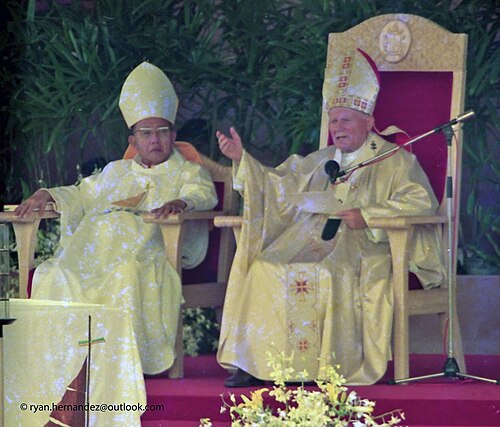
ヨハネ・パウロ2世は、若い司祭として青年たちと成功した活動の延長として、国際ワールドユースデーの先駆者となった。ヨハネ・パウロ2世は、ローマ(1985年と2000年)、ブエノスアイレス( 1987年)、サンティアゴ・デ・コンポステーラ(1989年)、チェンストホヴァ(1991年)、デンバー(1993年)、マニラ(1995年)、パリ(1997年)、トロント(2002年)の9つのワールドユースデーを主宰した。教皇在位中のこれらの代表的なイベントの参加者は、合計で数千万人に上った。[113]
献身的な年月
ヨハネ・パウロ2世は、時間のリズムとカトリック教会の生活における記念日の重要性を鋭く認識しており、教皇在位26年半の間に9つの「献身的な年」を導いた。1983年から84年の贖罪の聖年、 1987年から88年の聖母マリア年、1993年から94年の家族の年、2000年の大聖年の準備のための3つの三位一体の年、大聖年、2002年から2003年のロザリオの年、そして2004年10月17日に始まり教皇の死後6か月で終了した聖体の年である。[113]
2000年の大祝典
2000 年の大聖年は、教会に対し、福音宣教の使命をより自覚し、受け入れるよう呼びかけるものでした。
「教皇就任当初から、私はこの聖年2000年を重要な任命として考えていました。私は、この聖年を祝うことを、第二バチカン公会議から35年を経て教会がどれだけ刷新されたかを検証し、新たな熱意をもって福音宣教の使命に取り組むことができるよう、摂理的な機会だと考えていました。」[114]
ヨハネ・パウロ2世も2000年の大聖年のために聖地巡礼を行った。[115]聖地訪問中、ヨハネ・パウロ2世はロザリオの聖地を数多く訪れた。その中には、洗礼者ヨハネがイエスに洗礼を施したヨルダン川のベタニア(アル・マグタス)、イエスの生誕地であるベツレヘムの町の飼い葉桶広場と降誕教会、イエスの埋葬と復活の地であるエルサレムの聖墳墓教会などがある。[116] [117] [118]
教え
教皇として、ヨハネ・パウロ2世は14の回勅を書き、いわゆる「身体の神学」で性について教えた。「カトリック教会を再配置する」という彼の戦略の重要な要素は、Ecclesia de Eucharistia、Reconciliatio et paenitentia、Redemptoris Materなどの回勅だった。彼は新千年紀の初めに(Novo Millennio Ineunte)、「キリストから新たに出発する」ことの重要性を強調した。「いいえ、私たちは公式によってではなく、人格によって救われるのです。」彼は『真理の輝き(Veritatis Splendor)』で、人間が神とその法(「創造主なしでは、被造物は消滅する」)に依存していること、および「自由が真理に依存していること」を強調した。彼は、人間が「相対主義と懐疑主義に身を委ねると、真実そのものから離れた幻想的な自由を探し求めることになる」と警告した。ヨハネ・パウロ2世は『信仰と理性の関係について』で、哲学への新たな関心と神学上の真理の自主的な追求を促した。彼はトマス主義などさまざまな資料を参考にして、信仰と理性の相互支援関係を説明し、神学者はその関係に焦点を当てるべきだと強調した。ヨハネ・パウロ2世は労働者と教会の社会教義について広範囲に著述し、3つの回勅『労働の実践』 『真の社会の志向』『100年目の到来』で論じた。回勅や多くの使徒的書簡や勧告を通じて、ヨハネ・パウロ2世は女性の尊厳と平等について語った。[119]彼は人類の未来にとって家族が重要であると主張した。[76]
その他の回勅には『生命の福音(Evangelium Vitae)』や『彼らが一つとなるために(Ut unum sint )』などがある。批評家は、教皇が千年以上もの間施行されてきた中絶や安楽死に反対するカトリックの道徳的教えをはっきりと再主張する頑固さを非難したが、彼は死刑についてより微妙な見解を主張した。[76] 2番目の回勅『慈悲の心(Dives in misericordia)』では、神の慈悲は現代に特に必要とされる神の最大の特徴であると 強調した。
社会的および政治的立場
ヨハネ・パウロ2世は、人間の生殖や女性の叙階に関する教義や問題に関しては保守的であると考えられていた。 [120]教皇になる前年の1977年に米国を訪問した際、ヴォイティワは次のように述べた。「受胎の瞬間からその後のすべての段階に至るまで、すべての人間の命は神聖である。」[121]
1979年9月から1984年11月まで、ローマで水曜日の謁見中にヨハネ・パウロ2世が行った129回の一連の講義は、後に人間の性についての長い瞑想である『身体の神学』と題された単一の著作としてまとめられ出版された。彼はそれを中絶、安楽死、そして事実上すべての死刑の非難にまで広げ、[122]これらすべてを「生命の文化」と「死の文化」の間の闘争の一部と呼んだ。[123]彼は世界の債務免除と社会正義のために運動した。[76] [120]彼は「社会的抵当」という用語を作り出し、これはすべての私有財産が社会的側面を持っていること、すなわち「この財産は本来すべての人のためにある」ということに関連している。[124] 2000年、彼はアイルランドのロックスター、ボブ・ゲルドフとボノが率いるアフリカ債務救済に関するジュビリー2000キャンペーンを公に支持し、 U2のレコーディングセッションを中断してスタジオに電話をかけ、ボノと話したいと頼んだことで有名になった。 [125]
1962年から1965年の第2バチカン公会議に出席し大きな影響力を持ったヨハネ・パウロ2世は、公会議の教えを肯定し、その実施に大きく貢献した。しかし、彼を批判する人々は、公会議の結果として発展すると期待されていた、いわゆる進歩的な課題を彼が受け入れることをしばしば望んだ。実際、公会議はこれらの分野での進歩的な変化を主張しなかった。例えば、彼らは依然として中絶を言語に絶する犯罪として非難した。ヨハネ・パウロ2世は、避妊、中絶、同性愛行為は重大な罪であると宣言し続け、ヨゼフ・ラッツィンガー(後の教皇ベネディクト16世)とともに、当初は解放の神学に反対した。
洗礼を受けた男女間の性交という結婚行為が、結婚の秘跡にふさわしい、結婚の秘跡にのみふさわしい行為であると教会が称賛したことを受けて、ヨハネ・パウロ2世は、避妊、中絶、離婚後の「再婚」、同性愛行為は、いかなる場合においても、結婚の秘跡を汚すものであると信じた。1994年、ヨハネ・パウロ2世は、教会には女性を司祭に叙階する権限がないと主張し、そのような権限がなければ、叙階はキリストへの忠誠と正当に両立しないと述べた。これは、女性を司祭に叙階することで教会の不変の伝統を破るという呼びかけを拒否するものともみなされた。[126]さらに、ヨハネ・パウロ2世は、司祭の義務的独身制の規律を終わらせないことを選択したが、少数の異例の状況下では、後にカトリック教徒になった他のキリスト教の伝統を持つ特定の既婚聖職者がカトリックの司祭として叙階されることを許可した。
南アフリカのアパルトヘイト
ヨハネ・パウロ2世は南アフリカのアパルトヘイトに公然と反対した。1985年、オランダを訪問した際、国際司法裁判所でアパルトヘイトを非難する熱烈な演説を行い、「いかなるアパルトヘイト制度も、分離発展も、民族や人種間の関係のモデルとして受け入れられることはない」と宣言した。[127] 1988年9月、ヨハネ・パウロ2世は南アフリカをあからさまに避けながら、南アフリカと国境を接する国を含む10の南部アフリカ諸国を巡礼した。ジンバブエ訪問中、ヨハネ・パウロ2世は南アフリカ政府に対する経済制裁を求めた。[128]ヨハネ・パウロ2世の死後、ネルソン・マンデラとデズモンド・ツツ大司教はともに、人権を擁護し経済的不公正を非難した教皇を称賛した。[129]
死刑
ヨハネ・パウロ2世は、歴代の教皇が死刑制度を容認していたにもかかわらず、死刑制度に公然と反対していた。米国ミズーリ州セントルイスで行われた教皇のミサで、彼は次のように述べた。
「希望の兆しは、たとえ大きな悪事を働いた人であっても、人間の命の尊厳は決して奪われてはならないという認識が広まっていることだ。現代社会は、犯罪者に更生の機会を決定的に否定することなく、自らを守る手段を持っている。私は、クリスマスに、残酷で不必要な死刑を廃止するための合意を求めて、改めて訴えたい。」[130]
その訪問中、ヨハネ・パウロ2世は当時のミズーリ州知事メル・カーナハンを説得し、殺人罪で有罪判決を受けたダレル・J・ミースの死刑判決を終身刑に減刑させた。[131]ヨハネ・パウロ2世は死刑囚の刑期を短縮する他の試みも失敗に終わった。1983年、ヨハネ・パウロ2世はグアテマラを訪問し、同国のエフライン・リオス・モント大統領に死刑判決を受けた左翼ゲリラ6人の刑期を短縮するよう要請したが、失敗に終わった。[132]
2002年、ヨハネ・パウロ2世は再びグアテマラを訪問した。当時、グアテマラはラテンアメリカで死刑を執行している2カ国のうちの1つであった(もう1カ国はキューバ)。ヨハネ・パウロ2世はグアテマラの大統領アルフォンソ・ポルティージョに死刑執行の一時停止を求めた。[133]
環境と生態学

ヨハネ・パウロ2世は地球の環境的健康について「人類は神の期待を裏切り、我々の住む場所である地球という『花壇』を汚してきた」と説いた。[134] 2001年にバチカンで一般謁見会で使われた彼の言葉と勧告「エコロジカルな転換」は[134] 、例えばオーストラリアのカトリック地球保護指令書[135]やフランシスコ教皇の著作[136]などで広く採用されている。
欧州連合
ヨハネ・パウロ2世は、欧州憲法草案でヨーロッパのキリスト教文化のルーツに言及するよう強く求めた。2003年の使徒的勧告『 ヨーロッパにおける教会』で、ヨハネ・パウロ2世は「(ヨーロッパの)諸制度の世俗的性質を全面的に尊重する」と記した。しかし、彼は憲法に宗教的権利を明記することを望んでいた。これには、宗教団体が自由に組織する権利を認めること、各宗派の固有のアイデンティティを認めること、各宗教共同体と欧州連合(EU)との間で「組織化された対話」を可能にすること、そして個々の加盟国の宗教機関が享受する法的地位をEU全体に拡大することが含まれる。ヨハネ・パウロ2世は「私は、将来の欧州憲法条約を起草する人々に、宗教、特にヨーロッパのキリスト教の遺産に言及するよう、もう一度訴えたい」と述べた。EU憲法でヨーロッパのキリスト教的アイデンティティに言及するという教皇の希望は、ロシア、ルーマニア、ギリシャの英国国教会と東方正教会の非カトリック代表によって支持された。 [137]ヨハネ・パウロ2世が欧州憲法にヨーロッパのキリスト教的ルーツへの言及を盛り込むよう要求したことは、正統派ユダヤ教徒で著名な憲法学者のジョセフ・ヴァイラーのような非キリスト教徒からも支持され、ヴァイラーはEU憲法にキリスト教への言及がないことは「中立の表明」ではなく「ジャコバン派の態度」だと述べた。[138]
同時に、ヨハネ・パウロ2世はヨーロッパ統合の熱心な支持者でもあり、特に母国ポーランドのEU加盟を支持した。2003年5月19日、ポーランドでEU加盟に関する国民投票が行われる3週間前に、ポーランドの教皇はバチカン市国のサン・ピエトロ広場で同胞に演説し、ポーランドのEU加盟に投票するよう促した。ポーランドの保守的なカトリックの政治家の中にはEU加盟に反対する者もいたが、ヨハネ・パウロ2世は次のように述べた。
「統合に反対する人がたくさんいることは知っています。彼らが我が国の文化的、宗教的アイデンティティを維持することに関心を持っていることは理解しています。しかし、ポーランドは常にヨーロッパの重要な一部であったことを強調しなければなりません。ヨーロッパはポーランドを必要としています。ヨーロッパの教会はポーランド人の信仰の証言を必要としています。ポーランドはヨーロッパを必要としています。」[139]
ポーランドの教皇は、ポーランドのEU加盟を、1569年に調印されポーランド王国とリトアニア大公国を一つの国家に統合し、選挙による君主制を創設したルブリン条約に例えた。 [140]
進化
1996年10月22日、バチカンで開かれた教皇庁科学アカデミー総会での演説で、ヨハネ・パウロ2世は進化論について「この理論は、さまざまな知識分野における一連の発見を受けて、研究者に次第に受け入れられてきた。独立して行われた研究の結果が、意図的でも捏造でもない形で収束したこと自体が、この理論を支持する重要な論拠である」と述べた。ヨハネ・パウロ2世の進化論への支持は、1984年に謁見したアメリカの古生物学者で進化生物学者のスティーブン・ジェイ・グールド[141]によって熱烈に賞賛された。[142]
ヨハネ・パウロ2世は進化論を一般的に受け入れているものの、人間の魂については一つの大きな例外を設け、「人間の体がそれより以前から存在する生きた物質に起源を持つのであれば、霊的な魂は神によって直接創造されたものである」と述べている。[143] [144] [145]
イラク戦争
2003年、ヨハネ・パウロ2世は、2003年の米国主導のイラク侵攻を批判し、世界情勢演説で「戦争反対!戦争は必ずしも避けられないものではない。それは常に人類の敗北である」と述べた。[146]彼は、戦争反対を表明するために、元教皇大使のピオ・ラギ枢機卿を米国に派遣し、ジョージ・W・ブッシュ米大統領と会談させた。ヨハネ・パウロ2世は、国際紛争を外交を通じて解決するのは国連の役割であり、一方的な侵略は平和に対する罪であり、国際法違反であると述べた。 教皇のイラク戦争反対は、2003年のノーベル平和賞の受賞候補に挙げられ、最終的にはイランの弁護士兼裁判官で著名な人権活動家であるシリン・エバディが受賞した。[147] [148]
解放の神学
1984年と1986年に、ヨハネ・パウロ2世は、信仰教理省長官ラッツィンガー枢機卿(後の教皇ベネディクト16世)を通じて、ラテンアメリカで多くの信奉者がいた解放神学のさまざまな側面を公式に非難した。[149]
ヨーロッパを訪問中のエルサルバドル大司教オスカル・ロメロは、エルサルバドル内戦中の人権侵害と暗殺部隊の支援について、バチカンがエルサルバドルの右翼軍事政権を非難するよう主張したが、失敗に終わった。ロメロは政府に協力する聖職者と働くことに不満を表明したが、ヨハネ・パウロ2世は司教団の統一を最優先にするようロメロに奨励した。[150] [151]
1983年にニカラグアのマナグアを訪れた際、ヨハネ・パウロ2世は、ラテンアメリカ司教会議が支援する教会基盤共同体と、ニカラグアの聖職者が左翼のサンディニスタを支持する傾向にあることを指摘し、聖職者にローマ教皇庁への服従義務を思い出させながら、 「民衆教会」と名付けた者たちを厳しく非難した。[149] [152] [153] [149]その訪問中、サンディニスタ政権の司祭兼牧師であるエルネスト・カルデナルは、ひざまずいて彼の手にキスをした。ヨハネ・パウロはそれを引っ込め、カルデナルの顔に向かって指を振り、「教会におけるあなたの立場を正さなければなりません」と言った。[154]
しかし、1986 年 3 月、バチカンはこの問題に関する指示を発表し、その中で「解放の救済的側面を、その結果である社会倫理的側面に縮小すること」を警告する一方で、解放神学者が支持する「貧しい人々のための特別な選択肢」を支持し、彼らが推進してきたキリスト教基本共同体を「教会にとって大きな希望の源」と評した。数週間後、教皇自身がブラジルの司教たちに、教会の教えと調和している限り、「私たちもあなた方も、解放の神学は時宜にかなっているだけでなく、有益で必要であると確信しています。それは、以前の神学的な反省と密接に関連した新しい状態を構成するはずです」と書いたとき、この運動を支持したようだった。[155]
組織犯罪
ヨハネ・パウロ2世は、南イタリアにおけるマフィアの暴力を非難した最初の法王である。1993年、シチリア島アグリジェントへの巡礼中に、法王はマフィアにこう訴えた。「責任者に言う。『改心せよ!いつの日か、神の審判が下るだろう!』」1994年、法王はカターニアを訪れ、マフィアの暴力の被害者に「立ち上がれ、光と正義をまとうのだ!」と語った。[156]
1995年、マフィアはローマの歴史的な教会2つを爆破した。これは、組織犯罪を非難した教皇に対するマフィアの復讐であると信じる者もいた。 [157]
湾岸戦争
1990年から1991年にかけて、米国率いる34カ国連合軍は、クウェートに侵攻し併合したサダム・フセインのイラクに対して戦争を仕掛けた。ヨハネ・パウロ2世は湾岸戦争の断固たる反対者だった。湾岸戦争中、彼は国際社会に戦争を止めるよう訴え、戦争が終わった後は中東和平交渉の外交的取り組みを主導した。[158] 1991年の回勅「センテシムス・アンヌス」でヨハネ・パウロ2世は湾岸戦争を厳しく非難した。
「いいえ、二度と戦争は起こしてはならない。戦争は罪のない人々の命を奪い、殺人の方法を教え、殺人を犯す人々の命さえも混乱に陥れ、恨みと憎しみの痕跡を残し、戦争を引き起こした問題そのものの正当な解決策を見つけることをますます困難にするのだ。」[159]
1991年4月、聖ペトロ大聖堂で行われたウルビ・エト・オルビ日曜メッセージで、ヨハネ・パウロ2世は国際社会に対し、「抑圧された人々の長らく無視されてきた願望」に「耳を傾ける」よう呼びかけた。彼は特に、イラクでサダム・フセイン軍と内戦を戦っていたクルド人の名前を挙げ、その戦争を「地球を脅かす闇」と呼んだ。この間、バチカンは教皇の中東和平の呼びかけが国際社会に無視されていることに不満を表明していた。[160]
ルワンダ虐殺
1990年、カトリック教徒が大多数を占めるルワンダでツチ族とフツ族の間で内戦が起こっていたとき、ヨハネ・パウロ2世は停戦を呼びかけ、ツチ族の迫害を非難した。 [161] 1994年、ヨハネ・パウロ2世はツチ族の虐殺をジェノサイドとして非難した最初の世界指導者となった。1995年、3度目のケニア訪問で30万人の聴衆を前に、ヨハネ・パウロ2世はルワンダとブルンジでの暴力の終結を訴え、ジェノサイドの解決策として許しと和解を促した。ヨハネ・パウロ2世はルワンダとブルンジの難民に対し、「私は彼らの近くにいて、彼らの計り知れない痛みを共有している」と語った。彼は次のように述べた。
「あなた方の国々で起こっていることは、終わらせなければならない恐ろしい悲劇です。アフリカ会議の期間中、私たち教会の牧師たちは、当惑を表明し、許しと和解を求める訴えを起こす義務があると感じました。これが、最近アフリカに漂い、ルワンダとブルンジに非常に残酷な影響を与えた民族中心主義の脅威を解消する唯一の方法です。」[162]
性に関する見解
ヨハネ・パウロ2世は、人間の性に関する伝統的な立場をとり、カトリック教会の同性愛行為に対する道徳的反対を維持しつつ、同性愛傾向を持つ人々は他の人々と同じ固有の尊厳と権利を持っていると主張した。[163]著書『記憶とアイデンティティ』の中で、彼は欧州議会が同性愛者の結合を養子縁組の権利を持つ代替家族形態として認めるよう「強い圧力」をかけていることに言及した。ロイター通信が引用した同著書の中で、彼は次のように書いている。「これはおそらく、より巧妙で隠された、人間と家族に対して人権そのものを悪用しようとする新しい悪のイデオロギーの一部ではないかと自問することは正当かつ必要である。」[76] [164]
1986年、教皇は教理省による「カトリック教会の司教たちへの同性愛者の司牧に関する書簡」の発表を承認した。この書簡は同性愛と道徳秩序についてのコメントを怠らず、同性愛者の尊厳を何度も肯定した。[165]
1997年の調査では、教皇の公の発言のうち、性道徳の問題に触れたのはわずか3%だったと判明した。[166]
教会法の改革
ヨハネ・パウロ2世は、カトリック教会のラテン法と東方法の法制度の全面的な改革とローマ教皇庁の改革を成し遂げた。
1990年10月18日、東方教会法典を公布した際、ヨハネ・パウロ2世は次のように述べた。
この法典の公布により、教会全体の教会法体系がようやく完成し、1988年の「ローマ教皇庁に関する使徒憲章」に続いて、ローマ教皇の「いわば教会全体を結びつける交わり」のための主要な手段として両法典に追加されました[167]
1998年、ヨハネ・パウロ2世は自発教令 「Ad tuendam fidem」を発布し、1983年教会法典の2つの条項(750条と1371条)と1990年東方教会法典の2つの条項(598条と1436条)を改正した。
1983教会法典
1983年1月25日、ヨハネ・パウロ2世は使徒憲章『聖なる規律』により、ラテン教会に属するカトリック教会のすべての信者のために現行の教会法典を公布した。この法典は翌年の待降節第1日曜日[168]、つまり1983年11月27日に発効した。[169]ヨハネ・パウロ2世はこの新法典を「第2バチカン公会議の最後の文書」と表現した。[168] エドワード・N・ピーターズは1983年の法典を「ヨハネ・パウロ法典」[170](ヨハネス・パウルスはラテン語で「ヨハネ・パウロ」を意味する)と呼び、この法典が取って代わった1917年の「ピオ・ベネディクト法典」と対比している。
東方教会の教会法典
ヨハネ・パウロ2世は、1990年10月18日に「Sacri Canones」という文書によって東方教会の教会法(CCEO)を公布した。[171] CCEOは1991年10月1日に法律として発効した。[172]これは、カトリック教会の24の独立教会のうち23の東方カトリック教会の教会法の共通部分を成文化したものである。30のタイトルに分かれており、合計1540の教会法がある。[173]
牧師ボーナス
ヨハネ・パウロ2世は1988年6月28日に使徒憲章 「パストル・ボナス」を公布した。この憲章はローマ教皇庁の運営過程において多くの改革をもたらした。パストル・ボナスはローマ教皇庁の組織をかなり詳細に規定し、各部局の名称と構成を正確に指定し、各部局の権限を列挙した。これは1967年にパウロ6世によって公布された以前の特別法「Regimini Ecclesiæ universæ」に取って代わった。 [174]
カトリック教会のカテキズム
1992年10月11日、ヨハネ・パウロ2世は使徒憲章 「信仰の遺産」の中で『カトリック教会のカテキズム』の出版を命じた。[175] [176]
彼は、この出版物が「信仰を教えるための確かな規範であり、カトリックの教義を教え、特に地域のカテキズムを準備するための確実で信頼できる参考文献である」と宣言した。それは、既存のカテキズムに取って代わるものではなく、「新しい地域のカテキズム(適用可能で忠実なものの両方)の執筆を奨励し、支援することを目的としていた」。
南米とカリブ海の独裁政権
ヨハネ・パウロ二世の報道官、 ホアキン・ナバロ=バルス氏は次のように述べています。
「1978年のヨハネ・パウロ2世の選出というたった一つの事実が、すべてを変えた。すべてはポーランドで始まった。東ドイツやチェコスロバキアではなかった。そしてすべてが広がった。なぜ1980年に彼らはグダニスクで先導したのか?なぜ彼らは今やらなければ永遠にできないと決断したのか?それはポーランド人の教皇がいたからに他ならない。彼はチリにいたが、ピノチェトはいなかった。彼はハイチにいたが、デュヴァリエはいなかった。彼はフィリピンにいたが、マルコスはいなかった。そのような機会の多くで、人々はここバチカンにやって来て、物事を変えてくれた教皇に感謝した。」[177]
チリ
ヨハネ・パウロ2世はラテンアメリカ巡礼の前に記者との会談でアウグスト・ピノチェト政権を「独裁的」と批判した。ニューヨーク・タイムズ紙によれば、彼は「異例の強い言葉」でピノチェトを批判し、チリのカトリック教会は祈るだけでなく、チリの民主主義の回復のために積極的に戦わなければならないと記者たちに主張した。[178]
1987年にチリを訪問した際、ヨハネ・パウロ2世はチリのカトリック司教31人に、同国で自由選挙を行うよう呼びかけた。ジョージ・ワイゲルとスタニスワフ・ジウィシュ枢機卿によると、ヨハネ・パウロ2世はピノチェトに政権の民主的開放を受け入れるよう促し、辞任を求めた可能性もあるという。[179]ヨハネ・パウロ2世の列福運動の提唱者、スワヴォミール・オデル大司教によると、ヨハネ・パウロ2世のピノチェトへの言葉はチリの独裁者に大きな影響を与えた。教皇は友人にこう打ち明けた。「ピノチェトから手紙を受け取り、カトリック教徒として私の言葉に耳を傾け、それを受け入れ、国の指導者を変えるプロセスを開始することを決意したと書いてありました。」[180]
チリ訪問中、ヨハネ・パウロ2世は教会主導の民主化・反ピノチェト組織である連帯司教区を支援した。ヨハネ・パウロ2世は連帯司教区の事務所を訪れ、職員と話をし、「福音書が一貫して人権尊重を訴えていることを強調しながら、彼らに仕事を続けるよう求めた」 [181] 。チリ滞在中、ヨハネ・パウロ2世はチリの反ピノチェト民主反対派への公的な支援を表明した。例えば、彼はチリ警察に焼き殺されそうになった若い学生、カルメン・グロリア・キンタナを抱きしめてキスし、「チリの平和と正義のために祈らなければならない」と語った[182]。その後、彼はピノチェト政権によって非合法とされたグループを含むいくつかの反対派グループと会談した。野党は、ヨハネ・パウロ2世がピノチェトを独裁者と非難したことを称賛した。なぜなら、チリの野党の多くは、はるかに穏やかな発言をしたために迫害されたからだ。チリ教会内でピノチェト独裁を最も厳しく批判した一人であるカルロス・カミュ司教は、教皇訪問中のヨハネ・パウロ2世の姿勢を称賛し、「私たちの牧師が全面的に私たちを支持しているので、私はとても感動しています。私たちが人間の尊厳を擁護しているからといって、政治に干渉しているなどと誰も言うことはできないでしょう」と述べた。また、「教皇が訪問した国は、出発後も変わっていません。教皇の訪問は使命であり、特別な社会教理であり、ここでの滞在はチリの歴史の分岐点となるでしょう」と付け加えた。[183]
中には、ヨハネ・パウロ2世がチリの統治者と公の場に姿を現したことでピノチェト政権を肯定したと誤って非難する者もいる。ヨハネ・パウロ2世の訪問を企画したロベルト・トゥッチ枢機卿は、ピノチェトが法王をリビングルームに連れて行くと言って騙し、実際はバルコニーに連れて行ったと明かした。トゥッチ枢機卿は、法王は「激怒」したと述べている。[184]
ハイチ
ヨハネ・パウロ2世は、1983年3月9日にハイチを訪問した。当時、ハイチはジャン=クロード・「ベイビー・ドック」・デュヴァリエによって統治されていた。彼はハイチの大群衆の前で ベイビー・ドックとその妻ミシェル・ベネットに直接語りかけ、ハイチの貧困を率直に批判した。
「あなた方の国は美しく、人材も豊富です。しかし、キリスト教徒は、大多数の人々が苦しんでいる不正、過度の不平等、生活の質の低下、悲惨、飢餓、恐怖に気づかないわけにはいきません。」[185]
ヨハネ・パウロ2世はフランス語と時折クレオール語で話し、説教の中でほとんどのハイチ人が欠いている基本的人権について概説した。「十分な食事をとる機会、病気のときに世話を受ける機会、住居を見つける機会、勉強する機会、無学を克服する機会、やりがいのある適切な賃金の仕事を見つける機会。これらはすべて、男性にも女性にも、若者にも老人にも、真に人間らしい生活を提供するものである」。ヨハネ・パウロ2世の巡礼の後、デュヴァリエに反対するハイチ人は教皇のメッセージを頻繁に複製し引用した。ハイチを去る直前、ヨハネ・パウロ2世は次のように述べてハイチの社会変革を求めた。「頭を上げて、神の似姿として創造された人間の尊厳を意識しなさい...」[186]
ヨハネ・パウロ2世の訪問は、デュヴァリエ独裁政権に対する大規模な抗議を引き起こした。この訪問に応えて、860人のカトリック司祭と教会関係者が、教会が貧しい人々のために働くことを約束する声明に署名した。[187] 1986年、デュヴァリエは暴動で退位した。
パラグアイ
パラグアイのアルフレド・ストロエスネル将軍の独裁政権の崩壊は、とりわけヨハネ・パウロ2世が1988年5月に南米の国を訪問したことと関係していた。[188] 1954年にストロエスネルがクーデターで権力を握って以来、パラグアイの司教たちは人権侵害、不正選挙、国の封建的経済について政権をますます批判した。ヨハネ・パウロ2世はストロエスネルとの私的な会談で独裁者にこう語った。
「政治は、何よりもまず人間への奉仕であるため、根本的な倫理的側面を持っています。教会は、人々、特に統治者に、社会全体の利益のための倫理的義務を思い出させることができますし、そうしなければなりません。人々の良心が神から切り離されないように、教会は寺院の中に孤立することはできません。」[189]
その後、ミサの最中にヨハネ・パウロ2世は、農民と失業者を貧困に陥れている政権を批判し、政府は人々に土地へのアクセスをより多く与えなければならないと述べた。ストロエスネルはそれを阻止しようとしたが、ヨハネ・パウロ2世は一党独裁国家の野党指導者と会談した。[189]
共産主義の崩壊における役割

精神的なインスピレーションと触媒としての役割
1970年代後半までに、ソビエト連邦の崩壊は一部の観察者によって予測されていた。[190] [191]ヨハネ・パウロ2世は、共産主義の崩壊の背後にある精神的なインスピレーションであり、ポーランドにおける「平和的な革命」の触媒であったことにより、中央および東ヨーロッパにおける共産主義の打倒に重要な役割を果たしたとされている。[76] [90 ] [ 94] [ 111 ] [112] [192]連帯の創設者であり、共産主義後のポーランド初の大統領であるレフ・ワレサは、ヨハネ・パウロ2世がポーランド人に変化を要求する勇気を与えたと評価している。[76]ワレサによると、「彼が教皇に就任する前、世界はブロックに分かれていました。誰も共産主義を排除する方法を知りませんでした。 1979年にワルシャワで彼はただこう言いました。『恐れることはありません』。そして後にこう祈りました。『あなたの霊が降りてきて、この国...この国のイメージを変えてください』。」[192]バチカン銀行が密かに連帯に資金を提供していたとも広く疑われている。[193] [194]
1984年、ロナルド・レーガン政権の外交政策により、1870年以来初めてバチカンとの外交関係が開かれた。国内で強固な反対が続いた長い歴史とは対照的に、今回は議会、裁判所、プロテスタント団体からの反対はほとんどなかった。[195]レーガンとヨハネ・パウロ2世の関係は親密だった。特に、2人は反共産主義を共有し、ソ連をポーランドから追い出すことに強い関心を持っていたためだ。[196]レーガンと教皇の書簡には、「米国の政策に対するバチカンの支持を強化するために絶えず奔走していた」ことが記されている。おそらく最も驚くべきことは、文書には、1984年になっても教皇はポーランドの共産主義政権を転覆できるとは考えていなかったことが示されていることだ。[197]
「彼が共産主義終焉の主因であったと決定的に証明できる者はいない。しかし、ポーランド連帯の指導者レフ・ワレサだけでなく、連帯の最大の敵であるヴォイチェフ・ヤルゼルスキ将軍、元アメリカ大統領ジョージ・ブッシュ・シニアだけでなく、元ソ連大統領ミハイル・ゴルバチョフも、現在ではあらゆる陣営の主要人物が、彼が共産主義終焉の主因であったことに同意している。私はこの歴史的ケースを3つの段階に分けて論じたい。ポーランドの教皇がいなければ、1980年のポーランドの連帯革命は起こらなかった。連帯がなければ、ゴルバチョフ政権下のソ連の東欧政策の劇的な変化は起こらなかった。その変化がなければ、1989年のビロード革命は起こらなかった。」[198]
1989年12月、ヨハネ・パウロ2世はバチカンでソ連の指導者ミハイル・ゴルバチョフと会談し、お互いに尊敬と賞賛の意を表した。ゴルバチョフはかつて「ヨハネ・パウロ2世がいなければ鉄のカーテンの崩壊は不可能だっただろう」と述べた。 [90] [111]ヨハネ・パウロ2世の死去に際してゴルバチョフは「ヨハネ・パウロ2世の信奉者に対する献身は、我々すべてにとって素晴らしい模範である」と述べた。[112] [192]
2004年6月4日、ジョージ・W・ブッシュ米大統領は、ローマ教皇宮殿で行われた式典で、米国最高の民間人栄誉である大統領自由勲章をヨハネ・パウロ2世に授与した。大統領は勲章に添えられた表彰状を読み上げ、そこには「ポーランドの息子」の「平和と自由のための信念ある立場が何百万もの人々にインスピレーションを与え、共産主義と暴政の打倒に貢献した」ことが記されていた。[199]ヨハネ・パウロ2世は勲章を受け取った後、「この勲章に象徴される自由、平和、より人間的な世界への願いが、あらゆる時代と場所の善意の男女にインスピレーションを与えますように」と述べた。[200]
ヨハネ・パウロ2世を危うくしようとする共産主義者の試み

1983年、ポーランド共産党政権はヨハネ・パウロ2世が私生児をもうけたと嘘をついて、彼に屈辱を与えようとしたが、失敗した。治安機関である社会治安警察(SB)のD課は、ポーランドのカトリック教会に対する犯罪行為を実行するために「トリアンゴロ」と呼ばれる活動を行っていた。この活動は、教皇に対するポーランドのあらゆる敵対行為を網羅していた。[201] [より詳細な情報源が必要]列福されたイェジ・ポピエウシュコの殺害者の一人であるグジェゴシュ・ピオトロフスキ大尉は、D課のリーダーだった。彼らは、ヴォイティワが働いていたクラクフの週刊カトリック雑誌「Tygodnik Powszechny」の秘書であるイレーナ・キナシェフスカに薬物を投与し、ヴォイティワと性的関係を持ったことを認めさせようとしたが、失敗した。[202]
その後、SBは、クラクフの司祭で『ティゴドニク・ポフシェチニー』の編集者であり、教皇になる前のヴォイティワ枢機卿の最も親しい友人の一人であったアンジェイ・バルデッキの住居に偽の回想録を仕掛けることで、彼を危険にさらそうとした。ピオトロフスキは暴露され、SBが発見したと言う前に偽造が発見され、破壊された。[202]
他のキリスト教宗派との関係
ヨハネ・パウロ2世は広範囲に旅をし、さまざまな信仰を持つ信者と会った。 1986年10月27日にアッシジで開催された世界平和祈願日には、さまざまな宗教や宗派の120人以上の代表者が一日断食と祈りを捧げた。[203]
東方の教会
聖座と東方キリスト教徒の多くとの接触は完全に途絶えたことはなかったが、交わりは古代から途絶えていた。また、中央ヨーロッパの紛争の歴史はヨハネ・パウロ2世の個人的な文化的遺産の複雑な部分であり、相対的に言えば聖座と非カトリックの東方教会は多くの点で信仰が近いことを考えると、それが彼に永続的な困難を克服しようと反応する決意を一層固めさせた。
東方正教会
1999年5月、ヨハネ・パウロ2世はルーマニア正教会のテオクティスト・アラパシュ総主教の招待を受けてルーマニアを訪問した。これは、 1054年の大分裂以来、東方正教会が多数を占める国を教皇が訪問した初めての機会であった。 [204]教皇の到着時に、総主教とルーマニア大統領のエミル・コンスタンティネスクが教皇を出迎えた。[204]総主教は「キリスト教史の第二千年紀は、教会の統一が痛ましく傷つけられたことで始まった。この千年紀の終わりには、キリスト教の統一を回復するという真の決意が見られた」と述べた。[204]
2001年6月23日から27日にかけて、ヨハネ・パウロ2世は、ウクライナ大統領とウクライナ・ギリシャ・カトリック教会の司教らの招待を受け、もう一つの正教会信仰が強い国であるウクライナを訪問した。[205]教皇は、全ウクライナ教会・宗教団体評議会の指導者らと会談し、「開かれた、寛容で、誠実な対話」を訴えた。[205]教皇がキエフで執り行った典礼には約20万人が出席し、リヴィウでの典礼には約150万人の信者が集まった。[205]ヨハネ・パウロ2世は、大分裂の終結が自分の最大の願いの一つであると述べた。[205]ラテンとビザンチンの伝統に関するカトリック教会と東方正教会の間の分裂を癒すことは、明らかに大きな個人的な関心事であった。ヨハネ・パウロ2世は、1988年に早くも「ヨーロッパには肺が2つある。その両方を使うまでは、決して楽に呼吸することはできない」と述べ、長年にわたり対話と団結の促進に努めてきました。[要出典]
2001年の旅行中、ヨハネ・パウロ2世は1291年ぶりにギリシャを訪問した教皇となった。[206] [207]アテネでは、教皇はギリシャ教会の長であるアテネのクリストドゥロス大司教と会談した。[206] 30分間の非公開の会談の後、2人は公の場で会談した。クリストドゥロス大司教は、大分裂以来のカトリック教会による東方正教会に対する「13の罪」のリストを読み上げ、[206] 1204年の第4回十字軍によるコンスタンティノープルの略奪を含む、カトリック教会からの謝罪がないことを嘆き、「今までに、13世紀の狂気の十字軍に対する恩赦を求める声は1つも聞かれていない」と述べた。[206]
教皇は「過去と現在において、カトリック教会の息子や娘が正教会の兄弟姉妹に対して行動や怠慢によって罪を犯した時、主が私たちに赦しを与えてくださいますように」と答え、クリストドゥロスは即座に拍手喝采した。ヨハネ・パウロ2世は、コンスタンティノープルの略奪はカトリック教徒にとって「深い後悔」の源であると述べた。[206]その後、ヨハネ・パウロ2世とクリストドゥロスは、かつてタルソスのパウロがアテネのキリスト教徒に説教した場所で会談した。彼らは共通の宣言を発表し、「ヨーロッパのキリスト教のルーツとそのキリスト教の魂が守られるように、私たちは全力を尽くします。…宗教の名の下に暴力、改宗、狂信に訴えることはすべて非難します」と述べた。 [206]その後、2人の指導者は一緒に主の祈りを唱え、カトリック教徒と一緒に祈ることを禁じる正教会のタブーを破った。[206]
教皇は在位中、最大の夢の一つはロシアを訪問することだと語っていたが[208] 、実現することはなかった。教皇はカトリック教会とロシア正教会の間で何世紀にもわたって生じた問題を解決しようとし、2004年に失われたカザンの聖母のイコンの1730年の複製を両教会に贈った。[要出典]
アルメニア使徒教会
ヨハネ・パウロ2世は、キリスト教の古代から聖座から分離していたアルメニア使徒教会と良好な関係を維持することを決意していた。1996年、ヨハネ・パウロ2世は、キリストの性質についてアルメニア大司教カレキン2世と同意することで、カトリック教会とアルメニア使徒教会の関係を近づけた。 [209] 2000年の謁見で、当時全アルメニア人のカトリコスであったヨハネ・パウロ2世とカレキン2世は、アルメニア人虐殺を非難する共同声明を発表した。一方、教皇は、 500年間イタリアのナポリに保管されていたアルメニア教会の初代首長、聖グレゴリウス・イルミネーターの聖遺物をカレキンに贈った。[210] 2001年9月、ヨハネ・パウロ2世はアルメニアへの3日間の巡礼を行い、エレバンの新しく奉献された聖グレゴリウス・イルミネーター大聖堂でカレキン2世とともにエキュメニカルな祝典に参加した。二人の教会指導者はアルメニア人虐殺の犠牲者を追悼する宣言に署名した。[211]
プロテスタント
ヨハネ・パウロ2世は、その後継者たちと同様に、プロテスタント諸団体との友好関係、実際的な人道的協力、神学上の対話を促進するために数多くの取り組みを行った。その中でも、マルティン・ルターとその追随者との争いが西方キリスト教における最も重要な歴史的分裂であったことを考えると、ルター派との取り組みは最も重要であったに違いない。 [要出典]
ルター派
1980年11月15日から19日まで、ヨハネ・パウロ2世は西ドイツを訪問した[212] 。これは、ルター派 プロテスタントの人口が多い国への最初の訪問であった。マインツでは、ドイツのプロテスタント教会の指導者や他のキリスト教宗派の代表者と会談した。[要出典]
1983年12月11日、ヨハネ・パウロ2世はローマの福音ルーテル教会でエキュメニカルな礼拝に参加した。 [213]これはルーテル教会への教皇の初訪問であった。この訪問は、最初はアウグスティノ会の修道士で、後にプロテスタントの改革者となったドイツのマルティン・ルターの生誕500年後に行われた。[要出典]
1989年6月のノルウェー、アイスランド、フィンランド、デンマーク、スウェーデンへの使徒的巡礼[214]で、ヨハネ・パウロ2世はルター派が多数派を占める国々を訪問した最初の教皇となった。カトリック信者とともにミサを執り行うほか、宗教改革以前にカトリックの聖地であったノルウェーのニーダロス大聖堂、アイスランドのシンクヴェトリルにある聖オラフ教会の近く、フィンランドのトゥルク大聖堂、デンマークのロスキレ大聖堂、スウェーデンのウプサラ大聖堂などでエキュメニカルな礼拝に参加した。[要出典]
1999 年 10 月 31 日 (宗教改革記念日、マルティン・ルターが95 カ条の論題を発表した 482 周年記念日)、カトリック教会のキリスト教統一促進評議会とルーテル世界連盟の代表は、団結のしるしとして、正当化の教義に関する共同宣言に署名しました。この署名は、ルーテル世界連盟とローマ教皇庁の間で1965 年以来続いてきた神学対話の成果でした。[引用が必要]
英国国教会
ヨハネ・パウロ2世は、イングランド国教会だけでなく、他の聖公会とも良好な関係を築いていた。1982年に英国を訪問した最初の教皇であり、そこでイングランド国教会の最高統治者であるエリザベス2世女王と会見した。教皇はカンタベリー大聖堂で説教し、カンタベリー大主教のロバート・ランシーを迎えた。教皇は、イングランド国教会が女性を聖職者に任命する決定に失望し、それが聖公会とカトリック教会の統一から遠ざかるものであると見ていると述べた。 [215]
1980年、ヨハネ・パウロ2世は、結婚した元聖公会司祭がカトリック司祭になること、および元聖公会教区をカトリック教会に受け入れることを許可する司牧条項を発布した。彼は、カトリックの教義と互換性のある英国国教会の祈祷書の選択された要素を取り入れた、非公式に英国国教会の使用として知られるローマ典礼の形式の創設を許可した。彼は、テキサス州サンアントニオのパトリック・フローレス大司教に、この混合典礼を使用する最初の教区として、贖罪の聖母カトリック教会を設立することを許可した。[216]
ユダヤ教との関係
ヨハネ・パウロ2世の在位中に、カトリックとユダヤ教の関係は劇的に改善した。 [76] [106]彼はカトリック教会とユダヤ教の関係について頻繁に語った。[76]彼の態度は、1930年代と1940年代にポーランドと他の中央ヨーロッパのユダヤ人が経験した悲惨な運命によって部分的に形成された可能性が高い。
1979年、ヨハネ・パウロ2世はポーランドのアウシュビッツ強制収容所を訪問した。第二次世界大戦中のドイツ占領下で多くの同胞(主にユダヤ人)が亡くなった場所である。1998年、彼はホロコーストに関する自身の考えを概説した『われらは忘れない:ホロコーストについての考察』を発表した。[217]彼は1986年4月13日にローマの大シナゴーグを訪問し、シナゴーグを公式訪問した最初の教皇として知られている。[218] [219]
1993年12月30日、ヨハネ・パウロ2世は、ユダヤ人の生活と信仰におけるイスラエルの中心性を認め、聖座とイスラエル国の間に正式な外交関係を樹立した。[218]
1994年4月7日、教皇はホロコーストを記念するコンサートを主催した。これは、第二次世界大戦で殺害された600万人のユダヤ人を追悼するバチカン初のイベントであった。米国の指揮者ギルバート・レヴィンが発案・指揮したこのコンサートには、ローマの首席ラビ、エリオ・トアフ、イタリア大統領オスカル・ルイジ・スカルファロ、そして世界中のホロコースト生存者が出席した。この機会に、レヴィンの指揮の下、ロイヤル・フィルハーモニー管弦楽団、俳優リチャード・ドレイファス、チェロ奏者のリン・ハレルが演奏した。[220] [221]コンサートの朝、教皇は使徒宮殿で特別謁見会を開き、生存者コミュニティの出席者を迎えた。
2000年3月、ヨハネ・パウロ2世はイスラエルの国立ホロコースト記念館であるヤド・ヴァシェムを訪問し、その後、ユダヤ教で最も神聖な場所の1つであるエルサレムの嘆きの壁に触れて歴史を作りました[106](ユダヤ人に対する行為の許しを祈った手紙をその中に入れました)。[105] [106] [218]演説の一部で、彼は次のように述べました。「私はユダヤ人の人々に保証します。カトリック教会は...キリスト教徒によるユダヤ人への憎悪、迫害行為、反ユダヤ主義の表明に深く悲しんでいます。」彼はさらに、「ホロコーストの恐ろしい悲劇を嘆くのに十分な言葉はない」と付け加えました。[105] [106]彼はさらにこう付け加えた。「歴史の中であなた方の子供たちに苦しみを与えた人々の行為に私たちは深く悲しんでいます。あなた方の許しを請い、私たちは盟約の民と真の兄弟愛を誓います。」[222]教皇の訪問を主催した イスラエルの閣僚ラビ・マイケル・メルヒオールは、教皇の行為に「非常に感動した」と述べた。[105] [106]彼はこう言った。「それは歴史を超え、記憶を超えたものでした。」[105]
2003年10月、名誉毀損防止同盟(ADL)は、ヨハネ・パウロ2世の教皇在位25年目を祝う声明を発表した。2005年1月、ラビのベンジャミン・ブレヒ、バリー・ドヴ・シュワルツ、ジャック・ベンポラドが使徒宮殿のクレメンティーヌ・ホールで教皇を訪問し、ヨハネ・パウロ2世はラビから司祭の祝福を受けた最初の教皇となった。[223]
ヨハネ・パウロ2世の死後すぐに、名誉毀損防止連盟は声明で、ヨハネ・パウロ2世はカトリックとユダヤ教の関係に革命を起こしたと述べ、「彼の27年間の教皇在位中に、それ以前の約2000年間よりも多くの良い変化が起こった」と述べた。[224]オーストラリア・イスラエル・ユダヤ問題評議会が出した別の声明で、コリン・ルーベンシュタイン理事は「教皇は、自由と人類の大義における感動的な精神的指導力で記憶されるだろう。彼は、ユダヤ民族とイスラエル国との関係を変革するという点で、カトリック教会の歴史上他のどの人物よりも多くのことを成し遂げた」と述べた。 [218] 1986年4月、ヨハネ・パウロ2世は「したがって、ユダヤ教とは、他のどの宗教とも持たない関係を持っている。あなた方は私たちの最愛の兄弟であり、ある意味では、あなた方は私たちの兄であると言えるだろう」と述べた。[225]
ポーランド通信とのインタビューで、ポーランドの首席ラビであるミヒャエル・シュドリッヒは、歴史上、ヨハネ・パウロ2世ほどキリスト教とユダヤ教の対話に貢献した人はいなかったと述べ、多くのユダヤ人は一部のラビよりも故教皇を尊敬していたと付け加えた。シュドリッヒは、ヨハネ・パウロ2世が反ユダヤ主義を罪として非難したことを称賛したが、これは歴代の教皇がしたことではなかった。[226]
ヨハネ・パウロ2世の列福について、ローマの首席ラビ、リッカルド・ディ・セーニはバチカンの新聞「オッセルバトーレ・ロマーノ」のインタビューで、「ヨハネ・パウロ2世は、ユダヤ世界に対するカトリックの千年にわたる不信の壁を打ち破った点で革命的だった」と語った。一方、元ローマ首席ラビの エリオ・トアフは次のように語った。
「教皇カロル・ヴォイティワの記憶は、あらゆる暴力を排除する友愛と寛容の精神を訴えた彼の功績により、ユダヤ人の集団的記憶の中に強く残るだろう。ローマ教皇とユダヤ人ゲットーの関係は、屈辱的な状況下で3世紀以上も閉じ込められていたが、その波乱に満ちた歴史の中で、ヨハネ・パウロ2世は唯一無二の存在として輝かしい存在である。血なまぐさい戦争と人種差別の蔓延に染まった新世紀における、私たちの2大宗教の関係において、ヨハネ・パウロ2世の遺産は、生き残りと人類の進歩を保証する数少ない精神的な島の一つであり続けている。」[227]
他の世界の宗教との関係
アニミズム
1995年に出版されたイタリア人ジャーナリスト、ヴィットリオ・メッソーリとのインタビュー本『希望の境界を越えて』の中で、ヨハネ・パウロ2世はアニミズムとキリスト教の類似点を指摘している。彼は次のように書いている。
「…先祖崇拝を強調するアニミズムの宗教を思い出すと役に立つだろう。アニミズムの宗教を実践する人々はキリスト教に特に近いようで、教会の宣教師たちも彼らの間で共通の言語を話すのが容易であると考えている。おそらく、この先祖崇拝には、生きているか死んでいるかにかかわらずすべての信者が単一のコミュニティ、単一の団体を形成する聖人の交わりにおけるキリスト教の信仰への一種の準備があるのだろうか?…したがって、アフリカとアジアのアニミストが極東の偉大な宗教の信者よりも容易にキリストの信者になるのは不思議なことではない。」[228]
1985年、教皇は人口の60パーセントがアニミズム信仰を信奉するアフリカの国トーゴを訪問した。アニミズムの宗教指導者たちは教皇を称えるため、森の中のカトリックの聖母マリアの聖堂で教皇と会見し、教皇は大いに喜んだ。ヨハネ・パウロ2世は宗教的寛容の必要性を訴え、自然を讃え、アニミズムとキリスト教の共通点を強調し、次のように述べた。
「この地域の森と湖の豊かで素晴らしい自然は、その神秘で精神と心を浸透させ、生命の創造主である神の神秘へと自然に導きます。この宗教的な感情があなたを動かし、あなたの同胞全員を動かしていると言えるでしょう。」[229]
2008年12月20日、ベナンのトーマス・ボニ・ヤイ大統領がヨルバ族の首長に叙任された際、ナイジェリアのイレイフェの現ウニ族、オルブセ2世は、ヨハネ・パウロ2世が以前に同じ王室の栄誉を受けた人物であると言及した。[230]
仏教
ダライ・ラマ14世テンジン・ギャツォはヨハネ・パウロ2世を8回訪問した。共産主義の影響を受けた国の出身で、主要な宗教団体の長を務めていた2人は多くの点で同様の見解を持ち、同様の苦境を理解していた。[231] [232]ダライ・ラマ14世が世界的に有名になるずっと前から、クラクフ大司教として、ヴォイティワは毛沢東政権下の中国からの自由を求めるチベット人の非暴力闘争を祈る特別ミサを開いた。[233] 1987年、彼は東西精神交流の参加者を迎え入れた。これは僧院間宗教対話(DIMMID)と禅研究所が主導する取り組みで、仏教とキリスト教の僧侶や尼僧が互いの修道院に1か月間交代で滞在するものである。[234] [235] 1995年にスリランカを訪問した際、ヨハネ・パウロ2世は、国民の大半が上座部仏教を信仰する国であるスリランカを訪問し、仏教に対する尊敬の念を表明した。彼は次のように述べた。
「特に、スリランカの多数派宗教である仏教の信者に最大限の敬意を表します。仏教には、慈悲、同情、共感の喜び、平静さという4つの偉大な価値があり、10の超越的な美徳と、上座部仏教でとても美しく表現されている僧伽の喜びがあります。私の訪問が私たちの間の友好関係を強化するのに役立つことを熱望し、より公正で友愛的な世界を築くための宗教間対話と協力に対するカトリック教会の望みをすべての人に再確認させるでしょう。私はすべての人に友情の手を差し伸べ、ダンマパダの素晴らしい言葉を思い出します。『無益な言葉1000語よりも平和をもたらす一言のほうがよい』…」[236]
イスラム教

ヨハネ・パウロ2世はカトリックとイスラム教の関係改善に多大な努力を払った。[237]
彼はローマのモスクのプロジェクトを公式に支持し、1995年の落成式に参加した。
1999年5月14日、シリアでのイスラム教指導者との会合で、彼はコーランを贈られ、すぐにそれにキスをしたが、この行為は一部のカトリック教徒の間で物議を醸した。[238] [239]
2001年5月6日、彼はシリアのダマスカスにあるウマイヤド・モスクで祈りを捧げた最初のカトリック教皇となった。彼は敬意を表して靴を脱ぎ、イスラム教の預言者としても崇敬されている洗礼者ヨハネに捧げられたビザンチン時代のキリスト教会に入った。彼は「イスラム教徒とキリスト教徒が互いに傷つけ合ったすべてのことに対して、私たちは全能の神に許しを求め、互いに許し合う必要がある」という声明を含む演説を行った。[104]
2004年、ヨハネ・パウロ2世は「教皇和解コンサート」を主催し、イスラム教の指導者とユダヤ教コミュニティおよびカトリック教会の指導者をバチカンに集め、ポーランドのクラクフ・フィルハーモニー合唱団、イギリスのロンドン・フィルハーモニー合唱団、アメリカのピッツバーグ交響楽団、トルコのアンカラ国立ポリフォニー合唱団によるコンサートを開催した。[240] [241] [242] [243]このイベントはKCSGのギルバート・レヴァインが考案・指揮し、世界中に放送された。[240] [241] [242] [243]
ヨハネ・パウロ2世は、イスラム教徒のための特別な規定を設けたカトリック教会のカテキズムの出版を監督しました。そこには、「彼らは私たちとともに、最後の日に人類を裁く唯一の慈悲深い神を崇拝している」と書かれています。[244]
ジャイナ教
1995年、ヨハネ・パウロ2世は、教皇庁宗教間対話評議会の主催により、 21人のジャイナ教徒と会合を開いた。教皇はモハンダス・ガンジーの「神への揺るぎない信仰」を称賛し、カトリック教会がジャイナ教徒との対話を継続することを保証し、貧しい人々への援助が共通の必要性であると語った。ジャイナ教の指導者たちは教皇の「透明性と簡潔さ」に感銘を受け、会合は多くのジャイナ教徒が住むインド西部のグジャラート州で大きな注目を集めた。 [245]
暗殺の試みと陰謀

1981年5月13日、ヨハネ・パウロ2世が演説のためサン・ピエトロ広場に入った際、 [246]メフメト・アリ・アージャ[20] [94] [247]に撃たれ重傷を負った。アージャはトルコの熟練したガンマンで、過激なファシスト集団「灰色の狼」のメンバーだった。[248]暗殺者はブローニング9mm半自動拳銃を使用し、[249]教皇の腹部を撃ち、結腸と小腸を複数回貫通した。[90]ヨハネ・パウロ2世はバチカンの敷地内に運ばれ、その後ジェメッリ病院に搬送された。病院に向かう途中で意識を失った。2発の銃弾は上腸間膜動脈と腹部大動脈を外れたものの、ほぼ4分の3の血液を失った。傷を治療するため5時間に及ぶ手術を受けた。[250]外科医は人工肛門を作製し、大腸の上部を一時的に別の経路で迂回させて損傷した下部を治癒させた。[250]手術前に一時的に意識を取り戻した彼は、手術中に茶色のスカプラリオを外さないように医師に指示した。 [251]ジェメッリ・クリニックで彼に会うことを許された数少ない人物の1人が、彼の親友の1人である哲学者のアンナ・テレサ・ティミエニエツカで、彼女は5月16日土曜日に到着し、緊急手術からの回復まで彼に付き添った。[81]教皇は後に、聖母マリアが彼の試練の間ずっと彼を生かし続けたと述べた。[94] [247] [252]彼は言った。
「サン・ピエトロ広場での出来事が、ポルトガルのファティマでキリストの母が貧しい小農たちに初めて現れた日と時刻に起こったことを、私は忘れることができただろうか。その日、私に起こったすべての出来事の中で、私は母親の並外れた保護と気遣いを感じた。それは致命的な銃弾よりも強力であることがわかった。」[253]
アジャは、警察が到着するまで、修道女と他の通行人によって捕らえられ、拘束された。彼は終身刑を宣告された。1983年のクリスマスの2日後、ヨハネ・パウロ2世は刑務所にいるアジャを訪問した。ヨハネ・パウロ2世とアジャは約20分間個人的に話をした。[94] [247]ヨハネ・パウロ2世は、「私たちが話したことは、彼と私の間の秘密のままでなければなりません。私は、私が赦免し、完全に信頼している兄弟として彼と話しました。」と述べた。[254]
暗殺未遂を説明するために数多くの説が唱えられ、そのいくつかは物議を醸した。マイケル・レディーンが唱え、暗殺当時はアメリカ中央情報局が強く推し進めたが、証拠によって実証されることはなかった説の一つは、ヨハネ・パウロ2世暗殺未遂の背後にソ連がいるというものである。これは、教皇がポーランドのカトリックの民主化労働者運動である連帯を支援したことへの報復である。[248] [255]この説は、シルヴィオ・ベルルスコーニが設置し、フォルツァ・イタリアの上院議員パオロ・グッザンティが率いる2006年のミトロヒン委員会によって支持され、同委員会は、ソ連の役割が暴露されるのを防ぐために共産主義ブルガリアの治安部が利用されたと主張し、 KGBではなくソ連の軍事情報機関 ( Glavnoje Razvedyvatel'noje Upravlenije )が関与していると結論付けた。 [255]ロシア対外情報局報道官ボリス・ラブソフは、この告発を「馬鹿げている」と述べた。[255]教皇は2002年5月のブルガリア訪問の際、ソ連時代のブルガリア指導部は暗殺未遂事件とは何の関係もないと宣言した。[248] [255]しかし、教皇の秘書であるスタニスワフ・ジヴィシュ枢機卿は著書『カロルとの生涯』の中で、教皇は個人的には旧ソ連が攻撃の背後にいると確信していたと主張した。[256]後に、ヨハネ・パウロ2世の側近の多くが外国政府と関係があったことが判明した。 [257]ブルガリアとロシアは、教皇がブルガリアとのつながりを公式に否定したことを指摘し、イタリア委員会の結論に異議を唱えた。 [ 255 ]
2度目の暗殺未遂事件は1982年5月12日、最初の暗殺未遂事件の記念日のちょうど前日にポルトガルのファティマで起こり、男がヨハネ・パウロ2世を銃剣で刺そうとした。[258] [259] [260]男は警備員に阻止された。スタニスワフ・ジヴィシュは後に、ヨハネ・パウロ2世は暗殺未遂事件で負傷したが、命に別状なく傷を隠すことができたと述べた。[258] [259] [260]襲撃者はフアン・マリア・フェルナンデス・イ・クローンという名の伝統主義カトリックのスペイン人司祭で、[258]聖ピオ十世会のマルセル・ルフェーブル大司教によって司祭に叙階されており、教皇は共産主義モスクワとマルクス主義東側諸国の手先だと言って第二バチカン公会議による変更に反対していた。[261]フェルナンデス・イ・クローンはその後司祭職を辞し、6年の刑期のうち3年間服役した。[259] [260] [261]この元司祭は精神疾患の治療を受けた後、ポルトガルから追放され、ベルギーで弁護士になった。[261]
アルカイダが資金援助するボジンカ計画は、 1995年の世界青年の日祝賀行事でフィリピンを訪問中のヨハネ・パウロ2世を殺害する計画だった。1995年1月15日、マカティのサン・カルロス神学校に向かう教皇の車列を横切る際、自爆犯が司祭に扮して爆弾を爆発させる計画を立てていた。この暗殺は、作戦の次の段階から注意をそらすためのものだった。しかし、このグループが誤って化学薬品の火災を起こし、警察に居場所を知られ、全員が教皇訪問の1週間前に逮捕され、計画を自白した。[262]
2009年、ジャーナリストで元陸軍情報部員のジャック・ケーラーは『バチカンのスパイ:カトリック教会に対するソ連の冷戦』を出版した。[263]ケーラーは主に東ドイツとポーランドの秘密警察の文書を調べた結果、暗殺未遂は「KGBの支援を受けたもの」だと主張した。[264]
謝罪
ヨハネ・パウロ2世は、長年カトリック教会の手によって苦しめられてきた多くのグループに謝罪した。[76] [265]教皇になる前、彼は1965年のポーランド司教からドイツ司教への和解の手紙などのイニシアチブの著名な編集者および支持者であった。教皇として、彼は100を超える不正行為について公式に公に謝罪したが、その中には以下が含まれる。[266] [267] [268] [269]
- 1633年頃のイタリアの科学者・哲学者で敬虔なカトリック教徒であったガリレオ・ガリレイに対する法的手続き(1992年10月31日)。 [270] [271]
- 大西洋奴隷貿易におけるカトリック教徒の関与(1993年8月9日)。
- プロテスタント宗教改革後の火あぶりと宗教戦争における教会階層の役割(1995 年 5 月 20 日、チェコ共和国)。
- 女性に対する不正、女性の権利の侵害、そして歴史的に女性を貶めてきたこと(1995 年 7 月 10 日、「すべての女性」に宛てた手紙)。
- ホロコースト中の多くのカトリック教徒の無活動と沈黙( 「ナチスドイツにおける宗教」の記事を参照)(1998 年 3 月 16 日)。
2000 年の大聖年では、2000 年 3 月 12 日に教会の罪の赦しを祈る日が設けられました。
2001年11月20日、ヨハネ・パウロ2世はバチカンのラップトップから、カトリックの性的虐待事件、オーストラリアの教会が支援する先住民の子供たちの「盗まれた世代」、そして植民地時代のカトリック宣教師の行動について中国に謝罪する最初の電子メールを送信した。[272]
健康

1978年に58歳で教皇になったとき、ヨハネ・パウロ2世は熱心なスポーツマンだった。彼は非常に健康で活動的で、バチカンの庭園でジョギングをしたり、ウェイトトレーニングをしたり、水泳をしたり、山でハイキングをしたりしていた。彼はサッカーが好きだった。メディアは、新教皇の運動能力と引き締まった体型を、ヨハネ・パウロ1世とパウロ6世の不健康さ、ヨハネ23世の太り気味さ、そしてピウス12世の絶え間ない病気の主張と比較した。現代の教皇でフィットネスに励んでいたのは、熱心な登山家だったピウス11世(1922-1939)だけだった。[273] [274] 1980年代のアイリッシュ・インディペンデント紙の記事は、ヨハネ・パウロ2世を「健康維持の教皇」と評した。
しかし、教皇としての26年以上の在位期間、二度の暗殺未遂(そのうちの一つは教皇を重傷に至らしめた)、そして数々の癌の恐怖により、ヨハネ・パウロ2世の身体の健康は衰えました。2001年、彼はパーキンソン病を患っていると診断されました。[275]国際的な観察者はしばらく前からこれを疑っていましたが、2003年にバチカンによって公に認められました。一度に数文以上話すのが困難で、聴覚に問題があり、重度の変形性関節症を患っていたにもかかわらず、彼は人前を歩くことはめったになかったものの、世界中を巡業し続けました。
死と葬儀
最後の数ヶ月
ヨハネ・パウロ2世は2005年2月1日にインフルエンザによる呼吸困難で入院した。[276] 2月10日に退院したが、2週間後に呼吸困難で再び入院し、気管切開手術を受けた。[277]
最後の病気と死
2005年3月31日、尿路感染症に続いて[278]、彼は敗血症性ショック(高熱と低血圧を伴う感染症の一種)を発症したが、入院はしなかった。その代わり、彼は私邸でコンサルタントチームによって監視された。これは教皇と彼の側近には、彼が死期が近づいている兆候であると受け止められた。それはバチカンで亡くなることが彼の希望に沿ったものだっただろう。[278]その日遅く、バチカンの情報筋は、ヨハネ・パウロ2世が友人で秘書のスタニスワフ・ジヴィシュによって病者の塗油を受けたと発表した。死去の前日、彼の最も親しい友人の一人であるアンナ・テレサ・ティミエニエツカが彼を見舞った。[79] [279]教皇の生涯の最後の数日間、教皇が使徒宮殿の最上階にある教皇居に横たわっていた場所には、夜通し明かりが灯されていた。何万人もの人々が集まり、2日間にわたってサン・ピエトロ広場とその周辺の通りに徹夜で祈りを捧げた。これを聞いた死にゆく教皇は、「私はあなたを捜し求めていましたが、今あなたは私のところに来てくれました。感謝します」と述べたと言われている。[280]

Wikinewsには関連ニュースがあります:
- ヨハネ・パウロ2世が死去
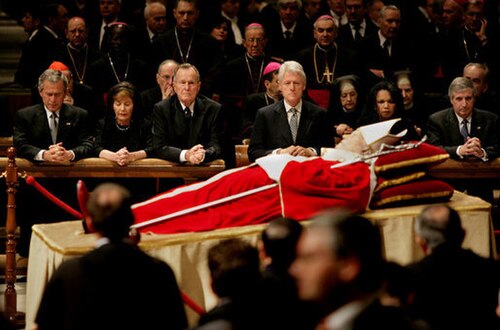
2005年4月2日土曜日、中央ヨーロッパ夏時間15時30分頃、ヨハネ・パウロ2世は側近たちにポーランド語で最後の言葉「Pozwólcie mi odejść do domu Ojca(父の家へ旅立たせてください)」を語り、約4時間後に昏睡状態に陥った。[280] [281] 2000年4月30日のファウスティナ・コヴァルスカの列聖を記念する復活祭第2日曜日の前夜ミサが、ジヴィシュと2人のポーランド人の協力者によってヨハネ・パウロ2世のベッドサイドで執り行われたばかりだった。ベッドサイドには、ポーランドでヨハネ・パウロ2世とともに司祭を務めたウクライナ出身のルボミール・フサル枢機卿と、教皇邸宅を取り仕切るイエズスの聖心に仕える修道女会のポーランド人修道女たちがいた。ヨハネ・パウロ2世は、21時37分(中央ヨーロッパ夏時間、協定世界時19時37分)に、重度の低血圧による心不全と敗血症性ショックによる循環不全のため、自宅の私室で亡くなった。[ 281 ] [ 282 ] [ 283]彼の死は、20分間の心電図で心拍数が平坦になったことで確認された。[284]
法王が亡くなった時点では近親者はおらず、その気持ちは2000年に書かれた遺言状の最後に書かれた言葉に反映されている。[285]ジウィシュ法王は後に、遺言書に法王の個人的なメモの焼却の要請があったにもかかわらず、焼却しなかったと述べた。[286]
余波
教皇の死去により、中世にまで遡る儀式や伝統が始まった。聖ペトロ大聖堂で2005年4月4日から7日まで、訪問の儀式が行われた。2005年4月7日に公表されたヨハネ・パウロ2世の遺言[287]によると、教皇は母国ポーランドに埋葬されることを考えたが、最終決定は枢機卿団に委ねたとされており、枢機卿団はついでに、教皇の「裸地」に埋葬してほしいという要望を尊重し、サン・ピエトロ大聖堂の下に埋葬されることを希望した。
2005年4月8日に行われたレクイエムミサは、葬儀に参列した出席者数と国家元首の数の両方で世界記録を樹立したと言われている。[ 270 ] [ 288] [289] [290] (参照:高官リスト)これは、ウィンストン・チャーチル(1965年)やヨシップ・ブロズ・チトー(1980年)の葬儀を上回り、当時としては最大の国家元首の集まりであった。4人の国王、5人の女王、少なくとも70人の大統領と首相、そして14人以上の他の宗教の指導者が参列した。[288]バチカン市国とその周辺には推定400万人の会葬者が集まった。[270] [289] [290] [291] 25万人から30万人がバチカンの壁の中からこの行事を見守った。[290]歴史上稀なことだが、プロテスタントと東方正教会の指導者、またユダヤ教、イスラム教、ドゥルーズ派[292] 、仏教の代表者や指導者らが、カトリック教徒の悲しみに同情する手段として、独自の追悼式や祈りを捧げた。
枢機卿団長のジョセフ・ラッツィンガー枢機卿が式典を司った。ヨハネ・パウロ2世は、教皇の墓である大聖堂の下の洞窟に埋葬された。彼は、以前ヨハネ23世の遺体が安置されていた同じ床の間に作られた墓に降ろされた。ヨハネ23世の遺体は、列福後に大聖堂の本体に移されて以来、床の間は空になっていた。
死後の認知
タイトル「偉大なる」

Upon the death of John Paul II, a number of clergy at the Vatican and laymen[90][270][293] began referring to the late pontiff as "John Paul the Great" — in theory only the fourth pope to be so acclaimed.[90][293][294][295] Cardinal Angelo Sodano specifically referred to John Paul as "the Great" in his published written homily for the pope's funeral Mass of Repose.[296][297] The South African Catholic newspaper The Southern Cross has referred to him in print as "John Paul II the Great".[298] Some Catholic educational institutions in the US have additionally changed their names to incorporate "the Great", including John Paul the Great Catholic University and schools called some variant of John Paul the Great High School.
.jpg/500px-Vaticano_sightseeing_(fc31_%E2%80%93_edited).jpg)
Scholars of canon law say that there is no official process for declaring a pope "Great"; the title simply establishes itself through popular and continued usage,[270][299][300] as was the case with celebrated secular leaders (for example, Alexander III of Macedon became popularly known as Alexander the Great). The three popes who today commonly are known as "Great" are Leo I, who reigned from 440–461 and persuaded Attila the Hun to withdraw from Rome; Gregory I, 590–604, after whom the Gregorian chant is named; and Pope Nicholas I, 858–867, who consolidated the Catholic Church in the Western world in the Middle Ages.[293]
John Paul's successor, Benedict XVI, did not use the term directly in public speeches, but made oblique references to "the great Pope John Paul II" in his first address from the loggia of St. Peter's Basilica, at the 20th World Youth Day 2005 in Germany when he said in Polish: "As the great Pope John Paul II would say: Keep the flame of faith alive in your lives and your people";[301] and in May 2006 during a visit to Poland where he repeatedly made references to "the great John Paul" and "my great predecessor".[302]

Institutions named after John Paul II
- Pope John Paul II High School (Tennessee)
- John Paul II High School (Plano, Texas)
- John Paul the Great Catholic University
- John Paul the Great Catholic High School (Indiana)
- John Paul II Catholic Secondary School (London, Ontario, Canada)
- John Paul II Catholic University of Lublin
- Saint John Paul the Great Catholic High School (Virginia)
- John Paul II High School, Greymouth
- Karol Wojtyla College, Lima, Peru[303]
- Scoil Eoin Phóil, Leixlip, Ireland
- John Paul II Gymnasium, Kaunas, Lithuania
- Pope John Paul II High School in Olympia, Washington[304]
- Universidad Privada Juan Pablo II, Lima, Peru [305]
- Karol Wojtyła building at Atma Jaya Catholic University of Indonesia in Jakarta, Indonesia[306]
- St. John Paul II Chapel and Museum at Pakuwon Mall in Surabaya, Indonesia
- St. John Paul II Minor Seminary, Minor Seminary in Antipolo City, Philippines
- St. John Paul II Parish Community (Lake View, NY)
- St. John Paul II High School (Massachusetts)
- Saint John Paul II Academy Boca Raton, FL
- St. John Paul II Catholic High School (Alabama)
- St. John Paul II Catholic High School (Arizona)
- St. John Paul II Seminary (Washington, DC)[307]
- Pope Saint John Paul II Major Seminary Awka (Nigeria)[308]
- St. John Paul II Catholic Secondary School, Scarborough, Ontario, Canada
- Pope John Paul II High School, Royersford Pennsylvania, USA
Beatification
.jpg/500px-Beatification_of_John_Paul_II_(1).jpg)
Inspired by calls of "Santo Subito!" ("[Make him a] Saint Immediately!") from the crowds gathered during the funeral Mass that he celebrated,[310][311][312][313] Benedict XVI began the beatification process for his predecessor, bypassing the normal restriction that five years must pass after a person's death before beginning the beatification process.[311][312][314][315] In an audience with Pope Benedict XVI, Camillo Ruini, Vicar General of the Diocese of Rome, who was responsible for promoting the cause for canonisation of any person who died within that diocese, cited "exceptional circumstances", which suggested that the waiting period could be waived.[21][270][316] This decision was announced on 13 May 2005, the Feast of Our Lady of Fátima and the 24th anniversary of the assassination attempt on John Paul II at St. Peter's Square.[317]
In early 2006, it was reported that the Vatican was investigating a possible miracle associated with John Paul II. Sister Marie Simon-Pierre, a French nun and member of the Congregation of Little Sisters of Catholic Maternity Wards, confined to her bed by Parkinson's disease,[312][318] was reported to have experienced a "complete and lasting cure after members of her community prayed for the intercession of Pope John Paul II".[193][270][310][312][319][320] As of May 2008[update], Sister Marie Simon-Pierre, then 46,[310][312] was working again at a maternity hospital run by her religious institute.[315][318][321][322]
"I was sick and now I am cured," she told reporter Gerry Shaw. "I am cured, but it is up to the church to say whether it was a miracle or not."[318][321]
On 28 May 2006, Pope Benedict XVI celebrated Mass before an estimated 900,000 people in John Paul II's native Poland. During his homily, he encouraged prayers for the early canonisation of John Paul II and stated that he hoped canonisation would happen "in the near future".[318][323]

In January 2007, Cardinal Stanisław Dziwisz announced that the interview phase of the beatification process, in Italy and Poland, was nearing completion.[270][318][324] In February 2007, second class relics of John Paul II—pieces of white papal cassocks he used to wear—were freely distributed with prayer cards for the cause, a typical pious practice after a saintly Catholic's death.[325][326] On 8 March 2007, the Vicariate of Rome announced that the diocesan phase of John Paul's cause for beatification was at an end. Following a ceremony on 2 April 2007—the second anniversary of the Pontiff's death—the cause proceeded to the scrutiny of the committee of lay, clerical, and episcopal members of the Vatican's Congregation for the Causes of Saints, to conduct a separate investigation.[311][318][324] On the fourth anniversary of John Paul II's death, 2 April 2009, Cardinal Dziwisz, told reporters of a presumed miracle that had recently occurred at the former pope's tomb in St. Peter's Basilica.[321][327][328] A nine-year-old Polish boy from Gdańsk, who was suffering from kidney cancer and was completely unable to walk, had been visiting the tomb with his parents. On leaving St. Peter's Basilica, the boy told them, "I want to walk," and began walking normally.[327][328][329] On 16 November 2009, a panel of reviewers at the Congregation for the Causes of Saints voted unanimously that John Paul II had lived a life of heroic virtue.[330][331] On 19 December 2009, Pope Benedict XVI signed the first of two decrees needed for beatification and proclaimed John Paul II "Venerable", asserting that he had lived a heroic, virtuous life.[330][331] The second vote and the second signed decree certifying the authenticity of the first miracle, the curing of Sister Marie Simon-Pierre, a French nun, from Parkinson's disease. Once the second decree is signed, the position (the report on the cause, with documentation about his life and writings and with information on the cause) is complete.[331] He can then be beatified.[330][331] Some speculated that he would be beatified sometime during (or soon after) the month of the 32nd anniversary of his 1978 election, in October 2010. As Monsignor Oder said, this course would have been possible if the second decree were signed in time by Benedict XVI, stating that a posthumous miracle directly attributable to his intercession had occurred, completing the positio.

The Vatican announced on 14 January 2011 that Pope Benedict XVI had confirmed the miracle involving Sister Marie Simon-Pierre and that John Paul II was to be beatified on 1 May, the Feast of Divine Mercy.[332] 1 May is commemorated in former Communist countries, such as Poland, and some Western European countries as May Day, and John Paul II was well known for his contributions to Communism's relatively peaceful demise.[90][111] In March 2011 the Polish mint issued a gold 1,000 Polish złoty coin (equivalent to US$350), with the Pope's image to commemorate his beatification.[333]
On 29 April 2011, John Paul II's coffin was disinterred from the grotto beneath St. Peter's Basilica ahead of his beatification, as tens of thousands of people arrived in Rome for one of the biggest events since his funeral.[334][335] John Paul II's remains, which were not exposed, were placed in front of the Basilica's main altar, where believers could pay their respect before and after the beatification mass in St. Peter's Square on 1 May 2011. On 3 May 2011 his remains were interred in the marble altar in Pier Paolo Cristofari Chapel of St. Sebastian, where Pope Innocent XI was buried. This more prominent location, next to the Chapel of the Pietà, the Chapel of the Blessed Sacrament, and statues of Popes Pius XI and Pius XII was intended to allow more pilgrims to view his memorial. John Paul II's body is located near the bodies of Pope Pius X and Pope John XXIII, whose bodies were reinterred in the Basilica after their own beatifications and together are three of the five popes beatified in the last century. The two popes who were not exhumed and reinterred after becoming a blessed in the last century were Pope Paul VI and Pope John Paul I, who both remain entombed in the papal grottos.[336][337]
In July 2012, a Colombian man, Marco Fidel Rojas, the former mayor of Huila, Colombia, testified that he was "miraculously cured" of Parkinson's disease after a trip to Rome where he met John Paul II and prayed with him. Antonio Schlesinger Piedrahita, a renowned neurologist in Colombia, certified Fidel's healing. The documentation was then sent to the Vatican office for sainthood causes.[338]
In September 2020, Poland unveiled a sculpture of him, designed by Jerzy Kalina and installed outside the National Museum, Warsaw, holding up a meteorite.[339] In the same month, a relic containing his blood was stolen from the Spoleto Cathedral in Italy.[340]
Canonisation
.jpg/500px-Canonization_2014-_The_Canonization_of_Saint_John_XXIII_and_Saint_John_Paul_II_(14036852944).jpg)
To be eligible for canonisation (being declared a saint) by the Catholic Church, two miracles must be attributed to a candidate.
The first miracle attributed to John Paul was the above mentioned healing of a man's Parkinson's disease, which was recognised during the beatification process. According to an article on the Catholic News Service (CNS) dated 23 April 2013, a Vatican commission of doctors concluded that a healing had no natural (medical) explanation, which is the first requirement for a claimed miracle to be officially documented.[341][342][343]
The second miracle was deemed to have taken place shortly after the late pope's beatification on 1 May 2011; it was reported to be the healing of Costa Rican woman Floribeth Mora of an otherwise terminal brain aneurysm.[344] A Vatican panel of expert theologians examined the evidence, determined that it was directly attributable to the intercession of John Paul II, and recognised it as miraculous.[342][343] The next stage was for Cardinals who compose the membership of the Congregation for the Causes of Saints to give their opinion to Pope Francis to decide whether to sign and promulgate the decree and set a date for canonisation.[342][343][345]
On 4 July 2013, Pope Francis confirmed his approval of John Paul II's canonisation, formally recognising the second miracle attributed to his intercession. He was canonised together with John XXIII.[15][346] The date of the canonisation was on 27 April 2014, Divine Mercy Sunday.[347][348]
The canonisation Mass for Pope John Paul II and Pope John XXIII, was celebrated by Pope Francis (with Pope Emeritus Benedict XVI), on 27 April 2014 in St. Peter's Square at the Vatican (John Paul II had died on vigil of Divine Mercy Sunday in 2005). About 150 cardinals and 700 bishops concelebrated the Mass, and at least 500,000 people attended the Mass, with an estimated 300,000 others watching from video screens placed around Rome.[349]
The new saint's remains, considered to be holy relics, were exhumed from their place in the basilica's grotto,[350] and a new tomb was established at the altar of St. Sebastian.[351]
Beatification of the Pope's parents
On 10 October 2019, the Archdiocese of Kraków and the Polish Episcopal Conference approved nihil obstat the opening of the beatification cause of the parents of its patron saint John Paul II, Karol Wojtyła Sr. and Emilia Kaczorowska. It gained approval from the Holy See to open the diocesan phase of the cause on 7 May 2020.[352]
Sexual abuse scandals
John Paul II was criticised by representatives of the victims of clergy sexual abuse for failing to respond quickly enough to the Catholic sex abuse crisis.[353] After decades of inaction, the scandal came to a head when Sinéad O'Connor infamously tore up a photo of John Paul II on a 3 October 1992 episode of Saturday Night Live while performing an a capella rendition of Bob Marley's "War".[354]
In response to mounting criticism over the next decade, John Paul II stated in 2002 that "there is no place in the priesthood and religious life for those who would harm the young".[355] The Catholic Church instituted reforms to prevent future abuse by requiring background checks for church employees[356] and, because a significant majority of victims were boys, disallowing ordination of men with "deep-seated homosexual tendencies".[357][358] They now require dioceses faced with an allegation to alert the authorities, conduct an investigation and remove the accused from duty.[356][359] In 2008, the church asserted that the scandal was a very serious problem and estimated that it was "probably caused by 'no more than 1 per cent'", or 5,000, of the over 500,000 Catholic priests worldwide.[360][361]
In April 2002, John Paul II, despite being frail from Parkinson's disease, summoned all the American cardinals to the Vatican to discuss possible solutions to the issue of sexual abuse in the American Church. He asked them to "diligently investigate accusations". John Paul II suggested that American bishops be more open and transparent in dealing with such scandals and emphasised the role of seminary training to prevent sexual deviance among future priests. In what The New York Times called "unusually direct language", John Paul condemned the arrogance of priests that led to the scandals:
"Priests and candidates for the priesthood often live at a level both materially and educationally superior to that of their families and the members of their own age group. It is therefore very easy for them to succumb to the temptation of thinking of themselves as better than others. When this happens, the ideal of priestly service and self-giving dedication can fade, leaving the priest dissatisfied and disheartened."[362]
The pope read a statement intended for the American cardinals, calling the sex abuse "an appalling sin" and said the priesthood had no room for such men.[363]
In 2002, Archbishop Juliusz Paetz, the Catholic Archbishop of Poznań, was accused of molesting seminarians.[364] John Paul II accepted his resignation, and placed sanctions on him, prohibiting Paetz from exercising his ministry as bishop.[365] It was reported that these restrictions were lifted, though Vatican spokesperson Federico Lombardi strenuously denied this saying "his rehabilitation was without foundation".
In 2003, John Paul II reiterated that "there is no place in the priesthood and religious life for those who would harm the young".[355] In April 2003, a three-day conference was held, titled "Abuse of Children and Young People by Catholic Priests and Religious", where eight non-Catholic psychiatric experts were invited to speak to near all Vatican dicasteries' representatives. The panel of experts overwhelmingly opposed implementation of policies of "zero-tolerance" such as was proposed by the United States Conference of Catholic Bishops. One expert called such policies a "case of overkill" since they do not permit flexibility to allow for differences among individual cases.[366]
In 2004, John Paul II recalled Bernard Francis Law to be Archpriest of the Papal Basilica of Santa Maria Maggiore. Law had previously resigned as Archbishop of Boston in 2002 in response to the Catholic Church sexual abuse cases after church documents were revealed that suggested he had covered up sexual abuse committed by priests in his archdiocese.[367] Law resigned from this position in November 2011.[363]
John Paul II was a firm supporter of the Legion of Christ, and in 1998 discontinued investigations into sexual misconduct by its leader Marcial Maciel, who in 2005 resigned his leadership and was later requested by the Vatican to withdraw from his ministry. However, Maciel's trial began in 2004 during the pontificate of John Paul II, but the Pope died before it ended and the conclusions were known.[368] In an interview with L'Osservatore Romano, Pope Francis said: "I am grateful to Pope Benedict, who dared to say this publicly (when more facts began to come to light after Degollado's death in 2008, Pope Benedict XVI in 2010 launched another investigation and on 1 May 2010 announced a declaration about the crimes of the founder of the Legionaries), and to Pope John Paul II, who dared to give the green light to the Legionaries' case".[369]
On 10 November 2020, the Vatican published a report which found that John Paul II learned of allegations of sexual impropriety against former cardinal Theodore McCarrick, who at the time was serving as Archbishop of Newark, through a 1999 letter from Cardinal John O'Connor warning him that appointing McCarrick to be Archbishop of Washington D.C., a position which had recently been opened, would be a mistake. John Paul II ordered an investigation, which stalled when three of the four bishops tasked with investigating claims allegedly brought back "inaccurate or incomplete information". John Paul II planned on not giving McCarrick the appointment anyway, but relented and gave him the appointment after McCarrick wrote a letter of denial. He created McCarrick a cardinal in 2001. McCarrick would eventually be laicized after allegations surfaced that he abused minors.[370][371] George Weigel, a biographer of John Paul II, defended the pope's actions as follows: "Theodore McCarrick fooled a lot of people ... and he deceived John Paul II in a way that is laid out in almost biblical fashion in [the Vatican's] report".[372]
In a 2019 interview with Mexican television, Pope Francis defended John Paul II's legacy on protecting minors against clerical sexual abuse. He said that John Paul II was "often misled", as in the case of Hans Hermann Groër. Francis said that with respect to the case of Marcial Maciel:
"Ratzinger was courageous, and so was John Paul II. ... With respect to John Paul II, we have to understand certain attitudes because he came from a closed world, from behind the Iron Curtain, where communism was still in force. There was a defensive mentality. We have to understand this well, and no one can doubt the saintliness of this great man and his good will. He was great, he was great."[373][374]
On March 6, 2023, an investigative report by the Polish television station TVN24 concluded that "there [is now] no doubt" that John Paul II "knew about sexual abuse of children by priests under his authority and sought to conceal it when he was an archbishop in his native Poland". The Dutch journalist Ekke Overbeek released a book on John Paul II with similar claims the following week. In response to the claims, Pope Francis stated: "You have to put things in the context of the era[...] At that time everything was covered up. [...] It was only when the Boston scandal broke that the church began to look at the problem." The Polish Episcopal Conference stated that "'further archival research' would be needed to arrive at a just evaluation of the decisions and actions" of Wojtyła.[375] Furthermore, other journalists have criticised the report, especially the interpretation of the sources.[17][18] Another point of contention is the use of materials from the communist secret police in the report.[376]
Other criticism and controversy
John Paul II was widely criticised for a variety of his views. He was a target of criticism from progressives for his opposition to the ordination of women and use of contraception,[20][377] and from traditional Catholics for his support for the Second Vatican Council and its reform of the liturgy. John Paul II's response to child sexual abuse within the Catholic Church has also come under heavy censure.
Opus Dei controversies
John Paul II was criticised for his support of the Opus Dei prelature and the 2002 canonisation of its founder, Josemaría Escrivá, whom he called "the saint of ordinary life".[378][379] Other movements and religious organisations of the church went decidedly under his wing Legion of Christ, the Neocatechumenal Way, Schoenstatt, the charismatic movement, etc. And he was accused repeatedly of taking a soft hand with them, especially in the case of Marcial Maciel, founder of the Legionaries of Christ.[380]
In 1984 John Paul II appointed Joaquín Navarro-Valls, a member of Opus Dei, as Director of the Vatican Press Office. An Opus Dei spokesman said that "the influence of Opus Dei in the Vatican has been exaggerated".[381] Of the nearly 200 cardinals in the Catholic Church, only two are known to be members of Opus Dei.[382]
Banco Ambrosiano scandal
John Paul II was alleged to have links with Banco Ambrosiano, an Italian bank that collapsed in 1982.[193] At the centre of the bank's failure was its chairman, Roberto Calvi, and his membership in the illegal Masonic Lodge Propaganda Due (aka P2). The Vatican Bank was Banco Ambrosiano's main shareholder, and the death of John Paul I in 1978 is rumoured to be linked to the Ambrosiano scandal.[194]
Calvi, often referred to as "God's Banker", was also involved with the Vatican Bank, and was close to Bishop Paul Marcinkus, the bank's chairman. Ambrosiano also provided funds for political parties in Italy, and for both the Somoza dictatorship in Nicaragua and its Sandinista opposition. It has been widely alleged that the Vatican Bank provided money for Solidarity in Poland.[193][194]
Calvi used his complex network of overseas banks and companies to move money out of Italy, to inflate share prices, and to arrange massive unsecured loans. In 1978, the Bank of Italy produced a report on Ambrosiano that predicted future disaster.[194] On 5 June 1982, two weeks before the collapse of Banco Ambrosiano, Calvi had written a letter of warning to John Paul II, stating that such a forthcoming event would "provoke a catastrophe of unimaginable proportions in which the Church will suffer the gravest damage".[383] On 18 June 1982 Calvi's body was found hanging from scaffolding beneath Blackfriars Bridge in the financial district of London. Calvi's clothing was stuffed with bricks, and contained cash valued at US$14,000, in three different currencies.[384]
Problems with traditionalists
In addition to all the criticism from those demanding modernisation, some traditionalist Catholics denounced him as well. These issues included demanding a return to the Tridentine Mass,[385] as well as the repudiation of reforms instituted after the Second Vatican Council, such as the use of the vernacular language in the formerly Latin-language Roman Rite, ecumenism, and the principle of religious liberty.[386] In 1988, the controversial traditionalist Archbishop Marcel Lefebvre, founder of the Society of Saint Pius X (1970), was excommunicated under John Paul II because of the unapproved ordination of four bishops, which Cardinal Ratzinger called a "schismatic act".[387]
The World Day of Prayer for Peace,[388] with a meeting in Assisi, Italy, in 1986, in which the pope prayed only with the Christians,[389] was criticised for giving the impression that syncretism and indifferentism were openly embraced by the Papal Magisterium. When a second Day of Prayer for Peace in the World was held in 2002,[390] it was condemned as confusing the laity and compromising to false religions. Likewise criticised was his kissing of the Qur'an in Damascus, Syria, on one of his travels on 6 May 2001.[391][unreliable source?] His call for religious freedom was not always supported; bishops like Antônio de Castro Mayer promoted religious tolerance but at the same time rejected the Vatican II principle of religious liberty as being liberalist and already condemned by Pope Pius IX in his Syllabus errorum (1864) and at the First Vatican Council.[392]
Religion and AIDS
John Paul II continued the tradition of advocating for the culture of life. In solidarity with Pope Paul VI's Humanae vitae, he rejected artificial birth control, even in the use of condoms to prevent the spread of AIDS.[377] Critics have said that large families are caused by lack of contraception and exacerbate Third World poverty and problems, such as street children in South America. John Paul II argued that the proper way to prevent the spread of AIDS was not condoms but rather "correct practice of sexuality, which presupposes chastity and fidelity".[377] The focus of John Paul II's point is that the need for artificial birth control is itself artificial, and that principle of respecting the sacredness of life ought not be rent asunder in order to achieve the good of preventing AIDS.[citation needed]
Social programmes
There was strong criticism of the pope for the controversy surrounding the alleged use of charitable social programmes as a means of converting people in the Third World to Catholicism.[393][394] The pope created an uproar in the Indian subcontinent when he suggested that a great harvest of faith would be witnessed on the subcontinent in the third Christian millennium.[395]
Argentine military regime
John Paul II endorsed Cardinal Pio Laghi, who critics say supported the Dirty War in Argentina and was on friendly terms with the Argentine generals of the military dictatorship, playing regular tennis matches with the Navy's representative in the junta, Admiral Emilio Eduardo Massera.[396][397][398][399]
Ian Paisley
In 1988, when John Paul II was delivering a speech to the European Parliament, Ian Paisley, the leader of the Democratic Unionist Party and Moderator of the General Assembly of the Free Presbyterian Church of Ulster, shouted "I denounce you as the Antichrist!"[400][401] He held up a red banner reading "Pope John Paul II ANTICHRIST". Otto von Habsburg (the last Crown Prince of Austria-Hungary), a Member of the European Parliament (MEP) for Germany, snatched Paisley's banner, tore it up, and along with other MEPs helped eject him from the chamber.[400][402][403][404][405] The pope continued with his address after Paisley had been ejected.[402][406][407]
Međugorje apparitions
A number of quotes about the apparitions of Međugorje, in Bosnia and Herzegovina, have been attributed to John Paul II.[408] In 1998, when a certain German gathered various statements that were supposedly made by the pope and Cardinal Ratzinger, and then forwarded them to the Vatican in the form of a memorandum, Ratzinger responded in writing on 22 July 1998: "The only thing I can say regarding statements on Međugorje ascribed to the Holy Father and myself is that they are [frei erfunden] complete invention".[409] Similar claims were also rebuked by the Vatican's Secretariate of State.[410]
Beatification controversy
Some Catholic theologians disagreed with the call for the beatification of John Paul II. Eleven dissident theologians, including Jesuit professor José María Castillo and Italian theologian Giovanni Franzoni, said that his stance against contraception and the ordination of women as well as the church scandals during his pontificate presented "facts which according to their consciences and convictions should be an obstacle to beatification".[411] Some traditionalist Catholics opposed his beatification and canonisation for his views on liturgy and participation in prayer with enemies of the church, heretics and non-Christians.[412]
After the 2020 report about the handling of the sexual misconduct complaints against Theodore McCarrick, some called for John Paul II's sainthood to be revoked.[413]
Personal life

| External videos | |
|---|---|
 Presentation by Carl Bernstein on His Holiness: John Paul II and the Hidden History of Our Time, September 24, 1996, C-SPAN Presentation by Carl Bernstein on His Holiness: John Paul II and the Hidden History of Our Time, September 24, 1996, C-SPAN |
Wojtyła was a Cracovia football team supporter, and the club retired number 1 in his honour.[414] Having played the game himself as a goalkeeper, John Paul II was a fan of English football team Liverpool F.C., where his compatriot Jerzy Dudek played in the same position.[415]
In 1973, while still the archbishop of Kraków, Wojtyła befriended a Polish-born, later American philosopher, Anna-Teresa Tymieniecka. The thirty-two-year friendship (and occasional academic collaboration) lasted until his death.[79][80][81] She served as his host when he visited New England in 1976, and photos show them together on skiing and camping trips.[81] Letters that he wrote to her were part of a collection of documents sold by Tymieniecka's estate in 2008 to the National Library of Poland.[81] According to the BBC the library had initially kept the letters from public view, partly because of John Paul's path to sainthood, but a library official announced in February 2016 the letters would be made public.[81][416] In February 2016, the BBC documentary program Panorama reported that John Paul II had apparently had a close relationship with the Polish-born philosopher.[81][82] The pair exchanged personal letters over 30 years, and Stourton believes that Tymieniecka had confessed her love for Wojtyła.[79][417] The Vatican described the documentary as "more smoke than fire", and Tymieniecka denied being involved with John Paul II.[418][419]
Writers Carl Bernstein, the veteran investigative journalist of the Watergate scandal, and Vatican expert Marco Politi, were the first journalists to talk to Anna-Teresa Tymieniecka in the 1990s about her importance in John Paul's life. They interviewed her and dedicated 20 pages to her in their 1996 book His Holiness.[79][279][420] Bernstein and Politi even asked her if she had ever developed any romantic relationship with John Paul II, "however one-sided it might have been". She responded, "No, I never fell in love with the cardinal. How could I fall in love with a middle-aged clergyman? Besides, I'm a married woman."[79][279]
See also





.svg/500px-Flag_of_Vatican_City_(2001%E2%80%932023).svg.png)
- Beatifications by Pope John Paul II
- Cardinals created by John Paul II
- Compendium of the Social Doctrine of the Church
- List of longest-reigning popes
- List of peace activists
- List of places named after Pope John Paul II
- List of popes
- List of pastoral visits of Pope John Paul II
- Museum of John Paul II and Primate Wyszynski
- Papal travel
- Pope John Paul II bibliography
- Jerzy Kluger
People
References
Notes
- ^ The luminous mysteries seem to have their origin (although in a slightly different form) in the writings of Saint George Preca
- ^ In isolation, Józef is pronounced [ˈjuzɛf].
- ^ In his speech, John Paul deliberately chose to mispronounce the Italian word for 'correct'.
Citations
- ^ "St. John Paul II, the patron saint of families". 27 April 2014. Retrieved 2 May 2014.
- ^ "John Paul II proclaimed the patron saint of Świdnica". 9 May 2012. Retrieved 2 May 2014.
- ^ "Trecastelli celebra il suo patron ricordando Giovanni Paolo II". Centro Pagina. 21 October 2017. Retrieved 31 March 2018.
- ^ "Comune di Borgo Mantovano (MN)". Tuttitalia. Retrieved 31 March 2018.
- ^ "Il santo patrono del nuovo commune è Giovanni Paolo II". Messaggero Veneto. 11 April 2015. Retrieved 31 March 2018.
- ^ "Mass Schedule for St. John Paul II Parish". 3 February 2020. Retrieved 3 February 2020.
- ^ "Biographical Profile: John Paul II". Booklet for the Celebration of the Canonization of Blesseds John XXIII and John Paul II. Holy See. 27 April 2014. Retrieved 2 September 2017.
- ^ Peter C. Kent (2002). The Lonely Cold War of Pope Pius XII: The Roman Catholic Church and the Division of Europe. McGill-Queen's University Press. p. 128.
- ^ "John Paul the Great Catholic University". John Paul the Great Catholic University. Archived from the original on 22 January 2012. Retrieved 28 January 2012.
- ^ "John Paul's Conservative Legacy". CBS News. 3 April 2005. Retrieved 1 January 2023.
- ^ "The Riddle of John Paul II". Beliefnet. Retrieved 18 May 2018.
- ^ "Beatifications By Pope John Paul II, 1979–2000". Office of Papal Liturgical Celebrations. Retrieved 1 January 2023.
- ^ "Pope John Paul II (St. Karol Józef Wojtyła)". Catholic-Hierarchy.org. David M. Cheney. Retrieved 31 October 2014.
- ^ Lenczowski, John (2002). "Public Diplomacy and the Lessons of the Soviet Collapse". JSTOR review.
- ^ a b "Report: Pope Francis Says John Paul II to Be Canonized April 27". National Catholic Register. 3 September 2013. Archived from the original on 5 November 2013. Retrieved 6 September 2013.
- ^ Lepiarz, Jacek (15 March 2023). "Poland: John Paul II abuse cover-up claims divide a nation". Deutsche Welle. Retrieved 16 March 2023.
- ^ a b "Kontrowersje wokół Jana Pawła II. "Znawcy życia i dorobku" papieża komentują". Polsat News (in Polish). 11 March 2023. Retrieved 25 April 2023.
- ^ a b "Kłamstwa w reportażu o Janie Pawle II. Czego nie powiedziano w dokumencie - Wiadomości - polskieradio24.pl". polskieradio24.pl (in Polish). Retrieved 25 April 2023.
- ^ "John Paul the Great Catholic University". Archived from the original on 5 February 2016. Retrieved 13 February 2016.
- ^ a b c d e f g "John Paul II Biography (1920–2005)". A&E Television Networks. Retrieved 1 January 2009.
- ^ a b c d e f g "His Holiness John Paul II : Short Biography". Vatican Press Office. 30 June 2005. Archived from the original on 30 December 2008. Retrieved 1 January 2009.
- ^ a b c d e "CNN Report Pope John Paul II 1920–2005". CNN. Retrieved 1 January 2009.
- ^ a b c "Karol Wojtyła (Pope John Paul II) Timeline". Christian Broadcasting Network. Retrieved 1 January 2009.
- ^ a b Stourton 2006, p. 11.
- ^ "St. Pope John Paul II". Saints & Angels. Catholic Online. Retrieved 11 November 2020.
- ^ a b Stourton 2006, p. 25.
- ^ Svidercoschi, Gian Franco. "The Jewish "Roots" of Karol Wojtyła". Vatican.va. Retrieved 3 July 2013.
- ^ Pope John Paul II 2005, p. 99.
- ^ Stourton 2006, p. 32.
- ^ a b c d e Kuhiwczak, Piotr (1 January 2007). "A Literary Pope". Polish Radio. Retrieved 1 May 2011.
- ^ Grosjean, François (1982). Life With Two Languages (8 ed.). United States: Harvard University Press. p. 286. ISBN 978-0-674-53092-8. Retrieved 6 July 2013.
- ^ Weigel, George. Witness to Hope: The Biography of Pope John Paul II (p. 44). HarperCollins. Kindle Edition.
- ^ The Guardian, "History of the Pope's health problems", 1 April 2005. Retrieved 26 March 2015.
- ^ "Family Genealogy of Blessed Pope John Paul II". Catholic Online. 2012. Retrieved 3 February 2012.
Family Genealogy of Blessed Pope John Paul II
- ^ a b Stourton 2006, p. 60.
- ^ a b c d e Stourton 2006, p. 63.
- ^ Climo, Jacob; Cattell, Maria G., eds. (2002). Social memory and history: anthropological perspectives. Walnut Creek, CA: AltaMira Press. p. 280. ISBN 978-0-7591-0177-7.
- ^ a b c Weigel 2001b, p. 71.
- ^ a b c d Davies 2004, pp. 253–254.
- ^ a b Weigel 2001b, pp. 71–21.
- ^ Weigel 2001b, p. 75.
- ^ a b "Profile of Edith Zierier (1946)". Voices of the Holocaust. 2000 Paul V. Galvin Library, Illinois Institute of Technology. Archived from the original on 19 April 2008. Retrieved 1 January 2009.
- ^ "CNN Live event transcript". CNN. 8 April 2005. Retrieved 1 January 2009.
- ^ Roberts, Genevieve. "The Death of Pope John Paul II: 'He Saved My Life—with Tea & Bread'". Archived from the original on 15 December 2007. Retrieved 1 June 2016., The Independent, 3 April 2005. Retrieved 17 June 2007.
- ^ Cohen, Roger (2011). "John Paul II met with Edith Zierer: The Polish Seminary Student and the Jewish Girl He Saved". International Herald Tribune. Archived from the original on 9 February 2014. Retrieved 28 January 2012.
- ^ "Jan Paweł II Sprawiedliwym wśród Narodów Świata?" [John Paul II Righteous Among the Nations?] (in Polish). Ekai.pl. 5 April 2005. Archived from the original on 22 December 2014. Retrieved 22 October 2014.
- ^ "Papież sprawiedliwym wśród narodów świata" [Pope righteous among the nations of the world] (in Polish). Kosciol.pl. 26 September 2003. Archived from the original on 1 July 2015. Retrieved 22 October 2014.
- ^ "Papież otrzyma honorowy tytuł "Sprawiedliwy wśród Narodów Świata"?" [The Pope will receive the honorary title of "Righteous Among the Nations"?] (in Polish). Onet.pl. 4 April 2005. Archived from the original on 23 October 2014. Retrieved 22 October 2014.
- ^ Pope John Paul II 2005, p. 16.
- ^ Między Heroizmem a Beatialstwem [Between Heroism and Bestiality]. Częstochowa. 1984.
- ^ Stourton 2006, p. 71.
- ^ a b c d e f g h i j k "His Holiness John Paul II, Biography, Pre-Pontificate". Holy See. Retrieved 1 January 2008.
- ^ "Belgen in Rome". 4 April 2016. Archived from the original on 31 March 2017. Retrieved 30 March 2017.
- ^ "His Holiness John Paul II, Biography, Pre-Pontificate". Retrieved 6 October 2012. Even though his doctoral work was unanimously approved in June 1948, he was denied the degree because he could not afford to print the text of his dissertation in accordance with the Angelicum rules. In December 1948 a revised text of his dissertation was approved by the theological faculty of Jagiellonian University in Kraków, and Wojtyła was finally awarded his doctoral degree.
- ^ "Karol Wojtyla: A Pope Who Hails from the Angelicum (Città Nuova, Roma 2009)". Pust.it. Archived from the original on 7 April 2014. Retrieved 23 October 2014.
- ^ "30Giorni" 11 December 2002, http://www.30giorni.it/in_breve_id_numero_14_id_arg_32125_l1.htm Accessed 19 February 2013
- ^ Kwitny, Jonathan (March 1997). Man of the Century: The Life and Times of Pope John Paul II. New York City: Henry Holt and Company. p. 768. ISBN 978-0-8050-2688-7.
- ^ Zahn, Paula (17 June 2002). "Padre Pio Granted Sainthood". CNN. Retrieved 19 January 2008.
- ^ a b Maxwell-Stuart 2006, p. 233.
- ^ "Pope John Paul II: A Light for the World". United States Council of Catholic Bishops. 2003. Archived from the original on 7 July 2011. Retrieved 1 January 2009.
- ^ Stourton 2006, p. 97.
- ^ "Highlights on the life of Karol Wojtiła". Holy See Press Office. Retrieved 23 June 2013.
- ^ Destined for Liberty: The Human Person in the Philosophy of Karol Wojtyla/John Paul II. CUA Press. 2000. ISBN 978-0-8132-0985-2. Retrieved 23 June 2013.
- ^ Walsh, Michael (1994). John Paul II: A Biography. London: HarperCollins. pp. 20–21. ISBN 978-0-00-215993-7.
- ^ Wojtyla, Karol. "Thomistic Personalism." In Person and Community. Translated by Theresa Sandok, OSM. Pages 165–175. New York: Peter Lang, 1993. Originally published 1961 in Polish
- ^ a b c "John Paul II to Publish First Poetic Work as Pope". ZENIT Innovative Media, Inc. 7 January 2003. Archived from the original on 29 May 2008. Retrieved 1 January 2009.
- ^ Wojtyła 1981.
- ^ Witness to Hope; The Biography of Pope John Paul II, by George Weigel. New York: Cliff Street Books/Harper Collins, 1999. p. 992.
- ^ Rice, Patricia (24 January 1999). "They Call Him "Wujek"". St Louis Post-Dispatch.
- ^ John Paul II, Pope (2004). Rise, Let Us Be On Our Way. Warner Books. ISBN 978-0-446-57781-6.
- ^ a b Stourton 2006, p. 103.
- ^ Weigel, George. Witness to Hope: The Biography of Pope John Paul II (p. 151). HarperCollins. Kindle Edition.
- ^ O'Malley, John W. (2008). What Happened at Vatican II. Cambridge, Massachusetts: Harvard University Press. pp. 204–205. ISBN 978-0-674-03169-2.
- ^ Crosby, John F. (2000). "John Paul II's Vision of Sexuality and Marriage: The Mystery of "Fair Love"". In Gneuhs, Geoffrey (ed.). The Legacy of Pope John Paul II: His Contribution to Catholic Thought. Crossroad. p. 54. ISBN 978-0-8245-1831-8.
- ^ a b "Short biography". vatican.va. Archived from the original on 30 December 2008. Retrieved 25 October 2009.
- ^ a b c d e f g h i j k l "John Paul II: A Strong Moral Vision". CNN. 11 February 2005. Retrieved 1 January 2009.
- ^ "Humanae vitae". 25 July 1968. Archived from the original on 3 March 2011. Retrieved 1 January 2009.
- ^ Graczyk, Roman (2011). Cena przetrwania: SB wobec Tygodnika Powszechnego (in Polish). Warsaw: Wydawnictwo Czerwone i Czarne. p. 204. ISBN 978-83-7700-015-1.
- ^ a b c d e f Stourton, Ed (15 February 2016). "The secret letters of Pope John Paul II – BBC News". BBC News. Retrieved 15 February 2016.
- ^ a b c d e f g Kirchgaessner, Stephanie (15 February 2016). "Pope John Paul II letters reveal 32-year relationship with woman". The Guardian. Retrieved 16 February 2016.
- ^ a b c d e f g What really happened between Pope John Paul II and his close friend, Anna-Teresa Tymienecka? by Edward Stourton, 15 February 2016, The Telegraph
- ^ a b c Panorama report: The Secret Letters of Pope John Paul II by Ed Stourton, 15 February 2016
- ^ Moreira Neves, Lucas Cardinal. "EVANGELII NUNTIANDI: PAUL VI'S PASTORAL TESTAMENT TO THE CHURCH". Eternal Word Television Network.
- ^ a b "A "Foreign" Pope". Time magazine. 30 October 1978. p. 1. Retrieved 1 January 2009. (subscription required)
- ^ a b c d "A Foreign Pope". Time magazine. 30 October 1978. p. 4. Archived from the original on 4 November 2007. Retrieved 1 January 2009. (subscription required)
- ^ Reese, Thomas J. (1998). Inside the Vatican: The Politics and Organization of the Catholic Church. Harvard University Press. pp. 91, 99. ISBN 978-0-674-93261-6.
- ^ a b c Stourton 2006, p. 171.
- ^ "New Pope Announced". BBC News. Retrieved 1 January 2009.
- ^ Agasso, Renzo. Caro Karol. Effata Editrice IT, 2011. p. 23.
- ^ a b c d e f g h Bottum, Joseph (18 April 2005). "John Paul the Great". The Weekly Standard. pp. 1–2. Archived from the original on 9 April 2005. Retrieved 1 January 2009.
- ^ First Greetings and First Blessing to the Faithful: Address of John Paul II, Monday, October 16, 1978 Archived 18 October 2013 at the Wayback Machine. Vatican. Vatican.va.
- ^ "1978 Year in Review: The Election of Pope John Paul II". UPI. 6 December 1978. Retrieved 17 February 2013.
- ^ "Events in the Pontificate of John Paul II". vatican.va. 30 June 2005. Archived from the original on 28 October 2011. Retrieved 1 January 2009.
- ^ a b c d e f Maxwell-Stuart 2006, p. 234.
- ^ "Biggest Papal Gathering | Millions Flock to Papal Mass in Manila, Gathering is Called the Largest the Pope Has Seen at a Service". The Baltimore Sun. The New York Times News Service. 2012. Archived from the original on 24 September 2012. Retrieved 29 January 2012.
- ^ a b c "The Philippines, 1995: Pope Dreams of "The Third Millennium of Asia"". AsiaNews. 4 April 2005. Retrieved 1 January 2009.
- ^ "CBN Pope John Paul II Timeline—CBN.com Spiritual Life". Christian Broadcasting Network. The Associated Press. 2011. Retrieved 28 June 2011.
- ^ Thompson, Ginger (30 July 2002). "Pope to Visit a Mexico Divided Over His Teachings". The New York Times. Retrieved 22 October 2014.
- ^ "Irish Remember the 1979 Papal Visit". BBC News. 2 April 2005. Retrieved 1 January 2009.
- ^ "BBC on This Day | 29 | 1982: Pope makes historic visit to Canterbury". BBC News. 29 May 1982. Retrieved 23 June 2013.
- ^ Systems, eZ. "A Retrospective of the 1982 Visit / Visit Background / Home – The Visit". www.thepapalvisit.org.uk. Archived from the original on 12 October 2016. Retrieved 16 August 2016.
- ^ Abbott, Elizabeth (1988). Haiti: The Duvalier Years. McGraw Hill Book Company. pp. 260–262. ISBN 978-0-07-046029-4.
- ^ a b c "Pope Pleads for Harmony between Faiths". BBC News. 24 February 2000. Retrieved 1 January 2009.
- ^ a b c Plett, Barbara (7 May 2001). "Mosque visit crowns Pope's tour". BBC News. Retrieved 1 January 2009.
- ^ a b c d e "2000: Pope Prays for Holocaust Forgiveness". BBC News. 26 March 2000. Retrieved 1 January 2009.
- ^ a b c d e f Klenicki, Rabbi Leon (13 April 2006). "Pope John Paul II's Visit to Jordan, Israel and the Palestinian Authority: A Pilgrimage of Prayer, Hope and Reconciliation" (PDF). Anti-Defamation League. Archived from the original (PDF) on 28 November 2008. Retrieved 1 January 2009.
- ^ Henneberger, Melinda (21 September 2001). "Pope to Leave for Kazakhstan and Armenia This Weekend". The New York Times. Retrieved 22 October 2014.
- ^ a b "1979: Millions Cheer as the Pope Comes Home". BBC News. 2 June 1979. Retrieved 1 January 2009.
- ^ a b Angelo M. Codevilla, "Political Warfare: A Set of Means for Achieving Political Ends", in Waller, ed., Strategic Influence: Public Diplomacy, Counterpropaganda and Political Warfare (IWP Press, 2008.)
- ^ John Lewis Gaddis, The Cold War: A New History, p. 193, Penguin Books (2006), ISBN 978-0-14-303827-6
- ^ a b c d CBC News Online (April 2005). "Pope Stared Down Communism in His Homeland—and Won". Religion News Service. Archived from the original on 30 June 2008. Retrieved 1 January 2009.
- ^ a b c "Gorbachev: Pope John Paul II was an 'Example to All of Us'". CNN. 4 April 2005. Retrieved 1 January 2009.
- ^ a b Weigel, George. The End and the Beginning: Pope John Paul II – The Victory of Freedom, the Last Years, the Legacy. The Crown Publishing Group. Kindle Edition.
- ^ Novo Millenio Inuente §2
- ^ "Jubilee Pilgrimage to the Holy Land". Holy See. Retrieved 19 November 2020.
- ^ "Visit to Wadi Al-Kharrar, Prayer of the Holy Father". Holy See. Retrieved 19 November 2020.
- ^ "Homily of John Paul II, Mass in the Manger Square". Holy See. Retrieved 19 November 2020.
- ^ "Homily of John Paul II, Mass in the Church of the Holy Sepulchre". Holy See. Retrieved 19 November 2020.
- ^ Pope John Paul II (1988). Mulieris Dignitatem: Apostolic Letter on the Dignity and Vocation of Women. Libreria Editrice Vaticana.
- ^ a b Küng, Hans (26 March 2005). "The Pope's Contradictions". Der Spiegel. Retrieved 1 January 2009.
- ^ "Pope John Paul II Visits the U.S., 1977 Year in Review". UPI. Retrieved 12 September 2010.
- ^ "John Paul II-The Millennial Pope" Synopsis "Pope John Paul II-The Millennial Pope" Frontline
- ^ John Paul II. (1995). Evangelium Vitae. Vatican City: Libreria Editrice Vaticana, §95
- ^ article 42, Solicitudo Rei Socialis
- ^ "U2—Eno Lets Bono Speak to the Pope". Contact Music. 2010. Retrieved 22 December 2011.
- ^ "Apostolic Letter Ordinatio Sacerdotalis of John Paul II to the Bishops of the Catholic Church on Reserving Priestly Ordination to Men Alone". Libreria Editrice Vaticana. Archived from the original on 18 January 2012. Retrieved 24 January 2012.
- ^ "Pope Attacks Apartheid in Speech at U.N. Court" Los Angeles Times, 13 May 1985
- ^ Pope's "South Africa Visit Honors 2 Vows" The New York Times, 13 May 1995
- ^ Mandela 'deeply inspired' by Pope [South Africa Info], 5 April 2005
- ^ "Religious Views: Pope John Paul II's Statements on the Death Penalty". Death Penalty Information Center. Retrieved 3 November 2013.
- ^ Trigilio Jr., Rev. John, Rev. Kenneth Brighenti and Rev. Jonathan Toborowsky. John Paul II for Dummies, p. 140, John Wiley & Sons, 2011 ISBN 978-0-471-77382-5
- ^ Virginia Garrard-Burnett. Terror in the Land of the Holy Spirit: Guatemala Under General Efrain Rios Montt, 1982–1983, pp. 20–21, John Wiley & Sons, 2010 ISBN 978-0-19-537964-8
- ^ "With Papal Prodding, Guatemala May End Executions". The Christian Science Monitor. 24 May 2013. Retrieved 3 November 2013.
- ^ a b John Paul II, General Audience, Wednesday 17 January 2001: "God made man the steward of creation", accessed 3 September 2023
- ^ Catholic Earthcare Australia, Mandate for Catholic Earthcare Australia, published May 2002, archived 3 August 2012, accessed 3 September 2023
- ^ Pope Francis, Laudato Si', Chapter 6, section 3, published 24 May 2015, accessed 3 September 2023
- ^ "Pope says EU constitution should cite Christian heritage". EU Business. 28 June 2003. Retrieved 14 November 2013.
- ^ "Jewish Professor Defends Mention of Christianity in Euro Text". Zenit News Agency. 17 September 2003. Retrieved 14 November 2013.
- ^ Marcin Frydrych (21 May 2003). "Pope paves the way to Polish "Yes" vote". EUObserver.com. Retrieved 14 November 2013.
- ^ Rev. Adam Boniecki (25 May 2003). "Od Unii Lubelskiej do Unii Europejskiej" [From the Union of Lublin to the European Union] (in Polish). Tygodnik Powszechny. Retrieved 14 November 2013.
- ^ Doug Linder. "The Vatican's View of Evolution: Pope Paul II and Pope Pius".
- ^ Green, Michelle (1986). "Stephen Jay Gould: Driven By a Hunger to Learn and to Write". Archived from the original on 10 January 2011.
- ^ "Message to Pontifical Academy of Sciences 22 October 1996". Catholic Information Network (CIN). 24 October 1997. Retrieved 1 January 2009.
- ^ "Magisterium is Concerned with Question of Evolution for it Involves Conception of Man". National Centre for Science Education. 24 October 1996. Retrieved 1 January 2009.
- ^ Tagliabue, John (25 October 1996). "Pope Bolsters Church Support for Evolution". The New York Times. Retrieved 22 October 2014.
- ^ John Paul II, "Address to the Diplomatic Corps", Vatican, 13 January 2003 (Retrieved 7 February 2007).
- ^ Pope Mooted for Nobel Peace Prize The Age, 9 October 2003
- ^ Pope John Paul II is the Favorite to Win Nobel Peace Prize Archived 6 November 2013 at the Wayback Machine Deseret News, 10 October 2003
- ^ a b c Garvin, Glenn (18 July 1999). "Hostility to the U.S., a Costly Mistake". The Miami Herald. Retrieved 1 January 2009.
- ^ "The Beatification of Óscar Romero". The New Yorker. 19 May 2015.
- ^ "What Óscar Romero's Canonization Says About Pope Francis". The Atlantic. November 2018.
- ^ "Pope says taking sides in Nicaragua is peril to church". The New York Times. 5 March 1983.
- ^ "Their Will Be Done". Mother Jones. 1983.
- ^ Ostling, Richard N.; Roberto Suro (10 September 1984). "Religion: Berating Marxism's False Hopes". Time. Archived from the original on 29 October 2010. Retrieved 27 July 2011.(subscription required)
- ^ Sigmund, Paul E. Liberation Theology: An Historical Evaluation.
- ^ Filip Mazurczak (24 May 2013). "The Priest Who Stood Up to the Mafia". First Things. Retrieved 2 November 2013.
- ^ "The Mafia Vs. Pope John Paul II". The Spokesman-Review. Associated Press. 24 May 2013. Retrieved 15 November 2013.
- ^ "Pontiff's Message Condemns Destruction of Gulf War". Los Angeles Times. Times Wire Services. 1 April 1991. Retrieved 22 November 2013.
- ^ Drew Christiansen, SJ (12 August 2002). "Hawks, Doves, and Pope John Paul II". America. Retrieved 22 November 2013.
- ^ Clyde Haberman (1 April 1991). "Pope Denounces Gulf War As 'Darkness'". The New York Times. Retrieved 22 November 2013.
- ^ Dariusz Rosiak (21 July 2013). "Arcybiskup i maczety" [Archbishop and machetes] (in Polish). Tygodnik Powszechny. Archived from the original on 9 November 2013. Retrieved 9 November 2013.
- ^ Donatella Lorch (20 September 1995). "Pope Calls for End to Killings in Rwanda". The New York Times. Retrieved 9 November 2013.
- ^ William Frank Smith (November 2010). Catholic Church Milestones: People and Events That Shaped the Institutional Church. Dog Ear Publishing. p. 86. ISBN 978-1-60844-821-0. Retrieved 25 January 2012.
- ^ Pope John Paul II 2005, p. 12.
- ^ "Letter to the Bishops of the Catholic Church on the Pastoral Care of Homosexual Persons Paragraphs 7, 10, 11, 13".
- ^ Weigel, George (2001a). The Truth of Catholicism. New York: Harper Collins. p. 3. ISBN 978-0-06-621330-9.
- ^ Ap. Const. Sacri Canones. Code of Canons of the Eastern Churches, Latin-English Edition, New English Translation (Canon Law Society of America, 2001), page xxv. Cf. Pastor Bonus n. 2
- ^ a b Ap. Const. Sacræ Disciplineæ Leges
- ^ NYTimes.com, "New Canon Law Code in Effect for Catholics", 27 November 1983, accessed June-25-2013
- ^ Master Page on the Johanno-Pauline Code of 1983, CanonLaw.info, accessed 17 March 2016
- ^ AAS82 (1990) pp. 1033–1063
- ^ Thomas Kuzhinapurath, Salvific Law: Salvific Character of CCEO, An Historical Overview, Malankara Seminary Publications, Trivandrum, 2008, p.79
- ^ Pete Vere & Michael Trueman, "Surprised by Canon Law, Vol. 2" (Cincinnati, Ohio: Servant Books, 2007); pg. 123
- ^ "Akin, Jimmy. "Is Pope Francis about to "rip up" the Vatican constitution? 12 things to know and share", National Catholic Register, 2 October 2013". Archived from the original on 8 April 2016. Retrieved 18 March 2016.
- ^ "JOHN PAUL II, BISHOP SERVANT OF THE SERVANTS OF GOD FOR EVERLASTING MEMORY". The Holy See. Retrieved 7 September 2024.
- ^ "Catechism of the Catholic Church". Ourladyofhopegrafton.org. Retrieved 7 September 2024.
- ^ Jonathan Kwitny, Man of the Century: The Life and Times of Pope John Paul II, p. 592, Henry Holt and Co. (1997), ISBN 978-0-8050-2688-7
- ^ Pope, on Latin Trip, Attacks Pinochet Regime The New York Times, 1 April 1987
- ^ George Weigel (2003). Biografía de Juan Pablo II—Testigo de Esperanza [Biography of John Paul II—Witness to Hope] (in Spanish). Editorial Plaza & Janés. ISBN 978-84-01-01304-1.; Heraldo Muñoz (2008). The Dictator's Shadow: Life under Augusto Pinochet. Basic Books. p. 183. ISBN 978-0-465-00250-4.
- ^ Slawomir Oder, Why He Is a Saint: The Life and Faith of Pope John Paul II and the Case for Canonisation, p. 107–108, Rizzoli International Publications (2010), ISBN 978-0-8478-3631-4
- ^ Timmerman, Jacobo Chile: Death in the South, p. 114, Alfred A. Knopf, Inc., 1987 ISBN 978-0-517-02902-2
- ^ Papal Mass In Chile Erupts In Violence Chicago Tribune, 4 April 1987
- ^ Pionchet's Foes Cheered by the Pope's Presence The New York Times, 3 April 1987
- ^ "Dlaczego Jan Paweł II wyszedł z Pinochetem na balkon" [Why John Paul II went to the balcony of Pinochet]. Gazeta Wyborcza (in Polish). 24 December 2009. Archived from the original on 23 October 2014. Retrieved 22 October 2014.
- ^ Riccardo Orizio, Talk of the Devil: Encounters with Seven Dictators, p. 131, Walker & Company (2003), ISBN 978-0-8027-1416-9
- ^ James Ferguson, Papa Doc, Baby Doc: Haiti and the Duvaliers, p. 75-77, Basil Blackwell (1987), ISBN 978-0-631-16579-8
- ^ Douglas Bond, Christopher Kruegler, Roger S. Powers, and William B. Vogele, Protest, Power, and Change: An Encyclopedia of Nonviolent Action from ACT-UP to Women's Suffrage, p. 227, Routledge (1997), ISBN 978-0-8153-0913-0
- ^ Suro, Roberto (19 May 1988). "Pope, Ending Trip, Urges Justice in Paraguay". The New York Times.
- ^ a b David Willey, God's Politician: Pope John Paul II, the Catholic Church, and the New World Order, p. 227, St. Martin's Press (1992), ISBN 978-0-312-08798-2
- ^ "bailey83221: Anticipations of the Failure of Communism (Scholarly list of those who predicted fall". 2 May 2006. Archived from the original on 2 May 2006. Retrieved 24 February 2019.
- ^ Daniel Patrick Moynihan, "Will Russia blow up?" Newsweek (19 November 1979): 144,147.
- ^ a b c Domínguez 2005.
- ^ a b c d Lewis, Paul (28 July 1982). "Italy's Mysterious Deepening Bank Scandal". The New York Times. ISSN 0362-4331. Retrieved 25 January 2012.
- ^ a b c d Lawrence M. Salinger (2005). Encyclopedia of White-Collar & Corporate Crime. Sage. ISBN 978-0-7619-3004-4. Retrieved 25 January 2012.
- ^ Andrew M. Essig, and Jennifer L. Moore. "US-Holy See Diplomacy: The Establishment of Formal Relations, 1984." Catholic Historical Review (2009) 95#4, pp. 741-764741-764. online
- ^ Gayte, Marie (2011). "The Vatican and the Reagan Administration: A Cold War Alliance?" Catholic Historical Review. 97 (4): 713–736. JSTOR 23053064.
- ^ Mark Riebling (7 April 2005). "Reagan's Pope: The Cold War Alliance of Ronald Reagan and Pope John Paul II". National Review. Archived from the original on 1 July 2012. Retrieved 12 September 2010.
- ^ "The first world leader". The Guardian. 4 April 2005. Retrieved 4 November 2013.
- ^ "Poles worried, proud of Pope John Paul II 10/13/03". The Topeka Capital-Journal. Associated Press. 3 April 2012. Archived from the original on 4 April 2004. Retrieved 28 January 2012.
- ^ "Address of Pope John Paul II to the Honorable George W. Bush President of the United States of America". Vatican.va. 4 June 2004. Retrieved 19 August 2011.
- ^ "Polish secret services played key part in criminal plot to kill John Paul II". Canada Free Press. 13 October 2006. Retrieved 23 October 2014.
- ^ a b "Nieślubne dziecko Jana Pawła II. Kulisy esbeckiej prowokacji" [Illegitimate Child of John Paul II. A behind-the-scenes SB provocation]. Dziennik (in Polish). 4 October 2013. Retrieved 23 October 2014.
- ^ Andrea Riccardi. La Pace Preventiva. Milan: San Paolo 2004.
- ^ a b c Brunwasser, Matthew (2 August 2007). "Patriarch Teoctist, 92, Romanian Who Held Out Hand to John Paul II, Dies". The New York Times. Retrieved 1 January 2009.
- ^ a b c d "Visit of Pope John Paul II to Ukraine". Lviv: The Institute of Religion and Society. Archived from the original on 9 February 2014. Retrieved 1 May 2011.
- ^ a b c d e f g "Macedonian Press Agency: News in English, 2001-05-04b". The Macedonian Press Agency (Hellenic Resources Network). 4 May 2001. Retrieved 1 January 2009.
- ^ Stephanopoulos, Nikki (28 January 2008). "Archbishop Christodoulos of Athens". Associated Press. Archived from the original on 23 July 2008. Retrieved 1 January 2009.
- ^ "The Distance Between the First and Third Rome". Project Syndicate. 12 January 2001.
- ^ "Pope to Make First Visit to Armenia". Los Angeles Times. Associated Press. 24 April 1999. Retrieved 6 December 2014.
- ^ "Pope John Paul II Recognises Armenian Genocide". Atour.com. 10 November 2000. Retrieved 6 December 2014.
- ^ George Weigel, The End and the Beginning: Pope John Paul II – The Victory of Freedom, the Last Years, the Legacy, p. 283, Doubleday Religion (2010), ISBN 978-0-385-52480-3
- ^ "Travels—Federal Republic of Germany 1980—John Paul II". Vatican.va. Archived from the original on 5 May 2011. Retrieved 3 June 2011.
- ^ "Ökumenisches Treffen mit der Evangelisch-Lutherischen Gemeinde von Rom". Vatican.va. Archived from the original on 29 July 2013. Retrieved 3 June 2011.
- ^ "Apostolic pilgrimage to Norway, Iceland, Finland, Denmark and Sweden (June 1–10, 1989)". Vatican.va. Archived from the original on 7 February 2011. Retrieved 1 May 2011.
- ^ Kirby, Alex (8 April 2005). "John Paul II and the Anglicans". BBC News. Retrieved 1 January 2009.
- ^ "An Introduction to the Parish Our Lady of the Atonement Catholic Church". Our Lady of the Atonement. Archived from the original on 26 December 2008. Retrieved 1 January 2009.
- ^ Cassidy, Cardinal Edward Idris (16 March 1998). "We Remember: 'A Reflection on The Shoah'". Vatican archives. Archived from the original on 26 December 2008. Retrieved 1 January 2009.
- ^ a b c d "AIJAC expresses sorrow at Pope's passing". Australia/Israel & Jewish Affairs Council. 4 April 2005. Retrieved 1 January 2009.
- ^ "Address at the Great Synagogue of Rome". Boston College. 13 April 1986. Archived from the original on 8 July 2008. Retrieved 1 January 2009.
- ^ "Address of His Holiness John Paul II to a Group of Jewish Leaders and Persons Responsible for the Organization of the Concert in Commemoration of the Shoah". Retrieved 12 February 2013.
- ^ "Events in the Pontificate of John Paul II". Archived from the original on 28 October 2011. Retrieved 12 February 2013.
- ^ "Online News Hour—A Papal Apology". MacNeil/Lehrer Productions. Archived from the original on 6 July 2008. Retrieved 1 January 2009.
- ^ "Largest Gathering of Jewish Leaders to Ever Meet With a Sitting Pope". PTWF. 2004–2009 Pave the Way Foundation, Inc. Archived from the original on 8 April 2009. Retrieved 1 January 2009.
- ^ Jacobson, Kenneth (2 April 2005). "Pope John Paul II: 'An Appreciation: A Visionary Remembered'". Anti-Defamation League. Archived from the original on 19 January 2012. Retrieved 22 December 2011.
- ^ "Pope John Paul II Quotes". brainymedia.com. 2007. Retrieved 11 January 2009.
- ^ "Żydzi szanowali JPII bardziej niż rabinów" [Jews respect John Paul II more than the rabbis] (in Polish). Fakt. 21 April 2011. Archived from the original on 9 November 2014. Retrieved 22 October 2014.
- ^ "Żydzi 'wyrazili radość' z powodu beatyfikacji Jana Pawła II" [Jews "expressed joy" because of the beatification of John Paul II] (in Polish). Fakt. 5 April 2011. Archived from the original on 5 October 2012. Retrieved 8 October 2012.
- ^ John Paul II. Crossing the Threshold of Hope, p. 82, Alfred A. Knopf, Inc., 1994 ISBN 978-0-307-76457-7
- ^ Pope Visits Palace in Togo, Then a Woman's Mud Hut The New York Times, 10 August 1985
- ^ "His Imperial Majesty, Alayeluwa Oba Okunade Sijuwade, Olubuse ll- The Ooni of Ife". Theooni.org. 20 December 2008. Archived from the original on 3 March 2013. Retrieved 28 April 2014.
- ^ "Dalai Lama mourns Pope John Paul II, "A True Spiritual Practitioner"". AsiaNews. 4 March 2005. Retrieved 1 January 2009.
- ^ Simpson, Victor L. (27 November 2003). "Pope John Paul II Meets With Dalai Lama". WorldWide Religious News. Archived from the original on 14 October 2007. Retrieved 1 January 2009.
- ^ Levi, Mons. Virgilio and Christine Allison. John Paul II: A Tribute in Words and Pictures, p. 165, William Morrow, 1999 ISBN 978-0-688-16621-2
- ^ de Béthune, Pierre-François (2022). "Bethune Experience of Hospitality". Dilatato Corde. XII (2 July - December). DIMMID. Retrieved 16 February 2024.
- ^ "To the participants in the "East-West Spiritual Exchanges" (September 9, 1987) | John Paul II". www.vatican.va. Libreria Editrice Vaticana. Retrieved 16 February 2024.
- ^ Brunett, Mons. Alex. "Text of Bishop Brunett's Greetings". United States Conference of Catholic Bishops Office of Media Relations. Archived from the original on 16 April 2013. Retrieved 30 October 2012.
- ^ Pope John Paul II (1994). Crossing the Threshold of Hope. Alfred A. Knopf, Inc. pp. 93–94. ISBN 978-0-679-76561-5.
- ^ Marshall, Taylor (2019). Infiltration: The Plot To Destroy The Church. Sophia Institute Press. p. 178. ISBN 978-1-622828-470.
- ^ "Theologian: John Paul II wanted to show respect by kissing the Koran". english.katholisch.de (in German). Retrieved 29 August 2024.
- ^ a b "WQED/PBS Present 'A Celebration of Faiths: the Papal Concert of Reconciliaton' A 90 Minute Television Special" (Press release). WQED. Archived from the original on 8 March 2009. Retrieved 1 January 2009.
- ^ a b "Orchestra to make Vatican History". BBC News. 9 November 2003. Retrieved 1 January 2009.
- ^ a b "Papal Concert of Reconciliation". London Philharmonic Choir. 11 January 2005. Archived from the original on 20 November 2008. Retrieved 1 January 2009.
- ^ a b Pitz, Marylynne; Andrew Druckenbrod (8 November 2003). "Pittsburgh Symphony to Perform for Pope". Pittsburgh Post-Gazette. Retrieved 1 January 2009.
- ^ "Catechism of the Catholic Church". Vatican archives. Libreria Editrice Vaticana. Archived from the original on 7 April 2015. Retrieved 1 January 2009.
- ^ "Pope Impresses Jain Team with Personal Warmth, Encourages More Dialogue". Ucanews.com. 20 April 1995. Archived from the original on 13 December 2014. Retrieved 6 December 2014.
- ^ "1981 Year in Review: Pope John Paul II Assassination (sic) Attempt". United Press International (UPI). 1981.
- ^ a b c Dziwisz 2001.
- ^ a b c Lee, Martin A. (14 May 2001). "The 1981 Assassination Attempt of Pope John Paul II, The Grey Wolves, and Turkish & U.S. Government Intelligence Agencies". San Francisco Bay Guardian. pp. 23, 25.
- ^ "1981 Year in Review: Pope John Paul II Assassination Attempt". UPI. 20 June 1981. Retrieved 17 February 2013.
- ^ a b Time Magazine 1982-01-25, p. 1.
- ^ Lo Scapolare del Carmelo [The Scapular of Carmel] (in Italian). Shalom. 2005. p. 6. ISBN 978-88-8404-081-7.
- ^ Bertone 2000–2009.
- ^ Pope John Paul II 2005, p. 184.
- ^ Morrow, Lance (19 January 1984). "Pope John Paul II Forgives His Would-Be Assassin". Time. ISSN 0040-781X. Retrieved 4 January 2023.
- ^ a b c d e "Soviets 'had Pope shot for backing Solidarity'". The Telegraph. 3 March 2006. Archived from the original on 10 January 2022.
- ^ "Late Pope 'Thought of Retiring'". BBC News. 22 January 2007. Retrieved 1 January 2009.
- ^ Gordon Thomas (2000). Gideon's Spies—Mossad's Secret Warriors. Pan Books. ISBN 978-0-330-37537-5. Retrieved 15 December 2011.
- ^ a b c "Pope John Paul 'Wounded' in 1982". BBC News. 16 October 2008. Retrieved 1 January 2009.
- ^ a b c ""Pope John Paul Injured in 1982 Knife Attack", says Aide". CBC News. 16 October 2008. Retrieved 1 January 2009.
- ^ a b c "John Paul was Wounded in 1982 Stabbing, Aide Reveals". Reuters. 15 October 2008. Retrieved 1 January 2009.
- ^ a b c Hebblethwaite 1995, p. 95.
- ^ McDermott, Terry (1 September 2002). "The Plot". Los Angeles Times. Archived from the original on 12 April 2003. Retrieved 1 January 2009.
- ^ John O. Koehler (14 February 2011). Spies in the Vatican: The Soviet Union's Cold War Against the Catholic Church. Pegasus Books. ISBN 978-1-60598-140-6. Retrieved 4 February 2012.
- ^ Publishers Weekly, review of 'Spies in the Vatican', 11 May 2009
- ^ Pope John Paul II 2005, p. 1.
- ^ Caroll, Rory (13 March 2000). "Pope says sorry for sins of church". The Guardian. London. Retrieved 22 October 2014.
- ^ BBC News. "Pope issues apology". BBC News. Retrieved 14 January 2013.
- ^ BBC News (12 March 2000). "Pope apologises for Church sins". BBC News. Retrieved 14 January 2013.
- ^ Robinson, B. A. (7 March 2000). "Apologies by Pope John Paul II". Ontario Consultants. Archived from the original on 14 November 2012. Retrieved 14 January 2013.
- ^ a b c d e f g h Weeke, Stephen (31 March 2006). "Perhaps 'Saint John Paul the Great?'". NBC News. Retrieved 1 January 2009.
- ^ "The Religion of Galileo Galilei, Astronomer and Scientist". Adherents. 2011. Archived from the original on 29 June 2011. Retrieved 12 July 2011.
{{cite web}}: CS1 maint: unfit URL (link) - ^ "Pope sends first e-mail apology". BBC News. 23 November 2001. Retrieved 30 January 2012.
from a laptop in the Vatican's frescoed Clementine Hall the 81-year-old pontiff transmitted the message, his first 'virtual' apology.
- ^ "Cardinal Ratti New Pope as Pius XI". The New York Times. 7 February 1922. Retrieved 1 January 2009.
- ^ "Cardinal Ratti New Pope as Pius XI, Full Article" (PDF). The New York Times. 7 February 1922. Retrieved 1 January 2009.
- ^ "Profile: Pope John Paul II". BBC News. February 2005. Retrieved 22 October 2014.
- ^ "Europe | Pope John Paul rushed to hospital". BBC News. 2 February 2005. Retrieved 17 February 2013.
- ^ "Pope John Paul resting; breathing on own following tracheotomy". Catholic News Agency. 25 February 2005. Retrieved 17 February 2013.
- ^ a b BBC 2005-04-01.
- ^ a b c Did Pope John Paul II Have a Secret Lover? by Barbi Latzu Nadeau, 15 February 2016
- ^ a b "Final Days, Last Words of Pope John Paul II". Catholic World News (CWN). 20 September 2005. Retrieved 1 January 2009.
- ^ a b "John Paul's Last Words Revealed". BBC News. 18 April 2005. Retrieved 1 January 2009.
- ^ Pisa, Nick (18 March 2006). "Vatican hid Pope's Parkinson's Disease Diagnosis for 12 Years". Daily Telegraph. London. Archived from the original on 10 January 2022. Retrieved 1 January 2009.
- ^ The New York Times (19 September 2005). "Vatican Releases Official Record of Pope John Paul II's Final Days". The New York Times. Retrieved 29 January 2018.
- ^ Stourton 2006, p. 320.
- ^ "Pope aide 'has not burned papers'". BBC News. 5 June 2005. Retrieved 12 August 2013.
- ^ "ZENIT: John Paul II's Last Will and Testament". Innovative Media, Inc. Archived from the original on 17 September 2008. Retrieved 1 January 2009.
- ^ a b "Pope John Paul II Buried in Vatican Crypt; Millions around the World Watch Funeral". CNN. Archived from the original on 13 June 2008. Retrieved 1 January 2009.
- ^ a b "The Independent:"Millions Mourn Pope at History's Largest Ever Funeral"". London. 8 April 2005. Archived from the original on 1 December 2008. Retrieved 1 January 2009.
- ^ a b c Holmes, Stephanie (9 April 2005). "City of Rome Celebrates 'Miracle'". BBC News. Retrieved 1 January 2009.
- ^ "Pope John Paul II Funeral". Outside the Beltway. 8 April 2005. Retrieved 1 January 2009.
- ^ Greetings by Pope Benedict XVI to religious leaders in the Galilee
- ^ a b c Saunders, Fr. William (2005). "John Paul the Great". Catholic Herald. Archived from the original on 9 February 2014. Retrieved 1 January 2009.
- ^ O'Reilly, David (4 April 2005). "Papal Legacy: Will History use the name John Paul the Great?". Detroit Free Press. Knight Ridder Newspapers.
Pope John Paul the Great was a name suggested by many for Karol Józef Wojtyła. Through all its long history, the Catholic Church has conferred the posthumous title of "Great" on just two popes: Leo I and Gregory I, both of whom reigned in the first thousand years of Christianity
- ^ Murphy, Brian (5 April 2005). "Faithful hold key to 'the Great' honour for John Paul". Associated Press.
- ^ "Text: Benedict XVI's first speech". BBC News. 19 April 2005. Retrieved 1 January 2009.
Dear brothers and sisters, after the great Pope John Paul II, the cardinals have elected me, a simple and humble worker in the Lord's vineyard. The fact that the Lord can work and act even with insufficient means consoles me, and above all I entrust myself to your prayers. In the joy of the resurrected Lord, we go on with his help. He is going to help us and Mary will be on our side. Thank you.
- ^ "Eucharistic Concelebration for the Repose of the Soul of Pope John Paul II: Homily of Card. Angelo Sodano". The Holy See. 3 April 2005. Archived from the original on 25 December 2008. Retrieved 1 January 2009.
- ^ "The Southern Cross: John Paul the Great". The Southern Cross 2008 by Posmay Media. Retrieved 1 January 2009.
- ^ Noonan, Peggy (2 August 2002). "John Paul the Great: What the 12 Million Know—and I Found Out Too". The Wall Street Journal. Retrieved 1 January 2009.
- ^ Noonan, Peggy (November 2005). John Paul the Great: Remembering a Spiritual Father. Penguin Group (USA). ISBN 978-0-670-03748-3. Retrieved 1 January 2009.
- ^ Susan Crimp, "The Last Wish of Pope John Paul II: The Life and Messages of Saint Faustina", p92
- ^ "Pastoral Visit by Pope Benedict XVI to Poland 2006: Address by the Holy Father". Libreria Editrice Vaticana. 25 May 2006. Retrieved 1 January 2009.
- ^ "KWC Home". Archived from the original on 25 September 2022. Retrieved 19 March 2022.
- ^ "JPII Home".
- ^ "UPJPII Celebración día de la enfermera". Archived from the original on 12 August 2022. Retrieved 19 March 2022.
- ^ Atma Jaya Catholic University of Indonesia. "Campus Map". Archived from the original on 20 May 2020. Retrieved 30 September 2019.
- ^ "Welcome to St. John Paul II Seminary". Archived from the original on 28 July 2020. Retrieved 25 May 2020.
- ^ "Pope John Paul Major Seminary". pjpsawka.org. Archived from the original on 13 April 2021. Retrieved 16 March 2021.
- ^ "Pope John Paul II beatified in front 1.5 million". The Telegraph. 1 May 2011. Archived from the original on 10 January 2022. Retrieved 17 February 2013.
- ^ a b c Moore, Malcolm (22 May 2008). "Pope John Paul II on Course to Become Saint in Record Time". Daily Telegraph. UK. Archived from the original on 10 January 2022. Retrieved 1 January 2009.
- ^ a b c Hollingshead, Iain (1 April 2006). "Whatever Happened to … Canonising John Paul II?". The Guardian. UK. Retrieved 22 October 2014.
- ^ a b c d e Hooper, John (29 March 2007). "Mystery Nun The Key to Pope John Paul II's Case for Sainthood". The Guardian. London. Retrieved 1 January 2009.
- ^ Owen, Richard. "Hopes Raised for Pope John Paul II's Beatification -Times Online". The Times. UK. Archived from the original on 1 June 2010. Retrieved 1 January 2009.
- ^ "Response of His Holiness Benedict XVI for the Examination of the Beatification and Canonization of The Servant of God John Paul II". Vatican News. Libreria Editrice Vaticana. 9 May 2005. Archived from the original on 5 January 2009. Retrieved 1 January 2009.
- ^ a b "John Paul II on Fast Track for Canonisation—Framingham, Massachusetts—The MetroWest Daily News". Metrowest Daily News. Archived from the original on 9 December 2012. Retrieved 1 January 2009.
- ^ "John Paul II's Cause for Beatification Opens". ZENIT. 28 June 2005. Retrieved 22 October 2012.
- ^ "Pope Benedict Forgoes Waiting Period, begins John Paul II Beatification Process" Catholic News Agency 13 May 2005 Retrieved 1 May 2011
- ^ a b c d e f Vicariato di Roma:A nun tells her story.... 2009
- ^ "Vatican May Have Found Pope John Paul's 'Miracle'". ABC (Australia). Agence France-Presse (AFP), APTN, Reuters, CNN, BBC World Service. 31 January 2006. Archived from the original on 11 October 2007. Retrieved 1 January 2009.
- ^ "Miracle attributed to John Paul II involved Parkinson's disease". Catholic World News (CWN). 2009 Trinity Communications. 30 January 2006. Retrieved 1 January 2009.
- ^ a b c "French nun says life has changed since she was healed thanks to JPII". Catholic News Service. Archived from the original on 7 April 2009. Retrieved 1 January 2009.
- ^ Willan, Philip. "No More Shortcuts on Pope John Paul II's Road to Sainthood". Sunday Herald. Archived from the original on 10 February 2008. Retrieved 1 January 2009.
- ^ "900,000 Gather for Mass with Pope Benedict". International Herald Tribune. 28 May 2006. Retrieved 22 October 2014.
- ^ a b Westcott, Kathryn (2 April 2007). "Vatican Under Pressure in Pope John Paul II Push". BBC News. Retrieved 22 October 2012.
- ^ Moore, Malcolm (25 September 2007). "Clamour for free Pope John Paul II relics". The Telegraph. London. Archived from the original on 10 January 2022. Retrieved 1 January 2009.
- ^ "Cause for Beatification and Canonization of The Servant of God: John Paul II". Vicariato di Roma—III Piano Postulazione Piazza San Giovanni in Laterano. Archived from the original on 16 December 2008. Retrieved 1 January 2009.
- ^ a b "Blessed John Paul II?". ncregister.com. Retrieved 7 March 2011.
- ^ a b "Child 'Able to Walk Again' After Praying at Pope's Tomb". Catholic Herald. Archived from the original on 17 January 2012. Retrieved 1 May 2011.
- ^ "CNS STORY: For Pope John Paul II, Beatification Process may be on Final Lap". Catholic News Service. Archived from the original on 5 October 2009. Retrieved 1 January 2009.
- ^ a b c "Pope John Paul II's Sainthood on Fast Track—The World Newser". ABC News. Archived from the original on 19 November 2009. Retrieved 18 November 2009.
- ^ a b c d "Beatification Looms Closer for John Paul II". catholicculture.org. Retrieved 18 November 2009.
- ^ "Pope Benedict Paves Way to Beatification of John Paul II". BBC News. 14 January 2011. Retrieved 14 January 2011.
- ^ "Gold Coin Marks Beatification of John Paul II". The Boston Globe. 30 March 2011. ISSN 0743-1791. Archived from the original on 6 November 2013. Retrieved 22 December 2011.
- ^ "Pope John Paul II's Body Exhumed ahead of Beatification Mass". Public Radio International. 29 April 2011. Retrieved 15 June 2017.
- ^ Willey, David (1 May 2011). "Celebration as John Paul beatified". BBC News. Retrieved 11 May 2020.
- ^ "Visiting the Tomb of John Paul II in St Peter´s Basilica in the Vatican". Vatican City Travel Guide. 23 August 2013. Retrieved 11 May 2020.
- ^ Kerr, David. "Pope Innocent XI's remains make way for John Paul II". Catholic News Agency. Retrieved 11 May 2020.
- ^ "Healing of Colombian man could pave way for John Paul II canonization". Catholic News Agency. Retrieved 4 August 2012.
- ^ "New Pope John Paul II sculpture unveiled in Warsaw". euronews.com. 24 September 2020.
- ^ "Relic holding Pope John Paul II's blood stolen from Italian cathedral". 9news.com. 25 September 2020.
- ^ The article by Cindy Wooden cited news reports from Italian news media agencies, and included remarks by the Pope's longtime aide, Kraków's Cardinal Stanislaw Dziwisz, and Vatican spokesman Jesuit Father Federico Lombardi, S.J.
- ^ a b c "John Paul II's 2nd miracle approved—report". Agence France-Presse (AFP). Rappler.com. 2 July 2013. Retrieved 2 July 2013.
- ^ a b c Livesay, Christopher (2 July 2013). "John Paul set for sainthood after second miracle okayed". ANSA (Agenzia Nazionale Stampa Associata). www.ansa.it. Retrieved 2 July 2013.
- ^ "Costa Rican Woman Describes John Paul Miracle Cure" Archived 11 March 2016 at the Wayback Machine, Fox News Latino, 6 July 2013
- ^ "Italian media report progress in Blessed John Paul's sainthood cause". Catholic News Service. 23 April 2013. Archived from the original on 23 April 2013. Retrieved 12 June 2013.
- ^ "Popes John Paul II, John XXIII to be made saints: Vatican". Reuters. 5 July 2013. Archived from the original on 8 July 2013. Retrieved 9 July 2013.
- ^ Povoledo, Elizabetta; Alan Cowell (30 September 2013). "Francis to Canonise John XXIII and John Paul II on Same Day". The New York Times. Retrieved 30 September 2013.
- ^ Easton, Adam (30 September 2013). "Date set for Popes John Paul II and John XXIII sainthood". BBC News. Retrieved 30 September 2013.
- ^ McDonnell, Patrick J.; Kington, Tom (27 April 2014). "Canonization of predecessors provides another boost for Pope Francis". Los Angeles Times. Los Angeles, CA.
An estimated 800,000 people descended on Rome for the dual canonisation, a Vatican spokesman said. That included the half a million around the Vatican and another 300,000 watching the event on giant TV screens set up throughout the city of Rome.
- ^ CNA. "John Paul II remains moved in front of St. Peter's tomb". Catholic News Agency. Retrieved 1 January 2023.
- ^ "Pope Francis Prays at John Paul II's Tomb". NCR. 3 April 2013. Retrieved 1 January 2023.
- ^ "St. John Paul II's parents' sainthood cause has officially opened". Catholic News Agency. Retrieved 22 November 2020.
- ^ Radio, Southern California Public (24 April 2014). "Clergy sex abuse victims decry sainthood for Pope John Paul II". scpr.org.
- ^ Hess, Amanda (18 May 2021). "Sinead O'Connor Remembers Things Differently". The New York Times. ISSN 0362-4331. Retrieved 27 August 2023.
- ^ a b Walsh (2003). John Paul II: A Light for the World. Rowman & Littlefield. p. 62. ISBN 9781580511421.
- ^ a b United States Conference of Catholic Bishops (2005). "Charter for the Protection of Children and Young People". United States Conference of Catholic Bishops. Archived from the original on 26 April 2011. Retrieved 8 October 2007.
- ^ Pope Benedict XVI (2005). "Instruction Concerning the Criteria for the Discernment of Vocations with regard to Persons with Homosexual Tendencies in view of their Admission to the Seminary and to Holy Orders". Vatican. Archived from the original on 25 February 2008. Retrieved 9 March 2008.
- ^ Filteau, Jerry (2004). "Report says Clergy Sexual Abuse Brought 'Smoke of Satan' into Church". Catholic News Service. Archived from the original on 4 October 2009. Retrieved 10 March 2008.
- ^ "Scandals in the church: The Bishops' Decisions; The Bishops' Charter for the Protection of Children and Young People". The New York Times. 15 June 2002. Retrieved 22 October 2014.
- ^ Owen, Richard (7 January 2008). "Pope Calls for Continuous Prayer to Rid Priesthood of Paedophilia". Times Online UK edition. London. Archived from the original on 9 January 2008. Retrieved 31 March 2008.
- ^ Terry, Karen; et al. (2004). The Nature and Scope of the Problem of Sexual Abuse of Minors by Priests and Deacons. John Jay College of Criminal Justice. Archived from the original on 25 April 2005.
- ^ Melinda Henneberger (21 April 2002). "Pope Takes on Scandals". Sun Sentinel. Archived from the original on 25 May 2013. Retrieved 9 November 2012.
- ^ a b Berry, Jason (16 May 2011). "The Shame of John Paul II: How the Sex Abuse Scandal Stained His Papacy". The Nation. Retrieved 24 January 2012.
- ^ "Europe | Polish archbishop 'molested students'". BBC News. 23 February 2002. Retrieved 17 February 2013.
- ^ "Watykan: Nie zrehabilitowaliśmy Paetza" [Vatican: no rehabilitation for Paetz]. Fakt (in Polish). 19 June 2010. Archived from the original on 9 February 2012. Retrieved 9 November 2012.
- ^ Gallagher, Delia. "Vatican Study on Sex Abuse". Zenit. Archived from the original on 16 March 2012.
- ^ "Abuse in the Catholic Church / Cardinal Law and the laity". The Boston Globe. 2004. ISSN 0743-1791. Retrieved 24 January 2012.
- ^ Piekara, Marek (2014). "Co Jan Paweł II wiedział o ks. Macielu?". wiara.pl.
- ^ "Pope John Paul II and Paedophilia". jp2online.pl. Retrieved 11 December 2021.
- ^ "Vatican admits Pope John Paul II was warned about abusive archbishop Theodore McCarrick, while clearing Francis". CNN. 10 November 2020.
- ^ "Key findings in Vatican report into ex-Cardinal McCarrick". Associated Press. 10 November 2020. Retrieved 10 November 2020.
- ^ Keane, James T. (10 November 2020). "The McCarrick Report and Pope John Paul II: Confronting a saint's tarnished legacy". America. Retrieved 11 November 2011.
- ^ "En primicia el Papa en Televisa: "El mundo sin la mujer no funciona"". VaticanNews.va. 19 May 2019. Retrieved 11 December 2021.
- ^ Bronk, Krzysztof T. (30 May 2019). "Pope Francis Explains the "Anecdote" and Clears John Paul II". John Paul II Foundation. Archived from the original on 11 December 2021. Retrieved 11 December 2021.
- ^ Scislowska, Monika (7 March 2023). "Polish TV report: John Paul II knew of abuse as archbishop". Washington Post. ISSN 0190-8286. Retrieved 8 March 2023.
- ^ "Prof. Skibiński: komuniści podjęli szeroko zakrojoną akcję dyskredytacji duchowieństwa - Wiadomości - polskieradio24.pl". polskieradio24.pl (in Polish). Retrieved 28 April 2023.
- ^ a b c "Catholic Church to Ease Ban on Condom Use". Deutsche Welle. 24 April 2006. Retrieved 12 January 2009.
- ^ Martin, S.J., James (25 February 1995). "Opus Dei in The United States". America Press Inc. Archived from the original on 16 January 2009. Retrieved 10 January 2009.
- ^ "St. Josemaría Escriva de Balaguer". Catholic Online. Retrieved 1 January 2009.
- ^ "Text of the accusation letter directed to John Paul II" (in Spanish). Pepe-rodriguez.com. Retrieved 17 February 2013.
- ^ "Decoding secret world of Opus Dei". BBC News. 16 September 2005. Retrieved 30 April 2010.
- ^ Associated Press, "Opus Dei backs new pope", CNN, 19 April 2005.
- ^ Gray, Sadie (6 October 2005). "Plea to Pope from 'God's banker' Revealed as Murder Trial Begins". The Times. London. Archived from the original on 26 March 2007.
- ^ "BBC on This Day | 1982: 'God's Banker' Found Hanged". BBC News. 19 June 1982. Retrieved 27 January 2012.
- ^ Hewitt, Hugh (4 June 2005). "Criticizing John Paul II : Yet Another Thing The Mainstream Press Does Not Understand About The Catholic Church". The Weekly Standard. Archived from the original on 6 January 2013. Retrieved 10 January 2009.
- ^ e.g. Marcel Lefebvre, An Open Letter to Confused Catholics (Herefordshire: Gracewing Publishing, 1986). ISBN 9780852440476.
- ^ A discussion of the crucial work of Ratzinger (later pope) to attempt reconciliation between Lefebvre and the Holy See, vide John Thavis, The Vatican Diaries: A Behind-the-Scenes Look at the Power, Personalities, and Politics at the Heart of the Catholic Church (London: Penguin, 2014), 147–49. ISBN 9780143124535
- ^ "Address to the Representatives of the Christian Churches and Ecclesial Communities and of the World Religions". Libreria Editrice Vaticana. 27 October 1986. Archived from the original on 27 December 2008. Retrieved 12 January 2009.
- ^ "Address to the Representatives of the other Christian Churches and Ecclesial Communities". Libreria Editrice Vaticana. 27 October 1986. Archived from the original on 17 April 2009. Retrieved 12 January 2009.
- ^ "Day of Prayer for Peace in the World". Vatican archives. Libreria Editrice Vaticana. 24 January 2002. Archived from the original on 15 May 2009. Retrieved 12 January 2009.
- ^ "John Paul II kisses the Koran". Tradition in Action. 14 May 1999. Retrieved 12 January 2009.
- ^ "Jan Paweł II Live at Vatican 1999". YouTube. 28 August 2011. Archived from the original on 11 December 2021. Retrieved 17 February 2013.
- ^ Carvalho, Nirmala (8 December 2005). "India: Hindu Extremists Against Grants to Missionaries". AsiaNews. Archived from the original on 20 June 2008. Retrieved 12 January 2009.
- ^ Shah, Dhiru. "Mother Teresa's Hidden Mission in India: Conversion to Christianity". IndiaStar. Archived from the original on 14 July 2008. Retrieved 12 January 2009.
- ^ Allen, John L. Jr. "The Death of the Pope: Analysis of Pope John Paul II's reign". National Catholic Reporter. Retrieved 12 January 2009.
- ^ "Argentine military dictator confirms Catholic Church hierarchy was well aware of the 'disappeared'". MercoPress. 24 July 2012.
- ^ "Vatican says its ex-envoy is innocent". The Washington Post. 23 May 1997.
- ^ "Former Argentinian dictator says he told Catholic Church of disappeared". The Irish Times. 24 July 2012.
- ^ "Pio Laghi, Papal Envoy, Dies at 86". The New York Times. 13 January 2009.
- ^ a b "Ian Paisley dies: How Paisley made his point". Belfast: BBC Northern Ireland. 1988. Retrieved 12 September 2014.
- ^ "Ian Paisley and politics of peace". Los Angeles Times. 24 March 2010. Retrieved 16 February 2012. from 1:45 m into video
- ^ a b Davenport, Mark (19 January 2004). "Paisley's Exit from Europe". BBC News. Retrieved 28 January 2012.
- ^ Paisley, Ian R.K. (2012). "Historical Documents Reveal Former Pope's Plans". ianpaisley.org. Retrieved 28 January 2012.
- ^ "Headliners; Papal Audience". The New York Times. 16 October 1988. Retrieved 22 October 2014.
- ^ Cloud, David W. (2012). "Free Presbyterian Church—Dr. Ian Paisley". freepres.org. Archived from the original on 30 September 2011. Retrieved 28 January 2012.
- ^ MacDonald, Susan (2 October 1988). "Paisley Ejected for Insulting Pope". The Times.
- ^ Chrisafis, Angelique (16 September 2004). "The Return of Dr No". The Guardian. London. Retrieved 22 October 2014.
- ^ "Quotes From Pope John Paul II On Međugorje". Medjugorje.org. Retrieved 4 August 2012.
- ^ Kutleša 2001, p. 283.
- ^ Kutleša 2001, p. 256.
- ^ "Dissident theologians participate in the canonization process of Pope John Paul II". Catholic News Agency. CNA. Retrieved 4 March 2020.
- ^ Michael J. Matt (21 March 2011). "A Statement of Reservations Concerning the Impending Beatification of Pope John Paul II". The Remnant. Retrieved 2 May 2011.
- ^ "'The Halo Is Hopelessly Tarnished': Why The Sainthood Of John Paul II Should Be Rescinded". 12 November 2020.
- ^ "Cracovia is about the people – John Paul II". en.cracovia.pl. 9 September 2010. Retrieved 4 April 2019.
- ^ "Pope supports Liverpool". BBC Sport. 27 November 2003. Retrieved 16 March 2016.
- ^ Berendt, Joanna; Chan, Sewell (15 February 2016). "Letters From Pope John Paul II Show Deep Friendship With Woman". The New York Times. Retrieved 16 February 2016.
- ^ Pope John Paul II letters reveal 32-year relationship with woman by Stephanie Kirchgaessner, Rome, 15 February 2016
- ^ Vatican dismisses JPII 'letter love-affair' probe: Archived 15 February 2016 at the Wayback Machine 14 February 2016, The Vatican
- ^ Pope John Paul II 'conducted secret romance with married woman' says new documentary by John Kelly, Mirror.co.uk News
- ^ His Holiness: John Paul II & the History of Our Time—Carl Bernstein, Marco Politi (1996)
Sources
- Kutleša, Dražen (2001). Ogledalo pravde [Mirror of Justice] (in Croatian). Mostar: Biskupski ordinarijat Mostar.
- Bertone, Tarcisio. "The Message of Fátima". The Holy See. Archived from the original on 21 August 2014. Retrieved 1 January 2009.
- "Cause for Beatification and Canonization of The Servant of God: John Paul II". Vicariato di Roma. Archived from the original on 30 December 2009. Retrieved 1 January 2009.
- "'Cured' Pope Returns to Vatican". BBC News. 10 February 2005. Retrieved 22 October 2014.
- Domínguez, Juan (4 April 2005). "Pope John Paul II and Communism". religion-cults.com. Archived from the original on 6 April 2004. Retrieved 1 January 2009.
- Dziwisz, Bishop Stanisław (13 May 2001). "13 May 1981 Conference of Bishop Stanisław Dziwisz For Honorary Doctorate". CatholicCulture.org. Retrieved 1 January 2009.
- "Frail Pope Suffers Heart Failure". BBC News. 1 April 2005. Retrieved 22 October 2014.
- "Half Alive: The Pope Vs. His Doctors". Time magazine. 25 January 1982. Archived from the original on 10 February 2005. Retrieved 1 January 2009.(subscription required)
- "Pope Back at Vatican by Easter? It's Possible". NBC News. Associated Press. 3 March 2005. Retrieved 1 January 2009.
- Editorial (5 April 2005). "Pope John Paul II". Voice Of America. Archived from the original on 1 February 2014. Retrieved 2 February 2014.
- "Pope Returns to Vatican after op". BBC News. 13 March 2005. Retrieved 22 October 2014.
- Sean Gannon (7 April 2006). "Papal Fallibility". Haaretz. Retrieved 22 October 2014.
- "Stasi Files Implicate KGB in Pope Shooting". Deutsche Welle. Retrieved 22 October 2014.
- "Pope John Paul II's Final Days". St Anthony Messenger Press. AmericanCatholic.org. Archived from the original on 20 November 2008. Retrieved 1 January 2009.
- Tchorek, Kamil; Roger Boyes (2 April 2005). "Kracow Lights a Candle for its Favourite Son's Last Fight". The Times. London. Archived from the original on 1 June 2010. Retrieved 1 January 2009.(subscription required)
- Vinci, Alessio (1 April 2005). "Vatican source: Pope Given Last Rites". CNN. Retrieved 1 January 2009.
- Alessio Vinci; Chris Burns; Jim Bittermann; Miguel Marquez; Walter Rodgers; Christiane Amanpour; John Allen (2 April 2005). "World Awaits Word on Pope's Condition". CNN. Retrieved 22 October 2014.
Bibliography
- Berry, Jason; Gerald Renner (2004). Vows of Silence: The Abuse of Power in the Papacy of John Paul II. New York, London, Toronto, Sydney: Free Press. ISBN 978-0-7432-4441-1.
- Davies, Norman (2004). Rising '44: The Battle for Warsaw. London: Viking Penguin. ISBN 978-0-670-03284-6.
- de Montfort, St. Louis-Marie Grignion (27 March 2007). True Devotion to Mary. Mark L. Jacobson (Translator). San Diego, California: Avetine Press. ISBN 978-1-59330-470-6.
- Duffy, Eamon (2006). Saints and Sinners, a History of the Popes (Third ed.). Yale University Press. ISBN 978-0-300-11597-0.
- Hebblethwaite, Peter (1995). Pope John Paul II and the Church. London: 1995 Rowman & Littlefield. ISBN 978-1-55612-814-1.
- Mannion, Gerard, ed. (2008). The Vision of John Paul II: Assessing His Thought and Influence. Collegeville, Mn.: Liturgical Press. ISBN 978-0-8146-5309-8.
- Maxwell-Stuart, P.G. (2006) [1997]. Chronicle of the Popes: Trying to Come Full Circle. London: Thames & Hudson. ISBN 978-0-500-28608-1.
- Menachery, Prof. George (11 November 1978). "John Paul II Election Surprises".
- Menachery, Prof. George (11 April 2005). "Last days of Pope John Paul II".[dead link]
- Meissen, Randall (2011). Living Miracles: The Spiritual Sons of John Paul the Great. Alpharetta, Ga.: Mission Network. ISBN 978-1-933271-27-9.
- Noonan, Peggy (November 2005). John Paul the Great: Remembering a Spiritual Father. New York: Penguin Group (USA). ISBN 978-0-670-03748-3. Retrieved 1 January 2009.
- Navarro-Valls, Joaquin (2 April 2005). Il Santo Padre è deceduto questa sera alle ore 21.37 nel Suo appartamento privato [The Holy Father passed away at 9:37 this evening in his private apartment.] (PDF) (in Italian). The Holy See.
- O'Connor, Garry (2006). Universal Father: A Life of Pope John Paul II. London: 2005 Bloomsbury Publishing. ISBN 978-0-7475-8241-0. Archived from the original on 14 February 2012. Retrieved 1 January 2009.
- Pope John Paul II (2005). Memory and Identity—Personal Reflections. London: 2006 Weidenfeld & Nicolson. ISBN 978-0-297-85075-5.
- Renehan, Edward; Schlesinger, Arthur Meier (INT) (November 2006). Pope John Paul II. Chelsea House. ISBN 978-0-7910-9227-9. Retrieved 25 February 2010.
- John Paul II, Pope (2004). Rise, Let Us Be On Our Way. 2004 Warner Books. ISBN 978-0-446-57781-6.
- Stanley, George E (January 2007). Pope John Paul II: Young Man of the Church. Fitzgerald Books. ISBN 978-1-4242-1732-8. Retrieved 25 February 2010.
- Stourton, Edward (2006). John Paul II: Man of History. London: Hodder & Stoughton. ISBN 978-0-340-90816-7.
- Szulc, Tadeusz (5 December 2007). Pope John Paul II: The Biography. London: 2007 Simon & Schuster Adult Publishing Group. ISBN 978-1-4165-8886-3.
- The Poynter Institute (1 May 2005). Pope John Paul II: 18 May 1920 - 2 April 2005 (First ed.). St. Petersburg, Florida: Andrews McMeel Publishing. ISBN 978-0-7407-5110-3. Retrieved 25 February 2010.
- Weigel, George (2001b). Witness to Hope. New York: HarperCollins. ISBN 978-0-06-018793-4.
- Wojtyła, Karol (1981). Love and Responsibility. London: William Collins Sons & Co. Ltd. ISBN 978-0-89870-445-7. Retrieved 1 January 2009.
- Yallop, David (2007). The Power and the Glory. London: Constable & Robinson Ltd. ISBN 978-1-84529-673-5. Retrieved 1 January 2009.
Further reading
- For a comprehensive list of books written by and about Pope John Paul II, please see Pope John Paul II bibliography
- For other references see Pope John Paul II in popular culture
- Shaw, Tamsin, "Ethical Espionage" (review of Calder Walton, Spies: The Epic Intelligence War Between East and West, Simon and Schuster, 2023, 672 pp.; and Cécile Fabre, Spying Through a Glass Darkly: The Ethics of Espionage and Counter-Intelligence, Oxford University Press, 251 pp., 2024), The New York Review of Books, vol. LXXI, no. 2 (8 February 2024), pp. 32, 34–35. "[I]n Walton's view, there was scarcely a US covert action that was a long-term strategic success, with the possible exception of intervention in the Soviet-Afghan War (a disastrous military fiasco for the Soviets) and perhaps support for the anti-Soviet Solidarity movement in Poland." (p. 34.)
External links
- John Paul the Great Catholic University
- The Holy See website – John Paul II
- Papal Transition 2005 Web Archive from the US Library of Congress
- Karol Wojtyła on Culture.pl
- Third pilgrimage of John Paul II to Poland, Institute of National Remembrance
- Tomb of John Paul II in St Peter's
- Text of the Apostolic Constitution Fidei Depositum
- Text of Laetamur magnopere, on the promulgation of the editio typica of the Catechism of the Catholic Church.
- Appearances on C-SPAN
- Audio recordings with Pope John Paul II in the Online Archive of the Österreichische Mediathek Retrieved 27. March 2021
- Liturgical texts for the optional Memorial of St. John Paul II, Pope: Celebration of the Eucharist (English, Latin); Liturgy of the Hours (English, Latin) from The Holy See website.