
Loading article…
スペイン帝国 | |
|---|---|
| 1492–1976 | |
 .svg/500px-Flag_of_Spain_(1785%E2%80%931873,_1875%E2%80%931931).svg.png) | |
| モットー: Plus Ultra (ラテン語) 「さらに先へ」 | |
| 国歌: マルチャ・レアル (スペイン語) 「王の行進曲」 | |
.png/500px-Imperio_Espa%C3%B1ol_(1714-1800).png) 18世紀後半のスペイン帝国 | |
| 資本 | 巡回宮廷(1492–1561) マドリード(1561–1601、1606–1976) バリャドリッド(1601–1606) |
| 公用語 | スペイン語 |
| その他の言語 | |
| 宗教 | ローマカトリック教会[a] |
| 異名 | スペイン人またはスペイン人 |
| メンバーシップ | |
| 政府 | 1975–1976 |
| 国家元首 | |
• 1492–1516 | カトリック両王(初代) |
• 1975–1976 | フアン・カルロス1世(最後) |
| 歴史 | |
| 1492年10月12日 | |
• スペインによるアメリカ大陸の植民地化が始まる | 1493 |
• ナバラの征服 | 1512–29 |
| 1519–21 | |
| 1519–22 | |
• マヤの征服 | 1524–1697 |
• インカ帝国の征服 | 1532–72 |
• ムイスカの征服 | 1537–40 |
•スペイン領東インドの設立 | 1565年4月27日 |
• イベリア連合 | 1580–1640 |
| 1808–33 | |
| 1976 | |
| エリア | |
| 1780年[3] | 13,700,000 km 2 (5,300,000平方マイル) |
| 通貨 | スペイン レアル エスクード(1537 年以降) スペイン ドル(1598 年以降) スペイン ペセタ(1869 年以降) |

スペイン帝国[ b]は、スペイン王政[c]またはカトリック王政[d ]とも呼ばれ、[4 ] [ 5] [6] 、 1492年から1976年まで存在した植民地帝国でした。[7] [8]ポルトガル帝国とともに、ヨーロッパの大航海時代を先導しました。 [9]アメリカ大陸、アフリカ、アジアとオセアニアのさまざまな島々、およびヨーロッパの他の地域の広大な地域を支配し、世界的規模を達成しました。 [10]近世で最も強力な帝国の1つであり、「太陽の沈まない帝国」として知られるようになりました。[11] 1700年代後半から1800年代初頭の最大の範囲では、スペイン帝国は1300万平方キロメートル(500万平方マイル)を超え、歴史上最大の帝国の1つとなりました。[3]
1492年のクリストファー・コロンブスの来航から3世紀以上にわたり、スペイン帝国はカリブ海諸島、南アメリカの半分、中央アメリカの大半、北アメリカの大部分に拡大していった。マゼラン・エルカーノによる初の地球一周航海は、スペインの太平洋帝国と東インド諸島に対するスペインの支配の基礎を築いた。当初、新世界におけるスペインの覇権に対する重大な脅威はポルトガルだけだった。ポルトガルの拡大の脅威を終わらせるため、スペインはポルトガル継承戦争中の1580年から1582年にかけてポルトガルとアゾレス諸島を征服し、その結果イベリア同盟が樹立された。これは2つの王国間の強制的な連合であり、1640年にポルトガルがスペインから独立を取り戻すまで続いた。
海外帝国の統治構造は、18世紀後半にブルボン朝の君主たちによって大幅に改革された。カスティーリャ王国はハプスブルク家の支配下で帝国を閉鎖的な経済体制に保とうとしたが、カスティーリャは需要を満たすのに十分な消費財をインドに供給することができなかった。このため、ジェノヴァ、フランス、イギリス、ドイツ、オランダの外国商人が貿易を利用し、ペルーとヌエバ・エスパーニャの鉱山から採掘された銀がヨーロッパの他の地域に流れた。セビリア(後のカディス)の商人ギルドが貿易の仲介役を務めた。17世紀初頭、王国の貿易独占は崩壊し、王国は財政上の理由から商人ギルドと結託して、閉鎖的とされる体制を回避した。[12]スペインはアメリカ大陸の領土をほぼ防衛することができ、オランダ、イギリス、フランスはカリブ海の小さな島々と前哨基地を占領しただけで、それらを利用してインド諸島のスペイン国民と密輸品の貿易を行っていた。
スペインは19世紀初頭、アメリカ大陸の植民地が独立戦争を開始した際に、最大の領土喪失を経験した。[13] 1900年までに、スペインはカリブ海と太平洋の植民地も失い、アフリカの領土のみが残された。ラテンアメリカでは、イベリア半島との関係の名残として、スペイン語が主要言語、カトリックが主要宗教であり、代議制政府の政治的伝統は1812年のスペイン憲法にまで遡ることができる。
カトリック両王と帝国の起源

アラゴン王フェルナンドとカスティーリャ王イサベルは、それぞれの王位継承者同士の結婚により、ほとんどの学者がスペイン王政の礎とみなす同君連合を結成した。カスティーリャ王位とアラゴン王位の統合により、イベリア半島の経済力と軍事力がトラスタマラ家という1つの王朝に統合された。この王朝同盟は、主に地中海西部の多くの王国やその他の領土をそれぞれの法的・行政的地位の下で共同統治するという、さまざまな理由で重要であった。彼らはイベリア半島での拡大を成功させ、1492年にイスラム教のグラナダ首長国をキリスト教徒が征服し、その功績によりバレンシア生まれの教皇アレクサンデル6世からカトリック両王の称号を与えられた。アラゴン王フェルナンドは、フランスとイタリアへの拡大、および北アフリカの征服に特に関心を持っていた。[14]
研究対象としての「近世スペイン」という概念は曖昧である。[15]ハプスブルク家の複合君主制には正式名称がなかった。[16]近世においては、地理的(非政治的)概念として、また中世の伝統に従って、「スペイン」という用語はイベリア半島全体を指すこともあった。[17]「カトリック君主制」(スペイン語:Monarquía Católica 、1494年の教皇勅書にすでに言及されている)という用語は、神聖ローマ皇帝カール5世の治世中に一般的であり、その政権は普遍的(つまりカトリック)君主制の理念の実現を目指していた。[16]後に、複合君主制を指すために「スペイン王政」(スペイン語:Monarquía Española)や「スペイン王政」(スペイン語:Monarquía de España、1597年にすでに言及されている)などの呼称も一般的になった。[18]君主の公式称号は君主制や王冠については言及せず、継承した王国やその他の所有物に焦点を合わせた。[19]
オスマントルコがアジアと中東からの陸路貿易の難所を支配していたため、スペインとポルトガルはともに代替ルートを模索した。ポルトガル王国は、先にイスラム教徒から領土を奪還していたため、カスティーリャ王国に対して有利であった。ポルトガルは、先に再征服を完了し、国境を確立した後、海外への拡張を模索し始め、最初はセウタ港(1415年)、次に大西洋のマデイラ諸島(1418年)とアゾレス諸島(1427年 - 1452年)を植民地化した。また、15世紀にはアフリカ西海岸への航海も開始した。[20]ライバルのカスティーリャはカナリア諸島の領有権を主張し(1402年)、1462年にムーア人から領土を奪還した。キリスト教のライバルであるカスティーリャとポルトガルは、アルカソバス条約(1479年)で新しい領土の分割について正式に合意し、またポルトガルが軍事的にその即位を争ったイサベルにカスティーリャの王位を確保した。
1492年のクリストファー・コロンブスの航海と1493年の新世界における最初の大規模な入植に続いて、ポルトガルとカスティーリャはトルデシリャス条約(1494年)によって世界を分割し、ポルトガルはアフリカとアジア、スペインは西半球を取得した。[21]ジェノバの船乗りコロンブスの航海はカスティーリャ女王イサベルの支援を得て1492年に西に航海し、インド諸島への航路を探した。コロンブスは思いがけず新世界に遭遇し、そこでは彼が「インディアン」と名付けた人々が住んでいた。その後の航海とスペイン人の本格的な入植が続き、カスティーリャの金庫に金が流れ始めた。拡大する帝国の管理は行政上の問題となった。フェルナンドとイサベルの治世は、スペインの政治機構の専門化の始まりとなり、サラマンカ、バリャドリッド、コンプルテンセ、アルカラの大学卒 ( licenciados ) の文学者 ( letrados ) の需要につながった。これらの法律家官僚は、最終的にはインド評議会と契約庁を含むさまざまな国家評議会に職員として配属された。この2 つは、新世界の帝国政府とインド王国政府のスペイン本土における 2 つの最高機関であった。
初期の拡大
グラナダの陥落

レコンキスタ時代の最後の250年間、カスティーリャ王国は、南東部の小さなムーア人のタイファ属国であるグラナダ王国を容認し、金の貢物、つまりパリアスを課した。そうすることで、アフリカのニジェール地方の金がヨーロッパに入ることを保証した。[22]
フェルナンド王とイサベル1世女王は1492年に グラナダを占領すると、領土の支配を維持するための政策を実施した。[23]そのために、王政はエンコミエンダ制を実施した。[24] エンコミエンダ制は、家臣の絆に基づいた土地の管理と分配の方法であった。土地は貴族の家族に与えられ、彼らはそれを耕作し守る責任があった。これは最終的に大規模な土地を基盤とする貴族階級、つまり国王が後に海外植民地で排除しようとした別の支配階級に繋がった。この政治組織方法を実施することで、国王は資源の共同利用など既存のシステムを完全に置き換えることなく、新しい形態の私有財産を実施することができた。軍事的・政治的征服の後、宗教的征服にも重点が置かれ、スペイン異端審問の創設につながった。[25]異端審問は技術的にはカトリック教会の一部であったが、フェルナンドとイサベルはスペイン異端審問所を別に組織し、半島からイスラム教徒とユダヤ人を大量に追放した。この宗教裁判所制度は後にアメリカ大陸に採用され移されたが、管轄権が限られ、領土が広大だったため、そこではあまり効果的ではなかった。
北アフリカでの作戦
イベリア半島でキリスト教徒による再征服が完了すると、スペインはイスラム教徒の北アフリカでの領土獲得を試み始めた。 1497年にはメリリャを征服しており、カスティーリャのフェルナンド・カトリック王の摂政時代にはシスネロス枢機卿の刺激を受けて北アフリカでのさらなる拡張主義政策が展開された。北アフリカ沿岸のいくつかの町や前哨地はカスティーリャに征服され占領された。マサルキビール(1505年)、ペニョン・デ・ベレス・デ・ラ・ゴメラ(1508年)、オラン(1509年)、チュニス、ブジー、トリポリ(1510年)。アルジェはオスマン帝国の介入までカスティーリャに貢物を納めなければならなかった。大西洋沿岸では、スペインはカナリア諸島の支援を受けてサンタ・クルス・デ・ラ・マル・ペケーニャの前哨地(1476年)を占領し、シントラ条約(1509年)の同意を得て1525年まで保持した。オスマントルコは1529年にアルジェを含む沿岸の領土からスペイン人を追放し、代わりにイェニチェリの駐屯地を設置して中央マグリブへの支配を拡大した。[26]
ナバラとイタリアの苦闘

カトリック両王は、長年の敵国フランスを孤立させるために、子供たちの結婚戦略を展開した。スペインの王女たちは、ポルトガル、イングランド、ハプスブルク家の後継者と結婚した。同じ戦略に従い、カトリック両王は、1494年に始まったイタリア戦争で、フランス国王シャルル8世に対抗してナポリ王国のアラゴン家を支援することを決定した。フェルナンドの将軍ゴンサロ・フェルナンデス・デ・コルドバは、1503年にチェリニョーラの戦いとガリリアーノの戦いでフランス軍を破り、ナポリを占領した。ヨーロッパの戦場でスペインのテルシオの優位を確立したこれらの戦いで、スペイン王の軍は1643年のロクロワの戦いまで無敵の評判を得た。
1504年にイザベル女王が死去し、フェルナンドがカスティーリャにおけるそれ以上の役割から排除された後、フェルナンドは1505年にジェルメーヌ・ド・フォワと結婚し、フランスとの同盟を固めた。この夫婦に後継者がいれば、アラゴン王位はカスティーリャから分割され、カスティーリャはフェルナンドとイザベルの孫であるカールが継承していたであろう。[27]フェルナンドは1508年にヴェネツィアに対抗するカンブレー同盟に参加した。1511年には、ミラノ(王朝の領有権を主張していた)とナバラの両方を奪取するチャンスがあると見て、フランスに対抗する神聖同盟に参加した。1516年、フランスはミラノを自国の支配下に置き、 1488年、1491年、1493年、1495年の一連の条約により事実上スペインの保護領となっていたナバラ北部のスペインによる支配を承認する休戦に同意した。[28]
1559年に終結したフランスとのイタリア戦争の後、スペインはカトー=カンブレジ条約によりイタリアの半分(ナポリ王国、シチリア島、サルデーニャ島、ミラノ公国)を支配するようになりました。
カナリア諸島
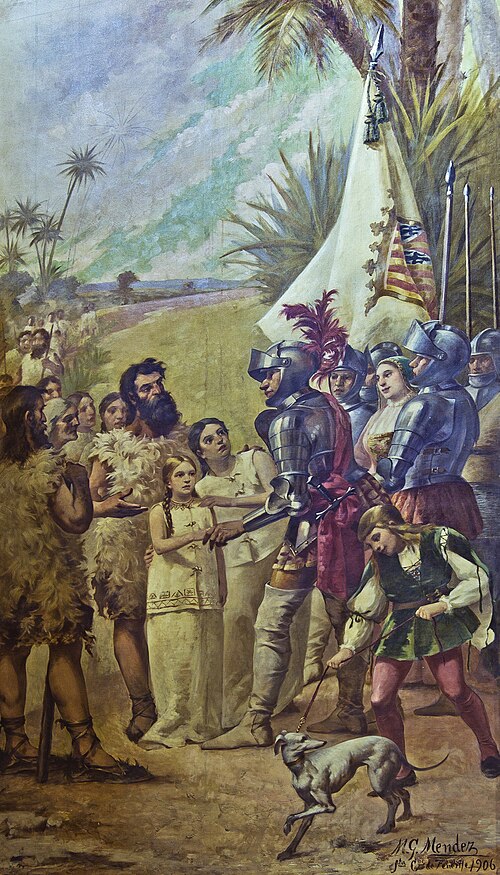
ポルトガルは、発見した領土に対するポルトガルの支配を認める教皇勅書を数通入手したが、カスティーリャも教皇から、 1436年11月6日付の勅書Romani Pontifexと1437年4月30日付のDominatur Dominusによって、カナリア諸島に対する権利の保障を得た。 [29]グアンチェ族が居住するカナリア諸島の征服は、カスティーリャ王エンリケ3世の治世中の1402年、ノルマン貴族のジャン・ド・ベタンクールが国王との封建協定に基づいて始めた。征服は、1478年から1496年までのカスティーリャ国王軍の遠征で完了し、グラン・カナリア島(1478年 - 1483年)、ラ・パルマ島(1492年 - 1493年)、テネリフェ島(1494年- 1496年)が征服された。[21] 1504年までに、先住民のカナリア諸島民の90%以上が殺害されるか奴隷にされた。[要出典]
ポルトガルとのライバル関係
ポルトガル人はギニア湾の黄金海岸(1471年)の発見を秘密にしようとしたが無駄だった。しかし、そのニュースはすぐに大規模なゴールドラッシュを引き起こした。年代記作者プルガーは、ギニアの財宝の名声は「アンダルシアの港に広まり、誰もがそこへ行こうとした」と書いている。[30]価値のない装身具、ムーア人の織物、そしてとりわけカナリア諸島とカーボベルデ諸島の貝殻が、金、奴隷、象牙、ギニアペッパーと交換された。
カスティーリャ継承戦争(1475-79)は、カトリック両王にポルトガルの勢力の主な源泉を攻撃するだけでなく、この利益の多い貿易を掌握する機会を与えた。国王はギニアとのこの貿易を公式に組織した。すべてのキャラベル船は政府の許可を取得し、利益の5分の1に税金を支払わなければならなかった(ギニアの関税徴収所は1475年にセビリアに設置された。これは後の有名な関税庁の祖先である)。[31]

カスティーリャ艦隊は大西洋で戦い、一時的にカーボベルデ諸島を占領し(1476年)、 1476年にティンギタン半島の都市セウタを征服した(しかしポルトガル人に奪還された)[e] [f] 、さらにはアゾレス諸島を攻撃し、プライアで敗北した。[g] [h]しかし、戦争の転機となったのは1478年、フェルナンド王がグラン・カナリア島を征服するために派遣したカスティーリャ艦隊がポルトガル人に撃退され、兵士と船を失い、[32]金満載の大規模なカスティーリャ艦隊が決定的なギニアの戦いで完全に拿捕されたときであった。[33] [i]
アルカソバス条約(1479年9月4日)は、カスティーリャ王位をカトリック両王に保証したが、カスティーリャの海軍と植民地の敗北を反映していた。[34]「カスティーリャとの戦争が勃発し、ギニア湾で激しい戦いが繰り広げられ、1478年に35隻のカスティーリャ艦隊がそこで敗北した。この海軍の勝利の結果、1479年のアルカソバス条約でカスティーリャはカナリア諸島での権利を保持しながらも、西アフリカ沿岸全域でのポルトガルの漁業と航行の独占と、マデイラ諸島、アゾレス諸島、カーボベルデ諸島に対するポルトガルの権利(およびフェズ王国を征服する権利)を認めた。」[35]この条約は両国の勢力圏を定め、 [36]マレ・クラウズムの原則を確立した。[37]これは1481年に教皇シクストゥス4世によって教皇勅書「アエテルニ・レジス」(1481年6月21日付)で確認された。 [38]
しかし、この経験は、スペインの将来の海外進出にとって有益であることが証明された。なぜなら、スペイン人はカナリア諸島から南に発見された、または発見される予定の土地から排除されていたため[39]、そして結果的にアフリカを回ってインドに向かう道からも排除されていたため[40]、彼らは香辛料を交易するためにアジアを探すコロンブスの西方への航海(1492年)を支援し、代わりにアメリカ大陸に遭遇したからである[41]。こうして、アルカソバス条約によって課された制限は克服され、トルデシリャス条約で、新興の海洋国家間の新しい、よりバランスのとれた世界の分割が達成された。[42]
新世界航海とトルデシリャス条約
_02c.jpg/500px-Monumento_a_Col%C3%B3n_(Madrid)_02c.jpg)


アルカソバス条約の7か月前、アラゴン王ジョアン2世が亡くなり、その息子であるアラゴン王フェルナンド2世はカスティーリャ王イサベル1世と結婚してアラゴン王位を継承した。2人はカトリック両王として知られるようになり、結婚は同君連合となり、アラゴン王とカスティーリャ王はそれぞれ独自の行政機関を持ちながらも、2人の君主が共同で統治する関係となった。[43]
フェルナンドとイサベルは、 10年にわたる戦争の末、1492年にグラナダの最後のイスラム王を破った。その後、カトリック両王は、西に航海してチパング(日本)に到達しようとしていたジェノバの船乗り、クリストファー・コロンブスと交渉した。コロンブスがイサベルに大胆な提案をした当時、カスティーリャはすでにポルトガルと海路で極東に到達するための探検競争を行っていた。1492年4月17日のサンタフェ協定で、クリストファー・コロンブスは、カトリック両王から、すでに発見されている土地[44]と今後発見する可能性のある土地[45]の総督および総督への任命を得た。 [46]これは、インド諸島に行政組織を設立した最初の文書となった。[47]コロンブスの発見により、スペインによるアメリカ大陸の植民地化が始まった。スペインのこれらの土地に対する主張[48]は、1493年5月4日の教皇勅書「インター・カエテラ」と1493年9月26日の「ドゥドゥム・シキデム」によって確固たるものとなった。
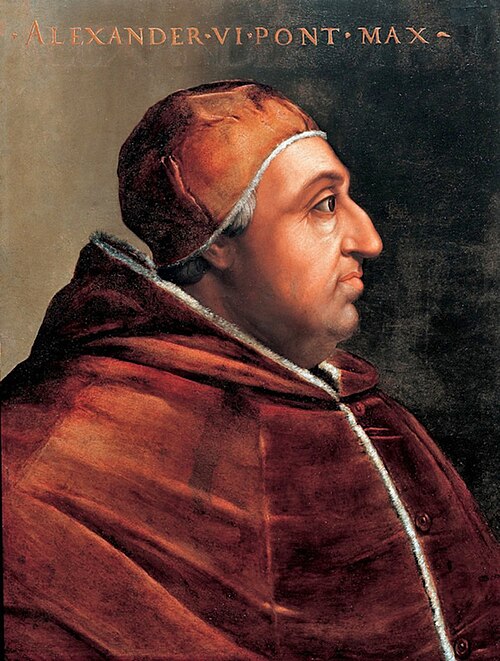
ポルトガルはボハドル岬の南の緯度に沿って東西に走るアルカソバスの境界線を維持することを望んだため、妥協案が練られ、 1494年6月7日のトルデシリャス条約に盛り込まれ、世界はスペインとポルトガルの2つの領有権に分割された。これらの行動により、スペインは北から南まで新世界全体(後にポルトガルの司令官ペドロ・アルバレス・カブラルが1500年に遭遇したブラジルを除く)とアジアの最東端に植民地を設立する独占権を獲得した。トルデシリャス条約は、1506年1月24日に教皇ユリウス2世によって勅書「Ea quae pro bono pacis」で承認された。[49]
トルデシリャス条約[50]とシントラ条約(1509年9月18日)[51]により、ポルトガルのフェズ王国の境界が確立され、1497年のメリリャ征服から始まり、カスティーリャ王国の拡大はこれらの境界外でも許可されました。 [j]
アメリカ大陸における最初の入植地
サンタフェ条約により、カスティーリャ王国はクリストファー・コロンブスに探検、入植、政治権力、歳入を含む広範な権限を与え、主権は王国に留保された。最初の航海で王国の主権が確立され、王国はコロンブスの発見した大げさな評価が真実であるとの仮定に基づいて行動したため、スペインは国境のスペイン側の領土を保護するためにポルトガルとトルデシリャス条約を交渉した。王国はすぐにコロンブスとの関係を再評価し、領土に対するより直接的な王国の支配を主張し、コロンブスの特権を消滅させる方向に動いた。この教訓を得て、王国は新しい地域での探検、征服、入植の条件を定める際にはるかに慎重になった。
カリブ海でより広いスペイン領インドで展開されたパターンは、未知の地域の探検と国王の主権の主張、先住民の征服または直接的な暴力を伴わない支配の獲得、エンコミエンダ制によって先住民の労働力を得たスペイン人の入植、そして既存の入植地がさらなる探検、征服、入植の出発点となり、国王によって任命された役人による制度の確立であった。カリブ海で確立されたパターンは拡大するスペイン圏全体で再現されたため、スペインによるアステカ帝国の征服とインカ帝国の征服後、カリブ海の重要性は急速に薄れたものの、これらの征服に参加した人々の多くはカリブ海で冒険を始めていた。[53]
新世界における最初の恒久的なヨーロッパ人の入植地は、最初はイスパニョーラ島、後にキューバ、ジャマイカ、プエルトリコと、カリブ海に築かれた。コロンブスは現在のハイチにラ・ナビダッド砦を築いたが、後にタイノ族によって破壊され、スペインの駐屯軍は全滅した。入植者の多くはスペインから追放された犯罪者であり、苦難、病気、貧困を経験したため、すぐに幻滅した。入植者同士、そして地元の部族民との間に摩擦が生じた。
ポルトガルとのつながりを持つジェノバ人として、コロンブスは、入植は貿易砦と工場のパターンであり、給料をもらっている従業員が地元民と貿易し、利用可能な資源を見つけるものであると考えていました。[54]しかし、新世界におけるスペイン人の入植は、カスティーリャの生活を別の場所で再現するための一連の制度と物質生活の全体的な複合体を備えた、大規模で恒久的な入植地のパターンに基づいていました。コロンブスの1493年の2回目の航海には、それを達成するための大規模な入植者と物資がありました。[55]イスパニョーラ島では、 1496年にクリストファー・コロンブスの兄弟バーソロミュー・コロンブスによってサントドミンゴ市が設立され、石造りの恒久的な都市になりました。カタロニア人やアラゴン人などの非カスティーリャ人は、新世界への移住を禁止されることが多かった。

イスパニョーラ島の開拓後、ヨーロッパ人は、目に見えるほどの富がほとんどなく、先住民の数も減少していたため、新たな開拓地を作れる場所を探し始めた。あまり繁栄していなかったイスパニョーラ島の人々は、新たな開拓地で新たな成功を模索することに熱心だった。そこからフアン・ポンセ・デ・レオンがプエルトリコを征服し(1508 年)、ディエゴ・ベラスケスがキューバを占領した。
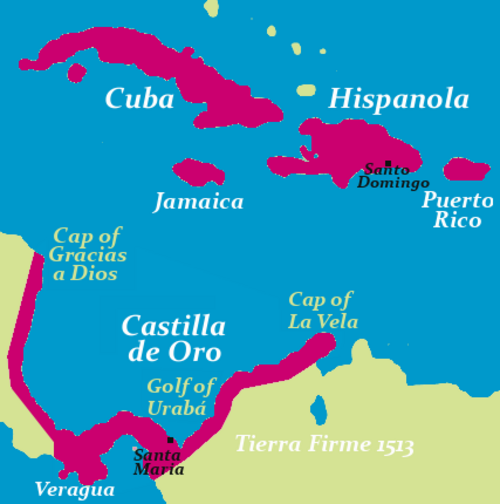
コロンブスは1498年に本土に遭遇し、[56]カトリック両王は1499年5月に彼の発見を知った。本土の最初の入植地はカスティーリャ・デ・オロ(現在のニカラグア、コスタリカ、パナマ、コロンビア)のサンタ・マリア・ラ・アンティグア・デル・ダリエンで、1510年にバスコ・ヌーニェス・デ・バルボアが開拓した。 1513年、バルボアはパナマ地峡を横断し、新世界の西海岸から太平洋を見る最初のヨーロッパ人探検隊を率いた。歴史的に永続的な意味を持つ行動として、バルボアは太平洋とそれに隣接するすべての土地がスペイン王室のものであると主張した。[57]
アステカ帝国の征服
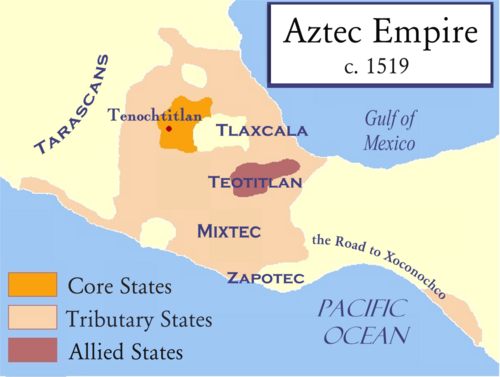


エルナン・コルテスは、イスパニョーラ島の総督ディエゴ・ベラスケス・デ・クエヤルの反対を押し切り、550人の征服者からなる遠征隊を組織し、1519年3月にメキシコ海岸に向けて出航した。カスティーリャ人は3月24日にポトンチャンで1万人のチョンタル族のマヤ軍を破り、3日後には4万人のマヤ軍に勝利した。9月2日には、カスティーリャ人360人とトトナコ族インディアン2,300人の同盟軍が2万人のトラスカラ軍を破った。3日後、5万人のオトミ族とトラスカラ族の軍がスペインの火縄銃兵と大砲の射撃、およびカスティーリャ騎兵の突撃により敗れた。数千人のトラスカル人がアステカの支配者に対する侵略者に加わった。コルテスの軍はチョルーラ市を略奪し、6,000人の住民を虐殺し、[58]その後11月8日にモクテスマ2世皇帝の首都テノチティトランに入った。ベラスケスはパンフィロ・デ・ナルバエス率いる軍を派遣し、メキシコへの無許可の侵略に対する反抗的なコルテスを罰したが、 1520年5月29日のセンポアラの戦いで敗北した。ナルバエスは負傷して捕虜となり、彼の部隊のうち17人が死亡し、残りはコルテスに加わった。[58]征服者の総数は1,500人のスペイン人、90頭の馬、30門の大砲となった。一方、ペドロ・デ・アルバラードは、テノチティトランの大神殿の虐殺に続いてメシカの反乱を引き起こし、その際に400人のメシカ貴族と2,000人の傍観者が切り刻まれ、撲殺された。カスティーリャ人はアステカの首都から追い出され、450人が死亡し、[59]悲しき夜の間にすべての金と銃を失った。
1520年7月8日、オトゥンバでカスティーリャ人とその同盟軍は、大砲や火縄銃兵を持たずに、黒曜石の刃の剣で武装した10万人のアステカ軍を撃退した。8月には、カスティーリャ人500人とトラスカル人4万人が、アステカの同盟国である丘の上の町テペアカを征服した[59]。町とその周辺地域は荒廃し、住民の大半はスペイン人によって顔に「G」(ゲラ)の文字を焼かれて奴隷にされたか、トラスカル人によって生贄にされて食べられた[59] 。 1521年の春までに、コルテスは新たな侵略軍を組織した。新皇帝クアウテモックは、投石器、弓、黒曜石の剣で武装した10万人の戦士でテノチティトランを防衛した。 5 月 21 日から 6 月 1 日にかけて、スペインとトラスカルの軍は湖を制圧し、地方を荒廃させた。最初の軍事衝突は、アルバラドとクリストバル デ オリドの軍隊がトラコパンの土手道に沿って前進した後に起こった。土手道での戦闘中、スペインとその同盟軍は、カヌーから矢を放つアステカ人の攻撃を両側から受けた。13 隻のスペインのブリガンティン船が、彼らに向けて送られた 400 隻の敵軍の戦闘カヌーのうち 300 隻を沈めた。アステカ人は、浅瀬の下に槍を隠してスペイン船に損害を与えようとした。攻撃者は都市を突破し、通りでアステカの守備隊と戦闘になった。
アステカ人は1521年6月30日のコルワカトンコの戦いでスペイン・トラスカル軍を破った。勝利の後、53人のスペイン人捕虜がトラテロルコの最も高いピラミッドの頂上まで連れて行かれ、公開のいけにえにされた。[60] 7月下旬、攻撃者は攻撃を再開し、800人のアステカ民間人を虐殺した。7月29日までにスペイン人はトラテロルコの中心部に到達し、都市のツインタワーの上に新しい旗を掲げた。火薬を使い果たしたスペイン人はカタパルトで突破を試みたが失敗した。8月3日には、市の別の地区でさらに12,000人の民間人が殺害された。[61]アルバラドが水道を破壊したため、アステカ人は湖から水を飲まざるを得なくなり、病気が発生し、数千人が死亡した。 8月12日にはもう一つの大規模な攻撃があり、その際何千人もの非戦闘員が避難所で虐殺された。[62]翌日、都市は陥落し、クアウテモックは捕らえられた(そして1525年に絞首刑に処された)。少なくとも10万人が死亡し、[62]都市は廃墟となり、瓦礫と化し、完全に破壊された。テノチティトラン陥落後、コルテスはアステカの書籍や記録の焼却、記念碑の破壊、寺院からの偶像の撤去、犠牲の残骸の除去を指示し、カトリックの礼拝の場を準備した。
北米探検

1500 年代、スペイン人は北アメリカを探検し、植民地化を始めた。彼らは先住民の王国で金を探していた。1511 年までに、イスパニョーラ島の北西に未発見の土地があるという噂が広まった。フアン ポンセ デ レオンは、自費で少なくとも 200 人の乗組員を乗せた 3 隻の船を準備し、1513 年 3 月 4 日にプエルトリコからフロリダとその周辺の海岸地域に向けて出発した。もう 1 つの初期の動機は、南西部の砂漠のどこかに先住民が建設したと噂されている7 つの黄金都市、または「シボラ」の探索だった。1536 年、コロラド川に到達した最初のヨーロッパ人として記録に残るフランシスコ デ ウジョアは、カリフォルニア湾を遡り、川のデルタ地帯に少し入った。
1524年、フェルディナンド・マゼランの艦隊に加わったポルトガル人のエステヴァン・ゴメスは、ノバスコシアを探検し、メイン州を南下してニューヨーク港に入り、ハドソン川を経て、1525年8月にフロリダに到着しました。
スペイン人のアルバル・ヌニェス・カベサ・デ・バカは、 1527年から1535年にかけて北アメリカ大陸を探検した600人のナルバエス遠征隊のリーダーだった。1528年4月15日、フロリダ州タンパ湾を出発し、フロリダを行進した。ほとんど徒歩で旅し、テキサス、ニューメキシコ、アリゾナ、メキシコのタマウリパス州、ヌエボ・レオン州、コアウイラ州を横断した。荒野や沼地で数か月間先住民と戦った後、242人の隊はアパラチー湾に到着した。彼らはメキシコの他のスペイン人の近くにいると信じていたが、実際には彼らの間には1500マイルもの海岸線があった。彼らは海岸沿いに西に進み、ガルベストン島近くのミシシッピ川河口に到着した。彼らはコアウイラ州とヌエバビスカヤ州を通り、カリフォルニア湾岸を南下して現在のメキシコのシナロア州まで約8年かけて進んだ。彼らはルイジアナ湾諸島のアナナリボ族に何年も奴隷として働かされた。後にハン族、カポケ族、その他にも奴隷として働かされた。1534年に彼らはアメリカ内陸部へ逃れ、途中で他のアメリカ先住民の部族と接触した。カベサ・デ・バカ、アンドレス・ドランテス・デ・カランサ、アロンソ・デル・カスティージョ・マルドナド、そして奴隷にされていたモロッコ系ベルベル人のエステバニコの4人だけが生き残り、メキシコシティまで逃れた。1539年、エステバニコはマルコス・デ・ニサに同行し、コロナドに先立つ伝説のシボラの7都市を探すガイドを務めた4人のうちの1人だった。他のメンバーが病気にかかった後、エステバニコは一人で探検を続け、現在のニューメキシコ州とアリゾナ州を開拓した。彼は現在のニューメキシコ州にある ズニ族の村ハウィクで殺害された。
ヌエバ・エスパーニャの副王アントニオ・デ・メンドーサ(メンドーサ写本の名前の由来)は、1540年から1542年にかけて、ヌエバ・エスパーニャ北部の土地を探検し、入植地を築くためにいくつかの遠征隊を派遣した。フランシスコ・バスケス・デ・コロナドは、カンザス州中央部のキビラに到達した。フアン・ロドリゲス・カブリヨは、1542年から1543年にかけて、アルタ・カリフォルニアの西海岸を探検した。
フランシスコ・バスケス・デ・コロナドの1540年から1542年の探検は、伝説の黄金都市の探索として始まったが、ニューメキシコの原住民から西に大きな川があることを知った後、彼はガルシア・ロペス・デ・カルデナスに小さな部隊を率いてその川を見つけるよう派遣した。ホピ族インディアンの案内で、カルデナスと彼の部下はグランドキャニオンを見た最初の部外者となった。しかし、カルデナスは峡谷にあまり感銘を受けなかったと伝えられており、コロラド川の幅を6フィート(1.8メートル)と想定し、300フィート(91メートル)の高さの岩層を人間の大きさと見積もった。川への下降に失敗した後、彼らは困難な地形と灼熱の天候に打ちのめされてその地域を去った。
1540 年、エルナンド デ アラルコンとその艦隊はコロラド川の河口に到達し、コロナドの遠征隊に追加の物資を供給するつもりでした。アラルコンはコロラド川を現在のカリフォルニア州とアリゾナ州の境界まで遡った可能性があります。しかし、コロナドはカリフォルニア湾にたどり着くことはなく、アラルコンは最終的に諦めて去りました。メルヒオール ディアスは同年デルタに到着し、アラルコンと連絡を取るつもりでしたが、ディアスが到着した時にはアラルコンはすでにいなくなっていました。ディアスはコロラド川をリオ デル ティソンと名付けましたが、コロラド (「赤い川」) という名前は、ヒラ川の支流に最初に付けられました。
1540 年、エルナンド・デ・アラルコンとメルキオール・ディアス率いる遠征隊がユマ地域を訪れ、コロラド川がメキシコからカリフォルニアまで陸路で自然に渡る場所をすぐに見つけました。コロラド川は狭い地点で幅が 1,000 フィート弱に狭まるため、都市を建設するのに理想的な場所でした。その後、ユマ・クロッシングでコロラド川を渡った軍事遠征隊には、フアン・バウティスタ・デ・アンサ(1774 年)がいます。
1541年、エルナンド・デ・ソトはミシシッピ川を渡った最初の探検家となった。この遠征中、スペイン人はフロリダのウティナ族、ミシシッピのチカソー族、現在のジョージア州のクーサ族の首長国、現在のアラバマ州のマビラの戦いでタスカルーサ酋長と戦った。マビラでのスペイン人の損失は22人が死亡、148人が負傷、2,500人のアメリカ先住民が死亡し、現在のアメリカ合衆国におけるアメリカ先住民とヨーロッパ人の間で戦われた戦いの中で最も血なまぐさい戦いとなった。
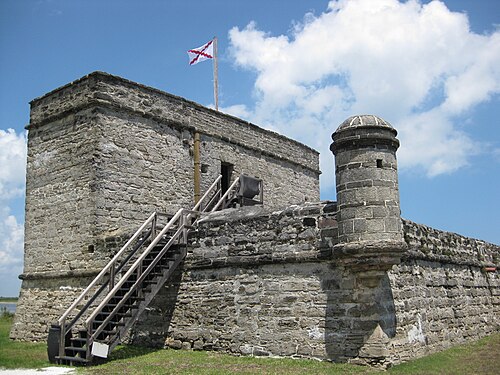
1565年、ペドロ・メネンデス・デ・アビレス率いるスペイン人がフロリダにセントオーガスティンを建設した。続いて彼らはフランス領フロリダのキャロライン砦を攻撃し、142人のフランス人ユグノーを虐殺した。生き残ったフランス人入植者は船で逃げたが、船はマタンサス川で嵐に遭い難破した。スペイン人は彼らを捕らえ、マタンサス入江での虐殺で210人のユグノーを殺害した。セントオーガスティンはすぐに、新世界の領土からスペインに送られる金と銀を満載したスペイン船の戦略的な防衛基地となった。
チャムスカドとロドリゲス探検隊は、 1581年から1582年にかけてニューメキシコを探検しました。彼らは、1540年から1542年の間にニューメキシコのコロナドが訪れたルートの一部と、米国南西部の他の地域を探検しました。ヌエバ・エスパーニャの副王ドン・ディエゴ・ガルシア・サルミエントは、カリフォルニアの探検、征服、植民地化のために、1648年に別の探検隊を派遣しました。
スペイン・ハプスブルク家(1516年~1700年)

カトリック両王(スペイン語ではレイエス・カトリコス)の婚姻政策の結果、ハプスブルク家の孫であるカール1世は、アメリカ大陸のカスティーリャ帝国と地中海沿岸のアラゴン王国領(南イタリア全域を含む)、ドイツ、低地諸国、フランシュ=コンテ、オーストリアの領土を継承し、スペイン・ハプスブルク家の統治が始まった。オーストリアのハプスブルク家の世襲領土は皇帝の弟フェルディナンド1世に譲渡され、スペインと残りの領土は1556年にカール1世が退位した際に息子の スペイン国王フェリペ2世が継承した。
ハプスブルク家はいくつかの目標を追求しました。
- フランスの力を弱め、東の国境に封じ込める
- オスマン帝国とハプスブルク家の戦争において、特にオスマン帝国をイスラム教から守る
- 神聖ローマ帝国におけるハプスブルク家の覇権を維持し、プロテスタント宗教改革からローマカトリック教会を守る
- 新世界とフィリピンの未改宗の原住民に(カトリックの)キリスト教を広める
- アメリカ大陸の資源(金、銀、砂糖)の開発とアジアとの貿易(磁器、香辛料、絹)
- 新世界で主張した領土から他のヨーロッパ諸国を排除する
「私はここで諺を学んだ」と1603年にフランス人旅行者は言った。「スペインでは銀以外はすべて高価だ」[63] 。インフレによって引き起こされる問題は、サラマンカ学派の学者やアルビトリスタによって議論された。天然資源の豊富さは、資源採掘による利益のリスクが低いため、起業家精神の衰退を引き起こした。[64]富裕層は、公債(ジュロス)に財産を投資することを好んだ。ハプスブルク家は、カスティーリャとアメリカの富をハプスブルク家の利益のためにヨーロッパ中の戦争に費やし、債務支払いの一時停止(破産)を何度も宣言した。これらの負担は、スペイン王国を含むスペイン・ハプスブルク家の領土全体で多くの反乱を引き起こした。
スペイン国王フェリペ2世(在位1556年 - 1598年)は1565年にフィリピンを征服し、世界初の真の帝国の支配者となった。[65]ポルトガル継承戦争での勝利により1580年にポルトガルが併合され、ブラジル沿岸部やアフリカ・インド沿岸部の飛び地を含むポルトガルの海外帝国がスペインの版図に事実上組み込まれた。[65]彼の治世は八十年戦争や英西戦争などさらなる紛争で特徴づけられた。1588年のスペイン無敵艦隊によるイングランド侵攻の試みは、ローマ時代以来初めて南欧諸国がイギリス諸島を脅かした事件となった。フィリップはオスマン帝国との紛争にも巻き込まれ、1571年に彼のガレー船団はレパントの海戦で大きな勝利を収めたが、オスマン帝国はすぐに地中海艦隊を再建し、1578年にフィリップに休戦を強制した。[65]
17世紀半ばまでに、スペインの世界帝国は経済、行政、軍事資源に負担をかけていた。前世紀、スペイン軍はフランス、ドイツ、オランダで戦い、多くの死傷者を出した。[66]広大な領土にもかかわらず、スペイン軍は基本的な近代化を欠いており、外国の供給者に大きく依存していた。[66]それでも、スペインはアメリカ大陸から豊富な金塊を保有しており、それが軍事活動の維持と民間人の需要の充足の両方において重要な役割を果たした。この時期、スペインは海外植民地に対する軍事的関心をあまり示さなかった。クリオーリョのエリート層と混血および混血の民兵は最小限の保護しか提供せず、勢力均衡を維持し、スペイン帝国が敵の手に落ちるのを防ぐことに既得権益を持つより影響力のある同盟国の支援を受けることが多かった。[66]
帝国の経済政策


スペイン帝国は、海外領土の、大規模で開発可能な先住民と豊かな鉱山地域から、有利な要素賦存の恩恵を受けていた。 [67]そのため、王室は古典的な閉鎖的商業システムを構築し、維持し、競争相手を撃退し、富を帝国内、特にカスティーリャ王冠内に留めようとした。理論上はハプスブルク家は国家独占の維持に尽力していたが、現実には帝国は密輸が蔓延する穴だらけの経済領域であった。ハプスブルク家の支配下にあった16世紀と17世紀、スペインの経済状況は、特にライバルであるフランス、オランダ、イギリスの産業発展に関して、徐々に衰退していった。帝国に輸出される商品の多くは、スペインではなく北西ヨーロッパの製造業者によるものであった。違法な商業活動は帝国の行政構造の一部となった。アメリカ大陸からの大量の銀の流入に支えられ、スペインの重商主義的規制によって禁じられていた貿易は、王室の役人と民間商人の両方の収入源となり、繁栄した。[68]たとえば、ブエノスアイレスの地方行政機構は、合法および違法の商業の両方を監視することによって確立された。 [69]ペルーとヌエバ・エスパーニャで大量の銀が産出されたにもかかわらず、領土の維持と拡大、カトリック信仰の擁護、プロテスタント撲滅、オスマン・トルコの勢力の撃退のために王室が戦争を遂行したことは、王室の能力を超えていた。その流れのほとんどは、16世紀と17世紀のヨーロッパの宗教戦争で傭兵に支払われ、北ヨーロッパで製造された消費財の外国商人に支払われた。逆説的に、インディアスの富はスペインを貧困に陥れ、北ヨーロッパを豊かにしたが、ブルボン朝の君主たちは18世紀にこの流れを逆転させようとした。[70]
このことはスペインでよく認識されており、政治経済学の著述家であるアービトリスタたちは、国王に「認識された問題と提案された解決策についての報告書」という形で長い分析を送った。[71] [72]これらの思想家によると、「王室の支出は規制され、官職の売却は中止され、教会の成長は抑制されなければならない。税制は見直され、農業労働者には特別の特権が与えられ、河川は航行可能となり、乾燥地は灌漑される。この方法によってのみ、カスティーリャの生産性は向上し、商業は回復し、外国人、オランダ人、ジェノバ人への屈辱的な依存は終結することができた。」[73]

カリブ海と征服の時代の初期から、国王はセビリアの商会(1503年設立)が施行した制限政策によって、スペインとインド諸島間の貿易を統制しようとした。船積みはカスティーリャの特定の港(セビリア、続いてカディス)、スペイン領アメリカの特定の港(ベラクルス、アカプルコ、ハバナ、カルタヘナ・デ・インディアス、カヤオ/リマ)、フィリピンの特定の港(マニラ)を通じて行われた。初期の頃はインド諸島にスペイン人入植者はごく少数で、スペインは彼らに十分な物資を供給することができた。しかし、16世紀初頭にアステカ帝国とインカ帝国が征服され、メキシコとペルーの両方で大量の銀鉱床が発見されると、スペイン人の移民が増加し、物資の需要がスペインの供給能力をはるかに超えて高まった。スペインには拡大する貿易に投資する資本がほとんどなく、重要な商業グループもなかったため、ジェノバ、ドイツ、オランダ、フランス、イギリスの銀行家や商社が、閉鎖的なシステムとされるシステムで投資資本と商品の両方を供給した。16世紀になっても、スペインは理想化された閉鎖システムが現実には機能していないことを認識していた。仲裁人の嘆願にもかかわらず、国王は制限的な構造を変えず、財政の慎重さを主張しなかったため、インド貿易は名目上はスペインの手に残っていたが、実際には他のヨーロッパ諸国を豊かにした。

国王は、セビリア(後のカディス)への銀の輸送を保護するために、宝物船団(スペイン語:flota)のシステムを確立した。他のヨーロッパ諸国で生産された銀は、セビリアの商人が商会に登録され課税された後、インド諸島に輸送された。他のヨーロッパの商業利害関係者が供給を支配するようになり、スペイン商家とスペインとインド諸島の両方のギルド(consulados)は単なる仲介人として働き、利益の一部を獲得した。しかし、それらの利益はスペインの経済発展における製造業部門を促進することはなく、その経済は農業を基盤とし続けた。インドの富は北ヨーロッパ、特にプロテスタントであったネーデルラントとイングランドの繁栄をもたらした。17世紀にスペインの力が弱まると、イングランド、オランダ、フランスは海外で有利になるようにカリブ海の島々を占領し、スペイン領アメリカで急成長する禁制品貿易の拠点となった。禁制品の取引を禁止するはずの王室の役人たちは、外国人と共謀することが非常に多かった。なぜなら、それは個人の富の源だったからだ。スペインでは、王室自身が外国商人と共謀していた。なぜなら、彼らは「詐欺による損失に対する国家への補償を確立することを目的とした」罰金を支払っていたからだ。商人が商売をするには計算されたリスクとなり、王室にとっては、そうでなければ失われていたであろう収入が得られた。外国商人は、貿易のいわゆる独占システムの一部だった。商館がセビリアからカディスに移ったことで、外国商人はスペイン貿易にさらに容易にアクセスできるようになりました。[75]
スペイン帝国経済が世界に与えた最大のインパクトは銀採掘であった。ペルーとメキシコの鉱山は、資本へのアクセスと採掘に伴うリスクを覚悟できる少数のエリート鉱山起業家の手に握られていた。王室が地下の富の権利を握っていたため、彼らは王室の許可制度の下で操業していた。鉱山起業家は事業のリスクをすべて引き受け、王室は利益の20%、王室の5分の1 (「キント・レアル」)を得た。さらに、鉱山業における王室の収入に加わったのは、パティオ法で銀鉱石から純銀を分離するのに使用される水銀供給の独占権を持っていたことである。王室は価格を高く維持し、それによって銀の生産量を抑えた。[76]メキシコとペルーからスペインへの出荷のために港を通過する際の銀の流れを保護するため、早い段階で年2回の護送船団システム(フロータ)が生まれた。その成功は、銀の艦隊が1628年にオランダの私掠船ピート・ハインによって一度だけ拿捕されたという事実から判断できる。その損失はスペイン国王の破産とスペインの長期にわたる経済不況を招いた。[77]
スペイン人が鉱山労働者を集めるために用いた慣行の 1 つに、レパルティミエントと呼ばれるものがあります。これは、先住民族のプエブロ族が年間の決められた日数、スペインの鉱山やプランテーションに労働者を派遣することを義務付けられた、交代制の強制労働制度です。レパルティミエントは奴隷労働に代わるものとして導入されたわけではなく、自由賃金労働、奴隷制度、年季奉公労働と並行して存在していました。しかし、これはスペイン人が安価な労働力を確保し、鉱山主導の経済を活性化させる手段でした。
レパルティミエント労働者として働く男性たちは、必ずしもこの慣習に抵抗していたわけではない。畑を耕して得た賃金を補い、家族を養い、もちろん貢物を納める手段として、この労働に引きつけられた者もいた。当初、スペイン人は、国に重要な資源を供給するためにこの労働が絶対に必要であるという条件でのみ、総督などの王室職員の許可を得て、レパルティミエント労働者を雇えた。この条件は年月が経つにつれて緩くなり、さまざまな企業がレパルティミエント労働者を雇い、危険な状況で長時間低賃金で働かせた。[78]

ブルボン朝時代、経済改革は、製造業のない貧困に陥ったスペインとその植民地が他国から供給される工業製品を必要とする状況を変えようとした。閉鎖的な貿易体制を確立しようとしたが、1713年のユトレヒト条約の条項によって妨げられた。ブルボン朝のフランス人王候補の勝利でスペイン継承戦争を終わらせたこの条約には、イギリス商人がスペイン領アメリカに奴隷免許 ( Asiento de Negros )をもって合法的に奴隷を売ることができるという条項があった。この条項は、スペインの独占制度を刷新する可能性を弱めた。商人はまた、この機会を利用して製造品の禁制品取引を行った。国王の政策は、1778年に自由通商 (comercio libre ) を制定し、スペイン領アメリカの港同士、またスペインのどの港とも貿易できるようにすることで、合法的な貿易を禁制品よりも魅力的にすることを目指した。それはスペインの閉鎖的な体制を刷新し、ますます強力になるイギリスを出し抜くことを目的としていた。銀の生産は18世紀に復活し、以前の生産量をはるかに上回った。王室は水銀税を軽減したため、より大量の純銀を精錬できるようになった。銀の採掘はメキシコとペルーの利用可能な資本のほとんどを吸収し、王室はスペインに送られる貴金属の生産を重視した。インドでは食糧を供給するためにある程度の経済発展があったが、多角化された経済は生まれなかった。[76]ブルボン朝時代の経済改革は、ヨーロッパの地政学的発展を形作り、またそれ自体が影響を受けた。ブルボン改革はスペイン継承戦争から生まれた。今度は、アメリカ大陸の植民地市場に対する王室の統制を強化しようとする試みが、その市場へのアクセスを争う他のヨーロッパ列強とのさらなる対立を招いた。 1700年代を通じて厳格な政策をめぐってスペインの貿易制度改革が一連の小競り合いを引き起こした後、1796年にイギリスとの戦争に発展した。 [79]一方、アメリカ大陸では、ブルボン朝下で施行された経済政策が地域によって異なる影響を及ぼした。一方では、ヌエバ・エスパーニャの銀の生産が大幅に増加し、経済成長につながった。しかし、活性化した鉱業部門の利益の多くは鉱業エリートと政府高官の手に渡り、一方ヌエバ・エスパーニャの農村部では農村労働者の状況が悪化し、その後の反乱に影響を与える社会不安の一因となった。[80]
太平洋の探検と貿易
1525年、スペイン国王カルロス1世は、修道士ガルシア・ホフレ・デ・ロアイサ率いる遠征隊に、西ルートでアジアに行き、マルク諸島(スパイス諸島として知られ、現在はインドネシアの一部)を植民地化するよう命じた。この遠征では、まず大西洋を横断し、次に太平洋を横断した。ルイ・ロペス・デ・ビジャロボスは1542年から1543年にかけてフィリピンへ航海した。1546年から1547年にかけて、フランシスコ・ザビエルはマルク諸島のアンボン島、テルナテ島、モロタイ島の人々の間で活動し、そこでキリスト教の基礎を築いた。
1564年、ミゲル・ロペス・デ・レガスピはヌエバ・エスパーニャの副王ルイス・デ・ベラスコの依頼で、マゼランとルイ・ロペス・デ・ビジャロボスがそれぞれ1521年と1543年に上陸したマルク諸島の探検を行った。この探検はスペイン国王フェリペ2世の命令によるもので、ビジャロボスはこれにちなんでフィリピンと名付けていた。レガスピは1565年に東インド諸島と太平洋諸島に入植地を設立した。彼はスペイン領東インドの初代総督となった。ロペス・デ・レガスピは様々な先住民族と和平を結んだ後、1571年にマニラを首都とした。
1603 年、スペイン人はティドレ島に定住し、支配権を握り、香辛料の取引とマルク諸島へのオランダの侵略に対抗しました。スペイン人の存在は 1663 年まで続き、その年に入植者と軍隊はフィリピンに強制送還されました。テルナテ島の住民の一部はスペイン人とともに去り、マニラ近郊の、後にテルナテ市となった地域に定住しました。
スペインのガレオン船は毎年、メキシコのアカプルコとマニラの間を太平洋を横断し、そこからアメリカ大陸から銀が輸送されるアジアの主要目的地は中国であった。[81]
1542年、フアン・ロドリゲス・カブリヨはカリフォルニアの海岸を横断し、その地形の多くに名前を付けました。1601年、セバスティアン・ビスカイノは海岸線の詳細な地図を作成し、多くの地形に新しい名前を付けました。セバスティアン・ビスカイノ率いる探検隊から行方不明になったマルティン・デ・アギラールは、現在のオレゴン州のクーズ湾まで北の太平洋沿岸を探検しました。
1549年に聖フランシスコ・ザビエル宣教師とポルトガル商人らを率いたイエズス会の一団が鹿児島(九州)に到着して以来、スペインは日本に興味を抱いていた。この最初のイエズス会宣教師の一団にはスペイン人のコスメ・デ・トーレスとフアン・フェルナンデスが含まれていた。
1611年、セバスティアン・ビスカイノは日本の東海岸を調査し、1611年から1614年まで日本国王フェリペ3世の大使として勤務し、1614年にアカプルコに戻りました。1608年、彼はリコ・デ・オロ(金の島)とリコ・デ・プラタ(銀の島)と呼ばれる2つの伝説の島を探索するために派遣されました。
1668年、イエズス会宣教師ディエゴ・ルイス・デ・サン・ビトレスがグアムに伝道所を設立し、スペインは太平洋帝国を拡大した。サン・ビトレスは1672年に現地のチャモロ人によって殺害され、スペイン・チャモロ戦争が勃発した。
スペイン・ブルボン家(1700年~1808年)

1700年に子供のいなかったスペイン国王カルロス2世が死去すると、スペインの王位をめぐってスペイン継承戦争が勃発した。戦争を終結させたユトレヒト条約(1713年4月11日)に基づき、フランス国王ルイ14世の孫でブルボン家のフランス王子フィリップ・ド・アンジューがスペイン国王フェリペ5世となった。彼はアメリカ大陸とフィリピンにおけるスペインの海外帝国を保持した。和平協定ではスペイン王政のためにハプスブルク家を支持した者に戦利品を与え、スペイン領ネーデルラント、ナポリ、ミラノ、サルデーニャのヨーロッパ領をオーストリアに、シチリア島とミラノの一部をサヴォイア公国に、ジブラルタルとメノルカ島をイギリス王国に割譲した。この条約では、イギリス商人にスペイン領アメリカで30年間奴隷を販売する独占権(アシエント・デ・ネグロス)と、スペインの植民地領土や開拓地の港への許可された航海も与えられました。[82]
スペインの経済と人口の回復は、ハプスブルク家の統治の最後の数十年間にゆっくりと始まり、その期間中の貿易船団の増加と、はるかに急速な違法貿易の増加からも明らかでした。(この成長は、帝国の市場における北のライバルによる違法貿易の増加よりも遅いものでした。)しかし、この回復は、制度の改善には結びつかず、「永続的な問題に対する近道的な解決策」に結びつきました。[83]この怠慢の遺産は、ブルボン朝の統治の初期に、軍隊が四国同盟戦争(1718-20)で無分別に戦闘に投入されたことに反映されています。スペインは、イギリス、フランス、サヴォイア、オーストリアの同盟によってイタリアで敗北しました。戦争後、新しいブルボン王朝は、ブルボン朝フランスとの家族同盟に頼り、制度の刷新計画を継続して実行しながら、国際関係に対してはるかに慎重なアプローチを取りました。
植民地の利益を犠牲にして首都の行政管理と効率性を促進する改革を施行する国王の計画は、クレオールのエリート層の国王に対する忠誠心を損ないました。 1808年にナポレオン・ボナパルトのフランス軍が イベリア半島に侵攻したとき、ナポレオンはスペインのブルボン王朝を追放し、弟のジョゼフ・ボナパルトをスペイン王位に就けました。スペイン領アメリカでは国王統治の正当性が危機に瀕し、スペイン・アメリカ独立戦争(1808年~1826年) につながりました。
ブルボン家の改革

スペイン・ブルボン家の最大の意図は、スペインと国王の利益のために帝国の制度を再編し、より良く統治することだった。収入を増やし、カトリック教会を含む国王の支配力を強化しようとした。権力の集中化(アラゴン王国の領土に対するヌエバ・プランタ法令に始まる)は、国王と本国、そして外国の侵略に対する帝国の防衛のためであった。[84]スペインの観点からは、ハプスブルク家による植民地支配の構造はもはやスペインの利益にはならず、多くの富がスペイン領アメリカに留まり、他のヨーロッパ列強の手に渡っていた。カリブ海諸国には他のヨーロッパ列強が存在し、イギリスはバルバドス(1627年)、セントクリストファー・ネイビス(1623年~1625年)、ジャマイカ(1655年)に駐留していた。キュラソー島のオランダ人、そしてサン=ドマング(ハイチ)(1697年)、マルティニーク島、グアドループ島のフランス人は、スペインの閉鎖的な商業システムの完全性を破壊し、繁栄する砂糖植民地を築き上げました。[85] [52]
スペイン最初のブルボン朝王、フェリペ5世は治世の初めに、フランスで行われたように、審議中心の多元会議制度に代わって君主の行政権を強化するために政府を再編した。[86]
フィリップの政府は海軍およびインド省(1714年)を設置し、商業会社を設立しました。ホンジュラス会社(1714年)、カラカス会社、ギプスコアナ会社(1728年)、そして最も成功したハバナ会社(1740年)とバルセロナ貿易会社(1755年)です。
1717年から1718年にかけて、インドを統治する組織であるインディアス評議会と契約管理局がセビリアからカディスに移され、外国商家がインド貿易にアクセスしやすくなった。[87]カディスはインド貿易の唯一の港となった(フロタ制度を参照)。定期的な間隔での個別の航海が伝統的な武装船団に取って代わることはなかったが、1760年代までには、カディスからハバナやプエルトリコへ、そしてより長い間隔でリオ・デ・ラ・プラタへ大西洋を定期航行する船があり、1776年にはリオ・デ・ラ・プラタに副王領が設けられた。ハプスブルク帝国の生命線であった禁制品貿易は、登録船舶(船舶登録簿は1735年に設立されていた)の増加に比例して衰退した。
2つの大変動がスペイン領アメリカ国内に不安を抱かせ、同時に改革された体制の新たな回復力を示した。1780年のペルーでのトゥパク・アマルーの反乱とヌエバ・グラナダのコムネロスの反乱であるが、どちらもより厳しく、より効率的な統制に対する反応であった。
18世紀の経済状況

18 世紀は海外スペイン帝国にとって繁栄の世紀であった。特に 18 世紀後半にはブルボン朝の改革により、国内貿易が着実に拡大した。カリブ海の港カルタヘナ・デ・インディアスでイギリス遠征隊に勝利したスペインは、19 世紀までアメリカ大陸の領有地の支配権を固めた。しかし、ブルボン朝の統治下では地域によって状況は異なり、ヌエバ・エスパーニャは特に繁栄していたものの、富の不平等が顕著であった。18 世紀にはヌエバ・エスパーニャで銀の生産が急増し、1750 年代初頭から 3 倍以上に増加した。経済と人口はともに成長し、メキシコシティを中心に成長した。しかし、鉱山所有者と王室が銀経済の繁栄から恩恵を受けた一方で、バヒオ地方の住民の大半は地価の上昇と賃金の低下に直面した。その結果、多くの人が土地から追い出された。[80]
ブルボン朝の君主制により、中央集権国家を基盤とするブルボン朝の重商主義思想が生まれ、アメリカ大陸では当初はゆっくりと実施されたが、世紀を経るにつれて勢いを増していった。1740年代半ばから七年戦争(1756~63年)まで、海運業は急速に成長した。これは、ブルボン朝が違法貿易を統制することに成功したことによるところが大きい。七年戦争後に貿易規制が緩和されると、帝国内の海運業は再び拡大し始め、1780年代には驚異的な成長率に達した。[要出典]
カディスのアメリカ植民地との貿易独占の終焉は、非常に重要な変化、特にスペインの製造業の復活をもたらした。それらの変化の中で最も注目すべきは、スペインの奴隷貿易へのカタルーニャ人の参加の始まりと、1780年代半ばまでに産業化の最初の兆候が見られたカタルーニャの繊維産業の急速な成長である。これにより、バルセロナに小規模で政治的に活動的な商業階級が出現した。この孤立した高度な経済発展地域は、国の大部分の相対的な後進性と著しい対照をなしていた。ほとんどの改善は、タバコ農園のあるキューバや南米での 貴金属採掘の新たな成長など、いくつかの主要な沿岸都市や主要な島々で起こった。
農業の生産性は、ほとんどが無関心で搾取されている農民や労働者グループに新しい技術を導入する努力にもかかわらず、低いままでした。政府の政策は一貫していませんでした。18 世紀後半までに大幅な改善が見られましたが、スペインは依然として経済的に後進的な国でした。[要出典]商業貿易協定の下では、帝国の急成長市場で需要のある商品を提供し、また、その戻り貿易のための十分な販路を提供することが困難でした。
上述の「後進性」とは反対の視点から、博物学者で探検家のアレクサンダー・フォン・フンボルトは、1799年から1804年にかけてスペイン領アメリカ大陸を広範囲に旅し、初めて近代科学の観点から探検し記述した。メキシコの地理に関する研究を含む著書『ヌエバ・エスパーニャ王国に関する政治論文』の中で、フンボルトはヌエバ・エスパーニャのアメリカインディアンはヨーロッパのどのロシア人やドイツ人農民よりも裕福だったと述べている。[88]フンボルトによれば、インディアン農民は貧しかったが、スペイン統治下では自由であり奴隷制度は存在せず、彼らの生活条件は北ヨーロッパの他のどの農民や農家よりもずっと良かったという。[89]
フンボルトはまた、ヌエバ・エスパーニャのパンと肉の消費量をパリなどヨーロッパの他の都市と比較した分析を発表した。メキシコシティでは1人当たり年間189ポンドの肉を消費しているのに対し、パリでは163ポンドである。メキシコ人はヨーロッパのどの都市とほぼ同じ量のパンを消費しており、1人当たり年間363キログラムのパンを消費しているのに対し、パリでは377キログラムである。カラカスでは1人当たりパリの7倍の肉を消費している。フンボルトはまた、その期間の平均所得はヨーロッパの所得の4倍であり、ヌエバ・エスパーニャの都市は多くのヨーロッパの都市よりも豊かであったと述べた。[88]
科学的な調査と探検

スペイン領アメリカ啓蒙主義は、科学的探検を通じてスペインの海外帝国に関する膨大な情報を生み出した。スペイン領アメリカで最も有名な旅行者はプロイセンの科学者アレクサンダー・フォン・フンボルトであり、彼の旅行記、特に『ヌエバ・エスパーニャ王国に関する政治論文』と科学的観察は、スペイン領アメリカの歴史にとって重要な情報源となっている。フンボルトの探検は国王によって認可されたが、彼自身の財産から自己資金で賄われた。ブルボン王朝は、有名なフンボルト探検に先立ち、国費による科学的研究を推進した。18世紀の聖職者たちは科学的知識の拡大に貢献した。[90]これらには、ホセ・アントニオ・デ・アルサテ・イ・ラミレス、[91]やホセ・セレスティーノ・ムティスが含まれる。
スペイン国王は、ペルー副王領への植物調査遠征(1777–78年)、ヌバ・グラナダへの王立植物調査遠征(1783–1816年)[92] 、ヌバ・エスパーニャへの王立植物調査遠征(1787–1803年)[93]など、数多くの重要な科学的遠征に資金を提供したが、これらは現在、学者らによって新たに調査されている。[94]国王は領土主張を強化するために太平洋岸北西部へのスペインの遠征に数多く資金を提供したが、大西洋と太平洋を横断した長期にわたるマラスピナ=ブスタマンテ遠征は科学的目的のためであった。国王はまた、1804年に植民地住民に天然痘の予防接種を行う バルミス遠征にも資金を提供した。
18世紀に行われた研究の多くは、王室の予算上の制約もあり、出版も普及もされなかった。20世紀後半から、スペインとスペイン帝国の科学史に関する研究が盛んになり、一次資料が学術版として出版されたり、再版されたり、重要な学術研究が数多く出版された。[95]
他の帝国との争い


フェリペ5世の統治下で行われたブルボン朝の制度改革は軍事的に成果をあげ、ポーランド継承戦争中の1734年、ビトントの戦いでスペイン軍はオーストリアからナポリとシチリアを容易に奪還し、ジェンキンスの耳の戦争(1739年 - 1742年)ではイギリスの陸海軍連合軍を破ってカルタヘナ・デ・インディアス、サンティアゴ・デ・クーバ、サン・オーガスティンといった戦略都市を占領しようとするイギリスの企てを阻止した。ただし、スペインのグルジア侵攻も失敗に終わった。この戦争でイギリスは2万5千人が死亡または負傷し、約5千隻の船舶を失った。[96]

1742年、ジェンキンスの耳の戦争は、より大きなオーストリア継承戦争、および北アメリカでのジョージ王戦争と合併した。フランスにも忙しかったイギリスはスペインの船団を拿捕することができず、スペインの私掠船は三角貿易ルート沿いのイギリス商船を拿捕し、ノースカロライナの海岸を攻撃して住民に貢物を徴収した。ヨーロッパでは、スペインは1741年以来、北イタリアのミラノ公国をマリア・テレジアから剥奪しようとしていたが、サルデーニャ王カール・エマヌエーレ3世の反対に直面し、北イタリアでの戦争は1746年までの期間を通じて決着がつかなかった。1748年のエクス・ラ・シャペル条約までに、スペインは(間接的に)北イタリアの パルマ、ピアチェンツァ、グアスタッラを獲得した。
スペインはポルトガル侵攻で敗北し、七年戦争(1756-63)の終わり頃にハバナとマニラの両方をイギリス軍に奪われたが[97] 、すぐにこれらの損失を回復し、アメリカ独立戦争(1775-83)中にスペイン軍は西フロリダ(現在のルイジアナ州、ミシシッピ州、アラバマ州、フロリダ州)のイギリスの砦とバハマのイギリス海軍基地を占領した。
18世紀のほとんどの期間、スペインの私掠船、特にサントドミンゴの私掠船は、オランダ、イギリス、フランス、デンマークの船を捕獲し、アンティル諸島にとって脅威となっていた。 [ 98]
ブラジルでの争い
1541年から1542年にかけてフランシスコ・デ・オレリャーナがアマゾン川全域を航行して探検を始めたとき、今日のブラジルの領土の大部分はスペイン領とされていた。多くのスペインの探検隊がこの広大な地域の大部分、特にスペイン人入植地に近い場所を探検した。16世紀から17世紀にかけては、スペインの兵士、宣教師、冒険家らが主にパラナ州、サンタカタリーナ州、サンパウロ州に開拓コミュニティを築き、フランスやオランダに脅かされていた北東海岸に砦を築いた。

バンデイランテスの功績を追ってポルトガル系ブラジル人の入植地が拡大するにつれ、孤立していたスペイン人集団は最終的にブラジル社会に統合された。リオグランデ・ド・スル州のパンパの紛争地域から追われたカスティーリャ人の一部だけが、18世紀にこの地域に到着した先住民族、ポルトガル人、黒人と混ざり合い、ガウチョの形成に大きな影響を与えた。スペイン人は法律で先住民を奴隷として使うことを禁じられていたため、アマゾン川流域の奥地では商業的な利益を得ることができなかった。ブルゴス法(1512年)と新法(1542年)は先住民の利益を保護することを目的としていた。ポルトガル系ブラジル人の奴隷商人、バンデイランテスは、トルデシリャスの境界線のポルトガル側にあるアマゾン川の河口からアクセスできるという利点があった。 1628年にスペインの宣教師団が襲撃され、約6万人の先住民が奴隷にされたという有名な事件があった。[k]
やがて、事実上、自力で資金を調達する占領軍が誕生した。18 世紀までに、スペイン領土の大部分は事実上、ポルトガル系ブラジル人の支配下に入った。この現実は、1750 年のマドリード条約でアマゾン川流域とその周辺地域の大半の主権がポルトガルに法的に移譲されたことで認識された。この和解が、1756 年の グアラニー戦争のきっかけとなった。
太平洋岸北西部のライバル帝国
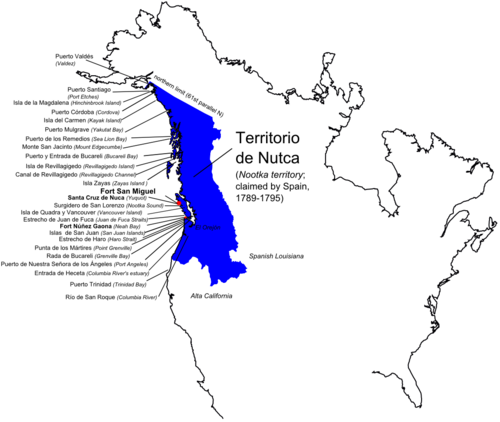
Spain claimed all of North America in the Age of Discovery, but claims were not translated into occupation until a major resource was discovered and Spanish settlement and crown rule put in place. The French had established an empire in northern North America and took some islands in the Caribbean. The English established colonies on the eastern seaboard of North America and in northern North America and some Caribbean islands as well. In the eighteenth century, the Spanish crown realized that its territorial claims needed to be defended, particularly in the wake of its visible weakness during the Seven Years' War when Britain captured the important Spanish ports of Havana and Manila. Another important factor was that the Russian empire had expanded into North America from the mid-eighteenth century, with fur trading settlements in what is now Alaska and forts as far south as Fort Ross, California. Great Britain was also expanding into areas that Spain claimed as its territory on the Pacific coast. Taking steps to shore up its fragile claims to California, Spain began planning California missions in 1769. Spain also began a series of voyages to the Pacific Northwest, where Russia and Great Britain were encroaching on claimed territory. The Spanish expeditions to the Pacific Northwest, with Alessandro Malaspina and others sailing for Spain, came too late for Spain to assert its sovereignty in the Pacific Northwest.[99]
The Nootka Crisis (1789–1791) nearly brought Spain and Britain to war. It was a dispute over claims in the Pacific Northwest, where neither nation had established permanent settlements. The crisis could have led to war, but without French support Spain capitulated to British terms and negotiations took place with the Nootka Convention. Spain and Great Britain agreed to not establish settlements and allowed free access to Nootka Sound on the west coast of what is now Vancouver Island. Nevertheless, the outcome of the crisis was a humiliation for Spain and a triumph for Britain, as Spain had practically renounced all sovereignty on the North Pacific coast.[100]
In 1806, Baron Nikolai Rezanov attempted to negotiate a treaty between the Russian-American Company and the Viceroyalty of New Spain, but his unexpected death in 1807 ended any treaty hopes. Spain gave up its claims in the West of North America in the Adams-Onis Treaty of 1819, ceding its rights there to the United States, allowing the U.S. to purchase Florida, and establishing a boundary between New Spain and the U.S. When the negotiations between the two nations were taking place, Spain's resources were stretched due to the Spanish American wars of independence.[101] Much of the present-day American Southwest later became part of Mexico after its independence from Spain; after the Mexican–American War, Mexico ceded to the U.S. present-day California, Texas, New Mexico, Utah, Nevada, Arizona, and parts of Colorado, Oklahoma, Kansas, Nebraska and Wyoming for $15 million.
Loss of Spanish Louisiana

The growth of trade and wealth in the colonies caused increasing political tensions as frustration grew with the improving but still restrictive trade with Spain. Alessandro Malaspina's recommendation to turn the empire into a looser confederation to help improve governance and trade so as to quell the growing political tensions between the élites of the empire's periphery and center was suppressed by a monarchy afraid of losing control. All was to be swept away by the tumult that was to overtake Europe at the turn of the 19th century with the French Revolutionary and Napoleonic Wars.
The first major territory Spain was to lose in the 19th century was the vast Louisiana Territory, which had few European settlers. It stretched north to Canada and was ceded by France in 1763 under the terms of the Treaty of Fontainebleau. The French, under Napoleon, took back possession as part of the Treaty of San Ildefonso in 1800 and sold it to the United States in the Louisiana Purchase of 1803. Napoleon's sale of the Louisiana Territory to the United States in 1803 caused border disputes between the United States and Spain that, with rebellions in West Florida (1810) and in the remainder of Louisiana at the mouth of the Mississippi River, led to their eventual cession to the United States.
End of the global empire (1808–1899)
.png/500px-Mapa_de_la_Am%C3%A9rica_espa%C3%B1ola_(1800).png)

In 1808, Napoleon maneuvered to place the Spanish king under his control, effectively seizing power without facing resistance. This action sparked resistance from the Spanish people, leading to the Peninsular War. This conflict created a power vacuum lasting nearly a decade, followed by civil wars, transitions to a republic, and eventually the establishment of a liberal democracy. Spain lost all the colonial possessions in the first third of the century, except for Cuba, Puerto Rico and, isolated on the far side of the globe, the Philippines, Guam and nearby Pacific islands, as well as Spanish Sahara, parts of Morocco, and Spanish Guinea.
The wars of independence in Spanish America were triggered by another failed British attempt to seize Spanish American territory, this time in the Río de la Plata estuary in 1806. The viceroy retreated hastily to the hills when defeated by a small British force. However, when the Criollos' militias and colonial army decisively defeated the now reinforced British force in 1807, they promptly embarked on the path to securing their own independence, igniting independence movements across the continent. A long period of wars followed in the Americas, and the lack of Spanish troops in the colonies led to war between patriotic rebels and local Royalists. In South America this period of wars led to the independence of Argentina (1810), Gran Colombia (1810), Chile (1810), Paraguay (1811) and Uruguay (1815, but subsequently ruled by Brazil until 1828). José de San Martín campaigned for independence in Chile (1818) and in Peru (1821). Further north, Simón Bolívar led forces that won independence between 1811 and 1826 for the area that became Venezuela, Colombia, Ecuador, Peru and Bolivia (then Upper Peru). Panama declared independence in 1821 and merged with the Republic of Gran Colombia (from 1821 to 1903). Over the course of nine years, 20,000 Spanish soldiers were sent to reinforce the Spanish American Royalists in northern South America. However, disease and combat claimed the lives of 16,000–17,000 of these soldiers.[102] Even within the Viceroyalty of Peru, the center of Spanish power in South America, the majority of the Royalist army consisted of Americans. After the Battle of Ayacucho, the captured Royalist army consisted of 1,512 Spanish Americans and only 751 Spaniards.[102]
Santo Domingo likewise declared independence in 1821 and began negotiating for inclusion in Bolivar's Republic of Gran Colombia, but was quickly occupied by the former French colony of Haiti, which ruled it until an 1844 revolution. After 17 years of independence, in 1861, Santo Domingo was again made a Spanish colony due to Haitian aggression, marking the only instance of a Spanish colonial possession returning to Spain after gaining independence. However Santo Domingo regained independence in 1865 through the Dominican Restoration War. Spanish losses against the Dominican rebels amounted to 10,888 soldiers killed or wounded in action, with the majority of the remaining approximately 30,000 troops succumbing to disease.[103]

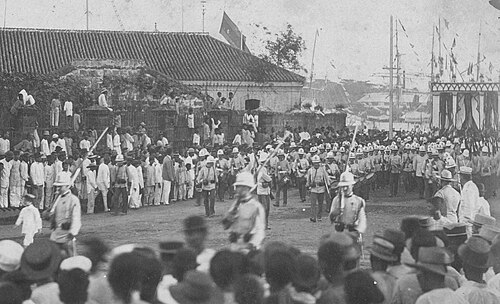
Uprisings in Cuba and the Philippine Islands culminated with the Spanish–American War of 1898. On 1 May, the US Navy destroyed the Spanish Pacific fleet at the Battle of Manila Bay. In Cuba, the Battle of Las Guasimas, Battle of El Caney, and Battle of San Juan Hill were counted as American victories, although the Spanish Army inflicted higher casualties during these engagements. The U.S. Army failed to capture the heavily fortified city of Santiago on 1 July, but two days later an American fleet that included five battleships destroyed the Spanish Caribbean squadron at the Battle of Santiago de Cuba.
Military defeat was followed by the U.S. occupation of Cuba and the cession of Puerto Rico, Guam, and the Philippines to the United States, receiving US$20 million in compensation for the Philippines.[104] The following year, Spain then sold its remaining Pacific Ocean possessions to Germany in the German–Spanish Treaty, retaining only its African territories. On 2 June 1899, the second expeditionary battalion Cazadores of Philippines, the last Spanish garrison in the Philippines, which had been besieged in Baler, Aurora at war's end, was pulled out, effectively ending around 300 years of Spanish hegemony in the archipelago.[105]
Territories in Africa (1885–1976)

By the end of the 17th century, only Melilla, Alhucemas, Peñón de Vélez de la Gomera (which had been taken again in 1564), and Ceuta (part of the Portuguese Empire since 1415, chose to retain their links to Spain once the Iberian Union ended. The formal allegiance of Ceuta to Spain was recognized by the Treaty of Lisbon in 1668), and Oran and Mers El Kébir remained Spanish territories in Africa. The latter cities were lost in 1708, reconquered in 1732 and sold by Charles IV in 1792.
In 1778, Fernando Pó (now Bioko), adjacent islets, and commercial rights to the mainland between the Niger and Ogooué rivers were ceded to Spain by the Portuguese in exchange for territory in South America (Treaty of El Pardo). In the 19th century, some Spanish explorers and missionaries would cross this zone, among them Manuel Iradier. In 1848, Spanish troops occupied the uninhabited Chafarinas Islands, anticipating a French move on the rocks located off the North-African coast.

In 1860, after the Tetuan War, Morocco paid Spain 100 million pesetas as war reparations and ceded Sidi Ifni to Spain as a part of the Treaty of Tangiers, on the basis of the old outpost of Santa Cruz de la Mar Pequeña, thought to be Sidi Ifni. The following decades of Franco-Spanish collaboration resulted in the establishment and extension of Spanish protectorates south of the city, and Spanish influence obtained international recognition in the Berlin Conference of 1884: Spain administered Sidi Ifni and Spanish Sahara jointly. Spain claimed a protectorate over the coast of Guinea from Cape Bojador to Cap Blanc, too, and even try to press a claim over the Adrar and Tiris regions in Mauritania. Río Muni became a protectorate in 1885 and a colony in 1900. Conflicting claims to the Guinea mainland were settled in 1900 by the Treaty of Paris, because of which Spain was left with a mere 26,000 km2 out of the 300,000 stretching east to the Ubangi River which they initially claimed.[106]
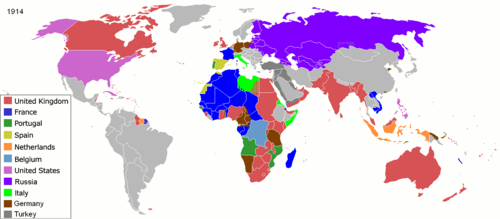
Following a brief war in 1893, Morocco paid war reparations of 20 million pesetas and Spain expanded its influence south from Melilla. In 1912, Morocco was divided between the French and Spanish. The Riffians rebelled, led by Abdelkrim, a former officer for the Spanish administration. The Battle of Annual (1921) during the Rif War was a major military defeat suffered by the Spanish army against Moroccan insurgents. A leading Spanish politician emphatically declared: "We are at the most acute period of Spanish decadence".[107] After the disaster of Annual, Spain began using German chemical weapons against the Moroccans. In September 1925, the Alhucemas landing by the Spanish Army and Navy with a small collaboration of an allied French contingent put an end to the Rif War. It is considered the first successful amphibious landing in history supported by seaborne air power and tanks.[108]

In 1923, Tangier was declared an international city under French, Spanish, British, and later Italian joint administration. In 1926, Bioko and Rio Muni were united as the colony of Spanish Guinea, a status that would last until 1959. In 1931, following the fall of the monarchy, the African colonies became part of the Second Spanish Republic. In 1934, during the government of Prime Minister Alejandro Lerroux, Spanish troops led by General Osvaldo Capaz landed in Sidi Ifni and carried out the occupation of the territory, ceded de jure by Morocco in 1860. Two years later, Francisco Franco, a general of the Army of Africa, rebelled against the republican government and started the Spanish Civil War (1936–39). During the Second World War the Vichy French presence in Tangier was overcome by that of Francoist Spain.
Spain lacked the wealth and the interest to develop an extensive economic infrastructure in its African colonies during the first half of the 20th century. However, through a paternalistic system, particularly on Bioko Island, Spain developed large cocoa plantations for which thousands of Nigerian workers were imported as laborers.
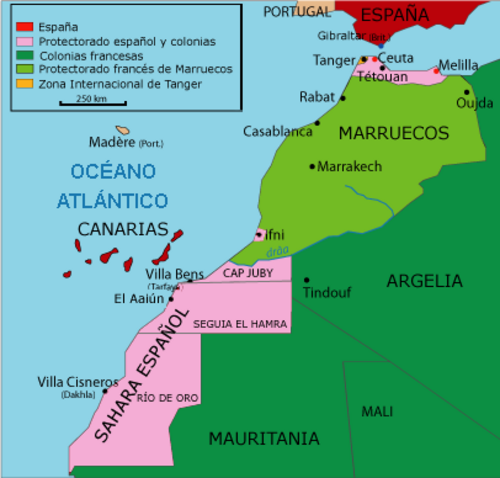
In 1956, when French Morocco became independent, Spain surrendered Spanish Morocco to the new nation, but retained control of Sidi Ifni, the Tarfaya region and Spanish Sahara. Moroccan Sultan (later King) Mohammed V was interested in these territories and unsuccessfully invaded Spanish Sahara in 1957, in the Ifni War, or in Spain, the Forgotten War (la Guerra Olvidada). In 1958, Spain ceded Tarfaya to Mohammed V and joined the previously separate districts of Saguia el-Hamra (in the north) and Río de Oro (in the south) to form the province of Spanish Sahara.

In 1959, the Spanish territory on the Gulf of Guinea was established with a status similar to the provinces of metropolitan Spain. As the Spanish Equatorial Region, it was ruled by a governor general exercising military and civilian powers. The first local elections were held in 1959, and the first Equatoguinean representatives were seated in the Spanish parliament. Under the Basic Law of December 1963, limited autonomy was authorized under a joint legislative body for the territory's two provinces. The name of the country was changed to Equatorial Guinea. In March 1968, under pressure from Equatoguinean nationalists and the United Nations, Spain announced that it would grant the country independence.
In 1969, under international pressure, Spain returned Sidi Ifni to Morocco. Spanish control of Spanish Sahara endured until the 1975 Green March prompted a withdrawal, under Moroccan military pressure. The future of this former Spanish colony remains uncertain.
The Canary Islands and Spanish cities in the African mainland are considered an equal part of Spain and the European Union but have a different tax system.
Morocco still claims Ceuta, Melilla, and plazas de soberanía even though they are internationally recognized as administrative divisions of Spain. Isla Perejil was occupied on 11 July 2002 by Moroccan Gendarmerie and troops, who were evicted by Spanish naval forces in a bloodless operation.
Legacy

Although the Spanish Empire declined from its apogee in the late seventeenth century, it remained a wonder for other Europeans for its sheer geographical span. Writing in 1738, English author Samuel Johnson questioned, "Has heaven reserved, in pity to the poor,/No pathless waste or undiscovered shore,/No secret island in the boundless main,/No peaceful desert yet unclaimed by Spain?"[109]
The Spanish Empire left a huge linguistic, religious, political, cultural, and urban architectural legacy in the Western Hemisphere. With over 470 million native speakers today, Spanish is the second most spoken native language in the world, as result of the introduction of the language of Castile—Castilian, "Castellano" —from Iberia to Spanish America, later expanded by the governments of successor independent republics. In the Philippines, the Spanish–American War (1898) brought the islands under U.S. jurisdiction, with English being imposed in schools and Spanish becoming a secondary official language. Many indigenous languages throughout the empire were often lost either as indigenous populations were decimated by war and disease, or as indigenous people mixed with colonists, and the Spanish language was taught and spread over time.[110]
An important cultural legacy of the Spanish empire overseas is Roman Catholicism, which remains the main religious faith in Spanish America and the Philippines. Christian evangelization of indigenous peoples was a key responsibility of the crown and a justification for its imperial expansion. Although indigenous were considered neophytes and insufficiently mature in their faith for indigenous men to be ordained to the priesthood, the indigenous were part of the Catholic community of faith. Catholic orthodoxy was enforced by the Inquisition, particularly targeting crypto-Jews and Protestants. Not until after their independence in the nineteenth century did Spanish American republics allow religious toleration of other faiths. Observances of Catholic holidays often have strong regional expressions and remain important in many parts of Spanish America. Observances include Day of the Dead, Carnival, Holy Week, Corpus Christi, Epiphany, and national saints' days, such as the Virgin of Guadalupe in Mexico.
Politically, the colonial era has strongly influenced modern Spanish America. The territorial divisions of the empire in Spanish America became the basis for boundaries between new republics after independence and for state divisions within countries. It is often argued that the rise of caudillismo during and after Latin American independence movements created a legacy of authoritarianism in the region.[111] There was no significant development of representative institutions during the colonial era, and the executive power was often made stronger than the legislative power during the national period as a result.
This has led to a popular misconception that the colonial legacy has caused the region to have an extremely oppressed proletariat. Revolts and riots are often seen as evidence of this supposed extreme oppression. However, the culture of revolting against an unpopular government is not simply a confirmation of widespread authoritarianism. The colonial legacy did leave a political culture of revolt, but not always as a desperate last act. The civil unrest of the region is seen by some as a form of political involvement. While the political context of the political revolutions in Spanish America is understood to be one in which liberal elites competed to form new national political structures, so too were those elites responding to mass lower-class political mobilization and participation.[112]
Hundreds of towns and cities in the Americas were founded during the Spanish rule, with the colonial centers and buildings of many of them now designated as UNESCO World Heritage Sites attracting tourists. The tangible heritage includes universities, forts, cities, cathedrals, schools, hospitals, missions, government buildings and colonial residences, many of which still stand today. A number of present-day roads, canals, ports or bridges sit where Spanish engineers built them centuries ago. The oldest universities in the Americas were founded by Spanish scholars and Catholic missionaries. The Spanish Empire also left a vast cultural and linguistic legacy. The cultural legacy is also present in the music, cuisine, and fashion, some of which have been granted the status of UNESCO Intangible Cultural Heritage.
The long colonial period in Spanish America resulted in a mixing of indigenous peoples, Europeans, and Africans that were classified by race and hierarchically ranked, which created a markedly different society than the European colonies of North America. In concert with the Portuguese, the Spanish Empire laid the foundations of a truly global trade by opening up the great trans-oceanic trade routes and the exploration of unknown territories and oceans for the western knowledge. The Spanish dollar became the world's first global currency.[113]
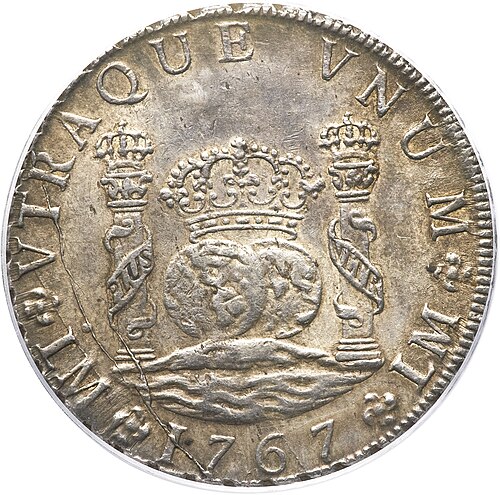
One of the features of this trade was the exchange of a great array of domesticated plants and animals between the Old World and the New in the Columbian Exchange. Some cultivars that were introduced to the Americas included grapes, wheat, barley, apples and citrous fruits; animals that were introduced to the New World were horses, donkeys, cattle, sheep, goats, pigs, and chickens. The Old World received from the Americas such things as maize, potatoes, chili peppers, tomatoes, tobacco, beans, squash, cacao (chocolate), vanilla, avocados, pineapples, chewing gum, rubber, peanuts, cashews, Brazil nuts, pecans, blueberries, strawberries, quinoa, amaranth, chia, agave and others. The result of these exchanges was to significantly improve the agricultural potential of not only in the Americas, but also that of Europe and Asia. Diseases brought by Europeans and Africans, such as smallpox, measles, typhus, and others, devastated almost all indigenous populations that had no immunity.
There were also cultural influences, which can be seen in everything from architecture to food, music, art and law, from southern Argentina and Chile to the United States of America together with the Philippines. The complex origins and contacts of different peoples resulted in cultural influences coming together in the varied forms evident today in the former colonial areas.
Gallery
-
 A photo of Cathedral of Mexico City, it is one of the largest cathedrals in Americas, built on the ruins of the Aztec main square.
 -
![The clock of Comayagua Cathedral's bell tower in Honduras is one of the oldest clocks in Americas and the oldest still working in the world.[114] It was brought from the Alhambra Arab palace to the Spanish colonies during the 17th century.](https://img-server.japedia.wiki/wikipedia/commons/thumb/5/58/Clock_of_Comayagua.jpg/500px-Clock_of_Comayagua.jpg) The clock of Comayagua Cathedral's bell tower in Honduras is one of the oldest clocks in Americas and the oldest still working in the world.[114] It was brought from the Alhambra Arab palace to the Spanish colonies during the 17th century.
The clock of Comayagua Cathedral's bell tower in Honduras is one of the oldest clocks in Americas and the oldest still working in the world.[114] It was brought from the Alhambra Arab palace to the Spanish colonies during the 17th century. -

-
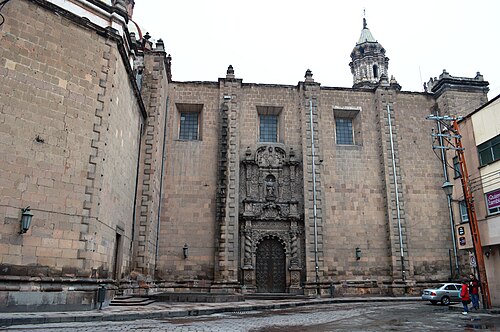 Templo del Carmen in San Luis Potosí City, Mexico in January 2014, it is one of the largest churches in Americas.
 -
 Roof tiles are a common Hispanic American architectural element because Spanish colonization. Hospital Escuela Eva Perón in Granadero Baigorria, Santa Fe, Argentina.
 -
 Detail of a Mural by Diego Rivera at the National Palace of Mexico showing the ethnic differences between Agustín de Iturbide, a criollo, and the multiracial Mexican court
 -
![Chest (petaca) from colonial Mexico, c. 1772. Now in the Metropolitan Museum of Art[115]](https://img-server.japedia.wiki/wikipedia/commons/thumb/3/36/Chest_%28petaca%29_MET_DP-15917-001.jpg/500px-Chest_%28petaca%29_MET_DP-15917-001.jpg)
.jpg/500px-Cathedral,_City_of_Mexico._(15719792402).jpg)
![Chest (petaca) from colonial Mexico, c. 1772. Now in the Metropolitan Museum of Art[115]](https://img-server.japedia.wiki/wikipedia/commons/thumb/3/36/Chest_(petaca)_MET_DP-15917-001.jpg/500px-Chest_(petaca)_MET_DP-15917-001.jpg)
See also

- Spanish Colonial architecture
- Black legend (Spain)
- Society in the Spanish Colonial Americas
- Cartography of Latin America
- Colonialism
- Creole nationalism
- Governor-General of the Philippines
- Historiography of Colonial Spanish America
- History of Spain
- History of the Americas
- List of countries that gained independence from Spain
- List of oldest buildings in the Americas
- Spain
- Spanish Viceroys of Aragon
- Spanish Viceroys of Catalonia
- Spanish Viceroys of Naples
- Spanish Viceroys of Navarre
- Spanish Viceroys of Sardinia
- Spanish Viceroys of Sicily
- Spanish Viceroys of Valencia
- Viceroys of New Granada
- Viceroys of New Spain
- Viceroys of Peru
- Viceroys of Río de la Plata
References
Notes
- ^ The Catholic Church was the State religion of the Spanish Empire, but the following religions were also present in the empire: Islam (Sunni Islam (Hanafi and Maliki [the latter until 1609] schools), Shia Islam, Crypto-Islam), Aztec religions, Inca religions, Buddhism, Hinduism, Sikhism, Jainism, Animism and Judaism (Crypto-Judaism).
- ^ Spanish: Imperio español
- ^ Spanish: Monarquía Hispánica
- ^ Spanish: Monarquía Católica
- ^ ... In August, the Duke besieged Ceuta [The city was simultaneously besieged by the moors and a Castilian army led by the Duke of Medina Sidónia] and took the whole city except the citadel, but with the arrival of Afonso V in the same fleet which led him to France, he preferred to leave the square. As a consequence, this was the end of the attempted settlement of Gibraltar by converts from Judaism ... which D. Enrique de Guzmán had allowed in 1474, since he blamed them for the disaster. See Ladero Quesada, Miguel Ángel (2000), "Portugueses en la frontera de Granada" in En la España Medieval, vol. 23 (in Spanish), p. 98, ISSN 0214-3038.
- ^ A dominated Ceuta by the Castilians would certainly have forced a share of the right to conquer the Kingdom of Fez (Morocco) between Portugal and Castile instead of the Portuguese monopoly recognized by the treaty of Alcáçovas. See Coca Castañer (2004), "El papel de Granada en las relaciones castellano-portuguesas (1369–1492)", in Espacio, tiempo y forma (in Spanish), Serie III, Historia Medieval, tome 17, p. 350: ... In that summer, D. Enrique de Guzmán crossed the Strait with five thousand men to conquer Ceuta, managing to occupy part of the urban area on the first thrust, but knowing that the Portuguese King was coming with reinforcements to the besieged [Portuguese], he decided to withdraw ...
- ^ A Castilian fleet attacked the Praia's Bay in Terceira Island but the landing forces were decimated by a Portuguese counter-attack because the rowers panicked and fled with the boats. See chronicler Frutuoso, Gaspar (1963)- Saudades da Terra (in Portuguese), Edição do Instituto Cultural de Ponta Delgada, volume 6, chapter I, p. 10. See also Cordeiro, António (1717)- Historia Insulana (in Portuguese), Book VI, Chapter VI, p. 257
- ^ This attack happened during the Castilian war of Succession. See Leite, José Guilherme Reis- Inventário do Património Imóvel dos Açores Breve esboço sobre a História da Praia (in Portuguese).
- ^ This was a decisive battle because after it, in spite of the Catholic Monarchs' attempts, they were unable to send new fleets to Guinea, Canary or to any part of the Portuguese empire until the end of the war. The Perfect Prince sent an order to drown any Castilian crew captured in Guinea waters. Even the Castilian navies which left to Guinea before the signature of the peace treaty had to pay the tax ("quinto") to the Portuguese crown when returned to Castile after the peace treaty. Isabella had to ask permission to Afonso V so that this tax could be paid in Castilian harbors. Naturally all this caused a grudge against the Catholic Monarchs in Andalusia.
- ^ Other European powers did not see the treaty between Castile and Portugal as binding on themselves. Francis I of France observed "The sun shines for me as for others and I should very much like to see the clause in Adam's will that excludes me from a share of the world."[52]
- ^ An early bandeira in 1628, (led by Antônio Raposo Tavares), composed of 2,000 allied Indians, 900 Mamluks (Mestizos) and 69 white Paulistanos, to find precious metals and stones and/or to capture Indians for slavery. This expedition alone was responsible for the destruction of most of the Jesuit missions of Spanish Guairá and the enslavement of 60,000 indigenous people. In response the missions that followed were heavily fortified.
Citations
- ^ Monarchy nominally restored in 1947
- ^ Government proclaimed in 1936
- ^ a b Taagepera, Rein (September 1997). "Expansion and Contraction Patterns of Large Polities: Context for Russia" (PDF). International Studies Quarterly. 41 (3): 492–502. doi:10.1111/0020-8833.00053. JSTOR 2600793. Archived (PDF) from the original on 7 July 2020. Retrieved 7 July 2020.
- ^ Fernández Álvarez, Manuel (1979). España y los españoles en los tiempos modernos (in Spanish). University of Salamanca. p. 128.
- ^ Schneider, Reinhold, 'El Rey de Dios', Belacqva (2002)
- ^ Hugh Thomas, 'World Without End: The Global Empire of Philip II', Penguin; first edition (2015)
- ^ Wright, Edmund, ed. (2015). A Dictionary of World History (2nd ed.). Oxford: Oxford University Press. doi:10.1093/acref/9780192807007.001.0001. ISBN 978-0191726927.
- ^ Echávez-Solano, Nelsy; Dworkin y Méndez, Kenya C., eds. (2007). Spanish and Empire. Nashville, Tenn.: Vanderbilt University Press. pp. xi–xvi. doi:10.2307/j.ctv16755vb.3. ISBN 978-0826515667. S2CID 242814420.
- ^ Beaule, Christine; Douglass, John G., eds. (2020). The Global Spanish Empire: Five Hundred Years of Place Making and Pluralism. Amerind Studies in Anthropology. Tucson: University of Arizona Press. pp. 3–15. doi:10.2307/j.ctv105bb41. ISBN 978-0816545711. JSTOR j.ctv105bb41. S2CID 241500499. Archived from the original on 30 August 2021. Retrieved 6 August 2021 – via Open Research Library.
- ^ Gibson, p. 91; Lockhart & Schwartz 1983, p. 19.
- ^ Márquez, Carlos E. (2016). "Plus Ultra and the Empire Upon Which the Sun Never Set". In Tarver, H. Micheal; Slape, Emily (eds.). The Spanish Empire: A Historical Encyclopedia [2 volumes]: A Historical Encyclopedia. ABC-CLIO. p. 161. ISBN 978-1610694223. Archived from the original on 14 January 2023. Retrieved 19 September 2022.
- ^ Lynch, Bourbon Spain, pp. 10–11.
- ^ Lynch, John. "Spanish American Independence" in The Cambridge Encyclopedia of Latin America and the Caribbean 2nd edition. New York: Cambridge University Press 1992, p. 218.
- ^ Bethany, Aram (2006). "Monarchs of Spain". Iberia and the Americas: culture, politics, and history. Santa Barbara: ABC Clio. p. 725.
- ^ Gloël, Matthias (2018). "Los conceptos de España durante los reinados de los Austrias" [The Concepts of Spain during the Habsburg's reigns] (PDF). Revista de Humanidades (38). Universidad Nacional Andrés Bello: 199. Archived (PDF) from the original on 7 November 2021. Retrieved 13 October 2021.
- ^ a b Gloël 2018, p. 205.
- ^ Gloël 2018, pp. 199–200.
- ^ Gloël 2018, pp. 205–206.
- ^ Gloël 2018, pp. 206–207.
- ^ Dutra, Francis A. "Portuguese Empire" in Encyclopedia of Latin American History and Culture 1996, vol. 4, p. 451
- ^ a b Burkholder, Mark A. "Spanish Empire" in Encyclopedia of Latin American History and Culture 1996, vol. 5, p. 167
- ^ Estow, Clara (1993). "Reflections on Gold: On the Late Medieval Background of the Spanish "Enterprise of the Indies"". Mediaevistik. 6: 85–120. ISSN 0934-7453. JSTOR 42583992. Archived from the original on 29 August 2021. Retrieved 8 February 2021.
- ^ "2 January 1492 – King Boabdil surrenders Granada to Ferdinand and Isabella". The Tudor Society. 2 January 2016. Archived from the original on 31 August 2021. Retrieved 8 February 2021.
- ^ "Constitutional Rights Foundation". www.crf-usa.org. Archived from the original on 16 April 2021. Retrieved 8 February 2021.
- ^ "Inquisition". HISTORY. Archived from the original on 2 December 2021. Retrieved 8 February 2021.
- ^ Trudy Ring, Noelle Watson, Paul Schellinger (2014). Middle East and Africa: International Dictionary of Historic Places. Routledge. p. 558.
{{cite book}}: CS1 maint: multiple names: authors list (link) - ^ Edwards 2000, pp. 282–288.
- ^ Edwards 2000, p. 248.
- ^ Castañeda Delgado, Paulino (1996). "La Santa Sede ante las empresas marítimas ibéricas" (PDF). La Teocracia Pontifical en las controversias sobre el Nuevo Mundo. Universidad Autónoma de México. ISBN 978-9683651532. Archived from the original (PDF) on 27 September 2011.
- ^ Hernando del Pulgar (1943), Crónica de los Reyes Católicos, vol. I (in Spanish), Madrid, pp. 278–279.
- ^ Jaime Cortesão (1990), Os Descobrimentos Portugueses Archived 22 November 2022 at the Wayback Machine, vol. III (in Portuguese), Imprensa Nacional-Casa da Moeda, p. 551, ISBN 9722704222
- ^ The Canary's campaign: Alfonso de Palencia, Decada IV Archived 22 November 2022 at the Wayback Machine, Book XXXI, Chapters VIII and IX ("preparation of 2 fleets" [to Guinea and to Canary, respectively] "so that with them King Ferdinand crush its enemies" [the Portuguese] ...). Palencia wrote that the conquest of Gran Canary was a secondary goal to facilitate the expeditions to Guinea (the real goal), a means to an end.
- Alfonso de Palencia, Decada IV Archived 22 November 2022 at the Wayback Machine, book XXXII, chapter III: in 1478 a Portuguese fleet intercepted the armada of 25 navies sent by Ferdinand to conquer Gran Canary—capturing 5 of its navies plus 200 Castilians—and forced it to fled hastily and definitively from the Canary waters. This victory allowed Prince John to use the Canary Islands as an "exchange coin" in the peace treaty of Alcáçovas.
- ^ Pulgar, Hernando del (1780), Crónica de los señores reyes católicos Don Fernando y Doña Isabel de Castilla y de Aragon Archived 16 January 2022 at the Wayback Machine (in Spanish), chapters LXXVI and LXXXVIII ("How the Portuguese fleet defeated the Castilian fleet which had come to the Mine of Gold"). From the Biblioteca Virtual Miguel de Cervantes.
- ^ Laughton, Leonard (1943). "Reviews". The Mariner's Mirror. 29 (3). London: Society for Nautical Research: 184. Archived from the original on 14 January 2023. Retrieved 25 October 2015.
... For four years the Castilians traded and fought; but the Portuguese were the stronger. They defeated a large Spanish fleet off Guinea in 1478, besides gaining other victories. The war ended in 1479 by Ferdinand resigning his claims to Guinea ...
- ... More important, Castile recognized Portugal as the sole proprietor of the Atlantic islands (excepting the Canaries) and of the African coast in the Treaty of Alcáçovas in 1479. This Treaty clause, secured by Portuguese naval successes off Africa during an otherwise unsuccessful war, eliminated the only serious rival. In Richardson, Patrick, The expansion of Europe, 1400–1660 Archived 22 November 2022 at the Wayback Machine (1966), Longmans, p. 48 Archived 23 May 2020 at the Wayback Machine
- ^ Waters, David (1988), Reflections Upon Some Navigational and Hydrographic Problems Of The XVth Century Related To The Voyage Of Bartolomeu Dias, 1487–88 Archived 10 April 2023 at the Wayback Machine, p. 299, in the Separata from the Revista da Universidade de Coimbra, vol. XXXIV.
- ^ ... the Treaty of Alcáçovas was an important step in defining the expansion areas of each kingdom ... The Portuguese triumph in this agreement is evident, and in addition deserved. Efforts and perseverance developed over the last four decades by Henry the Navigator during the Discoveries in Africa reached their fair reward. In Donat, Luis Rojas (2002), España y Portugal ante los otros: derecho, religión y política en el descubrimiento medieval de América Archived 22 November 2022 at the Wayback Machine (in Spanish), Ediciones Universidad del Bio-Bio, p. 88, ISBN 9567813191
- ^ ... Castile undertakes not to allow any his subject navigate waters reserved to the Portuguese. From the Canary's Parallel onwards, the Atlantic Ocean would be a Mare clausum to the Castilians. The treaty of Alcáçovas represented a huge victory for Portugal and resulted tremendously damaging to Castile. In Espina Barrio, Angel (2001), Antropología en Castilla y León e iberoamérica: Fronteras Archived 10 April 2023 at the Wayback Machine, vol. III (In Spanish), Universidad de Salamanca, Instituto de Investigaciones Antropológicas de Castilla y León, p. 118, ISBN 8493123110
- ^ Davenport, Frances Gardiner (2004), European Treaties Bearing on the History of the United States and Its Dependencies, The Lawbook Exchange, Ltd., p. 49, ISBN 978-1584774228, archived from the original on 14 January 2023, retrieved 21 November 2020
- ^ ... Castile accepted a Portuguese monopoly on new discoveries in the Atlantic from the Canaries southward and toward the African coast. In Bedini 1992, p. 53
- ^ ... This boundary line cut off Castile from the route to India around Africa ..., in Prien, Hans-Jürgen (2012), Christianity in Latin America: Revised and Expanded Edition Archived 22 November 2022 at the Wayback Machine, Brill, p. 8, ISBN 978-9004242074
- ^ ... With an eye to the Treaty of Alcáçovas which only permitted westerly expansion by Castile, the Crown accepted the proposals of the Italian adventurer [Christopher Columbus] because if, contrary to all expectation, he were to prove successful, a great opportunity would arise to outmanoeuvre Portugal ..., in Emmer, Piet (1999), General History of the Caribbean Archived 22 November 2022 at the Wayback Machine, vol. II, UNESCO, p. 86 Archived 23 May 2020 at the Wayback Machine, ISBN 0333-724550
- ^ Superpowers Spain and Portugal struggled for global control and in the 1494 Treaty of Tordesillas the Pope divided the non-Christian world between them. In Flood, Josephine (2006), The original Australians: Story of the Aboriginal people Archived 22 November 2022 at the Wayback Machine, p. 1, ISBN 1 74114 872 3
- ^ Burbank & Cooper 2010, pp. 120–121.
- ^ Fernández Herrero 1992, p. 143.
- ^ McAlister, Lyle N. (1984). Spain and Portugal in the New World, 1492–1700. U of Minnesota Press. p. 69. ISBN 978-0816612185.
- ^ Historia general de España 1992, p. 189.
- ^ Fernández Herrero 1992, p. 141.
- ^ Diffie, Bailey Wallys; Winius, George Davison (1977). Foundations of the Portuguese Empire, 1415–1580. University of Minnesota Press. p. 173. ISBN 978-0816607822. Archived from the original on 14 January 2023. Retrieved 21 November 2020.
- ^ Vieira Posada, Édgar (2008). La formación de espacios regionales en la integración de América Latina. Pontificia Universidad Javeriana. p. 56. ISBN 978-9586982344. Archived from the original on 14 January 2023. Retrieved 21 November 2020.
- ^ Sánchez Doncel, Gregorio (1991). Presencia de España en Orán (1509–1792). I.T. San Ildefonso. p. 122. ISBN 978-8460076148. Archived from the original on 14 January 2023. Retrieved 21 November 2020.
- ^ Los Trastámara y la Unidad Española. Ediciones Rialp. 1981. p. 644. ISBN 978-8432121005.[permanent dead link]
- ^ a b Collier, Simon (1992). "The non-Spanish Caribbean Islands to 1815". The Cambridge Encyclopedia of Latin America and the Caribbean (second ed.). New York: Cambridge University Press. pp. 212–213.
- ^ Lockhart & Schwartz 1983, pp. 61–85.
- ^ Lockhart & Schwartz 1983, p. 62.
- ^ Lockhart & Schwartz 1983, p. 63.
- ^ Diego-Fernández Sotelo 1987, p. 139.
- ^ Kozlowski, Darrell J. (2010). Colonialism. Infobase Publishing. p. 84. ISBN 978-1438128900. Archived from the original on 14 January 2023. Retrieved 21 November 2020.
- ^ a b Marley 2008, p. 27.
- ^ a b c Marley 2008, p. 30.
- ^ Marley 2008, p. 36.
- ^ Marley 2008, p. 37.
- ^ a b Marley 2008, p. 38.
- ^ Quoted in Braudel 1984, vol. 2, p. 171.
- ^ Baten, Jörg (2016). A History of the Global Economy. From 1500 to the Present. Cambridge University Press. p. 159. ISBN 978-1107507180.
- ^ a b c Cathal J. Nolan (2006). The Age of Wars of Religion 1000–1650: An Encyclopedia of Global Warfare and Civilization. pp. 672–675.
- ^ a b c Cathal J. Nolan (2008). Wars of the Age of Louis XIV, 1650–1715: An Encyclopedia of Global Warfare and Civilization. pp. 442–443.
- ^ Kenneth L. Sokoloff; Stanley L. Engerman (2000). "History Lessons: Institutions, Factor Endowments, and Paths of Development in the New World" (PDF). The Journal of Economic Perspectives. 14 (3): 217–232. doi:10.1257/jep.14.3.217. Archived from the original (PDF) on 21 September 2020. Retrieved 12 March 2018.
- ^ Stein, Stanley J. (2003). Silver, Trade, and War : Spain and America in the Making of early modern Europe. Johns Hopkins Univ Press. ISBN 0801877555. OCLC 173164546.
- ^ Moutoukias, Zacarias (1988). "Power, Corruption, and Commerce: The Making of the Local Administrative Structure in Seventeenth-Century Buenos Aires". The Hispanic American Historical Review. 68 (4): 771–801. doi:10.2307/2515681. ISSN 0018-2168. JSTOR 2515681.
- ^ Stein & Stein 2000, pp. 40–57.
- ^ Andrien, Kenneth A. "Arbitristas" in Encyclopedia of Latin American History and Culture 1996, vol. 1, p. 122
- ^ Stein & Stein 2000, pp. 94–102.
- ^ Elliott 1989, p. 231.
- ^ "Old Havana and its Fortification System". UNESCO World Heritage List website. Archived from the original on 5 June 2020. Retrieved 7 August 2023.
- ^ Lynch 1989, pp. 10–11.
- ^ a b Bakewell, Peter and Kendall W. Brown, "Mining: Colonial Spanish America" in Encyclopedia of Latin American History and Culture 1996, vol. 4, pp. 59–63
- ^ Fisher, John R. "Fleet System (Flota)" in Encyclopedia of Latin American History and Culture 1996, vol. 2, p. 575
- ^ Tutino, John (2018). In The Mexican Heartland: How Communities Shaped Capitalism, a Nation, and World History, 1500–2000. Princeton University Press. pp. 57–90.
- ^ Kuethe, Allan J.; Andrien, Kenneth J. (May 2014). "War and Reform, 1736–1749". The Spanish Atlantic World in the Eighteenth Century. pp. 133–166. doi:10.1017/cbo9781107338661.007. ISBN 978-1107338661.
{{cite book}}:|website=ignored (help) - ^ a b Tutino, John (2016). New countries capitalism, revolutions, and nations in the Americas, 1750–1870. Duke University Press. ISBN 978-0822361145. OCLC 1107326871.
- ^ Owen Flynn, Dennis; Giraldez, Arturo (2002). "Cycles of Silver: Global Economic Unity through the Mid-Eighteenth Century". Journal of World History. 13 (2). University of Hawai'i Press: 391–427. doi:10.1353/jwh.2002.0035. S2CID 145805906. Archived from the original on 26 February 2021. Retrieved 8 August 2021.
- ^ Braudel 1984, vol. 2, p. 418.
- ^ Lynch 1989, p. 1.
- ^ Kuethe, Allan J. "The Bourbon Reforms" in Encyclopedia of Latin American History and Culture 1996, vol. 1, pp. 399–401
- ^ Fisher, John R. "The Spanish American empire, 1580–1808" in The Cambridge Encyclopedia of Latin America and the Caribbean, 2nd edition. New York: Cambridge University Press 1992, pp. 204–205.
- ^ Albareda Salvadó, Joaquim (2010). La Guerra de Sucesión de España (1700–1714). Editorial Critica. pp. 239–241. ISBN 978-8498920604.
- ^ Lynch 1989, p. 11.
- ^ a b von Humboldt 1811.
- ^ Janota, Tom (9 February 2015). Alexander von Humboldt, un explorador científico en América. CIDCLI. p. 64. ISBN 978-6078351121. Archived from the original on 14 January 2023. Retrieved 23 September 2020.
- ^ Schmitt, Karl (April 1959). "The Clergy and the Enlightenment in Latin America: An Analysis". The Americas. 15 (4): 381–391. doi:10.2307/978867. JSTOR 978867. S2CID 146900474.
- Aldridge, Alfred Owen (1971). The Ibero-American Enlightenment. Urbana: University of Illinois Press.
- ^ Saladino García, Alberto (1990). Dos científicos de la Ilustración hispanoamericana: J.A. Alzate y F.J. de Caldas (in Spanish). Mexico: UNAM.
- Codding, Mitchell A. (1994). "Perfecting the geography of New Spain: Alzate and the Cartographic legacy of Sigüenza y Góngora". Colonial Latin American Review. 2 (1–2): 185–219. doi:10.1080/10609169408569828.
- ^ Pérez Arbeláez, Enrique (1983) [1967]. José Celestino Mutis y la real expedición botánica del Nuevo Reyno de Granada (in Spanish) (2nd. ed.). Bogotá: Instituto Colombiano de Cultura Hispánica.
- ^ Rickett, Harold W. (1947). "The Royal Botanical Expedition to New Spain". Chronica Botanica. 11 (1): 1–81.
- de Solano, Francisco, ed. (1987). La Real Expedición Botánica a Nueva España, 1787–1800 (in Spanish). Madrid: CSIC.
- ^ Engstrand, Iris H. W. (1981). Spanish Scientists in the New World: The Eighteenth-Century Expeditions. Seattle: University of Washington Press.
- Bleichmar, Daniela (2012). Visible Empire: Botanical Expeditions & Visible Culture in the Hispanic Enlightenment. Chicago: University of Chicago Press.
- De Vos, Paula S. (June 2006). "Research, Development, and Empire: State Support of Science in Spain and Spanish America, Sixteenth to Eighteenth Centuries". Colonial Latin America Review. 15 (1): 55–79. doi:10.1080/10609160600607432. S2CID 218576951.
- ^ Cañizares-Esguerra, Jorge (2006). Nature, Empire, and Nation: Explorations in the History of Science in the Iberian World. Stanford: Stanford University Press.
- Bleichmar, Daniela, ed. (2008). Science in the Spanish and Portuguese Empires, 1500–800. Stanford: Stanford University Press.
- Peset, José Luis, ed. (1989). Ciencia, vida, y espacio en Iberoamérica (in Spanish). Madrid: CSIC.
- Franklin Safier, Neil (2008). Measuring the New World: Enlightenment Science and South America. Chicago: University of Chicago Press.
- ^ "4 More of the Stupidest Wars in World History". October 2020. Archived from the original on 7 August 2023. Retrieved 7 August 2023.
- ^ Prowse, D. W. (2007). A History of Newfoundland: from the English, Colonial and Foreign Records. Heritage Books. p. 311. ISBN 978-0788423109.
In one short year the unfortunate Spaniards saw their armies beaten in Portugal, Cuba and Manila torn from their grasp, their commerce destroyed, and their fleets annihilated.
- ^ "Corsairs of Santo Domingo a socio-economic study, 1718–1779" (PDF). Archived (PDF) from the original on 16 January 2017. Retrieved 12 October 2020.
- ^ Kamen 2003, pp. 237, 485.
- ^ Blackmar, Frank Wilson (1891). Spanish Institutions of the Southwest Issue 10 of Johns Hopkins University studies in historical and political science. Hopkins Press. p. 335. Archived from the original on 14 January 2023. Retrieved 3 June 2022.
- ^ Salvucci, Linda K. "Adams–Onís Treaty (1819)" in Encyclopedia of Latin American History and Culture 1996, vol. 1, pp. 11–12
- ^ a b c Robert L. Scheina (2003). Latin America's Wars Volume I: The Age of the Caudillo, 1791–1899.
- ^ Micheal Clodfelter (2017). Warfare and Armed Conflicts: A Statistical Encyclopedia of Casualty and Other Figures, 1492–2015.
- ^ "Avalon Project – Treaty of Peace Between the United States and Spain; December 10, 1898". avalon.law.yale.edu. Archived from the original on 16 September 2018. Retrieved 29 September 2022.
- ^ Dictionary of Battles and Sieges: A Guide to 8,500 Battles 2007 Archived 5 April 2023 at the Wayback Machine Cerezo finally surrendered with the full honors of war (1 July 1898 – 2 June 1899)
- ^ William Gervase Clarence-Smith, 1986 "Spanish Equatorial Guinea, 1898–1940", in The Cambridge History of Africa: From 1905 to 1940 Ed. J. D. Fage, A. D. Roberts, & Roland Anthony Oliver. Cambridge: Cambridge University Press>"The Cambridge History of Africa, Volume 7~ from 1905 to 1940 (0521225051, 1986)". Archived from the original on 20 February 2014. Retrieved 23 September 2013.
- ^ "La derrota más amarga del Ejército español – ABC.es" (in Spanish). 15 July 2011. Archived from the original on 21 July 2017. Retrieved 28 January 2017.
- ^ "Desembarco en Alhucemas, el "Día D" de las tropas españolas en el norte de África". abc (in European Spanish). 12 January 2014. Archived from the original on 12 June 2018. Retrieved 24 June 2017.
- ^ quoted in Simon Collier, "The Spanish Conquests, 1492–1580" in The Cambridge Encyclopedia of Latin America and the Caribbean. New York: Cambridge University Press 1992, p. 194.
- ^ Hamel, Rainer Enrique (1995), "Indigenous education in Latin America: policies and legal frameworks", Linguistic Human Rights, De Gruyter Mouton, pp. 271–288, doi:10.1515/9783110866391.271, ISBN 978-3110866391
- ^ Chiaramonte, José Carlos (1 August 2010). "The "Ancient Constitution" after Independence (1808–1852)". Hispanic American Historical Review. 90 (3): 455–488. doi:10.1215/00182168-2010-003. ISSN 0018-2168.
- ^ Hamnett, Brian R. (1997). "Process and Pattern: A Re-Examination of the Ibero-American Independence Movements, 1808–1826". Journal of Latin American Studies. 29 (2): 279–328. doi:10.1017/S0022216X97004719 (inactive 27 August 2024). ISSN 0022-216X. JSTOR 158396. S2CID 145479092.
{{cite journal}}: CS1 maint: DOI inactive as of August 2024 (link) - ^ "Dissemination of Hispanic-American coinage". Encyclopædia Britannica. Archived from the original on 29 December 2011. Retrieved 7 February 2012.
- ^ "El reloj más antiguo del mundo – 30 Maravillas de Honduras" (in European Spanish). Archived from the original on 1 July 2022. Retrieved 27 July 2022.
- ^ "Chest (petaca)". Metropolitan Museum of Art website. Archived from the original on 4 June 2023. Retrieved 4 June 2023.
Bibliography
- Alip, Eufronio Melo (1964). Philippine History: Political, Social, Economic.
- Altman, Ida; Cline, Sarah; Javier Pescador, Juan (2003). The Early History of Greater Mexico. Upper Saddle River, NJ: Pearson. pp. 321–322.
- Archer, Christon; et al. (2002). World History of Warfare. Lincoln, NE: University of Nebraska. ISBN 978-0803244238.
- Arranz Márquez, Luis (1982). Don Diego Colón, almirante, virrey y gobernador de las Indias (in Spanish). CSIC. ISBN 978-8400051563.
- Atiyah, Jeremy (2002). Rough guide to Southeast Asia. Rough Guide. ISBN 978-1858288932.
- Bedini, Silvio, ed. (1992). The Christopher Columbus Encyclopedia. Simon & Schuster. ISBN 978-0131426702.
- Bennassar, Bartolomé (2001). La América española y la América portuguesa: siglos XVI–XVIII (in Spanish). Akal. ISBN 978-8476002032.
- Burbank, Jane; Cooper, Frederick (2010). Empires in World History: Power and the Politics of Difference. Princeton University Press. pp. 120–121. ISBN 978-0691127088.
- Brading, D.A. (1993). The First America: Spanish Monarchy, Creole Patriots, and the Liberal State, 1492–1866. Cambridge: Cambridge University Press. ISBN 978-0521447966.
- Brading, D.A. (1971). Miners and Merchants in Bourbon Mexico, 1763–1810. New York: Cambridge University. ISBN 978-0521102070.
- Braudel, Fernand (1984) [1979]. Civilization and Capitalism, 15th–18th century. Vol. 3 volumes. London: Collins.
- Brown, Jonathan; Elliott, John Huxtable (1980). A Palace for a King. The Buen Retiro and the Court of Philip IV. New Haven: Yale University Press. ISBN 978-0300025071.
- Bushnell, Amy (1981). The King's Coffer: Proprietors of the Spanish Florida Treasury 1565–1702. Gainesville: University Presses of Florida. ISBN 978-0813006901.
- Carrera Damas, Germán (1999). Historia general de América Latina (in Spanish). UNESCO. ISBN 978-9233031517.
- Chipman, Donald E. (2005). Moctezuma's Children: Aztec Royalty under Spanish Rule, 1520–1700 (Individual e-book (no page numbers) ed.). Austin: University of Texas Press. ISBN 978-0292782648. Retrieved 22 October 2013.
- Diego-Fernández Sotelo, Rafael (1987). Las capitulaciones colombinas (in Spanish). El Colegio de Michoacán A.C. ISBN 978-9687230306.
- Edwards, John (2000). The Spain of the Catholic Monarchs, 1474–1520. New York: Blackwell. ISBN 978-0631161653.
- Elliott, J.H. (2006). Empires of the Atlantic World: Britain and Spain in America 1492–1830. New Haven: Yale University Press.
- Elliott, J.H. (1989). Spain and Its World, 1500–1700. New Haven: Yale University Press.
- Elliott, J.H. (1986). The Count-Duke of Olivares: the statesman in an age of decline. New Haven: Yale University Press. ISBN 978-0300033908.
- Elliott, J.H. (1977). Imperial Spain, 14691716. New York: New American Library. ISBN 978-0452006140.
- Elliott, J.H. (1961). "The Decline of Spain". Past and Present (20): 52–75. doi:10.1093/past/20.1.52.
- Encyclopedia of Latin American History and Culture. New York: Charles Scribner's Sons. 1996. 5 volumes
- Fernández Herrero, Beatriz (1992). La utopía de América: teoría, leyes, experimentos (in Spanish). Anthropos Editorial. ISBN 978-8476583203.
- Frankham, Steven (2008). Borneo. Footprint Handbooks. Footprint. ISBN 978-1906098148.
- Gómez Gómez, Margarita (2008). El sello y registro de Indias: imagen y representación (in Spanish). Böhlau Verlag Köln Weimar. ISBN 978-3412202293.
- Góngora, Mario (1998). Estudios sobre la historia colonial de hispanoamérica (in Spanish). Editorial Universitaria. ISBN 978-9561113817.
- Guerrero, Milagros; Custodio, Teresa Ma.; Dalisay, Jose Y. (1998), "Reform and Revolution", Kasaysayan: The History of the Filipino People, vol. 5, Asia Publishing Company Limited, ISBN 962-258-228-1
- Hamnett, Brian (2017). The End of Iberian Rule on the American Continent, 1770–1830. Cambridge: Cambridge University Press. ISBN 978-1316626634.
- Haring, Clarence (1947). The Spanish Empire in America. New York: Oxford University Press.
- Historia general de España y América (in Spanish). Vol. 10. Ediciones Rialp. 1992. ISBN 978-8432121029.
- von Humboldt, Alexander (1 January 1811). Political essay on the kingdom of New Spain containing researches relative to the geography of Mexico. Printed for Longman, Hurst, Rees, Orme and Brown ... and H. Colburn ... ISBN 978-0665185465 – via Biodiversity Library.
- Joaquin, Nick (1988). Culture and history: occasional notes on the process of Philippine becoming. Solar. ISBN 978-9711706333.
- Kamen, Henry (2005). Spain 1469–1714. A Society of Conflict (third ed.). London: Pearson Longman. ISBN 978-0582784642.
- Kamen, Henry (2003). Empire: How Spain Became a World Power, 1492–1763. New York: HarperCollins. ISBN 978-0060932640.
- Kennedy, Paul M (2017) [1988]. The rise and fall of the great powers: economic change and military conflict from 1500 to 2000. London: William Collins. ISBN 978-0006860525.
- Kurlansky, Mark (1999). The Basque history of the world. Walker. ISBN 978-0802713490.
- Lagos Carmona, Guillermo (1985). Los títulos históricos (in Spanish). Editorial Andrés Bello. OCLC 320082537.
- Lockhart, James; Schwartz, Stuart B. (1983). Early Latin America. New York: Cambridge University Press. ISBN 978-0521233446.
- Lynch, John (1989). Bourbon Spain, 1700–1808. New York. ISBN 978-0631192459.
{{cite book}}: CS1 maint: location missing publisher (link) - McAmis, Robert Day (2002). Malay Muslims: The History and Challenge of Resurgent Islam in Southeast Asia. Eerdmans. ISBN 978-0802849458.
- Mecham, J. Lloyd (1966). Church and State in Latin America: A History of Politico-Ecclesiastical Relations (revised ed.). Chapel Hill: University of North Carolina Press.
- Parker, Geoffrey (1978). Philip II. Boston: Little, Brown. ISBN 978-0316690805.
- Ruiz Martín, Felipe (1996). La proyección europea de la monarquía hispánica (in Spanish). Editorial Complutense. ISBN 978-8495983305.
- Saunders, Graham (2002). A History of Brunei. Routledge. ISBN 978-0700716982.
- Sibaja Chacón, Luis Fernando (2006). El cuarto viaje de Cristóbal Colón y los orígenes de la provincia de Costa Rica (in Spanish). EUNED. ISBN 978-9968314886.
- Stein, Stanley J.; Stein, Barbara H. (2000). Silver, Trade, and War: Spain and America in the Making of Early Modern Europe. Baltimore: Johns Hopkins University.
- Victoria, Pablo (2005). El día que España derrotó a Inglaterra : de cómo Blas de Lezo, tuerto, manco y cojo, venció en Cartagena de Indias a la otra "Armada Invencible" (in Spanish) (1st ed.). Barcelona: Áltera. ISBN 978-8489779686.
- Marley, David (2008). Wars of the Americas: A Chronology of Armed Conflict in the New World, 1492 to the Present [2 ed.]
Further reading
- Padilla Angulo, Fernando J. (12 January 2023). Volunteers of the Empire: War, Identity, and Spanish Imperialism, 1855–1898. Bloomsbury. ISBN 978-1-350-28120-2.
- Anderson, James Maxwell (2000). The History of Portugal. Westport, Connecticut: Greenwood. ISBN 978-0313311062.
- Black, Jeremy (1996). The Cambridge illustrated atlas of warfare: Renaissance to revolution. Cambridge: Cambridge University. ISBN 978-0521470339.
- Boyajian, James C. (2007). Portuguese Trade in Asia Under the Habsburgs, 1580–1640. Johns Hopkins University. ISBN 978-0801887543.
- Braudel, Fernand (1972). The Mediterranean and the Mediterranean World in the Age of Philip II. Berkeley, Calif. : University of California Press.
- Brown, Jonathan (1998). Painting in Spain: 1500–1700. New Haven: Yale University Press. ISBN 978-0300064728.
- Dominguez Ortiz, Antonio (1971). The Golden Age of Spain, 1516–1659. Oxford: Oxford University Press. ISBN 978-0297004059.
- Elliott, J.H. (1970). The Old World and The New. Cambridge: Cambridge [Eng.] University Press. ISBN 978-0521079372.
- Farriss, N.M. (1968). Crown and Clergy in Colonial Mexico, 1759–1821. London: Athlone Press.
- Fisher, John (1985). Commercial Relations Between Spain and Spanish America in the Era of Free Trade, 1778–1796. Liverpool.
{{cite book}}: CS1 maint: location missing publisher (link) - Gibson, Charles (1966). Spain in America. New York: Harper and Row.
- Gibson, Charles (1964). The Aztecs Under Spanish Rule. Stanford: Stanford University Press.
- Herr, Richard (1958). The Eighteenth-Century Revolution in Spain. Princeton.
{{cite book}}: CS1 maint: location missing publisher (link) - Israel, Jonathan (May 1981). "Debate – The Decline of Spain: A Historical Myth". Past and Present (91): 170–185. doi:10.1093/past/91.1.170.
- Kagan, Richard L.; Parker, Geoffrey (1995). Spain, Europe and the Atlantic: Essays in Honour of John H. Elliott. Cambridge University Press. ISBN 978-0521525114.
- Kamen, Henry (1998). Philip of Spain. New Haven: Yale University. ISBN 978-0300078008.
- Kamen, Henry. Empire: How Spain Became a World Power, 1493–1763. New York: HarperCollins 2003. ISBN 978-0060194765
- Lach, Donald F.; Van Kley, Edwin J. (1994). Asia in the Making of Europe. Chicago: University of Chicago. ISBN 978-0226467344.
- Lynch, John (1964). Spain Under the Hapsburgs. New York.
{{cite book}}: CS1 maint: location missing publisher (link) - Lynch, John (1983). The Spanish American Revolutions, 1808–1826. New York.
{{cite book}}: CS1 maint: location missing publisher (link) - MacLachlan, Colin M. (1988). Spain's Empire in the New World: The Role of Ideas in Institutional and Social Change. Berkeley: University of California Press. ISBN 978-0520074101.
- Marichal, Carlos; Mantecón, Matilde Souto (1994). "Silver and Situados: New Spain and the Financing of the Spanish Empire in the Caribbean in the Eighteenth Century". Hispanic American Historical Review. 74 (4): 587–613. doi:10.2307/2517493. JSTOR 2517493.
- Merriman, Roger Bigelow (1918). The Rise of the Spanish Empire in the Old World and the New. New York.
{{cite book}}: CS1 maint: location missing publisher (link) - Olson, James S. (1992). Historical Dictionary of the Spanish Empire, 1402–1975.
- Paquette, Gabriel B (17 January 2008). Enlightenment, governance, and reform in Spain and its empire, 1759–1808. New York: Palgrave Macmillan 2008. ISBN 978-0230300521.
- Parker, Geoffrey (1997). The Thirty Years' War (2nd ed.). New York: Routledge. ISBN 978-0415128834.
- Parker, Geoffrey (1972). The Army of Flanders and the Spanish Road, 1567–1659; the logistics of Spanish victory and defeat in the Low Countries' Wars. Cambridge: Cambridge University Press. ISBN 978-0521084628.
- Parker, Geoffrey (1977). The Dutch revolt. Cambridge: Cambridge University Press. ISBN 978-0801411366.
- Parker, Geoffrey (1997). The General Crisis of the Seventeenth Century. New York: Routledge. ISBN 978-0415165181.
- Parry, J.H. (1966). The Spanish Seaborne Empire. Berkeley: University of California Press. ISBN 978-0520071407.
- Ramsey, John Fraser (1973). Spain: The Rise of the First World Power. University of Alabama Press. ISBN 978-0817357047.
- Restall, Matthew (2007). "The Decline and Fall of the Spanish Empire?". The William and Mary Quarterly. 64 (1): 183–194. JSTOR 4491607.
- Schmidt-Nowara, Christopher; Nieto Phillips, John M., eds. (2005). Interpreting Spanish Colonialism: Empires, Nations, and Legends. Albuquerque: University of New Mexico Press.
- Stein, Stanley J.; Stein, Barbara H. (2003). Apogee of Empire: Spain and New Spain in the Age of Charles III, 1759–1789. Baltimore: Johns Hopkins University.
- Stradling, R. A. (1988). Philip IV and the Government of Spain. Cambridge: Cambridge University Press. ISBN 978-0521323338.
- Studnicki-Gizbert, Daviken (2007). A Nation upon the Ocean Sea: Portugal's Atlantic Diaspora and the Crisis of the Spanish Empire, 1492–1640. Oxford University Press. ISBN 978-0198039112.
- Thomas, Hugh (2004). Rivers of Gold: The Rise of the Spanish Empire 1490–1522. Weidenfeld & Nicolson. ISBN 978-0297645634.
- Thomas, Hugh (1997). The Slave Trade; The History of the Atlantic Slave Trade 1440–1870. London: Papermac. ISBN 978-0333731475.
- Vicens Vives, Jaime (1969). An Economic History of Spain (3rd revised ed.). Princeton: Princeton, N.J., Princeton University Press.
- Wright, Esmond, ed. (1984). History of the World, Part II: The last five hundred years (third ed.). New York: Hamlyn Publishing. ISBN 978-0517436448.
External links
Wikimedia Commons has media related to Spanish Empire.

Wikivoyage has a travel guide for Spanish Empire.
- Library of Iberian Resources Online, Stanley G Payne A History of Spain and Portugal vol 1 Ch 13 "The Spanish Empire"
- The Mestizo-Mexicano-Indian History in the USA
- Documentary Film, Villa de Albuquerque
- The last Spanish colonies (in Spanish)
- Francisco José Calderón Vázquez (2008), Fronteras, identidad, conflicto e interacción. Los Presidios Españoles en el Norte Africano (in Spanish), ISBN 978-8469167861, archived from the original on 14 February 2009
- The Kraus Collection of Sir Francis Drake at the Library of Congress contains primary materials on Spanish colonialism.