Loading article…

世界のほぼすべての国が第二次世界大戦に参加しました。ほとんどの国は当初中立でしたが、終戦まで中立を保った国は比較的少数でした。第二次世界大戦は、連合国と枢軸国という2つの同盟国が互いに戦う戦争でした。 死者は8500万人と推定されており、推定値は4000万人から 9000 万人(すべてのジェノサイド犠牲者を含む)に及びます。[ 1 ]主な枢軸国はナチス・ドイツ、大日本帝国、イタリア王国であり、一方、イギリス、アメリカ合衆国、ソビエト連邦、中国は「四大連合国」でした。[ 2 ]
第二次世界大戦に関与した、あるいは影響を受けた国々をアルファベット順に列挙し、それぞれの国が紛争において果たした役割についての説明を添える。
出典:[ 3 ]
 ドイツ(1940年~1945年)
 イタリア(1940年~1943年)
 日本(1940年~1945年)
 ハンガリー(1940年~1945年)
 ルーマニア(1940年~1944年)
 ブルガリア(1940年~1944年)
 スロバキア
スロバキア クロアチア(1941年以降)
 フィリピン(1943年以降)
 北イタリア(1943年以降)
 タイ(1941年以降)
 イラク(1941年) [ 4 ]
 ボヘミアとモラヴィア
 イタリア領アルバニア(1940年~1943年)
 フィンランド(1941年~1944年)
 ヴィシー・フランス(名目上は中立国、正式名称は「フランス国家」)(1940年~1944年)仏領インドシナ(1944 年以降、事実上日本占領)フランス領インドシナ(日本領)(1945年) オランダ領東インド(日本領)(1942年~1945年)
 セルビア(正式名称は「国民救済政府」)(1941年~1944年)
 ロコット自治(1941 ~ 1944 年)
 モンテネグロ(1941年~1944年)
 ベラルーシ(1941年~1944年)
 ドイツ領アルバニア(1943年~1944年)
 ギリシャ国家(1941年~1944年)
 ノルウェー国家(1942年~1945年)
 ユーゴスラビア(1941年)(2日間)
 チェトニク(1941年~1945年)
 ビルマ(1942年~1945年)
 マケドニア(1944年)(マケドニアにおけるドイツの傀儡国家案)
 アザド・ヒンド(1943年より)
 満州国
満州国 蒙江
蒙江 汪兆銘政権(1940年~)
 イラン(共同交戦国)
 ウクライナ帝国国家委員会(1941 年から)
 オストランド帝国国家委員会(1941 年から 1943 年まで)
 ニーダーランド帝国国家委員会(1940 年から 1944 年まで)
 ソビエト連邦(1939年~1941年)
 イギリス(1939年以降)
 アメリカ合衆国(1941年以降) ソビエト連邦(1941年以降) 中国 フランス(1940年まで)
 ポーランド
ポーランド モンゴル(1945年)
 チェコスロバキア(1939年以降)チェトニク(1941年)
 ネパール
ネパール サウジアラビア(1945年)
 フィリピン(1941年以降)
 カナダ(1939年以降)
 ニューファンドランド
 インド
インド オーストラリア
 ポーランド(1939年以降)
 自由フランス(1940年~1944年)
 ニュージーランド
 サンマリノ(1944年)
 南ローデシア
 メキシコ(1942年以降)
 ドミニカ共和国(1941年以降)
 ベルギー(1940年以降) オランダ(1940年以降)
 ルクセンブルク(1940年以降) ノルウェー(1940年から)
 ブラジル(1942年以降)
 リベリア(1944年以降)
 韓国
韓国 エジプト
エジプト ハイチ(1941年以降)
 南アフリカ フィンランド(1944年以降) イラク(1943年以降)イタリア(1943年以降)
 イタリアの抵抗運動(1943年~1945年) ルーマニア(1944年以降) ブルガリア(1944年以降) ユーゴスラビア(1941年)
 トルコ(1945年)
 ギリシャ(1940年以降)
 シリア(1945年)
 レバノン(1945年) イラン(1941年以降)
 エチオピア(1941年以降)
 デンマーク(1940年)
 ランチ(1942年~1945年)
 キューバ(1941年以降)
 パナマ(1941年以降)
 コスタリカ(1941年以降)
 トゥヴァ共和国(1941年~1944年)
 ベトミン(1941年以降)
 ユーゴスラビア(1941年以降)
 英エジプト・スーダン
 フランス共和国臨時政府(1944年以降)
 ベルギー領コンゴ(1940年以降)
モハメド・ハシム・ハーン首相の下、アフガニスタンは中立を保った。[ 5 ]イギリスの圧力にもかかわらず、アフガニスタンは戦争中枢国と友好関係を維持し、イギリス領インドとメソポタミアから来るこの地域におけるイギリスの影響力を止めるために枢軸国が協力してくれることを期待した。[ 6 ] 1940年、ベルリンのアフガニスタン公使館は、ドイツが戦争に勝利した場合、イギリス領インドの土地をアフガニスタンに割譲するかどうかを尋ねた。具体的には、国王と大臣はデュランド線とインダス川の間のパシュトゥーン人の土地すべてを獲得したいと考えていた。[ 7 ] この目標を表明したにもかかわらず、アフガニスタンは戦争に関与せず、攻撃を受けることも、他国を攻撃することもなかった。
1941年、西側メディアは、 1920年代の内戦で王位を失った元国王アマンラー・ハーンがベルリンでナチス・ドイツのスパイとして活動していると報じた。[ 8 ]彼は枢軸国の支援を受けて王位を取り戻す計画に関与していたと考えられている。[ 9 ] 1943年のスターリングラードでの枢軸国の敗北後、この計画は沈静化し、実行されることはなかった。[ 10 ]
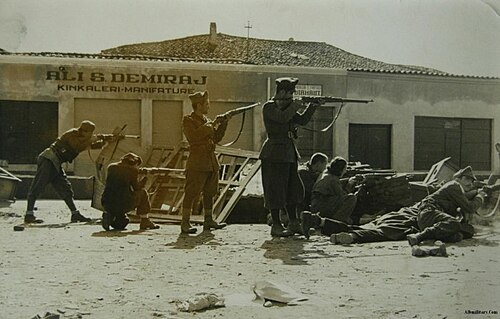
1939年4月のイタリアによるアルバニア侵攻後、10万人のイタリア兵と、アルバニアをイタリア帝国に統合しようとした1万1千人のイタリア人入植者が同国に定住した。当初、アルバニア・ファシスト党は、1941年春に枢軸国がユーゴスラビアとギリシャを征服した後、コソボやその他のアルバニア人が居住する地域がアルバニア本土と統合されたことを主な理由として、国民の支持を得た。ベニート・ムッソリーニは1941年5月、アルバニア・ファシストの一団に対し、ティラナの民族主義者が長年望んでいた大アルバニアを実現したと自慢した。1941年6月22日、ドイツはバルバロッサ作戦を開始し、6月28日にはアルバニアもソ連に宣戦布告した。
1941年10月、小規模なアルバニア共産主義グループが、エンヴェル・ホッジャの指導の下、ティラナで130人の党員からなるアルバニア共産党を設立した。しかし、1942年半ば、党指導部は若者たちにイタリアからの祖国解放のために戦うよう呼びかけ、党の人気を高めた。1942年9月、同党は、強力な反共産主義グループを含む多数の抵抗グループから、アルバニア国民反ファシスト戦線を組織した。彼らは国民解放軍を編成した。
ドイツは1943年9月にアルバニアを占領し、アルバニアのゲリラが首都を制圧する前に空挺部隊をティラナに降下させ、ゲリラを丘陵地帯や南部へと追いやった。その後、ベルリンは中立国アルバニアの独立を承認すると発表し、アルバニア政府、警察、軍隊を組織した。多くのバリ・コンベタル部隊と指導者がこれに協力した。パルチザンは1944年11月29日、アルバニアをドイツの占領から完全に解放した。アルバニアのパルチザンは、コソボとユーゴスラビアの一部解放にも貢献した。

フランス陥落後、アルジェリアは、アフリカにおけるフランスの他の領土とともに、ナチス・ドイツとヴィシー・フランスの支配下に置かれました。次に、イギリス帝国は、フランスの軍艦でいっぱいだったオラン近郊のメルス・エル・ケビール港を攻撃するために、イギリス海軍の艦隊を出撃させました。1942年11月8日、連合国は「トーチ作戦」と名付けられた大規模攻勢を開始しました。その後、イタリア軍はアルジェを爆撃しました。次に、連合国は海軍による上陸作戦でオランとアルジェの都市を占領しようとしましたが、フランス軍と海軍が多数存在していました。そこで、連合国はまずモロッコを占領し、その途中でアルジェリアを占領し、北アフリカの解放を確立しました。
戦争中、多数のイスラム教徒およびヨーロッパ系アルジェリア人がフランス軍に所属した。アルジェリア軍は特に、1943年のイタリア戦線におけるジュアン将軍率いるフランス遠征軍、および1944年の連合軍による南フランス侵攻作戦であるドラグーン作戦において、目覚ましい活躍を見せた。
アンドラは戦争中、政治的には中立を保っていたが、枢軸国のヴィシー・フランス軍と枢軸国側についたスペイン軍の人員による密輸ルートとして利用された。

英エジプト共同統治領スーダンは、 1939年のイギリスの宣戦布告以来、戦争状態にあった。1940年にイタリアが参戦すると、スーダンにも戦闘が及んだ。スーダンはイタリア領東アフリカと長い国境を接していたため、東アフリカ戦線では北部戦線となった。イタリア軍はカッサラの鉄道分岐点や他の町を占領し、北はポートスーダンまで襲撃した。[ 11 ]スーダン防衛軍(SDF)の部隊はインド第1騎兵連隊と合流してガゼル部隊を編成し、1941年1月にイタリア軍をスーダン領土から追い出すのに貢献した。[ 12 ]
別のSDF大隊はギデオン部隊の一員としてエチオピアに侵攻し、他の部隊はエリトリア侵攻に参加した。SDFはリビアとの国境に近いスーダン北部で行われた西部砂漠作戦に参加し、自由フランス軍、そしてそこに駐屯していた長距離砂漠挺身隊に物資を供給した。[ 13 ]

第二次世界大戦中、南極大陸では戦闘はなかったものの、国際的な競争は南極大陸にまで及んだ。開戦前、ナチス・ドイツはノルウェーのクイーン・モード・ランド領有権主張を阻止するため、 1938年に第3次ドイツ南極探検隊を組織した。[ 14 ]この探検隊は、新シュヴァーベンと呼ばれる新たなドイツの領有権主張の根拠となった。[ 15 ] 1年後、米国南極局探検隊が2つの基地を設立したが、2年間運営された後、放棄された。[ 16 ]これらの侵略に対抗し、ヨーロッパの戦時中の混乱に乗じて、近隣のチリとアルゼンチンは独自の領有権を主張した。 1940年、チリは既にイギリスが領有権を主張していた地域にチリ南極領土を宣言した。一方、アルゼンチン( 1904年から既に常駐拠点を有していた)は、1943年に重複する地域にアルゼンチン南極を宣言した。
ドイツ、チリ、アルゼンチン、アメリカ合衆国の活動に対応して、イギリスは1943年にタバリン作戦を開始した。その目的は、恒久的な拠点を確立し、フォークランド諸島属領に対するイギリスの領有権を主張すること[ 17 ]、そして遠隔の島々を集合地点として利用することで知られていたドイツ海軍による同地域の使用を阻止することであった。また、日本がフォークランド諸島を占領しようとする恐れもあった[ 18 ]。ジェームズ・マー中尉[ 19 ]率いる探検隊は1944年1月29日にフォークランド諸島を出発した。基地はデセプション島、グラハムランドの海岸、ホープ湾に設置された。タバリン作戦で始まった調査はその後も継続され、最終的にイギリス南極調査隊となった[ 20 ]。
戦後、南極大陸の領有権を主張する国々、そしてアメリカ合衆国とソビエト連邦の間で競争が続いた。1950年代後半、この競争は国際地球観測年と南極条約という協力的な国際枠組みへと移行していった。
1939年に第二次世界大戦が始まる前、アルゼンチンはヨーロッパの戦争に関して中立の伝統を長く維持しており、これは19世紀以来すべての主要政党によって支持され擁護されてきた。この政策の主な理由の1つは、アルゼンチンがヨーロッパ全般、特にイギリスへの食料品や農産物の世界有数の輸出国としての経済的地位に関係していた。[ 21 ]そのため、当初、アルゼンチン政府は連合国に同情的で[ 22 ] 、イギリスに経済援助を提供していたにもかかわらず[ 23 ]、同国の政治的伝統である中立主義が優勢であった。日本による真珠湾攻撃とそれに続くアメリカの日本への宣戦布告の後、アルゼンチンの参戦を求めるアメリカの圧力が高まり始めた。[ 22 ] 1943年の軍事クーデターの後、クーデター首謀者が枢軸国に同情的であると非難されたため、関係はさらに悪化した。[ 23 ]アルゼンチン軍内部の激しい分裂と対立のため、同国はアメリカの制裁後も中立を維持し続けた。 [ 23 ]しかし、アルゼンチンは最終的に連合国の圧力に屈し、1944年1月26日に枢軸国との関係を断絶し、 [ 23 ] 1945年3月27日に宣戦布告した。[ 23 ] 4,000人以上のアルゼンチン人義勇兵が連合国側で戦った。[ 24 ]戦争末期から数年間続いたラットラインは、ヨーロッパから逃亡するドイツのナチスやその他のファシストのための脱出ルートのシステムであった。アルゼンチンは、フアン・ペロンとその政府の秘密裏の支援と奨励により、これらの脱出ルートの主要な目的地となり、ヒトラー政権と関係のある数千人の避難所となった。[ 25 ]

オーストラリアは、1939年9月3日にドイツとの戦争を宣言した最初の国の1つでした。ロバート・メンジーズ首相は、イギリスの宣言はオーストラリアを法的に拘束すると考え、イギリスの宣言の直接の結果として、オーストラリアとドイツの間に戦争状態が宣言されました。[ 26 ]
オーストラリアの総人口約700万人のうち、100万人以上のオーストラリア人男性が戦争に参加した。戦争への準備は不十分だったものの、オーストラリア政府はすぐに飛行隊と人員を派遣し、イギリス空軍に協力させた。オーストラリア海軍(RAN)は1940年6月にイタリアに対する作戦を開始した。同年後半、オーストラリア陸軍は北アフリカ戦線に参戦し、ギリシャで戦った。ドイツの潜水艦と襲撃艦は戦争中ずっとオーストラリア海域で活動していた。1941年後半に日本との敵対行為が勃発した後、日本軍機は2月にダーウィンを爆撃し、 1942年から1943年にかけてオーストラリアに対する小規模な空襲を行った。
戦争の残りの期間、オーストラリアの戦争努力は東南アジアと南西太平洋地域に集中した。1942年1月からはマラヤ、オランダ領東インド、そしてオーストラリア領ニューギニアに関与した。1942年半ばには民兵部隊がココダ・トラック作戦を戦い、ニューギニア作戦は1945年までオーストラリア軍の大部分の注意を惹きつけた。

現在のパプアニューギニアは、オーストラリアの統治下にあったパプア準州とニューギニア準州の2つの地域から成っていた。第二次世界大戦勃発時、ニューギニア準州では白人駐在員による民兵組織としてニューギニア義勇ライフル隊が編成され、オーストラリア軍の大部分は地中海に展開していた。日本軍は1942年1月にラバウルの戦いを皮切りに侵攻を開始し、その後数ヶ月でニューギニア準州の大部分を占領した。1942年後半から日本の降伏まで、連合軍(主にオーストラリア軍とアメリカ軍)は、まずパプアから、次にニューギニア準州から、そして最後にオランダ領西ニューギニアから日本軍を掃討した。この作戦は日本にとって大きな損失となった。戦闘よりも病気や飢餓で多くの日本兵が命を落とした。連合軍は敵の駐屯地を効果的に包囲し、食料や医療物資の供給を遮断した。[ 27 ]
戦争中、両地域では民政が停止し、全域に戒厳令が敷かれた。パプア人住民から編成されたのは、パプア歩兵大隊というたった一つの大隊のみであった。その他多くの人々は、前線への物資輸送や負傷したオーストラリア兵の搬送のために徴兵された。彼らは「ファジー・ワジー・エンジェルズ」と呼ばれた。戦後、民政が再開され、1949年に両地域はパプアニューギニア準州として統合された。
1940年の駆逐艦基地協定の一環として、アメリカ海軍はグレート・エクスマ島のジョージタウンに基地と滑走路を設置した。[ 28 ]一部のバハマ人はカリブ連隊やその他のイギリス軍部隊に入隊した。
元国王エドワード8世であるウィンザー公は、 1940年8月にバハマ総督に就任した。公爵夫妻は戦前および戦中ファシズムに共感しており、そうした感情に基づいて行動する機会を最小限に抑えるためにバハマに移されたと広く信じられている。[ 29 ]公爵は島々の貧困と闘う努力で称賛されたが、帝国のほとんどの非白人と同様にバハマ人に対しても軽蔑的であった。[ 30 ]また、1942年6月にナッソー で発生した低賃金をめぐる市民の騒乱を解決したことでも称賛された。この騒乱は「本格的な暴動」であったが、公爵 は騒乱の原因を「悪事を働く共産主義者」と「中央ヨーロッパ系ユダヤ人」に押し付けた。[ 31 ] [ 32 ]公爵は1945年3月16日に辞任した。[ 33 ] 1942年4月、イギリスは公爵の保護も目的の一つとして、カナダにナッソーでの軍事支援を要請した。カナダ退役軍人警備隊の1個中隊がバハマに派遣され、続いてピクトウ・ハイランダーズの1個中隊が派遣された。カナダ軍駐屯部隊は1946年にナッソーを離れた。 [ 34 ]
バーレーンの首長は1939年9月10日にドイツに宣戦布告した。1940年10月19日、イタリア軍機4機が連合国に石油を供給する精製所を破壊するためにバーレーンを爆撃した。 [ 35 ]この空襲は精製所に最小限の損害しか与えなかったが、連合国は(イギリスの保護領であった)バーレーン周辺の防衛を強化した。

1936年、ベルギーはヨーロッパで戦争が起きた場合の永世中立を宣言した。[ 36 ]それにもかかわらず、1940年5月、ドイツはフランスに対する大規模な電撃戦の中で奇襲攻撃を開始した。[ 37 ]ベルギー軍はベルギーの戦いで18日間侵攻に抵抗したが、ベルギー軍とその司令官であるレオポルド3世国王は1940年5月28日に降伏した。[ 38 ]少数のベルギー兵はダンケルク経由で脱出したが、国王と軍の大部分は捕虜となった。多くは第二次世界大戦終結まで捕虜として収容された。[ 39 ]
ドイツはベルギーを占領し、軍事政権を樹立した。占領軍は厳しい税金と厳格な配給制を課した。[ 40 ]戦争中、何十万人ものベルギー人がドイツで労働に従事し、そのほとんどはドイツの強制労働計画の一環としてだった。[ 41 ]ホロコーストの間、ベルギーでは約2万5千人のユダヤ人とロマ人が強制移送され、そのほとんどはメヘレン通過収容所を経由した。ほぼ全員がナチスの絶滅収容所で命を落とした。[ 42 ]フランドルとワロンでは多くのナチス協力グループが活動し、[ 43 ]他のベルギー人は国家行政機関[ 44 ]や武装親衛隊のフランドル軍団とワロン軍団を通じて協力した。[ 45 ]反対派として、ベルギー抵抗運動はさまざまな方法で占領と戦った多数のグループで構成されていた。グループGは鉄道に対する破壊工作を成功させ、他のグループはユダヤ人を強制送還から守ったり、撃墜された連合軍パイロットの国外脱出を支援したりした。[ 46 ]
ベルギーの選出政府は占領から逃れ、フランス、そしてロンドンへと移り、そこでユベール・ピエルロ率いるベルギー亡命政府と、ヴィクトル・ヴァン・ストリドンク・デ・ブルケル率いる自由ベルギー軍を樹立した。[ 47 ]ベルギー軍はノルマンディー上陸作戦、イタリア戦線、ワルヘレン島上陸作戦、大西洋の戦いに参加した。[ 48 ] [ 49 ]イギリスとアメリカは占領下のベルギーを戦略爆撃で標的にし、多くの民間人の犠牲者を出した。[ 50 ]ベルギーの解放は、自由ベルギー軍を含む連合軍がベルギーに侵攻した1944年9月に始まった。[ 51 ]ドイツ軍は12月にアルデンヌ攻勢で反撃したが、この攻勢の失敗により、1945年2月までにすべてのドイツ軍がベルギーから撤退した。 [ 52 ]ドイツのV爆弾攻撃は終戦まで続いた。[ 53 ]
戦後のベルギーはNATOとベネルクス関税同盟に加盟したが、レオポルド国王による協力の告発が王室問題と呼ばれる政治危機を引き起こした。[ 54 ]

ベルギー植民地帝国は連合国に忠誠を尽くし、ベルギーの降伏後もベルギー領コンゴとルワンダ・ウルンディはベルギー亡命政府と自由ベルギー軍の支配下に留まった。コンゴは経済的な資産として重要な役割を果たし、連合国に大量の原材料、特に金とウランを供給した。広島と長崎に投下された原子爆弾は、コンゴの鉱山から採掘されたウランで作られた。コンゴ軍は「公安部隊」としても戦い、東アフリカ戦線でイタリア軍と交戦した。東アジア戦線には医療部隊も派遣された。
植民地政府によるコンゴ住民への要求は、ストライキ、暴動、その他の抵抗運動を引き起こした。これらの運動は、植民地当局によってしばしば暴力的に鎮圧された。紛争中のコンゴの比較的豊かな状況は、戦後のベルギーからの移民の波をもたらし、1950年までに白人人口は10万人に達した。また、1950年代を通じて工業化と都市化が進んだ。
ベルギーの委任統治領ルワンダ=ウルンディは、現在のルワンダとブルンジの2つの国から成っていた。そこでは、戦争の年月はルザガユラ飢饉によって特徴づけられた。当初は干ばつが原因であったが、ベルギー当局が連合国を支援するために農産物をコンゴに送ろうとしたため、飢饉の影響は悪化した。飢饉により植民地の人口の5分の1から3分の1が死亡し、さらに数千人が避難を余儀なくされた。[ 55 ]
ブータンはイギリスの宗主権下にあったものの、独立を維持していた。ジグメ・ワンチュク国王の治世下においても、ブータン王国は外部世界からほぼ完全に孤立しており、インドのイギリス領インド帝国との関係は限定的であった。中立政策にもかかわらず、戦争勃発時には、国王は友好の証としてインド政府に10万ルピーの贈り物を送った。[ 56 ]
ボリビアは、戦争後半にドイツに宣戦布告した南米諸国の1つで、1943年4月7日に連合国に加わった。1943年に宣戦布告した3カ国のうちの1つで、他の2カ国はチリとコロンビアだった。宣戦布告後まもなく、ボリビア大統領エンリケ・ペニャランダはクーデターで失脚した。新大統領グアルベルト・ビジャロエルはファシスト的で反ユダヤ主義的な傾向があったが、外国からの圧力により平和を維持し、より過激な親ナチス支持者を抑圧せざるを得なかった。ボリビアの鉱山は連合国に必要な錫を供給したが、海岸線を持たない内陸国であるボリビアは、海外に軍隊や戦闘機を派遣することはなかった。[ 57 ]


ブラジルはゲトゥリオ・ヴァルガス率いる二度目の文民・軍事独裁政権下にあり、1941年に米軍が南大西洋を哨戒するために基地を使用することを許可するまで公式には中立を維持していた。米国は、戦争終結後まもなくブラジルに引き渡されるという了解のもと、ブラジル領内にいくつかの飛行場を建設した。[ 58 ]真珠湾攻撃とナチス・ドイツおよびファシスト・イタリアによる米国への宣戦布告を 受けて、1942年1月にリオデジャネイロで開催された第9回パンアメリカ会議で、ブラジルは他のアメリカ諸国に枢軸国との外交関係を断つよう働きかけた。これに対し、ドイツとイタリアはブラジルに対する潜水艦戦を拡大した。1942年前半、枢軸国の潜水艦がブラジルの商船を沈没させ、ブラジル海軍はこれらの潜水艦を追跡して攻撃した。ドイツの潜水艦U-507によって7隻の商船が沈没した際、ヴァルガスはドイツとイタリアに対する戦争状態を正式に宣言することを決定した。[ 59 ]
ブラジル北東部のナタールには、自国領土外最大のアメリカ空軍基地があり、レシフェにはイングラム提督の指揮下にあるアメリカ第4艦隊司令部があった。ナタールの空軍基地は北アフリカ戦線を支援し、アメリカ陸軍航空隊の飛行機がインドや中国へ飛行するためのルートを提供した。[ 60 ] [ 61 ]
大西洋の戦いにおいて、ブラジル海軍はアメリカ海軍とイギリス海軍を支援し、南大西洋と中央大西洋を哨戒し、枢軸国のUボートや襲撃艦と戦った。1943年、連合国海軍は南大西洋西部で活動していた枢軸国の潜水艦のほとんどを撃沈し、その中にはU-199も含まれていた。この激しい作戦の後、南大西洋はドイツにとって敗北の地となった。[ 62 ] [ 63 ] [ 64 ]
2年間の準備期間を経て、 1944年7月に完全な歩兵師団(約2万5千人の兵士、ブラジル遠征軍(BEF)と呼ばれる)がイタリア戦線に派遣された。彼らはイタリア戦線の最後の2段階、すなわちゴシックラインの緩やかな崩壊と、その戦線における連合軍の最終攻勢で戦った。[ 65 ] [ 66 ]

ボルネオ島は5つの地域に分割された。北部の4つはイギリスの支配下に置かれ、サラワク、ブルネイ、ラブアン島、イギリス領北ボルネオとなった。島の残りの大部分は南部に位置し、オランダ領東インド(現在のインドネシア)の管轄下にあった。
日本の侵攻計画では、イギリス領は日本陸軍が占領し保持し、オランダ南部領は日本海軍が占領し保持することになっていた。[ 67 ] 1941年12月8日、ブルック内閣はミリとセリアの油田とルトンの製油所を速やかに破壊するよう指示した。12月16日未明、2つの日本軍上陸部隊がイギリス軍の抵抗をほとんど受けずにミリとセリアを確保した。数時間後、ルトンが占領された。

ブルガリアは中立を放棄し、 1941年3月1日に三国同盟に署名してドイツの同盟国となった。ブルガリアの主な貢献は、ユーゴスラビアとギリシャに対するドイツ軍部隊の通過権の確保であった。ブルガリアはギリシャとユーゴスラビアの一部を占領し、19世紀の大ブルガリアの国境を再現したが、ソ連侵攻には参加しなかった。
1944年9月9日に共産党主導のブルガリアでクーデターが発生した後、ブルガリア政府はドイツに宣戦布告した。ブルガリア軍はユーゴスラビアのドイツ軍陣地を攻撃した。 1944年10月28日、モスクワで連合国との休戦協定が締結された。ナチスがユーゴスラビア領から撤退した後、ブルガリア軍はハンガリーとオーストリアで攻勢を続けた。ブルガリアの第二次世界大戦への参戦は、1945年5月にオーストリアのクラーゲンフルトでブルガリア軍がイギリス軍と遭遇したことで終結した。

ビルマは1937年にイギリス領インドから分離され、立憲政府を持つ直轄植民地となった。この植民地は、 1938年に完成したビルマ公路を経由して中国に物資を送る上で重要であった。しかし、第二次世界大戦勃発時には防衛が手薄なまま放置されていた。イギリスはビルマを辺境の地であり、攻撃の標的になる可能性は低いと考えていたからである。[ 68 ]日本は1941年12月に小規模な襲撃でビルマの征服を開始し、翌年1月に本格的な侵攻を開始した。日本は4月までに国土の大部分を占領し、シャン州を同盟国タイに割譲した。
多くのビルマ人は、ビルマが独立できるよう、イギリスを追い出すために日本の支援を得ることを望んでいた。[ 69 ] [ 70 ]日本はすでに30人の同志を訓練しており、彼らは今やビルマ独立軍の中核を形成していた。日本は1943年8月1日に植民地をビルマ国として独立を宣言した。バ・モー率いる傀儡政権が樹立された。しかし、多くのビルマ人は、日本が彼らに真の独立を与えるつもりはないと信じ始めた。[ 69 ] [ 70 ]アウン・サンと他の民族主義指導者は1944年8月に反ファシスト組織を結成し、イギリスに他の連合国とともに日本に対抗する連合を結成するよう求めた。
連合軍は1944年後半からビルマへの攻勢を開始した。1945年5月のエレファントポイントの戦いの後、ラングーンを占領した。その後、ビルマとイギリスの間で独立に向けた交渉が始まった。日本占領下では、17万から25万人の民間人が死亡した。[ 69 ] [ 70 ]
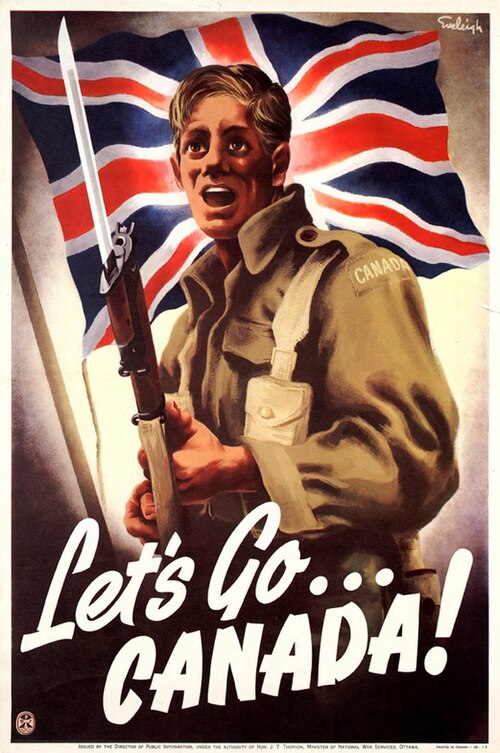
1939年9月10日、カナダも同様にドイツに宣戦布告した[ 71 ]。これは、カナダ史上最大の国家共同作戦への参加の始まりであった。カナダ軍は主にイタリア[ 72 ]、北西ヨーロッパ[ 73 ]、北大西洋で活動した。
戦争中、110万人のカナダ人が陸軍、海軍、空軍に所属した。そのうち4万5千人以上が命を落とし、さらに5万4千人が負傷した。[ 74 ]財政的コストは1939年から1950年の会計年度の間に21,786,077,519.13ドルであった。[ 75 ]戦争の終わりまでに、カナダは世界で4番目に大きな空軍[ 76 ]と3番目に大きな海軍[ 77]を擁していた。また、カナダ商船隊は2万5千回以上の大西洋横断航海を完了した。[78 ]戦争中、多くの連合国パイロットがカナダで訓練を受けた。カナダ人はまた、さまざまな連合国の軍隊にも所属していた。
カナダ軍は1939年にイギリスに派遣された。1個軍団はイタリア戦線で戦い、もう1個軍団は1944年6月6日のノルマンディー上陸作戦(ジュノー・ビーチへの上陸)を皮切りに北西ヨーロッパで戦った。第1カナダ軍は、5個カナダ師団と多数の連合軍部隊を直接指揮下に置き、ドイツ領内で終戦を迎えた。
戦争中、カナダはセントローレンス川の戦いにおいて直接攻撃を受け、ブリティッシュコロンビア州のエステバン岬にある灯台も砲撃された。
戦争は徴兵危機を含め、カナダに文化的、政治的、経済的に大きな影響を与えた。しかし、戦争努力はカナダ経済を強化しただけでなく、カナダを世界舞台における主要なプレーヤーとしてさらに確立させた。[ 79 ]

第二次世界大戦中、米国はカリブ海における英国の防衛責任を引き継いだ。1940年9月、両国はレンドリース協定(駆逐艦基地交換協定とも呼ばれる)に合意した。この協定では、米国が駆逐艦を貸与する代わりに、バハマ、ジャマイカ、アンティグア、セントルシア、トリニダード・トバゴ、英領ギアナ、バミューダ、ニューファンドランドを含む英国領土内の11の海軍基地と空軍基地を99年間無償でリースした。東カリブ海は、 1939年のパナマ宣言で正式に定められた米国の防衛戦略の最前線となった。米国の戦略家たちは西インド諸島を「我々が監視する防壁」と呼んだ。[ 80 ]
米国からヨーロッパとアフリカに送られた物資の50%以上は、メキシコ湾の港から出荷され、カリブ海を経由していた。真珠湾攻撃から1年後、米国カリブ海防衛司令部は総勢11万9000人の人員を擁し、その半数はパナマに駐留し、予想される日本軍の攻撃から運河を守っていた。一方、ドイツ海軍は1942年にカリブ海の船舶に甚大な被害を与えた。同年末までに、カリブ海で活動していたUボートは336隻の船舶を沈没させ、その少なくとも半数は石油タンカーであった。[ 80 ]
カリブ海の一部は、現在枢軸国の占領下にある国々によって植民地化されていた。アルバとキュラソーはオランダ亡命政府に忠誠を保っていたが、ベネズエラの石油を精製する貴重な製油所があったため、イギリスの保護下に置かれた。両島はノイラント作戦でドイツ軍の攻撃を受けた。1942年に両島はアメリカ合衆国に移管された。アメリカ合衆国は1941年にボーキサイト鉱山を確保するためにスリナムにも部隊を駐留させていた。 [ 81 ]マルティニークとグアドループはヴィシー・フランスの支配下に入った。アメリカとイギリスの圧力により、唯一の航空母艦ベアルンを含む数隻のフランス艦船がマルティニークに抑留されたままとなった。[ 82 ]数千人の難民が逃亡し、その多くがドミニカに向かった一方、反ヴィシー抵抗運動が拡大した。[ 81 ]これらの島々はフランス領ギアナとともに1943年に自由フランスに移った。
セイロン島(現在のスリランカ)はイギリスの植民地であり、連合国の主要な海軍基地でした。1942年4月5日、日本の空母から発進した300機以上の航空機が島を爆撃しました。ウィンストン・チャーチルはこの攻撃を第二次世界大戦における「最も危険な瞬間」と呼びました。なぜなら、日本軍は真珠湾攻撃の成功をさらに大きく再現しようとしていたからです。しかし、イギリスの艦船はモルディブ諸島のアッドゥ環礁に移動しました。それでも、イギリスは空母1隻、巡洋艦2隻、駆逐艦2隻を失い、セイロン島に駐留していたイギリス空軍の飛行隊も大きな損害を受けました。
セイロン駐屯砲兵連隊は、日本軍の攻撃からココス諸島のホースバーグ島を守るため、同島に駐屯していた。しかし、 1942年5月8日の夜、同連隊は反乱を起こし、島々を日本軍に引き渡そうとした。反乱は鎮圧され、セイロン兵3名が処刑された。
ココス諸島の反乱後、セイロンの戦闘部隊は前線に配備されなかったが、補給輸送部隊は中東の後方地域で使用された。スリランカはゴムの産地として戦略的に重要であったため、防衛は連合軍の3個師団にまで強化された。日本占領下のマラヤとシンガポールにいたセイロン人は、連合軍と戦うためにインド国民軍のランカ連隊に日本軍によって徴兵されたが、実際に戦闘に参加することはなかった。

チリはヨーロッパで戦争が勃発した際、ドイツとの緊密な貿易関係を背景に中立を宣言した。しかし、戦争が進むにつれて、チリは枢軸国から積極的に距離を置き、政府は親ドイツ派の軍将校を解任する措置を講じた。 1938年9月にナチスが支援したクーデター未遂事件が発生したことで、チリ国民の大多数は国内のドイツ系住民に反感を抱くようになった。ニュージャージー沖でナチス潜水艦がトルテン号を沈没させ、チリで反ドイツデモが発生したことを受け、1943年1月20日に枢軸国との関係が断絶した。 [ 83 ]戦争中、チリ海軍は、恐れていた日本軍の攻撃を阻止するため、イースター島周辺でのプレゼンスを強化した(日本軍はポリネシア全島を支配下に置こうという領土的野心を持っていた)。また、アントファガスタ、コキンボ、バルパライソ、タルカワノの重要な港湾の防衛能力を強化した。チリの商船は、カリブ海の戦いの間、ペルー、コロンビア、キューバの船がパナマ運河地帯周辺を哨戒するのを支援した。1943年から1945年にかけて、チリのピサグア刑務所は、敵国の国民を戦時中に抑留する場所となった。チリは最終的に1945年4月13日に日本に宣戦布告し、南米で最後に宣戦布告した国となった。[ 84 ] 2017年半ばに新たに機密解除された文書により、チリの捜査警察部隊が、チリ北部の銅鉱山を爆破しパナマ運河を爆破しようとするナチスのスパイ網の計画を阻止していたことが明らかになった。[ 85 ]

中華民国は、 1931年の満州事件で日本が満州を併合して以来、断続的に日本と戦ってきた。1937年7月7日の盧溝橋事件により、両国は全面戦争に突入した。この事件と、国民党(KMT、中国国民党)と中国共産党の間の内戦により、中国国民政府の注意は国内に集中した。しかし、蒋介石総統は1942年初頭にビルマでイギリスを支援するために軍隊を派遣することに成功した。150万人以上の 日本軍兵士が中国で泥沼にはまり、死傷者は110万から190万人と推定された 。開戦時、中国軍は260万人の兵士を擁していたが、終戦時には570万人にまで増加した(共産党兵士を除く)。
戦争によって、かつては良好だった中国とドイツの関係は冷え込み(中独協力を参照)、日本軍による真珠湾攻撃の後、中国は正式に連合国側に加わり、1941年12月9日にドイツに宣戦布告した。
戦争中、中国の多くの都市部、工業資源、沿岸地域は日本に占領された。中国は戦争で軍人、民間人ともに甚大な死者を出した。中国国民党軍は約320万人の死傷者を出し、1700万人の民間人が巻き添えで死亡した。戦後、中国は国連安全保障理事会の常任理事国の一つとなった。[ 86 ]
国民党と共産党は日本軍に対抗するために協力したが、戦争が終わると中国内戦が再び勃発した。1949年、国民党政府は共産党に敗れ台湾に撤退し、一方、中国本土には共産主義の中華人民共和国が樹立された。

真珠湾攻撃後、コロンビアは枢軸国との外交関係を断絶した。コロンビアは連合国に石油製品を供給した。1943年、ドイツの潜水艦U-505が コロンビアのスクーナーを破壊したため、コロンビアは1943年11月26日にドイツに対する「交戦状態」を宣言した。[ 87 ]
ドイツ大使は国を離れ、ドイツ国民を指定された地域に抑留するなどの統制措置が実施された。コロンビアとドイツの都市の航空写真を撮影していたコロンビア・ドイツ企業Scadtaが所有していた写真や偵察機も米国に引き渡された。コロンビア海軍はパナマ運河地帯付近の海域の哨戒を支援し、カリブ海海戦に参加した。唯一注目すべき戦闘は1944年に発生した。駆逐艦ARCカルダスがドイツの潜水艦U-154を攻撃したが、U-154は逃走するために自爆を偽装した。[ 88 ]
左派改革派のラファエル・アンヘル・カルデロン・グアルディア大統領はフランクリン・ルーズベルトの同盟者であり、ナチズムに敵対的だった。1940年、カルデロンとルーズベルトが太平洋にあるコスタリカ領のココス島にアメリカ軍基地を建設することで合意したと報じられたが、米国は最終的にガラパゴス諸島に基地を建設することに決めた。コスタリカは1941年12月8日に連合国に加わり、真珠湾攻撃の翌日に日本に宣戦布告し、その後まもなくドイツとイタリアにも宣戦布告した。コスタリカはアメリカで最初に大日本帝国に宣戦布告した国であり、アメリカ国民との連帯を示した。[ 89 ]コスタリカの500人という小規模な軍隊は直接戦闘に貢献することはできなかったが、カルデロン政権は国内の枢軸国出身者に対して財産没収や抑留などの戦時措置を導入した。標的となったのはドイツ人、イタリア人、スペイン人で、スペイン人はファシズムに同情的なフランコ主義者と見なされていた。[ 90 ]

フェデリコ・ラレド・ブルー大統領はヨーロッパで戦争が勃発した際にキューバを率いていたが、実権は陸軍参謀総長のフルヘンシオ・バティスタにあった。 [ 91 ] 1940年、ラレド・ブルーはドイツの客船MSセントルイス号でハバナに到着した900人のユダヤ人難民の入国を拒否した。米国とカナダも同様に難民の受け入れを拒否したため、彼らはヨーロッパに戻り、その多くは最終的にホロコーストで殺害された。[ 92 ]バティスタは1940年の選挙で自らの力で大統領になった。彼は米国が枢軸国との戦争に近づくにつれて協力した。キューバは1941年12月8日に日本に、12月11日にドイツとイタリアに宣戦布告した。[ 93 ]
キューバはカリブ海の戦いにおいて重要な役割を果たし、その海軍は熟練度と効率性で名声を得た。海軍は数百隻の連合国艦船を敵対的な海域で護衛し、数千時間もの時間を船団護衛と哨戒任務に費やし、ドイツのUボート攻撃の犠牲者200人以上を海から救助した。キューバの商船6隻がUボートによって沈没し、約80人の船員が命を落とした。1943年5月15日、キューバの潜水艦駆逐艦隊がカヨ・ブランキサル付近でドイツの潜水艦U-176 を撃沈した。[ 94 ]キューバはレンドリース計画を通じて数百万ドルのアメリカの軍事援助を受け、これには空軍基地、航空機、武器、訓練が含まれていた。[ 93 ]グアンタナモ湾 のアメリカ海軍基地は、アメリカ本土とパナマ運河またはカリブ海の他の地点の間を通過する船団の基地としても機能した。[ 95 ]
キプロス連隊は1940年4月12日に創設され、イギリス陸軍の組織の一部となった。隊員は主にキプロスのギリシャ系およびトルコ系キプロス人住民からの志願兵であったが、他の英連邦諸国出身者も含まれていた。約3万人のキプロス人がこの連隊に所属した。歩兵中隊、機械化中隊、輸送中隊、および荷役輸送中隊で構成されていた。キプロス人のラバ使いは、西部戦線に派遣された最初の植民地軍部隊であった。彼らはフランス、エチオピア、イタリアで、車両がアクセスできない地域に装備を運搬する任務に就いた。この連隊はダンケルク、ギリシャ戦線(ギリシャの戦い)、北アフリカ(コンパス作戦)、フランス、中東、イタリアで活動した。戦後、解散前には、キプロスと中東、1945年から1948年にはパレスチナで活動した。連隊は1950年3月31日に解散した。

チェコスロバキアはミュンヘン協定を皮切りに、1938年の第一次ウィーン裁定によって解体された。その結果、ズデーテン地方はドイツ領となり、トランスオルザ地方はポーランド領となり、チェコスロバキア南部はハンガリー領となった。その後、新たに分離されたスロバキア共和国が樹立された。これはローマ・カトリック司祭ヨゼフ・ティソが率いるナチス依存の傀儡政権であった。一方、カルパティア・ルテニアの残りの地域はハンガリーに占領・併合された。翌日、チェコ領はエミール・ハーハ大統領の下、ボヘミア・モラヴィア保護領となった。
1940年以降、元チェコスロバキア大統領エドヴァルド・ベネシュ率いるロンドン亡命政府は、連合国の一員として承認された。

ドイツの指導者アドルフ・ヒトラーは1939年3月16日、プラハ城から布告を発して保護領を設立した。[ 96 ]この保護領の設立はミュンヘン協定に違反していた。[ 97 ]
保護領は名目上は自治権を保持し、二重統治体制を敷いていた。ドイツ系住民にはドイツ法が適用され、その他の住民は保護領臣民としての法的地位を持ち、チェコの傀儡政権によって統治されていた。第二次世界大戦中、訓練されたチェコの労働力と発展した産業は、ドイツの戦時経済に大きく貢献することを強いられた。保護領はイギリスに拠点を置く連合軍爆撃機の射程圏外にあったため、チェコ経済は終戦までほぼ無傷で機能することができた。保護領の行政はボヘミアとモラヴィアでのホロコーストに深く関与した。[ 98 ] [ 99 ]国家の存在は、 1945年5月のドイツによる連合国への降伏とともに終焉を迎えた。

ヨゼフ・ティソ率いる新生スロバキア共和国は、1939年3月14日に建国を宣言し、ナチス・ドイツと同盟を結び、ポーランドとソビエト連邦との戦争に参加した。1940年11月24日、スロバキアの指導者たちが三国同盟に署名し、スロバキアは枢軸国側に加わった。
地元のユダヤ人住民は激しく迫害された。[ 100 ]スロバキアのホロコーストの一環として、スロバキアのユダヤ人8万人のうち7万5千人が強制移送され、ドイツの絶滅収容所に送られた。[ 101 ] [ 102 ]
1944年8月に始まったスロバキア国民蜂起は10月末にドイツ軍によって鎮圧されたが、パルチザンは終戦まで山岳地帯で戦闘を続けた。1945年4月、赤軍はドイツ軍を破り、ティソ政権を打倒し、チェコスロバキア国家を再建した。[ 87 ]
国際連盟の保護下にあった半自治都市国家ダンツィヒ自由市は、 1936年までにドイツ人が多数を占め、ナチス政権が樹立された。 [ 103 ] 1939年8月30日、ドイツはポーランドに対し、ダンツィヒ市の支配権を要求する最後通牒を突きつけ、ダンツィヒ危機と9月1日のポーランド侵攻を引き起こした。ダンツィヒ市は侵攻中にナチス・ドイツを支援し、その後ドイツに併合されて独立都市としての役割を失った。

デンマークは開戦当初から公式には中立を維持していた。ドイツは1940年4月9日、ヴェーザー演習作戦の一環として宣戦布告なしにデンマークに侵攻し、わずか数時間の戦闘でデンマークを圧倒した。
デンマーク政府は1943年までコペンハーゲンに留まり、反コミンテルン協定に署名した。1943年8月29日、ドイツ側からのさらなる譲歩要求に応じ、政府は辞任・解散した。デンマークはドイツ軍の占領下に置かれ、民政はSS将軍ヴェルナー・ベストが担当した。
1945年5月4日、デンマーク駐留のドイツ軍はイギリス軍に降伏した。しかし、東のボーンホルム島のドイツ軍司令官はソ連への降伏を拒否したため、地元の2つの町が爆撃され、駐屯部隊は降伏を余儀なくされた。ボーンホルム島は1946年までソ連の支配下に置かれた。
1940年5月10日、イギリスはアイスランドとデンマーク領フェロー諸島に侵攻した。アメリカはグリーンランドを占領し、この立場は後にワシントン駐在のデンマーク特使ヘンリック・カウフマンによって支持された。その後、イギリスからアメリカの支配下に移ったアイスランドは、 1944年に独立を宣言した。
ドミニカ共和国は真珠湾攻撃とナチスの米国への宣戦布告を受けてドイツと日本に宣戦布告した。直接的に兵力、航空機、船舶を提供したわけではないが、112人のドミニカ人が米軍に編入され、戦争で戦った。さらに、ドイツの潜水艦がカリブ海でドミニカ人乗組員の船4隻を沈没させた際に、27人のドミニカ人が死亡した。[ 104 ]

オランダ領東インドの豊富な石油資源は、1941年12月7日から始まった日本軍による連合国への攻撃の主要な目標であった。オランダ海軍とオランダ領東インド陸軍は米英蘭連合軍の一部であったが、オランダは1940年にドイツに占領されていたため、植民地を防衛する能力はほとんどなかった。日本海軍と陸軍は3か月足らずでオランダ軍と連合軍を圧倒し、1942年3月に占領を完了した。[ 105 ]一部のオランダ人員と艦船はオーストラリアに脱出し、そこで日本軍と戦い続けた。
日本占領時代はインドネシアの歴史上最も重要な時期の一つであった。当初、多くのインドネシア人はオランダの植民地支配からの解放者として日本人を喜んで迎えた。しかし、インドネシア人が日本の戦争遂行のために苦難に耐えなければならないと悟ると、その感情は変化した。ジャワ島とスマトラ島では、日本軍は多くの若いインドネシア人を教育し、訓練し、武装させ、民族主義指導者に政治的な発言権を与えた。このようにして、日本占領はインドネシアの独立の条件を作り出した。[ 106 ]
1944年から1945年にかけて、連合軍はインドネシアをほぼ迂回した。そのため、1945年8月の降伏時、植民地の大部分は依然として日本の占領下にあった。インドネシア独立宣言は、太平洋における日本の降伏から数日後に読み上げられた。その後、インドネシア国民革命が起こり、1949年に同国は独立を勝ち取った。後の国連の報告書によると、インドネシアでは日本の占領の結果、400万人が死亡した。[ 107 ] 1944年から1945年にかけて、ジャワ島では飢饉により約240万人が死亡した。[ 108 ]
エクアドルは、戦争末期に連合国側に加わった南米諸国の1つであり(1945年2月2日にドイツに対して連合国側に加わった)、米国がバルトラ島を海軍基地として使用することを許可した。[ 109 ]

イギリスは1922年にエジプトの独立を一方的に承認したが、その後も軍事的にエジプトを占領し、支配し続けた。1936年の英エジプト条約により、イギリスの占領はスエズ運河地帯に限定されたが、戦時にはイギリス軍がエジプト全土を再占領することを認めた。
スエズ運河と地理的に中心的な位置にあることから、エジプトは戦略的に極めて重要な国であった。エジプト政府はイギリス軍に物資を供給していたが、一部の政府は、イギリスが西部砂漠戦線で敗北した場合にエジプトが枢軸国側に加わる可能性について、ドイツと秘密裏に交渉を行っていた。多くのエジプトの政治家や軍将校は、占領下のイギリス軍を国外に撤退させるために枢軸国の支援を求めた。
イギリス軍がイタリア軍の最初の侵攻を撃退した後、ドイツはイタリア領リビアを救うために北アフリカ戦線に参戦した。ドイツ軍の一連の勝利により、枢軸軍はカイロから160キロメートル(99マイル)の地点まで迫り、エジプトの民族主義者たちの間で大きな期待が高まった。しかし、エル・アラメインでのイギリス軍の勝利は、エジプトにおける枢軸軍の進撃の終焉、そして最終的には北アフリカにおける枢軸軍の敗北を告げるものとなった。エジプトは西部砂漠戦線で枢軸軍と戦うためにほぼ全軍を投入していたにもかかわらず、ファルーク国王は1945年までドイツへの宣戦布告を求めるイギリスの圧力に抵抗し続けた。

1931年から1944年まで、エルサルバドルはヒトラーとムッソリーニを崇拝する軍事独裁者マキシミリアーノ・エルナンデス・マルティネスによって統治された。個人的な崇拝にもかかわらず、エルサルバドルとアメリカ合衆国との経済的な結びつきが強かったため、エルナンデス・マルティネスは真珠湾攻撃直後に日本(1941年12月8日)とドイツ(1941年12月12日)の両方に宣戦布告した。彼は政府からドイツ人を排除し、日本人、ドイツ人、イタリア人を抑留した。第二次世界大戦によりエルサルバドル国民は独裁政権にうんざりし、1944年の全国ストライキによりエルナンデス・マルティネスは辞任してグアテマラに逃亡した。戦後、彼はホンジュラスで復讐心に燃えるエルサルバドル国民によって殺害された。[ 110 ]
ホセ・カステリャノス・コントレラスはエルサルバドルの陸軍大佐であり外交官で、第二次世界大戦中にジュネーブのエルサルバドル総領事として勤務していた際、ジョルジュ・マンドルという名のユダヤ系ハンガリー人実業家と共に、偽のエルサルバドル国籍証書を提供することで、最大4万人のユダヤ人と中央ヨーロッパ人をナチスの迫害から救った。[ 111 ]
ホセ・グスタボ・ゲレーロは、ヒトラーによるヨーロッパ侵攻の際にナチスに立ち向かったエルサルバドルの裁判官である。この著名なエルサルバドルの法曹家は、外交官として、またオランダのハーグに本部を置く常設国際司法裁判所の裁判長として、長年にわたりヨーロッパに居住した。
1937年、ヨーロッパでナチズムが台頭する中、ゲレーロ博士は議長に就任したが、1940年にナチスによって追放された。オランダ陥落直後の1940年5月17日、ナチスはハーグにある国際法廷の平和宮殿を占拠しようとしたが、そこで彼らは、オランダ将校の一団と共に残っていた唯一の判事、エルサルバドル出身のゲレーロと遭遇した。ドイツ軍の将軍が近づいてきたとき、議長は「法廷とその職員は不可侵だ。私の身に頼らなければ宮殿に入ることはできない」と告げた。このことや、普遍法を守るための数々の勇気ある行動により、ゲレーロはノーベル平和賞に2度ノミネートされた。
ジュネーブに拠点を構えたゲレーロは、スイス駐在エルサルバドル総領事のホセ・カステリャノス・コントレラス大佐の訪問を受けた。コントレラス大佐はドイツから逃れてきた人物で、エルサルバドルがヒトラー政権との国交を断絶するまでドイツで領事を務めていた。
カステリャノスはすでにナチスに迫害されたユダヤ系の人々に数件のビザを発給していた。しかし、今回はより大きな計画の一環だった。それは、ユダヤ系の人々にエルサルバドル国籍の偽造書類を渡すというものだった。カステリャノスはゲレーロに相談し、ゲレーロはすぐにこの計画に同意し、数千人のユダヤ人の命を救った。調査によると、ゲレーロは彼らの命を救うために渡された書類の文面作成に協力したとされる。
1939年8月にナチス・ドイツとソ連の間で締結されたモロトフ=リッベントロップ協定により、エストニアはソ連の勢力圏に留まった。ソ連は、エストニアが「相互援助協定」に同意しなければ戦争を仕掛けると脅迫した。この協定では、ソ連軍が10年間、エストニア国内の複数の軍事基地を使用することを認めるものだった。ソ連との戦争は必ず敗北すると確信していたエストニア政府は、1939年9月28日に協定に同意した。ソ連は1940年6月に赤軍によるエストニアの完全占領を開始し、クーデターを起こした。そして、ソ連の支配下で偽りの選挙が行われた。新政府が発足し、 1940年7月21日にエストニア・ソビエト社会主義共和国が宣言された。この傀儡国家は8月6日に正式にソ連に加盟した。併合の合法性はほとんどの西側諸国に認められず、バルト三国は1991年に独立を回復するまで形式的には独立国として存続した。[ 87 ]
エストニアは、ドイツとソ連の間で戦争が勃発した後の1941年にドイツに占領されました。ソ連軍の帰還に伴い、7万人のエストニア人がドイツ側に加わるか、ドイツ側に徴兵されてソ連と戦いました。国民委員会は、ソ連の再占領のため、1944年9月に国民政府を再建することができませんでした。戦争の終結後、ソ連当局に対する森林兄弟の武装蜂起が始まり、これはバルト三国で1950年代半ばまで続きました。エストニアは1991年まで事実上ソ連の一部でした。 [ 87 ]
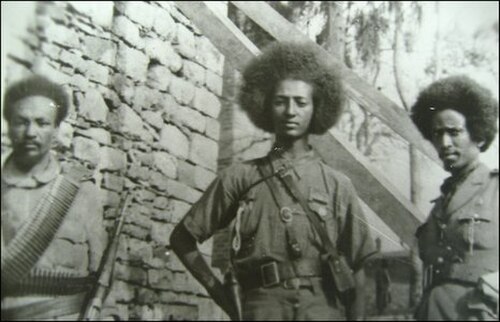
戦争勃発時、エチオピアはイタリアの占領下にあり、エチオピア皇帝ハイレ・セラシエはイギリスに亡命し、自国の独立運動への連合国の支援を得ようと奔走していたが、徒労に終わっていた。アルベグノック運動は、1936年5月にアディスアベバが陥落したその日に、占領下のイタリア軍に対するゲリラ戦を開始した。皇帝が亡命すると、解散したエチオピア帝国軍の残党はゲリラ部隊へと変貌した。全国各地の都市住民は、愛国者を支援するために地下組織を結成し、国民全体がムッソリーニの地域経済政策を阻止するための非暴力抵抗運動を展開した。占領期間中から第二次世界大戦勃発まで、イタリア軍部隊や通信・補給線への絶え間ない嫌がらせは、イタリア軍の戦闘能力と士気を低下させた。ローマからますます孤立していくにつれ、イタリア軍兵士と市民の間にはパラノイアの蔓延が広がっていった。ファシストによる愛国者攻撃への報復は残忍で、しばしば民間人を標的としたが、それがかえって愛国者の兵力を増やすことになり、最終的にムッソリーニのイタリア領東アフリカの崩壊につながる悪循環を生み出した。[ 112 ]
イギリスのイタリアに対する宣戦布告は愛国者運動を再び活気づけ、エチオピアとアフリカの角におけるイタリア軍の最終的な追放への道を開いた。連合国によるエチオピア解放作戦は1940年の冬に始まった。ハイレ・セラシエ皇帝はイギリスの支援と協力を得てスーダンに移送され、オード・ウィンゲート少佐と共に、イギリスの宣戦布告の知らせを受けてファシスト支配下のエチオピアから逃れてきたエチオピア愛国者軍の主力師団を組織し、指揮した。東アフリカ作戦は主に多国籍アフリカ軍によって遂行され、エチオピア、エリトリア、イギリス、スーダン、ケニア、ローデシア、南アフリカ、インド、ナイジェリア、ガーナ、自由フランス軍で構成されていた。数ヶ月のうちにエチオピアの解放が達成され、皇帝が首都から逃亡してからちょうど5年後の1941年5月5日、ハイレ・セラシエは王位に復帰した。エチオピアにおけるファシストの敗北は、第二次世界大戦における連合国の最初の勝利となり、残りの部隊を迅速にエジプトに移動させて、カイロへの枢軸国の進軍に対抗することを可能にした。[ 112 ]
フィジーは第二次世界大戦中、イギリスの植民地でした。フィジー防衛軍は、連合国太平洋方面軍の指揮下でニュージーランド軍部隊と共に活動しました。フィジー歩兵連隊は、ソロモン諸島で日本軍と戦いました。フィジーは、アメリカとオーストラリア間の船団輸送にとって重要な軍港となりました。ここは、激戦地のソロモン諸島を迂回する最も近くて比較的安全なルートであり、すぐ北にあるソロモン諸島へ輸送される兵員や物資の中継地点であり、ガダルカナル島周辺で損傷した船舶が利用できる最も近い保護された港でした。フィジーはまた、連合軍の爆撃のための飛行場、兵舎、訓練場など、多くの施設を建設しました。[ 113 ]

フィンランドはモロトフ=リッベントロップ協定でソ連の勢力圏に置かれ、ソ連が自国領内に基地を建設することを拒否したため、冬戦争(1939年11月30日 ~1940年3月13日)でソ連軍の攻撃を受けた。戦後、フィンランドはソ連の圧力に対抗するためイギリスとスウェーデンに保護を求めたが失敗し、その後ナチス・ドイツとの関係改善に転じた。これにより両国間の協力が生まれ、バルバロッサ作戦開始から3日後にソ連によるフィンランドへの先制空爆が行われ、継続戦争(1941年6月25日 ~1944年9月4日)が始まった。フィンランドはこの戦争でドイツと共同交戦国となった。イギリスは1941年12月6日にフィンランドに宣戦布告した。[ 114 ]カナダとニュージーランドは12月7日にフィンランドに宣戦布告し、オーストラリアと南アフリカは翌日に宣戦布告した。
D-Dayと連携したヴィボルグ・ペトロザヴォーツク攻勢を阻止するために必要な軍事支援を確保するため、 1944年6月26日にリッティ・リッベントロップ協定が締結され、フィンランドとナチス・ドイツの関係は同盟に最も近いものとなった。ソ連の攻勢が膠着状態に陥り、ドイツ国防軍がバルト三国から撤退した後、休戦協定が締結された。この条約はフィンランドにすべてのドイツ軍を追放することを義務付けており、これがラップランド戦争(1944年9月15日~1945年4月25日)につながった。これは1945年5月7日~8日(ヨーロッパ戦勝記念日)にヨーロッパ全土でナチス軍が完全に降伏する直前のことであった。イギリスとソ連との完全な平和は1947年のパリ講和条約で締結された。

フランスはポーランドの安全保障の当初の保証国の一つであり、そのためドイツに宣戦布告した最初の国の一つでもあった。数ヶ月間、まやかし戦争(または「おかしな戦争」)ではほとんど戦闘は起こらなかった。1940年5月10日、ドイツはフランスへの攻撃を開始した。6週間の激しい戦闘の後、フランス政府は1940年6月22日の休戦協定に署名した。[ 115 ]
休戦後、フランスは占領地域と非占領地域の2つに分割された。占領下のフランスでは、オットー・フォン・シュテュルプナーゲルとその従兄弟で後継者のカール・ハインリヒが軍政を敷いた。市民はドイツで実施された強制労働プログラムである義務労働(Service du travail obligatoire )の対象となった。ユダヤ人とロマはフランスでホロコーストによる迫害に直面した。活発なレジスタンスは戦争中ずっと占領軍と戦った。南フランスはヴィシーのフィリップ・ペタンによる傀儡政権によって統治され、そのためヴィシー・フランスと呼ばれた。これに反対して、シャルル・ド・ゴールはロンドンに亡命政府を置き、フランスの非占領海外領土と連合国側で戦った軍隊を統制する自由フランスを率いた。
フランス解放は、1944年の連合軍の侵攻、北部のノルマンディーにおけるオーバーロード作戦と南部のドラグーン作戦から始まった。連合軍は8月にパリを解放した。ド・ゴールはフランス共和国の暫定政府を樹立し、国全体が連合軍の手に渡った。 1944年から1945年にかけてのライン川への進軍中、フランスではさらに戦闘が続いた。戦後、フランスはNATOの創設メンバーとなり[ 116 ]、国連安全保障理事会の常任理事国となった[ 117 ]。
ヴィシー政権は紛争中、公式には中立を保っていたが、ドイツと協力関係にあった。ピエール・ラヴァル首相はフランスを枢軸国側に近づけようと繰り返し試みたが、ペタンによって拒否された。ヴィシー軍は、特にフランス領アフリカにおいて、イギリス軍と自由フランス軍から幾度となく攻撃を受けた。ヴィシー北アフリカがトーチ作戦後に停戦を宣言し、1940年の休戦協定の条項に違反した結果、ドイツ軍は1942年秋にフランス本土全域を占領したが、ヴィシー政府の活動継続を認めた。フランソワ・ダルラン率いるヴィシー北アフリカ政府と軍は連合国側に加わった。ダルランが暗殺された後、ド・ゴールがアンリ・ジローと共に権力を掌握した。ラヴァルは戦後、国家反逆罪で処刑された。ペタンは死刑判決を受けたが、刑は減刑された。
シャルル・ド・ゴールが率いるロンドンを拠点とする亡命グループ、フランス国民解放委員会(CFLN)の自由フランス軍(FFF)は、連合国に対するフランスの義務を維持し、ドイツに占領されたフランス領土を解放するために1940年に結成された。フランス抵抗運動とともに、彼らは地中海戦線と西ヨーロッパの解放、そして1944年のフランス解放に貢献した。1943年までに、自由フランスは広大な領土を支配していたが、軍需産業がなく、アメリカの援助に依存していた。自由フランスは、これに加わったヴィシー政権と国内抵抗運動と再編成し、フランスと戦った。CFLNは1944年8月と9月にフランスを掌握した。
1944年、フランス自由軍(FFF)の兵士数は約56万人、1945年には130万人を超えた。アイゼンハワー元帥によれば、レジスタンス(国内勢力)は15個師団に匹敵する役割を果たした。フランス解放において、FFFとレジスタンスは大きな役割を担った。

1940年8月、フェリックス・エブエ率いる自由フランス軍に植民地連邦が合流した。ただし、ガボンは1940年11月12日にガボンの戦いでヴィシー政権が自由フランス軍に降伏するまでヴィシー・フランス領であった。その後、連邦はアフリカにおける自由フランス軍の活動の戦略的中心地となり、ブラザヴィル市は1940年から1943年まで自由フランスの首都として機能した。[ 118 ] 1944年、ブラザヴィルではフランス抵抗軍とフランスのアフリカ植民地の代表者による会合が開かれた。その結果として採択されたブラザヴィル宣言は、フランスとアフリカ植民地の関係を再定義しようとする試みであった。[ 119 ]
フランス領ソマリランドは、首都がジブチにあり、第二次世界大戦の東アフリカ戦線で小競り合いや封鎖が行われた場所である。1940年6月10日にイタリアがフランスに宣戦布告した後、ソマリランドではフランスが陥落し、 6月25日に仏伊休戦協定が結ばれるまで両軍の戦闘が続いた。現地の行政評議会は7月19日にヴィシー政府を支持した。[ 120 ]イタリアはロヤダのフランス軍要塞を占領し、 8月にイギリス領ソマリランド侵攻の拠点として使用した。 [ 121 ]イギリスは海上封鎖を行い、9月にジブチを爆撃した。これに対し、ヴィシーの新総督ピエール・ヌアイエタスは、ヨーロッパ人と地元住民の両方に対して残忍な恐怖政治を行った。[ 120 ] 彼は1942年に召還され、退役を余儀なくされた。封鎖が厳しくなるにつれ、多くのフランス軍が離反し、イギリス領ソマリランドに逃亡した。これが最終的に、1942年12月26日に総督が自由フランス軍に降伏するきっかけとなり、アフリカでヴィシー政権に忠誠を誓い続けた最後のフランス領となった。[ 122 ]領土解放後、フランス領ソマリランドでは総督が急速に交代し、1940年から42年の困窮からの復興は戦争が終わってからようやく始まった。
フランス領西アフリカでは大規模な戦闘は発生しなかった。大規模な戦闘はダカールの戦い(1940年9月23日~25日)のみであった。この地域はフランス陥落(1940年6月25日)後も、連合軍による北アフリカ侵攻(1942年11月8日~16日)までヴィシー・フランスの支配下にあった。休戦後も自由フランスに加わらなかったフランス領赤道アフリカ唯一の植民地であるフランス領ガボンは、ガボンの戦い(1940年11月8日~12日)の後、近隣植民地からの自由フランス軍の侵攻により陥落し、西アフリカはさらに孤立した。フランス本土とは異なり、西アフリカのフランス植民地軍は1940年の休戦後も削減されず、枢軸国による干渉もほとんどなかったため、解放後の自由フランス軍にとって貴重な戦力となった。

ガンビア植民地および保護領はイギリスによって統治されていた。1939年、その軍隊であるガンビア中隊はガンビア連隊に拡大され、1941年からは2個大隊の兵力となった。同連隊はビルマ戦役で戦った。植民地はまた補助警察を組織し、その警察はとりわけバサーストでの灯火管制の実施を支援した。ガンビア自体には、飛行艇基地であるRAFバサーストと、同国初の空港となった空軍基地であるRAFユンダムがあった。 [ 123 ]陸上基地であるHMSメランパスは戦争中、バサーストに拠点を置いており、1942年には軽巡洋艦HMSガンビア が進水し、1960年に退役するまで植民地との関係を維持した。[ 124 ]ガンビアには、戦時中、イギリスの総合病院が次々と設置された。[ 125 ] 1943年、フランクリン・D・ルーズベルトはカサブランカ会議への往復の途中でバサーストに一泊した。これは現職の米国大統領によるアフリカ大陸への最初の訪問となった。 [ 126 ]戦後、植民地では経済と政治の改革に注目が集まり、輸出のほぼ100%を占めていた落花生への依存度を減らすなどの取り組みが行われた。[ 127 ]

アドルフ・ヒトラー率いるナチス・ドイツは、ヨーロッパ戦線における主要な枢軸国であった。ドイツ軍は1939年9月にポーランド侵攻を開始し、戦争を勃発させた。ポーランドはソ連と分割された。その後、偽りの戦争が始まり、1940年春にはドイツ軍はデンマーク、ノルウェー、フランス、ベルギー、ルクセンブルク、オランダを侵略し、征服した。1940年夏にはイギリスを空から制圧しようとする試みが失敗し、計画されていた侵攻は中止された。1941年夏、ドイツはソ連侵攻により戦力を東へ向けた。東部戦線はドイツ軍の主要な戦場となった。ソ連侵攻は、苦戦するイタリア軍を支援することを目的としたギリシャとユーゴスラビアでの作戦によって遅れていた。同様に、アフリカ軍団も苦戦するイタリア軍を支援するために西部砂漠に派遣され、ドイツ軍は軍集団にまで拡大した。 1943年2月のスターリングラードにおける大敗と、その直後の北アフリカにおける枢軸軍の壊滅は、一般的に戦争の転換点と考えられている。ドイツ軍はシチリア島で戦い、イタリアが寝返ると、ドイツ軍はシチリア島を掌握し、撤退を成功させ、連合軍を北西ヨーロッパから引き離した。1943年夏のクルスクの戦いと1944年のソ連の夏季攻勢における甚大な損害はドイツ軍の戦闘力を壊滅させ、連合軍のノルマンディーと南フランスへの上陸はドイツ軍に複数の戦線での同時戦闘を強いた。1945年5月4日から8日にかけてのドイツ軍の降伏は、ヨーロッパにおける戦争の終結を告げるものとなった。
ドイツ軍は主に潜水艦部隊を通じて海上での活動が非常に活発であった。ドイツ空軍は、1944年半ばに連合軍が制空権を確立するまで、効果的な戦術的および兵站的支援を提供した。しかし、航空戦力の戦略的活用は失敗に終わり、イギリスに対する激しい空爆(そして後にV-1およびV-2ロケット)にもかかわらず、永続的な成果を上げることはできなかった。
ヒトラーの戦争目的にはヨーロッパのユダヤ人の絶滅が含まれており、 1942年初頭のヴァンゼー会議で、ホロコーストにつながる絶滅計画が最終決定された。
オーストリアは1938年、国民の歓声の中、アンシュルスによってナチス・ドイツに完全に併合された。第二次世界大戦中、約120万人のオーストリア人がドイツ軍の全軍種に所属した。枢軸国の敗北後、連合国は第二次世界大戦終結時に設定された4つの占領区域でオーストリアを占領し、1955年に中立を維持することを条件に再び完全な独立共和国となった。4つの占領区域はフランス、アメリカ、イギリス、ソ連であり、ウィーンも4つの勢力によって分割された。これは戦後のドイツの状況と類似していた。
イギリスの海外領土であるジブラルタルは、 300年以上にわたりイギリスの要塞であり防壁であった。第二次世界大戦の初期から、ジブラルタルは地中海の要衝となり、北アフリカ侵攻作戦であるトーチ作戦はジブラルタルから指揮された。ジブラルタルが占領された場合に敵の動きを監視できるよう、ジブラルタルの岩の中にある秘密の地下壕に6人の兵士を潜伏させるという極秘作戦であるトレーサー作戦も、ジブラルタルを経由して行われた。[ 128 ]
ゴールドコースト植民地の植民地軍は、東アフリカ戦線、特にイタリア支配下のエチオピアへの攻撃において重要な役割を果たした。首都アクラは、連合軍の航空機が米国、ヨーロッパ、太平洋の間を飛行する際の拠点となった。ゴールドコーストは戦争によって経済的にも恩恵を受けた。1945年までに、英国政府の支出増加と所得税の導入により、地方歳入が拡大した。戦争は植民地の人口構成を変え、労働者を少数の大都市に集中させた。植民地政府は、安価で丈夫な地元の建築資材を使用して住宅不足に対処するプログラムを開始した(1939年の地震により、多くの町のインフラが深刻な被害を受けていた)。[ 129 ]

ギリシャは当初、 1940年10月28日のイタリア軍の侵攻に抵抗し、ムッソリーニ軍をアルバニアへと押し戻した。ヒトラーはしぶしぶながらも同盟国を救済し、ギリシャを制圧するために軍隊を派遣した(マリタ作戦)。その結果、1941年4月にギリシャの戦いが勃発し、ソ連侵攻は遅れた。また、クレタ島上空でのドイツ降下猟兵の甚大な損害は、ドイツ軍の大規模な空挺作戦を事実上阻止することになった。
政府と国王はエジプトに逃亡し、そこから抵抗を続けた。占領軍は一連の傀儡政権を樹立したが、国民の忠誠心はほとんど得られなかった。1942年以降、活発な抵抗運動が展開され、主に共産主義主導の国民解放戦線(EAM)と非共産主義のギリシャ国民共和同盟(EDES)が主導した。
1943年を通して、ゲリラはギリシャの山岳地帯の大部分を解放し、「自由ギリシャ」と呼ばれる自由地帯を樹立した。1943年9月のイタリア降伏後、ドイツ軍はイタリア占領地域を占領したが、イタリア軍はドイツ軍と、イタリア占領地域を占領しようとする連合軍(ドデカネス諸島作戦)の両方に抵抗しようとしたため、しばしば流血を伴う戦闘となった。解放が近づくにつれ、抵抗運動は政治的な路線で分裂し、内乱が勃発した。1944年5月のレバノン会議で国民統一政府を樹立する合意が成立し、緊張はいくらか緩和された。
1944年夏、赤軍が東ヨーロッパを進軍するにつれ、ドイツ軍は1944年10月から11月にかけてギリシャ本土から撤退したが、多くの島嶼部の守備隊は取り残され、1945年5月8日の無条件降伏後に降伏した。イギリス軍の支援を受けた亡命政府は、間もなくアテネで東アフリカ軍と衝突し、ギリシャ内戦が始まった。この紛争は1949年まで続き、ギリシャ社会に分裂をもたらす遺産を残すことになる。
グアテマラは当初第二次世界大戦には参戦せず、ホルヘ・ウビコ大統領は1941年9月4日に中立を宣言した。この宣言は5日後に改めて確認された。ウビコ大統領は、中央アメリカでドイツ系移民人口が最も多いグアテマラにおいて、ナチスのプロパガンダを厳しく禁止した。その後、グアテマラは連合国側に加わり、1941年12月9日に日本に宣戦布告し、3日後にはドイツとイタリアにも宣戦布告した。ウビコ大統領は米国がグアテマラに空軍基地を建設することを許可した。[ 130 ]
グアテマラでは戦争中に不安が高まり、 1944年6月にグアテマラ革命が勃発した。ウビコはゼネストを受けて6月に辞任し、後任となった独裁者は10月に民主的な民衆革命によって倒された。哲学者フアン・ホセ・アレバロは同年12月に行われた大統領選挙で勝利し、戦争終結までグアテマラを率いた。
ハイチは真珠湾攻撃まで第二次世界大戦で中立を保っていた。そのため、1941年後半、ハイチは日本(12月8日)、ドイツ(12月12日)、イタリア(12月12日)、ブルガリア(12月24日)、ハンガリー(12月24日)、ルーマニア(12月24日)に宣戦布告した。[ 131 ]これら6つの枢軸国のうち、ルーマニアだけが同日(1941年12月24日)にハイチに宣戦布告し、応じた。[ 132 ] ハイチは連合軍に食糧を供給し、アメリカ沿岸警備隊の分遣隊を受け入れたが、兵力は提供しなかった。しかし、ハイチ空軍のハイチ人5人がアメリカ陸軍(タスキーギ航空隊)に編入され、戦争で戦った。[ 133 ] [ 134 ]ハイチ大統領エリー・レスコは、戦争中にいくつかの不人気な緊急措置を導入したが、批評家たちはそれが彼の権力を増大させるために考案されたものだと主張した。レスコットは戦争終結の翌年に失脚した。
ホンジュラスは当初戦争で中立だったが、真珠湾攻撃後に連合国側に加わった。1941年12月8日に日本に宣戦布告し、4日後にはドイツとイタリアにも宣戦布告した。ホンジュラスは連合国の戦争遂行に食料と原材料を提供し、兵士も派遣したが、そのうち150人が戦死した。このため、ホンジュラスは1942年からNA-16型機を使用した一連の航空哨戒を開始した。ドイツの潜水艦は戦争中にホンジュラスの船3隻を沈没させ、1隻は日本海軍に拿捕された。ホンジュラスの航空兵はホンジュラス領土の哨戒に加えて、他のラテンアメリカ諸国と共同でメキシコ湾付近を飛行し、米国に向かう船がさらに沈没するのを防いだ[ 135 ]。ホンジュラスはバナナの大生産国であったため、連合国軍に数千本のバナナを送った。

香港は1世紀にわたりイギリスの植民地であった。 1941年のクリスマスに終結した香港の戦いの激戦の後、日本は香港を占領した。日本軍は太平洋戦線から帰還した負傷兵を治療するため、多くの医療施設を野戦病院に転用した。 [ 136 ]厳しい食糧配給も実施され、配給量を低く抑えるため、多くの市民が中国本土に強制送還された。終戦までに香港の人口は150万人からわずか60万人にまで減少した。[ 137 ]アメリカ海軍は3年間香港への空襲を行い、オーストラリア海軍は近隣に機雷を敷設したが、香港は1945年の日本の降伏後まで日本の支配下にあった。8月30日、 HMSスウィフトシュアを先頭とする巡洋艦隊が香港に到着し、イギリスのために香港を奪還した。日本は9月16日に正式に降伏した。[ 138 ]

ハンガリーはドイツの重要な同盟国であった。1940年11月20日に三国同盟に署名し、翌年のソ連侵攻にも参加した。1944年、摂政ミクローシュ・ホルティ政権が連合国との停戦協定締結を望んだ際、ナチスによって政権は打倒され、ハンガリーの矢十字党による政権が樹立された。この政権は1945年にソ連軍に占領されるまでハンガリーを支配した。
戦争勃発時、アイスランドはデンマーク国王を国家元首とする同君連合下の自由国であった。1940年のドイツによるデンマーク侵攻後、アイスランドは国王との連絡を完全に断たれた。イギリス軍は1940年5月10日、自軍の基地確保とドイツに同様の選択肢を与えないためにアイスランドに侵攻した。少数の武装部隊が駐留していたが、イギリス軍に抵抗しないよう命令に従った。イギリス軍はドイツ領事ヴェルナー・ゲルラッハを含む多数のドイツ国民を逮捕し、ラジオと電話のサービスを掌握した。
アイスランド政府は占領に正式に抗議したが、事実上はイギリスに協力した。占領の最盛期には、アイスランドには2万5000人のイギリス兵が駐留していたが、レイキャビクの人口は約4万人だった。1941年7月7日、アイスランドの統治権はイギリスからアメリカに移管された。アメリカはまだ戦争状態ではなかったが、アイスランドをドイツに奪われないようにする必要があった。
アイスランドは占領中に経済ブームを経験しました。多くのアイスランド人が外国人のために仕事に就いたためで、一部の人々は、ブレタヴィナン(大体イギリス人の仕事)が戦後のアイスランド経済の成功の一因となったと言っています。1944年6月17日、アメリカの奨励により、アイスランドは恒久的に独立した共和国となり、デンマークとの関係をすべて断ちました。占領下にあったにもかかわらず、アイスランドは第二次世界大戦中、公式には中立を維持しました。ケプラヴィークなどのアイスランドの空軍基地は、大西洋の戦いでドイツのUボートと戦う連合国にとって重要でした。
人口の少ないアイスランドには、軍隊を編成できる立場にはありませんでした。アメリカとアイスランドの緊密な協力関係により、アイスランドは中立を放棄し、 1949年に北大西洋条約機構(NATO)の創設メンバーとなりました。アイスランドは軍隊を持っていませんが(タラ戦争を参照)、同盟国のために基地を提供しました。ケプラヴィークにはアメリカ空軍基地と海軍航空基地があります。

インド帝国は、現在のインド、パキスタン、バングラデシュの領土で構成されていました。ビルマは1937年に独立した植民地となりましたが、非公式にはペルシャ湾駐在官領も含まれていました。イギリス帝国の一部として、インドはイギリスの宣戦布告の対象となりました。250万人のインド兵がイギリスの指揮下でインド陸軍、インド空軍、インド海軍と共に戦い、志願兵によって編成された最大の軍隊を形成しました。約8万7000人のインド軍兵士が戦闘で死亡し[ 139 ]、さらに6万4000人が負傷しました[ 140 ] 。多くのインド軍兵士が勇敢さに対して勲章を授与され、1940年代には30のヴィクトリア十字勲章が授与されました[ 141 ] 。
数百万のインド人の労働が連合国の戦争努力に貢献した。劣悪な労働条件や1944年のボンベイ爆発のような事故で多くの命が失われた。[ 141 ]戦略的に、インドは中国・ビルマ・インド戦域における中国支援のためのアメリカ軍の作戦の拠点となった。物資はレド・ロード沿いの陸路とハンプ越えの空路でインドから中国へ運ばれた。インド東海岸の都市は日本軍の空襲の脅威にさらされた。[ 141 ] 例えばカルカッタとチッタゴン[ 142 ]は何度も爆撃された。 [ 143 ] 1944年、日本軍は東インドに侵攻したが、病気、栄養失調、疲労により壊滅的な損失を被った。[ 144 ]
人口6030万人のうち、推定210万~300万人が飢餓、マラリア、栄養失調、人口移動、不衛生な環境、医療不足によって悪化したその他の病気で死亡した。歴史家はしばしばこの飢饉を「人為的なもの」と特徴づけ、戦時中の植民地政策が危機を生み出し、その後悪化させたと主張している。[ 145 ]
ムスリム連盟をはじめとするインド社会の多くの層が戦争を支持したが、インド国民の支持は決して一致していなかった。 1942年のクリップス使節団は、戦争遂行と将来の自治領としての地位についてインド国民会議の支持を得ることに失敗した。それどころか、モハンダス・ガンディー率いる国民会議は、インド独立運動(クイット・インディア運動)で独立を要求した。これに対し、ガンディーと国民会議の指導者の大半は逮捕された。一方、スバス・チャンドラ・ボースは、第二次世界大戦をイギリスと戦う機会として利用しようとする民族主義運動を率いていた。ボースの運動は、アザド・ヒンドと呼ばれる亡命政府と、枢軸国側で戦った軍事部隊、すなわち東南アジアのインド国民軍とヨーロッパのインド軍団を生み出した。
1942年3月23日、日本軍はアンダマン・ニコバル諸島に侵攻した。1943年12月、日本が支援する自由インド運動(アザド・ヒンド)が結成された。アンダマン諸島はシャヒード諸島、ニコバル諸島はスワラージ諸島と改名された。この間、アンダマン・ニコバル諸島の住民は日本軍と共に戦った。これらの島々は1945年10月6日までイギリス軍によって再占領されなかった。

フランスの戦いとフランス第三共和政の崩壊後、インドシナ(現在のベトナム、ラオス、カンボジア)の植民地統治はヴィシー・フランスに移管された。1940年9月、日本軍はインドシナの一部に侵攻し、1941年7月には全域を占領した。タイはこの機会を利用して以前失った領土を取り戻し、 1940年10月から1941年5月にかけて仏タイ戦争が勃発した。日本はインドシナを利用してマラヤ侵攻を開始し、これと真珠湾やその他のイギリス領およびアメリカ領への攻撃が太平洋戦争の引き金となり、第二次世界大戦がインドシナにまで及んだ。[ 146 ]
日本占領中、インドシナの共産主義者はカオバン省に拠点を築いたが、共産主義グループと非共産主義グループの両方を含む、日本とヴィシー・フランスに対する抵抗運動の大部分は、国境を越えた中華民国に拠点を置いていた。中国は1941年にホー・チ・ミンを釈放し、彼は西側諜報機関の支援を受けてベトミンを復活させ、日本占領軍と戦った。[ 147 ]
1944年のパリ解放によりヴィシー政権は終焉を迎えた。新たに樹立されたフランス共和国臨時政府は連合国側に加わり、インドシナにおけるその統治は太平洋における連合国の作戦に秘密裏に支援を与え始めた。[ 148 ]そのため、1945年3月9日、日本はクーデターを起こし、フランス政権を打倒した。ベトナム、カンボジア、ラオスは、名目上は日本の大東亜共栄圏の独立国、すなわちベトナム帝国、カンボジア王国、ラオス王国となった。実際には、日本政府の降伏の知らせが8月に届くまで、日本はインドシナを支配していた。インドシナの全般的な混乱といくつかの自然災害が重なり、1945年のベトナム飢饉を引き起こした。ベトミンは8月革命を起こし、戦争終結時に独立宣言を発布した。フランスは1945年から1946年にかけて同国を再び支配下に置いたが、同年12月に始まった第一次インドシナ戦争によってフランス支配は終焉を迎えることになった。
1945年4月、日本軍はビエンチャンを占領した。シーサヴァンヴォン国王は王位を維持することを許されたが、息子のサヴァンヴァッタナー皇太子はすべてのラオス国民に占領軍への抵抗を呼びかけた。ペツァラート王子はこの立場に反対し、日本軍に味方することでラオスの独立が達成できると考え、ラオス全体の首相ではなく、ルアンパバーンの首相に任命された。実際には国は混乱状態にあり、ペツァラート政府には実権がなかった。ラオスの別のグループであるラオ・イサラ(自由ラオス)は、イサーン地方の自由タイ運動から非公式の支援を受けた。タイは1941年の仏タイ戦争終結後、ラオスのごく一部を再併合した。これらの領土は1946年10月にようやくフランスの主権下に戻された。

戦争の初期、連合国はイランに対し、ドイツ国民がナチスのスパイである可能性や、イギリス所有の石油施設に危害を加える可能性があるとして、彼らを国外退去させるよう要求したが、レザー・シャーはナチスとは何の関係もないとしてこれを拒否した。
連合国は、ドイツが中立国イランから石油を調達するのではないかと懸念していた。やがて連合国はイランの中立性に疑問を抱き、レザー・シャーにドイツ人労働者を撤退させるよう最終警告を発した。しかし彼は再び拒否した。1941年8月、イギリス軍とソ連軍はイランに侵攻し(「カウンテナンス作戦」)、同年9月、レザー・シャー・パフラヴィーに退位を強要した。後を継いだのは息子のモハンマド・レザー・シャー・パフラヴィーで、彼は連合国側で参戦する意思があった。イランは「勝利の橋」として知られるようになった。
イランは、バンダルアッバス港と特別に建設された鉄道ルートを経由して、ソ連への「外洋」補給路を提供した。これらの補給路は総称してペルシャ回廊と呼ばれた。ソ連の政治工作員、いわゆる「プロパガンダ工作員」はイランに潜入し、 1942年初頭にコミンテルン傘下のトゥーデ党の設立を支援した。
1943年9月、イランはドイツに宣戦布告し、これにより国際連合(UN)への加盟資格を得た。
ソ連はイラン国内のアゼルバイジャン人とクルド人の間で反乱を扇動し、 1945年12月にアゼルバイジャン人民共和国を、その後まもなくクルド人民共和国を樹立した。両共和国はソ連の支配下にある指導者によって運営された。アメリカ、イギリス、ソ連の軍隊の駐留を規定した戦時条約が1946年1月に失効した後も、ソ連軍はイランに駐留し続けた。

イラクはインドへの航路上の要衝であり、戦略的な石油供給源でもあったため、イギリスにとって重要な国だった。第一次世界大戦終結以来、イラクはハバニヤにある大規模なイギリス空軍基地と、イギリスに友好的な政権を維持することで、これらの資源を守り続けてきた。しかし、開戦当初のイギリスの弱体化により、イラクは英イラク同盟から離脱した。イギリス軍最高司令部がイラクへの増援を要請した際、当時の首相ヌーリ・アル=サイードは少数のイギリス軍部隊の上陸を許可した。その結果、1941年4月にラシード・アリー率いる枢軸国寄りのクーデターが起こり、ヌーリ・アル=サイードは辞任を余儀なくされた。その後、イギリスがイラクへの増援を要請したが、新政権はこれを拒否した。
新政権は秘密裏に枢軸国との交渉を開始した。ドイツとイタリアは迅速に対応し、ルフトヴァッフェ機でシリア経由でバグダッドに軍事援助を送った。その結果、インド軍は1941年4月下旬に侵攻し、5月にはバグダッドとRAFハバニヤに到達した。イラク軍はハバニヤを攻撃したが、すぐに降伏し、ラシード・アリーは国外に逃亡した。英国は1942年にイラクに枢軸国への宣戦布告を促した。英国軍は重要な石油供給を守るために残った。イラクは外交関係を断絶した後、1943年に枢軸国に宣戦布告した。ドイツは当初、ラシード・アリーを正当な政府として認めていたため、宣戦布告を受け入れることを拒否した。[ 149 ]イラク軍は連合国の兵站ルート、特にバスラ、バグダッド、キルクークから到着していたソ連への軍事援助の保護に役割を果たした。イラクにおけるイギリスとインドの作戦は、近隣のシリアとペルシャにおける出来事と関連付けて考察されるべきである。

アイルランドは戦争中ずっと中立を保った。アイルランド国民は自由に海外で働き、外国の軍隊に入隊することができた。戦争終結までに、アイルランド生まれの男女7万人がイギリス軍に所属していたと推定されているが[ 150 ] 、この推定値は長年にわたって大幅に増加している[151]。アイルランド人のパディ・フィヌケーンは、イギリス空軍史上最年少の航空団司令官であり戦闘機のエースであり[ 152 ]、 22歳になる前にバトル・オブ・ブリテンとフランス上空での攻撃作戦で最高レベルの撃墜率を達成した[ 153 ]。
第二次世界大戦中のダブリン爆撃と、ドイツ空軍による偶発的とみられる爆撃でカーロウ県が民間人の犠牲となった。[ 154 ]これらの爆撃は、意図的な攻撃、航法ミス、またはドイツ空軍に対するイギリスの電子妨害の結果であるとされている。ずっと後になって、ドイツ空軍がダブリンのノース・ストランド地区を爆撃したのは、アイルランドの中立違反に対する報復として行われた「ローマン・ヘルメット作戦」の一環であることが判明した。この作戦には、エイモン・デ・ヴァレラがベルファスト空襲での消火活動を支援するために消防車を国境を越えて送った決定も含まれていた。[ 155 ]
1940年6月、イギリスのバーナード・モントゴメリー少将は、アイルランド侵攻の計画を立て、コークとコーブを占領するよう命じられた。 [ 156 ]ウィンストン・チャーチルもまた、かつての3つの条約港を占領するための侵攻計画を立てた。[ 157 ] Dデイ上陸作戦の実施決定は、アイルランドのメイヨー州ブラックソッド灯台からの大西洋の気象報告に基づいて行われた。[ 158 ]

ファシスト政権下のイタリアは、第二次世界大戦参戦前にエチオピアとアルバニアを征服していた。ナチス・ドイツの初期の作戦が成功を収めた後、イタリアはフランスの敗北によって連合国領土の一部を獲得しようと計画し、1940年6月に参戦した。
イタリア軍は委任統治領パレスチナを爆撃し、エジプトに侵攻し、イギリス領ソマリランドを占領し、当初は成功を収めた。スペインには友好的なファシスト政権が樹立さ れ、ユーゴスラビア侵攻後にはクロアチアに傀儡政権が樹立された。アルバニア、リュブリャナ、沿岸ダルマチア、モンテネグロはイタリア国家に直接併合された。ギリシャの大部分は(当初の敗北にもかかわらず)イタリアに占領され、ヴィシー・フランスの崩壊とアントン事件の後、フランス領のコルシカ島とチュニジアも同様に占領された。しかし、アフリカと東部戦線での独伊の敗北後、連合国は1943年夏にイタリアへの侵攻を開始し、ムッソリーニ政権は崩壊した。
ピエトロ・バドリオ元帥率いる新王政は連合国と休戦協定を結んだが、国土の大部分はすぐにドイツ軍に占領され、北部にはムッソリーニを首班とする傀儡政権、イタリア社会共和国(本拠地サロにちなんでサロ共和国とも呼ばれる)が樹立された。バドリオ元帥とヴィットーリオ・エマヌエーレ3世国王は軍に何の命令も下さずにブリンディジへ逃れたため、軍は混乱状態に陥り、指揮官を失った。一部の師団はドイツ軍に降伏し、他の師団は独自に抵抗を続けた。
王室政府は南部を支配し続け、ドイツに宣戦布告した。王室政府が依然として支配していた軍隊は連合国側に加わり、共同交戦国となった。最終的に、1945年春の戦争終結直前、パルチザン蜂起によって北イタリアが解放された際に、王室政府はイタリア全土の政府として再建された。イタリアは戦後NATOに加盟したが、イストリア地方とダルマチア地方のザダル市をユーゴスラビアに奪われ、ソマリアを除くすべての植民地を失った。[ 87 ]

ベニート・ムッソリーニは1936年に、最近征服したエチオピアを、より古い植民地であったエリトリアとソマリランドと合併させてイタリア領東アフリカを形成した。[ 160 ] 1940年6月10日、ムッソリーニはイギリスとフランスに宣戦布告し、東アフリカのイタリア軍は隣接するイギリスとフランスの植民地にとって脅威となった。イタリア参謀本部は1942年以降の戦争を計画していたが、1940年の夏にはイタリアは長期戦やアフリカの広大な地域の占領の準備ができていなかった。[ 161 ]
東アフリカ戦線は、1940年6月13日にイタリア軍がケニアのワジールにあるイギリス空軍基地を空襲したことから始まった。反撃を行うため、連合国はエチオピア人、エリトリア人、イギリスのアフリカ植民地やインド出身の兵士、自由ベルギーのために戦っていたコンゴ公安軍の兵士など、アフリカ出身の兵士で構成された部隊を編成した。この戦線は、1940年から1941年初頭にかけて、イタリア軍がケニアとスーダンからソマリランド、エリトリア、エチオピアへと押し戻されるまで続いた。植民地に残っていたイタリア軍の大部分は1941年11月のゴンダールの戦いの後降伏したが、小規模な部隊は1943年9月のカッシビレ休戦協定までエチオピアでゲリラ戦を続けた。 [ 162 ]東アフリカ戦線は、この戦争における連合国の最初の戦略的勝利となった。
戦役後、勝利した連合国はイタリア領東アフリカを解体した。英エチオピア協定により、ハイレ・セラシエがエチオピアの王位に復帰した(エチオピアの項を参照)。ソマリランドとエリトリアはイギリス軍政下に置かれた。1945年、ポツダム会談において、国連はソマリアが10年以内に独立を達成することを条件に、イタリア領ソマリランドの信託統治をイタリアに厳重な監視下で委ねた。[ 163 ] 1950年、エリトリアはエチオピアに割譲された。イギリス領ソマリランドとイタリア領ソマリランドはともに1960年に独立し、その後まもなくソマリ共和国として統合された。[ 164 ]

大日本帝国は太平洋戦域における枢軸国のリーダーであった。一部の学者は、1937年の盧溝橋事件後に日本が中国に侵攻したことから始まった日中戦争の勃発を第二次世界大戦の真の始まりとみなしている。[ 165 ]この紛争は、1941年12月の日本の真珠湾攻撃の後、世界大戦と合流した。真珠湾攻撃の直後、アメリカが占領していたフィリピン、グアム、ウェーク島、イギリスの植民地であるマラヤ、シンガポール、香港、タイ王国に対する一連の協調攻撃が行われた。[ 166 ] 1942年、日本は中国、東南アジア、太平洋戦域で攻勢を開始した。 1942年末までに、連合国がそれまでの日本の戦果を覆したため、日本は守勢に立たされた。アメリカによる広島と長崎への原爆投下は、日本政府に1945年9月2日に無条件降伏を決意させた。[ 167 ]日本の多くの政治指導者や軍指導者が、東京裁判やアジアの他の連合国裁判で戦争犯罪で有罪判決を受けた。[ 168 ]

戦争中、ケニアはアフリカにおけるイギリス陸軍の最も重要な徴兵地の1つでした。戦争中、98,240人のケニア人がキングス・アフリカン・ライフルズ(KAR)のアスカリとして入隊し、これは部隊の総兵力の30%に相当します。[ 169 ]ケニア出身の兵士のほとんどは徴兵された者で、[ 170 ]圧倒的にアフリカ人であり、イギリス陸軍の人種隔離政策により、彼らは白人の将校や下士官によって指揮されていました。黒人は准尉以上の階級に昇進することはできませんでした。ケニア兵は、西アフリカの部隊とともに、イタリアに対する東アフリカ戦線での勝利、ヴィシー政権下のマダガスカル侵攻、日本に対するビルマ戦線で従軍しました。個々のケニア人はイギリス海軍やイギリス空軍にも従軍しました。
東アフリカ戦線の南部戦線の一部として、ケニア北部で戦闘が発生した。1940年7月、イタリア軍はエチオピアとの国境から南へ約100kmのブナ まで進軍した。1941年初頭までに、イタリア軍は国境まで撤退した。1941年1月と2月、イギリス軍は国境を越えてエチオピア南部への攻勢を開始した。[ 171 ]

朝鮮は、日本の50年にわたる帝国主義的拡大(1910年8月22日から1945年8月15日まで)の一環として、日本の統治下にあった。第二次世界大戦中、10万人以上の朝鮮人が強制的に大日本帝国陸軍に徴兵された。[ 172 ] [ 173 ]
植民地時代の独立運動には、三・一運動が含まれる。韓国人は独立に向けて正式な政府を樹立した。 1919年に大韓民国臨時政府が設立され、1940年9月17日に朝鮮解放軍(KLA)を創設、1941年12月10日に大日本帝国に宣戦布告した。
朝鮮人民軍は、1945年8月18日に首都圏(ソウルと仁川)を最初に攻撃して朝鮮半島を解放する計画であるイーグル作戦を開始したが、失敗した。米国の戦略情報局も、作戦中に戦闘機、潜水艦、空挺部隊で朝鮮人民軍を支援することを約束していた。しかし、1945年8月15日の日本の早期降伏により、この計画は失敗に終わった。臨時政府は、第二次世界大戦後、朝鮮における米国の軍政に対しても激しい抵抗に直面した。大韓民国政府は1948年8月15日に樹立され、臨時政府は正式に解散した。
形式的には、日本の統治は1945年の第二次世界大戦における日本の敗戦に伴い、同年9月2日に終了した。戦後の朝鮮半島はソ連軍とアメリカ軍によって共同占領され、政治的な意見の相違から朝鮮半島は二つの独立国家に分裂した。これが最終的に朝鮮戦争へと発展した。

1939年9月1日に戦争が始まると、ラトビアは中立を宣言した。[ 174 ]モロトフ・リッベントロップ協定の締結後、ラトビアは1939年にソ連の最後通牒により自国領土に赤軍の駐屯を受け入れることを余儀なくされた。[ 175 ] 1940年6月16日、ソ連は政府の交代と無制限のソ連軍の受け入れを要求する最後通牒を出した。[ 176 ]政府は要求に応じ、ソ連軍は6月17日に同国を占領した。 1940年8月5日、ラトビアはソ連に併合された。翌年、ソ連の治安機関はラトビアを「ソ連化」し、その結果、ラトビアの住民3万5千人から5万人が死亡した。[注2 ]併合の合法性は西側諸国のほとんどに認められず、バルト三国は1991年まで形式的には独立国として存続した。
独ソ間の敵対行為が勃発すると、ソ連軍はドイツ軍によってたちまち駆逐された。当初、ドイツ軍はほぼ普遍的に解放者として称賛されたが、ナチスの占領政策によって徐々に状況は変化していった。1944年10月13日、リガはソ連軍によって奪還され、ドイツ北方軍集団(Heersgruppe Nord)の大部分は、ラトビア北西部を形成するクルゼメ半島で孤立した。そこで、彼らと現地で編成されたラトビア人部隊は「クルラント要塞」を形成し、1945年5月の終戦まで持ちこたえた。
ラトビア初の警察大隊は1943年初頭に編成され、ラトビア武装親衛隊義勇軍は1943年3月16日に編成された。ドイツ占領政府はすぐに徴兵制に頼り、ラトビアは武装親衛隊兵士が徴兵された2カ国のうちの1つとなった(もう1つはエストニア)。1944年7月1日までに、11万人以上の男性がドイツ支配下の部隊で武装していた。ラトビア義勇軍は87,550人で構成され、そのうち31,446人が第15および第19武装擲弾兵師団に、12,118人が国境警備連隊に、42,386人が様々な警察部隊に、1,600人がその他の部隊に所属していた。 22,744人の男性が、国防軍補助部隊や空軍補助部隊など、軍団以外の部隊で勤務した。[ 177 ]
約7万人のラトビア人(ラトビアとロシア・ソビエト連邦社会主義共和国の両方)が、主に徴兵によって赤軍の民族部隊(ラトビア狙撃兵ソ連師団)に徴兵された。また、ソ連占領開始後も本国に戻らなかったラトビアの小型船団は、ラトビア国旗を掲げたまま連合国商船隊の一部となった。[ 178 ]
ラトビア人の中には、ホロコースト中にソ連とナチスの占領政府の両方で活動し、積極的に関与した者もいた。[ 179 ]ラトビア中央評議会など、さまざまな運動が西側連合国と関係のある独立した民主的なラトビアを再建しようと試みたが、これらの努力はナチスとソ連の政権によって阻止された。戦争終結後、ソ連当局に対する森林兄弟の武装蜂起がバルト三国で1950年代半ばまで続いた。
当時フランスの統治下にあったレバノンは、フランス第三共和政の崩壊後、ヴィシー政権によって支配された。レバノン国民の大多数はヴィシー政権とその統治方法を容認せず、多くのレバノン国民はフランス兵がナチス・ドイツの同盟国になったことを嘲笑し、批判した。レバノンはシリア・レバノン戦役中にパレスチナからの連合軍によって侵略され占領された。ド・ゴールは1943年11月22日にレバノンの独立を宣言した。1945年、レバノンはドイツと日本に宣戦布告した。[ 87 ]
リベリアは戦争初期に連合軍に領土への立ち入りを許可した。北アフリカへ向かう部隊や物資、特にブラジルのパルナミリン(ナタール近郊)から空輸される軍需物資の中継地点として利用された。さらに重要なことに、東南アジアのゴム農園が日本軍に占領されていた戦争中、リベリアは連合軍にとって数少ないゴムの供給源の一つとなった。
この資源の重要性により、リベリアの輸送インフラが大幅に改善され、経済の近代化が進んだ。カサブランカ会談に出席したフランクリン・ルーズベルトがリベリアを訪問し、エドウィン・バークレー大統領と会談したことで、リベリアの戦略的重要性が強調された。連合国への支援にもかかわらず、リベリアは公式の中立を破棄することに消極的で、1944年1月27日までドイツに宣戦布告しなかった。[ 87 ]

イタリア領リビアの沿岸部は、1939年1月9日の法律によりイタリアの不可分の一部となり、リビアは「イタリアの第4の海岸」( Quarta Sponda)と呼ばれるようになった。[ 180 ]リビア人は、リビア国内でのみ有効な「特別イタリア市民権」を与えられた。 [ 181 ]リビア人は、国民ファシスト党の支部であるリクトル・ムスリム協会への加入を許可された。これにより、イタリア軍内にリビア軍部隊、第1シビッレと第2ペスカトーリが創設された。[ 182 ]これらの部隊は、イタリア人将校とリビア人の下士官および兵士で構成されていた。リビア師団はイタリアに忠実で、戦闘で優れた働きをした。[ 183 ] リビアのスパヒの騎兵隊は軽騎兵として働いた。これらの措置により、リビア抵抗運動の魅力は低下し、その活動は主にフェザーン地方に限定された。そして、自由フランス軍がこの地域に到着するまでは、その活動は依然として弱体であった。1930年代後半から、リビアのユダヤ人はリビアにおけるホロコースト迫害に直面した。[ 184 ]
リビアでは、北アフリカ戦線で最も激しい戦闘が繰り広げられた。開戦当初、イタリアはリビアの国境を南に拡大し、イタリア領東アフリカと繋がる陸橋を併合することを目指していた。[ 185 ] 1940年9月、イタリアはエジプト侵攻により西部砂漠戦線を開始した。同年12月、イギリスはコンパス作戦で反撃し、イタリア軍を国境を越えて押し戻し、キレナイカ全域を占領し、第10軍の大部分を捕虜にした。ドイツの支援を受けて、この地域はゾンネンブルーメ作戦で奪還されたが、連合軍はトブルクの包囲を解くことに成功した。 1942年のガザラの戦いで、連合軍はついにトブルクからエジプトへと追いやられた。エジプトでの第二次エル・アラメインの戦いは、リビアの枢軸軍にとって破滅を意味し、西部砂漠戦線の終結を告げるものとなった。
1943年2月、撤退するドイツ軍とイタリア軍はリビアを放棄し、チュニジアに撤退し、イタリアの支配は永久に終わった。自由フランス軍は1943年にフェザーンを占領した。第二次世界大戦終結後、イギリスとフランスは連合国によるリビア統治において現地の抵抗勢力と協力した。1951年、連合国は独立リビアの国王となったイドリスに権力を譲った。 [ 186 ]
第一次世界大戦終結後、リヒテンシュタインはスイスと関税および通貨協定を締結し、大国である隣国に外交関係を委ねた。1938年3月のオーストリア併合後、フランツ王子は三従兄弟のフランツ・ヨーゼフ2世に譲位した。フランツの妻エリザベート・フォン・グートマンはユダヤ人であり、彼女の出自がナチス・ドイツを刺激する可能性があると懸念されていた。[ 187 ]ドイツによるチェコスロバキア占領により、リヒテンシュタイン家が所有していた広大な土地が没収され、フランツ・ヨーゼフ王子はリヒテンシュタイン本土に移住せざるを得なくなり、公国に居住した最初の王子となった。[ 188 ]
戦争が勃発すると、フランツ・ヨーゼフは公国を戦争から遠ざけ、スイスとの緊密な関係を頼りに保護を求めた。[ 189 ]国自体の永世中立は侵害されなかったが、リヒテンシュタイン家は、かつての居城であるレドニツェ=ヴァルティツェを含め、公国外の領地を取り戻すことはなかった。[ 188 ]国は占領下のヨーロッパから約400人のユダヤ人難民を受け入れ、主に支払い能力のある裕福な人々など、他の人々にも市民権を与えた。[ 189 ]シュトラスホーフの強制収容所のユダヤ人労働者は、公爵家の所有する農園で働くために雇われた。[ 189 ] 1945年、リヒテンシュタインは親枢軸派のロシア第1国民軍の約500人のロシア人に亡命を認めた。ソ連の送還要求を拒否し、彼らのほとんどは最終的にアルゼンチンに再定住した。[ 190 ]
国家社会主義の「リヒテンシュタインのドイツ民族運動」は活発ではあったが小規模だった。ドイツとの統一とリヒテンシュタインのユダヤ人の追放を主張した。[ 191 ] 1939年3月、同党はクーデターを試みたが、指導者たちが逃亡または逮捕され、完全に失敗に終わった。[ 191 ] 1940年に組織は再結成されたが、権力を得ることはなかった。その機関誌『ウンブルッフ』は1943年に発禁処分となり、戦後、指導者は国家反逆罪で有罪判決を受けた。[ 191 ]

ナチス・ドイツとソ連の間で締結されたモロトフ=リッベントロップ協定の結果、リトアニアは赤軍に占領され、ラトビア、エストニアとともにソ連に強制的に併合された。軍事的抵抗は一切なかった。 この併合の合法性はほとんどの西側諸国に認められず、バルト三国は1991年まで形式的には独立国家として存続した。
ヒトラーが最終的にリトアニアの独立回復を期待してソ連に侵攻した後、一部のリトアニア人はドイツ側についた。協力者の中にはホロコーストやその他の人道に対する罪に関与した者もいた。赤軍にはリトアニア人師団(第16狙撃師団)やその他の部隊(第29狙撃軍団)が編成された。ラトビアとは異なり、ドイツ当局による「リトアニア軍団」の編成は失敗に終わり、最も有名な部隊はリトアニア領土防衛軍であった。
戦争終結後、ソ連当局に対する「森の兄弟」による武装蜂起が始まり、それはバルト三国で1950年代半ばまで続いた。

When Germany invaded France by way of the Low Countries in the spring of 1940, it also invaded Luxembourg, despite its neutrality. The country was occupied quickly: the government made an attempt to slow the advancing German forces, but local forces put up little resistance and surrendered before the end of the first day.[192] During the German occupation, the administration was led by Gustav Simon, who pursued a policy of Germanisation and carried out the Holocaust in Luxembourg.[193] In August 1942, Germany fully annexed Luxembourg and attached it to Gau Moselland.[194]
The exiled Luxembourgish government meanwhile fled to France and then Portugal before establishing itself in London for the remainder of the war, while Grand Duchess Charlotte settled in Montreal.[195] The exiled government committed its very limited resources to the Allied war effort, signing the Declaration of St James's Palace and Declaration by United Nations. It also formed the agreement that created the Benelux customs union with the exiled governments of Belgium and the Netherlands.[196]
Some Luxembourgers collaborated with Nazi Germany or were drafted into the German armed forces. A total of 12,000 Luxembourgers served in the German military, of whom nearly 3,000 died during the war.[197] Others joined the Luxembourg Resistance. The general strike of 1942 was an act of passive resistance that mobilized a large portion of the population and led to the execution of 21 leaders.[197] American forces liberated the capital in September 1944, but the country continued to see combat. Luxembourg Resistance fought German forces in the Battle of Vianden in November, and the Battle of the Bulge was fought in the country between December and January.[198]

French Madagascar played an important role in the war due to the presence of critically important harbors and the contribution of Malagasy troops. After the fall of France in 1940, Madagascar became a crucial flashpoint in the conflict between the Free French movement and Vichy France. The island was consequential in the Pacific theater of the war as Imperial Japanese naval forces operated unopposed off the island for some time. Madagascar was also briefly considered as the solution to the Jewish Question by the government of Nazi Germany who floated the idea of deporting Europe's Jewish population to the island in 1940. This scheme, the Madagascar Plan, never came to fruition for a variety of reasons.
In May 1942, the British and several other Allied forces launched an invasion of Madagascar, seeking to protect its position as a link in Allied shipping and deny its use to the Axis. The northern naval base at Diego Suarez quickly surrendered. That September, newly arrived troops from East Africa, South Africa, and Northern Rhodesia launched an offensive to capture the rest of the island. British forces took the capital Tananarive in late September; on 8 November, the last Vichy forces surrendered. The British handed the island over to Free France in 1943, under whose control it remained for the rest of the war.
Malaya was under British rule before the war began. It was occupied by Japan from 1942 to 1945. The Malayan Communist Party became the backbone of the Malayan Peoples' Anti-Japanese Army. The British Forces in Malaya fled to Singapore, where they would eventually be defeated. After the war, the British Military Administration of Malaya took over the country.
The 4 Malay states of Kedah, Perlis, Kelantan and Terengganu were annexed by Thailand, which was under a Fascist Regime and aligned to the Axis Powers. These territories were gifted by Japan, as they had occupied Malaya almost 2 years prior. All 4 states were given back to Malaya after the Japanese Surrender.
During World War II, the Maldives were a British protected state ruled by a succession of sultans. The islands were only lightly affected by the war. Britain built RAF Gan on Addu Atoll at the southern end of the country, which was later redeveloped as Gan International Airport.[199] The Action of 27 February 1941 occurred near the Maldives. The Italian auxiliary cruiser Ramb I had escaped the destruction of the Red Sea Flotilla and sailed for Japanese-controlled territory. HMNZS Leander engaged and sank Ramb I; most of the crew were rescued and taken to Gan.[200] The RAF forces created "Port T". The Maldive Islands, the British Indian Ocean Territory, Ceylon and other naval bases and areas in the Indian Ocean were victims to the Easter Sunday Raids of 1941.
The Maldives were also a victim to massive resource shortages, notably economy and food-wise. Most food was imported into the country by boat during the war, and the nation relied on local fishing in the islands. This was commonly known as the great famine in the Maldives.[201]
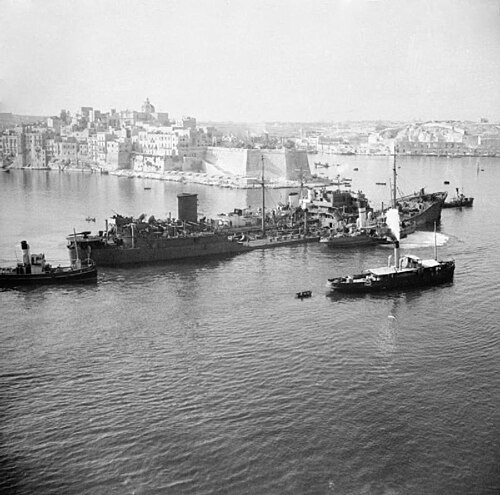
Malta was a British colony during World War II. The Legislative Council of Malta reaffirmed the people's loyalty to Britain on 6 September 1939. Between June 1940 and December 1942, Malta became the besieged and battered arena for one of the most decisive struggles of World War II. Malta was the most bombed place in the war and was crucial to Allied efforts to thwart Axis maneuvers in Africa. Britain awarded the George Cross to the island of Malta in a letter dated 15 April 1942, from King George VI to Governor William Dobbie: "To honour her brave people, I award the George Cross to the Island Fortress of Malta to bear witness to a heroism and devotion that will long be famous in history".[202]
The fortitude of the population under sustained air raids and a naval blockade, which almost saw them starved into submission, won widespread admiration, with some historians dubbing it "the Mediterranean Stalingrad". The George Cross is woven into the modern Flag of Malta.[203]
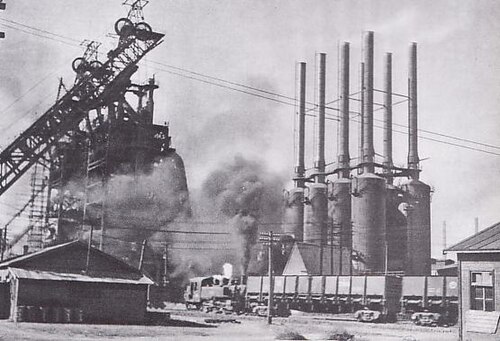
Established in 1931 as a puppet state of Japan, the Empire of Manchukuo was led by Pu Yi, the last Emperor of China, who reigned as Emperor Kang De. The state remained a loyal ally to Japan until 1945. In 1945, the Soviet Union declared war on Japan, and Manchukuo was subsequently invaded and abolished. The former puppet state was subsequently returned to China.
During the Second World War, the Mauritius Territorial Force was expanded to two battalions and renamed the Mauritius Regiment.[204] The 1st Battalion went to Diego Suarez, Madagascar, in December 1943 to relieve imperial forces who had captured the island in the Battle of Madagascar. Shortly after landing, the battalion mutinied due to poor conditions and because they had been told they would not leave Mauritius. Disarmed by the King's African Rifles, 300 soldiers were arrested, but only 6 remained imprisoned by 1946.[205] Mauritius also had a home guard formation, the Mauritius Defence Force of 2,000 men, and a naval Coastal Defence Force.[206]
Mengjiang was established in Inner Mongolia as a puppet state of Japan, and contributed troops which fought alongside the Japanese in China. It ceased to exist following the Soviet invasion in 1945.
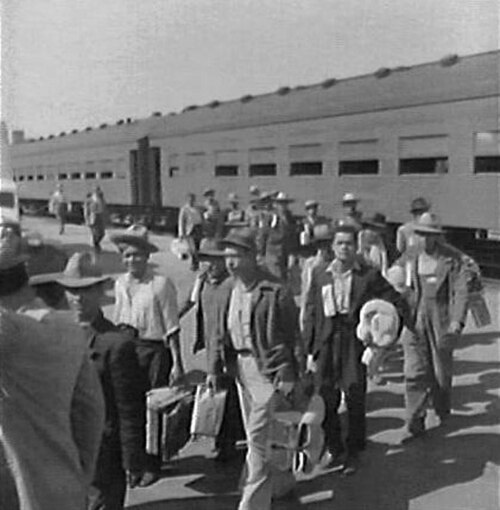
Mexico entered World War II in response to German attacks on Mexican ships. The Potrero del Llano, originally an Italian tanker, had been seized in port by the Mexican government in April 1941 and renamed in honor of a region in Veracruz. It was attacked and crippled by the German submarine U-564 on 13 May 1942. The attack killed 13 of 35 crewmen.[207] On 20 May 1942, a second tanker, Faja de Oro, also a seized Italian ship, was attacked and sunk by the German submarine U-160, killing 10 of 37 crewmen. In response, President Manuel Ávila Camacho and the Mexican government declared war on the Axis powers on 22 May 1942.
A large part of Mexico's contribution to the war came through an agreement January 1942 that allowed Mexican nationals living in the United States to join the American armed forces. As many as 250,000 Mexicans served in this way.[208] In the final year of the war, Mexico sent one air squadron to serve under the Mexican flag: the Mexican Air Force's Escuadrón Aéreo de Pelea 201 (201st Fighter Squadron), which saw combat in the Philippines in the war against Imperial Japan.[209] In addition to those in the armed forces, tens of thousands of Mexican men were hired as farm workers in the United States during the war years through the Bracero program, which continued and expanded in the decades after the war.[210]
World War II helped spark an era of rapid industrialization known as the Mexican Miracle.[211] Mexico supplied the United States with more strategic raw materials than any other country, and American aid spurred the growth of industry.[212] President Ávila was able to use the increased revenue to improve the country's credit, invest in infrastructure, subsidize food, and raise wages.[213]
While Prince Louis II's sympathies were strongly pro-French, he tried to keep Monaco neutral during World War II, and he supported the Vichy France government of his old army colleague, Philippe Pétain. In 1943, the Italian army invaded and occupied Monaco, setting up a fascist government administration. Shortly thereafter, following Mussolini's collapse in Italy, the German army occupied Monaco and began the deportation of the Jewish population. Among them was René Blum, founder of the Ballet de l'Opera, who died in a Nazi extermination camp.[214] In August 1944, the Germans executed three Resistance leaders. Under Prince Louis's secret orders, the Monaco police, often at great risk to themselves, warned in advance those people whom the Gestapo planned to arrest. The country was liberated, as German troops retreated, on 3 September 1944.

During the war, Mongolia—officially the Mongolian People's Republic—was ruled by the communist government of Khorloogiin Choibalsan and was closely linked to the Soviet Union. Mongolia was considered a breakaway province of the Republic of China by most nations. In August 1937, as part of their effort to support China, the Soviets decided to station troops along Mongolia's southern and southeastern frontiers. The arrival of the Soviet army coincided with a series of intensified terrors and purges (the "Great Terror").[215]
The Soviet–Japanese Neutrality Pact of 13 April 1941 recognized the neutrality of Mongolia and its place with the Soviet sphere of influence. Its geographical situation made it a buffer state between Japanese forces and the Soviet Union. In addition to keeping around 10% of the population under arms, Mongolia provided supplies and raw materials to the Soviet military and financed several units, and half million military trained horses.
Mongolian troops took part in the Battle of Khalkhin Gol in the summer of 1939 and in the Soviet invasion of Manchuria in August 1945, both times as small part in Soviet-led operations. On 10 August 1945, the Little Khural, the Mongolian parliament, issued a formal declaration of war against Japan.[216]
For Mongolia, the most important result of World War II was the recognition of its independence by China, American consent having been given with the Yalta agreement.
Most of Morocco was a protectorate of France during World War II, and entered on France's side at the beginning. When France was defeated, Morocco came under the control of the Vichy regime, and therefore was nominally on the side of the Axis powers, although an active resistance movement operated. In November 1942, it was invaded by the Allies as part of Operation Torch. From that point, Moroccan forces (especially the Goumier's) fought on the side of the Allies.
A small area in northern Morocco, Spanish Morocco, was a Spanish protectorate and remained neutral throughout the war, as did the international city of Tangier.
Nauru was administered by Australia under a League of Nations mandate. Nauru was shelled by a German surface raider in December 1940, aiming to incapacitate its phosphate mining operations (this action was probably the most distant military activity carried out by Germany during the entire war). Phosphates are important for making ammunition and fertilizers.
Nauru was occupied by Japan from 1942 to 1945, and was the target of shelling by American battleships and cruisers, and aerial bombing by the Allies. For example, Nauru was bombarded by the American battleships North Carolina, Washington, South Dakota, Indiana, Massachusetts, and the Alabama, on 8 December 1943, and also bombed by U.S. Navy carrier airplanes on the same day. See the article on the Washington.
The Kingdom of Nepal declared war on Germany on September 4, 1939. Once Japan entered the conflict, sixteen battalions of the Royal Nepalese Army fought in the Burma campaign. In addition to military support, Nepal contributed guns, equipment, and hundreds of thousands of pounds of tea, sugar and raw materials such as timber to the Allied war effort.
Besides RNA troops, Nepalese fought in the British Indian Gurkha units and were engaged in combat all over the world. A total of 250,280[217] Gurkhas served in 40 battalions during the war,[218] in almost all theatres. In addition to keeping peace in India, Gurkhas fought in Syria, North Africa, Italy, Greece and against the Japanese in Burma, northeast India and Singapore.[219] They did so with considerable distinction, earning 2,734 bravery awards[217] and suffering around 32,000 casualties in all theatres.[220] After the war, Gurkha troops formed part of the Allied occupation force in Japan.

Like the Belgians, the Netherlands declared neutrality in 1939. In May 1940, the Netherlands was invaded after fierce resistance against the Nazis. Rotterdam and Middelburg were heavily bombed. The Dutch joined the Allies and contributed their surviving naval and armed forces to the defense of East Asia, in particular, the Netherlands East Indies. Until their liberation in 1945, the Dutch fought alongside the Allies around the globe, from the battles in the Pacific to the Battle of Britain. On the islands of Aruba and Curaçao (Netherlands West Indies) a large oil refinery was of major importance for the war effort in Europe, especially after D-day. As a protection, a considerable U.S. military force was stationed on the island.

New Zealand declared war on 3 September 1939, backdating the date to the time of Britain's declaration.
With gratitude for the past and confidence in the future, we range ourselves without fear beside Britain. Where she goes, we go; where she stands, we stand. We are only a small and young nation, but we march with a union of hearts and souls to a common destiny.[221]
New Zealand sent one Army division that served in Greece, North Africa, and Italy, and it offered a fair number of pilots and aircrew to the Royal Air Force in England. Royal New Zealand Navy (RNZN) warships fought in the South Atlantic, including in the Battle of Rio de la Plata in 1939, before being called back to defend the homeland.
New Zealand fought in the Pacific War through warships of the Royal New Zealand Navy, the Royal New Zealand Air Force (RNZAF), and independent army brigades, such as on Vella Lavella. While New Zealand's home islands were not attacked, the casualty rate suffered by the military was the worst per capita of all Commonwealth nations, except for Great Britain.
In the South West Pacific theater, the RNZAF participated in a unique force, AirSols, in the Solomon Islands, consisting of squadrons from the U.S. Marine Corps, U.S. Navy, USAAF, and RNZAF, with occasional help from the Royal Australian Air Force.

During World War II the Dominion of Newfoundland was governed directly by the United Kingdom. It joined the war on 4 September 1939, declaring war on Germany. The defenses of Newfoundland, and the Newfoundland Home Guard forces were integrated with the Canadian military, and both governments agreed to form a joint coastal defense organization. As part of the Anglo-American Destroyers for Bases Agreement, the United States was granted Air Force and U.S. Navy bases on Newfoundland's territory. The influx of American money and personnel had significant social, economic, and political effects on the island.[222]
Newfoundlanders were encouraged to enlist in the large armed forces of the United Kingdom and of Canada. Over 3,200 Newfoundlanders enlisted in the Royal Navy. On 14 September 1939, The Royal Navy requested 625 experienced fishermen or seamen for special service in the Northern Patrol, guarding the Atlantic shipping lanes.[223] The Royal Artillery raised the 166th Newfoundland Field Artillery Regiment, which fought in North Africa and Italy, and the 59th Newfoundland Heavy Artillery, which fought in Normandy and northwestern Europe. Another 700 Newfoundlanders served in the Royal Air Force, most notably with the 125th Newfoundland Squadron. In all, some 15,000 Newfoundlanders saw active service, and thousands more were engaged in the hazardous duty of the Merchant Navy. Some 900 Newfoundlanders (including at least 257 Merchant Mariners) lost their lives in the conflict.
Newfoundland was directly attacked by German forces when U-boats attacked four Allied ore carriers and the loading pier at Bell Island. The cargo ships S.S. Saganaga and S.S. Lord Strathcona were sunk by the German submarine U-513 on 5 September 1942, and the S.S. Rosecastle and P.L.M. 27 were sunk by the German submarine U-518 on 2 November 1942. German troops were landed in Labrador to establish weather stations.
During the war, Nicaragua was ruled by Anastasio Somoza García, who had assumed the presidency after a military coup in 1937. Somoza was an ally of the United States, and Nicaragua declared war on Japan immediately after the attack on Pearl Harbor. Three days later, on 11 December, Nicaragua declared war on Germany and Italy, and, on 19 December, on Bulgaria, Romania, and Hungary. Out of these six Axis countries, only Romania reciprocated, declaring war on Nicaragua on the same day (19 December 1941).[132]

During World War II, three battalions of the Nigeria Regiment fought in the East Africa campaign. Nigerian units also contributed to two divisions serving with British forces in Palestine, Morocco, Sicily and Burma. Wartime experiences provided a new frame of reference for many soldiers, who interacted across ethnic boundaries in ways that were unusual in Nigeria. Inside Nigeria, union membership increased sixfold during the war to 30,000. This rapid growth of organised labour brought new political forces into play. The war also made the British reappraise Nigeria's political future. In 1944, Herbert Macaulay and Nnamdi Azikiwe founded the National Council of Nigeria and the Cameroons, a nationalist and pro-labour political party advocating Nigerian independence.[224]
Northern Rhodesia (now Zambia) was a British colony. As such, it was covered by the British declaration of war. Northern Rhodesian units served in East Africa, Madagascar and Burma.[225]

Norway was strategically important as a route for the transport of iron ore from Sweden to Germany, via Narvik. Both sides had designs on Scandinavia. Norwegian neutrality was compromised in the Altmark incident.
Norway remained neutral until it was invaded by Germany on 9 April 1940, as part of Operation Weserübung. The Norwegian government fled the capital and after two months of fighting went to Britain and continued the fight in exile.
The Norwegian Shipping and Trade Mission (Nortraship) was established in London in April 1940 to administer the merchant fleet outside German-controlled areas. Nortraship operated some 1,000 vessels and was the largest shipping company in the world. British politician, Philip Noel-Baker, Baron Noel-Baker commented after the war that "Without the Norwegian merchant fleet, Britain and the allies would have lost the war."[226]
After the occupation, the Germans began producing heavy water in Norway. After commando raids and bomber attacks, the Germans decided to move heavy water supplies to Germany. The Allies maintained a deception of a planned invasion of Norway. As a result, additional German forces were held there to repel any attempts. In 1944, Finnmark was liberated by the Soviet Union, and (together with the northern parts of Troms) totally destroyed by the retreating Nazis. German forces surrendered on 8 May 1945.
Norway declared war on Japan on 6 July 1945, with reciprocal effect dating back to 7 December 1941.[227] The delay was because it had been impossible for the parliament to convene during the German occupation.[228] Several hundred Norwegian sailors died when their ships were sunk by Japanese forces or during subsequent captivity.[228] After the war, Norway became one of the founding members of NATO.
Throughout the war, the Nyasaland Protectorate was an economic asset for the Allies and contributed a significant number of soldiers to fight in the British Army. At the outbreak of war, the Acting Governor requested aid, fearful that the German settlers might organize a pro-Nazi uprising. In response, 50 soldiers from Southern Rhodesia arrived in Nyasaland by air. They returned to Salisbury after only a month, having found no risk of a possible rebellion.[229] A number of camps were constructed in Nyasaland intended to house Polish war refugees. Additionally, perceived "enemy aliens" – primarily members of the German community, but also Italian settlers[230] – were brought to Southern Rhodesia for internment during the war.[231]
Many Nyasas fought for the British, primarily as askaris of the King's African Rifles (KAR). Others were recruited into the Artillery, Engineers, Service Corps and Medical Corps, placing the total number of enlisted Nyasas at around 27,000. Nyasas fought in a number of theatres, including the East African campaign, the Italian invasion of British Somaliland, the Battle of Madagascar, and the Burma campaign. Nyasaland's economy benefited from the end of the war as returning soldiers came home with useful skills, such as the 3,000 who had been trained as lorry drivers.[232]
The Sultan of Oman declared war on Germany on September 10, 1939, as it was then part of the British Empire as a protectorate. During the Second World War, Great Britain recognized the strategic importance of Oman's geographical location by expanding facilities throughout the country. A new airfield was built on Masirah Island, which, from 1943 onwards, housed No. 33 Staging Post. In 1943, both Masirah and Ras Al-Hadd became Royal Air Force stations in their own right. Units of No. 2925 Squadron of the RAF Regiment guarded these bases while the marine craft was based in Oman to perform air-sea rescue duties.[233]
The Reichskommissariat Ostland (RKO; lit. 'Reich Commissariat of Eastland')[a] was an administrative entity of the Reich Ministry for the Occupied Eastern Territories of Nazi Germany from 1941 to 1945. It served as the German civilian occupation regime in Lithuania, Latvia, Estonia, and the western part of the Byelorussian SSR during the Eastern Front of World War II.
Ostland was established after the success of the Wehrmacht's Baltic operation and an initial period of military administration by Army Group North Rear Area based on the equivalent Reichskommissariat Baltenland in German planning documents.[1] It was divided into Generalbezirk Estland (Estonia), Generalbezirk Lettland (Latvia), Generalbezirk Litauen (Lithuania), and Generalbezirk Weißruthenien (Belarus) each with its own Nazi collaborationist government and Auxiliary Police under the control of a German Generalkommissar. Hinrich Lohse served as the Reichskommissar from 1941 to 1944 and Erich Koch from 1944 to 1945.

The population, culture and infrastructure of Melanesia, Micronesia and Polynesia (the Pacific Islands) were completely changed between 1941 and 1945 due to the logistical requirements of the Allies in their war against Japan.[234][235] At the start of the war the islands had experienced 200 years of colonialism from Europe and its colonies; some islands were on the verge of being fully annexed while others were close to independence. The early Japanese expansion through the western Pacific then introduced a new colonial system to many islands. The Japanese occupation subjected the indigenous people of Guam and other Islands to forced labor, family separation, incarceration, execution, concentration camps, and forced prostitution, but also created opportunities for advanced education.[236][237]
The Pacific Islands then experienced military action, massive troop movements, and resource extraction and building projects as the Allies pushed the Japanese back to their home islands.[238] The juxtaposition of all these cultures led to a new understanding among the indigenous Pacific Islanders of their relationship with the colonial powers. In communities that had very little contact with Europeans before the war, the sudden arrival and rapid departure of men and machines spurred the growth of so-called "cargo cults" in parts of Melanesia,[239][240] such as the cult of John Frum that emerged in the New Hebrides (modern Vanuatu).

Mandatory Palestine remained under British rule via the League of Nations mandate system. During the war, Palestine was a location of hostilities, a staging area for the British and a source of troops. In July 1940, Italy began a bombing campaign against Palestine. German and Vichy French aircraft also attacked Palestine. The attacks mainly targeted the city of Haifa with its strategic port and oil refineries, although Tel Aviv was also hit, with the deadliest raid of the war taking place there, along with some other locations.[241]
The Yishuv, or Jewish community of Palestine, rallied to the British war effort in spite of its grievances against the British due to the White Paper of 1939, which greatly restricted Jewish immigration, as Nazi Germany was seen as a greater threat. The Yishuv's primary leader and future Prime Minister of Israel David Ben-Gurion declared that the Jews of Palestine would "support the British as if there is no White Paper and oppose the White Paper as if there is no war". The right-wing Irgun underground movement also felt this way and many of its leaders were released from prison. The more radical branch of the Irgun disagreed and, on 17 July 1940, it split under the leadership of Avraham Stern and became known as "The National Military Organization in Israel" as opposed to Irgun's official name, "The National Military Organization in the Land of Israel". It would later change its name to Lehi, referred to by the British as the "Stern Gang", as a completely separated militia.[242]
In 1941, the main Jewish underground paramilitary group in Palestine, the Haganah, established the Palmach as an elite strike force. It initially received British training and support, although the British later attempted to disarm it. During the Syria–Lebanon campaign, Palmach fighters participated in combat alongside Allied troops. It was during this campaign that Moshe Dayan, attached to the Australian 7th Division, lost an eye, requiring him to wear what would become his trademark eye-patch.[243]
In 1942, after the Germans advanced into Egypt and until they were stopped at the Second Battle of El Alamein, there was widespread fear in the Yishuv that the Germans would reach Palestine, a period that became known as the 200 days of dread. According to historical research, an Einsatzgruppen unit, Einsatzkommando Egypt, was prepared to carry out the mass murder of the Jews of Palestine after German occupation.[244] The British prepared a defensive plan called Palestine Final Fortress. The Yishuv's leaders also prepared for a potential last stand by the Haganah.
About 30,000 Jews from Palestine served in the British Armed Forces during the war.[245] Most served in logistical, engineering, guard, and other support roles, although some did see combat. According to research by historian Mustafa Abbasi, about 12,000 Palestinian Arabs also served in the British military during the war.[246] This figure is also cited by Rashid Khalidi. According to Benny Morris, this estimate was probably double the true figure, with most serving as service personnel on bases inside Palestine.[247]
Of the Jewish soldiers from Palestine, large numbers served in the Royal Pioneer Corps and were deployed in the North African campaign, Battle of France, and German invasion of Greece. While engaged mainly in logistical tasks, they were also armed and participated in combat when the situation demanded.[248][249] The British Army also recruited local volunteers into commando units, forming the Special Interrogation Group, which was composed mainly of German-speaking Jews from Palestine, and No. 51 Commando, composed of 240 and 120 Arab volunteers from Palestine.[250][251]
A total of 2,031 Palestinian Jews served in the Royal Air Force during World War II. Most served in support roles, including hundreds who served as aircraft mechanics. In addition, 37 became accomplished aircrews, including 20 pilots.[252] Some Palestinian Jews also served in the Royal Navy.
Following a particularly deadly Italian air raid in Tel Aviv in September 1940, the British recruited Haganah men to serve as anti-aircraft gunners defending Palestine. The 1st Palestine Light Anti-Aircraft Battery was formally established in October 1940 and became operational in early 1941. Its gunners defended Palestine from Axis air raids and also served elsewhere throughout the Mediterranean theater with British forces.[241][253]
In 1942, the British Army formed the Palestine Regiment for volunteers from Palestine. In order to maintain the status quo ante bellum between the Jews and the Arabs, the British instated a policy of equal recruitment from both groups to the Palestine Regiment. However, due to the events of the 1936–1939 Arab revolt in Palestine and the alliance of exiled former Grand Mufti of JerusalemHajjMohammad Amin al-Husayni with Adolf Hitler, only one Arab volunteered for every three Jewish volunteers. On August 6, 1942, the policy was relinquished and the regiment was formed, containing three Jewish battalions and one Arab. The regiment was assigned mostly to guard duty in Egypt and North Africa.[254]
On 3 July 1944, Britain agreed to form a special Jewish combat unit. Thus the three Jewish battalions of the Palestine Regiment together with the 200th Field Regiment were reorganized under the aegis of the Jewish Brigade, which would see action in Italy. The Jewish Brigade participated in the Spring 1945 offensive in Italy.[248][255]
At the start of the war, approximately a thousand German nationals residing in Palestine known as Templers were deported by Britain to Australia, where they were held in internment camps until 1946–47. Although some had been registered members of the Nazi party and Nazi marches had taken place in their settlements, no evidence had been presented until 2007 that the majority supported Hitler. Although their property had been confiscated by the British authorities, the State of Israel chose to compensate them in 1962.[256]
The small Panama Canal Zone was United States territory, and American forces from the U.S. Navy, U.S. Army, the USAAF (at Howard Air Force Base), and Colombian forces helped inside the Canal Zone, guarded the Panama Canal from both ends. This Canal provided the United States and its Allies with the ability to move warships and troops rapidly between the Atlantic Ocean and the Pacific Ocean. Since most of the American shipbuilding capability was on the East Coast and the Gulf of Mexico, the Canal was vital for moving new warships to the Pacific to fight the Imperial Japanese Navy.
Paraguay's authoritarian government under Higinio Morínigo was sympathetic to the Axis powers early in the war; the country's large German community, in particular, were supporters of Nazism, as well as most of the Paraguayan population.[257] Serious thought was given to joining the war on Germany's side, but United States President Franklin D. Roosevelt avoided this by providing aid and military hardware in 1942. Paraguay declared war on Germany on February 2, 1945, by which time the war was almost over and many Paraguayans joined the Brazilian air force for fighting the Axis Powers.[258]
Peru broke off relations with the Axis on 24 January 1942. Because of its ability to produce aviation fuel and its proximity to the Panama Canal, the oil refinery and port city of Talara, in northwest Peru, became an American air base. Although Peru did not declare war on Germany and Japan until February 1945 (Peru declared a "state of belligerency"), the Peruvian Navy patrolled the Panama Canal area. As many as 2,000 Peruvian citizens of Japanese descent were detained and sent to the United States under American orders as part of the Japanese American internment policy.

In 1941, the Philippine Commonwealth was a semi-independent commonwealth of the United States, with full Independence scheduled for 4 July 1946.[259] The Philippine Commonwealth Army was commanded by American General Douglas MacArthur, and the Philippines was one of the first countries invaded by the Empire of Japan; combined Filipino and American forces maintained a stubborn resistance against the invasion. General MacArthur was ordered by the President to withdraw his headquarters to Australia, where he made his famous statement "I came out of Bataan, and I shall return". The Americans in the Philippines surrendered at Corregidor, on 6 May 1942.[260]
Despite the official surrender, there was a significant local resistance movement to the Japanese Occupation. Elements of the Philippine Army continued their activity and were able to free all but twelve of the then-fifty Provinces of the Philippines, whilst other groups such as the Hukbalahap were also involved. While in exile, PresidentManuel L. Quezon continued to represent the Philippines until his death from tuberculosis in 1944. American forces under General MacArthur made their return in October 1944, beginning with amphibious landing on Leyte.[261][260]

The Second World War started in September 1939, as Poland suffered an attack by Nazi Germany and later by the USSR. Many Polish troops and other servicemen escaped the occupied country. They reorganized in France and took part in the Battle of France. Later Poles organized troops in the United Kingdom and were integrated into the forces of Britain with Polish pilots serving with distinction in the Battle of Britain. Polish soldiers also played an important role in the Battle of Monte Cassino in 1944. Poland was the only German-occupied country that never had any official collaboration with the Nazis. The Polish Resistance Movement was the largest anti-Nazi resistance in the whole Nazi-occupied Europe and the only non-Communist resistance among the Slavic countries. It is remembered for its daring and brave methods of resisting occupation, often facing German forces in a pitched battle. Polish armies also reformed in Soviet territory. The Polish-Jewish community was mostly exterminated in the Holocaust in Nazi-occupied Poland, while Poles themselves were considered to be a threat to the "German race", and were classified as "subhumans". Millions of Poles were sent to concentration camps or were killed in other fashions in occupied Poland. German-occupied Poland was the only territory where any kind of help for Jews was punishable by death for the helper and his whole family. However, many Polish civilians risked their lives, and the lives of their families, to save the Jews from the Nazis. Moreover, Poles created "Żegota" – the only organization in occupied Europe, entirely focused on helping the Jews.[262]
For the duration of World War II, Portugal was under the control of the dictator António de Oliveira Salazar. Early in September 1939, Portugal proclaimed neutrality to avoid a military operation in Portuguese territory. This action was welcomed by Great Britain. Germany's invasion of France brought the Nazis to the Pyrenees, which increased the ability of Hitler to bring pressures on Portugal and Spain.
Following the Nazi invasion of the Soviet Union, which cut off their supply of tungsten metal, Germany sought tungsten from Portugal. Salazar attempted to limit their purchases, and in late 1941, German U-boats attacked Portuguese ships. In January 1942 Salazar signed an agreement to sell tungsten to Germany. In June 1943, Britain invoked the long-standing Anglo-Portuguese Alliance requesting the use of the Azores, to establish an air force and naval air base. Salazar complied at once. The Allies promised all possible aid in the event of a German attack and guaranteed the integrity of Portugal's territorial possessions. In 1944, Portugal declared a total embargo of tungsten shipments to Germany. Germany protested but did not retaliate.
Lisbon became a safe-haven to a scattering of Jews from all over Europe. Jewish refugees from Central Europe were granted resident status. After the German invasion of France, Portugal allowed thousands of Jewish refugees to enter the country. As the war progressed, Portugal gave entry visas to people coming via rescue operations, on the condition that Portugal would only be used as a transit point. More than 100,000 Jews and other refugees were able to flee Nazi Germany into freedom via Lisbon. By the early 1940s, there were thousands of Jews arriving in Lisbon and leaving weeks later to other countries.
Although the Japanese military invaded and occupied the neighboring British colony of Hong Kong in 1941, they initially avoided direct interference in the affairs of Macau. It remained a neutral territory, belonging to Portugal, but Portuguese authorities lacked the ability to prevent Japanese activities in and around Macau. In 1943, Japan ordered the government of Macau to accept Japanese advisors. The limited Portuguese military forces at Macau were disarmed, although Macau was never occupied.

In early 1942, Portuguese authorities maintained their neutrality, in spite of warnings from the Australian and Dutch East Indies governments that Japan would invade. To protect their own positions in neighboring Dutch Timor, Australian and Dutch forces landed in Portuguese Timor and occupied the territory. There was no armed opposition from Portuguese forces or the civilian population. However, within a matter of weeks, Japanese forces landed but were unable to subdue substantial resistance, in the form of a guerrilla campaign launched by Allied commandos and continued by the local population. It is estimated that 40,000–70,000 Timorese civilians were killed by Japanese forces during 1942–1945.[263]
Qatar was a British protected state under the Persian Gulf Residency of the British Indian Empire. The country's first oil strike occurred at Dukhan in 1939, but the outbreak of war halted production. The petroleum industry that was to transform the country did not resume until after the war.[264] The war also disrupted food supplies, prolonging a period of economic hardship going back to the 1920s with the collapse of the pearl trade, continuing through the Great Depression and a Bahraini embargo in 1937. Entire families and tribes moved to other parts of the Persian Gulf, leaving many Qatari villages deserted. Emir Abdullah bin Jassim Al Thani abdicated in 1940 in favor of his second son, Hamad bin Abdullah Al Thani.[265]

Romania had its first involvement in the war in providing transit rights for members of the Polish government, its treasury, and many Polish troops in 1939. During 1940, threatened with Soviet invasion, Romania ceded territory to the Soviet Union, Hungary, and Bulgaria, and following an internal political upheaval, Romania joined the Axis. Subsequently, the Romanian army participated with over 600,000 men in the German-led invasion of the Soviet Union, with its forces taking part in the capture of Odessa, Sevastopol and ultimately suffering irrecoverable losses at Stalingrad. Romania was also a major source of oil for Nazi Germany via the Ploiești oil fields.
With the entry of Soviet troops into Romania and a royal coup in August 1944, a pro-Allied government was installed, and after Germany and Hungary declared war on Romania, the country joined the Allies as a co-belligerent for the remainder of the war. The total number of troops deployed against the Axis was 567,000 men in 38 army divisions. The Romanian Army was involved in the siege of Budapest and reached as far as Czechoslovakia and Austria.
After the war, Romania forcibly became a people's republic as the country fell under the Soviet sphere of influence and joined the Warsaw Pact.
Samoa declared war on Germany along with New Zealand, which administered all of Western Samoa under a League of Nations mandate. Prior to World War I, Samoa had been a German colony and was occupied by New Zealand in 1914. Under the Treaty of Versailles, Germany relinquished its claims to the islands.
Samoa sent many troops to fight with the New Zealand armed forces in the war. After the sinking of a Samoan food ship by a Japanese gunboat in 1940, the Samoan government was forced to dispatch a light-gunned ship. HMS Fa'i was in action and sank seven ships, including the attacking gunboat.
When the American armed forces entered Samoa, using it as a port, four midget submarines were spotted entering the capital Apia's port. The Samoan home guard reacted by firing a fair number of rounds, resulting in the sinking of the Hirojimi and the Shijomiki.
Ever since the times of Giuseppe Garibaldi, San Marino has maintained strong ties with the Italian state. Throughout the war, San Marino maintained its neutrality, although it did not remain unscathed from both sides. Germany invaded San Marino on 13 September,[266] and on 17–20 September 1944 retreating German troops of the 278th Infantry Division fought the Battle of San Marino within the country against units of the 4th Indian Division. Allied victory was followed by a short occupation.
Saudi Arabia severed diplomatic contacts with Germany on 11 September 1939, and with Japan in October 1941. Although officially neutral, the Saudis provided the Allies with large supplies of oil. Dhahran was bombed by Italian planes in October 1940, targeting the oil refineries. Diplomatic relations with the United States were established in 1943. King Abdul Aziz Al-Saud was a personal friend of Franklin D. Roosevelt. The Americans were then allowed to build an air force base near Dhahran. On 28 February 1945, Saudi Arabia declared war on Germany and Japan, but no military actions resulted from the declaration.
Freetown served as a critical convoy station for the Allies.
Singapore was part of the Straits Settlements, a British Crown colony, and is in a strategic location for shipping routes connecting Asia to Europe. For these reasons, Japan invaded Singapore in the Battle of Singapore from 7 February to 14 February 1942. The city was renamed Syonan and kept under Japanese occupation until the end of the war in September 1945.
Slovakia was part of Czechoslovakia during World War II. See this article's section on Czechoslovakia in general, and its subsection on the Slovak Republic in particular.
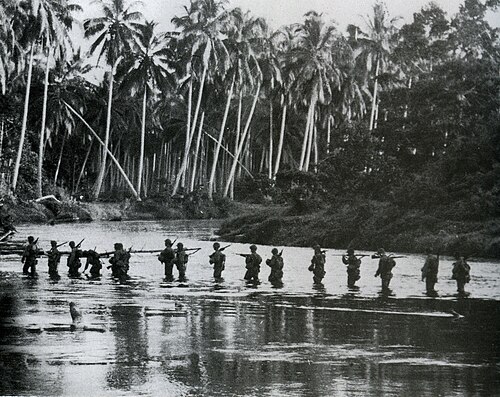
Japan occupied several areas in the British Solomon Islands during the first six months of 1942. The Japanese began to build naval and air bases to protect the flank of their offensive in New Guinea. The Allies, led by the United States, launched a counterattack with the Guadalcanal campaign beginning 7 August 1942. These landings initiated a series of battles in the central and northern Solomons, on and around New Georgia Island, and on Bougainville Island. In a campaign of attrition fought by land, sea, and air, the Allies wore the Japanese down, inflicting irreplaceable losses. The Allies retook parts of the Solomon Islands, but Japanese resistance continued until the end of the war.[267]
The impact of the war on islanders was profound. The destruction, together with the introduction of modern materials, machinery and Western material culture, transformed traditional ways of life. Some 680 islanders enlisted in the British Solomon Islands Protectorate Defence Force, while another 3,000 worked as labourers in the Solomon Islands Labour Corps.[268] The experiences of Corps members affected the development of the Pijin language and helped spark the postwar political movement Maasina Ruru.[269][270] During the war, the capital of Tulagi was damaged, while the Americans did much to develop the infrastructure around Henderson Field on Guadalcanal. After the war, this evolved into the new capital, Honiara.[271]

As a member of the British Commonwealth, the Union of South Africa declared war on Germany shortly after the United Kingdom, on 6 September 1939. Three South African infantry divisions and one armored division fought under Allied commands in Europe and elsewhere, most notably in the North African campaign and the Italian campaign. Most of the South African 2nd Division was taken prisoner with the fall of Tobruk on 21 June 1942. Under the Joint Air Training Scheme, part of the British Commonwealth Air Training Plan, South Africa trained 33,347 aircrews for the British Royal Air Force, South African Air Force and other Allied air forces. Only Canada trained more.[272]
The so-called High Commission Territories of Bechuanaland, Basutoland, and Swaziland (modern Botswana, Lesotho, and Eswatini) had autonomous governments under the supervision of the British High Commissioner for Southern Africa. In July 1941, the paramount chiefs of these territories convinced the colonial authorities to create an independent force consisting of their subjects: the African Auxiliary Pioneer Corps. During its service the corps provided crucial logistical support to the Allied war effort during the North African and Italian campaigns. Initially a labor battalion, AAPC's duties were gradually expanded to include anti-aircraft artillery operation and other combat duties. Unequal treatment of the African soldiers compared to their white counterparts led to resentment and unrest, including mutinies and riots when the unit's return home was delayed after the end of the war.[273]
Southern Rhodesia (modern-day Zimbabwe) had been a self-governing British colony since 1923. It was covered by the British declaration of war, but its colonial government issued a symbolic declaration of war anyway.[274] Southern Rhodesia's white troops did not serve in a composite unit (unlike their Australian, Canadian, or South African counterparts) because they constituted a significant part of the settler population; it was feared that the colony's future might be placed in jeopardy if an all-Southern Rhodesian unit went into the field and suffered heavy casualties. Southern Rhodesians served in East Africa, Europe, North Africa, the Middle East, and the Burma campaign. A significant number of Southern Rhodesian troops, especially in the Rhodesian African Rifles, were black or mixed race. Their service has never been recognised by the ZANU–PF government in Harare. Ian Smith, the future Prime Minister, like many of his white contemporaries, served under British command as a fighter pilot in the Royal Air Force.[275]

The Soviet Union's participation in World War II began with the Battles of Khalkhin Gol against Japan, in Mongolia between May and August 1939. Later that year, by agreement with Germany, it invaded eastern Poland about three weeks after the Germans invaded the west of the country. During the next eleven months the Soviets occupied and annexed the Baltic states. The Soviet Union supported Germany in the war effort against Western Europe through the 1939 German–Soviet Commercial Agreement and larger 1940 German–Soviet Commercial Agreement with supplies of raw materials that were otherwise blocked by the British naval blockade. After Finland rebuffed Moscow's demands for military bases and a territorial swap, the Soviet Union invaded on 30 November 1939, in the Winter War. The Soviet Union also annexed Bessarabia, leading Romania to ally with Germany.
On June 22, 1941, Nazi Germany launched a massive surprise attack on the Soviet Union. Soviet forces took heavy losses, but this Eastern Front fighting would inflict on German forces about half of their military casualties over the course of the war.[276][277] After an initial devastating advance, the Wehrmacht suffered its first defeat in war at Moscow. The Germans and their allies tried in 1942 to advance southward, to the Caucasus. After six months of fighting, they suffered a pivotal defeat at Stalingrad. In late 1943, in the wake of Battle of Kursk, the Soviet Red Army gained the initiative with a series of major victories. After the Allies opened a second European front with the June 1944 landings in France, the USSR was able to push the Germans back.[278][279][280][281] Soviet forces advanced into Eastern Europe during 1944 and into Germany in 1945, concluding with the Battle of Berlin. The war against the USSR inflicted loss of lives (both civilian and military), on a scale greater than any countries in the war. Following the end of the war in Europe and the American atomic bombing of Hiroshima, the USSR joined the war against Japan. The Soviet Union, as one of the main victors, gained one of the permanent seats in the United Nations Security Council. After the war, the Soviet sphere of influence was widened to cover most of Eastern Europe, formalized in the Warsaw Pact. The Soviet Union came to be considered one of the two superpowers of the Cold War.[282]
Armenia participated in the Second World War on the side of the Allies under the Soviet Union. Armenia was spared the devastation and destruction that wrought most of the western Soviet Union during the Great Patriotic War of World War II. The Nazis never reached the South Caucasus, which they intended to do in order to capture the oil fields in Azerbaijan. Still, Armenia played a valuable role in aiding the Allies both through industry and agriculture. An estimated 300–500,000 Armenians served in the war, almost half of whom did not return.[283] Armenia thus had one of the highest death tolls, per capita, among the other Soviet republics.
One hundred and nineteen Armenians were awarded with the rank of Hero of the Soviet Union.[284] Many Armenians who were living in the areas occupied regions of the Soviet Union also formed partisan groups to combat the Germans.[285] Over sixty Armenians were promoted to the rank of general, and with an additional four eventually achieving the rank of Marshal of the Soviet Union.[285] The 89th Tamanyan Division, composed of ethnic Armenians, distinguished itself during the war. It fought in the Battle of Berlin and entered Berlin.[286]
Azerbaijan played a crucial role in the strategic energy policy of the Soviet Union since much of the petroleum needed on the Eastern Front was supplied by Baku. Mobilization affected all spheres of life in Azerbaijan. The oil workers extended their work to 12-hour shifts, with no days off, no holidays, and no vacations until the end of the war. By decree of the Supreme Soviet of the USSR in February 1942, more than 500 workers and employees of the oil industry of Azerbaijan were awarded orders and medals. In addition to this labor, some 800,000 Azerbaijanis fought in the ranks of the Soviet Army, of which 400,000 died. Azeri Major-General Hazi Aslanov was twice awarded Hero of the Soviet Union. Like the other people of the Caucasus, some Azerbaijanis joined the side of Germany.
Baku was the primary strategic goal of the right flank of Germany's 1942 Fall Blau offensive. In this attack, labelled Operation Edelweiss, the German Wehrmacht targeted Baku's oil fields.[287] The German army was at first stalled in the mountains of the Caucasus, then decisively defeated at the Battle of Stalingrad and forced to retreat.

During WWII, Belarus was part of the Soviet Union as the Byelorussian SSR. Byelorussia's borders were expanded in the invasion of Poland of 1939 under the terms of the Molotov–Ribbentrop Pact, which divided Poland's territory into German and Soviet spheres. Despite the pact, Nazi Germany invaded on June 22, 1941; Germany occupied all of Belarus by August. The Jewish inhabitants were rounded up by Einsatzgruppen and slaughtered. In 1943 the Germans established the Belarusian Central Council, a collaborationist government. Meanwhile, the Belarusian resistance fought against the occupiers. Soviet forces took back Belarus during Operation Bagration on August 1, 1944.

Although the Axis powers never penetrated the Georgian Soviet Socialist Republic, Soviet Georgia contributed to the war effort almost 700,000 officers and soldiers (about 20% of the total 3.2–3.4 million citizens mobilized), of which approximately 300,000 were killed. 137 Georgians were awarded Hero of the Soviet Union, the most numerous recipients of this award in the Caucasus.[288][289] The country was also a vital source of textiles as well as an important manufacturer of warplanes.
Around 30,000 Georgians, both captives and volunteers, fought for the Germans in units such as the Bergmann Battalion. One such Axis unit, the Georgian Legion, staged the Georgian Uprising of Texel in the Netherlands, often described as Europe's last battle of World War II.[290] When it became clear that the Germans were losing, the Georgians of the "Queen Tamar" Battalion,[291][292] led by Shalva Loladze, decided to switch sides. On 6 April 1945, they attempted to capture the island's heavily fortified coastal batteries. A German counterattack led to fierce fighting and the failure of the uprising.[290][292]

Before the German invasion, Ukraine was a constituent republic of the Soviet Union, inhabited by Ukrainians with Russian, Polish, Jewish, Belarusian, German, Romani and Crimean Tatar minorities. It was a key subject of Nazi planning for the post-war expansion of the German state. Upon the beginning of Operation Barbarossa, modern-day Ukraine fell under their occupation. The Nazi occupation of Ukraine ended the lives of millions of civilians in the Holocaust and other Nazi mass killings: it is estimated 900,000 to 1.6 million Jews and 3[293] to 4[294] million non-Jewish Ukrainians were killed during the occupation. Under the Reichskommissariat Ukraine, many Ukrainians fled east to aid the Soviet Red Army in resisting the German advance, while others stayed behind and formed the Ukrainian Insurgent Army (UPA) (Ukrainian: Українська Повстанська Армія), which waged military campaign against Germans and later Soviet forces as well against Polish civilians.[295]
Those Ukrainians who remained at times welcomed the Germans as liberators. Those who collaborated with the German occupiers did so in various ways including participating in the local administration, in the Ukrainian Auxiliary Police, the Schutzmannschaft, in the German military, and serving as concentration camp guards. An entire Ukrainian volunteer SS division was created. Nationalists in western Ukraine were among the most enthusiastic and hoped that their efforts would enable them to re-establish an independent state later on. For example, on the eve of Operation' Barbarossa, as many as 4000 Ukrainians, operating under Wehrmacht orders, sought to cause disruption behind Soviet lines, and some groups aided the German Army in the invasion, including theton Nachtigall and Roland battalions.

Italian and German intervention had aided the Franco government in the recent Spanish Civil War, but Franco and Hitler did not achieve an agreement about Spanish participation in the new war. Galicia became an alternate source of tungsten for the Reich. Despite its non-belligerency, Spain sent volunteers to fight against the Soviet Union in the form of the Blue Division. As the Allies emerged as possible victors, the regime declared neutrality in July 1943. Removal of Spanish troops from the Eastern Front was completed in March 1944.
Spain did make plans for defense of the country. Initially, the mass of the Spanish army was stationed in southern Spain in case of Allied attack from Gibraltar during 1940 and 1941. However, Franco ordered the divisions to gradually redeploy in the Pyrenees as Axis interest in Gibraltar grew. By the time it became clear that the Allies were gaining the upper hand, Franco had amassed all his troops on the French border and was assured that the Allies did not wish to invade Spain.
In 1940, Suriname was a colony of the Netherlands. At the start of the Battle of the Netherlands, it was defended by 200 soldiers of the Royal Netherlands East Indies Army and 180 local volunteers of the Schutterij.[296]
Suriname was a major producer of bauxite which is used to make aluminium, a vital resource for the aircraft industry. Between 1940 and 1943, Suriname supplied 65% of American imports of bauxite. On 1 September 1941, three months before Pearl Harbor, President Franklin D. Roosevelt made an offer to Queen Wilhelmina to station 3,000 soldiers in Suriname.[297] The number of troops was later revised to 2,000 soldiers who started to arrive from November 1941 onwards.[296] In December 1941, the American troops started to transform Airstrip Zanderij into the largest airport of South America at the time.[298]
The border with French Guiana, part of Vichy France, was a major concern, and was defended by the Schutterij.[296] On 16 March 1943,[299] French Guiana sided with Free France.[300] In 1943, the American troops were replaced by Puerto Ricans.[296]
In exchange for greater Swazi autonomy from the British, King Sobhuza II gathered a few thousand Swazi volunteers to fight with the Allies in the war. Swazi soldiers served in the Western Desert campaign and the Invasion of Italy.
Sweden maintained neutrality throughout the war, though some Swedish volunteers participated in Finland's Winter War and Continuation War against the Soviet Union. Also, Sweden secretly supported both the Norwegian and Danish resistance against Germany, providing military training to thousands of Norwegian and Danish refugees.
After Denmark and Norway were invaded on 9 April 1940, Sweden and the other remaining Baltic Sea countries became enclosed by Nazi Germany and the Soviet Union, then on friendly terms with each other as formalized in the Molotov–Ribbentrop Pact. The lengthy fighting in Norway resulted in intensified German demands for indirect support from Sweden, demands that Swedish diplomats were able to fend off by reminding the Germans of the Swedes' feeling of closeness to their Norwegian brethren. With the conclusion of hostilities in Norway, the Swedish Cabinet gave in to German pressure and allowed railroad transports through Sweden of unarmed German soldiers on leave between Norway and Germany. Throughout the war, Sweden continued to supply Germany with iron ore through Narvik in Norway and secretly sent Britain vital shipments of ball bearings.
Switzerland intended to be a neutral power during the war, but Axis threats and military mobilizations towards its borders prompted the Swiss military to prepare for war. Following the German invasion of Poland on 1 September 1939, the country was completely mobilized within three days. An invasion of Switzerland, codenamed Operation Tannenbaum, was planned for 1940, but Hitler decided it would be a waste of resources. Unlike the Netherlands, Belgium, and other western European nations that had easily fallen under German maneuver warfare, Switzerland had a strong military and mountainous terrain offering defenders the traditional advantage of high ground in mountain warfare.
Despite its neutrality, Switzerland was not free from hostilities. Early in the war, Swiss fighters shot down German aircraft for violating Swiss air space. Counting both sides, hundreds of aircraft, such as those with battle damage, landed in Switzerland and were interned at Swiss airports and their crews held until the end of the war. Allied airmen were interned, in some cases contrary to Swiss law, and some were reportedly subjected to abuse in internment camps. Both sides accidentally bombed Swiss cities. Because of its defensive and hostile nature toward both sides, Switzerland eventually and unofficially proclaimed itself on its own side in the war. Although the Swiss government was anti-Nazi, Swiss troops did not directly participate in the war. After the war, controversies arose over assets of the victims and perpetrators of the Holocaust in Swiss banks.
Syria was under French control throughout the war. Following the French surrender in 1940, this was the Vichy government, a puppet of the Nazi regime. Winston Churchill feared that Germany could use Syria to threaten Britain's Iraqi oil supplies. These appeared to be substantiated when Luftwaffe supply flights to the new pro-German Iraqi regime (under Rashid Ali) refuelled in Damascus.
In June 1941, British and Free French forces invaded Syria, and after giving effective opposition, the Vichy forces surrendered in July 1941. British occupation lasted until the end of the war. During the occupation, Syria gradually went on the path towards independence. The proclamation of independence took place in 1944; October 1945 Syrian Republic was recognized by the United Nations; it became a de facto sovereign state on 17 April 1946 with the withdrawal of French troops.
After the United Kingdom declared war, the British forces in Tanganyika were ordered to intern the German males living in the territory out of fear that they would try to help the Axis. Some of the Germans living in Dar es Salaam attempted to flee the country, but they were stopped and later interned by a small group of Tanganyikan soldiers and British officers that included Roald Dahl.[301]
During the war about 100,000 people from Tanganyika joined the Allies.[302] Tanganyikans with the King's African Rifles fought in the East African campaign against the Italians, in the Madagascar campaign against the Vichy French, and in the Burma campaign against the Japanese.[303] Tanganyika became an important source of food and Tanganyika's export income greatly increased from the pre-war years of the Great Depression;[302] however, this led to a rise in inflation.[304]
Tibet was a de facto independent state that lacked international recognition.[305] It remained neutral throughout the war. The 14th Dalai Lama, Tenzin Gyatso, was enthroned by the Ganden Phodrang government at the Potala Palace in 1939. Tibet established a Foreign Office in 1942, and in 1946 it sent congratulatory missions to China and India related to the end of the war.[306] Its era of independence ended after the Nationalist government of China lost the Chinese Civil War and the People's Liberation Army entered Tibet in 1950.
Thailand was nominally an ally of Japan at the beginning of the war. Field Marshal Plaek Phibunsongkhram, a military dictator with nationalist leanings, ruled the country under the nominal rule of King Ananda Mahidol, who was just fourteen years old in 1939 and remained in Switzerland until the war ended. Thailand remained uninvolved when war broke out in Europe, but it took the opportunity of France's defeat to settle claims to parts of French Indochina, in the Franco-Thai War. The December 1941 Japanese invasion of Thailand brought five hours of war after which Phibun surrendered and acquiesced, making the country a stepping-stone to open the Burma campaign.
Japanese victory in the Malayan campaign made the Premier more enthusiastic about co-operation, and on 21 December, a formal "alliance" was concluded. On 25 January 1942, Thailand declared war on the United States and the United Kingdom. Some Thais disapproved, and formed the Free Thai Movement to resist. Eventually, when the war turned against the Japanese, Phibun was forced to resign, and Thailand renounced its alliance with Japan.
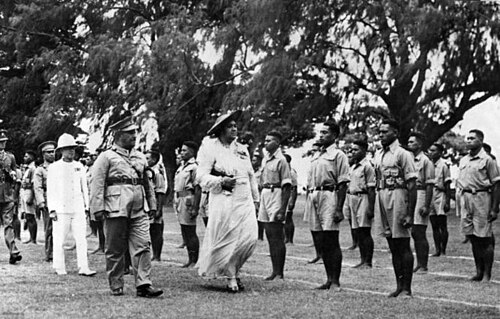
By 1939, Tonga was a protected state of the British Empire and Commonwealth (through the United Kingdom) respectively, Britain had sovereignty over its foreign affairs and defence, thus declaring war on Germany in 1939 and Japan in 1941 following the attack on Pearl Harbor.[307] The Queen of Tonga, Salote Tupou III accepted the outcome and put her island country's resources at the disposal of Britain and supported the Allied cause throughout the war. The Tonga Defense Service (TDS) came into existence in 1939. New Zealand trained two Tongan contingents of about 2,000 troops, who saw action in the Solomon Islands and Guadalcanal.[308][309] In addition, New Zealand and US troops were stationed on Tongatapu, which became a staging point for shipping.
The Emirate of Transjordan was a British mandate territory, and the Transjordanian forces were under British command during the war. The Transjordanian forces numbered 1,600 soldiers during the war and they took part and fought in Iraq, Iran, Syria and Lebanon during the Middle Eastern Campaign.

Tunisia was a French protectorate and many Tunisians took satisfaction in France's defeat by Germany,[310] but the nationalist parties were unable to derive any benefit from it. The Vichy French Resident-General, Admiral Jean-Pierre Esteva, repressed political activity and arrested leaders of the independence party Neo Destour.[311] The Bey Muhammad VII al-Munsif (Moncef Bey) declared neutrality and attempted to protect Tunisian Jews from persecution.[312][313]
Allied forces landed in Algeria with Operation Torch on 8 November 1942. Beginning on 10 November, the British First Army under Kenneth Anderson began to advance toward Tunis. For the next six months, Tunisia was a battlefield as Axis and Allied forces fought on northern and southern fronts. In February 1943 the Axis won a victory at the Battle of Kasserine Pass, the first major engagement involving American troops, but the Operation Ochsenkopf offensive at the end of the month failed to stop the Allied advance. The Battle of Longstop Hill cleared the road to Tunis, which fell on 7 May. All Axis forces in Tunisia surrendered in the following days.
Following the recapture of Tunis, Free France took control of the country. Charles Mast served as the Resident General for the remainder of the war. The Free French accused Moncef Bey of collaborating with the Vichy Government and deposed him.[314] From Tunisia, the Allies launched Operation Husky, the invasion of Sicily, in July 1943.
Turkey was neutral until several months before the end of the war, at which point it joined the Allied powers. Prior to the outbreak of war, Turkey signed a Mutual Aid Pact with France and Britain in 1939. After the German invasion of France, however, Turkey remained neutral, relying on a clause excusing them if military action might bring conflict with the USSR, which, after the division of Poland, Turkey feared, as East Thrace including Istanbul and the Caucasian borderlands were especially vulnerable to a potential Soviet attack. Then, in June 1941, after neighboring Bulgaria joined the Axis and allowed Germany to move troops through to invade Yugoslavia and Greece, Turkey signed a treaty of friendship with Germany.
Turkey was an important producer of chromite, which is a key ingredient in the manufacture of stainless steel and refractory brick, and Germany had limited access to it. The key issue in Turkey's negotiations with both sides was the sale of chromite to Germany or to the Allies. The Allies had access to other sources and mainly bought the chromite in order to preclude its sale to Germany. Turkey halted its sales to Germany in April 1944 and broke off relations in August. Turkey declared war on the Axis powers in February 1945, after the Allies made its invitation to the inaugural meeting of the United Nations (along with the invitations of several other nations) conditional on full belligerency. There is no record that Turkish troops ever saw combat.
The main theme of Eric Ambler's 1940 spy thrillerJourney Into Fear is the efforts of Britain and Germany to get Turkey to join them – or at least prevent it from joining the other. At the time of writing, it was far from clear what Turkey's role in the war would be.
In her March 18, 1943, entry in The Diary of Anne Frank, Frank recorded the jubilation she and her family felt at the news that Turkey had joined the war on the side of the Allies, replaced on the following day by disappointment upon hearing that in fact Turkey had not actually joined the war, only that a Turkish minister said that Turkey might end its neutrality at some future time.[315]
The Tuvan People's Republic was a partially recognized Soviet puppet state.[316] Tuva volunteer forces took part in the battles on the eastern front as part of the formations of the Workers and Peasants Red Army. On October 14, 1944, the Tuva People's Republic became part of the Soviet Union, becoming the Tuva Autonomous Oblast. From that moment on, the Tuvans participated in hostilities until the end of the war as citizens of the Soviet Union.

The United Kingdom, along with most of its Dominions, all of its Crown colonies, and eventually its protectorates declared war on Nazi Germany in September 1939 to honour its commitments to Poland after the German invasion. At the time, Britain was still the world's major superpower, having the largest navy in the world, its influence and presence in each continent, although its power and stature is not of equal standing in contrast to before the First World War. As a result of the declaration of war, a National Service Act was passed immediately after declaring war, but conscription was never implemented in Northern Ireland, despite urgings from the Stormont government, due to Irish nationalist opposition.[317] After the fall of France, Britain was the only major Allied nation left in Europe. In the early war, the Royal Navy engaged Axis ships in the Battles of the Atlantic and the Mediterranean. The British Army fought the Axis in the Mediterranean and Middle East including the Balkans, the East African and Western Desert campaigns.
While Nazi Germany never attacked Britain with ground forces, it subjected the country to heavy air attacks in the Battle of Britain of 1940, which was won by the Royal Air Force. Nightly attacks of the Blitz continued until mid-1941, which killed 40,000 people[318] and prompted evacuations of major urban centres, but achieved none of Germany's strategic objectives.[319] The economy of Britain was re-oriented to military production.[320] Initiatives such as the Women's Land Army boosted food production, while a rationing program regulated consumption.
Britain entered the Pacific Ocean theater when Japan seized many British colonies in Asia in 1941–1942.[321] After the Soviet Union and United States joined the Allies in 1941, the U.K., U.S. and other Allied countries launched major offensives in North Africa, Italy, Normandy and Burma. As a member of the Big Three, Prime Minister Winston Churchill participated in conferences with the United States and the Soviet Union to plan the war and the postwar world. After the war, Britain became one of the Permanent members of the United Nations Security Council.
The Channel Islands are self-governing Crown dependencies off the coast of France, and were the only British territory to be occupied by Germany during the War. The islands are dependent on the United Kingdom for their defence and foreign relations. In 1940, the British government demilitarised the islands, and they were subsequently occupied by German forces. Strong German defences were set up, but the Islands were not assaulted except by occasional hit-and-run commando raids. German forces surrendered at the end of the war. Almost all the Jewish people fled the islands before the German occupation; some who remained were deported to extermination camps.[322]
The Isle of Man is a self-governing Crown dependency external to the United Kingdom. Its foreign relations and defence, however, are the responsibility of the government of the UK. During the Second World War, the Isle of Man had a detention camp for Axis citizens and suspected sympathisers, including members of the British Union of Fascists and the Irish Republican Army. A naval base, radar network and training stations were also established on the island.
The Captain, a 1967 WWII novel by Dutch writer Jan de Hartog, features a Royal Navy captain originating from the Isle of Man who takes great pride in his island, and who eventually goes down, heroically defending a naval convoy under his charge against an overwhelming attack by a U-boat "wolf pack".

A sense of having been tricked into World War I led Congress, with strong public opinion backing, to pass the Neutrality Acts of the 1930s. After 1939 the Roosevelt Administration made support of Britain, China and France a priority and tried to revoke or avoid the neutrality laws. This new policy included trade with the British under terms that the Axis could not meet. The U.S. passed a Lend-Lease act in March 1941. After the Japanese attack on Pearl Harbor on December 7, the debates on neutrality ended and the nation upon joining the Allies was unified in support and commitment to fighting in the war. President Roosevelt declared war on Imperial Japan on December 8 and three days later declared war on Germany and Italy.[323] Washington and the other Allied governments made German defeat the top priority, dubbing it the "Europe First Policy", coordinating with London in most major operations against Nazi Germany and Fascist Italy in the European Theater[nb 3]. The United States along with Great Britain, France and the Soviet Union were the main Allied powers in Europe. However, the U.S. also maintained a strong effort in the war against Japan, being the primary Allied power in the Pacific Theater. Like many of the other Allied forces the U.S. military deployed to both Europe and the Pacific Theatres, participating in many prominent and large-scale battles and operations such as the North African, Italian and Solomon Islands campaigns as well as the Normandy landings, the Western Allied invasion of Germany along with the battles of Iwo Jima, Okinawa and the Battle of the Bulge. The United States played a crucial role in the Allied victory over the Axis powers.
The U.S. led the Manhattan Project to develop atomic weapons, which it deployed in August 1945 in the atomic bombings of Hiroshima and Nagasaki. This attack led to the surrender of Japan and the end of World War II.
Inside the United States, every aspect of life from politics to personal savings was put on a wartime footing. The country directed its massive industrial production to the war effort as what President Roosevelt called "the Arsenal of Democracy." Civilians engaged in volunteer efforts and submitted to government-managed rationing and price controls. The Hollywood film industry produced wartime propaganda. Between 110,000 and 120,000 Japanese Americans were forcibly moved to internment camps. After the war, the United States retained military commitments to European security while providing economic investment to rebuild nations devastated during the war. Politically, the U.S. abandoned its neutrality and became a founding member of NATO,[116] and hosts the United Nations[324] in which it gained one of the permanent chairs on the Security Council.[117]
American Samoa is an American territory and a U.S. Navy base, and was used during the war. See also Pacific Islands.

25,000 Native Americans in World War II fought actively: 21,767 in the Army, 1,910 in the Navy, 874 in the Marines, 121 in the Coast Guard, and several hundred Native American women as nurses. As sovereign nations, the tribes joined the war alongside the United States with their citizens enlisting in the U.S. Armed Forces.[325]
The Iroquois Confederacy was the only Native American nation to have officially declared war on the Axis powers separately from the United States. The Iroquois representative to the U.S. stated: "We represent the oldest, though smallest, democracy in the world today. It is the unanimous sentiment among Indian people that the atrocities of the Axis nations are violently repulsive to all sense of righteousness of our people, and that this merciless slaughter of mankind can no longer be tolerated. Now we do resolve that it is the sentiment of this council that the Six Nations of Indians declare that a state of war exists between our Confederacy of Six Nations on the one part and Germany, Italy, Japan and their allies against whom the United States has declared war, on the other part."[326][327]
More than 65,000 Puerto Ricans served in the United States armed forces during World War II. Some guarded American installations in the Caribbean, while others served in combat in the European and Pacific theatres. Many of the soldiers from the island served in the 65th Infantry Regiment or the Puerto Rico National Guard. As recruitment increased many were assigned to units in the Panama Canal Zone and the British West Indies to replace the continental troops serving in regular Army units. Puerto Ricans residing on the mainland were assigned to regular units of the military. They were often subject to the racial discrimination that was widespread in the United States at the time.[328]
Borinquen Army Airfield (Ramey Air Force Base), was established in Puerto Rico in 1939.[329] In 1940, President Roosevelt ordered the construction of a major naval base to serve as "the Pearl Harbor of the Atlantic". Roosevelt Roads Naval Station grew into a major facility but was scaled back after the defeat of Germany. The naval station remained in use until 2003, when it was shut down.[330][331]

Uruguay was neutral for most of World War II but eventually joined the Allies. It declared its neutrality on September 4, 1939, although PresidentAlfredo Baldomir was poorly disposed towards the Axis powers. Uruguay's neutrality included a 500-kilometre (310 mi) exclusion zone extending from its coast, established as part of the Declaration of Panama.[332]
Neither side of the conflict acknowledged the exclusion zone, and in December, British warships and the German warship Admiral Graf Spee fought the Battle of the River Plate in the zone. This prompted a joint protest from several Latin American nations to both sides. (Admiral Graf Spee took refuge in Uruguay's capital, Montevideo, claiming sanctuary in a neutral port, but was later ordered out.) In early 1942, President Baldomir broke off diplomatic relations with the Axis Powers. On 15 February 1945, near the end of the war, Uruguay dropped its neutrality and joined the Allies, and declaring war on Germany and Japan.
The Reichskommissariat Ukraine (RKU; lit.'ReichCommissariat of Ukraine') was an administrative entity of the Reich Ministry for the Occupied Eastern Territories of Nazi Germany from 1941 to 1944. It served as the German civilian occupation regime in the Ukrainian SSR and parts of the Byelorussian SSR, Russian SFSR, and eastern Poland during the Eastern Front of World War II.
Reichskommissariat Ukraine was established after the early success of the Wehrmacht's Operation Barbarossa for territory under the military administration of Army Group South Rear Area. The German civil administration was based in Rovno (Rivne) with Erich Koch serving as the only Reichskommissar during its existence.

Vatican City, the smallest autonomous country in the world at 0.44 km2 (0.16 sq mi, little more than 100 acres), remained unoccupied throughout the war and its small military did not engage in combat. Pope Pius XII allegedly supported resistance efforts in secret, issued public statements against racism, and attempted to broker peace before the outbreak of total war. However, as Cardinal Eugenio Pacelli, he signed the very first treaty negotiated by Nazi Germany when it came to power in 1933, the Reichskonkordat, on behalf of Pope Pius XI (a treaty that remains in force). The Vatican City was also bound by the Lateran Treaty with Italy, requiring the Vatican and the Holy See to remain politically neutral, which Pius XII successfully maintained throughout the war.
After the attack on Pearl Harbor, Venezuela severed diplomatic relations with Italy, Germany, and Japan, and produced vast oil supplies for the Allies. It maintained a relative neutrality until the last years of war, when it finally declared war on Germany and the rest of the Axis countries.
The Mutawakkilite Kingdom of Yemen, which occupied the northern portion of modern Yemen, followed an isolationist foreign policy under King Yahya Muhammad Hamid ed-Din. It formed an alliance with Italy in 1936, an obvious precaution following the Italian Conquest of Ethiopia, directly across the Red Sea from Yemen. Yet Yemen had no intention of actually involving itself in Italy's wars, and it remained neutral for the duration of the war. The southern portion of modern Yemen, known as the Aden Protectorate, was under British control.

The Axis Powers occupied Yugoslavia in 1941 and created several puppet states and client states including the Independent State of Croatia, Nedić's Serbia, and the Kingdom of Montenegro. Other parts of Yugoslavia were occupied directly. Yugoslavs opposing the Nazis soon started to organize resistance movements, the Partisans, led by Josip Broz Tito and the Communist Party of Yugoslavia, and the monarchist Chetniks, led by Draža Mihailović. The Sisak People's Liberation Partisan Detachment of the Yugoslav Partisans established in Sisak, Croatia, was the first Partisan armed anti-Fascist movement to take place in occupied Yugoslavia and primarily consisted of Croats. By the end of 1941, of the roughly 7,000 members of Partisans in Croatia, 5,400 were Serbs. By May 1944, the ethnic composition of the Yugoslav Partisans on a national level was made up of 44% Serbs, 30% Croats, and 10% Slovenes.[333] The two resistance movements had conflicting goals, and the Chetniks began collaborating in the middle of the war with the Axis powers to fight against the Partisans. The Chetniks also engaged in a campaign of ethnic cleansing of non-Serbs in the territory of the former Kingdom of Yugoslavia during the war.[334] This was in accordance with Mihailović's directive of 20 December 1941 which called for the cleansing of Croats and Bosniaks living in areas intended to be part of Greater Serbia. Communist Anti-Fascist Council of National Liberation of Yugoslavia was convened on in Bihać in 1942 and in Jajce. Near the end of the war, Western governments attempted to reconcile the various sides, which led to the Tito-Šubašić Agreement in June 1944. However, the Communist Party ruled the post-war state. After heavy bloodshed in a complex war, Yugoslavia was reestablished in 1945, including areas previously ruled by Kingdom of Italy (Istria and parts of Dalmatia). General Mihailović and many other royalists were rounded-up and executed by the Partisans. Mihailović was posthumously awarded the Legion of Merit by President Harry S. Truman for his resistance efforts throughout the war and for his role in Operation Halyard.[335]
The Independent State of Croatia (Nezavisna Država Hrvatska, or NDH) was a Nazi-puppet state that became a member of the Axis on 10 April 1941 and joined the Tripartite Pact on 15 June 1941. The state was nominally a monarchy and a de facto Italian-German quasi-protectorate until the Italian capitulation on 8 September 1943, after which it remained a de facto German quasi-protectorate until the German withdrawal near the end of the war. It had a government controlled by the fascist Ustaše movement who were put in power by Germany. During the war, the Ustaše regime committed genocide against Serbs as well as Jews and Roma in the NDH. They also had their own separate concentration camps, such as the Jasenovac extermination camp.[336] Its military fought alongside Axis troops; mainly on anti-Partisan operations within the NDH. Volunteers from the NDH fought in Wehrmacht formations on the Eastern Front as the 'Croatian Legion' for some time. The Armed Forces of the Independent State of Croatia remained engaged in battle a week after the capitulation of Germany on 8 May 1945 in an attempt to surrender to Allied forces rather than the Yugoslav Partisans.
Nedic's Serbia was a puppet regime installed by Nazi Germany. Unlike the puppet state Independent State of Croatia, the regime in the occupied Yugoslavia was never accorded status in international law and did not enjoy formal diplomatic recognition on the part of the Axis powers.[337] The regime enjoyed some support.[338] Serbia became the second country in Europe, following Estonia,[339][340] to be proclaimed Judenfrei (free of Jews).[341][342][343][344][345]
The Kingdom of Montenegro was an occupied territory under military government of Fascist Italy during World War II. Although the Italians had intended to establish a quasi-independent Montenegrin kingdom, these plans were permanently shelved after a popular uprising in July 1941.[346][347][348] Following the Italian surrender in September 1943, the territory of Montenegro was occupied by German forces which withdrew in December 1944.
{{cite web}}: CS1 maint: numeric names: authors list (link){{cite web}}: CS1 maint: deprecated archival service (link){{cite book}}: CS1 maint: location missing publisher (link){{cite web}}: CS1 maint: deprecated archival service (link)Cargo cult new guinea.