
Loading article…
יְהוּדִים (イェフディム) | |
|---|---|
 | |
| 総人口 | |
| 1520万人 拡大人口(ユダヤ人の親を持つ人を含む): 2000万人[注1] [2]  | |
| 人口の多い地域 | |
| イスラエル(占領地を含む) | 6,983,000~7,455,200 [2] [1] |
| アメリカ合衆国 | 6,000,000~9,800,000 [2] |
| フランス | 440,000~550,000 [2] [3] |
| カナダ | 398,000~450,000 [2] [3] |
| イギリス | 312,000~330,000 [2] [3] |
| アルゼンチン | 171,000~240,000 [2] [3] |
| ロシア | 132,000~290,000 [2] [3] |
| ドイツ | 125,000~175,000 [2] [3] |
| オーストラリア | 117,200~130,000 [2] [3] |
| ブラジル | 90,000~120,000 [1] [3] |
| 南アフリカ | 51,000~75,000 [2] |
| ハンガリー | 46,500~75,000 [1] |
| ウクライナ | 40,000~90,000 [1] |
| メキシコ | 40,000~45,000 [1] |
| オランダ | 29,700~43,000 [1] |
| ベルギー | 28,800~35,000 [1] |
| イタリア | 27,000~34,000 [1] |
| スイス | 18,800~22,000 [1] |
| ウルグアイ | 16,300~20,000 [1] |
| チリ | 15,800~20,000 [1] |
| スウェーデン | 14,900~20,000 [1] |
| 七面鳥 | 14,300~17,500 [1] |
| スペイン | 12,900~16,000 [1] |
| オーストリア | 10,300~14,000 [1] |
| パナマ | 10,000~11,000 [1] |
| 言語 | |
| 宗教 | |
| 過半数: | |
| 関連民族 | |

ユダヤ人(ヘブライ語:יְהוּדִים 、 ISO 259-2:Yehudim、イスラエル語の発音:[jehuˈdim])またはユダヤ人は、古代近東のイスラエル人[15]に由来する民族宗教グループ[13]および国家[14]であり、その伝統的な宗教はユダヤ教です。[16] [17]ユダヤ人の民族、宗教、コミュニティは密接に関連しており[18] [19]、ユダヤ教は民族宗教であるため[20] [21]、すべての民族的ユダヤ人がそれを実践しているわけではありません。[22] [23]それにもかかわらず、宗教的なユダヤ人は、正式にユダヤ教に改宗した個人をコミュニティの一部と見なします。[22] [24]
イスラエル人はカナン人の中から生まれ、鉄器時代のイスラエル王国とユダ王国を建国した。[25]ユダヤ教は、紀元前6世紀後半までにイスラエルのヤハウィズムから生まれ、 [26]宗教的なユダヤ人によってその神学は彼らの祖先であるイスラエル人と結ばれた神との契約の表現であると考えられていた。 [27]王国の滅亡後のユダ人のバビロン捕囚、[28]ヘレニズム時代のユダヤ人集団の地中海周辺での移動、そしてユダヤ・ローマ戦争などのその後の紛争と暴力的な離散の時代は、ユダヤ人のディアスポラを引き起こした。ユダヤ人のディアスポラは、ユダヤ人の歴史、アイデンティティ、文化に対する意識を維持しているユダヤ人コミュニティが世界中に広く分散していることである。[29]
その後の千年の間に、ユダヤ人のディアスポラのコミュニティは、祖先が定住した場所に応じて、3つの主要な民族区分に統合されました。アシュケナージ(中央および東ヨーロッパ)、セファルディム(イベリア半島)、ミズラヒム(中東および北アフリカ)です。[30] [31]これらの3つの主要な区分が世界のユダヤ人のほとんどを占めていますが、3つ以外にも小さなユダヤ人グループが存在します。[32]第二次世界大戦前、世界のユダヤ人の人口は1670万人のピークに達し、[33]当時の世界人口の約0.7%を占めていました。第二次世界大戦中、ヨーロッパ全土で約600万人のユダヤ人がホロコーストとして知られる大量虐殺でナチスドイツによって組織的に殺害されました。[34] [35]それ以来、人口は再びゆっくりと増加し、2021年の時点で、人口統計学者セルジオ・デラ・ペルゴラによって1520万人と推定されており[2] 、これは2012年の世界の総人口の0.2%未満です。 [36] [注 2]今日、ユダヤ人の85%以上がイスラエルまたは米国に住んでいます。人口の73.9%がユダヤ人であるイスラエルは、ユダヤ人が人口の2.5%以上を占める唯一の国です。[2][update]
ユダヤ人は、歴史的にも現代においても、科学技術、[38]哲学、[39]倫理、[40]文学、[38]統治、[38]ビジネス、[38]芸術、音楽、コメディ、演劇、[41]映画、建築、[38]食品、医学、[42] [43]宗教など、多くの分野で人類の進歩の発展と成長に大きな影響を与え、貢献してきました。ユダヤ人は聖書を書き、[44] [45]キリスト教を創始し、[46]イスラム教に間接的ではあるが深い影響を与えました。[47]このように、ユダヤ人は西洋文化の発展にも重要な役割を果たしてきました。[48] [49]
名前と語源
「ユダヤ人」という用語はヘブライ語のיְהוּדִי Yehudiに由来し、複数形はיְהוּדִים Yehudim である 。 [ 50 ] 他のユダヤ語の同義語には、ラディーノ語のג׳ודיו Djudio(複数形ג׳ודיוס、Djudios)やイディッシュ語のייִד Yid(複数形ייִדן Yidn )がある。もともと、古代では、Yehudi(ユダヤ人)[51] はイスラエルのユダ王国の住民を表すために使用されていました。[52]また、彼らの子孫を異邦人やサマリア人と区別するためにも使用されます。[53]ヘブライ語聖書によれば、これらの住民は主にヤコブの4番目の息子であるユダのユダ族の子孫です。[54]ユダ族とベニヤミン族は一緒にユダ王国を構成しました。[55]
創世記29:35と49:8では「ユダ」が「賛美」を意味する動詞「ヤダ」と結び付けられているが、学者たちは一般的に「ユダ」は峡谷や峡谷が広がるレバントの地理的地域の名前に由来している可能性が高いことに同意している。 [56] [57]古代、バビロン捕囚まではユダヤ人は総じてヘブライ人またはイスラエル人と呼ばれていた。捕囚後、ユダヤ教の信者全員に対してイェフディ(ユダヤ人)という言葉が使われた。捕囚の生存者(ユダ王国の元居住者)は、北イスラエル王国の10部族が散らばって他の民族に同化してしまったため、独自のアイデンティティを保った唯一のイスラエル人だったからである。[58]ユダヤの血統であるかどうかに関わらず、 「イスラエル人」から「ユダヤ人」への民族名の段階的な移行は、トーラーには記載されていないが、タナックのエステル記(紀元前4世紀)で明確に述べられている。[59]現代の学者の中には、ヨセフス、フィロン、使徒パウロの著作に基づいて、この混同に反対する者もいる。[60]
英語の「ユダヤ人」は中英語の Gyw, Ieweの派生語である。後者は古フランス語の giuから借用されたものであり、giu自体はそれ以前のjuieuから発展したもので、juieuはjudieu/iudieuから派生したもので、中世ラテン語の Iudaeusから「d」の文字が省略されたものである。Iudaeusは新約聖書のギリシャ語Ioudaiosと同様に「ユダヤ人」と「ユダヤの」の両方を意味していた。 [ 61 ]このギリシャ語はアラム語の *yahūdāyからの借用であり、ヘブライ語יְהוּדִי Yehudiに相当する。[54]
一部の学者は、聖書の中でイオウダイオスを「ユダヤ人」と訳すことを好む。より正確で、コミュニティの起源を示し、読者が反ユダヤ主義的な解釈に陥るのを防ぐためである。[62] [63]他の人はこれに反対し、それはイエスなどの聖書の登場人物のユダヤ人としてのアイデンティティを消し去ると考えている。[53]ダニエル・R・シュワルツは「ユダヤ人」と「ユダヤ人」を区別している。ここで「ユダヤ人」とは、南パレスチナを含むユダヤの住民を指す。一方、「ユダヤ人」とは、ユダヤ教を信仰するイスラエル人の子孫を指す。改宗者もその定義に含まれる。[64]しかしシェイ・J・D・コーエンは、「ユダヤ人」にはユダヤの神の信者とユダヤ国家の同盟者も含まれるべきだと主張する。 [ 65]トロイ・W・マーティンも同様に、聖書のユダヤ人であることは祖先に依存するのではなく、「契約上の割礼」(創世記17:9–14)の遵守に基づいていると主張している。[66]
語源的に同義語は他の言語でも使用されており、例えばアラビア語ではيَهُودِيّ yahūdī(単数形)、al-yahūd(複数形)、ドイツ語では「Jude」 、ポルトガル語では「judeu」、フランス語では「Juif」(男性)/「Juive」(女性) 、デンマーク語とノルウェー語では「jøde」 、スペイン語では「judío/a」 、オランダ語では「jood」、ポーランド語では「żyd」などである。また、「ヘブライ人」という語の派生語も、例えばイタリア語(Ebreo)、ペルシア語(「Ebri/Ebrani」(ペルシア語:عبری/عبرانی))、ロシア語(Еврей、Yevrey)でユダヤ人を表すのに使用されている。[67]ドイツ語の「Jude」は[ˈjuːdə]と発音され、対応する形容詞「jüdisch」[ˈjyːdɪʃ](ユダヤ人の)が「イディッシュ語」の語源である。[68]
『アメリカン・ヘリテージ英語辞典』第4版(2000年) によると、
ユダヤ人弁護士やユダヤ人倫理などの句でユダヤ人という名詞を限定的に使用することは、下品で非常に不快なことであると広く認識されている。そのような文脈では、ユダヤ人が唯一の許容可能な可能性である。しかし、一部の人々はこの構文を非常に警戒するようになり、ユダヤ人を名詞として使用することに汚名を着せるようになり、それ自体がリスクを伴う慣行となっている。「評議会には現在数人のユダヤ人がいる」などの文では、これは異論の余地がないが、ユダヤ人の人々やユダヤ人の背景を持つ人々などの婉曲表現に置き換えることは、ユダヤ人が名詞として使用された場合に否定的な意味合いを持つと示唆しているように思われ、それ自体が不快感を引き起こす可能性がある。[69]
身元
.jpg/500px-A_map_of_Canaan_(8343807206).jpg)
ユダヤ教は、国家、[70] [71] [72] [73 ] [74] [75]民族、[13]宗教、文化、[76] [77] [78]といった特徴を共有しており、誰がユダヤ人であるかという定義は、アイデンティティに対する宗教的アプローチと国家的アプローチのどちらが用いられるかによって若干異なる。[ 79 ] [より良い情報源が必要]一般的に、現代の世俗的な用法では、ユダヤ人には3つのグループが含まれる。宗教を信仰しているかどうかにかかわらずユダヤ人の家庭に生まれた人々、何らかのユダヤ人の祖先の背景や血統を持つ人々(厳密に母系の血統ではない人々も含む)、そしてユダヤ人の祖先の背景や血統を持たず、正式にユダヤ教に改宗したためその宗教の信者である人々である。 [80]
ユダヤ人のアイデンティティの歴史的定義は、伝統的に、母系血統のハラハー定義とハラハー改宗に基づいてきた。ユダヤ人とは何かというこれらの定義は、紀元200年頃、口伝律法がバビロニア・タルムードに成文化されたことに遡る。ユダヤの賢人によるタナックの解釈、例えばイスラエル人の祖先と7つの非イスラエル民族との結婚を禁じた申命記7:1-5、「それは[すなわち、あなたの娘を彼らの息子に与えたり、彼らの娘をあなたの息子にめとったりすること]は、あなたの子供たちが私に従うのをやめ、他の神々に仕えるようになるからである」[25] [検証に失敗した]は、ユダヤ人と異邦人の結婚に対する警告として使われている。レビ記24:10には、ヘブライ人女性とエジプト人男性との結婚で生まれた息子は「イスラエルの共同体の一員」であると書かれている。これを補完するのがエズラ記10章2~3節で、バビロンから帰還したイスラエル人が異邦人の妻と子供たちを捨てることを誓う。[81] [82]捕囚中のユダヤ人女性への強姦が、ユダヤ人のアイデンティティの法が母系で継承されるようになったという説が有力であるが、学者たちは、流刑前の時代にタルムードで確立された法を引用してこの説に異議を唱えている。[83]もう一つの議論は、ローマ兵によるユダヤ人女性の強姦が広まったため、ラビが父系血統の法を母系血統に変更したというものである。[84] 18世紀後半から19世紀にかけての反宗教的なハスカラー運動以来、ユダヤ人のアイデンティティのハラハー的解釈は異議を唱えられてきた。[85]
歴史家シェイ・J・D・コーエンによると、聖書では混血結婚の子孫の地位は父系で決定されていた。コーエンは、ミシュナ時代の変化について2つの説明を挙げている。第一に、ミシュナは他の混血(キライム)に適用したのと同じ論理を混血結婚に適用していた可能性がある。したがって、混血結婚は馬とロバの結合と同様に禁じられており、どちらの結合でも子孫は母系で裁かれる。[86]第二に、タンナイムはローマ法の影響を受けた可能性がある。ローマ法では、親が合法的な結婚をできない場合、子孫は母親に従うと定められていた。[86]ラビ・リヴォン・クリギールも同様の推論をしており、ユダヤ人の血統はかつて父系血統を経ており、母系血統の法はローマ法制度にそのルーツがあると主張している。[83]
起源
.jpg/500px-Procession_of_the_Aamu,_Tomb_of_Khnumhotep_II_(composite).jpg)

ユダヤ人の先史時代と民族形成は、考古学、生物学、歴史文献、神話、宗教文学と密接に絡み合っている。ユダヤ人がもともとその祖先をたどる民族的系統は、部族時代と君主制の時代にカナンの一部に住んでいたイスラエル人として知られる鉄器時代のセム語系部族の連合であった。[93]現代のユダヤ人は、南イスラエルのユダ王国にちなんで名付けられ、その子孫でもある。[94] [95] [96] [97] [98] [99]ゲイリー・A・レンズバーグは、初期のカナン人の遊牧民連合を、紀元前15世紀頃のエジプト人に知られていたシャスー族と結び付けている。 [100]
ヘブライ語聖書の物語によれば、ユダヤ人の祖先は、アブラハム、その息子イサク、イサクの息子ヤコブ、そしてカナンの地に住んでいた聖書の女族長サラ、リベカ、レア、ラケルにまで遡ります。十二部族はヤコブの十二人の息子の子孫であると説明されています。ヤコブとその家族は、ファラオ自身からヤコブの息子ヨセフと一緒に暮らすよう招かれた後、古代エジプトに移住しました。族長の子孫は後にモーセに率いられた出エジプトまで奴隷とされたが、その後イスラエル人はモーセの後継者ヨシュアのもとでカナンを征服し、ヨシュアの死後は聖書の士師の時代を経て、サムエルの調停によりサウル王の支配下に入り、その後ダビデ、ソロモンが王位を継承した。ソロモンの後、統一王政は終わり、イスラエル王国とユダ王国に分裂した。ユダ王国はユダ族、ベニヤミン族、部分的にレビ族で構成され、後に北イスラエル王国から移住した他の部族の残党が加わったとされている。[101] [102] [103]
聖書以外の記録では、イスラエル人は紀元前1200年から1000年の間に民族として目に見えるようになる。[104]紀元前1200年頃のメルネプタハの石碑、 [105] [106]および紀元前840年のメシャの石碑に「イスラエル」に言及する考古学的証拠が広く受け入れられている。聖書の士師記のような時代があったかどうか[107] [108] [109] [110] [111]また統一君主制が存在したかどうかについても議論がある。[112] [113] [ 114] [115]イスラエル王国とユダ王国の最古の存在とその範囲と権力についてはさらに意見の相違がある。歴史家たちは、イスラエル王国が紀元前1000年頃までに存在していたことに同意している。紀元前900年頃、[113] : 169–95 [114] [115]少なくとも紀元前700年頃までにユダ王国が存在していたという見解は一致しており、 [116]キルベト・ケイヤファでの最近の発掘調査は、ユダ王国が紀元前10世紀にまで遡ることを示す強力な証拠を提供している。[117] 紀元前587年、新バビロニア帝国の王ネブカドネザル2世はエルサレムを包囲し、第一神殿を破壊し、ユダヤ人の一部を追放した。[118]
学者の間では、聖書が初期イスラエル史の史料としてどの程度受け入れられるべきかという点について意見が分かれている。レンズバーグは、聖書の物語の歴史性について議論する学者には、それを大部分否定するミニマリストと大部分受け入れるマキシマリストの2つのほぼ同数のグループがあり、ミニマリストの方が声高に主張している、と述べている。[119]
主要なミニマリストの中には、聖書の記述をイスラエル人の感動的な国家神話物語として再構成し、現代の考古学と歴史の記述によれば、イスラエル人とその文化は力ずくでこの地域を征服したのではなく、カナンの神々の1柱であるヤハウェを中心とした独特の一神教、後に一神教のヤハウェ教の発展を通じてカナン人や文化から分岐したと主張する者もいる。ヤハウェ中心の信仰の発展と数々の宗教的慣習により、徐々にイスラエルという独特の民族グループが生まれ、他のカナン人とは区別されるようになった。[120] [121] [122]デバーによると、現代の考古学者は、族長と出エジプトにまつわる聖書の物語の証拠の探求をほとんど放棄している。[123]
マキシマリストの立場によれば、現代の考古学的記録は、聖書の記述とほぼ一致する物語を独自に示している。この物語は、イスラエル人が、エジプト人にシャスー族に属すると知られていた遊牧民であったという証言を提供している。時が経つにつれて、これらの遊牧民は砂漠を離れ、カナンの地の中央山脈に、豚の骨が著しく存在しない単純な半遊牧民の集落に定住した。この人々は、部族の生活様式から徐々に君主制に移行した。紀元前9世紀の考古学的記録は、2つの君主制の証拠を提供している。1つは南部のダビデという人物が首都エルサレムで設立した王朝の君主制であり、もう1つは北部のオムリという人物が首都サマリアで設立した王朝の君主制である。また、初期の君主制の時代を指し示しており、これらの地域は物質文化と宗教を共有しており、共通の起源を示唆している。考古学的発見はまた、後にこれら2つの王国がアラムに対する同盟で協力したこと、そしてアッシリア人、そして後にバビロニア人によって滅ぼされたことの証拠を提供している。 [124]
ユダヤ人の遺伝子研究では、世界中のほとんどのユダヤ人が中東に起源を持つ共通の遺伝的遺産を持ち、肥沃な三日月地帯の他の非ユダヤ人と特定の遺伝的特徴を共有していることが示されている。[125] [126] [127]さまざまなユダヤ人グループの遺伝子構成は、ユダヤ人が共通の祖先の起源のマーカーとして、4000年前に遡る共通の遺伝子プールを共有していることを示している。[128]長期間の分離にもかかわらず、ユダヤ人コミュニティは文化、伝統、言語における独自の共通性、性向、感受性を維持した。[129]
歴史
イスラエルとユダ
イスラエルという名の民族に関する最も古い記録は、紀元前1200年頃のメルエンプタハの石碑に見られる。学者の大多数は、この文書がイスラエル人を指していると考えている。イスラエル人はカナンの中央高地に住んでいた集団であり、考古学的証拠によると、紀元前12世紀から10世紀の間に何百もの小さな集落が建設されたことが示されている。[130] [131]イスラエル人は、宗教的慣習、異人種間の結婚の禁止、系図と家族の歴史の重視など、さまざまな独特の特徴を通じて近隣の民族と区別していた。[132] [133] [133]
紀元前10世紀、北イスラエル王国と南ユダ王国という2つの隣り合うイスラエル王国が出現した。両王国は創設以来、複雑な関係にありながらも民族的、文化的、言語的、宗教的特徴を共有していた。サマリアに首都を置くイスラエルはより大きく、より豊かで、すぐに地域大国へと発展した。[134]対照的に、エルサレムに首都を置くユダはそれほど繁栄しておらず、領土は小さく、ほとんどが山岳地帯であった。しかし、イスラエルでは王位継承が軍事クーデターによって決定されることが多く、王朝が何度も交代したのに対し、ユダではその存在期間の4世紀にわたってダビデの家系によって統治されていたため、政治的安定ははるかに高かった。 [135]
紀元前720年頃、イスラエル王国は新アッシリア帝国に征服され滅ぼされた。新アッシリア帝国は古代近東を支配するようになった。[101]アッシリアの再定住政策の下、北イスラエルの人口の大部分はメソポタミアに追放され、同地域からの移民に置き換えられた。[136]同じ時期、紀元前7世紀を通して、今やアッシリアの属国となったユダ王国は繁栄の時代を迎え、人口が大幅に増加した。[137]この繁栄は、新アッシリア王セナケリブが 反乱に応じてユダ地方を荒廃させ、最終的にエルサレムで停止するまで続いた。[138]同世紀後半、アッシリア人は台頭してきた新バビロニア帝国に敗れ、ユダはその属国となった。紀元前587年、ユダ王国の反乱の後、バビロニア王ネブカドネザル2世はエルサレムと第一神殿を包囲して破壊し、王国を滅ぼした。王国のエリート層を含むエルサレム住民の大半はバビロンに追放された。[139] [140]
第二神殿時代
エズラ記によると、ペルシャのキュロス大王はバビロンを占領した翌年、紀元前538年にバビロン捕囚を終わらせた。 [141]この捕囚は、王子ゼルバベル(ダビデ王家の子孫であるためそう呼ばれる)と祭司ヨシュア(以前の神殿大祭司の家系の子孫)が帰還し、紀元前521年から516年頃に第二神殿を建設したことで終わった。 [141]ペルシャ帝国の一部として、かつてのユダ王国はユダ州(イェフド・メディナタ)となり、[143]領土は縮小し[144]人口も減少した。[113]
ユダヤは、紀元前333年頃にアレクサンダー大王によってアケメネス朝が滅亡するまで、その支配下にあった。数世紀にわたり外国の帝国の支配下にあった後、セレウコス朝に対するマカバイ戦争の結果、独立したハスモン朝が誕生し、そのもとでユダヤ人は紀元前110年から63年にかけて再び政治的独立を享受した。[145]ハスモン朝の支配下で、彼らの王国の境界は拡大され、歴史的なユダ王国の領土だけでなく、ガリラヤとトランスヨルダンも含まれるようになった。[146]この過程の初めに、第一神殿の破壊後に南ユダヤに侵入したイドマヤ人が大量に改宗した。[147] [148]紀元前63年、ユダヤはローマ人に征服された。紀元前37年から紀元後6年にかけて、ローマはヘロデ王朝を属国王として据えることで、ユダヤ人にある程度の独立性を認めた。しかし、ユダヤは最終的にローマの直接支配下に入り、ユダヤ州としてローマ帝国に編入された。[149] [150]
ユダヤ・ローマ戦争は、紀元1世紀から2世紀にかけてローマ支配に対して起こった一連の失敗に終わった反乱であり、ユダヤのユダヤ人に重大かつ悲惨な結果をもたらした。[151] [152]第一次ユダヤ・ローマ戦争(紀元66年 - 73年)は、エルサレムと第二神殿の破壊で頂点に達した。ユダヤのユダヤ人人口は大幅に減少し、いかなる政治的自治も認められなくなった。[153]数世代後、バル・コクバの反乱(紀元132年 - 136年)が勃発し、ローマ人による残忍な鎮圧によりユダヤの人口減少につながった。反乱の後、ユダヤ人はエルサレム近辺に住むことを禁じられ、ユダヤのユダヤ人の人口中心地はガリラヤに移った。[154] [155] [156]同様の激動が、ディアスポラ反乱(115-117年)の際に帝国の東部諸州のユダヤ人コミュニティに影響を及ぼし、リビア、キプロス、エジプトのユダヤ人ディアスポラコミュニティのほぼ完全な破壊につながった。 [157] [158]これには、アレクサンドリアの非常に影響力のあるコミュニティも含まれていた。[153] [157]

西暦70年の第二神殿の破壊はユダヤ教に大きな変化をもたらした。ユダヤ教の礼拝における神殿の中心的な位置がなくなったため、宗教的慣習は祈り、トーラーの学習(口伝トーラーを含む)、シナゴーグでの共同の集まりへと移行した。ユダヤ教はまた、その宗派的性格の多くを失った。[159] : 69 第二神殿時代後期に繁栄した3つの主要宗派のうちの2つ、すなわちサドカイ派とエッセネ派は最終的に消滅し、一方でパリサイ派の信仰はラビ派ユダヤ教の基礎、典礼、儀式の基盤となり、ラビ派ユダヤ教は古代後期以来のユダヤ教の支配的な形態として現れた。[160]
バビロンとローマ
ユダヤ人の離散は、第二神殿が破壊された西暦70年よりずっと前から存在し、強制的な追放と自発的な移住の両方によって引き起こされた離散を伴い、何世紀にもわたって続いていた。[161] [153]メソポタミアでは、ユダヤ人コミュニティの始まりの証拠は、追放されたユダヤ王とその家族にネブカドネザル2世によって割り当てられた食料を列挙したヨアキンの配給粘土板に見出すことができる。また、紀元前6世紀から5世紀のもので、第一神殿の破壊後に到着したユダヤからの亡命者に関するアル・ヤフドゥ粘土板も証拠である。[118]ただし、バビロニアには紀元前626年からすでにユダヤ人が存在していたという十分な証拠がある。[162]エジプトでは、エレファンティネの文書から、紀元前5世紀から4世紀にかけて、国境の2つの要塞にペルシャのユダヤ人駐屯軍が設立したコミュニティの試練が明らかになっており、ヨセフスによれば、アレクサンドリアのユダヤ人コミュニティは、アレクサンダー大王が紀元前4世紀にこの都市を建設して以来存在していた。[163]紀元前200年までには、エジプトとメソポタミア(ユダヤ教の資料では「バビロニア」)の両方にユダヤ人コミュニティが確立しており、その後の2世紀には、小アジア、ギリシャ、マケドニア、キュレネ、そして紀元前1世紀半ばからはローマ市にもユダヤ人が存在していた。[164] [153]その後、紀元後1世紀には、ユダヤ・ローマ戦争の結果、多数のユダヤ人が捕虜にされ、奴隷として売られ、あるいは戦争の影響を受けた地域から逃亡を余儀なくされ、ローマ帝国全土、アラビア、メソポタミアにおけるユダヤ人コミュニティの形成と拡大に貢献しました。
バル・コクバの反乱の後、大幅に減少したユダヤのユダヤ人人口は、反乱の壊滅的な影響から立ち直ろうと努力したが、以前の勢力を完全に取り戻すことはなかった。 [165] [166] 2世紀から4世紀にかけて、ガリラヤ地方はシリア・パレスチナにおけるユダヤ人生活の新たな中心地として浮上し、文化的、人口的に繁栄した。この時期に、ミシュナーとエルサレム・タルムードという2つの中心的なラビのテキストが編纂された。[167]しかし、ローマ帝国がコンスタンティヌス帝の下でキリスト教化されたビザンチン帝国に取って代わられると、ユダヤ人は教会と当局から迫害されるようになり、多くがディアスポラのコミュニティに移住した。4世紀には、ユダヤ人はシリア・パレスチナにおける多数派としての地位を失ったと考えられている。[168] [165]
メソポタミアのユダヤ人コミュニティは、ローマ帝国の境界を越えてパルティア、後にはササン朝の支配下で暮らしていたが、ユダヤのユダヤ人人口が減少するにつれて、ユダヤ研究の重要な中心地となった。[168] [165] 3世紀から7世紀のバビロニアのユダヤ人コミュニティは、しばしば約100万人と推定され、その時代最大のユダヤ人ディアスポラコミュニティであった。[169]ダビデ家の王家の後継者とみなされていた亡命大管長の政治的リーダーシップの下、このコミュニティは自治権を持ち、シリア・パレスチナのユダヤ人の避難場所としての役割を果たした。メソポタミアには、ネハルデア、プムベディタ、スーラなどの重要なタルムードアカデミーが数多く設立され、多くの重要なアモライムがそこで活動していた。ユダヤ教の宗教法の中心となるバビロニア・タルムードは、3世紀から6世紀にかけてバビロニアで編纂された。[170]
中世
ユダヤ人のディアスポラコミュニティは、一般的に、祖先が定住した場所に応じて、アシュケナージ(最初はラインラントとフランス)、セファルディム(最初はイベリア半島)、ミズラヒム(中東と北アフリカ)の3つの主要な民族区分に統合されたと言われています。 [ 171 ]ロマニオ系ユダヤ人、チュニジア系ユダヤ人、イエメン系ユダヤ人、エジプト系ユダヤ人、エチオピア系ユダヤ人、ブハラ系ユダヤ人、山岳系ユダヤ人、およびその他のグループも、セファルディ系ディアスポラの到着より前に存在していました。[172]
西ヨーロッパのアシュケナージ系ユダヤ人は、度重なる迫害の波を経験したにもかかわらず、さまざまな分野で活動し、コミュニティの経済や社会に影響を与えた。たとえばフランク王国では、イサク・ユダエウスやアルメンタリウスのような人物が社会的、経済的に重要な地位を占めていた。しかし、ユダヤ人はしばしば差別的な法律、隔離、流血の誹謗、ポグロムの対象となり、ラインラント虐殺(1066年)やイングランドからのユダヤ人追放(1290年)などの事件に至った。その結果、アシュケナージ系ユダヤ人は徐々にポーランド、リトアニア、ロシアへと東に追いやられていった。[173]
同時期に中東のユダヤ人コミュニティはイスラム支配下で繁栄し、特にバグダッド、カイロ、ダマスカスなどの都市で繁栄した。バビロニアでは、7世紀から11世紀にかけてプンベディタとスーラのアカデミーがアラブ、そして現在に至るまでユダヤ世界全体を導いた。これらのアカデミーの学長と学生は、ユダヤの歴史におけるゲオニック時代を定義した。 [174]この時代の後には、 11世紀から15世紀にかけて生きたリショニムがいた。ヨーロッパのユダヤ人と同様に、中東と北アフリカのユダヤ人も迫害と差別政策の時代に直面し、北アフリカとイベリアのアルモハド・カリフが強制改宗令を出し、マイモニデスなどのユダヤ人が他の地域に安全を求めた。
当初、西ゴート族の支配下ではイベリア半島のユダヤ人は迫害に直面していましたが、イスラムの支配下で状況は劇的に変化しました。この期間中、ユダヤ人は黄金時代に繁栄し、サムエル・イブン・ナグリラ、ユダ・ハレヴィ、ソロモン・イブン・ガビロルなどの人物が哲学、医学、文学などの分野で重要な知的および文化的貢献をしました。しかし、12世紀から15世紀にかけて、イベリア半島では反ユダヤ主義の台頭が見られ、迫害、反ユダヤ法、虐殺、強制改宗(1391年にピーク)、そして同年にスペイン異端審問が設立されました。レコンキスタが完了し、1492年にカトリック両王によってアルハンブラ宮殿の勅令が発布されると、スペインのユダヤ人はキリスト教に改宗するか追放されるかの選択を迫られました。その結果、約20万人のユダヤ人がスペインから追放され、オスマン帝国、北アフリカ、イタリア、オランダ、インドなどの場所に避難した。数年後、ポルトガルのユダヤ人も同様の運命をたどった。一部のユダヤ人は残留を選択し、カトリックを信仰しているふりをした。これらのユダヤ人は隠れユダヤ教のメンバーを形成することになる。[175]
近代
19世紀、西ヨーロッパのユダヤ人が法の下の平等を徐々に認められるようになる一方で、居住地のユダヤ人は迫害、法的制限、広範囲にわたるポグロムに直面した。シオニズムは19世紀後半に中央および東ヨーロッパで国家復興運動として出現し、イスラエルの地にユダヤ人国家を再建することを目指した。これは、ユダヤ人の歴史を悩ませてきた脱出と迫害を止めるために、ユダヤ人を祖先の故郷に復帰させようとする試みであった。これは、オスマン帝国支配下のパレスチナへのユダヤ人の移住の波につながった。政治的シオニズムの父と見なされているテオドール・ヘルツル[176]は、1896年の著書『ユダヤ人国家』で将来のユダヤ人国家のビジョンを提示し、その1年後には第1回シオニスト会議を主宰した。[177]
ヨーロッパのユダヤ人コミュニティに蔓延した反ユダヤ主義は、1881年から1924年の間に 200万人以上のユダヤ人がアメリカへ大量脱出するきっかけにもなった。[178]ヨーロッパとアメリカのユダヤ人は科学、文化、経済の分野で成功を収めた。その中で最も有名とされるのは、アルベルト・アインシュタインとルートヴィヒ・ヴィトゲンシュタインである。当時のノーベル賞受賞者の多くはユダヤ人であり、現在もそうだ。[179]
イスラエル
+ 1,000,000
+ 100,000
+ 10,000
+ 1,000
1933年にアドルフ・ヒトラーとナチスがドイツで政権を握ると、ユダヤ人の状況は急速に悪化した。人種差別的な反ユダヤ法、経済的困難、そして差し迫った戦争への恐怖の結果、多くのユダヤ人がヨーロッパからパレスチナ委任統治領、米国、ソ連に逃れた。1939年に第二次世界大戦が始まり、1941年までにヒトラーはヨーロッパのほぼ全土を占領した。1941年のドイツによるソ連侵攻に続いて、ユダヤ人を絶滅させることを目的とした前例のない大規模で組織的な取り組みである「最終的解決」が始まり、ヨーロッパと北アフリカでユダヤ人の迫害と殺害が起こった。ポーランドでは、すべての強制収容所を合わせて300万人がガス室で殺害され、アウシュビッツ収容所だけで100万人が殺害された。ホロコーストは、600万人のユダヤ人が組織的に殺害されたこの大量虐殺に付けられた名前である。
ホロコーストの前と最中、膨大な数のユダヤ人がパレスチナ委任統治領に移住しました。1948年5月14日、委任統治の終了に伴い、ダヴィド・ベングリオンはイスラエルの地にユダヤ人の民主国家であるイスラエル国家の建国を宣言しました。その直後、近隣のアラブ諸国はすべて侵攻しましたが、新たに結成されたイスラエル国防軍が抵抗しました。1949年に戦争が終わり、イスラエルは国家建設を開始し、世界中から 大量のアリーヤーの波を吸収し始めました。
文化
宗教
ユダヤ人とユダヤ教は密接に関連している。ユダヤ教に改宗した者は、ユダヤ民族の中で、ユダヤ教徒として生まれた者と同等の地位を通常有する。 [180]しかし、ユダヤ教に改宗した者や元ユダヤ人の中には、改宗者は多くのユダヤ人生まれの者から二流のユダヤ人として扱われていると主張する者もいる。[181]ユダヤ教の主流派は改宗を奨励しておらず、改宗は困難な課題であると考えられている。改宗者のかなりの割合は、混血の子供、またはユダヤ人の配偶者になる予定の者や現配偶者である。[182]
ヘブライ語聖書は、ユダヤ人の伝統と初期の歴史の宗教的解釈であり、現在世界の54パーセントが信仰している最初のアブラハムの宗教を確立しました。ユダヤ教は、信者の実践と信仰の両面を導き、宗教であるだけでなく「生き方」とも呼ばれており、[183] ユダヤ教、ユダヤ文化、ユダヤ人のアイデンティティを明確に区別することはむしろ困難です。歴史を通じて、古代ギリシャ世界[ 184] 、啓蒙時代前後のヨーロッパ(ハスカラーを参照)、[185]イスラム教のスペインとポルトガル、[186]北アフリカと中東、[186]インド、[187]中国、[188]または現代の米国[189]とイスラエル[190]など、さまざまな時代と場所において、ある意味ではユダヤ的でありながら特に宗教的ではない文化現象が発達してきました。この要因の一部はユダヤ教内部から来ており、他の要因はユダヤ人や特定のユダヤ人コミュニティとその周囲との相互作用から来ており、さらに他の要因は宗教自体ではなくコミュニティの内部の社会的、文化的ダイナミクスから来ている。この現象は、それぞれのコミュニティに固有のかなり異なるユダヤ文化を生み出している。 [191]
言語
ヘブライ語はユダヤ教の典礼言語(ラション・ハ・コデシュ、「聖なる言語」と呼ばれる)であり、ヘブライ語聖書(タナク)のほとんどが書かれた言語であり、何世紀にもわたってユダヤ人の日常会話であった。紀元前5世紀までには、近縁の言語であるアラム語がユダヤの話し言葉としてヘブライ語に加わった。[192]紀元前3世紀までには、離散ユダヤ人の中にはギリシャ語を話す者もいた。[193]ユダヤ人にはバビロニアとして知られていたアソリスタンのユダヤ人コミュニティなどでは、バビロニア・タルムードの言語であるヘブライ語とアラム語を話していた。これらの同じ言語の方言は、当時シリア・パレスチナのユダヤ人によっても使用されていた。 [要出典]
何世紀にもわたり、世界中のユダヤ人は移住先の地域の現地語または主要言語を話し、しばしば独特の方言形式や分派を形成して独立言語となった。イディッシュ語は中央ヨーロッパに移住したアシュケナージ系ユダヤ人が開発したユダヤ・ドイツ語である。ラディーノ語はイベリア半島に移住したセファルディ系ユダヤ人が開発したユダヤ・スペイン語である。ホロコーストがヨーロッパのユダヤ人に与えた影響、アラブ諸国やイスラム諸国からのユダヤ人の大量脱出、世界中の他のユダヤ人コミュニティからの大規模な移住など、多くの要因により、ユダヤ・グルジア語、ユダヤ・アラビア語、ユダヤ・ベルベル語、クリムチャク語、ユダヤ・マラヤーラム語など、いくつかのコミュニティの古代の独特のユダヤ言語はほとんど使われなくなっている。[4]

16世紀以上にわたって、ヘブライ語は礼拝言語として、またユダヤ教に関するほとんどの書籍の執筆言語としてほぼ独占的に使用されてきた。安息日にはヘブライ語のみを話す人も少数いた。[194]ヘブライ語は、1881年にパレスチナに到着したエリゼル・ベン・イェフダによって話し言葉として復活した。タンナイ朝時代以来、母国語としては使われていなかった。 [192]現代ヘブライ語はイスラエルの「国語」に指定されている。[195]
ヘブライ語をユダヤ人の国語として復活させようとする努力にもかかわらず、世界中のユダヤ人がこの言語の知識を一般的に持っているわけではなく、英語がユダヤ人ディアスポラの共通語として浮上してきた。 [196] [197] [198] [199] [200]かつては多くのユダヤ人が古典文学を学ぶのに十分なヘブライ語の知識を持っており、イディッシュ語やラディーノ語などのユダヤ語は20世紀初頭まで一般的に使用されていたが、今日ではほとんどのユダヤ人がそのような知識を欠いており、英語は概してほとんどのユダヤ人の母語に取って代わっている。今日ユダヤ人の間で最も一般的に話されている3つの言語は、ヘブライ語、英語、ロシア語である。いくつかのロマンス語、特にフランス語とスペイン語も広く使用されている。[4]イディッシュ語は歴史上他のどの言語よりも多くのユダヤ人に話されてきたが、[201]ホロコーストとシオニスト運動とイスラエル国による現代ヘブライ語の採用以降、今日では使用頻度ははるかに低くなっている。場所によっては、ユダヤ人コミュニティの母語が一般人口や支配的グループの母語と異なる。例えば、ケベックでは、アシュケナージ系多数派が英語を採用しているが、セファルディ系少数派はフランス語を第一言語としている。[202] [203] [204]同様に、南アフリカのユダヤ人はアフリカーンス語ではなく英語を採用した。[205]帝政ロシアとソ連の政策により、[206] [207]ロシア系ユダヤ人の言語はイディッシュ語に代わりロシア語となったが、これらの政策は近隣のコミュニティにも影響を及ぼした。[208]今日、ロシア語は、ウクライナ[209] [210] [211] [212]やウズベキスタン[213] [より詳しい情報源が必要]などの旧ソ連諸国の多くのユダヤ人コミュニティの第一言語であり、アゼルバイジャン[214] [215]、ジョージア[216] 、タジキスタン[217]のアシュケナージ系ユダヤ人にとっても第一言語である。[ 218]北アフリカのコミュニティでは、ロシア語はロシア語よりも優先されるが、現在、アフリカのユダヤ人の数は少なくなりつつありますが、その数は増え続けており、多言語を話すグループから単一言語を話すグループ(またはほぼ単一言語)に移行し、アルジェリア[219] 、モロッコ[214]、チュニス[220]ではフランス語を話しています。[221]一方、北アフリカのほとんどの人々はアラビア語またはベルベル語を母国語として使い続けています。 [要出典]
リーダーシップ
ユダヤ人コミュニティには単一の統治機関はなく、宗教の教義に責任を負う単一の権威もありません。[222]代わりに、地方、国家、国際レベルのさまざまな世俗的および宗教的機関が、さまざまな問題でユダヤ人コミュニティのさまざまな部分を指導しています。[223]今日、多くの国にはその国のユダヤ人の代表を務めるチーフラビがいます。多くのハシディズムのユダヤ人は特定の世襲のハシディズムの王朝に従っていますが、すべてのハシディズムのユダヤ人を一般的に受け入れるリーダーはいません。多くのユダヤ人は、メシアがユダヤ人と全世界の統一リーダーとして行動すると信じている。[224]
古代ユダヤ人の国民的アイデンティティに関する理論

現代のナショナリズムの学者の多くは、古代におけるユダヤ人の国民的アイデンティティの存在を支持している。その一人であるデイビッド・グッドブラット[225]は、一般的に近代以前にナショナリズムが存在したと信じている。彼の見解では、聖書、寓話文学、ユダヤ人の国民史がユダヤ人の集団的アイデンティティの基礎となっている。古代ユダヤ人の多くは(近隣のユダヤ人同様)文盲であったが、彼らの国家物語は公の朗読を通じて強化された。ヘブライ語もまた国民的アイデンティティを構築し、維持した。ヘブライ語は紀元前5世紀以降は広く話されなくなったが、グッドブラットは次のように述べている。[226] [227]
話し言葉や書き言葉でその言語が存在するだけで、ユダヤ人の国民的アイデンティティという概念が呼び起こされる可能性がある。ヘブライ語を知らない人や読み書きができない人でも、一連の標識がヘブライ文字で書かれていると認識できる。…それはイスラエル人の祖先の言語であり、国民文学であり、国民的宗教だった。したがって、それは国民的アイデンティティと切り離せないものだった。実際、視覚的または聴覚的な媒体でその言語が存在するだけで、そのアイデンティティが呼び起こされる可能性がある。
ナショナリズム研究の学際的分野の創始者の一人とされる歴史社会学者のアンソニー・D・スミスは、第二神殿時代後期のユダヤ人は「古代世界のどこよりも国家の理想型に近い」と書いている。スミスは、この観察から「近代化が始まる前の国家、さらには宗教的ナショナリズムの可能性に安易に反対することに警戒しなければならない」と付け加えている。 [228]グッドブラットはスミスに同意し、スミスによれば国家の記憶と文化における宗教的要素は現代でも一般的であると指摘し、スミスの古代ユダヤ人ナショナリズムの定義から「宗教的」という修飾語を省くことを提案している。[229]この見解は政治学者トム・ガービンの見解にも反映されており、彼は「奇妙なことに現代のナショナリズムに似たものが、中世だけでなく古典時代にも多くの人々について記録されている」と述べ、古代ユダヤ人を古典ギリシア人、ガリア人、ブリテン島のケルト人と並んで「明白な例」の一つとして挙げている。[230]
古代においてユダヤ人の民族主義的感情が促進されたのは、外国(ペルシャ人、ギリシャ人、ローマ人)の支配下でユダヤ人が自分たちは古代国家であると主張することができたためだと考えられている。この主張は、彼らの聖典、ヘブライ語、神殿と聖職者、そして祖先の他の伝統の保存と尊敬に基づいていた。[231]
人口統計
民族間の分断


世界のユダヤ人人口には明確な民族的区分があるが、そのほとんどはイスラエル人起源の人口からの地理的分岐とその後の独自の進化の結果である。旧世界のさまざまな場所にユダヤ人入植者によって多数のユダヤ人コミュニティが設立されたが、それらはしばしば互いに遠く離れた場所に存在し、事実上、そしてしばしば長期にわたる孤立をもたらした。ユダヤ人の離散の数千年の間に、コミュニティは政治的、文化的、自然的、人口的な地域環境の影響を受けて発展した。今日、ユダヤ人間のこれらの違いの現れは、ユダヤ人の言語的多様性、料理の好み、典礼慣行、宗教的解釈、および遺伝的混合の程度と起源を含む、各コミュニティのユダヤ人文化表現に見られる。[232]
ユダヤ人は、アシュケナジムとセファルディムという2つの主要なグループのいずれかに属するとされることが多い。アシュケナジムは、彼らの地理的起源にちなんでそのように名付けられている(彼らの祖先の文化は、ユダヤ人が歴史的にアシュケナズと呼んでいたラインラントで融合した)。同様に、セファルディム(ヘブライ語で「スペイン」を意味するセファラド)は、イベリア半島に起源があることにちなんで名付けられている。中東と北アフリカのユダヤ人の多様なグループは、祈りの儀式に関係する典礼上の理由から、セファルディム本家とともに、しばしば総称してセファルディムと呼ばれる。スペイン系でないユダヤ人の多くを総称する一般的な用語は、ミズラヒム(ヘブライ語で「東方人」を意味する)である。しかし、ミズラヒムとセファルディムは通常、民族的に異なる。[233]
より小規模なグループには、ベネ・イスラエル、ブネイ・メナシェ、コーチン・ユダヤ人、ベネ・エフライムなどのインド系ユダヤ人、ギリシャのロマニオテス、イタリア系ユダヤ人(「イタルキム」または「ベネ・ロマ」)、イエメンのテイマニム、エチオピアのベタ・イスラエルが最も多いアフリカ系ユダヤ人、中国系ユダヤ人(最も有名なのは開封ユダヤ人) 、その他さまざまな独特だが現在ではほぼ絶滅したコミュニティが含まれるが、これらに限定されない。[234]
これらすべてのグループ間の区分は大まかであり、その境界は必ずしも明確ではありません。たとえば、ミズラヒムは、北アフリカ、中央アジア、コーカサス、中東のユダヤ人コミュニティの異質な集まりであり、前述のどのユダヤ人グループともそれほど密接な関係はありません。ただし、現代の用法では、ミズラヒムは、セファルディム本来のユダヤ人とは独立して発展したにもかかわらず、類似した典礼スタイルのためにセファルディムと呼ばれることがあります。したがって、ミズラヒムには、エジプトのユダヤ人、イラクのユダヤ人、レバノンのユダヤ人、クルド人のユダヤ人、モロッコのユダヤ人、リビアのユダヤ人、シリアのユダヤ人、ブハラのユダヤ人、山岳地帯のユダヤ人、グルジアのユダヤ人、イランのユダヤ人、アフガニスタンのユダヤ人、その他さまざまなユダヤ人が含まれます。イエメンのテイマニムが含まれることもありますが、彼らの典礼スタイルは独特であり、ミズラヒムに見られる混合とは異なっています。さらに、 1490年代にスペインとポルトガルからユダヤ人が追放された後に中東と北アフリカに定住したセファルディ人移民と、それらの地域に以前から存在していたユダヤ人コミュニティとの間には区別がある。[234]
アシュケナージ系ユダヤ人は現代のユダヤ人の大部分を占め、世界中のユダヤ人の少なくとも70%を占めている(第二次世界大戦とホロコースト以前は90%にも達した)。ヨーロッパからの移民の結果、アシュケナージ系ユダヤ人は米国、カナダ、アルゼンチン、オーストラリア、ブラジルなどの新大陸のユダヤ人の圧倒的多数も占めている。フランスでは、アルジェリア(セファルディム)からのユダヤ人の移民により、アシュケナージ系ユダヤ人を上回った。[234]イスラエルだけが、ユダヤ人の人口がすべてのグループを代表しており、世界全体のユダヤ人人口における各グループの割合とは無関係なるつぼである。 [235]
遺伝学研究
YDNA研究では、古い集団の中に少数の創始者がいて、そのメンバーが分かれて異なる移住経路をたどったことを示唆する傾向がある。[236]ほとんどのユダヤ人集団では、これらの男性系の祖先は主に中東であったように思われる。たとえば、アシュケナージ系ユダヤ人は、東ヨーロッパ、ドイツ、フランスのライン渓谷にユダヤ人が住んでいた地域の非ユダヤ人集団よりも、他のユダヤ人および中東グループと父方の血統を共有している。これは、ほとんどのユダヤ人の父方の起源を中東地域に置くというユダヤ教の伝統と一致している。[237] [238]
逆に、ミトコンドリアDNAを調べたところ、ユダヤ人集団の母系血統は、一般的にもっと多様であることがわかった。[239]ハリー・オストラーやラファエル・フォークなどの学者は、これは多くのユダヤ人男性が古代イスラエルから逃れた後に移住した土地で、ヨーロッパや他のコミュニティから新しい配偶者を見つけたことを示していると考えている。[240]対照的に、ベハールは、アシュケナージ系ユダヤ人の約40%が、中東出身のわずか4人の女性創始者から母系で生まれたという証拠を発見した。セファルディ系およびミズラヒ系ユダヤ人コミュニティの集団は、「狭い創始者効果の証拠は示されなかった」。[239]フェダーらによるその後の研究では、アシュケナージ系ユダヤ人の母系起源の大部分が地元以外であることが確認された。アシュケナージ系ユダヤ人の母系の起源に関する調査結果を振り返り、著者らは「明らかに、ユダヤ人と非ユダヤ人の違いは、ユダヤ人コミュニティ間で観察される違いよりもはるかに大きい。したがって、比較に非ユダヤ人を含めると、ユダヤ人コミュニティ間の違いは見過ごされる可能性がある」と結論付けている。[12] [241] [242]ある調査によると、アシュケナージ系ユダヤ人の7%がハプログループG2cを持っている。これは主にパシュトゥーン人に見られ、より少ない割合ですべての主要なユダヤ人グループ、パレスチナ人、シリア人、レバノン人にも見られる。[243] [244]
技術の発展に伴い、DNAの混合全体を調べる常染色体DNAの研究がますます重要になっている。それらの研究によると、ユダヤ人集団は独立したコミュニティ内で比較的近縁のグループを形成する傾向があり、コミュニティ内のほとんどの集団は共通の重要な祖先を持っている。 [245]ディアスポラのユダヤ人集団の場合、アシュケナージ、セファルディ、ミズラヒのユダヤ人集団の遺伝子構成は、主に共通の中東祖先を示している。ベハールによると、この共通の中東祖先に対する最も簡潔な説明は、「ユダヤ人がレバントの古代ヘブライ人とイスラエル人の子孫であるという歴史的定式化と一致する」ことと、「古代イスラエルの人々が旧世界全体に分散している」ことである。[246]北アフリカ、イタリア、その他のイベリア起源の人々は、母系で非ユダヤ人の歴史的ホスト集団との混合の頻度がさまざまであることが示されている。アシュケナージ系ユダヤ人とセファルディ系ユダヤ人(特にモロッコ系ユダヤ人)は近縁関係にあるが、非ユダヤ人の混血の源は主に南ヨーロッパ人であるのに対し、ミズラヒ系ユダヤ人は他の中東民族との混血の証拠が見られる。ベハールらは、アシュケナージ系ユダヤ人と現代イタリア人との密接な関係について述べている。[246] [247] 2001年の研究では、ユダヤ人はアラブ系近隣住民よりも肥沃な三日月地帯の集団(クルド人、トルコ人、アルメニア人)とより近縁関係にあることが判明した。アラブ系近隣住民の遺伝子の特徴はイスラムの征服を反映した地理的パターンに見られた。[237] [248]
研究によれば、セファルディム系ブネイ・アヌシム(カトリックに改宗させられた「アヌシム」の子孫)は、現在のイベリア半島(スペインとポルトガル)の人口の最大19.8%、イベロアメリカ(ヒスパニック系アメリカとブラジル)の人口の少なくとも10%を占めており、過去数世紀の間にセファルディム系ユダヤ人の祖先を持つようになったことも明らかになっている。インドのベネ・イスラエルとコーチン・ユダヤ人、エチオピアのベタ・イスラエル、南アフリカのレンバ族の一部は、それぞれの出身国の現地住民によく似ているにもかかわらず、より遠い古代ユダヤ人の祖先を持つと考えられてきた。[249] [246] [250] [242]レンバ族に対する見方は変化しており、2000年代の遺伝子Y-DNA分析により、レンバ族の男性の一部が部分的に中東起源であることが判明しましたが、これをさらに絞り込むことはできませんでした。[251] [252]
人口密集地

歴史的に、ユダヤ人は世界中に存在していたが、第二次世界大戦とイスラエル建国以降の数十年間で、彼らは少数の国に集中するようになった。[253] [254] 2021年、イスラエルと米国は世界のユダヤ人人口の85%以上を占め、それぞれ世界のユダヤ人の約45.3%と39.6%を占めた。[2]世界のユダヤ人の半分以上(51.2%)は、わずか10の大都市圏に居住している。2021年現在、これらの10地域は、テルアビブ、ニューヨーク、エルサレム、ハイファ、ロサンゼルス、マイアミ、フィラデルフィア、パリ、ワシントン、シカゴであった。テルアビブ大都市圏は、総人口に占めるユダヤ人の割合が最も高く(94.8%)、エルサレム(72.3%)、ハイファ(73.1%)、ベエルシェバ(60.4%)が続き、残りはほとんどがイスラエルのアラブ人である。イスラエル以外では、大都市圏におけるユダヤ人の割合が最も高かったのはニューヨーク(10.8%)で、次いでマイアミ(8.7%)、フィラデルフィア(6.8%)、サンフランシスコ(5.1%)、ワシントン(4.7%)、ロサンゼルス(4.7%)、トロント(4.5%)、ボルチモア(4.1%)となっている。[2]
2010年の時点で、世界中には約1400万人のユダヤ人がおり、当時の世界人口の約0.2%に相当します。[255]ユダヤ人政策企画研究所の2007年の推計によると、世界のユダヤ人の人口は1320万人です。[256]この統計には、シナゴーグやユダヤ人コミュニティに所属するユダヤ教徒と、無所属で世俗的なユダヤ人約450万人が含まれています。[要出典]
ユダヤ人人口統計学者セルジオ・デラ・ペルゴラによれば、2021年にはイスラエルに約680万人、米国に600万人、その他の世界に230万人のユダヤ人がいた。[2]
イスラエル

ユダヤ人の国民国家であるイスラエルは、ユダヤ人が国民の過半数を占める唯一の国である。[257]イスラエルは1948年5月14日に独立した民主的なユダヤ人国家として建国された。 [258]国会であるクネセトの120人の議員のうち、[259] 2016年現在[update]、14人のクネセト議員はイスラエルのアラブ人市民であり(ドゥルーズ派は除く)、そのほとんどがアラブの政党を代表している。イスラエルの最高裁判所判事の1人もイスラエルのアラブ人市民である。[260]
1948年から1958年の間に、ユダヤ人の人口は80万人から200万人に増加した。[261]現在、ユダヤ人はイスラエルの人口の75.4%、つまり600万人を占めている。[262] [263]イスラエル国家の初期には、ホロコーストの余波によるホロコースト生存者の大量移民とアラブ諸国から逃れたユダヤ人がいた。[264]イスラエルにはエチオピア系ユダヤ人も多く、その多くは1980年代後半から1990年代前半にかけてイスラエルに空輸された。[265] [266] 1974年から1979年の間に、約227,258人の移民がイスラエルに到着し、その約半数がソ連からだった。 [ 267]この時期には、西ヨーロッパ、ラテンアメリカ、北アメリカからのイスラエルへの移民も増加した。[268]
他のコミュニティからの移民も少しずつ到着しており、インド系ユダヤ人やその他の人々、米国、アルゼンチン、オーストラリア、チリ、南アフリカなどの国に定住したアシュケナージ系ホロコースト生存者の子孫もいます。一部のユダヤ人は経済問題や政治情勢への幻滅、そして継続するアラブ・イスラエル紛争のために、イスラエルから他の場所に移住しました。ユダヤ人のイスラエル移民はヨルディムとして知られています。[269]
ディアスポラ(イスラエル国外)


19世紀初頭のアメリカやその他の地域への移民の波、シオニズムの創設とその後のロシア帝国でのポグロム(主に現在のウクライナ、モルドバ、ベラルーシ、ポーランド東部の居住地圏内)、ホロコースト中のヨーロッパのユダヤ人の虐殺、イスラエル国家の建国とそれに続くアラブ諸国からのユダヤ人の脱出など、これらすべての結果として、20世紀末までに世界のユダヤ人の人口中心地に大きな変化が生じた。[272]
ユダヤ人の半数以上はディアスポラに住んでいる(人口表を参照)。現在、イスラエル以外で最大のユダヤ人コミュニティ、そして世界でも最大あるいは2番目に大きいユダヤ人コミュニティはアメリカ合衆国にあり、様々な推計によると600万から750万人のユダヤ人がいる。アメリカ大陸の他の地域では、カナダ(315,000人)、アルゼンチン(180,000~300,000人)、ブラジル(196,000~600,000人)にも大規模なユダヤ人の人口があり、メキシコ、ウルグアイ、ベネズエラ、チリ、コロンビア、その他いくつかの国にも小規模な人口がいる(ラテンアメリカのユダヤ人の歴史を参照)。[273] 2010年のピュー研究所の調査によると、ラテンアメリカとカリブ海地域には約470,000人のユダヤ系の人々[255]人口統計学者の間では、米国のユダヤ人人口がイスラエルよりも多いかどうかについて意見が分かれており、2000年代にイスラエルが米国のユダヤ人人口を上回ったと主張する人が多い一方で、米国は依然として世界最大のユダヤ人人口を抱えていると主張する人もいる。現在、イスラエルが米国のユダヤ人人口を追い抜いたかどうかを確かめるために、大規模な全国ユダヤ人人口調査が計画されている。[274]

西ヨーロッパ最大、そして世界でも3番目に大きなユダヤ人コミュニティはフランスにあり、483,000人から500,000人のユダヤ人が暮らしており、その大部分はアルジェリア、モロッコ、チュニジアなどの北アフリカ諸国からの移民または難民(またはその子孫)である。[275]イギリスには292,000人のユダヤ人コミュニティがある。東ヨーロッパでは、正確な数字を確定するのが難しい。ロシアのユダヤ人の数は、情報源が国勢調査データ(「ロシア人」と「ユダヤ人」を含む選択肢から1つの国籍を選択する必要がある)を使用するか、イスラエルへの移民資格(ユダヤ人の祖父母が1人以上いることが求められる)を使用するかによって大きく異なる。後者の基準によれば、ロシアのユダヤ人コミュニティの代表は、最大150万人のロシア人がアリーヤーの資格があると主張している。[276] [277]ドイツでは、ユダヤ人コミュニティに登録されている102,000人のユダヤ人は、ベルリンの壁崩壊以来、旧ソ連から数万人のユダヤ人が移住したにもかかわらず、徐々に減少している人口である。 [ 278 ]また、何千人ものイスラエル人も、経済的な理由で、永住または一時的にドイツに住んでいる。[279]
1948年以前は、約80万人のユダヤ人が、現在のアラブ世界(イスラエルを除く)を構成する土地に住んでいた。このうち、ちょうど3分の2弱がフランス統治下のマグリブ地域に、15~20パーセントがイラク王国に、約10パーセントがエジプト王国に、約7パーセントがイエメン王国に住んでいた。さらに20万人がパフラヴィー朝イランおよびトルコ共和国に住んでいた。今日、約2万6千人のユダヤ人がアラブ諸国に住んでおり[281]、約3万人がイランおよびトルコに住んでいます。20世紀初頭には多くの国で小規模な脱出が始まっていましたが、まとまった移住はイエメンとシリアからのみでした。[282]アラブ諸国やイスラム諸国からの脱出は、主に1948年から始まった。最初の大規模な脱出は1940年代後半から1950年代前半にイラク、イエメン、リビアを中心に起こり、これらのコミュニティの最大90%が数年のうちに国を離れた。エジプトからの脱出のピークは1956年だった。マグリブ諸国からの脱出は1960年代にピークを迎えた。レバノンは、他のアラブ諸国からの難民の流入により、この時期にユダヤ人の人口が一時的に増加した唯一のアラブ諸国であったが、1970年代半ばまでにレバノンのユダヤ人コミュニティも縮小した。アラブ諸国からの脱出の波の余波で、イラン系ユダヤ人のさらなる移住が1980年代にピークを迎え、イラン系ユダヤ人の約80%が国を離れた。[要出典]
ヨーロッパ、アメリカ、中東、その他のアジア諸国以外では、オーストラリア(112,500人)と南アフリカ(70,000人)にかなりのユダヤ人人口が存在します。 [33]ニュージーランドにも6,800人のユダヤ人コミュニティがあります。[283]
人口動態の変化
同化
少なくとも古代ギリシャの時代以来、一定数のユダヤ人が自らの選択で、あるいは強制的に、周囲のより広範な非ユダヤ人社会に同化し、ユダヤ教の実践をやめ、ユダヤ人としてのアイデンティティを失ってきた。[284]同化はあらゆる地域、あらゆる時期に起こり、[284]中国開封のユダヤ人など、一部のユダヤ人コミュニティは完全に消滅した。[285] 18世紀のユダヤ啓蒙主義の到来(ハスカラー参照)と、それに続く19世紀のヨーロッパとアメリカのユダヤ人の解放は、状況に拍車をかけ、ユダヤ人が世俗社会に参加し、その一員となることを奨励した。その結果、ユダヤ人が非ユダヤ人の配偶者と結婚し、ユダヤ人コミュニティへの参加をやめるなど、同化の傾向が強まった。[286]
異宗教間の結婚率は大きく異なります。米国では50%弱[287] 、英国では約53%、フランスでは約30%[288]、オーストラリアとメキシコでは10%と低いです。[289]米国では、異宗教間の結婚で生まれた子供のうち、ユダヤ教の慣習に従うのはわずか3分の1です。[290]その結果、ユダヤ人が居住国に同化し続けているため、ディアスポラのほとんどの国では、宗教的なユダヤ人人口は安定しているかわずかに減少しています。[要出典]
戦争と迫害
_Cropped.jpg/500px-The_Emperor_sends_Vespasian_with_an_army_to_destroy_the_Jews_(f._177v)_Cropped.jpg)
ユダヤ人とユダヤ教は、ユダヤの歴史を通じて様々な迫害を受けてきた。古代後期から中世初期にかけて、ローマ帝国(後期はビザンチン帝国として知られる)は、異教ローマ時代にはまずユダヤ人を故郷から追放し、キリスト教ローマ時代にはユダヤ人を公式に二級市民とみなすなど、ユダヤ人を繰り返し抑圧した。[ 291 ] [ 292 ]
ジェームズ・キャロルによれば、「ユダヤ人はローマ帝国の全人口の10%を占めていた。この比率で言えば、他の要因が介入していなければ、今日、世界には1300万人ではなく2億人のユダヤ人が存在していただろう。」[293]
その後、中世西ヨーロッパでは、十字軍の遠征(ドイツ全土のユダヤ人が虐殺された)や、イングランド王国、ドイツ王国、フランス王国からの一連の追放など、キリスト教徒によるユダヤ人へのさらなる迫害が起こった。その後、スペインとポルトガルがレコンキスタ(イベリア半島のカトリックの再征服)の後、洗礼を受けていないセファルディ系ユダヤ人と支配的なイスラム教徒ムーア人の両方を追放した際に、史上最大の追放が起こった。[294] [295]
1870年まで存在した教皇領では、ユダヤ人はゲットーと呼ばれる特定の地区にのみ住むことを義務付けられていました。[296]

イスラム教とユダヤ教の関係は複雑である。伝統的に、イスラム教の地に住むユダヤ教徒とキリスト教徒はズィンミーと呼ばれ、宗教を実践し、内政を管理することが許されていたが、一定の条件が課されていた。[297]彼らはジズヤ(イスラム教の成人男性に課される一人当たりの税金)をイスラム国家に支払わなければならなかった。 [297]ズィンミーはイスラムの支配下では劣位であった。武器の所持や、イスラム教徒が関与する事件で法廷で証言することが禁じられるなど、社会的、法的にいくつかの障害があった。 [298]障害の多くは非常に象徴的なものである。バーナード・ルイスが「最も屈辱的」と表現した障害[299]は、独特の衣服の着用義務である。これはコーランやハディースには記載されておらず、中世初期のバグダッドで考案されたものであり、その施行は非常に不安定であった。[299]一方、ユダヤ人は殉教や追放、あるいは宗教を変えるよう強制されることはほとんどなく、居住地や職業の選択もほとんど自由でした。[300]
注目すべき例外としては、12世紀にアル・アンダルスでモハド朝の支配者によって行われたユダヤ人の虐殺と一部のユダヤ人の強制改宗[301]、およびイスラム教ペルシア[302]、15世紀から特に19世紀初頭に始まったモロッコのユダヤ人のメラーと呼ばれる壁で囲まれた地区への強制的な監禁[303]などがある。現代では、ヒズボラやハマスなどのイスラム運動の反シオニスト出版物や声明、イラン・イスラム共和国のさまざまな機関の声明、さらにはトルコのレファ・パルティシの新聞やその他の出版物で、標準的な反ユダヤ主義のテーマが混同されることが当たり前になっている。」[304] [より良い情報源が必要]
歴史を通じて、多くの統治者、帝国、国家が自国のユダヤ人を抑圧し、あるいは完全に根絶しようとしてきた。用いられた手段は、追放からあからさまな大量虐殺まで多岐にわたり、国家内部では、こうした極端な手段の脅威がしばしば反対意見を沈黙させるのに十分であった。反ユダヤ主義の歴史には、ユダヤ人の虐殺をもたらした第1回十字軍[294] 、新キリスト教徒とマラーノ系ユダヤ人に対する迫害と異端審問を行ったスペイン異端審問(トマス・デ・トルケマダ率いる)とポルトガル異端審問[305] 、ウクライナにおけるボフダン・フミェルニツキ・コサックの虐殺[306]、ロシア皇帝が支援したポグロム[307]、そしてユダヤ人が定住していたスペイン、ポルトガル、イギリス、フランス、ドイツ、その他の国からの追放などがある。[295] 2008年にアメリカ人類遺伝学ジャーナルに掲載された研究によると、現代のイベリア半島の人口の19.8%がセファルディ系ユダヤ人の祖先を持ち、[308]改宗者の数は当初考えられていたよりもはるかに多かった可能性があることを示唆しています。[309] [310]

迫害はナチス・ドイツの「最終的解決」で頂点に達し、ホロコーストと約600万人のユダヤ人の虐殺につながった。[311] 1939年の世界全体のユダヤ人1600万人のうち、ほぼ40%がホロコーストで殺害された。[312]ホロコーストは、第二次世界大戦中にドイツとその協力者によってヨーロッパのユダヤ人(およびヨーロッパ支配下の北アフリカの特定の北アフリカのユダヤ人コミュニティ)とヨーロッパの他の少数民族に対して国家主導で組織的に行われた迫害と大量虐殺であり、現代のユダヤ人迫害の中で最も顕著なものとなっている。[313]迫害と大量虐殺は段階的に行われた。ユダヤ人を市民社会から排除する法律は、第二次世界大戦勃発の何年も前に制定された。[314]強制収容所が設立され、囚人は疲労や病気で死ぬまで奴隷労働に従事させられた。 [315]第三帝国が東ヨーロッパで新たな領土を征服した場所では、アインザッツグルッペンと呼ばれる専門部隊が大量射殺でユダヤ人と政敵を殺害した。[316]ユダヤ人とロマ人はゲットーに押し込められ、貨物列車で数百キロ離れた絶滅収容所に移送された。そこで生き延びたとしても、大多数がガス室で殺害された。[317]ドイツの官僚機構のほぼすべての部門が大量殺戮のロジスティクスに関与し、ドイツはホロコースト研究者の言うところの「大量虐殺国家」となった。[318]
移行
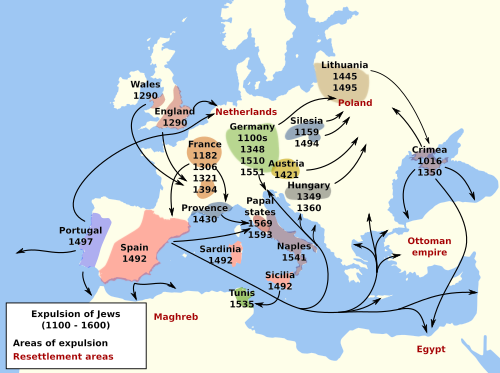
ユダヤ人の歴史を通じて、ユダヤ人は彼らの本来の故郷であるイスラエルの地と、彼らが定住した多くの地域の両方から、直接的または間接的に繰り返し追放されてきた。この難民としての経験は、多くの点でユダヤ人のアイデンティティと宗教的慣習を形成し、したがってユダヤ人の歴史の重要な要素となっている。[319]族長アブラハムは、ニムロデ王の暗殺未遂の後、カルデアのウルからカナンの地へ移住したとされている[320]。[321]聖書の物語(その史実性は不明)では、彼の子孫であるイスラエルの民は、出エジプト記に記録されているように、古代エジプトからの出エジプト(ギリシャ語で「出発」または「脱出」を意味する)を行った。[322]


数世紀後、アッシリアは征服した人々を追放し、強制移住させる政策をとり、捕虜のうち約450万人がアッシリア統治の3世紀の間にこの強制移住を経験したと推定されている。[323]イスラエルに関しては、ティグラト・ピレセル3世は下ガリラヤの人口の80%にあたる約13,520人を追放したと主張している。 [324]イスラエル王国の人口の20~25%にあたる約27,000人のイスラエル人がサルゴン2世によって追放されたとされ、他の追放された人々と入れ替わり、最初はアッシリア帝国の上メソポタミア地方にアッシリアによって永久追放された。[325] [326]ユダヤ王国からも1万人から8万人が同様にバビロニアに追放されたが、[323]これらの人々はその後、ペルシアのアケメネス朝のキュロス大王によってユダヤに帰還した。[327]
多くのユダヤ人はローマ帝国によって再び追放された。[328] 2000年にわたるユダヤ人の離散はローマ帝国の統治下で始まり、[329]ユダヤ人はローマ世界に散らばり、国から国へと追われ、[330]宗教を実践できるほど自由に暮らせる場所に定住した。離散の過程で、ユダヤ人の生活の中心はバビロニア[331]からイベリア半島[332]、ポーランド[333] 、米国[334] 、そしてシオニズムの結果としてイスラエルに戻った。 [ 335]
ヨーロッパでは中世と啓蒙時代にも多くのユダヤ人追放があった。1290年には16,000人のユダヤ人がイングランドから追放された(ユダヤ法典参照)。1396年には10万人がフランスから追放された。1421年には数千人がオーストリアから追放された。これらのユダヤ人の多くは東中央ヨーロッパ、特にポーランドに定住した。[336] 1492年のスペイン異端審問の後、スペインに住む約20万人のセファルディ系ユダヤ人がスペイン王室とカトリック教会によって追放され、続いて1493年にはシチリア島(37,000人のユダヤ人)と1496年のポルトガルでも追放が行われた。追放されたユダヤ人は主にオスマン帝国、オランダ、北アフリカに逃れ、他の者は南ヨーロッパや中東に移住した。 [337]
19世紀、フランスは宗教に関係なく平等な市民権政策をとったため、ユダヤ人(特に東欧と中央ヨーロッパ)の移民が急増した。[338]これにより、何百万人ものユダヤ人が新世界に到着した。1880年から1925年にかけて、200万人以上の東欧系ユダヤ人が米国に到着した。[339]
要約すると、東ヨーロッパでのポグロム[307] 、現代の反ユダヤ主義の台頭[340]、ホロコースト[341] 、アラブ民族主義の台頭[342]、これらすべてが、ユダヤ人の大規模な集団の移動と移住を促し、彼らがイスラエルの元々の歴史的な故郷に大挙して戻ってくるまで、国から国へ、大陸から大陸へと移動したのである[335] 。
In the latest phase of migrations, the Islamic Revolution of Iran caused many Iranian Jews to flee Iran. Most found refuge in the US (particularly Los Angeles, California, and Long Island, New York) and Israel. Smaller communities of Persian Jews exist in Canada and Western Europe.[343] Similarly, when the Soviet Union collapsed, many of the Jews in the affected territory (who had been refuseniks) were suddenly allowed to leave. This produced a wave of migration to Israel in the early 1990s.[269]
Growth
.jpg/500px-Western_Wall,_Jerusalem,_(16037897867).jpg)
Israel is the only country with a Jewish population that is consistently growing through natural population growth, although the Jewish populations of other countries, in Europe and North America, have recently increased through immigration. In the Diaspora, in almost every country the Jewish population in general is either declining or steady, but Orthodox and Haredi Jewish communities, whose members often shun birth control for religious reasons, have experienced rapid population growth.[344]
Orthodox and Conservative Judaism discourage proselytism to non-Jews, but many Jewish groups have tried to reach out to the assimilated Jewish communities of the Diaspora in order for them to reconnect to their Jewish roots. Additionally, while in principle Reform Judaism favors seeking new members for the faith, this position has not translated into active proselytism, instead taking the form of an effort to reach out to non-Jewish spouses of intermarried couples.[345]
There is also a trend of Orthodox movements reaching out to secular Jews in order to give them a stronger Jewish identity so there is less chance of intermarriage. As a result of the efforts by these and other Jewish groups over the past 25 years, there has been a trend (known as the Baal teshuva movement) for secular Jews to become more religiously observant, though the demographic implications of the trend are unknown.[346] Additionally, there is also a growing rate of conversion to Jews by Choice of gentiles who make the decision to head in the direction of becoming Jews.[347]
Contributions
Jewish individuals have played a significant role in the development and growth of Western culture,[48][348] advancing many fields of thought, science and technology,[38] both historically and in modern times,[349] including through discrete trends in Jewish philosophy, Jewish ethics[350] and Jewish literature,[38] as well as specific trends in Jewish culture, including in Jewish art, Jewish music, Jewish humor, Jewish theatre, Jewish cuisine and Jewish medicine.[351][352] Jews have established various Jewish political movements,[38] religious movements, and, through the authorship of the Hebrew Bible and parts of the New Testament,[44][45] provided the foundation for Christianity and Islam.[46][47] More than 20 percent[353][354][355][356][357][358] of the awarded Nobel Prize have gone to individuals of Jewish descent.[359]
Notes
- ^ The global core Jewish population was estimated at approximately 15,263,500 in 2022. When including individuals who identify as partly Jewish and anyone with one or two Jewish parents increases the estimate to 20,028,800. Adding individuals with a Jewish background but without Jewish parents, and non-Jewish household members living with Jews, yields an enlarged estimate of 22,720,400.[1]
- ^ The exact world Jewish population, however, is difficult to measure. In addition to issues with census methodology, disputes among proponents of halakhic, secular, political, and ancestral identification factors regarding who is a Jew may affect the figure considerably depending on the source.[37]
Citations
- ^ a b c d e f g h i j k l m n o p q American Jewish Year Book 2022. Vol. 122. 2023. doi:10.1007/978-3-031-33406-1. ISBN 978-3-031-33405-4.
- ^ a b c d e f g h i j k l m n o p Dashefsky, Arnold; Della-Pergola, Sergio; Sheskin, Ira, eds. (2021). World Jewish Population (PDF) (Report). Berman Jewish DataBank. Retrieved 4 September 2023.
- ^ a b c d e f g h "Global Jewish population hits 15.7 million ahead of new year, 46% of them in Israel | the Times of Israel". The Times of Israel.
- ^ a b c "Links". Beth Hatefutsoth. Archived from the original on 26 March 2009. Retrieved 2 April 2012.
- ^ "New Poll Shows Atheism on Rise, With Jews Found to Be Least Religious". Haaretz. Archived from the original on 19 July 2018. Retrieved 25 December 2023.
- ^ Kiaris, Hippokratis (2012). Genes, Polymorphisms and the Making of Societies: How Genetic Behavioral Traits Influence Human Cultures. Universal Publishers. p. 21. ISBN 978-1-61233-093-8.
- ^ a b Shen, Peidong; Lavi, Tal; Kivisild, Toomas; Chou, Vivian; Sengun, Deniz; Gefel, Dov; Shpirer, Issac; Woolf, Eilon; Hillel, Jossi; Feldman, Marcus W.; Oefner, Peter J. (September 2004). "Reconstruction of patrilineages and matrilineages of Samaritans and other Israeli populations from Y-Chromosome and mitochondrial DNA sequence Variation". Human Mutation. 24 (3): 248–260. doi:10.1002/humu.20077. ISSN 1059-7794. PMID 15300852. S2CID 1571356.
- ^ Ridolfo, Jim (2015). Digital Samaritans: Rhetorical Delivery and Engagement in the Digital Humanities. University of Michigan Press. p. 69. ISBN 978-0-472-07280-4.
- ^ Wade, Nicholas (9 June 2010). "Studies Show Jews' Genetic Similarity". The New York Times.
- ^ Nebel, Almut; Filon, Dvora; Weiss, Deborah A.; Weale, Michael; Faerman, Marina; Oppenheim, Ariella; Thomas, Mark G. (December 2000). "High-resolution Y chromosome haplotypes of Israeli and Palestinian Arabs reveal geographic substructure and substantial overlap with haplotypes of Jews". Human Genetics. 107 (6): 630–641. doi:10.1007/s004390000426. PMID 11153918. S2CID 8136092.
- ^ "Jews Are the Genetic Brothers of Palestinians, Syrians, and Lebanese". Sciencedaily.com. 9 May 2000. Retrieved 12 April 2013.
- ^ a b Atzmon, Gil; Hao, Li; Pe'er, Itsik; Velez, Christopher; Pearlman, Alexander; Palamara, Pier Francesco; Morrow, Bernice; Friedman, Eitan; Oddoux, Carole; Burns, Edward; Ostrer, Harry (June 2010). "Abraham's Children in the Genome Era: Major Jewish Diaspora Populations Comprise Distinct Genetic Clusters with Shared Middle Eastern Ancestry". The American Journal of Human Genetics. 86 (6): 850–859. doi:10.1016/j.ajhg.2010.04.015. PMC 3032072. PMID 20560205.
- ^ a b
- Ethnic minorities in English law. Books.google.co.uk. Retrieved on 23 December 2010.
- Edgar Litt (1961). "Jewish Ethno-Religious Involvement and Political Liberalism". Social Forces. 39 (4): 328–32. doi:10.2307/2573430. JSTOR 2573430.
- Craig R. Prentiss (2003). Religion and the Creation of Race and Ethnicity: An Introduction. NYU Press. pp. 85–. ISBN 978-0-8147-6700-9.
- The Avraham Harman Institute of Contemporary Jewry The Hebrew University of Jerusalem Eli Lederhendler Stephen S. Wise Professor of American Jewish History and Institutions (2001). Studies in Contemporary Jewry : Volume XVII: Who Owns Judaism? Public Religion and Private Faith in America and Israel: Volume XVII: Who Owns Judaism? Public Religion and Private Faith in America and Israel. Oxford University Press, USA. pp. 101–. ISBN 978-0-19-534896-5.
- Ernest Krausz; Gitta Tulea. Jewish Survival: The Identity Problem at the Close of the Twentieth Century; [... International Workshop at Bar-Ilan University on the 18th and 19th of March, 1997]. Transaction Publishers. pp. 90–. ISBN 978-1-4128-2689-1.
- John A. Shoup III (2011). Ethnic Groups of Africa and the Middle East: An Encyclopedia: An Encyclopedia. ABC-CLIO. p. 133. ISBN 978-1-59884-363-7.
- Tet-Lim N. Yee (2005). Jews, Gentiles and Ethnic Reconciliation: Paul's Jewish identity and Ephesians. Cambridge University Press. pp. 102–. ISBN 978-1-139-44411-8.
- ^ *M. Nicholson (2002). International Relations: A Concise Introduction. NYU Press. pp. 19–. ISBN 978-0-8147-5822-9. "The Jews are a nation and were so before there was a Jewish state of Israel"
- Jacob Neusner (1991). An Introduction to Judaism: A Textbook and Reader. Westminster John Knox Press. pp. 375–. ISBN 978-0-664-25348-6. "That there is a Jewish nation can hardly be denied after the creation of the State of Israel"
- Alan Dowty (1998). The Jewish State: A Century Later, Updated With a New Preface. University of California Press. pp. 3–. ISBN 978-0-520-92706-3. "Jews are a people, a nation (in the original sense of the word), an ethnos"
- Brandeis, Louis (25 April 1915). "The Jewish Problem: How To Solve It". University of Louisville School of Law. Retrieved 2 April 2012.
Jews are a distinctive nationality of which every Jew, whatever his country, his station or shade of belief, is necessarily a member
- Palmer, Edward Henry (2002) [First published 1874]. A History of the Jewish Nation: From the Earliest Times to the Present Day. Gorgias Press. ISBN 978-1-931956-69-7. OCLC 51578088. Retrieved 2 April 2012.
- ^ *Facts On File, Incorporated (2009). Encyclopedia of the Peoples of Africa and the Middle East. Infobase Publishing. pp. 337–. ISBN 978-1-4381-2676-0."The people of the Kingdom of Israel and the ethnic and religious group known as the Jewish people that descended from them have been subjected to a number of forced migrations in their history"
- Spielvogel, Jackson J. (2008). Western Civilization: Volume A: To 1500. Wadsworth Publishing. p. 36. ISBN 9780495502883.
The people of Judah survived, eventually becoming known as the Jews and giving their name to Judaism, the religion of Yahweh, the Israelite God.
- Raymond P. Scheindlin (1998). A Short History of the Jewish People: From Legendary Times to Modern Statehood. Oxford University Press. pp. 1–. ISBN 978-0-19-513941-9. Israelite origins and kingdom: "The first act in the long drama of Jewish history is the age of the Israelites"
- Cline, Eric H. (2004). Jerusalem Besieged: From Ancient Canaan to Modern Israel. Ann Arbor: University of Michigan Press. p. 33. ISBN 0-472-11313-5. OCLC 54913803.
Few would seriously challenge the belief that most modern Jews are descended from the ancient Hebrews
- Harry Ostrer MD (2012). Legacy: A Genetic History of the Jewish People. Oxford University Press. pp. 19–22. ISBN 978-0-19-997638-6.
- Spielvogel, Jackson J. (2008). Western Civilization: Volume A: To 1500. Wadsworth Publishing. p. 36. ISBN 9780495502883.
- ^ "Jew | History, Beliefs, & Facts". Britannica. Archived from the original on 1 September 2022. Retrieved 20 August 2022.
any person whose religion is Judaism. In the broader sense of the term, a Jew is any person belonging to the worldwide group that constitutes, through descent or conversion, a continuation of the ancient Jewish people, who were themselves descendants of the Hebrews of the Bible (Old Testament).
- ^ Jew. Cambridge Dictionary. Archived from the original on 6 July 2021.
a member of a people whose traditional religion is Judaism
Jew. Oxford Dictionary. Archived from the original on 13 February 2023.a member of the people and cultural community whose traditional religion is Judaism and who come from the ancient Hebrew people of Israel; a person who believes in and practises Judaism
Jew. Collins. Archived from the original on 22 July 2023.a person whose religion is Judaism", "a member of the Semitic people who claim descent from the ancient Hebrew people of Israel, are spread throughout the world, and are linked by cultural or religious ties
- ^ Eli Lederhendler (2001). Studies in Contemporary Jewry: Volume XVII: Who Owns Judaism? Public Religion and Private Faith in America and Israel. Oxford University Press. pp. 101–. ISBN 978-0-19-534896-5. "Historically, the religious and ethnic dimensions of Jewish identity have been closely interwoven. In fact, so closely bound are they, that the traditional Jewish lexicon hardly distinguishes between the two concepts. Jewish religious practice, by definition, was observed exclusively by the Jewish people, and notions of Jewish peoplehood, nation, and community were suffused with faith in the Jewish God, the practice of Jewish (religious) law and the study of ancient religious texts"
- ^ Tet-Lim N. Yee (2005). Jews, Gentiles and Ethnic Reconciliation: Paul's Jewish identity and Ephesians. Cambridge University Press. pp. 102–. ISBN 978-1-139-44411-8. "This identification in the Jewish attitude between the ethnic group and religious identity is so close that the reception into this religion of members not belonging to its ethnic group has become impossible."
- ^ M. Nicholson (2002). International Relations: A Concise Introduction. NYU Press. pp. 19–. ISBN 978-0-8147-5822-9. "The Jews are a nation and were so before there was a Jewish state of Israel"
- ^ Alan Dowty (1998). The Jewish State: A Century Later, Updated With a New Preface. University of California Press. pp. 3–. ISBN 978-0-520-92706-3. "Jews are a people, a nation (in the original sense of the word), an ethnos"
- ^ a b Ernest Krausz; Gitta Tulea (1997). Jewish Survival: The Identity Problem at the Close of the Twentieth Century; [... International Workshop at Bar-Ilan University on the 18th and 19th of March, 1997]. Transaction Publishers. pp. 90–. ISBN 978-1-4128-2689-1. "A person born Jewish who refutes Judaism may continue to assert a Jewish identity, and if he or she does not convert to another religion, even religious Jews will recognize the person as a Jew"
- ^ "A Portrait of Jewish Americans". Pew Research Center. 1 October 2013.
But the survey also suggests that Jewish identity is changing in America, where one-in-five Jews (22%) now describe themselves as having no religion.
- ^ "BBC - Religions - Judaism: Converting to Judaism". www.bbc.co.uk. Retrieved 29 September 2023.
- ^ a b John Day (2005), In Search of Pre-Exilic Israel, Bloomsbury Publishing, pp. 47.5 [48] 'In this sense, the emergence of ancient Israel is viewed not as the cause of the demise of Canaanite culture but as its upshot'.
- ^ David P Mindell (2009). The Evolving World. Harvard University Press. p. 224. ISBN 978-0-674-04108-0.
- ^ "Knowledge Resources: Judaism". Berkley Center for Religion, Peace, and World Affairs. Archived from the original on 27 August 2011. Retrieved 22 November 2011.
- ^ Albertz, Rainer (2003). Israel in Exile: The History and Literature of the Sixth Century B.C.E. Society of Biblical Lit. pp. 45ff. ISBN 978-1-58983-055-4.
Since the exilic era constitutes a gaping hole in the historical narrative of the Bible, historical reconstruction of this era faces almost insurmountable difficulties. Like the premonarchic period and the late Persian period, the exilic period, though set in the bright light of Ancient Near Eastern history, remains historically obscure. Since there are very few Israelite sources, the only recourse is to try to cast some light on this darkness from the history of the surrounding empires under whose dominion Israel came in this period.
- ^ * Marvin Perry (2012). Western Civilization: A Brief History, Volume I: To 1789. Cengage Learning. p. 87. ISBN 978-1-111-83720-4.
- Botticini, Maristella; Eckstein, Zvi (1 September 2007). "From Farmers to Merchants, Conversions and Diaspora: Human Capital and Jewish History". Journal of the European Economic Association. 5 (5): 885–926. doi:10.1162/JEEA.2007.5.5.885. "The death toll of the Great Revolt against the Roman empire amounted to about 600,000 Jews, whereas the Bar Kokhba revolt in 135 caused the death of about 500,000 Jews. Massacres account for roughly 40 percent of the decrease of the Jewish population in Palestine. Moreover, some Jews migrated to Babylon after these revolts because of the worse economic conditions. After accounting for massacres and migrations, there is an additional 30 to 40 percent of the decrease in the Jewish population in Palestine (about 1–1.3 million Jews) to be explained" (p. 19).
- Boyarin, Daniel, and Jonathan Boyarin. 2003. Diaspora: Generation and the Ground of Jewish Diaspora. p. 714 Archived 11 October 2020 at the Wayback Machine "...it is crucial to recognize that the Jewish conception of the Land of Israel is similar to the discourse of the Land of many (if not nearly all) "indigenous" peoples of the world. Somehow the Jews have managed to retain a sense of being rooted somewhere in the world through twenty centuries of exile from that someplace (organic metaphors are not out of place in this discourse, for they are used within the tradition itself). It is profoundly disturbing to hear Jewish attachment to the Land decried as regressive in the same discursive situations in which the attachment of native Americans or Australians to their particular rocks, trees, and deserts is celebrated as an organic connection to the Earth that "we" have lost" p. 714.
- Cohen, Robin (1997), Global Diasporas: An Introduction. p. 24 London: UCL Press. "...although the word Babylon often connotes captivity and oppression, a rereading of the Babylonian period of exile can thus be shown to demonstrate the development of a new creative energy in a challenging, pluralistic context outside the natal homeland. When the Romans destroyed the Second Temple in AD 70, it was Babylon that remained as the nerve- and brain-centre for Jewish life and thought...the crushing of the revolt of the Judaeans against the Romans and the destruction of the Second Temple by the Roman general Titus in AD 70 precisely confirmed the catastrophic tradition. Once again, Jews had been unable to sustain a national homeland and were scattered to the far corners of the world" (p. 24).
- Johnson, Paul A History of the Jews "The Bar Kochba Revolt," (HarperPerennial, 1987) pp. 158–61: Paul Johnson analyzes Cassius Dio's Roman History: Epitome of Book LXIX para. 13–14 (Dio's passage cited separately) among other sources: "Even if Dio's figures are somewhat exaggerated, the casualties amongst the population and the destruction inflicted on the country would have been considerable. According to Jerome, many Jews were also sold into slavery, so many, indeed, that the price of Jewish slaves at the slave market in Hebron sank drastically to a level no greater than that for a horse. The economic structure of the country was largely destroyed. The entire spiritual and economic life of the Palestinian Jews moved to Galilee. Jerusalem was now turned into a Roman colony with the official name Colonia Aelia Capitolina (Aelia after Hadrian's family name: P. Aelius Hadrianus; Capitolina after Jupiter Capitolinus). The Jews were forbidden on pain of death to set foot in the new Roman city. Aelia thus became a completely pagan city, no doubt with the corresponding public buildings and temples... We can...be certain that a statue of Hadrian was erected in the centre of Aelia, and this was tantamount in itself to a desecration of Jewish Jerusalem." p. 159.
- Cassius Dio's Roman History: Epitome of Book LXIX para. 13–14: "13 At first the Romans took no account of them. Soon, however, all Judaea had been stirred up, and the Jews everywhere were showing signs of disturbance, were gathering together, and giving evidence of great hostility to the Romans, partly by secret and partly by overt acts; 2 many outside nations, too, were joining them through eagerness for gain, and the whole earth, one might almost say, was being stirred up over the matter. Then, indeed, Hadrian sent against them his best generals. First of these was Julius Severus, who was dispatched from Britain, where he was governor, against the Jews. 3 Severus did not venture to attack his opponents in the open at any one point, in view of their numbers and their desperation, but by intercepting small groups, thanks to the number of his soldiers and his under-officers, and by depriving them of food and shutting them up, he was able, rather slowly, to be sure, but with comparatively little danger, to crush, exhaust and exterminate them. Very few of them in fact survived. Fifty of their most important outposts and nine hundred and eighty-five of their most famous villages were razed to the ground. Five hundred and eighty thousand men were slain in the various raids and battles, and the number of those that perished by famine, disease and fire was past finding out. 2 Thus nearly the whole of Judaea was made desolate, a result of which the people had had forewarning before the war. For the tomb of Solomon, which the Jews regard as an object of veneration, fell to pieces of itself and collapsed, and many wolves and hyenas rushed howling into their cities. 3 Many Romans, moreover, perished in this war. Therefore Hadrian in writing to the senate did not employ the opening phrase commonly affected by the emperors, 'If you and our children are in health, it is well; I and the legions are in health'" (para. 13–14).
- Safran, William (2005). "The Jewish Diaspora in a Comparative and Theoretical Perspective". Israel Studies. 10 (1): 36–60. doi:10.2979/ISR.2005.10.1.36. JSTOR 30245753. S2CID 144379115. Project MUSE 180371. "...diaspora referred to a very specific case—that of the exile of the Jews from the Holy Land and their dispersal throughout several parts of the globe. Diaspora [galut] connoted deracination, legal disabilities, oppression, and an often painful adjustment to a hostland whose hospitality was unreliable and ephemeral. It also connoted the existence on foreign soil of an expatriate community that considered its presence to be transitory. Meanwhile, it developed a set of institutions, social patterns, and ethnonational and/or religious symbols that held it together. These included the language, religion, values, social norms, and narratives of the homeland. Gradually, this community adjusted to the hostland environment and became itself a center of cultural creation. All the while, however, it continued to cultivate the idea of return to the homeland." (p. 36).
- Sheffer, Gabriel (2005). "Is the Jewish Diaspora Unique? Reflections on the Diaspora's Current Situation". Israel Studies. 10 (1): 1–35. doi:10.2979/ISR.2005.10.1.1. JSTOR 30245752. S2CID 143958201. Project MUSE 180374. "...the Jewish nation, which from its very earliest days believed and claimed that it was the "chosen people," and hence unique. This attitude has further been buttressed by the equally traditional view, which is held not only by the Jews themselves, about the exceptional historical age of this diaspora, its singular traumatic experiences its singular ability to survive pogroms, exiles, and Holocaust, as well as its "special relations" with its ancient homeland, culminating in 1948 with the nation-state that the Jewish nation has established there... First, like many other members of established diasporas, the vast majority of Jews no longer regard themselves as being in Galut [exile] in their host countries.…Perceptually, as well as actually, Jews permanently reside in host countries of their own free will, as a result of inertia, or as a result of problematic conditions prevailing in other hostlands, or in Israel. It means that the basic perception of many Jews about their existential situation in their hostlands has changed. Consequently, there is both a much greater self- and collective-legitimatization to refrain from making serious plans concerning "return" or actually "making Aliyah" [to emigrate, or "go up"] to Israel. This is one of the results of their wider, yet still rather problematic and sometimes painful acceptance by the societies and political systems in their host countries. It means that they, and to an extent their hosts, do not regard Jewish life within the framework of diasporic formations in these hostlands as something that they should be ashamed of, hide from others, or alter by returning to the old homeland" (p. 4).
- Davies, William David; Finkelstein, Louis; Katz, Steven T. (1984). The Cambridge History of Judaism: Volume 4, The Late Roman-Rabbinic Period. Cambridge University Press. ISBN 978-0-521-77248-8.
Although Dio's figure of 985 as the number of villages destroyed during the war seems hyperbolic, all Judaean villages, without exception, excavated thus far were razed following the Bar Kochba Revolt. This evidence supports the impression of total regional destruction following the war. Historical sources note the vast number of captives sold into slavery in Palestine and shipped abroad. ... The Judaean Jewish community never recovered from the Bar Kochba war. In its wake, Jews no longer formed the majority in Palestine, and the Jewish center moved to the Galilee. Jews were also subjected to a series of religious edicts promulgated by Hadrian that were designed to uproot the nationalistic elements with the Judaean Jewish community, these proclamations remained in effect until Hadrian's death in 138. An additional, more lasting punitive measure taken by the Romans involved expunging Judaea from the provincial name, changing it from Provincia Judaea to Provincia Syria Palestina. Although such name changes occurred elsewhere, never before or after was a nation's name expunged as the result of rebellion.
- Dalit Rom-Shiloni, Exclusive Inclusivity: Identity Conflicts Between the Exiles and the People who Remained (6th–5th Centuries BCE), A&C Black, 2013 p. xv n.3: 'it is argued that biblical texts of the Neo-Babylonian and the early Persian periods show a fierce adversarial relationship(s) between the Judean groups. We find no expressions of sympathy to the deported community for its dislocation, no empathic expressions towards the People Who Remained under Babylonian subjugation in Judah. The opposite is apparent: hostile, denigrating, and denunciating language characterizes the relationships between resident and exiled Judeans throughout the sixth and fifth centuries.' (p. xvii)
- ^ Eban, Abba Solomon (1984). Heritage: Civilization and the Jews. Simon and Schuster. ISBN 978-0-671-44103-6.
- ^ Dosick (2007), pp. 59, 60.
- ^ "Ashkenazic and Sephardic Jews - Judaism 101 (JewFAQ)". www.jewfaq.org. Retrieved 12 December 2023.
- ^ a b "The Jewish Population of the World (2014)". Jewish Virtual Library. Retrieved 30 June 2015., based on American Jewish Year Book. American Jewish Committee.
- ^ "The Holocaust". HISTORY.com. Retrieved 10 November 2015.
- ^ Mitchell, Travis (22 January 2020). "What Americans Know About the Holocaust". Pew Research Center's Religion & Public Life Project. Retrieved 16 January 2023.
- ^ Silverman, Anav (October 2012). "Jews make up only 0.2% of mankind". ynetnews.
- ^ Pfeffer, Anshel (12 September 2007). "Jewish Agency: 13.2 million Jews worldwide on eve of Rosh Hashanah, 5768". Haaretz. Archived from the original on 19 March 2009. Retrieved 24 January 2009.
- ^ a b c d e f g h Jonathan Daly (2013). The Rise of Western Power: A Comparative History of Western Civilization. A&C Black. pp. 21–. ISBN 978-1-4411-1851-6."Upon the foundation of Judaism, two civilizations centered on monotheistic religion emerged, Christianity and Islam. To these civilizations, the Jews added a leaven of astonishing creativity in business, medicine, letters, science, the arts, and a variety of other leadership roles."
- ^ "Maimonides – Internet Encyclopedia of Philosophy". utm.edu. Retrieved 26 August 2015.
- ^ Sekine, Seizo (20 January 2005). A Comparative Study of the Origins of Ethical Thought: Hellenism and Hebraism. Sheed & Ward. ISBN 978-1-4616-7459-7.[page needed]
- ^ "Broadway Musicals: A Jewish Legacy". DC Theatre Scene.
- ^ Rabin, Roni Caryn (14 May 2012). "Tracing the Path of Jewish Medical Pioneers". The New York Times. ISSN 0362-4331. Retrieved 20 August 2022.
- ^ Shatzmiller, Joseph. Doctors to Princes and Paupers: Jews, Medicine, and Medieval Society. Berkeley: U of California, 1995. Print.
- ^ a b Max I. Dimont (2004). Jews, God, and History. Penguin Publishing Group. pp. 102–. ISBN 978-1-101-14225-7. "During the subsequent five hundred years, under Persian, Greek and Roman domination, the Jews wrote, revised, admitted and canonized all the books now comprising the Jewish Old Testament"
- ^ a b Julie Galambush (2011). The Reluctant Parting: How the New Testament's Jewish Writers Created a Christian Book. HarperCollins. pp. 3–. ISBN 978-0-06-210475-5."The fact that Jesus and his followers who wrote the New Testament were first-century Jews, then, produces as many questions as it does answers concerning their experiences, beliefs, and practices"
- ^ a b John M. G. Barclay; John Philip McMurdo Sweet (1996). Early Christian Thought in Its Jewish Context. Cambridge University Press. pp. 20–. ISBN 978-0-521-46285-3."Early Christianity began as a Jewish movement in first-century Palestine"
- ^ a b Dr. Andrea C. Paterson (2009). Three Monotheistic Faiths – Judaism, Christianity, Islam: An Analysis and Brief History. AuthorHouse. pp. 41–. ISBN 978-1-4520-3049-4. "Judaism also contributed to the religion of Islam for Islam derives its ideas of holy text, the Qur'an, ultimately from Judaism. The dietary and legal codes of Islam are based on those of Judaism. The basic design of the mosque, the Islamic house of worship, comes from that of the early synagogues. The communal prayer services of Islam and their devotional routines resembles those of Judaism."
- ^ a b Cambridge University Historical Series, An Essay on Western Civilization in Its Economic Aspects, p. 40: "Hebraism, like Hellenism, has been an all-important factor in the development of Western Civilization; Judaism, as the precursor of Christianity, has indirectly had much to do with shaping the ideals and morality of Western nations since the Christian era."
- ^ "Judaism – The Judaic tradition | Britannica". Encyclopædia Britannica. Retrieved 20 August 2022.
Judaism has played a significant role in the development of Western culture because of its unique relationship with Christianity, the dominant religious force in the West
- ^ Grintz, Yehoshua M. (2007). "Jew". In Berenbaum, Michael; Skolnik, Fred (eds.). Encyclopaedia Judaica. Vol. 11 (2nd ed.). Detroit: Macmillan Reference. p. 253. ISBN 978-0-02-866097-4.
- ^ "Jew | History, Beliefs, & Facts | Britannica". www.britannica.com. 3 July 2024. Retrieved 6 July 2024.
- ^ Cf. Marcus Jastrow's Dictionary of the Targumim, Talmud Babli, Talmud Yerushalmi and Midrashic Literature, and the source he used: Megilla 13a:2 (Talmud).
- ^ a b Amy-Jill Levine. The Misunderstood Jew: The Church and the Scandal of the Jewish Jesus. San Francisco: HarperSanFrancisco, 2006, page 162
- ^ a b "Jew", Oxford English Dictionary.
- ^ "Jew | History, Beliefs, & Facts | Britannica". www.britannica.com. 3 July 2024. Retrieved 6 July 2024.
- ^ Botterweck, G. Johannes; Ringgren, Helmer, eds. (1986). Theological Dictionary of the Old Testament. Vol. V. Translated by Green, David E. Grand Rapids, Mich.: William B. Eerdmans. pp. 483–84. ISBN 978-0-8028-2329-8.
- ^ Julia Phillips Berger; Sue Parker Gerson (2006). Teaching Jewish History. Behrman House, Inc. p. 41. ISBN 978-0-86705-183-4.
- ^ "Jew | History, Beliefs, & Facts | Britannica". www.britannica.com. 3 July 2024. Retrieved 6 July 2024.
- ^ Chouraqui, André (1975). The people and the faith of the Bible. Internet Archive. Amherst : University of Massachusetts Press. p. 43. ISBN 978-0-87023-172-8.
- ^ Staples, Jason A. (2021). "The Idea of Israel in Second Temple Judaism: A New Theory of People, Exile, and Israelite Identity". Cambridge University Press: 25–53. doi:10.1017/9781108906524. ISBN 9781108906524. S2CID 235573883 – via Cambridge Core.
- ^ Encyclopedia of the Peoples of Africa and the Middle East, Facts On File Inc., Infobase Publishing, 2009, p. 336
- ^ Adele Reinhartz, "The Vanishing Jews of Antiquity" Archived 22 August 2017 at the Wayback Machine "Marginalia", L.A. Review of Books, 24 June 2014.
- ^ Danker, Frederick W. "Ioudaios", in A Greek-English Lexicon of the New Testament and Other Early Christian Literature. third edition University of Chicago Press. ISBN 978-0226039336
- ^ Schwartz, Daniel R. (2014). Judeans and Jews: Four Faces of Dichotomy in Ancient Jewish History. University of Toronto Press. pp. 3–10. ISBN 978-1442648395. JSTOR 10.3138/j.ctt1287s34.
- ^ Cohen, Shaye J.D. (2001). The Beginnings of Jewishness: Boundaries, Varieties, Uncertainties. University of California Press. ISBN 9780520226937.
- ^ Martin, Troy W. (2003). "The Covenant of Circumcision (Genesis 17:9-14) and the Situational Antitheses in Galatians 3:28". Journal of Biblical Literature. 122 (1): 111–125. doi:10.2307/3268093. JSTOR 3268093 – via JSTOR.
- ^ Falk, Avner (1996). A Psychoanalytic History of the Jews. Madison, N.J.: Fairleigh Dickinson University Press. p. 131. ISBN 0-8386-3660-8.
- ^ "Yiddish". Merriam-Webster's Collegiate Dictionary (11th ed.). Springfield, Massachusetts: Merriam-Webster. 2004. p. 1453. ISBN 0-87779-809-5.
- ^ Kleinedler, Steven; Spitz, Susan; et al., eds. (2005). The American Heritage Guide to Contemporary Usage and Style. Houghton Mifflin Company. Jew. ISBN 978-0-618-60499-9.
- ^ M. Nicholson (2002). International Relations: A Concise Introduction. NYU Press. pp. 19–. ISBN 978-0-8147-5822-9. "The Jews are a nation and were so before there was a Jewish state of Israel"
- ^ Jacob Neusner (1991). An Introduction to Judaism: A Textbook and Reader. Westminster John Knox Press. pp. 375–. ISBN 978-0-664-25348-6. "That there is a Jewish nation can hardly be denied after the creation of the State of Israel"
- ^ Alan Dowty (1998). The Jewish State: A Century Later, Updated With a New Preface. University of California Press. pp. 3–. ISBN 978-0-520-92706-3. "Jews are a people, a nation (in the original sense of the word), an ethnos"
- ^ Brandeis, Louis (25 April 1915). "The Jewish Problem: How To Solve It". University of Louisville School of Law. Retrieved 2 April 2012.
Jews are a distinctive nationality of which every Jew, whatever his country, his station or shade of belief, is necessarily a member
- ^ Palmer, Edward Henry (2002) [First published 1874]. A History of the Jewish Nation: From the Earliest Times to the Present Day. Gorgias Press. ISBN 978-1-931956-69-7. OCLC 51578088. Retrieved 2 April 2012.
- ^ Einstein, Albert (21 June 1921). "How I Became a Zionist" (PDF). Einstein Papers Project. Princeton University Press. Archived from the original (PDF) on 5 November 2015. Retrieved 5 April 2012.
The Jewish nation is a living fact
- ^ David M. Gordis; Zachary I. Heller (2012). Jewish Secularity: The Search for Roots and the Challenges of Relevant Meaning. University Press of America. pp. 1–. ISBN 978-0-7618-5793-8.: "Judaism is a culture and a civilization which embraces the secular as well"
- ^ Seth Daniel Kunin (2000). Themes and Issues in Judaism. A&C Black. pp. 1–. ISBN 978-0-304-33758-3.: Although culture - and Judaism is a culture (or cultures) as well as religion - can be subdivided into different analytical categories..."
- ^ Paul R. Mendes-Flohr (1991). Divided Passions: Jewish Intellectuals and the Experience of Modernity. Wayne State University Press. pp. 421–. ISBN 0-8143-2030-9.: "Although Judaism is a culture - or rather has a culture - it is eminently more than a culture"
- ^ Weiner, Rebecca (2007). "Who is a Jew?". Jewish Virtual Library. Retrieved 6 October 2007.
- ^ Fowler, Jeaneane D. (1997). World Religions: An Introduction for Students. Sussex Academic Press. p. 7. ISBN 1-898723-48-6.
- ^ "What is the origin of Matrilineal Descent?". Shamash.org. 4 September 2003. Archived from the original on 18 October 1996. Retrieved 9 January 2009.
- ^ "What is the source of the law that a child is Jewish only if its mother is Jewish?". Torah.org. Archived from the original on 24 December 2008. Retrieved 9 January 2009.
- ^ a b Emma Klein (2016). Lost Jews: The Struggle for Identity Today. Springer. pp. 6–. ISBN 978-1-349-24319-8.
- ^ Robin May Schott (2010). Birth, Death, and Femininity: Philosophies of Embodiment. Indiana University Press. pp. 67–. ISBN 978-0-253-00482-6.
- ^ Dosick (2007), pp. 56–57.
- ^ a b Shaye J.D. Cohen (1999). The Beginnings of Jewishness. U. California Press. pp. 305–06. ISBN 0-585-24643-2.
- ^ Mieroop, Marc Van De (2010). A History of Ancient Egypt. John Wiley & Sons. p. 131. ISBN 978-1-4051-6070-4.
- ^ Bard, Kathryn A. (2015). An Introduction to the Archaeology of Ancient Egypt. John Wiley & Sons. p. 188. ISBN 978-1-118-89611-2.
- ^ Curry, Andrew (2018). "The Rulers of Foreign Lands". Archaeology Magazine.
- ^ Kamrin, Janice (2009). "The Aamu of Shu in the Tomb of Khnumhotep II at Beni Hassan". Journal of Ancient Egyptian Interconnections. 1 (3): 22–36. S2CID 199601200.
- ^ Kuan, Jeffrey Kah-Jin (2016). Neo-Assyrian Historical Inscriptions and Syria-Palestine: Israelite/Judean-Tyrian-Damascene Political and Commercial Relations in the Ninth-Eighth Centuries BCE. Wipf and Stock Publishers. pp. 64–66. ISBN 978-1-4982-8143-0.
- ^ Cohen, Ada; Kangas, Steven E. (2010). Assyrian Reliefs from the Palace of Ashurnasirpal II: A Cultural Biography. UPNE. p. 127. ISBN 978-1-58465-817-7.
- ^ Ostrer, Harry (2012). Legacy: A Genetic History of the Jewish People. Oxford University Press (published 8 May 2012). ISBN 978-0-19-537961-7.
- ^ Killebrew, Ann E. (October 2005). Biblical Peoples and Ethnicity: An Archaeological Study of Egyptians, Canaanite. Society of Biblical Lit. ISBN 978-1-58983-097-4.
- ^ Schama, Simon (2014). The Story of the Jews: Finding the Words 1000 BC–1492 AD. HarperCollins. ISBN 978-0-06-233944-7.
- ^ * "In the broader sense of the term, a Jew is any person belonging to the worldwide group that constitutes, through descent or conversion, a continuation of the ancient Jewish people, who were themselves the descendants of the Hebrews of the Old Testament."
- "The Jewish people as a whole, initially called Hebrews (ʿIvrim), were known as Israelites (Yisreʾelim) from the time of their entrance into the Holy Land to the end of the Babylonian Exile (538 BC)."
- ^ Ostrer, Harry (2012). Legacy: A Genetic History of the Jewish People. Oxford University Press, USA. ISBN 978-0-19-970205-3.
- ^ Brenner, Michael (2010). A Short History of the Jews. Princeton University Press. ISBN 978-0-691-14351-4.
- ^ Adams, Hannah (1840). The History of the Jews: From the Destruction of Jerusalem to the Present Time. London Society House.
- ^ Rendsburg, Gary A. (31 December 2022), "1 Israel Without the Bible", The Hebrew Bible, New York University Press, pp. 1–23, doi:10.18574/nyu/9780814733080.003.0005, ISBN 978-0-8147-3308-0, retrieved 7 December 2023
- ^ a b Broshi, Maguen (2001). Bread, Wine, Walls and Scrolls. Bloomsbury Publishing. p. 174. ISBN 1-84127-201-9.
- ^ "Judah". Encyclopædia Britannica, Inc. Retrieved 1 April 2018.
- ^ "Israelite refugees found high office in Kingdom of Judah, seals found in Jerusalem show". Haaretz.
- ^ Spielvogel, Jackson J. (2012). Western civilization (8th ed.). Australia: Wadsworth/Cengage Learning. p. 33. ISBN 978-0-495-91324-5.
What is generally agreed, however, is that between 1200 and 1000 B.C.E., the Israelites emerged as a distinct group of people, possibly united into tribes or a league of tribes
- ^ Noll, K. L. (7 December 2012). Canaan and Israel in Antiquity: A Textbook on History and Religion: Second Edition. A&C Black. ISBN 978-0-567-44117-1.
- ^ Thompson, Thomas L. (1 January 2000). Early History of the Israelite People: From the Written & Archaeological Sources. BRILL. pp. 137ff. ISBN 978-90-04-11943-7.
They are rather a very specific group among the population of Palestine which bears a name that occurs here for the first time that at a much later stage in Palestine's history bears a substantially different signification.
- ^ Yoder, John C. (2015). Power and Politics in the Book of Judges: Men and Women of Valor. Augsburg Fortress Publishers. ISBN 978-1-4514-9642-0.
- ^ Marc Zvi Brettler (2002). The Book of Judges. Psychology Press. p. 107. ISBN 978-0-415-16216-6.
- ^ Thomas L. Thompson (2000). Early History of the Israelite People: From the Written & Archaeological Sources. Brill. p. 96. ISBN 90-04-11943-4.
- ^ Hjelm, Ingrid; Thompson, Thomas L, eds. (2016). History, Archaeology and The Bible Forty Years After "Historicity": Changing Perspectives. Routledge. p. 4. ISBN 978-1-317-42815-2.
- ^ Philip R. Davies (1995). In Search of "Ancient Israel": A Study in Biblical Origins. A&C Black. p. 26. ISBN 978-1-85075-737-5.
- ^ Lipschits, Oded (2014). "The History of Israel in the Biblical Period". In Berlin, Adele; Brettler, Marc Zvi (eds.). The Jewish Study Bible (2nd ed.). Oxford University Press. ISBN 978-0-19-997846-5.
- ^ a b c Finkelstein, Israel; Silberman, Neil Asher (2001). The Bible unearthed : archaeology's new vision of ancient Israel and the origin of its stories (1st Touchstone ed.). New York: Simon & Schuster. ISBN 0-684-86912-8.
- ^ a b Kuhrt, Amiele (1995). The Ancient Near East. Routledge. p. 438. ISBN 978-0-415-16762-8.
- ^ a b Wright, Jacob L. (July 2014). "David, King of Judah (Not Israel)". The Bible and Interpretation.
- ^ Holloway, Steven W.; Handy, Lowell K. (1 May 1995). The Pitcher is Broken: Memorial Essays for Gösta W. Ahlström. Bloomsbury Publishing. ISBN 978-0-567-63671-3.
For Israel, the description of the battle of Qarqar in the Kurkh Monolith of Shalmaneser III (mid-ninth century) and for Judah, a Tiglath-pileser III text mentioning (Jeho-) Ahaz of Judah (IIR67 = K. 3751), dated 734–733, are the earliest published to date.
- ^ Garfinkel, Yosef; Ganor, Saar (31 December 2008). "Khirbet Qeiyafa: Sha'arayim". Journal of Hebrew Scriptures. 8. doi:10.5508/jhs.2008.v8.a22.
- ^ a b Baker, Luke (3 February 2017). "Ancient tablets reveal life of Jews in Nebuchadnezzar's Babylon". Reuters.
- ^ Rendsburg, Gary A.. "1 Israel Without the Bible". The Hebrew Bible: New Insights and Scholarship, edited by Frederick E. Greenspahn, New York, USA: New York University Press, 2007, p. 7. https://doi.org/10.18574/nyu/9780814733080.003.0005: "I am not sure I can quantify the schools, that is, tell you that the majority of biblical scholars today are maximalist or minimalist - I suppose the divide is about 50-50 - But I can tell you this: there is no doubt that the minimalists are more vocal, and they are the ones who set the agenda, publish books at a very rapid pace, organize conferences to present their views (especially in Europe) and take advantage of the popular press. The maximalists, in turn, frequently are left to respond to these diatribes, often needing to take time away from their own research to counter the views expressed in the many publications emanating from the pens of minimalist scholars."
- ^ Tubb, 1998. pp. 13–14[full citation needed]
- ^ Mark Smith in "The Early History of God: Yahweh and Other Deities of Ancient Israel" states "Despite the long regnant model that the Canaanites and Israelites were people of fundamentally different culture, archaeological data now casts doubt on this view. The material culture of the region exhibits numerous common points between Israelites and Canaanites in the Iron I period (c. 1200–1000 BCE). The record would suggest that the Israelite culture largely overlapped with and derived from Canaanite culture... In short, Israelite culture was largely Canaanite in nature. Given the information available, one cannot maintain a radical cultural separation between Canaanites and Israelites for the Iron I period." (pp. 6–7). Smith, Mark (2002) "The Early History of God: Yahweh and Other Deities of Ancient Israel" (Eerdman's)
- ^ Rendsberg, Gary (2008). "Israel without the Bible". In Frederick E. Greenspahn. The Hebrew Bible: New Insights and Scholarship. NYU Press, pp. 3–5
- ^ Dever, William (2001). What Did the Biblical Writers Know, and When Did They Know It?. Eerdmans. pp. 98–99. ISBN 3-927120-37-5.
After a century of exhaustive investigation, all respectable archaeologists have given up hope of recovering any context that would make Abraham, Isaac, or Jacob credible "historical figures" [...] archaeological investigation of Moses and the Exodus has similarly been discarded as a fruitless pursuit.
- ^ Rendsburg, Gary A.. "1 Israel Without the Bible". The Hebrew Bible: New Insights and Scholarship, edited by Frederick E. Greenspahn, New York, USA: New York University Press, 2007, pp. 7-23. https://doi.org/10.18574/nyu/9780814733080.003.0005
- ^ Jared Diamond (1993). "Who are the Jews?" (PDF). Archived from the original (PDF) on 21 July 2011. Retrieved 8 November 2010. Natural History 102:11 (November 1993): 12–19.
- ^ Hammer, MF; Redd, AJ; Wood, ET; et al. (June 2000). "Jewish and Middle Eastern non-Jewish populations share a common pool of Y-chromosome biallelic haplotypes". Proc. Natl. Acad. Sci. U.S.A. 97 (12): 6769–74. Bibcode:2000PNAS...97.6769H. doi:10.1073/pnas.100115997. PMC 18733. PMID 10801975.
- ^ Wade, Nicholas (9 May 2000). "Y Chromosome Bears Witness to Story of the Jewish Diaspora". The New York Times. Retrieved 10 October 2012.
- ^ Balter, Michael (3 June 2010). "Tracing the Roots of Jewishness". Science. Retrieved 4 October 2018.
- ^ Genes, Behavior, and the Social Environment:: Moving Beyond the Nature ...By Committee on Assessing Interactions Among Social, Behavioral, and Genetic Factors in Health, Board on Health Sciences Policy, Institute of Medicine, Lyla M. Hernandez. National Academies Press. 2006. p. 100. ISBN 978-0-309-10196-7.
- ^ Stager 1998, p. 91.
- ^ Dever, William G. (2001). What Did the Biblical Writers Know and When Did They Know It?: What Archeology Can Tell Us About the Reality of Ancient Israel. Wm. B. Eerdmans Publishing. ISBN 978-0-8028-2126-3.
- ^ McNutt 1999, p. 35.
- ^ a b Dever 2003, p. 206.
- ^ Finkelstein & Silberman 2002, pp. 146–7Put simply, while Judah was still economically marginal and backward, Israel was booming. [...] In the next chapter we will see how the northern kingdom suddenly appeared on the ancient Near Eastern stage as a major regional power
- ^ Lemaire, André (2018). "Israel and Judah". The Oxford Illustrated History of the Holy Land. Robert G. Hoyland, H. G. M. Williamson (1st ed.). Oxford University Press. pp. 61–85. ISBN 978-0-19-872439-1. OCLC 1017604304.
- ^ Tobolowsky 2022, pp. 69–70, 73–75.
- ^ Ben-Sasson, Haim Hillel, ed. (1976). A History of the Jewish People. Harvard University Press. p. 142. ISBN 978-0674397316. Retrieved 12 October 2018.
Sargon's heir, Sennacherib (705–681), could not deal with Hezekiah's revolt until he gained control of Babylon in 702 BCE.
- ^ Finkelstein, Israel and Mazar, Amihai. The Quest for the Historical Israel: Debating Archaeology and the History of Early Israel. Leiden: Brill, 2007. p. 166.
- ^ Lipiński 2020, p. 94.
- ^ Lipschits, Oded (2005). The Fall and Rise of Jerusalem: Judah under Babylonian Rule. Penn State University Press. p. 367. doi:10.5325/j.ctv1bxh5fd. ISBN 978-1-57506-297-6. JSTOR 10.5325/j.ctv1bxh5fd.
- ^ a b "Second Temple Period (538 BCE. to 70 CE) Persian Rule". Biu.ac.il. Retrieved 15 March 2014.
- ^ Harper's Bible Dictionary, ed. by Achtemeier, etc., Harper & Row, San Francisco, 1985, p. 103
- ^ Yehud being the Aramaic equivalent of the Hebrew Yehuda, or "Judah", and "medinata" the word for province
- ^ Grabbe, Lester L. (2004). A History of the Jews and Judaism in the Second Temple Period: Yehud – A History of the Persian Province of Judah v. 1. T & T Clark. p. 355. ISBN 978-0-567-08998-4.
- ^ Peter Fibiger Bang; Walter Scheidel (2013). The Oxford Handbook of the State in the Ancient Near East and Mediterranean. Oxford University Press. pp. 184–187. ISBN 978-0-19-518831-8. Archived from the original on 9 April 2023. Retrieved 16 January 2023.
- ^ Stern, Menahem. (2007). "Hasmoneans". In Skolnik, Fred (ed.). Encyclopaedia Judaica Volume 8 Gos–Hep (2nd ed.). Michigan: Thompson Gale. p. 446.
- ^ Levin, Yigal (24 September 2020). "The Religion of Idumea and Its Relationship to Early Judaism". Religions. 11 (10): 487. doi:10.3390/rel11100487. ISSN 2077-1444.
- ^ Strabo, Geography Bk.16.2.34
- ^ Peter Fibiger Bang; Walter Scheidel (2013). The Oxford Handbook of the State in the Ancient Near East and Mediterranean. OUP USA. pp. 184–87. ISBN 978-0-19-518831-8.
- ^ Abraham Malamat (1976). A History of the Jewish People. Harvard University Press. pp. 223–239. ISBN 978-0-674-39731-6.
- ^ Zissu, Boaz (2018). "Interbellum Judea 70-132 CE: An Archaeological Perspective". Jews and Christians in the First and Second Centuries: The Interbellum 70‒132 CE. Joshua Schwartz, Peter J. Tomson. Brill. p. 19. ISBN 978-90-04-34986-5. OCLC 988856967.
- ^ Erwin Fahlbusch; Geoffrey William Bromiley (2005). The Encyclopedia of Christianity. Wm. B. Eerdmans Publishing. pp. 15–. ISBN 978-0-8028-2416-5. Archived from the original on 9 April 2023. Retrieved 16 January 2023.
- ^ a b c d Goodman, Martin (2018). A History of Judaism. Princeton Oxford: Princeton University Press. pp. 21, 232. ISBN 978-0-691-18127-1.
- ^ Mor, M. The Second Jewish Revolt: The Bar Kokhba War, 132–136 CE. Brill, 2016. P471/
- ^ Raviv, Dvir; Ben David, Chaim (27 May 2021). "Cassius Dio's figures for the demographic consequences of the Bar Kokhba War: Exaggeration or reliable account?". Journal of Roman Archaeology. 34 (2): 585–607. doi:10.1017/S1047759421000271. ISSN 1047-7594. S2CID 236389017.
- ^ Powell, The Bar Kokhba War AD 132-136, Osprey Publishing, Oxford, ç2017, p.80
- ^ a b Kerkeslager, Allen; Setzer, Claudia; Trebilco, Paul; Goodblatt, David (2006), Katz, Steven T. (ed.), "The Diaspora from 66 to c. 235 ce", The Cambridge History of Judaism: Volume 4: The Late Roman-Rabbinic Period, The Cambridge History of Judaism, vol. 4, Cambridge: Cambridge University Press, pp. 62–63, doi:10.1017/chol9780521772488.004, ISBN 978-0-521-77248-8, retrieved 10 September 2024
- ^ Zeev, Miriam Pucci Ben (22 June 2006), Katz, Steven T. (ed.), "The uprisings in the Jewish Diaspora, 116–117", The Cambridge History of Judaism (1 ed.), Cambridge University Press, p. 98, doi:10.1017/chol9780521772488.005, ISBN 978-1-139-05513-0, retrieved 8 September 2024
- ^ Jodi Magness (2011). "Sectarianism before and after 70 CE". In Daniel R. Schwartz; Zeev Weiss (eds.). Was 70 CE a Watershed in Jewish History?: On Jews and Judaism before and after the Destruction of the Second Temple. Brill. ISBN 978-90-04-21744-7.
- ^ Karesh, Sara E. (2006). Encyclopedia of Judaism. Facts On File. ISBN 978-1-78785-171-9. OCLC 1162305378.
Until the modern period, the destruction of the Temple was the most cataclysmic moment in the history of the Jewish people. Without the Temple, the Sadducees no longer had any claim to authority, and they faded away. The sage Yochanan ben Zakkai, with permission from Rome, set up the outpost of Yavneh to continue develop of Pharisaic, or rabbinic, Judaism.
- ^ Erich S. Gruen, Diaspora: Jews Amidst Greeks and Romans Harvard University Press, 2009 pp. 3–4, 233–34: 'Compulsory dislocation, .…cannot have accounted for more than a fraction of the diaspora. … The vast bulk of Jews who dwelled abroad in the Second Temple Period did so voluntarily.' (2)' .Diaspora did not await the fall of Jerusalem to Roman power and destructiveness. The scattering of Jews had begun long before-occasionally through forced expulsion, much more frequently through voluntary migration.'
- ^ Zadok R. Judeans in Babylonia–Updating the Dossier. in U.Gabbay and Sh.Secunda. (eds.). Encounters by the Rivers of Babylon: Scholarly Conversations between Jews, Iranians and Babylonians in Antiquity, Texts and Studies in Ancient Judaism 160. Tübingen: MohrSiebeck. pp. 109–110.
- ^ Josephus Flavius, Against Appion. 4.II
- ^ E. Mary Smallwood (1984). "The Diaspora in the Roman period before AD 70". In William David Davies; Louis Finkelstein; William Horbury (eds.). The Cambridge History of Judaism: The early Roman period, Volume 3. Cambridge University Press. ISBN 978-0521243773.
- ^ a b c Ehrlich, Michael (2022). The Islamization of the Holy Land, 634–1800. Leeds, UK: Arc Humanities Press. pp. 3–4. ISBN 978-1-64189-222-3. OCLC 1302180905.
The Jewish community strove to recover from the catastrophic results of the Bar Kokhva revolt (132–135 CE). Although some of these attempts were relatively successful, the Jews never fully recovered. During the Late Roman and Byzantine periods, many Jews emigrated to thriving centres in the diaspora, especially Iraq, whereas some converted to Christianity and others continued to live in the Holy Land, especially in Galilee and the coastal plain. During the Byzantine period, the three provinces of Palestine included more than thirty cities, namely, settlements with a bishop see. After the Muslim conquest in the 630s, most of these cities declined and eventually disappeared. As a result, in many cases the local ecclesiastical administration weakened, while in others it simply ceased to exist. Consequently, many local Christians converted to Islam. Thus, almost twelve centuries later, when the army led by Napoleon Bonaparte arrived in the Holy Land, most of the local population was Muslim.
- ^ Oppenheimer, A'haron and Oppenheimer, Nili. Between Rome and Babylon: Studies in Jewish Leadership and Society. Mohr Siebeck, 2005, p. 2.
- ^ Leibner, Uzi (2009). Settlement and History in Hellenistic, Roman, and Byzantine Galilee: An Archaeological Survey of the Eastern Galilee. Mohr Siebeck. pp. 321–324, 362–371, 396–400, 414–416. hdl:20.500.12657/43969. ISBN 978-3-16-151460-9.
- ^ a b Edward Kessler (2010). An Introduction to Jewish-Christian Relations. Cambridge University Press. p. 72. ISBN 978-0-521-70562-2.
Jews probably remained in the majority in Palestine until some time after the conversion of Constantine in the fourth century. [...] In Babylonia, there had been for many centuries a Jewish community which would have been further strengthened by those fleeing the aftermath of the Roman revolts.
- ^ Gafni, Isaiah (2006), Katz, Steven T. (ed.), "The Political, Social, and Economic History of Babylonian Jewry, 224–638 CE", The Cambridge History of Judaism: Volume 4: The Late Roman-Rabbinic Period, The Cambridge History of Judaism, vol. 4, Cambridge: Cambridge University Press, p. 805, doi:10.1017/chol9780521772488.033, ISBN 978-0-521-77248-8, retrieved 10 September 2024
- ^ "Talmud and Midrash (Judaism) :: The making of the Talmuds: 3rd–6th century". Encyclopædia Britannica. 2008. Retrieved 28 October 2013.
- ^ Ben-Sasson, Haim Hillel (1972) [1969]. Ettinger, Samuel (ed.). Jewish society through the ages. Schocken Books. OCLC 581911264.
- ^ The Jews of the Middle East and North Africa in Modern Times. Columbia University Press. 2002. JSTOR 10.7312/simo10796.
- ^ Harshav, Benjamin (1999). The Meaning of Yiddish. Stanford: Stanford University Press. p. 6. "From the fourteenth and certainly by the sixteenth century, the center of European Jewry had shifted to Poland, then ... comprising the Grand Duchy of Lithuania (including today's Byelorussia), Crown Poland, Galicia, the Ukraine and stretching, at times, from the Baltic to the Black Sea, from the approaches to Berlin to a short distance from Moscow."
- ^ "GAON – JewishEncyclopedia.com". www.jewishencyclopedia.com. Retrieved 23 June 2020.
- ^ Schloss, Chaim (2002). 2000 Years of Jewish History: From the Destruction of the Second Bais Hamikdash Until the Twentieth Century. Feldheim Publishers. ISBN 978-1-58330-214-9.
- ^ Kornberg 1993 "How did Theodor Herzl, an assimilated German nationalist in the 1880s, suddenly in the 1890s become the founder of Zionism?"
- ^ "Chapter One". The Jewish Agency for Israel1. 21 July 2005. Archived from the original on 10 December 2018. Retrieved 21 September 2015.
- ^ Lewin, Rhoda G. (1979). "Stereotype and reality in the Jewish immigrant experience in Minneapolis" (PDF). Minnesota History. 46 (7): 259. Archived (PDF) from the original on 21 July 2020. Retrieved 10 August 2020.
- ^ "Jewish Nobel Prize Winners". jinfo.org. Archived from the original on 24 December 2018. Retrieved 7 October 2011.
- ^ "BBC Religions/Converting to Judaism: "A person who converts to Judaism becomes a Jew in every sense of the word, and is just as Jewish as someone born into Judaism."". Bbc.co.uk. Retrieved 2 October 2013.
- ^ "Are Converts Treated as Second Class?". InterfaithFamily. 2 May 2011.
- ^ "Paul Golin: The Complicated Relationship Between Intermarriage and Jewish Conversion". Huffingtonpost.com. 31 March 2011. Retrieved 2 October 2013.
- ^ Neusner (1991) p. 64
- ^ Patai, Raphael (1996) [1977]. The Jewish Mind. Detroit: Wayne State University Press. p. 7. ISBN 0-8143-2651-X.
- ^ Johnson, Lonnie R. (1996). Central Europe: Enemies, Neighbors, Friends. Oxford: Oxford University Press. p. 145. ISBN 0-19-510071-9.
- ^ a b Sharot (1997), pp. 29–30.
- ^ Sharot (1997), pp. 42–43.
- ^ Sharot (1997), p. 42.
- ^ Fishman, Sylvia Barack (2000). Jewish Life and American Culture. Albany, N.Y.: State University of New York Press. p. 38. ISBN 0-7914-4546-1.
- ^ Kimmerling, Baruch (1996). The Israeli State and Society: Boundaries and Frontiers. Albany, N.Y.: State University of New York Press. p. 169. ISBN 0-88706-849-9.
- ^ Lowenstein, Steven M. (2000). The Jewish Cultural Tapestry: International Jewish Folk Traditions. Oxford: Oxford University Press. p. 228. ISBN 0-19-513425-7.
- ^ a b Grintz, Jehoshua M. (March 1960). "Hebrew as the Spoken and Written Language in the Last Days of the Second Temple". Journal of Biblical Literature. 79 (1). The Society of Biblical Literature: 32–47. doi:10.2307/3264497. JSTOR 3264497.
- ^ Feldman (2006), p. 54.
- ^ Parfitt, T. V. (1972). "The Use Of Hebrew In Palestine 1800–1822". Journal of Semitic Studies. 17 (2): 237–252. doi:10.1093/jss/17.2.237.
- ^ "Basic Law: Israel – The Nation State Of The Jewish People" (PDF). The Knesset. Knesset of the State of Israel. Archived from the original (PDF) on 10 April 2021. Retrieved 3 September 2020.
- ^ Nava Nevo (2001). International Handbook of Jewish Education. Springer. p. 428. ISBN 978-94-007-0354-4.
In contrast to other peoples who are masters of their national languages, Hebrew is not the 'common possession' of all Jewish people, and it mainly—if not exclusively—lives and breathes in Israel.... Although there are oases of Hebrew in certain schools, it has not become the Jewish lingua franca and English is rapidly taking its place as the Jewish people's language of communication. Even Hebrew-speaking Israeli representatives tend to use English in their public appearances at international Jewish conventions.
- ^ Chaya Herman (2006). Prophets and Profits: Managerialism and the Restructuring of Jewish Schools in South Africa. HSRC Press. p. 121. ISBN 978-0-7969-2114-7.
It is English rather than Hebrew that emerged as the lingua franca of the Jews towards the late 20th century.... This phenomenon occurred despite efforts to make Hebrew a language of communication, and despite the fact that the teaching of Hebrew was considered the raison d'être of the Jewish day schools and the 'nerve center' of Jewish learning.
- ^ Elana Shohamy (2010). Negotiating Language Policy in Schools: Educators as Policymakers. Routledge. p. 185. ISBN 978-1-135-14621-4.
This priority given to English is related to the special relationship between Israel and the United States, and the current status of English as a lingua franca for Jews worldwide.
- ^ Elan Ezrachi (2012). Dynamic Belonging: Contemporary Jewish Collective Identities. Bergahn Books. p. 214. ISBN 978-0-85745-258-0.
As Stephen P. Cohen observes: 'English is the language of Jewish universal discourse.'
- ^ "Jewish Languages – How Do We Talk To Each Other?". Jewish Agency. Archived from the original on 7 March 2014. Retrieved 5 April 2014.
Only a minority of the Jewish people today can actually speak Hebrew. In order for a Jew from one country to talk to another who speaks a different language, it is more common to use English than Hebrew.
- ^ Hebrew, Aramaic and the rise of Yiddish. D. Katz. (1985) Readings in the sociology of Jewish languages
- ^ "Quebec Sephardim Make Breakthroughs". forward.com. 2 April 2004. Retrieved 12 March 2015.
- ^ Edna Aizenberg (2012). Contemporary Sephardic Identity in the Americas: An Interdisciplinary Approach. Syracuse University Press. p. xxii. ISBN 978-0-8156-5165-9.
- ^ Gerald Tulchinsky (2008). Canada's Jews: A People's Journey. University of Toronto Press. pp. 447–49. ISBN 978-0-8020-9386-8.
- ^ Jessica Piombo (2009). Institutions, Ethnicity, and Political Mobilization in South Africa. Palgrave Macmillan. p. 51. ISBN 978-0-230-62382-8.
- ^ Andrew Noble Koss (dissertation) (2010). World War I and the Remaking of Jewish Vilna, 1914–1918. Stanford University. pp. 30–31.
- ^ Paul Wexler (2006). "Chapter 38: Evaluating Soviet Yiddish Language Policy Between 1917–1950". Jewish and Non-Jewish Creators of "Jewish Languages". Otto Harrassowitz Verlag. p. 780. ISBN 978-3-447-05404-1.
- ^ Anna Verschik (25 May 2007). "Jewish Russian". Jewish Languages Research Website. Archived from the original on 16 October 2014. Retrieved 1 April 2014.
- ^ Ehrlich, Mark Avrum (2009). Encyclopedia of the Jewish Diaspora: Origins, Experiences, and Culture, Volume 1. Bloomsbury Academic. p. 1007. ISBN 978-1-85109-873-6.
- ^ Subtelny, O. (2009). Ukraine: A History, 4th Edition. University of Toronto Press, Scholarly Publishing Division. ISBN 978-1-4426-9728-7. Retrieved 12 March 2015.
- ^ Congress, E.P.; Gonzalez, M.J. (2005). Multicultural Perspectives in Working with Families. Springer Publishing Company. ISBN 978-0-8261-3146-1. Retrieved 12 March 2015.
- ^ Anshel Pfeffer (14 March 2014). "The Jews who said 'no' to Putin". Haaretz. Archived from the original on 26 March 2014.
- ^ "Bukharan Jews | Jewish Virtual Library". jewishvirtuallibrary.org. Retrieved 12 March 2015.
- ^ a b Moshe Ma'oz (2011). Muslim Attitudes towards Jews and Israel. Sussex Academic Press. pp. 135, 160. ISBN 978-1-84519-527-4. Archived from the original on 4 July 2014.
- ^ "Azerbaijan".
Like many immigrant communities of the Czarist and Soviet eras in Azerbaijan, Ashkenazi Jews appear to be linguistically Russified. Most Ashkenazi Jews speak Russian as their first language with Azeri being spoken as the second.
- ^ Yaakov Kleiman (2004). DNA & Tradition: The Genetic Link to the Ancient Hebrews. Devora Publishing. p. 72. ISBN 978-1-930143-89-0.
The community is divided between 'native' Georgian Jews and Russian-speaking Ashkenazim who began migrating there at the beginning of the 19th century, and especially during World War II.
- ^ Joshua A. Fishman (1985). Readings in the Sociology of Jewish Languages. Brill Archive. pp. 165, 169–74. ISBN 90-04-07237-3.
Jews in Tadzhikistan have adopted Tadzhik as their first language. The number of Yiddish-speaking Ashkenazic Jews in that region is comparatively low (cf. 2,905 in 1979). Both Ashkenazic and Oriental Jews have assimilated to Russian, the number of Jews speaking Russian as their first language amounting to a total of 6,564. It is reasonable to assume that the percentage of assimilated Ashkenazim is much higher than the portion of Oriental Jews.
- ^ Harald Haarmann (1986). Language in Ethnicity: A View of Basic Ecological Relations. Walter de Gruyter. pp. 70–73, 79–82. ISBN 978-3-11-086280-5.
- ^ Gafaiti, Hafid (2009). Transnational Spaces and Identities in the Francophone World. U of Nebraska Press. p. 234. ISBN 978-0-8032-2465-0.
- ^ Gottreich, Emily Benichou; Schroeter, Daniel J (2011). Jewish Culture and Society in North Africa. Indiana University Press. pp. 258, 270. ISBN 978-0-253-00146-7.
- ^ "Tunisia". jdc.org. Archived from the original on 16 October 2013. Retrieved 12 March 2015.
- ^ Eisenstadt, S.N. (2004). Explorations in Jewish Historical Experience: The Civilizational Dimension. Leiden, The Netherlands: Brill. p. 75. ISBN 90-04-13693-2.
- ^ Lewis, Hal M. (2006). From Sanctuary to Boardroom: A Jewish Approach to Leadership. Lanham, Md.: Rowman & Littlefield. p. 1. ISBN 0-7425-5229-2.
- ^ "Messiah – Key beliefs in Judaism – GCSE Religious Studies Revision – Eduqas". BBC Bitesize. Retrieved 20 August 2022.
- ^ "David Goodblatt". history.ucsd.edu.
- ^ "Elements of Ancient Jewish Nationalism". Bryn Mawr Classical Review.
- ^ Adam L. Porter, Illinois College, review of Goodblatt, David M., Elements of ancient Jewish nationalism, 2006 Archived 9 February 2020 at the Wayback Machine, in Journal of Hebrew Scriptures – Volume 9 (2009)
- ^ Smith, Anthony D. (1993). National Identity. Ethnonationalism in comparative perspective (Reprint ed.). Reno Las Vegas: University of Nevada Press. pp. 48–50. ISBN 978-0-87417-204-1.
- ^ Goodblatt, David (2006). Elements of Ancient Jewish Nationalism. Cambridge: Cambridge University Press. pp. 11–12. doi:10.1017/cbo9780511499067. ISBN 978-0-521-86202-8.
- ^ Tom Garvin, “Ethnic Markers, Modern Nationalisms, and the Nightmare of History,” in Kruger, ed., ¨ Ethnicity and Nationalism, p. 67.
- ^ Weitzman, Steven (2008). "On the Political Relevance of Antiquity: A Response to David Goodblatt's Elements of Ancient Jewish Nationalism". Jewish Social Studies. 14 (3): 168. JSTOR 40207028.
- ^ Dosick (2007), p. 60.
- ^ Dosick (2007), p. 59.
- ^ a b c Schmelz, Usiel Oscar; Della Pergola, Sergio (2007). "Demography". In Berenbaum, Michael; Skolnik, Fred (eds.). Encyclopaedia Judaica. Vol. 5 (2nd ed.). Detroit: Macmillan Reference. p. 571–572. ISBN 978-0-02-866097-4.
- ^ Dosick (2007), p. 61.
- ^ Hammer, M. F.; Redd, A. J.; Wood, E. T.; Bonner, M. R.; Jarjanazi, H.; Karafet, T.; Santachiara-Benerecetti, S.; Oppenheim, A.; Jobling, M. A.; Jenkins, T.; Ostrer, H.; Bonne-Tamir, B. (6 June 2000). "Jewish and Middle Eastern non-Jewish populations share a common pool of Y-chromosome biallelic haplotypes". Proceedings of the National Academy of Sciences. 97 (12): 6769–6774. Bibcode:2000PNAS...97.6769H. doi:10.1073/pnas.100115997. PMC 18733. PMID 10801975.
- ^ a b Nebel, Almut; Filon, Dvora; Brinkmann, Bernd; Majumder, Partha P.; Faerman, Marina; Oppenheim, Ariella (November 2001). "The Y Chromosome Pool of Jews as Part of the Genetic Landscape of the Middle East". The American Journal of Human Genetics. 69 (5): 1095–1112. doi:10.1086/324070. PMC 1274378. PMID 11573163.
- ^ Frudakis, Tony (19 July 2010). "Ashkezani Jews". Molecular Photofitting: Predicting Ancestry and Phenotype Using DNA. Elsevier. p. 383. ISBN 978-0-08-055137-1.
- ^ a b Behar, Doron M.; Metspalu, Ene; Kivisild, Toomas; Rosset, Saharon; Tzur, Shay; Hadid, Yarin; Yudkovsky, Guennady; Rosengarten, Dror; Pereira, Luisa; Amorim, Antonio; Kutuev, Ildus; Gurwitz, David; Bonne-Tamir, Batsheva; Villems, Richard; Skorecki, Karl (30 April 2008). "Counting the Founders: The Matrilineal Genetic Ancestry of the Jewish Diaspora". PLOS ONE. 3 (4): e2062. Bibcode:2008PLoSO...3.2062B. doi:10.1371/journal.pone.0002062. PMC 2323359. PMID 18446216.
- ^ Lewontin, Richard (6 December 2012). "Is There a Jewish Gene?". New York Review of Books. 59 (19).
- ^ Feder, Jeanette; Ovadia, Ofer; Glaser, Benjamin; Mishmar, Dan (April 2007). "Ashkenazi Jewish mtDNA haplogroup distribution varies among distinct subpopulations: lessons of population substructure in a closed group". European Journal of Human Genetics. 15 (4): 498–500. doi:10.1038/sj.ejhg.5201764. PMID 17245410.
- ^ a b Ostrer, Harry; Skorecki, Karl (February 2013). "The population genetics of the Jewish people". Human Genetics. 132 (2): 119–127. doi:10.1007/s00439-012-1235-6. PMC 3543766. PMID 23052947.
- ^ "Sign In" (PDF). Family Tree DNA. Retrieved 1 April 2018.
- ^ Hammer, Michael F.; Behar, Doron M.; Karafet, Tatiana M.; Mendez, Fernando L.; Hallmark, Brian; Erez, Tamar; Zhivotovsky, Lev A.; Rosset, Saharon; Skorecki, Karl (8 August 2009). "Extended Y chromosome haplotypes resolve multiple and unique lineages of the Jewish priesthood". Human Genetics. 126 (5): 707–17. doi:10.1007/s00439-009-0727-5. PMC 2771134. PMID 19669163.
- ^ Katsnelson, Alla (3 June 2010). "Jews worldwide share genetic ties". Nature: news.2010.277. doi:10.1038/news.2010.277.
- ^ a b c Behar, Doron M.; Yunusbayev, Bayazit; Metspalu, Mait; Metspalu, Ene; Rosset, Saharon; Parik, Jüri; Rootsi, Siiri; Chaubey, Gyaneshwer; Kutuev, Ildus; Yudkovsky, Guennady; Khusnutdinova, Elza K.; Balanovsky, Oleg; Semino, Ornella; Pereira, Luisa; Comas, David; Gurwitz, David; Bonne-Tamir, Batsheva; Parfitt, Tudor; Hammer, Michael F.; Skorecki, Karl; Villems, Richard (July 2010). "The genome-wide structure of the Jewish people". Nature. 466 (7303): 238–242. Bibcode:2010Natur.466..238B. doi:10.1038/nature09103. PMID 20531471. S2CID 4307824.
- ^ Zoossmann-Diskin, Avshalom (2010). "The origin of Eastern European Jews revealed by autosomal, sex chromosomal and mtDNA polymorphisms". Biology Direct. 5 (1): 57. Bibcode:2010Sci...328.1342B. doi:10.1186/1745-6150-5-57. PMC 2964539. PMID 20925954.
- ^ Haber, Marc; Gauguier, Dominique; Youhanna, Sonia; Patterson, Nick; Moorjani, Priya; Botigué, Laura R.; Platt, Daniel E.; Matisoo-Smith, Elizabeth; Soria-Hernanz, David F.; Wells, R. Spencer; Bertranpetit, Jaume; Tyler-Smith, Chris; Comas, David; Zalloua, Pierre A. (28 February 2013). "Genome-Wide Diversity in the Levant Reveals Recent Structuring by Culture". PLOS Genetics. 9 (2): e1003316. doi:10.1371/journal.pgen.1003316. PMC 3585000. PMID 23468648.
- ^ "Jews Are a 'Race,' Genes Reveal". Forward.com. 4 May 2012. Retrieved 12 April 2013.
- ^ Begley, Sharon (6 August 2012). "Genetic study offers clues to history of North Africa's Jews". Reuters. Archived from the original on 18 November 2015. Retrieved 12 October 2020.
- ^ Spurdle, AB; Jenkins, T (November 1996), "The origins of the Lemba "Black Jews" of southern Africa: evidence from p12F2 and other Y-chromosome markers.", Am. J. Hum. Genet., 59 (5): 1126–33, PMC 1914832, PMID 8900243
- ^ Himla Soodyall; Jennifer G. R Kromberg (29 October 2015). "Human Genetics and Genomics and Sociocultural Beliefs and Practices in South Africa". In Kumar, Dhavendra; Chadwick, Ruth (eds.). Genomics and Society: Ethical, Legal, Cultural and Socioeconomic Implications. Academic Press/Elsevier. p. 316. ISBN 978-0-12-420195-8.
- ^ Johnson (1987), pp. 529, 560–62.
- ^ "Jews". 18 December 2012.
- ^ a b "Jews – Pew Research Center". Pew Research Center. 2 April 2015. Retrieved 28 March 2018.
- ^ Pfeffer, Anshel (6 January 2008). "Percent of world Jewry living in Israel climbed to 41% in 2007". Haaretz. Retrieved 10 October 2012.
- ^ "Iran must attack Israel by 2014". The Jerusalem Post. 9 February 2012. Retrieved 3 April 2012.
- ^ "Israel". The World Factbook. Central Intelligence Agency. 19 June 2007. Retrieved 20 July 2007.
- ^ "The Electoral System in Israel". The Knesset. Retrieved 8 August 2007.
- ^ "Israel". Freedom in the World. Freedom House. 2009. Archived from the original on 19 August 2012. Retrieved 5 April 2012.
- ^ "Population, by Religion and Population Group". Israel Central Bureau of Statistics. 2006. Archived from the original on 30 September 2007. Retrieved 7 August 2007.
- ^ Drukman, Yaron (20 June 1995). "Jewish New Year: Israel's population nears 8M mark". Ynetnews. Retrieved 12 April 2013.
- ^ Harriet Sherwood in Jerusalem (1 January 2013). "Israel's Jewish population passes 6 million mark". Guardian. Retrieved 12 April 2013.
- ^ Dekmejian 1975, p. 247. "And most [Oriental-Sephardic Jews] came... because of Arab persecution resulting from the very attempt to establish a Jewish state in Palestine."
- ^ "airlifted tens of thousands of Ethiopian Jews". Retrieved 7 July 2005.
- ^ Goldenberg, Tia (10 March 2018). "Ethiopian-Israelis decry separation from relatives as discriminatory". Times of Israel. Retrieved 20 February 2024.
- ^ Alexeyeva, Lyudmila (1983). История инакомыслия в СССР [History of Dissident Movement in the USSR] (in Russian). Vilnius. Archived from the original on 9 March 2017. Retrieved 5 April 2012.
- ^ Goldstein (1995) p. 24
- ^ a b Dosick (2007), p. 340.
- ^ Gurock, Jeffrey S. (1998). East European Jews in America, 1880–1920: Immigration and Adaptation. New York: Routledge. p. 54. ISBN 0-415-91924-X.
- ^ "Planting Jewish roots in Siberia". Fjc.ru. 24 May 2004. Archived from the original on 27 August 2009.
- ^ Gartner (2001), p. 213.
- ^ "Annual Assessment" (PDF). Jewish People Policy Planning Institute (Jewish Agency for Israel). 2007. p. 15., based on Annual Assessment 2007. Vol. 106. American Jewish Committee. 2006.
- ^ "Israel May Be Main Topic In Next National Jewish Population Survey of the U.S." Jewish Journal. 14 March 2013. Retrieved 12 April 2013.
- ^ Gartner (2001), pp. 410–10.
- ^ "Исследование: Около 1,5 млн людей с еврейскими корнями проживают в России" [Study: About 1.5 Million People with Jewish Roots Live in Russia]. Moscow Urban News Agency. 20 October 2017. Retrieved 28 October 2017.
- ^ "В России проживает около миллиона иудеев" [In Russia, There Are About a Million Jews]. Interfax. 26 February 2015. Retrieved 28 October 2017.
- ^ "Mitgliederstatistik der jüdischen Gemeinden und Landesverbände: Zu und Abgänge 2012" (PDF). 4 December 2013. Archived from the original (PDF) on 4 December 2013. Retrieved 20 August 2022.
- ^ Waxman, Chaim I. (2007). "Annual Assessment 2007" (PDF). Jewish People Policy Planning Institute (Jewish Agency for Israel). pp. 40–42. Retrieved 3 July 2008.
- ^ "Israelis in Berlin". Jewish Community of Berlin. Retrieved 11 October 2012.
- ^ Rosenberg, Jerry M. (28 September 2009). The Rebirth of the Middle East. Hamilton Books. ISBN 978-0-7618-4846-2.
- ^ Simon, Reeva Spector; Laskier, Michael Menachem; Reguer, Sara, eds. (2003). The Jews of the Middle East and North Africa in Modern Times. Columbia University Press. p. 327. ISBN 978-0-231-50759-2.
Before the 1940s only two communities, Yemen and Syria, made substantial aliyah.
- ^ Congress, World Jewish. "World Jewish Congress". World Jewish Congress. Retrieved 20 August 2022.
- ^ a b Johnson (1987), p. 171.
- ^ Edinger, Bernard (15 December 2005). "Chinese Jews: Reverence for Ancestors". Shavei Israel. Archived from the original on 3 October 2012. Retrieved 2 April 2012.
- ^ Elazar (2003), p. 434.
- ^ "NJPS: Defining and Calculating Intermarriage". The Jewish Federations of North America. Archived from the original on 12 August 2011. Retrieved 2 April 2012.
- ^ Cohen, Erik H. (November 2002). "Les juifs de France: La lente progression des mariages mixtes" [The Jews of France: The slow progression of mixed marriages] (PDF) (in French). Akadem. Archived from the original (PDF) on 16 April 2021. Retrieved 12 October 2020.
- ^ "Australia". World Jewish Congress. Archived from the original on 21 May 2012. Retrieved 2 April 2012.
- ^ Waxman, Chaim I. (2007). "Annual Assessment 2007" (PDF). Jewish People Policy Planning Institute (Jewish Agency for Israel). p. 61. Retrieved 3 July 2008.
- ^ Goldenberg (2007), pp. 131, 135–36.
- ^ Johnson (1987), pp. 164–65.
- ^ Carroll, James. Constantine's Sword (Houghton Mifflin, 2001) ISBN 0-395-77927-8 p. 26
- ^ a b Johnson (1987), pp. 207–08.
- ^ a b Johnson (1987), pp. 213, 229–31.
- ^ Johnson (1987), pp. 243–44.
- ^ a b Lewis (1984), pp. 10, 20
- ^ Lewis (1987), pp. 9, 27
- ^ a b Lewis (1999), p.131
- ^ Lewis (1999), p. 131; (1984), pp. 8, 62
- ^ Lewis (1984), p. 52; Stillman (1979), p. 77
- ^ Lewis (1984), pp. 17–18, 94–95; Stillman (1979), p. 27
- ^ Lewis (1984), p. 28.
- ^ Lewis, Bernard (June 1998). "Muslim Anti-Semitism". Middle East Quarterly. Middle East Forum.
- ^ Johnson (1987), pp. 226–29.
- ^ Johnson (1987), pp. 259–60.
- ^ a b Johnson (1987), pp. 364–65.
- ^ Adams, Susan M. (2008). "The Genetic Legacy of Religious Diversity and Intolerance: Paternal Lineages of Christians, Jews, and Muslims in the Iberian Peninsula". The American Journal of Human Genetics. 83 (6): 725–36. doi:10.1016/j.ajhg.2008.11.007. ISSN 0002-9297. PMC 2668061. PMID 19061982.
- ^ "DNA study shows 20 percent of Iberian population has Jewish ancestry". The New York Times. 4 December 2008.
- ^ Adams, Susan M.; Bosch, Elena; Balaresque, Patricia L.; Ballereau, Stéphane J.; Lee, Andrew C.; Arroyo, Eduardo; López-Parra, Ana M.; Aler, Mercedes; Grifo, Marina S. Gisbert; Brion, Maria; Carracedo, Angel; Lavinha, João; Martínez-Jarreta, Begoña; Quintana-Murci, Lluis; Picornell, Antònia; Ramon, Misericordia; Skorecki, Karl; Behar, Doron M.; Calafell, Francesc; Jobling, Mark A. (December 2008). "The Genetic Legacy of Religious Diversity and Intolerance: Paternal Lineages of Christians, Jews, and Muslims in the Iberian Peninsula". The American Journal of Human Genetics. 83 (6): 725–736. doi:10.1016/j.ajhg.2008.11.007. PMC 2668061. PMID 19061982.
- ^ Johnson (1987), p. 512.
- ^ "The continuing decline of Europe's Jewish population". 9 February 2015. Archived from the original on 1 April 2020.
- ^ Donald L Niewyk, The Columbia Guide to the Holocaust, Columbia University Press, 2000, p. 45: "The Holocaust is commonly defined as the murder of more than 5,000,000 Jews by the Germans in World War II." However, the Holocaust usually includes all of the different victims who were systematically murdered.
- ^ Johnson (1987), pp. 484–88.
- ^ Johnson (1987), pp. 490–92.
- ^ "Ukrainian mass Jewish grave found". BBC News Online. 5 June 2007. Retrieved 10 October 2012.
- ^ Johnson (1987), pp. 493–98.
- ^ Berenbaum, Michael. The World Must Know," United States Holocaust Museum, 2006, p. 103.
- ^ de Lange (2002), pp. 41–43.
- ^ Johnson (1987), p. 10.
- ^
 Hirsch, Emil G.; Seligsohn, Max; Bacher, Wilhelm (1901–1906). "NIMROD". In Singer, Isidore; et al. (eds.). The Jewish Encyclopedia. New York: Funk & Wagnalls.
- ^ Johnson (1987), p. 30.
- ^ a b Smith-Christopher, Daniel L. (14 January 2015). The Religion of the Landless. Wipf and Stock Publishers. ISBN 9781608994786.
- ^ Cooper, Jerrold S.; Schwartz, Glenn M. (1996). The Study of the Ancient Near East in the Twenty-first Century. Eisenbrauns. ISBN 9780931464966.
- ^ Moore, Megan Bishop; Kelle, Brad E. (17 May 2011). Biblical History and Israel S Past. Wm. B. Eerdmans. ISBN 9780802862600.
- ^ Dille, Sarah J. (July 2004). Mixing Metaphors. A&C Black. ISBN 9780826469694.
- ^ Johnson (1987), pp. 85–86.
- ^ Johnson (1987), p. 147.
- ^ "The Post-Second Temple Period". The Jewish Agency. 31 May 2005. Retrieved 10 December 2023.
- ^ Next Year in Jerusalem: Exile and Return in Jewish History. Purdue University Press. 2019. doi:10.2307/j.ctvh9w1wk. ISBN 978-1-55753-875-8. JSTOR j.ctvh9w1wk. S2CID 263234025.
- ^ Johnson (1987), p. 163.
- ^ Johnson (1987), p. 177.
- ^ Johnson (1987), p. 231.
- ^ Johnson (1987), p. 460.
- ^ a b Gartner (2001), p. 431.
- ^ Gartner (2001), pp. 11–12.
- ^ Johnson (1987), pp. 229–31.
- ^ Johnson (1987), p. 306.
- ^ Johnson (1987), p. 370.
- ^ Gartner (2001), pp. 213–15.
- ^ Gartner (2001), pp. 357–70.
- ^ Johnson (1987), pp. 529–30.
- ^ Netzer, Amnon (2007). "Iran". In Berenbaum, Michael; Skolnik, Fred (eds.). Encyclopaedia Judaica. Vol. 10 (2nd ed.). Detroit: Macmillan Reference. p. 13. ISBN 978-0-02-866097-4.
- ^ Gartner (2001), pp. 400–01.
- ^ Kaplan (2003), p. 301.
- ^ Danzger, M. Herbert (2008). "The 'Return' to Traditional Judaism at the End of the Twentieth Century: Cross-Cultural Comparisons". The Blackwell Companion to Judaism. pp. 495–511. doi:10.1002/9780470758014.ch27. ISBN 978-0-470-75801-4.
- ^ de Lange (2002), p. 220.
- ^ "Judaism – The Judaic tradition | Britannica". Encyclopædia Britannica. Retrieved 20 August 2022.
Judaism has played a significant role in the development of Western culture because of its unique relationship with Christianity, the dominant religious force in the West
- ^ Schwartz, Richard H. (2001). Judaism and Global Survival. New York: Lantern Books. p. 153. ISBN 1-930051-87-5.
- ^ Sekine, Seizo (20 January 2005). A Comparative Study of the Origins of Ethical Thought: Hellenism and Hebraism. Sheed & Ward. ISBN 978-1-4616-7459-7.[page needed]
- ^ Rabin, Roni Caryn (14 May 2012). "Tracing the Path of Jewish Medical Pioneers". The New York Times. ISSN 0362-4331. Retrieved 20 August 2022.
- ^ Shatzmiller, Joseph. Doctors to Princes and Paupers: Jews, Medicine, and Medieval Society. Berkeley: U of California, 1995. Print.
- ^ Shalev, Baruch (2005). 100 Years of Nobel Prizes. p. 57.
A striking fact... is the high number of Laureates of the Jewish faith—over 20% of the total Nobel Prizes (138); including: 17% in Chemistry, 26% in Medicine and Physics, 40% in Economics and 11% in Peace and Literature each. These numbers are especially startling in light of the fact that only some 14 million people (0.2% of the world's population) are Jewish.
- ^ Dobbs, Stephen Mark (12 October 2001). "As the Nobel Prize marks centennial, Jews constitute 1/5 of laureates". J. The Jewish News of Northern California. Retrieved 3 April 2012.
Throughout the 20th century, Jews, more so than any other minority, ethnic or cultural group, have been recipients of the Nobel Prize—perhaps the most distinguished award for human endeavor in the six fields for which it is given. Remarkably, Jews constitute almost one-fifth of all Nobel laureates. This, in a world in which Jews number just a fraction of 1 percent of the population.
- ^ "Jewish Nobel Prize Winners". Archived from the original on 19 October 2017. Retrieved 25 November 2011.
- ^ Ted Falcon; David Blatner (2001). "28". Judaism for dummies. John Wiley & Sons.
Similarly, because Jews make up less than a quarter of one percent of the world's population, it's surprising that over 20 percent of Nobel prizes have been awarded to Jews or people of Jewish descent.
- ^ Lawrence E. Harrison (2008). The Central Liberal Truth: How Politics Can Change a Culture and Save It. Oxford University Press. p. 102.
That achievement is symbolized by the fact that 15 to 20 percent of Nobel Prizes have been won by Jews, who represent two tenths of one percent of the world's population.
- ^ Jonathan B. Krasner; Jonathan D. Sarna (2006). The History of the Jewish People: Ancient Israel to 1880s America. Behrman House, Inc. p. 1.
These accomplishments account for 20 percent of the Nobel Prizes awarded since 1901. What a feat for a people who make up only .2 percent of the world's population!
- ^ "Jewish Nobel Prize Winners". Jinfo.org. Retrieved 16 March 2016.
At least 194 Jews and people of half- or three-quarters-Jewish ancestry have been awarded the Nobel Prize, accounting for 22% of all individual recipients worldwide between 1901 and 2015, and constituting 36% of all US recipients during the same period. In the scientific research fields of Chemistry, Economics, Physics, and Physiology/Medicine, the corresponding world and US percentages are 26% and 38%, respectively. Among women laureates in the four research fields, the Jewish percentages (world and US) are 33% and 50%, respectively. Of organizations awarded the Nobel Peace Prize, 22% were founded principally by Jews or by people of half-Jewish descent. Since the turn of the century (i.e., since the year 2000), Jews have been awarded 25% of all Nobel Prizes and 28% of those in the scientific research fields.
Sources
- Coogan, Michael D., ed. (1998). The Oxford History of the Biblical World. Oxford University Press. ISBN 978-0-19-513937-2. Archived from the original on 15 November 2020. Retrieved 4 April 2018.
- Dekmejian, R. Hrair (1975). Patterns of Political Leadership: Egypt, Israel, Lebanon. State University of New York Press. ISBN 0-87395-291-X.
- Dever, William (2003). Who Were the Early Israelites and Where Did They Come From?. Eerdmans. ISBN 978-0-8028-0975-9. Archived from the original on 21 April 2020. Retrieved 4 April 2018.
- Finkelstein, Israel; Silberman, Neil Asher (2002). The Bible Unearthed: Archaeology's New Vision of Ancient Israel and the Origin of Sacred Texts. Simon and Schuster. ISBN 978-0-7432-2338-6.
- Kornberg, Jacques (1993). Theodor Herzl: From Assimilation to Zionism. Indiana University Press. ISBN 978-0-253-33203-5.
- Lipiński, Edward (2020). A History of the Kingdom of Jerusalem and Judah. Orientalia Lovaniensia Analecta. Vol. 287. Peeters. ISBN 978-90-429-4212-7.
- McNutt, Paula (1999). Reconstructing the Society of Ancient Israel. Westminster John Knox Press. ISBN 978-0-664-22265-9.
- Stager, Lawrence. "Forging an Identity: The Emergence of Ancient Israel". In Coogan (1998).
- Tobolowsky, Andrew (2022). "The Tribes That Were Not Lost: The Samaritans". The Myth of the Twelve Tribes of Israel: New Identities Across Time and Space. Cambridge: Cambridge University Press. pp. 69–70, 73–75. doi:10.1017/9781009091435.003. ISBN 978-1-316-51494-8.
External links
Jews at Wikipedia's sister projects
 Definitions from Wiktionary
 Media from Commons
 News from Wikinews
 Quotations from Wikiquote
 Texts from Wikisource
 Textbooks from Wikibooks
 Resources from Wikiversity
 Data from Wikidata
- Jews at Curlie
- Official website of the Berman Jewish DataBank
- Official website of the Jewish Agency for Israel
- Official website of The Jewish Encyclopedia
- Official website of the Jewish Telegraphic Agency
- Maps related to Jewish history Archived 23 March 2012 at the Wayback Machine
- Official website of the World Jewish Congress