Loading article…
| マンハッタン地区 | |
|---|---|
 | |
| アクティブ | 1942–1946 |
| 解散 | 1947年8月15日 |
| 国 |
|
| 支店 | アメリカ陸軍工兵隊 |
| 駐屯地/本部 | オークリッジ、テネシー州、米国 |
| 記念日 | 1942年8月13日 |
| エンゲージメント | |
| 司令官 | |
| 著名な 指揮官 | |
| 記章 | |
| マンハッタン地区の肩章 |  |
マンハッタン計画は、第二次世界大戦中に着手された、最初の核兵器を製造するための研究開発プログラムであった。米国が英国およびカナダと共同で主導した。1942年から1946年まで、このプロジェクトは米国陸軍工兵隊のレスリー・グローブス少将によって指揮された。原子核物理学者のJ・ロバート・オッペンハイマーは、爆弾を設計したロスアラモス研究所の所長であった。陸軍のプログラムは、最初の本部がマンハッタンにあったため、マンハッタン地区と命名され、徐々にこの名称が、プロジェクト全体の正式コード名である「代替材料の開発」に取って代わっていった。このプロジェクトは、以前の英国の同等プロジェクトであるチューブアロイを吸収し、米国民間の科学研究開発局のプログラムを包含した。マンハッタン計画はピーク時に約13万人を雇用し、約20億ドル(2023年に約270億ドルに相当)の費用がかかり[1] 、その80パーセント以上が核分裂性物質を生産する工場の建設と運営に費やされました。研究と生産は米国、英国、カナダの30以上の場所で行われました。
このプロジェクトの結果、戦争中に同時に開発された2種類の原子爆弾が生まれました。比較的単純な銃型の核分裂兵器と、より複雑な爆縮型の核兵器です。シンマン銃型の設計はプルトニウムでは実用的ではないことが判明したため、ウラン235を使用する、より単純な銃型の設計であるリトルボーイが開発されました。ウラン濃縮には、電磁濃縮、気体濃縮、熱濃縮の3つの方法が採用されました。ウランの研究と並行して、プルトニウムを製造する取り組みもありました。 1942年にシカゴ大学の冶金研究所で世界初の人工原子炉であるシカゴ・パイル1の実現可能性が実証された後、プロジェクトではX-10グラファイト原子炉とハンフォード・サイトの生産原子炉が設計され、そこでウランが照射されてプルトニウムに変換されました。ファットマンプルトニウム爆縮型兵器は、ロスアラモス研究所による共同設計開発の取り組みによって開発されました。
この計画には、ドイツの核兵器計画に関する情報収集も課せられていた。アルソス作戦を通じて、マンハッタン計画の人員はヨーロッパで活動し、時には敵陣の背後で核物質や文書を収集し、ドイツの科学者を逮捕した。マンハッタン計画はセキュリティを重視していたが、ソ連の核スパイが計画に侵入した。
史上初の核兵器は、1945年7月16日にニューメキシコ州ホワイトサンズ性能試験場で行われたトリニティ実験で使用された爆縮型爆弾である。リトルボーイ爆弾とファットマン爆弾は、その1ヵ月後に広島と長崎への原爆投下の際に使用された。戦後間もない時期には、マンハッタン計画により、クロスロード作戦の一環としてビキニ環礁で兵器のテストが実施され、新兵器が開発され、国立研究所のネットワークの発展が促進され、放射線医学の医学研究が支援され、原子力海軍の基礎が築かれた。同計画は、1947年1月に米国原子力委員会(UNAEC) が設立されるまで、アメリカの原子兵器の研究と製造を管理し続けた。
起源
1938年にオットー・ハーンとフリッツ・シュトラスマンが核分裂を発見し、リーゼ・マイトナーとオットー・フリッシュが理論的に説明したことで、原子爆弾は理論的に可能となった。ナチスドイツやその他のファシスト国家から逃れてきた科学者の間では特に、ドイツの原子爆弾計画が最初に原子爆弾を開発するのではないかとの懸念があった。 [2] 1939年8月、ハンガリー生まれの物理学者レオ・シラードとユージン・ウィグナーは、アインシュタイン=シラード書簡を起草し、「新型の極めて強力な爆弾」が開発される可能性について警告した。この書簡では、米国にウラン鉱石の備蓄を確保し、エンリコ・フェルミらによる核連鎖反応の研究を加速するよう促した。[3]
彼らはそれをアルバート・アインシュタインに署名させ、フランクリン・D・ルーズベルト大統領に届けた。ルーズベルトは国立規格協会のライマン・ブリッグスにウランに関する諮問委員会の委員長に任命し、ブリッグスは1939年10月にシラード、ウィグナー、エドワード・テラーと会談した。[3]委員会は11月にルーズベルトに、ウランは「現在知られているものよりもはるかに大きな破壊力を持つ爆弾の原料となる可能性がある」と報告した。[4]

1940年2月、アメリカ海軍はコロンビア大学に6,000ドルを授与したが、 [5]フェルミとシラードはその大半をグラファイトに費やした。フェルミ、シラード、ユージン・T・ブース、ジョン・ダニングを含むコロンビア大学の教授チームは、アメリカ大陸で最初の核分裂反応を生み出し、ハーンとシュトラスマンの研究を検証した。同じチームはその後、コロンビア大学のピューピンホールに一連のプロトタイプ原子炉(フェルミは「パイル」と呼んだ)を建設したが、連鎖反応はまだ達成できなかった。[6]ウラン諮問委員会は、1940年6月27日に組織が結成されると、ウランに関する国防研究委員会(NDRC)となった。 [7]
1941年6月28日、ルーズベルト大統領は大統領令8807号に署名し、ヴァネヴァー・ブッシュ長官の下に科学研究開発局(OSRD)[8]を設置した。同局は研究や大規模な工学プロジェクトに従事する権限を与えられた。[9] NDRCのウラン委員会はOSRDのS-1セクションとなり、「ウラン」という単語は安全保障上の理由から削除された。[10] 1941年7月、ブリッグスはウラン、特にウラン235同位体とプルトニウム[9]の研究に16万7000ドルを費やすことを提案した。プルトニウムは1941年2月にカリフォルニア大学で初めて単離されていた。[11] [a]
イギリスでは、 1939年6月にバーミンガム大学のフリッシュとルドルフ・パイエルスがウラン235の臨界質量の調査で画期的な成果をあげていた。 [13]彼らの計算によると、臨界質量は10キログラム(22ポンド)の桁違いで、当時の爆撃機で運べるほど小さかった。[14] 1940年3月のフリッシュ=パイエルス覚書により、イギリスの原子爆弾計画とMAUD委員会[15]が開始され、同委員会は満場一致で原子爆弾の開発を推奨した。[14] 1940年7月、イギリスは米国に研究へのアクセスを提供すると申し出ており、[16]ティザード・ミッションのジョン・コッククロフトはアメリカの科学者にイギリスの開発状況を説明した。彼はアメリカの計画がイギリスのものより小規模で、それほど進んでいないことを発見した。[17]
科学的な交流の一環として、MAUD委員会の調査結果は米国に伝えられた。委員会メンバーの一人であるオーストラリア人物理学者マーク・オリファントは1941年8月下旬に米国に飛び、MAUD委員会が提供したデータが主要な米国物理学者に届いていないことを発見した。オリファントは、委員会の調査結果が明らかに無視されている理由を突き止めようとした。彼はウラン委員会と会談し、カリフォルニア州バークレーを訪れ、アーネスト・O・ローレンスに説得力のある話をした。ローレンスは十分に感銘を受け、ウランに関する独自の研究を開始した。彼は次に、ジェームズ・B・コナント、アーサー・H・コンプトン、ジョージ・B・ペグラムと話し合った。オリファントの任務は成功し、主要な米国物理学者は今や原子爆弾の潜在的威力を認識していた。[18] [19]
1941年10月9日、ルーズベルト大統領は、ヴァネヴァー・ブッシュ大統領およびヘンリー・A・ウォレス副 大統領との会議を招集した後、原子力計画を承認した。彼は、自身(会議には出席しなかったが)、ウォレス、ブッシュ、コナント、ヘンリー・L・スティムソン陸軍長官、およびジョージ ・C・マーシャル陸軍参謀総長からなる最高政策グループを結成した。ルーズベルトは、海軍ではなく陸軍をプロジェクトの運営に選んだ。陸軍の方が大規模建設の管理経験が豊富であったためである。彼は英国との調整に同意し、10月11日にはウィンストン・チャーチル首相に、原子力問題で連絡を取り合うことを示唆するメッセージを送った。[20]
実現可能性
提案

1941年12月18日のS-1委員会の会議は、真珠湾攻撃と米国による日本およびドイツへの宣戦布告を受けて「熱狂と緊迫感の雰囲気が漂っていた」 [21]。[22]同位体分離のための3つの技術の研究が進められていた。カリフォルニア大学のローレンスと彼のチームは電磁分離を研究し、コロンビア大学ではエガー・マーフリーとジェシー・ウェイクフィールド・ビームズのチームが気体拡散を調査し、ワシントンのカーネギー研究所、後に海軍研究所でフィリップ・アベルソンが熱拡散の研究を指揮した。[23]マーフリーはガス遠心分離機を使った分離プロジェクトも指揮したが、失敗に終わった。[24]
一方、原子炉技術に関する研究は2つの方向から行われていた。ハロルド・ユーリーはコロンビア大学で重水を研究し、アーサー・コンプトンは1942年初頭に冶金研究所を設立してプルトニウムとグラファイトを中性子減速材として使用する原子炉を研究した。[25] S-1委員会は5つの技術すべてを追求することを勧告した。これはブッシュ、コナント、そして核問題に関する陸軍代表に任命されていたウィルヘルム・D・スタイアー准将 によって承認された。 [23]
ブッシュとコナントはその後、1943年度の予算案として、アメリカ陸軍工兵隊による建設に5400万ドル、陸軍工兵隊による研究開発に3100万ドル、不測の事態に500万ドルを充てるという勧告を最高政策グループに提出した。彼らはそれを1942年6月17日に大統領に送り、大統領は文書に「OK FDR」と書いて承認した。[23]
爆弾の設計コンセプト

コンプトンは、カリフォルニア大学の理論物理学者J. ロバート オッペンハイマーに、1942 年 5 月 18 日に運用上のセキュリティの不備を懸念して辞職したグレゴリー ブライトから、高速中性子の計算(臨界質量と兵器の爆発の計算の鍵となる) の研究を引き継ぐよう依頼した。 [26]冶金研究所の物理学者ジョン H. マンリーは、全国に散らばる実験物理学グループを調整してオッペンハイマーを補佐する任務に就いた。[27]オッペンハイマーとイリノイ大学のロバート サーバーは、中性子拡散 (核連鎖反応で中性子がどのように移動するか) と流体力学(連鎖反応によって生じる爆発がどのように動作するか)の問題を研究した。[28]
この研究と核分裂反応の一般理論を検討するために、オッペンハイマーとフェルミは、1942年6月にシカゴ大学で、7月にカリフォルニア大学で、理論物理学者のハンス・ベーテ、ジョン・ヴァン・ヴレック、エドワード・テラー、エミール・コノピンスキー、ロバート・セルバー、スタン・フランケル、エルドレッド・C・(カーライル)ネルソン、実験物理学者の エミリオ・セグレ、フェリックス・ブロック、フランコ・ラセッティ、マンリー、エドウィン・マクミランと会議を招集した。彼らは暫定的に、核分裂爆弾が理論的に可能であることを確認した。[28]
純粋なウラン235の特性は比較的知られていなかったが、プルトニウムの特性も同様で、プルトニウムは1941年2月にグレン・シーボーグとそのチームによって初めて単離された。1942年7月の会議に参加した科学者たちは、ウラン238原子がウラン235の核分裂から放出された中性子を吸収する原子炉でプルトニウムを生成することを構想した。この時点では原子炉は建造されておらず、サイクロトロンから得られるプルトニウムはごく微量であった。[11] 1943年12月になっても、生産されたのはわずか2ミリグラムであった。[29]核分裂性物質を臨界質量に配置する方法は多数あった。最も単純な方法は、「タンパー」を使用して「円筒形のプラグ」を「活性物質」の球体に撃ち込むというものだった。タンパーとは、中性子を内側に集中させ、反応質量をまとめて効率を高めるための高密度物質である。[30]彼らはまた、リチャード・C・トルマンが提案した原始的な形の「爆縮」である球形爆弾の設計や、爆弾が爆発する際の効率を高める自己触媒方式の可能性についても研究した。 [31]
核分裂爆弾の構想が理論的に定着するにつれ、少なくともより多くの実験データが利用可能になるまでは、エドワード・テラーはより強力な爆弾の議論を推し進めた。それは「スーパー」爆弾、現在では「水素爆弾」と呼ばれるもので、核分裂爆弾の爆発力を利用して重水素と三重水素の核融合反応を起こすものだった。[32]テラーは次々と計画を提案したが、ベーテはどれも拒否した。核融合の構想は、核分裂爆弾の製造に集中するために棚上げされた。[33]テラーは、原子爆弾が窒素原子核の仮想的な核融合反応によって大気を「点火」する可能性があるという推測の可能性を提起した。[b]ベーテは、それは「極めてありそうにない」と計算した。[35]テラーが共著者となった戦後の報告書は、「大気の一部がどんな温度に加熱されても、自己増殖する核反応の連鎖は開始されない可能性が高い」と結論付けた。[36]セルバーの説明によると、オッペンハイマーはアーサー・コンプトンにこのシナリオの可能性について言及したが、コンプトンには「それについて黙っていられるほどの知恵がなかった。どういうわけか、それはワシントンに送られた文書に載り」、「決して忘れ去られることはなかった」という。[c]
組織
マンハッタン地区
1942年6月、工兵隊長ユージン・レイボルド少将は、ジェームズ・C・マーシャル大佐を陸軍のプロジェクトの責任者に選んだ。マーシャルはワシントンDCに連絡事務所を開設したが、ニューヨーク市ブロードウェイ270番地に臨時本部を設置し、工兵隊北大西洋師団から管理支援を受けることができた。そこは、プロジェクトの主要請負業者であるストーン・アンド・ウェブスターのマンハッタン事務所やコロンビア大学に近かった。彼は以前指揮していたシラキュース地区からスタッフを雇う許可を得ており、副官となったケネス・ニコルズ中佐から始めた。[ 38 ] [39]
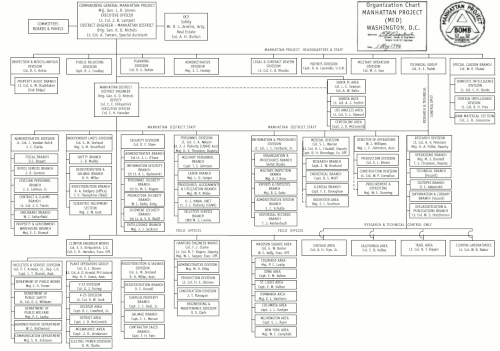
マーシャルの任務の大半は建設作業であったため、マーシャルは工兵隊建設部長のトーマス・M・ロビンズ少将と副官のレスリー・グローブス大佐と協力した。レイボルド、サマーベル、スタイアーはプロジェクトを「代替資材の開発」と名付けることにしたが、グローブスは注目を集めると感じた。工兵地区は通常、所在する都市の名前を冠するため、マーシャルとグローブスは陸軍の部隊をマンハッタン地区と名付けることに同意した。レイボルドは8月13日にこの地区を正式に設立した。非公式にはマンハッタン工兵地区、またはMEDとして知られていた。他の地区とは異なり、地理的境界はなく、マーシャルは師団工兵としての権限を持っていた。代替資材の開発はプロジェクト全体の公式コードネームとして残ったが、時が経つにつれて「マンハッタン」に取って代わられた。[39] [40]
マーシャルは後に「原子核分裂については聞いたことがなかったが、9000万ドルでは4基どころか大した工場を建設できないことは知っていた」と認めている。[41]ニコルズが最近ペンシルバニア州に建設したTNT工場1基の費用は1億2800万ドルだった。 [42]また、彼らは最も近い桁までの見積もりにも満足しなかった。グローブスはそれを、ケータリング業者に10人から1000人のゲストを準備するように言うのと似ていると例えた。[43]ストーン&ウェブスターの調査チームはすでに生産工場の建設地を探していた。戦時生産委員会は、テネシー州ノックスビル周辺の場所を推奨した。そこは、テネシー川流域開発公社が十分な電力を供給でき、川が原子炉の冷却水を提供できる隔離された地域だった。いくつかの場所を調査した後、調査チームはテネシー州エルザ近くの場所を選んだ。コナントはすぐにその場所を取得するよう助言し、スタイアーも同意したが、マーシャルはコナントの原子炉実験の結果を待って時間を稼いだ。[44]将来的なプロセスのうち、ローレンスの電磁分離だけが建設を開始できるほど十分に進んでいるように見えた。[45]
マーシャルとニコルズは必要な資源を集め始めた。最初のステップは、プロジェクトの優先度を高くすることだった。最高評価は上からAA-1からAA-4までだったが、緊急時用に特別にAAA評価が取ってあった。AA-1とAA-2の評価は必須の武器と装備用だったので、サービスと供給部門の要求と資源担当副参謀長ルシウス・D・クレイ大佐は、必要が生じれば重要な資材の要請に応じてAAA評価を与える用意はあったものの、自分が割り当てられる最高の評価はAA-3だと感じていた。[46]ニコルズとマーシャルはがっかりした。AA-3は、ペンシルベニア州にあるニコルズのTNT工場と同じ優先度だったのだ。[47]
軍事政策委員会

ヴァネヴァー・ブッシュは、マーシャル大佐がプロジェクトを迅速に進めることができなかったことに不満を抱き[49]、より積極的なリーダーシップが必要だと感じた。彼はハーヴェイ・バンディ、マーシャル、サマーヴェル、スタイアー将軍に懸念を話し、プロジェクトを上級政策委員会の管轄下に置いて、できればスタイアーのような高官を委員長に据えることを提唱した[47] 。
サマーヴェルとスタイアーはグローブスをその職に選んだ。マーシャル将軍は彼を准将に昇進させるよう命じた。[50]これは「将軍」という肩書きの方が、計画に携わる学者たちには影響力があると考えられたためである。[51]グローブスの命令により、彼はレイボルドではなくサマーヴェルの直属となり、マーシャル大佐がグローブスに責任を負うことになった。[52]グローブスはワシントン DC の新陸軍省ビルに本部を置き、マーシャル大佐はそこに連絡事務所を置いた。[53]彼は 1942 年 9 月 23 日にマンハッタン計画の指揮を執った。その日遅く、彼はスティムソンが招集した会議に出席し、最高政策グループに責任を負う軍事政策委員会を設立した。委員会はブッシュ (代理としてコナント)、スタイアー、ウィリアム・R・パーネル少将 で構成されていた。[50]トルマンとコナントは後にグローブスの科学顧問に任命された。[54]
9月19日、グローブスは戦時生産委員会の委員長ドナルド・ネルソンのもとを訪れ、必要なときにいつでもAAA格付けを発行できる広範な権限を求めた。ネルソンは当初は難色を示したが、グローブスが大統領に訴えると脅すとすぐに屈した。[55]グローブスは、必要な場合を除いてAAA格付けを使用しないことを約束した。すぐに、プロジェクトの日常的な要件ではAAA格付けは高すぎるが、AA-3格付けは低すぎることが判明した。長いキャンペーンの後、グローブスは1944年7月1日にようやくAA-1の権限を得た。[56]グローブスによると、「ワシントンでは最優先事項の重要性に気付いた。ルーズベルト政権で提案されたほとんどすべてのことが最優先事項だった。それは1、2週間続き、その後別のことが最優先事項になった」という。[57]
グローブスが当初抱えていた問題の 1 つは、爆弾を設計・製造するグループであるプロジェクト Yの責任者を見つけることだった。明らかに、ユーリー、ローレンス、コンプトンという 3 人の研究所長のうちの 1 人を選ぶべきだったが、彼らを犠牲にすることはできなかった。コンプトンは、爆弾の設計概念をすでに熟知していたオッペンハイマーを推薦した。しかし、オッペンハイマーには管理経験がほとんどなく、ユーリー、ローレンス、コンプトンとは違い、ノーベル賞を受賞していなかった。多くの科学者は、このような重要な研究所の責任者にはノーベル賞があるべきだと考えていた。また、オッペンハイマーの妻キティ、恋人のジーン・タトロック、兄弟のフランクなど、彼の仲間の多くが共産主義者であったため、オッペンハイマーのセキュリティ上の懸念もあった。1942 年 10 月の長い話し合いで、グローブスとニコルズは、オッペンハイマーは辺鄙な地域に研究所を設立することに伴う問題を十分に理解しており、彼をその責任者に任命すべきだと確信した。グローブスは個人的にセキュリティ要件を放棄し、1943年7月20日にオッペンハイマーの許可を発行した。[58] [59]
英国との協力
英国と米国は核に関する情報を交換したが、当初は協力することはなかった。1940年から41年の間、英国のプロジェクト(チューブアロイ)の方が規模が大きく、より進んでいた。[17]英国は、自国の技術的優位性を共有し、米国独自の原子爆弾開発を支援することに消極的であったため、1941年8月にブッシュとコナントが協力を強化しようとした試みを拒絶した。しかし、戦争初期に研究で大きな進歩を遂げていた英国には、経済の大部分が戦争に従事している間、そのような研究プログラムを開発にまで進めるための資源がなかった。チューブアロイはすぐに米国に遅れをとった。[60]両国の役割は逆転し、[61] 1943年1月にコナントは英国に対し、特定の分野を除いて今後は核情報を受け取らないと通知した。[62] [63]英国は独自の核プログラムの可能性を調査したが、ヨーロッパでの戦争に影響を与えるまでに準備が間に合わないと判断した。[64]
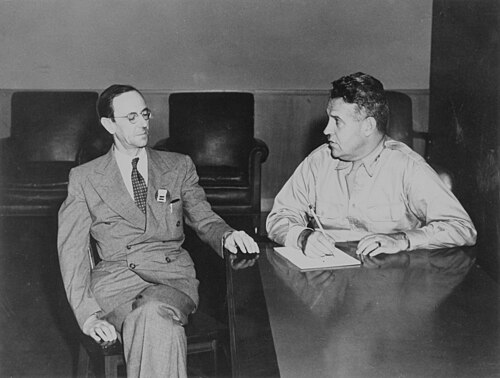
1943年3月までに、コナントは、ジェームズ・チャドウィックと他の1、2人の英国人科学者は、兵器設計の秘密を漏らすリスクを冒しても、ロスアラモスの爆弾設計チームに必要であるほど重要であると判断した。[65] 1943年8月、チャーチルとルーズベルトはケベック協定を交渉し、[66] [67]米国と英国の取り組みを調整するための統合政策委員会を設立した。カナダは署名国ではなかったが、この協定では、取り組みへのカナダの貢献を考慮して、統合政策委員会にカナダの代表を置くことを規定した。[68] 1944年9月下旬に署名されたルーズベルトとチャーチルの間のハイドパーク覚書として知られる協定は、ケベック協定を戦後まで延長し、「最終的に「爆弾」が利用可能になったとき、熟慮の末、おそらく日本に対して使用される可能性があり、日本は降伏するまでこの爆撃が繰り返されると警告されるべきである」と示唆した。[69] [70]
ケベック協定後に協力が再開されると、アメリカの進歩と支出はイギリスを驚かせた。チャドウィックはイギリスがマンハッタン計画に最大限関与するよう強く求め、戦争中にイギリスが独立した計画をするという望みを捨てた。[64]チャーチルの支援を得て、彼はグローブスからの援助要請がすべて尊重されるように努めた。[71] 1943年12月にアメリカに到着した英国使節団には、ニールス・ボーア、オットー・フリッシュ、クラウス・フックス、ルドルフ・パイエルス、アーネスト・ティッタートンが含まれていた。[72] 1944年初頭にはさらに多くの科学者が到着した。気体拡散に割り当てられた者は1944年秋までに去ったが、バークレーでローレンスとともにオリファントのもとで働いていた35人は既存の研究グループに配属され、ほとんどが戦争の終わりまで留まった。ロスアラモスに派遣された19人は、既存のグループにも加わったが、主に爆縮と爆弾の組み立てに関するグループであり、プルトニウム関連のグループには加わらなかった。[64]ケベック協定では、米国と英国の相互同意なしに核兵器を他国に対して使用しないことが規定されていた。1945年6月、ウィルソンは日本への原爆投下が統合政策委員会の決定として記録されることに同意した。[73]
1944年6月、統合政策委員会はグローブスを委員長とする統合開発トラストを設立し、国際市場でウランとトリウムの鉱石を調達した。ベルギー領コンゴとカナダは東ヨーロッパ以外では世界のウランの多くを保有しており、ベルギー亡命政府はロンドンにあった。イギリスは、アメリカの研究が制限されなければ供給のほとんどを使用できないため、ベルギーの鉱石のほとんどをアメリカに提供することに同意した。[74] 1944年、トラストはベルギー領コンゴで鉱山を運営する会社から344万ポンド(156万kg)の酸化ウラン鉱石を購入した。アメリカ財務長官ヘンリー・モーゲンソー・ジュニアへの報告を避けるため、通常の監査と管理の対象とならない特別口座がトラストの資金を保管するために使用された。 1944年から1947年に信託を辞任するまでの間に、グローブスは合計3,750万ドルを預けました。[75]
グローブスは、初期のイギリスの原子力研究とイギリスの科学者によるマンハッタン計画への貢献を高く評価したが、1945年8月の広島への原爆投下に間に合わなかったとしても、アメリカは彼らがいなくても成功しただろうと述べた。 [76] 1946年のマクマホン法によりアメリカの核協力が一時的に終了した後、イギリスの戦時参加はイギリスの独立した核兵器計画の成功に不可欠であった。[64]
プロジェクトサイト

オークリッジ
プロジェクトを引き継いだ翌日、グローブスはマーシャル大佐とともにテネシー州に行き、予定地を視察したが、グローブスは感銘を受けた。[78] [79] 1942年9月29日、ロバート・P・パターソン陸軍次官は、 工兵隊に350万ドルの費用で56,000エーカー(23,000ヘクタール)の土地を収用することを許可した。さらに3,000エーカー(1,200ヘクタール)がその後取得された。10月7日に発効したこの命令により、約1,000世帯が影響を受けた。[80]抗議、法廷での訴え、1943年の議会の調査は無駄に終わった。[81] 11月中旬までに、連邦保安官が農家のドアに立ち退き通知を掲示し、建設業者が入居し始めた。[82]何世代にもわたって住居としてきた農場から立ち退くよう2週間前に通知された家族もあった。[83] 1945年3月まで完了しなかった土地収用の最終的な費用は、わずか約260万ドル、1エーカーあたり約47ドルだった。[84]オークリッジを軍の許可なしには誰も立ち入ることができない完全立入禁止区域と宣言する布告が提示されると、テネシー州知事プレンティス・クーパーは怒ってそれを破棄した。[85]
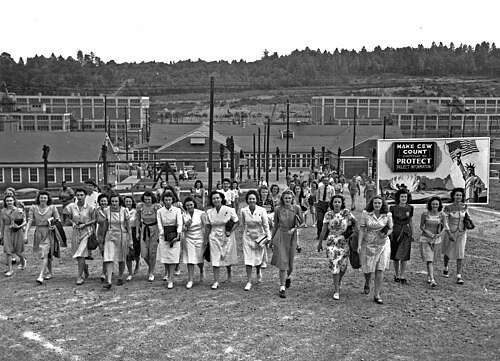
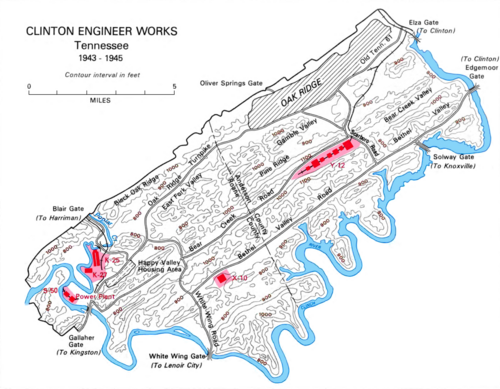
当初キングストン解体場として知られていたこの場所は、1943年初めに正式にクリントン工兵工場(CEW)に改名された。 [86]ストーン&ウェブスターが生産施設に集中している間、建築およびエンジニアリング会社スキッドモア・オーウィングス&メリルは13,000人のための住宅コミュニティを開発した。コミュニティはブラックオークリッジの斜面に位置し、新しい町オークリッジの名前はそこから付けられた。[87]オークリッジでの陸軍のプレゼンスは、1943年8月にマーシャルに代わってマンハッタン工兵地区の責任者としてニコルズが就任したときに増加した。彼の最初の仕事の1つは、地区の名称は変更されなかったが、地区本部をオークリッジに移転することだった。[88] 1943年9月、コミュニティ施設の管理は、子会社のローアン・アンダーソン社を通じてターナー建設会社に委託された。 [89]化学技術者たちは、厳重な警備と物資の迅速な承認のもと、10%から12%の濃縮ウラン235を製造するための「必死の努力」に参加した。[90]オークリッジの人口はすぐに当初の計画をはるかに超えて増加し、1945年5月には7万5千人でピークを迎えた。その時点で、クリントン・エンジニア・ワークスには8万2千人が雇用され、[77]ローン・アンダーソンには1万人が雇用されていた。[89]
ロスアラモス
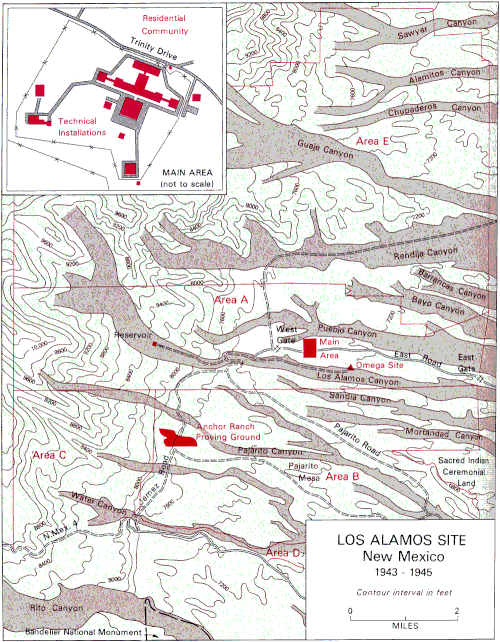
プロジェクトYをオークリッジに設置するという案も検討されたが、遠隔地にすることが決定された。オッペンハイマーの勧めで、適切な場所の探索は、オッペンハイマーが牧場を所有していたニューメキシコ州アルバカーキ近郊に絞られた。[91] 1942年11月16日、オッペンハイマー、グローブス、ダドリーらはロスアラモス牧場学校付近を視察した。オッペンハイマーは、その自然の美しさを挙げて、その場所を強く希望し、それがプロジェクトに携わる人々にインスピレーションを与えるだろうと期待した。[92] [93]技術者たちは、アクセス道路の悪さと給水が十分かどうかを懸念していたが、それ以外は理想的だと感じていた。[94]
パターソンは1942年11月25日にこの土地の買収を承認し、事前に計算された54,000エーカー(22,000ヘクタール)の購入に44万ドルを認可した。そのうち8,900エーカー(3,600ヘクタール)を除くすべてがすでに連邦政府の所有物であった。[95] 農務長官 クロード・R・ウィッカードは、約45,000エーカー(18,000ヘクタール)の米国森林局の土地を「軍事上の必要性が続く限り」陸軍省に譲渡した。 [96]戦時中の土地購入は最終的に49,383エーカー(19,985ヘクタール)に達したが、実際に使われたのは414,971ドルに過ぎなかった。[97]工事は1942年12月に開始された。グローブスは当初、建設費としてオッペンハイマーの見積もりの3倍にあたる30万ドルを割り当てたが、1943年11月30日にサントが完成するまでに700万ドル以上が費やされていた。[98]
戦争中、ロスアラモスは「サイトY」または「ザ・ヒル」と呼ばれていた。[99]当初はオッペンハイマーと他の研究者が陸軍に委託され、軍事研究所となる予定だったが、ロバート・バッチャーとイジドール・ラビがその考えに難色を示し、他の科学者が反対するだろうとオッペンハイマーを説得した。その後、コナント、グローブス、オッペンハイマーは妥協案を考案し、カリフォルニア大学が陸軍省と契約して研究所を運営することになった。[100] ドロシー・マッキビンはサンタフェの支局を運営し、そこで新参者を出迎えてパスを発行した。[101]
シカゴ
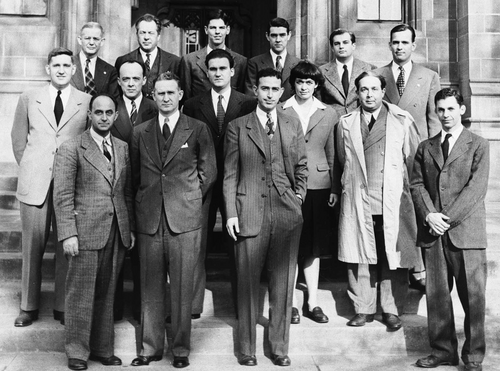
1942年6月25日、陸軍とOSRDの評議会はシカゴ南西部のアルゴンヌ森林保護区にプルトニウム生産のパイロットプラントを建設することを決定した。7月にニコルズはクック郡森林保護区から1,025エーカー(415ヘクタール)の土地を借り受け、ジェームズ・F・グラフトン大尉がシカゴ地域の技師に任命された。すぐに事業規模がこの地域には大きすぎることが明らかになり、オークリッジにパイロットプラントを建設し、研究および試験施設をシカゴに置くことが決定された。[102] [103]
アルゴンヌの工場設立が遅れたため、アーサー・コンプトンは冶金研究所にシカゴ大学スタッグフィールドの観客席の下に最初の原子炉を建設する許可を与えた。原子炉には大量の高度に精製された黒鉛ブロックと金属および粉末酸化物の形のウランが必要だった。当時、純粋なウラン金属の供給源は限られており、アイオワ州立大学のフランク・スペディングはわずか2ショートトンしか生産できなかった。3ショートトンはウェスティングハウスランプ工場から供給され、間に合わせの方法で急いで生産された。原子炉を囲む大きな四角い風船がグッドイヤータイヤによって作られた。 [104] [105]
1942年12月2日、エンリコ・フェルミ率いるチームがシカゴ・パイル1号と呼ばれる実験炉で、人工的に初めて[d]自立型核連鎖反応を開始した。[107]反応が自立型になるポイントは「臨界点」として知られるようになった。コンプトンはワシントンDCのコナントに暗号電話で成功を報告し、「イタリアの航海士[フェルミ]が新世界に着陸したばかりだ」と伝えた。[108] [e]
1943年1月、グラフトンの後任であるアーサー・V・ピーターソン少佐は、人口密集地での原子炉の稼働は危険すぎると考え、シカゴ・パイル1号炉を解体し、アルゴンヌの森のサイトで再組み立てするよう命じた。[109]新しいサイトは、依然として冶金研究所によって運営され、「サイトA」として知られるようになった。 最初の重水炉であるシカゴ・パイル3号炉も、1944年5月15日にこのサイトで臨界に達した。 [110] [111]戦後、サイトAの運営は、アルゴンヌ国立研究所の現在の所在地であるデュページ郡に約6マイル (9.7 km) 移された。[103]
ハンフォード
1942年12月までに、オークリッジでさえも、大規模な核事故が起きた場合、人口密集地(ノックスビル)に近すぎるのではないかという懸念が高まった。グローブスは1942年11月にデュポン社をプルトニウム生産施設建設の元請けに採用した。同社の社長、ウォルター・S・カーペンター・ジュニアはいかなる利益も望んでいなかったため、法的な理由から1ドルという名目上の報酬で合意した。[112]
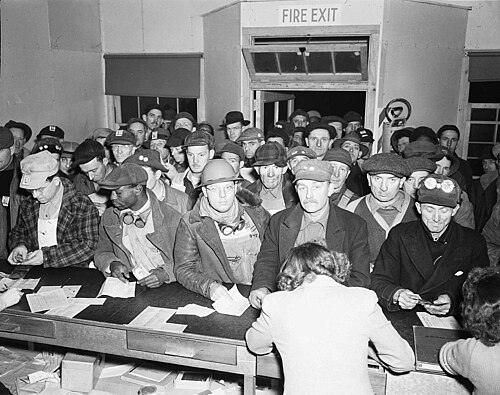
デュポンは、この敷地をオークリッジの既存のウラン生産施設から離れた場所に建設することを推奨した。[113] 1942年12月、グローブスはフランクリン・マティアス大佐とデュポンの技術者を派遣し、候補地の偵察を行った。マティアスは、ワシントン州リッチランド近郊のハンフォード・サイトが「事実上あらゆる点で理想的」であると報告した。この場所は孤立しており、コロンビア川の近くにあったため、原子炉を冷却するのに十分な水を供給することができた。グローブスは1月にこの敷地を訪れ、コード名「サイトW」のハンフォード・エンジニア・ワークス(HEW)を設立した。[114]
パターソン次官は2月9日に承認を与え、43万エーカー(17万ヘクタール)の土地買収に500万ドルを割り当てた。連邦政府は近隣の集落の住民約1,500人と、この地域を利用していたワナパム族およびその他の部族を移住させた。すでに植えられていた作物の補償をめぐって農民との間で紛争が起こった。スケジュールが許せば陸軍は作物の収穫を許可したが、常に可能だったわけではない。[114]土地買収のプロセスは長引き、1946年12月のマンハッタン計画終了前には完了しなかった。[115]
紛争によって作業が遅れることはなかった。冶金研究所とデュポン社の原子炉設計の進捗状況は、プロジェクトの範囲を正確に予測できるほどには進んでいなかったが、1943年4月に推定2万5000人の労働者のための施設の建設が開始され、その半数は現場で生活する予定だった。1944年7月までに、約1200棟の建物が建てられ、建設キャンプには約5万1000人が住んでいた。地域エンジニアとして、マティアスは現場の全体的な管理を行った。[116]建設キャンプは最盛期にはワシントン州で3番目に人口の多い町だった。[117]ハンフォードは900台以上のバスを運行しており、シカゴ市よりも多かった。[118]ロスアラモスやオークリッジと同様に、リッチランドは立ち入りが制限されたゲートコミュニティだったが、軍の存在感は低く、高いフェンスや番犬などの物理的なセキュリティ要素は目立たなかった。[119]
カナダのサイト
カナダはウランとプルトニウムの研究、採掘、生産を提供し、カナダの科学者はロスアラモスで働いた。[120] [121]
ブリティッシュコロンビア
コミンコ社は1930年からブリティッシュコロンビア州トレイルで電解水素を生産していた。ユーリーは1941年に重水生産の可能性を示唆した。75MWの水力発電を消費する3,215個のセルからなる1,000万ドルの既存のプラントに、二次電解セルを追加して水中の重水素濃度を2.3%から99.8%に高めた。このプロセスでは、プリンストン大学のヒュー・テイラーが最初の3段階用に白金炭素触媒を開発し、ユーリーが第4段階タワー用にニッケルクロミア触媒を開発した。最終的なコストは280万ドルだった。カナダ政府は1942年8月までこのプロジェクトを公式に知らなかった。トレイルの重水生産は1944年1月に始まり、1956年まで続いた。トレイルの重水は、重水と天然ウランを使用した最初の原子炉であるシカゴ・パイル3に使用され、1944年5月15日に臨界に達した。[122]
オンタリオ
オンタリオ州チョークリバーの敷地は、連合軍のモントリオール研究所の拠点を市街地から離れた場所に移転するために設立された。チームメンバーの住居と施設を提供するために、オンタリオ州ディープリバーに新しいコミュニティが建設された。この場所が選ばれたのは、オンタリオ州とケベック州の工業地帯に近いこと、そして大きな軍事基地であるキャンプ・ペタワワに隣接する鉄道の終点に近いためである。オタワ川沿いに位置していたため、水は豊富であった。新しい研究所の初代所長はハンス・フォン・ハルバンであった。1944年5月にジョン・コッククロフトが後任となり、 1946年9月にベネット・ルイスが後任となった。ZEEP(ゼロエネルギー実験炉)として知られるパイロット原子炉は、1945年9月に臨界に達し、カナダ初の原子炉、そして米国外で完成した最初の原子炉となった。 ZEEPは1970年まで研究者によって使用され続けた。[123]戦時中に設計されたより大きな10MWのNRX原子炉が完成し、1947年7月に臨界に達した。 [122]
ノースウエスト準州
ポート・ラディアムのエルドラド鉱山はウラン鉱石の産地であった。[124]
重水サイト
デュポンが好んだ原子炉の設計はヘリウム冷却で減速材にグラファイトを使用するものだったが、デュポンはバックアップとして重水を使用することに依然として関心を示していた。P -9 プロジェクトは、政府による重水製造プログラムのコードネームだった。1 か月あたり 3 ショートトン (2.7 t) の重水が必要になると見積もられた。当時建設中だったトレイルの工場は、1 か月あたり 0.5 ショートトン (0.45 t) を製造できた。そのためグローブスは、ウェストバージニア州モーガンタウン近郊のモーガンタウン兵器工場、インディアナ州ダナとニューポート近郊のワバッシュ川兵器工場、アラバマ州チルダースバーグとシラコーガ近郊のアラバマ兵器工場に重水施設を建設することをデュポンに許可した。これらの工場は兵器工場として知られ、兵器省の契約で資金が支払われていたが、建設と運営は陸軍工兵隊によって行われた。アメリカの工場ではトレイルとは異なるプロセスを採用しており、重水の沸点がわずかに高いことを利用して蒸留によって重水を抽出した。[125] [126]
ウラン
鉱石
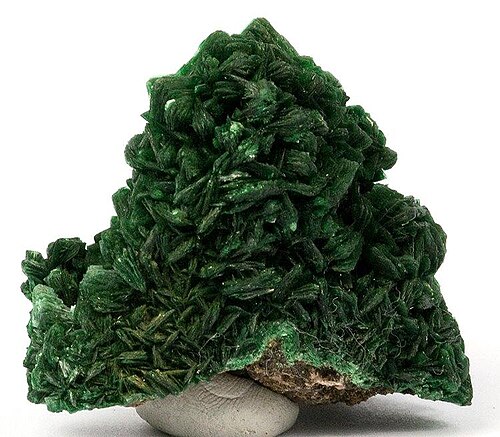
この計画の主要原材料はウランであり、原子炉の燃料として、またプルトニウムに変換される原料として、また濃縮された形で原子爆弾自体に使用された。1940年にはウランの主要な鉱床が4ヶ所知られており、コロラド州、カナダ北部、チェコスロバキアのヨアヒムスタール、ベルギー領コンゴであった。[127]ヨアヒムスタール以外はすべて連合国の手に渡っていた。1942年の調査では、計画の必要量を満たすのに十分な量のウランがあると判断された。[128] [f]ニコルズは国務省と協力して酸化ウランの輸出規制を整備し、スタテン島の倉庫に保管されていたベルギー領コンゴ産のウラン鉱石1,200ショートトン(1,100トン)と、コンゴに保管されていた採掘済み鉱石の残りの在庫の購入について交渉した。彼はオンタリオ州ポートホープにあるエルドラド・ゴールド・マインズの精錬所から鉱石を購入するために同社と交渉した。その後カナダ政府は同社の株式を買い上げ、最終的に支配権を獲得した。[130]
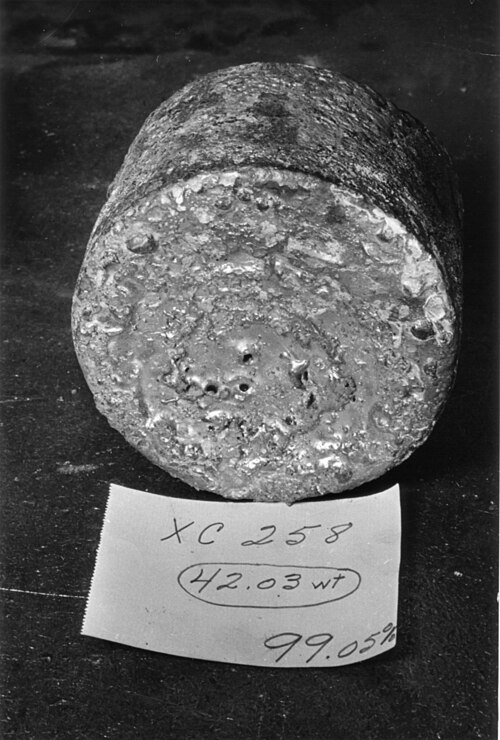
これらの鉱石のうち、ベルギー領コンゴ産のものは岩石1質量あたりのウラン含有量が群を抜いて多かった。[131] [g]アメリカとイギリスの指導者たちは、戦時中の必要性を超えて、世界のウラン鉱床を可能な限り管理することが自国の利益であると結論付けた。シンコロブエ鉱山は浸水して閉鎖され、ニコルズは鉱山を所有するユニオン・ミニエール・デュ・オー・カタンガの取締役エドガー・サンジエと、鉱山の再開と将来の生産物のすべてをアメリカに売却する交渉を試みたが、失敗に終わった。[134]その後、この問題は合同政策委員会で取り上げられた。ユニオン・ミニエールの株式の30パーセントはイギリスの利害関係者によって管理されていたため、イギリスが交渉を主導した。ジョン・アンダーソン卿とジョン・ウィナント大使は、1944年5月にサンジエとベルギー政府との間で、鉱山を再開し、1,720ショートトン(1,560トン)の鉱石を1ポンドあたり1.45ドルで購入する契約を締結した。[135]鉱石をイギリスとカナダに依存することを避けるため、グローブスはコロラド州ウラバンにある米国バナジウム社の備蓄の購入も手配した。[136]
原鉱石は硝酸に溶解されて硝酸ウラニルが生成され、これが三酸化ウランに加工され、さらに高純度の二酸化ウランに還元された。[137] 1942年7月までに、マリンクロットは1日1トンの高純度酸化物を生産していたが、これをウラン金属に変えるには当初困難が伴った。[138]生産は遅く、品質は許容できないほど低かった。代替案を調査するため、アイオワ州エイムズのアイオワ州立大学にフランク・スペディングの指揮下で冶金研究所の支部が設立された。これはエイムズ計画として知られるようになり、エイムズ法は1943年に利用可能になった。[139]
同位体分離
天然ウランは、99.3%のウラン238と0.7%のウラン235から構成されていますが、後者だけが核分裂性であるため、より豊富な同位体から物理的に分離する必要があります。ウラン濃縮にはさまざまな方法が検討され、そのほとんどはオークリッジで実施されました。[140]最も明白な技術である遠心分離は失敗しましたが、電磁分離、ガス拡散、熱拡散技術はすべて成功し、プロジェクトに貢献しました。1943年2月、グローブスはいくつかのプラントの出力を他のプラントの入力として使用するというアイデアを思いつきました。[141]
遠心分離機
1942年4月には、遠心分離法が唯一の有望な分離法とみなされていた。 [142] ジェシー・ビームズは1930年代にそのような方法を開発していたが、技術的な困難に直面していた。1941年に彼は、ウランの唯一の既知の気体化合物である六フッ化ウランの研究を始め、ウラン235を分離することに成功した。コロンビアでは、カール・P・コーエンが遠心分離装置の設計を可能にする数学理論を構築し、ウェスティングハウスが構築を引き受けた。[143]
これを生産プラントにスケールアップすることは、非常に困難な技術的課題でした。ユーリーとコーエンは、1日あたり1キログラム(2.2ポンド)のウラン235を生産するには、1メートル(3フィート3インチ)のローターを備えた遠心分離機が最大50,000台、または4メートル(13フィート)のローターを備えた遠心分離機が10,000台必要になると推定しました(4メートルのローターを製造できると仮定した場合)。これほど多くのローターを高速で連続的に稼働させる見通しは困難に思えました。[144]ビームズが実験装置を稼働させたところ、予測された収量の60%しか得られず、より多くの遠心分離機が必要であることがわかりました。その後、ビームズ、ユーリー、コーエンは、効率を向上させることが期待される一連の改良に取り組み始めました。しかし、高速でのモーター、シャフト、ベアリングの頻繁な故障により、パイロットプラントでの作業が遅れました。[145]
1942年11月、軍事政策委員会は遠心分離法を放棄した。[146]代わりに、戦後ソ連ではジッペ型ガス遠心分離機が開発された。この方法は最終的にウラン同位体分離の好ましい方法となり、はるかに経済的であった。[147]
電磁分離
電磁同位体分離は、カリフォルニア大学放射線研究所で開発された。この方法では、カルトロンと呼ばれる装置が使用された。名前は、カリフォルニア、大学、サイクロトロンという言葉に由来している。[148]電磁プロセスでは、磁場が質量に応じて荷電粒子を偏向させる。[149]このプロセスは、科学的に洗練されておらず、工業的に効率的でもなかった。[150]ガス拡散プラントや原子炉と比較すると、電磁分離プラントは希少な材料をより多く消費し、運用に多くの人材を必要とし、建設コストも高くなる。それでも、このプロセスは実証済みの技術に基づいており、リスクが少ないため承認された。さらに、段階的に建設でき、すぐに工業生産能力に達することができた。[148]

マーシャルとニコルズは、電磁同位体分離プロセスには5,000ショートトン(4,500トン)の銅が必要であることを発見したが、銅はひどく不足していた。しかし、銀を代用することができ、銅と銀の比率は11:10であった。1942年8月3日、ニコルズは財務次官 ダニエル・W・ベルと会談し、ウェストポイント地金保管所から6,000トンの銀地金を移送するよう要請した。[151]最終的に14,700ショートトン(13,300トン、4億3000万トロイオンス)が使用された。[152] 1,000トロイオンス(31 kg)の銀の延べ棒は円筒形のビレットに鋳造され、ストリップに押し出され、磁気コイルに巻き付けられた。[152] [153]
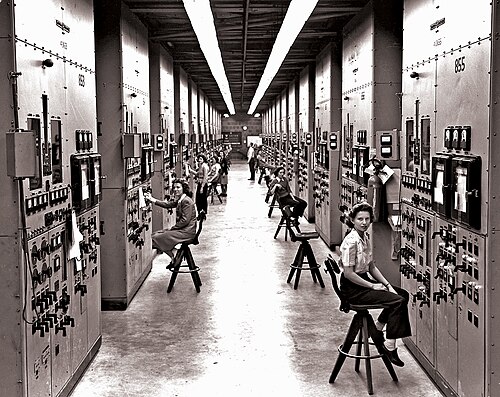
1942年6月、 Y-12と呼ばれるようになった電磁分離プラントの設計と建設の責任は、ストーン&ウェブスター社に割り当てられた。設計では、アルファレーストラックと呼ばれる第1段階処理ユニット5台と、ベータレーストラックと呼ばれる最終処理ユニット2台が必要だった。1943年9月、グローブスはアルファIIとして知られるさらに4つのレーストラックの建設を承認した。建設は1943年2月に始まった。[155] 2番目のアルファIは1944年1月末に稼働し、最初のベータIと最初のアルファIと3番目のアルファIは3月にオンラインになり、4番目のアルファIは4月に稼働した。4つのアルファIIレーストラックは1944年7月から10月の間に完成した。[156] テネシー・イーストマン社は、Y-12の管理を請け負った。[157]カルトロンは、カルトロン・ガールズとして知られる訓練を受けたテネシー・イーストマン社のオペレーターに引き渡された。[158]
カルトロンは当初ウラン235の濃度を13~15%に濃縮し、1944年3月に最初の数百グラムをロスアラモスに出荷した。ウラン供給量5,825分の1だけが製品として現れた。残りの大部分は製造過程で機器に飛び散った。懸命な回収作業により、1945年1月までにウラン235供給量の10%まで生産量を引き上げることができた。2月にはアルファ競馬場は新しいS-50熱拡散工場からわずかに濃縮された(1.4%)供給を受け始め、翌月にはK-25気体拡散工場から濃縮された(5%)供給を受けた。8月までにK-25はベータ競馬場に直接供給できるほど濃縮されたウランを生産していた。[159]
気体拡散
同位体分離の最も有望かつ最も困難な方法は気体拡散であった。グラハムの法則によれば、気体の流出速度はその分子量の平方根に反比例するため、半透膜と2種類のガスの混合物が入った箱では、軽い分子の方が重い分子よりも速く容器から出る。このアイデアは、このような箱をポンプと膜のカスケードに形成し、各段階に少しずつ濃度の高い混合物を入れるというものだった。このプロセスの研究は、コロンビア大学のハロルド・ユーリー、カール・P・コーエン、ジョン・R・ダニングらのグループによって行われた。[160]

1942年11月、軍事政策委員会は600段階のガス拡散プラントの建設を承認した。[161] 12月14日、MWケロッグはK-25というコードネームのプラント建設の申し出を受け入れた。このプロジェクトのために、ケレックスと呼ばれる別の法人が設立された。[162]このプロセスは、大きな技術的困難に直面した。代替品が見つからなかったため、腐食性の高い六フッ化ウランガスを使用する必要があり、モーターとポンプは真空密閉し、不活性ガスで封入する必要があった。最大の問題は、強く、多孔質で、耐腐食性のあるバリアの設計であった。エドワード・アドラーとエドワード・ノリスは、電気メッキされたニッケルからメッシュバリアを作成した。このプロセスをテストするために、コロンビアに6段階のパイロットプラントが建設されたが、プロトタイプは脆すぎることが判明した。 1944年1月、グローブスはケレックスバリアの生産を命じた。[163] [164]
ケレックスのK-25の設計では、4階建て、長さ0.5マイル(0.80 km)のU字型構造で、54の連続した建物が含まれていました。これらは6段階のセルを含む9つのセクションに分かれていました。調査隊は1943年5月に500エーカー(2.0 km 2)の敷地をマークして建設を開始しました。メインの建物の作業は1943年10月に始まり、6段階のパイロットプラントは1944年4月17日に稼働可能になりました。1945年にグローブスは上段の段階をキャンセルし、代わりに540段のサイドフィードユニットを設計して構築するようにケレックスに指示しました。これはK-27として知られるようになりました。ケレックスは1945年9月11日に最後のユニットを運営請負業者であるユニオンカーバイドアンドカーボンに譲渡しました。戦後に完成したK-27プラントを含む総費用は4億8000万ドルになりました。[165]
生産工場は1945年2月に稼働を開始し、カスケードが次々と稼働するにつれて、製品の品質が向上しました。1945年4月までに、K-25は1.1%の濃縮度を達成し、S-50熱拡散工場の生産物が供給源として使用され始めました。翌月には、一部の製品はほぼ7%の濃縮度に達しました。8月には、2,892段階のうち最後の段階が稼働を開始しました。K-25とK-27は、戦後初期にその潜在能力を最大限に発揮し、他の生産工場を凌駕し、新世代の工場のプロトタイプとなりました。[166]
熱拡散
熱拡散法は、シドニー・チャップマンとデビッド・エンスコグの理論に基づいており、混合ガスが温度勾配を通過すると、重いものは冷たい端に、軽いものは暖かい端に集まる傾向があると説明していた。[167]これは米海軍の科学者によって開発されたが、マンハッタン計画で使用するために当初選択された濃縮技術の1つではなかった。これは主に技術的な実現可能性に対する疑問によるものだが、陸軍と海軍の間の軍種間の競争も一因となっていた。[168]海軍研究所はフィリップ・アベルソンの指揮の下で研究を継続したが、1944年4月、ロスアラモスで兵器開発を担当していた海軍士官のウィリアム ・S・パーソンズ大佐がオッペンハイマーに熱拡散に関する有望な進歩のニュースをもたらすまで、マンハッタン計画とはほとんど接触がなかった。オッペンハイマーはグローブスに知らせ、グローブスは1944年6月24日に熱発電所の建設を承認した。[169]

グローブスはオハイオ州クリーブランドのHKファーガソン社と契約し、S-50と命名された熱拡散プラントを建設した。[170]計画では、高さ48フィート(15メートル)の拡散柱2,142本を21のラックに配置することになっていた。各柱の中には3本の同心円状の管があった。近くのK-25発電所[h]から得られた100ポンド毎平方インチ(690kPa)、545°F(285℃)の蒸気は、最も内側の1.25インチ(32mm)のニッケル管を通って下方に流れ、155°F(68℃)の水は最も外側の鉄管を通って上方に流れた。六フッ化ウランは中央の銅管を流れ、ウランの同位体分離はニッケル管と銅管の間で行われた。[171] 1944年7月9日に作業が開始され、S-50は9月に部分的な運用を開始しました。漏洩により生産が制限され、数か月間は停止を余儀なくされましたが、1945年6月にS-50工場は12,730ポンド(5,770 kg)のわずかに濃縮された製品を生産しました。[172]
1945年3月までに、21台の生産ラックすべてが稼働していた。当初、S-50の生産物はY-12に送られていたが、1945年3月からは3つの濃縮プロセスすべてが連続して実行されるようになった。S-50が第一段階となり、ウランをウラン235で0.71%から0.89%に濃縮した。これは次にK-25工場の気体拡散プロセスに送られ、約23%に濃縮された製品が生成された。次に、これはY-12に送られ、[173]核兵器に使用するのに十分な約89%にまで高められた。89%に濃縮されたウラン約50キログラム(110ポンド)が1945年7月までにロスアラモスに届けられた。50キログラムすべてと、平均約85%に濃縮された50%濃縮ウランが、最初のリトルボーイ爆弾に使用された。[174]
プルトニウム
マンハッタン計画が追求した第2の開発ラインではプルトニウムが使用された。少量のプルトニウムは自然界に存在するが、大量に得るには原子炉を使用するのが最善である。天然ウランは中性子の照射を受けてウラン239に変化し、ウラン239は急速に崩壊して、まずネプツニウム239に、次にプルトニウム239に変化する。[175]変化する量はごくわずかであるため、プルトニウムは残りのウラン、初期の不純物、および核分裂生成物から化学的に分離する必要がある。[175]
X-10 グラファイトリアクター

1943年3月、デュポンはオークリッジの112エーカー(0.5 km 2 )の敷地にプルトニウム工場の建設を開始した。ハンフォードのより大規模な生産施設のパイロットプラントとして意図されたこの工場には、空冷式のX-10グラファイトリアクター、化学分離プラント、およびサポート施設が含まれていた。その後、ハンフォードに水冷式原子炉を建設することが決定されたため、化学分離プラントのみが真のパイロットとして稼働した。[176] X-10グラファイトリアクターは、一辺が24フィート(7.3 m)、重さが約1,500ショートトン(1,400 t)の巨大なグラファイトブロックで構成され、放射線シールドとして7フィート(2.1 m)の高密度コンクリートで囲まれていた。[176]
最も困難だったのは、マリンクロット社とメタルハイドライド社が製造したウランスラグだった。腐食と冷却システムへの核分裂生成物の流出を防ぐために、アルミニウムでコーティングする必要があった。グラッセリ化学会社は熱浸漬法の開発を試みたが、成功しなかった。アルコア社は缶詰を試し、フラックスを使わない溶接の新しい方法を開発した。缶の97%は標準真空テストに合格したが、高温テストでは50%以上の不合格率が示された。それでも、1943年6月に生産が開始された。冶金研究所は最終的にゼネラルエレクトリック社の協力を得て改良された溶接技術を開発し、1943年10月に生産プロセスに取り入れられた。[177]
X-10グラファイト原子炉は、1943年11月4日に約30ショートトン(27t)のウランを積んだ状態で臨界状態になった。1週間後、負荷は36ショートトン(33t)に増加され、発電量は500kWに上昇し、その月の終わりまでに最初の500mgのプルトニウムが生成された。[178]段階的な改造により、1944年7月には出力が4,000kWに上昇した。X-10は1945年1月まで生産工場として稼働し、その後研究に引き渡された。[179]
ハンフォード原子炉
オークリッジの原子炉は迅速な建設を可能にするために空冷式が選ばれたが、これははるかに大型の生産用原子炉には非現実的だった。冶金研究所とデュポン社による当初の設計では冷却にヘリウムが使われていたが、水冷式原子炉の方がシンプルで安価、迅速に建設できると判断された。[180]この設計は1943年10月4日まで実現しなかった。その間、マティアスは宿泊施設の建設、道路の改良、鉄道の分岐器の建設、電気、水道、電話線のアップグレードなど、ハンフォードサイトの改良に専念した。[181]

オークリッジと同様に、最も困難だったのは、1944年3月にハンフォードで開始されたウランスラグの缶詰め作業だった。スラグは汚れや不純物を取り除くために酸洗いされ、溶けた青銅、スズ、アルミニウムシリコン合金に浸され、油圧プレスで缶詰めされ、その後アルゴン雰囲気下でアーク溶接でキャップされた。最後に、穴や溶接不良を検出するためにテストされた。残念なことに、缶詰めされたスラグのほとんどは当初テストに合格せず、1日にわずか数個しか生産されなかった。しかし、着実に進歩が見られ、1944年6月までに生産量が増加し、1944年8月に予定通りB原子炉を稼働させるのに十分なスラグが缶詰めされたように見えた。 [182]
1943年10月10日、計画されていた6基の250MW原子炉のうち最初の原子炉Bの建設が開始された。[183] 原子炉群にはAからFまでの文字が与えられ、原子炉間の距離を最大化するためにB、D、Fのサイトが最初に開発された。これらはマンハッタン計画中に建設された唯一の原子炉である。 [184]高さ120フィート(37メートル)の建物を建設するために、約390ショートトン(350トン)の鋼鉄、17,400立方ヤード(13,300 m 3)のコンクリート、50,000個のコンクリートブロック、71,000個のコンクリートレンガが使用された。
原子炉の建設自体は1944年2月に開始された。[185]コンプトン、マティアス、デュポンのクロフォード・グリーンウォルト、レオナ・ウッズ、そして最初のスラグを挿入したフェルミが見守る中、原子炉は1944年9月13日から起動された。その後数日間で838本のチューブが装填され、原子炉は臨界状態になった。9月27日の真夜中過ぎに、オペレーターは制御棒を引き抜いて生産を開始し始めた。最初はすべて順調に見えたが、午前3時頃に出力レベルが低下し始め、午前6時30分までに原子炉は完全に停止した。冷却水に漏れや汚染がないか調査された。翌日、原子炉は再び起動したが、再び停止した。[186] [187]
フェルミは呉健雄に連絡を取り、呉は問題の原因が半減期が9.2時間のキセノン135による中性子中毒であると特定した。 [188]フェルミ、ウッズ、ドナルド・J・ヒューズ、ジョン・アーチボルド・ウィーラーはキセノン135の原子核断面積を計算し、それがウランの3万倍であることが判明した。[189]デュポン社の技術者ジョージ・グレイブスは冶金研究所の当初の設計、すなわち原子炉に1,500本の管を円形に配置するという設計から外れ、角を埋めるためにさらに504本の管を追加した。科学者たちは当初、この過剰設計は時間とお金の無駄だと考えていたが、フェルミは2,004本の管すべてを装填すれば原子炉は必要な出力レベルに達し、効率的にプルトニウムを生産できることに気付いた。[190] D原子炉は1944年12月17日に稼働を開始し、F原子炉は1945年2月25日に稼働を開始した。[191]
分離プロセス

一方、化学者たちは、プルトニウムの化学的性質が不明なときに、プルトニウムをウランから分離する方法を検討した。1942年に冶金研究所で入手可能な微量のプルトニウムを使って、チャールズ・M・クーパー率いるチームがランタンフッ化物プロセスを開発し、パイロット分離プラントに採用された。2番目の分離プロセスであるリン酸ビスマスプロセスは、その後シーボーグとスタンリー・G・トムソンによって開発された。[192]グリーンウォルトは、ランタンフッ化物の腐食性を考慮してリン酸ビスマスプロセスを支持し、ハンフォード分離プラントに採用された。[193] X-10がプルトニウムの生産を開始すると、パイロット分離プラントがテストされた。最初のバッチは40%の効率で処理されたが、その後数か月で90%に引き上げられた。[179]
ハンフォードでは、当初は300番エリアの設備、つまり材料の試験、ウランの準備、機器の組み立てと較正を行う建物に最優先が与えられていた。建物の1つにはウランスラグの缶詰装置が置かれ、もう1つには小型の試験用原子炉があった。優先度が高いにもかかわらず、300番エリアの作業は、施設の特殊性と複雑さ、戦時中の労働力と資材の不足により、スケジュールより遅れた。[194]
初期の計画では、200-West と 200-East と呼ばれる各エリアに 2 つの分離プラントを建設することになっていた。これはその後、200-West に T プラントと U プラントの 2 つ、200-East に B プラントの 1 つに縮小された。[195]各分離プラントは、プロセス セル ビルディングまたは「キャニオン」(221 として知られる)、濃縮ビルディング (224)、精製ビルディング (231)、および弾薬庫 (213) の 4 つの建物で構成されていた。キャニオンはそれぞれ長さ 800 フィート (240 m)、幅 65 フィート (20 m) であった。各キャニオンは 17.7 x 13 x 20 フィート (5.4 x 4.0 x 6.1 m) のセル 40 個で構成されていた。[196]
221-T と 221-U の工事は 1944 年 1 月に始まり、前者は 9 月に、後者は 12 月に完了した。221-B の建物は 1945 年 3 月に続いた。高レベルの放射能が含まれていたため、分離プラントでの作業は、1943 年当時は前代未聞の、閉回路テレビを使用した遠隔操作で行わなければならなかった。メンテナンスは、天井クレーンと特別に設計されたツールの助けを借りて行われた。224 の建物は、処理する材料が少なく、放射能が低かったため、より小規模であった。224-T と 224-U の建物は 1944 年 10 月 8 日に完成し、224-B の建物は 1945 年 2 月 10 日に続いた。1944 年 4 月 8 日に建設が開始された時点では、最終的に 231-W で使用される精製方法はまだ不明であったが、プラントは完成し、その年の終わりまでに方法は選択された。[197] 1945年2月5日、マティアスは純度95%の硝酸プルトニウム80gの最初の出荷品をロサンゼルスのロスアラモスの配達員に手渡した。[191]
武器のデザイン

1943年、プルトニウムを使った銃型核分裂兵器「シンマン」の開発が進められた。プルトニウムの特性に関する初期の研究は、サイクロトロンで生成されたプルトニウム239を使用して行われた。プルトニウム239は極めて純粋だが、ごく少量しか生成できなかった。ロスアラモスは1944年4月にクリントンX-10原子炉からプルトニウムの最初のサンプルを受け取り、数日のうちにエミリオ・セグレは問題を発見した。原子炉で生成されたプルトニウムはプルトニウム240の濃度が高く、サイクロトロンプルトニウムの自発核分裂率が最大5倍になるという問題である。[198]
これにより、プルトニウム240は連鎖反応を早く開始し、最小限のプルトニウムが核分裂した後に臨界質量を分散させる前駆爆発を引き起こすため、銃型兵器への使用には不適切となった。より高速の銃が提案されたが、非実用的であることが判明した。同位体を分離する可能性も検討されたが、プルトニウム240をプルトニウム239から分離するのはウラン235をウラン238から分離するよりもさらに困難であり、それを試みることは「兵器の開発を無期限に延期する」ことになるため、却下された。[199]
爆縮として知られる爆弾設計の代替方法の研究は、物理学者セス・ネッダーマイヤーの指導の下で以前から始まっていた。爆縮では、爆薬を使用して、核分裂性物質の亜臨界球をより小さく密度の高い形状に押しつぶす。臨界質量は、銃による方法よりもはるかに短い時間で組み立てられる。核分裂性原子がより密集していると、中性子捕獲率が上昇するため、[200]核分裂性物質をより効率的に使用することも可能になる。[201]ネッダーマイヤーの1943年と1944年初頭の調査は有望であったが、理論的にも工学的観点からも、爆縮兵器は銃型の設計よりも複雑であることが明らかになった。[202] 1943年9月、成形爆薬の経験があったジョン・フォン・ノイマンは、ネッダーマイヤーが取り組んでいた円筒形の構成の代わりに球形の構成を使用することを提案した。[203]
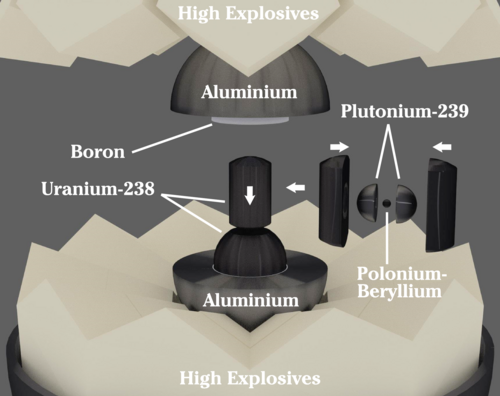
ファットマンというコードネームで呼ばれる爆縮設計の加速された取り組みは、オッペンハイマーが爆縮に焦点を当てるためにロスアラモス研究所の徹底的な再編を実施した1944年8月に始まった。[204]爆縮兵器を開発するために、爆薬の専門家ジョージ・キスティアコウスキーが率いるX(爆発物)部門とロバート・バッハーの指揮下にあるG(ガジェット)部門という2つの新しいグループがロスアラモスに設立された。[205] [206]新しい設計では、爆縮を球形に集中させる爆発レンズが採用された。 [207]レンズの設計は時間がかかり、難しく、イライラさせられるものであることが判明した。[207]組成Bとバラトールに落ち着く前に、さまざまな爆薬がテストされた。[208]最終的なデザインはサッカーボールに似ており、20個の六角形レンズと12個の五角形レンズがあり、それぞれの重さは約80ポンド(36kg)でした。爆発を正確に行うには、高速で信頼性が高く安全な電気雷管が必要であり、信頼性を確保するためにレンズごとに2つの雷管がありました。[209]彼らは、ルイス・アルバレスが率いるグループがロスアラモスで開発した新しい発明である爆発ブリッジワイヤ雷管を使用しました。[210]
収束する衝撃波の挙動を研究するため、ロバート・サーバーは、ガンマ線の強力な発生源である短寿命の放射性同位元素ランタン140を使用したRaLa実験を考案した。ガンマ線源は、イオン化室内の爆薬レンズに囲まれた金属球の中心に置かれていた。これにより、爆縮のX線動画を撮影することができた。レンズは、主にこの一連のテストを使用して設計された。[211]ロスアラモス計画の歴史の中で、デビッド・ホーキンスは「RaLaは、最終的な爆弾の設計に影響を与えた最も重要な単一の実験となった」と書いている。[212]
爆薬の中にはアルミニウムのプッシャーが入っており、比較的低密度の爆薬から次の層である天然ウランのタンパーへのスムーズな移行を可能にした。その主な役割は臨界質量をできるだけ長く維持することだったが、中性子をコアに反射し、一部のウランが核分裂する。外部中性子による早期爆発を防ぐため、タンパーは中性子を吸収するホウ素の薄い層で覆われていた。[209]ポロニウムベリリウム変調中性子イニシエーター、通称「ウニ」[213]が、連鎖反応を正確なタイミングで開始するために開発された。[214]放射性ポロニウムの化学と冶金に関するこの研究は、モンサント社のチャールズ・アレン・トーマスが指揮し、デイトン計画として知られるようになった。[215]試験には毎月最大500キュリーのポロニウムが必要でしたが、モンサントはそれを供給できました。 [216]組み立てられた装置全体は、銃弾や高射砲弾から守るためにジュラルミン製の爆弾ケースに収められました。[209]

冶金学者たちの最終的な課題は、プルトニウムを球状に鋳造する方法を見つけることだった。プルトニウムの密度を測定した結果が一貫していなかったことから、困難が明らかになった。最初は汚染が疑われたが、すぐにプルトニウムには複数の同素体があることがわかった。[217]室温で存在する脆いα相は、高温になると塑性的なβ相に変化する。次に注目は、通常300℃から450℃の範囲に存在する、さらに展性のあるδ相に移った。これはアルミニウムと合金にすると室温で安定するが、アルミニウムはアルファ粒子が当たると中性子を放出し、これが早期着火問題を悪化させることが判明した。そこで冶金学者たちは、δ相を安定させ、ホットプレスで目的の球形にできるプルトニウム-ガリウム合金を使うことを思いついた。プルトニウムは腐食しやすいことがわかったため、球体はニッケルでコーティングされた。[218]
この作業は危険であることが判明した。戦争の終わりまでに、化学者と冶金学者の半数が、尿から許容できないほど高いレベルの元素が検出され、プルトニウムを扱う作業から外されなければならなかった。[219] 1945年1月にロスアラモスで小規模な火災が発生したため、プルトニウム研究室の火災が町全体を汚染する恐れがあり、グローブスはプルトニウム化学と冶金のための新しい施設の建設を承認した。これはDPサイトとして知られるようになった。[220]最初のプルトニウムピット(またはコア)の半球は1945年7月2日に製造され、配達された。さらに3つの半球が7月23日に製造され、3日後に配達された。[221]
プルトニウムのファットマンとは対照的に、ウラン砲型のリトルボーイ兵器は、設計が簡単ではないにしても単純明快だった。その全体的な責任はパーソンズの兵器部門(O)に割り当てられ、ロスアラモスでの設計、開発、技術作業はフランシス・バーチ少佐の グループに統合された。砲型の設計は濃縮ウランのみで動作しなければならなくなり、これにより設計が大幅に簡素化された。高速度砲はもはや必要なく、より単純な兵器に置き換えられた。[222] [223]
スーパーの研究も進められたが、これは核分裂爆弾の開発に比べると二次的なものと考えられていた。この研究は、最も熱心な推進者であったテラーが指揮を執った。[224] F-1(スーパー)グループの計算によると、1立方メートル(35立方フィート)の液体重水素を燃焼させると、TNT火薬10メガトン(42 PJ)のエネルギーが放出され、1,000平方マイル(2,600 km 2)を壊滅させるのに十分な量になる。[225] 1946年6月のスーパーに関する最終報告書で、テラーはスーパーの開発が成功する見込みについて楽観的であったが、その意見は普遍的ではなかった。[226]
三位一体
爆縮型兵器の複雑さのため、核分裂性物質の無駄にもかかわらず、本格的な核実験が必要であると決定された。オッペンハイマーはそれを「トリニティ」というコード名で呼んだ。[227] 1944年3月、テストの計画はケネス・ベインブリッジに任され、彼はテスト場としてアラモゴード爆撃場を選んだ。 [228]兵舎、倉庫、作業場、爆薬庫、売店を備えたベースキャンプが建設された。[229] 1945年5月7日、機器の較正のため、事前テストの爆発が行われた。木製のテストプラットフォームが、将来のトリニティ爆心地から800ヤード(730メートル)の地点に建てられ、核分裂生成物をまき散らした約100ショートトン(91トン)の高性能爆薬[i]が積み上げられた。[232] [233]

グローブスは上院委員会に10億ドル相当のプルトニウムの損失を説明することを望まなかったため、万一の事故の際に活性物質を回収するために「ジャンボ」というコードネームの円筒形の格納容器が作られた。この格納容器は214ショートトン(194t)の鉄鋼から多額の費用をかけて作られた。[234]しかし、それが到着した時には爆縮法への信頼は十分に高く、プルトニウムの入手も十分であったため、オッペンハイマーはそれを使用しないことにした。代わりに、爆発の威力を大まかに測るために、この格納容器は兵器から800ヤード(730m)離れた鉄塔の上に設置された。ジャンボは生き残ったが、その塔は燃え尽き、ジャンボは不発の爆発をうまく封じ込めただろうという確信が強まった。[235] [232]
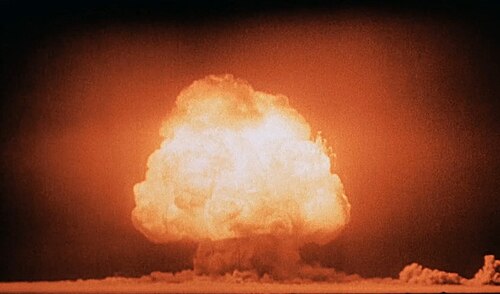
実際のテストでは、「ガジェット」というニックネームが付けられたこの兵器は、100フィート(30メートル)の鉄塔の頂上に吊り上げられた。その高さで爆発させると、爆撃機から投下されたときに兵器がどのように動作するかをより正確に知ることができるからだ。空中で爆発させることで、標的に直接適用されるエネルギーが最大になり、核の降下物が少なくなる。この兵器は、7月13日に近くのマクドナルド・ランチ・ハウスでノリス・ブラッドベリーの監督の下で組み立てられ、翌日、危険な状態でウインチで塔に引き上げられた。[236]
1945年7月16日午前5時30分、爆発装置はTNT火薬約20キロトン相当のエネルギーで爆発し、砂漠に幅250フィート(76メートル)のトリニタイト(放射性ガラス)のクレーターを残した。衝撃波は100マイル(160キロ)以上離れた場所でも感じられ、キノコ雲は高さ7.5マイル(12.1キロ)に達した。この音はテキサス州エルパソまで聞こえたため、グローブスはアラモゴード飛行場でガス弾が原因の弾薬庫爆発というカバーストーリーを発表した。[237] [238]
オッペンハイマーは後に、爆発を目撃しながらヒンズー教の聖典『バガヴァッド・ギーター』の一節を思い浮かべたと主張した(XI,12)。
彼はこれを(XI,32)と訳し、「今や私は死となり、世界の破壊者となった」と訳した。[241] [242] [j]
この実験は予想以上に成功し、すぐにポツダム会談に出席していたスティムソンに電報で伝えられ、グローブスは急いでより長い報告書を作成し、宅配便で送った。トルーマンはこのニュースに強く、前向きな影響を受けた。スティムソンは日記に、このニュースをチャーチルに伝えたところ、チャーチルは「昨日トルーマンに何が起こったのか分かった。私には理解できなかった。この報告書を読んで会議に来たチャーチルは、別人のようになっていた。ロシア人にどこで乗降するかを告げ、会議全体を指揮していた」と述べたと記している。[244]
人事

At its peak in June 1944, the Manhattan Project employed about 129,000 workers, of whom 84,500 were construction workers, 40,500 were plant operators and 1,800 were military personnel. As construction activity declined, the workforce fell to 100,000 a year later, but the number of military personnel increased to 5,600. Procuring the required numbers of workers, especially highly skilled workers, in competition with other vital wartime programs proved very difficult.[245] Due to high turnover, over 500,000 people worked on the project.[246] Most African Americans were employed in low-level jobs, but there were a few African-American scientists and technicians.[247] The unique labor and security requirements also resulted in the Manhattan Project having a higher percentage of women in technical roles than later government projects.[248]
In 1943, Groves obtained a special temporary priority for labor from the War Manpower Commission. In March 1944, both the War Production Board and the War Manpower Commission gave the project their highest priority.[249] The Kansas commission director stated that from April to July 1944 every qualified applicant in the state who visited a United States Employment Service office was urged to work at the Hanford Site. No other job was offered until the applicant definitively rejected the offer.[250] Tolman and Conant, in their role as the project's scientific advisers, drew up a list of candidate scientists and had them rated by scientists already working on the project. Groves then sent a personal letter to the head of their university or company asking for them to be released for essential war work.[251]

One source of skilled personnel was the Army itself, particularly the Army Specialized Training Program. In 1943, the MED created the Special Engineer Detachment (SED), with an authorized strength of 675. Technicians and skilled workers drafted into the Army were assigned to the SED. Another source was the Women's Army Corps (WAC). Initially intended for clerical tasks handling classified material, the WACs were soon tapped for technical and scientific tasks as well.[252] On 1 February 1945, all military personnel assigned to the MED, including all SED detachments, were assigned to the 9812th Technical Service Unit, except at Los Alamos, where military personnel other than SED, including the WACs and Military Police, were assigned to the 4817th Service Command Unit.[253]
An associate professor of Radiology at the University of Rochester School of Medicine, Stafford L. Warren, was commissioned as a colonel in the United States Army Medical Corps, and appointed as chief of the MED's Medical Section and Groves' medical advisor. Warren's initial task was to staff hospitals at Oak Ridge, Richland and Los Alamos.[254] The Medical Section was responsible for medical research, but also for the MED's health and safety programs. This presented an enormous challenge, because workers were handling a variety of toxic chemicals, using hazardous liquids and gases under high pressures, working with high voltages, and performing experiments involving explosives, not to mention the largely unknown dangers presented by radioactivity and handling fissile materials.[255] Yet in December 1945, the National Safety Council presented the Manhattan Project with the Award of Honor for Distinguished Service to Safety in recognition of its safety record. Between January 1943 and June 1945, there were 62 fatalities and 3,879 disabling injuries—about 62 percent below the rate of private industry.[256]
Secrecy

The Manhattan Project operated under a mandate of "absolute secrecy" from Roosevelt, meaning that the very existence of the project itself was to be kept secret. This proved a daunting task given the amount of knowledge and speculation about nuclear fission that existed prior to the Manhattan Project, the huge numbers of people involved, and the scale of the facilities.[257] Groves adopted an extreme version of compartmentalization (the need-to-know policy):
Compartmentalization of knowledge, to me, was the very heart of security. My rule was simple and not capable of misinterpretation—each man should know everything he needed to know to do his job and nothing else. Adherence to this rule not only provided an adequate measure of security, but it greatly improved over-all efficiency by making our people stick to their knitting. And it made quite clear to all concerned that the project existed to produce a specific end product—not to enable individuals to satisfy their curiosity and to increase their scientific knowledge.[258]
This clashed with the norms of many of the scientists involved, who claimed that science could not operate successfully under such requirements. The Manhattan Project officials also had difficulty with journalists, Congressmen, federal officials who were not "in the know", residents near local sites, judges adjudicating land claims, and other sources of speculation, prying, and leaks, along with concerns about espionage and sabotage. Groves relied on the FBI and his own autonomous G-2 intelligence unit to investigate potential security violations. Ultimately over 1,500 "loose talk" cases were investigated during the war. Even Harry Truman was not informed about the project while he was vice president, and only learned about it after Roosevelt's death.[257]
Because of its relative success at keeping the story out of newspapers, Byron Price, head of the Office of Censorship, ultimately designated the Manhattan Project "the best-kept secret of the war".[259] In 1945 Life estimated that before the Hiroshima and Nagasaki bombings "probably no more than a few dozen men in the entire country knew the full meaning of the Manhattan Project, and perhaps only a thousand others even were aware that work on atoms was involved." The magazine wrote that the more than 100,000 others employed with the project "worked like moles in the dark". Warned that disclosing the project's secrets was punishable by 10 years in prison or a fine of US$10,000 (equivalent to $169,000 in 2023), they monitored "dials and switches while behind thick concrete walls mysterious reactions took place" without knowing the purpose of their jobs.[260][261][262]
In December 1945 the US Army published a secret report assessing the security apparatus surrounding the Manhattan Project. The report states that the project was "more drastically guarded than any other highly secret war development." The surrounding security infrastructure was so vast and thorough that in the early days of the project in 1943, investigators vetted 400,000 potential employees and 600 companies for potential security risks.[263]
Censorship

Voluntary censorship of atomic information began before the Manhattan Project. After the start of the European war in 1939 American scientists began avoiding publishing military-related research, and in 1940 scientific journals began asking the National Academy of Sciences to clear articles. William L. Laurence of The New York Times, who wrote an article on atomic fission in The Saturday Evening Post of 7 September 1940, later learned that government officials asked librarians nationwide in 1943 to withdraw the issue.[264] The Soviets noticed the silence, however. In April 1942 nuclear physicist Georgy Flyorov wrote to Joseph Stalin on the absence of articles on nuclear fission in American journals; this resulted in the Soviet Union establishing its own atomic bomb project.[265]
The Manhattan Project operated under tight security lest its discovery induce Axis powers, especially Germany, to accelerate their own nuclear projects or undertake covert operations against the project.[266] The Office of Censorship relied on the press to comply with a voluntary code of conduct it published, and the project at first avoided notifying the office. By early 1943 newspapers began publishing reports of large construction in Tennessee and Washington, and the office began discussing with the project how to maintain secrecy. In June it asked newspapers and broadcasters to avoid discussing "atom smashing, atomic energy, atomic fission, atomic splitting, or any of their equivalents. The use for military purposes of radium or radioactive materials, heavy water, high voltage discharge equipment, cyclotrons."[267][259]
Soviet spies
The prospect of sabotage was always present, and sometimes suspected when there were equipment failures. While there were some problems believed to be the result of careless or disgruntled employees, there were no confirmed instances of Axis-instigated sabotage.[268] However, on 10 March 1945, a Japanese fire balloon struck a power line, and the resulting power surge caused the three reactors at Hanford to be temporarily shut down.[269] With so many people involved, security was difficult. A special Counter Intelligence Corps detachment was formed to handle the project's security issues.[270] By 1943, it was clear that the Soviet Union was attempting to penetrate the project. Lieutenant Colonel Boris T. Pash, the head of the Counter Intelligence Branch of the Western Defense Command, investigated suspected Soviet espionage at the Radiation Laboratory in Berkeley. Oppenheimer informed Pash that he had been approached by a fellow professor at Berkeley, Haakon Chevalier, about passing information to the Soviet Union.[271]
The most successful Soviet spy was Klaus Fuchs, a physicist and member of the British Mission who was intimately involved in work at Los Alamos on the design of the implosion bomb.[272] His espionage activities were not identified until 1950, as a result of Venona project. The revelation of his espionage activities damaged the United States' nuclear cooperation with Britain and Canada,[273] and other instances of espionage were subsequently uncovered, leading to the arrest of Harry Gold, David Greenglass, and Julius and Ethel Rosenberg.[274] Other spies like George Koval and Theodore Hall remained unknown for decades.[275] The value of the espionage is difficult to quantify, as the principal constraint on the Soviet atomic bomb project was their short supply of uranium ore. It may have saved the Soviets at least one or two years in the development of their own bomb,[276] although some historians have argued the Soviets spent as much time vetting and reduplicating the information as they would have saved had they trusted it.[277]
Foreign intelligence
In addition to developing the atomic bomb, the Manhattan Project was charged with gathering intelligence on the German nuclear energy project. It was believed that the Japanese nuclear weapons program was not far advanced because Japan had little access to uranium ore, but it was initially feared that Germany was very close to developing its own weapons. At the instigation of the Manhattan Project, a bombing and sabotage campaign was carried out against heavy water plants in German-occupied Norway.[278] A small mission was created, jointly staffed by the Office of Naval Intelligence, OSRD, the Manhattan Project, and Army Intelligence (G-2), to investigate enemy scientific developments. It was not restricted to those involving nuclear weapons.[279] The Chief of Army Intelligence, Major General George V. Strong, appointed Boris Pash to command the unit,[280] which was codenamed "Alsos" (Greek for "grove").[281] Samuel Goudsmit was the scientific director of the Alsos mission.[282]
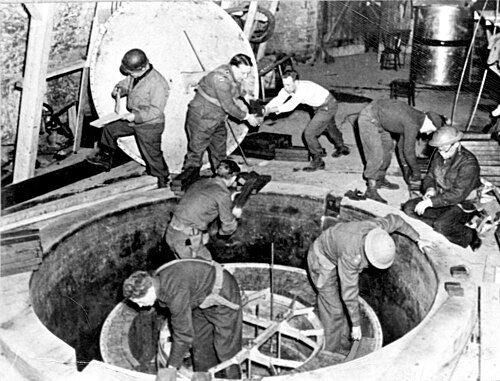
The Alsos Mission to Italy questioned physics laboratory staff at the University of Rome following the capture of the city in June 1944.[283] Meanwhile, Pash formed a combined British and American Alsos mission in London under the command of Captain Horace K. Calvert to participate in Operation Overlord.[284] Groves considered the risk that the Germans might attempt to disrupt the Normandy landings with radioactive poisons was sufficient to warn General Dwight D. Eisenhower and send an officer to brief his chief of staff, Lieutenant General Walter Bedell Smith.[285] Under the codename Operation Peppermint, special equipment was prepared and Chemical Warfare Service teams were trained in its use.[286]
Following in the wake of the advancing Allied armies, the Alsos team interrogated scientists and searched facilities in liberated areas of France and Germany to learn about the German work. Goudsmit concluded in November 1944 that the German nuclear program had never made it beyond the laboratory stage. As he put it later: "The evidence at hand proved definitely that Germany had no atom bomb and was not likely to have one in any reasonable time."[287]
Interrogation of German prisoners indicated that uranium and thorium were being processed in Oranienburg, so Groves arranged for it to be bombed on 15 March 1945 to deny its capture by the Soviet Union.[288] An Alsos team went to Stassfurt in the Soviet Occupation Zone and retrieved 11 tons of ore from WIFO.[289] In April 1945, Pash, in command of a composite force known as T-Force, conducted Operation Harborage, a sweep behind enemy lines of Hechingen, Bisingen, and Haigerloch—the heart of the German nuclear effort. T-Force captured nuclear laboratories, documents, equipment and supplies, including heavy water and 1.5 tons of metallic uranium.[290][291]
Alsos teams rounded up German scientists including Kurt Diebner, Otto Hahn, Walther Gerlach, Werner Heisenberg, and Carl Friedrich von Weizsäcker. They were taken to England and interned at Farm Hall, where they were surreptitiously surveilled.[292]
Atomic bombings of Hiroshima and Nagasaki
Preparations
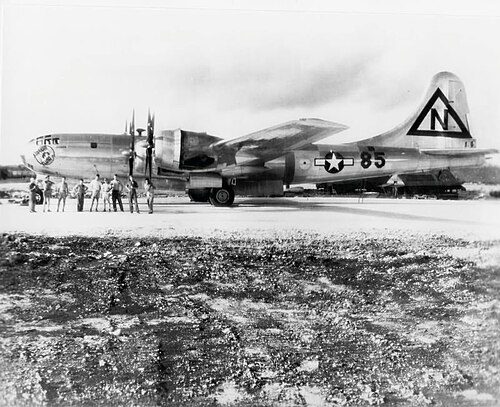
The only Allied aircraft capable of carrying the 17-foot (5.2 m) long Thin Man or the 59-inch (150 cm) wide Fat Man was the British Avro Lancaster, but using a British aircraft would have caused difficulties with maintenance. Groves hoped that the American Boeing B-29 Superfortress could be modified to carry a Thin Man by joining its two bomb bays together.[293] This became unnecessary after Thin Man was abandoned, as a Little Boy was short enough to fit into a B-29 bomb bay,[223] but modifications were still required. The Army Air Forces Materiel Command at Wright Field, Ohio, began Silverplate, the codename for the modification of the B-29, in November 1943. Test drops were carried out at Muroc Army Air Field and the Naval Ordnance Test Station in California with Thin Man and Fat Man pumpkin bombs to test their ballistic, fuzing and stability characteristics.[294]
The 509th Composite Group was activated on 17 December 1944 at Wendover Army Air Field, Utah, under the command of Colonel Paul W. Tibbets. Its 393rd Bombardment Squadron, equipped with Silverplate B-29s, practiced long-distance flights over water and dropped pumpkin bombs.[295] A special unit known as Project Alberta was formed at Los Alamos under Parsons's command to assist in preparing and delivering the bombs.[295] The 509th Composite Group deployed to North Field on Tinian in July 1945.[296] Most of the components for the Little Boy left San Francisco on the cruiser USS Indianapolis on 16 July and arrived on Tinian on 26 July. The remaining components, which included six highly enriched uranium rings, were delivered by three Douglas C-54 Skymasters of the 509th Group's 320th Troop Carrier Squadron.[297] Two Fat Man assemblies traveled to Tinian in specially modified 509th Composite Group B-29s, and the first plutonium core went in a special C-54.[298]
At the end of December 1944, worried by the heavy losses occurring in the Battle of the Bulge, Roosevelt instructed Groves and Stimson that if the atomic bombs were ready before the war with Germany ended, they should be ready to drop them on Germany, but Japan was regarded as more likely.[299] In late April 1945, a targeting committee was established to determine which cities should be targets, and it recommended Kokura, Hiroshima, Niigata, and Kyoto. Stimson intervened, announcing that he would be making the targeting decision, and that he would not authorize the bombing of Kyoto on the grounds of its historical and religious significance.[300] Nagasaki was ultimately substituted.[301] In May 1945, the Interim Committee was created to advise on wartime and postwar use of nuclear energy. The Interim Committee in turn established a scientific panel consisting of Arthur Compton, Fermi, Lawrence, and Oppenheimer; the scientific panel offered its opinion not just on the likely physical effects of an atomic bomb, but on its probable military and political impact. In a meeting on 1 June, the Interim Committee resolved that "the bomb should be used against Japan as soon as possible; that it be used on a war plant surrounded by workers' homes; and that it be used without prior warning".[302][303]
At the Potsdam Conference in Germany, President Harry S. Truman told Stalin that the US had "a new weapon of unusual destructive force", without giving any details. As he showed "no special interest," Truman erroneously assumed that Stalin did not understand. In reality, Soviet spies had kept Stalin informed of the work and the planned test.[304][305][306]
A strike order from General Thomas T. Handy to General Carl Spaatz was approved by Marshall and Stimson on 25 July which specified that the "first special bomb" be used "after about 3 August 1945," and that "additional bombs" would be used "as soon as made ready by the project staff".[307] The operational plan was to drop the first bomb on 2 August, the second bomb on 10 August, and a third bomb around 24 August. However, due to weather conditions over Japan and the desire for visual bombing, the date of the first bombing mission was pushed back to 6 August, and the second was moved forward to 9 August.[308]
Bombings
On 6 August 1945, the Enola Gay, a Boeing B-29 Superfortress of the 393d Bombardment Squadron, piloted by Tibbets, lifted off from North Field with a Little Boy in its bomb bay. Hiroshima, the headquarters of the 2nd General Army and Fifth Division and a port of embarkation, was the primary target, with Kokura and Nagasaki as alternatives. Parsons, the weaponeer in charge of the mission, completed the bomb assembly in the air to minimize the risks of a nuclear explosion in the event of a crash during takeoff.[309] The bomb detonated at an altitude of 1,750 feet (530 m) with a blast that was later estimated to be the equivalent of 13 kilotons of TNT.[310] An area of approximately 4.7 square miles (12 km2) was destroyed. Japanese officials determined that 69% of Hiroshima's buildings were destroyed and another 6–7% damaged. Early estimates were that 66,000 people were killed and 69,000 injured; later re-estimations that included people ignored by previous methods, like Korean slave laborers and additional soldiers, concluded there might have been 140,000 dead from the attack by December 1945.[311][312][313][314]

Fat Man explodes over Nagasaki, Japan, 9 August 1945 (right).
On the morning of 9 August 1945, the Bockscar, a second B-29 piloted by the 393d Bombardment Squadron's commander, Major Charles W. Sweeney, lifted off with a Fat Man on board. This time, Ashworth served as weaponeer and Kokura was the primary target. When they reached Kokura, they found cloud cover had obscured the city, prohibiting the visual attack required by orders. After three runs and with fuel running low, they headed for the secondary target, Nagasaki. Ashworth decided that a radar approach would be used if the target was obscured, but a last-minute break in the clouds over Nagasaki allowed a visual approach as ordered. The Fat Man was dropped over the city's industrial valley midway between the Mitsubishi Steel and Arms Works in the south and the Mitsubishi-Urakami Ordnance Works in the north. The resulting explosion had a blast yield equivalent to 21 kilotons of TNT, roughly the same as the Trinity blast, but was confined to the Urakami Valley, and a major portion of the city, including the city center, was protected by the intervening hills. About 44% of the city was destroyed, and estimates of casualties range from 40,000 to 80,000 people killed and at least 60,000 injured.[315] Overall, an estimated 35,000–40,000 people were killed and 60,000 injured.[316][317][311]
Groves expected to have another atomic bomb ready for use on 19 August, with three more in September and a further three in October.[318] Two more Fat Man assemblies were readied, and scheduled to leave Kirtland Field for Tinian on 11 and 14 August.[317] At Los Alamos, technicians worked 24 hours straight to cast another plutonium core.[319] Although cast, it still needed to be pressed and coated, which would take until 16 August.[320] It could therefore have been ready for use on 19 August.
On 10 August, Truman was informed that another bomb was being prepared. He ordered that no additional atomic bombs could be used without his express authority. According to Henry A. Wallace, Truman told his cabinet that "the thought of wiping out another 100,000 people was too horrible. He didn't like the idea of killing, as he said, 'all those kids.'"[321] Groves suspended the third core's shipment on 13 August.[322]
On 11 August, Groves phoned Warren with orders to organize a survey team to report on the damage and radioactivity at Hiroshima and Nagasaki as soon as the war ended. A party equipped with portable Geiger counters arrived in Hiroshima on 8 September headed by Farrell and Warren, with Japanese Rear Admiral Masao Tsuzuki, who acted as a translator. They remained in Hiroshima until 14 September and then surveyed Nagasaki from 19 September to 8 October.[323] This and other scientific missions to Japan provided valuable data on the effects of the atomic bomb, and led to the creation of the Atomic Bomb Casualty Commission.[324]
In anticipation of the bombings, Groves had commissioned physicist Henry DeWolf Smyth to prepare a sanitized technical history of the project for public consumption. The idea of releasing such information freely was controversial; the decision to do so was made by Truman personally. The "Smyth Report" was released to the public on 12 August 1945.[325]
Japan announced its surrender on 15 August.[326] The necessity of the bombings became a subject of controversy among historians. Some questioned whether "atomic diplomacy" would have attained the same goals, and the relative weight that the bombs and the Soviet declaration of war had on the Japanese willingness to surrender.[327] The Franck Report was the most notable effort pushing for a demonstration but was turned down by the Interim Committee's scientific panel.[328] The Szilárd petition, drafted in July 1945 and signed by dozens of scientists working on the Manhattan Project, was a late attempt at warning Truman about his responsibility in using such weapons.[329][330]
After the war

The Manhattan Project became instantly famous after the bombing of Hiroshima and the partial lifting of its secrecy. It was widely credited with ending the war, and Groves worked to credit its contractors, whose work had hitherto been secret. Groves and Nichols presented them with Army–Navy "E" Awards, and over 20 Presidential Medals for Merit were awarded to key contractors and scientists, including Bush and Oppenheimer. Military personnel received the Legion of Merit.[331]
The Manhattan Project persisted until 31 December 1946, and the Manhattan District to 15 August 1947.[332] During this time, it suffered from numerous difficulties caused by technical problems, the effects of rapid demobilization, and a lack of clarity on its long-term mission.
At Hanford, plutonium production declined as Reactors B, D and F wore out, poisoned by fission products and swelling of the graphite moderator known as the Wigner effect. The swelling damaged the charging tubes where the uranium was irradiated to produce plutonium, rendering them unusable. Production was curtailed and the oldest unit, B pile, was closed down so at least one reactor would remain available. Research continued, with DuPont and the Metallurgical Laboratory developing a redox solvent extraction process as an alternative plutonium extraction technique to the bismuth phosphate process, which left unspent uranium in a state from which it could not easily be recovered.[333]
Bomb engineering was carried out by the Z Division,[334] initially located at Wendover Field but moved to Oxnard Field, New Mexico, in September 1945 to be closer to Los Alamos. This marked the beginning of the Sandia Base. Nearby Kirtland Field was used as a B-29 base for aircraft compatibility and drop tests.[335] As reservist officers were demobilized, they were replaced by about fifty hand-picked regular officers.[336]
Nichols recommended that S-50 and the Alpha tracks at Y-12 be closed down. This was done in September.[337] Although performing better than ever,[338] the Alpha tracks could not compete with K-25 and the new K-27, which had commenced operation in January 1946. In December, the Y-12 plant was closed, cutting the Tennessee Eastman payroll from 8,600 to 1,500 and saving $2 million a month.[339]

Nowhere was demobilization more of a problem than at Los Alamos, where there was an exodus of talent. Much remained to be done. The bombs used on Hiroshima and Nagasaki needed work to make them simpler, safer and more reliable. Implosion methods needed to be developed for uranium in place of the wasteful gun method, and composite uranium-plutonium cores were needed now that plutonium was in short supply. However, uncertainty about the future of the laboratory made it hard to induce people to stay. Oppenheimer returned to his job at the University of California and Groves appointed Norris Bradbury as an interim replacement; Bradbury remained in the post for the next 25 years.[340] Groves attempted to combat the dissatisfaction caused by the lack of amenities with a construction program that included an improved water supply, three hundred houses, and recreation facilities.[333]
Manhattan Project personnel participated in the first postwar nuclear tests, Operation Crossroads, conducted at Bikini Atoll in July 1946. Two Fat Man-type bombs were detonated — one as an airburst, one as an underwater burst — to investigate the effect of nuclear weapons on warships.[341][342] Press and international observers were allowed to attend, making the tests an international spectacle.[343]
Following a domestic debate over the peacetime management of the nuclear program, the Atomic Energy Act of 1946 created the United States Atomic Energy Commission to take over the project's functions and assets. It established civilian control over atomic development. Military aspects were taken over by the Armed Forces Special Weapons Project (AFSWP).[344]
After the bombings at Hiroshima and Nagasaki, a number of Manhattan Project physicists founded the Bulletin of the Atomic Scientists (1945) and Emergency Committee of Atomic Scientists (1946), which began as an emergency action undertaken by scientists who saw urgent need for an educational program about atomic weapons.[345] In the face of the destructiveness of the bombs and in anticipation of the nuclear arms race several project members including Bohr, Bush and Conant expressed the view that it was necessary to reach agreement on international control of nuclear research and atomic weapons. The Baruch Plan, unveiled in a speech to the newly formed United Nations Atomic Energy Commission (UNAEC) in June 1946, proposed the establishment of an international atomic development authority, but was not adopted.[346]
Cost
The project expenditure through 1 October 1945 was $1.845 billion, equivalent to less than nine days of wartime spending, and was $2.191 billion when the AEC assumed control on 1 January 1947. The total allocation was $2.4 billion. 84% of the costs through the end of 1945 were spent on the plants at Oak Ridge and Hanford, producing the enriched uranium and plutonium needed to fuel the bombs. At both sites, the majority of the costs were for construction (74% at Oak Ridge, 87% at Hanford), with the rest being for operations.[348][349][350]

Initial funding for the project was through the general budget of the Office of Scientific Research and Development. As plans were made to turn the work over to the Army Corps of Engineers, Bush wrote to Roosevelt in late 1942 that "it would be ruinous to the essential secrecy to have to defend before an appropriations committee any request for funds for this project." Instead, initial funding was done through discretionary funds to which Roosevelt had access.[351]
As it grew in size and cost, Congress was deliberately kept ignorant of the project, because of concerns that Congressmen were prone to leaking information, and because it was feared that the project would appear to be a boondoggle. Appropriations requests were quietly slipped into other bills, but the project's mounting costs and large facilities (which appeared to many to produce nothing) attracted scrutiny from several Congressional auditors. The Truman Committee that investigated wartime waste and fraud attempted to audit the project several times, but each time their inquiries were rejected.[352]
These Congressional inquiries, along with the need for smooth budgetary approval, led to Bush, Groves, and Stimson agreeing in the spring of 1944 that a few high-ranking Congressmen should be told of the project's purpose. By March 1945, exactly seven Congressmen were officially informed.[352] The funds were hidden into appropriation requests with the inconspicuous headings, frequently "Engineer Service Army" and "Expediting Production." In late May 1945, to further expedite budget issues and assure the cooperation of Albert J. Engel, who had threatened to reveal the existence of the project if he was not told more about it, five additional Congressmen were permitted to visit the Oak Ridge site to assure themselves of "the reasonableness of the various living accommodations which had been provided, [and] that they actually observe the size and scope of the installations and that some of the complexities of the project be demonstrated to them."[k]
During the war, the Manhattan Project ultimately produced the three bombs used (the Trinity gadget, Little Boy, and Fat Man), as well as an additional unused Fat Man bomb, making the average wartime cost per bomb around $500 million in 1945 dollars. By comparison, the project's total cost by the end of 1945 was about 90% of the total spent on the production of US small arms (not including ammunition) and 34% of the total spent on US tanks during the same period.[347] It was the second most expensive weapons project undertaken by the United States during the war, behind only the Boeing B-29 Superfortress.[354]
Legacy
.jpg/500px-Aerial_view_of_Niagara_Falls_Storage_Site,_Lewiston,_New_York_(2002).jpg)
The political and cultural impacts of the development of nuclear weapons were profound. William Laurence of The New York Times, the first to use the phrase "Atomic Age",[359] became the official correspondent for the Manhattan Project in spring 1945. He witnessed both the Trinity test[360] and the bombing of Nagasaki and wrote the official press releases on them. He went on to write a series of articles extolling the virtues of the new weapon. His reporting helped to spur public awareness of the potential of nuclear technology and motivated its development in the United States and Soviet Union.[361]
The Manhattan Project left a legacy of a network of national laboratories: the Lawrence Berkeley National Laboratory, Los Alamos National Laboratory, Oak Ridge National Laboratory, Argonne National Laboratory, and Ames Laboratory. Two more were established by Groves soon after the war, the Brookhaven National Laboratory at Upton, New York, and the Sandia National Laboratories at Albuquerque, New Mexico. Groves allocated $72 million to them for research activities in fiscal year 1946–1947.[362] They would be in the vanguard of the kind of large-scale research that Alvin Weinberg, the director of the Oak Ridge National Laboratory, would call Big Science.[363]
The Naval Research Laboratory had long been interested in the prospect of using nuclear power for warship propulsion, and sought to create its own nuclear project. In May 1946, Nimitz, now Chief of Naval Operations, decided that the Navy should instead work with the Manhattan Project. A group of naval officers were assigned to Oak Ridge, the most senior of whom was Captain Hyman G. Rickover, who became assistant director there. They immersed themselves in the study of nuclear energy, laying the foundations for a nuclear-powered navy.[364] A similar group of Air Force personnel arrived at Oak Ridge in September 1946 with the aim of developing nuclear aircraft.[365] Their Nuclear Energy for the Propulsion of Aircraft project ran into formidable technical difficulties and was ultimately canceled.[366]
The ability of the new reactors to create radioactive isotopes in previously unheard-of quantities sparked a revolution in nuclear medicine. Starting in mid-1946, Oak Ridge began distributing radioisotopes to hospitals and universities, primarily iodine-131 and phosphorus-32 for cancer diagnosis and treatment. Isotopes were also used in biological, industrial and agricultural research.[367]
Its production sites, operating with new technologies, exotic substances, and under conditions of secrecy and haste, also left a vast legacy of waste and environmental damage. At Hanford, for example, corrosive and radioactive wastes were stored in "hastily fabricated, single-shell, steel-lined, underground storage tanks" that were intended to be temporary, awaiting a more permanent solution.[368] Instead, they were neglected and eventually leaked. Issues of this kind resulted in Hanford becoming "one of the most contaminated nuclear waste sites in North America", and the subject of significant cleanup efforts after it was deactivated in the late Cold War.[369]
On handing over control to the Atomic Energy Commission, Groves bid farewell to the people who had worked on the Manhattan Project:
Five years ago, the idea of Atomic Power was only a dream. You have made that dream a reality. You have seized upon the most nebulous of ideas and translated them into actualities. You have built cities where none were known before. You have constructed industrial plants of a magnitude and to a precision heretofore deemed impossible. You built the weapon which ended the War and thereby saved countless American lives. With regard to peacetime applications, you have raised the curtain on vistas of a new world.[370]
The Manhattan Project National Historical Park was established on 10 November 2015.[371]
See also
- The Bomb (film) – 2015 American documentary film
- Oppenheimer (TV series) - 1980 TV miniseries
- Fat Man and Little Boy (film) - 1989 film starring Paul Newman
- Oppenheimer (film) - 2023 film by Christopher Nolan starring Cillian Murphy
- Timeline of nuclear weapons development
Notes
- ^ Specifically at its Berkeley campus; however, as of 1940, the University of California had not yet established a formal distinction between the university as a whole and its flagship campus at Berkeley. The process of transforming the University into a multi-campus university system began in March 1951 and was not complete until 1960.[12]
- ^ The reaction Teller was most concerned with was: 14
7N
+ 14
7N
→ 24
12Mg
+ 4
2He
(alpha particle) + 17.7 MeV.[34] - ^ In Bethe's account, the possibility of this ultimate catastrophe came up again in 1975 when it appeared in a magazine article by H.C. Dudley, who got the idea from a report by Pearl Buck of an interview she had with Arthur Compton in 1959. The worry was not entirely extinguished in some people's minds until the Trinity test.[37]
- ^ Natural self-sustaining nuclear reactions have occurred in the very distant past.[106]
- ^ The allusion here is to the Italian navigator Christopher Columbus, who reached the Caribbean in 1492.
- ^ The original project goal in 1942 was to acquire approximately 1,700 short tons (1,500 t) of uranium ore. By the time of the dissolution of the Manhattan District, it had acquired about 10,000 short tons (9,100 t) tons of uranium oxides, 72% of which came from the Congolese ores, 14% from the Colorado plateau, and 9% from Canadian ores.[129]
- ^ Much of the mined ore from the Shinkolobwe mine had a uranium oxide content as high as 65% to 75%, which was many times higher than any other global sources.[132] By comparison, the Canadian ores could be as high as 30%, and American sources, many of them byproducts of the mining of other minerals (especially vanadium), contained less than 1% uranium.[133]
- ^ It is necessary to distinguish between the K-25 gaseous diffusion plant and the K-25 power plant. The latter provided energy to both the K-25 gaseous diffusion plant and the S-50 thermal diffusion plant.
- ^ The charge consisted of 89.75 short tons (81.42 t) tons of TNT and 14.91 short tons (13.53 t) tons of Composition B (with the total explosive power of approximately 108 tons of TNT), actually a few tons more than the stated "100-tons".[230][231]
- ^ The first instance in print of Oppenheimer's Gita story is apparently from 1948. Oppenheimer at times translated it to "shatterer of worlds" as well. The quote with "destroyer of worlds" comes from a taped interview of Oppenheimer did with NBC in 1965. Oppenheimer's translation is not considered a standard or literal one, and was likely influenced by the style of his Sanskrit teacher, Arthur Ryder, who translated the line as: "Death am I, and my present task / Destruction." A more common translation has the identification not as "Death," but as "Time." In the passage, the Hindu god Krishna is revealing himself and his true form to Prince Arjuna, imploring Arjuna to fulfill his duty and take part in a war, and assuring him that the fate of those killed is really up to Krishna, not mortal men.[243]
- ^ The seven Congressmen officially informed were: Alben W. Barkley (Senate Majority Leader), Styles Bridges (Ranking minority member of the Sub-Committee on Military Appropriations), Joseph W. Martin Jr. (House Minority Leader), John W. McCormack (House Majority Leader), Sam Rayburn (Speaker of the House), Elmer Thomas (Chair of the Sub-Committee on Military Appropriations), and Wallace H. White (Senate Minority Leader). The five allowed to tour Oak Ridge were: Clarence Cannon, Albert J. Engel, George H. Mahon, J. Buell Snyder, and John Taber.[353]
Citations
- ^ Johnston, Louis; Williamson, Samuel H. (2023). "What Was the U.S. GDP Then?". MeasuringWorth. Retrieved 30 November 2023. United States Gross Domestic Product deflator figures follow the MeasuringWorth series.
- ^ Jones 1985, p. 12.
- ^ a b Hewlett & Anderson 1962, pp. 16–20.
- ^ Hewlett & Anderson 1962, p. 20.
- ^ Hewlett & Anderson 1962, p. 21.
- ^ "Fermi at Columbia". physics.columbia.edu. Archived from the original on 21 June 2019. Retrieved 29 July 2019.
- ^ Rhodes 1986, pp. 337–338.
- ^ "Executive Order 8807 Establishing the Office of Scientific Research and Development". 28 June 1941. Retrieved 28 June 2011.
- ^ a b Hewlett & Anderson 1962, pp. 40–41.
- ^ Jones 1985, p. 33.
- ^ a b Hewlett & Anderson 1962, pp. 33–35, 183.
- ^ "Past Chancellors". Berkeley Office of the Chancellor. Retrieved 16 April 2018.
- ^ Rhodes 1986, pp. 322–325.
- ^ a b Hewlett & Anderson 1962, p. 42.
- ^ Hewlett & Anderson 1962, pp. 39–40.
- ^ Phelps 2010, pp. 126–128.
- ^ a b Phelps 2010, pp. 282–283.
- ^ Rhodes 1986, pp. 372–374.
- ^ Hewlett & Anderson 1962, pp. 43–44.
- ^ Jones 1985, pp. 30–32.
- ^ Jones 1985, p. 35.
- ^ Williams 1960, pp. 3–4.
- ^ a b c Jones 1985, pp. 37–39.
- ^ Nichols 1987, pp. 32.
- ^ Jones 1985, pp. 35–36.
- ^ Rhodes 1986, p. 416.
- ^ Hewlett & Anderson 1962, p. 103.
- ^ a b Hoddeson et al. 1993, pp. 42–44
- ^ Groves 1962, p. 41.
- ^ Serber & Rhodes 1992, p. 21.
- ^ Hoddeson et al. 1993, pp. 54–56
- ^ Rhodes 1986, p. 417.
- ^ Hoddeson et al. 1993, pp. 44–45
- ^ Bethe 1991, p. 30.
- ^ Rhodes 1986, p. 419.
- ^ Konopinski, E. J; Marvin, C.; Teller, Edward (1946). "Ignition of the Atmosphere with Nuclear Bombs" (PDF). Los Alamos National Laboratory. Retrieved 23 November 2008.
- ^ Bethe 1991, pp. xi, 30.
- ^ Broad, William J. (30 October 2007). "Why They Called It the Manhattan Project". The New York Times. Retrieved 27 October 2010.
- ^ a b Jones 1985, pp. 41–44.
- ^ Sullivan 2016, pp. 86–87.
- ^ Fine & Remington 1972, p. 652.
- ^ Nichols 1987, p. 174.
- ^ Groves 1962, p. 40.
- ^ Hewlett & Anderson 1962, pp. 76–78.
- ^ Fine & Remington 1972, p. 654.
- ^ Jones 1985, pp. 57–61.
- ^ a b Fine & Remington 1972, p. 657.
- ^ "Science:Atomic Footprint". Time. 17 September 1945. Retrieved 19 January 2022.
- ^ Hewlett & Anderson 1962, p. 81.
- ^ a b Jones 1985, pp. 74–77.
- ^ Groves 1962, pp. 4–5.
- ^ Fine & Remington 1972, pp. 659–661.
- ^ Groves 1962, pp. 27–28.
- ^ Groves 1962, pp. 44–45.
- ^ Groves 1962, pp. 22–23.
- ^ Jones 1985, pp. 80–82.
- ^ Ermenc 1989, p. 238.
- ^ Groves 1962, pp. 61–63.
- ^ Nichols 1987, pp. 72–73.
- ^ Bernstein 1976, pp. 206–208.
- ^ Villa 1981, pp. 144–145.
- ^ Stacey 1970, p. 517.
- ^ Bernstein 1976, p. 211.
- ^ a b c d Fakley, Dennis C. (Winter–Spring 1983). "The British Mission". Los Alamos Science (7): 186–189.
- ^ Bernstein 1976, pp. 213.
- ^ Gowing 1964, pp. 168–173.
- ^ Bernstein 1976, pp. 216–217.
- ^ Jones 1985, p. 296.
- ^ "Hyde Park Aide-Mémoire (18 September 1944)". Atomic Heritage Foundation. 2022.
- ^ Gowing (1964), pp. 340–342.
- ^ Gowing 1964, pp. 242–244.
- ^ Hunner 2004, p. 26.
- ^ Gowing 1964, p. 372.
- ^ Bernstein 1976, pp. 223–224.
- ^ Jones 1985, pp. 90, 299–306.
- ^ Groves 1962, p. 408.
- ^ a b Johnson & Jackson 1981, pp. 168–169.
- ^ Hewlett & Anderson 1962, pp. 116–117.
- ^ Groves 1962, pp. 25–26.
- ^ Jones 1985, p. 78.
- ^ Johnson & Jackson 1981, pp. 39–43.
- ^ Fine & Remington 1972, pp. 663–664.
- ^ "Oak Ridge National Laboratory Review, Vol. 25, Nos. 3 and 4, 2002". ornl.gov. Archived from the original on 25 August 2009. Retrieved 9 March 2010.
- ^ Jones 1985, pp. 327–328.
- ^ Johnson & Jackson 1981, p. 49.
- ^ Johnson & Jackson 1981, p. 8.
- ^ Johnson & Jackson 1981, pp. 14–17.
- ^ Jones 1985, p. 88.
- ^ a b Jones 1985, pp. 443–446.
- ^ William J. (Bill) Wilcox Jr., Oak Ridge City Historian, Retired Technical Director for the Oak Ridge Y-12 & K-25 Plants, 11 November 2007, Early Days of Oak Ridge and Wartime Y-12, Retrieved 22 November 2014
- ^ Jones 1985, pp. 83–84.
- ^ Fine & Remington 1972, pp. 664–665.
- ^ "50th Anniversary Article: Oppenheimer's Better Idea: Ranch School Becomes Arsenal of Democracy". Los Alamos National Laboratory. Retrieved 6 April 2011.
- ^ Groves 1962, pp. 66–67.
- ^ Jones 1985, pp. 328–331.
- ^ "Secretary of Agriculture granting use of land for Demolition Range" (PDF). Los Alamos National Laboratory. 8 April 1943. Retrieved 6 April 2011.
- ^ "Civilian Displacement: Los Alamos, NM". Atomic Heritage Foundation. 26 July 2017. Retrieved 1 August 2024.
- ^ Hunner 2004, pp. 31–32.
- ^ Hunner 2004, p. 29.
- ^ Hewlett & Anderson 1962, pp. 230–232.
- ^ Conant 2005, pp. 58–61.
- ^ Jones 1985, pp. 67–71.
- ^ a b "Site A/Plot M, Illinois, Decommissioned Reactor Site Fact Sheet" (PDF). Archived from the original (PDF) on 26 October 2014. Retrieved 3 December 2012.
- ^ "FRONTIERS Research Highlights 1946–1996" (PDF). Office of Public Affairs, Argonne National Laboratory. 1996. p. 11. doi:10.2172/770687. OSTI 770687.
- ^ Walsh, John (19 June 1981). "A Manhattan Project Postscript" (PDF). Science. 212 (4501): 1369–1371. Bibcode:1981Sci...212.1369W. doi:10.1126/science.212.4501.1369. ISSN 0036-8075. PMID 17746246. Retrieved 23 March 2013.
- ^ Libby 1979, pp. 214–216.
- ^ "CP-1 (Chicago Pile 1 Reactor)". Argonne National Laboratory; U.S. Department of Energy. Retrieved 12 April 2013.
- ^ Compton 1956, p. 144.
- ^ Jones 1985, pp. 195–196.
- ^ Holl, Hewlett & Harris 1997, p. 428.
- ^ Fermi, Enrico (1946). "The Development of the first chain reaction pile". Proceedings of the American Philosophical Society. 90 (1): 20–24. JSTOR 3301034.
- ^ Groves 1962, pp. 58–59.
- ^ Groves 1962, pp. 68–69.
- ^ a b Jones 1985, pp. 108–111.
- ^ Jones 1985, p. 342.
- ^ Jones 1985, pp. 452–457.
- ^ Thayer 1996, p. 16.
- ^ Jones 1985, p. 401.
- ^ Jones 1985, pp. 463–464.
- ^ Commission, Canadian Nuclear Safety. "Canada's historical role in developing nuclear weapons". www.cnsc-ccsn.gc.ca. Retrieved 23 May 2024.
- ^ Dawson, Tyler (24 July 2023). "Canada's contributions to the atomic bomb developed by Oppenheimer". National Post. Retrieved 25 May 2024.
- ^ a b Waltham 2002, pp. 8–9.
- ^ "ZEEP – Canada's First Nuclear Reactor". Canada Science and Technology Museum. Archived from the original on 6 March 2014.
- ^ Jones 1985, pp. 8, 62.
- ^ Jones 1985, pp. 107–108.
- ^ Hewlett & Anderson 1962, pp. 201–202.
- ^ Smyth 1945, p. 39.
- ^ Smyth 1945, p. 92.
- ^ Manhattan District History, Book 7, Volume 1 (Feed Materials and Special Procurement). Vol. Book 7, Volume 1. 1947. pp. 2.14, 5.1, Appendix D.3.. An additional 5% came from "miscellaneous sources", which included some ores recovered by the Alsos Mission from Europe.
- ^ Hewlett & Anderson 1962, pp. 85–86.
- ^ Nichols 1987, p. 47
- ^ Nichols 1987, p. 47
- ^ Manhattan District History, Book 7, Volume 1 (Feed Materials and Special Procurement). Vol. Book 7, Volume 1. 1947. pp. Appendix C1..
- ^ Jones 1985, p. 295.
- ^ Hewlett & Anderson 1962, pp. 285–288.
- ^ Hewlett & Anderson 1962, pp. 291–292.
- ^ Ruhoff & Fain 1962, pp. 3–9.
- ^ Hoddeson et al. 1993, p. 31
- ^ Hewlett & Anderson 1962, pp. 87–88.
- ^ Smyth 1945, pp. 154–156.
- ^ Jones 1985, p. 157.
- ^ Hewlett & Anderson 1962, pp. 22–23.
- ^ Hewlett & Anderson 1962, p. 30.
- ^ Hewlett & Anderson 1962, p. 64.
- ^ Hewlett & Anderson 1962, pp. 96–97.
- ^ Nichols 1987, p. 64.
- ^ Kemp 2012, pp. 281–287, 291–297.
- ^ a b Jones 1985, pp. 117–119.
- ^ Smyth 1945, pp. 164–165.
- ^ Fine & Remington 1972, p. 684.
- ^ Nichols 1987, p. 42.
- ^ a b Jones 1985, p. 133.
- ^ Hewlett & Anderson 1962, p. 153.
- ^ "The Calutron Girls". SmithDRay. Retrieved 22 June 2011.
- ^ Jones 1985, pp. 126–132.
- ^ Jones 1985, pp. 138–139.
- ^ Jones 1985, p. 140.
- ^ Nichols 1987, p. 131.
- ^ Jones 1985, pp. 143–148.
- ^ Hewlett & Anderson 1962, pp. 30–32, 96–98
- ^ Hewlett & Anderson 1962, p. 108.
- ^ Jones 1985, pp. 150–151.
- ^ Jones 1985, pp. 154–157.
- ^ Hewlett & Anderson 1962, pp. 126–127.
- ^ Jones 1985, pp. 158–165.
- ^ Jones 1985, pp. 167–171.
- ^ Smyth 1945, pp. 161–162.
- ^ Jones 1985, p. 172.
- ^ Jones 1985, pp. 175–177.
- ^ Hewlett & Anderson 1962, pp. 170–172.
- ^ Jones 1985, pp. 178–179.
- ^ Jones 1985, pp. 180–183.
- ^ Hewlett & Anderson 1962, pp. 300–302.
- ^ Hansen 1995b, p. V-112.
- ^ a b Smyth 1945, pp. 130–132.
- ^ a b Jones 1985, pp. 204–206.
- ^ Hewlett & Anderson 1962, pp. 208–210.
- ^ Hewlett & Anderson 1962, p. 211.
- ^ a b Jones 1985, p. 209.
- ^ Groves 1962, pp. 78–82.
- ^ Jones 1985, p. 210.
- ^ Hewlett & Anderson 1962, pp. 222–226.
- ^ Thayer 1996, p. 139.
- ^ Hanford Cultural and Historic Resources Program 2002, p. 1.16
- ^ Hewlett & Anderson 1962, pp. 216–217.
- ^ Hewlett & Anderson 1962, pp. 304–307.
- ^ Jones 1985, pp. 220–223.
- ^ Howes & Herzenberg 1999, p. 45.
- ^ Libby 1979, pp. 182–183.
- ^ Thayer 1996, p. 10.
- ^ a b Thayer 1996, p. 141.
- ^ Hewlett & Anderson 1962, pp. 184–185.
- ^ Hewlett & Anderson 1962, pp. 204–205.
- ^ Jones 1985, pp. 214–216.
- ^ Jones 1985, p. 212.
- ^ Thayer 1996, p. 11.
- ^ Hewlett & Anderson 1962, pp. 219–222.
- ^ Hoddeson et al. 1993, pp. 226–229, 237
- ^ Hoddeson et al. 1993, pp. 242–244
- ^ Hewlett & Anderson 1962, pp. 312–313.
- ^ Hewlett & Anderson 1962, p. 246.
- ^ Hoddeson et al. 1993, pp. 129–130
- ^ Hoddeson et al. 1993, pp. 130–131
- ^ Hoddeson et al. 1993, pp. 245–248
- ^ Hewlett & Anderson 1962, p. 311.
- ^ Hoddeson et al. 1993, p. 245
- ^ a b Hoddeson et al. 1993, pp. 294–296
- ^ Hoddeson et al. 1993, p. 299
- ^ a b c Hansen 1995b, p. V-123.
- ^ Hoddeson et al. 1993, pp. 301–307
- ^ Hoddeson et al. 1993, pp. 148–154
- ^ Hawkins, Truslow & Smith 1961, p. 203.
- ^ Hansen 1995a, p. I-298.
- ^ Hewlett & Anderson 1962, p. 235.
- ^ Gilbert 1969, pp. 3–4.
- ^ Hoddeson et al. 1993, pp. 308–310
- ^ Hewlett & Anderson 1962, pp. 244–245.
- ^ Baker, Hecker & Harbur 1983, pp. 144–145
- ^ Hoddeson et al. 1993, p. 288
- ^ Hoddeson et al. 1993, p. 290
- ^ Hoddeson et al. 1993, pp. 330–331
- ^ Hoddeson et al. 1993, pp. 245–249.
- ^ a b Rhodes 1986, p. 541.
- ^ Hawkins, Truslow & Smith 1961, pp. 95–98.
- ^ Hawkins, Truslow & Smith 1961, pp. 214–216.
- ^ "American Experience . Race for the Superbomb . Super Conference". PBS. Archived from the original on 28 August 2016. Retrieved 28 August 2016.
- ^ Jones 1985, p. 465.
- ^ Hewlett & Anderson 1962, pp. 318–319.
- ^ Jones 1985, pp. 478–481.
- ^ Walker, Raymond L. (1950). 100-ton Test: Piezo Gauge Measurements. U.S. Atomic Energy Commission, Technical Information Division. p. 1.
- ^ Loring, William S. (2019). Birthplace of the Atomic Bomb: A Complete History of the Trinity Test Site. Jefferson, North Carolina: McFarland & Company, Inc., Publishers. p. 133. ISBN 978-1-4766-3381-7.
- ^ a b Jones 1985, p. 512.
- ^ Hoddeson et al. 1993, pp. 360–362
- ^ Hoddeson et al. 1993, pp. 174–175
- ^ Hoddeson et al. 1993, pp. 365–367
- ^ Hoddeson et al. 1993, pp. 367–370
- ^ Hoddeson et al. 1993, pp. 372–374
- ^ Jones 1985, pp. 514–517.
- ^ Jungk 1958, p. 201.
- ^ "Bhagavad Gita As It Is, 11: The Universal Form, Text 12". A.C. Bhaktivedanta Swami Prabhupada. Retrieved 19 July 2013.
- ^ Barnett, Lincoln. "J. Robert Oppenheimer". Life. p. 133. ISSN 0024-3019. Retrieved 29 August 2023.
- ^ "The Eternal Apprentice". Time. 8 November 1948. Retrieved 29 August 2023.
- ^ Hijiya, James A. (June 2000). "The 'Gita' of J. Robert Oppenheimer". Proceedings of the American Philosophical Society. 144 (2): 123–167.
- ^ Groves 1962, pp. 303–304.
- ^ Jones 1985, p. 344.
- ^ Wellerstein, Alex (1 November 2013). "How many people worked on the Manhattan Project?". Restricted Data. Retrieved 28 March 2023.
- ^ "African Americans and the Manhattan Project". Nuclear Museum. Retrieved 12 April 2024.
- ^ Howes & Herzenberg 1999, pp. 14–15: "On the basis of numbers alone, women were important at all the project sites. They accounted for 9 percent of the 51,000 employees at Hanford in 1944, when the site's staff was at its largest. At Los Alamos, when tight security made it difficult to hire people who did not already live on the site, opportunities for women may have been even greater. In September 1943, some sixty women worked in the Technical Area at Los Alamos. By October 1944, about 30 percent, or 200 members of the labor for in the Tech Area, the hospital, and the schools were women. Of these, twenty could be described as scientists and fifty as technicians. ... The number of women working on the Manhattan Project contrasts sharply with the Apollo Project of the 1960s, which was comparable in size and scope. At its peak in 1965, when Apollo engaged 5.4 percent of the national supply of scientists and engineers, women accounted for only 3 percent of NASA's scientific and engineering staff."
- ^ Jones 1985, p. 353.
- ^ "1,000 were at Pasco". Lawrence Journal-World. Associated Press. 8 August 1945. p. 1. Retrieved 24 October 2022.
- ^ Jones 1985, pp. 349–350.
- ^ Jones 1985, p. 358.
- ^ Jones 1985, p. 361.
- ^ Nichols 1987, p. 123.
- ^ Jones 1985, p. 410.
- ^ Jones 1985, p. 430.
- ^ a b Wellerstein 2021, pp. 43, 52–96
- ^ Groves 1962, p. 140.
- ^ a b "No News Leaked Out About Bomb". Lawrence Journal-World. Associated Press. 8 August 1945. p. 5. Retrieved 15 April 2012.
- ^ Wickware, Francis Sill (20 August 1945). "Manhattan Project: Its Scientists Have Harnessed Nature's Basic Force". Life. pp. 2, 91. Retrieved 25 November 2011.
- ^ "The Secret City/ Calutron operators at their panels, in the Y-12 plant at Oak Ridge, Tennessee, during World War II". The Atlantic. 25 June 2012. Retrieved 25 June 2012.
- ^ Wellerstein, Alex (16 April 2012). "Oak Ridge Confidential, or Baseball for Bombs". Restricted Data. Archived from the original on 17 January 2013. Retrieved 7 April 2013.
- ^ Roberts, Sam (29 September 2014). "The Difficulties of Nuclear Containment". The New York Times. ISSN 0362-4331. Retrieved 6 May 2020.
- ^ Sweeney 2001, pp. 196–198.
- ^ Holloway 1994, pp. 76–79.
- ^ Jones 1985, pp. 253–255.
- ^ Sweeney 2001, pp. 198–200.
- ^ Jones 1985, pp. 263–264.
- ^ Jones 1985, p. 267.
- ^ Jones 1985, pp. 258–260.
- ^ Jones 1985, pp. 261–265.
- ^ Groves 1962, pp. 142–145.
- ^ Hewlett & Duncan 1969, pp. 312–314.
- ^ Hewlett & Duncan 1969, p. 472.
- ^ Broad, William J. (12 November 2007). "A Spy's Path: Iowa to A-Bomb to Kremlin Honor". The New York Times. pp. 1–2. Retrieved 2 July 2011.
- ^ Holloway 1994, pp. 222–223.
- ^ Gordin, Michael D. (2009). Red Cloud at Dawn: Truman, Stalin, and the End of the Atomic Monopoly. Farrar, Straus, and Giroux. pp. 153–156.
- ^ Groves 1962, pp. 191–192.
- ^ Groves 1962, pp. 187–190.
- ^ Jones 1985, p. 281.
- ^ Groves 1962, p. 191.
- ^ Jones 1985, p. 285.
- ^ Jones 1985, p. 282.
- ^ Groves 1962, pp. 194–196.
- ^ Groves 1962, pp. 200–206.
- ^ Jones 1985, pp. 283–285.
- ^ Goudsmit 1947, pp. 70–71.
- ^ Jones 1985, pp. 286–288.
- ^ Groves 1962, p. 237.
- ^ Jones 1985, pp. 289–290.
- ^ Goudsmit 1947, pp. 174–176.
- ^ Groves 1962, pp. 333–340.
- ^ Hoddeson et al. 1993, pp. 379–380.
- ^ Hoddeson et al. 1993, pp. 380–381.
- ^ a b Groves 1962, pp. 259–262.
- ^ Hoddeson et al. 1993, pp. 386–388.
- ^ Campbell 2005, pp. 39–40.
- ^ Groves 1962, p. 341.
- ^ Groves 1962, p. 184.
- ^ Groves 1962, pp. 268–276.
- ^ Groves 1962, p. 308.
- ^ Jones 1985, pp. 530–532.
- ^ "Notes of Meeting of the Interim Committee, June 1, 1945". The Harry S Truman Library and Museum. pp. 8–9. Archived from the original on 14 May 2011. Retrieved 2 March 2011.
- ^ Holloway 1994, pp. 116–117.
- ^ "Foreign Relations of the United States: Diplomatic Papers, The Conference of Berlin (The Potsdam Conference), 1945, Volume II". Office of the Historian. Retrieved 24 January 2024.
- ^ Gordin, Michael (2009). Red Cloud at Dawn: Truman, Stalin, and the End of the Atomic Monopoly. Farrar, Straus and Giroux. pp. 7–10.
- ^ "Order to Drop the Atomic Bomb, Handy to Spaatz, July 25, 1945". Office of History and Heritage Resources, US Department of Energy. Retrieved 24 January 2024.
- ^ Gordin, Michael (2007). Five Days in August: How World War II Became a Nuclear War. Princeton University Press. pp. 80, 90, 99.
- ^ Groves 1962, pp. 315–319.
- ^ Hoddeson et al. 1993, pp. 392–393
- ^ a b Wellerstein, Alex (4 August 2020). "Counting the dead at Hiroshima and Nagasaki". Bulletin of the Atomic Scientists. Retrieved 23 January 2024.
- ^ "U.S. Strategic Bombing Survey: The Effects of the Atomic Bombings of Hiroshima and Nagasaki" (PDF). Harry S. Truman Presidential Library and Museum. 19 June 1946. pp. 9, 36. Archived from the original (PDF) on 31 January 2012. Retrieved 15 March 2009.
- ^ Buttry, Daniel. "Life Arises from Hiroshima: Legacy of slavery still haunts Japan". Our Values. Retrieved 15 June 2016.
- ^ "Hiroshima and Nagasaki Bombing – Facts about the Atomic Bomb". Hiroshimacommittee.org. Retrieved 11 August 2013.
- ^ Sklar 1984, pp. 22–29
- ^ Groves 1962, pp. 343–346.
- ^ a b Hoddeson et al. 1993, pp. 396–397
- ^ "Telephone conversation transcript, General Hull and Colonel Seeman (13 August 45)" (PDF). National Security Archive Electronic Briefing Book No. 162. George Washington University. 13 August 1945. Retrieved 23 January 2024.
- ^ "Lawrence Litz's Interview (2012)". Manhattan Project Voices. Retrieved 27 February 2015.
- ^ Wellerstein, Alex (16 August 2013). "The Third Core's Revenge". Restricted Data. Retrieved 27 February 2015.
- ^ Wallace 1973, p. 474
- ^ Bernstein, Barton J. (Spring 1991). "Eclipsed by Hiroshima and Nagasaki: Early Thinking about Tactical Nuclear Weapons". International Security. 15 (4): 149–173. ISSN 0162-2889. JSTOR 2539014.
- ^ Ahnfeldt 1966, pp. 886–889.
- ^ Home & Low 1993, p. 537.
- ^ Groves 1962, pp. 348–362.
- ^ "Hirohito's "Jewel Voice Broadcast"". Air Force Magazine. August 2012. Archived from the original on 10 September 2013.
- ^ Burr, William (13 August 1945). "The Atomic Bomb and the End of World War II, A Collection of Primary Sources". National Security Archive Electronic Briefing Book No. 162. George Washington University. Retrieved 23 January 2024.
- ^ Frisch 1970, pp. 107–115.
- ^ Hewlett & Anderson 1962, pp. 399–400.
- ^ "Petition to the President of the United States, 17 July 1945. Miscellaneous Historical Documents Collection". Harry S. Truman Presidential Library and Museum. Archived from the original on 18 May 2015. Retrieved 20 October 2012.
- ^ Nichols 1987, p. 226.
- ^ Jones 1985, p. 600.
- ^ a b Jones 1985, pp. 592–593.
- ^ Sandia 1967, p. 11.
- ^ Hansen 1995b, p. V-152.
- ^ Nichols 1987, pp. 225–226.
- ^ Nichols 1987, pp. 216–217.
- ^ Hewlett & Anderson 1962, p. 624.
- ^ Hewlett & Anderson 1962, pp. 630, 646
- ^ Hewlett & Anderson 1962, p. 625.
- ^ Nichols 1987, p. 234.
- ^ Jones 1985, p. 594.
- ^ Weisgall, Jonathan (1994), Operation Crossroads: The Atomic Tests at Bikini Atoll, Annapolis, Maryland: Naval Institute Press, ISBN 978-1-55750-919-2
- ^ Groves 1962, pp. 394–398.
- ^ Grodzins & Rabinowitch 1963, p. vii.
- ^ Gosling 1994, pp. 55–57.
- ^ a b Hewlett & Anderson 1962, pp. 723–724.
- ^ Nichols 1987, pp. 34–35.
- ^ "Atomic Bomb Seen as Cheap at Price". Edmonton Journal. 7 August 1945. p. 1. Retrieved 1 January 2012.
- ^ Hewlett & Anderson 1962, pp. 723
- ^ Wellerstein, Alex (5 December 2011). "Origins of the Nuclear Blcak Budget". Restricted Data. Retrieved 7 April 2013.
- ^ a b Wellerstein 2021, pp. 77–82
- ^ Manhattan District History, Book 1, Volume 4, Chapter 1 (Legislative Contacts of the Manhattan Project). Vol. Book 1, Volume 4. 1947. pp. 2.4–2.13.
- ^ O'Brien 2015, pp. 47–48.
- ^ "The Community LOOW Project: A Review of Environmental Investigations and Remediation at the Former Lake Ontario Ordnance Works" (PDF). King Groundwater Science, Inc. September 2008.
- ^ "Niagara Falls Storage Site, New York" (PDF). U.S. Army Corps of Engineers. 31 August 2011. Archived from the original (PDF) on 23 February 2017.
- ^ Jenks, Andrew (July 2002). "Model City USA: The Environmental Cost of Victory in World War II and the Cold War". Environmental History. 12 (77): 552. doi:10.1093/envhis/12.3.552.
- ^ DePalma, Anthony (10 March 2004). "A Toxic Waste Capital Looks to Spread it Around; Upstate Dump is the Last in the Northeast". The New York Times.
- ^ Laurence, William L. (26 September 1945). "Drama of the Atomic Bomb Found Climax in July 16 Test". The New York Times. Retrieved 1 October 2012.
- ^ Sweeney 2001, pp. 204–205.
- ^ Holloway 1994, pp. 59–60.
- ^ Hewlett & Anderson 1962, pp. 633–637.
- ^ Weinberg 1961, p. 161.
- ^ Hewlett & Duncan 1969, pp. 74–76.
- ^ Hewlett & Duncan 1969, pp. 72–74.
- ^ Hewlett & Duncan 1969, pp. 490–493, 514–515
- ^ Hewlett & Duncan 1969, pp. 252–253.
- ^ Walker 2009, pp. 2–3
- ^ General Accounting Office (2006). "Nuclear Waste: DOE's Efforts to Protect the Columbia River from Contamination Could Be Further Strengthened". Retrieved 23 January 2024.
- ^ Hewlett & Anderson 1962, p. 655.
- ^ "Manhattan Project National Historical Park". Department of Energy. Retrieved 10 November 2015.
References
- Bernstein, Barton J. (June 1976). "The Uneasy Alliance: Roosevelt, Churchill, and the Atomic Bomb, 1940–1945". The Western Political Quarterly. 29 (2). University of Utah: 202–230. doi:10.2307/448105. JSTOR 448105.
- Campbell, Richard H. (2005). The Silverplate Bombers: A History and Registry of the Enola Gay and Other B-29s Configured to Carry Atomic Bombs. Jefferson, North Carolina: McFarland & Company. ISBN 0-7864-2139-8. OCLC 58554961.
- Conant, Jennet (2005). 109 East Palace: Robert Oppenheimer and the Secret City of Los Alamos. New York: Simon & Schuster. ISBN 0-7432-5007-9.
- Fine, Lenore; Remington, Jesse A. (1972). The Corps of Engineers: Construction in the United States (PDF). Washington, DC: United States Army Center of Military History. OCLC 834187. Retrieved 25 August 2013.
- Frisch, David H. (June 1970). "Scientists and the Decision to Bomb Japan". Bulletin of the Atomic Scientists. 26 (6). Educational Foundation for Nuclear Science: 107–115. doi:10.1080/00963402.1970.11457835. ISSN 0096-3402.
- Gilbert, Keith V. (1969). History of the Dayton Project (PDF). Miamisburg, OH: Mound Laboratory, Atomic Energy Commission. OCLC 650540359. Archived from the original (PDF) on 12 April 2019. Retrieved 31 October 2014.
- Gosling, Francis George (1994). The Manhattan Project: Making the Atomic Bomb. Washington, DC: US Department of Energy, History Division. OCLC 637052193.
- Gowing, Margaret (1964). Britain and Atomic Energy, 1935–1945. London: Macmillan Publishing. OCLC 3195209.
- Grodzins, Morton; Rabinowitch, Eugene, eds. (1963). The Atomic Age: Scientists in National and World Affairs. New York: Basic Book Publishing. OCLC 15058256.
- Hewlett, Richard G.; Anderson, Oscar E. (1962). The New World, 1939–1946 (PDF). University Park: Pennsylvania State University Press. ISBN 0-520-07186-7. OCLC 637004643. Retrieved 26 March 2013.
- Hewlett, Richard G.; Duncan, Francis (1969). Atomic Shield, 1947–1952. A History of the United States Atomic Energy Commission, no. 2. University Park: Pennsylvania State University Press. ISBN 0-520-07187-5. OCLC 3717478.
- Holl, Jack M.; Hewlett, Richard G.; Harris, Ruth R. (1997). Argonne National Laboratory, 1946–96. University of Illinois Press. ISBN 978-0-252-02341-5.
- Holloway, David (1994). Stalin and the Bomb: The Soviet Union and Atomic Energy, 1939–1956. New Haven, Connecticut: Yale University Press. ISBN 0-300-06056-4. OCLC 29911222.
- Howes, Ruth H.; Herzenberg, Caroline L. (1999). Their Day in the Sun: Women of the Manhattan Project. Philadelphia: Temple University Press. ISBN 1-56639-719-7. OCLC 49569088.
- Hunner, Jon (2004). Inventing Los Alamos: The Growth of an Atomic Community. Norman: University of Oklahoma Press. ISBN 978-0-8061-3891-6. OCLC 154690200.
- Johnson, Charles; Jackson, Charles (1981). City Behind a Fence: Oak Ridge, Tennessee, 1942–1946. Knoxville: University of Tennessee Press. ISBN 0-87049-303-5. OCLC 6331350.
- Jones, Vincent (1985). Manhattan: The Army and the Atomic Bomb (PDF). Washington, D.C.: United States Army Center of Military History. OCLC 10913875. Archived from the original (PDF) on 28 September 2013. Retrieved 25 August 2013.
- Jungk, Robert (1958). Brighter than a Thousand Suns: A Personal History of the Atomic Scientists. New York: Harcourt Brace. ISBN 0-15-614150-7. OCLC 181321.
- O'Brien, Phillips Payson (2015). How the War Was Won. Cambridge: Cambridge University Press. ISBN 978-1-107-01475-6. OCLC 907550561.
- Phelps, Stephen (2010). The Tizard Mission: the Top-Secret Operation that Changed the Course of World War II. Yardley, PA: Westholme. ISBN 978-1-59416-116-2. OCLC 642846903.
- Rhodes, Richard (1986). The Making of the Atomic Bomb. New York: Simon & Schuster. ISBN 0-671-44133-7. OCLC 13793436.
- Sklar, Morty, ed. (1984). Nuke-Rebuke: Writers & Artists Against Nuclear Energy & Weapons. The Contemporary anthology series. Iowa City: The Spirit That Moves Us Press. ISBN 978-0-930370-16-9. OCLC 973585699.
- Stacey, C. P. (1970). Arms, Men and Government: The War Policies of Canada, 1939–1945 (PDF). The Queen's Printer by authority of the Minister of National Defence. OCLC 610317261. Archived from the original (PDF) on 20 June 2019. Retrieved 6 September 2012.
- Sullivan, Neil J. (2016). The Prometheus Bomb: The Manhattan Project and Government in the Dark. Lincoln: University of Nebraska Press. ISBN 978-1-61234-815-5.
- Sweeney, Michael S. (2001). Secrets of Victory: The Office of Censorship and the American Press and Radio in World War II. Chapel Hill: University of North Carolina Press. ISBN 0-8078-2598-0.
- Villa, Brian L. (1981). "Chapter 11: Alliance Politics and Atomic Collaboration, 1941–1943". In Sidney, Aster (ed.). The Second World War as a National Experience: Canada. The Canadian Committee for the History of the Second World War, Department of National Defence. OCLC 11646807. Retrieved 8 December 2014.
- Walker, J. Samuel (2009). The Road to Yucca Mountain: The Development of Radioactive Waste Policy in the United States. Berkeley: University of California Press. ISBN 978-0-520-26045-0. OCLC 276274684.
- Wellerstein, Alex (2021). Restricted Data: The History of Nuclear Secrecy in the United States. Chicago: University of Chicago Press. ISBN 978-0-226-02038-9. OCLC 1178870332.
- Williams, Mary H. (1960). Chronology 1941–1945. Washington, DC: Office of the Chief of Military History, Department of the Army. OCLC 1358166.
Technical histories
- Ahnfeldt, Arnold Lorentz, ed. (1966). Radiology in World War II. Washington, DC: Office of the Surgeon General, Department of the Army. OCLC 630225.
- Baker, Richard D.; Hecker, Siegfried S.; Harbur, Delbert R. (1983). "Plutonium: A Wartime Nightmare but a Metallurgist's Dream" (PDF). Los Alamos Science (Winter/Spring): 142–151. Retrieved 22 November 2010.
- Ermenc, Joseph J., ed. (1989). Atomic Bomb Scientists: Memoirs, 1939–1945. Westport, Connecticut & London: Meckler. ISBN 978-0-88736-267-5. (1967 interview with Groves)
- Hanford Cultural and Historic Resources Program (2002). History of the Plutonium Production Facilities, 1943–1990. Richland, WA: Pacific Northwest National Laboratory. OCLC 52282810.
- Hansen, Chuck (1995a). Volume I: The Development of US Nuclear Weapons. Swords of Armageddon: US Nuclear Weapons Development since 1945. Sunnyvale, CA: Chukelea Publications. ISBN 978-0-9791915-1-0. OCLC 231585284.
- Hansen, Chuck (1995b). Volume V: US Nuclear Weapons Histories. Swords of Armageddon: US Nuclear Weapons Development since 1945. Sunnyvale, CA: Chukelea Publications. ISBN 978-0-9791915-0-3. OCLC 231585284.
- Hawkins, David; Truslow, Edith C.; Smith, Ralph Carlisle (1961). Manhattan District history, Project Y, the Los Alamos story, Vol. 2. Los Angeles: Tomash Publishers. doi:10.2172/1087645. ISBN 978-0-938228-08-0. OSTI 1087645.
Originally published as Los Alamos Report LAMS-2532
- Hoddeson, Lillian; Henriksen, Paul W.; Meade, Roger A.; Westfall, Catherine L. (1993). Critical Assembly: A Technical History of Los Alamos During the Oppenheimer Years, 1943–1945. New York: Cambridge University Press. ISBN 978-0-521-44132-2. OCLC 26764320.
- Home, R. W.; Low, Morris F. (September 1993). "Postwar Scientific Intelligence Missions to Japan". Isis. 84 (3): 527–537. doi:10.1086/356550. JSTOR 235645.
- Kemp, R. Scott (April 2012). "The End of Manhattan: How the Gas Centrifuge Changed the Quest for Nuclear Weapons". Technology and Culture. 53 (2): 272–305. doi:10.1353/tech.2012.0046. ISSN 0040-165X.
- Ruhoff, John; Fain, Pat (June 1962). "The First Fifty Critical days". Mallinckrodt Uranium Division News. 7 (3 and 4). Archived from the original on 30 March 2015. Retrieved 30 October 2010.
- Sandia (1967). The History of the Mk4 Bomb. Sandia National Laboratory. Retrieved 11 November 2019.
- Serber, Robert; Rhodes, Richard (1992). The Los Alamos Primer: The First Lectures on How to Build an Atomic Bomb. Berkeley: University of California Press. ISBN 978-0-520-07576-4. OCLC 23693470. (Available on Wikimedia Commons)
- Smyth, Henry DeWolf (1945). Atomic Energy for Military Purposes: the Official Report on the Development of the Atomic Bomb under the Auspices of the United States Government, 1940–1945. Princeton, NJ: Princeton University Press. OCLC 770285.
- Thayer, Harry (1996). Management of the Hanford Engineer Works In World War II: How the Corps, DuPont and the Metallurgical Laboratory Fast Tracked the Original Plutonium Works. New York: American Society of Civil Engineers Press. ISBN 978-0-7844-0160-6. OCLC 34323402.
- Waltham, Chris (20 June 2002). An Early History of Heavy Water. Department of Physics and Astronomy, University of British Columbia. arXiv:physics/0206076. Bibcode:2002physics...6076W.
- Weinberg, Alvin M. (21 July 1961). "Impact of Large-Scale Science on the United States". Science. New Series. 134 (3473): 161–164. Bibcode:1961Sci...134..161W. doi:10.1126/science.134.3473.161. JSTOR 1708292. PMID 17818712.
Participant accounts
- Bethe, Hans A. (1991). The Road from Los Alamos. New York: Simon and Schuster. ISBN 0-671-74012-1. OCLC 22661282.
- Compton, Arthur (1956). Atomic Quest. New York: Oxford University Press. OCLC 173307.
- Goudsmit, Samuel A. (1947). Alsos. New York: Henry Schuman. ISBN 0-938228-09-9. OCLC 8805725.
- Groves, Leslie (1962). Now it Can be Told: The Story of the Manhattan Project. New York: Harper & Row. ISBN 0-306-70738-1. OCLC 537684.
- Libby, Leona Marshall (1979). Uranium People. New York: Charles Scribner's Sons. ISBN 0-684-16242-3. OCLC 4665032.
- Nichols, Kenneth David (1987). The Road to Trinity: A Personal Account of How America's Nuclear Policies Were Made. New York: William Morrow and Co. ISBN 0-688-06910-X. OCLC 15223648.
- Wallace, Henry (1973). The Price of Vision: The Diary of Henry A. Wallace, 1942–1946. Boston: Houghton Mifflin Company. ISBN 978-0-395-17121-9. OCLC 627817.
External links

Wikisource has original text related to this article:
Los Alamos Ranch School Seizure Letter
- "The Atomic Bomb and the End of World War II, A Collection of Primary Sources". George Washington University. Retrieved 27 July 2011.
- "Atomic Heritage Foundation". Atomic Heritage Foundation. Retrieved 27 July 2011.
- "Voices of the Manhattan Project". Atomic Heritage Foundation. Retrieved 10 February 2015. Features hundreds of audio/visual interviews with Manhattan Project veterans.
- "History Center: Los Alamos National Laboratory". Los Alamos National Laboratory. Retrieved 27 July 2011.
- "ORNL: The first 50 Years: History of ORNL". ORNL Review. 25 (3). Archived from the original on 2 June 2016. Retrieved 13 October 2015.
- Manhattan Project and Allied Scientists Collections at the University of Chicago Special Collections Research Center
- Chadwick, Mark B. (3 December 2021). "Nuclear Science for the Manhattan Project and Comparison to Today's ENDF Data". Nuclear Technology. 207 (sup1): S24–S61. arXiv:2103.05727. doi:10.1080/00295450.2021.1901002.