
Loading article…
ソロモン諸島 ソロモン・アエラン (ピジン) | |
|---|---|
| モットー: 「リードすることは奉仕すること」 | |
| 国歌: 「神よソロモン諸島を救ってください」[1] | |
.svg/500px-Solomon_Islands_on_the_globe_(Oceania_centered).svg.png) | |
| 資本 そして最大の都市 | ホニアラ 9°25′55″S 159°57′20″E / 9.43194°S 159.95556°E / -9.43194; 159.95556 |
| 公用語 | |
| 民族グループ (2016) | |
| 宗教 (2016年)[2] | |
| 異名 | ソロモン諸島人 |
| 政府 | 単一議会制立憲君主制 |
• モナーク | シャルル3世 |
• 総督 | デビッド・ティヴァ・カプ |
• 首相 | ジェレミア・マネレ |
| 立法府 | 国会 |
| 独立 | |
| 1978年7月7日 | |
| エリア | |
• 合計 | 28,896 [3] km 2 (11,157 平方マイル) ( 139 位) |
• 水 (%) | 3.2% |
| 人口 | |
• 2023年の推定 | 734,887 ( 167位) |
• 2019年国勢調査 | 721,956 |
• 密度 | 24.2/km 2 (62.7/平方マイル) ( 200番目) |
| GDP (購買力平価) | 2024年推定 |
• 合計 |  16億8000万ドル[4] 16億8000万ドル[4] |
• 一人当たり | 2,205.25ドル[4] |
| GDP (名目) | 2024年推定 |
• 合計 | 16億8100万ドル[4] |
• 一人当たり | 2,205.25ドル[4] |
| ジーニ (2013) |  37.1 [5] 37.1 [5]中程度の不平等 |
| HDI (2022) |  0.562 [6]中程度 (156番目) 0.562 [6]中程度 (156番目) |
| 通貨 | ソロモン諸島ドル( SBD ) |
| タイムゾーン | UTC +11(ソロモン諸島時間) |
• 夏 ( DST ) | UTCにはない(ソロモン諸島には関連する夏時間がない) |
| ドライブを続ける | 左 |
| 呼び出しコード | +677 |
| ISO 3166 コード | SB |
| インターネットTLD | .sb |


ソロモン諸島[7]は、単にソロモン諸島[8]とも呼ばれ、オーストラリア北東のオセアニアの一部であるメラネシアにある6つの主要な島と900以上の小島からなる国です。西はパプアニューギニア、南西はオーストラリア、南東はニューカレドニアとバヌアツ、東はフィジー、ワリス・フツナ、ツバル、北はナウルとミクロネシア連邦に直接隣接しています。総面積は28,896平方キロメートル(11,157平方マイル)で、[9] 2023年半ばの公式推計によると人口は734,887人です。[10]首都で最大の都市であるホニアラは、最大の島であるガダルカナル島にあります。ソロモン諸島という国名は、メラネシア諸島の集合体であるソロモン諸島群島の広い地域に由来しており、ブーゲンビル自治州(現在はパプアニューギニアの一部)も含まれるが、サンタクルス諸島は含まれない。
少なくとも紀元前3万年から2万8800年の間には島々に人が住み始め、その後ラピタ人などの移民が移住し、混ざり合って現代の先住民ソロモン諸島人が形成された。1568年、スペインの航海者アルバロ・デ・メンダーニャがヨーロッパ人として初めてこの島を訪れた。[11]メンダーニャが名付けたわけではないが、後に彼の航海の知らせを受けて発見の地図を作成した人々によって「ソロモン諸島」と呼ばれたと考えられている。 [12]メンダーニャは数十年後の1595年に再び訪れ、ポルトガルの航海者ペドロ・フェルナンデス・デ・ケイロス率いるスペインの別の探検隊が1606年にソロモン諸島を訪れた。
1893年6月、HMS キュラコーのハーバート・ギブソン艦長は、ソロモン諸島南部をイギリスの保護領と宣言した。[13] [14]第二次世界大戦中、ソロモン諸島作戦(1942年 - 1945年)では、ガダルカナル島の戦いを含む、アメリカ、イギリス帝国軍、日本帝国の間で激しい戦闘が行われた。
1975年、当時のイギリス統治の正式名称が「英領ソロモン諸島保護領」から「ソロモン諸島」に変更され、翌年には自治が達成された。1978年に独立が達成され、名称は単に「ソロモン諸島」(定冠詞なし)に変更された。独立により、ソロモン諸島は立憲君主制となった。ソロモン諸島の国王はチャールズ3世で、首相の助言に基づいて任命された総督が国内で国王の代理を務めている。
名前
1568年、スペインの航海者アルバロ・デ・メンダニャはソロモン諸島を訪れた最初のヨーロッパ人であったが、当時は諸島に名前を付けず、特定の島にのみ名前を付けた。メンダニャは名前を付けなかったが、彼の航海の報告が聖書の裕福なソロモン王の物語と楽観的に混同された後、他の人々はこれらの島を聖書に出てくる都市オフィルであると信じ、イスラス・サロモン(ソロモン諸島)と呼ぶようになった。[11] [15] [16]植民地時代のほとんどの間、この地域の正式名称は「イギリス領ソロモン諸島保護領」であったが、1978年に独立すると、ソロモン諸島憲法で定義された「ソロモン諸島」に変更され、この名前で連邦王国となった。[17] [18]
定冠詞「the」は独立以来、国の正式名称には使われていないが、独立前のこの地域に関する言及には必ず残っており、国内外で時々使用されている。口語では、島々は単に「ソロモン諸島」と呼ばれている。[8]
歴史
先史時代
.jpg/500px-El_viajero_ilustrado,_1878_602320_(3810561161).jpg)
パプアニューギニアのブーゲンビル自治区ブカ島のキル洞窟で発見された考古学的証拠によると、ソロモン諸島に最初に定住したのは、更新世の紀元前3万~2万8千年ごろ、ビスマルク諸島とニューギニアから来た人々である。[19] [20]この時点では海面が低く、ブカ島とブーゲンビル島は物理的に南ソロモン諸島と1つの陸地(「グレーター・ブーゲンビル」)でつながっていたが、この時期の他の考古学的遺跡が見つかっていないため、これらの初期定住者が正確にどこまで南に広がったかは不明である。[19]氷河期が紀元前4000~3500年ごろに終了して海面が上昇すると、グレーター・ブーゲンビル島陸地は現在存在する多数の島々に分裂した。[19] [21]紀元前4000~3500年ごろにさかのぼる後代の人類の定住の証拠紀元前4500~2500年ごろの遺跡がガダルカナル島のポハ洞窟とバトゥルマ・ポソビ洞窟で発見されている。[19]これらの初期の人々の民族的アイデンティティは不明であるが、中央ソロモン語族(ソロモン諸島で話されている他の言語とは無関係の独立した言語族)の話者は、おそらくこれらの初期の移住者の子孫であると考えられている。
紀元前1200年から800年頃、オーストロネシアの ラピタ人がビスマルク諸島から特徴的な陶器を持って到着し始めた。[19] [22]彼らの存在の証拠はソロモン諸島全体と南東部のサンタクルス諸島で発見されており、異なる時期に異なる島に定住した。 [19]言語的および遺伝学的証拠は、ラピタ人がすでに人が住んでいたソロモン諸島本島を「飛び越えて」、最初にサンタクルス諸島に定住し、後に逆移住して彼らの文化を本島にもたらしたことを示唆している。[23] [24]これらの人々は先住民のソロモン諸島人と混血し、時間の経過とともに彼らの言語が支配的になり、そこで話されている60から70の言語のほとんどがオーストロネシア語族のオセアニア語派に属していた。[25]当時も現在も、島々の間には広範囲にわたる交易網が存在していたものの、コミュニティは小さな村落に分かれて自給自足の農業を営んでいた。[19]西暦1000年から1500年の間には、島々の至る所で多数の古代の埋葬地や恒久的な集落の証拠が見つかっており、最も顕著な例の1つは、ニュージョージア島南岸沖の島々を中心とするロビアナ文化複合体で、13世紀には多数の巨石神殿やその他の建造物が建設された。[26]ソロモン諸島の人々は、ヨーロッパ人が到着する前は首狩りや人食いで悪名高かった。 [27] [28]
ヨーロッパ人の到来(1568年~1886年)

この島々を訪れた最初のヨーロッパ人は、1568年にペルーから出航したスペインの航海者アルバロ・デ・メンダーニャ・デ・ネイラであった。[29] 2月7日にサンタ・イサベル島に上陸したメンダーニャは、マキラ島、ガダルカナル島、マライタ島など他のいくつかの島々を探検した。 [29] [30] [31]ソロモン諸島の原住民との関係は当初は友好的であったが、時が経つにつれて悪化することが多かった。[29]その結果、メンダーニャは1568年8月にペルーに戻った。 [29]彼は1595年に2度目の航海でより多くの乗組員を連れてソロモン諸島に戻り、島々を植民地化することを目指した。[29]彼らはサンタ・クルス諸島のネンド島に上陸し、グラシオーソ湾に小さな集落を築いた。[29]しかし、原住民との関係が悪く、スペイン人の間で疫病が流行して多数の死者が出たため、入植は失敗し、メンダニャ自身も10月に亡くなった。 [ 29] [31]新しい指揮官ペドロ・フェルナンデス・デ・ケイロスは入植地を放棄することを決定し、彼らは北のスペイン領フィリピンに向けて航海した。[29]ケイロスは後に1606年にこの地域に戻り、ティコピアとタウマコを発見したが、この航海は主にバヌアツへのテラ・アウストラリスの探索であった。[31] [32]
1648年にアベル・タスマンが遠く離れたオントンジャワ環礁を目撃した以外、1767年にイギリスの探検家フィリップ・カートレットがサンタクルス諸島、マライタ島、さらに北へ進んでブーゲンビル島とビスマルク諸島を航海するまで、ヨーロッパ人は再びソロモン諸島へ航海しませんでした。[21] [31]フランスの探検家もソロモン諸島に到達し、ルイ・アントワーヌ・ド・ブーゲンビルが1768年にショワズル島と命名し、ジャン=フランソワ・ド・シュルヴィルが1769年に島々を探検しました。[21] 1788年、ボタニー湾にあるイギリスの新しいオーストラリア植民地への補給船の船長であったジョン・ショートランドが、トレジャリー諸島とショートランド諸島を目撃しました。[ 21] [31]同年、フランスの探検家ジャン=フランソワ・ド・ラ・ペルーズがヴァニコロ島で難破しました。ブルーニ・ダントルカストー率いる救出隊がヴァニコロまで航海したが、ラ・ペルーズの痕跡は見つからなかった。[21] [33] [34]ラ・ペルーズの運命は、1826年にイギリス人商人ピーター・ディロンがティコピアを訪れ、地元の人々がラ・ペルーズの所有物を発見するまで確認されなかった。これは、 1828年のジュール・デュモン・デュルヴィルの航海によって確認された。[31] [35]
島を定期的に訪れた最初の外国人の中には、イギリス、アメリカ、オーストラリアからの捕鯨船があった。 [31] [36]彼らは18世紀後半から食料、木材、水を求めてやって来て、ソロモン諸島人と貿易関係を築き、後に島民を船の乗組員として乗船させた。[37]島民と訪問中の船員との関係は常に良好だったわけではなく、時には流血もあった。[31] [38]ヨーロッパ人との接触が拡大したことによる連鎖反応として、現地の人々が免疫を持たない病気が蔓延し、ヨーロッパの武器や技術を利用できる沿岸部と利用できない内陸部の間の勢力バランスが変化した。[31] 1800年代後半には、亀の甲羅、ナマコ、コプラ、白檀を求めてさらに多くの貿易商がやって来て、時には半永久的な貿易拠点を設立した。[31]しかし、1851年にベンジャミン・ボイドがガダルカナル島に移住したような、より長期的な入植の初期の試みは失敗に終わった。 [31] [39]

1840年代に始まり、1860年代には加速し、オーストラリア、フィジー、サモアの植民地の労働者として島民が募集(または誘拐)されるようになった。これは「ブラックバーディング」として知られるプロセスである。 [31] [40]労働者の条件はしばしば劣悪で搾取的であり、地元の島民は島に現れたヨーロッパ人を暴力的に攻撃することが多かった。 [31]ブラックバーディングの取引は、ジョー・メルビンやジャック・ロンドンなどの著名な西洋の作家によって記録されている。[41] [42]キリスト教宣教師も1840年代からソロモン諸島を訪れ始め、最初はジャン=バティスト・エパール率いるフランスのカトリック教徒がサンタ・イザベル島に伝道所を設立しようとしたが、1845年にエパールが島民に殺害された後、この試みは放棄された。 [21] [40]英国国教会の宣教師は1850年代から到着し始め、その後他の宗派の宣教師も到着し、時間の経過とともに多くの改宗者を獲得した。[43]
植民地時代(1886年~1978年)
植民地支配の確立
1884年、ドイツはニューギニア北東部とビスマルク諸島を併合し、1886年にはブーゲンビル島、ブカ島、ショワズル島、サンタ・イザベル島、ショートランド諸島、オントンジャワ環礁を含む北ソロモン諸島への支配を拡大した。 [44] 1886年にドイツとイギリスはこの取り決めを確認し、イギリスは南ソロモン諸島に対する「勢力圏」を獲得した。[45]ドイツは島々にほとんど注意を払わず、ニューギニアに拠点を置くドイツ当局は1888年までこの地域を訪問さえしなかった。[45]ドイツの存在と、ブラックバーディングとして知られる強制的な労働者募集慣行の行き過ぎを抑制するよう宣教師から圧力がかかったため、イギリスは1893年3月に南ソロモン諸島の保護領を宣言し、当初はニュージョージア島、マライタ島、ガダルカナル島、マキラ島、モノ島、中央ンゲラ島を包含した。[13] [46]
1896年4月、植民地官僚のチャールズ・モリス・ウッドフォードがイギリス代理副長官に任命され、翌年にはその地位が確認された。植民地省は1897年2月17日にウッドフォードをソロモン諸島の駐在長官に任命した。彼はソロモン諸島海域で行われているブラックバーディングと呼ばれる強制的な労働者募集慣行を取り締まり、銃器の違法取引を止めるよう指示された。 [13] [46]ウッドフォードはツラギ島の小島に行政本部を設置し、1898年と1899年にはレンネル諸島、ベロナ諸島、シカイアナ、サンタクルス諸島、およびアヌータ島、ファタカ島、テモツ島、ティコピア島などの周辺の島々が保護領に追加された。[46] [47] 1900年、 1899年の三国条約の条項に基づき、ドイツはブカ島とブーゲンビル島を除いて北ソロモン諸島をイギリスに割譲した。ブーゲンビル島は地理的にはソロモン諸島に属していたが、ドイツ領ニューギニアの一部となった。[40]
資金不足のウッドフォード政権は、辺鄙な植民地で法と秩序を維持するのに苦労した。[13] 1890年代後半から1900年代初頭にかけて、ヨーロッパの商人や入植者が島民に殺害される事件が数多く発生し、イギリスはこれに対してイギリス海軍の軍艦を派遣して、殺人を犯した村々に対する懲罰遠征を開始した。 [13] アーサー・マハフィーは1898年1月に副長官に任命された。[48] [47]彼はギゾ島を拠点とし、ニュージョージア島と近隣の島々での首狩りの取り締まりを任務としていた。[47]
イギリス植民地政府は入植者によるプランテーション設立を奨励しようとしたが、1902年までに島に住むヨーロッパ人入植者はわずか80人ほどだった。[49]経済発展の試みはさまざまな結果に終わったが、レバー・ブラザーズの子会社であるレバーズ・パシフィック・プランテーション社は、多くの島民を雇用する収益性の高いコプラ・プランテーション産業を確立することに成功した。[49]小規模な鉱業や伐採業も発展した。[50] [51]しかし、教育、医療、その他の社会福祉事業は宣教師の管理下にあり、植民地は依然として辺境地であった。[40]暴力も続き、最も有名なのは、 1927年にマライタ島のクワイオ族のバシアナが植民地行政官ウィリアム・R・ベルを殺害した事件である。ベルは不評だった人頭税を施行しようとした。報復襲撃で数人のクワイオ族が殺害され、バシアナとその共犯者は処刑された。[52]
第二次世界大戦
1942年から1943年末まで、ソロモン諸島は連合国と日本帝国軍の間でいくつかの主要な陸、海、空中戦の舞台となった。[53] 1941年の日本軍による真珠湾攻撃に続いて、日本と連合国の間で戦争が宣言され、日本軍は南方面を守るために東南アジアとニューギニアに侵攻した。1942年5月、日本軍はモ作戦を開始し、ツラギ島とソロモン諸島西部のほとんどを占領し、その中にはガダルカナル島も含まれ、ガダルカナル島では飛行場の建設を開始した。[54]イギリスの政権はすでにマライタ島のアウキに移転しており、ヨーロッパ人の大半はオーストラリアに避難していた。[54]連合軍は1942年8月にガダルカナル島に反攻し、続いて1943年にニュージョージア島の戦いで日本軍の進撃を阻止し、その後反撃し、太平洋戦争の転換点となった。 [53]この戦いで連合軍、日本軍、民間人が数十万人死亡し、島々に甚大な被害が出た。ソロモン諸島の戦いで連合軍は約7,100人の兵士、29隻の船、615機の航空機を失った。日本軍は31,000人の兵士、38隻の船、683機の航空機を失った。[53]
ソロモン諸島の沿岸監視員は、情報提供や他の連合軍兵士の救助に大きな役割を果たした。[54]ガダルカナル島の戦いで連合軍の司令官を務めたウィリアム・ハルゼー米海軍提督は、「沿岸監視員がガダルカナル島を救い、ガダルカナル島が南太平洋を救った」と述べて沿岸監視員の貢献を認めた。[55]さらに、約3,200人がソロモン諸島労働部隊に、約6,000人が英領ソロモン諸島保護領防衛軍に入隊し、アメリカ人との接触によっていくつかの社会的、政治的変革がもたらされた。[56]たとえば、アメリカ人はホニアラを大規模に開発し、1952年に首都をツラギからホニアラに移した。また、ピジン語はアメリカ人と島民のコミュニケーションに大きく影響された。[57]
-

-

-
 アメリカ軍がレンドバ島に上陸。
 -

-
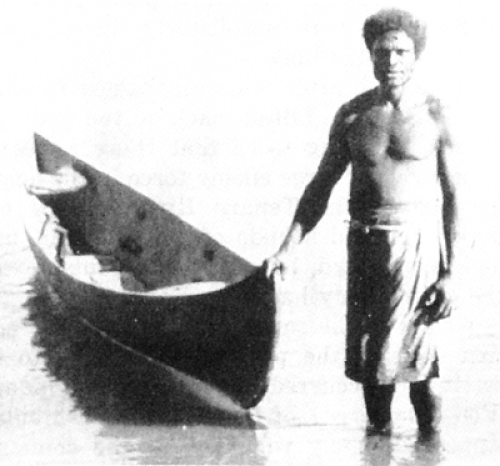 ガダルカナル島の沿岸監視員ジェイコブ・C・ヴォウザ。
 -
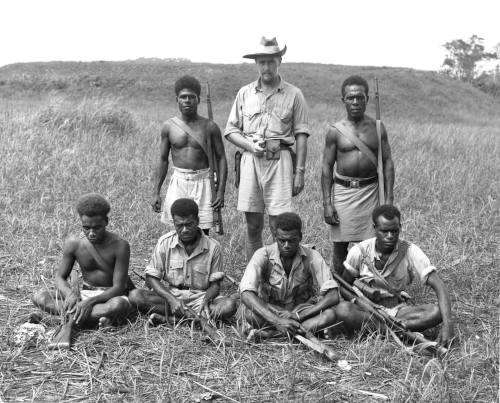 1943 年のイギリス領ソロモン諸島保護領防衛軍のメンバー。
_under_attack_and_burning_during_the_Battle_of_the_Eastern_Solomons_on_24_August_1942_(NH_97778).jpg/500px-USS_Enterprise_(CV-6)_under_attack_and_burning_during_the_Battle_of_the_Eastern_Solomons_on_24_August_1942_(NH_97778).jpg)
.gif/500px-Cactus_Air_Force_aircraft_at_Henderson_Field,_Guadalcanal,_circa_in_1942_(74250534).gif)
戦後と独立への道
1943年から1944年にかけて、マライタを拠点とする酋長アリキ・ノノオヒマエはマシナ統治運動(別名先住民評議会運動、文字通り「同胞の統治」)を創設し、後に別の酋長ホアシハウもこれに加わった。[58]彼らの目的は、先住民ソロモン諸島民の経済的幸福を向上させ、より大きな自治権を獲得し、島民と植民地政府との連絡役を務めることだった。[40] [59]この運動は元労働軍団のメンバーに特に人気があり、戦後その数は膨れ上がり、他の島々にも運動が広がった。[59]運動の拡大に警戒したイギリスは、1947年から1948年にかけて「シラミ駆除作戦」を開始し、マシナの指導者のほとんどを逮捕した。[59] [58]その後、マライタ人は市民的不服従運動を組織し、大量逮捕を引き起こした。[58] 1950年にヘンリー・グレゴリー・スミスという新しい駐在委員が着任し、運動の指導者を釈放したが、不服従運動は続いた。[58] 1952年に新しい高等弁務官(後に総督)ロバート・スタンレーが運動の指導者と会談し、島議会の設立に合意した。[58] [60] 1952年後半、スタンレーは正式に領土の首都をホニアラに移した。[61] 1950年代初頭、島々の主権をオーストラリアに移譲する可能性がイギリス政府とオーストラリア政府によって議論されたが、オーストラリア側は領土管理の財政的負担を受け入れることに消極的であり、この案は棚上げされた。[62] [63]
脱植民地化が植民地世界を席巻し、英国がもはや帝国の財政的負担を負う意思(または能力)がなくなったため、植民地当局はソロモン諸島の自治に向けて準備を進めた。任命制の行政評議会と立法評議会が1960年に設立され、1964年には一定数のソロモン諸島民の選出代表が導入され、1967年には拡大された。[40] [64] [65] 1970年には新しい憲法が起草され、2つの評議会は1つの統治評議会に統合されたが、英国総督は依然として広範な権限を保持していた。[40] [66]これに対する不満から、1974年に新しい憲法が制定され、総督の残りの権限の多くを削減し、ソロモン・ママロニが最初に就任した首相の地位が創設された。[40] [67]領土の完全な自治は、隣国パプアニューギニアがオーストラリアから独立した翌年の1976年に達成されました。[40]一方、西部の島々では不満が高まり、将来ホニアラやマライタが支配する国家によって疎外されることを恐れる人が多く、西部分離運動の形成を促しました。[67] 1977年にロンドンで開催された会議では、ソロモン諸島が翌年に完全独立を獲得することが合意されました。[67] 1978年のソロモン諸島法の条項により、国は女王陛下の領土に併合され、1978年7月7日に独立が認められました。初代首相はソロモン諸島統一党(SIUP)のピーター・ケニロレア卿で、エリザベス2世がソロモン諸島女王となり、地元では総督が代表を務めました。
-
 エリザベス2世女王の肖像が描かれた郵便切手、1968年
 -
 1978年7月7日のソロモン諸島独立式典
 -
 5ドルプルーフコイン
 -
 ソロモン諸島の 5 ドル プルーフ コイン 1977 年 10 月 24 日
独立時代(1978年~現在)
独立後初期
ピーター・ケニロレアは1980年のソロモン諸島総選挙で勝利し、1981年に不信任投票により人民同盟党(PAP)のソロモン・ママロニに交代するまで首相を務めた。 [68]ママロニは中央銀行と国営航空会社を創設し、島々の自治権拡大を推し進めた。[69]ケニロレアは1984年の選挙で勝利して政権に復帰したが、2期目はフランスの援助金不正使用の疑惑でエゼキエル・アレブアに交代するまでわずか2年しか続かなかった。[70] [71] 1986年、ソロモン諸島は、地域における協力と貿易の促進を目的としたメラネシア先鋒グループの設立を支援した。 [72] 1989年の選挙で勝利した後、ママロニとPAPは権力に復帰し、1990年代前半から中頃にかけてママロニはソロモン諸島の政治を支配した(フランシス・ビリー・ヒリーの1年間の首相職を除く)。ママロニはソロモン諸島を共和国にしようと努力したが、失敗に終わった。[69]彼はまた、 1988年に隣国ブーゲンビルで勃発した紛争の影響に対処しなければならず、多くの難民がソロモン諸島に逃げた。 [73] PNG軍が反乱軍を追って頻繁にソロモン諸島の領土に入ったため、パプアニューギニアとの緊張が高まった。[73] 1998年の紛争終結後、状況は落ち着き関係は改善した。一方、国の財政状況は悪化し続け、予算の多くは持続不可能な速度で行われる伐採産業から得られ、ママロニが政治家が使用する「裁量基金」を創設したことも状況を悪化させ、詐欺や汚職を助長した。[69]彼の統治に対する不満から人民行動党は分裂し、ママロニは1993年の選挙でビリー・ヒリーに敗れた。しかしヒリーは後に離党者が続出したことで過半数を失ったため総督に解任され、1994年にママロニが政権に復帰し、1997年までその地位にとどまった。[69]過剰な伐採、政府の汚職、持続不可能なレベルの公共支出は増加し続け、国民の不満からママロニは1997年の選挙で敗北した。[69] [74]ソロモン諸島自由党の新首相バーソロミュー・ウルファアルは経済改革を試みましたが、彼の首相在任中すぐに「緊張」として知られる深刻な民族紛争に巻き込まれました。[75]
民族間の暴力(1998年~2003年)
| ソロモン諸島紛争 | |||||||
|---|---|---|---|---|---|---|---|
| |||||||
| 交戦国 | |||||||
| イサタブ自由運動 | マライタ・イーグル・フォース | ||||||
| 指揮官とリーダー | |||||||
| ハロルド・ケケ | ジミー・ルシベア | ||||||
一般的に緊張関係あるいは民族間の緊張関係と呼ばれているこの初期の内乱は、主にイサタブ自由運動(IFM、ガダルカナル革命軍、イサタブ自由の闘士としても知られる)とマライタ・イーグル・フォース(およびマラウ・イーグル・フォース)との間の戦闘によって特徴づけられた。[76]マライタ島の人々は長年にわたり、主にそこで得られるより大きな経済的機会に惹かれてホニアラやガダルカナル島に移住してきた。[77]大規模な流入はガダルカナル島の先住民(グアレスとして知られる)との間に緊張関係を引き起こし、1998年後半にIFMが結成され、マライタ人入植者に対する脅迫と暴力のキャンペーンを開始した。[76] [74]その後、何千人ものマライタ人がマライタまたはホニアラに逃げ帰り、1999年半ばにはガダルカナル島のマライタ人を保護するためにマライタ・イーグル・フォース(MEF)が設立された。[74] [76] 1999年後半、和平交渉の試みが数回失敗した後、バーソロミュー・ウルファアル首相は4か月間の非常事態を宣言し、オーストラリアとニュージーランドに支援を要請したが、彼の訴えは却下された。[76] [74]一方、ガダルカナル島の法と秩序は崩壊し、民族的に分裂した警察は権威を主張できず、武器庫の多くが民兵に襲撃された。この時点で、MEFはホニアラを、IFMはグアダラカナル島の残りの地域を支配していた。[77] [74]
2003年4月、ロビン・リンゼイ兄弟とその仲間の7人のキリスト教徒の兄弟が、ガダルカナル島のウェザーコーストで反乱軍のリーダー、ハロルド・ケケによって殺害された。6人はナサニエル兄弟を捜しに行ったが、ナサニエル兄弟はすでに拷問を受けて殺害されていたことが判明した。緊張状態の間、ナサニエルは過激派グループと親しくなったが、ハロルド・ケケはナサニエルを政府のスパイだと非難し、賛美歌を歌っているときに殴り殺された。[78]教会は4月24日に彼らを追悼している。
2000年6月5日、ウルファアルはMEFに誘拐された。MEFは、彼がマライタン人であるにもかかわらず、彼らの利益を守るために十分な努力をしていないと感じていた。[74]ウルファアルはその後、釈放と引き換えに辞任した。[76] ウルファアル政権で財務大臣を務めていたがその後野党に加わったマナセ・ソガバレが、レスリー・ボセト牧師を23対21で破って首相に選出された。しかし、ソガバレの選出は、6人の国会議員(ボセト支持者と思われる)が重要な投票のために議会に出席できなかったため、直ちに論争に包まれた。[79] 2000年10月15日、タウンズビル和平協定がMEF、IFMの一部、ソロモン諸島政府によって調印された。[80] [76] 2001年2月、マラウ和平協定がマラウ・イーグル・フォース、IFM、ガダルカナル島政府、ソロモン諸島政府によって調印された。[76]しかし、グアレの主要過激派リーダーであるハロルド・ケケが協定への署名を拒否したため、グアレのグループとの分裂が起きた。[77]その後、アンドリュー・テエが率いる協定署名者のグアレは、マライタンが中心の警察と合流し、「統合作戦部隊」を結成した。[77]次の2年間、統合作戦部隊がケケとそのグループを捕らえようとしたが失敗したため、紛争はガダルカナル島南部の辺鄙なウェザーコースト地域に移動した。[76]
.jpg/500px-New_beginning_for_Solomon_Islands_(10709848893).jpg)
2001年初頭までに経済は崩壊し、政府は破産した。[74] 2001年12月の再選挙で、人民同盟党と無所属議員協会の支持を得たアラン・ケマケザが首相に就任した。紛争の性質が変化するにつれて法と秩序は悪化した。ウェザーコーストでは暴力が続き、ホニアラの過激派はますます犯罪、恐喝、強盗に目を向けるようになった。[77]資金が到着する予定になると、財務省はしばしば武装した男たちに包囲された。2002年12月、ローリー・チャン財務大臣は、過激派の一部に宛てた小切手に銃を突きつけられて署名を強要された後、辞任した。[要出典]西部州でも地元住民とマライタン入植者の間で紛争が勃発した。[要出典]ブーゲンビル革命軍(BRA)の反逆者メンバーが護衛部隊として招聘されたが、結局は彼らが防いだのと同じくらい多くのトラブルを引き起こすことになった。 [ 77]無法地帯、恐喝の蔓延、警察の無力さといった雰囲気が蔓延していたため、ソロモン諸島政府は正式に外部からの援助を要請し、その要請は議会で満場一致で支持された。[77]
2003年7月、オーストラリアと太平洋諸島の警察と軍隊が、オーストラリア主導のソロモン諸島地域支援ミッション(RAMSI)の支援の下、ソロモン諸島に到着した。[76]オーストラリアとニュージーランドが率いる2,200人の警察と軍隊、および約15の他の太平洋諸国の代表者からなる大規模な国際治安部隊が、ヘルペム・フレン作戦の下、翌月に到着し始めた。[77]状況は劇的に改善し、暴力は終結し、ハロルド・ケケが警察に投降した。[81]紛争で約200人が死亡した。[77]この時から、一部の評論家は、この国が地元の島や民族の忠誠心を覆すことができる包括的な国民的アイデンティティを築くことに失敗したため、この国を破綻国家とみなしている。[74] [82]しかし、他の学者は、この国は「破綻国家」ではなく、独立から数十年経っても統合されなかった未形成の国家であると主張している。[83]さらに、カブタウラカ(2001)やディネン(2002)などの一部の学者は、「民族紛争」という呼称は単純化しすぎていると主張している。[84]
紛争後の時代
ケマケザは2006年4月まで政権に留まったが、 2006年ソロモン諸島総選挙で敗れ、スナイダー・リニが首相となった。しかし、リニが中国人実業家から賄賂を受け取り、国会議員の票を買収していたという疑惑が、首都ホニアラで大規模な暴動を引き起こし、市内のチャイナタウン周辺に集中した。少数派の中国人実業家に対する根深い恨みから、市内のチャイナタウンの多くが破壊された。 [85]多額の資金が中国に輸出されているとの見方によっても緊張が高まった。中国は、暴動を避けて逃げてきた数百人の中国人を避難させるため、チャーター機を送った。[要出典]オーストラリア人とイギリス人の避難ははるかに小規模だった。[要出典]暴動を鎮圧するために、オーストラリア、ニュージーランド、フィジーの警察と軍隊が追加派遣された。リニは結局、議会の不信任決議に直面する前に辞任し、議会はマナセ・ソガバレを首相に選出した。[86] [87]
ソガバレ大統領は権威を主張するのに苦労し、オーストラリアの国内駐留にも敵対的だった。一度失敗した後、2007年に不信任投票で解任され、ソロモン諸島自由党のデレク・シクア大統領に交代した。 [88] 2008年には、緊張状態の年の傷を調査し癒すために真実和解委員会が設立された。 [89] [90]シクア大統領は2010年のソロモン諸島総選挙でダニー・フィリップ大統領に敗れたが、汚職疑惑を受けて不信任投票が行われ、フィリップ大統領は追放され、ゴードン・ダーシー・リロ大統領に交代した。[91] [92]ソガバレは2014年の選挙後に権力に復帰し、2017年にRAMSI軍の撤退を監督した。 [77]ソガバレは2017年に不信任投票で追放され、リック・フエニプウェラが権力を握った。しかし、ソガバレは2019年の選挙で勝利し首相に復帰し、ホニアラで暴動を引き起こした。[93] [94] 2019年にソガバレはソロモン諸島が台湾から中国への承認を切り替えると発表した。[95] [96]
2019年11月25日、ソロモン諸島は島民の利益のために海洋の持続可能な開発と利用を実現するための 国家海洋政策を開始しました。
2021年11月には大規模な暴動と騒乱が発生した。[97]ソロモン諸島政府は2017年の二国間安全保障条約に基づきオーストラリアに支援を要請し、オーストラリアはオーストラリア連邦警察と国防軍の派遣を提供した。[98]
2022年3月、ソロモン諸島は中国との警察協力に関する覚書(MOU)に署名し、中国との安全保障協定の締結手続き中であるとも報じられた。中国との協定により、ソロモン諸島における中国の軍事・海軍の継続的な駐留が可能になる可能性がある。オーストラリア外務貿易省の報道官は、「太平洋諸島諸国には主権上の決定を下す権利がある」としながらも、「オーストラリアは地域の安全保障を不安定にするいかなる行動にも懸念を抱いている」と述べた。[99] [100]ニュージーランドと米国でも同様の懸念がある。[101] 中国は訓練用にソロモン諸島警察にレプリカ銃器を寄贈した。[102]ソロモン諸島と中国は4月、ソロモン諸島の社会的安定と長期的な平和と安全を促進するための安全保障協力協定に署名した。[103] BBCは、オーストラリア政府が確認した協定の漏洩草案によると、北京は「社会秩序の維持を支援するため」にソロモン諸島に軍隊を派遣する可能性があると報じた。マナセ・ソガバレ首相は、協定は地域の「平和と調和を損なう」ものではなく、ソロモン諸島の国内治安状況を守ることを目的としていると述べた。中国は、社会秩序条項が最終協定で維持されたことを確認した。[104]
2023年2月、マライタ州のダニエル・スイダニ首相が州議会の不信任決議により解任された後、さらなる抗議活動が勃発した。 [105] [106] 2024年5月、ジェレミア・マネレがマナセ・ソガバレの後任としてソロモン諸島の新首相に選出された。[107]
政治
.jpg/500px-Long_shot_of_the_Solomon_Islands_Parliament_House._(10708895683).jpg)

ソロモン諸島は立憲君主制の議会制政治を採用しています。ソロモン諸島国王であるチャールズ3世が国家元首であり、国会によって5年の任期で選出される総督が国王を代表します。国会は一院制で、50名の議員で構成され、任期は4年です。ただし、議会は任期満了前に議員の過半数の投票により解散されることがあります。
議会の代表制は小選挙区制に基づいている。選挙権は21歳以上の国民に普通選挙で与えられる。 [108]政府の長は首相であり、議会によって選出され、内閣を選出する。各省庁は内閣メンバーによって率いられ、内閣メンバーは省庁職員を指揮する職業公務員 である事務次官によって補佐される。
ソロモン諸島政府は、政党が弱く(ソロモン諸島の政党一覧を参照)、議会連合が極めて不安定なのが特徴である。不信任投票が頻繁に行われ、政府の指導者や内閣の任命が頻繁に変更される。
土地の所有権はソロモン諸島民に留保されている。法律では、中国人やキリバス人などの居住外国人は帰化によって市民権を取得できると規定されている。土地は一般的に今でも家族または村単位で所有されており、地元の慣習に従って母親または父親から相続される可能性がある。島民は非伝統的な経済事業に土地を提供することを嫌がっており、これが土地所有権をめぐる継続的な紛争につながっている。
ソロモン諸島には1978年以来軍隊は存在しないが、国境警備隊を含む約500人の警察部隊がある。警察はまた、消防、災害救助、海上監視の責任も負っている。警察部隊は総督によって任命され首相に対して責任を負うコミッショナーによって率いられている。2006年12月27日、ソロモン諸島政府は同国のオーストラリア人警察署長が太平洋の国に帰国するのを阻止する措置を講じた。2007年1月12日、オーストラリアは、 2国間の4か月に及ぶ紛争を緩和することを目的とした和解措置の一環として、政治的干渉を理由にソロモン諸島から追放された自国のトップ外交官を交代させた。
2007年12月13日、マナセ・ソガバレ首相は、 5人の大臣が野党に離党したことを受けて、議会の不信任投票により失脚した。 [109]ソロモン諸島で首相がこのような形で失脚したのはこれが初めてであった。12月20日、議会は野党候補(元教育大臣)のデレク・シクアを32対15の投票で首相に選出した。[110] [111]
2019年4月、マナセ・ソガバレが4度目の首相に選出され、その決定に対する抗議とデモが起こった。[112]
司法
総督は首相と野党党首の助言に基づいて最高裁判所長官を任命する。総督は司法委員会の助言に基づいて他の判事を任命する。現在の長官はアルバート・パーマー卿である。
2014年3月以来、エドウィン・ゴールドスブロー判事はソロモン諸島控訴裁判所長官を務めている。ゴールドスブロー判事は以前、ソロモン諸島高等裁判所判事として5年間(2006年から2011年)の任期を務めていた。エドウィン・ゴールドスブロー判事はその後、タークス・カイコス諸島の最高裁判所長官を務めた。[113]
外交関係

ソロモン諸島は、国際連合、インターポール、イギリス連邦、太平洋諸島フォーラム、太平洋共同体、国際通貨基金、アフリカ・カリブ海諸国・太平洋(ACP)諸国(ロメ条約)の加盟国です。
2019年9月まで、ソロモン諸島は中華民国(台湾)を承認し、正式な外交関係を維持している数少ない国の一つであった。この関係は、承認を中華人民共和国(PRC)に切り替えたソロモン諸島によって2019年9月に終了した。[114]ブーゲンビル反乱からの難民の流入と、ブーゲンビル反乱軍を追跡する勢力によるソロモン諸島北部の島々への攻撃のために緊張していたパプアニューギニアとの関係は修復された。1998年のブーゲンビル和平協定により武力の脅威はなくなり、両国は2004年の合意で国境での活動を定例化した。[115] 2022年以降、中国との関係は急速に強化されており、ソロモン諸島は騒乱を鎮圧するために中国の治安部隊を要請することを可能にする安全保障協定に署名した。[116] [117]
2017年3月、国連人権理事会の第34回定例会において、バヌアツは、西ニューギニアにおける人権侵害を訴えるソロモン諸島および他の太平洋諸国を代表して共同声明を発表した。同国は、西パプア国際国会議員連盟(IPWP)が西パプアは1963年以来インドネシアに占領されていると主張し、[118]国連人権高等弁務官に報告書を作成するよう要請した。[119] [120]インドネシアはバヌアツの主張を否定し、バヌアツはパプアの人々を代表しておらず、代表していると「幻想を抱くのはやめる」べきだと返答した。[121] [120] 50年に及ぶパプア紛争で10万人以上のパプア人が死亡した。[122] 2017年9月、第72回国連総会において、ソロモン諸島、ツバル、バヌアツの首相は、インドネシア占領下の西パプアにおける人権侵害を再び取り上げた。[123]
軍隊
第二次世界大戦中、ソロモン諸島で戦闘に参加した連合軍の一部として現地で採用されたイギリス領ソロモン諸島保護国防軍が存在したが、独立以来ソロモン諸島には正規の軍隊は存在しない。 2003年、ソロモン諸島地域支援ミッション(RAMSI)の介入を受けて、王立ソロモン諸島警察(RSIPF)のさまざまな準軍事組織は解散し、武装解除された。RAMSIには、オーストラリア人司令官が率いる小規模な軍事派遣隊があり、国内外の治安維持においてRAMSIの警察組織を支援する責任を負っていた。RSIPFは現在もパシフィック級哨戒艇2隻(RSIPV AukiとRSIPV Lata)を運用しており、ソロモン諸島の事実上の海軍を構成している。
長期的には、RSIPF が国の防衛の役割を再開することが予想されます。警察部隊は総督によって任命され、警察・国家安全保障・矯正サービス大臣に責任を負う長官によって率いられています。
ソロモン諸島の警察予算は、4年間の内戦により逼迫している。 2002年12月にサイクロン・ゾーイがティコピア島とアヌータ島を襲った後、オーストラリアは、救援物資を積んだ巡視船ラタ号の燃料と補給品として、ソロモン諸島政府に20万シンガポールドル(5万オーストラリアドル)を提供しなければならなかった。(RAMSIの活動には、ソロモン諸島政府の予算安定化を支援することが含まれている。)
行政区分
地方自治に関しては、国は 10 の行政区域に分かれており、そのうち 9 つは選挙で選ばれた州議会によって統治される州、10 番目はホニアラ市議会によって統治される首都ホニアラです。
- ^ ホニアラ首都圏を除く
州別の島々
人権
教育、水/水の安全保障、衛生、男女平等、家庭内暴力などに関して、人権上の懸念や問題があります。
ソロモン諸島では同性愛は違法である。[124]
地理
.jpg/500px-Medium_shot_of_idyllic_villages_beach_near_Auki,_the_capital_of_Malaita._(10702263414).jpg)
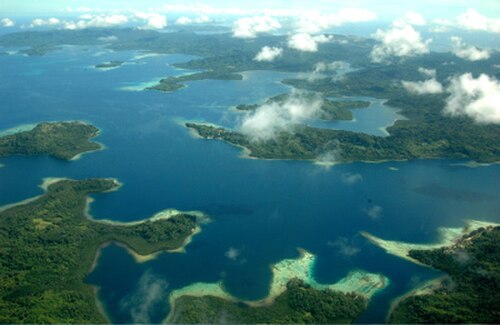
ソロモン諸島はパプアニューギニアの東に位置する島国で、6つの大きな島と900を超える小島で構成されています。ソロモン諸島の国土の大半は、ソロモン諸島群島の山岳火山島の多くを占めており、ショワズル島、ショートランド諸島、ニュージョージア諸島、サンタイザベル島、ラッセル諸島、フロリダ諸島、ツラギ島、マライタ島、マラマシケ島、ウラワ島、オワラハ島(サンタアナ島)、マキラ島(サンクリストバル島)、ガダルカナル島などが含まれています。ソロモン諸島には、シカイアナ島、レンネル島、ベローナ島、サンタクルス諸島などのより小さく孤立した低地環礁や火山島、ティコピア島、アヌータ島、ファトゥタカ島などの小さな離島も含まれています。ブーゲンビル島はソロモン諸島群島の中で最大の島ですが、政治的にはパプアニューギニアの自治区であり、ソロモン諸島国の一部ではありません。
この国の島々は、南緯5 度から13 度、東経155 度から169 度の間に位置しています。最西端の島と最東端の島の間の距離は約 1,500 キロメートル (930 マイル) です。ティコピア島を含むサンタクルス諸島はバヌアツの北に位置し、他の島々から 200 キロメートル (120 マイル) 以上も離れており、特に孤立しています。
気候
諸島の海洋赤道気候は年間を通じて非常に湿度が高く、平均気温は26.5℃(79.7℉)で、極端な気温や天候になることはほとんどありません。6月から8月は涼しい時期です。季節ははっきりしていませんが、11月から4月にかけて北西風が頻繁に降り、時折スコールやサイクロンが発生します。年間降水量は約3,050ミリメートル(120インチ)です。世界リスク報告書2021によると、この島国は世界で最も災害リスクが高い国の中で2番目にランクされています。[125]
2023年にソロモン諸島および気候変動のリスクにさらされているその他の島嶼国(フィジー、ニウエ、ツバル、トンガ、バヌアツ)の政府は、「化石燃料のない太平洋への公正な移行を求めるポートビラ呼びかけ」を立ち上げ、化石燃料の段階的廃止と再生可能エネルギーへの「迅速かつ公正な移行」 、およびエコサイド犯罪の導入を含む環境法の強化を求めた。[126] [127] [128]
エコロジー
.svg/500px-Share_Of_Forest_Area_In_Total_Land_Area,_Top_Countries_(2021).svg.png)
ソロモン諸島群島は、2つの異なる陸上生態地域の一部です。島のほとんどは、ブーゲンビル島とブカ島も含まれるソロモン諸島熱帯雨林生態地域の一部であり、これらの森林は林業活動による圧力を受けています。サンタクルス諸島は、隣接するバヌアツ群島とともにバヌアツ熱帯雨林生態地域の一部です。 [130]この国の2019年の森林景観完全性指数の平均スコアは7.19/10で、172か国中世界48位にランクされています。[131]土壌の質は、極めて豊かな火山性土壌(いくつかの大きな島には活動度の異なる火山があります)から比較的不毛な石灰岩まであります。230種類を超えるランやその他の熱帯の花が風景を明るくしています。島々には哺乳類が少なく、陸生哺乳類はコウモリと小型げっ歯類のみである。しかし、鳥類と爬虫類は豊富である。[要出典]
島々には活火山と休火山がいくつかあり、ティナクラ火山とカバチ火山が最も活発です。
バングヌ島の南側にあるザイラの小さな集落の周囲の森林は独特で、少なくとも3種の絶滅危惧種の動物の生息地となっている。この地域の200人の住民は、伐採や採鉱によって原生林や海岸線が乱されたり汚染されたりしないように、森林を保護区に指定するよう求めてきた。[132]

2004年に実施されたソロモン諸島の海洋生物多様性の基礎調査では、[133]ソロモン諸島には474種のサンゴが生息しており、科学的に新種である可能性のある9種も発見されました。これは世界で2番目にサンゴの多様性が高く、インドネシア東部のラジャ・アンパット諸島に次ぐものです。[134]
水と衛生
淡水源の不足と衛生設備の欠如は、ソロモン諸島が直面している絶え間ない課題である。淡水と衛生設備を利用できない人々の数を半減させることは、環境の持続可能性を確保するために目標7を通じて国連が実施した2015年ミレニアム開発目標(MDGs)の1つであった。[135]島々は一般的に淡水源にアクセスできるが、通常は州都ホニアラでのみ利用可能であり、[135]一年中保証されているわけではない。ユニセフの報告書によると、州都ホニアラの最貧困コミュニティは排泄物を捨てる適切な場所にアクセスできず、ソロモン諸島の学校の推定70%は飲用、洗濯、排泄物の処理に安全で清潔な水にアクセスできない。[135]学齢期の子供が安全な飲料水を利用できないと、コレラや腸チフスなどの致命的な病気にかかるリスクが高くなります。[136]ソロモン諸島では、水道管で飲料水を供給されている人の数は2011年以降減少しているのに対し、水道管のない水道で生活している人の数は2000年から2010年の間に増加している。しかし、改善点としては、水道管のない水道で生活している人の数は2011年以降一貫して減少している点が挙げられる。[137]

さらに、2014年に制定され2020年まで有効なソロモン諸島第二次農村開発プログラムは、安全な飲料水と適切な衛生設備の不足に最も苦しんでいるソロモン諸島の農村部と村落に、適切なインフラとその他の重要なサービスを提供するために取り組んできました。 [138]このプログラムは、インフラ、サービス、リソースの改善により、コミュニティ主導の取り組みを通じて農家やその他の農業部門を市場につなげ、経済成長を促進しました。[136]ソロモン諸島西部州にあるボラバなどの農村部は、貯水タンク、雨水集水システム、貯水システムの導入により、このプログラムから大きな恩恵を受けています。[136]インフラの改善によりソロモン諸島の生活の質が向上しただけでなく、サービスもコミュニティによって運営および開発されているため、以前は危険な状況で暮らしていた人々の間に共同体の誇りと達成感が生まれています。このプログラムは、世界銀行、欧州連合、国際農業開発基金(IFAD)、オーストラリア政府、ソロモン諸島政府など、さまざまな国際開発主体によって資金提供されています。[136]
地震
2007年4月2日現地時間7時39分56秒(UTC+11 )、マグニチュード8.1の地震が震源地S8.453 E156.957、島の首都ホニアラの北西349キロ(217マイル)、西部州の州都ギゾの南東、震源の深さ10キロ(6.2マイル)で発生した。[139] 2007年4月4日水曜日22:00:00 UTCまでにマグニチュード5.0以上の余震が44回以上発生した。その後に発生した津波で少なくとも52人が死亡、900軒以上の家屋が全焼し、数千人が家を失った。[140]陸地の隆起により、ラノンガ島の海岸線が最大70メートル(230フィート)延長され、かつては手つかずだったサンゴ礁の多くが露出しました。[141]
2013 年 2 月 6 日、サンタクルス諸島の震源地 S10.80 E165.11 でマグニチュード 8.0 の地震が発生し、その後 1.5 メートルの津波が発生しました。少なくとも 9 人が死亡し、多くの家屋が倒壊しました。主な地震の前には、マグニチュード 6.0 までの一連の地震が発生しました。[引用が必要]
経済


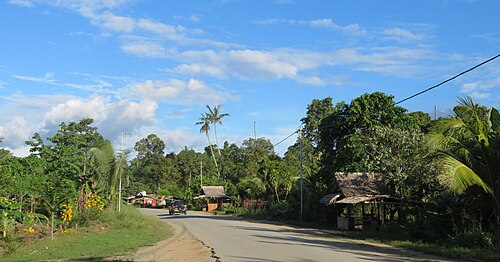
ソロモン諸島の一人当たりGDPは600ドルで、後発開発途上国に分類され、労働力の75%以上が自給自足の農業と漁業に従事している。ほとんどの工業製品と石油製品は輸入に頼らざるを得ない。島嶼部のわずか3.9%が農業に利用されており、78.1%が森林に覆われているため、ソロモン諸島は世界で103番目に森林に覆われた国となっている。[142] [説明が必要]
ソロモン諸島政府は 2002 年までに破産状態に陥りました。2003年のRAMSI介入以来、政府は予算を組み直しました。国内債務を統合して再交渉し、現在はオーストラリアの支援を受けて対外債務の再交渉を進めています。主な援助国はオーストラリア、ニュージーランド、欧州連合、日本、台湾です。
通貨
ソロモン諸島ドル(ISO 4217コード:SBD)は1977年に導入され、オーストラリアドルを等価通貨に置き換えた。その通貨記号は「SI$」であるが、ドル記号「$」を使用する他の通貨との混同が起こらなければ、「SI」接頭辞は省略できる。100セントに細分化される。地元の貝貨は、一部の州では伝統や儀式の目的で今も重要であり、国内の遠隔地では貿易に使用されている。貝貨は太平洋諸島で広く使用されている伝統的な通貨であり、ソロモン諸島では主にマライタ島とガダルカナル島で製造されているが、ホニアラ中央市場など他の場所でも購入できる。[143]遠隔地では、物々交換システムがあらゆる種類の通貨に取って代わることが多い。
輸出
1998年に熱帯木材の世界価格が急落するまで、木材はソロモン諸島の主な輸出品であり、近年ソロモン諸島の森林は危険なほど過剰に伐採されていた。2000年6月の民族紛争をきっかけに、パーム油と金の輸出は停止し、木材の輸出は減少した。
最近、[いつ? ]ソロモン諸島の裁判所は、営利目的で生きたイルカを輸出することを再承認しました。最も最近では、アラブ首長国連邦のドバイへの輸出です。この慣行は、28頭の生きたイルカをメキシコに出荷したことで国際的な騒動が起こった後、2004年に政府によって最初に停止されました。この動きは、オーストラリアとニュージーランドの両国、およびいくつかの保護団体から批判を招きました。2019年現在、未加工の木材は依然として輸出の3分の2を占めています[要出典]。
農業
2017年には317,682トンのココナッツが収穫され、ソロモン諸島は世界で18位のココナッツ生産国となり、輸出の24%はコプラであった。[144]カカオ豆は主にガダルカナル島、マキラ島、マライタ島で栽培されている。2017年には4,940トンのカカオ豆が収穫され、ソロモン諸島は世界で27位のカカオ生産国となった。[145]しかし、コプラとカカオの生産と輸出の伸びは、ほとんどのココナッツとカカオの木の老齢化によって妨げられている。2017年には285,721トンのパーム油が生産され、ソロモン諸島は世界で24位のパーム油生産国となった。[146]
その他の重要な換金作物および輸出品としては、コプラ、カカオ、パーム油などがある。
多くの家庭が輸出用ではなく国内市場向けに、タロイモ(2017年:45,901トン)[147]、米(2017年:2,789トン)[148] 、 ヤムイモ(2017年:44,940トン)[149]、バナナ(2017年:313トン)[150]、タバコ(2017年:118トン)[151] 、スパイス(2017年:217トン) [152]を栽培している。
ソロモン諸島の農業は、農業機械の深刻な不足によって妨げられています。
鉱業
1998 年、ガダルカナル島のゴールドリッジで金採掘が始まりました。他の地域での鉱物探査は継続されました。島々は鉛、亜鉛、ニッケル、金などの未開発の鉱物資源が豊富です。2006 年の暴動後に閉鎖されたゴールドリッジ鉱山の再開につながる可能性のある交渉が進行中です。
レンネル島ボーキサイト鉱山は2011年から2021年までレンネル島で操業していたが、複数回の流出事故により深刻な生態系被害を残した。[153] [154]
漁業
ソロモン諸島の漁業は輸出と国内経済の拡大の見通しもある。国内唯一の魚缶詰工場を運営していた日本の合弁会社、ソロモン太陽株式会社は、民族紛争の影響で2000年半ばに閉鎖された。工場は現地の経営で再開されたが、マグロの輸出は再開されていない。
観光
観光、特にダイビングはソロモン諸島にとって重要なサービス産業になる可能性がある。しかし、観光の成長はインフラの不足と交通の制限によって妨げられている。2017年にソロモン諸島を訪れた観光客は26,000人で、同国は世界で最も観光客の少ない国の一つとなっている。[155]ソロモン諸島政府は、2019年末までに観光客数を30,000人に、2025年末までに年間60,000人に増やしたいと望んでいる。 [156] 2019年にソロモン諸島を訪れた観光客は28,900人で、2020年には4,400人となった。[157]
エネルギー
南太平洋応用地球科学委員会(SOPAC)に勤務し、再生可能エネルギーとエネルギー効率パートナーシップ(REEEP)の資金援助を受けている再生可能エネルギー開発者のチームは、多額の現金を調達することなく、地元コミュニティが太陽光、水力、風力などの再生可能エネルギーを利用できるスキームを開発した。このスキームでは、ソーラーランタンを現金で支払うことができない島民は、代わりに作物を現物で支払うことができる。[158]
インフラストラクチャー
フライト接続
ソロモン航空はホニアラ国際空港とフィジーのナンディ、バヌアツのポートビラ、オーストラリアのブリスベンを結んでいるほか、国内各州の20以上の国内空港とも結んでいる。観光を促進するため、ソロモン航空は2019年にブリスベンとムンダの間に週1回の直行便を導入した。 [159]ヴァージン・オーストラリアはホニアラとブリスベンを週2回結んでいる。国内空港のほとんどは短い芝生の滑走路があるため、小型飛行機しか利用できない。
道路
ソロモン諸島の道路網は不十分で、鉄道はない。最も重要な道路は、ホニアラとガダルカナル島西部のランビ(58 km、36マイル)および東部のアオラ(75 km、47マイル)を結んでいる。[160]バスは少なく、決まった時刻表に従って運行されていない。ホニアラにはバスターミナルはない。最も重要なバス停は中央市場の前にある。
フェリー
ほとんどの島へはホニアラからフェリーで行くことができます。ホニアラからツラギ島を経由してアウキ島へは高速双胴船が毎日運航しています。
人口統計
2019年11月の国勢調査では総人口は721,455人だった。2021年現在[update]、ソロモン諸島には707,851人が住んでいる。[161] [162]
民族グループ
.jpg/500px-A_close_up_shot_of_three_junior_AFL_player_holding_footballs_at_the_Lord_Howe_Settlement,_Honiara._(10661462334).jpg)
ソロモン諸島民の大部分はメラネシア人(95.3%)である。ポリネシア人(3.1%)とミクロネシア人(1.2%)も他の2つの重要なグループである。[163]数千人のヨーロッパ人と同数の中国人がいます。[85]
言語
英語が公用語である一方、英語で流暢にコミュニケーションできるのは人口のわずか 1 ~ 2% です。しかし、英語クレオール語のソロモンピジン語は、現地の先住民言語とともに、人口の大多数が話す事実上の 共通語です。ピジン語は、パプアニューギニアで話されている トク ピシン語と密接な関係があります。
The number of local languages listed for Solomon Islands is 74, of which 70 are living languages and 4 are extinct, according to Ethnologue, Languages of the World.[164] Western Oceanic languages (predominantly of the Southeast Solomonic group) are spoken on the central islands. Polynesian languages are spoken on Rennell and Bellona to the south, Tikopia, Anuta and Fatutaka to the far east, Sikaiana to the north east, and Luaniua to the north (Ontong Java Atoll, also known as Lord Howe Atoll). The immigrant population from Kiribati (the i-Kiribati) speak Gilbertese.
Most of the indigenous languages are Austronesian languages. The Central Solomon languages such as Bilua, Lavukaleve, Savosavo and Touo constitute an independent family within Papuan languages.[165]
Religion

The religion of Solomon Islands is 92% Christian. The main Christian denominations are: Anglican 35%, Catholic 19%, the South Seas Evangelical Church 17%, the United Church 11% and Seventh-day Adventist 10%. Other Christian denominations are the Jehovah's Witnesses, the New Apostolic Church (80 churches) and the Church of Jesus Christ of Latter-day Saints.
Another 5% adhere to aboriginal beliefs. The remaining 3% adhere to Islam or the Baháʼí Faith. According to the most recent reports, Islam in Solomon Islands is made up of approximately 350 Muslims,[166] including members of the Ahmadiyya Islamic community.[167]
Health
See Health in the Solomon Islands
Education


Education in Solomon Islands is not compulsory, and only 60 percent of school-age children have access to primary education.[168][169] There are kindergartens in various places, including the capital, but they are not free.

From 1990 to 1994, the gross primary school enrolment rose from 84.5 percent to 96.6 percent.[168] Primary school attendance rates were unavailable for Solomon Islands as of 2001.[168] While enrolment rates indicate a level of commitment to education, they do not always reflect children's participation in school.[168] The Department of Education and Human Resource Development efforts and plans to expand educational facilities and increase enrolment. However, these actions have been hindered by a lack of government funding, misguided teacher training programs, poor co-ordination of programs, and a failure of the government to pay teachers.[168] The percentage of the government's budget allocated to education was 9.7 percent in 1998, down from 13.2 percent in 1990.[168] Male educational attainment tends to be higher than female educational attainment.[169] The University of the South Pacific, which has campuses in 12 Pacific island nations, has a campus at Guadalcanal.[170] The literacy rate of the adult population amounted to 84.1% in 2015 (men 88.9%, women 79.23%).[171]
The Human Rights Measurement Initiative (HRMI)[172] finds that the Solomon Islands is fulfilling only 70.1% of what it should be fulfilling for the right to education based on the country's level of income.[173] HRMI breaks down the right to education by looking at the rights to both primary education and secondary education. While taking into consideration the Solomon Islands' income level, the nation is achieving 94.9% of what should be possible based on its resources (income) for primary education but only 45.4% for secondary education.[173]
Culture


The culture of Solomon Islands reflects the extent of the differentiation and diversity among the groups living within the Solomon Islands archipelago, which lies within Melanesia in the Pacific Ocean, with the peoples distinguished by island, language, topography, and geography. The cultural area includes the nation state of Solomon Islands and the Bougainville Island, which is a part of Papua New Guinea.[174] Solomon Islands includes some culturally Polynesian societies which lie outside the main region of Polynesian influence, known as the Polynesian Triangle. There are seven Polynesian outliers within the Solomon Islands: Anuta, Bellona, Ontong Java, Rennell, Sikaiana, Tikopia, and Vaeakau-Taumako. Solomon Islands arts and crafts cover a wide range of woven objects, carved wood, stone and shell artefacts in styles specific to different provinces:
-
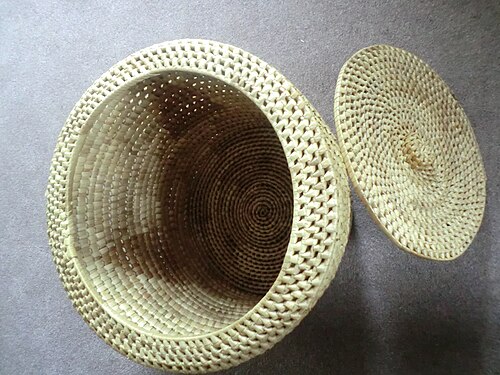 Laundry basket
 -
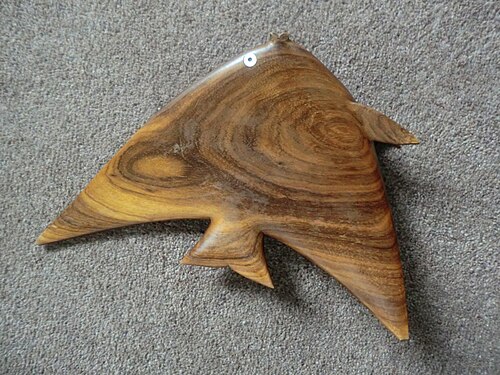 Carved fish
 -
 Bukhaware trays
 -
 Carved dish inlaid with mother-of-pearl
 -
 Carved longboat
 -
 Gnusu gnusu heads
 -
 Salad bowl and serving spoon and fork
 -
 Wooden religious objects in front of All Saints' Church, Honiara

Malaitan shell-money, manufactured in the Langa Langa Lagoon, is the traditional currency used in Malaita and throughout the Solomon Islands. The money consists of small polished shell disks which are drilled and placed on strings.[175] In the Solomons Tectus niloticus is harvested, which was traditionally made into items such as pearl buttons and jewellery.[176][177]
Gender inequality and domestic violence
Solomon Islands has one of the highest rates of family and sexual violence (FSV) in the world, with 64% of women aged 15–49 having reported physical and/or sexual abuse by a partner.[178] As per a World Health Organization (WHO) report issued in 2011, "the causes of Gender Based Violence (GBV) are multiple, but it primarily stems from gender inequality and its manifestations."[179] The report stated:
- "In Solomon Islands, GBV has been largely normalized: 73% of men and 73% of women believe violence against women is justifiable, especially for infidelity and 'disobedience,' as when women do 'not live up to the gender roles that society imposes.' For example, women who believed they could occasionally refuse sex were four times more likely to experience GBV from an intimate partner. Men cited acceptability of violence and gender inequality as two main reasons for GBV, and almost all of them reported hitting their female partners as a 'form of discipline,' suggesting that women could improve the situation by '[learning] to obey [them].'"
Another manifestation and driver of gender inequality in Solomon Islands is the traditional practice of bride price. Although specific customs vary between communities, paying a bride price is considered similar to a property title, giving men ownership over women. Gender norms of masculinity tend to encourage men to "control" their wives, often through violence, while women felt that bride prices prevented them from leaving men. Another report issued by the WHO in 2013 painted a similarly grim picture.[180]
In 2014, Solomon Islands officially launched the Family Protection Act 2014, which was aimed at curbing domestic violence in the country.[181] While numerous other interventions are being developed and implemented in the healthcare system as well as the criminal justice system, these interventions are still in their infancy and have largely stemmed from Western protocols. Therefore, for these models to be effective, time and commitment is needed to change the cultural perception of domestic violence in Solomon Islands.[178]
Literature
Writers from Solomon Islands include the novelists John Saunana and Rexford Orotaloa and the poet Jully Makini.
Media
Newspapers
There is one daily newspaper, the Solomon Star, one daily online news website, Solomon Times Online (www.solomontimes.com), two weekly papers, Solomons Voice and Solomon Times, and two monthly papers, Agrikalsa Nius and the Citizen's Press.
Radio
Radio is the most influential type of media in Solomon Islands due to language differences, illiteracy,[182] and the difficulty of receiving television signals in some parts of the country. The Solomon Islands Broadcasting Corporation (SIBC) operates public radio services, including the national stations Radio Happy Isles 1037 on the dial and Wantok FM 96.3, and the provincial stations Radio Happy Lagoon and, formerly, Radio Temotu. There are two commercial FM stations, Z FM at 99.5 in Honiara but receivable over a large majority of island out from Honiara, and, PAOA FM at 97.7 in Honiara (also broadcasting on 107.5 in Auki), and, one community FM radio station, Gold Ridge FM on 88.7.
Television
No television service covers the entire Solomon Islands, but some coverage is available in six main centres in four of the nine Provinces. Satellite TV stations can be received. In Honiara, there is a free-to-air HD digital TV, analogue TV, and online service called Telekom Television Limited, operated by Solomon Telekom Co. Ltd., which rebroadcasts a number of regional and international TV services including ABC Australia and BBC World News. Residents can also subscribe to SATSOL, a digital pay TV service, re-transmitting satellite television.
Music

Traditional Melanesian music in Solomon Islands includes both group and solo vocals, slit-drum and panpipe ensembles. Bamboo music gained a following in the 1920s. In the 1950s Edwin Nanau Sitori composed the song "Walkabout long Chinatown", which has been referred to by the government as the unofficial "national song" of the Solomon Islands.[183] Modern Solomon Islander popular music includes various kinds of rock and reggae as well as island music. [check quotation syntax]
Sport
Rugby union: The Solomon Islands national rugby union team has played internationals since 1969. It took part in the Oceania qualifying tournament for the 2003 and 2007 Rugby World Cups, but did not qualify on either occasion.
Association football: The Solomon Islands national football team has proved among the most successful in Oceania and is part of the OFC confederation in FIFA. They are currently ranked 141st out of 210 teams in the FIFA World Rankings. The team became the first team to beat New Zealand in qualifying for a play-off spot against Australia for qualification to the World Cup 2006. They were defeated 7–0 in Australia and 2–1 at home.
Futsal: Closely related to Association Football. On 14 June 2008, the Solomon Islands national futsal team, the Kurukuru, won the Oceania Futsal Championship in Fiji to qualify them for the 2008 FIFA Futsal World Cup, which was held in Brazil from 30 September to 19 October 2008. Solomon Islands is the futsal defending champions in the Oceania region. In 2008 and 2009 the Kurukuru won the Oceania Futsal Championship in Fiji. In 2009 they defeated the host nation Fiji 8–0 to claim the title. The Kurukuru currently hold the world record for the fastest ever goal scored in an official futsal match. It was set by Kurukuru captain Elliot Ragomo, who scored against New Caledonia three seconds into the game in July 2009.[184] They also, however, hold the less enviable record for the worst defeat in the history of the Futsal World Cup,[clarification needed] when in 2008 they were beaten by Russia with two goals to thirty-one.[185]
Beach soccer: The Solomon Islands national beach soccer team, the Bilikiki Boys, are statistically the most successful team in Oceania. They have won all three regional championships to date, thereby qualifying on each occasion for the FIFA Beach Soccer World Cup. The Bilikiki Boys are ranked fourteenth in the world as of 2010[update], higher than any other team from Oceania.[186]
Solomon Islands hosted the 2023 Pacific Games.[187]
See also

References
- ^ "National Parliament of Solomon Islands Daily Hansard: First Meeting – Eighth Session Tuesday 9th May 2006" (PDF). www.parliament.gov.sb. 2006. p. 12. Archived from the original (PDF) on 30 October 2012. Retrieved 3 January 2019.
- ^ "Religions in Solomon Islands | PEW-GRF". Archived from the original on 23 January 2014.
- ^ "Solomon Islands: Geography". CIA Factbook. Archived from the original on 22 October 2021. Retrieved 25 July 2023.
- ^ a b c d "World Economic Outlook database (Solomon Islands)". World Economic Outlook, April 2024. International Monetary Fund. April 2024. Archived from the original on 26 April 2024. Retrieved 26 April 2024.
- ^ "Gini Index coefficient". CIA World Factbook. Archived from the original on 17 July 2021. Retrieved 16 July 2021.
- ^ "HUMAN DEVELOPMENT REPORT 2023-24" (PDF). United Nations Development Programme. United Nations Development Programme. 13 March 2024. pp. 274–277. Archived (PDF) from the original on 1 May 2024. Retrieved 3 May 2024.
- ^ "Solomon Islands country brief". Archived from the original on 22 December 2022. Retrieved 22 December 2022.
- ^ a b John Prados, Islands of Destiny, Dutton Caliber, 2012, p,20 and passim
- ^ "Solomon Islands: Geography". CIA Factbook. Archived from the original on 22 October 2021. Retrieved 25 July 2023.
- ^ Solomon Islands National Statistical Office - estimate as at 1 July 2023.
- ^ a b "Alvaro de Mendaña de Neira, 1542?–1595". Princeton University Library. Archived from the original on 17 April 2019. Retrieved 8 February 2013.
- ^ "Alvaro de Mendan~a de Neira and Pedro Fernandes de Queirós". library.princeton.edu. Archived from the original on 9 August 2022. Retrieved 9 August 2022.
- ^ a b c d e Lawrence, David Russell (October 2014). "Chapter 6 The British Solomon Islands Protectorate: Colonialism without capital" (PDF). The Naturalist and his "Beautiful Islands": Charles Morris Woodford in the Western Pacific. ANU Press. ISBN 9781925022032. Archived (PDF) from the original on 25 September 2022. Retrieved 30 March 2019.
- ^ Commonwealth and Colonial Law by Kenneth Roberts-Wray, London, Stevens, 1966. P. 897
- ^ "Lord GORONWY-ROBERTS, speaking in the House of Lords, HL Deb 27 April 1978 vol 390 cc2003-19". Parliamentary Debates (Hansard). 27 April 1978. Archived from the original on 16 June 2018. Retrieved 19 November 2014.
- ^ HOGBIN, H. In, Experiments in Civilization: The Effects of European Culture on a Native Community of the Solomon Islands, New York: Schocken Books, 1970
- ^ 'International Encyclopedia of Comparative Law: Instalment 37' edited by K. Zweigert, S-65
- ^ The British Solomon Islands Protectorate (Name of Territory) Order 1975
- ^ a b c d e f g Walter, Richard; Sheppard, Peter (February 2009). "A review of Solomon Island archaeology". Research Gate. Retrieved 31 August 2020.
- ^ Sheppard, Peter J. "Lapita Colonization Across the Near/Remote Boundary" Current Anthropology, Vol 53, No. 6 (Dec 2011), p. 800
- ^ a b c d e f "Exploration". Solomon Encyclopedia. Archived from the original on 27 October 2020. Retrieved 1 September 2020.
- ^ Kirch, Patrick Vinton (2002). On the Road of the Winds: An Archaeological History of the Pacific Islands. Berkeley, California: University of California Press. ISBN 0-520-23461-8
- ^ Walter, Richard; Sheppard, Peter (2001). "A Revised Model of Solomon Islands Culture History". Journal of Field Archaeology: 27–295. CiteSeerX 10.1.1.580.3329.
- ^ "Ancient Solomon Islands mtDNA: assessing Holocene settlement and the impact of European contact" (PDF). Genomicus. Journal of Archaeological Science. Archived from the original (PDF) on 2 February 2021. Retrieved 1 September 2020.
- ^ Ples Blong Iumi: Solomon Islands the Past Four Thousand Years, Hugh Laracy (ed.), University of the South Pacific, 1989, ISBN 982-02-0027-X
- ^ Peter J. Shepherd; Richard Walter; Takuya Nagaoka. "The Archaeology of Head-Hunting in Roviana Lagoon, New Georgia". The Journal of the Polynesian Society. Archived from the original on 21 April 2012. Retrieved 1 September 2020.
- ^ "From primitive to postcolonial in Melanesia and anthropology". Bruce M. Knauft (1999). University of Michigan Press. p. 103. ISBN 0-472-06687-0
- ^ "King of the Cannibal Isles". Time. 11 May 1942. Archived from the original on 12 January 2008.
- ^ a b c d e f g h "Alvaro de Mendaña de Neira, 1542?–1595". Princeton University Library. Archived from the original on 17 April 2019. Retrieved 8 February 2013.
- ^ Sharp, Andrew The discovery of the Pacific Islands Clarendon Press, Oxford, 1960, p.45.
- ^ a b c d e f g h i j k l m Lawrence, David Russell (2014). "3. Commerce, trade and labour". The Naturalist and His 'beautiful Islands': Charles Morris Woodford in the Western Pacific. ANU Press. pp. 35–62. ISBN 9781925022032. JSTOR j.ctt13wwvg4.8.
- ^ Kelly, Celsus, O.F.M. La Austrialia del Espiritu Santo. The Journal of Fray Martín de Munilla O.F.M. and other documents relating to the Voyage of Pedro Fernández de Quirós to the South Sea (1605–1606) and the Franciscan Missionary Plan (1617–1627) Cambridge, 1966, p.39, 62.
- ^ "The fate of La Perouse". Discover Collections. State Library of NSW. Archived from the original on 17 May 2013. Retrieved 7 February 2013.
- ^ Duyker, Edward (September 2002). "In search of Lapérouse". NLA news Volume XII Number 12. National Library of Australia. Archived from the original on 19 May 2007. Retrieved 1 September 2020.
- ^ "After Vanikoro-In Search of the Lapérouse Expedition (Lapérouse Museum)". Albi, France: laperouse-france.fr. Archived from the original on 5 October 2011. Retrieved 24 July 2010.
- ^ Robert Langdon (ed.) Where the whalers went: an index to the Pacific ports and islands visited by American whalers (and some other ships) in the 19th century (1984), Canberra, Pacific Manuscripts Bureau, pp.229–232 ISBN 0-86784-471-X.
- ^ Judith A. Bennett, Wealth of the Solomons: a history of a Pacific archipelago, 1800–1978, (1987), Honolulu, University of Hawaii Press, pp.24–31 & Appendix 3.ISBN 0-8248-1078-3
- ^ Bennett, 27–30; Mark Howard, "Three Sydney whaling captains of the 1830s", The Great Circle, 40 (2) December 2018, 83–84.
- ^ Walsh, G P (1966). "Boyd, Benjamin (1801–1851)". Australian Dictionary of Biography. Canberra: National Centre of Biography, Australian National University. pp. 140–142. ISBN 978-0-522-84459-7. ISSN 1833-7538. OCLC 70677943. Retrieved 7 April 2019.
- ^ a b c d e f g h i "Issue on the Solomon Islands" (PDF). UN Department of Political Affairs. Archived (PDF) from the original on 22 October 2020. Retrieved 3 September 2020.
- ^ Corris, Peter. "Joseph Dalgarno Melvin (1852–1909)". Melvin, Joseph Dalgarno (1852–1909). Australian National University. Archived from the original on 9 January 2015. Retrieved 11 January 2018.
- ^ London, Jack (1911). The Cruise of the Snark. The Macmillan company. Retrieved 16 January 2008.
- ^ "Religion". Solomon Encyclopedia. Archived from the original on 27 October 2020. Retrieved 1 September 2020.
- ^ "German New Guinea". Solomon Encyclopedia. Archived from the original on 27 October 2020. Retrieved 2 September 2020.
- ^ a b Sack, Peter (2005). "German Colonial Rule in the Northern Solomons". In Regan, Anthony; Griffin, Helga-Maria (eds.). Bougainville Before the Conflict. Stranger Journalism. pp. 77–107. ISBN 9781921934230. JSTOR j.ctt1bgzbgg.14. Archived from the original on 16 April 2021. Retrieved 3 September 2020.
- ^ a b c "British Solomon Islands Protectorate, Proclamation of". Solomon Encyclopedia. Archived from the original on 19 October 2021. Retrieved 2 September 2020.
- ^ a b c Lawrence, David Russell (October 2014). "Chapter 7 Expansion of the Protectorate 1898–1900" (PDF). The Naturalist and his "Beautiful Islands": Charles Morris Woodford in the Western Pacific. ANU Press. pp. 198–206. ISBN 9781925022032. Archived (PDF) from the original on 27 October 2020. Retrieved 3 September 2020.
- ^ "Mahaffy, Arthur (1869 - 1919)". Solomon Islands Historical Encyclopaedia 1893-1978. 2003. Archived from the original on 25 June 2021. Retrieved 24 March 2024.
- ^ a b Lawrence, David Russell (October 2014). "Chapter 9 The plantation economy" (PDF). The Naturalist and his "Beautiful Islands": Charles Morris Woodford in the Western Pacific. ANU Press. pp. 245–249. ISBN 9781925022032. Archived (PDF) from the original on 30 March 2019. Retrieved 3 September 2020.
- ^ "Forestry". Solomon Encyclopedia. Archived from the original on 27 October 2020. Retrieved 2 September 2020.
- ^ "Mining". Solomon Encyclopedia. Archived from the original on 27 October 2020. Retrieved 2 September 2020.
- ^ "Bell, William Robert (1876–1927)". Solomon Islands Historical Encyclopaedia 1893–1978. Archived from the original on 2 April 2015. Retrieved 24 March 2014.
- ^ a b c "The Solomon Islands Campaign: Guadalcanal". National World War II Museum. Archived from the original on 26 September 2020. Retrieved 3 September 2020.
- ^ a b c "Solomon Islanders in World War II". Australian National University. Archived from the original on 27 October 2020. Retrieved 3 September 2020.
- ^ "Operation Watchtower: Assault on the Solomons" Archived 9 May 2019 at the Wayback Machine War in the Pacific: The First Year. U.S. National Park Service, 2004.
- ^ "Pacific Memories: Island Encounters of World War II". Retrieved 12 June 2007.
- ^ "Solomon Islands Pijin – History". Archived from the original on 13 May 2007. Retrieved 12 June 2007.
- ^ a b c d e "Maasina Rule". Solomon Encyclopedia. Archived from the original on 4 August 2020. Retrieved 3 September 2020.
- ^ a b c "Solomon Islanders in World War II – 4. Impacts of the War". Australian National University. Archived from the original on 27 October 2020. Retrieved 3 September 2020.
- ^ "Solomon Islands : History". The Commonwealth. Archived from the original on 23 January 2020. Retrieved 30 December 2021.
- ^ "Stanley, Robert Christopher Stafford". Solomon Islands Historical Encyclopaedia 1893–1978. © Solomon Islands Historical Encyclopaedia, 1893–1978, 2013. Archived from the original on 24 September 2015. Retrieved 31 August 2015.
- ^ Thompson, Roger (1995). "Conflict or co-operation? Britain and Australia in the South Pacific, 1950–60". The Journal of Imperial and Commonwealth History. 23 (2): 301–316. doi:10.1080/03086539508582954.
- ^ Goldsworthy, David (1995). "British Territories and Australian Mini-Imperialism in the 1950s". Australian Journal of Politics and History. 41 (3): 356–372. doi:10.1111/j.1467-8497.1995.tb01266.x.
- ^ "Self rule starting in Solomon Islands". Virgin Islands Daily News. 29 November 1960. Archived from the original on 2 February 2021. Retrieved 31 August 2015.
- ^ Busy end-of-year for Islands legislature Archived 23 October 2020 at the Wayback Machine Pacific Islands Monthly, January 1967, p7
- ^ Islanders feel their way in the new Solomons council Archived 23 October 2020 at the Wayback Machine Pacific Islands Monthly, September 1970, p19
- ^ a b c "Independence". Solomon Encyclopedia. Archived from the original on 16 June 2021. Retrieved 3 September 2020.
- ^ "Kenilorea, Peter Kau'ona Keninaraiso'ona (1943 – )". Solomon Encyclopedia. Archived from the original on 27 October 2020. Retrieved 4 September 2020.
- ^ a b c d e "Mamaloni, Solomon Suna'one (1943 – )". Solomon Encyclopedia. Archived from the original on 13 October 2021. Retrieved 4 September 2020.
- ^ Eight ministers out in Solomons poll Archived 23 October 2020 at the Wayback Machine Pacific Islands Monthly, December 1984, p7
- ^ Kenilorea is Solomons P.M. Archived 23 October 2020 at the Wayback Machine Pacific Islands Monthly, January 1985, p7
- ^ "Melanesian Spearhead Group Secretariat". Archived from the original on 4 July 2015. Retrieved 19 July 2015.
- ^ a b May, RJ. "The Situation on Bougainville: Implications for Papua New Guinea, Australia and the Region". Parliament of Australia. Archived from the original on 1 October 2020. Retrieved 4 September 2020.
- ^ a b c d e f g h Kabutaulaka, Tarcisius Tara. "A Weak State and the Solomon Islands Peace Process" (PDF). University of Hawaii. Archived (PDF) from the original on 25 October 2020. Retrieved 5 September 2020.
- ^ "Ulufa'alu, Bartholomew (1939–2007)". Solomon Encyclopedia. Archived from the original on 14 October 2021. Retrieved 4 September 2020.
- ^ a b c d e f g h i "The Tensions". RAMSI. Archived from the original on 27 July 2020. Retrieved 5 September 2020.
- ^ a b c d e f g h i j O'Malley, Nick. "As RAMSI ends, Solomon Islanders look to the future". Sydney Morning Herald. Archived from the original on 3 August 2020. Retrieved 6 September 2020.
- ^ 'I Wait For The Lord, My Soul Waits For Him, And In His Word is My Hope: A resource book of the Martyrs of Papua New Guinea and Melanesia' by Margaret Bride (Anglican Board of Mission – Australia) https://www.abmission.org/wp-content/uploads/2022/01/4526_Martyrs_Booklet_pp32.pdf Archived 19 August 2022 at the Wayback Machine
- ^ Moore, C (2004). appy Isles in Crisis: the historical causes for a failing state in Solomon Islands, 1998 2004. Canberra: Asia Pacific Press. p. 174.
- ^ "THE TOWNSVILLE PEACE AGREEMENT". Commerce.gov.sb. 15 October 2000. Archived from the original on 10 February 2011. Retrieved 9 December 2016.
- ^ "Solomons warlord surrenders". BBC News. 13 August 2003. Retrieved 7 July 2007.
- ^ "Pacific Islands: PINA and Pacific". 10 November 2003. Archived from the original on 10 November 2003.
- ^ Pillars and Shadows: Statebuilding as Peacebuilding in Solomon Islands, J. Braithwaite, S. Dinnen, M.Allen, V. Braithwaite & H. Charlesworth, Canberra, ANU E Press: 2010.
- ^ "Cap – Anu". Rspas.anu.edu.au. 14 December 2012. Archived from the original on 30 December 2011. Retrieved 3 May 2014.
- ^ a b Spiller, Penny: "Riots highlight Chinese tensions Archived 2 December 2012 at the Wayback Machine", BBC News, Friday, 21 April 2006, 18:57 GMT
- ^ "Rini resigns as Solomons PM". The New Zealand Herald. Reuters, Newstalk ZB. 26 April 2006. Archived from the original on 28 May 2013. Retrieved 12 November 2011.
- ^ "Embattled Solomons PM steps down". BBC News. 26 April 2006. Archived from the original on 19 December 2008. Retrieved 12 November 2011.
- ^ Tom Allard, "Solomon Islands Prime Minister ousted" Archived 24 October 2012 at the Wayback Machine, The Sydney Morning Herald, 14 December 2007.
- ^ "PM Sikua Announces TRC Team". Solomon Times. 27 April 2009. Archived from the original on 4 May 2009. Retrieved 29 April 2009.
- ^ "Solomons Commission claims broad support". Radio New Zealand International. 30 April 2009. Archived from the original on 5 May 2009. Retrieved 30 April 2009.
- ^ "Solomons Islands get new PM weeks after election" Archived 15 January 2016 at the Wayback Machine, BBC, 25 August 2010
- ^ Osifelo, Eddie (24 November 2011). "Former PM now a backbencher". Solomon Star. Archived from the original on 10 April 2012. Retrieved 4 December 2011.
- ^ "Ex-PM wins Solomons run-off sparking riots". Japan Times. Archived from the original on 24 April 2019. Retrieved 25 July 2019.
- ^ "Pacific News Minute:Protests, Riots Follow Election Of New Prime Minister In Solomon Islands". Hawai'i Public Radio. 25 April 2019. Archived from the original on 26 April 2019. Retrieved 25 July 2019.
- ^ "Sacked Solomons minister says PM lied, China switch 'pre-determined'". Radio New Zealand. 27 September 2019. Archived from the original on 27 September 2019. Retrieved 6 September 2020.
- ^ Lyons, Kate. "China extends influence in Pacific as Solomon Islands break with Taiwan". The Guardian. Archived from the original on 17 September 2019. Retrieved 17 September 2019.
- ^ Honiara, Georgina Kekea in (24 November 2021). "Parliament building and police station burned down during protests in Solomon Islands". the Guardian. Retrieved 25 November 2021.
- ^ Andrews, Karen (25 November 2021). "Joint media release – Solomon Islands" (Press release). Canberra: Australian Government. Archived from the original on 21 December 2021. Retrieved 26 November 2021.
- ^ Bagshaw, Eryk (24 March 2022). "China set to sign first security deal in the Pacific on Australia's doorstep". Sydney Morning Herald. Archived from the original on 24 March 2022. Retrieved 24 March 2022.
- ^ "China finalising security deal with Solomon Islands to base warships in the Pacific". The Guardian. Reuters. 24 March 2022. Retrieved 24 March 2022.
- ^ Bagshaw, Eryk; Tomazin, Farrah (25 March 2022). "Australia, NZ warn Solomons over 'destabilising' the Pacific with China deal". Sydney Morning Herald. Archived from the original on 25 March 2022. Retrieved 25 March 2022.
- ^ Kekea, Georgina (25 March 2022). "Secret shipment of replica guns to Solomon Islands police by China triggers concern". Retrieved 25 March 2022.
- ^ Maiden, Samantha (19 April 2022). "China signs security pact with Solomon Islands". news.com.au. Retrieved 19 April 2022.
- ^ "Solomon Islands: China deal in Pacific stokes Australian fears". BBC News. 20 April 2022. Archived from the original on 6 May 2022. Retrieved 30 April 2022.
- ^ "Solomon Islands ousts official critical of close relations with China". Reuters. 7 February 2023. Archived from the original on 7 February 2023. Retrieved 7 February 2023.
- ^ Piringi, Charley (7 February 2023). "Protests in Solomon Islands as key China critic politician is ousted in no confidence vote". The Guardian. ISSN 0261-3077. Archived from the original on 4 October 2023. Retrieved 7 February 2023.
- ^ "Solomon Islands elects ex-top diplomat as new prime minister". Al Jazeera. Archived from the original on 9 May 2024. Retrieved 9 May 2024.
- ^ "CIA – The World Factbook – Solomon Islands". Archived from the original on 22 October 2021. Retrieved 19 November 2014.
- ^ Sireheti, Joanna., & Joy Basi, – "Solomon Islands PM Defeated in No-Confidence Motion" Archived 18 July 2012 at the Wayback Machine, – Solomon Times, – 13 December 2007
- ^ Tuhaika, Nina., – "New Prime Minister for Solomon Islands" Archived 18 July 2012 at the Wayback Machine, – Solomon Times, – 20 December 2007
- ^ "Solomon Islands parliament elects new PM", – ABC Radio Australia, – 20 December 2007
- ^ "Solomon Islands tense as Manasseh Sogavare returns to top job". ABC News. 24 April 2019. Archived from the original on 4 August 2022. Retrieved 4 August 2022.
- ^ Boyce, Hayden (20 September 2014). "Turks & Caicos Islands Chief Justice Edwin Goldsbrough Resigns". Turks & Caicos Sun. Archived from the original on 8 March 2021. Retrieved 15 November 2013.
- ^ Lyons, Kate (16 September 2019). "China extends influence in Pacific as Solomon Islands break with Taiwan". theguardian.com. Retrieved 17 September 2019.
- ^ "Basic Agreement between the Government of Solomon Islands and the Government of Papua New Guinea on Border Arrangements | UNEP Law and Environment Assistance Platform". leap.unep.org. 27 July 2004. Archived from the original on 25 November 2021. Retrieved 25 November 2021.
- ^ Lawler, Bethany Allen-Ebrahimian,Dave (29 August 2022). "Solomon Islands bars U.S. Coast Guard ship, raising China influence fears". Axios. Archived from the original on 29 August 2022. Retrieved 30 August 2022.
{{cite web}}: CS1 maint: multiple names: authors list (link) - ^ "China-friendly Solomon Islands suspends all foreign naval visits as tensions rise". South China Morning Post. 30 August 2022. Archived from the original on 30 August 2022. Retrieved 30 August 2022.
- ^ "Freedom of the press in Indonesian-occupied West Papua". The Guardian. 22 July 2019. Archived from the original on 25 July 2019. Retrieved 30 July 2019.
- ^ Fox, Liam (2 March 2017). "Pacific nations call for UN investigations into alleged Indonesian rights abuses in West Papua". ABC News. Archived from the original on 31 October 2017. Retrieved 30 July 2019.
- ^ a b "Pacific nations want UN to investigate Indonesia on West Papua". SBS News. 7 March 2017. Archived from the original on 7 November 2017. Retrieved 30 July 2019.
- ^ "Indonesia Calls out Vanuatu over Papua remarks at UNGA". The Jakarta Post. 29 September 2020. Archived from the original on 28 April 2021. Retrieved 29 June 2021.
- ^ "Goodbye Indonesia". Al-Jazeera. 31 January 2013. Archived from the original on 30 July 2019. Retrieved 30 July 2019.
- ^ "Fiery debate over West Papua at UN General Assembly". Radio New Zealand 2017. 27 September 2017. Archived from the original on 1 October 2017. Retrieved 7 October 2017.
- ^ "Homosexuality to remain illegal in Samoa, Solomon Islands and PNG" Archived 14 May 2018 at the Wayback Machine, Radio Australia, 21 October 2011
- ^ The WorldRiskReport 2021 https://weltrisikobericht.de/weltrisikobericht-2021-e/ Archived 1 September 2022 at the Wayback Machine 19 January 2022
- ^ "Six Island Nations Commit to 'Fossil Fuel-Free Pacific,' Demand Global Just Transition". www.commondreams.org. Archived from the original on 16 June 2023. Retrieved 1 July 2023.
- ^ "Port Vila call to phase out fossil fuels". RNZ. 22 March 2023. Archived from the original on 1 July 2023. Retrieved 1 July 2023.
- ^ Ligaiula, Pita (17 March 2023). "Port Vila call for a just transition to a fossil fuel free Pacific | PINA". Archived from the original on 1 July 2023. Retrieved 1 July 2023.
- ^ "Klimatafel von Honiara / Insel Guadalcanal / Salomonen" (PDF). Baseline climate means (1961–1990) from stations all over the world (in German). Deutscher Wetterdienst. Archived (PDF) from the original on 12 May 2019. Retrieved 22 November 2016.
- ^ Dinerstein, Eric; et al. (2017). "An Ecoregion-Based Approach to Protecting Half the Terrestrial Realm". BioScience. 67 (6): 534–545. doi:10.1093/biosci/bix014. ISSN 0006-3568. PMC 5451287. PMID 28608869.
- ^ Grantham, H. S.; et al. (2020). "Anthropogenic modification of forests means only 40% of remaining forests have high ecosystem integrity – Supplementary Material". Nature Communications. 11 (1): 5978. Bibcode:2020NatCo..11.5978G. doi:10.1038/s41467-020-19493-3. ISSN 2041-1723. PMC 7723057. PMID 33293507.
- ^ Fox, Liam (2 December 2020). "Villagers fight to preserve a rare piece of untouched forest in Solomon Islands – ABC News". ABC (Australian Broadcasting Corporation). Archived from the original on 24 December 2020. Retrieved 24 December 2020.
- ^ Turak, E. with Green, A., P. Lokani, W. Atu, P. Ramohia, P. Thomas and J. Almany (eds.). (2006). Solomon Islands Marine Assessment: Technical report of survey conducted May 13 to June 17, 2004. TNC Pacific Island Countries Report No. 1/06 (PDF) (Report). DC: World Resources Institute. pp. 65–109. Archived (PDF) from the original on 2 August 2021. Retrieved 31 March 2021.
{{cite report}}: CS1 maint: multiple names: authors list (link) - ^ Doubilet, David (2007). Ultra Marine: In far eastern Indonesia, the Raja Ampat islands embrace a phenomenal coral wilderness. National Geographic, September 2007. Originally retrieved from http://ngm.nationalgeographic.com/2007/09/indonesia/doubilet-text. Archived on 9 April 2008 at https://web.archive.org/web/20080409084522/http://ngm.nationalgeographic.com/2007/09/indonesia/doubilet-text.
- ^ a b c "Sectors". Commonwealth of Nations. Archived from the original on 5 December 2018. Retrieved 4 December 2018.
- ^ a b c d "Solomon Island Communities Build Potable Water Systems to Improve Livelihoods – Solomon Islands". ReliefWeb. 5 March 2018. Archived from the original on 5 December 2018. Retrieved 4 December 2018.
- ^ "JMP". washdata.org. Archived from the original on 10 October 2018. Retrieved 18 October 2018.
- ^ "Projects : Solomon Islands Rural Development Program II | The World Bank". www.projects.worldbank.org. Archived from the original on 5 December 2018. Retrieved 4 December 2018.
- ^ "Solomon Islands earthquake and tsunami" Archived 11 October 2016 at the Wayback Machine, Breaking Legal News – International, 4 March 2007
- ^ "Aid reaches tsunami-hit Solomons" Archived 7 April 2007 at the Wayback Machine, BBC News, 3 April 2007
- ^ "Quake lifts Solomons island metres from the sea". Archived from the original on 17 April 2007.
- ^ "Forest area (% of land area) – for all countries". www.factfish.com. Archived from the original on 10 September 2019. Retrieved 16 November 2019.
- ^ "Currency as Cultural Craft: Shell Money – The Official Globe Trekker Website". The Official Globe Trekker Website. Archived from the original on 8 August 2022. Retrieved 28 September 2017.
- ^ "Coconuts, production quantity (tons) – for all countries". www.factfish.com. Archived from the original on 30 January 2023. Retrieved 18 December 2023.
- ^ "Solomon Islands: Cocoa beans, production quantity (tons)". www.factfish.com. Retrieved 18 December 2023.
- ^ "Solomon Islands: Oil palm fruit, production quantity (tons)". www.factfish.com. Archived from the original on 9 July 2023. Retrieved 18 December 2023.
- ^ "Solomon Islands: Taro, production quantity (tons)". www.factfish.com. Archived from the original on 14 April 2023. Retrieved 18 December 2023.
- ^ "Solomon Islands: Rice, paddy, production quantity (tons)". www.factfish.com. Archived from the original on 20 April 2023. Retrieved 18 December 2023.
- ^ "Solomon Islands: Yams, production quantity (tons)". www.factfish.com. Archived from the original on 14 April 2019. Retrieved 16 November 2019.
- ^ "Solomon Islands: Bananas, production quantity (tons)". www.factfish.com. Archived from the original on 5 March 2020. Retrieved 16 November 2019.
- ^ "Solomon Islands: Tobacco, production quantity (tons)". www.factfish.com. Archived from the original on 14 April 2019. Retrieved 16 November 2019.
- ^ "Spices, others, production quantity (tons) – for all countries". www.factfish.com. Archived from the original on 14 October 2019. Retrieved 16 November 2019.
- ^ "'They failed us': how mining and logging devastated a Pacific island in a decade". The Guardian. 30 May 2021. ISSN 0261-3077. Archived from the original on 3 March 2023. Retrieved 3 March 2023.
- ^ Piringi, Charley (10 November 2021). "Mining operation allegedly owes millions in taxes and royalties in Solomon Islands". The Guardian. ISSN 0261-3077. Retrieved 3 March 2023.
- ^ "Keine Lust auf Massentourismus? Studie: Die Länder mit den wenigsten Urlaubern der Welt". TRAVELBOOK (in German). 10 September 2018. Archived from the original on 30 June 2022. Retrieved 15 November 2019.
- ^ Paradise, Volume 4, July–August 2019, p. 128. Port Moresby 2019.
- ^ "Development and importance of tourism for the Solomon Islands". Archived from the original on 15 January 2023. Retrieved 15 January 2023.
- ^ Solomon Islands Solar: A New Microfinance Concept Takes Root Archived 9 January 2014 at the Wayback Machine. Renewable Energy World. Retrieved 24 September 2010.
- ^ Samisoni Pareti: Solomons, issue 80, S. 10. Honiara 2019.
- ^ Südsee, p. 41. Nelles Verlag, München 2011
- ^ a b "World Population Prospects 2022". United Nations Department of Economic and Social Affairs, Population Division. Retrieved 17 July 2022.
- ^ a b "World Population Prospects 2022: Demographic indicators by region, subregion and country, annually for 1950-2100" (XSLX) ("Total Population, as of 1 July (thousands)"). United Nations Department of Economic and Social Affairs, Population Division. Retrieved 17 July 2022.
- ^ CIA World Factbook. Country profile: Solomon Islands Archived 22 October 2021 at the Wayback Machine. Retrieved 21 October 2006.
- ^ Ethnologue report for Solomon Islands Archived 4 October 2012 at the Wayback Machine. Ethnologue.com. Retrieved 24 September 2010.
- ^ Obata, Kazuko (2003). A Grammar of Bilua: a Papuan language of the Solomon Islands (PDF). Pacific Linguistics 540. Canberra: Pacific Linguistics. Research School of Pacific and Asian Studies. The Australian National University. p. 1. doi:10.15144/PL-540. hdl:1885/146708. ISBN 0-85883-531-2. Archived (PDF) from the original on 2 April 2023. Retrieved 2 April 2023.
- ^ "International Religious Freedom Report 2007". State.gov. 14 September 2007. Archived from the original on 16 December 2019. Retrieved 18 June 2012.
- ^ "Ahmadiyya Solomon Islands". Ahmadiyya.org.au. Archived from the original on 22 March 2012. Retrieved 7 July 2011.
- ^ a b c d e f "Solomon Islands" Archived 30 August 2010 at the Wayback Machine. 2001 Findings on the Worst Forms of Child Labor. Bureau of International Labor Affairs, United States Department of Labor (2002). This article incorporates text from this source, which is in the public domain.
- ^ a b "Solomon Islands Population Characteristics" (PDF). Spc.int. Archived (PDF) from the original on 12 June 2011. Retrieved 7 July 2011.
- ^ "Home – University of the South Pacific". 9 November 2005. Archived from the original on 9 November 2005.
- ^ "The World Factbook – Central Intelligence Agency". Archived from the original on 24 November 2016. Retrieved 2 March 2018.
- ^ "Human Rights Measurement Initiative – The first global initiative to track the human rights performance of countries". humanrightsmeasurement.org. Archived from the original on 8 March 2022. Retrieved 27 March 2022.
- ^ a b "Solomon Islands – HRMI Rights Tracker". rightstracker.org. Archived from the original on 19 May 2022. Retrieved 27 March 2022.
- ^ "Solomon Islands country profile". BBC News. 31 July 2017. Archived from the original on 29 September 2017. Retrieved 28 September 2017.
- ^ Pei-yi Guo (1 January 2006). ""Making Money": Objects, Productions, and Performances of Shell Money Manufacture in Langalanga, Solomon Island". The Frontiers of Southeast Asia and Pacific Studies. Archived from the original on 28 November 2021. Retrieved 15 April 2021.
- ^ Sulu, Reuben & C., Hay & Ramohia, P. & Lam, M. (2003). The status of Solomon Islands coral reefs (Report). Centre IRD de Nouméa. Retrieved 31 March 2021.
{{cite report}}: CS1 maint: multiple names: authors list (link) - ^ Kile N. (2000). "Solomon Islands marine resources overview" (PDF). Pacific Economic Bulletin. 15 (1): 1–61. doi:10.5479/si.00775630.589.1. Archived (PDF) from the original on 23 July 2022. Retrieved 15 April 2021.
- ^ a b Ming, Mikaela A.; Stewart, Molly G.; Tiller, Rose E.; Rice, Rebecca G.; Crowley, Louise E.; Williams, Nicola J. (2016). "Domestic violence in the Solomon Islands". Journal of Family Medicine and Primary Care. 5 (1): 16–19. doi:10.4103/2249-4863.184617. ISSN 2249-4863. PMC 4943125. PMID 27453837.
- ^ "WHO 2011 report on gender based violence report in the Solomon Islands" (PDF). Archived (PDF) from the original on 24 February 2021. Retrieved 5 October 2020.
- ^ "WHO Solomon Islands GBV report 2013" (PDF). Archived from the original (PDF) on 14 October 2015.
- ^ "Solomon Islands launches new domestic violence law". Radio New Zealand. 8 April 2016. Archived from the original on 26 October 2017. Retrieved 28 September 2017.
- ^ "Solomon Islands country profile". BBC News. Archived from the original on 17 February 2009. Retrieved 9 December 2016.
- ^ "Wakabauti long Chinatown": The song, the composers, the storyline" Archived 18 February 2011 at the Wayback Machine, Office of the Prime Minister of Solomon Islands
- ^ "RAGOMO BEATS WORLD RECORD....to score the fastest futsal goal" Archived 13 September 2016 at the Wayback Machine, Solomon Star, 15 July 2009
- ^ "Russia Beats Kurukuru 31–2" Archived 18 July 2012 at the Wayback Machine, Solomon Times, 7 October 2008
- ^ "Bilikiki ranked fourteenth in the world" Archived 16 July 2011 at the Wayback Machine, Solomon Star, 29 January 2010
- ^ "Venues". www.sol2023.com.sb. SOL23. 25 October 2022. Archived from the original on 17 November 2023. Retrieved 14 April 2023.
External links
Solomon Islands at Wikipedia's sister projects
 Definitions from Wiktionary
 Media from Commons
 News from Wikinews
 Quotations from Wikiquote
 Texts from Wikisource
 Textbooks from Wikibooks
 Resources from Wikiversity
 Travel information from Wikivoyage
- Department of Prime Minister and Cabinet Archived 18 January 2012 at the Wayback Machine
- Solomon Islands. The World Factbook. Central Intelligence Agency.
- Moore, Clive. "Solomon Islands Historical Encyclopaedia 1893–1978".
- Latest Earthquakes – United States Geological Survey
- Solomon Islands Act 1978 (25 May 1978): "to make provision for, and in connection with, the attainment by Solomon Islands of independence within the Commonwealth."
8°S 159°E / 8°S 159°E / -8; 159