
Loading article…
 | |||||||||||||||||||||||||
| アルミニウム | |||||||||||||||||||||||||
|---|---|---|---|---|---|---|---|---|---|---|---|---|---|---|---|---|---|---|---|---|---|---|---|---|---|
| 発音 |
| ||||||||||||||||||||||||
| 別名 | アルミニウム(米国、カナダ) | ||||||||||||||||||||||||
| 外観 | シルバーグレーメタリック | ||||||||||||||||||||||||
| 標準原子量 A r °(Al) | |||||||||||||||||||||||||
| |||||||||||||||||||||||||
| 周期表におけるアルミニウム | |||||||||||||||||||||||||
| |||||||||||||||||||||||||
| 原子番号 ( Z ) | 13 | ||||||||||||||||||||||||
| グループ | 13族(ホウ素族) | ||||||||||||||||||||||||
| 期間 | 期間3 | ||||||||||||||||||||||||
| ブロック | pブロック | ||||||||||||||||||||||||
| 電子配置 | [ね] 3s 2 3p 1 | ||||||||||||||||||||||||
| 殻あたりの電子数 | 2、8、3 | ||||||||||||||||||||||||
| 物理的特性 | |||||||||||||||||||||||||
| STPでの フェーズ | 固体 | ||||||||||||||||||||||||
| 融点 | 933.47 K (660.32 °C、1220.58 °F) | ||||||||||||||||||||||||
| 沸点 | 2743 [4] K (2470 °C、4478 °F) | ||||||||||||||||||||||||
| 密度(20℃) | 2.699 g/cm3 [ 5] | ||||||||||||||||||||||||
| 液体の場合( mp) | 2.375グラム/ cm3 | ||||||||||||||||||||||||
| 融解熱 | 10.71 kJ/モル | ||||||||||||||||||||||||
| 気化熱 | 284 kJ/モル | ||||||||||||||||||||||||
| モル熱容量 | 24.20 J/(モル·K) | ||||||||||||||||||||||||
蒸気圧
| |||||||||||||||||||||||||
| 原子特性 | |||||||||||||||||||||||||
| 酸化状態 | −2、−1、0、[6] +1、[7] +2、[8] +3( 両性酸化物) | ||||||||||||||||||||||||
| 電気陰性度 | ポーリングスケール: 1.61 | ||||||||||||||||||||||||
| イオン化エネルギー |
| ||||||||||||||||||||||||
| 原子半径 | 経験的: 午後143時 | ||||||||||||||||||||||||
| 共有結合半径 | 121±4時 | ||||||||||||||||||||||||
| ファンデルワールス半径 | 午後184時 | ||||||||||||||||||||||||
 | |||||||||||||||||||||||||
| その他のプロパティ | |||||||||||||||||||||||||
| 自然発生 | 原始的な | ||||||||||||||||||||||||
| 結晶構造 | 面心立方(fcc) ( cF4 ) | ||||||||||||||||||||||||
| 格子定数 | 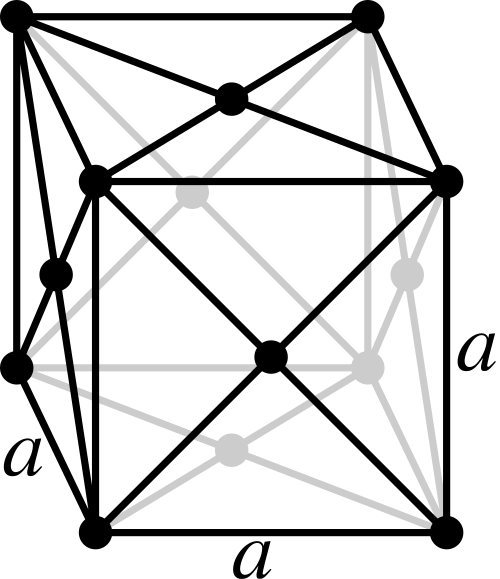 | ||||||||||||||||||||||||
| 熱膨張 | 22.87 × 10 -6 /K (20 °C 時) [5] | ||||||||||||||||||||||||
| 熱伝導率 | 237 W/(m⋅K) | ||||||||||||||||||||||||
| 電気抵抗率 | 26.5 nΩ⋅m(20℃時) | ||||||||||||||||||||||||
| 磁気秩序 | 常磁性体[9] | ||||||||||||||||||||||||
| モル磁化率 | +16.5 × 10 −6 cm 3 /モル | ||||||||||||||||||||||||
| ヤング率 | 70GPa | ||||||||||||||||||||||||
| せん断弾性係数 | 26GPa | ||||||||||||||||||||||||
| 体積弾性率 | 76GPa | ||||||||||||||||||||||||
| 音速の 細い棒 | (ロール) 5000 m/s ( 室温で) | ||||||||||||||||||||||||
| ポアソン比 | 0.35 | ||||||||||||||||||||||||
| モース硬度 | 2.75 | ||||||||||||||||||||||||
| ビッカース硬度 | 160~350MPa | ||||||||||||||||||||||||
| ブリネル硬度 | 160~550MPa | ||||||||||||||||||||||||
| CAS番号 | 7429-90-5 | ||||||||||||||||||||||||
| 歴史 | |||||||||||||||||||||||||
| ネーミング | アルミンの旧称「alumine」から | ||||||||||||||||||||||||
| 予測 | アントワーヌ・ラヴォアジエ(1782) | ||||||||||||||||||||||||
| 発見 | ハンス・クリスチャン・エルステッド(1824) | ||||||||||||||||||||||||
| 命名者 | ハンフリー・デイビー(1812 [a] ) | ||||||||||||||||||||||||
| アルミニウムの同位体 | |||||||||||||||||||||||||
| |||||||||||||||||||||||||

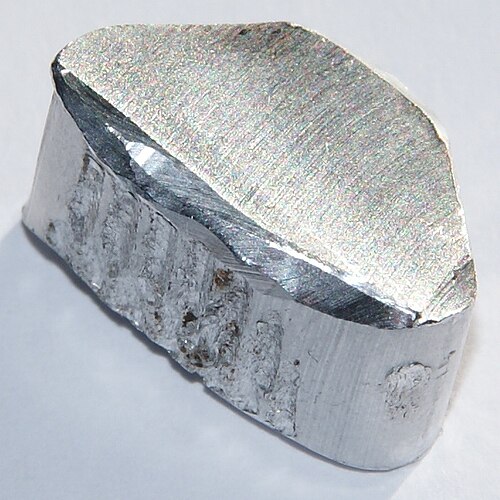
アルミニウム(北米英語ではaluminum)は化学元素であり、記号はAl、原子番号は 13です。アルミニウムの密度は他の一般的な金属よりも低く、鋼鉄の約3分の1です。アルミニウムは酸素との親和性が高く、空気に触れると表面に酸化物の保護層を形成します。アルミニウムは、色と光の反射率の高さの両方において銀に似ています。柔らかく、非磁性で、延性があります。アルミニウムには、非常に豊富に存在する安定同位体である27 Alが1つあり、宇宙で12番目に多い元素となっています。より不安定な同位体である26 Alの放射能により、放射年代測定に使用されます。
化学的には、アルミニウムはホウ素族の遷移後金属である。この族では一般的であるように、アルミニウムは主に +3 の酸化状態で化合物を形成する。アルミニウム陽イオンAl 3+は小さく、電荷が高い。そのため、分極力がより強く、アルミニウムによって形成される結合はより共有結合的な性質を持つ。アルミニウムは酸素と親和性が高いため、自然界ではその酸化物が一般的に存在する。アルミニウムは地球上では主に地殻の岩石中に存在し、マントルには存在せず、酸素とケイ素に次いで 3 番目に豊富な元素であり、自由金属として存在することは事実上ない。アルミニウムは、アルミニウム鉱物を豊富に含む堆積岩であるボーキサイトを採掘することによって工業的に得られる。
アルミニウムの発見は、1825年にデンマークの物理学者ハンス・クリスチャン・エルステッドによって発表されました。アルミニウムの最初の工業生産は、1856年にフランスの化学者アンリ・エティエンヌ・サント=クレール・ドヴィルによって開始されました。アルミニウムは、1886年にフランスの技術者ポール・エルーとアメリカの技術者チャールズ・マーティン・ホールが独立して開発したホール・エルー法によって一般にはるかに利用しやすくなり、アルミニウムの大量生産により、産業や日常生活で広く使用されるようになりました。第一次および第二次世界大戦では、アルミニウムは航空にとって重要な戦略資源でした。1954年には、アルミニウムは銅を抜いて最も生産量の多い非鉄金属になりました。21世紀には、アルミニウムの大部分は米国、西ヨーロッパ、日本で輸送、エンジニアリング、建設、梱包に消費されました。
アルミニウム塩は環境中に広く存在しているにもかかわらず、それを代謝する生物は知られていないが、このアルミニウムは植物や動物によく許容される。これらの塩は豊富に存在するため、その生物学的役割の可能性は興味深く、研究が進められている。
身体的特徴
同位体
アルミニウム同位体のうち、27
アル
は安定している。この状況は、原子番号が奇数の元素によく見られる。[b]これは唯一の原始的なアルミニウム同位体であり、つまり地球の形成以来、現在の形で地球上に存在してきた唯一の同位体である。したがって、これは単核元素であり、その標準原子量は同位体のそれと実質的に同じである。このため、アルミニウムは核磁気共鳴(NMR)に非常に有用であり、その単一の安定同位体は高いNMR感度を有する。[13]アルミニウムの標準原子量は、他の多くの金属と比較して低い。[c]
アルミニウムの他の同位体はすべて放射性です。これらの中で最も安定しているのは26 Alです。太陽系が形成された星間物質には安定した27 Alとともに存在し、恒星内元素合成によっても生成されましたが、半減期はわずか 717,000 年であるため、惑星の形成以来、検出可能な量は残っていません。[14]しかし、微量の26 Al は、宇宙線陽子による破砕によって大気中のアルゴンから生成されます。 26 Al と10 Beの比率は、 10 5~ 10 6年のタイムスケールでの地質学的プロセス 、特に輸送、堆積、堆積物の貯蔵、埋没時間、浸食の放射年代測定に使用されています。 [ 15]隕石科学者の多くは、 26Alの崩壊によって放出されたエネルギーが、 45億5千万年前に形成されたいくつかの小惑星の溶融と分化の原因であると考えています。[16]
アルミニウムの残りの同位体は質量数が21から43の範囲にあり、半減期はすべて1時間未満です。3つの準安定状態が知られており、いずれも半減期は1分未満です。[12]
電子殻
アルミニウム原子は 13 個の電子を持ち、[ Ne ] 3s 2 3p 1の電子配置で配置されており、[17] 3 つの電子が安定した希ガス配置を超えています。したがって、アルミニウムの最初の 3 つのイオン化エネルギーを合わせた値は、4 番目のイオン化エネルギーのみよりもはるかに低くなります。[18]このような電子配置は、同じグループの他のよく特徴付けられたメンバーであるホウ素、ガリウム、インジウム、およびタリウムと共有されており、ニホニウムにも期待されています。アルミニウムは、多くの化学反応でその最外殻電子 3 つを放棄することができます (以下を参照)。アルミニウムの電気陰性度は 1.61 (ポーリングスケール) です。[19]

自由アルミニウム原子の半径は143 pmである。[20]最外殻電子3個を除去すると、半径は4配位原子では39 pm、6配位原子では53.5 pmに縮小する。[20]標準温度および圧力では、アルミニウム原子は(他の元素の原子の影響を受けていない場合)原子の最外殻電子が提供する金属結合によって束縛された面心立方結晶系を形成するため、アルミニウムは(これらの条件下では)金属である。 [21]この結晶系は鉛や銅など他の多くの金属と共有されており、アルミニウムの単位格子のサイズは他の金属のものと同程度である。[21]しかし、このシステムは同じグループの他の元素と共有されていません。ホウ素はイオン化エネルギーが高すぎて金属化できず、タリウムは六方最密構造を持ち、ガリウムとインジウムはアルミニウムやタリウムのように最密ではない珍しい構造を持っています。アルミニウムの金属結合に利用できる電子が少ないことが、アルミニウムが柔らかく、融点と電気抵抗が低い原因であると考えられます。[22]
バルク
アルミニウム金属は、表面の粗さに応じて銀白色から鈍い灰色まで外観が異なります。[d]アルミニウムミラーは、近紫外線と遠赤外線に対してすべての金属ミラーの中で最も反射率が高いです。また、可視スペクトルの光に対して最も反射率が高く、この点では銀とほぼ同等であるため、この2つは似ています。アルミニウムは太陽光の反射にも優れていますが、空気中で長時間太陽光にさらされると金属表面が摩耗します。アルミニウムを陽極酸化処理して表面に酸化物の保護層を追加すると、 これを防ぐことができます。
アルミニウムの密度は2.70 g/cm 3 で、鋼鉄の約1/3であり、他の一般的な金属よりもはるかに低いため、アルミニウム部品はその軽さで簡単に識別できます。[25]アルミニウムが他のほとんどの金属と比較して密度が低いのは、その原子核がはるかに軽いためであり、単位格子のサイズの違いはこの差を補うものではありません。より軽い金属は1族と2族の金属のみであり、ベリリウムとマグネシウムは反応性が高すぎて構造用途に使用できません(ベリリウムは非常に有毒です)。[26]アルミニウムは鋼鉄ほど強くも硬くもありませんが、航空宇宙産業や軽量で比較的高い強度が重要な他の多くの用途では、低密度がこれを補っています。[27]
純アルミニウムは非常に柔らかく、強度に欠ける。ほとんどの用途では、強度と硬度が高いさまざまなアルミニウム合金が代わりに使用されている。 [28]純アルミニウムの降伏強度は7~11 MPaであるのに対し、アルミニウム合金の降伏強度は200 MPaから600 MPaの範囲である。[29]アルミニウムは延性があり、伸び率は50~70%で[30]、展性があるため、簡単に引き抜きや押し出しができる。[31]また、機械加工や鋳造も容易である。[31]
アルミニウムは優れた熱伝導性と電気伝導性を持ち、熱伝導性と電気伝導性は銅の約60%である一方、密度は銅の30%しかありません。 [32]アルミニウムは超伝導が可能で、超伝導臨界温度は1.2ケルビン、臨界磁場は約100ガウス(10ミリテスラ)です。[33]アルミニウムは常磁性体であるため、静磁場の影響をほとんど受けません。[34]ただし、電気伝導性が高いため、渦電流の誘導により交流磁場の影響を強く受けます。[35]
化学
アルミニウムは遷移前金属と遷移後金属の特性を兼ね備えている。より重い第13族同族元素と同様に金属結合に利用できる電子が少ないため、遷移後金属の特徴的な物理的特性を持ち、予想よりも長い原子間距離を持つ。[22]さらに、Al 3+は小さく高電荷の陽イオンであるため、分極が強く、アルミニウム化合物の結合は共有結合に向かう傾向がある。[36]この挙動はベリリウム(Be 2+ )の挙動と似ており、この2つは対角関係の例を示している。[37]
アルミニウムの価電子殻の下にある核は、前述の希ガスの核であるが、より重い同族元素であるガリウム、インジウム、タリウム、ニホニウムの核も、満たされたd-サブシェルと、場合によっては満たされたf-サブシェルを含む。したがって、アルミニウムのより重い同族元素とは異なり、アルミニウムの内部電子は価電子をほぼ完全に遮蔽する。そのため、アルミニウムはそのグループの中で最も電気陽性の金属であり、その水酸化物は実際、ガリウムの水酸化物よりも塩基性が高い。[36] [e]アルミニウムは、同じグループの半金属ホウ素とも若干の類似点がある。AlX 3化合物はBX 3化合物と価電子が等しく(同じ価電子構造を持つ)、どちらもルイス酸として振舞い、容易に付加物を形成する。[38]さらに、ホウ素化学の主なモチーフの一つは規則的な二十面体構造であり、アルミニウムはAl-Zn-Mgクラスを含む多くの二十面体準結晶合金の重要な部分を形成します。 [39]
アルミニウムは酸素との化学的親和性が高く、テルミット反応の還元剤としての使用に適しています。アルミニウムの微粉末は液体酸素と接触すると爆発的に反応します。しかし、通常の条件下では、アルミニウムは薄い酸化物層(室温で約5nm)を形成します[40]。これにより、金属は酸素、水、または希酸によるさらなる腐食から保護されます。このプロセスは不動態化と呼ばれます。 [36] [41]アルミニウムは一般に耐腐食性があるため、微粉末の形で銀色の反射率を保持する数少ない金属の1つであり、銀色の塗料の重要な成分となっています。[42]アルミニウムは不動態化のため、酸化酸に侵されません。これにより、アルミニウムは硝酸、濃硫酸、および一部の有機酸などの試薬の保管に使用できます。 [43]
熱い濃塩酸中では、アルミニウムは水と反応して水素を発生し、室温では水酸化ナトリウムまたは水酸化カリウムの水溶液中ではアルミン酸塩を形成する。これらの条件下では保護的不動態化はごくわずかである。[44] 王水もアルミニウムを溶解する。[43]アルミニウムは、一般的な塩化ナトリウムなどの溶解した塩化物によって腐食されるため、家庭用配管はアルミニウム製ではない。[44]アルミニウムの酸化層は、アマルガム化による水銀との接触や、一部の電気陽性金属の塩との接触によっても破壊される。[36]そのため、最も強力なアルミニウム合金でも、合金銅とのガルバニック反応により耐食性が低下し、[29]特に異種金属が存在する場合、アルミニウムの耐食性は水性塩によって大幅に低下する。[22]
アルミニウムは加熱するとほとんどの非金属と反応し、窒化アルミニウム(AlN)、硫化アルミニウム(Al 2 S 3)、ハロゲン化アルミニウム(AlX 3)などの化合物を形成します。また、周期表のあらゆるグループの金属を含む幅広い金属間化合物も形成します。[36]
無機化合物
アルミニウム含有鉱物や商業的に重要なアルミニウム化合物を含む化合物の大部分は、アルミニウムの酸化状態が3+である。このような化合物の配位数は様々であるが、一般的にAl 3+は6配位または4配位である。アルミニウム(III)の化合物のほとんどすべては無色である。[36]
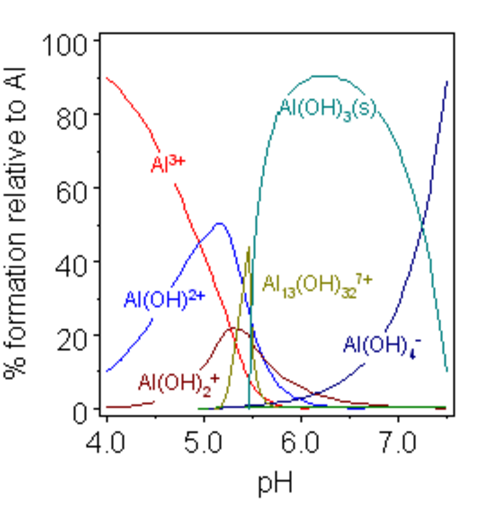
水溶液中では、Al 3+ は六価アクアカチオン [Al(H 2 O) 6 ] 3+として存在し、そのK a はおよそ10 −5である。[13]このような溶液は酸性であり、このカチオンがプロトン供与体として作用し、徐々に加水分解して水酸化アルミニウムAl(OH) 3の沈殿物が形成される。沈殿物は水中の浮遊粒子上で核形成し、それらを除去するため、水の浄化に役立つ。pH をさらに上げると、水酸化物が再び溶解してアルミネート[Al(H 2 O) 2 (OH) 4 ] −が形成される。
水酸化アルミニウムは塩とアルミン酸塩の両方を形成し、酸とアルカリに溶解するほか、酸性および塩基性酸化物と融合する。[36] Al(OH) 3のこの挙動は両性と呼ばれ、不溶性水酸化物を形成し、その水和種もプロトンを供与できる弱塩基性カチオンの特徴である。この効果の1つは、弱酸を含むアルミニウム塩が水中で加水分解されて、水和水酸化物と対応する非金属水素化物になることである。たとえば、硫化アルミニウムは硫化水素を生成する。しかし、炭酸アルミニウムなどの一部の塩は水溶液中に存在しても不安定であり、ハロゲン化物、硝酸塩、硫酸塩などの強酸を含む塩では不完全な加水分解しか起こらない。同様の理由から、無水アルミニウム塩は「水和物」を加熱して作ることはできない。水和塩化アルミニウムは実際にはAlCl 3 ·6H 2 Oではなく[Al(H 2 O) 6 ]Cl 3であり、Al–O結合は非常に強いため、加熱してもそれらを切断してAl–Cl結合を形成するには不十分である。[36]
- 2[Al(H 2 O) 6 ]Cl 3 アルミニウム2酸素3 + 6 HCl + 9 H 2酸素
4 つの三ハロゲン化物はすべてよく知られている。3 つのより重い三ハロゲン化物の構造とは異なり、フッ化アルミニウム(AlF 3 ) は 6 配位アルミニウムを特徴としており、これがその不揮発性、不溶性、および高い生成熱の原因となっている。各アルミニウム原子は 6 つのフッ素原子に囲まれ、歪んだ八面体配置になっており、各フッ素原子は 2 つの八面体の頂点で共有されている。このような {AlF 6 } ユニットは、氷晶石、Na 3 AlF 6などの複合フッ化物にも存在する。[f] AlF 3 は1,290 °C (2,354 °F) で融解し、 700 °C (1,300 °F) で酸化アルミニウムとフッ化水素ガスの反応によって生成される。 [46]
より重いハロゲン化物では、配位数はより低くなります。その他の三ハロゲン化物は、四面体の4配位アルミニウム中心を持つ二量体またはポリマーです。 [g] 三塩化アルミニウム(AlCl 3)は、融点192.4 °C(378 °F)以下では層状のポリマー構造をとりますが、融解するとAl 2 Cl 6二量体に変わります。高温になると、BCl 3の構造に似た三方平面AlCl 3モノマーに解離していきます。三臭化アルミニウムと三ヨウ化アルミニウムは、3つの相すべてでAl 2 X 6二量体を形成するため、相変化によってそれほど大きな特性の変化は見られません。[46]これらの物質は、アルミニウムをハロゲンで処理することによって作られます。三ハロゲン化アルミニウムは、多くの付加化合物や錯体を形成します。ルイス酸性のため、フリーデル・クラフツ反応の触媒として有用です。三塩化アルミニウムは、アントラキノンやスチレンの製造など、この反応を伴う主要な工業用途があります。また、他の多くのアルミニウム化合物の前駆体として、また非金属フッ化物を対応する塩化物に変換するための試薬(トランスハロゲン化反応)としてもよく使用されます。[46]
アルミニウムは化学式Al 2 O 3で表される安定した酸化物を形成し、一般にアルミナと呼ばれる。[47]自然界では鉱物コランダム、α-アルミナとして見つかる。 [48] γ-アルミナ相も存在する。[13]その結晶形であるコランダムは非常に硬く(モース硬度9)、融点が2,045℃(3,713℉)と高く、揮発性が非常に低く、化学的に不活性で、優れた電気絶縁体であるため、研磨剤(歯磨き粉など)や耐火物、セラミックスによく使用され、アルミニウムの電解生産の出発物質でもある。サファイアとルビーは微量の他の金属が混入した不純なコランダムである。[13] 2つの主要な酸化物-水酸化物AlO(OH)は、ベーマイトとダイアスポアです。3つの主要な三水酸化物は、バイヤライト、ギブサイト、ノルドストランダイトで、結晶構造(多形)が異なります。他の多くの中間体や関連構造も知られています。[13]ほとんどは、酸と塩基を使用したさまざまな湿式プロセスによって鉱石から生成されます。水酸化物を加熱するとコランダムが形成されます。これらの材料はアルミニウムの製造に非常に重要であり、それ自体が非常に有用です。スピネル(MgAl 2 O 4)、Na-β-アルミナ(NaAl 11 O 17)、三カルシウムアルミネート(Ca 3 Al 2 O 6 、ポートランドセメントの重要な鉱物相)などのいくつかの混合酸化物相も非常に有用です。[13]
通常の条件下で安定なカルコゲニドは、硫化アルミニウム(Al 2 S 3 )、セレン化物(Al 2 Se 3 )、およびテルル化物(Al 2 Te 3 ) のみです。これら 3 つは、約 1,000 °C (1,800 °F) で元素を直接反応させることによって生成され、水中で急速に完全に加水分解されて、水酸化アルミニウムとそれぞれの水素カルコゲニドを生成します。アルミニウムはこれらのカルコゲンに比べて小さな原子であるため、これらは 4 配位四面体アルミニウムであり、ウルツ鉱に関連した構造を持つさまざまな多形を持ち、可能な金属サイトの 3 分の 2 が整然とした (α) またはランダムな (β) 形式で占有されています。硫化物にはγ-アルミナに関連するγ型と、アルミニウム原子の半分が四面体四配位、残りの半分が三方両錐五配位という珍しい高温六方型もあります。[49]
ニクタイドには、アルミニウム窒化物(AlN)、アルミニウムリン化物(AlP)、アルミニウムヒ素化物(AlAs)、アルミニウムアンチモン化物(AlSb)の4種類が知られている。これらはすべて、シリコンやゲルマニウムと等電子的なIII-V族半導体であり、AlNを除いてすべて閃亜鉛鉱構造をとっている。4種類とも、構成元素の高温(場合によっては高圧)直接反応によって生成できる。[49]
アルミニウムは他のほとんどの金属(ほとんどのアルカリ金属と第13族金属を除く)と合金化しやすく、他の金属との150種類以上の金属間化合物が知られています。製造には、一定の割合で固定された金属を一緒に加熱し、その後徐々に冷却して焼きなましを行います。それらの結合は主に金属結合であり、結晶構造は主にパッキングの効率に依存します。[50]
より低い酸化状態の化合物はほとんどない。アルミニウム(I)化合物はいくつか存在する。AlF、AlCl、AlBr、およびAlIは、それぞれの三ハロゲン化物をアルミニウムとともに加熱すると気相で存在し、極低温でも存在する。 [46]アルミニウムモノヨウ化物の安定した誘導体は、トリエチルアミンと形成される環状付加物、Al 4 I 4 (NEt 3 ) 4 である。Al 2 OおよびAl 2 Sも存在するが、非常に不安定である。[51]非常に単純なアルミニウム(II)化合物は、Al金属と酸化剤の反応で呼び出されたり観察されたりしている。たとえば、一酸化アルミニウム、AlOは、爆発後の気相で検出されている[52]ほか、恒星の吸収スペクトルでも検出されている。[53]より徹底的に調査されているのは、Al-Al結合を含み、Rが大きな有機配位子である式R 4 Al 2の化合物である。[54]
有機アルミニウム化合物および関連水素化物

実験式AlR 3およびAlR 1.5 Cl 1.5の化合物は多種多様に存在する。[55]アルミニウムトリアルキルおよびトリアリールは、反応性があり、揮発性で、無色の液体または低融点の固体である。空気中で自然発火し、水と反応するため、取り扱いには注意が必要である。ホウ素類似体とは異なり、二量体を形成することが多いが、分岐鎖アルキル(例:Pr i、Bu i、Me 3 CCH 2)ではこの傾向は減少する。例えば、トリイソブチルアルミニウムは、モノマーと二量体の平衡混合物として存在する。[56] [57]トリメチルアルミニウム(Al 2 Me 6 )などのこれらの二量体は通常、両方のアルミニウム原子間を架橋するアルキル基との二量化によって形成される四面体Al中心を特徴とする。これらは硬酸であり、配位子と容易に反応して付加物を形成する。産業界では、カール・ツィーグラーが発見したアルケン挿入反応、特に長鎖非分岐第一級アルケンおよびアルコールを形成する「成長反応」、およびエチレンおよびプロペンの低圧重合に主に使用されています。また、Al-N結合を含む複素環式およびクラスター有機アルミニウム化合物もいくつかあります。 [56]
工業的に最も重要なアルミニウム水素化物は、有機化学で還元剤として使用される水素化リチウムアルミニウム(LiAlH 4 )です。これは、水素化リチウムと三塩化アルミニウムから生成できます。[58]最も単純な水素化物であるアルミニウム水素化物またはアランはあまり重要ではありません。これは、式(BH 3)2の二量体である対応するホウ素水素化物とは対照的に、式(AlH 3)nのポリマーです。[58]
自然発生
空間
太陽系におけるアルミニウムの粒子当たりの存在量は3.15 ppm(百万分の一)である。[59] [h]アルミニウムは全元素の中で12番目に多く、奇数原子番号を持つ元素の中では水素と窒素に次いで3番目に多い。[59]アルミニウムの唯一の安定同位体である27 Alは、宇宙で18番目に多い原子核である。これは、後にタイプII超新星となる大質量星での炭素の融合後にほぼ完全に生成される。この融合により26 Mgが生成され、これが自由陽子と中性子を捕獲してアルミニウムになる。27 Alは、進化した星の水素燃焼殻で少量生成され、そこで26 Mgが自由陽子を捕獲できる。[60]基本的に、現在存在するアルミニウムはすべて27 Alである。26 Alは、 27 Alに比べて0.005%存在して初期の太陽系に存在していたが、半減期が728,000年と短すぎるため、元の原子核は生き残れず、26 Alは絶滅した。[60] 27 Alとは異なり、 26 Alの主な発生源は水素燃焼であり、 25 Mgの原子核が自由陽子を捕らえた後に核種が出現する。しかし、微量に存在する26 Alは、星間ガスで最も一般的なガンマ線放出源である。[60]元の26 Alがまだ存在していれば、天の川銀河のガンマ線マップはより明るくなるはずである。 [60]
地球

地球全体では、アルミニウムの質量比は約1.59%(質量比で7番目に多い)である。[61]アルミニウムは、宇宙全体よりも地殻に多く存在する。これは、アルミニウムが酸化物を形成しやすく、岩石に結合して地殻に留まるのに対し、反応性の低い金属は核に沈むためである。[60]地殻では、アルミニウムは最も豊富な金属元素(質量比8.23% [30])であり、すべての元素の中で3番目に豊富(酸素とケイ素に次ぐ)である。[62]地殻の多くのケイ酸塩にはアルミニウムが含まれている。[63]対照的に、地球のマントルには質量比でわずか2.38%のアルミニウムしか含まれていない。[64]アルミニウムは、海水にも2μg/kgの濃度で存在する。[30]
アルミニウムは酸素との親和性が強いため、元素状態で見つかることはほとんどなく、酸化物やケイ酸塩の形で見つかります。地殻で最も一般的な鉱物群である長石は、アルミノケイ酸塩です。アルミニウムは、緑柱石、氷晶石、ガーネット、スピネル、トルコ石などの鉱物にも存在します。[65] Al 2 O 3に含まれるクロムや鉄などの不純物は、それぞれ宝石の ルビーやサファイアを生み出します。[66] 自然界のアルミニウム金属は極めて稀で、特定の火山の内部など、酸素のフガシティーが低い環境でのみ微量相として見つかります。 [67]自然界のアルミニウムは、南シナ海の北東大陸斜面の冷水湧出帯で報告されています。これらの鉱床は、テトラヒドロキソアルミネートAl(OH) 4 −の細菌による還元によって生じた可能性があります。[68]
アルミニウムは一般的で広く存在する元素ですが、すべてのアルミニウム鉱物が経済的に採算の取れる金属源というわけではありません。金属アルミニウムのほぼすべては鉱石ボーキサイト ( AlO x (OH) 3–2 x )から生産されます。ボーキサイトは、熱帯気候条件で鉄分とシリカ分の少ない岩盤の風化生成物として発生します。 [69] 2017年には、ボーキサイトの大部分がオーストラリア、中国、ギニア、インドで採掘されました。[70]
歴史

アルミニウムの歴史はミョウバンの使用によって形作られてきました。ギリシャの歴史家ヘロドトスによるミョウバンの最初の記録は、紀元前5世紀に遡ります。[71]古代人は染色媒染剤として、また都市防衛のためにミョウバンを使用していたことが知られています。[71]十字軍の後、ヨーロッパの織物産業に欠かせない商品であったミョウバンは、[72]国際貿易の対象となり、[73] 15世紀半ばまで東地中海からヨーロッパに輸入されていました。[74]
ミョウバンの性質は不明のままであった。1530年頃、スイスの医師パラケルススは、ミョウバンはミョウバンの土の塩であると示唆した。 [75] 1595年、ドイツの医師で化学者のアンドレアス・リビウスは、実験的にこれを確認した。[76] 1722年、ドイツの化学者フリードリヒ・ホフマンは、ミョウバンのベースは別の土であるという彼の考えを発表した。 [77] 1754年、ドイツの化学者アンドレアス・ジギスムント・マルクグラフは、粘土を硫酸で煮沸し、その後にカリを加えることでアルミナを合成した。[77 ]
アルミニウムを生産する試みは1760年に遡る。[78]しかし、最初の成功した試みは、1824年にデンマークの物理学者で化学者のハンス・クリスチャン・エルステッドによって完了した。彼は無水塩化アルミニウムをカリウムアマルガムと反応させ、スズに似た金属の塊を生成した。[79] [80] [81]彼は1825年に結果を発表し、新しい金属のサンプルを実演した。[82] [83] 1827年、ドイツの化学者フリードリヒ・ヴェーラーはエルステッドの実験を繰り返したが、アルミニウムを特定しなかった。[84](この矛盾の理由は1921年に初めて発見された。)[85]彼は同じ年に無水塩化アルミニウムとカリウムを混合する同様の実験を行い、アルミニウムの粉末を生成した。[81] 1845年に彼は金属の小片を作り、この金属のいくつかの物理的性質を記述しました。[85]その後長年にわたり、ヴェーラーはアルミニウムの発見者として認められました。[86]

ヴェーラーの方法ではアルミニウムを大量に生産できなかったため、この金属は希少なままで、そのコストは金を上回った。[84]アルミニウムの最初の工業生産は、1856年にフランスの化学者アンリ・エティエンヌ・サント=クレール・ドヴィルと仲間たちによって確立された。[87]ドヴィルは、三塩化アルミニウムをナトリウムで還元できることを発見した。これはヴェーラーが使用したカリウムよりも便利で安価だった。[88]当時でも、アルミニウムの純度はまだ高くなく、製造されたアルミニウムはサンプルごとに特性が異なっていた。[89]アルミニウムは電気伝導性があるため、 1885年に完成したワシントン記念塔の蓋に使用された。当時世界で最も高い建物であったこの腐食しない金属製の蓋は、避雷針の先端として機能することが意図されていた。
最初の工業的大規模生産方法は、1886年にフランスの技術者ポール・エルーとアメリカの技術者チャールズ・マーティン・ホールによって独立して開発され、現在ではホール・エルー法として知られています。[90]ホール・エルー法はアルミナを金属に変換します。オーストリアの化学者カール・ジョセフ・バイヤーは、 1889年にボーキサイトを精製してアルミナを生成する方法を発見しました。これは現在ではバイヤー法として知られています。 [91]現代のアルミニウム生産は、バイヤー法とホール・エルー法に基づいています。[92]
大規模生産によってアルミニウムの価格が下落したため、1890年代から20世紀初頭にかけて、アルミニウムは宝飾品、眼鏡のフレーム、光学機器、食器、ホイル、その他の日用品に広く使われるようになった。アルミニウムは他の金属と硬くて軽い合金を形成できるため、当時はさまざまな用途に使われていた。[93]第一次世界大戦中、主要国政府は軽くて丈夫な機体のために大量のアルミニウムの出荷を要求した。 [94]第二次世界大戦中、主要国政府による航空需要はさらに高まった。[95] [96] [97]
20世紀半ばまでに、アルミニウムは日常生活の一部となり、家庭用品の必須部品となった。[98] 1954年、アルミニウムの生産量は銅を上回り[i]、歴史的には鉄に次ぐ生産量となり[101] 、非鉄金属の中で最も多く生産された。20世紀半ばには、アルミニウムは土木材料として登場し、基礎工事と内装仕上げの両方で建築用途に使用され[102]、航空機と陸上装甲車のエンジンの両方で軍事工学でますます使用されるようになった。[103] 1957年に打ち上げられた 地球初の人工衛星は、2つの別々のアルミニウム半球を結合したもので、その後のすべての宇宙船はある程度アルミニウムを使用している。[92]アルミ缶は1956年に発明され、1958年に飲料の保管に使用された。[104]
20世紀を通じて、アルミニウムの生産量は急速に増加した。1900年の世界のアルミニウム生産量は6,800トンであったが、年間生産量が初めて10万トンを超えたのは1916年、1941年には100万トン、1971年には1000万トンに達した。 [99] 1970年代には、アルミニウムの需要増加により、アルミニウムは取引所商品となり、1978年には世界最古の工業用金属取引所であるロンドン金属取引所に上場された。 [92]生産量は増加し続け、2013年にはアルミニウムの年間生産量は5000万トンを超えた。[99]
アルミニウムの実質価格は、1900年の1トン当たり14,000ドルから1948年の2,340ドル(1998年米ドル)に下落した。[99]抽出および処理コストは、技術の進歩と経済規模に応じて低下した。しかし、低品位で品質の悪い鉱床を開発する必要性や、急増する投入コスト(とりわけエネルギー)の使用により、アルミニウムの純コストが増加した。[105]実質価格は、エネルギーコストの上昇とともに1970年代に上昇し始めた。[106]生産は、工業国から生産がより安価な国に移った。[107] 20世紀後半の生産コストは、技術の進歩、エネルギー価格の低下、米ドルの為替レート、およびアルミナ価格により変化した。[108] BRIC諸国の一次生産と一次消費の合計シェアは、 21世紀の最初の10年間で大幅に増加した。[109]中国は、豊富な資源、安価なエネルギー、政府の景気刺激策により、世界の生産量の特に大きなシェアを蓄積しています。[110]また、消費シェアは1972年の2%から2010年には40%に増加しました。[111]米国、西ヨーロッパ、日本では、アルミニウムのほとんどは輸送、エンジニアリング、建設、梱包に消費されました。 [ 112 ] 2021年には、中国のエネルギー不足により電力コストが上昇したため、アルミニウムなどの工業用金属の価格は記録的なレベルに急騰しました。[113]
語源
アルミニウムとアルミニウムという名前は、アルミニウムの天然酸化物であるアルミナ[j]の旧称であるalumineという単語に由来しています。[115]アルミンはフランス語から借用され、そのフランス語は、アルミニウムが採取された鉱物であるミョウバンの古典ラテン語名であるalumenから派生しました。 [116]ラテン語のalumenは、「苦い」または「ビール」を意味するインド・ヨーロッパ祖語の語根*alu-に由来しています。[117]

起源
金属を単離することを目的とした多くの実験を行った英国の化学者ハンフリー・デービーが、この元素に名前を付けた人物として知られています。ミョウバンから単離された金属に最初に提案された名前はalumiumであり、これはデービーが1808年に王立協会哲学会報に発表した電気化学の研究に関する論文で提案したものです。[118]この名前は英語のalumとラテン語の接尾辞-iumから作られたようですが、当時はラテン語に由来する名前を付けるのが慣例であったため、この名前は普遍的に採用されませんでした。この名前はフランス、ドイツ、スウェーデンの同時代の化学者によって批判され、彼らは金属は単離される酸化物アルミナにちなんで名付けられるべきだと主張しました。[119]英語の名前alum はラテン語から直接来ていませんが、alumine / alumina は明らかにラテン語のalumenに由来しています(alumen は変化してalumin-に変化します)。
一例としては、スウェーデンの化学者イェンス・ヤコブ・ベルセリウスがフランス語で書いた「化学命名法に関するエッセイ」(1811年7月)がある。この論文では、ミョウバンから合成される元素にアルミニウムという名前が与えられている。[120] [k] (同じ雑誌の別の号の記事でも、サファイアの元となる酸化物である金属、つまりアルミニウムと同じ金属について言及している。)[122] 1811年1月の王立協会でのデービーの講義の要約では、アルミニウムという名前が可能性のあるものとして言及されている。[123]翌年、デービーは化学の教科書を出版し、その中ではaluminumという綴りを使った。[124]それ以来、両方の綴りが共存している。現在では、それらの使用は地域的であり、aluminumは米国とカナダで主流であり、aluminiumは英語圏のその他の地域で普及している。[125]
スペル
In 1812, British scientist Thomas Young[126] wrote an anonymous review of Davy's book, in which he proposed the name aluminium instead of aluminum, which he thought had a "less classical sound".[127] This name persisted: although the -um spelling was occasionally used in Britain, the American scientific language used -ium from the start.[128] Most scientists throughout the world used -ium in the 19th century;[125] and it was entrenched in several other European languages, such as French, German, and Dutch.[l] In 1828, an American lexicographer, Noah Webster, entered only the aluminum spelling in his American Dictionary of the English Language.[129] In the 1830s, the -um spelling gained usage in the United States; by the 1860s, it had become the more common spelling there outside science.[128] In 1892, Hall used the -um spelling in his advertising handbill for his new electrolytic method of producing the metal, despite his constant use of the -ium spelling in all the patents he filed between 1886 and 1903. It is unknown whether this spelling was introduced by mistake or intentionally, but Hall preferred aluminum since its introduction because it resembled platinum, the name of a prestigious metal.[130] By 1890, both spellings had been common in the United States, the -ium spelling being slightly more common; by 1895, the situation had reversed; by 1900, aluminum had become twice as common as aluminium; in the next decade, the -um spelling dominated American usage. In 1925, the American Chemical Society adopted this spelling.[125]
The International Union of Pure and Applied Chemistry (IUPAC) adopted aluminium as the standard international name for the element in 1990.[131] In 1993, they recognized aluminum as an acceptable variant;[131] the most recent 2005 edition of the IUPAC nomenclature of inorganic chemistry also acknowledges this spelling.[132] IUPAC official publications use the -ium spelling as primary, and they list both where it is appropriate.[m]
Production and refinement
The production of aluminium starts with the extraction of bauxite rock from the ground. The bauxite is processed and transformed using the Bayer process into alumina, which is then processed using the Hall–Héroult process, resulting in the final aluminium.
Aluminium production is highly energy-consuming, and so the producers tend to locate smelters in places where electric power is both plentiful and inexpensive.[135] Production of one kilogram of aluminium requires 7 kilograms of oil energy equivalent, as compared to 1.5 kilograms for steel and 2 kilograms for plastic.[136] As of 2019, the world's largest smelters of aluminium are located in China, India, Russia, Canada, and the United Arab Emirates,[134] while China is by far the top producer of aluminium with a world share of 55%.
According to the International Resource Panel's Metal Stocks in Society report, the global per capita stock of aluminium in use in society (i.e. in cars, buildings, electronics, etc.) is 80 kg (180 lb). Much of this is in more-developed countries (350–500 kg (770–1,100 lb) per capita) rather than less-developed countries (35 kg (77 lb) per capita).[137]
Bayer process
Bauxite is converted to alumina by the Bayer process. Bauxite is blended for uniform composition and then is ground. The resulting slurry is mixed with a hot solution of sodium hydroxide; the mixture is then treated in a digester vessel at a pressure well above atmospheric, dissolving the aluminium hydroxide in bauxite while converting impurities into relatively insoluble compounds:[138]
Al(OH)3 + Na+ + OH− → Na+ + [Al(OH)4]−
After this reaction, the slurry is at a temperature above its atmospheric boiling point. It is cooled by removing steam as pressure is reduced. The bauxite residue is separated from the solution and discarded. The solution, free of solids, is seeded with small crystals of aluminium hydroxide; this causes decomposition of the [Al(OH)4]− ions to aluminium hydroxide. After about half of aluminium has precipitated, the mixture is sent to classifiers. Small crystals of aluminium hydroxide are collected to serve as seeding agents; coarse particles are converted to alumina by heating; the excess solution is removed by evaporation, (if needed) purified, and recycled.[138]
Hall–Héroult process

The conversion of alumina to aluminium is achieved by the Hall–Héroult process. In this energy-intensive process, a solution of alumina in a molten (950 and 980 °C (1,740 and 1,800 °F)) mixture of cryolite (Na3AlF6) with calcium fluoride is electrolyzed to produce metallic aluminium. The liquid aluminium sinks to the bottom of the solution and is tapped off, and usually cast into large blocks called aluminium billets for further processing.[43]
Anodes of the electrolysis cell are made of carbon—the most resistant material against fluoride corrosion—and either bake at the process or are prebaked. The former, also called Söderberg anodes, are less power-efficient and fumes released during baking are costly to collect, which is why they are being replaced by prebaked anodes even though they save the power, energy, and labor to prebake the cathodes. Carbon for anodes should be preferably pure so that neither aluminium nor the electrolyte is contaminated with ash. Despite carbon's resistivity against corrosion, it is still consumed at a rate of 0.4–0.5 kg per each kilogram of produced aluminium. Cathodes are made of anthracite; high purity for them is not required because impurities leach only very slowly. The cathode is consumed at a rate of 0.02–0.04 kg per each kilogram of produced aluminium. A cell is usually terminated after 2–6 years following a failure of the cathode.[43]
The Hall–Heroult process produces aluminium with a purity of above 99%. Further purification can be done by the Hoopes process. This process involves the electrolysis of molten aluminium with a sodium, barium, and aluminium fluoride electrolyte. The resulting aluminium has a purity of 99.99%.[43][139]
Electric power represents about 20 to 40% of the cost of producing aluminium, depending on the location of the smelter. Aluminium production consumes roughly 5% of electricity generated in the United States.[131] Because of this, alternatives to the Hall–Héroult process have been researched, but none has turned out to be economically feasible.[43]
Recycling

Recovery of the metal through recycling has become an important task of the aluminium industry. Recycling was a low-profile activity until the late 1960s, when the growing use of aluminium beverage cans brought it to public awareness.[140] Recycling involves melting the scrap, a process that requires only 5% of the energy used to produce aluminium from ore, though a significant part (up to 15% of the input material) is lost as dross (ash-like oxide).[141] An aluminium stack melter produces significantly less dross, with values reported below 1%.[142]
White dross from primary aluminium production and from secondary recycling operations still contains useful quantities of aluminium that can be extracted industrially. The process produces aluminium billets, together with a highly complex waste material. This waste is difficult to manage. It reacts with water, releasing a mixture of gases (including, among others, hydrogen, acetylene, and ammonia), which spontaneously ignites on contact with air;[143] contact with damp air results in the release of copious quantities of ammonia gas. Despite these difficulties, the waste is used as a filler in asphalt and concrete.[144]
Applications

Metal
The global production of aluminium in 2016 was 58.8 million metric tons. It exceeded that of any other metal except iron (1,231 million metric tons).[145][146]
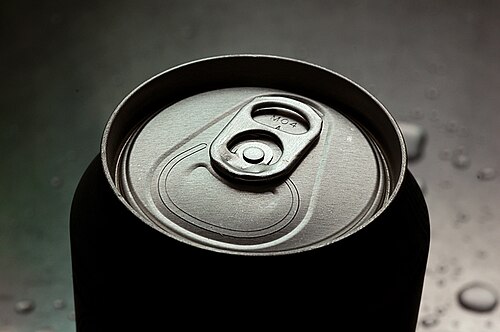
Aluminium is almost always alloyed, which markedly improves its mechanical properties, especially when tempered. For example, the common aluminium foils and beverage cans are alloys of 92% to 99% aluminium.[147] The main alloying agents are copper, zinc, magnesium, manganese, and silicon (e.g., duralumin) with the levels of other metals in a few percent by weight.[148] Aluminium, both wrought and cast, has been alloyed with: manganese, silicon, magnesium, copper and zinc among others.[149]
The major uses for aluminium are in:[150]
- Transportation (automobiles, aircraft, trucks, railway cars, marine vessels, bicycles, spacecraft, etc.). Aluminium is used because of its low density;
- Packaging (cans, foil, frame, etc.). Aluminium is used because it is non-toxic (see below), non-adsorptive, and splinter-proof;
- Building and construction (windows, doors, siding, building wire, sheathing, roofing, etc.). Since steel is cheaper, aluminium is used when lightness, corrosion resistance, or engineering features are important;
- Electricity-related uses (conductor alloys, motors, and generators, transformers, capacitors, etc.). Aluminium is used because it is relatively cheap, highly conductive, has adequate mechanical strength and low density, and resists corrosion;
- A wide range of household items, from cooking utensils to furniture. Low density, good appearance, ease of fabrication, and durability are the key factors of aluminium usage;
- Machinery and equipment (processing equipment, pipes, tools). Aluminium is used because of its corrosion resistance, non-pyrophoricity, and mechanical strength.
Compounds
The great majority (about 90%) of aluminium oxide is converted to metallic aluminium.[138] Being a very hard material (Mohs hardness 9),[151] alumina is widely used as an abrasive;[152] being extraordinarily chemically inert, it is useful in highly reactive environments such as high pressure sodium lamps.[153] Aluminium oxide is commonly used as a catalyst for industrial processes;[138] e.g. the Claus process to convert hydrogen sulfide to sulfur in refineries and to alkylate amines.[154][155] Many industrial catalysts are supported by alumina, meaning that the expensive catalyst material is dispersed over a surface of the inert alumina.[156] Another principal use is as a drying agent or absorbent.[138][157]

Several sulfates of aluminium have industrial and commercial application. Aluminium sulfate (in its hydrate form) is produced on the annual scale of several millions of metric tons.[158] About two-thirds is consumed in water treatment.[158] The next major application is in the manufacture of paper.[158] It is also used as a mordant in dyeing, in pickling seeds, deodorizing of mineral oils, in leather tanning, and in production of other aluminium compounds.[158] Two kinds of alum, ammonium alum and potassium alum, were formerly used as mordants and in leather tanning, but their use has significantly declined following availability of high-purity aluminium sulfate.[158] Anhydrous aluminium chloride is used as a catalyst in chemical and petrochemical industries, the dyeing industry, and in synthesis of various inorganic and organic compounds.[158] Aluminium hydroxychlorides are used in purifying water, in the paper industry, and as antiperspirants.[158] Sodium aluminate is used in treating water and as an accelerator of solidification of cement.[158]
Many aluminium compounds have niche applications, for example:
- Aluminium acetate in solution is used as an astringent.[159]
- Aluminium phosphate is used in the manufacture of glass, ceramic, pulp and paper products, cosmetics, paints, varnishes, and in dental cement.[160]
- Aluminium hydroxide is used as an antacid, and mordant; it is used also in water purification, the manufacture of glass and ceramics, and in the waterproofing of fabrics.[161][162]
- Lithium aluminium hydride is a powerful reducing agent used in organic chemistry.[163][164]
- Organoaluminiums are used as Lewis acids and co-catalysts.[165]
- Methylaluminoxane is a co-catalyst for Ziegler–Natta olefin polymerization to produce vinyl polymers such as polyethene.[166]
- Aqueous aluminium ions (such as aqueous aluminium sulfate) are used to treat against fish parasites such as Gyrodactylus salaris.[167]
- In many vaccines, certain aluminium salts serve as an immune adjuvant (immune response booster) to allow the protein in the vaccine to achieve sufficient potency as an immune stimulant.[168] Until 2004, most of the adjuvants used in vaccines were aluminium-adjuvanted.[169]
Biology

Despite its widespread occurrence in the Earth's crust, aluminium has no known function in biology.[43] At pH 6–9 (relevant for most natural waters), aluminium precipitates out of water as the hydroxide and is hence not available; most elements behaving this way have no biological role or are toxic.[171] Aluminium sulfate has an LD50 of 6207 mg/kg (oral, mouse), which corresponds to 435 grams (about one pound) for a 70 kg (150 lb) mouse.
Toxicity
Aluminium is classified as a non-carcinogen by the United States Department of Health and Human Services.[172][n] A review published in 1988 said that there was little evidence that normal exposure to aluminium presents a risk to healthy adult,[175] and a 2014 multi-element toxicology review was unable to find deleterious effects of aluminium consumed in amounts not greater than 40 mg/day per kg of body mass.[172] Most aluminium consumed will leave the body in feces; most of the small part of it that enters the bloodstream, will be excreted via urine;[176] nevertheless some aluminium does pass the blood-brain barrier and is lodged preferentially in the brains of Alzheimer's patients.[177][178] Evidence published in 1989 indicates that, for Alzheimer's patients, aluminium may act by electrostatically crosslinking proteins, thus down-regulating genes in the superior temporal gyrus.[179]
Effects
Aluminium, although rarely, can cause vitamin D-resistant osteomalacia, erythropoietin-resistant microcytic anemia, and central nervous system alterations. People with kidney insufficiency are especially at a risk.[172] Chronic ingestion of hydrated aluminium silicates (for excess gastric acidity control) may result in aluminium binding to intestinal contents and increased elimination of other metals, such as iron or zinc; sufficiently high doses (>50 g/day) can cause anemia.[172]

During the 1988 Camelford water pollution incident people in Camelford had their drinking water contaminated with aluminium sulfate for several weeks. A final report into the incident in 2013 concluded it was unlikely that this had caused long-term health problems.[180]
Aluminium has been suspected of being a possible cause of Alzheimer's disease,[181] but research into this for over 40 years has found, as of 2018[update], no good evidence of causal effect.[182][183]
Aluminium increases estrogen-related gene expression in human breast cancer cells cultured in the laboratory.[184] In very high doses, aluminium is associated with altered function of the blood–brain barrier.[185] A small percentage of people[186] have contact allergies to aluminium and experience itchy red rashes, headache, muscle pain, joint pain, poor memory, insomnia, depression, asthma, irritable bowel syndrome, or other symptoms upon contact with products containing aluminium.[187]
Exposure to powdered aluminium or aluminium welding fumes can cause pulmonary fibrosis.[188] Fine aluminium powder can ignite or explode, posing another workplace hazard.[189][190]
Exposure routes
Food is the main source of aluminium. Drinking water contains more aluminium than solid food;[172] however, aluminium in food may be absorbed more than aluminium from water.[191] Major sources of human oral exposure to aluminium include food (due to its use in food additives, food and beverage packaging, and cooking utensils), drinking water (due to its use in municipal water treatment), and aluminium-containing medications (particularly antacid/antiulcer and buffered aspirin formulations).[192] Dietary exposure in Europeans averages to 0.2–1.5 mg/kg/week but can be as high as 2.3 mg/kg/week.[172] Higher exposure levels of aluminium are mostly limited to miners, aluminium production workers, and dialysis patients.[193]
Consumption of antacids, antiperspirants, vaccines, and cosmetics provide possible routes of exposure.[194] Consumption of acidic foods or liquids with aluminium enhances aluminium absorption,[195] and maltol has been shown to increase the accumulation of aluminium in nerve and bone tissues.[196]
Treatment
In case of suspected sudden intake of a large amount of aluminium, the only treatment is deferoxamine mesylate which may be given to help eliminate aluminium from the body by chelation therapy.[197][198] However, this should be applied with caution as this reduces not only aluminium body levels, but also those of other metals such as copper or iron.[197]
Environmental effects

High levels of aluminium occur near mining sites; small amounts of aluminium are released to the environment at coal-fired power plants or incinerators.[176] Aluminium in the air is washed out by the rain or normally settles down but small particles of aluminium remain in the air for a long time.[176]
Acidic precipitation is the main natural factor to mobilize aluminium from natural sources[172] and the main reason for the environmental effects of aluminium;[199] however, the main factor of presence of aluminium in salt and freshwater are the industrial processes that also release aluminium into air.[172]
In water, aluminium acts as a toxiс agent on gill-breathing animals such as fish when the water is acidic, in which aluminium may precipitate on gills,[200] which causes loss of plasma- and hemolymph ions leading to osmoregulatory failure.[199] Organic complexes of aluminium may be easily absorbed and interfere with metabolism in mammals and birds, even though this rarely happens in practice.[199]
Aluminium is primary among the factors that reduce plant growth on acidic soils. Although it is generally harmless to plant growth in pH-neutral soils, in acid soils the concentration of toxic Al3+ cations increases and disturbs root growth and function.[201][202][203][204] Wheat has developed a tolerance to aluminium, releasing organic compounds that bind to harmful aluminium cations. Sorghum is believed to have the same tolerance mechanism.[205]
Aluminium production possesses its own challenges to the environment on each step of the production process. The major challenge is the greenhouse gas emissions.[193] These gases result from electrical consumption of the smelters and the byproducts of processing. The most potent of these gases are perfluorocarbons from the smelting process.[193] Released sulfur dioxide is one of the primary precursors of acid rain.[193]
Biodegradation of metallic aluminium is extremely rare; most aluminium-corroding organisms do not directly attack or consume the aluminium, but instead produce corrosive wastes.[206][207] The fungus Geotrichum candidum can consume the aluminium in compact discs.[208][209][210] The bacterium Pseudomonas aeruginosa and the fungus Cladosporium resinae are commonly detected in aircraft fuel tanks that use kerosene-based fuels (not avgas), and laboratory cultures can degrade aluminium.[211]
See also
- Aluminium granules
- Aluminium joining
- Aluminium–air battery
- Aluminized steel, for corrosion resistance and other properties
- Aluminized screen, for display devices
- Aluminized cloth, to reflect heat
- Aluminized mylar, to reflect heat
- Panel edge staining
- Quantum clock
Notes
- ^ Davy's 1812 written usage of the word aluminum was predated by other authors' usage of aluminium. However, Davy is often mentioned as the person who named the element; he was the first to coin a name for aluminium: he used alumium in 1808. Other authors did not accept that name, choosing aluminium instead. See below for more details.
- ^ No elements with odd atomic numbers have more than two stable isotopes; even-numbered elements have multiple stable isotopes, with tin (element 50) having the highest number of stable isotopes of all elements, ten. The single exception is beryllium which is even-numbered but has only one stable isotope.[12] See Even and odd atomic nuclei for more details.
- ^ Most other metals have greater standard atomic weights: for instance, that of iron is 55.845; copper 63.546; lead 207.2.[3] which has consequences for the element's properties (see below)
- ^ The two sides of aluminium foil differ in their luster: one is shiny and the other is dull. The difference is due to the small mechanical damage on the surface of dull side arising from the technological process of aluminium foil manufacturing.[23] Both sides reflect similar amounts of visible light, but the shiny side reflects a far greater share of visible light specularly whereas the dull side almost exclusively diffuses light. Both sides of aluminium foil serve as good reflectors (approximately 86%) of visible light and an excellent reflector (as much as 97%) of medium and far infrared radiation.[24]
- ^ In fact, aluminium's electropositive behavior, high affinity for oxygen, and highly negative standard electrode potential are all better aligned with those of scandium, yttrium, lanthanum, and actinium, which like aluminium have three valence electrons outside a noble gas core; this series shows continuous trends whereas those of group 13 is broken by the first added d-subshell in gallium and the resulting d-block contraction and the first added f-subshell in thallium and the resulting lanthanide contraction.[36]
- ^ These should not be considered as [AlF6]3− complex anions as the Al–F bonds are not significantly different in type from the other M–F bonds.[46]
- ^ Such differences in coordination between the fluorides and heavier halides are not unusual, occurring in SnIV and BiIII, for example; even bigger differences occur between CO2 and SiO2.[46]
- ^ Abundances in the source are listed relative to silicon rather than in per-particle notation. The sum of all elements per 106 parts of silicon is 2.6682×10¹⁰ parts; aluminium comprises 8.410×10⁴ parts.
- ^ Compare annual statistics of aluminium[99] and copper[100] production by USGS.
- ^ The spelling alumine comes from French, whereas the spelling alumina comes from Latin.[114]
- ^ Davy discovered several other elements, including those he named sodium and potassium, after the English words soda and potash. Berzelius referred to them as to natrium and kalium. Berzelius's suggestion was expanded in 1814[121] with his proposed system of one or two-letter chemical symbols, which are used up to the present day; sodium and potassium have the symbols Na and K, respectively, after their Latin names.
- ^ Some European languages, like Spanish or Italian, use a different suffix from the Latin -um/-ium to form a name of a metal, some, like Polish or Czech, have a different base for the name of the element, and some, like Russian or Greek, do not use the Latin script altogether.
- ^ For instance, see the November–December 2013 issue of Chemistry International: in a table of (some) elements, the element is listed as "aluminium (aluminum)".[133]
- ^ While aluminium per se is not carcinogenic, Söderberg aluminium production is, as is noted by the International Agency for Research on Cancer,[173] likely due to exposure to polycyclic aromatic hydrocarbons.[174]
References
- ^ "aluminum". Oxford English Dictionary (Online ed.). Oxford University Press. (Subscription or participating institution membership required.)
- ^ "Standard Atomic Weights: Aluminium". CIAAW. 2017.
- ^ a b Prohaska, Thomas; Irrgeher, Johanna; Benefield, Jacqueline; Böhlke, John K.; Chesson, Lesley A.; Coplen, Tyler B.; Ding, Tiping; Dunn, Philip J. H.; Gröning, Manfred; Holden, Norman E.; Meijer, Harro A. J. (4 May 2022). "Standard atomic weights of the elements 2021 (IUPAC Technical Report)". Pure and Applied Chemistry. doi:10.1515/pac-2019-0603. ISSN 1365-3075.
- ^ Zhang, Yiming; Evans, Julian R. G.; Yang, Shoufeng (2011). "Corrected Values for Boiling Points and Enthalpies of Vaporization of Elements in Handbooks". J. Chem. Eng. Data. 56 (2): 328–337. doi:10.1021/je1011086.
- ^ a b c Arblaster, John W. (2018). Selected Values of the Crystallographic Properties of Elements. Materials Park, Ohio: ASM International. ISBN 978-1-62708-155-9.
- ^ Unstable carbonyl of Al(0) has been detected in reaction of Al2(CH3)6 with carbon monoxide; see Sanchez, Ramiro; Arrington, Caleb; Arrington Jr., C. A. (1 December 1989). "Reaction of trimethylaluminum with carbon monoxide in low-temperature matrixes". American Chemical Society. 111 (25): 9110-9111. doi:10.1021/ja00207a023. OSTI 6973516.
- ^ Dohmeier, C.; Loos, D.; Schnöckel, H. (1996). "Aluminum(I) and Gallium(I) Compounds: Syntheses, Structures, and Reactions". Angewandte Chemie International Edition. 35 (2): 129–149. doi:10.1002/anie.199601291.
- ^ Tyte, D. C. (1964). "Red (B2Π–A2σ) Band System of Aluminium Monoxide". Nature. 202 (4930): 383. Bibcode:1964Natur.202..383T. doi:10.1038/202383a0. S2CID 4163250.
- ^ Lide, D. R. (2000). "Magnetic susceptibility of the elements and inorganic compounds" (PDF). CRC Handbook of Chemistry and Physics (81st ed.). CRC Press. ISBN 0849304814.
- ^ Kondev, F. G.; Wang, M.; Huang, W. J.; Naimi, S.; Audi, G. (2021). "The NUBASE2020 evaluation of nuclear properties" (PDF). Chinese Physics C. 45 (3): 030001. doi:10.1088/1674-1137/abddae.
- ^ Mougeot, X. (2019). "Towards high-precision calculation of electron capture decays". Applied Radiation and Isotopes. 154 (108884). doi:10.1016/j.apradiso.2019.108884.
- ^ a b IAEA – Nuclear Data Section (2017). "Livechart – Table of Nuclides – Nuclear structure and decay data". www-nds.iaea.org. International Atomic Energy Agency. Archived from the original on 23 March 2019. Retrieved 31 March 2017.
- ^ a b c d e f Greenwood & Earnshaw 1997, pp. 242–252.
- ^ "Aluminium". The Commission on Isotopic Abundances and Atomic Weights. Archived from the original on 23 September 2020. Retrieved 20 October 2020.
- ^ Dickin, A.P. (2005). "In situ Cosmogenic Isotopes". Radiogenic Isotope Geology. Cambridge University Press. ISBN 978-0-521-53017-0. Archived from the original on 6 December 2008. Retrieved 16 July 2008.
- ^ Dodd, R.T. (1986). Thunderstones and Shooting Stars. Harvard University Press. pp. 89–90. ISBN 978-0-674-89137-1.
- ^ Dean 1999, p. 4.2.
- ^ Dean 1999, p. 4.6.
- ^ Dean 1999, p. 4.29.
- ^ a b Dean 1999, p. 4.30.
- ^ a b Enghag, Per (2008). Encyclopedia of the Elements: Technical Data – History – Processing – Applications. John Wiley & Sons. pp. 139, 819, 949. ISBN 978-3-527-61234-5. Archived from the original on 25 December 2019. Retrieved 7 December 2017.
- ^ a b c Greenwood and Earnshaw, pp. 222–4
- ^ "Heavy Duty Foil". Reynolds Kitchens. Archived from the original on 23 September 2020. Retrieved 20 September 2020.
- ^ Pozzobon, V.; Levasseur, W.; Do, Kh.-V.; et al. (2020). "Household aluminum foil matte and bright side reflectivity measurements: Application to a photobioreactor light concentrator design". Biotechnology Reports. 25: e00399. doi:10.1016/j.btre.2019.e00399. ISSN 2215-017X. PMC 6906702. PMID 31867227.
- ^ Lide 2004, p. 4-3.
- ^ Puchta, Ralph (2011). "A brighter beryllium". Nature Chemistry. 3 (5): 416. Bibcode:2011NatCh...3..416P. doi:10.1038/nchem.1033. PMID 21505503.
- ^ Davis 1999, pp. 1–3.
- ^ Davis 1999, p. 2.
- ^ a b Polmear, I.J. (1995). Light Alloys: Metallurgy of the Light Metals (3 ed.). Butterworth-Heinemann. ISBN 978-0-340-63207-9.
- ^ a b c Cardarelli, François (2008). Materials handbook : a concise desktop reference (2nd ed.). London: Springer. pp. 158–163. ISBN 978-1-84628-669-8. OCLC 261324602.
- ^ a b Davis 1999, p. 4.
- ^ Davis 1999, pp. 2–3.
- ^ Cochran, J.F.; Mapother, D.E. (1958). "Superconducting Transition in Aluminum". Physical Review. 111 (1): 132–142. Bibcode:1958PhRv..111..132C. doi:10.1103/PhysRev.111.132.
- ^ Schmitz 2006, p. 6.
- ^ Schmitz 2006, p. 161.
- ^ a b c d e f g h i Greenwood & Earnshaw 1997, pp. 224–227.
- ^ Greenwood & Earnshaw 1997, pp. 112–113.
- ^ King 1995, p. 241.
- ^ King 1995, pp. 235–236.
- ^ Hatch, John E. (1984). Aluminum : properties and physical metallurgy. Metals Park, Ohio: American Society for Metals, Aluminum Association. p. 242. ISBN 978-1-61503-169-6. OCLC 759213422.
- ^ Vargel, Christian (2004) [French edition published 1999]. Corrosion of Aluminium. Elsevier. ISBN 978-0-08-044495-6. Archived from the original on 21 May 2016.
- ^ Macleod, H.A. (2001). Thin-film optical filters. CRC Press. p. 158159. ISBN 978-0-7503-0688-1.
- ^ a b c d e f g Frank, W.B. (2009). "Aluminum". Ullmann's Encyclopedia of Industrial Chemistry. Wiley-VCH. doi:10.1002/14356007.a01_459.pub2. ISBN 978-3-527-30673-2.
- ^ a b Beal, Roy E. (1999). Engine Coolant Testing : Fourth Volume. ASTM International. p. 90. ISBN 978-0-8031-2610-7. Archived from the original on 24 April 2016.
- ^ *Baes, C. F.; Mesmer, R. E. (1986) [1976]. The Hydrolysis of Cations. Robert E. Krieger. ISBN 978-0-89874-892-5.
- ^ a b c d e f Greenwood & Earnshaw 1997, pp. 233–237.
- ^ Eastaugh, Nicholas; Walsh, Valentine; Chaplin, Tracey; Siddall, Ruth (2008). Pigment Compendium. Routledge. ISBN 978-1-136-37393-0. Archived from the original on 15 April 2021. Retrieved 1 October 2020.
- ^ Roscoe, Henry Enfield; Schorlemmer, Carl (1913). A treatise on chemistry. Macmillan. Archived from the original on 15 April 2021. Retrieved 1 October 2020.
- ^ a b Greenwood & Earnshaw 1997, pp. 252–257.
- ^ Downs, A. J. (1993). Chemistry of Aluminium, Gallium, Indium and Thallium. Springer Science & Business Media. p. 218. ISBN 978-0-7514-0103-5. Archived from the original on 15 April 2021. Retrieved 1 October 2020.
- ^ Dohmeier, C.; Loos, D.; Schnöckel, H. (1996). "Aluminum(I) and Gallium(I) Compounds: Syntheses, Structures, and Reactions". Angewandte Chemie International Edition. 35 (2): 129–149. doi:10.1002/anie.199601291.
- ^ Tyte, D.C. (1964). "Red (B2Π–A2σ) Band System of Aluminium Monoxide". Nature. 202 (4930): 383–384. Bibcode:1964Natur.202..383T. doi:10.1038/202383a0. S2CID 4163250.
- ^ Merrill, P.W.; Deutsch, A.J.; Keenan, P.C. (1962). "Absorption Spectra of M-Type Mira Variables". The Astrophysical Journal. 136: 21. Bibcode:1962ApJ...136...21M. doi:10.1086/147348.
- ^ Uhl, W. (2004). "Organoelement Compounds Possessing AlAl, GaGa, InIn, and TlTl Single Bonds". Advances in Organometallic Chemistry Volume 51. Vol. 51. pp. 53–108. doi:10.1016/S0065-3055(03)51002-4. ISBN 978-0-12-031151-4.
- ^ Elschenbroich, C. (2006). Organometallics. Wiley-VCH. ISBN 978-3-527-29390-2.
- ^ a b Greenwood & Earnshaw 1997, pp. 257–67.
- ^ Smith, Martin B. (1970). "The monomer-dimer equilibria of liquid aluminum alkyls". Journal of Organometallic Chemistry. 22 (2): 273–281. doi:10.1016/S0022-328X(00)86043-X.
- ^ a b Greenwood & Earnshaw 1997, pp. 227–232.
- ^ a b Lodders, K. (2003). "Solar System abundances and condensation temperatures of the elements" (PDF). The Astrophysical Journal. 591 (2): 1220–1247. Bibcode:2003ApJ...591.1220L. doi:10.1086/375492. ISSN 0004-637X. S2CID 42498829. Archived (PDF) from the original on 12 April 2019. Retrieved 15 June 2018.
- ^ a b c d e Clayton, D. (2003). Handbook of Isotopes in the Cosmos : Hydrogen to Gallium. Leiden: Cambridge University Press. pp. 129–137. ISBN 978-0-511-67305-4. OCLC 609856530. Archived from the original on 11 June 2021. Retrieved 13 September 2020.
- ^ William F McDonough The composition of the Earth. quake.mit.edu, archived by the Internet Archive Wayback Machine.
- ^ Greenwood and Earnshaw, pp. 217–9
- ^ Wade, K.; Banister, A.J. (2016). The Chemistry of Aluminium, Gallium, Indium and Thallium: Comprehensive Inorganic Chemistry. Elsevier. p. 1049. ISBN 978-1-4831-5322-3. Archived from the original on 30 November 2019. Retrieved 17 June 2018.
- ^ Palme, H.; O'Neill, Hugh St. C. (2005). "Cosmochemical Estimates of Mantle Composition" (PDF). In Carlson, Richard W. (ed.). The Mantle and Core. Elseiver. p. 14. Archived (PDF) from the original on 3 April 2021. Retrieved 11 June 2021.
- ^ Downs, A.J. (1993). Chemistry of Aluminium, Gallium, Indium and Thallium. Springer Science & Business Media. ISBN 978-0-7514-0103-5. Archived from the original on 25 July 2020. Retrieved 14 June 2017.
- ^ Kotz, John C.; Treichel, Paul M.; Townsend, John (2012). Chemistry and Chemical Reactivity. Cengage Learning. p. 300. ISBN 978-1-133-42007-1. Archived from the original on 22 December 2019. Retrieved 17 June 2018.
- ^ Barthelmy, D. "Aluminum Mineral Data". Mineralogy Database. Archived from the original on 4 July 2008. Retrieved 9 July 2008.
- ^ Chen, Z.; Huang, Chi-Yue; Zhao, Meixun; Yan, Wen; Chien, Chih-Wei; Chen, Muhong; Yang, Huaping; Machiyama, Hideaki; Lin, Saulwood (2011). "Characteristics and possible origin of native aluminum in cold seep sediments from the northeastern South China Sea". Journal of Asian Earth Sciences. 40 (1): 363–370. Bibcode:2011JAESc..40..363C. doi:10.1016/j.jseaes.2010.06.006.
- ^ Guilbert, J.F.; Park, C.F. (1986). The Geology of Ore Deposits. W.H. Freeman. pp. 774–795. ISBN 978-0-7167-1456-9.
- ^ United States Geological Survey (2018). "Bauxite and alumina" (PDF). Mineral Commodities Summaries. Archived (PDF) from the original on 11 March 2018. Retrieved 17 June 2018.
- ^ a b Drozdov 2007, p. 12.
- ^ Clapham, John Harold; Power, Eileen Edna (1941). The Cambridge Economic History of Europe: From the Decline of the Roman Empire. CUP Archive. p. 207. ISBN 978-0-521-08710-0.
- ^ Drozdov 2007, p. 16.
- ^ Setton, Kenneth M. (1976). The papacy and the Levant: 1204-1571. 1 The thirteenth and fourteenth centuries. American Philosophical Society. ISBN 978-0-87169-127-9. OCLC 165383496.
- ^ Drozdov 2007, p. 25.
- ^ Weeks, Mary Elvira (1968). Discovery of the elements. Vol. 1 (7 ed.). Journal of chemical education. p. 187. ISBN 9780608300177.
- ^ a b Richards 1896, p. 2.
- ^ Richards 1896, p. 3.
- ^ Örsted, H. C. (1825). Oversigt over det Kongelige Danske Videnskabernes Selskabs Forhanlingar og dets Medlemmerz Arbeider, fra 31 Mai 1824 til 31 Mai 1825 [Overview of the Royal Danish Science Society's Proceedings and the Work of its Members, from 31 May 1824 to 31 May 1825] (in Danish). pp. 15–16. Archived from the original on 16 March 2020. Retrieved 27 February 2020.
- ^ Royal Danish Academy of Sciences and Letters (1827). Det Kongelige Danske Videnskabernes Selskabs philosophiske og historiske afhandlinger [The philosophical and historical dissertations of the Royal Danish Science Society] (in Danish). Popp. pp. xxv–xxvi. Archived from the original on 24 March 2017. Retrieved 11 March 2016.
- ^ a b Wöhler, Friedrich (1827). "Ueber das Aluminium". Annalen der Physik und Chemie. 2. 11 (9): 146–161. Bibcode:1828AnP....87..146W. doi:10.1002/andp.18270870912. S2CID 122170259. Archived from the original on 11 June 2021. Retrieved 11 March 2016.
- ^ Drozdov 2007, p. 36.
- ^ Fontani, Marco; Costa, Mariagrazia; Orna, Mary Virginia (2014). The Lost Elements: The Periodic Table's Shadow Side. Oxford University Press. p. 30. ISBN 978-0-19-938334-4.
- ^ a b Venetski, S. (1969). "'Silver' from clay". Metallurgist. 13 (7): 451–453. doi:10.1007/BF00741130. S2CID 137541986.
- ^ a b Drozdov 2007, p. 38.
- ^ Holmes, Harry N. (1936). "Fifty Years of Industrial Aluminum". The Scientific Monthly. 42 (3): 236–239. Bibcode:1936SciMo..42..236H. JSTOR 15938.
- ^ Drozdov 2007, p. 39.
- ^ Sainte-Claire Deville, H.E. (1859). De l'aluminium, ses propriétés, sa fabrication. Paris: Mallet-Bachelier. Archived from the original on 30 April 2016.
- ^ Drozdov 2007, p. 46.
- ^ Drozdov 2007, pp. 55–61.
- ^ Drozdov 2007, p. 74.
- ^ a b c "Aluminium history". All about aluminium. Archived from the original on 7 November 2017. Retrieved 7 November 2017.
- ^ Drozdov 2007, pp. 64–69.
- ^ Ingulstad, Mats (2012). "'We Want Aluminum, No Excuses': Business-Government Relations in the American Aluminum Industry, 1917–1957". In Ingulstad, Mats; Frøland, Hans Otto (eds.). From Warfare to Welfare: Business-Government Relations in the Aluminium Industry. Tapir Academic Press. pp. 33–68. ISBN 978-82-321-0049-1. Archived from the original on 25 July 2020. Retrieved 7 May 2020.
- ^ Seldes, George (1943). Facts and Fascism (5 ed.). In Fact, Inc. p. 261.
- ^ Thorsheim, Peter (2015). Waste into Weapons. Cambridge University Press. pp. 66–69. ISBN 978-1-107-09935-7. Archived from the original on 6 April 2020. Retrieved 7 January 2021.
- ^ Weeks, Albert Loren (2004). Russia's Life-saver: Lend-lease Aid to the U.S.S.R. in World War II. Lexington Books. p. 135. ISBN 978-0-7391-0736-2. Archived from the original on 6 April 2020. Retrieved 7 January 2021.
- ^ Drozdov 2007, pp. 69–70.
- ^ a b c d "Aluminum". Historical Statistics for Mineral Commodities in the United States (Report). United States Geological Survey. 2017. Archived from the original on 8 March 2018. Retrieved 9 November 2017.
- ^ "Copper. Supply-Demand Statistics". Historical Statistics for Mineral Commodities in the United States (Report). United States Geological Survey. 2017. Archived from the original on 8 March 2018. Retrieved 4 June 2019.
- ^ Gregersen, Erik. "Copper". Encyclopedia Britannica. Archived from the original on 22 June 2019. Retrieved 4 June 2019.
- ^ Drozdov 2007, pp. 165–166.
- ^ Drozdov 2007, p. 85.
- ^ Drozdov 2007, p. 135.
- ^ Nappi 2013, p. 9.
- ^ Nappi 2013, pp. 9–10.
- ^ Nappi 2013, p. 10.
- ^ Nappi 2013, pp. 14–15.
- ^ Nappi 2013, p. 17.
- ^ Nappi 2013, p. 20.
- ^ Nappi 2013, p. 22.
- ^ Nappi 2013, p. 23.
- ^ "Aluminum prices hit 13-year high amid power shortage in China". Nikkei Asia. 22 September 2021.
- ^ Black, J. (1806). Lectures on the elements of chemistry: delivered in the University of Edinburgh. Vol. 2. Graves, B. p. 291.
The French chemists have given a new name to this pure earth; alumine in French, and alumina in Latin. I confess I do not like this alumina.
- ^ "aluminium, n." Oxford English Dictionary, third edition. Oxford University Press. December 2011. Archived from the original on 11 June 2021. Retrieved 30 December 2020.
Origin: Formed within English, by derivation. Etymons: aluminen., -ium suffix, aluminum n.
- ^ "alumine, n." Oxford English Dictionary, third edition. Oxford University Press. December 2011. Archived from the original on 11 June 2021. Retrieved 30 December 2020.
Etymology: < French alumine (L. B. Guyton de Morveau 1782, Observ. sur la Physique 19 378) < classical Latin alūmin-, alūmen alum n.1, after French -ine -ine suffix4.
- ^ Pokorny, Julius (1959). "alu- (-d-, -t-)". Indogermanisches etymologisches Wörterbuch [Indo-European etymological dictionary] (in German). A. Francke Verlag. pp. 33–34. Archived from the original on 23 November 2017. Retrieved 13 November 2017.
- ^ Davy, Humphry (1808). "Electro Chemical Researches, on the Decomposition of the Earths; with Observations on the Metals obtained from the alkaline Earths, and on the Amalgam procured from Ammonia". Philosophical Transactions of the Royal Society. 98: 353. Bibcode:1808RSPT...98..333D. doi:10.1098/rstl.1808.0023. Archived from the original on 15 April 2021. Retrieved 10 December 2009.
- ^ Richards 1896, pp. 3–4.
- ^ Berzelius, J. J. (1811). "Essai sur la nomenclature chimique". Journal de Physique. 73: 253–286. Archived from the original on 15 April 2021. Retrieved 27 December 2020..
- ^ Berzelius, J. (1814). Thomson, Th. (ed.). "Essay on the Cause of Chemical Proportions, and on some Circumstances relating to them: together with a short and easy Method of expressing them". Annals of Philosophy. III. Baldwin, R.: 51–62. Archived from the original on 15 July 2014. Retrieved 13 December 2014.
- ^ Delaméntherie, J.-C. (1811). "Leçonse de minéralogie. Données au collége de France". Journal de Physique. 73: 469–470. Archived from the original on 15 April 2021. Retrieved 27 December 2020..
- ^ "Philosophical Transactions of the Royal Society of London. For the Year 1810. — Part I". The Critical Review: Or, Annals of Literature. The Third. XXII: 9. January 1811. hdl:2027/chi.36013662.
Potassium, acting upon alumine and glucine, produces pyrophoric substances of a dark grey colour, which burnt, throwing off brilliant sparks, and leaving behind alkali and earth, and which, when thrown into water, decomposed it with great violence. The result of this experiment is not wholly decisive as to the existence of what might be called aluminium and glucinium
- ^ Davy, Humphry (1812). "Of metals; their primary compositions with other uncompounded bodies, and with each other". Elements of Chemical Philosophy: Part 1. Vol. 1. Bradford and Inskeep. p. 201. Archived from the original on 14 March 2020. Retrieved 4 March 2020.
- ^ a b c "aluminium, n." Oxford English Dictionary, third edition. Oxford University Press. December 2011. Archived from the original on 11 June 2021. Retrieved 30 December 2020.
aluminium n. coexisted with its synonym aluminum n. throughout the 19th cent. From the beginning of the 20th cent., aluminum gradually became the predominant form in North America; it was adopted as the official name of the metal in the United States by the American Chemical Society in 1925. Elsewhere, aluminum was gradually superseded by aluminium, which was accepted as international standard by IUPAC in 1990.
- ^ Cutmore, Jonathan (February 2005). "Quarterly Review Archive". Romantic Circles. University of Maryland. Archived from the original on 1 March 2017. Retrieved 28 February 2017.
- ^ Young, Thomas (1812). "Elements of Chemical Philosophy By Sir Humphry Davy". Quarterly Review. VIII (15): 72. ISBN 978-0-217-88947-6. 210. Archived from the original on 25 July 2020. Retrieved 10 December 2009.
- ^ a b Quinion, Michael (2005). Port Out, Starboard Home: The Fascinating Stories We Tell About the words We Use. Penguin Books Limited. pp. 23–24. ISBN 978-0-14-190904-2.
- ^ Webster, Noah (1828). "aluminum". American Dictionary of the English Language. Archived from the original on 13 November 2017. Retrieved 13 November 2017.
- ^ Kean, S. (2018). "Elements as money". The Disappearing Spoon: And Other True Tales of Rivalry, Adventure, and the History of the World from the Periodic Table of the Elements (Young Readers ed.). Little, Brown Books for Young Readers. ISBN 978-0-316-38825-2. Archived from the original on 15 April 2021. Retrieved 14 January 2021.
- ^ a b c Emsley, John (2011). Nature's Building Blocks: An A–Z Guide to the Elements. OUP Oxford. pp. 24–30. ISBN 978-0-19-960563-7. Archived from the original on 22 December 2019. Retrieved 16 November 2017.
- ^ Connelly, Neil G.; Damhus, Ture, eds. (2005). Nomenclature of inorganic chemistry. IUPAC Recommendations 2005 (PDF). RSC Publishing. p. 249. ISBN 978-0-85404-438-2. Archived from the original (PDF) on 22 December 2014.
- ^ "Standard Atomic Weights Revised" (PDF). Chemistry International. 35 (6): 17–18. ISSN 0193-6484. Archived from the original (PDF) on 11 February 2014.
- ^ a b "USGS Minerals Information: Mineral Commodity Summaries" (PDF). minerals.usgs.gov. doi:10.3133/70194932. Archived (PDF) from the original on 22 January 2021. Retrieved 17 December 2020.
- ^ Brown, T.J. (2009). World Mineral Production 2003–2007. British Geological Survey. Archived from the original on 13 July 2019. Retrieved 1 December 2014.
- ^ Lama, F. (2023). Why the West Can't Win: From Bretton Woods to a Multipolar World. Clarity Press, Inc. p. 19. ISBN 978-1-949762-74-7.
- ^ Graedel, T.E.; et al. (2010). Metal stocks in Society – Scientific Synthesis (PDF) (Report). International Resource Panel. p. 17. ISBN 978-92-807-3082-1. Archived (PDF) from the original on 26 April 2018. Retrieved 18 April 2017.
- ^ a b c d e Hudson, L. Keith; Misra, Chanakya; Perrotta, Anthony J.; et al. (2005). "Aluminum Oxide". Ullmann's Encyclopedia of Industrial Chemistry. Wiley-VCH.
- ^ Totten, G.E.; Mackenzie, D.S. (2003). Handbook of Aluminum. Marcel Dekker. p. 40. ISBN 978-0-8247-4843-2. Archived from the original on 15 June 2016.
- ^ Schlesinger, Mark (2006). Aluminum Recycling. CRC Press. p. 248. ISBN 978-0-8493-9662-5. Archived from the original on 15 February 2017. Retrieved 25 June 2018.
- ^ "Benefits of Recycling". Ohio Department of Natural Resources. Archived from the original on 24 June 2003.
- ^ "Theoretical/Best Practice Energy Use in Metalcasting Operations" (PDF). Archived from the original (PDF) on 31 October 2013. Retrieved 28 October 2013.
- ^ "Why are dross & saltcake a concern?". www.experts123.com. Archived from the original on 14 November 2012.
- ^ Dunster, A.M.; et al. (2005). "Added value of using new industrial waste streams as secondary aggregates in both concrete and asphalt" (PDF). Waste & Resources Action Programme. Archived from the original on 2 April 2010.
- ^ Brown, T.J.; Idoine, N.E.; Raycraft, E.R.; et al. (2018). World Mineral Production: 2012–2016. British Geological Survey. ISBN 978-0-85272-882-6. Archived from the original on 16 May 2020. Retrieved 10 July 2018.
- ^ "Aluminum". Encyclopædia Britannica. Archived from the original on 12 March 2012. Retrieved 6 March 2012.
- ^ Millberg, L.S. "Aluminum Foil". How Products are Made. Archived from the original on 13 July 2007. Retrieved 11 August 2007.
- ^ Lyle, J.P.; Granger, D.A.; Sanders, R.E. (2005). "Aluminum Alloys". Ullmann's Encyclopedia of Industrial Chemistry. Wiley-VCH. doi:10.1002/14356007.a01_481. ISBN 978-3-527-30673-2.
- ^ Ross, R.B. (2013). Metallic Materials Specification Handbook. Springer Science & Business Media. ISBN 9781461534822. Archived from the original on 11 June 2021. Retrieved 3 June 2021.
- ^ Davis 1999, pp. 17–24.
- ^ Lumley, Roger (2010). Fundamentals of Aluminium Metallurgy: Production, Processing and Applications. Elsevier Science. p. 42. ISBN 978-0-85709-025-6. Archived from the original on 22 December 2019. Retrieved 13 July 2018.
- ^ Mortensen, Andreas (2006). Concise Encyclopedia of Composite Materials. Elsevier. p. 281. ISBN 978-0-08-052462-7. Archived from the original on 20 December 2019. Retrieved 13 July 2018.
- ^ The Ceramic Society of Japan (2012). Advanced Ceramic Technologies & Products. Springer Science & Business Media. p. 541. ISBN 978-4-431-54108-0. Archived from the original on 29 November 2019. Retrieved 13 July 2018.
- ^ Slesser, Malcolm (1988). Dictionary of Energy. Palgrave Macmillan UK. p. 138. ISBN 978-1-349-19476-6. Archived from the original on 11 June 2021. Retrieved 13 July 2018.
- ^ Supp, Emil (2013). How to Produce Methanol from Coal. Springer Science & Business Media. pp. 164–165. ISBN 978-3-662-00895-9. Archived from the original on 26 December 2019. Retrieved 13 July 2018.
- ^ Ertl, Gerhard; Knözinger, Helmut; Weitkamp, Jens (2008). Preparation of Solid Catalysts. John Wiley & Sons. p. 80. ISBN 978-3-527-62068-5. Archived from the original on 24 December 2019. Retrieved 13 July 2018.
- ^ Armarego, W.L.F.; Chai, Christina (2009). Purification of Laboratory Chemicals. Butterworth-Heinemann. pp. 73, 109, 116, 155. ISBN 978-0-08-087824-9. Archived from the original on 22 December 2019. Retrieved 13 July 2018.
- ^ a b c d e f g h Helmboldt, O. (2007). "Aluminum Compounds, Inorganic". Ullmann's Encyclopedia of Industrial Chemistry. Wiley-VCH. pp. 1–17. doi:10.1002/14356007.a01_527.pub2. ISBN 978-3-527-30673-2.
- ^ World Health Organization (2009). Stuart MC, Kouimtzi M, Hill SR (eds.). WHO Model Formulary 2008. World Health Organization. hdl:10665/44053. ISBN 9789241547659.
- ^ Occupational Skin Disease. Grune & Stratton. 1983. ISBN 978-0-8089-1494-5. Archived from the original on 15 April 2021. Retrieved 14 June 2017.
- ^ Galbraith, A; Bullock, S; Manias, E; Hunt, B; Richards, A (1999). Fundamentals of pharmacology: a text for nurses and health professionals. Harlow: Pearson. p. 482.
- ^ Papich, Mark G. (2007). "Aluminum Hydroxide and Aluminum Carbonate". Saunders Handbook of Veterinary Drugs (2nd ed.). St. Louis, Mo: Saunders/Elsevier. pp. 15–16. ISBN 978-1-4160-2888-8.
- ^ Brown, Weldon G. (15 March 2011), John Wiley & Sons, Inc. (ed.), "Reductions by Lithium Aluminum Hydride", Organic Reactions, Hoboken, NJ, USA: John Wiley & Sons, Inc., pp. 469–510, doi:10.1002/0471264180.or006.10, ISBN 978-0-471-26418-7, archived from the original on 11 June 2021, retrieved 22 May 2021
- ^ Gerrans, G.C.; Hartmann-Petersen, P. (2007). "Lithium Aluminium Hydride". SASOL Encyclopaedia of Science and Technology. New Africa Books. p. 143. ISBN 978-1-86928-384-1. Archived from the original on 23 August 2017. Retrieved 6 September 2017.
- ^ M. Witt; H.W. Roesky (2000). "Organoaluminum chemistry at the forefront of research and development" (PDF). Curr. Sci. 78 (4): 410. Archived from the original (PDF) on 6 October 2014.
- ^ A. Andresen; H.G. Cordes; J. Herwig; W. Kaminsky; A. Merck; R. Mottweiler; J. Pein; H. Sinn; H.J. Vollmer (1976). "Halogen-free Soluble Ziegler-Catalysts for the Polymerization of Ethylene". Angew. Chem. Int. Ed. 15 (10): 630–632. doi:10.1002/anie.197606301.
- ^ Aas, Øystein; Klemetsen, Anders; Einum, Sigurd; et al. (2011). Atlantic Salmon Ecology. John Wiley & Sons. p. 240. ISBN 978-1-4443-4819-4. Archived from the original on 21 December 2019. Retrieved 14 July 2018.
- ^ Singh, Manmohan (2007). Vaccine Adjuvants and Delivery Systems. John Wiley & Sons. pp. 81–109. ISBN 978-0-470-13492-4. Archived from the original on 20 December 2019. Retrieved 14 July 2018.
- ^ Lindblad, Erik B (October 2004). "Aluminium compounds for use in vaccines". Immunology & Cell Biology. 82 (5): 497–505. doi:10.1111/j.0818-9641.2004.01286.x. PMID 15479435. S2CID 21284189.
- ^ a b Exley, C. (2013). "Human exposure to aluminium". Environmental Science: Processes & Impacts. 15 (10): 1807–1816. doi:10.1039/C3EM00374D. PMID 23982047.
- ^ "Environmental Applications. Part I. Common Forms of the Elements in Water". Western Oregon University. Western Oregon University. Archived from the original on 11 December 2018. Retrieved 30 September 2019.
- ^ a b c d e f g h Dolara, Piero (21 July 2014). "Occurrence, exposure, effects, recommended intake and possible dietary use of selected trace compounds (aluminium, bismuth, cobalt, gold, lithium, nickel, silver)". International Journal of Food Sciences and Nutrition. 65 (8): 911–924. doi:10.3109/09637486.2014.937801. ISSN 1465-3478. PMID 25045935. S2CID 43779869.
- ^ Polynuclear aromatic compounds. part 3, Industrial exposures in aluminium production, coal gasification, coke production, and iron and steel founding. International Agency for Research on Cancer. 1984. pp. 51–59. ISBN 92-832-1534-6. OCLC 11527472. Archived from the original on 11 June 2021. Retrieved 7 January 2021.
- ^ Wesdock, J. C.; Arnold, I. M. F. (2014). "Occupational and Environmental Health in the Aluminum Industry". Journal of Occupational and Environmental Medicine. 56 (5 Suppl): S5–S11. doi:10.1097/JOM.0000000000000071. ISSN 1076-2752. PMC 4131940. PMID 24806726.
- ^ Physiology of Aluminum in Man. Aluminum and Health. CRC Press. 1988. p. 90. ISBN 0-8247-8026-4. Archived from the original on 19 May 2016.
- ^ a b c "Public Health Statement: Aluminum". ATSDR. Archived from the original on 12 December 2016. Retrieved 18 July 2018.
- ^ Xu, N.; Majidi, V.; Markesbery, W. R.; Ehmann, W. D. (1992). "Brain aluminum in Alzheimer's disease using an improved GFAAS method". Neurotoxicology. 13 (4): 735–743. PMID 1302300.
- ^ Yumoto, Sakae; Kakimi, Shigeo; Ohsaki, Akihiro; Ishikawa, Akira (2009). "Demonstration of aluminum in amyloid fibers in the cores of senile plaques in the brains of patients with Alzheimer's disease". Journal of Inorganic Biochemistry. 103 (11): 1579–1584. doi:10.1016/j.jinorgbio.2009.07.023. PMID 19744735.
- ^ Crapper Mclachlan, D.R.; Lukiw, W.J.; Kruck, T.P.A. (1989). "New Evidence for an Active Role of Aluminum in Alzheimer's Disease". Canadian Journal of Neurological Sciences. 16 (4 Suppl): 490–497. doi:10.1017/S0317167100029826. PMID 2680008.
- ^ "Lowermoor Water Pollution incident "unlikely" to have caused long term health effects" (PDF). Committee on Toxicity of Chemicals in Food, Consumer Products and the Environment. 18 April 2013. Archived (PDF) from the original on 21 December 2019. Retrieved 21 December 2019.
- ^ Tomljenovic, Lucija (21 March 2011). "Aluminum and Alzheimer's Disease: After a Century of Controversy, Is there a Plausible Link?". Journal of Alzheimer's Disease. 23 (4): 567–598. doi:10.3233/JAD-2010-101494. PMID 21157018. Archived from the original on 11 June 2021. Retrieved 11 June 2021.
- ^ "Aluminum and dementia: Is there a link?". Alzheimer Society Canada. 24 August 2018. Archived from the original on 21 December 2019. Retrieved 21 December 2019.
- ^ Santibáñez, Miguel; Bolumar, Francisco; García, Ana M (2007). "Occupational risk factors in Alzheimer's disease: a review assessing the quality of published epidemiological studies". Occupational and Environmental Medicine. 64 (11): 723–732. doi:10.1136/oem.2006.028209. ISSN 1351-0711. PMC 2078415. PMID 17525096.
- ^ Darbre, P.D. (2006). "Metalloestrogens: an emerging class of inorganic xenoestrogens with potential to add to the oestrogenic burden of the human breast". Journal of Applied Toxicology. 26 (3): 191–197. doi:10.1002/jat.1135. PMID 16489580. S2CID 26291680.
- ^ Banks, W.A.; Kastin, A.J. (1989). "Aluminum-induced neurotoxicity: alterations in membrane function at the blood–brain barrier". Neurosci Biobehav Rev. 13 (1): 47–53. doi:10.1016/S0149-7634(89)80051-X. PMID 2671833. S2CID 46507895.
- ^ Bingham, Eula; Cohrssen, Barbara (2012). Patty's Toxicology, 6 Volume Set. John Wiley & Sons. p. 244. ISBN 978-0-470-41081-3. Archived from the original on 20 December 2019. Retrieved 23 July 2018.
- ^ "Aluminum Allergy Symptoms and Diagnosis". Allergy-symptoms.org. 20 September 2016. Archived from the original on 23 July 2018. Retrieved 23 July 2018.
- ^ al-Masalkhi, A.; Walton, S.P. (1994). "Pulmonary fibrosis and occupational exposure to aluminum". The Journal of the Kentucky Medical Association. 92 (2): 59–61. ISSN 0023-0294. PMID 8163901.
- ^ "CDC – NIOSH Pocket Guide to Chemical Hazards – Aluminum". www.cdc.gov. Archived from the original on 30 May 2015. Retrieved 11 June 2015.
- ^ "CDC – NIOSH Pocket Guide to Chemical Hazards – Aluminum (pyro powders and welding fumes, as Al)". www.cdc.gov. Archived from the original on 30 May 2015. Retrieved 11 June 2015.
- ^ Yokel R.A.; Hicks C.L.; Florence R.L. (2008). "Aluminum bioavailability from basic sodium aluminum phosphate, an approved food additive emulsifying agent, incorporated in cheese". Food and Chemical Toxicology. 46 (6): 2261–2266. doi:10.1016/j.fct.2008.03.004. PMC 2449821. PMID 18436363.
- ^ United States Department of Health and Human Services (1999). Toxicological profile for aluminum (PDF) (Report). Archived (PDF) from the original on 9 May 2020. Retrieved 3 August 2018.
- ^ a b c d "Aluminum". The Environmental Literacy Council. Archived from the original on 27 October 2020. Retrieved 29 July 2018.
- ^ Chen, Jennifer K.; Thyssen, Jacob P. (2018). Metal Allergy: From Dermatitis to Implant and Device Failure. Springer. p. 333. ISBN 978-3-319-58503-1. Archived from the original on 26 December 2019. Retrieved 23 July 2018.
- ^ Slanina, P.; French, W.; Ekström, L.G.; Lööf, L.; Slorach, S.; Cedergren, A. (1986). "Dietary citric acid enhances absorption of aluminum in antacids". Clinical Chemistry. 32 (3): 539–541. doi:10.1093/clinchem/32.3.539. PMID 3948402.
- ^ Van Ginkel, M.F.; Van Der Voet, G.B.; D'haese, P.C.; De Broe, M.E.; De Wolff, F.A. (1993). "Effect of citric acid and maltol on the accumulation of aluminum in rat brain and bone". The Journal of Laboratory and Clinical Medicine. 121 (3): 453–460. PMID 8445293.
- ^ a b "ARL: Aluminum Toxicity". www.arltma.com. Archived from the original on 31 August 2019. Retrieved 24 July 2018.
- ^ Aluminum Toxicity Archived 3 February 2014 at the Wayback Machine from NYU Langone Medical Center. Last reviewed November 2012 by Igor Puzanov, MD
- ^ a b c Rosseland, B.O.; Eldhuset, T.D.; Staurnes, M. (1990). "Environmental effects of aluminium". Environmental Geochemistry and Health. 12 (1–2): 17–27. Bibcode:1990EnvGH..12...17R. doi:10.1007/BF01734045. ISSN 0269-4042. PMID 24202562. S2CID 23714684.
- ^ Baker, Joan P.; Schofield, Carl L. (1982). "Aluminum toxicity to fish in acidic waters". Water, Air, and Soil Pollution. 18 (1–3): 289–309. Bibcode:1982WASP...18..289B. doi:10.1007/BF02419419. ISSN 0049-6979. S2CID 98363768. Archived from the original on 11 June 2021. Retrieved 27 December 2020.
- ^ Belmonte Pereira, Luciane; Aimed Tabaldi, Luciane; Fabbrin Gonçalves, Jamile; Jucoski, Gladis Oliveira; Pauletto, Mareni Maria; Nardin Weis, Simone; Texeira Nicoloso, Fernando; Brother, Denise; Batista Teixeira Rocha, João; Chitolina Schetinger, Maria Rosa Chitolina (2006). "Effect of aluminum on δ-aminolevulinic acid dehydratase (ALA-D) and the development of cucumber (Cucumis sativus)". Environmental and Experimental Botany. 57 (1–2): 106–115. Bibcode:2006EnvEB..57..106P. doi:10.1016/j.envexpbot.2005.05.004.
- ^ Andersson, Maud (1988). "Toxicity and tolerance of aluminium in vascular plants". Water, Air, & Soil Pollution. 39 (3–4): 439–462. Bibcode:1988WASP...39..439A. doi:10.1007/BF00279487. S2CID 82896081. Archived from the original on 28 February 2020. Retrieved 28 February 2020.
- ^ Horst, Walter J. (1995). "The role of the apoplast in aluminium toxicity and resistance of higher plants: A review". Zeitschrift für Pflanzenernährung und Bodenkunde. 158 (5): 419–428. doi:10.1002/jpln.19951580503.
- ^ Ma, Jian Feng; Ryan, P.R.; Delhaize, E. (2001). "Aluminium tolerance in plants and the complexing role of organic acids". Trends in Plant Science. 6 (6): 273–278. Bibcode:2001TPS.....6..273M. doi:10.1016/S1360-1385(01)01961-6. PMID 11378470.
- ^ Magalhaes, J.V.; Garvin, D.F.; Wang, Y.; Sorrells, M.E.; Klein, P.E.; Schaffert, R.E.; Li, L.; Kochian, L.V. (2004). "Comparative Mapping of a Major Aluminum Tolerance Gene in Sorghum and Other Species in the Poaceae". Genetics. 167 (4): 1905–1914. doi:10.1534/genetics.103.023580. PMC 1471010. PMID 15342528.
- ^ "Fuel System Contamination & Starvation". Duncan Aviation. 2011. Archived from the original on 25 February 2015.
- ^ Romero, Elvira; Ferreira, Patricia; Martínez, Ángel T.; Jesús Martínez, María (April 2009). "New oxidase from Bjerkandera arthroconidial anamorph that oxidizes both phenolic and nonphenolic benzyl alcohols". Biochimica et Biophysica Acta (BBA) - Proteins and Proteomics. Proteins and Proteomics 1794 (4): 689–697. doi:10.1016/j.bbapap.2008.11.013. PMID 19110079.
A Geotrichum-type arthroconidial fungus was isolated by the authors from a deteriorated compact disc found in Belize (Central America)....In the present paper, we report the purification and characterization of an H2O2-generating extracellular oxidase produced by this fungus, which shares catalytic properties with both P. eryngii AAO and P. simplicissimum VAO.
See also the abstract of Romero et al. 2007. - ^ Bosch, Xavier (27 June 2001). "Fungus eats CD". Nature: news010628–11. doi:10.1038/news010628-11. Archived from the original on 31 December 2010.
- ^ Garcia-Guinea, Javier; Cárdenes, Victor; Martínez, Angel T.; Jesús Martínez, Maria (2001). "Fungal bioturbation paths in a compact disk". Short Communication. Naturwissenschaften. 88 (8): 351–354. Bibcode:2001NW.....88..351G. doi:10.1007/s001140100249. PMID 11572018. S2CID 7599290.
- ^ Romero, Elvira; Speranza, Mariela; García-Guinea, Javier; Martínez, Ángel T.; Jesús Martínez, María (8 August 2007). Prior, Bernard (ed.). "An anamorph of the white-rot fungus Bjerkandera adusta capable of colonizing and degrading compact disc components". FEMS Microbiol Lett. 275 (1). Blackwell Publishing Ltd.: 122–129. doi:10.1111/j.1574-6968.2007.00876.x. hdl:10261/47650. PMID 17854471.
- ^ Sheridan, J.E.; Nelson, Jan; Tan, Y.L. "Studies on the "Kerosene Fungus" Cladosporium resinae (Lindau) De Vries: Part I. The Problem of Microbial Contamination of Aviation Fuels". Tuatara. 19 (1): 29. Archived from the original on 13 December 2013.
Bibliography
- Davis, J. R. (1999). Corrosion of Aluminum and Aluminum Alloys. ASM International. ISBN 978-1-61503-238-9.
- Dean, J. A. (1999). Lange's handbook of chemistry (15 ed.). McGraw-Hill. ISBN 978-0-07-016384-3. OCLC 40213725.
- Drozdov, A. (2007). Aluminium: The Thirteenth Element. RUSAL Library. ISBN 978-5-91523-002-5.
- Greenwood, N. N.; Earnshaw, A. (1997). Chemistry of the Elements (2nd ed.). Butterworth-Heinemann. ISBN 978-0-08-037941-8.
- King, R. B. (1995). Inorganic Chemistry of Main Group Elements. Wiley-VCH. ISBN 978-0-471-18602-1.
- Lide, D. R., ed. (2004). Handbook of Chemistry and Physics (84 ed.). CRC Press. ISBN 978-0-8493-0566-5.
- Nappi, C. (2013). The global aluminium industry 40 years from 1972 (PDF) (Report). International Aluminium Institute. Archived (PDF) from the original on 9 October 2022.
- Richards, J. W. (1896). Aluminium: Its history, occurrence, properties, metallurgy and applications, including its alloys (3 ed.). Henry Carey Baird & Co.
- Schmitz, C. (2006). Handbook of Aluminium Recycling. Vulkan-Verlag GmbH. ISBN 978-3-8027-2936-2.
Further reading
- Mimi Sheller, Aluminum Dream: The Making of Light Modernity. Cambridge, Mass.: Massachusetts Institute of Technology Press, 2014.
External links
Aluminium at Wikipedia's sister projects
 Definitions from Wiktionary
 Media from Commons
 Texts from Wikisource
 Resources from Wikiversity
- Aluminium at The Periodic Table of Videos (University of Nottingham)
- Toxicological Profile for Aluminum (PDF) (September 2008) – 357-page report from the United States Department of Health and Human Services, Public Health Service, Agency for Toxic Substances and Disease Registry
- Aluminum entry (last reviewed 30 October 2019) in the NIOSH Pocket Guide to Chemical Hazards published by the CDC's National Institute for Occupational Safety and Health
- Current and historical prices (1998–present) for aluminum futures on the global commodities market
- The short film Aluminum is available for free viewing and download at the Internet Archive.