
Loading article…




.svg/500px-Navy_Unit_Commendation_streamer_(USMC).svg.png)

_Streamer.jpg/500px-Meritorious_Unit_Commendation_(Navy-Marine)_Streamer.jpg)


_Streamer.png/500px-Presidential_Unit_Citation_(Philippines)_Streamer.png)





アメリカ海兵隊(USMC )は、アメリカ海兵隊とも呼ばれ、アメリカ軍の海上陸軍部門であり、歩兵、砲兵、航空、特殊作戦部隊を独自に編成し、複合兵器による遠征・水陸両用作戦[11]の実施を担当しています。アメリカ海兵隊は、アメリカ合衆国の8つの制服組軍種の1つです。
海兵隊は1834年6月30日以来、姉妹組織であるアメリカ海軍とともにアメリカ海軍省の一部となっている。[12]米海兵隊は世界中の陸上および洋上水陸両用戦闘艦船上に施設を運営している。さらに、海兵隊の戦術航空隊のいくつか、主に海兵戦闘攻撃隊も海軍の空母航空団に組み込まれ、航空母艦から活動している。[13]
海兵隊の歴史は、1775年11月10日にフィラデルフィアで、海と陸の両方で戦うことができる歩兵部隊のサービス部門として、大陸海兵隊の2個大隊が編成されたときに始まりました。 [14]第二次世界大戦の太平洋戦域では、海兵隊は島から島へと進軍する大規模な水陸両用作戦で先頭に立った。[15] [16] [17] 2022年現在、米海兵隊には約177,200人の現役隊員と約32,400人の予備役がいます。[3]
ミッション
10 USC § 5063に概説され、 1947 年の国家安全保障法に基づいて最初に導入されたように、米国海兵隊の主な責任分野は次の 3 つです。
この最後の条項は、 1834年の議会法「海兵隊のより良い組織のために」および1798年の「海兵隊の設立と組織」の同様の文言に由来している。 1951年、下院 軍事委員会は、この条項を「海兵隊の最も重要な法定機能の1つであり、伝統的な機能である」と呼んだ。同委員会は、海兵隊が、トリポリ、 1812年の戦争、チャプルテペク、および多数の反乱鎮圧および占領任務(中央アメリカ、第一次世界大戦、朝鮮戦争など)での有名な行動を含め、非海軍的な性質の行動を頻繁に実行してきたことを指摘した。これらの行動は、海軍作戦の支援や水陸両用戦闘として正確に説明されているわけではないが、共通点は、米国の利益のために海軍の機動性を利用して外交問題にタイムリーに介入するという遠征的な性質のものである。[18]
ジョン・アダムズによって「大統領専属」と名付けられた海兵隊バンドは、ホワイトハウスでの国家行事で音楽を提供している。[19]ワシントン D.C. の海兵隊兵舎に駐屯する儀礼用A中隊およびB中隊の海兵隊員は、キャンプ・デービッドを含む大統領の別荘を警備しており、 HMX-1エグゼクティブ・フライト・デタッチメントの海兵隊員は、それぞれ「マリーン・ワン」および「マリーン・ツー」という無線コールサインで、大統領と副大統領にヘリコプターによる輸送を提供している。 [20]エグゼクティブ・フライト・デタッチメントは、閣僚やその他の要人のヘリコプターによる輸送も提供している。1946年の外交法の権限により、海兵大使館警備司令部の海兵隊警備隊は、世界中の140を超える駐在所でアメリカ大使館、公使館、領事館の警備を行っている。[21]
国務省とアメリカ海兵隊の関係は、海兵隊自体とほぼ同じくらい古い。200年以上にわたり、海兵隊はさまざまな国務長官の要請に応じて任務に就いてきた。第二次世界大戦後、世界中のアメリカ大使館、領事館、公使館を守るために、警戒心の強い規律ある部隊が必要となった。1947年、国防総省が1946年外交官法の規定に基づき、海兵隊員を外交官の警備任務に派遣するという提案がなされた。1948年12月15日、国務省と海軍長官の間で正式な協定覚書が締結され、83名の海兵隊員が海外任務に派遣された。プログラムの最初の年には、36の派遣隊が世界中に派遣された。[22]
歴史的使命
海兵隊は、海軍艦艇上の歩兵部隊として創設され、艦艇への乗り込み作戦中に攻防戦を指揮し、士官を反乱から守ることにより、艦艇と乗組員の安全に責任を負っていた。反乱の防止のため、彼らの居住区は士官居住区と艦艇の残りの部分の間に戦略的に配置されることが多かった。大陸海兵隊は、海上と陸上の両方で襲撃隊を配置した。アメリカ初の水陸両用強襲上陸は、独立戦争初期の1776年3月3日に海兵隊がバハマ諸島ニュープロビデンス島にあったイギリスの弾薬庫兼軍港であるモンタギュー砦とナッソー砦を制圧したときに行われた。それ以来、海兵隊の役割は大幅に拡大した。海軍の戦闘教義の変化と海軍の専門職化により、当初の海軍任務の重要性が低下すると、海兵隊は以前は二次的であった陸上の任務に重点を置くことで適応した。 20 世紀初頭の先進基地教義では、海兵隊の陸上での戦闘任務が成文化され、海軍作戦を支援するために基地の占拠やその他の陸上任務に海兵隊員を活用することが概説されました。1987 年、米海兵隊海上学校は閉鎖され、1998 年には艦船上の海兵隊派遣隊はすべて解散されました。
19世紀後半から20世紀にかけて、海兵隊の派遣隊は海軍の巡洋艦、戦艦、航空母艦に乗艦して任務に就いた。派遣隊は船の武器を操作し、船の警備を行うという伝統的な任務を遂行した。派遣隊は、 1832年の第一次スマトラ遠征や20世紀初頭のカリブ海およびメキシコ作戦など、上陸部隊として船員によって増強された。海兵隊は、防御された海岸線への水陸両用強襲の戦術と技術を開発し、第二次世界大戦での使用に間に合うようにした。[23]第二次世界大戦中、海兵隊は主力艦に乗艦し続け、一部は対空砲台に配属された。[24]
1950年、[25]ハリー・トルーマン大統領はゴードン・L・マクドノー下院議員のメッセージに返答した。マクドノーはトルーマン大統領に統合参謀本部に海兵隊の代表を加えるよう促していた。トルーマン大統領はマクドノーに宛てた手紙の中で、「海兵隊は海軍の警察部隊であり、私が大統領である限りそれは変わらない。彼らはスターリンのものとほぼ同等の宣伝機関を持っている」と述べた。その後、マクドノーは1950年8月29日付のトルーマン大統領の手紙を議会記録に挿入した。議員と海兵隊組織は反応し、トルーマン大統領の発言は侮辱的であるとし、謝罪を要求した。トルーマンは当時の海兵隊司令官に謝罪し、「海兵隊に関してマクドノー下院議員に8月29日に送った手紙で使用した言葉の選択が不適切であったことを心から後悔している」と書いた。トルーマンは比喩について謝罪したが、海兵隊は引き続き海軍長官に報告すべきだという立場は変えなかった。数日後、海兵隊連盟を突然訪問し、「間違いを犯したら、それを正そうとする。できるだけ間違いを少なくしようと努力する」と繰り返しただけで、償いをした。彼はスタンディングオベーションを受けた。[26]
1970年代末までに砲艦巡洋艦が退役すると、残存していた海兵隊派遣部隊は戦艦と空母にのみ配備された。艦上警備という当初の任務は1990年代に終了した。[27]
機能
海兵隊は水陸両用戦闘部隊として重要な軍事的役割を果たしている。通常戦力、非正規戦力、ハイブリッド戦力による非対称戦が可能である。海兵隊は独自の能力を採用していないが、部隊として、世界中のほぼどこにでも数日以内に複合兵科任務部隊を迅速に展開することができる。展開されたすべての部隊の基本構造は、共通の指揮要素の下に地上戦闘要素、航空戦闘要素、および兵站戦闘要素を統合した海兵空地任務部隊(MAGTF)である。ゴールドウォーター・ニコルズ法に基づく統合コマンドの創設により、各部門間の調整が改善されたが、統合された多要素タスクフォースを単一の指揮下に恒久的に維持する海兵隊の能力は、複合兵科戦争の原則をよりスムーズに実施することを可能にする。[28]

異なる海兵隊部隊の緊密な統合は、歩兵を中心とした組織文化に由来している。海兵隊の他のすべての能力は、歩兵を支援するために存在する。一部の西側諸国の軍隊とは異なり、海兵隊は、新しい兵器が単独で戦争に勝つことができると主張する理論に対して保守的であり続けた。たとえば、海兵隊の航空部隊は常に近接航空支援に重点を置いており、戦略爆撃だけで戦争に勝つことができると主張する航空力理論にほとんど影響されていない。 [23]
この歩兵への重点は、「すべての海兵隊員はライフル兵である」という教義と一致している。これはアルフレッド・M・グレイ・ジュニア司令官の教えであり、すべての海兵隊員の歩兵戦闘能力を強調している。すべての海兵隊員は、軍事専門に関係なく、ライフル兵として訓練を受け、すべての士官は歩兵小隊指揮官としての追加訓練を受ける。[29]第二次世界大戦中のウェーク島の戦いで、海兵隊の航空機がすべて破壊されたとき、パイロットは地上将校として戦いを続け、補給係と料理人を率いて最後の防衛努力を行った。[30]実行の柔軟性は、命令を実行するための指針として「指揮官の意図」を強調し、最終状態を特定しながらも実行方法は公開することで実現されている。[31]
第二次世界大戦で開発された水陸両用強襲技術は、航空攻撃と機動戦の教義が加わり、現在の海からの戦力投射の「海上機動作戦」教義へと進化した。[11]海兵隊はヘリコプター投入教義を開発したとされ、低レベルの主導権と柔軟な実行を重視する機動戦の原則を広く採用したアメリカ軍で最も早い部隊であった。海兵隊の伝統的な任務から逸脱した最近の戦争を考慮して、[32]海兵隊は水陸両用能力に再び重点を置いている。[33]
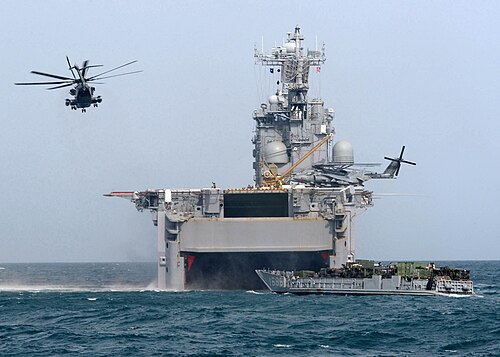
海兵隊は、迅速な展開能力を得るために海軍の海上輸送に依存している。艦隊海兵隊の3分の1を日本に駐留させているほか、海兵遠征部隊(MEU)は通常、国際事件の第一対応者として機能できるように海上に駐留している。[34]迅速な展開を支援するために、海上事前配置システムが開発された。コンテナ船の艦隊は、海兵遠征部隊が30日間展開するのに十分な装備と物資を備えて世界中に配置されている。 [引用が必要]
教義
1930年代に出版された2冊の小規模マニュアルは、2つの分野で米海兵隊の教義を確立した。小規模戦争マニュアルは、ベトナムからイラク、アフガニスタンまでの海兵隊の対反乱作戦の枠組みを定め、暫定上陸作戦マニュアルは、第二次世界大戦の水陸両用作戦の教義を確立した。「海からの作戦機動」は、2006年の戦力投射の教義であった。[11]
歴史
建国とアメリカ独立戦争

アメリカ海兵隊は、アメリカ独立戦争の大陸海兵隊にその起源を遡ることができる。大陸海兵隊は、1775年11月10日の第2回大陸会議の決議により、サミュエル・ニコラス大尉が2個大隊の海兵隊を編成するために結成した。[35]この日は海兵隊の誕生日として祝われている。ニコラスはジョン・アダムズによって海兵隊の指揮官に指名された。[36] 1775年12月までに、ニコラスは故郷のフィラデルフィアで募集により300人の大隊を編成した。[35] [37]
1776年1月、海兵隊はエセク・ホプキンス提督の指揮の下海に出航し、3月に初の水陸両用上陸作戦であるバハマ諸島のナッソーの戦いに挑み、イギリスのナッソー港を2週間占領した。[38] 1777年1月3日、海兵隊はジョン・キャドワラダー将軍の旅団に配属されてプリンストンの戦いに到着した。彼らはジョージ・ワシントン将軍からその任務を与えられた。 1776年12月までにワシントンはニュージャージーを通って撤退しており、ベテラン兵士を必要としていたため、ニコラスと海兵隊に大陸軍に配属するよう命じた。プリンストンの戦いでは、海兵隊とキャドワラダー旅団がワシントン自ら招集され、海兵隊にとって初の陸上戦闘となった。この戦いには推定130名の海兵隊員が参加した。[38]
アメリカ独立戦争の終結に伴い、大陸海軍と大陸海兵隊はともに1783年4月に解散した。この組織は1798年7月11日に復活し、フランスとの疑似戦争に備えて議会はアメリカ海兵隊を創設した。[39]海兵隊員は1794年3月18日の議会の「海軍装備法」で認可された新造フリゲート艦に配属され、1797年8月[40]にはすでに陸軍省によって徴兵されていた。 [41]この法律では、各フリゲート艦に徴兵する海兵隊員の数が規定されていた。[42]
この時期の海兵隊の最も有名な行動は、第一次バーバリ戦争(1801-1805年)でのバーバリ海賊との戦いで、[43]ウィリアム・イートンとプレスリー・オバノン中尉が8人の海兵隊員と500人の傭兵を率いてトリポリを占領しようとしたときである。彼らはデルナにしか到達できなかったが、トリポリでのこの行動は海兵隊の賛美歌と海兵隊士官が持つマムルークの剣によって不滅のものとなった。[44]
1812年の戦争とその後
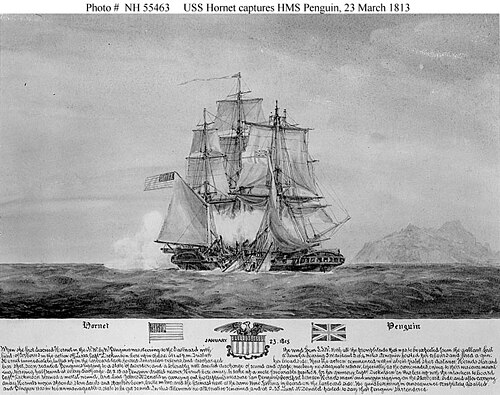
米英戦争 中、海軍艦艇に乗った海兵隊の派遣隊は、この戦争を特徴づけるいくつかの大きなフリゲート艦の決闘、すなわち戦争の最初で最後の戦闘に参加した。彼らの最も重要な貢献は、1815年のニューオーリンズの戦いでアンドリュー・ジャクソン将軍の防衛線の中心を保持したことである。この戦いは最後の大きな戦いであり、この戦争で最も一方的な戦闘の1つであった。この戦いと、英米軍の最後の戦闘であるHMSサイアン、HMSレヴァント、HMSペンギンの拿捕のニュースが広く伝わり、海兵隊は、特に防御と艦対艦戦闘において熟練した狙撃手としての評判を得た。 [44]彼らは1813年のニューヨーク州サケッツ港とバージニア州ノーフォークおよびポーツマスの防衛に大きな役割を果たし、[45]また、1814年のカナダと米国の国境に沿ったイギリス軍の最後の攻勢の1つでは、シャンプレーン渓谷のプラッツバーグの防衛にも参加した。 1814年8月24日に行われたブラーデンスバーグの戦いは、アメリカ軍にとって最悪の日の一つとなったが、少数の部隊や個人が英雄的な活躍を見せた。その中でも注目すべきは、ジョシュア・バーニー提督率いる500人の水兵と、サミュエル・ミラー海兵隊大尉率いる120人の海兵隊で、彼らはイギリス軍の死傷者の大半を負わせ、この戦いで唯一有効なアメリカ軍の抵抗勢力となった。しかし、接近戦での最後の必死の海兵隊の反撃は十分ではなく、バーニーとミラーの部隊は圧倒された。114人の海兵隊員のうち11人が死亡、16人が負傷した。この戦いでミラー大尉は腕を重傷したが、戦闘での勇敢な働きにより、海兵隊少佐に名誉昇進した。[46]
戦後、海兵隊は停滞状態に陥ったが、1820年にアーチボルド・ヘンダーソンが第5代司令官に任命されたことで停滞は終わった。彼の在任中、海兵隊はカリブ海、メキシコ湾、キーウェスト、西アフリカ、フォークランド諸島、スマトラ島で遠征任務を引き受けた。ヘンダーソン司令官は、ジャクソン大統領による海兵隊と陸軍の統合の試みを阻止したとされている。[44]その代わりに、議会は1834年に海兵隊のより良い組織に関する法案を可決し、海兵隊を海軍の姉妹軍として海軍省の一部と規定した。[47]
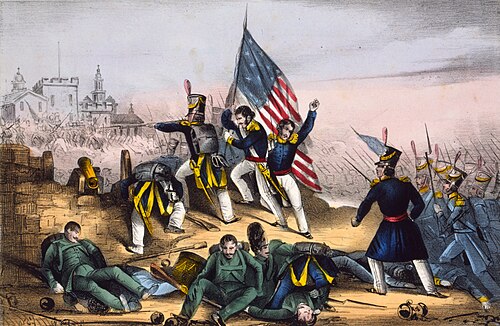
ヘンダーソン司令官は1835年のセミノール戦争に海兵隊を志願し、自ら海兵隊全体のほぼ半数(2個大隊)を率いて戦争に赴いた。10年後の米墨戦争(1846年 - 1848年)では、海兵隊はメキシコシティのチャプルテペク宮殿への有名な攻撃を行なった。この宮殿は後に海兵隊の賛歌で「モンテスマのホール」として讃えられることになる。公平を期すために言っておくと、モンテスマのホールへの最後の攻撃を行った部隊のほとんどは海兵隊員ではなく陸軍兵士だった。[48]アメリカ軍はウィンフィールド・スコット陸軍大将が指揮した。スコットはそれぞれ約250人の2つの突撃隊を組織し、合計500人、うち40人は海兵隊員だった。[要出典]
1850年代、海兵隊はパナマとアジアで任務に従事し、マシュー・ペリー提督の 東インド艦隊の歴史的な極東への航海に同行した。[49]
アメリカ南北戦争から第一次世界大戦まで

海兵隊は南北戦争(1861年 - 1865年)では小さな役割しか果たさなかったが、最も重要な任務は封鎖任務だった。ますます多くの州が連邦から脱退するにつれて、海兵隊士官の約3分の1が米国を離れ、南軍に加わって南軍海兵隊を結成したが、結局この海兵隊は戦争でほとんど役割を果たさなかった。第一次ブル・ランの戦いのために編成された新兵大隊は戦果が芳しくなく、残りの北軍と共に撤退した。[34]封鎖任務には前線基地を確保するための海上水陸両用作戦が含まれていた。1861年11月初旬、水兵と海兵隊の一団がサウスカロライナ州のポートロイヤルとビューフォートの町に上陸した。数日後、この機動部隊は近くのヒルトンヘッド島を占領した。2週間後、偵察部隊がタイビー島を占領した。これは北軍がプラスキ砦に砲撃を開始した場所である。[50] 1862年4月から5月にかけて、海兵隊はニューオーリンズの占領とルイジアナ州バトンルージュの占領に参加した。[51]この戦争の重要な出来事は、北軍がミシシッピ川下流域を掌握し、南軍がメキシコ湾岸に主要な港と海軍基地を持つことを阻止するのに役立った。[要出典]
19世紀の残りの期間は、海兵隊の力の衰えと任務に対する内省が特徴的だった。海軍が帆船から蒸気機関に移行したことで、海軍艦艇に海兵隊員を配置する必要性が疑問視されるようになった。一方、海兵隊は、海外におけるアメリカの権益を守るための介入や上陸のための便利なリソースとして機能した。海兵隊は、南北戦争の終結から19世紀末までの30年間に、28回を超える介入に関与した。[52]海兵隊は、米国内の政情不安や労働不安を食い止めるよう求められた。[53]ジェイコブ・ザイリン司令官の在任期間中、海兵隊の慣習と伝統が形作られた。海兵隊は1868年11月19日に海兵隊の紋章を採用した。この時期に「海兵隊の賛歌」が初めて聞かれた。1883年頃、海兵隊は現在のモットー「Semper fidelis」(常に忠実)を採用した。[44]音楽家で作曲家の ジョン・フィリップ・スーザは、13歳で海兵隊の見習いとして入隊し、1867年から1872年まで、また1880年から1892年まで海兵隊バンドのリーダーを務めた。[54]
米西戦争(1898年)の間、海兵隊はアメリカ軍を率いてフィリピン、キューバ、プエルトリコに上陸し、配備への準備態勢を整えていることを示した。キューバのグアンタナモ湾では、海兵隊が現在も使用されている先進的な海軍基地を占拠した。1899年から1916年の間、海兵隊はフィリピン米戦争、中国での義和団の乱、パナマ、キューバ和平、モロッコ、ベラクルス、サントドミンゴでのペルディカリス事件、ハイチとニカラグアでのバナナ戦争など、海外遠征への参加記録を継続した。[要出典]この期間中に反乱鎮圧とゲリラ作戦で得られた経験は、小規模戦争マニュアルにまとめられた。[55] [より良い出典が必要]
第一次世界大戦

第一次世界大戦中、アメリカが1917年4月6日に参戦すると、海兵隊はジョン・J・パーシング将軍の指揮下にあるアメリカ海外派遣軍の一部として活動した。海兵隊は戦闘経験のある将校と下士官の豊富な人材を抱えていたため、大幅な拡張を経験した。米海兵隊は511人の将校と13,214人の下士官で参戦し、1918年11月11日までに将校2,400人、下士官70,000人の戦力に達した。[56]この戦争中、アフリカ系アメリカ人は海兵隊から完全に排除されていた。[57]オファ・メイ・ジョンソンは海兵隊に入隊した最初の女性であり、第一次世界大戦中の1918年に海兵隊予備役に加わり、正式に女性初の海兵隊員となった。[58]その時から第一次世界大戦の終結までに、305人の女性が海兵隊に入隊した。[59] 1918年のベローウッドの戦いの際、海兵隊と米国のメディアは、ドイツ人が彼らを「悪魔の犬」を意味するトイフェル・フンデンと呼んでいたと報じた。これは、彼らが900メートルまでの距離で突撃部隊や狙撃手として名を馳せていたためである。ドイツの記録にはこのことを示す証拠はない(ドイツ語ではトイフェルシュンデが正しい)。しかし、この名前は米海兵隊の伝説として定着した。[60]
両大戦間期、海兵隊はジョン・A・ルジューン司令官の指揮下、第二次世界大戦で大いに役立つ水陸両用技術を研究・開発した。アール・ハンコック・「ピート」・エリス中佐を含む多くの将校が太平洋での日本との戦争を予見し、そのような紛争に備えた準備を行った。1941年を通して、戦争の可能性が高まるにつれ、海兵隊は陸軍との合同水陸両用演習を緊急に推進し、来たるべき紛争で大いに役立つ水陸両用装備を獲得した。[61]
第二次世界大戦
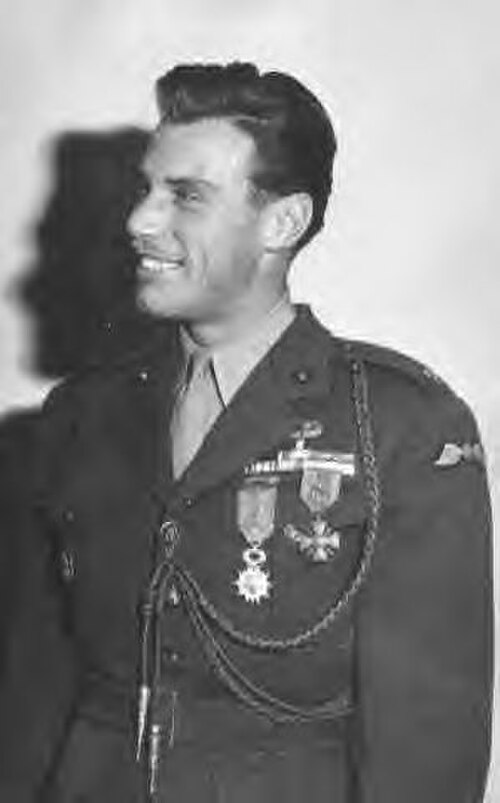
第二次世界大戦では、海兵隊はアメリカ陸軍とともに太平洋戦争で中心的な役割を果たした。ガダルカナル島、ブーゲンビル島、タラワ島、グアム島、テニアン島、グロスター岬、サイパン島、ペリリュー島、硫黄島、沖縄の戦いでは、海兵隊と日本軍の間で激しい戦闘が繰り広げられた。第二次世界大戦では約60万人のアメリカ人がアメリカ海兵隊に従軍した。[62]
1945年2月19日に始まった硫黄島の戦いは、おそらく戦争中最も有名な海兵隊の戦闘だった。日本軍はマリアナ諸島戦役での敗北から教訓を得て、島にトーチカやトンネル網など多くの要塞化された陣地を準備していた。日本軍は激しく抵抗したが、アメリカ軍は2月23日に摺鉢山の頂上に到達した。この作戦は、アメリカ軍2万6千人、日本軍2万2千人という大きな損失を伴って達成された。[63]
海兵隊はヨーロッパ戦域では比較的小さな役割を果たした。しかし、アメリカ大使館や船舶への警備派遣を継続し、戦略諜報局(OSS、 CIAの前身)の任務の一環としてナチス占領下のヨーロッパに派遣された小規模な特殊作戦チームに人員を派遣し、ノルマンディー上陸作戦を含むアメリカ陸軍の水陸両用作戦の参謀およびトレーナーとして活動した。[64] [65]戦争の終わりまでに、海兵隊は2個旅団から6個師団、5個航空団、支援部隊に拡大し、合計約48万5千人の海兵隊員を擁していた。さらに、20個防衛大隊と1個パラシュート大隊が編成された。[66]第二次世界大戦中、約8万7千人の海兵隊員が死傷し(うち約2万人が戦死)、82人が名誉勲章を受章した。[67]

1942年、海軍シービーズが創設され、海兵隊がその組織と軍事訓練を提供した。多くのシービーズ部隊は米海兵隊の標準装備を支給され、「海兵隊」に再指定された。海兵隊がシービーズに軍事組織と軍事訓練を与え、制服を支給し、部隊を再指定していたにもかかわらず、シービーズは海軍のままであった。[注 2] [68] [69]米海兵隊の歴史家ゴードン・L・ロットマンは、「第二次世界大戦中の海軍の海兵隊への最大の貢献の1つは、シービーズの創設であった」と書いている。[70]
海軍長官 ジェームズ・フォレスタルは、硫黄島での海兵隊旗掲揚は「今後500年間の海兵隊」を意味すると予言したが[71] [72]、突然の予算削減により、海兵隊は戦後すぐに組織的危機に直面した。陸軍将軍らは、防衛体制の強化と再編を推進し、海兵隊の任務と資産を海軍と陸軍に統合しようとした。急遽集められた議会の支援と、いわゆる「提督の反乱」の支援を得て、海兵隊は海兵隊を解体しようとするそのような動きを拒絶し、 1947年の国家安全保障法で海兵隊の法的保護がもたらされた。[73]その後まもなく、1952年にダグラス・マンスフィールド法が制定され、海兵隊に関する事項について司令官に統合参謀本部と同等の発言権が与えられ、現在も残る3つの現役師団と航空団の構造が確立された。[要出典]
朝鮮戦争
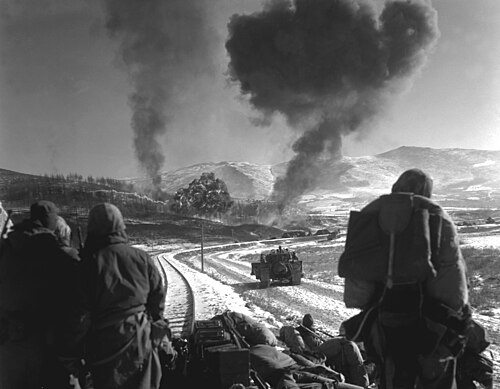
朝鮮戦争(1950年 - 1953年)の初めには、急遽編成された臨時海兵旅団が釜山境界線の防衛線を維持していた。側面攻撃を遂行するため、ダグラス・マッカーサー将軍は米海兵隊を含む国連軍に仁川への水陸両用上陸を要請した。上陸が成功した結果、北朝鮮軍の防衛線は崩壊し、北朝鮮軍は鴨緑江付近の北方まで追撃され、ついには中華人民共和国が参戦した。中国軍は、過剰に展開し数で劣るアメリカ軍を包囲、奇襲し、圧倒した。米陸軍第10軍団(第1海兵師団と陸軍第7歩兵師団を含む)は再編成し、海岸への戦闘撤退中に多大な損害を与えた。これは長津湖の戦いとして知られている。
長津湖の戦いの後、戦闘は沈静化したが、1953年3月下旬、人民解放軍が第5海兵連隊の駐屯する3つの前哨基地に大規模な攻勢を開始したことにより、戦争の比較的静かな状況は破られた。これらの前哨基地は、「リノ」、「ベガス」、「カーソン」というコードネームで呼ばれていた。この作戦は、総じてネバダ都市作戦と呼ばれた。リノヒルでは激しい戦闘があり、最終的に中国軍が占領した。リノは失われたものの、第5海兵連隊は作戦の残り期間を通じてベガスとカーソンの両方を保持した。この1回の作戦で、海兵隊は約1,000人の死傷者を出し、米軍のタスクフォースフェイスがなければ、さらに多くの死傷者を出していた可能性もあった。海兵隊は、 1953年の休戦まで、38度線付近で消耗戦を続けた。[74]戦争中、海兵隊は正規兵75,000人から主に予備兵の261,000人の海兵隊員に拡大し、戦争中に30,544人の海兵隊員が死亡または負傷し、42人が名誉勲章を授与された。[75]
ベトナム戦争
_001.jpg/500px-U.S._Marines_in_Operation_Allen_Brook_(Vietnam_War)_001.jpg)
海兵隊はベトナム戦争に従軍し、 1968年のフエの戦いやケサンの戦いなどに参加した。米海兵隊員は一般的に南ベトナムの北部I軍団地域で活動した。そこでは、北ベトナム軍との断続的な通常戦に加え、ベトコンとのゲリラ戦に絶えず従事していたため、海兵隊はベトナム全土で知られるようになり、ベトコンからも恐ろしい評判を得た。海兵隊の一部は、対反乱作戦のための非正規技術を実装したあまり知られていない統合行動計画を担当し、ベトナム共和国海兵隊の軍事顧問として働いた。海兵隊は1971年に撤退し、1975年にサイゴンから避難してSSマヤグエスの乗組員の救出を試みる目的で短期間復帰した。[76]ベトナム戦争は海兵隊にとってその時点で最長の戦争であった。戦争終了までに13,091人が戦死し、[77] [78] 51,392人が負傷し、57人が名誉勲章を授与された。[79] [80]ローテーションに関する方針により、ベトナム戦争では第二次世界大戦よりも多くの海兵隊員が派遣された。[81]
ベトナム戦争からの復興の過程で、海兵隊は戦争中の無断欠勤や脱走の増加に一部関連した軍法会議や非司法的処罰により、その歴史上最悪の状況に陥った。1970年代後半に海兵隊の改革が始まり、最も非行の激しい者を解雇し、新兵の質が向上すると、海兵隊は部隊の重要な機能部分である下士官部隊の改革に重点を置いた。[28]
中間:ベトナム戦争から対テロ戦争へ

ベトナム戦争後、米海兵隊は遠征任務を再開し、1980年に失敗したイラン人質救出作戦「イーグルクロー作戦」、アージェント・フューリー作戦、「ジャスト・コーズ作戦」に参加した。1983年10月23日、ベイルートの海兵隊宿舎が爆撃され、海兵隊史上最大の平時損失(海兵隊員220名とその他軍人21名が死亡)が発生し、アメリカ軍はレバノンから撤退した。1990年、統合任務部隊シャープ・エッジの海兵隊員は、リベリア内戦の暴力からイギリス、フランス、アメリカの国民を避難させることで数千人の命を救った。
1990年から1991年の湾岸戦争中、海兵隊のタスクフォースは砂漠の盾作戦のために編成され、その後、砂漠の嵐作戦で連合軍と共にクウェートを解放した。 [44]海兵隊は、人道支援を提供するために、リストア・ホープ作戦、リストア・ホープII作戦、ユナイテッド・シールド作戦中にソマリアでの戦闘作戦(1992年~1995年)に参加した。 [82] 1997年、海兵隊はアルバニアのティラナにある米国大使館から米国市民を避難させるシルバー・ウェイク作戦に参加した。 [要出典]
テロとの世界戦争

2001年9月11日の攻撃の後、ジョージ・W・ブッシュ大統領は世界対テロ戦争を発表した。世界対テロ戦争の宣言された目的は「アルカイダ、その他のテロ組織、およびテロリストを支援またはかくまっているあらゆる国家の打倒」である。[83]それ以来、海兵隊は他の軍隊とともに、その任務を支援するために世界中でグローバルな作戦に従事してきた。[84]
2009年春、バラク・オバマ大統領の国防総省支出削減目標は、ロバート・ゲーツ長官の指揮の下、海兵隊の予算とプログラムに大きな変更のない一連の予算削減で達成された。削減されたのはVH-71ケストレルのみで、VXXプログラムはリセットされた。[85] [86] [87]しかし、財政責任・改革に関する国家委員会は、 2010年後半に推奨された一連の削減の対象として海兵隊を特に指定した。 [88] 2013年の予算削減を踏まえ、ジェームズ・エイモス将軍は174,000人の海兵隊員という目標を設定した。[89]彼は、これは単一の緊急事態作戦にも効果的に対応できる最小数であるが、平時の本拠地での時間と展開時間の比率を歴史的に低いレベルまで引き下げると証言した。[90]
アフガニスタン作戦

海兵隊と他のアメリカ軍は、不朽の自由作戦に備えて、2001年10月には早くもアフガニスタン国境のパキスタンとウズベキスタンに集結し始めた。[91]第15および第26海兵遠征部隊は、 2001年11月の不朽の自由作戦を支援するためにアフガニスタンに派遣された最初の通常部隊の一部であった。 [92]
その後、海兵隊の大隊と飛行隊が交代でタリバンとアルカイダの勢力と交戦した。 2008年4月29日、第24海兵遠征部隊の海兵隊は、この地域で数年ぶりのアメリカの大規模作戦として、タリバンが支配するヘルマンド州の町ガルムシルに殺到した。 [93] 2009年6月、第2海兵遠征旅団(第2海兵遠征旅団)の7,000人の海兵隊員が治安改善のためにアフガニスタンに展開し[94]、翌月「剣の一撃作戦」を開始した。2010年2月、第2海兵遠征旅団は、ヘルマンド州の主要拠点からタリバンを排除するために、2001年以来のアフガニスタン作戦最大の攻勢であるマルジャの戦いを開始した。[95]マルジャの後、海兵隊はヘルマンド川を北上し、カジャキとサンギンの町を掃討した。海兵隊は2014年までヘルマンド州に留まった。[96]
イラク作戦
米海兵隊は、姉妹軍とともにイラク戦争に参加した。第1海兵遠征軍は、米陸軍第3歩兵師団とともに、2003年のイラク侵攻の先頭に立った。[97]海兵隊は2003年夏にイラクを離れたが、2004年初頭に再び戻った。彼らは、バグダッド西方の広大な砂漠地帯であるアンバール州の責任を与えられた。この占領中、海兵隊は2004年4月(「ヴィジラント・リゾルブ作戦」)と11月(「ファントム・フューリー作戦」 )にファルージャ市への攻撃を指揮し、ラマディ、アルカイム、ヒートなどの場所で激しい戦闘を経験した。[98]海兵隊のイラク滞在は、ハディーサ殺害やハムダニア事件などの事件で物議を醸した。[99] [100]アンバールの覚醒と2007年の増派により、暴力のレベルは低下した。海兵隊は2010年1月23日にアンバール州の責任を米軍に引き渡した時点で、イラクでの役割を正式に終了した。[101]海兵隊は2014年夏、イラクでの暴力の激化に対応してイラクに復帰した。[102]
アフリカでの事業
テロとの戦いを通じて、米海兵隊はアフリカでのイスラム過激主義や紅海の海賊行為に対抗する作戦を支援してきた。 2002年後半には、地域の安全保障のため、ジブチのキャンプ・ルモニエに統合統合任務部隊「アフリカの角」が立ち上げられた。 [103] 2006年に海軍に全体指揮権が移管されたにもかかわらず、海兵隊は2007年までアフリカの角で活動を続けた。 [104]
中国の脅威に備えた再編
2020年代、米国の国家戦略が対テロ戦争から中国との競争へと移行するにつれ、海兵隊は陸上作戦に重点を置くという以前の計画を放棄し、島嶼作戦で中国人民解放軍を打ち負かすためにインド太平洋地域での火力構成を強化した。[105]この転換の一環として、米海兵隊は2011年に200人の海兵隊員から始まり、ダーウィンでオーストラリア軍との共同展開を確立した。[106]
組織

海軍省
海軍省は、海軍長官が率いる、内閣レベルの米国国防総省の軍事部門であり、海兵隊と海軍を監督している。最高位の海兵隊士官は司令官であり(海兵隊士官が統合参謀本部議長または統合参謀本部副議長でない限り)、海兵隊の組織、募集、訓練、装備について海軍長官に対して責任を負い、戦闘指揮官の作戦指揮下で部隊を展開できるように海兵隊の組織、募集、訓練、装備を行う。海兵隊は、海兵隊本部(HQMC)、作戦部隊、支援組織、海兵隊予備役(MARFORRESまたはUSMCR)の4つの主要な部門に分かれている。[要出典]
海兵隊本部
海兵隊本部 (HQMC) は、海兵隊司令官、海兵隊副司令官、海兵隊参謀長、数名の副司令官、海兵隊曹長、および司令官または副司令官に直接報告するさまざまな特別参謀と海兵隊機関の長で構成されています。HQMC は、司令官とそのスタッフに管理、補給、兵站、訓練、およびサービス サポートを提供する米海兵隊本部およびサービス大隊によってサポートされています。[要出典]さらに、海兵隊の航空機部門と情報部門は両方とも HQMC の傘下に組織されており、それぞれ海兵隊航空と海兵隊情報部です。
作戦部隊
作戦部隊は3つのカテゴリーに分かれている。統合戦闘司令部、すなわち艦隊海兵隊部隊(FMF)に配属される海兵隊部隊(MARFOR)、危険度の高い海軍施設を警備する警備部隊、およびアメリカ大使館の警備隊派遣隊である。「統合司令部部隊」覚書に基づき、統合司令部計画に従って、海兵隊部隊は国防長官の裁量で各戦闘司令部に割り当てられる。1991年以来、海兵隊は各地域の統合戦闘司令部に構成本部を置いている。[107]
海兵隊の部隊は、部隊司令部(MARFORCOM)と太平洋司令部(MARFORPAC)に分かれており、それぞれ大西洋FMF(FMFLANT)または太平洋FMF(FMFPAC)の司令官を兼任する中将が指揮を執っている。MARFORCOM/FMFLANTは第2海兵遠征軍の作戦統制権を持ち、MARFORPAC/FMFPACは第1海兵遠征軍と第3海兵遠征軍の作戦統制権を持っている。[34]
海兵隊部隊の傘下にあるその他の軍種には、米国欧州軍(EURCOM)および米国アフリカ軍(AFRICOM)傘下の海兵隊欧州・アフリカ部隊(MARFOREUR/AF) 、米国中央軍(CENTCOM )傘下の海兵隊中央軍(MARFORCENT) 、米国南方軍(SOUTHCOM)傘下の海兵隊南部部隊(MARFORSOUTH) 、米国サイバー軍(CYBERCOM)傘下の海兵隊サイバースペース軍(MARFORCYBER)、米国宇宙軍(SPACECOM )傘下の海兵隊宇宙軍(MARFORSPACE )、米国戦略軍(STRATCOM)傘下の海兵隊戦略軍(MARFORSTRAT)がある。
海兵空陸任務部隊
展開可能な海兵隊部隊の基本的な枠組みは、さまざまな規模の柔軟な構造を持つ海兵航空地上任務部隊(MAGTF)である。MAGTFは、地上戦闘要素(GCE)、航空戦闘要素(ACE)、および兵站戦闘要素(LCE)を共通の指揮要素(CE)の下に統合し、独立して、またはより大きな連合の一部として活動することができる。MAGTFの構造は、海兵隊の自給自足と複合兵器への取り組みに対する強い好みを反映しており、どちらも遠征軍にとって不可欠な資産である。[28]
支援機関
支援組織には、戦闘開発司令部、兵站司令部、システム司令部、訓練教育司令部(募集司令部を含む)、施設司令部、海兵隊バンド、海兵隊鼓笛隊が含まれます。[要出典]
海兵隊基地と基地
海兵隊は多くの主要基地を運営しており、そのうち14の基地には作戦部隊、7つの支援・訓練施設、衛星施設が配置されている。[108]海兵隊基地は海兵遠征軍の所在地の周辺に集中しているが、予備役部隊は米国全土に散在している。主要な基地は、第1海兵遠征軍の本拠地である西海岸のキャンプ・ペンドルトン、 [109] 第2海兵遠征軍の本拠地である東海岸のキャンプ・ルジューン、 [110]第3海兵遠征軍の本拠地である日本の沖縄のキャンプ・バトラーである。[111]
その他の重要な基地には、航空基地、新兵訓練所、兵站基地、訓練司令部などがある。カリフォルニア州の海兵隊航空地上戦闘センター・トゥエンティナイン・パームスは海兵隊最大の基地であり、海兵隊で最も複雑な複合兵科実弾射撃訓練が行われる。[要出典]バージニア州の 海兵隊基地クアンティコには海兵隊戦闘開発司令部があり、「海兵隊の十字路」という愛称で呼ばれている。[112] [113] 海兵隊は首都圏に大きな存在感を維持しており、海兵隊本部はペンタゴン、ヘンダーソン・ホール、ワシントン海軍工廠、ワシントン D.C. の海兵隊兵舎に点在している。さらに、海兵隊は専門学校などのリソースをよりよく共有するために、他の部隊が所有する多くの施設で分遣隊を運営している。海兵隊は遠征作戦中に多くの前進基地に駐留し、運営している。[要出典]
海兵隊予備役
海兵隊予備軍(MARFORRES/USMCR)は、部隊司令部グループ、第4海兵師団、第4海兵航空団、第4海兵兵站グループで構成されています。MARFORRES/USMCRは、第4海兵遠征軍を編成したり、現役部隊を強化/増強したりすることができます。[要出典]
特殊作戦

海兵隊特殊作戦司令部 (MARSOC) には、海兵突撃連隊、海兵突撃支援グループ、海兵突撃訓練センター (MRTC) が含まれます。突撃連隊と突撃支援グループはどちらも、本部中隊と 3 つの作戦大隊で構成されています。MRTC は、MARSOC ユニットのスクリーニング、評価、選択、訓練、開発機能を実行します。海兵隊特殊作戦能力のある部隊には、航空海軍砲撃連絡中隊、化学生物事件対応部隊、海兵師団偵察大隊、部隊偵察中隊、海上特殊目的部隊、および特殊対応チームが含まれます。さらに、配備されたすべての MEU は、「特殊作戦能力」、つまり「MEU(SOC)」 として認定されています。
海兵隊特殊作戦部隊が米国特殊作戦軍(USSOCOM)に貢献するという概念は、1980年代のUSSOCOM創設当初から検討されていたが、海兵隊の反対を受けた。ポール・X・ケリー司令官は、海兵隊は海兵隊を支援するだけであり、海兵隊の作戦を直接支援しない特殊作戦能力に海兵隊は資金を提供すべきではないという信念を表明した。[114]しかし、海兵隊の指導者たちが、不朽の自由作戦のごく初期段階で、陸軍、海軍、空軍の他の通常部隊や特殊作戦部隊がアフガニスタンでの作戦に積極的に従事しているのを海兵隊の指導者たちが海兵隊の第15海兵遠征部隊(SOC)と第26海兵遠征部隊(SOC)が「傍観者」になっているのを見て、海兵隊内部の抵抗の多くは消えた。 [115] 3年間の開発期間の後、海兵隊は2006年にUSSOCOMに直接報告する2,500人の部隊、海兵隊特殊作戦軍を供給することに同意した。[116]
人事
リーダーシップ
海兵隊司令官は、海兵隊員が統合参謀本部議長または副議長を務めていない限り、海兵隊の最高位の将校である。司令官は、合衆国法典第10編に基づき、海兵隊の人員配置、訓練、装備の責任を負っているが、指揮権はない。司令官は統合参謀本部の一員であり、海軍長官に報告する。[117]
海兵隊副司令官は司令官の首席代理として行動する。海兵隊曹長は最上級の下士官であり、司令官の顧問として行動する。海兵隊本部は司令官の残りの顧問とスタッフで構成され、副司令官は海兵隊の資産と能力のさまざまな側面を監督する。第39代司令官で現職はエリック・M・スミス、第20代曹長はカルロス・A・ルイスである。[118]
女性


アメリカ海兵隊では1918年から女性が勤務している。[119]入隊した最初の女性はオファ・メイ・ジョンソン(1878-1955)であった。[120] [121] 2017年1月、キャンプ・ルジューンの歩兵大隊に3人の女性が加わった。これ以前に女性が歩兵海兵隊員として勤務したことはなかった。[122] 2017年、海兵隊は初めて女性に焦点を当てた募集広告を発表した。[123] 2019年10月現在[update]、女性海兵隊員は人員の7.8%を占めている。[要出典]
2020年12月、海兵隊はサンディエゴの新兵訓練所の訓練中隊に女性を統合する試験プログラムを開始した。これは、議会が同所での男性のみのプログラムの終了を義務付けたことによる。2021年2月にサンディエゴで訓練を開始する予定の女性新兵60人のために、海兵隊は、すでに男女共学のプログラムを実施しているパリス島の新兵訓練所から女性の訓練教官を異動させる予定である。[124]これらの新兵のうち53人は、2021年4月にブートキャンプを無事卒業し、海兵隊員となった。[125] [126]
少数民族

1776年と1777年には、12人のアフリカ系アメリカ人海兵隊員がアメリカ独立戦争に従軍したが、1798年から1942年まで、海兵隊はアフリカ系アメリカ人に従軍する機会を拒否するという人種差別的な政策をとった。[127]海兵隊はアフリカ系アメリカ人を募集した最後の軍隊であり、海兵隊の歴史のページには、大統領命令により「海兵隊指導部の反対にもかかわらず、1942年にアフリカ系アメリカ人海兵隊員の募集を開始した」と記されている。 [128]海兵隊は、黒人のみで構成された部隊に黒人を新兵として受け入れた。[127]その後数十年間、海兵隊内で黒人兵士の統合は広く受け入れられず、人種差別の解消もスムーズに、あるいは迅速に達成されなかった。非白人海兵隊員の統合は、1942年の分離された大隊から始まり、1949年の統一訓練、そして最終的に1960年の完全な統合へと段階的に進んだ。[129]
現在、海兵隊は人種差別のない軍隊であり、あらゆる人種の海兵隊員が共に働き、戦っている。2020年現在、アフリカ系アメリカ人は、米国の人口全体と比較すると、海兵隊では過小評価されている。同時に、海兵隊は同じ基準でヒスパニック系が過剰に代表されている唯一の軍隊である。[130]
ランク構造
アメリカ軍の他の部隊(現在准尉を任命していない空軍と宇宙軍を除く)と同様に、海兵隊の階級は、権限の降順で、士官、准尉、下士官の3つのカテゴリのいずれかに分類されます。報酬を標準化するため、各階級には給与等級が割り当てられています。[131]
任命された将校
任命された将校は任命状によって他の将校と区別される。任命状とは、米国大統領の名で発行される正式な書面による権限であり、海兵隊将校の階級と権限を付与するものである。任命された将校は、米国大統領の「特別な信用と信頼」を受けている。[18]海兵隊の任命された将校は、 1980年の国防将校人事管理法に従って、 「アップ・オア・アウト」システムに基づいて昇進する。 [132]
准尉
准尉は主に特定の専門分野における元下士官の専門家であり、通常はその専門分野内でのみリーダーシップを発揮します。
入隊
E-1からE-3の給与等級の下士官が海兵隊の階級の大部分を占めている。彼らは厳密には指導的階級ではないが、海兵隊の精神ではすべての海兵隊員にリーダーシップを重視しており、下級海兵隊員に通常は上官に与えられる責任がしばしば割り当てられる。E-4とE-5の給与等級の者は下士官(NCO)である。[133]彼らは主に下級海兵隊員を監督し、上級指揮構造との重要な連絡役として機能し、命令が正しく実行されるようにする。E-6以上の海兵隊員は下士官補佐(SNCO)であり、下士官を監督し、指揮官の下士官顧問として活動する。[134]
E-8 および E-9 レベルには、給与等級ごとにそれぞれ 2 つと 3 つの階級があり、それぞれ責任が異なります。一等軍曹および曹長の階級は指揮命令型で、部隊の上級海兵隊員として、規律、管理、部隊の士気と福利厚生に関して指揮官を補佐する任務を負います。曹長および曹長は、特定の MOS における職業専門家として技術的なリーダーシップを発揮します。海兵隊曹長は、海兵隊全体の上級海兵隊員に授与される役職で、司令官が個人的に選出し、E-9 より上の特別な給与等級が与えられます。下士官である海兵隊員が海兵隊曹長より上級の役職に就くことは可能であり、2011年から2015年まで、ブライアン・B・バタグリア曹長が統合参謀本部に勤務する米軍の最上級下士官である議長上級下士官顧問に任命されたことがその例であった。[135]
軍事職業専門
軍事職業専門職 (MOS) は、職務分類のシステムです。4 桁のコードを使用して、海兵隊員が従事する分野と特定の職業を指定します。士官と下士官に分けられた MOS によって、部隊の人員配置が決まります。一部の MOS は、監督職を反映して階級によって変わります。その他の MOS は二次的で、海兵隊員の通常の任務や特別なスキル以外の一時的な任務を表します。[引用が必要]
初期研修

毎年、2,000人以上の新しい海兵隊士官が任命され、38,000人の新兵が受け入れられ、訓練を受けています。[34]すべての新しい海兵隊員は、下士官であろうと士官であろうと、海兵隊募集司令部によって募集されます。[136]
士官は主に海軍予備役将校訓練課程、士官候補生学校、海軍兵学校の3つの機関のいずれかで任命される。任命後、入隊経路やさらなる訓練要件に関わらず、すべての海兵隊士官はクアンティコ海兵隊基地の基礎学校に通う。基礎学校では、少尉、准尉、および選抜された外国人士官が歩兵戦と複合兵器戦の技術を学ぶ。[18]
下士官となった海兵隊員は、サンディエゴ海兵隊新兵訓練所またはパリス島海兵隊新兵訓練所で、ブートキャンプと呼ばれる新兵訓練を受ける。歴史的には、ミシシッピ川が誰がどこで訓練を受けるかの境界線となっていたが、最近では地区制度によって、2つの施設間で男性新兵がより均等に配分されるようになっている。訓練を始めるには、すべての新兵が体力テストに合格しなければならない。不合格者は、最低基準に達するまで個別に指導と訓練を受ける。[137]海兵隊の新兵訓練は、アメリカ軍の中で最も長く、入隊手続きと退役手続きを含めて13週間続く。[138]
新兵訓練の後、下士官となった海兵隊員はキャンプ・ガイガーまたはキャンプ・ペンドルトンの歩兵学校に入学する。歩兵海兵隊員は歩兵訓練大隊ですぐに戦闘訓練を開始するが、訓練期間はそれぞれ異なる。その他のMOSの海兵隊員は海兵戦闘訓練で29日間の訓練を受け、一般的な歩兵スキルを学んだ後、MOS学校に進むが、訓練期間はそれぞれ異なる。[139]
制服
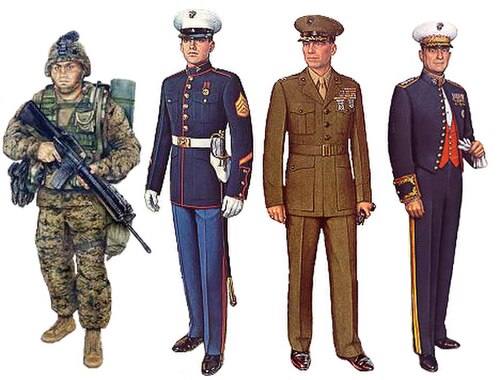
海兵隊はアメリカ軍の中で最も安定していて、最も認識しやすい制服を持っています。礼服は19世紀初頭にまで遡り[34]、制服は20世紀初頭にまで遡ります。識別バッジが必要なのは、ほんの一握りの技能(落下傘兵、航空乗務員、爆発物処理など)のみであり、階級章は制服の帽子には着用されません(将校の駐屯地勤務用カバーを除く)。
海兵隊には、正装、勤務服、実用服、および身体訓練服という 4 つの主な制服があります。これらの制服には、下士官から士官、下士官まで、いくつかの小さいながらも非常に明確なバリエーションがあります。海兵隊の正装は最も凝ったもので、正式な行事や儀式の場で着用されます。正装には 4 つの異なる形式があります。正装のバリエーションは、「アルファ」、「ブラボー」、「チャーリー」、「デルタ」として知られています。最も一般的なのは、「ブルー ドレス アルファまたはブラボー」で、「ドレス ブルー」または単に「ブルー」と呼ばれています。これは募集広告で最もよく見られ、ブラック タイに相当します。夏用の「ブルー ホワイト」ドレスと、フォーマルな行事 (ホワイト タイ) 用のイブニング ドレスがあり、これらは SNCO と士官用です。コートの代わりにカーキ色のシャツを着たバージョン (ブルー ドレス チャーリー/デルタ) は、海兵隊の募集担当者と NROTC スタッフが日常の作業服として着用します。[140]
軍服はかつて駐屯地で定められた日常の作業服であったが、現在ではその役割は主に軍服に取って代わられている。オリーブグリーンとカーキ色で構成されている。機能と構成はビジネススーツとほぼ同等である。[140] [検証失敗]
ユーティリティユニフォーム(現在は海兵隊戦闘ユーティリティユニフォーム)は、野外での着用や駐屯地での汚れ仕事のための迷彩服であるが、通常任務用に標準化されている。着用者の形を崩すMARPATピクセル迷彩で表現されている。駐屯地では、海兵隊員の勤務地に応じて森林地帯用と砂漠用のユニフォームが着用される。 [141] [より良い情報源が必要]海兵隊員はユーティリティユニフォームを作業服とみなしており、任務地への往復移動中や緊急時を除き、基地外での着用は許可されていない。[140]
文化
公式の伝統と慣習
他の軍隊組織と同様に、海兵隊の公式および非公式の伝統は、仲間意識を強化し、他の軍隊と区別する役割を果たしている。海兵隊が豊かな文化と歴史を受け入れていることが、高い団結心を持つ理由として挙げられている。[18]海兵隊文化の重要な部分は、海軍との歴史から生まれた伝統的な航海用語である。「海兵隊員」は「兵士」でも「水兵」でもない。[142]

海兵隊の紋章 は鷲、地球儀、錨で、略して「EGA」とも呼ばれ、1868年に採用された。[143]海兵隊の紋章には紋章が含まれており、米国海兵隊の旗にも見られ、緋色と金色が公式色として定められている。[144]海兵隊のモットーであるSemper Fidelis はラテン語で常に忠実を意味し、しばしばSemper Fiと表記される。この海兵隊の賛歌は19世紀に遡り、米国軍最古の公式歌である。Semper Fi はジョン・フィリップ・スーザが作曲した海兵隊の公式行進曲の名前でもある。モットーの「Fortitudine」(不屈の精神をもって)、 「 By Sea and by Land 」(王立海兵隊のPer Mare, Per Terramの翻訳)、「To the Shores of Tripoli」は1868年まで使用されていた。[145]

海兵隊員が携帯する剣には2種類ある。1つは士官用マムルーク剣で、これはデルナの戦いの後にプレスリー・オバノン中尉に贈られたペルシャのシャムシールに似ている。もう1つは海兵隊下士官剣である。 [34]海兵隊誕生日は毎年11月10日にケーキカットの儀式で祝われ、最初のケーキの一切れが出席している最年長の海兵隊員に渡され、その最年少の海兵隊員がそれを出席している最年少の海兵隊員に渡す。この式典では、ルジューン司令官の誕生日メッセージの朗読が行われる。[146]近接指揮訓練は海兵隊の初期訓練の早い段階で重視され、ほとんどの公式行事に組み込まれており、命令に対する正確さと自動応答の習慣を植え付けることで規律を教え、指揮の練習を通じて下級士官や下士官の自信を高め、海兵隊員に個々の武器を扱う機会を与えるために使用されている。[147]
非公式の伝統と習慣

海兵隊員にはいくつかの一般的なニックネームがあります。
- 悪魔の犬:第一次世界大戦中のドイツ兵はベルオーウッドで、海兵隊員が非常に凶暴だったため、ドイツ歩兵は彼らをTeufel Hunden(悪魔の犬)と呼んだと語ったと伝えられている。 [148] [149] [150] [151]
- ギレーネ:海兵隊員同士でよく使われる。[152]
- レザーネック:かつて独立戦争時代の海兵隊の制服の一部であった革製の首輪を指します。 [153]
- ジャーヘッドには、しばしば議論の的となる説明がいくつかある。[154]
- クレヨンイーター: 2010年代に生まれた自虐的な言葉で、海兵隊員は頭が悪いというステレオタイプをもじったもの。 [155] [156]
その他の非公式の伝統としては、モットーや感嘆符などがあります。
- ウーラは海兵隊員の間では一般的であり、陸軍、空軍、宇宙軍のフーアや海軍のフーヤーの叫びと機能と目的が似ている。この用語には多くの語源が提案されている。 [157]
- 「Semper Fi」は現役および退役海兵隊員の間でよく使われる挨拶です。
- 「即興、適応、克服」は多くの部隊で採用されているマントラとなっている。[158]
否定的な連想
現在の海兵隊文化に過激主義との関連や具体的な証拠はないが、海兵隊には、特に白人至上主義との2つの短い関係があった。1976年、100人以上のメンバーを擁するクー・クラックス・クランのキャンプ・ペンドルトン支部は、現役の海兵隊員によって率いられていた。1986年、数人の海兵隊員がホワイト・パトリオット党の武器盗難に関与していたとされた。武器の販売先は至上主義組織であったが、海兵隊員が実際にその組織のメンバーであったことは確認されなかった。類似した関係ではあるものの、1976年の出来事と1986年に記録された出来事との相関関係を示す証拠はない。それ以来、米海兵隊は他の軍とともに、隊内の過激主義に対処する努力を行ってきた。[159]
ベテラン海兵隊員
海兵隊は「海兵隊員」は獲得した称号であるという考えを奨励しており、ほとんどの海兵隊員は「一度海兵隊員になったら、ずっと海兵隊員」という言葉を心に留めている。彼らはほとんどの場合「元海兵隊員」という用語を拒否する。現役を退いた者の住所に関する規制はないため、いくつかの慣習的な用語が一般的に使用されるようになった。[73]
武道プログラム

2001年、海兵隊は内部で設計された格闘技プログラム、海兵隊格闘技プログラム(MCMAP)を開始した。21世紀には都市や警察タイプの平和維持活動がより一般的になり、海兵隊が非武装の民間人とより密接に接触することが予想されたため、MCMAPは海兵隊に、敵対的な非武装の個人を制御するためのより広範囲でより汎用的な非致死的選択肢を提供するために実施された。このプログラムの明示された目的は、海兵隊員に「戦士の精神」を植え付け、維持することである。[160] MCMAPは、さまざまなスタイルの格闘技を融合させた折衷的なミックスである。 MCMAPは、テコンドーと空手のパンチとキック、柔術の相手の体重移動、ブラジリアン柔術の関節技と絞め技を含むグラウンドグラップリング、エスクリマから派生したナイフと警棒/棒の戦いのミックス、ムエタイの肘打ちとキックボクシングで構成されています。海兵隊員はブートキャンプでMCMAPトレーニングを開始し、そこで5つのベルトのうち最初のベルトを獲得します。ベルトはタン色から始まり、黒へと進み、標準的なユーティリティユニフォームと一緒に着用されます。[161]
装置
As of 2013, the typical infantry rifleman carries $14,000 worth of gear (excluding night-vision goggles), compared to $2,500 a decade earlier. The number of pieces of equipment (everything from radios to trucks) in a typical infantry battalion has also increased, from 3,400 pieces of gear in 2001 to 8,500 in 2013.[162]
Infantry weapons

The infantry weapon of the Marine Corps is the M27 IAR[163] service rifle. Most non-infantry marines have been equipped with the M4 Carbine[164] or Colt 9mm SMG.[165] The standard side arm is the SIG Sauer M17/M18[166] The M18 will replace all other pistols in the Marine Corps inventory, including the M9, M9A1, M45A1 and M007, as the M45A1 Close Quarter Battle Pistol (CQBP) in small numbers. Suppressive fire is provided by the, M249 SAW, and M240 machine guns, at the squad and company levels respectively. In 2018, the M27 IAR was selected to be the standard-issue rifle for all infantry squads.[167] In 2021, the Marine Corps committed to fielding suppressors to all its infantry units, making it the first branch of the U.S. military to adopt them for widespread use.[168]
The USMC infantry issued grenade launcher is the M320, which shoots a 40 mm grenade,[169] such as the M67 fragmentation grenade.[170] Indirect fire is also provided by the M203 grenade launcher and the M32 grenade launcher in fireteams, M224 60 mm mortar in companies, and M252 81 mm mortar in battalions. The M2 .50 caliber heavy machine gun and MK19 automatic grenade launcher (40 mm) are available for use by dismounted infantry, though they are more commonly vehicle-mounted. Precision firepower is provided by the M40 series[171] and the Barrett M107, while designated marksmen use the DMR variant of the M27, known as the M38, and the SAM-R.[citation needed]

The Marine Corps utilizes a variety of direct-fire rockets and missiles to provide infantry with an offensive and defensive anti-armor capability. The SMAW and AT4 are unguided rockets that can destroy armor and fixed defenses (e.g., bunkers) at ranges up to 500 meters. The smaller and lighter M72 LAW can destroy targets at ranges up to 200 meters.[172][173] The Predator SRAW, FGM-148 Javelin and BGM-71 TOW are anti-tank guided missiles. The Javelin can utilize top-attack profiles to avoid heavy frontal armor. The Predator is a short-range fire-and-forget weapon; the Javelin and TOW are heavier missiles effective past 2,000 meters that give infantry an offensive capability against armor.[174]
Ground vehicles
The Corps operates the same HMMWV as does the Army, which is in the process of being replaced by the Joint Light Tactical Vehicle (JLTV). However, for its specific needs, the Corps uses a number of unique vehicles. The LAV-25 is a dedicated wheeled armored personnel carrier, similar to the Army's Stryker vehicle, used to provide strategic mobility.[175] Amphibious capability is provided by the AAV-7A1 Assault Amphibious Vehicle, an armored tracked vehicle that doubles as an armored personnel carrier, due to be replaced by the Amphibious Combat Vehicle, a faster vehicle with superior armor and weaponry. The threat of land mines and improvised explosive devices in Iraq and Afghanistan has seen the Corps begin purchasing heavily armored vehicles that can better withstand the effects of these weapons as part of the Mine Resistant Ambush Protected vehicle program.[176][177]
The Marines also operate the M777 155 mm howitzer and the High Mobility Artillery Rocket System (HIMARS), a truck-mounted rocket artillery system. Both are capable of firing guided munitions.[178] In 2020, the Marine Corps retired its M1A1 Abrams tanks and eliminated all of its tank units. General David Berger explained the decision describing the long-serving Marine weapons system as "operationally unsuitable for our highest-priority challenges." The move leaves the Army as the sole American operator of tanks.[179]
Aircraft

The organic aviation capability of the Marine Corps is essential to its amphibious mission. Marine Corps Aviation operates both rotary-wing and fixed-wing aircraft mainly to provide Assault Support and close air support to its ground forces. Other aircraft types are used in a variety of support and special-purpose roles. The light transport and attack capabilities are provided by the Bell UH-1Y Venom and Bell AH-1Z Viper.[180] Medium-lift squadrons utilize the MV-22 Osprey tiltrotor. Heavy-lift squadrons are equipped with the CH-53E Super Stallion helicopter, which are being replaced with the upgraded CH-53K.[181]
Marine attack squadrons fly the AV-8B Harrier II; while the fighter/attack mission is handled by the single-seat and dual-seat versions of the F/A-18 Hornet strike-fighter aircraft. The AV-8B is a V/STOL aircraft that can operate from amphibious assault ships, land air bases and short, expeditionary airfields, while the F/A-18 can only be flown from land or aircraft carriers. Both are slated to be replaced by 340 of the STOVL B version of the F-35 Lightning II[182] and 80 of the carrier F-35C versions for deployment with Navy carrier air wings.[183][184][185][186]

The Corps operates its own organic aerial refueling assets in the form of the KC-130 Hercules; however, it also receives a large amount of support from the U.S. Air Force. The Hercules doubles as a ground refueler and tactical-airlift transport aircraft. The USMC electronic warfare plane, the EA-6B, was retired in 2019. The Marines operate unmanned aerial vehicles: the RQ-7 Shadow and Scan Eagle for tactical reconnaissance.[187]
Marine Fighter Training Squadron 401 (VMFT-401), operates F-5E, F-5F and F-5N Tiger II aircraft in support of air combat adversary (aggressor) training. Marine Helicopter Squadron One (HMX-1) operates the VH-3D Sea King and VH-60N Whitehawk helicopters in the VIP transport role, most notably Marine One, but are due to be replaced with the VH-92 Patriot.[188] A single Marine Corps C-130 Hercules aircraft, "Fat Albert", is used to support the U.S. Navy's flight demonstration team, the "Blue Angels".[189]
Relationship with other services
In general, the Marine Corps shares many resources with the other branches of the United States Armed Forces. However, the Corps has consistently sought to maintain its own identity with regard to mission, funding, and assets, while utilizing support available from the larger branches. While the Marine Corps has far fewer installations both in the U.S. and worldwide than the other branches, many Army posts, Naval stations, and Air Force bases have a Marine presence. They also cross-train with other countries.[citation needed]
United States Navy
_welldeck.jpg/500px-USS_Bonhomme_Richard_(LHD-6)_welldeck.jpg)
The Marine Corps's counterpart under the Department of the Navy is the United States Navy. As a result, the Navy and Marine Corps have a close relationship, more so than with other branches of the military. White papers and promotional literature have commonly used the phrase "Navy-Marine Corps Team",[190][191] or refer to "the Naval Service". Both the Chief of Naval Operations (CNO) and Commandant of the Marine Corps report directly to the Secretary of the Navy.[192][193]
Operationally, the Marine Corps provides the Fleet Marine Forces for service with the Navy's fleets, including the forward-deployed Marine Expeditionary Units embarked aboard Navy amphibious warships. The Corps also contributes some Marine Aviation fixed-wing fighter/attack assets (aircraft squadrons and related aircraft maintenance augmentation units) as part of the Carrier Air Wings deployed aboard aircraft carriers. The Marine Corps Security Force Regiment provides infantry-based security battalions and Fleet Anti-terrorism Security Team companies to guard and defend high-priority and overseas Navy bases. Security for the Presidential Retreat located aboard the Naval Support Activity Thurmont, aka Camp David is provided by the Marine infantry battalion stationed as part of the garrison aboard Marine Barracks Washington.
Cooperation between the two services includes the training and instruction of some future Marine Corps officers (most are trained and commissioned through Marine Corps OCS), all Marine Corps Naval Aviators (aircraft pilots) and Naval Flight Officers (airborne weapons and sensor system officers), and some Navy and Marine Corps enlisted personnel. The Corps receives a significant portion of its officers from the United States Naval Academy (USNA) and Naval Reserve Officers Training Corps (NROTC). USNA and NROTC staff and faculty includes Marine Corps instructors. Marine Corps aviators and flight officers are trained in the Naval Air Training Command (NATRACOM) and are designated, or winged as Naval Aviators or Naval Flight Officers. The Marine Corps provides flight instructors to the Naval Air Training Command as well as drill instructors to the Navy's Officer Candidate School. Many enlisted marines, particularly those in the aviation maintenance specialties, are trained at Navy technical training centers. The Marine Corps also provides ground combat training support to various Navy field medical (Hospital Corpsmen), Naval Construction Force (Seabee), and Navy Expeditionary Warfare personnel, units, and commands.
Training alongside each other is viewed as critical, as the Navy provides transport, logistical, and combat support to put Marine units into the fight, such as maritime prepositioning ships and naval gunfire support. Most Marine aviation assets ultimately derive from the Navy, with regard to acquisition, funding, and testing, and Navy aircraft carriers typically deploy with a Marine squadron alongside Navy squadrons. Marines do not recruit or train noncombatants such as chaplains or medical/dental personnel; naval personnel fill these roles. Some of these sailors, particularly Hospital corpsmen and Religious program specialists, generally wear Marine uniforms emblazoned with Navy insignia. Conversely, the Marine Corps is responsible for conducting land operations to support naval campaigns, including the seizure of naval bases. Both services operate a network security team in conjunction.
Marines and sailors share many naval traditions, especially terminology and customs. Marine Corps Medal of Honor recipients wear the Navy variant of this and other awards;[23] and with few exceptions, the awards and badges of the Navy and Marine Corps are identical. Much of testing for new Marine Corps aircraft is done at Naval Air Station Patuxent River. The Navy's Blue Angels flight demonstration team is staffed by both Navy and Marine officers and enlisted personnel.[23]
In 2007, the Marine Corps joined with the Navy and Coast Guard to adopt a new maritime strategy called A Cooperative Strategy for 21st Century Seapower that raises the notion of prevention of war to the same philosophical level as the conduct of war.[194] This new strategy charts a course for the Navy, Coast Guard and Marine Corps to work collectively with each other and international partners to prevent regional crises, human-made or natural, from occurring or reacting quickly should one occur to avoid negative impacts to the United States.
United States Army

The Marine Corps capabilities overlap with those of the United States Army, historically creating competition for funding and missions. The competition dates back to the founding of the Continental Marines, when General George Washington refused to allow the initial Marine battalions to be drawn from among his Continental Army. In the aftermath of World War II, Army leadership made efforts to restructure the American defense establishment including the dissolution of the Marine Corps and the folding of its capabilities into the other services. Leading this movement were such prominent Army officers as General Dwight D. Eisenhower and Army Chief of Staff George C. Marshall.[73] The Goldwater-Nichols Act significantly reshaped the services roles and relationships with each other, enforcing more joint decision making.[195] Department of Defense Directive 5100.01 tasks both the Army and Marine Corps with expeditionary and amphibious operations.[196] With most of the 2000s spent in operations in Afghanistan and Iraq, Secretary of Defense Robert Gates voiced concerns that the Marine Corps are becoming a "second Army".[32] Since these comments, the Marine Corps has shed its main battle tanks, reduced its size, and focused more on operations in littoral areas where the Army is not explicitly tasked to operate.[197]
The Army maintains much larger and diverse combat arms, special operations, and logistics forces. The Army has much lighter and expeditionary forces in its infantry and airborne infantry brigade combat teams. The Army also maintains heavier and more logistically taxing armored brigade combat teams.[198] The Marine Corps, in comparison, maintains forces between these two extremes of mobility and protection. The Marine Corps organizes much smaller deployable units with integrated aviation support. The Marine Corps was historically hesitant to provide forces to U.S. Special Operations Command, instead making specialty units available to its division commanders. The Army has maintained Special Forces, Rangers, civil affairs, psychological operations, special operations aviation, and special missions units for decades. In 2003, the Marine Corps[199] created the present-day successors to the Marine Raiders and provided them to Special Operations Command starting with the establishment of MCSOCOM Detachment One. The modern Marine Raider training pipeline was based on input from U.S. Army Ranger and Special Forces units.[115]
Culturally, marines and soldiers share most of the common U.S. military slang and terminology, but the Corps utilizes a large number of naval terms and traditions incompatible with Army lifestyle, as well as its own unique vernacular. As the Army Reserve and Army National Guard is much larger than the Marine Corps's Reserve, many more former active duty marines continue their service in the Army's reserve components.[200] The Army does not require transfers from the Marines, Air Force Security Forces, or special operations of any branch to attend Army Basic Combat Training.[201] Due to the requirement that all inter-service transfers attend Marine Corps Recruit Training, very few former soldiers serve in the Marine Corps.
United States Air Force

While some of Marine Corps Aviation assets ultimately derive from the Navy, a large amount of support is drawn from the United States Air Force. The Marine Corps makes extensive use of the USAF Air Mobility Command to airlift marines and equipment, along with utilizing close air support from the Air Force. The Air Force may also attach Tactical Air Control Party units to conventional Marine ground forces to provide coordination for close air support.[202]
The Air Force traditionally provides the Joint Force Air Component Commander (JFACC) who controls "sorties for air defense, and long range interdiction and reconnaissance" while the MAGTF commander retains control of the Marines' organic aviation assets, however Marine Aviation missions not directly in the support of the MAGTF will be typically controlled by the JFACC.[203][204][205]
United States Coast Guard
The Marine Corps shares a sphere of operation with units of the United States Coast Guard, including operation of the Joint Maritime Training Center (JMTC) (previously known as the Special Missions Training Center (SMTC)), a joint Coast Guard, Navy, and Marine Corps training facility located on the Marine Corps Base Camp Lejeune in Camp Lejeune, North Carolina.[206][207]
Budget
According to the Department of the Navy (from whence the Marine Corps receives its funding), for FY 2019, the Marine Corps received $43.2B in funding.[208]
* not exact since certain fields are combined with Navy expenditures[citation needed]
In 2013, the USMC became the first American military branch to ever have a fully audited annual budget.[210]
See also
- Category:Ad hoc units and formations of the United States Marine Corps
- Marine Corps Key Volunteer Network
- Marine Corps Planning Process
- United States Marine Corps Women's Reserve
- List of United States Marine Corps acronyms and expressions
Notes
- ^ Variations also used as a "Branch of Service Insignia" on Marine Corps uniforms[10]
- ^ See: 17th Marines, 18th Marines, 19th Marines, and 20th Marines
References
Citations
- ^ "Marine Corps Decade Timeline | Marine Corps history". Marines.com. Archived from the original on 6 July 2014. Retrieved 15 July 2014.
- ^ "ARMED FORCES STRENGTH FIGURES FOR SEPTEMBER 30, 2020". Archived from the original on 9 November 2020. Retrieved 9 November 2020.
- ^ a b "Defense Budget Overview Book" (PDF). Office of the Under Secretary of Denfense (Comptroller)/Chief Financial Officer. 15 April 2022. Retrieved 3 August 2022.
- ^ "World Air Forces 2018". Flightglobal: 17. Archived from the original on 14 June 2018. Retrieved 13 June 2018.
- ^ Macias, Amanda (10 April 2013). "Marine One upgrade: The next presidential helicopter fleet is getting closer to its debut". CNBC. Archived from the original on 14 June 2018. Retrieved 13 June 2018.
- ^ Lejeune, Erich E. (18 April 1925). "Marine Corps Order No. 4 (Series 1925)". Commandant of the Marine Corps. United States Marine Corps History Division. Archived from the original on 5 October 2010. Retrieved 2 February 2010.
- ^ "Color Palette" (PDF). United States Marine Corps Brand Guide. 16 July 2009. Archived (PDF) from the original on 1 February 2017. Retrieved 7 August 2017.
- ^ Loredo-Agostini, Heidi E. (30 July 2009). "Ready for the Corps: Marines recruit latest mascot from South Texas". Recruiting Station San Antonio. Castroville, Texas: United States Marine Corps. Archived from the original on 20 March 2011. Retrieved 22 December 2010.
- ^ Dobbs, Chris (25 July 2008). "Marine Barracks' mascot, Chesty the XII, retires after more than 40 'dog years' of faithful service". Marine Barracks, Washington, D.C.: United States Marine Corps. Archived from the original on 16 May 2011. Retrieved 22 December 2010.
- ^ "Marine Corps Order P1020.34G W/CH 1–5: Marine Corps Uniform Regulations, Chapter 4: Insignia and Regulations For Wear, Paragraph 4001. Branch of Service Insignia, Pages 4–7" (PDF). marines.mil. 31 March 2003. Archived (PDF) from the original on 15 December 2017. Retrieved 15 January 2018.
- ^ a b c Charles C. Krulak (1996). Operational Maneuver from the Sea (PDF) (Report). Headquarters Marine Corps. Archived from the original (PDF) on 11 August 2006. Retrieved 28 July 2006.
- ^ Hoffman, Colonel Jon T., USMC: A Complete History, Marine Corps Association, Quantico, VA, (2002), p. 57.
- ^ "Air Wings Built for Two". Air & Space Forces Magazine. Retrieved 16 December 2023.
- ^ "U.S. Marine Corps Decade Timeline". Archived from the original on 1 October 2013. Retrieved 1 October 2013.
- ^ Hough, Frank O.; Ludwig, Verle E.; Shaw, Henry I. Jr. "Part I, Chapter 2: Evolution of Modern Amphibious Warfare, 1920–1941". Pearl Harbor to Guadalcanal. History of U.S. Marine Corps Operations in World War II, Volume I. Historical Branch, HQMC, United States Marine Corps. Archived from the original on 30 May 2007. Retrieved 2 June 2007.
- ^ Garand, George W. & Truman R. Strobridge (1971). "Part II, Chapter 1: The Development of FMFPac". Western Pacific Operations. History of U.S. Marine Corps Operation in World War II, Volume IV. Historical Branch, HQMC, United States Marine Corps. Archived from the original on 25 July 2008. Retrieved 3 August 2008.
- ^ Frank, Benis M & Henry I. Saw, Jr. (1968). "Part VI, Chapter 1: Amphibious Doctrine in World War II". Victory and Occupation. History of U.S. Marine Corps Operations in World War II, Volume V. Historical Branch, HQMC, United States Marine Corps. Archived from the original on 11 October 2008. Retrieved 3 August 2008.
- ^ a b c d Estes, Kenneth W. (2000). The Marine Officer's Guide, 6th Edition. Naval Institute Press. ISBN 1-55750-567-5.
- ^ Clinton, William J. (2000). "Remarks Celebrating the 200th Anniversary of the United States Marine Corps Band 10 July 1998". In Office of the Federal Register (ed.). Public Papers of the Presidents of the United States, William J. Clinton, 1998, Book 2: July 1 to December 31, 1998. Government Printing Office. p. 1217. ISBN 978-1-4034-4551-3.
The Marine Band played at Thomas Jefferson's Inauguration in 1801 and hasn't missed a single one since. Jefferson was a violin player who loved music almost as much as he loved freedom. He named the band "The President's Own".
- ^ Hearn, Chester G. (2007). Marines: An Illustrated History: The United States Marine Corps from 1775 to the 21st Century. Zenith Imprint. p. 180. ISBN 978-0-7603-3211-5.
- ^ Keller, Scott (2004). Marine Pride: A Salute to America's Elite Fighting Force. Citadel Press. p. 56. ISBN 978-0-8065-2603-4.
- ^ "The Role of Marines in Embassy Security". Archived from the original on 4 March 2016. Retrieved 22 November 2015.
- ^ a b c d Lawliss, Chuck (1988). The Marine Book: A Portrait of America's Military Elite. New York: Thames and Hudson.
- ^ Hough, LtCol., Frank O.; Ludwig, Verle E.; Shaw, Jr., Henry I. (1989). Pearl Harbor to Guadalcanal: History of U.S. Marine Corps Operations in World War II (PDF). Vol. 1. Historical Branch, G-3 Division, Headquarters, U.S. Marine Corps. LCCN 58-60002. Archived from the original (PDF) on 25 June 2013. Alt URL
- ^ "A Chronology of the United States Marine Corps Historical Reference Pamphlet" (PDF). Marines.mil. 1947–1964. Archived (PDF) from the original on 5 June 2020. Retrieved 29 April 2020.
- ^ Battistella, Edwin (7 May 2014). "The Art of the Political Apology". Politico.com. Archived from the original on 20 October 2020. Retrieved 14 January 2024.
- ^ "The Corps' Salty Seadogs Have All But Come Ashore: Seagoing Traditions Founder as New Millennium Approaches". NHHC. Retrieved 16 December 2023.
- ^ a b c Warren, James A. (2005). American Spartans: The U.S. Marines: A Combat History From Iwo Jima to Iraq. New York: Free Press, Simon & Schuster. ISBN 0-684-87284-6.
- ^ Milks, Keith A. (8 May 2003). Ensuring 'Every Marine a Rifleman' is more than just a catch phrase. 22 MEU, USMC. Story ID # 20071230234422. Archived from the original on 24 December 2007.
- ^ R.D. Heinl, Jr (1947). "Marines in WWII Historical Monograph: The Defense of Wake". Historical Section, Division of Public Information, Headquarters, USMC. Archived from the original on 2 October 2006. Retrieved 28 August 2006.
- ^ Lind, William S.; Wyly, Michael (1985). Maneuver Warfare Handbook. Boulder, Colorado: Westview Press. ISBN 0-86531-862-X.
- ^ a b Kevin Baron (12 August 2010). "Gates: Time has come to re-examine future of Marine Corps". Archived from the original on 16 September 2010. Retrieved 20 September 2010.
- ^ Patrick, Capt Timothy (10 December 2010). "Marines return to their amphibious roots". II Marine Expeditionary Force. United States Marine Corps. Archived from the original on 25 December 2010. Retrieved 22 December 2010.
- ^ a b c d e f Chenoweth, H. Avery; Nihart, Brooke (2005). Semper fi: The Definitive Illustrated History of the U.S. Marines. New York: Main Street. ISBN 1-4027-3099-3.
- ^ a b "Marine Corps University > Research > Marine Corps History Division > People > Who's Who in Marine Corps History > Mackie - Ozbourn > Major Samuel Nicholas". www.usmcu.edu. Retrieved 16 December 2023.
- ^ Upton, Stewart (6 November 2014). "First Marine Corps Leader All About Institution, Not Self". www.imef.marines.mil. U.S. Marine Corps. Archived from the original on 25 October 2020. Retrieved 29 July 2020.
During this time of the late 1760s and into the 1770s leading up to the War for our Independence … Samuel Nicholas would spend time aboard super-cargo merchant ships traveling to and from China. At the time of his nomination by (future U.S. President) John Adams to lead the Continental Marines in Nov. of 1775, he would have been well known in the community of Philadelphia for his maritime knowledge and experience.
- ^ "U.S. Marine Corps Birthday and Veterans Day – A Message from the NPS President". nps.edu. Retrieved 16 December 2023.
- ^ a b "Marines at the Battle of Princeton". The American Battlefield Trust. American Battlefield Trust. 30 January 2017. Archived from the original on 29 July 2020. Retrieved 28 July 2020.
- ^ U.S. Congress (11 July 1798). "An Act for Establishing and Organizing a Marine Corps". Archived from the original on 10 June 2010. Retrieved 6 August 2008.
- ^ Captain John Barry (9 February 1798). "Muster Roll of Officers, Petty Officers, Seamen, and Marines, on the Frigate United States". Archived from the original on 27 August 2009. Retrieved 16 May 2009.
- ^ U.S. Congress (18 March 1794). "Act to provide a Naval Armament". NARA. Archived from the original on 7 January 2011. Retrieved 16 May 2009.
- ^ "A Different War: Marines in Europe and North Africa (Introduction)".
- ^ Richard Leiby, Terrorists by Another Name: The Barbary Pirates Archived 10 August 2018 at the Wayback Machine, The Washington Post, 15 October 2001
- ^ a b c d e Simmons, Edwin H. (2003). The United States Marines: A History, Fourth Edition. Annapolis, Maryland: Naval Institute Press. ISBN 1-59114-790-5.
- ^ Roosevelt, Theodore, The Naval War of 1812, Random House, New York, ISBN 0-375-75419-9
- ^ Sharp, John G., Register of Patients at Naval Hospital Washington DC 1814 With The Names of American Wounded from the Battle of Bladensburg, Naval History and Heritage Command, 2018, https://www.history.navy.mil/research/library/online-reading-room/title-list-alphabetically/r/register-patients-naval-hospital-washington-dc-1814.html Archived 18 March 2021 at the Wayback Machine
- ^ U.S. Congress (30 June 1834). "An Act for the Better Organization of the United States Marine Corps". Archived from the original on 7 October 2010. Retrieved 3 August 2008.
- ^ Eisenhower, John S. D (26 September 2018). "So far from God: the U.S. war with Mexico 1846–1848". Easton Press. Retrieved 26 September 2018.
- ^ Moskin, J. Robert (1987). The U.S. Marine Corps Story. New York: McGraw-Hill.
- ^ Elliott, Daniel T. (2008). "Archaeological Reconnaissance at the Drudi Tract, Tybee Island, Chatham County, Georgia" (PDF). Savannah, Georgia: LAMAR Institute Publication Series. p. 9. Archived from the original (PDF) on 1 October 2011. Retrieved 7 October 2011.
- ^ Hoffman, Colonel Jon T., USMC: A Complete History, Marine Corps Association, Quantico, VA, (2002), p. 92.
- ^ Reference Branch (2016). "Marine Corps Casualties: 1775–2015". Frequently Requested. USMC History Division. Archived from the original on 26 April 2016. Retrieved 23 April 2016.
- ^ Ellsworth, Harry Allanson (1934). One Hundred Eighty Landings of United States Marines 1800–1934. Washington, D.C.: History and Museums Division, HQ, USMC.
- ^ "John Philip Sousa". www.marineband.marines.mil. Retrieved 16 December 2023.
- ^ Report on Marine Corps Duplication of Effort between Army and Navy (Report). U.S. Marine Corps. 17 December 1932. Contains a very detailed account of almost all the actions of the Continental Marines and USMC until 1932. It is available in scanned TIFF format from the archives of the Marine Corps University.
- ^ "History of Marine Corps Aviation – World War One". AcePilots.com. Archived from the original on 11 January 2006.
- ^ Chad L. Williams, Torchbearers of Democracy: African American Soldiers in the World War I Era. Chapel Hill, North Carolina: University of North Carolina Press, 2010; p. 6.
- ^ Hewitt, Linda J. (1974). Women Marines in World War I (1974). United States Marine Corps History and Museums Division. Archived from the original on 15 March 2016. Retrieved 31 December 2014.
- ^ "Women Marines". Usmcpress.com. Archived from the original on 19 August 2015. Retrieved 11 August 2015.
- ^ Mitchell, John Ames (1918). "Teufel-Hunden". Life. Vol. 72. p. 759. Archived from the original on 26 October 2021. Retrieved 7 October 2011.
- ^ Ballendorf, Dirk Anthony (1997). Pete Ellis: an amphibious warfare prophet, 1880–1923. Annapolis, Maryland: Naval Institute Press.
- ^ "Expanding the Size of the U.S. Military in World War II". warfarehistorynetwork.com. 26 June 2017. Archived from the original on 12 August 2018. Retrieved 13 March 2019.
- ^ Derrick Wright and Jim Laurier, Iwo Jima 1945: The Marines raise the flag on Mount Suribachi (2012)
- ^ Chenoweth (2005), pp. 270–71
- ^ Smith Jr., Thomas W., "Rivalry at Normandy", National Review, 4 June 2004
- ^ "Marines in World War II Commemorative Series". Marine Corps Historical Center. Archived from the original on 8 February 2008. Retrieved 17 January 2008.
- ^ Owens, Ron (2004). Medal of honor: historical facts & figures. Turner Publishing Company. p. 110. ISBN 978-1-56311-995-8.
- ^ Battle Orders – US Marine Corps Pacific Theater of Operations 1943–44, Gordon L Rottman, Osprey Publishing, p. 13 Archived 12 March 2017 at the Wayback Machine.
- ^ Rottman, Gordon L. (2002). U.S. Marine Corps World War II Order of Battle: Ground and Air units in the Pacific War, 1939–1945. Westport, Connecticut: Greenwood Press. p. 31. ISBN 978-0-31331-906-8.
- ^ Warren, James A. (2007). American Spartans: The U.S. Marines: A Combat History from Iwo Jima to Iraq. New York: Simon and Schuster. p. 70. ISBN 978-1-4165-3297-2.
- ^ Clancy, Tom (1996). Marine: A Guided Tour of a Marine Expeditionary Unit. Penguin Group US. p. 670. ISBN 978-1-4295-2009-6. Archived from the original on 8 July 2014. Retrieved 6 June 2018.
- ^ a b c Krulak, Victor H. (1984). First To Fight: An Inside View of the U.S. Marine Corps. Annapolis, Maryland: Naval Institute Press. ISBN 0-87021-785-2. Chapter 7, The Marines' Push Button pp. 113–119.
- ^ Fehrenbach, T. R. (1994). This Kind of War: The Classic Korean War History. Brassey's. ISBN 1-57488-259-7.
- ^ "Fast Facts on the Korean War". History Division, U.S. Marine Corps. Archived from the original on 6 August 2007.
- ^ Millet, Alan R. (1991). Semper Fidelis: The History of the United States Marine Corps. New York: Simon & Schuster. p. 605. ISBN 978-0-02-921596-8.
- ^ Casualties: U.S. Navy and Marine Corps Archived 5 June 2007 at the Wayback Machine, United States Navy.
- ^ Official Navy figures number the marine deaths at 13,091. This source provides a number of 14,837. "U.S. Military Casualties in Southeast Asia". The Wall-USA. 31 March 1997. Archived from the original on 2 September 2006.
- ^ "Casualties: U.S. Navy and Marine Corps Personnel Killed and Wounded in Wars, Conflicts, Terrorist Acts, and Other Hostile Incidents". Naval Historical Center, Department of the Navy. 7 August 2006. Archived from the original on 5 June 2007.
- ^ "Marines Awarded the Medal of Honor". United States Marine Corps. Archived from the original on 6 August 2007.
- ^ Simmons, 247.
- ^ "The preannounced landing of U.S. Marines was witnessed by millions of U.S. primetime television viewers" (PDF). United States Naval Aviation, 1910–1995. U.S. Navy. Archived from the original (PDF) on 5 October 2001. (PDF file, see "1992, 9 December" on p. 16)
- ^ "Address to Congress". Whitehouse. Archived from the original on 28 May 2010. Retrieved 3 August 2008.
- ^ "After 9/11, Camp Lejeune Marines recall being first responders in War on Terror". ABC11 Raleigh-Durham. 7 September 2021. Retrieved 14 March 2024.
- ^ "Gates Announces Major Pentagon Priority Shifts". CNN. 9 April 2009. Archived from the original on 17 April 2009. Retrieved 14 April 2009.
- ^ Shanker, Thom (8 May 2010). "Gates Takes Aim at Pentagon Spending". The New York Times. Archived from the original on 9 May 2010. Retrieved 9 May 2010.
- ^ Jaffe, Greg (9 May 2010). "Gates: Cuts in Pentagon bureaucracy needed to help maintain military force". The Washington Post. Archived from the original on 9 May 2010. Retrieved 9 May 2010.
- ^ Smith, Rich (13 November 2010). "Marines Under Fire From Pentagon Cuts". Money Times. Archived from the original on 28 April 2011. Retrieved 14 November 2010.
- ^ "Amos: America Needs a Robust Crisis Response Force". Defense One. 16 September 2013. Archived from the original on 30 March 2015. Retrieved 1 April 2015.
- ^ "Gen. Amos: 174,000 force would mean 11 fewer battalions, 14 fewer squadrons". Military Times. Archived from the original on 23 January 2016. Retrieved 1 April 2015.
- ^ "War Against Terror Will Involve Amorphous Front Lines". CNN. 1 October 2001. Archived from the original on 14 November 2007. Retrieved 27 April 2007.
- ^ "Marines land in Afghanistan". International Herald Tribune. Archived from the original on 22 May 2008. Retrieved 3 August 2008.
- ^ "Marines launch attack on Taliban in Helmand". The Telegraph. 29 April 2008. Archived from the original on 28 April 2011. Retrieved 13 December 2010.
- ^ "7,000 Marines Join Fight in Afghanistan". Camp Leatherhead (sic): CBS News. Associated Press. 8 June 2009. Archived from the original on 4 August 2009. Retrieved 3 November 2009.
- ^ Gal Perl Finkel, Back to the ground? Archived 17 August 2016 at the Wayback Machine, Israel Hayom, 8 November 2015.
- ^ Stancati, Margherita (22 October 2014). "Last of U.S. Marines Leave Afghanistan's Helmand Province". wsj.com. Wall Street Journal. Retrieved 19 May 2022.
- ^ West, Bing; General Ray L. Smith (September 2003). The March Up: Taking Baghdad with the 1st Marine Division. New York: Bantam Books. p. 17. ISBN 0-553-80376-X.
- ^ West, Bing (October 2005). No True Glory: A Frontline Account of the Battle for Fallujah. New York: Bantam Dell. pp. 111–113. ISBN 978-0-553-80402-7.
- ^ "Marines face charges in Haditha killings". CNN. Archived from the original on 24 January 2007. Retrieved 27 April 2007.
- ^ White, Josh; Geis, Sonya (22 June 2006). "8 Troops Charged in Death of Iraqi". CNN. Archived from the original on 28 April 2011. Retrieved 3 August 2008.
- ^ Burns, Robert (25 January 2010). "Are Marines Out of Iraq for Good?". Military.com. Associated Press. Archived from the original on 27 May 2010. Retrieved 28 January 2010.
- ^ "U.S. to Send 275 Marines to Iraq, Won't Rule Out Cooperation With Iran". KTLA. 17 June 2014. Archived from the original on 4 August 2015. Retrieved 1 April 2015.
- ^ "Fact Sheet – CJTF-HOA". Combined Joint Task Force – Horn of Africa. Archived from the original on 3 January 2008. Retrieved 3 August 2008.
- ^ Ross, Jeremy (7 February 2007). "26th MEU lands in Djibouti for deployment's first exercise". United States Marine Corps. Archived from the original on 10 December 2007. Retrieved 3 August 2008.
- ^ "How US Marines are being reshaped for China threat". BBC. 31 January 2023. Retrieved 31 January 2023.
- ^ O'Brien, Kristy (5 February 2024). "Since soldiers moved to this former cattle station, a deeply respectful relationship has unfolded". ABC News. Archived from the original on 10 February 2024.
- ^ United States Marine Corps (2007). Marine Corps Operations. Cosimo, Inc. p. 19. ISBN 978-1-60206-062-3.
- ^ Williams, BGen Willie J. (October 2004). "Bases and Stations Are They Relevant?". Marine Corps Gazette. Vol. 88, no. 10. Marine Corps Association. pp. 12–16.
- ^ "About". www.imef.marines.mil. Retrieved 16 December 2023.
- ^ "What is II MEF?". www.iimef.marines.mil. Retrieved 16 December 2023.
- ^ "About". www.okinawa.usmc-mccs.org. Retrieved 16 December 2023.
- ^ "About MCB Quantico". Archived from the original on 28 April 2011.
- ^ "About Marine Corps University". U.S. Marine Corps. Archived from the original on 27 September 2007. Retrieved 27 September 2007.
- ^ Smith, W Thomas Jr. (2005). "Marines, Navy SEALs Forge New Special Operations Team; An exclusive interview with U.S. Navy SEAL Commander Mark Divine". Military.com. Archived from the original on 8 October 2008. Retrieved 3 August 2008.
- ^ a b Priddy, Maj. Wade (2006). "Marine Detachment 1: Opening the door for a Marine force contribution to USSOCom". Marine Corps Gazette. Vol. 90, no. 6. Marine Corps Association. pp. 58–59.
- ^ Graham, Bradley (2 November 2005). "Elite Marine Unit to Help Fight Terrorism, Force to Be Part of Special Operations". The Washington Post. Archived from the original on 10 October 2008. Retrieved 3 August 2008.
- ^ Estes (1986), p. 60
- ^ "Biography". www.hqmc.marines.mil. Archived from the original on 16 July 2021. Retrieved 15 October 2021.
- ^ "Women Marines Association". Archived from the original on 12 July 2017. Retrieved 29 July 2017.
- ^ "Girl Joins Devil Dogs". Evening Star. 14 August 1918. Archived from the original on 24 October 2019. Retrieved 24 October 2019.
- ^ Dvorak, Petula (22 September 2017). "The first woman Marine: In 1918, she couldn't vote but rushed to serve". The Washington Post. Archived from the original on 30 June 2019. Retrieved 24 October 2019.
- ^ Tatum, Sophie. "Military welcomes first women infantry Marines". CNN. Archived from the original on 29 July 2017. Retrieved 29 July 2017.
- ^ Domonoske, Camila (12 May 2017). "Marines Release First-Ever Ad Spotlighting Woman in Combat Position". NPR. Archived from the original on 29 July 2017. Retrieved 29 July 2017.
- ^ Harkins, Gina (14 December 2020). "Female Recruits to Train at Marines' All-Male San Diego Boot Camp in Historic First". Military.com. Archived from the original on 14 December 2020. Retrieved 14 December 2020.
- ^ Harkins, Gina (23 April 2021). "53 Women Officially Become Marines at Formerly All-Male Boot Camp". Military.com. Archived from the original on 3 May 2021. Retrieved 3 May 2021.
- ^ Adamczyk, Ed (23 April 2021). "First female recruits complete San Diego Marine boot camp". UPI. Archived from the original on 3 May 2021. Retrieved 3 May 2021.
- ^ a b Shaw, Henry I. Jr.; Donnelly, Ralph W. (1975). "Blacks in the Marine Corps". Washington, DC: History and Museums Division, Headquarters USMC. Retrieved 19 May 2022.
- ^ Military.com "Marines Will Finally Have Their First Black Four-Star General", 3 August 2022
- ^ Morris, Steven (December 1969). "How Blacks Upset The Marine Corps: 'New Breed' Leathernecks are Tackling Racist Vestiges". Ebony. 25 (2). Johnson Publishing Company: 55–58. ISSN 0012-9011.
- ^ "Demographics of the U.S. Military". cfr.org. Council on Foreign Relations. 13 July 2020. Retrieved 19 May 2022.
- ^ "DoD Defense Insignia". Archived from the original on 31 August 2006. Retrieved 28 August 2006.
- ^ Shane III, Leo (25 July 2018). "Congress is giving the officer promotion system a massive overhaul". Military Times. Retrieved 31 October 2021.
- ^ "Marine Corps Ranks". Archived from the original on 18 November 2017.
- ^ Bajza, Stephen. "Enlisted Marine Corps Ranks". Military.com. Archived from the original on 9 July 2021. Retrieved 8 July 2021.
- ^ "SEAC - Senior Enlisted Advisor to the Chairman". www.jcs.mil. Retrieved 18 July 2024.
- ^ Clancy, Tom (1996). Marine: a guided tour of a Marine expeditionary unit. Penguin. p. 46. ISBN 978-0-425-15454-0.
- ^ "Marine Corps Initial Strength Test - MarinesBootCampHQ.com". Retrieved 22 November 2021.
- ^ Bernard L. DeKoning, ed. (2006). Recruit Medicine: Textbooks of Military Medicine. Government Printing Office. p. 33. ISBN 978-0-16-076718-0.
- ^ Ricks, Thomas E. (2007). Making the Corps: 10th Anniversary Edition with a New Afterword by the Author (10 ed.). Simon and Schuster. p. 239. ISBN 978-1-4165-4450-0.
- ^ a b c "Mco p1020.34g". United States Marine Corps. Archived from the original on 8 October 2009. Retrieved 27 November 2005.
- ^ ALMAR 007/08 Archived 13 August 2008 at the Wayback Machine directing seasonal uniform changes
- ^ "Don't call a Marine a soldier or sailor". The News-Times. Danbury, CT. 25 September 2005. Archived from the original on 25 May 2017. Retrieved 26 May 2017.
- ^ "U.S. Marine Corps Emblem". U.S. Marine Corps. Archived from the original on 7 January 2008.
- ^ "Marine Corps Emblem and Seal". Customs and Traditions. Reference Branch, History Division, United States Marine Corps. Archived from the original on 19 February 2007. Retrieved 11 October 2008.
- ^ "USMC Customs and Traditions". History Division, U.S. Marine Corps. Archived from the original on 4 March 2007.
- ^ "Marine Corps Birthday Celebration". USMC History Division. Archived from the original on 6 August 2007.
- ^ "Drill a Platoon Sized Unit". Student Handout. Marine Corps University. Archived from the original on 10 July 2007.
- ^ "Marine Corps History, Customs, and Courtesies". U.S. Marine Guidebook. United states Marine Corps. 2010. p. 37. ISBN 978-1-60239-941-9.
Marines fought like teufel hunden, legendary wild, devil dogs that at one time roamed the forests of northern Germany
- ^ Myers, Thomas (1988). "Hearts of Darkness". Walking Point: American Narratives of Vietnam. Oxford University Press, USA. p. 114. ISBN 978-0-19-505351-7.
He reminds his charges that "at Belleau Wood the Marines were so vicious that the German infantrymen called them Teufel-Hunden – 'devil dogs'
- ^ Waseleski, Michael (2009). To Lead by the Unknowing, to Do the Unthinkable. AuthorHouse. p. 5. ISBN 978-1-4389-5676-3.
the 5th and 6th Marine Regiments earned the nickname of "Teufel Hunden" (devil dog) by the Germans in World War I during the 1918 Château-Thierry campaign near the French village of Bouresches, the Battle of Belleau Wood
- ^ "6th Marine Regiment > Units > 1st Battalion > History". www.6thmarines.marines.mil. Archived from the original on 4 August 2019. Retrieved 20 May 2019.
- ^ Rottman, Gordon (2011). "GI and Gyrene Jargon US Army and Marine Corps Slang". FUBAR F***ed Up Beyond All Recognition: Soldier Slang of World War II. Osprey Publishing. p. 49. ISBN 978-1-84908-653-0.
based on Chinese pronunciation of Marine
- ^ "Marine Corps History, Customs, and Courtesies". U.S. Marine Guidebook. United states Marine Corps. 2010. p. 37. ISBN 978-1-60239-941-9.
In 1804 the Secretary of the Navy ordered Marines to wear black leather stock collars when on duty
- ^ Rottman, Gordon (2011). "GI and Gyrene Jargon US Army and Marine Corps Slang". FUBAR F***ed Up Beyond All Recognition: Soldier Slang of World War II. Osprey Publishing. p. 51. ISBN 978-1-84908-653-0.
Most likely it was the pillbox cap and high stiff collar making a Marine appear similar to a Mason jar
- ^ Hauptman, Max (5 January 2023). "When did Marines really start eating crayons: An investigation". Task & Purpose. Retrieved 19 August 2023.
- ^ Snow, Shawn (21 February 2019). "Hey, crayon eaters, these M27 rifles are built to be 'Marine proof' Heckler & Koch says in viral post". Military Times. Retrieved 20 August 2023.
- ^ Hiresman III, LCpl. Paul W. "The meaning of 'Oorah' traced back to its roots". Marine Corps News. United States Marine Corps. Archived from the original on 24 December 2007.
- ^ Santamaria, Jason A.; Martino, Vincent; Clemons, Eric K. (2005). The Marine Corps Way: Using Maneuver Warfare to Lead a Winning Organization. McGraw-Hill Professional. p. 149. ISBN 978-0-07-145883-2.
Long before Hollywood popularized it, Marines used the phrase to reflect their preference for being a fluid, loosely reined force that could spontaneously react to rapidly changing situations, rather than a rigid outfit that moved in a specific direction with a precise plan.
- ^ Askew, Simone; Lowe, Jack; Monaus, Nette; Cooper, Kirsten L. (27 April 2021). "We've Been Here Before: Learning From the Military's History with White Nationalism". War on the Rocks. Archived from the original on 18 May 2021. Retrieved 18 May 2021.
- ^ Yi, Capt. Jamison, USMC. "MCMAP and the Warrior Ethos", Military Review, November–December 2004.
- ^ Franck, Loren (2003). "The Few and the Proud: A Tradition of Excellence Fuels the US Marine Corps Martial Arts Program". Black Belt. 41 (7): 70.
- ^ Corps to Industry: Prepare for the Worst Archived 28 September 2013 at the Wayback Machine – DoDBuzz.com, 26 September 2013
- ^ "PM Infantry Weapons undergoing largest modernization effort in decades". United States Marine Corps Flagship. Retrieved 31 August 2023.
- ^ "Top Marine Glad to Have M16A4 Standard". Kit Up!. Military.com. 25 March 2010. Archived from the original on 28 March 2010. Retrieved 27 April 2010.
- ^ "NAVMC Directive 3500.90: Marine Corps Security Guard Battalion Training and Readiness Manual, (Short Title: MSGBN T&R Manual)" (PDF). Headquarters Marine Corps. 4 April 2006. Archived from the original (PDF) on 10 January 2009. Retrieved 11 June 2014.
- ^ "Marine Corps fields first new service pistol in 35 years". United States Marine Corps Flagship. Retrieved 31 August 2023.
- ^ Hodge Seck, Hope (5 January 2018). "M27s and 'Head-to-Toe' Gear Overhaul on the Way for Marine Grunts". Military.com. Archived from the original on 7 January 2018. Retrieved 11 September 2021.
- ^ Hambling, David (5 January 2021). "Stealth Fighters: Why U.S. Marine Corps Is Issuing Silencers To All Infantry Units". Forbes. Archived from the original on 28 January 2021. Retrieved 11 September 2021.
- ^ "Marines test grenade launcher during fielding event". United States Marine Corps Flagship. Retrieved 9 February 2024.
- ^ "Service Members Throw M-67 Fragmentation Grenades". marines.mil. Retrieved 9 February 2024.
- ^ "M40A1 Sniper Rifle". USMC Fact File. U.S. Marine Corps. Archived from the original on 25 February 2007.
- ^ John Antal "Packing a Punch: America's Man-Portable Antitank Weapons" page 88 Military Technology 3/2010 ISSN 0722-3226
- ^ "Light Assault Weapon (LAW)". FBO.gov. Archived from the original on 14 February 2012. Retrieved 20 January 2012.
- ^ "Tube Launched, Optically Tracked, Wire Guided (TOW) Missile Weapon System". USMC Fact File. U.S. Marine Corps. Archived from the original on 11 February 2007.
- ^ "Light Armored Vehicle-25 (LAV-25)". USMC Fact File. U.S. Marine Corps. Archived from the original on 28 April 2003.
- ^ "U.S. Marine Corps Orders More Force Protection Vehicles". Force Protection, Inc. – In the News. Force Protection, Inc. August 2006. Archived from the original on 3 May 2009. Retrieved 3 January 2007.
- ^ Lamothe, Dan (22 October 2009). "First LVSR truck arrives in Afghanistan". Marine Corps Times. Archived from the original on 28 April 2011. Retrieved 23 October 2009.
- ^ Lewis, Maj. J Christopher (July 2006). "The Future Artillery Force... Today". Marine Corps Gazette (July 2006). Marine Corps Association: 24–25.
- ^ "A farewell to armor: Marine Corps shuts down tank units, hauls away M1A1s". Stars and Stripes. Archived from the original on 4 December 2020. Retrieved 23 November 2020.
- ^ "AH-1W Super Cobra Helicopter". USMC Fact File. U.S. Marine Corps. Archived from the original on 5 February 2007. Retrieved 3 August 2008.
- ^ "Marine Corps Rotary Wing". Federation of American Scientists. Archived from the original on 5 November 2015. Retrieved 29 October 2015.
- ^ "F-35 Joint Strike Fighter Program". Department of Defense. Archived from the original on 27 October 2007. Retrieved 3 August 2008.
- ^ Daniel, Lisa (14 March 2011). "Plan Improves Navy, Marine Corps Air Capabilities". American Forces Press Service. United States Department of Defense. Archived from the original on 29 May 2011. Retrieved 23 March 2011.
- ^ Cavas, Christopher P. (14 March 2011). "More Marines to fly carrier-variant JSFs". Marine Corps Times. Archived from the original on 28 April 2011. Retrieved 23 March 2011.
- ^ Cifuentes, Michael S. (14 March 2011). "Marine Corps continues flying with Joint Strike Fighter program". Headquarters Marine Corps. Archived from the original on 1 March 2013. Retrieved 11 June 2014.
- ^ "U.S. Marine Corps Received Its First F-35C Lightning II Carrier Variant". 29 January 2015. Archived from the original on 4 February 2015. Retrieved 4 February 2015.
- ^ Talton, Trista. "U.S. Marines' Shadow UAV Sees First Combat". Defensenews.com. Archived from the original on 31 July 2012. Retrieved 3 August 2008.
- ^ Trevithick, Joseph (14 March 2023). "New VH-92 Presidential Helicopter Deploys To Las Vegas". The Drive. Retrieved 17 May 2023.
- ^ Trevithick, Joseph (30 June 2020). "Check Out The Blue Angels' New Fat Albert C-130J In All Its Glory". www.thedrive.com. The Drive. Archived from the original on 22 May 2021. Retrieved 22 May 2021.
- ^ Clark, Adm. Vern; Hinton, Don (October 2002). "Sea Power 21". Proceedings. 130 (October 2002). Naval Institute Press: 3005. doi:10.1090/S0002-9939-02-06392-X. ISSN 0002-9939. Archived from the original on 3 March 2007. Retrieved 28 July 2006.
- ^ Lt. Col. James Kuhn (2 November 2005). Enduring Freedom (Film). Department of the Navy. Archived from the original on 24 July 2006.
- ^ "United States Navy > Leadership > Chief of Naval Operations > Chief of Naval Operations". www.navy.mil. Archived from the original on 17 June 2024. Retrieved 30 August 2024.
- ^ "Commandant of the Marine Corps". www.hrom.marines.mil. Archived from the original on 28 August 2024. Retrieved 30 August 2024.
- ^ Jim Garamone (17 October 2007). "Sea Services Unveil New Maritime Strategy". Navy News Service. Archived from the original on 5 March 2009. Retrieved 3 August 2008.
- ^ "Goldwater-Nichols Act" (PDF). DOD. Retrieved 30 December 2021.
- ^ "DODD 5100.01" (PDF). DOD. Retrieved 30 December 2021.
- ^ "Marine Corps Restructure". Business Insider. Retrieved 30 December 2021.
- ^ "FM 3–96" (PDF). DA Pubs. Retrieved 30 December 2021.
- ^ Bradley Graham (3 November 2005). "Elite Marine Unit to Help Fight Terrorism". The Washington Post. Archived from the original on 25 May 2017. Retrieved 17 September 2017.
- ^ "Marine to Guard". National Guard. Retrieved 30 December 2021.
- ^ "Go Army". Go Army. Retrieved 30 December 2021.
- ^ "U.S. Air Force – Career Detail – Tactical Air Control Party Specialist (TACP)". airforce.com. Archived from the original on 22 August 2017. Retrieved 21 August 2017.
- ^ "Purpose of JFACC (archived)". Archived from the original on 19 November 2005. Retrieved 28 January 2010. U.S. Air Force
- ^ United States Marine Corps (2005). Expeditionary Operations (Marine Corps Doctrinal Publication 3). Willside Press LLC. p. 83. ISBN 978-1-55742-371-9.
- ^ "Command and Control of Joint Air Operations" (PDF). Archived from the original (PDF) on 22 December 2014. Retrieved 18 December 2014.
- ^ "Joint Maritime Training Center". Uscg.mil. 16 March 2009. Retrieved 19 May 2011.
- ^ "Joint Maritime Training Center website". Uscg.mil. 8 December 2010. Retrieved 19 May 2011.
- ^ "Highlights of the Department of the Navy FY 2019 Budget" (PDF). 23 May 2017. Archived (PDF) from the original on 12 April 2019. Retrieved 5 November 2018.
- ^ Deputy Assistant Secretary of the Navy (Budget) (12 March 2019). "Resource Summary". Highlights of the Department of the Navy – FY 2020 Budget (PDF). United States Department of the Navy (Report). p. 11. Archived (PDF) from the original on 23 December 2020. Retrieved 8 December 2020.
- ^ Sisk, Richard (7 February 2014). "Corps Becomes First Service to Pass Audit". dodbuzz.com. Military Advantage, A Monster Company. Archived from the original on 7 February 2014. Retrieved 7 February 2014.
Sources
 This article incorporates public domain material from websites or documents of the United States Marine Corps.
Further reading
- Foster, Douglas (2006). Braving the Fear: The True Story of Rowdy US Marines in the Gulf War. Frederick, Maryland: PublishAmerica. ISBN 1-4137-9902-7. Archived from the original on 20 April 2018. Retrieved 12 May 2017.
- Martinez, Marco (2007). Hard Corps: From Gangster to Marine Hero. New York: Crown Forum. ISBN 978-0-307-38304-4.
- Ricks, Thomas E. (1997). Making the Corps. New York: Scribner. ISBN 1-4165-4450-X.
- Ulbrich, David J. (2011). Preparing for Victory: Thomas Holcomb and the Making of Modern Marine Corps, 1935–1943. Annapolis, Maryland: Naval Institute Press. ISBN 978-1-59114-903-3.
External links

United States Marine Corps at Wikipedia's sister projects
 Media from Commons
 Quotations from Wikiquote
 Texts from Wikisource
- Marines.mil – Official site
- Marine Corps History Division
- Marine Corps Heritage Foundation Archived 2 May 2006 at the Wayback Machine