
Loading article…
アイルランド[a] | |
|---|---|
| アンセム: アムフラン・ナ・ブフィアン 「兵士たちの歌」 | |
.svg/500px-EU-Ireland_(orthographic_projection).svg.png) 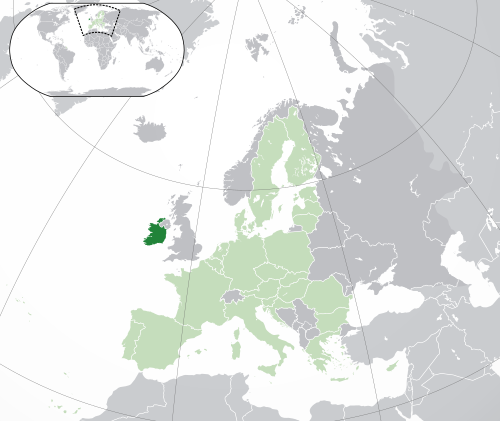 | |
| 資本 そして最大の都市 | ダブリン 53°20.65′N 6°16.05′W / 53.34417°N 6.26750°W / 53.34417; -6.2675053°N 8°W / 53°N 8°W / 53; -8 |
| 公用語 | |
| 民族グループ (2022年[2]) |
|
| 宗教 (2022年[3]) | |
| 異名 | アイルランド語 |
| 政府 | 単一議会制共和国 |
• 社長 | マイケル・D・ヒギンズ |
• 首相 | サイモン・ハリス |
• タナステ | ミケル・マーティン |
• 最高裁判所長官 | ドナル・オドネル |
| 立法府 | オイレイハタス |
• 上院 | 上院 |
• 下院 | ドイル |
| 独立 イギリスから | |
• 宣言 | 1916年4月24日 |
• 宣言 | 1919年1月21日 |
• 英愛条約 | 1921年12月6日 |
• 1922年憲法 | 1922年12月6日 |
• 1937年憲法 | 1937年12月29日 |
• 共和国法 | 1949年4月18日 |
| エリア | |
• 合計 | 70,273 km 2 (27,133 平方マイル) ( 118 位) |
• 水 (%) | 2.0% |
| 人口 | |
• 2023年の推定 |  5,281,600 [4] ( 122位) 5,281,600 [4] ( 122位) |
• 2022年国勢調査 | 5,149,139 [5] |
• 密度 | 71.3/km 2 (184.7/平方マイル) ( 113 位) |
| GDP (購買力平価) | 2024年推定 |
• 合計 |  7120億5600万ドル[6] (第40位) 7120億5600万ドル[6] (第40位) |
• 一人当たり | 133,895ドル[6] ( 3位) |
| GDP (名目) | 2024年推定 |
• 合計 | 5640.2億ドル[6] ( 30日) |
• 一人当たり | 106,059ドル[6] ( 2位) |
| ジーニ (2022) |  27.9 [7] 27.9 [7]低い不平等 |
| HDI (2022) | 0.950 [8]非常に高い (7位) |
| 通貨 | ユーロ( € ) [c] ( EUR ) |
| タイムゾーン | UTC (グリニッジ標準時) |
• 夏 ( DST ) | UTC +1 ( IST ) |
| 日付形式 | 年/月/日 |
| ドライブを続ける | 左 |
| 呼び出しコード | +353 |
| ISO 3166 コード | IE |
| インターネットTLD | .ie [d] |

アイルランド(アイルランド語: Éire [ˈeːɾʲə]) )は、アイルランド共和国(Poblacht na hÉireann)としても知られ[a]北西ヨーロッパしアイルランド島の32郡人口は 530 万人である。[4] 首都で最大の都市は島の東側にダブリン[9]この主権国家は、連合王国の一部である北アイルランドとのみ陸上の国境を接している大西洋に囲まれており、南はケルト海南東はセントジョージ海峡アイリッシュ海て。単一制の議会制共和国。[10]立法府であるアイルランド議会は、下院のDáil Éireannと上院のSeanad Éireannで構成される。選出された大統領(Uachtarán)は、主に儀礼的な国家元首が、いくつかの重要な権限と義務を持ちます。政府の長は、下院によって選出され、他の政府大臣を任命する大統領によって任命される首相 ( Taoiseach、文字通り「長」です
アイルランド自由国は、1922年に英愛条約に従って自治領として設立された。1937年に新憲法が採択され、国名は「アイルランド」となり、選挙で選ばれた非執行の大統領を置く共和国となった。 1948年のアイルランド共和国法により、1949年に正式に共和国が宣言された。アイルランドは1955年に国際連合に加盟した。 1973年には欧州連合(EU)の前身である欧州共同体(EC)に加盟した。20世紀の大半、アイルランドは北アイルランドと正式な関係を持たなかったが、1980年代と1990年代には、イギリス政府とアイルランド政府が北アイルランドの各政党と協力して、トラブルとして知られる紛争の解決に取り組んだ。 1998年の聖金曜日合意の調印以来、アイルランド政府と北アイルランド政府は、合意によって設置された 南北閣僚理事会の下で、多くの政策分野で協力してきました。
アイルランドは、世界でもトップクラスの生活の質を誇る先進国です。不平等調整後、2021年の人間開発指数では世界で6番目に高い評価を得ています。[11]また、医療、経済的自由、報道の自由でも高い評価を得ています。[12] [13] EU加盟国であり、欧州評議会とOECDの創設メンバーでもあります。アイルランド政府は第二次世界大戦前から非同盟による軍事中立政策をとっており、 NATOには加盟していませんが、[14]平和のためのパートナーシップとPESCOの一部には加盟しています。アイルランドの経済は進んでおり、[15]ヨーロッパの主要な金融ハブの1つがダブリンに集中しています。GDPと一人当たりGNIの両方で、世界で最も裕福な国のトップ5にランクされています。[16] [17] [18] [19] EC加盟後、アイルランド政府は一連の自由主義経済政策を制定し、1995年から2007年にかけて経済成長を後押しした。この時期は現在ではケルトの虎時代と呼ばれている。その後、大不況の間に景気後退と成長の反転が起こり、アイルランドの不動産バブルの崩壊によって状況は悪化した。[20]大不況は2014年まで続き、その後は新たな力強い経済成長の時期が続いた。[21]
名前
アイルランドのアイルランド名はÉireで、アイルランド神話の女神Ériuに由来する。 [22] 1922年に創設されたこの国は、アイルランドの32の郡のうち26郡で構成され、「アイルランド自由国 ( Saorstát Éireann ) と呼ばれ、その名で知られた。[23] 1937年に採択されたアイルランド憲法では、「国の名称はÉire、英語では Ireland である」とされている。1948年アイルランド共和国法第2条では、「国の名称はアイルランド共和国とすることをここに宣言する」とされている。1948年法では、国名を「アイルランド共和国」としていない。そうすると憲法に抵触するからである。[24]
英国政府は、国名として「アイルランド」(発音区別符号なし)を使用し、1949年からは「アイルランド共和国」を使用した。[25] 1998年の聖金曜日合意で国が北アイルランドに対する領有権を放棄して初めて、国は「アイルランド」と呼ばれるようになった。[26] [27]
アイルランド共和国は非公式に「共和国」、「南アイルランド」または「南部」とも呼ばれる。[28]特にアイルランド島と区別する場合や北アイルランド(「北部」)について議論する場合に用いられる。アイルランド共和主義者は「アイルランド」という名称を島全体を指すために留保しており[27]、しばしば「自由国」、「26の州」[27] [29]または「アイルランド南部」[30]と呼ぶ。これは「アイルランドは国境で止まるという分割主義の見解に対する反応」である。 [31]
歴史
自治運動

1801年1月1日の連合法から1922年12月6日まで、アイルランド島はグレートブリテンおよびアイルランド連合王国の一部であった。 1845年から1849年にかけての大飢饉の間、800万人以上いた島の人口は30%減少した。100万人のアイルランド人が飢餓と病気で亡くなり、さらに150万人が主に米国に移住した。[32]これが次の世紀の移住パターンとなり、1960年代まで人口が継続的に減少した。[33] [34] [35]
1874年以降、特に1880年のチャールズ・スチュワート・パーネル政権下で、アイルランド議会党は台頭した。これは、まずアイルランド土地連盟による広範な農業運動によって実現した。この連盟は、アイルランド土地法の形で借地人のための土地改革を勝ち取った。次に、アイルランドに限定的な国家自治権を与える2つの法案を通した自治権獲得の試みによって実現した。この試みは、 1898年地方自治法の下で、プロテスタント優勢派の地主中心の大陪審が掌握していた国家問題を「草の根」で統制することになった。
1911年の議会法で貴族院の拒否権が廃止され、ジョン・レドモンドが1914年に第三次ホームルール法を確保したとき、ホームルールは確実になったように見えた。しかし、最初のホームルール法案の導入後、アイルランドのプロテスタントの間では、アイルランドのカトリック教徒が実際の政治権力を獲得した場合の差別と経済的・社会的特権の喪失を恐れ、1886年以来ユニオニスト運動が拡大していた。19世紀後半から20世紀初頭にかけて、ユニオニストはアルスターの一部で特に強かった。アルスターでは、島の他の地域よりも農業が盛んであり、工業化がより一般的で、プロテスタント人口がより多く、4つの郡で多数派を占めていた。[36]ダブリン生まれのアイルランドユニオニスト党のサー・エドワード・カーソンとアルスター出身のアルスターユニオニスト党のサー・ジェームズ・クレイグの指導の下、ユニオニストは強く戦闘的になり、「アルスターの強制」に反対するためにアルスター義勇軍を結成した。 [37] 1914年5月に自治法案が議会を通過した後、アルスターとの反乱を避けるため、英国首相HHアスキスは修正法案を提出したが、アイルランド党指導部は渋々これを認めた。この修正法案は、試行期間6年間、アルスターを法案の適用から一時的に除外することを規定し、一時的に除外される地域に対して導入される予定の新たな一連の措置はまだ決定されていなかった。
革命と独立への歩み
.jpg/500px-The_shell_of_the_G.P.O._on_Sackville_Street_after_the_Easter_Rising_(6937669789).jpg)
第三次ホームルール法は1914年に国王裁可を得て制定されたものの、アイルランド内戦の脅威が和らぐ第一次世界大戦後まで施行は保留された。アイルランドの戦争参加を通じて戦争終結時に同法の施行を確実にするという希望を抱き、レドモンドとアイルランド国民義勇軍は英国とその同盟国を支援した。17万5千人の兵士が新イギリス軍の第10(アイルランド)師団と第16(アイルランド)師団のアイルランド連隊に加わり、ユニオニストは第36(アルスター)師団に加わった。[38]
レドモンドを拒否し、英国のいかなる支援にも反対したアイルランド義勇軍の残党は、1916年のイースター蜂起でアイルランド市民軍とともに英国統治に対する武装蜂起を起こした。これは1916年4月24日の独立宣言とともに始まった。主にダブリンで1週間の激しい戦闘の後、生き残った反乱軍は降伏を余儀なくされた。大多数は投獄され、15人の囚人(リーダーのほとんどを含む)は英国への裏切り者として処刑された。これには、蜂起のスポークスマンで義勇軍に蜂起開始の合図をしたパトリック・ピアースや、社会主義者で世界産業労働組合およびアイルランドとスコットランドの労働運動の創設者であるジェームズ・コノリーも含まれていた。これらの出来事は、 1918年の徴兵危機とともに、英国政府に対するアイルランドの世論の変化に大きな影響を与えた。[39]
1918年12月の総選挙後の1919年1月、アイルランドの国会議員105人のうち73人は、英国下院から棄権を掲げて選出されたシン・フェイン党員であった。1919年1月、彼らはアイルランド議会「下院」を設立した。この最初の下院は独立宣言を出し、アイルランド共和国を宣言した。この宣言は主に1916年の宣言を言い直したもので、アイルランドはもはや英国の一部ではないという条項が追加されていた。アイルランド共和国の下院内閣は、ショーン・T・オケリー議長率いる代表団を1919年のパリ講和会議に派遣したが、受け入れられなかった。

1921年7月に独立戦争と休戦が呼びかけられた後、アーサー・グリフィス、ロバート・バートン、マイケル・コリンズが率いるイギリス政府と5人のアイルランド条約代表の代表は、 1921年10月11日から12月6日までロンドンで英愛条約の交渉を行った。アイルランド代表はナイツブリッジのハンス・プレイスに本部を置き、ここで非公開の話し合いが行われ、12月5日に条約をアイルランド下院に勧告する決定が下された。1922年1月7日、第2下院は64票対57票で条約を批准した。 [40]
条約に従い、1922年12月6日、アイルランド島全体がアイルランド自由国 ( Saorstát Éireann ) と呼ばれる自治領となった。アイルランド自由国憲法の下、北アイルランド議会は1か月後にアイルランド自由国を離脱し、英国に復帰する選択肢があった。その間、アイルランド自由国議会およびアイルランド自由国執行評議会の権限は北アイルランドには及ばなかった。北アイルランドは条約に基づく新自治領からの離脱の権利を行使し、1922年12月8日に英国に復帰した。その際、国王に「アイルランド自由国議会および政府の権限は、もはや北アイルランドには及ばないものとする」と要請する演説を行った。[41]アイルランド自由国は、英国およびイギリス連邦の他の自治領と君主を共有する立憲君主制であった。この国には総督(君主を代表する)、二院制の議会、「行政評議会」と呼ばれる内閣、そして行政評議会議長と呼ばれる首相がいた。
アイルランド内戦
.jpg/500px-The_Long_Fellow_(10570624475).jpg)
アイルランド内戦(1922年6月~1923年5月)は、英愛条約の批准とアイルランド自由国の創設の結果であった。[42]エアモン・デ・ヴァレラ率いる反条約派は、条約の受諾により、彼らが忠誠を誓った1919年のアイルランド共和国が廃止されるという事実に反対し、和解に対する国民の支持を前に「国民には不正を行う権利はない」と主張した。[43]彼らが最も反対したのは、国家が大英帝国の一部であり続けることと、自由国議会の議員が、反条約派が英国国王への忠誠の誓いとみなす誓いを立てなければならないという事実であった。マイケル・コリンズ率いる条約賛成派は、条約は「すべての国家が望み、発展させようとする究極の自由ではなく、それを達成する自由」を与えるものだと主張した。[44]
戦争開始時、アイルランド共和軍(IRA) は、条約賛成派 IRA と条約反対派 IRA の2つの対立する陣営に分裂した。条約賛成派 IRA は解散し、新しくできた国民軍に加わった。しかし、条約反対派 IRA には効果的な指揮系統がなく、条約賛成派は戦争中ずっと防御戦術をとっていたため、マイケル・コリンズと彼の条約賛成派は、1922年に解散したイギリス軍のアイルランド連隊から第一次世界大戦の退役軍人数万人を集め、条約反対派を圧倒できる軍隊を編成することができた。イギリスからの大砲、航空機、機関銃、弾薬の供給は条約賛成派の勢力を後押しし、また、王国軍が自由国に戻ってくるという脅威は、条約を施行する必要性についての疑問を払拭した。反条約勢力(しばしばイレギュラーズと呼ばれる)に対する国民の支持の欠如と、イレギュラーズを打ち負かすという政府の決意が、彼らの敗北に大きく貢献した。[要出典]
アイルランド憲法 1937

1937年7月の国民投票の後、アイルランドの新憲法(Bunreacht na hÉireann)が1937年12月29日に発効した。 [45]これはアイルランド自由国憲法に代わるもので、国名をÉire、英語で「アイルランド」とすることを宣言した。[46]憲法第2条と第3条は国土を島全体と定義したが、国の管轄権をアイルランド自由国であった地域に限定した。旧アイルランド自由国政府は1936年12月に総督府を廃止した。憲法はアイルランド大統領の職を設けたが、アイルランドが共和国であるかどうかという問題は未解決のままであった。外交官は国王に信任されたが、大統領は国家元首としてのすべての国内機能を行使した。[47]例えば、大統領は、制定法で規定された「機関」に過ぎなかった ジョージ6世に相談することなく、独自の権限で新しい法律に同意を与えました。
アイルランドは、自国が「非常事態」と呼んだ第二次世界大戦の間、中立を保った。[48]アイルランドの自治領としての地位は、 1948年アイルランド共和国法の可決により終了した。同法は1949年4月18日に発効し、同国が共和国であると宣言した。[49] [50]当時、共和国の宣言により英連邦加盟資格は終了した。この規則は、アイルランドが共和国であると宣言した10日後の1949年4月28日のロンドン宣言で変更された。規則が共和国の加盟を認めるよう変更されたとき、アイルランドは再申請しなかった。その後、1962年の法令改正(連合前アイルランド法令)法により、アイルランドでは1542年アイルランド王室法が廃止された。[51]
最近の歴史
.jpg/500px-Tratado_de_Lisboa_13_12_2007_(081).jpg)
アイルランドは、第二次世界大戦中に中立の立場をとり、連合国を支持しなかったために加盟を拒否された後、1955年12月に国連に加盟した。[52]当時、国連に加盟するには、国連が必要と判断した場合、ある国による他の国への侵略を抑止するために武力を行使するという約束が必要だった。[53]
1950年代にアイルランドで欧州共同体(EC)加盟への関心が高まり、欧州自由貿易地域への加盟も検討された。英国がEC加盟を意図していたように、アイルランドは英国との実質的な経済的つながりを理由に1961年7月に加盟を申請した。EC創設メンバーは、アイルランドの経済力、中立性、魅力のない保護主義政策について懐疑的であった。[54]多くのアイルランドの経済学者や政治家は、経済政策の改革が必要であることを認識していた。1963年にフランスのシャルル・ド・ゴール大統領がフランスは英国の加盟に反対すると述べ、他のすべての候補国との交渉が停止したことで、EC加盟の見通しは疑わしくなった。1969年、彼の後継者であるジョルジュ・ポンピドゥーは、英国とアイルランドの加盟に反対しなかった。交渉が始まり、1972年に加盟条約が調印された。その年の後半に国民投票が行われ、アイルランドのEU加盟が承認され、1973年1月1日についにECに加盟した。[55]
1970年代後半の経済危機は、フィアナ・フォイル政権の予算、自動車税の廃止、過剰借入、1979年の石油危機を含む世界経済の不安定化によって引き起こされた。[56] 1989年以降、経済改革、減税、福祉改革、競争の激化、経常支出を賄うための借入禁止など、重要な政策変更があった。この政策は1989年から1992年にかけてフィアナ・フォイル/進歩民主党政権によって開始され、その後のフィアナ・フォイル/労働党政権、フィナ・ゲール/労働党/民主左派政権によって継続された。アイルランドは、大不況まで続いたケルトの虎時代として知られる1990年代後半までに世界で最も急速に成長する経済の一つとなった。2014年以降、アイルランドは経済活動の増加を経験している。[57]
北アイルランド問題では、英国とアイルランドの両政府は、北アイルランドで多数の準軍事組織と英国軍が関与する「トラブル」として知られる暴力的な紛争の平和的解決を模索し始めた。1998年、北アイルランドの和平合意として知られる北アイルランド和平協定が、国境の北と南で行われた国民投票で承認された。和平協定の一環として、アイルランド憲法第2条と第3条に規定されている北アイルランドに対する領有権の主張は国民投票で削除された。英国政府は、ブレグジットに関する白書で、この和平合意へのコミットメントを改めて表明した。北アイルランドの地位に関しては、英国政府は「北アイルランドの現在の憲法上の立場、すなわち英国の一部でありながらアイルランドとの強いつながりを維持することを明確に表明している」と述べた。[58]
地理
.jpg/500px-Ireland_(47474631822).jpg)

アイルランド島(84,421 km 2または 32,595 平方マイル)の約6分の5(70,273 km 2または 27,133 平方マイル)の面積を占め、残りは北アイルランドです。アイルランド島は北と西は大西洋、北東はノース海峡に囲まれています。東ではアイリッシュ海がセントジョージ海峡を経由して大西洋に、南西では ケルト海につながっています。
西部の風景は、ほとんどが険しい断崖、丘、山々で構成されています。中央低地は、粘土と砂の氷河堆積物で広く覆われており、沼地やいくつかの湖も広がっています。最高地点は、南西部のマクギリカディーズ・リークス山脈にあるカラントゥーヒル(1,038.6 メートルまたは 3,407 フィート) です。中央低地を横切るシャノン川は、長さ 386 キロメートル (240 マイル) で、アイルランド最長の川です。西海岸は東海岸よりも険しく、島、半島、岬、湾が多数あります。
アイルランドは、ヨーロッパで最も森林の少ない国の一つです。[59]中世の終わりまで、この土地は深い森林に覆われていました。在来種には、オーク、トネリコ、ハシバミ、カバノキ、ハンノキ、ヤナギ、ポプラ、ニレ、ナナカマド、サンザシなどの落葉樹と、ヨーロッパアカマツ、イチイ、ヒイラギ、イチゴノキなどの常緑樹があります。[60]湿原の拡大と農業のための森林の大規模な伐採が、森林破壊の主な原因であると考えられています。[61]今日、アイルランドの約10%のみが森林で、[62]そのほとんどが非在来の針葉樹の植林地であり、在来林はわずか2%です。[63] [64]ヨーロッパ諸国の平均森林被覆率は33%を超えています。[62]国営林業会社コイルテによると、アイルランドの気候はヨーロッパで最も森林の成長率が高い国の一つだ。 [65]伝統的に土地の境界を定めるために使われてきた生け垣は、森林生息地の重要な代替物であり、在来の野生植物や様々な昆虫、鳥類、哺乳類の種の避難所となっている。[66]ケルト広葉樹林と北大西洋湿潤混合林という2つの陸上生態地域がアイルランドにはある。[67]
農業は総陸地面積の約64%を占めています。[68]この結果、特に領土を必要とする大型野生哺乳類の自然生息地を保護するための土地が限られています。[69]農業生産の長い歴史と、農薬や肥料の使用などの近代的な農法が相まって、生物多様性に圧力をかけています。[70]
気候

大西洋とメキシコ湾流の温暖化の影響がアイルランドの気象パターンに影響を与えている。[71]気温は地域によって異なり、中央部と東部ではより極端な傾向がある。しかし、温暖な海洋性気候のため、冬でも気温が−5 °C (23 °F) を下回ることはめったになく、夏でも気温が26 °C (79 °F) を上回ることはない。[72]アイルランドで記録された最高気温は、1887年6月26日にキルケニーのキルケニー城で記録された33.3 °C (91.9 °F) で、最低気温はスライゴのマークリー城で記録された−19.1 °C (−2.4 °F) である。 [73]降雨量は冬季に多く、初夏は少なめである。南西部は南西風の影響で降雨量が最も多く、ダブリンは最も少ない。日照時間は国の南東部で最も長い。[71]極北と西部はヨーロッパで最も風の強い地域であり、風力発電の大きな可能性を秘めています。[74]
アイルランドでは、通常、年間 1100 ~ 1600 時間の日照があり、ほとんどの地域では 1 日平均 3.25 ~ 3.75 時間です。最も日照時間が多いのは 5 月と 6 月で、国土のほとんどの地域で 1 日平均 5 ~ 6.5 時間です。最も日照時間が多いのは南東部で、初夏には 1 日平均 7 時間以上になります。12 月は最も日照時間が少ない月で、平均日照時間は北部で約 1 時間、南東部でほぼ 2 時間です。ダブリンのフェニックス パークで行われた測定によると、1881 年から 1980 年までの 100 年間で最も日照時間が多かった夏は 1887 年で、最も日照時間が少なかったのは 1980 年でした。[75]
政治
アイルランドは議会制の立憲共和国である。アイルランド議会は二院制の国会で、アイルランド大統領と2つのアイルランド議会、すなわち下院(Dáil Éireann )と上院( Seanad Éireann)から構成される。[76]アイルランド大統領の 公邸はアーラス・アン・ウアクターランであり、アイルランド議会はダブリンのレンスター・ハウスで会合を行っている。
大統領は国家元首として選出され、7年の任期で選出され、1回再選される。大統領は主に名目上の存在であるが、国家評議会の助言により一定の憲法上の権限を委任されている。大統領職は、法案を最高裁判所に付託して合憲性の判断を求めるなど、いくつかの分野で絶対的な裁量権を有する。[77] マイケル・D・ヒギンズは2011年11月11日に第9代アイルランド大統領に就任した。[78]
タオイシェック(首相)は政府の長であり、下院の指名に基づいて大統領によって任命される。ほとんどのタオイシェックは、国政選挙で最多議席を獲得した政党の党首を務めている。 1989年以降、一党独裁政権は存在していないため、連立政権が樹立するのが通例となっている。 [79]
下院には、単記移譲式比例代表制度の下、複数議席の選挙区を代表する160 名の議員 ( Teachtaí Dála ) がいる。上院は60 名の議員で構成され、そのうち 11 名は首相によって指名され、6 名は 2 つの大学選挙区によって選出され、43 名は職業に基づいて設置された候補者のパネルから国民の代表によって選出される。
内閣は憲法により15人までと制限されている。上院からは2人までしか選出できず、首相、副首相、財務大臣は下院議員でなければならない。下院は前回選挙後の初回会合から5年以内に解散しなければならず、[80]解散後30日以内に下院議員の総選挙を行わなければならない。アイルランド憲法によれば、議会選挙は少なくとも7年に1度は実施しなければならないが、制定法によりより低い回数を定めることができる。現政権はフィアナ・フォイル、フィナ・ゲール、緑の党の連立政権で、フィナ・ゲールのサイモン・ハリスが首相、フィアナ・フォイルのマイケル・マーティンが副首相を務めている。現在の下院における野党は、シン・フェイン党、労働党、人民利益連帯党、社会民主党、アオントゥ党、および多数の無所属議員である。
アイルランドは1973年以来、欧州連合の加盟国となっている。英国国民は、アイルランド島、イギリス、マン島、チャンネル諸島からなるパスポート不要の地域である共通旅行地域により、パスポートなしで自由に入国できる。ただし、空港や港では何らかの身分証明書の提示が必要となる。
地方自治体
1898年の地方自治(アイルランド)法は、現在の地方自治制度の基礎となる法律であり、 1999年憲法第20次改正により憲法上の承認が規定された。アイルランドの伝統的な26の郡が地方自治区域の基礎となっており、伝統的なコーク、ダブリン、ゴールウェイの郡には2つ以上の地方自治区域が含まれている。2001年の地方自治法は、 2014年の地方自治改革法[81]により改正され、31の地方自治体制度を規定している。具体的には、26の郡議会、2つの市・郡議会、3つの市議会である。[81]郡(ダブリンの3つの郡を除く)は市区町村に分割されている。2番目の地方自治層である町議会は2014年に廃止された。
地方自治体は、計画、地方道路、衛生、図書館などの問題に責任を負っている。下院選挙区の設定では、郡の境界を越えることは可能な限り避けるべきである。人口の多い郡は複数の選挙区を持ち、複数の郡にまたがる選挙区もあるが、一般的には郡の境界を越えることはない。郡は3つの地域にグループ化され、各地域には、その地域のさまざまな郡および市議会から委任されたメンバーで構成される地域議会がある。地域には直接的な行政的役割はないが、計画、調整、統計の目的で機能している。
法
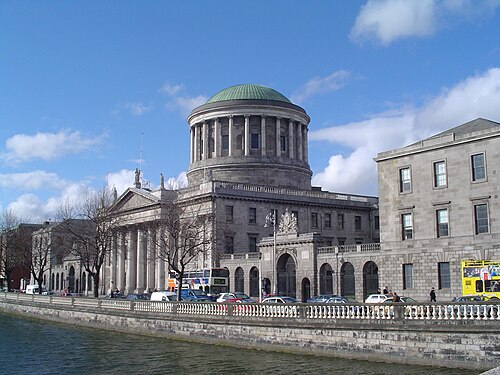
アイルランドは、議会制民主主義を規定する成文憲法を伴うコモンロー 法制度を採用している。裁判所制度は、最高裁判所、控訴院、高等裁判所、巡回裁判所、地方裁判所から成り、いずれもアイルランド法を適用し、民事および刑事事件の両方を審理する。重大犯罪の裁判は通常、陪審員の前で行われる。高等裁判所、控訴院、最高裁判所は、司法審査を通じて、法律および国家の他の機関の活動が憲法および法律に適合しているかどうかを判断する権限を有する。例外的な状況を除き、裁判は公開で行われなければならない。[82] [83]

ガルダ・シオカナ(平和の守護者)は、一般的にガルダと呼ばれ、国の民間警察である。この警察は、領土とインフラの両面で、民間警察活動のあらゆる側面を担当している。政府によって任命されたガルダ長官が率いる。制服を着た隊員のほとんどは、日常的に銃器を携帯していない。標準的な警察活動は、伝統的に、警棒と催涙スプレーのみを装備した制服警官によって行われている。[84]
憲兵はアイルランド軍の部隊であり、警察要員の派遣と、訓練や展開中の部隊への憲兵派遣を担当している。戦時中は、軍部隊が任務地域に迅速に移動できるように交通管制組織の設置も任務に含まれる。その他の戦時中の役割には、捕虜や難民の統制が含まれる。[85]
アイルランドの市民権法は、島や海を含む「アイルランド島」に関するものであり、それによって英国の一部である北アイルランドにも適用されている。したがって、アイルランド島でアイルランド人または英国人の親のもとに生まれた、または居住地の制限なく北アイルランドまたはアイルランド共和国に居住する権利を持つ親のもとに生まれたなど、アイルランド市民となるための要件を満たす北アイルランドで生まれた人は誰でも、[86]アイルランドのパスポートなどのアイルランド市民権の権利を行使することができる。[87]
外交関係
.jpg/500px-P20230317AS-2347_(52777500991).jpg)
外交関係は欧州連合加盟国に大きく影響されるが、英国や米国との二国間関係も重要である。[88]ロシアは欧州連合理事会の議長国を6回務めており、直近では2013年1月から6月まで務めている。 [89]
アイルランドは外交政策において独立志向を強めており、NATOに加盟しておらず、長年軍事中立政策をとっている。この政策により、アイルランド国防軍は1960年以降、コンゴ危機やその後のキプロス、レバノン、ボスニア・ヘルツェゴビナでの活動を含め、国連の平和維持活動に貢献してきた。[90]
第二次世界大戦中、アイルランドは中立を保っていたが、イギリス軍に入隊して5万人以上が戦争に参加した。冷戦中、アイルランドの軍事政策は表面上は中立であったが、NATO寄りであった。[91]キューバ危機の間、ショーン・レマスはシャノンを通過するキューバとチェコスロバキアの航空機の捜索を承認し、その情報をCIAに渡した。[92]アイルランドの航空施設は、2003年のイラク侵攻に関わった軍人をシャノン空港経由で輸送するためにアメリカ軍によって使用された。この空港は、2001年のアメリカのアフガニスタン侵攻や第一次湾岸戦争にも使用されていた。[93]
アイルランドは1999年以来、NATOの平和のためのパートナーシップ(PfP)プログラムとNATOの欧州大西洋パートナーシップ評議会(EAPC)のメンバーであり、NATOとヨーロッパ諸国および旧ソ連諸国との信頼関係の構築を目指している。[94] [95]
軍隊
.jpg/500px-Soldiers_from_41_Inf_Gp_on_Parade_1_(4446682116).jpg)
アイルランドは中立国であり[96]、紛争地域へのアイルランド軍の参加を規定する「トリプルロック」規則があり、国連、下院、政府の承認が必要である。[97]したがって、その軍事的役割は国家の自衛と国連の平和維持活動への参加に限定されている。
アイルランド国防軍(Óglaigh na hÉireann )は、陸軍、海軍、航空隊、予備役防衛軍から構成されている。規模は小さいが装備は充実しており、常勤軍人が約1万人、予備役が2千人を超えている。[98] [99]国防軍の日々の展開は、民間電力活動への支援、アイルランド海軍によるアイルランド領海とEEZの保護とパトロール、国連、EU、 PfPの平和維持活動などである。1996年までに、4万人以上のアイルランド軍人が国際国連平和維持活動に従事した。[100]
アイルランド航空隊は国防軍の航空部隊であり、16機の固定翼航空機と8機のヘリコプターを運用している。アイルランド海軍はアイルランドの海軍であり、6隻の巡視船、少数のゴムボートと訓練船を運用し、船舶を拿捕できる武装乗っ取り部隊と特殊部隊の潜入捜査官を擁している。軍隊には、パートタイムの予備役のための予備国防軍(陸軍予備隊と海軍予備隊)が含まれる。アイルランドの特殊部隊には、国際特殊作戦部隊とともに訓練と活動を行う陸軍レンジャー航空団が含まれる。大統領は国防軍の正式な最高司令官であるが、実際にはこれらの軍は国防大臣を通じて政府に報告している。[101]
2017年、アイルランドは核兵器禁止条約に署名した。[102]
経済
アイルランドは開放経済であり、「高価値」の外国直接投資(FDI)フローで第1位である。[103]アイルランドは、一人当たりGDPで187か国中5位(IMF)、175か国中6位(世界銀行)であり、一人当たりGNIでもトップ10入りしている。修正国民総所得(GNI)として知られる代替指標は、中央統計局によって作成され、無形資産に関連することが多い大規模な多国籍企業の輸出動向を除いた国内経済の活動を示すためにアイルランド政府によって使用されている。[104]これはアイルランド経済に特に関連しており、GDPにはアイルランド国外の企業からの収入が不釣り合いに多く含まれており、その収入はアイルランドから流出することが多い。[105]外国の多国籍企業はアイルランド経済の主な原動力であり、民間部門の労働力の4分の1を雇用し、[106]アイルランドの法人税の80%を支払っている。[107] [108] [109]アイルランドの上位20社(2017年の売上高)のうち14社は米国を拠点とする多国籍企業であり[110]、アイルランドの外国多国籍企業の80%は米国企業である。[111] [112] [110]
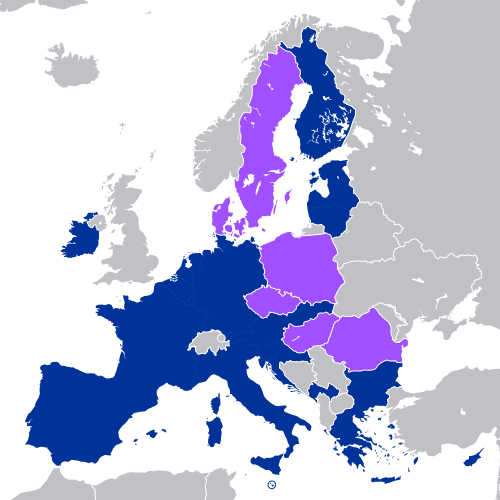
アイルランドは2002年に他の11のEU加盟国とともにユーロ通貨を採用した。[70] 2023年1月現在、ユーロ通貨を使用しているEU加盟国は20か国あり、最も新しい加盟国は2023年1月1日にクロアチアが加盟した。[113]
大不況とアイルランドの不動産バブルの崩壊の後、アイルランドは米国多国籍企業の輸出増加に牽引され、2010年に正式に不況から脱した。[114]しかし、民間銀行債務の政府保証による公的借入コストの上昇により、アイルランド政府はEU、国際通貨基金(IMF)からの850億ユーロの支援プログラムと、英国、スウェーデン、デンマークからの二国間融資を受け入れた。[115] 3年間の縮小の後、経済は2011年に0.7%、2012年に0.9%成長した。[116] 2012年の失業率は14.7%で、最近の移民の18.5%を含む。[117] 2016年3月の失業率はCSOによって8.6%と報告され、2012年2月のピーク時の失業率15.1%から低下した。 [118]失業に加えて、2008年から2013年の間にアイルランドから純移民は120,100人に達し、[119] 2011年のアイルランド国勢調査によると、総人口の約2.6%を占めた。移民の3分の1は15歳から24歳であった。[119] 2022年11月現在、失業率は4.4%に低下している。[120] [更新が必要]
アイルランドは2013年12月15日にEU-IMFの救済プログラムから脱退した。[121]予算削減、改革、資産売却を実施した後、アイルランドは再び債券市場にアクセスできるようになりました。それ以来、アイルランドは記録的なレートで長期債を売却できるようになりました。[122]しかし、アイルランドの信用バブルの安定化には、アイルランドの銀行救済と公的赤字支出を通じて、民間部門のバランスシート(OECDで最も高いレバレッジ)から公共部門のバランスシート(危機前はほぼレバレッジなし)への大規模な債務移転が必要でした。[123] [124]この債務移転により、アイルランドは2017年現在でも、EU-28/OECDの中で公共部門の負債と民間部門の負債の両方で最高レベルの1つを抱えています。[125] [126] [127] [128] [129] [130]
アイルランドは2009年から2016年まで、米国の製薬企業による法人税の逆転の主な目的地の一つとなった。[131] [132]また、アイルランドは米国の大手テクノロジー多国籍企業(Apple、Google、Microsoft、Facebookなど)にとって最大の海外拠点となっており、2015年にはGDP成長率26.3%(GNP成長率18.7%)を達成した。この成長はその後、Appleが「二重アイルランド」子会社(Apple Sales International、現在、優遇税制に対する EUの「違法な国家援助」罰金130億ユーロの脅威にさらされている)を再編したことによることが判明した。
課税政策
アイルランドの税制改革は、 1987年に国際金融サービスセンター(IFSC)と呼ばれる10%の低税率の「特別経済区」が創設されたことから始まった。 [133] 1999年には、アイルランドの法人税が32%から12.5%に引き下げられ、国全体が事実上「IFSCになった」。[134] [135]これにより、アイルランドは主に農業経済から知識・サービス経済への移行が後期段階で加速した。知識・サービス経済は当初は不動産と建設に重点を置き、後にはアイルランドの低い法人税率と有利な法人税制度を利用したいハイテク、ライフサイエンス、金融サービス産業の米国の多国籍企業を誘致することに重点が置かれた。 [136]
外国企業がアイルランドで使用している多国籍税制は、アイルランドの経済統計を著しく歪めている。これは、2015年の「レプラコーン経済学」GDP/GNP成長率で頂点に達した(2015年にAppleがアイルランド子会社を再編したため)。アイルランド中央銀行は、これらの歪みを取り除くために、新しい統計である修正国民総所得を導入した。GNI*はGDPを30%下回っている(つまり、GDPはGNIの143%である)。[136] [137] [138] [139] [140]
IFSCの創設以来、アイルランドは力強く持続的な経済成長を経験し、それがアイルランドの消費者の借入と支出、そしてアイルランドの建設と投資の劇的な増加を促し、ケルトの虎時代として知られるようになった。[141] [142] 2007年までに、アイルランドはOECD諸国の中で民間部門の負債が最も高く、家計債務対可処分所得比率は190%に達した。ケルトの虎時代にアイルランドの銀行が国内預金ベースを超えて借り入れることを可能にして(ピーク時には180%以上[143] )、アイルランドの債務増加に資金を提供した国際資本市場は、 2007年から2008年の金融危機で支援を撤回した。借り入れ過剰のアイルランド信用システムからの撤退は、深刻なアイルランドの不動産調整を引き起こし、それが2008年以降のアイルランド銀行危機につながった。[144] [141]
アイルランドの「低税」経済の成功は、「法人税回避地」という非難にさらされており、[145] [146] [147]、ブラジルの「ブラックリスト」入りにつながった。[148] [149] 2017年の調査では、アイルランドは、合法的にタックスヘイブンに資金を流すコンジットOFCとして世界第5位にランクされている。深刻な課題は、2017年の米国減税・雇用法(FDIIおよびGILTI制度はアイルランドの多国籍税制を標的としている)の可決である。[150] [151] [152] [153] EUの2018年デジタル売上税(DST)[154] (およびCCCTBへの要望[155] )も、米国のテクノロジー企業によるアイルランドの「多国籍税制」を制限する試みと見られている。[156] [157] [158]
貿易
.jpg/500px-La_Touche_House,_Dublin_(_DSC6350).jpg)
多国籍企業がアイルランドの輸出部門を支配しているが、他の輸出も国民所得に大きく貢献している。アイルランドに拠点を置く多国籍企業の活動により、アイルランドは医薬品、医療機器、ソフトウェア関連の製品およびサービスの世界最大の輸出国の一つとなっている。アイルランドの輸出は、大手アイルランド企業(ライアンエアー、ケリーグループ、スマーフィットカッパなど)の活動や、亜鉛や鉛の精鉱を含む鉱物資源の輸出にも関連している。この国にはまた、大量の石膏の鉱床があり、銅、銀、金、重晶石、ドロマイトの鉱床も少量ある。[70] アイルランドの観光業はGDPの約4%を占め、重要な雇用源となっている。
その他の輸出品には、農産食品、牛、牛肉、乳製品、アルミニウムなどがある。アイルランドの主な輸入品には、データ処理機器、化学薬品、石油および石油製品、繊維、衣類などがある。アイルランド金融サービスセンターに拠点を置く多国籍企業が提供する金融サービスも、アイルランドの輸出に貢献している。輸出(894億ユーロ)と輸入(455億ユーロ)の差額により、2010年の年間貿易黒字は439億ユーロとなり、[159]これはEU加盟国の中でGDPに対する貿易黒字が最も高い数字である。
EUは英国にとって圧倒的に最大の貿易相手国であり、輸出の57.9%、輸入の60.7%を占めている。ブレグジット以前は、英国はEU内で最も重要な貿易相手国であり、輸出の15.4%、輸入の32.1%を占めていた。EU外では、米国は2010年に輸出の23.2%、輸入の14.1%を占めていた。[159]
エネルギー

ESB、Bord Gáis Energy、Airtricityは、アイルランドの3大電力・ガス供給業者である。ガスの確認埋蔵量は198.2億立方メートルである。[70] [160]天然ガスの採掘は、以前はキンセール・ヘッドで行われ、枯渇した。コリブ・ガス田は2013/14年に生産を開始する予定であった。2012年、バリーロー油田には最大16億バレルの石油埋蔵量があり、1億6000万~6億バレルが回収可能であることが確認された。[161]これは、2015/16年に開発されれば、最大13年間アイルランドの全エネルギー需要を賄うことができる。
アイルランドでは、再生可能で持続可能なエネルギーの利用を増やすための大きな努力がなされており、特に風力発電では、3,000メガワット[162]の風力発電所が建設されており、一部は輸出を目的としている。[163]アイルランド持続可能エネルギー庁(SEAI)は、2011年のアイルランドのエネルギー需要の6.5%が再生可能資源によって生産されたと推定している。 [164] SEAIはまた、アイルランドのエネルギー効率が向上し、2005年から2013年にかけて住宅1軒あたりの炭素排出量が28%削減されたと報告している。 [ 165 ]
2021年現在、アイルランドは世界で24番目に大きな風力エネルギー生産国であり、一人当たりの生産量では2020年に3位にランクされています。[166]
輸送
ダブリン、シャノン、コークの3つの主要国際空港は、定期便やチャーター便によるヨーロッパや大陸間の多くの路線にサービスを提供しています。ロンドンからダブリンへの航空路線は、世界で9番目に忙しい国際航空路線であり、ヨーロッパで最も忙しい国際航空路線でもあります。2017年には、2つの路線間で14,500便が運航されました。 [167] [168] 2015年には、450万人が当時世界で2番目に忙しい路線を利用しました。[167]エアリンガスはアイルランドのフラッグキャリアですが、ライアンエアーは同国最大の航空会社です。ライアンエアーはヨーロッパ最大の格安航空会社で、[169]乗客数では第2位、国際乗客数では世界最大です。[170]

鉄道サービスはアイルランド鉄道(Irish Rail)によって提供されており、同社は国内のすべての都市間鉄道、通勤鉄道、貨物鉄道サービスを運営している。ダブリンはネットワークの中心であり、ヒューストン駅とコノリー駅の2つの主要駅があり、国内の都市や主要町とつながっている。北アイルランド鉄道と共同で運行するエンタープライズサービスは、ダブリンとベルファストを結んでいる。アイルランドの主要路線ネットワーク全体は、ヨーロッパで唯一の5フィート3インチ(1,600 mm)の軌間を持つ線路で運行されており、独特の車両設計となっている。ダブリンの公共交通機関ネットワークには、 DART、Luas、ダブリンバス、ダブリンバイクなどがある。[171]
高速道路、国道、国道はアイルランド交通インフラによって管理されており、地方道路と地方道路はそれぞれの地域の地方自治体によって管理されている。道路網は主に首都に集中しているが、高速道路はコーク、リムリック、ウォーターフォード、ゴールウェイなどアイルランドの他の主要都市とつながっている。[172]
ダブリンには、イーストリンクとウェストリンクの有料橋やダブリン港トンネルなどの主要なインフラが整っています。ダブリン郊外では、コークのリー川の下にあるジャックリンチトンネルとシャノン川の下にあるリムリックトンネルの2つの主要なプロジェクトがありました。[173]
人口統計

遺伝子研究によると、最も古い入植者は最近の氷河期の後にイベリア半島から移住してきたことが示唆されている。[174]中石器時代、新石器時代、青銅器時代の後、移住者はケルト語と文化を持ち込んだ。後者の2つの時代からの移住者は、今でもほとんどのアイルランド人の遺伝的遺産を代表している。[175] [176]ゲール語の伝統は拡大し、時間の経過とともに支配的な形態となった。アイルランド人は、ゲール語、ノルウェー語、アングロノルマン語、フランス語、およびイギリス人の祖先 の組み合わせである。
アイルランドの人口は2022年に5,149,139人で、2016年から8%増加した。 [177] 2011年の時点で[update]、アイルランドの出生率は欧州連合で最も高かった(人口1,000人あたり16人の出生) 。 [178] 2014年には、出生の36.3%が未婚女性だった。[179] 2002年から2006年の国勢調査間の期間中、年間人口増加率は2%を超えたが、これは自然増加率と移民率の高さによるものだった。 [180]この率はその後の2006年から2011年の国勢調査間の期間中にいくらか低下し、年間平均変化率は1.6%であった。 2017年の合計特殊出生率(TFR)は、女性1人当たり1.80人と推定され、人口置換率2.1を下回っているが、1850年の女性1人当たり4.2人という最高値を大幅に下回っている。[181] 2018年のアイルランド人口の中央年齢は37.1歳だった。 [182]
2022年の国勢調査時点で、非アイルランド国籍者の数は631,785人と記録されています。これは、2016年の国勢調査の数字535,475人から8%の増加を表しています。[183] 非アイルランド国籍者の上位5か国は、それぞれポーランド(93,680人)、英国(83,347人)、インド(45,449人)、ルーマニア(43,323人)、リトアニア(31,177人)、ラトビア(27,338人)でした。2016年から最大の増加が見られた非アイルランド国籍者は、インド(+33,984)、ルーマニア(+14,137)、ブラジル(+13,698)、ウクライナ(+10,006)でした。 2016年から最も減少が大きかった非アイルランド国籍は、ポーランド(−28,835)、英国(−19,766)、リトアニア(−5,375)、ラトビア(−1,633)、スロバキア(−1,117)であった。[184]
言語

アイルランド憲法では、アイルランド語は「国語」および「第一公用語」とされているが、英語(「第二公用語」)が主要言語である。2016年の国勢調査では、約175万人(人口の40%)がアイルランド語を話せると回答したが、そのうち日常的にアイルランド語を話すのは74,000人未満であった。[186]アイルランド語は、主に国の西部と南部の少数の農村地域でのみコミュニティ言語として話されており、総称してゲールタハトと呼ばれている。ゲールタハト地域を除いて、道路標識は通常バイリンガルである。[187]ほとんどの公共通知と印刷メディアは英語のみである。国家は公式にはバイリンガルであるが、市民はアイルランド語で国家サービスを受けるのに苦労することが多く、市民がアイルランド語で国家と交渉する権利があるにもかかわらず、ほとんどの政府出版物は両方の言語で入手できない。アイルランド語メディアには、テレビチャンネルTG4、ラジオ局RTÉ Raidió na Gaeltachta、オンライン新聞Tuairisc.ieなどがあります。アイルランド国防軍では、すべての歩兵および武器訓練の指示はアイルランド語で行われます。
移民の結果、アイルランドでは英語に次いでポーランド語が最も広く話されている言語であり、アイルランド語は3番目に多く話されている。[188]中央ヨーロッパの言語(チェコ語、ハンガリー語、スロバキア語)やバルト諸国の言語(リトアニア語、ラトビア語)も日常的に話されている。アイルランドで話されている他の言語には、アイルランドの旅行者が話すシェルタ語や、ドニゴールのアルスター・スコットランド人が話すスコットランド語の方言がある。 [189]中等学校の生徒のほとんどは、1つか2つの外国語を学ぶことを選択する。ジュニア・サーティフィケートとリービング・サーティフィケートで受講できる言語は、フランス語、ドイツ語、イタリア語、スペイン語である。リービング・サーティフィケートの生徒は、アラビア語、日本語、ロシア語も学ぶことができる。中等学校によっては、古代ギリシャ語、ヘブライ語、ラテン語も提供している。リービング・サーティフィケートの生徒は、アイルランド語の学習が一般的に必須であるが、学習障害や11歳以降に入国する場合など、状況によっては免除される場合もある。[190]
健康管理
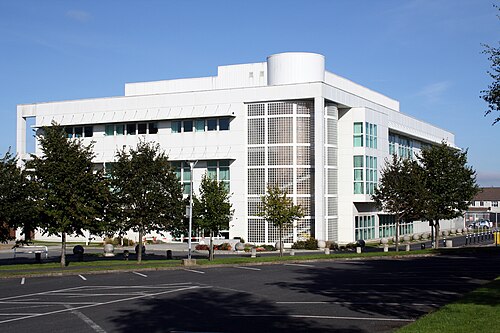
アイルランドの医療は、公的および私的医療提供者の両方によって提供されています。[191]保健大臣は、全体的な医療サービス政策の策定に責任を負っています。アイルランドのすべての居住者は、保健サービス執行部によって管理され、一般税によって資金が賄われる公的医療制度を通じて医療を受ける権利があります。特定の医療を受ける場合、補助金付きの料金を支払う必要がある場合があります。これは、収入、年齢、病気、または障害によって異なります。すべての産科サービスは無料で提供され、生後6か月までの子供は無料です。緊急治療は、病院の救急科を受診した患者に提供されます。ただし、かかりつけ医からの紹介なしで救急科を訪れた非緊急の状況の患者には、100ユーロの料金が発生する場合があります。状況によっては、この料金は支払われないか、免除される場合があります。[192]
欧州健康保険カードを持っている人は、保健サービス局およびボランティア病院の公共ベッドで無料のメンテナンスと治療を受ける権利があります。外来サービスも無料で提供されます。ただし、中間所得以上の患者の大多数は、補助金付きの病院料金を支払う必要があります。民間の健康保険は、利用を希望する人々に提供されます。
2021年のアイルランドの平均寿命は82.4歳(OECDリスト)で、男性は80.5歳、女性は84.3歳でした。[193] [194]アイルランドの出生率はEUで最も高く(1,000人の住民に対して16.8人の出生、EU平均は10.7人)[195] 、乳児死亡率は非常に低くなっています(1,000人の出生に対して3.5人)。Health Consumer Powerhouseが作成した欧州健康消費者指数によると、アイルランドの医療制度は2012年にヨーロッパ34か国中13位にランクされました。[196]同じレポートでは、アイルランドの医療制度はヨーロッパで8番目に優れた健康成果を持つと評価されていますが、最もアクセスしやすいシステムとしては21位に過ぎません。
教育
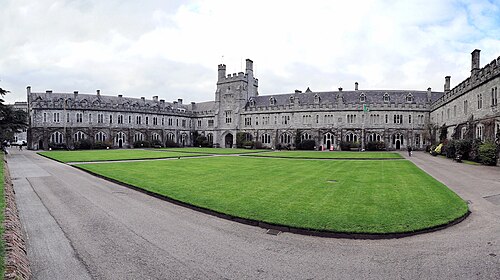
アイルランドには、初等教育、中等教育、高等教育の3つの教育レベルがある。教育制度は、主に教育大臣を通じて政府の指導下にある。認可された初等・中等学校は、関係当局が定めたカリキュラムに従わなければならない。教育は6歳から15歳まで義務教育であり、18歳までのすべての子供は、ジュニアサーティフィケート試験の1回の受験を含む、中等教育の最初の3年間を修了しなければならない。[197]
アイルランドには約3,300校の小学校がある。[198]大多数(92%)はカトリック教会の保護下にある。宗教団体が運営する学校であっても、公的資金と認可を受けている学校は、宗教の有無に基づいて生徒を差別することはできない。認可された優先制度は存在し、学校の定員がすでに達している場合、特定の宗教の生徒は学校の精神を共有しない生徒よりも先に受け入れられることがある。

2年間の勉強の後に受ける卒業証明書は、中等教育制度における最終試験です。高等教育を受けようとする者は通常この試験を受け、第三レベルのコースへのアクセスは一般的に、競争ベースで受講した最も成績の良い6科目の成績によって決まります。[199]第三レベルの教育賞は、少なくとも38の高等教育機関によって授与されます。これには、7つの大学の構成または提携カレッジと、高等教育訓練賞評議会の他の指定機関が含まれます。2022年のUS Newsランキングによると、アイルランドは教育の最高の国トップ20に入っています。[200]
OECDが調整する国際学習到達度調査( PIA )によると、2012年の評価で、アイルランドの読解力はOECD諸国の中で4位、理科は9位、数学は13位となっている。[201] 2012年、アイルランドの15歳の生徒の読解力はEUで2番目に高かった。[202]また、アイルランドには人口1人当たりで世界トップ500の大学が0.747校あり、世界第8位となっている。[203]アイルランドでは、すべてのEU市民に対して初等、中等、高等(大学/カレッジ)レベルの教育がすべて無料である。[204]学生向けサービスと試験には料金がかかる。
さらに、アイルランドの人口の37%が大学または短大の学位を取得しており、これは世界でも最も高い割合の1つです。[205] [206]
宗教
アイルランドでは憲法で宗教の自由が保障されており、同国の憲法は1973年以来世俗的なものとなっている。キリスト教が主要な宗教であり、アイルランドは依然としてカトリック教徒が多数を占める国であるが、国勢調査でカトリック教徒であると自認する人口の割合は、2011年の国勢調査の84.2%から2016年には78.3%、2022年には69%へと大幅に減少した。 [207] [208] 2016年の国勢調査のその他の結果は、プロテスタントが4.2% 、正教会が1.3%、イスラム教徒が1.3%、無宗教が9.8%であった。[209]ジョージタウン大学の研究によると、2000年以前、アイルランドは西洋諸国の中で定期的なミサへの出席率が最も高かった国の一つであった。 [ 210] 2006年の毎日の出席率は13%であったが、週ごとの出席率は1990年の81%から2006年には48%に減少した。しかし、減少率は安定していると報告されている。[211] 2011年には、ダブリンの週ごとのミサ出席率は18%で、若い世代ではさらに低いと報告されている。[212]
.jpg/500px-St._Mary%E2%80%99s_Pro-Cathedral,_Dublin_2023_(2).jpg)

アイルランド国教会は人口の2.7%を占め、キリスト教で2番目に大きい宗派である。20世紀を通じて信者数は減少したが、21世紀初頭には他のキリスト教宗派とともに増加した。その他の重要なプロテスタント宗派には、長老派教会とメソジスト教会がある。移民はヒンズー教徒とイスラム教徒の人口増加に貢献している。パーセンテージで見ると、2006年の国勢調査時点で、正教会とイスラム教はそれぞれ100%と70%の増加で最も急速に増加した宗教であった。[213]
アイルランドの守護聖人は聖パトリック、聖ブリジット、聖コルンバであり、聖パトリックが第一の守護聖人として一般的に認められている。[214] 聖パトリックの日は3月17日にアイルランド国内外でアイルランドの国民の祝日としてパレードやその他の祝賀行事とともに祝われる。
スペインやイタリアなど他の伝統的カトリックのヨーロッパ諸国と同様に、[215]アイルランドは 20 世紀後半に法的世俗化の時期を経た。1972 年、憲法で特定の宗教グループを名指しする条項は国民投票で第 5 修正条項により削除された。憲法には第 44 条が残っている: 「国家は、公の礼拝の敬意は全能の神に捧げられるべきものであることを認める。国家は神の名を崇敬し、宗教を尊重し、敬うものとする。」この条項はまた、宗教の自由を確立し、いかなる宗教への寄付も禁止し、国家による宗教差別を禁止し、宗教学校と非宗教学校を偏見なく扱うことを国家に義務付けている。
アイルランドのほとんどの学校は宗教団体の後援を受けているが、政府の政策により一部の学校は非宗派または多宗派の後援に「移行」されており[216] [217]、若い世代の間では世俗主義の傾向が見られる。[218]
文化
アイルランドの文化は数世紀にわたり主にゲール語が支配的であり、現在でも6つの主要なケルト民族国家の1つである。12世紀のアングロ・ノルマン人の侵入、および16世紀に始まったイギリスによる漸進的な征服と植民地化の後、アイルランドはイングランドとスコットランドの文化の影響を受けるようになった。その後、アイルランド文化は多くの点で独特ではあるものの、他のアングロ圏、カトリックヨーロッパ、および他のケルト地域と特徴を共有している。世界最大かつ最も分散したアイルランド人ディアスポラの1つは、アイルランド文化のグローバル化に貢献し、芸術、音楽、科学の分野で多くの著名人を輩出している。
文学

アイルランドは、英語とアイルランド語の両方で世界文学に多大な貢献をしてきました。近代アイルランド小説は、ジョナサン・スウィフトによる1726年の小説『ガリヴァー旅行記』の出版から始まりました。18世紀のその他の重要な作家とその最も有名な作品には、ローレンス・スターンの『紳士トリストラム・シャンディの生涯と意見』やオリバー・ゴールドスミスの『ウェイクフィールドの牧師』などがあります。19世紀には、マリア・エッジワース、ジョン・バニム、ジェラルド・グリフィン、チャールズ・キックハム、ウィリアム・カールトン、ジョージ・ムーア、サマーヴィルとロスなど、数多くのアイルランドの小説家が登場しました。ブラム・ストーカーは、 1897年の小説『魔人ドラキュラ』の著者として最もよく知られています。
ジェイムズ・ジョイス(1882年 - 1941年)は1922年に最も有名な作品である『ユリシーズ』を出版した。これはダブリンを舞台にした『オデュッセイア』の解釈である。エディス・サマーヴィルは1915年にパートナーのマーティン・ロスが死去した後も執筆を続けた。ダブリンのアニー・MP・スミスソンは1920年代から1930年代にかけて恋愛小説のファンを満足させた数人の作家の一人でした。第二次世界大戦後、人気小説は、とりわけブライアン・オノーラン(フラン・オブライエン、エリザベス・ボーエン、ケイト・オブライエンとして出版)によって出版されました。20世紀最後の数十年間には、エドナ・オブライエン、ジョン・マクガーハーン、メイヴ・ビンチー、ジョセフ・オコナー、ロディ・ドイル、コルム・トービーン、ジョン・バンヴィルが小説家として頭角を現しました。

パトリシア・リンチは20世紀に多作な児童文学作家であり、一方、エオイン・コルファーの作品は21世紀初頭にニューヨーク・タイムズのこのジャンルのベストセラーとなった。 [219]多くのアイルランド人作家が好む形式である短編小説のジャンルでは、ショーン・オファオリン、フランク・オコナー、ウィリアム・トレヴァーなどが著名な人物である。よく知られているアイルランドの詩人には、パトリック・カヴァナー、トーマス・マッカーシー、ダーモット・ボルジャー、ノーベル文学賞受賞者のウィリアム・バトラー・イェイツ、シェイマス・ヒーニー(北アイルランド生まれ、ダブリン在住)がいる。アイルランド語の著名な作家には、パドレイク・オコネール、マーティン・オ・カドハイン、シェイマス・オ・グリアナ、ヌーラ・ニ・ドムネイルがいる。
アイルランド演劇の歴史は、17 世紀初頭のダブリンにおけるイギリス統治の拡大に始まり、それ以来、アイルランドはイギリスの演劇に大きく貢献してきました。初期の歴史では、アイルランドの演劇作品は政治的目的を果たす傾向がありましたが、劇場が増え、一般の観客が増えるにつれて、より多様な娯楽が上演されるようになりました。ダブリンを拠点とする多くの劇場はロンドンの同等の劇場とのつながりを築き、イギリスの作品が頻繁にアイルランドの舞台に上演されました。しかし、ほとんどのアイルランドの劇作家は、地位を確立するために海外に渡りました。18 世紀には、オリバー ゴールドスミスとリチャード ブリンズリー シェリダンが、当時ロンドンの舞台で最も成功した劇作家の 2 人でした。20 世紀初頭には、アイルランドの演劇の上演と、作家、監督、パフォーマーの育成に専念する劇団が出現し始め、多くのアイルランドの劇作家がイギリスやアメリカではなくアイルランドでその技術を学び、名声を確立することができました。オスカー・ワイルド、ノーベル文学賞受賞者のジョージ・バーナード・ショー(1925年)、サミュエル・ベケット(1969年)といった著名な劇作家の伝統を引き継ぎ、ショーン・オケーシー、ブライアン・フリエル、セバスチャン・バリー、ブレンダン・ビーアン、コナー・マクファーソン、ビリー・ロッシュといった劇作家が人気を博した。[220] 20世紀のその他のアイルランドの劇作家には、デニス・ジョンストン、トーマス・キルロイ、トム・マーフィー、ヒュー・レナード、フランク・マクギネス、ジョン・B・キーンがいる。
音楽とダンス
アイルランドの伝統音楽は、文化的勢力のグローバル化にもかかわらず、活気にあふれ、多くの伝統的な側面を保っている。アメリカのカントリーやルーツミュージック、ある程度は現代のロックなど、さまざまな音楽ジャンルに影響を与えてきた。ロックンロールやパンクロックなどのスタイルと融合されることもあった。アイルランドはまた、ロック、ポップ、ジャズ、ブルースなど、他のジャンルでも国際的に知られるアーティストを数多く輩出している。アイルランドで最も売れているミュージシャンはロックバンドのU2で、1976年の結成以来、世界中でアルバムを1億7千万枚売り上げている。[223]
RTÉ Performing Groupsなど、全国に数多くのクラシック音楽アンサンブルがある。[224]アイルランドにはオペラ団体も2つある。ダブリンのアイルランド国立オペラと、あまり知られていないオペラを宣伝する毎年恒例のウェックスフォード・オペラ・フェスティバルで、10月と11月に開催される。
アイルランドは1965年からユーロビジョン・ソング・コンテストに参加している。[225]アイルランドが初めて優勝したのは1970年で、ダナが「All Kinds of Everything」で優勝した。[226]その後も6回優勝しており、[227] [228]これはどの参加国よりも優勝回数が多い。リバーダンスという現象は1994年のコンテストの合間のパフォーマンスから始まった。[229]
アイリッシュ ダンスは、大きく分けて社交ダンスとパフォーマンス ダンスに分けられます。アイリッシュ ダンスは、ケイリーダンスとセット ダンスに分けられます。アイリッシュセット ダンスは、4 組のカップルが正方形に並んで踊るカドリーユですが、ケイリー ダンスは2 人から 16 人のカップルのさまざまなフォーメーションで踊られます。また、これら 2 つの形式には、多くのスタイルの違いがあります。アイリッシュ ダンスは生きた伝統であり、特定のダンスのバリエーションは全国で見受けられます。場所によっては、ダンスが意図的に変更され、新しいダンスが振り付けられます。パフォーマンス ダンスは、伝統的にステップダンスと呼ばれています。ショーRiverdanceによって人気を博したアイリッシュ ステップダンスは、体と腕をほぼ動かさずに、脚を素早く動かすことで知られています。ソロ ステップダンスは、一般的に、制御されているが硬直していない上半身、まっすぐな腕、足の素早い正確な動きが特徴です。ソロ ダンスは、「ソフト シュー」または「ハード シュー」のいずれかで踊ることができます。
建築
アイルランドには、ブルー・ナ・ボーニャ、ポウルナブローネ・ドルメン、キャッスルストレンジ・ストーン、トゥロエ・ストーン、ドロンベグ・ストーンサークルなど、新石器時代の建造物が数多く残っており、 [230]さまざまな保存状態で現存しています。[231]アイルランドはローマ帝国の一部ではなかったため、西ヨーロッパのほとんどの地域とは対照的に、グレコローマン様式の古代建築は非常に稀です。代わりに、この国では鉄器時代の建築が長い期間にわたって行われていました。[232]アイルランドの円塔は中世初期に起源を持ちます。
キリスト教は、クロンマクノイズ、スケリッグ・マイケル、スキャタリー島などの単純な修道院をもたらしました。これらの二重修道院とエジプトのコプト教徒の修道院との間には様式の類似性が指摘されています。 [233]ゲール人の王や貴族は環状要塞またはクラノグに居住しました。[234] 12世紀のシトー会による教会改革は大陸の影響を刺激し、ロマネスク様式のメリフォント、ボイル、ティンターン修道院が建てられました。[235]ゲール人の居住地はケルズなどの修道院の原始的な町に限られており、そこでは現在の通りのパターンがある程度、元の円形の居住地の輪郭を保っています。[236]重要な都市の居住地は、ヴァイキングの侵略の時代以降にのみ発展しました。[234]主要なアイルランド系ノース人のロングフォートは海岸沿いに位置していたが、同名のロングフォードのような小さな内陸の河川沿いの集落もあった。
.jpg/500px-Monasterboice_(52364039739).jpg)
Castles were built by the Anglo-Normans during the late 12th century, such as Dublin Castle and Kilkenny Castle,[237] and the concept of the planned walled trading town was introduced, which gained legal status and several rights by grant of a Charter under Feudalism. These charters specifically governed the design of these towns.[238] Two significant waves of planned town formation followed, the first being the 16th- and 17th-century plantation towns, which were used as a mechanism for the Tudor English kings to suppress local insurgency, followed by 18th-century landlord towns.[239] Surviving Norman founded planned towns include Drogheda and Youghal; plantation towns include Portlaoise and Portarlington; well-preserved 18th-century planned towns include Westport and Ballinasloe. These episodes of planned settlement account for the majority of present-day towns throughout the country.

Gothic cathedrals, such as St Patrick's, were also introduced by the Normans.[240] Franciscans were dominant in directing the abbeys by the Late Middle Ages, while elegant tower houses, such as Bunratty Castle, were built by the Gaelic and Norman aristocracy.[241] Many religious buildings were ruined with the dissolution of the monasteries.[242] Following the Restoration, palladianism and rococo, particularly country houses, swept through Ireland under the initiative of Edward Lovett Pearce, with the Houses of Parliament being the most significant.[243]
With the erection of buildings such as The Custom House, Four Courts, General Post Office and King's Inns, the neoclassical and Georgian styles flourished, especially in Dublin.[243] Georgian townhouses produced streets of singular distinction, particularly in Dublin, Limerick and Cork. Following Catholic Emancipation, cathedrals and churches influenced by the French Gothic Revival emerged, such as St Colman's and St Finbarre's.[243] Ireland has long been associated with thatched roof cottages, though these are nowadays considered quaint.[244]
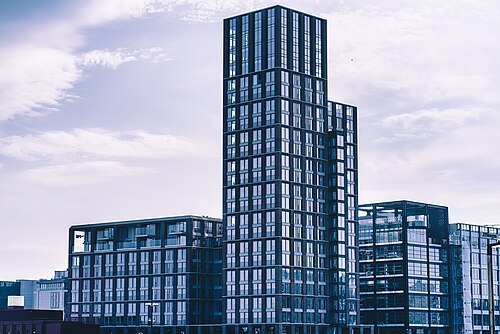
Beginning with the American designed art deco church at Turner's Cross, Cork in 1927, Irish architecture followed the international trend towards modern and sleek building styles since the 20th century.[245] Other developments include the regeneration of Ballymun and an urban extension of Dublin at Adamstown.[246] Since the establishment of the Dublin Docklands Development Authority in 1997, the Dublin Docklands area underwent large-scale redevelopment, which included the construction of the Convention Centre Dublin and Grand Canal Theatre.[247] Completed in 2018, Capital Dock in Dublin is the tallest building in the Republic of Ireland achieving 79 metres (259 feet) in height (the Obel Tower in Belfast, Northern Ireland being the tallest in Ireland). The Royal Institute of the Architects of Ireland regulates the practice of architecture in the state.[248]
Media
Raidió Teilifís Éireann (RTÉ) is Ireland's public service broadcaster, funded by a television licence fee and advertising.[249] RTÉ operates two national television channels, RTÉ One and RTÉ Two. The other independent national television channels are Virgin Media One, Virgin Media Two, Virgin Media Three and TG4, the latter of which is a public service broadcaster for speakers of the Irish language. All these channels are available on Saorview, the national free-to-air digital terrestrial television service.[250] Additional channels included in the service are RTÉ News Now, RTÉjr, and RTÉ One +1. Subscription-based television providers operating in Ireland include Virgin Media and Sky.
The BBC's Northern Irish division is widely available in Ireland. BBC One Northern Ireland and BBC Two Northern Ireland are available in pay television providers including Virgin and Sky as well as via signal overspill by Freeview in border counties.
Supported by the Irish Film Board, the Irish film industry grew significantly since the 1990s, with the promotion of indigenous films as well as the attraction of international productions like Braveheart and Saving Private Ryan.[251]
A large number of regional and local radio stations are available countrywide. A survey showed that a consistent 85% of adults listen to a mixture of national, regional and local stations on a daily basis.[252] RTÉ Radio operates four national stations, Radio 1, 2fm, Lyric fm, and RnaG. It also operates four national DAB radio stations. There are two independent national stations: Today FM and Newstalk.
Ireland has a traditionally competitive print media, which is divided into daily national newspapers and weekly regional newspapers, as well as national Sunday editions. The strength of the British press is a unique feature of the Irish print media scene, with the availability of a wide selection of British published newspapers and magazines.[251]
Eurostat reported that 82% of Irish households had Internet access in 2013 compared to the EU average of 79% but only 67% had broadband access.[253]
Cuisine
.jpg/500px-J'ai_commenc%C3%A9_ma_visite_de_Dublin..._(8777546507).jpg)
Irish cuisine was traditionally based on meat and dairy products, supplemented with vegetables and seafood. Examples of popular Irish cuisine include boxty, colcannon, coddle, stew, and bacon and cabbage. Ireland is known for the full Irish breakfast, which involves a fried or grilled meal generally consisting of rashers, egg, sausage, white and black pudding, and fried tomato. Apart from the influence by European and international dishes, there has been an emergence of a new Irish cuisine based on traditional ingredients handled in new ways.[254] This cuisine is based on fresh vegetables, fish, oysters, mussels and other shellfish, and the wide range of hand-made cheeses that are now being produced across the country. Shellfish have increased in popularity, especially due to the high quality shellfish available from the country's coastline. The most popular fish include salmon and cod. Traditional breads include soda bread and wheaten bread. Barmbrack is a yeasted bread with added sultanas and raisins, traditionally eaten on Halloween.[255]
Popular everyday beverages among the Irish include tea and coffee. Alcoholic drinks associated with Ireland include Poitín and the world-famous Guinness, which is a dry stout that originated in the brewery of Arthur Guinness at St. James's Gate in Dublin. Irish whiskey is also popular throughout the country and comes in various forms, including single malt, single grain, and blended whiskey.[254]
Sports

Gaelic football and hurling are the traditional sports of Ireland as well as popular spectator sports.[256] They are administered by the Gaelic Athletics Association on an all-Ireland basis. Other Gaelic games organised by the association include Gaelic handball and rounders.[257] Association football (soccer) is the third most popular spectator sport and has the highest level of participation.[258] Although the League of Ireland is the national league, the English Premier League is the most popular among the public.[259] The Republic of Ireland national football team plays at international level and is administered by the Football Association of Ireland.[260]
The Irish Rugby Football Union is the governing body of rugby union, which is played at local and international levels on an all-Ireland basis, and has produced players such as Brian O'Driscoll and Ronan O'Gara, who were on the team that won the Grand Slam in 2009.[261] The success of the Irish Cricket Team in the 2007 Cricket World Cup has led to an increase in the popularity of cricket, which is also administered on an all-Ireland basis by Cricket Ireland.[262] Ireland are one of the twelve Test playing members of the International Cricket Council, having been granted Test status in 2017. Professional domestic matches are played between the major cricket unions of Leinster, Munster, Northern, and North West. Netball is represented by the Ireland national netball team.
Golf is another popular sport in Ireland, with over 300 courses countrywide.[263] The country has produced several internationally successful golfers, such as Pádraig Harrington, Shane Lowry and Paul McGinley. Horse racing has a large presence, with influential breeding and racing operations in the country. Racing takes place at courses at The Curragh Racecourse in County Kildare, Leopardstown Racecourse just outside Dublin, and Galway. Ireland has produced champion horses such as Galileo, Montjeu, and Sea the Stars. Boxing is Ireland's most successful sport at an Olympic level. Administered by the Irish Athletic Boxing Association on an all-Ireland basis, it has gained in popularity as a result of the international success of boxers such as Bernard Dunne, Andy Lee and Katie Taylor.
Some of Ireland's highest performers in athletics have competed at the Olympic Games, such as Eamonn Coghlan and Sonia O'Sullivan. The annual Dublin Marathon and Dublin Women's Mini Marathon are two of the most popular athletics events in the country.[264] Rugby league is represented by the Ireland national rugby league team and administered by Rugby League Ireland (who are full member of the Rugby League European Federation) on an all-Ireland basis. The team compete in the European Cup (rugby league) and the Rugby League World Cup. Ireland reached the quarter-finals of the 2000 Rugby League World Cup as well as reaching the semi-finals in the 2008 Rugby League World Cup.[265] The Irish Elite League is a domestic competition for rugby league teams in Ireland.[266]
While Australian rules football in Ireland has a limited following, a series of International rules football games (constituting a hybrid of the Australian and Gaelic football codes) takes place annually between teams representing Ireland and Australia.[267] Baseball and basketball are also emerging sports in Ireland, both of which have an international team representing the island of Ireland. Other sports which retain a following in Ireland include cycling, greyhound racing, horse riding, and motorsport.
Society
Ireland ranks fifth in the world in terms of gender equality.[268] In 2011, Ireland was ranked the most charitable country in Europe, and second most charitable in the world.[269] Contraception was controlled in Ireland until 1979, however, the receding influence of the Catholic Church has led to an increasingly secularised society.[270] A constitutional ban on divorce was lifted following a referendum in 1995. Divorce rates in Ireland are very low compared to European Union averages (0.7 divorced people per 1,000 population in 2011) while the marriage rate in Ireland is slightly above the European Union average (4.6 marriages per 1,000 population per year in 2012). Abortion had been banned throughout the period of the Irish state, first through provisions of the Offences Against the Person Act 1861 and later by the Protection of Life During Pregnancy Act 2013. The right to life of the unborn was protected in the constitution by the Eighth Amendment in 1983; this provision was removed following a referendum, and replaced it with a provision allowing legislation to regulate the termination of pregnancy. The Health (Regulation of Termination of Pregnancy) Act 2018 passed later that year provided for abortion generally during the first 12 weeks of pregnancy, and in specified circumstances after that date.[271]
Capital punishment is constitutionally banned in Ireland, while discrimination based on age, gender, sexual orientation, marital or familial status, religion, race or membership of the travelling community is illegal. The legislation which outlawed homosexual acts was repealed in 1993.[272][273] The Civil Partnership and Certain Rights and Obligations of Cohabitants Act 2010 permitted civil partnerships between same-sex couples.[274][275][276] The Children and Family Relationships Act 2015 allowed for adoption rights for couples other than married couples, including civil partners and cohabitants, and provided for donor-assisted human reproduction; however, significant sections of the Act have yet to be commenced.[277] Following a referendum held on 23 May 2015, Ireland became the eighteenth country to provide in law for same-sex marriage, and the first to do so by popular vote.[278]
Ireland became the first country in the world to introduce an environmental levy for plastic shopping bags in 2002 and a public smoking ban in 2004. Recycling in Ireland is carried out extensively, and Ireland has the second highest rate of packaging recycling in the European Union. It was the first country in Europe to ban incandescent lightbulbs in 2008 and the first EU country to ban in-store tobacco advertising and product display in 2009.[279][280] In 2015, Ireland became the second country in the world to introduce plain cigarette packaging.[281] Despite the above measures to discourage tobacco use, smoking rates in Ireland remain at approximately 15.4% as of 2020.[282]
State symbols

The state shares many symbols with the island of Ireland. These include the colours green and blue, animals such as the Irish wolfhound and stags, structures such as round towers and celtic crosses, and designs such as Celtic knots and spirals. The shamrock, a type of clover, has been a national symbol of Ireland since the 17th century when it became customary to wear it as a symbol on St. Patrick's Day. These symbols are used by state institutions as well as private bodies in the Republic of Ireland.
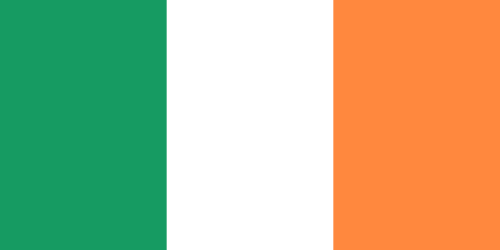
The flag of Ireland is a tricolour of green, white and orange. The flag originates with the Young Ireland movement of the mid-19th century but was not popularised until its use during the Easter Rising of 1916.[283] The colours represent the Gaelic tradition (green) and the followers of William of Orange in Ireland (orange), with white representing the aspiration for peace between them.[284] It was adopted as the flag of the Irish Free State in 1922 and continues to be used as the sole flag and ensign of the state. A naval jack, a green flag with a yellow harp, is set out in Defence Forces Regulations and flown from the bows of warships in addition to the national flag in limited circumstances (e.g. when a ship is not underway). It is based on the unofficial green ensign of Ireland used in the 18th and 19th centuries and the traditional green flag of Ireland dating from the 16th century.[285]
Like the national flag, the national anthem, Amhrán na bhFiann (English: A Soldier's Song), has its roots in the Easter Rising, when the song was sung by the rebels. Although originally published in English in 1912,[286] the song was translated into Irish in 1923 and the Irish-language version is more commonly sung today.[286] The song was officially adopted as the anthem of the Irish Free State in 1926 and continues as the national anthem of the state.[287] The first four bars of the chorus followed by the last five comprise the presidential salute.
The arms of Ireland originate as the arms of the monarchs of Ireland and was recorded as the arms of the King of Ireland in the 12th century. From the union of the crowns of England, Scotland and Ireland in 1603, they have appeared quartered on the royal coat of arms of the United Kingdom. Today, they are the personal arms of the president of Ireland whilst he or she is in office and are flown as the presidential standard. The harp symbol is used extensively by the state to mark official documents, Irish coinage and on the seal of the president of Ireland.
See also
.svg/500px-Europe_(orthographic_projection).svg.png)
Notes
- ^ a b Article 4 of the Constitution of Ireland declares that the name of the state is Ireland; Section 2 of the Republic of Ireland Act 1948 declares that Republic of Ireland is "the description of the State".[288]
- ^ Article 8 of the Constitution states that Irish is "the national language" and "the first official language", and that English is "a second official language".
- ^ Prior to 2002, Ireland used the Irish pound as its circulated currency. The euro was introduced as an accounting currency in 1999.
- ^ The .eu domain is also used, as it is shared with other European Union member states.
References
- ^ "Article 8, Constitution of Ireland". Irish Statute Book. Archived from the original on 23 April 2022. Retrieved 4 February 2022.
- ^ "Population Usually Resident and Present in the State". Central Statistics Office. 30 May 2023. Retrieved 2 June 2023.
- ^ a b "Population Usually Resident and Present in the State". CSO.ie. Central Statistics Office. 30 May 2023. Retrieved 2 June 2023.
- ^ a b "Key Findings – Population and Migration Estimates, April 2023". CSO. 25 September 2023.
- ^ "Remote work up, Catholic numbers down in Census data". rte.ie. 30 May 2023. Archived from the original on 30 May 2023.
- ^ a b c d "World Economic Outlook Database, April 2024 Edition. (Ireland)". imf.org. International Monetary Fund. 16 April 2024. Retrieved 16 April 2024.
- ^ "Gini coefficient of equivalised disposable income – EU-SILC survey". ec.europa.eu. Eurostat. Retrieved 3 September 2023.
- ^ "Human Development Report 2023/24" (PDF). United Nations Development Programme. 13 March 2024. p. 288. Retrieved 13 March 2024.
- ^ "Census Mapping: Dublin City and its Suburbs". Central Statistics Office. 21 September 2023. Archived from the original on 26 September 2023. Retrieved 22 September 2023.
- ^ L. Prakke; C. A. J. M. Kortmann; J. C. E. van den Brandhof (2004), Constitutional Law of 15 EU Member States, Deventer: Kluwer, p. 429, ISBN 9013012558,
Since 1937 Ireland has been a parliamentary republic, in which ministers appointed by the president depend on the confidence of parliament
- ^ "Inequality-adjusted Human Development Index". Retrieved 8 September 2022.
- ^ "Human Development Report 2020" (PDF). HDRO (Human Development Report Office) United Nations Development Programme. p. 343. Archived (PDF) from the original on 15 December 2020. Retrieved 29 January 2022.
- ^ Henry, Mark (2021). In Fact An Optimist's Guide to Ireland at 100. Dublin: Gill Books. ISBN 978-0-7171-9039-3. OCLC 1276861968. Archived from the original on 25 August 2022. Retrieved 29 January 2022.
- ^ "NATO – Member countries". NATO. Archived from the original on 24 September 2011. Retrieved 29 December 2014.
- ^ "Ireland is world's eighth-most 'inclusive' advanced economy". The Irish Times. Retrieved 15 February 2023.
- ^ "Country Comparison: GDP – per capita (PPP)". The World Factbook. Central Intelligence Agency. Archived from the original on 19 November 2011. Retrieved 29 August 2011.
- ^ "'Leprechaun Economics' Earn Ireland Ridicule, $443 Million Bill". Bloomberg L.P. 13 July 2016. Archived from the original on 14 July 2016. Retrieved 1 January 2021.
- ^ Gabriel Zucman; Thomas Torslov; Ludvig Wier (June 2018). "The Missing Profits of Nations". National Bureau of Economic Research, Working Papers. p. 31. Archived from the original on 10 June 2018. Retrieved 1 January 2021.
Appendix Table 2: Tax Havens
- ^ "Ireland is the world's biggest corporate 'tax haven', say academics". The Irish Times. 13 June 2018. Archived from the original on 28 December 2022. Retrieved 1 January 2021.
New Gabriel Zucman study claims State shelters more multinational profits than the entire Caribbean
- ^ Nicoll, Ruaridh (16 May 2009). "Ireland: As the Celtic Tiger roars its last". The Guardian. London. Archived from the original on 6 September 2013. Retrieved 30 March 2010.
- ^ "Doing the maths: how real is Ireland's economic growth?". Irish Independent. 3 January 2016.
- ^ "Where does the name Ireland come from?". IrishCentral.com. 26 August 2021. Archived from the original on 2 September 2021. Retrieved 13 September 2021.
- ^ Coleman, Marie (2013). The Irish Revolution, 1916–1923. Routledge. p. 230. ISBN 978-1317801467. Archived from the original on 9 December 2021. Retrieved 12 February 2015.
- ^ Gallagher, Michael, "The changing constitution", in Gallagher, Michael; Coakley, John, eds. (2010). Politics in the Republic of Ireland. 0415476712. ISBN 978-0415476713. Archived from the original on 9 December 2021. Retrieved 12 February 2015.
- ^ Oliver, J.D.B., What's in a Name, in Tiley, John, ed. (2004). Studies in the History of Tax Law. Hart Publishing. pp. 181–3. ISBN 1841134732. Archived from the original on 1 January 2016. Retrieved 12 February 2015. Note: the author uses "Éire", with the diacritic.
- ^ Oliver (2004), p. 178; Daly (2007), p. 80
- ^ a b c Daly, Mary E. (2007). "The Irish Free State/Éire/Republic of Ireland/Ireland: "A Country by Any Other Name"?". Journal of British Studies. 46 (1): 72–90. doi:10.1086/508399. ISSN 0021-9371.
- ^ Acciano, Reuben (2005). Western Europe. Lonely Planet. p. 616. ISBN 1740599276. Archived from the original on 9 December 2021. Retrieved 12 February 2015.
- ^ Smith, M.L.R (2002). Fighting for Ireland?: The Military Strategy of the Irish Republican Movement. Routledge. p. 2. ISBN 1134713975. Archived from the original on 9 December 2021. Retrieved 12 February 2015.
- ^ McGreevy, Ronan (24 February 2020). "Why Sinn Féin will not call the State by its name". The Irish Times. Archived from the original on 25 August 2022. Retrieved 24 August 2022.
- ^ "Dáil Éireann debate – Irish Nationality and Citizenship Bill, 1999". Oireachtas. 13 April 2000. Archived from the original on 25 August 2022. Retrieved 24 August 2022.
- ^ Mokyr, Joel (1984). "New Developments in Irish Population History 1700–1850" (PDF). Irish Economic and Social History. XI: 101–121. hdl:10197/1406. Archived (PDF) from the original on 24 September 2019. Retrieved 19 September 2019.
- ^ "Population of Ireland 1841–2011". CSO. Archived from the original on 6 September 2018. Retrieved 6 September 2018.
- ^ Johnston, Wesley; Abbot, Patrick. "Prelude to the Irish Famine – Demographics". Wesleyjohnston.com. Archived from the original on 7 July 2019. Retrieved 6 September 2018.
- ^ "Population Change and Historical Perspective" (PDF). CSO. Archived (PDF) from the original on 17 April 2019. Retrieved 6 September 2018.
- ^ Bardon, Jonathan (1992). A History of Ulster. Blackstaff Press. pp. 402, 405. ISBN 0856404985.
- ^ Coogan, Tim Pat (2009). Ireland in the 20th Century. Random House. pp. 127–128. ISBN 9781407097213. Archived from the original on 5 July 2021. Retrieved 19 November 2020.
- ^ "Irish Soldiers in the First World War". 1916 Commemorations. Department of the Taoiseach. 2010. Archived from the original on 10 August 2011. Retrieved 29 August 2011.
- ^ Hennessy, Dave. "The Hay Plan & Conscription in Ireland During WW1". Waterford County Museum. Archived from the original on 25 December 2018. Retrieved 6 September 2018.
- ^ "Dáil Éireann debates, 7 January 1922: Debate on Treaty". Oireachtas. Archived from the original on 28 September 2019. Retrieved 28 September 2019.
- ^ "Northern Ireland Parliamentary Report, 7 December 1922". Stormontpapers.ahds.ac.uk. 7 December 1922. Archived from the original on 15 April 2016. Retrieved 9 July 2009.
- ^ Ward, Brian (25 October 2018). "Literature of the Irish Civil War". oxfordbibliographies. Oxford University Press. doi:10.1093/OBO/9780199846719-0149. Archived from the original on 27 April 2021. Retrieved 27 April 2021.
- ^ Coogan, Tim Pat (1993). "21 de Valera Stands Tall". De Valera: Long Fellow, Long Shadow. Head of Zeus. ISBN 9781784975371. Archived from the original on 20 March 2021. Retrieved 19 November 2020.
- ^ "Dáil Éireann – Volume T – 19 December, 1921 (Debate on Treaty)". Dáil Éireann. Archived from the original on 21 July 2011.
- ^ "Constitution of Ireland, 1 July, 1937". Irish Statute Book. Archived from the original on 3 May 2019. Retrieved 6 September 2018.
- ^ T. Garvin, 1922: the birth of Irish democracy, Gill & Macmillan: Dublin, 2005.
Cottrell, Peter (2008). The Irish Civil War 1922–23. Osprey Publishing. p. 85. ISBN 978-1-84603-270-7.Irish voters approved a new constitution, Bunreacht na hÉireann, in 1937 renaming the country Éire or simply Ireland.
Whelan, Darius (June 2005). "Guide to Irish Law". Archived from the original on 5 September 2009. Retrieved 11 September 2009.This Constitution, which remains in force today, renamed the state Ireland (Article 4) and established four main institutions – the President, the Oireachtas (Parliament), the Government and the Courts.
John T. Koch, Celtic culture: a historical encyclopedia, ABC-CLIO: Santa Barbara, 2006. - ^ Daly, Mary E. (January 2007). "The Irish Free State/Éire/Republic of Ireland/Ireland: "A Country by Any Other Name"?". Journal of British Studies. 46 (1): 72–90. doi:10.1086/508399. ISSN 0021-9371. JSTOR 10.1086/508399.
After the enactment of the 1936 External Relations Act and the 1937 Constitution, Ireland's only remaining link with the crown had been the accreditation of diplomats. The president of Ireland was the head of state. When opposition deputies asked de Valera whether Ireland was a republic—a favorite pastime in the mid-1940s—he tended to resort to dictionary definitions showing that Ireland had all the attributes of a republic.
- ^ Girvin, Brian (2007). The Emergency: Neutral Ireland 1939–45. Pan. ISBN 9780330493291.
- ^ The Republic of Ireland Act 1948 (Commencement) Order 1949 (S.I. No. 27 of 1949). Signed on 4 February 1949. Statutory Instrument of the Government of Ireland. Retrieved from Irish Statute Book.
- ^ Whyte, J. H. (2010). "Economic crisis and political cold war, 1949-57". In Hill, J. R. (ed.). A New History of Ireland. Vol. VII: Ireland, 1921–84. Oxford University Press. p. 277 (footnote 20). ISBN 978-0191615597. Archived from the original on 15 November 2019. Retrieved 6 August 2019.
The Republic of Ireland Act, 1948...repealed the external relations act, and provided for the declaration of a republic, which came into force on 18 Apr. 1949, when Ireland left the commonwealth.
- ^ "Statute Law Revision (Pre-Union Irish Statutes) Act, 1962". Irish Statute Book. Archived from the original on 5 September 2018. Retrieved 6 September 2018.
- ^ "Ireland at the UN". Irish Independent. 22 August 2010. Archived from the original on 16 July 2014. Retrieved 12 November 2010.
- ^ "Ireland's UN affairs". Irish Independent. 26 June 2010. Archived from the original on 16 July 2014. Retrieved 12 November 2010.
- ^ "National Archives – Ireland and European Unity". Nationalarchives.ie. Archived from the original on 1 January 2011. Retrieved 12 November 2010.
- ^ "Joining the European Community". European Commission. 31 July 1961. Archived from the original on 6 June 2016. Retrieved 12 November 2010.
- ^ O'Toole, Francis; Warrington. "Taxations And savings in Ireland" (PDF). Trinity Economic Papers Series. Trinity College Dublin. p. 19. Archived (PDF) from the original on 24 June 2008. Retrieved 17 June 2008.
- ^ "National Income and Expenditure 2017 (Figure 1.1 Growth Rates)". CSO. Archived from the original on 6 September 2018. Retrieved 6 September 2018.
- ^ The United Kingdom's exit from and new partnership with the European Union. Cm 9417 (Report). HM Government. February 2017.
- ^ "History of Forestry in Ireland" Archived 30 January 2019 at the Wayback Machine. Teagasc.
- ^ Native Species Archived 9 April 2022 at the Wayback Machine. Tree Council of Ireland.
- ^ "History of Forestry in Ireland". Archived from the original on 11 January 2012. Retrieved 15 June 2011.
- ^ a b "Forest Statistics – Ireland 2017" (PDF). Department of Agriculture, Food and the Marine. pp. 3, 63. Archived from the original (PDF) on 20 October 2019. Retrieved 29 January 2019.
- ^ "Native trees cover just 2% of Ireland. How can this be increased?" Archived 4 March 2020 at the Wayback Machine. The Irish Times, 6 July 2018. Retrieved 29 January 2019.
- ^ "Ireland's native woodlands are quietly disappearing" Archived 16 February 2019 at the Wayback Machine. The Irish Times, 19 June 2018. Retrieved 29 January 2019.
- ^ "Forestry – Did you know?". coillte.ie. Coillte. Archived from the original on 9 April 2020. Retrieved 3 December 2019.
Ireland has an ideal climate for forestry with one of the fastest growth rates of trees in Europe
- ^ "Hedgerows". Archived from the original on 26 July 2011. Retrieved 15 June 2011.
- ^ Dinerstein, Eric; et al. (2017). "An Ecoregion-Based Approach to Protecting Half the Terrestrial Realm". BioScience. 67 (6): 534–545. doi:10.1093/biosci/bix014. ISSN 0006-3568. PMC 5451287. PMID 28608869.
- ^ "Agriculture in Ireland". Teagasc.ie. Archived from the original on 4 October 1999. Retrieved 12 November 2010.
- ^ "Land cover and land use". Environmental Protection Agency. 2000. Archived from the original on 16 September 2008. Retrieved 30 July 2007.
- ^ a b c d "Ireland". The World Factbook. Central Intelligence Agency. Archived from the original on 9 January 2021. Retrieved 28 August 2011.
- ^ a b "Climate in Ireland". Met.ie. Archived from the original on 9 February 2010. Retrieved 22 October 2009.
- ^ "The Ireland Climate and What to Wear". TravelInIreland.com. Archived from the original on 19 September 2009. Retrieved 22 October 2009.
- ^ "Temperature in Ireland". Met.ie. Archived from the original on 28 February 2018. Retrieved 22 October 2009.
- ^ "Wind over Ireland". Met.ie. Archived from the original on 8 May 2008. Retrieved 22 October 2009.
- ^ "Sunshine and Solar Radiation". Met.ie. Archived from the original on 22 January 2018. Retrieved 22 January 2018.
- ^ Article 15.2 of the Constitution of Ireland.
- ^ "Office of the President – Powers and Functions". Archived from the original on 7 April 2015. Retrieved 4 January 2011.
- ^ "President Michael D promises seven years of new ideas". Irish Independent. 11 November 2011. Archived from the original on 9 March 2013. Retrieved 11 November 2011.
- ^ McGrath, Conor; O'Malley, Eoin (2007). Conor McGrath, Eoin O'Malley (ed.). Irish political studies reader: key contributions. Routledge. p. 54. ISBN 978-0-415-44648-8. Archived from the original on 5 July 2021. Retrieved 15 March 2011.
- ^ Electoral Act 1992, s. 33: Maximum duration of Dáil (No. 23 of 1992, s. 33). Enacted on 5 November 1992. Act of the Oireachtas. Retrieved from Irish Statute Book.
- ^ a b Local Government Reform Act 2014 (No. 1 of 2014). Enacted on 27 January 2014. Act of the Oireachtas. Retrieved from Irish Statute Book.
- ^ "Constitution of Ireland – The Courts – Article 34.1". irishstatutebook.ie. Attorney General. Archived from the original on 3 May 2019. Retrieved 28 July 2020.
Justice shall be administered in courts [...] and, save in such special and limited cases as may be prescribed by law, shall be administered in public
- ^ Craven-Barry, Clare (2019). "Transparency in Family And Child Law Proceedings: Disentangling The Statutory Techniques And Terminology" (PDF). Irish Judicial Studies Journal. 3. Archived (PDF) from the original on 28 July 2020. Retrieved 28 July 2020.
- ^ "Poll: Should the Garda Síochána be armed?". TheJournal.ie. 4 July 2011. Archived from the original on 22 September 2021. Retrieved 20 November 2012.
- ^ "The Defence Forces". Rdf.ie. Archived from the original on 6 June 2009. Retrieved 12 November 2010.
- ^ "Irish citizenship through birth or descent". Citizens Information. Archived from the original on 12 November 2010. Retrieved 12 November 2010.
- ^ "Irish Nationality and Citizenship Act 1956". Law Reform Commission.
- ^ See Michael J. Geary, An Inconvenient Wait: Ireland's Quest for Membership of the EEC, 1957–73 (Institute of Public Administration, 2009) (ISBN 978-1-904541-83-7)
- ^ "Official Journal of the European Union". Archived from the original on 7 April 2013. Retrieved 12 November 2010.
- ^ "Ireland and the United Nations". Archived from the original on 14 April 2010. Retrieved 15 July 2010.
- ^ Kennedy, Michael (8 October 2014). "Ireland's Role in Post-War Transatlantic Aviation and Its Implications for the Defence of the North Atlantic Area". Royal Irish Academy. Archived from the original on 17 November 2007. Retrieved 10 October 2007.
- ^ Irish Times, 28 December 2007 p. 1 Archived 7 July 2012 at the Wayback Machine.
- ^ "Private Members' Business. – Foreign Conflicts: Motion (Resumed) – Dáil Éireann (29th Dáil)". Houses of the Oireachtas. 30 January 2003. Archived from the original on 11 May 2011. Retrieved 15 July 2022. – Tony Gregory speaking in Dáil Éireann
- ^ Smyth, Patrick (29 November 1999). "State joins Partnership for Peace on Budget day". The Irish Times. Archived from the original on 3 September 2015. Retrieved 6 May 2008.
- ^ "Signatures of Partnership for Peace Framework Document". NATO website. 21 April 2008. Archived from the original on 20 March 2021. Retrieved 6 May 2008.
- ^ Gilland 2001, p. 143.
- ^ "Minister for Defence, Mr. Willie O'Dea TD secures formal Cabinet approval today for Ireland's participation in an EU Battlegroup". Department of Defense. Archived from the original on 19 November 2007. Retrieved 26 August 2008.
- ^ Lally, Conor (25 November 2009). "Numbers in Defence Forces hit 40-year low". The Irish Times. Archived from the original on 3 September 2015. Retrieved 12 November 2010.
- ^ "Written Replies Nos. 437 to 450 – Defence Forces Reserve". Houses of the Oireachtas. 13 January 2016. Archived from the original on 11 October 2017. Retrieved 27 July 2016.
- ^ United States. National Archives and Records Administration, United States. Office of the Federal Register (1996). Weekly compilation of Presidential documents, Volume 32, Issue 2. Office of the Federal Register, National Archives and Records Service, General Services Administration. p. 1050. Archived from the original on 5 July 2021. Retrieved 29 August 2012.
- ^ "Defence Forces". citizensinformation.ie. Citizens Information Board. Archived from the original on 29 July 2020. Retrieved 28 July 2020.
- ^ "Chapter XXVI: Disarmament – No. 9 Treaty on the Prohibition of Nuclear Weapons". United Nations Treaty Collection. 7 July 2017. Archived from the original on 6 August 2019. Retrieved 17 September 2019.
- ^ "Ireland named best country for high-value FDI for sixth year in a row". The Irish Times. 31 August 2017. Archived from the original on 1 April 2019. Retrieved 11 April 2018.
- ^ "Press Statement Macroeconomic Releases Year 2016 and Quarter 1 2017 – CSO – Central Statistics Office". cso.ie. Archived from the original on 21 August 2018. Retrieved 21 August 2018.
- ^ "Modified Gross National Income – CSO – Central Statistics Office". Archived from the original on 21 August 2018. Retrieved 21 August 2018.
- ^ "IRELAND Trade and Statistical Note 2017" (PDF). OECD. 2017. Archived (PDF) from the original on 10 April 2018. Retrieved 11 April 2018.
- ^ "20 multinationals paid half of all Corporation tax paid in 2016". RTÉ News. 21 June 2017. Archived from the original on 21 June 2017. Retrieved 11 April 2018.
- ^ "Most of Ireland's huge corporate tax haul last year came from foreign firms". sunday Business Post FORA. 14 May 2016. Archived from the original on 17 May 2017. Retrieved 11 April 2018.
- ^ "An Analysis of 2015 Corporation Tax Returns and 2016 Payments" (PDF). Revenue Commissioners. April 2017. Archived (PDF) from the original on 28 November 2017. Retrieved 14 April 2018.
- ^ a b "Ireland's Top 1000 Companies". The Irish Times. 2018. Archived from the original on 17 September 2019. Retrieved 11 April 2018.
- ^ "Winning FDI 2015–2019 Strategy". IDA Ireland. March 2015. Archived from the original on 15 September 2017. Retrieved 11 April 2018.
- ^ "IDA Ireland Competitiveness". IDA Ireland. March 2018. Archived from the original on 5 April 2018. Retrieved 11 April 2018.
- ^ "Croatia set to join the euro area on 1 January 2023: Council adopts final required legal acts". consilium.europa.eu. Archived from the original on 25 July 2022. Retrieved 31 December 2022.
- ^ Fottrell, Quentin (30 June 2010). "Ireland Officially Exits Recession". The Wall Street Journal. Archived from the original on 5 April 2015. Retrieved 30 June 2011.
- ^ "Ireland to receive €85 billion bailout at 5.8% interest rate". The Irish Times. 28 November 2010. Archived from the original on 18 May 2013. Retrieved 30 June 2011.
- ^ "Irish economy grew by 0.9% in 2012 – CSO". Raidió Teilifís Éireann. 21 March 2013. Archived from the original on 3 December 2013. Retrieved 30 May 2013.
- ^ Crosbie, Judith (26 June 2013). "Irish anti-immigrant attitudes growing, report shows". The Irish Times. Archived from the original on 12 December 2013. Retrieved 6 December 2013.
- ^ "Monthly Unemployment March 2016 – CSO – Central Statistics Office". cso.ie. 5 April 2016. Archived from the original on 31 July 2017. Retrieved 30 July 2017.
- ^ a b "One Irish person emigrates every six minutes". Financial Times. London. 29 August 2010. Archived from the original on 14 April 2014. Retrieved 2 May 2015.
- ^ "Monthly Unemployment November 2022 – CSO – Central Statistics Office". CSO. 30 November 2022. Archived from the original on 8 December 2022. Retrieved 31 December 2022.
- ^ McDonald, Henry (13 December 2013). "Ireland becomes first country to exit eurozone bailout programme". The Guardian. London. Archived from the original on 20 July 2017. Retrieved 30 July 2017.
- ^ "Republic of Ireland raises €3.75 billion from sale of new 10-year benchmark bond". cbonds.com. Archived from the original on 25 May 2017. Retrieved 2 February 2017.
- ^ Boland, Vincent (10 July 2017). "Irish government debt four times pre-crisis level, NTMA says". Financial Times. London. Archived from the original on 11 October 2017. Retrieved 11 April 2018.
- ^ "42% of Europe's banking crisis paid by Ireland". 16 January 2013. Archived from the original on 18 January 2013. Retrieved 11 April 2018.
- ^ "Who owes more money – the Irish or the Greeks?". The Irish Times. 4 June 2015. Archived from the original on 31 July 2019. Retrieved 11 April 2018.
- ^ "Why do the Irish still owe more than the Greeks?". The Irish Times. 7 March 2017. Archived from the original on 7 July 2019. Retrieved 11 April 2018.
- ^ "Ireland's colossal level of indebtedness leaves any new government with precious little room for manoeuvre". Irish Independent. 16 April 2016. Archived from the original on 16 November 2018. Retrieved 11 April 2018.
- ^ "Irish public debt levels 4th highest in EU28 June 2017 FAR Slide 7" (PDF). Irish Fiscal Advisory Council. June 2017. Archived (PDF) from the original on 23 October 2017. Retrieved 11 April 2018.
- ^ "Irish household debt still amongst the highest in Europe". The Irish Times. 11 September 2017. Archived from the original on 16 November 2018. Retrieved 11 April 2018.
- ^ "Net National debt now €44000 per head, 2nd highest in the World". Irish Independent. 7 July 2017. Archived from the original on 14 November 2019. Retrieved 11 April 2018.
- ^ "Tracking Tax Runaways". Bloomberg News. 1 March 2017. Archived from the original on 17 June 2020. Retrieved 11 April 2018.
- ^ "Pfizer pulls out of €140bn Irish Allergan merger". Irish Independent. 6 April 2016. Archived from the original on 8 July 2018. Retrieved 11 April 2018.
- ^ "Dermot Desmond on the IFSC past and future". Finance Dublin. 2003. Archived from the original on 23 March 2018. Retrieved 11 April 2018.
- ^ "History of the Irish Corporate Tax System" (PDF). Ernst and Young. 2014. Archived (PDF) from the original on 10 October 2018. Retrieved 11 April 2018.
- ^ "Report on Ireland's Relationship with Global Corporate Taxation Architecture" (PDF). Department of Finance. 2014. Archived (PDF) from the original on 9 May 2018. Retrieved 11 April 2018.
- ^ "CSO paints a very different picture of Irish economy with new measure". The Irish Times. 15 July 2017. Archived from the original on 21 January 2019. Retrieved 12 April 2018.
- ^ "New economic Leprechaun on loose as rate of growth plunges". Irish Independent. 15 July 2017. Archived from the original on 25 October 2019. Retrieved 12 April 2018.
- ^ "ESRG Presentation and CSO Response" (PDF). Central Statistics Office. 4 February 2017. Archived (PDF) from the original on 5 December 2017. Retrieved 12 April 2018.
- ^ "Leprechaun-proofing economic data". RTÉ News. 4 February 2017. Archived from the original on 4 February 2017. Retrieved 12 April 2018.
- ^ "Report on the ESRG Review Group on GNI*". Central Statistics Office (Ireland). February 2017. Archived from the original on 30 March 2017. Retrieved 15 April 2018.
- ^ a b "Crisis Recovery in a Country with a High Presence of Foreign Owned Companies" (PDF). IMK Institute, Berlin. January 2017. Archived (PDF) from the original on 19 February 2017. Retrieved 11 April 2018.
- ^ "ESRI – Irish Economy". Esri.ie. Archived from the original on 24 June 2011. Retrieved 30 June 2011.
- ^ "Irish Banks continue to grow deposits as loan books shrink". Irish Examiner. December 2012. Archived from the original on 12 April 2018. Retrieved 11 April 2018.
- ^ "Ireland Financial System Stability Assessment 2016" (PDF). International Monetary Fund. July 2016. Archived (PDF) from the original on 29 March 2017. Retrieved 11 April 2018.
- ^ "Ireland named world's 6th worst corporate tax haven". journal.ie. 12 December 2016. Archived from the original on 26 March 2018. Retrieved 11 April 2018.
- ^ "The United States' new view of Ireland: 'tax haven'". The Irish Times. January 2017. Archived from the original on 9 April 2018. Retrieved 11 April 2018.
- ^ "Europe points finger at Ireland over tax avoidance". The Irish Times. 7 March 2018. Archived from the original on 7 March 2018. Retrieved 11 April 2018.
- ^ "Blacklisted by Brazil, Dublin funds find new ways to invest". Reuters. 20 March 2017. Archived from the original on 14 June 2018. Retrieved 11 April 2018.
- ^ "Oregon Department of Revenue made a recommendation that Ireland be included as a 'listed jurisdiction' or tax haven". Irish Independent. 26 March 2017. Archived from the original on 14 June 2018. Retrieved 11 April 2018.
- ^ "Trump's US tax reform a significant challenge for Ireland". The Irish Times. 30 November 2017. Archived from the original on 25 June 2018. Retrieved 11 April 2018.
- ^ "US corporations could be saying goodbye to Ireland". The Irish Times. 17 January 2018. Archived from the original on 9 April 2018. Retrieved 4 July 2021.
- ^ "Donald Trump singles out Ireland in tax speech". The Irish Times. 29 November 2017. Archived from the original on 3 April 2018. Retrieved 11 April 2018.
- ^ "Breaking Down the New U.S. Corporate Tax Law". Harvard Business Review. 26 December 2017. Archived from the original on 22 July 2018. Retrieved 11 April 2018.
- ^ "MEPs approve new EU corporate tax plan which embraces 'digital presence'". European Parliament. 15 March 2018. Archived from the original on 16 March 2018. Retrieved 11 April 2018.
- ^ "What the EU's new taxes on the tech giants mean – and how they would hurt Ireland". TheJournal.ie. 24 March 2018. Archived from the original on 29 March 2018. Retrieved 11 April 2018.
- ^ "Shake-up of EU tax rules a 'more serious threat' to Ireland than Brexit". Irish Independent. 14 September 2017. Archived from the original on 16 November 2019. Retrieved 11 April 2018.
- ^ "Why Ireland faces a fight on the corporate tax front". The Irish Times. 14 March 2018. Archived from the original on 30 March 2019. Retrieved 11 April 2018.
- ^ "EU digital levy could hit tech FDI and tax revenue here". Irish Independent. 21 March 2018. Archived from the original on 26 June 2019. Retrieved 11 April 2018.
- ^ a b "CSO – Main Trading Partners 2010". Cso.ie. Archived from the original on 13 October 2011.
- ^ Bord Gáis (2006). Natural Gas In Ireland. Archived 27 February 2012 at the Wayback Machine Gas and the Environment. Retrieved 8 August 2006.
- ^ Providence hits high as potential oil yield revised. The Irish Times (26 July 2012). Retrieved 16 July 2013. Archived 21 December 2012 at the Wayback Machine
- ^ "Ireland's state power supplier is planning a major leap into solar energy". TheJournal.ie. 11 April 2016. Archived from the original on 31 July 2017. Retrieved 30 July 2017.
- ^ Wind farm firm to create 2,000 jobs by 2018 – RTÉ News Archived 22 October 2014 at the Wayback Machine. Raidió Teilifís Éireann. Retrieved 16 July 2013.
- ^ "Renewable Energy in Ireland 2011" (PDF), Energy Policy Statistical Support Unit, 2012 Report, Sustainable Energy Authority of Ireland, p. 3, June 2012, archived from the original (PDF) on 15 November 2013, retrieved 5 August 2013
- ^ Mark Paul (18 December 2013). "Ireland on course to meet Kyoto emissions targets". The Irish Times. Archived from the original on 19 December 2013. Retrieved 19 December 2013.
- ^ "RENEWABLE CAPACITY STATISTICS 2022" (PDF). irena.org. Archived (PDF) from the original on 11 April 2022. Retrieved 31 December 2022.
- ^ a b O'Halloran, Barry (25 January 2016). "Dublin-London second-busiest route in world". The Irish Times. Archived from the original on 4 June 2016. Retrieved 18 January 2018.
- ^ McSorley, Anita (10 January 2018). "Dublin to London named Europe's busiest air route in new OAG report". Irish Mirror. Archived from the original on 10 January 2018. Retrieved 30 January 2018.
- ^ "Ash makes Ryanair cancel flights until Monday". Forbes. 16 April 2010. Archived from the original on 19 April 2010. Retrieved 30 January 2018 – via Wayback Machine.
- ^ "WATS Scheduled Passengers Carried 53rd Edition". International Air Transport Association. 2008. Archived from the original on 23 March 2010.
- ^ "Travelling around Dublin and Ireland". Ireland and the EU Presidency. eu2013.ie. Archived from the original on 28 July 2020. Retrieved 28 July 2020.
- ^ "Transport 21 Website – What is Transport 21?". Transport21.ie. Archived from the original on 28 June 2011. Retrieved 30 June 2011.
- ^ "80 Iconic Irish Construction Projects". Construction Magazine. 2015. Archived from the original on 3 August 2020. Retrieved 3 December 2019 – via constructionnews.ie.
- ^ "Myths of British ancestry" Archived 30 October 2019 at the Wayback Machine Prospect magazine
- ^ Origins of the British, Stephen Oppenheimer, 2006
- ^ McEvoy, B; Richards, M; Forster, P; Bradley, DG (October 2004). "The Longue Durée of genetic ancestry: multiple genetic marker systems and Celtic origins on the Atlantic facade of Europe". Am. J. Hum. Genet. 75 (4): 693–702. doi:10.1086/424697. PMC 1182057. PMID 15309688.
- ^ "Census of Population 2022 – Summary Results". Central Statistics Office Ireland. 30 May 2023.
- ^ Ireland continues to have highest birth rate in the European Union Archived 13 February 2019 at the Wayback Machine. BBC News. (20 December 2012). Retrieved 16 July 2013.
- ^ "Vital Statistics Yearly Summary 2014 – CSO – Central Statistics Office". cso.ie. 29 May 2015. Archived from the original on 11 July 2017. Retrieved 30 July 2017.
- ^ "Ireland's population still fastest-growing in EU". Thomas Crosbie Media. 18 December 2007. Archived from the original on 11 December 2008. Retrieved 9 July 2009.
- ^ Roser, Max (2014), "Total Fertility Rate around the world over the last centuries", Our World in Data, Gapminder Foundation, archived from the original on 17 July 2020, retrieved 7 May 2019
- ^
 This article incorporates text from this source, which is in the public domain: "World Factbook EUROPE : IRELAND", The World Factbook, 12 July 2018, archived from the original on 18 January 2021, retrieved 23 January 2021
- ^ "Census of Population 2022 – Summary Results". Central Statistics Office. 30 May 2023. Retrieved 2 July 2023.
- ^ "Population Usually Resident and Present in the State". Central Statistics Office. 30 May 2023. Retrieved 2 July 2023.
- ^ "Population Density and Area Size F1013". Central Statistics Office. 29 June 2023. Retrieved 3 July 2023.
- ^ "Irish Language and the Gaeltacht (within Census of Population 2016 – Profile 10 Education, Skills and the Irish Language)". Central Statistics Office. Government of Ireland. Archived from the original on 8 December 2020. Retrieved 10 January 2022.
- ^ Road Traffic (Signs) (Amendment) Regulations 1970 (S.I. No. 164 of 1970). Signed on 16 July 1970. Statutory Instrument of the Government of Ireland. Archived from the original on 3 May 2011. Retrieved from Irish Statute Book on 4 February 2020.
- ^ "Irish is third most used language – Census". Raidió Teilifís Éireann. 29 March 2012. Archived from the original on 30 December 2019. Retrieved 30 July 2017.
- ^ An introduction to the Ulster-Scots Language Archived 1 September 2011 at the Wayback Machine, Ulster-Scots Agency.
- ^ "Pupils exempt from the study of the Irish language (per Circular M10/94 – Revision of Rule 46 of the "Rules and Programme for Secondary Schools" in relation to exemption from Irish)". Department of Education and Skills. Archived from the original on 24 November 2012. Retrieved 27 October 2010.
- ^ "Health care". Irish Citizens Information Board. Archived from the original on 2 January 2015. Retrieved 29 December 2014.
- ^ Charges for hospital services, Citizens Information board, 26 July 2011
- ^ "Life expectancy at birth". OECD. Retrieved 16 June 2024.
- ^ "OECD Better Life Index". oecdbetterlifeindex.org. Archived from the original on 21 July 2017. Retrieved 30 July 2017.
- ^ "Ireland has EU's highest birth rate". The Irish Times. 7 July 2010. Archived from the original on 3 September 2015. Retrieved 30 June 2011.
- ^ "Euro Health Consumer Index 2012" (PDF). Health Consumer Powerhouse. 15 May 2012. Archived from the original (PDF) on 25 May 2017. Retrieved 23 November 2016.
- ^ Education (Welfare) Act, 2000 (Section 17) Archived 30 September 2007 at the Wayback Machine
- ^ "Minister Hanafin announces intention to pilot new additional model of Primary School Patronage". Department of Education and Skills. 17 February 2007. Archived from the original on 26 September 2013. Retrieved 7 September 2010.
- ^ "Education Ireland – Leaving Certificate". Educationireland.ie. Archived from the original on 29 October 2010. Retrieved 12 November 2010.
- ^ "Best Countries for Education". US News. Archived from the original on 16 November 2022. Retrieved 16 November 2022.
- ^ "Irish teens perform significantly above average in maths, reading and science – OECD". Education. RTÉ News. 3 December 2013. Archived from the original on 3 September 2015. Retrieved 27 August 2015.
- ^ "CSO – Measuring Ireland's Progress 2013". Central Statistics Office. 2014. Archived from the original on 3 September 2015. Retrieved 27 August 2015.
- ^ "World's top 500 Universities per capita". Nationmaster.com. Archived from the original on 23 June 2011. Retrieved 30 June 2011.
- ^ "Third-level student fees". Free fees. Citizens Information Board. Archived from the original on 18 April 2021. Retrieved 25 July 2010.
- ^ Michael B. Sauter and Alexander E. M. Hess, The Most Educated Countries in the World Archived 4 November 2015 at the Wayback Machine, 24/7 Wall St., 21 September 2012
- ^ Samantha Grossman, And the World's Most Educated Country Is... Archived 11 October 2015 at the Wayback Machine, Time, 27 September 2012
- ^ "Press Statement Census 2016 Results Profile 8 - Irish Travellers, Ethnicity and Religion - CSO - Central Statistics Office". www.cso.ie. Retrieved 4 July 2024.
- ^ "Religion - CSO - Central Statistics Office". www.cso.ie. 26 October 2023. Retrieved 4 July 2024.
- ^ "Census 2016 Summary Results – Part 1" (PDF). 6 April 2017. Archived (PDF) from the original on 5 August 2019. Retrieved 6 April 2017.
- ^ Weekly Mass Attendance of Catholics in Nations with Large Catholic Populations, 1980–2000 – World Values Survey (WVS)
- ^ Irish Mass attendance below 50% Archived 3 May 2011 at the Wayback Machine Catholic World News 1 June 2006
- ^ Smyth, Jamie (30 May 2011). "Fewer than one in five attend Sunday Mass in Dublin'". The Irish Times. Archived from the original on 8 January 2014. Retrieved 30 June 2011.
- ^ Final Principal Demographic Results 2006 (PDF). Central Statistics Office. 2007. pp. 31 (Table Q). ISBN 978-0-7557-7169-1. Archived from the original (PDF) on 25 March 2009. Retrieved 20 June 2010.
- ^ "A history of St Patrick, patron saint of Ireland". galwaytourism.ie. March 2024. Retrieved 5 July 2024.
- ^ Greeley, Andrew M., ed. (2004). Religion in Europe at the End of the Second Millenium - A Sociological Profile. Routledge. p. 208. ISBN 9780765808219.
- ^ "Parents to be polled next year on multi-denominational education in effort to 'accelerate' school choice". Irish Times. 27 December 2023. Retrieved 5 July 2024.
- ^ "Irish poll shows parents no longer want to force religion on to children". United Kingdom: National Secular Society. 13 April 2007. Archived from the original on 27 September 2011. Retrieved 29 August 2011.
- ^ Daniszewski, John (17 April 2005). "Catholicism Losing Ground in Ireland". Los Angeles Times. Archived from the original on 21 March 2015. Retrieved 29 August 2011. Lawler, Phil (17 September 2007). "Ireland threatened by secularism, Pope tells new envoy". Catholic World News. Archived from the original on 10 June 2011. Retrieved 29 August 2011.
- ^ "Eoin Colfer signs Artemis Fowl spin-off series deal". The Irish Times. 11 April 2018. Archived from the original on 9 November 2020. Retrieved 5 September 2018.
Colfer is The New York Times best-selling author of eight books in the Artemis Fowl series, with sales in excess of 25 million copies
- ^ Houston, Eugenie (2001). Working and Living in Ireland. Working and Living Publications. p. 299. ISBN 0-9536896-8-9.
- ^ English, Eoin (23 November 2016). "Hark! The herald Enya sings in historic Cork chapel". Irish Examiner. Retrieved 17 August 2024.
- ^ "Bono: The missionary - People, News - The Independent". 10 October 2008. Archived from the original on 10 October 2008. Retrieved 17 August 2024.
- ^ Mason, Anthony (24 May 2015). "U2: What they're still looking for". CBS News. Archived from the original on 1 June 2019. Retrieved 25 May 2015.
- ^ "Contemporary Music Ireland". Contemporary Music Centre – Links. Archived from the original on 24 February 2009. Retrieved 9 July 2009.
- ^ "Showband legend Butch Moore dies". Raidió Teilifís Éireann. 4 April 2001. Archived from the original on 11 August 2012. Retrieved 9 February 2012.
- ^ "Dana". The Daily Show: Celebrity Guests. RTÉ Television. 11 March 2011. Archived from the original on 11 August 2012. Retrieved 9 February 2012.
- ^ "Eurovision Song Contest Statistics". eurovisioncovers.co.uk. 2011. Archived from the original on 2 November 2013. Retrieved 9 February 2012.
- ^ "A Little Bit Eurovision". RTÉ Television. 6 July 2011. Archived from the original on 19 December 2011. Retrieved 9 February 2012.
- ^ "On The Road with Riverdance". RTÉ Radio 1. 1 December 2004. Archived from the original on 24 November 2012. Retrieved 9 February 2012.
- ^ "The Megalithic Monuments of Ireland". Megalithomania. Archived from the original on 6 February 2017. Retrieved 19 November 2011.
- ^ "The Prehistoric Monuments of Ireland". About.com. Archived from the original on 25 June 2009. Retrieved 19 October 2009.
- ^ "AD 43–410 Roman Iron Age". WorldTimelines.org.uk. Archived from the original on 13 October 2010. Retrieved 19 October 2009.
- ^ Meinardus 2002, p. 130.
- ^ a b "AD 410–1066 Early medieval". WorldTimelines.org.uk. Archived from the original on 12 October 2010. Retrieved 19 October 2009.
- ^ Moody 2005, p. 735.
- ^ "Altman 2007 Unpublished thesis". Archived from the original on 10 May 2011. Retrieved 5 November 2010.
- ^ "Irish Castles". Castles.me.uk. Archived from the original on 1 July 2013. Retrieved 19 October 2009.
- ^ Butlin RA (1977): The Development of the Irish Town, Croom Helm
- ^ Butlin RA: op cit
- ^ Greenwood 2003, p. 813.
- ^ "The Later Middle Ages: 1350 to 1540". AskAboutIreland.ie. Archived from the original on 14 November 2010. Retrieved 19 October 2009.
- ^ "Early Tudor Ireland: 1485 to 1547". AskAboutIreland.ie. Archived from the original on 14 November 2010. Retrieved 19 October 2009.
- ^ a b c Greenwood 2003, p. 815.
- ^ "Thatching in Ireland". BallyBegVillage.com. Archived from the original on 11 October 2017. Retrieved 19 October 2009.
- ^ "Exterior of Church of Christ the King, Turner's Cross". Parish of Turner's Cross. Archived from the original on 13 December 2013. Retrieved 9 November 2008.
- ^ "About Adamstown". South Dublin County Council. Archived from the original on 3 September 2015. Retrieved 13 August 2010.
- ^ "Docklands Authority – About Us". Archived from the original on 27 September 2011. Retrieved 31 August 2011.
- ^ "About the RIAI". Archived from the original on 28 September 2010. Retrieved 17 November 2010.
- ^ "About RTÉ". Raidió Teilifís Éireann. Archived from the original on 23 August 2011. Retrieved 30 August 2011.
- ^ "What is Saorview?". Saorview official website. Archived from the original on 29 August 2011. Retrieved 30 August 2011.
- ^ a b "Media landscape: Ireland". European Journalism Centre. 5 November 2010. Archived from the original on 24 August 2011. Retrieved 30 August 2011.
- ^ "Listenership 2011/1 Summary Results" (PDF). JNLR/Ipsos MRB. 28 July 2011. Archived (PDF) from the original on 22 November 2011. Retrieved 30 August 2011.
- ^ Ireland still lags behind EU counterparts in access to broadband The Irish Times, 18 December 2013 (accessed on 19 December 2013) Archived 29 December 2013 at the Wayback Machine
- ^ a b "Food & Drink in Ireland". Archived from the original on 24 January 2011. Retrieved 19 January 2011.
- ^ McElwain, Aoife (28 October 2017). "Now we know ... What's so spooky about barmbrack?". The Irish Times. Archived from the original on 15 September 2018. Retrieved 15 September 2018.
- ^ "GAA attendances hold firm". GAA official website. 21 July 2011. Archived from the original on 30 December 2011. Retrieved 28 August 2011.
- ^ "About the GAA". GAA official website. Archived from the original on 27 August 2011. Retrieved 28 August 2011.
- ^ "Social and Economic Value of Sport in Ireland" (PDF). Archived from the original (PDF) on 12 July 2015. Retrieved 5 February 2009.
- ^ Whelan, Daire (2006). Who Stole Our Game?. Gill & Macmillan Ltd. ISBN 0-7171-4004-0.
- ^ "About FAI". FAI official website. Archived from the original on 26 September 2011. Retrieved 28 August 2011.
- ^ "Ireland Are Grand Slam Champions!". IRFU. 21 March 2009. Archived from the original on 23 February 2015. Retrieved 23 February 2015.
- ^ Selvey, Mike (17 March 2011). "Ireland is learning to love cricket and deserves more visits from the elite". The Guardian. London. Archived from the original on 8 January 2014. Retrieved 28 August 2011.
- ^ "Golf courses of Ireland". WorldGolf. Archived from the original on 4 November 2011. Retrieved 28 August 2011.
- ^ "A long and winding road". Dublin Marathon official website. Archived from the original on 10 August 2011. Retrieved 28 August 2011.
- ^ "Ireland rugby league nation overview". Rugby League Planet. Archived from the original on 6 March 2013. Retrieved 28 August 2011.
- ^ "Irish Eye Super League". Sky Sports. Archived from the original on 24 October 2012. Retrieved 2 September 2011.
- ^ "International Rules". AFL. Archived from the original on 28 April 2021. Retrieved 28 April 2021.
- ^ "Iceland 'best country for gender equality'". BBC News. 12 October 2010. Archived from the original on 12 October 2010. Retrieved 12 October 2010.
- ^ "Ireland 'most charitable' country in Europe". RTÉ News. 20 December 2010. Archived from the original on 5 December 2013. Retrieved 20 December 2010.
- ^ Health (Family Planning) Act 1979 (No. 20 of 1979). Enacted on 23 July 1979. Act of the Oireachtas. Archived from the original on 18 September 2019. Retrieved from Irish Statute Book on 4 February 2022.
- ^ Health (Regulation of Termination of Pregnancy) Act 2018 (No. 31 of 2018). Enacted on 20 December 2018. Act of the Oireachtas. Archived from the original on 21 November 2019. Retrieved from Irish Statute Book on 4 February 2022.
- ^ "NORRIS v. IRELAND – 10581/83 [1988] ECHR 22". European Court of Human Rights. 26 October 2007. Archived from the original on 15 October 2015. Retrieved 7 June 2007.
- ^ Senator David Norris successfully challenged the law in the European Court of Human Rights in 1988, but Irish Government did not introduce and pass legislation to rectify the issue until 1993.
- ^ "Civil partnership bill backed by Irish politicians". BBC News. 1 July 2010. Archived from the original on 2 December 2010. Retrieved 11 July 2010.
- ^ O'Brien, Carl (2 July 2010). "'Historic advance' for equality as Civil Partnership Bill passed". The Irish Times. Dublin, Ireland. p. 1.
- ^ "Civil Partnership and Certain Rights and Obligations of Cohabitants Act 2010". Irish Statute Book. 19 July 2010. Archived from the original on 28 September 2019. Retrieved 28 September 2019.
- ^ "Children and Family Relationships Act 2015". Irish Statute Book. 6 April 2015. Archived from the original on 23 May 2015. Retrieved 28 September 2019.
- ^ "Ireland becomes first country to approve same-sex marriage by popular vote". The Irish Times. 23 May 2015. Archived from the original on 23 July 2015. Retrieved 23 May 2015.
- ^ "Traditional light bulbs to be scrapped". Raidió Teilifís Éireann. 10 October 2008. Archived from the original on 22 October 2014. Retrieved 9 July 2009.
- ^ "Ban on in-store tobacco advertising". Raidió Teilifís Éireann. 30 June 2009. Archived from the original on 22 October 2014. Retrieved 9 July 2009.
- ^ Hilliard, Mark (10 March 2015). "Plain packaging for cigarettes signed into law in Ireland". The Irish Times. Archived from the original on 1 July 2015. Retrieved 13 March 2015.
- ^ "Smoking Prevalence Tracker 2020 Info – Graph" (PDF). Health Service Executive. Archived (PDF) from the original on 6 March 2021. Retrieved 28 May 2021.
- ^ "Flags Used in Northern Ireland". cain.ulst.ac.uk. Cain Web Service. Archived from the original on 14 May 2011. Retrieved 5 November 2014.
- ^ "National Flag". taoiseach.gov.ie. Department of the Taoiseach. Archived from the original on 17 December 2017. Retrieved 5 November 2014.
- ^ "Ireland: The Naval Service". crwflags.com. CRW Flags. Archived from the original on 25 October 2014. Retrieved 5 November 2014.
- ^ a b Sherry, Ruth (Spring 1996). "The Story of the National Anthem". History Ireland. 4 (1). Dublin: 39–43. Archived from the original on 4 November 2019. Retrieved 5 November 2014.
- ^ "Ceisteannea—Questions. Oral answers. – Saorstát National Anthem". Dáil Éireann (4th Dáil) – Vol. 16 No. 21. 20 July 1926. Archived from the original on 10 September 2012. Retrieved 15 July 2022.
- ^ Coakley, John (20 August 2009). Politics in the Republic of Ireland. Taylor & Francis. p. 76. ISBN 978-0-415-47672-0. Archived from the original on 25 December 2018. Retrieved 2 May 2011.
Bibliography
- Gilland, Karin (2001). Ireland: Neutrality and the International Use of Force. Routledge. ISBN 0-415-21804-7.
- Greenwood, Margaret (2003). Rough guide to Ireland. Rough Guides. ISBN 1-84353-059-7.
- Mangan, James Clarence (2007). James Clarence Mangan – His Selected Poems. Read Books. ISBN 978-1-4086-2700-6.
- Meinardus, Otto Friedrich August (2002). Two thousand years of Coptic Christianity. American Univ in Cairo Press. ISBN 977-424-757-4.
- Moody, Theodore William (2005). A New History of Ireland: Prehistoric and early Ireland. Oxford University Press. ISBN 0-19-821737-4.
Further reading
- Constitution of Ireland (the 1937 constitution)
- The Irish Free State Constitution Act, 1922
- J. Anthony Foley and Stephen Lalor (ed), Gill & Macmillan Annotated Constitution of Ireland (Gill & Macmillan, 1995) (ISBN 0-7171-2276-X)
- Geary, Michael J. (2009). An Inconvenient Wait: Ireland's Quest for Membership of the EEC, 1957–73. Institute of Public Administration. ISBN 978-1-904541-83-7.
- FSL Lyons (1 January 1985). Ireland Since the Famine. ISBN 978-0006860051.
- Ward, Alan J. (1994). The Irish Constitutional Tradition: Responsible Government and Modern Ireland 1782–1992. Irish Academic Press. ISBN 0-7165-2528-3.
External links
Ireland at Wikipedia's sister projects
 Definitions from Wiktionary
 Media from Commons
 News from Wikinews
 Quotations from Wikiquote
 Texts from Wikisource
 Textbooks from Wikibooks
 Resources from Wikiversity
 Travel information from Wikivoyage
Government
- Irish State – official governmental portal
- Áras an Uachtaráin – official presidential site
- Taoiseach – official prime ministerial site
General information
- Ireland. The World Factbook. Central Intelligence Agency.
- Ireland – information from the United States Department of State
- Portals to the World at the Wayback Machine (archived 29 July 2010) from the United States Library of Congress (archived by the WayBackMachine)
- Ireland at UCB Libraries GovPubs
- Ireland profile from the BBC News
 Wikimedia Atlas of Ireland
 Geographic data related to Republic of Ireland at OpenStreetMap
- Key Development Forecasts for Ireland from International Futures