
Loading article…
パレスチナ | |||||||||||||
|---|---|---|---|---|---|---|---|---|---|---|---|---|---|
| 1920–1948 | |||||||||||||
.svg/500px-Map_of_Mandatory_Palestine_in_1946_with_major_cities_(in_English).svg.png) 1946年のパレスチナ委任統治 | |||||||||||||
| 状態 | イギリスの委任統治領 | ||||||||||||
| 資本 | エルサレム | ||||||||||||
| 共通言語 | 英語、アラビア語、ヘブライ語 | ||||||||||||
| 宗教 | イスラム教、ユダヤ教、キリスト教、バハイ教、ドゥルーズ派 | ||||||||||||
| 異名 | パレスチナ人 | ||||||||||||
| 高等弁務官 | |||||||||||||
• 1920–1925(最初) | ハーバート・L・サミュエル卿 | ||||||||||||
• 1945–1948 (最後) | サー・アラン・カニンガム | ||||||||||||
| 立法府 | |||||||||||||
• イスラム教徒コミュニティの議会 | イスラム最高評議会 | ||||||||||||
• ユダヤ人コミュニティの議会 | 代議院 | ||||||||||||
| 歴史時代 | |||||||||||||
• 任務の割り当て | 1920年4月25日 | ||||||||||||
• 英国が正式に統治権を握る | 1923年9月29日 | ||||||||||||
| 1948年5月14日 | |||||||||||||
| エリア | |||||||||||||
• 合計 | 25,585.3 km 2 (9,878.5 平方マイル) [2] | ||||||||||||
| 人口 | |||||||||||||
• 国勢調査 | 757,182 (1922) [3] | ||||||||||||
| 通貨 | エジプトポンド (1927年まで) パレスチナポンド (1927年以降) | ||||||||||||
| ISO 3166 コード | 追伸 | ||||||||||||
| |||||||||||||
| 今日の一部 | イスラエル パレスチナ | ||||||||||||

![パレスチナの公印[1]](https://img-server.japedia.wiki/wikipedia/commons/thumb/2/22/Public_Seal_of_Mandatory_Palestine.png/500px-Public_Seal_of_Mandatory_Palestine.png)

.svg/500px-Flag_of_Hejaz_(1920).svg.png)
委任統治パレスチナ[a] [4]は、国際連盟のパレスチナ委任統治の条件に基づき、 1920年から1948年までパレスチナ地域に存在した地政学的実体であった。
1916年の第一次世界大戦中にオスマン帝国に対するアラブ人の反乱が起こった後、イギリス軍はオスマン帝国軍をレバントから追い出した。[5]イギリスはマクマホン・フセイン書簡で、反乱があった場合にはアラブ人の独立を尊重すると合意していたが、結局イギリスとフランスはサイクス・ピコ協定に基づきオスマン帝国領だったシリアを分割した。これはアラブ人の目には裏切り行為に映った。もう1つの問題は1917年のバルフォア宣言であり、イギリスはパレスチナにユダヤ人の「国家」を設立することへの支援を約束した。その後1920年に委任統治領パレスチナが設立され、1922年にイギリスは国際連盟からパレスチナの委任統治領を獲得した。 [6]
委任統治時代、この地域ではユダヤ人の移民が次々と起こり、ユダヤ人とアラブ人の両コミュニティで民族主義運動が勃興した。2つの民族の利害が対立し、 1936~1939年にはパレスチナでアラブ人の反乱が、1944~1948年には委任統治領パレスチナでユダヤ人の反乱が起きた。パレスチナをアラブ国家とユダヤ人国家の2つに分割する国連パレスチナ分割案は、1947年11月に可決された。1948年のパレスチナ戦争は、委任統治領パレスチナの領土がイスラエル国、ヨルダン川西岸の領土を併合したヨルダン・ハシミテ王国、およびガザ地区に「全パレスチナ保護領」を設立したエジプト王国に分割されて終結した。
パレスチナ委任統治領は、その社会的、政治的、経済的発展に基づき、クラスA委任統治領に指定された。この分類は、最も高い自治能力を持つ戦後の委任統治領に与えられた。[7]パレスチナ委任統治領を除くすべてのクラスA委任統治領は、1946年までに独立を獲得した。 [8]
語源
委任統治領の名称は、パレスチナのアラブ人とオスマン帝国の慣習[9] [10] [11] [12]とヨーロッパの伝統に従って「パレスチナ」と名付けられた。[b]委任統治憲章では、パレスチナ委任統治領には英語、アラビア語、ヘブライ語の3つの公用語があると規定されていた。
1926年、イギリス当局は、英語名に相当する伝統的なアラビア語とそのヘブライ語転写である、それぞれフィラスティーン(فلسطين)とパレスティナー(פּלשׂתינה)を使用することを正式に決定した。ユダヤ人の指導者は、正しいヘブライ語名はʾĒrēts Yiśrāʾel(ארץ ישׂראל、イスラエルの地)であるべきだと提案した。最終的な妥協案は、公式文書で委任統治領の名前がヘブライ語で言及されるときは常に、パレスティナーの後に、提案されたヘブライ語名の頭文字であるアレフ-ヨドを括弧(א״י)で付けるというものだった。 [14] [15]アラブの指導者たちは、この妥協案を委任統治の条件に違反しているとみなした。一部のアラブ政治家は、代わりにアラビア語の名前として「南シリア」(سوريا الجنوبية)を提案した。英国当局はこの提案を拒否した。国際連盟の常任委任統治委員会の第9回会議の議事録によると、
サイムズ大佐は、この国はヨーロッパ人からは「パレスチナ」、アラブ人からは「ファレスチン」と呼ばれていると説明した。この国のヘブライ語名は「イスラエルの地」という呼称であり、政府はユダヤ人の希望に応えて、すべての公式文書においてヘブライ文字の「パレスチナ」の後にその呼称を表す頭文字を付けることに同意した。これと相まって、一部のアラブ政治家は、この国が他のアラブ国家と密接な関係にあることを強調するために「南シリア」と呼ぶべきだと提案した。[16]
「義務的」という形容詞は、その団体の法的地位が国際連盟の委任により生じたものであることを示している。これは、「強制的な」や「必要な」の同義語としてより一般的に使用される言葉とは関係がない。[17]
歴史
1920年代

イギリス人の到着後、アラブ人住民はすべての主要都市でイスラム・キリスト教協会を設立した。 [18] 1919年、彼らはエルサレムで第1回パレスチナ・アラブ会議を開催した。[19]その主な目的は、代表制政府の樹立とバルフォア宣言への反対であった。[20]同時に、 1918年3月にシオニスト委員会が結成され、パレスチナにおけるシオニストの目的を積極的に推進した。1920年4月19日、パレスチナのユダヤ人コミュニティの代表者会議の選挙が行われた。[21]
1920年3月、アラブ人によるユダヤ人の村テルハイへの攻撃がありました。4月には、今度はエルサレムでユダヤ人に対する 別の攻撃がありました。
1920年7月、軍政に代わって高等弁務官が率いる英国の文民政権が発足した。 [22]初代高等弁務官ハーバート・サミュエル卿はシオニストで英国内閣の大臣だった人物で、1920年6月20日にパレスチナに到着し、7月1日からの任期を務めた。サミュエルは、当時エルサレムの北東端にあったスコーパス山のオーガスタ・ビクトリア病院敷地内に本部と公邸を構えた。この建物は1910年頃にドイツ人のために建設されたものであった。 [23]この建物は1927年の地震で被害を受けたが、1933年まで英国高等弁務官の本部と公邸として使われた。[23]その年、当時エルサレムの南東端にあった場所に、高等弁務官専用の新しい本部と公邸が完成した。[23]ユダヤ人からはアルモン・ハネツィブと呼ばれているこの建物は、ジャベル・ムカベルの尾根にある「邪悪な助言者の丘」に位置し、1948年にイギリス統治が終了するまでイギリス高等弁務官の本部および公邸として使われ続けた。[23]
_(14780310121).jpg/500px-A_world_in_perplexity_(1918)_(14780310121).jpg)


新しく設置された民政の最初の行動の一つは、委任統治政府から主要な経済資産に対する譲歩を許し始めることだった。1921年、政府はユダヤ人起業家のピニャス・ルーテンベルグに電力生産と配電の譲歩を与えた。ルーテンベルグはすぐに電力会社を設立し、その株主はシオニスト組織、投資家、慈善家であった。パレスチナ系アラブ人はこれを、英国がシオニズムを優遇する意図があることの証拠とみなした。英国政府は、電化は国全体の経済発展を促進すると同時に、政治的手段ではなく経済的手段を通じてユダヤ人の国家建設を促進するという約束を確約すると主張した。[24]
1921年5月、対立するユダヤ人左翼抗議者間の騒乱とそれに続くアラブ人によるユダヤ人への攻撃を受けて、ヤッファで暴動が発生し、約100人が死亡した。
サミュエル高等弁務官は委任統治の要請に従いパレスチナに自治機関を設立しようとしたが、アラブ指導部はユダヤ人の参加を含むいかなる機関とも協力することを拒否した。[25]エルサレムの大ムフティー、カミル・アル・フサイニーが1921年3月に死去すると、サミュエル高等弁務官は彼の異母兄弟、モハメド・アミン・アル・フセイニーをその地位に任命した。エルサレムのアル・フサイニー一族の一員であったアミン・アル・フセイニーはアラブ民族主義者でイスラム教指導者であった。大ムフティーとして、またこの時期に彼が務めた他の影響力のある役職において、アル・フセイニーはシオニズムに対する暴力的な反対運動で重要な役割を果たした。 1922年、アル・フセイニーは、1921年12月にサミュエルによって設立されたイスラム最高評議会の議長に選出された。 [26] [27]評議会は、年間数万ポンドの価値があるワクフ基金[28]と、ユダヤ人機関の年間予算60万ポンドと比較して年間約5万ポンドの価値がある孤児基金を管理していた。[29]さらに、彼はパレスチナのイスラム裁判所を管理していた。他の機能の中でも、これらの裁判所は教師や説教者を任命する権限を持っていた。
1922年のパレスチナ評議会令[30]により、立法評議会が設立され、12人が選挙で選ばれ、10人が任命され、高等弁務官を含む23人のメンバーで構成されることになった。[31]選出された12人のうち、8人はイスラム教徒のアラブ人、2人はキリスト教徒のアラブ人、2人はユダヤ教徒であった。[32]アラブ人は議席の配分に抗議し、人口の88%を占めるアラブ人が43%の議席しか持たないのは不公平だと主張した。[32] 1923年2月と3月に 選挙が行われたが、アラブ人のボイコットにより結果は無効となり、12人のメンバーからなる諮問評議会が設立された。[31]
1923年にオーストリアのウィーンで開催された第1回世界ユダヤ人女性会議では、「したがって、パレスチナの社会経済的再建に協力し、その国へのユダヤ人の定住を支援することは、すべてのユダヤ人の義務であると思われる」と決議された。[33]
1923年10月、イギリスは国際連盟に、委任統治以前の期間を対象とした1920年から1922年までのパレスチナ統治に関する報告書を提出した。[34]
1929年8月には暴動が発生し、250人が死亡した。
1930年代: アラブ武装反乱
1930年、シェイク・ イズ・アドディン・アル・カッサムは、当時フランス統治下のシリア・レバノン委任統治領の一部であったシリアからパレスチナに到着し、反シオニスト・反英国の過激派組織であるブラックハンドを組織・設立した。彼は農民を募集して軍事訓練を手配し、1935年までに200人から800人の男たちを入隊させた。彼らはシオニスト入植者に対して爆弾や銃器を使用し、入植者の果樹園や英国が建設した鉄道を破壊した。[35] 1935年11月、彼の部下2人が果物泥棒を捜索していたパレスチナ警察のパトロール隊と銃撃戦になり、警官1人が死亡した。事件後、英国植民地警察は捜索を開始し、ヤバード近くの洞窟でアル・カッサムを包囲した。その後の戦闘でアル・カッサムは死亡した。[35]
アラブの反乱

1935年11月20日のアル・カッサムの死は、アラブ社会に広範な怒りを引き起こした。大勢の群衆がハイファの墓地までカッサムの遺体に付き添った。数か月後の1936年4月、アラブ民族のゼネストが発生した。このストライキは、アミン・アル・フセイニ率いるアラブ高級委員会の扇動により、1936年10月まで続いた。その年の夏、ユダヤ人の農地や果樹園の数千エーカーが破壊された。ユダヤ人の民間人が襲撃され殺害され、ベイサン(ベイト・シェアン)やアッコなどのユダヤ人コミュニティの一部は安全な地域に逃げた。[36]イギリスが調査のためにピール委員会を派遣した約1年間、暴力は沈静化した。 [37]
アラブ反乱の初期段階では、パレスチナのアラブ人の間でアル・フセイニ氏族とナシャシビ氏族が対立していたため、アミン・アル・フセイニの命令により数回暗殺未遂に遭い、ラギブ・ナシャシビはエジプトに逃亡せざるを得なかった。[38]
アラブ人がピール委員会の勧告を拒否した後、1937年秋に反乱が再開した。その後18か月で、イギリス軍はナブルスとヘブロンを失った。6,000人の武装したユダヤ人補助警察の支援を受けたイギリス軍は[39]、圧倒的な力で広範囲に広がった暴動を鎮圧した。イギリス軍将校チャールズ・オード・ウィンゲート(宗教的理由からシオニスト復興を支持した[40])は、イガル・アロンなどのユダヤ人義勇兵とイギリス兵で特別夜間部隊を組織し、「下ガリラヤとイズレエル渓谷のアラブ反乱軍に対して大きな成果をあげた」[41]。[42]ユダヤ人民兵組織のイルグンは「報復行為」としてアラブ民間人に対しても暴力を振るい、[43]市場やバスを襲撃した。
1939年3月に反乱が終結するまでに、5,000人以上のアラブ人、400人のユダヤ人、200人のイギリス人が殺害され、少なくとも15,000人のアラブ人が負傷した。[44]合計で、成人アラブ人男性の10%が殺害、負傷、投獄、または追放された。 [45] 1936年から1945年にかけて、イギリスはユダヤ人機関との協力的な安全保障協定を確立しながら、アラブ人から13,200丁の銃器、ユダヤ人から521丁の武器を押収した。 [ 46 ]
アラブ人によるユダヤ人への攻撃は、3つの永続的な影響を及ぼした。第一に、それらはハガナーを中心とするユダヤ人地下民兵の結成と発展につながり、 1948年に決定的な影響を与えた。第二に、2つのコミュニティは和解できないことが明らかになり、分割案が生まれた。第三に、英国はアラブ人の反対に1939年の白書で対応し、ユダヤ人の土地購入と移民を厳しく制限した。しかし、第二次世界大戦の到来により、この削減された移民割当量にさえ達しなかった。白書の政策自体がユダヤ人の一部を過激化させ、戦後はもはや英国に協力しなくなった。
この反乱はパレスチナのアラブ人の指導力、社会的結束、軍事力にも悪影響を及ぼし、1948年の戦争の結果にも寄与した。なぜなら「パレスチナ人が1947年から1949年にかけて最も致命的な試練に直面したとき、彼らはまだ1936年から1939年のイギリスの弾圧に苦しんでおり、事実上統一された指導力を持っていなかった。実際、彼らには実質的に指導力が全くなかったとも言えるだろう。」[47]
分割案

1937年、ピール委員会は、アラブ人住民を移住させる必要のある小さなユダヤ人国家と、より広範なパレスチナ委任統治領の一部でもあるトランスヨルダン首長国に付属するアラブ国家との分割を提案した。この提案はアラブ人によって完全に拒否された。2人のユダヤ人指導者、ハイム・ワイツマンとダヴィド・ベングリオンは、シオニスト会議を説得して、さらなる交渉の土台としてピールの勧告を曖昧に承認させた。[48] [49] [50] [51] [52] 1937年10月の息子への手紙で、ベングリオンは、分割は「土地全体の所有」への第一歩となると説明した。[53] [54] [55]ベングリオンは、1938年6月のユダヤ人機関幹部の会議など、他の機会にも同様の意見を記録しており、[56]ハイム・ワイツマンも同様である。[55] [57]
1939年2月から3月のロンドン会議の後、英国政府は白書を発表し、ヨーロッパからのユダヤ人移民の制限、ユダヤ人による土地購入の規制、そして10年以内に委任統治領に代わる独立国家を樹立するプログラムを提案した。これは、特にヨーロッパでのユダヤ人迫害の増加を考慮して、イシューブによって義務的条件に対する裏切りとみなされた。これに応えて、シオニストはパレスチナへの不法移民プログラムであるアリーヤー・ベットを組織した。過激なシオニストの小集団であるレヒは、パレスチナで英国当局に対して武力攻撃を仕掛けた。しかし、主流のシオニスト指導部とユダヤ人人口の大半を代表するユダヤ人機関は、ユダヤ人の移民再開を許可するよう英国を説得することを依然として望み、第二次世界大戦中は英国に協力した。
第二次世界大戦
連合国と枢軸国の活動
_George_Dobner,_Norm_Grainger_%5E_Reg_Shephard_at_Tel-Aviv,_Pales.jpg/500px-060_1942_-_Tom_Beazley's_mates_(l_to_r)_George_Dobner,_Norm_Grainger_%5E_Reg_Shephard_at_Tel-Aviv,_Pales.jpg)
1940年6月10日、第二次世界大戦中、イタリア王国はイギリス帝国に宣戦布告し、ナチスドイツ側についた。1ヶ月以内にイタリア軍はパレスチナを空襲し、テルアビブとハイファを爆撃し、[58]多数の死傷者を出した。
1942年、エルヴィン・ロンメル将軍率いるドイツ軍が北アフリカを東に進みスエズ運河に向かい、パレスチナを征服するのではないかという恐怖が高まり、イシューブにとって大きな不安の時期があった。この時期は「恐怖の200日間」と呼ばれた。この出来事が直接の原因となり、イギリスの支援を受けてパルマッハ[59]が設立された。パルマッハはハガナー(主に予備役で構成された準軍事組織) に属する高度に訓練された正規部隊である。
アラブ世界の大半と同様、パレスチナのアラブ人の間でも、第二次世界大戦の交戦国に関する立場は一致していなかった。多くの指導者や著名人は、枢軸国の勝利がおそらく結果であり、シオニストや英国からパレスチナを取り戻す方法だと考えていた。アラブ人はナチスの人種理論では高く評価されていなかったが、ナチスは英国の覇権に対抗するためにアラブ人の支援を奨励した。[60] 1943年のバルフォア宣言の記念日に、親衛隊全国指導者 ハインリヒ・ヒムラーと外務大臣ヨアヒム・フォン・リッベントロップは、ベルリンでの支持者集会でラジオ放送用に読み上げるよう、エルサレムのグランド・ムフティー、モハメド・アミン・アル・フセイニーに支持の電報を送った。[c] [61] [62]一方、ナブルスやガザの市長など多くの著名人や「ラジオ・パレスチナ」 [d] 、ヤッファを拠点とする有名な新聞「ファラスティン」 [e ]などのメディアの支持を得て、1万2000人ものパレスチナ系アラブ人が英国軍に志願して戦い、その多くはパレスチナ出身のユダヤ人も含む部隊に所属していた。120人のパレスチナ人女性も補助領土部隊の一員として従軍した。しかし、この歴史はあまり研究されておらず、イスラエルの情報源はユダヤ人兵士の役割の研究に重点を置いている。一方、パレスチナの情報源は「英国が1936年から1939年のアラブ反乱を鎮圧してからそれほど年月が経っていないのに英国に協力し、それによってユダヤ人が国家を樹立するのを間接的に助けた人々の名前を称賛したがらなかった」[63] 。
動員
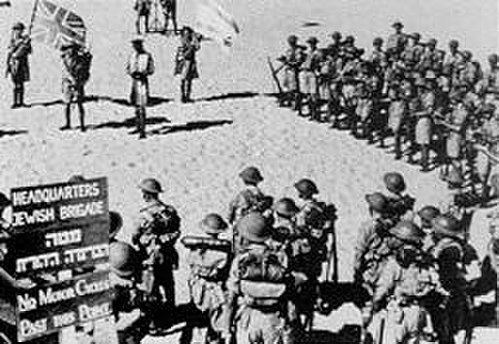
1944年7月3日、英国政府は、厳選されたユダヤ人および非ユダヤ人の上級将校からなるユダヤ人旅団を英国陸軍内に設立することに同意した。1944年9月20日、陸軍省の公式声明により、英国陸軍のユダヤ人旅団グループの結成が発表された。ユダヤ人旅団は当時、イタリア、ユーゴスラビア、オーストリアの国境三角地帯に近いタルヴィージオに駐留し、ヨーロッパからパレスチナへ逃れるユダヤ人を支援するベリハの活動において重要な役割を果たした。この役割は、旅団が解散した後も多くの旅団員が引き継ぐことになる。そのプロジェクトの中には、セルヴィーノの子供たちの教育と世話もあった。後に、ユダヤ人旅団の退役軍人はイスラエル国防軍(IDF)の設立において主要な役割を果たすことになった。
パレスチナ連隊からは、准将 アーネスト・ベンジャミンの指揮下にあるユダヤ人小隊とアラブ人小隊の2個小隊が、イタリア戦線の連合軍に加わるために派遣され、そこでの最終攻勢に参加した。
パレスチナ出身のユダヤ人とアラブ人に加えて、1944年半ばまでにイギリスは、志願兵によるヨーロッパ系ユダヤ人難民(ドイツ占領国出身)、イエメン系ユダヤ人、アビシニア系ユダヤ人からなる多民族部隊を編成した。[64]
ホロコーストと移民割当
.jpg/500px-Hagana_Ship_-_Jewish_State_at_Haifa_Port_(1947).jpg)
1939年、英国は1939年白書の結果として、パレスチナへの移民数を削減した。その後まもなく第二次世界大戦とホロコーストが始まり、年間1万5000人の定員を超えると、ナチスの迫害から逃れるユダヤ人は収容所に収容されるか、モーリシャスなどの場所に移送された。[66]
1939年から、モサド・レアリーヤー・ベットと呼ばれる組織が先頭に立って、アリーヤー・ベットと呼ばれる秘密移民運動が展開された。何万人ものヨーロッパ系ユダヤ人がボートや小型船でナチスから逃れ、パレスチナに向かった。英国海軍 は多くの船舶を拿捕したが、航海に適さない船舶は難破した。SSパトリア号はハガナー爆弾で沈没し、267人が死亡した。他の2隻はソ連の潜水艦によって沈没した。モータースクーナーのストルマ号は1942年2月、黒海でソ連の潜水艦に魚雷で攻撃され沈没し、約800人の命が失われた。[67]戦争中にパレスチナに渡ろうとした最後の難民船は、 1944年8月のブルブル、メフキュレ、モリナ号であった。ソ連の潜水艦がモータースクーナーのメフキュレ号を魚雷と砲弾で沈め、水中の生存者を機関銃で撃ち殺し、[68] 300人から400人の難民を殺害した。[69]第二次世界大戦の終結後、特にハガナー号による不法移民が再開され、1945年から1947年にかけては主にユダヤ人の不法移民を運んでいた。[65]
戦後、25万人のユダヤ人難民がヨーロッパの難民キャンプに取り残された。世界世論の圧力、特に米国大統領ハリー・S・トルーマンの再三の要請や、10万人のユダヤ人の即時パレスチナ入国を認めるべきだという英米調査委員会の勧告にもかかわらず、英国は移民禁止を維持した。
シオニスト反乱の始まり

1940年代、ユダヤ人のレヒ(イスラエル自由戦士)とイルグン(国家軍事組織)運動が英国委任統治領に対する暴力的な蜂起を起こした。1944年11月6日、エリヤフ・ハキムとエリヤフ・ベト・ズリ(レヒのメンバー)がカイロでモイン卿を暗殺した。モイン卿は英国の中東担当国務大臣であり、この暗殺が英国のウィンストン・チャーチル首相をシオニストの大義に反対させるきっかけとなったと一部で言われている。モイン卿の暗殺後、ハガナーはイルグン(「狩猟の季節」)のメンバーの多くを誘拐、尋問し、英国に引き渡した。また、ユダヤ人機関の執行部はパレスチナの「テロ組織」に対する一連の措置を決定した。イルグンは内戦を防ぐためにメンバーに抵抗したり暴力で報復したりしないように命じた。
第二次世界大戦後:反乱と分割計画
3つの主要なユダヤ人地下組織は後にユダヤ抵抗運動を結成し、英国政府に対して数々の攻撃や爆破を実行した。1946年、イルグンはエルサレムのキング・デイビッド・ホテルを爆破した。ホテルの南棟には英国政府の本部があり、92人が死亡した。爆破後、英国政府はキプロスでユダヤ人の不法移民を収容し始めた。1948年、レヒはエルサレムで国連の調停人ベルナドッテ伯爵 を暗殺した。後にイスラエルの首相となるイツハク・シャミールも共謀者の一人だった。

パレスチナ情勢の悪評により委任統治は英国内で広く不評となり、米国議会は復興のための英国への重要な融資の承認を遅らせた。英国労働党は1945年の選挙前にユダヤ人の大量移住をパレスチナに認めると約束していたが、政権に就くとこの約束を破った。反英ユダヤ人の闘争心が高まり、状況は10万人以上の英国軍をパレスチナに駐留させる必要に迫られた。アッコ脱獄事件とイルグンによる報復的な英国軍曹の絞首刑の後、英国は委任統治を終了し、遅くとも1948年8月初旬までに撤退する意向を発表した。[22]
1946 年の英米調査委員会は、ユダヤ人のパレスチナへの移住に関する政策に合意しようとした英国と米国の共同の試みであった。4 月、委員会は、委員が全員一致で決定に達したと報告した。委員会は、ヨーロッパからパレスチナに 10 万人のユダヤ人難民を即時受け入れるという米国の勧告を承認した。また、アラブ人やユダヤ人の国家は存在しないことを勧告した。委員会は、「パレスチナに対するユダヤ人とアラブ人の排他的権利をきっぱりと処分するためには、パレスチナにおいてユダヤ人がアラブ人を支配し、アラブ人がユダヤ人を支配してはならないという明確な原則を表明することが不可欠であると考える」と述べた。米国大統領ハリー・S・トルーマンは、 10 万人の難民を支持する声明を発表しながらも、委員会の残りの調査結果を認めなかったことで英国政府を怒らせた。英国は勧告の実施に米国に支援を求めた。米陸軍省は以前、アラブ人の反乱に対する秩序維持で英国を支援するには、無期限の米軍派遣30万人が必要であると述べていた。10万人のユダヤ人移民を直ちに受け入れれば、ほぼ確実にアラブ人の反乱を引き起こしただろう。[70]
これらの出来事が決定的な要因となり、英国はパレスチナ委任統治を終了し、パレスチナ問題を国際連盟の後継組織である国際連合に提起する意向を発表せざるを得なくなった。国連は1947年5月15日、11カ国の代表者からなるUNSCOP(国連パレスチナ特別委員会)を設置した。UNSCOPは公聴会を開催し、パレスチナの状況について概観調査を行い、8月31日に報告書を発表した。7カ国(カナダ、チェコスロバキア、グアテマラ、オランダ、ペルー、スウェーデン、ウルグアイ)は、独立したアラブおよびユダヤ人国家の設立と、エルサレムの国際管理下への設置を勧告した。3カ国(インド、イラン、ユーゴスラビア)は、ユダヤ人とアラブ人の両方の構成国を含む単一の連邦国家の設立を支持した。オーストラリアは棄権した。[71]
1947年11月29日、国連総会は賛成33、反対13、棄権10で、経済統合を伴う分割案の採択と実施を勧告する決議を決議181(II)として採択した。 [72] [73]一方で、提案された2つの国家間の境界に若干の調整が加えられた。分割はイギリスの撤退日に発効することになっていた。分割案では、提案された国々は、人種、宗教、性別にかかわらず、その境界内のすべての人々に完全な公民権を与えることが求められていた。国連総会には勧告権のみが与えられているため、UNGAR 181には法的拘束力がなかった。[74]米国とソ連の両国は決議を支持した。ハイチ、リベリア、フィリピンは、米国とシオニスト組織の一致した圧力を受けて、土壇場で投票を変更した。[75] [76] [77]当時投票権を持っていた アラブ連盟の5か国は、この計画に反対票を投じた。
ユダヤ人国家の形成段階にあったユダヤ人機関はこの計画を受け入れ、パレスチナのユダヤ人のほぼ全員がその知らせに歓喜した。
この分割案はパレスチナのアラブ指導者とアラブ人の大半に拒否された。[f] [g] 1947年11月と12月にカイロで会合したアラブ連盟は、紛争の軍事的解決を支持する一連の決議を採択した。
英国は分割案を受け入れると発表したが、アラブ諸国が受け入れていないとして実施を拒否した。また、移行期間中に国連パレスチナ委員会とパレスチナの統治を分担することも拒否した。1947年9月、英国政府はパレスチナ委任統治は1948年5月14日の深夜に終了すると発表した。[80] [81] [82]
一部のユダヤ人組織もこの提案に反対した。イルグン指導者メナヘム・ベギンは「祖国の分割は違法である。決して認められない。分割協定に署名した機関や個人は無効である。ユダヤ人を拘束するものではない。エルサレムは我々の首都であり、これからも永遠に首都であり続ける。エルサレムはイスラエル国民に返還される。すべてが。そして永遠に。」と宣言した。[83]
任務の終了
1946年にイギリスがトランスヨルダン首長国をトランスヨルダン・ハシミテ王国として独立させると発表したとき、国際連盟の最終総会と国連総会はともにこのニュースを歓迎する決議を採択した。[84]ユダヤ人機関は、トランスヨルダンはパレスチナの不可分の一部であり、国連憲章第80条によればユダヤ人はその領土に確固たる権利を有していると主張して反対した。[85]
パレスチナに関する総会の審議中、トランスヨルダンの領土の一部を提案されたユダヤ人国家に組み込むことが望ましいという提案があった。 1947年11月29日に決議181 (II)が採択される数日前、米国国務長官マーシャルは、ユダヤ人国家がネゲブと「紅海への出口とアカバ港」の両方を持つことが望ましく、特別委員会が頻繁に言及していたことに言及した。 [86]ジョン・スネツィンガーによると、ハイム・ワイツマンは1947年11月19日にトルーマン大統領を訪問し、ネゲブとアカバ港がユダヤ人国家の領域に含まれることが不可欠であると述べた。[87]トルーマンは国連の米国代表団に電話をかけ、ワイツマンの立場を支持すると伝えた。 [88]しかし、トランスヨルダン覚書は、トランスヨルダン首長国の領土をユダヤ人の入植地から除外していた。 [ 89 ]
国連決議の直後、アラブ人とユダヤ人の間で内戦が勃発し、イギリスの権威は崩壊し始めた。1947年12月16日、パレスチナ警察はユダヤ人人口の半数以上が居住するテルアビブ地域から撤退し、法と秩序の維持の責任をユダヤ人警察に引き渡した。 [90]内戦が激化するにつれ、イギリス軍は徐々にパレスチナから撤退したが、時折どちらかの側に有利な形で介入することもあった。これらの地域の多くは戦争地帯となった。イギリスはエルサレムとハイファに強力なプレゼンスを維持したが、エルサレムはアラブ軍に包囲され激しい戦闘の場となった。イギリスは時折戦闘に介入し、主に避難経路の確保を目的として、戒厳令の布告や停戦の実施などを行った。パレスチナ警察はほとんど機能せず、社会福祉、水道、郵便などの政府サービスは撤退した。 1948年3月、パレスチナに駐留していた英国人判事全員が英国に送還された。[91] 1948年4月、英国軍はハイファの大部分から撤退したが、英国軍の撤退に使うために港湾地区に飛び地を残し、ハイファ近郊の空軍基地であるイギリス空軍ラマト・ダビドを撤退の援護に留め、秩序維持のためにボランティアの警察部隊を残した。ハイファの戦いで、この都市はすぐにハガナーに占領された。勝利の後、エルサレムの英国軍は、地方行政を監督する意図はないが、軍の安全で秩序ある撤退を妨げる行為は認めず、妨害者は軍事法廷で裁くと発表した。[92] [93] [94]この時までにパレスチナの大部分における英国の権威は崩壊し、国土の大半はユダヤ人やアラブ人の手に渡っていたが、パレスチナに対する英国の空と海の封鎖は継続された。アラブ義勇兵はパレスチナと周辺アラブ諸国の国境を越えて戦闘に参加できたが、イギリスは周辺アラブ諸国の正規軍がパレスチナに侵入することを許可しなかった。
英国は、1948年8月1日までに委任統治を終了する意向を国連に通告していた。 [95] [96]しかし、1948年初頭、英国は5月15日にパレスチナにおける委任統治を終了するという確固たる意向を発表した。これに対して、ハリー・S・トルーマン大統領は3月25日に、分割ではなく国連信託統治を提案する声明を発表し、「残念ながら、現時点では分割計画を平和的手段で実行できないことが明らかになった...緊急措置が取られない限り、その日にはパレスチナに法と秩序を維持できる公的機関は存在しないだろう。聖地は暴力と流血に見舞われるだろう。その国の国民の間で大規模な戦闘が起こるのは避けられない結果となるだろう」と述べた。[97]英国議会は、パレスチナ法案で委任統治を終了するために必要な法律を可決し、1948年4月29日に国王の裁可を得た。 [98]

_-_Hoisting_of_the_national_flag_during_a_special_ceremony_of_elementary_school_children.jpg/500px-Flickr_-_Government_Press_Office_(GPO)_-_Hoisting_of_the_national_flag_during_a_special_ceremony_of_elementary_school_children.jpg)
1948年5月14日までに、パレスチナに残っていたイギリス軍はハイファ地域とエルサレムのみであった。同日、エルサレムのイギリス軍守備隊は撤退し、最後の高等弁務官サー・アラン・カニングハム将軍は ハイファに向けて出発し、そこから海路で国を離れることになっていた。後の首相ダヴィド・ベングリオン率いるユダヤ人指導部は、1948年5月14日午後(ヘブライ暦5708年イヤール5日) 、[99]委任統治領の終了時深夜に発効する、エルサレムにおけるユダヤ人国家、いわゆるイスラエル国の樹立を宣言した。 [100] [101] [102]また14日、イスラエル暫定政府は米国政府に対し、国連の分割案で指定された国境の承認を求めた。[103]米国は直ちに反論し、「暫定政府を事実上の権威と認めた」。[104]
1948年5月14日/15日の深夜、パレスチナ委任統治領は失効し、イスラエル国が誕生した。パレスチナ政府は正式に消滅し、ハイファから撤退中だった英国軍の地位は外国領土の占領軍に変わり、パレスチナ警察は正式に解散、残りの人員は英国軍とともに撤退し、英国によるパレスチナ封鎖は解除され、パレスチナ国民であった者はすべて英国の保護対象者ではなくなり、強制パレスチナパスポートはもはや英国の保護を与えなくなった。[93] [105] 1948年のパレスチナ人の追放と逃亡は委任統治領の終了前と終了後の両方で起こった。[106] [107]
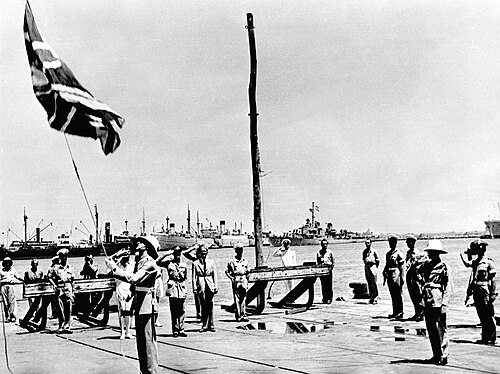
その後数日間で、およそ700人のレバノン軍、1,876人のシリア軍、4,000人のイラク軍、2,800人のエジプト軍が国境を越えてパレスチナに入り、1948年の第一次中東戦争が始まった。[108]わずか数週間前にイギリス軍を辞職した38人のイギリス人将校(総司令官ジョン・バゴット・グラブ将軍を含む)が指揮する約4,500人のトランスヨルダン軍が、エルサレムとその周辺を含む分離地帯(ハガナーのキルション作戦への対応として)に入り、 [109]国連の分割案でアラブ国家の一部として指定された地域に移動した。 1949年まで続いたこの戦争で、イスラエルは旧イギリス委任統治領の領土の約78%を占領するまでに勢力を拡大し、トランスヨルダンがヨルダン川西岸地区を占領して併合し、エジプト王国がガザ地区を占領した。委任統治の終了に伴い、イスラエルに残っていたイギリス軍は、撤退の際に通ったハイファ港湾地区の飛び地と、撤退をカバーするために維持されていたイギリス空軍ラマト・ダビド基地に集中した。イギリスは5月26日にイギリス空軍ラマト・ダビド基地をイスラエルに引き渡し、6月30日には最後のイギリス軍がハイファから撤退した。ハイファ港の管理棟からイギリス国旗が降ろされ、その代わりにイスラエル国旗が掲揚され、式典でハイファ港湾地区は正式にイスラエル当局に引き渡された。[110]
政治
委任統治領の行政は公式には英国政府の管轄下にあったが、ピール委員会はそれが信頼できず、人員不足で、過度に中央集権化されており、ユダヤ人とアラブ人の間の人種的対立が行政全体に影響を及ぼし始めていると指摘した。ユダヤ人とアラブ人をそれぞれ代表するユダヤ人機関とアラブ高等委員会は、それ自体が並行政府に成長し、帝国内の帝国の例となっていた。[111]
パレスチナのアラブ人コミュニティ
英国委任統治時代のパスポート
サンレモ会議の決議には、非ユダヤ人コミュニティの既存の権利を保護する条項が含まれていた。会議は、パレスチナに関する委任統治の条件を、委任統治国がパレスチナの非ユダヤ人コミュニティがこれまで享受してきた権利の放棄を伴わないという法的約束を覚書に盛り込んだという理解のもとで、承認した。[112]メソポタミアとパレスチナの委任統治の草案、および戦後のすべての平和条約には、宗教グループと少数派を保護する条項が含まれていた。委任統治は、紛争が発生した場合には常設国際司法裁判所の強制管轄権を主張した。[113]
1878年7月13日に調印されたベルリン条約第62条(LXII)[114]は、オスマン帝国全土における宗教の自由と市民的および政治的権利を扱っている。 [115]この保障はしばしば「宗教的権利」または「少数派の権利」と呼ばれてきた。しかし、この保障には市民的および政治的問題における差別の禁止も含まれていた。宗教の違いは、市民的または政治的権利の享受、公職への就労、職務および栄誉の付与、または「いかなる地域においても」さまざまな職業および産業の営みに関する問題において、排除または無能力の根拠としていかなる人物に対しても主張され得なかった。
国際司法裁判所(ICJ)が行った法的分析では、国際連盟規約は暫定的にパレスチナのコミュニティを独立国家として承認していたと指摘した。委任統治は単に過渡期を定めたものであり、委任統治領を独立した自治国家に導くことを目的としていた。[116]ヒギンズ判事は、「パレスチナ人は自らの領土を持ち、自決権を行使し、自らの国家を持つ権利がある」と説明した。[117]裁判所は、ベルリン条約(1878年)に含まれる移動の自由と聖地へのアクセスに関する具体的な保証は、パレスチナ委任統治領の条項と国連パレスチナ分割案の章の下で維持されていると述べた。[118]
歴史家ラシッド・ハリディによると、委任統治はアラブ人の政治的権利を無視した。[119]アラブの指導者たちは、英国がユダヤ人の祖国のために確保したパレスチナ委任統治領の残り23%におけるユダヤ人の国家的および政治的権利よりも、代表制政府などの国家的および政治的権利をアラブ人に与えるよう繰り返し英国に圧力をかけた。アラブ人は英国に、ウィルソン大統領の14か条の原則と第一次世界大戦中の英国の約束を思い出させた。しかし英国は、アラブ人の憲法上の立場を変更するには、委任統治の条件を受け入れることが前提条件となった。1922年のパレスチナ評議会命令で立法評議会が提案され、委任統治の条件が実施された。そこには、「委任統治の条項にいかなる形でも反する、または矛盾する法令は可決されない」と記されていた。アラブ人にとって、この法令は「自殺」に等しい、受け入れられないものだった。[120]その結果、アラブ人は1923年に行われた評議会選挙をボイコットし、選挙は後に無効となった。[121]戦間期、イギリスは多数決の原則やアラブ人に政府を統制させるその他の措置を拒否した。[122]
委任統治の条件は、パレスチナとトランスヨルダンの両方に自治機関を設立することであった。1947年、外務大臣アーネスト・ベヴィンは、過去25年間、英国はアラブ人の利益を害することなくユダヤ人コミュニティの正当な願望を促進するために最善を尽くしたが、委任統治の条件に従って「自治機関の発展を確保する」ことができなかったことを認めた。[123]
パレスチナのアラブ指導者と国家の願望

イギリス委任統治下において、伝統的に権限と地理的範囲が限定されていた「エルサレムのムフティ」の役職は、「パレスチナの大ムフティ」に作り変えられた。さらに、イスラム最高評議会 (SMC) が設立され、宗教的寄付金の管理や宗教裁判官および地方のムフティの任命など、さまざまな任務が与えられた。オスマン帝国時代には、これらの任務はコンスタンティノープル(イスタンブール)の帝国官僚機構によって遂行されていた。 [124]パレスチナのアラブ人との交渉において、イギリスは中流階級や下層階級ではなく、エリート層と交渉した。[125]イギリスはハッジ・アミン・アル・フセイニを大ムフティに選んだが、彼は若く、エルサレムのイスラム指導者からの投票数が最も少なかった。[126]ムフティのライバルの一人、ラギブ・ベイ・アル・ナシャシビは、 1920年にムサ・カジムの後任としてエルサレム市長に任命されていた。カージムは1920年のナビー・ムーサ暴動後にイギリス軍によって解任されたが、[127]暴動中、彼は群衆にパレスチナのために血を捧げるよう呼びかけていた。[128]委任統治期間全体、特に後半には、ムフティとアル・ナシャシビの対立がパレスチナ政治を支配していた。ハリディは、パレスチナ指導者が大衆の支持を集められなかったのは、彼らが支配階級の一員であり、命令が守られることに慣れていたためであり、大衆を動員するという概念は彼らには知られていなかったとしている。[129]
フセイニとナシャシビの対立については、1920年代のアラビア語新聞ファラスティンの社説で次のように述べられている。 [130]
派閥主義の精神は社会のほとんどの階層に浸透しており、ジャーナリスト、研修生、一般の人々のあいだでそれが見受けられる。誰かに「誰を支持するか」と尋ねれば、その人は誇らしげにフセイニかナシャシビかと答えるか、あるいは…反対陣営に対して最も不快なやり方で怒りをぶちまけ始めるだろう。
1921年と1929年にはすでに暴動が起き、ユダヤ人に対する攻撃や虐殺が行われていた。1930年代には、ユダヤ人の移民に対するパレスチナのアラブ人の民衆の不満が高まった。1920年代後半から1930年代前半にかけて、パレスチナ社会のいくつかの派閥、特に若い世代は、パレスチナのエリート層の内紛や無能さにいら立ち、青年イスラム教徒協会などのグループが組織した草の根の反英、反シオニスト運動に従事した。インド国民会議派のように英国に対するボイコットを呼びかけた過激な民族主義独立党(ヒズボラ・イスティクラル)への支持もあった。英国とユダヤ人と戦うために丘に上った者もいた。これらの取り組みのほとんどは委任統治領から報酬を得ていた著名人、特にムフティとその従兄弟のジャマル・アル・フセイニによって阻止され、阻止された。1936年の6か月間のゼネストは、アラブ大反乱の始まりとなった。[131]
パレスチナのアラブジャーナリズム

オスマン帝国時代のパレスチナのアラブ報道機関は、1914年の第一次世界大戦の勃発により抑圧された後、委任統治時代にオスマン帝国時代の3大新聞のうち2紙、アル・カルミルとファラスティンだけが再開された。この期間中、報道機関はより多様化し、ますますさまざまな政治派閥や国民意識を反映するようになった。1930年代半ばのある調査によると、委任統治領パレスチナでは250以上のアラビア語新聞と65の他の言語の新聞が流通していた。 [133]エルサレムに20の新聞、ヤッファに6つの新聞、ハイファに12の新聞、ベツレヘム、ガザ、トゥルカレムに他の新聞が設立された。[ 133]
オスマン帝国の出版法は出版許可と政府当局への翻訳の提出を義務付けており、イギリスもこれを採用したが、1929年のパレスチナ暴動まではほとんど介入しなかった。この暴動ではアラブ人とシオニストの間で暴力的な対立が起こり、アラブ系新聞の過激化につながった。ヤッファでは1934年にアル・ディファ(防衛)という率直な新聞が創刊され、ヒズブ・アル・イスティクラル(独立党)と提携していた。[133] ファラスティンとアル・ディファは委任統治時代に最も著名な2紙となり、2紙の間には競争が生まれ、それが新聞の質の向上につながった。[134]
新聞の編集者や所有者の多くは政治組織のメンバーであり、彼らの出版物を大衆の動員に利用していた。[135]英国当局は当初、パレスチナの報道機関が公共生活に与える影響は最小限であると評価していたため寛容であったが、すぐに制限措置が導入されるようになった。1933年に新しい出版法が公布され、英国当局は出版許可を取り消し、新聞を停止し、ジャーナリストを処罰する権限を得た。さらに報道の自由を制限する規制が公布された。ファラスティン、アルディファ、アルリワなど、多くの主要出版物が1937年から1938年にかけて長期間にわたって停止された。第二次世界大戦の勃発後、非常事態法が制定され、英国はファラスティンとアルディファを除くほぼすべての新聞を、論調の穏健化と検閲されたニュースの出版を理由に閉鎖した。[136]
ユダヤ人コミュニティ
1917年にイギリス軍がオスマン・シリアを征服すると、この地域には混血コミュニティが形成され、オスマン・シリア南部のパレスチナにはイスラム教徒、キリスト教徒、ユダヤ教徒、ドゥルーズ派の混血人口が居住していた。この時期、パレスチナのユダヤ人コミュニティ(イシューブ)は、何世紀にもわたって存在していた都市部の伝統的なユダヤ人コミュニティ(旧イシューブ) [137]と、1870年代以降に新たに設立された農業シオニストコミュニティ(新イシューブ)で構成されていた。委任統治領の設立に伴い、パレスチナのユダヤ人コミュニティは自らの利益を代表するシオニスト委員会を結成した。
1929年、パレスチナ・ユダヤ人機関がシオニスト委員会からユダヤ人コミュニティの代表機能と管理を引き継いだ。委任統治時代、ユダヤ人機関はユダヤ人コミュニティの行政ニーズに応える準政府組織だった。その指導者は世界中のユダヤ人により比例代表で選出された。[138]ユダヤ人機関はパレスチナへのユダヤ人の移住、土地購入、シオニスト指導部の一般政策の立案を担っていた。学校や病院を運営し、ハガナーを結成した。英国当局は同様のアラブ機関の設立を提案したが、この提案はアラブ指導者らに拒否された。[139]
ユダヤ人コミュニティに対するアラブ人による数々の攻撃に対抗するため、ユダヤ人準軍事組織ハガナーが1920年6月15日にユダヤ人居住者を守るために結成された。緊張関係は、1921年(ヤッファ暴動を参照)、1929年(主にアラブ人によるユダヤ人への暴力的攻撃 - 1929年のヘブロン大虐殺を参照)、および1936~1939年など、数回にわたって広範囲にわたる暴力的騒乱を招いた。1936年以降、エツェル(イルグン)やレヒ(シュテルン・ギャング)などのユダヤ人グループが、イギリス軍やアラブ人を標的とした暴力行為を行った。
ユダヤ人移民
.jpg/500px-Jewish_immigration_to_Mandatory_Palestine_(1920-1945).jpg)
委任統治時代、イシューブは人口の6分の1からほぼ3分の1にまで増加した。公式記録によると、1920年から1945年の間に367,845人のユダヤ人と33,304人の非ユダヤ人が合法的に移住した。 [140]この期間中にさらに5万~6万人のユダヤ人と、ほとんどが季節的な少数のアラブ人が不法に移住したと推定されている。[141]ユダヤ人人口の増加の大部分は移民によるものであり、非ユダヤ人人口の増加は主に自然増加によるものであった。[142]ユダヤ人移民のうち、1939年には大半がドイツとチェコスロバキアから来ていたが、1940~1944年には大半がルーマニアとポーランドから来ており、同時期にイエメンからも3,530人の移民が到着した。[143]
当初、パレスチナへのユダヤ人の移民は、パレスチナのアラブ人からほとんど反対を受けなかった。しかし、 19世紀後半から20世紀初頭にかけてヨーロッパで反ユダヤ主義が広がると、パレスチナへのユダヤ人の移民(主にヨーロッパから)が著しく増加し始めた。この地域でのアラブ民族主義の高まりと反ユダヤ感情の高まりと相まって、ユダヤ人人口の増加はアラブ人の大きな反感を生んだ。英国政府はパレスチナへのユダヤ人の移民に制限を設けた。この割り当ては、特に英国統治後期には物議を醸し、アラブ人とユダヤ人の両方がそれぞれの理由でこの政策を嫌った。
ユダヤ人移民にはパレスチナ国籍が与えられることになっていた。
第7条 パレスチナ政府は国籍法を制定する責任を負う。この法律には、パレスチナに永住するユダヤ人がパレスチナ国籍を取得することを容易にするための規定が含まれるものとする。[144]
ユダヤ人の国家の家
1919年、シオニスト機構の事務総長(後の会長)ナフム・ソコロフは『シオニズムの歴史(1600-1918)』を出版した。彼はまた、パリ講和会議でシオニスト機構を代表した。
ナフム・ソコロフ『シオニズムの歴史』[145]
英国統治の目的の一つはバルフォア宣言を発効させることであり、それは委任統治領の前文にも次のように記されていた。
主要連合国はまた、委任統治領が、1917年11月2日に英国国王陛下の政府により最初になされ、前記連合国により採択された、パレスチナにユダヤ人の国家を樹立することを支持する宣言を実施する責任を負うことに合意したが、パレスチナの既存の非ユダヤ人コミュニティの市民権および宗教的権利、または他の国でユダヤ人が享受している権利および政治的地位を損なう可能性のある行為は一切行われないことが明確に理解されている。[146]
国連パレスチナ特別委員会は、1897年のバーゼル綱領におけるシオニストの願望の表明から派生した「ユダヤ人国家の家」は、その意味、範囲、法的性格について多くの議論を引き起こしてきたと述べた。特に、それが法的意味合いを持たず、国際法上その解釈の先例がないことから、それはそうである。それはバルフォア宣言と委任統治領で使用され、どちらも「ユダヤ人国家の家」の設立を約束したが、その意味を定義しなかった。1922年6月3日に植民地省によって発行された「パレスチナにおける英国の政策」に関する声明[147]は、バルフォア宣言を制限的に解釈した。声明では、英国政府は「パレスチナにおけるアラブ人の人口、言語、習慣の消滅や従属」、あるいは「パレスチナ全体の住民にユダヤ人の国籍を押し付ける」ことは考えていないと述べ、委任統治国の観点からは、ユダヤ人の国家の家はパレスチナに設立されるべきであり、パレスチナ全体がユダヤ人の国家の家になるべきではないことを明確にした。委員会は、国家の家の範囲を大幅に制限する建設は、国際連盟理事会による委任統治の確認前に行われ、当時シオニスト機構の執行部によって正式に承認されていたことを指摘した。[148]
1930年3月、植民地大臣パスフィールド卿は内閣文書[149]を書き、その中で次のように述べていた。
バルフォア宣言には、パレスチナのアラブ人居住者と比較してユダヤ人に特別または優遇された地位を与えるべきだとか、パレスチナ人が自治権を享受する要求(委任統治者による行政上の助言と援助の提供を条件とする)が、パレスチナにユダヤ人の国家の設立を促進するために制限されるべきだとか、示唆するところはない。...シオニスト指導者たちは、現在も、また今後何年もの間、パレスチナの人々に自治権を与えることに反対していることを隠してはいないし、これからも隠すつもりはない。彼らの中には、委任統治第2条の条項が、アラブ人の自治権要求に応じる妨げになっていると主張する者さえいる。委任統治第2条の条項と、アラブ人に対して何度かなされた約束を考慮すると、その主張は正しい。認められません。
国際連盟の委任統治委員会は、委任統治には二重の義務が含まれているという立場をとった。1932年、委任統治委員会は委任統治のさまざまな条項、特に第2条に従って、アラブ人住民が自治機関の設立に関して行った要求について委任統治国の代表に質問した。委員長は、「同じ条項の条件の下で、委任統治国はずっと以前にユダヤ人国家の家を設立していた」と述べた。[150]
1937年、ピール伯爵率いる英国王立委員会ピール委員会は、アラブ・ユダヤ人紛争を解決するためにパレスチナを2つの国家に分割することを提案した。2人のユダヤ人指導者、ハイム・ワイツマンとダヴィド・ベングリオンは、シオニスト会議を説得し、さらなる交渉の土台としてピールの勧告を曖昧な形で承認させた。[48] [49] [50] [151]エルサレム駐在の米国総領事は国務省に対し、ムフティが分割の原則を拒否し、検討を断ったと伝えた。同領事によると、アブドラ首長は現実を直視しなければならないとして受け入れを促したが、提案された境界と中立地域におけるアラブの行政の修正を希望した。同領事はまた、ナシャシビが原則を回避したが、有利な修正のために交渉する用意があると指摘した。[152]
ダヴィド・ベン・グリオンが出版した私信集には、1937年に書かれた手紙が収められており、部分的なユダヤ人国家がプロセスの最終段階になるとは考えていないため、分割に賛成であると説明している。ベン・グリオンは「我々が望むのは、国が統一され、完全に統一されることではなく、統一され、国全体がユダヤ人であることだ」と書いている。彼は、一流のユダヤ人軍があれば、アラブ人の同意の有無にかかわらず、シオニストが国の残りの部分に定住できると説明した。[153]ベニー・モリスは、ハイム・ワイツマンとダヴィド・ベン・グリオンの両者が、分割をさらなる拡大と最終的にはパレスチナ全土の占領への足がかりと見ていたと述べた。[154]元イスラエル外務大臣で歴史家のシュロモ・ベン・アミは、1937年は、イツハク・サデの指揮下にある「野戦大隊」が「アヴネル計画」を書いたのと同じ年であり、これは1948年に計画Dとなるものを予見し、基礎を築いた年であると書いている。それは、既存の分割案に含まれる境界をはるかに超えて、ガリラヤ、ヨルダン川西岸、エルサレムの征服を計画した。[155]
1942年、ビルトモア計画が世界シオニスト機構の綱領として採択された。計画は「パレスチナをユダヤ人の国家として設立する」ことを要求した。
1946年、英米調査委員会は、ユダヤ人国家の要求はバルフォア宣言や委任統治の義務を超えており、つい最近の1932年にはユダヤ人機関の議長によって明確に否定されていたと指摘した。 [156]その後、ユダヤ人機関は、モリソン=グレイディ案を議論の根拠として受け入れることを拒否した。同機関のスポークスマン、エリアフ・エプスタインは、グレイディ=モリソン案が議題に上がっている場合、同機関はロンドン会議に出席できないと米国務省に伝えた。同氏は、ユダヤ人機関は、グレイディ=モリソン案と、ユダヤ人機関自身の分割案の間で妥協しなければならない立場に置かれることを望んでいないと述べた。同氏は、ユダヤ人機関は、パレスチナの解決策として、自らが支持する分割案を受け入れたと述べた。[157]
土地所有権
.jpg/500px-Palestine_Land_ownership_by_sub-district_(1945).jpg)

イギリス統治への移行後、パレスチナの農地の多く(全領土の約3分の1)は、オスマン帝国統治下と同じ地主、主に有力なアラブ人氏族と地元のイスラム教シェイクによって所有されていました。その他の土地は、外国のキリスト教組織(最も有名なのはギリシャ正教会)やユダヤ人の民間組織、シオニスト組織によって所有されていましたが、バハーイー教徒、サマリア人、チェルケス人などの少数派によっても所有されていました。
1931年時点で、イギリス委任統治領パレスチナの領土は26,625,600ドゥナム(26,625.6 km 2)で、そのうち8,252,900ドゥナム(8,252.9 km 2)または33%が耕作可能でした。[158]公式統計によると、1945年のユダヤ人の個人的および集団的な所有地は1,393,531ドゥナム(1,393.53 km 2)で、パレスチナ全体の5.23%に相当します。 [159] [160]ユダヤ人が所有する農地は主にガリラヤと海岸平野に沿っていました。 1948年5月15日までにユダヤ人が購入した土地の総量の推定は、違法で未登録の土地譲渡や、1936年3月31日以降のパレスチナ政権からの土地譲渡に関するデータの欠如によって複雑になっている。アヴネリによると、ユダヤ人は1947年に1,850,000ドゥナム(1,850 km 2 )の土地を所有しており、これは総面積の6.94%にあたる。 [161]シュタインは、 1948年5月時点で2,000,000ドゥナム(2,000 km 2 )と推定しており、これは総面積の7.51%にあたる。 [162]フィッシュバッハによると、1948年までにユダヤ人とユダヤ人企業は国内の耕作可能な土地の20%を所有していた。[163]
クリフォード・A・ライトによれば、1948年の英国委任統治期間の終わりまでに、ユダヤ人農民は425,450ドゥナムの土地を耕作し、パレスチナ人農民は5,484,700ドゥナムの土地を耕作していた。[164] 1945年の国連の推定によると、耕作地のアラブ人所有率は平均して地区の68%で、ベエルシェバ地区の15%からラマラ地区の99%までの範囲であった。これらのデータは近隣諸国のデータと比較しなければ十分に理解できない。例えばイラクでは、1951年でも登録された土地のわずか0.3%(総量の50%)が「私有財産」に分類されていた。[165]
地区別の土地所有
次の表は、1945 年のパレスチナ委任統治領の地区別の土地所有権を示しています。
法人による土地所有
下の表は、1945 年 12 月 31 日時点のパレスチナにおける大規模ユダヤ人企業による土地所有状況 (平方キロメートル単位) を示しています。
土地所有形態
ユダヤ人、アラブ人、その他の非ユダヤ人が個人的または共同で所有する土地は、都市部、農村部、耕作可能(農地)、耕作不可能に分類できます。次の表は、各カテゴリにおけるユダヤ人、アラブ人、その他の非ユダヤ人の所有権を示しています。
強制土地法の一覧
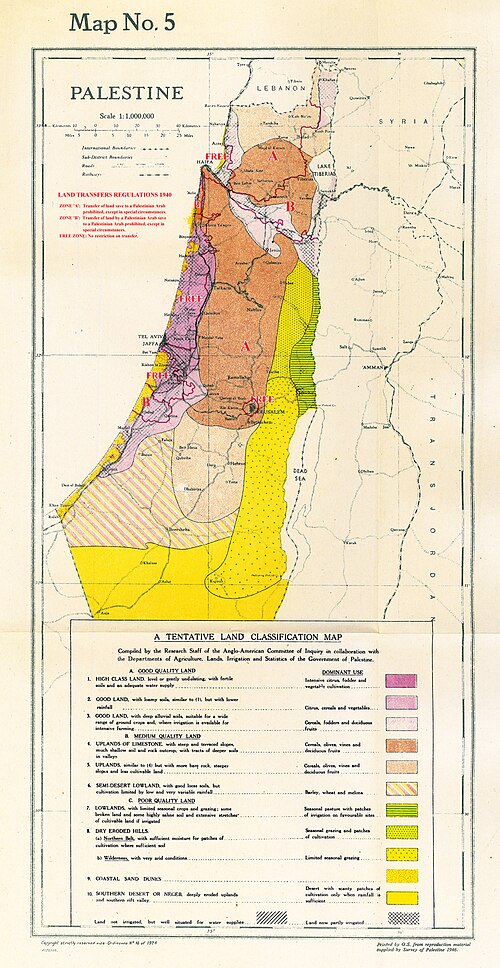
- 1920年の土地譲渡条例
- 1926年土地台帳訂正条例
- 1928年の土地開拓条例
- 1940年の土地譲渡規則
1940 年 2 月、パレスチナの英国政府は土地譲渡規則を公布し、パレスチナを 3 つの地域に分割し、それぞれに異なる土地売買規制を適用した。ユダヤの丘陵地帯全体、ヤッファ地区の特定の地域、ガザ地区、およびベエルシェバ地区の北部を含むゾーン「A」では、高等弁務官の許可なしに、パレスチナのアラブ人以外への土地の新規売買契約を禁止した。イズレエル渓谷、ガリラヤ東部、ハイファ南部の海岸平野、ガザ地区の北東の地域、およびベエルシェバ地区の南部を含むゾーン「B」では、同様の例外があるパレスチナのアラブ人以外への土地の売買は禁止された。ハイファ湾、ジフロン・ヤコブからイブナまでの海岸平野、エルサレム近郊からなる「自由地帯」には、制限はなかった。この規制の理由は、委任統治領は「他の住民の権利と地位が侵害されないよう保証する」必要があり、「アラブ人の耕作者が現在の生活水準を維持し、相当数の土地を持たないアラブ人がすぐに生まれないようにするためには、このような土地の譲渡は制限されなければならない」という主張であった[171]。
人口統計
英国の国勢調査と推定

.jpeg/500px-Palestine_Distribution_of_Population_1947_UN_map_no_93(b).jpeg)
1920年、この多民族地域の人口約75万人のうち大半はアラビア語を話すイスラム教徒であり、その中にはベドウィン(1922年の国勢調査[172]時点で推定103,331人で、ベエルシェバ地域とその南と東の地域に集中していた)やユダヤ人(全体の約11%を占める)、そして少数のドゥルーズ派、シリア人、スーダン人、ソマリア人、チェルケス人、エジプト人、コプト人、ギリシャ人、ヒジャーズ・アラブ人が含まれていた。
- 1922年の最初の国勢調査では人口は757,182人で、そのうち78%がイスラム教徒、11%がユダヤ教徒、10%がキリスト教徒であった。
- 1931年の第2回国勢調査では、総人口は1,035,154人で、そのうち73.4%がイスラム教徒、16.9%がユダヤ教徒、8.6%がキリスト教徒であった。
2度の国勢調査と出生、死亡、移民の記録の間に矛盾があったため、第2回国勢調査の著者は、その間に約9,000人のユダヤ人と4,000人のアラブ人が不法に移民したと推測した。[173]

その後の国勢調査は行われなかったが、出生、死亡、移住を数えることで統計が維持された。1936年末までに、総人口は約130万人で、ユダヤ人は38万4千人と推定された。アラブ人も、オスマン帝国による徴兵制の廃止、マラリア撲滅運動、医療サービスの全般的改善の結果として、急速に増加した。絶対数で見ると、アラブ人の増加はユダヤ人人口の増加を上回ったが、割合で見ると、ユダヤ人は1922年の国勢調査で総人口の13%から1936年末にはほぼ30%に増加した。[174]
不法移民など、いくつかの要素はおおよその推定しかできなかった。ユダヤ人の移民制限を定めた1939年の白書では、ユダヤ人の人口は「約45万人に増加し」、「国全体の人口の3分の1に近づいている」と述べられていた。1945年の人口統計調査では、人口は1,764,520人に増加し、そのうち1,061,270人がイスラム教徒、553,600人がユダヤ人、135,550人がキリスト教徒、14,100人がその他のグループの人々であることが示された。
By district
.svg/500px-Mandatory_Palestine_-_Population_by_Municipality_(1945).svg.png)
150,000 and more
100,000
50,000
20,000
10,000
5,000
2,000
1,000
500
less than 500
Nomadic regions in the Negev desert
The following table gives the religious demography of each of the 16 districts of the Mandate in 1945.
Urban areas
The table below shows the population of the municipal areas of Palestine in 1922, at the start of the mandate period, per the 1922 census of Palestine.[176]
Government and institutions

Under the terms of the August 1922 Palestine Order in Council, the Mandate territory was divided into administrative regions known as districts and were administered by the office of the British High Commissioner for Palestine.[177]
Britain continued the millet system of the Ottoman Empire whereby all matters of a religious nature and personal status were within the jurisdiction of Muslim courts and the courts of other recognised religions, called confessional communities. The High Commissioner established the Orthodox Rabbinate and retained a modified millet system which only recognised eleven religious communities: Muslims, Jews and nine Christian denominations (none of which were Christian Protestant churches). All those who were not members of these recognised communities were excluded from the millet arrangement. As a result, there was no possibility, for example, of marriages between confessional communities, and there were no civil marriages. Personal contacts between communities were nominal.
Apart from the Religious Courts, the judicial system was modelled on the British one, having a High Court with appellate jurisdiction and the power of review over the Central Court and the Central Criminal Court. The five consecutive Chief Justices were:
- Sir Thomas Haycraft (1921–1927)[178]
- Sir Michael McDonnell (1927–1936)[178]
- Sir Harry Trusted[179] (1936–1941; knighted in 1938) (afterwards Chief Justice of the Federated Malay States, 1941)
- Frederick Gordon-Smith (1941–1944)[180]
- Sir William Fitzgerald (1944–1948)[181]
The local newspaper The Palestine Post was founded in 1932 by Gershon Agron. In 1950, its name was changed to The Jerusalem Post. In 1923, Pinhas Rutenberg founded the Palestine Electric Company (to become the Israel Electric Corporation in 1961).
Economy
"Palestine" is shown in English, Arabic (فلسطين) and Hebrew; the latter includes the acronym א״י for Eretz Yisrael (Land of Israel).
Between 1922 and 1947, the annual growth rate of the Jewish sector of the economy was 13.2%, mainly due to immigration and foreign capital, while that of the Arab was 6.5%. Per capita, these figures were 4.8% and 3.6% respectively. By 1936, Jews earned 2.6 times as much as Arabs.[182] Compared to Arabs in other countries, Palestinian Arabs earned slightly more.[183]
The Jaffa Electric Company was founded in 1923 by Pinhas Rutenberg, and was later absorbed into a newly created Palestine Electric Corporation; the First Jordan Hydro-Electric Power House was opened in 1933. Palestine Airways was founded in 1934, Angel Bakeries in 1927, and the Tnuva dairy in 1926. Electric current mainly flowed to Jewish industry, following it to its nestled locations in Tel Aviv and Haifa. Although Tel Aviv had by far more workshops and factories, the demand for electric power for industry was roughly the same for both cities by the early 1930s.[184]
The country's largest industrial zone was in Haifa, where many housing projects were built for employees.[185]
On the scale of the UN Human Development Index determined for around 1939, of 36 countries, Palestinian Jews were placed 15th, Palestinian Arabs 30th, Egypt 33rd and Turkey 35th.[186] The Jews in Palestine were mainly urban, 76.2% in 1942, while the Arabs were mainly rural, 68.3% in 1942.[187] Overall, Khalidi concludes that Palestinian Arab society, while overmatched by the Yishuv, was as advanced as any other Arab society in the region and considerably more than several.[188]
Education
Under the British Mandate, the country developed economically and culturally. In 1919, the Jewish community founded a centralised Hebrew school system, and the following year established the Assembly of Representatives, the Jewish National Council and the Histadrut labour federation. The Technion university was founded in 1924, and the Hebrew University of Jerusalem in 1925.
There were several attempts by the Arab Palestinians to establish an Arab higher education institution, starting from the 1920s, but it did not materialise. Israeli historian Ilan Pappé attributed this to "Zionist pressure, British anti-Arab racism, and lack of resources." He added that "the colonial mentality of the British authorities who deemed the Palestinians yet another colonized people who had to be oppressed, while regarding the Zionist settlers as fellow colonialists, feared that such a university would enhance the Palestinian national movement."[189]
Literacy rates in 1932 were 86% for the Jews compared to 22% for the Palestinian Arabs, but Arab literacy rates steadily increased thereafter. By comparison, Palestinian Arab literacy rates were higher than those of Egypt and Turkey, but lower than in Lebanon.[190]
Gallery
-
 General Sir Edmund Allenby's final attacks of the Palestine Campaign gave Britain control of the area.
 -
 General Allenby entering Jerusalem with British troops on 11 December 1917 (Allenby was later created a field marshal, in April 1919)
 -

-
 The surrender of Jerusalem by the Ottomans to the British on 9 December 1917 following the Battle of Jerusalem
 -
 Main post office, Jaffa Road, Jerusalem
 -
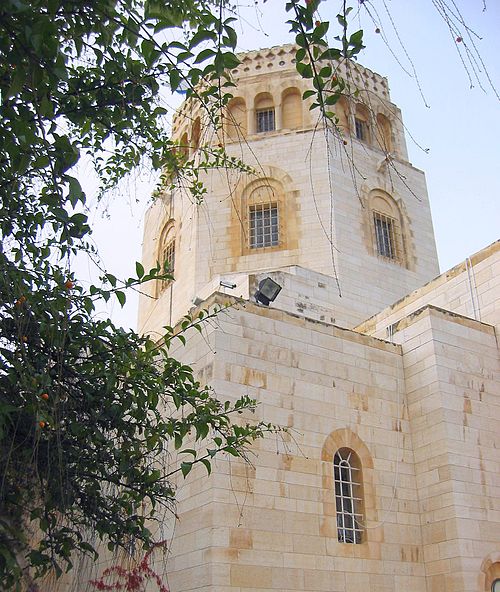 The Palestine Archaeological Museum (PAM; known since 1967 as the Rockefeller Archaeological Museum), built in Jerusalem during the British Mandate
 -
 Main post office, Jaffa
 -

-
 The Western Wall, 1933
 -
 Supreme Military Tribunal of the British Mandate, Kiryat Shmuel, Jerusalem
 -
 YMCA in Jerusalem, built during the British Mandate
 -
 "Bevingrad" in Jerusalem, Russian Compound behind barbed wire
 -
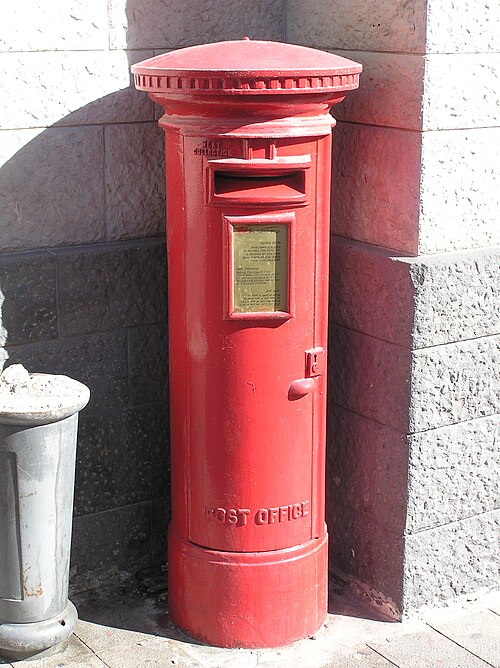 Mandate-era pillar box, Jerusalem
 -
 1941 currency coin
 -
 Movement and curfew pass, issued under the authority of the British Military Commander, East Palestine, 1946

See also
- Mandatory Palestine passport
- Palestinian Citizenship Order, 1925
- History of Palestinian journalism
- History of agriculture in Palestine
- Palestine Command
- Palestine pound
- High Commissioners for Palestine and Transjordan
- Israeli Declaration of Independence
- List of post offices in the British Mandate of Palestine
- Postage stamps and postal history of Palestine
Notes
- ^ During its existence the territory was officially known simply as Palestine, but, in later years, a variety of other names and descriptors have been used, including Mandatory or Mandate Palestine, the British Mandate of Palestine and British Palestine. (Arabic: فلسطين الانتدابية Filasṭīn al-Intidābiyah; Hebrew: פָּלֶשְׂתִּינָה (א״י) Pāleśtīnā (E.Y.), where "E.Y." indicates ’Eretz Yiśrā’ēl, the Land of Israel)
- ^ Historian Nur Masalha describes the "British preoccupation with Palestine" and the large increase in European books, articles, travelogues and geographical publications during the 18th and 19th centuries.[13]
- ^ From Himmler:
From Ribbentrop:The National Socialist movement of Greater Germany has, since its inception, inscribed upon its flag the fight against the world Jewry. It has therefore followed with particular sympathy the struggle of freedom-loving Arabs, especially in Palestine, against Jewish interlopers. In the recognition of this enemy and of the common struggle against it lies the firm foundation of the natural alliance that exists between the National Socialist Greater Germany and the freedom-loving Muslims of the whole world. In this spirit I am sending you on the anniversary of the infamous Balfour declaration my hearty greetings and wishes for the successful pursuit of your struggle until the final victory.
I am sending my greetings to your eminence and to the participants of the meeting held today in the Reich capital under your chairmanship. Germany is linked to the Arab nation by old ties of friendship, and today we are united more than ever before. The elimination of the socalled Jewish national home and the liberation of all Arab countries from the oppression and exploitation of the Western powers is an unchangeable part of the Great German Reich policy. Let the hour not be far off when the Arab nation will be able to build its future and find unity in full independence.
- ^ For example, Radio Palestine broadcast the comments of an Egyptian writer who said, "The war is between the lofty and humane values represented by England and the forces of darkness represented by the Nazis."[63]
- ^ A British recruiting poster in Arabic, published in the Falastin newspaper in January 1942, read: "She couldn't stop thinking about contribution and sacrifice, she felt ongoing pride and exaltation of spirit – when she did what she saw as her sacred duty for her nation and its sons. When your country is crying out to you and asking for your service, when your country makes it plain that our Arab men need your love and support, and when your country reminds you of how cruel the enemy is – when your country is calling you, can you stand by and do nothing?"[63]
- ^ p. 50, at 1947 "Haj Amin al-Husseini went one better: he denounced also the minority report, which, in his view, legitimized the Jewish foothold in Palestine, a "partition in disguise", as he put it."; p. 66, at 1946 "The League demanded independence for Palestine as a "unitary" state, with an Arab majority and minority rights for the Jews. The AHC went one better and insisted that the proportion of Jews to Arabs in the unitary state should stand at one to six, meaning that only Jews who lived in Palestine before the British Mandate be eligible for citizenship"; p. 67, at 1947 "The League's Political Committee met in Sofar, Lebanon, on 16–19 September, and urged the Palestine Arabs to fight partition, which it called "aggression", "without mercy". The League promised them, in line with Bludan, assistance "in manpower, money and equipment" should the United Nations endorse partition."; p. 72, at Dec 1947 "The League vowed, in very general language, "to try to stymie the partition plan and prevent the establishment of a Jewish state in Palestine,"[78]
- ^ "The Arabs rejected the United Nations Partition Plan so that any comment of theirs did not specifically concern the status of the Arab section of Palestine under partition but rather rejected the scheme in its entirety."[79]
References
- ^ "Palestine seal". www.royalmintmuseum.org.uk. Retrieved 12 February 2024.
- ^ Department of Statistics (1945). Village Statistics, April, 1945. Government of Palestine. Scan of the original document at the National Library of Israel.
- ^ 1922 Census of Palestine, retrieved 19 February 2024.
- ^ "League of Nations decision confirming the Principal Allied Powers' agreement on the territory of Palestine". Archived from the original on 25 November 2013.
- ^ Hughes, Matthew, ed. (2004). Allenby in Palestine: The Middle East Correspondence of Field Marshal Viscount Allenby June 1917 – October 1919. Army Records Society. Vol. 22. Phoenix Mill, Thrupp, Stroud, Gloucestershire: Sutton Publishing Ltd. ISBN 978-0-7509-3841-9. Allenby to Robertson 25 January 1918 in Hughes 2004, p. 128
- ^ Article 22, The Covenant of the League of Nations Archived 26 July 2011 at the Wayback Machine and "Mandate for Palestine", Encyclopaedia Judaica, Vol. 11, p. 862, Keter Publishing House, Jerusalem, 1972
- ^ Legal Consequences of the Construction of a Wall in the Occupied Palestinian Territory, Advisory Opinion of 9 July 2004, 2004 International Court of Justice 63.
- ^ Victor Kattan. From Coexistence to Conquest, International Law and the Origins of the Arab-Israeli Conflict, 1891–1949. London, New York: Pluto Press, 2009.
- ^ Nur Masalha (2018). Palestine: A Four Thousand Year History. Zed. ISBN 978-1-78699-272-7. Chapter 9: Being Palestine, becoming Palestine, p. 287: "the sense of continuity between the ancient, medieval and modern political geography and naming traditions of Palestine eventually came into play in the designation of the British Mandatory Government of Palestine". The preceding pages, p.259-287, document in detail the usage of the term Palestine by native Palestinians from the moment the printing press was introduced into the area in the late 19th century.
- ^ Khalidi 1997, pp. 151–152.
- ^ Büssow, Johann (11 August 2011). Hamidian Palestine: Politics and Society in the District of Jerusalem 1872–1908. BRILL. p. 5. ISBN 978-90-04-20569-7. Retrieved 17 May 2013.
- ^ |The 1915 Filastin Risalesi ("Palestine Document") is a country survey of the VIII Corps of the Ottoman Army, which identified Palestine as a region including the sanjaqs of Akka (the Galilee), the Sanjaq of Nablus, and the Sanjaq of Jerusalem (Kudus Sherif), see Ottoman Conceptions of Palestine-Part 2: Ethnography and Cartography, Salim Tamari Archived 27 March 2015 at the Wayback Machine
- ^ Nur Masalha (2018). Palestine A Four Thousand year History. Zed Books. pp. 242–245. ISBN 978-1-78699-274-1.
- ^ Caplan, Neil (1994). "ZIONIST VISIONS OF PALESTINE, 1917–19361". The Muslim World. 84 (1–2): 19–35. doi:10.1111/j.1478-1913.1994.tb03587.x.
- ^ Ronald Storrs, Orientations, Nicholson & Watson 1943 pp.383-384.|quote='When . .the first civil issue of Palestine stamps was being designed, strong pressure was exerted on the authorities to render Palestine, in the Hebrew title, by Eretz Yisrael, the Land of Israel, the ancient and traditional Jewish name. Jews have never called the country Palestine, which was indeed a Roman name etymologically akin to Philistia. .the Government was undoubtedly right in resisting a nomenclature intolerable to the vast majority of Palestinians, and in substituting the device, relatively inoffensive to all parties (though giving complete satisfaction to none), of adding to "Palestine" in Hebrew the two Hebrew initials (E.Y.).'
- ^ League of Nations, Permanent Mandate Commission, Minutes of the Ninth Session Archived 2011-06-28 at the Wayback Machine (Arab Grievances), Held at Geneva from 8 to 25 June 1926,
- ^ Rayman, Noah (29 September 2014). "Mandatory Palestine: What It Was and Why It Matters". Time. Archived from the original on 26 May 2020.
- ^ Ira M. Lapidus, A History of Islamic Societies, 2002: "The first were the nationalists, who in 1918 formed the first Muslim-Christian associations to protest against the Jewish national home" p.558
- ^ Tessler, A History of the Israeli-Palestinian Conflict, Second Edition, 2009: "An All-Palestine Congress, known also as the First Congress of the Muslim-Christian Societies, was organised by the MCA and convened in Jerusalem in February 1919." p.220-221
- ^ "First Arab Congress 1919 Paris Resolution (in Arabic)" (PDF). ecf.org.il. Archived from the original (PDF) on 25 September 2017.
- ^ "Palestine Through History: A Chronology (I)". Archived from the original on 17 June 2011. Retrieved 14 February 2016. The Palestine Chronicle
- ^ a b "United Nations Maintenance Page". unispal.un.org. Archived from the original on 3 June 2014.
- ^ a b c d 'A Colonial Room With a View of Jerusalem' (Haaretz, 24 April 2012). https://www.haaretz.com/israel-news/culture/2012-04-24/ty-article/a-colonial-room-with-a-view-of-Jerusalem/0000017f-deec-db22-a17f-fefd9e520000
- ^ Shamir, Ronen (2013) Current Flow: The Electrification of Palestine Stanford: Stanford University Press
- ^ Caplan, Neil. Palestine Jewry and the Arab Question, 1917 – 1925. London and Totowa, NJ: F. Cass, 1978. ISBN 978-0-7146-3110-3. pp. 148–161.
- ^ Mattar, Philip (2003). "al-Husayni, Amin". In Mattar, Philip (ed.). Encyclopedia of the Palestinians (Revised ed.). New York: Facts On File. ISBN 978-0-8160-5764-1.
- ^ "It was not scholarly religious credentials that made Hajj Amin an attractive candidate for president of the SMC in the eyes of colonial officials. Rather, it was the combination of his being an effective nationalist activist and a member of one of Jerusalem's most respected notable families that made it advantageous to align his interests with those of the British administration and thereby keep him on a short tether." Weldon C. Matthews, Confronting an Empire, Constructing a Nation: Arab Nationalists and Popular Politics in Mandate Palestine, I.B.Tauris, 2006 pp. 31–32
- ^ For details see Yitzhak Reiter, Islamic Endowments in Jerusalem under British Mandate, Frank Cass, London Portland, Oregon, 1996
- ^ Excluding funds for land purchases. Sahar Huneidi, A Broken Trust: Herbert Samuel, Zionism and the Palestinians 1920–1925, I.B. Tauris, London and New York, 2001 p. 38. The 'Jewish Agency', mentioned in article 4 of the Mandate only became the official term in 1928. At the time the organisation was called the Palestine Zionist Executive.
- ^ "1922 Palestine Order in Council". Archived from the original on 16 September 2014.
- ^ a b "Palestine. The Constitution Suspended. Arab Boycott Of Elections. Back To British Rule" The Times, 30 May 1923, p. 14, Issue 43354
- ^ a b Legislative Council (Palestine) Archived 15 October 2018 at the Wayback Machine Answers.com
- ^ Las, Nelly. "International Council of Jewish Women". International Council of Jewish Women. Retrieved 20 November 2018.
- ^ League of Nations, Official Journal, October 1923, p. 1217.
- ^ a b Segev 2000, pp. 360–362
- ^ Gilbert 1998, p. 80
- ^ Khalidi 2006, pp. 87–90
- ^ Smith, Charles D. (2007). Palestine and the Arab–Israeli Conflict: A History with Documents (Sixth ed.). pp. 111–225.
- ^ Gilbert 1998, p. 85: The Jewish Settlement Police were created and equipped with trucks and armoured cars by the British working with the Jewish Agency.
- ^ "The Zionism of Orde", Covenant, vol. 3, IDC, archived from the original on 1 August 2014, retrieved 4 August 2014
- ^ Black 1991, p. 14
- ^ Shapira 1992, pp. 247, 249, 350
- ^ Firestone, Reuven (2012). Holy War in Judaism: The Fall and Rise of a Controversial Idea. Oxford University Press. p. 192. ISBN 978-0-19-986030-2.
- ^ "Aljazeera: The history of Palestinian revolts". Archived from the original on 15 December 2005. Retrieved 15 December 2005.
- ^ Khalidi 2001, p. 26
- ^ Khalidi 1987, p. 845.
- ^ Khalidi 2001, p. 28.
- ^ a b Louis, William Roger (2006). Ends of British Imperialism: The Scramble for Empire, Suez, and Decolonization Archived 28 November 2022 at the Wayback Machine, p. 391.
- ^ a b Morris, Benny (2009). One State, Two States: Resolving the Israel/Palestine Conflict, p. 66
- ^ a b Morris, Benny (2004) [1988]. The Birth of the Palestinian Refugee Problem Revisited. Cambridge University Press. pp. 11, 48, 49. ISBN 978-0-521-00967-6. Retrieved 12 February 2022. p. 11 "while the Zionist movement, after much agonising, accepted the principle of partition and the proposals as a basis for negotiation"; p. 49 "In the end, after bitter debate, the Congress equivocally approved—by a vote of 299 to 160—the Peel recommendations as a basis for further negotiation."
- ^ 'Zionists Ready To Negotiate British Plan As Basis', The Times Thursday, 12 August 1937; p. 10; Issue 47761; col B.
- ^ Eran, Oded (2002). "Arab-Israel Peacemaking." The Continuum Political Encyclopedia of the Middle East. Ed. Avraham Sela. New York: Continuum, p. 122.
- ^ Letter from David Ben-Gurion to his son Amos, written 5 October 1937 Archived 12 May 2019 at the Wayback Machine, Obtained from the Ben-Gurion Archives in Hebrew, and translated into English by the Institute of Palestine Studies, Beirut
- ^ Morris, Benny (2011), Righteous Victims: A History of the Zionist-Arab Conflict, 1881–1998, Knopf Doubleday Publishing Group, p. 138, ISBN 978-0-307-78805-4 Quote: "No Zionist can forgo the smallest portion of the Land Of Israel. [A] Jewish state in part [of Palestine] is not an end, but a beginning ….. Our possession is important not only for itself … through this we increase our power, and every increase in power facilitates getting hold of the country in its entirety. Establishing a [small] state …. will serve as a very potent lever in our historical effort to redeem the whole country"
- ^ a b Finkelstein, Norman (2005), Beyond Chutzpah: On the Misuse of Anti-semitism and the Abuse of History, University of California Press, p. 280, ISBN 978-0-520-24598-3
- ^ Quote from a meeting of the Jewish Agency executive in June 1938: "[I am] satisfied with part of the country, but on the basis of the assumption that after we build up a strong force following the establishment of the state, we will abolish the partition of the country and we will expand to the whole Land of Israel." in
Masalha, Nur (1992), Expulsion of the Palestinians: The Concept of "Transfer" in Zionist Political Thought, 1882–1948, Inst for Palestine Studies, p. 107, ISBN 978-0-88728-235-5; and Segev 2000, p. 403 - ^ From a letter from Chaim Weizmann to General Sir Arthur G. Wauchope, High Commissioner for Palestine, while the Peel Commission was convening in 1937: "We shall spread in the whole country in the course of time ….. this is only an arrangement for the next 25 to 30 years." Masalha, Nur (1992), Expulsion of the Palestinians: The Concept of "Transfer" in Zionist Political Thought, 1882–1948, Inst for Palestine Studies, p. 62, ISBN 978-0-88728-235-5
- ^ "Why Italian Planes Bombed Tel-Aviv?". Archived from the original on 21 September 2011.
- ^ How the Palmach was formed Archived 12 December 2019 at the Wayback Machine (History Central)
- ^ Secret World War II documents released by the UK in July 2001, include documents on Operation ATLAS (See References: KV 2/400–402 Archived 2 April 2014 at the Wayback Machine. A German task force led by Kurt Wieland parachuted into Palestine in September 1944. This was one of the last German efforts in the region to attack the Jewish community in Palestine and undermine British rule by supplying local Arabs with cash, arms and sabotage equipment. The team was captured shortly after landing.
- ^ Moshe Pearlman (1947). Mufti of Jerusalem; the story of Haj Amin el Husseini. V. Gollancz. p. 50.
- ^ Rolf Steininger (17 December 2018). Germany and the Middle East: From Kaiser Wilhelm II to Angela Merkel. Berghahn Books. pp. 55–. ISBN 978-1-78920-039-3.
- ^ a b c Aderet, Ofer. "12,000 Palestinians Fought for U.K. in WWII alongside Jewish Volunteers, Historian Finds." Haaretz.com. Haaretz, May 31, 2019. Link Archived 27 March 2022 at the Wayback Machine.
- ^ Corrigan, Gordon. The Second World War Thomas Dunne Books, 2011 ISBN 978-0-312-57709-4 p. 523, last paragraph
- ^ a b "United States: British Collaboration on Illegal Immigration to Palestine, 1945-1947". Miriam Joyce Haron. JSTOR. 1980. JSTOR 4467083. Retrieved 6 December 2023.
- ^ Lenk, RS (1994). The Mauritius Affair, The Boat People of 1940–41. London: R Lenk. ISBN 978-0-9518805-2-4.
- ^ Aroni, Samuel (2002–2007). "Who Perished on the Struma And How Many?". JewishGen.org.
- ^ Подводная лодка "Щ-215". Черноморский Флот информационный ресурс (in Russian). 2000–2013. Retrieved 27 March 2013.
- ^ "מפקורה SS Mefküre Mafkura Mefkura". Haapalah Aliyah Bet Database. 27 September 2011. Retrieved 26 March 2013.
- ^ Kenneth Harris, Attlee (1982) pp 388–400.
- ^ Howard Adelman, "UNSCOP and the Partition Recommendation." (Centre for Refugee Studies, York University, 2009) online Archived 19 December 2019 at the Wayback Machine.
- ^ "A/RES/181(II) of 29 November 1947". United Nations. 1947. Archived from the original on 24 May 2012. Retrieved 11 January 2012.
- ^ Cathy Hartley; Paul Cossali (2004). Survey of Arab-Israeli Relations. Routledge. pp. 52–53. ISBN 978-1-135-35527-2.
- ^ Article 11 of the United Nations Charter
- ^ Roosevelt, Kermit (1948). "The Partition of Palestine: A lesson in pressure politics". Middle East Journal. 2 (1): 1–16. JSTOR 4321940.
- ^ Snetsinger, John (1974). Truman, the Jewish vote, and the creation of Israel. Hoover Institution. pp. 66–67. ISBN 978-0-8179-3391-3.
- ^ Sarsar, Saliba (2004). "The question of Palestine and United States behavior at the United Nations". International Journal of Politics, Culture and Society. 17 (3): 457–470. doi:10.1023/B:IJPS.0000019613.01593.5e. ISSN 0891-4486. S2CID 143484109.
- ^ Morris, Benny (2008). 1948: a history of the first Arab-Israeli war. Yale University Press. ISBN 978-0-300-12696-9. Retrieved 24 July 2013.
- ^ "UNITED NATIONS CONCILIATION COMMISSION FOR PALESTINE A/AC.25/W/19 30 July 1949: (Working paper prepared by the Secretariat)". Archived from the original on 2 October 2013. Retrieved 24 August 2013.
- ^ "Palestine". Encyclopædia Britannica Online School Edition, 2006. 15 May 2006.
- ^ Stefan Brooks (2008). "Palestine, British Mandate for". In Spencer C. Tucker (ed.). The Encyclopedia of the Arab-Israeli Conflict. Vol. 3. Santa Barbara, California: ABC-CLIO. p. 770. ISBN 978-1-85109-842-2.
- ^ A. J. Sherman (2001). Mandate Days: British Lives in Palestine, 1918–1948. The Johns Hopkins University Press. ISBN 978-0-8018-6620-3.
- ^ Menachem Begin (1977). "The Revolt".
- ^ See Mandates, Dependencies and Trusteeship, by H. Duncan Hall, Carnegie Endowment, 1948, pp. 266–267.
- ^ "The Mandate is Indivisble". Historical Jewish Press, Tel Aviv University, Palestine Post. 9 April 1946. p. 3. Archived from the original on 29 September 2010.
- ^ "The Near East and Africa". Foreign relations of the United States. 1947. p. 1255.
- ^ Snetsinger, John (1974). Truman, the Jewish vote, and the creation of Israel. Hoover Press. pp. 60–61. ISBN 978-0-8179-3391-3.
- ^ "The Near East and Africa, Volume V (1947)". United States Department of State, Foreign relations of the United States. p. 1271.
- ^ The British Empire in the Middle East, 1945–1951 Archived 28 November 2022 at the Wayback Machine, p. 348. William Roger Louis, Clarendon Press, 1984
- ^ "Violence Ebbs; British Police Withdrawn from Tel Aviv and Its Environs – Jewish Telegraphic Agency". www.jta.org. 16 December 1947.
- ^ Michael J Cohen (24 February 2014). Britain's Moment in Palestine: Retrospect and Perspectives, 1917–1948. Routledge. pp. 481–. ISBN 978-1-317-91364-1.
- ^ "British Forces in Jerusalem Alerter Following Haifa Victory; Fear Haganah Raid on City – Jewish Telegraphic Agency". www.jta.org. 23 April 1948.
- ^ a b "PALESTINE BILL". Parliamentary Debates (Hansard). 10 March 1948.
- ^ Herzog, Chaim and Gazit, Shlomo: The Arab-Israeli Wars: War and Peace in the Middle East from the 1948 War of Independence to the Present, p. 46
- ^ "'U.N. Resolution 181 (II). Future Government of Palestine, Part 1-A, Termination of Mandate, Partition and Independence". Archived from the original on 7 February 2009. Retrieved 20 May 2017.
- ^ U.N. Resolution 181 (II). Future Government of Palestine, Part 1-A, Termination of Mandate, Partition and Independence Archived 29 October 2006 at the Wayback Machine.
- ^ "President Truman's Trusteeship Statement – 1948". www.mideastweb.org.
- ^ Northey, Ruth (project ed.) (2013). Whitaker's Britain. Bloomsbury Publishing. p. 127. ISBN 978-1-4729-0305-1.
- ^ "Israel Ministry of Foreign Affairs: Declaration of Establishment of State of Israel: 14 May 1948: Retrieved 10 April 2012". Archived from the original on 16 January 2013. Retrieved 9 April 2012.
- ^ Bier, Aharon, & Slae, Bracha, For the sake of Jerusalem, Mazo Publishers, 2006, p. 49
- ^ Declaration of the Establishment of the State of Israel, 14 May 1948.
- ^ J. Sussmann (1950). "Law and Judicial Practice in Israel". Journal of Comparative Legislation and International Law. 32: 29–31.
- ^ "Copy of telegram from Epstein to Shertok" (PDF). Government of Israel. Archived from the original (PDF) on 13 November 2013. Retrieved 3 May 2013.
- ^ "Our Documents – Press Release Announcing U.S. Recognition of Israel (1948)". www.ourdocuments.gov. 9 April 2021.
- ^ "Palestine Passports Cease to Give British Protection After May Govt. Announces – Jewish Telegraphic Agency". www.jta.org. 26 March 1948.
- ^ Masalha, Nur (1992). "Expulsion of the Palestinians." Institute for Palestine Studies, this edition 2001, p. 175.
- ^ Rashid (1997). p. 21 Archived 28 November 2022 at the Wayback Machine "In 1948 half of Palestine's 1.4 million Arabs were uprooted from their homes and became refugees".
- ^ Appendix IX-B, 'The Arab Expeditionary Forces to Palestine, 15/5/48, Khalidi, 1971, p. 867.
- ^ Bayliss, 1999, p. 84.
- ^ Cohen-Hattab, Kobi (8 July 2019). Zionism's Maritime Revolution: The Yishuv's Hold on the Land of Israel's Sea and Shores, 1917–1948. Walter de Gruyter GmbH & Co KG. ISBN 978-3-11-063352-8.
- ^ "Plan of partition - Summary of the UK Palestine Royal Commission (Peel Commission) report - League of Nations/Non-UN document". un.org.
- ^ See Papers relating to the foreign relations of the United States "The Paris Peace Conference". 1919. p. 94.
- ^ League of Nations Union (1922). "Summary of the work of the League of Nations, January 1920 – March 1922". London – via Internet Archive.
- ^ "Internet History Sourcebooks". www.fordham.edu. Archived from the original on 8 June 2008. Retrieved 12 January 2010.
- ^ See Defending the Rights of Others, by Carol Fink, Cambridge University, 2006, ISBN 978-0-521-02994-0, p. 28
- ^ See the Statement of the Principal Accredited Representative, Hon. W. Ormsby-Gore, C.330.M.222, Mandate for Palestine – Minutes of the Permanent Mandates Commission/League of Nations 32nd session, 18 August 1937 Archived 3 June 2011 at the Wayback Machine
- ^ See the Judgment in "Legal Consequences of the Construction of a Wall in the Occupied Palestinian Territory" Archived 2011-01-12 at the Wayback Machine (PDF)
- ^ See paragraphs 49, 70, and 129 of the International Court of Justice Advisory Opinion, Legal Consequences of the Construction of a Wall in the Occupied Palestinian Territory PDF Archived 2010-07-06 at the Wayback Machine and PAUL J. I. M. DE WAART (2005). "International Court of Justice Firmly Walled in the Law of Power in the Israeli–Palestinian Peace Process." Leiden Journal of International Law, 18, pp. 467–487, doi:10.1017/S0922156505002839
- ^ Khalidi 2006, pp. 32–33.
- ^ Khalidi 2006, pp. 33–34.
- ^ "Palestine. The Constitution Suspended., Arab Boycott Of Elections., Back To British Rule" The Times, 30 May 1923, p. 14, Issue 43354
- ^ Khalidi 2006, pp. 32, 36.
- ^ See Foreign relations of the United States, 1947. The Near East and Africa Volume V, p. 1033
- ^ Khalidi 2006, p. 63.
- ^ Khalidi 2006, p. 52.
- ^ Khalidi 2006, pp. 56–57.
- ^ Khalidi 2006, pp. 63, 69; Segev 2000, pp. 127–144.
- ^ Morris 2001, p. 112.
- ^ Khalidi 2006, p. 81.
- ^ "Filastin". National Library of Israel. Retrieved 4 March 2019.
- ^ Khalidi 2006, pp. 87–90.
- ^ Sufian, Sandy (1 January 2008). "Anatomy of the 1936–39 Revolt: Images of the Body in Political Cartoons of Mandatory Palestine". Journal of Palestine Studies. 37 (2): 23–42. doi:10.1525/jps.2008.37.2.23. Retrieved 14 January 2008.
- ^ a b c Kominko 2015, p. 384.
- ^ Gorman & Monciaud 2018, p. 106.
- ^ Regan 2018, p. 135, 137.
- ^ Kominko 2015, p. 386-387.
- ^ In June 1947, the British Mandate Government of Palestine had published the following statistics: "It is estimated that over a quarter of the Jewish population in Palestine are Sephardic Jews of whom some 60,000 were born of families resident in Palestine for centuries. The bulk of the Sephardic community, however, consists of oriental Jews emanating from Syria, Egypt, Persia, Iraq, Georgia, Bokhara and other Eastern countries. They are confined mainly to the larger towns ..." (From: Supplement to Survey of Palestine – Notes compiled for the information of the United Nations Special Committee on Palestine – June 1947, Gov. Printer Jerusalem, pp. 150–151)
- ^ "Jewish Agency History". Archived from the original on 15 February 2006. Retrieved 29 January 2012.
- ^ Palestine Jewry and the Arab Question, 1917–1925, by Caplan, Neil. London and Totowa, NJ: F. Cass, 1978. ISBN 978-0-7146-3110-3. pp. 161–165.
- ^ A Survey of Palestine: Prepared in December 1945 and January 1946 for the Information of the Anglo-American Committee of Inquiry. Vol. 1. Palestine: Govt. printer. 1946. p. 185.
- ^ A Survey of Palestine: Prepared in December 1945 and January 1946 for the Information of the Anglo-American Committee of Inquiry. Vol. 1. Palestine: Govt. printer. 1946. p. 210: "Arab illegal immigration is mainly ... casual, temporary and seasonal". pp. 212: "The conclusion is that Arab illegal immigration for the purpose of permanent settlement is insignificant".
- ^ J. McCarthy (1995). The population of Palestine: population history and statistics of the late Ottoman period and the Mandate. Princeton, N.J.: Darwin Press.
- ^ Supplement to Survey of Palestine – Notes compiled for the information of the United Nations Special Committee on Palestine – June 1947, Gov. Printer Jerusalem, p. 18
- ^ John B. Quigley (2010). The Statehood of Palestine: International Law in the Middle East Conflict. Cambridge University Press. p. 54. ISBN 978-0-521-15165-8.
- ^ See History of Zionism (1600–1918), Volume I, Nahum Sokolow, 1919 Longmans, Green, and Company, London, pp. xxiv–xxv
- ^ "The Avalon Project : The Palestine Mandate". avalon.law.yale.edu.
- ^ "British White Paper of June 1922". avalon.law.yale.edu.
- ^ See the report of the United Nations Special Committee on Palestine, UN Document A/364, 3 September 1947
- ^ Memorandum by the Secretary of State for the Colonies, "Palestine: High Commissioners Views on Policy", March 1930, UK National Archives Cabinet Paper CAB/24/211, formerly C.P. 108 (30)
- ^ "PERMANENT MANDATES COMMISSION MINUTES OF THE TWENTY-SECOND SESSION". LEAGUE OF NATIONS. Archived from the original on 10 August 2011. Retrieved 8 June 2010.
- ^ Partner to Partition: The Jewish Agency's Partition Plan in the Mandate Era, by Yossi Katz, Routledge, 1998, ISBN 978-0-7146-4846-0
- ^ "FRUS: Foreign relations of the United States diplomatic papers, 1937. The British Commonwealth, Europe, Near East and Africa: Palestine". digicoll.library.wisc.edu.
- ^ See Letters to Paula and the Children, David Ben Gurion, translated by Aubry Hodes, University of Pittsburgh Press, 1971 pp. 153–157
- ^ See Righteous Victims: A History of the Zionist–Arab Conflict, 1881–1999, by Benny Morris, Knopf, 1999, ISBN 978-0-679-42120-7, p. 138
- ^ See Scars of war, Wounds of Peace: The Israeli–Arab Tragedy, by Shlomo Ben-Ami, Oxford University Press, USA, 2006, ISBN 978-0-19-518158-6, p. 17
- ^ "Avalon Project – Anglo-American Committee of Inquiry – Chapter V". avalon.law.yale.edu.
- ^ See Foreign relations of the United States, 1946, The Near East and Africa Volume VII, pp. 692–693
- ^ Stein 1984, p. 4.
- ^ "Land Ownership in Palestine", CZA, KKL5/1878. The statistics were prepared by the Palestine Lands Department for the Anglo-American Committee of Inquiry, 1945, ISA, Box 3874/file 1. See Khalaf 1991, p. 27
- ^ Stein 1984, p. 226.
- ^ Avneri 1984, p. 224.
- ^ Stein 1984, pp. 3–4, 247.
- ^ Fischbach, Michael R. (13 August 2013). Jewish Property Claims Against Arab Countries. Columbia University Press. p. 24. ISBN 978-0-231-51781-2.
By 1948, after several decades of Jewish immigration, the Jewish population of Palestine had risen to about one third of the total, and Jews and Jewish companies owned 20 percent of all cultivable land in the country
- ^ Wright, Clifford A. (2015). Facts and Fables (RLE Israel and Palestine): The Arab-Israeli Conflict. Routledge. p. 38. ISBN 978-1-317-44775-7.
- ^ Kamel, Lorenzo (2014). "Whose Land? Land Tenure in Late Nineteenth- and Early Twentieth-Century Palestine". British Journal of Middle Eastern Studies. 41 (2): 230–242. doi:10.1080/13530194.2013.878518. S2CID 153944896.
- ^ Land Ownership of Palestine Archived 26 February 2024 at the Wayback Machine – Map prepared by the Government of Palestine on the instructions of the UN Ad Hoc Committee on the Palestine Question.
- ^ Table 2 showing Holdings of Large Jewish Lands Owners as of December 31st, 1945, British Mandate: A Survey of Palestine: Volume I – Page 245. Chapter VIII: Land: Section 3., prepared by the British Mandate for the United Nations Archived 18 June 2021 at the Wayback Machine Survey of Palestine Retrieved 4 July 2015
- ^ a b Anglo-American Committee of Inquiry on Jewish Problems in Palestine and Europe, J. V. W. Shaw, General Assembly, Special Committee on Palestine, United Nations (1991). A Survey of Palestine: Prepared in December, 1945 and January, 1946 for the Information of the Anglo-American Committee of Inquiry. Vol. 1. Institute for Palestine Studies. ISBN 978-0-88728-211-9.
{{cite book}}: CS1 maint: multiple names: authors list (link) - ^ Ownership of land in Palestine, Share of Palestinan (sic) Arabs and Jews as of 1 April 1943, prepared by the British Mandate for the United Nations Archived 29 September 2018 at the Wayback Machine Survey of Palestine Retrieved 25 August 2014
- ^ ibid, Supplement p30.
- ^ A Survey of Palestine (Prepared in December 1945 and January 1946 for the information of the Anglo-American Committee of Inquiry), vol. 1, chapter VIII, section 7, Government Printer of Jerusalem, pp. 260–262 Archived 12 September 2017 at the Wayback Machine
- ^ ""Hope Simpson report, Chapter III". Zionism-israel.com. October 1930.
- ^ Mills, E. Census of Palestine, 1931 (UK government, 1932), Vol I, pp. 61–65.
- ^ The Political History of Palestine under British Administration, Memorandum to the United Nations Special Committee
- ^ prepared in December 1945 and January 1946 for the information of the Anglo-American Committee of Inquiry. (1991). A Survey of Palestine: Prepared in December, 1945 and January, 1946 for the Information of the Anglo-American Committee of Inquiry. Vol. 1. Institute for Palestine Studies. pp. 12–13. ISBN 978-0-88728-211-9.
{{cite book}}: CS1 maint: numeric names: authors list (link) - ^ File:J. B. Barron, ed. Palestine, Report and General Abstracts of the Census of 1922. Government of Palestine.djvu, page 9
- ^ The Palestine Order in Council, 10 August 1922, article 11 Archived 16 September 2014 at the Wayback Machine: "The High Commissioner may, with the approval of a Secretary of State, by Proclamation divide Palestine into administrative divisions or districts in such manner and with such subdivisions as may be convenient for purposes of administration describing the boundaries thereof and assigning names thereto."
- ^ a b Likhovski 2006, p. 64.
- ^ "H.h. Trusted Named Chief Justice of Palestine". Jewish Telegraphic Agency. 27 October 1936. Retrieved 18 November 2015.
- ^ Likhovski 2006, p. 74.
- ^ Likhovski 2006, p. 75.
- ^ Khalidi 2006, pp. 13–14.
- ^ Khalidi 2006, p. 27.
- ^ Shamir, Ronen (2013). Current Flow: The Electrification of Palestine. Stanford: Stanford University Press.
- ^ Noam Dvir (5 April 2012). "Haifa's glass house transparent, but still an Israeli mystery". Haaretz.
- ^ Khalidi 2006, p. 16.
- ^ Khalidi 2006, p. 17.
- ^ Khalidi 2006, pp. 29–30.
- ^ "Why Only a Hebrew University? The Tale of the Arab University in Mandatory Jerusalem" (PDF). Jerusalem Quarterly. Institute for Palestine Studies. 2023. Retrieved 16 April 2023.
- ^ Khalidi 2006, pp. 14, 24.
Bibliography
- Aruri, Naseer Hasan (1972). Jordan: A Study in Political Development 1923–1965. The Hague: Martinus Nijhoff Publishers. ISBN 978-90-247-1217-5. Retrieved 2 May 2009.
- Avneri, Aryeh L. (1984). The Claim of Dispossession: Jewish Land-Settlement and the Arabs, 1878–1948. Transaction Publishers. ISBN 978-0-87855-964-0. Retrieved 2 May 2009.
- Bayliss, Thomas (1999). How Israel Was Won: A Concise History of the Arab–Israeli Conflict. Lexington Books. ISBN 978-0-7391-0064-6.
- Bethell, Nicholas (1979). The Palestine Triangle: the Struggle Between the British, the Jews and the Arabs, 1935–48. London: Deutsch. ISBN 978-0-233-97069-1.
- Biger, Gideon (2004). The Boundaries of Modern Palestine, 1840–1947. London: Routledge. ISBN 978-0-7146-5654-0. Retrieved 2 May 2009.
- Black, Ian (1991). Israel's Secret Wars: A History of Israel's Intelligence Services. Morris, Benny. Grove Press. ISBN 978-0-8021-1159-3.
- El-Eini, Roza I.M. (2006). Mandated Landscape: British Imperial Rule in Palestine, 1929–1948. London: Routledge. ISBN 978-0-7146-5426-3. Retrieved 5 May 2009.
- Gilbert, Martin (1998). Israel: a history. Doubleday. ISBN 978-0-385-40401-3. Retrieved 2 May 2009.
- Gorman, Anthony; Monciaud, Didier, eds. (2018). The Press in the Middle East and North Africa. Edinburgh University Press. ISBN 978-1-4744-3064-7. Retrieved 2 April 2024.
- Hughes, Matthew, ed. (2004). Allenby in Palestine: The Middle East Correspondence of Field Marshal Viscount Allenby June 1917 – October 1919. Army Records Society. Vol. 22. Phoenix Mill, Thrupp, Stroud, Gloucestershire: Sutton Publishing Ltd. ISBN 978-0-7509-3841-9.
- Katz, Shmuel (1973). Battleground: Fact and Fantasy in Palestine. Bantam Books. ISBN 978-0-929093-13-0. Retrieved 2 May 2009.
- Khalaf, Issa (1991). Politics in Palestine: Arab Factionalism and Social Disintegration, 1939–1948. State University of New York Press. ISBN 978-0-7914-0708-0. Retrieved 6 May 2009.
- Khalidi, Rashid (1997). Palestinian Identity: The Construction of Modern National Consciousness. Columbia University Press. ISBN 978-0-231-10575-0. Retrieved 12 February 2022.
- Khalidi, Rashid (2006). The Iron Cage: The Story of the Palestinian Struggle for Statehood. Beacon Press. ISBN 978-0-8070-0308-4. Retrieved 2 May 2009.
- Khalidi, Rashid (2007) [1st ed. 2001]. "The Palestinians and 1948: the underlying causes of failure". In Eugene L. Rogan & Avi Shlaim (ed.). The War for Palestine: Rewriting the History of 1948 (2nd ed.). Cambridge University Press. ISBN 978-0-521-69934-1. Retrieved 2 May 2009.
- Khalidi, Walid (1987) [Original in 1971]. From Haven to Conquest: Readings in Zionism and the Palestine Problem Until 1948. Institute for Palestine Studies. ISBN 978-0-88728-155-6. Retrieved 2 May 2009.
- Kominko, Maja (16 February 2015). From Dust to Digital: Ten Years of the Endangered Archives Programme. Open Book Publishers. ISBN 978-1-78374-062-8. Retrieved 31 March 2024.
- Likhovski, Assaf (8 December 2006). Law and Identity in Mandate Palestine. Univ of North Carolina Press. ISBN 978-0-8078-7718-0.
- Louis, Wm. Roger (1969). "The United Kingdom and the Beginning of the Mandates System, 1919–1922". International Organization. 23 (1): 73–96. doi:10.1017/s0020818300025534. S2CID 154745632.
- Morris, Benny (2001) [1999]. Righteous Victims: A History of the Zionist–Arab Conflict, 1881–1999. New York: Alfred A. Knopf. ISBN 978-0-679-74475-7. Retrieved 2 May 2009.
- Pappé, Ilan (15 August 1994). "Introduction". The Making of the Arab–Israeli Conflict, 1947–1951. I.B.Tauris. ISBN 978-1-85043-819-9. Retrieved 2 May 2009.
- Paris, Timothy J. (2003). Britain, the Hashemites and Arab Rule, 1920–1925: The Sherifian Solution. London: Routledge. ISBN 978-0-7146-5451-5.
- Regan, Bernard (30 October 2018). The Balfour Declaration: Empire, the Mandate and Resistance in Palestine. Verso Books. ISBN 978-1-78663-248-7. Retrieved 1 April 2024.
- Segev, Tom (2000). One Palestine, Complete: Jews and Arabs Under the British Mandate. Translated by Watzman, Haim. London: Henry Holt and Company. ISBN 978-0-8050-4848-3.
- Shapira, Anita (1992). Land and Power: The Zionist Resort to Force, 1881–1948. trans. William Templer. Oxford University Press. ISBN 978-0-19-506104-8. Retrieved 2 May 2009.
- Sherman, A. J. (1998). Mandate Days: British Lives in Palestine, 1918–1948. Thames & Hudson. ISBN 978-0-8018-6620-3.
- Stein, Kenneth W. (1987) [Original in 1984]. The Land Question in Palestine, 1917–1939. University of North Carolina Press. ISBN 978-0-8078-4178-5. Retrieved 2 May 2009.
- Vareilles, Guillaume (2010). Les frontières de la Palestine, 1914–1947. Paris: L'Harmattan. ISBN 978-2-296-13621-2.
Further reading
- Bar-Yosef, Eitan. "Bonding with the British: Colonial Nostalgia and the Idealization of Mandatory Palestine in Israeli Literature and Culture after 1967." Jewish Social Studies 22.3 (2017): 1–37. online Archived 31 October 2019 at the Wayback Machine
- Cohen, Michael J. Britain's Moment in Palestine: Retrospect and Perspectives, 1917–1948 (2014)
- El-Eini, Roza. Mandated landscape: British imperial rule in Palestine 1929–1948 (Routledge, 2004).
- Galnoor, Itzhak. Partition of Palestine, The: Decision Crossroads in the Zionist Movement (SUNY Press, 2012).
- Hanna, Paul Lamont, "British Policy in Palestine Archived 1 October 2018 at the Wayback Machine", Washington, D.C., American Council on Public Affairs, (1942)
- Harris, Kenneth. Attlee (1982) pp 388–400.
- Kamel, Lorenzo. "Whose Land? Land Tenure in Late Nineteenth- and Early Twentieth-Century Palestine", "British Journal of Middle Eastern studies" (April 2014), 41, 2, pp. 230–242.
- Miller, Rory, ed. Britain, Palestine and Empire: The Mandate Years (2010)
- Morgan, Kenneth O.The People's Peace: British history 1945 – 1990 (1992) 49–52.
- Ravndal, Ellen Jenny. "Exit Britain: British Withdrawal From the Palestine Mandate in the Early Cold War, 1947–1948", Diplomacy and Statecraft, (Sept 2010) 21#3 pp. 416–433.
- Roberts, Nicholas E. "Re‐Remembering the Mandate: Historiographical Debates and Revisionist History in the Study of British Palestine." History Compass 9.3 (2011): 215–230. online[dead link].
- Sargent, Andrew. " The British Labour Party and Palestine 1917–1949" (PhD thesis, University of Nottingham, 1980) online Archived 25 December 2018 at the Wayback Machine
- Shelef, Nadav G. "From 'Both Banks of the Jordan' to the 'Whole Land of Israel:' Ideological Change in Revisionist Zionism." Israel Studies 9.1 (2004): 125–148. Online Archived 5 November 2019 at the Wayback Machine
- Sinanoglou, Penny. "British Plans for the Partition of Palestine, 1929–1938." Historical Journal 52.1 (2009): 131–152. online Archived 10 November 2019 at the Wayback Machine
- Wright, Quincy, The Palestine Problem, Political Science Quarterly, 41#3 (1926), pp. 384–412, online Archived 1 October 2018 at the Wayback Machine.
External links

Wikiquote has quotations related to Mandatory Palestine.
 Media related to British Mandate of Palestine at Wikimedia Commons