Loading article…
.svg/500px-Europe_orthographic_Caucasus_Urals_boundary_(with_borders).svg.png)  | |
| エリア | 10,180,000 km 2 (3,930,000平方マイル) [1] ( 6番目) [a] |
|---|---|
| 人口 | 745,173,774 (2021; 3位) [2] [3] |
| 人口密度 | 72.9/km 2 (188/平方マイル) (2位) |
| GDP (購買力平価) | 33.62兆ドル(2022年推定、第2位)[4] |
| GDP(名目) | 24.02兆ドル(2022年推定、第3位)[5] |
| 一人当たりGDP | 34,230 ドル (2022 年推定、3 位) [c] [6] |
| HDI |  0.845 [7] 0.845 [7] |
| 宗教 | |
| 異名 | ヨーロッパ |
| 国 | ソブリン( 44–50 ) 事実上( 2–5 ) |
| 依存関係 | 外部(5~6) 内部(3) |
| 言語 | 最も一般的なもの: |
| タイムゾーン | UTC−1からUTC+5まで |
| 最大の都市 | 最大の都市圏: |
| UN M49コード | 150– ヨーロッパ001–世界 |
| |
ヨーロッパは、北半球全体に広がり、大部分は東半球に位置する大陸です。北は北極海、西は大西洋、南は地中海、東はアジアに接しています。ヨーロッパはユーラシア大陸をアジアと共有し、アフロユーラシア大陸をアジアとアフリカの両方と共有しています。[10] [11]ヨーロッパは、ウラル山脈、ウラル川、カスピ海、大コーカサス山脈、黒海、ボスポラス海峡の水路の分水嶺によってアジアから隔てられていると一般的に考えられています。[12]
ヨーロッパは約1018万km2(393万平方マイル)の面積を誇り、地球の表面積の2%(陸地面積の6.8%)を占め、7大陸モデルでは2番目に小さい大陸となっている。政治的には、ヨーロッパは約50の主権国家に分かれており、そのうちロシアが最大かつ最も人口が多く、大陸の39%を占め、人口の15%を占めている。ヨーロッパの総人口は2021年時点で約7億4500万人(世界人口の約10% )で、アジア、アフリカに次いで3番目に多い。 [2] [3]ヨーロッパの気候は、メキシコ湾流などの大西洋の暖かい海流の影響を受けており、大陸の大部分で冬と夏を和らげる温暖な気候を生み出している。海から離れるほど季節の違いがより顕著になり、より大陸性気候となる。
ヨーロッパ文化は、西洋文明全体の中心的なルーツを形成する様々な国民文化と地域文化から成り、特にキリスト教の後継者を通じて、古代ギリシャと古代ローマを重要な共通のルーツとして一般的に参照しています。[13] [14]西暦476年の西ローマ帝国の崩壊に始まり、大移動期を経たヨーロッパのキリスト教統合は、ヨーロッパのポスト古典派中世を特徴づけました。イタリアルネッサンスは、ヨーロッパ大陸に芸術と科学への新しい人文主義的な関心を広め、近代へとつながりました。スペインとポルトガルが先導した大航海時代以来、ヨーロッパは世界中で複数の探検と征服を行い、世界情勢において主導的な役割を果たしました。16世紀から20世紀にかけて、ヨーロッパ列強は様々な時期にアメリカ大陸、アフリカとオセアニアのほぼ全域、そしてアジアの大部分を植民地化しました。
啓蒙時代、フランス革命、ナポレオン戦争は、 17世紀末から19世紀前半にかけて、ヨーロッパ大陸の文化的、政治的、経済的形を形成した。18世紀末にイギリスで始まった産業革命は、西ヨーロッパ、そして最終的には世界全体に急進的な経済的、文化的、社会的変化をもたらした。2つの世界大戦は主にヨーロッパで始まり、戦われたが、ソ連と米国が台頭し、ヨーロッパと世界で覇権を争うようになると、20世紀半ばまでに世界情勢における西ヨーロッパの優位性は低下した。 [15]結果として生じた冷戦は、鉄のカーテンに沿ってヨーロッパを分断し、西側はNATO 、東側はワルシャワ条約機構となった。この分断は1989年の革命、ベルリンの壁の崩壊、ソ連の解体で終わり、ヨーロッパ統合が大きく前進した。
欧州統合は、1948年の欧州評議会の設立以来、制度的に進められてきたが、今日ではヨーロッパの大部分を代表する欧州連合(EU)の実現によって大きく前進した。 [16]欧州連合は、連合と連邦の中間に位置する超国家的な政治体であり、欧州条約システムに基づいている。[17] EUは西ヨーロッパで始まったが、 1991年のソ連崩壊以降は東方に拡大している。加盟国の大半は共通通貨ユーロを採用し、欧州単一市場および関税同盟に参加している。シェンゲン圏という大きな国々のブロックも、内部の国境管理および入国管理を廃止している。EU内では5年ごとに定期的な国民選挙が行われており、インドの選挙に次いで世界で2番目に大きな民主的な選挙とされている。EUは世界第3位の経済大国である。
名前

エヴロスという地名は、古代ギリシャ人が今日も同じ名前を持つ彼らの最北の州を指すために初めて使用しました。そこの主要川であるエヴロス川(今日のマリツァ川)はトラキアの肥沃な谷を流れています。[18]トラキア自体も、この言葉が大陸を意味するようになる以前はヨーロッパとも呼ばれていました。[19]
古代ギリシャ神話では、エウロペ(古代ギリシャ語:Εὐρώπη、エウロペー)はフェニキアの王女であった。一説によると、彼女の名前は古代ギリシャ語の要素εὐρύς(eurús)「広い、幅広い」とὤψ(ōps、属名 ὠπός、ōpós)「目、顔、表情」に由来しており、したがってこれらを合成したエウロペーは「広い視線」または「広い外観」を意味するという。[20] [21] [22] [23] 広いは、再構築された原インド・ヨーロッパ語の宗教とそれに捧げられた詩の中で、地球そのものの形容詞となっている。[20]ロバート・ビークスは別の見解として、この地名の起源はインド・ヨーロッパ語族以前のものであると主張し、eurusからの派生であればEuropaとは異なる地名になるだろうと説明した。ビークスは、古代ギリシャの領土にEuropaに関連する地名、古代マケドニアのEuroposなどの場所を特定した。[24]
エウロペーをセム語の西を表す言葉と結び付けようとする試みがなされてきた。これはアッカド語の 「沈む、沈む」(太陽について)を意味するエレブか、フェニキア語の 「夕方、西」を意味するエレブのいずれかであり、[25]アラビア語の 「マグレブ」とヘブライ語の 「マアラヴ」の語源である。マーティン・リッチフィールド・ウェストは「音韻的に、エウロペーの名前とセム語の単語のいかなる形態も一致しにくい」と述べている[26]一方、ビークスはセム語との関連はありそうにないと考えている[24] 。
世界の主要言語のほとんどが、大陸を指すのにEurṓpēまたはEuropaに由来する語を使用している。例えば、中国語ではŌuzhōu (歐洲/欧洲)という語を使用するが、これはŌuluóbā zhōu (歐羅巴洲)の音訳名である( zhōuは「大陸」を意味する)。同様の中国語由来の用語であるŌshū (欧州)も日本語で使用されることがある。例えば、欧州連合の日本語名称であるŌshū Rengō (欧州連合)である。ただし、カタカナの Yoroppa (ヨーロッパ)の方が一般的に使用されている。一部のテュルク系言語では、AvrupaやEvropaなどの正式名称のほかに、ヨーロッパの多くの地域を指す際に、もともとペルシア語の名前であるFrangistan (フランク人の土地)が日常的に使用されている。[27]
意味
現代の定義
クリック可能なヨーロッパの地図。最も一般的に使用される大陸の境界線の 1 つを示しています[u]
キー: 青:ヨーロッパとアジアの境界にまたがる国、
緑: 地理的にはヨーロッパではないが、大陸と密接に関連している国

ヨーロッパという地理的用語の一般的な定義は、19世紀半ばから使われてきた。ヨーロッパは北、西、南の大きな水域で区切られていると考えられている。東と北東のヨーロッパの境界は通常、ウラル山脈、ウラル川、カスピ海とされ、南東はコーカサス山脈、黒海、そして黒海と地中海を結ぶ水路とされている。[28]


島は一般的に最も近い大陸の陸地とグループ化されるため、アイスランドはヨーロッパの一部とみなされ、近くのグリーンランド島は政治的にはデンマークに属しているものの、通常は北アメリカに割り当てられます。ただし、社会政治的および文化的な違いに基づく例外がいくつかあります。キプロスはアナトリア(または小アジア)に最も近いですが、政治的にはヨーロッパの一部とみなされており[29]、EU加盟国でもあります。マルタは何世紀にもわたって北西アフリカの島とみなされていましたが、現在ではヨーロッパの一部ともみなされています。[30]特にイギリス英語で使用される「ヨーロッパ」は、大陸ヨーロッパのみを指す場合もあります。[31]
「大陸」という用語は通常、境界が水で完全にまたはほぼ完全に囲まれた大きな陸地の物理的地理を意味する。山脈の分水嶺を含む現在の慣例が採用される前、ヨーロッパとアジアの境界は、古代に最初に構想されて以来、何度も再定義されてきたが、常に、地中海から東と北に未知の距離まで延びると考えられていた一連の河川、海、海峡であり、山脈は含まれていなかった。地図製作者ヘルマン・モルは1715年に、ヨーロッパはトルコ海峡に向かう一連の部分的に合流した水路と、オビ川上流と北極海に流れ込むイルティシ川によって区切られていると示唆した。対照的に、現在のヨーロッパの東の境界は部分的にウラル山脈とコーカサス山脈に沿っているが、これは「大陸」という用語の明確な定義と比較すると、いくぶん恣意的で一貫性がない。
現在、ユーラシア大陸が 2 つの大陸に分かれているのは、東西の文化、言語、民族の違いを反映したもので、明確な境界線があるわけではなく、さまざまな形で変化している。ヨーロッパとアジアの地理的境界は、国家の境界には従っておらず、現在はいくつかの水域に従っているだけである。トルコは一般に、完全に水域で分断された大陸横断国であると考えられているが、ロシアとカザフスタンは部分的にしか水路で分断されていない。フランス、オランダ、ポルトガル、スペインも大陸横断国 (海洋や大きな海が関係する場合は、より正確には大陸間国) であり、主な陸地はヨーロッパにあり、領土の一部はヨーロッパから大きな水域で隔てられた他の大陸に位置している。たとえば、スペインは地中海の南に領土を持っている。つまり、セウタとメリリャである。これらはアフリカの一部で、モロッコと国境を接している。現在の慣例によれば、ジョージアとアゼルバイジャンは大陸横断国であり、大陸間の境界として水路が完全に山に置き換えられている。
コンセプトの歴史
初期の歴史

Eurṓpēが地理用語として最初に記録に残っているのは、ホメロスの『デロスのアポロ讃歌』で、エーゲ海の西岸を指して使われている。既知の世界の一部を表す名称としては、紀元前 6 世紀にアナクシマンドロスとヘカタイオスによって初めて使用されている。アナクシマンドロスは、アジアとヨーロッパの境界をコーカサスのファシス川 (現在のジョージア領内のリオニ川) に置いたが、この慣習は紀元前 5 世紀のヘロドトスにも引き継がれていた。 [32]ヘロドトスは、世界が未知の人々によってヨーロッパ、アジア、リビア (アフリカ) の 3 つに分割され、ナイル川とファシス川がその境界を形成したと述べているが、ヨーロッパとアジアの境界としてファシス川ではなくドン川を考える者もいたとも述べている。 [33]ヨーロッパの東の国境は、1 世紀に地理学者ストラボンによってドン川で定義された。 [34]ユビレイス書では、大陸はノアが3人の息子に与えた土地として説明されており、ヨーロッパは北西アフリカと隔てるジブラルタル海峡のヘラクレスの柱からアジアと隔てるドン川まで広がっていると定義されていました。[35]
中世に受け継がれ、現代まで使われている慣習は、ポセイドニオス[36] 、ストラボン[37]、プトレマイオス[38]などのローマ時代の著述家が用いたローマ時代の慣習であり、彼らはタナイス(現在のドン川)を境界としていた。
ローマ帝国は大陸分割という概念に強いアイデンティティを付与していなかった。しかし西ローマ帝国の崩壊後、その場所でラテン語やカトリック教会と結びついた文化が「ヨーロッパ」という概念と結びつき始めた。[39] 「ヨーロッパ」という用語は、9世紀のカロリング朝ルネサンスで初めて文化圏を指すために使用された。その時から、この用語は東方正教会とイスラム世界の両方に対抗する西方教会の勢力圏を指すようになった。
ヨーロッパをラテンキリスト教世界の地とする文化的定義は8世紀に固まり、ゲルマン伝統とキリスト教・ラテン文化の合流によって生み出された新しい文化的共同体を意味し、部分的にビザンツ帝国やイスラム教と対比して定義され、イベリア半島北部、ブリテン諸島、フランス、キリスト教化されたドイツ西部、アルプス地方、北イタリアと中央イタリアに限定された。[40] [41]この概念はカロリング朝ルネッサンスの永続的な遺産の1つである。カール大帝の宮廷学者アルクインの手紙には、エウロパが[疑わしい-議論する]人物として頻繁に登場する。[42]ヨーロッパが地理的用語であると同時に文化的用語にもなったことで、ヨーロッパの境界は東方の文化的配慮、特にビザンツ、オスマン、ロシアの影響下にある地域に関係する考慮によって影響を受けることになった。ヨーロッパ諸国による征服と入植にもかかわらず、アメリカ大陸にはこのような文化的配慮は適用されなかった。その代わりに、「西洋文明」という概念が、ヨーロッパとこれらの植民地をひとまとめにする手段として現れた。[43]
現代の定義


ヨーロッパの正確な東の境界を定める問題は、モスクワ大公国の東方拡張が北アジアを包含し始めた近世に生じる。中世から18世紀にかけて、ユーラシア大陸をヨーロッパとアジアの2つの大陸に分ける伝統的な区分はプトレマイオスに従い、境界はトルコ海峡、黒海、ケルチ海峡、アゾフ海、ドン川(古代タナイス)に沿っていた。しかし、16世紀から18世紀にかけて作成された地図は、ドン川がカラチ・ナ・ドヌで屈曲する先(ヴォルガ川に最も近い場所で、現在はヴォルガ・ドン運河によってつながっている)の、古代の地理学者によって詳細に記述されていない領域まで、境界をどのように延長するかについて異なる傾向があった。
1715年頃、ヘルマン・モルは、オビ川の北部とオビ川の主要支流であるイルティシ川を、トルコ海峡からドン川を経て北極海に至るまでの、ヨーロッパとアジアの境界線となる一連の部分的に合流した水路の構成要素として示す地図を作成した。1721年に、彼はより読みやすい最新の地図を作成した。しかし、境界線として主要河川にこだわるという彼の提案は、ヨーロッパとアジアを分ける唯一の正当な境界線は水域であるという考えから離れ始めていた他の地理学者に採用されることはなかった。
4年後の1725年、フィリップ・ヨハン・フォン・シュトラレンベルクは、古典的なドン国境から初めて逸脱した。彼はヴォルガ川に沿って新しい線を引き、ヴォルガ川を北にサマラ湾曲部までたどり、オブシチ・シルト(ヴォルガ川とウラル川の分水嶺)に沿って進み、その後ウラル川に沿って北東に進み、ウラル山脈の源流まで進んだ。この時点で彼は、近くの水路の代わりに山脈を大陸の境界に含めることができると提案した。したがって、彼は新しい境界線を、近くを並行して流れるオビ川とイルティシ川ではなく、ウラル山脈に沿って北に引いた。 [44]これはロシア帝国によって支持され、最終的に一般的に受け入れられる慣例を導入した。しかし、これには批判がなかったわけではない。ヴォルテールは、1760年にピョートル大帝によるロシアのヨーロッパ化の取り組みについて書いたが、ロシア、スカンジナビア、北ドイツ、ポーランドのいずれも完全にはヨーロッパの一部ではないと主張し、国境問題全体を無視した。[39]それ以来、ハルフォード・マッキンダーのような多くの現代の分析地理学者は、ウラル山脈が大陸の境界として妥当性が低いと主張してきました。[45]
地図製作者たちの間では、ドン川下流とサマーラ川の境界をめぐって19世紀に入っても意見が分かれていた。1745年にロシア科学アカデミーが出版した地図帳では、境界はドン川に沿ってカラチを越えてセラフィモヴィチまで行き、そこから北のアルハンゲリスクに向かっているとされているが、ジョン・ケアリーなど18世紀から19世紀の他の地図製作者はシュトラレンベルクの規定に従った。南では、クマ・マニチ低地が 1773年頃にドイツの博物学者ピーター・シモン・パラスによって、かつて黒海とカスピ海を結んでいた谷として特定され、 [46] [47]その後、大陸間の自然の境界として提案された。
19世紀半ばまでに、3つの主要な慣習があった。1つはドン川、ヴォルガ・ドン運河、ヴォルガ川に沿ったもの、もう1つはクマ・マニチ低地からカスピ海、そしてウラル川に沿ったもの、そして3つ目はドン川を完全に放棄し、大コーカサス分水嶺からカスピ海に沿ったものだった。この問題は1860年代の地理学文献でも依然として「論争」として扱われており、ダグラス・フレッシュフィールドはさまざまな「現代の地理学者」の支持を引用して、コーカサス山脈の稜線境界が「可能な限り最善」であると主張した。[48]
ロシアとソ連では、1906年には早くもクマ・マニチ低地に沿った境界線が最も一般的に使われていた。[49] 1958年にソビエト地理学会は、ヨーロッパとアジアの境界線を教科書に引くことを正式に勧告した。境界線は、カラ海のバイダラツカヤ湾からウラル山脈の東麓に沿って、ウラル川に沿ってムゴジャル丘陵まで行き、次にエンバ川を経てクマ・マニチ低地となり、[50]コーカサス山脈全体がアジアに、ウラル山脈全体がヨーロッパに位置付けられた。[51]『ヨーロッパ植物誌』は、クマ川とマニチ川から南にテレク川とクバン川に沿った境界線を採用したが、コーカサス山脈全体がアジアにあることには変わりなかった。[52] [53]しかし、ソ連の地理学者のほとんどはコーカサス山脈の稜線に沿った境界線を支持しており、[54]これは20世紀後半に一般的な慣例となったが、20世紀の地図の中にはクマ・マニチ境界線が引き続き使われていたものもあった。
ユーラシアがアジアとヨーロッパに分離していることを、ヨーロッパ中心主義の残滓と見る人もいる。「物理的、文化的、歴史的な多様性において、中国とインドは単一のヨーロッパの国ではなく、ヨーロッパ大陸全体に匹敵する。」[55]
歴史
先史時代
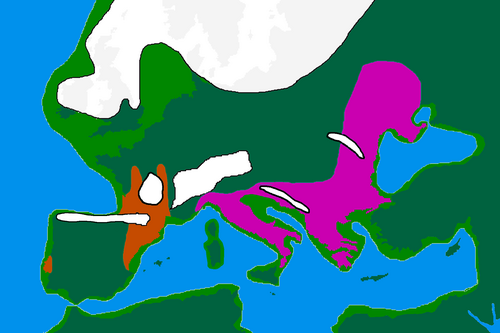
ソリュートレ文化
エピグラヴェット文化[56]


更新世の250万年間に、ヨーロッパと北アメリカで氷河期(第四紀氷河期)と呼ばれる、大陸氷床の大幅な前進と呼ばれる寒冷期が約4万年から10万年の間隔で数多く発生しました。長い氷河期は、約1万年から1万5千年続いたより温暖で短い間氷期によって区切られていました。最後の氷河期の最後の寒冷期は約1万年前に終了しました。[57]地球は現在、完新世と呼ばれる第四紀の間氷期にあります。[58]
およそ180万年前にジョージアに生息していたホモ・エレクトス・ゲオルギクスは、ヨーロッパで発見された最古の人類である。 [59]およそ100万年前の その他の人類の化石は、スペインのアタプエルカで発見されている。 [60]ネアンデルタール人(ドイツのネアンデルタール渓谷にちなんで名付けられた)は、15万年前にヨーロッパに現れ(11万5000年前には、現在のポーランドの領土ですでに発見されている[61])、約4万年前に化石記録から姿を消し、 [62]イベリア半島が最終的な避難所となった。ネアンデルタール人は、約4万3000年から4万年前にヨーロッパに現れたと思われる現代人(クロマニヨン人)に取って代わられた。 [63]しかし、ホモ・サピエンスがヨーロッパに到着したのは約54,000年前で、これまで考えられていたよりも約10,000年早いという証拠もあります。 [64]ヨーロッパで48,000年前の遺跡としては、リパロ・モキ(イタリア)、ガイセンクレスターレ(ドイツ)、イストゥリッツ(フランス)が最古です。 [65] [66]
ヨーロッパの新石器時代は、作物の栽培や家畜の飼育、集落数の増加、陶器の広範な使用を特徴とし、紀元前7000年頃にギリシャとバルカン半島で始まり、アナトリアと近東での初期の農業慣行の影響を受けたものと考えられる。[67]それはバルカン半島からドナウ川とライン川の渓谷に沿って(線状土器文化)、そして地中海沿岸に沿って(カーディアル文化)広がった。紀元前4500年から3000年の間に、これらの中央ヨーロッパの新石器時代文化はさらに西と北へと発展し、銅器の製作に関する新たに獲得した技術を伝えた。西ヨーロッパでは、新石器時代は大規模な農業集落ではなく、堤防で囲まれた囲い地、古墳、巨石墓などの野外記念碑によって特徴付けられた。[68]紐状土器文化は新石器時代から銅石器時代への移行期に栄えた。この時期にはマルタの巨石神殿やストーンヘンジなどの巨大な巨石建造物が西ヨーロッパと南ヨーロッパの各地に建設された。[69] [70]
ヨーロッパの現代先住民は、主に3つの異なる系統から派生している。[71]旧石器時代のエピグラヴェット文化に関連する集団の子孫である中石器時代の狩猟採集民、 [56] 9,000年前の新石器時代革命中にアナトリアから移住した新石器時代初期ヨーロッパ農耕民、 [72]そして5,000年前のインド・ヨーロッパ語族の移住の文脈でウクライナと南ロシアのポントス・カスピ海ステップからヨーロッパに進出したヤムナヤステップ遊牧民である。 [71] [73]ヨーロッパの青銅器時代は、紀元前3200年頃にギリシャで始まり、ヨーロッパで最初の高度な文明であるクレタ島のミノア文明が生まれた。 [74]ミノア人の後にはミケーネ人が続いたが、紀元前1200年頃に突如崩壊し、ヨーロッパ鉄器時代が到来した。[75]鉄器時代のギリシャ人とフェニキア人による植民地化により、初期の地中海都市が誕生しました。紀元前8世紀頃からの初期鉄器時代のイタリアとギリシャでは、徐々に歴史的な古典古代が誕生しました。その始まりは、最初のオリンピックが開催された紀元前776年に遡ることもあります。[76]
古代

古代ギリシャは西洋文明の基盤となる文化であった。西洋の民主主義と合理主義の文化は、しばしば古代ギリシャに起因するとされる。[77]ギリシャの都市国家ポリスは、古代ギリシャの基本的な政治単位でした。[77]紀元前508年、クレイステネスはアテネで世界初の民主的な政治制度を制定しました。[78]ギリシャの政治的理想は、18世紀後半にヨーロッパの哲学者や理想主義者によって再発見されました。ギリシャはまた、多くの文化的貢献を生み出しました。アリストテレス、ソクラテス、プラトンによる哲学、ヒューマニズム、合理主義、ヘロドトス、トゥキュディデスによる歴史、ホメロスの叙事詩に始まる劇作と物語の詩、[79]ソポクレス、エウリピデスによる演劇、ヒポクラテス、ガレノスによる医学、ピタゴラス、ユークリッド、アルキメデスによる科学です。[80] [81] [82]紀元前5世紀の間に、いくつかのギリシャの都市国家は、世界史上の重要な瞬間と見なされているペルシャ戦争を通じて、ヨーロッパにおけるアケメネス朝ペルシャの進出を最終的に阻止しました。 [83]その後の50年間の平和は、西洋文明の基礎の多くを築いた古代ギリシャの重要な時代 であるアテネの黄金時代として知られています。
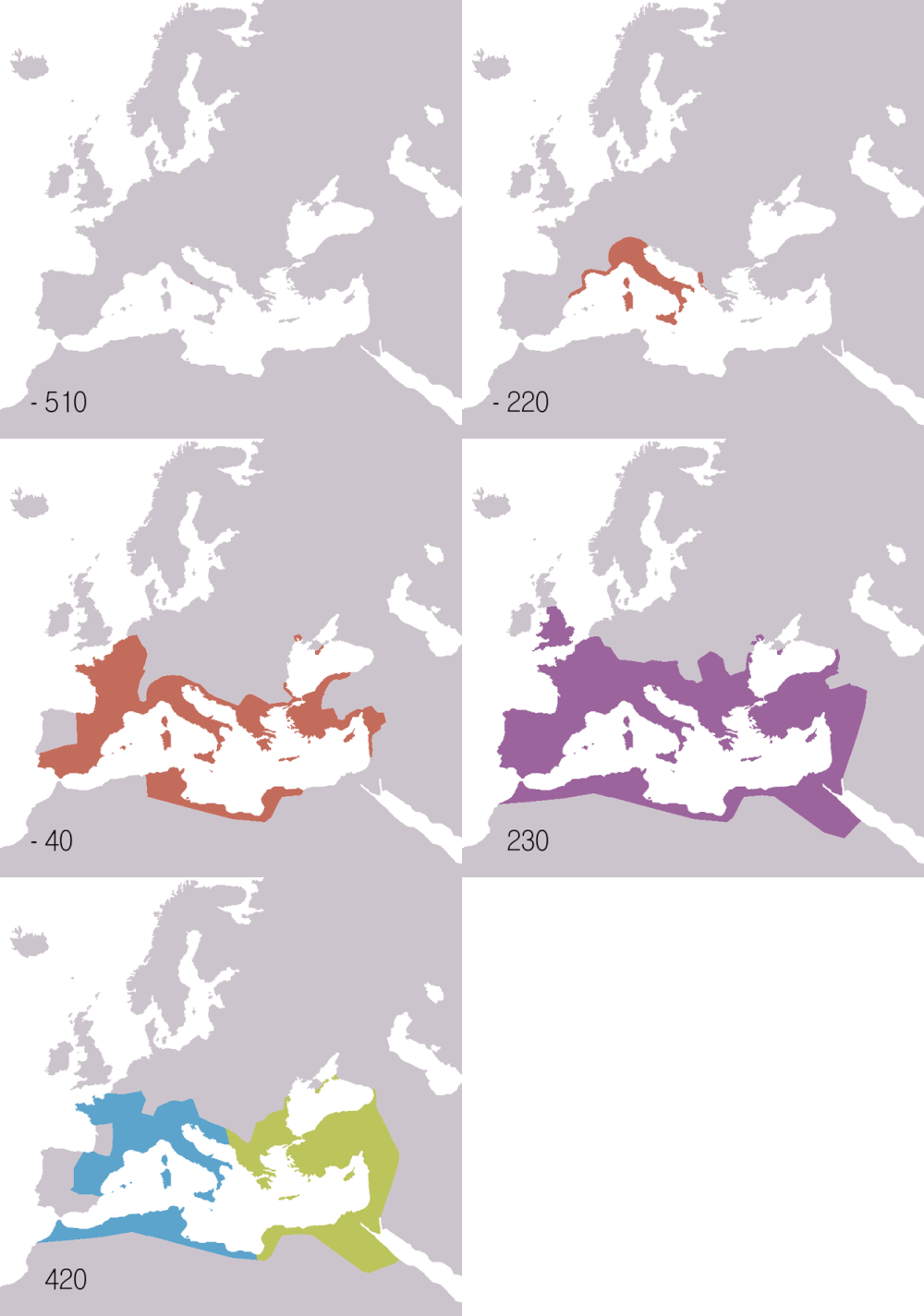
ギリシャの後にローマが続き、法律、政治、言語、工学、建築、政府、そして西洋文明の多くの重要な側面に影響を与えました。 [77]紀元前200年までに、ローマはイタリアを征服し、その後2世紀にわたってギリシャ、ヒスパニア(スペインとポルトガル)、北アフリカ沿岸、中東の大部分、ガリア(フランスとベルギー)、ブリタニア(イングランドとウェールズ)を征服しました。
ローマ人は紀元前3世紀にイタリア中部の拠点から拡大し始め、2000年初頭までには地中海沿岸全域と西ヨーロッパを支配するまで徐々に勢力を拡大していった。ローマ共和国は紀元前27年にアウグストゥスがローマ帝国を宣言したことで終焉を迎えた。その後の2世紀はパックス・ロマーナと呼ばれ、ヨーロッパの大半で前例のない平和と繁栄、政治的安定が続いた時代である。[84]ローマ帝国はアントニヌス・ピウスやマルクス・アウレリウスなどの皇帝の下で拡大を続け、彼らは帝国の北の国境でゲルマン人、ピクト人、スコットランド人と戦った。 [85] [86] キリスト教は3世紀に及ぶ帝国の迫害の後、313年にコンスタンティヌス1世によって合法化された。コンスタンティヌスはまた、帝国の首都をローマからビザンチン(現在のイスタンブール)に恒久的に移し、330年に彼に敬意を表してコンスタンティノープルと改名した。キリスト教は380年に帝国の唯一の国教となり、391年から392年にかけてテオドシウス帝は異教を禁止した。[87]これは古代の終わりを意味すると考えられることもあるが、あるいは古代は西ローマ帝国の476年の崩壊、アテネの異教プラトンアカデミーの529年の閉鎖、 [88]あるいは7世紀初頭のイスラム教の台頭とともに終わったと考えられている。ビザンチン帝国はその存在期間のほとんどにおいて、ヨーロッパで最も強力な経済、文化、軍事力を有していた。[89]
中世初期
ローマ帝国の衰退期、ヨーロッパは歴史家が「移住の時代」と呼ぶものから生じる長い変化の時代に入った。東ゴート族、西ゴート族、ゴート族、ヴァンダル族、フン族、フランク族、アングル人、サクソン人、スラヴ人、アヴァール人、ブルガール人、ヴァイキング、ペチェネグ人、クマン人、マジャル人の間で数多くの侵略と移住があった。[84]ペトラルカなどのルネサンスの思想家は後にこれを「暗黒時代」と呼ぶことになる。[90]
孤立した修道院共同体は、以前に蓄積された書面による知識を保存し、編集する唯一の場所でした。これ以外には、書かれた記録はほとんど残っていません。古典時代の文学、哲学、数学、その他の思想の多くは西ヨーロッパから姿を消しましたが、東のビザンチン帝国では保存されていました。[91]
西ローマ帝国が衰退し続ける一方で、ギリシア語を話す人が多数を占める東ローマ帝国(ビザンチン帝国とも呼ばれる)ではローマの伝統とローマ国家が強く残っていた。ビザンチン帝国はその存続期間の大半において、ヨーロッパで最も強力な経済、文化、軍事力を有していた。皇帝ユスティニアヌス1世はコンスタンティノープルの最初の黄金時代を統治し、多くの現代法制度の基礎となる法典を制定し、アヤソフィアの建設に資金を提供し、キリスト教会を国家の管理下に置いた。[92]
7世紀以降、ビザンチン帝国と近隣のササン朝ペルシア人が、何世紀にもわたって長引いた頻繁なビザンチン・ササン朝戦争によって著しく弱体化すると、イスラム教徒のアラブ人が歴史的にローマの領土に侵入し始め、レバントと北アフリカを占領し、小アジアに進出した。7世紀半ば、イスラム教徒がペルシアを征服した後、イスラム教はコーカサス地方に浸透した。[93]次の数世紀にわたって、イスラム教徒の勢力はキプロス、マルタ、クレタ島、シチリア島、南イタリアの一部を占領した。[94] 711年から720年の間に、西ゴート王国イベリア半島のほとんどの土地が、北西部(アストゥリアス)の小さな地域とピレネー山脈のバスク地方の大部分を除いて、イスラム教徒の支配下に入った。アラビア語でアル・アンダルスと呼ばれたこの領土は、拡大しつつあったウマイヤ朝の一部となった。コンスタンティノープルの第二次包囲戦(717年)の失敗により、ウマイヤ朝は弱体化し、その威信は低下した。その後、ウマイヤ朝は732年のポワティエの戦いでフランク人のリーダー、カール・マルテルに敗れ、北方への進撃は終結した。イベリア半島北西部とピレネー山脈中部の遠隔地では、南部のイスラム教徒の力はほとんど感じられなかった。ここでアストゥリアス、レオン、ガリシアのキリスト教王国の基礎が築かれ、イベリア半島の再征服が始まった。しかし、ムーア人を追い出すための組織的な試みは行われなかった。キリスト教王国は主に内部の権力闘争に集中していた。その結果、レコンキスタは800年近くを要し、その間、アルフォンソ、サンチョ、オルドニョ、ラミロ、フェルナンド、ベルムードといった大勢の人々が、イスラム教徒の侵略者と同じく、キリスト教徒のライバルとも戦うことになった。

暗黒時代、西ローマ帝国は様々な部族の支配下に置かれました。ゲルマン部族とスラヴ部族はそれぞれ西ヨーロッパと東ヨーロッパに領土を築きました。[95]最終的にフランク諸部族はクローヴィス1世のもとで統一されました。[96]西ヨーロッパの大半を征服した カロリング朝のフランク王カール大帝は、800年に教皇によって「神聖ローマ皇帝」に任命されました。これが962年の神聖ローマ帝国の建国につながり、最終的には中央ヨーロッパのドイツ諸侯国を中心とするようになりました。[97]
東中央ヨーロッパでは、最初のスラヴ国家が誕生し、キリスト教が受け入れられました(西暦1000 年頃 )。強大な西スラヴ国家であった大モラヴィアは、その領土を南はバルカン半島まで広げ、スヴァトプルク 1 世の治世中に最大の領土に達し、東フランク王国との一連の武力紛争を引き起こしました。さらに南では、 7 世紀後半から 8 世紀にかけて最初の南スラヴ国家が出現し、キリスト教を受け入れました。第 1 ブルガリア帝国、セルビア公国(後の王国および帝国)、クロアチア公国(後のクロアチア王国) です。東では、キエフ大公国が首都キエフから拡大し、10 世紀までにヨーロッパ最大の国になりました。988 年、ウラジーミル 2 世は正教を国教として採用しました。 [98] [99]さらに東のヴォルガ・ブルガリアは10世紀にイスラム国家となったが、数世紀後にロシアに吸収された。[100]
中世盛期と後期

1000 年から 1250 年までの期間は中世盛期と呼ばれ、その後1500 年頃まで 中世後期が続きます。
中世盛期には、ヨーロッパの人口は大幅に増加し、12 世紀のルネッサンス期に頂点に達しました。経済成長と大陸の交易路の安全性の欠如により、地中海沿岸とバルト海沿岸に主要な商業路が発達しました。沿岸都市の一部が富を増やし、独立を獲得したことで、海洋共和国がヨーロッパの舞台で主導的な役割を果たす ようになりました。
中世の大陸では、社会構造の2つの上層階級、すなわち貴族と聖職者が支配していた。封建制は中世初期にフランスで発達し、すぐにヨーロッパ全土に広がった。 [103]イングランドでは貴族と王権の争いによりマグナ・カルタが起草され、議会が設立された。[104]この時代における文化の主な源泉はローマ・カトリック教会であった。教会は修道院や大聖堂の学校を通じて、ヨーロッパの多くの地域で教育を担っていた。[103]
.jpg/500px-Philip_II_and_Tancred_meeting_in_Messina_-_British_Library_Royal_MS_16_G_vi_f350r_(detail).jpg)
教皇権は中世盛期に最盛期を迎えた。 1054年の東西分裂により旧ローマ帝国は宗教的に分裂し、東方正教会はビザンチン帝国に、ローマカトリック教会は旧西ローマ帝国に分かれた。1095年、教皇ウルバヌス2世はエルサレムと聖地を占領するイスラム教徒に対する十字軍を呼びかけました。[105]ヨーロッパでは、教会が異端者に対する異端審問を組織しました。イベリア半島では、1492年のグラナダ陥落でレコンキスタが終了し、半島南西部における7世紀以上に及ぶイスラム支配が終わりました。[106]
東では、復活したビザンチン帝国がクレタ島とキプロス島をイスラム教徒から奪還し、バルカン半島を再征服した。コンスタンティノープルは9世紀から12世紀にかけて、人口約40万人を擁するヨーロッパ最大かつ最も裕福な都市であった。[107]帝国はマンジケルトの戦いでの敗北後に弱体化し、1204年の第4回十字軍の際のコンスタンティノープルの略奪によってさらに弱体化した。[108] [109] [110] [111] [112] [113] [114] [115] [116]ビザンチン 帝国は1261年にコンスタンティノープルを奪還したが、1453年にコンスタンティノープルがオスマン帝国に占領されると陥落した。[117] [118] [119]

11世紀と12世紀には、ペチェネグ人やクマン・キプチャク人などの遊牧民族であるテュルク系部族による絶え間ない侵略により、スラヴ人が北部のより安全で森林が深い地域に大量に移住し、ルーシ国家の南と東への拡大が一時的に止まった。[120]ユーラシアの他の多くの地域と同様に、これらの地域はモンゴル人に制圧された。[121]タタール人として知られるようになった侵略者のほとんどはモンゴルの宗主権下にあったテュルク語を話す人々であった。彼らはクリミア半島に本部を置くジョチ・ウルス国を建国し、後にイスラム教を宗教として取り入れ、現代の南ロシアと中央ロシアを3世紀以上にわたって支配した。[122] [123]モンゴル帝国の崩壊後、14世紀に最初のルーマニア国家(公国)であるモルダヴィアとワラキアが出現した。それ以前は、これらの領土はペチェネグ人とクマン人の相次ぐ支配下にあった。[124] 12世紀から15世紀にかけて、モスクワ大公国はモンゴル支配下の小さな公国からヨーロッパ最大の国家に成長し、1480年にモンゴルを打倒し、最終的にロシア帝国となった。この国家はイヴァン3世とイヴァン雷帝の下で統合され、その後数世紀にわたって東と南に着実に拡大していった。
1315年から1317年にかけての大飢饉は、中世後期にヨーロッパを襲った最初の危機であった。 [125] 1348年から1420年の間に最も大きな損失が見られた。フランスの人口は半減した。[126] [127]中世の英国は95の飢饉に見舞われ、[128]フランスは同時期に75以上の飢饉の影響を受けた。[129] 14世紀半ばには、人類史上最も致命的なパンデミックの1つである黒死病によってヨーロッパは壊滅的な打撃を受け、ヨーロッパだけで推定2500万人が死亡した。これは当時のヨーロッパ人口の3分の1に相当した。 [130]
ペストはヨーロッパの社会構造に壊滅的な影響を及ぼし、ジョヴァンニ・ボッカッチョが『デカメロン』(1353年)で描いたように、人々を今を生きるよう駆り立てた。ローマカトリック教会にとって深刻な打撃となり、ユダヤ人、物乞い、ハンセン病患者に対する迫害が激化した。[131]ペストは18世紀まで、世代ごとに毒性や死亡率を変えながら再発したと考えられている。[132]この期間中、100回以上のペスト流行がヨーロッパ全土を襲った。[133]
近世

ルネサンスは、フィレンツェで始まり、後にヨーロッパ全土に広がった文化的変革の時代であった。新たなヒューマニズムの勃興に伴い、修道院の図書館から忘れ去られていた古典ギリシャ語とアラビア語の知識が発見され、アラビア語からラテン語に翻訳されることが多かった。[134] [135] [136]ルネサンスは14世紀から16世紀にかけてヨーロッパ中に広がり、王族、貴族、ローマカトリック教会、新興の商人階級の共同支援の下、芸術、哲学、音楽、科学が開花した。 [137] [138] [139]フィレンツェの銀行家メディチ家やローマ教皇などのイタリアのパトロンは、ラファエロ、ミケランジェロ、レオナルド・ダ・ヴィンチなど、 40世紀と50世紀の多作な芸術家に資金を提供した。[140] [141]
14世紀半ばの教会内の政治的陰謀により、西方教会分裂が起こった。この40年間、アヴィニョンとローマの2人の教皇が教会の支配権を主張した。分裂は最終的に1417年に修復されたものの、教皇の精神的権威は大きく損なわれた。[142] 15世紀には、ヨーロッパは地理的境界を越えて拡大し始めた。当時最大の海軍国であったスペインとポルトガルが世界探検の先頭に立った。[143] [144]探検は南半球の大西洋とアフリカ南端にまで達した。クリストファー・コロンブスは1492年に新世界に到達し、ヴァスコ・ダ・ガマは1498年に大西洋とインド洋を結ぶ東への海洋航路を開いた。ポルトガル生まれの探検家フェルディナンド・マゼランはスペインの遠征隊によって大西洋と太平洋を越えて西のアジアに到達し、スペイン人のフアン・セバスティアン・エルカーノ(1519-1522)によって初の世界一周航海が達成された。その後まもなく、スペインとポルトガルはアメリカ大陸、アジア、アフリカ、オセアニアで大規模な世界帝国を築き始めた。[145]フランス、オランダ、イギリスもすぐにこれに続き、アフリカ、アメリカ大陸、アジアに広大な領土を持つ大規模な植民地帝国を築いた。1588年、スペインの無敵艦隊はイギリスへの侵攻に失敗した。1年後、イギリスはスペインへの侵攻に失敗し、スペイン国王フェリペ2世はヨーロッパにおける優位な戦争力を維持することができた。このイギリスの惨事により、スペイン艦隊はその後数十年にわたって戦争遂行能力を維持することができた。しかし、さらに2回のスペイン無敵艦隊(第2次スペイン無敵艦隊と第3次スペイン無敵艦隊)はイギリス侵攻に失敗した。[146] [147] [148] [149]

1517年の宗教改革で、ドイツの神学者マルティン・ルターが、免罪符の販売を批判する95ヶ条の論題を教会の扉に打ち付けたことで、教会の力はさらに弱まりました。ルターはその後、1520年の教皇勅書「Exsurge Domine」で破門され、ルターの信奉者たちは1521年のヴォルムス帝国議会で非難され、この議会はドイツ諸侯をプロテスタントとカトリックの信仰に分裂させました。[151]プロテスタントとともに、 宗教的な争いや戦争が広がりました。[152]アメリカ大陸の帝国を略奪したことで、スペインは1世紀以上にわたってヨーロッパでの宗教迫害に資金を提供することができました。[153]三十年戦争(1618年 - 1648年)で神聖ローマ帝国は機能不全に陥り、ドイツの大部分が壊滅し、人口の25~40%が死亡しました。[154]ウェストファリア条約の余波で、フランスはヨーロッパで優位に立った。 [ 155] 1683年のウィーンの戦いでオスマントルコが敗北したことで、オスマン帝国のヨーロッパへの拡大は歴史的に終焉を迎えた。[156]
17世紀は中央ヨーロッパと東ヨーロッパの一部で全般的な衰退期であった。[157]この地域では1501年から1700年までの200年間に150回以上の飢饉が起きた。[158]クレヴォ合同(1385年)以降、東中央ヨーロッパはポーランド王国とリトアニア大公国によって支配されていた。広大なポーランド・リトアニア共和国の覇権は第二次北方戦争(大洪水)とそれに続く紛争による荒廃で終焉を迎えた。 [159]国家自体は18世紀末に分割され消滅した。 [160]
15世紀から18世紀にかけて、崩壊しつつあったジョチ・ハン国のハン国がロシアに征服されると、クリミア・ハン国のタタール人が奴隷を捕獲するために東スラヴの土地を頻繁に襲撃した。[161]さらに東では、ノガイ・ハン国とカザフ・ハン国が、ロシアが北ユーラシア(東ヨーロッパ、中央アジア、シベリア)の大半を拡大して征服するまで、数百年にわたって現代のロシアとウクライナのスラヴ語圏を頻繁に襲撃した。
ルネッサンスと新君主制は、探検、発明、科学的発展の時代である大航海時代の始まりを告げた。[162] 16世紀と17世紀の西洋科学革命の偉人の中には、コペルニクス、ケプラー、ガリレオ、アイザック・ニュートンがいた。[163]ピーター・バレットによると、「『近代科学』は17世紀(ルネッサンスの終わり頃)のヨーロッパで生まれ、自然界に対する新しい理解をもたらしたことは広く認められている。」[134]
18世紀と19世紀
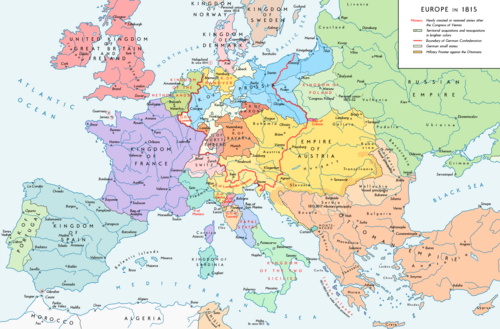
七年戦争はヨーロッパにおける「旧体制」の同盟に終止符を打った。その結果、アメリカ独立戦争が1778年から1783年にかけて世界戦争に発展したとき、イギリスはヨーロッパ諸国の強力な連合軍に対抗され、実質的な同盟国を欠くことになった。[164]
啓蒙時代は18世紀の強力な知的運動であり、科学的で理性的な考えを推進した。[165] [166] [167]フランスにおける貴族と聖職者の政治権力の独占に対する不満からフランス革命が起こり、第一共和政が樹立されたが、その結果、最初の恐怖政治で王政と多くの貴族が滅んだ。[168]フランス革命後に ナポレオン・ボナパルトが権力を握り、フランス第一帝政を樹立した。この帝政はナポレオン戦争中にヨーロッパの大部分を支配し、1815年のワーテルローの戦いで崩壊した。[169] [170] ナポレオンの統治により、国民国家の理想を含むフランス革命の理想がさらに広まり、フランスの行政、法律、教育モデルが広く採用されるようになった。[171] [172] [173]ナポレオンの失脚後に招集されたウィーン会議は、5つの「大国」、すなわちイギリス、フランス、プロイセン、オーストリア、ロシアを中心とするヨーロッパの新たな勢力均衡を確立した。 [174]この均衡は1848年の革命まで維持されたが、革命の間、自由主義的な蜂起がロシアとイギリスを除くヨーロッパ全土に影響を与えた。これらの革命は最終的に保守派によって鎮圧され、改革はほとんど行われなかった。[175] 1859年には、ルーマニアが小公国から国民国家として統一された。1867年にはオーストリア・ハンガリー帝国が成立し、1871年にはイタリアとドイツが小公国から国民国家として統一された。 [176]
同時に、露土戦争(1768-1774)でオスマン帝国が敗北して以来、東方問題はより複雑になっていった。オスマン帝国の解体が差し迫っているように思われたため、列強はオスマン帝国領における自国の戦略的、商業的利益を守ろうと奮闘した。ロシア帝国は衰退から利益を得る立場にあったが、ハプスブルク帝国とイギリスはオスマン帝国の存続が自国の利益になると考えた。一方、セルビア革命(1804年)とギリシャ独立戦争(1821年)はバルカン半島におけるオスマン帝国の支配の終わりの始まりを示し、それは1912-1913年のバルカン戦争で終結した。[177]事実上の独立公国であったモンテネグロ、セルビア、ルーマニアの正式承認は1878年のベルリン会議で行われた。

産業革命は18世紀後半にイギリスで始まり、ヨーロッパ全土に広がった。新技術の発明と導入により、都市が急速に成長し、大量雇用と新たな労働者階級が台頭した。 [178]続いて社会経済の改革が進み、児童労働に関する初の法律、労働組合の合法化、[179]奴隷制度の廃止などがあった。[180]イギリスでは、1875年に公衆衛生法が可決され、多くのイギリスの都市で生活環境が大幅に改善された。[181]ヨーロッパの人口は1700年の約1億人から1900年までに4億人に増加した。[182]西ヨーロッパで記録された最後の大飢饉であるアイルランド大飢饉では、何百万人ものアイルランド人が死亡し、大量移住した。[183] 19世紀には、7千万人がヨーロッパを離れ、海外のさまざまなヨーロッパ植民地やアメリカに移住した。[184]産業革命は人口の大幅な増加にもつながり、ヨーロッパに住む世界人口の割合は1913年頃に25%をわずかに上回るピークに達しました。[185] [186]
20世紀から現在まで
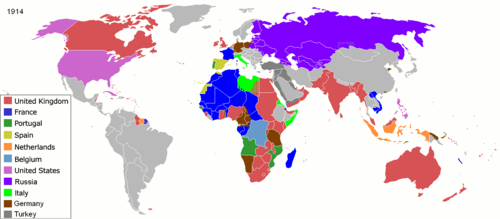
20世紀前半は、2つの世界大戦と経済不況が支配的だった。第一次世界大戦は1914年から1918年にかけて戦われた。オーストリアのフランツ・フェルディナンド大公がユーゴスラビアの民族主義者[187] ガブリロ・プリンツィプによって暗殺されたことに始まった[188]。協商国(フランス、ベルギー、セルビア、ポルトガル、ロシア、イギリス、後にイタリア、ギリシャ、ルーマニア、アメリカ)と中央同盟国(オーストリア=ハンガリー、ドイツ、ブルガリア、オスマン帝国)の間で戦われたこの戦争に、ほとんどのヨーロッパ諸国が巻き込まれた。この戦争で1600万人以上の民間人と軍人が死亡した[189] 。 1914年から1918年にかけて、6000万人以上のヨーロッパの兵士が動員された[190] 。

ロシアはロシア革命に突入し、帝政が打倒されて共産主義の ソビエト連邦が樹立され、[191]フィンランド、エストニア、ラトビア、リトアニアなど多くの旧ロシア領が新しいヨーロッパの国として独立した。[192]オーストリア=ハンガリー帝国とオスマン帝国は崩壊して別々の国に分裂し、他の多くの国も国境が引き直された。 1919年に第一次世界大戦を公式に終結させたベルサイユ条約はドイツに対して厳しいもので、戦争の全責任をドイツに負わせ、重い制裁を課した。[193]第一次世界大戦とロシア内戦(戦後の飢饉を含む)の過程でロシアで死亡した超過人数は、合わせて1,800万人に上った。[194] 1932年から1933年にかけて、スターリンの指導の下、ソ連当局による穀物の没収が第二次ソ連飢饉の一因となり、数百万人が死亡した。 [195]生き残ったクラークは迫害され、多くが強制労働のためにグラグに送られた。スターリンはまた、 1937年から1938年にかけてNKVDが681,692人を処刑した大粛清の責任者でもあった。 [196]数百万人がソ連の遠隔地へ追放・流刑にされた。 [197]

.jpg/500px-Mussolini_and_Hitler_1940_(retouched).jpg)
ロシア全土に広がった社会革命は、第一次世界大戦後の他のヨーロッパ諸国にも影響を及ぼした。1919年にはドイツでワイマール共和国、オーストリア第一共和国が誕生し、1922年にはイタリア王国とトルコ共和国でムッソリーニの一党独裁政権が誕生し、西欧のアルファベットと国家の世俗主義が採用された。第一次世界大戦で負った負債やドイツへの「融資」が一因となった経済不安は、1920年代後半から1930年代にかけてヨーロッパで大混乱を引き起こした。これと1929年のウォール街大暴落が重なって、世界恐慌が引き起こされた。経済危機、社会不安、共産主義の脅威に助けられ、ヨーロッパ全土でファシスト運動が起こり、アドルフ・ヒトラーがナチス・ドイツとなる国の権力を握った。[203] [204]
1933年、ヒトラーがドイツの指導者となり、大ドイツ建設という目標に向けて動き始めた。ドイツは再び領土を拡大し、 1935年と1936年にザールラントおよびラインラントを奪還した。 1938年、オーストリアはアンシュルスによりドイツの一部となった。ドイツ、フランス、イギリス、イタリアが調印したミュンヘン協定に従い、1938年後半、ドイツはチェコスロバキアの一部でドイツ系住民が住んでいたズデーテン地方を併合した。1939年初頭、チェコスロバキアの残りの地域はボヘミア・モラビア保護領としてドイツとスロバキア共和国に分割された。当時、イギリスとフランスは宥和政策を好んでいた。
ダンツィヒの将来をめぐってドイツとポーランドの間で緊張が高まると、ドイツはソ連に目を向け、モロトフ・リッベントロップ条約に調印した。これによりソ連はバルト諸国、ポーランドとルーマニアの一部に侵攻することができた。ドイツは1939年9月1日にポーランドに侵攻し、フランスとイギリスは9月3日にドイツに宣戦布告し、第二次世界大戦のヨーロッパ戦線が始まった。[205] [206] [207]ソ連のポーランド侵攻は9月17日に始まり、その後まもなくポーランドは陥落した。9月24日、ソ連はバルト諸国を攻撃し、11月30日にはフィンランドを攻撃した。フィンランドはその後、赤軍にとって壊滅的な冬戦争へとつながった。 [208]イギリスはナルビクに上陸してフィンランド支援のために部隊を派遣することを望んだが、上陸の主な目的はドイツを包囲し、ドイツをスカンジナビアの資源から切り離すことだった。同じ頃、ドイツはデンマークに軍隊を派遣し、まやかし戦争は続いた。
1940年5月、ドイツは低地諸国を通ってフランスを攻撃した。フランスは1940年6月に降伏した。8月までにドイツはイギリスに対する爆撃攻勢を開始したが、イギリスを降伏させることはできなかった。[209] 1941年、ドイツはバルバロッサ作戦でソ連に侵攻した。[210] 1941年12月7日、日本が真珠湾を攻撃したことで、アメリカは大英帝国の同盟国として、また他の同盟国として紛争に巻き込まれた。[211] [212]
_(B&W).jpg/500px-Yalta_Conference_(Churchill,_Roosevelt,_Stalin)_(B&W).jpg)
1943年のスターリングラード攻防戦での圧倒的な勝利の後、ソ連におけるドイツ軍の攻勢は継続的な後退へと変わった。史上最大の戦車戦となったクルスクの戦いは、東部戦線におけるドイツ軍の最後の大規模攻勢となった。1944年6月、イギリス軍とアメリカ軍はノルマンディー上陸作戦でフランスに侵攻し、ドイツに対する新たな戦線を開いた。 1945年、ついにベルリンが陥落し、ヨーロッパにおける第二次世界大戦は終結した。この戦争は人類史上最大かつ最も破壊的な戦争であり、世界中で6千万人が死亡した。[213]ヨーロッパでは第二次世界大戦の結果4千万人以上が死亡し、[214]ホロコーストで亡くなった1100万~1700万人も含まれている。[215]ソ連は戦争中に約2700万人(ほとんどが民間人)を失い、これは第二次世界大戦の死傷者の約半数にあたる。[216]第二次世界大戦の終わりまでに、ヨーロッパには4000万人以上の難民がいた。[217] [218] [219]戦後、中央ヨーロッパと東ヨーロッパでは数回の追放により合計約2000万人が避難した。[220]
第一次世界大戦、特に第二次世界大戦は、世界情勢における西欧の優位性を低下させた。第二次世界大戦後、ヨーロッパの地図はヤルタ会談で書き換えられ、西側諸国と共産主義の東側陣営の2つの陣営に分割され、後にウィンストン・チャーチルが「鉄のカーテン」と呼んだものによって隔てられた。米国と西欧はNATO同盟を結成し、その後、ソ連と中央ヨーロッパはワルシャワ条約機構を結成した。[221]第二次世界大戦後の特にホットな場所はベルリンとトリエステで、1947年に国連とともに設立されたトリエステ自由地域は、それぞれ1954年と1975年に解体された。1948年と1949年のベルリン封鎖と1961年のベルリンの壁建設は、冷戦の大きな国際的危機の1つであった。[222] [223] [224]
新たな超大国であるアメリカとソ連は、核拡散をめぐる50年にわたる冷戦に巻き込まれた。同時に、第一次世界大戦後にすでに始まっていた脱植民地化により、アジアとアフリカのヨーロッパ植民地のほとんどが徐々に独立していった。[15]
1980年代、ミハイル・ゴルバチョフの改革とポーランドの連帯運動により、それまで硬直していた共産主義体制が弱体化した。汎ヨーロッパ・ピクニックで鉄のカーテンが開かれたことで、平和的な連鎖反応が起こり、その末に東側諸国、ワルシャワ条約機構、その他の共産主義諸国が崩壊し、冷戦が終結した。[226] [227] [228] 1989年のベルリンの壁の象徴的な崩壊の後、ドイツは再統一され、中央ヨーロッパと東ヨーロッパの地図は再び書き換えられた。[229]これにより、以前は途絶えていた古い文化的、経済的関係が可能になり、以前は孤立していたベルリン、プラハ、ウィーン、ブダペスト、トリエステなどの都市が再びヨーロッパの中心となった。[203] [230] [231] [232]
ヨーロッパの統合は第二次世界大戦後にも進展した。1949年、ウィンストン・チャーチル卿の演説を受けて、共通の目標を達成するためにヨーロッパを統一するという理念を掲げて欧州評議会が設立された。 [16]これにはベラルーシ、ロシア、[233]およびバチカン市国を除くすべてのヨーロッパ諸国が含まれる。1957年のローマ条約は、統一された経済政策と共通市場を目標とする西ヨーロッパ6か国による欧州経済共同体を設立した。 [234] 1967年、EEC、欧州石炭鉄鋼共同体、およびユーラトムは欧州共同体を形成し、1993年に欧州連合となった。EUは議会、裁判所、中央銀行を設立し、統一通貨としてユーロを導入した。 [235] 2004年から2013年の間に、より多くの中央ヨーロッパ諸国が加盟し始め、EUは28か国のヨーロッパ諸国に拡大し、ヨーロッパは再び主要な経済的および政治的権力の中心地となった。[236]しかし、 2016年6月のEU加盟に関する国民投票の結果、英国は2020年1月31日にEUを離脱した。[237] 2014年から続いているロシア・ウクライナ紛争は、 2022年2月24日にロシアがウクライナへの全面侵攻を開始したことで急激にエスカレートし、第二次世界大戦[238]とユーゴスラビア戦争以来、ヨーロッパで最大の人道・難民危機となった。[239]
地理

ヨーロッパは、ユーラシア大陸の西側5分の1を占めている。[28]ヨーロッパの陸地に対する海岸線の比率は、他のどの大陸や亜大陸よりも高い。[240]ヨーロッパの海上の境界は、北は北極海、西は大西洋、南は地中海、黒海、カスピ海である。[241] ヨーロッパの陸地の起伏は、比較的狭い地域内で大きな変化に富んでいる。南部は山がちで、北に行くにつれて、アルプス山脈、ピレネー山脈、カルパティア山脈の高地から丘陵の高地を抜けて、東に広がる低く広い北部平原へと地形は下っていく。この広がった低地は大ヨーロッパ平原として知られ、その中心には北ドイツ平原がある。北西海岸沿いにも弧状の高地があり、ブリテン島とアイルランド島の西部から始まり、山岳地帯のフィヨルドに削られたノルウェーの背骨に沿って続いている。
この説明は簡略化されています。イベリア半島やイタリア半島などのサブリージョンは、中央ヨーロッパ本土自体と同様に、独自の複雑な特徴を持っています。中央ヨーロッパ本土の地形には、多くの台地、川の谷、盆地があり、全体的な傾向を複雑にしています。アイスランド、イギリス、アイルランドなどのサブリージョンは特別なケースです。前者は北の海に浮かぶ独立した土地で、ヨーロッパの一部として数えられていますが、後者は海面上昇により分断されるまでは大陸とつながっていた高地です。
気候
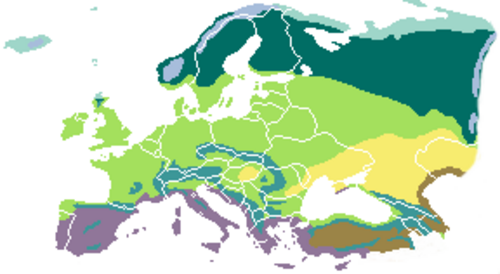
ヨーロッパは主に北半球の温帯気候帯に位置し、卓越風向は西からである。メキシコ湾流の影響により、同緯度の他の地域に比べて気候は穏やかである。メキシコ湾流は、メキシコ湾から大西洋を横切って暖かい水をヨーロッパに運ぶ海流である。 [242]メキシコ湾流は「ヨーロッパのセントラルヒーティング」というニックネームが付けられている。これは、メキシコ湾流によりヨーロッパの気候が通常よりも暖かく湿潤になるためである。メキシコ湾流はヨーロッパの海岸に暖かい水を運ぶだけでなく、大西洋から大陸を横切って吹く偏西風も温める。
そのため、アヴェイロの年間平均気温は16℃(61℉)であるのに対し、ほぼ同じ緯度で同じ海に面しているニューヨーク市ではわずか13℃(55℉)である。ドイツのベルリン、カナダのカルガリー、ロシア南東部のイルクーツクはほぼ同じ緯度に位置しており、ベルリンの1月の気温はカルガリーよりも平均8℃(14℉)高く、イルクーツクの平均気温よりも約22℃(40℉)高い。[242]
地中海の大きな水塊は、年間平均および日平均の気温を均一にしており、特に重要である。地中海の水は、サハラ砂漠からトリエステ近郊のアドリア海の最北端のアルプス弧まで広がっている。[243]
一般的に、ヨーロッパは南に比べて北の方が寒いだけでなく、西から東に向かっても寒くなります。気候は西の方が海洋性気候で、東は海洋性気候ではありません。これは、おおよそ 64、60、55、50、45、40 度の緯度に沿った場所の平均気温を示す次の表で説明できます。これらの場所はいずれも標高が高くなく、ほとんどが海に近いです。
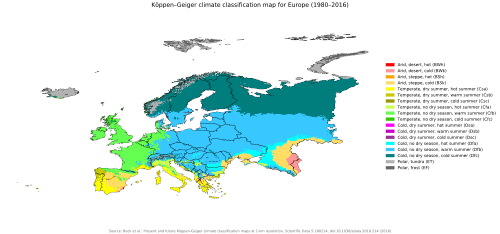
[245] 最も寒い月の平均気温と年間平均気温が西から東に行くにつれて下がるのは注目すべきことである。例えば、エディンバラはベオグラードよりも緯度で10度ほど南に位置しているにもかかわらず、一年で最も寒い月でもベオグラードより暖かい。
気候変動
.png/500px-Increase_of_average_yearly_temperature_in_Europe_(1900-2017).png)
地質学

ヨーロッパの地質学上の歴史は、約22億5千万年前のバルト楯状地(フェノスカンジア)とサルマティア・クラトンの形成に遡り、続いてボルゴ・ウラリア楯状地が形成され、この3つが一緒になって東ヨーロッパ・クラトン(≈バルティカ)となり、超大陸 コロンビアの一部となった。約11億年前、バルティカとアークティカ(ローレンシア・ブロックの一部)はロディニアに結合し、その後約5億5千万年前に再分裂してバルティカとなった。約4億4千万年前、バルティカとローレンシアからユーラメリカが形成され、さらにゴンドワナと結合してパンゲアが形成されました。約1億9千万年前、大西洋の拡大によりゴンドワナとローラシアが分裂した。最終的に、その後すぐにローラシア大陸は再び分裂し、ローレンシア(北アメリカ)とユーラシア大陸に分かれた。この2つの大陸の陸地のつながりはグリーンランドを介してかなり長い間続き、動物種の交流につながった。約5000万年前から、海面の上昇と下降により、ヨーロッパの実際の形状と、アジアなどの大陸とのつながりが決まった。ヨーロッパの現在の形状は、約500万年前の第三紀後期に遡る。 [251]
ヨーロッパの地質は極めて多様かつ複雑で、スコットランド高地からハンガリーの起伏に富んだ平野に至るまで、大陸全体に広がる多種多様な景観を生み出している。[252]ヨーロッパの最も重要な特徴は、南ヨーロッパの高地と山岳地帯、および西はアイルランドから東はウラル山脈まで広がる、部分的に水没した広大な北部平原との二分性である。この2つの半分は、ピレネー山脈とアルプス山脈/カルパティア山脈の山脈によって隔てられている。北部平原は、西側でスカンジナビア山脈とイギリス諸島の山岳部によって区切られている。北部平原の一部を水没させている主要な浅い水域は、ケルト海、北海、バルト海複合体、バレンツ海である。
北部の平原には古い地質学的大陸であるバルティカ大陸があり、地質学的には「主要大陸」とみなされる一方、南部と西部の周辺の高地と山岳地帯は、さまざまな他の地質学的大陸の断片を構成しています。西ヨーロッパの古い地質のほとんどは、古代の微小大陸 アヴァロニアの一部として存在していました。
フローラ
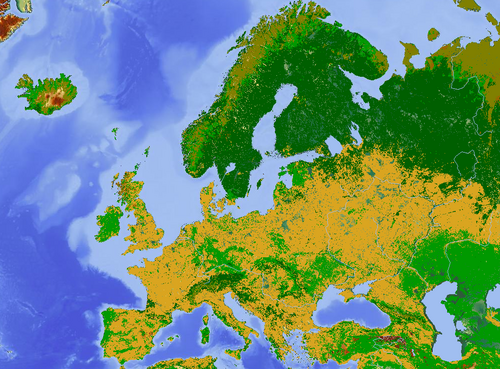
ヨーロッパの動物や植物は、何千年もの間農耕民族と共存してきたため、人間の存在と活動によって大きな影響を受けてきました。フェノスカンジアとロシア北部を除き、現在ヨーロッパには、さまざまな国立公園を除いて、手つかずの自然が残っている地域はほとんどありません。
ヨーロッパの主な自然植生被覆は混合林です。生育条件は非常に良好です。北部では、メキシコ湾流と北大西洋海流が大陸を暖めます。南ヨーロッパは温暖ですが穏やかな気候です。この地域では夏の干ばつが頻繁に発生します。山脈も条件に影響を与えます。アルプス山脈やピレネー山脈など、東西に向いているものもあり、風が内陸部の海から大量の水を運ぶことができます。その他の山脈は南北に向いており (スカンジナビア山脈、ディナル山脈、カルパティア山脈、アペニン山脈)、雨は主に海に面した山側に降るため、こちら側の森林はよく生育しますが、反対側の条件ははるかに好ましくありません。ヨーロッパ本土のほとんどの地域では、かつて家畜の放牧が行われており、農業以前の森林生息地の伐採により、元々の動植物の生態系が破壊されました。
.png/500px-Floristic_regions_in_Europe_(english).png)
ヨーロッパの80~90パーセントは、かつては森林に覆われていたと考えられています。[253]それは地中海から北極海まで広がっていました。何世紀にもわたる森林伐採により、ヨーロッパの元々の森林の半分以上が消滅しましたが、ヨーロッパには、広葉樹林や混交林、スカンジナビアやロシアのタイガ、コーカサスの混交熱帯雨林、地中海西部のコルク樫の森など、国土の4分の1以上がまだ森林です。近年、森林伐採は減速し、多くの木が植えられました。しかし、多くの場合、成長が早いため、元々の混交自然林は針葉樹の単一栽培植林に置き換えられました。現在、植林は広大な土地を覆っていますが、樹種の混合と多様な森林構造を必要とする多くのヨーロッパの森林生息種にとっては劣悪な生息地となっています。西ヨーロッパの自然林の量はわずか2~3%以下ですが、西ロシアでは5~10%です。ヨーロッパの国の中で森林面積の割合が最も小さいのはアイスランド(1%)で、最も森林面積が大きいのはフィンランド(77%)です。[254]
温帯ヨーロッパでは、広葉樹と針葉樹が混交する林が優勢である。中央ヨーロッパと西ヨーロッパで最も重要な樹種はブナとオークである。北部では、タイガはトウヒ、マツ、シラカバの混交林である。ロシア内のさらに北とスカンジナビア半島の最北部では、北極圏に近づくにつれてタイガはツンドラに変わる。地中海では、その乾燥した気候に非常によく適応したオリーブの木が多く植えられてきた。地中海イトスギも南ヨーロッパで広く植えられている。半乾燥地帯の地中海地域には、多くの低木林がある。ユーラシア草原の東西の狭い舌状部(ステップ)は、ウクライナとロシア南部から西に伸びてハンガリーで終わり、北のタイガに横切っている。
動物相

最近の氷河期の氷河作用と人間の存在は、ヨーロッパの動物相の分布に影響を与えました。動物については、ヨーロッパの多くの地域でほとんどの大型動物と頂点捕食種が絶滅するまで狩猟されました。マンモスは新石器時代の終わりまでに絶滅しました。今日、オオカミ(肉食動物)とクマ(雑食動物)は絶滅の危機に瀕しています。かつてはヨーロッパのほとんどの地域で見られました。しかし、森林伐採と狩猟により、これらの動物はますます姿を消しました。中世までには、クマの生息地は十分な森林に覆われた、多かれ少なかれアクセスが困難な山々に限られていました。今日、ヒグマは主にバルカン半島、スカンジナビア、ロシアに生息しています。ヨーロッパの他の国々(オーストリア、ピレネー山脈など)にも少数が生息していますが、これらの地域では生息地の破壊によりヒグマの個体群が断片化され、疎外されています。さらに、ホッキョクグマはスカンジナビア半島のはるか北に位置するノルウェーのスヴァールバル諸島にも生息しています。ヨーロッパでヒグマに次いで2番目に大きい捕食動物であるオオカミは、主に中央ヨーロッパ、東ヨーロッパ、バルカン半島に生息しており、西ヨーロッパ(スカンジナビア、スペインなど)にも少数の群れが生息しています。

その他の肉食動物には、ヨーロッパヤマネコ、アカギツネ、ホッキョクギツネ、キンイロジャッカル、さまざまな種類のテン、ヨーロッパハリネズミ、さまざまな種類の爬虫類(マムシや草蛇などのヘビなど)と両生類、さまざまな鳥類(フクロウ、タカ、その他の猛禽類)が 含まれます。
ヨーロッパの重要な草食動物には、カタツムリ、幼虫、魚、さまざまな鳥、げっ歯類、シカ、ノロジカ、イノシシ、山地に生息するマーモット、シュタインボック、シャモアなどの哺乳類などがある。小さなベニバナチョウなどの多くの昆虫も生物多様性に貢献している。[257]
海の生物もヨーロッパの動植物の重要な一部です。 海の植物は主に植物プランクトンです。 ヨーロッパの海に生息する重要な動物は、動物プランクトン、軟体動物、棘皮動物、さまざまな甲殻類、イカ、タコ、魚、イルカ、クジラです。
ヨーロッパでは、欧州評議会のベルン条約を通じて生物多様性が保護されており、この条約には欧州共同体だけでなく、ヨーロッパ以外の国々 も署名している。
政治

さまざまな多国籍ヨーロッパ組織と協定の関係を示すオイラー図
ヨーロッパの政治地図は、1815年のナポレオン戦争後のヨーロッパの再編成から大きく派生したものです。ヨーロッパで一般的な政治形態は議会制民主主義で、ほとんどの場合は共和制です。1815年には、一般的な政治形態は依然として君主制でした。ヨーロッパの残りの11の君主制[258]は立憲君主制です。
欧州統合とは、第二次世界大戦の終結以来、欧州評議会のスポンサー国によって進められてきた、ヨーロッパ諸国の政治的、法的、経済的(場合によっては社会的、文化的)統合のプロセスである。欧州連合は、 1993年の設立以来、大陸における経済統合の中心となっている。最近では、旧ソ連諸国で構成されるユーラシア経済連合が、そのカウンターパートとして設立された。
27のヨーロッパ諸国が政治経済的な欧州連合に加盟しており、26は国境のないシェンゲン協定圏に、20は通貨統合ユーロ圏に加盟している。より小規模なヨーロッパ組織としては、北欧理事会、ベネルクス、バルト諸国会議、ヴィシェグラード・グループなどがある。
V-Dem民主主義指数によると、2024年にヨーロッパで最も民主的でない国はベラルーシ、ロシア、トルコです。[259]
州および地域の一覧
このリストには、ヨーロッパの共通の地理的または政治的定義に部分的にでも該当する、国際的に認められたすべての主権国家が含まれています。
上記の国々の中には、国際的に承認されていないか、ほとんど承認されていない事実上の独立国がいくつかあります。これらの国はいずれも国連に加盟していません。
ヨーロッパ内またはヨーロッパ近辺には、広範な自治権を持つ属国や類似の地域もいくつかある。これには、オーランド諸島(フィンランドの自治県)、デンマーク王国の2つの自治領(デンマーク本国以外)、3つの王室属領、2つのイギリス海外領土が含まれる。スヴァールバル諸島も、自治権はないものの、ノルウェー国内での独自の地位のため含まれる。権限が委譲されているイギリスの3か国と、独自の程度の自治権があるものの、国際問題以外では大部分が自治権を持たないポルトガルの2つの自治州は含まれない。カナリア諸島やヘルゴラント島など、税制上の地位がほとんどない地域も、この理由で含まれない。
経済
_per_capita.svg/500px-Map_of_European_countries_by_GDP_(PPP)_per_capita.svg.png)
欧州諸国の一人当たりGDP(購買力平価)
大陸として見ると、ヨーロッパの経済は現在地球上で最大であり、運用資産で測ると32.7兆ドルを超え、2008年の北米の27.1兆ドルと比較して最も豊かな地域です。 [261] 2009年、ヨーロッパは最も豊かな地域のままでした。37.1兆ドルの運用資産は世界の富の3分の1を占めていました。ヨーロッパは、金融危機前の年末のピークを富が上回った数少ない地域の1つでした。[262]他の大陸と同様に、ヨーロッパでは国間で大きな富の格差があります。一般的に、より豊かな国は北西部と西部にあり、中央ヨーロッパがそれに続きます。一方、東ヨーロッパと南東ヨーロッパのほとんどの経済は、ソ連の崩壊とユーゴスラビアの解体からまだ復興の途上にあります。
ブルーバナナのモデルは、各地域の経済力を経済的に地理的に表現するために設計され、その後ゴールデンバナナやブルースターへと発展した。2つの世界大戦、新たな国境、冷戦によって長い間中断されていた東西間の貿易、およびアジアとの貿易は、1989年以降急増した。さらに、スエズ運河を越えてアフリカとアジアに向かう中国の一帯一路構想による新たな推進力もある。[263]
欧州連合は27のヨーロッパ諸国からなる政治体であり、世界最大の経済圏を構成している。EU加盟19カ国が共通通貨ユーロを使用している。GDP(購買力平価)で世界トップ10の経済大国にランクインしているヨーロッパ諸国は5カ国である。これには( CIAによる順位)ドイツ(6位)、ロシア(7位)、イギリス(10位)、フランス(11位)、イタリア(13位)が含まれる。[264]
ヨーロッパの国々の中には、他の国よりもはるかに豊かな国もあります。名目GDPで最も豊かなのはモナコで、一人当たり185,829米ドル(2018年)です。一方、最も貧しいのはウクライナで、一人当たり3,659米ドル(2019年)です。 [265]
2016年の国際通貨基金の評価によると、ヨーロッパ全体の一人当たりGDPは21,767米ドルである。[266]
経済史
- 産業の成長(1760年~1945年)
資本主義は封建制の終焉以来、西洋世界で支配的であった。[272]資本主義はイギリスから徐々にヨーロッパ全土に広がった。[273]産業革命はヨーロッパ、特に18世紀後半にイギリスで始まり、[274] 19世紀には西ヨーロッパが工業化した。経済は第一次世界大戦によって混乱したが、第二次世界大戦の初めまでに回復し、成長するアメリカの経済力と競争しなければならなくなった。第二次世界大戦は再びヨーロッパの産業の多くに損害を与えた。
- 冷戦(1945年~1991年)


第二次世界大戦後、イギリスの経済は破滅状態に陥り、[275]その後数十年間、相対的に経済が衰退し続けた。[276]イタリアも経済状況は悪かったが、1950年代までに高い成長率を取り戻した。西ドイツは急速に回復し、1950年代までに生産量を戦前の2倍にした。[277]フランスも急速な成長と近代化を享受して目覚ましい復活を遂げた。その後、フランコの指導の下、スペインも回復し、1960年代からスペインの奇跡と呼ばれる前例のない経済成長を記録した。[278]中央および東ヨーロッパ諸国の大半はソ連の支配下に入り、相互経済援助会議(COMECON)のメンバーとなった。[279]
自由市場システムを維持した国々は、マーシャル・プランの下で米国から多額の援助を受けた。[280]西側諸国は経済を連携させ、EUの基盤を築き、国境を越えた貿易を増やした。これにより、コメコン諸国が冷戦のコストに大きく苦しんでいた一方で、西側諸国は急速に経済発展を遂げることができた。1990年までに、欧州共同体は創設メンバー6か国から12か国に拡大した。西ドイツ経済の復興に重点が置かれた結果、西ドイツは英国を抜いてヨーロッパ最大の経済大国となった。
- 統一(1991年~現在)
.jpeg/500px-Trepca_Miners_(24876825).jpeg)
With the fall of communism in Central and Eastern Europe in 1991, the post-socialist states underwent shock therapy measures to liberalise their economies and implement free market reforms.
After East and West Germany were reunited in 1990, the economy of West Germany struggled as it had to support and largely rebuild the infrastructure of East Germany, while the latter experienced sudden mass unemployment and plummeting of industrial production.
By the millennium change, the EU dominated the economy of Europe, comprising the five largest European economies of the time: Germany, the United Kingdom, France, Italy, and Spain. In 1999, 12 of the 15 members of the EU joined the Eurozone, replacing their national currencies by the euro.
Figures released by Eurostat in 2009 confirmed that the Eurozone had gone into recession in 2008.[282] It impacted much of the region.[283] In 2010, fears of a sovereign debt crisis[284] developed concerning some countries in Europe, especially Greece, Ireland, Spain and Portugal.[285] As a result, measures were taken, especially for Greece, by the leading countries of the Eurozone.[286] The EU-27 unemployment rate was 10.3% in 2012. For those aged 15–24 it was 22.4%.[287]
Demographics
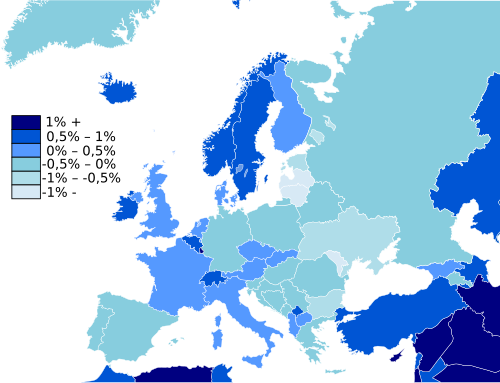
The population of Europe was about 742 million in 2023 according to UN estimates.[2][3] This is slightly more than one ninth of the world's population.[v] The population density of Europe (the number of people per area) is the second highest of any continent, behind Asia. The population of Europe is currently slowly decreasing, by about 0.2% per year,[289] because there are fewer births than deaths. This natural decrease in population is reduced by the fact that more people migrate to Europe from other continents than vice versa.
Southern Europe and Western Europe are the regions with the highest average number of elderly people in the world. In 2021, the percentage of people over 65 years old was 21% in Western Europe and Southern Europe, compared to 19% in all of Europe and 10% in the world.[290] Projections suggest that by 2050 Europe will reach 30%.[291] This is caused by the fact that the population has been having children below replacement level since the 1970s. The United Nations predicts that Europe will decline in population between 2022 and 2050 by −7 per cent, without changing immigration movements.[292]
According to a population projection of the UN Population Division, Europe's population may fall to between 680 and 720 million people by 2050, which would be 7% of the world population at that time.[293] Within this context, significant disparities exist between regions in relation to fertility rates. The average number of children per female of child-bearing age is 1.52, far below the replacement rate.[294] The UN predicts a steady population decline in Central and Eastern Europe as a result of emigration and low birth rates.[295]
Ethnic groups
Pan and Pfeil (2004) count 87 distinct "peoples of Europe", of which 33 form the majority population in at least one sovereign state, while the remaining 54 constitute ethnic minorities.[296]
Migration
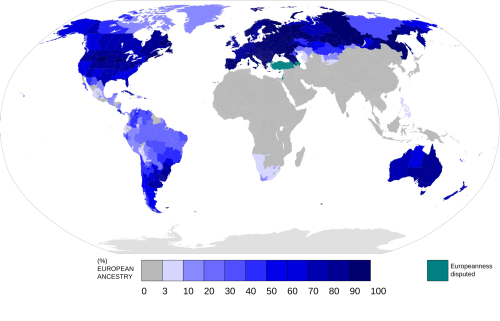
Europe is home to the highest number of migrants of all global regions at nearly 87 million people in 2020, according to the International Organisation for Migration.[297] In 2005, the EU had an overall net gain from immigration of 1.8 million people. This accounted for almost 85% of Europe's total population growth.[298] In 2021, 827,000 persons were given citizenship of an EU member state, an increase of about 14% compared with 2020.[299] 2.3 million immigrants from non-EU countries entered the EU in 2021.[299]
Early modern emigration from Europe began with Spanish and Portuguese settlers in the 16th century,[300][301] and French and English settlers in the 17th century.[302] But numbers remained relatively small until waves of mass emigration in the 19th century, when millions of poor families left Europe.[303]
Today, large populations of European descent are found on every continent. European ancestry predominates in North America and to a lesser degree in South America (particularly in Uruguay, Argentina, Chile and Brazil, while most of the other Latin American countries also have a considerable population of European origins). Australia and New Zealand have large European-derived populations. Africa has no countries with European-derived majorities (or with the exception of Cape Verde and probably São Tomé and Príncipe, depending on context), but there are significant minorities, such as the White South Africans in South Africa. In Asia, European-derived populations, specifically Russians, predominate in North Asia and some parts of Northern Kazakhstan.[304] Also in Asia, Europeans, especially the Spanish are an influential minority population in the Philippines.[305][306]
Languages

Europe has about 225 indigenous languages,[307] mostly falling within three Indo-European language groups: the Romance languages, derived from the Latin of the Roman Empire; the Germanic languages, whose ancestor language came from southern Scandinavia; and the Slavic languages.[251] Slavic languages are mostly spoken in Southern, Central and Eastern Europe. Romance languages are spoken primarily in Western and Southern Europe, as well as in Switzerland in Central Europe and Romania and Moldova in Eastern Europe. Germanic languages are spoken in Western, Northern and Central Europe as well as in Gibraltar and Malta in Southern Europe.[251] Languages in adjacent areas show significant overlaps (such as in English, for example). Other Indo-European languages outside the three main groups include the Baltic group (Latvian and Lithuanian), the Celtic group (Irish, Scottish Gaelic, Manx, Welsh, Cornish and Breton[251]), Greek, Armenian and Albanian.
A distinct non-Indo-European family of Uralic languages (Estonian, Finnish, Hungarian, Erzya, Komi, Mari, Moksha and Udmurt) is spoken mainly in Estonia, Finland, Hungary and parts of Russia. Turkic languages include Azerbaijani, Kazakh and Turkish, in addition to smaller languages in Eastern and Southeast Europe (Balkan Gagauz Turkish, Bashkir, Chuvash, Crimean Tatar, Karachay-Balkar, Kumyk, Nogai and Tatar). Kartvelian languages (Georgian, Mingrelian and Svan) are spoken primarily in Georgia. Two other language families reside in the North Caucasus (termed Northeast Caucasian, most notably including Chechen, Avar and Lezgin; and Northwest Caucasian, most notably including Adyghe). Maltese is the only Semitic language that is official within the EU, while Basque is the only European language isolate.
Multilingualism and the protection of regional and minority languages are recognised political goals in Europe today. The Council of Europe Framework Convention for the Protection of National Minorities and the Council of Europe's European Charter for Regional or Minority Languages set up a legal framework for language rights in Europe.
Religion
Religion in Europe according to the Global Religious Landscape survey by the Pew Forum, 2016[8]
Christianity (76.2%)
No religion (18.3%)
Islam (4.9%)
Buddhism (0.2%)
Hinduism (0.2%)
Folk religion (0.1%)
Other religions (0.1%)
The largest religion in Europe is Christianity, with 76.2% of Europeans considering themselves Christians,[308][309] including Catholic, Eastern Orthodox and various Protestant denominations. Among Protestants, the most popular are Lutheranism, Anglicanism and the Reformed faith. Smaller Protestant denominations include Anabaptists as well as denominations centered in the United States such as Pentecostalism, Methodism, and Evangelicalism. Although Christianity originated in the Middle East, its centre of mass shifted to Europe when it became the official religion of the Roman Empire in the late 4th century. Christianity played a prominent role in the development of the European culture and identity.[310][311][312] Today, a bit over 25% of the world's Christians live in Europe.[313]
Islam is the second most popular religion in Europe. Over 25 million, or roughly 5% of the population, adhere to it.[314] In Albania and Bosnia and Herzegovina, two countries in the Balkan peninsula in Southeastern Europe, Islam instead of Christianity is the majority religion. This is also the case in Turkey and in certain parts of Russia, as well as in Azerbaijan and Kazakhstan, all of which are at the border to Asia.[314] Many countries in Europe are home to a sizeable Muslim minority, and immigration to Europe has increased the number of Muslim people in Europe in recent years.
The Jewish population in Europe was about 1.4 million people in 2020 (about 0.2% of the population).[315] There is a long history of Jewish life in Europe, beginning in antiquity. During the late 19th and early 20th centuries, the Russian Empire had the majority of the world's Jews living within its borders.[316] In 1897, according to Russian census of 1897, the total Jewish population of Russia was 5.1 million people, which was 4.13% of total population. Of this total, the vast majority lived within the Pale of Settlement.[317] In 1933, there were about 9.5 million Jewish people in Europe, representing 1.7% of the population,[318] but most were killed, and most of the rest displaced, during The Holocaust.[319][315] In the 21st century, France has the largest Jewish population in Europe, followed by the United Kingdom, Germany and Russia.[8]
Other religions practiced in Europe include Hinduism and Buddhism, which are minority religions, except in Russia's Republic of Kalmykia, where Tibetan Buddhism is the majority religion.
A large and increasing number of people in Europe are irreligious, atheist and agnostic. They are estimated to make up about 18.3% of Europe's population currently.[8]
Major cities and urban areas
The three largest urban areas of Europe are Moscow, London and Paris. All have over 10 million residents,[320] and as such have been described as megacities.[321] While Istanbul has the highest total city population, it lies partly in Asia. 64.9% of the residents live on the European side and 35.1% on the Asian side. The next largest cities in order of population are Madrid, Saint Petersburg, Milan, Barcelona, Berlin, and Rome each having over three million residents.[320]
When considering the commuter belts or metropolitan areas within Europe (for which comparable data is available), Moscow covers the largest population, followed in order by Istanbul, London, Paris, Madrid, Milan, Ruhr Area, Saint Petersburg, Rhein-Süd, Barcelona and Berlin.[322]
European megacities
Culture

"Europe" as a cultural concept is substantially derived from the shared heritage of ancient Greece and the Roman Empire and its cultures. The boundaries of Europe were historically understood as those of Christendom (or more specifically Latin Christendom), as established or defended throughout the medieval and early modern history of Europe, especially against Islam, as in the Reconquista and the Ottoman wars in Europe.[323]
This shared cultural heritage is combined by overlapping indigenous national cultures and folklores, roughly divided into Slavic, Latin (Romance) and Germanic, but with several components not part of either of these groups (notably Greek, Basque and Celtic). Historically, special examples with overlapping cultures are Strasbourg with Latin (Romance) and Germanic, or Trieste with Latin, Slavic and Germanic roots. Cultural contacts and mixtures shape a large part of the regional cultures of Europe. Europe is often described as "maximum cultural diversity with minimal geographical distances".
Different cultural events are organised in Europe, with the aim of bringing different cultures closer together and raising awareness of their importance, such as the European Capital of Culture, the European Region of Gastronomy, the European Youth Capital and the European Capital of Sport.
Sport

Sport in Europe tends to be highly organized with many sports having professional leagues.
The origins of many of the world's most popular sports today lie in the codification of many traditional games, especially in the United Kingdom. However, a paradoxical feature of European sport is the extent to which local, regional and national variations continue to exist, and even in some instances to predominate.[324]Social dimension
In Europe many people are unable to access basic social conditions, which makes it harder for them to thrive and flourish. Access to basic necessities can be compromised, for example 10% of Europeans spend at least 40% of household income on housing. 75 million Europeans feel socially isolated. From the 1980s income inequality has been rising and wage shares have been falling. In 2016, the richest 20% of households earned over five times more than the poorest 20%. Many workers experience stagnant real wages and precarious work is common even for essential workers.[325]
See also
.svg/500px-Europe_(orthographic_projection).svg.png)
- Early modern Europe
- Eurodistrict
- European Games
- European Union as a potential superpower
- Euroregion
- Financial and social rankings of sovereign states in Europe
- Flags of Europe
- Healthcare in Europe
- List of sovereign states in Europe by GDP (nominal)
- List of European television stations
- List of names of European cities in different languages
- List of villages in Europe
- Lists of cities in Europe
- Modernity
- OSCE countries statistics
- Pan-European identity
Notes
- ^ a b Transnistria, internationally recognised as being a legal part of the Republic of Moldova, although de facto control is exercised by its internationally unrecognised government which declared independence from Moldova in 1990
- ^ Russia is a transcontinental country spanning Eastern Europe and North Asia. The vast majority of its population (80%) lives within its European part.[326] However, only the population figure includes the entire state.
- ^ a b c Guernsey, the Isle of Man, and Jersey are Crown Dependencies of the United Kingdom. Other Channel Islands legislated by the Bailiwick of Guernsey include Alderney and Sark.
- ^ a b Cyprus can be considered part of Europe or West Asia; it has strong historical and sociopolitical connections with Europe. The population and area figures refer to the entire state, including the de facto independent part Northern Cyprus which is not recognised as a sovereign nation by the vast majority of sovereign nations, nor the UN.
- ^
- ^
- ^ Figures for France include only metropolitan France: some politically integral parts of France are geographically located outside Europe.
- ^ Netherlands population for November 2014. Population and area details include European portion only: Netherlands and three entities outside Europe (Aruba, Curaçao, and Sint Maarten, in the Caribbean) constitute the Kingdom of the Netherlands. Amsterdam is the official capital, while The Hague is the administrative seat.
- ^ Kazakhstan is physiographically considered a transcontinental country, mostly in Central Asia (UN region), partly in Eastern Europe, with European territory west of the Ural Mountains and Ural River. However, only the population figure refers to the entire country.
- ^
- ^ Azerbaijan is physiographically considered a transcontinental country, mostly in Western Asia. A small portion of its territory is located north of Greater Caucasus, considered part of Eastern Europe.[327] However the population and area figures are for the entire state. This includes the exclave of the Nakhchivan Autonomous Republic and the region Nagorno-Karabakh.
- ^ Georgia can be considered part of Eastern Europe or West Asia; it has strong historical and sociopolitical connections with Europe.[328] The population and area figures include Georgian estimates for Abkhazia and South Ossetia, two regions that have declared and de facto achieved independence. International recognition, however, is limited.
- ^ Turkey is physiographically considered a transcontinental country, mostly in West Asia (the Middle East). Turkey has a small part of its territory (3%) in Southeast Europe called East Thrace.[329] However, only the population figure includes the entire state.
- ^ a b c d The total figures for area and population include only European portions of transcontinental countries. The precision of these figures is compromised by the ambiguous geographical extent of Europe and the lack of references for European portions of transcontinental countries.
- ^
- ^ a b Abkhazia and South Ossetia, both of which can be considered part of Eastern Europe or West Asia[330] unilaterally declared their independence from Georgia on 25 August 1990 and 28 November 1991, respectively. Their status as sovereign nations is not recognised by a vast majority of sovereign nations, nor the UN. Population figures stated as of 2003 census and 2000 estimates, respectively.
- ^ Nagorno-Karabakh, which can be considered part of Eastern Europe or West Asia, unilaterally declared its independence from Azerbaijan on 6 January 1992. Its status as a sovereign nation is not recognised by any sovereign nation, nor the UN. Population figures stated as of 2003 census and 2000 estimates, respectively.
- ^ Greenland, an autonomous constituent country within the Danish Realm, is geographically a part of the continent of North America, but has been politically and culturally associated with Europe.
- ^ a b The Donetsk People's Republic and Luhansk People's Republic are internationally recognised as being a legal part of Ukraine, although de facto control is exercised by governments which declared independence from Ukraine in 2014.
- ^ Europe is normally considered its own continent in the English-speaking world, which uses the seven continent model.[331][332] Other models consider Europe as part of a Eurasian or Afro-Eurasian continent. See Continent § Number for more information.
- ^ The map shows one of the most commonly accepted delineations of the geographical boundaries of Europe, as used by National Geographic and Encyclopædia Britannica. Whether countries are considered in Europe or Asia can vary in sources, for example in the classification of the CIA World Factbook or that of the BBC. Certain countries in Europe, such as France, have territories lying geographically outside Europe, but which are nevertheless considered integral parts of that country.
- ^ This number includes Siberia, (about 38 million people) but excludes European Turkey (about 12 million).
References
- ^ "Largest Countries In Europe 2020". worldpopulationreview.com. Archived from the original on 8 July 2022. Retrieved 30 July 2022.
- ^ a b c "World Population Prospects 2022". United Nations Department of Economic and Social Affairs, Population Division. Retrieved 17 July 2022.
- ^ a b c "World Population Prospects 2022: Demographic indicators by region, subregion and country, annually for 1950-2100" (XSLX) ("Total Population, as of 1 July (thousands)"). United Nations Department of Economic and Social Affairs, Population Division. Retrieved 17 July 2022.
- ^ "GDP PPP, current prices". International Monetary Fund. 2022. Archived from the original on 22 January 2021. Retrieved 16 January 2022.
- ^ "GDP Nominal, current prices". International Monetary Fund. 2022. Archived from the original on 25 February 2017. Retrieved 16 January 2022.
- ^ "Nominal GDP per capita". International Monetary Fund. 2022. Archived from the original on 11 January 2020. Retrieved 16 January 2022.
- ^ "Reports". Human Development Reports. Archived from the original on 9 July 2012. Retrieved 21 July 2017.
- ^ a b c d e f g Analysis (19 December 2011). "Global religious landscape" (PDF). Pewforum.org. Archived (PDF) from the original on 23 March 2018. Retrieved 17 August 2012.
- ^ "Demographia World Urban Areas" (PDF). Demographia. Archived (PDF) from the original on 3 May 2018. Retrieved 28 October 2020.
- ^ "Europe". Encyclopædia Britannica. Archived from the original on 30 March 2019. Retrieved 30 July 2022.
- ^ "Europe: Human Geography | National Geographic Society". education.nationalgeographic.org. Retrieved 4 February 2023.
- ^ National Geographic Atlas of the World (7th ed.). Washington, DC: National Geographic. 1999. ISBN 978-0-7922-7528-2. "Europe" (pp. 68–69); "Asia" (pp. 90–91): "A commonly accepted division between Asia and Europe ... is formed by the Ural Mountains, Ural River, Caspian Sea, Caucasus Mountains, and the Black Sea with its outlets, the Bosporus and Dardanelles."
- ^ Lewis & Wigen 1997, p. 226
- ^ Covert, Kim (2011). Ancient Greece: Birthplace of Democracy. Capstone. p. 5. ISBN 978-1-4296-6831-6. Archived from the original on 27 July 2022. Retrieved 30 July 2022.
Ancient Greece is often called the cradle of western civilization. ... Ideas from literature and science also have their roots in ancient Greece.
- ^ a b National Geographic, 534.
- ^ a b "History of the European Union 1945–59". european-union.europa.eu. Archived from the original on 23 April 2022. Retrieved 16 April 2022.
- ^ "The European union—a federation or a confederation?" (PDF). Archived (PDF) from the original on 19 March 2022. Retrieved 30 July 2022.
- ^ "Qrakh. Thraciae Veteris Typus. Ex conatibus Geographicis Abrah. Ortelij. Cum Imp. Et Belgico privilegio decennali. 1585". 15 February 1585.
- ^ "Greek goddess Europa adorns new five-euro note". BBC News. 10 January 2013. Retrieved 21 March 2024.
- ^ a b M. L. West; West, Morris (2007). Indo-European Poetry and Myth. OUP Oxford. p. 185. ISBN 978-0-19-928075-9. Archived from the original on 22 January 2021. Retrieved 30 July 2022.
- ^ FitzRoy, Charles (2015). The Rape of Europa: The Intriguing History of Titian's Masterpiece. Bloomsbury Publishing. pp. 52–. ISBN 978-1-4081-9211-5. Archived from the original on 20 March 2022. Retrieved 30 July 2022.
- ^ Astour, Michael C. (1967). Hellenosemitica: An Ethnic and Cultural Study in West Semitic Impact on Mycenaean Greece. Brill Archive. p. 128. GGKEY:G19ZZ3TSL38. Archived from the original on 20 March 2022. Retrieved 30 July 2022.
- ^ "Europe – Origin and meaning of the name Europe by Online Etymology Dictionary". www.etymonline.com. Archived from the original on 17 September 2017. Retrieved 30 July 2022.
- ^ a b Beekes, Robert (2004). "Kadmos and Europa, and the Phoenicians" (PDF). Kadmos. 43 (1): 168–69. doi:10.1515/kadm.43.1.167. ISSN 0022-7498. S2CID 162196643. Archived (PDF) from the original on 1 November 2021. Retrieved 30 July 2022.
- ^ "Europe" Archived 17 September 2017 at the Wayback Machine in the Online Etymology Dictionary.
- ^ M. L. West (1997). The east face of Helicon: west Asiatic elements in Greek poetry and myth. Oxford: Clarendon Press. p. 451. ISBN 978-0-19-815221-7..
- ^ Davidson, Roderic H. (1960). "Where is the Middle East?". Foreign Affairs. 38 (4): 665–675. doi:10.2307/20029452. JSTOR 20029452. S2CID 157454140.
- ^ a b "Europe". Microsoft Encarta Online Encyclopaedia 2007. Archived from the original on 28 October 2009. Retrieved 27 December 2007.
- ^ "Cyprus". The World Factbook. Central Intelligence Agency. 7 August 2024. Retrieved 13 August 2024.
- ^ Falconer, William; Falconer, Thomas. Dissertation on St. Paul's Voyage Archived 2017-03-27 at the Wayback Machine, BiblioLife (BiblioBazaar), 1872. (1817.), p. 50, ISBN 1-113-68809-2 These islands Pliny, as well as Strabo and Ptolemy, included in the African sea
- ^ "Europe – Noun". Princeton University. Archived from the original on 15 July 2014. Retrieved 9 June 2008.
- ^ Histories 4.38. C.f. James Rennell, The geographical system of Herodotus examined and explained, Volume 1, Rivington 1830, p. 244
- ^ Herodotus, 4:45
- ^ Strabo Geography 11.1
- ^ Franxman, Thomas W. (1979). Genesis and the Jewish antiquities of Flavius Josephus. Pontificium Institutum Biblicum. pp. 101–102. ISBN 978-88-7653-335-8.
- ^ W. Theiler, Posidonios. Die Fragmente, vol. 1. Berlin: De Gruyter, 1982, fragm. 47a.
- ^ I. G. Kidd (ed.), Posidonius: The commentary, Cambridge University Press, 2004, ISBN 978-0-521-60443-7, p. 738 Archived 1 August 2020 at the Wayback Machine.
- ^ Geographia 7.5.6 (ed. Nobbe 1845, vol. 2 Archived 24 May 2020 at the Wayback Machine, p. 178) Καὶ τῇ Εὐρώπῃ δὲ συνάπτει διὰ τοῦ μεταξὺ αὐχένος τῆς τε Μαιώτιδος λίμνης καὶ τοῦ Σαρματικοῦ Ὠκεανοῦ ἐπὶ τῆς διαβάσεως τοῦ Τανάϊδος ποταμοῦ. "And [Asia] is connected to Europe by the land-strait between Lake Maiotis and the Sarmatian Ocean where the river Tanais crosses through."
- ^ a b J. G. A. Pocock (2002). "Some Europes in Their History". In Pagden, Anthony (ed.). The Idea of Europe From Antiquity to the European Union. Cambridge University Press. pp. 57–61. doi:10.1017/CBO9780511496813.003. ISBN 978-0511496813. Archived from the original on 23 March 2022. Retrieved 30 July 2022.
- ^ Norman F. Cantor, The Civilization of the Middle Ages, 1993, ""Culture and Society in the First Europe", pp185ff.
- ^ Dawson, Christopher; Olsen, Glenn (1961). Crisis in Western Education (reprint ed.). CUA Press. p. 108. ISBN 978-0-8132-1683-6.
- ^ Noted by Cantor, 1993:181.
- ^ J. G. A. Pocock. "Western historiography and the problem of "Western" history" (PDF). United Nations. pp. 5–6. Archived (PDF) from the original on 13 June 2022. Retrieved 30 July 2022.
- ^ Philipp Johann von Strahlenberg (1730). Das Nord-und Ostliche Theil von Europa und Asia (in German). p. 106.
- ^ Davies, Norman (1996). Europe: A History. Oxford University Press. p. 8. ISBN 978-0-19-820171-7. Archived from the original on 1 August 2020. Retrieved 23 August 2010.
- ^ "Boundary of Europe and Asia along Urals" (in Russian). Archived from the original on 8 January 2012.
- ^ Peter Simon Pallas, Journey through various provinces of the Russian Empire, vol. 3 (1773)
- ^ Douglas W. Freshfield, "Journey in the Caucasus Archived 2020-08-01 at the Wayback Machine", Proceedings of the Royal Geographical Society, Volumes 13–14, 1869. Cited as de facto convention by Baron von Haxthausen, Transcaucasia (1854); review Dublin University Magazine
- ^ "Europe"[dead link], Brockhaus and Efron Encyclopedic Dictionary, 1906
- ^ "Do we live in Europe or in Asia?" (in Russian). Archived from the original on 18 February 2018. Retrieved 30 July 2022.
- ^ Orlenok V. (1998). "Physical Geography" (in Russian). Archived from the original on 16 October 2011.
- ^ Tutin, T.G.; Heywood, V.H.; Burges, N.A.; Valentine, D.H.; Walters, S.M.; Webb, D.A. (1964). Flora Europaea, Volume 1: Lycopodiaceae to Platanaceae. Cambridge: Cambridge University Press. ISBN 978-0-521-06661-7.
- ^ Tutin, Thomas Gaskell (1993). Flora Europaea, Volume 1: Psilotaceae to Platanaceae (2nd ed.). Cambridge New York Melbourne [etc.]: Cambridge University Press. ISBN 978-0-521-41007-6.
- ^ E.M. Moores, R.W. Fairbridge, Encyclopedia of European and Asian regional geology, Springer, 1997, ISBN 978-0-412-74040-4, p. 34: "most Soviet geographers took the watershed of the Main Range of the Greater Caucasus as the boundary between Europe and Asia."
- ^ Lewis & Wigen (1997), p. ?.
- ^ a b Posth; Yu; Ghalichi (2023). "Palaeogenomics of Upper Palaeolithic to Neolithic European hunter-gatherers". Nature. 615 (2 March 2023): 117–126. Bibcode:2023Natur.615..117P. doi:10.1038/s41586-023-05726-0. PMC 9977688. PMID 36859578.
- ^ "Quaternary Period". National Geographic. 6 January 2017. Archived from the original on 29 November 2020. Retrieved 30 July 2022.
- ^ "How long can we expect the present Interglacial period to last?". U.S. Department of the Interior. Archived from the original on 26 July 2022. Retrieved 30 July 2022.
- ^ A. Vekua; D. Lordkipanidze; G.P. Rightmire; J. Agusti; R. Ferring; G. Maisuradze; et al. (2002). "A new skull of early Homo from Dmanisi, Georgia". Science. 297 (5578): 85–89. Bibcode:2002Sci...297...85V. doi:10.1126/science.1072953. PMID 12098694. S2CID 32726786.
- ^ The million year old tooth from Archived 22 September 2021 at the Wayback Machine Atapuerca, Spain, found in June 2007
- ^ Strickland, Ashley (10 October 2018). "Bones reveal Neanderthal child was eaten by a giant bird". CNN. Archived from the original on 7 July 2022. Retrieved 30 July 2022.
- ^ "Neanderthals Died Out 10,000 Years Earlier Than Thought, With Help From Modern Humans". National Geographic. 21 August 2014. Archived from the original on 18 February 2021.
- ^ National Geographic, 21.
- ^ Fleming, Nic (2022). "My work digging up the shelters of our ancestors". Nature. 606 (7916): 1035. Bibcode:2022Natur.606.1035F. doi:10.1038/d41586-022-01593-3. PMID 35676354. S2CID 249520231.
- ^ Fu, Qiaomei; et al. (23 October 2014). "The genome sequence of a 45,000-year-old modern human from western Siberia". Nature. 514 (7523): 445–449. Bibcode:2014Natur.514..445F. doi:10.1038/nature13810. hdl:10550/42071. PMC 4753769. PMID 25341783.
- ^ 42.7–41.5 ka (1σ CI). Douka, Katerina; et al. (2012). "A new chronostratigraphic framework for the Upper Palaeolithic of Riparo Mochi (Italy)". Journal of Human Evolution. 62 (2): 286–299. Bibcode:2012JHumE..62..286D. doi:10.1016/j.jhevol.2011.11.009. PMID 22189428.
- ^ Borza, E.N. (1992). In the Shadow of Olympus: The Emergence of Macedon. Princeton University Press. p. 58. ISBN 978-0-691-00880-6. Archived from the original on 1 August 2020. Retrieved 30 July 2022.
- ^ Scarre, Chris (1996). Fagan, Brian M. (ed.). The Oxford Companion to Archaeology. Oxford University Press. pp. 215–216. ISBN 978-0-19-507618-9.
- ^ Atkinson, R.J.C., Stonehenge (Penguin Books, 1956)
- ^ Peregrine, Peter Neal; Ember, Melvin, eds. (2001). "European Megalithic". Encyclopedia of Prehistory. Vol. 4. Springer. pp. 157–184. ISBN 978-0-306-46258-0.
- ^ a b Haak, Wolfgang; Lazaridis, Iosif; Patterson, Nick; Rohland, Nadin; Mallick, Swapan; Llamas, Bastien; Brandt, Guido; Nordenfelt, Susanne; Harney, Eadaoin; Stewardson, Kristin; Fu, Qiaomei (11 June 2015). "Massive migration from the steppe was a source for Indo-European languages in Europe". Nature. 522 (7555): 207–211. arXiv:1502.02783. Bibcode:2015Natur.522..207H. doi:10.1038/nature14317. ISSN 0028-0836. PMC 5048219. PMID 25731166.
- ^ "When the First Farmers Arrived in Europe, Inequality Evolved". Scientific American. 1 July 2020.
- ^ Gibbons, Ann (21 February 2017). "Thousands of horsemen may have swept into Bronze Age Europe, transforming the local population". Science.
- ^ "Ancient Greece". British Museum. Archived from the original on 15 June 2012.
- ^ "Periods – School of Archaeology". University of Oxford. Archived from the original on 19 November 2018. Retrieved 25 December 2018.
- ^ Short, John R. (1987). An Introduction to Urban Geography. Routledge. p. 10. ISBN 978-0-7102-0372-4. Archived from the original on 20 March 2022. Retrieved 30 July 2022.
- ^ a b c Daly, Jonathan (2013). The Rise of Western Power: A Comparative History of Western Civilization. A&C Black. pp. 7–9. ISBN 978-1-4411-1851-6. Archived from the original on 28 April 2022. Retrieved 30 July 2022.
- ^ Dunn, John (1994). Democracy: the unfinished journey 508 BCE – 1993 CE. Oxford University Press. ISBN 978-0-19-827934-1.
- ^ National Geographic, 76.
- ^ Heath, Thomas Little (1981). A History of Greek Mathematics, Volume I. Dover Publications. ISBN 978-0-486-24073-2.
- ^ Heath, Thomas Little (1981). A History of Greek Mathematics, Volume II. Dover publications. ISBN 978-0-486-24074-9.
- ^ Pedersen, Olaf. Early Physics and Astronomy: A Historical Introduction. 2nd edition. Cambridge: Cambridge University Press, 1993.
- ^ Strauss, Barry (2005). The Battle of Salamis: The Naval Encounter That Saved Greece – and Western Civilization. Simon and Schuster. pp. 1–11. ISBN 978-0-7432-7453-1. Archived from the original on 23 June 2022. Retrieved 30 July 2022.
- ^ a b McEvedy, Colin (1961). The Penguin Atlas of Medieval History. Penguin Books.
- ^ National Geographic, 123.
- ^ Foster, Sally M., Picts, Gaels, and Scots: Early Historic Scotland. Batsford, London, 2004. ISBN 0-7134-8874-3
- ^ Williams, Stephen; Friell, Gerard (2005). Theodosius: The Empire at Bay. Routledge. p. 105. ISBN 978-1-135-78262-7. Archived from the original on 30 May 2022. Retrieved 30 July 2022.
- ^ Hadas, Moses (1950). A History of Greek Literature. Columbia University Press. pp. 273, 327. ISBN 978-0-231-01767-1. Archived from the original on 21 May 2022. Retrieved 30 July 2022.
- ^ Laiou & Morisson 2007, pp. 130–131; Pounds 1979, p. 124.
- ^ Journal of the History of Ideas, Vol. 4, No. 1. (January 1943), pp. 69–74.
- ^ Norman F. Cantor, The Medieval World 300 to 1300.
- ^ National Geographic, 135.
- ^ Hunter, Shireen; et al. (2004). Islam in Russia: The Politics of Identity and Security. M.E. Sharpe. p. 3.
(..) It is difficult to establish exactly when Islam first appeared in Russia because the lands that Islam penetrated early in its expansion were not part of Russia at the time, but were later incorporated into the expanding Russian Empire. Islam reached the Caucasus region in the middle of the seventh century as part of the Arab conquest of the Iranian Sassanian Empire.
- ^ Kennedy, Hugh (1995). "The Muslims in Europe". In McKitterick, Rosamund, The New Cambridge Medieval History: c. 500 – c. 700, pp. 249–272. Cambridge University Press. 052136292X.
- ^ National Geographic, 143–145.
- ^ National Geographic, 162.
- ^ National Geographic, 166.
- ^ Bulliet et al. 2011, p. 250.
- ^ Brown, Anatolios & Palmer 2009, p. 66.
- ^ Gerald Mako, "The Islamization of the Volga Bulghars: A Question Reconsidered", Archivum Eurasiae Medii Aevi 18, 2011, 199–223.
- ^ Marc'Antonio Bragadin, Storia delle Repubbliche marinare, Odoya, Bologna 2010, 240 pp., ISBN 978-88-6288-082-4
- ^ G. Benvenuti, Le Repubbliche Marinare. Amalfi, Pisa, Genova, Venezia, Newton & Compton editori, Roma 1989
- ^ a b National Geographic, 158.
- ^ National Geographic, 186.
- ^ National Geographic, 192.
- ^ National Geographic, 199.
- ^ Laiou & Morisson 2007, pp. 130–131; Pounds 1979, p. 124.
- ^ Duiker, William J.; Spielvogel, Jackson J. (2010). The Essential World History. Cengage Learning. p. 330. ISBN 978-0-495-90227-0. Archived from the original on 11 May 2013. Retrieved 20 January 2013.
The Byzantine Empire also interacted with the world of Islam to its east and the new European civilization of the west. Both interactions proved costly and ultimately fatal.
- ^ Findlay, Ronald (2006). Eli Heckscher, International Trade, And Economic History. MIT Press. pp. 178–179. ISBN 978-0-262-06251-0. Archived from the original on 11 May 2013. Retrieved 20 January 2013.
These Christian allies did not accept the authority of Byzantium, and the Fourth Crusade that sacked Constantinople and established the so-called Latin Empire that lasted until 1261 was a fatal wound from which the empire never recovered until its fall at the hands of the Ottoman Turks in 1453 (Queller and Madden 1997).
- ^ Browning, Robert (1992). The Byzantine Empire (Revised ed.). CUA Press. p. 253. ISBN 978-0-8132-0754-4. Retrieved 20 January 2013.
And though the final blow was struck by the Ottoman Turks, it can plausibly be argued that the fatal injury was inflicted by the Latin crusaders in 1204.
- ^ Byfield, Ted (2008). A Glorious Disaster: A.D. 1100 to 1300: The Crusades: Blood, Valor, Iniquity, Reason, Faith. Christian History Project. p. 136. ISBN 978-0-9689873-7-7. Archived from the original on 11 May 2013. Retrieved 20 January 2013.
continue to stand for another 250 before ultimately falling to the Muslim Turks, but it had been irrevocably weakened by the Fourth Crusade.
- ^ Golna, Cornelia (2004). City of Man's Desire: A Novel of Constantinople. Go-Bos Press. p. 424. ISBN 978-90-804114-4-9. Archived from the original on 11 May 2013. Retrieved 20 January 2013.
1204 The Fourth Crusade sacks Constantinople, destroying and pillaging many of its treasures, fatally weakening the empire both economically and militarily
- ^ Powell, John (2001). Magill's Guide to Military History: A-Cor. Salem Press. ISBN 978-0-89356-015-7. Archived from the original on 11 May 2013. Retrieved 20 January 2013.
However, the fifty-seven years of plunder that followed made the Byzantine Empire, even when it retook the capital in 1261, genuinely weak. Beginning in 1222, the empire was further weakened by a civil war that lasted until 1355. ... When the Ottomans overran their lands and besieged Constantinople in 1453, sheer poverty and weakness were the causes of the capital city's final fall.
- ^ Irvin, Dale T. (2002). History of the World Christian Movement: Volume 1: Earliest Christianity To 1453. Continuum International Publishing Group. p. 405. ISBN 978-0-567-08866-6. Archived from the original on 11 May 2013. Retrieved 20 January 2013.
Not only did the fourth crusade further harden the resentments Greek-speaking Christians felt toward the Latin West, but it further weakened the empire of Constantinople, many say fatally so. After the restoration of Greek imperial rule the city survived as the capital of Byzantium for another two centuries, but it never fully recovered.
- ^ Frucht, Richard C. (2004). Eastern Europe: An Introduction to the People, Lands, and Culture. ABC-CLIO. p. 856. ISBN 978-1-57607-800-6. Archived from the original on 11 May 2013. Retrieved 20 January 2013.
Although the empire was revived, the events of 1204 had so weakened Byzantium that it was no longer a great power.
- ^ Duiker, William J.; Spielvogel, Jackson J. (2010). The Essential World History. Cengage Learning. p. 386. ISBN 978-0-495-90227-0. Archived from the original on 11 May 2013. Retrieved 20 January 2013.
Later they established themselves in the Anatolian peninsula at the expense of the Byzantine Empire. ... The Byzantines, however, had been severely weakened by the sack of Constantinople in the Fourth Crusade (in 1204) and the Western occupation of much of the empire for the next half century.
- ^ National Geographic, 211.
- ^ Peters, Ralph (2006). New Glory: Expanding America's Global Supremacy. Sentinel. ISBN 978-1-59523-030-0. Retrieved 20 January 2013.
Western Christians, not Muslims, fatally crippled Byzantine power and opened Islam's path into the West.
- ^ Chronicles. Rockford Institute. 2005. Archived from the original on 11 May 2013. Retrieved 20 January 2013.
two-and-a-half centuries to recover from the Fourth Crusade before the Ottomans finally took Constantinople in 1453, ... They fatally wounded Byzantium, which was the main cause of its weakened condition when the Muslim onslaught came. Even on the eve of its final collapse, the precondition for any Western help was submission in Florence.
- ^ Klyuchevsky, Vasily (1987). The course of the Russian history. "Myslʹ. ISBN 978-5-244-00072-6. Archived from the original on 24 October 2007. Retrieved 30 July 2022.
- ^ "The Destruction of Kyiv". University of Toronto. Archived from the original on 27 April 2011. Retrieved 10 June 2008.
- ^ "Golden Horde Archived 29 May 2008 at the Wayback Machine", in Encyclopædia Britannica, 2007.
- ^ "Khanate of the Golden Horde (Kipchak)". Alamo Community Colleges. Archived from the original on 7 June 2008. Retrieved 10 June 2008.
- ^ Spinei, Victor. The Romanians and the Turkic Nomads North of the Danube Delta from the Tenth to the Mid-Thirteenth Century, Brill, 2009, ISBN 978-90-04-17536-5
- ^ The Late Middle Ages Archived 2 November 2015 at the Wayback Machine. Oglethorpe University.
- ^ Baumgartner, Frederic J. France in the Sixteenth Century. London: Macmillan Publishers, 1995. ISBN 0-333-62088-7.
- ^ Don O'Reilly. "Hundred Years' War: Joan of Arc and the Siege of Orléans". TheHistoryNet.com. Archived 9 November 2006 at the Wayback Machine
- ^ Poor studies will always be with us[dead link]. By James Bartholomew. Telegraph. 7 August. 2004.
- ^ Famine Archived 7 May 2015 at the Wayback Machine. Encyclopædia Britannica.
- ^ "Plague: The Black Death". National Geographic. Archived from the original on 16 February 2012. Retrieved 1 April 2012.
- ^ National Geographic, 223.
- ^ "Epidemics of the Past: Bubonic Plague – Infoplease.com". Infoplease.com. Archived from the original on 21 October 2008. Retrieved 3 November 2008.
- ^ Revill, Jo (16 May 2004). "Black Death blamed on man, not rats | UK news | The Observer". The Observer. London. Archived from the original on 12 February 2014. Retrieved 3 November 2008.
- ^ a b Peter Barrett (2004), Science and Theology Since Copernicus: The Search for Understanding Archived 22 April 2022 at the Wayback Machine, pp. 14–18, Continuum International Publishing Group, ISBN 0-567-08969-X
- ^ Weiss, Roberto (1969) The Renaissance Discovery of Classical Antiquity, ISBN 1-59740-150-1
- ^ Burckhardt, Jacob (1990) [1878]. The Civilisation of the Renaissance in Italy (translation by S.G.C Middlemore ed.). London: Penguin Books. ISBN 978-0-14-044534-3.
- ^ National Geographic, 254.
- ^ Jensen, De Lamar (1992), Renaissance Europe, ISBN 0-395-88947-2
- ^ Levey, Michael (1967). Early Renaissance. Penguin Books.
- ^ National Geographic, 292.
- ^ Levey, Michael (1971). High Renaissance. Penguin Books.
- ^ National Geographic, 193.
- ^ John Morris Roberts (1997). Penguin History of Europe. Penguin Books. ISBN 978-0-14-026561-3.
- ^ National Geographic, 296.
- ^ National Geographic, 338.
- ^ Elliott p.333
- ^ Morris, Terence Alan (1998). Europe and England in the sixteenth century. Routledge, p. 335. ISBN 0-415-15041-8
- ^ Rowse, A. L. (1969). Tudor Cornwall: portrait of a society. C. Scribner, p. 400
- ^ "One decisive action might have forced Philip II to the negotiating table and avoided fourteen years of continuing warfare. Instead the King was able to use the brief respite to rebuild his naval forces and by the end of 1589 Spain once again had an Atlantic fleet strong enough to escort the American treasure ships home." The Mariner's Mirror, Volumes 76–77. Society for Nautical Research., 1990
- ^ Kamen, Henry. Spain's Road to Empire: The Making of a World Power, 1492–1763. p. 221.
- ^ National Geographic, 256–257.
- ^ "European History/Religious Wars in Europe – Wikibooks, open books for an open world". en.wikibooks.org. Archived from the original on 31 May 2022. Retrieved 30 July 2022.
- ^ Humphreys, Kenneth. Jesus Never Existed: An Introduction to the Ultimate Heresy.
- ^ History of Europe – Demographics Archived 1 January 2015 at the Wayback Machine. Encyclopædia Britannica.
- ^ National Geographic, 269.
- ^ Virginia Aksan, Ottoman Wars, 1700–1860: An Empire Besieged, (Pearson Education Limited, 2007), 28.
- ^ "The Seventeenth-Century Decline". The Library of Iberian resources online. Archived from the original on 27 March 2017. Retrieved 13 August 2008.
- ^ "Food, Famine And Fertilisers Archived 2022-04-17 at the Wayback Machine". Seshadri Kannan (2009). APH Publishing. p. 51. ISBN 81-313-0356-X
- ^ Frost, Robert I. (2004). After the Deluge; Poland-Lithuania and the Second Northern War, 1655–1660. Cambridge: University Press. ISBN 978-0521544023. Archived from the original on 30 July 2022. Retrieved 30 July 2022.
- ^ Lukowski, Jerzy (2014). The Partitions of Poland 1772, 1793, 1795. New York: Taylor & Routledge. ISBN 978-1317886945. Archived from the original on 30 July 2022. Retrieved 30 July 2022.
- ^ W.G. Clarence-Smith (2006). "Islam And The Abolition Of Slavery Archived 2016-04-29 at the Wayback Machine". Oxford University Press. p. 13. ISBN 0-19-522151-6 – "Lands to the north of the Black Sea probably yielded the most slaves to the Ottomans from 1450. A compilation of estimates indicates that Crimean Tartars seized about 1,750,000 Ukrainians, Poles, and Russians from 1468 to 1694."
- ^ Hunt, Shelby D. (2003). Controversy in marketing theory: for reason, realism, truth, and objectivity. M.E. Sharpe. p. 18. ISBN 978-0-7656-0932-8. Archived from the original on 19 March 2022. Retrieved 30 July 2022.
- ^ Hatch, Robert A. "Scientific Revolution: Chronological Timeline: Copernicus to Newton". Archived from the original on 23 July 2013. Retrieved 24 March 2023.
- ^ Gipson, Lawrence Henry (1950). "The American Revolution as an Aftermath of the Great War for the Empire, 1754–1763". Political Science Quarterly. 65 (1): 86–104. doi:10.2307/2144276. JSTOR 2144276.
- ^ Goldie, Mark; Wokler, Robert (2006). The Cambridge History of Eighteenth-Century Political Thought. Cambridge University Press. ISBN 978-0-521-37422-4.
- ^ Cassirer, Ernst (1979). The Philosophy of the Enlightenment. Princeton University Press. ISBN 978-0-691-01963-5.
- ^ National Geographic, 255.
- ^ Schama, Simon (1989). Citizens: A Chronicle of the French Revolution. Knopf. ISBN 978-0-394-55948-3.
- ^ National Geographic, 360.
- ^ McEvedy, Colin (1972). The Penguin Atlas of Modern History. Penguin Books. ISBN 978-0-14-051153-6.
- ^ Lyons, Martyn (1994). Napoleon Bonaparte and the legacy of the French Revolution. St. Martin's Press. ISBN 978-0-312-12123-5.
- ^ Grab, Alexander (2003). Napoleon and the Transformation of Europe (European History in Perspective). Palgrave MacMillan. ISBN 978-0-333-68275-3.
- ^ National Geographic, 350.
- ^ National Geographic, 367.
- ^ National Geographic, 371–373.
- ^ Davies, Norman (1996). Europe: A History. Oxford University Press. ISBN 978-0-19-820171-7.
- ^ [1] Archived 26 January 2022 at the Wayback Machine, Ottoman Empire – 19th century, Historyworld
- ^ Trevelyan, George Macaulay (1988). A shortened history of England. Penguin Books. ISBN 978-0-14-010241-3.
- ^ Webb, Sidney (1976). History of Trade Unionism. AMS Press. ISBN 978-0-404-06885-1.
- ^ Slavery Archived 16 October 2014 at the Wayback Machine, Historical survey – Ways of ending slavery, Encyclopædia Britannica
- ^ Trevelyan, George Macaulay (1942). English Social History. Longmans, Green.
- ^ Modernisation – Population Change Archived 30 July 2022 at the Wayback Machine. Encyclopædia Britannica.
- ^ "The Irish Famine Archived 2019-11-09 at the Wayback Machine". BBC – History.
- ^ The Atlantic: Can the US afford immigration? Archived 4 July 2010 at the Wayback Machine. Migration News. December 1996.
- ^ Maddison (27 July 2016). "Growth of World Population, GDP and GDP Per Capita before 1820" (PDF). University of Groningen. Archived from the original (PDF) on 12 February 2021. Retrieved 12 June 2024.
- ^ World Population Growth, 1950–2050. Population Reference Bureau. Archived 22 July 2013 at the Wayback Machine
- ^ "Assassin Gavrilo Princip gets a statue in Sarajevo". Prague Post. 28 June 2014. Archived from the original on 10 July 2014. Retrieved 11 July 2014.
- ^ National Geographic, 407.
- ^ National Geographic, 440.
- ^ "The Treaty of Versailles and its Consequences". James Atkinson. Archived from the original on 12 May 2008. Retrieved 10 June 2008.
- ^ National Geographic, 480.
- ^ Heinrich August Winkler (2015). "The Struggle for Independence: Estonia, Latvia, Lithuania and Finland". The Age of Catastrophe. Yale University Press. p. 110. ISBN 978-0300204896.
- ^ National Geographic, 443.
- ^ Harrison, Mark (2002). Accounting for War: Soviet Production, Employment, and the Defence Burden, 1940–1945. Cambridge University Press. p. 167. ISBN 978-0-521-89424-1. Archived from the original on 17 June 2020. Retrieved 30 July 2022.
- ^ "Legacy of famine divides Ukraine Archived 2006-11-27 at the Wayback Machine". BBC News. 24 November 2006.
- ^ Gleason, Abbott (2009). A companion to Russian history. Wiley-Blackwell. p. 373. ISBN 978-1-4051-3560-3. Archived from the original on 5 September 2015. Retrieved 30 July 2022.
- ^ Hosking, Geoffrey A. (2001). Russia and the Russians: a history. Harvard University Press. p. 469. ISBN 978-0-674-00473-3.
- ^ Loti, Pierre (30 June 1918). "Fourth of Serbia's Population Dead". Los Angeles Times. p. 49. Retrieved 15 January 2023 – via Newspapers.com.
- ^ "Asserts Serbians Face Extinction; Their Plight in Occupied Districts Worse Than Belgians', Says Labor Envoy" (PDF). The New York Times. Washington. p. 13. Archived (PDF) from the original on 15 March 2020. Retrieved 15 January 2023.
- ^ "Serbia Restored" (PDF). Archived (PDF) from the original on 16 September 2018. Retrieved 19 January 2017.
- ^ "Serbia and Austria" (PDF). New York Times. 28 July 1918. Archived (PDF) from the original on 22 April 2021. Retrieved 30 July 2022.
- ^ "Appeals to Americans to pray for Serbians" (PDF). New York Times. 27 July 1918. Archived (PDF) from the original on 16 September 2018. Retrieved 30 July 2022.
- ^ a b Hobsbawm, Eric (1995). The Age of Extremes: A history of the world, 1914–1991. Vintage. ISBN 978-0-679-73005-7.
- ^ National Geographic, 438.
- ^ "Adolf Hitler: Rise of Power, Impact & Death". History.com. Archived from the original on 3 October 2018. Retrieved 26 July 2020.
- ^ National Geographic, 465.
- ^ Taylor, A. J. P. (1996). The Origins of the Second World War. Simon & Schuster. ISBN 978-0-684-82947-0.
- ^ Massari, Ivano (18 August 2015). "The Winter War – When the Finns Humiliated the Russians". War History Online. Archived from the original on 19 December 2021. Retrieved 19 December 2021.
- ^ National Geographic, 510.
- ^ National Geographic, 532.
- ^ National Geographic, 511.
- ^ National Geographic, 519.
- ^ National Geographic, 439.
- ^ "Europe honours war dead on VE Day Archived 2018-03-16 at the Wayback Machine". BBC News. 9 May 2005.
- ^ Niewyk, Donald L. and Nicosia, Francis R. The Columbia Guide to the Holocaust Archived 21 May 2022 at the Wayback Machine, Columbia University Press, 2000, pp. 45–52.
- ^ "Leaders mourn Soviet wartime dead". BBC News. 9 May 2005. Archived from the original on 22 December 2019. Retrieved 4 January 2010.
- ^ The State of The World's Refugees 2000: Fifty Years of Humanitarian Action. Oxford University Press. 2000. p. 13. Archived from the original on 23 April 2022. Retrieved 30 July 2022.
- ^ Bundy, Colin (2016). "Migrants, refugees, history and precedents | Forced Migration Review". www.fmreview.org. Archived from the original on 8 March 2022. Retrieved 9 March 2022.
- ^ "Refugees: Save Us! Save Us!". Time. 9 July 1979.
- ^ Schechtman, Joseph B. (1953). "Postwar Population Transfers in Europe: A Survey". The Review of Politics. 15 (2): 151–178. doi:10.1017/s0034670500008081. JSTOR 1405220. S2CID 144307581.
- ^ National Geographic, 530.
- ^ Jessica Caus "Am Checkpoint Charlie lebt der Kalte Krieg" In: Die Welt 4 August 2015.
- ^ Karlo Ruzicic-Kessler "Togliatti, Tito and the Shadow of Moscow 1944/45–1948: Post-War Territorial Disputes and the Communist World", In: Journal of European Integration History, (2/2014).
- ^ Christian Jennings "Flashpoint Trieste: The First Battle of the Cold War", (2017), pp 244.
- ^ The European flag Archived 14 January 2022 at the Wayback Machine, Council of Europe. Retrieved 27 October 2016.
- ^ Thomas Roser: DDR-Massenflucht: Ein Picknick hebt die Welt aus den Angeln (German – Mass exodus of the GDR: A picnic clears the world) In: Die Presse 16 August 2018.
- ^ Der 19. August 1989 war ein Test für Gorbatschows" (German – August 19, 1989 was a test for Gorbachev), In: FAZ 19 August 2009.
- ^ Michael Frank: Paneuropäisches Picknick – Mit dem Picknickkorb in die Freiheit (German: Pan-European picnic – With the picnic basket to freedom), in: Süddeutsche Zeitung 17 May 2010.
- ^ Andreas Rödder, Deutschland einig Vaterland – Die Geschichte der Wiedervereinigung (2009).
- ^ Padraic Kenney "A Carnival of Revolution: Central Europe 1989" (2002) pp 109.
- ^ Michael Gehler "Der alte und der neue Kalte Krieg in Europa" In: Die Presse 19.11.2015.
- ^ Robert Stradling "Teaching 20th-century European history" (2003), pp 61.
- ^ "Russia Quits Europe's Rule of Law Body, Sparking Questions Over Death Penalty". The Moscow Times. 10 March 2022. Archived from the original on 12 March 2022. Retrieved 12 March 2022.
- ^ National Geographic, 536.
- ^ National Geographic, 537.
- ^ National Geographic, 535.
- ^ "UK leaves the European Union". BBC News. 1 February 2020. Archived from the original on 14 March 2020. Retrieved 16 July 2020.
- ^ "Ukrainian exodus could be Europe's biggest refugee crisis since World War II". El Pais. 3 March 2022. Archived from the original on 5 April 2022. Retrieved 30 July 2022.
- ^ "Protecting Ukrainian refugees: What can we learn from the response to Kosovo in the 90s?". British Future. 7 March 2022. Archived from the original on 7 March 2022. Retrieved 29 March 2022.
- ^ Cuper, Simon (23 May 2014). "Why Europe works". ft.com. Archived from the original on 22 August 2016. Retrieved 28 May 2014.
- ^ Europe Archived 3 May 2015 at the Wayback Machine. Encyclopædia Britannica.
- ^ a b "European Climate". World Book. World Book, Inc. Archived from the original on 9 November 2006. Retrieved 16 June 2008.
- ^ Josef Wasmayer "Wetter- und Meereskunde der Adria" (1976), pp 5.
- ^ Beck, Hylke E.; Zimmermann, Niklaus E.; McVicar, Tim R.; Vergopolan, Noemi; Berg, Alexis; Wood, Eric F. (30 October 2018). "Present and future Köppen-Geiger climate classification maps at 1-km resolution". Scientific Data. 5: 180214. Bibcode:2018NatSD...580214B. doi:10.1038/sdata.2018.214. PMC 6207062. PMID 30375988.
- ^ Climate tables of the articles, where the precise sources can be found
- ^ Kayser-Bril, Nicolas (24 September 2018). "Europe is getting warmer, and it's not looking like it's going to cool down anytime soon". EDJNet. Retrieved 25 September 2018.
- ^ "Climate change impacts scar Europe, but increase in renewables signals hope for future". public.wmo.int. 14 June 2023. Retrieved 9 July 2023.
- ^ "Global and European temperatures — Climate-ADAPT". climate-adapt.eea.europa.eu. Retrieved 12 September 2021.
- ^ Carter, J.G. 2011, "Climate change adaptation in European cities", Current Opinion in Environmental Sustainability, vol. 3, no. 3, pp. 193-198
- ^ Abnett, Kate (21 April 2020). "EU climate chief sees green strings for car scrappage schemes". Reuters. Retrieved 6 October 2020.
- ^ a b c d "Europe". Encyclopædia Britannica. 2007. Archived from the original on 4 December 2007. Retrieved 10 June 2008.
- ^ "Geology map of Europe". University of Southampton. 1967. Archived from the original on 11 August 2019. Retrieved 9 June 2008.
- ^ "History and geography". Save America's Forest Funds. Archived from the original on 6 October 2008. Retrieved 9 June 2008.
- ^ "State of Europe's Forests 2007: The MCPFE report on sustainable forest management in Europe" (PDF). EFI Euroforest Portal. p. 182. Archived from the original (PDF) on 24 June 2008. Retrieved 9 June 2008.
- ^ "European bison, Wisent". Archived from the original on 26 December 2016. Retrieved 19 January 2017.
- ^ Walker, Matt (4 August 2009). "European bison on 'genetic brink'". BBC News. Archived from the original on 6 July 2022. Retrieved 30 July 2022.
- ^ Bryant, S.; Thomas, C.; Bale, J. (1997). "Nettle-feeding nymphalid butterflies: temperature, development and distribution". Ecological Entomology. 22 (4): 390–398. Bibcode:1997EcoEn..22..390B. doi:10.1046/j.1365-2311.1997.00082.x. S2CID 84143178.
- ^ not counting the microstate of Vatican City
- ^ Democracy Report 2024, Varieties of Democracy
- ^ "Member States of the European Union". Europa. Retrieved 29 June 2024.
- ^ Fineman, Josh (15 September 2009). "Bloomberg.com". Bloomberg.com. Archived from the original on 28 January 2015. Retrieved 23 August 2010.
- ^ "Global Wealth Stages a Strong Comeback". Pr-inside.com. 10 June 2010. Archived from the original on 20 May 2011. Retrieved 23 August 2010.
- ^ Global shipping and logistic chain reshaped as China's Belt and Road dreams take off in Hellenic Shipping News, 4. December 2018; Wolf D. Hartmann, Wolfgang Maennig, Run Wang: Chinas neue Seidenstraße. (2017), p 59; Jacob Franks "The Blu Banana – the True Heart of Europe" In: Big Think Edge, 31 December 2014; Zacharias Zacharakis: Chinas Anker in Europa in: Die Zeit 8. May 2018; Harry de Wilt: Is One Belt, One Road a China crisis for North Sea main ports? in World Cargo News, 17 December 2019; Hospers, Gert-Jan "Beyond the blue banana? Structural change in Europe's geo-economy." 2002
- ^ "The CIA World Factbook – GDP (PPP)". CIA. 15 July 2008. Archived from the original on 4 June 2011. Retrieved 19 July 2008.
- ^ "The World Bank DataBank". worldbank.org. Archived from the original on 2 October 2019. Retrieved 30 July 2022.
- ^ Some data refers to IMF staff estimates but some are actual figures for the year 2017, made on 12 April 2017. World Economic Outlook Database–April 2017 Archived 24 June 2021 at the Wayback Machine, International Monetary Fund. Accessed on 18 April 2017.
- ^ "Report for Selected Countries and Subjects". IMF.
- ^ World Bank's GDP (Nominal) Data for Italy
- ^ World Bank's GDP (Nominal) Data for Russia
- ^ "Peak GDP (PPP) by the World Bank for the European Union". Retrieved 21 August 2024.
- ^ a b c d e f g h "Peak GDP (PPP) by the World Bank for Russia, Germany, Brazil, France, Italy, Spain, Poland, the Netherlands and Romania". Retrieved 21 August 2024.
- ^ Capitalism Archived 17 May 2014 at the Wayback Machine. Encyclopædia Britannica.
- ^ Scott, John (2005). Industrialism: A Dictionary of Sociology. Oxford University Press.
- ^ Kreis, Steven (11 October 2006). "The Origins of the Industrial Revolution in England". The History Guide. Archived from the original on 2 November 2015. Retrieved 1 January 2007.
- ^ Dornbusch, Rudiger; Nölling, Wilhelm P.; Layard, Richard G. Postwar Economic Reconstruction and Lessons for the East Today, p. 117
- ^ Emadi-Coffin, Barbara (2002). Rethinking International Organisation: Deregulation and Global Governance. Routledge. p. 64. ISBN 978-0-415-19540-9.
- ^ Dornbusch, Rudiger; Nölling, Wilhelm P.; Layard, Richard G. Postwar Economic Reconstruction and Lessons for the East Today, p. 29
- ^ Harrop, Martin. Power and Policy in Liberal Democracies, p. 23
- ^ "Germany (East)", Library of Congress Country Study, Appendix B: The Council for Mutual Economic Assistance Archived 1 May 2009 at the Wayback Machine
- ^ "Marshall Plan". US Department of State Office of the historian. Archived from the original on 14 April 2015. Retrieved 30 July 2022.
- ^ "Kosovo: Natural resources key to the future, say experts". adnkronos.com. Archived from the original on 7 July 2011. Retrieved 17 March 2011.
- ^ "EU data confirms eurozone's first recession". EUbusiness.com. 8 January 2009. Archived from the original on 30 December 2010.
- ^ Thanks to the Bank it's a crisis; in the eurozone it's a total catastrophe Archived 31 May 2022 at the Wayback Machine. Telegraph. 8 March 2009.
- ^ Schultz, Stefan (11 February 2010). "Five Threats to the Common Currency". Spiegel Online. Archived from the original on 14 April 2010. Retrieved 28 April 2010.
- ^ Blackstone, Brian; Lauricella, Tom; Shah, Neil (5 February 2010). "Global Markets Shudder: Doubts About U.S. Economy and a Debt Crunch in Europe Jolt Hopes for a Recovery". The Wall Street Journal. Archived from the original on 24 September 2015. Retrieved 10 May 2010.
- ^ Lauren Frayer. "European Leaders Try to Calm Fears Over Greek Debt Crisis and Protect Euro". AOL News. Archived from the original on 9 May 2010. Retrieved 2 June 2010.
- ^ Unemployment statistics Archived 14 June 2012 at the Wayback Machine. Eurostat. April 2012.
- ^ CIA.gov Archived 27 May 2016 at the Wayback Machine CIA population growth rankings, CIA World Factbook
- ^ "World Population Prospects: The 2022 Revision". United Nations, Department of Economic and Social Affairs, Population Division. Retrieved 28 April 2023.
- ^ "2021 World Population Data Sheet". PRB.
- ^ "Population trends 1950 – 2100: globally and within Europe". European Environment Agency.
- ^ World Population Prospects 2022, Summary of Results (PDF). United Nations. pp. 7, 9.
- ^ "World Population Prospects – Population Division – United Nations". population.un.org.
- ^ "White Europeans: An endangered species?". Yale Daily News. Archived from the original on 19 May 2008. Retrieved 10 June 2008.
- ^ UN predicts huge migration to rich countries Archived 14 June 2022 at the Wayback Machine. Telegraph. 15 March 2007.
- ^ Christoph Pan, Beate Sibylle Pfeil, Minderheitenrechte in Europa. Handbuch der europäischen Volksgruppen (2002). Living-Diversity.eu Archived 20 July 2011 at the Wayback Machine, English translation 2004.
- ^ Word migration report 2022. NEW YORK: International Organization for Migration (IOM). 2021. p. 87. ISBN 978-92-9268-078-7. OCLC 1292425355. Retrieved 28 April 2023.
- ^ "Europe: Population and Migration in 2005". Migration Information Source. June 2006. Archived from the original on 9 June 2008. Retrieved 10 June 2008.
- ^ a b Migration and migrant population statistics – Statistics Explained. Retrieved 28 April 2023.
- ^ Brasil-Colônia, Geraldo Pieroni doutor em História pela Université Paris-Sorbonnetambém escreveu os livros: Os Excluídos do Reino: Inquisição portuguesa e o degredo para o; Brasil, Os degredados na colonização do; ciganos, Vadios e; autor, Heréticos e Bruxas: os degredados no Brasil Textos publicados pelo autor Fale com o. "A pena do degredo nas Ordenações do Reino – Jus.com.br | Jus Navigandi". jus.com.br (in Brazilian Portuguese). Archived from the original on 21 June 2022. Retrieved 11 February 2022.
- ^ "Ensaio sobre a imigração portuguesa e os padrões de miscigenação no Brasil" (PDF). Archived from the original (PDF) on 6 July 2011. Retrieved 18 August 2010.
- ^ Axtell, James (September–October 1991). "The Columbian Mosaic in Colonial America". Humanities. 12 (5): 12–18. Archived from the original on 17 May 2008. Retrieved 8 October 2008.
- ^ Evans, N.J. (2001). "Work in progress: Indirect passage from Europe Transmigration via the UK, 1836–1914". Journal for Maritime Research. 3: 70–84. doi:10.1080/21533369.2001.9668313.
- ^ Robert Greenall, Russians left behind in Central Asia Archived 15 November 2019 at the Wayback Machine, BBC News, 23 November 2005
- ^ "Reference Populations – Geno 2.0 Next Generation". Archived from the original on 7 April 2016. Retrieved 21 December 2017.
- ^ Go MC, Jones AR, Algee-Hewitt B, Dudzik B, Hughes C (2019). "Classification Trends among Contemporary Filipino Crania Using Fordisc 3.1". Human Biology. 2 (4). University of Florida Press: 1–11. doi:10.5744/fa.2019.1005. S2CID 159266278. Archived from the original on 7 January 2021. Retrieved 13 September 2020.
[Page 1] ABSTRACT: Filipinos represent a significant contemporary demographic group globally, yet they are underrepresented in the forensic anthropological literature. Given the complex population history of the Philippines, it is important to ensure that traditional methods for assessing the biological profile are appropriate when applied to these peoples. Here we analyze the classification trends of a modern Filipino sample (n = 110) when using the Fordisc 3.1 (FD3) software. We hypothesize that Filipinos represent an admixed population drawn largely from Asian and marginally from European parental gene pools, such that FD3 will classify these individuals morphometrically into reference samples that reflect a range of European admixture, in quantities from small to large. Our results show the greatest classification into Asian reference groups (72.7%), followed by Hispanic (12.7%), Indigenous American (7.3%), African (4.5%), and European (2.7%) groups included in FD3. This general pattern did not change between males and females. Moreover, replacing the raw craniometric values with their shape variables did not significantly alter the trends already observed. These classification trends for Filipino crania provide useful information for casework interpretation in forensic laboratory practice. Our findings can help biological anthropologists to better understand the evolutionary, population historical, and statistical reasons for FD3-generated classifications. The results of our studyindicate that ancestry estimation in forensic anthropology would benefit from population-focused research that gives consideration to histories of colonialism and periods of admixture.
- ^ Language facts – European day of languages Archived 2 October 2015 at the Wayback Machine, Council of Europe. Retrieved 30 July 2015
- ^ "Regional Distribution of Christians: Christianity in Europe". Pew Research Center's Religion & Public Life Project. 18 December 2011. Archived from the original on 1 August 2013. Retrieved 22 February 2015.
- ^ "Global Christianity – A Report on the Size and Distribution of the World's Christian Population" (PDF). Pew Research Center. Archived (PDF) from the original on 1 August 2019.
- ^ Byrnes, Timothy A.; Katzenstein, Peter J. (2006). Religion in an Expanding Europe. Cambridge: Cambridge University Press. p. 110. ISBN 978-0521676519.
- ^ Hewitson, Mark; D’Auria, Matthew (2012). Europe in Crisis: Intellectuals and the European Idea, 1917–1957. New York; Oxford: Berghahn Books. p. 243. ISBN 9780857457271.
- ^ Nikodemos Anagnostopoulos, Archimandrite (2017). Orthodoxy and Islam. Taylor & Francis. p. 16. ISBN 9781315297927.
Christianity has undoubtedly shaped European identity, culture, destiny, and history.
- ^ Pew Research Center (19 December 2011). "Global Christianity – A Report on the Size and Distribution of the World's Christian Population". Pew Research Center's Religion & Public Life Project. Retrieved 28 April 2023.
- ^ a b Hackett, Conrad (29 November 2017). "5 facts about the Muslim population in Europe". Pew Research Center. Archived from the original on 17 August 2018. Retrieved 30 July 2022.
- ^ a b Lipka, Michael (9 February 2015). "The continuing decline of Europe's Jewish population". Pew Research Center. Retrieved 28 April 2023.
- ^ The Pittsburgh Press, October 25, 1915, p. 11
- ^ Grosfeld, Irena; Rodnyansky, Alexander; Zhuravskaya, Ekaterina (August 2013). "Persistent Antimarket Culture: A Legacy of the Pale of Settlement after the Holocaust". American Economic Journal: Economic Policy. 5 (3). American Economic Association: 189–226. doi:10.1257/pol.5.3.189. JSTOR 43189345.
- ^ United States Holocaust Memorial Museum. "Jewish Population of Europe in 1933: Population Data by Country". encyclopedia.ushmm.org. Retrieved 29 April 2023.
- ^ Sherwood, Harriet (25 October 2020). "Europe's Jewish population has dropped 60% in last 50 years". The Guardian. Retrieved 28 April 2023.
- ^ a b "The World's Cities in 2016" (PDF). United Nations. 2016. p. 11. Archived (PDF) from the original on 1 October 2017. Retrieved 30 July 2022.
- ^ "Istanbul one of four anchor megacities of Europe: Research". Hürriyet Daily News. 14 December 2015. Archived from the original on 19 March 2022. Retrieved 30 July 2022.
- ^ "Major Agglomerations of the World – Population Statistics and Maps". www.citypopulation.de. Archived from the original on 12 June 2018. Retrieved 10 September 2020.
- ^ Hilaire Belloc, Europe and the Faith Archived 16 March 2018 at the Wayback Machine, Chapter I
- ^ Dine, Philip; Crosson, Seán (2010). Sport, Representation and Evolving Identities in Europe. Bern: Peter Lang. p. 2. ISBN 9783039119776.
- ^ "Sustainable Prosperity – Made in Europe". sustainable-prosperity.eu.
- ^ Vishnevsky, Anatoly (15 August 2000). "Replacement Migration: Is it a solution for Russia?" (PDF). Expert Group Meeting on Policy Responses to Population Ageing and Population Decline /UN/POP/PRA/2000/14. United Nations Population Division, Department of Economic and Social Affairs. pp. 6, 10. Archived (PDF) from the original on 29 August 2017. Retrieved 14 January 2008.
- ^ The UN Statistics Department [2] Archived 26 December 2018 at the Wayback Machine places Azerbaijan in West Asia for statistical convenience [3] Archived 11 July 2017 at the Wayback Machine: "The assignment of countries or areas to specific groupings is for statistical convenience and does not imply any assumption regarding political or other affiliation of countries or territories." The CIA World Factbook [4] Archived 27 January 2021 at the Wayback Machine places Azerbaijan in South Western Asia, with a small portion north of the Caucasus range in Europe. National Geographic Archived 19 January 2012 at the Wayback Machine and Encyclopædia Britannica Archived 30 July 2022 at the Wayback Machine also place Georgia in Asia.
- ^ Council of Europe "47 countries, one Europe". Archived from the original on 8 January 2011. Retrieved 9 January 2011., British Foreign and Commonwealth Office "Country profiles ' Europe ' Georgia". Archived from the original on 31 December 2010. Retrieved 9 January 2011., World Health Organization [5] Archived 12 January 2011 at the Wayback Machine, World Tourism Organization [6] Archived 26 December 2010 at the Wayback Machine, UNESCO [7] Archived 2 November 2018 at the Wayback Machine, UNICEF [8] Archived 5 December 2013 at the Wayback Machine, UNHCR [9] Archived 2 July 2022 at the Wayback Machine, European Civil Aviation Conference "Member States". Archived from the original on 23 July 2013. Retrieved 9 January 2011., Euronews [10] Archived 9 May 2021 at the Wayback Machine, BBC [11] Archived 26 July 2022 at the Wayback Machine, NATO [12] Archived 26 July 2022 at the Wayback Machine, Russian Foreign Ministry [13] Archived 21 January 2022 at the Wayback Machine, the World Bank "Europe & Central Asia | Data". Archived from the original on 19 February 2011. Retrieved 9 January 2011..
- ^ FAO. "Inland fisheries of Europe". FAO. Archived from the original on 26 January 2012. Retrieved 26 March 2011.
- ^ The UN Statistics Department [14] Archived 26 December 2018 at the Wayback Machine places Georgia in Western Asia for statistical convenience [15] Archived 11 July 2017 at the Wayback Machine: "The assignment of countries or areas to specific groupings is for statistical convenience and does not imply any assumption regarding political or other affiliation of countries or territories." The CIA World Factbook [16] Archived 4 February 2021 at the Wayback Machine, National Geographic Archived 11 December 2020 at the Wayback Machine, and Encyclopædia Britannica Archived 26 April 2015 at the Wayback Machine also place Georgia in Asia.
- ^ "Europe". Oxford Learner's Dictionary. Retrieved 5 February 2023.
- ^ "Europe". Merriam-Webster. Retrieved 5 February 2023.
Sources
- National Geographic Society (2005). National Geographic Visual History of the World. Washington, DC: National Geographic Society. ISBN 0-7922-3695-5.
- Bulliet, Richard; Crossley, Pamela; Headrick, Daniel; Hirsch, Steven; Johnson, Lyman (2011). The Earth and Its Peoples, Brief Edition. Vol. 1. Cengage Learning. ISBN 978-0-495-91311-5.
- Brown, Stephen F.; Anatolios, Khaled; Palmer, Martin (2009). O'Brien, Joanne (ed.). Catholicism & Orthodox Christianity. Infobase Publishing. ISBN 978-1-60413-106-2.
- Laiou, Angeliki E.; Morisson, Cécile (2007). The Byzantine Economy. Cambridge, England: Cambridge University Press. ISBN 978-0-521-84978-4.
- Lewis, Martin W.; Wigen, Kären (1997). The Myth of Continents: A Critique of Metageography. University of California Press. ISBN 978-0-520-20743-1.
- Pounds, Norman John Greville (1979). An Historical Geography of Europe, 1500–1840. Cambridge, England: Cambridge University Press. ISBN 978-0-521-22379-9.
External links
- Europe web resources provided by GovPubs at the University of Colorado Boulder Libraries
- Europe at the Encyclopædia Britannica
- Europe: Human Geography at the National Geographic Society
- European Reading Room from the United States Library of Congress
- . Encyclopædia Britannica. Vol. 9 (11th ed.). 1911. pp. 907–953.
- The Columbia Gazetteer of the World Online Columbia University Press
Historical Maps
- Borders in Europe 3000BC to the present Geacron Historical atlas
- Online history of Europe in 21 maps