Loading article…
パリ | |
|---|---|
| モットー: Fluctuat nec mergitur 「波に揺られても沈むことはない」 | |
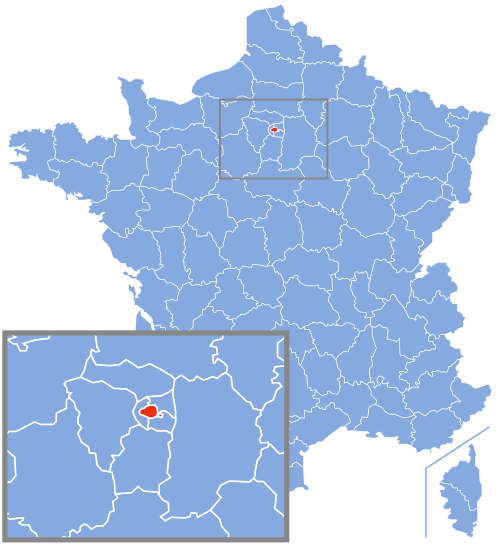 フランスのパリ | |
パリの位置 | |
  パリ  パリ | |
| 座標: 48°51′24″N 2°21′8″E / 48.85667°N 2.35222°E / 48.85667; 2.35222 | |
| 国 | フランス |
| 地域 | イル・ド・フランス |
| 部門 | パリ |
| 区 | なし |
| 相互コミュニティ性 | メトロポール・デュ・グラン・パリ |
| 区分 | 20区 |
| 政府 | |
| • 市長(2020~2026年) | アン・イダルゴ[1] ( PS ) |
| エリア 1 | 105.4 km 2 (40.7 平方マイル) |
| • 都会的な (2020年) | 2,853.5 km 2 (1,101.7 平方マイル) |
| • メトロ (2020年) | 18,940.7 km 2 (7,313.0 平方マイル) |
| 人口 (2023年)[2] | 2,102,650 |
| • ランク | ヨーロッパ9位フランス 1位 |
| • 密度 | 20,000/km 2 (52,000/平方マイル) |
| • 都会的な (2019年[3]) | 10,858,852 |
| • 都市の密度 | 3,800/km 2 (9,900/平方マイル) |
| • メトロ (2017年1月[4]) | 13,024,518 |
| • 地下鉄の密度 | 690/km 2 (1,800/平方マイル) |
| 異名 | パリジャン( en )パリジャン (男性)、パリジェンヌ (女性) ( fr )、パリゴ (男性)、「パリゴット」 (女性) (女性、口語) |
| タイムゾーン | UTC+01:00 (中央ヨーロッパ時間) |
| • 夏 ( DST ) | UTC+02:00 (中央ヨーロッパ標準時) |
| INSEE /郵便番号 | 75056 /75001-75020、75116 |
| 標高 | 28~131メートル(92~430フィート) (平均78メートルまたは256フィート) |
| Webサイト | パリ.fr |
| 1フランスの土地登記簿データ。1 km2 (0.386 平方マイルまたは 247 エーカー) を超える湖、池、氷河、河口は除外されます。 | |
.jpg/500px-La_Tour_Eiffel_vue_de_la_Tour_Saint-Jacques,_Paris_ao%C3%BBt_2014_(2).jpg)


パリ(フランス語の発音: [paʁi] パリ(: Paris)は、フランスの首都であり、最大の都市。2023年1月の公式推定人口は2,102,650人で[2]、2(41平方マイル)を超え[5]欧州連合で4番目に大きな都市、2022年には世界で30番目に人口密度の高い都市となる[6]金融、外交、商業、文化、ファッション、美食芸術と科学における主導的な役割と、初期の広範囲にわたる街路照明システムにより、パリは光の都として知られるようになった。[7]
パリ市はイル・ド・フランス 地域圏、またはパリ地域圏の中心地であり、2023年1月の公式推定人口は12,271,794人で、フランスの人口の約19%を占めています。 [2]パリ地域の2021年のGDPは7,650億ユーロ(1兆640億米ドル、購買力平価)[8]で、欧州連合内で最高でした。[9]エコノミスト・インテリジェンス・ユニットの世界生活費調査によると、2022年にはパリは世界で9番目に生活費の高い都市でした。[10]
パリは、ヨーロッパで3番目に利用者数の多いシャルル・ド・ゴール空港とオルリー空港という2つの国際空港がある主要な鉄道、高速道路、航空輸送の拠点です。[11] [12] 1900年に開業したパリの地下鉄システムであるパリメトロは、 1日523万人の乗客にサービスを提供しています。 [13]モスクワ地下鉄に次いでヨーロッパで2番目に利用者数の多い地下鉄システムです。パリ北駅は世界で24番目に利用者数の多い鉄道駅であり、日本以外では最も利用者数が多く、 2015年には2億6,200万人の乗客が利用しました。 [14]パリは最も持続可能な交通システムの一つであり[15] 、持続可能な交通賞を2度受賞した世界でも数少ない2つの都市の一つです。[16]
パリは美術館や建築物で知られています。ルーブル美術館は2023年に890 万人の来場者を迎え、世界で最も訪問者が多い美術館としての地位を維持する見込みです。[17]オルセー美術館、マルモッタン・モネ美術館、オランジュリー美術館は、フランス印象派のコレクションで知られています。ポンピドゥー・センター 国立近代美術館、ロダン美術館、ピカソ美術館は、近現代美術のコレクションで知られています。市内中心部のセーヌ川沿いの歴史地区は、1991年からユネスコの 世界遺産に登録されています。 [18]
パリには、ユネスコを含むいくつかの国連機関のほか、OECD、OECD開発センター、国際度量衡局、国際エネルギー機関、国際人権連盟などの国際機関、さらに欧州宇宙機関、欧州銀行監督局、欧州証券市場監督局などの欧州機関の本拠地がある。サッカークラブのパリ・サンジェルマンとラグビーユニオンクラブのスタッド・フランセはパリを本拠地としている。 1998年のFIFAワールドカップのために建設された81,000席のスタッド・ド・フランスは、パリのすぐ北、隣接するサン=ドニ市にある。パリでは、ローラン・ギャロスの赤土コートで毎年全仏オープン・グランドスラム・テニストーナメントが開催されている。パリは1900年、1924年、そして2024年の夏季オリンピックを開催した。 1938年と1998年のFIFAワールドカップ、2019年のFIFA女子ワールドカップ、2007年のラグビーワールドカップ、1960年、1984年、2016年のUEFA欧州選手権がパリで開催されました。毎年7月には、ツール・ド・フランスの自転車レースがパリのシャンゼリゼ通りでゴールします。
語源
現代のパリ市に相当する古代のオッピドゥムは、紀元前1世紀半ばにジュリアス・シーザーによってLuteciam Parisiorum(「パリシイ人のルテティア」)として初めて言及され、後に紀元後5世紀にParision 、そして1265年にParisとして証明されました。 [19] [20]ローマ時代には、ラテン語ではLutetiaまたはLutecia 、ギリシャ語ではLeukotekíaとして一般的に知られていました。これは、ケルト語の語源*lukot-(「ネズミ」)または* luto- (「沼地、湿地」)に由来すると解釈されています。[21] [22] [20]
パリという名前は、鉄器時代とローマ時代のガリアの部族であるパリシイ族に由来しています。[23]ガリアの民族名の意味は依然として議論されています。ザビエル・デラマールによると、ケルト語の語根pario- (「大釜」) に由来する可能性があります。[23]アルフレッド・ホルダーは、ウェールズ語のperyff (「領主、指揮官」)と比較して、この名前を「作る人々」または「指揮官」と解釈しました。どちらも、* kwar-is-io - として再構成された祖ケルト語の形から派生している可能性があります。[24]あるいは、ピエール=イヴ・ランベールは、最初の要素を古いアイルランド語のcarr (「槍」) に接続して、パリシイを「槍の人々」と翻訳することを提案しました。これは、より古い * kwar-sāに由来しています。 [20]いずれにせよ、この都市の名前はギリシャ神話のパリとは関係ありません。
この都市の住民は英語ではパリジャン、フランス語ではパリジャン([paʁizjɛ̃])と呼ばれています。 )。彼らは軽蔑的にパリゴット([paʁiɡo] )。[注 1][25]
歴史
起源
パリシイ族はケルト人の セノネス族の亜部族で、紀元前3世紀中ごろからパリ地域に住んでいた。[26] [27]この地域の主要な南北交易路の1つは、セーヌ川を渡るシテ島で、徐々に重要な交易の中心地となっていった。[28]パリシイ族は多くの川沿いの町(中にはイベリア半島のような遠方の町もあった)と交易し、独自の貨幣を鋳造した。[29]

ローマ人は紀元前52年にパリ盆地を征服し、パリ左岸に定住し始めた。[30]ローマの町はもともとルテティア(より正確にはLutetia Parisiorum、「パリシイ人のルテティア」、現代フランス語ではLutèce )と呼ばれていた。それはフォーラム、浴場、寺院、劇場、円形劇場を備えた繁栄した都市になった。[31]
西ローマ帝国の末期には、この町はラテン語のパリシウスと呼ばれていたが、これは後にフランス語でパリとなる。[32]キリスト教は、紀元後3世紀半ばにパリの初代司教サン・ドニによって導入された。伝説によると、サン・ドニはローマ占領軍の前で信仰を捨てることを拒否したため、後に「モンマルトル」と呼ばれるようになった丘で斬首され、そこから首を切られたまま町の北へと歩いた。彼が倒れて埋葬された場所は、重要な宗教的聖地であるサン・ドニ大聖堂となり、多くのフランス王が埋葬されている。[33]
メロヴィング朝の初代国王クローヴィス1世は、508年からこの都市を首都とした。 [34]フランク人のガリア支配が始まると、フランク人は徐々にパリに移住し、パリ・フラン語の方言が生まれた。シテ島の要塞化は845年のヴァイキングの略奪を阻止できなかったが、橋が船の通過を阻止するなどパリの戦略的重要性は、パリ包囲戦(885-886年)での防衛の成功によって確立され、当時のパリ伯爵オド・ド・フランスが西フランク王国王に選ばれた。[35] 987年にユーグ・カペーが統一西フランク王国の王に選出されて始まったカペー朝により、パリは徐々にフランス最大かつ最も繁栄した都市となっていった。[33]
中世盛期および後期からルイ14世まで
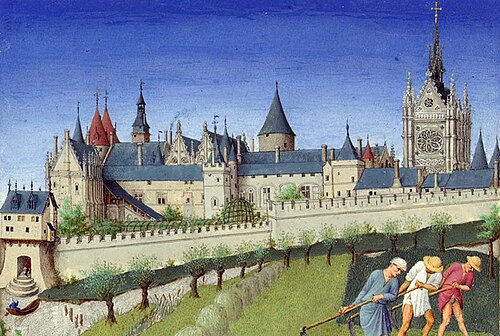
12世紀末までに、パリはフランスの政治、経済、宗教、文化の中心地となった。[36]王宮であるシテ宮はシテ島の西端に位置していた。1163年、ルイ7世の治世中に、パリの司教モーリス・ド・シュリーがシテ島の東端にノートルダム大聖堂の建設に着手した。
セーヌ川とその北側の緩やかな流れの「死の支流」の間の湿地帯が10世紀頃から埋め立てられた後、[37]パリの文化の中心地は右岸に移り始めました。1137年、新しい市の市場(今日のレ・アール)が、シテ島とグレーヴ広場(オテル・ド・ヴィル広場)の2つの小さな市場に取って代わりました。[38]後者の場所には、パリの河川貿易会社の本部が置かれ、後に非公式に(後年正式には)パリ初の市政府となった組織です。
12世紀後半、フィリップ・オーギュストは西からの河川侵攻から街を守るためにルーブル城塞を拡張し、1190年から1215年の間に街に最初の城壁を築き、中央の島の両側に橋を架け直し、主要道路を舗装した。 [39] 1190年、彼はパリの旧大聖堂学校を学生と教師の団体に改築し、これが後にパリ大学となり、ヨーロッパ全土から学生を集めることになった。[40] [36]
1328年当時すでにフランスの首都であったパリは、20万人の住民を抱え、ヨーロッパで最も人口の多い都市であった。比較すると、1300年のロンドンの住民は8万人であった。[41] 14世紀初頭までに、ヨーロッパの都市部には大量の汚物が蓄積したため、フランスやイタリアの都市では人間の排泄物にちなんで通りに名前がつけられた。中世のパリでは、いくつかの通りの名前がフランス語で「糞」を意味する「merde 」に由来していた。[42]

百年戦争の間、パリは1418年からイングランド寄りのブルゴーニュ軍に占領され、1420年にイングランド王ヘンリー5世がフランスの首都に入城するとイングランド軍に完全に占領された。 [43] 1429年にジャンヌ・ダルクがパリを解放しようとしたにもかかわらず、 [44]パリは1436年までイングランドの占領下にあった。
16世紀後半のフランス宗教戦争では、パリはカトリック同盟の拠点であり、同同盟は1572年8月24日の聖バルテルミの虐殺を組織した。この虐殺では数千人のフランス人プロテスタントが殺害された。[45] [46]この紛争は、王位請求者アンリ4世が首都に入るためにカトリックに改宗した後、1594年にフランスの王位を主張するために市内に入城したときに終結した。この国王は治世中に首都にいくつかの改良を加えた。パリ初の屋根のない歩道付き橋であるポン・ヌフの建設を完了し、ルーブル美術館の増築部分を建設してチュイルリー宮殿と結び、パリ初の住宅広場であるロワイヤル広場(現在のヴォージュ広場)を作った。アンリ4世は都市の交通を改善しようと努力したにもかかわらず、パリの通りの狭さが、1610年にレ・アール市場近くで彼が暗殺される一因となった。 [47]
17世紀、ルイ13世の宰相リシュリュー枢機卿はパリをヨーロッパで最も美しい都市にしようと決意した。彼は5つの新しい橋、ソルボンヌ大学のための新しい礼拝堂、そして自身の宮殿であるパレ・カルディナルを建設した。1642年にリシュリューが亡くなった後、この宮殿はパレ・ロワイヤルと改名された。[48]

フロンドの乱中のパリの反乱により、ルイ14世は1682年に宮廷を新しい宮殿であるヴェルサイユに移した。もはやフランスの首都ではなかったが、コメディ・フランセーズ、絵画アカデミー、フランス科学アカデミーなどにより、芸術と科学が栄えた。都市が攻撃から安全であることを示すため、国王は市壁を破壊し、代わりにグラン・ブールヴァールとなる並木道を設けた。[49]彼の治世を象徴するものには、カトル・ナシオン・コレージュ、ヴァンドーム広場、ヴィクトワール広場、アンヴァリッドなどがある。[50]
18世紀と19世紀
パリの人口は1640年の約40万人から1780年には65万人に増加した。[51]シャンゼリゼ通りと名付けられた新しい大通りが市を西のエトワールまで拡張し、[52]市の東側にある労働者階級のフォーブール・サン・タントワーヌ地区は、フランスの他の地域からの貧しい移民労働者でますます混雑するようになった。[53]


パリは啓蒙時代として知られる哲学と科学の活動が爆発的に増加した時代の中心地だった。ディドロとダランベールは1751年に百科全書を出版し、その後モンゴルフィエ兄弟は1783年11月21日に熱気球による初の有人飛行を行った。パリはヨーロッパ大陸の金融の中心地であり、書籍出版、ファッション、高級家具や贅沢品の製造のヨーロッパの主要な中心地でもあった。[54] 1797年10月22日、パリはガルヌランによる史上初のパラシュート降下が行われた場所でもある。
1789年の夏、パリはフランス革命の中心地となった。7月14日、暴徒がアンヴァリッドの武器庫を占拠し、数千丁の銃を手に入れ、王権の主要な象徴であるバスティーユ牢獄を襲撃した。最初の独立したパリ・コミューン、つまり市議会がパリ市庁舎で開催され、 7月15日に天文学者のジャン・シルヴァン・バイーが市長に選出された。 [55]
ルイ16世と王室はパリに連行され、チュイルリー宮殿に投獄された。1793年、革命がますます過激化すると、恐怖政治により国王、王妃、市長が、フランス全土の1万6千人以上の他の人々とともにギロチンで斬首された。 [56]貴族と教会の財産は国有化され、市内の教会は閉鎖、売却、または破壊された。[57] 1799年11月9日(ブリュメール18日のクーデター)にナポレオン・ボナパルトが第一統領として権力を掌握するまで、一連の革命派閥がパリを支配した。[58]
パリの人口は革命中に10万人減少したが、1799年以降は16万人の新規居住者が急増し、1815年には66万人に達した。 [59]ナポレオンはパリの選挙政府を彼に直属する知事に置き換えた。彼は凱旋門などの軍事的栄光の記念碑を建て始め、新しい噴水、ウルク運河、ペール・ラシェーズ墓地、そしてパリ初の金属製橋であるポン・デ・ザールなど、放置されていた都市のインフラを改善した。[59]

王政復古の間、パリの橋や広場は革命前の名称に戻された。1830年の7月革命(バスティーユ広場の7月革命記念柱によって記念されている)により立憲君主ルイ・フィリップ1世が権力を握った。1837年にパリへの最初の鉄道が開通し、地方からパリへの大規模な移住の新たな時代が始まった。[59] 1848年、ルイ・フィリップはパリの路上での民衆蜂起によって打倒された。後継者のナポレオン3世は、新任のセーヌ県知事ジョルジュ・ウジェーヌ・オスマンとともに、大規模な公共事業プロジェクトを開始し、新しい大通り、新しいオペラハウス、中央市場、新しい水道橋、下水道、ブローニュの森やヴァンセンヌの森を含む公園を建設した。[60] 1860年、ナポレオン3世は周辺の町を併合し、8つの新しい区を設置し、パリを現在の境界まで拡大した。[60]
普仏戦争(1870年 - 1871年)の間、パリはプロイセン軍に包囲された。数か月に及ぶ封鎖、飢餓、そしてプロイセン軍による砲撃の後、パリは1871年1月28日に降伏を余儀なくされた。3月28日にパリで権力を掌握した後、パリ・コミューンとして知られる革命政府は2か月間権力を握ったが、 1871年5月末の「血の週」の間にフランス軍によって厳しく鎮圧された。 [61]
19世紀後半、パリでは2つの大きな国際博覧会が開催されました。1889年の万国博覧会では、フランス革命100周年を記念して新しいエッフェル塔が展示されました。 1900年の万国博覧会では、アレクサンドル3世橋、グラン・パレ、プティ・パレ、パリ初の地下鉄が完成しました。[62]パリは自然主義(エミール・ゾラ)と象徴主義(シャルル・ボードレール、ポール・ヴェルレーヌ)、そして印象派(クールベ、マネ、モネ、ルノワール)の実験場となりました。[63]
20世紀と21世紀
1901年までに、パリの人口は約271万5000人にまで増加した。[64]世紀の初めには、パブロ・ピカソ、モディリアーニ、アンリ・マティスなど世界中の芸術家がパリに拠点を置いた。パリはフォーヴィスム、キュビズム、抽象芸術の発祥地であり、[65] [66]マルセル・プルーストなどの作家は文学への新しいアプローチを模索していた。[67]
第一次世界大戦中、パリは時折最前線に立たされた。第一次マルヌ会戦では、600台から1,000台のパリタクシーが6,000人の兵士を最前線に輸送するという、小さいながらも非常に重要な象徴的な役割を果たした。パリはまた、ツェッペリン飛行船による爆撃やドイツ軍の長距離砲による砲撃も受けた。[68]戦後の数年間は「Les Anées Folles」と呼ばれ、パリはアーネスト・ヘミングウェイ、イーゴリ・ストラヴィンスキー、ジェイムズ・ジョイス、ジョセフィン・ベイカー、エヴァ・コッチェヴァー、ヘンリー・ミラー、アナイス・ニン、シドニー・ベシェ[ 69 ]、サルバドール・ダリなど、世界中の作家、音楽家、芸術家の聖地であり続けた。[70]
平和会議後の数年間、この都市にはフランス植民地や他のアジア・アフリカ諸国からの学生や活動家が増え、後にホー・チミン、周恩来、レオポルド・セダール・サンゴールなど各国の指導者となった人々も増えていった。[71]

1940年6月14日、ドイツ軍は「無防備都市」と宣言されていたパリに進軍した。[72] 1942年7月16日から17日にかけて、ドイツの命令により、フランス警察と憲兵は4,115人の子供を含む12,884人のユダヤ人を逮捕し、5日間ヴェル・ディヴ(ヴェロドローム・ディヴ)に監禁し、そこから列車でアウシュビッツの絶滅収容所に移送した。子供たちは誰一人戻ってこなかった。[73] [74] 1944年8月25日、パリはフランス第2機甲師団とアメリカ陸軍第4歩兵師団によって解放された。シャルル・ド・ゴール将軍は、シャンゼリゼ通りをノートルダム寺院に向かって大勢の感情的な群衆を率いて歩き、パリ市庁舎から激励の演説を行った。[75]
1950年代から60年代にかけて、パリはアルジェリア独立戦争の前線の一つとなった。1961年8月、独立派のFLNはパリの警察官11人を標的に殺害し、アルジェリアのイスラム教徒(当時はフランス国籍)に夜間外出禁止令を課した。1961年10月17日、夜間外出禁止令に反対するアルジェリア人の無許可だが平和的な抗議デモが警察とデモ参加者の激しい衝突に発展し、少なくとも40人が死亡した。反独立派の秘密武装組織(OAS)は1961年から62年にかけてパリで一連の爆破事件を起こした。[76] [77]
1968 年 5 月、抗議する学生たちがソルボンヌ大学を占拠し、カルチェラタンにバリケードを築いた。数千人のパリのブルーカラー労働者が学生たちに加わり、運動は 2 週間にわたるゼネストへと拡大した。政府支持派は 6 月の選挙で圧倒的多数で勝利した。1968年 5 月のフランスでの事件の結果、パリ大学は 13 の独立したキャンパスに分割された。[78] 1975年、国民議会はパリの地位を他のフランスの都市と同等に変更し、1977年3月25日、ジャック・シラクは1793年以来初めて選出されたパリ市長となった。[79]トゥール・メーヌ・モンパルナスは、57階建て、高さ210メートル(689フィート)で市内で最も高い建物であり、1969年から1973年にかけて建設された。これは非常に物議を醸し、現在でも市内中心部で32階建てを超える唯一の建物である。[80]パリの人口は、中流家庭が郊外に移住したため、1954年の285万人から1990年には215万2千人に減少した。[81]郊外鉄道網のRER(Réseau Express Régional)は、メトロを補完するために建設された。市を囲むペリフェリック高速道路は1973年に完成した。[ 82 ]
戦後第五共和政の大統領のほとんどは、パリに自らの記念碑を残すことを望んだ。ジョルジュ・ポンピドゥー大統領はポンピドゥー・センター(1977年)を、ヴァレリー・ジスカール・デスタンはオルセー美術館(1986年)を建設した。フランソワ・ミッテラン大統領はオペラ・バスティーユ(1985年 - 1989年)、フランス国立図書館の新敷地(1996年)、ラ・デファンスのアルシュ・ド・ラ・デファンス(1985年 - 1989年) 、および地下の中庭を備えたルーブル美術館のピラミッド(1983年 - 1989年)を建設した。ジャック・シラク(2006年)はケ・ブランリー美術館を建設した。[83]
21世紀初頭、パリの人口は若者の流入が増え、再びゆっくりと増加し始めた。2011年には225万人に達した。2001年3月、ベルトラン・ドラノエが初の社会主義者市長に就任。2008年3月に再選された。[84] 2007年には、自動車交通量を減らす取り組みの一環として、自転車レンタルシステム「ヴェリブ」を導入した。ベルトラン・ドラノエはまた、セーヌ川左岸の高速道路の一部を都市型遊歩道と公園「プロムナード・デ・ベルジュ・ド・ラ・セーヌ」に改造し、2013年6月に開通させた。[85]
.jpg/500px-Marche_hommage_Charlie_hebdo_et_aux_victimes_des_attentats_de_janvier_2015_(17).jpg)
2007年、ニコラ・サルコジ大統領は、パリとその周辺地域の都市とのより緊密な統合を図るグラン・パリ計画を立ち上げた。多くの修正を経て、グラン・パリ大都市圏と名付けられた人口670万人の新エリアが2016年1月1日に誕生した。[86] 2011年、パリ市と中央政府は、パリ、パリ近郊の最も内側の3県、空港、高速鉄道(TGV)駅を結ぶ全長205kmの自動化地下鉄路線であるグラン・パリ・エクスプレスの計画を承認した。推定費用は350億ユーロである。[87]このシステムは2030年までに完成する予定である。 [88]
2015年1月、アラビア半島のアルカイダはパリ地域での攻撃を主張した。 [89] [90] 150万人がテロに反対し、言論の自由を支持するためにパリでデモ行進した。[91]同年11月、ISILが犯行声明を出したテロ攻撃により[92] 130人が死亡、350人以上が負傷した。 [93]
2016年4月22日、気候変動の影響を2℃未満に抑えることを目的として、国連気候変動枠組条約の196か国がパリ協定に署名した。 [94]
地理
位置

パリはフランス北部中央部、セーヌ川の北に曲がる弧上に位置し、川の河口には2つの島、サン・ルイ島とより大きなシテ島があり、パリ最古の部分を形成している。イギリス海峡(ラ・マンシュ)へのセーヌ川の河口はパリから約233マイル(375 km)下流にある。パリは川の両岸に広く広がっている。[95]パリは全体的に比較的平坦で、最低地点は海抜35メートル(115フィート)である。パリにはいくつかの目立つ丘があり、最も高いのは標高130メートル(427フィート)のモンマルトルである。 [96]
パリは、周辺の公園であるブローニュの森とヴァンセンヌの森を除けば、面積約87 km 2 (34 平方マイル)の楕円形の都市で、周囲を35 km (22 マイル)の環状道路であるブルヴァール・ペリフェリックが囲んでいる。[97] 1860年にパリが周辺地域を最後に併合したことにより、現在の形が確立し、時計回りに螺旋状に走る20の行政区が誕生した。1860年の面積78 km 2 (30 平方マイル)から、市域は1920年代にわずかに拡大し、86.9 km 2 (33.6 平方マイル)となった。 1929年にブローニュの森とヴァンセンヌの森が市に併合され、市の面積は約105 km 2 (41 平方マイル)となった。[98]都市圏は2,300 km 2 (890 平方マイル)である。[95]
ノートルダム大聖堂前の「ポイント・ゼロ」から測ると、パリはロンドンの南東450km(280マイル)、カレーの南287km(178マイル)、ブリュッセルの南西305km(190マイル) 、マルセイユの北774km(481マイル) 、ナントの北東385km(239マイル) 、ルーアンの南東135km(84マイル)に位置する。[99]
気候
.jpg/500px-Paris_raining_autumn_cityscape_(8252181936).jpg)
パリはケッペンの気候区分では西ヨーロッパに典型的な海洋性気候に属します。この気候は、冬は涼しく、雨が多く曇り空で、夏は穏やかから暖かいのが特徴です。このタイプの気候では、非常に暑い、非常に寒い気温、極端な天候はまれです。[100]
夏の日は通常穏やかで快適で、平均気温は15〜25℃(59〜77℉)で、日照時間もかなり長い。[101]毎年、気温が32℃(90℉)を超える日が数日ある。2003年の熱波のように、気温が数週間にわたって30℃(86℉)を超え、日によっては40℃(104℉)に達し、夜間に涼しくなることはめったになかったなど、より厳しい暑さが長期間続くこともある。[102]
春と秋は平均して日中は穏やかで夜は涼しいが、天候は変わりやすく不安定である。意外にも両季節とも暖かい日や涼しい日が頻繁にある。[103]冬は日照時間が乏しい。日中は涼しく、夜は寒いが一般的に氷点下よりは高く、最低気温は3℃(37℉)程度である。[104]夜間の軽い霜はよく降りるが、気温が−5℃(23℉)を下回ることはめったにない。パリでは積雪の有無にかかわらず小雪や吹雪が降ることがある。[105]
パリの年間降水量は平均641 mm(25.2インチ)で、年間を通じて均等に小雨が降る。パリは断続的で突然の激しいにわか雨で知られている。最高気温は2019年7月25日の42.6 °C(108.7 °F)である。[106]最低気温は1879年12月10日の−23.9 °C(−11.0 °F)である。[107]
管理
市政府
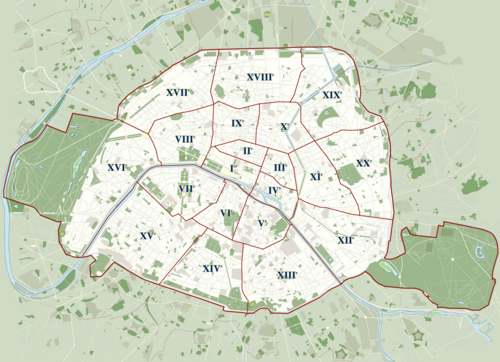
パリはその長い歴史のほとんどにおいて、いくつかの短い期間を除いて、フランス国王、皇帝、または大統領の代表者によって直接統治されてきた。1974年、パリは国民議会によって自治体の自治権を与えられた。[111]パリで最初に選挙で選ばれた近代的な市長は、1977年3月に選出されたジャック・シラクであり、1871年以来初の市長であり、1794年以来4人目の市長となった。現在の市長は社会主義者のアンヌ・イダルゴであり、2014年4月に初当選し、[112] 2020年6月に再選された。[113]

パリ市長はパリ市民によって間接的に選出される。市内の20区の有権者がそれぞれパリ議会の議員を選出し、パリ議会が市長を選出する。議会は163人の議員で構成される。各区には人口に応じて議席が割り当てられ、最も人口の少ない区には10人、最も人口の多い区には34人が割り当てられる。議会は2回投票制のクローズドリスト 比例代表制で選出される。[114]
第一回投票で過半数、または第二回投票で少なくとも過半数を獲得した政党名簿は、自動的にその区の議席の半分を獲得する。残りの議席の半分は、最高平均法を使用して、少なくとも5%の票を獲得したすべての名簿に比例配分される。[ 114 ]これにより、勝利した政党または連合は、過半数の票を獲得しなくても、常に議席の過半数を獲得することが保証される。[115]
2020年のパリ市議会選挙以前は、パリの20の区にはそれぞれ市役所と直接選挙で選ばれた議会(区議会)があり、区長を選出していた。[116]各区議会はパリ市議会のメンバーと、区議会のみのメンバーで構成される。各区の副市長の数は、その人口によって異なる。1996年の時点で、区長は20人、副市長は120人であった。[111] 2020年の選挙で、最初の4区を1人の市長が管轄する統一行政区分であるパリセンターの創設が発効した。他の16区には引き続き独自の市長がいる。[117]
メトロポール・デュ・グラン・パリ

2016年1月、グラン・パリ大都市圏(略してグラン・パリ)が誕生した。[118]これはパリ市とその近郊の協力のための行政構造である。これにはパリ市に加え、内側の近郊の3県、オー=ド=セーヌ県、セーヌ=サン=ドニ県、ヴァル=ド=マルヌ県のコミューン、さらに外側の近郊の7つのコミューン(ヴァル=ドワーズ県のアルジャントゥイユ、エソンヌ県のパレー=ヴィエイユ=ポストなど)が含まれ、パリの主要空港が含まれるようになった。大都市圏は814 km 2(314平方マイル)の面積をカバーしている。2015年の人口は694万5000人だった。[119] [120]
新しい構造は、直接選挙ではなく、加盟コミューンの議会によって選出された210人の議員からなるメトロポリタン評議会によって運営される。2020年までに、その基本的な権限には都市計画、住宅、環境保護が含まれることになる。[118] [120] 2016年1月、パトリック・オリエがメトロポリタン評議会の初代議長に選出された。メトロポリタンは人口約700万人でフランスのGDPの25%を占めているが、予算は非常に少なく、パリ市の80億ユーロと比べてわずか6500万ユーロである。[121]
地方政府
パリとその周辺の自治体を含むイル・ド・フランス地域圏は、地域議会によって統治されており、地域内の各自治体を代表する209人の議員によって構成されている。2015年12月、ヴァレリー・ペクレス率いる中道右派政党連合の右派連合の候補者が、社会党と環境保護主義者の連合を破り、地方選挙で僅差で勝利した。社会党は17年間この地域を統治していた。地域議会には右派連合から121人、左派連合から66人、極右の国民戦線から22人の議員がいる。[122]
国家政府
.jpg/500px-Secretary_Pompeo_Arrives_to_Meet_with_French_Foreign_Minister_Le_Drian_in_Paris_(50610423656).jpg)
フランスの首都パリは、フランスの国家政府の所在地である。行政に関しては、2人の最高責任者がそれぞれ公邸を持ち、それが事務所としても機能している。フランス共和国大統領はエリゼ宮に住んでいる。[123]首相官邸はマティニョン邸にある。[124] [125]政府省庁は市内のさまざまな場所にあり、その多くはマティニョン邸の近くにある。[126]
フランス議会の両院はリヴ・ゴーシュに位置している。上院である元老院はリュクサンブール宮殿で開催される。より重要な下院である国民議会はブルボン宮殿で開催される。フランスで2番目に高い公務員である上院議長は、共和国大統領を唯一の上司とし、リュクサンブール宮殿の小さな別館であるプチ・リュクサンブール宮殿に住んでいる。[127]

フランスの最高裁判所はパリにある。刑事事件と民事事件を審理する司法制度の最高裁判所である破毀院は、シテ島のパレ・ド・ジュスティスにある。[128]行政機関に対する訴訟を裁き、行政制度の最高裁判所として機能する国会議事堂は、 1区のパレ・ロワイヤルにある。[129]法律と政令の合憲性に関する最終権限を持つ諮問機関である憲法評議会は、パレ・ロワイヤルのモンパンシエ翼で開催される。[130]
パリとその周辺地域には、ユネスコ、経済協力開発機構、国際商業会議所、パリクラブ、欧州宇宙機関、国際エネルギー機関、国際フランコフォニー機構、欧州連合安全保障研究所、国際度量衡局、国際博覧会事務局、国際人権連盟など、いくつかの国際組織の本部が置かれています。
警察力

パリの治安は、主に内務省の下部組織であるパリ警察署が担当している。警察署は、パリ市内および近隣の3県を巡回する国家警察の部隊を監督している。また、パリ消防隊を含む緊急サービスの提供も担当している。本部はシテ島のルイ・レピーヌ広場にある。[131]
警察署の管轄下には43,800人の警官と、パトカー、バイク、消防車、ボート、ヘリコプターを含む6,000台以上の車両がある。[131]国家警察には暴動鎮圧、群衆鎮圧、公共施設の警備を担当する共和国警備隊(CRS)という特別部隊がある。デモや公共イベントがあるときは、パリ中心部でCRSの隊員の車が頻繁に見かけられる。警察はフランス軍の一部門である国家憲兵隊の支援を受けており、その警察活動は内務省の監督下にある。[132]
パリの犯罪は、他の大都市の犯罪とほぼ同じです。市内中心部では、暴力犯罪は比較的まれです。政治的暴力はまれですが、パリと他のフランスの都市で同時に非常に大規模なデモが発生することがあります。通常、強力な警察の存在によって管理されているこれらのデモは、対立に発展し、暴力にエスカレートする可能性があります。[133]
都市景観

都市計画と建築


パリは、大災害や戦争による破壊をほとんど経験していない世界でも数少ない首都の一つである。その結果、その最古の歴史さえも街路地図に見ることができ、何世紀にもわたる統治者たちがそれぞれの建築的特徴を首都に加えてきた結果、歴史豊かな記念碑や建物が蓄積され、その美しさが今日のパリの名声に大きく貢献している。[134]中世以前のパリは、セーヌ川の湾曲部にあるいくつかの島と砂州で構成されていた。そのうちの2つが今日も残っている。サン・ルイ島とシテ島である。3つ目は、1827年に人工的に作られたシグネ島である。
近代パリのダウンタウン計画と建築的調和の多くは、ナポレオン3世とセーヌ県知事オスマン男爵によるものである。1853年から1870年にかけて、彼らは市の中心部を再建し、広いダウンタウンの大通りと大通りが交差する広場を造り、大通り沿いに標準的なファサードを設け、ファサードを特徴的なクリームグレーの「パリ石」で造ることを義務付けた。彼らはパリ中心部の周囲に主要な公園を建設した。[135]市の中心部の住宅人口が多いため、パリは他のほとんどの西洋の主要都市とは大きく異なる。[136]
パリの都市計画法は17世紀初頭から厳しく管理されており、[137]特に道路沿いの配置、建物の高さ、建物の配置に関しては厳しく管理されている。[137]高さ210メートル(690フィート)のトゥール・モンパルナスは1973年以来パリとフランスで最も高い建物であったが、[138] 2011年以来、この記録はクルブヴォアのラ・デファンス地区トゥール・ファースト・タワーによって保持されている。
ハウジング

2018年、パリで1平方メートルあたりの平均価格が最も高い住宅街はモンテーニュ通りで、1平方メートルあたり22,372ユーロでした。[139] 2011年、パリ市内の住宅数は1,356,074戸でした。このうち、1,165,541戸(85.9%)が主な住宅、91,835戸(6.8%)が二次住宅、残りの7.3%は空き家でした。[140]
建物の62%は1949年以前に建てられたもので、20%は1949年から1974年の間に建てられたものです。パリの建物の18%は1974年以降に建てられました。[141]市内の130万戸の住宅の3分の2は、ワンルームまたは2部屋のアパートです。パリの平均1住宅あたりの人口は1.9人で、1980年代から変わっていませんが、イル・ド・フランスの平均2.33人よりも少ないです。パリの住民のうち、自宅を所有しているのはわずか33%で、イル・ド・フランス地域全体では47%です。パリの人口の大半は賃貸住宅を使用しています。[141] 2017年、社会住宅または公営住宅はパリの住宅の19.9%でした。その分布はパリ全体で大きく異なり、裕福な7区の住宅の2.6%から19区の39.9%まであります。[142]

2019年2月、パリのNGOが毎年恒例の市内ホームレス人口調査を実施した。パリ市内のホームレス人口は3,641人で、そのうち12%が女性だった。半数以上が1年以上ホームレス生活を送っていた。2,885人が路上や公園、298人が電車や地下鉄の駅、756人がその他の一時避難所で生活していた。これは2018年以降588人の増加である。[143]
郊外


20 世紀にブローニュの森、ヴァンセンヌの森、パリ ヘリポートが追加されたことを除けば、パリの行政区分は 1860 年以来変わっていません。1790 年に創設されて以来、セーヌ川のより広い行政区分がパリとその郊外を統治してきましたが、郊外の人口が増加したため、独自の存在として維持することが困難になりました。この問題に対処するため、親の「パリ地域区」(「パリ地域区」) は 1968 年からいくつかの新しい県に再編成されました。パリは独立した県となり、その郊外の行政はそれを囲む 3 つの新しい県に分割されました。パリ地域区は 1977 年に「イル ド フランス」に改名されましたが、この略称「パリ地域」の名前は、イル ド フランスを表すために、またパリの集合体全体を指す漠然とした表現として、今日でも一般的に使用されています。[144]パリとその郊外を統合するための長年の計画は、2016年1月にメトロポール・デュ・グラン・パリが誕生したときに始まりました。[118]
パリと郊外の断絶、特に郊外交通機関の不足は、パリ都市圏の成長とともに非常に明白になった。ポール・ドゥルーヴリエは、 1961年にパリ地域の長に就任したとき、パリ郊外のメセンタント問題を解決することを約束した。 [145]彼がパリ地域のために最も野心的なプロジェクトのうちの2つは、5つの郊外「ヴィル・ヌーヴェル」(「新都市」)の建設[146]とRER通勤鉄道網であった。[147]
1960年代から1970年代にかけて、急速に増えた人口に低コストで対応するために、郊外の住宅地(グラン・アンサンブル)が数多く建設された。 [148]これらの地区は当初、社会的に混在していたが、[149]実際に住宅を所有している住民はほとんどいなかった。経済成長により、1970年代になってようやく中流階級がこれらの地区に住めるようになった。[150]建設品質の悪さと、既存の都市成長への無計画な組み込みにより、他の場所に移住できる人々がここを去り、より限られた資源しか持たない人々が再びここに住むようになった。[150]
これらの地域は、パリ北部と東部、つまりグット・ドール地区とベルヴィル地区の周辺にある。パリ北部では、主にセーヌ=サン=ドニ 県に、東部ではヴァル=ドワーズ 県に集まっている。その他の困難な地域は、セーヌ川流域、エヴリー・エ・コルベイユ=エソンヌ(エソンヌ県)、ミュロー、マント=ラ=ジョリー(イヴリーヌ県)、そして1961年にドゥルーヴリエが打ち出した「ヴィル・ヌーヴェル」政策によって作られた公営住宅地区に散在している。[151]
パリ都市圏の都市社会学は、基本的に19世紀のパリのそれである。富裕層は西部と南西部に住み、中流から労働者階級は北部と東部に住んでいます。残りの地域は主に中流階級で、歴史的に重要な地域、すなわちパリの東のサン=モール=デ=フォッセと北のアンギャン=レ=バンに富裕層が点在しています。 [152]
人口統計

| 2019年国勢調査 パリ地域 | |||||||||||||||||||||||||||||||||||||||||
|---|---|---|---|---|---|---|---|---|---|---|---|---|---|---|---|---|---|---|---|---|---|---|---|---|---|---|---|---|---|---|---|---|---|---|---|---|---|---|---|---|---|
| (イル・ド・フランス) [153] [154] | |||||||||||||||||||||||||||||||||||||||||
| |||||||||||||||||||||||||||||||||||||||||
| |||||||||||||||||||||||||||||||||||||||||

.svg/500px-Unofficial_flag_of_Guadeloupe_(local).svg.png)











フランスの統計機関INSEEによると、パリ市の人口は2023年1月時点で210万2650人で、2022年1月の216万5423人から減少している。2013年から2023年の間に人口は12万2919人、つまり約5%減少した。パリ市長のアンヌ・イダルゴは、これは都市の「疎密化」を示しており、緑地が増え、混雑が減ったと宣言した。[155] [156]人口減少にもかかわらず、パリは公園を除いて1ヘクタールあたり252人の住民を抱え、ヨーロッパで最も人口密度の高い都市のままである。[157]この人口減少は、出生率の低下、中流階級の住民の流出、観光客向けの短期賃貸によるパリの住宅喪失の可能性などが一因とされている。[158]
パリは、ベルリン、マドリード、ローマに次いで、欧州連合で4番目に大きな自治体である。ユーロスタットは、2012年の「都市監査中核都市」の人口に基づき、パリ(650万人)をロンドン(800万人)より下、ベルリン(350万人)より上に位置付けている。[159] 今日のパリの人口は、1921年の史上最多の290万人より少ない。 [160]主な理由は、世帯規模の大幅な減少と、1962年から1975年にかけての郊外への住民の劇的な移住である。移住の要因には、産業空洞化、家賃の高騰、多くの都心部の高級化、住居スペースのオフィスへの転換、労働者世帯の富裕化などがある。パリの人口減少は、21世紀初頭に一時的に止まった。人口は1999年の2,125,246人から2012年には2,240,621人に増加し、その後2017年、2018年、そして2021年に再びわずかに減少した。[161] [162]
パリは、その境界をはるかに超えて広がる市街地の中心地である。一般的にパリ都市圏と呼ばれ、統計的にはunité urbaine (都市部の尺度)として、パリ都市圏の人口は2017年に10,785,092人に達し、欧州連合で最大の都市圏となった。[163] [164]都市の影響を受ける通勤活動は、統計的なaire d'attraction de Paris (「機能エリア」、大都市圏に匹敵する統計手法)にまで及び、[165])、2017年の人口は13,024,518人で、[166]フランスの人口の19.6%を占め、[167]ユーロ圏で最大の大都市圏となっている。[164]
欧州連合の統計機関ユーロスタットによると、2012年、パリ市は欧州連合内で最も人口密度の高い都市だった。市域内のNUTS-3統計区域には1平方キロメートル当たり21,616人の人口があり、1平方キロメートル当たり10,374人のインナーロンドン西部を上回った。同じ国勢調査では、パリに隣接するオー=ド=セーヌ県、セーヌ=サン=ドニ県、ヴァル=ド=マルヌ県の3県の人口密度は1平方キロメートル当たり1万人を超え、EU内で最も人口密度の高い10の地域にランクインした。[168] [要検証]
移住
フランスの法律では、出生時にフランス国籍を持たずに外国で生まれた人は移民と定義されている。2012年の国勢調査では、パリ市の住民のうち135,853人がヨーロッパからの移民、112,369人がマグリブからの移民、70,852人がサハラ以南のアフリカとエジプトからの移民、5,059人がトルコからの移民、91,297人がトルコ以外のアジアからの移民、38,858人がアメリカ大陸からの移民、1,365人が南太平洋からの移民であった。[169]
パリ地域では、ヨーロッパからの移民が590,504人、マグリブからの移民が627,078人、サハラ以南のアフリカとエジプトからの移民が435,339人、トルコからの移民が69,338人、トルコ以外のアジアからの移民が322,330人、アメリカ大陸からの移民が113,363人、南太平洋からの移民が2,261人であった。[170]
2012年には、パリ市(パリ市)には8,810人のイギリス国民と10,019人のアメリカ国民が居住し、パリ地域(イル・ド・フランス)全体には20,466人のイギリス国民と16,408人のアメリカ国民が居住していた。[171] [172]
2020年から2021年にかけて、パリ地域の人口の41%にあたる約600万人が移民(21%)か、少なくとも片方の親が移民(20%)であった。これらの数字には、海外フランスで生まれたフランス人とその直系の子孫は含まれていない。[173]
宗教

20世紀初頭、パリは世界最大のカトリック都市だった。 [174]フランスの国勢調査データには宗教的所属に関する情報は含まれていない。[175]フランスの世論調査機関であるフランス世論研究所(IFOP)による2011年の調査では、パリ地域(イル・ド・フランス)の住民の61%がローマカトリック教徒であると自認している。同じ調査で、住民の7%がイスラム教徒、4%がプロテスタント、2%がユダヤ教徒、25%が無宗教であると自認している。
INSEEによると、フランス在住者の400万から500万人は、アルジェリア、モロッコ、チュニジアなどイスラム教徒が多数を占める国で生まれたか、少なくとも片方の親がこれらの国で生まれた。2008年のIFOP調査では、これらのイスラム教徒が多数を占める国からの移民のうち、25%が定期的にモスクに通っていた。41%が宗教を実践し、34%は信者ではあるが宗教を実践していなかったと報告されている。[176] [177] 2012年と2013年には、パリ市内に約50万人、イル・ド・フランス地域圏に150万人、フランス全土に400万人から500万人のイスラム教徒がいると推定された。[178] [179]
2014年、パリ地域のユダヤ人人口は282,000人と推定され、イスラエルと米国以外では世界最大のユダヤ人の集中地域となっている。 [180]
経済
.jpg/500px-La_D%C3%A9fense_depuis_l'Arc_de_Triomphe_Janvier_2023_(cropped).jpg)
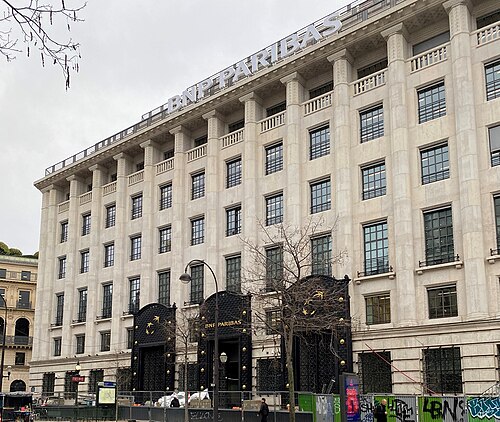


パリ市の経済は主にサービス業と商業に依存している。パリの企業390,480社のうち、80.6%が商業、運輸、多様なサービス業に従事し、6.5%が建設業、3.8%が工業に従事している。[184]パリ地域(イル・ド・フランス)でも同様の状況で、企業の76.7%が商業とサービス業に従事し、3.4%が工業に従事している。[185]
2012年の国勢調査では、パリ地域の雇用の59.5%が市場サービス(卸売・小売業12.0%、専門・科学・技術サービス9.7%、情報通信6.5%、運輸・倉庫6.5%、金融・保険5.9%、管理・支援サービス5.8%、宿泊・飲食サービス4.6%、その他さまざまな市場サービス8.5%)、非市場サービス26.9%(人間の健康・社会福祉活動10.4%、行政・防衛9.6%、教育6.9%)、製造・公益事業8.2%(製造業6.6%、公益事業1.5%)、建設業5.2%、農業0.2%であった。[186] [187]
パリ地域には2010年に540万人の給与所得者がおり、そのうち220万人が39の商業地区に集中している。従業員数で見ると、これらのうち最大の地区は、フランス語でQCA(quartier central des affaires)と呼ばれている。2010年には、50万人の給与所得者が働いており、パリの給与所得者の約30%、イル・ド・フランスの給与所得者の約10%を占めていた。中央商業地区の最大の活動分野は、金融と保険(地区の従業員の16%)とビジネスサービス(15%)であった。地区には、デパート、ショッピングエリア、ホテル、レストラン、政府機関、省庁が集中している。[188]
雇用面で2番目に大きいビジネス地区は、パリのすぐ西にあるラ・デファンスである。2010年には144,600人の従業員が働いており、そのうち38%が金融・保険業、16%がビジネスサポートサービスに従事していた。他の2つの重要な地区、ヌイイ=シュル=セーヌとルヴァロワ=ペレは、パリのビジネス地区とラ・デファンスの延長である。ブローニュ=ビヤンクール、イシー=レ=ムリノー、15区の南部を含む別の地区は、メディアと情報技術の活動の中心地である。[188]
2021年、フォーチュン・グローバル500にランクインしているフランスのトップ企業はすべてパリ地域に本社を置いている。6社はパリ市の中央ビジネス地区に、4社は市に近いオー=ド=セーヌ県に、3社はラ・デファンスに、1社はブローニュ=ビヤンクールにある。ソシエテ・ジェネラルのように、パリとラ・デファンスの両方にオフィスを構える企業もある。パリ地域はフランス有数の経済活動地域であり、GDPは7,650億ユーロで、そのうち2,530億ユーロはパリ市内にある。 [189] 2021年、パリ地域のGDPはEUの大都市圏の中で第1位となり、一人当たりGDPの購買力平価は第8位となった。[190] [191] [192] 2019年にパリ地域の人口はフランス本土の18.8%を占めましたが、[2]パリ地域のGDPはフランス本土のGDPの32%を占めました。[193] [194]
パリ地域の経済は、工業から高付加価値サービス産業(金融、ITサービス)とハイテク製造業(電子工学、光学、航空宇宙など)へと徐々に移行してきました。[195]パリ地域の最も活発な経済活動は、中央のオードセーヌ県と郊外のラデファンスのビジネス地区を通じて行われており、パリの経済の中心地は市の西側、オペラ座、ラデファンス、ヴァルドセーヌの間の三角形に位置しています。[195]パリの経済はサービスによって支配されており、製造業の雇用は大幅に減少していますが、この地域は特に航空、自動車、および「エコ」産業の重要な製造センターであり続けています。[195]
エコノミスト・インテリジェンス・ユニットによる2017年の世界生活費調査(2016年9月の調査に基づく)では、パリは世界で7番目に生活費の高い都市、ヨーロッパではチューリッヒに次いで2番目に生活費の高い都市となった。 [ 196] 2018年には、パリはシンガポール、香港とともに世界で最も生活費の高い都市となった。[197] ステーションFはスタートアップのためのビジネスインキュベーターであり、世界最大のスタートアップ施設として知られている。[198]
雇用と収入
_named.svg/500px-Median_income_of_Paris_and_inner_ring_(2018)_named.svg.png)
2007年、パリの給与所得者の大半は、北西部の8区、16区、17区に集中している37万人のビジネスサービス職に就いていた。[199]パリの金融サービス企業は、中央西部の8区と9区の銀行・保険地区に集中している。[199]パリの1区、6区、8区、9区のデパート街では、パリの労働者の10%が雇用されており、そのほとんどは女性で、そのうち10万人が小売業に従事している。 [ 199]パリ市民の14%は、ホテルやレストラン、その他個人向けサービスに従事していた。[199]
パリの従業員の19%は、行政または教育の分野で国家のために働いています。パリの医療従事者と社会福祉従事者の大半は、周辺の13、14、18、19、20区に集中している病院や公営住宅で働いています。[199]パリ以外では、金融、保険、科学研究地区を専門とする西部オードセーヌ県ラデファンス地区で144,600人が働いています。[195]北東部のセーヌ=サン=ドニ視聴覚部門には、200のメディア企業と10の大手映画スタジオがあります。[195]
パリの製造業は主に郊外に集中している。パリには約7万5000人の製造業労働者がおり、そのほとんどは繊維、衣料、皮革製品、靴の業界に従事している。[195] 2015年、パリ地域の航空宇宙企業800社は10万人を雇用した。[195]自動車産業企業400社は、さらに10万人の労働者を雇用している。その多くはイヴリーヌ県のルノーとPSAシトロエンの工場周辺に集中している。この県だけで3万3000人を雇用している。 [ 195] 2014年には、オルネースーボアのシトロエンの主要組立工場が閉鎖され、業界全体が大きな損失を被った。 [195]
南部のエソンヌ県は科学技術に特化しています。[195]南東部のヴァル=ド=マルヌ県は、卸売のランジス食品市場を擁し、食品加工と飲料に特化しています。[195]パリ地域の製造業の衰退は、急速にエコ産業に取って代わられています。これらは約10万人の労働者を雇用しています。[195]
パリ西部と西郊の所得は、市街地の北部と東部よりも高い。[200]パリにはフランスで最も裕福な地区がいくつかあるが、最も貧しい地区もいくつかあり、そのほとんどは市の東側にある。2012年、パリの世帯の14%が公式貧困ラインである月額977ユーロ未満の収入だった。19区の住民の25%が貧困ライン以下の生活をしていた。パリで最も裕福な地区である7区では、7%が貧困ライン以下の生活をしていた。[201] 2021年第4四半期のパリの失業率は6%で、フランス全体の7.4%と比較して低かった。これは13年間で最低の率だった。[202] [203]
観光
.jpg/500px-Visiter_le_Louvre_en_%C3%A9t%C3%A9_!_(4787187477).jpg)
パリ地域の観光は2022年も回復を続け、訪問者数は4,400万人に達し、2021年より95%増加しましたが、2019年より13%低いままでした。[204]
パリとその周辺の3県からなる大パリ圏は、2019年にホテル宿泊者数で過去最高の3,800万人の観光客を迎えた。[205]これにはフランス人観光客1,220万人が含まれる。外国人観光客のうち最も多かったのは、米国(260万人)、英国(120万人)、ドイツ(98万1,000人)、中国(71万1,000人)であった。[205]
2018年、ユーロモニターの世界都市目的地指数によると、パリは世界で2番目に航空利用者数の多い目的地で、1,910万人の訪問者があり、バンコク(2,278万人)に次ぐものの、ロンドン(1,909万人)を上回った。[206] 2016年には、パリ大都市圏の労働者393,008人、つまり全労働力の12.4%が、ホテル、ケータリング、運輸、レジャーなどの観光関連部門に従事していた。[207]
2022年のパリのトップ文化的アトラクションは、ルーブル美術館(770万人の訪問者)、エッフェル塔(580万人の訪問者)、オルセー美術館(327万人の訪問者)、ポンピドゥー・センター(300万人の訪問者)でした。[204]
2019年、パリ大都市圏には2,056軒のホテルがあり、そのうち94軒は5つ星ホテルで、客室数は合計121,646室だった。[205] 2019年、パリ大都市圏にはホテルに加え、Airbnbに登録された住宅が6万軒あった。[205]フランスの法律では、これらの物件の賃借人はパリ観光税を支払わなければならない。同社は2016年に市政府に730万ユーロを支払った。[208] [全文引用必要]
ごく一部の外国人観光客は、パリでの経験が期待に沿わないとパリ症候群に陥ります。 [209]
文化
絵画と彫刻

何世紀にもわたり、パリは世界中の芸術家を魅了してきました。その結果、パリは「芸術の街」という評判を得ました。[210]イタリアの芸術家は、16世紀と17世紀のパリの芸術、特に彫刻とレリーフの発展に多大な影響を与えました。絵画と彫刻はフランス王室の誇りとなり、フランス王室はフランスのバロックと古典主義の時代に、多くのパリの芸術家に宮殿を飾るよう依頼しました。ジラルドン、コワズヴォ、クストゥなどの彫刻家は、17世紀フランス王室の最高の芸術家としての評判を得ました。ピエール・ミニャールは、この時期にルイ14世の最初の画家になりました。1648年、首都での芸術への劇的な関心に対応するために、王立絵画彫刻アカデミーが設立されました。この学校は1793年までフランスの最高美術学校として機能した。[211]
19世紀から20世紀初頭にかけてパリは芸術の最盛期を迎え、市内や美術学校にはアンリ・ド・トゥールーズ=ロートレック、エドゥアール・マネ、クロード・モネ、ベルト・モリゾ、ポール・ゴーギャン、ピエール=オーギュスト・ルノワールなど、当時の最も優れた画家たちと関わりのある芸術家集団が結成された。パリはジェリコーなどの画家たちを擁し、ロマン主義芸術の発展の中心地であった。[211]印象派、アール・ヌーヴォー、象徴主義、フォーヴィスム、キュビズム、アール・デコ運動はすべてパリで発展した。[211] 19世紀後半には、フランスの地方や世界中から多くの芸術家がパリに集まり、数多くのサロンや博覧会で作品を展示し、名声を博した。[212]パブロ・ピカソ、アンリ・マティス、フィンセント・ファン・ゴッホ、ポール・セザンヌ、ジャン・メッツァンジェ、アルベール・グレーズ、アンリ・ルソー、マルク・シャガール、アメデオ・モディリアーニなど多くの芸術家がパリと関わりを持つようになりました。
近代パリで名声を博した最も権威ある彫刻家としては、フレデリック・オーギュスト・バルトルディ(自由の女神像)、オーギュスト・ロダン、カミーユ・クローデル、アントワーヌ・ブールデル、ポール・ランドウスキー(リオデジャネイロのキリスト像)、アリスティード・マイヨールなどがいます。パリ派の黄金時代は、2つの世界大戦の間に終わりました。
博物館

ルーブル美術館は2020年の270万人から2021年には280万人の来館者を迎え、[213]最も来館者数の多い美術館の中で第1位の地位を維持している。その宝物には、モナリザ(ラ・ジョコンド)、ミロのヴィーナス像、民衆を導く自由の女神などがある。2021年に市内で2番目に多く来館した美術館は、150万人の来館者で、国立近代美術館を収容するジョルジュ・ポンピドゥー・センター(別名ボーブール)だった。 2021年にパリで3番目に多く来館した美術館は、140万人の来館者で国立自然史博物館だった。恐竜の遺物、鉱物コレクション、進化のギャラリーで有名である。それに続いて、19世紀の芸術とフランス印象派の作品を展示するオルセー美術館が100万人の来館者を集めた。パリにはヨーロッパ最大級の科学博物館である科学産業都市(2020年の来場者数98万4千人)がある。2021年に最も来場者が多かったパリの美術館は他に、ルイ・ヴィトン財団美術館(69万1千人)、アフリカ、アジア、オセアニア、アメリカ大陸の先住民の芸術と文化を紹介するケ・ブランリ=ジャック・シラク美術館(61万6千人)、カルナヴァレ美術館(パリの歴史)(60万6千人)、パリ市の美術館であるプティ・パレ(51万8千人)だった。 [214]

ルーブル美術館とオルセー美術館の近くにあるオランジュリー美術館では、クロード・モネの大きな壁画「睡蓮」のほとんどを含む印象派やポスト印象派の作品も展示されています。国立中世美術館(クリュニー美術館)では中世美術を展示しています。ギメ東洋美術館(国立アジア美術館)には、ヨーロッパ最大級のアジア美術コレクションがあります。また、ピカソ美術館、ロダン美術館、ウジェーヌ・ドラクロワ美術館など、個々の芸術家に特化した有名な美術館もあります。
フランスの軍事史は、アンヴァリッドの軍事博物館の展示で紹介されている。文化省が運営する国立博物館に加えて、パリ市は、パリの歴史に関するカルナヴァレ博物館、パリ市立近代美術館、パレ・ド・トーキョー、ヴィクトル・ユゴーの家、バルザックの家、パリのカタコンブなど14の博物館を運営している。[215]著名な私立博物館もある。建築家フランク・ゲーリーが設計したルイ・ヴィトン財団の現代美術館は、2014年10月にブローニュの森にオープンした。
劇場
パリ最大のオペラハウスは、19世紀のオペラ・ガルニエ(歴史的にはパリ・オペラ座)と現代のオペラ・バスティーユである。前者はより古典的なバレエやオペラに傾倒しており、後者は古典と現代の混合レパートリーを提供している。[216] 19世紀半ばには、他に3つの活動的で競合するオペラハウスがあった。オペラ・コミック座(現在も存在)、テアトル・イタリアン、テアトル・リリック(現代ではテアトル・ド・ラ・ヴィルにプロフィールと名前を変更した)である。[217]パリの現代的な交響コンサートホールである フィルハーモニー・ド・パリは、2015年1月にオープンした。もう一つの音楽のランドマークはシャンゼリゼ劇場で、1913年にディアギレフのバレエ・リュスが初演された場所である。

演劇は伝統的にパリの文化において大きな位置を占めており、今日最も人気のある俳優の多くはフランスのテレビスターでもある。パリ最古かつ最も有名な劇場は1680年に設立されたコメディ・フランセーズである。フランス政府によって運営されており、パレ・ロワイヤルのリシュリューホールで主にフランスの古典作品を上演している。 [218]その他の有名な劇場には、国立機関であり劇場のランドマークでもあるオデオン座、モガドール劇場、ラ・ゲテ・モンパルナス劇場などがある。[219]
ミュージックホールとキャバレーもパリの有名な施設です。ムーランルージュは1889年にオープンし、フレンチカンカンとして知られるダンスの発祥地となりました。歌手のミスタンゲットやエディット・ピアフ、そして会場のポスターを制作した画家のトゥールーズ=ロートレックを有名にするのに一役買いました。1911年、ダンスホールのオランピア・パリは、最大のライバルであるフォリー・ベルジェールに対抗して、ショーの舞台として大階段を発明しました。 1920年代のスターには、アメリカの歌手でダンサーのジョセフィン・ベイカーがいました。後に、オランピア・パリでは、ダリダ、エディット・ピアフ、マレーネ・ディートリッヒ、マイルス・デイビス、ジュディ・ガーランド、グレイトフル・デッドが出演しました。
カジノ・ド・パリでは、ミスタンゲット、モーリス・シュヴァリエ、ティノ・ロッシなど、多くの有名なフランス人歌手が出演した。その他の有名なパリのミュージックホールには、1946年にオープンしたシャンゼリゼ通りのル・リドや、1951年にオープンしたストリップ、ダンス、マジックを楽しめるクレイジー・ホース・サルーンなどがある。現在パリには6軒のミュージックホールがあり、ほとんどがパリを訪れる観光客が利用している。[220]
文学

フランスで印刷された最初の本は、ガスパリヌス・デ・ベルガモ(ガスパリーノ・ダ・バルツィッツァ)の『手紙』で、1470年にヨハン・ハインリンが設立した印刷所によってパリで出版されました。それ以来、パリはフランスの出版産業の中心地となり、世界で最も有名な作家や詩人が生まれ、フランス文学の多くの古典作品の舞台となりました。パリがフランス文学の中心地として認められたのは、17世紀になってからで、ボワロー、コルネイユ、ラ・フォンテーヌ、モリエール、ラシーヌ、シャルル・ペローなどの作家が地方から輩出され、[221] アカデミー・フランセーズが設立されました。[ 222 ] 18世紀のパリの文学生活はカフェやサロンを中心に展開しました。それはヴォルテール、ジャン=ジャック・ルソー、ピエール・ド・マリヴォー、ピエール・ボーマルシェによって支配されました。
During the 19th century, Paris was the home and subject for some of France's greatest writers, including Charles Baudelaire, Stéphane Mallarmé, Mérimée, Alfred de Musset, Marcel Proust, Émile Zola, Alexandre Dumas, Gustave Flaubert, Guy de Maupassant and Honoré de Balzac. Victor Hugo's The Hunchback of Notre-Dame inspired the renovation of its setting, the Notre-Dame de Paris.[223] Another of Victor Hugo's works, Les Misérables, described the social change and political turmoil in Paris in the early 1830s.[224] One of the most popular of all French writers, Jules Verne, worked at the Theatre Lyrique and the Paris stock exchange, while he did research for his stories at the National Library.[225]
In the 20th century, the Paris literary community was dominated by figures such as Colette, André Gide, François Mauriac, André Malraux, Albert Camus, and, after World War II, by Simone de Beauvoir and Jean-Paul Sartre. Between the wars it was the home of many important expatriate writers, including Ernest Hemingway, Samuel Beckett, Miguel Ángel Asturias, Alejo Carpentier and, Arturo Uslar Pietri. The winner of the 2014 Nobel Prize in Literature, Patrick Modiano, based most of his literary work on the depiction of the city during World War II and the 1960s–1970s.[226]
Paris is a city of books and bookstores. In the 1970s, 80 percent of French-language publishing houses were found in Paris.[227] It is also a city of small bookstores. There are about 150 bookstores in the 5th arrondissement alone, plus another 250 book stalls along the Seine. Small Paris bookstores are protected against competition from discount booksellers by French law; books, even e-books, cannot be discounted more than five percent below their publisher's cover price.[228]
Music

In the late 12th century, a school of polyphony was established at Notre-Dame. Among the Trouvères of northern France, a group of Parisian aristocrats became known for their poetry and songs. Troubadours, from the south of France, were also popular. During the reign of François I, in the Renaissance era, the lute became popular in the French court. The French royal family and courtiers "disported themselves in masques, ballets, allegorical dances, recitals, and opera and comedy", and a national musical printing house was established.[211] In the Baroque-era, noted composers included Jean-Baptiste Lully, Jean-Philippe Rameau, and François Couperin.[211] The Conservatoire de Musique de Paris was founded in 1795.[229] By 1870, Paris had become an important centre for symphony, ballet and operatic music.
Romantic-era composers (in Paris) include Hector Berlioz, Charles Gounod, Camille Saint-Saëns, Léo Delibes and Jules Massenet, among others.[211] Georges Bizet's Carmen premiered 3 March 1875. Carmen has since become one of the most popular and frequently-performed operas in the classical canon.[230][231] Among the Impressionist composers who created new works for piano, orchestra, opera, chamber music and other musical forms, stand in particular, Claude Debussy, Erik Satie and Maurice Ravel. Several foreign-born composers, such as Frédéric Chopin, Franz Liszt, Jacques Offenbach, Niccolò Paganini, and Igor Stravinsky, established themselves or made significant contributions both with their works and their influence in Paris.
Bal-musette is a style of French music and dance that first became popular in Paris in the 1870s and 1880s; by 1880 Paris had some 150 dance halls.[232] Patrons danced the bourrée to the accompaniment of the cabrette (a bellows-blown bagpipe locally called a "musette") and often the vielle à roue (hurdy-gurdy) in the cafés and bars of the city. Parisian and Italian musicians who played the accordion adopted the style and established themselves in Auvergnat bars,[233] and Paris became a major centre for jazz and still attracts jazz musicians from all around the world to its clubs and cafés.[234]
Paris is the spiritual home of gypsy jazz in particular, and many of the Parisian jazzmen who developed in the first half of the 20th century began by playing Bal-musette in the city.[233] Django Reinhardt rose to fame in Paris, having moved to the 18th arrondissement in a caravan as a young boy, and performed with violinist Stéphane Grappelli and their Quintette du Hot Club de France in the 1930s and 1940s.[235]

Immediately after the War the Saint-Germain-des-Pres quarter and the nearby Saint-Michel quarter became home to many small jazz clubs, including the Caveau des Lorientais, the Club Saint-Germain, the Rose Rouge, the Vieux-Colombier, and the most famous, Le Tabou. They introduced Parisians to the music of Claude Luter, Boris Vian, Sydney Bechet, Mezz Mezzrow, and Henri Salvador. Most of the clubs closed by the early 1960s, as musical tastes shifted toward rock and roll.[236]
Some of the finest manouche musicians in the world are found here playing the cafés of the city at night.[235] Some of the more notable jazz venues include the New Morning, Le Sunset, La Chope des Puces and Bouquet du Nord.[234][235] Several yearly festivals take place in Paris, including the Paris Jazz Festival and the rock festival Rock en Seine.[237] The Orchestre de Paris was established in 1967.[238] December 2015 was the 100th anniversary of the birth of Edith Piaf—widely regarded as France's national chanteuse, as well as being one of France's greatest international stars.[239]
Paris has a big hip hop scene. This music became popular during the 1980s.[240] The presence of a large African and Caribbean community helped to its development, giving political and social status for many minorities.[241]
Cinema

The movie industry was born in Paris when Auguste and Louis Lumière projected the first motion picture for a paying audience at the Grand Café on 28 December 1895.[242] Many of Paris's concert/dance halls were transformed into cinemas when the media became popular beginning in the 1930s. Paris's largest cinema room today is in the Grand Rex theatre with 2,700 seats.[243] Big multiplex cinemas have been built since the 1990s. UGC Ciné Cité Les Halles with 27 screens, MK2 Bibliothèque with 20 screens and UGC Ciné Cité Bercy with 18 screens are among the largest.[244]
Parisians tend to share the same movie-going trends as many of the world's global cities, with cinemas primarily dominated by Hollywood-generated film entertainment. French cinema comes a close second, with major directors (réalisateurs) such as Claude Lelouch, Jean-Luc Godard, and Luc Besson, and the more slapstick/popular genre with director Claude Zidi as an example. European and Asian films are also widely shown and appreciated.[245]
Restaurants and cuisine

Since the late 18th century, Paris has been famous for its restaurants and haute cuisine, food meticulously prepared and artfully presented. A luxury restaurant, La Taverne Anglaise, opened in 1786 in the arcades of the Palais-Royal by Antoine Beauvilliers; it became a model for future Paris restaurants. The restaurant Le Grand Véfour in the Palais-Royal dates from the same period.[246] The famous Paris restaurants of the 19th century, including the Café de Paris, the Rocher de Cancale, the Café Anglais, Maison Dorée and the Café Riche, were mostly located near the theatres on the Boulevard des Italiens. Several of the best-known restaurants in Paris today appeared during the Belle Époque, including Maxim's on Rue Royale, Ledoyen in the gardens of the Champs-Élysées, and the Tour d'Argent on the Quai de la Tournelle.[247]
Today, owing to Paris's cosmopolitan population, every French regional cuisine and almost every national cuisine in the world can be found there; the city has more than 9,000 restaurants.[248] The Michelin Guide has been a standard guide to French restaurants since 1900, awarding its highest award, three stars, to the best restaurants in France. In 2018, of the 27 Michelin three-star restaurants in France, ten are located in Paris. These include both restaurants which serve classical French cuisine, such as L'Ambroisie in the Place des Vosges, and those which serve non-traditional menus, such as L'Astrance, which combines French and Asian cuisines. Several of France's most famous chefs, including Pierre Gagnaire, Alain Ducasse, Yannick Alléno and Alain Passard, have three-star restaurants in Paris.[249][250]

Paris has several other kinds of traditional eating places. The café arrived in Paris in the 17th century, and by the 18th century Parisian cafés were centres of the city's political and cultural life. The Café Procope on the Left Bank dates from this period. In the 20th century, the cafés of the Left Bank, especially Café de la Rotonde and Le Dôme Café in Montparnasse and Café de Flore and Les Deux Magots on Boulevard Saint Germain, all still in business, were important meeting places for painters, writers and philosophers.[247] A bistro is a type of eating place loosely defined as a neighbourhood restaurant with a modest decor and prices and a regular clientele and a congenial atmosphere. Real bistros are increasingly rare in Paris, due to rising costs, competition, and different eating habits of Parisian diners.[251] A brasserie originally was a tavern located next to a brewery, which served beer and food at any hour. Beginning with the Paris Exposition of 1867, it became a popular kind of restaurant which featured beer and other beverages served by young women in the national costume associated with the beverage. Now brasseries, like cafés, serve food and drinks throughout the day.[252]
Fashion
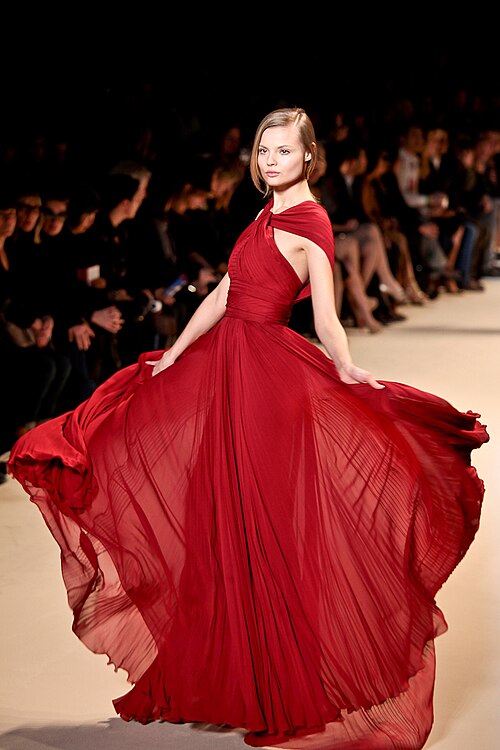
Since the 19th century, Paris has been an international fashion capital, particularly in the domain of haute couture (clothing hand-made to order for private clients).[253] It is home to some of the largest fashion houses in the world, including Dior and Chanel, as well as many other well-known and more contemporary fashion designers, such as Karl Lagerfeld, Jean-Paul Gaultier, Yves Saint Laurent, Givenchy, and Christian Lacroix. Paris Fashion Week, held in January and July in the Carrousel du Louvre among other renowned city locations, is one of the top four events on the international fashion calendar.[254][255] Moreover, Paris is also the home of the world's largest cosmetics company: L'Oréal as well as three of the top five global makers of luxury fashion accessories: Louis Vuitton, Hermés, and Cartier.[256] Most of the major fashion designers have their showrooms along the Avenue Montaigne, between the Champs-Élysées and the Seine.
Photography
The inventor Nicéphore Niépce produced the first permanent photograph on a polished pewter plate in Paris in 1825. In 1839, after the death of Niépce, Louis Daguerre patented the Daguerrotype, which became the most common form of photography until the 1860s.[211] The work of Étienne-Jules Marey in the 1880s contributed considerably to the development of modern photography. Photography came to occupy a central role in Parisian Surrealist activity, in the works of Man Ray and Maurice Tabard.[257][258] Numerous photographers achieved renown for their photography of Paris, including Eugène Atget, noted for his depictions of street scenes, Robert Doisneau, noted for his playful pictures of people and market scenes (among which Le baiser de l'hôtel de ville has become iconic of the romantic vision of Paris), Marcel Bovis, noted for his night scenes, as well as others such as Jacques-Henri Lartigue and Henri Cartier-Bresson.[211] Poster art also became an important art form in Paris in the late nineteenth century, through the work of Henri de Toulouse-Lautrec, Jules Chéret, Eugène Grasset, Adolphe Willette, Pierre Bonnard, Georges de Feure, Henri-Gabriel Ibels, Paul Gavarni and Alphonse Mucha.[211]
Media

Paris and its close suburbs are home to numerous newspapers, magazines and publications including Le Monde, Le Figaro, Libération, Le Nouvel Observateur, Le Canard enchaîné, La Croix, Le Parisien (in Saint-Ouen), Les Échos, Paris Match (Neuilly-sur-Seine), Réseaux & Télécoms, Reuters France, l'Équipe (Boulogne-Billancourt) and L'Officiel des Spectacles.[260] France's two most prestigious newspapers, Le Monde and Le Figaro, are the centrepieces of the Parisian publishing industry.[261] Agence France-Presse is France's oldest, and one of the world's oldest, continually operating news agencies. AFP, as it is colloquially abbreviated, maintains its headquarters in Paris, as it has since 1835.[262] France 24 is a television news channel owned and operated by the French government, and is based in Paris.[263] Another news agency is France Diplomatie, owned and operated by the Ministry of Foreign and European Affairs, and pertains solely to diplomatic news and occurrences.[264]
The most-viewed network in France, TF1, is in nearby Boulogne-Billancourt. France 2, France 3, Canal+, France 5, M6 (Neuilly-sur-Seine), Arte, D8, W9, NT1, NRJ 12, La Chaîne parlementaire, France 4, BFM TV, and Gulli are other stations located in and around the capital.[265] Radio France, France's public radio broadcaster, and its various channels, is headquartered in Paris's 16th arrondissement. Radio France Internationale, another public broadcaster is also based in the city.[266] Paris also holds the headquarters of the La Poste, France's national postal carrier.[267]
Holidays and festivals
Bastille Day, a celebration of the storming of the Bastille in 1789, the biggest festival in the city, is a military parade taking place every year on 14 July on the Champs-Élysées, from the Arc de Triomphe to Place de la Concorde. It includes a flypast over the Champs Élysées by the Patrouille de France, a parade of military units and equipment, and a display of fireworks in the evening, the most spectacular being the one at the Eiffel Tower.[268]
Some other yearly festivals are Paris-Plages, a festive summertime event when the Right Bank of the Seine is converted into a temporary beach;[268] Journées du Patrimoine, Fête de la Musique, Techno Parade, Nuit Blanche, Cinéma au clair de lune, Printemps des rues, Festival d'automne, and Fête des jardins. The Carnaval de Paris, one of the oldest festivals in Paris, dates back to the Middle Ages.
Libraries
The Bibliothèque nationale de France (BnF) operates public libraries in Paris, among them the François Mitterrand Library, Richelieu Library, Louvois, Opéra Library, and Arsenal Library.[269]

The Bibliothèque Forney, in the Marais district, is dedicated to the decorative arts; the Arsenal Library occupies a former military building, and has a large collection on French literature; and the Bibliothèque historique de la ville de Paris, also in Le Marais, contains the Paris historical research service. The Sainte-Geneviève Library, designed by Henri Labrouste and built in the mid-1800s, contains a rare book and manuscript division.[270] Bibliothèque Mazarine is the oldest public library in France. The Médiathèque Musicale Mahler opened in 1986 and contains collections related to music. The François Mitterrand Library (nicknamed Très Grande Bibliothèque) was completed in 1994 to a design of Dominique Perrault and contains four glass towers.[270]
There are several academic libraries and archives in Paris. The Sorbonne Library is the largest university library in Paris. In addition to the Sorbonne location, there are branches in Malesherbes, Clignancourt-Championnet, Michelet-Institut d'Art et d'Archéologie, Serpente-Maison de la Recherche, and Institut des Etudes Ibériques.[271] Other academic libraries include Interuniversity Pharmaceutical Library, Leonardo da Vinci University Library, Paris School of Mines Library, and the René Descartes University Library.[272]
Sports

Paris's most popular sport clubs are the association football club Paris Saint-Germain F.C. and the rugby union clubs Stade Français and Racing 92, the last of which is based just outside the city proper. The 80,000-seat Stade de France, built for the 1998 FIFA World Cup, is located just north of Paris in the commune of Saint-Denis.[273] It is used for football, rugby union and track and field athletics. It hosts the France national football team for friendlies and major tournaments qualifiers, annually hosts the French national rugby team's home matches of the Six Nations Championship, and hosts several important matches of the Stade Français rugby team.[273] In addition to Paris Saint-Germain F.C., the city has a number of other professional and amateur football clubs: Paris FC, Red Star, RCF Paris and Stade Français Paris.
Paris hosted the 1900, 1924 and 2024 Summer Olympics.
The city also hosted the finals of the 1938 FIFA World Cup (at the Stade Olympique de Colombes), as well as the 1998 FIFA World Cup and the 2007 Rugby World Cup Final (both at the Stade de France). Three UEFA Champions League Finals in the current century have also been played in the Stade de France: the 2000, 2006 and 2022.[274] Paris hosted UEFA Euro 2016.[275]

The final stage of the most famous bicycle racing in the world, Tour de France, always finishes in Paris. Since 1975, the race has finished on the Champs-Elysées.[276] Tennis is another popular sport in Paris and throughout France; the French Open, held every year on the red clay of the Roland Garros National Tennis Centre,[277] is one of the four Grand Slam events of the world professional tennis tour. The 17,000-seat Bercy Arena (officially named AccorHotels Arena and formerly known as the Palais Omnisports de Paris-Bercy) is the venue for the annual Paris Masters ATP Tour tennis tournament. The Bercy Arena also hosted the 2017 IIHF World Ice Hockey Championship, together with Cologne, Germany. The final stages of the FIBA EuroBasket 1951 and EuroBasket 1999 were also played in Paris, the latter at the Palais Omnisports de Paris-Bercy.
The basketball team Levallois Metropolitans plays some of its games at the 4,000 capacity Stade Pierre de Coubertin.[278] Another top-level professional team, Nanterre 92, plays in Nanterre.
In 2023, a professional American football team, the Paris Musketeers, were formed in the city[279] joining the European League of Football.
Infrastructure
Transport

Paris is a major rail, highway, and air transport hub. The Île-de-France Mobilités (IDFM) oversees the transit network in the region.[280] The syndicate coordinates public transport. The RATP operates 347 bus lines, the Métro, eight tramway lines, and sections of the RER. The SNCF operates suburban rails, one tramway line and the other sections of the RER. The Optile consortium of private operators manages 1,176 bus lines.[281]
Paris has one of the most sustainable transportation systems in the world,[15][282] and is one of only two cities that received the Sustainable Transport Award twice, in 2008 and 2023.[16] In 2022–2023, 53.3% of trips in Paris were made on foot, 30% on public transport, 11.2% on bicycles and 4.3% on cars.[283][284] Bike lanes are being doubled, and electric car incentives are being created. Paris is banning the most polluting automobiles from key districts.[285][286]
Railways

A central hub of the national rail network, Paris's six major railway stations (Gare du Nord, Gare de l'Est, Gare de Lyon, Gare d'Austerlitz, Gare Montparnasse, Gare Saint-Lazare) and a minor one (Gare de Bercy) are connected to three networks: high-speed rail lines (TGV, Eurostar, Intercity Express, Frecciarossa), normal speed trains (Intercités, Intercités de nuit, Nightjet, TER), and the suburban rails (Transilien). The Transilien is the commuter rail network serving Paris region, through 9 lines, 392 stations and 1,294 km (804.1 mi) of rails.
Since the inauguration of its first line in 1900, Paris's Métro network has grown to become the city's most widely used local transport system. In 2015, it carried about 5.23 million passengers daily.[287] There are 16 lines, 320 stations (404 stops) and 245.6 km (152.6 mi) of rails. Superimposed on this is a 'regional express network', the RER, whose five lines, 257 stops and 602 km (374 mi) of rails connect Paris to more distant parts of the urban area. With over 1.4 million passengers per day RER A is the busiest metro line in Europe. The Paris region is served by a light rail network, the tramway. Opened since 1992, fourteen lines are operational. The network is 186.6 kilometres (115.9 mi) long, with 278 stations.
Air
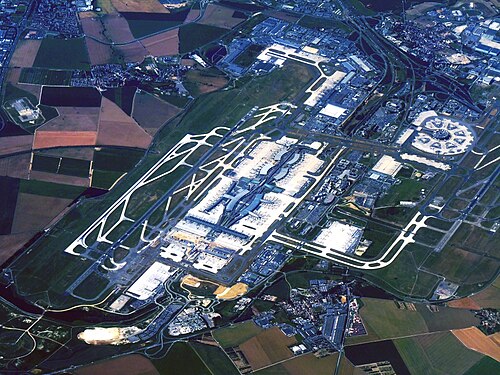
Paris is a major international air transport hub, and the 5th busiest airport system in the world. Paris is served by three commercial international airports: Charles de Gaulle Airport, Orly Airport and Beauvais–Tillé Airport. In 2019, these three airports recorded traffic of 112 million passengers.[289] There is also one general aviation airport, Paris–Le Bourget Airport, historically the oldest Parisian airport and closest to the city centre, which is now used only for private business flights and air shows. Charles de Gaulle Airport, located on the edge of the northern suburbs of Paris, opened to commercial traffic in 1974 and became the busiest Parisian airport in 1993.[290] In 2023, it was the 4th busiest airport in the world by international traffic and it is the hub for the nation's flag carrier, Air France.[291] Beauvais-Tillé Airport, located 69 km (43 mi) north of Paris's city centre, is used by charter airlines and low-cost carriers.
Motorways
_-_2021-08-11_-_3.jpg/500px-Boulevard_P%C3%A9riph%C3%A9rique_vu_depuis_Boulevard_Auteuil_-_Paris_XVI_(FR75)_-_2021-08-11_-_3.jpg)
Paris is the most important hub of France's motorway network, and is surrounded by three orbital freeways: the Périphérique,[97] which follows the approximate path of 19th-century fortifications around Paris, the A86 motorway in the inner suburbs, and the Francilienne motorway in the outer suburbs. Paris has an extensive road network with over 2,000 km (1,243 mi) of highways and motorways.
Waterways
The Paris region is the most active water transport area in France. Most of the cargo is handled by the Ports of Paris, in facilities located around Paris. The rivers Loire, Rhine, Rhône, Meuse, and Scheldt can be reached by canals connecting with the Seine, which include the Canal Saint-Martin, Canal Saint-Denis, and the Canal de l'Ourcq.[292]
Cycling
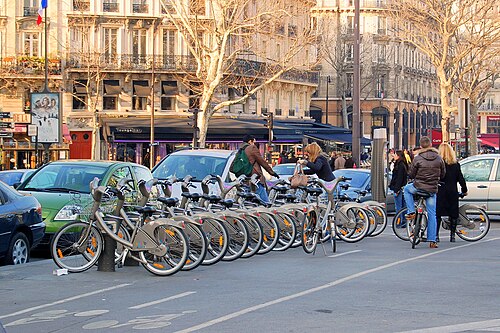
There are 440 km (270 mi) of cycle paths and routes in Paris. These include piste cyclable, bike lanes separated from other traffic by physical barriers, and bande cyclable, a bicycle lane denoted by a painted path on the road). Some 29 km (18 mi) of specially marked bus lanes are free for use by cyclists, with a protective barrier against encroachments from vehicles.[293] Cyclists have the right to ride in both directions on certain one-way streets. Paris has a bike sharing system called Vélib' with more than 20,000 public bicycles distributed at 1,800 parking stations.[294]
Electricity
Electricity is provided to Paris through a peripheral grid, fed by multiple sources. In 2012, around 50% of electricity generated in the Île-de-France came from cogeneration energy plants. Other energy sources included thermal power (35%), waste incineration (9% – with cogeneration plants, these provide the city in heat as well), methane gas (5%), hydraulics (1%), solar power (0.1%) and a negligible amount of wind power.[295] A quarter of the city's district heating is to come from a plant in Saint-Ouen-sur-Seine, burning a 50/50-mix of coal and wood pellets.[296]
Water and sanitation

Paris in its early history had only the rivers Seine and Bièvre for water. From 1809, the Canal de l'Ourcq provided Paris with water from less-polluted rivers to the north-east of the capital.[297] From 1857, the civil engineer Eugène Belgrand, under Napoleon III, oversaw the construction of a series of new aqueducts that brought water from locations all around the city to several reservoirs.[298]
From then on, the new reservoir system became Paris's principal source of drinking water. The remains of the old system, pumped into lower levels of the same reservoirs, were from then on used for the cleaning of Paris's streets. This system is still a major part of Paris's water-supply network. Today Paris has more than 2,400 km (1,491 mi) of underground sewers.[299]
Air pollution in Paris, from the point of view of particulate matter (PM10), is the highest in France with 38 μg/m3.[300] From the point of view of nitrogen dioxide pollution, Paris has one of the highest levels in the EU.[301]
Parks and gardens

Paris has more than 421 municipal parks and gardens, covering more than 3,000 hectares and containing more than 250,000 trees.[302] Two of Paris's oldest and most famous gardens are the Tuileries Garden, created in 1564 for the Tuileries Palace and redone by André Le Nôtre between 1664 and 1672,[303] and the Luxembourg Garden, for the Luxembourg Palace, built for Marie de' Medici in 1612, which today houses the Senate.[304] The Jardin des plantes was the first botanical garden in Paris, created in 1626.[305]
Between 1853 and 1870, Emperor Napoleon III and the city's first director of parks and gardens, Jean-Charles Adolphe Alphand, created the Bois de Boulogne, Bois de Vincennes, Parc Montsouris and Parc des Buttes-Chaumont, located at the four compass points around Paris, as well as many smaller parks, squares and gardens in the Paris's quarters.[306] Since 1977, the city has created 166 new parks, most notably the Parc de la Villette (1987), Parc André Citroën (1992), Parc de Bercy (1997) and Parc Clichy-Batignolles (2007).[307] One of the newest parks, the Promenade des Berges de la Seine (2013), built on a former highway on the left bank of the Seine between the Pont de l'Alma and the Musée d'Orsay, has floating gardens.
Cemeteries

During the Roman era, Paris' main cemetery was located on the outskirts of the left bank settlement. This changed with the rise of Catholic Christianity, where most every inner-city church had adjoining burial grounds for use by their parishes. With Paris's growth, many of these, particularly the city's largest cemetery, the Holy Innocents' Cemetery, were filled to overflowing. When inner-city burials were condemned from 1786, the contents of all Paris' parish cemeteries were transferred to a renovated section of Paris's stone mines, today place Denfert-Rochereau in the 14th arrondissement.[308][309]
After a tentative creation of several smaller suburban cemeteries, the Prefect Nicholas Frochot under Napoleon Bonaparte provided a more definitive solution, in the creation of three massive Parisian cemeteries outside the city limits.[310] Open from 1804, these were the cemeteries of Père Lachaise, Montmartre, Montparnasse, and later Passy. New suburban cemeteries were created in the early 20th century: The largest of these are the Cimetière parisien de Saint-Ouen, the Cimetière parisien de Pantin, also known as Cimetière parisien de Pantin-Bobigny, the Cimetière parisien d'Ivry, and the Cimetière parisien de Bagneux.[311] Famous people buried in Parisian cemeteries include Oscar Wilde, Frédéric Chopin, Jim Morrison, Édith Piaf and Serge Gainsbourg.[312]
Education

Paris is the département with the highest proportion of highly educated people. In 2009, around 40 percent of Parisians held a licence-level diploma or higher, the highest proportion in France.[313] 13 percent have no diploma, the third-lowest percentage in France. Education in Paris and the Île-de-France region employs approximately 330,000 people, 170,000 of whom are teachers and professors, teaching approximately 2.9 million students in around 9,000 primary, secondary, and higher education schools and institutions.[314]
The University of Paris, founded in the 12th century, is often called the Sorbonne after one of its original medieval colleges. In 1970, it was broken up into thirteen autonomous universities, following the student demonstrations in 1968. Most of the campuses today are in the Latin Quarter where the old university was located, while others are scattered around the city and the suburbs.[315]
The Paris region hosts France's highest concentration of the grandes écoles – 55 specialised centres of higher-education outside or inside the public university structure. The prestigious public universities are usually considered grands établissements. Most of the grandes écoles were relocated to the suburbs of Paris in the 1960s and 1970s, in new campuses much larger than the old campuses within the crowded City of Paris. The École Normale Supérieure, PSL University has remained on rue d'Ulm in the 5th arrondissement.[316]
In 2024, Paris is the home of prestigious universities in science and technology (Polytechnic Institute of Paris, Paris Cité University, Paris-Saclay University, Sorbonne University), political science (Sciences Po),[317] management (HEC Paris, ESSEC Business School, ESCP Business School, INSEAD)[318] as well as multidisciplinary universities (Paris Sciences et Lettres University).[319]
Healthcare

Health care and emergency medical service in the City of Paris and its suburbs are provided by the Assistance publique – Hôpitaux de Paris (AP-HP), a public hospital system that employs more than 90,000 people, including practitioners, support personnel, and administrators, in 44 hospitals.[320] It is the largest hospital system in Europe. It provides health care, teaching, research, prevention, education and emergency medical service in 52 branches of medicine. The hospitals receive more than 5.8 million annual patient visits.[320]
One of the most notable hospitals is the Hôtel-Dieu, founded in 651, the oldest hospital in Paris and the oldest worldwide still operating,[321] although the current building is the product of a reconstruction of 1877. Other hospitals include Pitié-Salpêtrière Hospital, one of the largest in Europe, Hôpital Cochin, Bichat–Claude Bernard Hospital, Hôpital Européen Georges-Pompidou, Bicêtre Hospital, Beaujon Hospital, the Curie Institute, Lariboisière Hospital, Necker–Enfants Malades Hospital, Hôpital Saint-Louis, Hôpital de la Charité and the American Hospital of Paris.
International relations
International organisations
The United Nations Educational, Scientific and Cultural Organization (UNESCO) has had its headquarters in Paris since November 1958. Paris is also the home of the Organisation for Economic Co-operation and Development (OECD).[322] Paris hosts the headquarters of the European Space Agency, the International Energy Agency, European Securities and Markets Authority and the European Banking Authority.
Twin towns – sister cities
Since April 1956, Paris is exclusively and reciprocally twinned with:[323][324]
 Rome, 1956
- Seule Paris est digne de Rome; seule Rome est digne de Paris. (in French)
- Solo Parigi è degna di Roma; solo Roma è degna di Parigi. (in Italian)
- "Only Paris is worthy of Rome; only Rome is worthy of Paris."[325][326][327][328]
Other relationships
Paris has agreements of friendship and co-operation with:[323]
 Algiers, 2003
 Amman, 1987
 Amsterdam, 2013
 Athens, 2000
 Beijing, 1997
 Beirut, 1992
 Berlin, 1987
 Brazzaville, 2015
 Buenos Aires, 1999
 Cairo, 1985
 Casablanca, 2004
 Chicago, 1996
 Copenhagen, 2005
 Dakar, 2011
 Doha, 2010
 Geneva, 2002
 Istanbul, 2009
 Jakarta, 1995
 Jericho, 2009
 Kinshasa, 2014
 Kyoto, 1958
 Lisbon, 1998
 London, 2001
 Madrid, 2000
 Mexico City, 1999
 Montevideo, 2013
 Montreal, 2006
 Moscow, 1992
 Phnom Penh, 2007
 Porto Alegre, 2001
 Prague, 1997
- Quebec City, 1996
- Rabat, 2004
- Ramallah, 2011
- Rio de Janeiro, 2009
 Riyadh, 1997
- Saint Petersburg, 1997
 Sanaa, 1987
- San Francisco, 1996
 Santiago, 1997
- São Paulo, 2004
 Seoul, 1991
 Sofia, 1998
 Sydney, 1998
 Tbilisi, 1997
 Tel Aviv, 2010
- Tokyo, 1982
 Tunis, 2004
 Warsaw, 1999
- Washington, D.C., 2000
 Yerevan, 1998
.svg/500px-Flag_of_Switzerland_(Pantone).svg.png)
.svg/500px-Flag_of_Canada_(Pantone).svg.png)
.svg/500px-Flag_of_Australia_(converted).svg.png)
See also

- Art Nouveau in Paris
- Art Deco in Paris
- C40 Cities Climate Leadership Group
- International Exposition of Modern Industrial and Decorative Arts held in Paris in 1925
- Megacity
- Outline of France
- Outline of Paris
- Paris syndrome
Notes
- ^ The word was most likely created by Parisians of the lower popular class who spoke *argot*, then *parigot* was used in a provocative manner outside the Parisian region and throughout France to mean Parisians in general.
References
Citations
- ^ "Répertoire national des élus: les maires" (in French). data.gouv.fr, Plateforme ouverte des données publiques françaises. 16 December 2022. Archived from the original on 27 February 2023.
- ^ a b c d "Population estimate as of January 1, 2023 – Series by region, department, sex and age from 1975 to 2023". www.insee.fr. 24 January 2023. Archived from the original on 21 April 2017. Retrieved 13 June 2023.
- ^ "Comparateur de territoire: Unité urbaine 2020 de Paris (00851)" (in French). INSEE. Archived from the original on 19 January 2021. Retrieved 10 February 2021.
- ^ "Comparateur de territoire: Aire d'attraction des villes 2020 de Paris (001)". INSEE. Archived from the original on 20 January 2021. Retrieved 10 February 2021.
- ^ "Populations légales 2019: Commune de Paris (75056)". INSEE. 29 December 2021. Archived from the original on 22 January 2022. Retrieved 3 February 2022.
- ^ "The World's Most Densely Populated Cities". WorldAtlas. 4 October 2020. Archived from the original on 19 March 2022. Retrieved 4 March 2022.
- ^ "Paris | Definition, Map, Population, Facts, & History | Britannica". www.britannica.com. Archived from the original on 27 August 2022. Retrieved 8 August 2022.
- ^ Source: PPPs and exchange rates. "Conversion rates – Purchasing power parities (PPP) – OECD Data". Data.oecd.org. Archived from the original on 4 November 2017. Retrieved 9 March 2022.
- ^ "Gross domestic product (GDP) at current market prices by metropolitan regions". ec.europa.eu. 10 March 2023. Archived from the original on 15 February 2023. Retrieved 13 June 2023.
- ^ "The world's most, and least, expensive cities". The Economist. ISSN 0013-0613. Archived from the original on 1 December 2022. Retrieved 1 December 2022.
- ^ "List: The world's 20 busiest airports (2017)". USA Today. Archived from the original on 25 June 2018. Retrieved 2 May 2018.
- ^ "ACI reveals the world's busiest passenger and cargo airports". Airport World. 9 April 2018. Archived from the original on 28 June 2018. Retrieved 2 May 2018.
- ^ "Métro2030". RATP (Paris metro operator). Archived from the original on 21 December 2016. Retrieved 25 September 2016.
- ^ "The 51 busiest train stations in the world – all but 6 located in Japan". Japan Today. 6 February 2013. Archived from the original on 22 April 2017. Retrieved 22 April 2017.
- ^ a b Zhang, Yiqian (26 November 2019). "Paris leads the way for sustainable urban mobility". ICLEI – Sustainable Mobility, 2024. Archived from the original on 7 January 2024. Retrieved 7 January 2024.
- ^ a b "Paris, France Honored with the 2023 Sustainable Transport Award". Institute for Transportation & Development policy. 10 January 2023. Archived from the original on 7 January 2024. Retrieved 7 January 2024.
- ^ "The Art Newspaper", 27 March 2023
- ^ "Paris, Banks of the Seine". UNESCO World Heritage Centre. United Nations Educational, Scientific, and Cultural Organization. Archived from the original on 9 May 2019. Retrieved 17 October 2021.
- ^ Nègre 1990, p. 155.
- ^ a b c Falileyev 2010, s.v. Parisii and Lutetia.
- ^ Lambert 1994, p. 38.
- ^ Delamarre 2003, p. 211.
- ^ a b Delamarre 2003, p. 247.
- ^ Busse 2006, p. 199.
- ^ Dottin 1920, p. 535.
- ^ Arbois de Jubainville & Dottin 1889, p. 132.
- ^ Cunliffe 2004, p. 201.
- ^ Lawrence & Gondrand 2010, p. 25.
- ^ Schmidt 2009, pp. 65–70.
- ^ Schmidt 2009, pp. 88–104.
- ^ Schmidt 2009, pp. 154–167.
- ^ Meunier 2014, p. 12.
- ^ a b Schmidt 2009, pp. 210–211.
- ^ Patrick Boucheron, et al., eds. France in the World: A New Global History (2019) pp 81–86.
- ^ Jones 1994, p. 48.
- ^ a b Lawrence & Gondrand 2010, p. 27.
- ^ Bussmann 1985, p. 22.
- ^ de Vitriaco & Hinnebusch 1972, p. 262.
- ^ Sarmant 2012, pp. 36–40.
- ^ Sarmant 2012, pp. 28–29.
- ^ "Paris history facts". Paris Digest. 2018. Archived from the original on 6 September 2018. Retrieved 6 September 2018.
- ^ John Kelly, "The Great Mortality" (2005). pp 42
- ^ Du Fresne de Beaucourt, G., Histoire de Charles VII, Tome I: Le Dauphin (1403–1422), Librairie de la Société bibliographiqque, 35 Rue de Grenelle, Paris, 1881, pp. 32 & 48
- ^ Fierro 1996, pp. 52–53.
- ^ "Massacre of Saint Bartholomew's Day". Encyclopædia Britannica Online. Archived from the original on 4 May 2015. Retrieved 23 November 2014.
- ^ Bayrou 1994, pp. 121–130.
- ^ Fierro 1996, p. 577.
- ^ Fierro 1996, p. 582.
- ^ Combeau 2003, pp. 42–43.
- ^ Fierro 1996, pp. 590–591.
- ^ Durant, Will; Durant, Ariel (1975). The Story of Civilization XI The Age of Napoleon. Simon & Schuster. p. 3. ISBN 978-0-671-21988-8. Archived from the original on 29 December 2016. Retrieved 11 February 2016.
- ^ Combeau 2003, pp. 45–47.
- ^ Sarmant 2012, pp. 129–133.
- ^ Sarmant 2012, p. 120.
- ^ Paine 1998, p. 453.
- ^ Fierro 1996, p. 674.
- ^ Sarmant 2012, p. 144.
- ^ Sarmant 2012, p. 147.
- ^ a b c Sarmant 2012, p. 148.
- ^ a b De Moncan 2012, pp. 7–35.
- ^ Rougerie 2014, p. 118.
- ^ Fraser & Spalding 2011, p. 117.
- ^ Fierro 1996, pp. 490–491.
- ^ Combeau 2003, p. 61.
- ^ Fierro 1996, p. 497.
- ^ Franck, Dan (1 December 2007). Bohemian Paris: Picasso, Modigliani, Matisse, and the Birth of Modern Art. Open Road + Grove/Atlantic. ISBN 978-0-8021-9740-5. Archived from the original on 18 November 2015 – via Google Books.
- ^ Fierro 1996, p. 491.
- ^ Fierro 1996, p. 750.
- ^ William A. Shack, Harlem in Montmartre, A Paris Jazz Story between the Great Wars, University of California Press, 2001. ISBN 978-0-520-22537-4,
- ^ Meisler, Stanley (April 2005). "The Surreal World of Salvador Dalí". Smithsonian.com. Smithsonian Magazine. Archived from the original on 18 May 2014. Retrieved 12 July 2014.
- ^ Goebel, Anti-Imperial Metropolis Archived 4 September 2015 at the Wayback Machine.
- ^ Sarmant 2012, p. 217.
- ^ Fierro 1996, p. 637.
- ^ Sarmant 2012, p. 218.
- ^ Fierro 1996, pp. 242–243.
- ^ Kim Willsher (17 October 2011). "France remembers Algerian massacre 50 years on". The Guardian. Archived from the original on 26 October 2014. Retrieved 26 October 2014.
- ^ Fierro 1996, p. 658.
- ^ Sarmant 2012, p. 226.
- ^ Fierro 1996, p. 260.
- ^ Sarmant 2012, p. 222.
- ^ Combeau 2003, pp. 107–108.
- ^ Bell & de-Shalit 2011, p. 247.
- ^ Sarmant 2012, pp. 226–230.
- ^ "City Mayors: Bertrand Delanoe – Mayor of Paris". www.citymayors.com. Archived from the original on 22 July 2012. Retrieved 16 August 2023.
- ^ "Les berges de Seine rendues aux Parisiens". Le Moniteur (in French). 19 June 2013. Archived from the original on 20 December 2014. Retrieved 2 December 2014.
- ^ Lichfield, John (29 April 2009). "Sarko's €35bn rail plan for a 'Greater Paris'". The Independent. London. Archived from the original on 2 May 2009. Retrieved 12 June 2009.
- ^ "€26.5bn Grand Paris metro expansion programme confirmed". Railway Gazette International. 12 March 2013. Archived from the original on 18 March 2013. Retrieved 24 April 2013.
- ^ "Le Metro du Grand Paris" (in French). Site of Grand Paris Express. Archived from the original on 14 July 2011. Retrieved 27 November 2014.
- ^ Library, C.N.N. (21 January 2015). "2015 Charlie Hebdo Attacks Fast Facts". CNN. Archived from the original on 23 June 2017. Retrieved 20 June 2017.
- ^ "Attentats terroristes : les questions que vous nous avez le plus posées". Le Monde (in French). 15 January 2015. Archived from the original on 14 January 2015. Retrieved 15 January 2015.
- ^ "Les politiques s'affichent à la marche républicaine". Le Figaro (in French). 11 January 2015. Archived from the original on 11 January 2015. Retrieved 11 January 2015.
- ^ "Islamic State claims Paris attacks that killed 127". Reuters. 14 November 2015. Archived from the original on 14 November 2015. Retrieved 14 November 2015.
- ^ "Paris attacks death toll rises to 130". RTÉ.ie. 20 November 2015. Archived from the original on 23 April 2019. Retrieved 8 November 2021.
- ^ "'Today is an historic day,' says Ban, as 175 countries sign Paris climate accord". United Nations. 22 April 2016. Archived from the original on 29 June 2017. Retrieved 26 June 2023.
- ^ a b "Paris". Encyclopædia Britannica Online. Archived from the original on 7 July 2013. Retrieved 4 July 2013.
- ^ Blackmore & McConnachie 2004, p. 153.
- ^ a b Lawrence & Gondrand 2010, p. 69.
- ^ "Key figures for Paris". Mairie de Paris. Paris.fr. 15 November 2007. Archived from the original on 6 March 2009. Retrieved 5 May 2009.
- ^ Google Maps Archived 11 January 2019 at the Wayback Machine, Retrieved 6 July 2013
- ^ "Climate". Paris.com. Archived from the original on 8 March 2013. Retrieved 29 June 2013.
- ^ Lawrence & Gondrand 2010, p. 309.
- ^ Goldstein 2005, p. 8.
- ^ "Climate in Paris". ParisInfo. Paris Convention and Visitors Bureau. Archived from the original on 5 December 2014. Retrieved 29 June 2013.
- ^ Courtney Traub (31 January 2018). "Visiting Paris in the Winter: A Complete Guide". tripsavvy. Archived from the original on 11 October 2017. Retrieved 27 February 2018.
- ^ Kelby Carr (30 November 2017). "Weather in France – Climate and Temperatures of French Cities". tripsavvy. Archived from the original on 28 February 2018. Retrieved 27 February 2018.
- ^ "42.6 °C à Paris : record absolu de chaleur battu !". meteofrance.fr. Météo France. Archived from the original on 25 July 2019. Retrieved 25 July 2019.
- ^ "Géographie de la capitale – Le climat" (in French). Institut National de la Statistique et des Études Économiques. Archived from the original on 3 October 2006. Retrieved 24 May 2006 – via Paris.fr.
- ^ "Paris–Montsouris (984)" (PDF). Fiche Climatologique: Statistiques 1991–2020 et records (in French). Meteo France. Archived from the original (PDF) on 27 February 2018. Retrieved 13 July 2022.
- ^ "Normes et records 1961–1990: Paris-Montsouris (75) – altitude 75m" (in French). Infoclimat. Archived from the original on 24 August 2017. Retrieved 19 May 2015.
- ^ "Paris, France – Climate data". Weather Atlas. Archived from the original on 12 March 2017. Retrieved 9 March 2017.
- ^ a b Fierro 1996, p. 334.
- ^ "Anne Hidalgo is new Mayor of Paris". City of Paris. Archived from the original on 20 December 2014. Retrieved 29 November 2014.
- ^ Willsher, Kim (28 June 2020). "Greens surge in French local elections as Anne Hidalgo holds Paris". The Guardian. ISSN 0261-3077. Archived from the original on 30 June 2020. Retrieved 1 July 2020.
- ^ a b "Code électoral – Article L260" [Election Code – Article L260] (in French). Legifrance. 13 March 1983. Archived from the original on 25 December 2014. Retrieved 7 November 2014.
- ^ "Election Preview: France Municipal Elections 2014 – Part I". World Elections. 22 March 2014. Archived from the original on 11 October 2016. Retrieved 4 January 2017.
- ^ Shales 2007, p. 16.
- ^ "Regroupement des 4 premiers arrondissements : le secteur Paris Centre sera créé le 11 juillet". Paris.fr. 12 June 2020. Archived from the original on 14 November 2023. Retrieved 15 November 2023.
- ^ a b c "Code général des collectivités territoriales – Article L5219-1" [General Code of Territorial Communities – Article L5219-1] (in French). Legifrance. Archived from the original on 1 January 2016. Retrieved 29 November 2015.
- ^ "Décret n° 2015-1212 du 30 septembre 2015 constatant le périmètre fixant le siège et désignant le comptable public de la métropole du Grand Paris" [Decree n° 2015-1212 of 30 September 2015 noting the perimeter fixing the seat and designating the public accountant of the metropolis of Greater Paris] (in French). Legifrance. Archived from the original on 28 February 2018. Retrieved 27 February 2018.
- ^ a b Nathalie Moutarde (17 July 2015). "La métropole du Grand Paris verra le jour le 1er janvier 2016" [The metropolis of Greater Paris will be born 1 January 2016]. Le Moniteur (in French). Archived from the original on 8 December 2015. Retrieved 3 December 2015.
- ^ Manon Rescan (22 January 2016). "Du Grand Paris à la Métropole du Grand Paris" [From Greater Paris to Greater Paris Metropolis]. Le Monde (in French). Archived from the original on 10 October 2017. Retrieved 30 January 2016.
- ^ "Régionales 2015 : les chiffres clés du scrutin" [Results of 2015 Regional Elections] (in French). Regional Council of Île-de-France. 15 December 2015. Archived from the original on 19 December 2015. Retrieved 16 December 2015.
- ^ "Le Palais de L'Élysée et son histoire" [The Elysée Palace and its history] (in French). Elysee.fr. Archived from the original on 19 May 2017. Retrieved 16 June 2013.
- ^ "Matignon Hotel". Embassy of France, Washington. 1 December 2007. Archived from the original on 5 April 2017. Retrieved 19 June 2013.
- ^ Knapp & Wright 2006, pp. 93–94.
- ^ Borrus 2012, p. 288.
- ^ "A la découverte du Petit Luxembourg" [Discovering Petit Luxembourg] (in French). Senat.fr. Archived from the original on 17 June 2013. Retrieved 3 May 2013.
- ^ "Introduction". Cour de Cassation [Court of Cassation] (in French). Archived from the original on 15 May 2013. Retrieved 27 April 2013.
- ^ "Histoire & Patrimoine" [History & Heritage] (in French). Conseil d'Etat. Archived from the original on 10 April 2013. Retrieved 27 April 2013.
- ^ "Le siège du Conseil constitutionnel" [The seat of the Constitutional Council] (PDF) (in French). Conseil Constitutionnel. 16 September 2011. Archived from the original (PDF) on 23 March 2014. Retrieved 26 April 2013.
- ^ a b "Présentation générale" [General Presentation] (in French). Police nationale — Ministère de l'intèrieur [National Police — Ministry of the Interior]. Archived from the original on 8 March 2013. Retrieved 22 November 2014.
- ^ "Accueil" [Home] (in French). Gendarmerie nationale — Ministère de l'intèrieur [National Gendarmerie — Ministry of the Interior]. Archived from the original on 26 December 2010. Retrieved 22 November 2014.
- ^ "France". Travel.State.Gov. U.S. Department of State. Archived from the original on 4 April 2017. Retrieved 4 April 2017.
- ^ Barthelemy, Marc; Bordin, Patricia; Berestycki, Henri; Gribaudi, Maurizio (8 July 2013). "Paris Street Evolution". Scientific Reports. 3 (1): 2153. doi:10.1038/srep02153. ISSN 2045-2322. PMC 3703887. PMID 23835429. S2CID 11824030.
- ^ De Moncan, Patrice, Le Paris de Haussmann, Les Éditions de Mecene, Paris, ISBN 978-2-907970-98-3
- ^ Braimoh & Vlek 2008, p. 12.
- ^ a b "Plan des hauteurs". Mairie de Paris (in French). Paris.fr. Archived from the original on 10 April 2014. Retrieved 1 November 2014.
- ^ "Plan Local d'Urbanisme – Règlement à la parcelle". Mairie de Paris. Archived from the original on 22 August 2010. Retrieved 31 August 2010.
- ^ Challenges, www. Challenges.fr, 3 July 2018.
- ^ "Chiffres Cléfs Logements (2011) – Département de Paris (75)". INSEE. 2011. Archived from the original on 4 September 2015. Retrieved 1 November 2014.
- ^ a b "Un territoire ancien et de petite taille" (PDF) (in French). www.notaires.paris-idf.fr. February 2012. p. 11. Archived from the original (PDF) on 1 November 2014. Retrieved 1 November 2014.
- ^ Le Logement Parisien en Chiffres, Agence Departmentale de l'information sur le lodgment de Paris, October 2017.
- ^ Le Monde, 18 March 2019.
- ^ "Une brève histoire de l'aménagement de Paris et sa région Du District à la Région Île-de-France" (PDF) (in French). DRIEA Île-de-France. Archived (PDF) from the original on 1 January 2017. Retrieved 26 November 2014.
- ^ Masson 1984, p. 536.
- ^ Yarri 2008, p. 407.
- ^ Gordon 2006, pp. 46–47.
- ^ Castells 1983, p. 75.
- ^ Tomas et al. 2003, p. 237.
- ^ a b "Les Politiques Nationales du Logement et le Logement dans les Villes Nouvelles" (PDF). Laburba.fr. p. 6. Archived from the original (PDF) on 26 March 2016. Retrieved 25 November 2014.
- ^ "Atlas des Zones urbaines sensibles (Zus)". SIG du secretariat générale du SIV (in French). Ministère de l'Egalité des Territoires et du Logement. Archived from the original on 16 August 2017. Retrieved 10 November 2014.
- ^ "Une forte hétérogénéité des revenus en Île-de-France" (in French). INSEE. Archived from the original on 29 December 2014. Retrieved 26 November 2014.
- ^ INSEE. "Individus localisés à la région en 2019 - Recensement de la population - Fichiers détail" (in French). Retrieved 15 February 2023.
- ^ INSEE. "IMG1B - Population immigrée par sexe, âge et pays de naissance en 2019 - Région d'Île-de-France (11)" (in French). Retrieved 15 February 2023.
- ^ "Paris Population Shrank By 122,000 Over Past Decade","Forbes Magazine", 24 February 2023
- ^ "Le Parisien, "Paris n'attire plus comme autrefois: année apres année, Paris perd des habitants": Le Parisien, 30 December 2021
- ^ Le Monde, 22 January 2019
- ^ "Paris perd ses habitants, la faute à la démographie et aux... meublés touristiques pour la Ville." Le Parisien, 28 December 2017
- ^ "Statistics on European cities". Eurostat. Archived from the original on 14 November 2014. Retrieved 28 November 2014.
- ^ Des villages de Cassini aux communes d'aujourd'hui: Commune data sheet Paris, EHESS (in French).
- ^ "Le Parisien", "Paris n'attire plus comme autrefois: année apres année, Paris perd des habitants": Le Parisien, 30 December 2021
- ^ Institut National de la Statistique et des Études Économiques. "Population en historique depuis 1968: Commune de Paris (75056)" (in French). Archived from the original on 15 February 2021. Retrieved 11 September 2020.
- ^ INSEE. "Évolution et structure de la population en 2017: Unité urbaine 2020 de Paris (00851)" (in French). Archived from the original on 17 June 2022. Retrieved 17 June 2022.
- ^ a b "Urban Europe — Statistics on cities, towns and suburbs". 2016. Archived from the original on 12 October 2020. Retrieved 11 September 2020.
- ^ "Functional areas – Definition". INSEE. Archived from the original on 9 April 2022. Retrieved 17 June 2022.
- ^ INSEE. "Évolution et structure de la population en 2017: Aire d'attraction des villes 2020 de Paris (001)" (in French). Archived from the original on 17 June 2022. Retrieved 17 June 2022.
- ^ INSEE. "Évolution et structure de la population en 2017: France entière" (in French). Archived from the original on 17 January 2021. Retrieved 11 September 2020.
- ^ "Population statistics at regional level". Eurostat. 25 March 2015. Archived from the original on 7 April 2015. Retrieved 3 April 2015.
- ^ "Les immigrés par sexe, âge et pays de naissance – Département de Paris (75)" [Immigrants by sex, age and country of birth – Department of Paris (75)]. Insee (in French). Archived from the original on 1 January 2016. Retrieved 19 November 2015.
- ^ "Les immigrés par sexe, âge et pays de naissance – Région d'Île-de-France (11)" [Immigrants by sex, age and country of birth – Île-de-France region (11)]. Insee (in French). Archived from the original on 1 January 2016. Retrieved 19 November 2015.
- ^ "Population par sexe, âge et nationalité – Région d'Île-de-France (11)" [Population by sex, age and nationality – Île-de-France region (11)]. Insee (in French). Archived from the original on 1 January 2016. Retrieved 20 November 2015.
- ^ "Population par sexe, âge et nationalité – Département de Paris (75)" [Population by sex, age and nationality – Department of Paris (75)]. Insee (in French). Archived from the original on 1 January 2016. Retrieved 20 November 2015.
- ^ "Localisation des immigrés et des descendants d'immigrés" [Location of immigrants and descendants of immigrants]. Insee (in French). Archived from the original on 12 October 2023. Retrieved 28 September 2023.
- ^ Ivereigh, Austen (2016). Catholicism and Politics in Argentina, 1810–1960. Springer. p. 76. ISBN 978-1-349-13618-6.
Buenos Aires was the second largest Catholic city in the world (after Paris)
- ^ Burchardt, Marian; Michalowski, Ines (26 November 2014). After Integration: Islam, Conviviality and Contentious Politics in Europe. Springer. ISBN 978-3-658-02594-6. Archived from the original on 1 October 2017. Retrieved 30 September 2017.
- ^ "que pese l'Islam en France". Le Monde (in French). 21 January 2015. Archived from the original on 27 November 2015. Retrieved 13 November 2015.
- ^ "How does France count its muslim population?". Le Figaro. Archived from the original on 5 November 2015. Retrieved 30 October 2015.
- ^ "Interview with Dalil Boubakeur". Le Soir (in French). Archived from the original on 28 January 2015. Retrieved 13 November 2015.
- ^ Riou, Mathilde (29 April 2013). "Le manque de mosquée en Ile-de-France". France 3. Archived from the original on 17 November 2017. Retrieved 17 November 2017.
- ^ Berman Jewish Databank. "World Jewish Population 2014". Archived from the original on 4 November 2015. Retrieved 13 November 2015.
- ^ "La Défense, Europe's largest business district". France.fr. Archived from the original on 30 May 2013. Retrieved 8 January 2013.
- ^ "Largest banks worldwide as of December 2021, by assets". statista.com. Statista. 29 August 2022. Archived from the original on 10 August 2019. Retrieved 21 March 2023.
- ^ "De Las Cases à Jean Jaurès : Crédit Agricole S.A. à travers ses sièges". Crédit Agricole. 2011. Archived from the original on 25 July 2023. Retrieved 25 July 2023.
- ^ "Department of Paris; Complete Dossier" (in French). INSEE. Archived from the original on 7 March 2016. Retrieved 25 November 2015.
- ^ "Île-de-France Region – Complete dossier" (in French). INSEE. Archived from the original on 16 March 2016. Retrieved 25 November 2015.
- ^ "EMP2 – Emplois au lieu de travail par sexe, statut et secteur d'activité économique – Région d'Île-de-France (11)" (in French). INSEE. Archived from the original on 1 January 2016. Retrieved 26 November 2015.
- ^ "La nomenclature agrégée – NA, 2008" (in French). INSEE. Archived from the original on 19 December 2015. Retrieved 26 November 2015.
- ^ a b "En Île-de-France, 39 poles d'emploi structurent l'economie régionale". INSEE. Archived from the original on 1 January 2016. Retrieved 7 December 2015.
- ^ "Gross domestic product (GDP) at current market prices by NUTS 3 regions". ec.europa.eu. Archived from the original on 1 January 2024. Retrieved 1 January 2024.
- ^ "Regional gross domestic product (PPS per inhabitant) by NUTS 2 regions". ec.europa.eu. 21 February 2023. Archived from the original on 13 June 2023. Retrieved 13 June 2023.
- ^ "L'Île-de-France, une des régions les plus riches d'Europe". Insee. Archived from the original on 4 September 2015. Retrieved 11 November 2014.
- ^ "The Most Dynamic Cities of 2025". Foreign Policy. Archived from the original on 28 August 2012. Retrieved 2 November 2014.
- ^ "GDP in value (current prices) – Metropolitan France". www.insee.fr. 15 February 2023. Archived from the original on 16 August 2023. Retrieved 13 June 2023.
- ^ "GDP in value (current prices) – Île-de-France". www.insee.fr. 15 February 2023. Archived from the original on 16 August 2023. Retrieved 13 June 2023.
- ^ a b c d e f g h i j k l "L'Industrie en Île-de-France, Principaux Indicateurs Régionaux" (PDF). INSEE. Archived (PDF) from the original on 23 February 2015. Retrieved 24 November 2014.
- ^ Economist Intelligence Unit Worldwide Cost of Living Survey, based in September 2016 data, retrieved July 2017.
- ^ "Classement.Singapour, Hong Kong, Paris : le trio des villes les plus chères du monde". courrierinternational.com. Courrier International. 20 March 2019. Archived from the original on 27 March 2019. Retrieved 23 March 2019..
- ^ Medeiros, João (29 June 2017). "Station F, the world's largest startup campus opens in Paris". Wired. Archived from the original on 21 August 2017. Retrieved 21 August 2017.
- ^ a b c d e "Île-de-France – A la Page Nº288 – INSEE 2007" (PDF) (Press release). November 2007. Archived (PDF) from the original on 29 December 2014. Retrieved 24 November 2014.
- ^ "Structure et distribution des revenus, inégalité des niveaux de vie en 2013". insee.fr. Archived from the original on 20 June 2017. Retrieved 4 April 2017.
- ^ "Neighborhoods of Paris with more than 40 percent living below poverty line" (in French). Metronews. Archived from the original on 6 April 2014. Retrieved 28 November 2013.
- ^ Reuters, "France unemployment hits 13-year low", 18 February 2022
- ^ INSEE data published 1 April 2022
- ^ a b "Bilan de l'année touristique 2022 à Paris Île-de-France (mars 2023)" [Review of the 2022 tourist year in Paris Île-de-France (March 2023)]. pro.visitparisregion.com. 20 March 2023. Archived from the original on 25 March 2023.
- ^ a b c d "Tourism in Paris – Key Figures 2020". press.parisinfo.com. Paris Convention and Visitors Bureau. Archived from the original on 10 September 2021. Retrieved 10 September 2021.
- ^ Rosen, Eric (4 September 2019). "The World's Most-Visited City Is Bangkok". Forbes. Archived from the original on 14 September 2019. Retrieved 21 September 2019.
- ^ "Tourism in Paris – Key Figures 2016". Paris Convention and Visitors Bureau. 9 August 2017. Archived from the original on 19 February 2018. Retrieved 18 February 2018.
- ^ Fortune Magazine, 5 July 2017.
- ^ Wyatt, Caroline (20 December 2006). "'Paris Syndrome' strikes Japanese". BBC News. Archived from the original on 31 October 2009. Retrieved 4 November 2009.
- ^ Montclos 2003.
- ^ a b c d e f g h i Michelin 2011.
- ^ Perry 1995, p. 19.
- ^ "Visitor Figures 2021", "The Art Newspaper", 5 January 2022.
- ^ "Le Tourisme a Paris – Chiffres Cles -Edition 2021,"the Office of Tourism and Congresses of the City of Paris.(published 2022)
- ^ "Municipal museums". Maire de Paris. Archived from the original on 23 November 2014. Retrieved 23 November 2014.
- ^ Lawrence & Gondrand 2010, p. 178.
- ^ Schumacher 1996, p. 60.
- ^ Fierro 1996, p. 1173.
- ^ Who's Where. 1961. p. 304. Archived from the original on 7 September 2013. Retrieved 2 July 2013.
- ^ Fierro 1996, pp. 1005–1006.
- ^ "scan of the book at the Bibliothèque nationale de France". Gallica.bnf.fr. 15 October 2007. Archived from the original on 12 June 2013. Retrieved 24 March 2014.
- ^ Fierro 1996, p. 488.
- ^ "Notre Dame Renovations". Adoremus Organization. Archived from the original on 7 February 2013. Retrieved 4 July 2013.
- ^ "Les Miserables". Preface. Gutenberg Organization. 1862. Archived from the original on 11 October 2013. Retrieved 4 July 2013.
- ^ "Jules Verne". Encyclopaedia Britannica. Retrieved 18 April 2024.
- ^ "Official site of the Nobel Prize". Archived from the original on 16 December 2014. Retrieved 24 November 2014.
- ^ Fierro 1996, p. 840.
- ^ "The French Still Flock to Bookstores", New York Times, 20 June 2012
- ^ Damschroeder & Williams 1990, p. 157.
- ^ Georges Bizet: Carmen Archived 26 March 2023 at the Wayback Machine, Susan McClary, p. 120
- ^ Dubal, David (2003). The Essential Canon of Classical Music. Macmillan. p. 346. ISBN 978-1-4668-0726-6. Archived from the original on 1 February 2023. Retrieved 9 January 2016.
- ^ Dregni 2004, p. 19.
- ^ a b Dregni 2008, p. 32.
- ^ a b Mroue 2006, p. 260.
- ^ a b c "Best Gypsy jazz bars in Paris". The Guardian. 3 March 2010. Archived from the original on 20 March 2014. Retrieved 3 July 2013.
- ^ Bezbakh 2004, p. 872.
- ^ "Rock en Seine '13". Efestivals.co.uk. Archived from the original on 13 May 2013. Retrieved 23 April 2013.
- ^ Andante (2004). "Orchestre de Paris". Andante.com. Archived from the original on 12 March 2007. Retrieved 3 July 2013.
- ^ Huey, Steve. Édith Piaf biography at AllMusic. Retrieved 22 December 2015.
- ^ "Hip-Hop à la Française". The New York Times. 15 October 2013. Archived from the original on 9 December 2015. Retrieved 28 November 2015.
- ^ Meghelli, Samir (2012). Between New York and Paris: Hip Hop and the Transnational Politics of Race, Culture, and Citizenship. Ph.D. Dissertation, Columbia University. pp. 54–108.
- ^ Universalis, Encyclopædia (27 March 2002). "PRÉSENTATION DU CINÉMATOGRAPHE LUMIÈRE". Encyclopædia Universalis. Archived from the original on 11 October 2017. Retrieved 14 May 2022.
- ^ "The Grand Rex ... and its Etoiles". RFI. 24 October 2010. Archived from the original on 7 October 2015. Retrieved 5 October 2015.
- ^ "Le Cinéma à Paris". Paris.fr. Archived from the original on 16 October 2015. Retrieved 5 October 2015.
- ^ "2 Tamil Films in 1st SAFF in Paris". The Times of India. 27 December 2012. Archived from the original on 2 July 2013. Retrieved 2 July 2013.
- ^ Fierro 1996, pp. 1136–1138.
- ^ a b Fierro 1996, p. 1137.
- ^ Dominé 2014.
- ^ Le Monde, 2 February 2015
- ^ "Michelin Guide". Michelin Guide. Archived from the original on 25 November 2014. Retrieved 23 November 2014.
- ^ Fierro 1996, p. 715.
- ^ Fierro 1996, p. 773.
- ^ Carr-Allinson, Rowena. "11 Ways to Look like a Local in Paris". iExplore.com. Inside-Out Media. Archived from the original on 24 September 2016. Retrieved 16 September 2016.
- ^ Bradford, Julie (2014). Fashion Journalism. Routledge. p. 129. ISBN 978-1-136-47536-8. Archived from the original on 1 January 2016. Retrieved 25 October 2015.
- ^ Dillon, Susan (2011). The Fundamentals of Fashion Management. A&C Black. p. 115. ISBN 978-2-940411-58-0. Archived from the original on 1 January 2016. Retrieved 25 October 2015.
- ^ "Global ranking of manufacturers of luxury goods". Insidermonkey.com. Archived from the original on 19 January 2015. Retrieved 16 January 2015.
- ^ Department of Photographs, Photography and Surrealism, Heilbrunn Timeline of Art History Archived 13 February 2015 at the Wayback Machine, The Metropolitan Museum of Art, New York, 2000.
- ^ Hazan 2011, p. 362.
- ^ "Le Figaro". Encyclopædia Britannica. 2 October 2023. Archived from the original on 13 November 2014. Retrieved 25 July 2023.
- ^ "French and Francophone Publications". French.about.com. Archived from the original on 13 May 2013. Retrieved 3 July 2013.
- ^ "Paris's Top Newspapers". About-France.com. Archived from the original on 28 June 2013. Retrieved 3 July 2013.
- ^ "Agence France-Presse". Agence France-Presse website. 16 January 2012. Archived from the original on 8 July 2013. Retrieved 3 July 2013.
- ^ "France 24". France24.com. Archived from the original on 15 October 2014. Retrieved 3 July 2013.
- ^ "France Diplomatie". Diplomatie.gouv.fr. Archived from the original on 29 June 2013. Retrieved 3 July 2013.
- ^ "French and Francophone TV Stations". French.about.com. Archived from the original on 20 May 2013. Retrieved 3 July 2013.
- ^ "France's Radio Stations". Listenlive.eu. Archived from the original on 10 October 2017. Retrieved 3 July 2013.
- ^ "La Poste". Laposte.com. Archived from the original on 12 July 2013. Retrieved 3 July 2013.
- ^ a b BlackmoreMcConnachie 2004, p. 204.
- ^ "How to find us". Bibliothèque nationale de France. Archived from the original on 16 October 2005.
- ^ a b Woodward, Richard B. (5 March 2006). "At These Parisian Landmarks, Shhh Is the Word". The New York Times. Archived from the original on 14 December 2014. Retrieved 4 July 2013.
- ^ "Paris-Sorbonne libraries". Paris-Sorbonne University. Archived from the original on 3 July 2013. Retrieved 4 July 2013.
- ^ "French Libraries and Archives". University of Notre Dame, Hesburgh Libraries. Archived from the original on 17 October 2013. Retrieved 5 July 2013.
- ^ a b Lawrence & Gondrand 2010, pp. 300–301.
- ^ "Arsenal aim to upset the odds". BBC Sport. London. 16 June 2006. Archived from the original on 12 September 2017. Retrieved 21 April 2013.
- ^ UEFA.com (1 January 2023). "EURO 2016: All you need to know | UEFA EURO". UEFA.com. Retrieved 6 June 2024.
- ^ "2013 route". Le Tour. Archived from the original on 17 May 2013. Retrieved 21 April 2013.
- ^ "Roland-Garros". Roland Garros. Archived from the original on 15 April 2013. Retrieved 21 April 2013.
- ^ "Stade Pierre de Coubertin (Paris)" Archived 13 July 2017 at the Wayback Machine. Équipement-Paris. Retrieved 4 April 2017
- ^ "Paris Football Team | The Paris Football Team is an American football franchise of the European League of Football, based in Paris, France". Archived from the original on 23 September 2022. Retrieved 23 September 2022.
- ^ Syndicat des Transports d'Île-de-France (STIF). "Le web des voyageurs franciliens" (in French). Archived from the original on 11 April 2006. Retrieved 10 April 2006.
- ^ "Optile en bref". Optile. Archived from the original on 8 December 2015. Retrieved 27 November 2015.
- ^ Vigneau, Laurent (30 May 2018). "On foot or by bike? While Paris walks, Amsterdam pedals". Medium. La Fabrique de la Cité. Archived from the original on 7 August 2020. Retrieved 13 May 2020.
- ^ "Bikes overtake cars as means of transport in Paris". AFP. The Local. 12 April 2024. Archived from the original on 15 May 2024. Retrieved 15 May 2024.
- ^ Frost, Rosie (12 April 2024). "Cycling is now more popular than driving in the centre of Paris, study finds". Euronews. Archived from the original on 19 June 2024. Retrieved 15 May 2024.
- ^ "5 reasons the world looks to Europe's cities". European Investment Bank. Archived from the original on 7 June 2021. Retrieved 7 June 2021.
- ^ McMahon, Jeff. "How Bike Lanes Are Transforming Paris". Forbes. Archived from the original on 7 June 2021. Retrieved 7 June 2021.
- ^ "Métro2030, notre nouveau métro de Paris". RATP. Archived from the original on 1 January 2016. Retrieved 27 November 2015.
- ^ "2023 Airport Traffic Report" (PDF). Port Authority of New York and New Jersey. April 2024. p. 32.
- ^ "Bulletin statistique, trafic aérien commercial – année 2014" (PDF). Direction générale de l'Aviation civile. p. 15. Archived (PDF) from the original on 29 March 2017. Retrieved 28 November 2015.
- ^ "Trafic aéroportuaire 1986–2013". Direction générale de l'Aviation civile. pp. 15–17. Archived from the original on 5 April 2017. Retrieved 27 November 2015.
- ^ Lawrence & Gondrand 2010, pp. 278–283.
- ^ Jefferson 2009, p. 114.
- ^ Hart 2004, p. 355.
- ^ Rand 2010, p. 165.
- ^ "La production électrique en IdF" (PDF). La DRIEE – Prefet de la région d'Île-de-France. Archived (PDF) from the original on 7 October 2015. Retrieved 11 November 2015.
- ^ "Paris to be heated with US wood pellets". Global Wood Markets Info. 11 March 2016. Archived from the original on 12 March 2016. Retrieved 11 March 2016.
- ^ "Historique des égouts" (in French). Paris.fr. Archived from the original on 10 April 2014. Retrieved 18 June 2013.
- ^ Burchell 1971, p. 93.
- ^ "Les égouts parisiens". Mairie de Paris (in French). Archived from the original on 3 October 2006. Retrieved 15 May 2006.
- ^ Air pollution in Paris Archived 24 September 2012 at the Wayback Machine according to L'internaute
- ^ "Air pollution in Europe: These are the worst-hit cities to live in". euronews. 24 December 2021. Archived from the original on 1 April 2022. Retrieved 1 April 2022.
- ^ Jarrassé 2007, p. 6.
- ^ Lawrence & Gondrand 2010, p. 125.
- ^ Lawrence & Gondrand 2010, p. 208.
- ^ "Le Jardin de Plantes". Archived from the original on 15 June 2013. Retrieved 22 June 2013.
- ^ Jarrassé 2007, pp. 122–161.
- ^ Jarrassé 2007, pp. 242–256.
- ^ Whaley 2012, p. 101.
- ^ Broadwell 2007, p. 92.
- ^ Ayers 2004, p. 271.
- ^ "Les 20 cimetières Parisiens". Paris.fr. Archived from the original on 5 April 2017. Retrieved 4 April 2017.
- ^ "Les célébrités du cimetière du Père Lachaise à Paris". www.oui.sncf (in French). 7 November 2018. Archived from the original on 14 April 2020. Retrieved 20 April 2020.
- ^ "Indicateurs départementaux et régionaux sur les diplômes et la formation en 2009". INSEE. Archived from the original on 10 September 2013. Retrieved 29 June 2013.
- ^ La Préfecture de la Région d'Île-de-France. "L'enseignement" (in French). Archived from the original on 24 August 2007. Retrieved 9 October 2007.
- ^ Combeau 2013, pp. 213–214.
- ^ "Contact and Maps" (in French). École Normale Supérieure. Archived from the original on 7 June 2013. Retrieved 18 June 2013.
- ^ Planête grandes écoles (16 April 2024). "Classement QS 2024 : Sciences Po devient la 2ème meilleure université mondiale en "Politics"" (in French). Retrieved 8 May 2024.
- ^ Financial Times. "European Business School Rankings 2023". Retrieved 8 May 2024.
- ^ ARWU. "2023 Academic Ranking of World Universities". Retrieved 8 May 2024.
- ^ a b "Rapport Annuel 2008" (in French). Rapport Activite. Archived from the original on 27 March 2014. Retrieved 21 April 2013.
- ^ "Hotel Dieu". London Science Museum. Archived from the original on 8 May 2013. Retrieved 21 April 2013.
- ^ |Where we are |publisher oecd.org |accessed on 30 August 2016.
- ^ a b "Les pactes d'amitié et de coopération" (in French). Paris. September 2015. Archived from the original on 8 March 2021. Retrieved 14 December 2021.
- ^ "Twinning Rome – Paris" (PDF) (in French). 30 January 1956. Archived (PDF) from the original on 13 November 2018. Retrieved 28 February 2018.
"Roma – Relazioni Internazionali Bilaterali" (in Italian). Commune Roma. Archived from the original on 9 July 2016. Retrieved 10 September 2016. - ^ "Dichiarazione congiunta Roma – Parigi – (2014)" (PDF). Roma – Relazioni Internazionali Bilaterali (in French). Rome: Commune Roma. 1 October 2014. Archived from the original on 9 July 2016. Retrieved 10 September 2016.
- ^ "Twinning with Rome". Archived from the original on 5 September 2012. Retrieved 27 May 2010.
- ^ "Les pactes d'amitié et de coopération". Mairie de Paris. Archived from the original on 11 October 2007. Retrieved 14 October 2007.
- ^ "International relations: special partners". Mairie de Paris. Archived from the original on 6 August 2007. Retrieved 14 October 2007.
Sources
- Andia, Béatrice de; Brialy, Jean-Claude (2001). Larousse Paris (in French). Larousse. ISBN 978-2-03-585012-6. Archived from the original on 1 January 2016. Retrieved 25 October 2015.
- Arbois de Jubainville, Henry; Dottin, George (1889). Les premiers habitants de l'Europe (in French). E. Thorin. Archived from the original on 1 January 2016. Retrieved 25 October 2015.
- Ayers, Andrew (2004). The Architecture of Paris. Axel Mendes. ISBN 978-3-930698-96-7. Archived from the original on 23 January 2021. Retrieved 22 August 2020.
- Bayrou, François (1994). Henri IV: le roi libre (in French). le Grand livre du mois. ISBN 978-2-7028-3282-0. Archived from the original on 1 January 2016. Retrieved 25 October 2015.
- Beevor, Antony; Cooper, Artemis (2007). Paris After the Liberation: 1944–1949: 1944–1949. Penguin Books Limited. ISBN 978-0-14-191288-2. Archived from the original on 1 January 2016. Retrieved 25 October 2015.
- Bell, Daniel A.; de-Shalit, Avner (2011). The Spirit of Cities: Why the Identity of a City Matters in a Global Age. Princeton University Press. ISBN 978-1-4008-3972-8. Archived from the original on 1 January 2016. Retrieved 25 October 2015.
- Berg, Leo van den; Braun, Erik (2012). National Policy Responses to Urban Challenges in Europe. Ashgate Publishing, Ltd. ISBN 978-1-4094-8725-8. Archived from the original on 1 January 2016. Retrieved 25 October 2015.
- Bernard, Léon (1970). The emerging city: Paris in the age of Louis XIV. Duke University Press. ISBN 978-0-8223-0214-8. Archived from the original on 1 January 2016. Retrieved 25 October 2015.
- Bezbakh, Pierre (2004). Petit Larousse de l'histoire de France (in French). Larousse. ISBN 978-2-03-505369-5.
- Blackmore, Ruth; McConnachie, James (2003). Rough Guide to Paris (9th ed.). Rough Guides. ISBN 978-1-84353-078-7. Archived from the original on 1 January 2016. Retrieved 25 October 2015.
- Blackmore, Ruth; McConnachie, James (2004). Rough Guide Paris Directions. Rough Guides. ISBN 978-1-84353-317-7. Archived from the original on 1 January 2016. Retrieved 25 October 2015.
- Blanchard, Pascal; Deroo, Eric; El Yazami, Driss; Fournié, Pierre; Manceron, Gilles (2003). Le Paris Arabe (in French). La Découverte. ISBN 978-2-7071-3904-7.
- Blum, Carol (2002). Strength in Numbers: Population, Reproduction, and Power in Eighteenth-Century France. JHU Press. ISBN 978-0-8018-6810-8. Archived from the original on 1 January 2016. Retrieved 25 October 2015.
- Boogert, Kate van der (2012). Frommer's Paris 2013. John Wiley & Sons. ISBN 978-1-118-33143-9. Archived from the original on 1 January 2016. Retrieved 25 October 2015.
- Borrus, Kathy (2012). Five Hundred Buildings of Paris. Black Dog & Leventhal Publishers. ISBN 978-1-60376-267-0. Archived from the original on 1 January 2016. Retrieved 25 October 2015.
- Braimoh, Ademola K.; Vlek, Paul L. G., eds. (2008). Land Use and Soil Resources. Springer Science & Business Media. pp. 212–. ISBN 978-1-4020-6778-5. Archived from the original on 1 January 2016. Retrieved 25 October 2015.
- Broadwell, Valerie (2007). City of Light, City of Dark: Exploring Paris Below. Valerie Broadwell. ISBN 978-1-4257-9022-6. Archived from the original on 1 January 2016. Retrieved 25 October 2015.
- Burchell, S.C. (1971). Imperial Masquerade: The Paris of Napoleon III. Atheneum.
- Busse, Peter E. (2006). "Belgae". In Koch, John T. (ed.). Celtic Culture: A Historical Encyclopedia. ABC-CLIO. pp. 195–200. ISBN 978-1-85109-440-0. Archived from the original on 19 August 2020. Retrieved 31 May 2020.
- Bussmann, Klaus (1985). Paris and the Ile de France. Webb & Bower. ISBN 978-0-86350-038-1. Archived from the original on 22 May 2020. Retrieved 6 July 2018.
- Byrne, Jim (1987). Conflict and Change: Europe 1870–1966. Educational Company. Archived from the original on 1 January 2016. Retrieved 25 October 2015.
- Byrne, Joseph P. (2012). Encyclopedia of the Black Death. ABC-CLIO. ISBN 978-1-59884-254-8. Archived from the original on 1 January 2016. Retrieved 25 October 2015.
- Castells, Manuel (1983). The City and the Grassroots: A Cross-Cultural Theory of Urban Social Movements. University of California Press. ISBN 978-0-520-05617-6. Archived from the original on 1 January 2016. Retrieved 25 October 2015.
- Clark, Linda L. (2008). Women and Achievement in Nineteenth-Century Europe. Cambridge University Press. ISBN 978-0-521-65098-4. Archived from the original on 1 January 2016. Retrieved 25 October 2015.
- Combeau, Yvan (2013). Histoire de Paris (in French). Presses Universitaires de France. ISBN 978-2-13-060852-3.
- Combeau, Yvan (2003). Histoire de Paris (in French). Presses universitaires de France. ISBN 978-2-13-053865-3. Archived from the original on 1 January 2016. Retrieved 25 October 2015.
- Compayré, Gabriel (2004). Abelard And the Origin And Early History of Universities. Kessinger Publishing. ISBN 978-1-4179-4646-4. Archived from the original on 1 January 2016. Retrieved 25 October 2015.
- Cunliffe, Barry (2004). Iron Age communities in Britain : an account of England, Scotland and Wales from the seventh century BC until the Roman conquest (4th ed.). London: Routledge. ISBN 978-0-415-34779-2. Archived from the original on 17 April 2021. Retrieved 18 November 2020.
- Daniel Jay Grimminger Ph.D. (2010). Paris. Arcadia Publishing. ISBN 978-1-4396-4101-9. Archived from the original on 1 January 2016. Retrieved 25 October 2015.
- Damschroeder, David; Williams, David Russell (1990). Music Theory from Zarlino to Schenker: A Bibliography and Guide. Pendragon Press. ISBN 978-0-918728-99-9. Archived from the original on 1 January 2016. Retrieved 25 October 2015.
- Delamarre, Xavier (2003). Dictionnaire de la langue gauloise: Une approche linguistique du vieux-celtique continental (in French). Errance. ISBN 978-2-87772-369-5.
- De Moncan, Patrice (2007). Les jardins du Baron Haussmann. Paris: Les Éditions du Mécène. ISBN 978-2-907970-91-4.
- De Moncan, Patrice (2012). Le Paris d'Haussmann (in French). Paris: Les Editions du Mecene. ISBN 978-2-907970-98-3.
- Dominé, André (2014). Culinaria France. Cologne: Könemann Verlagsgesellschaft mbh. ISBN 978-3-8331-1129-7.
- Dosch, Dee Davidson (2010). A Summer in '69. Strategic Book Publishing. ISBN 978-1-60976-878-2. Archived from the original on 29 December 2016. Retrieved 12 October 2016.
- Dottin, George (1920). La Langue Gauloise : Grammaire, Textes et Glossaire (in French). Paris: C. Klincksieck. ISBN 978-2-05-100208-0.
- Dregni, Michael (2004). Django : The Life and Music of a Gypsy Legend: The Life and Music of a Gypsy Legend. Oxford University Press. ISBN 978-0-19-803743-9. Archived from the original on 1 January 2016. Retrieved 25 October 2015.
- Dregni, Michael (2008). Gypsy Jazz : In Search of Django Reinhardt and the Soul of Gypsy Swing: In Search of Django Reinhardt and the Soul of Gypsy Swing. Oxford University Press. ISBN 978-0-19-804262-4. Archived from the original on 1 January 2016. Retrieved 25 October 2015.
- Du Camp, Maxim (1875). Paris: ses organes, ses fonctions et sa vie jusqu'en 1870. G. Rondeau. ISBN 978-2-910305-02-4. Archived from the original on 1 January 2016. Retrieved 25 October 2015.
- Dutton, Paul Edward (1994). The Politics of Dreaming in the Carolingian Empire. U of Nebraska Press. ISBN 978-0-8032-1653-2. Archived from the original on 1 January 2016. Retrieved 25 October 2015.
- Singleton, Esther (1912). Paris as Seen and Described by Famous Writers ... Dodd, Mead & Company. Archived from the original on 1 January 2016. Retrieved 25 October 2015.
- Evans, Graeme (2002). Cultural Planning: An Urban Renaissance?. Routledge. ISBN 978-0-203-45974-4. Archived from the original on 1 January 2016. Retrieved 25 October 2015.
- Falileyev, Alexander (2010). Dictionary of Continental Celtic Place-names: A Celtic Companion to the Barrington Atlas of the Greek and Roman World. CMCS. ISBN 978-0-9557182-3-6.
- Fallon, Steve; Williams, Nicola (2008). Paris (7 ed.). Lonely Planet. ISBN 978-1-74059-850-7.
- Fierro, Alfred (1996). Histoire et dictionnaire de Paris (in French). Lafont. ISBN 978-0-7859-9300-1.
- Forsyth, David (1867). Marie Antoinette in the Conciergerie, a lecture. Archived from the original on 1 January 2016. Retrieved 25 October 2015.
- Franck, Dan (2003). Bohemian Paris: Picasso, Modigliani, Matisse, and the Birth of Modern Art. Grove/Atlantic. ISBN 978-0-8021-3997-9. Archived from the original on 1 January 2016. Retrieved 25 October 2015.
- Fraser, Benjamin; Spalding, Steven D. (2011). Trains, Culture, and Mobility: Riding the Rails. Lexington Books. ISBN 978-0-7391-6749-6. Archived from the original on 1 January 2016. Retrieved 25 October 2015.
- Frommer's (2012). AARP Paris 2012. John Wiley & Sons. ISBN 978-1-118-26621-2. Archived from the original on 1 January 2016. Retrieved 25 October 2015.
- Garrioch, David (2002). The making of revolutionary Paris (electronic resource). University of California Press. ISBN 978-0-520-24327-9.
- Goebel, Michael (2015). Anti-Imperial Metropolis: Interwar Paris and the Seeds of Third World Nationalism. Cambridge University Press. ISBN 978-1-107-07305-0. Archived from the original on 22 May 2020. Retrieved 7 September 2017.
- Goldstein, Natalie (2005). Droughts And Heat Waves: A Practical Survival Guide. The Rosen Publishing Group. ISBN 978-1-4042-0536-9. Archived from the original on 1 January 2016. Retrieved 25 October 2015.
- Goodman, David C. (1999). The European Cities and Technology Reader: Industrial to Post-industrial City. Routledge. ISBN 978-0-415-20082-0. Archived from the original on 1 January 2016. Retrieved 25 October 2015.
- Gordon, David (2006). Planning Twentieth Century Capital Cities. New York: Routledge. ISBN 978-0-415-28061-7.
- Haine, W. Scott (1998). The World of the Paris Café: Sociability Among the French Working Class, 1789–1914. JHU Press. ISBN 978-0-8018-6070-6. Archived from the original on 1 January 2016. Retrieved 25 October 2015.
- Hall, Peter; Pain, Kathy (2012). The Polycentric Metropolis: Learning from Mega-City Regions in Europe. Routledge. ISBN 978-1-136-54768-3. Archived from the original on 1 January 2016. Retrieved 25 October 2015.
- Harding, Vanessa (2002). The Dead and the Living in Paris and London, 1500–1670. Cambridge University Press. ISBN 978-0-521-81126-2. Archived from the original on 1 January 2016. Retrieved 25 October 2015.
- Hart, Alan (2004). Going to Live in Paris: How to Live and Work in France's Great Capital. How To Books Ltd. ISBN 978-1-85703-985-6. Archived from the original on 1 January 2016. Retrieved 25 October 2015.
- Hargreaves, Alec Gordon; Kelsay, John; Twiss, Sumner B. (2007). Politics and Religion in France and the United States. Rowman & Littlefield Pub Incorporated. ISBN 978-0-7391-1930-3. Archived from the original on 1 January 2016. Retrieved 25 October 2015.
- Hazan, Eric (2011). The Invention of Paris: A History in Footsteps. Verso Books. ISBN 978-1-84467-800-6. Archived from the original on 1 January 2016. Retrieved 25 October 2015.
- Hervé, Peter (1818). A Chronological Account of the History of France. p. 72.
- Higonnet, Patrice L. R. (2009). Paris: Capital of the World. Harvard University Press. ISBN 978-0-674-03864-6. Archived from the original on 1 January 2016. Retrieved 25 October 2015.
- Horne, Alistair (2003). Seven Ages of Paris. Knopf. ISBN 978-0-679-45481-6.
- d'Istria, Robert Colonna (2002). Paris and Versailles. Editions Marcus. ISBN 978-2-7131-0202-8. Archived from the original on 1 January 2016. Retrieved 25 October 2015.
- Jefferson, David (2009). Through the French Canals (12th ed.). A&C Black. ISBN 978-1-4081-0381-4. Archived from the original on 17 April 2021. Retrieved 22 August 2020.
- Jones, Colin (2006). Paris: Biography of a City. Penguin Adult. ISBN 978-0-14-028292-4. Archived from the original on 1 January 2016. Retrieved 25 October 2015.
- Jones, Colin (1994). The Cambridge Illustrated History of France. Cambridge University Press. p. 48. ISBN 978-0-521-66992-4.
west francia kingdom.
- Jarrassé, Dominique (2007). Grammaire des jardins parisiens: de l'héritage des rois aux créations contemporaines (in French). Parigramme. ISBN 978-2-84096-476-6. Archived from the original on 1 January 2016. Retrieved 25 October 2015.
- Kaberry, Rachel; Brown, Amy K. (2001). Paris. Rough Guides. ISBN 978-1-85828-679-2.
- Korgen, Kathleen Odell; White, Jonathan Michael (2008). The Engaged Sociologist: Connecting the Classroom to the Community. Pine Forge Press. ISBN 978-1-4129-6900-0. Archived from the original on 1 January 2016. Retrieved 25 October 2015.
- Knapp, Andrew; Wright, Vincent (2006). The Government and Politics of France. Routledge. ISBN 978-0-415-35732-6.
- Krinsky, Carol Herselle (1996). Synagogues of Europe: Architecture, History, Meaning. Dover Publications. ISBN 978-0-486-29078-2.
- Lambert, Pierre-Yves (1994). La langue gauloise: description linguistique, commentaire d'inscriptions choisies. Errance. ISBN 978-2-87772-089-2.
- Lawrence, Rachel; Gondrand, Fabienne (2010). Paris (City Guide) (12th ed.). London: Insight Guides. ISBN 978-981-282-079-2.
- Leclanche, Maria Spyropoulou (1998). Le refrain dans la chanson française: de Bruant à Renaud (in French). Presses Univ. Limoges. ISBN 978-2-84287-096-6. Archived from the original on 1 January 2016. Retrieved 25 October 2015.
- Madge, Charles; Willmott, Peter (2006). Inner City Poverty in Paris and London. Routledge. ISBN 978-0-415-41762-4. Archived from the original on 1 January 2016. Retrieved 25 October 2015.
- Masson, Jean-Louis (1984). Provinces, départements, régions: l'organisation administrative de la France. Fernand Lanore.
- Mehra, Ajay K.; Levy, Rene (2011). The Police, State and Society: Perspectives from India and France. Pearson Education India. ISBN 978-81-317-3145-1. Archived from the original on 1 January 2016. Retrieved 25 October 2015.
- Metzelthin, Pearl Violette Newfield (1981). Gourmet. Condé Nast Publications. Archived from the original on 6 February 2021. Retrieved 25 October 2015.
- Meunier, Florian (2014). Le Paris du Moyen Âge (in French). Éditions Ouest-France. ISBN 978-2-7373-6217-0.
- Michelin (2011). Paris Green Guide Michelin 2012–2013. Michelin. ISBN 978-2-06-718220-2. Archived from the original on 1 January 2016. Retrieved 25 October 2015.
- Montclos, Jean-Marie Perouse De (2003). Paris, City of Art. Harry N. Abrams. ISBN 978-0-86565-226-2. Archived from the original on 1 January 2016. Retrieved 25 October 2015.
- Modood, Tariq; Triandafyllidou, Anna; Zapata-Barrero, Ricard (2012). Multiculturalism, Muslims and Citizenship: A European Approach. Routledge. ISBN 978-1-134-25561-0. Archived from the original on 1 January 2016. Retrieved 25 October 2015.
- Mroue, Haas (2006). Frommer's Memorable Walks in Paris. John Wiley & Sons. ISBN 978-0-470-03712-6. Archived from the original on 1 January 2016. Retrieved 25 October 2015.
- Nègre, Ernest (1990). Toponymie générale de la France. Librairie Droz. ISBN 978-2-600-02883-7.
- Nevez, Catherine Le (2010). Paris Encounter. Lonely Planet. ISBN 978-1-74220-503-8. Archived from the original on 1 January 2016. Retrieved 25 October 2015.
- Newman, Peter; Thornley, Andy (2002). Urban Planning in Europe: International Competition, National Systems and Planning Projects. Taylor & Francis. ISBN 978-0-203-42794-1. Archived from the original on 1 January 2016. Retrieved 25 October 2015.
- Oscherwitz, Dayna (2010). Past Forward: French Cinema and the Post-Colonial Heritage. SIU Press. p. 135. ISBN 978-0-8093-8588-1. Archived from the original on 1 January 2016. Retrieved 25 October 2015.
- Overy, Richard (2006). Why the Allies Won. Pimlico. ISBN 978-1-84595-065-1.
- Paine, Thomas (1998). Rights of Man, Common Sense, and Other Political Writings. Oxford University Press. ISBN 978-0-19-283557-4. Archived from the original on 1 January 2016. Retrieved 25 October 2015.
- Papayanis, Nicholas (2004). Planning Paris Before Haussmann. JHU Press. ISBN 978-0-8018-7930-2. Archived from the original on 1 January 2016. Retrieved 25 October 2015.
- Perry, Gillian (1995). Women Artists and the Parisian Avant-garde: Modernism and 'feminine Art' Art, 1900 to the Late 1920s. Manchester University Press. ISBN 978-0-7190-4165-5. Archived from the original on 1 January 2016. Retrieved 25 October 2015.
- Perry, Marvin; Chase, Myrna; Jacob, James R.; Jacob, Margaret C.; Von Laue, Theodore H. (2011). Western Civilization: Ideas, Politics, and Society: from 1600: Ideas, Politics, and Society: From the 1600s (10th ed.). Cengage Learning. ISBN 978-1-111-83171-4. Archived from the original on 1 January 2016. Retrieved 25 October 2015.
- Phillips, Betty Lou (2005). The French Connection. Gibbs Smith. ISBN 978-1-58685-529-1.
- Rand, Tom (2010). Kick the Fossil Fuel Habit: 10 Clean Technologies to Save Our World. Greenleaf Book Group. ISBN 978-0-9812952-0-6. Archived from the original on 1 January 2016. Retrieved 25 October 2015.
- Robb, Graham (2010). Parisians: An Adventure History of Paris. Pan Macmillan. ISBN 978-0-330-52254-0. Archived from the original on 1 January 2016. Retrieved 25 October 2015.
- Robertson, Jamie Cox (2010). A Literary Paris: Hemingway, Colette, Sedaris, and Others on the Uncommon Lure of the City of Light. Krause Publications. ISBN 978-1-4405-0740-3. Archived from the original on 1 January 2016. Retrieved 25 October 2015.
- Rodgers, Eamonn J. (1999). Encyclopedia of Contemporary Spanish Culture. CRC Press. ISBN 978-0-415-13187-2. Archived from the original on 1 January 2016. Retrieved 25 October 2015.
- Rougerie, Jacques (2014). La Commune de 1871 (in French). Paris: Presses universitaires de France. ISBN 978-2-13-062078-5.
- Rousseau, George Sebastian (2004). Yourcenar. Haus Bublishing. ISBN 978-1-904341-28-4. Archived from the original on 1 January 2016. Retrieved 25 October 2015.
- Ryersson, Scot D.; Yaccarino, Michael Orlando (2004). Infinite variety: the life and legend of the Marchesa Casati. University of Minnesota Press. ISBN 978-0-8166-4520-6. Archived from the original on 5 March 2021. Retrieved 25 October 2015.
- Sarmant, Thierry (2012). Histoire de Paris: politique, urbanisme, civilisation (in French). Editions Gisserot. ISBN 978-2-7558-0330-3. Archived from the original on 1 January 2016. Retrieved 25 October 2015.
- Schmidt, Joël (2009). Lutèce: Paris, des origines à Clovis (in French). Perrin. ISBN 978-2-262-03015-5. Archived from the original on 1 January 2016. Retrieved 25 October 2015.
- Schumacher, Claude (1996). Naturalism and Symbolism in European Theatre 1850–1918. Cambridge University Press. ISBN 978-0-521-23014-8. Archived from the original on 1 January 2016. Retrieved 25 October 2015.
- Shack, William A. (2001). Harlem in Montmartre, A Paris Jazz Story between the Great Wars. University of California Press. ISBN 978-0-520-22537-4.
- Shales, Melissa (2007). Paris. New Holland Publishers. ISBN 978-1-84537-661-1. Archived from the original on 1 January 2016. Retrieved 25 October 2015.
- Simmer, James (1997). Innovation Networks and Learning Regions?. Routledge. ISBN 978-0-11-702360-4. Archived from the original on 1 January 2016. Retrieved 25 October 2015.
- Steele, Valerie (1998). Paris Fashion: A Cultural History. Berg. ISBN 978-1-85973-973-0. Archived from the original on 1 January 2016. Retrieved 25 October 2015.
- Sutherland, Cara (2003). The Statue of Liberty. Barnes & Noble Publishing. ISBN 978-0-7607-3890-0. Archived from the original on 1 January 2016. Retrieved 25 October 2015.
- Tallett, Frank; Atkin, Nicholas (1991). Religion, Society and Politics in France Since 1789. Continuum. ISBN 978-1-85285-057-9. Archived from the original on 1 January 2016. Retrieved 25 October 2015.
- Tellier, Luc-Normand (2009). Urban World History: An Economic and Geographical Perspective. PUQ. ISBN 978-2-7605-2209-1. Archived from the original on 1 January 2016. Retrieved 25 October 2015.
- Tomas, François; Blanc, Jean-Noël; Bonilla, Mario; IERP (2003). Les grands ensembles: une histoire qui continue. Université de Saint-Étienne. p. 237. ISBN 978-2-86272-260-3. Archived from the original on 1 January 2016. Retrieved 25 October 2015.
- Truslove, Roland; de Blowitz, Henri Georges Stephane Adolphe Opper (1911). . In Chisholm, Hugh (ed.). Encyclopædia Britannica. Vol. 20 (11th ed.). Cambridge University Press. pp. 805–822.
- de Vitriaco, Jacobus; Hinnebusch, John Frederick (1972). The Historia Occidentalis of Jacques de Vitry. Saint-Paul. GGKEY:R8CJPKJJK4D. Archived from the original on 11 April 2017. Retrieved 10 April 2017.
- Weingardt, Richard (2009). Circles in the Sky: The Life and Times of George Ferris. ASCE Publications. ISBN 978-0-7844-1010-3. Archived from the original on 1 January 2016. Retrieved 25 October 2015.
- Whaley, Joachim (2012). Mirrors of Mortality (Routledge Revivals): Social Studies in the History of Death. Routledge. ISBN 978-1-136-81060-2. Archived from the original on 1 January 2016. Retrieved 25 October 2015.
- Woolley, Reginald Maxwell (1915). Coronation Rites. Cambridge University Press. p. 106.
- Yarri, Monique (2008). Rethinking the French City: Architecture, Dwelling, and Display After 1968. Amsterdam, New York: Editions Rodopi B.V. ISBN 978-90-420-2500-4. Archived from the original on 17 April 2021. Retrieved 18 November 2020.
- Zarka, Yves Charles; Taussig, Sylvie; Fleury, Cynthia (2004). "Les contours d'une population susceptible d'être musulmane d'après la filiation". L'Islam en France (in French). Presses universitaires de France. ISBN 978-2-13-053723-6. Archived from the original on 28 September 2015. Retrieved 25 October 2015.
Further reading
- Vincent Cronin (1989). Paris on the Eve, 1900–1914. New York: HarperCollins. ISBN 978-0-312-04876-1.
- Vincent Cronin (1994). Paris: City of Light, 1919–1939. New York: HarperCollins. ISBN 978-0-00-215191-7.
- Jean Favier (1997). Paris (in French). Fayard. ISBN 978-2-213-59874-1.
- Jacques Hillairet (2005). Connaissance du Vieux Paris (in French). Rivages. ISBN 978-2-86930-648-6.
- Colin Jones (2004). Paris: The Biography of a City. New York: Penguin Viking. ISBN 978-0-670-03393-5.
- Bernard Marchand (1993). Paris, histoire d'une ville : XIXe-XXe siècle (in French). Paris: Le Seuil. ISBN 978-2-02-012864-3.
- Rosemary Wakeman (2009). The Heroic City: Paris, 1945–1958. University of Chicago Press. ISBN 978-0-226-87023-6.
External links

- Official website (in French)