
Loading article…
欧州統合とは、ヨーロッパ全体または一部、あるいは近隣諸国の産業、経済、政治、法律、社会、文化の統合のプロセスです。欧州統合は主に欧州連合とその政策 を通じて実現してきましたが、それだけではありません。
ヨーロッパ統合の歴史は、ローマ帝国によるヨーロッパと地中海の領土の統合によって特徴づけられ、統一ヨーロッパという概念の前例となった。この考えは、神聖ローマ帝国、ハンザ同盟、ナポレオン帝国などの統一の試みを通じて繰り返された。第一次世界大戦の荒廃により、統一ヨーロッパという概念が再燃し、ヨーロッパ全土の政治的調整を目的とした国際機関の設立につながった。戦間期には、リヒャルト・フォン・クーデンホーフ=カレルギーやアリスティード・ブリアンなどの政治家が、異なるビジョンではあったものの、ヨーロッパ統一を主張した。
第二次世界大戦後のヨーロッパでは統合に向けて大きな動きが見られ、 1946年にウィンストン・チャーチルが「ヨーロッパ合衆国」の設立を呼びかけたことは顕著な例です。この時期には、ヨーロッパ統合をめぐる理論が形成され、プロト統合、統合の説明、統治の分析、EUの構築に分類され、ヨーロッパ統合を独自のプロセスと見なす考え方から、より広範な国際関係や比較政治の理論を取り入れる考え方へと変化したことが反映されています。
市民団体は、欧州連邦主義者同盟や欧州インターナショナル運動に代表されるように、欧州統合の推進に役割を果たしてきた。さまざまな協定や加盟は、欧州諸国間の関係や関与の網目構造を示しており、統合の多層的な性質を示している。
歴史
古代ローマ帝国は、ヨーロッパと地中海沿岸の複数の領土を統合した。ローマ帝国の継承を主張するその後の数々の主張、さらには古典帝国とその古代民族の反復は、1950年以降のヨーロッパ統合の観点から、インスピレーションや歴史的前例を提供するものとして時折再解釈されてきた。重要な例としては、神聖ローマ帝国、ハンザ同盟、ウェストファリア条約、ナポレオン帝国、ドイツ、イタリア、バルカン半島の統一、ラテン通貨同盟などがある。

1914年から1918年にかけての第一次世界大戦の惨禍の後、様々な政治的伝統を持つ思想家や先見者たちが、政治的に統一されたヨーロッパという考えを再び提唱し始めた。1920年代初頭には、志を同じくする政党が活動を調整するのを助けるために、様々な国際組織が設立(または再設立)された。これらには、コミンテルン(1919年)、労働社会主義インターナショナル(1921年)、中道左派進歩政党の急進民主協商(1924年)、農民政党の緑のインターナショナル(1923年)、キリスト教に触発された中道右派民主党国際事務局(1925年)などがある。[1] これらの国際組織の権限は世界的であったが、ヨーロッパの政党が優勢であったため、ヨーロッパの国境を越えた特定のイデオロギーの支持者間の交流が促進された。それぞれの政治的伝統の中で、さまざまな国の政党の協力だけでなく、欧州レベルでの政治制度の追求を主張する声が上がった。
この見解を最初に表明した人物の一人がリヒャルト・フォン・クーデンホーフ=カレルギーで、彼は汎ヨーロッパ宣言(1923年)の中で保守的なヨーロッパ統一のビジョンを概説した。[2]第1回汎ヨーロッパ会議は1926年にウィーンで開催され、1929年のウォール街大暴落の時点で協会は8000人の会員を擁していた。彼らは特にキリスト教、そして暗にカトリックのヨーロッパを構想した。英国の官僚で後に保守党大臣となるアーサー・ソルターは1933年にヨーロッパ合衆国を主張する本を出版した。 [3]
対照的に、ソ連の人民委員(大臣)レオン・トロツキーは1923年に「ソビエト・ヨーロッパ合衆国のために」というスローガンを掲げ、共産主義の原則に沿って統一されたヨーロッパを主張した。[4]
自由民主主義政党の中で、フランスの中道左派は、ヨーロッパ諸国の志を同じくする政党をまとめるいくつかの取り組みを行った。1927年、中道左派急進党の指導者で急進インターナショナルの創設者でもあるフランスの数学者で政治家のエミール・ボレルは、フランス欧州協力委員会を設立し、さらに20か国が同等の委員会を設立した。しかし、それはエリートの事業にとどまり、最大の委員会であるフランスの委員会でも委員は600人未満で、その3分の2は国会議員だった。[5]中道左派の2人のフランス首相はさらに踏み込んだ。1929年、アリスティド・ブリアンは国際連盟総会で演説し、連帯に基づき経済的繁栄と政治的・社会的協力を追求するヨーロッパ諸国の連邦構想を提案した。 1930年、連盟の要請により、ブリアンは欧州連邦連合システムの組織に関する覚書を提出した。[6] 翌年、将来のフランス首相エドゥアール・エリオは著書『ヨーロッパ合衆国』を出版した。実際、そのようなシステムの雛形は、1921年のベルギーとルクセンブルクの関税および通貨統合の形ですでに存在していた。
フランスの中道左派による提案は、さまざまな著名人から支持された。国家間の経済の底辺への競争がかつてないほど大きな不安定さを生み出していることを認識していた多くの著名な経済学者が、この見解を支持した。その中にはジョン・メイナード・ケインズも含まれていた。フランスの政治学者で経済学者のベルトラン・ジュヴネルは、1924年以降、「共通の繁栄のために、欧州連合の路線に沿って国家利益を調和させる」ことを求める広範な雰囲気があったことを覚えていた。[7]スペインの哲学者で政治家のオルテガ・イ・ガセットは、スペイン共和主義者の多くに共通する立場を表明した。「欧州の統一は空想ではなく、現実そのものである。そして、その空想はまさにその反対である。フランス、ドイツ、イタリア、スペインが実質的で独立した現実であるという信念である。」[8] ギリシャの首相エレフテリオス・ヴェニゼロスは1929年の演説で「欧州合衆国は、ロシアがいなくても、他の大陸の繁栄を満足のいくレベルまで推進するのに十分な力を持つだろう」と述べ、政府の支援を概説した。[9]
二度の世界大戦の間に、ポーランドの政治家ユゼフ・ピウスツキ(1867年 - 1935年)は、ミェンジモジェ(「海の間」または「海の間」)と名付けたヨーロッパ連邦の構想を構想した。英語ではインターマリウムとして知られ、これはミッテレオイロパのポーランド版であった。
大恐慌、ファシズムと共産主義の台頭、そしてその後の第二次世界大戦により、戦間期の運動はさらなる支持を得ることができなかった[要出典]。1933年から1936年の間に、ヨーロッパに残っていた民主主義国のほとんどが独裁政権となり、オルテガのスペインとヴェニゼロスのギリシャはともに内戦に陥った。しかし、社会民主主義、自由主義、キリスト教民主主義のヨーロッパ統一支持者は1930年代には政権を失っており、自らの理念を実行に移すこともできなかったが、1940年代と1950年代にはその多くが政権を握り、経済危機や政治危機に対する以前の対策を実行に移すのに有利な立場に立った。
第二次世界大戦(1939年~1945年)中、ナチスドイツは直接的または間接的に、さまざまな時期にヨーロッパの大部分を支配するようになりました。新秩序、大ゲルマン帝国、東方総合計画など、ドイツ主導のヨーロッパの政治的、社会的、経済的統合の計画は、戦争を生き延びることはできませんでした。
第二次世界大戦の終わりには、大陸の政治情勢は、ヨーロッパ大陸を荒廃させた極端な形態のナショナリズムからの脱出として、民主主義的なヨーロッパ諸国の統一を支持するものであった。 [10] 1946年9月19日にスイスのチューリッヒ大学で行われた演説で、ウィンストン・チャーチルはヨーロッパ合衆国を提唱した。[11]しかし、同じ演説には、あまり引用されていないが、チャーチルが当初イギリスをヨーロッパ合衆国の一部とは考えていなかったことを明らかにする発言が含まれている。
我々英国には英国連邦がある ...そして、この激動の強大な大陸の混乱した人々に拡大した愛国心と共通の市民意識を与えることができるヨーロッパのグループがなぜ存在すべきではないのか、そして、人類の運命を形作る他の偉大なグループとともに正当な地位を占めるべきではないのか? ...フランスとドイツは共に主導権を握らなければならない。英国、英連邦、強大なアメリカ、そして私はソビエト・ロシアを信頼している。そうすれば確かにすべてうまくいくだろうから。新しいヨーロッパの友人および後援者となり、ヨーロッパが生きて輝く権利を擁護しなければならない。
我々は、ヨーロッパ合衆国のようなものを建設しなければなりません。こうして初めて、何億人もの労働者が、人生を生きる価値のあるものにする素朴な喜びと希望を取り戻すことができるのです。
— ウィンストン・チャーチル[12]
統合の理論
欧州統合学者のトーマス・ディーツとアンチェ・ヴィーナーは、欧州統合理論の発展における一般的な傾向を特定し、統合理論を3つの大きな段階に分けることを提案している。これらの段階は、規範的な原統合理論の時代が先行している。[13]欧州統合を独自のものとして研究する理論から、国際関係論や比較政治学の理論を取り入れた新しいアプローチへと徐々に移行している。[14]
プロト統合期
国民国家間の戦争をいかに回避するかという問題は、初期の理論にとって不可欠であった。連邦主義と機能主義は国民国家の封じ込めを提唱し、トランザクショナリズムは国民国家システムの安定化の条件を理論化しようとした。初期の連邦主義は、さまざまな政治的アクターによるヨーロッパの連邦化を求める政治運動に近いものであった。例えば、アルティエロ・スピネッリはヴェントテーネ宣言で連邦ヨーロッパを呼びかけ、ポール・ヴァレリーはヨーロッパ文明の統一を構想した。[15]国家主権は、より高い地域レベルの政治組織がこの問題を解決することを期待する連邦主義者にとっての問題であった。[13]機能主義の代表的な学者はデビッド・ミトラニーであり、彼もまた国家とその主権を中核的な問題とみなし、将来の戦争を防ぐために国家を抑制すべきだと信じていた。しかし、ミトラニーは地域統合を国家モデルの単なる複製とみなし、これに反対した。[13]一方、トランザクショナリズムは、国境を越えた交流の増加が地域統合を促進し、戦争のリスクが軽減されると考えている。[16]
第一段階:統合の説明、1960年代以降
欧州統合理論は当初、超国家的な制度構築の統合プロセスを説明することに焦点を当てていた。 [13]欧州統合の最も影響力のある理論の1つは、機能主義の考え方に影響を受け、エルンスト・B・ハース(1958)によって開発され、レオン・リンドバーグ(1963)によってさらに研究された新機能主義である。この理論は、統合の波及効果に焦点を当てており、十分に統合され相互依存している領域がさらなる統合につながった。[17] [18]新機能主義は、1957年のローマ条約で設立された欧州石炭鉄鋼共同体から欧州経済共同体への波及効果をよく捉えている。統合が進むにつれて、国家レベルから超国家レベルへの忠誠心の移行が起こると予想される。[19]
統合研究におけるもう一つの大きな影響力のある理論は、 1960年代のフランス大統領シャルル・ド・ゴールの空席危機の後にスタンレー・ホフマンによって提唱された政府間主義である。政府間主義、そして後にアンドリュー・モラフシックによって1980年代に開発された自由主義的政府間主義は、超国家機関によって強化されるが、それらによって制限されるわけではない政府主体の影響に焦点を当てている。[13]機能主義と(自由主義的)政府間主義の間の重要な論争は、ヨーロッパ統合の発展と挫折を理解する上で依然として中心的な位置を占めている。
第2段階: 1980年代以降のガバナンスの分析
実証世界が変化するにつれ、理論も変化し、したがって欧州統合に対する理解も変化した。第二世代の統合理論家は、制度の重要性と、それが統合プロセスと欧州ガバナンスの発展の両方に与える影響に焦点を当てた。 [ 13]第二段階では、伝統的な国際関係論の理論的参照に加えて、比較政治学の視点が取り入れられた。研究では、EUがどのような政治体制であり、どのように機能するかを理解しようとした。[13]たとえば、EUの機能と発展を理解するために、 新しい理論であるマルチレベルガバナンス(MLG)が開発された。
第3段階:EUの構築、1990年代以降
統合理論の第三段階は、1990年代の批判的・構成主義的アプローチの台頭とともに国際関係理論が復活したことを特徴としている。[13]社会構成主義者、ポスト構造主義者、批判理論、フェミニスト理論の視点が統合理論に組み込まれ、拡大と深化のヨーロッパ統合プロセスを概念化している。[13]
さらなる統合を求める市民団体
連邦ヨーロッパの理念を支持する様々な連邦主義組織が、長い年月の間に設立されてきた。これらには、欧州連邦主義者同盟、若手欧州連邦主義者、欧州運動インターナショナル、欧州連邦党、ボルト・ヨーロッパなどがある。欧州連邦主義者同盟(UEF)は、欧州連邦を目指して活動する欧州の非政府組織である。20の構成組織で構成され、50年以上にわたり欧州、国家、地方レベルで活動している。欧州運動インターナショナルは、欧州統合の促進と情報の普及を目標に、協会や国家評議会の取り組みを調整するロビー団体である。欧州連邦党は、EUのさらなる統合と連邦ヨーロッパの設立を主張する、親欧州、汎欧州、連邦主義の政党である。その目的は、すべての欧州人を結集して欧州連邦主義を促進し、欧州全土のすべての選挙に参加することである。15か国に国内支部がある。Volt Europa は、汎ヨーロッパおよび欧州連邦主義の政治運動であり、EU 加盟国の補助政党の汎ヨーロッパ組織としても機能しています。29 か国に存在し、EU 全域の地方、国、欧州レベルの選挙に参加しています。
さまざまな協定におけるメンバーシップの重複

さまざまな多国籍ヨーロッパ組織と協定の関係を示すオイラー図
重複して加盟している協定が多数あります。いくつかの国は、他の国よりも多くの協定に参加しています。
欧州連合加盟国の共通メンバーシップ
欧州連合(EU)のすべての加盟国は、以下の加盟国です。
- 欧州安全保障協力機構(OSCE)、事務局:オーストリア、ウィーン
- 欧州政治共同体(EPC)
- 欧州評議会(CoE)、本部:フランス、ストラスブール
- 欧州民間航空会議(ECAC)、本部: フランス、パリ/ヌイイ=シュル=セーヌ
- 欧州航空安全機構(ユーロコントロール)、本部:ベルギー、ブリュッセル
- 欧州標準化委員会(CEN)、本部: ベルギー、ブリュッセル
- 欧州電気通信標準化機構(ETSI)、本部: フランス、ソフィア・アンティポリス
- 欧州電気標準化委員会(CENELEC)、本部: ベルギー、ブリュッセル
- 欧州連合関税同盟(EUCU)
- 欧州オリンピック委員会(EOC)、本部:イタリア、ローマ
- 欧州特許条約(EPC)/欧州特許機構 (EPOrg)
- 欧州原子力共同体(EAEC、ユーラトム)
- 単一ユーロ決済圏(SEPA)
- 欧州共通航空領域(ECAA)
- 欧州高等教育圏(EHEA) - ベルギーはフラマン語共同体およびフランス語共同体として、つまりベルギーのドイツ語圏共同体は含まれません。
以下の団体に加盟している:
- 欧州放送連合(EBU)、本部:スイス、ジュネーブ
- 欧州サッカー連盟(UEFA)、本部:スイス、ニヨン
- 欧州電力送電システム運用者ネットワーク、本部:ベルギー、ブリュッセル
会員、提携パートナー、またはオブザーバーである組織がある
- 欧州ガス送電システム運用者ネットワーク、本部:ベルギー、ブリュッセル
欧州放送地域(EBA) に位置する
最も統合された国
21 か国はユーロ圏に加盟しているか、ユーロから脱退せずに ERM II に参加しています。
これらは、オーストリア、ベルギー、ブルガリア、クロアチア、キプロス、エストニア、フィンランド、フランス、ドイツ、ギリシャ、イタリア、アイルランド、ラトビア、リトアニア、ルクセンブルク、マルタ、オランダ、ポルトガル、スロバキア、スロベニア、スペインです。
彼らは全員、以下の団体のメンバーであるか、参加しています:
地理的範囲
地理的なヨーロッパを超えて
主にヨーロッパ大陸の国々に関係する一部の協定は、大陸外の地域でも有効です。
以下に記載されていない協定は、協定に次の内容が含まれているため、協定の範囲が地理的にヨーロッパ外となる場合のみです。
- 大陸をまたぐ国の領土:ロシア、カザフスタン、トルコ、キプロス、アルメニア、アゼルバイジャン、ジョージアには、ヨーロッパとアジアの領土が含まれている。
- EUは二国間の強化されたパートナーシップおよび協力協定を統合の手段として活用している。[20]
- ヨーロッパ諸国の特別地域、例:欧州連合加盟国の特別地域
- キプロスは欧州評議会やその他のいくつかの協定に加盟している。
リスト:
- NATOには米国とカナダが加盟しているが、焦点はヨーロッパにある。北大西洋条約第10条では、非加盟国が加盟する方法を規定している。「締約国は、この条約の原則を推進する立場にある他のヨーロッパ諸国を招待することができる」[21]
- 欧州安全保障協力機構(OSCE)には、米国、カナダ、キルギスタン、タジキスタン、トルクメニスタン、ウズベキスタン、モンゴルが加盟している。
- 欧州放送連合(EBU)には北アフリカと中東の国々が含まれる
- 欧州オリンピック委員会(EOC)にはイスラエルが含まれる
地理的にヨーロッパ内の地域に限定
いくつかの地域統合の取り組みにより、政府間協力が効果的に促進され、地域的な武力紛争の可能性が減少しました。その他の取り組みでは、ヨーロッパ地域の自由貿易の障壁が取り除かれ、国境を越えた人、労働力、商品、資本の自由な移動が増加しました。
北欧諸国
第二次世界大戦の終結以来、北欧地域では以下の組織が設立されました。
北欧理事会と北欧閣僚理事会は、 1953年2月に設立された北欧諸国の議会と政府のための協力フォーラムです。これには、デンマーク、フィンランド、アイスランド、ノルウェー、スウェーデンの各国と、それらの自治領(グリーンランド、フェロー諸島、オーランド諸島)が含まれます。
北欧パスポート同盟は1954年に創設され、1958年5月1日に施行され、各国の国民がパスポートなしで国境を自由に移動できるようにした。同盟はデンマーク、スウェーデン、ノルウェーを基本国として構成され、さらに1965年9月24日以降はフィンランドとアイスランド、1966年1月1日以降はデンマーク自治領フェロー諸島が加盟している。
バルト海地域
ポストモダン時代にバルト海地域に存在した政治・経済組織は以下のとおりです。
バルト議会は、バルト諸国、すなわちエストニア共和国、ラトビア共和国、リトアニア共和国の議会間の協力を促進することを目的としています。この組織は 1990 年 12 月 1 日にビリニュスで計画され、3 か国は 1994 年 6 月 13 日にその構造と規則に同意しました。
バルト自由貿易圏(BAFTA) は、エストニア、リトアニア、ラトビア間の貿易協定でした。1993 年 9 月 13 日に調印され、1994 年 4 月 1 日に発効しました。この協定は後に農産物にも適用されるように拡大され、1997 年 1 月 1 日に発効しました。BAFTA は、加盟国が 2004 年 5 月 1 日に EU に加盟したため廃止されました。
バルト海諸国理事会(CBSS)は、経済、市民社会の発展、人権問題、原子力および放射線の安全性に関する問題でバルト海諸国間の政府間協力を促進するために1992年に設立されました。デンマーク、エストニア、フィンランド、ドイツ、アイスランド( 1995年以降)、ラトビア、リトアニア、ノルウェー、ポーランド、ロシア、スウェーデン、欧州委員会の12か国が加盟しています。
2009年、欧州理事会は欧州委員会の通知を受けて、バルト海地域に関するEU戦略(EUSBSR)を承認した。EUSBSRは欧州初のマクロ地域戦略であった。この戦略は、バルト海地域内の協力を強化し、課題に共に取り組み、地域のバランスの取れた発展を促進することを目的としている。この戦略は、ヨーロッパ2020を含む主要なEU政策に貢献し、地域内の統合を強化している。[22]
北欧・バルト8か国
低地諸国地域(ベネルクス)
第一次世界大戦の終結以来、低地諸国地域では以下の連合が設立されました。
ベネルクスは、ベルギー、オランダ、ルクセンブルクの経済および政治同盟です。1944 年 9 月 5 日、ベネルクス関税同盟を設立する条約が調印されました。この条約は 1948 年に発効し、1960 年 11 月 1 日に廃止されました。その後、1958 年 2 月 3 日にハーグで調印された条約により、ベネルクス経済同盟に置き換えられました。ベネルクス議会は1955 年に設立されました。
ベルギー・ルクセンブルク経済同盟(BLEU) は、ベネルクスの前身とみなすことができます。BLEU は、1921 年 7 月 25 日に調印された条約によって創設されました。この条約により、両国間に単一市場が確立され、ベルギー フランとルクセンブルク フランの為替レートが固定されました。
黒海地域
ソビエト連邦の崩壊以来、 黒海地域では次のようないくつかの地域組織が設立されました。
黒海経済協力機構( BSEC) は、主に黒海地域に位置する 12 の加盟国間の友好的かつ善隣関係を促進することにより、平和、安定、繁栄を確保することを目的としています。1992 年 6 月 25 日にイスタンブールで設立され、1999 年 5 月 1 日に発効しました。創設メンバーの 11 か国は、アルバニア、アルメニア、アゼルバイジャン、ブルガリア、ジョージア、ギリシャ、モルドバ、ルーマニア、ロシア、トルコ、ウクライナです。セルビア (当時はセルビア・モンテネグロ) は 2004 年 4 月に加盟しました。
GUAM民主主義経済発展機構は、旧ソ連諸国 4 か国による地域組織であり、協力と民主主義の価値を促進し、安定した発展を確保し、国際的および地域的安全保障を強化し、欧州統合を強化することを目的としています。現在のメンバーには、ジョージア、ウクライナ、アゼルバイジャン、モルドバの 4 か国が創設メンバーとして含まれています。ウズベキスタンは 1999 年に加盟し、2005 年に脱退しました。
英国およびアイルランド
第一次世界大戦の終結以来、英国とアイルランド地域では以下の協定が締結されています。
英愛評議会は、 1998年の聖金曜日合意により、「これらの島々の人々の全体的な関係の調和のとれた相互利益的な発展を促進する」ために設立されました。1999年12月2日に正式に設立されました。そのメンバーは、アイルランド、英国、英国の3か国(北アイルランド、スコットランド、ウェールズ)、および3つの英国王室属領(ガーンジー、マン島、ジャージー)で構成されています。イングランドには地方議会がないため、評議会には独立した団体として代表されていません。
共通旅行地域は、1922年に設立されたパスポート不要の地域で、アイルランド、イギリス、マン島、ジャージー島、ガーンジー島で構成されています。アイルランドの法律では、すべてのイギリス国民は入国管理を免除され、国外追放を免れています。[23]彼らはいかなる制限や条件もなくアイルランドに居住する権利があります。 [24]イギリスの法律では、アイルランド国民はいかなる制限や条件もなくイギリスに入国し居住する権利があります。彼らはまた、投票、労働、学習、福祉および医療サービスを受ける権利があります。[25] [26]
2020年1月、英国はEUを離脱し、40年以上にわたるEU統合への参加のほとんどの側面を覆しました。アイルランドは引き続き熱心なEU加盟国であり、共通ビザ政策(北アイルランドが英国の一部である限りこの立場は維持される可能性が高い)以外のシェンゲン協定の一部に参加しています。共通旅行エリアは引き続き運用されていますが、2022年6月現在[update]、関係の他の側面は困難に直面しています。
中央ヨーロッパ
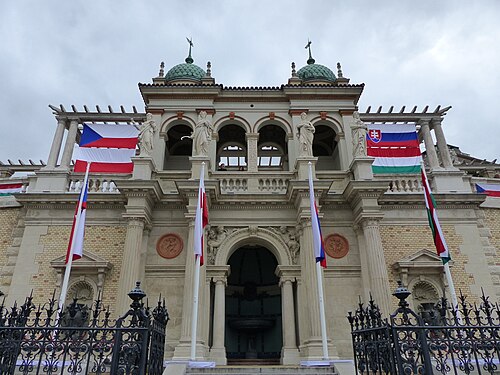
中央ヨーロッパでは以下の協力協定が締結されています。
ヴィシェグラードグループは、中核となる中欧諸国の古くからの戦略的同盟に基づく、協力と欧州統合のための中欧同盟です。このグループは、 1991 年 2 月 15 日にハンガリーの城下町ヴィシェグラードで開催されたチェコスロバキア、ハンガリー、ポーランドの首脳会議に端を発しています。1993 年の チェコスロバキア解体後、チェコ共和国とスロバキアがメンバーとなりました。
1989年、18カ国が加盟する中央・東ヨーロッパの地域協力フォーラムである中央ヨーロッパイニシアティブがブダペストで設立されました。CEIの本部は1996年以来イタリアの トリエステにあります。
中央ヨーロッパ自由貿易協定(CEFTA)は、中央ヨーロッパとバルカン半島諸国間の貿易協定であり、欧州連合への完全な加盟に向けた準備として機能しています。2013年現在、北マケドニア、アルバニア、ボスニア・ヘルツェゴビナ、モルドバ、モンテネグロ、セルビア、および国連コソボ暫定行政ミッション(UNMIK[update] )の7か国が加盟しています。
CEFTAは1992年にチェコスロバキア、ハンガリー、ポーランドによって設立されたが、発効したのは1994年になってからである。その間にチェコスロバキアはチェコ共和国とスロバキアに分裂していた。スロベニアは1996年に、ルーマニアは1997年に、ブルガリアは1999年に、クロアチアは2003年に加盟した。2004年、チェコ共和国、スロバキア、ハンガリー、ポーランド、スロベニアはEUに加盟するためCEFTAを離脱した。ルーマニアとブルガリアも同じ理由で2007年に離脱した。その後、2006年に北マケドニアが加盟し[a] 、2007年にはアルバニア、ボスニア・ヘルツェゴビナ、モルドバ、モンテネグロ、セルビア、UNMIK(コソボを代表して)が加盟した。2013年、クロアチアはEUに加盟するためCEFTAを離脱した。
スイスおよびリヒテンシュタインは1924年以来関税同盟に参加しており、両国ともスイスフランを国の通貨として採用しています。
東欧
旧東側諸国のEU統合プロセスの影響については、いまだ議論が続いている。その結果、移民レベルとEUに対する国民の支持との関係は不確かなままである。統合を通じて、東欧諸国は経済成長、自由市場協定の恩恵、EU内での労働移動の自由を経験した。[27]しかし、実証的な社会経済分析の結果[ which? ]は、スペイン、フランス、アイルランド、オランダでは、CEEからの移民がホスト社会における欧州統合への支持にマイナスの影響を与えたことを示唆している。[要出典]研究[ which? ]はまた、CEEからの移民が統合の長期的影響を損なう可能性があることを示唆している。[要出典] ]社会開発プログラムに対する意見は、東欧からの移民との長期にわたる接触は共通のヨーロッパ人としてのアイデンティティを築くのに役立つかもしれないが、労働移民に対する支援メカニズムの強化によって潜在的な国家孤立につながる可能性もあるという見解にまで及ぶ。[要出典]また、同量の研究は、EU加盟国間の国内移住が経済連合の発展を成功させる上で必要であることを示唆している。[28]
ドナウ川流域
ドナウ川流域に関するEU戦略は2011年に欧州理事会で承認され、ヨーロッパで2番目のマクロ地域戦略である。この戦略はドナウ川沿いの14か国間の協力を改善するための基盤を提供する。地域統合の取り組みの有効性を高め、EU、国家、地方レベルでの政策の影響を活用することを目指している。[29]
バルカン半島
クライオヴァ・グループ、クライオヴァ・フォー、または C4 は、ルーマニア、ブルガリア、ギリシャ、セルビアの 4 つのヨーロッパ諸国による協力プロジェクトであり、ヨーロッパ統合の促進、および相互の経済、輸送、エネルギー協力を目的としています。
欧州評議会
.svg/500px-Council_of_Europe_(blue).svg.png)
青: 欧州評議会加盟国
薄い灰色: 非加盟国
第二次世界大戦中の荒廃と人々の苦しみ、そして戦後の和解の必要性を背景に、欧州統合の理念が生まれ、1949年に ストラスブールで欧州評議会が設立されました。
欧州評議会の最も重要な功績は、1950年の欧州人権条約と、欧州全域における人権と基本的自由に関する事実上の最高裁判所としての役割を果たすストラスブールの欧州人権裁判所である。人権は、欧州評議会の拷問防止委員会と欧州社会憲章によっても保護されている。
_participation_map,_current.svg/500px-Istanbul_Convention_(2011)_participation_map,_current.svg.png)
欧州評議会の条約のほとんどは、法的援助、汚職防止、マネーロンダリング防止、スポーツにおけるドーピング防止、インターネット犯罪防止に関する条約など、より高度な法的統合を目指しています。
文化協力は、1954年の文化条約と、その後の大学での学習と卒業証書の承認、および少数言語の保護に関する条約に基づいています。
ベルリンの壁の崩壊後、旧共産主義ヨーロッパ諸国は、現在ヨーロッパの46カ国から構成される欧州評議会に加盟することができた。したがって、欧州評議会レベルでのヨーロッパ統合は事実上成功しており、ベラルーシ、カザフスタン、コソボ、ロシア、バチカン市国を除くほぼヨーロッパ大陸全域を網羅している。
欧州評議会レベルでの欧州統合は、加盟国の条約への加入、および閣僚会議や議会間会合レベルでの政治的調整を通じて機能します。1949年の規約に従い、欧州評議会は人権や民主主義などの共通の価値観に基づいて加盟国間の団結を高めるよう努めています。
欧州政治共同体
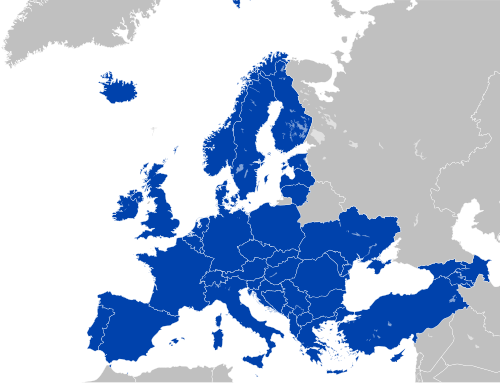
欧州政治共同体(EPC)は、ヨーロッパの将来に関する政治的、戦略的議論のための政府間フォーラムです。 [30]最初のサミットは2022年10月6日にプラハで開催され、44のヨーロッパ諸国と、欧州理事会および欧州委員会の議長が参加しました。[31]
欧州安全保障協力機構
欧州安全保障協力機構( OSCE)は、ヨーロッパの安定確保を目的とする大西洋横断の政府間組織です。1973年7月に欧州安全保障協力会議(CSCE)として設立され、その後1995年1月に現在の形態に変わりました。OSCEには56か国が加盟しており、北半球のほとんどをカバーしています。
OSCEは、政治・軍事的側面、経済・環境的側面、人的側面という3つの活動を展開しています。これらはそれぞれ、(i)紛争予防・解決のメカニズム、(ii)経済・環境的脅威が発生した場合の監視、警告、支援、(iii)人権と基本的自由の完全な尊重を促進しています。

欧州自由貿易連合
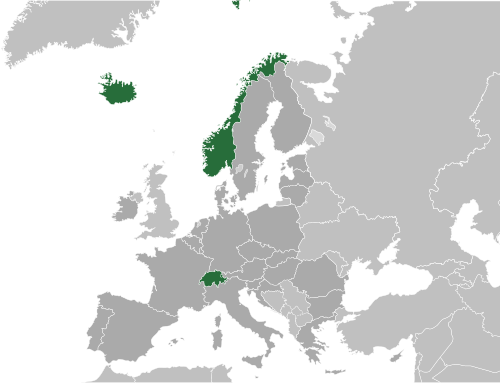
欧州自由貿易連合(EFTA) は、EECに加盟しなかったヨーロッパ諸国の代替として 1960 年 5 月 3 日に設立されたヨーロッパの貿易ブロックです。EFTA には現在、アイスランド、ノルウェー、スイス、リヒテンシュタインの 4 か国が加盟しており、ノルウェーとスイスのみが創設メンバーです。
EFTA 条約は、1960 年 1 月 4 日にストックホルムで7 か国 (オーストリア、デンマーク、ノルウェー、ポルトガル、スウェーデン、スイス、イギリス) によって調印されました。フィンランドは 1961 年に準加盟国となり、1986 年に正式加盟国となりました。アイスランドは 1970 年に加盟し、リヒテンシュタインは 1991 年に加盟しました。改訂された条約であるファドゥーツ条約は 2001 年 6 月 21 日に調印され、2002 年 6 月 1 日に発効しました。
英国とデンマークは1973年に欧州共同体(EC)に加盟した際にEFTAを脱退した。ポルトガルは1986年にECに加盟した際にEFTAを脱退した。オーストリア、フィンランド、スウェーデンは1993年にECに取って代わった欧州連合に加盟し、1995年にEFTAの加盟国ではなくなった。
欧州放送連合

欧州放送連合(EBU)は、1950年2月12日に設立された公共サービスメディア団体の連合体である。2022年現在、この組織は54か国の112[update]の正会員と、さらに19か国の30の準会員から構成されている。[33] EU加盟国のほとんどがこの組織に加盟しているため、EBUは超国家的な法律と規制の対象となっている。[34]また、 2014年の議会選挙では欧州委員会委員長候補者間の討論会も開催されたが、EU自体とは無関係である。[35]
欧州特許条約

欧州特許条約 (EPC) は、1973 年 10 月 5 日の欧州特許付与に関する条約としても知られ、欧州特許機構を設立し、欧州特許が付与される自律的な法制度を提供する多国間条約です。2022 年現在、欧州特許条約には 39 か国が加盟しています。欧州特許付与に関する条約は、1973 年 10 月 5 日に初めて署名されました。
欧州共同体
1951年、ベルギー、フランス、イタリア、ルクセンブルク、オランダ、西ドイツは、パリ条約において、鉄鋼と石炭の生産に関する権限を欧州石炭鉄鋼共同体(ECSC)に付与することに合意し、この条約は1952年7月23日に発効した。
石炭と鉄鋼の生産は、第二次世界大戦後のヨーロッパ諸国の復興に不可欠であり、国民経済のこの部門は第一次世界大戦と第二次世界大戦の戦争において重要でした。そのため、フランスは1949年にドイツ連邦共和国(西ドイツ)が建国された後も、鉄鋼会社とともにザールラントの占領を維持していました。石炭と鉄鋼の生産に関する国家権限を新たに設立されたECSC委員会に移譲することで、ECSC加盟国は相互の透明性と信頼を高めることができました。
国家権力を「共同体」に移譲し、その委員会が行使するこの動きは、ブリュッセルで欧州原子力共同体(ユーラトム)と欧州経済共同体(EEC)を設立した1957年のローマ条約と並行して行われた。
1967年、合併条約(またはブリュッセル条約)により、ECSCとユーラトムの機関がEECに統合されました。両国はすでに議会と裁判所を共有していました。総称して欧州共同体と呼ばれていました。1987年、単一欧州議定書(SEA)はローマ条約の最初の主要な改正であり、単一の欧州市場と欧州政治協力が正式に確立されました。当初、各共同体は独立した人格を持っていましたが、統合が進み、年月を経て現在の欧州連合と呼ばれる組織に変貌しました。
3 つの共同体を設立した 6 か国は「内 6 か国」として知られていました (「外 7 か国」は欧州自由貿易連合を形成した国です)。これらはベルギー、フランス、イタリア、ルクセンブルク、オランダ、および西ドイツです。最初の拡大は 1973 年にデンマーク、アイルランド、およびイギリスの加盟により行われました。ギリシャは 1981 年に、ポルトガルとスペインは 1986 年に加盟しました。1990 年 10 月 3 日に東ドイツと西ドイツが再統一され、東ドイツは新しい統一ドイツで共同体の一部となりました (国家の数は増加しませんでした)。
共同体創設プロセスの重要人物は、欧州統合の主導的勢力とみなされている欧州連合の「創始者」とみなされている ジャン・モネであった。
欧州連合

欧州連合(EU)は、27の主権加盟国からなる連合体であり、加盟国の上に新たな国家を形成することなく、さまざまな分野で政策を調整するために、条約によって一定の権限を共通機関に委任しています。 1993年にマーストリヒト条約によって、既存の欧州経済共同体を基盤として正式に設立されました。
したがって、12か国が創設メンバーであり、すなわちベルギー、デンマーク、フランス、ドイツ、ギリシャ、アイルランド、イタリア、ルクセンブルク、オランダ、ポルトガル、スペイン、および英国です。 1995年にオーストリア、フィンランド、スウェーデンがEUに加盟しました。 キプロス、チェコ共和国、エストニア、ハンガリー、ラトビア、リトアニア、マルタ、ポーランド、スロバキア、およびスロベニアは2004年に加盟しました。 ブルガリアとルーマニアは2007年に加盟しました。 クロアチアは2013年に加入しました。 英国は47年間の加盟を経て2020年に脱退しました。 公式の候補国には、アルバニア、ボスニア・ヘルツェゴビナ、ジョージア、北マケドニア、[a]モルドバ、モンテネグロ、セルビア、トルコ、およびウクライナがあります。 モロッコの申請はEECによって拒否されました。 2005年10月3日に始まったEUとトルコ間の加盟交渉プロセスは、2019年以来中断されている。
欧州連合の機関、その議員、裁判官、委員、事務局、加盟国の政府とその国民は、すべて欧州統合において役割を果たしています。しかし、欧州統合については、さまざまな主体や機関に焦点を当てたさまざまな理論があるため、誰が主要な役割を果たすのかという問題は議論の的となっています。
欧州連合は、正式には連合に加盟していない国々と数多くの関係を築いている。欧州連合の公式サイトとギュンター・フェルホイゲン委員の声明によると、その目的は、必ずしも完全な加盟国になることなく、EUの民主主義の理想を共有し、さらなる統合に加わる国々の輪を形成することだという。
能力
ほとんどの責任(「権限」)は加盟国が保持しますが、一部の権限は集団的決定のために EU にのみ付与され、一部は EU の措置を待つ間共有され、一部は EU の支援を受けます。これらは次の表に示されています。
経済統合
欧州連合は、加盟国全域で単一の経済市場を運営し、ユーロ圏加盟国間では単一の通貨を使用しています。さらに、EU は欧州経済領域や関税同盟協定を通じて、正式には加盟国ではない国々と数多くの経済関係を築いています。
自由貿易地域
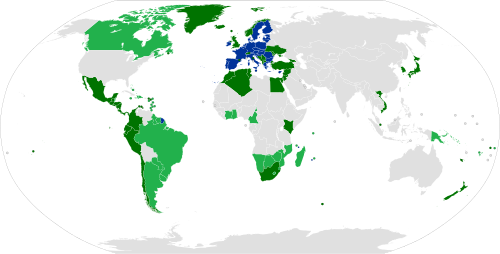
EECの創設により、自由貿易地域(FTA)を定義するための要件である加盟国間の物品に対する関税、割当、特恵が撤廃された。英国は、Brexit離脱協定の移行期間中、FTAに留まる。
数多くの国が、FTA条項を含む欧州連合連合協定(AA)に署名しています。これらには主に地中海諸国(アルジェリア(2005年)、エジプト(2004年)、イスラエル(2000年)、ヨルダン(2002年)、レバノン(2006年)、モロッコ(2000年)、パレスチナ自治政府(1997年)、チュニジア(1998年)が含まれますが、他の貿易ブロックの国も署名しています(チリ(2003年)、メキシコ(2000年)、南アフリカ(2000年)など)。
さらに、多くのバルカン諸国は、アルバニア(2006年署名)、モンテネグロ(2007年)、北マケドニア(2004年)、ボスニア・ヘルツェゴビナ、セルビア(ともに2008年、発効保留中)など、FTA条項を含む安定化連合協定( SAA)に署名している。
2008年、ポーランドとスウェーデンは、EUとアルメニア、アゼルバイジャン、ベラルーシ、[37]ジョージア、モルドバ、ウクライナの間のFTAの設定を含む東方パートナーシップを提案した。[38]
関税同盟
欧州連合関税同盟は、その地域内を移動する商品に関税が課されない地域を定義します。これには、欧州連合のすべての加盟国が含まれます。EEC加盟国間の内部関税障壁の廃止は1968 年に達成されました。
アンドラとサンマリノは第三国とのEU関税同盟に加盟しています。トルコは欧州連合・トルコ関税同盟によって結ばれています。
欧州単一市場
1992年にマーストリヒト条約によって設立されて以来、EUの主な目標は単一市場を確立し維持することです。これは、EUの域内市場における商品、サービス、資本、人の自由な移動を保証することに関連する 4つの基本的自由を保証することを目指しています。
英国は、ブレグジット離脱協定の移行期間中、単一市場に留まりました。欧州経済領域(EEA)協定により、ノルウェー、アイスランド、リヒテンシュタインはEUに加盟せずに欧州単一市場に参加できます。4つの基本的自由が適用されます。ただし、漁業と農業にはいくつかの制限があります。スイスは、スイス・EU二国間協定によって欧州連合と結びついていますが、その内容はEEA協定の内容とは異なります。
ユーロ圏

ユーロ圏加盟国
ERM-IIメンバー
オプトアウト可能な ERM-II メンバー (デンマーク)
参加義務のある残りのEU加盟国は
The Eurozone refers to the European Union member states that have adopted the euro currency union as the third stage of the European Economic and Monetary Union (EMU). Further, certain states outside the EU have adopted the euro as their currency, despite not belonging to the EMU. Thus, a total of 26 states, including 20 European Union states and six non-EU members, currently use the euro.
The Eurozone came into existence with the official launch of the euro on 1 January 1999. Physical coins and banknotes were introduced on 1 January 2002.
The original members were Austria, Belgium, Finland, France, Germany, Ireland, Italy, Luxembourg, the Netherlands, Portugal, and Spain. Greece adopted the euro on 1 January 2001. Slovenia joined on 1 January 2007, Cyprus and Malta were admitted on 1 January 2008, Slovakia joined on 1 January 2009, Estonia on 1 January 2011, Latvia on 1 January 2014, Lithuania on 1 January 2015 and Croatia on 1 January 2023.
Outside the EU, agreements have been concluded with Andorra, Monaco, San Marino, and Vatican City for formal adoption, including the right to issue their own coins. Montenegro and Kosovo} unilaterally adopted the euro when it launched.
Fiscal union
There has long been speculation about the possibility of the European Union eventually becoming a fiscal union. In the wake of the European debt crisis that began in 2009, calls for closer fiscal ties, possibly leading to some sort of fiscal union have increased; though it is generally regarded as implausible in the short term, some analysts regard fiscal union as a long-term necessity.[39][40] While stressing the need for coordination, governments have rejected talk of fiscal union or harmonisation in this regard.[41]
Aviation

There are three main aviation related institutions present in Europe:
Energy
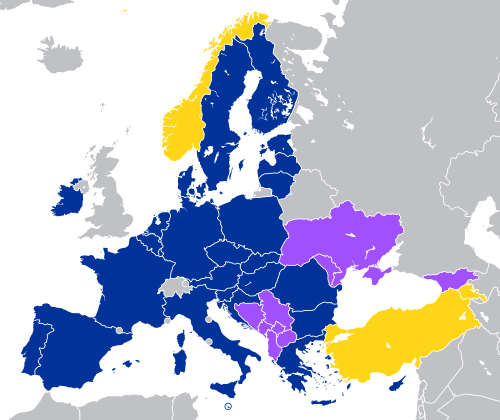
The transnational energy related structures present in Europe are:
- Energy Community
- European Atomic Energy Community
- European Network of Transmission System Operators for Electricity
- European Network of Transmission System Operators for Gas
- INOGATE
- Energy Charter Treaty
Standardisation
The transnational standardisation organisations present in Europe are:
Social and political integration
Education
The ERASMUS programme (European Region Action Scheme for the Mobility of University Students) seeks to encourage and support free movement of the academic community. It was established in 1987.
A total of 33 states (including all European Union states, Iceland, Liechtenstein, Norway, Switzerland and Turkey) are involved.
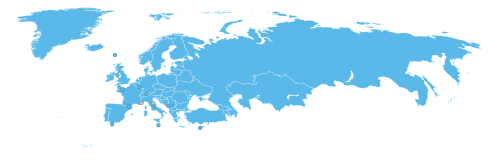
The European Higher Education Area (EHEA) aims to integrate education systems in Europe. Thus, degrees and study periods are recognised mutually. This is done by following the Bologna process, and under the Lisbon Recognition Convention of the Council of Europe.
The Bologna declaration was signed in 1999 by 29 countries, all EU members or candidates at the moment (except Cyprus which joined later) and three out of four EFTA countries: Austria, Belgium, Bulgaria, Czech Republic, Denmark, Estonia, Finland, France, Germany, Greece, Hungary, Iceland, Ireland, Italy, Latvia, Lithuania, Luxembourg, Malta, the Netherlands, Norway, Poland, Portugal, Romania, Slovakia, Slovenia, Spain, Sweden, Switzerland, and United Kingdom. Croatia, Cyprus, Liechtenstein, and Turkey joined in 2001. In 2003, Albania, Andorra, Bosnia and Herzegovina, the Holy See (a Council of Europe permanent observer), North Macedonia,[a] Russia, and Serbia signed the convention. Armenia, Azerbaijan, Georgia, Moldova and Ukraine followed in 2005. Montenegro joined in 2007. Finally, Kazakhstan (not a member of the Council of Europe) joined in 2010. This makes a total of 47 member states. Monaco and San Marino are the only members of the Council of Europe which have not adopted the convention. The other European nation that is eligible to join, but has not, is Belarus.
Research
There are a number of multinational research institutions based in Europe.
- In the EIROforum collaboration:
- Meteorology:
Health
The European Health Insurance Card (or EHIC) is issued free of charge and allows anyone who is insured by or covered by a statutory social security scheme of the EEA countries and Switzerland to receive medical treatment in another member state for free or at a reduced cost, if that treatment becomes necessary during their visit (for example, due to illness or an accident), or if they have a chronic pre-existing condition which requires care such as kidney dialysis.
The epSOS project, also known as Smart Open Services for European Patients, aims to promote free movement of patients.[42] It will allow health professionals to electronically access the data from patients from another country, to electronically process prescriptions in all involved countries, or to provide treatment in another EU state to a patient on a waiting list.
The project has been launched by the EU and 47 member institutions from 23 EU member states and 3 non-EU members. They include national health ministries, national competence centres, social insurance institutions and scientific institutions as well as technical and administrative management entities.
Charter of Fundamental Rights
The Charter of Fundamental Rights of the European Union is a document enshrining certain fundamental rights. The wording of the document has been agreed at ministerial level and has been incorporated into the Treaty of Lisbon. Poland has negotiated an opt out from this Charter, as had the United Kingdom before the latter's withdrawal from the European Union.
Right to vote
The European integration process has extended the right of foreigners to vote. Thus, European Union citizens were given voting rights in local elections by the 1992 Maastricht Treaty. Several member states (Belgium, Luxembourg, Lithuania, and Slovenia) have extended since then the right to vote to all foreign residents. This was already the case in Denmark, Finland, the Netherlands and Sweden. Further, voting and eligibility rights are granted among citizens of the Nordic Passport Union, and between numerous countries through bilateral treaties (i.e. between Norway and Spain, or between Portugal and Brazil, Cape Verde, Iceland, Norway, Uruguay, Venezuela, Chile and Argentina), or without them (i.e. Ireland and the United Kingdom). Finally, within the EEA, Iceland and Norway also grant the right to vote to all foreign residents.
Schengen Area
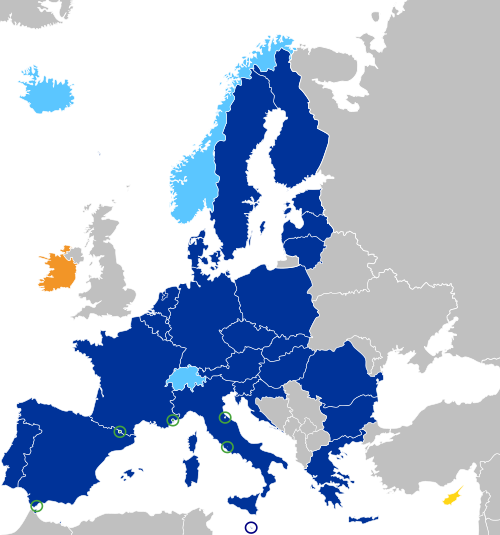
Future members (Cyprus)
Cooperating countries (Ireland)
The main purpose of the establishment of the Schengen Agreement is the abolition of physical borders among European countries. A total of 30 states, including 26 European Union states (all except Ireland, which is part of the Common Travel Area with the United Kingdom) and four non-EU members (Iceland, Liechtenstein, Norway, and Switzerland), are subject to the Schengen rules. Its provisions have already been implemented by 29 states, leaving just Cyprus to do so among signatory states.
Further, Monaco, San Marino and Vatican City are de facto members.
Visa policy in EU
European Union has visa-free regime agreements with some European countries outside EU and discussing such agreements with others; Armenia,[43] Russia,[44][45] Ukraine,[46] and Moldova.[47] Matters concerning Turkey have also been debated.[48][49] Ireland maintains an independent visa policy in the EU.
Defence

There are a number of multi-national military and peacekeeping forces which are ultimately under the command of the EU, and therefore can be seen as the core for a future European Union army.[50] These corps include forces from 26 EU states (all except Malta, which currently does not participate in any battlegroup), Norway and Turkey. Denmark used to have an opt-out clause in its accession treaty and was not obliged to participate in the common defence policy, but in 2022 decided to abandon its stance. Further, the Western European Union (WEU) capabilities and functions have been transferred to the European Union, under its developing Common Foreign and Security Policy (CFSP) and European Security and Defence Policy (ESDP).[51]
The EU also has close ties with the North Atlantic Treaty Organization (NATO), according to the Berlin Plus agreement. This is a comprehensive package of agreements made between NATO and the EU on 16 December 2002. With this agreement the EU is given the possibility to use NATO assets in case it wanted to act independently in an international crisis, on the condition that NATO does not want to act itself – the so-called "right of first refusal".[52]
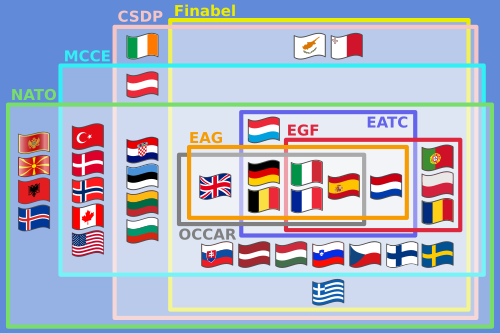
In fact, many EU member states are among the 32 NATO members. The Treaty of Brussels is considered the precursor to NATO. The North Atlantic Treaty was signed in Washington, D.C., in 1949. It included the five Treaty of Brussels states, as well as the United States, Canada, Portugal, Italy, Norway, Denmark and Iceland. Greece and Turkey joined the alliance in 1952, and West Germany did the same in 1955. Spain entered in 1982. In 1999, Hungary, the Czech Republic, and Poland became NATO members. Finally, Bulgaria, Estonia, Latvia, Lithuania, Romania, Slovenia, and Slovakia joined in 2004. In 2009, Albania and Croatia joined. In 2008, Ukraine and Georgia were told that they will also eventually become members. Montenegro and North Macedonia joined in 2017 and 2020 respectively. In 2023 and 2024, Finland and Sweden joined. Thus, 23 out of 32 NATO states are among the 27 EU members, another two are members of the EEA, and one more is an EU candidate and also a member of the European Union Customs Union.
Space
On 22 May 2007, the member states of the European Union have agreed to create a common political framework for space activities in Europe by unifying the approach of the European Space Agency (ESA) with those of the individual European Union member states.[53]
However, ESA is an intergovernmental organisation with no formal organic link to the EU; indeed the two institutions have different member states and are governed by different rules and procedures. ESA was created in 1975 by the merger of the two pre-existing European organisations engaged in space activities, ELDO and ESRO. The 10 founding members were Belgium, Denmark, France, Germany, Italy, the Netherlands, Spain, Sweden, Switzerland and the United Kingdom. Ireland joined on 31 December 1975. In 1987, Austria and Norway became member states. Finland joined in 1995, Portugal in 2000, Greece and Luxembourg in 2005, the Czech Republic in 2008, and Romania in 2011. Currently, it has 20 member states: all the EU member states before 2004, plus Czech Republic, Norway, Poland, Romania, and Switzerland. In addition, Canada has had the special status of a Cooperating State under a series of cooperation agreements dating since 1979.[54][55]
In 2007 the political perspective of the European Union was to make ESA an agency of the EU by 2014.[56] ESA is likely to expand in the coming years with the countries which joined the EU in both 2004 and 2007. Currently, almost all EU member states are in different stages of affiliation with ESA. Poland[57] has joined on 19 November 2012. Hungary[58] and Estonia[59] have signed ESA Convention. Latvia and Slovenia have started to implement a Plan for European Cooperating State (PECS) Charter. Slovakia, Lithuania and Bulgaria have signed a European Cooperating State (ECS) Agreement. Cyprus,[60] Malta and Croatia have signed Cooperation Agreements with ESA.
Membership in European Union agreements
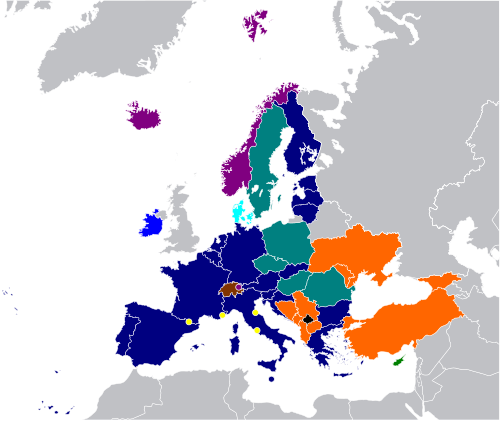
EU, Schengen, EMU, AFSJ (All agreements): 18 c.
EU, Schengen, AFSJ: 6 c.
EU, EMU, AFSJ: 1 c.
EU, Schengen: 1 c.
EU, EMU: 1 c.
EEA, Schengen: 3 c.
Schengen, Bilateral treaties: 1 c.
Candidates, some agreements: 9 c.
Microstates, some agreements: 4 c.
Association Agreement: 1 c.
some agreements: 0 c.
A small group of EU member states have joined all European treaties, instead of opting out on some. They drive the development of a federal model for the European integration. This is linked to the concept of Multi-speed Europe where some countries would create a core union; and goes back to the Inner Six references to the founding member states of the European Communities.
At present, the formation of a formal Core Europe Federation ("a federation within the confederation") has been held off at every occasion where such a federation treaty had been discussed.[citation needed] Instead, supranational institutions are created that govern more areas in "Inner Europe" than existing European integration provides for.
Among the 27 EU state members, 18 states have signed all integration agreements: Austria, Belgium, Croatia, Finland, Estonia, France, Germany, Greece, Italy, Latvia, Lithuania, Luxembourg, Malta, Netherlands, Portugal, Slovakia, Slovenia and Spain. The agreements considered include the fifth stage of economic integration or EMU, the Schengen agreement, and the Area of freedom, security and justice (AFSJ).
Thus, among the 27 EU countries, 20 have joined the Eurozone, 25 have joined Schengen, and also 25 have no opt-outs under AFSJ.
Further, some countries which do not belong to the EU have joined several of these initiatives, albeit sometimes at a lower stage such as the Customs Union, the Common Market (EEA), or even unilaterally adopting the euro, and by taking part in Schengen, either as a signatory state, or de facto.
Thus, 6 non-EU countries have adopted the euro (4 through an agreement with the EU and 2 unilaterally), and 4 non-EU states have joined the Schengen agreement officially.
The following table shows the status of each state membership to the different agreements promoted by the EU. It lists 47 countries, including the 27 EU member states, 9 candidate states, 3 members of the EEA and Switzerland, Kosovo which has applied for membership, 4 microstates, and the United Kingdom and Armenia as special cases.
Hence, this table summarises some components of EU laws applied in most European states. Some territories of EU member states also have a special status in regard to EU laws applied. Some territories of EFTA member states also have a special status in regard to EU laws applied as is the case with some European microstates. For member states that do not have special-status territories the EU law applies fully with the exception of the opt-outs in the European Union and states under a safeguard clause or alternatively some states participate in enhanced co-operation between a subset of the EU members. Additionally, there are various examples of non-participation by some EU members and non-EU states participation in particular Agencies of the European Union, the programmes for European Higher Education Area, European Research Area and Erasmus Mundus.
Notes:
- ^ a b c In a customs union with the EU.[66][67][68][69]
- ^ a b c d Formal agreement with the EU to issue euros.
Future of European integration

Current member states
Candidates: Albania, Bosnia and Herzegovina, Georgia, North Macedonia, Moldova, Montenegro, Serbia, Turkey and Ukraine[70]
There is no fixed end to the process of integration. The discussion on the possible final political shape or configuration of the European Union is sometimes referred to as the debate on the finalité politique (French for "political purpose").[71] Integration and enlargement of the European Union are major issues in the politics of Europe, each at European, national and local level. Integration may conflict with national sovereignty and cultural identity, and is opposed by eurosceptics. To the east of the European Union, the countries of Belarus, Kazakhstan and Russia launched the creation of the Eurasian Economic Union in the year 2015, which was subsequently joined by Armenia and Kyrgyzstan. Other states in the region, such as Moldova and Tajikistan may also join. Meanwhile, the post-Soviet disputed states of Abkhazia, Artsakh, South Ossetia, and Transnistria have created the Community for Democracy and Rights of Nations to closer integrate among each other. Some Eastern European countries such as Armenia have opted to cooperate with both the EU and the Eurasian Union. On 24 February 2017 Tigran Sargsyan, the Chairman of the Eurasian Economic Commission stated that Armenia's stance was to cooperate and work with both the European Union and the Eurasian Economic Union. Sargsyan added that although Armenia is part of the Eurasian Union, a new European Union Association Agreement between Armenia and the EU would be finalized shortly.[72]
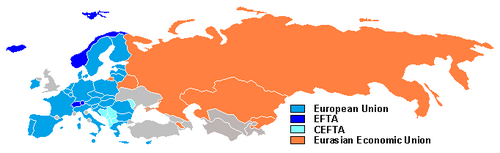
Several countries in Eastern Europe have engaged the EU with the aim to grow economic and political ties. The Euronest Parliamentary Assembly, established in 2003, is the inter-parliamentary forum in which members of the European Parliament and the national parliaments of Ukraine, Moldova, Belarus, Armenia, Azerbaijan and Georgia participate and forge closer political and economic ties with the European Union.[73] All of these States participate in the EU's Eastern Partnership program. The Organization of the Black Sea Economic Cooperation and the Community of Democratic Choice are other organizations established to promote European integration, stability, and democracy. On 12 January 2002, the European Parliament noted that Armenia and Georgia may enter the EU in the future.[74] On 12 March 2024, the European Parliament passed a resolution confirming Armenia meets Maastricht Treaty Article 49 requirements and may apply for EU membership.[75] Currently, Georgia is the only country in the Caucasus actively seeking EU membership.
European Security Treaty
In 2008, Russian President Dmitry Medvedev announced a new concept for Russian foreign politics and called for the creation of a common space in Euro-Atlantic and Eurasia area "from Vancouver to Vladivostok".[76] On 5 June 2009 in Berlin he proposed a new all-European pact for security that would include all European, CIS countries and the United States.[77][78] On 29 November 2009 a draft version of the European Security Treaty appeared.[79][80][81] French president Sarkozy spoke positively about Medvedev's ideas and called for closer security and economic relation between Europe and Russia.[82][83][84][85]
Common space from Lisbon to Vladivostok

Russian Prime Minister Vladimir Putin in a German newspaper in 2010 called for common economic space, free-trade area or more advanced economic integration, stretching from Lisbon to Vladivostok.[86][87][88][89][90] He also said it is quite possible Russia could join the eurozone one day.[91] French president Nicolas Sarkozy in 2010 said he believed in 10 or 15 years there will be common economic space between EU and Russia with visa-free regime and general concept of security.[92]
Instead Russia has chosen economic policy of self-sufficiency and economic autarky. Russia has been unable to compete with the EU economy, so integration might be at the cost of its own political and socio-economic stability.[93]
Concept of a single legal space for the CIS and Europe

Special member state territories outside the EU
Russian legal scholar Oleg Kutafin and economist Alexander Zakharov produced a Concept of a Single Legal Space for the CIS and Europe in 2002. This idea was fully incorporated in the resolution of the 2003 Moscow Legal Forum. The Forum gathered representatives of more than 20 countries including 10 CIS countries. In 2007 both the International Union of Jurists of the CIS and the International Union (Commonwealth) of Advocates passed resolutions that strongly support the Concept of a Single Legal Space for Europe and post-Soviet Countries.
The concept said: "Obviously, to improve its legislation Russia and other countries of CIS should be oriented toward the continental legal family of European law. The civil law system is much closer to the Russian and other CIS countries will be instrumental in harmonising legislation of CIS countries and the European Community but all values of common law should be also investigated on the subject of possible implementation in some laws and norms. It is suggested that the introduction of the concept of a Single legal space and a single Rule of Law space for Europe and CIS be implemented in four steps:
- Development plans at the national level regarding adoption of selected EC legal standards in the legislation of CIS countries;
- Promotion of measures for harmonisation of law with the goal of developing a single legal space for Europe and CIS countries in the area of commercial and corporate law;
- Making the harmonisation of judicial practice of CIS countries compatible with Rule of Law principles and coordination of the basic requirements of the Rule of Law in CIS countries with the EU legal standards.
- Development of ideas the Roerich Pact (International Treaty on the Protection of Artistic and Scientific Institution and Historic Monuments initiated by Russian thinker Nicholas Roerich and signed in 1935 by 40 % of sovereign states in Washington D.C.) into the law of CIS countries and European law.
[94]
Beyond Europe
Euro-Mediterranean Partnership

The Euro-Mediterranean Partnership or Barcelona Process was organised by the European Union to strengthen its relations with the countries in the Mashriq and Maghreb regions. It started in 1995 with the Barcelona Euro-Mediterranean Conference, and it has been developed in successive annual meetings.
The European Union enlargement of 2004 brought two more Mediterranean countries (Cyprus and Malta) into the Union, while adding a total of 10 to the number of Member States. The Euro-Mediterranean Partnership today comprises 43 members: 27 European Union member states, and 15 partner countries (Albania, Algeria, Bosnia and Herzegovina, Egypt, Israel, Jordan, Lebanon, Libya, Mauritania, Monaco, Montenegro, Morocco, Syria and Tunisia, as well as the Palestinian Territories). Libya has had observer status since 1999.
The Euro-Mediterranean Free Trade Area (EU-MEFTA) is based on the Barcelona Process and European Neighbourhood Policy (ENP). It will cover the EU, the EFTA, the EU customs unions with third states (Andorra, San Marino, and Turkey), the EU candidate states, and the partners of the Barcelona Process.
The Union for the Mediterranean is a community of countries, mostly bordering the Mediterranean Sea, established in July 2008.[95]
Ties with partners
Morocco already has a number of close ties with the EU, including an Association Agreement with FTA provisions, air transport integration, or the participation in military operations such as ALTHEA in Bosnia.
Further, it will be the first partner to go beyond association by enhancing political and economic ties, entering the Single Market, and participating in some EU agencies.[96][97][98][99]
Commonwealth of Independent States
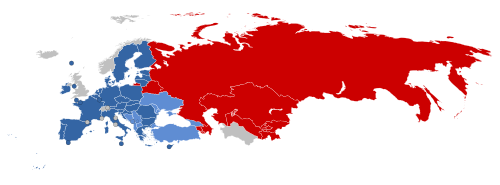
The Commonwealth of Independent States (CIS) is a loose organisation in which most former Soviet republics participate. A visa-free regime operates among members and a free-trade area is planned. Ukraine is not an official member, but has participated in the organisation. Some members are more integrated than others, for example Russia and Belarus form a Union State. In 2010, Belarus, Russia and Kazakhstan formed a customs union and a single market (Common Economic Space) commenced on 1 January 2012. The Presidents of Belarus, Russia and Kazakhstan established the Eurasian Economic Union with a Eurasian Commission in 2015, subsequently joined by Armenia and Kyrgyzstan. A common currency is also planned, potentially to be named "evraz". Some other countries in the region, such as Moldova are potential members of these organisations.
Community for Democracy and Rights of Nations
The post-Soviet disputed states of Abkhazia, South Ossetia, and Transnistria are all members of the Community for Democracy and Rights of Nations which aims to forge closer integration.
EU and other regions and countries in the world
The European Union cooperates with some other countries and regions via loose organisations and regular meetings. The ASEM forum, consisting of the EU and some Asian countries, has been held every two years since 1996. The EU and African, Caribbean and Pacific Group of States form the ACP–EU Joint Parliamentary Assembly, promoting ACP–EU development cooperation, democracy and human rights. The EU and Latin American countries form the Euro-Latin American Parliamentary Assembly. TAFTA is a proposed free-trade area between EU and United States.
- ASEM – Asia–Europe Meeting
- ACP – African, Caribbean and Pacific Group of States (Economic Partnership Agreements)
- EuroLat – Euro-Latin American Parliamentary Assembly
- TAFTA – Transatlantic Free Trade Area
Other organisations in world
European countries like the United Kingdom, France, Spain, Portugal have made organisations with other countries in the world with which they have strong cultural and historical links.
European languages in the world
English is considered to be the global lingua franca. European languages like English, French, Spanish, Portuguese, Italian, Russian and German are official, co-official or widely in use in many countries with a colonial past or with a European diaspora.
World integration
See also
.svg/500px-Europe_(orthographic_projection).svg.png)
- Assembly of European Regions
- Centre Virtuel de la Connaissance sur l'Europe - Virtual Centre for Knowledge on Europe
- Differentiated integration
- European Federation
- European Policy Centre
- Europe Day
- EuroVoc
- Mechanism for Cooperation and Verification
- North American integration
- Pan-European identity
- Paneuropean Union
- Pulse of Europe
- Regions of Europe
- TRACECA
Notes
- ^ a b c d Until February 2019, officially referred to by the EU and most other European organisations by the provisional appellation "the former Yugoslav Republic of Macedonia", due to a naming dispute.
References
- ^ Kosowska-Gąstoł, Beata (6 November 2017). "A Truly 'European' Christian Democracy? The European People's Party". In Kosicki, Piotr H.; Łukasiewicz, Sławomir (eds.). Christian Democracy Across the Iron Curtain: Europe Redefined. Cham, Zug: Springer. p. 129. ISBN 9783319640877. Archived from the original on 13 August 2023. Retrieved 13 August 2023.
[...] forerunners of contemporary Christian Democracy had pioneered transnational cooperation beginning in 1925 with the International Secretariat of Democratic Parties of Christian Inspiration.
- ^ Ben Rosamond, Theories of European Integration, Palgrave Macmillan, 2000, pp. 21–22.
- ^ Salter, James Arthur (1933). The United States of Europe: And Other Papers. Essay index reprint series. Books for Libraries Press. ISBN 9780836917185. Archived from the original on 13 August 2023. Retrieved 13 August 2023.
- ^ The Slogan of the Soviet United States of Europe by Leon Trotsky. From The Draft Program of the Communist International, 1936. Retrieved through https://www.marxists.org/history/etol/newspape/socialist-viewpoint-us/feb_05/feb_05_22.html
- ^ Guieu, Jean-Michel (2003). "Le Comité fédéral de coopération européenne". Organisations Internationales et Architectures Européennes (1929–1939): 73–91.
- ^ D. Weigall and P. Stirk, editors, The Origins and Development of the European Community, Leicester: Leicester University Press, 1992, pp. 11–15.
- ^ Jouvenel, Bertrand (1980). Un Voyageur dans le Siècle. Paris. p. 79.
{{cite book}}: CS1 maint: location missing publisher (link) - ^ Ortega y Gasset, José (1998) [1929]. The Revolt of the Masses. Madrid: Editorial Castalia.
- ^ Emm. Papadakis, Nikolaos (2006). Eleftherios K. Venizelos – A Biography. National Research Foundation "Eleftherios K. Venizelos". pp. 48–50.
- ^ "The political consequences". Cvce.eu. Archived from the original on 7 January 2015. Retrieved 16 January 2015.
- ^ "Ein britischer Patriot für Europa: Winston Churchills Europa-Rede, Universität Zürich, 19. September 1946" [A British Patriot for Europe: Winston Churchill's Speech on Europe University of Zurich, 19 September 1946]. Zeit Online. Archived from the original on 22 December 2017. Retrieved 13 January 2010.
- ^ Churchill, Winston (1946). Speech to the Academic Youth (Speech). Zürich, Switzerland. Archived from the original on 15 May 2016. Retrieved 3 December 2009.
- ^ a b c d e f g h i Diez, Thomas, and Antje Wiener. 2019. ‘Introducing the Mosaic of Integration Theory’. Pp. 1–24 in European integration theory, edited by A. Wiener, T. A. Börzel, and T. Risse. Oxford: Oxford University Press.
- ^ Saurugger, Sabine (30 August 2013). Theoretical approaches to European integration. Bloomsbury. ISBN 978-1-137-36724-2. OCLC 967394091.
- ^ Ginsberg, Roy H. 2010. Demystifying the European Union the Enduring Logic of Regional Integration / Roy H. Ginsberg. 2nd ed. Lanham, Md: Rowman & Littlefield Publishers.
- ^ Kuhn, Theresa (15 January 2015). Experiencing European Integration. Oxford University Press. doi:10.1093/acprof:oso/9780199688913.001.0001. ISBN 978-0-19-968891-3. Archived from the original on 22 December 2023. Retrieved 24 May 2022.
- ^ Policy-making in the European Union. Wallace, Helen (Helen S.), Wallace, William, 1941–, Pollack, Mark A., 1966– (5th ed.). Oxford: Oxford University Press. 2005. pp. 16–19. ISBN 0199276129. OCLC 58828845.
{{cite book}}: CS1 maint: others (link) - ^ Niemann, Arne, and Philippe C. Schmitter. 2009. ‘Neofunctionalism’. Pp. 45–66 in European integration theory, edited by A. Wiener and T. Diez. Oxford: Oxford University Press.
- ^ Risse, Thomas (April 2005). "Neofunctionalism, European identity, and the puzzles of European integration". Journal of European Public Policy. 12 (2): 291–309. doi:10.1080/13501760500044033. ISSN 1350-1763. S2CID 144529861. Archived from the original on 3 June 2022. Retrieved 24 May 2022.
- ^ "EUR-Lex – 32016D0123 – EN – EUR-Lex". Archived from the original on 22 December 2023. Retrieved 2 November 2022.
- ^ "The North Atlantic Treaty". 29 November 2007. Archived from the original on 30 January 1998. Retrieved 15 September 2008.
- ^ What is the EUSBSR : EUSBSR : GroupSpaces Archived 2 July 2013 at the Wayback Machine. Balticsea-region-strategy.eu. Retrieved on 19 July 2013.
- ^ Per the provisions of the S.I. No. 97/1999 — Aliens (Exemption) Order, 1999 Archived 17 June 2014 at the Wayback Machine and Immigration Act 1999 Archived 16 October 2014 at the Wayback Machine.
- ^ "Residence rights of UK citizens". www.citizensinformation.ie. Archived from the original on 31 December 2020. Retrieved 22 December 2020.
- ^ "Letter from Kevin Foster MP to Stuart McDonald MP, 22 June 2020" (PDF). data.parliament.uk. Archived (PDF) from the original on 23 September 2020.
- ^ "Immigration and Social Security Co-ordination (EU Withdrawal) Act 2020 — UK Parliament". services.parliament.uk. Archived from the original on 15 November 2020. Retrieved 28 November 2020.
- ^ Alsasua, Jesús, Javier Bilbao‐Ubillos, and Jon Olaskoaga. "The EU integration process and the convergence of social protection benefits at national level." International Journal of Social Welfare 16.4 (2007): 297–306.
- ^ Toshkov, Dimiter, and Elitsa Kortenska. "Does immigration undermine public support for integration in the European Union?." JCMS: Journal of Common Market Studies 53.4 (2015): 910–925.
- ^ "EU STRATEGY FOR THE DANUBE REGION" (PDF). Files.groupspaces.com. Archived from the original (PDF) on 17 April 2017. Retrieved 16 December 2017.
- ^ Tidey, Alice (5 October 2022). "What we know and don't know about the new European Political Community". euronews. Archived from the original on 18 October 2022. Retrieved 6 October 2022.
- ^ "Meeting of the European Political Community, 6 October 2022". www.consilium.europa.eu. 6 October 2022. Archived from the original on 28 October 2022. Retrieved 6 October 2022.
- ^ "EBU Active Members". ebu.ch. EBU. Archived from the original on 26 October 2021. Retrieved 9 June 2015.
- ^ "EBU Associate Members". ebu.ch. EBU. Archived from the original on 27 October 2021. Retrieved 9 June 2015.
- ^ "European Commission – PRESS RELEASES – Press release – Commission approves the EBU-Eurovision system". europa.eu. Archived from the original on 5 March 2016. Retrieved 24 October 2016.
- ^ "EBU – Eurovision Debate". EBU. Archived from the original on 19 October 2014. Retrieved 24 October 2016.
- ^ As outlined in Title I of Part I of the consolidated Treaty on the Functioning of the European Union
- ^ Belarus still Participating in "Eastern Partnership," FM Archived 15 June 2012 at the Wayback Machine. Telegraf.by. Retrieved on 19 July 2013.
- ^ "EU Looks East as Foreign Policy Council Convenes". Deutsche Welle. Bonn. 25 May 2008. Archived from the original on 15 October 2008. Retrieved 25 May 2008.
- ^ Münchau, Wolfgang (10 November 2010). "Fiscal union is crucial to the euro's survival". Financial Times. London. Archived from the original on 20 January 2011. Retrieved 20 January 2011.
The establishment of a fiscal union would require such a massive change in the European treaties that it is hard to see how it could be done.
- ^ Münchau, Wolfgang (12 December 2010). "How a mini fiscal union could end instability". Financial Times. London. Archived from the original on 15 January 2011. Retrieved 20 January 2011.
Yet almost all political and legal experts who specialise in the European Union believe a fiscal union is Utopian. If both are right a fiscal union is simultaneously necessary and impossible.
- ^ Saltmarsh, Matthew (24 January 2011). "Tighter Fiscal Union in Europe? Not So Fast, Says French Finance Minister". The New York Times. Archived from the original on 11 November 2012. Retrieved 24 January 2011.
- ^ "epSOS: Home". Epsos.eu. Archived from the original on 28 December 2017. Retrieved 16 December 2017.
- ^ "Armenia starts visa liberalization dialogue with EU member states". Public Radio of Armenia. 18 January 2019. Archived from the original on 19 January 2019. Retrieved 7 May 2019.
- ^ "Visa-free travel between Russia and the EU? Yes, but not yet". European Voice. Brussels. 9 September 2010. Archived from the original on 14 September 2010.
- ^ "Russia optimistic on EU visa-free travel". EU Observer. 3 September 2010. Archived from the original on 9 September 2010. Retrieved 15 September 2010.
- ^ "Ukraine Reconfirms its Aspiration for Closer Integration With the European Union". PR Newswire. 13 September 2010. Archived from the original on 29 January 2022. Retrieved 29 January 2022.
- ^ "Moldova eyes EU visa-free travel". EU Observer. 10 May 2010. Archived from the original on 24 September 2010. Retrieved 15 September 2010.
- ^ Turkey's visa policy: Has Turkey given up its demand of free movement in the EU? Archived 14 May 2010 at the Wayback Machine. Hurriyet. 15 February 2010.
- ^ "Turkey – EU Relations". Archived from the original on 25 March 2010. Retrieved 29 October 2018.
- ^ "New force behind EU foreign policy". BBC News. 15 March 2007. Archived from the original on 16 April 2007. Retrieved 16 December 2017.
- ^ "Marseille Declaration" (PDF). Weu.int. Archived from the original (PDF) on 8 July 2017. Retrieved 16 December 2017.
- ^ Bram Boxhoorn, Broad Support for NATO in the Netherlands, 21 September 2005, "Broad Support for NATO in the Netherlands". Archived from the original on 18 February 2007. Retrieved 19 August 2007. www.ataedu.org
- ^ "European Space Policy". Esa.int. 22 May 2007. Archived from the original on 21 November 2011. Retrieved 17 October 2011.
- ^ Canada-ESA Evaluation 2010 (PDF). Archived from the original (PDF) on 6 July 2011. Retrieved 20 April 2011.
- ^ "ESA Portal – Benefits for Europe – ESA and Canada renew partnership in space science and technology – printer version". Esa.int. 15 December 2010. Archived from the original on 9 August 2011. Retrieved 17 October 2011.
- ^ "ESA BR-268" (PDF). Archived (PDF) from the original on 7 March 2010. Retrieved 17 October 2011.
- ^ "ESA Portal – Polish flag raised at ESA". Esa.int. 19 November 2012. Archived from the original on 1 December 2012. Retrieved 7 December 2012.
- ^ "Hungary accedes to ESA Convention / Welcome to ESA / About Us / ESA". Esa.int. Archived from the original on 19 December 2015. Retrieved 6 January 2016.
- ^ "Estonia accedes to ESA Convention / Press Releases / For Media / ESA". Esa.int. Archived from the original on 5 February 2015. Retrieved 6 January 2016.
- ^ "ESA – About ESA – Cyprus signs Cooperation Agreement". Esa.int. 27 August 2009. Archived from the original on 9 August 2011. Retrieved 17 October 2011.
- ^ 3 October 1990 for East Germany
- ^ accession suspended (1962 and 1967). Then rejected in two referendums (1972 and 1994)
- ^ "Iceland withdraws EU accession bid | News | DW.COM | 12.03.2015". Dw.de. Archived from the original on 2 April 2015. Retrieved 6 January 2016.
- ^ "Retrait de la demande d'adhesion de la Suisse a l'UE" (PDF). Swiss Federal Council. 27 July 2016. Archived from the original (PDF) on 22 October 2016. Retrieved 13 September 2016.
- ^ "Trade – Switzerland". European Commission. Archived from the original on 25 March 2013. Retrieved 15 September 2012.
- ^ "Andorra : Customs Unions and preferential arrangements". European Commission. Archived from the original on 26 October 2012. Retrieved 12 September 2012.
- ^ "San Marino : Customs Unions and preferential arrangements". European Commission. Archived from the original on 26 October 2012. Retrieved 12 September 2012.
- ^ "Trade : Turkey". European Commission. Archived from the original on 2 March 2009. Retrieved 12 September 2012.
- ^ "Turkey : Customs Unions and preferential arrangements". European Commission. Archived from the original on 30 July 2012. Retrieved 12 September 2012.
- ^ a b "Enlargement – Check current status". European Commission. Retrieved 27 June 2014.
- ^ "The debate on the finalité politique of the european union in the applicant countries from central and eastern europe-measures accompanying other eu activities to prepare the igc 2004". European Commission : CORDIS. Archived from the original on 1 July 2013. Retrieved 16 December 2017.
- ^ "Armenia president and European Commission official discuss EU-Armenia talks". ARMENPRESS. 24 February 2017. Archived from the original on 3 April 2023. Retrieved 6 March 2017.
- ^ Huseynbala, A.; Babayeva, J. (19 May 2009). "Initial Agreement Reached To Establish Parliamentary Assembly Of European Parliament's Eastern Neighbors". Turkish Weekly. Trend News. Archived from the original on 15 June 2011.
- ^ Zahorka, Hans-Juergen. "How Could America Approach the European Union?" (PDF). Libertas-institut.com. Archived (PDF) from the original on 27 November 2004. Retrieved 16 December 2017.
- ^ "JOINT MOTION FOR A RESOLUTION on closer ties between the EU and Armenia and the need for a peace agreement between Azerbaijan and Armenia | RC-B9-0163/2024 | European Parliament". www.europarl.europa.eu.
- ^ Volovoj, Vadim (9 September 2008). "New concept of the Russian foreign policy: from Vancouver to Vladivostok?". Geopolitika. Archived from the original on 2 December 2020. Retrieved 20 April 2011.
- ^ Socor, Vladimir (9 June 2008). "Medvedev Proposes All-European Security Pact During Berlin Visit". Eurasia Daily Monitor. 5 (109). The Jamestown Foundation. Archived from the original on 28 February 2011. Retrieved 29 October 2018.
- ^ "Medvedev and the new European security architecture". Opendemocracy.net. Archived from the original on 21 May 2020. Retrieved 16 December 2017.
- ^ "The draft of the European Security Treaty". Eng.news.kremlin.ru. 29 November 2009. Archived from the original on 3 August 2020. Retrieved 20 April 2011.
- ^ "Главная". Mid.ru. Archived from the original on 20 May 2020. Retrieved 16 December 2017.
- ^ "Russia proposes new Euro-Atlantic security treaty". 30 November 2009. Archived from the original on 3 December 2009. Retrieved 29 October 2018.
- ^ "Sarkozy wants new EU-US-Russia security accord". Euobserver.com. 14 November 2008. Archived from the original on 14 August 2020. Retrieved 16 December 2017.
- ^ Ian Traynor; Luke Harding (15 November 2008). "Sarkozy backs Russian calls for pan-European security pact". The Guardian. Archived from the original on 9 November 2020. Retrieved 16 December 2017.
- ^ "Sarkozy to push for Russia-EU security deal". English.ruvr.ru. Archived from the original on 18 March 2012. Retrieved 16 December 2017.
- ^ Erlanger, Steven; Bennhold, Katrin (1 October 2010). "Sarkozy to Propose New Bond With Russia". The New York Times. Archived from the original on 22 May 2020. Retrieved 16 December 2017.
- ^ Donahue, Patrick (25 November 2010). "Putin Promotes Trade Zone From 'Lisbon to Vladivostok'". Bloomberg.com. Bloomberg. Archived from the original on 9 November 2020. Retrieved 20 April 2011.
- ^ sueddeutsche.de GmbH, Munich, Germany (25 November 2010). "Von Lissabon bis Wladiwostok". Sueddeutsche.de. Archived from the original on 12 November 2020. Retrieved 20 April 2011.
{{cite web}}: CS1 maint: multiple names: authors list (link) - ^ "From Lisbon to Vladivostok" (in German). Translate.google.de. Archived from the original on 21 May 2020. Retrieved 20 April 2011.
- ^ "Putin Envisions a Russia-EU Free Trade Zone". Der Spiegel. 25 November 2010. Archived from the original on 29 January 2012. Retrieved 20 April 2011.
- ^ "Russia and Europe: From an Analysis of Crisis Lessons to a New Partnership Agenda". Government.ru. 25 November 2010. Archived from the original on 11 May 2011. Retrieved 20 April 2011.
- ^ Armitstead, Louise (26 November 2010). "Putin: Russia will join the euro one day". The Daily Telegraph. UK. Archived from the original on 12 January 2022. Retrieved 20 April 2011.
- ^ "Nicolas Sarkozy believes the visa-free regime (EU-Russia) is possible in 10–15 years". Visahouse.com. 26 October 2010. Archived from the original on 26 March 2016. Retrieved 20 April 2011.
- ^ Kluge, Janis; Richter, Michael (20 March 2020). "The Lisbon-Vladivostok illusion". Riddle. Archived from the original on 29 November 2022. Retrieved 29 November 2022.
- ^ Evgeny Semenyako, Petr Barenboim, The Moscow-Bruges Concept of a Single Legal and Rule of Law Space for Europe and Russia, Justitceinform, Moscow, 2007, ISBN 978-5-7205-0911-8; Peter Barenboim, Naeem Sidiqi, Bruges, the Bridge between Civilizations: The 75 Anniversary of the Roerich Pact, Grid Belgium, 2010. ISBN 978-5-98856-114-9
- ^ Sarkozy sounds out basis for Mediterranean Union Archived 11 May 2011 at the Wayback Machine Euractiv.com 16 July 2007. Retrieved 19 July 2007.
- ^ "Morocco glad to be the first partner with which EU decides to go beyond association, minister". www.map.ma. Archived from the original on 14 October 2008. Retrieved 15 October 2008.. Retrieved 15 October 2008.
- ^ "afrol News – Morocco enters EU market". Afrol.com. Archived from the original on 16 December 2017. Retrieved 16 December 2017.
- ^ "Europe supports Morocco's EU partnership aspirations". 23 January 2008. Archived from the original on 12 February 2008. Retrieved 29 October 2018.
- ^ "Closer ties for EU, Morocco". /www.news24.com. 14 October 2008. Archived from the original on 6 January 2009. Retrieved 15 October 2008.. Retrieved 15 October 2008.
Further reading
- Carrasco, C. A., & Peinado, P. (2014). On the origin of European imbalances in the context of European integration, Working papers wpaper71, Financialisation, Economy, Society & Sustainable Development (FESSUD) Project.
- Glencross, A. (2014). The Politics of European Integration: Political Union or a House Divided.