
Loading article…
スペイン王国 | |
|---|---|
| モットー: Plus ultra (ラテン語) (英語: 「さらに先へ」) | |
| 国歌: 王の行進曲 (スペイン語) [1] (英語: "Royal March") | |
.svg/500px-EU-Spain_(orthographic_projection).svg.png) 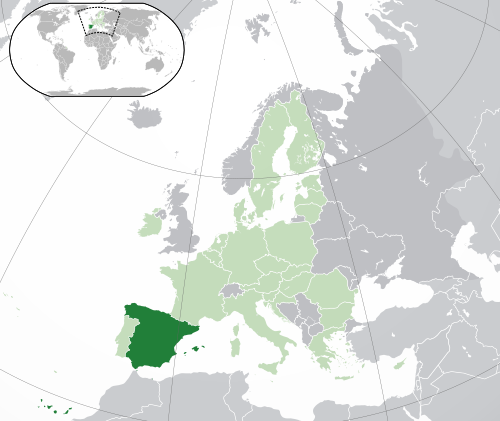 | |
| 資本 そして最大の都市 | マドリード 40°26′N 3°42′W / 40.433°N 3.700°W / 40.433; -3.700 |
| 公用語 | スペイン語[b] [c] |
| 国籍(2024年)[3] | |
| 宗教 (2023年)[4] | |
| 異名 |
|
| 政府 | 単一議会制 立憲君主制 |
• モナーク | フェリペ6世 |
• 首相 | ペドロ・サンチェス |
• 下院議長 | フランシナ・アルメンゴル |
• 上院議長 | ペドロ・ロラン |
| 立法府 | コルテス・ヘネラレス |
• 上院 | 上院 |
• 下院 | 下院議員会議 |
| 形成 | |
• 王朝連合 | 1479年1月20日 |
• 唯一の主権者 | 1516年3月14日 |
• 中央集権国家 | 1715年6月9日 |
• 最初の憲法 | 1812年3月19日 |
• 現憲法 | 1978年12月29日 |
| エリア | |
• 合計 | 505,990 [5] km 2 (195,360平方マイル) ( 51位) |
• 水 (%) | 0.89 [6] |
| 人口 | |
• 2024年の推定 |  48,797,875 [7] ( 31日) 48,797,875 [7] ( 31日) |
• 密度 | 96/km 2 (248.6/平方マイル) ( 121位) |
| GDP (購買力平価) | 2024年推定 |
• 合計 |  2兆5,160億ドル[8](15位) 2兆5,160億ドル[8](15位) |
• 一人当たり | 52,012ドル[8] ( 36位) |
| GDP (名目) | 2024年推定 |
• 合計 | 1兆6,470億ドル[8](15位) |
• 一人当たり | 34,045ドル[8] ( 32位) |
| ジニ (2023) |  31.5 [9] 31.5 [9]中程度の不平等 |
| HDI (2022) | 0.911 [10]非常に高い (27位) |
| 通貨 | ユーロ[d] ( € ) ( EUR ) |
| タイムゾーン | UTC ±0 ~ +1 ( WETおよびCET ) |
• 夏 ( DST ) | UTC +1 から +2 (西ヨーロッパ時間および中央ヨーロッパ夏時間) |
| 注: スペインのほとんどの地域では CET/CEST が観測されますが、カナリア諸島では WET/WEST が観測されます。 | |
| 呼び出しコード | +34 |
| ISO 3166 コード | ES |
| インターネットTLD | .es [英語] |

.svg/500px-Escudo_de_Espa%C3%B1a_(variant).svg.png)
スペイン[f]は、正式にはスペイン王国[a] [g]であり、北アフリカに領土を持つ南西ヨーロッパの国です。[11] [h]南ヨーロッパで最大の国であり、欧州連合加盟国の中で4番目に人口が多い国です。イベリア半島の大部分にまたがり、大西洋のカナリア諸島、地中海のバレアレス諸島、アフリカの自治都市セウタとメリリャも領土に含まれています。スペイン半島は、北はフランス、アンドラ、ビスケー湾、東と南は地中海とジブラルタル、西はポルトガルと大西洋に接しています。スペインの首都で最大の都市はマドリードで、他の主要都市にはバルセロナ、バレンシア、サラゴサなどがあります。
古代初期、イベリア半島にはケルト人、イベリア人、その他のローマ以前の民族が住んでいた。ローマによるイベリア半島の征服により、イスパニア州が設立された。イスパニアのローマ化とキリスト教化に続いて、西ローマ帝国の崩壊により、トレドを中心とする西ゴート王国を形成した西ゴート族を含む中央ヨーロッパからの部族の移住が始まった。8世紀初頭には、半島の大部分がウマイヤ朝に侵略され、イスラム支配の初期には、コルドバを中心とするアルアンダルスが半島の有力な勢力となった。イベリア半島北部には、アストゥリアス、レオン、カスティーリャ、アラゴン、ナバラ、ポルトガルなどのキリスト教王国がいくつか出現した。スペインは断続的に南方への軍事的拡大と人口再流入を行い、レコンキスタとして知られる運動でイベリア半島におけるイスラム支配を撃退し、1492年にキリスト教徒がナスル朝のグラナダ王国を奪取して頂点に達した。1479年にカトリック両王の下でカスティーリャ王冠とアラゴン王冠が王朝統合したことは、国民国家としてのスペインの事実上の統一とよく考えられている。
大航海時代、スペインは新大陸探検の先駆けとなり、初の地球一周航海を成し遂げ、史上最大級の帝国を築き上げた。[12]スペイン帝国は世界的規模に達し、すべての大陸に広がり、主に貴金属を原動力とする世界貿易システムの台頭を支えた。18世紀には、ブルボン家の改革によりスペイン本土が中央集権化された。[13] 19世紀、ナポレオンによる占領とスペイン独立戦争の勝利の後、自由主義者と絶対主義者の間で政治的な分裂が起こり、アメリカ植民地のほとんどが分離した。これらの政治的分裂は最終的に20世紀にスペイン内戦で収束し、1975年まで続いたフランコ独裁政権を生み出した。民主主義の回復と欧州連合への加盟により、国は社会的にも政治的にも大きく変貌する経済成長を経験した。黄金時代以降、スペインの芸術、建築、音楽、詩、絵画、文学、料理は、特に西ヨーロッパとアメリカ大陸で世界中に影響を与えてきました。その豊かな文化的豊かさを反映して、スペインは世界で2番目に訪問者が多い国であり、世界遺産の数も世界有数であり、ヨーロッパからの留学生に最も人気のある留学先でもあります。[14]その文化的影響は6億人を超えるスペイン語圏の人々に及んでおり、スペイン語は世界で2番目に話されている母国語であり、世界で最も広く話されているロマンス語となっています。[15]
スペインは、フェリペ6世国王を国家元首とする世俗的な議会制民主主義および立憲君主制の国である[16]。先進国であり、主要な先進資本主義経済国でもある[17] 。名目GDPでは世界第15位、購買力平価では世界第15位の経済大国である。スペインは、国際連合、欧州連合、ユーロ圏、北大西洋条約機構(NATO)の加盟国であり、 G20の常任理事国であるほか、欧州評議会(CoE)、イベロアメリカ諸国機構(OEI)、地中海連合、経済協力開発機構(OECD)、欧州安全保障協力機構(OSCE)、世界貿易機関(WTO)など、数多くの国際機関に加盟している。
語源
スペイン ( España )の名称は、ローマ帝国時代にローマ人がイベリア半島とその属州に使用した名前であるヒスパニアに由来する。ヒスパニアという用語の語源は定かではないが、フェニキア人はこの地域をスパニア(「ウサギの国」を意味する) と呼んでいたため、最も受け入れられている説はフェニキア説である。[18]その起源については、いくつかの説明と仮説がある。
ヘスス・ルイス・クンチージョスspanという語の語源はフェニキア語のspyであり、「金属を鍛造する」という意味であると主張した。したがって、i-spn-ya は「金属を鍛造する土地」を意味するだろう。[19]これは、スペインが地中海の端に位置していることに由来する、フェニキア語のI-Shpaniaの派生語である可能性があり、「ウサギの島」、「ウサギの土地」、または「端」を意味する。ハドリアヌス帝の治世にこの地域で鋳造されたローマの硬貨には、足元にウサギを連れた女性の姿が描かれている。[20]また、ストラボンはこの地域を「ウサギの土地」と呼んだ。[21]問題の単語は実際には「ハイラックス」を意味し、フェニキア人がこの 2 つの動物を混同したためである可能性がある。[22]
また、「ヒスパニア」は「端」や「境界」を意味するバスク語の「エスパナ」に由来するという主張もあり、これもイベリア半島がヨーロッパ大陸の南西端を構成しているという事実を反映している。[23]
歴史
先史時代とローマ以前の人々

アタプエルカでの考古学的研究によると、イベリア半島には130万年前に人類が住んでいたことが示されています。 [24]
現代人は約35,000年前に北から歩いてイベリア半島に初めて到着しました。[25] [検証に失敗]これらの先史時代の人類居住地の最も有名な遺物は、イベリア半島北部のカンタブリア州アルタミラ洞窟の壁画で、紀元前35,600年から13,500年の間にクロマニョン人によって作成されました。[26] [27]考古学的および遺伝学的証拠は、イベリア半島が最終氷河期の終わりに北ヨーロッパが再定住したいくつかの主要な避難所の1つとして機能したことを示唆しています。
ローマ帝国による征服以前にイベリア半島に住んでいた二大グループは、イベリア人とケルト人であった。イベリア人は半島の地中海側に住んでいた。ケルト人は半島の内陸部と大西洋側の大半に住んでいた。バスク人はピレネー山脈の西部とその隣接地域を占領し、フェニキアの影響を受けたタルテッソスは南西部で繁栄し、ルシタニア人とヴェットーネ人は中央西部の地域を占領した。いくつかの都市はフェニキア人によって海岸沿いに建設され、東にはギリシャ人によって交易拠点と植民地が設立された。最終的に、フェニキア人-カルタゴ人はメセタに向かって内陸に拡大したが、内陸部の好戦的な部族のために、カルタゴ人はイベリア半島の海岸に定住した。
ローマ帝国ヒスパニアと西ゴート王国

第二次ポエニ戦争(紀元前210年から205年頃)の間、拡大を続けるローマ共和国は地中海沿岸のカルタゴ貿易植民地を占領した。ローマ人がイベリア半島の征服を完了するまでにほぼ2世紀を要したが、彼らは6世紀以上にわたってその支配を維持した。ローマの支配は法律、言語、ローマ街道によって結び付けられていた。[28]
ローマ以前の人々の文化は、半島のどの地域に住んでいたかによって異なる速度で徐々にローマ化(ラテン化)され、地元の指導者はローマの貴族階級に受け入れられました。 [i] [29]
ヒスパニアはローマ市場の穀倉地帯として機能し、港からは金、羊毛、オリーブ オイル、ワインなどが輸出された。灌漑事業の導入により農業生産が増加し、その一部は現在でも使用されている。ハドリアヌス帝、トラヤヌス帝、テオドシウス 1 世、哲学者セネカはヒスパニアで生まれた。[j]キリスト教は 1 世紀にヒスパニアに伝わり、2 世紀には都市で普及した。[29]スペインの現在の言語や宗教のほとんど、および法律の基礎はこの時代に由来している。[28] 170 年以降、北アフリカのマウリ族がバエティカ県に侵入した。[30]
.jpg/500px-Coronas_votivas_visigodas_en_el_MAN_(16846328238).jpg)
409年以降、ゲルマン系の スエビ族とヴァンダル族がサルマティア系の アラン族とともに半島に侵入し、西ローマ帝国のヒスパニアに対する管轄権を弱めた。スエビ族はイベリア半島北西部に王国を築き、ヴァンダル族は420年までに半島南部に定着し、429年に北アフリカに渡った。西ローマ帝国が崩壊するにつれ、社会と経済の基盤は大幅に簡素化され、後継政権はキリスト教や進化するローマ文化への同化など、後期ローマ帝国の制度や法律の多くを維持した。
ビザンチン帝国は、イベリア半島全域でローマ支配を復活させる意図で、南部に西方属州スパニアを設立した。しかし、最終的にヒスパニアは西ゴート族の支配下で再統一された。
イスラム時代とレコンキスタ

.jpg/500px-Entrada_de_Roger_de_Flor_en_Constantinopla_(Palacio_del_Senado_de_Espa%C3%B1a).jpg)
711年から718年にかけて、ビザンチン帝国から北アフリカを征服したウマイヤ朝の拡大の一環として、イベリア半島のほぼ全域がジブラルタル海峡を渡ってきたイスラム教徒によって征服され、西ゴート王国は崩壊した。最初の侵略で奪われた領土のうち、半島北部の山岳地帯の小さな地域だけが突出していた。アストゥリアス・レオン王国はこの領土を統合した。北部の山岳地帯にあるナバラやアラゴンなどの他のキリスト教王国は、最終的にカロリング朝のスペイン辺境伯領の郡を統合して台頭した。[31]数世紀の間、半島のイスラム教徒とキリスト教徒の支配地域の間の境界は、エブロ川とドウロ川の谷に沿って変動していた。

イスラム教への改宗は急速に進み、10世紀末までにムラディ(イベリア民族出身のイスラム教徒)がアル・アンダルスの人口の大半を占めるようになったと考えられている。 [32] [33]
9世紀から10世紀にかけて、イベリア半島の海岸はヴァイキングの侵攻によって何度も襲われた。[ 34 ]イベリア半島への最初のヴァイキングの襲撃は844年に記録されているが、ガリシア人のバリスタによって多くのヴァイキングが殺害され、ヴァイキングのロングシップ70隻が海岸で拿捕され、アストゥリアス王ラミロ1世の軍隊によって焼き払われて失敗に終わった。
11世紀、コルドバのカリフ制は崩壊し、一連の小王国(タイファ)に分裂した。[35]これらの王国は、南方への領土拡大を進めていた北部のキリスト教王国に対し、しばしばみかじめ料(パリアス)の支払いを強いられた。1085年に戦略都市トレドが占領されたことで、勢力バランスはキリスト教王国に有利に大きくシフトした。[要出典]北アフリカからイスラム教の支配宗派であるムラービト朝とモハド朝が到来すると、イスラム教徒の支配地域で一時的な統一が達成され、イスラム教はより厳格で寛容さを欠いたものとなった。また、キリスト教徒の領土獲得の一部が覆された。

レオン王国は数世紀にわたって最強のキリスト教王国であった。1188年、ヨーロッパで最初の形態の近代議会(司教、有力者、および「各都市の選出市民」に限定)がレオン(レオン議会)で開催された。[36]レオンの領土から形成されたカスティーリャ王国は、最強の王国としてその後継者となった。この時期、王と貴族は権力と影響力を争った。ローマ皇帝の例は王室の政治的目的に影響を与え、貴族は封建制から利益を得た。
グアダルキビール渓谷のコルドバ(1236年)やセビリア(1248年)などのイスラム教徒の拠点は、 13世紀にカスティーリャ王国に陥落した。バルセロナ伯国とアラゴン王国は王朝連合を組み、地中海の領土と権力を獲得した。1229年にマヨルカ島が征服され、 1238年にはバレンシアも征服された。13世紀と14世紀には、北アフリカのマリーヌ朝がジブラルタル海峡周辺にいくつかの飛び地を築いた。グラナダ戦争の終結後、グラナダのナスル朝(1246年以降イベリア半島に残っていたイスラム教徒の統治国家)は1492年にカトリック両王の軍事力に降伏し、それ以降カスティーリャ王国に統合された。[37]
スペイン帝国

1469年、キリスト教国であったカスティーリャ王国とアラゴン王国は、それぞれの君主であるイサベル1世とフェルナンド2世の結婚により統一された。1492年、ユダヤ人はカトリックへの改宗か追放かの選択を迫られ、[38]カスティーリャ王国とアラゴン王国から20万人ものユダヤ人が追放された。1492年は、イサベル女王の資金援助を受けた航海でクリストファー・コロンブスが新世界に到達した年でもあった。コロンブスの最初の航海は大西洋を横断してカリブ海諸島に到達し、ヨーロッパ人によるアメリカ大陸の探検と征服の始まりとなった。グラナダ条約はイスラム教徒に対する宗教的寛容を保証したが、[39] 1502年にカスティーリャで、1527年にアラゴンでイスラム教が非合法化されるまでの数年間、残っていたイスラム教徒は名目上キリスト教徒のモリスコとなった。アルプハラ戦争(1568-1571)から約40年後、30万人以上のモリスコが追放され、主に北アフリカに定住した。[40]
.svg/500px-Spanish_Empire_(diachronic).svg.png)
アラゴン王国とカスティーリャ王国の君主同士の結婚による統一は、現代のスペインとスペイン帝国の基礎を築いたが、スペインの各王国は社会的、政治的、法的、通貨や言語の面で別々の国のままであった。[41] [42]
ハプスブルク家のスペインは16世紀から17世紀の大半にかけて世界有数の強国であり、貿易と植民地からの富によってその地位は強化され、世界有数の海洋国家となった。スペインは最初の2人のハプスブルク家、カール5世/1世(1516年 - 1556年)とフェリペ2世(1556年 - 1598年)の治世中に最盛期を迎えた。この時期には、イタリア戦争、シュマルカルデン戦争、ネーデルラント反乱、ポルトガル継承戦争、オスマン帝国との衝突、フランス宗教戦争への介入、英西戦争があった。[43]

探検と征服、あるいは王族の婚姻による同盟や相続を通じて、スペイン帝国はアメリカ大陸、インド太平洋、アフリカ、そしてヨーロッパ大陸(イタリア半島、低地諸国、フランシュ=コンテの領有を含む)の広大な地域に拡大していった。いわゆる大航海時代は、海と陸からの探検、大洋を越えた新しい貿易ルートの開拓、征服、そしてヨーロッパによる植民地主義の始まりを特徴としていた。貴金属、香辛料、贅沢品、そしてそれまで知られていなかった植物が本拠地にもたらされ、ヨーロッパ人の地球に対する認識を変える上で主要な役割を果たした。[44]この時期に目撃された文化の開花は、現在ではスペインの黄金時代と呼ばれている。帝国の拡大はアメリカ大陸に甚大な混乱を引き起こし、社会と帝国の崩壊、そしてヨーロッパから来た新たな病気がアメリカの先住民を壊滅させた。ヒューマニズムの台頭、対抗宗教改革、新たな地理的発見と征服によって、現在サラマンカ学派として知られる知的運動によって取り組まれた問題が浮上し、現在国際法と人権 として知られる最初の近代理論が生み出されました。
16世紀のスペインの海洋覇権は、1571年のレパントの海戦におけるオスマン帝国に対する勝利、1582年のポンタ・デルガーダの海戦におけるポルトガルに対する勝利、そして1588年のスペイン無敵艦隊の敗北後の1585年~1604年の英西戦争におけるイングランドに対する一連の勝利によって実証された。しかし、17世紀中頃の数十年間、スペインの海洋力はネーデルラント共和国(ダウンズの戦い)に対する敗北、続いて1654年~1660年の英西戦争でのイングランドに対する敗北を重ね、長期にわたる衰退期に入った。1660年代までには、スペインは海賊や私掠船から海外領土を守るのに苦労していた。
宗教改革により、スペインは宗教色の強い戦争に関与する機会が増え、ヨーロッパ全土と地中海地域で軍事活動を拡大せざるを得なくなった。[45]戦争と疫病に見舞われた17世紀ヨーロッパの中頃の数十年までに、スペイン・ハプスブルク家は、大陸規模の宗教的・政治的紛争に国を巻き込んでいた。これらの紛争で資源が枯渇し、経済全体が衰退した。スペインは、散在するハプスブルク帝国の大半をなんとか保持し、神聖ローマ帝国の帝国軍がプロテスタント勢力の前進の大部分を覆すのを支援したが、最終的にはポルトガルとオランダ連邦共和国の分離を認めざるを得なくなり、ヨーロッパ全土で甚大な破壊をもたらした三十年戦争の後半には、フランスに対して深刻な軍事的敗北を喫した。[46] 17世紀後半、スペインは徐々に衰退し、フランスとイギリスにいくつかの小さな領土を明け渡しましたが、広大な海外帝国を維持し拡大し、19世紀初頭までその帝国は維持されました。
18世紀
.jpg/500px-La_familia_de_Felipe_V_(Van_Loo).jpg)
衰退は18世紀初頭の数年間に及ぶ王位継承をめぐる論争にまで発展した。スペイン継承戦争は内戦を伴った広範囲にわたる国際紛争であり、王国はヨーロッパの領土とヨーロッパの主要国としての地位を失うことになった。[47]
この戦争中に、フランス発祥の新しい王朝、ブルボン家が樹立された。カスティーリャ王国とアラゴン王国は、長い間、王政と異端審問所の聖務省という共通機関によってのみ統一されていた。[48]王政は、権力の集中と行政の統一という包括的な目標を掲げ、数多くの改革政策(いわゆるブルボン改革)を追求した。 [49]改革には、多くの古い地方特権と法律の廃止、[50]や、1717年のアラゴン王国とカスティーリャ王国間の関税障壁の撤廃、それに続くアラゴン王国における新たな財産税の導入が含まれていた。[51]
18世紀には、帝国の多くの地域で徐々に復興と繁栄が進んだ。支配的な経済政策は介入主義的なもので、国家はインフラ開発、国内関税の廃止、輸出関税の引き下げを目指す政策も推進した。[52]スペイン本土南部では、新しい入植地の建設による農業植民地化プロジェクトが行われた。[53]王国のエリート層と王室の一部で 啓蒙思想が広まり始めた。
自由主義と国民国家


.jpg/500px-Fusilamiento_de_Torrijos_(Gisbert).jpg)
1793年、スペインは第一次対仏大同盟の一員として、革命を起こしたばかりのフランス共和国と戦争をした。その後のピレネー戦争では、フランス化したエリート層に対する反発から国内が二極化し、戦場での敗北の後、1795年にフランスと和平が成立したが、この和平でスペインはイスパニョーラ島の3分の2の支配権を失った。1807年、ナポレオンと人気のない首相との間で秘密条約が結ばれ、イギリスとポルトガルに対する新たな宣戦布告がなされた。フランス軍はポルトガル侵攻のためスペインに侵入したが、代わりにスペインの主要な要塞を占領した。スペイン国王は退位し、フランス帝国の衛星国である傀儡王国が樹立され、ジョゼフ・ボナパルトが国王となった。
1808年5月2日の反乱は、フランス占領に対する全国的な反乱の一つであった。[54]これらの反乱は、ナポレオン政権に対する壊滅的な独立戦争の始まりとなった。 [55]スペイン軍、ゲリラ戦、英葡同盟軍によるさらなる軍事行動と、ロシア戦線でのナポレオンの失敗が相まって、1814年にフランス帝国軍はイベリア半島から撤退し、フェルディナンド7世が帰国した。[56]
戦争中の1810年、革命組織であるカディス議会が召集され、ボナパルティスト政権に対抗する取り組みを調整し、憲法を準備した。[57]この議会は1つの組織として会合し、そのメンバーはスペイン帝国全体を代表した。[58] 1812年、立憲君主制の下での普遍的な代表制のための憲法が宣言されたが、ボナパルティスト政権の崩壊後、スペイン国王は絶対君主として統治することを決意し、カディス議会を解散した。

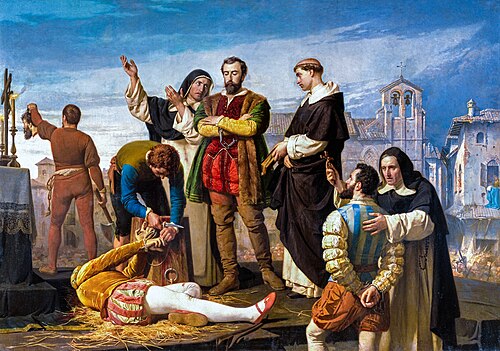
フランスによるスペイン本土の占領は、半島のエリート層に対する特権に憤慨し、主権の人民への返還を要求する海外のクリオーリョ・エリート層に好機をもたらした。1809年以降、アメリカ植民地は一連の革命を開始して独立を宣言し、スペイン本土に対する本土の支配に終止符を打った米西独立戦争に至った。支配権を再び主張する試みは、植民地だけでなくイベリア半島でも反対があり、軍の反乱が続いたため無駄に終わった。1826年末までに、スペインが保持していたアメリカ植民地はキューバとプエルトリコのみとなった。ナポレオン戦争により、スペインは経済的に破綻し、深刻な分裂と政情不安に陥った。 1830年代から1840年代にかけて、カルリスタ(ブルボン家の別系統を支持する反動的な正統主義運動)は、カルリスタ戦争でイサベル2世女王の王権を支持する政府軍と戦った。政府軍が勝利したが、進歩派と穏健派の対立は脆弱な初期憲政時代に終わった。1868年の名誉革命に続いて、1868年から1874年にかけて進歩的なセクセニオ・デモクラティコ(短命だったスペイン第一共和国を含む)が続き、安定した王政復古(1875年–1931年)の時代が到来した。[59]

19世紀後半、フィリピンとキューバで民族主義運動が勃発した。1895年と1896年にはキューバ独立戦争とフィリピン革命が勃発し、最終的に米国が関与することになった。 1898年春には米西戦争が勃発し、スペインは北アフリカ以外にあったかつての広大な植民地帝国の最後の領土を失った。スペインで「エル・デサストレ(惨事)」として知られるようになったこの戦争は、1998年世代にさらなる勢いを与えた。世紀の変わり目は繁栄が増した時期だったが、20世紀に社会的な平和はほとんどもたらされなかった。スペインはアフリカの奪い合いにおいて小さな役割しか果たさなかった。第一次世界大戦中は中立を保った。モロッコ北部でのリフィアン軍との衝突で植民地軍が大きな損失を被ったことで、政府の信用は失墜し、王政は弱体化した。

スペイン国内の多くの地域、特にバルセロナでは、工業化、鉄道の発達、資本主義の萌芽が進み、労働運動や社会主義、無政府主義の思想も生まれた。1870年のバルセロナ労働者会議や1888年のバルセロナ万国博覧会はその好例である。1879年、スペイン社会主義労働者党が設立された。この党と連携した労働組合、労働者総連合は1888年に設立された。スペインの労働運動のアナルコ・サンディカリズムの流れの中で、1910年に全国労働者連合が、1927年にはイベリコ・アナルキスタ連盟が設立された。
カタロニア主義とバスク主義は、スペインにおける他の民族主義や地域主義とともに、この時期に生まれました。バスク民族主義党は1895 年に、カタロニア地域主義連盟は1901 年に結成されました。
政治腐敗と弾圧は二大政党制の立憲君主制の民主主義体制を弱体化させた。[60] 1909年7月の悲劇週間の事件と弾圧は当時の社会的不安定さを象徴していた。

1919年のラ・カナディエンセのストライキにより、労働時間を1日8時間に制限する最初の法律が制定された。[61]
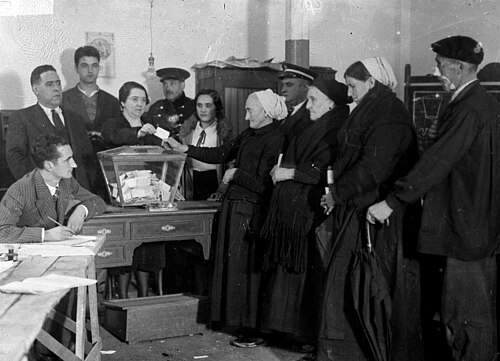
1923年から1931年にかけて国王が支援する独裁政権の期間の後、1923年以来初の選挙、つまり君主制に関する国民投票として1931年4月12日の市議会選挙が行われた。この選挙では、大都市と州都で共和社会党の候補者が圧勝し、地方では君主制派の議員が多数を占めた。国王は国を離れ、4月14日に共和国が宣言され、臨時政府が樹立された。
1931年6月の制憲総選挙後の10月に憲法が可決され、共和党と社会労働党の支持を受けたマヌエル・アサニャ首相による一連の内閣が続いた。1933年の選挙では右派が勝利し、1936年には左派が勝利した。第二共和制の時代には、左派と右派の急激な過激化を特徴とする大きな政治的、社会的激変があった。この時期の政治的暴力の例には、教会の焼き討ち、1932年のホセ・サンフホ率いるクーデター未遂、1934年の革命、対立する政治指導者に対する数々の襲撃などがある。一方、民主的な憲法、農地改革、軍隊の再編、政治的地方分権、女性参政権など、国の近代化に向けた重要な改革が開始されたのも第二共和制の時代である。
内戦とフランコ独裁政権
1936年にスペイン内戦が勃発した。7月17日と18日、軍の一部がクーデターを起こしたが、勝利したのは国土の一部のみであった。この状況は内戦につながり、領土は2つの地域に分割された。1つはソ連とメキシコ(および国際旅団)からの外部支援を当てにする共和政府支配下、もう1つはナチスドイツとファシストイタリアから最も批判的に支援されたクーデター派(国民党または反乱軍)が支配した。イギリス主導の不干渉政策のため、西側諸国は共和国を支持しなかった。 1936年10月1日、フランシスコ・フランコ将軍が反乱軍の最高指導者に就任した。部分的な社会革命を起こした草の根のアナキストと共和政府との間にも不安定な関係が続いた。

内戦は残忍に戦われ、すべての側で多くの残虐行為が行われた。この戦争で50万人以上が死亡し、50万人もの国民が国外に逃亡した。[62] [63] 1939年4月1日、第二次世界大戦勃発の5か月前に、フランコ率いる反乱軍が勝利し、国全体に独裁政権を敷いた。内戦後、数千人がフランコ政権の強制収容所に収監された。
フランコ政権は第二次世界大戦の大半で名目上「中立」を保っていたが、枢軸国に同情的で、東部戦線でナチス国防軍にスペイン義勇兵を提供していた。フランコ独裁政権下で唯一合法だった政党は、ファシストのスペイン伝統党とカルリスタ伝統主義者の合併により1937年に結成され、反乱軍を支持する他の右翼団体も加わった「スペイン伝統党およびホンス党」(FET y de las JONS) だった。「国民運動」の名称は、FET y de las JONS そのものよりも広い組織として理解されることもあり、1950年代の公式文書では主に後者の名称に押し付けられた。
.jpg/500px-Meeting_at_Hendaye_(en.wiki).jpg)
戦後、スペインは政治的にも経済的にも孤立し、国連にも加盟できなかった。しかし、冷戦期の1955年に状況が一変し、ソ連が地中海域に進出してきた場合に備え、米国にとってイベリア半島に軍事的プレゼンスを確立することが戦略的に重要となった。米国の冷戦における戦略的優先事項には、近代化と拡張を促進するための米国の教育理念の普及が含まれていた。[64] 1960年代、スペインは工業化、地方からマドリード、バルセロナ、バスク地方への大規模な国内移住、大規模な観光産業の創出によって、前例のない経済成長を記録した。フランコの統治は、権威主義、統一的な国民的アイデンティティの推進、国民カトリック、差別的な言語政策によっても特徴づけられた。
民主主義の回復

1962年、フランコ政権に反対する国内外の政治家グループがミュンヘンの欧州運動会議に集まり、民主主義を支持する決議を採択した。[65] [66] [67]
1975年11月にフランコが死去すると、フランコ法に基づきフアン・カルロスがスペイン国王および国家元首の地位を継承した。 1978年の新スペイン憲法の承認と民主主義の回復により、国家は多くの権限を地域に委譲し、自治共同体に基づく国内組織を創設した。1977年のスペイン恩赦法により、フランコ政権の人々は、1976年3月3日のビトリアでの虐殺や1977年のアトーチャの虐殺など、民主主義への移行期に起きた犯罪の加害者でさえ、何の責任も負わずに機関内に留まることができた。
バスク地方では、穏健なバスク民族主義と武装組織ETAが率いる過激な民族主義運動が、2018年5月にETAが解散するまで共存していた。 [68]このグループはフランコ政権下の1959年に結成されたが、民主主義が回復し、かなりの程度の地方自治権が回復した後も暴力的な運動を続けていた。
1981年2月23日、治安部隊内の反乱分子がコルテスを占拠し、軍の支援を受けた政府を樹立しようとした。フアン・カルロス国王は自ら軍の指揮を執り、国営テレビを通じてクーデター計画者に降伏を命じることに成功した。[69]

1980年代には、民主主義の回復によって開かれた社会が拡大した。マドリード運動など、自由に基づいた新しい文化運動が出現した。1982年5月、スペインはNATOに加盟し、その後、強い社会的反対を受けた国民投票が行われた。その年、スペイン社会労働党(PSOE)が政権を握り、43年ぶりの左派政権となった。1986年、スペインは欧州経済共同体(後の欧州連合)に加盟した。フェリペ・ゴンサレス政権によるETAに対する汚い戦争への参加をめぐるスキャンダルの後、1996年にPSOEは国民党(PP)に政権を交代した。

2002年1月1日、スペインはユーロを全面的に導入し、2000年代初頭のEU平均を大きく上回る力強い経済成長を遂げた。しかし、好景気の絶頂期には多くの経済評論家が、異常な不動産価格と巨額の貿易赤字が痛みを伴う経済崩壊につながる可能性が高いと警告し、広く報道された。[70]
2002年、プレスティージュ号の原油流出事故が発生し、スペインの大西洋沿岸で大きな生態系被害をもたらした。2003年、ホセ・マリア・アスナールはイラク戦争でジョージ・W・ブッシュ米大統領を支持し、スペイン社会では反戦運動が強く高まった。2004年3月、アルカイダに影響を受けた地元のイスラム過激派グループがマドリードの通勤電車を爆破し、西欧史上最大のテロ攻撃を実行し、191人が死亡、1,800人以上が負傷した。[71]当初はバスク地方のテロ組織ETAに疑惑が向けられたが、すぐにイスラム主義者の関与の証拠が浮上した。 2004年のスペイン総選挙が近かったため、責任追及の問題はすぐに政治的論争となり、主要競合政党のPPとPSOEが事件の処理をめぐって非難の応酬となった。[72]ホセ・ルイス・ロドリゲス・サパテロ率いるPSOEが選挙に勝利した。[73]
2000年代初頭、スペインの外国生まれの人口の割合は経済成長中に急増したが、その後金融危機により減少した。[74] 2005年、スペイン政府は同性婚を合法化し、世界で3番目に同性婚を合法化した国となった。[75]地方分権化は憲法裁判所と保守派の抵抗に遭いながらも支持され、クォータ制や性暴力禁止法などのジェンダー政策も同様であった。政府はETAと協議し、同グループは2010年に暴力の永久停止を発表した。[76]
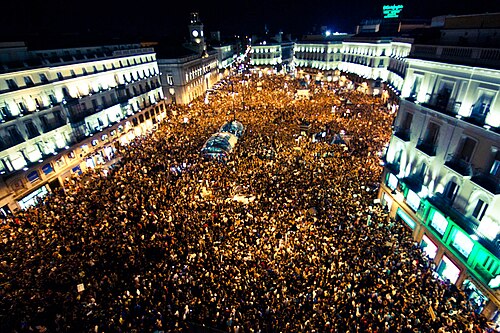
2008年のスペインの不動産バブルの崩壊は、2008年から2016年にかけてのスペインの金融危機につながった。高水準の失業、政府支出の削減、王室と人民党の汚職は、2011年から2012年にかけてのスペインの抗議運動の背景となった。[77] カタルーニャ独立主義も高まった。2011年、マリアーノ・ラホイ率いる保守的な人民党は44.6%の票を獲得して選挙に勝利した。[78]首相として、彼はEU救済のための緊縮財政、EU安定成長協定を実施した。[79] 2014年6月19日、フアン・カルロス国王は息子のフェリペ6世に王位を譲った。[80]
2017年10月、カタルーニャ独立住民投票が行われ、カタルーニャ議会はスペインからの独立を一方的に宣言し、カタルーニャ共和国を樹立することを決議した[81] [82]。これはスペイン上院がスペイン首相の要請に応じてカタルーニャの直接統治を承認するかどうかを議論していた日であった[83] [84] 。同日、上院は直接統治を課す権限を付与し、ラホイ首相はカタルーニャ議会を解散して新選挙を呼びかけました[85]。どの国もカタルーニャを独立国家として承認しませんでした[86] 。
_-_1.jpg/500px-Primera_trobada_entre_el_president_Illa_i_l'alcalde_Collboni_(23-08-2024)_-_1.jpg)
2018年6月、下院はラホイ首相に対する不信任決議を可決し、後任に社会労働党のペドロ・サンチェス党首を据えた。[87] 2019年には、社会労働党とウニダス・ポデモスの間でスペイン初の連立政権が発足した。2018年から2024年にかけて、スペインは司法総評議会(CGPJ)の権限をめぐる制度的危機に直面したが、最終的に権限は刷新された。[88] 2020年1月、COVID-19ウイルスがスペインに広がっていることが確認され、平均寿命が1年以上低下した。[89]欧州委員会の経済回復パッケージ「次世代EU」は、EU加盟国がCOVID-19パンデミックから回復するのを支援するために作成され、2021年から2026年まで使用される予定。2021年3月、スペインは積極的安楽死を合法化した世界で6番目の国となった。[90] 2023年7月23日の総選挙後、ペドロ・サンチェス首相は再び連立政権を組んだが、今回はスマル(ウニダス・ポデモスの後継者)と組んだ。[91] 2024年には、10年以上ぶりに非独立派のカタルーニャ州知事サルバドール・イジャが選出され、国と地方行政の憲法上および制度上の関係が正常化された。最新の世論調査によると、[92]カタルーニャ人のわずか17.3%が自分たちを「カタルーニャ人」だと感じている。カタルーニャ人の46%は「カタルーニャ人と同じくらいスペイン人」、21.8%は「スペイン人よりカタルーニャ人」と答えた。[93]バルセロナ大学の2024年の世論調査によると、カタルーニャ人の50%以上が独立に反対し、40%未満が独立に賛成するとのことだ。[94]
地理

スペインは面積が505,992 km 2 (195,365 平方マイル)で、世界で51番目に大きい国であり、ヨーロッパで4番目に大きい国です。フランスより約47,000 km 2 (18,000 平方マイル)小さいです。標高3,715 m (12,188 フィート)のテイデ山(テネリフェ島) はスペインで最も高い山で、麓から見ると世界で3番目に大きい火山です。スペインは大陸横断国であり、ヨーロッパとアフリカの両方に領土を持っています。
スペインは、北緯27度から44度、西経19度から東経5度の間に位置しています。
スペインは西側でポルトガルと国境を接し、南側では北アフリカの飛び地(セウタ、メリリャ、ベレス・デ・ラ・ゴメラ半島)を介してジブラルタルとモロッコと国境を接しています。北東側はピレネー山脈に沿ってフランスとアンドラと国境を接しています。ジローナのピレネー山脈沿いには、フランスに囲まれたリビアという小さな飛び地の町があります。
ポルトガルとスペインの国境は1,214km(754マイル)に及び、欧州連合内で最も長い連続した国境である。[95]
島々
.jpeg/500px-Mallorca_Sch%C3%B6nste_Str%C3%A4nde_Cala_D_Or_(181610303).jpeg)
スペインには、地中海のバレアレス諸島、大西洋のカナリア諸島、チャファリナス諸島やアルフセマスなど、ジブラルタル海峡の地中海側にあるプラザ・デ・ソベラニア(「主権の場所」、スペインの主権下にある領土)として知られる無人島も含まれています。ベレス・デ・ラ・ゴメラ半島もプラザ・デ・ソベラニアと見なされています。スペインと北アフリカの間の地中海に位置するアルボラン島もスペイン、具体的にはアンダルシア州アルメリア市によって管理されています。ビダソア川の小さなフェザント島は、スペインとフランスの共同所有地です。
スペインには11の主要な島があり、それぞれに統治機関がある(カナリア諸島には島議会、バレアレス諸島には島民評議会)。これらの島々は、スペイン憲法で上院議員の選出の際に特に言及されている(イビサ島とフォルメンテーラ島はピティウス諸島としてまとめられ、バレアレス諸島の一部となっている)。これらの島々には、カナリア諸島のテネリフェ島、グラン・カナリア島、ランサローテ島、フエルテベントゥラ島、ラ・パルマ島、ラ・ゴメラ島、エル・イエロ島、バレアレス諸島の マヨルカ島、イビサ島、メノルカ島、フォルメンテーラ島が含まれる。
山と川
.jpg/500px-Teide_von_Nordosten_(Zuschnitt_1).jpg)
スペイン本土は、高原と山脈が大部分を占める、山がちな陸地です。ピレネー山脈に次ぐ主な山脈は、カンタブリア山脈、イベリア山脈、セントラル山脈、トレド山、シエラ・モレナ山脈、ベティコ山脈で、ベティコ山脈の最高峰は、シエラネバダ山脈にある標高3,478メートルのムラセン山で、イベリア半島の最高標高となっています。スペインの最高地点は、カナリア諸島にある標高3,718メートルの活火山テイデ山です。メセタ・セントラル(「内なる高原」と訳されることが多い)は、スペイン半島の中心部にある広大な高原で、システマ・セントラルによって 2 つに分割されています。
スペインにはテージョ川( Tajo )、エブロ川、グアディアナ川、ドウロ川( Duero )、グアダルキビル川、フカル川、セグラ川、トゥリア川、ミーニョ川(ミーニョ川)などの主要な川がいくつかあります。海岸沿いには沖積平野が見られ、最大の平野はアンダルシアのグアダルキビルです。
気候


地理的状況と地形条件に応じて、3つの主要な気候帯に分けることができます。 [96]
- 地中海性気候は、暖かくて暑く乾燥した夏が特徴で、この国の主な気候です。ケッペンの気候区分によると、CsaとCsb の2 種類があります。
- Csaゾーンは、暑い夏のある地域と関連しています。このゾーンは、地中海南部 (南東部を除く) と大西洋南部の海岸、およびアンダルシア、エストレマドゥーラ、および国の中心部の大部分の内陸部に広く見られます。Csa の一部の地域、主に内陸部の地域、たとえばエストレマドゥーラ、カスティーリャ・ラ・マンチャ、マドリード、さらにはアンダルシアの一部では、冬は大陸性気候の影響を多少受けて涼しい一方、海に近い地中海性気候の地域では冬は穏やかです。
- Csbゾーンは、暑いというよりは暖かい夏で、スペインの中央部と北中部の大部分 (例: カスティーリャ・レオン州西部、カスティーリャ・ラ・マンチャ州北東部、マドリード北部) や、より雨の多い地域 (特にガリシア) など、地中海性気候に通常関連しない涼しい冬の地域にまで広がっています。
- 半乾燥気候( BSk 、 BSh )は、スペインの南東部で優勢ですが、スペインの他の地域にも広く見られます。この気候は、ムルシア州の大部分、バレンシア南部および中東部、アンダルシア東部、カスティーリャ・ラ・マンチャ州のさまざまな地域、マドリード、エストレマドゥーラ州の一部で見られます。さらに北では、ナバラ南部、アラゴン中部、カタルーニャ西部を横切るエブロ川渓谷の上流および中流域で優勢です。また、アンダルシア北部の小さな地域とカスティーリャ・レオン中部の小さな地域でも見られます。降水量は少なく、乾季は夏を過ぎても続き、平均気温は高度と緯度によって異なります。
- 海洋性気候( Cfb ) は、国の北部、特に大西洋沿岸地域 (バスク州、カンタブリア州、アストゥリアス州、 ガリシア州 と カスティーリャ・レオン州 の一部 ) に分布しています。また、ナバラ州北部、イベリア山脈沿いの高地のほとんど、ピレネー山脈の渓谷にも分布しており、ピレネー山脈の渓谷では湿潤亜熱帯性気候 ( Cfa ) も見られます。冬と夏の気温は海洋の影響を受け、季節的な干ばつはありません。
これらの主なタイプの他に、標高が非常に高い地域のアルプス性気候、スペイン北東部の湿潤亜熱帯気候、ピレネー山脈やカンタブリア山脈、中央システム、シエラネバダ山脈、イベリアシステムの一部の大陸性気候( Dfc、Dfb / Dsc、Dsb )、アルメリア、ムルシア、カナリア諸島東部の地域の典型的な砂漠気候( BWk、BWh )などのサブタイプも見られます。カナリア諸島の低地は、最も涼しい月でも平均気温が 18.0 °C (64.4 °F) を超え、熱帯気候の影響を受けていますが、AEMET によると乾燥度が高く、乾燥または半乾燥気候に属するため、熱帯気候として適切に分類することはできません。[97]
気候変動
スペインは、ヨーロッパで気候危機の影響を最も受けている国の一つです。スペインは、今後20年間で産業革命前の水準に比べて2℃(3.6℉)の温暖化が見込まれ、最悪のシナリオでは今世紀末までに4℃(7.2℉)の温暖化に達するでしょう。降雨量の減少により、すでにヨーロッパで最悪の干ばつの一つとなっているスペインの干ばつは、2023年と比較して10倍悪化するでしょう。WHOは、スペインで2022年に熱中症によるストレスで4,000人が死亡したと推定しています。[98]国土の74%が砂漠化の危険にさらされています[99]
スペインの一人当たり排出量は2021年に4.92トンで、EU平均より約1.5トン低い。スペインは2021年に世界の累積排出量の0.87%を占めた。スペインは2030年までに1990年比で排出量を23%削減し、2050年までに排出量を実質ゼロにすることを約束した。[100]
動物と植物

動物相は、主に大西洋と地中海の間、アフリカとユーラシアの間に位置するイベリア半島の地理的位置と、多様な気候と明確に分化した地域に起因する生息地と生息域の多様性に起因して、多種多様な生物が生息しています。
スペインの植生は、地形、気候、緯度の多様性など、いくつかの要因により多様です。スペインにはさまざまな植物地理学的地域があり、それぞれが気候、地形、土壌の種類と火災、生物的要因の相互作用から生じる独自の花の特徴を持っています。スペインの2019年の森林景観完全性指数の平均スコアは4.23/10で、172か国中130位にランクされています。[101]
ヨーロッパ領土内では、スペインはヨーロッパ諸国の中で最も多くの植物種(7,600種の維管束植物)を保有しています。[102]
スペインには178億400万本の樹木があり、毎年平均2億8400万本が新たに成長しています。[103]
政治
スペインの憲法史は1812年の憲法に遡る。1976年6月、スペインの新国王フアン・カルロスはカルロス・アリアス・ナバロを解任し、改革派のアドルフォ・スアレスを首相に任命した。[104] [105]その結果、1977年の総選挙で、1978年の憲法を起草し承認する目的で制憲議会(憲法制定議会としてのスペイン議会)が招集された。 [106] 1978年12月6日の国民投票で、88%の有権者が新憲法を承認した。その結果、スペインは一党独裁から17の自治州と2つの自治市からなる複数党制 議会制民主主義へと移行した。これらの地域はスペイン憲法のおかげでさまざまな程度の自治権を享受しているが、それでもスペイン国家の不可分な統一が明確に述べられている。
ガバナンス
ザ・クラウン
国王の独立性、政治的中立性、そして異なるイデオロギー的立場を受け入れて調和させようとする意志は、私たちの政治体制の安定に貢献し、他の憲法機関や地域機関とのバランスを促進し、国家の秩序ある機能を促進し、スペイン人の間に結束の道筋を提供することを可能にしている。[107]
フェリペ6世、2014年
スペイン憲法は、五つの政府部門間の権力分立を規定しており、これを「基本的な国家機関」と呼んでいる。[k] [108] [109]これらの機関の中で最も重要なのは、スペイン国家とその永続性の象徴である王冠(ラ・コロナ)である。 [110]スペインの「議会君主制」は立憲君主制であり、在位中の国王または女王が王冠の体現者であり、したがって国家元首である。[l] [111] [110] [112]しかし、ベルギー、デンマーク、ルクセンブルク、オランダ、ノルウェー、さらには英国などの他の立憲君主制とは異なり、君主は国家主権の源泉ではなく、名目上の最高行政官でさえない。[113] [114] [115] [116] [117] [118]むしろ、国王は機関として「スペイン国家の諸機関の通常の機能を仲裁し、調整する」。[110]このように、君主は異なる部門間の紛争を解決し、憲法上の危機を調停し、権力の濫用を防ぐ。[119] [120] [121] [122]
これらの点で、国王は、公共政策を立案したり、公共サービスを管理したりしない第5の調整部門を構成しており、これらの機能は、スペインの正当に選出された国会と、国レベルと地域レベルの両方で政府が正当に担っています。代わりに、国王は民主的なスペイン国家を体現し、正当な権威を認可し、手段の合法性を確保し、民意の執行を保証します。[123] [124]言い換えれば、君主は国内で国民の団結を促進し、海外でスペイン人を代表し(特に歴史的共同体の国々に関して)、スペイン政府の秩序ある運営と継続を促進し、代議制民主主義を擁護し、法の支配を維持します。[109]言い換えれば、国王はスペイン憲法とすべてのスペイン人の権利と自由の守護者です。[125] [m]この安定化の役割は、即位時に君主が厳粛に宣誓した「…職務を忠実に遂行し、憲法と法律を遵守し、それらが遵守されることを確保し、市民と自治共同体の権利を尊重する」という誓約に沿ったものである。[127]
国家元首としての君主には、憲法上の権力、義務、権利、責任、機能が数多く割り当てられている。しかし、王位はこれらの大権の行使において不可侵であり、王位の名の下に司法を執行する裁判所において訴追されることはない。 [128]このため、君主が行うすべての公的な行為は、首相、または適切な場合には代議院議長の副署がなければ法的効力を持たない。副署手続き、すなわちレフレンドは、王位の大権に関する政治的および法的責任を証明当事者に移転する。[129]この規定は、君主が絶対的な統制と監督権を持つ王室や、ブルボン=アンジュー家が個人的に贈与した王朝の勲章である金羊毛騎士団の会員には適用されない。[130]
国王大権は、内閣行為か留保権かで分類できる。内閣行為とは、フアン・カルロス1世が定めた慣例に従い、政府、下院、上院、司法総評議会、または憲法裁判所の助言を求めた上で君主が行使する国王大権である。一方、国王の留保権とは、君主の個人的な裁量で行使される国王大権である。[125]国王の大権のほとんどは実際には内閣行為であり、つまり、君主はそれらの執行に関して裁量を持たず、主に国家儀式としてそれらを行使する。[p]それでも、前記内閣行為を行使する場合、君主は助言に基づいて行動する前に相談を受ける権利、特定の行動方針を奨励する権利、責任ある憲法当局に警告する権利を有する。
前述の制限は国王の予備権には適用されず、国王は国家機関の継続性と安定性を維持するために必要な場合にこれを行使することができる。 [150]たとえば、国王は政府との定期的な謁見を通じて国事について情報を得る権利を有する。この目的のため、国王はいつでも閣僚会議の議長を務めることができるが、首相の要請があった場合に限られる。[151]さらに、国王は4年の任期が満了する前に代議院、上院、または両院の議会全体を早期に解散し、その結果として同時に総選挙を要請することができる。国王はこの特権を、閣僚会議で問題が議論された後、首相の要請に基づいて行使する。国王は要請を受け入れるか拒否するかを選択できる。[152]君主は首相の要請に基づいて国民投票を命じることもできるが、それは議会の事前の許可がある場合に限られる。この場合も、君主は首相の要請を受け入れるか拒否するかを選択できる。[153]
国王の留保権は、憲法解釈と司法行政にまで及んでいる。君主は司法評議会の20名のメンバーを任命する。これらの顧問のうち、12名は最高裁判所、控訴裁判所、第一審裁判所によって指名され、4名は代議院議員の5分の3の多数決で指名され、4名は上院で同じ多数決で指名される。君主はどの指名も受け入れるか拒否するかを選択できる。[154]同様に、君主は憲法裁判所の12名の裁判官を任命する。これらの裁判官のうち、4人は代議院議員の5分の3以上の多数決で指名され、4人は上院で同じ多数決で指名され、2人は政府で指名され、2人は司法評議会で指名される。国王は指名を受け入れるか拒否するかを選択できる。[155]
しかし、おそらく最も頻繁に行使されるのは、政府樹立に関する君主の留保権である。君主は首相候補を指名し、場合によっては、首相が代議院の信任を維持できるかどうかに基づいて、その候補者を任命または解任する。[156]代議院が2か月以内に新政府に信任を与えず、議会の膠着状態により統治能力がなくなった場合、君主は議会を解散し、新たな選挙を要請することができる。君主は代議院議長と協議した後、自らの熟慮の上でこれらの留保権を使用する。[157]
コルテス・ヘネラレス

立法権はスペイン国民の最高代表機関として民主的に選出された二院制議会であるスペイン議会(Cortes Generales 、英語: Spanish Parliament、直訳すると 「一般裁判所」)にある。国王を除けば、スペイン議会は不可侵性を享受する唯一の基本的な国家機関である。 [158]議会は、350人の議員で構成される下院である代議院(Congreso de los Diputados)と、259人の上院である上院(Senado)から構成される。 [159] [160]代議士は、比例代表制による限定名簿による一般投票 で選出され、任期は4年である。[161]一方、208人の上院議員は、制限投票方式による一般投票で直接選出され、残りの51人の上院議員も4年の任期で地方議会によって任命される。[162]
政府
行政権は政府(Gobierno de España )にあり、政府は下院に対して集団的に責任を負う。 [163] [164]政府は首相、1人以上の副首相、および様々な国務大臣で構成される。[165]これらの人物が一緒になって内閣を構成し、内閣はスペインの中央行政権として政府の業務を遂行し、公務員を管理する。[166]政府は下院の 信任を維持できる限り政権を維持する。
首相は政府の長として、他の大臣の任命と解任について国王に助言する権限を有し、他の大臣に対して優位に立つ。 [167]さらに、首相はスペイン憲法によって政府の政策と行政活動を指導し調整する全権を付与されている。[168]スペイン国王は、さまざまな議会グループの代表者と協議した後、首相を指名し、代議院での任命投票によって正式に任命する。 [169]
行政区分
自治コミュニティ

スペインの自治州は、国の第一レベルの行政区画である。自治州は、現在の憲法が発効した後(1978年)、「スペインの民族と地域」の自治権を認めて創設された。 [170]自治州は、共通の歴史、文化、経済特性を持つ隣接する州で構成されることになっていた。権限委譲に基づくこの領土組織は、スペインでは「自治州」(Estado de las Autonomías)として知られている。各自治州の基本制度法は、自治法である。自治法は、その歴史的および現代的なアイデンティティに従ってコミュニティの名前、その領土の境界、政府機関の名前と組織、および憲法に従って享受する権利を確立する。[171]この継続的な権限委譲のプロセスは、公式には単一国家であるにもかかわらず、スペインがベルギー、ドイツ、スイスなどの連邦制国家と並んで、ヨーロッパで最も地方分権化された国の一つであることを意味している。[172]
カタルーニャ、ガリシア、バスク地方は、自らを民族とみなし、迅速な手続きを経て自治権を与えられた。アンダルシアも、憲法で定められた他の地域よりも長い手続きを経て、最初の自治法で自らを民族とみなした。バレンシア州、[173]カナリア諸島、[174]バレアレス諸島、[175]アラゴンなど、他のコミュニティも、自治法の改正で、歴史的、現代的なアイデンティティに従って徐々にその呼称を採用してきた。[176 ]
自治州は、独自の議会と政府、専用の行政機関を持ち、広範な立法および行政の自治権を持っている。権限委譲は非対称となるように意図されていたため、自治法に定められているように、権限の分配は各自治州ごとに異なる可能性がある。例えば、バスク州とナバラ州の2つの州だけが、古代の地方規定に基づいて完全な財政自治権を持っている。しかし、各自治州は、他の公共サービスの中でも、医療や教育に責任を負っている。[177]これらの権限以外に、アンダルシア州、バスク州、カタルーニャ州、ガリシア州の各民族にも、他の州よりも多くの権限が委譲されており、その中には、州知事がいつでも議会を解散し、選挙を呼び掛けることができる権限も含まれている。さらに、バスク州、カナリア諸島、カタルーニャ、ナバラにはそれぞれエルツァインツァ、カナリア警察、モッソスデスクアドラ、フォラル警察という自治警察隊がある。アンダルシアのアンダルシア自治警察やマドリードのBESCAMのように、警察力がより限られているか、まったくないコミュニティもある。[178]
州および市町村
自治州は州に分かれており、州が自治州の領土の構成要素となっている。州は市町村に分かれている。州と市町村の存在は憲法によって保証され保護されており、必ずしも自治法自体によって保証されているわけではない。市町村には内部問題を管理する自治権が与えられており、州は国家の活動を遂行するために設計された地域区分である。[179]
現在の州区分構造は、 1833年にハビエル・デ・ブルゴスが制定した領土区分に若干の変更を加えたもので、スペイン領土は全部で50の州に分かれている。アストゥリアス、カンタブリア、ラ・リオハ、バレアレス諸島、マドリード、ムルシア、ナバラの各州は、州自体と同じ広さを持つ唯一の州を構成している。これらの州では、州の行政機関が州の政府機関に置き換えられている。
外交関係

.jpg/500px-Barcelona_Palau_Reial_de_Pedralbes_(51135781861).jpg)
1975年のフランコの死去に伴う民主主義の復活後、スペインの外交政策の優先事項は、フランコ時代の外交的孤立から抜け出し、外交関係を拡大し、欧州共同体に加盟し、西側諸国との安全保障関係を明確にすることであった。
1982 年以来NATOに加盟しているスペインは、多国間の国際安全保障活動の参加者としての地位を確立しています。スペインの EU 加盟は、同国の外交政策の重要な部分を占めています。西ヨーロッパ以外の多くの国際問題に関しても、スペインは欧州政治協力メカニズムを通じて EU パートナーとの取り組みを調整することを好んでいます。[曖昧]
スペインは、ヒスパニック系アメリカおよびフィリピンとの特別な関係を維持している。その政策は、イベロアメリカ共同体の概念を強調しており、本質的には、英語でよく言われる「ヒスパニダッド」または「ヒスパニスモ」の概念の刷新であり、言語、商業、歴史、文化を通じてイベリア半島とヒスパニック系アメリカを結び付けようとしてきた。それは基本的に「共通の価値観と民主主義の回復に基づいている」[180] 。
この国は数々の領土紛争に巻き込まれている。スペインはイベリア半島最南端にあるイギリスの海外領土ジブラルタルの領有権を主張している。[181] [182] [183] もう一つの紛争はサベージ諸島をめぐる紛争である。スペインは、サベージ諸島は島ではなく岩であると主張し、したがって、島によって設定されたポルトガルの排他的経済水域(200海里)を受け入れない。 [184] [185]スペインは、ジブラルタル海峡南岸にある小さな無人の岩の小島ペレヒル島の領有権を主張している。この島は2002年にスペインとモロッコの間で武力衝突の対象となった。モロッコは、スペインの都市セウタとメリリャ、およびアフリカ北岸沖のプラサ・デ・ソベラニア諸島の領有権を主張している。ポルトガルはオリベンサの領土に対するスペインの主権を認めていない。[186]
軍隊

スペイン軍は3 つの部門に分かれています。陸軍 ( Ejército de Tierra )。海軍 (無敵艦隊) ;および空宇宙軍 ( Ejército del Aire y del Espacio )。[187]
_and_other_North_Atlantic_Treaty_Organization_(NATO)_leaders_at_the_NATO_Summit_in_Madrid,_June_29%E2%80%9330,_2022_-_IMG_2325.jpg/500px-thumbnail.jpg)
スペインの軍隊はスペイン軍 ( Fuerzas Armadas Españolas ) として知られている。その最高司令官はスペイン国王フェリペ6世である。[188]次の軍事当局は首相と国防大臣である。国家の4番目の軍事当局は国防参謀総長( JEMAD ) である。[189]国防参謀総長( Estado Mayor de la Defensa ) は補助機関として JEMAD を補佐する。
スペイン軍は、2017年時点で現役兵力121,900人、予備兵力4,770人の職業軍である。また、国家非常事態の際には国防省の管轄下に入る77,000人の治安部隊も存在する。スペインの国防予算は57億1,000万ユーロ(72億米ドル)で、2015年比1%増となっている。この増加は、国内の安全保障上の懸念によるものである。[190]兵役は2001年に廃止された。[191]
2024年世界平和指数によると、スペインは世界で23番目に平和な国です。[192]
人権
1978年のスペイン憲法は「すべてのスペイン人とスペインのすべての民族の人権、文化、伝統、言語、制度の行使を保護する」としている。[193]
アムネスティ・インターナショナル(AI)によれば、警察の虐待疑惑に関する政府の調査はしばしば長期化し、処罰は軽いものであった。[194]女性に対する暴力は問題であり、政府はこれに対処するための措置を講じた。[195] [196]
スペインはLGBTコミュニティに対して世界で最も高い自由度を提供している国の一つである。2013年にピュー研究所が調査した国の中で、スペインは同性愛の受容度で第1位にランクされ、調査対象者の88%が同性愛は受け入れられるべきだと答えている。[197]
スペイン下院は2007年に男女平等法を承認し、スペインの政治・経済生活における男女平等の促進を目指した。 [198] 2018年9月1日時点の列国議会同盟のデータによると、議会議員350人のうち137人が女性(39.1%)、上院では266人中101人が女性(39.9%)で、下院(単独)の女性議員の割合でスペインは16位となっている。[199]国連人間開発報告書におけるスペインのジェンダー・エンパワーメント指標は0.794で、世界12位である。[200]
経済
.jpg/500px-20140404193229!Cuatro_Torres_Business_Area_(cropped).jpg)
.jpg/500px-Torre_Gl%C3%B2ries,_Barcelona_(51351746585).jpg)
スペインの資本主義混合経済は世界で15番目、欧州連合で4番目、ユーロ圏で4番目に大きい。ホセ・マリア・アスナール元首相の中道右派政権は、1999年にユーロを導入した国々のグループへの加盟に成功した。失業率は2024年7月時点で11.27%であった。 [201]若者の失業率(2024年4月時点で26.5%)は、EUの基準と比較して非常に高い。[202]スペイン経済の長年の弱点には、大規模な非公式経済[203] [204] [205]と、OECDの報告によると米国と並んで先進国で最も貧しい国の1つに位置付けられる教育システムがある。[206]
1990年代以降、スペイン企業の中には多国籍企業の地位を獲得し、文化的に近いラテンアメリカで活動を拡大しているものもある。スペインは米国に次いでラテンアメリカで2番目に大きな外国投資国である。スペイン企業はアジア、特に中国とインドにも進出している。[207]スペイン企業は、再生可能エネルギーの商業化(イベルドローラは世界最大の再生可能エネルギー事業者だった[208])、テレフォニカ、アベンゴア、モンドラゴン・コーポレーション(世界最大の労働者所有協同組合)、モビスター、ヒスデサット、インドラなどのテクノロジー企業、CAF、タルゴなどの鉄道メーカー、繊維会社インディテックスなどのグローバル企業、レプソルやセプサなどの石油会社、インフラなどの分野に投資しており、輸送を専門とする10大国際建設会社のうち6社は、フェロビアル、アクシオナ、ACS、OHL、FCCなどスペインの企業である。[209]
スペインの自動車産業は、同国最大の雇用主の1つです。2023年、スペインは245万台の自動車を生産し、世界で8番目に大きな自動車生産国となり、ドイツに次いでヨーロッパで2番目に大きな自動車メーカーとなりました。 [ 210] 2024年もその地位を維持しています。[211]合計で、スペインで製造された自動車の89%と自動車部品の60%が2023年に世界中に輸出されました。2023年には、合計2,201,802台のスペイン製自動車が輸出されました。2023年、スペインの自動車産業はスペインの国内総生産の10%を生み出し、スペインの総輸出(自動車と自動車部品を含む)の18%を占めました。自動車の対外貿易黒字は2023年に188億ユーロに達しました。この業界は総雇用の9%を生み出し、約200万人の雇用がこの業界に関連しています。[210]
観光

2023年、スペインはフランスに次いで世界で2番目に訪問者数の多い国となり、8,500万人の観光客を記録しました。世界観光機関の本部はマドリードにあります。
スペインの地理的な位置、人気の高い海岸線、多様な景観、歴史的遺産、活気ある文化、優れたインフラにより、同国の国際観光産業は世界最大級となっている。過去50年間で、スペインの国際観光は支出額で世界第2位に成長し、2006年には約400億ユーロ、GDPの約5%に相当した。[212] [213]
カスティーリャ・イ・レオンは、その環境と建築の遺産に関連した田舎の観光においてスペインのリーダーです。
エネルギー
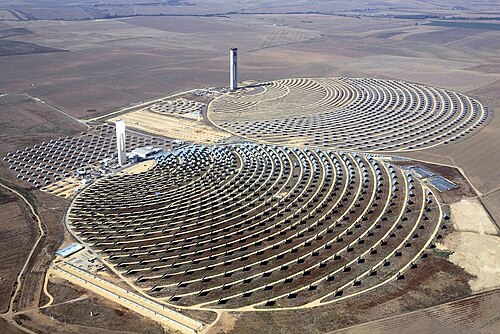
2010年、スペインはバダホス県アルバラド近郊にラ・フロリダと呼ばれる巨大な発電所を建設し、米国を追い抜いて太陽光発電の世界的リーダーとなった。[214] [215]スペインはヨーロッパにおける風力エネルギーの主要生産国でもある。[216] [217] 2010年、スペインの風力タービンはスペインで生産される全電力の16.4%を発電した。[218] [219] [220] 2010年11月9日、風力エネルギーは史上最高値に達し、本土の電力需要の53%を賄い[221] 、原子炉14基に相当する量のエネルギーを生産した。[222]スペインで利用されるその他の再生可能エネルギーは、水力発電、バイオマス、海洋発電である。[223]
スペインで使用されている非再生エネルギー源は、原子力(稼働中の原子炉8基)、ガス、石炭、石油です。化石燃料は2009年にスペインの電力の58%を生成しましたが、これはOECD平均の61%をわずかに下回っています。原子力はさらに19%を生成し、風力と水力はそれぞれ約12%を生成しました。[224]
科学技術

スペイン科学研究高等委員会(CSIC)は、スペインの科学研究を専門とする主要な公的機関です。2018年のSCImago機関ランキングでは、世界で5番目に高い政府科学機関(全体では32位)にランクされました。[225]スペインは、 2023年のグローバルイノベーションインデックスで29位にランクされました。[226]
高等教育機関は国内の基礎研究の約60%を行っている。[227]同様に、民間部門の研究開発費への貢献は他のEUやOECD諸国に比べてはるかに低い。[228]
輸送
The Spanish road system is mainly centralised, with six highways connecting Madrid to the Basque Country, Catalonia, Valencia, West Andalusia, Extremadura and Galicia. Additionally, there are highways along the Atlantic (Ferrol to Vigo), Cantabrian (Oviedo to San Sebastián) and Mediterranean (Girona to Cádiz) coasts. Spain aims to put one million electric cars on the road by 2014 as part of the government's plan to save energy and boost energy efficiency.[229] The former Minister of Industry Miguel Sebastián said that "the electric vehicle is the future and the engine of an industrial revolution."[230]
As of July 2024[update], the Spanish high-speed rail network is the longest HSR network in Europe with 3,966 km (2,464 mi)[231] and the second longest in the world, after China's. It is linking Málaga, Seville, Madrid, Barcelona, Valencia and Valladolid, with the trains operated at commercial speeds up to 330 km/h (210 mph).[232] On average, the Spanish high-speed train is the fastest one in the world, followed by the Japanese bullet train and the French TGV.[233] Regarding punctuality, it is second in the world (98.5% on-time arrival) after the Japanese Shinkansen (99%).[234]
There are 47 public airports in Spain. The busiest one is the airport of Madrid (Barajas), with 60 million passengers in 2023, being the world's 15th busiest airport, as well as the European Union's third busiest. The airport of Barcelona (El Prat) is also important, with 50 million passengers in 2023, being the world's 30th-busiest airport. Other main airports are located in Majorca, Málaga, Las Palmas (Gran Canaria), and Alicante.
-
![マドリード-バルセロナ線のヴィナイシャ付近の高速AVEクラス103列車。スペインはヨーロッパで最も長い高速鉄道網を有している。[231]](https://img-server.japedia.wiki/wikipedia/commons/thumb/8/8c/RENFE_Class_103_Vinaixa.jpg/500px-RENFE_Class_103_Vinaixa.jpg) High-speed AVE Class 103 train near Vinaixa, Madrid-Barcelona line. Spain has the longest high-speed rail network in Europe.[231]
High-speed AVE Class 103 train near Vinaixa, Madrid-Barcelona line. Spain has the longest high-speed rail network in Europe.[231] -
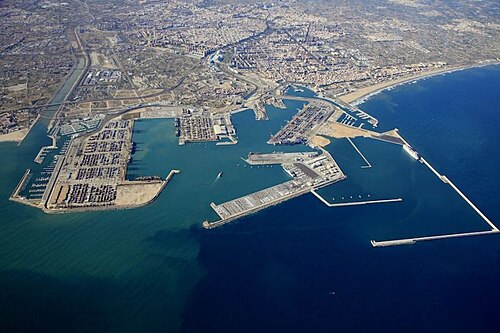 The Port of Valencia, one of the busiest in the Golden Banana
Demographics
.svg/500px-Population_per_km2_by_municipality_in_Spain_(2018).svg.png)
In 2024, Spain had a population of 48,797,875 people as recorded by Spain's Instituto Nacional de Estadística.[235] Spain's population density, at 96/km2 (249.2/sq mi), is lower than that of most Western European countries and its distribution across the country is very unequal. With the exception of the region surrounding the capital, Madrid, the most populated areas lie around the coast. The population of Spain has risen 2+1⁄2 times since 1900, when it stood at 18.6 million, principally due to the spectacular demographic boom in the 1960s and early 1970s.[236]
In 2022, the average total fertility rate (TFR) across Spain was 1.16 children born per woman,[237] one of the lowest in the world, below the replacement rate of 2.1, it remains considerably below the high of 5.11 children born per woman in 1865.[238] Spain subsequently has one of the oldest populations in the world, with the average age of 43.1 years.[239]
Native Spaniards make up 86.5% of the total population of Spain. After the birth rate plunged in the 1980s and Spain's population growth rate dropped, the population again trended upward initially upon the return of many Spaniards who had emigrated to other European countries during the 1970s, and more recently, fuelled by large numbers of immigrants who make up 12% of the population. The immigrants originate mainly in Latin America (39%), North Africa (16%), Eastern Europe (15%), and Sub-Saharan Africa (4%).[240]
In 2008, Spain granted citizenship to 84,170 persons, mostly to people from Ecuador, Colombia and Morocco.[241] Spain has a number of descendants of populations from former colonies, especially Latin America and North Africa. Smaller numbers of immigrants from several Sub-Saharan countries have recently been settling in Spain. There are also sizeable numbers of Asian immigrants, most of whom are of Middle Eastern, South Asian and Chinese origin. The single largest group of immigrants are European; represented by large numbers of Romanians, Britons, Germans, French and others.[242]
Urbanisation
Immigration
.png/500px-Distribuci%C3%B3n_de_la_poblaci%C3%B3n_extranjera_en_Espa%C3%B1a_(2005).png)
According to the official Spanish statistics (INE) there were 6.6 million foreign residents in Spain in 2024 (13.5%)[243] while all citizens born outside of Spain were 8.9 million in 2024, 18.31% of the total population.[244]
According to residence permit data for 2011, more than 860,000 were Romanian, about 770,000 were Moroccan, approximately 390,000 were British, and 360,000 were Ecuadorian.[245] Other sizeable foreign communities are Colombian, Bolivian, German, Italian, Bulgarian, and Chinese. There are more than 200,000 migrants from Sub-Saharan Africa living in Spain, principally Senegaleses and Nigerians.[246] Since 2000, Spain has experienced high population growth as a result of immigration flows, despite a birth rate that is only half the replacement level. This sudden and ongoing inflow of immigrants, particularly those arriving illegally by sea, has caused noticeable social tension.[247]
Within the EU, Spain had the 2nd highest immigration rate in percentage terms after Cyprus, but by a great margin, the highest in absolute numbers, up to 2008.[248] The number of immigrants in Spain had grown up from 500,000 people in 1996 to 5.2 million in 2008 out of a total population of 46 million.[249] In 2005 alone, a regularisation programme increased the legal immigrant population by 700,000 people.[250] There are a number of reasons for the high level of immigration, including Spain's cultural ties with Latin America, its geographical position, the porosity of its borders, the large size of its underground economy and the strength of the agricultural and construction sectors, which demand more low cost labour than can be offered by the national workforce.
Another statistically significant factor is the large number of residents of EU origin typically retiring to Spain's Mediterranean coast. In fact, Spain was Europe's largest absorber of migrants from 2002 to 2007, with its immigrant population more than doubling as 2.5 million people arrived.[251] In 2008, prior to the onset of the economic crisis, the Financial Times reported that Spain was the most favoured destination for Western Europeans considering a move from their own country and seeking jobs elsewhere in the EU.[252]
In 2008, the government instituted a "Plan of Voluntary Return" which encouraged unemployed immigrants from outside the EU to return to their home countries and receive several incentives, including the right to keep their unemployment benefits and transfer whatever they contributed to the Spanish Social Security.[253] The programme had little effect.[254] Although the programme failed to, the sharp and prolonged economic crisis from 2010 to 2011, resulted in tens of thousands of immigrants leaving the country due to lack of jobs. In 2011 alone, more than half a million people left Spain.[255] For the first time in decades the net migration rate was expected to be negative, and nine out of 10 emigrants were foreigners.[255]
Languages
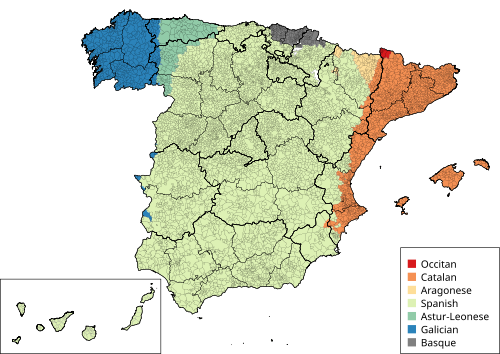
Spain is a multilingual state.[256] Spanish—featured in the 1978 Spanish Constitution as castellano ('Castilian')—has effectively been the official language of the entire country since 1931.[257] As allowed in the third article of the Constitution, the other 'Spanish languages' can also become official in their respective autonomous communities. The territoriality created by the form of co-officiality codified in the 1978 Constitution creates an asymmetry, in which Spanish speakers' rights apply to the entire territory whereas vis-à-vis the rest of co-official languages, their speakers' rights only apply in their territories.[258]
Besides Spanish, other territorialized languages include Aragonese, Aranese, Astur-Leonese, Basque, Ceutan Arabic (Darija), Catalan, Galician, Portuguese, Valencian and Tamazight, to which the Romani Caló and the sign languages may add up.[259] The number of speakers varies widely and their legal recognition is uneven, with some of the most vulnerable languages lacking any sort of effective protection.[260] Those enjoying recognition as official language in some autonomous communities include Catalan/Valencian (in Catalonia and the Balearic Islands officially named as Catalan and in the Valencian Community officially named as Valencian); Galician (in Galicia); Basque (in the Basque Country and part of Navarre); and Aranese in Catalonia.
Spanish is natively spoken by 74%, Catalan/Valencian by 17%, Galician by 7% and Basque by 2% of the Spanish population.[261]
Some of the most spoken foreign languages used by the immigrant communities include Moroccan Arabic, Romanian and English.[262]
Education

State education in Spain is free and compulsory from the age of six to sixteen. The current education system is regulated by the 2006 educational law, LOE (Ley Orgánica de Educación), or Fundamental Law for the Education.[263] In 2014, the LOE was partially modified by the newer and controversial LOMCE law (Ley Orgánica para la Mejora de la Calidad Educativa), or Fundamental Law for the Improvement of the Education System, commonly called Ley Wert (Wert Law).[264] Since 1970 to 2014, Spain has had seven different educational laws (LGE, LOECE, LODE, LOGSE, LOPEG, LOE and LOMCE).[265]
The levels of education are preschool education, primary education,[266] secondary education[267] and post-16 education.[268] In regards to the professional development education or the vocational education, there are three levels besides the university degrees: the Formación Profesional Básica (basic vocational education); the Ciclo Formativo de Grado Medio or CFGM (medium level vocation education) which can be studied after studying the secondary education, and the Ciclo Formativo de Grado Superior or CFGS (higher level vocational education), which can be studied after studying the post-16 education level.[269]
The Programme for International Student Assessment coordinated by the OECD currently ranks the overall knowledge and skills of Spanish 15-year-olds as significantly below the OECD average of 493 in reading literacy, mathematics, and science.[270][271]
Health
The health care system of Spain (Spanish National Health System) is considered one of the best in the world, in 7th position in the ranking elaborated by the World Health Organization.[272] The health care is public, universal and free for any legal citizen of Spain.[273] The total health spending is 9.4% of the GDP, slightly above the average of 9.3% of the OECD.
Religion
Roman Catholicism, which has a long history in Spain, remains the dominant religion. Although it no longer has official status by law, in all public schools in Spain students have to choose either a religion or ethics class. Catholicism is the religion most commonly taught, although the teaching of Islam,[275] Judaism,[276] and evangelical Christianity[277] is also recognised in law. According to a 2020 study by the Spanish Centre for Sociological Research, about 61% of Spaniards self-identify as Catholics, 3% other faiths, and about 35% identify with no religion.[278] Most Spaniards do not participate regularly in religious services.[279] Recent polls and surveys suggest that around 30% of the Spanish population is irreligious.[279][280][281]
The Spanish constitution enshrines secularism in governance, as well as freedom of religion or belief for all, saying that no religion should have a "state character", while allowing for the state to "cooperate" with religious groups.
Protestant churches have about 1,200,000 members.[282] There are about 105,000 Jehovah's Witnesses. The Church of Jesus Christ of Latter-day Saints has approximately 46,000 adherents in 133 congregations.[283]
A study made by the Union of Islamic Communities of Spain demonstrated that there were more than 2,100,000 inhabitants of Muslim background living in Spain as of 2019[update], accounting for 4–5% of the total population of Spain. The vast majority was composed of immigrants and descendants originating from the Maghreb (especially Morocco) and other African countries. More than 879,000 (42%) of them had Spanish nationality.[284]
Judaism was practically non-existent in Spain from the 1492 expulsion until the 19th century, when Jews were again permitted to enter the country. Currently there are around 62,000 Jews in Spain, or 0.14% of the total population.
Culture

Spain is a Western country and one of the major Latin countries of Europe, and has been noted for its international cultural influence.[285] Spanish culture is marked by strong historic ties to the Catholic Church, which played a pivotal role in the country's formation and subsequent identity.[286] Spanish art, architecture, cuisine, and music have been shaped by successive waves of foreign invaders, as well as by the country's Mediterranean climate and geography. The centuries-long colonial era globalised Spanish language and culture, with Spain also absorbing the cultural and commercial products of its diverse empire.
World Heritage Sites

Spain has 49 World Heritage Sites. These include the landscape of Monte Perdido in the Pyrenees, which is shared with France, the Prehistoric Rock Art Sites of the Côa Valley and Siega Verde, which is shared with Portugal, the Heritage of Mercury, shared with Slovenia and the Ancient and Primeval Beech Forests, shared with other countries of Europe.[287] In addition, Spain has also 14 Intangible cultural heritage, or "Human treasures".[288]
Literature
Some early examples of vernacular Romance-based literature include short snippets of Mozarabic Romance (such as refrains) sprinkled in Arabic and Hebrew texts.[289] Other examples of early Iberian Romance include the Glosas Emilianenses written in Latin, Basque and Romance.[290]

Early Medieval literature in Christian Iberia was written in Latin, which remained as the standard literary language up until the mid-13th century, whereas Ibero-Romance vernaculars and Basque were spoken.[291] A decisive development ensued in the 13th century in Toledo, where Arabic scholarship was translated to the local vernacular, Castilian. In the scope of lyric poetry Castilian co-existed alongside Galician-Portuguese across the Crown of Castile up until the 16th century.[292] The Romance variety preferred in Eastern Iberia for lyrical poetry, Occitan, became increasingly Catalanised in the 14th and 15th centuries.[293] Major literary works from the Middle Ages include the Cantar de Mio Cid, Tirant lo Blanch, The Book of Good Love and Coplas por la muerte de su padre. Genres such as Mester de Juglaría and Mester de Clerecía were cultivated.
Promoted by the monarchs in the late Middle Ages and even codified in the late 15th century, Castilian (thought to be widespread known as 'Spanish' from the 16th century on) progressively became the language of the elites in the Iberian Peninsula, which ushered in a Golden era of Castilian literature in the 16th and 17th centuries, also in the science domain, eclipsing Galician and Catalan.[294] Famous Early Modern works include La Celestina and Lazarillo de Tormes. The famous Don Quijote de La Mancha by Miguel de Cervantes was written in this time. Other writers from the period are: Francisco de Quevedo, Lope de Vega, Calderón de la Barca or Tirso de Molina. During the Enlightenment authors included, Benito Jerónimo Feijóo, Gaspar Melchor de Jovellanos, and Leandro Fernández de Moratín.
Steps of Spanish Romantic literature (initially a rebellion against French classicism) have been traced back to the last quarter of the 18th century, even if the movement had its heyday between 1835 and 1850, waning thereafter.[295] In a broader definition encompassing the period from 1868 or 1874 to 1936, the so-called Silver Age of Spanish Culture ensued.[296][297]
The waning of Romantic literature was followed by the development of Spanish Realism, which offered depictions of contemporary life and society 'as they were', rather than romanticised or stylised presentations.[citation needed] The major realist writer was Benito Pérez Galdós.[298] The second half of the 19th century also saw the resurgence of the literary use of local languages other than Spanish under cultural movements inspired by Romanticism such as the Catalan Renaixença or the Galician Rexurdimento.[299] Rarely used before in a written medium, the true fostering of the literary use of the Basque language had to wait until the 1960s, even if some interest towards the language had developed in the late 19th century.[300] 20th-century authors were classified in loose literary generations such as the Generation of '98, the Generation of '27, Generation of '36 and the Generation of '50. Premio Planeta de Novela and Miguel de Cervantes Prize are the two main awards in Spanish literature.
Philosophy

The construct pertaining a distinctive Spanish philosophical thought has been variously approached by academia, either by diachronically tracing its development throughout the centuries from the Roman conquest of Hispania on (with early representatives such as Seneca, Trajan, Lucan, or Martial); by pinpointing its origins to the late 19th century (associated to the Generation of 98); or simply by outright denying its existence.[301] The crux around the existence of a Spanish philosophy pitted the likes of Marcelino Menéndez y Pelayo (chief architect of the myth around it)[302] against Antonio Pérez.[303] Foreign imports such as Krausism proved to be extremely influential in Spain in the 19th and early 20th centuries.[304]
Art

Artists from Spain have been highly influential in the development of various European and American artistic movements. Due to historical, geographical and generational diversity, Spanish art has known a great number of influences. The Mediterranean heritage with Greco-Roman and some Moorish influences in Spain, especially in Andalusia, is still evident today. European influences include Italy, Germany and France, especially during the Renaissance, Spanish Baroque and Neoclassical periods. There are many other autochthonous styles such as the Pre-Romanesque art and architecture, Herrerian architecture or the Isabelline Gothic.[citation needed]
During the Golden Age painters working in Spain included El Greco, José de Ribera, Bartolomé Esteban Murillo and Francisco Zurbarán. Also in the Baroque period, Diego Velázquez created some of the most famous Spanish portraits, such as Las Meninas and Las Hilanderas.[305]
Francisco Goya painted during a historical period that includes the Spanish Independence War, the fights between liberals and absolutists, and the rise of contemporary nations-states.[citation needed]
Joaquín Sorolla is a well-known modern impressionist painter and there are many important Spanish painters belonging to the modernism art movement, including Pablo Picasso, Salvador Dalí, Juan Gris and Joan Miró.[citation needed]
Sculpture

The Plateresque style extended from beginnings of the 16th century until the last third of the century and its stylistic influence pervaded the works of all great Spanish artists of the time. Alonso Berruguete (Valladolid School) is called the "Prince of Spanish sculpture". His main works were the upper stalls of the choir of the Cathedral of Toledo, the tomb of Cardinal Tavera in the same Cathedral, and the altarpiece of the Visitation in the church of Santa Úrsula in the same locality. Other notable sculptors were Bartolomé Ordóñez, Diego de Siloé, Juan de Juni and Damián Forment.[citation needed]
There were two Schools: the Seville School, to which Juan Martínez Montañés belonged, whose most celebrated works are the Crucifix in the Cathedral of Seville, another in Vergara, and a Saint John; and the Granada School, to which Alonso Cano belonged, to whom an Immaculate Conception and a Virgin of Rosary, are attributed.[citation needed]
Other notable Andalusian Baroque sculptors were Pedro de Mena, Pedro Roldán and his daughter Luisa Roldán, Juan de Mesa and Pedro Duque Cornejo. In the 20th century the most important Spanish sculptors were Julio González, Pablo Gargallo, Eduardo Chillida, and Pablo Serrano.
Cinema

After the first projection of a cinematographer in Spain by 1896, cinema developed in the following years, with Barcelona becoming the largest production hub in the country (as well as a major European hub) on the eve of the World War I.[306] The conflict offered the Spanish industry of silent films an opportunity for further growth.[307] Local studios for sound films were created in 1932.[308] The government imposition of dubbing of foreign films in 1941 accustomed Spanish audiences to watching dubbed films.[309]
Spanish cinema has achieved major international success including Oscars for films such as Pan's Labyrinth and Volver.[310]
Distinct exploitation genres that flourished in the second half of the 20th century include the Fantaterror, the cine quinqui and the so-called destape films.[311]
As of 2021, the festivals of San Sebastián and Málaga are ranked among the top cultural initiatives in the country.[312]
Architecture
.jpg/500px-Sagrada_Fam%C3%ADlia._Fa%C3%A7ana_del_Naixement_(cropped).jpg)
Earth and gypsum are very common materials of the traditional vernacular architecture in Spain (particularly in the East of the country, where most of the deposits of gypsum are located).[313] Due to its historical and geographical diversity, Spanish architecture has drawn from a host of influences. Fine examples of Islamicate architecture, belonging to the Western Islamic tradition, were built in the Middle Ages in places such as Córdoba, Seville, or Granada. Similarly to the Maghreb, stucco decoration in Al-Andalus became an architectural stylemark in the high Middle Ages.[314]
Simultaneously, the Christian kingdoms also developed their own styles; developing a pre-Romanesque style when for a while isolated from contemporary mainstream European architectural influences during the earlier Middle Ages, they later integrated the Romanesque and Gothic streams. There was then an extraordinary flourishing of the Gothic style that resulted in numerous instances being built throughout the entire territory. The so-called Mudéjar style came to designate works by Muslims, Christians and Jews in lands conquered from Muslims.[315]
The arrival of Modernism produced much of the architecture of the 20th century. An influential style centred in Barcelona, known as modernisme, produced a number of important architects, of which Gaudí is one. The International style was led by groups like GATEPAC. Spain is currently experiencing a revolution in contemporary architecture and Spanish architects like Rafael Moneo, Santiago Calatrava, Ricardo Bofill as well as many others have gained worldwide renown.[citation needed]
Music and dance

Spanish music is often considered abroad to be synonymous with flamenco, a West Andalusian musical genre, which is not widespread outside that region. Various regional styles of folk music abound. Pop, rock, hip hop and heavy metal are also popular.
In the field of classical music, Spain has produced a number of noted composers such as Isaac Albéniz, Manuel de Falla and Enrique Granados and singers and performers such as Plácido Domingo, José Carreras, Montserrat Caballé, Alicia de Larrocha, Alfredo Kraus, Pablo Casals, Ricardo Viñes, José Iturbi, Pablo de Sarasate, Jordi Savall and Teresa Berganza. In Spain there are over forty professional orchestras, including the Orquestra Simfònica de Barcelona, Orquesta Nacional de España and the Orquesta Sinfónica de Madrid. Major opera houses include the Teatro Real, the Gran Teatre del Liceu, Teatro Arriaga and the El Palau de les Arts Reina Sofía.
Thousands of music fans also travel to Spain each year for internationally recognised summer music festivals Sónar which features pop and techno acts, and Benicàssim which tends to feature alternative rock and dance acts.[316] The Vitoria-Gasteiz jazz festival is one of the main ones in its genre.
The most popular traditional musical instrument, the guitar, originated in Spain.[317] Typical of the north are the traditional bag pipers or gaiteros, mainly in Asturias and Galicia.
Cuisine
Spanish cuisine consists of a great variety of dishes which stem from differences in geography, culture and climate. It is heavily influenced by seafood available from the waters that surround the country, and reflects the country's deep Mediterranean roots. Spain's extensive history with many cultural influences has led to a unique cuisine. In particular, three main divisions are easily identified:
Mediterranean Spain – coastal regions, from Catalonia to Andalusia – heavy use of seafood, such as pescaíto frito (fried fish); cold soups like gazpacho; and many rice-based dishes like paella from Valencia[318] and arròs negre (black rice) from Catalonia.[319]
Inner Spain – Castile – hot, thick soups such as the bread and garlic-based Castilian soup, along with substantial stews such as cocido madrileño. Food is traditionally preserved by salting, such as Spanish ham, or immersed in olive oil, such as Manchego cheese.
Atlantic Spain – the Northern coast, including Asturian, Basque, Cantabrian and Galician cuisine – vegetable and fish-based stews like caldo gallego and marmitako. Also, the lightly cured lacón ham. The best known cuisine of the northern countries often rely on ocean seafood, as in the Basque-style cod, albacore or anchovy or the Galician octopus-based polbo á feira and shellfish dishes.
Sport
_(cropped).jpg/500px-2023FWWC_Final_(celebration)_(cropped).jpg)
While varieties of football have been played in Spain as far back as Roman times, sport in Spain has been dominated by football since the early 20th century. Real Madrid CF and FC Barcelona are two of the most successful football clubs in the world. The country's national men's football team won the UEFA European Championship in 1964, 2008, 2012 and 2024 and the FIFA World Cup in 2010, and is the first team ever to win three back-to-back major international tournaments.[citation needed] Spain's women's national team were champions of the 2023 FIFA World Cup, becoming one of only five nations to win a Women's World Cup. Barcelona Femení has won a record 20 domestic trophies.
Basketball, tennis, cycling, handball, futsal, motorcycling and, lately, Formula One also can boast of Spanish champions. Today, Spain is a major world sports powerhouse, especially since the 1992 Summer Olympics and Paralympics that were hosted in Barcelona, which stimulated a great deal of interest in sports in the country. The tourism industry has led to an improvement in sports infrastructure, especially for water sports, golf and skiing. In their respective regions, the traditional games of Basque pelota and Valencian pilota both are popular.[citation needed]
Public holidays and festivals
Public holidays celebrated in Spain include a mix of religious (Roman Catholic), national and local observances. Each municipality is allowed to declare a maximum of 14 public holidays per year; up to nine of these are chosen by the national government and at least two are chosen locally.[323] Spain's National Day (Fiesta Nacional de España) is celebrated on 12 October.[324][325]
There are many festivals and festivities in Spain. One of the most famous is San Fermín, in Pamplona. While its most famous event is the encierro, or the running of the bulls. It has become one of the most internationally renowned fiestas in Spain, with over 1,000,000 people attending every year.
Other festivals include La Tomatina tomato festival in Buñol, Valencia, the carnivals in the Canary Islands, the Falles in Valencia or the Holy Week in Andalusia and Castile and León.

See also

.svg/500px-Europe_(orthographic_projection).svg.png)
- History of education in Spain
- Outline of Spain
- Topographical relief of Spain
- History of the territorial organization of Spain
Notes
- ^ a b In Spain, some other languages enjoy co-official status in certain regions (in accordance with the latter's Statutes of Autonomy) or have some degree of recognition. In each of these, Spain's conventional long name for international affairs in Spanish laws and the most used (Spanish: Reino de España, pronounced: Spanish pronunciation: [ˈrejno ð(e) esˈpaɲa]) is as follows:
- Aragonese: Reino d'Espanya, IPA: [ˈrejno ðesˈpaɲa]
- Asturian: Reinu d'España, IPA: [ˈrejnu ðesˈpaɲa]
- Catalan: Regne d'Espanya, IPA: [ˈreŋnə ðəsˈpaɲə]
- Basque: Espainiako Erresuma, IPA: [es̺paɲiako eres̺uma]
- Galician: Reino de España, IPA: [ˈrejnʊ ð(ɪ) esˈpaɲɐ]
- Occitan: Reiaume d'Espanha, IPA: [reˈjawme ðesˈpaɲɔ]
- Valencian: Regne d'Espanya, IPA: [ˈreŋne ðesˈpaɲa]
- ^ The official language of the State is established in the Section 3 of the Constitution of Spain to be Castilian.[2]
- ^ In some autonomous communities, Basque, Catalan, Galician, Valencian, and Occitan (locally known as Aranese) are co-official languages. Aragonese, Asturian, and Leonese have some degree of government recognition at the regional level.
- ^ The Peseta before 2002
- ^ The .eu domain is also used, as it is shared with other European Union member states. Also, the .cat domain is used in Catalonia, .gal in Galicia and .eus in the Basque-Country autonomous regions.
- ^ Spanish: España, [esˈpaɲa]
- ^ The Spanish Constitution does not contain any one official name for Spain. Instead, the terms España (Spain), Estado español (Spanish State) and Nación española (Spanish Nation) are used throughout the document, sometimes interchangeably. In 1984, the Spanish Ministry of Foreign Affairs established that the denominations España (Spain) and Reino de España (Kingdom of Spain) are equally valid to designate Spain in international treaties. The latter term is widely used by the government in national and international affairs of all kinds, including foreign treaties as well as national official documents, and is therefore recognised as the conventional name by many international organisations.[326]
- ^ See list of transcontinental countries.
- ^ The latifundia (sing., latifundium), large estates controlled by the aristocracy, were superimposed on the existing Iberian landholding system.
- ^ The poets Martial, Quintilian and Lucan were also born in Hispania.
- ^ Those nationwide institutions are the Crown, the Cortes Generales, the Government, the Judiciary, and the Constitutional Tribunal.
- ^ Most Spanish monarchs have been kings. However, a queen regnant – while uncommon – is possible due to Spain's adherence to male-preference primogeniture. Leonor, Princess of Asturias, will be Spain's first queen regnant since Isabella II, who reigned from 1833 to 1868, should she someday succeed her father Felipe VI as expected.
- ^ Former king Juan Carlos I's intervention and foiling of the 1981 Spanish coup attempt is but one example of the Crown exercising its influence as the moderating branch to defend democracy and uphold the rule of law.[126]
- ^ The Spanish state honours system comprises the Order of Charles III, the Order of Isabella the Catholic, the Order of Civil Merit, the Civil Order of Alfonso X, the Wise, the Order of Saint Raymond of Peñafort, and the Order of Constitutional Merit, among other orders, decorations and medals. The prime minister is ex officio chancellor of the Order of Charles III. On the other hand, the ministers of foreign affairs, education, and justice are the corresponding chancellors for the orders of Isabella the Catholic and of Civil Merit, the Civil Order of Alfonso X, the Wise, and the orders of Saint Raymond of Peñafort and of Constitutional Merit, respectively.
- ^ They being the Real Academia de Bellas Artes de San Fernando, the Real Academia de Ciencias Morales y Políticas, the Royal Academy of Engineering of Spain, the Real Academia de la Historia, the Royal Academy of Jurisprudence and Legislation, the Royal Academy of Pharmacy, the Royal Spanish Academy, and the Spanish Royal Academy of Sciences
- ^ The ministerial acts performed by the Spanish monarch are as follows:
- Sanction and promulgate bills duly passed by the Cortes Generales, making them laws. The Spanish Constitution mandates the monarch grant royal assent to each bill within fifteen days of its passage; he or she does not have a right to veto legislation.[131][132]
- Summon the Cortes Generales into session following a general election, dissolve the same upon the expiration of its four-year term, and proclaim the election of the next Cortes. These functions are performed in accordance with the strictures of the Spanish Constitution.[133][134][135][136][137]
- Appoint and dismiss ministers of state on the advice of the prime minister.[138]
- Appoint the president of the Supreme Court on the advice of the General Council of the Judiciary.[139]
- Appoint the president of the Constitutional Tribunal from among its members, on the advice of the full bench, for a term of three years.[140]
- Appoint the Fiscal General, who leads the Prosecution Ministry, on the advice of the Government. Before tendering advice, the Government is required to consult the General Council of the Judiciary.[141]
- Appoint the presidents of the autonomous communities as elected by their respective parliaments.[142]
- Issue decrees approved in the Council of Ministers, confer civil service and military appointments, and award honours and distinctions in the gift of the state, all done on the advice of the prime minister or another minister designated thereby.[n][143]
- Exercise supreme command and control over the Armed Forces, on the advice of the prime minister.[144]
- Declare war and make peace on the advice of the prime minister and with the prior authorization of the Cortes Generales.[145]
- Ratify treaties, on the advice of the prime minister.[146]
- Accredit Spanish ambassadors and ministers to foreign states and receive the credentials of foreign diplomats to Spain, on the advice of the prime minister.[147]
- Exercise the right of clemency, but without the authority to grant general pardons, on the advice of the prime minister.[148]
- Patronise the Royal Academies.[o][149]
References
- ^ Presidency of the Government (11 October 1997). "Real Decreto 1560/1997, de 10 de octubre, por el que se regula el Himno Nacional" (PDF). Boletín Oficial del Estado núm. 244 (in Spanish). Archived (PDF) from the original on 24 September 2015.
- ^ "The Spanish Constitution". Lamoncloa.gob.es. Archived from the original on 25 March 2013. Retrieved 26 April 2013.
- ^ "Estadística Continua de Población (ECP) 1 de abril de 2024. Datos provisionales".
- ^ CIS."Barómetro de Enero de 2023", 3,961 respondents. The question was "¿Cómo se define Ud. en materia religiosa: católico/a practicante, católico/a no practicante, creyente de otra religión, agnóstico/a, indiferente o no creyente, o ateo/a?".
- ^ "Anuario estadístico de España 2008. 1ª parte: entorno físico y medio ambiente" (PDF). Instituto Nacional de Estadística (Spain). Archived (PDF) from the original on 24 September 2015. Retrieved 14 April 2015.
- ^ "Surface water and surface water change". Organisation for Economic Co-operation and Development (OECD). Archived from the original on 24 March 2021. Retrieved 11 October 2020.
- ^ "INEbase / Continuous Population Statistics (CPS). 1st July 2024. Provisional data". ine.es. Retrieved 1 July 2024.
- ^ a b c d "World Economic Outlook Database, April 2024 Edition. (Spain)". www.imf.org. International Monetary Fund. 16 April 2024. Retrieved 16 April 2024.
- ^ "Gini coefficient of equivalised disposable income – EU-SILC survey". ec.europa.eu. Eurostat. Retrieved 10 July 2024.
- ^ "Human Development Report 2023/24" (PDF). United Nations Development Programme. 13 March 2024. p. 288. Retrieved 13 March 2024.
- ^ "Spain | Facts, Culture, History, & Points of Interest". Encyclopedia Britannica. 26 July 2023. Archived from the original on 8 August 2014. Retrieved 17 March 2019.
- ^ "European exploration - Age of Discovery, Voyages, Expansion". britannica.com. Retrieved 16 May 2024.
- ^ Flynn, Dennis O.; Giráldez Source, Arturo (1995). "Born with a 'Silver Spoon': The Origin of World Trade in 1571". Journal of World History. 6 (2): 202. JSTOR 20078638.
- ^ Spain is crowned the champion of foreign students. This is thanks to universities such as those in Barcelona, Valencia, Madrid, Granada and Salamanca. Although nowhere near as popular as Spain, we find Germany in second place. It is a country that also has a large number of prestigious universities spread out across many cities. The fact that Germany is an economic powerhouse makes it an attractive destination for those searching for employment after studying. France, the United Kingdom and Italy appear in third, fourth and fifth position. The rest of countries rank behind at a considerable distance. What are the most popular Erasmus destinations? Archived 30 June 2023 at the Wayback Machine
- ^ "572 millones de personas hablan español, cinco millones más que hace un año, y aumentarán a 754 millones a mediados de siglo". www.cervantes.es. Archived from the original on 13 May 2021.
- ^ Spanish Constitution 1978, Article 1.
- ^ Whitehouse, Mark (6 November 2010). "Number of the Week: $10.2 Trillion in Global Borrowing". The Wall Street Journal. Archived from the original on 20 September 2017.
- ^ ABC (28 August 2014). ""I-span-ya", el misterioso origen de la palabra España". Archived from the original on 13 November 2016.
- ^ #Linch, John (director), Fernández Castro, María Cruz (del segundo tomo), Historia de España, El País, volumen II, La península Ibérica en época prerromana, p. 40. Dossier. La etimología de España; ¿tierra de conejos?, ISBN 978-84-9815-764-2
- ^ Burke, Ulick Ralph (1895). A History of Spain from the Earliest Times to the Death of Ferdinand the Catholic, Volume 1. London: Longmans, Green & Co. p. 12. hdl:2027/hvd.fl29jg.
- ^ Herbermann, Charles, ed. (1913). . Catholic Encyclopedia. New York: Robert Appleton Company.
- ^ "Rabbits, fish and mice, but no rock hyrax". Understanding Animal Research. Archived from the original on 31 October 2018. Retrieved 31 October 2018.
- ^ Anthon, Charles (1850). A System of Ancient and Mediæval Geography for the Use of Schools and Colleges. New York: Harper & Brothers. p. 14.
- ^ "'First west Europe tooth' found". BBC. 30 June 2007. Archived from the original on 21 October 2009. Retrieved 9 August 2008.
- ^ Typical Aurignacian items were found in Cantabria (Morín, El Pendo, El Castillo), the Basque Country (Santimamiñe) and Catalonia. The radiocarbon datations give the following dates: 32,425 and 29,515 BP. [failed verification]
- ^ Pike, A. W. G.; Hoffmann, D. L.; Garcia-Diez, M.; Pettitt, P. B.; Alcolea, J.; De Balbin, R.; Gonzalez-Sainz, C.; de las Heras, C.; Lasheras, J. A.; Montes, R.; Zilhao, J. (2012). "U-Series Dating of Paleolithic Art in 11 Caves in Spain". Science. 336 (6087): 1409–1413. Bibcode:2012Sci...336.1409P. doi:10.1126/science.1219957. ISSN 0036-8075. PMID 22700921. S2CID 7807664.
- ^ Bernaldo de Quirós Guidolti, Federico; Cabrera Valdés, Victoria (1994). "Cronología del arte paleolítico" (PDF). Complutum. 5: 265–276. ISSN 1131-6993. Archived from the original on 12 September 2023. Retrieved 17 November 2012.
- ^ a b Payne, Stanley G. (1973). "A History of Spain and Portugal; Ch. 1 Ancient Hispania". The Library of Iberian Resources Online. Archived from the original on 8 October 2018. Retrieved 9 August 2008.
- ^ a b Rinehart, Robert; Seeley, Jo Ann Browning (1998). "A Country Study: Spain. Chapter 1 – Hispania". Library of Congress Country Series. Archived from the original on 22 September 2008. Retrieved 9 August 2008.
- ^ Alonso Villalobos, Carlos (1984). "Contribución al estudio de las invasiones mauritanas de la Bética en el siglo II" (PDF). Actas del II Congreso Andaluz deEstudios Clásicos. Vol. II. Sociedad Española de Estudios Clásicos. Archived (PDF) from the original on 5 July 2022. Retrieved 5 July 2022.
- ^ Rinehart, Robert; Seeley, Jo Ann Browning (1998). "A Country Study: Spain – Castile and Aragon". Library of Congress Country Series. Archived from the original on 22 September 2008. Retrieved 9 August 2008.
- ^ Islamic and Christian Spain in the Early Middle Ages. Chapter 5: Ethnic Relations Archived 3 April 2017 at the Wayback Machine, Thomas F. Glick
- ^ Payne, Stanley G. (1973). "A History of Spain and Portugal; Ch. 2 Al-Andalus". The Library of Iberian Resources Online. Archived from the original on 8 October 2018. Retrieved 9 August 2008.
- ^ Scheen, Rolf (1996). "Viking raids on the spanish peninsula". Militaria. Revista de Cultura Militar (8): 67–73. Archived from the original on 13 April 2022. Retrieved 13 April 2022.
- ^ Classen, Albrecht (31 August 2015). Handbook of Medieval Culture. Walter de Gruyter GmbH & Co KG. ISBN 9783110267303. Archived from the original on 12 September 2023. Retrieved 10 December 2018 – via Google Books.
- ^ VAN ZANDEN, JAN LUITEN; BURINGH, ELTJO; BOSKER, MAARTEN (29 July 2011). "The rise and decline of European parliaments, 1188-17891". The Economic History Review. 65 (3): 835–861. doi:10.1111/j.1468-0289.2011.00612.x. ISSN 0013-0117. S2CID 154956049. Archived from the original on 12 September 2023. Retrieved 24 November 2022.
- ^ Salicrú i Lluch, Roser (2020). "Granada and Its International Contacts". The Nasrid Kingdom of Granada between East and West. Brill. pp. 124–125. doi:10.1163/9789004443594_006. ISBN 9789004443594. S2CID 243153050. Archived from the original on 13 April 2022. Retrieved 13 April 2022.
- ^ "Spanish Inquisition left genetic legacy in Iberia". New Scientist. 4 December 2008. Archived from the original on 28 March 2014. Retrieved 18 January 2014.
- ^ "The Treaty of Granada, 1492". Islamic Civilisation. Archived from the original on 24 September 2008. Retrieved 13 August 2008.
- ^ Rinehart, Robert; Seeley, Jo Ann Browning (1998). "A Country Study: Spain – The Golden Age". Library of Congress Country Series. Archived from the original on 9 August 2008. Retrieved 9 August 2008.
- ^ "Imperial Spain". University of Calgary. Archived from the original on 29 June 2008. Retrieved 13 August 2008.
- ^ Handbook of European History. Penguin Random House Grupo Editorial España. 1994. ISBN 90-04-09760-0. Archived from the original on 12 September 2023. Retrieved 4 January 2022.
- ^ Payne, Stanley G. (1973). "A History of Spain and Portugal; Ch. 13 The Spanish Empire". The Library of Iberian Resources Online. Archived from the original on 8 October 2018. Retrieved 9 August 2008.
- ^ Thomas, Hugh (2003). Rivers of gold: the rise of the Spanish Empire. London: George Weidenfeld & Nicolson. pp. passim. ISBN 978-0-297-64563-4.
- ^ "The Seventeenth-Century Decline". The Library of Iberian resources online. Archived from the original on 21 September 2013. Retrieved 13 August 2008.
- ^ Payne, Stanley G. (1973). "A History of Spain and Portugal; Ch. 14 Spanish Society and Economics in the Imperial Age". The Library of Iberian Resources Online. Archived from the original on 8 October 2018. Retrieved 9 August 2008.
- ^ Rinehart, Robert; Seeley, Jo Ann Browning (1998). "A Country Study: Spain – Spain in Decline". Library of Congress Country Series. Archived from the original on 9 August 2008. Retrieved 9 August 2008.
- ^ Serrano Daura, Josep (2019). "Una aproximación a la Corona de Aragón de Fernando el Católico". Revista de Dret Històric Català. 18 (18). Societat Catalana d'Estudis Jurídics: 75. doi:10.2436/20.3004.01.119. ISSN 1578-5300.
- ^ Phillips, William D.; Phillips, Carla Rahn (2010). A Concise History of Spain. Cambridge University Press. p. 175. ISBN 9780521845137.
- ^ Rinehart, Robert; Seeley, Jo Ann Browning (1998). "A Country Study: Spain – Bourbon Spain". Library of Congress Country Series. Archived from the original on 9 August 2008. Retrieved 9 August 2008.
- ^ Casey, James (1999). Early Modern Spain: A Social History. Routledge. p. 83. ISBN 9780415138130.
- ^ Martínez Shaw, Carlos (2016). "El Despotismo Ilustrado en España: entre la continuidad y el cambio" (PDF). El Siglo de las Luces: III Centenario del Nacimiento de José de Hermosilla (1715-1776). Sociedad Extremeña de Historia. p. 14. ISBN 978-84-608-8037-0. Archived (PDF) from the original on 19 April 2022. Retrieved 13 April 2022.
- ^ Martínez Shaw 2016, pp. 14, 23.
- ^ David A. Bell. "Napoleon's Total War". TheHistoryNet.com
- ^ (Gates 2001, p. 20.)
- ^ (Gates 2001, p. 467.)
- ^ Alvar Ezquerra, Jaime (2001). Diccionario de historia de España. Ediciones Akal. p. 209. ISBN 978-84-7090-366-3. Cortes of Cádiz (1812) was the first parliament of Spain with sovereign power
- ^ Rodríguez. Independence of Spanish America. Cambridge University Press. Archived from the original on 10 March 2020. Retrieved 20 June 2013.
It met as one body, and its members represented the entire Spanish world
- ^ Cruz Artacho, Salvador (2003). "Caciquismo y mundo rural durante la Restauración". In Gutiérrez, Rosa Ana; Zurita, Rafael; Camurri, Renato (eds.). Elecciones y cultura política en España e Italia (1890–1923). Valencia: Universitat de València. p. 33. ISBN 84-370-5672-1. Archived from the original on 12 September 2023. Retrieved 13 September 2020.
- ^ Costa, Joaquín. Oligarquía y caciquismo, Colectivismo agrario y otros escritos: (Antología).
- ^ Meaker, Gerald H. (1974). The Revolutionary Left in Spain, 1914–1923. Stanford University Press. p. 159 ff. ISBN 0-8047-0845-2.
- ^ Spanish Civil War fighters look back[permanent dead link], BBC News, 23 February 2003
- ^ "Relatives of Spaniards who fled Franco granted citizenship". The Daily Telegraph. London. 28 December 2008. Archived from the original on 23 July 2013. Retrieved 18 January 2014.
- ^ Óscar, Martín García (May 2023). "Soft Power, Modernization, and Security: US Educational Foreign Policy Toward Authoritarian Spain in the Cold War". History of Education Quarterly. 63 (2): 198–220. doi:10.1017/heq.2023.5. hdl:10251/201668. ISSN 0018-2680. S2CID 258190145.
- ^ Villena, Miguel Ángel (9 June 2012). "El contubernio que preparó la democracia". EL PAÍS. Archived from the original on 5 April 2013.
- ^ "Contubernio de Múnich: 50 años". Archived from the original on 21 October 2014.
- ^ "El contubernio de Munich". La Vanguardia. 4 June 2012. Archived from the original on 26 October 2014. Retrieved 17 September 2014.
- ^ "Speech by Mrs Nicole FONTAINE, President of the European Parliament on the occasion of the presentation of the Sakharov Prize 2000 to Basta ya!". Archived from the original on 2 October 2016.
- ^ "King Orders army to crush coup". The Guardian. 23 February 1981. Archived from the original on 5 October 2017. Retrieved 19 March 2020.
- ^ Pfanner, Eric (11 July 2002). "Economy reaps benefits of entry to the 'club': Spain's euro bonanza". International Herald Tribune. Archived from the original on 1 May 2011. Retrieved 9 August 2008. See also: "Spain's economy / Plain sailing no longer". The Economist. 3 May 2007. Archived from the original on 13 June 2008. Retrieved 9 August 2008.
- ^ "Al-Qaeda 'claims Madrid bombings'". BBC. 14 March 2004. Archived from the original on 24 June 2006. Retrieved 13 August 2008. See also: "Madrid bombers get long sentences". BBC. 31 October 2007. Archived from the original on 14 January 2021. Retrieved 13 August 2008.
- ^ Bailey, Dominic (14 March 2004). "Spain votes under a shadow". BBC. Archived from the original on 25 August 2004. Retrieved 13 August 2008.
- ^ "An election bombshell". The Economist. 18 March 2004. Archived from the original on 19 March 2020. Retrieved 19 March 2020.
- ^ Ortiz, Fiona (22 April 2013). "Spain's population falls as immigrants flee crisis". Reuters. Archived from the original on 2 September 2017. Retrieved 2 September 2017.
- ^ "Spain legalises gay marriage". The Guardian. 30 June 2005. Archived from the original on 21 February 2020. Retrieved 19 March 2020.
- ^ Tremlett, Giles (5 September 2010). "Basque separatists Eta announce ceasefire". The Guardian. Archived from the original on 19 March 2020. Retrieved 19 March 2020.
- ^ "Spain's Indignados protest here to stay". BBC News. 15 May 2012. Archived from the original on 19 March 2020. Retrieved 19 March 2020.
- ^ "Rajoy ahoy". The Economist. 21 November 2011. Archived from the original on 19 March 2020. Retrieved 19 March 2020.
- ^ Tremlett, Giles (11 July 2012). "Mariano Rajoy announces €65bn in austerity measures for Spain". The Guardian. Archived from the original on 19 March 2020. Retrieved 19 March 2020.
- ^ "Spain king: Juan Carlos signs his abdication". BBC News. 18 June 2014. Archived from the original on 19 March 2020. Retrieved 19 March 2020.
- ^ Alandete, David (27 October 2017). "Análisis. Is Catalonia independent?". El País. Archived from the original on 28 October 2017.
- ^ Ríos, Pere; Piñol, Àngels (27 October 2017). "El Parlament de Cataluña aprueba la resolución para declarar la independencia". El País (in Spanish). Archived from the original on 29 October 2017.
- ^ "Catalan crisis: Regional MPs debate Spain takeover bid". BBC. 26 October 2017. Archived from the original on 26 October 2017. Retrieved 27 October 2017.
- ^ "Catalan crisis: Spain PM Rajoy demands direct rule". BBC. 27 October 2017. Archived from the original on 29 October 2017. Retrieved 27 October 2017.
- ^ "Catalonia independence: Rajoy dissolves Catalan parliament". BBC News. Barcelona, Madrid. 27 October 2017. Archived from the original on 28 October 2017. Retrieved 27 October 2017.
- ^ Sandford, Alasdair (27 October 2017). "Catalonia: what direct rule from Madrid could mean". euronews. Archived from the original on 27 October 2017. Retrieved 27 October 2017.
- ^ Minder, Raphael (June 2018). "Spain's Prime Minister, Mariano Rajoy, Is Ousted in No-Confidence Vote". The New York Times. Archived from the original on 19 June 2018. Retrieved 18 June 2018.
- ^ "Spanish institutional crisis triggered by legal block of judicial reform". The Irish Times. Archived from the original on 4 August 2023. Retrieved 4 August 2023.
- ^ Woolf, Steven H.; Masters, Ryan K.; Aron, Laudan Y. (24 June 2021). "Effect of the covid-19 pandemic in 2020 on life expectancy across populations in the USA and other high income countries: simulations of provisional mortality data". BMJ. 373: n1343. doi:10.1136/bmj.n1343. ISSN 1756-1833. PMC 8220857. PMID 34162598.
- ^ Borraz, Marta (18 March 2021). "Luz verde definitiva: la ley de eutanasia ya es una realidad en España tras superar su último trámite en el Congreso". ElDiario.es (in Spanish). Archived from the original on 18 March 2021. Retrieved 19 March 2021.
- ^ Bayer, Lili (16 November 2023). "Socialist leader Pedro Sánchez wins new term as Spanish PM following election gamble – as it happened". the Guardian. ISSN 0261-3077. Archived from the original on 7 December 2023. Retrieved 7 December 2023.
- ^ https://www.newtral.es/sentimiento-catalan-espanol/20240501/
- ^ https://www.newtral.es/sentimiento-catalan-espanol/20240501/
- ^ https://www.elperiodico.com/es/politica/20230113/encuesta-independencia-catalunya-icps-uab-81112066
- ^ Medina García, Eusebio (2006). «Orígenes históricos y ambigüedad de la frontera hispano-lusa (La Raya)» Archived 25 May 2017 at the Wayback Machine. Revista de Estudios Extremeños. Tomo LXII (II Mayo-Agosto). ISSN 0210-2854, pp. 713–723.
- ^ "World Map of the Köppen-Geiger climate classification updated – (see p.3)" (PDF). Archived (PDF) from the original on 12 April 2019. Retrieved 30 April 2011.
- ^ "Evolucion de los climas de Koppen en España: 1951-2020" (PDF). Agencia Estatal de Meteorologia. Archived (PDF) from the original on 13 February 2024. Retrieved 8 February 2024.
- ^ Frost, Rosie (6 July 2023). "Spain is getting 'hotter, drier and more flammable' due to climate change, Greenpeace warns". Euronews. Archived from the original on 7 July 2023. Retrieved 9 July 2023.
- ^ "Faced with an early heat wave and a major drought, Spain questions its water management". Le Monde.fr. 29 April 2023. Archived from the original on 8 July 2023. Retrieved 10 July 2023.
- ^ "Spain approves 'milestone' clean energy climate bill". www.aljazeera.com. Archived from the original on 10 July 2023. Retrieved 10 July 2023.
- ^ Grantham, H. S.; et al. (2020). "Anthropogenic modification of forests means only 40% of remaining forests have high ecosystem integrity – Supplementary Material". Nature Communications. 11 (1): 5978. Bibcode:2020NatCo..11.5978G. doi:10.1038/s41467-020-19493-3. ISSN 2041-1723. PMC 7723057. PMID 33293507.
- ^ "Biodiversity in Spain". Climatechangepost.com. Archived from the original on 24 September 2022. Retrieved 24 September 2022.
- ^ Biodiversidad, Fundación (18 February 2014). "The Foundation". Fundación Biodiversidad. Archived from the original on 24 September 2022. Retrieved 24 September 2022.
- ^ John Hooper, The New Spaniards, 2001, From Dictatorship to Democracy
- ^ Spain's fast-living king turns 70 Archived 6 January 2010 at the Wayback Machine BBC News Friday, 4 January 2008 Extracted 18 June 2009
- ^ Spanish Constitution 1978.
- ^ "HM The King's address to the Cortes Generales on the occasion of his accession". Casa de Su Majestad El Rey. 19 June 2014.
- ^ "Section 86, Spanish Constitution". Constitute Project. Retrieved 11 April 2024.
- ^ a b "Institutions of Spain". La Moncloa, the Office of the President of the Government. Retrieved 15 April 2024.
- ^ a b c "Section 56 (1), Spanish Constitution". Constitute Project. Retrieved 15 April 2024.
- ^ "Section 1 (3), Spanish Constitution". Constitute Project. Retrieved 15 April 2024.
- ^ Shelley, Fred M. (2015). Governments around the World: From Democracies to Theocracies. ABC-CLIO. p. 197. ISBN 978-1-4408-3813-2. Archived from the original on 12 September 2023. Retrieved 2 October 2018.
- ^ "Article 37, Constitution of the Kingdom of Belgium". Constitute Project. Retrieved 15 April 2024.
- ^ "Article 3, Constitution Act of the Kingdom of Denmark". Constitute Project. Retrieved 15 April 2024.
- ^ "Article 33, Constitution of the Grand Duchy of Luxembourg". Constitute Project. Retrieved 15 April 2024.
- ^ "Article 42, Constitution of the Kingdom of the Netherlands". Constitute Project. Retrieved 15 April 2024.
- ^ "Article 3, Constitution of the Kingdom of Norway". Constitute Project. Retrieved 15 April 2024.
- ^ Robert Blackburn (2022). O. Lepsius; A. Nußberger; C. Schönberger; C. Waldhoff & C. Walter (eds.). "The Constitutional Role and Working of the Monarchy in the United Kingdom". Jahrbuch des Öffentlichen Rechts der Gegenwart. Neue Folge. 70. Mohr Siebeck (published 2 June 2022): 181–201. doi:10.1628/joer-2022-0009. S2CID 257830288. Archived from the original on 19 June 2023. Retrieved 19 June 2023.
- ^ Sodré, Nelson Werneck (2004). Panorama do Segundo Império (in Portuguese) (2 ed.). Rio de Janeiro: Graphia. p. 91.
- ^ Torres, João Camilo de Oliveira (2017). A democracia coroada (PDF) (in Portuguese). Brasília: Câmara dos Deputados. pp. 105–106. ISBN 978-85-402-0667-0.
- ^ Sousa, Galvão (1962). História do Direito Político Brasileiro (in Portuguese) (2 ed.). São Paulo: Saraiva. pp. 125–126.
- ^ Faoro, Raymundo (2001). Os Donos do Poder (PDF) (in Portuguese). Globo. pp. 343–344. Archived from the original (PDF) on 4 August 2016.
- ^ McCaughey, J. Davis (1993). The Crown at State Level (Speech). Hugo Wolfsohn Memorial Lecture. Melbourne, Victoria, Australia: La Trobe University. Retrieved 15 April 2024.
- ^ Arthur Bousfield & Gary Toffoli, ed. (1991). Royal Observations: Canadians and Royalty. Toronto, Ontario, Canada: Dundurn Press.
- ^ a b Walther L. Bernecker (January 1998). "Monarchy and Democracy: The Political Role of King Juan Carlos in the Spanish Transicion". Journal of Contemporary History. 33 (1): 65–84. doi:10.1177/003200949803300104. JSTOR 260997.
- ^ The Monitor's Editorial Board (4 June 2019). "The Spanish king who set, then saved, democracy". Christian Science Monitor. Retrieved 17 August 2024.
- ^ "Section 61 (1), Spanish Constitution". Constitute Project. Retrieved 15 April 2024.
- ^ "Section 56 (3), Spanish Constitution". Constitute Project. Retrieved 15 April 2024.
- ^ "Section 64, Spanish Constitution". Constitute Project. Retrieved 15 April 2024.
- ^ "Section 65, Spanish Constitution". Constitute Project. Retrieved 15 April 2024.
- ^ "Section 62 (a), Spanish Constitution". Constitute Project. Retrieved 15 April 2024.
- ^ "Section 91, Spanish Constitution". Constitute Project. Retrieved 15 April 2024.
- ^ "Section 62 (b), Spanish Constitution". Constitute Project. Retrieved 15 April 2024.
- ^ "Section 68 (4), Spanish Constitution". Constitute Project. Retrieved 15 April 2024.
- ^ "Section 69 (6), Spanish Constitution". Constitute Project. Retrieved 15 April 2024.
- ^ "Section 116 (5), Spanish Constitution". Constitute Project. Retrieved 15 April 2024.
- ^ "Section 168, Spanish Constitution". Constitute Project. Retrieved 15 April 2024.
- ^ "Section 62 (e), Spanish Constitution". Constitute Project. Retrieved 15 April 2024.
- ^ "Section 123 (2), Spanish Constitution". Constitute Project. Retrieved 15 April 2024.
- ^ "Section 160, Spanish Constitution". Constitute Project. Retrieved 15 April 2024.
- ^ "Section 124 (4), Spanish Constitution". Constitute Project. Retrieved 15 April 2024.
- ^ "Section 152 (1), Spanish Constitution". Constitute Project. Retrieved 15 April 2024.
- ^ "Section 62 (f), Spanish Constitution". Constitute Project. Retrieved 15 April 2024.
- ^ "Section 62 (h), Spanish Constitution". Constitute Project. Retrieved 15 April 2024.
- ^ "Section 63 (3), Spanish Constitution". Constitute Project. Retrieved 15 April 2024.
- ^ "Section 63 (2), Spanish Constitution". Constitute Project. Retrieved 15 April 2024.
- ^ "Section 63 (1), Spanish Constitution". Constitute Project. Retrieved 15 April 2024.
- ^ "Section 62 (i), Spanish Constitution". Constitute Project. Retrieved 15 April 2024.
- ^ "Section 62 (j), Spanish Constitution". Constitute Project. Retrieved 15 April 2024.
- ^ "Functions of the Head of State". Royal Household of Spain. Retrieved 15 April 2024.
- ^ "Section 62 (g), Spanish Constitution". Constitute Project. Retrieved 15 April 2024.
- ^ "Section 115, Spanish Constitution". Constitute Project. Retrieved 15 April 2024.
- ^ "Section 92, Spanish Constitution". Constitute Project. Retrieved 15 April 2024.
- ^ "Section 122 (3), Spanish Constitution". Constitute Project. Retrieved 15 April 2024.
- ^ "Section 159 (1), Spanish Constitution". Constitute Project. Retrieved 15 April 2024.
- ^ "Section 62 (d), Spanish Constitution". Constitute Project. Retrieved 15 April 2024.
- ^ "Section 99, Spanish Constitution". Constitute Project. Retrieved 15 April 2024.
- ^ "Section 66, Spanish Constitution". Constitute Project. Retrieved 11 April 2024.
- ^ "Section 68, Spanish Constitution". Constitute Project. Retrieved 11 April 2024.
- ^ "Section 69, Spanish Constitution". Constitute Project. Retrieved 11 April 2024.
- ^ "Functions". Congress of Deputies of Spain. Retrieved 11 April 2024.
- ^ "Composition of the Senate". Senate of Spain. Retrieved 11 April 2024.
- ^ "Section 97, Spanish Constitution". Constitute Project. Retrieved 11 April 2024.
- ^ "Part V. Relations Between the Government and the Cortes Generales, Spanish Constitution". Constitute Project. Retrieved 11 April 2024.
- ^ "Section 98 (1), Spanish Constitution". Constitute Project. Retrieved 11 April 2024.
- ^ "Section 97, Spanish Constitution". Constitute Project. Retrieved 15 April 2024.
- ^ "Section 100, Spanish Constitution". Constitute Project. Retrieved 11 April 2024.
- ^ "Section 98 (2), Spanish Constitution". Constitute Project. Retrieved 11 April 2024.
- ^ "Section 99, Spanish Constitution". Constitute Project. Retrieved 11 April 2024.
- ^ Spanish Constitution 1978, Article 143.
- ^ Spanish Constitution 1978, Article 147.
- ^ "Catalonians vote for more autonomy". CNN. 18 June 2006. Archived from the original on 4 June 2008. Retrieved 13 August 2008. See also: "Economic Survey: Spain 2005". Organisation for Economic Co-operation and Development. Archived from the original on 17 April 2008. Retrieved 13 August 2008. and "Country Briefings: Spain". The Economist. Archived from the original on 14 October 2012. Retrieved 9 August 2008. and "Swiss Experience With Decentralized Government" (PDF). The World Bank. Archived (PDF) from the original on 19 August 2008. Retrieved 13 August 2008.
- ^ "Estatut" (PDF) (in Spanish). Archived from the original (PDF) on 26 March 2009. Retrieved 20 July 2009.
- ^ "Nuevo Estatuto de Autonomía de Canarias". .gobiernodecanarias.org. Archived from the original on 20 January 2011. Retrieved 30 April 2011.
- ^ "BOCAe32.QXD" (PDF) (in Catalan). Archived from the original (PDF) on 11 July 2009. Retrieved 20 July 2009.
- ^ "Estatuto de Autonomía de Aragón". Narros.congreso.es. Archived from the original on 11 December 2009. Retrieved 20 July 2009.
- ^ "Spain: Main executive and legislative bodies". European Commission. Retrieved 16 April 2024.
- ^ "Unidad de Policía de la Comunidad Autónoma de Andalucía" (in Spanish). Cartujo.org. Archived from the original on 7 November 2007. Retrieved 23 October 2007.
- ^ Articles 140 and 141. Spanish Constitution of 1978
- ^ Garcia Cantalapiedra, David, and Ramon Pacheco Pardo, Contemporary Spanish Foreign Policy (Routledge, 2014). Pg. 126
- ^ "Resolution 2070: Question of Gibraltar" (PDF). United Nations. 16 December 1965. Archived from the original (PDF) on 3 May 2011. Retrieved 19 February 2010.
- ^ "Resolution 2231: Question of Gibraltar" (PDF). United Nations. 20 December 1966. Archived from the original (PDF) on 3 May 2011. Retrieved 19 February 2010.
- ^ "La cuestión de Gibraltar" (in Spanish). Ministry of Foreign Affairs and Cooperation of Spain. January 2008. Archived from the original on 29 May 2009. Retrieved 3 January 2010.
- ^ Spain's letter to the UN (PDF) (in Spanish), UN, September 2013, archived (PDF) from the original on 25 May 2017
- ^ "Spain disputes Portugal islands" Archived 8 September 2013 at the Wayback Machine The Portugal News. Retrieved 9 September 2013.
- ^ Fernández Liesa, Carlos R. (2004). "La cuestión de Olivenza, a la luz del Derecho internacional público" (PDF). Encuentros: Revista luso-española de investigadores en Ciencias humanas y sociales. Separatas (4). Ayuntamiento de Olivenza: 234–235. ISSN 1138-6622. Archived (PDF) from the original on 29 August 2014.
- ^ Spanish Constitution 1978, Article 8.
- ^ Spanish Constitution 1978, Article 62.
- ^ "El jefe del Estado Mayor del Ejército de Tierra y 11 tenientes generales aspiran a JEMAD". La Vanguardia. 6 November 2016. Archived from the original on 1 February 2020. Retrieved 1 February 2020.
- ^ "Update: Spain to increase defence spending". janes.com. Archived from the original on 18 May 2015. Retrieved 8 May 2015.
- ^ Julve, Rafa (9 March 2016). "Señores, se acabó la mili". El Periódico. Archived from the original on 1 February 2020. Retrieved 1 February 2020.
- ^ "2024 Global Peace Index" (PDF).
- ^ Spanish Constitution 1978, preamble.
- ^ Spain 2015/2016 Archived 8 August 2016 at the Wayback Machine Amnesty International. Retrieved 22 June 2016.
- ^ "Analysis of 8 years of Gender Violence Law in Spain | Gender violence and justice". justiciadegenero.com. 4 March 2015. Archived from the original on 25 May 2017. Retrieved 9 May 2017.
- ^ Rincón, Reyes (25 November 2015). "The successes and failures of Spain's fight against domestic abuse". EL PAÍS. Archived from the original on 25 May 2017. Retrieved 9 May 2017.
- ^ "Global Acceptance of Homosexuality". Pew Research Center. 4 June 2013. Archived from the original on 10 November 2014.
- ^ "SPAIN: No Turning Back from Path to Gender Equality". Ipsnews.net. 15 March 2007. Archived from the original on 19 April 2014. Retrieved 5 May 2014.
- ^ "Women in National Parliaments". Ipu.org. 28 February 2010. Archived from the original on 28 March 2014. Retrieved 1 May 2010.
- ^ "Human Development Report 2007/2008" (PDF). Hdr.undp.org. p. 330. Archived from the original (PDF) on 29 April 2011. Retrieved 18 January 2014.
- ^ "Economically Active Population Survey. Second Quarter 2024". INE Instituto Nacional de Estadística. Retrieved 27 July 2024.
- ^ "Expansión / Unemployment, youth total (% of total labor force ages 15-24) (national estimate) - Spain".
- ^ Benton, Lauren A. (1990). Invisible Factories: The Informal Economy and Industrial Development in Spain. SUNY Press.
- ^ Roberto A. Ferdman, Spain's Black Market Economy Is Worth 20% of Its GDP: One million Spanish people have jobs in the underground economy Archived 11 September 2017 at the Wayback Machine, The Atlantic (16 July 2013)
- ^ Angel Alañón & M. Gómez-Antonio, [Estimating the size of the shadow economy in Spain: a structural model with latent variables], Applies Economics, Vol 37, Issue 9, pp. 1011–1025 (2005).
- ^ "OECD report for 2006" (PDF). OECD. Archived (PDF) from the original on 19 August 2008. Retrieved 9 August 2008.
- ^ "A good bet?". The Economist. Business. Madrid. 30 April 2009. Archived from the original on 4 May 2009. Retrieved 14 May 2009.
- ^ "Spain's Iberdrola signs investment accord with Gulf group Taqa". Forbes. 25 May 2008. Archived from the original on 7 June 2010.
- ^ "Big in America?". The Economist. Business. Madrid. 8 April 2009. Archived from the original on 12 April 2009. Retrieved 14 May 2009.
- ^ a b "Spain is the 2nd largest automaker in Europe and the 8th largest in the world". ICEX-Invest in Spain. 22 July 2024 – via investinspain.org.
- ^ "Car Production by Country 2024". worldpopulationreview.com. Retrieved 26 March 2024.
- ^ "Global Guru | analysis". The Global Guru. Archived from the original on 6 January 2011. Retrieved 13 August 2008.
- ^ "Economic report" (PDF). Bank of Spain. Archived from the original (PDF) on 26 July 2008. Retrieved 13 August 2008.
- ^ "Spain Is World's Leader in Solar Energy". NPR.org. NPR. 15 July 2010. Archived from the original on 19 September 2010. Retrieved 4 September 2010.
- ^ "Spain becomes solar power world leader". Europeanfutureenergyforum.com. 14 July 2010. Archived from the original on 24 November 2010. Retrieved 4 September 2010.
- ^ Villalobos, Alvaro (6 May 2018). "Spain's Bilbao fights to lead European wind power sector". Phys.org (in Spanish). Archived from the original on 24 December 2022. Retrieved 6 July 2018.
- ^ AFP (6 May 2018). "Spain's Bilbao fights to lead European wind power sector". The Local (in Spanish). Archived from the original on 6 July 2018. Retrieved 6 July 2018.
- ^ "Spain becomes the first European wind energy producer after overcoming Germany for the first time". Eolic Energy News. 31 December 2010. Archived from the original on 27 April 2011. Retrieved 30 April 2011.
- ^ "Asociación Empresarial Eólica – Spanish Wind Energy Association – Energía Eólica". Aeeolica. Archived from the original on 20 October 2021. Retrieved 28 September 2018.
- ^ Méndez, Rafael (9 November 2009). "La eólica supera por primera vez la mitad de la producción eléctrica". El País (in Spanish). Ediciones El País. Archived from the original on 13 May 2011. Retrieved 8 August 2010.
- ^ "Wind power in Spain breaks new instantaneous power record". renovablesmadeinspain.es. 9 November 2010. Archived from the original on 14 December 2011. Retrieved 5 June 2011.
- ^ "14 reactores nucleares movidos por el viento". El País. 9 November 2010. Archived from the original on 12 September 2023. Retrieved 5 June 2011.
- ^ "La Fuerza del Mar". revista.consumer.es. Archived from the original on 26 August 2011. Retrieved 5 June 2011.
- ^ Energy in Sweden, Facts and figures, The Swedish Energy Agency, (in Swedish: Energiläget i siffror), Table for figure 49. Source: IEA/OECD [1]. Archived 16 October 2013 at the Wayback Machine
- ^ "Scimago Institution Rankings". Archived from the original on 8 March 2020. Retrieved 5 January 2018.
- ^ Dutta, Soumitra; Lanvin, Bruno; Wunsch-Vincent, Sacha; León, Lorena Rivera; World Intellectual Property Organization (7 January 2024). Global Innovation Index 2023, 15th Edition. World Intellectual Property Organization (WIPO). doi:10.34667/tind.46596. ISBN 978-92-805-3432-0. Archived from the original on 22 October 2023. Retrieved 23 October 2023.
- ^ Añón Higón, Dolores; Díez-Minguela, Alfonso (2021). "Do universities matter for the location of foreign R&D?". Business Research Quarterly. 27 (2): 1; 5. doi:10.1177/23409444211042382. hdl:10550/88686. S2CID 239695136.
- ^ Giachi, Sandro; Fernández-Esquinas, Manuel (2020). "Mapping heterogeneity in a research system: The emergence of a 'hybrid' organizational field between science and industry". Research Evaluation. 29 (4): 392–405. doi:10.1093/reseval/rvaa014. Archived from the original on 11 May 2022. Retrieved 11 May 2022.
- ^ "Algae Based Biofuels in Plain English: Why it Matters, How it Works. (algae algaebiofuels carbonsequestration valcent vertigro algaebasedbiofuels ethanol)". Triplepundit.com. 30 July 2008. Archived from the original on 18 May 2013. Retrieved 19 November 2008.
- ^ "Spain to Put 1 million Electric Cars on the Road". Triplepundit.com. 30 July 2008. Archived from the original on 23 November 2008. Retrieved 19 November 2008.
- ^ a b "Red de Alta Velocidad". ADIF. Archived from the original on 20 December 2021. Retrieved 7 May 2023.
- ^ Lara Galera, Antonio L. (2015). "El AVE Madrid-Barcelona, una obra de mérito" (PDF). Revista de Obras Públicas (3569): 57. ISSN 0034-8619. Archived from the original (PDF) on 1 February 2020. Retrieved 1 February 2020.
- ^ "El AVE español, el más veloz del mundo y el segundo en puntualidad". El Mundo. Spain. 10 November 2010. Archived from the original on 9 November 2011. Retrieved 5 June 2011.
- ^ "Spain powers ahead with high-speed rail". railpro.co.uk. January 2010. Archived from the original on 21 July 2011. Retrieved 5 June 2011.
- ^ "Population Figures". Instituto Nacional de Estadística (National Statistics Institute). Retrieved 7 August 2024.
- ^ Joseph Harrison, David Corkill (2004). Spain: A Modern European Economy. Ashgate Publishing. p. 23. ISBN 0-7546-0145-5.
- ^ "Indice coyuntural de fecundidad". Instituto Nacional de Estadística. Retrieved 19 June 2024.
- ^ Roser, Max (2014), "Total Fertility Rate around the world over the last centuries", Our World in Data, Gapminder Foundation, archived from the original on 7 August 2018, retrieved 8 May 2019
- ^ "World Factbook EUROPE : SPAIN", The World Factbook, 12 July 2018, archived from the original on 27 September 2021, retrieved 23 January 2021
- ^ "Población extranjera por sexo, país de nacionalidad y edad". Instituto Nacional de Estadística. Archived from the original on 25 March 2008. Retrieved 13 August 2008.
- ^ "EU27 Member States granted citizenship to 696 000 persons in 2008 Archived 6 September 2014 at the Wayback Machine" (PDF). Eurostat. 6 July 2010.
- ^ "Immigration statistics". BBC. 11 December 2006. Archived from the original on 8 April 2013. Retrieved 13 August 2008.
- ^ "Instituto Nacional de Estadística. Estadística del Padrón Continuo". ine.es. Instituto Nacional de Estadística. Retrieved 20 June 2024.
- ^ "Cifras de Población (CP) a 1 de abril de 2024 Estadística de Migraciones (EM). Datos provisionales". ine.es (in Spanish). Instituto Nacional de Estadística. Retrieved 20 June 2024.
- ^ INE Archived 23 July 2013 at the Wayback Machine, 2011.
- ^ "Financial crisis reveals vulnerability of Spain's immigrants – Feature". The Earth Times. 18 November 2009.
- ^ "Avance del Padrón Municipal a 1 de enero de 2006. Datos provisionales" (PDF). Instituto Nacional de Estadística. Archived from the original (PDF) on 26 July 2008. Retrieved 13 August 2008. and "Spain: Immigrants Welcome". Business Week. Archived from the original on 6 October 2008. Retrieved 13 August 2008. and "Immigrants Fuel Europe's Civilization Clash". MSNBC. Archived from the original on 13 May 2008. Retrieved 13 August 2008. and "Spanish youth clash with immigrant gangs". International Herald Tribune. Archived from the original on 3 June 2008. Retrieved 13 August 2008.
- ^ "Population in Europe in 2005" (PDF). Eurostat. Archived from the original (PDF) on 19 August 2008. Retrieved 13 August 2008.
- ^ Spain to increase immigration budget Archived 30 August 2008 at the Wayback Machine, 10 October 2007
- ^ Tremlett, Giles (9 May 2005). "Spain grants amnesty to 700,000 migrants". The Guardian. London. Archived from the original on 29 August 2013. Retrieved 20 July 2009.
- ^ "Population series from 1998". INE Spanish Statistical Institute. Archived from the original on 2 November 2007. Retrieved 14 August 2008.
- ^ "Europeans Favour Spain for Expat Jobs". News.bg. Archived from the original on 10 October 2008. Retrieved 13 August 2008.
- ^ Plan de Retorno Voluntario Archived 18 October 2011 at the Wayback Machine Gobierno de España
- ^ Spain's Jobs Crisis Leaves Immigrants Out of Work Archived 10 July 2017 at the Wayback Machine, The Wall Street Journal, 24 January 2009
- ^ a b 580.000 personas se van de España Archived 15 November 2011 at the Wayback Machine. El País. Edición Impresa. 8 October 2011
- ^ Conversi, Daniele (2002). "The Smooth Transition: Spain's 1978 Constitution and the Nationalities Question" (PDF). National Identities, Vol 4, No. 3. Carfax Publishing, Inc. Archived from the original (PDF) on 11 May 2008. Retrieved 28 January 2008.
- ^ Casado Velarde, Manuel (2011). "Spain, a plurilingual state: Spanish and other official languages". In Stickel, Gerhard (ed.). National, regional and minority languages in Europe. Frankfurt: Peter Lang. p. 129. ISBN 978-3-631-60365-9. Archived from the original on 12 September 2023. Retrieved 24 July 2021.
- ^ Ramallo 2018, p. 465.
- ^ Ramallo, Fernando (2018). "17. Linguistic diversity in Spain". In Ayres-Bennett, Wendy; Carruthers, Janice (eds.). Manual of Romance Sociolinguistics. De Gruyter. p. 462. doi:10.1515/9783110365955-018. ISBN 9783110365955. S2CID 158999790.
- ^ Ramallo 2018, p. 463.
- ^ "CIA – The World Factbook – 5pain". Cia.gov. Archived from the original on 27 September 2021. Retrieved 30 April 2011.
- ^ Recalde Fernández, Montserrat (2016). "A contribución da inmigración ao multilingüismo do Estado español" (PDF). In Recalde Fernández, Montserrat; Silva Domínguez, Carme (eds.). Ser inmigrante en tempos de crise: Unha ollada multidisciplinar. Servizo de Publicacións e Intercambio Científico da Universidade de Compostela. p. 175. doi:10.15304/9788416533015. ISBN 9788416533015. Archived from the original (PDF) on 25 July 2021. Retrieved 12 July 2021.
- ^ La Ley Orgánica 2/2006 Archived 25 May 2011 at the Wayback Machine. Retrieved 23 September 2009
- ^ Ley Orgánica 8/2013 Archived 12 February 2015 at the Wayback Machine. Retrieved 9 December 2013
- ^ De la LGE a la LOMCE: Así son las siete leyes educativas españolas de la democracia Archived 12 February 2015 at the Wayback Machine. teinteresa.es
- ^ "Educación Primaria │Ministerio de Educación y Formación Profesional" (in Spanish). Archived from the original on 5 November 2020. Retrieved 26 November 2020.
- ^ "Educación Secundaria Obligatoria (ESO)│Ministerio de Educación y Formación Profesional" (in Spanish). Archived from the original on 16 November 2020. Retrieved 26 November 2020.
- ^ "Bachillerato│Ministerio de Educación y Formación Profesional". Archived from the original on 26 November 2020. Retrieved 26 November 2020.
- ^ "La Formación Profesional actual en el sistema educativo – TodoFP│Ministerio de Educación y Formación Profesional" (in Spanish). Archived from the original on 31 October 2020. Retrieved 26 November 2020.
- ^ "Compare your country - PISA 2018". www2.compareyourcountry.org. Archived from the original on 27 September 2021. Retrieved 29 September 2021.
- ^ "The Programme for International Student Assessment (PISA): Spain" (PDF). Archived (PDF) from the original on 29 September 2021. Retrieved 29 September 2021.
- ^ World Health Organization, World Health Staff, (2000), Haden, Angela; Campanini, Barbara, eds., The world health report 2000 – Health systems: improving performance (PDF), Geneva: World Health Organization, ISBN 92-4-156198-X
- ^ "Health care in Spain: Beneficiairies". seg-social.es. Archived from the original on 25 May 2017. Retrieved 24 September 2017.
- ^ CIS."Barómetro de Enero de 2023", 3,961 respondents. The question was "¿Cómo se define Ud. en materia religiosa: católico/a practicante, católico/a no practicante, creyente de otra religión, agnóstico/a, indiferente o no creyente, o ateo/a?". Page 19.
- ^ Ley 26/1992 Archived 26 November 2016 at the Wayback Machine, Documento BOE-A-1992-24855, Agencia Estatal Boletín Oficial del Estado
- ^ Ley 25/1992 Archived 27 December 2016 at the Wayback Machine, Documento BOE-A-1992-24854, Agencia Estatal Boletín Oficial del Estado
- ^ Ley 24/1992 Archived 26 November 2016 at the Wayback Machine, Documento BOE-A-1992-24853, Agencia Estatal Boletín Oficial del Estado
- ^ Centro de Investigaciones Sociológicas: Barómetro de Julio 2020, página 21. Archived 20 July 2020 at the Wayback Machine¿Cómo se define Ud. en materia religiosa: católico/a practicante, católico/a no practicante, creyente de otra religión, agnóstico/a, indiferente o no creyente, o ateo/a?
- ^ a b Centro de Investigaciones Sociológicas (Centre for Sociological Research) (October 2019). "Macrobarómetro de octubre 2019, Banco de datos" (in Spanish). p. 160. Archived from the original on 14 June 2020. Retrieved 17 December 2019. The question was "¿Cómo se define Ud. en materia religiosa: católico/a practicante, católico/a no practicante, creyente de otra religion, agnóstico/a, indiferente o no creyente, o ateo/a?", the weight used was "PESOCCAA" which reflects the population sizes of the Autonomous communities of Spain.
- ^ "WVS Database". World Values Survey. Institute for Comparative Survey Research. March 2015. Archived from the original on 5 January 2016.
- ^ "Gallup International Religiosity Index" (PDF). The Washington Post. WIN-Gallup International. April 2015. Archived (PDF) from the original on 1 February 2016.
- ^ "Federación de Entidades Religiosas Evangélicas de España – FEREDE". Ferede.org. Archived from the original on 30 September 2011. Retrieved 4 September 2010.
- ^ "Spain – Newsroom". churchofjesuschrist.org. Archived from the original on 14 June 2020. Retrieved 4 September 2010.
- ^ "Los musulmanes en España superan por primera vez los 2 millones de personas". El Heraldo. September 2020. Archived from the original on 4 October 2020. Retrieved 30 September 2020.
- ^ "Countries With the Most Cultural Influence". U.S. News. 1 January 2024. Retrieved 7 August 2024.
- ^ Townson, N. (2007). Spain Transformed: The Franco Dictatorship, 1959-1975. Routledge. p. 7. ISBN 9780230592643.
- ^ "Spain". UNESCO Culture Sector. Archived from the original on 26 September 2014. Retrieved 14 September 2014.
- ^ "Spain – Intangible Cultural Heritage". UNESCO Culture Sector. Archived from the original on 14 September 2014. Retrieved 14 September 2014.
- ^ Gies, David T. (2004). The Cambridge History of Spanish Literature. Cambridge University Press. pp. 73–74. ISBN 0-521-80618-6.
- ^ Dapueto Reyes, María de los Ángeles (2015). "Literatura hispanorromance primigenia : la glosa conoajutorio del Codex Aemilianensis 60". Letras. 2 (72). Pontificia Universidad Católica Argentina Santa María de los Buenos Aires: 90. ISSN 0326-3363. Archived from the original on 6 August 2020. Retrieved 23 May 2020.
- ^ Labanyi, Jo (2010). Spanish Literature. A Very Short Introduction. Oxford University Press. pp. 18–19. ISBN 978-0-19-920805-0.
- ^ Labanyi 2010, p. 24.
- ^ Labanyi 2010, p. 21.
- ^ Amorós Negre, Carla (2016), "The spread of Castilian/Spanish in Spain and the Americas: A relatively successful language standardisation experience", Sociolinguistica, 1 (30): 26–28, doi:10.1515/soci-2016-0003, ISSN 0933-1883, S2CID 132493573, archived from the original on 31 May 2022, retrieved 5 April 2022
- ^ González Subías, José Luis (2007). "La extensión del Romanticismo en España". Cuadernos de Ilustración y Romanticismo: Revista del Grupo de Estudios del siglo XVIII (15). Editorial UCA: 226; 228–229. ISSN 2173-0687. Archived from the original on 12 April 2022. Retrieved 5 April 2022.
- ^ Abad, Francisco (2007). "La 'Edad de Plata' (1868-1936) y las generaciones de la Edad de Plata : cultura y filología" (PDF). Epos. Revista de Filología (23): 244–245. Archived (PDF) from the original on 12 April 2022. Retrieved 5 April 2022.
- ^ Orringer, Nelson R. (1998). "Redefining the Spanish Silver Age and '98 Within It". Anales de la literatura Española Contemporánea. 23 (1/2). Society of Spanish & Spanish-American Studies: 317. JSTOR 25642011.
- ^ Labanyi 2010, p. 61.
- ^ Coluzzi, Paolo (2007). Minority Language Planning and Micronationalism in Italy: An Analysis of the Situation of Friulian, Cimbrian and Western Lombard with Reference to Spanish Minority Languages. Peter Lang. p. 103. ISBN 9783039110414. Archived from the original on 12 September 2023. Retrieved 15 April 2022.
- ^ Coluzzi 2007, pp. 103–104.
- ^ Antonova, N.V.; Myagkov, G.P; Nikolaeva, O.A (2019). "Genesis problem of philosophical thought in spanish historiography" (PDF). Utopía y Praxis Latinoamericana. 24 (5). Universidad del Zulia: 66–67. Archived (PDF) from the original on 1 April 2022. Retrieved 1 April 2022.
- ^ Caponigri, A. Robert (1967). Contemporary Spanish Philosophy (PDF). Archived from the original (PDF) on 2 April 2022. Retrieved 1 April 2022.
- ^ Antonova, Myagkov & Nikolaeva 2019, p. 67.
- ^ Caponigri 1967, p. 169–170.
- ^ Anirudh. "10 Most Famous Paintings by Diego Velazquez | Learnodo Newtonic". Archived from the original on 24 November 2020. Retrieved 21 November 2020.
- ^ Montes Fernández 2011, pp. 602–603.
- ^ Montes Fernández 2011, p. 603.
- ^ Montes Fernández, Francisco José (2011). "Recordando la historia del cine español" (PDF). Anuario Jurídico y Económico Escurialense. XLIV. ISSN 1133-3677. Archived (PDF) from the original on 17 April 2022. Retrieved 1 April 2022.
- ^ Montes Fernández 2011, pp. 609–610.
- ^ Jordan, Barry; Morgan-Tamosunas, Rikki (1998). Contemporary spanish cinema. Manchester University Press.
- ^ Yuste, Javier (13 December 2019). "Viaje por la cara B del cine español". El Cultural. Archived from the original on 1 April 2022. Retrieved 1 April 2022 – via El Español.
- ^ "El Festival de San Sebastián y el de Málaga, entre las diez iniciativas culturales más importantes de España en 2021". Audiovisual451. 9 February 2022. Archived from the original on 9 February 2022. Retrieved 1 April 2022.
- ^ La Spina, V (2018). "Earth and gypsum: From theory to practice in Spanish vernacular architecture". In Mileto, C.; Vegas López-Manzanares, F.; García-Soriano, L.; Cristini, V. (eds.). Vernacular and Earthen Architecture: Conservation and Sustainability. London: Taylor & Francis. pp. 153–154. ISBN 978-1-138-03546-1.
- ^ Bloom, Jonathan M. (2020). Architecture of the Islamic West. North Africa and the Iberian Peninsula. New Haven and London: Yale University Press. p. 88. ISBN 978-0-300-21870-1.
- ^ Bloom 2020, p. 171.
- ^ "Music Festivals, UK Festivals and London Festivals". Spoonfed.co.uk. Archived from the original on 28 October 2011. Retrieved 1 November 2011.
- ^ "The History of the Guitar in Spain". Linguatics.com. Archived from the original on 29 April 2011. Retrieved 30 April 2011.
- ^ a b Richardson, Paul (19 August 2007). "Spain's perfect paella". The Times. London. Archived from the original on 4 June 2010. Retrieved 6 August 2010.
- ^ DiGregorio, Sarah (1 December 2009). "Spain Gain at Mercat Negre". The Village Voice. New York. Archived from the original on 8 December 2009. Retrieved 6 August 2010.
- ^ Smillie, Susan (18 January 2010). "World's most expensive ham?". The Guardian. ISSN 0261-3077. Archived from the original on 31 October 2019. Retrieved 31 October 2019.
- ^ Limón, Raúl (7 March 2016). "The world's most expensive ham is from Huelva and costs €4,100 a leg". El País. ISSN 1134-6582. Archived from the original on 27 November 2019. Retrieved 31 October 2019.
- ^ "Primera División 2015/2016". worldfootball.net. Archived from the original on 13 July 2016. Retrieved 14 July 2016.
- ^ "Bank holidays in Spain". bank-holidays.com. Archived from the original on 18 September 2008. Retrieved 13 August 2008.
- ^ Nogués y Secall (1862), 68.
- ^ Paloma Aguilar, Carsten Humlebæk, "Collective Memory and National Identity in the Spanish Democracy: The Legacies of Francoism and the Civil War", History & Memory, 1 April 2002, pag. 121–164
- ^ "Acuerdo entre el Reino de España y Nueva Zelanda sobre participación en determinadas elecciones de los nacionales de cada país residentes en el territorio del otro, hecho en Wellington el 23 de junio de 2009". Noticias Jurídicas. Archived from the original on 31 August 2016. Retrieved 14 November 2010.
Works cited
- Gates, David (2001). The Spanish Ulcer: A History of the Peninsular War. Da Capo Press. ISBN 978-0-306-81083-1.
- "The Spanish Constitution" (PDF). Agencia Estatal Boletín Oficial del Estado. 1978. Retrieved 10 June 2022.
- Marcos, F. Javier (2006). La Sierra de Atapuerca y el Valle del Arlanzón. Patrones de asentamiento prehistóricos. Editorial Dossoles. Burgos, Spain. ISBN 9788496606289.
- Marcos, F. Javier (2016). La Prehistoria Reciente del entorno de la Sierra de Atapuerca (Burgos, España). British Archaeological Reports (Oxford, U.K.), BAR International Series 2798. ISBN 9781407315195.
Further reading
- Carr, Raymond, ed. Spain: a history. Oxford University Press, USA, 2000.
- Callaghan O.F. Joseph. A History of Medieval Spain. Cornell University Press 1983.
- Frank, Waldo D. Virgin Spain: Scenes from the Spiritual Drama of a Great People NYC: Boni & Liveright, 1926.
External links
Spain at Wikipedia's sister projects
 Definitions from Wiktionary
 Media from Commons
 News from Wikinews
 Quotations from Wikiquote
 Texts from Wikisource
 Resources from Wikiversity
 Travel information from Wikivoyage
- Spain. The World Factbook. Central Intelligence Agency.
- Spain from UCB Libraries GovPubs
- Spain at Curlie
- Spain from the BBC News
- Key Development Forecasts for Spain from International Futures
- Government
- E-Government portal for Spain
- Maps
 Wikimedia Atlas of Spain
 Geographic data related to Spain at OpenStreetMap
- Tourism
- Official tourism portal for Spain
40°N 4°W / 40°N 4°W / 40; -4