
Loading article…
グローバリゼーション(英連邦英語:globalisation )は、世界中の人々、企業、政府の間で起こる相互作用と統合のプロセスである。 [1]グローバリゼーションという用語は、20世紀初頭に初めて登場し(以前のフランス語のmondialisationに取って代わった)、20世紀後半のある時期に現在の意味を持つようになり、1990年代に冷戦後の世界の前例のない国際的な連結性を説明するために広く使われるようになった。[2]その起源は、輸送および通信技術の進歩により、18世紀と19世紀にまで遡ることができる。この世界的な交流の増加により、国際貿易と、アイデア、信念、文化の交換が増加した。 グローバリゼーションは、主に社会的、文化的側面に関連する相互作用と統合の経済プロセスである。しかし、紛争と国際外交もグローバリゼーションの歴史、そして現代のグローバリゼーションの歴史の大きな部分を占めている。
経済的には、グローバリゼーションには商品、サービス、データ、テクノロジー、資本という経済資源が関わっています。[3]世界市場の拡大により、商品や資金の交換という経済活動が自由化されます。国境を越えた貿易障壁の撤廃により、世界市場の形成がより実現可能になりました。[4]蒸気機関車、蒸気船、ジェットエンジン、コンテナ船などの輸送手段の進歩や、電信、インターネット、携帯電話、スマートフォンなどの通信インフラの発達は、グローバリゼーションの大きな要因となり、世界中の経済活動や文化活動の相互依存性をさらに高めています。[5] [6] [7]
多くの学者はグローバリゼーションの起源を近代に置くが、その歴史をヨーロッパの大航海時代や新世界への航海よりはるか以前、さらには紀元前3千年紀にまで遡る学者もいる。[8]大規模なグローバリゼーションは1820年代に始まり、19世紀後半から20世紀初頭にかけて、世界の経済と文化の連結性が急速に拡大した。[9]グローバル都市という用語は、その後、社会学者 サスキア・サッセンが著書『グローバル都市:ニューヨーク、ロンドン、東京』(1991年)で広めた。 [10]
2000年に国際通貨基金(IMF)は、グローバリゼーションの4つの基本的な側面を特定しました。それは、貿易と取引、資本と投資の移動、人の移住と移動、知識の普及です。[11]グローバリゼーションのプロセスは、ビジネスと労働組織、経済、社会文化的資源、自然環境に影響を与え、またそれらから影響を受けます。学術文献では、グローバリゼーションを経済的グローバリゼーション、文化的グローバリゼーション、政治的グローバリゼーションの3つの主要領域に分けるのが一般的です。[12]
グローバリゼーションの支持者は経済成長とより広範な社会の発展がその利点であると指摘する一方、反対者はグローバリゼーションのプロセスは民族中心主義、環境への影響、その他の潜在的な欠点のために社会の幸福に有害であると主張している。[13] [14]
語源と用法
グローバリゼーションという言葉は、1930年代にはすでに英語で使われていたが、教育の文脈でのみ使われ、普及には至らなかった。その後の数十年間、この言葉は他の学者やメディアによって時折使われたが、明確に定義されていなかった。[2]この言葉が、後の一般的な用法に似た意味で最初に使われたのは、1960年代初頭のフランスの経済学者フランソワ・ペルーのエッセイである(彼はフランス語の著作の中で「mondialisation 」(フランス語で文字通り世界化を意味する)という用語を使用し、ムンディアル化とも訳されている)。[2] セオドア・レビットは、 1980年代後半から中頃にこの用語を普及させ、主流のビジネス界に広めたとよく言われている。[2]
しばしば同義語として扱われるが、フランス語では、グローバリゼーションは、世界経済交流ネットワーク内での国家アイデンティティの解体と国境の廃止を意味する、モンドリア化に続く段階と見なされている。[15]
グローバリゼーションの概念は、その誕生以来、さまざまな定義や解釈を生み出してきました。その前身は、15世紀以降のアジアとインド洋における貿易と帝国の大きな動きにまで遡ります。[16] [17]
1848年、カール・マルクスは資本主義によって国家間の相互依存が高まっていることに気づき、近代世界社会の普遍的な性格を予言しました。彼は次のように述べています。
ブルジョアジーは世界市場を搾取することによって、各国の生産と消費に世界的性格を与えた。反動主義者にとって非常に残念なことに、ブルジョアジーは産業の足元から、産業が立脚していた国家的基盤を奪い去った。古くから確立されたすべての国家的産業は破壊されたか、あるいは日々破壊されつつある。… かつての地方的、国家的な孤立と自給自足に代わって、あらゆる方向での交流、諸国家の普遍的な相互依存関係が生まれた。[18]
社会学者マーティン・アルブローとエリザベス・キングは、グローバリゼーションを「世界中の人々が一つの世界社会に統合されるすべてのプロセス」と定義しています。 [3]アンソニー・ギデンズは著書『近代性の帰結』の中で、 「グローバリゼーションとは、遠く離れた地域を結びつける世界規模の社会的関係の強化と定義できます。その結果、地元の出来事は遠く離れた場所で起こる出来事によって形作られ、その逆もまた同様です」と書いています。 [19] 1992年、アバディーン大学の社会学教授であり、この分野の初期の著者であるローランド・ロバートソンは、グローバリゼーションを「世界の圧縮と世界全体の意識の強化」と表現しました。[20]
『Global Transformations』の中で、デイビッド・ヘルドと共著者は次のように述べています。
グローバリゼーションは、その単純な意味では、地球規模の相互接続の拡大、深化、加速化を指すが、このような定義にはさらなる詳細化が必要である。… グローバリゼーションは、地方、国家、地域と連続している可能性がある。連続体の一方の端には、地方および/または国家ベースで組織された社会的および経済的関係とネットワークがあり、もう一方の端には、より広いスケールの地域および地球規模の相互作用で結晶化する社会的および経済的関係とネットワークがある。グローバリゼーションは、地域や大陸を越えて人間の活動を結び付け、拡大することにより、人間の活動の組織化の変革を支える空間的および時間的変化のプロセスを指す可能性がある。このような広大な空間的つながりを参照せずに、この用語を明確または首尾一貫して定式化することはできない。… グローバリゼーションの満足のいく定義は、これらの要素のそれぞれを捉える必要がある:拡張性(伸び)、強度、速度、影響。[21]
ヘルドと共著者らは、同書の中でグローバリゼーションを「社会関係と取引の空間的組織の変化(その範囲、強度、速度、影響の観点から評価)が大陸間または地域間の流れを生み出すこと」と定義したが、これは2014年のDHLグローバル連結性指数で「おそらく最も広く引用されている定義」と評された。[22]
スウェーデンのジャーナリスト、トーマス・ラーソンは、著書『トップへの競争:グローバリゼーションの真実』の中で、グローバリゼーションについて次のように述べています。
...それは世界が縮小し、距離が縮まり、物事が近づくプロセスです。これは、世界の片側にいる人が世界の反対側にいる人と相互利益のために交流することがますます容易になることに関係しています。[23]
ポール・ジェームズは、より直接的かつ歴史的文脈を重視してグローバリゼーションを定義しています。
グローバリゼーションとは、世界空間全体にわたる社会関係の拡大であり、変化する世界時間を通じて実践され社会的に理解されてきた歴史的に多様な方法の観点から世界空間を定義するものである。[24]
RMIT大学のグローバル研究教授であり、グローバル都市研究所の研究リーダーであるマンフレッド・シュテーガーは、グローバリゼーションには経済、政治、文化、環境という4つの主要な実証的側面があるとしている。そして、他の4つの側面を横切る5つ目の側面、イデオロギー的側面がある。シュテーガーによれば、イデオロギー的側面には、現象そのものに関するさまざまな規範、主張、信念、物語が詰まっているという。 [25]
ジェイムズとステガーは、グローバリゼーションの概念は「4つの相互に関連する『実践コミュニティ』(ウェンガー、1998年):学者、ジャーナリスト、出版者/編集者、図書館員の交差点から生まれた」と述べた。[2] : 424 彼らは、この用語が「教育においてはグローバルな精神生活を説明するために」、国際関係においては欧州共同市場の拡大を説明するために、ジャーナリズムにおいては「アメリカの黒人とその問題がグローバルな重要性を帯びつつある」ことを説明するために使用されたと指摘している。[2]彼らはまた、グローバリゼーションには、純粋に経験的な次元を補完し横断する4つの形態があると主張した。[24] [26]ジェイムズによると、最も古い支配的なグローバリゼーションの形態は、具体化されたグローバリゼーション、つまり人々の移動である。2番目の形態は、機関拡張型グローバリゼーション、つまり帝国の代理人を含むさまざまな機関、組織、政治体制の代理人の循環である。 3番目の形態であるオブジェクト拡張型グローバリゼーションは、商品やその他の交換対象の移動である。ジェームズは、世界空間を越えたアイデア、イメージ、知識、情報の伝達を非具体型グローバリゼーションと呼び、これが現在グローバリゼーションの支配的な形態であると主張している。ジェームズは、この一連の区別により、今日、難民や移民の移動など最も具体化された形態のグローバリゼーションがますます制限される一方で、金融商品やコードの流通など最も非具体化された形態が最も規制緩和されていることを理解できると主張している。[27]
ジャーナリストのトーマス・L・フリードマンは、 「フラットな世界」という言葉を広め、グローバル化した貿易、アウトソーシング、サプライチェーン、そして政治勢力が世界を良くも悪くも永久に変えてしまったと主張した。彼は、グローバル化のペースは加速しており、それがビジネスの組織と実践に与える影響は今後も大きくなり続けると主張した。[28]
経済学者タキス・フォトポロスは、 「経済的グローバリゼーション」を、現在の新自由主義的グローバリゼーションにつながる商品、資本、労働市場の開放と規制緩和と定義した。彼は「政治的グローバリゼーション」を、国境を越えたエリート層の出現と国民国家の段階的廃止を指すのに使用した。一方、彼は「文化的グローバリゼーション」を、文化の世界的な均質化を指すのに使用した。彼は他に「イデオロギー的グローバリゼーション」、「技術的グローバリゼーション」、「社会的グローバリゼーション」といった用語も使用した。[29]
レヒナーとボリ(2012)は、グローバリゼーションを、より多くの人が遠く離れた場所から、より多くの異なる方法でつながることと定義しています。[30]
「グロボフォビア」はグローバリゼーションに対する恐怖を指すのに使われるが、風船に対する恐怖を意味することもある。[31] [32] [33]
歴史
グローバリゼーションに影響を与えた歴史的要因には、遠位原因と近位原因の両方がある。大規模なグローバリゼーションは19世紀に始まった。 [34]
アルカイック
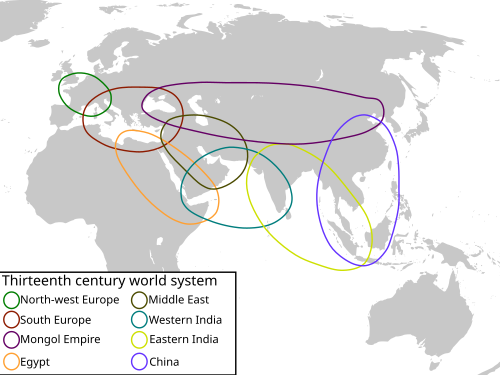
古代グローバリゼーションとは、通常、最古の文明の時代からおよそ1600年代までのグローバリゼーションの出来事や発展を含むグローバリゼーションの歴史の一段階を指します。この用語は、コミュニティと国家の関係、そしてそれらが地方レベルと地域レベルの両方でアイデアと社会規範の地理的広がりによってどのように形成されたかを説明するために使用されます。[35]
この図式では、グローバリゼーションが起こるための3つの主な前提条件が想定されている。1つ目は、西洋諸国が東洋から学んだ原則をどのように適応させ、実行してきたかを示す東洋起源の考え方である。[ 35]東洋からの伝統的な考え方の普及がなければ、西洋のグローバリゼーションは今のような形で出現することはなかっただろう。国家間の交流は地球規模ではなく、ほとんどの場合、アジア、北アフリカ、中東、およびヨーロッパの特定の地域に限定されていた。[35]初期のグローバリゼーションでは、国家が近くない他の国々と交流することは困難だった。最終的に、技術の進歩により、国家は他の国々の存在を知ることができるようになり、グローバリゼーションの別の段階が発生する可能性がある。3つ目は、相互依存性、安定性、および規則性と関係している。国家が他の国家に依存していない場合、どちらの国家も他の国家から相互に影響を受けることはない。これは、世界的なつながりと貿易の原動力の1つであり、どちらもなければ、グローバリゼーションは今のような形で出現することはなく、各国は依然として自国の生産と資源に依存して機能するだろう。これは初期のグローバリゼーションの考え方を取り巻く議論の一つである。古代のグローバリゼーションは、国家が今日ほど相互依存していなかったため、現代のグローバリゼーションと同じようには機能しなかったと主張されている。[35]
また、古代のグローバリゼーションには「多極的」な性質があり、非ヨーロッパ人が積極的に参加していたとも言われている。古代のグローバリゼーションは、西ヨーロッパが工業生産と経済生産の面で世界の他の地域をリードした19世紀の大分岐よりも前のことであったため、ヨーロッパだけでなく、グジャラート、ベンガル、中国沿岸部、日本など、経済的に発展した旧世界の中心地によっても推進された現象であった。[36]

ドイツの歴史経済学者で社会学者のアンドレ・グンダー・フランクは、ある種のグローバリゼーションは紀元前3千年紀にシュメールとインダス文明の間で貿易関係が始まったことに始まると主張している。この古風なグローバリゼーションはヘレニズム時代に存在し、商業化された都市中心地がインドからスペインにまで広がるギリシャ文化の中心を取り囲み、アレクサンドリアや他のアレクサンドリアの都市も含まれていた。ギリシャの地理的位置と小麦輸入の必要性から、ギリシャ人は早くから海上貿易に従事せざるを得なかった。古代ギリシャの貿易はほぼ制限がなく、国家は穀物の供給のみを管理していた。[8]


シルクロードの交易は、中国、インド亜大陸、ペルシャ、ヨーロッパ、アラビアの文明の発展に重要な要素であり、それらの文明間の長距離の政治的、経済的交流を開いた。[37]絹は確かに中国からの主要貿易品であったが、塩や砂糖などの一般的な商品も取引されていた。また、宗教、融合哲学、さまざまな技術、さらには病気もシルクロードに沿って運ばれた。経済貿易に加えて、シルクロードは、そのネットワークに沿った文明の間で文化貿易を行う手段としても機能した。[38]難民、芸術家、職人、宣教師、盗賊、使節などの人々の移動は、宗教、芸術、言語、新技術の交換をもたらした。[39]
近世
「初期近代」または「プロトグローバリゼーション」は、グローバリゼーションの歴史のうち、およそ 1600 年から 1800 年までの期間を指します。「プロトグローバリゼーション」という概念は、歴史家AG ホプキンスとクリストファー ベイリーによって初めて導入されました。この用語は、19 世紀後半の高度な「近代グローバリゼーション」の到来直前の期間を特徴づける、貿易関係と文化交流が拡大した段階を表しています。[40]このグローバリゼーションの段階は、15 世紀と 17 世紀のヨーロッパの海洋帝国の台頭によって特徴づけられ、最初はポルトガル帝国(1415 年)、続いてスペイン帝国(1492 年)、その後はオランダ帝国とイギリス帝国が台頭しました。 17世紀には、イギリス東インド会社(1600年設立)やオランダ東インド会社(1602年設立、株式を発行した最初の多国籍企業と言われる)などの認可会社が設立され、世界貿易がさらに発展しました。[41]
.jpg/500px-Chafariz_d'el_Rei_(Flemish_School).jpg)
歴史家デニス・フリンとアルトゥーロ・ヒラルデスの別の見解は、次のように主張している。「グローバリゼーションは、マゼラン・エルカーノ探検隊による初の世界一周航海から始まり、それが世界的な銀貿易の勃興のきっかけとなった。 」 [42] [43]
近世のグローバリゼーションは、拡張主義、世界貿易の管理方法、情報交換のレベルに基づいて、現代のグローバリゼーションと区別される。この時代は、西ヨーロッパへの覇権の移行、三十年戦争などの大国間の大規模な紛争の勃発、そして特に奴隷などの商品の需要によって特徴づけられる。三角貿易により、ヨーロッパは西半球内の資源を活用することが可能になった。アルフレッド・W・クロスビーのコロンブス交換の概念に関連する家畜、植物、伝染病の移動も、このプロセスで中心的な役割を果たした。ヨーロッパ、中東、インド、東南アジア、中国の商人はすべて、特にインド洋地域で近世の貿易と通信に関わっていた。


モダンな
経済史家のケビン・H・オルーク、レアンドロ・プラドス・デ・ラ・エスコスーラ、ギヨーム・ドーダンによれば、1815年から1870年にかけてグローバリゼーションを促進した要因はいくつかある。[44]
- ナポレオン戦争の終結により、ヨーロッパには比較的平和な時代が到来した。
- 輸送技術の革新により貿易コストが大幅に削減されました。
- 新たな産業軍事技術によってヨーロッパ諸国と米国の力が増大し、これらの大国は強制的に世界中の市場を開拓し、帝国を拡大することができました。
- ヨーロッパ諸国におけるさらなる自由化に向けた段階的な動き。
19世紀、グローバリゼーションは産業革命の直接的な結果としてその形に近づきました。工業化により規模の経済を利用して家庭用品の標準化された生産が可能になり、急速な人口増加により商品に対する持続的な需要が生まれました。19世紀には、蒸気船が国際輸送のコストを大幅に削減し、鉄道が内陸輸送を安価にしました。輸送革命は1820年から1850年の間に起こりました。 [34]より多くの国が国際貿易を受け入れました。[34]この時期のグローバリゼーションは、アフリカやアジアなどの19世紀の帝国主義によって決定的に形作られました。1956年の輸送コンテナの発明は、商業のグローバリゼーションの促進に貢献しました。[45] [46]
第二次世界大戦後、政治家たちの働きかけによりブレトンウッズ会議の合意が生まれ、主要国政府は国際通貨政策、通商、金融の枠組みを定め、貿易障壁を下げることで経済成長を促進することを目的とした国際機関がいくつか設立された。当初、関税及び貿易に関する一般協定(GATT)は貿易制限を撤廃する一連の協定につながった。GATTの後継は世界貿易機関(WTO)で、貿易協定の交渉と正式化、紛争解決プロセスの枠組みを提供した。輸出は1970年の世界総生産の8.5%から2001年には16.2%へとほぼ倍増した。[47]貿易を促進するために世界的な協定を使用するアプローチは、ドーハ開発ラウンドの貿易交渉の失敗でつまずいた。その後、多くの国が2011年の米韓自由貿易協定などの二国間またはより小規模な多国間協定に移行した。
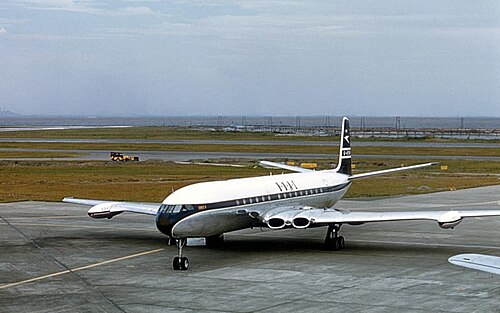
1970 年代以降、先進国の中流階級にとって航空はますます手頃なものになってきました。オープン スカイポリシーと格安航空会社が市場に競争をもたらすのに貢献しました。1990 年代には、低コストの通信ネットワークの成長により、国家間の通信コストが削減されました。場所に関係なく、コンピューターを使用して実行できる作業が増えました。これには、会計、ソフトウェア開発、エンジニアリング設計が含まれます。
交換留学プログラムは第二次世界大戦後に人気が高まり、参加者の異文化に対する理解と寛容性を高め、語学力を向上させ、社会的視野を広げることを目的としています。1963年から2006年の間に、外国で学ぶ学生の数は9倍に増加しました。[48]
1980年代以降、現代のグローバリゼーションは資本主義と新自由主義イデオロギーの拡大を通じて急速に広まった。[49]新自由主義政策の実施により、公共産業の民営化、市場の自由な流れを妨げる法律や政策の規制緩和、政府の社会サービスの削減が可能になった。[50]これらの新自由主義政策は、世界銀行と国際通貨基金(IMF)によって実施された構造調整プログラム(SAP)の形で多くの開発途上国に導入された。[49]これらのプログラムでは、金融援助を受ける国が資本主義に市場を開放し、公共産業を民営化し、自由貿易を許可し、医療や教育などの社会サービスを削減し、巨大な多国籍企業の自由な移動を許可することが求められた。[51]これらのプログラムにより、世界銀行とIMFは世界金融市場の規制機関となり、世界規模で新自由主義と多国籍企業のための自由市場の創出を推進することができた。[52]

19世紀後半から20世紀初頭にかけて、世界の経済と文化のつながりは急速に拡大した。1910年代以降は世界大戦と冷戦により減速したが[ 53]、1980年代と1990年代には再び加速した。[54] 1989年の革命とその後の世界各地での自由化により、世界の相互連結性は大幅に拡大した。人々の移住と移動も、グローバリゼーションのプロセスの顕著な特徴として強調できる。1965年から1990年の間に、移住する労働力の割合は約2倍になった。移住のほとんどは、開発途上国と後発開発途上国(LDC)の間で発生した。[55]経済統合が進むにつれて、労働者は賃金の高い地域に移動し、開発途上国のほとんどは国際市場経済を志向した。ソ連の崩壊は、冷戦による世界分断を終わらせただけでなく、米国を世界の唯一の警察官、そして自由市場の自由な擁護者とした。[誰によると? ]また、病気の移動、大衆文化と消費者の価値観の拡散、国連などの国際機関の重要性の高まり、環境や人権などの問題に対する国際的な協調行動に注目が集まる結果となった。[56]他の劇的な展開としては、インターネットが世界中の人々をつなぐ上で影響力を持つようになったことが挙げられます。2012年6月の時点で[update]、24億人以上の人々(世界人口の3分の1以上)がインターネットのサービスを利用しています。[57] [58]グローバリゼーションの成長は決して順調ではありませんでした。影響力のあった出来事の1つは、2000年代後半の不況で、これは世界的な相互接続性の成長の低下(国境を越えた電話やSkypeの使用などの分野)や一時的なマイナス成長(貿易などの分野)と関連していました。[59] [60]
2018年に始まった米中貿易戦争は、二大経済大国間の貿易に悪影響を及ぼした。COVID -19パンデミックの経済的影響には、多くの国が一時的に国境を閉鎖したことによる観光業と国際ビジネス旅行の大幅な減少などがある。2021 ~2022年の世界的なサプライチェーン危機は、製造・輸送施設の一時的な閉鎖と労働力不足から生じた。供給問題により、一部は国内生産への切り替えを促した。[61] 2022年のロシアによるウクライナ侵攻の経済的影響には、ウクライナ港の封鎖とロシアに対する国際制裁が含まれ、その結果、ロシア経済と世界貿易、特に欧州連合(EU)や他の西側諸国との貿易が一部切り離された。
過去15年間の現代のコンセンサスでは、グローバリゼーションは終焉を迎え、衰退したと見られています。[62]これに対する一般的な議論は、貿易は2008年のピークから減少し、大不況以来回復していないというものです。一部の経済学者からの新たな反対意見は、このような傾向は価格低下の結果であり、実際には貿易量は増加しており、特に農産物、天然資源、精製石油で増加していると主張しています。[63] [64]
経済のグローバル化

_and_Trade_Policies.png/500px-U.S._Trade_Balance_(1895%E2%80%932015)_and_Trade_Policies.png)
.jpg/500px-Brno,_N%C3%A1kupn%C3%AD_centrum_Kr%C3%A1lovo_Pole_(7239).jpg)
経済のグローバル化とは、商品、サービス、技術、資本の国境を越えた移動が急速に増加することで、世界中の国家経済の経済的相互依存が高まることである。 [66]ビジネスのグローバル化は、国際貿易規制や関税、税金、その他の世界貿易を抑制する障害の減少を中心に展開されるのに対し、経済のグローバル化は、国家間の経済統合が進み、世界市場または単一の世界市場の出現につながるプロセスである。[67]パラダイムに応じて、経済のグローバル化は肯定的または否定的な現象として見ることができる。経済のグローバル化は、生産のグローバル化で構成され、これは、コストと品質の違いから利益を得るために、世界中の特定のソースから商品やサービスを取得することを指します。同様に、市場のグローバル化も含まれ、これは、異なる個別の市場が巨大な世界市場に統合されることと定義されます。経済のグローバル化には、[68]競争、技術、企業、産業も含まれます。[66]
現在のグローバル化の傾向は、主に、外国直接投資、貿易障壁の削減やその他の経済改革、そして多くの場合移民を通じて、先進国が発展途上国と統合することによって説明できる。[69]
国際標準により、商品やサービスの貿易はより効率的になりました。そのような標準の例としては、複合一貫輸送コンテナがあります。コンテナ化により輸送コストが劇的に削減され、戦後の国際貿易の好況を支え、グローバリゼーションの大きな要素となりました。[45]国際標準は、さまざまな国の標準化団体の代表者で構成される国際標準化機構によって設定されています。
多国籍企業、または世界規模の企業[70]とは、自国以外の1つ以上の国で商品やサービスの生産を所有または管理する組織です。[71]国際企業、多国籍企業、無国籍企業と呼ばれることもあります。[72]
自由貿易地域とは、加盟国が自由貿易協定(FTA)を締結した貿易圏を包含する地域である。このような協定は、少なくとも2か国間の協力により、 輸入割当や関税などの貿易障壁を削減し、相互の物品やサービス の貿易を増やすことを目的とする。 [73]
自由貿易協定に加えて、人々が国家間で自由に移動できる場合、それは開かれた国境ともみなされるだろう。おそらく、世界で最も重要な自由貿易地域は、主にヨーロッパに位置する27の加盟国からなる政治経済連合である欧州連合である。EUは、すべての加盟国に適用される標準化された法律システムを通じて、欧州単一市場を開発してきた。EUの政策は、域内市場内での人、商品、サービス、資本の自由な移動を確保することを目指している。 [74]
貿易円滑化では、国境を越えた商品の移動を管理する手順と管理を改善して、関連するコスト負担を軽減し、効率を最大化しながら、正当な規制目的を保護する方法を検討します。
世界的なサービス貿易も重要である。例えば、インドでは、ビジネスプロセスアウトソーシングは「今後数十年間の国の開発の主な原動力となり、GDPの成長、雇用の増加、貧困の軽減に広く貢献する」と評されている。[75] [76]
ウィリアム・I・ロビンソンのグローバリゼーションに対する理論的アプローチは、ウォーラーステインの世界システム理論に対する批判である。ロビンソンは、今日経験されているグローバル資本は、1980年代に始まった新しい独特の形態のグローバリゼーションによるものだと考えている。ロビンソンは、経済活動が国境を越えて拡大しているだけでなく、これらの活動が国境を越えて断片化していると主張する。[77]ロビンソンのグローバリゼーション理論の重要な側面の1つは、商品の生産がますますグローバル化しているということである。これは、1足の靴が6か国で生産され、それぞれが生産プロセスの一部に貢献していることを意味する。
文化のグローバル化

文化のグローバリゼーションとは、社会関係を拡大し強化するような方法で、世界中にアイデア、意味、価値観が伝わることを指します。[78]このプロセスは、インターネット、大衆文化メディア、海外旅行によって広まった文化の共通の消費によって特徴付けられます。これは、文化的意味を世界中に運ぶ長い歴史を持つ商品交換と植民地化のプロセスに加わりました。文化の循環により、個人は国境や地域の境界を越えた広範な社会関係に参加することができます。このような社会関係の創造と拡大は、単に物質的なレベルで観察されるものではありません。文化のグローバリゼーションには、人々が個人および集団の文化的アイデンティティを関連付ける共通の規範と知識の形成が含まれます。それは、異なる人々と文化の間の相互接続性の増大をもたらします。[79]
異文化コミュニケーションは、異なる文化的背景を持つ人々が、類似した方法や異なる方法でどのようにコミュニケーションをとるか、また、文化を超えてどのようにコミュニケーションを取ろうとするかを研究する分野です。異文化コミュニケーションは関連する研究分野です。
文化の拡散とは、思想、様式、宗教、技術、言語などの文化的な項目が広がることである。文化のグローバル化により異文化間の接触は増加したが、かつては孤立していたコミュニティの独自性は減少する可能性がある。例えば、寿司は日本だけでなくドイツでも入手可能だが、ユーロディズニーはパリの街を魅了し、「本物の」フランスのペストリーの需要を減らす可能性がある。[80] [81] [82]ジャン=ポール・サルトルやアルベール・カミュなどの実存主義者が主張するように、グローバル化が個人を伝統から疎外することへの貢献は、近代化自体の影響と比較すると控えめかもしれない。グローバル化は、特にインターネットや衛星テレビを通じてポップカルチャーを広めることで、娯楽の機会を拡大した。文化の拡散は均質化の力を生み出す可能性があり、ここでグローバル化は、市場、文化、政治のつながり、帝国国家の影響圏を通じた近代化への欲求を通じて均質化の力と同義であると見なされている。[83]
宗教は、力、移住、伝道者、帝国主義者、貿易商によって広まり、最も早くグローバル化した文化的要素の一つである。キリスト教、イスラム教、仏教、そして最近ではモルモン教などの宗派は、起源から遠く離れた場所に根付き、その土地固有の文化に影響を与えた宗教である。[84]

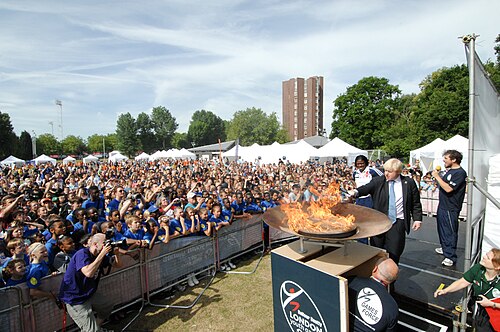
グローバリゼーションはスポーツに大きな影響を与えています。[85]たとえば、近代オリンピックには200か国以上の選手がさまざまな競技に参加しています。 [86] FIFAワールドカップは、オリンピックをも上回る世界で最も広く視聴され、注目されているスポーツイベントです。 2006年のFIFAワールドカップ決勝戦は、地球上の全人口の9分の1が視聴しました。[87] [88] [89]
グローバリゼーションという言葉は変革を意味する。伝統音楽を含む文化的慣習は失われるか、伝統の融合に変わる可能性がある。グローバリゼーションは音楽遺産の保存のための緊急事態を引き起こす可能性がある。アーキビストはメロディーが同化または変更される前にレパートリーを収集、記録、または転写しようとするかもしれないが、地元のミュージシャンは真正性を求めて地元の音楽の伝統を保存しようと奮闘するかもしれない。グローバリゼーションは演奏者に伝統的な楽器を捨てさせる可能性がある。フュージョンジャンルは興味深い分析分野になる可能性がある。[90]
音楽は、グローバリゼーションの時代における経済と文化の発展において重要な役割を果たしている。ジャズやレゲエなどの音楽ジャンルは、地元で始まり、後に国際的な現象となった。グローバリゼーションは、発展途上国の音楽がより広い聴衆に届くようにすることで、ワールドミュージック現象を支えた。 [91]「ワールドミュージック」という用語は、もともと民族特有の音楽を指すものであったが、グローバリゼーションによってその範囲が拡大し、「ワールドフュージョン」、「グローバルフュージョン」、「エスニックフュージョン」などのハイブリッドなサブジャンルが含まれることが多くなった。[92]ワールドビート[ 93] [94]
.jpg/500px-Thai_curry_paste_at_the_market_so_good_I_brought_some_home_(3195324838).jpg)
ブルデューは、消費の認識は自己同一性とアイデンティティの形成とみなせると主張した。音楽的に言えば、これは各個人が好みや嗜好に基づいて独自の音楽的アイデンティティを持つことを意味する。これらの好みや嗜好は文化に大きく影響される。文化は個人の欲求や行動の最も基本的な原因だからである。自分の文化の概念は、現在、グローバリゼーションにより変化の時期にある。また、グローバリゼーションは、政治、個人、文化、経済の要因の相互依存性を高めている。[96]
2005年のユネスコ報告書[97]によると、東アジアからの文化交流はより頻繁になっているが、西洋諸国が依然として文化財の主な輸出国である。2002年、中国は英国と米国に次ぐ第3位の文化財輸出国であった。1994年から2002年の間、北米と欧州連合の文化輸出のシェアは減少したが、アジアの文化輸出は北米を上回るまでに成長した。関連する要因として、アジアの人口と面積は北米の数倍であるという事実がある。アメリカ化は、アメリカの政治的影響力が強かった時期と、アメリカの店、市場、物品が他国に持ち込まれることが大幅に増加した時期に関係している。
グローバリゼーションの批判者の中には、グローバリゼーションは文化の多様性を損なうと主張する者もいる。支配国の文化がグローバリゼーションを通じて受け入れ国に導入されると、それが地域文化の多様性に対する脅威となる可能性がある。グローバリゼーションは最終的に文化の西洋化またはアメリカ化につながり、経済的、政治的に強力な西洋諸国の支配的な文化的概念が広がり、地域文化に害を及ぼす可能性があると主張する者もいる。[98]
グローバリゼーションは、多国間の政治世界と国家間の文化的対象および市場の増加に関連する多様な現象である。インドの経験は、特に文化的グローバリゼーションの影響の多様性を明らかにしている。 [99]
トランスカルチュラリズムは「他者の中に自分を見る」と定義されます。[100]トランスカルチュラリズム[101]は、「すべての人間の文化に広がる」[101]または「複数の文化の要素を巻き込み、包含し、組み合わせる」[102]と説明されます。トランスカルチュラリズムの背景で育った子供は、第三文化の子供と呼ばれることもあります。
政治のグローバル化
.jpg/500px-67%C2%BA_Per%C3%ADodo_de_Sesiones_de_la_Asamblea_General_de_Naciones_Unidas_(8020913157).jpg)
政治的グローバリゼーションとは、世界規模の政治システムが規模と複雑さの両面で拡大することを指す。そのシステムには、各国政府、その政府組織および政府間組織、および国際的な非政府組織や社会運動組織などの政府から独立したグローバル市民社会の要素が含まれる。政治的グローバリゼーションの重要な側面の 1 つは、国民国家の重要性の低下と政治舞台における他のアクターの台頭である。 ウィリアム R. トンプソンはこれを「地域間取引 (貿易を含むが、もちろん貿易に限定されない) が管理されるグローバルな政治システムとその制度の拡大」と定義している。[103]政治的グローバリゼーションは、学術文献でよく見られるグローバリゼーションの 3 つの主要な側面の 1 つであり、他の 2 つは経済的グローバリゼーションと文化的グローバリゼーション である。[12]
政府間主義は政治学の用語で、2つの意味があります。1つ目は、もともとスタンレー・ホフマンが提唱した地域統合の理論を指し、2つ目は、国家と中央政府を統合の主要因として扱うことです。マルチレベルガバナンスは、ヨーロッパ統合の研究から生まれた政治学と行政理論のアプローチです。マルチレベルガバナンスは、台頭しつつあるグローバル政治経済では、相互作用する多くの権威構造が機能しているという考えを表現しています。これは、国内レベルと国際レベルの権威の密接な絡み合いを明らかにします。
複数の国民国家の市民である人もいます。多重国籍は、二重国籍、多重国籍、二重国籍とも呼ばれ、ある人物が複数の国の法律の下で同時にその国の市民とみなされる国籍の状態です。

非政府組織は、人道支援や開発努力など、国境を越えて公共政策に影響を与えることが増えている。[105]世界的な使命を持つ慈善団体も人道的努力の最前線に立つようになってきている。ビル&メリンダ・ゲイツ財団、アクシオン・インターナショナル、アキュメン・ファンド(現アキュメン)、エコーイング・グリーンなどの慈善団体は、ビジネスモデルと慈善活動を組み合わせ、グローバル・フィランソロピー・グループなどのビジネス組織や、グローバル・フィランソロピー・フォーラムなどの新しい慈善家団体を生み出した。ビル&メリンダ・ゲイツ財団のプロジェクトには、現在、世界で最も貧困だが急速に成長している国々の一部で予防接種に資金を提供する数十億ドルのコミットメントが含まれている。[106]ハドソン研究所は、 2010年に開発途上国に流入した民間慈善資金の総額を590億ドルと推定している。[107]
グローバル化への対応として、一部の国は孤立主義政策を採用している。例えば、北朝鮮政府は外国人の入国を非常に困難にし、入国した外国人の活動を厳しく監視している。援助活動家は厳しい監視下に置かれ、政府が入国を望まない場所や地域から締め出されている。国民は自由に国を離れることはできない。[108] [109]
グローバリゼーションとジェンダー

グローバル化はジェンダーに基づくプロセスであり、巨大な多国籍企業は、貧困層の女性が労働力の大半を占めるバングラデシュの既製服産業のような、低賃金、低技能、割り当てのない経済に仕事をアウトソースしてきました。衣料品産業では女性労働者の割合が高いにもかかわらず、女性は男性に比べて依然として大幅に不完全雇用されています。衣料品産業で雇用されている女性のほとんどはバングラデシュの田舎から来ており、これが衣料品の仕事を求めて女性の移住を引き起こしています。以前は存在しなかった有給労働へのアクセスが女性に力を与えたかどうかはまだ明らかではありません。答えは、雇用主の視点か労働者の視点か、そして彼らが自分の選択をどう見ているかによって異なりました。女性労働者は、長時間の立ち仕事と劣悪な労働条件のため、衣料品産業が長期的に経済的に持続可能だとは考えていません。しかし、女性労働者は、家族と交渉する能力、結婚の選択肢の多さ、家族の中で稼ぎ手として評価されるなど、私生活においてかなりの自立性を示しました。これは、労働者が職場で自分たちにとってより良い条件を交渉するために集団的に組織化できるようになるということにはつながらなかった。[110]
製造業におけるアウトソーシングのもう一つの例は、メキシコのシウダー・フアレスのマキラドーラ産業で、貧困層の女性が労働力の大半を占めている。マキラドーラ産業の女性は、男性に比べて離職率が高く、訓練を受けるのに十分な期間留まらない。マキラドーラ産業では、訓練と労働者の忠誠心に重点を置いた、性別による二層制が作られている。女性は訓練を受けられないとみなされ、未熟練で低賃金の仕事に就かされるが、男性は訓練を受けやすく離職率が低いとみなされ、より高度な技術職に就かされる。訓練という考え方は、女性の高い離職率を非難する手段として使われるようになり、女性を臨時労働者として雇用し続けることで業界にも利益をもたらしている。[111]
その他の次元
学者たちは、環境グローバリゼーション(環境保護に関する国際条約の形で行われることが多い、国際的に調整された慣行や規制)[112]や軍事グローバリゼーション(安全保障関係の世界的な範囲と規模の拡大)[113]など、グローバリゼーションの他のあまり一般的ではない側面についても時折議論する。しかし、これらの側面は、上記の3つほど注目されていない。なぜなら、学術文献では、グローバリゼーションは一般的に、経済的グローバリゼーション、文化的グローバリゼーション、政治的グローバリゼーションの3つの主要領域に細分化されているからである。[12]
人の移動

グローバリゼーションの重要な側面は人々の移動であり、その移動に対する国境の制限は歴史を通じて変化してきました。[114]観光客やビジネスマンの移動は、前世紀に自由になりました。輸送技術が向上するにつれて、18世紀から20世紀初頭にかけて、旅行時間と費用は劇的に減少しました。たとえば、大西洋を横断する旅行は18世紀には最大5週間かかりましたが、20世紀頃にはわずか8日間でした。[115]今日、現代の航空技術により、長距離輸送は迅速かつ手頃な価格になりました。
観光とは、楽しみのための旅行である。ジャンボジェット機、格安航空会社、よりアクセスしやすい空港など、技術や交通インフラの発達により、多くのタイプの観光がより手頃になった。いつでも50万人が空を飛んでいる。[116]国際観光客の到着数は、2012年に初めて世界全体で10億人の節目を突破した。[117] ビザとは、国が外国人に与える条件付きの許可であり、外国人がその国に入国して一時的に滞在したり、出国したりすることを許可するものである。シェンゲン協定国など一部の国は、他の国と協定を結んでおり、互いの国民がビザなしで行き来できるようになっている(例えば、スイスはシェンゲン協定に参加しており、欧州連合諸国の人々が簡単に旅行できる)。世界観光機関は、旅行前にビザを必要とする観光客の数が2015年に過去最低になったと発表した。 [118]
移民とは、人々が母国ではない国や市民権を持たない国に国際的な移動をし、特に永住者や帰化人としてそこに定住または居住するか、移民労働者または一時的な外国人労働者として雇用されることである。[119] [120] [121]国際労働機関によると、2014年の時点で世界には推定2億3,200万人の国際移民(出身国を12か月以上離れている人と定義)がおり、そのうち約半数が経済的に活動している(つまり、雇用されているか、求職中である)と推定されている。[ 122]労働力の国際的な移動は、経済発展にとって重要であるとしばしば考えられている。例えば、欧州連合(EU)における労働者の移動の自由は、人々が加盟国間を自由に移動して、他の国で生活、就労、学習、または引退できることを意味する。 [update]
グローバル化は国際教育の劇的な増加と関連している。アドホックトレーニングを通じて労働力のグローバル異文化能力の開発は、最近ますます注目に値する。 [124] [125]ますます多くの学生が海外で高等教育を受けることを求めており、多くの留学生が海外留学を国内永住権への足がかりと考えている。[126]留学生が文化的にも経済的にも受け入れ国の経済に貢献していることから、主要国は、移民やビザの政策や手続きを大幅に改正するなど、留学生の到着と統合を促進するためのさらなる取り組みを実施するよう促されている。[48]
国際結婚とは、異なる国に住む 2 人の間の結婚です。異なる国に住む人々同士の結婚には、市民権や文化に関連する問題など、さまざまな特別な問題が生じ、こうした関係に複雑さと課題が加わります。グローバル化が進む時代では、現在の地理的位置ではなく、世界中の人々や場所のネットワークとつながりを持つ人が増えており、国境を越えて結婚する人が増えています。国際結婚は、人々の移動と移住の副産物です。
情報の移動
電子通信が登場する前は、長距離通信は郵便に依存していました。19 世紀半ばまで、世界通信の速度は宅配便 (特に馬と船) の最高速度によって制限されていました。電信は、瞬時に長距離通信を行う最初の方法でした。たとえば、最初の大西洋横断ケーブルが登場する前は、船で海を越えて郵便物を運ばなければならなかったため、ヨーロッパとアメリカ大陸間の通信には数週間かかりました。最初の大西洋横断ケーブルによって通信時間が大幅に短縮され、メッセージと応答を同じ日に受け取ることができました。1865 年から 1866 年にかけて、大西洋を横断する永続的な電信接続が実現しました。最初の無線電信送信機は 1895 年に開発されました。
インターネットは地理的境界を越えて人々を結びつける上で重要な役割を果たしてきました。例えば、Facebookは2016年3月31日現在、月間アクティブユーザー数が16億5千万人を超えるソーシャルネットワーキングサービス[update]です。[128]
グローバリゼーションは、膨大な情報を提供し、インターネットを介してやりとりするグローバルジャーナリズムによって広められ、「世界のさまざまな地域の人々とその行動、習慣、問題、生活状況などがどのように相互に関連しているかを調査することを日常的に行う。気候変動などの地球規模の脅威が、グローバルジャーナリズムのさらなる確立を促進すると想定できる。」[129]
グローバリゼーションと病気
現在のグローバル化の時代において、世界はかつてないほど相互依存的になっています。効率的で安価な交通手段によってアクセスできない場所はほとんどなくなり、世界貿易の増加によって、種の壁を越えた動物の病気に接触する人が増えています(人獣共通感染症を参照)。[130]
新型コロナウイルス感染症(COVID-19)は、2019年11月に中国の武漢で初めて発生しました。それ以来、180か国以上で症例が報告されています。 [131] 2020年4月6日現在[update]、米国は世界で最も多くの感染者を抱えています。[132] COVID-19パンデミックの発生から最初の3か月で、最も被害の大きい国から340万人以上が米国に入国しました。[133]これにより、世界経済、特に無限責任/自営業の中小企業や小規模事業者に悪影響を及ぼし、財務上の困難に陥りやすくなり、寡占市場の市場シェアが拡大し、参入障壁が高まりました。
測定
グローバリゼーションの指標の一つにKOFグローバリゼーション指数があり、これは経済、社会、政治というグローバリゼーションの3つの重要な側面を測定している。[134]もう1つはATカーニー/フォーリン・ポリシー・マガジンのグローバリゼーション指数である。 [135]
経済のグローバル化の測定は、通常、貿易、外国直接投資(FDI)、国内総生産(GDP)、証券投資、所得などの変数に焦点を当てています。しかし、新しい指標は、政治的、社会的、文化的、さらには環境的側面に関連する変数を含め、より一般的な観点からグローバル化を測定しようとしています。[136] [137]
DHLグローバル連結性指数は、貿易(商品とサービスの両方)、情報、人(観光客、学生、移民を含む)、資本という4つの主要な越境フローを調査している。この指数によると、世界的な統合の深さは2008年以降約10分の1に低下したが、2013年までに崩壊前のピークを大きく上回るまで回復した。[22] [59]この報告書では、経済活動が新興国に移行していることも明らかになった。[22]
支持と批判
.jpg/500px-Press_conference_EU-Mercosul_on_June_26,_2019_(VII).jpg)
グローバリゼーションに寄与するプロセスに対する反応は、域外との接触や貿易と同じくらい長い歴史の中で、多種多様である。そのようなプロセスのコストと利益に関する哲学的な違いは、幅広いイデオロギーと社会運動を生み出している。経済成長、拡大、発展の支持者は、一般的に、グローバリゼーションのプロセスは人類社会の幸福にとって望ましい、または必要であると考えている。[138]
反対派は、1つまたは複数のグローバル化のプロセスが、地球規模または地域規模で社会的幸福に有害であると考えています。[138]これには、長期的かつ継続的な経済拡大の社会的または自然な 持続可能性、これらのプロセスによって引き起こされる社会構造の不平等、およびそのようなプロセスの根底にある植民地主義、帝国主義、覇権主義的な 民族中心主義、文化的同化、文化の盗用に焦点を当てる人々が含まれます。
グローバリゼーションは人々を外国の人々や文化と接触させる傾向がある。外国人嫌悪とは、外国のものや奇妙であると認識されたものに対する恐怖である。[139] [140]外国人嫌悪は、内集団と外集団の関係や認識に関わるさまざまな形で現れる可能性があり、その中にはアイデンティティを失うことへの恐怖、その活動に対する疑念、攻撃性、そして想定される純粋さを確保するためにその存在を排除したいという願望などが含まれる。[141]
グローバリゼーションに対する批判は、一般的に、そのようなプロセスが地球に与える影響や人的コストに関する議論から生じている。彼らは、GDP などの従来の指標に直接異議を唱え、ジニ係数[142]や幸福な地球指数[143]などの他の指標に目を向け、「社会の崩壊、民主主義の崩壊、環境のより急速かつ広範な悪化、新しい病気の蔓延、貧困と疎外の増大など、相互に関連し合った多数の致命的な結果」[144]を指摘し、これらはグローバリゼーションの意図しない結果であると主張する。また、グローバリゼーションの力によって西洋型民主主義が広まった一方で、自由市場経済政策が普通選挙の民主的プロセスと結びつき、民主的原則を押し付け、紛争解決の手段として軍事化がエスカレートするにつれて、民族間の緊張と暴力が増加したと指摘する者もいる。[145]
2019年8月9日、フランシスコ教皇は孤立主義を非難し、 2019年10月のアマゾニアシノドスでカトリック教会がグローバリゼーションを受け入れることを示唆し、「全体は部分よりも大きい。グローバリゼーションと統一は球体としてではなく、多面体として考えるべきである。各民族は他の民族との統一の中で自らのアイデンティティを維持する」と述べた[146]。
世論
複雑で多面的な現象であるグローバリゼーションは、資本主義の拡大の一形態であり、地域経済と国家経済をグローバルで規制のない市場経済に統合するものであると考える人もいます。[147]ピア・フィスとポール・ハーシュによる2005年の研究では、それ以前の数年間にグローバリゼーションに否定的な記事が大幅に増加したことがわかっています。1998年には、否定的な記事が肯定的な記事の2倍になりました。[148]否定的なフレーミングを示す新聞記事の数は、1991年の総記事数の約10%から1999年には総記事数の55%に増加しました。この増加は、グローバリゼーションに関する記事の総数がほぼ2倍になった時期に発生しました。[148]
数多くの国際世論調査によると、アフリカやアジアの住民は、ヨーロッパや北米の住民よりもグローバル化を好意的に見ている傾向がある。アフリカでは、ギャラップの世論調査で、人口の70%がグローバル化を好意的に見ていることがわかった。[149] BBCの調査では、50%の人が経済のグローバル化が急速に進んでいると考えており、35%の人が経済のグローバル化が遅すぎると考えていることがわかった。[150]
2004年、フィリップ・ゴードンは「ヨーロッパ人の大多数は、グローバリゼーションが自分たちの生活を豊かにしてくれると信じており、欧州連合はグローバリゼーションの恩恵を享受しつつ、その悪影響から自分たちを守ってくれると信じている」と述べた。主な反対派は社会主義者、環境保護団体、国家主義者だった。2004年、EUの住民はグローバリゼーションに脅威を感じていないようだった。EUの雇用市場はより安定しており、労働者は賃金や福利厚生の削減を受け入れる可能性が低かった。社会保障費は米国よりもはるかに高かった。[151] 2007年のデンマークの世論調査では、76%がグローバリゼーションは良いことだと回答した。[152]
フィスらは1993年に米国の世論調査を行った。調査によると、1993年には回答者の40%以上がグローバリゼーションの概念を知らないことがわかった。1998年に調査が再実施されたとき、回答者の89%がグローバリゼーションは良いか悪いかという二極化した見解を持っていた。同時に、金融界で始まったグローバリゼーションに関する議論は、推進派と失望した学生や労働者との間で白熱した議論へと移行した。1995年のWTO設立後、二極化は劇的に増加し、この出来事とその後の抗議活動は大規模な反グローバリゼーション運動につながった。[148]当初、大学教育を受けた労働者はグローバリゼーションを支持する傾向があった。移民や発展途上国の労働者と競合する可能性が高い低学歴の労働者は反対する傾向があった。大不況 後、状況は変化した。 1997年の世論調査によると、大学卒業生の58%がグローバル化は米国にとって良いことだと答えた。2008年までに良いと考える人は33%にまで減少した。高校卒の回答者もグローバル化に反対する傾向が強まった。[153]
竹中平蔵と千田良吉によれば、1998年時点で[update]日本では経済が「小さく脆弱」であるという認識があった。しかし、日本は資源に乏しく、原材料の支払いに輸出に依存していた。その立場に対する不安から、国際化やグローバリゼーションなどの言葉が日常語になった。しかし、日本の伝統は、特に農業において可能な限り自給自足することであった。[154]
発展途上国では、グローバリゼーションは貧困から抜け出すための前向きな力であると考えている人が多い。[155]グローバリゼーションに反対する人々は、典型的には環境問題とナショナリズムを組み合わせている。反対派は、政府を多国籍企業に従属する新植民地主義の代理人とみなしている。[156]この批判の多くは中流階級から来ている。ブルッキングス研究所は、これは中流階級が、上昇志向の低所得層を自分たちの経済的安全保障に対する脅威と認識しているためだと示唆している。[157]
経済

自由貿易の経済性を分析した文献は非常に豊富で、理論的および実証的影響について広範囲にわたる研究が行われてきた。自由貿易は勝者と敗者を生み出すが、経済学者の間では、自由貿易は社会にとって大きく明白な純利益であるという点で広く一致している。[158] [159] 2006年に83人のアメリカ人経済学者を対象に行われた調査では、「87.5%が米国は残っている関税やその他の貿易障壁を撤廃すべきだと同意」し、「90.1%が米国が雇用主による外国への業務委託を制限すべきだという提案に反対」した。[160]
ハーバード大学経済学教授のN. グレゴリー・マンキューは次のように述べている。「自由貿易は経済成長を促し、生活水準を高めるという主張ほど、プロの経済学者の間でコンセンサスを得ているものはほとんどない。」[161]有力な経済学者を対象にした調査では、「より自由な貿易は生産効率を高め、消費者により良い選択肢を提供し、長期的にはこれらの利益は雇用への影響よりもはるかに大きい」という考え方に反対する者はいなかった。[162]ほとんどの経済学者は、規模の経済性増大は、比較優位から生じる強い経済的理由なしに特定の産業が特定の地域に定着できることを意味するかもしれないが、これは自由貿易に反対する理由にはならない、と同意するだろう。なぜなら、「勝者」と「敗者」の両方が享受する絶対的な生産レベルは増加し、「勝者」は「敗者」よりも多くの利益を得るが、絶対レベルでは両者とも以前よりも多くの利益を得るからである。
ジェフリー・サックスは著書『貧困の終焉』で、政府の腐敗、性別、民族、カーストに基づく法的および社会的格差、エイズやマラリアなどの疾病、インフラの欠如(交通、通信、健康、貿易を含む)、不安定な政治情勢、保護主義、地理的障壁など、多くの要因が国の世界市場への参入能力に影響を与える可能性があることを論じています。[163]元国連グローバリゼーション顧問の ジャグディッシュ・バグワティは、過度に急速な発展には明らかな問題があるものの、グローバリゼーションは、より速い経済成長に関連する好循環を引き起こすことで国々を貧困から引き上げる非常に前向きな力であると主張しています。[155]しかし、経済成長は必ずしも貧困の削減を意味するわけではなく、実際には両者は共存できます。経済成長は従来、GDPやGNIなどの指標を使用して測定されますが、これらは富の格差の拡大を正確に反映していません。[164]さらに、オックスファム・インターナショナルは、貧困層は「生産資産の不足、脆弱なインフラ、劣悪な教育、不健康」により、グローバル化がもたらす機会から排除されることが多いと主張している。[165]事実上、これらの疎外されたグループは貧困の罠に陥っている。経済学者のポール・クルーグマンは、グローバル化と自由貿易の熱心な支持者であり、グローバル化の多くの批判者と意見が一致しないという記録がある。彼は、彼らの多くは比較優位と今日の世界におけるその重要性について基本的な理解を欠いていると主張する。[166]
先進国への移民の流れは、世界賃金の収束につながると主張されてきた。IMFの調査では、途上国の賃金が上昇するにつれ、技能が途上国に還元される可能性があることが指摘されている。[11]最後に、知識の普及はグローバリゼーションの不可欠な側面である。技術革新(または技術移転)は、携帯電話の導入に見られるように、ほとんどの途上国と後発開発途上国(LDC)に利益をもたらすと推測されている。[55]
アジアでは、私有財産権、自由企業、競争を奨励する市場志向の経済政策を採用して以来、急速な経済成長を遂げてきた。特に東アジアの開発途上国では、 1975年から2001年まで一人当たりGDPが年率5.9%増加した(UNDPの2003年人間開発報告書[167]による)。このように、英国の経済ジャーナリスト、マーティン・ウルフは、世界人口の半分以上を占める貧しい開発途上国の所得が、比較的安定した成長を維持した世界の最も豊かな国の所得よりも大幅に高い伸びを示し、国際的な不平等と貧困率の減少につながったと述べている。

積極的な経済自由化と国際統合後の発展途上国における特定の人口動態の変化は、一般福祉の向上と不平等の減少をもたらした。ウルフによれば、発展途上国全体では、生活水準と健康状態の改善により、平均寿命は1970年以降毎年4か月延び、乳児死亡率は1970年の1000人中107人から2000年の58人に減少した。また、発展途上国の成人識字率は1970年の53%から1998年の74%に上昇し、若者の非識字率が大幅に低下していることから、時間の経過とともに識字率は引き続き低下することが保証されている。さらに、発展途上国全体の出生率が1980年の女性1人当たり4.1人から2000年の2.8人に減少したことは、出生率に関する女性の教育レベルが向上し、親の関心と投資を増やして子供の数を抑制していることを示している。[169]その結果、裕福で教育水準が高く子供の数が少ない親は、子供たちに学校で教育を受ける機会を与えるために、子供たちを労働力から引き離すことを選択し、児童労働の問題を改善しました。このように、これらの発展途上国では所得の分配が不平等であるように見えますが、経済成長と発展により、国民全体の生活水準と福祉が向上しました。
1980 年以降にグローバル化した国々の1 人当たり国内総生産(GDP) 成長率は、1960 年代の年間 1.4%、1970 年代の年間 2.9% から、1980 年代には 3.5%、1990 年代には 5.0% へと加速しました。この成長の加速は、富裕国の成長率が 1960 年代の最高 4.7% から 1990 年代には 2.2% へと着実に低下していることを考えると、さらに注目に値します。また、グローバル化を進めていない発展途上国は、グローバル化を進めている国々よりも状況が悪いようで、その年間成長率は 1970 年代の最高 3.3% から 1990 年代にはわずか 1.4% にまで低下しています。グローバリゼーション諸国の急速な成長は、1980年代と1990年代の中国とインドの好調な業績だけによるものではない。グローバリゼーション諸国24か国のうち18か国が成長の増加を経験し、その多くはかなりの成長を遂げた。[170]
,_2018.jpg/500px-Worlds_regions_by_total_wealth(in_trillions_USD),_2018.jpg)
20世紀後半から21世紀初頭のグローバリゼーションにより、経済的相互依存の拡大が平和を促進するという考え方が再浮上した。 [171]この考えは19世紀後半から20世紀初頭のグローバリゼーションの時代に非常に強力であり、若きジョン・メイナード・ケインズ(1883-1946)のような当時の古典的自由主義者の中心的な教義であった。[172]
グローバリゼーションに反対する人々の中には、グローバリゼーション現象を企業の利益の促進と見なす者もいる。[173]また、企業の自治権と力が増すことで各国の政治政策が形作られると主張する者もいる。[174] [175]彼らは、貧困層や労働者階級の道徳的要求や環境問題により適切に対処できると考える世界的な制度や政策を主張している。[176]公正貿易理論家による経済的議論では、無制限の自由貿易は貧困層を犠牲にして、より多くの金融レバレッジを持つ人々 (つまり富裕層)に利益をもたらすと主張している。[177]
グローバル化により、企業は製造やサービスの仕事をコストの高い場所からアウトソースできるようになり、最も競争力のある賃金と労働者の福利厚生を伴う経済的機会が生まれます。 [75]グローバル化の批判者は、それが貧しい国々に不利益をもたらすと主張します。自由貿易が国々の間のグローバル化を促進するのは事実ですが、一部の国々は国内の供給者を保護しようとします。貧しい国々の主な輸出品は通常、農産物です。大国はしばしば自国の農家に補助金を支給し(例:EUの共通農業政策)、外国の作物の市場価格を下げます。[178]
グローバル民主主義
民主的グローバリゼーションとは、世界中の市民に政治組織での発言権を与えるグローバル民主主義の制度的システムを目指す動きである。彼らの見解では、これは国民国家、企業寡占、イデオロギー的非政府組織(NGO)、政治カルト、マフィアを迂回するものである。その最も熱心な提唱者の 1 人は、英国の政治思想家デイビッド・ヘルドである。民主的グローバリゼーションの提唱者は、経済の拡大と発展が民主的グローバリゼーションの第一段階であるべきであり、その後にグローバルな政治組織の構築段階が続くべきだと主張する。ローマクラブ米国協会のディレクターであるフランチェスコ・スティポは、世界政府の下での国家の統一を提唱し、「世界国家の政治的および経済的バランスを反映すべきである。世界連合は国家政府の権威に取って代わるものではなく、むしろそれを補完するもので、国家と世界権威の両方がそれぞれの権限の範囲内で権力を持つことになる」と示唆している。[179]元カナダ上院議員のダグラス・ロッシュ氏は、グローバリゼーションは避けられないものと考え、選挙で選ばれない国際機関を監視するために、直接選挙で選ばれる国連議会のような機関の創設を主張した。[180]
グローバル市民教育
グローバル市民とは、相互依存と相互作用の時代における地球市民間の社会契約として、地球規模の意味で市民権を理解できると示唆している。この概念の普及者は、地球上で人間であるという単なる事実によって、私たちはお互いに対して一定の権利と責任を持っているという概念であると定義している。 [181]世界市民にはさまざまな類似の意味があり、多くの場合、国家市民権から生じる伝統的な地政学的区分に反対する人を指す。この感情の初期の具体化はソクラテスに見ることができ、プルタルコスはソクラテスの言葉を引用している。「私はアテネ人でもギリシャ人でもなく、世界市民だ。」[182]ますます相互依存が進む世界では、世界市民は考え方を組み立て、環境問題や核拡散などの世界の問題に対する共通の意識と地球規模の責任感を生み出すための羅針盤を必要としている。[183]
Baha'i-inspired author Meyjes, while favoring the single world community and emergent global consciousness, warns of globalization[184] as a cloak for an expeditious economic, social, and cultural Anglo-dominance that is insufficiently inclusive to inform the emergence of an optimal world civilization. He proposes a process of "universalization" as an alternative.
Cosmopolitanism is the proposal that all human ethnic groups belong to a single community based on a shared morality. A person who adheres to the idea of cosmopolitanism in any of its forms is called a cosmopolitan or cosmopolite.[185] A cosmopolitan community might be based on an inclusive morality, a shared economic relationship, or a political structure that encompasses different nations. The cosmopolitan community is one in which individuals from different places (e.g. nation-states) form relationships based on mutual respect. For instance, Kwame Anthony Appiah suggests the possibility of a cosmopolitan community in which individuals from varying locations (physical, economic, etc.) enter relationships of mutual respect despite their differing beliefs (religious, political, etc.).[186]
Canadian philosopher Marshall McLuhan popularized the term Global Village beginning in 1962.[187] His view suggested that globalization would lead to a world where people from all countries will become more integrated and aware of common interests and shared humanity.[188]
International cooperation

Military cooperation – Past examples of international cooperation exist. One example is the security cooperation between the United States and the former Soviet Union after the end of the Cold War, which astonished international society. Arms control and disarmament agreements, including the Strategic Arms Reduction Treaty (see START I, START II, START III, and New START) and the establishment of NATO's Partnership for Peace, the Russia NATO Council, and the G8 Global Partnership against the Spread of Weapons and Materials of Mass Destruction, constitute concrete initiatives of arms control and de-nuclearization. The US–Russian cooperation was further strengthened by anti-terrorism agreements enacted in the wake of 9/11.[189]
Environmental cooperation – One of the biggest successes of environmental cooperation has been the agreement to reduce chlorofluorocarbon (CFC) emissions, as specified in the Montreal Protocol, in order to stop ozone depletion. The most recent debate around nuclear energy and the non-alternative coal-burning power plants constitutes one more consensus on what not to do. Thirdly, significant achievements in IC can be observed through development studies.[189]
Economic cooperation – One of the biggest challenges in 2019 with globalization is that many believe the progress made in the past decades are now back tracking. The back tracking of globalization has coined the term "Slobalization." Slobalization is a new, slower pattern of globalization.[190]
Anti-globalization movement
.jpg/500px-2016-04-23_Anti-TTIP-Demonstration_in_Hannover,_(10118).jpg)
Anti-globalization, or counter-globalization,[191] consists of a number of criticisms of globalization but, in general, is critical of the globalization of corporate capitalism.[192] The movement is also commonly referred to as the alter-globalization movement, anti-globalist movement, anti-corporate globalization movement,[193] or movement against neoliberal globalization. Opponents of globalization argue that power and respect in terms of international trade between the developed and underdeveloped countries of the world are unequally distributed.[194] The diverse subgroups that make up this movement include some of the following: trade unionists, environmentalists, anarchists, land rights and indigenous rights activists, organizations promoting human rights and sustainable development, opponents of privatization, and anti-sweatshop campaigners.[195]
In The Revolt of the Elites and the Betrayal of Democracy, Christopher Lasch analyzed[196] the widening gap between the top and bottom of the social composition in the United States. For him, our epoch is determined by a social phenomenon: the revolt of the elites, in reference to The Revolt of the Masses (1929) by the Spanish philosopher José Ortega y Gasset. According to Lasch, the new elites, i.e. those who are in the top 20% in terms of income, through globalization which allows total mobility of capital, no longer live in the same world as their fellow-citizens. In this, they oppose the old bourgeoisie of the nineteenth and twentieth centuries, which was constrained by its spatial stability to a minimum of rooting and civic obligations. Globalization, according to the sociologist, has turned elites into tourists in their own countries. The denationalization of business enterprise tends to produce a class who see themselves as "world citizens, but without accepting ... any of the obligations that citizenship in a polity normally implies". Their ties to an international culture of work, leisure, information – make many of them deeply indifferent to the prospect of national decline. Instead of financing public services and the public treasury, new elites are investing their money in improving their voluntary ghettos: private schools in their residential neighborhoods, private police, garbage collection systems. They have "withdrawn from common life". Composed of those who control the international flows of capital and information, who preside over philanthropic foundations and institutions of higher education, manage the instruments of cultural production and thus fix the terms of public debate. So, the political debate is limited mainly to the dominant classes and political ideologies lose all contact with the concerns of the ordinary citizen. The result of this is that no one has a likely solution to these problems and that there are furious ideological battles on related issues. However, they remain protected from the problems affecting the working classes: the decline of industrial activity, the resulting loss of employment, the decline of the middle class, increasing the number of the poor, the rising crime rate, growing drug trafficking, the urban crisis.
D.A. Snow et al. contend that the anti-globalization movement is an example of a new social movement, which uses tactics that are unique and use different resources than previously used before in other social movements.[197]
One of the most infamous tactics of the movement is the Battle of Seattle in 1999, where there were protests against the World Trade Organization's Third Ministerial Meeting. All over the world, the movement has held protests outside meetings of institutions such as the WTO, the International Monetary Fund (IMF), the World Bank, the World Economic Forum, and the Group of Eight (G8).[195] Within the Seattle demonstrations the protesters that participated used both creative and violent tactics to gain the attention towards the issue of globalization.
Opposition to capital market integration

Capital markets have to do with raising and investing money in various human enterprises. Increasing integration of these financial markets between countries leads to the emergence of a global capital marketplace or a single world market. In the long run, increased movement of capital between countries tends to favor owners of capital more than any other group; in the short run, owners and workers in specific sectors in capital-exporting countries bear much of the burden of adjusting to increased movement of capital.[198]
Those opposed to capital market integration on the basis of human rights issues are especially disturbed[according to whom?] by the various abuses which they think are perpetuated by global and international institutions that, they say, promote neoliberalism without regard to ethical standards. Common targets include the World Bank (WB), International Monetary Fund (IMF), the Organisation for Economic Co-operation and Development (OECD) and the World Trade Organization (WTO) and free trade treaties like the North American Free Trade Agreement (NAFTA), Free Trade Area of the Americas (FTAA), the Multilateral Agreement on Investment (MAI) and the General Agreement on Trade in Services (GATS). In light of the economic gap between rich and poor countries, movement adherents claim free trade without measures in place to protect the under-capitalized will contribute only to the strengthening the power of industrialized nations (often termed the "North" in opposition to the developing world's "South").[199][better source needed]
Anti-corporatism and anti-consumerism
Corporatist ideology, which privileges the rights of corporations (artificial or juridical persons) over those of natural persons, is an underlying factor in the recent rapid expansion of global commerce.[200] In recent years, there have been an increasing number of books (Naomi Klein's 2000 No Logo, for example) and films (e.g. The Corporation & Surplus) popularizing an anti-corporate ideology to the public.
A related contemporary ideology, consumerism, which encourages the personal acquisition of goods and services, also drives globalization.[201] Anti-consumerism is a social movement against equating personal happiness with consumption and the purchase of material possessions. Concern over the treatment of consumers by large corporations has spawned substantial activism, and the incorporation of consumer education into school curricula. Social activists hold materialism is connected to global retail merchandizing and supplier convergence, war, greed, anomie, crime, environmental degradation, and general social malaise and discontent. One variation on this topic is activism by postconsumers, with the strategic emphasis on moving beyond addictive consumerism.[202]
Global justice and inequality
Global justice

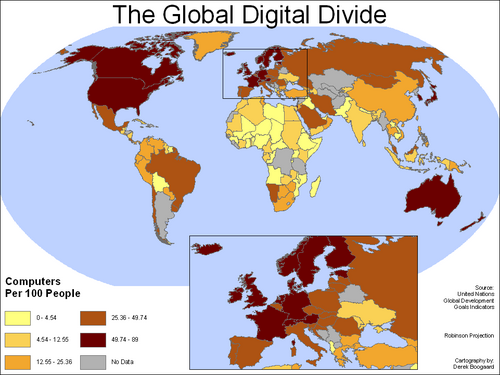
The global justice movement is the loose collection of individuals and groups—often referred to as a "movement of movements"—who advocate fair trade rules and perceive current institutions of global economic integration as problems.[204] The movement is often labeled an anti-globalization movement by the mainstream media. Those involved, however, frequently deny that they are anti-globalization, insisting that they support the globalization of communication and people and oppose only the global expansion of corporate power.[205] The movement is based in the idea of social justice, desiring the creation of a society or institution based on the principles of equality and solidarity, the values of human rights, and the dignity of every human being.[206][207][208] Social inequality within and between nations, including a growing global digital divide, is a focal point of the movement. Many nongovernmental organizations have now arisen to fight these inequalities that many in Latin America, Africa and Asia face. A few very popular and well known non-governmental organizations (NGOs) include: War Child, Red Cross, Free The Children and CARE International. They often create partnerships where they work towards improving the lives of those who live in developing countries by building schools, fixing infrastructure, cleaning water supplies, purchasing equipment and supplies for hospitals, and other aid efforts.
,_Credit_Suisse.png/500px-Countries_by_total_wealth_(trillions_USD),_Credit_Suisse.png)
Social inequality

The economies of the world have developed unevenly, historically, such that entire geographical regions were left mired in poverty and disease while others began to reduce poverty and disease on a wholesale basis. From around 1980 through at least 2011, the GDP gap, while still wide, appeared to be closing and, in some more rapidly developing countries, life expectancies began to rise.[209] If we look at the Gini coefficient for world income, since the late 1980s, the gap between some regions has markedly narrowed—between Asia and the advanced economies of the West, for example—but huge gaps remain globally. Overall equality across humanity, considered as individuals, has improved very little. Within the decade between 2003 and 2013, income inequality grew even in traditionally egalitarian countries like Germany, Sweden and Denmark. With a few exceptions—France, Japan, Spain—the top 10 percent of earners in most advanced economies raced ahead, while the bottom 10 percent fell further behind.[210] By 2013, 85 multibillionaires had amassed wealth equivalent to all the wealth owned by the poorest half (3.5 billion) of the world's total population of 7 billion.[211]
Critics of globalization argue that globalization results in weak labor unions: the surplus in cheap labor coupled with an ever-growing number of companies in transition weakened labor unions in high-cost areas. Unions become less effective and workers their enthusiasm for unions when membership begins to decline.[178] They also cite an increase in the exploitation of child labor: countries with weak protections for children are vulnerable to infestation by rogue companies and criminal gangs who exploit them. Examples include quarrying, salvage, and farm work as well as trafficking, bondage, forced labor, prostitution and pornography.[212]

Women often participate in the workforce in precarious work, including export-oriented employment. Evidence suggests that while globalization has expanded women's access to employment, the long-term goal[whose?] of transforming gender inequalities remains unmet and appears unattainable without regulation of capital and a reorientation and expansion of the state's role in funding public goods and providing a social safety net.[213] Furthermore, the intersectionality of gender, race, class, can be overlooked by scholars and commentators when assessing the impact of globalization.[214]
In 2016, a study published by the IMF posited that neoliberalism, the ideological backbone of contemporary globalized capitalism, has been "oversold", with the benefits of neoliberal policies being "fairly difficult to establish when looking at a broad group of countries" and the costs, most significantly higher income inequality within nations, "hurt the level and sustainability of growth."[215]
Anti-global governance
Beginning in the 1930s, opposition arose to the idea of a world government, as advocated by organizations such as the World Federalist Movement (WFM). Those who oppose global governance typically do so on objections that the idea is unfeasible, inevitably oppressive, or simply unnecessary.[216] In general, these opponents are wary of the concentration of power or wealth that such governance might represent. Such reasoning dates back to the founding of the League of Nations and, later, the United Nations.
Environmentalist opposition


Environmentalism is a broad philosophy, ideology[217][218][219] and social movement regarding concerns for environmental conservation and improvement of the health of the environment. Environmentalist concerns with globalization include issues such as global warming, global water supply and water crises, inequity in energy consumption and energy conservation, transnational air pollution and pollution of the world ocean, overpopulation, world habitat sustainability, deforestation, biodiversity loss and species extinction.
One critique of globalization is that natural resources of the poor have been systematically taken over by the rich and the pollution promulgated by the rich is systematically dumped on the poor.[220] Some argue that Northern corporations are increasingly exploiting resources of less wealthy countries for their global activities while it is the South that is disproportionately bearing the environmental burden of the globalized economy. Globalization is thus leading to a type of" environmental apartheid".[221]
Helena Norberg-Hodge, the director and founder of Local Futures/International Society for Ecology and Culture, criticizes globalization in many ways. In her book Ancient Futures, Norberg-Hodge claims that "centuries of ecological balance and social harmony are under threat from the pressures of development and globalization." She also criticizes the standardization and rationalization of globalization, as it does not always yield the expected growth outcomes. Although globalization takes similar steps in most countries, scholars such as Hodge claim that it might not be effective to certain countries and that globalization has actually moved some countries backward instead of developing them.[222]
A related area of concern is the pollution haven hypothesis, which posits that, when large industrialized nations seek to set up factories or offices abroad, they will often look for the cheapest option in terms of resources and labor that offers the land and material access they require (see Race to the bottom).[223] This often comes at the cost of environmentally sound practices. Developing countries with cheap resources and labor tend to have less stringent environmental regulations, and conversely, nations with stricter environmental regulations become more expensive for companies as a result of the costs associated with meeting these standards. Thus, companies that choose to physically invest in foreign countries tend to (re)locate to the countries with the lowest environmental standards or weakest enforcement.
The European Union–Mercosur Free Trade Agreement, which would form one of the world's largest free trade areas,[224] has been denounced by environmental activists and indigenous rights campaigners.[225] The fear is that the deal could lead to more deforestation of the Amazon rainforest as it expands market access to Brazilian beef.[226]
See also


- Civilizing mission
- Cosmopolitanism
- Deglobalization
- Environmental racism
- Eurasianism
- Franchising
- Free trade
- Global civics
- Global commons
- Global mobility
- Global regionalization
- Globalism
- Global public goods
- List of bilateral free-trade agreements
- List of globalization-related indices
- List of multilateral free-trade agreements
- Middle East and globalization
- Neorealism (international relations)
- North–South divide
- Outline of globalization
- Postdevelopment theory
- Technocapitalism
- The No-Nonsense Guide to Globalization
- Transnational cinema
- Transnational citizenship
- Triadization
- United Nations Millennium Declaration
- Vermeer's Hat
- World Englishes
References
- ^ Scholte, Jan Aart (2008). "Defining Globalisation". The World Economy. 31 (11): 1471–1502. doi:10.1111/j.1467-9701.2007.01019.x.
- ^ a b c d e f James, Paul; Steger, Manfred B. (2014). "A Genealogy of globalization: The career of a concept". Globalizations. 11 (4): 417–34. Bibcode:2014Glob...11..417J. doi:10.1080/14747731.2014.951186. ISSN 1474-7731. S2CID 18739651.
- ^ a b Albrow, Martin; King, Elizabeth (1990). Globalization, Knowledge and Society. London: Sage. ISBN 0-8039-8323-9. OCLC 22593547.
- ^ Read "Following the Money: U.S. Finance in the World Economy" at NAP.edu. 1995. doi:10.17226/2134. ISBN 978-0-309-04883-5.
- ^ "Imagining the Internet". History of Information Technologies. Elon University School of Communications. Archived from the original on 23 March 2009. Retrieved 17 August 2009.
- ^ Stever, H. Guyford (1972). "Science, Systems, and Society". Journal of Cybernetics. 2 (3): 1–3. doi:10.1080/01969727208542909.
- ^ Wolf, Martin (September 2014). "Shaping Globalization" (PDF). Finance & Development. 51 (3). International Monetary Fund: 22–25. Archived (PDF) from the original on 22 September 2018. Retrieved 10 August 2015.
- ^ a b Frank, Andre Gunder. (1998). ReOrient: Global economy in the Asian age. Berkeley: University of California Press. ISBN 978-0-520-21474-3
- ^ H., O'Rourke, Kevin; G., Williamson, Jeffrey (1 April 2002). "When did globalisation begin?". European Review of Economic History. 6 (1): 23–50. doi:10.1017/S1361491602000023. ISSN 1361-4916. S2CID 15767303.
{{cite journal}}: CS1 maint: multiple names: authors list (link) - ^ Sassen, Saskia - The Global City: New York, London, Tokyo. Archived 16 March 2015 at the Wayback Machine (1991) – Princeton University Press. ISBN 0-691-07063-6
- ^ a b "Globalization: Threat or Opportunity?". International Monetary Fund. 12 April 2000. Archived from the original on 18 August 2017. Retrieved 28 November 2019.
- ^ a b c Babones, Salvatore (2008). "Studying Globalization: Methodological Issues". In Ritzer, George (ed.). The Blackwell Companion to Globalization. Malden: John Wiley & Sons. p. 146. ISBN 978-0-470-76642-2. OCLC 232611725.
- ^ "6 Pros and Cons of Globalization in Business to Consider". Business Insights Blog. 1 April 2021. Retrieved 4 September 2024.
- ^ "Weighing the Pros and Cons of Globalization | Wilson Center". www.wilsoncenter.org. Retrieved 4 September 2024.
- ^ Sorinel, Cosma (2012). "Globalization and Mondialisation – A Conceptual Analysis". Ovidius University of Constantza, Faculty of Economic Sciences, Decembre. Ovidius University Annals. Economic Sciences Series (2): 27–30.
- ^ Hopkins, Antony G., ed. (2002). Globalization in World History. New York: Norton. pp. 4–8. ISBN 0-393-97942-3. OCLC 50028410.
- ^ Bakari, Mohamed El-Kamel (2013). "Globalization and Sustainable Development: False Twins?". New Global Studies. 7 (3): 23–56. doi:10.1515/ngs-2013-021. ISSN 1940-0004. S2CID 154786395.
- ^ Karl Marx; Friedrich Engels (2017). "Manifesto of the Communist Party". The Communist Manifesto (PDF). Pluto Press. pp. 47–103. doi:10.2307/j.ctt1k85dmc.4. ISBN 978-1-78680-025-1. JSTOR j.ctt1k85dmc. S2CID 53056560.
- ^ Giddens, Anthony (1990). The Consequences of Modernity. Cambridge: Polity Press. p. 64. ISBN 0-7456-0793-4. OCLC 22305142.
- ^ Robertson, Roland (1992). Globalization: Social Theory and Global Culture (Reprint. ed.). London: Sage. ISBN 978-0-8039-8187-4. OCLC 28634687.
- ^ Held, David; Goldblatt, David; McGrew, Anthony; Perraton, Jonathan (1999). Global Transformations Cambridge: Polity Press. ISBN 978-0-7456-1498-4
- ^ a b c "DHL Global Connectedness Index 2014" (PDF). DHL. 11 March 2014. Archived from the original (PDF) on 2 February 2015. Retrieved 31 March 2015.
- ^ Larsson, Thomas. (2001). The Race to the Top: The Real Story of Globalization Washington, DC: Cato Institute. p. 9. ISBN 978-1-930865-15-0
- ^ a b James, Paul (2005). "Arguing Globalizations: Propositions Towards an Investigation of Global Formation". Globalizations. 2 (2): 193–209. Bibcode:2005Glob....2..193J. doi:10.1080/14747730500202206. S2CID 146553776.
- ^ Steger, Manfred (2009). Globalization: A Very Short Introduction. New York: Oxford University Press. p. 11. ISBN 978-0-19-955226-9.
- ^ Manfred B. Steger; Paul James (2013). "Levels of Subjective Globalization: Ideologies, Imaginaries, Ontologies". Perspectives on Global Development and Technology. 12 (1–2).
- ^ James, Paul (2014). "Faces of Globalization and the Borders of States: From Asylum Seekers to Citizens". Citizenship Studies. 18 (2): 208–23. doi:10.1080/13621025.2014.886440. S2CID 144816686.
- ^ Friedman, Thomas L. "The Dell Theory of Conflict Prevention". Emerging: A Reader. Ed. Barclay Barrios. Boston: Bedford, St. Martins, 2008. 49
- ^ Fotopoulos, Takis. (2001). "Globalization, the reformist Left and the Anti-Globalization 'Movement.'" Democracy & Nature: The International Journal of Inclusive Democracy, 7:(2) (July 2001). Archived 26 April 2009 at the Wayback Machine
- ^ Lechner, Frank J.; Boli, John, eds. (2012). The Globalization Reader (4th ed.). Chichester: John Wiley & Sons. ISBN 978-0-470-65563-4. OCLC 723530747.
- ^ Henwood, Doug (13 November 2003). "Beyond Globophobia". The Nation. ISSN 0027-8378. Archived from the original on 29 October 2014.
- ^ Clark, Ross (20 March 2004). "Globophobia". The Spectator. Archived from the original on 22 December 2014. Retrieved 29 October 2014.
- ^ Ritzer, George, ed. (2008). The Blackwell Companion to Globalization. Malden: John Wiley & Sons. pp. 16–. ISBN 978-0-470-76642-2. OCLC 232611725.
- ^ a b c O'Rourke, Kevin H.; Williamson, Jeffrey G. (2002). "When Did Globalization Begin?". European Review of Economic History. 6 (1): 23–50. doi:10.1017/S1361491602000023. S2CID 15767303.
- ^ a b c d Martell, Luke (2010). The Sociology of Globalization. Policy Press.
- ^ Kochler, Hans (2000). Globality versus Democracy: The Changing Nature of International Relations in the Era of Globalization. Vienna: International Progress Organization. p. 35.
- ^ Jerry Bentley, Old World Encounters: Cross-Cultural Contacts and Exchanges in Pre-Modern Times (New York: Oxford University Press, 1993), 32.
- ^ Jerry Bentley, Old World Encounters: Cross-Cultural Contacts and Exchanges in Pre-Modern Times (New York: Oxford University Press, 1993), 33.
- ^ "The Legacy of the Silk Road". Yale Global. 25 January 2013. Archived from the original on 2 April 2015. Retrieved 31 March 2015.
- ^ Hopkins, A.G., ed., 2003. Globalization in World History. New York City: Norton. ISBN 0-393-97942-3 pp. 4–5, 7
- ^ Chaudhuri, K.N. (1965\1999). The English East India Company: The Study of an Early Joint-stock Company 1600–1640 (Vol. 4). London: Routledge/Thoemmes Press.
- ^ China and the Birth of Globalization in the 16th Century, by Dennis O. Flynn and Arturo Giráldez
- ^ The Silver Way: China, Spanish America and the birth of globalisation 1565–1815 By Morales, Juan Jose; Gordon, Peter
- ^ Trade and empire (Chapter 4) – The Cambridge Economic History of Modern Europe. pp. 100–01. doi:10.1017/CBO9780511794834.006. ISBN 978-0-521-88202-6. S2CID 155275323. Archived from the original on 3 March 2018. Retrieved 2 March 2018.
{{cite book}}:|website=ignored (help) - ^ a b Levinson, Marc. "Sample Chapter for Levinson, M.: The Box: How the Shipping Container Made the World Smaller and the World Economy Bigger". The Box: How the Shipping Container Made the World Smaller and the World Economy Bigger. Princeton University Press. Archived from the original on 22 January 2013. Retrieved 17 February 2013.
- ^ Gittins, Ross (12 June 2006). "How the invention of a box changed our world – Business – smh.com.au". The Sydney Morning Herald. Archived from the original on 14 November 2015. Retrieved 17 February 2013.
- ^ "World Exports as Percentage of Gross World Product". Global Policy Forum. Archived from the original on 12 July 2008. Retrieved 11 November 2009.
- ^ a b Varghese, N.V. 2008, 'Globalization of higher education and cross-border student mobility', International Institute for Educational Planning, UNESCO
- ^ a b Lourdes, Benería; Gunseli, Berik; Maria S., Floro (2016). Gender, Development, and Globalization: Economics as if all people mattered. New York: Routledge. p. 95. ISBN 978-0-415-53748-3.
- ^ Klein, Naomi (2008). The Shock Doctrine. Canada: Vintage. p. 68.
- ^ Lourdes, Benería; Deere, Carmen Diana; Kabeer, Naila (8 August 2012). "Gender and International Migration: Globalization, Development and Governance". Feminist Economics. 18 (2): 1–33. doi:10.1080/13545701.2012.688998. S2CID 144565818.
- ^ Rai. "The History of International Development: Concepts and Contexts". Women, Gender and Development Reader: 15.
- ^ Wolf, Martin (2001). "Will the nation-state survive globalization?". Foreign Affairs. 80 (1): 178–190. doi:10.2307/20050051. JSTOR 20050051. Archived from the original on 11 September 2017. Retrieved 12 September 2017.
- ^ Ritzer, George (2011). Globalization: The Essentials. NY: John Wiley & Sons.
- ^ a b Saggi, Kamal (2002). "Trade, Foreign Direct Investment, and International Technology Transfer: A Survey". World Bank Research Observer. 17 (2): 191–235. CiteSeerX 10.1.1.17.7732. doi:10.1093/wbro/17.2.191. S2CID 16620922.
- ^ Hunt, Michael H. (2004). The World Transformed 1945 to present. p. 399.
- ^ "The Open Market Internet Index". Treese.org. 11 November 1995. Archived from the original on 1 June 2013. Retrieved 15 June 2013.
- ^ "World Stats". Internet World Stats. Miniwatts Marketing Group. 30 June 2012. Archived from the original on 23 June 2011. Retrieved 4 January 2015.
- ^ a b "Signs of life". The Economist. 15 November 2014. Archived from the original on 2 September 2017. Retrieved 29 August 2017.
- ^ Faiola, Anthony. (2009). "A Global Retreat As Economies Dry Up." The Washington Post, 5 March 2009. Archived 4 December 2010 at the Wayback Machine
- ^ Allison Morrow (24 May 2022). "Globalization is coming undone, and that's a huge red flag". CNN.
- ^ Walker, Marcus; Hayashi, Yuka (9 August 2023). "Sputtering Trade Fuels Fears of a Fractured Global Economy". The Wall Street Journal. ISSN 0099-9660. Retrieved 3 November 2023.
- ^ Zumbrun, Josh. "Is Globalization in Decline? A New Number Contradicts the Consensus". WSJ. Retrieved 3 November 2023.
- ^ Ganapati, Sharat; Wong, Woan Foong (August 2023). "How Far Goods Travel: Global Transport and Supply Chains from 1965–2020". Journal of Economic Perspectives. 37 (3): 3–30. doi:10.1257/jep.37.3.3. hdl:10419/272042. ISSN 0895-3309.
- ^ "Czech foreign owned companies take second biggest dividend yield in 2017:report". Radio Prague. 7 March 2018.
- ^ a b Joshi, Rakesh Mohan, (2009) International Business, Oxford University Press, New Delhi and New York ISBN 0-19-568909-7.
- ^ Riley, T: "Year 12 Economics", p. 9. Tim Riley Publications, 2005
- ^ Hill, Charles W.L. (2014). International business: competing in the global marketplace (10th ed.). New York: McGraw-Hill. ISBN 978-0-07-811277-5. OCLC 864808614.
- ^ "What Is Globalization?". PIIE. 29 October 2018. Retrieved 25 May 2020.
- ^ Pitelis, Christos; Roger Sugden (2000). The nature of the transnational firm. Routledge. p. H72. ISBN 978-0-415-16787-1.
- ^ "Multinational Corporations". Archived from the original on 14 April 2018. Retrieved 23 December 2016.
- ^ Roy D. Voorhees, Emerson L. Seim, and John I. Coppett, "Global Logistics and Stateless Corporations", Transportation Practitioners Journal 59, 2 (Winter 1992): 144–51.
- ^ O'Sullivan, Arthur; Sheffrin, Steven M. (2003). Economics: Principles in Action. Upper Saddle River, NJ: Pearson Prentice Hall. p. 453. ISBN 978-0-13-063085-8.
- ^ European Commission. "The EU Single Market: Fewer barriers, more opportunities". Europa web portal. Archived from the original on 1 October 2007. Retrieved 27 September 2007.
"Activities of the European Union: Internal Market". Europa web portal. Archived from the original on 25 June 2007. Retrieved 29 June 2007. - ^ a b Kuruvilla, Sarosh; Ranganathan, Aruna (October 2008). "Economic Development Strategies And Macro- And Micro-Level Human Resource Policies: The Case Of India's "Outsourcing" Industry". Industrial & Labor Relations Review. 62 (1): 39–72. CiteSeerX 10.1.1.662.425. doi:10.1177/001979390806200103. S2CID 12104735.
- ^ "Outsourcing to Africa: The world economy calls | The Economist". 16 April 2011. Archived from the original on 11 May 2011. Retrieved 16 April 2011.
- ^ Robinson, William I. "Globalization and the sociology of Immanuel Wallerstein: A critical appraisal". International Sociology. 1–23.
- ^ James, Paul (2006). Globalism, Nationalism, Tribalism. London: Sage Publications. Archived from the original on 29 April 2020. Retrieved 20 December 2017.
- ^ Manfred B. Steger and Paul James, 'Ideologies of Globalism', in Paul James and Manfred B. Steger, eds, Globalization and Culture: Vol. 4, Ideologies of Globalism Archived 8 November 2017 at the Wayback Machine, Sage Publications, London, 2010. Inda, Jonathan; Rosaldo, Renato (2002). "Introduction: A World in Motion". The Anthropology of Globalization. Wiley-Blackwell.
- ^ Cowen, Tyler; Barber, Benjamin (May–June 2003). "Globalization and Culture" (PDF). Cato Policy Report. Archived from the original (PDF) on 19 November 2012. Retrieved 15 March 2017.
- ^ Nadeem, S (2009) Macaulay's (Cyber) Children: The Cultural Politics of Outsourcing in India Archived 20 June 2010 at the Wayback Machine. Cultural Sociology
- ^ Hacker, Violaine (2011). "Budovanie mediálneho priemyslu a podpora hodnotovo orientovanej spoločnosti v globalizácii: od chichotského výberu k pragmatickým výhodám EU občanov" [Building Medias Industry while Promoting a Community of Values in the Globalization: From Quixotic Choices to Pragmatic Boon for EU Citizens]. Politické vedy. 14 (2): 64–74. ISSN 1335-2741.
- ^ Fangjun, Cao (1 September 2009). "Modernization Theory and China's Road to Modernization". Chinese Studies in History. 43 (1): 7–16. doi:10.2753/CSH0009-4633430101. ISSN 0009-4633. S2CID 145504998.
- ^ McAlister, Elizabeth (September 2005). "Globalization and the Religious Production of Space". Journal for the Scientific Study of Religion. 44 (3): 249–255. doi:10.1111/j.1468-5906.2005.00283.x.
- ^ "Globalization and Sport: A Review by Susan Froetschel". Archived from the original on 23 December 2016.
- ^ "Overview of Olympic Games". Encyclopædia Britannica. Archived from the original on 30 April 2015. Retrieved 4 June 2008.
- ^ "2006 FIFA World Cup broadcast wider, longer and farther than ever before". FIFA.com. Fédération Internationale de Football Association. 6 February 2007. Archived from the original on 20 January 2012. Retrieved 11 October 2009.
- ^ Dunmore, Tom (2011). Historical Dictionary of Soccer. Scarecrow Press. p. 235. ISBN 978-0-8108-7188-5.
The World Cup is now the most-watched sporting event in the world on television, above even the Olympic Games.
- ^ Wong, Glenn M. (8 March 2012). The Comprehensive Guide to Careers in Sports. Jones & Bartlett Publishers. pp. 144–. ISBN 978-1-4496-0203-1.
The World Cup is the most-watched sporting event in the world. In 2006, more than 30 billion viewers in 214 countries watched the World Cup on television, and more than 3.3 million spectators attended the 64 matches of the tournament.
- ^ Clayton, Thomas (August 2004). ""Competing Conceptions of Globalization" Revisited: Relocating the Tension between World-Systems Analysis and Globalization Analysis". Comparative Education Review. 48 (3): 274–294. doi:10.1086/421180. ISSN 0010-4086. S2CID 56099753.
- ^ Throsby, David (2002). "The music industry in the new millennium: Global and Local Perspectives." Paper prepared for The Global Alliance for Cultural Diversity Division of Arts and Cultural Enterprise UNESCO, Paris.
- ^ "Ethnic fusion Music". Allmusic. Archived from the original on 29 April 2012. Retrieved 20 February 2020.
- ^ "Worldbeat". Allmusic. Archived from the original on 3 May 2012. Retrieved 20 February 2020.
- ^ "World Fusion Music". worldmusic.nationalgeographic.com. Archived from the original on 14 March 2012.
- ^ "Chili: Small Fruit Sets Global Palettes on Fire" Archived 31 December 2016 at the Wayback Machine, History of Globalization, YaleGlobal Online.
- ^ Beard, David and Keneth Gloag. 2005. Musicology: The Key Concepts. London and New York: Routledge.
- ^ "International Flows of Selected Goods and Services" (PDF). Archived from the original (PDF) on 5 July 2010. Retrieved 31 July 2010.
- ^ "Why do we need religion in a globalized world?". Aleteia — Catholic Spirituality, Lifestyle, World News, and Culture. 11 April 2018. Archived from the original on 12 April 2018. Retrieved 12 April 2018.
- ^ Ghosh, Biswajit (June 2011). "Cultural Changes and Challenges in the Era of Globalization: The Case of India". Journal of Developing Societies. 27 (2): 153–175. doi:10.1177/0169796X1102700203. ISSN 0169-796X. S2CID 145494090.
- ^ Cuccioletta, Donald. Multiculturalism or Transculturalism: Towards a Cosmopolitan Citizenship., London Journal of Canadian Studies 2001/2002 Vol. 17, Plattsburgh State University of New York, Interdisciplinary Research Group on the Americas
- ^ a b transcultural Archived 5 August 2018 at the Wayback Machine, thefreedictionary.com
- ^ transcultural Archived 2 January 2018 at the Wayback Machine, yourdictionary.com
- ^ George Modelski; Tessaleno Devezas; William R. Thompson (20 December 2007). Globalization as Evolutionary Process: Modeling Global Change. Routledge. p. 59. ISBN 978-1-135-97764-1.
- ^ "These are all the countries where the US has a military presence". Quartz. 2 April 2015. Archived from the original on 2 August 2019. Retrieved 2 August 2019.
- ^ Pawel Zaleski Global Non-governmental Administrative System: Geosociology of the Third Sector, [in:] Gawin, Dariusz & Glinski, Piotr [ed.]: "Civil Society in the Making", IFiS Publishers, Warszawa 2006
- ^ "Vaccine Delivery". Bill & Melinda Gates Foundation. Archived from the original on 31 May 2013. Retrieved 6 June 2013.
- ^ "The Index of Global Philanthropy and Remittances 2012. Hudson Institute Center for Global Prosperity" (PDF). Archived from the original (PDF) on 30 July 2012.
- ^ "North Korean Refugees NGO". Northkoreanrefugees.com. 20 October 2008. Archived from the original on 18 June 2010. Retrieved 23 August 2010.
- ^ United Nations High Commissioner for Refugees (2 July 2008). "UNHCR Freedom in the World 2008 – North Korea". Unhcr.org. Archived from the original on 18 October 2012. Retrieved 23 August 2010.
- ^ Kabeer, Nalia; Simeen; Mahmud (2004). "Rags, Riches and Women Workers: Export-Oriented Garment Manufacturing in Bangladesh," from Linking Women Producers and Workers with Global Markets. London: Commonwealth Secretariat. pp. 137, 147, 148, 150, 152. ISBN 978-0-85092-798-6.
- ^ Wright W., Melissa (2007). "The Dialectics of Still Life: Murder, Women, and Disposability," from Disposable Women and Other Myths of Global Capitalism. New York: Routledge. pp. 73, 82, 83.
- ^ Zimmerer, Karl S. (2006). Globalization & New Geographies of Conservation. University of Chicago Press. p. 1. ISBN 978-0-226-98344-8.
- ^ Krishnan, Armin (2016). War as Business: Technological Change and Military Service Contracting. Routledge. p. 157. ISBN 978-1-317-00049-5.
- ^ James, Paul (2014). "Faces of Globalization and the Borders of States: From Asylum Seekers to Citizens". Citizenship Studies. 18 (2): 208–23. doi:10.1080/13621025.2014.886440. S2CID 144816686.
- ^ Boustan, Adain May. "Fertility and Immigration." UCLA. 15 January 2009.
- ^ Siebeck, Florian. "Flugzeugparkplatz im Outback: Schlaf in der Wüste". FAZ.NET (in German). ISSN 0174-4909. Retrieved 16 May 2020.
- ^ "UNWTO World Tourism Barometer" (PDF). UNWTO World Tourism Barometer. 11 (1). January 2013. Archived from the original (PDF) on 28 February 2013. Retrieved 9 April 2013.
- ^ "Visa Openness Report 2015 January 2016" (PDF). Archived from the original (PDF) on 23 January 2016.
- ^ "immigration". Oxford Dictionaries. Oxford University Press. Archived from the original on 18 May 2016. Retrieved 11 May 2016.
- ^ "immigrate". Merriam-Webster. Archived from the original on 28 March 2014. Retrieved 27 March 2014.
- ^ "Who's who: Definitions". London, England: Refugee Council. 2016. Archived from the original on 16 September 2015. Retrieved 7 September 2015.
- ^ "Mainstreaming of Migration in Development Policy and Integrating Migration in the Post-2015 UN Development Agenda" (PDF). www.ilo.org. Archived (PDF) from the original on 25 May 2017. Retrieved 23 December 2016.
- ^ "Most London babies have foreign-born parent Archived 25 June 2018 at the Wayback Machine". Financial Times. 1 December 2016.
- ^ Landis, Dan; Bhawuk, Dharm P. S. (2020). The Cambridge handbook of intercultural training (4th ed.). Cambridge, United Kingdom: Cambridge University Press & Assessment. ISBN 978-1-108-85418-4. OCLC 1135909636.
- ^ Caligiuri, Paula (2021). Build Your Cultural Agility The Nine Competencies of Successful Global Professionals. London: Kogan Page, Limited. ISBN 978-1-78966-660-1. OCLC 1239982517.
- ^ Gribble, C (2008). "Policy options for managing international student migration: the sending country's perspective". Journal of Higher Education Policy and Management. 30 (1): 25–39. doi:10.1080/13600800701457830. S2CID 155059201.
- ^ "Measuring digital development: Facts and figures 2023". Telecommunication Development Bureau, International Telecommunication Union (ITU). Retrieved 14 June 2024.
- ^ "Company Info – Facebook Newsroom". Facebook. Archived from the original on 15 November 2015. Retrieved 23 December 2016.
- ^ Berglez, Peter (2008). "What is Global Journalism?". Journalism Studies. 9 (6): 845–58. doi:10.1080/14616700802337727. S2CID 142859567.
- ^ "The Coronavirus Could Finally Kill the Wild Animal Trade". Foreign Policy. 25 February 2020. Archived from the original on 17 March 2020. Retrieved 6 April 2020.
- ^ "Coronavirus: Which countries have confirmed cases?". Al Jazeera. 6 April 2020. Archived from the original on 31 March 2020. Retrieved 6 April 2020.
- ^ "Coronavirus COVID-19 Global Cases by the Center for Systems Science and Engineering (CSSE) at Johns Hopkins". Archived from the original on 5 September 2019. Retrieved 25 March 2020.
- ^ "Disaster in motion: 3.4 million travelers poured into US as coronavirus pandemic erupted". ABC News. 2 April 2020. Archived from the original on 2 April 2020. Retrieved 6 April 2020.
- ^ "KOF Index of Globalization". ethz.ch. The KOF Swiss Economic Institute. 2014. Archived from the original on 31 May 2012. Retrieved 21 January 2013.
- ^ 16 October 2006 Archived 6 March 2008 at the Wayback Machine. Data for the year 2006. No longer published.
- ^ Vujakovic, Petra (2010). "How to Measure Globalization? A New Globalization Index (NGI)". Atlantic Economic Journal. 38 (2): 237. doi:10.1007/s11293-010-9217-3.
- ^ Overland, Indra (1 April 2016). "Energy: The missing link in globalization". Energy Research & Social Science. 14: 122. Bibcode:2016ERSS...14..122O. doi:10.1016/j.erss.2016.01.009. hdl:11250/2442076. Archived from the original on 5 February 2018. Retrieved 7 April 2018.
- ^ a b Sen, Amartya K. (1970). Collective choice and social welfare. San Francisco, CA: Holden-Day.
- ^ "Definition of xenophobia in English from the Oxford dictionary". oxforddictionaries.com. Archived from the original on 31 July 2016. Retrieved 23 December 2016.
- ^ "Define Xenophobia at Dictionary.com". Dictionary.com. Archived from the original on 1 January 2011. Retrieved 23 December 2016.
- ^ Guido Bolaffi. Dictionary of race, ethnicity and culture. SAGE Publications Ltd., 2003. p. 332.
- ^ "Poverty Analysis – Measuring Inequality". worldbank.org. Archived from the original on 22 June 2013. Retrieved 2 June 2013.
- ^ "The Happy Planet Index". Neweconomics.org. Archived from the original on 26 September 2009. Retrieved 2 June 2013.
- ^ Capra, Fritjof (2002). The Hidden Connections. New York, New York: Random House. ISBN 978-0-385-49471-7.
- ^ Sorrells, Kathryn. Intercultural Communication: Globalization and Social Justice. Thousand Oaks, CA: Sage, 2013. Print.
- ^ "Pope: isolationism and populism lead to war – Vatican News". www.vaticannews.va. 9 August 2019. Archived from the original on 9 August 2019. Retrieved 9 August 2019.
- ^ Guttal, Shalmali (2007). "Globalisation". Development in Practice. 17 (4/5): 523–531. doi:10.1080/09614520701469492. ISSN 0961-4524. JSTOR 25548249. S2CID 218523141.
- ^ a b c Fiss, Peer C.; Hirsch, Paul M. (February 2005). "The Discourse of Globalization: Framing and Sensemaking of an Emerging Concept". American Sociological Review. 70 (1): 29–52. doi:10.1177/000312240507000103. S2CID 16331519.
- ^ "Africans and Asians Tend to View Globalization Favorably; Europeans and Americans are More Skeptical". WorldPublicOpinion.org. 7 November 2006. Archived from the original on 12 February 2012. Retrieved 28 November 2019.
- ^ "Widespread Unease about Economy and Globalization – Global poll" (PDF). BBC World Service. 2008. Archived from the original (PDF) on 3 September 2014. Retrieved 24 March 2015.
- ^ Gordon, Philip. 2004. "Globalization: Europe's Wary Embrace" Archived 29 June 2011 at the Wayback Machine. Yale Global, 1 November 2004.
- ^ Fox, Justin (15 November 2007). "Why Denmark Loves Globalization". Time. Archived from the original on 23 October 2019. Retrieved 28 November 2019.
- ^ Ip, Greg (18 July 2008). "The Declining Value Of Your College Degree". The Wall Street Journal. ISSN 0099-9660. Archived from the original on 29 February 2020. Retrieved 29 November 2019.
- ^ Heizo, Takenaka; Ryokichi, Chida (1998). "Japan" (PDF). In Morrison, Charles E.; Soesastro, Hadi (eds.). Domestic Adjustments to Globalization. Tokyo: Japan Center for International Exchange. pp. 76–102. ISBN 4-88907-012-5. OCLC 40657196. Archived (PDF) from the original on 6 April 2011.
- ^ a b Bhagwati, Jagdish (2004). In Defense of Globalization. Oxford; New York: Oxford University Press. ISBN 978-0-19-533093-9. OCLC 719371219.
- ^ Shoa, S. Rajgopal (2002). "Reclaiming Democracy, the Anti-globalization Movement in South Asia". Feminist Review (70): 134–137. JSTOR 1395975.
- ^ Graham, Carol (1 January 2011). "Winners and Losers: Perspectives on Globalization from the Emerging Market Economies". Brookings. Archived from the original on 11 May 2011.
- ^ Fuller, Dan; Geide-Stevenson, Doris (Fall 2003). "Consensus Among Economists: Revisited" (PDF). Journal of Economic Review. 34 (4): 369–87. doi:10.1080/00220480309595230. S2CID 143617926. Archived (PDF) from the original on 20 September 2004. Retrieved 22 December 2016.(registration required)
- ^ Friedman, Milton (1993). "The Case for Free Trade". Hoover Digest. 1997 (4): 42. Bibcode:1993SciAm.269e..42B. doi:10.1038/scientificamerican1193-42. Archived from the original on 22 January 2007.
- ^ Whaples, Robert (2006). "Do Economists Agree on Anything? Yes!". The Economists' Voice. 3 (9). doi:10.2202/1553-3832.1156. S2CID 201123406.
- ^ Mankiw, Gregory (7 May 2006). "Outsourcing Redux". Archived from the original on 2 April 2007. Retrieved 22 January 2007.
- ^ "Poll Results | IGM Forum". www.igmchicago.org. Archived from the original on 22 June 2016. Retrieved 1 July 2016.
- ^ Sachs, Jeffrey (2005). The End of Poverty. New York: Penguin Press. ISBN 978-1-59420-045-8. OCLC 57243168.
- ^ Peet, Richard; Hartwick, Elaine (2015). Theories of Development: Contentions, Arguments, Alternatives (3rd ed.). New York: The Guilford Press. p. 2. ISBN 978-1-4625-1957-6. OCLC 908634816.
But economic growth can occur without touching problems like inequality or poverty when all the increase in income goes to a relatively few people.
- ^ Beaudet, Pierre; Schafer, Jessica; Haslam, Paul A. (2012). Introduction to International Development: Approaches, Actors, and Issues. Oxford University Press. p. 112. ISBN 978-0-19-544020-1.
According to Oxfam International, the contrasting experiences of Latin America and East Asia illustrate that globalization-induced growth and poverty can co-exist. Even when the market expands, 'poor people are often excluded from opportunities by a lack of productive assets, weak infrastructure, poor education, and ill-health'
- ^ Conversi, Daniele (2009) 'Globalization, ethnic conflict and nationalism Archived 7 June 2011 at the Wayback Machine', in B. Turner (ed.) Handbook of Globalization Studies. London: Routledge/ Taylor & Francis; Barkawi, Tarak (2005) Globalization and War. Rowman & Littlefield; Smith, Dennis (2006) Globalization: The Hidden Agenda. Cambridge: Polity Press. See also Barber, Benjamin R., Jihad vs. McWorld. Ballantine Books, 1996
- ^ "Human Development Report 2003" (PDF). UNDP. 2003. Archived (PDF) from the original on 18 April 2013. Retrieved 6 April 2013.
- ^ Berg, Andrew G.; Ostry, Jonathan D. (2011). "Equality and Efficiency". Finance and Development. 48 (3). Archived from the original on 3 July 2012. Retrieved 10 September 2012.
- ^ Martin Wolf (2004). Why Globalization Works. Yale University Press. ISBN 978-0-300-10252-9. Retrieved 6 April 2013.[dead link]
- ^ Dollar, David; Kraay, Aart. "Trade, Growth, and Poverty". Finance and Development. International Monetary Fund. Archived from the original on 11 January 2012. Retrieved 6 June 2011.
- ^ E.g. Pyun, Ju Hyun; Lee, Jong-Wha (21 March 2009). "Globalisation promotes peace". Archived from the original on 25 October 2014. Retrieved 25 October 2014.
- ^ See, for example, Roy Harrod, The Life of John Maynard Keynes, Macmillan, 1951; Donald Markwell, John Maynard Keynes and International Relations: Economic Paths to War and Peace, Oxford University Press, 2006. Keynes had colourfully described the globalization before World War I in The Economic Consequences of the Peace, Macmillan, 1919, chapter 2.
- ^ Lee, Laurence (17 May 2007). "WTO blamed for India grain suicides". Al Jazeera. Archived from the original on 19 May 2007. Retrieved 17 May 2007.
- ^ Bakan, Joel (2004). The Corporation. New York: Simon & Schuster. ISBN 978-0-7432-4744-3.
- ^ Perkins, John (2004). Confessions of an Economic Hit Man. San Francisco: Berrett-Koehler. ISBN 978-1-57675-301-9.
- ^ "Fórum Social Mundial". Forumsocialmundial.org.br. Archived from the original on 18 September 2008. Retrieved 31 July 2010.
- ^ "NAFTA at 10". Economic Policy Institute. Archived from the original on 30 June 2012. Retrieved 7 February 2012.
- ^ a b Hurst E. Charles. Social Inequality: Forms, Causes, and consequences, 6th ed. p. 41
- ^ "USACOR.org". USACOR.org. 28 July 2009. Archived from the original on 20 May 2010. Retrieved 31 July 2010.
- ^ Roche, Douglas. "The Case for a United Nations Parliamentary Assembly" (PDF). The World Federalist Movement – Institute for Global Policy. Archived from the original (PDF) on 31 May 2013. Retrieved 28 May 2012.
- ^ Altinay, Hakan (2010). "The Case for Global Civics". Global Economy and Development at Brookings. Archived from the original on 3 June 2010.
- ^ "Global Parliament | World Citizens Association (Australia)". australia. Archived from the original on 19 August 2019. Retrieved 19 August 2019.
- ^ Altinay, Hakan (June 2010). "A Global Civics: Necessary? Feasible?". Global Policy. Archived from the original on 26 September 2012. Retrieved 16 July 2012.
- ^ Meyjes (also: Posthumus Meyjes), Gregory Paul (1999). "Language and Universalization: a 'Linguistic Ecology' Reading of Bahá'í Writ". The Journal of Bahá'í Studies. Vol. IX (1). Ottawa: Association for Bahá'í Studies. pp. 51–63.
- ^ "Cosmopolitan". Dictionary.com. Archived from the original on 2 January 2016. Retrieved 7 April 2012.
- ^ Kwame Anthony Appiah, "Cosmopolitan Patriots," Critical Inquiry 23, no. 3 (Spring, 1997): 617–39.
- ^ Marshall McLuhan and Bruce R. Powers (17 September 1992) The Global Village: Transformations in World Life and Media in the 21st century . Oxford University Press: 17 September 1992
- ^ Chapman, Roger. Culture wars: an encyclopedia of issues, viewpoints, and voices, Volume 1. 2009: M.E. Sharp
- ^ a b "International cooperation as a stepping-stone to a world government". Global Policy Journal. Archived from the original on 3 December 2013. Retrieved 15 June 2013.
- ^ "Slowbalisation". The Economist. Vol. 430, no. 9127. 26 January 2019. ProQuest 2171135679.
- ^ Jacques Derrida (May 2004) Enlightenment past and to come Archived 19 July 2017 at the Wayback Machine, speech at the party for 50 years of Le Monde diplomatique
- ^ Morris, Douglas "Globalization and Media Democracy: The Case of Indymedia", Shaping the Network Society, MIT Press 2003. Courtesy link to (pre-publication version) FIS.utoronto.ca Archived 4 March 2009 at the Wayback Machine
- ^ Juris, Jeffrey S. (2008). Networking Futures: The Movements against Corporate Globalization. Durham: Duke University Press. p. 2. ISBN 978-0-8223-4269-4.
- ^ Staggenborg, S. (2011). Social movements (Rev. ed.). New York: Oxford University Press.
- ^ a b Engler, M. (30 May 2007). "The Anti-Globalization Movement Defined Share The World's Resources". Retrieved 14 March 2013.[permanent dead link]l
- ^ "The treachery of the lites Elite sense of irresponsibility". The Independent. 10 March 1995. Archived from the original on 27 August 2017. Retrieved 19 September 2018.
- ^ Snow, D.A., Soule, S.A., & Kriesi, H. (2004). The Blackwell companion to social movements. Malden, MA: Blackwell Pub.
- ^ Frieden, Jeffry A. (1991). "Invested Interests: The Politics of National Economic Policies in a World of Global Finance". International Organization. 45 (4): 425–51. doi:10.1017/s0020818300033178. ISSN 1531-5088. JSTOR 2706944. S2CID 154738660.
- ^ Kolas, Logan. "How Tariffs and Regressive Trade Policies Hurt the Poor". The Heritage Foundation. Archived from the original on 30 March 2019. Retrieved 30 March 2019.
- ^ Ottaway, Marina (September 2001). "Corporatism Goes Global". Global Governance: A Review of Multilateralism and International Organizations. 7 (3). doi:10.1163/19426720-00703006. Archived from the original on 3 September 2014. Retrieved 28 August 2014.
- ^ Storper Michael (2000). "Lived effects of the Contemporary Economy: Globalization, Inequality, and Consumer Society". Public Culture. 12 (2): 375–409. CiteSeerX 10.1.1.571.5793. doi:10.1215/08992363-12-2-375. S2CID 53599498.
- ^ Cohen, Maurie J. (July 2013). "Collective dissonance and the transition to post-consumerism". Futures. 52: 42–51. doi:10.1016/j.futures.2013.07.001.
- ^ "GINI index (World Bank estimate) | Data". data.worldbank.org. Retrieved 23 July 2020.
- ^ Mertes, Tom; Bello, Walden F.; Bové, José; Cassen, Bernard; et al., eds. (2004). A Movement of Movements: Is Another World Really Possible?. London: Verso. ISBN 1-85984-504-5. OCLC 53243132.
- ^ della Porta, D. 2005. "The Social Bases of the Global Justice Movement: Some Theoretical Reflections and Empirical Evidence from the First European Social Forum." Civil Society and Social Movements Programme Paper No. 21.Geneva: UNRISD (United Nations Research Institute for Social Development).
- ^ Education and Social Justice By J. Zajda, S. Majhanovich, V. Rust, 2006, ISBN 1-4020-4721-5
- ^ Nursing ethics: across the curriculum and into practice By Janie B. Butts, Karen Rich, Jones and Bartlett Publishers 2005, ISBN 978-0-7637-4735-0
- ^ "Legal Birth Definition Act – Act 135 of 2004" (PDF). Archived from the original (PDF) on 3 December 2013. Retrieved 1 June 2012.
- ^ Rosling, Hans (2013). "How much do you know about the world?". BBC News. BBC. Archived from the original on 14 July 2014. Retrieved 9 July 2014.
- ^ Stiglits Joseph E. (13 October 2013). "Inequality is a Choice". New York Times. Archived from the original on 25 November 2018. Retrieved 9 July 2014.
- ^ "Outlook on the Global Agenda 2014" (PDF). World Economic Forum. Archived (PDF) from the original on 10 February 2015. Retrieved 9 July 2014.
- ^ Pavcnik, Nina; Pavcnik, Nina (September 2005). "Child Labor in the Global Economy". Journal of Economic Perspectives. 19 (1): 199–220. CiteSeerX 10.1.1.488.791. doi:10.1257/0895330053147895.
- ^ Seguino, Stephanie; Grown, Caren (November 2006). "Gender equity and globalization: macroeconomic policy for developing countries". Journal of International Development. 18 (8): 1081–104. CiteSeerX 10.1.1.589.4614. doi:10.1002/jid.1295. Pdf version – via the World Bank. Archived 5 June 2013 at the Wayback Machine
- ^ Lourdes, Benería (2014). Gender, development, and globalization: economics as if all people mattered. Berik, Günseli, Floro, Maria (Second ed.). New York. ISBN 978-0-415-53748-3. OCLC 903247621.
{{cite book}}: CS1 maint: location missing publisher (link) - ^ Foroohar, Rana (3 June 2016). "Globalization's True Believers Are Having Second Thoughts". TIME. Archived from the original on 17 June 2016. Retrieved 12 July 2018.
- ^ Kennedy, Paul. (2006.) The Parliament of Man: The Past, Present, and Future of the United Nations. New York: Harper Collins. ISBN 978-0-375-50165-4
- ^ "Ideology and Sustainability". Formal.stanford.edu. Archived from the original on 4 February 2012. Retrieved 13 June 2012.
- ^ Ronald Bailey from the February 2002 issue (February 2002). "Debunking Green Myths". Reason.com. Archived from the original on 10 July 2012. Retrieved 13 June 2012.
{{cite web}}: CS1 maint: numeric names: authors list (link) - ^ Donald Gibson. Environmentalism: Ideology and Power. Nova Science Pub Inc. 2003
- ^ Low, Nicholas. (2002). Global Ethics and Environment. Routledge Science. ISBN 978-0-415-19735-9.
- ^ Lechner, Frank J., and John Boli. 2012. The Globalization Reader, 4th ed. Wiley-Blackwell. ISBN 978-0-470-65563-4.
- ^ Norberg-Hodge, Helena (1992). Ancient futures: learning from Ladakh (Sierra Club Books paperback ed.). San Francisco: Sierra Club Books. ISBN 978-0-87156-643-0.
- ^ Levinson, Arik; M. Scott Taylor (2008). "Unmasking the Pollution Haven Effect" (PDF). International Economic Review. 49 (1): 223–54. doi:10.1111/j.1468-2354.2008.00478.x. S2CID 40982519. Archived (PDF) from the original on 2 June 2018. Retrieved 29 November 2019.
- ^ "Farmers, environmentalists slam 'sell-out' EU-Mercosur trade deal". France24. 29 June 2019. Archived from the original on 25 August 2019. Retrieved 25 August 2019.
- ^ "EU urged to halt trade talks with S. America over Brazil abuses". France 24. 18 June 2019. Archived from the original on 25 August 2019. Retrieved 25 August 2019.
- ^ "We must not barter the Amazon rainforest for burgers and steaks". The Guardian. 2 July 2019. Archived from the original on 24 August 2019. Retrieved 25 August 2019.
Further reading
- Ampuja, Marko. Theorizing Globalization: A Critique of the Mediatization of Social Theory (Brill, 2012)
- Conner, Tom, and Ikuko Torimoto, eds. Globalization Redux: New Name, Same Game (University Press of America, 2004).
- Eriksen, Thomas Hylland. "Globalization." in Handbook of Political Anthropology (Edward Elgar Publishing, 2018).
- Frey, James W. "The Global Moment: The Emergence of Globality, 1866–1867, and the Origins of Nineteenth-Century Globalization." The Historian 81.1 (2019): 9. online Archived 3 December 2019 at the Wayback Machine, focus on trade and Suez Canal
- Gunder Frank, Andre, and Robert A. Denemark. ReOrienting the 19th Century: Global Economy in the Continuing Asian Age (Paradigm Publishers, 2013).
- Hansen, Valerie (2020). The Year 1000: When Explorers Connected the World―and Globalization Began. Scribner. ISBN 978-1501194108.
- Hopkins, A.G., ed. Globalization in World History (Norton, 2003).
- Lechner, Frank J., and John Boli, eds. The Globalization Reader (4th ed. Wiley-Blackwell, 2012).
- Leibler, Anat. "The Emergence of a Global Economic Order: From Scientific Internationalism to Infrastructural Globalism." in Science, Numbers and Politics (Palgrave Macmillan, Cham, 2019) pp. 121–145 online[dead link].
- Mir, Salam. "Colonialism, Postcolonialism, Globalization, and Arab Culture." Arab Studies Quarterly 41.1 (2019): 33–58. online
- Olstein, Diego (2015) "Proto-globalization and Proto-glocalizations in the Middle Millennium." In Kedar, Benjamin and Wiesner-Hanks, Merry (Eds.), Cambridge World History. Volume 5: Expanding Webs of Exchange and Conquest, 500–1500 CE. Cambridge University Press, pp. 665–684
- Pfister, Ulrich (2012), Globalization, EGO – European History Online, Mainz: Institute of European History, retrieved: 25 March 2021 (pdf).
- Pieterse, Jan Nederveen. Globalization and culture: Global mélange (Rowman & Littlefield, 2019).
- Rosenberg, Justin. "Globalization Theory: A Post Mortem," International Politics 42:1 (2005), 2–74.
- Steger, Manfred B. Globalization: A Very Short Introduction (4th ed. Oxford University Press, 2017)
- Van Der Bly, Martha C.E. "Globalization: A Triumph of Ambiguity," Current Sociology 53:6 (November 2005), 875–893
- Wallerstein, Immanuel. "Globalization or the Age of Transition? A Long-Term View of the Trajectory of the World System," International Sociology 15:2 (June 2000), 251–267.
External links

Scholia has a profile for globalisation (Q7181).

Wikimedia Commons has media related to globalization.

Look up globalisation or globalization in Wiktionary, the free dictionary.

Wikiquote has quotations related to Globalization.
- Comprehensive discussion of the term at the Site Global Transformations Archived 12 October 2009 at the Portuguese Web Archive
- Globalization Website (Emory University) Links, Debates, Glossary etc.
- BBC News Special Report – "Globalisation"
- Globalization collected news and commentary at The Guardian
- "Globalization" Stanford Encyclopedia of Philosophy Analysis of the idea and its history.
- OECD Globalization statistics
- Mapping Globalization, Princeton University
- List of Global Development Indexes and Rankings