
Loading article…
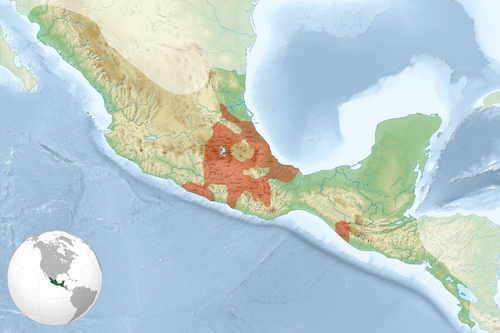
アステカ人[ a] ( / ˈ æ z t ɛ k s / AZ -teks ) は、1300年から1521年までの古典期後期に中央メキシコで栄えたメソアメリカ文明です。アステカ人には中央メキシコのさまざまな民族グループが含まれており、特にナワトル語を話し、14世紀から16世紀にかけてメソアメリカの大部分を支配していたグループです。アステカ文化は都市国家 (アルテペトル) に組織化されており、そのうちのいくつかは同盟、政治連合、または帝国を形成するために参加しました。アステカ帝国は、 1427年に設立された3つの都市国家の連合体であった。テノチティトランはメシカまたはテノチカの首都であり、テツココとトラコパンは以前はテパネク帝国の一部であり、その支配力はアスカポツァルコであった。アステカ人[1]という用語は、テノチティトランのメシカに限定されることが多いが、スペイン到来以前の時代[2]やスペイン植民地時代(1521-1821)の中央メキシコのナワ族の国家や人々を指すために広く使用されている。[ 3 ]アステカとアステカ人の定義は、19世紀初頭にドイツの科学者アレクサンダー・フォン・フンボルトが一般的な用法を確立して以来、長い間学術的な議論のテーマとなっている。[4]
古典期以降のメキシコ中央部のほとんどの民族は、メソアメリカの基本的な文化的特徴を共有していた。アステカ文化の特徴の多くは、アステカ人だけに限ったものではない。同じ理由で、「アステカ文明」という概念は、一般的なメソアメリカ文明の特定の地平として理解するのが最も適切である。[5]メキシコ中央部の文化には、トウモロコシ栽培、貴族(ピピルティン)と平民(マセワルティン)の社会的区分、パンテオン(テスカトリポカ、トラロック、ケツァルコアトルが登場)、 365日のシウホフアリと260日のトナルポフアリを交互に繰り返す暦法などがある。テノチティトランのメシカの特徴は、守護神ウィツィロポチトリ、双子のピラミッド、そしてアステカIからIVとして知られる陶器のスタイルでした。[6]
13 世紀以降、メキシコ渓谷は人口密度が高く、都市国家が台頭する中心地となった。メシカ人はメキシコ渓谷に後からやって来て、テスココ湖の見込みのない小島に都市国家テノチティトランを建設し、後にアステカ三国同盟またはアステカ帝国の支配的勢力となった。アステカ帝国はメキシコ渓谷をはるかに越えて政治的覇権を拡大し、後古典期後期にメソアメリカ中の他の都市国家を征服した。これは 1427 年にテノチティトラン、テスココ、トラコパンの都市国家間の同盟として始まった。これらの都市国家は、メキシコ盆地を支配していたテパネカのアスカポツァルコ国を倒すために同盟を結んだ。すぐにテスココとトラコパンは同盟の中で下位のパートナーに追いやられ、テノチティトランが支配的な勢力となった。帝国は貿易と軍事征服を組み合わせて勢力を拡大した。征服した州に大規模な軍事駐屯地を置いて領土を掌握するような真の領土帝国ではなかったが、むしろ征服した地域に友好的な支配者を設置し、支配王朝間で婚姻による同盟を築き、帝国のイデオロギーを属国都市国家に押し広げることで、属国都市国家を支配した。[7]属国都市国家はアステカ皇帝ヒューイ・トラトアニに貢物ではなく税金を支払った[8] 。これは経済戦略として、辺境の政体間の交流と貿易を制限し、贅沢品の入手を帝国の中心に依存させたためである。[9]帝国の政治的影響力ははるか南のメソアメリカにまで及び、チアパスやグアテマラなどの南方の国家を征服し、メソアメリカを太平洋から大西洋まで広げた。
帝国は1519年に最大規模に達したが、これはエルナン・コルテス率いるスペインの征服者たちの小集団が到着する直前のことであった。コルテスはメシカに対抗する都市国家、特にナワトル語を話すトラスカルテカや、三国同盟でかつて同盟を結んでいたテスココを含む他の中央メキシコの政体と同盟を結んだ。1521年8月13日のテノチティトラン陥落と皇帝クアウテモックの捕虜となった後、スペイン人はテノチティトランの廃墟にメキシコシティを建設した。そこから彼らはメソアメリカの人々を征服し、スペイン帝国に組み込むプロセスを進めた。1521年にアステカ帝国の上部構造が破壊されると、スペイン人はアステカ帝国が築かれた都市国家を利用して、地元の貴族を通じて先住民を支配した。これらの貴族はスペイン王室に忠誠を誓い、少なくとも名目上はキリスト教に改宗し、その見返りとしてスペイン王室から貴族として認められた。貴族は新しい領主のために税金を納め、労働力を動員する仲介者として行動し、スペインの植民地支配の確立を促進した。[10]
アステカの文化と歴史は、メキシコシティの有名なテンプロ・マヨールなどの発掘調査で発見された考古学的証拠、先住民の著作、コルテスやベルナル・ディアス・デル・カスティーヨなどのスペイン人征服者による目撃証言、そして特に16世紀と17世紀にスペインの聖職者と教養のあるアステカ人によってスペイン語またはナワトル語で書かれたアステカの文化と歴史の記述を通じて主に知られています。その例としては、フランシスコ会の修道士ベルナルディーノ・デ・サアグンが先住民のアステカの情報提供者と協力して作成した、有名なイラスト入りの2か国語(スペイン語とナワトル語)の12巻からなるフィレンツェ写本があります。征服後のナワ族に関する知識にとって重要だったのは、スペインの植民地支配下で主に地元の目的で、先住民の書記官がナワトル語でアルファベットの文章を書く訓練を受けたことです。アステカ文化は最盛期には、豊かで複雑な哲学、神話、宗教の伝統を有し、また建築や芸術においても素晴らしい成果を残しました。
定義

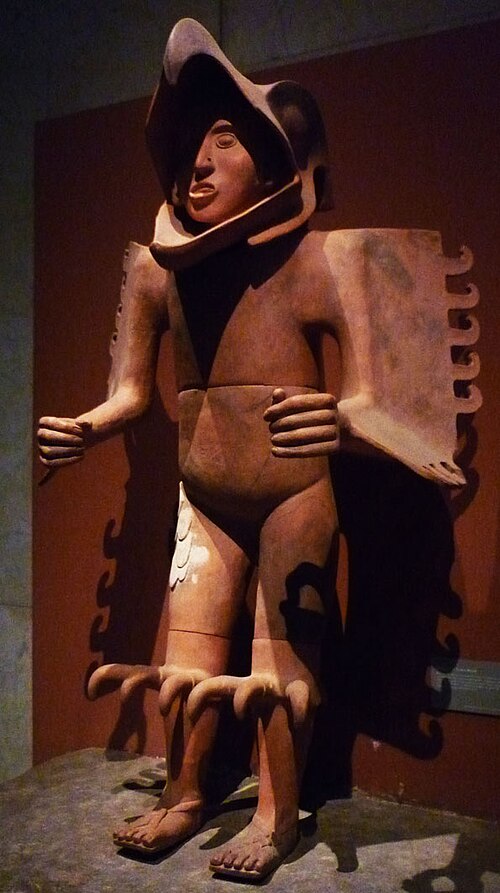
ナワトル語のaztēcatl(ナワトル語の発音: [asˈteːkat͡ɬ]、単数形)[11]とaztēcah(ナワトル語の発音:[asˈteːkaʔ]、複数形)[11]は「アズトランの人々」[12]を意味し、中央メキシコのいくつかの民族の起源とされる伝説の地である。この用語はアステカ人自身によってエンドニムとして使用されたことはないが、メシカ族のさまざまな移住の記録には、一緒にアズトランを離れたさまざまな部族について記述されている。アズトランからの旅の記録の1つでは、メシカ族の守護神であるウィツィロポチトリが、旅の途中で従者たちに「今やお前の名前はアステカではなく、お前はメキシティン(メシカ)となった」と告げている。[13]
今日では、「アステカ」という用語は、テスココ湖の島に位置するテノチティトラン(現在のメキシコシティの位置)のメシカ人のみを指すことが多い。彼らは自分たちをMēxihcah(ナワトル語の発音:[meːˈʃiʔkaʔ] 、トラテロルコを含む部族の呼称)、Tenochcah(ナワトル語の発音:[teˈnot͡ʃkaʔ]、トラテロルコを除くテノチティトランのメシカ人のみを指す)、またはCōlhuah(ナワトル語の発音:[ˈkoːlwaʔ]、彼らの王家の系図がクルワカンに彼らを結びつけていることを指す)と呼んでいた。[14] [15] [注 1] [注 2]
この用語には、テノチティトランの2つの主要な同盟都市国家、テスココのアコルワ族とトラコパンのテパネック族の住民も含まれることがある。この2人はメシカ族とともにアステカ三国同盟を結成し、しばしば「アステカ帝国」として知られる国を支配した。テノチティトランを中心とする帝国を「アステカ」という用語で表現することについては、ロバート・H・バーロウ(「クルワ・メシカ」という用語を好んだ)[14] [16]とペドロ・カラスコ(「テノチカ帝国」という用語を好んだ)[17]によって批判されている。カラスコは「アステカ」という用語について、「古代メキシコの民族的複雑さを理解したり、研究している政治体制の支配的要素を特定したりする上で、この用語は役に立たない」と書いている[17] 。
他の文脈では、アステカは、メシカ、アコルワ、テパネックと民族史や文化的特徴の大部分を共有し、ナワトル語を共通語として頻繁に使用していた、さまざまな都市国家とその人々すべてを指す場合があります。例としては、ジェローム・A・オフナーの『アステカ・テスココの法と政治』があります。[18]この意味では、後古典期後期に中央メキシコに住んでいたほとんどの人々に共通するすべての特定の文化パターンを含む「アステカ文明」について話すことができます。 [19]このような使用法では、「アステカ」という用語を、文化的または政治的にアステカ帝国の支配圏に組み込まれた中央メキシコのすべてのグループにまで拡張することもできます。[20] [注 3]
民族集団を説明する際に使用される「アステカ」という用語は、メソアメリカ年代学の古典期以降の中央メキシコのナワトル語を話すいくつかの人々、特にテノチティトランを拠点とする覇権帝国の樹立に主導的な役割を果たした民族であるメシカを指す。この用語は、アコルワ、テパネク、および帝国に組み入れられたその他の民族など、アステカ帝国に関連する他の民族にも及ぶ。チャールズ・ギブソンは、彼の研究『スペイン統治下のアステカ』(1964年)の中で、中央メキシコの多くのグループを列挙している。これらには、クルワケ、クイトラワケ、ミスキカ、ソチミルカ、チャルカ、テパネカ、アコルワケ、およびメシカが含まれる。[21]
古くは、この用語は現代のナワトル語を話す民族を指すのによく使われ、ナワトル語は以前は「アステカ語」と呼ばれていた。最近は、これらの民族はナワ人と呼ばれている。[22] [23]言語学的には、「アステカ人」という用語は、ナワトル語とその近縁のポチュテク語とピピル語を含むユト・アステカ語族(ユト・ナワ語族と呼ばれることもある)の分派を指すのに今でも使われている。[24]
アステカ人にとって、「アステカ」という言葉は特定の民族を指す固有名ではなかった。むしろ、神話上の起源地であるアズトランの遺産を主張する、ナワトル語を話すわけではないいくつかの民族を指す包括的な用語だった。アレクサンダー・フォン・フンボルトは、1810年に、貿易、慣習、宗教、言語によってメシカ国家および三国同盟に結びついたすべての人々を総称する「アステカ」という現代の用法を考案した。1843年、ウィリアム・H・プレスコットのメキシコ征服の歴史に関する著作が出版され、この用語は世界のほとんどの国で採用されたが、その中には、征服前のメキシコ人と現代のメキシコ人を区別する方法として捉えた19世紀のメキシコの学者もいた。この用法は近年議論の対象となっているが、「アステカ」という用語の方がまだ一般的である。[15]
歴史
知識の源
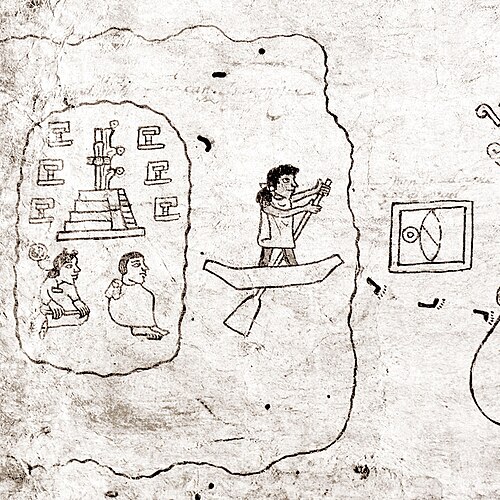
アステカ社会に関する知識は、いくつかの異なる情報源に基づいています。寺院のピラミッドから茅葺き小屋まで、あらゆるものの多くの考古学的遺跡は、アステカ世界がどのようなものであったかの多くの側面を理解するために使用できます。しかし、考古学者は、遺物の歴史的背景を解釈するために、他の情報源からの知識に頼らなければならないことがよくあります。植民地時代初期の先住民とスペイン人による多くの文書があり、植民地化以前のアステカの歴史に関する貴重な情報が含まれています。これらのテキストは、さまざまなアステカ都市国家の政治史とその支配家系についての洞察を提供します。そのような歴史は、絵入りの写本でも作成されました。これらの写本のいくつかは完全に絵入りで、多くの場合象形文字が使用されていました。征服後の時代には、読み書きのできるアステカ人や、先住民に習慣や物語について聞き取り調査したスペインの修道士によって、他の多くのテキストがラテン文字で書かれました。 16世紀初頭に作られた重要な絵入りアルファベット文書にメンドーサ写本がある。これはメキシコの初代副王にちなんで名付けられ、おそらく副王の委託により、スペイン王室にアステカ帝国の政治・経済構造を伝えるために作られたものと思われる。三国同盟が征服した国家名、アステカ帝国に課された税の種類、社会の階級・性別構造に関する情報が含まれている。[25]地元のナワ族の歴史家が彼らの国家の歴史を記録した年代記が数多く存在する。これらの年代記は絵入りの歴史を用いていたが、後にラテン文字のアルファベットの年代記に改められた。[26]よく知られた先住民の年代記作者や編者には、アメカメカ・チャルコのチマルパヒン、テノチティトランのフェルナンド・アルバラド・テソゾモク、テスココのアルバ・イシュトリルショチトル、テスココのフアン・バウティスタ・ポマール、トラスカラのディエゴ・ムニョス・カマルゴ。征服の全歴史を記した ベルナル・ディアス・デル・カスティーヨなど、スペイン侵略に参加したスペイン征服者による記録も数多くある。
スペインの修道士たちも年代記やその他の記録という形で文書を残している。中でも重要なのは、 1524年にメキシコに到着した最初の12人のフランシスコ会修道士のうちの1人、トリビオ・デ・ベナベンテ・モトリニアである。もう一人のフランシスコ会修道士として、モナルキア・インディアナの著者であるフアン・デ・トルケマダ神父も非常に重要である。ドミニコ会修道士のディエゴ・デュランも、スペイン到来以前の宗教やメシカの歴史について広範囲に著作を残している。 [27]アステカの宗教思想、政治・社会構造、そしてメシカの観点から見たスペイン征服の歴史の多くの側面に関する貴重な情報源は、フィレンツェ写本である。 1545年から1576年の間に、フランシスコ会の修道士ベルナルディーノ・デ・サアグンと先住民の情報提供者や筆記者によってスペイン語とナワトル語の2か国語で書かれた民族誌百科事典の形で制作されたこの書物には、宗教、暦、植物学、動物学、貿易、工芸、歴史など、植民地化以前の社会の多くの側面に関する知識が含まれています。 [28] [29]もう1つの知識源は、当時のナワトル語話者の文化と習慣であり、これらはしばしば先スペイン時代の生活様式がどのようなものであったかについての洞察を与えてくれます。アステカ文明の学術的研究は、ほとんどの場合、考古学的知識と民族史的および民族誌的情報を組み合わせた科学的かつ学際的な方法論に基づいています。[30]
古典期と後古典期の中央メキシコ

巨大な都市テオティワカンにナワトル語話者が住んでいたのか、それとも古典期にはまだナワ族が中央メキシコに到着していなかったのかは議論の余地がある。ナワ族は中央メキシコの高地の原住民ではなく、北西メキシコのどこかから徐々にこの地域に移住してきたというのが一般的な見解である。6 世紀にテオティワカンが陥落すると、中央メキシコでいくつかの都市国家が台頭したが、そのうちのいくつか、例えばチョルーラやソチカルコには、おそらくナワトル語話者が住んでいた。ある研究では、ナワ族はもともとグアナファト周辺のバヒオ地域に住んでいたと示唆されており、この地域の人口は 6 世紀にピークに達し、その後の乾期に急速に減少した。このバヒオの人口減少は、メキシコ渓谷への新しい集団の侵入と一致しており、これはこの地域へのナワトル語話者の流入を示していることを示唆している。[31]これらの人々はメキシコ中部に住み、オト・マンゲ語族を駆逐しながら政治的影響力を南に広げていった。かつての遊牧狩猟採集民がメソアメリカの複雑な文明と混ざり合い、宗教的・文化的慣習を取り入れるにつれて、後のアステカ文化の基礎が築かれた。西暦900年以降、後古典期には、ナワトル語話者が住んでいたとほぼ確実な多くの遺跡が勢力を拡大した。その中にはトゥーラ、イダルゴの遺跡、メキシコ渓谷のテナユカやコルワカン、モレロスのクアウナワクなどの都市国家がある。[32]
メシカ人の移住とテノチティトランの建設
植民地時代の民族史資料では、メシカ族自身がメキシコ渓谷への到着について記述している。民族名アステカ(ナワトル語のアステカ)は「アズトラン出身の人々 」を意味し、アズトランは北にある神話上の起源地である。したがって、この用語はこの神話上の地の遺産を継承していると主張するすべての人々に適用される。メシカ族の移住物語では、トラスカルテカ族、テパネカ族、アコルワ族などの他の部族とともに移動したが、最終的に部族の神ウィツィロポチトリが他のアステカ部族から分離して「メシカ」という名前を名乗るように命じたことが語られている。[33]彼らが到着した当時、この地域には多くのアステカ都市国家があった。最も強力だったのは南のコルワカンと西のアスカポツァルコであった。アスカポツァルコのテパネック族はすぐにメシカ族をチャプルテペクから追放し、チマルショチトル2世女王を除く最初のアステカ王家を処刑した。1299年、コルワカンの支配者ココシュトリは彼らがティサパンの荒れ地に定住することを許可し、彼らは最終的にそこでクルワカン文化に同化した。[34]コルワカンの高貴な家系は伝説の都市国家トゥーラにそのルーツをたどることができ、メシカ族はコルワ族の家系と結婚することでこの遺産を独占した。コルワカンに住んだ後、メシカ族は再び追放され、強制的に移住させられた。[35]
アステカの伝説によると、1323年にメシカ族はウチワサボテンに止まり蛇を食べる鷲の幻影を見せられた。その幻影は彼らが定住地を建設する場所を示していた。メシカ族はメキシコ盆地の内陸湖であるテスココ湖の小さな沼地の島にテノチティトランを建設した。建設年は通常1325年とされる。1376年、メシカ族の父とコルワ族の母を持つアカマピチトリがテノチティトランの初代ヒューイ・トラトアニに選出され、メシカ王朝が設立された。[36]
初期のメヒカの支配者
メシカ王朝の建国後50年間、メシカ人はテソゾモク王の統治下で主要な地域勢力となっていたアスカポツァルコの貢納者であった。メシカ人はテパネカ族に戦士を供給し、その地域での征服作戦を成功させ、征服した都市国家から貢物の一部を受け取っていた。このようにして、テノチティトランの政治的地位と経済は徐々に成長していった。[37]
1396年、アカマピチトリが亡くなると、その息子ウィツィリウィトル(ハチドリの羽)が統治者となり、テソゾモクの娘と結婚して、アスカポツァルコとの関係は密接なままでした。ウィツィリウィトルの息子チマルポポカ(盾のように煙を吐く)は、1417年にテノチティトランの統治者になりました。1418年、アスカポツァルコはテスココのアコルワ族との戦争を開始し、彼らの統治者イシュトリルショチトルを殺害しました。イシュトリルショチトルはチマルポポカの娘と結婚していましたが、メシカの統治者はテソゾモクを支援し続けました。テソゾモクは1426年に亡くなり、その息子たちはアスカポツァルコの統治権をめぐって争い始めました。この権力闘争の最中にチマルポポカは死亡したが、おそらく彼を競争相手とみなしたテソゾモクの息子マクストラによって殺されたと思われる。 [38] ウィツィリフイトルの兄弟でチマルポポカの叔父であるイツコアトルが次のメシカ・トラトアニに選出された。メシカ人はアスカポツァルコと開戦しており、イツコアトルは殺害されたテクスコカの支配者イシュトリルショチトルの息子であるネサワルコヨトルとの同盟をマクストラに対抗するために請願した。イツコアトルはまた、テパネコの都市トラコパンの支配者でマクストラの兄弟であるトトキワズトリとも同盟を結んだ。テノチティトラン、テクスココ、トラコパンの三国同盟はアスカポツァルコを包囲し、1428年に都市を破壊しマクストラを犠牲にした。この勝利により、テノチティトランはメキシコ渓谷の支配的な都市国家となり、3つの都市国家間の同盟がアステカ帝国の基盤となった。[39]
イツコアトルはテノチティトランの基盤を固めるため、クルワカン、ソチミルコ、クィトラワク、ミスキクといった南湖畔の都市国家を征服した。これらの国家は生産性の高いチナンパ農業を基盤とした経済を持ち、浅いソチミルコ湖の肥沃な土壌を人工的に拡張して耕作していた。イツコアトルはその後モレロス渓谷でさらなる征服を行い、クアウナワク(現在のクエルナバカ)の都市国家を支配下に置いた。[40]
アステカ帝国の初期の統治者
モテクゾマ・イ・イルウイカミナ

1440 年、モテウゾマツィン・イルウイカミナ[注 4] (文字通り「彼は領主のようにしかめ面をし、空を撃つ」[注 5] ) がトラトアニに選出された。彼はウィツィリウィトルの息子で、チマルポポカの兄弟であり、テパネカ族との戦争で叔父のイツコアトルの戦争指導者を務めていた。支配的な都市国家で新しい支配者が即位すると、従属都市は税金の支払いを拒否して反乱を起こすことがよくあった。つまり、新しい支配者は戴冠式キャンペーンで統治を開始し、反乱を起こした州に対して行うことが多いが、時には新たな征服を行って軍事力を誇示することもあった。モテウゾマは、テノチティトランの大神殿の拡張のために労働者を要請することで、谷周辺の都市の態度を試した。チャルコ市だけが労働者の提供を拒否し、チャルコとテノチティトランの敵対関係は1450年代まで続いた。[41] [42]その後、モテクソマはモレロス渓谷とゲレロ渓谷の都市を再征服し、その後、ベラクルス北部のワステカ地方、コイストラワカのミシュテク地方、オアハカの大部分を新たに征服し、その後はベラクルス中部と南部でコサマロパン、アウイリサパン、クエトラシュトランを征服した。[43]この時期に、トラスカラン、チョルーラ、ウエソチンコの都市国家が帝国の拡大に対する主要な競争相手として台頭し、征服した都市のいくつかに戦士を供給した。そのため、モテクゾマはこれら3つの都市に対して低強度の戦争状態を開始し、おそらく消耗戦略として「花の戦争」(ナワトル語でxochiyaoyotl )と呼ばれる小規模な小競り合いを繰り広げた。 [44] [45]
モテクソマ1世は三国同盟の政治構造とテノチティトランの内部政治組織も強化した。弟のトラカエレル(ナワトル語:シワコアトル)がモテクソマ1世の主な顧問を務め、この時期の主要な政治改革の立役者とみなされ、貴族階級(ナワトル語:ピピルティン)の権力を強化し、一連の法典を制定し、メシカ・トラトアニに忠誠を誓った征服された支配者を都市に復権させる慣行を確立した。[46] [47] [44]
アシャヤカトルとティゾック
1469年、次の統治者はアシャヤカトル(文字通り「水の仮面」)で、イツコアトルの息子テソゾモクとモテクゾマ1世の娘アトトツトリ2世の息子であった。[注 6]彼はテワンテペク地峡のサポテカ族に対してテノチティトランのはるか南で戴冠式を成功させた。アシャヤカトルはまた、テノチティトランも位置していた島の北部にある独立都市トラテロルコを征服した。トラテロルコの統治者モキウイクスはアシャヤカトルの妹と結婚しており、彼女に対する彼の虐待の疑惑は、トラテロルコとその重要な市場をテノチティトランのトラトアニの直接の支配下に置くための口実として使われた。[48]
アシャヤカトルはその後、中央ゲレロ州、プエブラ渓谷、メキシコ湾岸の地域を征服し、トルカ渓谷のオトミ族とマトラツィンカ族を征服した。トルカ渓谷はミチョアカン州の強力なタラスカン王国に対する緩衝地帯であり、アシャヤカトルは次にこのタラスカン王国を攻撃した。1478年から1479年にかけてのタラスカン族(ナワトル語:ミチュアケ)に対する大規模な作戦では、アステカ軍はよく組織された防衛によって撃退された。アシャヤカトルはトラキシマロヤン(現在のタジマロア)の戦いで大敗し、32,000人の兵士の大半を失い、かろうじて残りの軍とともにテノチティトランに逃げ帰った。[49]
1481年、アシャヤカトルが死去すると、兄のティゾクが統治者に選出された。ティゾクはメツティトランのオトミ族に対する戴冠式を戦ったが、大戦に敗れ、戴冠式のために犠牲にできる捕虜を40人しか確保できず、失敗に終わった。弱みを見せた多くの都市が反乱を起こし、その結果、ティゾクの短い統治期間の大半は反乱鎮圧と先代が征服した地域の支配維持に費やされた。ティゾクは1485年に急死したが、次期トラトアニとなった兄で戦争指導者のアウィツォトルに毒殺されたとされている。ティゾクは、ティゾクの征服地の表現で飾られた記念碑的な彫刻「ティゾクの石」 (ナワトル語でテマラカトル)の名にちなんで名付けられていることでよく知られている。[50]
アウィッツォトル
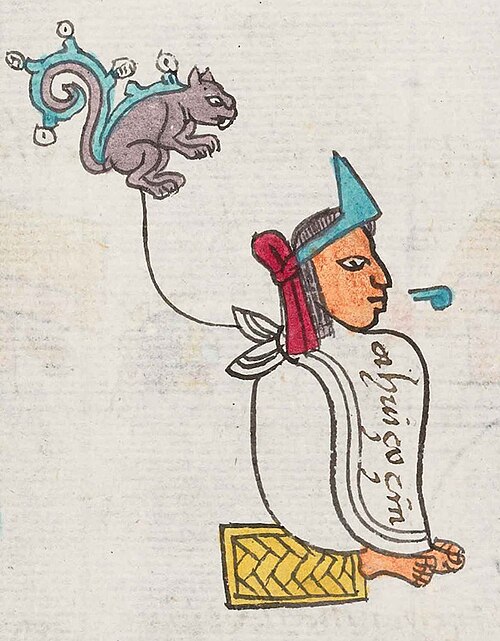
次の支配者はアウィツォトル (文字通り「水の怪物」) で、アシャヤカトルとティソクの兄弟であり、ティソクの下で戦争の指導者でした。彼の戴冠作戦は成功し、トルカ渓谷の反乱を鎮圧し、ヒロテペクとメキシコ北部の渓谷のいくつかのコミュニティを征服しました。1521 年の湾岸への第 2 次作戦も非常に成功しました。彼はテノチティトランの大神殿の拡張を開始し、1487 年に新しい神殿を開所しました。開所式には、メシカ族はすべての属国都市の支配者を招待し、彼らは式典の観客として参加しました。この式典では、前例のない数の戦争捕虜が犠牲にされました。いくつかの情報源によると、4 日間で 80,400 人の捕虜が犠牲にされました。おそらく実際の犠牲者の数ははるかに少ないでしょうが、それでも数千人に達します。首都では、最も控えめな数字でも満足できるほどの頭蓋骨が発見されたことはありません。[51]アウィツォトルはカリストラワカ、マリナルコ、テポツトランなどの遺跡にも記念碑的な建築物を建設した。北ゲレロ州のアラウィツォトランとオズトティチパックの町で反乱が起こった後、彼は全住民を処刑し、メキシコ渓谷からの人々で再定住するよう命じた。また、タラスカン国家に対する国境を守るためにオズトゥマに要塞化された駐屯地を建設した。[52]
最後のアステカの支配者とスペインの征服

モテクゾマ・ショコヨツィンは、スペインの侵略者とその先住民同盟が2年間にわたる戦役(1519~1521年)でアステカ帝国の征服を開始したときのアステカの支配者として世界史に名を残しています。彼の初期の統治は、彼の将来の名声を暗示するものではありませんでした。彼はアウィツォトルの死後、統治を引き継ぎました。モテクゾマ・ショコヨツィン(文字通り「彼は領主のようにしかめ面をしており、末っ子は死んでいるが、生きている間は生きていたが死んではいない」)は、アシャヤカトルの息子で、戦争の指導者でした。彼は統治を標準的な方法で開始し、指導者としての能力を示すために戴冠式作戦を実施しました。彼はオアハカの要塞都市ノパランを攻撃し、隣接する地域を帝国の支配下に置きました。有能な戦士であったモクテスマは、前任者が設定した征服のペースを維持し、ゲレロ、オアハカ、プエブラ、さらには太平洋とメキシコ湾岸の南まで広い地域を支配し、チアパス州のショコノチコ県を征服した。また、トラスカラとウエソチンコに対する花の戦争を激化させ、チョルーラとの同盟を確保した。また、戦闘での功績によって平民(ナワトル語:マセワルティン)が特権階級であるピピルティンに加わることを困難にすることで、アステカ社会の階級構造を強化した。また、平民が消費できる贅沢品の種類を制限する厳格な贅沢禁止令を制定した。[53]

1517年、モクテスマは、見知らぬ戦士を乗せた船がセンポアラン近くのメキシコ湾岸に上陸したという最初の知らせを受け取り、使者を派遣して彼らを迎え、何が起こっているのかを調べさせ、その地域の臣民に、新たな到着があれば報告するように命じた。1519年、彼はエルナン・コルテスのスペイン艦隊の到着を知らされ、コルテスはすぐにトラスカラに向けて進軍し、そこでアステカの伝統的な敵と同盟を結んだ。1519年11月8日、モクテスマ2世はテノチティトラン南の土手道でコルテスとその軍隊およびトラスカラの同盟者を迎え、スペイン人をテノチティトランに客として滞在するよう招いた。アステカ軍がメキシコ湾岸のスペイン軍の陣地を破壊したとき、コルテスはモクテスマに攻撃の責任者である指揮官を処刑するよう命じ、モクテスマはそれに従った。この時点で、勢力バランスはスペイン人側に傾き、モクテスマは宮殿に囚われていた。この勢力の移行がモクテスマの臣民に明らかになると、スペイン人は首都でますます歓迎されなくなり、1520年6月に敵対行為が勃発し、大神殿での虐殺とスペイン人に対するメシカ人の大規模な反乱にまで至った。戦闘中、モクテスマは街から逃げる途中で殺されたスペイン人か、彼を裏切り者とみなしたメシカ人自身によって殺害された。[54]
モクテスマの親族で顧問でもあったクィトラワクがモクテスマの後を継いでトラトアニとなり、スペインの侵略者とその同盟先住民からテノチティトランを防衛した。クィトラワクはわずか80日間統治し、初期の史料では死因は明らかにされていないが、天然痘の流行で死亡したとみられる。クアウテモックは最後の独立したメキシカ・トラトアニとなり、テノチティトランの激しい防衛を続けた。アステカ人は疫病で弱体化し、スペイン人はテノチティトラン攻撃のためにトラスカル人を中心に数万人のインディアンの同盟者を動員した。アステカの首都が包囲され破壊された後、クアウテモックは1521年8月13日に捕らえられ、中央メキシコにおけるスペインの覇権の始まりとなった。スペイン人はクアウテモックを捕虜にし、1525年のホンジュラスへの不運な遠征中に、コルテスの命令でおそらく反逆罪で拷問を受け、処刑した。彼の死は、アステカの政治史における激動の時代の終わりを告げた。
アステカ帝国の崩壊後、ナワ族のコミュニティ全体がエンコミエンダ制度の下で強制労働の対象となり、アステカの教育制度は廃止されて非常に限定された教会教育に置き換えられ、アステカの宗教的慣習は強制的にカトリックに置き換えられました。
社会および政治組織
貴族と平民

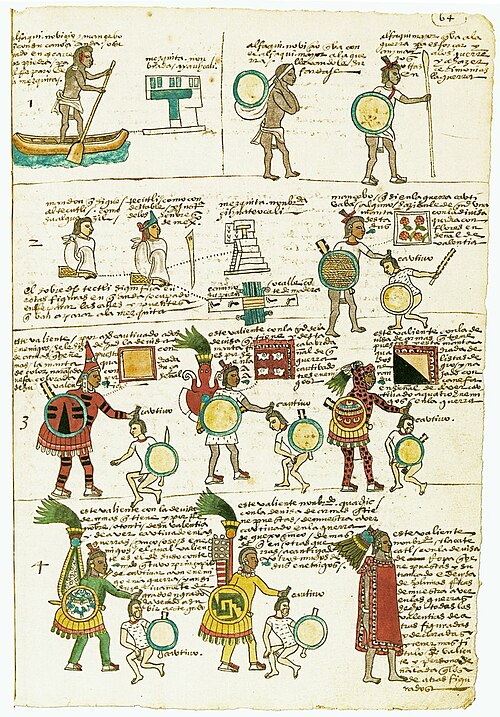
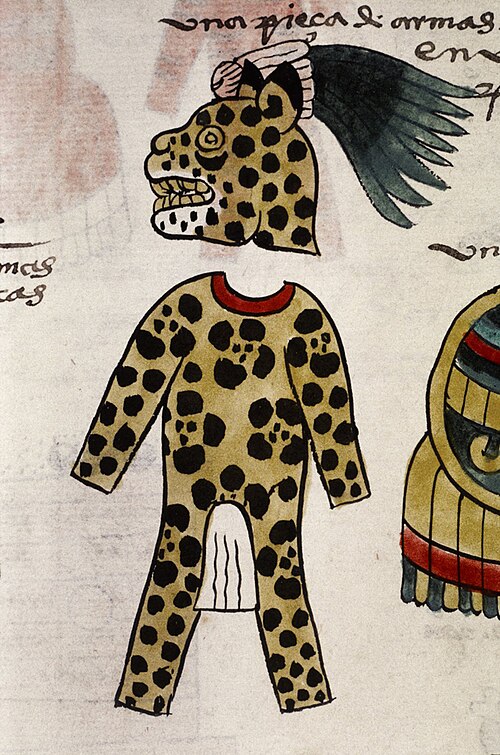
最高階級はピピルティン[nb 7]、つまり貴族であった。ピリの地位は世襲制で、その保持者には、特に上質な衣服を着用し、贅沢品を消費する権利、土地を所有し、平民に強制労働をさせる権利など、一定の特権が与えられていた。最も権力のある貴族は領主(ナワトル語:テウクティン)と呼ばれ、貴族の領地や家を所有・管理し、政府の最高職や軍の指導者として働くことができた。貴族は人口の約5%を占めていた。[55]
2番目の階級はマセワルティンで、もともとは農民だったが、後に下層労働者階級全般に広がった。エドゥアルド・ノゲラは、後期には人口のわずか20%が農業や食料生産に従事していたと推定している。[56]社会の残りの80%は戦士、職人、商人だった。最終的に、マセワルティンのほとんどは芸術や工芸に専念するようになった。彼らの作品は都市の重要な収入源だった。[57]マセワルティンは、借金や貧困のために貴族に身を売らなければならない場合など、奴隷になる可能性があったが(ナワトル語:tlacotin)、奴隷はアステカ人の間では世襲の身分ではなかった。マセワルティンの中には土地を持たず領主(ナワトル語:mayehqueh)のために直接働く者もいたが、大多数の庶民は土地や財産にアクセスできるカルポリスに組織された。[58]
平民は戦争で優れた能力を発揮することで貴族と同様の特権を得ることができた。戦士が捕虜を捕らえると、特定の紋章、武器、衣服を使用する権利が得られ、捕虜の数が増えるにつれて地位と名声が高まった。[59]
家族と性別
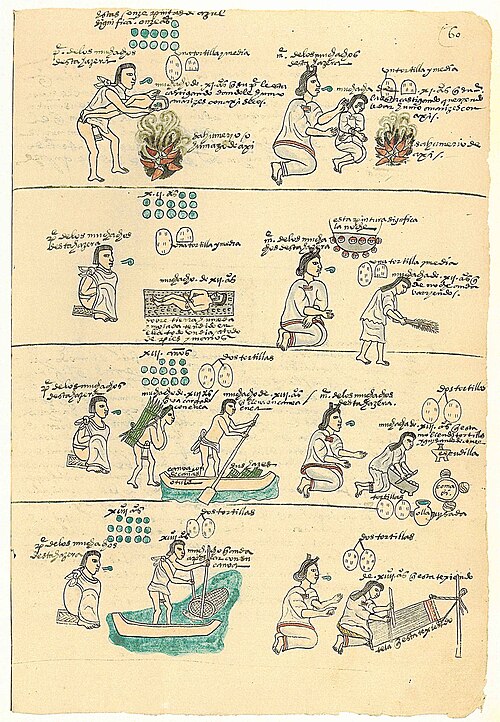
アステカの家族形態は双系で、父方と母方の親族は平等に数えられ、相続財産も息子と娘の両方に渡されました。これは、女性も男性と同じように財産を所有でき、したがって女性は配偶者からかなりの経済的自由を持っていたことを意味します。しかし、アステカ社会は性別による差別が著しく、男性と女性の役割は別々でした。男性は農民、貿易商、職人、戦士として家の外で働くことが期待され、女性は家庭の責任を負うことが期待されていました。ただし、女性は小規模な商人、医師、司祭、助産婦として家の外で働くこともできました。戦争は高く評価され、高い名声の源でしたが、女性の仕事は比喩的に戦争と同等であり、世界の均衡を維持し、神々を喜ばせるために同等に重要であると考えられていました。この状況から、一部の学者はアステカのジェンダーイデオロギーをジェンダー階層のイデオロギーではなく、ジェンダーの役割は別々でありながら平等であるというジェンダー補完性のイデオロギーであると説明しています。[60]
貴族の間では、結婚による同盟が政治的戦略としてよく使われ、下級貴族はより名声のある家系の娘と結婚し、その地位は子供たちに継承された。貴族はしばしば一夫多妻制で、領主は多くの妻を持っていた。一夫多妻制は庶民の間ではあまり一般的ではなく、いくつかの資料では禁止されていたとされている。[61]
アルテペトルそしてカルポリ

アステカの政治組織の主要単位は都市国家で、ナワトル語で「水の山」を意味するアルテペトルと呼ばれていました。各アルテペトルは、貴族の集団と平民の集団に対して権威を持つ支配者、トラトアニによって率いられていました。アルテペトルには、首都があり、宗教の中心地として機能し、首都の周囲の小さな集落に散らばって暮らす現地住民の分布と組織の中心でした。アルテペトルは、異なる言語を話す集団で構成されることが多かったにもかかわらず、住民にとって民族的アイデンティティの主な源でもありました。各アルテペトルは、他のアルテペトルの政体とは政治的に対照的であると自認しており、アルテペトル国家間で戦争が起こりました。このようにして、あるアルテペトルのナワトル語を話すアステカ人は、同じアルテペトルに属する他の言語の話者とは団結するが、競合する他のアルテペトル国家に属するナワトル語の話者とは敵対することになる。メキシコ盆地では、アルテペトルはcalpolliと呼ばれる下位区分から構成され、これが平民の主な組織単位として機能していた。トラスカラとプエブラ渓谷では、アルテペトルは領主 (ナワトル語: tecutli ) が率いるteccalli単位に組織され、領主が領土を支配し、土地の権利を平民に分配した。calpolli は、土地が私有財産ではなかったため平民が労働と土地利用を組織する領土単位でもあり、また、婚姻を通じてつながった家族のネットワークとしての親族単位でもあった。カルポリの指導者は貴族であったり、貴族になったりする可能性があり、その場合、彼らはアルテペトル政府でカルポリの利益を代表することができた。[62] [63]
考古学者マイケル・E・スミスは、モレロス渓谷の典型的なアルテペトルには1万人から1万5千人の住民がおり、70平方キロメートルから100平方キロメートル(27平方マイルから39平方マイル)の面積を占めていたと推定している。モレロス渓谷のアルテペトルの規模はやや小さかった。スミスは、アルテペトルは領土単位というよりも、領主に忠誠を誓う住民で構成された政治単位であったと主張する。スミスがこのように区別するのは、いくつかの地域では異なるアルテペトルの忠誠心を持つ小さな集落が点在していたためである。[64]
三国同盟とアステカ帝国
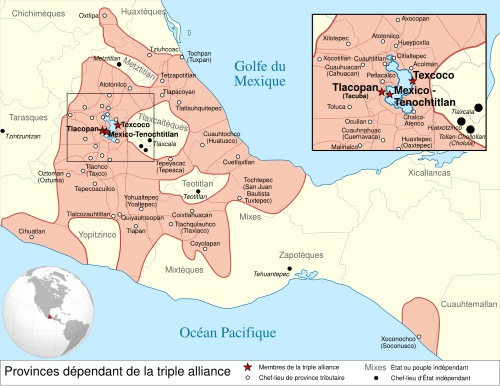
アステカ帝国は間接的な手段で統治されていた。ほとんどのヨーロッパ帝国と同様に、民族的に非常に多様であったが、ほとんどのヨーロッパ帝国とは異なり、単一の政府システムよりも覇権的な連合であった。民族史家ロス・ハシグは、アステカ帝国は征服した土地に対して最高権力を行使しなかったため、非公式または覇権的な帝国として理解するのが最も適切であると主張している。アステカ帝国は単に税金の支払いを期待し、税金の支払いを確実にするために必要な程度にのみ力を行使した。[65]また、支配したすべての領土がつながっているわけではないため、不連続な帝国でもあった。たとえば、ショコノチコの南部の周辺地域は中心部と直接接していませんでした。アステカ帝国の覇権的性格は、都市国家が征服されると一般的に地方の支配者がその地位に復帰し、税金が支払われ、地方のエリートが進んで参加する限り、アステカ人は地方の問題に干渉しなかったという事実に見ることができる。このような順守は、婚姻やさまざまな形の交流を通じて結びついたエリートのネットワークを確立し、維持することによって確保された。[65]
それでも、帝国の拡大は、戦略的な州における辺境地帯の軍事支配を通じて達成され、そこでは征服と支配へのより直接的なアプローチが取られた。そのような戦略的な州は、しばしば課税を免除された。アステカ人は、軍隊を常駐させたり、傀儡の支配者を設置したり、さらには忠実な支持基盤を維持するために中心部から全住民を移動させたりすることで、それらの地域に投資さえした。[66]このように、アステカの政治システムは、メキシコ渓谷の中心から遠く離れた帝国の外側の地域で、異なる支配戦略を区別していた。いくつかの州は、帝国の経済的安定の基盤となる従属州と、さらなる拡大の基盤となる戦略的な州として扱われた。[67]
政治形態はしばしば帝国と呼ばれるが、帝国内のほとんどの地域はナワトル語でアルテペトルと呼ばれる都市国家として組織されていた。これらは正当な貴族王朝の世襲指導者(トラトアニ)によって統治された小さな政体であった。初期アステカ時代はアルテペトルの成長と競争の時代であった。1427年に三国同盟の連合が形成され、征服を通じて拡大し始めた後も、アルテペトルは地方レベルで支配的な組織形態であり続けた。地域政治単位としてのアルテペトルの効率的な役割は、帝国の覇権的支配形態の成功に大きく貢献した。[68]
経済
農業と自給自足

メソアメリカのすべての民族と同様に、アステカ社会はトウモロコシ農業を中心に組織されていました。メキシコ渓谷の湿潤な環境は、多くの湖と沼地があり、集約的な農業を可能にしました。トウモロコシに加えて主な作物は、豆、カボチャ、唐辛子、アマランサスでした。渓谷の農業生産にとって特に重要だったのは、湖にチナンパを建設することでした。チナンパは、浅瀬を一年中耕作できる非常に肥沃な庭園に変えることを可能にした人工島です。チナンパは、湖の底の泥と植物やその他の植物が交互に層になって作られた、農地の人工的な拡張です。これらの高床式ベッドは狭い運河で区切られており、農民はカヌーで行き来することができました。チナンパは非常に肥沃な土地で、平均して年間7回の収穫がありました。現在のチナンパの収穫量に基づくと、1ヘクタール(2.5エーカー)のチナンパで20人を養うことができ、9,000ヘクタール(22,000エーカー)のチナンパで18万人を養うことができると推定されています。[69]
アステカ人は、人工灌漑システムを構築することで、農業生産をさらに強化しました。農業のほとんどは人口密集地域の外で行われましたが、都市内では別の(小規模)農業の方法がありました。各家族は庭の区画を持ち、トウモロコシ、果物、ハーブ、薬、その他の重要な植物を栽培しました。テノチティトランの街が主要な都市中心地になると、湖岸の泉から水道を通じて街に水が供給され、人々は肥料として使用するために人間の排泄物を収集するシステムを組織しました。集約的な農業を通じて、アステカ人は大規模な都市人口を維持することができました。湖はまた、魚、両生類、エビ、昆虫や昆虫の卵、水鳥などの水生動物の形でタンパク質の豊富な供給源でもありました。このように多様なタンパク質源が存在したため、肉用の家畜はほとんど使われていなかった(飼育されていたのは七面鳥と犬だけだった)ため、学者たちはメキシコ渓谷の住民にタンパク質不足はなかったと計算している。[70]
工芸と貿易

食料の過剰供給により、アステカ人のかなりの部分が食料生産以外の産業に従事することができた。家庭での食料生産のほかに、女性はアガベ繊維や綿で織物を織っていた。男性も陶器や黒曜石、フリントの道具、ビーズ細工、羽根細工、道具や楽器の製作などの高級品の製作などの工芸の専門に従事していた。カルポリス全体が単一の工芸に特化している場合もあり、いくつかの考古学的遺跡では単一の工芸専門のみが営まれていた大規模な地区が発見されている。[71] [72]
アステカ人は金属製品をあまり生産しなかったが、金の基本的な製錬技術の知識を持っており、金と翡翠やトルコ石などの宝石を組み合わせていた。銅製品は一般的にミチョアカン州のタラスカ人から輸入されていた。[73]
貿易と流通

製品は市場のネットワークを通じて流通した。市場の中には、単一の商品に特化したもの (アコルマンの犬の市場など) もあれば、さまざまな商品が並ぶ一般的な市場もあった。市場は高度に組織化されており、監督官が、許可された商人だけが商品を販売できるようにし、顧客を騙したり、標準以下の商品や偽造品を販売した商人を罰するシステムを備えていた。典型的な町には週 1 回 (5 日ごと) の市場があり、大都市では毎日市場が開かれていた。コルテスは、テノチティトランの姉妹都市であるトラテロルコの中央市場には 1 日 6 万人が訪れたと報告している。市場の売り手の中には小規模な商人もおり、農民は農産物の一部を、陶工は器を売るなどしていた。他の売り手は、利益を求めて市場から市場へと移動するプロの商人であった。[74]
ポチテカは専門の長距離商人で、排他的なギルドに組織されていました。彼らはメソアメリカのあらゆる地域に長い遠征をして、エキゾチックな高級品を持ち帰り、トラテロルコ市場の裁判官や監督者として働いていました。アステカ・メキシコの経済は商業化されていましたが(お金、市場、商人の使用において)、土地と労働力は一般に販売される商品ではありませんでしたが、一部の種類の土地は貴族の間で売買されました。[75]経済の商業部門では、数種類のお金が定期的に使用されていました。[76]少額の買い物はカカオ豆で行われ、カカオ豆は低地から輸入しなければなりませんでした。アステカの市場では、小さなウサギは豆30個、七面鳥の卵は豆3個、タマルは豆1個でした。より大きな買い物には、クアクトリと呼ばれる標準化された長さの綿布が使用されました。クワチュリには様々な等級があり、価値はカカオ豆65個から300個までの範囲であった。約20クワチュリでテノチティトランの庶民は1年間生活することができた。[77]
課税
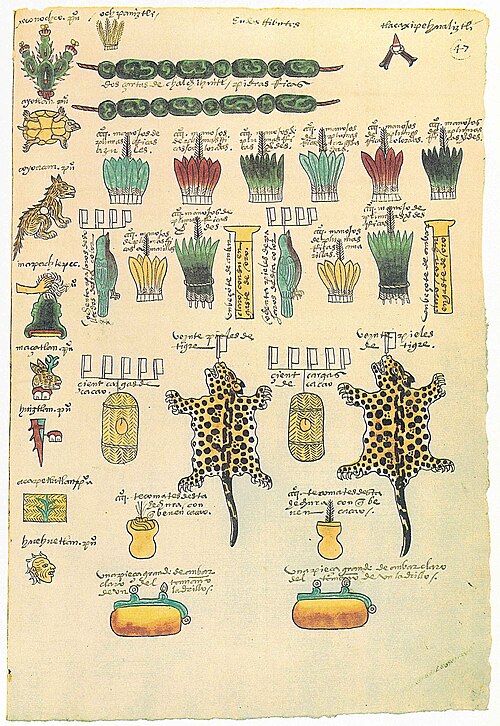
物品の分配のもう一つの形態は、税金の支払いである。アルテペトルが征服されると、勝者は毎年の税金を課し、通常は最も価値があり貴重な地元の産物の形で支払われた。メンドーサ写本の数ページには、支配下の町とそこから供給される品物が記載されており、羽毛、装飾された服、緑色の石のビーズなどの贅沢品だけでなく、布、薪、食料などのより実用的な品物も含まれていた。税金は通常、年に2回または4回、異なる時期に支払われた。[25]
アステカ支配下の地方における考古学的発掘調査は、帝国への編入が地方民にとってコストと利益の両方をもたらしたことを明らかにしている。プラス面としては、帝国は商業と貿易を促進し、黒曜石から青銅まで、珍しい品々が庶民と貴族の両方の家に届くようになった。貿易相手には、青銅の道具や宝石の供給源である敵国のプレペチャ(タラスカンとも呼ばれる)も含まれていた。マイナス面としては、帝国の税が庶民の世帯に負担を課し、庶民は税を払うために労働を増やさなければならなかった。一方、貴族は帝国の組織の間接的な性質のために、帝国の支配下ではしばしばうまくやっていた。帝国は地元の王や貴族に頼らざるを得ず、秩序を維持し、税収を滞りなく流し続けるために彼らに特権を与えた。[78]
都市計画
アステカ社会は、比較的単純な農村の伝統と、制度、専門化、階層構造の複雑なシステムを備えた真に都市化された社会の発展を組み合わせた。メソアメリカの都市の伝統は、人口が10万人をはるかに超えるテオティワカンなどの大都市圏で古典期に発展し、アステカの台頭時には、都市の伝統はメソアメリカ社会に根付いており、都市圏は全人口の主要な宗教的、政治的、経済的機能を果たしていた。[79]
メキシコ-テノチティトラン
.jpg/500px-Vestigios_de_Tenochtitlan_by_CDMX_Gov_IMG_4984_(29638565064).jpg)
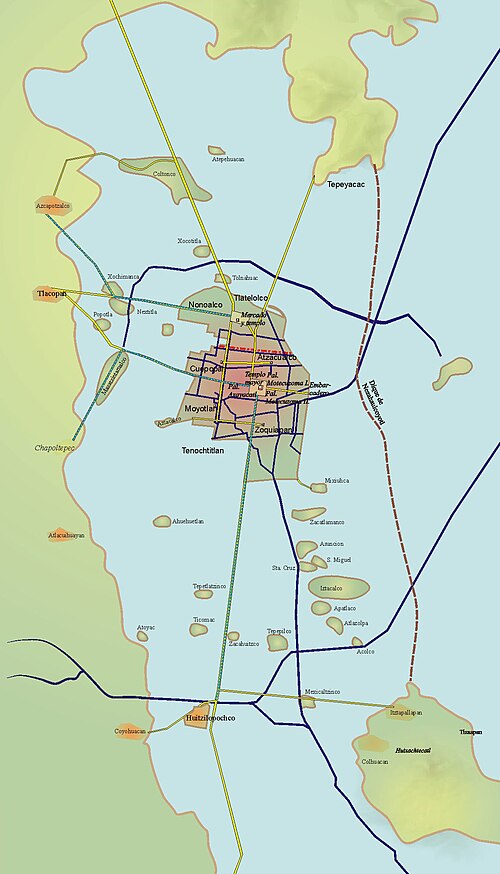
アステカ帝国の首都はテノチティトランであり、現在のメキシコシティにあたる。テスココ湖の小島群の上に築かれた都市計画は、カンパン(方向)と呼ばれる4つの都市セクションに分かれた対称的なレイアウトに基づいていた。テノチティトランは固定された計画に従って建設され、テノチティトランの大ピラミッドが都市から50メートル(160フィート)の高さに聳え立つ祭祀場を中心にしていた。家屋は木とロームで作られ、屋根は葦で作られていたが、ピラミッド、寺院、宮殿は一般に石で作られていた。都市には運河が張り巡らされており、輸送に便利だった。人類学者のエドゥアルド・ノゲラは、家屋数とトラテロルコ(かつては独立都市だったが後にテノチティトランの郊外になった)の人口を合わせて、人口を20万人と推定した。[69]テスココ湖周辺の島々や湖岸も含めると、人口は30万人から70万人と推定される。マイケル・E・スミスは、テノチティトランの面積1,350ヘクタール(3,300エーカー)と人口密度157人/ヘクタール(60人/エーカー)に基づいて、人口を212,500人とやや少なく見積もっている。アステカ時代のメキシコ渓谷で2番目に大きい都市はテスココで、450ヘクタール(1,100エーカー)の土地に約25,000人の住民が住んでいた。[80]
テノチティトランの中心は聖域で、壁で囲まれた正方形のエリアには、大神殿、他の神々の神殿、舞踏場、カルメカック(貴族の学校)、犠牲者の頭蓋骨を展示する頭蓋骨置き場(ツォンパントリ) 、戦士団の住居、商人の宮殿がありました。聖域の周りには、トラトアニスによって建てられた王宮がありました。[81]
大寺院

テノチティトランの中心はテンプロ・マヨール、つまり大神殿であった。これは、 2つの双子の神殿へと続く二重階段のある大きな階段のあるピラミッドであり、1つはトラロックに捧げられ、もう1つはウィツィロポチトリに捧げられたものであった。ここは、祭礼の際にほとんどの人身御供が捧げられた場所であり、犠牲者の遺体は階段から投げ落とされた。神殿は数段階にわたって拡張され、ほとんどのアステカの支配者は、新しい奉納式と落成式をそれぞれ行うために、さらに段階を増築することを重視していた。神殿はメキシコシティの中心部で発掘されており、奉納された豪華な供物がテンプロ・マヨール博物館に展示されている。[82]
考古学者エドゥアルド・マトス・モクテスマは、その論文「テンプロ・マヨールの象徴性」の中で、この神殿の方向は、メシカ人が宇宙に対して抱いていたビジョン(コスモビジョン)の全体性を示しているとしている。彼は、「水平面と垂直面が交差する主要な中心、つまりへそ、つまり天界または上層面と下界面が始まり、宇宙の4つの方向が始まる地点が、テノチティトランのテンプロ・マヨールである」と述べている。マトス・モクテスマは、この神殿が「すべての神聖な力が集中し、すべての階層が交差する」生きた神話の具現化として機能していると主張して、この仮説を裏付けている。[83] [84]
その他の主要都市国家
その他の主要なアステカの都市としては、テナユカ、アスカポツァルコ、テクスココ、コルワカン、トラコパン、チャプルテペク、コヨアカン、ソチミルコ、チャルコなど、湖の周囲にあった以前の都市国家の中心地が挙げられます。プエブラ渓谷では、チョルーラがメソアメリカ最大のピラミッド寺院を有する最大の都市であり、トラスカラ連合は4つの小さな都市で構成されていました。モレロスでは、クアナワクがナワトル語を話すトラウイカ族の主要都市であり、トルカ渓谷のトッロカンは、ナワトル語とオトミ語、および今日マトラツィンカと呼ばれる言語を話す人々を含むマトラツィンカ族の首都でした。アステカの都市のほとんどは、中央広場に2つの階段のある大きなピラミッドと西向きの二重神殿があるという同様のレイアウトでした。[79]
宗教
ナワ族の形而上学は、テオトル、「単一の、ダイナミックで、生命力のある、永遠に自己生成し、自己再生する神聖な力、エネルギー、または力」を中心に据えています。[85]これは、最高神オメテオトル[87]や、下位の神々の大規模なパンテオン、星や火などの自然現象の理想化に表れているように、一種の一元論的汎神論[86]として概念化されています。 [88]司祭や教育を受けた上流階級は、より一元論的な見解を持っていましたが、教育を受けていない人々の一般的な宗教は、多神教や神話的な側面を受け入れる傾向がありました。[89]
他の多くの先住民族のメソアメリカ文明と同様に、アステカ人は暦に非常に儀式的な重点を置いており、アステカ暦の重要な移行日を中心に祭りや政府の儀式、さらには戦争が予定されていました。公的な儀式の慣習には、日々と生命のサイクルの継続に対する支払い、または継続を実現する方法として、食事、物語、ダンス、さらには儀式的な戦争、メソアメリカの球技、そして人身御供が含まれる可能性があります。 [90] [91]
神々

アステカ人が崇拝した四大神は、トラロック、ウィツィロポチトリ、ケツァルコアトル、テスカトリポカであった。トラロックは雨と嵐の神、ウィツィロポチトリは太陽と武の神でメシカ族の守護神、ケツァルコアトルは風と空と星の神で文化的英雄、テスカトリポカは夜と魔法と予言と運命の神である。テノチティトランの大神殿の頂上には二つの神殿があり、一つはトラロックに、もう一つはウィツィロポチトリに捧げられていた。二つの神殿は二つの聖なる山を表していた。左の神殿はトナカテペトル、すなわち糧の丘でその守護神はトラロックであり、右の神殿はコアテペクでその守護神はウィツィロポチトリであった。[92]ケツァルコアトルとテスカトリポカはそれぞれ大神殿に近い宗教的境内に別々の神殿を持っており、大神殿の高僧は「ケツァルコアトル・トラマカズケ」と呼ばれていました。他の主要な神々は、トラルテクトリまたはコアトリクエ(女性の大地の神)、トナカテクトリとトナカシワトルの神のカップル(生命と生存に関連しています)、冥界と死を表す男女の神のカップルであるミクトランテクトリとミクトランシワトル、チャルチウトリクエ(湖と泉の女神)、シペ・トテック(豊穣と自然の周期の神)、ウエウエテオトルまたはシウテクートリ(火の神)、トラソルテオトル(出産と性に結びついた女神)でした。およびショチピリとショチケツァル(歌、踊り、ゲームの神)である。一部の地域、特にトラスカラでは、ミシュコアトルまたはカマクトリが主な部族の神であった。いくつかの資料には、生と死、男性と女性の二元性の神であった可能性のあるオメテオトルという二元性の神について言及されており、トナカテクトリとトナカシワトルを組み込んだ可能性がある。[93]一部の歴史家は、オメテオトルが二重神であったという考えに反対し、学者が翻訳テキストに先入観を当てはめていると主張している。[94]主要な神々の他に、それぞれが要素や概念に関連付けられた数十のマイナーな神々が存在し、アステカ帝国が成長するにつれて、征服した人々の地元の神々を自分たちのものに取り入れたため、彼らの神々の集団も拡大しました。さらに、主要な神々には多くの代替の顕現や側面があり、関連する側面を持つ小さな神々の家族を形成しました。[95]
神話と世界観
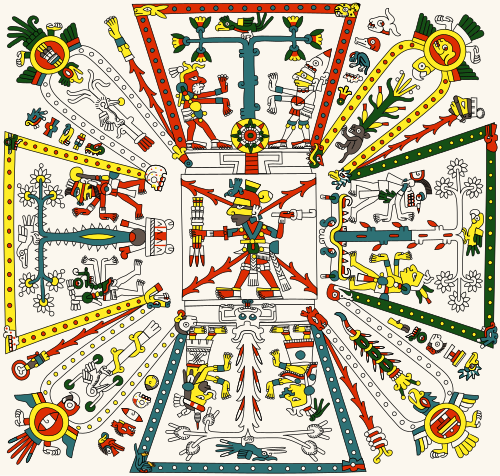
アステカ神話は、植民地時代に書かれた多くの文献から知られています。太陽伝説と呼ばれる一連の神話には、4 つの太陽、つまり時代が連続して創造されたことが記されています。それぞれの時代は、異なる神によって支配され、異なる存在のグループが住んでいます。各時代は、次の時代が始まるための舞台を整える大惨事で終わります。この過程で、テスカトリポカとケツァルコアトルの神々が敵対者として登場し、お互いの創造物を破壊します。現在の 5 番目の太陽は、マイナーな神が焚き火で自らを犠牲にして太陽に変わったときに創造されましたが、他の神々が自らを犠牲にして太陽に生命力を捧げて初めて、太陽は動き始めます。[97]
地球創造に関する別の神話では、テスカトリポカとケツァルコアトルが同盟者として登場し、巨大なワニのシパクトリを倒してシパクトリに地球になることを要求し、その見返りに血を捧げることを条件に、人間がシパクトリの肉を彫って種を植えることを許可した。人類創造の物語では、ケツァルコアトルは双子のショロトルとともに冥界に旅し、骨を持ち帰り、女神シワコアトルによってメタテの上でトウモロコシのように挽かれ、その結果できた生地に人間の形が与えられ、ケツァルコアトルが血を吹き込むと命が吹き込まれる。[98]
ウィツィロポチトリはメシカ族と結びついた神であり、部族の起源と移住の物語に登場する。旅の途中、ウィツィロポチトリはメシカの司祭が運ぶ神々の束の形をとって、部族が定住するたびに隣人との衝突を促し、部族を絶えず刺激する。別の神話では、ウィツィロポチトリはコアテペトルの丘で妹の月の神 コヨルシャウキとその400人の兄弟を倒してバラバラにする。コアテペトルとも呼ばれる大神殿の南側は、この神話を表現したもので、階段のふもとにはバラバラになった女神の表現が彫られた大きな石の一枚岩が横たわっていた。 [99]
カレンダー

アステカの宗教生活は暦に基づいて構成されていました。ほとんどのメソアメリカの人々と同様に、アステカ人は同時に 2 つの暦を使用していました。260 日の儀式暦である tonalpohualliと、365 日の太陽暦であるxiuhpohualliです。両方の暦で各日に名前と番号があり、2 つの日付の組み合わせは 52 年間で一意でした。tonalpohualli は主に占いの目的で使用され、20 日の記号と 1 ~ 13 の数値係数で構成され、固定された順序で循環します。xiuhpohualli は20日の 18 の「月」で構成され、サイクルの最後には新しいxiuhpohualliサイクルが始まる前に 5 日の「空白」日が残ります。20 日の各月は、その月の始まりとなる特定の儀式の祭りにちなんで名付けられ、その多くは農業サイクルに関連していました。アステカ暦が閏年に合わせて修正されたかどうか、またどのように修正されたかは専門家の間でも議論されている。毎月の儀式は各家庭、カルポリ寺院、主要な聖域で行われ、全人口が参加した。多くの祭りでは、さまざまな形式のダンス、神の化身による神話物語の再現、食べ物、動物、人間の犠牲の形での犠牲の捧げ物が行われた。[100]
52年ごとに、2つの暦は共通の開始点に達し、新しい暦のサイクルが始まりました。この暦の出来事は、Xiuhmolpilliまたは新しい火の儀式として知られる儀式で祝われました。この儀式では、すべての家の古い陶器が壊され、アステカ王国のすべての火が消されました。次に、新しい火が犠牲者の胸にドリルでくべられ、ランナーが新しい火をさまざまなcalpolliコミュニティに運び、そこで火が各家に再分配されました。火のない夜は、星の悪魔、 tzitzimimehが降りてきて地球を食い尽くし、太陽の第5周期が終わるのではないかという恐怖と関連していました。[101]
人身供犠と人食い
.jpg/500px-Codex_Magliabechiano_(141_cropped).jpg)
アステカ人にとって、死は創造の永続に重要な役割を果たし、神も人間も生命が続くように自らを犠牲にする責任があった。上記の創造神話で説明されているように、人間は太陽の継続的な復活と、地球の継続的な豊穣に対する支払いの責任があると理解されていた。様々な形で血の供犠が行われた。なだめるべき神と執り行われる儀式に応じて、人間と動物の両方が犠牲にされ、一部の神の司祭は自傷行為によって血を提供することが求められることもあった。一部の儀式には人食い行為が含まれており、捕虜とその家族が犠牲にした捕虜の肉の一部を食べることが知られているが、この習慣がどれほど広まっていたかは不明である。[102] [103]
メソアメリカ全土で人身御供が実践されていたが、アステカ人は彼らの記録によれば、この習慣を前例のないレベルにまで高めた。例えば、 1487年のテノチティトランの大ピラミッドの再奉献では、4日間で80,400人の囚人が犠牲にされたとアステカとスペインの資料は後に述べている。伝えられるところによると、この数字は大言壮語者アウィツォトル自身によって行われたという。しかし、多くの学者はこの数字を極端に誇張していると考えている。他の推定では、人身御供の数は年間1,000人から20,000人の間である。[104] [105]
アステカにおける人身御供の規模の大きさは、多くの学者に、アステカの宗教のこの側面の原動力は何であったのかを考えるきっかけを与えた。1970年代、マイケル・ハーナーとマーヴィン・ハリスは、アステカ人による人身御供の動機は、例えばマリアベキアーノ写本に描かれている、生贄の犠牲者の人食いであったと主張した。ハーナーは、非常に高い人口圧力と、家畜化された草食動物なしでのトウモロコシ栽培の重視が、アステカ人の必須アミノ酸欠乏症を招いたと主張した。[106]アステカ人が生贄を捧げていたことは普遍的な合意があるが、人食いが広まっていたかどうかについては学者のコンセンサスがない。『人食い人と王』 (1977年)の著者であるハリスは、もともとハーナーが提唱した、アステカ人の食事にはタンパク質が不足していたため、犠牲者の肉は報酬として貴族の食事の一部であったという主張を広めている。これらの主張は、アステカ人の健康、食事、医学に関する研究で、アステカ人の食事は動物性タンパク質が少ない一方で、植物性タンパク質が豊富だったことを実証したベルナール・オルティス・モンテリャーノによって反駁されている。オルティスはまた、収穫後の食糧が豊富な時期には食糧不足の時期よりも人身御供が優勢であったこと、犠牲から得られる人体タンパク質の量はわずかであったこと、貴族がすでに動物性タンパク質を容易に入手できたという事実を指摘している。[107] [104]今日、多くの学者は、征服された国の戦士を犠牲にするという公開の見せ物が、支配階級が神の権威を主張するのを裏付ける政治的権力の大きな誇示であったことを指摘し、この慣習のイデオロギー的説明を指摘している。[108]また、それはアステカ国家に対する被征服国家の反乱に対する重要な抑止力として機能し、そのような抑止力は緩やかに組織された帝国の団結にとって不可欠であった。[109]
芸術と文化の制作
アステカ人は、中央メキシコでアステカ人より古くから存在していたトルテカ人のトルテカヨートル(芸術と優れた職人技)を高く評価していた。アステカ人はトルテカ人の作品が文化の最高の状態を表すと考えていた。芸術には、文章や絵画、歌や詩の作曲、彫刻やモザイクの制作、高級陶磁器の制作、複雑な羽根細工の制作、銅や金などの金属の加工などが含まれていた。芸術の職人は総称してトルテカ(トルテカ)と呼ばれていた。[110]
-
 都市標準の詳細。メキシコ - テノチティトランの壁の残骸の石レンガ、テンプロ マヨール博物館(メキシコシティ)
 -

-

-

-

-
 トラロックの彫像容器、1440-1469年、彩色陶器、高さ35cm(14インチ)、テンプロ・マヨール博物館(メキシコシティ)
 -
 ひざまずく女性像、15 世紀から 16 世紀初頭、彩色石、全体: 54.61 cm × 26.67 cm (21.50 インチ × 10.50 インチ)、メトロポリタン美術館(ニューヨーク市)
 -
 カエル形のネックレス飾り。15 世紀~ 16 世紀初頭。金製。高さ 2.1 cm (0.83 インチ)。メトロポリタン美術館 (ニューヨーク市)
.jpg/500px-Vestigios_de_Tenochtitlan_by_CDMX_Gov_IMG_5002_(29972506550).jpg)
.jpg/500px-Xiuhtecuhtli_(mask).jpg)
.jpg/500px-Codex_Borbonicus_(p._14).jpg)
.jpg/500px-Aztec_Calendar_Stone_(8263450477).jpg)

文字と図像

アステカ人はマヤ人のように完全に発達した文字体系を持っていなかったが、マヤ人やサポテク人のように、表意文字と音節文字を組み合わせた文字体系を使用していた。表意文字は、例えば山のイメージを使って「山」を意味するtepetlという単語を表すのに対し、音節文字は歯のイメージを使って歯とは関係のない単語の音節tla を表す。これらの原理を組み合わせることで、アステカ人は人名や地名の音を表すことができた。物語は、足跡で道を示す、寺院が燃えるなど、さまざまな図像的慣習を使って、一連のイメージで表現される傾向があった。[111]
Epigrapher Alfonso Lacadena has demonstrated that the different syllable signs used by the Aztecs almost enabled the representation of all the most frequent syllables of the Nahuatl language (with some notable exceptions),[112] but some scholars have argued that such a high degree of phonetics was only achieved after the conquest when the Aztecs had been introduced to the principles of phonetic writing by the Spanish.[113] Other scholars, notably Gordon Whittaker, have argued that the syllabic and phonetic aspects of Aztec writing were considerably less systematic and more creative than Lacadena's proposal suggests, arguing that Aztec writing never coalesced into a strictly syllabic system such as the Maya writing, but rather used a wide range of different types of phonetic signs.[114]
The image to the right demonstrates the use of phonetic signs for writing place names in the colonial Aztec Codex Mendoza. The uppermost place is "Mapachtepec", meaning literally "Hill of the Raccoon", but the glyph includes the phonetic prefixes ma (hand) and pach (moss) over a mountain tepetl spelling the word "mapach" ("raccoon") phonetically instead of logographically. The other two place names, Mazatlan ("Place of Many Deer") and Huitztlan ("Place of many thorns") use the phonetic element tlan represented by a tooth (tlantli) combined with a deer head to spell maza (mazatl = deer) and a thorn (huitztli) to spell huitz.[115]
Music, song and poetry
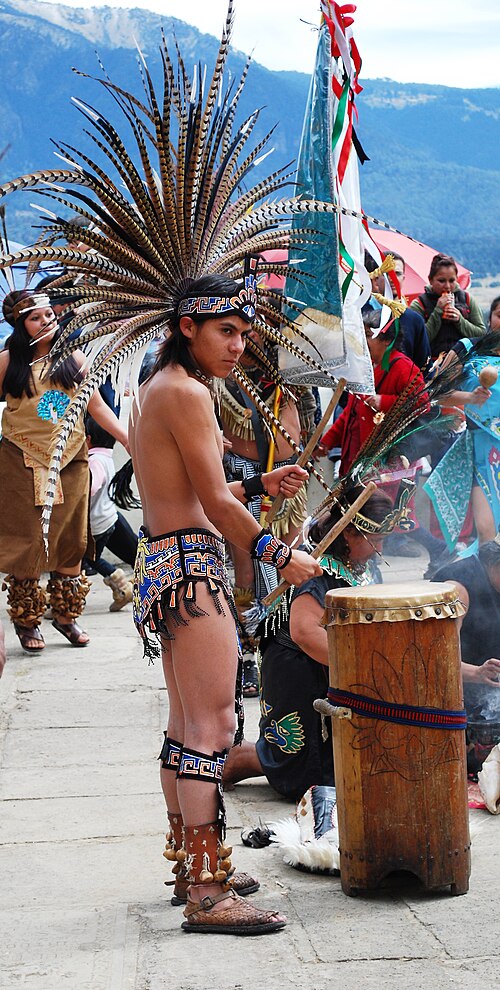
Song and poetry were highly regarded; there were presentations and poetry contests at most of the Aztec festivals. There were also dramatic presentations that included players, musicians, and acrobats. There were several different genres of cuicatl (song): Yaocuicatl was devoted to war and the god(s) of war, Teocuicatl to the gods and creation myths and adoration of said figures, xochicuicatl to flowers (a symbol of poetry itself and indicative of the highly metaphorical nature of poetry that often used duality to convey multiple layers of meaning). "Prose" was tlahtolli, also with its different categories and divisions.[116][117]
A key aspect of Aztec poetics was the use of parallelism, using a structure of embedded couplets to express different perspectives on the same element.[118] Some such couplets were diphrasisms, conventional metaphors whereby an abstract concept was expressed metaphorically by using two more concrete concepts. For example, the Nahuatl expression for "poetry" was in xochitl in cuicatl a dual term meaning "the flower, the song".[119]
A remarkable amount of this poetry survives, having been collected during the era of the conquest. In some cases poetry is attributed to individual authors, such as Nezahualcoyotl, tlatoani of Texcoco, and Cuacuauhtzin, Lord of Tepechpan, but whether these attributions reflect actual authorship is a matter of opinion. An important collection of such poems is Romances de los señores de la Nueva España, collected (Tezcoco 1582), probably by Juan Bautista de Pomar,[nb 8] and the Cantares Mexicanos.[120] Both men and women were poets in Aztec society, illustrating pre-Hispanic Mexico's gender parallelism in upper-class society.[121] One famous female poet is Macuilxochitzin, whose work primarily focused on the Aztec conquest.[122]
Ceramics
The Aztecs produced ceramics of different types. Common are orange wares, which are orange or buff burnished ceramics with no slip. Red wares are ceramics with a reddish slip. Polychrome ware is ceramics with a white or orange slip, with painted designs in orange, red, brown, and/or black. Very common is "black on orange" ware which is orange ware decorated with painted designs in black.[123][124][125]
Aztec black-on-orange ceramics are chronologically classified into four phases: Aztec I and II corresponding to c. 1100–1350 (early Aztec period), Aztec III (c. 1350–1520), and the last phase Aztec IV was the early colonial period. Aztec I is characterized by floral designs and day-name glyphs; Aztec II is characterized by a stylized grass design above calligraphic designs such as S-curves or loops; Aztec III is characterized by very simple line designs; Aztec IV continues some pre-Columbian designs but adds European influenced floral designs. There were local variations on each of these styles, and archeologists continue to refine the ceramic sequence.[124]
Typical vessels for everyday use were clay griddles for cooking (comalli), bowls and plates for eating (caxitl), pots for cooking (comitl), molcajetes or mortar-type vessels with slashed bases for grinding chilli (molcaxitl), and different kinds of braziers, tripod dishes, and biconical goblets. Vessels were fired in simple updraft kilns or even in open firing in pit kilns at low temperatures.[124] Polychrome ceramics were imported from the Cholula region (also known as Mixteca-Puebla style), and these wares were highly prized as a luxury ware, whereas the local black on orange styles were also for everyday use.[126]
Painted art

Aztec painted art was produced on animal skin (mostly deer), on cotton lienzos, and amate paper made from bark (e.g., from Trema micrantha or Ficus aurea), it was also produced on ceramics and carved in wood and stone. The surface of the material was often first treated with gesso to make the images stand out more clearly. The art of painting and writing was known in Nahuatl by the metaphor in tlilli, in tlapalli – meaning "the black ink, the red pigment".[127][128]
There are few extant Aztec-painted books. Of these, none are conclusively confirmed to have been created before the conquest, but several codices must have been painted either right before the conquest or very soon after – before traditions for producing them were much disturbed. Even if some codices may have been produced after the conquest, there is good reason to think that they may have been copied from pre-Columbian originals by scribes. The Codex Borbonicus is considered by some to be the only extant Aztec codex produced before the conquest – it is a calendric codex describing the day and month counts indicating the patron deities of the different periods.[27] Others consider it to have stylistic traits suggesting a post-conquest production.[129]
Some codices were produced post-conquest, sometimes commissioned by the colonial government, for example, Codex Mendoza, were painted by Aztec tlacuilos (codex creators), but under the control of Spanish authorities, who also sometimes commissioned codices describing pre-colonial religious practices, for example, Codex Ríos. After the conquest, codices with calendric or religious information were sought out and systematically destroyed by the church – whereas other types of painted books, particularly historical narratives, and tax lists continued to be produced.[27] Although depicting Aztec deities and describing religious practices also shared by the Aztecs of the Valley of Mexico, the codices produced in Southern Puebla near Cholula, are sometimes not considered to be Aztec codices, because they were produced outside of the Aztec "heartland".[27] Karl Anton Nowotny, nevertheless considered that the Codex Borgia, painted in the area around Cholula and using a Mixtec style, was the "most significant work of art among the extant manuscripts".[130]
The first Aztec murals were from Teotihuacan.[131] Most of our current Aztec murals were found in Templo Mayor.[131] The Aztec capital was decorated with elaborate murals. In Aztec murals, humans are represented like they are represented in the codices. One mural discovered in Tlateloco depicts an old man and an old woman. This may represent the gods Cipactonal and Oxomico.
Sculpture
.jpg/500px-Coatlicue_Statue_in_National_Museum_of_Anthropology,_Mexico_City_(2748833231).jpg)
Sculptures were carved in stone and wood, but few wood carvings have survived.[132] Aztec stone sculptures exist in many sizes from small figurines and masks to large monuments, and are characterized by a high quality of craftsmanship.[133] Many sculptures were carved in highly realistic styles, for example realistic sculpture of animals such as rattlesnakes, dogs, jaguars, frogs, turtles, and monkeys.[134]
In Aztec artwork some monumental stone sculptures have been preserved, such sculptures usually functioned as adornments for religious architecture. Particularly famous monumental rock sculpture includes the so-called Aztec "Sunstone" or Calendarstone discovered in 1790; also discovered in 1790 excavations of the Zócalo was the 2.7-meter-tall (8.9 ft) Coatlicue statue made of andesite, representing a serpentine chthonic goddess with a skirt made of rattlesnakes. The Coyolxauhqui Stone representing the dismembered goddess Coyolxauhqui, found in 1978, was at the foot of the staircase leading up to the Great Temple in Tenochtitlan.[135] Two important types of sculpture are unique to the Aztecs, and related to the context of ritual sacrifice: the cuauhxicalli or "eagle vessel", large stone bowls often shaped like eagles or jaguars used as a receptacle for extracted human hearts; the temalacatl, a monumental carved stone disk to which war captives were tied and sacrificed in a form of gladiatorial combat. The most well-known examples of this type of sculpture are the Stone of Tizoc and the Stone of Motecuzoma I, both carved with images of warfare and conquest by specific Aztec rulers. Many smaller stone sculptures depicting deities also exist. The style used in religious sculpture was rigid stances likely meant to create a powerful experience for the onlooker.[134] Although Aztec stone sculptures are now displayed in museums as unadorned rock, they were originally painted in vivid polychrome color, sometimes covered first with a base coat of plaster.[136] Early Spanish conquistador accounts also describe stone sculptures as having been decorated with precious stones and metal, inserted into the plaster.[134]
Featherwork

An especially prized art form among the Aztecs was featherwork – the creation of intricate and colorful mosaics of feathers, and their use in garments as well as decoration on weaponry, war banners, and warrior suits. The class of highly skilled and honored craftsmen who created feather objects was called the amanteca,[137] named after the Amantla neighborhood in Tenochtitlan where they lived and worked.[138] They did not pay taxes nor were required to perform public service. The Florentine Codex gives information about how feather works were created. The amanteca had two ways of creating their works. One was to secure the feathers in place using agave cords for three-dimensional objects such as fly whisks, fans, bracelets, headgear, and other objects. The second and more difficult was a mosaic-type technique, which the Spanish also called "feather painting". These were done principally on feather shields and cloaks for idols. Feather mosaics were arrangements of minute fragments of feathers from a wide variety of birds, generally worked on a paper base, made from cotton and paste, then itself backed with amate paper, but bases of other types of paper and directly on amate were done as well. These works were done in layers with "common" feathers, dyed feathers, and precious feathers. First, a model was made with lower-quality feathers and the precious feathers were found only on the top layer. The adhesive for the feathers in the Mesoamerican period was made from orchid bulbs. Feathers from local and faraway sources were used, especially in the Aztec Empire. The feathers were obtained from wild birds as well as from domesticated turkeys and ducks, with the finest quetzal feathers coming from Chiapas, Guatemala, and Honduras. These feathers were obtained through trade and taxes. Due to the difficulty of conserving feathers, fewer than ten pieces of original Aztec featherwork exist today.[139]
Colonial period, 1521–1821
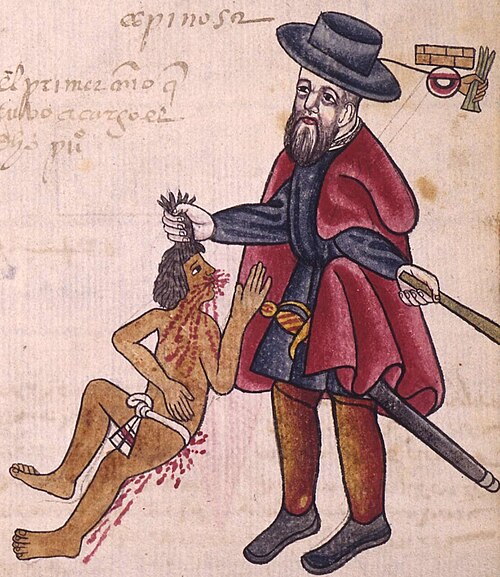
Mexico City was built on the ruins of Tenochtitlan, gradually replacing and covering the lake, the island and the architecture of Aztec Tenochtitlan.[140][141][142] After the fall of Tenochtitlan, Aztec warriors were enlisted as auxiliary troops alongside the Spanish Tlaxcalteca allies, and Aztec forces participated in all of the subsequent campaigns of conquest in northern and southern Mesoamerica. This meant that aspects of Aztec culture and the Nahuatl language continued to expand during the early colonial period as Aztec auxiliary forces made permanent settlements in many of the areas that were put under the Spanish crown.[143]
The Aztec ruling dynasty continued to govern the indigenous polity of San Juan Tenochtitlan, a division of the Spanish capital of Mexico City, but the subsequent indigenous rulers were mostly puppets installed by the Spanish. One was Andrés de Tapia Motelchiuh, who was appointed by the Spanish. Other former Aztec city states likewise were established as colonial indigenous towns, governed by a local indigenous gobernador. This office was often initially held by the hereditary indigenous ruling line, with the gobernador being the tlatoani, but the two positions in many Nahua towns became separated over time. Indigenous governors were in charge of the colonial political organization of the Indians. In particular, they enabled the continued functioning of the tax and enslavement of indigenous commoners to benefit the Spanish encomenderos. Encomenderos owned encomiendas, large tracts of agricultural land on which the encomenderos and their slaves lived. The Spanish coerced the tribes into granting them private ownership of indigenous people and land for enslavement and encomiendas. Occasionally, an Indigenous individual benefited from this system and grew into substantial wealth and power come the colonial period. [144]
Population decline

After the arrival of the Europeans in Mexico and the conquest, indigenous populations declined significantly. This was largely the result of the epidemics of viruses brought to the continent against which the natives had no immunity. In 1520–1521, an outbreak of smallpox swept through the population of Tenochtitlan and was decisive in the fall of the city; further significant epidemics struck in 1545 and 1576.[145]
There has been no consensus about the population size of Mexico at the time of European arrival. Early estimates gave very small population figures for the Valley of Mexico, in 1942 Kubler estimated a figure of 200,000.[146] In 1963 Borah and Cook used preconquest tax lists to calculate the number of residents in central Mexico, estimating over 18–30 million. Their very high figure has been highly criticized for relying on unwarranted assumptions.[147] Archeologist William Sanders based an estimate on archeological evidence of dwellings, arriving at an estimate of 1–1.2 million inhabitants in the Valley of Mexico.[148] Whitmore used a computer simulation model based on colonial censuses to arrive at an estimate of 1.5 million for the Basin in 1519, and an estimate of 16 million for all of Mexico.[149] Depending on the estimations of the population in 1519 the scale of the decline in the 16th century, range from around 50 percent to around 90 percent – with Sanders's and Whitmore's estimates being around 90 percent.[147][150]
Social and political continuity and change

Although the Aztec empire fell, some of its highest elites continued to hold elite status in the colonial era. The principal heirs of Moctezuma II and their descendants retained high status. His son Pedro Moctezuma produced a son, who married into the Spanish aristocracy and a further generation saw the creation of the title Duke of Moctezuma de Tultengo. From 1696 to 1701, the Viceroy of Mexico held the title of Count of Moctezuma. In 1766, the holder of the title became a Grandee of Spain. In 1865, (during the Second Mexican Empire) the title, which was held by Antonio María Moctezuma-Marcilla de Teruel y Navarro, 14th Count of Moctezuma de Tultengo, was elevated to that of a Duke, thus becoming Duke of Moctezuma, with de Tultengo again added in 1992 by Juan Carlos I.[151] Two of Moctezuma's daughters, Doña Isabel Moctezuma and her younger sister, Doña Leonor Moctezuma, were granted extensive encomiendas in perpetuity by Hernán Cortes. Doña Leonor Moctezuma married in succession two Spaniards, and left her encomiendas to her daughter by her second husband.[152]
The different Nahua peoples, just like other Mesoamerican indigenous peoples in colonial New Spain, were able to maintain many aspects of their social and political structure under colonial rule. The basic division the Spanish made was between the Indigenous populations, organized under the República de indios, which was separate from the Hispanic sphere, the República de españoles. The República de españoles included not just Europeans, but also Africans and mixed-race castas. The Spanish recognized the indigenous elites as nobles in the Spanish colonial system, maintaining the status distinction of the preconquest era, and used these noblemen as intermediaries between the Spanish colonial government and their communities. This was contingent on their conversion to Christianity and continuing loyalty to the Spanish crown. Colonial Nahua polities had considerable autonomy to regulate their local affairs. The Spanish rulers did not entirely understand the indigenous political organization, but they recognized the importance of the existing system and their elite rulers. They reshaped the political system utilizing altepetl or city-states as the basic unit of governance. In the colonial era, altepetl was renamed cabeceras or "head towns" (although they often retained the term altepetl in local-level, Nahuatl-language documentation), with outlying settlements governed by the cabeceras named sujetos, subject communities. In cabeceras, the Spanish created Iberian-style town councils, or cabildos, which usually continued to function as the elite ruling group had in the Preconquest era.[153][154] Population decline due to epidemic disease resulted in many population shifts in settlement patterns and the formation of new population centers. These were often forced resettlements under the Spanish policy of congregación. Indigenous populations living in sparsely populated areas were resettled to form new communities, making it easier for them to be brought within range of evangelization efforts, and easier for the colonial state to exploit their labor.[155][156]
Legacy
Today the legacy of the Aztecs lives on in Mexico in many forms. Archeological sites are excavated and opened to the public and their artifacts are prominently displayed in museums. Place names and loanwords from the Aztec language Nahuatl permeate the Mexican landscape and vocabulary, and Aztec symbols and mythology have been promoted by the Mexican government and integrated into contemporary Mexican nationalism as emblems of the country.[157]
During the 19th century, the image of the Aztecs as uncivilized barbarians was replaced with romanticized visions of the Aztecs as original sons of the soil, with a highly developed culture rivaling the ancient European civilizations. When Mexico became independent from Spain, a romanticized version of the Aztecs became a source of images that could be used to ground the new nation as a unique blend of European and American.[158]
The Aztecs and Mexico's national identity
Aztec culture and history have been central to the formation of a Mexican national identity after Mexican independence in 1821. In 17th and 18th century Europe, the Aztecs were generally described as barbaric, gruesome, and culturally inferior.[160] Even before Mexico achieved its independence, American-born Spaniards (criollos) drew on Aztec history to ground their search for symbols of local pride, separate from that of Spain. Intellectuals used Aztec writings, such as those collected by Fernando de Alva Ixtlilxochitl, and writings of Hernando Alvarado Tezozomoc, and Chimalpahin to understand Mexico's indigenous past in texts by indigenous writers. This search became the basis for what historian D.A. Brading calls "creole patriotism". Seventeenth-century cleric and scientist, Carlos de Sigüenza y Góngora acquired the manuscript collection of Texcocan nobleman Alva Ixtlilxochitl. Creole Jesuit Francisco Javier Clavijero published La Historia Antigua de México (1780–1781) in his Italian exile following the expulsion of the Jesuits in 1767, in which he traces the history of the Aztecs from their migration to the last Aztec ruler, Cuauhtemoc. He wrote it expressly to defend Mexico's indigenous past against the slanders of contemporary writers, such as Pauw, Buffon, Raynal, and William Robertson.[161] Archeological excavations in 1790 in the capital's main square uncovered two massive stone sculptures, buried immediately after the fall of Tenochtitlan in the conquest. Unearthed were the famous calendar stone, as well as a statue of Coatlicue. Antonio de León y Gama's 1792 Descripción histórico y cronológico de las dos piedras examines the two stone monoliths. A decade later, German scientist Alexander von Humboldt spent a year in Mexico, during his four-year expedition to Spanish America. One of his early publications from that period was Views of the Cordilleras and Monuments of the Indigenous Peoples of the Americas.[162] Humboldt was important in disseminating images of the Aztecs to scientists and general readers in the Western world.[163]

In the realm of religion, late colonial paintings of the Virgin of Guadalupe have examples of her depicted floating above the iconic nopal cactus of the Aztecs. Juan Diego, the Nahua to whom the apparition was said to appear, links the dark Virgin to Mexico's Aztec past.[165]
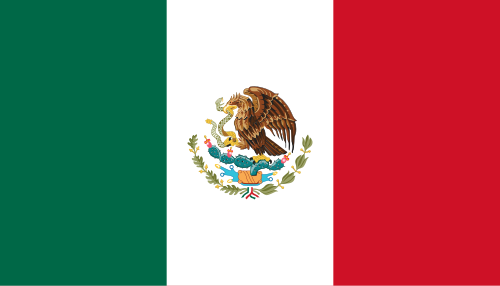
When New Spain achieved independence in 1821 and became a monarchy, the First Mexican Empire, its flag had the traditional Aztec eagle on a nopal cactus. The eagle had a crown, symbolizing the new Mexican monarchy. When Mexico became a republic after the overthrow of the first monarch Agustín de Iturbide in 1822, the flag was revised to show the eagle with no crown. In the 1860s, when the French established the Second Mexican Empire under Maximilian of Habsburg, the Mexican flag retained the emblematic eagle and cactus, with elaborate symbols of monarchy. After the defeat of the French and their Mexican collaborators, the Mexican Republic was re-established, and the flag returned to its republican simplicity.[166] This emblem has also been adopted as Mexico's national coat of arms, and is emblazoned on official buildings, seals, and signs.[164]
Tensions within post-independence Mexico pitted those rejecting the ancient civilizations of Mexico as a source of national pride, the Hispanistas, mostly politically conservative Mexican elites, and those who saw them as a source of pride, the Indigenistas, who were mostly liberal Mexican elites. Although the flag of the Mexican Republic had the symbol of the Aztecs as its central element, conservative elites were generally hostile to the current indigenous populations of Mexico or crediting them with a glorious pre-Hispanic history. Under Mexican President Antonio López de Santa Anna, pro-indigenist Mexican intellectuals did not find a wide audience. With Santa Anna's overthrow in 1854, Mexican liberals and scholars interested in the indigenous past became more active. Liberals were more favorably inclined toward the Indigenous populations and their history, but considered a pressing matter being the "Indian Problem". Liberals' commitment to equality before the law meant that for upwardly mobile Indigenous, such as Zapotec Benito Juárez, who rose in the ranks of the liberals to become Mexico's first president of Indigenous origins, and Nahua intellectual and politician Ignacio Altamirano, a disciple of Ignacio Ramírez, a defender of the rights of the indigenous, liberalism presented a way forward in that era. For investigations of Mexico's indigenous past, however, the role of moderate liberal José Fernando Ramírez is important, serving as director of the National Museum and doing research utilizing codices, while staying out of the fierce conflicts between liberals and conservatives that led to a decade of civil war. Mexican scholars who pursued research on the Aztecs in the late 19th century were Francisco Pimentel, Antonio García Cubas, Manuel Orozco y Berra, Joaquín García Icazbalceta, and Francisco del Paso y Troncoso contributing significantly to the 19th-century development of Mexican scholarship on the Aztecs.[167]

The late 19th century in Mexico was a period in which Aztec civilization became a point of national pride. The era was dominated by liberal military hero, Porfirio Díaz, a mestizo from Oaxaca who was president of Mexico from 1876 to 1911. His policies opening Mexico to foreign investors and modernizing the country under a firm hand controlling unrest, "Order and Progress", undermined Mexico's indigenous populations and their communities. However, for investigations of Mexico's ancient civilizations, his was a benevolent regime, with funds supporting archeological research and for protecting monuments.[168] "Scholars found it more profitable to confine their attention to Indians who had been dead for a number of centuries."[169] His benevolence saw the placement of a monument to Cuauhtemoc in a major traffic roundabout (glorieta) of the wide Paseo de la Reforma, which he inaugurated in 1887. In world fairs of the late 19th century, Mexico's pavilions included a major focus on its indigenous past, especially the Aztecs. Mexican scholars such as Alfredo Chavero helped shape the cultural image of Mexico at these exhibitions.[170]
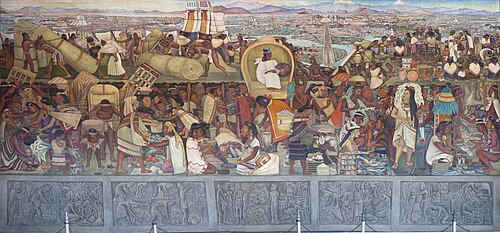
The Mexican Revolution (1910–1920) and the significant participation of Indigenous people in the struggle in many regions, ignited a broad government-sponsored political and cultural movement of indigenismo, with symbols of Mexico's Aztec past becoming ubiquitous, most especially in Mexican muralism of Diego Rivera.[171][172]
In their works, Mexican authors such as Octavio Paz and Agustin Fuentes have analyzed the use of Aztec symbols by the modern Mexican state, critiquing the way it adopts and adapts indigenous culture to political ends, yet they have also in their works made use of the symbolic idiom themselves. Paz for example critiqued the architectural layout of the National Museum of Anthropology, which constructs a view of Mexican history as culminating with the Aztecs, as an expression of a nationalist appropriation of Aztec culture.[173]
Aztec history and international scholarship

Scholars in Europe and the United States increasingly wanted investigations into Mexico's ancient civilizations, starting in the nineteenth century. Humboldt had been extremely important in bringing ancient Mexico into broader scholarly discussions of ancient civilizations. French Americanist Charles Étienne Brasseur de Bourbourg (1814–1874) asserted that "science in our own time has at last effectively studied and rehabilitated America and the Americans from the [previous] viewpoint of history and archeology. It was Humboldt [...] who woke us from our sleep."[174] Frenchman Jean-Frédéric Waldeck published Voyage pittoresque et archéologique dans la province d'Yucatan pendant les années 1834 et 1836 in 1838. Although not directly connected with the Aztecs, it contributed to the increased interest in ancient Mexican studies in Europe. English aristocrat Lord Kingsborough spent considerable energy in their pursuit of understanding ancient Mexico. Kingsborough answered Humboldt's call for the publication of all known Mexican codices, publishing nine volumes of Antiquities of Mexico (1831–1846) that were richly illustrated, bankrupting him. He was not directly interested in the Aztecs, but rather in proving that Mexico had been colonized by Jews.[citation needed] However, his publication of these valuable primary sources gave others access to them.[citation needed]
In the United States in the early 19th century, interest in ancient Mexico propelled John Lloyd Stephens to travel to Mexico and then publish well-illustrated accounts in the early 1840s. The research of a half-blind Bostonian, William Hickling Prescott, into the Spanish conquest of Mexico, resulted in his highly popular and deeply researched The Conquest of Mexico (1843). Although not formally trained as a historian, Prescott drew on the obvious Spanish sources, but also Ixtlilxochitl and Sahagún's history of the conquest. His resulting work was a mixture of pro- and anti-Aztec attitudes. It was not only a bestseller in English, but it also influenced Mexican intellectuals, including the leading conservative politician, Lucas Alamán. Alamán pushed back against his characterization of the Aztecs. In the assessment of Benjamin Keen, Prescott's history "has survived attacks from every quarter, and still dominates the conceptions of the laymen, if not the specialist, concerning Aztec civilization".[175] In the later 19th century, businessman and historian Hubert Howe Bancroft oversaw a huge project, employing writers and researchers, to write the history the "Native Races" of North America, including Mexico, California, and Central America. One entire work was devoted to ancient Mexico, half of which concerned the Aztecs. It was a work of synthesis drawing on Ixtlilxochitl and Brasseur de Bourbourg, among others. [167]
When the International Congress of Americanists was formed in Nancy, France in 1875, Mexican scholars became active participants, and Mexico City hosted the biennial multidisciplinary meeting six times, starting in 1895. Mexico's ancient civilizations have continued to be the focus of major scholarly investigations by Mexican and international scholars.
Language and placenames

The Nahuatl language is today spoken by 1.5 million people, mostly in mountainous areas in the states of central Mexico. Mexican Spanish today incorporates hundreds of loans from Nahuatl, and many of these words have passed into general Spanish use, and further into other world languages.[176][177][178]
In Mexico, Aztec place names are ubiquitous, particularly in central Mexico where the Aztec empire was centered, but also in other regions where many towns, cities, and regions were established under their Nahuatl names, as Aztec auxiliary troops accompanied the Spanish colonizers on the early expeditions that mapped New Spain. In this way even towns, that were not originally Nahuatl speaking came to be known by their Nahuatl names.[179] In Mexico City there are commemorations of Aztec rulers, including on the Mexico City Metro, line 1, with stations named for Moctezuma II and Cuauhtemoc.
Cuisine
Mexican cuisine continues to be based on staple elements of Mesoamerican cooking and, particularly, of Aztec cuisine: corn, chili, beans, squash, tomato, and avocado. Many of these staple products continue to be known by their Nahuatl names, carrying in this way ties to the Aztec people who introduced these foods to the Spaniards and the world. Through the spread of ancient Mesoamerican food elements, particularly plants, Nahuatl loan words (chocolate, tomato, chili, avocado, tamale, taco, pupusa, chipotle, pozole, atole) have been borrowed through Spanish into other languages around the world.[178] Through the spread and popularity of Mexican cuisine, the culinary legacy of the Aztecs can be said to have a global reach. Today, Aztec images and Nahuatl words are often used to lend an air of authenticity or exoticism in the marketing of Mexican cuisine.[180]
-
 Las Tortilleras, an 1836 lithograph after a painting by Carl Nebel of women grinding corn and making tortillas.
 -
 Chapulines, grasshoppers toasted and dusted with chilis, continue to be a popular delicacy.
Ethnic identity
Aztec and Maya were newly listed examples given for American Indian groups in the 2020 United States census, and "Aztec" became the largest American Indian group that respondents identified as having a full background.[181][182]
In popular culture
The idea of the Aztecs has captivated the imaginations of Europeans since the first encounters and has provided many iconic symbols to Western popular culture.[183] In his book The Aztec Image in Western Thought, Benjamin Keen argued that Western thinkers have usually viewed Aztec culture through a filter of their cultural interests.[184]
The Aztecs and figures from Aztec mythology feature in Western culture.[185] The name of Quetzalcoatl, a feathered serpent god, has been used for a genus of pterosaurs, Quetzalcoatlus, a large flying reptile with a wingspan of as much as 11 meters (36 ft).[186] Quetzalcoatl has appeared as a character in many books, films and video games. D.H. Lawrence gave the name Quetzalcoatl to an early draft of his novel The Plumed Serpent, but his publisher, Alfred A. Knopf, insisted on a change of title.[187] American author Gary Jennings wrote two acclaimed historical novels set in Aztec-period Mexico, Aztec (1980) and Aztec Autumn (1997).[188] The novels were so popular that four more novels in the Aztec series were written after his death.[189]
Aztec society has also been depicted in cinema. The Mexican feature film The Other Conquest (Spanish: La Otra Conquista) from 2000 was directed by Salvador Carrasco and illustrated the colonial aftermath of the 1520s Spanish Conquest of Mexico. It adopted the perspective of an Aztec scribe, Topiltzin, who survived the attack on the temple of Tenochtitlan.[190] The 1989 film Retorno a Aztlán by Juan Mora Catlett is a work of historical fiction set during the rule of Motecuzoma I, filmed in Nahuatl and with the alternative Nahuatl title Necuepaliztli in Aztlan.[191][192] In Mexican exploitation B movies of the 1970s, a recurring figure was the "Aztec mummy" as well as Aztec ghosts and sorcerers.[193]
See also


.jpg/500px-Lascar_Avenue_of_the_Dead_and_the_Pyramid_of_the_Sun_in_the_background_(4566574277).jpg)
Notes
- ^ The term was not used as an endonym, see #Definitions
- ^ Smith 1997, p. 4 writes "For many the term 'Aztec' refers strictly to the inhabitants of Tenochtitlan (the Mexica people), or perhaps the inhabitants of the Valley of Mexico, the highland basin where the Mexica and certain other Aztec groups lived. I believe it makes more sense to expand the definition of "Aztec" to include the peoples of nearby highland valleys in addition to the inhabitants of the Valley of Mexico. In the final few centuries before the arrival of the Spaniards in 1519, the peoples of this wider area all spoke the Nahuatl language (the language of the Aztecs), and they all traced their origins to a mythical place called Aztlan (Aztlan is the etymon of "Aztec," a modern label that was not used by the Aztecs themselves)"
- ^ Lockhart 1992, p. 1 writes "These people I call the Nahuas, a name they sometimes used themselves and the one that has become current today in Mexico, in preference to Aztecs. The latter term has several decisive disadvantages: it implies a quasi-national unity that did not exist, it directs attention to an ephemeral imperial agglomeration, it is attached specifically to the pre-conquest period, and by the standards of the time, its use for anyone other than the Mexica (the inhabitants of the imperial capital, Tenochtitlan) would have been improper even if it had been the Mexica's primary designation, which it was not"
- ^ The editors of the "Oxford Handbook of the Aztecs", Nichols & Rodríguez-Alegría 2017, p. 3 write: "The use of terminology changed historically during the Late Postclassic, and it has changed among modern scholars. Readers will find some variation in the terms authors employ in this handbook, but, in general, different authors use Aztecs to refer to people incorporated into the empire of the Triple Alliance in the Late Postclassic period. An empire of such broad geographic extent [...] subsumed much cultural, linguistic, and social variation, and the term Aztec Empire should not obscure that. Scholars often use more specific identifiers, such as Mexica or Tenochca, when appropriate, and they generally employ the term Nahuas to refer to indigenous people in central Mexico [...] after the Spanish Conquest, as Lockhart (1992) proposed. All of these terms introduce their own problems, whether because they are vague, subsume too much variation, are imposed labels, or are problematic for some other reason. We have not found a solution that all can agree on and thus accept the varied viewpoints of authors. We use the term Aztec because today it is widely recognized by both scholars and the international public."
- ^ The name of the two Aztec rulers which in this article is written as "Motecuzoma" has several variants, due to alterations to the original Nahuatl word by speakers of English and Spanish, and due to different orthographical choices for writing Nahuatl words. In English the variant "Montezuma" was originally the most common, but has now largely been replaced with "motecuhzoma" and "Moteuczoma", in Spanish the term "Moctezuma" which inverts the order of t and k has been predominant and is a common surname in Mexico, but is now also largely replaced with a form that respects the original Nahuatl structure, such as "Motecuzoma". In Nahuatl the word is /motekʷso:ma/, meaning "he frowns like a lord" (Hajovsky 2015, pp. ix, 147:n#3).
- ^ Gillespie 1989 argues that the name "Motecuzoma" was a later addition added to make for a parallel to the later ruler, and that his original name was only "Ilhuicamina".
- ^ Some sources, including the Relación de Tula and the history of Motolinia, suggest that Atotoztli functioned as ruler of Tenochtitlan succeeding her father. Indeed no conquests are recorded for Motecuzoma in the last years of his reign, suggesting that he may have been incapable of ruling, or even dead (Diel 2005).
- ^ singular form pilli
- ^ This volume was later translated into Spanish by Ángel María Garibay K., teacher of León-Portilla, and it exists in English translation by John Bierhorst
References
- ^ "Why are Aztecs called Mexicas?". mexicanroutes.com. 4 November 2023. Retrieved 4 November 2023.
- ^ e.g.Offner 1983
- ^ Gibson 1964
- ^ López Austin 2001, p. 68
- ^ Smith 1997, pp. 4–7
- ^ Lucia, Kristin De (2018). "Style, Memory, and the Production of History: Aztec Pottery and the Materialization of a Toltec Legacy" (PDF). Current Anthropology. 59 (6): 741–764. doi:10.1086/700916. ISSN 0011-3204. S2CID 150354407.
- ^ Smith 1997, pp. 174–175
- ^ Smith, Michael E. (2014). "The Aztecs Paid Taxes, Not Tribute". Mexicon. 36 (1): 19–22. ISSN 0720-5988. JSTOR 43857654.
- ^ Smith 1997, pp. 176–182
- ^ Cline 2000, pp. 193–197
- ^ a b "Náhuatl: AR-Z". Vocabulario.com.mx. Archived from the original on 17 October 2012. Retrieved 30 August 2012.
- ^ "Aztec". Online Etymology Dictionary. Archived from the original on 7 July 2014.
- ^ Chimalpahin 1997, p. 73.
- ^ a b Barlow 1949.
- ^ a b León-Portilla 2000.
- ^ Barlow 1945.
- ^ a b Carrasco 1999, p. 4.
- ^ Offner 1983
- ^ Smith 1997, p. 4.
- ^ Nichols & Rodríguez-Alegría 2017.
- ^ Gibson 1964, pp. 9–21
- ^ Lockhart 1992, p. 1.
- ^ Smith 1997, p. 2.
- ^ Campbell 1997, p. 134.
- ^ a b Berdan & Anawalt 1997.
- ^ Boone 2000, pp. 242–249.
- ^ a b c d Batalla 2016.
- ^ León-Portilla 2002.
- ^ Sahagún 1577.
- ^ Berdan 2014, pp. 25–28.
- ^ Beekman & Christensen 2003.
- ^ Smith 1997, pp. 41–43.
- ^ Smith 1984.
- ^ Smith 1984, p. 173.
- ^ Smith 1997, pp. 44–45.
- ^ Townsend 2009, pp. 60–62.
- ^ Townsend 2009, p. 63.
- ^ Townsend 2009, pp. 64–74.
- ^ Townsend 2009, pp. 74–75.
- ^ Townsend 2009, pp. 78–81.
- ^ Smith 1997, p. 51.
- ^ Hassig 1988, pp. 158–159.
- ^ Hassig 1988, pp. 161–162.
- ^ a b Townsend 2009, pp. 91–98.
- ^ Smith 1997, pp. 51–53.
- ^ Smith 1997, pp. 52–53.
- ^ Carrasco 1999, pp. 404–407.
- ^ Townsend 2009, p. 99.
- ^ Townsend 2009, pp. 99–100.
- ^ Townsend 2009, pp. 100–101.
- ^ "'Huey Tzompantli': Fearsome tower of human skulls unearthed in Mexico City". The Yucatan Times. 21 July 2017. Archived from the original on 12 January 2023. Retrieved 14 July 2021.
- ^ Townsend 2009, pp. 101–110.
- ^ Townsend 2009, p. 110.
- ^ Townsend 2009, pp. 220–236.
- ^ Smith 2008, p. 154.
- ^ Noguera Auza 1974, p. 56.
- ^ Sanders 1971.
- ^ Smith 2008, pp. 153–154.
- ^ Smith 1997, pp. 152–153.
- ^ Burkhart 1997.
- ^ Hassig 2016.
- ^ Lockhart 1992, pp. 14–47.
- ^ Townsend 2009, pp. 61–62.
- ^ Smith 2008, pp. 90–91.
- ^ a b Berdan & Smith 1996b, pp. 209–216.
- ^ Smith 1996, pp. 141–147.
- ^ Berdan & Smith 1996a, p. 7.
- ^ Smith 2000.
- ^ a b Noguera Auza 1974.
- ^ Townsend 2009, pp. 171–179.
- ^ Brumfiel 1998.
- ^ Townsend 2009, pp. 181–196.
- ^ Townsend 2009, pp. 184, 193.
- ^ Hirth 2016.
- ^ Hirth 2016, pp. 18, 37–38.
- ^ Hirth 2016, Ch. 2.
- ^ Smith 1997, p. 126.
- ^ Smith 2005.
- ^ a b Smith 2008.
- ^ Smith 2008, p. 152.
- ^ Smith 1997, pp. 196–200.
- ^ López Luján 2005.
- ^ Matos Moctezuma 1987.
- ^ Matos Moctezuma 1988.
- ^ Maffie n.d., sec 2a: "Teotl continually generates and regenerates as well as permeates, encompasses, and shapes the cosmos as part of its endless process of self-generation-and–regeneration. That which humans commonly understand as nature – e.g. heavens, earth, rain, humans, trees, rocks, animals, etc. – is generated by teotl, from teotl as one aspect, facet, or moment of its endless process of self-generation-and-regeneration."
- ^ Maffie n.d., sec 2b,2c, citing Hunt 1977 and I. Nicholson 1959; Leon-Portilla 1966, p. 387 cited by Barnett 2007, "M. Leon-Portilla argues that Ometeotl was neither strictly pantheistic nor strictly monistic."
- ^ Maffie n.d., sec 2f: "Literally, 'Two God', also called in Tonan, in Tota, Huehueteotl, 'our Mother, our Father, the Old God'"
- ^ Maffie n.d., sec 2f, citing Leon-Portilla 1963.
- ^ Maffie n.d., sec. 2f, citing Caso 1958; Leon-Portilla 1963, ch. II; H. B. Nicholson 1971, pp. 410–412; and I. Nicholson 1959, pp. 60–63.
- ^ Wade, Lizzie (2018). "Feeding the Gods". Science. 360 (6395). Science.org: 1288–1292. Bibcode:2018Sci...360.1288W. doi:10.1126/science.360.6395.1288. ISSN 0036-8075. PMID 29930121. S2CID 49414905. Retrieved 6 October 2023.
- ^ Smith 1997, pp. 204, 211–212, 221–222.
- ^ King, Authors: Heidi. "Tenochtitlan: Templo Mayor | Essay | The Metropolitan Museum of Art | Heilbrunn Timeline of Art History". The Met's Heilbrunn Timeline of Art History. Retrieved 27 April 2023.
- ^ Miller & Taube 1993, p. 172.
- ^ "Ometeotl". Mythopedia. Retrieved 27 April 2023.
- ^ Taube 1993, pp. 31–33.
- ^ Taube 2012, p. 745.
- ^ Taube 1993, pp. 41–44.
- ^ Taube 1993, pp. 33–37.
- ^ Taube 1993, pp. 44–50.
- ^ Hassig 2001, pp. 7–19.
- ^ Elson & Smith 2001.
- ^ Isaac 2005.
- ^ Isaac 2002.
- ^ a b Ortíz de Montellano 1983.
- ^ Pennock, Caroline Dodds (2012). "Mass Murder Religious Homicide: Rethinking Human Sacrifice and Interpersonal Violence in Aztec Society". Historical Social Research. 37 (3): 276–283.
- ^ Harner 1977.
- ^ Ortíz de Montellano 1990.
- ^ Carrasco 2000, p. [page needed].
- ^ Keen 2001.
- ^ Soustelle 1970, pp. 66–69.
- ^ Prem 1992.
- ^ Lacadena 2008.
- ^ Zender 2008.
- ^ Whittaker 2009.
- ^ Berdan & Anawalt 1997, p. 116.
- ^ Tomlinson 1995.
- ^ Karttunen & Lockhart 1980.
- ^ Bright 1990.
- ^ Montes de Oca 2013, p. 160.
- ^ León-Portilla 1992, pp. 14–15.
- ^ Sturman, Janet (2016). The Course of Mexican Music. New York: Routledge. p. 30. ISBN 9781138843080.
- ^ Portilla, Miguel León (1992). Fifteen Poets of the Aztec World. University of Oklahoma Press. ISBN 9780806124414.
- ^ Hodge et al. 1993.
- ^ a b c Minc 2017.
- ^ Pasztory 1983, pp. 292–299.
- ^ Pasztory 1983, p. 292.
- ^ Berdan 1982, pp. 150–151.
- ^ Boone 2000.
- ^ Nowotny 2005.
- ^ Nowotny 2005, p. 8.
- ^ a b Tuerenhout, Dirk R. Van; Weeks, John M. (2005). The Aztecs: New Perspectives. ABC-CLIO. ISBN 978-1-57607-921-8. Archived from the original on 12 January 2023. Retrieved 2 April 2021.
- ^ Nicholson & Berger 1968.
- ^ Nicholson 1971.
- ^ a b c Berdan 1982, pp. 152–153.
- ^ Matos Moctezuma 2017.
- ^ Nicholson 1981.
- ^ Pasztory 1983, p. 278.
- ^ Soustelle 1970, p. 67.
- ^ Berdan 2016.
- ^ Mundy 2015, passim.
- ^ Rodríguez-Alegría 2017.
- ^ Mundy 2014.
- ^ Matthew & Oudijk 2007.
- ^ Lockhart 1992.
- ^ McCaa 1995.
- ^ Kubler 1942.
- ^ a b McCaa 1997.
- ^ Sanders 1992.
- ^ Whitmore 1992.
- ^ Morfín & Storey 2016, p. 189.
- ^ Chipman 2005, pp. 75–95.
- ^ Himmerich y Valencia 1991, pp. 195–196.
- ^ Lockhart 1992, pp. 30–33.
- ^ Ouweneel 1995.
- ^ Haskett 1991.
- ^ Gibson 1964, passim.
- ^ Carrasco 2012, pp. 121–135.
- ^ Keen 1971, pp. 310–370.
- ^ Minahan, James B. (2009). The Complete Guide to National Symbols and Emblems. ABC-CLIO. p. 718. ISBN 9780313344978. Archived from the original on 21 April 2023. Retrieved 22 September 2020.
- ^ Keen 1971, pp. 260–270.
- ^ Brading 1991, pp. 450–455.
- ^ Humboldt 2014.
- ^ Quiñones Keber 1996.
- ^ a b Berdan & Anawalt 1997, p. 3.
- ^ Peterson 2014, pp. 176, 227.
- ^ Galindo Leal et al. 2017.
- ^ a b Cline 1973.
- ^ Bueno 2016.
- ^ Keen 1971, p. 417.
- ^ Tenorio-Trillo 1996.
- ^ Helland 1990.
- ^ Wolfe 2000, p. 147.
- ^ Franco 2004.
- ^ Keen 1971, p. 336.
- ^ Keen 1971, p. 363.
- ^ Cáceres-Lorenzo 2015.
- ^ Frazier 2006.
- ^ a b Haugen 2009.
- ^ Van Essendelft 2018.
- ^ Pilcher 2017, pp. 184–185.
- ^ Van Dam, Andrew (27 October 2023). "The Native American population exploded, the census shows. Here's why". The Washington Post. Retrieved 29 March 2024.
- ^ Bureau, US Census. "Census Bureau Releases 2020 Census Data for Nearly 1,500 Detailed Race and Ethnicity Groups, Tribes and Villages". Census.gov. Retrieved 29 March 2024.
{{cite web}}:|last=has generic name (help) - ^ Cooper Alarcón 1997.
- ^ Keen 1971.
- ^ Carrasco 2012, pp. 112–120.
- ^ Witton, Martill & Loveridge 2010.
- ^ Martz & Lawrence 1998, pp. iv, ix.
- ^ Smith, Dinitia (18 February 1999). "Gary Jennings Is Dead at 70; Author of the Best Seller 'Aztec'". The New York Times. Archived from the original on 13 January 2016. Retrieved 5 January 2016.
- ^ "Aztec series". Macmillan Publishers. Archived from the original on 22 September 2018. Retrieved 12 April 2018.
- ^ O'Leary, Devin D. (3 May 2007). "The Other Conquest Conquers America". Alibi. Vol. 16, no. 18. Archived from the original on 12 April 2018. Retrieved 12 April 2018.
- ^ "Films on the Indigenous Peoples of Mexico. Part One: Historical Films". Native American Films. Archived from the original on 15 October 2018. Retrieved 12 April 2018.
- ^ Mora 2005, p. 212.
- ^ Greene 2012.
Bibliography
- Batalla, Juan José (2016). "The Historical Sources: Codices and Chronicles". In Deborah L. Nichols; Enrique Rodríguez-Alegría (eds.). The Oxford Handbook of the Aztecs. Vol. 1. doi:10.1093/oxfordhb/9780199341962.013.30.
- Barlow, Robert H. (1945). "Some Remarks On The Term "Aztec Empire"". The Americas. 1 (3): 345–349. doi:10.2307/978159. JSTOR 978159. S2CID 147083453.
- Barlow, Robert H. (1949). Extent Of The Empire Of Culhua Mexica. University of California Press.
- Barnett, Ronald A. (1 November 2007). "Mesoamerican religious concepts: Part two". MexConnect. Retrieved 20 July 2022.
- Beekman, C.S.; Christensen, A.F. (2003). "Controlling for doubt and uncertainty through multiple lines of evidence: A new look at the Mesoamerican Nahua migrations". Journal of Archaeological Method and Theory. 10 (2): 111–164. doi:10.1023/a:1024519712257. S2CID 141990835.
- Berdan, Frances (1982). The Aztecs of Central Mexico: An Imperial Society. Case Studies in Cultural Anthropology. New York: Holt, Rinehart & Winston. ISBN 978-0-03-055736-1. OCLC 7795704.
- Berdan, Frances F.; Smith, Michael E. (1996a). "1. Introduction". In Frances Berdan; Richard Blanton; Elizabeth Hill Boone; Mary G. Hodge; Michael E. Smith; Emily Umberger (eds.). Aztec Imperial Strategies. Washington, DC: Dumbarton Oaks Research Library and Collection. ISBN 978-0-88402-211-4. OCLC 27035231.
- Berdan, Frances F.; Smith, Michael E. (1996b). "9. Imperial Strategies and Core-Periphery Relations". In Frances Berdan; Richard Blanton; Elizabeth Hill Boone; Mary G. Hodge; Michael E. Smith; Emily Umberger (eds.). Aztec Imperial Strategies. Washington, DC: Dumbarton Oaks Research Library and Collection. ISBN 978-0-88402-211-4. OCLC 27035231.
- Berdan, Frances F.; Anawalt, Patricia Rieff (1997). The Essential Codex Mendoza. University of California Press. ISBN 978-0-520-20454-6.
- Berdan, Frances (2014). Aztec Archaeology and Ethnohistory. Cambridge University Press.
- Berdan, F.F. (2016). "Featherworking in the Provinces: A Dispersed Luxury Craft under Aztec Hegemony". Ancient Mesoamerica. 27 (1): 209–219. doi:10.1017/S0956536115000358. S2CID 164771165.
- Boone, Elizabeth Hill (2000). Stories in Red and Black: Pictorial Histories of the Aztec and Mixtec. Austin: University of Texas Press. ISBN 978-0-292-70876-1. OCLC 40939882.
- Brading, D.A. (1991). The First America: The Spanish Monarchy, Creole Patriots, and the Liberal State, 1492–1867. Cambridge: Cambridge University Press. ISBN 978-0-521-39130-6.
- Bright, W. (1990). "'With one lip, with two lips': Parallelism in Nahuatl". Language. 66 (3): 437–452. doi:10.2307/414607. JSTOR 414607.
- Brumfiel, Elizabeth M. (1998). "The multiple identities of Aztec craft specialists". Archeological Papers of the American Anthropological Association. 8 (1): 145–152. doi:10.1525/ap3a.1998.8.1.145.
- Bueno, Christina (2016). The Pursuit of Ruins: Archaeology, History, and the Making of Modern Mexico. University of New Mexico Press. ISBN 978-0-8263-5732-8.
- Burkhart, Louise M. (1997). "Mexican women on the home front". In S Schroeder; S Wood; RS Haskett (eds.). Indian women of early Mexico. pp. 25–54.
- Cáceres-Lorenzo, M.T. (2015). "Diffusion trends and Nahuatlisms of American Spanish: Evidence from dialectal vocabularies". Dialectologia et Geolinguistica. 23 (1): 50–67. doi:10.1515/dialect-2015-0004. hdl:10553/43280. S2CID 151429590.
- Campbell, Lyle (1997). American Indian Languages: The Historical Linguistics of Native America. Oxford Studies in Anthropoical Linguistics, 4. London and New York: Oxford University Press. ISBN 978-0-19-509427-5. OCLC 32923907.
- Carrasco, David (2000). City of Sacrifice: The Aztec Empire and the Role of Violence in Civilization. Boston, MA: Beacon Press. ISBN 978-0-8070-4642-5. OCLC 41368255.
- Carrasco, David (2012). The Aztecs: A very Short Introduction. Oxford University Press. ISBN 978-0-1953-7938-9.
- Carrasco, Pedro (1999). The Tenochca Empire of Ancient Mexico: The Triple Alliance of Tenochtitlan, Tetzcoco, and Tlacopan. University of Oklahoma Press. ISBN 978-0-8061-3144-3.
- Chipman, Donald E. (2005). Moctezuma's Children: Aztec Royalty Under Spanish Rule, 1520–1700. University of Texas Press. ISBN 978-0-292-72597-3.
- Cline, Howard F. (1973). "Selected Nineteenth-Century Mexican Writers on Ethnohistory". In H.F. Cline (ed.). Handbook of Middle American Indians, Guide to Ethnohistorical Sources, Part 2. pp. 370–393. ISBN 978-0-292-70153-3.
- Cline, Sarah (2000). "Native Peoples of Colonial Central Mexico". The Cambridge History of the Native Peoples of the Americas. Vol. 2. Mesoamerica Part 2. Cambridge University Press. pp. 187–222. ISBN 978-0-521-65204-9.
- Cooper Alarcón, Daniel (1997). The Aztec palimpsest: Mexico in the Modern Imagination. Tucson: University of Arizona Press.
- Diel, Lori B. (2005). "Women and political power: The inclusion and exclusion of noblewomen in Aztec pictorial histories". RES: Anthropology and Aesthetics. 47 (1): 82–106. doi:10.1086/resv47n1ms20167660. S2CID 157991841.
- Elson, Cristina; Smith, Michael E. (2001). "Archaeological deposits from the Aztec New Fire Ceremony". Ancient Mesoamerica. 12 (2): 157–174. CiteSeerX 10.1.1.723.2681. doi:10.1017/S0956536101122078. S2CID 25246053.
- Franco, Jean (2004). "The return of Coatlicue: Mexican nationalism and the Aztec past". Journal of Latin American Cultural Studies. 13 (2): 205–219. doi:10.1080/1356932042000246977. S2CID 162346920.
- Frazier, E.G. (2006). "Préstamos del náhuatl al español mexicano". Hesperia: Anuario de Filología Hispánica. 9: 75–86.
- Galindo Leal, Carlos; Sarukhán Kermez, José; Wright, David; Carr, Charles (2017). "Una historia natural del emblema nacional de México". In Cora Ma. A. Falero Ruiz (ed.). Escudo Nacional: flora, fauna y biodiversidad. México City: Secretaría de Medio Ambiente y Recursos Naturales, Secretaría de Cultura, Instituto Nacional de Antropología e Historia, Museo Nacional de Antropología. pp. 42–61.
- Gibson, Charles (1964). The Aztecs Under Spanish Rule: A History of the Indians of the Valley of Mexico, 1519–1810. Stanford: Stanford University Press.
- Gillespie, Susan D. (1989). The Aztec Kings: the Construction of Rulership in Mexica History. Tucson: University of Arizona Press. ISBN 978-0-8165-1095-5. OCLC 19353576.
- Greene, Doyle (2012). Mexploitation Cinema: A Critical History of Mexican Vampire, Wrestler, Ape-Man and Similar Films, 1957–1977. McFarland.
- Hajovsky, Patrick Thomas (2015). On the Lips of Others: Moteuczoma's Fame in Aztec Monuments and Rituals. University of Texas Press.
- Harner, Michael (1977). "The Ecological Basis for Aztec Sacrifice". American Ethnologist. 4 (1): 117–135. doi:10.1525/ae.1977.4.1.02a00070. S2CID 144736919.
- Haskett, R.S. (1991). Indigenous rulers: An ethnohistory of town government in colonial Cuernavaca. University of New Mexico Press.
- Hassig, Ross (1988). Aztec Warfare: Imperial Expansion and Political Control. Civilization of the American Indian series. Norman: University of Oklahoma Press. ISBN 978-0-8061-2121-5. OCLC 17106411.
- Hassig, Ross (2001). Time, History, and Belief in Aztec and Colonial Mexico. Austin: University of Texas Press. ISBN 978-0-292-73139-4. OCLC 44167649.
- Hassig, Ross (2016). Polygamy and the Rise and Demise of the Aztec Empire. University of New Mexico Press.
- Haugen, J.D. (2009). "Borrowed borrowings: Nahuatl loan words in English". Lexis. Journal in English Lexicology. 3. Archived from the original on 12 January 2023. Retrieved 19 September 2019.
- Helland, J. (1990). "Aztec Imagery in Frida Kahlo's Paintings: Indigenity and Political Commitment". Woman's Art Journal. 11 (2): 8–13.
- Hirth, Kenneth G. (2016). The Aztec Economic World. Cambridge University Press.
- Himmerich y Valencia, Robert (1991). The Encomenderos of New Spain, 1521–1555. University of Texas Press. ISBN 978-0-292-73108-0.
- Hodge, Mary G.; Neff, Hector; Blackman, M. James; Minc, Leah D. (1993). "Black-on-orange ceramic production in the Aztec empire's heartland". Latin American Antiquity. 4 (2): 130–157. doi:10.2307/971799. JSTOR 971799. S2CID 163893131.
- Humboldt, Alexander von (2014). Views of the Cordilleras and Monuments of the Indigenous Peoples of the Americas [1810]: A Critical Edition. University of Chicago Press. ISBN 978-0-226-86506-5.
- Isaac, B.L. (2005). "Aztec cannibalism: Nahua versus Spanish and mestizo accounts in the Valley of Mexico". Ancient Mesoamerica. 16 (1): 1–10. doi:10.1017/s0956536105050030. S2CID 162825038.
- Isaac, B.L. (2002). "Cannibalism among Aztecs and Their Neighbors: Analysis of the 1577–1586" Relaciones Geográficas" for Nueva España and Nueva Galicia Provinces". Journal of Anthropological Research. 58 (2): 203–224. doi:10.1086/jar.58.2.3631036. S2CID 163993224.
- Karttunen, Frances; Lockhart, James (1980). "La estructura de la poesía náhuatl vista por sus variantes". Estudios de Cultura Nahuatl. 14: 15–64.
- Keen, Benjamin (1971). The Aztec image in Western thought. New Brunswick: Rutgers University Press. ISBN 978-0-8135-0698-2.
- Keen, B. (2001). "Review of: City of Sacrifice: The Aztec Empire and the Role of Violence in Civilization". The Americas. 57 (4): 593–595. doi:10.1353/tam.2001.0036. S2CID 144513257.
- Kubler, George (1942). "Population Movements in Mexico, 1520–1600". Hispanic American Historical Review. 22 (4): 606–643. doi:10.2307/2506768. JSTOR 2506768.
- Lacadena, Alfonso (2008). "A Nahuatl Syllabary" (PDF). The PARI Journal. VIII (4). Archived (PDF) from the original on 21 January 2021. Retrieved 1 July 2017.
- Leon-Portilla, Miguel (1963). Aztec Thought and Culture: A Study of the Ancient Náhuatl Mind. Translated by Davis, Jack E. University of Oklahoma Press.
- León-Portilla, Miguel (1992). Fifteen Poets of the Aztec World. Norman, Oklahoma: University of Oklahoma Press. ISBN 978-0-8061-2441-4. OCLC 243733946.
- León-Portilla, Miguel (2000). "Aztecas, disquisiciones sobre un gentilicio". Estudios de la Cultura Nahuatl. 31: 307–313.
- León-Portilla, Miguel (2002). Bernardino de Sahagun, First Anthropologist. Mauricio J. Mixco (trans.) (Originally published as Bernardino de Sahagún: Pionero de la Antropología 1999, UNAM. ed.). Norman: University of Oklahoma Press. ISBN 978-0-8061-3364-5. OCLC 47990042.
- Lockhart, James (1992). The Nahuas After the Conquest: A Social and Cultural History of the Indians of Central Mexico, Sixteenth Through Eighteenth Centuries. Stanford: Stanford University Press. ISBN 978-0-8047-1927-8.
- López Austin, Alfredo (2001). "Aztec". The Oxford Encyclopedia of Mesoamerican Culture. Vol. 1. Oxford University Press. pp. 68–72. ISBN 978-0-19-514255-6.
- López Luján, Leonardo (2005). The Offerings of the Templo Mayor of Tenochtitlan. Translated by Bernard R. Ortiz de Montellano and Thelma Ortiz de Montellano (Revised ed.). Albuquerque: University of New Mexico Press. ISBN 978-0-8263-2958-5.
- Maffie, James (n.d.). "Aztec Philosophy". The Internet Encyclopedia of Philosophy. ISSN 2161-0002. Archived from the original on 12 January 2023. Retrieved 20 July 2022.
- Martz, Louis L.; Lawrence, D. H. (1998). Quetzalcoatl. New Directions Books. ISBN 978-0-8112-1385-1.
- Matos Moctezuma, Eduardo (1988). The Great Temple of the Aztecs: Treasures of Tenochtitlan. New Aspects of Antiquity series. Doris Heyden (trans.). New York: Thames & Hudson. ISBN 978-0-500-39024-5. OCLC 17968786.
- Matos Moctezuma, Eduardo (1987). "Symbolism of the Templo Mayor". In Hill Boone, Elizabeth (ed.). The Aztec Templo Mayor. Dumbarton Oaks Research Library and Collection. pp. 188–189.
- Matos Moctezuma, Eduardo (2017). "Ancient Stone Sculptures: In Search of the Mexica Past". In Nichols, Deborah L; Rodríguez-Alegría, Enrique (eds.). The Oxford Handbook of the Aztecs. Vol. 1. Oxford University Press. doi:10.1093/oxfordhb/9780199341962.013.1.
- Matthew, Laura E; Oudijk, Michel R. (2007). Indian Conquistadors: Indigenous Allies in the Conquest of Mesoamerica. University of Oklahoma Press.
- McCaa, Robert (1995). "Spanish and Nahuatl Views on Smallpox and Demographic Catastrophe in Mexico". Journal of Interdisciplinary History. 25 (3): 397–431. doi:10.2307/205693. JSTOR 205693. S2CID 145465056.
- McCaa, Robert (1997). "The Peopling of Mexico from Origins to Revolution (preliminary draft)". Archived from the original on 12 July 2017. Retrieved 17 February 2018.
- Miller, Mary; Taube, Karl (1993). The Gods and Symbols of Ancient Mexico and the Maya: An Illustrated Dictionary of Mesoamerican Religion. London: Thames & Hudson. ISBN 978-0-500-05068-2. OCLC 27667317.
- Minc, Leah D. (2017). "Pottery and the Potter's Craft in the Aztec Heartland". In Deborah L. Nichols; Enrique Rodríguez-Alegría (eds.). The Oxford Handbook of the Aztecs. Vol. 1. Oxford University Press. doi:10.1093/oxfordhb/9780199341962.013.13.
- Montes de Oca, Mercedes (2013). Los difrasismos en el náhuatl de los siglos XVI y XVII. México City: Universidad Nacional Autonoma de México.
- Mora, Carl J. (2005). Mexican Cinema: Reflections of a Society, 1896–2004 (3rd ed.). McFarland.
- Morfín, Lourdes Márquez; Storey, Rebecca (2016). "Population History in Precolumbian and Colonial Times". The Oxford Handbook of the Aztecs. p. 189.
- Mundy, B.E. (2015). The death of Aztec Tenochtitlan, the life of México City. University of Texas Press.
- Mundy, B.E. (2014). "Place-Names in Mexico-Tenochtitlan". Ethnohistory. 61 (2): 329–355. doi:10.1215/00141801-2414190.
- Nichols, Deborah L.; Rodríguez-Alegría, Enrique (2017). "Introduction: Aztec Studies: Trends and Themes". In Deborah L. Nichols; Enrique Rodríguez-Alegría (eds.). The Oxford Handbook of the Aztecs. Oxford University Press.
- Nicholson, H.B. (1971). "Major Sculpture in Pre-Hispanic Central Mexico". In Gordon F. Ekholm; Ignacio Bernal (eds.). Handbook of Middle American Indians, Volume 10 & 11 "Archaeology of Northern Mesoamerica". University of Texas Press. pp. 92–134.
- Nicholson, H.B. (1981). "Polychrome on Aztec Sculpture". In Elizabeth Hill Boone (ed.). Painted Architecture and Polychrome Monumental Sculpture in Mesoamerica: A Symposium at Dumbarton Oaks, 10th to 11th October, 1981. Dumbarton Oaks.
- Nicholson, H.B.; Berger, Rainer (1968). "Two Aztec Wood Idols: Iconographic and Chronologic Analysis". Studies in Pre-Columbian Art and Archaeology. 5 (5): 1–3, 5–28. JSTOR 41263409.
- Nichols, Deborah L. and Enrique Rodríguez-Alegría, eds. The Oxford Handbook of The Aztecs. Oxford: Oxford University Press 2017.
- Noguera Auza, Eduardo (1974). "Sitios de ocupación en la periferia de Tenochtitlán y su significado histórico-arqueológico". Anales de Antropología. 11: 53–87. doi:10.22201/iia.24486221e.1974.0.23307 (inactive 5 September 2024).
{{cite journal}}: CS1 maint: DOI inactive as of September 2024 (link) - Nowotny, Karl Anton (2005). Tlacuilolli: Style and Contents of the Mexican Pictorial Manuscripts with a Catalog of the Borgia Group. Translated by George A. Evertt and Edward B. Sisson. University of Oklahoma Press.
- Offner, Jerome A. (1983). Law and Politics in Aztec Texcoco. Cambridge: Cambridge University Press. ISBN 978-0-521-23475-7.
- Ortíz de Montellano, Bernard R. (1983). "Counting Skulls: Comment on the Aztec Cannibalism Theory of Harner-Harris". American Anthropologist. 85 (2): 403–406. doi:10.1525/aa.1983.85.2.02a00130. OCLC 1479294. S2CID 162218640.
- Ortíz de Montellano, Bernard R. (1990). Aztec Medicine, Health, and Nutrition. New Brunswick, NJ: Rutgers University Press. ISBN 978-0-8135-1562-5. OCLC 20798977.
- Ouweneel, A. (1995). "From tlahtocayotl to gobernadoryotl: a critical examination of indigenous rule in 18th-century central Mexico". American Ethnologist. 22 (4): 756–785. doi:10.1525/ae.1995.22.4.02a00060.
- Pasztory, Esther (1983). Aztec Art. Harry N. Abrams, Inc. Publishers.
- Peterson, Jeanette Favrot (2014). Visualizing Guadalupe. University of Texas Press. pp. 176, 227. ISBN 978-0-292-73775-4.
- Pilcher, J.M. (2017). Planet taco: A global history of Mexican food. Oxford: Oxford University Press. pp. 184–185.
- Prem, Hanns J. (1992). "Aztec Writing". In Victoria R. Bricker; Patricia A. Andrews (eds.). Supplement to the Handbook of Middle American Indians, Vol. 5: Epigraphy. Austin: University of Texas Press. pp. 53–69. ISBN 978-0-292-77650-0. OCLC 23693597.
- Quiñones Keber, Eloise (1996). "Humboldt and Aztec Art". Colonial Latin American Review. 5 (2): 277–297. doi:10.1080/10609169608569894.
- Rodríguez-Alegría, E. (2017). "A City Transformed: From Tenochtitlan to Mexico City in the Sixteenth Century". In Nichols, Deborah L; Rodríguez-Alegría, Enrique (eds.). The Oxford Handbook of the Aztecs. Vol. 1. Oxford: Oxford University Press. doi:10.1093/oxfordhb/9780199341962.001.0001. ISBN 978-0-19-934196-2.
- Sahagún, Bernardino de (1577). Historia general de las cosas de nueva España [General History of the Things of New Spain (The Florentine Codex)] (in Spanish). Archived from the original on 2 December 2020. Retrieved 31 January 2020 – via World Digital Library.
- Sanders, William T. (1992) [1976]. "The Population of the Central Mexican Symbiotic Region, the Basin of Mexico, and the Teotihuacan Valley in the Sixteenth-century". In William Denevan (ed.). The Native Population of the Americas in 1492 (revised ed.). Madison: University of Wisconsin Press. pp. 85–150.
- Sanders, William T. (1971). "Settlement Patterns in Central Mexico". Handbook of Middle American Indians. Vol. 3. pp. 3–44.
- Smith, Michael E. (1984). "The Aztlan Migrations of Nahuatl Chronicles: Myth or History?" (PDF). Ethnohistory. 31 (3): 153–186. doi:10.2307/482619. JSTOR 482619. OCLC 145142543. Archived (PDF) from the original on 8 October 2018. Retrieved 4 July 2006.
- Smith, Michael E. (1996). "The Strategic Provinces". In Frances Berdan; Richard Blanton; Elizabeth Hill Boone; Mary G. Hodge; Michael E. Smith; Emily Umberger (eds.). Aztec Imperial Strategies. Washington, DC: Dumbarton Oaks Research Library and Collection. pp. 137–151. ISBN 978-0-88402-211-4. OCLC 27035231.
- Smith, Michael E. (1997). The Aztecs (first ed.). Malden, MA: Blackwell Publishing. ISBN 978-0-631-23015-1. OCLC 48579073.
- Smith, Michael E. (2000). "Aztec City-States". In Mogens Herman Hansen (ed.). A Comparative Study of Thirty City-State Cultures. Copenhagen: The Royal Danish Academy of Sciences and Letters. pp. 581–595.
- Smith, Michael E. (2008). Aztec City-State Capitals. University Press of Florida.
- Smith, Michael E. (2005). "Life in the Provinces of the Aztec Empire" (PDF). Scientific American. Archived (PDF) from the original on 21 January 2021. Retrieved 20 April 2006.
- Soustelle, Jacques (1970). Daily Life of the Aztecs, on the Eve of the Spanish Conquest. Stanford University Press. ISBN 9780804707213.
- Taube, Karl A. (1993). Aztec and Maya Myths (4th ed.). Austin: University of Texas Press. ISBN 978-0-292-78130-6. OCLC 29124568.
- Taube, Karl (2012). "Creation and Cosmology:Gods and Mythic Origins in Ancient Mesoamerica". In Deborah L. Nichols; Christopher A. Pool (eds.). The Oxford Handbook of Mesoamerican Archaeology. Oxford University Press. pp. 741–752.
- Tenorio-Trillo, Mauricio (1996). Mexico at the World's Fairs. University of California Press. ISBN 978-0-520-20267-2.
- Tomlinson, G. (1995). "Ideologies of Aztec song". Journal of the American Musicological Society. 48 (3): 343–379. doi:10.2307/3519831. JSTOR 3519831.
- Townsend, Richard F. (2009). The Aztecs (3rd, rev. ed.). London: Thames & Hudson. ISBN 978-0-500-28791-0.
- Van Essendelft, W. (2018). "What's in a name? A typological analysis of Aztec placenames". Journal of Archaeological Science: Reports. 19: 958–967. Bibcode:2018JArSR..19..958V. doi:10.1016/j.jasrep.2018.01.019. S2CID 189685291.
- Whittaker, G. (2009). "The principles of nahuatl writing". Göttinger Beiträge zur Sprachwissenschaft. 16: 47–81.
- Whitmore, Thomas M. (1992). Disease and Death in Early Colonial Mexico: Simulating Amerindian Depopulation. Boulder, CO: Westview Press.
- Witton, M.P.; Martill, D.M.; Loveridge, R.F. (2010). "Clipping the Wings of Giant Pterosaurs: Comments on Wingspan Estimations and Diversity". Acta Geoscientica Sinica. 31 (Supplement 1): 79–81.
- Wolfe, Bertram D. (2000). The Fabulous Life of Diego Rivera. Cooper Square Press.
- Zender, Marc (2008). "One Hundred and Fifty Years of Nahuatl Decipherment" (PDF). The PARI Journal. VIII (4). Archived (PDF) from the original on 21 January 2021. Retrieved 1 July 2017.
Primary sources in English
- Berdan, Frances F. and Patricia Reiff Anawalt (1997) The Essential Codex Mendoza. University of California Press, Berkeley. ISBN 0-520-20454-9.
- Cortés, Hernan (1987) Letters from Mexico. New Edition. Translated by Anthony Pagden. Yale University Press, New Haven. ISBN 0-300-03724-4.
- Díaz del Castillo, Bernal (1963) [1632]. The Conquest of New Spain. Penguin Classics. J.M. Cohen (trans.) (6th printing (1973) ed.). Harmondsworth, England: Penguin Books. ISBN 978-0-14-044123-9. OCLC 162351797.
- Durán, Diego (1971) [1574–79]. Fernando Horcasitas; Doris Heyden (eds.). Book of the Gods and Rites and The Ancient Calendar. Civilization of the American Indian series. Translated by Fernando Horcasitas; Doris Heyden. Foreword by Miguel León-Portilla (translation of Libro de los dioses y ritos and El calendario antiguo, 1st English ed.). Norman: University of Oklahoma Press. ISBN 978-0-8061-0889-6. OCLC 149976.
- Durán, Diego (1994) [c.1581]. The History of the Indies of New Spain. Civilization of the American Indian series, no. 210. Doris Heyden (trans., annot., and introd.) (Translation of Historia de las Indias de Nueva-España y Islas de Tierra Firme, 1st English ed.). Norman: University of Oklahoma Press. ISBN 978-0-8061-2649-4. OCLC 29565779.
- Ruiz de Alarcón, Hernando (1984) [1629]. Treatise on the Heathen Superstitions and Customs That Today Live Among the Indians Native to This New Spain, 1629. Civilization of the American Indian series. translated & edited by J. Richard Andrews and Ross Hassig (original reproduction and translation of: Tratado de las supersticiones y costumbres gentílicas que oy viven entre los indios naturales desta Nueva España, first English ed.). Norman: University of Oklahoma Press. ISBN 978-0-8061-1832-1. OCLC 10046127. (in Nahuatl languages and English)
- Sahagún, Bernardino de (1950–82) [c. 1540–85]. Florentine Codex: General History of the Things of New Spain, 13 vols. in 12. vols. I–XII. Charles E. Dibble and Arthur J.O. Anderson (eds., trans., notes and illus.) (translation of Historia General de las Cosas de la Nueva España ed.). Santa Fe, NM and Salt Lake City: School of American Research and the University of Utah Press. ISBN 978-0-87480-082-1. OCLC 276351.
- Sahagún, Bernardino de (1997) [c. 1558–61]. Primeros Memoriales. Civilization of the American Indians series. Vol. 200, part 2. Thelma D. Sullivan (English trans. and paleography of Nahuatl text), with H.B. Nicholson, Arthur J.O. Anderson, Charles E. Dibble, Eloise Quiñones Keber, and Wayne Ruwet (completion, revisions, and editor). Norman: University of Oklahoma Press. ISBN 978-0-8061-2909-9. OCLC 35848992.
- Durán, Fray Diego (1994) The History of the Indies of New Spain. Translated by Doris Heyden. University of Oklahoma Press, Norman. ISBN 0-8061-2649-3.
- Chimalpahin, Domingo de San Antón Muñón (1997) [c. 1621]. Arthur J.O. Anderson; Susan Schroeder (eds.). Codex Chimalpahin, vol. 1: society and politics in Mexico Tenochtitlan, Tlatelolco, Texcoco, Culhuacan, and other Nahua altepetl in central Mexico; the Nahuatl and Spanish annals and accounts collected and recorded by don Domingo de San Antón Muñón Chimalpahin Quauhtlehuanitzin. Civilization of the American Indian series. Translated by Arthur J.O. Anderson; Susan Schroeder. Susan Schroeder (general editor), Wayne Ruwet (manuscript editor). Norman: University of Oklahoma Press. ISBN 978-0-8061-2921-1. OCLC 36017075.
- Chimalpahin Quauhtlehuanitzin; Domingo de San Antón Muñón (1997) [c. 1621]. Arthur J.O. Anderson; Susan Schroeder (eds.). Codex Chimalpahin, vol. 2: society and politics in Mexico Tenochtitlan, Tlatelolco, Texcoco, Culhuacan, and other Nahua altepetl in central Mexico; the Nahuatl and Spanish annals and accounts collected and recorded by don Domingo de San Antón Muñón Chimalpahin Quauhtlehuanitzin (continued). Civilization of the American Indian series. Translated by Arthur J.O. Anderson; Susan Schroeder. Susan Schroeder (general editor), Wayne Ruwet (manuscript editor). Norman: University of Oklahoma Press. ISBN 978-0-8061-2950-1. OCLC 36017075.
- Zorita, Alonso de (1963) Life and Labor in Ancient Mexico: The Brief and Summary Relation of the Lords of New Spain. Translated by Benjamin Keen. Rutgers University Press, New Brunswick. ISBN 0-8061-2679-5 (1994 paperback).
Further reading
- Altman, Ida; Cline, Sarah; Pescador, Javier (2003). The Early History of Greater Mexico. Prentice Hall. ISBN 978-0-13-091543-6.
- Charlton, Thomas (2000). "The Aztecs and their Contemporaries: The Central and Eastern Mexican Highlands". The Cambridge History of the Native Peoples of the Americas. Vol. 2. Mesoamerica Part 1. Cambridge University Press. pp. 500–558. ISBN 978-0-521-35165-2.
- Cline, Howard F. (1976). "Hubert Howe Bancroft, 1832–1918". In H.F. Cline (ed.). Handbook of Middle American Indians, Guide to Ethnohistorical Sources, Part 2. pp. 326–347. ISBN 978-0-292-70153-3.
- Gillespie, Susan D. (1998). "The Aztec Triple Alliance: A Postconquest Tradition" (PDF). In Elizabeth Hill Boone; Tom Cubbins (eds.). Native Traditions in the Postconquest World, A Symposium at Dumbarton Oaks 2nd through 4th October 1992. Washington, DC: Dumbarton Oaks Research Library and Collection. pp. 233–263. ISBN 978-0-88402-239-8. OCLC 34354931. Archived from the original (PDF Reprint) on 21 February 2007.
- Gutierrez, Natividad (1999). Nationalist Myths and Ethnic Identities: Indigenous Intellectuals and the Mexican State. University of Nebraska Press.
- Hassig, Ross (1985). Trade, Tribute, and Transportation: The Sixteenth-Century Political Economy of the Valley of Mexico. Civilization of the American Indian series. Norman: University of Oklahoma Press. ISBN 978-0-8061-1911-3. OCLC 11469622.
- Hassig, Ross (1992). War and Society in Ancient Mesoamerica. Berkeley: University of California Press. ISBN 978-0-520-07734-8. OCLC 25007991.
- Kaufman, Terrence (2001). "The history of the Nawa language group from the earliest times to the sixteenth century: some initial results" (PDF). Project for the Documentation of the Languages of Mesoamerica. Revised March 2001. Archived from the original (PDF) on 19 January 2020. Retrieved 14 March 2010.
- Lockhart, James (1993). We People Here: Nahuatl Accounts of the Conquest of Mexico. Repertorium Columbianum. Vol. 1. Translated by Lockhart, James. Berkeley: University of California Press. ISBN 978-0-520-07875-8. OCLC 24703159. (in English, Spanish, and Nahuatl languages)
- López Austin, Alfredo (1997). Tamoanchan, Tlalocan: Places of Mist. Mesoamerican Worlds series. Translated by Bernard R. Ortiz de Montellano; Thelma Ortiz de Montellano. Niwot: University Press of Colorado. ISBN 978-0-87081-445-7. OCLC 36178551.
- MacLeod, Murdo (2000). "Mesoamerica since the Spanish Invasion: An Overview.". The Cambridge History of the Native Peoples of the Americas. Vol. 2. Mesoamerica Part 2. Cambridge University Press. pp. 1–43. ISBN 978-0-521-65204-9.
- Restall, Matthew (2004). Seven Myths of the Spanish Conquest (1st pbk ed.). Oxford and New York: Oxford University Press. ISBN 978-0-19-517611-7. OCLC 56695639.
- Schroeder, Susan (1991). Chimalpahin and the Kingdoms of Chalco. Tucson: University of Arizona Press. ISBN 978-0-8165-1182-2. OCLC 21976206.
- Smith, Michael E.; Montiel, Lisa (2001). "The Archaeological Study of Empires and Imperialism in Pre-Hispanic Central Mexico". Journal of Anthropological Archaeology. 20 (3): 245–284. doi:10.1006/jaar.2000.0372. S2CID 29613567.
- Zantwijk, Rudolph van (1985). The Aztec Arrangement: The Social History of Pre-Spanish Mexico. Norman: University of Oklahoma Press. ISBN 978-0-8061-1677-8. OCLC 11261299.
External links


Wikimedia Commons has media related to Aztecs.
- Aztecs at Mexicolore: constantly updated educational site specifically on the Aztecs, for serious students of all ages.
- Aztecs / Nahuatl / Tenochtitlan: Ancient Mesoamerica resources at University of Minnesota Duluth
- Aztec history, culture and religion B. Diaz del Castillo, The Discovery and Conquest of Mexico (tr. by A.P. Maudsley, 1928, repr. 1965)
- Article: "Life in the Provinces of the Aztec Empire"
- Tlahuica Culture Home Page (an Aztec group from Morelos, Mexico)
- "The Aztecs – looking behind the myths" on BBC Radio 4's In Our Time featuring Alan Knight, Adrian Locke and Elizabeth Graham