
Loading article…

結婚は、婚姻関係や婚姻届とも呼ばれ、配偶者と呼ばれる人々の間で文化的に、また多くの場合法的に認められた結びつきである。結婚は、配偶者との間だけでなく、配偶者と子供(いる場合)の間や配偶者と義理の家族との間にも権利と義務を確立する。[1]ほぼ文化的に普遍的であるが、[2]結婚の定義は文化や宗教により、また時代とともに変化する。典型的には、結婚は対人関係、通常は性的な関係が認められたり認可されたりする制度である。一部の文化では、性行為を行う前に結婚することが推奨されたり義務と見なされたりする。結婚式は結婚式と呼ばれ、私的な結婚は駆け落ちと呼ばれることもある。
世界中で、女性の平等な権利を確保し、異民族、異人種、異宗教、宗派、階級、コミュニティ、国境を越えたカップル、同性カップル、移民カップル、移民配偶者を持つカップル、その他の少数派カップルに対する差別や嫌がらせを終わらせようとする一般的な傾向が見られます。既婚女性の法的地位、結婚生活における暴力への寛容さ、持参金や婚資などの慣習、結婚適齢期、婚前および婚外性交の犯罪化に関する議論が続いています。個人が結婚する理由は、法的、社会的、性欲的、感情的、経済的、精神的、文化的、経済的、政治的、宗教的、性的、恋愛的目的など、いくつかあります。世界の一部の地域では、見合い結婚、強制結婚、一夫多妻結婚、一妻多夫結婚、集団結婚、カバーチャー結婚、児童結婚、いとこ結婚、きょうだい結婚、十代結婚、叔父結婚、近親結婚、獣姦結婚が実践され、法的に許容されている一方、人権保護のためこれらを禁止している地域もある。[3] [不適切な統合? ]女性の結婚年齢は女性の自立を示す強力な指標であることが証明されており、経済史研究で継続的に使用されている。[4]
結婚は、国家、組織、宗教的権威、部族グループ、地域社会、または仲間によって承認されます。結婚は多くの場合、契約と見なされます。宗教的な結婚式は、その宗教における結婚に固有の権利と義務を承認および作成するために、宗教機関によって行われます。宗教的な結婚は、キリスト教(特にカトリック)では聖礼典結婚、イスラム教ではニカ、ユダヤ教ではニッスイン、その他の信仰の伝統ではさまざまな名前で知られており、それぞれに、有効な宗教的な結婚を構成するものや、誰がそれに参加できるかに関する独自の制約があります。
語源
結婚を意味する「 marriage 」という語は1300年頃に登場し、古フランス語の mariage(12世紀)から借用されたものである。mariage自体は俗ラテン語の maritāticum (11世紀)から派生し、最終的にはラテン語の maritātus (結婚した)に遡り、maritāre (結婚する)の過去分詞となっている。 [5]形容詞marītus(-a、-um 「結婚の、婚姻の」)は、名詞化によって、男性形では「夫」の名詞として、女性形では「妻」の名詞として使用されることもある。 [6]関連語であるmatrimonyは、古フランス語のmatremoineから借用されており、これは1300年頃に登場し、最終的にはラテン語のmātrimōniumからの借用であり、 māter「母」に接尾辞-mōniumが付いて、行為、状態、または状況を表す。 [7]
定義
人類学者は、文化を超えて観察される多種多様な結婚習慣を包含しようと、結婚に関するいくつかの競合する定義を提案してきました。[8]西洋文化においてさえ、「結婚の定義は、ある極端から別の極端へ、そしてその間のあらゆるところへ急激に変化してきました」(エヴァン・ガーストマンが述べたように)。[9]
慣習や法律で認められた関係
エドヴァルド・ヴェスターマークは『人類の結婚の歴史』(1891年)で、結婚を「単なる繁殖行為を超えて子孫の誕生後まで続く、男性と女性の間の多かれ少なかれ永続的な関係」と定義しました。[10] 『西洋文明における結婚の未来』(1936年)では、以前の定義を否定し、代わりに結婚を「慣習または法律によって認められた、1人以上の男性と1人以上の女性の関係」と暫定的に定義しました。[11]
子孫の正当性
人類学のハンドブック『Notes and Queries』(1951年)では、結婚を「男性と女性が結びつき、女性が産んだ子どもが両方のパートナーの正当な子孫として認められること」と定義している。[12]スーダンのヌエル族には、女性が特定の状況下で夫の役割を果たすことを認める慣習(冥婚)があることを踏まえ、キャスリーン・ゴフはこれを「女性と1人以上の他の人」と修正することを提案した。[13]
ゴフは、インドの一夫多妻社会であるナヤール族の結婚を分析し、このグループには従来の意味での夫の役割が欠けていることを発見した。西洋では単一である夫の役割は、女性の子どもの非居住の「社会的父親」と、実際の出産者である彼女の愛人の間で分割されていた。これらの男性の誰も、女性の子どもに対する法的権利を持っていなかった。このため、ゴフは結婚の重要な要素である性的アクセスを無視し、子孫の正当性のみの観点から結婚を定義しざるを得なかった。結婚とは「女性と1人以上の人物の間に確立された関係であり、関係の規則によって禁止されていない状況下で女性が生まれた子どもには、その社会または社会階層の通常のメンバーに共通する完全な出生身分権が与えられる」[14]
経済人類学者デュラン・ベルは、一部の社会では結婚が嫡出子の要件とならないことを理由に、嫡出子の定義を批判している。彼は、母親が未婚であること以外に、非嫡出子が子供に法的または社会的影響を与えない社会では、嫡出子の定義は循環的であると主張した。[8]
権利の収集
エドマンド・リーチは、ゴフの定義は認められた嫡出子に関して制限が厳しすぎると批判し、結婚はそれが確立するさまざまな種類の権利の観点から見るべきだと提案した。1955年にMan誌に発表された記事で、リーチは結婚の定義はすべての文化に当てはまるものではないと主張した。彼は、性的独占や子供に関する権利など、結婚に関連する10の権利のリストを提示したが、具体的な権利は文化によって異なる。リーチによると、それらの権利には以下が含まれる。
- 「女性の子供の法的父親を確立すること。」
- 男性の子供の法的母親を確立すること。
- 夫に妻の性的権利を独占させる。
- 妻に夫の性的権利を独占させる。
- 夫に妻の家事労働やその他の労働サービスに対する部分的または独占的な権利を与えること。
- 夫の家事労働やその他の労働サービスに対する部分的または独占的な権利を妻に与えること。
- 妻に属する、または妻に発生する可能性のある財産に対する部分的または完全な管理権を夫に与えること。
- 夫に属する、または夫に発生する可能性のある財産に対する部分的または完全な管理権を妻に与えること。
- 結婚した子供たちの利益のために共同財産(パートナーシップ)を設立すること。
- 夫と妻の兄弟の間に社会的に重要な「親族関係」を確立するため。」[15]
性的アクセスの権利
1997 年のCurrent Anthropologyの記事で、デュラン・ベルは結婚を「1 人以上の男性 (男性または女性) と 1 人以上の女性との間の関係であり、男性に家庭内グループ内での性的アクセスの要求権を与え、女性にはその特定の男性の要求に応じる義務を負わせる」と説明しています。「男性 (男性または女性)」とは、結婚価格を支払ったことで、夫 (一族の一員) が死亡した場合でも女性の子孫に対する権利を保持する一族などの集団的な親族グループを指します (レビラト結婚)。「男性 (男性または女性)」とは、妻の他の愛人から生まれた子供たちの「社会的父親」の代わりを務める可能性のある一族内の女性を指します (ヌエル族の「幽霊結婚」を参照)。[8]
種類
一夫一婦制

一夫一婦制とは、個人が生涯または任意の時点で 1 人の配偶者のみを持つ結婚の形態です (連続一夫一婦制)。
人類学者ジャック・グッディが民族誌アトラスを用いて世界中の結婚を比較研究した結果、集約的な耕作、持参金、一夫一婦制の間に強い相関関係があることが判明した。このパターンは、日本からアイルランドまで、ユーラシア社会の広い範囲で見られた。対照的に、大規模な鍬耕作を行っているサハラ以南のアフリカ社会の大半では、「花嫁価格」と一夫多妻制の間に相関関係が見られる。[17]民族誌アトラスを用いたさらなる研究では、社会規模の拡大、人間の道徳を支える「高位の神」への信仰、一夫一婦制の間に統計的な相関関係があることが示された。[18]
一夫多妻制を認めていない国では、合法的に結婚している者が、その国の誰かと結婚すると、重婚罪に問われます。いずれの場合も、2 度目の結婚は法的に無効とみなされます。2 度目以降の結婚が無効となることに加え、重婚者は他の刑罰の対象にもなり、これも管轄によって異なります。
連続一夫一婦制
一夫一婦制を支持する政府は、簡単に離婚を認めるかもしれない。多くの西洋諸国では、離婚率は50%に近づいている。再婚する人は通常3回までである。[19]離婚と再婚は、このように「連続一夫一婦制」、つまり複数回の結婚はするが、一度に法的配偶者は1人だけという結果になる可能性がある。これは、カリブ海、モーリシャス、ブラジルなどの女性が世帯主の家族が主流の社会で未婚のパートナーが頻繁に入れ替わるのと同様に、多妻婚の一形態と解釈できる。これら全体で、「一夫一婦制」のカテゴリーの16~24%を占める。[20]

連続一夫一婦制は、新しい種類の親戚、「元」を作り出す。例えば、「元妻」は、「元夫」や「元妻」の生活に積極的に関わり続けるかもしれない。なぜなら、両者は資産の移転(慰謝料、養育費)や共同親権によって結び付けられているかもしれないからだ。ボブ・シンプソンは、イギリスの場合、連続一夫一婦制は「拡大家族」を作り出すと指摘している。これは、このように結び付けられた複数の世帯であり、移動する子供たちも含まれる(元夫、元義理の兄弟などが考えられるが、「元子供」は含まれない)。これらの「不明瞭な家族」は、一夫一婦制の核家族の型には当てはまらない。一連のつながりのある世帯として、それらは、結婚または離婚した男性によって結び付けられた、母親と子供がいる別々の世帯を維持する一夫多妻制モデルに似てくる。[21]
一夫多妻
.jpg/500px-Kwong_Sue_Duk_with_his_three_wives_and_fourteen_children,_Cairns,_1904_(9623512597).jpg)
一夫多妻制とは、二人以上の配偶者が関係する結婚のことである。[22]男性が一度に複数の妻と結婚している場合、その関係は一夫多妻制と呼ばれ、妻同士の間に婚姻の絆はない。また、女性が一度に複数の夫と結婚している場合、一夫多妻制と呼ばれ、夫同士の間に婚姻の絆はない。結婚に複数の夫または妻が関係する場合、それは集団結婚と呼ばれることがある。[22]
地球規模の人間の遺伝的多様性に関する分子遺伝学的研究では、ヨーロッパとアジアで約1万年から5千年前に定住農耕社会に移行し、最近ではアフリカとアメリカ大陸でも移行するまで、性的な一夫多妻制が人間の生殖パターンの典型であったと主張されている。[23]前述のように、人類学者ジャック・グッディが民族誌アトラスを使用して世界中の結婚を比較研究した結果、大規模な鍬農業を実践しているサハラ以南のアフリカ社会の大半で、「花嫁価格」と一夫多妻制の間に相関関係が見られることが判明した。[17]他の異文化サンプルの調査では、鋤の不在が一夫多妻制の唯一の予測因子であることが確認されたが、戦争による男性死亡率の高さ(非国家社会)や病原体ストレス(国家社会)などの他の要因もいくらか影響していた。[24]
結婚は、個人の法的配偶者の数によって分類されます。接尾辞「-gamy」は、特に配偶者の数を指し、例えば、bi-gamy(配偶者が 2 人、ほとんどの国では一般的に違法)や poly-gamy(配偶者が 1 人以上)などがあります。
社会によって、一夫多妻制が文化的理想および慣習として受け入れられているかどうかはさまざまである。民族誌アトラスによると、記録されている1,231の社会のうち、186が一夫一婦制、453が時折一夫多妻制、588がより頻繁な一夫多妻制、4が一妻多夫制であった。[25]しかし、ミリアム・ツァイツェンが書いているように、一夫多妻制に対する社会的寛容度は一夫多妻制の実践とは異なる。なぜなら、一夫多妻制には複数の妻のために複数の世帯を設立するための富が必要であるからである。寛容な社会における一夫多妻制の実際の実践は実際には低く、一夫多妻制を望む大多数が一夫一婦制の結婚を実践している可能性がある。一夫多妻制が禁止されているが実践され続けている管轄区域(事実上の一夫多妻制)では、一夫多妻制の発生を追跡することはさらに複雑である。[26]
ツァイツェン氏はまた、アフリカ社会と結婚パターンに対する西洋の認識は、「伝統的なアフリカ文化への郷愁と、一夫多妻制が女性を抑圧し発展に有害であるという批判との矛盾した懸念」によって偏っていると指摘している。 [26]一夫多妻制は人権侵害の一形態として非難されており、家庭内暴力、強制結婚、育児放棄などの懸念が生じている。世界のほとんどの国、実質的に世界の先進国のすべてを含む国々は、一夫多妻制を認めていない。発展途上国では一夫多妻制の廃止を求める声が上がっている[誰から? ] 。 [要出典]
一夫多妻制
一夫多妻制では通常、妻は夫と同等の地位を得るが、夫には個人的な好みがあるかもしれない。事実上の一夫多妻制の1つの形は妾制度であり、 1人の女性だけが妻の権利と地位を得るが、他の女性は法的には家政婦のままである。
ある社会が一夫多妻制に分類されるとしても、その社会における結婚がすべて一夫多妻制であるとは限らず、一夫一婦制の結婚が実際に主流である場合もある。人類学者ロビン・フォックスは、社会支援システムとしての成功はこうした柔軟性によるものだとしている。「男女比の不均衡、男児死亡率の高さ、男性の寿命の短さ、戦争による男性の喪失などを考えると、女性は夫からの経済的支援を受けられないことがよくある。この状態を是正するために、女性は生まれたときに殺されるか、独身のままでいるか、売春婦になるか、独身の宗教団体に引き抜かれるかしなければならなかった。一夫多妻制には、モルモン教徒がしたように、すべての女性に家庭と家族を約束できるという利点がある。」[27]
とはいえ、一夫多妻制は男性に非対称な利益をもたらすジェンダー問題である。場合によっては、男性と一番若い妻の間に大きな年齢差(一世代分)があり、両者の力関係がさらに悪化する。緊張関係はジェンダー間だけでなく、ジェンダー内でも存在する。年上の男性と年下の男性が妻をめぐって争うし、同じ家庭内の年上の妻と年下の妻は、生活環境や内部階層が根本的に異なる場合がある。いくつかの研究によると、妻の生産性、生殖、個人的業績にとって、共同妻や夫の女性親族を含む他の女性との関係は、夫との関係よりも重要であると示唆されている。[28]一部の社会では、共同妻は親戚、通常は姉妹であり、これは姉妹一夫多妻制と呼ばれる慣習である。共同妻間の既存の関係は、結婚生活における潜在的な緊張を緩和すると考えられている。[29]
フォックスは、「一夫多妻制と一夫一婦制の主な違いは、次のように述べることができる。両方の制度において複数の交配が行われるが、一夫多妻制では複数の結合が合法的な結婚として認められる可能性があるが、一夫一婦制ではそのうちの1つの結合のみが合法的な結婚として認められる。しかし、多くの場合、両者の間に厳密な線を引くのは難しい」と主張している。[30]
アフリカの一夫多妻制がますます法的制限を受けるようになるにつれ、事実上の一夫多妻制(合法的またはde jureとは対照的)の異形が都市部で実践されている。複数の(現在では違法な)正式な結婚は伴わないが、家庭内および個人的な取り決めは古い一夫多妻制のパターンに従っている。事実上の一夫多妻制は世界の他の地域でも見られる(米国の一部のモルモン教派やイスラム教徒の家族を含む)。[31]南アフリカのラブドゥ族やスーダンのヌエル族 などの一部の社会では、貴族の女性が女性の「夫」になることがある。ラブドゥ族の場合、この女性夫は複数の一夫多妻制の妻を娶ることがある。これはレズビアンの関係ではなく、これらの妻の子供を王家の血統に結び付けることで王家の血統を合法的に拡大する手段である。この関係は一夫多妻制ではなく一夫多妻制と見なされる。なぜなら、女性夫は実際には男性的なジェンダーの政治的役割を担っているからである。[29]
一夫多妻制の正当性については、宗教グループによって見解が異なります。一夫多妻制はイスラム教と儒教では認められています。ユダヤ教とキリスト教は過去に一夫多妻制の慣習について言及していましたが、そのような慣習を宗教が全面的に容認することは、後の聖句で否定されるまで言及されていませんでした。今日では一夫多妻制は明確に禁止されています。
一夫多妻制
一夫多妻制は一夫多妻制よりも著しく珍しいが、ヒマラヤ山脈で発見された一夫多妻制の社会のみを列挙した『民族誌アトラス(1980年)』でよく引用される数字ほど珍しくはない。最近の研究では、ヒマラヤで発見された28の社会以外にも53の社会で一夫多妻制が実践されていることが判明している。 [32]一夫多妻制は、男性の死亡率や欠勤率が高い平等主義の社会で最も一般的である。一夫多妻制は、子供は複数の父親を持つことができるという文化的信念である分割父性と関連している。 [33]
ヒマラヤ山脈での一夫多妻制は、土地の不足と関係している。家族の兄弟全員が同じ妻と結婚すれば(兄弟一夫多妻制)、家族の土地はそのままの形で分割されずに残る。兄弟全員が別々に結婚して子供を産めば、家族の土地は維持できないほど小さな区画に分割されることになる。ヨーロッパでは、これは分割相続(兄弟のほとんどを相続から排除し、そのうちの何人かは独身の僧侶や司祭になった)という社会慣習によって防がれた。[34]
多妻結婚
集団結婚(多国間結婚とも呼ばれる)は、2人以上が家族単位を形成するポリアモリーの一形態であり、集団結婚のすべてのメンバーは、他のすべてのメンバーと結婚しているとみなされ、結婚から生まれた子供に対する親としての責任を結婚のすべてのメンバーが共有する。 [35]法律上も事実婚としても集団結婚を法的に容認している国はないが、歴史的にはポリネシア、アジア、パプアニューギニア、アメリカ大陸の一部の文化で実践されてきた。また、ニューヨーク州北部のオナイダ・パーフェクショニストなどの意図的なコミュニティやオルタナティブ・サブカルチャーでも実践されてきた。アメリカの人類学者ジョージ・マードックが1949年に報告した250の社会のうち、集団結婚をまったく行っていたのはブラジルのカインガングだけだった。 [36]
児童婚
児童婚とは、配偶者の一方または両方が18歳未満の場合の結婚である。[37] [38]これは児童婚約や10代の妊娠に関連している。
児童婚は歴史を通じて一般的であり、米国では1900年代まで続き、西暦1880年のデラウェア州では結婚同意年齢は7歳でした。[39]それでも、2017年には、米国の50州のうち半数以上で結婚の最低年齢が明確に定められておらず、いくつかの州では結婚年齢を14歳と低く設定しています。 [40]今日、国際人権団体はこれを非難しています。[41] [42]児童婚は、将来の花嫁と花婿の家族の間で取り決められることが多く、女の子が生まれるとすぐに行われることもあります。[41]しかし、1800年代後半のイギリスと米国では、フェミニスト活動家が同意年齢の引き上げを求め始め、最終的には1920年代に16〜18歳に引き上げられました。[43]
児童婚は花嫁誘拐という形で起こることもある。[41]
1552年、ジョン・サマーフォードとジェーン・サマーフォード・ブレアトンはそれぞれ3歳と2歳で結婚した。12年後の1564年、ジョンは離婚を申請した。[44]
児童婚は男女ともに行われているが、子供の配偶者の大多数は女の子である。[45]多くの場合、結婚相手のうち子供は一人だけで、通常は女性である。これは女性の処女が重視されるためである。[41]児童婚の原因には、貧困、婚資、持参金、児童婚を認める法律、宗教的・社会的圧力、地域の慣習、未婚でいることへの恐怖、女性は金のために働くことができないという認識などがある。
今日、児童婚は世界各地で広まっており、南アジアとサハラ以南のアフリカで最も多く見られ、これらの地域の一部の国では少女の半数以上が18歳未満で結婚している。 [41]児童婚の発生率は世界のほとんどの地域で減少している。先進国では児童婚は違法または制限されている。
18歳未満で結婚した少女は、特に年上の男性と結婚した場合、それ以降に結婚した少女よりも家庭内暴力の被害者になるリスクが高くなります。 [42]
同性婚および第三の性同士の結婚

先住民族や血統に基づく文化では、同性婚のいくつかの形態が記録されている。アメリカ大陸では、ウィーワ(ズニ)はイラマナ(少なくとも時々、その文化で通常女性が担う役割を果たす服装や生活を送る男性)であり、尊敬される芸術家であったウィーワはワシントンへのズニの使節として働き、そこでグロバー・クリーブランド大統領と会った。[46]ウィーワには、一般に夫として認識されている夫が少なくとも1人いた。[47]
同性カップルに異性カップルに一般的に与えられているのと同じ形の法的婚姻承認を与えることは比較的新しい慣行であるが、世界中で同性間の結合の記録がいくつかある。[48] 古代ギリシャの同性関係は、配偶者に感情的なつながりがほとんどなく、夫が外部の性的関係を持つ自由があった異性間の結婚とは異なり、現代の伴侶結婚のようなものだった。西暦438年に発行されたテオドシウス法典(C. Th. 9.7.3)は、同性関係に厳しい刑罰または死刑を課したが、[49]その文化には同性関係の例がわずかしか存在しないため、法律の正確な意図と社会的慣行との関係は不明である。[50]同性間の結合は、福建省など中国の一部の地域で祝われた。[51]ラテンキリスト教世界で記録に残る最も古い同性結婚は、1581年にイタリアのローマにあるサン・ジョヴァンニ・ア・ポルタ・ラティーナ大聖堂で行われたものと考えられます。[52]
一時的な結婚
いくつかの文化では、一時的かつ条件付きの結婚が実践されてきた。例としては、ケルト人のハンドファスティングの習慣や、イスラム教徒のコミュニティにおける期限付き結婚などがある。イスラム以前のアラブ人は、ニカ・ムタア(ニカ・ムタア)という期限付き結婚契約という、今日まで続く一時的な結婚の形態を実践していた。イスラムの預言者ムハンマドは、イランではシゲ、イラクではムタアと呼ばれる一時的な結婚を認可したが、これは性労働者に合法的な隠れ蓑を提供する可能性がある。 [53]エジプト、レバノン、イランでは、体外受精のために人間の卵子の提供を合法化するために、同じ形態の一時的な結婚が使用されてきた。しかし、女性はこの種の結婚を利用して精子の提供を得ることはできない。[54]ニカ・ムタアに関するイスラム教徒の論争の結果、この慣習は主にシーア派コミュニティに限定されることになった。中国の母系制のモソ族は、いわゆる「ウォーキング・マリッジ」を実践している。
同棲
一部の法域では、同棲は、特定の状況下では、事実婚や未登録のパートナーシップとみなされるか、または未婚のパートナーにさまざまな権利と責任を与えることがあります。また、一部の国では、税金や社会保障給付の面で、同棲を制度上の結婚の代わりに法律で認めています。オーストラリアがその一例です。[55]同棲は、伝統的な制度化された結婚に対する抵抗の形として追求される選択肢である可能性があります。ただし、この文脈では、一部の国では、関係が国家または宗教機関に登録されていない場合でも、その関係を婚姻関係と定義する権利、またはその他の方法で関係を規制する権利を留保しています。[56]
逆に、制度化された結婚には同棲は含まれない。場合によっては、一緒に暮らすカップルが結婚していると認められたくないこともある。年金や扶養手当の権利が不利に影響を受けるため、課税上の考慮のため、移民問題のため、またはその他の理由のためである。このような結婚は北京でもますます一般的になってきている。北京大学女性研究センター所長の郭建美氏はニューズデイ特派員に「ウォーキング・マリッジは中国社会の大きな変化を反映している」と語った。ウォーキング・マリッジとは、中国のモソ族が結ぶ一時的な結婚の一種で、男性パートナーは別の場所に住み、毎晩訪問する。[57]サウジアラビアの同様の取り決めはミシャール・マリッジと呼ばれ、夫婦は別居しながらも定期的に会う。[58]
パートナーの選択


結婚相手の選択を規定する社会的ルールには、文化間で大きな違いがあります。パートナーの選択がパートナーによる個人的な決定であるか、パートナーの親族グループによる集団的な決定であるかの程度には違いがあり、どのパートナーが有効な選択であるかを規定するルールにも違いがあります。
2003年の国連世界出生率報告書によると、全人口の89%が49歳までに結婚している。[60] 49歳までに結婚する女性と男性の割合は、国によっては50%近くまで低下し、他の国では100%近くに達する。[61]
パートナーを選ぶグループを規制する規則がそれほど厳格でない他の文化では、結婚相手を選ぶには、カップルが求愛の選択プロセスを経るか、カップルの両親または外部の当事者である仲人によって結婚が取り決められることがあります。
年齢差
自分より年上または年下の人と結婚したいという人もいます。これは結婚生活の安定性に影響を与える可能性があり[62]、10歳以上の年齢差があるパートナーは社会的に非難される傾向があります[63]。さらに、高齢女性(35歳以上)は妊娠すると健康リスクが高まります。[64]
社会的地位と富
自分より地位の高い人や低い人と結婚したいという人もいます。また、同じような地位の人と結婚したいという人もいます。多くの社会では、女性は自分より社会的地位の高い男性と結婚します。[65]双方が同じような地位の相手を求めている結婚もあります。男性が女性より年上の結婚もあります。[66]
愛のためではなく、金銭のために取引関係を結ぶことを望む人々もいます(これは一種の政略結婚です)。そのような人々は、金目当ての人と呼ばれることもあります。しかし、別個の財産制度は、離婚または死後に財産がパートナーに引き継がれるのを防ぐために使用できます。
高収入の男性は結婚する可能性が高く、離婚する可能性は低い。高収入の女性は離婚する可能性がより高い。[67]
近親相姦のタブー、異族婚と同族婚
社会は親族との結婚にしばしば制限を設けてきたが、禁じられている関係の程度は大きく異なる。親子間、または血のつながった兄弟間の結婚は、いくつかの例外を除いて、[68] [69] [70] [71] [72] [73] [74]近親相姦とみなされ、禁じられてきた。しかし、より遠い親戚同士の結婚ははるかに一般的であり、ある推定によると、歴史上すべての結婚の80%はいとこ同士、またはより近い親戚同士の結婚であった。[75]この割合は劇的に減少したが、それでもすべての結婚の10%以上はいとこ同士、またはより近い親戚同士の結婚であると考えられている。[76]米国では、そのような結婚は現在非常に非難されており、30州ではいとこ同士の結婚のほとんどまたはすべてが法律で禁止されている。詳細はさまざまである。韓国では、歴史的に同じ姓で同じ祖先を持つ人と結婚することは違法であった。[77]
叔父と姪、または叔母と甥の間で行われる結婚である。このような結婚は、近親相姦の規制によりほとんどの国で違法である。しかし、アルゼンチン、オーストラリア、オーストリア、マレーシア、[ 78 ]、ロシアなど少数の国では合法化されている。[79]
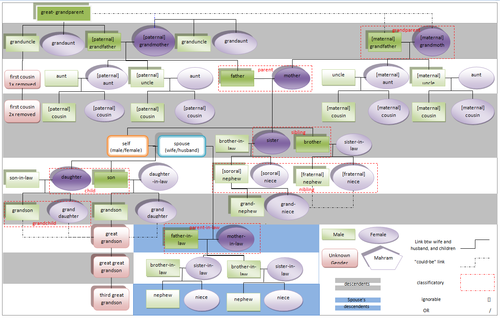
さまざまな社会において、パートナーの選択は特定の社会集団の適切な人物に限定されることが多い。一部の社会では、パートナーは個人自身の社会集団から選ばれるという規則があり、これは同族婚であり、階級やカーストに基づく社会ではよくあることである。しかし他の社会では、パートナーは自分とは異なる集団から選ばれなければならない。これは異族婚であり、ほとんどのオーストラリア先住民社会のように、社会がいくつかの異族婚のトーテム氏族に分かれているトーテム宗教を実践している社会ではよくあることである。他の社会では、人は交差いとこ同士で結婚することが期待され、女性は父親の姉妹の息子と、男性は母親の兄弟の娘と結婚しなければならない。これは、西アフリカのアカン族のように、父系または母系の血統集団を通じてのみ親族関係をたどる規則がある社会ではよくあることである。もう一つの結婚選択の種類はレビラト婚であり、未亡人は夫の兄弟と結婚することが義務付けられており、血縁関係が同族婚の氏族グループに基づいている社会で主に見られます。
宗教は、親族同士の結婚が許されるかどうかという問題に一般的に介入してきた。親族関係は血縁関係または姻族関係、つまり血縁または婚姻によるものである。いとこ同士の結婚については、カトリックの方針は当初は容認されていたが、長い期間の一般的な禁止を経て、現在は免除が必要であるという要件にまで発展した。[80] イスラム教は常にそれを認めているが、ヒンズー教の文献は大きく異なる。[81] [82]
規範的結婚

血統に基づく分類的親族制度を持つさまざまな社会では、結婚の規範的なルールによって決められた特定の親族クラスから、結婚相手候補が探される。このルールは、人類学者によって「男性の母親の兄弟の娘」(「交差いとこ」とも呼ばれる)などの「記述的」な親族用語を使用して表現されることがある。このような記述的ルールは、参加者の視点を隠している。男性は母親の血統の女性と結婚すべきである。社会の親族用語では、このような親族は通常、結婚の可能性があるものとして区別する特定の用語で示される。しかし、ピエール・ブルデューは、このルールに従う結婚はほとんどなく、従うとしても「公式の親族」イデオロギーではなく、家族の財産の保全などの「実際的な親族」の理由によるものだと指摘している。[83]

規範的な規則に従った通常の結婚が行われる限り、血統は固定された関係で結びついており、血統間のこうしたつながりは、血縁関係が支配的な社会において政治的同盟を形成する可能性がある。[84]フランスの構造人類学者クロード・レヴィ=ストロースは、可能な限られた数の規範的な結婚規則によって生み出される「基本的な」血縁関係構造を説明するために同盟理論を展開した。[85]
実利的な(または「お見合い」の)結婚は、家族やグループの政治の正式な手続きによって容易になります。責任ある権威者が結婚を設定または奨励します。実際、彼らは未婚の人にふさわしい配偶者を見つけるためにプロの仲人を雇うこともあります。権威者とは、両親、家族、宗教関係者、またはグループの合意である可能性があります。場合によっては、権威者が結婚の調和以外の目的で相手を選ぶこともあります。[86]
強制結婚
._Molla_Nasreddin.jpg/500px-Oskar_Shmerling._Free_love_(Forced_marriage)._Molla_Nasreddin.jpg)
強制結婚とは、一方または双方の意思に反して結婚させられる結婚のことである。強制結婚は世界の一部、特に南アジアとアフリカで現在も行われている。これらの文化の社会規範では、配偶者の選択に関して親や親族の希望に決して反対してはならないと定められているため、強制結婚と合意に基づく結婚の境界線は曖昧になる可能性がある。このような文化では、暴力、脅迫、威嚇などが発生する必要はなく、暗黙の社会的圧力と義務から、本人は望んでいなくても結婚に「同意」するだけである。世界の一部に存在する花嫁価格と持参金の慣習は、結婚のために人々を売買することにつながる可能性がある。[87] [88]
中央アジアからコーカサス、アフリカに至るいくつかの社会では、男性が友人らに女性を誘拐する花嫁誘拐の習慣が今も残っている。駆け落ちを伴うこともあるが、性的暴力を伴うこともある。以前は、この誘拐の大規模版として、女性グループが男性グループに、時には戦争で誘拐された。最も有名な例は「サビニの女たちの略奪」で、ローマの最初の市民に妻を与えた。
他の結婚相手は、多かれ少なかれ個人に強制されます。たとえば、未亡人相続では、未亡人に亡くなった夫の兄弟から別の男性が提供されます。
インドの農村部では児童婚が行なわれており、両親が結婚を手配することが多く、子供が生まれる前でさえ行われることがある。[89]この慣習は1929年の児童婚禁止法によって違法とされた。
経済的考慮
結婚の経済的な側面は文化によって異なり、時代とともに変化してきました。
一部の文化では、持参金や花嫁の財産は今でも必要とされています。どちらの場合も、金銭的な取り決めは通常、新郎(またはその家族)と花嫁の家族の間で行われ、花嫁は交渉に関与しないことが多く、結婚に参加するかどうかの選択肢がないことがよくあります。
近世イギリスでは、夫婦の社会的地位は平等であると考えられていました。結婚後、妻のすべての財産(「財産」と呼ばれる)と予想される相続財産は夫のものとなりました。
持参金
持参金とは「親の財産が、所有者の死亡時(死因)ではなく結婚時(生前)に娘に分配される手続きである…持参金は、夫婦の基金のようなもので、その性質は多岐にわたる。この基金は、未亡人となった彼女の生活(または財産)を保障し、最終的には彼女の息子や娘たちの生活を支えるために使われる。」[90]
一部の文化、特にトルコ、インド、バングラデシュ、パキスタン、スリランカ、モロッコ、ネパールなどの国では、持参金が依然として期待されています。インドでは、持参金に関連した死亡事故が毎年何千件も発生しており、[91] [92]この問題に対処するために、いくつかの管轄区域では持参金を制限または禁止する法律が制定されています(インドの持参金法を参照)。ネパールでは、2009年に持参金は違法となりました。[93]一部の著者は、持参金の授受は地位、さらには社会階層を上るための努力を反映していると考えています。[94]
ダワー
直接的な持参金は、新郎またはその家族が花嫁の両親に支払う花嫁の財産、および結婚時に新郎から花嫁自身に与えられ、花嫁の所有権と管理下にある財産である間接的な持参金(またはダウアー)とは対照的です。[95]
ユダヤの伝統では、古代のラビは結婚したカップルがケトゥバと呼ばれる婚前契約を結ぶことを強く主張した。ケトゥバは他の事柄に加えて、離婚の際に夫が支払う金額、または夫が死亡した場合に夫の財産について規定していた。この金額は、結婚時に新郎が花嫁の父親に支払う聖書の持参金または花嫁価格に代わるものである。 [96]この革新が導入されたのは、聖書の花嫁価格が大きな社会問題を引き起こしたためである。多くの若い将来の夫は、通常結婚することが期待される時期に花嫁価格を調達できなかった。そのため、これらの若者が結婚できるように、ラビは事実上、金額が支払われる時期を遅らせ、彼らが金額を用意できる可能性が高くなった。また、持参金とケトゥバの金額はどちらも同じ目的、つまり、妻が死亡または離婚によって扶養を断たれた場合に妻を保護するという目的を果たしていたことにも留意する必要がある。 2 つの制度の唯一の違いは、支払いのタイミングです。これは、結婚が破綻した場合に妻が受け取る扶養料や、夫が遺言で妻に十分な扶養を与えなかった場合に受け取る家族扶養料の現在の権利の前身です。ケトゥバ額が果たすもう 1 つの機能は、妻との離婚を考えている夫に抑止力を与えることです。つまり、夫は妻に支払うことができる金額を用意しておく必要があるのです。
モーニングギフトは花嫁自身に贈られ、花嫁ではなく花嫁の父親が手配することもある。この名前は、新婚初夜の翌朝に贈るというゲルマン民族の慣習に由来する。花嫁は夫の存命中はモーニングギフトを管理できるが、未亡人になったときに受け取る権利がある。彼女の相続財産の額が合意ではなく法律で決められている場合、それはダワーと呼ばれる。法制度や正確な取り決めによっては、彼女は死後にそれを処分する権利がない場合があり、再婚すると財産を失う可能性がある。モーニングギフトは、何世紀にもわたって貴賤婚、つまり妻の社会的地位が低いために子供が貴族の称号や財産を相続できない関係で維持されてきた。この場合、モーニングギフトは妻と子供を養うものだった。未亡人に関する別の法的規定は共有財産で、財産、多くの場合は土地が共有所有となり、夫が亡くなったときに自動的に未亡人の手に渡る。
イスラムの伝統にも同様の慣習がある。「マフル」は、即時または延期のいずれかで、花婿の財産(離婚)または財産(死亡)のうち女性が受け取る部分である。これらの金額は通常、花婿自身および家族の財産と収入に基づいて設定されるが、一部の地域では、特に結婚から男子の子供がいない場合に、花婿が離婚をしたり、夫の家族が財産の大部分を「相続」したりするのを阻止するために、非常に高く設定されている。イランを含む一部の国では、マフルまたは扶養料は、男性が期待できる以上の額になる場合があり、時には100万ドル(公式イラン金貨4000枚)に達することもある。イランの現行法によれば、離婚の場合または要求された場合に夫がマフルを支払えない場合は、分割払いで支払わなければならない。マフルを支払えない場合は、投獄される可能性もある。[97]
結婚財産

花嫁料は、東南アジア(タイ、カンボジア)の一部、中央アジアの一部、およびサハラ以南のアフリカの多くの地域で一般的な習慣です。花嫁料としても知られていますが、花嫁の購入を意味するため、好まれなくなっています。花嫁料とは、娘が花婿と結婚する際に、花婿またはその家族が女性の両親に支払う金銭、財産、または富のことです。人類学の文献では、花嫁料は、花嫁の労働力と生殖能力の喪失に対する補償として花嫁の家族に支払われる支払いであると説明されることがよくあります。場合によっては、花嫁料は、花婿の家族と結婚した子供たちとのつながりを認める手段です。
課税
一部の国では、結婚した個人またはカップルは、独身者には得られないさまざまな税制上の優遇措置を受けられる。例えば、配偶者は合算した所得を平均化することが認められる場合がある。これは所得の異なる夫婦にとって有利である。これを補うために、国は夫婦の平均所得に対してより高い税率区分を設ける場合がある。所得の平均化は、専業主婦の配偶者がいる夫婦には依然として有利かもしれないが、そのような平均化により、個人所得がほぼ同等の夫婦は、独身者2人の場合よりも総税額が多くなる。米国では、これを結婚ペナルティと呼ぶ。[98]
税法で適用される税率が所得平均ではなく個人の所得の合計に基づいている場合、累進課税制度では共働き世帯の各個人に通常より高い税率が適用されます。これは高所得納税者に最も多く見られ、結婚ペナルティと呼ばれる別の状況です。[99]
逆に、累進課税がパートナーシップを考慮せずに個人に課される場合、共働き夫婦は、世帯収入が同程度の単独収入の夫婦よりも有利な状況となる。福祉制度で同じ収入を共有収入として扱い、稼いでいない配偶者に福祉へのアクセスを拒否すると、その効果は増大する可能性がある。このような制度は、例えばオーストラリアやカナダで適用されている。[100]
結婚後の居住地
多くの西洋文化では、結婚は通常、結婚した夫婦からなる新しい世帯の形成につながり、結婚した夫婦は同じ家に住み、同じベッドを共有することも多いが、他の文化ではこの伝統はない。[101]西スマトラのミナンカバウ族の間では、結婚後の居住地は母方居住であり、夫は妻の母親の世帯に移る。[102]結婚後の居住地は父方居住または叔父居住の場合もある。これらの場合、結婚したカップルは独立した世帯を形成せず、拡大家族世帯の一部にとどまることがある。
結婚後の居住地の決定要因を説明する初期の理論[103]は、それを性別による労働の分担と結び付けていた。しかし、現在までに、世界中のサンプルを用いたこの仮説の異文化間テストでは、これら2つの変数の間に有意な関係は見つかっていない。しかし、コロタエフのテストでは、女性の生計への貢献は一般的に母系居住と有意に相関していることが示されている。しかし、この相関は一般的な一夫多妻制の要因によって隠されている。
異性婚では、女性の生計への貢献度が増すと母方居住につながる傾向があるが、同時に母方居住を事実上破壊する一般的な非母方一夫多妻制にもつながる傾向がある。この一夫多妻制の要因を制御すれば(例えば、多重回帰モデルを通じて)、分業は結婚後の居住の重要な予測因子であることがわかる。したがって、性別による分業と結婚後の居住の関係に関するマードックの仮説は基本的に正しかったが、[104]これら2つの変数群の実際の関係は彼が予想したよりも複雑である。[105] [106]
西洋社会では新居住地への傾向が見られる。[107]
法
婚姻法とは、婚姻の有効性を決定する法的要件を指し、国によって大きく異なります。世界人権宣言第 16 条は次のように宣言しています。
1. 成年の男女は、人種、国籍、宗教によるいかなる制限を受けることなく、結婚し、家族を形成する権利を有する。彼らは、結婚中および結婚の解消に際して、結婚に関して平等の権利を有する。
2. 婚姻は両当事者の自由かつ完全な合意に基づいてのみ成立する。 3. 家族は社会の自然かつ基礎的な集団単位であり、社会および国家による保護を受ける権利を有する。
— 世界人権宣言第16条
権利と義務
結婚は、結婚した当事者、そして時には親族にも権利と義務を与え、姻族関係(義理の家族)を形成する唯一の手段となります。これには、管轄区域に応じて、以下のものが含まれます。
- 一方の配偶者またはその家族に、もう一方の配偶者の性的サービス、労働、財産に対する管理権を与えること。
- 配偶者の一方に、もう一方の配偶者の借金の責任を負わせること。
- 配偶者の一方が投獄または入院している場合に、もう一方に面会権を与えること。
- 配偶者の一方が無能力になった場合に、もう一方に配偶者の事柄の管理権を与えること。
- 親の子供の第2の法定後見人を確立する。
- 子供たちの利益のために共同財産基金を設立する。
- 配偶者の家族間の関係を確立する。
これらの権利と義務は、社会によって、また社会内のグループによって大きく異なります。[108]これらには、見合い結婚、家族の義務、核家族の法的設立、子どもの法的保護、公的な誓約の宣言などが含まれます。[109] [110]
財産制度
現在多くの国では、結婚した各パートナーは、自分の財産を別々に保持するか、財産を統合するかを選択できます。後者の場合、共有財産と呼ばれ、離婚により結婚生活が終了した場合、各自が半分ずつ所有します。遺言書や信託に代えて、故人が所有していた財産は、一般的には生存配偶者が相続します。
一部の法制度では、結婚した夫婦は結婚に伴う負債に対して「連帯責任」を負う。これは「必需品の原則」と呼ばれる伝統的な法概念に基づいており、異性間の結婚では夫が妻に必要な物を提供する責任がある。この場合、一方のパートナーは、明示的に契約していない負債の回収で訴えられる可能性がある。この慣行の批判者は、債権回収会社が不当に広範囲の負債を結婚費用であると主張することでこれを悪用する可能性があると指摘する。その場合、費用が家族の負債ではないことを証明するための弁護費用と立証責任は、契約していない側に課される。結婚中および結婚後のそれぞれの扶養義務は、ほとんどの管轄区域で規制されており、扶養手当はその方法の 1 つである。
制限
結婚は歴史的に制限の多い制度です。年齢、人種、社会的地位、血縁関係、性別など、子どもの利益、健康な遺伝子の継承、文化的価値観の維持、あるいは偏見や恐怖などの理由で、社会によって結婚に制限が課せられています。結婚を認めているほぼすべての文化では、不倫も結婚の条件に違反するものとして認められています。 [111]
年
ほとんどの法域では結婚の最低年齢が定められており、つまり、法的に結婚が認められるには一定の年齢に達していなければならない。この年齢は状況によって異なり、例えば、若者の両親が同意を表明した場合や、裁判所が当該結婚が若者の最善の利益となると判断した場合(少女が妊娠している場合によく適用される)、一般規則からの例外が認められる場合がある。ほとんどの年齢制限は、子供が結婚を強いられること(特に年上の相手との結婚)を防ぐために設けられているが、このような児童婚は教育や健康に悪影響を及ぼし、児童性的虐待やその他の暴力につながる可能性がある[112]が、世界の一部地域では依然として一般的である。国連によると、児童婚はサハラ以南のアフリカと南アジアの農村部で最も一般的である。児童婚率が最も高い10カ国は、ニジェール(75%)、チャド、中央アフリカ共和国、バングラデシュ、ギニア、モザンビーク、マリ、ブルキナファソ、南スーダン、マラウイである。[113]
親族関係
近親相姦や優生学上の理由を禁じるため、婚姻法では親族間の結婚に制限を設けている。直系血族の結婚は通常禁止されているが、分系血族の結婚については法律で慎重である。[114] [115]
結婚による親族関係は「親族関係」とも呼ばれ、出身グループ内で生じた関係は、血統グループとも呼ばれます。一部の文化では、親族関係は経済的または政治的な関係、またはその他の社会的つながりを持つ人々にまで及ぶと考えられます。一部の文化では、神々[116]や動物の祖先 (トーテム) にまで遡ることがあります。これは多かれ少なかれ文字通りに考えることができます。
人種
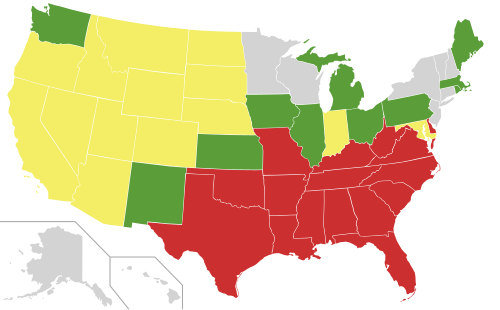
法律は可決されなかった
1887年以前に廃止
1948年から1967年の間に廃止
1967年6月12日に覆された
「人種混合」を禁止する法律は、北米の特定の地域では1691年[117]から1967年まで、ナチスドイツでは1935年から1945年まで(ニュルンベルク法)、南アフリカではアパルトヘイト時代(1949年から1985年)のほとんどの期間に施行された。これらの法律はすべて、主に人種的または民族的に定義された異なるグループの人々の間の結婚を禁止しており、米国では「融合」または「異人種間混交」と呼ばれていた。ナチスドイツや米国の多くの州、および南アフリカの法律では、そのような個人間の性的関係も禁止されていた。
アメリカ合衆国では、すべての州ではないが一部の州の法律で白人と黒人の結婚が禁止されており、また多くの州では白人とネイティブアメリカンやアジア人との結婚も禁止されていた。[118]アメリカ合衆国では、このような法律は異人種間結婚禁止法として知られていた。1913年から1948年まで、当時48州のうち30州がこのような法律を施行した。[119]アメリカ合衆国憲法の「異人種間結婚禁止修正条項」は1871年、1912~1913年、そして1928年に提案されたが、[120] [121]人種の異なる結婚を禁止する全国的な法律は制定されなかった。1967年、アメリカ合衆国最高裁判所は、ラヴィング対バージニア州の訴訟で異人種間結婚禁止法は違憲であると全員一致で判決を下した。この判決により、これらの法律は、まだ施行されていた残りの 16 州では施行されなくなりました。
ナチスによる異人種間の結婚および性交の禁止は、1935年9月にニュルンベルク法、ドイツの血とドイツの名誉を守る法律の一部として制定された。ニュルンベルク法はユダヤ人を人種として分類し、最初はユダヤ人の子孫との結婚および婚外性交を禁じたが、後に「ジプシー、黒人またはその庶子」および「ドイツ人またはその近親者の血」との結婚および婚外性交は禁止された。[122]こうした関係はラッセンシャンデ(文字通り「人種的不名誉」)とされ、投獄(通常は強制収容所への移送が続く)や死刑に処せられることもあった。
アパルトヘイト下の南アフリカでは、異人種間の結婚も禁止されていた。1949年の混血結婚禁止法は、異なる人種間の結婚を禁じ、1950年の不道徳行為禁止法は、異なる人種との性的関係を犯罪とした。
セックス

同性カップルの結婚も認められる(指輪:個別ケース)
同性婚を規定する法律または拘束力のある国内裁判所の判決があるが、結婚はまだ規定されていない
同性婚は、他の特定の管轄区域で行われる場合には認められ、(もしあれば)地元の同性婚よりも大きな権利が与えられる。
シビルユニオンまたはドメスティックパートナーシップ
限定的な法的承認(登録された同棲)
法的強制力のない地方認証
特定の管轄区域で行われた結婚の限定的な承認(配偶者の居住権)
同性婚を認める国際裁判所の判決を受ける国
同性間の結婚は法的に認められていない
同性婚は、アンドラ、アルゼンチン、オーストラリア、オーストリア、ベルギー、ブラジル、カナダ、チリ、コロンビア、コスタリカ、キューバ、デンマーク、エクアドル、エストニア、フィンランド、フランス、ドイツ、ギリシャ、アイスランド、アイルランド、ルクセンブルク、マルタ、メキシコ、オランダ、[a]ニュージーランド、[b]ノルウェー、ポルトガル、スロベニア、南アフリカ、スペイン、スウェーデン、スイス、台湾、イギリス、[c]アメリカ合衆国、 [ d]ウルグアイなどの国で合法的に行われ、認められています。イスラエルは、海外で行われた同性婚を完全な結婚として認めています。
同性婚の導入は、法域によって異なり、結婚法の立法変更、憲法上の平等の保証に基づく裁判所の判決、または直接の国民投票(投票イニシアチブまたは国民投票による)を通じて達成されています。同性婚の承認は、人権および公民権であると同時に、政治的、社会的、宗教的な問題であると考えられています。[123]同性婚の最も著名な支持者は、人権および公民権団体、医療および科学界であり、最も著名な反対者は宗教団体です。世界中のさまざまな宗教コミュニティが同性婚を支持している一方で、多くの宗教グループは反対しています。世論調査では、すべての先進民主主義国と一部の発展途上民主主義国で、同性婚の承認に対する支持が継続的に高まっていることが一貫して示されています。[124]
同性カップルの結婚を法律で認めることは、LGBT権利運動の最も重要な目的の一つです。
配偶者の数
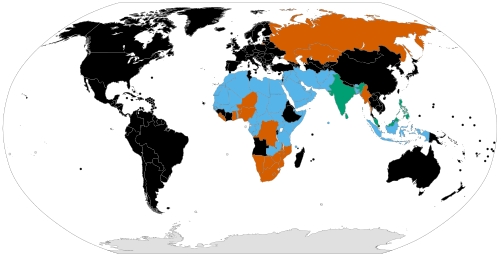
一夫多妻制は合法である
一夫多妻制はイスラム教徒にのみ合法である
一夫多妻制は一部の地域では合法である(インドネシア)
一夫多妻は違法だが、その行為は犯罪化されていない
一夫多妻は違法であり、犯罪行為である
法的地位は不明
- インド、マレーシア、フィリピン、シンガポールでは一夫多妻制はイスラム教徒にのみ合法です。
- ナイジェリアと南アフリカでは、慣習法およびイスラム教徒による一夫多妻制の結婚が法的に認められています。
- モーリシャスでは、一夫多妻制は法的に認められていない。しかし、イスラム教徒の男性は最大4人の女性と「結婚」できるが、妻としての法的地位は持たない。
一夫多妻制は主にイスラム教国とアフリカ諸国で広く実践されている。 [125] [126]中東地域では、イスラエル、トルコ、チュニジアが注目すべき例外である。[127]
他のほとんどの法域では一夫多妻制は違法である。例えば、アメリカ合衆国では、一夫多妻制は全50州で違法である。[128]
19世紀後半、現在のユタ州の自治領の住民は、アメリカ合衆国連邦政府により、いくつかの議会法の強力な執行を通じて一夫多妻制の慣行を放棄するよう強制され、最終的にはそれに従った。末日聖徒イエス・キリスト教会は、1890年に「宣言」と題された文書で正式にこの慣行を廃止した( 19世紀後半の末日聖徒の一夫多妻制を参照)。[129]アメリカのイスラム教徒のうち、約5万人から10万人の少数派が、夫が違法な一夫多妻関係を維持している家族で暮らしていると推定されている。[128]
インドやスリランカなどいくつかの国では[130] 、イスラム教徒のみに一夫多妻制を認めている。インド人の中には、そのような法的規制を回避するためにイスラム教に改宗した人もいる。 [131]キリスト教国では、コンゴ共和国、ウガンダ、ザンビアなど少数の例外を除き、一夫多妻制は認められていない。
国家承認
政府機関が管轄地域の結婚法に従って宗教的内容を伴わずに結婚を執り行う場合、それは民事婚である。民事婚は、国家の観点から結婚に固有の権利と義務を認め、創出する。国によっては、国内で執り行われる宗教的結婚を単独では認めず、公式の目的で別途民事婚を必要とする。逆に、サウジアラビアなど宗教法制度が統治する国では民事婚が存在せず、国外で結ばれた結婚は、サウジアラビアのイスラム法の解釈に反して結ばれた場合、認められない可能性がある。レバノンやイスラエルなど世俗と宗教が混在する法制度が統治する国では、国内で現地で執り行われる民事婚は存在せず、そのため宗教法に反する異教徒間の結婚やその他さまざまな結婚が国内で行われるのを防いでいる。しかし、国外で執り行われた民事婚は、宗教法に抵触する場合でも国家に認められる場合がある。例えば、イスラエルにおける婚姻の承認の場合、海外で行われた異宗教間の民事婚だけでなく、海外での同性間の民事婚も承認されます。
さまざまな法域では、理論的には異なるものの、宗教的な結婚式の一部として民事婚が行われる場合があります。法域によっては、同性結婚やシビルユニオンなど、特定の宗教では明確に認められていない状況でも民事婚を認めています。
逆のケースも起こり得ます。パートナーは完全な法的行為能力を持たない可能性があり、教会は民事管轄よりも緩い制限を設けている可能性があります。これは特に最低年齢や身体障害に当てはまります。[要出典]
宗教機関やその他の機関によって結婚が認められても、国家によって認められず、結婚の法的権利と義務を持たない2人の人物、あるいは宗教によって民事婚が無効で罪深いとみなされる2人の人物が存在する可能性があります。同様に、民事離婚後も宗教的な観点からは夫婦が結婚したままである可能性があります。
ほとんどの主権国家およびその他の管轄区域では、法的に認められた結婚を異性のカップルに限定しており、そのうち減少しているが、一夫多妻、一妻多夫、グループ結婚、カバーチャー結婚、見合い結婚、強制結婚、児童結婚、いとこ結婚、きょうだい結婚、10代結婚、叔父の結婚、近親相姦結婚、獣姦結婚を認めている国もある。現代では、主に先進民主主義国を中心に、女性の平等の権利や、異民族、異人種、異宗教、宗派、階級、コミュニティ、国境を越えた結婚、同性カップル、移民カップル、移民配偶者を持つカップル、その他の少数派カップルの結婚に対する禁止を解除し、法的に承認する国が増えている。一部の地域では、国の法律で禁止されているにもかかわらず、児童婚や一夫多妻制が行われることがあります。
結婚許可証、民事婚、登録


結婚は、通常、結婚式または結婚式で正式に行われます。式は、宗教関係者、政府関係者、または国が承認した司祭によって執り行われます。ヨーロッパやラテンアメリカの多くの国では、宗教式は、義務付けられた民事式とは別に行う必要があります。ベルギー、ブルガリア、フランス、オランダ、ルーマニア、トルコなどの一部の国では、民事式を宗教式の前に行うことを義務付けています[132] 。米国、カナダ、英国、アイルランド、ノルウェー、スペインなどの一部の国では、両方の式を一緒に行うことができます。宗教式と民事式の司祭は、民事式を執り行う国の代理人としても機能します。国が宗教結婚を「承認」しているという暗示を避けるため (一部の国では禁止されています)、「民事」式は宗教式と同時に行われると言われています。多くの場合、これには宗教式の間に登録簿に署名するだけです。宗教儀式の民事的要素が省略された場合、その結婚式は法律上、政府によって結婚として認められません。
オーストラリアなど一部の国では、結婚式を私的に、また場所を問わずに挙げることが認められているが、イングランドやウェールズなどその他の国では、民事婚は、公衆に開かれ、その目的のために法律で特別に認可された場所で行わなければならないとされている。イングランドでは、以前は結婚の場所は教会か登録事務所でなければならなかったが、これは必要な許可があればどの公共の場所でも可能となった。特別緊急許可(英:licence)による結婚の場合は例外となるが、これは通常、当事者の一方が末期の病気である場合にのみ与えられる。結婚できる場所と時期に関する規則は場所によって異なる。一部の規則では、当事者の一方が登録事務所(旧教区)の管轄区域内に居住する必要がある。
各宗教当局には、その役員や信者が結婚式を執り行う方法についての規則があります。宗教結婚が国によって認められている場合、司式者は管轄区域の法律にも従わなければなりません。
事実婚
少数の法域では、法律の施行のみで婚姻関係が成立することがある。[133]法的な契約、結婚式、その他の詳細を伴う典型的な儀式的な結婚とは異なり、コモンロー結婚は「習慣と評判による結婚(同棲)」と呼ばれることがある。許可証や儀式のない事実上のコモンロー結婚は、一部の法域では法的に拘束力があるが、他の法域では法的効果がない。[133]
シビル・ユニオン

シビル・ユニオンはシビル・パートナーシップとも呼ばれ、結婚に似た法的に認められたパートナーシップの形態です。 1989年のデンマークを皮切りに、同性カップルに異性間のシビル・マリッジと同様の(国によっては同一) 権利、利益、責任を与えるために、さまざまな名称のシビル・ユニオンがいくつかの国で法律で制定されました。ブラジル、ニュージーランド、ウルグアイ、エクアドル、フランス、米国のハワイ州とイリノイ州など、一部の法域では、異性カップルにもシビル・ユニオンが認められています。
「政略結婚」
時には、ある状況を利用するために結婚する人がいます。これは、便宜結婚や偽装結婚と呼ばれることもあります。2003 年には、18 万人以上の移民が米国市民の配偶者として米国に入国を許可されました。[135]さらに多くの人が、90 日以内に結婚する目的で米国市民の婚約者として入国を許可されました。これらの結婚の動機は多岐にわたり、永住権の取得、結婚条項のある相続財産の確保、健康保険への加入など、多岐にわたります。すべての結婚には、結婚の動機となる便宜上の複雑な組み合わせがありますが、便宜結婚とは、結婚する通常の理由がない結婚です。シンガポールなどの一部の国では、偽装結婚は刑事罰の対象となります。[136]
結婚に対する現代の法的および人権的批判

結婚に反対する議論は、政治的、哲学的、宗教的な批判、離婚率への懸念、個人の自由と男女平等、政府や宗教当局によって認可された個人的な関係を持つことの必要性への疑問、宗教的または哲学的な理由による独身の推奨などから提起されてきた。研究によると、不幸な結婚生活を送っているカップルは、臨床的うつ病を発症するリスクが3~25倍高いことがわかっている。[137] [138] [139]
権力とジェンダーの役割

歴史的に、ほとんどの文化において、既婚女性は自身の権利をほとんど持たず、家族の子供と共に夫の所有物とみなされていた。そのため、女性は財産を所有または相続できず、法的に自らを代表することもできなかった(例えば、カバーチャーを参照)。19世紀後半以降、一部の(主に西洋の)国では、結婚に関して妻の権利向上を目的とした法改正が徐々に行われてきた。これらの変更には、妻に自身の法的アイデンティティを与えること、夫が妻を身体的に懲らしめる権利を廃止すること、妻に財産権を与えること、離婚法を自由化すること、妻に自身の生殖に関する権利を与えること、性関係が生じる際に妻の同意を求めることなどが含まれていた。 21世紀においても、既婚女性の法的地位、結婚生活における暴力(特に性的暴力)の法的容認または寛容、持参金や婚資などの伝統的な結婚慣習、強制結婚、結婚適齢期、婚前・婚外性交などの合意に基づく行為の犯罪化などについて論争が続いている。
フェミニスト理論は、異性間の結婚を、伝統的に家父長制に根ざし、女性に対する男性の優位性と権力を促進する制度として捉えている。この力関係は、男性を「公的な領域で働く養育者」、女性を「私的な領域で働く介護者」と概念化している。[141]「理論的には、女性は...夫の所有物として定義されていた...女性の不倫は常に男性の不倫よりも厳しく扱われた。」[142]「[フェミニストの]妻が自分の財産を管理するという要求は、...[19世紀後半に法律が制定されるまで][イギリスの一部では]満たされなかった。」[143]
伝統的な異性間の結婚は、妻が夫のために性的に利用可能である義務と、夫が妻に物質的/経済的支援を提供する義務を課した。多くの哲学者、フェミニスト、その他の学者が歴史を通じてこれについてコメントし、性的問題に関する法的および宗教的権威の偽善を非難し、女性が自身の性的欲求をコントロールすることに関して選択の余地がないことを指摘し、神聖な制度として推進されている結婚と、広く非難され中傷されている(ただし「必要悪」として容認されることも多い)売春との類似点を指摘した。18世紀のメアリー・ウルストンクラフトは、結婚を「合法的な売春」と表現した。 [144]エマ・ゴールドマンは1910年に次のように書いている。「道徳家にとって売春は、女性が自分の体を売るという事実ではなく、むしろ結婚関係外で売るという事実である」。[145]バートランド・ラッセルは著書『結婚と道徳』の中で、「女性にとって結婚は最も一般的な生活様式であり、女性が耐える望まない性行為の総量は、売春よりも結婚生活において多いだろう」と書いている。[146]アンジェラ・カーターは『サーカスの夜』の中で、「結婚とは、多数の男性ではなく一人の男性に対する売春でしかない」と書いている。[147]
批評家の中には、結婚をあらゆる社会問題の解決策として積極的に推進する政府、宗教団体、メディアによる結婚に関するプロパガンダに反対する者もいる。そのようなプロパガンダには、例えば学校での結婚推進が含まれる。学校では、子どもたち、特に少女たちが、当局が用意した情報のみを与えられ、結婚に関する肯定的な情報を浴びせかけられる。[148] [149]
男性による支配的な性別役割と女性による従属的な性別役割の遂行は、異性愛結婚の力関係に影響を与える。[150]アメリカの家庭の中には、女性が性別役割の固定観念を内面化し、社会規範や男性パートナーに合わせて「妻」、「母」、「世話人」の役割に同化しているところもある。作家のベル・フックスは、「家族構造の中で、個人は性差別的な抑圧を『自然』として受け入れることを学び、異性愛主義的な支配を含む他の形態の抑圧を支持するように準備される」と述べている。[151]「夫の文化的、経済的、政治的、法的優位性」は「英国法の下では伝統的ではなかった」。[152]この家父長制の力関係は、権力と労働が性別役割に左右されずに平等に分配される平等主義または同輩結婚の概念とは対照的である。[141]
米国では、平等主義の理想が一般的であるにもかかわらず、回答者の半数以下が異性間の関係を力において平等であると考えており、不平等な関係では男性パートナーが支配することが多いことが研究で示されている。[153]また、研究では、夫婦は平等な関係に最も高い満足度を感じ、妻が支配する関係に最も低い満足度を感じることが示されている。[153]近年、平等または対等な結婚は、米国を含む多くの国で政治的、経済的、文化的にますます注目されてきている。
婚外性交

社会によって婚外性交に対する寛容度は異なる。標準異文化サンプルは、産業革命以前の50以上の文化における男女別の婚外性交の発生状況を示している。[155] [156]男性の婚外性交の発生状況は、6つの文化では「普遍的」、29の文化では「中程度」、6つの文化では「時々」、10の文化では「まれ」とされている。女性の婚外性交の発生状況は、6つの文化では「普遍的」、23の文化では「中程度」、9つの文化では「時々」、15の文化では「まれ」とされている。米国の全国的な代表サンプルを用いた3つの研究では、女性の10~15%と男性の20~25%が婚外性交を行っていることがわかった。[157] [158] [159]
世界の主要な宗教の多くは、婚姻外の性関係を好ましく思っていない。[160]非世俗的なイスラム教国の中には、婚前性交に対して刑事罰を科すところもある。[161]既婚者が配偶者以外の人と性関係を持つことは姦通として知られている。姦通は多くの法域で犯罪であり、離婚の理由となるとみなされている。
サウジアラビア、パキスタン、[162]アフガニスタン、[163] [164]イラン、[164]クウェート、[ 165]モルディブ、 [166]モロッコ、[167]オマーン、[168]モーリタニア、[169]アラブ首長国連邦、[170] [171]スーダン、[172]イエメン、[173]などの一部の国では、婚姻外のあらゆる性的行為は違法です。
世界の一部の地域では、婚姻外の性的関係を持ったとされる女性や女児が、家族による名誉殺人の被害者になる危険がある。 [174] [175] 2011年にはイラン、ソマリア、アフガニスタン、スーダン、マリ、パキスタンで数人が姦通の罪で石打ちの死刑を宣告された。 [176] [177] [178] [179] [180] [181] [182] [183] [184]名誉殺人や石打ちなどの慣行は、一部の国では主流派の政治家やその他の当局者によって支持され続けている。パキスタンでは、2008年にバロチスタン州で起きた名誉殺人でバロチスタン州のウムラニ族の部族民によって5人の女性が殺害された後、パキスタン連邦郵政大臣イスラール・ウラー・ゼフリがこの慣行を擁護した。彼はこう言った。[185]「これらは何世紀にもわたる伝統であり、私はこれを守り続けるつもりだ。不道徳な行為にふける者だけが恐れるべきである。」[186]
性的暴力
結婚に関する深刻な懸念事項であり、国際的な監視の対象となっている問題は、結婚生活における性的暴力である。歴史の大部分を通じて、ほとんどの文化において、結婚生活における性行為は「権利」とみなされており、もし「拒否」されれば、強制的に(多くの場合、男性から女性へ)奪われる可能性がある。20世紀に人権の概念が発達し始め、第二波フェミニズムが到来すると、そのような見解や法律は広く受け入れられなくなった。[187]
夫婦間レイプの法的および社会的概念は、20世紀中盤から後半にかけてほとんどの先進国で発展してきたが、世界の他の多くの地域では、社会的にも法的にも虐待の一形態として認識されていない。東ヨーロッパとスカンジナビアのいくつかの国では、1970年以前に夫婦間レイプが違法とされ、西ヨーロッパの他の国と英語圏の西側諸国では、1980年代と1990年代に違法となった。イングランドとウェールズでは、1991年に夫婦間レイプが違法となった。夫婦間レイプは発展途上国でもますます犯罪化されているが、「夫婦の権利」に関する文化的、宗教的、伝統的なイデオロギーは世界の多くの地域で非常に根強く残っており、夫婦間レイプに対する適切な法律がある国でも、これらの法律が施行されることはほとんどない。[188]
配偶者に対する強姦の問題とは別に、結婚は世界の多くの地域で、他の形態の性的暴力と密接に関係している。モロッコのような一部の地域では、強姦された未婚の少女や女性は、家族から強姦犯との結婚を強いられることが多い。強姦の被害者となり処女を失うことは社会的に極めて不名誉なことであり、被害者の「評判」が傷つけられたとみなされるため、強姦犯との結婚が取り決められる。これは、未婚のままでいることがなく社会的地位を失うことのない被害者と、処罰を免れる強姦犯の双方にとって有利であると主張されている。2012年、モロッコの16歳の少女が家族から強姦犯との結婚を強要され、結婚後も強姦犯からさらなる虐待を受けた後に自殺した後、活動家からモロッコで一般的なこの慣習に対する抗議があった。[189]
一部の社会では、夫婦の貞操、特に女性の貞操が社会的、宗教的に非常に重要視されているため、不倫は犯罪とみなされ、石打ちやむち打ちなどの厳しい刑罰が科されることが多い一方、不貞に関連した暴力(名誉殺人など)に対する処罰は寛大である。[190] 21世紀には、不倫に対する刑法が物議を醸し、国際機関はそれらの廃止を求めている。[191] [192]不倫法反対派は、これらの法律は主に女性に対して選択的に施行されているため、女性に対する差別や暴力の主因となっていると主張している。また、これらの法律は女性が性的暴力を報告できないようにし、夫、家族、地域社会による女性に対する暴力犯罪を正当化する社会規範を維持していると主張している。法律と実践における女性差別に関する国連作業部会の共同声明では、「刑事犯罪としての不倫は女性の人権を侵害する」と述べている。[192]一部の人権団体は、姦通の犯罪化は個人のプライバシーへの恣意的な干渉であり、国際法で認められていないため、国際的に認められた私生活の保護を侵害すると主張している。[193]
法律、人権、ジェンダーの地位
多くの国における異性間の結婚に関する法律は、国際人権基準に反し、女性に対する暴力、児童婚、強制結婚を制度化し、妻が有給労働、法的文書への署名、刑事告訴、民事訴訟などを行うのに夫の許可が必要であり、夫が妻を「懲罰」するために暴力を振るうことを容認し、離婚において女性を差別するなど、国際的な監視を受けている。[194] [195] [196]
このようなことは最近まで多くの西側諸国でも合法であった。例えば、フランスでは1965年に既婚女性が夫の許可なしで働く権利を獲得し、[197] [198] [199] 、西ドイツでは1977年に女性がこの権利を獲得した(比較すると東ドイツの女性はより多くの権利を持っていた)。[200] [201]フランコ時代のスペインでは、既婚女性は雇用、財産の所有、さらには家を離れての旅行を含むほぼすべての経済活動において、夫の同意( permiso marital)を必要としたが、 permiso maritalは1975年に廃止された。[202]
妻が夫に絶対的に服従することは、世界の多くの地域で自然なこととして受け入れられている。例えば、ユニセフの調査では、特定の状況下では夫が妻を殴ったり殴ったりしても正当であると考える15~49歳の女性の割合は、アフガニスタンとヨルダンでは90%、マリでは87%、ギニアと東ティモールでは86%、ラオスでは81%、中央アフリカ共和国では80%に上る。[203]アフガニスタンの詳細な結果によると、妻が「夫に告げずに出かけた場合」には殴打に賛成する女性が78%、夫と口論した場合には76%が賛成している。[204]
歴史を通じて、そして今日でも多くの国では、不倫が原因で妻を殺害した男性に対して、酌量すべき情状、部分的または完全な抗弁を法律で規定しており、そのような行為はしばしば情状酌量の余地のない犯罪とみなされ、挑発や家族の名誉の擁護などの法的抗弁によってカバーされている。[205]
離婚する権利と能力
国際法や条約では、結婚には合意が必要であること、つまり本人の意思に反して結婚を強制されてはならないことは認められているが、離婚する権利は認められていない。そのため、本人の意思に反して結婚を続けることは(本人が同意している場合)、人権侵害とはみなされず、離婚の問題は各国の判断に委ねられている。[206]
EUでは、2011年に離婚を認めた最後の国はマルタでした。世界中で離婚を禁止している国はフィリピンとバチカン市国だけですが[207]、実際には過失に基づく離婚制度を採用している多くの国では離婚が非常に困難です。法律上および実践上の離婚の可否は、多くの国で議論の的となっている問題であり、公の議論にはフェミニズム、社会保守主義、宗教的解釈などのさまざまなイデオロギーが関わっています。[208]
持参金と婚資

近年、持参金や花嫁価格の慣習は、家族や氏族間の対立を誘発し、女性に対する暴力を助長し、物質主義を助長し、財産犯罪(男性が花嫁価格を支払うために牛などの商品を盗む)を増加させ、貧しい人々の結婚を困難にしているとして、国際的な批判を受けている。アフリカの女性の権利運動家は、女性は購入可能な財産の一種であるという考えに基づいていると主張し、花嫁価格の廃止を主張している。[209]花嫁価格はまた、貧しい両親が幼い娘を裕福な年配の男性に売るため、児童人身売買の一因となっていると批判されている。 [210]パプアニューギニアの上級警察官は、花嫁価格が同国における女性虐待の主な原因の1つであると主張し、花嫁価格の廃止を求めている。[211]反対の持参金の慣習は、暴力(持参金による死亡を参照)や恐喝などの犯罪の多発と関連している。[212]
婚姻外で生まれた子供
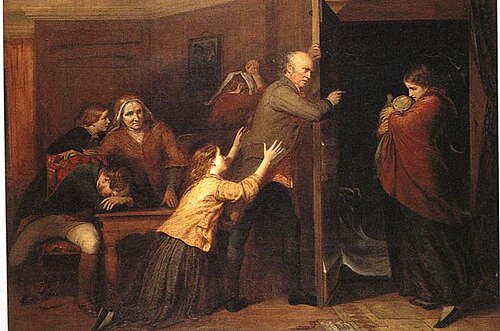

歴史的に、そして現在でも多くの国で、婚姻関係外で生まれた子供は深刻な社会的烙印と差別に苦しめられてきました。イングランドとウェールズでは、そのような子供は私生児や売春婦として知られていました。
非婚姻関係にない出産の社会的・法的地位に関しては、世界地域によって大きな違いがあり、完全に受け入れられ議論の余地がない状態から、深刻な汚名と差別を受けている状態までさまざまである。[214] [215]
1975年の「婚外子の法的地位に関する欧州条約」は、未婚の両親から生まれた子供の権利を保護している。[216]この条約には、とりわけ「婚外子の父母は、その子が婚姻関係で生まれた場合と同様に、その子を養育する義務を有する」、また「婚外子は、父母および父母の家族の一員の財産について、婚姻関係で生まれた場合と同様に相続する権利を有する」と規定されている。[217]
西洋諸国のほとんどでは、婚姻関係下で生まれた子どもと婚姻関係外で生まれた子どもの間の法的不平等はほぼ廃止されているが、世界の一部の地域ではそうではない。
未婚の父親の法的地位は国によって大きく異なる。父親が自発的に子どもを正式に認知しない限り、ほとんどの場合、父子関係を確定するためには適正手続きが必要となる。しかし、一部の国では、未婚のカップルが一定期間同棲すると、正式な結婚と同様に父子関係の推定が生じる。オーストラリアがそうだ。[218]どのような状況で父子関係を確定させる訴訟を起こせるか、父子関係が確定した後の父親の権利と責任(親権を得られるか、子どもを養育するよう強制されるか)や、自発的に子どもを認知した父親の法的地位は、法域によって大きく異なる。結婚した女性が夫以外の男性との間に子どもをもうける場合は特別な状況となる。イスラエルなど一部の国では、子どもが汚名を着せられるのを避けるため、このような状況での父子関係の法的異議申し立てを拒否している(ユダヤ法の概念であるマムゼルを参照)。 2010年、欧州人権裁判所は、既婚女性との間に双子をもうけたドイツ人男性に有利な判決を下し、母親とその夫が子供との面会を禁じていたにもかかわらず、双子との面会権を認めた。[219]
未婚の父親が子供の権利を得るためにとらなければならない手続きは、国によって異なります。一部の国(英国など - イングランドとウェールズでは2003年以降、スコットランドでは2006年以降、北アイルランドでは2002年以降)では、父親が出生証明書に記載されているだけで親権を得ることができます。[220]アイルランドなどの他の国では、出生証明書に記載されているだけでは権利は付与されず、追加の法的手続きを踏む必要があります(母親が同意する場合は、両親が「法定宣言書」に署名できますが、母親が同意しない場合は、父親が裁判所に申し立てを行う必要があります)。[221]
婚外出産はより一般的になり、一部の国では大多数を占めるようになった。ラテンアメリカの最近のデータによると、非婚姻出産の割合はコロンビアで74% 、ペルーで69%、チリで68% 、ブラジルで66% 、アルゼンチンで58% 、メキシコで55%となっている。[222] [223] 2012年には、欧州連合では出生の40%が婚外出産であり、[224]米国では2013年に同様の数字で41%であった。 [ 225]英国では2012年に出生の48%が未婚女性によるものであり、アイルランドではその数字は35%であった。[224]
20世紀前半、一部の西洋諸国では、未婚女性が当局から子供を養子に出すよう強要された。特にオーストラリアでは強制養子縁組が顕著で、そのほとんどは1950年代から1970年代にかけて行われた。2013年、当時のオーストラリア首相ジュリア・ギラードは、強制養子縁組の被害者に対し国家的な謝罪を行った。[226] [227]
結婚したカップルの中には、子供を持たないことを選択する人もいます。不妊症や妊娠や出産を妨げるその他の要因のために、子供を持つことができないカップルもいます。文化によっては、結婚は女性に子供を産む義務を課します。たとえば、ガーナ北部では、結婚金の支払いは女性が子供を産む義務を意味し、避妊をする女性は身体的虐待や報復の大きな脅威に直面します。[228]
宗教

宗教は特定の地理的、社会的環境の中で発展します。[229]結婚に関する宗教的態度や慣習は様々ですが、多くの類似点があります。[230]
アブラハムの宗教
バハイ教
バハイ教は結婚を奨励し、それを相互に強める絆とみなしています。バハイ教の結婚は、生存する両親全員の同意を条件としています。[231]
キリスト教
「主なる神は、男から取ったあばら骨から女を造り、男のところに連れて来られた。男は言った。「これこそ、今や私の骨の骨、私の肉の肉。男から取ったものなので、これを『女』と呼ぶ。」それゆえ、男は父母を離れ、妻と結ばれ、二人は一体となるのである。[232]
「 ...だから、彼らはもはや二つではなく、一つです。それゆえ、神が結び合わせたものを、人は引き離してはならない。」
— イエス[233]


現代のキリスト教は、結婚に対する考え方をイエスと使徒パウロの教えに基づいています。[234]キリスト教の主要宗派の多くは、結婚を聖餐、神聖な制度、または契約と見なしています。[235]
結婚に関する最初の法令は、ローマカトリック 教会のトレント公会議(1563年の第24回会議)の間に出されたもので、結婚の有効性は、司祭と2人の証人の前で行われる結婚式に依存すると定めた法令であった。[236] [237]親の同意が必要なかったことで、12世紀から続いた議論に終止符が打たれた。[237] [238]民事上の離婚の場合、無実の配偶者は、たとえ配偶者が姦通の罪を犯していたとしても、もう一方の配偶者の死によって有効な結婚が終了するまで、再婚する権利を持っていなかったし、現在もない。[237]
16世紀以前は、キリスト教会は結婚契約と婚約に重点を置き、教会のナルテックスで結婚式を挙げていた。その後、儀式は教会の聖具室で行われるようになった。 [236] [239]
キリスト教徒は、聖書の「男は父母を離れて妻と結ばれ、二人は一体となる」という教えに従うことから[240] 、ローマカトリックの秘跡の神の恩寵を受けることまで、宗教的な理由で結婚することが多い[241]。
カトリック教徒、東方正教会、そして多くの英国国教会やメソジスト教会は、聖婚と呼ばれる結婚は神の恩寵の表現であると考えており、[242]最初の2つのキリスト教の伝統では秘跡と神秘と呼ばれています。西洋の儀式では、秘跡の司祭は配偶者自身であり、司教、司祭、または助祭は教会を代表して結合に立ち会い、それを祝福するだけです。東方の儀式的な教会では、司教または司祭が聖なる神秘の実際の司祭として機能します。東方正教会の助祭は結婚式を執り行うことはできません。西洋のキリスト教徒は一般的に結婚を召命と呼び、東方のキリスト教徒はそれを叙階と殉教と見なしますが、さまざまな名前によって示される神学的な強調は、どちらの伝統の教えからも排除されるわけではありません。[疑わしい–議論する]結婚は一般的に聖体礼儀(結婚ミサまたは聖体礼儀)の文脈で祝われます。結婚の秘跡はキリストと教会の関係を示しています。 [243]
12世紀と13世紀のローマカトリックの伝統では、結婚は神によって定められた秘跡であると定義され、[234]キリストと教会の神秘的な結婚を意味していました。[244]
男女が生涯にわたるパートナーシップを確立する結婚の契約は、その本性上、配偶者の幸福と子孫の出産と教育を目的としています。洗礼を受けた者同士のこの契約は、主キリストによって秘跡の尊厳にまで高められました。[245]
カトリックとメソジストのキリスト教徒にとって、夫と妻の相互愛は、神が人類を愛する永遠の愛の象徴となる。[246]合同メソジスト教会では、聖婚の挙行は、聖餐の挙行を含む礼拝の場で行われるのが理想的である。[242]同様に、カトリック教徒同士の結婚の挙行は、キリストの復活の秘跡 (聖体拝領) の一体性と秘跡的つながりがあるため、通常は聖ミサの公の典礼の挙行中に行われる。秘跡的結婚は、夫婦間に永続的で排他的な絆を与える。結婚制度と夫婦愛は、その性質上、子孫の出産と育成を目的としている。結婚は、教会において夫婦間および子供に対する権利と義務を生み出す。「子供を持たないつもりで結婚することは、重大な過ちであり、婚姻無効の理由となる可能性が高い」。[247]ローマカトリックの法律によれば、無効とされた関係から生まれた子供は嫡出とみなされる。存命の合法的な配偶者と民事的に離婚した民事的に再婚した人は教会から離れることは無いが、聖体拝領を受けることはできない。[248]
離婚と再婚は、一般的には奨励されていないが、キリスト教の各宗派によって異なる考え方がとられており、カトリック教会などの一部の伝統では、婚姻無効の概念を教えている。たとえば、アメリカ改革派教会は離婚と再婚を認めているが、[249]福音派メソジスト教会会議などの団体は、姦通の場合を除いて離婚を禁じており、いかなる状況でも再婚を認めていない。[250]東方正教会は、限られた数の理由で離婚を認めており、理論上は、通常は実際にはそうではないが、離婚後の結婚は悔悛の雰囲気で祝われることを要求している。キリスト教徒と異教徒の結婚に関しては、初期の教会は「より寛大な見方をすることがあり、改宗者が異教徒の配偶者と離婚し、その後キリスト教徒と結婚することを許可する正当な根拠として、いわゆるパウロの許された別居の特権(1コリント7)を援用した。」[251]
カトリック教会は、マタイ伝19章6節にある、結婚を完結した夫婦は「もはや二人ではなく、一体である。したがって、神が結び合わせたものを、人は引き離してはならない」というイエスの教えを固守している。[ 252]したがって、カトリック教会は、秘跡的に有効で完結した結婚を解消する権限が全くないと理解しており、その教会法典(1983年)は、教会法1055~7条でこれを確認している。具体的には、教会法1056条は「結婚の本質的な性質は一体性と不解消性である。キリスト教の結婚では、それらは秘跡により独特の堅固さを獲得する」と宣言している。 [253]教会法1057条2項は、結婚は「取り消すことのできない契約」であると宣言している。[254]したがって、そのような結婚の離婚は形而上学的、道徳的、法的に不可能である。しかし、教会は、婚姻無効手続きにおいて、推定される「結婚」が最初から無効であったと宣言する、すなわち、それが結婚ではなかったし、結婚したこともなかったと宣言することによって、婚姻を無効にする権限を有しており、 [ 255]これは基本的に事実の調査と事実の宣言の取り組みである。
プロテスタント諸宗派にとって、結婚の目的には、親密な交際、子供の養育、そして夫婦双方が人生の使命を果たすための相互支援が含まれる。改革派キリスト教徒の多くは、結婚を聖礼典の地位とはみなさなかった。「結婚は救いのために必要な恩寵の手段とはみなさなかったから」だが、それでも結婚は神の前での夫婦間の契約であると考えられている。cf . [256]さらに、プロテスタント諸宗派(メソジスト教会など)の中には、聖婚は「恩寵の手段であり、したがって聖礼典的な性格を持つ」と断言しているものもある。[257]

16世紀以来、西洋の結婚の伝統は、ジョン・ウィッテ・ジュニアが述べているように、5つの競合するモデルによって形作られてきました。[258]
- ローマカトリックの伝統における結婚は秘跡である
- ルター派宗教改革における社会階級としての結婚
- 改革派(およびメソジスト派)の伝統における契約としての結婚[259]
- 英国国教会の伝統における共同体としての結婚
- 啓蒙主義の伝統における契約としての結婚
末日聖徒イエス・キリスト教会(LDS教会)の会員は、「男女間の結婚は神によって定められたものであり、家族は神の子供たちの永遠の運命に対する創造主の計画の中心である」と信じている。 [260]彼らの結婚観は、家族関係は死後も続くというものである。[261]これは「永遠の結婚」として知られており、権限を与えられた神権者が神聖な神殿で結び固めの儀式を行った場合にのみ永遠に続く。[262]
宗教に関しては、キリスト教の歴史的信仰は、キリスト教の結婚式は教会で行うべきであると強調している。なぜなら、キリスト教の結婚は信仰の旅を始める場所から始まるべきであるからだ(キリスト教徒は教会で会衆の前で洗礼の秘跡を受ける)。[263]カトリックのキリスト教の結婚式は「教会の建物で行う」必要がある。なぜなら、聖なる結婚は秘跡だからである。秘跡は神の家でキリストのいるところで行われるのが通例であり、「信仰共同体のメンバーは、その出来事を目撃し、秘跡を祝う人々に支援と励ましを与えるために立ち会うべきである」。 [263]司教は「庭、海岸、または教会以外の場所で結婚することを望む人々」に許可を与えることは決してなく、免除は「特別な状況(たとえば、新郎または新婦が病気または障害があり教会に来ることができない場合)」にのみ与えられる。[263]キリスト教徒にとって、教会での結婚は、新婚夫婦が毎週主日に定期的に教会に通い、信仰の中で子供を育てるという成果に貢献するものと考えられています。[263]
同性結婚に対するキリスト教徒の態度
多くのキリスト教宗派は現在同性婚を行っていないが、米国長老派教会、聖公会の一部の教区、メトロポリタン・コミュニティ教会、クエーカー教徒、カナダ合同教会、合同キリスト教会の諸教会、英国国教会の一部の教区など、多くの宗派では同性婚を行っている。[264] [265]同性婚は様々な宗派で認められている。[266] [267]
イスラム教
_(6018352949).jpg/500px-Jeunes_Mari%C3%A9s_dans_le_parc_dAk_Saray_(Shahrisabz)_(6018352949).jpg)
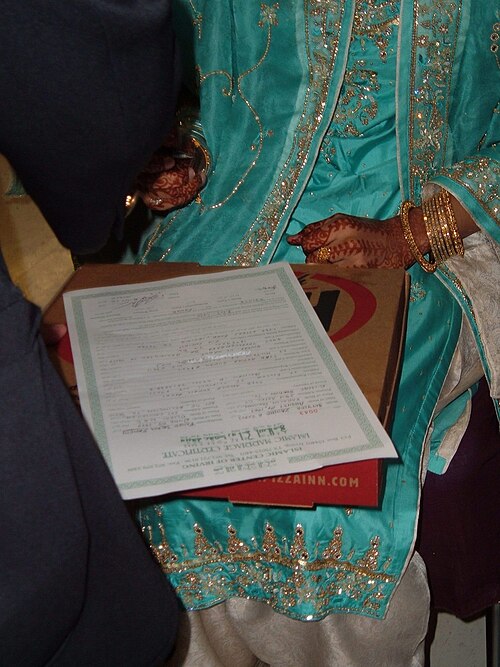

イスラム教は結婚も推奨しており、結婚年齢は個人が経済的にも精神的にも準備ができたと感じた時とされている。[268]
イスラム教では一夫多妻制は認められているが一妻多夫制は認められておらず、男性は一度に4人までの合法的な妻を持つことができ、妾として無制限の数の女性奴隷を持つことができるという具体的な制限がある。妾には妻と同様の権利があるが、男性が子供を作らない限りは自由になれないこと、男性がそれぞれの妻と妾に時間と財産を平等に分配する能力と意志があることが条件である(ユダヤ教のような妾制度は現代には当てはまらず、世界における奴隷制の役割に関する見解の変化により学者によって無効とみなされている)。[269]
イスラム教の結婚式を行うには、新郎と花嫁の後見人(ワリー)の両者が結婚に同意しなければならない。後見人が結婚に同意しない場合、結婚は法的に行われない。少女のワリーが彼女の父親または父方の祖父である場合、彼は彼女の宣言した意志に反しても彼女を結婚させる権利を持つが、それが彼女の最初の結婚である場合、この権限の行使は花嫁の利益のために非常に厳しく規制されている。花嫁を結婚させることが許される後見人はワリー・ムジュビルと呼ばれる。未成年者は法的に有効な希望を宣言する立場にないため、ワリー・ムジュビルによってのみ結婚できるが、このようにして自分の尊属以外の者と結婚した女性は、成人すると、カディによってその結婚が無効(ファスク)であると宣言されるよう要求する権利がある。[270]

イスラム法(シャリーア法)の観点から見ると、イスラム教徒の結婚における最低限の要件と責任は、新郎が新婦に生活費(住居、衣服、食料、生活費)を提供し、その見返りとして、新婦の主な責任は子供を正しいイスラム教徒として育てることです。その他のすべての権利と責任は夫と妻の間で決定され、結婚の最低限の要件に反しない限り、結婚が実際に行われる前に結婚契約の条項として含めることもできます。
スンニ派イスラム教では、結婚は少なくとも2人の信頼できる証人の前で、花嫁の保護者の同意と花婿の同意を得て行われなければならない。結婚後、カップルは結婚を完了することができる。ウルフ結婚を成立させるには、男性と女性が結婚の意思を示し、適切なイスラム教徒の前で必要な言葉を唱えるだけで十分である。結婚パーティーは通常その後に行われるが、カップルとその家族が望むときはいつでも、数日後または数ヶ月後に開催することができる。ただし、証人が必要であるため、結婚は公の通知とみなされるため、結婚を隠すことはできない。[271] [272] [273] [274]
シーア派イスラム教では、一時的なニカ・ムタ(スンニ派イスラム教では禁止されている)の場合のように証人がいなくても結婚できるが、新郎新婦双方の同意があればよい。結婚後、彼らは結婚生活を完了することができる。[275]
ユダヤ教


ユダヤ教では、結婚はトーラの法に基づいており、夫婦が互いに神聖化されることに同意する、夫婦間の契約上の絆である。[276]この契約はキドゥシーンと呼ばれる。[277]生殖が唯一の目的ではないが、ユダヤ教の結婚は、子供を持つという戒律を満たすことも期待されており、「神は彼らを祝福し、神は彼らに言った。『子を産め、増えよ』」と書かれている。 [278]主な焦点は、夫婦間の関係に集中している。カバラ的には、結婚は、夫婦が一つの魂に融合することを意味すると理解されている。カバラの思想では、結婚していない男性は「不完全」であると見なされ、その魂は統合されていない大きな全体の一部にすぎない。[279]
ヘブライ語聖書には、イサク[280] 、ヤコブ[281]、サムソン[282] など、数多くの結婚が記されている。一夫多妻制、つまり男性が一度に複数の妻を持つことは、ヘブライ語聖書に描かれている最も一般的な結婚形態の1つである。[283]もう1つは妾(ピラグシュット)制で、これは男性と女性の間で取り決められることが多く、女性は一般に正式な妻と同じ権利を享受していた。その他の妾制の方法は、士師記19-20章の著者によって観察されている。[284]また、申命記21:10-12では、戦争中に妾がいたとされている。[285]タルムードのラビたちは、結婚目的で戦争中に女性を誘拐することに不快感を示し、それは「人間の邪悪な性向に対する妥協」であり避けるべきものだと宣言した。[286]今日、アシュケナージ系ユダヤ人はゲルショム・ベン・ユダ(1040年没)によって制定された禁止令により、複数の妻を持つことが禁じられている。しかし、学術研究によれば、ダマスカス協定に基づいて一夫多妻制の禁止ははるか以前から存在していた可能性があるとされている。[287]
古代ヘブライ人にとって、結婚は家庭内の行事であり、宗教的な儀式ではありませんでした。法律では司祭や証人は必要ありませんでした。ラムバムは「トーラーが与えられる前は、男性が市場で女性と出会い、結婚を決意すると、その女性を家に連れ帰り、内密に関係を持ち、妻としていました」と書いています。しかしその後、シナイでトーラーが伝えられ、ユダヤ人は結婚には証人が必要であるという戒律を受け取りました。[288]
Betrothal (erusin), which refers to the time that this binding contract is made, is distinct from marriage itself (nissu'in), with the time between these events varying substantially.[283][289] In biblical times, a wife was regarded as personal property, belonging to her husband;[283][289] the descriptions of the Bible suggest that she would be expected to perform tasks such as spinning, sewing, weaving, manufacture of clothing, fetching of water, baking of bread, and animal husbandry.[281] A husband's obligations to his wife are 1) to provide her with food and care; 2) to supply her clothing and shelter; 3) to share a home with her; 4) to provide the ketubah (marriage contract); 5) to supply medical care if she falls ill; 6) to ransom her back if she is kidnapped; 7) to provide proper burial when she dies; 8) to provide for her materially if he predeceases her; 9) to provide for the support of their daughters until they marry or become adults; and 10) to see that their sons inherit the money specified in her ketubah, in addition to their portion of his estate.[290] Men are also obligated sexually to their wives, per BT Ketubot 61b:10, with the frequency of marital relations determined in part by the occupation (and hence availability) of the husband.[291]
Per Deuteronomy 24, because a wife was regarded as property, her husband was originally free to divorce her for any reason, at any time.[289] However, Talmudic sources complicate this matter significantly, with Beit Shammai stating that a man may divorce his wife only if she has committed a sexual transgression (such as adultery).[292] Divorcing a woman against her will was also banned by Gershom ben Judah for Ashkenazi Jews. A divorced couple were permitted to remarry, unless the wife had married someone else after her divorce.[293]
Hinduism
Hinduism regards Vivāha or Biye (marriage) to be a sacred duty that entails both religious and social obligations. It is regarded to be an important samskara, or a rite of passage.[294] Hindu texts describe four purusharthas (goals of existence): dharma (righteousness), artha (wealth), kama (desire), and moksha (liberation). The purpose of the marriage samskara is to fulfill the goal of kama, allowing an adherent to gradually advance towards the attainment of moksha. The Manusmriti describes many different types of marriages and their categorisation, ranging from the gandharva vivaha[295] (a consensual marriage of love between a man and a woman without the performance of rituals or witnesses) to the rakshasa vivaha[295] (a "demoniac" marriage, performed by abduction of one participant by the other participant, usually, but not always, with the help of other persons). In the Indian subcontinent, arranged marriages, in which the spouse's parents or an older family member choose the partner, are still predominant in comparison with love marriages in the contemporary period. The Hindu Widow's Remarriage Act 1856 empowers a Hindu widow to remarry.[296]
Buddhism
The Buddhist view of marriage considers marriage a secular affair and thus not a sacrament. Buddhists are expected to follow the civil laws regarding marriage laid out by their respective governments. Gautama Buddha, being a kshatriya was required by Shakyan tradition to pass a series of tests to prove himself as a warrior, before he was allowed to marry.
Sikhism
In a Sikh marriage, the couple walks around the Guru Granth Sahib holy book four times, and a holy man recites from it in the kirtan style. The ceremony is known as 'Anand Karaj' and represents the holy union of two souls united as one.
Wicca
Wiccan marriages are commonly known as handfastings and are a celebration held by Wiccans. Handfasting was originally a medieval ritual and has been revived by contemporary Pagans. In the ritual, the couple's wrists are tied together to symbolize the binding of two lives. It is commonly used in Wicca and Pagan ceremonies, but it has become more mainstream and comes up in both religious and secular vows and readings. Although handfastings vary for each Wiccan they often involve honoring Wiccan deities.[297] Some Wiccan traditions have a marriage vow "for as long as love lasts" instead of the traditional Christian "till death do us part". The first Wiccan wedding took place in 1960, between Frederic Lamond and his wife, Gillian. Most Wiccan traditions will celebrate same-sex and different-sex handfastings.[297] The length of commitment varies from a year and a day (after which the vows may be renewed), "as long as love shall last", for a lifetime, or for future incarnations.
Consensual sex is considered sacred for Wiccans. Some traditions perform the Great Rite, in which a High Priest and High Priestess invoke the God and Goddess on each other before making love. It can be used to raise magical energy for the use of spell work. It can also be performed symbolically, using the athame to symbolize masculine energy and the chalice to symbolize feminine energy.[298]
Health

Marriage, like other close relationships, exerts considerable influence on health.[299] Married people experience lower morbidity and mortality across such diverse health threats as cancer, heart attacks, and surgery.[300] Research on marriage and health is part of the broader study of the benefits of social relationships.
Social ties provide people with a sense of identity, purpose, belonging, and support.[301] Simply being married, as well as the quality of one's marriage, have been linked to diverse measures of health.[299][clarification needed]
The health-protective effect of marriage is stronger for men than women.[300][302] Marital status—the simple fact of being married—confers more health benefits to men than women.[300]
Women's health is more strongly impacted than men's by marital conflict or satisfaction, such that unhappily married women do not enjoy better health relative to their single counterparts.[300][302][303] Most research on marriage and health has focused on heterosexual couples; more work is needed to clarify the health impacts of same-sex marriage.[299]
Divorce and annulment
In most societies, the death of one of the partners terminates the marriage, and in monogamous societies, this allows the other partner to remarry, though sometimes after a waiting or mourning period.
In some societies, a marriage can be annulled, when an authority declares that a marriage never happened. Jurisdictions often have provisions for void marriages or voidable marriages.
A marriage may also be terminated through divorce. Countries that have relatively recently legalized divorce are Italy (1970), Portugal (1975), Brazil (1977), Spain (1981), Argentina (1987), Paraguay (1991), Colombia (1991), Ireland (1996), Chile (2004) and Malta (2011). As of 2012, the Philippines and the Vatican City are the only jurisdictions which do not allow divorce (this is currently under discussion in Philippines).[304] After divorce, one spouse may have to pay alimony. Laws concerning divorce and the ease with which a divorce can be obtained vary widely around the world. After a divorce or an annulment, the people concerned are free to remarry (or marry).
A statutory right of two married partners to mutually consent to divorce was enacted in western nations in the mid-20th century. In the United States, no-fault divorce was first enacted in California in 1969 and the final state to legalize it was New York in 1989.[305]
About 45% of marriages in Britain[306] and, according to a 2009 study, 46% of marriages in the U.S.[307] end in divorce.
History
The history of marriage is often considered under history of the family or legal history.[308]
Ancient world
Ancient Near East
Many cultures have legends concerning the origins of marriage. The way in which a marriage is conducted and its rules and ramifications have changed over time, as has the institution itself, depending on the culture or demographic of the time.[309]
The first recorded evidence of marriage ceremonies uniting a man and a woman dates back to approximately 2350 BC, in ancient Mesopotamia.[310] Wedding ceremonies, as well as dowry and divorce, can be traced back to Mesopotamia and Babylonia.[311]
According to ancient Hebrew tradition, a wife was seen as being property of high value and was, therefore, usually, carefully looked after.[283][289] Early nomadic communities in the Middle East practiced a form of marriage known as beena, in which a wife would own a tent of her own, within which she retains complete independence from her husband;[312] this principle appears to survive in parts of early Israelite society, as some early passages of the Bible appear to portray certain wives as each owning a tent as a personal possession[312] (specifically, Jael,[313] Sarah,[314] and Jacob's wives[315]).
The husband, too, is indirectly implied to have some responsibilities to his wife. The Covenant Code orders "If he take him another; her food, her clothing, and her duty of marriage, shall he not diminish (or lessen)".[316] If the husband does not provide the first wife with these things, she is to be divorced, without cost to her.[317] The Talmud interprets this as a requirement for a man to provide food and clothing to, and have sex with, each of his wives.[318][clarification needed] However, "duty of marriage" is also interpreted as whatever one does as a married couple, which is more than just sexual activity. And the term diminish, which means to lessen, shows the man must treat her as if he was not married to another.
As a polygynous society, the Israelites did not have any laws that imposed marital fidelity on men.[319][320] However, the prophet Malachi states that none should be faithless to the wife of his youth and that God hates divorce.[321] Adulterous married women, adulterous betrothed women, and the men who slept with them, however, were subject to the death penalty by the biblical laws against adultery[322][323][324] According to the Priestly Code of the Book of Numbers, if a pregnant[325] woman was suspected of adultery, she was to be subjected to the Ordeal of Bitter Water,[326] a form of trial by ordeal, but one that took a miracle to convict. The literary prophets indicate that adultery was a frequent occurrence, despite their strong protests against it,[327][328][329][330] and these legal strictness's.[319]
Classical Greece and Rome
In ancient Greece, no specific civil ceremony was required for the creation of a heterosexual marriage – only mutual agreement and the fact that the couple must regard each other as husband and wife accordingly.[331] Men usually married when they were in their 20s and women in their teens.[332] It has been suggested that these ages made sense for the Greeks because men were generally done with military service or financially established by their late 20s, and marrying a teenage girl ensured ample time for her to bear children, as life expectancies were significantly lower.[citation needed] Married Greek women had few rights in ancient Greek society and were expected to take care of the house and children.[citation needed] Time was an important factor in Greek marriage. For example, there were superstitions that being married during a full moon was good luck and Greeks married in the winter in honor of Hera.[331] Inheritance was more important than feelings: a woman whose father dies without male heirs could be forced to marry her nearest male relative – even if she had to divorce her husband first.[333]
There were several types of marriages in ancient Roman society. The traditional ("conventional") form called conventio in manum required a ceremony with witnesses and was also dissolved with a ceremony.[334] In this type of marriage, a woman lost her family rights of inheritance of her old family and gained them with her new one. She now was subject to the authority of her husband.[335] There was the free marriage known as sine manu. In this arrangement, the wife remained a member of her original family; she stayed under the authority of her father, kept her family rights of inheritance with her old family and did not gain any with the new family.[336] The minimum age of marriage for girls was 12.[337]
Germanic tribes

Among ancient Germanic tribes, the bride and groom were roughly the same age and generally older than their Roman counterparts, at least according to Tacitus:
The youths partake late of the pleasures of love, and hence pass the age of puberty unexhausted: nor are the virgins hurried into marriage; the same maturity, the same full growth is required: the sexes unite equally matched and robust, and the children inherit the vigor of their parents.[338]
Where Aristotle had set the prime of life at 37 years for men and 18 for women, the Visigothic Code of law in the 7th century placed the prime of life at 20 years for both men and women, after which both presumably married. Tacitus states that ancient Germanic brides were on average about 20 and were roughly the same age as their husbands.[339] Tacitus, however, had never visited the German-speaking lands and most of his information on Germania comes from secondary sources. In addition, Anglo-Saxon women, like those of other Germanic tribes, are marked as women from the age of 12 and older, based on archaeological finds, implying that the age of marriage coincided with puberty.[340]
Europe

From the early Christian era (30 to 325 CE), marriage was thought of as primarily a private matter, with no uniform religious or other ceremony being required.[341] However, bishop Ignatius of Antioch writing around 110 to bishop Polycarp of Smyrna exhorts, "[I]t becomes both men and women who marry, to form their union with the approval of the bishop, that their marriage may be according to God, and not after their own lust."[342]
In 12th-century Europe, women took the surname of their husbands and starting in the second half of the 16th century parental consent along with the church's consent was required for marriage.[343]
With few local exceptions, until 1545, Christian marriages in Europe were by mutual consent, declaration of intention to marry and upon the subsequent physical union of the parties.[344][345] The couple would promise verbally to each other that they would be married to each other; the presence of a priest or witnesses was not required.[346] This promise was known as the "verbum." If freely given and made in the present tense (e.g., "I marry you"), it was unquestionably binding;[344] if made in the future tense ("I will marry you"), it would constitute a betrothal.
In 1552, a wedding took place in Zufia, Navarre, between Diego de Zufia and Mari-Miguel following the custom as it was in the realm since the Middle Ages, but the man denounced the marriage on the grounds that its validity was conditioned to "riding" her ("si te cabalgo, lo cual dixo de bascuence (...) balvin yo baneça aren senar içateko"). The tribunal of the kingdom rejected the husband's claim, validating the wedding, but the husband appealed to the tribunal in Zaragoza, and this institution annulled the marriage.[347] According to the Charter of Navarre, the basic union consisted of a civil marriage with no priest required and at least two witnesses, and the contract could be broken using the same formula.[citation needed] The Church in turn lashed out at those who got married twice or thrice in a row while their formers spouses were still alive. In 1563 the Council of Trent, twenty-fourth session, required that a valid marriage must be performed by a priest before two witnesses.[347]
One of the functions of churches from the Middle Ages was to register marriages, which was not obligatory. There was no state involvement in marriage and personal status, with these issues being adjudicated in ecclesiastical courts. During the Middle Ages marriages were arranged, sometimes as early as birth, and these early pledges to marry were often used to ensure treaties between different royal families, nobles, and heirs of fiefdoms. The church resisted these imposed unions, and increased the number of causes for nullification of these arrangements.[343] As Christianity spread during the Roman period and the Middle Ages, the idea of free choice in selecting marriage partners increased and spread with it.[343]
In medieval Western Europe, later marriage and higher rates of definitive celibacy (the so-called "European marriage pattern") helped to constrain patriarchy at its most extreme level. For example, Medieval England saw marriage age as variable depending on economic circumstances, with couples delaying marriage until the early twenties when times were bad and falling to the late teens after the Black Death, when there were labor shortages;[348] by appearances, marriage of adolescents was not the norm in England.[349][350] Where the strong influence of classical Celtic and Germanic cultures (which were not rigidly patriarchal)[351][352] helped to offset the Judaeo-Roman patriarchal influence,[353] in Eastern Europe the tradition of early and universal marriage (often in early adolescence),[354] as well as traditional Slavic patrilocal custom,[355] led to a greatly inferior status of women at all levels of society.[356]

The average age of marriage for most of Northwestern Europe from 1500 to 1800 was around 25 years of age;[357][358][359] as the Church dictated that both parties had to be at least 21 years of age to marry without the consent of their parents, the bride and groom were roughly the same age, with most brides in their early twenties and most grooms two or three years older,[359] and a substantial number of women married for the first time in their thirties and forties, particularly in urban areas,[360] with the average age at first marriage rising and falling as circumstances dictated. In better times, more people could afford to marry earlier and thus fertility rose and conversely marriages were delayed or forgone when times were bad, thus restricting family size;[361] after the Black Death, the greater availability of profitable jobs allowed more people to marry young and have more children,[362] but the stabilization of the population in the 16th century meant fewer job opportunities and thus more people delaying marriages.[363]
The age of marriage was not absolute, however, as child marriages occurred throughout the Middle Ages and later, with just some of them including:
- The 1552 CE marriage between John Somerford and Jane Somerford Brereto, at the ages of 3 and 2, respectively.[44]
- In the early 1900s, Magnus Hirschfeld surveyed the age of consent in about 50 countries, which he found to often range between 12 and 16. In the Vatican, the age of consent was 12.[364]
As part of the Protestant Reformation, the role of recording marriages and setting the rules for marriage passed to the state, reflecting Martin Luther's view that marriage was a "worldly thing".[365] By the 17th century, many of the Protestant European countries had a state involvement in marriage.
In England, under the Anglican Church, marriage by consent and cohabitation was valid until the passage of Lord Hardwicke's Act in 1753. This act instituted certain requirements for marriage, including the performance of a religious ceremony observed by witnesses.[366]

As part of the Counter-Reformation, in 1563 the Council of Trent decreed that a Roman Catholic marriage would be recognized only if the marriage ceremony was officiated by a priest with two witnesses. The council also authorized a Catechism, issued in 1566, which defined marriage as "The conjugal union of man and woman, contracted between two qualified persons, which obliges them to live together throughout life."[234]
In the early modern period, John Calvin and his Protestant colleagues reformulated Christian marriage by enacting the Marriage Ordinance of Geneva, which imposed "The dual requirements of state registration and church consecration to constitute marriage"[234] for recognition.
In England and Wales, Lord Hardwicke's Marriage Act 1753 required a formal ceremony of marriage, thereby curtailing the practice of Fleet Marriage, an irregular or a clandestine marriage.[367] These were clandestine or irregular marriages performed at Fleet Prison, and at hundreds of other places. From the 1690s until the Marriage Act of 1753 as many as 300,000 clandestine marriages were performed at Fleet Prison alone.[368] The Act required a marriage ceremony to be officiated by an Anglican priest in the Anglican Church with two witnesses and registration. The Act did not apply to Jewish marriages or those of Quakers, whose marriages continued to be governed by their own customs.

In England and Wales, since 1837, civil marriages have been recognized as a legal alternative to church marriages under the Marriage Act 1836. In Germany, civil marriages were recognized in 1875. This law permitted a declaration of the marriage before an official clerk of the civil administration, when both spouses affirm their will to marry, to constitute a legally recognized valid and effective marriage, and allowed an optional private clerical marriage ceremony.
In contemporary English common law, a marriage is a voluntary contract by a man and a woman, in which by agreement they choose to become husband and wife.[369] Edvard Westermarck proposed that "the institution of marriage has probably developed out of a primeval habit".[370]
Since the late twentieth century, major social changes in Western countries have led to changes in the demographics of marriage, with the age of first marriage increasing, fewer people marrying, and more couples choosing to cohabit rather than marry. For example, the number of marriages in Europe decreased by 30% from 1975 to 2005.[371] As of 2000, the average marriage age range was 25–44 years for men and 22–39 years for women.
China
The mythological origin of Chinese marriage is a story about Nüwa and Fu Xi who invented proper marriage procedures after becoming married. In ancient Chinese society, people of the same surname are supposed to consult with their family trees prior to marriage to reduce the potential risk of unintentional incest. Marrying one's maternal relatives was generally not thought of as incest. Families sometimes intermarried from one generation to another. Over time, Chinese people became more geographically mobile. Individuals remained members of their biological families. When a couple died, the husband and the wife were buried separately in the respective clan's graveyard. In a maternal marriage, a male would become a son-in-law who lived in the wife's home.
The New Marriage Law of 1950 radically changed Chinese marriage traditions, enforcing monogamy, equality of men and women, and choice in marriage; arranged marriages were the most common type of marriage in China until then. Starting October 2003, it became legal to marry or divorce without authorization from the couple's work units.[372][clarification needed] Although people with infectious diseases such as AIDS may now marry, marriage is still illegal for the mentally ill.[373]
Korea
The practice of matrilocality in Korea started in the Goguryeo period, continued through the Goryeo period and ended in the early Joseon period.[374][375] The Korean saying that when a man gets married, he is "entering jangga" (the house of his father-in-law), stems from the Goguryeo period.[376]
See also
- Avunculate marriage
- Convention on Consent to Marriage, Minimum Age for Marriage and Registration of Marriages
- List of countries by marriage rate
- List of coupled cousins
- Marriage certificate
- Relationship science
- Bride buying
- Wedding
- Elopement
- Collective wedding
- White wedding
- Black wedding
- Interethnic marriage
- Interracial marriage
- Interfaith marriage
- Interdenominational marriage
- Intercommunity marriage
- Transnational marriage
- Gay marriage
Notes
- ^ Same-sex marriage is performed and recognized by law in the Netherlands proper, including Bonaire, Sint Eustatius and Saba. Marriages entered into there have minimal recognition in Aruba, Curaçao and Sint Maarten.
- ^ Same-sex marriage is performed and recognized by law in New Zealand proper, but not in Tokelau, the Cook Islands or Niue, which together make up the Realm of New Zealand.
- ^ Except the British Overseas Territories of Anguilla, the British Virgin Islands, the Cayman Islands, Montserrat and the Turks and Caicos Islands.
- ^ Same-sex marriage is performed and recognized by law in all fifty states and the District of Columbia, all territories except American Samoa, and in some tribal nations.
References
- ^ Haviland, William A.; Prins, Harald E.L.; McBride, Bunny; Walrath, Dana (2011). "Chapter 9: Sex, Marriage, and Family". Cultural Anthropology: The Human Challenge (13th ed.). Cengage Learning. p. 209. ISBN 978-0-495-81178-7. "A nonethnocentric definition of marriage is a culturally sanctioned union between two or more people that establishes certain rights and obligations between the people, between them and their children, and between them and their in-laws."
- ^ Ember CR, Gonzalez B, McCloskey D (16 July 2021), Ember CR (ed.), "Marriage and Family" (PDF), Explaining Human Culture (Topical summary), New Haven, Ct.: Human Relations Area Files, p. 5, retrieved 17 March 2024
- ^ United States Department of State (December 2010). Country Reports on Human Rights Practices for 2008 (PDF) (Report). Vol. 1. p. 1353. Retrieved 17 March 2024.
- ^ Baten, Joerg; de Pleijt, Alexandra M. (2018). "Girl power Generates Superstars in Long-term Development: Female Autonomy and Human Capital Formation in Early Modern Europe". CEPR Working Paper. 13348.
- ^ Harper, Douglas R. (13 October 2021). "marriage (n.)". Online Etymology Dictionary. Retrieved 17 March 2024.
- ^ Oxford English Dictionary 11th Edition, "marriage"
- ^ "matrimony (n.)". Online Etymology Dictionary.
- ^ a b c Bell, Duran (1997). "Defining Marriage and Legitimacy" (PDF). Current Anthropology. 38 (2): 237–54. doi:10.1086/204606. JSTOR 2744491. S2CID 144637145. Archived from the original (PDF) on 24 May 2017. Retrieved 6 April 2013.
- ^ Gerstmann, Evan (2004). Same-sex marriage and the Constitution. Cambridge [England]; New York : Cambridge University Press. p. 22. ISBN 978-0-521-81100-2 – via Internet Archive.
- ^ Westermarck, Edward (26 October 2017). History of Human Marriage. Vol. 1 (5th ed.). New York: The Allerton Book Company (published 1922). p. 71. ISBN 978-0-7661-4618-1 – via Internet Archive.
- ^ Westermarck, Edward (1936). The Future of Marriage in Western Civilisation. Macmillan. p. 3. ISBN 978-0-8369-5304-6 – via Internet Archive.
- ^ Notes and Queries on Anthropology. Royal Anthropological Institute. 1951. p. 110.
- ^ Gough, E. Kathleen (1959). "The Nayars and the Definition of Marriage". Royal Anthropological Institute of Great Britain and Ireland. 89 (1): 23–34. doi:10.2307/2844434. ISSN 0307-3114. JSTOR 2844434. Nuer female-female marriage is done to keep property within a family that has no sons. It is not a form of lesbianism.
- ^ Gough, Kathleen (1968). "The Nayars and the Definition of Marriage". In Paul Bohannan & John Middleton (ed.). Marriage, Family and Residence. New York: Natural History Press. p. 68.
- ^ Leach, Edmund (December 1955). "Polyandry, Inheritance and the Definition of Marriage". Man. 55 (12): 183. doi:10.2307/2795331. JSTOR 2795331.
- ^ Lung, Tang (2014). "Marriage of Inanna and Dumuzi". World History Encyclopedia.
- ^ a b Goody, Jack (1976). Production and Reproduction: A Comparative Study of the Domestic Domain. Cambridge: Cambridge University Press. p. 7.
- ^ Roes, Frans L. (1992). "The Size of Societies, Monogamy, and Belief in High Gods Supporting Human Morality". Tijdschrift voor Sociale Wetenschappen. 37 (1): 53–58.
- ^ "The Demographics of Remarriage". Pew Research Center's Social & Demographic Trends Project. 14 November 2014. Retrieved 28 June 2021.
- ^ Fox, Robin (1997). Reproduction & Succession: Studies in Anthropology, Law and Society. New Brunswick, NJ: Transaction Publishers. p. 34.
- ^ Simpson, Bob (1998). Changing Families: An Ethnographic Approach to Divorce and Separation. Oxford: Berg.
- ^ a b Zeitzen, Miriam Koktvedgaard (2008). Polygamy: a cross-cultural analysis. Berg. p. 3. ISBN 978-1-84520-220-0.
- ^ Dupanloup I, Pereira L, Bertorelle G, Calafell F, Prata MJ, Amorim A, Barbujani G (2003). "A recent shift from polygyny to monogamy in humans is suggested by the analysis of worldwide Y-chromosome diversity". J Mol Evol. 57 (1): 85–97. Bibcode:2003JMolE..57...85D. CiteSeerX 10.1.1.454.1662. doi:10.1007/s00239-003-2458-x. PMID 12962309. S2CID 2673314.
- ^ Ember, Carol R. (2011). "What we know and what we don't know about variation in social organization: Melvin Ember's approach to the study of kinship". Cross-Cultural Research. 45 (1): 27–30. doi:10.1177/1069397110383947. S2CID 143952998.
- ^ Ethnographic Atlas Codebook Archived 18 November 2012 at the Wayback Machine derived from George P. Murdock's Ethnographic Atlas recording the marital composition of 1231 societies from 1960 to 1980
- ^ a b Zeitzen, Miriam Koktvedgaard (2008). Polygamy: A Cross-Cultural Analysis. Oxford: Berg. p. 5. ISBN 978-1-84788-617-0.
- ^ Fox, Robin (1997). Reproduction & Succession: Studies in Anthropology, Law, and Society. New Brunswick, NJ: Transaction Publishers. p. 48.
- ^ Zeitzen, Miriam Koktvedgaard (2008). Polygamy: A Cross-Cultural Analysis. Oxford: Berg. pp. 125–27.
- ^ a b Zeitzen, Miriam Koktvedgaard (2008). Polygamy: A Cross-Cultural Analysis. Oxford: Berg. p. 9.
- ^ Fox, Robin (1997). Reproduction & Succession: Studies in Anthropology, Law and Society. New Brunswick, NJ: Transaction Publishers. p. 21.
- ^ Zeitzen, Miriam Koktvedgaard (2008). Polygamy: A Cross-Cultural Analysis. Oxford: Berg. pp. 17, 89–107.
- ^ Starkweather, Katherine; Hames, Raymond (June 2012). "A survey of non-classical polyandry". Human Nature. 23 (2): 149–72. doi:10.1007/s12110-012-9144-x. PMID 22688804. S2CID 2008559. Archived from the original on 23 September 2017.
- ^ Starkweather, Katherine; Hames, Raymond (June 2012). "A survey of non-classical polyandry". Human Nature. 23 (2): 149–72. doi:10.1007/s12110-012-9144-x. PMID 22688804. S2CID 2008559.
- ^ Levine, Nancy (1998). The Dynamics of polyandry: kinship, domesticity, and population on the Tibetan border. Chicago: University of Chicago Press.
- ^ Murdock, 1949, p. 24. "group marriage or a marital union embracing at once several men and several women."
- ^ "Group Marriage". Encyclopædia Britannica. 9 October 2023.
- ^ Child Marriage Archived 7 September 2018 at the Wayback Machine UNICEF (2011)
- ^ "Q & A: Child Marriage and Violations of Girls' Rights – Human Rights Watch". 14 June 2013. Retrieved 7 October 2014.
- ^ Robertson, Stephen. "Age of Consent Laws (Table)". Children & Youth in History. Archived from the original on 7 June 2010. Retrieved 3 February 2023.
- ^ "Understanding State Statutes on Minimum Marriage Age and Exceptions Laws" (PDF). Tahirih Justice Center. Archived from the original (PDF) on 15 December 2016. Retrieved 27 May 2017.
- ^ a b c d e "I have a right to". BBC World Service. Retrieved 7 October 2014.
- ^ a b "Child marriages: 39,000 every day". WHO. Archived from the original on 14 March 2013. Retrieved 7 October 2014.
- ^ Bullough, Vern L. "Age of Consent". Encyclopedia. Gale Group. Retrieved 18 October 2015.
- ^ a b Hermann Heinrich Ploss; Max Bartels; Paul Bartels (1935). Woman: An Historical Gynæcological and Anthropological Compendium. London: William Heinemann (Medical Books) Ltd. p. 129. ISBN 978-1-4831-9419-6.
- ^ A Note on Child Marriage Archived 19 August 2018 at the Wayback Machine UNICEF (July 2012), p. 3
- ^ Matilda Coxe Stevenson, The Zuni Indians: Their Mythology, Esoteric Fraternities, and Ceremonies, (BiblioBazaar, 2010) p. 37 Quote: "the most intelligent person in the pueblo. Strong character made his word law among both men and women with whom he associated. Though his wrath was dreaded by men as well as women, he was loved by all children, to whom he was ever kind."
- ^ Eskridge, William N. (1993). "A History of Same-Sex Marriage". Virginia Law Review. 79 (7): 1453–58. doi:10.2307/1073379. JSTOR 1073379.
- ^ Alderson, Kevin; Lahey, Kathleen A. (2004). Same-Sex Marriage: The Personal and the Political. Insomniac Press. p. 16. ISBN 978-1-894663-63-2.
- ^ ubi scelus est id, quod non proficit scire, ubi venus mutatur in alteram formam, ubi amor quaeritur nec videtur, iubemus insurgere leges, armari iura gladio ultore, ut exquisitis poenis subdantur infames, qui sunt vel qui futuri sunt rei.Ancientrome.ru "where that crime is found, which is unfit even to know, we command the law to arise armed with an avenging sword that the infamous men who are, or shall in future be guilty of it, may undergo the most severe punishments." translation by Lord William Blackstone, Commentaries on the Laws of England Oxford: Clarendon Press, 1769, Vol. IV, pp. 215–16.
- ^ Kuefler, Mathew (2007). "The Marriage Revolution in Late Antiquity: The Theodosian Code and Later Roman Marriage Law". Journal of Family History. 32 (4): 343–70. doi:10.1177/0363199007304424. S2CID 143807895.
- ^ Hinsch, Bret (1990). Passions of the Cut Sleeve: The Male Homosexual Tradition in China. Reed Business Information, Inc. ISBN 978-0-520-07869-7.
- ^ "Gay Marriage in Montaigne". bway.net. 5 December 1998. Archived from the original on 5 December 1998. Retrieved 5 December 2017.
{{cite web}}: CS1 maint: bot: original URL status unknown (link) - ^ İlkkaracan, Pınar (2008). Deconstructing sexuality in the Middle East: challenges and discourses. Ashgate Publishing, Ltd. p. 36. ISBN 978-0-7546-7235-7.
- ^ Inhorn, Marcia (2006). "Making Muslim Babies: IVF and Gamete Donation in Sunni versus Shi'a Islam". Culture, Medicine and Psychiatry. 30 (4): 427–50. doi:10.1007/s11013-006-9027-x. PMC 1705533. PMID 17051430.
- ^ Income Tax Assessment Act 1997 – Sect 995.1(1): ""spouse" of an individual includes: (a) another individual (whether of the same sex or a different sex) with whom the individual is in a relationship that is registered under a * State law or * Territory law prescribed for the purposes of section 22B of the Acts Interpretation Act 1901 as a kind of relationship prescribed for the purposes of that section; and (b) another individual who, although not legally married to the individual, lives with the individual on a genuine domestic basis in a relationship as a couple."
- ^ Cherlin, Andrew J. (2004). "The Deinstitutionalization of American Marriage" (PDF). Journal of Marriage and the Family. 66 (4): 848–61. CiteSeerX 10.1.1.614.8920. doi:10.1111/j.0022-2445.2004.00058.x. Archived from the original (PDF) on 1 February 2017. Retrieved 25 October 2017.
- ^ Gargan, Edward A. (19 March 2001). "China's New Brides Put Freedom First/All perks, no work in 'walking marriages'". Newsday. p. A.04.
- ^ Karam, Souhail (21 July 2006). "Misyar offers marriage-lite in strict Saudi society". The Boston Globe. Reuters. Archived from the original on 18 February 2009.
- ^ "A Wife Wanted". Royal Cornwall Gazette, Falmouth Packet and Plymouth Journal. 18 October 1828. p. 3.
- ^ "World Fertility Report: 2003". United Nations. 2004. Archived from the original on 29 July 2004. Retrieved 26 April 2006.
- ^ "World Marriage Patterns 2000". United Nations. 2000. Retrieved 26 April 2006.
- ^ DREFAHL, SVEN (7 May 2010). "How Does the Age Gap Between Partners Affect Their Survival?". Demography. 47 (2): 313–326. doi:10.1353/dem.0.0106. PMC 3000022. PMID 20608099.
- ^ "Mind the gap – does age difference in relationships matter?". phys.org.
- ^ Harmanci, Reyhan (15 April 2020). "The Truth About Pregnancy Over 40". The New York Times. Archived from the original on 15 April 2020.
- ^ Stephen K. Sanderson (2010), "Why Rational Choice Theory and Sociobiology Are Natural Allies" (PDF), Evolution, Biology and Society, 7 (1), archived from the original (PDF) on 18 April 2015, retrieved 18 April 2015
- ^ Lancaster, J.B.; Altmann, J.; Sherrod, L.R.; Rossi, A. (2010). Parenting Across the Life Span: Biosocial Dimensions. Aldine Transaction. ISBN 978-1-4128-4452-9.
- ^ Hopcroft, Rosemary L. (April 2021). "High income men have high value as long-term mates in the U.S. (abstract)". Evolution and Human Behavior. 42 (3). doi:10.1016/j.evolhumbehav.2021.03.004. S2CID 233667442. Retrieved 26 March 2021.
- ^ Strong, Anise (2006). "Incest Laws and Absent Taboos in Roman Egypt". Ancient History Bulletin. 20.
- ^ Lewis, N. (1983). Life in Egypt under Roman Rule. Clarendon Press. ISBN 978-0-19-814848-7.
- ^ Frier, Bruce W.; Bagnall, Roger S. (1994). The Demography of Roman Egypt. Cambridge, UK: Cambridge University Press. ISBN 978-0-521-46123-8.
- ^ Shaw, B.D. (1992). "Explaining Incest: Brother-Sister Marriage in Graeco-Roman Egypt". Man. New Series. 27 (2): 267–99. doi:10.2307/2804054. JSTOR 2804054.
- ^ Hopkins, Keith (1980). "Brother-Sister Marriage in Roman Egypt". Comparative Studies in Society and History. 22 (3): 303–54. doi:10.1017/S0010417500009385. S2CID 143698328.
- ^ remijsen, sofie. "Incest or Adoption? Brother-Sister Marriage in Roman Egypt Revisited" (PDF).
- ^ Scheidel, W. (1997). "Brother-sister marriage in Roman Egypt" (PDF). Journal of Biosocial Science. 29 (3): 361–71. doi:10.1017/s0021932097003611. PMID 9881142. S2CID 23732024. Archived from the original (PDF) on 2 November 2013. Retrieved 4 July 2013.
- ^ Conniff, Richard (1 August 2003). "Richard Conniff. "Go Ahead, Kiss Your Cousin."". Discovermagazine.com.
- ^ Kershaw, Sarah (26 November 2009). "Shaking Off the Shame". The New York Times.
- ^ See Article 809 of the Korean Civil Code and "The first ten years of the Korean Constitutional Court" (PDF). Constitutional Court of Korea. p. 242 (p. 256 of the PDF). Archived from the original (PDF) on 19 February 2012.
- ^ Law Reform (Marriage and Divorce) Act 1976 Archived 7 March 2012 at the Wayback Machine (for Hindus only)
- ^ (in Russian) The Family Code of the Russian Federation, Article 14 (in Russian). Semkodeks.ru (13 May 2009). Retrieved on 5 September 2013.
- ^ Ottenheimer, Martin (1996). "Chapter 3". Forbidden Relatives: The American Myth of Cousin Marriage. University of Illinois.
- ^ "Islamic View on Marrying Cousins". IslamonLine.net. Archived from the original on 16 July 2007. Retrieved 4 June 2017.
- ^ Bourdieu, Pierre (1972). Outline of a Theory of Practice. Cambridge: Cambridge University Press. pp. 27–29.
- ^ Radcliffe-Brown, A.R., Daryll Forde (1950). African Systems of Kinship and Marriage. London: KPI Limited.
- ^ Lévi-Strauss, Claude (1963). Structural Anthropology. New York: Basic Books. ISBN 978-0-465-08230-8.
- ^ "Orange County Register". Orange County Register. 4 July 2021. Retrieved 4 July 2021.
- ^ Ethics – Slavery: Modern slavery. BBC. Retrieved on 5 September 2013.
- ^ Report of the Special Rapporteur on contemporary forms of slavery, including its causes and consequences, Gulnara Shahinian. United Nations. Human Rights Council Twenty-first session. 10 July 2012
- ^ "Child Marriage Factsheet: State of World Population 2005". UNFPA. Archived from the original on 16 August 2007.
- ^ Goody, Jack (1976). Production and Reproduction: A Comparative Study of the Domestic Domain. Cambridge: Cambridge University Press. p. 6.
- ^ "India's dowry deaths". BBC News. 16 July 2003.
- ^ Anita Pratap (11 September 1995) Women: killed by greed and oppression". Time Magazine. Volume 146, No. 11
- ^ "Nepal bans dowry, caste-based discrimination – OneWorld South Asia". Southasia.oneworld.net. 27 January 2009. Archived from the original on 20 July 2012. Retrieved 26 September 2012.
- ^ Tanwar, Reicha (2007). Dowery the North Indian Perspective. Pinnacle Technology. pp. 36–. ISBN 978-1-61820-208-6.
- ^ Goody, Jack (1976). Production and Reproduction: A Comparative Study of the Domestic Domain. Cambridge: Cambridge University Press. p. 8.
- ^ Exodus 22:15–16
- ^ "A translation of some parts of the Civil Code of Iran". International-divorce.com.
- ^ "What are marriage penalties and bonuses?". Tax Policy Center. Retrieved 28 June 2021.
- ^ Renacci, James B. "Simplifying America's Tax System." Simplifying America's Tax System (2016): 1–11. Renacci.house.gov. July 2016. Web. 26 Feb. 2017.
- ^ Hanegbi, Rami (15 December 2023). "INCOME SPLITTING IN AUSTRALIA: TIME FOR A PRINCIPLED APPROACH?". Adelaide Law Review. 44 (2). University of Adelaide.
- ^ Rosenblatt, Paul C. (2006). Two in a Bed: The Social System of Couple Bed Sharing. State University of New York Press. ISBN 978-0-7914-6829-6. Archived from the original on 3 July 2009. Retrieved 13 January 2007.
- ^ Sanday, Peggy Reeves (2002). Women at the center: life in a modern matriarchy. Cornell University Press. ISBN 978-0-8014-8906-8.
- ^ For example, Lewis Henry Morgan, Edward Tylor, or George Peter Murdock
- ^ as has been shown by Korotayev
- ^ Korotayev, A. (2003). "Form of marriage, sexual division of labor, and postmarital residence in cross-cultural perspective: A reconsideration". Journal of Anthropological Research. 59 (1): 69–89. doi:10.1086/jar.59.1.3631445. JSTOR 3631445. S2CID 147513567.
- ^ Korotayev, A. (2003). "Division of Labor by Gender and Postmarital Residence in Cross-Cultural Perspective: A Reconsideration". Cross-Cultural Research. 37 (4): 335–72. doi:10.1177/1069397103253685. S2CID 145694651.
- ^ Ember, Melvin; Ember, Carol R. (1983). Marriage, Family, and Kinship: Comparative Studies of Social Organization. New Haven: HRAF Press. ISBN 978-0-87536-113-0.
- ^ Leach, Edmund (1968). Paul Bonannan and John Middleton (ed.). Marriage, Family, and Residence. The Natural History Press. ISBN 978-1-121-64470-0.
- ^ Krier, James E.; Gregory S. Alexander; Michael H. Schill; Jesse Dukeminier (2006). Property. Aspen Publishers. ISBN 978-0-7355-5792-5. Excerpt – p. 335: "...at the wedding; hence the importance of including in the marriage ceremony the words, 'With all my worldly goods I thee endow.'"
- ^ Gallagher, Maggie (2002). "What is Marriage For? The Public Purposes of Marriage Law" (PDF). Louisiana law review.
- ^ "Adultery" Encyclopædia Britannica
- ^ Q & A: Child Marriage and Violations of Girls' Rights | Human Rights Watch. Hrw.org (14 June 2013). Retrieved on 5 September 2013.
- ^ WHO | Child marriages: 39,000 every day. Who.int (7 March 2013). Retrieved on 6 April 2013.
- ^ "State Variations on American Marriage Prohibitions". www.umanitoba.ca. Retrieved 10 July 2021.
- ^ Hafen, Bruce C. (1983). "The Constitutional Status of Marriage, Kinship, and Sexual Privacy: Balancing the Individual and Social Interests". Michigan Law Review. 81 (3): 463–574. doi:10.2307/1288509. ISSN 0026-2234. JSTOR 1288509.
- ^ Campagno, Marcelo (18 August 2014). "Patronage and Other Logics of Social Organization in Ancient Egypt during the IIIrd Millennium bce". Journal of Egyptian History. 7 (1): 1–33. doi:10.1163/18741665-12340012. hdl:11336/33193. ISSN 1874-1657.
- ^ Frank W Sweet (1 January 2005). "The Invention of the Color Line: 1691—Essays on the Color Line and the One-Drop Rule". Backentyme Essays. Archived from the original on 9 April 2007.
{{cite journal}}: Cite journal requires|journal=(help) - ^ Karthikeyan, Hrishi; Chin, Gabriel (2002). "Preserving Racial Identity: Population Patterns and the Application of Anti-Miscegenation Statutes to Asian Americans, 1910–1950". Asian Law Journal. 9 (1). SSRN 283998.
- ^ "Where were Interracial Couples Illegal?". LovingDay. Archived from the original on 31 December 2007. Retrieved 5 August 2013.
- ^ "Courtroom History" Archived 31 December 2007 at the Wayback Machine Lovingday.org Retrieved 28 June 2007
- ^ Stein, Edward (2004). "Past and present proposed amendments to the United States constitution regarding marriage". Washington University Law Quarterly. 82 (3). SSRN 576181.
- ^ Michael Burleigh (7 November 1991). The Racial State: Germany 1933–1945. Cambridge University Press. p. 49. ISBN 978-0-521-39802-2.
- ^
- "Inter-American Human Rights Court backs same-sex marriage". BBC. 10 January 2018. Retrieved 6 April 2018.
- "Obergefell v. Hodges, 576 U.S. ___ (2015)". Justia. 26 June 2015. Retrieved 6 April 2018.
- Smith, Susan K. (30 July 2009). "Marriage a Civil Right, not Sacred Rite". The Washington Post. Archived from the original on 3 October 2012. Retrieved 20 September 2012.
- "Decision in Perry v. Schwarzenegger" (PDF). Archived from the original (PDF) on 16 March 2013. Retrieved 6 August 2010.
- ^
- "Two in Three Americans Support Same-Sex Marriage". Gallup. 23 May 2018.
- "For several years a majority of Australians have supported marriage equality". Australian Marriage Equality Incorporated. Retrieved 22 May 2015.
- "Support for Same-Sex Marriage in Latin America" (PDF). Vanderbilt University. Retrieved 25 September 2012.
- ^ "Polygamy in Muslim countries". Waleg.com. 26 June 2005. Archived from the original on 1 September 2013. Retrieved 4 August 2013.
- ^ Berstein, Nina (25 March 2007). "Polygamy, Practiced in Secrecy, Follows Africans to New York City". The New York Times. Archived from the original on 20 July 2008.
- ^ "Tunisia: Notable Features: Polygamy". Law.emory.edu.
- ^ a b Hagerty, Barbara Bradley (27 May 2008). "Some Muslims in U.S. Quietly Engage in Polygamy". National Public Radio: All Things Considered.
- ^ Lyman, Edward Leo (1994). "Statehood for Utah". In Powell, Allan Kent (ed.). Utah History Encyclopedia. Salt Lake City, Utah: University of Utah Press. ISBN 978-0-87480-425-6. OCLC 30473917. Archived from the original on 1 November 2013.
- ^ "Sri Lanka: Family Code". Genderindex.org. Archived from the original on 27 October 2010.
- ^ See Polygamy in India
- ^ "Turkish Civil and Penal Code Reforms from a Gender Perspective: The Success of two Nationwide Campaigns" (PDF). Archived from the original (PDF) on 31 December 2006. (6.21 MB) (p. 18)
- ^ a b "Common Law Marriage FAQ." Nolo. 31 July 2009.
- ^ NYC Protest and Civil Rights March Opposing Proposition 8, Andy Towle, Towleroad.com, 13 November 2008. Retrieved 14 November 2008.
- ^ "Immigration to the United States: Fiscal years 1820–2003" (PDF). (2.03 MB)
- ^ "Sham marriage: Married on the day they met to prolong her stay". Retrieved 26 June 2014.
- ^ Tatiana D. Gray, Matt Hawrilenko, and James V. Cordova (2019). "Randomized Controlled Trial of the Marriage Checkup: Depression Outcomes" (PDF).
{{cite web}}: CS1 maint: multiple names: authors list (link) - ^ Fink, Brandi C.; Shapiro, Alyson F. (March 2013). "Coping Mediates the Association Between Marital Instability and Depression, but Not Marital Satisfaction and Depression". Couple & Family Psychology. 2 (1): 1–13. doi:10.1037/a0031763. ISSN 2160-4096. PMC 4096140. PMID 25032063.
- ^ Maria R. Goldfarb & Gilles Trudel (2019). "Marital quality and depression: a review". Marriage & Family Review. 55 (8): 737–763. doi:10.1080/01494929.2019.1610136. S2CID 165116052.
- ^ "Are married women required by law to obey their husbands?". Our World in Data. Retrieved 15 February 2020.
- ^ a b Weadock, Briana. "Disciplining Marriage: Gender, Power and Resistance" Archived 25 April 2012 at the Wayback Machine. Paper presented at the annual meeting of the American Sociological Association, Hilton San Francisco & Renaissance Parc 55 Hotel, San Francisco, CA,, 14 August 2004.
- ^ Evans, Tanya (2005) Women, Marriage and the Family, p. 64 in Barker, Hannah, & Elaine Chalus, eds., Women's History: Britain, 1700–1850: An Introduction, Oxon/London: Routledge, ISBN 0-415-29177-1.
- ^ Evans, Tanya, Women, Marriage and the Family, op. cit., in Barker, Hannah, & Elaine Chalus, eds., Women's History, op. cit., p. 66 & n. 69.
- ^ Wollstonecraft, Mary (1995). Wollstonecraft: A Vindication of the Rights of Man and a Vindication of the Rights of Woman and Hints. Cambridge University Press. ISBN 978-0-521-43633-5.
- ^ The Traffic in Women by Emma Goldman 1910. Marxists.org. Retrieved on 5 September 2013.
- ^ Russell, Bertrand (1929). Marriage And Morals.
- ^ Carter, Angela (1984). Nights at the circus. Chatto & Windus. ISBN 978-0-7011-3932-2.
- ^ Hardisty, Jean (2008) Marriage as a cure for poverty?. Red Sun Press, ISBN 0-915987-21-X.
- ^ Reduce Poverty Using Proven Methods: Eliminate Federal Funding of "Marriage Promotion" and Staff HHS with Appointees Who Value All Families. arts.cornell.edu
- ^ Veronica Jaris Tichenor, "Thinking About Gender and Power in Marriage", The Kaleidoscope of Gender, 2010
- ^ bell hooks (2000). Feminist Theory: From Margin to Center. Pluto Press. ISBN 978-0-7453-1663-5.
- ^ Barnett, Hilaire A, Introduction to Feminist Jurisprudence (London: Cavendish Publishing, 1998 (ISBN 1-85941-237-8)), p. 35 and, per p. 35 n. 35, see chap. 3 (author then of Queen Mary & Westfield Coll., Univ. of London).
- ^ a b Sprecher, Susan; Felmlee, Diane (1997). "The Balance of Power in Romantic Heterosexual Couples Over Time from "His" and "Her" Perspectives". Sex Roles. 37 (5/6): 361–79. doi:10.1023/A:1025601423031. S2CID 141083115. Archived from the original on 30 April 2011.
- ^ Figure 9, Frances Finnegan, Do Penance or Perish, Congrave Press, 2001.
- ^ Divale, W. (2000). Pre-Coded Variables for the Standard Cross-Cultural Sample, Volume I and II (PDF). Jamaica, New York: York College, CUNY. Archived from the original (PDF) on 17 December 2008.
See Variable 170 and Variable 171
- ^ Murdock, G.P.; White, D.R. (1969). "Standard cross-cultural sample". Ethnology. 8 (4): 329–69. doi:10.2307/3772907. JSTOR 3772907.
- ^ Clements, M. (7 August 1994). "Sex in America today: A new national survey reveals how our attitudes are changing". Parade Magazine. pp. 4–6.
- ^ Laumann, E.O.; Gagnon, J.H.; Michael, R.T.; Michaels, S. (1994). The social organization of sexuality: Sexual practices in the United States. Chicago: University of Chicago Press.
- ^ Wiederman, M.W. (1997). "Extramarital sex: Prevalence and correlates in a national survey". Journal of Sex Research. 34 (2): 167–74. doi:10.1080/00224499709551881.
- ^ Ontario Consultants on Religious Tolerance (31 December 2006). "Human sexuality and gender topics: Subjects of major concern to many faith groups". Religioustolerance.org.
- ^ Kury, H.; Redo, S.; Shea, E. (2016). Women and Children as Victims and Offenders: Background, Prevention, Reintegration: Suggestions for Succeeding Generations (Volume 1). Springer International Publishing. p. 652. ISBN 978-3-319-08398-8. Retrieved 8 January 2024.
- ^ "Human Rights Voices – Pakistan, August 21, 2008". Eyeontheun.org. Archived from the original on 21 January 2013.
- ^ "Home". AIDSPortal. Archived from the original on 26 October 2008.
- ^ a b "Iran". Travel.state.gov. Archived from the original on 1 August 2013.
- ^ "Treaty Bodies Database – Document – Summary Record – Kuwait". United Nations Human Rights. Archived from the original on 31 October 2015.
- ^ "Culture of Maldives – history, people, clothing, women, beliefs, food, customs, family, social". World Culture Encyclopedia.
- ^ Fakim, Nora (9 August 2012). "Morocco: Should pre-marital sex be legal?". BBC News. Archived from the original on 4 June 2023.
- ^ "Legislation of Interpol member states on sexual offences against children – Oman" (PDF). Interpol. Archived from the original (PDF) on 7 August 2011.
- ^ "2010 Human Rights Report: Mauritania". U.S. State Department. 8 April 2011. Archived from the original on 4 June 2023.
- ^ "Education in Dubai". Dubai FAQs. Archived from the original on 28 August 2023.
- ^ Judd, Terri; Sajn, Nikolina (10 July 2008). "Briton faces jail for sex on Dubai beach – Middle East – World". The Independent. London. Archived from the original on 31 May 2023.
- ^ "Sudan must rewrite rape laws to protect victims". Reuters. 28 June 2007. Archived from the original on 9 December 2012.
- ^ United Nations High Commissioner for Refugees. "Refworld | Women's Rights in the Middle East and North Africa – Yemen". UNHCR.
- ^ Ethics – Honour crimes. BBC. Retrieved on 5 September 2013.
- ^ Pandey, Geeta. (16 June 2010) "Indian community torn apart by 'honour killings'". BBC News. Retrieved on 5 September 2013.
- ^ Ali Akbar Dareini (25 December 2011). "Iran Stoning: Woman To Be Executed For Adultery". HuffPost World. Archived from the original on 24 June 2012. Retrieved 5 September 2013.
- ^ "Somali woman stoned for adultery". BBC News. 18 November 2009. Archived from the original on 4 April 2023.
- ^ Tait, Robert & Hoseiny, Noushin (21 July 2008). "Eight women and a man face stoning in Iran for adultery". The Guardian. London. Archived from the original on 4 April 2023.
- ^ "Two Men Stoned to Death for Adultery in Iran". Fox News. 13 January 2009. Archived from the original on 27 May 2013. Retrieved 5 September 2013.
- ^ "Taliban 'kill adulterous Afghan couple'". BBC News. 16 August 2010. Archived from the original on 29 July 2023.
- ^ Sommerville, Quentin (27 January 2011). "Woman stoned to death in north Afghanistan". RAWA News. Retrieved 5 September 2013.
- ^ Smith, David (31 May 2012). "Sudanese woman sentenced to stoning death over adultery claims". The Guardian. London. Archived from the original on 14 August 2023.
- ^ Hoije, Katarina (2 August 2012). "Islamists: Two stoned to death for committing adultery in Mali". CNN. Archived from the original on 24 September 2023.
- ^ Shah, Saeed (18 July 2010). "Pakistani couple face death by stoning threat after conviction for adultery". The Guardian. ISSN 0261-3077. Archived from the original on 30 May 2023.
- ^ Hussain, Zahid (5 September 2008). "Three teenagers buried alive in 'honour killings'". The Times. London. Archived from the original on 16 July 2011.
{{cite news}}: CS1 maint: unfit URL (link) - ^ "Pakistani women buried alive 'for choosing husbands'". Telegraph. London. 1 September 2008. Archived from the original on 10 January 2022.
- ^ Freedman, Estelle B. (25 August 2013). "Feminism's amazing achievement: Changing the conversation – and laws – about rape". Salon. Retrieved 11 October 2022.
- ^ Banerjee, Debanjan; Rao, T. S. Sathyanarayana (2022). "The Dark Shadow of Marital Rape: Need to Change the Narrative". Journal of Psychosexual Health. 4 (1): 11–13. doi:10.1177/26318318221083709. ISSN 2631-8318.
- ^ "Morocco protest after raped Amina Filali kills herself". BBC News. 15 March 2012.
- ^ Domestic violence is today illegal in the Western World, but this is not the case in many developing countries. In Jordan, for instance, part of article 340 of the Penal Code states that "he who discovers his wife or one of his female relatives committing adultery and kills, wounds, or injures one of them, is exempted from any penalty. Altstein, Howard & Simon, Rita James (2003). Global perspectives on social issues: marriage and divorce. Lexington, Mass: Lexington Books. p. 11. ISBN 978-0-7391-0588-7.
- ^ IPS – Adultery Laws Unfairly Target Women, U.N. Says | Inter Press Service. Ipsnews.net (24 October 2012). Retrieved on 5 September 2013.
- ^ a b DisplayNews. Ohchr.org (18 October 2012). Retrieved on 5 September 2013.
- ^ Indonesia: New Aceh Law Imposes Torture | Human Rights Watch. Hrw.org (11 October 2009). Retrieved on 5 September 2013.
- ^ Court in UAE says beating wife, child OK if no marks are left – CNN.com Archived 25 March 2012 at the Wayback Machine. Articles.cnn.com. Retrieved on 6 April 2013.
- ^ Key human rights concerns highlighted by Amnesty International in advance of Swaziland's Universal Periodic Review hearing in October 2011. Amnesty International
- ^ Committee on the Elimination of Discrimination against Women, Twenty-eighth session, United Nations, 14 February 2003.
- ^ Women in France Archived 4 March 2016 at the Wayback Machine. Modern and Contemporary France, Taylor and Francis.
- ^ France's leading women show the way Archived 28 July 2013 at the Wayback Machine. Parisvoice.com. Retrieved on 6 April 2013.
- ^ Lesson – The French Civil Code (Napoleonic Code) – Teaching Women's Rights From Past to Present. Womeninworldhistory.com. Retrieved on 6 April 2013.
- ^ Bennhold, Katrin (5 October 2010). 20 Years After Fall of Wall, Women of Former East Germany Thrive, The New York Times.
- ^ Trzcinski, Eileen and Holst, Elke (April 2010) Gender Differences in Subjective Well-Being in and out of Management Positions, German Institute for Economic Research, Berlin.
- ^ Spain – Social Values And Attitudes. Countrystudies.us. Retrieved on 6 April 2013.
- ^ Statistics by Area – Attitudes towards wife-beating – Statistical table Archived 4 July 2014 at the Wayback Machine. Childinfo.org. Retrieved on 6 April 2013.
- ^ "UNICEF Data" (PDF). Retrieved 8 February 2013.
- ^ "Decriminalization of adultery and defenses". www.endvawnow.org.
- ^ Collins, Jem (25 July 2018). "It's 2018 And You Still Don't Have A Right To Divorce". EachOther. Retrieved 31 July 2022.
- ^ Lichauco de Leon, Sunshine (6 October 2014). "The fight to make divorce legal in the Philippines". CNN. Retrieved 11 August 2021.
- ^ Bartlett, Katherine T. (1999). "Feminism and Family Law". Family Law Quarterly. 33 (3): 475–500.
- ^ "The Economics of Dowry and Brideprice" (PDF). econ.arts.ubc.ca. Archived from the original (PDF) on 3 March 2016. Retrieved 30 October 2012.
- ^ "Human rights groups ask NWFP Govt. to ban 'bride price' to curb women Trafficking". Thefreelibrary.com. 18 January 2010.
- ^ iSite Interactive Limited (21 November 2011). "PNG Police blame bride price for violence in marriage". Islands Business. Archived from the original on 26 January 2013.
- ^ "Addressing dowry-related violence through criminalization of dowry demands". Endvawnow.org.
- ^ "Changing Patterns of Nonmarital Childbearing in the United States". CDC/National Center for Health Statistics. 13 May 2009. Retrieved 24 September 2011.
- ^ The 1997 Global Study on Family Values found that only 3% of respondents in Iceland, 8% in France, and 9% in Germany, thought that it was "wrong" to have a child outside marriage. Global Study of Family Values. An International Gallup Poll. Family Values Differ Sharply Around the World. hi-ho.ne.jp
- ^ In many parts of the world, especially in Muslim majority countries, children born outside marriage and their mothers face severe social and legal difficulties Refugee Review Tribunal Australia. mrt-rrt.gov.au. 21 April 2009.
- ^ European Convention on the Legal Status of Children Born out of Wedlock. Conventions.coe.int. Retrieved on 5 September 2013.
- ^ Council of Europe – ETS no. 085 – European Convention on the Legal Status of Children Born out of Wedlock. Conventions.coe.int. Retrieved on 5 September 2013.
- ^ Family Law Act 1975 – SECT 69Q Presumption of paternity arising from cohabitation. Austlii.edu.au. Retrieved on 5 September 2013.
- ^ ECHR : Anayo v. Germany Publication : [not yet received] Archived 26 February 2014 at the Wayback Machine. Sim.law.uu.nl. Retrieved on 5 September 2013.
- ^ Parental rights and responsibilities. GOV.UK (1 July 2013). Retrieved on 5 September 2013.
- ^ Legal guardianship and cohabiting couples. Citizensinformation.ie (8 March 2013). Retrieved on 5 September 2013.
- ^ "Global Children's Trends | The Sustainable Demographic Dividend". Sustaindemographicdividend.org.
- ^ Joice Melo Vieira. The Evolution of Births Outside of Marriage, Paternal Recognition and Children's Rights in Brazil Archived 4 March 2016 at the Wayback Machine. Department of Demography (IFCH) and Population Studies Center (Nepo), State University of Campinas
- ^ a b "Eurostat – Tables, Graphs and Maps Interface (TGM) table". ec.europa.eu.
- ^ "FastStats". www.cdc.gov. 8 August 2018.
- ^ AGD. "National Apology for Forced Adoptions". www.ag.gov.au. Retrieved 1 July 2019.
- ^ "Gillard sorry for forced adoptions". BBC News.
- ^ Bawah, AA.; Akweongo P; Simmons R; Phillips JF. (1999). "Women's fears and men's anxieties: the impact of family planning on gender relations in northern Ghana" (PDF). Studies in Family Planning. 30 (1): 54–66. doi:10.1111/j.1728-4465.1999.00054.x. hdl:2027.42/73927. PMID 10216896. Archived from the original (PDF) on 14 October 2012. Retrieved 11 January 2007.
- ^
Olson, Duane (2011). Issues in Contemporary Christian Thought: A Fortress Introduction. Fortress Press. p. 150. ISBN 978-1-4514-0731-0. Retrieved 17 September 2015.
In the course of human history, over thousands of years, many human cultures arise in relative isolation from each other, and major world religions develop in these relatively independent cultures.
- ^ Zarean, Mansoureh; Barzegar, Khadijeh (2016). "Marriage in Islam, Christianity, and Judaism". Religious Inquiries. 5 (9): 67–80. Retrieved 30 May 2020.
- ^ Smith, Peter (2000). "Marriage". A concise encyclopedia of the Baháʼí Faith. Oxford: Oneworld Publications. pp. 232–33. ISBN 978-1-85168-184-6.
- ^ Genesis 2:22–24
- ^ Matthew 19:6
- ^ a b c d Witte, John Jr. (1997). From Sacrament to Contract: Marriage, Religion, and Law in the Western Tradition. Westminster John Knox Press. pp. 39–40. ISBN 978-0-664-25543-5.
- ^ "Religions – Christianity: Marriage and weddings". BBC.
- ^ a b Monger, George P. (2004). "Christian Weddings". Marriage Customs of the World: From Henna to Honeymoons. Santa Barbara, CA: ABC CLIO. pp. 70–71. ISBN 978-1-57607-987-4. OCLC 469368346.
- ^ a b c *O'Malley, John W. (15 January 2013). Trent: What Happened at the Council. Harvard University Press. p. 225. ISBN 978-0-674-06760-8.
- O'Malley, John (22 May 2013). The Council of Trent. Myths, Misunderstandings and Unintended Consequences. Gregorian Biblical BookShop. p. 6. ISBN 978-88-7839-255-7.
- ^ For clarification, see State of Virginity: Gender, Religion, and Politics in an Early Modern Europe (Google Books) by Ulrike Strasser, University of Michigan Press, Ann Arbor, 2007
- ^ "Catholic Encyclopedia: Ritual of Marriage". www.newadvent.org.
- ^ Gen. 2:24. See also Mark 10:7, Gen. 2:24, Matt. 19:5, Eph. 5:31
- ^ Herbermann, Charles, ed. (1913). . Catholic Encyclopedia. New York: Robert Appleton Company.
- ^ a b Yrigoyen, Charles Jr.; Warrick, Susan E. (7 November 2013). Historical Dictionary of Methodism. Scarecrow Press. p. 236. ISBN 978-0-8108-7894-5.
In Methodism, the sacred service celebrates a covenenat grounded in the will of God and sustained by divine grace. ... Methodism encourages the solemnization of marriages within the context of congregational worship and eucharistic celebration.
- ^ Eph. 5:29–32
- ^ "Catechism of the Catholic Church, Second Edition, Article Seven, Paragraph 1612". Vatican.va. Archived from the original on 17 February 2007.
- ^ "Catechism of the Catholic Church, Second Edition, Article Seven, Paragraph 1601". Vatican.va. Archived from the original on 17 February 2007.
- ^ The Book of Resolutions of The United Methodist Church 2016. United Methodist Publishing House. 16 December 2016. p. 623. ISBN 978-1-5018-3325-0.
For the church, the marriage covenant is grounded in the covenant between God and God's people into which Christians enter in their baptism.
- ^ McLachlan, P. Sacrament of Holy Matrimony. Catholic-pages.com
- ^ "Catechism of the Catholic Church, Second Edition, Article Seven, Paragraph 1665". Vatican.va. Archived from the original on 17 February 2007.
- ^ "Statements of General Synod". Reformed Church in America. 1975. Retrieved 4 June 2021.
- ^ Evangelical Methodist Church Discipline. Evangelical Methodist Church Conference. 15 July 2017. pp. 22–21.
The marriage contract is so sacred that we advise against seeking divorce on any grounds whatseover. Should any member seek divorce on any unscriptural grounds (Matt. 5:32 "But I say unto you, that whosoever shall put away his wife, saving for the cause of fornication, causeth her to commit adultery; and whosoever shall marry her that is divorced comitteth adultery."), and that well proven, he shall be summoned to appear at a meeting in the local church, with the general board working in co-operation with the local church board. If proven guilty of such offense, he shall be dismissed at once, and no longer considered a member of Evangelical Methodist Church. We advise against the remarriage of all divorced persons, as the scriptures declare in Romans 7:3a "...So then if, while her husband liveth, she be married to another man, she shall be called an adulteress." If any person becoming converted, and having such marital complications as mentioned above in the days of their sin and ignorance, it is our belief that God will and does forgive them; however, we shall not receive such persons into church membership, but with to extend to them the right hand of fellowship, promising the prayers of God's people. Should any pastor, knowingly or unknowingly, receive such persons that have been divorced and remarried into membership, such membership shall not be valid. Ministers are advised to have nothing to do with the re-marriage of persons divorced on any grounds. In the event any person is divorced by an unbelieving companion and shall remain in an unmarried state, retaining his or her Christian integrity, he or she shall not be dismissed or barred from church membership.
- ^ Divorce and Remarriage from Augustine to Zwingli. Christianity Today. Retrieved on 6 April 2013.
- ^ Matthew, 19: 6, New American Bible Revised Edition, [1].
- ^ Code of Canon Law Annotated, edited by Ernest Caparros et alia, Canon 1056, pp. 806–07 (Woodridge, Illinois: Midwest Theological Forum, 2004); see the printed work to correctly cite the translator(s) et alia; emphasis added.
- ^ Code of Canon Law Annotated, edited by Ernest Caparros et alia, Canon 1057, §2, p. 807 (Woodridge, Illinois: Midwest Theological Forum, 2004); see the printed work to correctly cite the translator(s) et alia; emphasis added.
- ^ "GCSE Bitesize: Marriage". BBC.
- ^ Ephesians 5:31–33
- ^ Mulhall, Daniel S. (18 September 2013). The Ecumenical Christian Dialogues and The Catechism of the Catholic Church. Paulist Press. p. 155. ISBN 978-1-61643-809-8.
The Protestant reformers of the sixteenth century were unwilling to call marriage a sacrament because they did not regard matrimony as a necessary means of grace for salvation. Though not necessary for salvation certainly marriage is a means of grace, thus, sacramental in character.
- ^ Witte, John (2007). From Sacarament to Contract: Marriage, Religion, and Law in the Western Tradition. The Family, Religion, and Culture (1st ed.). Westminster John Knox Press.
- ^ Book of Discipline of the Free Methodist Church. Free Methodist Church. 2015. pp. 53–54.
- ^ "The Family: A Proclamation to the World". ChurchofJesusChrist.org.
- ^ "Lesson 5: Laws and Ordinances". ChurchofJesusChrist.org.
- ^ "Lesson 15: Eternal Marriage". ChurchofJesusChrist.org.
- ^ a b c d Dooley, Sandra (20 June 2016). A Guide to Catholic Weddings. Liturgy Training Publications. pp. 29–30. ISBN 978-1-61833-134-2.
- ^ "World Religions and Same-Sex Marriage", Marriage Law Project, Columbus School of Law at The Catholic University of America, Washington, DC, July 2002 revision
- ^ "Affirming Congregations, The Episcopal Church and Ministries of the United Church of Canada". United-church.ca. Archived from the original on 31 May 2010.
- ^ "Religious Groups' Official Positions on Same-Sex Marriage". pewforums.org. 1 April 2008. Archived from the original on 9 November 2008.
- ^ Shaila Dewan (5 July 2005). "United Church of Christ Backs Same-Sex Marriage". The New York Times. Archived from the original on 8 July 2005.
- ^ Levy, Reuben (2000). The Social Structure of Islam. Taylor & Francis. ISBN 978-0-415-20910-6.
- ^ "Global Connections . How Many Wives? | PBS". www.pbs.org. Retrieved 31 July 2022.
- ^ The Encyclopaedia of Islam, New Edition, Vol. VIII, p. 27, Leiden 1995.
- ^ "The method of pronouncing the marriage formula".
- ^ Marriage formula. sistani.org
- ^ Conditions of pronouncing Nikah. sistani.org
- ^ "Women with whom matrimony is Haraam".
- ^ "The Four Pillars Of Mut'a". Al-Islam.org. 27 September 2012.
- ^ Mishnah Kidushin 1:1
- ^ "Talmud Bavli, Kiddushin 2a". Sefaria. Retrieved 18 May 2023.
- ^ "B'reishit 1:28". Sefaria. Retrieved 18 May 2023.
- ^ "Why Marry?". Chabad.org. Archived from the original on 24 December 2007.
- ^ "B'reishit 24". Sefaria. Retrieved 18 May 2023.
- ^ a b "B'reishit 29". Sefaria. Retrieved 18 May 2023.
- ^ "Shoftim 14". Sefaria. Retrieved 18 May 2023.
- ^ a b c d
 One or more of the preceding sentences incorporates text from a publication now in the public domain: Singer, Isidore; et al., eds. (1901–1906). "Marriage". The Jewish Encyclopedia. New York: Funk & Wagnalls.
- ^ "Shoftim 19–20". Sefaria. Retrieved 18 May 2023.
- ^ Farbiarz, Rachel. "Women & War". My Jewish Learning. Retrieved 18 May 2023.
- ^ Cohen, Shaye J. D.; Farber, Zev. "Marrying a Beautiful Captive Woman". The Torah. Project TABS. Retrieved 18 May 2023.
- ^ Sassoon, Isaac S. D. "The Biblical Prohibition of Polygyny?". The Torah. Project TABS. Retrieved 18 May 2023.
- ^ Maimonides. "Mishneh Torah, Marriage 1:1". Sefaria. Retrieved 18 May 2023.
- ^ a b c d This article incorporates text from the 1903 Encyclopaedia Biblica article "MARRIAGE", a publication now in the public domain.
- ^ Maimonides. "Mishneh Torah, Marriage 12:2". Sefaria. Retrieved 18 May 2023.
- ^ "Talmud Bavli, Ketubot 61b:10". Sefaria. Retrieved 18 May 2023.
- ^ Feinstein, Eve Levavi. "When Is a Man Allowed to Divorce his Wife?". The Torah. Project TABS. Retrieved 18 May 2023.
- ^ Feinstein, Eve Levavi. "Remarrying Your Ex-Wife". The Torah. Project TABS. Retrieved 18 May 2023.
- ^ Rao, CN Shankar (2012). Sociology. S. Chand Publishing. p. 363. ISBN 978-81-219-1036-1.
- ^ a b Banerjee, Gooroodass. The Hindu Law of Marriage and Stridhan. p. 86.
- ^ "What is The Hindu Widows' Remarriage Act, 1856?". Jagranjosh.com. 20 July 2020. Retrieved 18 May 2021.
- ^ a b Bedard, Karlie (2012). All about Wicca (PDF). Delhi: University Publications. pp. 17–18. ISBN 978-1-283-50016-6.
- ^ A Wiccan Bible: Exploring the Mysteries of the Craft from Birth to Summerland – p. 124, A. J. Drew – 2003
- ^ a b c "PsycNET". psycnet.apa.org. Retrieved 17 July 2019.
- ^ a b c d Kiecolt-Glaser, JK; Newton, TL (2001). "Marriage and health: His and hers". Psychological Bulletin. 127 (4): 472–503. doi:10.1037/0033-2909.127.4.472. PMID 11439708.
- ^ Thoits, P. A. (2011). "Mechanisms Linking Social Ties and Support to Physical and Mental Health". Journal of Health and Social Behavior. 52 (2): 145–61. doi:10.1177/0022146510395592. PMID 21673143. S2CID 18169869.
- ^ a b Wanic, R.; Kulik, J. (2011). "Toward an understanding of gender differences in the impact of marital conflict on health". Sex Roles. 65 (5–6): 297–312. doi:10.1007/s11199-011-9968-6. S2CID 145011583.
- ^ Saxbe, DE; Repetti, RL; Nishina, A (2008). "Marital satisfaction, recovery from work, and diurnal cortisol among men and women" (PDF). Health Psychology. 27 (1): 15–25. CiteSeerX 10.1.1.597.2884. doi:10.1037/0278-6133.27.1.15. PMID 18230009. Archived from the original (PDF) on 19 August 2018. Retrieved 27 October 2017.
- ^ Malig, Jojo (6 July 2012). "Is Philippines ready for a divorce law?". ABS-CBN News. Archived from the original on 7 June 2012.
- ^ "No-Fault Divorce – The Pros and Cons Of No-Fault Divorce". Divorcesupport.about.com. 30 July 2010. Archived from the original on 30 June 2017. Retrieved 19 February 2010.
- ^ Nearly half of marriaged doomed for divorce, The Guardian (27 March 2008)
- ^ Yen, Hope (18 May 2011) Census; divorce decline but 7 year itch persists, Associated Press.
- ^ for the historiography see Frederik J. G. Pedersen, "Marriage" in Kelly Boyd, ed. (1999). Encyclopedia of Historians and Historical Writing vol 2. Taylor & Francis. pp. 766–68. ISBN 978-1-884964-33-6.
- ^ Hobhouse, Leonard Trelawny (1906) Morals in evolution: a study in comparative ethics, New York: H. Holt and Co, p. 180.
- ^ "The origins of marriage". The Week. 1 January 2007. Retrieved 8 December 2019.
- ^ Naranjo, Robert. "Marriage in Ancient Mesopotamia and Babylonia". eHistory.osu.edu. Ohio State University. Retrieved 8 December 2019.
- ^ a b William Robertson Smith, Kinship and Marriage in early Arabia, (1885), 167
- ^ Judges 4:7
- ^ Genesis 24:26
- ^ Genesis 31:33–34
- ^ Exodus 21:10
- ^ Exodus 21:11
- ^ One or more of the preceding sentences incorporates text from a publication now in the public domain: Singer, Isidore; et al., eds. (1901–1906). "Husband and Wife". The Jewish Encyclopedia. New York: Funk & Wagnalls.
- ^ a b This article incorporates text from the 1903 Encyclopaedia Biblica article "Jealousy, Ordeal of", a publication now in the public domain.
- ^ One or more of the preceding sentences incorporates text from a publication now in the public domain: Singer, Isidore; et al., eds. (1901–1906). "Adultery". The Jewish Encyclopedia. New York: Funk & Wagnalls.
- ^ Malachi 2:15–16
- ^ Ezekiel 16:40
- ^ Leviticus 20:10
- ^ Deuteronomy 22:22–25
- ^ Peake's commentary on the Bible (1962 edition), ad loc
- ^ Numbers 5:11–31
- ^ Jeremiah 7:9
- ^ Jeremiah 23:10
- ^ Hosea 4:2
- ^ Malachi 3:5
- ^ a b WILLIAMSON, MALCOLM (1998). The Sacred and the Feminine in Ancient Greece. Psychology Press. ISBN 978-0-415-12663-2.
- ^ "Greek Women: Marriage and Divorce". www.pbs.org. Retrieved 28 June 2021.
- ^ "Marriage, a History." Psychology Today, 1 May 2005
- ^ "Magnus Hirschfeld Archive of Sexology". Erwin J. Haeberle.
- ^ Frier and McGinn, Casebook, p. 53.
- ^ "Roman empire.net marriage". Roman-empire.net. Archived from the original on 12 February 2009.
- ^ Treggiari, Susan (1993). Roman Marriage: Isusti Coniuges from the Time of Cicero to the Time of Ulpian. Clarendon Press. p. 39. ISBN 978-0-19-814939-2.
- ^ Tacitus (by commentator Edward Brooks). 2013. The Germany and the Agricola of Tacitus. Project Gutenberg. Footnotes 121–122.
- ^ Herlihy, David. (1985). Medieval Households. Harvard University Press, pp. 73–5, ISBN 0-674-56376-X.
- ^ Green, Dennis Howard and Siegmund, Frank. 2003. The Continental Saxons from the Migration Period to the Tenth Century. Boydell Press. p. 107
- ^ McSheffrey, Shannon (2006). Marriage, sex, and civic culture in late medieval London. University of Pennsylvania Press. p. 21. ISBN 978-0-8122-3938-6.
- ^ "St. Ignatius of Antioch to Polycarp (Roberts-Donaldson translation)". Earlychristianwritings.com. 2 February 2006.
- ^ a b c Pernoud, Régine (2000). Those terrible Middle Ages: debunking the myths. San Francisco: Ignatius Press. p. 102. ISBN 978-0-89870-781-6.
- ^ a b Excerpt from Marriage, Sex, and Civic Culture in Late Medieval London Archived 23 March 2009 at the Wayback Machine "the sacramental bond of marriage could be made only through the freely given consent of both parties."
- ^ "marriage.about.com". marriage.about.com. 16 June 2010. Archived from the original on 14 February 2017. Retrieved 25 November 2008.
- ^ "Marriage Records". Exploregenealogy.co.uk. 29 October 2007.
- ^ Hanawalt, Barbara A. 1986. The Ties That Bound: Peasant Families in Medieval England. Oxford University Press, Inc. Pg 96
- ^ Hanawalt, pp. 98–100
- ^ 33. Young, Bruce W. 2008. Family Life in the Age of Shakespeare. Greenwood Press. pp. 21, 24, 28
- ^ John T. Koch, Antone Minard. 2012. The Celts: History, Life, and Culture. ABC-CLIO. p. 495
- ^ Young, Bruce W. 2008. Family Life in the Age of Shakespeare. Greenwood Press. pp. 16–17, 20
- ^ Greif, Avner. 2005. Family Structure, Institutions, and Growth: The Origin and Implications of Western Corporatism. Stanford University. 2011. pp. 2–3. "Archived copy" (PDF). Archived from the original (PDF) on 4 September 2015. Retrieved 20 November 2015.
{{cite web}}: CS1 maint: archived copy as title (link) - ^ Levin, Eve. 1995. Sex and Society in the World of the Orthodox Slavs, 900–1700. Cornell University Press. pp 96–98
- ^ Levin, 1995; pp. 137, 142
- ^ Levin, 1995; pp. 225–27
- ^ Stone, Linda. (2010). Kinship and Gender. Boulder, Colorado: Westview Press, pp. 231–36, ISBN 0-8133-4402-6.
- ^ Schofield, Phillipp R. (2003). Peasant and community in Medieval England, 1200–1500. Medieval culture and society. New York: Palgrave-Macmillan. p. 98, ISBN 0-333-64710-6.
- ^ a b Laslett, Peter. (1965). The World We Have Lost. New York: Charles Scribner's Sons. p. 82, ISBN 0-415-31527-1.
- ^ Coontz, Stephanie. (2005). Marriage, a History: From Obedience to Intimacy, or How Love Conquered Marriage. New York: Viking Press, Penguin Group Inc. pp. 125–29, ISBN 0-14-303667-X.
- ^ Kertzer, David I and Marzio Barbagli. (2001). The history of the European family. New Haven: Yale University Press. p. xxii, ISBN 0-300-09090-0.
- ^ Lehmberg, Stanford E. and Samantha A. Meigs. (2008). The Peoples of the British Isles: A New History: From Prehistoric Times to 1688. Lyceum Books. p. 117, ISBN 1-933478-01-2.
- ^ De Moor, Tine; Van Zanden, Jan Luiten (2010). "Girl power: The European marriage pattern and labour markets in the North Sea region in the late medieval and early modern period". The Economic History Review. 63: 1–33 (17). doi:10.1111/j.1468-0289.2009.00483.x.
- ^ Bullough, Vern L. (3 June 2014). Adolescence, Sexuality, and the Criminal Law: Multidisciplinary Perspectives. Routledge. p. 37. ISBN 978-1-317-95499-6. Retrieved 18 October 2015.
- ^ Herbermann, Charles, ed. (1913). . Catholic Encyclopedia. New York: Robert Appleton Company.
- ^ West's Encyclopedia of American Law, 2nd Edition. Thomson Gale, 2005. ISBN 0-7876-6367-0
- ^ Leneman, Leah (1999). "The Scottish Case That Led to Hardwicke's Marriage Act". Law and History Review. Archived from the original on 6 July 2008. Retrieved 8 June 2008.
- ^ Gillis, John R. (1985). For Better, for Worse: British Marriages, 1600 to the Present. Oxford University Press. p. 92. ISBN 978-0-19-503614-5.
- ^ "Marriage|LII / Legal Information Institute". Topics.law.cornell.edu. 19 August 2010. Archived from the original on 25 March 2011.
- ^ Westermarck, Edward Alexander (1903). The History of Human Marriage (reprint ed.). Macmillan and Co., Ltd., London. ISBN 978-1-4021-8548-9.
- ^ Vucheva, Elitsa. (30 July 2013) / Social Affairs / Europeans marry older, less often. Euobserver.com. Retrieved on 5 September 2013.
- ^ "Danwei". Retrieved 7 October 2014.
- ^ Spencer, Richard (21 August 2003). "China relaxes laws on love and marriage". The Daily Telegraph. London. Archived from the original on 10 January 2022.
- ^ Molony, Barbara (2016). Gender in Modern East Asia. Routledge. p. 22.
- ^ 김선주. "연애와 혼인 사이". National Institute of Korean History (in Korean).
- ^ Lee, Bae-yong (2008). Women in Korean History. Ewha Womans University Press. p. 19.
Further reading
- Bellarmine, Robert (1847). . The Art of Dying Well. Translated by John Dalton. Richardson and Son.
- Jones, Lucy; Mills, Sara; Paterson, Laura L.; Turner, Georgina; Coffey-Glover, Laura (2017). "Identity and naming practices in British marriage and civil partnerships" (PDF). Gender and Language. 11 (3): 309–35. doi:10.1558/genl.27916.
- Council of Trent (1829). . The catechism of the Council of Trent. Translated by James Donovan. Lucas Brothers.
External links
Marriage at Wikipedia's sister projects
 Definitions from Wiktionary
 Media from Commons
 Quotations from Wikiquote
 Texts from Wikisource
- For Better, for Worse: British Marriages, 1600 to the Present John Gillis. 1985. Oxford University Press. ISBN 0-19-503614-X
- The Council of Trent on Marriage by the Catholic Church
- "Legal Regulation of Marital Relations: An Historical and Comparative Approach – Gautier 19 (1): 47 – International Journal of Law, Policy and the Family". Archived from the original on 17 December 2005.
- "Marriage – Its Various Forms and the Role of the State" on BBC Radio 4's In Our Time featuring Janet Soskice, Frederik Pedersen and Christina Hardyment
- Radical Principles and the Legal Institution of Marriage: Domestic Relations Law and Social Democracy in Sweden – Bradley 4 (2): 154 – International Journal of Law, Policy and the Family
- Recordings & Photos from a College Historical Society debate on the role of marriage, featuring Senator David Norris and Senator Rónán Mullen.
- Chris Knight. "Early Human Kinship Was Matrilineal." In N. J. Allen, H. Callan, R. Dunbar and W. James (eds.), Early Human Kinship. Oxford: Blackwell, pp. 61–82.
- The Delights of Wisdom Concerning Marriage ("Conjugial") Love, After Which Follows the Pleasures of Insanity Concerning Scortatory Love. by Emanuel Swedenborg (Swedenborg Society 1953)