
Loading article…
.png/500px-Bushmen_hunters_(cropped).png)
狩猟は、人間が野生動物や野生化した動物を探し、追いかけ、捕獲し、殺す行為である。[10]人間が狩猟をする最も一般的な理由は、肉や有用な動物製品(毛皮、骨、牙、角など)を得るために動物の死体を入手すること、娯楽や剥製を作ること(トロフィーハンティングを参照)であるが、人間や家畜にとって危険な捕食者の除去(オオカミ狩りなど)、農作物や家畜、家禽に被害を与えたり病気を広めたりする害虫や迷惑動物の駆除(害獣駆除を参照)、貿易や観光(サファリを参照)、または過剰繁殖や外来種に対する生態系の保全(一般に間引きと呼ばれる)などの資源的な理由で行われることもある。
娯楽目的で狩猟される種は一般に狩猟対象動物と呼ばれ、通常は哺乳類と鳥類です。狩猟に参加する人はハンターまたは(まれに)狩猟者と呼ばれます。狩猟に使用される自然地域は狩猟保護区と呼ばれます。また、狩猟の計画や狩猟保護区の管理を手伝う経験豊富なハンターは、ゲームキーパーとも呼ばれます。

人間による狩猟活動は、ホモ・エレクトスまたはそれ以前の数百万年前に始まった。狩猟はさまざまな人間の文化に深く根付いており、かつては農村経済の重要な部分であり、経済学者によって林業、農業、漁業とともに一次生産の一部として分類されていた。現代の規制(狩猟法を参照)では、合法的な狩猟活動と違法な密猟(動物を許可なく規制せずに殺害、罠にかけたり捕獲したりする行為)を区別している。

食糧供給とは別に、狩猟は個体数管理の手段にもなり得る。狩猟推進派は、規制された狩猟は現代の野生生物管理の必要な要素[11]になり得ると述べている。[11] 例えば、天敵などの自然の抑制手段が存在しない、または不十分な場合に、環境の生態学的収容力内で健全な割合の動物個体数を維持するのに役立つため、 [12] [13]または繁殖プログラムや自然保護区および保護公園の維持に資金を提供するためである。しかし、過剰な狩猟は多くの動物の絶滅や駆除に大きく貢献している。 [14] [15]動物の権利活動家や狩猟反対活動家の 中には、狩猟を残酷で倒錯した不必要な流血スポーツと見なす者もいる。[16] [17]キャンドハントや法外な報酬/賄賂を受け取ったトロフィーツアー(特に貧困国への)などの特定の狩猟慣行は、一部のハンターによってさえ非倫理的で搾取的であると考えられている。

クジラや鰭脚類などの海洋哺乳類も、娯楽目的と商業目的の両方で狩猟の対象となっており、こうした行為の道徳性、倫理性、合法性について激しい論争が巻き起こることが多い。魚類や水生頭足動物、甲殻類の追跡、収穫、キャッチアンドリリースはフィッシングと呼ばれるが、これは広く受け入れられており、狩猟の一形態として分類されることは一般的ではない。また、野生動物の写真撮影、バードウォッチング、動物の麻酔やタグ付けを伴う科学的研究活動など、殺す意図なく動物を追跡することも狩猟とはみなされないが、グリーンハンティングは今でもそう呼ばれている。トロフィーコレクションのために昆虫やその他の節足動物を網で捕まえたり、罠にかけたりすること、または植物やキノコを採集することも狩猟とはみなされない。[18]

見つけにくいターゲットを巧みに追跡して獲得することから、「ハント」という言葉は、何かを探して獲得することの比喩として日常語で使われるようになりました。例えば、「宝探し」、「掘り出し物探し」、「票集め」、さらには「汚職や無駄遣いの追跡」などです。
語源
狩猟という語は、名詞(「狩猟の行為、習慣、または例」)としても動詞(「食料またはスポーツとして追いかける」)としても使われる。[19]この名詞は、動詞huntから12世紀初頭に遡る。古英語にはhuntung、huntoþ があった。[20]「猟犬の群れとともに狩猟の目的で集まった人々の集団」という意味は、1570年代に初めて記録されている。「誰かまたは何かを探す行為」は、1600年頃から使われている。[20]
古英語の動詞huntian「獲物を追う」(他動詞および自動詞)は、おそらくhunta「狩人」から派生したもので、起源が定かでないゲルマン祖語huntojan(ゴート語hinþan「つかむ、捕らえる」、古高ドイツ語hunda 「戦利品」の語源でもある)に由来するhentan「つかむ」と関連している。「熱心に(何かを)探す」という一般的な意味は、1200年頃に初めて記録された。[21]
種類
- レクリエーション狩猟、トロフィー狩猟、スポーツ狩猟、または「スポーティング」 とも呼ばれる
- 害虫駆除・迷惑行為管理
- 商業狩猟と伝統的な食料狩猟
- 他の
歴史
旧石器時代前期から中期
狩猟には長い歴史があります。それはホモ・サピエンス(解剖学的に現代人)の出現より古く 、ホモ属 よりも古いとも考えられます。
狩猟に関する最も古い議論の余地のない証拠は、約170万年前のホモ・エレクトスの出現と初期の分散(アシューリアン)と一致する、前期更新世にまで遡ります。[22]ホモ・エレクトスが狩猟者であった ことは議論の余地がありませんが、石器の製作や最終的には火の制御を含む、ホモ・エレクトスがアウストラロピテクスの祖先から 出現する上での狩猟の重要性は、いわゆる「狩猟仮説」で強調され、雑食性と社会的相互作用を強調するシナリオでは軽視されています。
ホモ・ハビリスにもアウストラロピテクスにも、ホモ・エレクトスより前に狩猟が行われていたという直接的な証拠はない。人類の初期の祖先であるヒト科動物は、おそらく果食動物か雑食動物であり、狩猟ではなく腐肉食から部分的に肉食性であった。アウストラロピテクスの肉食の証拠は1990年代に提示された。[23]それにもかかわらず、ホモ・エレクトス が出現するはるか前から、少なくとも時折の狩猟行動があったとしばしば想定されてきた。これは、同じく狩猟を行う現生の人類に最も近いチンパンジーとの比較に基づいて議論することができ、このことから、この行動特性は500万年前にはチンパンジーと人類の最後の共通祖先に存在していた可能性があることが示唆される。普通のチンパンジー ( Pan troglodytes ) は、アルファオスがベータオスの群れを率いる群れ捕食行動を定期的に行う。ボノボ(Pan paniscus)も時折集団で狩りをすることが観察されているが[24]、Pan troglodytesよりも稀であり、主に果食性の食物で生活している。[25]ケニア南西部のオルドワン石遺跡に基づく2009年の研究で、初期ホモ属または後期アウストラロピテクス属によるオルドワン石時代の狩猟 の間接的な証拠が提示された。[26]
ルイス・ビンフォード(1986)は、初期の人類と原始人類が狩猟動物であったという考えを批判した。彼は、食用動物の骨格の分析に基づいて、原始人類と原始人類は狩猟動物ではなく、主に腐肉食動物であったと結論付けた。[ 27 ]ブルーメンシン(1986)は、獲物を仕留めた後に他の捕食動物に挑戦して追い払うという対決的腐肉食 という考えを提唱し、これが初期の人類がタンパク質を豊富に含む肉を手に入れるための主な方法であった可能性があると示唆した。[28]
南アフリカでは、50万年前のものとされる石の槍先が発見されている。[29]しかし、木材は保存状態がよくなく、南カリフォルニア大学の霊長類学者で人類学の教授であるクレイグ・スタンフォードは、チンパンジーが槍を使っていたことが発見されたことは、おそらく500万年前に初期の人類も木製の槍を使用していたことを意味するのではないかと示唆している。 [30]現存する木製の狩猟用の槍 の最も古い発見は、30万年前の直前、前期旧石器時代の終わりのものである。1976年にドイツで発見されたシェーニンゲンの槍は、ホモ・ハイデルベルゲンシスのものとされている。[31]
狩猟仮説では、中期旧石器時代の行動の近代化は、交尾行動、言語、文化、宗教の確立、神話、動物の犠牲など、狩猟に直接関係していると考えられています。ヴィッテンベルク大学の社会学者デビッド・ニバートは、動物の組織的な狩猟の出現により、初期の人類社会の共同体的で平等な性質が損なわれ、女性の地位と力の弱い男性の地位が低下し、男性の地位がすぐに狩猟の成功と結び付けられるようになり、これらの社会内での人間の暴力も増加したと主張しています。[32]しかし、ペルーのプーノ県のアンデス山脈のウィラマヤ・パジサ遺跡で、9000年前の女性狩猟者の遺骨が、尖頭器と動物処理器具の道具一式とともに発見されました。[33]
後期旧石器時代から中石器時代


狩猟が、完新世における大型動物の絶滅と小型草食動物への置き換えをもたらした複数の、あるいはおそらくは主な環境要因の一つであった可能性があるという証拠が存在する。[34] [35]
オーストラリアなど一部の地域では、人間が居住する以前に広く生息していたオーストラリアの大型動物の絶滅に人間が非常に重要な役割を果たしたと考えられています。 [36] [37] [38]
狩猟は、家畜の家畜化や農業の幕開け以前の狩猟採集社会の重要な要素であり、世界の一部の地域では約11,000年前に始まりました。槍に加えて、後期旧石器時代に開発された狩猟用武器には、アトラトル(槍投げ器、30,000年前以前)と弓(18,000年前)があります。中石器時代までに、これらのより遠くまで届く武器の開発と約15,000年前の犬の家畜化により、狩猟戦略は多様化しました。証拠によると、アジアで槍を使った最も古いマンモス狩りは約16,200年前のものとされています。[39]

歴史を通じて多くの動物種が狩猟の対象となってきた。ある説によれば、北アメリカとユーラシアでは、カリブーと野生のトナカイは「狩猟に関する人類学文献全体の中で最も重要な種である可能性が高い」[40] (トナカイの時代も参照)であるが、種によって重要性が異なるのは地理的な場所による。

中石器時代の狩猟採集生活は、ヨーロッパ人の大航海時代まで、アメリカ大陸の一部、サハラ以南アフリカ、シベリア、およびオーストラリア全土で広く行われていた。急速に衰退しているとはいえ、一部の部族社会では今も存続している。最近まで旧石器時代の狩猟採集生活を維持していた民族としては、アマゾナスの先住民族(アチェ族)、中央アフリカおよび南アフリカの一部(サン族)、ニューギニアの一部(ファユ族)、タイとラオスのムラブリ族、スリランカのヴェッダ族、および少数の未接触民族などが挙げられる。アフリカでは、タンザニアのハッザ族が最後の狩猟採集民族として残っている。 [41]
新石器時代と古代


動物の家畜化が比較的広まり、農業が発達した後も、狩猟は人間の食糧供給に大きく貢献し続けました。狩猟で得られる補助的な肉や材料には、タンパク質、道具用の骨、縄用の腱、毛皮、羽毛、衣類に使用される生皮や革などがありました。
狩猟は、特に牧畜や農業に適さない気候の厳しい地域では、今でも重要な役割を果たしています。 [42]例えば、北極圏のイヌイットは、衣類のために動物を捕獲して狩り、海生哺乳類の皮を使ってカヤックや衣類、履物 を作っています。
古代のレリーフ、特にメソポタミアの彫刻では、王はライオンなどの大物を狩るハンターとして描かれ、戦車に乗って狩りをしている姿がよく描かれている。これは、王族が象徴的かつ軍事的に狩猟に従事した初期の例であり[43]、 「王のスポーツ」[44]である。古代社会における狩猟の 文化的、心理的重要性は、角のある神 ケルヌンノスや古典古代の月の女神、ギリシャのアルテミスやローマのダイアナなどの神々によって表されている。タブーは狩猟に関係することが多く[要出典]、獲物と神との神話的な関連は、神殿を囲む保護区などの狩猟制限に反映されている可能性がある。たとえば、エウリピデスのアルテミスとアクタイオンの物語は、獲物への無礼や厚かましい自慢に対する警告と見ることができる。

犬、猛禽類、フェレットの家畜化に伴い、ベネリー(嗅覚猟犬、キツネ狩りなど)、コーシング(視覚猟犬)、タカ狩り、フェレット狩りなど、動物を使った様々な狩猟形態が発達した。これらはすべて中世の狩猟と関連しているが[要出典]、時が経つにつれて、狩猟中の非常に精密な作業のために人間によって様々な犬種が選ばれ、 「ポインター」や「セッター」などの名前に反映されている。
牧畜と農業社会

農業や畜産が普及しても、狩猟は環境や社会条件が許す限り、人間の文化の一部として残ることが多かった。狩猟採集社会は、ますます辺境地域に限定されても存続した。そして、農業システムにおいては、狩猟は家畜や野生動物を捕食する動物を殺したり、水や飼料などの資源をめぐる競争相手と人間が考える動物を 根絶しようとしたりするために使われた。
狩猟が自給自足の活動から選択的な活動へと移行すると、2 つの傾向が現れました。
- 特別な訓練と装備を備えた専門ハンターの役割の発展
- 上流社会階級の人々にとっての「スポーツ」としての狩猟の選択肢
中英語の「ゲーム」という言葉の意味は、狩猟される動物も含むように進化した。食肉用の動物の家畜化が進むにつれ、自給自足のための狩猟は最下層階級に留まったが、ヨーロッパ社会における様式化された狩猟は贅沢となった。ライオンやイノシシなどの危険な狩猟は、馬や戦車に乗って行われることが多く、トーナメントや男らしいスポーツに似た機能を持っていた。狩猟は、貴族が平和な時代に戦争のスキルを練習するのに役立つ、名誉ある、やや競争的な娯楽として位置づけられた。 [45]
中世ヨーロッパのほとんどの地域では、上流階級が封建領土の特定の地域で狩猟する独占権を得ていた。これらの地域で獲れた獲物は、食料や毛皮の供給源として、専門の狩猟者を通じて提供されることが多かったが、貴族階級の娯楽の一形態としても期待されていた。獲物に対するこの独占的見解の重要性は、ロビン・フッドの伝説に見ることができる。この伝説では、無法者に対する主な非難の 1 つは「王の鹿を狩る」ことである。対照的に、英語圏の植民地の入植者は、民主的に皆で狩猟を行うことを誇りに思っていた。[46]
中世ヨーロッパでは、ヨハネス・スコトゥス・エリウゲナは狩猟を7つの機械技術のうちの1つとみなしていた。[47]
犬の使用

フェレットなど、他のさまざまな動物がハンターの助けに使われてきましたが、犬はハンターにとって非常に重要な役割を担ってきました。犬の家畜化は、犬が人間から独立することを延期する共生関係をもたらしました。犬は人間から独立して生きることができ、多くの場合は野生化しますが、人間に育てられたり引き取られたりすると、住居、食料、支援と引き換えに人間の管理に従う傾向があります。[48]
今日、犬は獲物を探し、追いかけ、回収し、時には殺すために使われています。犬のおかげで、人間は、そうでなければ狩るのが非常に困難または危険な獲物を追跡し、殺すことができます。特別に飼育された狩猟犬の様々な品種が、様々なタイプの狩猟に使用されます。水鳥は、ラブラドール レトリバー、ゴールデン レトリバー、チェサピーク ベイ レトリバー、ブリタニー スパニエル、その他の類似品種などの回収犬を使用して狩られるのが一般的です。狩猟鳥は、イングリッシュ スプリンガー スパニエル、さまざまなコッカー スパニエル、および類似品種 などのフラッシングスパニエルを使用して追い出されます。
イングランドとウェールズでは、犬を使った野生哺乳類の狩猟は2004年の狩猟法により禁止されている。野生哺乳類にはキツネ、ノウサギ、シカ、ミンクなどが含まれる。ただし、この法律には例外がある。[49]それにもかかわらず、過去20年間に活動家や圧力団体などによってこの法律を撤回しようとする試みが数多く行われてきた。[50] [51] [52]
宗教
多くの先史時代の神々は、人間の捕食者または獲物として、多くの場合動物の形で描かれており、これはおそらくほとんどの旧石器時代の文化における狩猟の重要性を暗示しているのでしょう。
多くの異教では、狩りの前または後に特定の儀式が行われます。行われる儀式は、狩猟される種や狩猟が行われる季節によって異なります。[要出典]多くの場合、狩猟場、または1つまたは複数の種の狩猟は、寺院の崇拝の文脈で予約または禁止されていました。[要出典]ローマの宗教では、ダイアナは狩猟の女神です。[53]
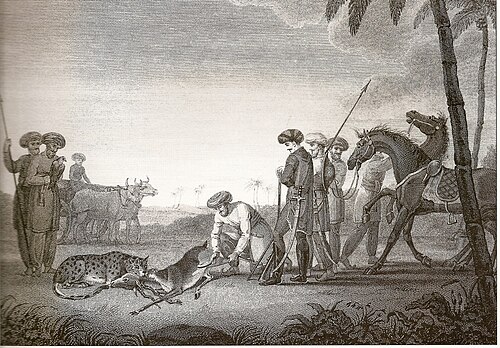
インドと東洋の宗教
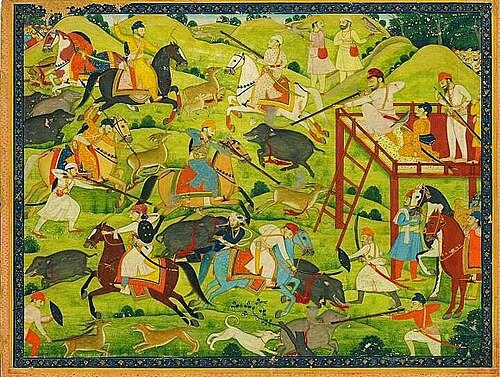

ヒンズー教の聖典では、狩猟は王族の職業であると同時にスポーツであると述べられている。神とされる人物でさえ、狩猟に従事していたとされている。シヴァ神の名前の一つは、ムリガヴィヤダ(鹿殺し)である。[54]マラヤーラム語を含む多くのインドの言語で、ムリガという言葉は、鹿だけでなく、すべての動物と動物的本能(ムリガ・トリシュナ)を表している。ムリガヴィヤダとしてのシヴァは、人間の動物的本能を破壊する者である。叙事詩ラーマーヤナでは、ラーマの父ダシャラタは暗闇でも狩りをする能力があったと言われている。ある狩猟遠征中に、彼はシュラヴァナを獲物と間違えて誤って殺してしまった。ラーマが森に追放されていたとき、ラーヴァナは妻のシータを小屋から誘拐した。一方、ラーマはシータから金の鹿を捕まえるよう頼まれ、兄のラクシュマンが追いかけた。マハーバーラタによると、パーンダヴァ兄弟の父であるパーンドゥは、賢者キンダマとその妻を鹿と間違えて誤って矢で殺してしまった。[要出典]
ジャイナ教は信者にすべての生命に対して多大な敬意を持つことを教えています。狩猟と肉食の禁止はジャイナ教徒であるための基本的な条件です。[55]
仏教の第一の戒律は、すべての感覚ある生命を尊重することです。すべての仏教徒の一般的なアプローチは、生きている動物を殺さないことです。仏陀はこの問題を「すべての人は死を恐れる。他人と自分を比べて、殺したり殺させたりしてはならない」と説明しました。[56]
シク教では、狩猟で得た肉、またはジャトカで屠殺した肉のみが許可されています。シク教の導師、特にグル・ハルゴビンドとグル・ゴビンド・シングは熱心な狩猟者でした。プレム・スマラグのような多くの古いシク教の指導者は、イノシシやシカの狩猟を推奨しています。しかし、現代のシク教徒の間では狩猟の習慣は廃れており、肉はすべて禁止されていると言う人もいます。
キリスト教、ユダヤ教、イスラム教


キリスト教初期から、狩猟はローマカトリック教会の聖職者には禁じられてきた。したがって、教会法典(C. ii, X, De cleric. venat.) には、「我々は、神のすべてのしもべに対し、猟犬を連れて森を探検したり、狩猟をしたりすることを禁じる。また、タカやハヤブサを飼うことも禁じる」とある。教皇インノケンティウス 3 世の治世下で開かれた第 4 回ラテラノ公会議では、 「我々は、すべての聖職者に対し、狩猟やタカ狩りを禁じる」と布告されている (教会法第 15 条)。トリエント公会議の法令はより穏やかな表現で、「聖職者は違法な狩猟と鷹狩りを控えるべきである」(第24会期、改革について、第12章)とされている。これは、すべての狩猟が違法なわけではないことを暗示しているようで、教会法学者は一般的に騒々しい(クラモローサ)狩猟は違法だが、静かな(クワイタ)狩猟は違法ではないと区別している。[57]
フェラーリスは、狩猟は、まれに、十分な理由、必要性、有用性、または「正直な」娯楽として、そして教会の国家にふさわしい節度をもって行われる場合に、聖職者に許可されるというのが、教会法学者の一般的な見解であると述べています。しかし、ツィーグラーは、教会法学者の解釈は、教会の法律の文言や精神に一致していないと考えています。[57]
それでも、合法な狩猟と違法な狩猟を区別することは間違いなく認められるが[58] 、ミラノ、アヴィニョン、リエージュ、ケルンなどのシノドスで行われたように、司教が自分の教区の聖職者に対して狩猟を全面的に禁止できることは確かである。ベネディクト14世は、狩猟の絶対的な禁止の方が教会法に合致するため、そのようなシノドスの法令は厳しすぎることはないと宣言した。したがって、実際には、静かな狩猟が許可されているのか、それとも完全に禁止されているのかを知るには、さまざまな地域のシノドスの法令を参照する必要がある。[57]家族や自給自足の農業活動としての小規模な狩猟は、教皇フランシスコの回勅「ラウダート・シ」で、食料生産システム内の雇用の正当かつ貴重な側面として認められている。 [59]
ユダヤ法では狩猟は禁じられていないが、嫌悪感は抱かれている。18世紀の偉大な権威者ラビ・イェヘスケル・ランダウは研究の結果、「狩猟は、動物が通常素早く殺され、拷問を受けない限り、動物に対する残虐行為とはみなされないが、そこには残虐行為という不道徳な要素がある」と結論付けた。もう1つの問題は、狩猟は危険を伴うことがあり、ユダヤ教は人間の命の価値を極度に重視しているということである。[60] [61]
イスラム法では、簡単に捕獲・屠殺できない合法的な動物や鳥の狩猟は許可されている。しかし、これは食用目的のみであり、トロフィーハンティングは認められていない。[62]
国の伝統
東アフリカ

サファリは、スワヒリ語で「旅、遠征」を意味する言葉から来ており、[63]特にアフリカでは、自然環境の中で動物を見たり殺したりする旅と定義され、最も一般的には東アフリカで使用されています。[64]狩猟の独特な方法としてのサファリは、米国の作家アーネスト・ヘミングウェイとセオドア・ルーズベルト大統領によって普及しました。[65]サファリは、ブッシュやジャングルでキャンプをしながら大型の獲物を追いかける、数日から数週間に及ぶ旅で構成される場合があります。今日では、アフリカの野生動物を狩猟するツアーを指すのによく使用されています。[66]
ハンターは通常、免許を持ち厳しく規制されたプロのハンター、地元のガイド、皮剥ぎ職人、そしてより困難な地形でのポーターなどが同行する観光客である。 [要出典]特別なサファリの種類はソロサファリであり、免許の取得、追跡、準備、装備のすべてがハンター自身によって行われる。[67]
インド亜大陸


イギリス領インドの封建時代および植民地時代、狩猟、すなわちシカールは多くの藩王国で王室のスポーツとみなされており、多くのマハラジャやナワーブ、ならびにイギリス軍将校が、現地のプロのハンターであるシカリ(大物ハンター)の部隊を維持していた。彼らは、ミル・シカールと呼ばれる狩猟の名人が率いていた。彼らは、環境や狩猟技術に関する伝統的な知識があるため、通常は地位の低い現地の部族を採用することが多かった。ベンガルトラなどの大物は、インド象の背中から狩られたこともあった。
地域の社会規範は一般的に狩猟に反対であるが、ビシュノイ派などの少数の宗派は、カモシカなどの特定の種の保護に特に重点を置いている。インドの1972年野生生物保護法は、すべての野生動物の殺害を禁止している。しかし、指定リストの野生動物が人命に危険を及ぼすようになった、または回復不可能なほど障害や病気を負ったと野生生物保護官長が確信した場合、そのような動物の狩猟を誰にでも許可することができる。この場合、殺されたり負傷したりした野生動物の死骸は政府の所有物となる。[68]
1770年代のイギリス領インドの兵士たちが、警戒心が強く、擬態する体色と不規則な飛行行動のため、狩猟者にとって非常に手ごわいとされる海岸鳥であるシギを狩りに出かける習慣があったが、これが現代の「狙撃兵」という言葉の語源になったと考えられている。シギ狩りをする人は追跡技術と射撃技術に加えて、隠密行動も必要だったからである。[69] [70]この用語は19世紀に使用され、第一次世界大戦までに一般的に使われるようになった。
イギリス

猟犬を伴って馬に乗って行う非武装のキツネ狩りは、英国に最も関連のある狩猟の種類である。実際、「狩猟」という語は、修飾語なしではキツネ狩りを意味する。[72]他の国で「狩猟」と呼ばれるものは、英国では「射撃」(鳥)[73]または「ストーキング」(鹿)[74]と呼ばれる。キツネ狩りは上流階級の社交活動であり、役割は富と地位によって厳密に定義されている。[75] [76]キツネ狩りと多くの点で似ているのは、猟犬による野ウサギの追跡である。グレイハウンドなどの視覚猟犬(または長猟犬)のつがいが野ウサギの追跡に使用されることがあり、その場合、グレイハウンドは野ウサギの追跡技術によってマークされる(ただし、実際に捕まえるわけではない)か、またはビーグル犬やハリアーなどの嗅覚猟犬で野ウサギを追跡することがある。他の種類のフォックスハウンドも、雄鹿やミンクの狩猟に使われることがある。[要出典]ライフルを使った鹿狩りは、猟犬を使わず、ステルス状態で徒歩で行われる。[11]
こうした狩猟方法は英国で議論を呼んでいる。動物愛護の支持者は、狩猟はキツネ、馬、猟犬に不必要な苦痛を与えると考えている。支持者は、狩猟は歴史的伝統だと主張する。2004年狩猟法により、2005年2月に犬を使って野生哺乳類を追いかけることは違法となった。猟犬を使った狩猟については同法にいくつかの例外規定(その場合、違法とならない行為)があったが、野ウサギ狩りにはまったく例外規定がなかった。[74]
射撃の伝統
英国では、スポーツとして狩猟鳥、特にキジが散弾銃で撃たれる。英国射撃・自然保護協会によると、狩猟、クレー射撃、標的射撃などの射撃には、年間100万人以上が参加している。[77] 英国で行われている射撃は、伝統的な狩猟とは対照的に、獲物を探す必要がほとんどなく、毎年約3,500万羽の鳥が射撃場に放たれ、中には工場で飼育された鳥もいる。射撃は、指定された位置に銃が配置され、補助員が散弾銃の装填を手伝うなど、手の込んだものになることがある。配置につくと、「ビーター」が隠れている場所を移動し、棒や旗を振りながら獲物を追い出す。このようなイベントは、「ドライブ」と呼ばれることが多い。英国でのライチョウの狩猟シーズンは、8月12日、いわゆる「栄光の12日」に始まる。英国における狩猟の定義は、1831 年の狩猟法( 1 & 2 Will. 4 . c. 32) によって規定されています。
同様の伝統であるojeo [es]がスペインにも存在します。
アメリカ合衆国

北米での狩猟は米国より数千年も古く、コロンブス以前の多くのネイティブアメリカン文化の重要な部分を占めていました。ネイティブアメリカンは一定の狩猟権を保持しており、インディアン条約の一部として、また連邦法の下では一部の法律の適用を免除されています[78] 。例としては、鷲の羽に関する法律や海洋哺乳類保護法の適用免除などが挙げられます。これはアラスカの先住民コミュニティ では特に重要であると考えられています。
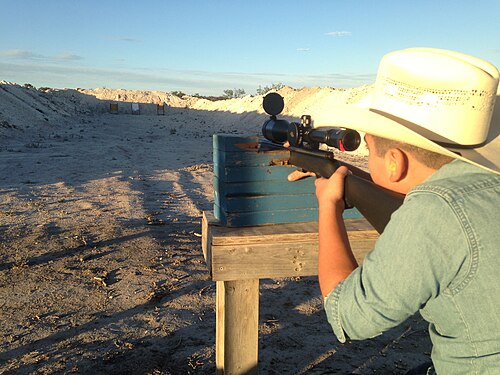
狩猟における銃の使用は、通常、獲物のカテゴリー、州内のエリア、および期間によって規制されています。大型動物の狩猟に関する規制では、銃器の最小口径または銃口エネルギーが指定されることがよくあります。人口密度が高い地域や地形の起伏が限られている地域では、安全上の理由からライフルの使用が禁止されることがよくあります。規制では、環境への懸念から弾薬への鉛の使用を制限または禁止する場合もあります。より効果的な武器を使用するハンターとの競争を制限するために、弓矢による狩猟や前装式の黒色火薬銃の特定の季節が設定されることがよくあります。
米国における狩猟は、特定の階級や文化とは関係がない。2006年の世論調査では、アメリカ人の78%が合法的な狩猟を支持していることが明らかになったが[79]、実際に狩猟をするアメリカ人は比較的少ない。21世紀初頭には、アメリカ人のわずか6%が狩猟を行っていた。東海岸沿いの州の南部住民の狩猟率は5%で、全国平均をわずかに下回っていた。南部の他の地域では狩猟は9%とより一般的であったが、この割合は中西部の住民の12%が狩猟を行う平原州の狩猟率を上回ることはなかった。国内の他の地域での狩猟は全国平均を下回った。[80]全体として、1996年から2006年にかけて、16歳以上のハンターの数は10%減少したが、これは生息地の喪失やレクリエーション習慣の変化など、いくつかの要因によるものである。 [81]
フェアチェイスの原則[82]は、100年以上にわたってアメリカの狩猟の伝統の一部となっています。セオドア・ルーズベルトによって普及され、ルーズベルトのブーンとクロケットクラブの設立によって永続化されたハンターの自然保護主義者の役割は、現代のフェアチェイスの伝統の発展の中心となっています。ジム・ポゼウィッツの著書 「フェアチェイスを超えて:狩猟の倫理と伝統」では、フェアチェイスについて次のように説明しています。
「倫理的な狩猟の基本は、公正な狩猟という考え方です。この概念は、狩猟者と狩猟される者の間のバランスに関係しています。これは、狩猟者が時折成功し、動物が一般的に捕獲されることを避けることができるバランスです。」[83]
2005年にインターネット狩猟が導入され、遠隔操作の銃を使ってインターネット上で狩猟ができるようになったとき、この行為は公正な狩猟の原則に違反しているとして狩猟者から広く批判された。全米ライフル協会(NRA)の代表者は次のように説明した。「NRAは、銃や弓を持って野外で狩猟を行う公正な狩猟が狩猟の伝統の重要な要素であると常に主張してきた。机に座ってコンピューターの前に座り、マウスをクリックすることは狩猟とは何の関係もない。」[84]
ブラックバック、ニルガイ、シカ、ダマジカ、シマウマ、バラシンガ、ガゼルなど、多くの外来種の動物が、スポーツハンティングのためにテキサスの狩猟場や牧場で見られるようになりました。これらのハンターは、管理された牧場で獲物を捕獲するために1万ドル以上を支払っています。[85]
ロシア
ロシア帝国の狩猟は、ヨーロッパの王宮の狩猟習慣の影響を受けた、初期のロシアの統治者(大公や皇帝)の狩猟の伝統から発展したものです。帝国の狩猟は主にペテルゴフ、ツァールスコエ・セロー、ガッチナで行われました。

オーストラリア
オーストラリアにおける狩猟は、害獣や外来種とみなされる様々な動物の狩猟と駆除を中心に発展してきました。在来動物はすべて法律で保護されており、カンガルーやアヒルなどの特定の種は、狩猟免許を持つ射手が狩猟シーズン中に公有地で特別許可を得た上でのみ狩猟できます。対象となる外来種には、ヨーロッパウサギ、アカギツネ、シカ(サンバー、ブタ、アカシカ、ダマジカ、アクシスジカ、ルサ)、野良猫、ブタ、ヤギ、ブランビー、ロバ、時にはラクダ、さらにウズラ、キジ、ヤマウズラなどの外来高地鳥類が含まれます。
ニュージーランド
ニュージーランドには狩猟文化が根付いている。[86]人間が到着したとき、ニュージーランドを構成する島々に生息していた唯一の哺乳類はコウモリであり、沿岸部にはアザラシや他の海洋哺乳類がいた。しかし、人間が到着したときに他の種も持ち込んだ。ポリネシアの航海者はクリ(犬)、キオレ(ポリネシアのネズミ)、およびさまざまな植物種を持ち込んだ。ヨーロッパの探検家、特に1700年代にキャプテン・クックまたはフランスの探検家ド・サーヴィルによって持ち込まれた豚は、ニュージーランドの生物相をさらに拡大した。[87] [88] 19世紀、ヨーロッパ人の植民地化が起こると、順応社会が設立された。これらの社会は、狩猟の獲物として以外の用途のない多数の種を持ち込んだ。[89]ニュージーランドの地形によく適応した種には、シカ、ブタ、ヤギ、ノウサギ、タール、シャモアなどがある。野生地域、適切な餌、そして天敵の不在により、彼らの個体数は爆発的に増加しました。政府機関は、自然環境と農業生産に影響を及ぼすため、これらの動物を害獣と見なしていますが、ハンターは彼らを資源と見なしています。
イラン
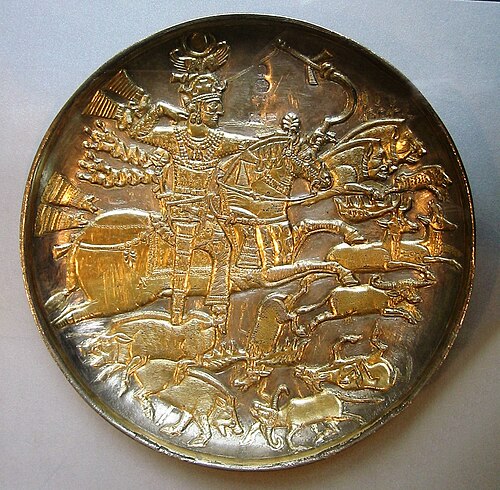
イランの伝統では、狩猟は王子の教育に不可欠な部分であると考えられており[90] 、イスラム以前のペルシャでは狩猟が上流階級の若者の教育のために行われていたことがよく記録されている。2020年10月現在、狩猟免許の費用は2万ドルである。ただし、環境省は発行された許可証の数を報告していない。[91]
日本
日本では、わなや銃を使用する狩猟者を含め、狩猟免許を持つ人の数は全体的に減少傾向にあり、平均年齢は上昇している。2010年時点で[update]、登録狩猟者は約19万人で、そのうち約65%が60歳以上であった。[92]
トリニダード・トバゴ
トリニダード・トバゴでは、小型から中型の野生動物を狩る伝統が非常に盛んに行われている。狩猟は銃、パチンコ、檻の罠で行われ、時には猟犬も使われる。罠銃やわな網の違法使用も行われている。近年では約 12,000 ~ 13,000 人のハンターが狩猟許可証を申請し、許可されていることから、この慣行が持続可能ではないのではないかとの懸念もある。さらに、現在、狩猟制限はなく、解禁シーズンは比較的非常に長い (10 月から 2 月までの 5 か月間)。そのため、合法的なハンターからの狩猟圧力は非常に大きい。それに加えて、密猟された野生動物の闇市場が盛んで非常に儲かる (高価な高級珍味として売られ、熱心に購入される)。営利を目的とする密猟者の数は不明だが、かなり多いと推定される。その結果、5 大哺乳類狩猟種 (アカアグーチ、ローランドパカ、コオロギアルマジロ、キジバトペッカリー、アカマダラシカ) の個体数は、近隣の南米本土の狩猟の少ない地域と比較すると比較的少ないと考えられています(ただし、科学的な個体数調査は 2013 年現在、ごく最近実施されているところです[update])。アカマダラシカの個体数は、過剰な狩猟の結果、トバゴ島から絶滅したようです。20 世紀半ばのある時期までに、トリニダード島で、大型狩猟鳥類のツノメドリが過剰な狩猟によって絶滅しました。さまざまなサギ、カモ、ハト、グリーンイグアナ、隠れたゴールデンテグ、メガネカイマン、オポッサム、カピバラも、一般的に狩猟や密猟の対象となっています。また、アカホエザルやオマキザル、ミナミコアリクガメ、ブラジルヤマアラシ、キアシガメ、絶滅が深刻に危惧されている島固有のトリニダード島ヒメフウチョウ、さらには国鳥の1つであるアカトキなど、「完全に保護されている種」の密猟も行われている。合法的な狩猟者は、狩猟免許を取得するために比較的少額の料金を支払い、公式の基本的な保全生物学や狩猟倫理/公正な狩猟の試験を受けることはない。野生生物保護に関する法律の知識と理解について、訓練も受けておらず、評価も受けていない。国内で自給自足の狩猟は比較的少ないと推定されている(ほとんどの狩猟はスポーツまたは商業的な利益のため)。地元の野生生物管理当局は人員も資金も不足しており、そのため、既存の野生生物管理法を遵守するための執行はほとんど行われておらず、狩猟/密猟はシーズン中、シーズン外を問わず、野生生物保護区内でさえ行われている。政府が野生生物管理の問題をより真剣に受け止め始めている兆候があり、2015年にはよく練られた法案が議会に提出されている。起草された法案が現政権および次期政権によって完全に採用され、財政的に支援されるかどうか、また一般大衆が野生生物保護の重要性をより意識し、乱暴な消費文化を持続可能な管理文化に変えるかどうかはまだ分からない。
野生動物管理

狩猟は、生息地の収容力を超えて他の種の幸福を脅かしたり、場合によっては人間の健康や安全を害したりする可能性のある個体群を管理する上で、資源管理者に重要な手段を与えると主張されています[93][94]。 [95]
場合によっては、狩猟によってコヨーテなどの捕食動物の個体数が実際に増加することがある。これは、本来であれば確立されていた縄張りの境界がなくなり、近隣の動物が過剰にその地域に移住し、個体数が人為的に増加するためである。[96]狩猟推進派[誰? ]は、狩猟によって食物や住処をめぐる種内競争が減り、生き残った動物の死亡率が下がると主張する。環境保護論者の中には[誰? ]捕食動物を(再)導入することで、環境や食物連鎖に大量の自由鉛を持ち込むなどの悪影響が少なく、より効率的に同じ目的を達成できると主張する者もいる。
米国では、野生生物管理者は狩猟規制機関や免許機関に所属することが多く、狩猟できる動物の数、方法、条件に関する規則の設定に協力しています。
管理機関は、北米の鹿の場合のように、特定の動物の個体数を管理するために狩猟に頼ることがあります。これらの狩猟はプロの射手によって行われることもありますが、アマチュアのハンターが行う場合もあります。米国の多くの市や地方自治体は、近隣の公園や都会のオープンスペースなどの制限区域で危険になりつつある鹿などの動物の個体数を減らすために、毎年プロやアマチュアのハンターを雇用しています。
個体群管理の大部分は、個体群の持続可能性を確保するために、狩猟される動物の数、場合によっては大きさや年齢を管理することです。狩猟を管理するために頻繁に使用される手段は、狩猟制限とシーズンの閉鎖ですが、狩猟者1人あたりの狩猟制限ではなく、面積あたりの狩猟制限に依存している国では、狩猟の成功率を下げるために、弓矢のみのシーズンなどの装備制限がますます人気を集めています。[97] [98] [99] [100]
法律
地元および国際的な保護法や野生生物管理法に反して野生種を違法に狩猟および採取することを密猟といいます。狩猟動物の保護は密猟を防止するために用いられる戦術の1つです。密猟を含む狩猟法および規則の違反は通常、法律で罰せられます。[101]罰則には、装備の没収、罰金、または懲役刑が含まれます。
狩猟の権利
狩猟の権利は、時には漁業の権利と組み合わせて、所有権の結果として暗黙的に保護されているか[102]、またはそれ自体の権利として明示的に保護されています[103] [104]。たとえば、2019年現在、米国の22の州が憲法で狩猟の主観的権利を明示的に認めています。[104] [105]
持ち込み制限
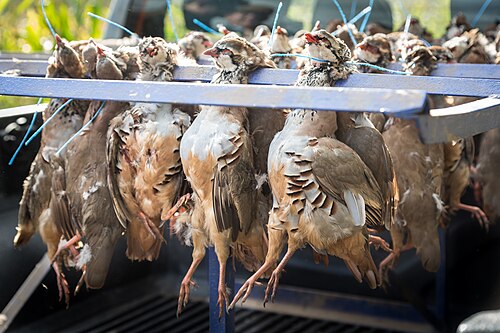
狩猟制限とは、特定の種または種のグループの動物が何頭まで殺されるかを管理する法律上の規定ですが、狩猟制限が適用されない種もしばしばあります。また、狩猟制限がまったく適用されない、または特定の状況下では適用されない管轄区域もあります。狩猟制限という語句は、小動物を狩るハンターが、釣りかごに似た小さなバスケットで獲物を運ぶ習慣に由来しています。
狩猟制限が用いられる場合、1日または季節ごとの狩猟制限が設けられる。例えば、アヒルは1人のハンターが1日に6羽の割合で狩猟されることが多い。[106]ヘラジカのような大型動物は、ほとんどの場合、1人のハンターにつき1頭という季節ごとの狩猟制限が設けられる。[要出典]狩猟制限は、ハンターが殺せる動物の大きさ、性別、または年齢を規制することもある。多くの場合、狩猟制限は、動物の個体群を保護するためというよりは、狩猟個体群間でより公平に狩猟獲物を割り当てるように設計されている。個体群を保護するには、地域の密度に応じた最大狩猟獲物制限が必要になるからである。
閉シーズンと開シーズン
禁猟期とは、特定の種の動物を狩猟することが違法となる期間のことである。通常、禁猟期は、種が最も脆弱なときに保護するため、または繁殖期に保護するために設けられる。[107]延長して、禁猟期以外の期間は解猟期として知られている。
方法


歴史的、自給自足的、スポーツ的な狩猟技術は根本的に異なる場合があり、現代の狩猟規制は、多くの場合、狩猟が行われる場所、時期、方法の問題に対処しています。政府の規制、ハンターの個人的な倫理、地元の慣習、狩猟用具、および狩猟される動物に応じて、技術は異なる場合があります。ハンターは、多くの場合、複数の技術を組み合わせて使用します。法律により、スポーツハンターが密猟や野生生物管理で主に使用される一部の方法を使用することが禁止されている場合があります。
- 餌付けとは、おとり、ルアー、匂い、または餌を使用することです
- バトゥーとは、棒で動物を殴って脅し、殺害地域に追い込んだり、待ち伏せしたりする行為です。
- ビーグル犬狩りとは、ウサギ狩り、時にはキツネ狩りにビーグル犬を使うことです。
- 追い込みでは、人間の追い込み手を使って獲物をあるエリアから追い出したり、所定の位置に追い込んだりします。
- スタンドハンティングまたはブラインドハンティングは、木のスタンド、狩猟用ブラインド、またはその他のタイプの射撃スタンドなど、隠れた位置または高い位置から動物を待つことです。
- コールとは、動物を引き寄せたり追い払ったりするために動物の鳴き声を使うことです。
- カモフラージュとは、視覚や嗅覚を隠蔽して環境に溶け込むことです。
- 犬は、獲物を誘導したり、追い払ったり、群れを作ったり、追い込んだり、追跡したり、指差したり、追跡したり、回収したりするのに使用されることがあります
- 追い込みとは、通常、群れの中の他のハンターに向かって、特定の方向に動物を誘導することです。
- 鷹狩りとは、訓練された猛禽類を使って、野生動物を自然の状態と生息地で狩ることです。
- フラッシングとは、隠れた場所から動物を追い出す行為です。
- ギリースーツは、人が環境に溶け込むために着用できるギアの一種です。 [108]
- グラッシングとは、双眼鏡などの光学機器を使用して動物をより簡単に見つけることです。
- 接着剤は鳥を殺すための無差別受動態です。[109]
- インターネット狩猟は、ウェブカメラと遠隔操作の銃を使用してインターネット経由で狩猟を行う方法です。
- ネット漁法には、キャノンネットやロケットネットを使用したアクティブネット漁法など、ネットを使用する漁法が含まれます。
- 持続的な狩猟とは、獲物を疲労困憊するまで走ったり追跡したりして追いかけることである。 [110]
- ポスティングは、特定の場所に座ったり立ったりして、移動経路に沿って選択した獲物を傍受する意図で行われます。[111]
- 獲物の偵察は通常、狩猟の前に行われ、目的の種が選択したエリアにいることを確認します。偵察中によく使用される戦術は、足跡や糞などの動物の痕跡を探すことと、「トレイル カメラ」を使用することです。
- 射撃は、銃、弓、クロスボウ、パチンコなどの遠距離武器を使用することです。
- 太陽・月齢理論によれば、動物は自分の体と比較した月の位置に応じて移動するとされており、狩猟者が狙った獲物を狩るのに最適な時期を知るために、はるか昔から使われてきたと言われている。 [112]
- スポットライトを当てる、または照らすというのは、殺す前に動物を見つけたり盲目にしたりするために人工の光を使うことです。
- ストーキングまたは静止狩猟は、動物を探して、または個々の動物を追いかけて静かに歩く行為です。
- 追跡とは、動物を追跡する際に物理的な証拠を読み取る行為です。
- 罠猟とは、わな、、落とし穴などの装置を使用して動物を捕獲したり殺したりすることです。
統計
テーブル
グラフ

トロフィーハンティング
.jpg/500px-Zdravko_Pe%C4%8Dar_During_an_Elephant_Hunt_(3).jpg)
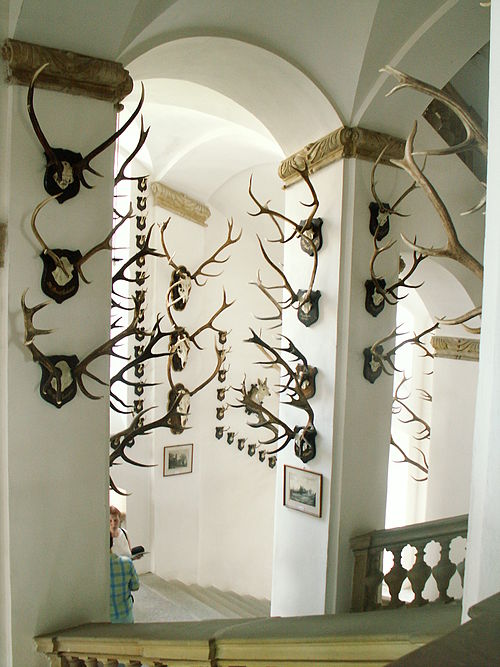
トロフィーハンティングとは、個人的なコレクション、自慢する権利、またはステータスシンボルとしてトロフィーを採取するために、野生動物を選択的に探し、殺すことである。また、トロフィーの特性を得るために管理または半管理された条件下で特別に繁殖、飼育された捕獲または半捕獲された動物の狩猟も含まれる可能性があり、これはキャンドハントと呼ばれることもある。[118]
歴史
19 世紀、南ヨーロッパと中央ヨーロッパのスポーツ ハンターは、獲物をトロフィー(通常は動物の頭部または毛皮)だけのために狩ることが多かった。獲物はその後、腕前の証として飾られた。動物の残りの部分は、通常、捨てられた。しかし、一部の文化では、そのような無駄遣いは認められていない。北欧諸国では、トロフィーを目的とした狩猟は、現在でも嫌われている。19 世紀の北米での狩猟は、主に食糧を補う手段として行われていたが、現在では主にスポーツとして行われている。[要出典]サファリ方式の狩猟は、スポーツ ハンティングの発展であり、アフリカ、インド、その他の場所をトロフィーを求めて精巧に旅するようになった。現代でも、トロフィー ハンティングは存続しており、一部の地域では重要な産業となっている。[要出典]
保全ツール
アメリカ魚類野生生物局によると、狩猟は牧場主にこれらの種の繁殖を続けるための「経済的インセンティブ」を与え、狩猟は「種の絶滅の脅威を軽減する」とのことである。[119] [120]
学術誌「生物保全」に掲載された科学的研究によると、トロフィーハンティングは「写真撮影エコツーリズムなど、野生動物をベースとした代替の土地利用には適さない可能性のある地域を含む広大な地域の保全に対する経済的インセンティブを生み出すことで、アフリカの保全にとって非常に重要である」とされている。 [121]しかし、別の研究では、トロフィーハンターの支出の3%未満が地元に届くと述べられており、特に狩猟許可が占める広大な土地を考慮すると、経済的インセンティブと利益は「最小限」であることを意味する。[122]
生物保全によると、トロフィーハンティングによる経済的インセンティブは、国立公園だけに頼った場合に比べて、野生生物保護に使用される土地面積を実質的に2倍以上に増やします。[121]ただし、地元コミュニティは通常、トロフィーハンティングから1ヘクタールあたり18セント以下しか得ていません。[122]
保全生物学[123] 、 持続可能な観光ジャーナル[124] 、持続可能な利用による野生生物保全[125 ] 、動物保全[123]の研究調査によると、トロフィーハンティングは大型肉食動物の保全に対する経済的インセンティブを提供するために不可欠であると考えられてきました。[123] [126]責任ある観光センター[127]とIUCNの研究では、狩猟以上のものを含むエコツーリズムは優れた経済的インセンティブであり、エーカーあたりの収益が2倍、常勤雇用が39倍になるとしています。[128]トロフィーハンティング、エコツーリズム、保全の交差点にあるのがグリーンハンティングです。これはトロフィーハンティングの代替手段であり、ハンターは保全プロジェクトのために麻酔をかける必要がある動物に麻酔薬を注射するためにお金を払います。[129]
2016年に米国下院天然資源委員会は、トロフィーハンティングが特定の動物の絶滅に寄与している可能性があると結論付けた。[130]国際動物福祉基金を含む動物福祉団体は、トロフィーハンティングがキリンの「静かな絶滅」の重要な要因であると主張している。[131]
米国魚類野生生物局が5年ごとに実施している全国調査によると、人口は増加しているにもかかわらず、狩猟をする人は減少している。ナショナル・パブリック・ラジオが報じたところによると、2016年の統計を示すグラフによると、16歳以上のアメリカ人のうち実際に狩猟をしているのはわずか5%ほどで、これは50年前の半分だ。狩猟人気の低下は今後10年間で加速すると予想されており、米国が自然保護に支払う費用を脅かすことになる。 [132]
論争
トロフィーハンティングは、希少動物や絶滅危惧動物が対象である場合に最も批判される。[133]反対派はトロフィーハンティングを道徳の問題とみなすこともある[134] 、または動物虐待とみなし、娯楽のために生き物を殺すことを批判する。ビクトリア朝時代の劇作家W.S. ギルバートは、「鹿狩りは、鹿が銃を持っていれば、非常に素晴らしいスポーツになるだろう」と述べた[135]。
トロフィーハンティングが地元経済にどの程度の利益をもたらすかについても議論がある。ハンターは狩猟用品店や狩猟ガイドに多額の料金を支払い、それが地元経済に貢献し、放牧地や家畜、作物の競合相手とみなされる動物に価値を与える。[136]しかし、この議論は動物福祉団体やトロフィーハンティングに反対する他の団体によって異論を唱えられている。[137] [138]動物は狩猟よりもエコツーリズムの面で地域社会にとって価値があると主張されている。[139] [140]
経済

狩猟はさまざまな産業に利益をもたらし、経済的な理由から狩猟を支援している。タンザニアでは、サファリハンターは平均的なエコツーリストの 50 ~ 100 倍の費用を費やすと推定されている。平均的な写真撮影観光客は高級宿泊施設を求めるかもしれないが、平均的なサファリハンターは一般的にテントキャンプに滞在する。また、サファリハンターは、典型的なエコツーリストにとって魅力のない遠隔地を利用する傾向がある。支持者は、これらのハンターは密猟防止活動と地元コミュニティの収入を可能にしていると主張している。[引用が必要]
英国では、鳥の狩猟は産業として農村経済にとって極めて重要であると言われている。1997 年のコブハム報告書では、狩猟の価値は約 7 億ポンドと推定され、狩猟および射撃のロビー団体は、それから 10 年も経たないうちに、狩猟の価値は 10 億ポンドを超えると主張した。[引用が必要]
狩猟は米国でも大きな経済的影響を与えており、狩猟用具や専門観光を専門とする企業が数多く存在する。ハンターを支援するために、さまざまな技術が開発されてきた。今日のハンターは、経済的、社会的、文化的背景が多岐にわたる。2001年には、1,300万人以上のハンターが平均18日間狩猟し、狩猟に205億ドル以上を費やした。[141]米国では、狩猟免許の収益は、野生生物の生息地の保護を含む州の狩猟管理プログラムに寄付されている。
狩猟は人々のカロリー摂取量の一部を占めており、工業的な方法で飼育された肉の利用を避けることで温室効果ガスの排出にプラスの影響を与える可能性がある。[142]
環境問題
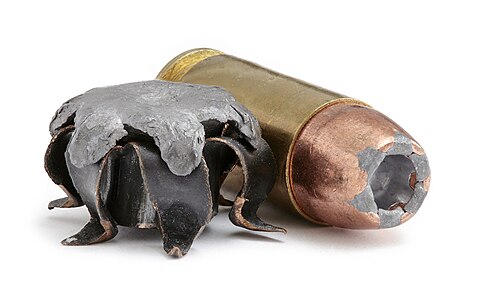
Lead bullets that miss their target or remain in an unretrieved carcass could become a toxicant in the environment but lead in ammunition because of its metallic form has a lower solubility and higher resistance to corrosion than other forms of lead making it hardly available to biological systems.[143] Waterfowl or other birds may ingest the lead and poison themselves with the neurotoxicant, but studies have demonstrated that effects of lead in ammunition are negligible on animal population size and growth.[144][145] Since 1991, US federal law forbids lead shot in waterfowl hunts, and 30 states have some type of restriction.[146]
In December 2014, a federal appeals court denied a lawsuit by environmental groups that the EPA must use the Toxic Substances Control Act to regulate lead in shells and cartridges. The groups sought EPA to regulate "spent lead", yet the court found EPA could not regulate spent lead without also regulating cartridges and shells.[147]
Conservation

Hunters have been driving forces throughout history in the movement to ensure the preservation of wildlife habitats and wildlife for further hunting.[149] However, excessive hunting and poachers have also contributed heavily to the endangerment, extirpation and extinction of many animals, such as the quagga, the great auk, Steller's sea cow, the thylacine, the bluebuck, the Arabian oryx, the Caspian and Javan tigers, the markhor, the Sumatran rhinoceros, the bison, the North American cougar, the Altai argali sheep, the Asian elephant and many more, primarily for commercial sale or sport. All these animals have been hunted to endangerment or extinction.[161] Poaching currently threatens bird and mammalian populations around the world.[162][163][164] The 2019 Global Assessment Report on Biodiversity and Ecosystem Services lists the direct exploitation of organisms, including hunting, as the second leading cause of biodiversity loss, after land use for agriculture.[165] In 2022, IPBES released another report which stated that unsustainable hunting, along with unsustainable logging and fishing, are primary drivers of the global extinction crisis.[166] A 2023 study published in BioScience posited that the prioritizing of hunting by state agencies in the United States over the rewinding of key species is "reinforcing" the loss of biodiversity.[167]
Legislation

Pittman–Robertson Wildlife Restoration Act of 1937
In 1937, American hunters successfully lobbied the US Congress to pass the Pittman-Robertson Wildlife Restoration Act, which placed an eleven per cent tax on all hunting equipment. This self-imposed tax now generates over $700 million each year and is used exclusively to establish, restore and protect wildlife habitats.[168] The act is named for Nevada Senator Key Pittman and Virginia Congressman Absalom Willis Robertson.
Federal Duck Stamp program
On 16 March 1934, President Franklin D. Roosevelt signed the Migratory Bird Hunting Stamp Act, which requires an annual stamp purchase by all hunters over the age of sixteen. The stamps are created on behalf of the program by the US Postal Service and depict wildlife artwork chosen through an annual contest. They play an important role in habitat conservation because ninety-eight per cent of all funds generated by their sale go directly toward the purchase or lease of wetland habitat for protection in the National Wildlife Refuge System.[169] In addition to waterfowl, it is estimated that one third of the nation's endangered species seek food and shelter in areas protected using Duck Stamp funds.[170]
Since 1934, the sale of Federal Duck Stamps has generated $670 million, and helped to purchase or lease 5,200,000 acres (8,100 sq mi; 21,000 km2) of habitat. The stamps serve as a license to hunt migratory birds, an entrance pass for all National Wildlife Refuge areas, and are also considered collectors items often purchased for aesthetic reasons outside of the hunting and birding communities. Although non-hunters buy a significant number of Duck Stamps, eighty-seven per cent of their sales are contributed by hunters. Distribution of funds is managed by the Migratory Bird Conservation Commission (MBCC).[171]
Species
Arabian oryx
The Arabian oryx, a species of large antelope, once inhabited much of the desert areas of the Middle East.[155] Native Bedouin tribes had long hunted the oryx using camels and arrows. Oil exploration made the habitat increasingly accessible, and the species' striking appearance made it (along with the closely related scimitar-horned oryx and addax) a popular quarry for sport hunters, including foreign executives of oil companies.[172] The use of automobiles and high-powered rifles destroyed their only advantage: speed, and they became extinct in the wild exclusively due to sport hunting in 1972. The scimitar-horned oryx followed suit, while the addax became critically endangered.[173] However, the Arabian oryx has now made a comeback and been upgraded from "extinct in the wild" to "vulnerable" due to conservation efforts like captive breeding.[174]
Markhor
The markhor is an endangered species of wild goat which inhabits the mountains of Central Asia and Pakistan. The colonization of these regions by Britain gave British sport hunters access to the species, and they were hunted heavily, almost to the point of extinction. Only their willingness to breed in captivity and the inhospitability of their mountainous habitat prevented this. Despite these factors, the markhor is still endangered.[175]
American bison
The American bison is a large bovid which inhabited much of western North America prior to the 1800s, living on the prairies in large herds. However, the vast herds of bison attracted market hunters, who killed dozens of bison for their hides only, leaving the rest to rot. Thousands of these hunters quickly eliminated the bison herds, bringing the population from several million in the early 1800s to a few hundred by the 1880s. Conservation efforts have allowed the population to increase, but the bison remains near-threatened due to lack of habitat.[176]
White rhino
The Journal of International Wildlife Law and Policy cites that the legalization of white rhinoceros hunting in South Africa motivated private landowners to reintroduce the species onto their lands. As a result, the country saw an increase in white rhinos from fewer than one hundred individuals to more than 11,000, even while a limited number were killed as trophies.[177]
However, the illegal hunting of rhinoceros for their horns is highly damaging to the population and is currently growing globally,[178] with 1004 being killed in South Africa alone according to the most recent estimate.[179] The White Rhino (along with the other 4 rhino species) are poached due to beliefs that the Rhinos horns can be used to cure Cancer, Arthritis and other diseases and illnesses, even though they are scientifically proven wrong.[180]
Other species
According to Richard Conniff, Namibia is home to 1,750 of the roughly 5,000 black rhinos surviving in the wild because it allows trophy hunting of various species. Namibia's mountain zebra population has increased to 27,000 from 1,000 in 1982. Elephants, which "are gunned down elsewhere for their ivory", have gone to 20,000 from 15,000 in 1995. Lions, which were on the brink of extinction "from Senegal to Kenya", are increasing in Namibia.[181]
In contrast, Botswana in 2012 banned trophy hunting following a precipitous wildlife decline.[182] The numbers of antelope plummeted across Botswana, with a resultant decline in predator numbers, while elephant numbers remained stable and hippopotamus numbers rose. According to the government of Botswana, trophy hunting is at least partly to blame for this, but many other factors, such as poaching, drought and habitat loss are also to blame.[183] Uganda recently did the same, arguing that "the share of benefits of sport hunting were lopsided and unlikely to deter poaching or improve [Uganda's] capacity to manage the wildlife reserves."[184] In 2020, Botswana reopened trophy hunting on public lands.[185]
Studies

A study published by the Wildlife Society concluded that hunting and trapping are cost effective tools that reduce wildlife damage by reducing a population below the capacity of the environment to carry it and changing the behaviors of animals to stop them from causing damage. The study furthermore states that the cessation of hunting could cause wildlife to be severely harmed, rural property values to fall, and the incentive of landowners to maintain natural habitats to diminish.[186]
Although deforestation and forest degradation have long been considered the most significant threats to tropical biodiversity, across Southeast Asia (Northeast India, Indochina, Sundaland, Philippines) substantial areas of natural habitat have few wild animals (>1 kg), bar a few hunting‐tolerant species.[187][188][189]
Opposition
It has been argued by animal rights activists that killing animals for sport is unethical, cruel, and unnecessary.[16] They note the suffering and cruelty inflicted on animals hunted for sport: "Many animals endure prolonged, painful deaths when they are injured but not killed by hunters. Hunting disrupts migration and hibernation patterns and destroys families."[16] Animal rights activists also comment that hunting is not needed to maintain an ecological balance, and that "nature takes care of its own".[16] They say that hunting can be combated on public lands by "spread[ing] deer repellent or human hair (from barber shops) near hunting areas".[16] Animal rights activists also argue that hunting is speciesist:[17]
Whether hunters try to justify their killing by citing human deaths caused by wild animals, by making conservationist claims, by claiming that it's acceptable to hunt as long as the animals' bodies are eaten, or simply because of the pleasure it brings them, the fact remains that hunting is morally unacceptable if we consider the interests of nonhuman animals. Hunted animals endure fear and pain, and then are deprived of their lives. Understanding the injustices of speciesism and the interests of nonhuman animals makes it clear that human pleasure cannot justify nonhuman animals' pain.[17]
In the arts

_-_WGA5466.jpg/500px-Gustave_Courbet_-_The_Quarry_(La_Cur%C3%A9e)_-_WGA5466.jpg)

-

-
 Hunting in the papyrus thicket, mural from a tomb in Thebes, Egypt, before 1350 BC
 -

-
 Man hunting a boar, Roman mosaic, 4th century AD
 -
 Illustration from the falconry book De arte venandi cum avibus written by Emperor Frederick II, c. 1245
 -

-

-
 Vittore Carpaccio, Caccia in laguna (Hunt in the Lagoon), c. 1490
 -
 Piero di Cosimo,
A Hunting Scene, 1508 -
 Lucas Cranach the Elder, A Stag Hunt with the Elector Friedrich the Wise, 1529
 -
 Peter Paul Rubens, Hippopotamus and Crocodile Hunt, c. 1615
 -
 Peter Paul Rubens, Tiger and Lion Hunt, 1618
 -
 Charles André van Loo, Halte de chasse (Halt During the Hunt), 1737
 -
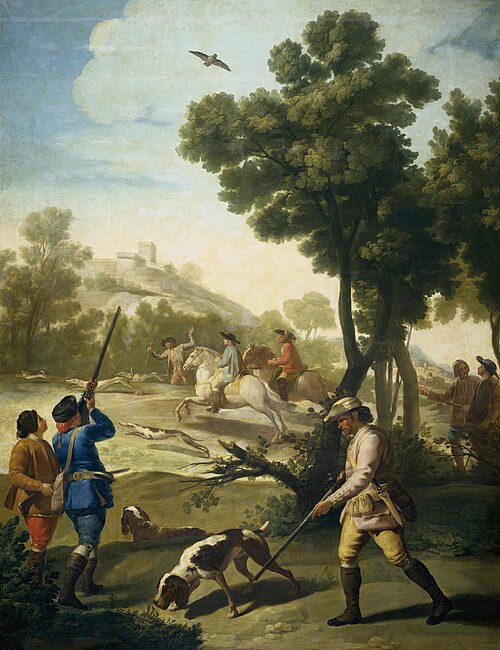 Francisco Goya, The Quail Shoot, 1775
 -
 Edward Walhouse Mark, Caimán del Magadalena, 1843 - 1856
 -
 Gustave Courbet, The Hunt Breakfast, 1858
 -
 Eugène Delacroix, Chasse au lion (Lion Hunt), 1858
 -


_01.jpg/500px-Mosaico_de_Las_Tiendas_(MNAR_M%C3%A9rida)_01.jpg)
.jpg/500px-Lucas_Cranach_d.%C3%84._-_Hirschjagd_des_Kurf%C3%BCrsten_Friedrich_des_Weisen_(KHM_Wien).jpg)


.jpg/500px-Eug%C3%A8ne_Delacroix_-_Chasse_au_lion_(1858).jpg)

See also
- Air travel with firearms and ammunition
- Poaching
- Anti-hunting
- Bambi effect
- Blood sport
- Bowhunting
- Bushfood
- Bushmeat
- Chase
- Defaunation
- Federation of Associations for Hunting and Conservation of the EU
- Hiking equipment
- Human hunting
- Hunt Saboteurs Association (HSA)
- Hunting horn
- Hunting weapon
- Nimrod
- Esau
- Sir Gawain and the Green Knight
- Tapetum lucidum eyeshine
- The Sound of His Horn
- Wilderness backpacking
- Sport of Kings
- List of extreme and adventure sports
- Game (hunting)
- Big-game hunting
- Big five game
- Safari
References
- ^ Oxford Dictionary of English. Stevenson, Angus (3 ed.). Oxford: Oxford University Press. 2010. p. 856. ISBN 9780199571123. OCLC 729551189.
'hunt [...] pursue and kill (a wild animal) for sport or food [...]'; 'hunting [...] the activity of hunting wild animals or game.'
{{cite book}}: CS1 maint: others (link) - ^ Peterson, M. Nils (2019), "Hunting", in Fath, Brian D. (ed.), Encyclopedia of Ecology, vol. 3 (2 ed.), Elsevier, pp. 438–440, doi:10.1016/b978-0-12-409548-9.11168-6, ISBN 978-0-444-64130-4,
Hunting is the practice of pursuing, capturing, or killing wildlife.
- ^ Park, Chris; Allaby, Michael (2013). A Dictionary of Environment and Conservation (2 ed.). Oxford: Oxford University Press. p. 208. ISBN 978-0-19-964166-6. OCLC 993020467.
hunting The activity of finding and killing or capturing wild animals for food, pelts, or as a field sport.
- ^ Neves-Garca, Katja (2007). "Hunting". In Robbins, Paul (ed.). Encyclopedia of Environment and Society. Vol. 3. Thousand Oaks: SAGE Publications. pp. 894–896. ISBN 978-1-4129-5627-7. OCLC 228071686.
In very general terms, hunting refers to the activity of pursuing and killing free-roaming animals.
- ^ Collin, P. H. (Peter Hodgson) (2009). Dictionary of Environment and Ecology: Over 7,000 terms clearly defined. Bloomsbury Reference (5 ed.). London: Bloomsbury. p. 108. ISBN 978-1-4081-0222-0. OCLC 191700369.
hunting [...] the activity of following and killing wild animals for sport
- ^ "HUNTING | meaning in the Cambridge English Dictionary". Cambridge English Dictionary. Archived from the original on 10 December 2019. Retrieved 10 December 2019.
hunting [...] chasing and killing an animal or bird for food, sport, or profit
- ^ "Hunting definition and meaning | Collins English Dictionary". Collins English Dictionary. Archived from the original on 10 December 2019. Retrieved 10 December 2019.
Hunting is the chasing and killing of wild animals by people or other animals, for food or as a sport.
- ^ "hunting | History, Methods, & Management". Encyclopedia Britannica. Archived from the original on 10 December 2019. Retrieved 10 December 2019.
Hunting, sport that involves the seeking, pursuing, and killing of wild animals and birds, called game and game birds, [...]
- ^ Cartmill, Matt (1996). A View to a Death in the Morning: Hunting and Nature Through History (1 ed.). Cambridge, Massachusetts: Harvard University Press. ISBN 9780674029255. OCLC 298105066.
- ^ [1][2][3][4][5][6][7][8][9]
- ^ a b Williams, Ted. "Wanted: More Hunters," Audubon magazine, March 2002, copy retrieved 26 October 2007.
- ^ "Recreational Hunting Areas". doc.govt.nz. Archived from the original on 13 August 2019. Retrieved 13 August 2019.
- ^ Harper, Craig A. "Quality Deer Management Guidelines for Implementation" (PDF). Agricultural Extension Service, The University of Tennessee. Archived from the original (PDF) on 12 September 2006. Retrieved 20 December 2006.
- ^ Nugent, Graham; Choquenot, David (2004). "Comparing Cost-Effectiveness of Commercial Harvesting, State-Funded Culling, and Recreational Deer Hunting in New Zealand". Wildlife Society Bulletin. 32 (2): 481–492. doi:10.2193/0091-7648(2004)32[481:CCOCHS]2.0.CO;2. ISSN 0091-7648. JSTOR 3784988. S2CID 86110872.
- ^ a b "Red List Overview". IUCN Red List. International Union for Conservation of Nature. Retrieved 8 September 2010.
- ^ a b c d e "Why Sport Hunting Is Cruel and Unnecessary". PETA. 15 December 2003. Archived from the original on 23 November 2013. Retrieved 20 March 2020.
- ^ a b c "Hunting". Animal Ethics. Archived from the original on 9 September 2017. Retrieved 20 March 2020.
- ^ "10 Hunting - Hunting Equipment Reviews And Buying Guide". Archived from the original on 20 February 2023. Retrieved 20 February 2023.
- ^ "Definition of HUNT". www.merriam-webster.com. 24 May 2023. Archived from the original on 20 February 2023. Retrieved 4 June 2023.
- ^ a b "hunt | Etymology, origin and meaning of hunt by etymonline". www.etymonline.com. Archived from the original on 4 June 2023. Retrieved 4 June 2023.
- ^ Harper, Douglas. "Hunt". Online Etymology Dictionary. Retrieved 24 December 2016.
- ^ Gaudzinski, S (2004). "Subsistence patterns of Early Pleistocene hominids in the Levant – Taphonomic evidence from the 'Ubeidiya Formation (Israel)". Journal of Archaeological Science. 31 (1): 65–75. Bibcode:2004JArSc..31...65G. doi:10.1016/s0305-4403(03)00100-6. ISSN 0305-4403.. Rabinovich, R.; Gaudzinski-Windheuser, S.; Goren-Inbar, N. (2008). "Systematic butchering of fallow deer (Dama) at the early Middle Pleistocene Acheulian site of Gesher Benot Ya'aqov (Israel)". Journal of Human Evolution. 54 (1): 134–49. Bibcode:2008JHumE..54..134R. doi:10.1016/j.jhevol.2007.07.007. PMID 17868780.
- ^ 1992 trace element studies of the strontium/calcium ratios in robust australopithecine fossils suggested the possibility of animal consumption, as did a 1994 using stable carbon isotopic analysis. Billings, Tom. "Comparative Anatomy and Physiology Brought Up to Date—continued, Part 3B". Archived from the original on 15 December 2006. Retrieved 6 January 2007.
- ^ "Bonobos Hunt Other Primates". livescience.com. 2008. Archived from the original on 15 November 2021. Retrieved 5 August 2012.
- ^ Courtney Laird. "Bonobo social spacing". Davidson College. Archived from the original on 23 January 2008. Retrieved 10 March 2008.
- ^ Plummer, T.W., Bishop, L., Ditchfield, P., Kingston, J., Ferraro, J., Hertel, F. & D. Braun (2009). "The environmental context of Oldowan hominin activities at Kanjera South, Kenya". In: Hovers, E. & D. Braun (eds.), Interdisciplinary Approaches to Understanding the Oldowan, Springer, Dordrecht, pp. 149–60. Tom Plummer, "The Hard Stuff of Culture: Oldowan Archaeology at Kanjera South, Kenya" Archived 14 November 2021 at the Wayback Machine, Popular Archaeology, June 2012.
- ^ Binford, Louis (1986). "Human ancestors: Changing views of their behavior". Journal of Anthropological Archaeology. 4 (4): 292–327. doi:10.1016/0278-4165(85)90009-1.
- ^ Blumenschine, Robert J. (1986) Early hominid scavenging opportunities: Implications of carcass availability in the Serengeti and Ngorongoro ecosystems. Oxford, England: B.A.R.
- ^ Monte Morin, "Stone-tipped spear may have much earlier origin", Los Angeles Times, 16 November 2012
- ^ Rick Weiss, "Chimps Observed Making Their Own Weapons" Archived 15 November 2021 at the Wayback Machine, The Washington Post, 22 February 2007
- ^ Thieme, Hartmut (1997). "Lower Palaeolithic hunting spears from Germany". Nature. 385 (6619): 807–810. Bibcode:1997Natur.385..807T. doi:10.1038/385807a0. PMID 9039910. S2CID 4283393. [1] Archived 21 July 2017 at the Wayback Machine.
- ^ Nibert, David (2013). Animal Oppression and Human Violence: Domesecration, Capitalism, and Global Conflict. Columbia University Press. p. 10. ISBN 978-0231151894. Archived from the original on 26 March 2023. Retrieved 18 April 2023.
- ^ Randall Haas; et al. (2020). "Female hunters of the early Americas". Vol. 6, no. 45. Science Advances. doi:10.1126/sciadv.abd0310.
- ^ Surovell, Todd; Nicole Waguespack; P. Jeffrey Brantingham (13 April 2005). "Global archaeological evidence for proboscidean overkill". Proceedings of the National Academy of Sciences. 102 (17): 6231–36. Bibcode:2005PNAS..102.6231S. doi:10.1073/pnas.0501947102. PMC 1087946. PMID 15829581.
- ^ Dembitzer, Jacob; Barkai, Ran; Ben-Dor, Miki; Meiri, Shai (2022). "Levantine overkill: 1.5 million years of hunting down the body size distribution". Quaternary Science Reviews. 276: 107316. Bibcode:2022QSRv..27607316D. doi:10.1016/j.quascirev.2021.107316. S2CID 245236379. Archived from the original on 22 December 2021. Retrieved 22 December 2021.
- ^ Miller, G.H. (2005). "Ecosystem Collapse in Pleistocene Australia and a Human Role in Megafaunal Extinction" (PDF). Science. 309 (5732): 287–90. Bibcode:2005Sci...309..287M. doi:10.1126/science.1111288. PMID 16002615. S2CID 22761857. Archived (PDF) from the original on 7 January 2023. Retrieved 3 January 2023.
- ^ Prideaux, G.J.; et al. (2007). "An arid-adapted middle Pleistocene vertebrate fauna from south-central Australia". Nature. 445 (7126): 422–25. Bibcode:2007Natur.445..422P. doi:10.1038/nature05471. PMID 17251978. S2CID 4429899.
- ^ Saltré, F.; Chadoeuf, J.; Peters, K.J.; McDowell, M.C.; Friedrich, T.; Timmermann, A.; Ulm, S.; Bradshaw, C.J. (2019). "Climate-human interaction associated with southeast Australian megafauna extinction patterns". Nature Communications. 10 (1): 5311. Bibcode:2019NatCo..10.5311S. doi:10.1038/s41467-019-13277-0. PMC 6876570. PMID 31757942.
- ^ Zenin, Vasiliy N.; Evgeny N. Mashenko; Sergey V. Leshchinskiy; Aleksandr F. Pavlov; Pieter M. Grootes; Marie-Josée Nadeau (24–29 May 2003). "The First Direct Evidence of Mammoth Hunting in Asia (Lugovskoye Site, Western Siberia) (L)". 3rd International Mammoth Conference. Dawson City, Yukon Territory, Canada: Government of Yukon. Archived from the original on 17 November 2006. Retrieved 1 January 2007.
- ^ "In North America and Eurasia the species has long been an important resource—in many areas the most important resource—for peoples inhabiting the northern boreal forest and tundra regions. Known human dependence on caribou/wild reindeer has a long history, beginning in the Middle Pleistocene (Banfield 1961:170; Kurtén 1968:170) and continuing to the present. […] The caribou/wild reindeer is thus an animal that has been a major resource for humans throughout a tremendous geographic area and across a time span of tens of thousands of years." Burch, Ernest S. Jr. (1972). "The Caribou/Wild Reindeer as a Human Resource". American Antiquity. 37 (3): 339–68. doi:10.2307/278435. JSTOR 278435. S2CID 161921691.
- ^ "The Nature Conservancy". The Nature Conservancy. Archived from the original on 3 July 2018. Retrieved 15 September 2016.
- ^ Porter, V.I. (2018). Mystique Melodies. Pittsburgh, PA: Dorrance Publishing. p. 48. ISBN 978-1-4809-5591-2.
- ^ Allsen, Thomas T. (2011) [2006]. The Royal Hunt in Eurasian History. Encounters with Asia. Philadelphia: University of Pennsylvania Press. ISBN 9780812201079. Retrieved 27 March 2023.
- ^ Connor, Steven (15 November 2011). "Winning". A Philosophy of Sport. London: Reaktion Books. ISBN 9781861899736. Archived from the original on 27 March 2023. Retrieved 27 March 2023.
From classical times onwards, games and sports were thought of as training for actual combat. The most important and sustained mediator between battle and sport was hunting, one of several sports regularly designated the 'Sport of Kings'.
- ^
Machiavelli provides a rationale, if not the origin, of noble hunting:
Machiavelli, Niccolò (1531). "Discourses on the first decade of Titus Livius, Book 3". In Gilbert, Allan (ed.). Machiavelli: The Chief Works and Others. Vol. 1. Duke University Press (published 1989). p. 516. ISBN 978-0-8223-8157-0. Retrieved 27 December 2013.
[...] hunting expeditions, as Xenophon makes plain, are images of war; therefore to men of rank such activity is honorable and necessary.
- ^
Dunlap, Thomas R. (1999). "Remaking Worlds: European models in New Lands". Nature and the English Diaspora: Environment and History in the United States, Canada, Australia, and New Zealand. Studies in Environment and History. Cambridge University Press. p. 61. ISBN 978-0-521-65700-6. Retrieved 24 December 2013.
The settlers adopted sport hunting, as they did other elements of British culture, but they had to adapt it. Social circumstances and biological realities reshaped it and gave it new meaning. There was no elite monopolizing access to land. Indeed, the great attraction and boast of these nations were of land for all.
- ^ In his commentary on Martianus Capella's early 5th-century work, The Marriage of Philology and Mercury, one of the main sources for medieval reflection on the liberal arts.
- ^ "The Hunting Guide >> Read Before Hunt". Hunting Guide. Archived from the original on 14 November 2021. Retrieved 15 December 2017.
- ^ "Hunting with dogs « Defra". Defra.gov.uk. 18 February 2005. Archived from the original on 22 February 2013. Retrieved 20 April 2012.
- ^ "Why we must continue to campaign for repeal of the Hunting Act 2004". www.vote-ok.co.uk. Retrieved 12 August 2024.
- ^ "Misguided and futile: time to repeal the Hunting Act". www.oxfordstudent.com. Retrieved 12 August 2024.
- ^ "English votes for English laws could end hunting ban". The Telegraph. Retrieved 12 August 2024.
- ^ "Diana - Roman Religion". Encyclopædia Britannica.com. Archived from the original on 8 January 2022. Retrieved 21 December 2021.
- ^ Cappeller, Carl (1891). A Sanskrit-English dictionary, based upon the St. Petersburg lexicons;. Strassburg: Karl J. Trübner. p. 418.
- ^ "Jainism - Nonviolence, Jiva, Ajiva, Three Jewels, Kalpa | Britannica". www.britannica.com. Archived from the original on 19 November 2022. Retrieved 4 June 2023.
- ^ "The Buddha Taught Nonviolence, Not Pacifism". www.buddhistinquiry.org. Archived from the original on 23 March 2023. Retrieved 4 June 2023.
- ^ a b c "CATHOLIC ENCYCLOPEDIA: Hunting". www.newadvent.org. Archived from the original on 29 December 2021. Retrieved 29 December 2021.
- ^ "Canons On Hunting". Catholic Answers. Archived from the original on 6 September 2015. Retrieved 23 March 2022.
- ^ Cardinal Peter Turkson, Laudato Si and the Vocation to Agriculture: A Prince of the Church explains the connection, published in Catholic Rural Life Magazine, Summer 2015, accessed 29 January 2024
- ^ "The Jewish Ethicist: Judaism and Hunting". aish.com. 13 February 2011. Archived from the original on 12 March 2016. Retrieved 24 February 2016.
- ^ "The Jewish View on Hunting for Sport". chabad.org. Archived from the original on 12 February 2016. Retrieved 24 February 2016.
- ^ New Muslim Guide. "Hunting according to Islamic Law". newmuslimguide.com. Archived from the original on 16 April 2016. Retrieved 2 April 2016.
- ^ "safari | Etymology, origin and meaning of safari by etymonline". www.etymonline.com. Archived from the original on 30 November 2022. Retrieved 4 June 2023.
- ^ "Definition of "safari"". Collins Dictionary. 4 June 2023. Archived from the original on 5 March 2023. Retrieved 4 June 2023.
- ^ Brennan, Claire (3 July 2015). ""An Africa on your own front door step": the development of an Australian safari". Journal of Australian Studies. 39 (3): 396–410. doi:10.1080/14443058.2015.1052833. ISSN 1444-3058. S2CID 142998322.
- ^ "Definition of SAFARI". www.merriam-webster.com. Archived from the original on 28 October 2022. Retrieved 28 October 2022.
- ^ Holland, Mary (31 January 2019). "Yes, A Solo Safari Is Possible". Condé Nast Traveler. Archived from the original on 4 June 2023. Retrieved 4 June 2023.
- ^ Helplinelaw. "Indian Wildlife Protection Act, 1972". Helplinelaw.com. Archived from the original on 22 December 2003. Retrieved 20 April 2012.
- ^ Pegler, Martin (2004). Out of nowhere : a history of the military sniper. Oxford: Osprey Publishing. p. 16. ISBN 1-84176-854-5. OCLC 56654780.
- ^ "Snipe". Online Etymology Dictionary. Archived from the original on 4 July 2017. Retrieved 8 April 2019.
- ^ Ratcliffe, Roger (6 October 2006). "Blast from the past". The Yorkshire Post. Johnston Publishing Ltd. Archived from the original on 2 April 2015. Retrieved 17 March 2015.
- ^ "Hunting". Cambridge Dictionary. 4 June 2023. Archived from the original on 10 December 2019. Retrieved 4 June 2023.
- ^ "Shooting | Animal Charity". www.league.org.uk. Archived from the original on 27 May 2023. Retrieved 4 June 2023.
- ^ a b "Deer Stalking Code of Practice". BASC. Archived from the original on 19 April 2023. Retrieved 4 June 2023.
- ^ Ward, Euan (12 February 2023). "The Fight Over Fox Hunting: A Cold War on England's Muddy Fields". The New York Times. ISSN 0362-4331. Archived from the original on 4 June 2023. Retrieved 4 June 2023.
- ^ Orendi, Dagmar (4 June 2023). "The Debate About Fox Hunting: A Social and Political Analysis" (PDF). Humboldt Universität zu Berlin. pp. 8–10. Archived (PDF) from the original on 11 August 2022. Retrieved 4 June 2023.
- ^ "BASC site". Archived from the original on 9 February 2014. Retrieved 3 April 2014.
- ^ Coggins, George Cameron; Modrcin, William (1979). "Native American Indians and Federal Wildlife Law". Stanford Law Review. 31 (3): 375–423. doi:10.2307/1228367. ISSN 0038-9765. JSTOR 1228367. Archived from the original on 13 September 2022. Retrieved 13 September 2022.
- ^ Results Archived 15 June 2007 at the Wayback Machine from a 2006 poll (813 people were polled) done by Responsive Management
- ^ National statistics from US Department of the Interior, Fish and Wildlife Service and US Department of Commerce, US Census Bureau, 2001 National Survey of Fishing, Hunting and Wildlife Associated Recreation, 27.
- ^ Jackson, Patrick. Number of hunters is dwindling—Urbanization and cultural changes discourage newcomers to the sport Archived 22 July 2015 at the Wayback Machine.
- ^ Interpretations of the Fair Chase can be found on the web sites of various hunter's organizations, such as the Boone and Crockett Club Archived 10 December 2005 at the Wayback Machine and Hunt Fair Chase Archived 25 January 2013 at archive.today.
- ^ Posewitz, Jim (1 August 1994). Beyond Fair Chase: The Ethic and Tradition of Hunting. Globe Pequot Press. p. 57. ISBN 978-1-56044-283-7.[permanent dead link]
- ^ Humane Society Wildlife Abuse Campaign, Fact Sheet on Internet Hunting Archived 22 July 2015 at the Wayback Machine
- ^ Ferguson, Wes (20 January 2021). "How Texas Hunting Went Exotic". texasmonthly.com. Texas Monthly. Archived from the original on 14 April 2023. Retrieved 14 April 2023.
- ^ Hunter, Kathryn M (2009). Hunting : a New Zealand history. Auckland : Random House New Zealand. ISBN 9781869791544. Archived from the original on 1 August 2020. Retrieved 13 August 2019.
- ^ Taonga, New Zealand Ministry for Culture and Heritage Te Manatu. "5. – Introduced animal pests – Te Ara Encyclopedia of New Zealand". teara.govt.nz. Retrieved 13 August 2019.[permanent dead link]
- ^ Clarke, C. M. H.; Dzieciolowski, R. M. (September 1991). "Feral pigs in the northern South Island, New Zealand: I. Origin, distribution, and density". Journal of the Royal Society of New Zealand. 21 (3): 237–247. Bibcode:1991JRSNZ..21..237C. doi:10.1080/03036758.1991.10418181. ISSN 0303-6758.
- ^ McDowall, R. M. (1994). Gamekeepers for the nation : the story of New Zealand's acclimatisation societies, 1861-1990. Christchurch, N.Z. : Canterbury University Press. ISBN 9780908812417. Archived from the original on 1 August 2020. Retrieved 13 August 2019.
- ^ "HUNTING IN IRAN i. In the pre-Islamic Period – Encyclopaedia Iranica". iranicaonline.org. Archived from the original on 18 November 2020. Retrieved 10 November 2020.
- ^ "مجوز شکار در ایران ۲۰ دلار یا ۲۰ هزار دلار؟ | پاسخ محیط زیست به انتقادات: صدور پروانه شکار کاملا فنی و کارشناسی شده است". همشهری آنلاین (in Persian). 11 October 2020. Archived from the original on 12 June 2021. Retrieved 10 November 2020.
- ^ Nenreibetsu shuryō menkyo shojishasū 年齢別狩猟免許所持者数 [Number of hunting license holders by age] (PDF). Archived (PDF) from the original on 24 July 2022. Retrieved 3 March 2023.
- ^ Chardonnet, P; Clers, B; Fischer, J; Gerhold, R; Jori, F; Lamarque, F (2002). "The Value of Wildlife" (PDF). Rev. Sci. Tech. Off. Int. Epiz. 21 (1): 15–51. doi:10.20506/rst.21.1.1323. PMID 11974626. Archived from the original (PDF) on 19 December 2006., posted by the Southeastern Cooperative Wildlife Disease Study, Accessed 12 December 2006
- ^ Herring, Hal. Today's sportsmen and sportswomen are a powerful force for conservation Archived 22 July 2015 at the Wayback Machine
- ^ The hunting section of the U.S. Fish and Wildlife Service Archived 30 June 2010 at the Wayback Machine site includes articles and statistics relating to wildlife management.
- ^ "Hunting for Wildlife Population Control and Ethical Eating?". Free From Harm. 14 January 2015. Archived from the original on 7 November 2017. Retrieved 2 November 2017.
- ^ Schroeder, Michael A.; Coates, Peter S.; Collins, Gary H. (2021). "Changes in hunting season regulations (1870s–2019) reduce harvest exposure on greater and Gunnison sage-grouse". PLOS ONE. 16 (7): e0253635. Bibcode:2021PLoSO..1653635D. doi:10.1371/journal.pone.0253635. PMC 8491912. PMID 34610035.
- ^ "Hunting Seasons and Bag Limits". Mississippi Department of Wildlife, Fisheries, and Parks. Retrieved 13 July 2024.
- ^ "Wildlife Management Practices". Hunter-Ed. Retrieved 13 July 2024.
- ^ "Hunting Season: Dates, Bag Limits And Trapping". OutdoorZia. Retrieved 13 July 2024.
- ^ "Hunting Laws and Regulations". knifemetrics.com. 2020. Archived from the original on 3 January 2020. Retrieved 3 January 2020.
- ^ Brenner, Michael (2018). "Quo vadis, Jagdrecht?". In Dietlein, Johannes; Froese, Judith (eds.). Jagdliches Eigentum. Bibliothek des Eigentums. Vol. 17. Berlin, Heidelberg: Springer Berlin Heidelberg. pp. 289–308. doi:10.1007/978-3-662-54771-7. ISBN 9783662547700.
- ^ Gordon, Stacey (2014). "A Solution in Search of a Problem: The Difficulty with State Constitutional "Right to Hunt" Amendments". Public Land and Resources Law Review. 35 (3). University of Montana School of Law: 2–50. ISSN 1093-6858. Archived from the original on 19 July 2019. Retrieved 19 July 2019.
- ^ a b Eisemann, John D.; O'Hare, Jeanette R.; Fagerstone, Kathleen A. (2013). "State-level approaches to managing the use of contraceptives in wildlife in the United States". Journal of Zoo and Wildlife Medicine. 44 (4s): 47–51. doi:10.1638/1042-7260-44.4S.S47. ISSN 1042-7260. PMID 24437085. S2CID 44747567. Archived from the original on 1 August 2020. Retrieved 23 August 2019.
- ^ "Right to hunt and fish constitutional amendments". Ballotpedia. Archived from the original on 13 February 2019. Retrieved 19 July 2019.
- ^ Debbie Young. "US Fish and Wildlife Service 2003 proposed bag limits for waterfowl". Fws.gov. Archived from the original on 24 September 2015. Retrieved 20 April 2012.
- ^ When can I hunt, Game Hunting, Recreation and Tourism; The Department of Sustainability and Environment (DSE), Government of Victoria, Australia., Accessed 4 December 2008. Archived 1 April 2011 at the Wayback Machine
- ^ "Ghillie Suit For Sale - Ghillie Suit, Kits, Ponchos For Hunting". ghilliesuitshop. Archived from the original on 12 March 2023. Retrieved 12 March 2023.
- ^ "Catalonian fiat, with picture". Gepec.org. Archived from the original on 14 May 2008. Retrieved 20 April 2012.
- ^ Nancy L. Struna, People of Prowess: Sport, Leisure, and Labor in Early Anglo-America(1996), ISBN 0-252-06552-2
- ^ "Posting | US | Hunter Ed.com™". www.hunter-ed.com. Archived from the original on 20 December 2019. Retrieved 20 December 2019.
- ^ Knight, John. "Solunar Tables for Fishermen Produced by Register-Guard." The Register-Guard, 11 May 1949: 10. Print.
- ^ "Jäger in Europa 2017" (PDF). Deutscher Jagdverband (in German). 2018. Archived (PDF) from the original on 29 August 2019.
- ^ Scallan, David (20 March 2012). The Place of Hunting in Rural Ireland (PDF). Galway: National University of Ireland. p. 95. Archived from the original (PDF) on 19 December 2016. Retrieved 25 January 2020.
- ^ 2012 Canadian Nature Survey: Awareness, participation and expenditures in nature-based recreation, conservation, and subsistence activities (PDF), Ottawa, ON, Canada: Federal, Provincial, and Territorial Governments of Canada, 2014, p. 52, ISBN 978-1-100-23241-6, archived (PDF) from the original on 29 August 2019, retrieved 29 August 2019
- ^ Braden, Kathleen (3 September 2014). "Illegal recreational hunting in Russia: the role of social norms and elite violators". Eurasian Geography and Economics. 55 (5): 457–490. doi:10.1080/15387216.2015.1020320. ISSN 1538-7216. S2CID 154573305.
- ^ 2016 National Survey of Fishing, Hunting, and Wildlife-Associated Recreation (PDF), U.S. Fish and Wildlife Service, U.S. Census Bureau, May 2018, p. 113, archived (PDF) from the original on 29 August 2019, retrieved 29 August 2019
- ^ Motivations of International Trophy Hunters Choosing to Hunt in South Africa Archived 3 May 2015 at the Wayback Machine
- ^ "2005 Federal Register, 70 FR 52310; Centralized Library: U.S. Fish and Wildlife Service - 09/02/05 - FR Doc 05-17432" (PDF). U.S. Fish & Wildlife Service. Retrieved 30 September 2023.
- ^ "Can hunting endangered animals save the species?". cbsnews.com. 30 January 2012. Archived from the original on 25 August 2014. Retrieved 12 July 2014.
- ^ a b "Archived copy" (PDF). Archived from the original (PDF) on 17 November 2015. Retrieved 16 November 2015.
{{cite web}}: CS1 maint: archived copy as title (link) - ^ a b "Archived copy" (PDF). Archived from the original (PDF) on 19 January 2015. Retrieved 16 July 2014.
{{cite web}}: CS1 maint: archived copy as title (link) - ^ a b "Archived copy" (PDF). Archived from the original (PDF) on 14 July 2014. Retrieved 12 July 2014.
{{cite web}}: CS1 maint: archived copy as title (link) - ^ Baker, Joni E. (1997). "Trophy Hunting as a Sustainable Use of Wildlife Resources in Southern and Eastern Africa". Journal of Sustainable Tourism. 5 (4): 306–321. Bibcode:1997JSusT...5..306B. doi:10.1080/09669589708667294. S2CID 153994508.
- ^ Hurt, Robin; Ravn, Pauline (2000). "Hunting and Its Benefits: An Overview of Hunting in Africa with Special Reference to Tanzania". Wildlife Conservation by Sustainable Use. pp. 295–313. doi:10.1007/978-94-011-4012-6_15. ISBN 978-94-010-5773-8. S2CID 168071478.
- ^ "Archived copy" (PDF). Archived from the original (PDF) on 14 July 2014. Retrieved 12 July 2014.
{{cite web}}: CS1 maint: archived copy as title (link) - ^ "Bear watching more profitable than bear hunting, says study". cbc.ca. Archived from the original on 3 July 2014. Retrieved 16 July 2014.
- ^ Bland, Alastair. "Should Trophy Hunting of Lions Be Banned?". smithsonianmag.com. Archived from the original on 25 July 2014. Retrieved 16 July 2014.
- ^ Cousins, Jenny A.; Sadler, Jon P.; Evans, James (2010). "The Challenge of Regulating Private Wildlife Ranches for Conservation in South Africa". Ecology and Society. 15 (2). doi:10.5751/es-03349-150228. hdl:10535/6027. ISSN 1708-3087.
- ^ Smith, Jada F. (13 June 2016). "Trophy Hunting Fees Do Little to Help Threatened Species, Report Says". The New York Times. Archived from the original on 2 May 2018. Retrieved 26 May 2017.
- ^ Milman, Oliver (19 April 2017). "Giraffes must be listed as endangered, conservationists formally tell US". The Guardian. Archived from the original on 30 April 2018. Retrieved 1 May 2018.
- ^ "Decline in Hunters Threatens How U.S. Pays For Conservation". npr.org. Archived from the original on 17 May 2018. Retrieved 16 May 2018.
- ^ Early Day Motion on trophy hunting Archived 22 February 2006 at the Wayback Machine
- ^ see, for example, this internet page Archived 10 July 2015 at the Wayback Machine
- ^ Grossmith, George in The Daily Telegraph, 7 June 1911
- ^ Martin, Glen. The lion, once king of vast African savanna, suffers alarming decline in population Archived 13 March 2007 at the Wayback Machine, San Francisco Chronicle, 6 October 2005. Retrieved 30 October 2007.
- ^ League Against Cruel Sports. Trophy Hunting Archived 31 August 2017 at the Wayback Machine July 2017
- ^ Morell, Virginia (18 November 2017). "What Trophy Hunting Does to the Elephants It Leaves Behind". The Atlantic. Archived from the original on 19 November 2017. Retrieved 20 November 2017.
- ^ "Persecution "and Hunting". endangeredspecieshandbook.org.
- ^ "Dead or Alive? Valuing an Elephant" (PDF). iworry.org. David Sheldrick Wildlife Trust. 2013. Archived (PDF) from the original on 9 October 2022. Retrieved 20 November 2017.
- ^ Why You're Wrong About the Right: Behind the Myths: The Surprising Truth About Conservatives. p. 137. By S.E. Cupp & Brett Joshpe Published by: Simon and Schuster, 2009
- ^ Johnson, Jamie L.; Zamzow, Benjamin K.; Taylor, Nathan T.; Moran, Matthew D. (2020). "Reported U.S. Wild game consumption and greenhouse gas emissions savings". Human Dimensions of Wildlife. 26: 1–11. doi:10.1080/10871209.2020.1799266. S2CID 225489395.
- ^ Dr. Göttlein Axel (7 April 2016). "Eco-toxicological assessment of hunting rifle ammunition". Bavarian Ministry of Nutrition, Agriculture and Forestry upon an initiative of the Bavarian Hunting Association. Archived from the original on 18 October 2017. Retrieved 17 February 2017.
- ^ Frederik Verdonck (7 April 2016). "Population Trend modelling of European Upland Birds due to Lead Shot Ingestion". Archived from the original on 18 October 2017. Retrieved 17 February 2017.
- ^ Angelo Moretto; Piermannuccio Mannucci. "Lead in game meat and implications for human health". Archived from the original on 17 February 2017. Retrieved 18 February 2013.
- ^ Michael Todd (14 October 2013). "Gunning for Lead Bullets". Pacific Standard. Archived from the original on 28 December 2014. Retrieved 30 December 2014.
- ^ Zack Colman (23 December 2014). "EPA can't regulate lead bullets, says federal court". Washington Examiner. Archived from the original on 23 December 2014. Retrieved 30 December 2014.
- ^ Ritchie, Hannah (20 April 2021). "Wild mammals have declined by 85% since the rise of humans, but there is a possible future where they flourish". Our World in Data. Archived from the original on 18 March 2023. Retrieved 18 April 2023.
- ^ Brockington, Dan. Nature unbound: conservation, capitalism and the future of protected areas, Earthscan, 2008.
"The birth of the international conservation movement as we recognize it today was due to the influence of powerful aristocratic hunters who wished to preserve suitable specimens for their sport from the alleged depredations of Africans (Mackenzie, 1988). The international hunting fraternity remains a powerful force behind conservation today." - ^ Hack, M.A., East, R. & Rubenstein, D.I. (2008). Equus quagga quagga. In: IUCN 2008. IUCN Red List of Threatened Species. Downloaded on 5 January 2008
- ^ Montevecchi, William A.; David A. Kirk (1996). "Demography–Great Auk (Pinguinus impennis)". The Birds of North America Online. Cornell Lab of Ornithology. Retrieved 2010-04-29.
- ^ Ellis, Richard (2004). No Turning Back: The Life and Death of Animal Species. New York City: Harper Perennial. p. 134. ISBN 0-06-055804-0.
- ^ "Additional Thylacine Topics: Persecution". The Thylacine Museum. 2006. Retrieved 27 November 2006.
- ^ Skead, C.J. 1987. Historical mammal incidence in the Cape Province. Volume 1 – The Western and Northern Cape. The Department of Nature and Environmental Conservation of the Provincial Administration of the Cape of Good Hope, Cape Town
- ^ a b Talbot, Lee Merriam (1960). A Look at Threatened Species. The Fauna Preservation Society. pp. 84–91.
- ^ Geptner, V.G., Sludskii, A.A. (1972). Mlekopitaiušcie Sovetskogo Soiuza. Vysšaia Škola, Moskva. (In Russian; English translation: Heptner, V.G., Sludskii, A.A., Bannikov, A.G.) (1992). Mammals of the Soviet Union. Volume II, Part 2: Carnivora (Hyaenas and Cats).
- ^ Valdez, R. (2008). Capra falconeri. In: IUCN 2008. IUCN Red List of Threatened Species. Downloaded on 5 April 2009. Database entry includes a brief justification of why this species is regarded as endangered
- ^ Staff (December/January 2012). "Restoring a Prairie Icon". National Wildlife (National Wildlife Federation) 50 (1): 20–25.
- ^ Cardoza, J.E.; Langlois, S.A. (2002). "The eastern cougar: A management failure?". Wildlife Society Bulletin. 30 (1): 265–73.
- ^ Endangered Animals – A Reference Guide to Conflicting Issues
- ^ [15][150][151][152][153][154][155][156][157][158][159][160]
- ^ Pennisi, Elizabeth (18 October 2016). "People are hunting primates, bats, and other mammals to extinction". Science. Archived from the original on 20 October 2021. Retrieved 26 May 2017.
- ^ Ripple, William J.; Abernethy, Katharine; Betts, Matthew G.; Chapron, Guillaume; Dirzo, Rodolfo; Galetti, Mauro; Levi, Taal; Lindsey, Peter A.; Macdonald, David W.; Machovina, Brian; Newsome, Thomas M.; Peres, Carlos A.; Wallach, Arian D.; Wolf, Christopher; Young, Hillary (2016). "Bushmeat hunting and extinction risk to the world's mammals". Royal Society Open Science. 3 (10): 1–16. Bibcode:2016RSOS....360498R. doi:10.1098/rsos.160498. PMC 5098989. PMID 27853564.
- ^ Benítez-López, A.; Alkemade, R.; Schipper, A.M.; Ingram, D. J.; Verweij, P.A.; Eikelboom, J.A.J.; Huijbregts, M.A.J. (14 April 2017). "The impact of hunting on tropical mammal and bird populations" (PDF). Science. 356 (6334): 180–83. Bibcode:2017Sci...356..180B. doi:10.1126/science.aaj1891. hdl:1874/349694. PMID 28408600. S2CID 19603093. Archived (PDF) from the original on 9 October 2022.
- ^ Stokstad E (5 May 2019). "Landmark analysis documents the alarming global decline of nature". Science. AAAS. Archived from the original on 26 October 2021. Retrieved 10 May 2021.
For the first time at a global scale, the report has ranked the causes of damage. Topping the list, changes in land use—principally agriculture—that have destroyed habitat. Second, hunting and other kinds of exploitation. These are followed by climate change, pollution, and invasive species, which are being spread by trade and other activities. Climate change will likely overtake the other threats in the next decades, the authors note. Driving these threats are the growing human population, which has doubled since 1970 to 7.6 billion, and consumption. (Per capita of use of materials is up 15% over the past 5 decades.)
- ^ Briggs, Helen (8 July 2022). "Unsustainable logging, fishing and hunting 'driving extinction'". BBC. Archived from the original on 1 August 2022. Retrieved 12 August 2022.
- ^ White, Robyn (2 December 2023). "Scientists Warn American 'Promotion of Hunting' Is Ruining the Environment". Newsweek. Retrieved 4 December 2023.
- ^ "The Pittman–Robertson Federal Aid in Wildlife Restoration Act". United States Fish and Wildlife Service. Archived from the original on 24 May 2007. Retrieved 11 May 2007.
- ^ "Migratory Bird Hunting & Conservation Stamp Act". U.S. Fish and Wildlife Service. Archived from the original on 28 September 2019. Retrieved 15 August 2019.
- ^ "H.R. 4315 Wetlands Loan Act and Migratory Bird Hunting and Conservation Stamp Act | U.S. Fish & Wildlife Service". FWS.gov. Archived from the original on 26 December 2022. Retrieved 26 December 2022.
- ^ "Migratory Bird Conservation Commission". United States Fish and Wildlife Service. Archived from the original on 8 June 2007. Retrieved 31 May 2007.
- ^ Price, Mark R. Stanley (14 September 1989). Animal Reintroductions: The Arabian Oryx in Oman. Cambridge University Press. pp. 39–40. ISBN 978-0-521-34411-1.
- ^ The Fundamentals of Conservation Biology, Malcolm L Hunter, Jr., James P. Gibbs
- ^ Platt, John. "Arabian Oryx Makes History as First Species to Be Upgraded from "Extinct in the Wild" to "Vulnerable"". scientificamerican.com. Archived from the original on 14 July 2014. Retrieved 13 July 2014.
- ^ Endangered Wildlife and Plants of the World, 2001
- ^ American Bison: A Natural History, By Dale F. Lott, Harry W. Greene, ebrary, Inc, Contributor Harry W. Greene, Edition: illustrated, Published by University of California Press, 2003 ISBN 978-0-520-24062-9
- ^ "Can trophy hunting actually help conservation?". conservationmagazine.org. Conservation. 15 January 2014. Archived from the original on 15 July 2014. Retrieved 12 July 2014.
- ^ 'Global surge' in rhino poaching Archived 29 November 2014 at the Wayback Machine BBC. 1 December 2009
- ^ "946 rhino killed in 2013". Eyewitness News. 19 December 2013. Archived from the original on 22 December 2013. Retrieved 25 December 2013.
- ^ "Why Are Rhinos Poached?". International Anti-Poaching Foundation (IAPF). 4 February 2021. Archived from the original on 4 March 2022. Retrieved 5 January 2022.
- ^ Conniff, Richard (20 January 2014). "Opinion – A Trophy Hunt That's Good for Rhinos". The New York Times. Archived from the original on 9 July 2017. Retrieved 27 February 2017.
- ^ "Botswana to ban wildlife hunting". BBC News. 29 November 2012. Archived from the original on 19 September 2018. Retrieved 21 July 2018.
- ^ Smith, David (17 June 2011). "Drought and poachers take Botswana's natural wonder to brink of catastrophe". The Guardian. Archived from the original on 27 February 2019. Retrieved 27 January 2019.
- ^ "National Geographic Society Newsroom". Archived from the original on 13 March 2014. Retrieved 16 July 2014.
- ^ "Botswana to Kickstart Elephant Hunting With Auction This Week". Bloomberg. 3 February 2020. Archived from the original on 26 November 2020. Retrieved 11 November 2020.
- ^ Conover, Michael R. "Effect of Hunting and Trapping on Wildlife Damage" (PDF). Wildlife Society Bulletin. 29. No. 2 (Summer. 2001). Allen Press: 521–32. Archived (PDF) from the original on 9 October 2022. Retrieved 19 August 2015.
- ^ Harrison, Rhett D.; Sreekar, Rachakonda; Brodie, Jedediah F.; Brook, Sarah; Luskin, Matthew; O'Kelly, Hannah; Rao, Madhu; Scheffers, Brett; Velho, Nandini (12 October 2016). "Impacts of hunting on tropical forests in Southeast Asia: Hunting in Tropical Forests". Conservation Biology. 30 (5): 972–981. doi:10.1111/cobi.12785. PMID 27341537. S2CID 3793259.
- ^ Sreekar, Rachakonda; Huang, Guohualing; Zhao, Jiang-Bo; Pasion, Bonifacio O.; Yasuda, Mika; Zhang, Kai; Peabotuwage, Indika; Wang, Ximin; Quan, Rui-Chang; Ferry Slik, J. W.; Corlett, Richard T.; Goodale, Eben; Harrison, Rhett D. (2015). "The use of species-area relationships to partition the effects of hunting and deforestation on bird extirpations in a fragmented landscape". Diversity and Distributions. 21 (4): 441–450. Bibcode:2015DivDi..21..441S. doi:10.1111/ddi.12292. S2CID 55972282.
- ^ Huang, G.; Sreekar, R.; Velho, N.; Corlett, R. T.; Quan, R.-C.; Tomlinson, K. W. (2020). "Combining camera-trap surveys and hunter interviews to determine the status of mammals in protected rainforests and rubber plantations of Menglun, Xishuangbanna, SW China". Animal Conservation. 23 (6): 689–699. Bibcode:2020AnCon..23..689H. doi:10.1111/acv.12588. S2CID 218779515.
Further reading
- International Journal of Environmental Studies (2013) Special Edition: Conservation and Hunting in North America. IJES v 70. Archived 8 August 2020 at the Wayback Machine
- International Journal of Environmental Studies (2015) Special Edition: Conservation and Hunting in North America II. IJES v72. Archived 9 August 2020 at the Wayback Machine
- IUCN (2016) Briefing Paper: Informing Decisions on Trophy Hunting. Archived 4 October 2016 at the Wayback Machine
- IUCN Species Survival Commission (2012) Guiding Principles on Trophy Hunting as a Tool for Creating Conservation Incentives. Archived 13 January 2018 at the Wayback Machine
- Dickson D. Bruce Jr., Mississippi Quarterly (Spring 1977).
- Kenneth S. Greenberg, Honor and Slavery: Lies, Duels, Noses, Masks, Dressing as a Woman, Gifts, Strangers, Humanitarianism, Death, Slave Rebellions, the Pro-Slavery Argument, Baseball, Hunting, and Gambling in the Old South (1996).
- Steven Hahn, Radical History Review (1982).
- Charles H. Hudson Jr., in Indians, Animals, and the Fur Trade, ed., Shephard Krech III (1981).
- Stuart A. Marks, Southern Hunting in Black and White: Nature, History, and Ritual in a Carolina Community (1991).
- Ted Ownby, Subduing Satan: Religion, Recreation, and Manhood in the Rural South, 1865–1920 (1990).
- Wiley C. Prewitt, "The Best of All Breathing: Hunting and Environmental Change in Mississippi, 1900–1980" M.A. thesis, (1991).
- Nicolas W. Proctor, Bathed in Blood: Hunting and Mastery in the Old South (2002).
- Jacob F. Rivers III, Cultural Values in the Southern Sporting Narrative (2002).
- Salem, D.J., and A.N. Rowan, eds. 2003. The State of the Animals II: 2003 Archived 24 March 2012 at the Wayback Machine. Washington, D.C.: Humane Society Press. (ISBN 0-9658942-7-4)
- Timothy Silver, A New Face on the Countryside: Indians, Colonists, and Slaves in South Atlantic Forests, 1500–1800 (1990).
- Richard C. Stedman and Thomas A. Heberlein, Rural Sociology (2001). Hunting and rural socialization: Contingent effects of the rural setting on hunting participation.
- Nancy L. Struna, People of Prowess: Sport, Leisure, and Labor in Early Anglo-America (1996).
- Marek Zukow-Karczewski, Polowania w dawnej Polsce (Hunting in the old Poland), "AURA" (A Monthly for the protection and shaping of human environment) 12 (1990).
External links

Look up hunting in Wiktionary, the free dictionary.

Wikiquote has quotations related to Hunting.
 Media related to Hunting at Wikimedia Commons
- The Theodore Roosevelt Hunting Library at the Library of Congress has 254 items on this topic.