
Loading article…


Domestication is a multi-generational mutualistic relationship in which an animal species, such as humans or leafcutter ants, takes over control and care of another species, such as sheep or fungi, to obtain from them a steady supply of resources, such as meat, milk, or labor. The process is gradual and geographically diffuse, based on trial and error.
The first animal to be domesticated by humans was the dog, as a commensal, at least 15,000 years ago. Other animals, including goats, sheep, and cows, were domesticated starting around 11,000 years ago. Among birds, the chicken was first domesticated in East Asia, seemingly for cockfighting, some 7,000 years ago. The horse came under domestication around 5,500 years ago in central Asia as a working animal. Among invertebrates, the silkworm and the western honey bee were domesticated over 5,000 years ago for silk and honey, respectively.
The domestication of plants began around 13,000–11,000 years ago with cereals such as wheat and barley in the Middle East, alongside crops such as lentil, pea, chickpea, and flax. Beginning around 10,000 years ago, Indigenous peoples in the Americas began to cultivate peanuts, squash, maize, potatoes, cotton, and cassava. Rice was first domesticated in China some about 9,000 years ago. In Africa, crops such as sorghum were domesticated. Agriculture developed in some 13 centres around the world, domesticating different crops and animals.
Domestication affected genes for behavior in animals, making them less aggressive. In plants, domestication affected genes for morphology, such as increasing seed size and stopping the shattering of cereal seedheads. Such changes both make domesticated organisms easier to handle and reduce their ability to survive in the wild.
Definitions
Domestication (not to be confused with the taming of an individual animal[3][4][5]), is from the Latin domesticus, 'belonging to the house'.[6] The term remained loosely defined until the 21st century, when the American archaeologist Melinda A. Zeder defined it as a long-term relationship in which humans take over control and care of another organism to gain a predictable supply of a resource, resulting in mutual benefits. She noted further that it is not synonymous with agriculture since agriculture depends on domesticated organisms but does not automatically result from domestication.[7]
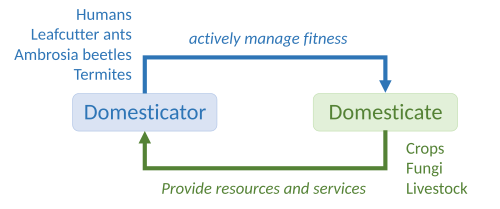
Michael D. Purugganan notes that domestication has been hard to define, despite the "instinctual consensus" that it means "the plants and animals found under the care of humans that provide us with benefits and which have evolved under our control."[8] He comments that insects such as termites, ambrosia beetles, and leafcutter ants have domesticated some species of fungi, and notes further that other groups such as weeds and commensals have wrongly been called domesticated.[8] Starting from Zeder's definition, Purugganan proposes a "broad" definition: "a coevolutionary process that arises from a mutualism, in which one species (the domesticator) constructs an environment where it actively manages both the survival and reproduction of another species (the domesticate) in order to provide the former with resources and/or services."[8] He comments that this adds niche construction to the activities of the domesticator.[8]
Domestication syndrome is the suite of phenotypic traits that arose during the initial domestication process and which distinguish crops from their wild ancestors.[9][10] It can also mean a set of differences now observed in domesticated animals, not necessarily reflecting the initial domestication process. The changes include increased docility and tameness, coat coloration, reductions in tooth size, craniofacial morphology, ear and tail form (e.g., floppy ears), estrus cycles, levels of adrenocorticotropic hormone and neurotransmitters, prolongations in juvenile behavior, and reductions in brain size and of particular brain regions.[11]
Cause and timing
The domestication of animals and plants was triggered by the climatic and environmental changes that occurred after the peak of the Last Glacial Maximum and which continue to this present day. These changes made obtaining food by hunting and gathering difficult.[12] The first animal to be domesticated was the dog at least 15,000 years ago.[1] The Younger Dryas 12,900 years ago was a period of intense cold and aridity that put pressure on humans to intensify their foraging strategies but did not favour agriculture. By the beginning of the Holocene 11,700 years ago, a warmer climate and increasing human populations led to small-scale animal and plant domestication and an increased supply of food.[13]
The appearance of the domestic dog in the archaeological record, at least 15,000 years ago, was followed by domestication of livestock and of crops such as wheat and barley, the invention of agriculture, and the transition of humans from foraging to farming in different places and times across the planet.[1][17][18][19] For instance, small-scale trial cultivation of cereals began some 28,000 years ago at the Ohalo II site in Israel.[20]
In the Fertile Crescent 11,000–10,000 years ago, zooarchaeology indicates that goats, pigs, sheep, and taurine cattle were the first livestock to be domesticated. Two thousand years later, humped zebu cattle were domesticated in what is today Baluchistan in Pakistan. In East Asia 8,000 years ago, pigs were domesticated from wild boar genetically different from those found in the Fertile Crescent.[1] The cat was domesticated in the Fertile Crescent, perhaps 10,000 years ago,[21] from European wildcats, possibly to control rodents that were damaging stored food.[22]

Animals
Desirable traits

The domestication of animals is the relationship between non-human animals and humans who have an influence on their care and reproduction.[7] In his 1868 book The Variation of Animals and Plants Under Domestication, Charles Darwin recognized the small number of traits that made domestic species different from their wild ancestors. He was also the first to recognize the difference between conscious selective breeding in which humans directly select for desirable traits and unconscious selection, in which traits evolve as a by-product of natural selection or from selection on other traits.[25][26][27]
There is a difference between domestic and wild populations; some of these differences constitute the domestication syndrome, traits presumed essential in the early stages of domestication, while others represent later improvement traits.[9][28][29] Domesticated animals tend to be smaller and less aggressive than their wild counterparts; other common traits are floppy ears, a smaller brain, and a shorter muzzle.[24] Domestication traits are generally fixed within all domesticates, and were selected during the initial episode of domestication of that animal or plant, whereas improvement traits are present only in a proportion of domesticates, though they may be fixed in individual breeds or regional populations.[28][29][30]
Certain animal species, and certain individuals within those species, make better candidates for domestication because of their behavioral characteristics:[31][32][33][34]
- The size and organization of their social structure[31]
- The availability and the degree of selectivity in their choice of mates[31]
- The ease and speed with which the parents bond with their young, and the maturity and mobility of the young at birth[31]
- The degree of flexibility in diet and habitat tolerance[31]
- Responses to humans and new environments, including reduced flight response and reactivity to external stimuli.[31]
Mammals
_(cropped).jpg/500px-Tibet_~_Camel_Caravan_(3747098653)_(cropped).jpg)
The beginnings of animal domestication involved a protracted coevolutionary process with multiple stages along different pathways. There are three proposed major pathways that most animal domesticates followed into domestication:[31][29][35]
- commensals, adapted to a human niche (e.g., dogs, cats, possibly pigs)[31]
- prey animals sought for food (e.g., sheep, goats, cattle, water buffalo, yak, pig, reindeer, llama and alpaca)[31]
- animals targeted for draft and riding (e.g., horse, donkey, camel).[31]
Humans did not intend to domesticate animals from either the commensal or prey pathways or at least they did not envision a domesticated animal would result from it. In both of those cases, humans became entangled with these species as the relationship between them intensified, and humans' role in their survival and reproduction gradually led to formalized animal husbandry.[29] Although the directed pathway for draft and riding animals proceeded from capture to taming, the other two pathways are not as goal-oriented, and archaeological records suggest that they took place over much longer time frames.[36]
Unlike other domestic species selected primarily for production-related traits, dogs were initially selected for their behaviors.[37][38] The dog was domesticated long before other animals,[39][40] becoming established across Eurasia before the end of the Late Pleistocene era, well before agriculture.[39]
The archaeological and genetic data suggest that long-term bidirectional gene flow between wild and domestic stocks – such as in donkeys, horses, New and Old World camelids, goats, sheep, and pigs – was common. [29][35] Human selection for domestic traits likely counteracted the homogenizing effect of gene flow from wild boars into pigs, and created domestication islands in the genome. The same process may apply to other domesticated animals. [41][42]
The 2023 parasite-mediated domestication hypothesis suggests that endoparasites such as helminths and protozoa could have mediated the domestication of mammals. Domestication involves taming, which has an endocrine component; and parasites can modify endocrine activity and microRNAs. Genes for resistance to parasites might be linked to those for the domestication syndrome; it is predicted that domestic animals are less resistant to parasites than their wild relatives.[43][44]
Birds
The chicken was domesticated from the red junglefowl, apparently for cockfighting, some 7,000 years ago.[16]
Domesticated birds principally mean poultry, raised for meat and eggs:[45] some Galliformes (chicken, turkey, guineafowl) and Anseriformes (waterfowl: ducks, geese, and swans). Also widely domesticated are cagebirds such as songbirds and parrots; these are kept both for pleasure and for use in research.[46] The domestic pigeon has been used both for food and as a means of communication between far-flung places through the exploitation of the pigeon's homing instinct; research suggests it was domesticated as early as 10,000 years ago.[47] Chicken fossils in China have been dated to 7,400 years ago. The chicken's wild ancestor is Gallus gallus, the red junglefowl of Southeast Asia. The species appears to have been kept initially for cockfighting rather than for food.[16]
Invertebrates
Two insects, the silkworm and the western honey bee, have been domesticated for over 5,000 years, often for commercial use. The silkworm is raised for the silk threads wound around its pupal cocoon; the western honey bee, for honey, and, from the 20th century, for pollination of crops.[48][49]
Several other invertebrates have been domesticated, both terrestrial and aquatic, including some such as Drosophila melanogaster fruit flies and the freshwater cnidarian Hydra for research into genetics and physiology. Few have a long history of domestication. Most are used for food or other products such as shellac and cochineal. The phyla involved are Cnidaria, Platyhelminthes (for biological pest control), Annelida, Mollusca, Arthropoda (marine crustaceans as well as insects and spiders), and Echinodermata. While many marine mollusks are used for food, only a few have been domesticated, including squid, cuttlefish and octopus, all used in research on behaviour and neurology. Terrestrial snails in the genera Helix are raised for food. Several parasitic or parasitoidal insects, including the fly Eucelatoria, the beetle Chrysolina, and the wasp Aphytis are raised for biological control. Conscious or unconscious artificial selection has many effects on species under domestication; variability can readily be lost by inbreeding, selection against undesired traits, or genetic drift, while in Drosophila, variability in eclosion time (when adults emerge) has increased.[50]
-

-

-
 The lac bug Kerria lacca has been kept for shellac resin.
 -