
Loading article…
イメージ を投稿する | |
|---|---|
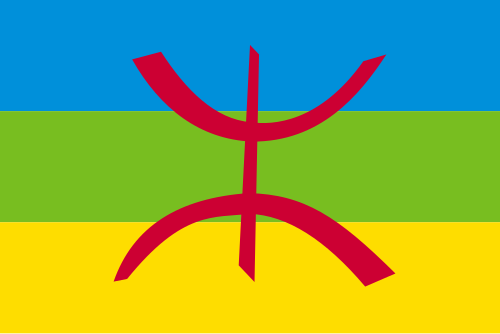 | |
| 総人口 | |
| 3600万[1] [2] [3] [4] | |
| 人口の多い地域 | |
| モロッコ | 1500万から2000万[5] |
| アルジェリア | 900万[2]から1300万[6] [7] |
| ニジェール | 260万[8] |
| フランス | 200万[9] |
| マリ | 85万人[10] |
| リビア | 60万人[11] |
| ベルギー | 50万人[12] |
| オランダ | 467,455 [引用が必要] |
| ブルキナファソ | 406,271 [13] |
| チュニジア | 173,937 [14] |
| モーリタニア | 133,000 [15] |
| カナダ | 37,060人(混血を含む)[16] |
| エジプト | 23,000 [17] |
| ノルウェー | 4,500 [引用が必要] |
| イスラエル | 3,500 [18] |
| アメリカ合衆国 | 1,325 [19] |
| 言語 | |
| ベルベル語(タマジグト語)とアラビア語 | |
| 宗教 | |
| イスラム教スンニ派が主流。 少数派はイバード派、シーア派、キリスト教(主にカトリック)、[20] [21] ユダヤ教 | |
| 関連民族 | |
| アラブ人とその他のアフロアジア語族 地中海民族[22] [23] [24] [25] [26] [27] | |

ベルベル人、あるいはベルベル民族[a]は、アマジグ[b]あるいはイマジゲン[c]とも呼ばれ、北アフリカに固有 の多様な民族集団であり、アラブ人がマグリブに移住する以前から存在していた。 [ 28] [29] [30] [31]彼らの主なつながりは、ほとんどが相互に理解不可能なベルベル語の使用によって特定され、 [30] [32]アフロアジア語族に属する。彼らは北アフリカのマグリブ地域が原産で、モロッコ、アルジェリア、リビア、そしてより少数ながらチュニジア、モーリタニア、マリ北部、ニジェール北部に散在するコミュニティに住んでいる。[31] [33] [34]より小規模なベルベル人コミュニティがブルキナファソやエジプトのシワオアシスにも存在する。[35] [36] [37]
北アフリカの石器時代の部族の子孫であるイマジゲン族に関する記述は、古代エジプトの文献で初めて言及されている。[38] [39]紀元前2000年頃から、ベルベル語はナイル渓谷からサハラ北部を越えてマグリブ地方に西に広がった。マウリ族、マサエシリ族、マッシリ族、ムスラミ族、ガエトゥリ族、ガラマンテス族などの一連のベルベル人が、ヌミディアやマウレタニア などのベルベル王国を興した。他の王国は、後期古代にアルタヴァ族、アウレス族、ワルセニス族、ホドナ族などとして出現した。[40]ベルベル王国は、最終的に西暦7世紀と8世紀のアラブ人の征服によって鎮圧された。これにより、アラブ化と呼ばれる文化的および言語的同化のプロセスが始まり、ベルベル人に影響を与えた。アラブ化は、ベルベル人の間でアラビア語とアラブ文化が広まり、アラビア語が主要言語として採用され、イスラム教に改宗することを伴った。特に、7世紀から17世紀にかけてのマグリブへのアラブ人の移住がこの過程を加速させた。 [41] 7世紀以降、地元のアラブ王朝がマグリブの一部を支配するようになったが、ベルベル人の部族は強力な政治勢力であり続け、10世紀と11世紀にズィール朝、ハマド朝、西マグリブのさまざまなゼナタ公国、アルアンダルスのいくつかのタイファ王国など、新しい支配王朝を建国した。その後、イスラム教は、11世紀から13世紀にかけての新たなベルベル帝国、ムラービト朝とムワッヒド朝の台頭に対する思想的刺激となった。彼らの後継者であるベルベル人のマリーン朝、ザイヤーン朝、ハフス朝は16世紀まで支配を続けた。16世紀以降、ベルベル人の王朝は不在のままこのプロセスが続き、モロッコではイスラムの預言者ムハンマドの子孫であると主張するアラブ人がベルベル人に取って代わった。[40]
ベルベル人は、カビル人、シャウイ人、リフ人など、いくつかの多様な民族グループとベルベル語に分かれています。歴史的に、この地域のベルベル人は、異なる文化のため、自分たちを単一の文化的または言語的単位とは見なしておらず、より大きな「ベルベル人コミュニティ」も存在しませんでした。[42]また、彼らは自分たちをベルベル人/アマジグ人とは呼ばず、自分たちのグループやコミュニティを指す独自の用語を持っていました。[43] 7世紀のアラブの征服後、彼らはまとめてベルベル人と呼ばれるようになり、この区別は19世紀にフランスの植民地行政官によって復活しました。今日、「ベルベル人」という用語は、「アマジグ人」という用語を好む多くの人々によって軽蔑的であると見なされています。[44] 20世紀後半以来、北アフリカのベルベル人の間では、アマジグ族の集団的民族的アイデンティティを促進し、より大きな言語的権利と文化的認識を求めて、ベルベル主義またはベルベル文化運動として知られる国境を越えた運動が起こりました。[45]
名前と語源
北アフリカのマグレブ地域の先住民は、総称してベルベル人、英語ではアマジグ人と呼ばれています。[31]
紀元前1700年と1300年のエジプトの碑文にはバラバラやベラベラータなどの部族の称号が登場しており、ベルベル人はおそらく非常に古い時代にエジプト人と密接な関係にあったと思われる。そのため、真の民族名は、古代の征服者たちが自然に使用した呼称であるバルバリと混同された可能性がある。[46] [より良い情報源が必要]
英語では複数形のイマジゲンも使われることがある。[33] [47]英語話者の間ではベルベル語の方が広く知られているが、その使用法は、その歴史的背景が異語であることと、現在ではアラビア語で「野蛮人」を意味する言葉と同義であることから、議論の的となっている。 [48] [49] [34] [50]歴史的に、ベルベル人は自分たちをベルベル人/アマジグ人とは呼ばず、自分たちを指す独自の用語を持っていた。例えば、カビレ人は自分たちの民族を指すのに「レクバイエル」という用語を使用し、シャウイ人はベルベル人/アマジグ人ではなく「イシャウィエン」を自称した。[43]
ステファン・グセルは、レオ・アフリカヌスがベルベル語を指して「アワル・アマジグ」を「高貴な言語」と翻訳したことに基づいて、アマジグという用語を「高貴な/自由な」と翻訳することを提案したが、この定義は依然として議論の的となっており、不当な推論であると広く見なされている。 [51] [52] [53]アマジグという用語には、トゥアレグ語の「アマジェグ」という同義語もあり、高貴を意味する。[54] [51] 「マジグ」はローマ帝国のマウレタニア・カエサリエンシスで部族の姓として使用された。[52] [55]
アブラハム・アイザック・ラレドは、アマジグという語はタルグムに出てくるシバのデダンの名である「メゼグ」に由来するのではないかと提唱している。[56] [51]
イブン・ハルドゥーンは、ベルベル人はバルバルの子孫であり、バルバルはタマラの息子であり、マジグの息子であり、カナンの息子であり、カナンはハムの息子であり、ハムはノアの息子であると述べています。[57] [51]
古代のヌミディア人、マウリ人、リブ人は、一般的に現代のベルベル人とほぼ同じ集団を指すと理解されています。[58] [59]
先史時代


北西アフリカのマグレブ地方には、少なくとも紀元前1万年からベルベル人が住んでいたと考えられている。[60]現在から1万2千年前のものとされる洞窟壁画が、アルジェリア南東部のタッシリ・ナジェール地方で発見されている。他の岩絵は、リビア砂漠のタドラルト・アカクスで発見されている。家畜化と自給農業を特徴とし、タッシリ・ナジェールの壁画に豊かに描かれている新石器時代の社会は、紀元前6000年から2000年の間(古典期まで)に北アフリカのサハラ砂漠と地中海地域(マグレブ)で発展し、優勢であった。
先史時代のティフィナグ碑文がオラン地域で発見された。[61]ローマ以前の時代には、マシニッサ王がヌミディアの人々を統一する前に、いくつかの独立国家(マッシリ)が相次いで存在していた。[62] [63] [64] [全文引用が必要]
歴史
北アフリカでベルベル語と伝統を最もよく保っている地域は、一般的にアルジェリア、リビア、モロッコ、チュニジアである。ベルベル文化の多くは、モロッコとアルジェリア、特にカビリア、オーレス、アトラス山脈の文化エリートの間で今でも祝われている。カビリア人は、カルタゴ人、ローマ人、ビザンチン人、ヴァンダル人、オスマントルコによる相次ぐ支配の間も独立を保った北アフリカの数少ない民族の一つであった。[65] [66] [67] [68]アラブ人が 北アフリカを征服した後も、カビル人は依然として自分たちの山々を所有し続けた。[69] [70]
起源


神話
ローマの歴史家ガイウス・サルスティウス・クリスプスによると、北アフリカの原住民はガエトゥリア人とリビア人で、彼らはイベリアからアフリカに渡った先史時代の人々でした。その後ずっと後になって、ヘラクレスとその軍隊がイベリアから北アフリカに渡り、彼の軍隊は現地の住民と結婚してその地域に永住しました。彼の軍隊のメディア人とリビア人との結婚によりマウル族が形成され、彼の軍隊の他の部分はノマダ人、今日ではヌミディア人として知られる人を形成し、後にマシニッサの支配下で北アフリカのベルベル人の部族すべてを統一しました。
その他の情報源
アル・フィリスタによれば、バーベル人(ベルベル人)はアフリカの7つの主要民族のうちの1つを構成していた。[71]
中世チュニジアの学者イブン・ハルドゥーン(1332-1406)は、当時広まっていた口承の伝承を語り、ベルベル人の起源について2つの一般的な意見を挙げている。1つの意見によると、ベルベル人はハムの息子カナンの子孫であり、先祖はベルベル人であり、ベルベル人はテムラの息子であり、テムラはマジグの息子であり、カナンの息子であり、ハムはノアの息子であるという。[72]もう1つは、アブー・ベクル・モハメッド・エス・スーリ(947年)は、ベルベル人はベルベル人の子孫であり、ベルベル人はケルジム(カスルヒム)の息子であり、ケルジムはハムの息子メスライムの息子であると主張した。[72]
彼らは、強力で、恐るべき、勇敢で、多数の民族に属しています。アラブ人、ペルシャ人、ギリシャ人、ローマ人など、世界が見てきた他の多くの人々と同じような真の民族です。この民族の家族に属する人々は、マグリブの初めから住んでいました。
— イブン・ハルドゥーン[73]
科学的
紀元前5000年頃の北アフリカの人口は主にイベロマウルス文化とカプシア文化の子孫であり、より最近の侵入は新石器革命に関連しています。[74]原ベルベル人の部族は、青銅器時代後期から鉄器時代初期にかけて、これらの先史時代のコミュニティから進化しました。[75]
片親DNA分析により、ベルベル人とアフリカの他のアフロアジア語族とのつながりが明らかになった。これらの集団のほとんどはE1b1b父系ハプログループに属しており、ベルベル語話者はこの系統の頻度が最も高い。[76]
さらに、ゲノム解析により、ベルベル人や他のマグレブのコミュニティには、近東に起源を持つ祖先要素が高頻度に存在することが判明しました。このマグレブ要素は、チュニジアのベルベル人の間でピークを迎えます。[77]この祖先は、完新世以前にこれらおよび他の西ユーラシア関連の要素から分岐したコプト/エチオピア・ソマリ要素に関連しています。[78]
2013年には、マグリブのタフォラルトとアファロウの先史時代の遺跡から出土したイベロマウルシア人の骨格も古代DNAの分析が行われた。標本はすべて北アフリカまたは地中海沿岸北部と南部に関連する母系の系統に属しており、これらの地域間では上旧石器時代以来の遺伝子流動があったことを示している。[79]古代タフォラルトの人々はmtDNAハプログループ U6、H、JT、Vを持っており、これはイベロマウルシア時代からこの地域の人口の継続性を示している。[80]
モロッコのイフリ・ナムル・ウ・ムーサ遺跡で発掘された人類の化石は、放射性炭素年代測定により、紀元前 5,000年頃の新石器時代初期と測定されました。これらの標本の古代DNA分析により、父方のハプロタイプはE1b1b1b1a(E-M81)サブクレードに関連し、母方のハプログループU6aおよびM1に関連していることが示されました。これらはすべて、現在のマグレブのコミュニティでよく見られるものです。これらの古代人は、現代のベルベル人にピークを迎える土着のマグレブ人のゲノム要素も持っており、この地域の人々の祖先であったことを示しています。さらに、ラバト近郊のケフ・エル・バルード遺跡で発掘された化石は、広く分布する父系ハプログループT-M184と母系ハプログループK1、 T2 、X2を有していたことがわかった。母系ハプログループK1、 T2 、X2は、新石器時代のヨーロッパとアナトリアで一般的なmtDNA系統であった。これらの古代人は、ベルベル人と関連するマグレブのゲノム成分も持っていた。これらを総合すると、後期新石器時代のケフ・エル・バルードの住民は、同地域の現代人の祖先であったが、ヨーロッパからの遺伝子流入も経験した可能性が高いことがわかる。[81]
後期新石器時代のケフ・エル・バルードの住民は、約50%が地元の北アフリカ系、50%が初期ヨーロッパ農民(EEF)系とモデル化されている。EEF系は、紀元前5000年から3000年の間にイベリア半島から来たカーディアルウェア植民者を通じて北アフリカに入ったと示唆されている。彼らはカナリア諸島のグアンチェ族と密接な関係にあることが判明した。研究の著者らは、ベルベル人のアフリカにローマ植民地が設立される以前、モロッコのベルベル人が相当量のEEF系を継承していたと示唆している。[ 81]
古代

古典古代(当時は古代リビア人として知られていた)のベルベル人の大部族は、おおよそ西から東に、マウリ族、カルタゴ近郊のヌミディア人、ガエトゥリア人の3つだったと言われている。マウリ族は西端(古代マウレタニア、現在のモロッコとアルジェリア中央部)に住んでいた。ヌミディア人はマウリ族と都市国家カルタゴの間の地域を占めていた。マウリ族とヌミディア人はどちらも村に住む定住人口が多く、土地を耕したり家畜の世話をしたりしていた。ガエトゥリア人はサハラ砂漠の北端の南方に住み、定住人口は少なく、主に牧畜の要素が強かった。[83] [84] [85] : 41f
一方、フェニキア人(セム語を話す カナン人)は、おそらく当時最も進んだ多文化圏であった西アジアの肥沃な三日月地帯の西海岸から来た。したがって、フェニキアの物質文化はおそらく初期のベルベル人よりも機能的で効率的であり、彼らの知識はより進んでいた。したがって、ベルベル人とフェニキア人の交流はしばしば非対称であった。フェニキア人は文化的結束と民族的結束を保つために努力し、母都市ティルスとの密接なつながりを絶えず更新した。 [82] : 37
フェニキア人が最初に沿岸に築いた拠点は、おそらくイベリア人との利益の大きい金属貿易に向かう船に補給や整備を行うためだけのものだったと思われる。[86]そしておそらく最初はベルベル人との貿易は利益にならないとみなしていた。 [87]しかしフェニキア人は最終的に多くのベルベル人の地域に戦略的な植民都市を築き、その中にはオエア、レプティス・マグナ、サブラタ(リビア)、ヴォルビリス、シェラ、モガドール(現在のモロッコ)などの現在のチュニジア以外の場所も含まれる。チュニジアと同様にこれらの中心地は貿易の中心地であり、後にヴォルビリスでのオリーブ油の加工やモガドールでのティリア紫の染料の加工など、資源開発の支援も提供した。ベルベル人のほとんどは農民または半牧畜民として独立を維持したが、カルタゴの例に倣って組織化された政治は規模と洗練度を増していった。[85]
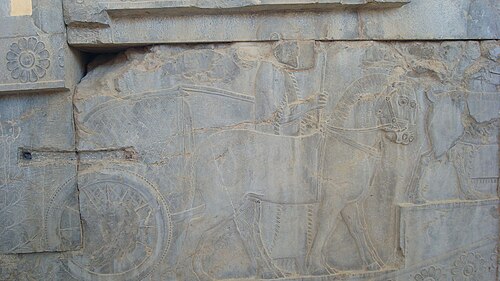
実際、ベルベル人の数的および軍事的優位性(当時の最高の騎手たち)により、ベルベル人の王国の中にはカルタゴに貢物を課す者もおり、この状況は紀元前5世紀まで続いた。[86] : 64–65 また、ベルベロ・リビアのメシュウェシュ王朝によるエジプト統治(紀元前945年~715年)により、 [88]カルタゴ近郊のベルベル人は多大な尊敬を集めていた(しかし、ナイル川沿いの優雅なリビアのファラオよりも田舎風に見えたと思われる)。同様に、初期のカルタゴでは、ベルベル人の首長たちと最も有利な条約を結ぶことに細心の注意が払われ、「ベルベル人とカルタゴの貴族との婚姻も含まれていた」。[89]この点では、トロゴスが語るカルタゴの創設者ディドーの伝説が適切かもしれない。彼女がマウリタニ族の首長ヒアルブスとの結婚を拒否したことは、そこに関係する政治的複雑さを示しているのかもしれない。[90]
フェニキア人の交易拠点は、やがて恒久的な居住地へと発展し、その後は小さな町へと発展した。おそらく、多種多様な商品や食料源が必要となり、ベルベル人との交易でその需要を満たすことができただろう。しかし、ここでもフェニキア人は、おそらくこうした地域交易の組織化と指導、そして農業生産の管理に引き込まれたと思われる。紀元前5世紀、カルタゴは領土を拡大し、ボン岬と肥沃なワディ・マジャルダを獲得し、[91]後に数百キロメートルに及ぶ肥沃な農地を支配下に置いた。[92]フェニキア人がこうした土地の富を横領すれば、ベルベル人から何らかの抵抗を受けることは確実である。しかし、戦争においても、フェニキア人の技術訓練、社会組織、武器は、部族ベルベル人に不利に働いたと思われる。初期カルタゴにおけるこの社会文化的交流は、次のように要約されている。
同時代の文書記録がないため、ここでの結論は不確実であり、社会的なニュアンスに関する推論と合理的な推測に基づくしかありません。しかし、フェニキア人は一般的にベルベル人と経済的に同等な関係にあったわけではなく、彼らの農業労働力や家事労働を、雇用契約または契約書によって雇用していたようです。その多くは小作人になりました。[82] : 86
一時期、ベルベル人は絶えず反乱を起こし、396年には大規模な反乱が起こった。
何千人もの反乱軍が山から流れ下り、地方の農奴を連れ、カルタゴ領に侵入した。カルタゴ軍は城壁内に撤退せざるを得ず、包囲された。
しかしベルベル人は団結力が欠けており、一時は20万人の勢力があったものの飢餓に屈し、指導者には賄賂が贈られ、「徐々に分裂して故郷に戻っていった」[86] : 125, 172。 その後、「4世紀以降、リビア人[ベルベル人]の間で一連の反乱が起こった」[82] : 81
ベルベル人は東からの移住者を不本意ながら「受け入れる」ことになり、何世紀にもわたってカルタゴの支配を受け入れざるを得なかった。しかし、彼らはカルタゴではほとんど同化されずに存続し、カルタゴ支配によって作られた社会構造の中で、都市部と農村部の受動的な貧困層の文化として、独立した潜伏した存在として存続した。 [93]さらに、そして最も重要なのは、ベルベル人が国境の草原とその向こうに準独立した衛星社会も形成し、少数派が自由な「部族共和国」として存続したことだ。カルタゴの物質文化と政治軍事制度の恩恵を受けながら、これらの辺境のベルベル人(リビア人とも呼ばれる)は、独自のアイデンティティ、文化、伝統を維持しながら、東からの新参者と非対称の共生関係を築きながら、独自の農業技術と村落社会を発展させ続けた。[e] [95]
数世紀が経つと、アフリカ生まれでフェニキア人の子孫であるリビュフェニキア人と呼ばれるカルタゴ人の社会がそこに出現した。この用語は後に、都市部のフェニキア文化に同化したベルベル人にも適用されるようになった。[82] : 65, 84–86 しかし、カルタゴ文明へのベルベル人の徒弟制度という概念全体は、ベルベル人にとって根本的に無縁の観点に基づく誇張だと言われてきた。[84] : 52, 58 混血のベルベル人とカルタゴ人がそこで発展し、ベルベル人がその有用性を証明した認知されたニッチが発達した。例えば、カルタゴ国家はベルベル人とヌミディア人の騎兵隊を指揮官の指揮下で定期的に配置し始めた。ベルベル人は最終的に兵士を提供することを要求され(最初は「戦利品以外」の報酬は「ありそうにない」)、紀元前4世紀までに「カルタゴ軍で最大の単一要素」となった。[82] : 86

しかし、カルタゴが緊迫し、外国軍が都市国家に攻め寄せてくると、ポエニ社会における地位の低さを考えると、ベルベル人の中には、それを自分たちの利益を推進するチャンスと見る者もいた。[要出典]例えば、シチリア島のアガトクレス(紀元前361年 - 紀元前289年)率いるギリシャ軍がボン岬に上陸し、カルタゴを脅かしたとき(紀元前310年)、アイリュマス率いるベルベル人が侵略してきたギリシャ軍に寝返った。[86] : 172 [f]ローマとの第二次ポエニ戦争(紀元前218年 - 紀元前201年)の長期にわたる戦いの間(下記参照)、ベルベル人の王マシニッサ(紀元前 240年頃 - 紀元前 148年頃)は侵略してきたローマの将軍スキピオと連合し、高名な将軍ハンニバルの存在にもかかわらず、ザマの戦いでカルタゴを破り、戦争を終わらせた。一方、ベルベル人の王シュファクス(紀元前202年没)はカルタゴを支援していた。ローマ人もこれらの兆候を読み取り、ベルベル人との同盟関係を育み、その後ローマの勝利で利益を増大させたベルベル人を優遇した。[96]
カルタゴは、その古くからのライバルたちから「その臣民に対する過酷な扱い」と「貪欲さと残酷さ」で非難された。[82] : 83 [g] [97]たとえば、カルタゴのリビアのベルベル人の小作人は、第一次ポエニ戦争の緊急事態の間、収穫の半分を都市国家に貢物として納めるよう要求された。カルタゴが通常受けていた徴収額は、おそらく「極めて重い」4分の1だった。[82] : 80 カルタゴはかつて、リビア人と外国人兵士の数を減らそうとしたことで有名で、傭兵戦争(紀元前240年 - 237年)につながった。[86] : 203 - 209 [98] [99]また、都市国家は、その臣民に対して冷酷な扱いをすることで知られる指導者に報奨を与えていたようで、ベルベル人の反乱が頻繁に起こった。現代人はカルタゴが「ローマがイタリア人を縛り付けたように、カルタゴが自らの臣民を縛り付けなかった」と非難するが、ローマとイタリア人はカルタゴとベルベル人よりもずっと多くの共通点を持っていた。それにもかかわらず、現代人の批判は、カルタゴ人が「適切に組織された都市での生活」という共通の共有の質を促進しなかったことで「自らに損害を与えた」というもので、特にベルベル人に関して忠誠心をかき立てるものである。[82] : 86–87 再び、カルタゴが要求した貢物は負担が大きかった。[100]
「最も破滅的な貢納が、従属国から容赦なく課され、同族のフェニキア諸国からも同様に、容赦なく厳格に徴収された。…したがって、カルタゴに対する、外国の従属国、さらにはフェニキアの従属国からの普遍的な不満、いやむしろ、致命的な憎悪が生じた。カルタゴは、アフリカのあらゆる侵略者にとって、最も確実な支えとして安心して頼りにできる国であった。…これが、カルタゴ帝国の根本的で、根絶できない弱点であった… [100]
カルタゴの存続期間中、カルタゴ人とベルベル人の大多数との関係は続いた。物質文化と社会組織の不平等な発展は、おそらくこの関係を不安定なものに運命づけた。カルタゴの不安定さの長期的原因は、民族の融合がなかったことだった。それはカルタゴにとってストレスの源であり、弱点であり続けた。しかし、いくつかの点、相互利益の発見、友情や家族の機会など、収束の度合いはあった。[101]

ベルベル人はローマ時代に徐々に歴史に名を残した。ビザンチンの著述家は、マジケ人(アマジグ人)がキレナイカの修道院を襲撃した部族として言及している。ガラマンティアは紀元前400年から紀元後600年の間にサハラ砂漠の現在のリビアの フェザーン地域で繁栄した著名なベルベル王国であった。
ローマ時代のキレナイカは初期キリスト教の中心地となった。イスラム以前のベルベル人の中にはキリスト教徒もいた[102] (ドナティストの教義を信奉することとベルベル人であることの間には強い相関関係があり、これは彼らの文化に合致した教義と、カトリック教会の支配的なローマ文化から疎外されていたことに起因していると考えられる)[73] 。また、一部はおそらくユダヤ教徒で、一部は伝統的な多神教を信奉していた。ローマ時代の著述家アプレイウスと聖アウグスティヌスはヌミディアで生まれ、3人の教皇もヌミディアで生まれた。そのうちの一人、教皇ウィクトル1世はローマ皇帝セプティミウス・セウェルスの治世に仕えた。セプティミウス・セウェルスは北アフリカ人でローマ/ポエニの血を引いていた(おそらくベルベル人の血も入っている)。[103]
ヌミディア
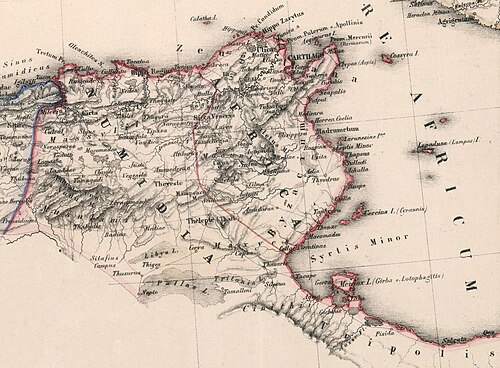
ヌミディア(紀元前202年 - 紀元前46年)は、現在のアルジェリアとチュニジアの一部にあった古代ベルベル人の王国です。後にローマの属州とローマの従属国を交互に経験しました。この王国は現在のアルジェリアの東の国境に位置し、西はローマの属州マウレタニア(現在のアルジェリアとモロッコ)、東はローマの属州アフリカ(現在のチュニジア)、北は地中海、南はサハラ砂漠に接していました。この王国の人々はヌミディア人でした。
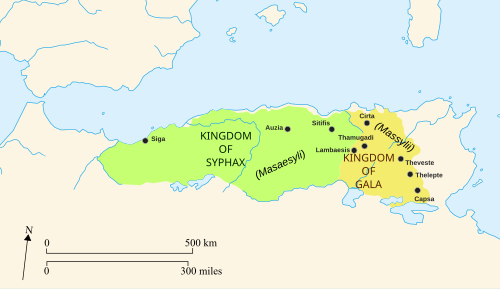
ヌミディアという名前は、紀元前3世紀にポリュビオスや他の歴史家によって、カルタゴの西側の領土を指すために初めて使われました。この領土には、オランの西約160キロメートル (100 マイル) にあるムルチャ (ムルヤ) 川までのアルジェリア北部全体が含まれます。ヌミディア人は、ヌミディア東部のマッシリ族と西部のマサエシリ族という2つの大きなグループとして考えられていました。第二次ポエニ戦争の前半では、ガラ王の指揮下にある東部のマサエシリ族はカルタゴと同盟を結び、シュファックス王の指揮下にある西部のマサエシリ族はローマと同盟を結びました。
紀元前206年、マシニッサというマシリウス一族の新しい王がローマと同盟を結び、マシニッサのシュファックスはカルタゴ側に寝返った。戦争の終わりに、勝利したローマはヌミディア全土をマシニッサに与えた。マシニッサが紀元前148年に亡くなった時点で、彼の領土はマウレタニアからカルタゴ領土の境界まで、南東はキレナイカまで広がっており、ヌミディアは海側を除いてカルタゴを完全に取り囲んでいた。[104]
マシニッサの跡を継いだのは息子のミキプサであった。ミキプサが紀元前118年に死去すると、彼の2人の息子ヒエンプサル1世とアデルバル、そしてマシニッサの非嫡出の孫でベルベル人出身のユグルタが共同で王位を継承した。ユグルタはミキプサの死後すぐに争いを起こした。ユグルタはヒエンプサルを殺害し、これがアデルバルとの戦争へと発展した。
ユグルタが野戦で彼を破った後、アドヘルバルはローマに助けを求めて逃げた。ローマの役人たちは、賄賂のためとも言われるが、おそらくは利益のある従属王国での争いを早く終わらせたいという願望から、ヌミディアを二つに分割することで争いを解決しようとした。ユグルタは西半分を割り当てられた。しかし、その後すぐに争いが再び起こり、ローマとヌミディアの間でユグルタ戦争が勃発した。

モーリタニア
古代、マウレタニア(紀元前3世紀 - 紀元前44年)は、現在のモロッコとアルジェリアの一部にあった古代マウリ・ベルベル人の王国でした。紀元前33年、ボッコス2世の死後、ローマ帝国の属国となり、その後、プトレマイオス朝の最後の王、マウレタニアのプトレマイオスの死後、紀元40年に完全なローマの属国となりました。
中世

中世の歴史家によると、ベルベル人はブトル族とバラニス族(ボトル族とバルネス族としても知られる)の2つの支族に分かれており、マジグ族の祖先から派生した。マジグ族は部族と亜部族に分かれていた。マグリブの各地域には、いくつかの完全に独立した部族が含まれていた(例:サンハジャ族、ホアラ族、ゼナタ族、マスムダ族、クタマ族、アウラバ族、バルガワタ族など)。[105] [全文引用が必要] [106]
マウロ・ローマ王国は、首都アルタヴァ(現在のアルジェリア)を中心とする独立したキリスト教ベルベル王国であり、古代ローマの属州マウレタニア・カエサリエンシスの大部分を支配していた。マグリブ内のベルベル人キリスト教徒コミュニティは、イスラム支配下でほぼ消滅した。ネフザワのいくつかの村の先住民キリスト教徒人口は14世紀まで存続した。[107]
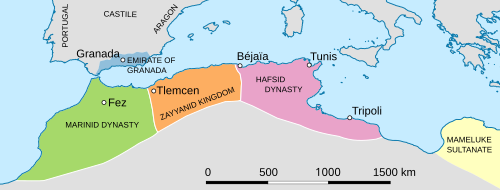
中世には、マグリブとアンダルスにいくつかのベルベル王朝が出現した。最も有名なのは、ズィル朝(イフリーキヤ、973年 - 1148年)、ハマド朝(西イフリーキヤ、1014年 - 1152年)、ムラービト朝(モロッコとアンダルス、1040年 - 1147年)、ムワッヒド朝(モロッコとアンダルス、1147年 - 1248年)、ハフス朝(イフリーキヤ、1229年 - 1574年)、ジアニド朝(トレムセン、1235年 - 1556年)、マリーン朝(モロッコ、1248年 - 1465年)、ワッタース朝(モロッコ、1471年 - 1554年)である。
11世紀以前、北西アフリカの大半はベルベル語を話すイスラム教地域となっていた。それ以前の宗教や文化の征服とは異なり、アラブ人によって広められたイスラム教の到来は、マグリブに広範かつ長期的な影響を及ぼすことになった。さまざまな形の新しい信仰は、軍隊、学者、熱心な神秘主義者を伴ってベルベル人社会のほぼすべての階層に浸透し、部族の慣習や忠誠心を新しい社会規範や政治的慣習に大きく置き換えた。この地域のさらなるアラブ化は、主にバヌ・ヒラルの到来によるものであった。バヌ・ヒラルは、シーア派を放棄したベルベル人のズィル朝を罰するためにエジプトのファーティマ朝から派遣された部族である。バヌ・ヒラルはズィル朝をいくつかの沿岸の町にまで追い込み、平野の大部分を占領したため、以前は農業が主流だった地域に遊牧民が広まった。
アラビアの影響に加えて、北アフリカにはバーバリ奴隷貿易を通じてヨーロッパ人が流入し、オスマン帝国時代に北アフリカに連れてこられたヨーロッパ人奴隷の数は125万人に上るとの推定もある。[108]近隣のスーダン帝国、貿易商、アフリカの他の地域からの遊牧民との交流もベルベル人に印象を残した。
イスラムの征服
.jpg/500px-Statue_of_Dyhia_in_Khenchela_(Algeria).jpg)
642年から669年にかけて行われた、アラブ軍によるマグリブへの最初の遠征は、イスラム教の普及につながった。エジプトを拠点としたこれらの初期の侵攻は、中央カリフの命令ではなく、現地の主導で行われた。しかし、カリフの所在地がメディナからダマスカスに移ると、ウマイヤ朝(661年から750年まで統治したイスラム王朝)は、地中海を支配する戦略的必要性から、北アフリカ戦線での軍事的協調が不可欠であると認識した。そのため、670年、ウクバ・イブン・ナフィ率いるアラブ軍は、現在のチュニスの南約160キロにカイラワンの町を建設し、その後の作戦の拠点とした。
ウクバの後継者アブ・アル・ムハジル・ディナールは西のアルジェリアに進出し、やがてキリスト教徒ベルベル人の広範な連合の支配者クサイラと共存関係を結んだ。トレムセンに拠点を置いていたクサイラはイスラム教徒となり、アルカイラワン近郊のタキルワンに本拠地を移した。この調和は長くは続かず、697年までアラビアとベルベルの勢力が交互にこの地域を支配した。ウマイヤ朝軍は698年にカルタゴを征服してビザンチン帝国を駆逐し、703年にはタバルカの戦いでディヒヤのベルベル連合軍を決定的に破った。711年までに、イスラム教に改宗したベルベル人の支援を受けたウマイヤ朝軍は北アフリカ全土を征服した。ウマイヤ朝のカリフによって任命された総督は、トリポリタニア(現在のリビアの西部)、チュニジア、アルジェリア東部 をカバーするイフリーキヤの新しいウィラヤ(州)の首都であるケルアンから統治しました。
ベルベル人の間でイスラム教が広まっても、アラブ人の差別的な態度のため、アラブ人が支配するカリフ制に対する彼らの支持は保証されなかった。支配的なアラブ人は、ベルベル人に重税を課し、改宗者を二級イスラム教徒として扱い、さらに最悪なことに、彼らを奴隷化することで、ベルベル人を疎外した。その結果、 739年から740年にかけて、イバード派イスラム教の旗の下で、広範な反対運動が公然と起こった。イバード派は東部でウマイヤ朝支配と戦っており、多くのベルベル人がこの宗派の一見平等主義的な教えに惹かれた。
反乱後、イバード朝はいくつかの神政的な部族王国を樹立したが、そのほとんどは短く困難な歴史をたどった。しかし、主要な交易路にまたがるシジルマサやトレムセンなどの他の王国は、より実行可能で繁栄した。750年、ウマイヤ朝の後継者としてイスラムの支配者となったアッバース朝は、カリフ制をバグダッドに移し、イフリーキヤにカリフの権威を再建し、イブラヒム・イブン・アル・アグラブをケルアンの知事に任命した。名目上はカリフの意のままに仕えていたものの、アル・アグラブとその後継者であるアグラブ朝は、909年まで独立して統治し、学問と文化の中心地となった宮廷を統括した。

アグラブ朝のすぐ西、アルジェの南西に位置するタヘルトから、アブドゥル・ラフマーン・イブン・ルスタムが中央マグリブの大半を支配した。ルスタム朝のイマーム(761年 - 909年)の統治者はそれぞれイバード派のイマームであり、有力な市民によって選出された。イマームは正直、敬虔、公正で評判を得た。タヘルトの宮廷は、数学、天文学、占星術、神学、法律の学問を支援していたことで知られた。ルスタム朝のイマームは、故意か怠慢か、信頼できる常備軍を組織することができなかった。この重要な要素と、王朝の最終的な衰退が相まって、ファーティマ朝の攻撃によるタヘルトの崩壊への道が開かれた。
マフディアは、921年にファーティマ朝のカリフ 、アブドゥッラー・アル・マフディーによって建設され、カリフ、アブドゥッラー・エル・ファーティミによってイフリーキヤの首都となった。[109]マフディアが首都に選ばれたのは、海に近く、フェニキア人の時代から重要な軍事拠点があった岬であったためである。[110]
ウマイヤ朝統治下のアル・アンダルス
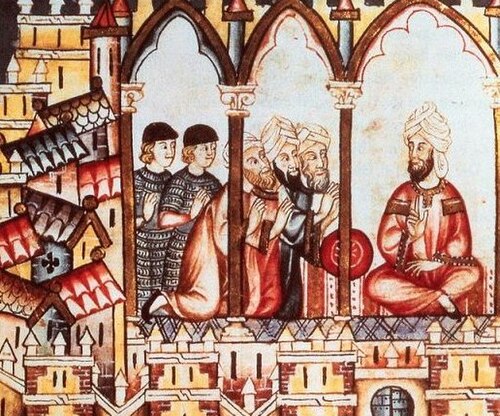
711年にイベリア半島を侵略したイスラム教徒は主にベルベル人で、ダマスカスのアラブのカリフ、アブド・アル・マリク・イブン・マルワンと北アフリカの総督、ムサ・イブン・ヌサイルの宗主権の下、ベルベル人のタリク・イブン・ズィヤードに率いられていた。[ 111 ]その後のアラブ人とベルベル人の対立と、アル・アンダルスの歴史のほとんどがアラブ人の視点から書かれたという事実により、利用可能な資料ではベルベル人の役割は控えめに記述されている。[111]イブン・ハリカンの人名辞典には、タリク・イブン・ズィヤードの項目で、711年の侵略におけるベルベル人の優位性が記録されている。[111] 712年には、イブン・ヌサイル自身の指揮下で、アラブ人とベルベル人の第2の混成軍が到着した。彼らは、ウマイヤ朝のカリフ、アブドゥル・ラフマーン1世の母親がベルベル人であったため、アル・アンダルスで彼を助けたとされている。
イギリスの中世学者ロジャー・コリンズは、イベリア半島に侵攻した勢力が主にベルベル人であったとすれば、それはアフリカの支配を維持しながらイベリア半島を攻撃するにはアラブ人の勢力が不十分だったためだと示唆している。[111] : 98 したがって、北アフリカが征服されたのはわずか十数年前であったが、アラブ人は次の侵攻を実行するためにすでに敗北したベルベル人の勢力を利用していた。[111] : 98 これは、最初の侵攻でベルベル人がアラブ人より優勢であったことを説明するだろう。さらにコリンズは、ベルベル人の社会組織のおかげでアラブ人は部族全体を軍隊に徴兵することができ、敗北したベルベル人は優れた軍事補助員になったと主張している。[111] : 99 イベリア半島に侵攻したベルベル人勢力はイフリーキヤから、あるいは遠くはトリポリタニアからやって来た。[112]
総督アス・サムは征服軍に土地を分配したが、部族ごとに分けたようだが、入手可能な数少ない史料から判断するのは困難である。[111] : 48–49 イベリア半島全土でアラブ人とベルベル人の配置が規則的になったのはこの頃である。ベルベル人はグラナダ、ピレネー山脈、カンタブリア、ガリシアなど、スペインの山岳地帯の多くに配置されていた。コリンズは、これはベルベル人の中には山岳地帯に精通していた者もいたが、アラブ人はそうではなかったためではないかと示唆している。[111] : 49–50 710年代後半までには、レオンかヒホンにベルベル人の総督がいた。[111] : 149 ペラギウスがアストゥリアスで反乱を起こしたのは、ベルベル人の総督に対するものであった。この反乱は、ベルベル人をガリシアとカンタブリアの山地に定住させるというアス・サムの計画に異議を唱えるものとなり、8世紀半ばまでにガリシアにはベルベル人はいなくなったようである。[111] : 49–50 コバドンガの戦いの後、ベルベル人の駐屯地がアストゥリアス中央部から追放されたことは、最終的に独立したアストゥリアス王国の形成に貢献した。[112] : 63
多くのベルベル人は、当時は国境地帯であったトレド、タラベラ、メリダ付近に定住し、[111] : 195 メリダは8世紀にベルベル人の主要拠点となった。[111] : 201 タラベラのベルベル人駐屯軍は後にアムルス・イブン・ユースフの指揮下に入り、700年代後半から800年代初頭にかけてトレドの反乱軍に対する軍事作戦に参加した。[111] : 210 ベルベル人は当初、ピレネー山脈東部やカタルーニャにも定住していた。[111] : 88–89, 195 彼らは南部の主要都市には定住せず、一般的にコルドバから離れた国境地帯に留まっていた。[111] : 207
ロジャー・コリンズはピエール・ギシャールの研究を引用し、イベリア半島のベルベル人は独自の社会組織を維持していたと主張している。[111] : 90 [113] [114]イベリア半島のアラブ人とベルベル人の文化に関するこの伝統的な見解によれば、ベルベル人社会は外部の影響をほとんど受けなかったが、アラブ人は同化してスペイン化した。[111] : 90 ベルベル人があまり同化しなかったという見解を裏付ける証拠として、スペイン北部のイスラム教徒の墓地の発掘調査がある。この発掘調査では、最初の侵略に同行したベルベル人が北アフリカから家族を連れてきたことが明らかになっている。[112] [115]
731年、東ピレネー山脈はムンヌザの指揮の下、主要都市に駐屯していたベルベル人勢力の支配下にあった。ムンヌザは、北アフリカのアラブ人裁判官によるベルベル人への虐待を理由に、スペインのアラブ人に対するベルベル人の反乱を企て、アキテーヌ公エウドと同盟を結んだ。しかし、総督アブド・アル・ラフマーンはムンヌザが準備する前に攻撃し、包囲してセルダニアで彼を破った。ムンヌザとの同盟のため、アブド・アル・ラフマーンはエウドを処罰しようとし、彼の懲罰遠征はポワティエでのアラブ人の敗北で終わった。[111] : 88–90
総督ウクバの時代、おそらく714年にはすでに、パンプローナ市はベルベル人の駐屯軍に占領されていた。[111] : 205–206 8世紀の墓地が発見され、イスラムの慣習に従って埋葬された190体の遺体が見つかり、この駐屯軍の存在を証明している。[111] : 205–206 [116]しかし、798年には、パンプローナはバヌ・カシ族の総督ムタリフ・イブン・ムサの支配下にあったと記録されている。イブン・ムサは民衆の反乱によりパンプローナの支配権を失った。806年、パンプローナはフランク人に忠誠を誓い、824年に独立したパンプローナ王国となった。これらの出来事により、パンプローナのベルベル人駐屯軍は終焉を迎えた。[111] : 206–208
中世エジプトの歴史家アル=ハカムは、 740年から741年にかけて北アフリカでマサイラ率いる大規模なベルベル人の反乱があったと書いている。754年の年代記ではこれらの反乱者をアルレスと呼んでいるが、コリンズはこれを「異端者」と訳し、ベルベル人の反乱者がイバード派またはハリジュ派に共感していたことを示していると主張している。[111] : 107 カール・マルテルが739年にマルセイユでアラブの同盟国マウロントゥスを攻撃した後、総督ウクバはフランク人に対する懲罰攻撃を計画したが、北アフリカでベルベル人の反乱が起こっているという知らせを受けて、サラゴサに到着した時に引き返した。[111] : 92 その代わりに、 754年の年代記によると、ウクバはアフリカのベルベル人の要塞を攻撃した。当初、これらの攻撃は成功しなかった。しかし最終的にウクバは反乱軍を壊滅させ、スペインへのすべての通過点を確保し、その後総督の職に復帰した。[111] : 105–106
マサイラは自身の支持者により殺害されたが、反乱は拡大し、ベルベル人の反乱軍は3つのアラブ軍を破った。[111] : 106–108 クルスームとバルジが指揮するシリアの精鋭部隊を含む第3軍の敗北後、ベルベル人の反乱はさらに拡大した。この頃、スペインのベルベル人軍事植民地が反乱を起こした。[111] : 108 同時にウクバが亡くなり、イブン・カタンが後を継いだ。この頃までに、ベルベル人はエブロ渓谷を除くイベリア半島北部のほとんどを支配し、トレドを脅かしていた。イブン・カタンは、当時セウタにいたバルジとシリア軍に、ベルベル人と戦うためにイベリア半島に渡るよう呼びかけた。[111] : 109–110
ベルベル人は三列に分かれて南下し、トレド、コルドバ、ジブラルタル海峡の港を同時に攻撃した。しかし、イブン・カタンの息子たちはトレドを攻撃する軍を破り、総督の軍はコルドバへの攻撃を、バルジュは海峡への攻撃を撃退した。その後、バルジュはコルドバに進軍し、イブン・カタンを処刑して権力を掌握した。[111] : 108 コリンズは、ウマイヤ朝に対するアッバース朝の反乱が勃発したちょうどその時、バルジュの軍はシリアを離れていたと指摘しており、これがウマイヤ朝の崩壊の一因となった可能性がある。[111] : 121
アフリカでは、ベルベル人は指導者の分裂によって妨害された。彼らのケルアンへの攻撃は敗北し、アフリカの新総督ハンザラ・イブン・サフワンはアフリカの反乱軍を倒し、バルジ軍と既存のアンダルシア・アラブ人の間に和平を強制した。[111] : 110–111
ロジャー・コリンズは、ベルベル人の大反乱がアストゥリアス王国の樹立を促し、イベリア半島のベルベル人の人口構成を変え、特に半島北西部からベルベル人が撤退する一因となったと主張している。[111] : 150–151 アラブ人が最初に半島を侵略したとき、ベルベル人の集団は北西部に住んでいた。しかし、ベルベル人の反乱により、ウマイヤ朝の知事は南側の側面を守らざるを得なくなり、アストゥリアス人に対して攻撃を仕掛けることができなかった。北西部には当初ベルベル人の存在がいくらか維持されていたかもしれないが、740年代以降、北西部のベルベル人に関する記述は史料に残っていない。[111] : 150–151, 153–154
ウマイヤ朝時代のアル・アンダルス
750年にウマイヤ朝が倒されると、カリフ・ヒシャームの孫アブドゥル・ラフマーンが北アフリカに逃れ[111] : 115 、北アフリカのベルベル人の間で5年間隠れた。根強い伝承によれば、これは彼の母親がベルベル人だったためであり[111] : 117–118 、彼はまず母親の部族であるナフサ・ベルベル人の元に避難した。総督イブン・ハビーブが彼を探していたため、彼はイブン・ハビーブの敵であったより強力なゼナタ・ベルベル人連合に逃れた。ゼナタ族はアル=アンダルスの最初の侵攻軍の一部であり、イベリア半島にまだ存在していたため、アブド・アッラフマーンはアル=アンダルスに支持基盤を持つことができた。[111] : 119 ただし、彼はウマイヤ朝に忠誠を誓っていたバルジ軍の一部からほとんどの支持を得ていたようだ。[111] : 122–123 [112] : 8
アブドゥル・ラフマーンは756年にスペインに渡り、自らをウマイヤ朝の正当なアンダルスの統治者と宣言した。総督のユースフは服従を拒否した。コルドバ近郊での最初の戦いに敗れた後、[111] : 124–125 ユースフはメリダに逃亡し、そこでベルベル人の大軍を率いてセビリアに進軍したが、アブドゥル・ラフマーンに忠誠を誓う軍に敗れた。ユースフはトレドに逃亡したが、その途中か到着後に殺害された。[111] : 132 ユースフの従兄弟ヒシャム・イブン・ウルワは764年までトレドからアブドゥル・ラフマーンに抵抗し続け、[111] : 133 ユースフの息子たちは785年に再び反乱を起こした。これらのユースフの家族、フィフリ族のメンバーは、ウマイヤ朝に対するベルベル人の反乱で支援を得るのに効果的だった。[111] : 134
アンダルスの首長として、アブドゥル・ラフマーン1世はゼナタ族を含むベルベル人の集団からの執拗な抵抗に直面した。ベルベル人はアブドゥル・ラフマーンとの戦いにおいてユスフの多大な支援を提供した。774年、ゼナタ族のベルベル人はセビリア地域でのイエメンの反乱に関与した。[111] : 168 アンダルスのベルベル人サリーフ・イブン・タリフは自らを預言者と称し、770年代にモロッコのバルガワタ・ベルベル人連合を統治した。 [111] : 169
768年、ミクナサのベルベル人であるシャキヤ・イブン・アブドゥルワリードが、ファーティマとアリーの子孫であると主張し、自らをファーティマ朝のイマームと称した。[111] : 168 彼は主にアラブの歴史家イブン・アル=アスィルの著作で知られており、[111] : 170 アスィルは、シャキヤの反乱はスペインの山岳地帯で、現在のクエンカの地域で始まったと書いている。シャキヤはまずエルカビカの近く)のウマイヤ朝知事を殺害し、続いてコリア周辺の地域を荒廃させた。アブドゥル・ラフマーンは769年、770年、771年にシャキヤと戦うために軍隊を派遣したが、シャキヤは山岳地帯に移動して彼らを避けた。 772年、シャキヤは策略でウマイヤ朝軍を破り、メデジン要塞の知事を殺害した。774年、シャキヤはウマイヤ朝に包囲されたが、セビリア近郊の反乱により包囲軍は撤退を余儀なくされた。775年、コリアのベルベル人守備隊がシャキヤへの忠誠を宣言したが、アブドゥル・ラフマンは町を奪還し、ベルベル人を山中へ追い払った。776年、シャキヤはサンタバールとシェバトラン(トレド近郊)の2つの主要要塞の包囲に抵抗したが、777年に自身の支持者に裏切られ、殺害され、支持者たちはシャキヤの首をアブドゥル・ラフマンに送った。[111] : 170–171
ロジャー・コリンズは、現代の歴史家も古代アラブの著述家も、シャキヤを狂信者とそれに続く騙されやすい狂信者として描写し、彼がファーティマ朝の子孫であると主張するのは自己欺瞞か詐欺のどちらかであると主張する傾向があると指摘している。[111] : 169 しかし、コリンズはシャキヤを、当時やそれ以前のベルベル人の間で珍しくなかった救世主的指導者の一例とみなしている。コリンズはシャキヤを、788年にイドリース朝を建国したゼナタ・ベルベル人によって認められたアリの子孫イドリース1世や、770年代にバルガワタ・ベルベル人を統治したサリーフ・イブン・タリフと比較している。また、これらの指導者をイスラム以前の指導者ディヒヤやクサイラと比較している。[111] : 169–170
788年、ヒシャム1世がアブドゥル・ラフマーンの後を継いでエミールとなったが、弟のスレイマンが反乱を起こしてバレンシアのベルベル人駐屯地へ逃亡し、2年間持ちこたえた。最終的にスレイマンはヒシャムと和解し、共に反乱を起こした他の兄弟たちとともに790年に亡命した。[111] : 203, 208 北アフリカでは、スレイマンと兄弟たちは地元のベルベル人、特にタヘルトのハーリジュ派の支配者と同盟を結んだ。ヒシャムの死とハカムの即位後、ヒシャムの兄弟たちはハカムに継承権を挑んだ。アブドゥッラー[誰? ]は796年に最初にバレンシアに渡り、何年も前にスレイマンを保護したのと同じベルベル人駐屯地に忠誠を求めた。[112] : 30 798年にアルアンダルスに渡ったスレイマンは、エルビラ(現在のグラナダ)、エシハ、ハエンに拠点を置き、これらの南部の山岳地帯のベルベル人の支援を得たようです。スレイマンは800年の戦いで敗れ、メリダのベルベル人の拠点に逃げましたが、そこに到着する前に捕らえられ、コルドバで処刑されました。[111] : 208
797年、タラベラのベルベル人は、トレドのアル・ハカムに対する反乱を鎮圧する上で重要な役割を果たした。[112] : 32 トレドのウバイド・アッラー・イブン・ハミルがアル・ハカムに反乱を起こし、アル・ハカムはタラベラのベルベル人の指揮官アムルス・イブン・ユースフに反乱鎮圧を命じた。アムルスはトレドのバヌ・マハサー派と秘密裏に交渉し、イブン・ハミルを裏切れば知事職を与えると約束した。バヌ・マハサーはイブン・ハミルの首をタラベラのアムルスに持ち込んだ。しかし、バヌ・マハサーとタラベラのベルベル人の間には確執があり、ベルベル人はバヌ・マハサー全員を殺害した。アムルスはバヌ・マハサーの首とイブン・ハミルの首をコルドバのアル・ハカムに送った。トレドの反乱は十分に弱体化しており、アムルスはトレドに入り、住民に服従するよう説得することができた。[112] : 32–33
コリンズは、アルアンダルスに駐屯していた同化していないベルベル人は、バヌ・マハサ族との紛争など、地元での復讐や争いに関与していたと主張している。[112] : 33 これは、ウマイヤ朝の首長の中央権力の力が限られていたためである。コリンズは、「ベルベル人は、同じイスラム教徒であるにもかかわらず、アラブ系を主張する人々から軽蔑されていた」と述べている。 [112] : 33–34 ベルベル人は、アラブ派閥との争いだけでなく、駐屯していた地元のコミュニティと大きな衝突を起こすこともあった。794年、タラゴナのベルベル人駐屯軍は、都市の住民を虐殺した。タラゴナは、フランク族によるバルセロナ征服によって再占領されるまで、7年間無人だった。[112] : 34
ベルベル人の集団は、880年から915年にかけてウマル・イブン・ハフスンの反乱に関与していた。[112] : 121–122 イブン・ハフスンは880年に反乱を起こし、捕らえられたが、883年にボバストロの拠点に逃亡した。そこで彼は、アルハマに拠点を置いていたベルベル人のバヌ・リファ族と同盟を結んだ。[112] : 122 彼はその後、他の地元のベルベル人氏族と同盟を結び、889年にオスナ、エステパ、エシハの町を占領した。彼は892年にハエンを占領した。[112] : 122 彼は915年にアブド・アル・ラフマーン3世に敗れた。[112] : 125
9世紀を通じて、ベルベル人の駐屯軍はウマイヤ朝の主要な軍事的支援の一つであった。[112] : 37 ベルベル人はアブド・アッラフマーン1世に多くの問題を引き起こしたが、コリンズは、アル・ハカムの治世までにベルベル人とアラブ人および現地のイベリア人との紛争により、ベルベル人はウマイヤ朝にしか支援と後援を頼ることができず、首長たちとの強固な忠誠関係を築いたと示唆している。しかし、ベルベル人を制御するのは困難でもあり、9世紀末までにベルベル人の国境駐屯軍は史料から姿を消した。コリンズは、これは彼らが北アフリカに移住したか、徐々に同化したためかもしれないと述べている。[112] : 37
ウマイヤ朝時代のアル・アンダルス

10世紀には、新たなベルベル人の波がアル・アンダルスに到来した。彼らは、929年に自らをカリフと宣言したアブド・アッラフマーン3世によって傭兵として連れてこられ、前エミールの統治下でウマイヤ朝が倒された地域でウマイヤ朝の権威を回復する作戦に協力した。[112] : 103, 131, 168 これらの新しいベルベル人は、700年代と800年代にアル・アンダルスに存在していた「人間関係のパターンにまったく馴染みがなかった」。 [112] : 103 そのため、彼らは以前から存在していたベルベル人の駐屯地のような伝統的な紛争や忠誠心の網に巻き込まれなかった。[112] : 168
_room_in_Morocco.jpg/500px-An_old_Amazigh_(Berb%C3%A8re)_room_in_Morocco.jpg)
新たなベルベル人傭兵のために、新たな辺境の集落が建設された。文献によると、傭兵の一部は再要塞化されたカラトラバに配属された。[112] : 168 トレドの西にあるバスコスと呼ばれる別のベルベル人集落は、歴史的資料には記載されていないが、考古学的に発掘されている。それは要塞化された町で、壁があり、独立した要塞またはアルカサルがあった。2つの墓地も発見されている。この町は、おそらくナフザ族のベルベル人のための辺境の町として900年代に設立された。 1085年にカスティーリャ人がトレドを占領するとすぐに放棄された。ベルベル人の住民はすべての所有物を持ち去った。[112] : 169 [117]
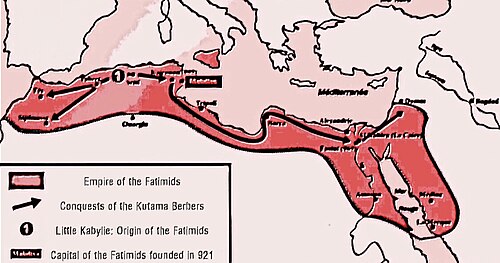
900年代、ウマイヤ朝は北アフリカでファーティマ朝の挑戦に直面した。10世紀のファーティマ朝はクタマ・ベルベル人によって樹立された。[118] [119] 909年にケルアン市を占領しアグラブ朝を打倒した後、クタマはマフディー・ウバイド・アッラーをイマーム兼カリフに据えたが、[120] [121]これはウマイヤ朝自身の主張に直接挑戦するものとなった。[112] : 169 ファーティマ朝はイドリース朝に対して覇権を獲得し、次にマグリブの征服を開始した。この脅威に対抗するため、ウマイヤ朝は931年に海峡を渡ってセウタを占領し、[112] : 171 、ゼナタやアウラバなどのベルベル人同盟と積極的に同盟を結んだ。ファーティマ朝とウマイヤ朝は直接戦うのではなく、ベルベル人の忠誠を競い合った。その結果、ベルベル人がイスラム教に改宗する動機が生まれたが、地中海から離れた南部のベルベル人の多くは、依然としてキリスト教徒や異教徒であった。[112] : 169–170 その結果、アル・ムラービト朝とアル・ムハド・カリフ制の樹立につながり、アル・アンダルスに大きな影響を与え、ウマイヤ朝の終焉につながった。[112] : 170
アブド・アッラフマーンは、新たに獲得した傭兵部隊の力を借りて、ウマイヤ朝から離脱したイベリア半島の一部に一連の攻撃を開始した。920年代には、ウマル・イブン・ハフスンの下で反乱を起こし、920年代まで服従を拒否していた地域に対して軍事行動をとった。928~929年にはメリダ、931年にはセウタ、932年にはトレドを征服した。[112] : 171–172 934年には、北部でレオンのラミロ2世とサラゴサ知事ムハンマド・イブン・ハシム・アル・トゥジビに対する軍事行動を開始した。イブン・ハイヤーンによれば、エブロ川でトゥジビ朝と決着のつかない戦いをした後、アブドゥル・ラフマーンは一時的にパンプローナ王国を屈服させ、カスティーリャとアラバを荒廃させ、ラミロ2世と決着のつかない戦いで対決した。 [112] : 171–172 935年から937年にかけて、彼はトゥジビ朝と対決し、937年に彼らを破った。939年、ラミロ2世はシマンカスの戦いでウマイヤ朝とトゥジビ朝の連合軍を破った。[112] : 146–147
ウマイヤ朝の影響力は、征服ではなく外交を通じて西北アフリカに広がった。[112] : 172 ウマイヤ朝は様々なベルベル人連合との同盟を模索した。これらの連合はファーティマ朝に対抗してウマイヤ朝への忠誠を宣言した。ウマイヤ朝は刺繍入りの絹の儀式用マントなどの贈り物を送った。この時期、モロッコ沿岸の都市、フェズ、シジルマサ、スファックス、アル・ナクルの造幣局は、ウマイヤ朝のカリフの名前が刻まれた貨幣を発行することがあり、ウマイヤ朝の外交的影響力の大きさを示している。[112] : 172 ベルベル人の指導者からウマイヤ朝のカリフに宛てた友好の手紙の本文が、イーサ・アル・ラーズィーの著作の中に保存されている。[122]
アブドゥル・ラフマーンの治世中、アル・アンダルスのムスリムコミュニティの3つの異なる構成要素、すなわちベルベル人、サカリバ(ヨーロッパ人奴隷)、アラブ人またはアラブ人とゴート人の混血の人々の間で緊張が高まった。[112] : 175 アブドゥル・ラフマーンがコルドバで新しいウマイヤ朝カリフを宣言した後、ウマイヤ朝はクライシュ族のウマイヤ朝の一員であることを非常に重視した。[112] : 180 これにより、コルドバでは、解放奴隷の子孫ではなく、純粋なアラブ人の祖先を主張することが流行した。[112] : 181 西ゴート族の貴族の子孫であるという主張も一般的になった。[112] : 181–182 しかし、「この祖先に対する強い意識の直接的な有害な結果は、特にベルベル人とサカリバ人に対する民族的軽蔑の復活であった」[112] : 182
ファーティマ朝が969年にエジプトに首都を移したとき、北アフリカは、ファーティマ朝の忠誠者でゼナタ朝の敵であったサンハジャ・ベルベル人のジリッド氏族の副王に任じられた。[112] : 170 ジリッド朝は領土を分割し、一部をハマディ朝の一族に統治させた。ハマディ朝は1014年に独立し、首都はカルアト・ベニ・ハマドに置かれた。しかし、ファーティマ朝がエジプトに撤退すると、ウマイヤ朝との対立は弱まった。[112] : 170
アル=ハカム2世は、973年から974年にかけて、ムハンマド・イブン・アビー・アーミールを北アフリカに派遣し、ウマイヤ朝の権威を受け入れたベルベル人集団の最高裁判事(最高裁判所長官)を務めさせた。イブン・アビー・アーミールは、カリフの妻と子供たちの家庭の財務官、マディーナ・アル=ザフラの造幣局長、コルドバ警察の司令官、国境の最高裁判事を務めた。北アフリカで最高裁判事を務めていた間、イブン・アビー・アーミールは北アフリカのベルベル人と密接な関係を築いた。[112] : 186
アル・マンスールとその子らアブド・アル・マリクとサンチュエロが北アフリカから連れてきたベルベル人の数が増えたことに対して、コルドバでは相当な憤りが起こった。[112] : 198 サンチュエロは宮廷に来る者にはベルベル人のターバンをかぶるよう命じたと言われているが、ロジャー・コリンズはこれは真実ではないかもしれないと示唆しているが、敵対的な反ベルベル人のプロパガンダがアル・マンスールの子らの信用を落とすために使われていたことを示している。1009年、サンチュエロは自らヒシャーム2世の後継者を宣言し、軍事遠征に赴いた。しかし、彼が留守の間に反乱が起こった。サンチュエロの宮殿は略奪され、彼への支持は失われた。彼がコルドバに行軍して戻ると、彼自身のベルベル人傭兵は彼を見捨てた。[112] : 197–198 コルドバでの彼らに対する悪感情の強さを知っていた彼らは、サンチュエロが彼らを守ることはできないと考え、生き残り、自分たちの利益を確保するために他の場所へ移った。[112] : 198 サンチュエロにはわずかな追随者しか残されず、1009年に捕らえられ、殺害された。ヒシャーム2世は退位し、ムハンマド2世アルマフディーが後を継いだ。
サンチュエロを見捨てたベルベル人は、もう一人の野心的なウマイヤ朝、スレイマンの支援に転じた。彼らはカスティーリャのサンチョ・ガルシア伯爵から兵站支援を得た。コルドバに進軍し、サカリバの将軍ワディを破り、ムハンマド2世マフディをトレドに逃亡させた。その後、彼らはスレイマンをカリフに据え、地元住民との摩擦を避けるためにマディーナ・アル・ザーフラに拠点を置いた。[112] : 198–199 ワディとマフディはバルセロナ伯爵とウルジェル伯爵と同盟を組み、コルドバに進軍した。彼らは1010年にコルドバ近郊での戦いでスレイマンとベルベル軍を破った。ベルベル人は滅ぼされるのを避けるためにアルヘシラスへ逃げた。[112] : 199
アル=マフディーはベルベル人を根絶することを誓い、追撃した。しかし、マルベーリャ近郊での戦いで敗れた。ワディーと共にコルドバへ逃亡し、カタルーニャ人の同盟者は帰国した。ベルベル人は方向転換してコルドバを包囲した。負けそうになったと判断したワディーは、アル=マフディーを打倒してその首をベルベル人に送り、ヒシャーム2世を後継者にした。[112] : 199 しかし、ベルベル人は包囲を解かなかった。彼らはコルドバ郊外を計画的に破壊し、住民を古代ローマの城壁の内側に閉じ込め、マディーナ・アル=ザフラを破壊した。ワディーの同盟者は彼を殺害し、コルドバ守備隊は恩赦を期待して降伏した。しかし、「ベルベル人は多くの個人的および集団的損害に対する復讐を行い、その過程でいくつかの確執を永久に解決する虐殺が続いた」。[112] : 200 ベルベル人は再びスレイマンをカリフに任命した。イブン・イダリは、1013年のスレイマンの就任は「コルドバでベルベル人の支配が始まり、268年43日間続いたウマイヤ朝の支配が終わった」瞬間であったと述べた。[112] : 200 [123]
タイファ時代のアル・アンダルス
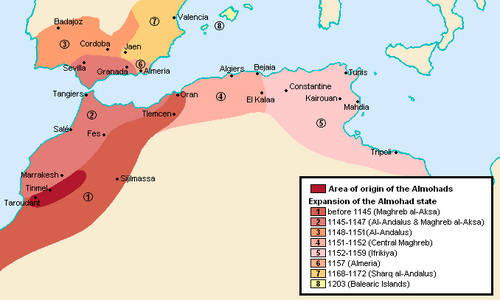
タイファ時代、小王はさまざまな民族から出ており、グラナダのジリッド王など、ベルベル人の出身者もいた。タイファ時代は、ベルベル人の王朝であるモロッコのムラービト朝がアルアンダルスを占領したときに終了した。その後、モロッコのムワッハド朝が後を継ぎ、アルアンダルスは繁栄した。
1013年にコルドバが陥落した後、サカリバ族は自らの領地を確保するために都市から逃亡した。サカリバ族の一団はベルベル人の駐屯地からオリウエラを奪い、その地域全体を支配した。[112] : 201
アル・マンスールによってアル・アンダルスに連れてこられたベルベル人の中には、サンハジャ・ベルベル人のジリッド家がいた。コルドバ陥落後、ジリッド家は1013年にグラナダを占領し、グラナダのジリッド王国を形成した。サカリバ・カイランは、ウマイヤ朝の指導者であるアブド・アル・ラフマーン4世アル・ムルタダとともに、1018年にジリッドからグラナダを奪取しようとしたが失敗した。その後、カイランはアブド・アル・ラフマーン4世を処刑した。カイランの息子ズハイルもグラナダのジリッド王国と戦争をしたが、1038年に殺害された。[112] : 202
コルドバでは、ベルベル人の支配者と、自らをアラブ人とみなす市民との間で紛争が続いた。[112] : 202 ベルベル人の支援を受けてカリフに就任したスレイマンは、南部の州をベルベル人の同盟者に分配するよう圧力をかけられた。このとき、サンハジャはコルドバから撤退した。セナタ・ベルベル人のハンムード朝は、セウタとアルヘシラスの重要な地区を獲得した。ハンムード朝はイドリース朝と血縁関係にあると主張し、その祖先はカリフのアリに遡った。1016年、彼らはセウタで反乱を起こし、ヒシャーム2世の復位を支持していると主張した。彼らはマラガを支配し、次にコルドバに進軍してこれを占領し、スレイマンとその家族を処刑した。アリ・イブン・ハンムド・アル・ナシルは自らをカリフと宣言し、2年間その地位にあった。[112] : 203
数年間、ハンムード朝とウマイヤ朝は互いに戦い、カリフの座は両者の間で何度も交代した。ハンムード朝は、内部でも争いを続けた。最後のハンムード朝カリフは1027年まで統治した。その後、ハンムード朝は反ベルベル感情がまだ強く残っていたコルドバから追放された。ハンムード朝は、1056年にジリッド朝によって追放されるまでマラガに留まった。[112] : 203 グラナダのジリッド朝は1073年までマラガを支配し、その後はアルモラビド朝の征服まで、ジリッド朝の別々の王がグラナダとマラガのタイファを支配し続けた。[124]
タイファ時代、バダホスを拠点とするアフタス朝は、グアディアナ川渓谷を中心とした広大な領土を支配していた。 [124]アフタス朝の支配地域は非常に広く、南はシエラ・モレナ山脈、メルトラとシルベスのタイファから、西はカンポ・デ・カラトラバ、北西はトレド山地、北東はオポルトにまで及んでいた。[124]
バーナード・ライリーによれば、[124] : 13 タイファの時代、系譜学はアル・アンダルスの上流階級の執着であり続けた。ほとんどの人は、侵略に同行したシリアやイエメンのアラブ人まで自分の家系を遡ることを望んだ。対照的に、同じ侵略に同行したベルベル人の血統を辿ることは「劣等な生まれとして烙印を押されることになった」。[124] : 13 しかし、ライリーは、実際には11世紀までに2つのグループはほぼ区別がつかなくなったと指摘している。「どちらのグループも徐々にイスラム教徒の人口の中で区別できるものではなくなったが、どちらかが実際にタイファを統治していた場合は例外で、その場合、その低い出自はライバルによって広く知られることになった」。[要出典]
しかしながら、アラブ人、ベルベル人、奴隷の区別は、タイファ内部でもタイファ間でも、深刻な政治問題にはならなかった。政治活動の単位は個々の家族だった」[124] : 13 ライリーによれば、カリフ制の終わりごろに傭兵として到着したベルベル人は、アル・アンダルシの総人口600万人のうちわずか2万人程度だった。彼らが目立ったのは、数が多かったからではなく、タイファ王朝を築いたためである。[124] : 13
権力階層において、ベルベル人はアラブ貴族とムラディ民衆の間に位置し、民族間の対立はアンダルシアの政治を動かす最も重要な要因の一つであった。ベルベル人は占領地の人口の20%を占めていた。[125]
アルモラビド朝の統治下のアル・アンダルス
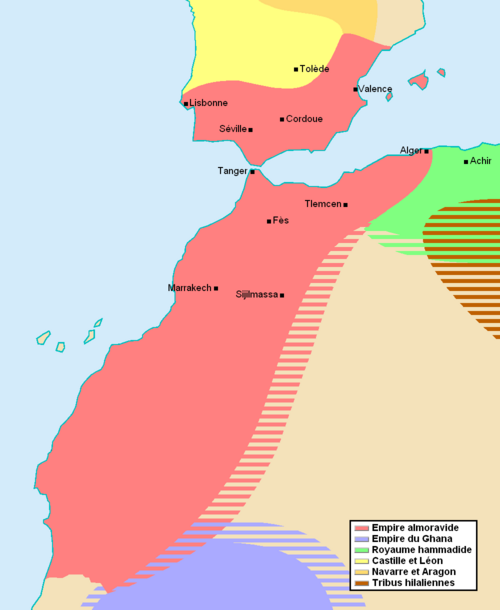
タイファの時代、北西アフリカでムラーヴィド朝が発展したが、その中核はサンハジャ・ベルベル人のラムトゥナ支族によって形成された。 [124] : 99 11世紀半ば、彼らはグッダラおよびマスファ・ベルベル人と同盟を結んだ。当時、ムラーヴィド朝の指導者ヤヒヤ・イブン・イブラーヒームはハッジに出かけた。その帰途、彼はカイルアンでマリク派の説教師に会い、彼らを自分の国に招待した。マリク派の弟子アブドゥッラー・イブン・ヤシンは招待を受け入れた。彼はモロッコに旅して軍事修道院、つまりリバトを設立し、そこで非常に意欲的で規律正しい戦闘部隊を訓練した。1054年と1055年に、これらの特別に訓練された部隊を用いて、ムラーヴィド朝の指導者ヤヒヤ・イブン・ウマルはガーナ王国とゼナタ・ベルベル人を打ち破った。ヤヒヤ・イブン・ウマルの死後、弟のアブ・バクル・イブン・ウマルがムラーヴィド朝の拡大を追求した。サンハジャ内戦の解決を余儀なくされた彼は、モロッコ征服の指揮権を弟のユースフ・イブン・タシュフィンに託した。ユースフは領土の征服を続け、1087年にアブ・バクルが死去すると、ムラーヴィド朝の指導者となった。[124] : 100–101
コルドバを失った後、ハンムード朝はアルヘシラスとセウタを占領した。11世紀半ば、ハンムード朝はイベリア半島の領有権を失ったが、セウタを拠点とする小さなタイファ王国は保持した。1083年、ユースフ・イブン・タシュフィンがセウタを征服した。同年、セビリアのタイファ王アル・ムタミッドはモロッコに赴き、カスティーリャ王アルフォンソ6世に対抗するためユースフに助けを求めた。それより前の1079年には、バダホス王アル・ムタワッキルがアルフォンソに対抗するためユースフに助けを求めていた。1085年にトレドがアルフォンソ6世に陥落した後、アル・ムタミッドは再びユースフに助けを求めた。この時、ユスフはイベリア半島のタイファ王たちの資金援助を受けてアルアンダルスに渡り、1086年にアルヘシラスを直接支配した。[124] : 102–103
近代史

カビリア人は、オスマン帝国が北アフリカを支配していた時代、外部からの支配を受けずに独立していた。彼らは主に、アイト・アッバース王国、クク王国、アイト・ジュバール公国の3つの国家または連合に住んでいた。[126]アイト・アッバース王国は北アフリカのベルベル人の国家であり、16世紀から19世紀にかけて小カビリアとその周辺を支配していた。スペインの歴史学では、レイノ・デ・ラベスと呼ばれている。[127]ベルベル語では、支配者一族のモクラニ家によって、アト・ムクラン(アラビア語:أولاد مقران Ouled Moqrane)と呼ばれることもある。首都は、ビバン山脈 の難攻不落の城塞、アイト・アッバースのカラーであった。
フランス領アルジェリアにおける、アブド・アル=カディールの時代以来最も深刻な反乱は、 1871年にカビリー地方で勃発し、アルジェリアの広範囲に広がった。1871年4月までに、250の部族が蜂起し、アルジェリアの人口のほぼ3分の1を占めた。[128]この反乱の余波から1892年まで、アラブ人とカビリー人の二元性に基づくさまざまなステレオタイプを前提としたカビリー神話が最高潮に達した。[129] [130]
1902年、フランス軍はホッガー山脈に侵入し、ティットの戦いでアハッガー・トゥアレグ族を破った。

1912年、モロッコはフランス領とスペイン領に分割された。 [131]スペイン政府の元将校、アブド・エル・クリム率いるリフ・ベルベル人が反乱を起こした。1921年7月、マヌエル・シルベストル率いるモロッコ北東部のスペイン軍は、アブド・エル・クリムの軍に敗走させられ、スペインでは「アヌルの惨事」として知られるようになった。アヌルの惨事とその後の戦闘で、スペイン軍は最大2万2千人の兵士を失ったとされる。[132]
アルジェリア戦争(1954-1962)の間、 FLNとALNによる国の再編により、初めて統一されたカビル人の行政区、ウィラヤIIIが創設され、反植民地闘争の中心地となった。[133]アルジェリアが独立した瞬間から、カビル人の指導者と中央政府の間に緊張が高まった。[134]
20世紀半ばに独立を果たして間もなく、北アフリカ諸国はフランス語、スペイン語、イタリア語に代えてアラビア語を公用語としたが、公用語としてヨーロッパの植民地言語からアラビア語への移行は今日まで続いている。その結果、ほとんどのベルベル人はアラビア語を学んで理解しなければならず、21世紀になるまで学校や大学で母語を使用する機会がなかった。これは、特にアルジェリアのシャウイ族の間など、すでにバイリンガルであった地域で、ベルベル人の既存のアラビア化の過程を加速させた可能性がある。 2004年に サリム・イェザが率いた行進以来、オーレスではタマジグト語が教えられている。
ベルベル主義はこれらの国々の独立以前から存在していたが、ベルベル人のエリート層に限定されていた。ベルベル主義が一般大衆の間で広まり始めたのは、北アフリカ諸国がヨーロッパ植民地の言語をアラビア語に置き換え、ベルベル人の存在と社会的特殊性を軽視または無視し、アラブ国家としてのみ認識するようになったときだった。しかし、ベルベル主義の分布は依然として不均一である。ベルベル主義の要求に応えて、モロッコとアルジェリアは両国とも政策を変更し、アルジェリアは憲法上「アラブ、ベルベル、イスラム教国家」と再定義した。
北アフリカのアラブ支配政権によるベルベル人迫害については、アイデンティティに関連した議論があるが、汎アラブ主義とイスラム主義の両方を通じて[135]、彼らのアイデンティティの問題は、エジプトの元大統領ガマール・アブドゥル・ナーセルの汎アラブ主義のイデオロギーによるものである。一部の活動家は、「アマジグの土地の人種差別的なアラブ化に立ち向かう時が来た。それはずっと遅れていた」と主張している[136]。

黒い春は、2001年にアルジェリアのカビリー地域でカビレ人活動家によって起こった一連の暴力的な騒乱と政治デモである。 2011年のリビア内戦では、ナフサ山地のベルベル人がカダフィ政権に対してすぐに反乱を起こした。この山地は反乱軍の拠点となり、紛争の焦点となり、反乱軍と政府支持派の間で地域の支配権をめぐる戦闘が頻発した。 [3] 2012年のトゥアレグ反乱は、マリ北部のアザワド地域の独立を目指して反乱軍がマリ政府に対して起こした。[137] 2016年後半から、モロッコのリーフ地域のベルベル人コミュニティ全体に大規模な暴動が広がっており、2017年5月に再び激化した。[138]
In Morocco, after the constitutional reforms of 2011, Berber has become an official language, and is now taught as a compulsory language in all schools regardless of the area or the ethnicity. In 2016, Algeria followed suit and changed the status of Berber from "national" to "official" language.
Although Berberists who openly show their political orientations rarely reach high positions, Berbers have reached high positions in the social and political hierarchies across the Maghreb. Examples are the former president of Algeria, Liamine Zeroual; the former prime minister of Morocco, Driss Jettou; and Khalida Toumi, a feminist and Berberist militant, who has been nominated as head of the Ministry of Communication in Algeria.
Arabization
The Arabization of the indigenous Berber populations was a result of the centuries-long Arab migrations to the Maghreb which began since the 7th century, in addition to changing the population's demographics. The early wave of migration prior to the 11th century contributed to the Berber adoption of Arab culture. Furthermore, the Arabic language spread during this period and drove Latin into extinction in the cities. The Arabization took place around Arab centres through the influence of Arabs in the cities and rural areas surrounding them.[139]
The migration of Banu Hilal and Banu Sulaym in the 11th century had a much greater influence on the process of Arabization of the population. It played a major role in spreading Bedouin Arabic to rural areas such as the countryside and steppes, and as far as the southern areas near the Sahara.[139] It also heavily transformed the culture in the Maghreb into Arab culture, and spread nomadism in areas where agriculture was previously dominant.[140] These Bedouin tribes accelerated and deepened the Arabization process, since the Berber population was gradually assimilated by the newcomers and had to share with them pastures and seasonal migration paths. By around the 15th century, the region of modern-day Tunisia had already been almost completely Arabized.[41] As Arab nomads spread, the territories of the local Berber tribes were moved and shrank. The Zenata were pushed to the west and the Kabyles were pushed to the north. The Berbers took refuge in the mountains whereas the plains were Arabized.[141]
Currently, most Arabized Berbers identify as Berber, although the prominence of Arab influences has fully assimilated them into the Arab cultural sphere.[142]
Contemporary demographics

Ethnic groups
Ethnically, Berbers comprise a minority population in the Maghreb. Berbers comprise 15%[143] to 25%[144] the population of Algeria, 10%[145] of Libya, 31%[146] to 35%[147] of Morocco, and 1%[148] of Tunisia. Berber language speakers in the Maghreb comprise 30%[3] to 40%[149][better source needed][6][better source needed] of the Moroccan population, and 15%[150] to 35%[6][better source needed] of the Algerian population, with smaller communities in Libya and very small groups in Tunisia, Egypt and Mauritania.[151] Berber languages in total are spoken by around 14 million[152] to 16 million[153] people in Africa.

Prominent Berber ethnic groups include the Kabyles—from Kabylia, a historical autonomous region of northern Algeria—who number about six million and have kept, to a large degree, their original language and society; and the Shilha or Chleuh—in High and Anti-Atlas and Sous Valley of Morocco—who number about eight million.[citation needed] Other groups include the Riffians of northern Morocco, the Chaoui people of eastern Algeria, the Chenouas in western Algeria and the Nafusis of the Nafusa Mountains.
Outside the Maghreb, the Tuareg in Mali (early settlement near the old imperial capital of Timbuktu),[154] Niger, and Burkina Faso number some 850,000,[10] 1,620,000,[155] and 50,000, respectively. Tuaregs are a Berber ethnic group with a traditionally nomadic pastoralist lifestyle and are the principal inhabitants of the vast Sahara Desert.[156][157]
Genetics
Genetically, the Berbers form the principal indigenous ancestry in the region.[175][176][full citation needed][177][178][179][180][181][182][183][184][excessive citations] Haplogroup E1b1b is the most frequent among Maghrebi groups, especially the downstream lineage of E1b1b1b1a, which is typical of the indigenous Berbers of North-West Africa. On the other hand, Haplogroup J1 is the second most frequent among Maghrebi groups and is more indicative of Middle East origins, and has its highest distribution among populations in the southern Arabian Peninsula. E1b1b1b accounts for 45% of North Africans, while Haplogroup J1-M267 accounts for 30% of North Africans, and has spread from Arabia.[185]
The Semitic-speaking presence in the Maghreb is mainly due to the migratory movements of Phoenicians in the 3rd century BC and large scale migrations of Arab Bedouin tribes in the 11th century AD such as Banu Hilal and Banu Sulaym, as well as other waves that occurred during the Arab migrations to the Maghreb (c. 7th century – 17th century). The results of a study from 2017 suggest that these Arab migrations to the Maghreb were mainly a demographic process that heavily implied gene flow and remodeled the genetic structure of the Maghreb.[186]
Diaspora

According to a 2004 estimate, there were about 2.2 million Berber immigrants in Europe, especially the Riffians in Belgium, the Netherlands, and France; and Algerians of Kabyles and Chaouis heritage in France.[187]
Politics
Berberism
Since the 1970s,[188]: 209 a political movement, initially led by the Kabyles of Algeria, has developed among various parts of the Berber populations of North Africa to promote a collective Amazigh ethnic identity.[45] It is variously referred to as Amazighism,[189] Berberism,[188] the Berber identity movement, or the Berber Culture Movement.[45] The movement does not have a specific organization and cuts across both modern national boundaries and traditional tribal divisions. It is generally consistent in its demands, which include greater linguistic rights for Berber languages and greater official and social recognition of Amazigh culture.[45] These Berberists also aimed to counter the image that Berbers were a mere collection of disparate tribes speaking mutually incomprehensible languages. They did this by introducing "Imazighen" as a collective term of self-referral and claimed that the various Berber languages once constituted a single language.[43]
The political outcomes have been different in each country of the Maghreb and are shaped by other factors such as geography and socioeconomic circumstances. In Algeria, the politics of the movement were focused in Kabylie, were more overtly political, and have sometimes been confrontational. In Morocco, where Amazigh populations are spread across a wider area, the movement has been less overtly political and confrontational.[45][188]: 213 In the 1990s, both states made concessions to this movement or attempted to ally itself with it, partly in response to the challenge of other political forces such as Islamism.[188]: 214
Political tensions
Over the past few decades, political tensions have arisen between some Berber groups (especially the Kabyles and Rifians) and North African governments, partly over linguistic and social issues. For example, in Morocco, Algeria, Tunisia, and Libya, giving children Berber names was banned.[190][191][192] In Morocco, the Arabic language and Arab culture occupied a superior position in official and social domains. The Arabist ideology was popular among Moroccan society, as well as within bureaucratic cadres and the political parties.[193] The regime of Muammar Gaddafi in Libya also banned the teaching of Berber languages, and, in a 2008 leaked diplomatic cable, the Libyan leader warned Berber minorities: "You can call yourselves whatever you want inside your homes – Berbers, Children of Satan, whatever – but you are only Libyans when you leave your homes."[194] He denied the existence of Berbers as a separate ethnicity, and called Berbers a "product of colonialism" created by the West to divide Libya.[195][196] As a result of the persecution suffered under Gaddafi's rule, many Berbers joined the Libyan opposition in the 2011 Libyan civil war.[197]
In contrast, many Berber students in Morocco supported Nasserism and Arabism, rather than Berberism. Many educated Berbers were attracted to the leftist National Union of Popular Forces rather than the Berber-based Popular Movement.[193]
Languages


The Berber languages form a branch of the Afroasiatic language family, a large family that also includes Semitic languages like Arabic and the Ancient Egyptian language.[198][199] Most Berbers speak Arabic and French.[200]
Tamazight is a generic name for all of the Berber languages, which consist of many closely related varieties and dialects. Among these Berber languages are Riffian, Zuwara, Kabyle, Shilha, Siwi, Zenaga, Sanhaja, Tazayit (Central Atlas Tamazight), Tumẓabt (Mozabite), Nafusi, and Tamasheq, as well as the ancient Guanche language.
Most Berber languages have a high percentage of borrowing and influence from the Arabic language, as well as from other languages.[201] For example, Arabic loanwords represent 35%[202] to 46%[203] of the total vocabulary of the Kabyle language and represent 51.7% of the total vocabulary of Tarifit.[204] The least influenced are the Tuareg languages.[201] Almost all Berber languages took from Arabic the pharyngeal fricatives /ʕ/ and /ħ/, the (nongeminated) uvular stop /q/, and the voiceless pharyngealized consonant /ṣ/.[205] In turn, Berber languages have influenced local dialects of Arabic. Although Maghrebi Arabic has a predominantly Semitic and Arabic vocabulary,[206] it contains a few Berber loanwords which represent 2–3% of the vocabulary of Libyan Arabic, 8–9% of Algerian Arabic and Tunisian Arabic, and 10–15% of Moroccan Arabic.[207]
Berber languages in total are spoken by around 14 million[152] to 16 million[153] people in Africa (see population estimation). These Berber speakers are mainly concentrated in Morocco and Algeria, followed by Mali, Niger, and Libya. Smaller Berber-speaking communities are also found as far east as Egypt, with a southwestern limit today at Burkina Faso.
Religion


The Berber identity encompasses language, religion, and ethnicity, and is rooted in the entire history and geography of North Africa. Berbers are not an entirely homogeneous ethnicity, and they include a range of societies, ancestries, and lifestyles. The unifying forces for the Berber people may be their shared language or a collective identification with Berber heritage and history.
As a legacy of the spread of Islam, the Berbers are now mostly Sunni Muslim. However, the Mozabite Berbers of the M'zab Valley in the town of Ghardaïa in Algeria and some Libyan Berbers in the Nafusa Mountains and Zuwara are primarily adherents of Ibadi Islam.
In antiquity, before the arrival of Abrahamic faiths into North Africa, the Berber people adhered to the traditional Berber religion. This traditional religion emphasized ancestor veneration, polytheism, and animism. Many ancient Berber beliefs were developed locally. Whereas others were influenced over time through contact with other traditional African religions (such as the Ancient Egyptian religion), or borrowed during antiquity from the Punic religion, Judaism, Iberian mythology, and the Hellenistic religion. The most recent influence came from Islam and pre-Islamic Arab religion during the medieval period. Some of the ancient Berber beliefs still subtly exist today within the Berber popular culture and tradition.
Until the 1960s, there was also a significant Jewish Berber minority in Morocco,[208] but emigration (mostly to Israel and France) dramatically reduced their number to only a few hundred individuals.
Following Christian missions, the Kabyle community in Algeria has a recently constituted Christian minority, both Protestant and Roman Catholic; and a 2015 study estimates that 380,000 Muslim Algerians have converted to Christianity in Algeria.[20] There are Berbers among the 8,000[209]–40,000[210] Moroccans who have converted to Christianity in the last decades, some of whom explain their conversion as an attempt to go back to their "Christian sources".[211] The International Religious Freedom Report for 2007 estimates that thousands of Tunisian Berber Muslims have converted to Christianity.[212][213]
Architecture
Antiquity
Some of the earliest evidence of original Amazigh culture in North Africa has been found in the highlands of the Sahara and dates from the second millennium BC, when the region was much less arid than it is today and when the Amazigh population was most likely in the process of spreading across North Africa.[214]: 15–22 Numerous archaeological sites associated with the Garamantes have been found in the Fezzan (in present-day Libya), attesting to the existence of small villages, towns, and tombs. At least one settlement dates from as early as 1000 BC. The structures were initially built in dry stone, but around the middle of the millennium (c. 500 BC) they began to be built with mudbrick instead.[214]: 23 By the second century AD there is evidence of large villas and more sophisticated tombs associated with the aristocracy of this society, in particular at Germa.[214]: 24
Further west, the kingdom of Numidia was contemporary with the Phoenician civilization of Carthage and the Roman Republic. Among other things, the Numidians have left thousands of pre-Christian tombs. The oldest of these is Medracen in present-day Algeria, believed to date from the time of Masinissa (202–148 BC). Possibly influenced by Greek architecture further east, or built with the help of Greek craftsmen, the tomb consists of a large tumulus constructed in well-cut ashlar masonry and featuring sixty Doric columns and an Egyptian-style cornice.[214]: 27–29 Another famous example is the Tomb of the Christian Woman in western Algeria. This structure consists of columns, a dome, and spiral pathways that lead to a single chamber.[215] A number of "tower tombs" from the Numidian period can also be found in sites from Algeria to Libya. Despite their wide geographic range, they often share a similar style: a three-story structure topped by a convex pyramid. They may have initially been inspired by Greek monuments but they constitute an original type of structure associated with Numidian culture. Examples of these are found at Siga, Soumaa d'el Khroub, Dougga, and Sabratha.[214]: 29–31
Mediterranean empires of Carthage and Rome left their mark in the material culture of North Africa as well. Phoenician and Punic (Carthaginian) remains can be found at Carthage itself and at Lixus. Numerous remains of Roman architecture can be found across the region, such as the amphitheatre of El Jem and the archaeological sites of Sabratha, Timgad, and Volubilis, among others.[216]
-
 Remains of Germa, a capital of the Garamantes (first millennium BC)
 -

-
 Numidian mausoleum of Dougga, example of a "tower tomb" (2nd century BC)
_-_Ruinen_der_antiken_Stadt_Garma_02.jpg/500px-Garma_(Garama)_-_Ruinen_der_antiken_Stadt_Garma_02.jpg)
After the Muslim conquest
After the Arab-Muslim conquest of the Maghreb in the 7th and early 8th centuries, Islamic architecture developed in the region. Various dynasties, either based in North Africa or beyond it, contributed to the architecture of the region, including the Aghlabids, the Fatimids, and the Umayyads of Cordoba. In addition to the general "Moorish" style prevalent in North Africa during the Islamic period, some architectural styles and structures in North Africa are distinctively associated with areas that have maintained strong Berber populations and cultures, including but not limited to the Atlas Mountain regions of Morocco, the Aurès and M'zab regions of Algeria, and southern Tunisia.[217] They do not form one single architectural style but rather a diverse variety of local vernacular styles.[217] Berber ruling dynasties also contributed to the formation and patronage of western Islamic art and architecture through their political domination of the region between the 11th and 16th centuries (during the rule of the Almoravids, Almohads, Marinids and Hafsids, among others).[218][217][219]
In Morocco, the largely Berber-inhabited rural valleys and oases of the Atlas and the south are marked by numerous kasbahs (fortresses) and ksour (fortified villages), typically flat-roofed structures made of rammed earth and decorated with local geometric motifs, as with the famous example of Ait Benhaddou.[217][220][221] Likewise, southern Tunisia is dotted with hilltop ksour and multi-story fortified granaries (ghorfa), such as the examples in Medenine and Ksar Ouled Soltane, which are typically built with loose stone bound by a mortar of clay.[217] Fortified granaries also exist in the Aures region of Algeria,[222] or in the form of agadirs of which numerous examples can be found in Morocco.[217][223] The island of Jerba in Tunisia, traditionally dominated by Ibadi Berbers,[224] has a traditional style of mosque architecture that consists of low-lying structures built in stone and covered in whitewash. Their prayer halls are domed and they have short, often round minarets.[224][217] The mosques are often described as "fortified mosques" because the island's flat topography made it vulnerable to attacks and as a result the mosques were designed in part to act as watch posts along the coast or in the countryside.[225][226] The M'zab region of Algeria (e.g. Ghardaïa) also has distinctive mosques and houses that are completely whitewashed, but built in rammed earth. The structures here also make frequent use of domes and barrel vaults. Unlike in Jerba, the distinctive minarets in this region are tall and have a square base, tapering towards the end and crowned with "horn"-like corners.[224][217]
-

-
 The ksar of Aït Benhaddou in Morocco
 -
 Ksar Ouled Soltane, an example of a multi-level ghorfa in southern Tunisia
 -
 Subterranean house in Matmata (Tunisia)
 -
 The Fadhloun Mosque in Djerba (Tunisia), an example of a traditional "fortified mosque"
 -

.jpg/500px-Ait_Benhaddou_Qsar_(588071549).jpg)
Culture and arts
Social context
The traditional social structure of the Berbers has been tribal. A leader is appointed to command the tribe. In the Middle Ages, many women had the power to govern, such as Dihya and Tazoughert Fatma in the Aurès Mountains, Tin Hinan in the Hoggar, Chemci in Aït Iraten, Fatma Tazoughert in the Aurès. Lalla Fatma N'Soumer was a Berber woman in Kabylie who fought against the French.
The majority of Berber tribes currently have men as heads of the tribe. In Algeria, the el Kseur platform in Kabylie gives tribes the right to fine criminal offenders. In areas of Chaoui, tribal leaders enact sanctions against criminals.[227] The Tuareg have a king who decides the fate of the tribe and is known as Amenokal; it is a very hierarchical society. The Mozabites are governed by the spiritual leaders of Ibadism and lead communal lives. During the crisis of Berriane between the Maliki and Ibadite movements, the heads of each tribe began talks to end the crisis and resolved the problem.[228][full citation needed]

In marriages, the man usually selects the woman, and depending on the tribe, the family often makes the decision. In contrast, in the Tuareg culture, the woman chooses her future husband. The rites of marriage are different for each tribe. Families are either patriarchal or matriarchal, according to the tribe.[229]
Traditionally, men take care of livestock. They migrate by following the natural cycle of grazing, and seeking water and shelter. They are thus assured of an abundance of wool, cotton, and plants used for dyeing. For their part, women look after the family and handicrafts – first for their personal use, and secondly for sale in the souqs in their locality.
Visual arts
The Berber tribes traditionally weave kilims (tapestry-woven carpets), whose designs maintain the traditional appearance and distinctiveness of the region of origin of each tribe, which has in effect its own repertoire of drawings. The plain weave textile designs include a wide variety of stripes and, more rarely, geometrical patterns such as triangles and diamonds. Additional decorations such as sequins or fringes, are typical of Berber weave in Morocco. The nomadic and semi-nomadic lifestyle of the Berbers is suitable for weaving kilims.[230] In Algeria, the cloak-like kachabia is typical Berber masculine clothing.
Traditional Berber jewelry is a style of jewellery, originally worn by women and girls of different rural Berber groups of Morocco, Algeria and other North African countries. It is usually made of silver and includes elaborate triangular plates and pins, originally used as clasps for garments, necklaces, bracelets, earrings and similar items. In modern times, these types of jewellery are produced also in contemporary variations and sold as a commercial product of ethnic-style fashion.[231]
From December 2004 to August 2006, the Peabody Museum of Archeology and Ethnology at Harvard University presented the exhibition Imazighen! Beauty and Artisanship in Berber Life, curated by Susan Gilson Miller and Lisa Bernasek, with an accompanying catalogue on artifacts from the Berber regions Kabylia in northeastern Algeria, the Rif mountains of northeastern Morocco and the Tuareg regions of the Algerian Sahara.[232][233]
From June to September 2007, the Musée du quai Branly in Paris showed an exhibition on the history of traditional ceramics in Algeria, titled Ideqqi, art de femmes berbères (Art of Berber women), and published an accompanying catalogue. The exhibition highlighted the originality of these pieces compared to urban earthenware, underlining their African roots as well as close relationship with the ancient art of the Mediterranean.[234]
-
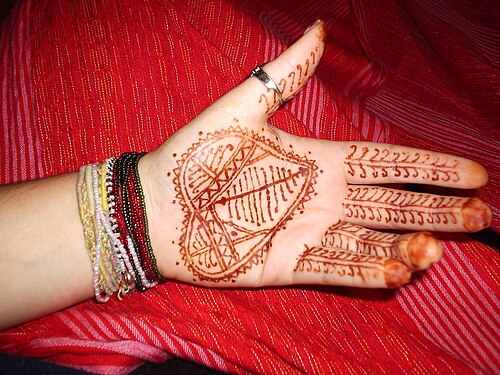 Berber henna decoration
 -
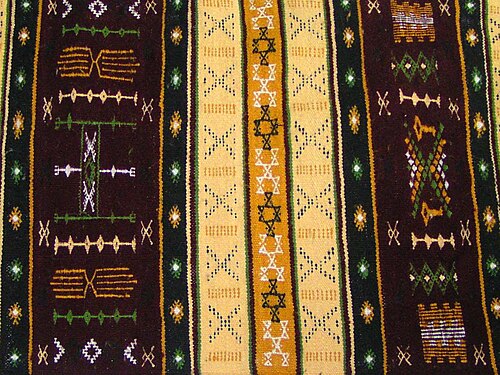 Detail of a traditional Berber carpet
 -
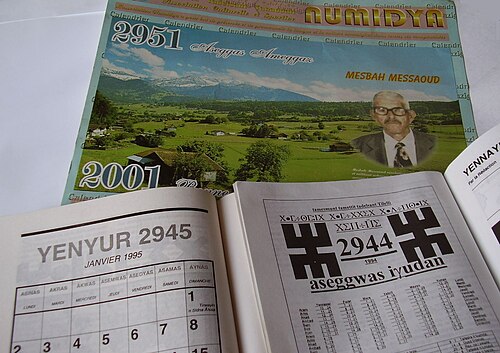 Algerian Berber calendar
 -
 Ancient Tifinagh scripts in Algeria
 -
 Jewelry from Kabylia region, Algeria
Cuisine
Berber cuisine is a traditional cuisine that has evolved little over time. It differs from one area to another between and within Berber groups.
Principal Berber foods are:
- Couscous, a semolina staple dish
- Tajine, a stew made in various forms
- Pastilla, a meat pie traditionally made with squab (fledgling pigeon); today often made using chicken
- Bread made with traditional yeast
- Bouchiar, fine yeastless wafers soaked in butter and natural honey
- Bourjeje, pancake containing flour, eggs, yeast, and salt
- Baghrir, light and spongy pancake made from flour, yeast, and salt; served hot and soaked in butter and tment ('honey').
- Tahricht, sheep offal (brains, tripe, lungs, and heart) rolled up with the intestines on an oak stick and cooked on embers in specially designed ovens. The meat is coated with butter to make it even tastier. This dish is served mainly at festivities.
Although they are the original inhabitants of North Africa, and in spite of numerous incursions by Phoenicians, Romans, Byzantines, Ottomans, and French, Berber groups lived in very contained communities. Having been subject to limited external influences, these populations lived free from acculturating factors.
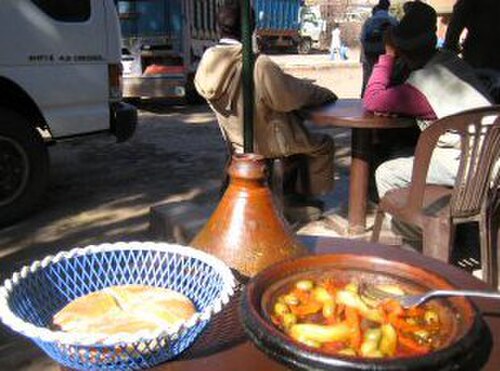


Music
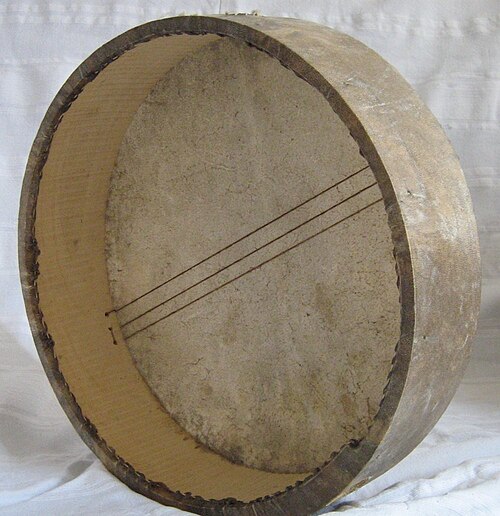
Berber music has a wide variety of regional styles. The best known are Moroccan music, the popular Gasba, Kabyle and Chawi music of Algeria, and the widespread Tuareg music of Burkina Faso, Niger, and Mali. Instruments used include the bendir (large drums) and the guembri (a lute). There are three varieties of Berber folk music: village music, ritual music, and the music performed by professional musicians. Village music is performed collectively for dancing, including ahidus and ahouach dances, which each begin with a chanted prayer. Ritual music is performed at regular ceremonies to celebrate marriages and other important life events, and is also used as protection against evil spirits. Professional musicians (imdyazn) travel in groups of four, led by a poet (amydaz). The amydaz recites improvised poems, often accompanied by drums and a rabab (a one-stringed fiddle), along with a bou oughanim who plays a double clarinet and acts as a clown for the group. The Chleuh Berbers have professional musicians called rwais who play in ensembles consisting of lutes, rababs, and cymbals, with any number of vocalists. The leader, or rayes, leads the group in its music and choreography. These performances begin with an instrumental astara on rabab, which also gives the notes of the melody which follows. The next phase is the amarg, or sung poetry, and then ammussu, a danced overture, tammust, an energetic song, aberdag, a dance, and finally the rhythmically swift tabbayt. There is some variation in the order of the presentation, but the astara is always at the beginning, and the tabbayt always at the end.

Traditional Berber festivals include Fantasia, Imilchil marriage festival and Udayn n Acur.
Role in tourism
In recent decades, Berber communities and culture have become involved in the tourism industries of some North African countries, such as Morocco and Tunisia.[235][236] Images and descriptions of Berber culture play a central role in the tourism industry of Morocco, where they are prominently featured in the marketing of products and locations.[237][238]
See also
Notes
- ^ Arabic: بربر, romanized: Barbar.
- ^ /ˌæməˈziːk, -iːx/ AM-ə-ZEEK(H); Arabic: أمازيغ, romanized: Amāzīgh; Berber languages: Amaziɣ (ⴰⵎⴰⵣⵉⵖ or ⵎⵣⵗ), singular.
- ^ Berber languages: Imaziɣen (ⵉⵎⴰⵣⵉⵖⵏ or ⵎⵣⵗⵏ), plural.
- ^ Warmington uses "Libyans of Tunisia" (an anachronistic term) on page 46; compare with page 61 (citing Herodotus, Diodorus Siculus, and Polybius).
- ^ "Pro-Berber" viewpoints (contrary to prevailing "Punicophilia" literature) are presented by Abdullah Laroui in his L'Histoire du Maghreb: Un essai de synthèse.[94][84]: 42–44
- ^ The Picards, however, remark that the resulting Greek defeat showed "how strong was the hold of Carthage over her African territory".
- ^ Warmington page 83, citing Plutarch (46–120 CE), Moralia 799D.
References
- ^ Steven L. Danver (2015). Native Peoples of the World: An Encyclopedia of Groups, Cultures and Contemporary Issues. Routledge. p. 23. ISBN 978-1-317-46400-6.
The Berber population numbers approximately 36 million people.
- ^ a b "Berber people". Retrieved 17 August 2016.
- ^ a b c "North Africa's Berbers get boost from Arab Spring". Fox News. 5 May 2012. Retrieved 8 December 2013.
- ^ Bhatia, Tej K.; Ritchie, William C. (2006). The Handbook of Bilingualism. John Wiley & Sons. p. 860. ISBN 0631227350. Retrieved 16 July 2016.
- ^ "Le berbère enseigné dans les écoles marocaines". BBC News Afrique (in French). Retrieved 20 January 2024.
- ^ a b c "Les Berbères en Afrique du Nord". Chaire pour le développement de la recherche sur la culture d'expression française en Amérique du Nord., Université Laval Québec, 2016.
- ^ "Algeria reinstates term limit and recognises Berber language". BBC News. 7 February 2016.
- ^ "The World Factbook". Central Intelligence Agency. Retrieved 8 October 2016., Niger: 11% of 23.6 million
- ^ Les langues de France: un patrimoine méconnu, une réalité vivante Archived 2014-09-29 at the Wayback Machine, originally published by CultureComm unication.gouv.fr.
- ^ a b "Mali". The World Factbook. 5 November 2021.
- ^ Zurutuza, Karlos, Libya's Berbers fear ethnic conflict, Aljazeera, retrieved 11 November 2021
- ^ Truong, Nicolas (23 March 2016). "Au cœur des réseaux djihadistes européens, le passé douloureux du Rif marocain". Le Monde.fr (in French). ISSN 1950-6244. Retrieved 16 November 2016.
- ^ "The World Factbook". Central Intelligence Agency. Retrieved 12 October 2021., Burkina Faso: 1.9% of 21.4 million
- ^ Tunisia Population. (2023-03-12). Retrieved 2020-02-27 [permanent dead link]
- ^ Joshua Project. "Tuareg, Tamasheq in Mauritania".
- ^ Government of Canada, Statistics Canada (8 February 2017). "Census Profile, 2016 Census – Canada". www12.statcan.gc.ca.
- ^ Joshua Project. "Berber, Siwa in Egypt".
- ^ Moshe Shokeid: The Dual Heritage: Immigrants from the Atlas Mountains in an Israeli Village. Manchester University Press, 1971.
- ^ US Census Bureau. "The Arab Population: 2000" (PDF). Archived (PDF) from the original on 13 January 2004. Retrieved 5 May 2013.
- ^ a b Miller, Duane Alexander; Johnstone, Patrick (2015). "Believers in Christ from a Muslim Background: A Global Census". Interdisciplinary Journal of Research on Religion. 11 (10). ISSN 1556-3723. Retrieved 27 March 2016 – via academia.edu.
- ^ (in French) Sadek Lekdja: Christianity in Kabylie, Radio France Internationale, 7 mai 2001 Archived 2017-10-18 at the Wayback Machine.
- ^ Blench, Roger (2006). Archaeology, Language, and the African Past. African Archaeology Series. AltaMira Press. ISBN 978-0759104662.
- ^ Diakonoff, Igor (1 October 1998). "The Earliest Semitic Society: Linguistic Data". Journal of Semitic Studies. XLIII (2): 209–219. doi:10.1093/jss/XLIII.2.209. ISSN 0022-4480.
- ^ Shirai, Noriyuki. The Archaeology of the First Farmer-Herders in Egypt: New Insights into the Fayum Epipalaeolithic and Neolithic. Leiden University Press, 2010. ISBN 978-9087280796.
- ^ Ehret, C; Keita, SOY; Newman, P (2004). "The Origins of Afroasiatic a response to Diamond and Bellwood (2003)". Science. 306 (5702): 1680. doi:10.1126/science.306.5702.1680c. PMID 15576591. S2CID 8057990.
- ^ Bender ML (1997), Upside Down Afrasian, Afrikanistische Arbeitspapiere 50, pp. 19–34
- ^ "Militarev A (2005) Once more about glottochronology and comparative method: the Omotic-Afrasian case, Аспекты компаративистики – 1 (Aspects of comparative linguistics – 1). FS S. Starostin. Orientalia et Classica II" (PDF). Moscow. pp. 339–408.
- ^ Andrews, Jonathan (2019). The Missiology behind the Story: Voices from the Arab World. Langham Publishing. ISBN 978-1-78368-599-8.
Berber: A collective term for the indigenous peoples of North Africa who predate the arrival of Arabs during the expansion of the Arab empire in the seventeenth century.
- ^ Skutsch, Carl (2013). Encyclopedia of the World's Minorities. Routledge. p. 211. ISBN 978-1-135-19388-1.
Berber is a generic name given to numerous heterogenous ethnic groups that share similar cultural, political, and economic practices.
- ^ a b Fields, Nic (2011). Roman Conquests: North Africa. Casemate Publishers. ISBN 978-1-84884-704-0.
It must be said that modern Berbers are a very diverse group of peoples whose main connections are linguistic.
- ^ a b c "Berber | Definition, People, Languages, & Facts". www.britannica.com. Retrieved 13 December 2022.
- ^ Baldauf, Richard B.; Kaplan, Robert B. (2007). Language Planning and Policy in Africa. Multilingual Matters. p. 49. ISBN 978-1-84769-011-1.
Most languages of the Berber branch are mutually unintelligible.
- ^ a b Aïtel, Fazia (2014). We are Imazigen : the development of Algerian Berber identity in twentieth-century literature and culture. Gainesville, FL: University of Florida Press. ISBN 978-0-8130-4895-6. OCLC 895334326.
- ^ a b Vourlias, Christopher (25 January 2010). "Moroccan minority's net gain". Variety. Vol. 417, no. 10. Penske Business Media, LLC.
- ^ "Berber". Encyclopædia Britannica. Retrieved 2 May 2015.
- ^ a b Project, Joshua. "Berber, Siwa in Egypt". joshuaproject.net. Retrieved 1 June 2022.
- ^ Margaret M. Vale (2015). Siwa: Jewelry, Costume, and Life in an Egyptian Oasis. American University in Cairo Press.
- ^ History of the Amazigh People study.com
- ^ Fischer-Lichte, Erika; Sugiera, Małgorzata; Jost, Torsten; Hartung, Holger; Soltani, Omid (2022). Entangled Performance Histories: New Approaches to Theater Historiography. Taylor & Francis. ISBN 978-1000825923.
- ^ a b "Berber | Definition, People, Languages, & Facts | Britannica". 23 May 2023.
- ^ a b Holes, Clive (2018). Arabic Historical Dialectology: Linguistic and Sociolinguistic Approaches. Oxford University Press. p. 42. ISBN 978-0-19-100506-0.
- ^ Probst, Peter; Spittler, Gerd (2004). Between Resistance and Expansion: Explorations of Local Vitality in Africa. LIT Verlag Münster. p. 71. ISBN 978-3-8258-6980-9.
It is difficult to speak of any cultural unity among the Berbers. Historically the indigenous Berbers of Morocco did not see themselves as a single linguistic unit, nor was there any greater "Berber community".
- ^ a b c Goodman, Jane E. (2005). Berber Culture on the World Stage: From Village to Video. Indiana University Press. pp. 7 and 11. ISBN 978-0-253-21784-4.
- ^ Maddy-Weitzman, Bruce (2011). The Berber Identity Movement and the Challenge to North African States. University of Texas Press. p. 2. ISBN 978-0-292-74505-6.
- ^ a b c d e Maddy-Weitzman, Bruce (2011). The Berber Identity Movement and the Challenge to North African States. University of Texas Press. pp. 7–9. ISBN 978-0-292-74505-6.
- ^ . Encyclopædia Britannica. Vol. 3 (11th ed.). 1911. pp. 764–767.
- ^ Ilahiane, Hsain (2017). Historical dictionary of the Berbers (Imazighen) (2nd ed.). Lanham, Maryland: Rowman & Littlefield. ISBN 978-1-4422-8182-0. OCLC 966314885.
- ^ Tressy Arts, ed. (2014). Oxford Arabic dictionary : Arabic-English · English-Arabic (First ed.). Oxford: Oxford University Press. pp. 979, 990. ISBN 978-0-19-958033-0. OCLC 881018992.
- ^ Maddy-Weitzman, Bruce (2011). The Berber Identity Movement and the Challenge to North African States. University of Texas Press. pp. 14–17. ISBN 9780292745056.
- ^ ""Respecting Identity: Amazigh Versus Berber"". Society for Linguistic Anthropology. 23 September 2019. Archived from the original on 25 October 2022. Retrieved 25 October 2022.
- ^ a b c d Stepanova, Anastasia (15 June 2018). "Who Conquered Spain? The Role of the Berbers in the Conquest of the Iberian Peninsula". Written Monuments of the Orient. 4 (1): 78–87. doi:10.17816/wmo35149. ISSN 2410-0145.
- ^ a b Chaker, S. (1 September 1986). "Amaziɣ (le/un Berbère)". Encyclopédie berbère (in French) (4): 562–568. doi:10.4000/encyclopedieberbere.2465. ISSN 1015-7344.
- ^ Gsell, Stéphane (1929). Histoire ancienne de l'Afrique du Nord. Tome 5 (in French). Paris: Hachette. p. 119.
- ^ Hureiki, Jacques (1 January 2003). Essai sur les origines des Touaregs: herméneutique culturelle des Touaregs de la région de Tombouctou (in French). KARTHALA Editions. ISBN 978-2-84586-442-9.
- ^ Desanges, Jehan (1962). Catalogue des tribus africaines de l'antiquité classique à l'ouest du Nil (in French). Dakar: Université de Dakar. p. 63.
- ^ Laredo, Abraham Isaac (1954). Bereberes y Hebreos en Marruecos: sus orígenes, según las leyendas, tradiciones y fuentes hebraicas antiguas (in Spanish). Instituto de Estudios Africanos, Consejo Superior de Investigaciones Científicas.
- ^ Stepanova, Anastasia V. (5 September 2018). "Origin of the Berber Tribal Confederation of Ṣanhādja". Oriental Studies (in Russian). 11 (2): 2–13. ISSN 2619-1008.
- ^ Maddy-Weitzman, Bruce (2022). Amazigh politics in the wake of the Arab Spring. Austin: University of Texas Press. ISBN 978-1-4773-2482-0. OCLC 1255524815.
- ^ Zimmermann, K. (2008). "Lebou/Libou". Encyclopédie berbère. Vol. 28–29 | Kirtēsii – Lutte. Aix-en-Provence: Edisud. pp. 4361–4363. doi:10.4000/encyclopedieberbere.319.
- ^ Hsain Ilahiane (17 July 2006). Historical Dictionary of the Berbers (Imazighen). Scarecrow Press. p. 112. ISBN 978-0-8108-6490-0.
- ^ Tiliouine, Habib; Estes, Richard J., eds. (2016). The State of Social Progress of Islamic Societies: Social, Economic, Political, and Ideological Challenges. Springer. p. 115. ISBN 9783319247724.
- ^ Histoire de l'émigration kabyle en France au XXe siècle: réalités culturelles ... De Karina Slimani-Direche
- ^ Les cultures du Maghreb. Maria Àngels Roque, Paul Balta, Mohammed Arkoun
- ^ Dialogues d'histoire ancienne à l'Université de Besançon, Centre de recherches d'histoire ancienne
- ^ Eur. The Middle East and North Africa: Pg 156. Psychology Press. ISBN 9781857431322.
- ^ Walmsley, Hugh Mulleneux (1858). "Sketches of Algeria During the Kabyle War By Hugh Mulleneux Walmsley: Pg 118".
- ^ Wysner, Glora M. (30 January 2013). The Kabyle People By Glora M. Wysner. Read Books. ISBN 9781447483526.
- ^ The Encyclopedia Americana, Volume 1: Pg 568. Grolier. 1990. ISBN 9780717201211.
- ^ "The art journal London, Volume 4: Pg 45". 1865.
- ^ Field, Henry Martyn (1893). "The Barbary Coast By Henry Martyn Field: Pg 93".
- ^ Ibn al-Nadim. Al-Fiḥrist, Book I, pp. 35–36
- ^ a b Ibn Khaldun (1925). Histoire des Berbères et des dynasties musulmanes de l'Afrique septentrionale (in French). Vol. 1. Translated by de Slane, William MacGuckin. Paris: P. Geuthner. p. 176. OCLC 556514510.
- ^ a b "The Berbers", BBC World Service | The Story of Africa
- ^ J. Desanges, "The proto-Berbers", pp. 236–245, especially p. 237, in General History of Africa, vol. II: Ancient Civilizations of Africa (UNESCO 1990).
- ^ Mário Curtis Giordani, História da África. Anterior aos descobrimentos. Editora Vozes, Petrópolis (Brasil) 1985, pp. 42f., 77f. Giordani references Bousquet, Les Berbères (Paris 1961).
- ^ Trombetta, Beniamino; D'Atanasio, Eugenia; Massaia, Andrea; Ippoliti, Marco; Coppa, Alfredo; Candilio, Francesca; Coia, Valentina; Russo, Gianluca; Dugoujon, Jean-Michel; Moral, Pedro; Akar, Nejat; Sellitto, Daniele; Valesini, Guido; Novelletto, Andrea; Scozzari, Rosaria; Cruciani, Fulvio (24 June 2015). "Phylogeographic Refinement and Large Scale Genotyping of Human Y Chromosome Haplogroup E Provide New Insights into the Dispersal of Early Pastoralists in the African Continent". Genome Biology and Evolution. 7 (7): 1940–1950. doi:10.1093/gbe/evv118. PMC 4524485. PMID 26108492.
- ^ Henn, Brenna M.; Botigué, Laura R.; Gravel, Simon; Wang, Wei; Brisbin, Abra; Byrnes, Jake K.; Fadhlaoui-Zid, Karima; Zalloua, Pierre A.; Moreno-Estrada, Andres; Bertranpetit, Jaume; Bustamante, Carlos D.; Comas, David (12 January 2012). "Genomic Ancestry of North Africans Supports Back-to-Africa Migrations". PLOS Genetics. 8 (1): e1002397. doi:10.1371/journal.pgen.1002397. PMC 3257290. PMID 22253600.
- ^ Hodgson, Jason A.; Mulligan, Connie J.; Al-Meeri, Ali; Raaum, Ryan L. (12 June 2014). "Early Back-to-Africa Migration into the Horn of Africa". PLOS Genetics. 10 (6): e1004393. doi:10.1371/journal.pgen.1004393. PMC 4055572. PMID 24921250.; "Supplementary Text S1: Affinities of the Ethio-Somali ancestry component". PLOS Genetics. doi:10.1371/journal.pgen.1004393.s017.
- ^ Kefi, R.; Bouzaid, E.; Stevanovitch, A.; Beraud-Colomb, E. "Mitochondrial DNA and Phylogenetic Analysis of Prehistoric North African Populations" (PDF). International Society for Applied Biological Sciences. Archived from the original (PDF) on 11 March 2016. Retrieved 21 April 2016.
- ^ Secher, Bernard; Fregel, Rosa; Larruga, José M.; Cabrera, Vicente M.; Endicott, Phillip; Pestano, José J.; González, Ana M. (19 May 2014). "The history of the North African mitochondrial DNA haplogroup U6 gene flow into the African, Eurasian and American continents". BMC Evolutionary Biology. 14 (109): 109. Bibcode:2014BMCEE..14..109S. doi:10.1186/1471-2148-14-109. PMC 4062890. PMID 24885141.
- ^ a b Fregel, Rosa; Méndez, Fernando L.; Bokbot, Youssef; Martín-Socas, Dimas; Camalich-Massieu, María D.; Santana, Jonathan; Morales, Jacob; Ávila-Arcos, María C.; Underhill, Peter A.; Shapiro, Beth; Wojcik, Genevieve; Rasmussen, Morten; Soares, Andre E. R.; Kapp, Joshua; Sockell, Alexandra; Rodríguez-Santos, Francisco J.; Mikdad, Abdeslam; Trujillo-Mederos, Aioze; Bustamante, Carlos D. (12 June 2018). "Ancient genomes from North Africa evidence prehistoric migrations to the Maghreb from both the Levant and Europe". Proceedings of the National Academy of Sciences. 115 (26): 6774–6779. Bibcode:2018PNAS..115.6774F. bioRxiv 10.1101/191569. doi:10.1073/pnas.1800851115. PMC 6042094. PMID 29895688.
- ^ a b c d e f g h i Warmington, Brian Herbert (1969) [1960]. Carthage (2nd ed.). London: Robert Hale. p. 46.
- ^ Sallust (86–35), Bellum Iugurthinum (c. 42 BC), 19–20, translated by S. A. Handford as The Jugurthine War (Penguin 1963), p. 55f.
- ^ a b c Laroui, Abdallah (19 April 2016) [1977]. The History of the Maghrib: An Interpretive Essay. Translated by Manheim, Ralph. Princeton University Press. pp. 55, 60, 65. ISBN 9780691635859.
- ^ a b Brett, Michael; Fentress, E. W. B. (1996). The Berbers. Blackwell Publishing. pp. 24f.
- ^ a b c d e Picard, Gilbert Charles; Picard, Colette (1968). The Life and Death of Carthage: A Survey of Punic History and Culture from Its Birth to Its Final Tragedy. Sidgwick & Jackson. p. 15ff.
- ^ Cf. Perkins, Tunisia (1986), p. 15.
- ^ The 22nd Dynasty. Erik Hornung, History of Ancient Egypt. An introduction ([1978]; Cornell University 1999) at 128–131.
- ^ Jamil M. Abun-Nasr, A History of the Maghrib (Cambridge University 1971) at 20.
- ^ E.g., Soren, Ben Khader, Slim, Carthage. Uncovering the mysteries and splendours of ancient Tunisia (New York: Simon & Schuster 1990) at 18–20, observes imperial pretensions.
- ^ The Wadi Majardah was anciently called the Bagradas. Lancel, Carthage (1992, 1995), p. 270.
- ^ B. H. Warmington, "The Carthaginian Period" at 246–260, 248–249, in General History of Africa, volume II. Ancient Civilizations of Africa (UNESCO 1981, 1990), edited by G. Mokhtar.
- ^ Cf., Richard Miles, Carthage must be destroyed (NY: Viking 2010), p. 80.
- ^ Laroui, Abdullah (1970). L'Histoire du Maghreb: Un essai de synthèse (in French). Paris: Librairie François Maspero.
- ^ Cf., Le Berbère, lumière de l'Occident (Nouvelles Editions, 1984).
- ^ The Romans also met with instances of "disloyalty" by Berber leaders, witness their long war against Jugurtha (c. 160 – c. 104 BC), the Berber King of Numidia. Sallust (86-c. 35 BC), The Jugurthine War (Penguin 1963), translated by Handford.
- ^ Charles-Picard, Daily life in Carthage (Paris: Hachette 1958; London: Geo. Allen & Unwin 1961), p. 123. The Khamessat contract "gave the landowner four-fifths of the income".
- ^ Polybius (203–120), The Histories at I, 72.
- ^ The Mercenary revolt occurred after the First Punic War (see below).
- ^ a b R. Bosworth Smith, Carthage and the Carthaginians (London: Longmans, Green 1878, 1908) at 45–46
- ^ Compare the contradictions described in Brett & Fentress, The Berbers (1996) at 24–25 (Berber adoption of elements of Punic culture), 49–50 (Berber persistence in their traditional belief).
- ^ Phillips, Andrew. "The Last Christians of North-West Africa: Some Lessons For Orthodox Today". Retrieved 2 May 2015.
- ^ "Berbers: ... The best known of them were the Roman author Apuleius, the Roman emperor Septimius Severus, and St. Augustine", Encyclopedia Americana, 2005, v.3, p.569
- ^ Appian, The Punic Wars, 106
- ^ Ibn Khaldun. Histoire des Berbères et des dynasties musulmanes de l'Afrique septentrionale (in French). Translated by de Slane, William MacGuckin.
- ^ Ibn Khaldun (1852). "Introduction". Histoire des Berbères et des dynasties musulmanes de l'Afrique septentrionale (in French). Vol. 1. Translated by de Slane, William MacGuckin. Imprimerie du Gouvernement. p. ii.
- ^ Hrbek, Ivan (1992). Africa from the Seventh to the Eleventh Century. Unesco. International Scientific Committee for the Drafting of a General History of Africa. J. Currey. p. 34. ISBN 0852550936.
- ^ European slaves in North Africa, Washington Times, 10 March 2004
- ^ "Mahdia: Historical Background". Commune-mahdia.gov.tn. Archived from the original on 9 November 2013. Retrieved 15 July 2012.
- ^ "MAHDIA:Finger pointing at the sea". Lexicorient.com. Archived from the original on 26 December 2016. Retrieved 15 July 2012.
- ^ a b c d e f g h i j k l m n o p q r s t u v w x y z aa ab ac ad ae af ag ah ai aj ak al am an ao ap aq ar as at au av aw Collins, Roger (1994). Arab Conquest of Spain, 710–797 (Paperback ed.). Blackwell. p. 97.
- ^ a b c d e f g h i j k l m n o p q r s t u v w x y z aa ab ac ad ae af ag ah ai aj ak al am an ao ap aq ar as at au av aw ax ay Collins, Roger (2014). Caliphs and Kings: Spain, 796–1031 (Paperback ed.). Wiley Blackwell. p. 9.
- ^ Guichard, Pierre (1973). Tribus arabes et berbères en al-Andalus. Paris: De Gruyter Mouton.
- ^ Guichard, Pierre (1976). Al-andalus: estructura antropológica de una sociedad islámica en occidente (Spanish translation of French original ed.). Barcelona: Barral Editores.
- ^ Sénac, Philippe (2007). Villes et campagnes de Tarraconaise et d'al-Andalus (VIe-XIe siècle): la transition. Toulouse: Presses universitaires du Midi. pp. 114–124.
- ^ Sénac, Philippe (2007). Villes et campagnes de Tarraconaise et d'al-Andalus (VIe-XIe siècle): la transition. Toulouse: Presses universitaires du Midi. pp. 97–138.
- ^ Izquierdo Bonito, Ricardo (1994). Excavaciones en la ciudad hispanomusulmana de Vascos (Navalmoralejo, Toledo) : campañas 1983-1988 [Excavations in the Spanish-Muslim city of Vascos (Navalmoralejo, Toledo): 1983-1988] (in Spanish). Toledo: Servicio de Publicaciones, Junta de Comunidades de Castilla-La Mancha. ISBN 978-847788301-2.
- ^ Nanjira, Daniel Don (2010). African Foreign Policy and Diplomacy from Antiquity to the 21st Century, Volume 1: Pg 92. Bloomsbury Academic. ISBN 9780313379826.
- ^ Fage, J. D. (1958). "An Atlas of African History by J. D. Fage: Pg 11".
- ^ Gall, Timothy L.; Hobby, Jeneen (2009). Worldmark Encyclopedia of Cultures and Daily Life: Africa: Pg 329. ISBN 9781414448831.
- ^ "Algeria, a Country StudyBy American University (Washington, D.C.). Foreign Area Studies: Pg 15". 1979.
- ^ Anales Palatinos del Califa de Córdoba al-Hakam II, por 'Isa ibn Ahmad al-Razi (360–364 H. = 971–975 J.C.) (Spanish translation by Emilio García Gómez ed.). Madrid. 1967. pp. 160–161.
{{cite book}}: CS1 maint: location missing publisher (link) - ^ Ibn Idhari (1901). Histoire de l'Afrique du Nord et de l'Espagne musulmane intitulée Kitab al-Bayan al-Mughrib par Ibn 'Idhari al-Marrakushi et fragments de la chronique de 'Arib (French translation by Edmond Fagnan ed.). Algiers. pp. II, ah 403.
{{cite book}}: CS1 maint: location missing publisher (link) - ^ a b c d e f g h i j Reilly, Bernard F. (1992). Contest of Christian and Muslim Spain 1031–1157 (1995 Paperback ed.). Blackwell. p. 4.
- ^ Spain – Al Andalus, Library of Congress
- ^ E. J. Brill's First Encyclopaedia of Islam, 1913–1936, Volume 4, publié par M. Th. Houtsma, Page 600
- ^ Afrique barbaresque dans la littérature française aux XVIe et XVIIe siècles (l'). Par Guy Turbet-Delof. page 25
- ^ Bernard Droz, «Insurrection de 1871: la révolte de Mokrani», dans Jeannine Verdès-Leroux (dir.), L'Algérie et la France, Paris, Robert Laffont 2009, p. 474–475 ISBN 978-2-221-10946-5
- ^ Lazreg, Marnia. “The Reproduction of Colonial Ideology: The Case of the Kabyle Berbers.” Arab Studies Quarterly, vol. 5, no. 4, 1983, pp. 380–95. JSTOR, http://www.jstor.org/stable/41857696. Accessed 31 Aug. 2022.
- ^ Islam in the West. OUP India. 2018. p. 250. ISBN 978-0-19-909366-3.
- ^ Miller, S. (2013). France and Spain in Morocco. In A History of Modern Morocco (pp. 88–119). Cambridge: Cambridge University Press. doi:10.1017/CBO9781139045834.008
- ^ David S. Woolman, page 96 "Rebels in the Rif", Stanford University Press
- ^ Stora, Benjamin (5 July 2004). "Veillée d'armes en Kabylie". Le Monde.fr (in French). ISSN 1950-6244. Retrieved 22 March 2017.
- ^ Le Saout, Didier; Rollinde, Marguerite (1999). Émeutes et Mouvements sociaux au Maghreb. Karthala. p. 46. ISBN 978-2-865-37998-9.
- ^ "Official request for an autonomy status for Kabylia". Kabylia Observer. 28 June 2004. Archived from the original on 20 February 2009. Retrieved 26 September 2021.
- ^ "Arabization". 9 October 2008. Archived from the original on 11 January 2010.
- ^ "Mali Tuareg rebels declare independence in the north". BBC News. 6 April 2012. Archived from the original on 30 October 2012.
- ^ "Scores arrested in connection with Morocco Rif protests". www.aljazeera.com. 30 May 2017.
- ^ a b Duri, A. A. (2012). The Historical Formation of the Arab Nation (RLE: the Arab Nation). Routledge. pp. 70–74. ISBN 978-0-415-62286-8.
- ^ el-Hasan, Hasan Afif (1 May 2019). Killing the Arab Spring. Algora Publishing. p. 82. ISBN 978-1-62894-349-8.
- ^ Farida, Benouis; Houria, Chérid; Lakhdar, Drias; Amine, Semar. An Architecture of Light. Islamic Art in Algeria. Museum With No Frontiers, MWNF (Museum Ohne Grenzen). p. 9. ISBN 978-3-902966-14-8.
- ^ "The Arabized Berbers" (PDF). International Journal of Frontier Missions. April 1997.
- ^ "Algeria", The World Factbook, Central Intelligence Agency, 14 June 2023, retrieved 19 June 2023
- ^ "Algeria reinstates term limit and recognises Berber language". BBC News. 7 February 2016. Retrieved 19 June 2023.
- ^ Zurutuza, Karlos. "Berbers fear ethnic conflict". www.aljazeera.com. Retrieved 12 December 2022.
- ^ The Report: Morocco 2012. Oxford Business Group. 2012. ISBN 978-1-907065-54-5.
- ^ Danver, Steven L. (10 March 2015). Native Peoples of the World: An Encyclopedia of Groups, Cultures and Contemporary Issues. Routledge. ISBN 978-1-317-46400-6.
- ^ "Q&A: The Berbers". 12 March 2004. Retrieved 12 December 2022.
- ^ "Morocco – Berber". World Directory of Minorities and Indigenous Peoples. 19 June 2015.
- ^ "Ethnic groups". The World Factbook. Archived from the original on 6 January 2019. Retrieved 24 January 2016.
- ^ "Historical Dictionaries: North Africa". Retrieved 2 May 2015.
- ^ a b "Berber languages | Britannica". www.britannica.com. Retrieved 30 May 2023.
- ^ a b Stolz, Christel (10 March 2015). Language Empires in Comparative Perspective. Walter de Gruyter GmbH & Co KG. p. 45. ISBN 978-3-11-040847-8.
- ^ David Prescott Barrows (2004). Berbers and Blacks: Impressions of Morocco, Timbuktu and Western Sudan. Kessinger. ISBN 9781417917426.
- ^ "Niger". The World Factbook. 3 March 2022.
- ^ "Q&A: Tuareg unrest". BBC. 7 September 2007. Retrieved 22 May 2016.
- ^ "Who are the Tuareg? | Art of Being Tuareg: Sahara Nomads in a Modern World". africa.si.edu. Archived from the original on 27 September 2011. Retrieved 22 May 2016.
- ^ "Chaouia". www.centrederechercheberbere.fr. Centre de Recherche Berbère. Retrieved 31 May 2023.
- ^ "Tachawit". Ethnologue Free. Retrieved 31 May 2023.
- ^ "Chenoua in Algeria". Joshua Project. Retrieved 29 May 2023.
- ^ "Shenwa". Ethnologue. 2015.
- ^ Project, Joshua. "Berber, Southern Shilha in Morocco". Joshua Project. Retrieved 31 May 2023.
- ^ "Amazigh, Djerba in Tunisia". Joshua Project. Retrieved 31 May 2023.
- ^ "Berber, Ghomara in Morocco". Joshua Project. Retrieved 31 May 2023.
- ^ Pereltsvaig, Asya (3 September 2020). Languages of the World: An Introduction. Cambridge University Press. doi:10.1017/9781108783071. ISBN 9781108783071. Retrieved 26 August 2023.
- ^ "Algérie: situation géographique et démolinguistique". L'aménagement linguistique dans le monde (in French). Retrieved 31 May 2023.
- ^ "Berber, Mozabite in Algeria". Joshua Project. Retrieved 31 May 2023.
- ^ "Tumzabt". Ethnologue. Retrieved 31 May 2023.
- ^ PeopleGroups.org. "Nefusa Berbers of Libya". peoplegroups.org. Retrieved 31 May 2023.[permanent dead link]
- ^ Brown, E. K. (2006). Encyclopedia of Language & Linguistics. Amsterdam; Heidelberg: Elsevier. p. 155. ISBN 978-0-08-044299-0.
- ^ a b Maaroufi, Youssef. "Recensement général de la population et de l'habitat 2004". Site institutionnel du Haut-Commissariat au Plan du Royaume du Maroc (in French). Archived from the original on 5 July 2011. Retrieved 2 June 2022.
- ^ "Siwi". Ethnologue. Retrieved 31 May 2023.
- ^ "Berber, Imazighen in Morocco". Joshua Project. Retrieved 31 May 2023.
- ^ "Nafusi". Ethnologue. Retrieved 4 November 2022.
- ^ ↑ Rando et al., 1998; Brakez et al., 2001; Kéfi et al., 2005
- ^ ↑ Turchi et al. (2009), "Polymorphisms of mtDNA control region in Tunisian and Moroccan populations: An enrichment of forensic mtDNA databases with Northern Africa data"
- ^ ↑ Côrte-Real et al., 1996; Macaulay et al., 1999
- ^ ↑ Fadhlaoui-Zid et al., 2004; Cherni et al., 2005; Loueslati et al., 2006
- ^ "Africa: Algeria". The World Factbook. Central Intelligence Agency. Retrieved 7 December 2009.
- ^ Arredi, Barbara; Poloni, Estella S.; Paracchini, Silvia; Zerjal, Tatiana; Dahmani, M. Fathallah; Makrelouf, Mohamed; Vincenzo, L. Pascali; Novelletto, Andrea; Tyler-Smith, Chris (7 June 2004). "A Predominantly Neolithic Origin for Y-Chromosomal DNA Variation in North Africa". American Journal of Human Genetics. 75 (2): 338–45. doi:10.1086/423147. PMC 1216069. PMID 15202071.
- ^ Stokes, Jamie (2009). Encyclopedia of the Peoples of Africa and the Middle East: L to Z. Infobase Publishing. p. 21. ISBN 9781438126760.
- ^ Veenhoven, Willem Adriaan; Ewing, Winifred Crum (1975). Case Studies on Human Rights and Fundamental Freedoms: A World Survey. Vol. 1. Martinus Nijhoff. p. 263. ISBN 9789024717804.
- ^ The Report: Algeria 2008. Oxford Business Group. 2008. p. 10. ISBN 9781902339092.
- ^ The Report: Algeria 2011. Oxford Business Group. 2011. p. 9. ISBN 9781907065378.
- ^ Elkamel, Sarra; Marques, Sofia L.; Alvarez, Luis; Gomes, Veronica; Boussetta, Sami; Mourali-Chebil, Soufia; et al. (August 2021). "Insights into the Middle Eastern paternal genetic pool in Tunisia: high prevalence of T-M70 haplogroup in an Arab population". Scientific Reports. 11 (1): 15728. Bibcode:2021NatSR..1115728E. doi:10.1038/s41598-021-95144-x. PMC 8333252. PMID 34344940.
- ^ Arauna, Lara R.; Mendoza-Revilla, Javier; Mas-Sandoval, Alex; Izaabel, Hassan; Bekada, Asmahan; Benhamamouch, Soraya; et al. (February 2017). "Recent Historical Migrations Have Shaped the Gene Pool of Arabs and Berbers in North Africa". Molecular Biology and Evolution. 34 (2): 318–329. doi:10.1093/molbev/msw218. PMC 5644363. PMID 27744413.
- ^ Pour une histoire sociale du berbèRe en France Archived 2012-11-12 at the Wayback Machine, Les Actes du Colloque Paris – Inalco, octobre 2004
- ^ a b c d Willis, Michael (2014). Politics and Power in the Maghreb: Algeria, Tunisia and Morocco from Independence to the Arab Spring. Oxford University Press. pp. 209–217. ISBN 978-0-19-936820-4.
- ^ Naylor, Phillip C. (2006). "Amazighism". Historical Dictionary of Algeria. Scarecrow Press. p. 76. ISBN 978-0-8108-6480-1.
- ^ "Amazigh: Morocco Upholds Ban of Traditional Names". Unpo. 2 November 2009.
- ^ Arbaoui, Larbi. "Morocco lifts the ban on Amazigh names". moroccoworldnew.
- ^ Zurutuza, Karlos. "The Amazigh of Libya revive their previously banned language". middleeasteye.
- ^ a b Aslan, Senem (2015). Nation Building in Turkey and Morocco. Cambridge University Press. p. 111. ISBN 978-1-107-05460-8.
- ^ "Small rebel victory big moment for persecuted Berber tribes". The Globe and Mail. Archived from the original on 25 September 2015. Retrieved 2 May 2015.
- ^ "Libya: Gaddafi Rails Against 'No Fly' Attacks and Berbers". allAfrica.com. 20 March 2011.
- ^ "Libyan rebels seize western border crossing, as fighting in mountains intensifies". The Washington Post. 21 April 2011.
- ^ "Amid a Berber Reawakening in Libya, Fears of Revenge". NYTimes. 8 August 2011. Retrieved 1 May 2014.
- ^ Campbell, George L.; King, Gareth (2020). Compendium of the World's Languages (3rd ed.). Routledge. p. 223. ISBN 978-1-136-25846-6.
- ^ Lyovin, Anatole; Kessler, Brett; Leben, William Ronald (2017). An Introduction to the Languages of the World (2nd ed.). Oxford University Press. pp. 198–208. ISBN 978-0-19-514988-3.
- ^ Strazny, Philipp (1 February 2013). Encyclopedia of Linguistics. Routledge. p. 35. ISBN 978-1-135-45522-4.
- ^ a b Mattar, Philip (2004). Encyclopedia of the Modern Middle East & North Africa: Aaronsohn-Cyril VI. Macmillan Reference USA. p. 463. ISBN 978-0-02-865769-1.
Most Berber languages have a high percentage of borrowing from Arabic, as well as from other languages.
- ^ Baldauf, Richard B.; Kaplan, Robert B. (1 January 2007). Language Planning and Policy in Africa. Multilingual Matters. ISBN 978-1-84769-011-1.
- ^ Kossmann, Maarten (18 July 2013). The Arabic Influence on Northern Berber. BRILL. p. 98. ISBN 978-90-04-25309-4.
- ^ Haspelmath, Martin; Tadmor, Uri (2009). Loanwords in the World's Languages: A Comparative Handbook. Walter de Gruyter. p. 56. ISBN 978-3-11-021843-5.
- ^ Kossmann, Maarten (29 March 2017), "Berber-Arabic Language Contact", Oxford Research Encyclopedia of Linguistics, doi:10.14711/spcol/b706487, ISBN 978-0-19-938465-5, retrieved 30 May 2023
- ^ Elimam, Abdou (2009). Du Punique au Maghribi :Trajectoires d'une langue sémito-méditerranéenne (PDF). Synergies Tunisie.
- ^ Wexler, Paul (1 February 2012). The Non-Jewish Origins of the Sephardic Jews. State University of New York Press. p. 174. ISBN 978-1-4384-2393-7.
Zavadovskij gives statistics for the percentage of Berber words in North African Muslim Arabic dialects: 10–15 percent Berber components in the Moroccan Arabic lexicon, 8–9 percent in Algerian and Tunisian Arabic, and only 2–3 percent in Libyan Arabic.
- ^ "Udayen imazighen — Les Juifs amazighs — The Amazigh Jews". Mondeberbere.com. Archived from the original on 27 October 2005.
- ^ Morning Star News (9 May 2013). "Christian Converts in Morocco Fear Fatwa Calling for Their Execution". Christianity Today.
- ^ Goverde, Rick (23 March 2015). "'House-Churches' and Silent Masses—The Converted Christians of Morocco Are Praying in Secret". Vice News.
- ^ Topper, Ilya U. (27 December 2008). "Marokkos unsichtbare Kirche" [Morocco invisible church]. Die Welt (in German). Retrieved 5 November 2015.
- ^ Bureau of Democracy, Human Rights, and Labor (14 September 2007). Tunisia: International Religious Freedom Report 2007. Archive. U.S. Department of State (Report). Retrieved 24 July 2022. This article incorporates text from this source, which is in the public domain.
- ^ Johnstone, Patrick; Miller, Duane Alexander (2015). "Believers in Christ from a Muslim Background: A Global Census". Interdisciplinary Journal of Research on Religion. 11: 8. Retrieved 30 October 2015.
- ^ a b c d e Brett, Michael; Fentress, Elizabeth (1996). The Berbers. Blackwell. ISBN 9780631207672.
- ^ Davidson, Basil (1995). Africa in History. Simon & Schuster. p. 50. ISBN 978-0-684-82667-7.
- ^ Ennabli, Abdelmajid (2000). "North Africa's Roman art. Its future". UNESCO World Heritage Centre. Archived from the original on 12 September 2014. Retrieved 11 January 2022.
- ^ a b c d e f g h L. Golvin, « Architecture berbère », Encyclopédie berbère [online], 6 (1989), document A264, published online on December 1, 2012, accessed on April 10, 2020. URL : http://journals.openedition.org/encyclopedieberbere/2582
- ^ Bennison, Amira K. (2016). The Almoravid and Almohad Empires. Edinburgh University Press. ISBN 9780748646821.
- ^ Marçais, Georges (1954). L'architecture musulmane d'Occident. Paris: Arts et métiers graphiques.
- ^ Naji, Salima (2009). Art et Architectures berbères du Maroc. Editions la Croisée des Chemins. ISBN 9782352700579.
- ^ "Ksar of Ait-Ben-Haddou". UNESCO World Heritage Centre. Retrieved 16 April 2020.
- ^ Ould-Braham, Ouahmi (1999). "Mission scientifique de Masqueray dans l'Aurès et ses dépendances (1875-1878)". Études et Documents Berbères (in French). 17 (1): 19–129. doi:10.3917/edb.017.0019. ISSN 0295-5245.
- ^ Strebe, Matthew (12 May 2018). "Collective Granaries, Morocco". Global Heritage Fund. Retrieved 11 January 2022.
- ^ a b c M. Bloom, Jonathan; S. Blair, Sheila, eds. (2009). "Berber". The Grove Encyclopedia of Islamic Art and Architecture. Oxford University Press. ISBN 9780195309911.
- ^ Polimeni, Beniamino (2018). "Describing a Unique Urban Culture: Ibadi Settlements of North Africa". In Calabrò, F.; Della Spina, L.; Bevilacqua, C. (eds.). International Symposium on New Metropolitan Perspectives. Springer. pp. 416–425. ISBN 978-3-319-92101-3.
- ^ "Sites and monuments". Djerba Museum. Archived from the original on 7 June 2021. Retrieved 7 June 2021.
- ^ "Honneur à la tribu". El Watan. Archived from the original on 18 June 2010. Retrieved 2 May 2015.
- ^ "A la une". El Watan. Retrieved 2 May 2015.
- ^ "The Berber Community, a story". African American Registry. Retrieved 20 October 2021.
- ^ ABC Amazigh. An editorial experience in Algeria, 1996–2001 experience, Smaïl Medjeber
- ^ Stewart, Courtney A. (4 December 2017). "Remarkable Berber Jewelry at The Met". Metropolitan Museum of Art. Retrieved 30 January 2021.
- ^ Cynthia Becker (1 January 2010). "Artistry of the Everyday: Beauty and Craftsmanship in Berber Art Lisa Bernasek Susan G. Miller". The International Journal of African Historical Studies. 43 (1): 200–202. JSTOR 25741422.
- ^ Bernasek, Lisa (2008). Artistry of the everyday : beauty and craftsmanship in Berber art. Cambridge Mass: Peabody Museum Press, Harvard University. pp. 60–111. ISBN 978-0-87365-405-0. OCLC 182662537.
- ^ Vivier, Marie-France; et al. (2007). Ideqqi, art de femmes berbères (in French). Paris: Musée du quai Branly. ISBN 978-2-915133-59-2. OCLC 147638431.
- ^ Timothy, Dallen J., ed. (2018). Routledge Handbook on Tourism in the Middle East and North Africa. Routledge. ISBN 978-1-317-22923-0.
- ^ Danver, Steven L. (2015). Native Peoples of the World: An Encyclopedia of Groups, Cultures and Contemporary Issues. Routledge. ISBN 978-1-317-46399-3.
- ^ Boum, Aomar (2009). "Dancing for the Moroccan state: ethnic folk dances and the production of national hybridity". In Boudraa, Nabil; Krause, Joseph (eds.). North African Mosaic: A Cultural Reappraisal of Ethnic and Religious Minorities. Cambridge Scholars Publishing. pp. 215–216. ISBN 978-1-4438-0768-5.
- ^ Scholze, Marko; Bartha, Ingo (2004). "Trading Cultures: Berbers and Tuareg as Souvenir Vendors". In Probst, Peter; Spittler, Gerd (eds.). Between Resistance and Expansion: Explorations of Local Vitality in Africa. LIT Verlag Münster. pp. 70–77. ISBN 978-3-8258-6980-9.
Further reading
- Brett, Michael; Fentress, Elizabeth (1997). The Berbers (The Peoples of Africa) (1996 hardcover ed.). Blackwell. ISBN 0-631-16852-4.
- Celenko, Theodore, ed. (December 1996). Egypt In Africa. Indianapolis Museum of Art. ISBN 978-0-253-33269-1.
- Cabot-Briggs, L. (28 October 2009). "The Stone Age Races of Northwest Africa". American Anthropologist. 58 (3): 584–585. doi:10.1525/aa.1956.58.3.02a00390.
- Hiernaux, Jean (1975). The people of Africa. People of the world series. ISBN 0-684-14040-3.
- Encyclopædia Britannica. 2004.
- Encarta. 2005.
- Blanc, S. H. (1854). Grammaire de la langue basque (d'apres celle de Larramendi). Lyons & Paris.
- Cruciani, F.; La Fratta, B.; Santolamazza; Sellitto; Pascone; Moral; Watson; Guida; Colomb (May 2004). "Phylogeographic Analysis of Haplogroup E3b (E-M215) Y Chromosomes Reveals Multiple Migratory Events Within and Out Of Africa". American Journal of Human Genetics. 74 (5): 1014–1022. doi:10.1086/386294. ISSN 0002-9297. PMC 1181964. PMID 15042509.
- Ekonomou, Andrew J. (2007). Byzantine Rome and the Greek Popes: Eastern Influences on Rome and the Papacy from Gregory the Great to Zacharias, A.D. 590–752. Lexington Books. ISBN 9780739119778.
- Entwistle, William J. (1936). The Spanish Language. London. ISBN 0-571-06404-3.
{{cite book}}: CS1 maint: location missing publisher (link) (as cited in Michael Harrison's work, 1974) - Gans, Eric Lawrence (1981). The Origin of Language. Berkeley: University of California Press. ISBN 0-520-04202-6.
- Gèze, Louis (1873). Eléments de grammaire basque (in French). Beyonne: Bayonne Lamaignère.
- Hachid, Malika (2001). Les Premiers Berberes. EdiSud. ISBN 2-7449-0227-6.
- Harrison, Michael (1974). The Roots of Witchcraft. Secaucus, NJ: Citadel Press. ISBN 0-426-15851-2.
- Hoffman, Katherine E.; Miller, Susan Gilson; McDougall, James; El Mansour, Mohamed; Silverstein, Paul A.; Goodman, Jane E.; Crawford, David; Ghambou, Mokhtar; Bernasek, Lisa; Becker, Cynthia (June 2010). Hoffman, Katherine E.; Miller, Susan Gilson (eds.). Berbers and Others: Beyond Tribe and Nation in the Maghrib. Indiana University Press. ISBN 9780253222008.
- Hualde, J. I. (1991). Basque Phonology. London & New York: Routledge. ISBN 0-415-05655-1.
- Martins, J. P. de Oliveira (1930). A History of Iberian Civilization. Oxford University Press. ISBN 0-8154-0300-3.
- Myles, S; Bouzekri; Haverfield; Cherkaoui; Dugoujon; Ward (June 2005). "Genetic evidence in support of a shared Eurasian-North African dairying origin". Human Genetics. 117 (1): 34–42. doi:10.1007/s00439-005-1266-3. ISSN 0340-6717. PMID 15806398. S2CID 23939065.
- Nebel, A.; Landau-Tasseron; Filon; Oppenheim; Faerman (June 2002). "Genetic Evidence for the Expansion of Arabian Tribes into the Southern Levant and North Africa". American Journal of Human Genetics. 70 (6): 1594–1596. doi:10.1086/340669. ISSN 0002-9297. PMC 379148. PMID 11992266.
- Osborn, Henry Fairfield (1915–1923). Men of the Old Stone Age. New York: New York, C. Scribner's sons.
- Renan, Ernest (1873) [First published Paris, 1858]. De l'Origine du Langage (in French). Paris: La société berbère.
- Ripley, W. Z. (1899). The Races of Europe. New York: D. Appleton & Co.
- Ryan, William; Pitman, Walter (1998). Noah's Flood: The new scientific discoveries about the event that changed history. New York: Simon & Schuster. ISBN 0-684-81052-2.
- Saltarelli, M. (1988). Basque. New York: Croom Helm. ISBN 0-7099-3353-3.
- Semino, O.; Magri, P. J.; Benuzzi; Lin; Al-Zahery; Battaglia; MacCioni; Triantaphyllidis; Shen (May 2004). "Origin, Diffusion, and Differentiation of Y-Chromosome Haplogroups E and J: Inferences on the Neolithization of Europe and Later Migratory Events in the Mediterranean Area". American Journal of Human Genetics. 74 (5): 1023–1034. doi:10.1086/386295. ISSN 0002-9297. PMC 1181965. PMID 15069642.
- シルバースタイン、ポール A. (2004)。フランスにおけるアルジェリア:トランスポリティクス、人種、国家。ブルーミントン:インディアナ大学出版局。ISBN 0-253-34451-4。
外部リンク

ウィキメディア・コモンズには、ベルベル語に関連するメディアがあります。

Wikiquote にはベルベル人に関する引用句があります。
- Portail des Amazighs (ベルベール)
- アマジグ/ベルベル文化
- 文化 アマジゲ(ベルベール) 2021年2月25日アーカイブウェイバックマシン
- 新しいマスメディアとアマジグ人のアイデンティティの形成
- グランカナリア島とテネリフェ島のベルベル人の数体系と暦
- 世界ハプログループマップ