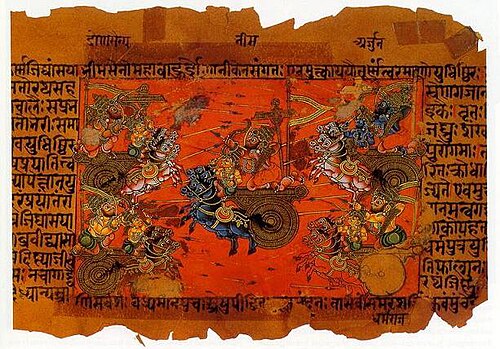
アレクシス・サンダーソンによれば、初期のサンスクリット語文献では、ヴァイディカ派、ヴァイシュナヴァ派、シャイヴァ派、シャクタ派、サウラ派、仏教、ジャイナ教の伝統が区別されている。しかし、西暦1千年紀後半のインド人の合意は、「仏教やジャイナ教とは対照的に、ヒンドゥー教に対応する複雑な実体を概念化し、反律法主義的なシャクタ・シャイヴァ派の特定の形態だけをその枠組みから除外するようになった」。[ web 5 ]ヒンドゥー哲学のミーマーンサー学派の一部の人々は、パンチャラートリカなどのアガマはヴェーダに適合しないため無効であると考えていた。カシミールの学者の中には、秘教的なタントラの伝統をヴァイディカ・ダルマの一部と認めない者もいた。[ web 5 ] [ web 6 ]紀元500年頃に遡るアティマルガ・シャイヴァ派の苦行の伝統は、ヴェーダ派の枠組みに異議を唱え、彼らのアガマと実践は有効であるだけでなく、ヴェーダ派のものよりも優れていると主張した。[ web 7 ]しかし、サンダーソンによれば、このシャイヴァ派の苦行の伝統は、自分たちがヴェーダの伝統に真に忠実であると見なし、「バラモン教のシュルティとスムリティは、その領域において普遍的かつ唯一無二に有効であり、したがって、ヴェーダは人間にとって有効な知識を得る唯一の手段であると満場一致で主張した」という。[ web 7 ]
Hindu beliefs are vast and diverse, and thus Hinduism is often referred to as a "family of religions" rather than a single religion.[web 8] Within each tradition in Hinduism, there are different theologies, practices, and sacred texts, often including unique interpretations, commentaries, and derivative works that build upon shared foundational scriptures.[122][123][124] Hinduism does not have a "unified system of belief encoded in a declaration of faith or a creed",[42] but is rather an umbrella term comprising the plurality of religious phenomena of India.[a][125] According to the Supreme Court of India,
Unlike other religions in the World, the Hindu religion does not claim any one Prophet, it does not worship any one God, it does not believe in any one philosophic concept, it does not follow any one act of religious rites or performances; in fact, it does not satisfy the traditional features of a religion or creed. It is a way of life and nothing more".[126]
Part of the problem with a single definition of the term Hinduism is the fact that Hinduism does not have a founder.[127] It is a synthesis of various traditions,[128] the "Brahmanical orthopraxy, the renouncer traditions and popular or local traditions".[129]
Despite the differences, there is also a sense of unity.[131] Most Hindu traditions revere a body of religious or sacred literature, the Vedas,[132] although there are exceptions.[133] These texts are a reminder of the ancient cultural heritage and point of pride for Hindus,[134][135] though Louis Renou stated that "even in the most orthodox domains, the reverence to the Vedas has come to be a simple raising of the hat".[134][136]
インド学者のアレクシス・サンダーソンによれば、イスラム教がインドに伝来する以前、「サンスクリット語の文献では、ヴェーダ、ヴァイシュナヴァ、シャイヴァ、シャークタ、サウラ、仏教、ジャイナ教の伝統が区別されていたが、仏教やジャイナ教に対抗して、これら最初の 5 つの伝統を集合体として示す名前はなかった」。サンダーソンによれば、正式な名前がないからといって、ヒンドゥー教の概念が存在しなかったわけではない。西暦 1 千年紀後半には、仏教やジャイナ教とは異なる信仰と伝統の概念が出現した。[ web 5 ]この複雑な伝統は、特定の反律法主義的なタントラ運動を除いて、現在のヒンドゥー教のほぼすべてをそのアイデンティティとして受け入れた。[ web 5 ]当時の保守的な思想家の中には、特定のシャイヴァ、ヴァイシュナヴァ、シャークタの文献や慣習がヴェーダと一致しているかどうか、あるいは全体として無効であるかどうかを疑問視する者もいた。当時の穏健派、そして後の正統派の学者たちの大半は、多少の相違はあるものの、信仰の基盤、儀式の文法、精神的な前提、救済論は同じであるという点で意見が一致していた。「このより大きな統一感は、ヒンドゥー教と呼ばれるようになった」とサンダーソンは述べている。[ web 5 ]
All of religion is contained in the Vedanta, that is, in the three stages of the Vedanta philosophy, the Dvaita, Vishishtâdvaita and Advaita; one comes after the other. These are the three stages of spiritual growth in man. Each one is necessary. This is the essential of religion: the Vedanta, applied to the various ethnic customs and creeds of India, is Hinduism.
This inclusivism[163] was further developed in the 19th and 20th centuries by Hindu reform movements and Neo-Vedanta,[164] and has become characteristic of modern Hinduism.[132]
Beginning in the 19th century, Indian modernists re-asserted Hinduism as a major asset of Indian civilisation,[78] meanwhile "purifying" Hinduism from its Tantric elements[165] and elevating the Vedic elements. Western stereotypes were reversed, emphasising the universal aspects, and introducing modern approaches of social problems.[78] This approach had great appeal, not only in India, but also in the west.[78] Major representatives of "Hindu modernism"[166] are Ram Mohan Roy, Swami Vivekananda, Sarvepalli Radhakrishnan and Mahatma Gandhi.[167]
Hindu texts accept a polytheistic framework, but this is generally conceptualised as the divine essence or luminosity that gives vitality and animation to the inanimate natural substances.[311] There is a divine in everything, human beings, animals, trees and rivers. It is observable in offerings to rivers, trees, tools of one's work, animals and birds, rising sun, friends and guests, teachers and parents.[311][312][313] It is the divine in these that makes each sacred and worthy of reverence, rather than them being sacred in and of themselves. This perception of divinity manifested in all things, as Buttimer and Wallin view it, makes the Vedic foundations of Hinduism quite distinct from animism, in which all things are themselves divine.[311] The animistic premise sees multiplicity, and therefore an equality of ability to compete for power when it comes to man and man, man and animal, man and nature, etc. The Vedic view does not perceive this competition, equality of man to nature, or multiplicity so much as an overwhelming and interconnecting single divinity that unifies everyone and everything.[311][314][315]
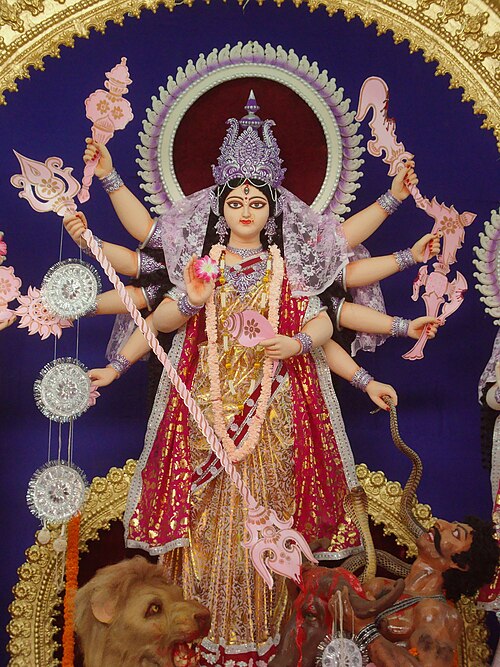
The Hindu scriptures name celestial entities called Devas (or Devi in feminine form), which may be translated into English as gods or heavenly beings.[note 25] The devas are an integral part of Hindu culture and are depicted in art, architecture and through icons, and stories about them are related in the scriptures, particularly in Indian epic poetry and the Puranas. They are, however, often distinguished from Ishvara, a personal god, with many Hindus worshipping Ishvara in one of its particular manifestations as their iṣṭa devatā, or chosen ideal.[316][317] The choice is a matter of individual preference,[318] and of regional and family traditions.[318][note 26] The multitude of Devas is considered manifestations of Brahman.[320]
↑クロスターマイヤー: 「ブラフマンは、語根bŗh = 成長する、偉大になる、に由来し、元々はヴェーダ語で人々を繁栄させる言葉と同一でした。言葉は、別の領域に住む神々に近づくための主要な手段でした。この「実体化された発話行為」という概念から、「発話行為が暗黙的にも明示的にも目的のための手段として見られる」という概念への大きなステップではありませんでした。」クロスターマイヤー 2007、p.55 は、マダヴ M. デシュパンデ (1990)、 Changing Conceptions of the Veda: From Speech-Acts to Magical Sounds、p.4 を引用しています。
1 2 O'Conell, Joseph T. (1973). "ガウディーヤ・ヴァイシュナヴァ文献における「ヒンドゥー」という言葉". Journal of the American Oriental Society . 93 (3): 340– 344. doi : 10.2307/599467 . ISSN 0003-0279 . JSTOR 599467 .
↑ Taylor, Patrick; Case, Frederick I. (2013). 『カリブ海宗教百科事典:第1巻:A~L;第2巻:M~Z』。イリノイ大学出版局。pp. 902–903。ISBN978-0-252-09433-02024年3月28日にオリジナルからアーカイブされました。2018年7月25日に取得。
↑ Sharma, A (1985). "ヒンドゥー教徒は自分たちの宗教に名前をつけていたのか?" . The Journal of the Oriental Society of Australia . 17 (1): 94–98 [95]. 2021年3月4日のオリジナルからアーカイブ。 2021年3月17日取得。
↑Quack, Johannes; Binder, Stefan (22 February 2018). "Atheism and Rationalism in Hinduism". Oxford Bibliographies. Oxford University Press. doi:10.1093/obo/9780195399318-0196.
↑Witz, Klaus G (1998). The Supreme Wisdom of the Upaniṣads: An Introduction, Motilal Banarsidass. Motilal Banarsidass Publ. pp.10–11. ISBN978-81-208-1573-5.
↑Henderson, John (2014). Scripture, Canon and Commentary. Princeton University Press. p.120. ISBN978-0-691-60172-4.
12Olivelle, Patrick (2014). The Early Upanisads. Oxford University Press. p.3. ISBN978-0-19-535242-9. Even though theoretically the whole of Vedic corpus is accepted as revealed truth [shruti], in reality it is the Upanishads that have continued to influence the life and thought of the various religious traditions that we have come to call Hindu. Upanishads are the scriptures par excellence of Hinduism.
↑Doniger 1990, pp.2–3: "The Upanishads supply the basis of later Hindu philosophy; they alone of the Vedic corpus are widely known and quoted by most well-educated Hindus, and their central ideas have also become a part of the spiritual arsenal of rank-and-file Hindus."
12McDowell, Michael; Brown, Nathan (2009). World Religions. Penguin. pp.208–210. ISBN978-1-59257-846-7.
↑Dissanayake, Wiman (1993). Kasulis, Thomas P.; etal. (eds.). Self as Body in Asian Theory and Practice. State University of New York Press. p.39. ISBN978-0-7914-1080-6.
↑Young, Serinity (2007). Hinduism. Marshall Cavendish. p.87. ISBN978-0-7614-2116-0. Retrieved 19 February 2015. Rammohun Roy Father of Hindu Renaissance.
↑Berg, Travis Vande; Kniss, Fred (2008). "ISKCON and Immigrants: The Rise, Decline, and Rise Again of a New Religious Movement". The Sociological Quarterly. 49 (1): 79–104. doi:10.1111/j.1533-8525.2007.00107.x. ISSN0038-0253. JSTOR40220058. S2CID146169730.
↑"How ISKCON took Hinduism to the US heartland". scroll.in. 17 January 2015. Archived from the original on 11 May 2021. Retrieved 9 April 2021.
↑"Hinduism in Europe"(PDF). Microsoft Word. 28 April 2017. Archived(PDF) from the original on 23 May 2021. Retrieved 9 April 2021.
1234SS Kumar (2010), Bhakti – the Yoga of Love, LIT Verlag Münster, ISBN978-3-643-50130-1, pp. 35–36
↑The global religious landscape: HindusArchived 9 February 2020 at the Wayback Machine, Pew Research (2012)
12Preston, Charles. "List of religious populations | Largest Religions, Smallest Religions, Lists, Data, & Overview | Britannica". www.britannica.com. Archived from the original on 14 January 2025. Retrieved 1 February 2025.
↑Nettl, Bruno; Stone, Ruth M.; Porter, James; Rice, Timothy (1998). The Garland Encyclopedia of World Music: South Asia: the Indian subcontinent. Routledge. pp.246–247. ISBN978-0-8240-4946-1. Archived from the original on 11 October 2017. Retrieved 21 February 2016.
↑Scaligero, Massimo (1955). "The Tantra and the Spirit of the West". East and West. 5 (4): 291–296. JSTOR29753633.
↑History: Hans Koester (1929), The Indian Religion of the Goddess Shakti, Journal of the Siam Society, Vol 23, Part 1, pp. 1–18;Modern practices: June McDaniel (2010), Goddesses in World Culture, Volume 1 (Editor: Patricia Monaghan), ISBN978-0-313-35465-6, Chapter 2
↑Wainwright, William (2012). "Concepts of God". Stanford Encyclopedia of Philosophy. Stanford University. Archived from the original on 23 March 2015. Retrieved 17 June 2015.
↑Murthy, U (1979). Samskara. Oxford University Press. p.150. ISBN978-0-19-561079-6.
↑Williamson, L (2010). Transcendent in America: Hindu-inspired Meditation Movements as New Religion. New York University Press. p.89. ISBN978-0-8147-9450-0.
↑Milner, Murray (1994). Status and Sacredness. Oxford University Press. pp.194–197. ISBN978-0-19-508489-4.
↑"The spread of Hinduism in Southeast Asia and the Pacific". Encyclopædia Britannica Online. Archived from the original on 16 January 2020. Retrieved 19 June 2021.
↑Haider, Suhasini (3 February 2018). "Tattooed 'blue-skinned' Hindu Pushtuns look back at their roots". The Hindu. Archived from the original on 22 August 2021. Retrieved 9 February 2020.
↑West 2010, p.357, quote: "The Kalasha [...] religion is a form of Hinduism that recognizes many gods and spirits and has been related to the religion of the Ancient Greeks, who mythology says are the ancestors of the contemporary Kalash [...] However, it is much more likely, given their Indo-Aryan language, that the religion of the Kalasha is much more closely aligned to the Hinduism of their Indian neighbors that to the religion of Alexander the Great and his armies.".
↑Rajesh Joshi. "Ghana's unique African-Hindu temple". BBC News. Archived from the original on 31 December 2021.
↑George M. Williams (2003), Handbook of Hindu Mythology, Oxford University Press, ISBN978-0-19-533261-2, p. 285
↑Jan Gonda (1975), Vedic Literature: (Saṃhitās and Brāhmaṇas), Otto Harrassowitz Verlag, ISBN978-3-447-01603-2
↑Roer 1908, pp.1–5; "The Vedas are divided in two parts, the first is the karma-kanda, the ceremonial part, also (called) pūrva-kāṇḍa, and treats on ceremonies; the second part is the jñāna-kāṇḍa, the part which contains knowledge, also named uttarra-kāṇḍa or posterior part and unfolds the knowledge of Brahma or the universal Self."
12Olivelle, Patrick (1998). "Introduction". Upaniṣads. Oxford University Press. ISBN978-0-19-282292-5.
12Doniger 1990, pp.2–3: "The Upanishads supply the basis of later Hindu philosophy; they alone of the Vedic corpus are widely known and quoted by most well-educated Hindus, and their central ideas have also become a part of the spiritual arsenal of rank-and-file Hindus."
↑Dissanayake, Wiman (1993). Kasulis, Thomas P.; etal. (eds.). Self as Body in Asian Theory and Practice. State University of New York Press. p.39. ISBN978-0-7914-1080-6. The Upanishads form the foundations of Hindu philosophical thought and the central theme of the Upanishads is the identity of Atman and Brahman, or the inner self and the cosmic self
↑Radhakrishnan, S. (1969) [1953]. The Principal Upanishads (reprinted.). George Allen & Co. pp.17–19. ISBN978-81-7223-124-8.
↑Thirteen Principal Upanishads. Translated by Hume, Robert. Oxford University Press. 1921.
↑Sarvopaniṣado gāvo, etc. (Gītā Māhātmya 6). Gītā Dhyānam, cited in "Introduction". Bhagavad-gītā[As It Is]. Archived from the original on 29 December 2020. Retrieved 29 December 2020– via Bhaktivedanta VedaBase.
↑Coburn, Thomas B. (September 1984). ""Scripture" in India: Towards a Typology of the Word in Hindu Life". Journal of the American Academy of Religion. 52 (3): 435–459. doi:10.1093/jaarel/52.3.435.
↑Michelis, Elizabeth De (2005). A History of Modern Yoga: Patanjali and Western Esotericism. Continuum. ISBN978-0-8264-8772-8. Archived from the original on 28 March 2024. Retrieved 14 October 2017.
↑Balfour, Edward (1885). The Cyclopædia of India and of Eastern and Southern Asia: Commercial, Industrial and Scientific, Products of the Mineral, Vegetable, and Animal Kingdoms, Useful Arts and Manufactures. B. Quaritch. p.60. Archived from the original on 20 March 2023. Retrieved 3 July 2023.
↑Laumakis, Stephen J. (2008). An Introduction to Buddhist Philosophy. Cambridge University Press. ISBN978-1-139-46966-1. Archived from the original on 28 March 2024. Retrieved 15 September 2022.
↑Hayakawa, Atsushi (2014). Circulation of Fire in the Veda. LIT Verlag Münster. ISBN978-3-643-90472-0.
↑Sayers, Matthew R. (2013). Feeding the Dead: Ancestor Worship in Ancient India. OUP USA. ISBN978-0-19-989643-1. Archived from the original on 30 December 2023. Retrieved 15 September 2022.
↑Sayers, Matthew R. (May 2008). Feeding the ancestors: ancestor worship in ancient Hinduism and Buddhism (Thesis thesis). Archived from the original on 20 September 2022. Retrieved 15 September 2022.
↑Sayers, Matthew R. (June 2015). "The Śrāddha: The Development of Ancestor Worship in Classical Hinduism: The Śrāddha". Religion Compass. 9 (6): 182–197. doi:10.1111/rec3.12155. Archived from the original on 19 January 2022. Retrieved 29 September 2022.
↑Flood, Gavin (1996a). "The meaning and context of the Purusarthas". In Lipner, Julius (ed.). The Fruits of Our Desiring. Bayeux. pp.16–21. ISBN978-1-896209-30-2.
↑"Dharma"Archived 26 September 2016 at the Wayback Machine, The Oxford Dictionary of World Religions: "In Hinduism, dharma is a fundamental concept, referring to the order and custom which make life and a universe possible, and thus to the behaviours appropriate to the maintenance of that order."
12"Dharma". The Columbia Encyclopedia (6thed.). Columbia University Press. 2013. ISBN978-0-7876-5015-5.
12Van Buitenen, J. A. B. (April–July 1957). "Dharma and Moksa". Philosophy East and West. 7 (1/2): 33–40. doi:10.2307/1396832. JSTOR1396832.
↑Charles Johnston, The Mukhya Upanishads: Books of Hidden Wisdom, Kshetra, ISBN978-1-4959-4653-0, p. 481, for discussion: pp. 478–505
↑Paul Horsch (Translated by Jarrod Whitaker), "From Creation Myth to World Law: The early history of Dharma", Journal of Indian Philosophy, Vol 32, pp. 423–448, (2004)
↑Swami Prabhupādā, A. C. Bhaktivedanta (1986). Bhagavad-gītā as it is. The Bhaktivedanta Book Trust. p.16. ISBN978-0-89213-268-3. Archived from the original on 29 December 2020. Retrieved 29 December 2020.
↑Bruce Sullivan (1997), Historical Dictionary of Hinduism, ISBN978-0-8108-3327-2, pp. 29–30
↑John Koller, Puruṣārtha as Human Aims, Philosophy East and West, Vol. 18, No. 4 (Oct. 1968), pp. 315–319
↑Macy, Joanna (1975). "The Dialectics of Desire". Numen. 22 (2): 145–160. doi:10.2307/3269765. JSTOR3269765.
↑Monier Williams, काम, kāmaArchived 19 October 2017 at the Wayback MachineMonier-Williams Sanskrit English Dictionary, p. 271, see 3rd column
↑R. Prasad (2008), History of Science, Philosophy and Culture in Indian Civilization, Volume 12, Part 1, ISBN978-8180695445, Chapter 10, particularly pp. 252–255
"The Hindu Kama Shastra Society" (1925), The Kama Sutra of Vatsyayana, University of Toronto Archives, pp. 8;
A. Sharma (1982), The Puruṣārthas: a study in Hindu axiology, Michigan State University, ISBN978-99936-24-31-8, pp. 9–12; See review by Frank Whaling in Numen, Vol. 31, 1 (July 1984), pp. 140–142;
A. Sharma (1999), "The Puruṣārthas: An Axiological Exploration of Hinduism"Archived 29 December 2020 at the Wayback Machine, The Journal of Religious Ethics, Vol. 27, No. 2 (Summer, 1999), pp. 223–256;
Chris Bartley (2001), Encyclopedia of Asian Philosophy, Editor: Oliver Learman, ISBN978-0-415-17281-3, Routledge, Article on Purushartha, p. 443
↑Long, J. Bruce (1980). "2 Karma and Rebirth in Classical Indian Traditions". In O'Flaherty, Wendy D. (ed.). The concepts of human action and rebirth in the Mahabharata. University of California Press. ISBN978-0-520-03923-0.
↑The Far East and Australasia, 2003 – Regional surveys of the world. Routledge. 2003. p.39. ISBN978-1-85743-133-9. Archived from the original on 29 December 2020. Retrieved 29 December 2020.
↑Hindu spirituality – Volume 25 of Documenta missionalia. Editrice Pontificia Università Gregoriana. 1999. p.1. ISBN978-88-7652-818-7. Archived from the original on 29 December 2019. Retrieved 29 December 2020.
123Potter, Karl H. (1958). "Dharma and Mokṣa from a Conversational Point of View". Philosophy East and West. 8 (1/2): 49–63. doi:10.2307/1397421. ISSN0031-8221. JSTOR1397421.
↑Ingalls, Daniel H. H. (1957d). "Dharma and Moksha"(PDF). Philosophy East and West. 7 (2): 41–48. doi:10.2307/1396833. JSTOR1396833.
12Pal, Jagat (2004). Karma, Dharma and Moksha: Conceptual Essays on Indian Ethics. Abhijeet Publications. ISBN978-81-88683-23-9. Archived from the original on 28 March 2024. Retrieved 2 June 2021.
↑von Brück, M. (1986). "Imitation or Identification?". Indian Theological Studies. 23 (2): 95–105.
↑Fort, Andrew O. (1998). Jivanmukti in Transformation: Embodied Liberation in Advaita and Neo-Vedanta. SUNY Press. ISBN978-0-7914-3904-3. Archived from the original on 28 March 2024. Retrieved 2 June 2021.
↑Apte, Vaman S (1997). The Student's English-Sanskrit Dictionary (Newed.). Delhi: Motilal Banarsidas. ISBN978-81-208-0300-8.
↑Smith, Huston (1991). The World's Religions: Our Great Wisdom Traditions. San Francisco: Harper. p.64. ISBN978-0-06-250799-0.
↑Karl Potter (1964), "The Naturalistic Principle of Karma", Philosophy East and West, Vol. 14, No. 1 (April 1964), pp. 39–49
12Wendy D. O'Flaherty (1980), Karma and Rebirth in Classical Indian Traditions, University of California Press, ISBN978-0-520-03923-0, pp. xi–xxv (Introduction) and 3–37
↑Karl Potter (1980), in Karma and Rebirth in Classical Indian Traditions (O'Flaherty, Editor), University of California Press, ISBN978-0-520-03923-0, pp. 241–267
↑Chapple, Christopher Key (1986). Karma and Creativity. SUNY Press. pp.60–64. ISBN978-0-88706-250-6. Archived from the original on 28 March 2024. Retrieved 2 June 2021.
↑Boyer, A. M. (1901). "Etude sur l'origine de la doctrine du samsara". Journal Asiatique. 9 (18): 451–453, 459–468.
↑Ranade, R. D. (1926). A Constructive Survey of Upanishadic Philosophy. Bharatiya Vidya Bhavan. pp.147–148. ...in certain other places [of Rigveda], an approach is being made to the idea of Transmigration. ... There we definitely know that the whole hymn is address to a departed spirit, and the poet [of the Rigvedic hymn] says that he is going to recall the departed soul in order that it may return again and live.
↑Sayers, Matthew R. (2013). Feeding the Dead: Ancestor worship in ancient India. Oxford University Press. pp.1–9. ISBN978-0-19-989643-1. Archived from the original on 30 December 2023. Retrieved 15 September 2022.
↑Sayers, Matthew Rae. Feeding the ancestors: ancestor worship in ancient Hinduism and Buddhism (PhD thesis). University of Texas. p.12. Archived from the original on 20 September 2022. Retrieved 15 September 2022.
↑Sayers, Matthew R. (1 November 2015). McGovern, Nathan (ed.). "Feeding the Dead: Ancestor worship in ancient India". The Journal of Hindu Studies. 8 (3): 336–338. doi:10.1093/jhs/hiv034. ISSN1756-4255. Archived from the original on 4 February 2021. Retrieved 15 September 2022.
↑Keown, Damien (2013). Buddhism: A very short introduction. Oxford University Press. pp.28, 32–38. ISBN978-0-19-966383-5. Archived from the original on 28 March 2024. Retrieved 15 September 2022.
↑Chakravarti, Sitansu (1991). Hinduism, a way of life. Motilal Banarsidass. p.71. ISBN978-81-208-0899-7. Archived from the original on 13 April 2017. Retrieved 29 December 2020.
↑Muller, Max (1878). Lectures on the Origins and Growth of Religions: As Illustrated by the Religions of India. Longmans Green & Co. pp.260–271.Wilkins, William Joseph (1882). Hindu Mythology: Vedic and Purānic. Calcutta: London Missionary Society. p.8. Archived from the original on 28 March 2024. Retrieved 19 October 2020.
↑Raghavendrachar, H.N. (1944). "Monism in the Vedas"(PDF). Section A – Arts. The Half-yearly Journal of the Mysore University. 4 (2): 137–152. Archived from the original(PDF) on 6 February 2015.Werner, K. (1982). "Men, gods and powers in the Vedic outlook". Journal of the Royal Asiatic Society of Great Britain & Ireland. 114 (1): 14–24. doi:10.1017/S0035869X00158575. S2CID163754819.Coward, H. (1995). "The Limits of Scripture: Vivekananda's Reinterpretation of the Vedas". Book Review. Journal of Hindu-Christian Studies. 8 (1): 45–47. doi:10.7825/2164-6279.1116. There is little doubt that the theo-monistic category is an appropriate one for viewing a wide variety of experiences in the Hindu tradition
↑John Koller (2012), Routledge Companion to Philosophy of Religion (Editors: Chad Meister, Paul Copan), Routledge, ISBN978-0-415-78294-4, pp. 99–107
↑Lance Nelson (1996), "Living liberation in Shankara and classical Advaita", in Living Liberation in Hindu Thought (Editors: Andrew O. Fort, Patricia Y. Mumme), State University of New York Press, ISBN978-0-7914-2706-4, pp. 38–39, 59 (footnote 105)
12R Prasad (2009), A Historical-developmental Study of Classical Indian Philosophy of Morals, Concept Publishing, ISBN978-81-8069-595-7, pp. 345–347
1234Buttimer, Anne; Wallin, L. (1999). Nature and Identity in Cross-Cultural Perspective. Springer. pp.64–68. ISBN978-0-7923-5651-6. Archived from the original on 28 March 2024. Retrieved 30 June 2017.
↑Berntsen, Maxine (1988). The Experience of Hinduism: Essays on Religion in Maharashtra. State University of New York Press. pp.18–19. ISBN978-0-88706-662-7.
↑Taittiriya Upanishad Thirteen Principal Upanishads, Robert Hume (Translator), pp. 281–282;Paul Deussen, Sixty Upanishads of the Veda, Volume 1, Motilal Banarsidass, ISBN978-81-208-1468-4, pp. 229–231
↑Mabry, John R. (2006). Noticing the Divine: An Introduction to Interfaith Spiritual Guidance. New York: Morehouse. pp.32–33. ISBN978-0-8192-2238-1. Archived from the original on 28 March 2024. Retrieved 30 June 2017.
↑Samovar, Larry A.; Porter, Richard E.; McDaniel, Edwin R.; etal. (2016). Communication Between Cultures. Cengage. pp.140–144. ISBN978-1-305-88806-7. Archived from the original on 28 March 2024. Retrieved 30 June 2017.
↑Harlan, Lindsey (1992). Religion and Rajput Women: The Ethic of Protection in Contemporary Narratives. University of California Press. pp.19–20, 48 with footnotes. ISBN978-0-520-07339-5. Archived from the original on 17 August 2023. Retrieved 5 July 2017.
Toropov & Buckles 2011, p.. "The members of various Hindu sects worship a dizzying number of specific deities and follow innumerable rituals in honor of specific gods. Because this is Hinduism, however, its practitioners see the profusion of forms and practices as expressions of the same unchanging reality. The panoply of deities is understood by believers as symbols for a single transcendent reality."
Espín & Nickoloff 2007, p.. "The devas are powerful spiritual beings, somewhat like angels in the West, who have certain functions in the cosmos and live immensely long lives. Certain devas, such as Ganesha, are regularly worshiped by the Hindu faithful. Note that, while Hindus believe in many devas, many are monotheistic to the extent that they will recognise only one Supreme Being, a God or Goddess who is the source and ruler of the devas."
↑Bassuk, Daniel E (1987). Incarnation in Hinduism and Christianity: The Myth of the God-Man. Palgrave Macmillan. pp.2–4. ISBN978-1-349-08642-9. Archived from the original on 28 March 2024. Retrieved 28 June 2017.
↑Hacker, Paul (1978). Schmithausen, Lambert (ed.). Zur Entwicklung der Avataralehre (in German). Otto Harrassowitz. pp.424, also 405–409, 414–417. ISBN978-3-447-04860-6.
↑Kinsley, David (2005). Jones, Lindsay (ed.). Encyclopedia of Religion. Vol.2 (Seconded.). Thomson Gale. pp.707–708. ISBN978-0-02-865735-6.
↑McDaniel, June (2004). Offering Flowers, Feeding Skulls: Popular Goddess Worship in West Bengal: Popular Goddess Worship in West Bengal. Oxford University Press, USA. pp.90–91. ISBN978-0-19-534713-5.
↑Hawley, John Stratton; Narayanan, Vasudha (2006). The life of Hinduism. University of California Press. p.174. ISBN978-0-520-24914-1. Archived from the original on 29 December 2020. Retrieved 29 December 2020.
↑Kinsley, David R. (1998). Tantric Visions of the Divine Feminine: The Ten Mahāvidyās. Motilal Banarsidass. pp.115–119. ISBN978-81-208-1522-3. Archived from the original on 28 March 2024. Retrieved 28 June 2017.
↑John Clayton (2010), Religions, Reasons and Gods: Essays in Cross-cultural Philosophy of Religion, Cambridge University Press, ISBN978-0-521-12627-4, page 150
↑Sharma, C. (1997). A Critical Survey of Indian Philosophy, Delhi: Motilal Banarsidass, ISBN978-81-208-0365-7, pp. 209–210
↑Reichenbach, Bruce R. (April 1989). "Karma, causation, and divine intervention". Philosophy East and West. 39 (2): 135–149 [145]. doi:10.2307/1399374. JSTOR1399374. Archived from the original on 27 October 2009. Retrieved 29 December 2009.
↑Rajadhyaksha (1959). The six systems of Indian philosophy. p.95. Archived from the original on 1 January 2016. Retrieved 2 July 2015. Under the circumstances God becomes an unnecessary metaphysical assumption. Naturally the Sankhyakarikas do not mention God, Vachaspati interprets this as rank atheism.
12Coward 2008, p.114: "For the Mimamsa the ultimate reality is nothing other than the eternal words of the Vedas. They did not accept the existence of a single supreme creator god, who might have composed the Veda. According to the Mimamsa, gods named in the Vedas have no existence apart from the mantras that speak their names. The power of the gods, then, is nothing other than the power of the mantras that name them."
↑Neville, Robert (2001). Religious truth. SUNY Press. p.51. ISBN978-0-7914-4778-9. Archived from the original on 1 January 2016. Retrieved 2 July 2015. Mimamsa theorists (theistic and atheistic) decided that the evidence allegedly proving the existence of God was insufficient. They also thought there was no need to postulate a maker for the world, just as there was no need for an author to compose the Veda or an independent God to validate the Vedic rituals.
↑A Goel (1984), Indian philosophy: Nyāya-Vaiśeṣika and modern science, Sterling, ISBN978-0-86590-278-7, pp. 149–151
↑Collins, Randall (2000), The sociology of philosophies, Cambridge, MA: The Belknap Press of Harvard University Press, ISBN978-0-674-00187-9, p. 836
↑Burley, Mikel (2012). Classical Samkhya and Yoga – An Indian Metaphysics of Experience. Routledge. pp.39–41. ISBN978-0-415-64887-5.;Pflueger, Lloyd (2008). Knut Jacobsen (ed.). Person Purity and Power in Yogasutra, in Theory and Practice of Yoga. Motilal Banarsidass. pp.38–39. ISBN978-81-208-3232-9.;Behanan, K. T. (2002). Yoga: Its Scientific Basis. Dover. pp.56–58. ISBN978-0-486-41792-9.
↑Knut Jacobsen (2008), Theory and Practice of Yoga: Essays in Honour of Gerald James Larson, Motilal Banarsidass, ISBN978-81-208-3232-9, pp. 77–78
↑Rankin, John (1 June 1984). "Teaching Hinduism: Some Key Ideas". British Journal of Religious Education. 6 (3): 133–160. doi:10.1080/0141620840060306. ISSN0141-6200.
↑NK Brahma, Philosophy of Hindu Sādhanā, ISBN978-8120333062, pp. ix–x
12Pandey, R (1969). Hindu Saṁskāras: Socio-Religious Study of the Hindu Sacraments (2nded.). Delhi: Motilal Banarsidass. ISBN978-81-208-0434-0.
↑Knipe, David (2015). Vedic Voices: Intimate Narratives of a Living Andhra Tradition. Oxford University Press. p.52. ISBN978-0-19-939769-3.
123Kane, PV (1941). "Saṁskāra". History of Dharmasastras. Part I. Vol.II. Bhandarkar Oriental Research Institute. pp.190–417.
12Olivelle, Patrick (2009b). Dharmasutras – The Law Codes of Ancient India. Oxford University Press. pp.90–91. ISBN978-0-19-955537-6.
↑Olson, Carl (2007). The Many Colors of Hinduism: A Thematic-historical Introduction. Rutgers University Press. pp.93–94. ISBN978-0-8135-4068-9.
↑For Vedic school, see: Smith, Brian K. (1986). "Ritual, Knowledge, and Being: Initiation and Veda Study in Ancient India". Numen. 33 (1): 65–89. doi:10.2307/3270127. JSTOR3270127.
↑For music school, see: Arnold, Alison; etal. (1999). The Garland Encyclopedia of World Music: South Asia. Vol.5. Routledge. p.459. ISBN978-0-8240-4946-1. For sculpture, crafts and other professions, see: Elgood, Heather (2000). Hinduism and the religious arts. Bloomsbury Academic. pp.32–134. ISBN978-0-304-70739-3.
↑Siqueira, Thomas N. (March 1935). "The Vedic Sacraments". Thought. 9 (4): 598–609. doi:10.5840/thought1935945.
↑Pechelis, Karen (2011). "Bhakti Traditions". In Frazier, Jessica; Flood, Gavin (eds.). The Continuum Companion to Hindu Studies. Bloomsbury. pp.107–121. ISBN978-0-8264-9966-0.
↑Lochtefeld 2002a, pp.98–100; also see articles on karmamārga and jnanamārga
↑Sahajananda, John Martin (2014). Fully Human Fully Divine. Partridge India. p.60. ISBN978-1-4828-1955-7.
↑Huyler, Stephen (2002). Meeting God: Elements of Hindu Devotion. Yale University Press. pp.10–11, 71. ISBN978-0-300-08905-9. Archived from the original on 28 March 2024. Retrieved 9 November 2017.
↑Gonda, Jan (1963). "The Indian Mantra". Oriens. 16: 244–297. doi:10.1163/18778372-01601016.
12Foulston, Lynn (2012). Cush, Denise; etal. (eds.). Encyclopedia of Hinduism. Routledge. pp.21–22, 868. ISBN978-1-135-18978-5. Archived from the original on 28 March 2024. Retrieved 10 November 2017.
12Lutgendorf, Philip (2007). Hanuman's Tale: The Messages of a Divine Monkey. Oxford University Press. p.401. ISBN978-0-19-804220-4. Archived from the original on 29 December 2020. Retrieved 29 December 2020.
↑Raj, Dhooleka S. (2003). Where Are You From?: Middle-Class Migrants in the Modern World. University of California Press. ISBN978-0-520-23382-9. JSTOR10.1525/j.ctt1pn917.
↑Lutgendorf, Philip (2007). Hanuman's Tale: The Messages of a Divine Monkey. Oxford University Press. pp.23, 262. ISBN978-0-19-804220-4. Archived from the original on 29 December 2020. Retrieved 29 December 2020.
↑Williams, Raymond Brady (2018). Introduction to Swaminarayan Hinduism. Cambridge University Press. pp.84, 153–154. ISBN978-1-108-42114-0. Archived from the original on 29 December 2020. Retrieved 29 December 2020.
↑Robinson, Bob (2011). Hindus meeting Christians. OCMS. pp.288–295. ISBN978-1-870345-39-2;Vroom, Hendrick (1996). No Other Gods. Cambridge: Eerdmans Publishing. pp.68–69. ISBN978-0-8028-4097-4.
↑Smart, Ninian (2012). The Yogi and the Devotee. Routledge. pp.52–80. ISBN978-0-415-68499-6.
↑Ardley, Jane (2015). Spirituality and Politics: Gandhian and Tibetan cases, in The Tibetan Independence Movement. Routledge. pp.ix, 98–99, 112–113. ISBN978-1-138-86264-7;Mitchell, Helen (2014). Roots of Wisdom: A Tapestry of Philosophical Traditions. Cengage Learning. pp.188–189. ISBN978-1-285-19712-8.
↑Bhavasar, SN (2004). Sundararajan, K. R.; Mukerji, Bithika (eds.). Hindu Spirituality: Postclassical and Modern. Motilal Banarsidass. pp.28–29. ISBN978-81-208-1937-5.
↑Foulston, Lynn; Abbott, Stuart (2009). Hindu Goddesses: Beliefs and Practices. Sussex Academic Press. p.155. ISBN978-1-902210-43-8.
↑Holberg 2000, Festival calendar of India, p. 120: "Raksha Bandhan (also called Rakhi), when girls and women tie a rakhi (a symbolic thread) on their brothers' wrists and pray for their prosperity, happiness and goodwill. The brothers, in turn, give their sisters a token gift and promise protection."
↑Frazier, Jessica (2015). The Bloomsbury Companion to Hindu Studies. Bloomsbury Academic. pp.255, 271–273. ISBN978-1-4725-1151-5.
↑Sharma, Krishan; Sinha, Anil Kishore; Banerjee, Bijon Gopal (2009). Anthropological Dimensions of Pilgrimage. Northern Book Centre. pp.3–5. ISBN978-81-89091-09-5. Archived from the original on 28 March 2024. Retrieved 5 July 2017.
↑Maw, Geoffrey Waring (1997). Pilgrims in Hindu Holy Land: Sacred Shrines of the Indian Himalayas. Sessions Book Trust. p.7. ISBN978-1-85072-190-1. Archived from the original on 16 February 2017. Retrieved 5 July 2017.
↑Glucklich, Ariel (2008). The Strides of Vishnu: Hindu Culture in Historical Perspective: Hindu Culture in Historical Perspective. Oxford University Press. p.146. ISBN978-0-19-971825-2. Archived from the original on 28 March 2024. Retrieved 10 July 2016. The earliest promotional works aimed at tourists from that era were called mahatmyas [in Puranas].
↑Bharati, Agehananda (1963). "Pilgrimage in the Indian Tradition". History of Religions. 3 (1): 135–167. doi:10.1086/462476. S2CID162220544.
↑Maclean, Kama (2008). Pilgrimage and Power: The Kumbh Mela in Allahabad, 1765–1954. Oxford University Press. pp.228–229. ISBN978-0-19-971335-6. Archived from the original on 28 March 2024. Retrieved 18 November 2017.
↑Amazzone, Laura (2012). Goddess Durga and Sacred Female Power. Rowman & Littlefield. pp.43–45. ISBN978-0-7618-5314-5. Archived from the original on 11 November 2023. Retrieved 5 July 2017.
↑Smith, Vincent Arthur (1977). Research Articles in Epigraphy, Archaeology, and Numismatics of India. Sheikh Mubarak Ali.
↑K. Krishna Murthy (1987). Early Indian Secular Architecture. Sundeep Prakashan. pp.5–16. ISBN978-81-85067-01-8.
↑Branfoot, Crispin (2008). "Imperial Frontiers: Building Sacred Space in Sixteenth-Century South India". The Art Bulletin. 90 (2). Taylor & Francis: 171–194. doi:10.1080/00043079.2008.10786389. S2CID154135978.
↑James C. Harle (1994). The Art and Architecture of the Indian Subcontinent. Yale University Press. pp.330–331. ISBN978-0-300-06217-5.
↑James C. Harle (1994). The Art and Architecture of the Indian Subcontinent. Yale University Press. pp.43–47, 67–68, 467–480. ISBN978-0-300-06217-5.
12B. Richmond (1956). Time Measurement and Calendar Construction. Brill Archive. pp.80–82. Archived from the original on 28 March 2024. Retrieved 18 September 2011.
12Christopher John Fuller (2004). The Camphor Flame: Popular Hinduism and Society in India. Princeton University Press. pp.109–110. ISBN978-0-691-12048-5. Archived from the original on 28 March 2024. Retrieved 10 July 2016.
↑Klaus K. Klostermaier (2007). A Survey of Hinduism: Third Edition. State University of New York Press. p.490. ISBN978-0-7914-7082-4. Archived from the original on 28 March 2024. Retrieved 10 June 2023.
12Eleanor Nesbitt (2016). Sikhism: a Very Short Introduction. Oxford University Press. pp.122–123. ISBN978-0-19-874557-0. Archived from the original on 15 April 2023. Retrieved 10 June 2023.
↑Orazio Marucchi (2011). Christian Epigraphy: An Elementary Treatise with a Collection of Ancient Christian Inscriptions Mainly of Roman Origin. Cambridge University Press. p.289. ISBN978-0-521-23594-5., Quote: "the lunar year consists of 354 days".
↑Anita Ganeri (2003). Buddhist Festivals Through the Year. BRB. pp.11–12. ISBN978-1-58340-375-4.
↑Napier, A David (1987). Masks, Transformation, and Paradox. University of California Press. pp.186–187. ISBN978-0-520-04533-0.
↑Sharma, SD (2010). Rice: Origin, Antiquity and History. CRC Press. pp.68–70. ISBN978-1-57808-680-1.
↑Rao, TA Gopinath (1998). Elements of Hindu iconography. Motilal Banarsidass. pp.1–8. ISBN978-81-208-0878-2.
↑Banerjea, JN (September 2004). The Development of Hindu Iconography. Kessinger. pp.247–248, 472–508. ISBN978-1-4179-5008-9.
↑Babary, Abrar; Zeeshan, Mahwish. "Reminiscent of Hinduism: An Insight of Katas Raj Mandir"(PDF). The Explorer: Journal of Social Sciences. 1 (4): 122. Archived from the original(PDF) on 26 November 2022. Retrieved 23 February 2023.
↑Radhakrishnan, S. (1929). Indian Philosophy, Volume 1. Muirhead library of philosophy (2nded.). London: George Allen and Unwin Ltd. p.148.
↑For ahiṃsā as one of the "emerging ethical and religious issues" in the Mahābhārata see: Brockington, John (2003). "The Sanskrit Epics". Flood. p.125.
↑For text of Y.S. 2.29 and translation of yama as "vow of self-restraint", see: Taimni, I. K. (1961). The Science of Yoga. Adyar, India: The Theosophical Publishing House. p.206. ISBN978-81-7059-212-9.{{cite book}}: ISBN / Date incompatibility (help)
↑Aiyar, KN (1914). "22". Thirty Minor Upanishads. Kessinger Publishing. pp.173–176. ISBN978-1-164-02641-9.{{cite book}}: ISBN / Date incompatibility (help)
↑Svatmarama; Brahmananda (2014). The Hathayogapradīpikā of Svātmārāma. verse 1.58–63, pp. 19–21.
↑Lorenzen, David (1972). The Kāpālikas and Kālāmukhas. University of California Press. pp.186–190. ISBN978-0-520-01842-6.
↑Narayanan, Vasudha (2007). "The Hindu Tradition". In Oxtoby, Willard G.; Segal, Alan F. (eds.). A Concise Introduction to World Religions. New York: Oxford University Press. ISBN978-0-19-542207-8.
↑Rosen, Steven (2006). Essential Hinduism (1sted.). Westport: Praeger Publishers. p.188.
↑Chapple, Christopher Key (2009). The Bhagavad Gita (25th Anniversaryed.). State University of New York Press. pp.641–643. ISBN978-1-4384-2842-0.
Delgado, Christopher L.; Narrod, Claire A.; Tiongco, Marites (24 July 2003). "Growth and Concentration in India". Policy, Technical, and Environmental Determinants and Implications of the Scaling-Up of Livestock Production in Four Fast-Growing Developing Countries: A Synthesis. Archived from the original on 29 December 2020. Retrieved 29 December 2020. An analysis of consumption data originating from National Sample Survey (NSS) shows that 42 percent of households are vegetarian, in that they never eat fish, meat or eggs. The remaining 58 percent of households are less strict vegetarians or non-vegetarians.
Goldammer, Ted. "Passage to India"(PDF). USDA Foreign Agricultural Service. Archived from the original(PDF) on 19 June 2009.
Landes, Maurice R. (February 2004). "The Elephant Is Jogging: New Pressures for Agricultural Reform in India". Amber Waves. Archived from the original on 28 December 2006. Results indicate that Indians who eat meat do so infrequently with less than 30% consuming non-vegetarian foods regularly, although the reasons may be economical.
↑Das, Veena (2003). The Oxford India companion to sociology and social anthropology. Vol.1. Oxford University Press. pp.151–152. ISBN978-0-19-564582-8.
↑Grover, Neelam; Singh, Kashi N. (2004). Cultural Geography, Form and Process, Concept. Concept Publishing Company. p.366. ISBN978-81-8069-074-7.
↑Jagannathan, Maithily (2005). South Indian Hindu Festivals and Traditions. Abhinav. pp.53, 69. ISBN978-81-7017-415-8;Min, Pyong Gap (2010). Preserving Ethnicity through Religion in America. New York University Press. p.1. ISBN978-0-8147-9586-6.
↑Uttara Kennedy; Arvind Sharma; Clive J.C. Philips (2018). "The Sheltering of Unwanted Cattle, Experiences in India and Implications for Cattle Industries Elsewhere". Animals. 8 (5): 64. doi:10.3390/ani8050064. PMC5981275. PMID29701646.
↑Marvin Harris. India's scared cow(PDF). Archived(PDF) from the original on 7 September 2021. Retrieved 24 July 2021.
↑Gloria Pungetti; Anna Maclvor. "Preliminary Literature Review On Scared Species"(PDF). Archived from the original(PDF) on 24 July 2021. Retrieved 24 July 2021.
↑Mansingh, Ajai (2016). "Stewards of Creation Covenant: Hinduism and the Environment". Caribbean Quarterly. 41 (1). A Journal of Caribbean Culture: 62. doi:10.1080/00086495.1995.11672075. Archived from the original on 7 September 2021. Retrieved 7 September 2021.
↑Williams, Raymond (2001). An Introduction to Swaminarayan Hinduism (1sted.). Cambridge: Cambridge University Press. p.159. ISBN978-0-521-65279-7.
↑Smith, Harold F. (2007). "12". Outline of Hinduism. Read Books. ISBN978-1-4067-8944-7.
↑Yayasan, Bumi Kita (2005). "The Hidden Life of Bali". In Gouyon, Anne (ed.). The natural guide to Bali: enjoy nature, meet the people, make a difference. Equinox Publishing (Asia). p.51. ISBN978-979-3780-00-9. Archived from the original on 26 July 2011. Retrieved 12 August 2010.
↑Gwynne, Paul (2011). World Religions in Practice: A Comparative Introduction. John Wiley & Sons. p.5 footnote 16. ISBN978-1-4443-6005-9.
↑Olcott, H.S. (1906). The Theosophist. Vol.XXVII. Theosophical Publishing House. pp.146 with footnote. Archived from the original on 28 March 2024. Retrieved 10 July 2016., Quote: "It is well known that Vaishnavas abhor animal sacrifice. In this province, like nearly all Bengalis, they celebrate Durga Puja, but their ceremonies are bloodless".
↑Fuller 2004, pp.101–102, Quote: "Blood sacrifice was a clear case in point, (, , , ) sacrifice was a barbarity inconsistent with Hinduism's central tenet of non-violence. [...] Contemporary opposition to animal sacrifice rests on an old foundation, although it also stems from the very widespread influence of reformism, whose antipathy to ritual killing has spread well beyond the self-consciously nationalist political classes"..
↑Nicholson 2010, p.169, Quote: "The acceptance of the principle of non-violence has been so through that animal sacrifice among Hindus today is uncommon, and many Indians are of the opinion that such things as cow slaughter were never practiced in ancient India".
↑Bekoff, Marc (2009). Encyclopedia of Animal Rights and Animal Welfare (2nded.). ABC-CLIO. p.482. ISBN978-0-313-35256-0. Archived from the original on 28 March 2024. Retrieved 11 October 2016.
↑Stein, Burton (February 1960). "The Economic Function of a Medieval South Indian Temple". The Journal of Asian Studies. 19 (2): 163–176. doi:10.2307/2943547. JSTOR2943547. S2CID162283012.
↑Boner, Alice (1990). Principles of Composition in Hindu Sculpture: Cave Temple Period. Motilal Banarsidass Publ. Introduction and pp. 36–37. ISBN978-81-208-0705-1.
↑Meister, Michael W. (1981). "Forest and Cave: Temples at Candrabhāgā and Kansuān". Archives of Asian Art. 34: 56–73. JSTOR20111117.
↑Olivelle, Patrick (1993). The Āśrama System: The History and Hermeneutics of a Religious Institution. Oxford University Press. pp.1–29, 84–111. ISBN978-0-19-508327-9. OCLC466428084.
12Sharma, RK (1999). Indian Society, Institutions and Change. Atlantic Publishers & Dist. p.28. ISBN978-81-7156-665-5.
↑Nugteren, Albertina (2005). Belief, Bounty, And Beauty: Rituals Around Sacred Trees in India. Brill Academic. pp.13–21. ISBN978-90-04-14601-3.
↑Saraswathi; etal. (2010). "Reconceptualizing Lifespan Development through a Hindu Perspective". In Jensen, Lene Arnett (ed.). Bridging Cultural and Developmental Approaches to Psychology. Oxford University Press. pp.280–286. ISBN978-0-19-538343-0.
12Bhawuk, DP (2011). "The Paths of Bondage and Liberation". Spirituality and Indian Psychology. Springer. pp.93–110. ISBN978-1-4419-8109-7.
↑Holdrege, Barbara (2004). "Dharma". In Mittal, Sushil; Thursby, Gene (eds.). The Hindu World. Routledge. p.231. ISBN978-0-415-21527-5.
↑Olivelle, Patrick (1993). The Ashrama System: The History and Hermeneutics of a Religious Institution. Oxford University Press. ISBN978-0-19-534478-3.
↑J. J. Navone, S. J. (1956). "Sankara and the Vedic Tradition". Philosophy and Phenomenological Research. 17 (2): 248–255. doi:10.2307/2104222. ISSN0031-8205. JSTOR2104222.
↑Blackwell's History of India; Stein 2010, page 107
↑Some Aspects of Muslim Administration, R.P.Tripathi, 1956, p. 24
↑Lal, Kishori Saran (1999). Theory and Practice of Muslim State in India. Aditya Prakashan. pp.90–145. ISBN978-81-86471-72-2.
↑Priolkar, Anand Kakba (1992). The Goa Inquisition. South Asia Books. pp.2–67, 184. ISBN978-0-8364-2753-0.
↑Souza, Teotonio R. De (1994). Discoveries, Missionary Expansion, and Asian Cultures. Concept Publishing Company. p.80. ISBN978-81-7022-497-6.
↑Vir, Dharam (1988). Education and Polity in Nepal: An Asian Experiment. Northern Book Centre. pp.56. ISBN978-81-85119-39-7.
↑Younger, Paul (2010). New homelands: Hindu communities in Mauritius, Guyana, Trinidad, South Africa, Fiji, and East Africa. Oxford: Oxford University Press. pp.3–17. ISBN978-0-19-539164-0. Retrieved 4 June 2022.
↑Masud, Muhammad Khalid (2005). Islamic Legal Interpretation: Muftis and Their Fatwas. Harvard University Press. pp.193–203. ISBN978-0-19-597911-4. JSTOR846021.
12Adcock, CS (2014). The Limits of Tolerance: Indian Secularism and the Politics of Religious Freedom. Oxford University Press. pp.1–35, 115–168. ISBN978-0-19-999544-8.
↑Coward, Harold (1987). Modern Indian Responses to Religious Pluralism. SUNY Press. pp.49–60. ISBN978-0-88706-572-9.
↑Viswanathan, Gauri (1998). Outside the Fold: Conversion, Modernity, and Belief. Princeton University Press. pp.153–176. ISBN978-0-691-05899-3.
↑"How the Global Religious Landscape Changed From 2010 to 2020: 5. Hindu population change". Pew Research Center. 9 June 2025. Retrieved 11 February 2026.
↑"Vietnam". State.gov. 22 October 2002. Retrieved 17 June 2014.
↑Hackett, Conrad; Stonawski, Marcin; Tong, Yunping; Kramer, Stephanie; Shi, Anne; Fahmy, Dalia (9 June 2025). "How the Global Religious Landscape Changed From 2010 to 2020". Pew Research Center. Archived from the original on 22 February 2026. Source: Pew Research Center estimates based on more than 2,700 censuses and surveys. "How the Global Religious Landscape Changed From 2010 to 2020"
↑"The Future of World Religions"(PDF). Pew Research. 2015. Archived from the original(PDF) on 6 May 2015.
↑Schwarz, John (2015). What's Christianity All About?. Wipf and Stock Publishers. p.176. ISBN978-1-4982-2537-3.
↑Wormald, Benjamin (2 April 2015). "The Future of World Religions: Population Growth Projections, 2010–2050". Pew Research Center's Religion & Public Life Project. Retrieved 4 March 2021.
↑Nepali Census data 2011 (2014). "Nepali Census data 2011 Go to page 56 to see Buddhist and Kirat percentages"(PDF). Population Monograph. Archived(PDF) from the original on 28 March 2023. Retrieved 29 April 2024.{{cite web}}: CS1 maint: numeric names: authors list (link)
↑"Resident population by religion and sex"(PDF). Statistics Mauritius. p.68. Archived from the original(PDF) on 6 October 2022. Retrieved 19 November 2023.
↑"National Profiles | World Religion". www.thearda.com.
↑"The Census of Population and Housing of Sri Lanka-2011". Department of Census and Statistics. 2011. Archived from the original on 24 December 2018. Retrieved 29 July 2013.
↑"SVRS 2010"(PDF). Bangladesh Bureau of Statistics. p.176 (Table P–14). Archived from the original(PDF) on 13 November 2012. Retrieved 2 September 2012.
↑"United Arab Emirates". U.S. Department of State.
↑"Seychelles Population and Housing Census 2022". National Bureau of Statistics Seychelles. 21 March 2024. Retrieved 30 March 2024.
↑Singapore Department of Statistics (12 January 2011). "Census of population 2010: Statistical Release 1 on Demographic Characteristics, Education, Language and Religion"(PDF). Archived from the original(PDF) on 3 March 2011. Retrieved 16 January 2011.
↑"Indonesia: Religious Freedoms Report 2010". US State Department. 2011. Retrieved 4 March 2021. The Ministry of Religious Affairs estimates that 10 million Hindus live in the country and account for approximately 90 percent of the population in Bali. Hindu minorities also reside in Central and East Kalimantan, the city of Medan (North Sumatra), South and Central Sulawesi, and Lombok (West Nusa Tenggara). Hindu groups such as Hare Krishna and followers of the Indian spiritual leader Sai Baba are present in small numbers. Some indigenous religious groups, including the "Naurus" on Seram Island in Maluku Province, incorporate Hindu and animist beliefs, and many have also adopted some Protestant teachings.
↑"Table 26, 2018 Census Data – Tables"(xlsx). Archived from the original on 13 April 2020. Retrieved 29 December 2020.
↑Australian Bureau of Statistics (18 January 2018). "Media Release – Census reveals Australia's religious diversity on World Religion Day". www.abs.gov.au. Retrieved 4 June 2023.
↑"Wayback Machine"(PDF). www.pbs.gov.pk.{{cite web}}: Cite uses generic title (help)
Sources
For references on specific authors or topics, please see the relevant article.
Printed sources
Acharya, P. K. (1927). Indian Architecture according to the Manasara Shilpa Shastra. London: Oxford University Press (Republ. by Motilal Banarsidass). Reprint: ISBN0-300-06217-6.
Acri, Andrea; Creese, Helen; Griffiths, Arlo, eds. (2011). From Lanka Eastwards: The Ramayaṇa in the Literature and Visual Arts of Indonesia. Leiden: KITLV Press.
Bakker, F.L. (1997). "Balinese Hinduism and the Indonesian State: Recent Developments". Journal of the Humanities and Social Sciences of Southeast Asia. 153 (1): 15–41. doi:10.1163/22134379-90003943. JSTOR27864809. S2CID162277591.
Barua, Ankur (2015). Debating 'Conversion' in Hinduism and Christianity. Routledge. ISBN978-1-138-84701-9.
Beck, Guy L., ed. (2005). Alternative Krishnas: Regional and Vernacular Variations on a Hindu Deity. Albany, NY: SUNY Press. ISBN978-0-7914-6415-1.
Bhardwaj, Surinder Mohan (1983). Hindu Places of Pilgrimage in India: A Study in Cultural Geography. University of California Press. ISBN978-0-520-04951-2.
Bhaskarananda, Swami (1994). Essentials of Hinduism. Viveka Press. ISBN978-1-884852-02-2.
Bhattacharya, A (2006). Hindu Dharma: Introduction to Scriptures and Theology. iUniverse. ISBN978-0-595-38455-6.
Bilimoria, Purushottama; Prabhu, Joseph; Sharma, Renuka, eds. (2007). Indian Ethics: Classical Traditions and Contemporary Challenges. Routledge. ISBN978-1-138-06269-6.
Bowker, John (2000). The Concise Oxford Dictionary of World Religions. Oxford University Press. ISBN978-0-19-280094-7.
Bhandarkar, R. G. (1913). Vaiṣṇavism, Śaivism and Minor Religious Systems. Grundriss der indo-arischen Philologie und Altertumskunde, 3.6. Strassburg: Trübner.
Brodd, Jeffrey (2003). World Religions. Winona, MN: Saint Mary's Press. ISBN978-0-88489-725-5.
Bronkhorst, Johannes (2007). Greater Magadha: Studies in the Culture of Early India. Brill.
Bryant, Edwin (2007). Krishna: A Sourcebook. Oxford University Press.
Bryant, Edwin F.; Ekstrand, Maria, eds. (2004). The Hare Krishna Movement: The Postcharismatic Fate of a Religious Transplant. New York: Columbia University Press. ISBN0-231-12256-X.
Burley, Mikel (2007). Classical Samkhya and Yoga: An Indian Metaphysics of Experience. Taylor & Francis.
Brodd, Jeffrey; Little, Layne; Nystrom, Bradley; Platzner, Robert; Shek, Richard; Stiles, Erin (2018). "Hinduism". Invitation to World Religions (3ed.). Oxford University Press. ISBN978-0-19-069081-6.
Carney, Gerald T. (2020). "Baba Premananda Bharati: his trajectory into and through Bengal Vaiṣṇavism to the West". In Ferdinando Sardella; Lucian Wong (eds.). The Legacy of Vaiṣṇavism in Colonial Bengal. Routledge Hindu Studies Series. London; New York: Routledge. pp.135–160. ISBN978-1-138-56179-3.
Christian, David (2011). Maps of Time: An Introduction to Big History. University of California Press. ISBN978-0-520-95067-2.
Chung, Paul S. (2022). The Social Scientific Study of Religion: A Method for Constructive Theology. Lutterworth Press. ISBN978-0-227-17768-6.
Clarke, Peter Bernard (2006). New Religions in Global Perspective. Routledge. p.209. ISBN978-0-7007-1185-7.
Clarke, Matthew (2011). Development and Religion: Theology and Practice. Edward Elgar Publishing. p.28. ISBN978-0-85793-073-6. Archived from the original on 29 December 2020. Retrieved 11 February 2015.
Cœdès, George (1968). The Indianized States of Southeast Asia. Translated by Susan Brown Cowing. Honolulu: University of Hawaii Press. ISBN978-0-8248-0368-1.
Coward, Harold (2008). The perfectibility of human nature in eastern and western thought. SUNY Press. ISBN978-0-7914-7336-8.
Dalal, Roshen (2010). The Religions of India: A Concise Guide to Nine Major Faiths. Delhi: Penguin Books India. ISBN978-0-14-341517-6.
David, Bruno; Mullett, Russell; Wright, Nathan; Stephenson, Birgitta; Ash, Jeremy; Fresløv, Joanna; Delannoy, Jean-Jacques; McDowell, Matthew C.; Mialanes, Jerome; Petchey, Fiona; Arnold, Lee J.; Rogers, Ashleigh J.; Crouch, Joe; Green, Helen; Urwin, Chris; Matheson, Carney D. (1 July 2024). "Archaeological evidence of an ethnographically documented Australian Aboriginal ritual dated to the last ice age". Nature Human Behaviour. 8 (8): 1481–1492. doi:10.1038/s41562-024-01912-w. ISSN2397-3374. PMC11343701. PMID38951612.
Deutsch, Eliot (2001). "The self in Advaita Vedanta". In Roy Perrett (ed.). Indian philosophy: Volume 3, metaphysics. Taylor and Francis. pp.343–360. ISBN978-0-8153-3608-2.
Deutsch, Eliot; Dalvi, Rohit (2004). The essential Vedanta. A New Source Book of Advaita Vedanta. World Wisdom. ISBN978-0-941532-52-5.
Dixon, R. M. W. (1996). "Origin legends and linguistic relationships". Oceania. 67 (2): 127–140. doi:10.1002/j.1834-4461.1996.tb02587.x. JSTOR40331537.
Doniger, Wendy (1990). Textual Sources for the Study of Hinduism. University of Chicago Press. ISBN978-0-226-61847-0.
Doniger, Wendy (2000). Merriam-Webster's Encyclopedia of World Religions. Merriam-Webster. ISBN978-0-87779-044-0.
Doniger, Wendy (2010). The Hindus: An Alternative History. Oxford University Press. ISBN978-0-19-959334-7.
Doniger, Wendy (2014). On Hinduism. Oxford University Press USA. ISBN978-0-19-936007-9.
Eck, Diana L. (2012). India: A Sacred Geography. Harmony. ISBN978-0-385-53190-0.
Eck, Diana L. (2013). India: A Sacred Geography. Random House. ISBN978-0-385-53192-4.
Eliade, Mircea (2009). Yoga: Immortality and Freedom. Princeton University Press. ISBN978-0-691-14203-6.
Espín, Orlando O.; Nickoloff, James B., eds. (2007). An Introductory Dictionary of Theology and Religious Studies. Liturgical Press. ISBN978-0-8146-5856-7.
Feuerstein, Georg (2002). The Yoga Tradition. Motilal Banarsidass. ISBN978-3-935001-06-9.
Flood, Gavin (1996). An Introduction to Hinduism. Cambridge: Cambridge University Press. ISBN978-0-521-43878-0. Archived from the original on 29 November 2016.
Flood, Gavin (1997). "The Meaning and Context of the Puruṣārthas". In Lipner, Julius J. (ed.). The Bhagavadgītā for Our Times. Oxford University Press. ISBN978-0-19-565039-6.
Flood, Gavin, ed. (2003). The Blackwell Companion to Hinduism. Oxford: Blackwell. ISBN0-631-21535-2. Archived from the original on 29 March 2024. Retrieved 29 May 2023.
Flood, Gavin (2003a). "Introduction: Establishing the Boundaries". In Flood, Gavin (ed.). The Blackwell Companion to Hinduism. Oxford: Blackwell.
Flood, Gavin (2022). The Wiley Blackwell Companion to Hinduism.
Fowler, Jeaneane D. (1997). Hinduism: Beliefs and Practices. Sussex Academic Press. ISBN978-1-898723-60-8.
Fuller, Christopher John (2004). The Camphor Flame: Popular Hinduism and Society in India. Princeton University Press. ISBN978-0-691-12048-5.
Ghurye, Govind Sadashiv (1980). The Scheduled Tribes of India. Transaction Publishers. ISBN978-0-87855-308-2.
Gomez, Luis O. (2013) [1987]. "Buddhism in India". In Kitagawa, Joseph M. (ed.). The Religious Traditions of Asia: Religion, History, and Culture. London: RoutledgeCurzon. pp.3–40. ISBN978-1-136-87590-8.
Gonda, Jan (1975). "The Indian Religions in Pre-Islamic Indonesia and their survival in Bali". Handbook of Oriental Studies. Section 3. Southeast Asia, Religions. Leiden: Brill. pp.1–47.
Gosch, Stephen; Stearns, Peter (2007). Premodern Travel in World History. Routledge. pp.88–99. ISBN978-0-415-22941-8.
Halbfass, Wilhelm (1988). India and Europe: An Essay in Understanding. State University of New York Press.
Halbfass, Wilhelm (1991). Tradition and Reflection. SUNY Press. ISBN978-0-7914-0361-7.
Halbfass, Wilhelm (1995). Philology and Confrontation: Paul Hacker on Traditional and Modern Vedānta. SUNY Press.
Hark, Lisa; DeLisser, Horace (7 September 2011). Achieving Cultural Competency. John Wiley & Sons.
Harman, William (2004). "Hindu Devotion". In Rinehart, Robin (ed.). Contemporary Hinduism: Ritual, Culture, and Practice. ABC-CLIO. pp.99–122. ISBN978-1-57607-905-8.
Harshananda, Swami (1989). "A Bird's Eye View of the Vedas". Holy Scriptures: A Symposium on the Great Scriptures of the World (2nded.). Mylapore: Sri Ramakrishna Math. ISBN978-81-7120-121-1.
Harvey, Andrew (2001). Teachings of the Hindu Mystics. Shambhala. ISBN978-1-57062-449-0.
Hatcher, Brian A. (2015). Hinduism in the Modern World. Routledge. ISBN978-1-135-04631-6.
Heesterman, Jan (2005). "Vedism and Brahmanism". In Jones, Lindsay (ed.). The Encyclopedia of Religion. Vol.14 (2nded.). Macmillan Reference. pp.9552–9553. ISBN978-0-02-865733-2.
Hefner, Robert W. (1989). Hindu Javanese: Tengger Tradition and Islam. Princeton, NJ: Princeton University Press. ISBN978-0-691-09413-7.
Heitzman, James; Worden, Robert L. (1996). India: a country study. Area handbook series. Federal Research Division, Library of Congress. ISBN978-0-8444-0833-0. LCCN96019266. Archived from the original on 29 December 2020.
Hiltebeitel, Alf (2002) [1987]. "Hinduism". In Kitagawa, Joseph M. (ed.). The Religious Traditions of Asia: Religion, History, and Culture. London: RoutledgeCurzon. pp.3–40. ISBN0-7007-1762-5.
Holberg, Dale, ed. (2000). Students' Britannica India. Vol.4. Encyclopædia Britannica India. p.316. ISBN978-0-85229-760-5.
Holdrege, Barbara A. (1996). Veda and Torah: Transcending the Textuality of Scripture. Albany, NY: SUNY Press. ISBN978-0-7914-1639-6.
Holm, Jean; Bowker, John (2001) [1994]. Sacred Place(pb.). Continuum. ISBN978-0-8264-5303-7.ISBN978-1-6235-6623-4
Hopfe, Lewis M.; Woodward, Mark R. (2008). Religions of the World. Pearson Education. ISBN978-0-13-606177-9.
Howe, Leo (2001). Hinduism & Hierarchy in Bali. Oxford: James Currey. ISBN978-0-85255-914-7.
Isaeva, Natalia (1995). From Early Vedanta to Kashmir Shaivism. Albany, NY: SUNY Press. ISBN978-0-7914-2449-0.
Jain, Andrea (2015). Selling Yoga: from Counterculture to Pop culture. Oxford University Press. ISBN978-0-19-939024-3. OCLC878953765.
Jacobsen, Knut A. (2013). Pilgrimage in the Hindu Tradition: Salvific Space. Routledge. ISBN978-0-415-59038-9.
Jones, Constance A.; Ryan, James D. (2007). Encyclopedia of Hinduism. Encyclopedia of World Religions. J. Gordon Melton, Series Editor. New York: Facts On File. ISBN978-0-8160-5458-9.
Kane, P. V. (1953). History of Dharmaśāstra: Ancient and Medieval Religious and Civil Law in India. Vol.4.
Kim, Sebastian (2005). In Search of Identity: Debates on Religious Conversion in India. Oxford University Press. ISBN978-0-19-567712-6.
King, Richard (1999). Orientalism and Religion: Post-Colonial Theory, India and "The Mystic East". Routledge.
King, Richard (2001). Orientalism and Religion: Post-Colonial Theory, India and "The Mystic East". Taylor & Francis e-Library.
Kinney, Ann R.; Klokke, Marijke J.; Kieven, Lydia (2003). Worshiping Siva and Buddha: The Temple Art of East Java. Honolulu: University of Hawaii Press. ISBN978-0-8248-2779-3.
Klostermaier, Klaus K. (1994). A Survey of Hinduism (2nded.). SUNY Press.
Klostermaier, Klaus K. (2007). A Survey of Hinduism (3rded.). SUNY Press. ISBN978-0-7914-7082-4.
Klostermaier, Klaus K. (2010). A Survey of Hinduism (3rded.). SUNY Press. ISBN978-0-7914-8011-3.
Klostermaier, Klaus K. (5 July 2007a). "The Divine Presence in Space and Time – Murti, Tirtha, Kala". A Survey of Hinduism. SUNY Press. ISBN978-0-7914-7082-4.
Klostermaier, Klaus K. (2007b). Hinduism: A Beginner's Guide. Oneworld Publications. ISBN978-1-78074-026-3.
Klostermaier, Klaus K. (2014). A Concise Encyclopedia of Hinduism. Oneworld Publications. ISBN978-1-78074-672-2.
Knott, Kim (1998). Hinduism: A Very Short Introduction. Oxford University Press. ISBN978-0-19-160645-8.
Koller, John M. (1968). "Puruṣārtha as Human Aims". Philosophy East and West. 18 (4): 315–319. doi:10.2307/1398408. JSTOR1398408.
Kramer, Kenneth (1986). World Scriptures: An Introduction to Comparative Religions. Paulist Press. ISBN978-0-8091-2781-8.
Kramrisch, Stella (1976a). The Hindu Temple. Vol.1. Motilal Banarsidass. ISBN978-81-208-0223-0.
Kramrisch, Stella (1976b). The Hindu Temple. Vol.2. Motilal Banarsidass. ISBN978-81-208-0224-7.
Kurien, Prema (2006). "Multiculturalism and American Religion: The Case of Hindu Indian Americans". Social Forces. 85 (2): 723–741. doi:10.1353/sof.2007.0015. S2CID146134214.
Larson, Gerald (1995). India's Agony Over Religion. SUNY Press. ISBN978-0-7914-2411-7.
Larson, Gerald James (2009). "Hinduism". World Religions in America: An Introduction. Westminster John Knox Press. pp.179–198. ISBN978-1-61164-047-2.
Leaf, Murray J. (2014). The Anthropology of Eastern Religions: Ideas, Organizations, and Constituencies. Lexington Books. ISBN978-0-7391-9241-2.
Lipner, Julius (1998). Hindus: Their Religious Beliefs and Practices. Psychology Press. ISBN978-0-415-05182-8.
Lingat, Robert (1973). The Classical Law of India. University of California Press. ISBN978-0-520-01898-3.
Lipner, Julius (2009). Hindus: their religious beliefs and practices (2nded.). Abingdon: Routledge. ISBN978-0-203-86464-7. OCLC812916971.
Lochtefeld, James G. (2002a). The Illustrated Encyclopedia of Hinduism: A–M. The Rosen Publishing Group. ISBN978-0-8239-3179-8.ISBN978-0-8239-2287-1.
Lochtefeld, James G. (2002b). The Illustrated Encyclopedia of Hinduism: N–Z. The Rosen Publishing Group. ISBN978-0-8239-3180-4.
Lockard, Craig A. (2007). Societies, Networks, and Transitions. Volume I: to 1500. Cengage Learning. ISBN978-0-618-38612-3.
Long, Jeffrey D. (2013). Jainism: An Introduction. I. B. Tauris.
Lorenzen, David N. (1999). "Who Invented Hinduism?". Comparative Studies in Society and History. 41 (4): 630–659. doi:10.1017/s0010417599003084. JSTOR179424. S2CID247327484.
Lorenzen, David N. (2002). "Early Evidence for Tantric Religion". In Harper, Katherine Anne; Brown, Robert L. (eds.). The Roots of Tantra. State University of New York Press. ISBN978-0-7914-5306-3.
Lorenzen, David N. (2006). Who Invented Hinduism: Essays on Religion in History. Yoda Press. ISBN978-81-902272-6-1.
Marsh, Donna (11 May 2015). Doing Business in the Middle East: A cultural and practical guide for all business professionals. Little, Brown Book Group. ISBN978-1-4721-3567-4.
McDaniel, June (2007). "Hinduism". In Corrigan, John (ed.). The Oxford Handbook of Religion and Emotion. Oxford University Press. ISBN978-0-19-517021-4.
Michael, Witzel (2004). "Kalash Religion (extract from 'The Ṛgvedic Religious System and its Central Asian and Hindukush Antecedents')"(PDF). In A. Griffiths; J. E. M. Houben (eds.). The Vedas: Texts, Language and Ritual. Groningen: Forsten. pp.581–636.
Michaels, Axel (2004). Hinduism: Past and Present. Translated by Harshav, Barbara. Princeton University Press. ISBN978-0-691-08953-9.
Michell, George (1988). The Hindu Temple: An Introduction to Its Meaning and Forms. University of Chicago Press. ISBN978-0-226-53230-1.
Monier-Williams, Sir Monier (1891). Brāhmanism and Hindūism, or, Religious Thought and Life in India: As Based on the Veda and Other Sacred Books of the Hindūs. J. Murray.
Monier-Williams, Monier (1974). Brahmanism and Hinduism: or, Religious Thought and Life in India, as Based on the Veda and Other Sacred Books of the Hindus. Elibron Classics. Adamant Media Corporation. ISBN978-1-4212-6531-5.
Monier-Williams, Monier (2001) [1872]. English Sanskrit dictionary. Delhi: Motilal Banarsidass. ISBN978-81-206-1509-0. Archived from the original on 29 December 2020. Retrieved 24 July 2007.
Muesse, Mark W. (2011). The Hindu Traditions: A Concise Introduction. Fortress Press. ISBN978-0-8006-9790-7.
Muller, Max (1859). A History of Ancient Sanskrit Literature. London: Williams and Norgate.
Nath, Vijay (2001). "From 'Brahmanism' to 'Hinduism': Negotiating the Myth of the Great Tradition". Social Scientist. 29 (3/4): 19–50. doi:10.2307/3518337. JSTOR3518337.
Nicholson, Andrew J. (2010). Unifying Hinduism: Philosophy and Identity in Indian Intellectual History. South Asia across the disciplines. Vol.3. Columbia University Press. ISBN978-0-231-14986-0.
Nicholson, Andrew (2013). Unifying Hinduism: Philosophy and Identity in Indian Intellectual History. Columbia University Press. ISBN978-0-231-14987-7.
Noble, Allen (1998). "South Asian Sacred Places". Journal of Cultural Geography. 17 (2): 1–3. doi:10.1080/08873639809478317.
Nussbaum, Martha C. (2009). The Clash Within: Democracy, Religious Violence, and India's Future. Harvard University Press. ISBN978-0-674-03059-6.
Olivelle, Patrick (2009). Dharma: Studies in its Semantic, Cultural and Religious History. Motilal Banarsidass. ISBN978-81-208-3338-8.
Osborne, E. (2005). Accessing R.E. Founders & Leaders, Buddhism, Hinduism and Sikhism Teacher's Book Mainstream. Folens.
Parpola, Asko (2015). The Roots of Hinduism. The Early Aryans and the Indus Civilization. Oxford University Press. ISBN978-0-19-022693-0.
Pennington, Brian K. (2005). Was Hinduism Invented?: Britons, Indians, and the Colonial Construction. Oxford University Press. ISBN978-0-19-516655-2.
Phuong, Tran Ky; Lockhart, Bruce (2011). The Cham of Vietnam: History, Society and Art. NUS Press. ISBN978-9971-69-459-3.
Prentiss, Karen Pechilis (2014). The Embodiment of Bhakti. Oxford University Press. ISBN978-0-19-535190-3.
Raju, P. T. (1989). Structural Depths of Indian Thought. SUNY Press. ISBN978-1-4384-1678-6.
Radhakrishnan, S. (1922). "The Hindu Dharma". International Journal of Ethics. 33 (1): 1–22. doi:10.1086/intejethi.33.1.2377174.
Radhakrishnan, S.; Moore, C. A. (1967). A Source Book in Indian Philosophy. Princeton University Press. ISBN978-0-691-01958-1.
Radhakrishnan, S. (1996). Indian Philosophy. Vol.1. Oxford University Press. ISBN978-0-19-563820-2.
Ramstedt, Martin, ed. (2004). Hinduism in Modern Indonesia: A Minority Religion Between Local, National, and Global Interests. London; New York: Routledge. ISBN978-0-7007-1533-6.
Renou, Louis (1964). The Nature of Hinduism. Walker.
Richman, Paula (1988). Women, branch stories, and religious rhetoric in a Tamil Buddhist text. Buffalo, NY: Maxwell School of Citizenship and Public Affairs, Syracuse University. ISBN978-0-915984-90-9.
Rinehart, Robin (2004). Contemporary Hinduism: Ritual, Culture, and Practice. ABC-CLIO.
Rocher, Ludo (1986). The Puranas. Otto Harrassowitz Verlag. ISBN978-3-447-02522-5.
Sharma, Arvind (2011). Hinduism as a Missionary Religion. SUNY Press. ISBN978-1-4384-3211-3.
Sharma, Suresh K.; Sharma, Usha (2004). Cultural and Religious Heritage of India: Hinduism. Mittal Publications. ISBN978-81-7099-956-0.
Siemens, Herman; Roodt, Vasti (2009). Nietzsche, Power and Politics: Rethinking Nietzsche's Legacy for Political Thought. Walter de Gruyter. ISBN978-3-11-021733-9.
Silverberg, James (1969). "Social Mobility in the Caste System in India: An Interdisciplinary Symposium". The American Journal of Sociology. 75 (3): 442–443. doi:10.1086/224812.
Shukla, D. N. (1993). Vastu-Sastra: Hindu Science of Architecture. Munshiram Manoharial Publ. ISBN978-81-215-0611-3.
Singh, Kunj Bihari (2004) [1963]. "Manipur Vaishnavism: A Sociological Interpretation". In Rowena Robinson (ed.). Sociology of Religion in India. Themes in Indian Sociology, 3. New Delhi: Sage Publ. India. pp.125–132. ISBN0-7619-9781-4.
Singh, Upinder (2008). A History of Ancient and Early Medieval India: From the Stone Age to the 12th Century. Pearson Education India. ISBN978-81-317-1120-0.
Sinha, Amita (1998). "Design of Settlements in the Vaastu Shastras". Journal of Cultural Geography. 17 (2). Taylor & Francis: 27–41. doi:10.1080/08873639809478319.
Sjoberg, Andree F. (1990). "The Dravidian Contribution to the Development of Indian Civilization: A Call for a Reassessment". Comparative Civilizations Review. 23 (23): 40–74. Article 4. Archived from the original on 29 December 2020.
Smart, Ninian (1993). "The Formation Rather Than the Origin of a Tradition". DISKUS. 1 (1): 1. Archived from the original on 2 December 2013.
Smith, Brian K. (1998). "Questioning Authority: Constructions and Deconstructions of Hinduism". International Journal of Hindu Studies. 2 (3): 313–339. doi:10.1007/s11407-998-0001-9. JSTOR20106612. S2CID144929213.
Smith, Wilfred Cantwell (1963) [1961]. The Meaning and End of Religion. New York: Macmillan – via archive.org.
Sponsel, Leslie Elmer (2012). Spiritual Ecology: A Quiet Revolution. ABC-CLIO.
Stuart-Fox, David J. (2002). Pura Besakih: Temple, religion and society in Bali. Leiden: KITLV Press. ISBN978-9067181464.
Sweetman, Will (2004). "The prehistory of Orientalism: Colonialism and the Textual Basis for Bartholomaus Ziegenbalg's Account of Hinduism"(PDF). New Zealand Journal of Asian Studies. 6 (2): 12–38. Archived from the original(PDF) on 7 February 2013.
Thapar, Romila (1989). "Imagined Religious Communities? Ancient History and the Modern Search for a Hindu Identity". Modern Asian Studies. 23 (2): 209–231. doi:10.1017/S0026749X00001049. S2CID145293468.
Thapar, R. (1993). "Imagined Religious Communities? Ancient History and the Modem Search for a Hindu Identity". Interpreting Early India. Delhi: Oxford University Press. pp.60–88.
Thomas, T. (2012). Prasons, Gerald (ed.). The Growth of Religious Diversity – Vol 1: Britain from 1945 Volume 1: Traditions. Routledge.
Thompson Platts, John (1884). A dictionary of Urdu, classical Hindī, and English. W. H. Allen & Co., Oxford University.
Toropov, Brandon; Buckles, Luke (2011). The Complete Idiot's Guide to World Religions. Penguin.
Truschke, Audrey (2023). "Hindu: A History". Comparative Studies in Society and History. 65 (2): 1–26. doi:10.1017/S0010417522000524. S2CID256174694.
Turner, Bryan S. (1996a). For Weber: Essays on the Sociology of Fate. SAGE Publications. ISBN978-0-8039-7634-4.
Varghese, Alexander P. (2008). India: History, Religion, Vision And Contribution To The World. Atlantic Publishers & Dist. ISBN978-81-269-0904-9.
Viswanathan, G (2003). "Colonialism and the Construction of Hinduism". In Flood, Gavin (ed.). The Blackwell Companion to Hinduism. pp.23–44. doi:10.1002/9780470998694.ch2. ISBN978-0-470-99869-4.
Vivekananda, Swami (1987). Complete Works of Swami Vivekananda. Calcutta: Advaita Ashrama. ISBN978-81-85301-75-4.
Vivekjivandas (2010). Hinduism: An Introduction – Part 1. Ahmedabad: Swaminarayan Aksharpith. ISBN978-81-7526-433-5.
Werner, Karel (1998) [1977]. Yoga And Indian Philosophy. Motilal Banarsidass. ISBN978-81-208-1609-1.
Werner, Karel (2005). A Popular Dictionary of Hinduism. Routledge. ISBN978-1-135-79753-9.
West, Barbara A. (2010). Encyclopedia of the Peoples of Asia and Oceania. Infobase Publishing. ISBN978-1-4381-1913-7.
Widgery, Alban G. (January 1930). "The Principles of Hindu Ethics". International Journal of Ethics. 40 (2): 232–245. doi:10.1086/intejethi.40.2.2377977. JSTOR2377977. S2CID170183611.
Wimberley, Edward T. (2009). Nested Ecology: The Place of Humans in the Ecological Hierarchy. JHU Press. ISBN978-0-8018-9289-9.
Witzel, Michael (1995). "Early Sanskritization: Origin and Development of the Kuru state"(PDF). Electronic Journal of Vedic Studies. 1 (4). Praeger. Archived from the original(PDF) on 11 June 2007.
Zaehner, R. C. (1992). Hindu Scriptures. Penguin Random House. ISBN978-0-679-41078-2. Archived from the original on 28 March 2024. Retrieved 11 April 2021.
↑"The Global Religious Landscape – Hinduism". A Report on the Size and Distribution of the World's Major Religious Groups. Pew Research Foundation. 18 December 2012. Archived from the original on 6 May 2013. Retrieved 31 March 2013.
↑"Christianity 2015: Religious Diversity and Personal Contact"(PDF). gordonconwell.edu. January 2015. Archived from the original(PDF) on 25 May 2017. Retrieved 29 May 2015.
12"Sanatana dharma | Hinduism". Encyclopædia Britannica. Archived from the original on 3 May 2015. Retrieved 17 November 2016.
↑Monier-Williams, Monier (1988). "Sanskrit English Dictionary". sanskritdictionary.com. Archived from the original on 29 December 2020. Retrieved 24 July 2018.
12345Sanderson, Alexis (March 2016). "Tolerance, Exclusivity, Inclusivity, and Persecution in Indian Religion During the Early Mediaeval Period – Part One". Sutra Journal. Archived from the original on 29 December 2020. Retrieved 13 March 2018.
↑Sanderson, Alexis (May 2016). "Tolerance, Exclusivity, Inclusivity, and Persecution in Indian Religion During the Early Mediaeval Period – Part Two". Sutra Journal. Archived from the original on 29 December 2020. Retrieved 13 March 2018.
12Sanderson, Alexis (July 2016). "Tolerance, Exclusivity, Inclusivity, and Persecution in Indian Religion During the Early Mediaeval Period – Part Three". Sutra Journal. Archived from the original on 29 December 2020. Retrieved 13 March 2018.
↑"Hinduism". History.com. 30 September 2019. Archived from the original on 29 December 2020. Retrieved 23 April 2020.
↑"Complete-Works/Volume 5/Epistles – First Series". ramakrishnavivekananda.info. Archived from the original on 27 January 2024. Retrieved 27 January 2024.
↑ఏడవ అధ్యాయము – 7. వివాహ ధర్మ వర్ణనము[Chapter 7 – 7. Description of Marriage]. Archived from the original on 10 June 2020.
↑Smart, Ninian (2007). "Polytheism". Encyclopædia Britannica. Archived from the original on 5 August 2011. Retrieved 5 July 2007.
↑"Hindu Marriage Act, 1955". Archived from the original on 5 June 2007. Retrieved 25 June 2007.
↑"Bhakti". Encyclopædia Britannica. 2009. Archived from the original on 29 December 2020. Retrieved 16 June 2015.
↑"Puja". Encyclopædia Britannica. 2015. Archived from the original on 29 December 2020. Retrieved 16 June 2015.
↑Taylor, Alan (14 January 2013). "Kumbh Mela: The Largest Gathering on Earth". The Atlantic. Archived from the original on 29 December 2020. Retrieved 14 November 2017.Memmott, Mark (14 January 2013). "Biggest Gathering On Earth' Begins In India; Kumbh Mela May Draw 100 Million". NPR. Archived from the original on 29 December 2020. Retrieved 5 April 2018.
↑"Manu Smriti Laws of Manu"(PDF). 1.87–1.91. Archived from the original(PDF) on 28 May 2010.
↑V, Jayaram. "The Hindu Caste System". Hinduwebsite. Archived from the original on 2 September 2023. Retrieved 28 November 2012.
↑Venkataraman, Swaminathan; Deshpande, Pawan. "Hinduism: Not Cast In Caste". Hindu American Foundation. Archived from the original on 2 December 2012. Retrieved 28 November 2012.
↑"Gopura". Encyclopædia Britannica. Archived from the original on 19 August 2020. Retrieved 16 June 2015.
↑"Nagara". Encyclopædia Britannica. Archived from the original on 29 December 2020. Retrieved 16 June 2015.
Further reading
Encyclopedias
Dalal, Roshen (2010b). Hinduism: An Alphabetical Guide. New Delhi: Penguin Books India. ISBN978-0-14-341421-6.
Vol. 3: Society, Religious Professionals, Religious Communities, Philosophies (2011).
Vol. 4: Historical Perspectives, Poets/Teachers/Saints, Relation to Other Religions and Traditions, Hinduism and Contemporary Issues (2012).
Vol. 5: Symbolism, Diaspora, Modern Groups and Teachers (2013).
Vol. 6: Indices (2015).
Jain, Pankaj; Sherma, Rita; Khanna, Madhu, eds. (2018). "Hinduism and Tribal Religions". Hinduism and Tribal Religions. Encyclopedia of Indian Religions. Dordrecht: Springer Netherlands. pp.1–6. doi:10.1007/978-94-024-1036-5_541-1. ISBN978-94-024-1036-5.
Johnson, W. J. (2009). A Dictionary of Hinduism. Oxford: Oxford University Press. ISBN978-0-19-861025-0.
Jones, Constance A.; Ryan, James D. (2007). Encyclopedia of Hinduism. Encyclopedia of World Religions. J. Gordon Melton, Series Editor. New York: Facts On File. ISBN978-0-8160-5458-9. Archived from the original on 2 April 2020.
Klostermaier, Klaus K. (1998). A Concise Encyclopedia of Hinduism. London: Oneworld Publications. ISBN978-1-78074-672-2.
Sullivan, Bruce M. (2001). The A to Z of Hinduism (Rev.ed.). Lanham, Md; London: Scarecrow Press. ISBN0-8108-4070-7.
Werner, Karel (1997). A Popular Dictionary of Hinduism (Rev.ed.). Surrey: Curzon Press. ISBN0-7007-1049-3.
Introductory
Flood, Gavin (1996). An Introduction to Hinduism. Cambridge: Cambridge University Press. ISBN978-0-521-43878-0. Archived from the original on 29 November 2016.
Flood, Gavin, ed. (2003). The Blackwell Companion to Hinduism. Oxford: Blackwell. ISBN0-631-21535-2. Archived from the original on 29 March 2024. Retrieved 29 May 2023.
Fowler, Jeaneane D. (1997). Hinduism: Beliefs and Practices. Sussex Academic Press. ISBN978-1-898723-60-8.
Hiltebeitel, Alf (2002) [1987]. "Hinduism". In Kitagawa, Joseph M. (ed.). The Religious Traditions of Asia: Religion, History, and Culture. London: RoutledgeCurzon. pp.3–40. ISBN0-7007-1762-5.
Klostermaier, Klaus K. (2007). Hinduism: A Beginner's Guide. Oneworld Publications. ISBN978-1-78074-026-3. Archived from the original on 29 December 2020.
Knott, Kim (1998). Hinduism: A Very Short Introduction. New York: Oxford University Press. ISBN978-0-19-160645-8. Archived from the original on 29 December 2020.



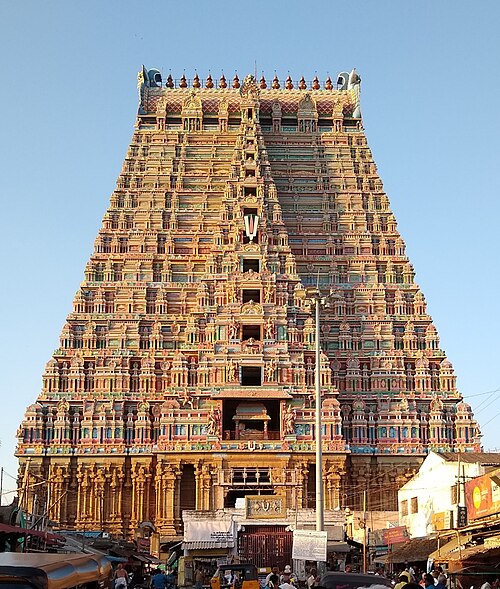


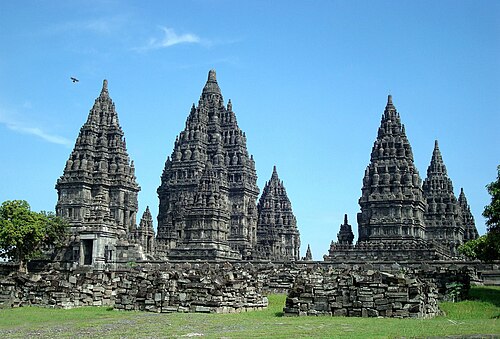

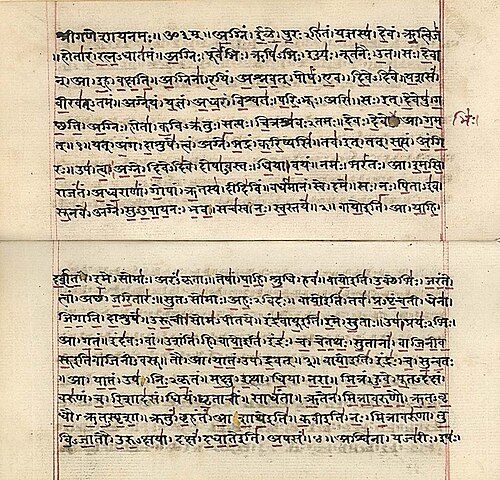
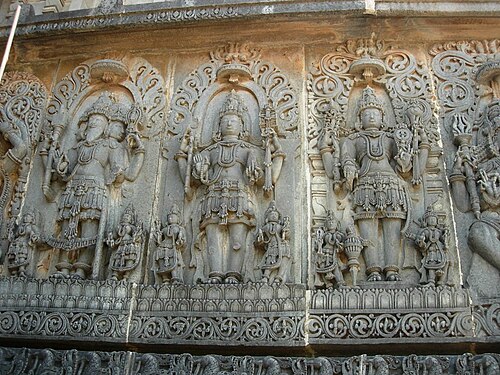


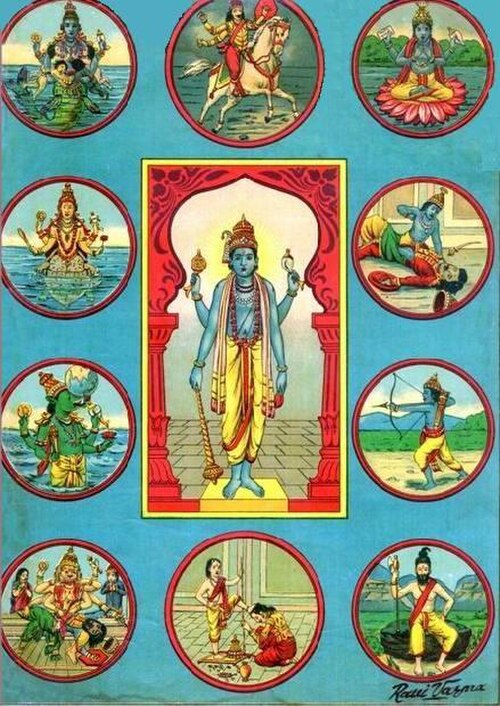


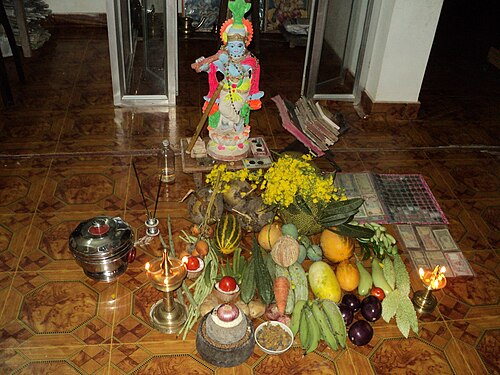


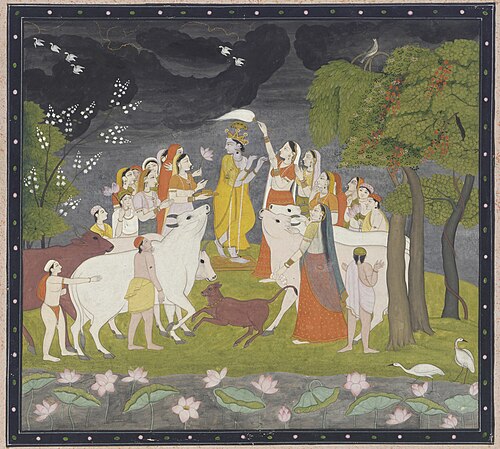
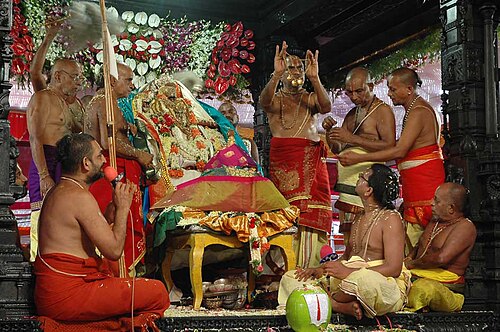


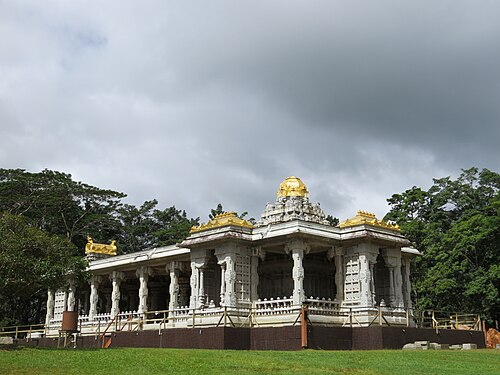

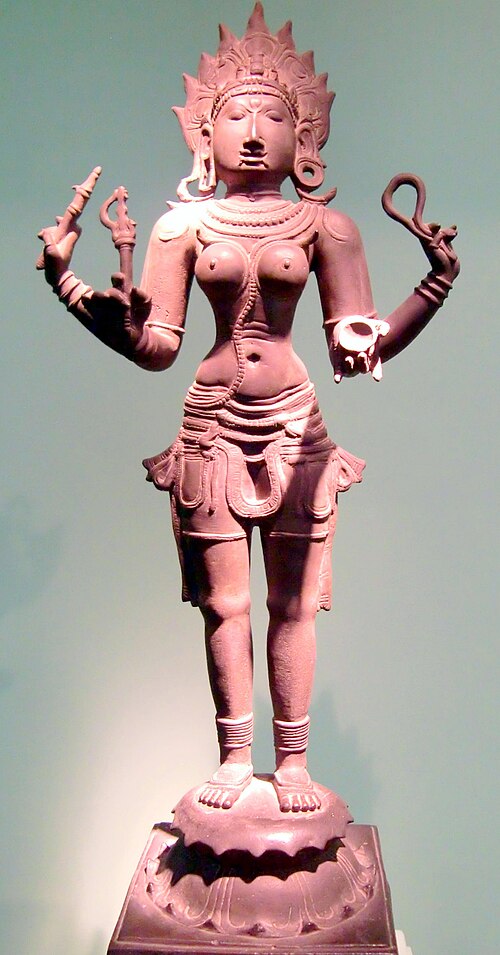


 ネパール– 81.19% [ 547 ]
  インド– 79.8% [ 548 ]
  モーリシャス– 47.9% [ 549 ]
  ガイアナ– 31% [ 550 ]
  フィジー– 27.9% [ 551 ]
  トリニダード・トバゴ– 24.3% [ 552 ]
  ブータン– 22.6% [ 553 ]
  スリナム– 22.3% [ 554 ]
  カタール– 15.9% [ 555 ]
  スリランカ– 12.6% [ 556 ]
  バーレーン– 9.8% [ 557 ]
  バングラデシュ– 7.9% [ 558 ]
  レユニオン島– 6.8% [注33 ]
  アラブ首長国連邦– 6.6% [ 559 ]
  マレーシア– 6.3% [ 560 ]
  クウェート– 6% [ 561 ]
  オマーン– 5.5% [ 562 ]
  セーシェル– 5.4% [ 563 ]
  シンガポール– 5% [ 564 ]
  インドネシア– 3.9% [ 565 ]
  ニュージーランド– 2.9% [ 566 ]
  オーストラリア– 2.7% [ 567 ]
  パキスタン– 2.2% [ 568 ]