
Loading article…
| コーラン | |
|---|---|
| アラビア語: ٱلْقُرْآن、ローマ字表記: al-Qurʾān | |
 | |
| 情報 | |
| 宗教 | イスラム教 |
| 言語 | 古典アラビア語 |
| 期間 | 西暦610~632年 |
| 章 | 114 (リスト)スーラ を参照 |
| 詩 | 6,348 (バスマラを含む) 6,236 (バスマラを除く)アーヤ を参照 |
| 全文 | |
 アラビア語ウィキソースのコーラン アラビア語ウィキソースのコーラン | |
| 英語版ウィキソースのコーラン | |
コーラン[c]は、ローマ字表記ではQur'anまたはKoran [d]とも呼ばれ、イスラム教の中心的な宗教文書であり、イスラム教徒は神(アッラー)から直接啓示されたものだと信じています。コーランには114の章(スーラ、複数形はsuwer )があり、各章は個々の詩節(アーヤ)で構成されています。宗教的な重要性に加えて、コーランにはアラビア文学の最高傑作として広く認められており[11] [12] [13] 、アラビア語に大きな影響を与えています。コーラン研究として知られる現代の学術研究の対象となっています。
イスラム教徒は、コーランは、神が天使ガブリエルを通して最後のイスラムの預言者 ムハンマドに口頭で啓示したものだと信じている。啓示は、ムハンマドが40歳のときの力の夜に始まり、632年に彼が亡くなった年に終わる、約23年にわたって徐々に行われた。イスラム教徒は、コーランはムハンマドの最も重要な奇跡であり、彼の預言者性の証明であり、最初のイスラムの預言者アダムに啓示されたものから始まる、イスラムの聖典であるトーラー、詩篇、福音書を含む一連の神のメッセージの集大成であると考えている。
イスラム教徒は、コーランは神自身の神聖な言葉であり、人生のあらゆる側面における完全な行動規範を提供していると信じています。このため、イスラムの神学者たちは、コーランは「創造されたものか、それとも創造されなかったものか」について激しく議論してきました。伝説によると、ムハンマドの仲間の何人かは書記官を務め、啓示を記録しました。ムハンマドの死後間もなく、コーランは、その一部を書き留めたり暗記したりしていた仲間によって、初代カリフのアブー・バクル(在位 632-634 )の命令で編纂されました。カリフのウスマーン(在位 644-656 )は、現在ウスマーン写本として知られる標準版を確立しました。これは、今日知られているコーランの原型であると一般に考えられています。ただし、意味に多少の違いがある 異読もあります。
コーランは、読者が聖書や外典に記された主要な物語に精通していることを前提としています。いくつかの物語は要約され、他の物語については長々と述べられ、場合によっては出来事の別の説明や解釈が提示されます。コーランは人類の指針となる書であると自らを説明しています(2:185 )。時には特定の歴史的出来事を詳細に説明し、物語の順序よりも出来事の 道徳的重要性を強調することがよくあります。
コーランには、難解なコーランの物語の説明や、ほとんどのイスラム教宗派におけるイスラム法の基礎ともなっている判決が補足されており、ハディースとは、ムハンマドの言葉や行動を記述していると信じられている口承および文書による伝承である。祈りの間、コーランはアラビア語でのみ朗誦される。コーラン全体を暗記した人は、ハーフィズと呼ばれる。理想的には、タジュウィドと呼ばれるこの目的のために確保された特別な種類の韻律で詩節が朗誦される。ラマダン月の間、イスラム教徒は通常、タラウィーの祈りの間にコーラン全体を朗誦する。特定のコーランの詩の意味を推測するために、イスラム教徒はテキストの直接翻訳ではなく、 解釈、つまり注釈に頼る。
語源と意味
クルアーンという言葉はコーランの中に約70回登場し、 [ 14]様々な意味を帯びている。これは「彼は読んだ」または「彼は朗読した」を意味するアラビア語の動詞qara'a ( قرأ )の動詞名詞( maṣdar )である。シリア語の同義語はqeryānā ( ּ֩ ... [17]
他の節では、この言葉は「[ムハンマドが]朗唱した個々の節」を指しています。その典礼的文脈は、例えば「クルアーンが朗唱されるときは、それを聞き、沈黙しなさい」など、多くの節に見られます。[18]この言葉は、トーラーや福音書などの他の聖典と一緒に言及されている場合、成文化された聖典の意味を帯びることもあります。[19]
この用語には、コーラン全体にわたって使用されている密接に関連する同義語もあります。各同義語はそれぞれ独自の意味を持っていますが、特定の文脈ではクルアーンと同義になることがあります。そのような用語には、 kitāb(「本」)、āyah(「しるし」)、およびsūrah(「聖典」)が含まれます。後者の2つの用語は、啓示の単位も表します。ほとんどの文脈では、通常は定冠詞(al-)を伴い、この単語はwaḥy(「啓示」)、つまり間隔を置いて「下された」(tanzīl )ものと呼ばれます。[20] [21]その他の関連語には、コーランを思い出させる、警告する意味で使われるdhikr (「思い出」 )、啓示またはその一部を指すことがあるḥikmah (「知恵」)などがあります。 [16] [e]
コーランは、自らを「識別」(アル・フルカン)、「母なる書」(ウム・アル・キターブ)、「導き」(フーダ)、「知恵」(ヒクマ)、「記憶」(ズィクル)、「啓示」(タンズィール、「下されたもの」、高い所から低い所への物体の降下を意味する)と表現している。[22]他には、アル・キターブ(「書物」)という用語があるが、これはアラビア語ではトーラーや福音書など他の聖典にも使われている。ムスハフ(「書かれた作品」)という用語は、特定のコーランの写本を指すのによく使われるが、コーランでは以前に啓示された書物を特定するためにも使われている。[16]
歴史
預言の時代
イスラムの伝承によれば、ムハンマドは610年、ヒラーの洞窟で、人里離れた山奥に隠遁していたときに、力の夜[23]に最初の啓示を受けた。その後、23年間にわたり啓示を受けた。ハディース(ムハンマドに帰せられる伝承)[f] [24]とイスラムの歴史によれば、ムハンマドと追随者たちがメディナに移住し、独立したイスラム共同体を形成した後、彼は多くの仲間にコーランを朗読し、毎日啓示される律法を学び教えるよう命じた。バドルの戦いで捕虜となったクライシュ族の中には、当時の簡単な文字を一部のムスリムに教えた後、自由を取り戻した者もいたと伝えられている。こうして、ムスリムの一団は徐々に読み書きができるようになった。コーランは当初口述されていたように、石板、骨、ナツメヤシの葉の広くて平らな端に記録された。ほとんどのスーラ(通常はスーラとも表記される)は、初期のイスラム教徒の間で使用されていた。なぜなら、それらはスンニ派とシーア派の両方の資料による数多くの格言の中で言及されており、ムハンマドがコーランをイスラム教への呼びかけ、祈り、朗誦の方法として使用したことに関連しているからである。しかし、632年にムハンマドが61~62歳で亡くなった時点では、コーランは書籍の形で存在していなかった。[16] [25] [26] [27] [28] [29]ムハンマド自身が啓示を書き留めなかったという点で学者の間では一致している。[30]
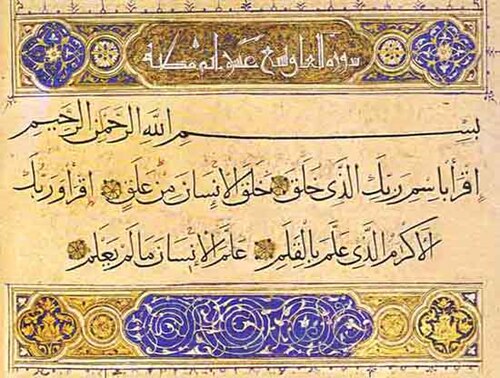
サヒーフ・アル=ブハーリーは、ムハンマドが啓示について「時には鐘の音のように(啓示が)現れる」と述べ、アーイシャは「私はとても寒い日に預言者が神の啓示を受けているのを見ました。そして(啓示が終わったとき)額から汗が流れ落ちるのに気づきました」と伝えています。[g]コーランによれば、ムハンマドの最初の啓示は幻視を伴っていました。啓示の使者は「全能の者」[32]、「地平線の一番高い所にいたとき、はっきりと見えました。それから近づいてきて、(弓2本分かそれより)近いところまで降りてきました」。[28][33]イスラム研究学者ウェルチは『イスラム百科事典』の中で、これらの啓示を受けた後、ムハンマドはひどく動揺していたため、この時のムハンマドの状態の生々しい描写は本物とみなせると述べている。ウェルチによると、これらの発作は周囲の人々にとって、ムハンマドの霊感の超人的起源の説得力のある証拠とみなされたであろう。しかし、ムハンマドの批評家たちは、古代アラビアでよく知られたそのような人物の主張と類似していたため、占い師、または魔術師。ウェルチはさらに、これらの体験がムハンマドが最初に預言者であると主張した前か後かは不明であると述べている。[34]
コーランではムハンマドを「ウンミ」と表現しているが[35] 、これは伝統的に「文盲」と解釈されているが、意味はもっと複雑である。アル・タバリー( 923年没)などの中世の注釈者は、この言葉には2つの意味があると主張した。1つは、一般的に読み書きができないということ、2つ目は、以前の書物や聖典に対する未経験または無知であるということ(ただし、彼らは最初の意味を優先した)。ムハンマドの無学さは、彼の預言者としての正真正銘のしるしとされた。例えば、ファフル・アッディーン・アル・ラーズィーによると、もしムハンマドが読み書きを習得していたら、先祖の書物を学んだのではないかと疑われたかもしれない。W・モンゴメリー・ワットなどの学者の中には、ウンミの2番目の意味を好み、以前の聖典に疎いことを示していると解釈する者もいる[28] [36]
コーランの最後の節は、ヒジュラ暦10年、イスラム暦のズル・ヒッジャ月18日に啓示されました。これは、おおよそ632年の2月か3月に相当します。この節は、預言者がガディール・フムでの説教を終えた後に啓示されました。
イスラムの伝統によれば、コーランは7つの異なるアフルフ(文字を意味するが、方言、形式、スタイル、様式を意味する場合もある)でムハンマドに啓示された。[37]ほとんどのイスラム学者は、これらの異なるアフルフは7つの異なるアラビア語の方言で啓示された同じコーランであり、コーランの意味を変えるものではなく、その目的はさまざまなアラブ部族の間でコーランを朗読し暗記しやすくすることであったことに同意している。[38] [39] [40] [41 ] 7つのハーフのうち、1つのハーフだけが生き残り、現在も使用されており、それはクライシュ語の方言であると考えられている。[38]スンニ派のイスラム教徒は7つのアフルフを信じているが、シーア派の中には7つのコーランの変種という考えを否定する人もいる。[42]よくある誤解は、7つのアフルフとキラートは同じであるということです。
編集と保存
632年にムハンマドが死去した後、コーランを暗記していた彼の仲間の多くがヤママの戦いでムサイリマに殺された。その後、初代カリフのアブー・バクル(在位 632-634年)は、この本を保存するために一冊の本にまとめることを決めた。[43] ザイド・イブン・サビト( 655年没)は、「アッラーの使徒のために神の啓示を書いていた」ことから、コーランの収集者となった。[44]こうして、一群の筆写者、特にザイドが詩節を集め、完全な本の手書きの原稿を作成した。ザイドによると、原稿は彼が亡くなるまでアブー・バクルのもとにあった。ザイドのこの仕事に対する反応や、羊皮紙、シュロの葉の茎、薄い石(神の教えを記した書物の総称としてスフフと呼ばれる) [45]、そしてそれを暗記していた人々からコーランの資料を集めることの難しさについては、初期の物語に記録されている。644年、ムハンマドの未亡人ハフサ・ビント・ウマルに写本が託されたが、第3代カリフのウスマーン(在位 644-656)[44]が彼女に標準写本を求めた。[46]歴史家マイケル・クックによると、初期のイスラム教の物語はコーランの収集と編纂について矛盾することがある。「ほとんどの物語ではウスマーンを編集者以上の存在としていないが、中には彼がまさに収集家であり、人々がたまたま持っているコーランを持ってくるように呼びかけていたとする物語もある。」いくつかの記録では、アブー・バクルが使用した「資料は実際にはすでに集められていた」とも示唆されており、彼が最初のカリフであったことから、ムハンマドがまだ生きていたときに収集されたことになる。[47]
650年代頃、アラビア半島を越えてペリサ、レバント、北アフリカへとイスラム教が拡大し、7つのアルフが使用されたことで、コーランの発音に混乱や違いが生じ、方言に基づいて他のアラブ部族や非アラブ人よりも優れていると主張するアラブ部族の間で紛争が発生していた。ウスマーンはこれに気づいた。[38] [40] [39] [41]テキストの神聖さを保つために、ウスマーンはザイド率いる委員会にアブー・バクルの写本を使用してコーランの標準テキストを作成するよう命じた。[48] [49]こうして、ムハンマドが死去した632年の20年以内に、[50]完全なコーランがウスマーン写本として文書化された。そのテキストは、イスラム世界の都市部全体にコピーが作られ、広められるモデルとなり、他のバージョンは破壊されたと考えられています。[48] [51] [52] [53]そして、コーランの他の6つのアールフは使用されなくなりました。[38] [40] [39] [41]現在のコーランのテキストは、アブー・バクルによって編纂された元のバージョンであるとイスラム学者によって認められています。[28] [29] [h] [i]
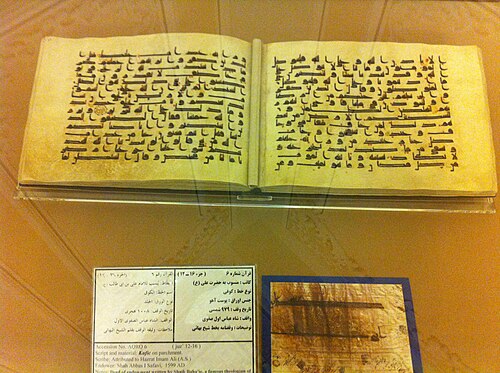
クルアーンを朗読する方法であるキラートは、その後しばらくして開発された。10の正典朗読があり、それらをアフルフと混同してはならない。シーア派は、アシムの権威に基づくハフスのキラートに従ってクルアーンを朗読する。これはイスラム世界で一般的なキラートであり[56]、クルアーンがムハンマドによって生前に収集され、編集されたと信じている。[57] [58]シーア派には、クルアーンが歪曲されていることを示す、シーア派イマームに帰せられる1,000以上のハディースがあると言われており[59]、エタン・コールバーグによると、クルアーンに関するこの信念は、イスラムの初期の世紀のシーア派の間で一般的だった。[60]彼の見解では、イブン・ババワイは「スンニ派と同一の立場をとった」最初の十二イマーム派の著者であり、その変化は「スンニ派のアッバース朝の権力の台頭」の結果であり、スンニ派の「正統派」の立場と比べると、コーランの腐敗を信じることは不可能になった。[61]アリ、イマームとその支持者の権利、およびウマイヤ朝やアッバース朝などの敵に対する非難に関する言及を削除するために、歪曲が行われたとされている。[62]
他にもイブン・マスウードやウバイ・イブン・カアブの写本など、コーランの個人写本が存在した可能性があるが、現在ではいずれも存在しない。[16] [48] [63]
学術研究
イスラム教徒はコーラン批判をシャリーア法の下で死刑に処せられる背教の罪とみなす可能性があるため、テキスト批評を超えたコーラン研究を行うことは不可能に思われた。[64] [65] 1970年代初頭まで、[66]非イスラム教徒のイスラム学者は、神の介入に関する伝統的な説明を受け入れなかったものの、上記の伝統的な起源の物語をほとんど詳細に受け入れていた。[43]

シカゴ大学のフレッド・ドナー教授は次のように述べている。[67]
初期に伝わった、おそらくはより広範で多様な関連テキストのグループから、コーランの統一された子音テキストを確立しようとする非常に初期の試みがありました。…この標準化された正典テキストの作成後、以前の権威あるテキストは禁止され、現存するすべての写本は、多数の異本があるにもかかわらず、この標準的な子音テキストが確立された後の時代のものであると思われます。
コーランのテキストの異読のほとんどは伝えられなくなったが、いくつかはまだ伝えられている。[68] [69]コーランのテキストを学術的に再構築するための基礎となる批評的なテキストは作成されていない。[j]
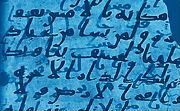
1972年、イエメンのサヌア市のモスクで「12,000片からなる」写本が発見され、後に当時存在が知られていた最古のコーランのテキストであることが証明された。サヌア写本にはパリンプセスト(筆記用具が不足していた古代では一般的な方法だった)が含まれており、テキストを洗い流して羊皮紙を再利用できるようにした原稿のページである。しかし、かすかに洗い流された下のテキスト(スクリプティオ・インフェリオル)はまだかろうじて見える。[71]放射性炭素年代測定法を用いた研究によると、羊皮紙は99パーセントの確率で西暦671年以前のものであることが示されている。[72] [73]ドイツの学者ゲルト・R・プインは長年にわたりこれらのコーランの断片を調査してきた。研究チームは写本のマイクロフィルム写真を35,000枚撮影し、8世紀初頭のものと推定した。プインは、型破りな詩の順序、テキストの微妙な変化、珍しい綴り方に注目し、羊皮紙の一部は再利用されたパリンプセストではないかと示唆した。プインは、これは固定されたテキストではなく、進化するテキストを意味していると信じていた。[74]
2015年、イギリスのバーミンガム大学の図書館で、1370年前に遡る非常に初期のコーランの1ページが発見された。オックスフォード大学の放射性炭素加速器ユニットが実施した検査によると、「95%以上の確率で、羊皮紙は568年から645年の間のもの」とのこと。この写本は、アラビア語の初期の書き言葉であるヒジャーズ文字で書かれている。 [75]これはおそらく現存する最古のコーランの見本の一つだが、検査では年代に幅があるため、現存する版のうちどれが最も古いかを確実に言うことはできない。[75]サウジアラビアの学者サウド・アル・サルハンは、断片には後世に作られたと考えられる点や章区切りが含まれているため、断片の年代に疑問を呈している。[76]バーミンガム写本は、ムハンマドの生涯(西暦 570年頃~632年)にわたる支配的な伝統と重なる可能性があることから信者の間で興奮を引き起こし[77]、従来の知恵を裏付ける証拠として、またコーランとイスラム教の初期の歴史に対する伝統的なアプローチとは異なる発見や見解を示す修正主義者の見解を反駁するための証拠として使われた[78]。
コンテンツ
コーランの内容は、神の存在と復活を含む基本的なイスラム教の信仰に関するものである。初期の預言者の物語、倫理と法律の主題、ムハンマドの時代の歴史的出来事、慈善と祈りもコーランに登場している。コーランの詩節には善悪に関する一般的な勧告が含まれており、歴史的出来事は一般的な道徳的教訓の概要に関連している。[79]コーランのスタイルは「暗示的」と呼ばれ、何が言及されているかを説明するために注釈が必要である。「出来事は言及されているが、語られていない。意見の相違は説明されずに議論されている。人々と場所は言及されているが、名前が挙がることはめったにない。」 [ 80]イスラム科学におけるタフシールは、コーランの暗黙の表現を理解しようとする努力を表すが、フィクフは、特に条項に関連する詩節における表現の意味を拡大し、理解しようとする努力を指す。 [81]

コーラン研究では、歴史的文脈において、コーランの内容はラビ文学、ユダヤ・キリスト教文学、シリア・キリスト教文学、ギリシャ文学、およびイスラム以前のアラビアと関連があると述べられている。アラブ文化とその歴史的近隣諸国の多くの場所、主題、神話上の人物、特にユダヤ・キリスト教物語[82]は、小さな言及、言及、または時にはジャンナート・アド、ジャハンナム、七人の眠り姫、シバの女王などの小さな物語とともにコーランに含まれている。しかし、コーランの神話的内容を強調するモハメッド・アルクンなどの一部の哲学者や学者は 、イスラム界で拒絶的な態度に遭遇している。[83]
ユースフとズライカ、モーゼ、アムラム一家(コーランによればマリアの両親)、そしてゴグとマゴグに対する障壁を築き、世の終わりまで残る謎の英雄[84] [85] [86] [87] ズル・カルナイン(「二本の角を持つ男」)の物語は、より詳細で長い物語である。ソロモン王やダビデのような半歴史的な出来事や人物、ユダヤの歴史やイスラエル人のエジプトからの脱出に関するもの以外にも、イスラム教で受け入れられているヘブライの預言者たちの物語、例えば天地創造、大洪水、アブラハムとニムロデの戦い、息子の犠牲など、がコーランの中で広い位置を占めている。
創造と神
コーランは、神の存在を証明するために、宇宙論や偶然性の議論を様々な節で用いているが、その用語には言及していない。したがって、宇宙は創造され、創造者を必要とし、存在するものはすべて、その存在の十分な原因を持っているに違いない。さらに、宇宙の設計は、熟考すべき点として頻繁に言及されている。「調和のとれた7つの天を創造したのは彼である。神の創造に欠陥は見当たらない。もう一度よく見てみなさい。欠陥は見当たらないだろうか?」[88] [89]
コーランの中心テーマは一神教である。神は生ける永遠なる存在、全知全能の存在として描かれている(例えば、コーラン2: 20、2 : 29、2 :255を参照)。神の全能性は、何よりも創造の力に現れている。神は天と地、そしてその間にあるすべてのものの創造主である(例えば、コーラン13: 16、2 :253、50 : 38などを参照)。すべての人間は神への完全な依存において平等であり、その事実を認め、それに従って生きるかどうかが、人間の幸福にかかっている。[28] [79]

イスラム教徒は神の存在と唯一性については疑っていませんが、神の本質(属性)、名前、創造物との関係に関して、歴史を通じて変化し発展してきた異なる態度をとってきた可能性があります。
預言者
イスラム教では、神はワヒと呼ばれる一種の啓示、または天使を通して預言者と呼ばれる人々に語りかけます。( 42:51 )ヌブッワ(アラビア語: نبوة「預言者」)は、知性、誠実さ、不屈の精神、正義などの特性を持つ個人に神が課した義務と見なされています。(参照:イスマ) 「あなたより前の使徒たちに言われたこと以外、あなたに言われたことは何もありません。あなたの主は、赦しと最も重い罰を命じています。」[90] [引用が必要]
イスラームはアブラハムを、アダムから始まりイシュマエルを経てムハンマドに至る預言者の連鎖の一人とみなし[91] 、コーラン35章で言及されている。聖書に登場する人物の中ではモーセを除くと最も多く言及されている。 [92]ムスリムは彼を偶像破壊者、ハニーフ[93]、完璧なムスリムの原型、メッカのカアバ神殿の建設者として崇敬されている預言者とみなしている。[94]コーランでは一貫してイスラームを「アブラハムの宗教」(ミラット・イブラヒム)と呼んでいる。[95]イシャクとヤアコブと並んで、アブラハムはムスリムにとって最も尊敬すべき、優れた模範的な父親の一人である。[96] [97] [98]
イスラム教では、イード・アル=アドハーは、アブラハムが自分の夢(アッサファト; 100–107)に従って降伏し、息子を犠牲にしようとしたことを記念して祝われます。彼はそれを神の意志として受け入れました。[99]ユダヤ教では、この物語は、子供の犠牲を動物の犠牲に置き換えるために作られた物語として、または「動物的な性質を犠牲にする」ことを説明する比喩として認識されています。 [101] [102]正統派イスラムの理解では、毎年ヒジュラ暦で定められた特定の日に、特定の条件を満たすイスラム教徒にとって、動物の犠牲は必須または強力なスンナであると考えられています。

ムーサは著名な預言者であり、神の使者であり、コーランの中で最も頻繁に言及されている人物であり、彼の名前は136回言及されており、彼の人生は他のどの預言者よりも多く語られ、語り継がれています。 [103] [104]
イーサー・イブン・マリアムは、父親のいない出生で奇跡を起こした人物としてもうひとり重要視されている(66 :12、21 : 89)。彼については、神からの「言葉」や「霊」といった表現が使われており(105)、クルアーンにはマリアムの母に捧げられたスーラがある。アス・サフ6によれば、彼はムハンマドの前触れであるが、スンニ派の理解では、昇天の物語にあるように、彼は天界に生き続けるとされ(106)、[107] 、終末近くに地上に戻り、マフディーに加わり、彼の後ろで祈りを捧げ、偽りの救世主(ダッジャル)を殺すと説かれている(108)。
倫理宗教的概念
神への信仰と預言者への服従は、預言者物語において主に強調されているが、[109]コーランには、神への信頼に加えて謙虚さと深い内なる知識 (ヒクマ) を持つことの重要性を強調する非預言者物語もある。これは、ヒドゥル、ルークマーン、ズルカルナインの物語の主なテーマである。これらの物語の後代の記述によると、この知識と神の支援を持つ者は、預言者に教えを授け (ヒドゥル・モーセ物語コーラン 18:65–82 )、ジン( ズルカルナイン ) を雇うことさえ可能である。アッラーの道に人生を捧げたために困窮している人々、そして尋ねるのが恥ずかしいためにその状況が分からない人々に「富を費やす」人々は、アッラーから報われるであろう。 (アル・バカーラ; 272-274)カールーンの物語では、富をもって来世を探すことを避け傲慢になった者は罰せられるが、傲慢は神にのみふさわしい。(アル・ムタカビール) 物語の登場人物は、閉鎖神話(ヒドゥン) [110] [111]、半神話的、あるいは複合的な人物であり、イスラーム化されているとも見られる。ルクマーンは預言者であると信じる者もいるが、クロトンのアルクメオン[112]やイソップ[113]と同一視する研究者もいる。
マルーフを命じ、ムンカールを禁じること(アル。ٱلْأَمْرُ بِٱلْمَعْرُوفِ وَٱلنَّهْيُ عَنِ ٱلْمُنْكَرِ)は、コーランのさまざまな文脈で約30の節で繰り返され、または言及されており、今日のイスラム主義者/ジハード主義者[114]の 教化、およびシーア派の教え[115]の重要な部分です。したがって、マルーフとムンカールは、コーランが信者に課す義務として、道徳的な観点からコーランを理解するためのキーワードであるはずです。このフレーズの一般的な翻訳は「善を勧め、悪を禁じる」ですが、イスラム哲学が講話で善と悪を決定する際に使用する言葉は「フスン」と「クブ」です。ma'rufという言葉は文字通り「知られている」、または特定の社会でよく知られているため承認されているものを意味し、その対義語であるmunkarは未知で無関係であるため承認されていないものを意味します。[116]

また、結婚、離婚、相続に関する法律を制定することで家族生活を肯定している。高利貸しや賭博など、多くの慣習は禁止されている。コーランはイスラム法(シャリーア)の基本的な源の一つである。ラマダン月のサラートや断食など、いくつかの正式な宗教的慣習はコーランで重要な注目を集めている。祈りの行い方については、コーランは平伏すことに言及している。[43] [117]喜捨に選ばれた用語「ザカート」は、文字通り浄化を意味し、自己浄化であることを暗示している。[118] [119]フィクフでは、ファルドという用語はコーランに基づく明確な命令規定に使用されている。しかし、関連する節がすべてのイスラム解説者に同じように理解されているとは言えない。例えば、ハナフィー派は1日5回の祈りをファルドとして受け入れている。しかし、今日存在するコーランが宗教的な源泉であることを疑わないコーラン信者やシーア派などの一部の宗教グループは、同じ節から、5回ではなく2回または3回の祈りが明確に命じられていると推論しています[120] [121] [122] [123]。約6つの節は、女性が公共の場で歩くときの服装について述べています。[124]イスラム学者はこれらの節の解釈について意見が分かれており、ヒジャブは遵守すべき命令(ファルド)であると言う人もいれば、 [125]そうではないと言う人もいます。[126]
研究によれば、クルアーンにおける儀礼は、キサス[127]や税金(ザカート)などの法律とともに、イスラーム以前のアラビアの儀礼の発展として発展した。巡礼(ハッジ)、祈り(サラート)、喜捨(ザカート)を意味するアラビア語は、イスラーム以前のサファイヤ・アラビア語の碑文に見られ[128] 、この連続性は多くの細部、特にハッジとウムラにおいて観察できる。[129]イスラーム以前のアラビアの伝統であり、ムハンマドの存命中にイスラム教徒の間で広く行われていた仮婚がイスラームで廃止されたかどうかも、スンニ派とシーア派の理解が対立する分野であり、関連するクルアーン4章24節の翻訳・解釈やそれに関する倫理的・宗教的問題でもある。
イスラム教では、イスラム以前の預言者たちが一般的な指針を与え、彼らにいくつかの書物が下されたと信じられているが、聖書のロトやその娘たちの物語など、いかなる出典からでも伝えられた預言者たちの物語はイスラーイリヤトと呼ばれ、疑いの目で見られる。[130]そこから生じるかもしれない規定(ワインの摂取など)は、「廃止された規定」(ナスフ)に過ぎない。[131]コーランとムハンマドの指針は絶対的かつ普遍的であり、世の終わりまで続くと考えられている。しかし、今日では、この理解は特定の界隈で疑問視されており、コーランやハディースなどの情報源の規定や内容は、一般的な目的とは別に、[132]当時の一般的な理解や慣行を反映した内容であり、[133]今日の倫理的価値観の観点から問題となるシャリーアの慣行を新しい解釈に置き換えるために持ち出されている[134] [135]と主張されている。
終末論
最後の日の教義と終末論(宇宙の最終的な運命)は、コーランの2番目に偉大な教義であると考えられる。[28]コーランの約3分の1は終末論的であり、来世での来世と世界の終わりの審判の日を扱っていると推定されている。[136]コーランは人間の魂の自然な不滅を主張していない。なぜなら、人間の存在は神の意志に依存しているからである。神が望むとき、神は人間を死なせ、望むとき、神は肉体の復活によって人間を再び生き返らせる。[117]

コーランでは、死後の世界への信仰は、神への信仰と関連して言及されることが多い。「神と最後の日を信じよ」[138]不可能とされることを強調することは、神の目には容易なことである。44、56、75、78、81、101章など、多くの章は死後の世界に直接関連しており、さまざまな形で言及される「差し迫った」日のために人々に備えるよう警告している。それは「審判の日」、「最後の日」、「復活の日」、または単に「時」である。まれに「区別の日」、「集合の日」、「会合の日」と呼ばれることもある。[28]
コーランにおける「時の兆し」とは、「大地の獣」が出現すること(27:82)、ゴグとマゴグの国が古代の防壁を破り、地上を襲撃すること(21:96-97)、そしてイエスが「時の兆し」であることである。神の御前でのみ時が来るという声明によって、時の不確実性が強調されているにもかかわらず(43:61)、イスラム世界には終末論に関する豊富な文献があり、イスラム世界の終末予言は「丸い」数字と密接に関連している。[139] サイード・ヌルシはコーランとハディースの表現を比喩的または寓話的な象徴として解釈し[140] 、自身の予言のいくつかのアーヤ/ハディース断片に適用された数秘術的手法の恩恵を受けた。[141]
黙示録の場面には、コーランで認識されている天体の性質、構造、大きさに関する手がかりが含まれています。通常の場合、星は空を照らすランプですが、石に変わります (アル・ムルク1-5) または (シャハップ; 流星、燃える火) (アル・ジン9) 違法に空に昇る悪魔に投げつけられます。審判の時が来ると、それらは地上に溢れますが、これは地上の生命が終わることを意味するものではありません。人々は恐怖で右往左往します。 (アト・タクウィール1-7) その後、広場が設けられ、その日の王または支配者(マーリキ・ヤウミ・ッディーン) [i] がやって来て、すねを見せます。[142] [143]恐ろしい表情をし、平伏するよう招かれます。しかし、過去に招かれたが遠ざかった人々は、これを行うことができません。 (アル・カラム42-43)
研究者の中には、コーランにも使われているフィルダウ、カウサル、ジャハンナム、マーリクなどの終末概念の多くが、歴史的進化を通じて外国文化から来たものであると躊躇なく考える者もいる。[144]
科学とコーラン
M. シャムシェル・アリによれば、コーランには自然現象を扱った節が約 750 あり、コーランの多くの節は人類に自然を研究するよう求めており、これは科学的探究と真実への奨励を意味すると解釈されている。[145]その一部には、「地上を旅して、神がいかにして生命を創造するかを見よ」( Q29:20 )、「天と地の創造、夜と昼の交替を見よ。そこには確かに理解ある人々へのしるしがある…」( Q3:190 ) などがある。天体物理学者のニダル・ゲスームは次のように書いている。「コーランは証拠なしに推測することの危険性に注意を喚起し (そして、知らないことに従ってはならない… 17:36 )、いくつかの異なる節でイスラム教徒に証拠を求めるよう求めている (「あなたが真実を語るなら証拠を持って来なさい」と言え 2:111 )。彼はコーランに見られるいくつかの科学的矛盾をコーランの表面的な解釈と関連付けている。[146]
イスマイル・アル=ファルキとタハ・ジャビル・アラルワニは、イスラム文明の再覚醒はコーランから始めなければならないという見解を持っている。しかし、この道における最大の障害は、コーランのメッセージの「普遍的な概念」を妨げる「何世紀にもわたるタフシールやその他の規律の遺産」である。 [147]作家のロドニー・スタークは、西暦1500年頃以降、イスラム教が西洋に科学の進歩で遅れをとったのは、伝統的なウラマーが「自然法則」で自然現象を体系的に説明しようとする努力に反対したためであると主張している。彼は、そのような法則は「神の自由」が神の望むように制限されるため冒涜的であると信じていたと主張している。[148]
タナー・エディスは、多くのイスラム教徒が技術を高く評価し、その創造における科学の役割を尊重していると書いている。その結果、この尊重と宗教的信仰を調和させようとするイスラムの疑似科学が数多く存在すると彼は言う。 [149]エディスによると、これはイスラム世界ではコーランに対する真の批判がほとんど存在しないためである。キリスト教は聖書を神の直接の言葉と見なす傾向が低いが、この考えに妥協するイスラム教徒は少なく、科学的真実はコーランに現れなければならないと信じるようになる。[149]
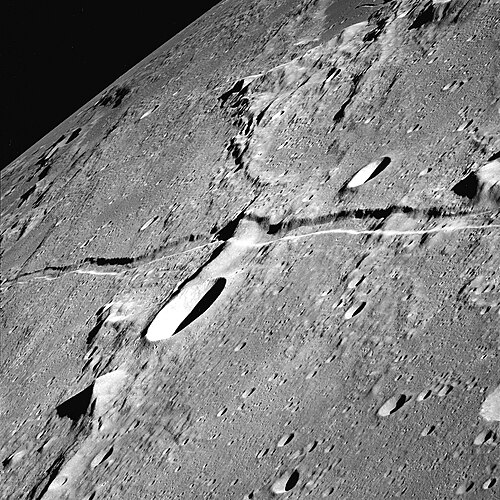
1970年代から80年代にかけて、コーランに科学的証拠があるという考えは、イジャズ(奇跡)文学、別名「ブカイリ主義」として普及し、イスラムの書店やウェブサイトを通じて配布され始めた。[152] [153]この運動は、コーランには発見される何世紀も前に現れた「科学的事実」が豊富にあると主張し、イスラムの創造論を推進している。作家のジアウディン・サルダールによると、イジャズ運動は「イスラム社会で世界的な流行」を生み出し、「広範囲に広がり資金も豊富な」産業に発展した。[152] [153] [154]この運動に関係する人物には、コーランとスンナの科学的兆候に関する委員会を設立したアブドゥル・マジード・アル・ズィンダニー、インドのテレビ伝道師ザキル・ナイク、トルコの創造論者アドナン・オクタールがいる。[152]
この運動の熱狂的な支持者たちは、コーランに見られる奇跡の中には「相対性理論、量子力学、ビッグバン理論、ブラックホールやパルサー、遺伝学、発生学、現代地質学、熱力学、さらにはレーザーや水素燃料電池に至るまで、あらゆるものが含まれている」と主張している。[152] ザファル・イシャク・アンサリは、コーランに「科学的真実」があると主張する現代の傾向を、聖典の「科学的解釈」と呼んでいる。[155] 1983年、キース・L・ムーアは、アブドゥル・マジード・アル・ジンダニとイスラミック・アディションズが共著した、広く使われている発生学の教科書(『人間の発達:臨床志向の発生学』)の特別版を出版した。 [156]アル・ジンダニによる「発生学に関連したコーランの詩とハディース」のページをムーアの原著に散りばめた。[157]ムーアとアル・ジンダニの教科書を研究していたアリ・A・リズヴィは、ムーアが「なぜそれほど『驚いた』のか」に「困惑」した。リズヴィは、コーランの言及が「曖昧」で、具体的である限り、アリストテレスやアイア・ヴェーダの観察に先行しており、[158]あるいは「常識」で簡単に説明できると感じた。[157] [159]
批評家は、生物学、地球の起源と歴史、人類の進化などについて、支持者が現代の科学的事実を説明していると主張する聖句には誤りがあり非科学的であると主張している。[153] [160] 2008年現在、イスラム教徒と非イスラム教徒の両方が、コーランに実際に「科学的奇跡」があるかどうかについて議論している。この運動に対するイスラム教徒の批評家には、インドのイスラム神学者マウラナ・アシュラフ・アリ・タンヴィ、イスラム歴史家サイード・ノマヌル・ハク、カナダ・アルバータ州のイスラム科学センター所長ムザッファル・イクバル、エジプトのイスラム学者ハレド・モンタセルがいる。 [161]
テキストとアレンジ
コーランは、スーラと呼ばれる長さの異なる114の章から成ります。各スーラは、アーヤトと呼ばれる節から成り、アーヤトはもともと神から与えられた「しるし」または「証拠」を意味します。節の数はスーラごとに異なります。個々の節は、ほんの数文字の場合もあれば、数行の場合もあります。最も人気のあるハフス・コーランの節の総数は6,236です。[k]ただし、ビスミラーを別々に数えると数は変わります。ある推定によると、コーランは77,430語、18,994語の固有語、12,183語の語幹、3,382語のレマ、1,685語の語根から成ります。[163]

章は、伝統的な説明によればムハンマドがメディナの町に移住する前か後かによって、メッカのものかメディナのものに分類される。しかし、メディナに分類されるスーラにはメッカの詩節が含まれることがあり、その逆もある。スーラ名は、テキスト中の名前や登場人物、またはスーラの最初の文字や単語に由来する。章は年代順に並べられているわけではなく、大まかにサイズの大きい順に並べられているように見える。[166]第9スーラを除く各スーラは、アラビア語で「神の名において」を意味するビスミッラー(بِسْمِ ٱللَّٰهِ ٱلرَّحْمَٰنِ ٱلرَّحِيمِ )で始まる。しかし、コーラン27章30節にソロモンがシバの女王に宛てた手紙の冒頭でビスミッラーが登場するため、コーランにはビスミッラーが114回登場する。[167] [168]
ムカッタット(アラビア語: حروف مقطعات ḥurūf muqaṭṭaʿāt、「ばらばらの文字、分断された文字」[169] 、 「神秘的な文字」とも呼ばれる)[170]は、1文字から5文字のアラビア文字の組み合わせであり、コーランの114章のうち29章の冒頭、バスマラ直後に登場します。[170]これらの文字は、それぞれのスーラの冒頭の詩を形成するため、ファワーティ(فواتح )、つまり「冒頭の文字」としても知られています。4つのスーラは、そのムカッタットにちなんで名付けられています:Ṭāʾ-Hāʾ、Yāʾ-Sīn、Ṣād、およびQāf。これらの文字の本来の意味は不明です。タフシール(注釈)[171]は、それらを神の名前や性質、またはそれぞれのスーラの名前や内容の略語として解釈しました。ラシャド・カリファによると、これらの文字はコーラン中の仮説的な数学的コード、すなわちコーランコード[172]の頭文字ですが、ビラル・フィリップスはこれを偽造データ、コーランのテキストの誤った解釈に基づくでっちあげだと批判しました。 [173]
章に分けることに加えて、読みやすさを考慮して、クルアーンをほぼ等しい長さの部分に分ける様々な方法がある。30ジュズ(複数形はアジュザー)は、1ヶ月でクルアーン全体を読むのに使用できる。1ジュズはさらに2つのヒズブ(複数形はアフザーブ)に分割され、各ヒズブは4つのルブ・アル・アハザブに細分化されることもある。クルアーンはまた、 1週間で朗読できるよう、ほぼ等しい7つの部分、マンジル(複数形はマナジル)に分割されている。 [16]段落に似ており、それぞれが約10アーヤットからなる意味単位によって異なる構造が提供される。このようなセクションはルクと呼ばれる。
文体
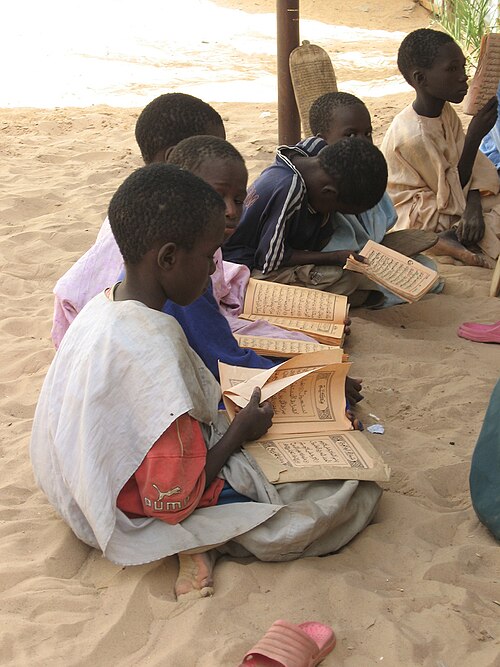
コーランのメッセージは、さまざまな文学的構造と技法で伝えられている。原典のアラビア語では、スーラと詩節は音声的および主題的な構造を採用しており、読者がテキストのメッセージを思い出すのを助けている。イスラム教徒[誰? ]は、コーラン自体によると、コーランの内容とスタイルは模倣できないと主張している。[174]
コーランの言語は詩と散文の両方の要素を持つため「押韻散文」と表現されてきたが、この表現は、ある部分では詩的であり、他の部分では散文的であるコーランの言語のリズムの質を伝えきれない恐れがある。押韻はコーラン全体に見られるが、比較的短い節で押韻語が目立つ初期のメッカのスーラの多くで顕著である。このような形式の有効性は、たとえばスーラ 81で明らかであり、これらの節が聞き手の良心に印象づけたことは疑いようがない。しばしば、ある節から別の節への押韻の変化は、議論の主題の変化を示す。後の節でもこの形式は維持されているが、スタイルはより説明的である。[175] [176]
コーランのテキストには始まりも中間も終わりもないと思われ、その非線形構造はウェブや網に似ている。[16]テキストの構成は、連続性がなく、時系列や主題の順序がなく、反復的であると考えられることがある。[l] [m] マイケル・セルズは、批評家のノーマン・O・ブラウンの著作を引用して、コーランの文学的表現の一見無秩序な状態(セルズの言葉を借りれば、散在または断片的な構成様式)は、実際には、預言的なメッセージの強烈さが、それが伝えられている人間の言語という媒体を粉砕するかのような深い効果をもたらすことができる文学的装置であるというブラウンの観察を認めている。[179] [180]セルズはまた、よく議論されるコーランの反復性についても言及し、これも文学的装置であると見ている。
テキストが自己言及的であるのは、テキストがそれ自身について語り、それ自身に言及するときである。ステファン・ヴィルトによれば、コーランは、伝えられる言葉を説明、分類、解釈、正当化することによって、このメタテキスト性を示している。自己言及性は、コーランが自らを啓示(タンジル)、記憶(ズィクル)、ニュース(ナバ)、基準(フルカン)と自己指定的に言及している箇所(「そしてこれは、われらが下した祝福された記憶である。それなのに、あなたは今それを否定するのか?」と、その神性を明示的に主張している)[181] 、またはムハンマドが話すように命じられているときに「言う」タグが頻繁に現れる箇所(例えば、「言え。『神の導きこそ真の導きである』」、「言え。『それでは、神についてわれわれと議論するのか?』」)に明らかである。ヴィルトによれば、コーランは高度に自己言及的である。この特徴は、初期のメッカのスーラにおいてより顕著である。[182]
比類なきもの
イスラム教において、クルアーンの「模倣不可能性への挑戦」を意味するイジャズ(アラビア語:اَلْإِعْجَازُ )は、フェシャハ(雄弁さ)とベラガ(修辞術)の意味で、クルアーンには内容と形式の両方において、人間の言葉ではかなわない奇跡的な性質があるという教義である。[183] これによれば、クルアーンとは奇跡であり、その模倣不可能性は、ムハンマドが預言者としての地位を確証する証拠であるとされている。 [184]クルアーンの文学的価値は、イスラム教徒の学者だけでなく、多くの非イスラム教徒の学者からも賞賛されている。[185]コーランの奇跡的教義は、ムハンマドの無学さによってさらに強調される。なぜなら、無学な預言者がコーランを書いたとは疑われなかったからである。[186]
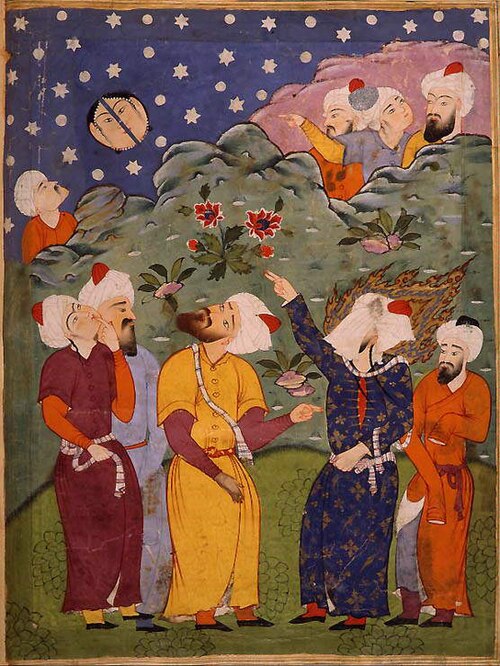
コーランは、アラビア文学の最高傑作として広く認められている。[189] [190] [191]コーランの出現は、口頭および聴覚による詩的体験であった。 [192]コーランを朗読し、聞くという美的体験は、初期のイスラム教への改宗の主な理由の 1 つとみなされることが多い。[193] イスラム以前のアラビア詩は、挑戦、宣伝、戦争の要素であり、[194]フェシャハとベラガで敵が同じようにできないようにした者は社会的に尊敬され、ムアラカット詩人にそれが見られた。「シャーイル(詩人)」という言葉の語源は、霊感を与える知識、目に見えない力を持つ人という意味を暗示している。 「初期のアラブ人にとって詩はシフル・ハラールであり、詩人はジンや精霊、インスピレーションを与えるミューズと超自然的な交信をする天才だった。」[193]イスラム以前のアラブ人は詩人を超人的な存在と結びつけて位置づけていたが、占い師や予言者はより低い地位の人物とみなされていた。後のヒューリスティックな予言や近年の科学的予言の主張とは対照的に、コーランに関する伝統的な奇跡の記述は予言に焦点を当てていなかったが、数百年にわたって互いに勝ち負けを繰り返しながら続いた戦争でのビザンチン帝国のペルシャに対する勝利[195]のようないくつかの例外があった。
コーランの「イジャズ」に関する最初の著作は、 9世紀にムタズィラ派によって現れ始めたが、彼らはその文学的側面のみを強調し、他の宗教グループに取り入れられた。[196]文法学者アル・ルムマーニーによれば、コーランに含まれる雄弁さは、タシュビー、イスティアーラ、ターグアーヌス、ムバーラガ、簡潔さ、言葉の明瞭さ(バヤン)、タラーウムから成っていた。彼はまた、主題の自由な変化(タシュリーフ・アル・マアーニー)、表現の含意内容(タドミーン)、押韻閉鎖(ファワーシル)という、彼自身が開発した他の特徴も付け加えた。[197]模倣不可能性の教義に関する最も有名な著作は、中世の文法学者アル・ジュルジャニ(1078年没)による2冊の著書、『ダライル・アル・イジャズ(模倣不可能性の論証)』と『アスラル・バラガ(雄弁の秘密)』である。[198]アル・ジュルジャニは、コーランの雄弁さは、その文体の配置や構成、あるいは単語のつなぎ合わせ方におけるある特別な性質に違いないと信じていた。[186] アンジェリカ・ニューワースは、イジャズの教義の出現につながった要因を次のように列挙している。コーランの難解な節を説明する必要性。[199]イスラム神学における「予言の証明」( dâ'il an-nubuwwa)理論の出現の文脈では、クルアーンが預言者の歴史の中で強調されたムハンマドの優れた地位に値する作品であることを証明し、それによってユダヤ教徒とキリスト教徒に対する論争上の優位性を獲得しました。イランのシュウビヤ運動との対立に直面してアラブの国民的誇りを保護しました。[200]
別の見方をすれば、コーランは19という数字を使って暗号化されたという奇跡の主張をラシャド・カリファが提唱した。この主張は、イスラム教徒にほぼ受け入れられているテキストの完全性に反する主張を含んでいるため批判を集めた。 [201] [n]また、カリファは自身の弟子による暗殺[202]で殺害されたが、これはおそらくスンニ派過激派グループによって組織されたものと思われる。[203]
イスラム教における重要性

コーランには「われらは真実をもってコーランを下した。そして真実をもってそれは下された」とあり[204]、その本文の中でそれが神によって定められたものであると頻繁に主張している。[205]コーランには、神の言葉が下される前に記録された前文、つまり運命の信仰の根拠でもある「保存された石板」について語られており、イスラム教徒はコーランはライラト・アル・カドルに下された、あるいは下され始めたと信じている。[118] [206]
敬虔なイスラム教徒によって「至聖所」として崇められ、[207]その音色は一部の人々を「涙と恍惚」に駆り立て、[208]信仰の物理的な象徴であり、その文章は誕生、死、結婚の際のお守りとしてよく使われる。伝統的に、コーランを読み始める前には清めが行われ、呪われたサタンからアッラーに救いを求め、アッラー、ラーマン、ラヒムの名をまとめてバスマラとして唱えることから読み始める。その結果、
決して他の本の下に置いてはいけません。常に他の本の上に置いてください。朗読中は飲酒や喫煙をしてはいけません。静かに聞いてください。病気や災害を防ぐお守りです。[207] [209]
イスラム教によれば、コーランは神の言葉(カラーム・アッラー)である。その性質とそれが創造されたものであるかどうかは、宗教学者の間で激しい議論の対象となった。[210] [211]そして、議論に政治権力が関与したため、政治的立場に反対するイスラムの宗教学者の中には、カリフ・マムーンの時代とその後の数年間に宗教的迫害を受けた者もいた 。
イスラム教徒は、現在のコーランのテキストがムハンマドに啓示されたものと一致していると信じており、彼らのコーラン15章9節の解釈によれば、それは腐敗から保護されている(「本当に、われらこそがコーランを下した者であり、われらこそがその守護者となる」)。[212]イスラム教徒は、コーランをムハンマドの預言者性と宗教の真実性のしるしとみなしている。このため、伝統的なイスラム社会では、子供たちがコーランを暗記することが非常に重要視され、コーラン全体を暗記した者はハーフィズの称号で称えられた。今日でも、何百万ものイスラム教徒が頻繁にコーランを参照して自分たちの行動や欲望を正当化し、科学的知識の源泉と見なしている。[214]とはいえ、コーランを奇妙な、あるいは疑似科学と呼ぶ者もいる。[215]
イスラム教徒は、コーランが神の文字通りの言葉であり、[16]完全な人生の規範であり、[216]人類への最後の啓示であり、天使ガブリエルを通してムハンマドに示された神の導きの作品であると信じている。[25] [217] [218] [219]その一方で、イスラム教徒のコミュニティでは、コーランを完全に理解するには、ウラマー(シーア派のイマーム[220])が「預言者の後継者」としてアクセスできる基礎科学と宗教科学の深みによってのみ可能であると信じられています。[221]このため、コーランを直接読んだり、その文字通りの翻訳に基づいた適用は、コーランが完全で明確な本であると考えるコーラン主義者などの一部のグループを除いて問題があると考えられています。 [222]そして、タフシール/フィクフは、コーランへの理解を正すために前面に押し出されます。古典的なアプローチでは、学者たちは、イスラム文学でアスバブ・アル・ヌズルと呼ばれる文脈、言語学、言語学でコーランの詩を議論し、ムフカムやムタシャビ、ナスフや廃止などのフィルターに通し、閉ざされた表現を解き明かして信者を導こうとします。コーランの翻訳には標準化はなく、[132]伝統的なスコラ学から、文字通りのサラフィー主義的理解、秘教的スーフィズム、現代的かつ世俗的な解釈まで、学者の個人的な科学的深みや傾向に応じて解釈は多岐にわたります。[223]
礼拝において
コーランの最初の章であるスーラ・アル・ファティハは、サラーのラカートごとに、また他の機会にも全文朗誦される。7節からなるこのスーラは、コーランの中で最も頻繁に朗誦されるスーラである。[16]

コーランの他の章も毎日の祈りの中で読まれる。クルアーンの中で2番目に読まれるのはイクラーシュ章である。多くの初期の権威者によれば、ムハンマドはイクラーシュがコーラン全体の3分の1に相当すると述べたからである。 [224]
コーランの文書への尊重は多くのイスラム教徒にとって宗教的信仰の重要な要素であり、コーランは尊敬の念をもって扱われている。伝統とコーラン56:79の文字通りの解釈(「清浄な者以外は触れてはならない」)に基づき、一部のイスラム教徒はコーランに触れる前に水で清める儀式(ウドゥまたはグスル)を行わなければならないと信じているが、この見解は普遍的ではない。 [16]使い古されたコーランのコピーは布で包まれ、安全な場所に無期限に保管されるか、モスクまたはイスラム教徒の墓地に埋葬されるか、焼却されて灰が埋められるか水に撒かれる。[225]祈りの間、コーランはアラビア語でのみ朗唱される。[226]
イスラム教では、イスラム神学、哲学、神秘主義、法学を含むほとんどの知的分野がコーランに関係しているか、その教えに基礎を置いています。[16]イスラム教徒は、コーランの説教や朗読には、アジュル、タワブ、ハサナットなどと呼ばれる神のご褒美が与えられると信じている。[227]
イスラム美術では
コーランはイスラム美術、特にいわゆるコーラン芸術である書道と装飾にも影響を与えました。[16]コーランは比喩的なイメージで飾られることはありませんが、多くのコーランではページの余白や行間、スーラの始めに装飾的な模様が施されています。イスラムの詩節は他の多くの媒体にも現れており、建物やあらゆる大きさの物体、例えばモスクのランプ、金属細工、陶器、ムラッカやアルバム用の書道の1ページなどに見られます。
-

-

-

-
 オスマン帝国時代のコーランのページ装飾芸術。
 -

-

-
 レザ・アッバシ博物館所蔵の 9 世紀のコーラン
 -
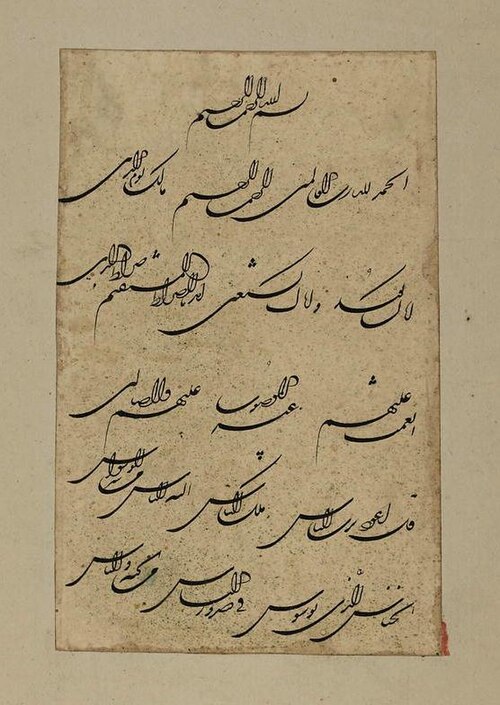 Shikasta nastaliqスクリプト、18 ~ 19 世紀

_(6016470147).jpg/500px-Mausol%C3%A9es_du_groupe_nord_(Shah-i-Zinda,_Samarcande)_(6016470147).jpg)
解釈
コーランは、多くの注釈や解説(タフシール)を生み出してきたが、その目的は「コーランの節の意味を説明し、その意味を明らかにし、その重要性を見出すこと」であった。[228]コーランは古典アラビア語で話されているため、後にイスラム教に改宗した人々(ほとんどが非アラブ人)の多くは、必ずしもコーランのアラビア語を理解していたわけではなく、アラビア語に堪能な初期のイスラム教徒には明らかだった強烈な暗示[80]を理解できず、コーランの主題の明らかな矛盾を調和させることに関心があった。アラビア語に精通した注釈者は暗示を説明し、そしておそらく最も重要なこととして、どのコーランの節がムハンマドの預言者としてのキャリアの初期に啓示され、最初期のイスラム教徒のコミュニティに適切であったか、そしてどの節が後に啓示され、以前のテキスト(マンスーク)を取り消したり「破棄」(ナーシーク)したかを説明した。[229] [230]しかし、他の学者は、コーランの廃止は行われていないと主張している。[231]
タフシールとは、イスラム教徒の最も初期の学問的活動の一つである。コーランによれば、ムハンマドは初期のイスラム教徒に詩節の意味を説明した最初の人物であった。[232]その他の初期の釈義者には、最初の4人のカリフであるアブー・バクル、ウマル、ウスマーン、アリー、そしてムハンマドの仲間であるアブドゥッラー・イブン・アル・アッバース、アブドゥッラー・イブン・マスウード、アブドゥッラー・イブン・アル・ズバイル、アブー・ムーサ・アル・アシュアリー、ウバイ・イブン・カアブ、ザイド・イブン・サビトなどが含まれていた。[233]当時の釈義は、詩節の文学的側面の説明、その啓示の背景、そして時には他の詩節を参考にして1つの詩節を解釈することに限られていた。その詩節が歴史的出来事に関するものである場合、その意味を明らかにするために、ムハンマドのいくつかの伝承(ハディース)が語られることもあった。 [228]さらに、教友の言葉[234] 、 その追随者や追随者の追随者[235]、イスラーム世界とキリスト教世界を結ぶイスラーム世界の物語や外典[236]の多くが後世に説明に加えられ、互いの出典や方法論を批判する解釈学の流派が形成された。

あらゆる宗派の学者によるコーランの注釈書がいくつかありますが、人気のあるものには、タフシル・イブン・カティール、タフシル・アル・ジャラリン、タフシル・アル・カビール、タフシル・アル・タバリなどが含まれます。タフシルのより現代的な作品には、ムフティ・ムハンマド・シャフィ著のマーリフル・コーランやベディウッザマン・サイード・ヌルシ著のリサレ・イ・ヌールなどがある。[239]
難解な解釈
シーア派やスンニ派、そして他のイスラム哲学者の中には、コーランの意味は文字通りの意味に限定されないと信じている者もいる。[240] : 7 対照的に、サラフィー派やザヒリ派が支持するコーランの文字通りの解釈とは、コーランは表面的な意味のみで解釈されるべきだという信念である。[241] [242]ヘンリー・コービンは、ムハンマドに遡るハディースを伝承している。
コーランには外見と隠された深み、外的な意味と秘められた意味があります。この秘められた意味は、さらに秘められた意味を隠しています。このようにして、コーランには7つの秘められた意味が存在します。[240] : 7
秘教的解釈者によれば、コーランの内的意味は、その外的意味を消し去ったり無効にしたりするものではない。むしろ、それは肉体に命を与える魂のようなものだ。[243]コーバンは、グノーシス論自体が予言論と密接に関係しているため、コーランはイスラム哲学の一翼を担っていると考えている。[240] : 13
テキストのザーヒル(「外面」)を扱う注釈はタフシール(説明)と呼ばれ、バティンを扱う解釈学的および秘教的な注釈はタウィル(「解釈」)と呼ばれます。秘教的な傾向を持つ注釈者は、コーランの究極の意味は神のみが知っていると信じている。[16]秘教的またはスーフィー的な解釈は、コーランの詩節を存在と意識の内的または秘教的(バティン)および形而上学的側面に関連付けます。[244]サンズによると、秘教的な解釈は宣言的というよりは示唆的であり、説明(タフシール)よりもほのめかし(イシャラト)です。それらは、著者の洞察力を示すのと同じくらい、可能性を示しています。[245]
スーフィズムにおける苦しみは精神的成熟のための手段であり、人は自分の存在を放棄し、愛する存在(神)の中に自分の存在を見出さなければならない。これは、コーラン 7:143 のクシャイリの解釈にも見られる。
モーゼが定められた時間にやって来て、主が彼に話しかけたとき、彼は「主よ、私にあなたを現してください。そうすれば私はあなたを見ることができます」と尋ねました。アッラーは答えました。「あなたは私を見ることはできません。しかし、山を見てください。それがその場所にしっかりと留まるならば、あなたは私を見るでしょう。」主が山に現れたとき、彼はそれを粉々にし、モーゼは意識を失いました。彼は意識を取り戻すと、「あなたに栄光がありますように。私は悔い改めてあなたに立ち返ります。私は信者の最初の者です」と叫びました。
モーセはビジョンを求めたが、その願いは拒否され、クシャイリの言葉で山が神を見ることができるのに、愛する人以外のものを見るように命じられて苦しめられた。モーセは遠くまで旅してきた何千人もの人々のようになり、自己の存在を放棄した。その状態で、モーセは愛する者たちの道に来たとき、現実の啓示を与えられた。[246]

ムハンマド・フサイン・タバタバーイーは、後代の注釈者の間で広く普及した説明によれば、タウィルは節が言及されている特定の意味を示していると述べている。タバタバーイーの見解では、タウィル、つまりコーランの解釈学的解釈は、言葉の記号を超えて一般の人々の理解を超えた特定の真実に関係している。法律、神の属性、そしてコーランの物語には、(明白なものを超えた)本当の意味がある。[247] [248]
タバタバエイは、コーランの受け入れがたい難解な解釈がなされてきたことを指摘し、受け入れがたい解釈を、最終的には神のみが知り、人間の思考だけでは直接理解できない暗黙の意味であると定義している。例として、彼は、来る、行く、座る、満足、怒り、悲しみなど、コーランでアッラーに帰せられる人間の性質を挙げ、「アッラーは、それらを私たちの心に近づけるために言葉を与えた。この点で、それらは、心に絵を描き、聞き手が表現したい考えを明確に理解するのに役立つことわざのようなものだ」と述べている。 [248] [249]彼はまた、ムハンマドと無実のイマームがこれらの節(ムフカムとムタシャビ)の解釈を知ることができたというシーア派の信念は、コーラン3章7節の次の文に違反しないと主張している。「神以外にその解釈(タウィル)を知る者はいない」
著名なスーフィーの注釈
12 世紀以前の秘教解釈の著名な著者の 1 人は、アル・スラミ(d. 1021) の著書「ハカイク・アル・タフシール(『釈義の真理』)」です。これは初期のスーフィーの注釈をまとめたものです。11 世紀以降には、クシャイリ (d. 1074)、アル・ダイラミ(d. 1193)、アル・シーラジ(d. 1209) 、アル・スフラワルディ(d. 1234) による注釈など、いくつかの作品が登場します。これらの作品には、スラミの本の資料に加えて、著者の貢献が含まれています。アル・マイブディー(d. 1135)の著作「カシュフ・アル・アスラル(『秘密の暴露』)」など、多くの作品がペルシア語で書かれています。[244] ルーミー(1273年没)は著書『マトナウィー』の中で膨大な量の神秘的な詩を著したが、これはある種のスーフィー派によるコーランの解釈であると考える者もいる。[250]シムナーニー(1336年没)は、物質世界を通して、また物質世界の中で神が顕現するという概念とスンニ派イスラムの感情を調和させようとした。[251]イスマイル・ハッキ・ブルセヴィ(1725年没)の著作『ルフ・アル・バヤン(啓示の精神)』は、アラビア語で書かれた膨大な解説書であり、著者自身の考えと先人たち(特にイブン・アラビーとガザーリー)の考えを組み合わせている。[251]
再利用
Reappropriation is the name of the hermeneutical style of some ex-Muslims who have converted to Christianity. Their style or reinterpretation can sometimes be geared towards apologetics, with less reference to the Islamic scholarly tradition that contextualizes and systematizes the reading (e.g., by identifying some verses as abrogated). This tradition of interpretation draws on the following practices: grammatical renegotiation, renegotiation of textual preference, retrieval, and concession.[252]
Translations

Translating the Quran has always been problematic and difficult. Many argue that the Quranic text cannot be reproduced in another language or form.[253] An Arabic word may have a range of meanings depending on the context, making an accurate translation difficult.[254] Moreover, one of the biggest difficulties in understanding the Quran for those who do not know its language in the face of shifts in linguistic usage over the centuries is semantic translations (meanings) that include the translator's contributions to the relevant text instead of literal ones. Although the author's contributions are often bracketed and shown separately, the author's individual tendencies may also come to the fore in making sense of the main text. These studies contain reflections and even distortions[255][256] caused by the region, sect,[257] education, ideology and knowledge of the people who made them, and efforts to reach the real content are drowned in the details of volumes of commentaries. These distortions can manifest themselves in many areas of belief and practices.[note 1]
Islamic tradition also holds that translations were made for Negus of Abyssinia and Byzantine Emperor Heraclius, as both received letters by Muhammad containing verses from the Quran.[254] In early centuries, the permissibility of translations was not an issue, but whether one could use translations in prayer.[citation needed] The Quran has been translated into most African, Asian, and European languages.[63] The first translator of the Quran was Salman the Persian, who translated surat al-Fatiha into Persian during the seventh century.[259] Another translation of the Quran was completed in 884 in Alwar (Sindh, India, now Pakistan) by the orders of Abdullah bin Umar bin Abdul Aziz on the request of the Hindu Raja Mehruk.[260]
The first fully attested complete translations of the Quran were done between the 10th and 12th centuries in Persian. The Samanid king, Mansur I (961–976), ordered a group of scholars from Khorasan to translate the Tafsir al-Tabari, originally in Arabic, into Persian. Later in the 11th century, one of the students of Abu Mansur Abdullah al-Ansari wrote a complete tafsir of the Quran in Persian. In the 12th century, Najm al-Din Abu Hafs al-Nasafi translated the Quran into Persian.[261] The manuscripts of all three books have survived and have been published several times.[citation needed] In 1936, translations in 102 languages were known.[254] In 2010, the Hürriyet Daily News and Economic Review reported that the Quran was presented in 112 languages at the 18th International Quran Exhibition in Tehran.[262]
Robert of Ketton's 1143 translation of the Quran for Peter the Venerable, Lex Mahumet pseudoprophete, was the first into a Western language (Latin).[263] Alexander Ross offered the first English version in 1649, from the French translation of L'Alcoran de Mahomet (1647) by Andre du Ryer. In 1734, George Sale produced the first scholarly translation of the Quran into English; another was produced by Richard Bell in 1937, and yet another by Arthur John Arberry in 1955. All these translators were non-Muslims. There have been numerous translations by Muslims. Popular modern English translations by Muslims include The Oxford World Classic's translation by Muhammad Abdel Haleem, The Clear Quran by Mustafa Khattab, Sahih International's translation, among various others. As with translations of the Bible, the English translators have sometimes favored archaic English words and constructions over their more modern or conventional equivalents; for example, two widely read translators, Abdullah Yusuf Ali and Marmaduke Pickthall, use the plural and singular ye and thou instead of the more common you.[264]
The oldest Gurmukhi translation of the Quran Sharif has been found in village Lande of Moga district of Punjab which was printed in 1911.[265]
-
![1091 太字で書かれたコーランのテキストと、細字で書かれたペルシア語の翻訳と解説[266]](https://img-server.japedia.wiki/wikipedia/commons/thumb/a/ac/Page_from_the_Qur%27an_of_Sultan_Ibrahim_%28TKS_EH_209%29.jpg/500px-Page_from_the_Qur%27an_of_Sultan_Ibrahim_%28TKS_EH_209%29.jpg) 1091 Quranic text in bold script with Persian translation and commentary in a lighter script[266]
1091 Quranic text in bold script with Persian translation and commentary in a lighter script[266] -
 Arabic Quran with interlinear Persian translation from the Ilkhanid Era
 -
 The first printed Quran in a European vernacular language: L'Alcoran de Mahomet, André du Ryer, 1647
 -
 Title page of the first German translation (1772) of the Quran
 -
 Verses 33 and 34 of surat Yā Sīn in this Chinese translation of the Quran
![1091 太字で書かれたコーランのテキストと、細字で書かれたペルシア語の翻訳と解説[266]](https://img-server.japedia.wiki/wikipedia/commons/thumb/a/ac/Page_from_the_Qur'an_of_Sultan_Ibrahim_(TKS_EH_209).jpg/500px-Page_from_the_Qur'an_of_Sultan_Ibrahim_(TKS_EH_209).jpg)
Recitation

Rules of recitation
The proper recitation of the Quran is the subject of a separate discipline named tajwid which determines in detail how the Quran should be recited, how each individual syllable is to be pronounced, the need to pay attention to the places where there should be a pause, to elisions, where the pronunciation should be long or short, where letters should be sounded together and where they should be kept separate, etc. It may be said that this discipline studies the laws and methods of the proper recitation of the Quran and covers three main areas: the proper pronunciation of consonants and vowels (the articulation of the Quranic phonemes), the rules of pause in recitation and of resumption of recitation, and the musical and melodious features of recitation.[267]
In order to avoid incorrect pronunciation, reciters follow a program of training with a qualified teacher. The two most popular texts used as references for tajwid rules are Matn al-Jazariyyah by Ibn al-Jazari[268] and Tuhfat al-Atfal by Sulayman al-Jamzuri.
The recitations of a few Egyptian reciters, like El Minshawy, Al-Hussary, Abdul Basit, Mustafa Ismail, were highly influential in the development of current styles of recitation.[269][270][271]: 83 Southeast Asia is well known for world-class recitation, evidenced in the popularity of the woman reciters such as Maria Ulfah of Jakarta.[267] Today, crowds fill auditoriums for public Quran recitation competitions.[272][191]
There are two types of recitation:
- Murattal is at a slower pace, used for study and practice.
- Mujawwad refers to a slow recitation that deploys heightened technical artistry and melodic modulation, as in public performances by trained experts. It is directed to and dependent upon an audience for the mujawwad reciter seeks to involve the listeners.[273]
Variant readings

The variant readings of the Quran are one type of textual variant.[274][275] According to Melchert (2008), the majority of disagreements have to do with vowels to supply, most of them in turn not conceivably reflecting dialectal differences and about one in eight disagreements has to do with whether to place dots above or below the line.[276] Nasser categorizes variant readings into various subtypes, including internal vowels, long vowels, gemination (shaddah), assimilation and alternation.[277]
It is generally stated that there are small differences between readings. However, these small changes may also include differences that may lead to serious differences in Islam, ranging from the definition of God[ii] to practices such as the formal conditions of ablution.[278]
The first Quranic manuscripts lacked marks, enabling multiple possible recitations to be conveyed by the same written text. The 10th-century Muslim scholar from Baghdad, Ibn Mujāhid, is famous for establishing seven acceptable textual readings of the Quran. He studied various readings and their trustworthiness and chose seven 8th-century readers from the cities of Mecca, Medina, Kufa, Basra and Damascus. Ibn Mujahid did not explain why he chose seven readers, rather than six or ten, but this may be related to a prophetic tradition (Muhammad's saying) reporting that the Quran had been revealed in seven ahruf. Today, the most popular readings are those transmitted by Ḥafṣ (d. 796) and Warsh (d. 812) which are according to two of Ibn Mujahid's reciters, Aasim ibn Abi al-Najud (Kufa, d. 745) and Nafi' al-Madani (Medina, d. 785), respectively. The influential standard Quran of Cairo uses an elaborate system of modified vowel-signs and a set of additional symbols for minute details and is based on ʻAsim's recitation, the 8th-century recitation of Kufa. This edition has become the standard for modern printings of the Quran.[51][68] Occasionally, an early Quran shows compatibility with a particular reading. A Syrian manuscript from the 8th century is shown to have been written according to the reading of Ibn Amir ad-Dimashqi.[279] Another study suggests that this manuscript bears the vocalization of himsi region.[280]
Accordinng to Ibn Taymiyyah vocalization markers indicating specific vowel sounds (tashkeel) were introduced into the text of the Qur'an during the lifetimes of the last Sahabah.[281]
Writing and printing
Writing
Before printing was widely adopted in the 19th century, the Quran was transmitted in manuscripts made by calligraphers and copyists. The earliest manuscripts were written in Ḥijāzī-typescript. The Hijazi style manuscripts nevertheless confirm that transmission of the Quran in writing began at an early stage. Probably in the ninth century, scripts began to feature thicker strokes, which are traditionally known as Kufic scripts. Toward the end of the ninth century, new scripts began to appear in copies of the Quran and replace earlier scripts. The reason for discontinuation in the use of the earlier style was that it took too long to produce and the demand for copies was increasing. Copyists would therefore choose simpler writing styles. Beginning in the 11th century, the styles of writing employed were primarily the naskh, muhaqqaq, rayḥānī and, on rarer occasions, the thuluth script. Naskh was in very widespread use. In North Africa and Iberia, the Maghribī style was popular. More distinct is the Bihari script which was used solely in the north of India. Nastaʻlīq style was also rarely used in Persian world.[282][283]
In the beginning, the Quran was not written with dots or tashkeel. These features were added to the text during the lifetimes of the last of the Sahabah.[281] Since it would have been too costly for most Muslims to purchase a manuscript, copies of the Quran were held in mosques in order to make them accessible to people. These copies frequently took the form of a series of 30 parts or juzʼ. In terms of productivity, the Ottoman copyists provide the best example. This was in response to widespread demand, unpopularity of printing methods and for aesthetic reasons.[284][285]
Whilst the majority of Islamic scribes were men, some women also worked as scholars and copyists; one such woman who made a copy of this text was the Moroccan jurist, Amina, bint al-Hajj ʿAbd al-Latif.[286]
-
 Folio from the "Blue" Quran at the Brooklyn Museum
 -
 Kufic script, eighth or ninth century
 -
 Maghribi script, 13th–14th centuries
 -
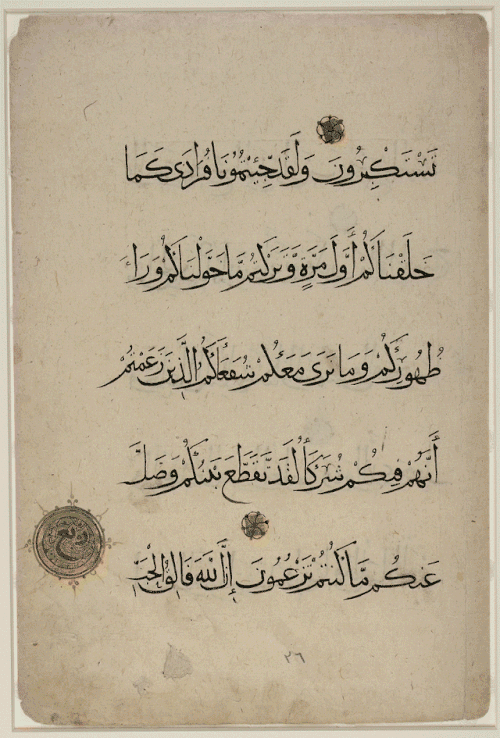 Muhaqqaq script, 14th–15th centuries

.jpg/500px-Folio_from_a_Koran_(8th-9th_century).jpg)

Printing

Wood-block printing of extracts from the Quran is on record as early as the 10th century.[287]
Arabic movable type printing was ordered by Pope Julius II (r. 1503–1512) for distribution among Middle Eastern Christians.[288] The first complete Quran printed with movable type was produced in Venice in 1537–1538 for the Ottoman market by Paganino Paganini and Alessandro Paganini.[289][290] But this Quran was not used as it contained a large number of errors.[291] Two more editions include the Hinckelmann edition published by the pastor Abraham Hinckelmann in Hamburg in 1694,[292] and the edition by the Italian priest Ludovico Maracci in Padua in 1698 with Latin translation and commentary.[293]
Printed copies of the Quran during this period met with strong opposition from Muslim legal scholars: printing anything in Arabic was prohibited in the Ottoman empire between 1483 and 1726—initially, even on penalty of death.[294][285][295] The Ottoman ban on printing in Arabic script was lifted in 1726 for non-religious texts only upon the request of Ibrahim Muteferrika, who printed his first book in 1729. Except for books in Hebrew and European languages, which were unrestricted, very few books, and no religious texts, were printed in the Ottoman Empire for another century.[p]
In 1786, Catherine the Great of Russia, sponsored a printing press for "Tatar and Turkish orthography" in Saint Petersburg, with one Mullah Osman Ismail responsible for producing the Arabic types. A Quran was printed with this press in 1787, reprinted in 1790 and 1793 in Saint Petersburg, and in 1803 in Kazan.[q] The first edition printed in Iran appeared in Tehran (1828), a translation in Turkish was printed in Cairo in 1842, and the first officially sanctioned Ottoman edition was finally printed in Constantinople between 1875 and 1877 as a two-volume set, during the First Constitutional Era.[298][299]
Gustav Flügel published an edition of the Quran in 1834 in Leipzig, which remained authoritative in Europe for close to a century, until Cairo's Al-Azhar University published an edition of the Quran in 1924. This edition was the result of a long preparation, as it standardized Quranic orthography, and it remains the basis of later editions.[282]
Criticism
Regarding the claim of divine origin, critics refer to preexisting sources, not only taken from the Bible, supposed to be older revelations of God, but also from heretic, apocryphic and talmudic sources, such as the Syriac Infancy Gospel and Gospel of James. The Quran acknowledges that accusations of borrowing popular ancient fables were being made against Muhammad.[300] Due to its rejection of the Crucifixion of Jesus, some scholars also suspect influences by Manichaeaism, a dualistic religion believing in two eternal forces, on the Quran.
The Chinese government has banned Quran mobile apps.[301]
Relationship with other literature
Some non-Muslim groups such as the Baháʼí Faith and Druze view the Quran as holy. In the Baháʼí Faith, the Quran is accepted as authentic revelation from God along with the revelations of the other world religions, Islam being a stage within the divine process of progressive revelation. Bahá'u'lláh, the Prophet-Founder of the Baháʼí Faith, testified to the validity of the Quran, writing, say: "Perused ye not the Qur'án? Read it, that haply ye may find the Truth, for this Book is verily the Straight Path. This is the Way of God unto all who are in the heavens and all who are on the earth."[302] Unitarian Universalists may also seek inspiration from the Quran. It has been suggested that the Quran has some narrative similarities to the Diatessaron, Protoevangelium of James, Infancy Gospel of Thomas, Gospel of Pseudo-Matthew and the Arabic Infancy Gospel.[303][304] One scholar has suggested that the Diatessaron, as a gospel harmony, may have led to the conception that the Christian Gospel is one text.[305]
.jpg/500px-Jonah_and_the_Whale,_Folio_from_a_Jami_al-Tavarikh_(Compendium_of_Chronicles).jpg)
The Bible
He has revealed to you ˹O Prophet˺ the Book in truth, confirming what came before it, as He revealed the Torah and the Gospel previously, as a guide for people, and ˹also˺ revealed the Standard ˹to distinguish between right and wrong˺.[307]
— 3:3-4
The Quran attributes its relationship with former books (the Torah and the Gospels) to their unique origin, saying all of them have been revealed by the one God.[308]
According to Christoph Luxenberg (in The Syro-Aramaic Reading of the Koran) the Quran's language was similar to the Syriac language.[309] The Quran recounts stories of many of the people and events recounted in Jewish and Christian sacred books (Tanakh, Bible) and devotional literature (Apocrypha, Midrash), although it differs in many details. Adam, Enoch, Noah, Eber, Shelah, Abraham, Lot, Ishmael, Isaac, Jacob, Joseph, Job, Jethro, David, Solomon, Elijah, Elisha, Jonah, Aaron, Moses, Zechariah, John the Baptist and Jesus are mentioned in the Quran as prophets of God (see Prophets of Islam). In fact, Moses is mentioned more in the Quran than any other individual.[104] Jesus is mentioned more often in the Quran than Muhammad (by name—Muhammad is often alluded to as "The Prophet" or "The Apostle"), while Mary is mentioned in the Quran more than in the New Testament.[310]
Arab writing
After the Quran, and the general rise of Islam, the Arabic alphabet developed rapidly into an art form.[63] The Arabic grammarian Sibawayh wrote one of the earliest books on Arabic grammar, referred to as "Al-Kitab", which relied heavily on the language in the Quran. Wadad Kadi, Professor of Near Eastern Languages and Civilizations at University of Chicago, and Mustansir Mir, Professor of Islamic studies at Youngstown State University, state that the Quran exerted a particular influence on Arabic literature's diction, themes, metaphors, motifs and symbols and added new expressions and new meanings to old, pre-Islamic words that would become ubiquitous.[311]
See also



- List of chapters in the Quran
- List of translations of the Quran
- Quran translations
- Historical reliability of the Quran
- Quran and miracles
- Quran code
- Criticism of the Quran
- Violence in the Quran
- Women in the Quran
- Digital Quran
- The True Furqan
- Qira'at
- Hadith
- Hadith al-Thaqalayn
- Islamic schools and branches
- Schools of Islamic theology
References
Notes
- ^ The English pronunciation varies: /kəˈrɑːn/, /-ˈræn/, /kɔː-/, /koʊ-/;[1] especially with the spelling quran /kʊˈrɑːn/, /-ˈræn/;[2] especially in British English /kɒˈrɑːn/.[3][4]
- ^ The Arabic pronunciation can be transcribed phonemically as /al.qurˈʔaːn/. The actual pronunciation in Literary Arabic varies regionally. The first vowel varies from [o] to [ʊ], while the second vowel varies from [æ] to [a] to [ɑ]. For example, the pronunciation in Egypt is [qorˈʔɑːn] and in Central East Arabia [qʊrˈʔæːn].
- ^ /kʊˈrɑːn/, kuurr-AHN;[a] vocalized Arabic: ٱلْقُرْآن, Quranic Arabic: ٱلۡقُرۡءَان, al-Qurʾān [alqurˈʔaːn],[b] lit. 'the recitation' or 'the lecture'
- ^ (English spelling) The form Alcoran (and its variants) was usual before the 19th century when it became obsolete.[5][6] The form Koran was most predominant from the second half of the 18th century till the 1980s, when it has been superseded by either Qur'an or Quran.[6][7][8][9] Other transliterations include al-Coran, Coran, Kuran and al-Qur'an. The adjectives vary as well and include Koranic, Quranic and Qur'anic (sometimes in lowercase).[10]
- ^ According to Welch in the Encyclopedia of Islam, the verses pertaining to the usage of the word hikma should probably be interpreted in the light of IV, 105, where it is said that "Muhammad is to judge (tahkum) mankind on the basis of the Book sent down to him."
- ^ Hadith are primarily from Muhammad but some are from those closest to him. Muslim scholars have worked carefully to authenticate them; see Hadith studies#Evaluating authenticity.
- ^ "God's Apostle replied, 'Sometimes it is (revealed) like the ringing of a bell, this form of Inspiration is the hardest of all and then this state passes off after I have grasped what is inspired. Sometimes the Angel comes in the form of a man and talks to me and I grasp whatever he says.' ʻAisha added: Verily I saw the Prophet being inspired Divinely on a very cold day and noticed the Sweat dropping from his forehead (as the Inspiration was over)."[31]
- ^ "Few have failed to be convinced that … the Quran is … the words of Muhammad, perhaps even dictated by him after their recitation."[54]
- ^ There is some disagreement among early Muslim sources disagree over who was the first to collect the narrations. At least one source credits Salim, the freed slave of Abu Hudhaifah with collecting the Qur'an into a mushaf:
"It is reported... from Ibn Buraidah who said:
The first of those to collect the Qur'an into a mushaf (codex) was Salim, the freed slave of Abu Hudhaifah.[55]
- ^ For both the claim that variant readings are still transmitted and the claim that no such critical edition has been produced, see Gilliot, C., "Creation of a fixed text" [70]
- ^ Scholars disagree on the exact number but this is a disagreement over "the placing of the divisions between the verese, not on the text itself."[162]
- ^ "The final process of collection and codification of the Quran text was guided by one over-arching principle: God's words must not in any way be distorted or sullied by human intervention. For this reason, no serious attempt, apparently, was made to edit the numerous revelations, organize them into thematic units, or present them in chronological order... This has given rise in the past to a great deal of criticism by European and American scholars of Islam, who find the Quran disorganized, repetitive and very difficult to read."[177]
- ^ Samuel Pepys: "One feels it difficult to see how any mortal ever could consider this Quran as a Book written in Heaven, too good for the Earth; as a well-written book, or indeed as a book at all; and not a bewildered rhapsody; written, so far as writing goes, as badly as almost any book ever was!" [178]
- ^ "Few have failed to be convinced that … the Quran is … the words of Muhammad, perhaps even dictated by him after their recitation."[54]
- ^ professor emeritus of Islamic thought at the University of Paris, Algerian Mohammed Arkoun.[213]
- ^ "the major Ottoman printing houses published a combined total of only 142 books in more than a century of printing between 1727 and 1838. When taken in conjunction with the fact that only a minuscule number of copies of each book were printed, this statistic demonstrates that the introduction of the printing press did not transform Ottoman cultural life until the emergence of vibrant print media in the middle of the nineteenth century" [296]
- ^ "at imperial expense, a 'Tatar and Turkish Typography' was established in St. Petersburg; a domestic scholar, Mullah Osman Ismail, was responsible for the manufacture of the types. One of the first products of this printing house was the Qur'ān. Through the doctor and writer, Johann Georg v. Zimmermann (d. 1795), who was befriended by Catherine II, a copy of the publication arrived in the Göttingen University library. Its director, the philologist Christian Gottlob Heyne (d. 1812), presented the work immediately in the Göttingische Anzeigen von gelehrten Sachen (28 July 1788); therein he pointed especially to the beauty of the Arabic types. To the Arabic text marginal glosses have been added that consist predominantly of reading variants. The imprint was reproduced unchanged in 1790 and 1793 in St. Petersburg (cf. Schnurrer, Bibliotheca arabica, no. 384); later, after the transfer of the printing house to Kazan, editions appeared in different formats and with varying presentation [297]
- ^ Qira’at: All except for ʻAsem, Al-Kesa’i, Yaʻqub and Khalaf in one of his narrations read it as 4 King of the Day of Judgement.
- ^ Qira’at: All except for ʻAsem, Al-Kesa’i, Yaʻqub and Khalaf in one of his narrations read [māliki yawmi-d-dīn(i)] as 4 King of the Day of Judgement.
- ^ In Luxenberg's Syro-Aramaic reading, the verse instead commands women to "snap their belts around their waists." The belt was a sign of chastity in the Christian world.[258] According to him, the meanings of the words in the relevant part of the verse are as follows:خِمار Khimar; cummerbund, جيب jyb; sinus, sac, وَلْيَضْرِبْنَ;"let them hit"
Citations
- ^ dictionary.reference.com: koran
- ^ dictionary.reference.com: quran
- ^ Cambridge dictionary: koran
- ^ Cambridge dictionary: quran
- ^ "Alcoran". Oxford English Dictionary. Vol. 1 (1st ed.). Oxford University Press. 1888. p. 210.
- ^ a b "Google Books Ngram Viewer". Google Books. Retrieved 16 February 2021.
- ^ "Koran". Oxford English Dictionary. Vol. 5 (1st ed.). Oxford University Press. 1901. p. 753.
- ^ "Koran". Oxford English Dictionary (Online ed.). Oxford University Press. (Subscription or participating institution membership required.)
- ^ "Quran". Oxford English Dictionary (Online ed.). Oxford University Press. (Subscription or participating institution membership required.)
- ^ "Koran". Merriam-Webster.com Dictionary. Merriam-Webster.
- ^ Guillaume, Alfred (1954). Islam. Edinburgh: Penguin books. p. 74.
It may be affirmed that within the literature of the Arabs, wide and fecund as it is both in poetry and in elevated prose, there is nothing to compare with it.
- ^ Toropov, Brandon; Buckles, Luke (2004). Complete Idiot's Guide to World Religions. Alpha. p. 126. ISBN 978-1-59257-222-9.
Muslims believe that Muhammad's many divine encounters during his years in Mecca and Medina inspired the remainder of the Qur'an, which, nearly fourteen centuries later, remains the Arabic language's preeminent masterpiece.
- ^ Esposito, John (2010). Islam: The Straight Path (4th ed.). Oxford University Press. p. 21. ISBN 978-0-19-539600-3.
Throughout history, many Arab Christians as well have regarded it as the perfection of the Arabic language and literature.
- ^ Wheeler, Brannon M. (2002). Prophets in the Quran: An Introduction to the Quran and Muslim Exegesis. A&C Black. p. 2. ISBN 978-0-8264-4957-3.
- ^ "The Comprehensive Aramaic Lexicon". Hebrew Union College – Jewish Institute of Religion. Archived from the original on 18 October 2017. Retrieved 31 August 2013.
- ^ a b c d e f g h i j k l m n Nasr 2007
- ^ Quran 75:17
- ^ Quran 7:204
- ^ See "Ķur'an, al-", Encyclopedia of Islam Online and 9:111
- ^ Quran 20:2 cf.
- ^ Quran 25:32 cf.
- ^ Jaffer, Abbas; Jaffer, Masuma (2009). Quranic Sciences. ICAS press. pp. 11–15. ISBN 978-1-904063-30-8.
- ^ Surah Al-Qadr 97
- ^ Sandıkcı, Özlem; Rice, Gillian (2011). Handbook of Islamic Marketing. Edward Elgar. p. 38. ISBN 978-1-84980-013-6.
- ^ a b Fisher, Mary Pat (1997). Living Religions: An Encyclopaedia of the World's Faiths (Rev. ed.). London: I. B. Tauris Publishers. p. 338.
- ^ Quran 17:106
- ^ Tabatabae 1988, p. 98
- ^ a b c d e f g Richard Bell (Revised and Enlarged by W. Montgomery Watt) (1970). Bell's introduction to the Qur'an. Univ. Press. pp. 31–51. ISBN 978-0-85224-171-4.
- ^ a b P.M. Holt, Ann K.S. Lambton and Bernard Lewis (1970). The Cambridge history of Islam (Reprint. ed.). Cambridge Univ. Press. p. 32. ISBN 978-0-521-29135-4.
- ^ Denffer, Ahmad von (1985). Ulum al-Qur'an: an introduction to the sciences of the Qur an (Repr. ed.). Islamic Foundation. p. 37. ISBN 978-0-86037-132-8.
- ^ "Translation of Sahih Bukhari, Book 1". Center for Muslim-Jewish Engagement. University of Southern California. Archived from the original on 10 January 2012.
- ^ Quran 53:5
- ^ Quran 53:6-9
- ^ Buhl, Fr. (2012) [1913–1936]. "Muhammad". In Houtsma, M. Th.; Arnold, T. W.; Basset, R.; Hartmann, R. (eds.). Encyclopedia of Islam (1 ed.). doi:10.1163/2214-871X_ei1_SIM_4746. ISBN 978-90-04-08265-6.
- ^ Quran 7:157
- ^ Günther, Sebastian (2002). "Muhammad, the Illiterate Prophet: An Islamic Creed in the Quran and Quranic Exegesis". Journal of Quranic Studies. 4 (1): 1–26. doi:10.3366/jqs.2002.4.1.1. ISSN 1465-3591.
- ^ "The Origins of the Variant Readings of the Qur'an". Yaqeen Institute for Islamic Research. Retrieved 15 August 2024.
- ^ a b c d Philips, Abu Ameenah Bilal (2006). Tafseer Soorah Al -Hujurat (New Revised Edition 2 ed.). International Islamic Publishing House. pp. 50–54. ISBN 9960-9677-0-0.
- ^ a b c "Qira't and the 7 Ahruf: All You Need To Know". 15 February 2023. Retrieved 15 August 2024.
- ^ a b c Academy, Ulum Al-Azhar (13 August 2024). "What Is Ahruf And Qirat? | A Full Guide - Ulum Al Azhar". Retrieved 15 August 2024.
- ^ a b c "Background of 7 Ahruf (Dialects) of the Quran". Rizqan Kareem - Most Excellent Sustenance. Retrieved 15 August 2024.
- ^ "معهد الفتح الإسلامي يرحب بكم". www.alfatihonline.com. Retrieved 15 August 2024.
- ^ a b c Campo, Juan E. (2009). Encyclopedia of Islam. Facts On File. pp. 570–574. ISBN 978-0-8160-5454-1.
- ^ a b Donner, Fred (2006). "The historical context". In McAuliffe, Jane Dammen (ed.). The Cambridge Companion to the Qur'ān. Cambridge University Press. pp. 31–33.
- ^ Roslan Abdul-Rahim (December 2017). "Demythologizing the Qur'an Rethinking Revelation Through Naskh al-Qur'an". Global Journal Al-Thaqafah. 7 (2): 62. doi:10.7187/GJAT122017-2. ISSN 2232-0474.
- ^ "Wat is de Koran?". Koran.nl (in Dutch). 18 February 2016.
- ^ Cook 2000, p. 121.
- ^ a b c Tabatabae 1988, p. 99:
Since the word of God seemed threatened with alteration, the [third] caliph ordered that five of the qurrā' from amongst the companions, (one of them being Zayd ibn Thābit who had compiled the first volume), produce other copies from the first volume which had been prepared on the orders of the first caliph and which had been kept with Ḥafṣah, the wife of the Prophet and daughter of the second caliph.
The other copies, already in the hands of Muslims in other areas, were collected and sent to Medina where, on orders of the Caliph, they were burnt (or, according to some historians, were destroyed by boiling). Thus several copies were made, one being kept in Medina, one in Mecca, and one each sent to Sham (a territory now divided into Syria, Lebanon, Palestine and Jordan), Kufa and Basra.
It is said that beside these five, one copy was also sent to Yemen and one to Bahrein. These copies were called the Imam copies and served as original for all future copies. The only difference of order between these copies and the first volume was that the chapters "Spirits of War" and "Immunity" were written in one place between "The Heights" and "Jonah."
- ^ al-Bukhari, Muhammad. "Sahih Bukhari, volume 6, book 61, narrations number 509 and 510". sahih-bukhari.com. Retrieved 16 February 2018.
- ^ Cook 2000, p. 117.
- ^ a b Rippin 2006:
- "Poetry and Language", by Navid Kermani, pp. 107–20.
- For the history of compilation see "Introduction," by Tamara Sonn, pp. 5–6
- For eschatology, see "Discovering (final destination)", by Christopher Buck, p. 30.
- For literary structure, see "Language," by Mustansir Mir, p. 93.
- For writing and printing, see "Written Transmission", by François Déroche, pp. 172–87.
- For recitation, see "Recitation," by Anna M. Gade pp. 481–93
- ^ Yusuff, Mohamad K. "Zayd ibn Thabit and the Glorious Qur'an".
- ^ Cook 2000, pp. 117–124.
- ^ a b Peters 1991, pp. 3–5
- ^ John Gilchrist, Jam' Al-Qur'an. The Codification of the Qur'an Text A Comprehensive Study of the Original Collection of the Qur'an Text and the Early Surviving Qur'an Manuscripts, [MERCSA, Mondeor, 2110 Republic of South Africa, 1989], Chapter 1. "The Initial Collection of the Qur'an Text", citing as-Suyuti, Al-Itqan fii Ulum al-Qur'an, p. 135).
- ^ "Noorullah Website - Is the Qur'an Corrupted? Shi'ites View". 27 October 2009. Archived from the original on 27 October 2009.
- ^ Shirazi, Muhammad (2001). The Qur'an - When was it compiled?. London,UK: Fountain Books. pp. 5, 7.
- ^ Shirazi, Muhammad (2008). The Shi'a and their Beliefs. London,UK: Fountain Books. p. 29.
- ^ HADDADIAN ABDORREZA; MOADDAB SEYYED REZA. "A STUDY ON TRADITIONS OF DISTORTION IN AYYASHI EXEGESIS". Hadith Studies. 4 (8): 141–166.
- ^ Ahmad ibn Muhammad al-Sayyari (2009). Kohlberg, Etan; Amir-Moezzi, Mohammad Ali (eds.). "Revelation and Falsification: The Kitab al-qira'at of Ahmad b. Muhammad al-Sayyari: Critical Edition with an Introduction and Notes by Etan Kohlberg and Mohammad Ali Amir-Moezzi". Texts and Studies on the Qurʼān. 4. BRILL: vii. ISSN 1567-2808.
- ^ Kohlberg & Amir-Moezzi 2009, p.24-26-27
- ^ Kohlberg & Amir-Moezzi 2009, pp.20, 24
- ^ a b c Leaman, Oliver, ed. (2006). The Qur'an: an Encyclopedia. New York: Routledge. ISBN 978-0-415-32639-1.
- For God in the Quran (Allah), see "Allah", by Zeki Saritoprak, pp. 33–40.
- For eschatology, see "Eschatology," by Zeki Saritoprak, pp. 194–99.
- For searching the Arabic text on the internet and writing, see "Cyberspace and the Qur'an", by Andrew Rippin, pp. 159–63.
- For calligraphy, see by "Calligraphy and the Qur'an" by Oliver Leaman, pp. 130–35.
- For translation, see "Translation and the Qur'an," by Afnan Fatani, pp. 657–69.
- For recitation, see "Art and the Qur'an" by Tamara Sonn, pp. 71–81; and "Reading", by Stefan Wild, pp. 532–35.
- ^ Religions of the world Lewis M. Hopfe – 1979 "Some Muslims have suggested and practiced textual criticism of the Quran in a manner similar to that practiced by Christians and Jews on their bibles. No one has yet suggested the higher criticism of the Quran."
- ^ Egypt's culture wars: politics and practice – Page 278 Samia Mehrez – 2008 Middle East report: Issues 218–222; Issues 224–225 Middle East Research & Information Project, JSTOR (Organization) – 2001 Shahine filed to divorce Abu Zayd from his wife, on the grounds that Abu Zayd's textual criticism of the Quran made him an apostate, and hence unfit to marry a Muslim. Abu Zayd and his wife eventually relocated to the Netherlands
- ^ Donner, "Quran in Recent Scholarship", 2008: p.30
- ^ Donner, Fred M. (2014). "Review: Textual Criticism and Qurʾān Manuscripts, by Keith E. Small". Journal of Near Eastern Studies. 73 (1): 166–169. doi:10.1086/674909.
- ^ a b Melchert, Christopher (2000). "Ibn Mujahid and the Establishment of Seven Qur'anic Readings". Studia Islamica (91): 5–22. doi:10.2307/1596266. JSTOR 1596266.
- ^ Ibn Warraq, Which Koran? Variants, Manuscript, Linguistics, p. 45. Prometheus Books, 2011. ISBN 1-59102-430-7
- ^ Gilliot, C. (2006). "Creation of a fixed text". In McAuliffe, Jane Dammen (ed.). The Cambridge Companion to the Qur'ān. Cambridge University Press. p. 52.
- ^ "'The Qur'an: Text, Interpretation and Translation' Third Biannual SOAS Conference, 16–17 October 2003". Journal of Qur'anic Studies. 6 (1): 143–145. April 2004. doi:10.3366/jqs.2004.6.1.143.
- ^ Bergmann, Uwe; Sadeghi, Behnam (September 2010). "The Codex of a Companion of the Prophet and the Qurān of the Prophet". Arabica. 57 (4): 343–436. doi:10.1163/157005810X504518.
- ^ Sadeghi, Behnam; Goudarzi, Mohsen (March 2012). "Ṣan'ā' 1 and the Origins of the Qur'ān". Der Islam. 87 (1–2): 1–129. doi:10.1515/islam-2011-0025. S2CID 164120434.
- ^ Lester, Toby (January 1999). "What Is the Koran?". Atlantic. Retrieved 24 September 2019.
- ^ a b Coughlan, Sean. "'Oldest' Koran fragments found in Birmingham University". BBC. Retrieved 22 July 2015.
- ^ Dan Bilefsky (22 July 2015). "A Find in Britain: Quran Fragments Perhaps as Old as Islam". New York Times. Retrieved 28 July 2015.
- ^ Elizabeth Goldman (1995), p. 63, gives 8 June 632, the dominant Islamic tradition. Many earlier (mainly non-Islamic) traditions refer to him as still alive at the time of the invasion of Palestine. See Stephen J. Shoemaker, The Death of a Prophet: The End of Muhammad's Life and the Beginnings of Islam,[page needed] University of Pennsylvania Press, 2011.
- ^ "New Light on the History of the Quranic Text?". The Huffington Post. 24 July 2015. Retrieved 27 July 2015.
- ^ a b Saeed, Abdullah (2008). The Qurʼan: an introduction. London: Routledge. p. 62. ISBN 978-0-415-42124-9.
- ^ a b Crone, Patricia (10 June 2008). "What do we actually know about Mohammed?". Open Democracy. Retrieved 3 October 2019.
- ^ Vogel, Frank E. (2000). Islamic Law and the Legal System of Saudí: Studies of Saudi Arabia. Brill. pp. 4–5. ISBN 9004110623.
- ^ Bietenholz, Peter G. (1994). Historia and fabula: myths and legends in historical thought from antiquity to the modern age. Brill. ISBN 978-9004100633.
- ^ After examining the verses of the Quran to find where the word mythology has been used and seeking the accordance between the meaning and context with Quran’s purpose of knowledge and guidance, including rules and educational issues, we found that the concept of myth is not acceptable in the Quran. The result of this study show that Quran is not a myth, rather the stories are factual and based on reality. https://www.iasj.net/iasj/download/194df3cf9e25bbef
- ^ Watt 1960–2007: "It is generally agreed both by Muslim commentators and modéra [sic] occidental scholars that Dhu ’l-Ḳarnayn [...] is to be identified with Alexander the Great." Cook 2013: "[...] Dhū al-Qarnayn (usually identified with Alexander the Great) [...]".
- ^ Hämeen-Anttila, Jaakko (17 April 2018). Khwadāynāmag The Middle Persian Book of Kings. BRILL. ISBN 978-90-04-27764-9.
Many Mediaeval scholars argued against the identification, though. Cf., e.g., the discussion in al-Maqrizi, Khabar §§212-232.
- ^ Maqrīzī, Aḥmad Ibn-ʿAlī al-; Hämeen-Anttila, Jaakko (2018). Al-Maqrīzī's al-Ḫabar ʻan al-bašar: vol. V, section 4: Persia and its kings, part I. Bibliotheca Maqriziana Opera maiora. Leiden Boston: Brill. pp. 279–281. ISBN 978-90-04-35599-6.
- ^ Zadeh, Travis (28 February 2017). Mapping Frontiers Across Medieval Islam: Geography, Translation and the 'Abbasid Empire. Bloomsbury Publishing. pp. 97–98. ISBN 978-1-78673-131-9.
In the early history of Islam there was a lively debate over the true identity of Dhū 'l-Qarnayn. One prominent identification was with an ancient South Arabian Ḥimyarī king, generally referred to in the sources as al-Ṣaʿb b. Dhī Marāthid. [...] Indeed the association of Dhū 'l-Qarnayn with the South Arabian ruler can be traced in many early Arabic sources.
- ^ Quran 67:3
- ^ Saritoprak, Zeki (2006). "Allah". In Leaman, Oliver (ed.). The Qur'an: an Encyclopedia. New York: Routledge. pp. 33–40. ISBN 978-0-415-32639-1.
- ^ Quran 41:43
- ^ Levenson 2012, p. 8.
- ^ Peters 2003, p. 9.
- ^ Levenson 2012, p. 200.
- ^ Lings 2004.
- ^ Quran 2:135
- ^ "Surah 38 Sad (The letter Saad). Read and listen Quran • Quran Academy". en.quranacademy.org.
- ^ "Surah 22 Al-Hajj (The Pilgrimage). Read and listen Quran • Quran Academy". en.quranacademy.org.
- ^ "Surah 60 Al-Mumtahanah (She that is to be examined). Read and listen Quran • Quran Academy". en.quranacademy.org.
- ^ Glassé, Cyril (1991). "Abraham". Kaaba. The Concise Encyclopedia of Islam. HarperSanFrancisco, Suhail Academy. pp. 18–19. ISBN 0-0606-3126-0.
- ^ In the same way that Abraham‘s interrupted sacrifice of Isaac can be read as an etiological myth explaining the abolition of human sacrifice, just so can the entirety of the Old Testament be understood as a critical rupture with a polytheistic pagan past. https://spectrum.library.concordia.ca/id/eprint/978528/1/Dudeck_MA_2014.pdf
- ^ Dubov, Nissan Dovid. "Jewish Meditation". Chabad-Lubavitch Media Center. Retrieved 17 August 2006.
- ^ אזכרי אלעזר
- ^ Ltd, Hymns Ancient Modern (May 1996). Third Way (magazine). p. 18. Archived from the original on 17 June 2016. Retrieved 7 January 2016.
- ^ a b Keeler, Annabel (2005). "Moses from a Muslim Perspective". In Solomon, Norman; Harries, Richard; Winter, Tim (eds.). Abraham's children: Jews, Christians and Muslims in conversation. T&T Clark. pp. 55–66. ISBN 978-0-567-08171-1. Archived from the original on 29 April 2016.
- ^ Surah An-Nisa 4:171
- ^ Sahih al-Bukhari 3430
- ^ Sahih al-Bukhari 3437
- ^ Bentlage et al. 2016, p. 428.
- ^ Izutsu, Toshihiko (6 June 2007) [2002]. Ethico-religious concepts in the Qur'an (Repr. ed.). McGill-Queen's University Press. p. 184. ISBN 978-0-7735-2427-9.
- ^ Dalley defends traditional opinion: "The name or epithet of Atrahasis is used for the skillful god of craftmanship Kothar-wa-hasis in Ugaritic mythology, and is abbreviated to Chousor in the Greek account of Syrian origins related by Philo of Byblos. A similar abbreviation is used in the name of the Islamic sage Al-khidr..." Stephanie Dalley, Myths from Mesopotamia: Creation, The Flood, Gilgamesh, and Others, Oxford, revised edition 2000, p. 2 ISBN 0-19-283589-0
- ^ "Myths from Mesopotamia – Creation, the Flood, Gilgamesh, and Others" (PDF). Archived from the original (PDF) on 5 September 2014. Retrieved 25 August 2014.
- ^ Cole, Juan (2021). "Dyed in Virtue: The Qur'ān and Plato's Republic". Greek, Roman, and Byzantine Studies. 61: 582.
- ^ Kassis, Riad Aziz (1999). The Book of Proverbs and Arabic Proverbial Works. Brill. p. 51. ISBN 978-90-04-11305-3.
- ^ “Whosoever of you sees an evil, let him change it with his hand; and if he is not able to do so, then [let him change it] with his tongue; and if he is not able to do so, then with his heart — and that is the weakest of faith.” https://sunnah.com/nawawi40:34
- ^ "Welcome to Encyclopaedia Iranica".
- ^ T. Izutsu, Ethico-Religious Concepts in the Qur’an, London, McGillQueen’s University Press, 2002, p. 213
- ^ a b Esack, Farid (2003). Martin, Richard C. (ed.). Encyclopedia of Islam and the Muslim world (Online-Ausg. ed.). Macmillan Reference. pp. 568–562. ISBN 978-0-02-865603-8.
- ^ a b Sonn, Tamara (2010). Islam: a brief history (Second ed.). Wiley-Blackwell. ISBN 978-1-4051-8093-1.
- ^ Quran 9:103
- ^ Zum Beispiel Sayyid Ahmad Khan. Vgl. Ahmad: Islamic Modernism in India and Pakistan 1857–1964. 1967, S. 49.
- ^ "Ek 15 – Dini Görevler: Tanrı'dan Bir Armağan". Teslimolanlar. Archived from the original on 5 November 2021. Retrieved 30 May 2021.
- ^ Vgl. Birışık: "Kurʾâniyyûn" in Türkiye Diyanet Vakfı İslâm Ansiklopedisi. 2002, Bd. 26, S. 429.; Yüksel; al-Shaiban; Schulte-Nafeh: Quran: A Reformist Translation. 2007, S. 507.
- ^ "10. How Can we Observe the Sala Prayers by Following the Quran Alone? - Edip-Layth - quranix.org". quranix.org. Retrieved 14 August 2023.
- ^ Elizabeth M. Bucar (2011). Creative Conformity: The Feminist Politics of U.S. Catholic and Iranian Shi'i Women. Georgetown University Press. p. 118. ISBN 9781589017528.
- ^ Hameed, Shahul (9 October 2003). "Is Hijab a Qur'anic Commandment?". Archived from the original on 4 April 2023. Retrieved 1 June 2023.
- ^ Nomani, Asra Q.; Arafa, Hala (21 December 2015). "Opinion: As Muslim women, we actually ask you not to wear the hijab in the name of interfaith solidarity". Washington Post. Retrieved 22 December 2022.
- ^ "Conflict and Conflict Resolution in the pre-Islamic Arab Society | SADIK KIRAZLI | download". Archived from the original on 29 January 2022. Retrieved 12 July 2024.
- ^ Al-Jallad 2022, p. 41–44, 68.
- ^ Dost 2023.
- ^ Yaron, Shlomith. "Sperm stealing: a moral crime by three of David's ancestresses". Bible Review 17:1, February 2001
- ^ Burton, Islamic Theories of Abrogation, 1990: pp. 166–167, 180–182
- ^ a b Translation of the Holy Quran: A Call for Standardization
- ^ Ismail, Mohammed Ali (2016). "A Comparative Study of Islamic Feminist and Traditional Shiʿi Approaches to Qurʾanic Exegesis". Journal of Shi'a Islamic Studies. 9 (2): 168. doi:10.1353/isl.2016.0014. ISSN 2051-557X. S2CID 152126508.
- ^ Gontowska, Luiza Maria, "Human Rights Violations Under the Sharia'a : A Comparative Study of the Kingdom of Saudi Arabia and the Islamic Republic of Iran" (2005). Honors College Theses. Paper 13.
- ^ See Refah Partİsİ (The Welfare Party) And Others V. Turkey (Applications nos. 41340/98, 41342/98, 41343/98 and 41344/98), Judgment, Strasbourg, 13 February 2003, No. 123 (siehe S. 39): "sharia is incompatible with the fundamental principles of democracy, since principles such as pluralism in the political sphere and the constant evolution of public freedoms have no place in it and a regime based on sharia clearly diverges from Convention values"; see Alastair Mowbray, Cases, Materials, and Commentary on the European Convention on Human Rights, OUP Oxford, 2012, p 744, Google-Books preview.
- ^ Buck C (2006). "Discovering (final destination)". In Rippin A, et al. (eds.). The Blackwell Companion to the Qur'an (2a reimpr. ed.). Blackwell. p. 30. ISBN 978-1-4051-1752-4.
- ^ Genesis 2:10–14.
- ^ Haleem, Muhammad Abdel (2005). Understanding the Qur'an: themes and style. I.B. Tauris. p. 82. ISBN 978-1-86064-650-8.
- ^ "The Apocalypse in the Teachings of Bediuzzaman Said Nursi - Risale-i Nur".
- ^ Here he identifies the antichrist, the "fearsome individual named the Sufyani," as the destroyer of the shari'a and leader of the dissemblers, who represent "the collective personality of the Sufyan.".. In the same context, he then employs the Hadith metaphorically to pinpoint the specific forms in which he sees these evil forces at work in Turkish society at the time: naturalist and materialist philosophies, individualism, self-aggrandizement, and hybris, including the hybris of a "tyrannical leader" figure who falsely but seductively claims to possess an almost god-like status. The figure of the Dajjal likewise symbolizes atheism; ... The true, a-historical Christianity (symbolized by Jesus) will unite with Islam, the former in the role of follower and the latter in the form of leader, and the great spiritual energy of these joint forces will defeat the powers of ungodliness.http://risaleinur.com/studies/131-conferences/2000/3967-the-apocalypse-in-the-teachings-of-bediuzzaman-said-nursi.html
- ^ ÖZ, Ahmet (31 August 2024). "Hurufilik Akımının Kur'an Ayetlerini İstismarı". Archived from the original on 25 March 2020. Retrieved 29 May 2024.
- ^ "Beware of˺ the Day the Shin ˹of Allah˺ will be bared, and the wicked will be asked to prostrate, but they will not be able to do so""Surah Al-Qalam - 1-52".
- ^ Sahih al-Bukhari 7439 In-book reference: Book 97, Hadith 65 USC-MSA web (English) reference: Vol. 9, Book 93, Hadith 532 (deprecated numbering scheme)
- ^ "The Foreign Vocabulary of the Quran". Oriental Institute Barods. 2 June 2024.
- ^ Ali, Shamsher. "Science and the Qur'an" (PDF). In Oliver Leaman (ed.). The Qurʼan: An Encyclopedia. p. 572. Retrieved 13 May 2018.
- ^ Guessoum, Nidhal (June 2008). "The QUR'AN, SCIENCE, AND THE (RELATED) CONTEMPORARY MUSLIM DISCOURSE". Zygon. 43 (2): 413. doi:10.1111/j.1467-9744.2008.00925.x. ISSN 0591-2385. Retrieved 15 April 2019.
- ^ Nidhal Guessoum (30 October 2010). Islam's Quantum Question: Reconciling Muslim Tradition and Modern Science. I.B.Tauris. pp. 117–18. ISBN 978-1848855175.
- ^ Stark, Rodney, The Victory of Reason, Random House: 2005, pp. 20–21.
- ^ a b "Reasonable Doubts Podcast". CastRoller. 11 July 2014. Archived from the original on 23 May 2013. Retrieved 23 July 2014.
- ^ "Moon Split Miracle Chain Letter". Hoax Slayer.
- ^ Soora, Gayathri (14 April 2020). "Split Moon image goes viral on WhatsApp; Fact Check | Digit Eye". Retrieved 13 January 2021.
- ^ a b c d SARDAR, ZIAUDDIN (21 August 2008). "Weird science". New Statesman. Retrieved 11 April 2019.
- ^ a b c Cook 2000, p. 30
- ^ Cook 2000, p. 29
- ^ Ansari, Zafar Ishaq (2001). "Scientific Exegesis of the Qur'an / التفسير العلمي للقرآن". Journal of Qur'anic Studies. 3 (1): 92. doi:10.3366/jqs.2001.3.1.91. JSTOR 25728019.
- ^ Moore, Keith L. (1983). The Developing Human: Clinically Oriented Emryology with Islamic Additions. Abul Qasim Publishing House (Saudi Arabia). Archived from the original on 29 January 2020. Retrieved 8 August 2020.
- ^ a b Rizvi, Atheist Muslim, 2016: p.120-1
- ^ Joseph Needham, revised with the assistance of Arthur Hughes, A History of Embryology (Cambridge, Cambridge University Press, 1959), p.82
- ^ Non-Muslim scientists have also found the case for Quranic prescient explanation about embryology lacking. Pharyngula. "Islamic embryology: overblown balderdash". science blogs. Retrieved 10 August 2020.
- ^ see also: Ruthven, Malise. 2002. A Fury For God. London: Granta. p. 126.
- ^ "Beyond Bucailleism: Science, Scriptures and Faith". Evidence for God's Unchanging World. 21 July 2014. Retrieved 9 August 2020.
- ^ Cook 2000, p. 119.
- ^ Dukes, Kais. "RE: Number of Unique Words in the Quran". The Mail Archive. Retrieved 29 October 2012.
- ^ National Geographic, issue mysteries of history, September 2018, p.45.
- ^ Burrowes, Robert D. (2010). Historical Dictionary of Yemen. Rowman & Littlefield. p. 319. ISBN 978-0810855281.
- ^ see Jamal Malik (6 April 2020). Islam in South Asia: Revised, Enlarged and Updated Second Edition. BRILL. p. 580. ISBN 978-90-04-42271-1.
- ^ See:* "Kur`an, al-", Encyclopaedia of Islam Online
- ^ Allen 2000, p. 53.
- ^ مقطعات is the plural of a participle from قطع, 'to cut, break'.
- ^ a b Massey, Keith (2002). "Mysterious Letters". In McAuliffe, Jane Dammen (ed.). Encyclopedia of the Qurʾān. Vol. 3. Leiden: Brill. p. 472. doi:10.1163/1875-3922_q3_EQCOM_00128. ISBN 90-04-12354-7.
- ^ Brown, Norman O. (1991). Apocalypse And/or Metamorphosis. University of California Press. p. 81. ISBN 0-520-07298-7.
- ^ "Appendix 1, One of the Great Miracles [74:35]". ICS/Masjid Tucson. Retrieved 8 June 2021.
- ^ Philips, Bilal. The Qur'an's Numerical Miracle: Hoax and Heresy (PDF). Archived from the original (PDF) on 1 March 2024.
- ^ Boullata, Issa J (2002), "Literary Structure of Quran", in McAuliffe, Jane Dammen (ed.), Encyclopedia of the Qurʾān, vol. 3, Leiden: Brill, pp. 192, 204, ISBN 90-04-12354-7
- ^ Mir M (2006). "Language". In Rippin A, et al. (eds.). The Blackwell Companion to the Qur'an (2a reimpr. ed.). Blackwell. p. 93. ISBN 978-1-4051-1752-4.
- ^ Rosenthal, Herman; Waldstein, A. S. "Körner, Moses B. Eliezer". Jewish Encyclopedia. Retrieved 15 August 2022.
- ^ Approaches to the Asian Classics, Irene Blomm, William Theodore De Bary, Columbia University Press, 1990, p. 65
- ^ Peterson, Daniel C. (1990). "Editor's Introduction: By What Measure Shall We Mete?". FARMS Review of Books. The Neal A. Maxwell Institute for Religious Scholarship at BYU. Archived from the original on 4 March 2008. Retrieved 30 September 2013.
- ^ Sells, Michael (1999), Approaching the Qur'ān, White Cloud Press
- ^ Brown, Norman O (Winter 1983–1984). "The Apocalypse of Islam". Social Text. 3 (8). Duke University Press: 155–71. doi:10.2307/466329. JSTOR 466329.
- ^ Quran 21:50
- ^ Wild, Stefan, ed. (2006). Self-referentiality in the Qur'an. Wiesbaden: Harrassowitz. ISBN 978-3-447-05383-9.
- ^ Leaman, Oliver, ed. (2006). The Qur'an: an encyclopedia. Routledge. ISBN 9780415326391
- ^ Peters, F.E. (2003). The Words and Will of God. Princeton University Press. pp. 12–13. ISBN 978-0-691-11461-3.
- ^ For example see comments by Arthur John Arberry: "to produce something which might be accepted as echoing however faintly the sublime rhetoric of the Arabic Koran, I have been at pains to study the intricate and richly varied rhythms which constitute the Koran's undeniable claim to rank amongst the greatest literary masterpieces of mankind Arberry, A.J (1955). The Koran: Interpreted. New York: Macmillan. pp. x; Karen Armstrong : "It is as though Muhammad had created an entirely new literary form that some people were not ready for but which thrilled others. Without this experience of the Koran, it is extremely unlikely that Islam would have taken root." Armstrong, K (1994). A History of God.p.78; Oliver Leaman: "the verses of the Qur'an represent its uniqueness and beauty not to mention its novelty and originality. That is why it has succeeded in convincing so many people of its truth. it imitates nothing and no one nor can it be imitated. Its style does not pall even after long periods of study and the text does not lose its freshness over time" Leaman, Oliver (2006). The Qur'an: an Encyclopedia.p.404 and similar views by Joseph Schacht (1974) The legacy of Islam, Henry Stubbe An account of the Rise and Progress of Mohammadanism (1911), Martin Zammit A Comparative Lexical Study of Qur'anic Arabic (2002), and Alfred Guillaume Islam (1990)
- ^ a b Vasalou, Sophia (2002). "The Miraculous Eloquence of the Qur'an: General Trajectories and Individual Approaches". Journal of Qur'anic Studies. 4 (2): 23–53. doi:10.3366/jqs.2002.4.2.23.
- ^ Wensinck, A.J. "Muʿd̲j̲iza". Encyclopaedia of Islam. Edited by: P. Bearman , Th. Bianquis , C. E. Bosworth , E. van Donzel and W. P. Heinrichs. Brill, 2007.
- ^ Denis Gril, Miracles, Encyclopedia of the Qur'an, Brill, 2007.
- ^ Arberry, Arthur (1956). The Koran Interpreted. London. p. 191. ISBN 0-684-82507-4.
It may be affirmed that within the literature of the Arabs, wide and fecund as it is both in poetry and in elevated prose, there is nothing to compare with it.
{{cite book}}: CS1 maint: location missing publisher (link)[clarification needed] - ^ Toropov, Brandon; Buckles, Luke (2004). Complete Idiot's Guide to World Religions. Alpha. p. 126. ISBN 978-1-59257-222-9.
Muslims believe that Muhammad's many divine encounters during his years in Mecca and Medina inspired the remainder of the Qur'an, which, nearly fourteen centuries later, remains the Arabic language's preeminent masterpiece.
- ^ a b Esposito, John (2010). Islam: The Straight Path (4th ed.). Oxford University Press. p. 21. ISBN 978-0-19-539600-3.
Throughout history, many Arab Christians as well have regarded it as the perfection of the Arabic language and literature.
- ^ Syukron, Ahmad; Khairiyah, Nikmatul (31 August 2024). "Chronology of the Qur'an According to Theodor Nöldeke and Sir William Muir (Analysis of the History of the Qur'an and Life of Mahomet)". Archived from the original on 30 August 2024. Retrieved 21 February 2024.
- ^ a b Siddiqui, M 2020, Poetry, prophecy and the angelic voice: Reflections on the Divine Word. in MS Burrows, H Davies & J von Zitzewitz (eds), Prophetic Witness and the Reimagining of the World: Poetry, Theology and Philosophy in Dialogue. 1st edn, The Power of the Word, vol. 5, Routledge Studies in Religion, Routledge, pp. 61-74. https://doi.org/10.4324/9780367344092-6 Avaliable at: https://www.pure.ed.ac.uk/ws/portalfiles/portal/75126557/Siddiqui2018PoetryProphecyAndTheAngelicVoice.pdf
- ^ FARRUGIA, MARISA (31 August 2024). "WAR AND PEACE IN PRE-ISLAMIC ARABIC POETRY" (PDF). Archived (PDF) from the original on 30 August 2024. Retrieved 21 February 2024.
- ^ EL-AWAISI, Khalid (31 August 2024). "THE QURANIC PROPHECY OF THE DEFEAT AND VICTORY OF THE BYZANTINES". Mardin Artuklu University. Archived from the original on 21 February 2024. Retrieved 21 February 2024.
- ^ Vgl. Martin 533
- ^ Vgl. Neuwirth 177 und Grotzfeld 65.
- ^ Larkin, Margaret (1988). "The Inimitability of the Qur'an: Two Perspectives". Religion & Literature. 20 (1): 31–47.
- ^ Quran 17:88
- ^ Vgl. Neuwirth 172-175.
- ^ Warraq I, et al. Warraq I (ed.). "The Origins of the Koran: Classic Essays on Islam's Holy Book". The Christian response to the Muslim debate. Summarised by Sharon Morad, Leeds. Archived from the original on 18 May 2011. Retrieved 15 March 2011.
- ^ Massinon, Stephane (30 April 2009). "Calgary police nab suspect in imam killing". National Post. The National Post Company. Retrieved 23 May 2009. [dead link]
- ^ Eric Anderson, "Slain Islamic leader was outspoken; Khalifa's teachings from Tucson angered Muslims worldwide", Denver Post, 21 October 1993, p21.
- ^ See:* Corbin 1993, p. 12
- Wild, Stefan (1996). The Quʼran as Text. Leiden: Brill. pp. 137, 138, 141, 147. ISBN 978-90-04-09300-3.
- Quran 2:97, 17:105
- ^ Jenssen, H. (2001). "Arabic Language". In McAuliffe, Jane Dammen (ed.). Encyclopedia of the Qurʾān. Vol. 1. Leiden: Brill. pp. 127–35.
- ^ Quran 85:22
- ^ a b Guillaume, Islam, 1954: p.74
- ^ Pickthall, M.M. (1981). The Glorious Qur'an. Chicago IL: Iqra' Book Center. p. vii.
- ^ Ibn Warraq, Why I'm Not a Muslim, 1995: p.105
- ^ Patton, Ibn Ḥanbal and the Miḥna, 1897: p.54
- ^ Ruthven, Malise (1984). Islam in the World. Oxford University Press. p. 192. ISBN 978-0-19-530503-6. Retrieved 28 February 2019.
- ^ Mir Sajjad Ali; Zainab Rahman (2010). Islam and Indian Muslims. Kalpaz Publications. p. 21. ISBN 978-81-7835-805-5.
- ^ LESTER, TOBY (January 1999). "What Is the Koran?". Atlantic. Retrieved 8 April 2019.
- ^ Guessoum, Nidhal (June 2008). "ThE QUR'AN, SCIENCE, AND THE (RELATED)CONTEMPORARY MUSLIM DISCOURSE". Zygon. 43 (2): 411+. doi:10.1111/j.1467-9744.2008.00925.x. ISSN 0591-2385. Retrieved 15 April 2019.
- ^ SARDAR, ZIAUDDIN (21 August 2008). "Weird science". New Statesman. Retrieved 15 April 2019.
- ^ Carroll, Jill. "The Quran & Hadith". World Religions. Retrieved 10 July 2019.
- ^ Watton, Victor (1993), A student's approach to world religions: Islam, Hodder & Stoughton, p. 1. ISBN 978-0-340-58795-9
- ^ Lambert, Gray (2013). The Leaders Are Coming!. WestBow Press. p. 287. ISBN 978-1-4497-6013-7.
- ^ Roy H. Williams; Michael R. Drew (2012). Pendulum: How Past Generations Shape Our Present and Predict Our Future. Vanguard Press. p. 143. ISBN 978-1-59315-706-7.[permanent dead link]
- ^ Corbin 1993, p. 30
- ^ "Book 26, Hadith 1 Chapter: Regarding the virtue of knowledge". 31 August 2024.
- ^ Jens Zimmermann, Hermeneutics: A Very Short Introduction, Oxford University Press, 2015, pg. 90
- ^ "Postmodernism Approach in Islamic Jurisprudence (Fiqh)" (PDF). 31 August 2024. Archived (PDF) from the original on 30 August 2024. Retrieved 2 May 2024.
- ^ Seyyed Hossein Nasr (2015), The Study Quran, HarperCollins, p. 1578.
- ^ "Afghan Quran-burning protests: What's the right way to dispose of a Quran?". Slate Magazine. 22 February 2012.
- ^ Street, Brian V. (2001). Literacy and Development: Ethnographic Perspectives. p. 193.
- ^ Sengers, Erik (2005). Dutch and Their Gods. p. 129.
- ^ a b "An Exegesis of the Holy Qur'an". Tafsir Al-Mizan. Tawheed Institute Australia.
- ^ "How can there be abrogation in the Quran?". Archived from the original on 8 June 2008.
- ^ "Are the verses of the Qur'an Abrogated and/or Substituted?". mostmerciful.com. Archived from the original on 1 May 2008.
- ^ Islahi, Amin Ahsan. "Abrogation in the Qur'ān". Renaissance Journal. Retrieved 26 April 2013.
- ^ Quran 2:151
- ^ بازمول, محمد. التهذيب والترتيب الاتقان في علوم القرآن. p. 525.
- ^ Yusuf, Badmas 'Lanre (2009). Sayyid Qutb: A Study of His Tafsir. The Other Press. p. 28. ISBN 9789675062278. Archived from the original on 16 March 2015. Retrieved 18 December 2014.
- ^ "The Hadith Book (48. Witnesses): nr. 819". Search Truth. Archived from the original on 14 April 2015. Retrieved 21 July 2013.
- ^ Mir, Mustansir. (1995). "Tafsīr". In John L. Esposito. The Oxford Encyclopedia of the Modern Islamic World. Oxford: Oxford University Press.
- ^ Sociology of religions: perspectives of Ali Shariati (2008) Mir Mohammed Ibrahim
- ^ Newman in Meri 2006, p. 734
- ^ "Resource: List of Famous Qur'anic Tafasir Works – Shi'a, Sunni and Zaydi – Iqra Online". 10 October 2020. Retrieved 2 August 2024.
- ^ a b c Corbin 1993
- ^ Quraishi, Asifa (2007). "Interpreting the Qur'an and the Constitution: Similarities in the Use of Text, Tradition, and Reason in Islamic and American Jurisprudence". SSRN Electronic Journal. doi:10.2139/ssrn.963142. ISSN 1556-5068. S2CID 143088125.
- ^ Nakissa, Aria (20 May 2019). "The Anthropology of Islamic Law: Education, Ethics, and Legal Interpretation at Egypt's Al-Azhar". Oxford Academic. p. 258. doi:10.1093/oso/9780190932886.001.0001. ISBN 978-0-19-093288-6. Retrieved 29 December 2023.
- ^ Tabataba'I, Allamah. "The Outward and Inward Aspects of the Qur'an". Tafseer Al-Mizan <!-– Allamah Muhammad Hussein Tabatabai -->. Archived from the original on 5 July 2008. Retrieved 16 February 2021.
- ^ a b Godlas, Alan (2008). "No tile given". The Blackwell companion to the Qur'an (Paperback ed.). Wiley-Blackwell. pp. 350–362. ISBN 978-1-4051-8820-3.
- ^ Sands, Kristin Zahra (2006). Sufi commentaries on the Qur'an in classical Islam (1. publ., transferred to digital print. ed.). Routledge. ISBN 978-0-415-36685-4.
- ^ Keeler, Annabel (2006). "Sufi tafsir as a Mirror: al-Qushayri the murshid in his Lataif al-isharat". Journal of Qur'anic Studies. 8 (1): 1–21. doi:10.3366/jqs.2006.8.1.1.
- ^ Tabataba'I, Allamah. "The Principles of Interpretation of the Qur'an". Tafseer Al-Mizan. Archived from the original on 1 December 2008. Retrieved 16 February 2021.
- ^ a b c Tabatabai, Allamah. "Al-Mizan Discourses". Tafsir Al-Mizan <!-– Allamah Muhammad Hussein Tabatabai -->. Archived from the original on 8 December 2008. Retrieved 16 February 2021.
- ^ "The Qur'an Possesses Revelation and Exegesis". Allamah Tabatabaee. Islamic Ma'aref Foundation Institute. 1988. pp. 37–45. Archived from the original on 16 February 2012.
- ^ Mojaddedi, Jawid (2008). "No title given". The Blackwell companion to the Qur'an (Paperback ed.). Wiley-Blackwell. pp. 363–373. ISBN 978-1-4051-8820-3.
- ^ a b Elias, Jamal (2010). "Sufi tafsir Reconsidered: Exploring the Development of a Genre". Journal of Qur'anic Studies. 12 (1–2): 41–55. doi:10.3366/jqs.2010.0104.
- ^ Miller, Duane Alexander (June 2009). "Reappropriation: An Accommodationist Hermeneutic of Islamic Christianity". St Francis Magazine. 5 (3): 30–33. Retrieved 17 December 2014.
- ^ Aslan, Reza (20 November 2008). "How To Read the Quran". Slate. Retrieved 21 November 2008.
- ^ a b c Fatani, Afnan (2006), "Translation and the Qur'an", in Leaman, Oliver (ed.), The Qur'an: an Encyclopedia, New York: Routledge, pp. 657–69, ISBN 978-0-415-32639-1
- ^ There are occasional misinterpretations, mistranslations, and even distortions. Translating the meanings of the Holy Quran has always been challenging for translators, as the Quran has an exoteric and an esoteric meaning. https://files.eric.ed.gov/fulltext/ED613311.pdf
- ^ "Ideologic Presuppositions Behind Translation: A Case Study of the Orientalist English Translations of the Quran" (PDF). 31 August 2024.
- ^ "The ideological factor in the translation of sensitive issues from the Quran into English, Spanish and Catalan" (PDF). 31 August 2024. Archived (PDF) from the original on 22 August 2024. Retrieved 22 August 2024.
- ^ "The Virgins and the Grapes: the Christian Origins of the Koran". Archived from the original on 17 April 2009.
- ^ An-Nawawi, Al-Majmu', (Cairo: Matba'at at-Tadamun n.d.), 380.
- ^ "English Translations of the Quran". Monthly Crescent. July 2009. Archived from the original on 29 April 2014.
- ^ C.E. Bosworth. Encyclopedia of Islam 2nd ed, Brill. "Al-Tabari, Abu Djafar Muhammad b. Djarir b. Yazid", Vol. 10, p. 14.
- ^ "More than 300 publishers visit Quran exhibition in Iran". Hürriyet Daily News and Economic Review. 12 August 2010.
- ^ Bloom, Jonathan; Blair, Sheila (2002). Islam: A Thousand Years of Faith and Power. New Haven: Yale University Press. p. 42. ISBN 978-0-300-09422-0.
- ^ "Al-i-Imran (The Family of Imran) Part 1". Read Quran Online. Archived from the original on 18 November 2010. Retrieved 21 November 2010.
- ^ Pal, Amaninder (5 May 2016) [4 April]. "Gurmukhi translation of Quran traced to Moga village". The Tribune. Archived from the original on 6 May 2016. Retrieved 26 August 2016.
- ^ Alya Karame. "Qur'ans from the Eastern Islamic World between the 4th/10th and 6th/12th Centuries" (PDF). The University of Edinburgh. p. 109.
- ^ a b Leaman, Oliver, ed. (2006), The Qur'an: an Encyclopedia, New York: Routledge, ISBN 978-0-415-32639-1:
- "Art and the Qur'an" by Tamara Sonn, pp. 71–81;
- "Reading," by Stefan Wild, pp. 532–35.
- ^ Thānawi, Qāri Izhār (21 January 2019). "The Great Imām of Qirā'ah: Muhammad Ibn al-Jazari". IlmGate. Retrieved 9 September 2020.
- ^ Taha Shoeb (2 February 2018) [28 September 2017]. "Khalaf from Hamzah – A look at the features of recitation of al-Qur'an by Shahzada Husain Bhaisaheb". The Dawoodi Bohras. Archived from the original on 19 May 2020.
- ^ Ejaz Taj (6 September 2018). "A Meeting with the Egyptian Giants, al-Minshāwī, al-Huṣrī, Muṣṭafā Ismāʿīl and ʿAbdul-Bāsit ʿAbdus-Ṣamad". islam21c.com. Archived from the original on 18 May 2020. Retrieved 18 May 2020.
- ^ Frishkopf, Michael (28 December 2009). "Mediated Qur'anic Recitation and the Contestation of Islam in Contemporary Egypt". In Nooshin, Laundan (ed.). In Music and Play of Power in the Middle East. London: Routledge. ISBN 978-0-7546-3457-7. Archived from the original on 19 May 2020 – via pdfslide.net.
- ^ "Best Quran Recitation Competition for Students Planned in Egypt". iqna.ir. 4 May 2020. Archived from the original on 19 May 2020.
- ^ Nelson, Kristina (2001). The art of reciting the Qur'an (New ed.). Cairo [u.a.]: American Univ. in Cairo Press. ISBN 978-977-424-594-7.
- ^ Rippin 2006:
- "Written Transmission," by François Déroche, pp. 172–87.
- "Recitation," by Anna M. Gade, pp. 481–93
- ^ Small, Keith E. (2011). Textual Criticism and Qur'an Manuscripts. Lexington Books. pp. 109–111. ISBN 978-0-7391-4291-2.
- ^ Melchert, Christopher (2008). "The Relation of the Ten Readings to One Another". Journal of Quranic Studies. 10 (2): 73–87. doi:10.3366/e1465359109000424.
- ^ Hekmat Nasser, Shady (2012). The Transmission of the Variant Readings of the Quran: The Problem of Tawatur and the Emergence of Shawdhdh. Brill Academic Pub. ISBN 978-90-04-24081-0.
- ^ Al-Hurr al-Amili, Muhammad (2003). Combat with the Self. Saqi Books (November 8, 2003). ISBN 978-1904063148. Archived from the original on 9 October 2023. Retrieved 19 July 2024.
- ^ Dutton, Yasin (2001). "An Early Mushaf According To The Reading Of Ibn ʻAmir". Journal of Qur'anic Studies. 3 (2): 71–89. doi:10.3366/jqs.2001.3.1.71.
- ^ Rabb, Intisar (2006). "Non-Canonical Readings of the Qur'an: Recognition and Authenticity (The Ḥimṣī Reading)". Journal of Qur'anic Studies. 8 (2): 88–127. doi:10.3366/jqs.2006.8.2.84.
- ^ a b Ibn Taymiyyah, Ahmed. Majmue Alfatawaa مجموع الفتاوى [Total Fatwas]. p. 12/576.
- ^ a b Déroche, François (2006). "Written Transmission". In Rippin, Andrew; et al. (eds.). The Blackwell Companion to the Qur'an (2a reimpr. ed.). Blackwell. pp. 172–87. ISBN 978-1-4051-1752-4.
- ^ Riddell, Peter G.; Street, Tony; Johns, Anthony Hearle (1997). Islam: essays on scripture, thought and society: a festschrift in honour of Anthony H. Johns. Leiden: Brill. pp. 170–74. ISBN 978-90-04-10692-5.
- ^ Faroqhi, Suraiya (2005). Subjects of the Sultan: culture and daily life in the Ottoman Empire. I.B. Tauris. pp. 134–136. ISBN 978-1-85043-760-4.
- ^ a b Bosworth, Clifford Edmund, ed. (1989). "Matba'a". The Encyclopaedia of Islam: Fascicules 111–112 : Masrah Mawlid. Leiden: E. J. Brill. p. 803. ISBN 90-04-09239-0.
- ^ James, David (1 January 2011). "Amina bint al-Hajj ʿAbd al-Latif". In Akyeampong, Emmanuel K; Gates, Henry Louis (eds.). Dictionary of African Biography. Oxford University Press. doi:10.1093/acref/9780195382075.001.0001. ISBN 978-0-19-538207-5. Retrieved 1 July 2022.
- ^ "Muslim Printing Before Gutenberg". muslimheritage.com.
- ^ Krek 1979, p. 203
- ^ "Saudi Aramco World: East Meets West in Venice". archive.aramcoworld.com. Archived from the original on 2 November 2013. Retrieved 16 February 2021.
- ^ Nuovo, Angela (1990). "A Lost Arabic Koran Rediscovered". The Library. s6-12 (4): 273–292. doi:10.1093/library/s6-12.4.273.
- ^ "Paganini Quran". Madain Project. Archived from the original on 6 May 2020. Retrieved 6 May 2020.
- ^ "The Quran in East and West: Manuscripts and Printed Books". Columbia University Libraries Online Exhibitions. Retrieved 3 April 2017.
- ^ "Alcorani textus universus ex correctioribus Arabum exemplaribus summa fide, atque pulcherrimis characteribus descriptus, vol. 2, p. i". Columbia University Libraries Online Exhibitions. Retrieved 3 April 2017.
- ^ Faroqhi, Suraiya (2005). Subjects of the Sultan: culture and daily life in the Ottoman Empire. I.B. Tauris. pp. 134–36. ISBN 978-1-85043-760-4.
- ^ Watson 1968, p. 435; Clogg 1979, p. 67
- ^ Hanioğlu, Şükrü (2010). A Brief History of the Late Ottoman Empire. Princeton University Press.
- ^ Dorn (2002). "Chronologisches Verzeichnis, 371". In McAuliffe, Jane Dammen (ed.). Encyclopedia of the Qurʾān. Vol. 3. Leiden: Brill. p. 251. ISBN 90-04-12354-7.
- ^ Iriye, A.; Saunier, P. (2009). The Palgrave Dictionary of Transnational History: From the mid-19th century to the present day. Springer. p. 627. ISBN 978-1-349-74030-7.
- ^ Kamusella, T. (2012). The Politics of Language and Nationalism in Modern Central Europe. Springer. pp. 265–266. ISBN 978-0-230-58347-4.
- ^ Quran 25:5
- ^ "Apple takes down Quran app in China". BBC News. 15 October 2021. Retrieved 21 May 2024.
- ^ "The Kitáb-i-Íqán". Bahá'í Reference Library. Retrieved 6 August 2021.
- ^ Griffith, Signey (2008). "Christian Lore and the Arabic Qur'an". In Reynolds, Gabriel S. (ed.). The Qurʼān in its Historical Context. Psychology Press. p. 112. ISBN 978-0-203-93960-4.
- ^ New Catholic Encyclopedia. Vol. 7. Washington, DC: Catholic University of America. 1967. p. 677.
- ^ Rawandi, Ibn (2002). "On pre-Islamic Christian strophic poetical texts in the Koran". In Warraq, Ibn (ed.). What the Koran Really Says: Language, Text and Commentary. Prometheus Books. ISBN 978-1-57392-945-5.
- ^ Ziolkowski 2007, p. 78.
- ^ 3:3 نزل عليك الكتاب بالحق مصدقا لما بين يديه وانزل التوراة والانجيل
- ^ Quran 2:285
- ^ Luxenberg, Christoph (2007). The Syro-Aramaic reading of the Koran: a contribution to the decoding of the language of the Koran. Berlin: H. Schiler. ISBN 978-3-89930-088-8.
- ^ Esposito, John L (2010). The Future of Islam. US: Oxford University Press. p. 40. ISBN 978-0-19-516521-0.
Christians are often surprised to discover that Jesus is mentioned by name in the Quran more than Muhammad and that Mary is mentioned more times in the Quran than in the New Testament. Both Jesus and Mary play important roles not only in the Quran but also in Muslim piety and spirituality.
- ^ Kadi, Wadad; Mir, Mustansir (2002). "Literature and the Quran". In McAuliffe, Jane Dammen (ed.). Encyclopedia of the Qurʾān. Vol. 3. Leiden: Brill. pp. 213, 216. ISBN 90-04-12354-7.
Sources
- Al-Jallad, Ahmad (2022). The Religion and Rituals of the Nomads of Pre-Islamic Arabia: A Reconstruction Based on the Safaitic Inscriptions. Brill. ISBN 978-90-04-50427-1.
- Allen, Roger (2000). An Introduction to Arabic literature. Cambridge University Press. ISBN 978-0-521-77657-8.
- Bentlage, Björn; Eggert, Marion; Krämer, Hans-Martin; Reichmuth, Stefan (2016). Religious Dynamics under the Impact of Imperialism and Colonialism: A Sourcebook. Brill. ISBN 9789004329003.
- Berlin, Adele (2011). "Cosmology and creation". In Berlin, Adele; Grossman, Maxine (eds.). The Oxford Dictionary of the Jewish Religion. Oxford University Press. ISBN 9780199730049.
- Clogg, Richard (1979). "An Attempt to Revive Turkish Printing in Istanbul in 1779". International Journal of Middle East Studies. 10 (1): 67–70. doi:10.1017/s0020743800053320. S2CID 159835641.
- Cook, David B. (2013). "Gog and Magog". In Fleet, Kate; Krämer, Gudrun; Matringe, Denis; Nawas, John; Rowson, Everett (eds.). Encyclopaedia of Islam, Three. doi:10.1163/1573-3912_ei3_COM_27495.
- Cook, Michael (2000). The Koran; A Very Short Introduction. Oxford University Press. ISBN 978-0-19-285344-8. Retrieved 24 September 2019.
- Corbin, Henry (1993) [1964 (in French)]. History of Islamic Philosophy. Translated by Sherrard, Liadain; Sherrard, Philip. London: Kegan Paul International in association with Islamic Publications for The Institute of Ismaili Studies. ISBN 978-0-7103-0416-2.
- Dost, Suleyman (2023). "Pilgrimage in Pre-Islamic Arabia: Continuity and Rupture from Epigraphic Texts to the Qur'an". Millennium. 20 (1): 15–32. doi:10.1515/mill-2023-0003.
- Guessoum, Nidhal (2011). Islam's Quantum Question: Reconciling Muslim Tradition and Modern Science. I.B. Tauris. p. 174. ISBN 978-1-84885-517-5.
- Levenson, Jon Douglas (2012). Inheriting Abraham: The Legacy of the Patriarch in Judaism, Christianity, and Islam. Princeton University Press. ISBN 978-0691155692.
- Lings, Martin (2004). Mecca: From Before Genesis Until Now. Archetype. ISBN 978-1-901383-07-2.
- Krek, Miroslav (1979). "The Enigma of the First Arabic Book Printed from Movable Type". Journal of Near Eastern Studies. 38 (3): 203–212. doi:10.1086/372742. S2CID 162374182.
- Nasr, Seyyed Hossein (2003). Islam: Religion, History and Civilization. San Francisco: Harper. ISBN 978-0-06-050714-5.
- Nasr, Seyyed Hossein (2007). "Qurʾān". Encyclopædia Britannica Online. Retrieved 4 November 2007.
- Peters, Francis E. (August 1991). "The Quest of the Historical Muhammad". International Journal of Middle East Studies. 23 (3): 291–315. doi:10.1017/S0020743800056312. S2CID 162433825.
- Rippin, Andrew; et al., eds. (2006). The Blackwell companion to the Qur'an. Blackwell. ISBN 978-1-4051-1752-4.
- Tabatabae, Mohammad Hosayn (1988). The Qur'an in Islam: Its Impact and Influence on the Life of Muslims. Routledge. ISBN 978-0-7103-0266-3.
- Watt, W. Montgomery (1960–2007). "al-Iskandar". In Bearman, P.; Bianquis, Th.; Bosworth, C.E.; van Donzel, E.; Heinrichs, W.P. (eds.). Encyclopaedia of Islam, Second Edition. doi:10.1163/1573-3912_islam_SIM_3630.
- Watson, William J. (1968). "İbrāhīm Müteferriḳa and Turkish Incunabula". Journal of the American Oriental Society. 88 (3): 435–441. doi:10.2307/596868. JSTOR 596868.
- Ziolkowski, Jan M. (2007). Fairy Tales from Before Fairy Tales: The Medieval Latin Past of Wonderful Lies. Ann Arbor, Michigan: University of Michigan Press. ISBN 978-0-472-03379-9.
Further reading
Introductory texts
- Bell, Richard; Watt, William Montgomery (1970). Bell's introduction to the Qurʼān. Edinburgh University Press. ISBN 978-0-7486-0597-2.
- Hawting, G.R. (1993). Approaches to the Qur'ān (1 ed.). Routledge. ISBN 978-0-415-05755-4.
- Hixon, Lex (2003). The heart of the Qurʼan: an introduction to Islamic spirituality (2 ed.). Quest. ISBN 978-0-8356-0822-0.
- Rahman, Fazlur (2009) [1989]. Major Themes of the Qur'an (Second ed.). University Of Chicago Press. ISBN 978-0-226-70286-5.
- Robinson, Neal (2002). Discovering the Qur'an. Georgetown University Press. ISBN 978-1-58901-024-6.
- Sells, Michael (15 November 1999). Approaching the Qur'ān: The Early Revelations (Book & CD ed.). White Cloud Press. ISBN 978-1-883991-26-5.
- Wild, Stefan (1996). The Quʼran as Text. Leiden: Brill. ISBN 978-90-04-09300-3.
Traditional Quranic commentaries (tafsir)
- Al-Tabari (1987) [Cairo 1955–69]. "Jāmiʻ al-bayān ʻan taʼwīl al-qurʼān". The Commentary on the Qurʼān. transl. J. Cooper (ed.). Oxford University Press. ISBN 978-0-19-920142-6.
- Tabatabae, Sayyid Mohammad Hosayn. Tafsir al-Mizan.
Topical studies
- McAuliffe, Jane Dammen (1991). Qurʼānic Christians: an analysis of classical and modern exegesis. New York: Cambridge University Press. ISBN 978-0-521-36470-6.
- Siljander, Mark D.; Mann, John David (2008). A Deadly Misunderstanding: a Congressman's Quest to Bridge the Muslim-Christian Divide. New York: Harper One. ISBN 978-0-06-143828-8.
- Stowasser, Barbara Freyer (1 June 1996). Women in the Qur'an, Traditions and Interpretation (Reprint ed.). Oxford University Press. ISBN 978-0-19-511148-4.
Literary criticism
- M.M. Al-Azami (2003). The History of The Qur'anic Text: From Revelation to Compilation: A Comparative Study with the Old and New Testaments (First ed.). UK Islamic Academy. ISBN 978-1-872531-65-6.
- Boullata, Issa J, ed. (2000). Literary Structures of Religious Meaning in the Qur'ān. Curzon Press. ISBN 0-7007-1256-9..
- Luling, Gunter (2003). A challenge to Islam for reformation: the rediscovery and reliable reconstruction of a comprehensive pre-Islamic Christian hymnal hidden in the Koran under earliest Islamic reinterpretations. New Delhi: Motilal Banarsidass. ISBN 978-81-208-1952-8.
- Luxenberg, Christoph (2007) [2004]. The Syro-Aramaic Reading of the Koran: a contribution to the decoding of the language of the Koran. Berlin: Verlag Hans Schiler. ISBN 978-3-89930-088-8.
- Puin, Gerd R. (1996). "Observations on Early Quran Manuscripts in Sana'a". In Wild, Stefan (ed.). The Qurʾan as Text. Leiden: E.J. Brill. pp. 107–11.
- Wansbrough, John (1977). Quranic Studies. Oxford University Press.
Encyclopedias
- McAuliffe JD, et al., eds. (2001). Encyclopaedia of the Qur'an (First ed.). Brill Academic Publishers. ISBN 978-90-04-11465-4.
- Leaman O, et al., eds. (2005). The Qur'an: An Encyclopedia (First ed.). Routledge. ISBN 978-0-415-77529-8.
- Iqbal M, et al., eds. (2013). The Integrated Encyclopedia of the Qur'an (First ed.). Center for Islamic Sciences. ISBN 978-1-926620-00-8.
Academic journals
- Journal of Qur'anic Studies (ISSN 1465-3591), published by the School of Oriental and African Studies
- Journal of Qur'anic Research and Studies, published by King Fahd Qur'an Printing Complex
External links
Quran at Wikipedia's sister projects
 Definitions from Wiktionary
 Media from Commons
 News from Wikinews
 Quotations from Wikiquote
- Texts from Wikisource
 Textbooks from Wikibooks
 Resources from Wikiversity
Reference material
- The British Library: Discovering Sacred Texts – Islam Archived 17 March 2022 at the Wayback Machine
Manuscripts
- Several digitised Qurans in the Cambridge University Digital Library
- 2017-232-1 al-Qurʼān. / القرآن at OPenn
Quran browsers and translation
- Quran Pdf
- Al-Quran.info
- Quran Archive – Texts and Studies on the Quran[permanent dead link]
- Quran text and translation at Tufts University
- Tanzil – Online Quran Navigator
- Quran.com
- Multilingual Quran (Arabic, English, French, German, Dutch, Spanish, Italian)
- Latin script transliterated Qur'an. Hans Zirker. University of Frankfurt.