
Loading article…
| イラク戦争 حرب العراق (アラビア語) | |||||||
|---|---|---|---|---|---|---|---|
| イラク紛争と対テロ戦争の一部 | |||||||
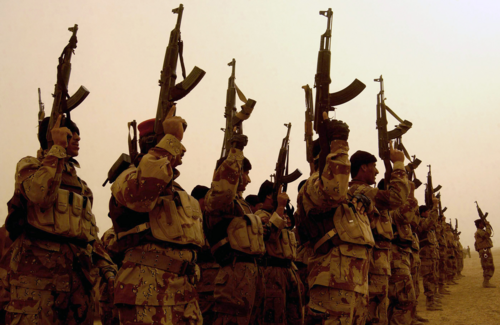
イラク国家警備隊の兵士、2004年。バグダッドのサダム・フセイン像の倒壊、2003年。破壊されたイラク69式戦車、2003年。UH -60ブラックホークヘリコプターからビラを投下する米兵、2008年。バスラをパトロールするイギリスの装甲車、2008年。バグダッドのバース党本部が破壊される、2003年。 | |||||||
| |||||||
| 交戦国 | |||||||
侵攻(2003年)アメリカイギリスオーストラリアポーランドクルディスタン地域イラク国民会議[1]  .svg/500px-Flag_of_Australia_(converted).svg.png)   .svg/500px-Iraqi_National_Congress_flag_(2003).svg.png) |
侵略(2003年)バース党イラク.svg/500px-Flag_of_Iraq_(1991%E2%80%932004).svg.png) | ||||||
侵攻後(2003-11)イラクアメリカイギリスMNF -I(2003-09)クルディスタン地域覚醒評議会.svg/500px-Flag_of_Iraq_(2004%E2%80%932008).svg.png)   |
侵攻後(2003年~2011年)イラクのアルカイダバアス党支持者イラクのイスラム軍 イラク・イスラム国 イラクのハマス ジャイシュ・アル・ムジャヒディーン1920年革命旅団ジャマート・アンサル・アル・スンナ スンニ派反乱分子特別グループ        | ||||||
| 指揮官とリーダー | |||||||
| 強さ | |||||||
|
連合軍(2003年) 覚醒民兵≈103,000 (2008) [6] クルディスタン地域≒40万人(クルド国境警備隊:3万人、 [7] ペシュメルガ7万5千人) |
 イラク・イスラム国 イラク・イスラム国≈1,000 (2008) ナクシュバンディー教団の軍隊 ≈500~1,000 (2007) | ||||||
| 死傷者と損失 | |||||||
|
イラク治安部隊(サダム政権後) 負傷者総数: 117,961人 |
イラク戦闘員の死者数(侵攻期間):7,600~45,000人[65] [66] 反乱軍(フセイン政権後) 殺害数:26,544人以上(2003~2011年)[f] (2006年9月までに4,000人の外国人戦闘員が殺害)[71] 拘留者数:12,000人(イラクが拘束、2010年のみ)[72] 逮捕された反乱軍兵士数:119,752人(2003~2007年)[73] 死者総数:34,144~71,544人 | ||||||
|
| |||||||
|
*「負傷者、病気、またはその他の医療」:医療航空輸送が必要。英国の数字には「航空医療による避難」が含まれる。 ** 総超過死亡数には、無法の増加、インフラの劣化、医療の劣悪さなどによるすべての追加死亡数が含まれる。 *** 暴力による死亡のみ– 無法の増加、医療の劣悪さなどによる超過死亡数は含まれない。 **** シリアのスッカリエも被害を受けた(2008年のアブ・カマル襲撃)。 | |||||||

.jpg/500px-Baath_Party_Headquarters,_Baghdad_(3148598572).jpg)


_DVIDS120182.jpg/500px-Operation_Iraqi_Freedom_(OIF)_DVIDS120182.jpg)

.svg/500px-Flag_of_Iraq_(1963%E2%80%931991).svg.png)



.svg/500px-Coat_of_arms_of_Iraq_(1991%E2%80%932004).svg.png)

イラク戦争(アラビア語: حرب العراق、ローマ字: ḥarb al-ʿirāq)は、第二次湾岸戦争とも呼ばれ、[82] [83] 2003年から2011年にかけてイラクで長引いた武力紛争である。この戦争は、サダム・フセイン率いるバース党政権を打倒したアメリカ主導の連合軍によるイラク侵攻から始まった。連合軍と侵攻後のイラク政府に反対する反乱軍が出現したため、紛争は次の10年間の大半にわたって続いた。米軍は2011年に 正式に撤退した。
米国は2014年に新たな連合軍を率いて再び関与した。反乱と武力紛争の多くの側面は現在も続いている。侵攻は、2001年に米国で 起きた9月11日の同時多発テロ事件を受けて、ジョージ・W・ブッシュ政権による対テロ戦争の一環として起こった。
2002年10月、米国議会は共同決議を可決し、ブッシュ大統領にイラク政府に対する軍事力行使の権限を与えた。イラク戦争は2003年3月20日、米国が英国、オーストラリア、ポーランドと合同で「衝撃と畏怖」の爆撃作戦を開始した時に正式に始まった。爆撃作戦の直後、米国主導の軍はイラクへの地上侵攻を開始した。連合軍がイラク全土を席巻したため、イラク軍はすぐに圧倒された。この侵攻によりバース党政権は崩壊し、同年12月の「レッド・ドーン作戦」でサダム・フセインが捕らえられ、 3年後に処刑された。
サダムの死後、権力の空白が生じ、連合暫定当局の失政により、シーア派とスンニ派の間で内戦が広がり、連合軍に対する反乱も長期化した。米国は2007年に17万人の兵力を増強して対応した。この増強により、イラク政府と軍の統制力が強まり、イラクの戦後復興において米国の発言力も強まった。2008年、ブッシュ大統領はイラクからすべての米軍の撤退に同意した。撤退はバラク・オバマ政権下で2011年12月に完了した。
米国は侵攻の根拠のほとんどを、イラクが大量破壊兵器(WMD)計画を持ち、サダム・フセインがアルカイダを支援しているという主張に基づいていた。米国政府はまた、アルカイダが大量破壊兵器を製造するためにイラクと密かに協力していると主張し、イラクが米国とその同盟国に対する脅威であると主張した。しかし、2004年に9/11委員会は、サダム政権とアルカイダの間にいかなる関係があるという証拠もないという結論を下した。イラクで大量破壊兵器の備蓄や稼働中の大量破壊兵器計画は発見されなかった。ブッシュ政権の当局者らも、サダムとアルカイダの関係や大量破壊兵器に関する主張を数多く行ったが、それらは不十分な証拠に基づいており、情報当局者らはこれを否定した。イラク戦争の根拠は国内外で激しい批判に直面した。当時の国連事務総長コフィー・アナン氏は、この侵攻は国連憲章に違反しており、国際法上違法であると述べた。2016年に英国が戦争に踏み切った決断について調査したチルコット報告書は、平和的な選択肢がすべて検討されたわけではなく、英国と米国は宣戦布告の過程で国連安全保障理事会を弱体化させ、戦争の法的根拠を特定するプロセスは「決して満足のいくものではなかった」ため、これらの結論を総合すると、この戦争は不必要であったとしている。FBIの尋問を受けたサダム・フセインは、米国の侵攻以前にはイラクが大量破壊兵器を保有していなかったことを認めたが、イラク調査グループは、サダムが大量破壊兵器の拡散を目的としており、大量破壊兵器の開発に必要な研究所と科学者を維持していたことを突き止めた。
2005年、イラクでは複数政党による選挙が行われた。ヌーリ・アル・マリキ氏は2006年に首相に就任し、2014年までその職にあった。マリキ政権は、同国でかつては優勢だったスンニ派少数派を疎外し、宗派間の緊張を悪化させる政策を実施した。
この戦争では推定15万人から103万3千人が死亡し、そのうち10万人を超える民間人が死亡した(下記の推定値を参照)。そのほとんどは、最初の反乱と内戦中に死亡した。2013年から2017年のイラク戦争は、侵攻と占領のドミノ効果と考えられており、少なくとも15万5千人が死亡し、330万人以上のイラク人が国内避難民となった。
この戦争は米国の国際的な評判を傷つけただけでなく、ブッシュ大統領の国内での人気とイメージも傷つけた。また、英国のトニー・ブレア首相の人気も低下し、2007年の辞任につながった。
背景
1990年のイラクによるクウェート侵攻後、サダム・フセイン政権に対する国際社会の強い反対が始まった。国際社会はこの侵攻を非難し、[84] 1991年に米国主導の軍事連合が湾岸戦争を開始し、イラク軍をクウェートから追放した。
湾岸戦争後、米国とその同盟国は封じ込め政策でサダム・フセインを抑えようとした。この政策には、国連安全保障理事会による数々の経済制裁、イラク政府による空襲からイラク・クルディスタンのクルド人と南部のシーア派を守るために米国と英国が宣言したイラクの飛行禁止空域の施行、イラクの大量破壊兵器に関する国連決議をイラクが順守しているかどうかを確認するための継続的な査察が含まれていた。
査察は国連特別委員会(UNSCOM)によって実施された。UNSCOMは国際原子力機関と協力して、イラクが化学兵器、生物兵器、核兵器とその施設を破壊するよう努めた。[85]
湾岸戦争後の10年間で、国連はイラクの大量破壊兵器の完全廃棄を求める16の安全保障理事会決議を可決した。加盟国は長年にわたり、イラクが特別委員会の作業を妨害し、軍縮義務を真剣に受け止めていないことに不満を表明した。イラク当局は査察官に嫌がらせをし、作業を妨害した。[85]そして1998年8月、イラク政府は査察官が米国のスパイ活動を行っているとして、査察官との協力を完全に停止した。[86]スパイ活動疑惑は後に立証された。[87]
1998年10月、イラク解放法の制定により、イラク政府の排除が米国の公式外交政策となった。同法は、イラクの「民主的反対組織」に「イラクの民主主義への移行を支援するプログラムを確立する」ために9,700万ドルを提供した。 [ 88]この法律は、武器と武器プログラムに焦点を当て、政権交代について言及していない国連安全保障理事会決議687に定められた条件とは対照的であった。 [89]
イラク解放法が可決されてから1か月後、米国と英国は砂漠の狐作戦と呼ばれるイラク爆撃作戦を開始した。この作戦の明確な目的は、サダム・フセイン政権の化学兵器、生物兵器、核兵器の製造能力を妨害することだったが、米国の諜報員はサダムの権力基盤を弱めることにも役立つと期待していた。[90]
2000年にジョージ・W・ブッシュが大統領に選出された後、米国はより積極的なイラク政策へと移行した。 2000年の選挙における共和党の選挙公約は、サダムを「排除」する計画の「出発点」としてイラク解放法の「完全実施」を求めた。[91]
政権発足当初から計画が策定され会議も開かれていたが、9月11日の攻撃まで侵攻に向けた正式な動きはほとんどなかった。 [92] [93]
戦前の出来事
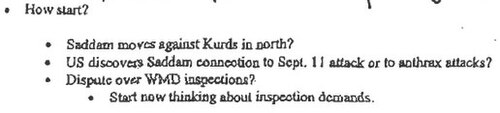
9/11の後、ブッシュ政権の国家安全保障チームはイラク侵攻について活発に議論した。攻撃当日、ドナルド・ラムズフェルド国防長官は側近に「最善の情報を早く入手せよ。サダム・フセインを同時に攻撃するのが十分かどうか判断せよ。オサマ・ビン・ラディンだけではなく。」と求めた。 [95]ブッシュ大統領は11月21日にラムズフェルドと話し、イラク侵攻の戦争計画であるOPLAN 1003の極秘レビューを行うよう指示した。 [96] [97]ラムズフェルドは11月27日に米中央軍司令官トミー・フランクス将軍と会談し、計画を検討した。会議の記録には「どのように始めるか?」という質問があり、米イラク戦争の複数の正当化の可能性が列挙されている。[94] [98] 9/11への対応としてイラク侵攻を行った根拠は、サダム・フセインとアルカイダの間に協力関係がなかったことから否定されている。[99] [100] [101] [102] [103] [104]
ブッシュ大統領は2002年1月の一般教書演説でイラクを悪の枢軸の一員と呼び、「アメリカ合衆国は世界で最も危険な政権が世界で最も破壊的な兵器で我々を脅すことを許さない」と述べ、イラク侵攻の公的な基礎作りを始めた。[105]ブッシュ大統領はこれを言い、イラクの大量破壊兵器の脅威について他の多くの恐ろしい主張をしたが、ブッシュ政権はイラクに核兵器がないことを知っており、イラクが生物兵器を持っているかどうかの情報も持っていなかった。[106] [107] [108] [109] [110]彼は2002年9月12日の国連安全保障理事会での演説で、国際社会に対してイラク侵攻の正式主張を始めた。[111]しかし、2002年9月5日のグレン・シェイファー少将の報告書は、統合参謀本部のJ2情報局が、イラクの大量破壊兵器計画のさまざまな側面に関する米国の知識は実質的にゼロから約75%の範囲であり、その知識は核兵器計画の可能性の側面に関する知識が特に乏しいと結論付けたことを明らかにした。「イラクの核兵器計画に関する我々の知識は、大部分、おそらく90%が不正確な情報の分析に基づいています」と彼らは結論付けた。「我々の評価は、確固たる証拠よりも分析的仮定と判断に大きく依存しています。イラクの核計画に関する証拠の基盤は特に乏しいのです。」[112] [113]同様に、英国政府は、イラクが核兵器やその他の大量破壊兵器を保有しているという証拠は見つからず、イラクは西側諸国に脅威を与えていないと結論付け、この結論を英国外交官は米国政府と共有した。[114]
NATOにおける主要な米国同盟国である英国などは米国の行動に賛成したが、フランスとドイツはイラク侵攻計画に批判的で、外交と兵器査察の継続を主張した。かなりの議論の末、国連安全保障理事会は妥協案として国連安全保障理事会決議1441を採択し、兵器査察の再開を認可し、不遵守には「重大な結果」を約束した。安全保障理事会メンバーのフランスとロシアは、これらの結果にはイラク政府を転覆させるための武力の使用は含まれていないと明言した。[115]米国と英国の国連大使は、この決議の解釈を公式に認めた。[116]
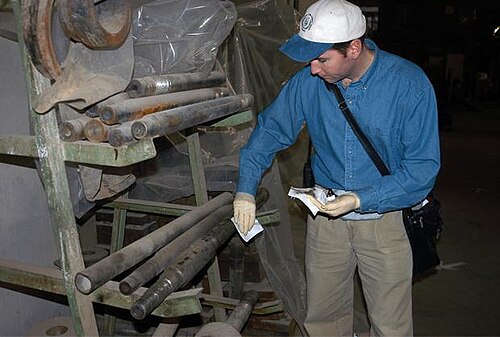
決議1441は、国連監視検証査察委員会(UNMOVIC)と国際原子力機関による査察を定めた。サダムは11月13日に決議を受諾し、査察官はUNMOVIC議長ハンス・ブリックスとIAEA事務局長モハメド・エルバラダイの指示の下、イラクに戻った。2003年2月時点で、IAEAは「イラクで核兵器計画が復活したという証拠やもっともらしい兆候は見つからなかった」としており、アルミニウム管など核濃縮遠心分離機に使用された可能性のある特定の品目は、実際には他の用途に意図されていたと結論付けている。[117] 2003年3月、ブリックスは査察が進展し、大量破壊兵器の証拠は見つからなかったと述べた。[118]
2002年10月、米国議会は「イラク決議」[119]を可決し、大統領はイラクに対して「必要なあらゆる手段」を講じることができるようになった。 2003年1月に行われた世論調査では、米国民は侵攻よりも外交的対応を広く支持した。しかし、同年後半には、米国民はブッシュの計画に賛同し始めた(イラク侵攻に関する米国民の意見を参照)。米国政府は、国民に戦争を宣伝するため、国内で綿密な広報活動を展開した。米国民の圧倒的多数は、サダムが大量破壊兵器を保有していると信じていた。査察官がそれらの兵器を発見していなかったにもかかわらず、85%がそう答えた。2003年2月までに、米国民の64%がサダムを権力から排除するために軍事行動を取ることを支持した。[120]

2003年2月5日、コリン・パウエル国務長官は 国連に出席し、イラクが非通常兵器を隠しているという証拠を提示した。しかし、ドイツ連邦情報局と英国秘密情報局から情報源は信用できないとの警告があったにもかかわらず、パウエルのプレゼンテーションには、ドイツ在住のイラク人移民で「カーブボール」のコードネームを持つラフィド・アハメド・アルワン・アル・ジャナビの主張に基づく情報が含まれていた。ジャナビも後に自分の主張が虚偽であったことを認めた。[121]パウエルはまた、イラクが秘密裏にアルカイダのネットワークをかくまい、支援していると主張した。さらに、パウエルはアルカイダがイラクから大量破壊兵器を入手しようとしていると主張した。
「アルカイダは大量破壊兵器の獲得に深い関心を持ち続けている。ザルカウィとそのネットワークの話と同様に、イラクがアルカイダにこれらの兵器の訓練を提供した経緯を語る上級テロリスト工作員の話もたどることができる。幸いにも、この工作員は現在拘束されており、その話を語ってくれた。…この拘束者が述べている支援には、2000年12月からイラクが2人のアルカイダ関係者に化学兵器や生物兵器の訓練を提供したことも含まれている。彼によると、アブダラ・アル・イラキという過激派が1997年から2000年の間に毒物やガスの獲得支援のためにイラクに数回派遣されたという。アブダラ・アル・イラキはイラク当局者と築いた関係は成功だったと述べている。」[122]
パウエルのプレゼンテーションを受けて、米国、英国、ポーランド、イタリア、オーストラリア、デンマーク、日本、スペインはイラクでの武力行使を承認する決議案を提案したが、カナダ、フランス、ドイツなどのNATO加盟国はロシアとともに外交継続を強く求めた。フランスとロシアの拒否権発動の可能性と敗北投票に直面し、米国、英国、ポーランド、スペイン、デンマーク、イタリア、日本、オーストラリアは最終的に決議案を撤回した。[123] [124]
2003年3月、アメリカ、イギリス、ポーランド、オーストラリア、スペイン、デンマーク、イタリアは、一連の広報活動と軍事行動でイラク侵攻の準備を始めた。2003年3月17日の国民向け演説で、ブッシュ大統領はサダムとその2人の息子、ウダイとクサイに降伏してイラクから撤退するよう要求し、48時間の期限を与えた。[125]
英国下院は2003年3月18日に戦争開始に関する討論を行い、政府の動議が賛成412票、反対149票で可決された。[126]この投票はブレア政権史上重要な瞬間となった。なぜなら、投票に反対した政府議員の数は、 1846年の穀物法廃止以来最大だったからである。ジョン・デナム、キングス・ヒースのハント卿、そして当時の下院議長 ロビン・クックの3人の政府大臣が戦争に抗議して辞任した。
侵略反対
2002年10月、元アメリカ大統領ビル・クリントンは、イラクに対する先制的な軍事行動の危険性について警告した。英国で行われた労働党大会で、彼は「今日の先制行動は、いかに正当なものであっても、将来的には好ましくない結果をもたらす可能性がある...爆弾や武器がどれだけ正確に爆発しても、罪のない人々が死ぬだろう」と述べた。[127] [128] 2002年のイラクに対する軍事力行使の承認決議案に対して、下院民主党議員209人のうち126人が反対票を投じたが、上院民主党議員50人のうち29人が賛成票を投じた。共和党上院議員で反対票を投じたのはリンカーン・チェイフィーただ1人。上院唯一の無所属議員ジム・ジェフォーズも反対票を投じた。元米海兵隊員で元海軍長官、将来上院議員となるジム・ウェッブは投票の直前に「イラクで一方的な戦争を推し進めている人々は、我々が侵攻すれば撤退戦略がないことを十分承知している」と書いた。[129]
同じ時期に、ヨハネ・パウロ2世は軍事介入を公然と非難した。また、非公式の会合で、ジョージ・W・ブッシュに直接こう言った。「大統領、あなたはイラク戦争についての私の意見をご存知でしょう。別の話をしましょう。一人に対してであれ、百万人に対してであれ、あらゆる暴力は神のイメージと似姿に対する冒涜です。」[130]

2003年1月20日、フランスのドミニク・ド・ビルパン外相は「軍事介入は最悪の解決策だと考えている」と宣言した。[132]一方、世界中の反戦団体が抗議活動を組織した。フランスの学者ドミニク・レニエによると、2003年1月3日から4月12日の間に、イラク戦争に反対する抗議活動が世界中で3,600万人近く集まり、 2003年2月15日のデモが最大規模だった。[133] ネルソン・マンデラは1月下旬に反対を表明し、「ブッシュ氏が欲しがっているのはイラクの石油だけだ」と述べ、国連事務総長が黒人であるという理由でブッシュが意図的に国連を弱体化させたのではないかと疑問を呈した。[134]
2003年2月、米陸軍の最高司令官エリック・シンセキは上院軍事委員会で、イラクの安全を確保するには「数十万人の兵士」が必要だと語った。[135] 2日後、ドナルド・ラムズフェルド国防長官は、戦後の兵力投入は戦争に勝つために必要な兵力よりも少なく、「数十万人の米軍が必要だという考えは的外れだ」と述べた。ポール・ウォルフォウィッツ国防副長官は、他国も占領軍に参加するため、シンセキの見積もりは「大きく外れている」と述べた。[136]
ドイツのヨシュカ・フィッシャー外相は、ドイツ軍のアフガニスタン駐留には賛成していたものの、シュレーダー首相 にはイラク戦争には参加しないよう助言した。フィッシャーは2003年の第39回ミュンヘン安全保障会議で、イラクが大量破壊兵器を保有しているという証拠として米国防長官ドナルド・ラムズフェルドに「失礼ですが、納得できません」と激しく非難したことで有名である。 [137]またフィッシャーは、侵攻後に民主主義が容易に根付くと米国が想定しないように警告した。「イラクを何年も占領しなければならないのに、突然民主主義が開花するという考えは私には受け入れられません。…米国人はこれに備えているのでしょうか?」[138]
イラク戦争の開始とブッシュの先制攻撃政策全般をめぐっては、深刻な法的疑問があった。2004年9月16日、国連事務総長のコフィ・アナン氏は、この侵攻について「国連憲章に違反していた。我々の視点から、国連憲章の観点から、それは違法だった」と述べた。 [139]
戦争の経過
2003年: 侵略
最初の中央情報局チームは2002年7月10日にイラクに入った。[140]このチームはCIAの特殊活動部のメンバーで構成され、後に米軍のエリート統合特殊作戦コマンド(JSOC)のメンバーが加わった。[141]彼らは協力して、通常軍による侵攻に備えた。これらの取り組みは、イラク軍のいくつかの師団の指揮官に侵攻に反対するのではなく降伏するよう説得し、非常にリスクの高い偵察任務中にすべての初期指導部の標的を特定することであった。[141]
最も重要なのは、彼らの努力によりクルド人 ペシュメルガが組織され、侵攻の北方戦線となったことである。この部隊は協力して侵攻前にイラク・クルディスタンでアンサル・アル・イスラムを打ち破り、その後北部でイラク軍を打ち破った。 [141] [142]ヴァイキング・ハンマー作戦として知られるアンサル・アル・イスラムとの戦いでは、相当数の戦闘員が死亡し、サルガトの化学兵器施設が発見された。[140] [143]

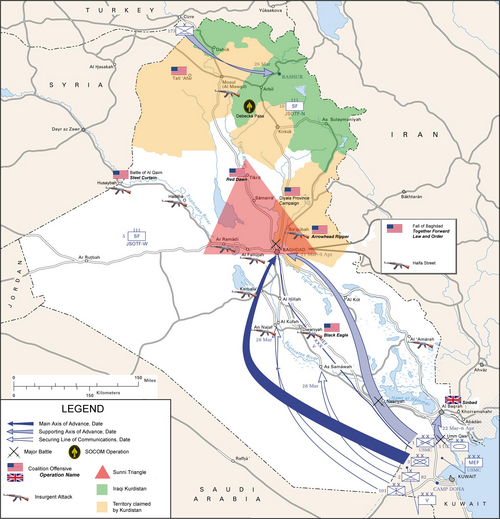
2003年3月20日バグダッド時間午前5時34分[144](東部標準時間3月19日午後9時34分)[145]、イラクへの奇襲[146]軍事侵攻が始まった。宣戦布告はなかった。[147] 2003年のイラク侵攻は、米陸軍のトミー・フランクス将軍が指揮し、コードネームはイラクの自由作戦、[148]イギリス軍のコードネームはテリック作戦、オーストラリア軍のコードネームはファルコナー作戦であった。連合軍は北部でクルド人ペシュメルガ軍とも協力した。約40か国の政府、「有志連合」が軍隊、装備、サービス、警備、特殊部隊を提供して参加し、アメリカ軍24万8千人、イギリス軍4万5千人、オーストラリア軍2千人、ポーランド軍特殊部隊GROMの194人が侵攻のためにクウェートに派遣された。[148]侵攻軍はイラクのクルド人 民兵部隊の支援も受け、その数は7万人以上と推定されている。[149]
フランクス将軍によれば、侵攻の目的は8つあった。
「第一に、サダム・フセイン政権を終わらせること。第二に、イラクの大量破壊兵器を特定、隔離、除去すること。第三に、テロリストを捜索、捕らえ、同国から追放すること。第四に、テロリストのネットワークに関連する情報を収集すること。第五に、違法な大量破壊兵器の世界的ネットワークに関連する情報を収集すること。第六に、制裁を終了し、避難民や多くの困窮するイラク国民に人道支援を直ちに提供すること。第七に、イラク国民の所有物であるイラクの油田と資源を確保すること。そして最後に、イラク国民が代表制自治政府への移行のための条件を整えるのを支援すること。」[150]
この侵攻は、米国、英国、その他の軍が予想していたことではなかったが、大きな抵抗に遭遇した迅速かつ決定的な作戦だった。イラク政権は、通常戦と非正規の非対称戦の両方を同時に戦う準備を整えており、主に装甲を装備した優れた通常戦力に直面して領土を譲り渡したが、民間人や準軍事服を着た戦闘員を使って後方から小規模な攻撃を仕掛けた。
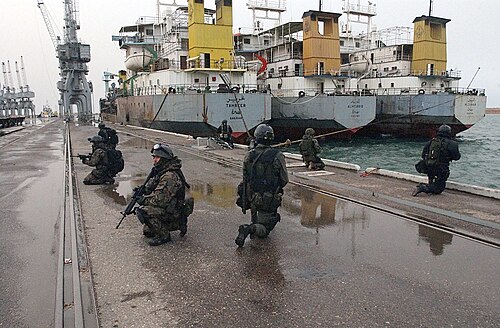
連合軍はアルファウ半島の油田と重要な港を確保するため、イギリス海軍、ポーランド海軍、オーストラリア海軍の軍艦の支援を受けて空襲と水陸両用攻撃を開始した。アメリカ海兵隊の第15海兵遠征部隊は第3コマンド旅団とポーランド特殊部隊GROMに所属し、ウンムカスル港を攻撃し、イギリス陸軍の第16空中攻撃旅団はイラク南部の油田を確保した。[151] [152]
アメリカ第3歩兵師団の重装甲部隊は西へ移動し、その後西の砂漠を通ってバグダッドに向かって北進した。一方、第1海兵遠征軍は国道1号線に沿ってさらに東へ移動し、国土の中央を通り、第1(イギリス)機甲師団は東部の湿地帯を北進した。[153]アメリカ第1海兵師団はナシリヤで戦い、主要道路の交差点を占拠した。[154]アメリカ陸軍第3歩兵師団はタリル飛行場とその周辺に陣取っていたイラク軍を破った。[155]
後方のナシリーヤとタリルの飛行場を確保した第3歩兵師団は、第101空挺師団の支援を受けてナジャフとカルバラーに向けて北進を続けたが、激しい砂嵐が連合軍の前進を遅らせたため、補給線の安全を確保するために一時中断した。[156]部隊が再び攻撃を開始すると、バグダッドへの重要な接近路であるカルバラー・ギャップを確保し、次にユーフラテス川にかかる橋を確保した。米軍部隊はギャップを通ってバグダッドに流れ込んだ。イラク中部では、第1海兵師団がバグダッド東側まで進撃し、市街地占領攻撃の準備を整えた。[157]
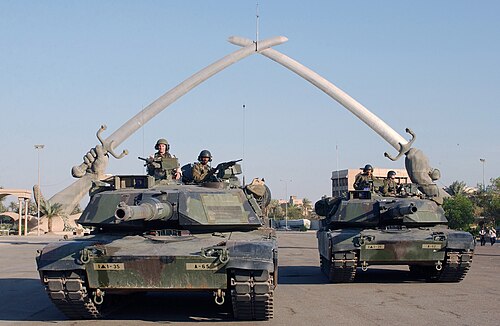
4月9日、バグダッドが陥落し、サダムの24年間の統治に終止符が打たれた。米軍は無人のバース党省庁を占拠し、後に地上の海兵隊が反論したいくつかの報告によると、サダムの巨大な鉄像の破壊を演出したという[158]。この像の写真やビデオは、後に物議を醸したものの、この出来事を象徴するものとなった。伝えられるところによると、ズームレンズで撮影された写真やビデオには写っておらず、ビデオでは聞こえないが、過激なシーア派聖職者ムクタダ・サドルへの熱狂的な群衆のスローガンが歌われていたという。[159]バグダッドの突然の陥落は、侵略者への感謝の広範な噴出を伴ったが、公共施設や政府施設の略奪や犯罪の激増など、大規模な市民の混乱も引き起こした。 [160] [161]
国防総省によると、合計65万ショートトン(59万トン)のうち25万ショートトン(23万トン)の兵器が略奪され、イラク反乱軍に重要な弾薬源を提供した。侵攻段階は、4月15日に サダムの故郷であるティクリートがトリポリ任務部隊の米海兵隊の攻撃によりほとんど抵抗を受けずに陥落したことで終了した。
戦争の侵攻段階(3月19日~4月30日)では、連合軍によって推定9,200人のイラク戦闘員が殺害され、推定3,750人の非戦闘員、つまり武器を取らなかった民間人が殺害された。[162]連合軍は、戦闘で139人の米軍人[163]と33人の英国軍人が死亡したと報告した。 [164]
侵攻後の段階
2003年: 反乱の始まり



2003年5月1日、ブッシュ大統領はカリフォルニア州サンディエゴの西数マイルで活動中の航空母艦 USS エイブラハム・リンカーンを訪問した。日没時に、大統領は飛行甲板上の水兵と空軍兵を前に「任務完了」の演説を全国放送した。ブッシュ大統領は、イラクの通常軍の敗北によりイラクにおける主要な戦闘作戦の終了を宣言したが、まだやるべきことはたくさんあると主張した。[97]
それにもかかわらず、サダム・フセインは逃亡中であり、かなりの抵抗勢力が残っていた。ブッシュ大統領の演説後、連合軍は「スンニ派三角地帯」などのさまざまな地域で、イラク軍に対する攻撃が徐々に増加し始めたことに気づいた。[要出典]当初のイラク反乱軍は、侵攻前にイラク軍と共和国防衛隊が設置した数百の武器庫から武器を供給されていた。
当初、イラクの抵抗勢力(連合軍は「反イラク勢力」と呼んでいた)は、主にフェダーインとサダム/バース党支持者から生じたが、すぐに宗教過激派と占領に憤るイラク人が反乱に加わった。最も多くの攻撃があった3つの州は、バグダッド、アンバール、サラディンであった。これら3つの州は人口の35%を占めているが、2006年12月までに、米軍の死者の73%を占め、最近の米軍の死者のうちさらに高い割合(約80%)を占めていた。[165]
反乱分子は、迫撃砲、ミサイル、自爆攻撃、狙撃兵、即席爆発装置(IED)、自動車爆弾、小火器(通常はアサルトライフル)、RPG(ロケット推進手榴弾)などのさまざまなゲリラ戦術を使用したほか、石油、水道、電気インフラに対する破壊活動も行った。
イラク侵攻後の国家を樹立するための連合軍の努力は、サダム政権の崩壊後に始まった。連合国は国連と協力し、非連合軍から自国を防衛し、内部分裂を克服できる安定した従順な民主国家の樹立に取り組み始めた。[166]
一方、連合軍はチグリス川半島周辺とスンニ派三角地帯でいくつかの作戦を開始した。一連の同様の作戦が夏の間中スンニ派三角地帯で開始された。2003 年後半、反乱軍の攻撃の激しさとペースが増し始めた。ゲリラ攻撃の急増は、イスラム教の聖なる月であるラマダンの始まりと重なったことから「ラマダン攻勢」と呼ばれる反乱軍の攻撃の先駆けとなった。
この攻撃に対抗するため、連合軍は侵攻終了以来初めて航空戦力と砲兵力を再び使用し、待ち伏せ場所と迫撃砲発射地点と疑われる場所を攻撃した。主要ルートの監視、哨戒、反乱分子と疑われる場所への襲撃が強化された。さらに、サダムの生誕地であるアウジャ村と小さな町アブ・ヒシュマを含む2つの村が有刺鉄線で囲まれ、厳重に監視された。
連合暫定当局とイラク調査グループ
侵攻後まもなく、多国籍連合軍は、民主政府が樹立されるまでのイラク暫定政府として、グリーンゾーンに拠点を置く連合暫定当局(CPA、アラビア語:سلطة الائتلاف الموحدة )を設立した。国連安全保障理事会決議1483(2003年5月22日)および戦争法に基づき、CPAは2003年4月21日のCPA発足から2004年6月28日の解散まで、イラク政府に対する行政、立法、司法の権限を付与された。
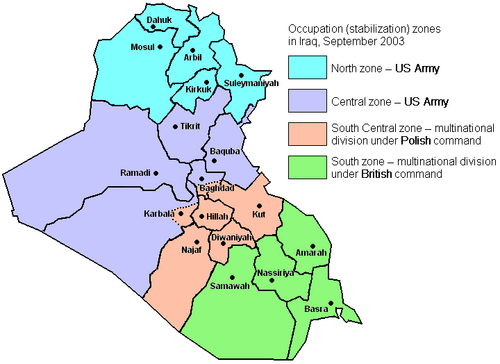
CPA は元々、元米軍将校のジェイ・ガーナーが率いていたが、その任期は 2003 年 5 月 11 日にブッシュ大統領がL・ポール・ブレマーを任命するまで続いた。2003 年 5 月 16 日、就任初日に、ポール・ブレマーは、新イラク政府および政権からバース党員を排除する連合暫定当局命令 1 を発令した。この政策は「脱バース党化」として知られ、最終的には 85,000 人から 100,000 人のイラク人が職を失う結果となった。[167]これには、単に職に就くためだけにバース党に入党した 40,000 人の教師も含まれていた。米陸軍のリカルド・サンチェス将軍はこの決定を「壊滅的な失敗」と呼んだ。[168]ブレマーは CPA が解散した 2004 年 6 月まで務めた。
2003年5月、CPA内のイラク国防省顧問のウォルター・B・スロコムは、地上での戦闘が終結した後、旧イラク軍を雇用するという戦前のブッシュ政権の政策を変更することを提唱した。[169]当時、何ヶ月も給料が支払われていなかった何十万人もの元イラク兵は、イラクの安全と再建を支援するためにCPAが彼らを再雇用してくれるのを待っていた。CPA内で働く米軍スタッフの助言にもかかわらず、ブレマーはビデオ会議でブッシュ大統領と会い、米国の政策を変更する権限を求めた。ブッシュはブレマーとスロコムに戦前の政策を変更する権限を与えた。スロコムは2003年春に政策変更を発表した。この決定は、何十万人もの元武装イラク兵の疎外につながり、彼らはその後イラク全土のさまざまな占領抵抗運動に加わった。イラク軍解散命令の前の週には、イラクでの敵対行為による連合軍の死者はいなかったが、その次の週には5人の米兵が死亡した。そして2003年6月18日、連合軍はバグダッドで抗議活動を行い連合軍に石を投げていた元イラク兵に発砲した。イラク軍解散の政策は、CPAによって実施からわずか数日後に撤回された。しかし時すでに遅し、元イラク軍はCPAと協力する用意と意志のある同盟関係から、CPAと連合軍に対する武装抵抗の同盟関係へと転換した。[170]
イラク侵攻後に多国籍軍が結成したもう一つのグループは、1,400人のメンバーからなる国際イラク調査グループであり、イラクの大量破壊兵器(WMD)計画の調査任務を遂行した。2004年、ISGのデュエルファー報告書は、イラクには実行可能なWMD計画がないと述べた。[171] [172] [173] [174] [175] [176]
元政府指導者の逮捕
2003 年夏、多国籍軍は旧政権の残りの指導者を捕らえることに集中した。7 月 22 日、米国第 101 空挺師団と第 20 任務部隊の兵士による急襲で、サダムの息子 (ウダイとクサイ) と孫の 1 人が殺害された。旧政権の最高指導者 300 人以上が殺害または捕らえられ、多数の下級役人や軍人も殺害または捕らえられた。
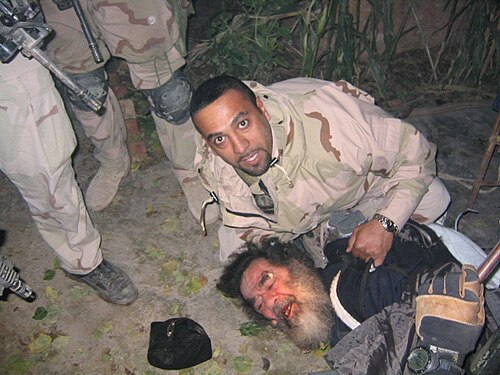
最も重要なのは、サダム・フセイン自身が2003年12月13日、ティクリート近郊の農場でレッド・ドーン作戦中に捕らえられたことである。[177]この作戦は、アメリカ陸軍第4歩兵師団と第121任務部隊のメンバーによって遂行された。サダムの居場所に関する情報は、彼の家族や元ボディーガードから得られた。[178]
サダムが捕らえられ、反乱軍の攻撃回数が減少したことから、多国籍軍が反乱軍との戦いで優勢に立っていると結論づける者もいた。暫定政府は、イラクの治安維持を目的とする新しいイラク治安部隊の訓練を開始し、米国はイラクの将来の石油収入に対するクレジットの形で200 億ドルを超える復興資金を約束した。石油収入は、学校の再建や電気および精製インフラの整備にも使用された。
サダム逮捕後まもなく、連合暫定当局から取り残された分子が選挙とイラク暫定政府の樹立を訴え始めた。このうち最も目立っていたのはシーア派聖職者アリー・アル・シスターニ大アーヤトッラーだった。連合暫定当局はこの時点で民主的な選挙を認めることに反対した。[179]反乱分子は活動を活発化させた。最も混乱した2つの中心地は、ファルージャ周辺と、バグダッド(サドルシティ)から南部の バスラまでの都市の貧しいシーア派地区だった。
イラクの博物館からの遺物の略奪
2003年のアメリカのイラク侵攻後、ギルガメシュの夢の石板を含む大量の古代遺物が、イラク国立博物館などの博物館からだけでなく、国中の遺跡での違法な発掘によっても盗まれた。それらの多くは、連邦法に反して、アラブ首長国連邦(UAE)とイスラエルを経由してアメリカに密輸された。ドナルド・ラムズフェルド国防長官は、それらが米軍人によって持ち去られたという主張を否定した。2020年代には、約17,000点の遺物がアメリカと中東諸国からイラクに返還された。しかし、バグダッド大学のイラク人考古学教授によると、これらの品々の返還は部分的な成功に過ぎず、国連教育科学文化機関(ユネスコ)のバグダッド事務所は世界中で盗品の捜索を続けている。多くのイラク人は、自国の歴史の多くの品々が失われたことについてアメリカのせいだと考えている。 [180] [181]
2004年: 反乱の拡大
.jpg/500px-Coalition_forces_in_Iraq_(2004-04-30).jpg)
2004年の初めは、暴力行為が比較的小康状態だった。この時期に反乱軍は再編し、多国籍軍の戦術を研究し、新たな攻撃を計画した。しかし、2004年のイラク春季戦闘では、中東各地の外国人戦闘員や、アブ・ムサブ・アル・ザルカウィ率いるアルカイダ系組織、ジャマーアト・アル・タウヒード・ワル・ジハードが反乱軍の推進に協力し、暴力行為が増加した。[182]
反乱が拡大するにつれ、連合軍から新しいイラク治安部隊への攻撃目標が明確に変化し、その後数か月にわたって大規模な爆撃が続き、数百人のイラク市民と警官が殺害された。深いルーツを持ち、民族主義とイスラム主義の両方の動機を持つ組織化されたスンニ派の反乱は、イラク全土で勢力を強めていた。シーア派のマフディー軍も、イラク治安部隊から支配権を奪おうと、連合軍の標的への攻撃を開始した。イラク南部と中央部では、多国籍軍が支配権を維持し、反撃に備えようとしたため、都市ゲリラ戦が勃発し始めた。

これまでの戦争で最も深刻な戦闘は、2004年3月31日に始まった。ファルージャのイラク反乱軍が、食品仕出し業者ユーレスト・サポート・サービスの警備を担当していた4人の米国民間軍事請負業者が率いるブラックウォーターUSAの車列を待ち伏せしたのだ。[183] 武装した4人の請負業者、スコット・ヘルヴェンストン、ジェルコ・ゾフコ、ウェスリー・バタロナ、マイケル・ティーグは手榴弾と小火器の銃撃で殺害された。その後、彼らの遺体は地元住民によって車両から引きずり出され、殴打され、火をつけられ、焼死体はユーフラテス川にかかる橋の上に吊るされた。[184]この事件の写真が世界中の報道機関に公開され、米国で大きな憤りと道徳的憤慨を引き起こし、2004年4月のファルージャの第一次戦闘で都市の「鎮圧」は失敗に終わった。
2004年11月、この戦争で最も血なまぐさい戦いとなった第二次ファルージャの戦いが再開された。米軍はこれを「ベトナムのフエ市の戦い以来、(米軍が関与した)最も激しい市街戦」と評した。[185]攻撃中、米軍は反乱軍に対して焼夷兵器として白リン弾を使用し、物議を醸した。46日間の戦闘は連合軍の勝利に終わり、米兵95名と反乱軍約1,350名が死亡した。戦闘中、ファルージャは完全に破壊されたが、民間人の犠牲者は戦闘前にほとんどが逃げていたため少なかった。[186]
この年のもう一つの大きな出来事は、アブグレイブ刑務所での広範な囚人虐待の暴露であり、2004年4月に国際メディアの注目を集めた。アブグレイブ刑務所での囚人虐待の最初の報告、および米軍兵士がイラク人囚人を嘲笑し虐待する生々しい写真は、60 Minutes IIのニュース報道(4月28日)とニューヨーカー誌のシーモア・M・ハーシュの記事(4月30日にオンライン掲載)によって世間の注目を集めた。[187]軍事特派員のトーマス・リックスは、これらの暴露が多くの人々、特にイラク人の目に占領の道徳的正当性に打撃を与え、戦争の転換点となったと主張した。[188]
2004年は、イラクにおける軍事移行チームの始まりでもありました。これは、新イラク軍部隊に直接配属された米国軍事顧問団です。
2005年: 選挙と暫定政府
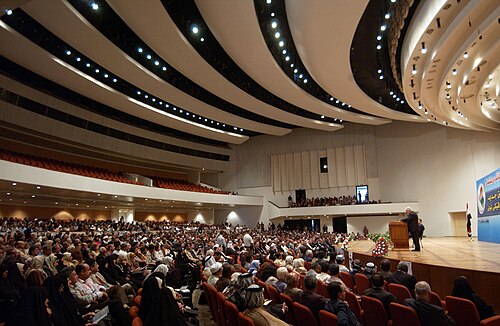
1月31日、イラク国民は恒久憲法を起草するためイラク暫定政府を選出した。多少の暴力と広範囲にわたるスンニ派のボイコットで選挙は台無しになったが、選挙権を持つクルド人とシーア派の大半は参加した。2月4日、ポール・ウォルフォウィッツは選挙警備のため任務を延長していた米軍1万5000人を翌月までにイラクから撤退させると発表した。[189] 2月から4月は11月と1月の惨劇に比べると比較的平和な月となり、反乱軍の攻撃は平均70件だった1日平均30件に減少した。
2005年4月2日のアブグレイブの戦いは、アブグレイブ刑務所のアメリカ軍に対する攻撃であり、迫撃砲とロケット弾の激しい砲火の中、推定80~120人の武装反乱軍が手榴弾、小火器、2つの車載式即席爆発装置(VBIED)で攻撃した。アメリカ軍の弾薬が不足したため、白兵戦に備えて銃剣を装着するよう命令が出された。これはベトナム戦争以来、アメリカ軍基地に対する最大の組織的攻撃とみなされた。[190]
反乱の早期終結と米軍撤退への期待は、イラク侵攻以来最も血なまぐさい月となった5月に打ち砕かれた。自爆テロ犯は主にイラクのスンニ派アラブ人、シリア人、サウジアラビア人と考えられており、イラク全土を襲った。彼らの標的はシーア派の集会やシーア派の民間人の密集地であることが多い。その結果、その月にはイラクの民間人700人以上と米兵79人が死亡した。
2005年の夏、米軍がシリア国境を封鎖しようとしたため、バグダッド周辺とイラク北西部のタル・アファルで戦闘が起きた。この戦闘は秋に首都とシリア国境の間のユーフラテス川流域の小さな町で戦闘を引き起こした。 [191]
10月15日に国民投票が行われ、イラクの新憲法が批准された。12月にはスンニ派のほか、クルド人やシーア派も参加したイラク国民議会が選出された。 [191]
2005年の反乱軍による攻撃は34,131件と、前年の26,496件から増加した。[192]
2006年: 内戦とイラクの恒久政府

2006 年の初めは、政府樹立交渉、宗派間の暴力の激化、そして反連合軍の攻撃が続いた。宗派間の暴力は、 2006 年 2 月 22 日にイラクの都市サマラで起きたアル・アスカリ モスク爆破事件をきっかけに、新たな激しさにまで拡大した。イスラム教シーア派の最も神聖な場所の 1 つであるこのモスクでの爆発は、アルカイダが仕掛けた爆弾によるものとみられている。
爆発で負傷者は出なかったが、モスクは大きな被害を受け、爆撃はその後数日間にわたって暴力行為を引き起こした。2月23日には銃弾の跡のある100体以上の死体が発見され、少なくとも165人が死亡したとみられる。この攻撃の余波で、米軍はバグダッドの平均殺人率が1日11人から33人に3倍に増加したと計算した。2006年、国連はイラクの状況を「内戦のような状況」と表現した。[193]
3月12日、第502歩兵連隊のアメリカ陸軍兵士5人が14歳のイラク人少女アビール・カシム・ハムザ・アル・ジャナビを強姦し、その後彼女と彼女の父親、母親のファクリヤ・タハ・ムハセン、そして6歳の妹ハディール・カシム・ハムザ・アル・ジャナビを殺害した。その後兵士らは犯罪の証拠を隠すために少女の遺体に火をつけた。[194]兵士のうち4人は強姦と殺人で有罪判決を受け、5人目は事件への関与でより軽い罪で有罪判決を受け、この事件はマフムディヤ強姦殺人事件として知られるようになった。[195] [196]
2006年6月6日、米国は、イラクのアルカイダ指導者アブ・ムサブ・アル=ザルカウィーを追跡することに成功した。ザルカウィーは、バグバの北約8キロ(5.0マイル)の隔離された隠れ家での会合に出席中に、標的殺害で殺害された。英国の無人機によって追跡された後、管制官と2機の米国空軍F- 16Cジェット機との間で無線通信が行われ、家屋が特定され、14:15 GMTに、先頭のジェット機が、彼がいた建物にレーザー誘導式のGBU-12とGPS誘導式のGBU-38の計2発の500ポンド(230 kg)誘導爆弾を投下した。他の6人(男性3人、女性3人)も死亡したと報告された。死亡した人の中には、彼の妻の1人とその子どもも含まれていた。
イラク政府は、2005年12月の総選挙に続いて、イラク国民議会の承認を得て、2006年5月20日に発足した。同政府は、恒久政府が樹立されるまで暫定政権として存続していたイラク暫定政府を引き継いだ。
イラク研究グループの報告書とサダムの処刑
イラク研究グループ報告書は2006年12月6日に発表された。イラク研究グループは米国の二大政党から構成され、共同議長は元国務長官(共和党)のジェームズ・ベイカー氏と元下院議員(民主党)のリー・H・ハミルトン氏だった。同グループは「イラクの状況は深刻で悪化している」と結論付け、「米軍は終わりの見えない任務に捕らわれているようだ」とした。同報告書の79の勧告には、イランとシリアとの外交手段の強化やイラク軍の訓練強化などが含まれている。12月18日、国防総省の報告書によると、反乱軍の攻撃は1週間あたり平均約960件で、2005年に報告書が始まって以来、最高を記録した。[197]
連合軍は、戦争以来初めて、正式に州の管理権をイラク政府に移譲した。軍検察は、 2005年11月にハディーサで24人のイラク民間人を殺害したとして、米海兵隊員8人を起訴した。そのうち10人は女性と子供だった。この事件に関連して、4人の将校も職務怠慢の罪で起訴された。[198]
サダム・フセインは、1年間に及ぶ裁判の末、イラクの裁判所によって人道に対する罪で有罪判決を受け、2006年12月30日に絞首刑に処された。 [199]
2007年: 米軍増強

2007年1月10日、ブッシュ大統領は米国民に向けたテレビ演説で、イラクへの21,500人の増派、イラク人への雇用プログラム、さらなる復興計画、およびこれらのプログラムに12億ドルを投じることを提案した。[200] 2007年1月23日、2007年一般教書演説で、ブッシュ大統領は「イラクに2万人以上の追加の兵士と海兵隊員を派遣する」と発表した。
2007年2月10日、デイビッド・ペトレイアスはジョージ・ケーシー将軍に代わり、イラク国内のすべての連合軍を監督する4つ星のポストである多国籍軍イラク(MNF-I)の司令官に任命された。ペトレイアスは新しい役職でイラク国内のすべての連合軍を監督し、ブッシュ政権が概説した新しい「増派」戦略に彼らを投入した。[201] [202]
2007年5月10日、イラク国会議員144名が、米国に撤退のタイムテーブルを設定するよう求める立法請願書に署名した。[203] 2007年6月3日、イラク国会は85対59の投票で、イラク政府がイラクにおける連合軍の作戦に関する国連安全保障理事会の任務の追加延長を要請する前に議会と協議することを義務付けることを可決した。[204]
米軍への圧力は、連合軍の撤退が続いたことでさらに高まった。[要出典] 2007年初頭、ブレア英首相はシンドバッド作戦後、英軍がバスラ県から撤退し、治安をイラク軍に引き渡すと発表した。[205] 7月にはデンマークのアンダース・フォー・ラスムセン首相もイラクから441人のデンマーク軍を撤退させ、残るは4機の観測ヘリコプターを操縦する9人の部隊のみと発表した。[206] 2019年10月、デンマークの新政府は、2003年のイラク戦争における米軍主導の軍事連合への同国の参加に関する公式調査を再開しないと発表した。[207]
計画的な兵力削減
2007年9月10日の議会での演説で、ペトレイアスは「来年の夏までにおよそ3万人の米軍を撤退させることを構想しており、まずは9月に海兵隊を撤退させる」と述べた。[208] 9月13日、ブッシュはイラクからの限定的な軍撤退を支持した。[209]ブッシュは、2007年のクリスマスまでに5,700人の人員が帰国し、2008年7月までにさらに数千人が帰還すると予想していると述べた。この計画により、兵員数は2007年初頭の増派前のレベルに戻ることになる。
増派による安全保障への影響
国防総省の報告書によると、2008年3月までにイラクでの暴力は40~80%減少したと報告されている。[210]独立系レポート[211] [212]は、これらの評価に疑問を投げかけている。イラク軍のスポークスマンは、増派計画開始以来のバグダッドでの民間人の死者は265人で、その前の4週間の1,440人から減少したと主張した。ニューヨークタイムズ紙は、イラク内務省と病院関係者 からの最初の日報に基づき、同じ28日間に450人以上のイラク民間人が死亡したと数えた。

歴史的に見ると、ニューヨークタイムズが毎日集計した死者数は、イラク保健省の数字と遺体安置所の数字に依拠している国連の調査と比較すると、総死者数を50%以上過小評価していた。[213]
治安活動の「増強」が始まって最初の7週間で、バグダッドにおける米軍の戦闘死者数は、前期に比べてほぼ倍増し、1日3.14人となった。イラクの他の地域では、わずかに減少した。[214] [215]
2007年8月14日、戦争中最も多くの死者を出した単独の攻撃が発生した。イラク北部のカハタニヤ入植地で一連の協調自爆攻撃が行われ、800人近い民間人が死亡した。爆発で100軒以上の住宅や店舗が破壊された。米国当局はアルカイダの犯行だと非難した。標的となった村人たちは非イスラム教徒のヤジディ民族の少数派だった。この攻撃は、その年の初めにヤジディ教徒がドゥア・ハリル・アスワドという10代の少女をスンニ派アラブ人男性と交際しイスラム教に改宗したとして石打ちで殺害した事件で勃発した抗争の最新のものだったのかもしれない。少女の殺害はカメラ付き携帯電話で録画され、動画がインターネットにアップロードされた。[216] [217] [218] [219]
2007年9月13日、アブドゥル・サッタル・アブ・リシャはラマディ市で爆弾攻撃を受け死亡した。[220]彼は、アルカイダに対抗するスンニ派アラブ部族の同盟「アンバール覚醒」を率いていたため、米国の重要な同盟者だった。アルカイダは攻撃の責任を主張した。 [221]謎に包まれたイラクのイスラム国がインターネットに投稿した声明では、アブ・リシャを「ブッシュの飼い犬の1匹」と呼び、木曜日の殺害を「準備に1か月以上かかった英雄的な作戦」と表現した。[222]

2007年5月以降、米軍の死者数は減少傾向にあると報告されており[要出典]、連合軍に対する暴力は「アメリカ軍の侵攻初年度以来最低レベル」にまで低下した。[223]多くのアナリストは、これらと他のいくつかの前向きな進展が増派によるものだとしている。[224]
国防総省や政府監査院(GAO)などの米国政府機関のデータによると、イラクにおける民間人に対する毎日の攻撃は2月以来「ほぼ同じ」状態が続いている。GAOはまた、宗派間の暴力には目立った傾向がないと述べた。 [225]しかし、この報告書は、2006年12月以来、民間人の死者と民族宗派間の暴力が全体的に減少傾向にあることを示した議会への報告書とは矛盾している。[226] 2007年後半までに、米軍の増派が終わりに近づき始めると、イラクでの暴力は2006年のピークから減少し始めた。[227]
バグダッドの地区全体がシーア派とスンニ派の民兵によって民族浄化され、イラクの混合人口の都市では宗派間の暴力が勃発した。 [228] [229] [230]調査報道記者のボブ・ウッドワードは、米国の「増派」が2007年から2008年にかけての暴力の減少の主因ではないとする米国政府の情報筋を引用した。その見解によれば、暴力の減少は、元反乱軍と緊密に協力するなど、反乱軍を見つけ出し、標的とし、殺害する米軍と諜報機関の新たな秘密戦術によるものだという。[231]
バスラ近郊のシーア派地域では、イギリス軍が同地域の治安をイラク治安部隊に引き渡した。バスラは占領開始以来、イラクの18州のうち地元治安部隊の支配下に返還された9番目の州となった。[232]
政治情勢
イラク国会議員の半数以上が、初めて自国の占領継続を拒否した。275人の議員のうち144人が、イラク政府が2008年末に期限切れとなるイラクにおける外国軍の国連任務の延長を要請する前に議会の承認を求めることを義務付ける立法請願に署名した。請願はまた、軍撤退のスケジュールと外国軍の規模の凍結を求めている。イラクにおける米国主導軍に対する国連安全保障理事会の任務は、「イラク政府の要請があれば」終了する。[233]米国で世論調査を受けた人の59%が撤退のスケジュールを支持している。[234]
2007年半ば、連合軍は「ガーディアン」民兵組織を結成するためにイラクのスンニ派(元反乱軍兵士が多い)を募集するという物議を醸す計画を開始した。これらのガーディアン民兵は、イスラム主義者からさまざまなスンニ派地区を支援し、守ることを目的としています。[235]
イランとの緊張
2007年、イランとイラク・クルディスタンの間の緊張は、イラクがクルド人分離主義過激派組織「クルディスタン自由生活党(PEJAK)」を保護したことにより大幅に高まった。報道によると、イランは8月16日からイラク・クルディスタンのPEJAKの拠点を砲撃していた。この緊張は、8月23日にイラン軍が国境を侵略したとされ、クルド人村落数か所を攻撃し、数え切れないほどの民間人と過激派を殺害したことでさらに高まった。[236]
連合軍はまた、イラク国内のイランのゴッズ部隊工作員とされる人物を標的にし始め、容疑者を逮捕または殺害した。ブッシュ政権と連合軍指導者は、イランがイラクの反乱軍や民兵に武器、特にEFP装置を供給していると公言し始めたが、現在までこれらの主張を裏付ける証拠は提示されていない。2007年秋には、ブッシュ政権によってイラン組織に対するさらなる制裁も発表された。2007年11月21日、イラク治安部隊の訓練を担当するジェームズ・デュビック中将は、イラクへの武器、爆発物の流入と過激派の訓練を阻止するというイランの誓約を守り、イラクにおける「暴力の減少に貢献した」としてイランを称賛した。[237]
トルコとの緊張
イラク北部に拠点を置くPKK戦闘員による国境侵攻はトルコ軍を悩ませ続けており、双方に犠牲者が出ている。2007年秋、トルコ軍はPKK戦闘員を「猛追」するためイラク・クルディスタン国境を越える権利があるとし、イラクのクルド人地域を砲撃し、クディ山地域のPKK基地を航空機で攻撃し始めた。[238] [239]トルコ議会は、軍がイラク・クルディスタンでPKKを追跡することを認める決議を承認した。[240] 11月、トルコのガンシップがイラク北部の一部を攻撃したが、これは国境の緊張が高まって以来初めてのトルコ航空機による攻撃であった。[241] 12月中旬の別の一連の攻撃は、カンディル、ザップ、アヴァシン、ハクルク地域のPKKの標的を襲った。最新の一連の攻撃には少なくとも50機の航空機と砲兵が関与し、クルド人当局は民間人1人が死亡、2人が負傷したと報告した。[242]
さらに、米軍がイラク治安部隊に提供した武器は、トルコ国内でPKKによって使用された後、トルコ当局によって回収されていた。[243]
ブラックウォーターの民間警備をめぐる論争
2007年9月17日、イラク政府は、国務省の車列近くで発生した自動車爆弾爆発後の銃撃戦で、女性1人と幼児1人を含む民間人8人が死亡した事件に同社が関与したとして、米国の警備会社ブラックウォーター USAのライセンスを取り消すと発表した。 [244]
2008年: 内戦は続く
.jpg/500px-Flickr_-_DVIDSHUB_-_Iraqi_army_battalion_trains_for_urban_operations_(Image_2_of_3).jpg)
2008年を通じて、米国政府関係者や独立系シンクタンクは、主要な統計から判断して治安状況の改善を指摘し始めた。米国防総省によると、2008年12月には、国内の「全体的な暴力レベル」は2007年1月の暴力増加以前から80%低下し、殺人率は戦前の水準まで低下した。また、2007年の904人に対して、2008年の米軍の死傷者数は314人だったと指摘した。[245]
ブルッキングス研究所によると、イラクの民間人の死者は2007年1月の3,500人に対して2008年11月には490人だったが、連合軍に対する攻撃は2007年夏のピーク時の1,600人近くに対して2008年後半には週200~300件だった。イラク治安部隊の死者数は2007年夏のピーク時の200~300人に対して、2008年後半には月100人以下だった。[246]
一方、イラク軍の能力は向上し、シーア派民兵に対する春の攻勢を開始した。この攻勢は、ヌーリ・アル=マリキ首相が以前に攻撃を許可したことで批判されていた。これは3月にバスラのマフディー軍に対する作戦から始まり、バグダッドのサドルシティ地区を中心に、国中のシーア派地域での戦闘につながった。10月までに、バスラを担当する英国軍将校は、作戦以来、町は「安全」になり、殺人率はイギリスのマンチェスターに匹敵するようになったと述べた。 [247]米軍はまた、2008年にイラクで発見されたイラン製爆発物の量が約4分の1減少したと述べており、これはイランの政策の変化を示している可能性がある。[248]
スンニ派地域での進展は、覚醒運動のメンバーが米軍からイラクの管理下に移された後も続いた。[249] 5月、連合軍の支援を受けたイラク軍は、アルカイダのイラク最後の主要拠点であるモスルへの攻撃を開始した。数千人を拘束したにもかかわらず、この攻撃はモスルの長期的な治安改善にはつながらなかった。年末時点で、この都市は依然として大きな紛争の火種となっている。[250] [251]
地域的な側面では、トルコとPKKの間で進行中の紛争[252] [253] [254]は、2月21日にトルコがイラク北部のクアンディール山脈に地上攻撃を開始したことで激化した。9日間にわたる作戦で、約1万人のトルコ軍がイラク北部に最大25km進撃した。これは1995年以来、トルコ軍による最初の本格的な地上侵攻であった。[255] [256]
侵攻開始直後、イラク内閣とクルド自治政府はトルコの行動を非難し、トルコ軍の即時撤退を求めた。[257]トルコ軍は2月29日に撤退した。[258]クルド人の運命と民族的に多様な都市キルクークの将来は、イラク政治において依然として論争の的となっている。
米軍当局は、 2008年を通じて交渉された米イラク地位協定に具体化された「移行期」に近づくにつれ、これらの傾向を慎重ながらも楽観的に受け止めた。[245]連合軍の司令官であるレイモンド・T・オディエルノ米陸軍大将は、2008年12月に「軍事的に言えば、移行期は最も危険な時期である」と指摘した。[245]
シーア派民兵に対する春の攻勢

3月末、イラク軍は連合軍の航空支援を受け、民兵から地域を守るためバスラで「騎士の突撃」と呼ばれる攻勢を開始した。これはイラク軍が通常の連合軍地上部隊からの直接戦闘支援を受けなかった最初の大規模作戦であった。この攻勢は、この地域の大半を支配していた民兵の1つであるマフディー軍によって阻止された。[259] [260]戦闘はすぐにイラクの他の地域、サドルシティ、アルクート、アルヒラなどに広がった。戦闘中、イラク軍はバスラの民兵からの激しい抵抗に遭い、イラク軍の攻勢は極端に遅くなり、高い消耗率により最終的にサドル派は交渉のテーブルに着くことを余儀なくされた。
イラン政府の仲介を受けて、サドル師は2008年3月30日に停戦を命じた。[261]民兵たちは武器を保持し続けた。
ニューヨーク・タイムズ紙によると、2008年5月12日までにバスラの「住民は圧倒的多数が日常生活が大幅に改善したと報告した」。同紙によると、「政府軍はイスラム過激派の拠点を制圧し、女性、キリスト教徒、音楽家、酒類販売員、西洋人と協力した疑いのある者を襲撃した暗殺部隊と『風紀取り締まり隊』を阻止した」という。しかし、イラク軍が撤退したら無法状態が再び始まるまでどのくらいかかるかと尋ねられた住民の1人は、「1日」と答えた。[260]
4月下旬、道路脇での爆弾テロは1月の最低記録から増加を続け、114件から250件を超え、2007年5月の最高記録を上回った。
議会証言
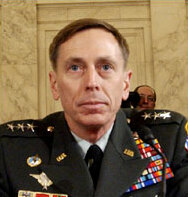
2008年4月8日、議会で演説したデイビッド・ペトレイアス将軍は、当時のブッシュ大統領とベトナム戦争時のウィリアム・ウェストモーランド将軍の発言に言及し、「私は繰り返し、我々はまだ何の進展も見ていない、トンネルの先には何の光も見ていないと指摘してきた」と述べ、軍の撤退を遅らせるよう促した。 [262]上院から、分別のある人々は今後の方針について意見が一致しない可能性があるかと問われると、ペトレイアス将軍は「我々は人々が他の意見を持つ権利のために戦っている」と答えた。[263]
当時の上院委員会委員長ジョー・バイデンの質問に対し、クロッカー大使はイラクのアルカイダはアフガニスタン・パキスタン国境沿いのオサマ・ビン・ラディン率いるアルカイダ組織より重要ではないと認めた。 [264]両党の議員は、イラクが石油収入で数十億ドルを稼いでいるため、米国の納税者がその重荷を背負っていると不満を述べた。
イラク治安部隊が再武装
イラクは、自国のAK-47アサルトライフルを米国のM-16およびM-4ライフルなどの装備と交換するなど、米国軍装備品の最大の購入者の一つとなった。[265] 2008年だけでも、イラクは米国の海外への武器販売340億ドルのうち125億ドル以上を占めた(潜在的なF-16戦闘機は含まない)。[266]
イラクは36機のF-16を求めたが、これはイラクが購入しようとした中で最も高度な兵器システムである。国防総省は、イラクへの24機の米国製攻撃ヘリコプターの販売を承認したと議会に通知した。その価値は24億ドルに上る。イラクはヘリコプターを含め、少なくとも100億ドル相当の米国製戦車、装甲車、輸送機、その他の戦場装備とサービスを購入する計画を発表した。夏には、国防総省はイラク政府が400台以上の装甲車と最大30億ドル相当のその他の装備、および6機のC-130J輸送機、最大15億ドル相当を発注したいと発表した。[267] [268] 2005年から2008年にかけて、米国はイラクと約200億ドルの武器販売契約を締結した。[269]
地位協定
米イラク地位協定は2008年12月4日にイラク政府により承認された。[270]この協定では、米軍戦闘部隊が2009年6月30日までにイラクの各都市から撤退し、2011年12月31日までにすべての米軍がイラクから完全に撤退することが定められた。この協定は、撤退を遅らせる可能性のある交渉と、2009年半ばにイラクで予定されている国民投票の対象となっており、その結果、2010年半ばまでにすべての米軍が完全に撤退することが必要となる可能性もあった。[271] [272]この協定では、囚人を24時間以上拘束した場合は刑事告訴が必要となり、戦闘に関係のない家屋や建物の捜索には令状が必要となった。[273]

米軍のために働く米国の請負業者はイラクの刑法の適用を受けるが、国務省やその他の米国機関のために働く請負業者は免責特権を保持する可能性がある。米軍が非番中や基地外で未決定の「重大な計画的重罪」を犯した場合、米国が部隊が非番中であったと認定すれば、米イラク合同委員会が定めた未決定の手続きの対象となる。[274] [275] [276] [277]
アメリカ人の中には「抜け穴」について議論する者もおり[278]、イラク人の中には協定の一部が「謎」のままであると信じている者もいる[279] 。ロバート・ゲーツ米国防長官は、2011年以降、イラクに残留する米軍部隊の一部として「おそらく数万人の米軍兵士」が見られるようになると予測した[280] 。
Several groups of Iraqis protested the passing of the SOFA accord[281][282][283] as prolonging and legitimizing the occupation. Tens of thousands of Iraqis burned an effigy of George W. Bush in a central Baghdad square where US troops five years previously organized a tearing down of a statue of Saddam Hussein.[158][279][284] Some Iraqis expressed skeptical optimism that the US would completely end its presence by 2011.[285] On 4 December 2008, Iraq's presidential council approved the security pact.[270]
A representative of Grand Ayatollah Ali Husseini al‑Sistani expressed concern with the ratified version of the pact and noted that the government of Iraq has no authority to control the transfer of occupier forces into and out of Iraq, no control of shipments and that the pact grants the occupiers immunity from prosecution in Iraqi courts. He said that Iraqi rule in the country is not complete while the occupiers are present, but that ultimately the Iraqi people would judge the pact in a referendum.[284] Thousands of Iraqis have gathered weekly after Friday prayers and shouted anti‑US and anti-Israeli slogans protesting the security pact between Baghdad and Washington. A protester said that despite the approval of the Interim Security pact, the Iraqi people would break it in a referendum next year.[286]
2009: Coalition redeployment
Transfer of the Green Zone

On 1 January 2009, the United States handed control of the Green Zone and Saddam Hussein's presidential palace to the Iraqi government in a ceremonial move described by the country's prime minister as a restoration of Iraq's sovereignty. Iraqi Prime Minister Nouri al-Maliki said he would propose 1 January be declared national "Sovereignty Day". "This palace is the symbol of Iraqi sovereignty and by restoring it, a real message is directed to all Iraqi people that Iraqi sovereignty has returned to its natural status", al‑Maliki said.[citation needed]
The US military attributed a decline in reported civilian deaths to several factors including the US‑led "troop surge", the growth of US-funded Awakening Councils, and Shiite cleric Muqtada al-Sadr's call for his militia to abide by a cease fire.[287]
Provincial elections
On 31 January, Iraq held provincial elections.[288] Provincial candidates and those close to them faced some political assassinations and attempted assassinations, and there was also some other violence related to the election.[289][290][291][292]
Iraqi voter turnout failed to meet the original expectations which were set and was the lowest on record in Iraq,[293] but US Ambassador Ryan Crocker characterized the turnout as "large".[294] Of those who turned out to vote, some groups complained of disenfranchisement and fraud.[293][295][296] After the post-election curfew was lifted, some groups made threats about what would happen if they were unhappy with the results.[297]
Exit strategy announcement
On 27 February, United States President Barack Obama gave a speech at Marine Corps Base Camp Lejeune in the US state of North Carolina announcing that the US combat mission in Iraq would end by 31 August 2010. A "transitional force" of up to 50,000 troops tasked with training the Iraqi Security Forces, conducting counterterrorism operations, and providing general support may remain until the end of 2011, the president added. However, the insurgency in 2011 and the rise of ISIL in 2014 caused the war to continue.[298]
The day before Obama's speech, Prime Minister of Iraq Nouri al‑Maliki said at a press conference that the government of Iraq had "no worries" over the impending departure of US forces and expressed confidence in the ability of the Iraqi Security Forces and police to maintain order without US military support.[299]
Sixth anniversary protests
On 9 April, the 6th anniversary of Baghdad's fall to coalition forces, tens of thousands of Iraqis thronged Baghdad to mark the anniversary and demand the immediate departure of coalition forces. The crowds of Iraqis stretched from the Sadr City slum in northeast Baghdad to the square around 5 km (3.1 mi) away, where protesters burned an effigy featuring the face of US President George W. Bush.[300] There were also Sunni Muslims in the crowd. Police said many Sunnis, including prominent leaders such as a founding sheikh from the Sons of Iraq, took part.[301]
Coalition forces withdraw
On 30 April, the United Kingdom formally ended combat operations. Prime Minister Gordon Brown characterized the operation in Iraq as a "success story" because of UK troops' efforts. Britain handed control of Basra to the United States Armed Forces.[302]
The withdrawal of US forces began at the end of June, with 38 bases to be handed over to Iraqi forces. On 29 June 2009, US forces withdrew from Baghdad. On 30 November 2009, Iraqi Interior Ministry officials reported that the civilian death toll in Iraq fell to its lowest level in November since the 2003 invasion.[303]
On 28 July, Australia withdrew its combat forces as the Australian military presence in Iraq ended, per an agreement with the Iraqi government.
Iraq awards oil contracts
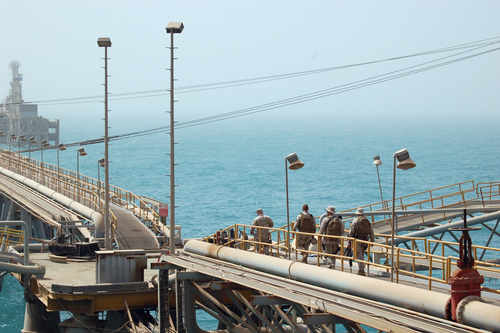
On 30 June and 11 December 2009, the Iraqi ministry of oil awarded contracts to international oil companies for some of Iraq's many oil fields. The winning oil companies entered joint ventures with the Iraqi ministry of oil, and the terms of the awarded contracts included extraction of oil for a fixed fee of approximately $1.40 per barrel.[304][305][306] The fees will only be paid once a production threshold set by the Iraqi ministry of oil is reached.
2010: US drawdown and Operation New Dawn
On 17 February 2010, US Secretary of Defense Robert Gates announced that as of 1 September, the name "Operation Iraqi Freedom" would be replaced by "Operation New Dawn".[307]
On 18 April, US and Iraqi forces killed Abu Ayyub al-Masri the leader of al-Qaeda in Iraq in a joint American and Iraqi operation near Tikrit, Iraq.[308] The coalition forces believed al-Masri to be wearing a suicide vest and proceeded cautiously. After the lengthy exchange of fire and bombing of the house, the Iraqi troops stormed inside and found two women still alive, one of whom was al-Masri's wife, and four dead men, identified as al-Masri, Abu Abdullah al-Rashid al-Baghdadi, an assistant to al-Masri, and al-Baghdadi's son. A suicide vest was indeed found on al-Masri's corpse, as the Iraqi Army subsequently stated.[309] Iraqi Prime Minister Nouri al-Maliki announced the killings of Abu Omar al-Baghdadi and Abu Ayyub al-Masri at a news conference in Baghdad and showed reporters photographs of their bloody corpses. "The attack was carried out by ground forces which surrounded the house, and also through the use of missiles," Maliki said. "During the operation computers were seized with e-mails and messages to the two biggest terrorists, Osama bin Laden and [his deputy] Ayman al-Zawahiri", Maliki added. US forces commander Gen. Raymond Odierno praised the operation. "The death of these terrorists is potentially the most significant blow to al‑Qaeda in Iraq since the beginning of the insurgency", he said. "There is still work to do but this is a significant step forward in ridding Iraq of terrorists."
US Vice President Joe Biden stated that the deaths of the top two al‑Qaeda figures in Iraq are "potentially devastating" blows to the terror network there and proof that Iraqi security forces are gaining ground.[310]
On 20 June, Iraq's Central Bank was bombed in an attack that left 15 people dead and brought much of downtown Baghdad to a standstill. The attack was claimed to have been carried out by the Islamic State of Iraq. This attack was followed by another attack on Iraq's Bank of Trade building that killed 26 and wounded 52 people.[311]

In late August 2010, insurgents conducted a major attack with at least 12 car bombs simultaneously detonating from Mosul to Basra and killing at least 51. These attacks coincided with the US plans for a withdrawal of combat troops.[312]
From the end of August 2010, the United States attempted to dramatically cut its combat role in Iraq, with the withdrawal of all US ground forces designated for active combat operations. The last US combat brigades departed Iraq in the early morning of 19 August. Convoys of US troops had been moving out of Iraq to Kuwait for several days, and NBC News broadcast live from Iraq as the last convoy crossed the border. While all combat brigades left the country, an additional 50,000 personnel (including Advise and Assist Brigades) remained in the country to provide support for the Iraqi military.[313][314] These troops were required to leave Iraq by 31 December 2011 under an agreement between the US and Iraqi governments.[315]
The desire to step back from an active counter-insurgency role did not however mean that the Advise and Assist Brigades and other remaining US forces would not be caught up in combat. A standards memo from the Associated Press reiterated "combat in Iraq is not over, and we should not uncritically repeat suggestions that it is, even if they come from senior officials".[316]
State Department spokesman P. J. Crowley stated "... we are not ending our work in Iraq, We have a long-term commitment to Iraq."[317] On 31 August, from the Oval Office, Barack Obama announced his intent to end the combat mission in Iraq. In his address, he covered the role of the United States' soft power, the effect the war had on the United States economy, and the legacy of the Afghanistan and Iraq wars.[318]
On the same day in Iraq, at a ceremony at one of Saddam Hussein's former residences at Al-Faw Palace in Baghdad, a number of US dignitaries spoke in a ceremony for television cameras, avoiding overtones of the triumphalism present in US announcements made earlier in the war. Vice President Joe Biden expressed concerns regarding the ongoing lack of progress in forming a new Iraqi government, saying of the Iraqi people that "they expect a government that reflects the results of the votes they cast". Gen. Ray Odierno stated that the new era "in no way signals the end of our commitment to the people of Iraq". Speaking in Ramadi earlier in the day, Gates said that US forces "have accomplished something really quite extraordinary here, [but] how it all weighs in the balance over time I think remains to be seen". When asked by reporters if the seven-year war was worth doing, Gates commented that "It really requires a historian's perspective in terms of what happens here in the long run". He noted the Iraq War "will always be clouded by how it began" regarding Saddam Hussein's supposed weapons of mass destruction, which were never confirmed to have existed. Gates continued, "This is one of the reasons that this war remains so controversial at home".[319] On the same day Gen. Ray Odierno was replaced by Lloyd Austin as Commander of US forces in Iraq.

On 7 September, two US troops were killed and nine wounded in an incident at an Iraqi military base. The incident is under investigation by Iraqi and US forces, but it is believed that an Iraqi soldier opened fire on US forces.[320]
On 8 September, the US Army announced the arrival in Iraq of the first specifically designated Advise and Assist Brigade, the 3d Armored Cavalry Regiment. It was announced that the unit would assume responsibilities in five southern governorates.[321] From 10 to 13 September, Second Advise and Assist Brigade, 25th Infantry Division fought Iraqi insurgents near Diyala.
According to reports from Iraq, hundreds of members of the Sunni Awakening Councils may have switched allegiance back to the Iraqi insurgency or al-Qaeda.[322]
In October, WikiLeaks disclosed 391,832 classified US military documents on the Iraq War.[323][324][325] Approximately, 58 people were killed with another 40 wounded in an attack on the Sayidat al‑Nejat church, a Chaldean Catholic church in Baghdad. Responsibility for the attack was claimed by the Islamic State in Iraq organization.[326]
Coordinated attacks in primarily Shia areas struck throughout Baghdad on 2 November, killing approximately 113 and wounding 250 with around 17 bombs.[327]
Iraqi arms purchases

As US forces departed the country, the Iraq Defense Ministry solidified plans to purchase advanced military equipment from the United States. Plans in 2010 called for $13 billion of purchases, to include 140 M1 Abrams main battle tanks.[328] In addition to the $13 billion purchase, the Iraqis also requested 18 F-16 Fighting Falcons as part of a $4.2 billion program that also included aircraft training and maintenance, AIM‑9 Sidewinder air-to-air missiles, laser-guided bombs and reconnaissance equipment.[329] All Abrams tanks were delivered by the end of 2011,[330] but the first F-16s did not arrive in Iraq until 2015, due to concerns that the Islamic State might overrun Balad Air Base.[331]
The Iraqi Navy also purchased 12 US‑built Swift-class patrol boats, at a cost of $20 million each. Delivery was completed in 2013.[332] The vessels are used to protect the oil terminals at Basra and Khor al-Amiya.[329] Two US‑built offshore support vessels, each costing $70 million, were delivered in 2011.[333]
The UN lifts restrictions on Iraq
In a move to legitimize the existing Iraqi government, the United Nations lifted the Saddam Hussein-era UN restrictions on Iraq. These included allowing Iraq to have a civilian nuclear program, permitting the participation of Iraq in international nuclear and chemical weapons treaties, as well as returning control of Iraq's oil and gas revenue to the government and ending the Oil-for-Food Programme.[334]
2011: US withdrawal
Muqtada al-Sadr returned to Iraq in the holy city of Najaf to lead the Sadrist movement after being in exile since 2007.[335]

June 2011, became the bloodiest month in Iraq for the US military since June 2009, with 15 US soldiers killed, only one of them outside combat.[336]
On 7 July, two US troops were killed and one seriously injured in an IED attack at Victory Base Complex outside Baghdad. They were members of the 145th Brigade Support Battalion, 116th Cavalry Heavy Brigade Combat Team, an Idaho Army National Guard unit base in Post Falls, Idaho. Spc. Nathan R. Beyers, 24, and Spc. Nicholas W. Newby, 20, were killed in the attack, Staff Sgt. Jazon Rzepa, 30, was seriously injured.[337]
In September, Iraq signed a contract to buy 18 Lockheed Martin F-16 warplanes, becoming the 26th nation to operate the F-16. Because of windfall profits from oil, the Iraqi government is planning to double this originally planned 18, to 36 F-16s. Iraq is relying on the US military for air support as it rebuilds its forces and battles a stubborn Islamist insurgency.[338]
With the collapse of the discussions about extending the stay of any US troops beyond 2011, where they would not be granted any immunity from the Iraqi government, on 21 October 2011, President Obama announced at a White House press conference that all remaining US troops and trainers would leave Iraq by the end of the year as previously scheduled, bringing the US mission in Iraq to an end.[339][340][341][342][343][344] The last American soldier to die in Iraq before the withdrawal, SPC. David Hickman, was killed by a roadside bomb in Baghdad on 14 November.[345]
In November 2011, the US Senate voted down a resolution to formally end the war by bringing its authorization by Congress to an end.[346]

On 15 December, an American military ceremony was held in Baghdad putting a formal end to the US mission in Iraq.[347]
The last US combat troops withdrew from Iraq on 18 December 2011, although the US embassy and consulates continue to maintain a staff of more than 20,000 including 100+ military personnel within the Office of Security Cooperation-Iraq (OSC-I),[348] US Marine Embassy Guards and between 4,000 and 5,000 private military contractors.[349][350] The next day, Iraqi officials issued an arrest warrant for the Sunni Vice-President Tariq al-Hashimi. He has been accused of involvement in assassinations and fled to the Kurdish part of Iraq.[351]
Aftermath
Emerging conflict and insurgency

Controlled by Iraqi government
Controlled by the Islamic State
Controlled by Iraqi Kurds
Controlled by Syrian government
Controlled by Syrian rebels
Controlled by Syrian Kurds
The invasion and occupation led to sectarian violence, which caused widespread displacement among Iraqi civilians. Since the beginning of the war, the first parliamentary elections were held in 2005 which brought greater representation and autonomy to Iraqi Kurds. By 2007 the Iraqi Red Crescent estimated 2.3 million Iraqis were internally displaced, with an estimated 2 million Iraqis fleeing to neighboring countries, mostly to Syria and Jordan.[352]
Sectarian violence continued in the first half of 2013. At least 56 people died in April when a Sunni protest in Hawija was interrupted by a government-supported helicopter raid and a series of violent incidents occurred in May. On 20 May 2013, at least 95 people died in a wave of car bomb attacks that was preceded by a car bombing on 15 May that led to 33 deaths; also, on 18 May 76 people were killed in the Sunni areas of Baghdad. Some experts have stated that Iraq could return to the brutal sectarian conflict of 2006.[353][354]
On 22 July 2013, at least five hundred convicts, most of whom were senior members of al-Qaida who had received death sentences, were freed from Abu Ghraib jail in an insurgent attack, which began with a suicide bomb attack on the prison gates.[355] James F. Jeffrey, the United States ambassador in Baghdad when the last American troops exited, said the assault and resulting escape "will provide seasoned leadership and a morale boost to Al Qaeda and its allies in both Iraq and Syria ... it is likely to have an electrifying impact on the Sunni population in Iraq, which has been sitting on the fence."[356]
By mid-2014 Iraq was in chaos with a new government yet to be formed following national elections, and the insurgency reaching new heights. In early June 2014 the Islamic State in Iraq and the Levant (ISIL) took over the cities of Mosul and Tikrit and said it was ready to march on Baghdad, while Iraqi Kurdish forces took control of key military installations in the major oil city of Kirkuk. The al-Qaida breakaway group formally declared the creation of an Islamic state on 29 June 2014, in the territory under its control.[357]
Prime Minister Nouri al-Maliki unsuccessfully asked his parliament to declare a state of emergency that would give him increased powers.[358] On 14 August 2014, Prime Minister Nouri al-Maliki succumbed to pressure at home and abroad to step down. This paved the way for Haidar al-Abadi to take over on 19 August 2014.
In September 2014, President Obama acknowledged that the US underestimated the rise of the Islamic State and overestimated the Iraqi military's ability to fight ISIL.[359] Obama announced the return of US forces, in the form of aerial support, in an effort to halt the advance of ISIL forces, render humanitarian aid to stranded refugees and stabilize the political situation.[360]
A civil war between ISIL and the central government continued for the next three years. Following the election of Donald Trump, the United States intensified its campaign against the Islamic State by January 2017.[361] Defense Secretary Jim Mattis said a tactical shift to surrounding Islamic State strongholds in Mosul, Iraq, and Raqqa, Syria, was devised not only to "annihilate" ISIL fighters hunkered down there, but also to prevent them from returning to their home nations in Europe, Africa, and the Middle East. In 2017, US-backed Kurdish forces captured Raqqa, which had served as the ISIL capital.[362] The Iraqi government declared victory against ISIL in December 2017.[363] By 2018, violence in Iraq was at its lowest level in ten years. This was greatly a result of the defeat of ISIL forces and the subsequent calming-down of the insurgency.[364]
In January 2020, after the assassination of Qasem Soleimani, the Iraqi parliament voted for all foreign troops to leave the country. This would end its standing agreement with the United States to station 5,200 soldiers in Iraq. Then-President Trump objected to withdrawing troops and threatened Iraq with sanctions over this decision.[365] In 2023, Iraqi Prime Minister Mohammed Shia' Al Sudani indicated his support for an indefinite U.S. military presence in Iraq.[366]
Casualties
Casualty estimates

For coalition death totals see the infobox at the top right. See also Casualties of the Iraq War, which has casualty numbers for coalition nations, contractors, non-Iraqi civilians, journalists, media helpers, aid workers, and the wounded. Casualty figures, especially Iraqi ones, are highly disputed.
There have been several attempts by the media, coalition governments and others to estimate the Iraqi casualties. The table below summarizes some of these estimates and methods.
Impacts
Economic impact
Financial cost

In March 2013, the total cost of the Iraq War to date was estimated at $1.7 trillion by the Watson Institute for International and Public Affairs at Brown University.[367] Some argue that the total cost of the war to the US economy will range from $3 trillion[368] to $6 trillion,[369] including interest rates, by 2053, as described in the Watson Institute's report. The upper ranges of these estimates include long-term veterans costs and economic impacts. For example, Harvard's public finance expert Linda J. Bilmes has estimated that the long-term cost of providing disability compensation and medical care to US troops injured in the Iraq conflict will reach nearly $1 trillion over the next 40 years,[370] and that the war in Iraq diverted resources from the war in Afghanistan, led to rising oil prices, increased the federal debt, and contributed to a global financial crisis.[371]
A CNN report noted that the United States–led interim government, the Coalition Provisional Authority lasting until 2004 in Iraq had lost $8.8 billion in the Development Fund for Iraq. In June 2011, it was reported by CBS News that $6 billion in neatly packaged blocks of $100 bills was air-lifted into Iraq by the George W. Bush administration, which flew it into Baghdad aboard C‑130 military cargo planes. In total, the Times says $12 billion in cash was flown into Iraq in 21 separate flights by May 2004, all of which has disappeared. An inspector general's report mentioned that "'Severe inefficiencies and poor management' by the Coalition Provisional Authority would leave no guarantee that the money was properly used", said Stuart W. Bowen, Jr., director of the Office of the Special Inspector General for Iraq Reconstruction. "The CPA did not establish or implement sufficient managerial, financial, and contractual controls to ensure that funds were used in a transparent manner."[372] Bowen told the Times the missing money may represent "the largest theft of funds in national history."[373]
Reparations
By 2013, some human rights groups in both Iraq and the US had begun campaigning for reparations from the US for the devastation and health effects suffered by Iraqis during the war.[374][375]
Economic recession in 2021
As of 2021, Iraq had fallen into an economic depression, caused by the ongoing COVID pandemic and falling oil and gas prices, which economists described as the country's biggest financial threat since the rule of Saddam Hussein. Iraq suffered from currency devaluation in 2021 for the first time in decades and was unable to import crucial products, including medicines and food, and had a lack of foreign currency to pay off the national debt.[376]
Humanitarian impact
Humanitarian crisis

According to a 2007 Oxfam report, the child malnutrition rate had risen to 28%, and the rate of people without access to clean drinking water had risen to 70%.[377] In 2007, Nasser Muhssin, a researcher on family and children's affairs affiliated to the University of Baghdad claimed that 60–70% of Iraqi children suffered from psychological problems.[378] A 2007 cholera outbreak in northern Iraq was thought to be the result of poor water quality.[379] As many as half of Iraqi doctors left the country between 2003 and 2006.[380]
By the end of 2015, according to the Office of the United Nations High Commissioner for Refugees, 4.4 million Iraqis had been internally displaced.[381] The population of Iraqi Christians dropped dramatically during the war, from 1.5 million in 2003 to 500,000 in 2015,[382] and perhaps only 275,000 in 2016.
The Foreign Policy Association reported that: "Perhaps the most perplexing component of the Iraq refugee crisis ... has been the inability for the United States to absorb more Iraqis following the 2003 invasion of the country. To date, the United States has granted around 84,000 Iraqis refugee status, of the more than two million global Iraqi refugees. By contrast, the United States granted asylum to more than 100,000 South Vietnamese refugees during the Vietnam War."[383][384][385]
Environmental impact
Oil pollution
The war has led to oil spills, which increased carbon emissions and contaminated the surrounding water resources. During the invasion period, the retreating Iraqi army damaged the oil infrastructure and destroyed more than 736 oil wells in southern Iraq, resulting in massive oil spills and the ignition of fires.[386] In 2003, more than 50 billion tonnes of carbon emissions were produced from burning oil fields and released into the atmosphere.[387] Also, over 130 million gallons of oil leaked into surrounding water resources, such as Sawa Lake.[388] Between 2003 and 2010, more than 5,000 birds from three species died around Sawa Lake.[388]
Radioactive contamination
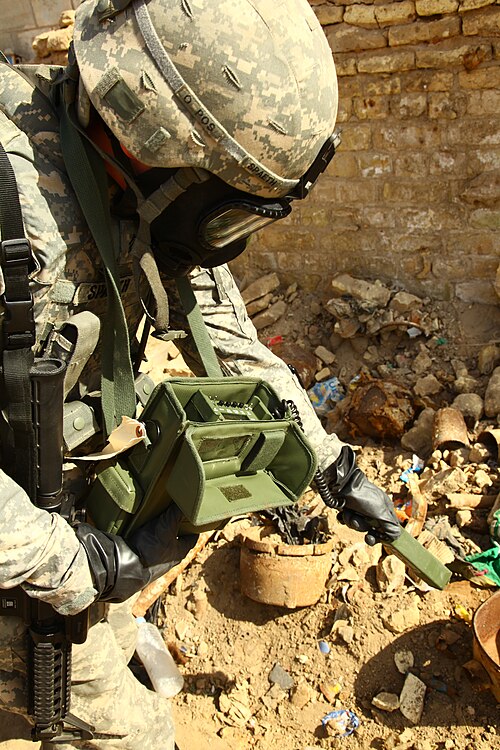
The U.S.-led coalition used depleted uranium (DU) munitions during the war to pierce tank armour.[389] 1,000 to 2,000 tonnes (980 to 1,970 long tons; 1,100 to 2,200 short tons) of DU munitions were fired, which caused ammunition fragments containing radioactive material to spread across the country. According to a United Nations Environment Programme report, radioactive material contaminated air and soil; with the radioactive concentration found in Iraqi soil at 709.52 Bq in 2003 compared to 143.22 Bq in 2002.[390] The report states that high levels of radiation prevented plants, especially crop seeds, from sprouting; with about 22% (9.5 million ha) of the farmland in Iraq unable to grow barley.[388]
In addition, radiation contamination may have had harmful public health outcomes through poisoning and increased incidence of various cancers and birth defects.[390] Several studies have identified increased occurrence of deformities, cancers, and other serious health problems in areas where DU shells were used.[391] Some Iraqi doctors attributed these malformations to possible long-term effects of depleted uranium.[392] Studies disagree on whether DU ammunition has any measurable detrimental health effects.[393][390] According to research from the UK Atomic Energy Authority in 2005, the cancer rate had increased by 35% since 2003. As of 2013, 140,000 Iraqis were suffering from cancer, with between 7,000 and 8,000 new cases yearly.[390] According to a 2012 journal article by Al-Hadithi et al., existing studies and research evidence does not show a "clear increase in birth defects" or a "clear indication of a possible environmental exposure including depleted uranium". The article further states that "there is actually no substantial evidence that genetic defects can arise from parental exposure to DU in any circumstances."[394]
Ecosystem destruction
The war has also led to damage to ecosystems though pollution and physical destruction. Approximately 25,000 tons of bombs were dropped by the U.S. military during the war.[386] More than 250 chemical and armament factories were destroyed, which caused over 50,000 cubic meters of hazardous chemicals, such as fertilizer, and raw sewage to leak into water,[395] leading to surrounding freshwater ecosystem becoming polluted and species' habitat being impacted.[386] According to the World Wide Fund for Nature, 33 Iraqi wetlands, especially the Mesopotamian Marshland, have been contaminated by chemicals, which has caused 60 types of mammal species to lose their habitats, and more than 45 types of plants to become extinct.[388]
Impact on the Global War on Terrorism
Though explicitly stating that Iraq had "nothing" to do with 9/11,[396] erstwhile President George W. Bush consistently referred to the Iraq War as "the central front in the War on Terror", and argued that if the United States pulled out of Iraq, "terrorists will follow us here".[397][398][399] While other proponents of the war regularly echoed this assertion, as the conflict dragged on, members of the US Congress, the US public, and even US troops questioned the connection between Iraq and the fight against anti-US terrorism. In particular, a consensus developed among intelligence experts that the Iraq War actually increased terrorism. Counterterrorism expert Rohan Gunaratna frequently referred to the invasion of Iraq as a "fatal mistake".[400]
London's International Institute for Strategic Studies concluded in 2004 that the occupation of Iraq had become "a potent global recruitment pretext" for Mujahideen and that the invasion "galvanised" al-Qaeda and "perversely inspired insurgent violence" there.[401] The US National Intelligence Council concluded in a January 2005 report that the war in Iraq had become a breeding ground for a new generation of terrorists; David Low, the national intelligence officer for transnational threats, indicated that the report concluded that the war in Iraq provided terrorists with "a training ground, a recruitment ground, the opportunity for enhancing technical skills ... There is even, under the best scenario, over time, the likelihood that some of the jihadists who are not killed there will, in a sense, go home, wherever home is, and will, therefore, disperse to various other countries." The council's chairman Robert Hutchings said, "At the moment, Iraq is a magnet for international terrorist activity."[402] And the 2006 National Intelligence Estimate, which outlined the considered judgment of all 16 US intelligence agencies, held that "The Iraq conflict has become the 'cause célèbre' for jihadists, breeding a deep resentment of US involvement in the Muslim world and cultivating supporters for the global jihadist movement."[403]
A report by the Council on Foreign Relations, released on the 20th anniversary of the invasion analyzed the rationale to go to war and the subsequent decisions during the occupation. The report states that the "justification for going to war was based on scanty and deeply flawed intelligence" and that the invasion was an "error compounded by the absence of an agreed exit strategy and the decision to embark on a massive, open-ended nation-building project". The same report also ascertained that "the occupation authority's first acts were to disband the Iraqi army and the Ba'athist governing party, igniting what would become a lethal, long-running insurgency and eventually a multinational terrorist organization that took over most of the country".[404][97]
Impact on geopolitics
From a geopolitical perspective, the war in Iraq has been interpreted as weakening the West's moral high ground and hampering its ability to effectively counter Russia and China. With regard to the Russo-Ukrainian War, Russian foreign minister Sergey Lavrov said in March 2022 that the U.S. exerted similar pressures on Iraq in 2003, which the US invaded later for no reason other than "a vial of unidentified chemicals".[405] In March 2023, Tony Blair, former British prime minister rejected comparisons between Russia's war in Ukraine and the US-led invasion of Iraq, claiming that the Iraq War cannot be used as a justification by Russia to annex Russian-speaking zones in eastern Ukraine.[406]
Criticism


The Bush administration's rationale for the Iraq War has faced heavy criticism from an array of popular and official sources both inside and outside the United States,[408][409][342] with many US citizens finding many parallels with the Vietnam War.[410] For example, a former CIA officer described the Office of Special Plans as a group of ideologues who were dangerous to US national security and a threat to world peace, and stated that the group lied and manipulated intelligence to further its agenda of removing Saddam.[411] The Center for Public Integrity stated that the Bush administration made a total of 935 false statements between 2001 and 2003 about Iraq's alleged threat to the United States.[412]
Both proponents and opponents of the invasion have also criticized the prosecution of the war effort along with a number of other lines. Most significantly, critics have assailed the United States and its allies for not devoting enough troops to the mission, not adequately planning for post-invasion Iraq, and for permitting and perpetrating human rights abuses. As the war has progressed, critics have also railed against the high human and financial costs. In 2016, the United Kingdom published the Iraq Inquiry, a public inquiry which was broadly critical of the actions of the British government and military in making the case for the war, in tactics and in planning for the aftermath of the war.[413][414][415]
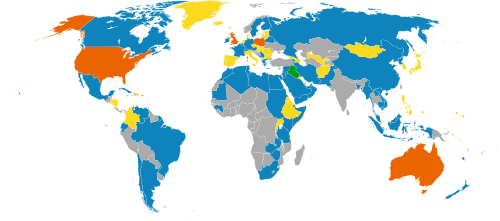
States participating in the invasion of Iraq
States in support of an invasion
States in opposition to an invasion
States with an uncertain or no official standpoint
Criticisms include:
- Legality of the invasion[416][417][418][419][420]
- Human casualties[421][422][423][424]
- Human rights violations such as the Iraq prison abuse scandals
- Insufficient post-invasion plans, in particular inadequate troop levels (A RAND Corporation study stated that 500,000 troops would be required for success.)[425]
- Financial costs with approximately $612 billion spent as of 4/09 the CBO has estimated the total cost of the war in Iraq to the United States will be around $1.9 trillion.[426]
- Adverse effect on US-led global "war on terror"[427][428]
- Damage to US' traditional alliances and influence in the region.[429][430]
- Endangerment and ethnic cleansing of religious and ethnic minorities by insurgents[229][431][432][433][434]
- Disruption of Iraqi oil production and related energy security concerns (the price of oil quadrupled between 2002 and 2008).[435][436]
War crimes
Throughout the war, many human rights abuses and war crimes were committed.
By Coalition forces and private contractors

- Deaths of civilians as a result of bombing and missile strikes that fail to take feasible precautions with regards to civilians casualties.[437]
- Abu Ghraib torture and prisoner abuse by US Army personnel,[438] involving the detention of thousands of Iraqi people. Torture at Abu Ghraib included rape, sodomy and extensive sexual abuse, waterboarding, pouring phosphoric acid on detainees, sleep deprivation and physical beatings.
- Haditha massacre of 24 civilians by US soldiers.
- Widespread use of the incendiary munition white phosphorus such as during the battle of Fallujah. The documentary Fallujah, The Hidden Massacre, claimed that Iraqi civilians, including women and children, had died of burns caused by white phosphorus during the battle, however, US Department of Defense spokesman Lieutenant Colonel Barry Venable denied that this was true but confirmed to the BBC that US forces had used white phosphorus as an incendiary weapon there against enemy combatants.[439][440][441] The use of white phosphorus against civilian populations is banned by international legislation.[442]
- Mahmudiyah rape and killings, where US soldiers raped and killed 14-year old Abeer Qasim Humza. They also killed 3 of her relatives.[443][444]
- The torture and killing of prisoner of war, Iraqi Air Force commander, Abed Hamed Mowhoush.
- The killing of Baha Mousa while in British Army custody.
- Mukaradeeb wedding party massacre, where 42 civilians were allegedly killed by coalition airstrikes.[445]
- Planting weapons on noncombatant, unarmed Iraqis by three US Marines after killing them.[446][447] According to a report by The Nation, other similar acts have been witnessed by US soldiers.[448]
- Nisour Square massacre by Blackwater Security Consulting personnel.
- Allegations of beatings, electrocution, mock executions, and sexual assault by British troops were presented to the International Criminal Court (ICC) by Public Interest Lawyers (PIL) and the European Center for Constitutional and Human Rights (ECCHR) on 12 January 2014.[449]
By insurgent groups

- Killing over 12,000 Iraqis from January 2005 to June 2006, according to Iraqi Interior Minister Bayan Jabr, giving the first official count for the victims of bombings, ambushes and other deadly attacks.[450] The insurgents have also conducted numerous suicide attacks on the Iraqi civilian population, mostly targeting the majority Shia community.[451][452] An October 2005 report from Human Rights Watch examines the range of civilian attacks and their purported justification.[453]
- Attacks against civilians by sectarian death squads primarily during the Iraqi Civil War. Iraq Body Count project data shows that 33% of civilian deaths during the Iraq War resulted from execution after abduction or capture. These were overwhelmingly carried out by unknown actors including insurgents, sectarian militias and criminals.[454]
- Attacks on diplomats and diplomatic facilities including; the bombing of the UN headquarters in Baghdad in August 2003 killing the top UN representative in Iraq and 21 other UN staff members;[455] beheading several diplomats: two Algerian diplomatic envoys Ali Belaroussi and Azzedine Belkadi,[456] Egyptian diplomatic envoy al-Sherif,[457] and four Russian diplomats[458]
- The February 2006 bombing of the al-Askari Mosque, destroying one of the holiest Shiite shrines, killing over 165 worshipers and igniting sectarian strife and reprisal killings[459]
- The publicised killing of several contractors; Eugene Armstrong, Jack Hensley, Kenneth Bigley, Ivaylo Kepov and Georgi Lazov (Bulgarian truck drivers.)[460] Other non-military personnel murdered include: translator Kim Sun-il, Shosei Koda, Fabrizio Quattrocchi (Italian), charity worker Margaret Hassan, reconstruction engineer Nick Berg, photographer Salvatore Santoro (Italian)[461] and supply worker Seif Adnan Kanaan (Iraqi.) Four private armed contractors, Scott Helvenston, Jerko Zovko, Wesley Batalona and Michael Teague, were killed with grenades and small arms fire, their bodies dragged from their vehicles, beaten and set ablaze. Their burned corpses were then dragged through the streets before being hung over a bridge crossing the Euphrates.[462]
- Torture or killing of members of the New Iraqi Army,[463] and assassination of civilians associated with the Coalition Provisional Authority, such as Fern Holland, or the Iraqi Governing Council, such as Aqila al-Hashimi and Ezzedine Salim, or other foreign civilians, such as those from Kenya[464]
By post-invasion Iraqi Government
The post-invasion Iraqi government used torture against detainees, including children. Some techniques of torture used included beatings, electric shocks, prolonged hanging by the wrists, food and water deprivation, and blindfolding for multiple days.[465] Iraqi police from the Interior Ministry were accused of forming Death Squads and committing numerous massacres of Sunni Arabs.[466] Many of these human rights abuses were carried out by Iraqi government-sponsored Shi'ite militias.[467]
Public opinion on the war
International opinion

In a March 2003 Gallup poll, the day after the invasion, 76% of Americans had approved of military action against Iraq.[468] In a March 2003 YouGov poll, 54% of Britons supported the military action against Iraq.[469] A remarkable aspect was the support for invasion expressed by many left-wing intellectuals such as Christopher Hitchens, Paul Berman, Michael Walzer and Jean Bethke Elshtain.[470][471] In a February 2003 poll by the national public research institute CIS, 91% of Spaniards opposed any military intervention in Iraq.[472]
According to a January 2007 BBC World Service poll of more than 26,000 people in 25 countries, 73% of the global population disapproved of US handling of the Iraq War.[473] A September 2007 poll conducted by the BBC found that two-thirds of the world's population believed the US should withdraw its forces from Iraq.[474]
In 2006 it was found that majorities in the UK and Canada believed that the war in Iraq was "unjustified" and – in the UK – were critical of their government's support of US policies in Iraq.[475]
According to polls conducted by the Arab American Institute, four years after the invasion of Iraq, 83% of Egyptians had a negative view of the US role in Iraq; 68% of Saudi Arabians had a negative view; 96% of the Jordanian population had a negative view; 70% of the population of the United Arab Emirates and 76% of the Lebanese population also described their view as negative.[476] The Pew Global Attitudes Project reports that in 2006 majorities in the Netherlands, Germany, Jordan, France, Lebanon, Russia, China, Canada, Poland, Pakistan, Spain, Indonesia, Turkey, and Morocco believed the world was safer before the Iraq War and the toppling of Saddam, while pluralities in the United States and India believe the world is safer without Saddam Hussein.[477]
Iraqi opinion

Directly after the invasion, an NDTV poll of Baghdad residents reported a slight majority of respondents supported the US invasion.[478] Polls conducted between 2005 and 2007 showed 31–37% of Iraqis wanted US and other Coalition forces to withdraw once security was restored and that 26–35% wanted immediate withdrawal instead.[479][480][481] In 2006, a poll conducted on the Iraqi public revealed that 52% of the ones polled said Iraq was going in the right direction and 61% claimed it was worth ousting Saddam Hussein.[479] In a March 2007 BBC poll, 82% of Iraqis expressed a lack of confidence in coalition forces based in Iraq.[482] According to a 2009 poll conducted by the University of Maryland, 7 out of 10 Iraqis wanted US troops to withdraw within one year and also 78% felt that US military presence was "provoking more conflict than it is preventing".[483] Despite a majority having previously been opposed to the US presence, according to a poll conducted by the Asharq Research Centre, a private Iraqi company, 60% of Iraqis had believed it was "the wrong time" for a major withdrawal of American troops prior to the withdrawal in 2011, with 51% saying withdrawal would have a negative effect.[484][485]
Foreign involvement
Suicide bombers
According to studies, most of the suicide bombers in Iraq were foreigners, especially Saudis.[486][487][488]
Role of Iran
According to two unnamed US officials, the Pentagon is examining the possibility that the Karbala provincial headquarters raid, in which insurgents managed to infiltrate an American base, kill five US soldiers, wound three, and destroy three humvees before fleeing, was supported by Iranians. In a speech on 31 January 2007, Iraqi Prime Minister Nouri al-Maliki stated that Iran was supporting attacks against Coalition forces in Iraq[489] and some Iraqis suspect that the raid may have been perpetrated by the Quds Force in retaliation for the detention of five Iranian officials by US forces in the northern Iraqi city of Irbil on 11 January.[490][491] In 2014, the legacy of Iran's presence in Iraq after the invasion had been mixed with regard to the fight against regional terrorist groups. The U.S. occupation and subsequent regional instability had spawned the creation of the PMF (Popular Mobilization Forces), an Iranian militia that effectively fought the influence of emerging caliphates in the region.[492]
Later, a 1,300-page US Army Iraq War study, released in January 2019, concluded that "At the time of this project's completion in 2018, an emboldened and expansionist Iran appears to be the only victor" and that the outcome of the war triggered a "deep skepticism about foreign interventions" among America's public opinion.[420]
Role of Israel
Israel did not officially support or take part in the Iraq War. According to former State Department official Lawrence Wilkerson and former CIA agent and Iran expert Robert Baer, Israeli officials warned the Bush administration against invading Iraq, saying that it would destabilize the region and empower the much more dangerous regime in Iran.[493][494][495][496] However it was reported in the Washington Post that "Israel is urging United States' officials not to delay a military strike against Iraq's Saddam Hussein".[497] It was also reported in 2002 that Israeli intelligence provided Washington with alarming reports about Iraq's alleged program to develop weapons of mass destruction.[498]
According to former US undersecretary of defense Douglas Feith, Israeli officials did not push their American counterparts to initiate the war in Iraq. In an interview with Ynet, Feith stated that "what you heard from the Israelis was not any kind of advocacy of war with Iraq" and that "[w]hat you heard from Israeli officials in private discussions was that they were not really focused on Iraq... [t]hey were much more focused on Iran."[499]
At Washington's behest, Israel did not provide vocal support for the war, as the US government was concerned that Israeli support for or participation in the war would potentially alienate the Arab world. In January 2007, the Forward reported that sometime before March 2003, Israeli Prime Minister Ariel Sharon told Bush that Israel "would not push one way or the other" for or against an Iraq war. Sharon said that he believed that Iraq was a genuine threat to the Middle East and that Saddam had weapons of mass destruction, but explicitly warned Bush that if the US did go to war with Iraq that he should make sure to formulate a viable exit strategy, prepare a counterinsurgency strategy, and should not attempt to implant democracy in the Arab world. One of the sources who provided this information was Israeli Ambassador to the US Daniel Ayalon.[500]
Israel has also assisted the US military by sharing its expertise on counterinsurgency methods, such as utilizing drones and operating checkpoints.[501]
In 2003 the Israeli news magazine, the Ha'aretz, in its published story "White Man's Burden" reported that belief in the war against Iraq was disseminated by "a small group of 25 or 30 neoconservatives, almost all of them Jewish".[502]Role of Russia
The invasion of Iraq prompted a widespread wave of criticism from several world leaders, including Russian President Vladimir Putin.[503] Before and during the invasion of Iraq, the Russian government provided intelligence to Saddam Hussein about the location of US forces and their plans.[504]
See also
- Foreign interventions by the United States
- United States involvement in regime change
- Criticism of United States foreign policy
- Iran–Saudi Arabia proxy conflict
- Iraq–United States relations
- The Iraq War: A Historiography of Wikipedia Changelogs
- List of wars by death toll
- National Network to End the War Against Iraq
- United States military casualties of war
- Joint Special Operations Command Task Force in the Iraq War
Footnotes
- ^ disbanded in 2003
- ^ 260 killed in 2003,[10] 15,196 killed from 2004 through 2009 (with the exceptions of May 2004 and March 2009),[11] 67 killed in March 2009,[12] 1,100 killed in 2010,[13] and 1,067 killed in 2011,[14] thus giving a total of 17,690 dead
- ^ The US DoD and the DMDC list 4,505 US fatalities during the Iraq War.[16][17] In addition to these, two service members were also previously confirmed by the DoD to have died while supporting operations in Iraq,[18][19] but have been excluded from the DoD and DMDC list. This brings the total of US fatalities in the Iraq War to 4,507.
- ^ 33 Ukrainians,[24] 31+ Italians,[25][26] 30 Bulgarians,[27][28] 20 Salvadorans,[29] 19 Georgians,[30] 18 Estonians,[citation needed] 14+ Poles,[31][32][33] 15 Spaniards,[34][35][36][37] 10 Romanians,[38] 6 Australians,[39] 5 Albanians, 4 Kazakhs,[40] 3 Filipinos,[41] and 2 Thais,[42][43] for a total of 210+ wounded
- ^ 185 in Diyala from June 2007 to December 2007,[52] 4 in assassination of Abu Risha, 25 on 12 November 2007,[53] 528 in 2008,[54] 27 on 2 January 2009,[55] 13 on 16 November 2009,[56] 15 in December 2009,[57] 100+ from April to June 2010,[58][59] 52 on 18 July 2010,[60][61] leaving a total of 1,002+ dead[62]
- ^ 597 killed in 2003,[67] 23,984 killed from 2004 through 2009 (with the exceptions of May 2004 and March 2009),[11] 652 killed in May 2004,[68] 45 killed in March 2009,[69] 676 killed in 2010,[70] and 590 killed in 2011,[14] thus giving a total of 26,544 dead
References
- ^ Graham, Bradley (7 April 2003). "U.S. Airlifts Iraqi Exile Force For Duties Near Nasiriyah". The Washington Post. Archived from the original on 8 August 2007. Retrieved 13 September 2009.
- ^ "A Timeline of Iraq War, Troop Levels". The Huffington Post.
- ^ https://sgp.fas.org/crs/mideast/RL31763.pdf [bare URL PDF]
- ^ "Deputy Assistant Secretary for International Programs Charlene Lamb's Remarks on Private Contractors in Iraq". US Department of State. 17 July 2009. Retrieved 23 October 2010.
- ^ International Institute for Strategic Studies (3 February 2010). Hackett, James (ed.). The Military Balance 2010. London: Routledge. ISBN 978-1-85743-557-3.
- ^ Rubin, Alissa J.; Nordland, Rod (29 March 2009). "Troops Arrest an Awakening Council Leader in Iraq, Setting Off Fighting". The New York Times. Retrieved 30 March 2010.
- ^ "The Kurdish peshmerga forces will not be integrated into the Iraqi army: Mahmoud Sangawi – Interview". Ekurd.net. 22 January 2010. Archived from the original on 2 April 2019. Retrieved 23 October 2010.
- ^ The Brookings Institution Iraq Index: Tracking Variables of Reconstruction & Security in Post-Saddam Iraq Archived 2 October 2007 at the Wayback Machine 1 October 2007
- ^ Pincus, Walter. "Violence in Iraq Called Increasingly Complex". The Washington Post, 17 November 2006.
- ^ "ABC News (Australian Broadcasting Corporation)". Australian Broadcasting Corporation. 13 May 2024.
- ^ a b Leigh, David (22 October 2010). "Iraq war logs reveal 15,000 previously unlisted civilian deaths". The Guardian.
- ^ "March violence claims 252 Iraqi lives". Archived from the original on 26 February 2012.
- ^ "Fewer Iraqi civilians, more security forces killed in 2010 - CNN". Archived from the original on 16 January 2013.
- ^ a b "Iraq Unrest".
- ^ "Iraq War" (PDF). US Department of State. Retrieved 18 November 2012.
- ^ http://www.defense.gov/casualty.pdf [bare URL PDF]
- ^ "Defense Casualty Analysis System".
- ^ "Marine Lance CPL. Angel R. Ramirez| Military Times".
- ^ "Army SGT. Jerry L. DeLoach| Military Times".
- ^ "Fact Sheets | Operations Factsheets | Operations in Iraq: British Fatalities". Ministry of Defence of the United Kingdom. Archived from the original on 11 October 2009. Retrieved 17 October 2009.
- ^ "Operation Iraqi Freedom". iCasualties. Archived from the original on 21 March 2011. Retrieved 24 August 2010.
- ^ "POW and MIA in Iraq and Afghanistan Fast Facts". CNN. Retrieved 5 June 2014.; As of July 2012, seven American private contractors remain unaccounted for. Their names are: Jeffrey Ake, Aban Elias, Abbas Kareem Naama, Neenus Khoshaba, Bob Hamze, Dean Sadek and Hussain al-Zurufi. Healy, Jack, "With Withdrawal Looming, Trails Grow Cold For Americans Missing In Iraq", The New York Times, 22 May 2011, p. 6.
- ^ "Casualty" (PDF). Retrieved 29 June 2016.
- ^ "Ukraine withdraws last troops in Iraq - Iraq | ReliefWeb". 20 December 2005.
- ^ "Attack on Italian police kills 26 in Iraq / Gasoline truck crashes into compound". Sfgate.
- ^ "Middle East Online". Archived from the original on 26 April 2004.
- ^ "Bulgaria mourns its dead soldiers". 30 December 2003.
- ^ "3 Bulgarian Soldiers Wounded in Iraq - Novinite.com - Sofia News Agency". www.novinite.com.
- ^ https://www.usatoday.com/news/world/iraq/2009-02-07-salvador-iraq_N.htm [bare URL]
- ^ "Civil.Ge | Georgian Soldier Killed in Iraq". old.civil.ge. Archived from the original on 13 May 2011.
- ^ "3 Bulgarian Soldiers Wounded, Driver Shot Dead in Iraq - Novinite.com - Sofia News Agency". www.novinite.com.
- ^ "The Iraq Page: Tomasz Jura". Archived from the original on 12 June 2007.
- ^ "Three Polish soldiers injured in patrol skirmish in Iraq - Xinhua News Agency | HighBeam Research". Archived from the original on 1 May 2011.
- ^ "FOXNews.com - Seven Spanish Intelligence Officers Killed in Iraq - U.S. & World". Fox News. 29 April 2011. Archived from the original on 29 April 2011.
- ^ http://www.thinkspain.com/news-spain/17607/soldier-dead-after-attack-on-spanish-convoy-in-afghanistan Archived 2 April 2019 at the Wayback Machine
- ^ "Five Spanish soldiers, four US troops injured in Iraq bomb attacks | al Bawaba". Archived from the original on 2 April 2019.
- ^ "Three Spanish soldiers wounded in Iraq".
- ^ http://english.people.com.cn/90001/90777/90853/6708832.html [bare URL]
- ^ "Combat troops pull out of Iraq - Local News - News - General - the Canberra Times". Archived from the original on 28 April 2011.
- ^ "The Iraq Page: Bomb blast kills 7 Ukrainians, 1 Kazakh serving with coalition in Iraq". Archived from the original on 30 January 2012.
- ^ "ASIAN JOURNAL a San Diego original. The 1st Asian Journal in Ca,USA. A Filipino American weekly. Online | Digital | Print Editions". Archived from the original on 7 July 2011.
- ^ "ABC News (Australian Broadcasting Corporation)". Australian Broadcasting Corporation. 13 May 2024.
- ^ http://www.asiantribune.com/news/2003/12/28/iraqi-insurgency-2-thai-soldiers-killed-1-injured-br-0 [bare URL]
- ^ a b Many official US tables at "Military Casualty Information" Archived 3 March 2011 at the Wayback Machine. See latest totals for injury, disease/other medical Archived 2 June 2011 at the Wayback Machine
- ^ "Casualties in Iraq".
- ^ a b iCasualties.org (was lunaville.org). Benicia, California. Patricia Kneisler, et al., "Iraq Coalition Casualties" Archived 21 March 2011 at the Wayback Machine
- ^ a b "Defence Internet Fact Sheets Operations in Iraq: British Casualties" Archived 14 November 2006 at the Wayback Machine. UK Ministry of Defense. Latest combined casualty and fatality tables Archived 4 October 2012 at the Wayback Machine.
- ^ "Global War on Terrorism – Operation Iraqi Freedom March 19, 2003 Through May 31, 2011 By Casualty Category Within Service" (PDF). Archived from the original (PDF) on 2 June 2011. Retrieved 7 February 2016.
- ^ "Human Costs of U.S. Post-9/11 Wars: Direct War Deaths in Major War Zones | Figures | Costs of War".
- ^ a b "Office of Workers' Compensation Programs (OWCP) – Defense Base Act Case Summary by Nation". US Department of Labor. Retrieved 15 December 2011.
- ^ a b T. Christian Miller (23 September 2009). "US Government Private Contract Worker Deaths and Injuries". Projects.propublica.org. Archived from the original on 27 July 2011. Retrieved 23 October 2010.
- ^ Moore, Solomon; Jr, Richard A. Oppel (24 January 2008). "Attacks Imperil U.S.-Backed Militias in Iraq". The New York Times.
- ^ Iraq Allies Claim Friendly Fire Killed 25, cbsnews.com, 15 November 2007
- ^ Finding a Place for the ‘Sons of Iraq’, cfr.org, 9 January 2009 Archived 10 December 2016 at the Wayback Machine
- ^ Williams, Timothy; Mohammed, Riyadh (2 January 2009). "Suicide Attack Kills 24 at Iraqi Tribal Gathering". The New York Times.
- ^ "Thirteen anti-Qaeda tribe members killed in Iraq – France 24". Archived from the original on 29 April 2011. Retrieved 14 February 2011.
- ^ Williams, Timothy; Hussein, Mohammed (29 December 2009). "4 Sunni Guards at Checkpoint in Baghdad Are Found Dead". The New York Times. ISSN 0362-4331. Retrieved 19 April 2024.
- ^ "Breaking News, World News and Video from al Jazeera".
- ^ Garcia-Navarro, Lulu (24 June 2010). "Bitterness Grows Amid U.S.-Backed Sons Of Iraq". NPR. Retrieved 7 June 2024.
- ^ Chulov, Martin (18 July 2010). "Suicide bomber kills dozens of US-backed militia in Baghdad". The Guardian. ISSN 0261-3077. Retrieved 19 April 2024.
- ^ "Bombs Targeting 'Sons of Iraq' Leave at Least 44 Dead - BusinessWeek". Archived from the original on 18 July 2010.
- ^ Moore, Solomon; Jr, Richard A. Oppel (24 January 2008). "Attacks Imperil U.S.-Backed Militias in Iraq". The New York Times. Archived from the original on 18 April 2009. Retrieved 19 August 2024.
{{cite news}}: CS1 maint: bot: original URL status unknown (link) - ^ Moore, Solomon; Oppel, Richard A. (24 January 2008). "Attacks Imperil U.S.-Backed Militias in Iraq". The New York Times.
- ^ Greg Bruno. "Finding a Place for the 'Sons of Iraq'". Council on Foreign Relations. Archived from the original on 10 December 2016. Retrieved 26 December 2011.
- ^ Conetta, Carl (23 October 2003). "The Wages of War: Iraqi Combatant and Noncombatant Fatalities in the 2003 Conflict – Project on Defense Alternative Research Monograph #8". Project on Defense Alternatives (via Commonwealth Institute). Retrieved 2 September 2010.
- ^ "Jonathan Steele: Body counts". TheGuardian.com. 28 May 2003.
- ^ https://www.usatoday.com/news/world/iraq/2007-09-26-insurgents_N.htm [bare URL]
- ^ "Iraq War Logs: What the numbers reveal :: Iraq Body Count".
- ^ http://www.reliefweb.int/rw/rwb.nsf/db900sid/CJAL-7QPQB7?OpenDocument Archived 3 September 2009 at the Wayback Machine
- ^ "Iraq Civilian Deaths Decline as Toll Eases After U.S. Drawdown". Bloomberg. 30 December 2010.
- ^ "4,000 fighters killed, 'al-Qaida in Iraq' tape says." The Guardian. 28 September 2006.
- ^ "Amnesty: Iraq holds up to 30,000 detainees without trial". CNN. 13 September 2010. Archived from the original on 23 October 2010. Retrieved 6 January 2011.
- ^ "Insurgent body count documents released." Archived 27 July 2020 at the Wayback Machine Stars and Stripes. 1 October 2007. Number of convictions not specified.
- ^ "Iraq Body Count". Retrieved 27 April 2014.
- ^ "Iraq War Logs: What the numbers reveal". Iraq Body Count. Retrieved 3 December 2010.
- ^ Kim Gamel (23 April 2009). "AP Impact: Secret tally has 87,215 Iraqis dead". Fox News. Retrieved 26 April 2014.
- ^ "Mortality after the 2003 invasion of Iraq: a cross-sectional cluster sample survey" (PDF). Archived from the original (PDF) on 7 September 2015. (242 KB). By Gilbert Burnham, Riyadh Lafta, Shannon Doocy, and Les Roberts. The Lancet, 11 October 2006
- ^ "The Human Cost of the War in Iraq: A Mortality Study, 2002–2006" (PDF). (603 KB). By Gilbert Burnham, Shannon Doocy, Elizabeth Dzeng, Riyadh Lafta, and Les Roberts. A supplement to the October 2006 Lancet study. It is also found here: "Archived copy" (PDF). Archived from the original (PDF) on 28 November 2007. Retrieved 9 May 2012.
{{cite web}}: CS1 maint: archived copy as title (link) [1] - ^ "Iraq Family Health Survey" New England Journal of Medicine 31 January 2008
- ^ "Greenspan admits Iraq was about oil, as deaths put at 1.2m". the Guardian. 16 September 2007. Retrieved 12 July 2020.
- ^ a b Hagopian, Amy; Flaxman, Abraham D.; Takaro, Tim K.; Esa Al Shatari, Sahar A.; Rajaratnam, Julie; Becker, Stan; Levin-Rector, Alison; Galway, Lindsay; Hadi Al-Yasseri, Berq J.; Weiss, William M.; Murray, Christopher J.; Burnham, Gilbert; Mills, Edward J. (15 October 2013). "Mortality in Iraq Associated with the 2003–2011 War and Occupation: Findings from a National Cluster Sample Survey by the University Collaborative Iraq Mortality Study". PLOS Medicine. 10 (10): e1001533. doi:10.1371/journal.pmed.1001533. PMC 3797136. PMID 24143140.
- ^ *"Research: Second Gulf War". Veterans Museum at Balboa Park. Retrieved 14 July 2024.
- "21 Years Later: The First Shots of the Second Gulf War". War on the Rocks. 27 December 2019. Retrieved 14 July 2024.
- "Rebuilding Iraq after the Second Gulf War: Lewis Lucke – Association for Diplomatic Studies & Training". adst.org. Retrieved 14 July 2024.
- "Twenty Years Later, First Iraq War Still Resonates". NPR.org. Retrieved 14 July 2024.
- ^ *"Iraq War". National Air and Space Museum. Retrieved 3 May 2024.
- "Iraq War | Summary, Causes, Dates, Combatants, Casualties, & Facts | Britannica". www.britannica.com. 11 June 2024. Retrieved 14 July 2024.
- "Persian Gulf War: Dates & Operation Desert Storm". HISTORY. 1 November 2022. Retrieved 14 July 2024.
- ^ Lewis, Paul; Times, Special To the New York (3 August 1990). "The Iraqi Invasion; U.N. Condemns the Invasion With Threat to Punish Iraq". The New York Times.
- ^ a b Zilinskas, Raymond A., "UNSCOM and the UNSCOM Experience in Iraq", Politics and the Life Sciences, Vol. 14, No. 2 (Aug. 1995), 230.
- ^ Robert Fisk (2007). The Great War for Civilisation: The Conquest of the Middle East. Knopf Doubleday Publishing Group. ISBN 978-0-307-42871-4. Digital copy, does not include page numbers.
- ^ Barton Gellman (2 March 1999). "U.S. Spied on Iraq Via U.N." Washington Post. Retrieved 9 November 2017.
- ^ "Iraq Liberation Act of 1998 (Enrolled as Agreed to or Passed by Both House and Senate)". Library of Congress. 31 October 1998. Archived from the original on 11 July 2008. Retrieved 25 May 2006.
- ^ "Resolution 687 (1991)". 8 April 1991. Archived from the original on 23 May 2006. Retrieved 25 May 2006.
- ^ William, Arkin (17 January 1999). "The Difference Was in the Details". The Washington Post. p. B1. Archived from the original on 9 September 2006. Retrieved 23 April 2007.
- ^ "Republican Platform 2000". CNN. Archived from the original on 21 April 2006. Retrieved 25 May 2006.
- ^ Bob Woodward (2004). Plan of Attack. Simon and Schuster. pp. 9–23. ISBN 978-0-7432-6287-3.
- ^ Julian Borger (12 January 2004). "Bush decided to remove Saddam 'on day one'". The Guardian. Retrieved 12 November 2020.
- ^ a b "'Building momentum for regime change': Rumsfeld's secret memos". MSNBC. 16 February 2013. Retrieved 19 January 2014.
- ^ "Plans For Iraq Attack Began on 9/11". CBS News. 4 September 2002. Archived from the original on 25 May 2006. Retrieved 26 May 2006.
- ^ Woodward 2004, 1–3.
- ^ a b c Schlosser, Nicholas J. (2023). "The IRAQ WAR TWENTY Years Later". Army History (126): 6–25. ISSN 1546-5330. JSTOR 48725101.
- ^ Michael Isikoff (16 February 2013). "'Building momentum for regime change': Rumsfeld's secret memos". MSNBC. Retrieved 31 March 2013.
- ^ Smith, Jeffrey R. "Hussein's Prewar Ties To Al-Qaeda Discounted". The Washington Post, Friday, 6 April 2007; p. A01. Retrieved on 23 April 2007.
- ^ "Iraq War". Encyclopædia Britannica. Retrieved 27 October 2012.
- ^ "Cheney on torture report: Saddam Hussein 'had a 10-year relationship with al-Qaida'". @politifact. Retrieved 28 May 2019.
- ^ "The Iraq War and WMDs: An intelligence failure or White House spin?". The Washington Post. 2019.
- ^ Jervis, Robert (February 2006). "Reports, Politics, and Intelligence Failures: The Case of Iraq". Journal of Strategic Studies. 29 (1): 3–52. doi:10.1080/01402390600566282. ISSN 0140-2390. S2CID 216088620.
- ^ L, Jonathan S.; Newspapers, ay-McClatchy. "Pentagon office produced 'alternative' intelligence on Iraq". mcclatchydc. Retrieved 21 April 2019.
- ^ "President Delivers State of the Union Address". georgewbush-whitehouse.archives.gov. Archived from the original on 2 May 2009.
- ^ Vox, 9 July 2016, "No, Really, George W. Bush Lied about WMDs"
- ^ "Saddam's al Qaeda Connection". The Weekly Standard. Archived from the original on 23 December 2014. Retrieved 3 November 2007.
- ^ Center for American Progress (29 January 2004) "In Their Own Words: Iraq's 'Imminent' Threat" Archived 15 January 2016 at the Wayback Machine americanprogress.org
- ^ Senator Bill Nelson (28 January 2004) "New Information on Iraq's Possession of Weapons of Mass Destruction", Archived 20 April 2016 at the Wayback Machine Congressional Record
- ^ "Raw Data: Text of Resolution on Iraq". Fox News. Associated Press. 25 March 2015.
- ^ George W. Bush, "President's Remarks at the United Nations General Assembly: Remarks by the President in Address to the United Nations General Assembly, New York City", official transcript, press release, The White House, 12 September 2002. Retrieved 24 May 2007.
- ^ IBT Staff Reporter (8 February 2011). "Little evidence for Iraq WMDs ahead of 2003 war: U.S. declassified report". International Business Times. Retrieved 30 December 2018.
- ^ Shaffer, Glen (5 September 2002). "Iraq: Status of WMD Programs". Politico. Archived from the original on 24 April 2016. Retrieved 30 December 2018.
- ^ The Independent, 15 December 2006 "Diplomat's Suppressed Document Lays Bare the Lies behind Iraq War"
- ^ "France threatens rival UN Iraq draft". BBC News, 26 October 2002. Retrieved on 23 April 2007
- ^ "U.S. Wants Peaceful Disarmament of Iraq, Says Negroponte". Embassy of the United States in Manila. 8 November 2002. Archived from the original on 3 January 2006. Retrieved 26 May 2006.
- ^ "Statements of the Director General". IAEA. 6 March 2003. Archived from the original on 3 September 2006. Retrieved 7 September 2006.
- ^ Blix, H. (7 March 2003) "Transcript of Blix's U.N. presentation" Archived 9 November 2016 at the Wayback Machine CNN
- ^ Collins, Dan (3 October 2002). "Congress Says Yes To Iraq Resolution". CBS News. Archived from the original on 23 August 2019. Retrieved 12 March 2019.
- ^ "Poll: Talk First, Fight Later". CBS.com, 24 January 2003. Retrieved on 23 April 2007.
- ^ Ferran, Lee (15 February 2011). "Iraqi Defector 'Curveball' Admits WMD Lies, Is Proud of Tricking U.S." ABC News.
- ^ Powell, Secretary Colin L. (5 February 2003). "Remarks to the United Nations Security Council". New York City: US Department of State. Archived from the original on 5 February 2009. Retrieved 21 October 2021.
- ^ "US, Britain and Spain Abandon Resolution". Associated Press. 17 March 2003. Retrieved 6 August 2006.
- ^ "Bush: Iraq is playing 'willful charade'". CNN. 7 March 2003. Retrieved 6 August 2006.
- ^ "President Says Saddam Hussein Must Leave Iraq Within 48 Hours" (Press release). White House Office of the Press Secretary. 17 March 2003. Retrieved 28 July 2010.
- ^ "Division No. 117 (Iraq)". Hansard. 401 (365). Parliament of the United Kingdom. 18 March 2003. Retrieved 29 October 2011.
- ^ "CNN Inside Politics". CNN. Retrieved 23 October 2010.
- ^ Grice, Andrew (3 October 2002). "Clinton urges caution over Iraq as Bush is granted war powers". The Independent. London. Archived from the original on 13 May 2011. Retrieved 23 October 2010.
- ^ Knight, Danielle. "Winning Over the Senate With Frank Words and a Keen Mind". U.S. News & World Report. Retrieved 26 July 2015.
- ^ LaRepubblica, [2] (it]
- ^ "Anti-war protests underway". BBC News. 31 October 2002. Retrieved 26 July 2015.
- ^ "Press conference of Foreign Affairs Minister Dominique de Villepin (excerpts)". Embassy of France in the U.S. 20 January 2003. Archived from the original on 27 September 2006. Retrieved 13 February 2007.
- ^ Anti-war protests do make a difference Archived 21 March 2006 at the Wayback Machine, Alex Callinicos, Socialist Worker, 19 March 2005.
- ^ Jarrett Murphy (30 January 2003). "Mandela Slams Bush on Iraq". CBS News. Retrieved 19 January 2014.
- ^ "Army chief: Force to occupy Iraq massive". USA Today. 25 February 2003. Retrieved 23 October 2010.
- ^ "Administration fends off demands for war estimates – Mar. 3, 2003". CNN. 26 February 2003. Retrieved 23 October 2010.
- ^ Connolly, Kate (10 February 2003). "I am not convinced, Fischer tells Rumsfeld". Daily Telegraph. ISSN 0307-1235.
- ^ Ricks, Thomas E. (2007). Fiasco: The American Military Adventure in Iraq, 2003 to 2005 (Illustrated ed.). Penguin Books. pp. 94–95. ISBN 978-0-14-303891-7.
- ^ "Iraq war illegal, says Annan". BBC News. 16 September 2004. Retrieved 26 November 2016.
- ^ a b Operation Hotel California, The Clandestine War inside Iraq, Mike Tucker and Charles Faddis, 2008.
- ^ a b c Bob Woodward (2004). Plan of Attack: The Definitive Account of the Decision to Invade Iraq. Simon & Schuster. ISBN 978-0743255486.[page needed]
- ^ Chivers, C. J. (24 March 2003). "A Nation at War: Second Front; Allied Troops Are Flown Into Airfields In North Iraq". The New York Times. Retrieved 8 July 2021.
- ^ Chivers, C. J. (30 March 2003). "A Nation at War: in the Field the Northern Front; Militants Gone, Caves in North Lie Abandoned". The New York Times.
- ^ "Iraq War | 2003–2011". Encyclopædia Britannica. Retrieved 31 January 2017.
- ^ "Keeping 4th ID in the Mediterranean created element of surprise. Iraq did not expect attack to begin until 4th ID arrived in Kuwait." Rumsfeld, D., Franks, T.: Summary of Lessons Learned Archived 31 January 2012 at the Wayback Machine. Prepared testimony for the Senate Armed Services Committee, 9 July 2003.
- ^ Friedman, G.: What Happened To The American Declaration Of War? Archived 29 July 2017 at the Wayback Machine, Forbes, 30 March 2011.
- ^ Patrick E. Tyler (21 March 2003). "A nation at war: The attack; U.S. and British troops push into Iraq as missiles strike Baghdad compound". The New York Times. p. B8.
- ^ Australian Department of Defence (2004). The War in Iraq. ADF Operations in the Middle East in 2003 Archived 9 October 2016 at the Wayback Machine. Page 11.
- ^ MAJ Isaac J. Peltier. "Surrogate Warfare: The Role of U.S. Army Special Forces". US Army. p. 29. Archived from the original on 11 February 2009. Retrieved 13 September 2009.
- ^ Sale, Michelle; Khan, Javid (11 April 2003). "Missions Accomplished?". The Learning Network.
- ^ Keegan, John (2005). The Iraq War. Vintage Books. p. 169. ISBN 978-1-4000-7920-9.
- ^ Carney, Stephen A. (2011). Allied Participation in Operation Iraqi Freedom (PDF). United States Army Center of Military History. pp. 10, 98.
- ^ Keegan, 145.
- ^ Keegan, 148–153.
- ^ Gordon, Michael R.; Trainor, Bernard E. (2006). Cobra II: The Inside Story of the Invasion and Occupation of Iraq. Pantheon. p. 205. ISBN 978-0-375-42262-1.
- ^ Keegan, 154–155.
- ^ West, Bing; General Ray L. Smith (2003). The March Up: Taking Baghdad with the 1st Marine Division. New York: Bantam Books. ISBN 978-0-553-80376-1.[page needed]
- ^ a b Zucchino, David (3 July 2004). "Army Stage-Managed Fall of Saddam Statue". Los Angeles Times. Retrieved 23 October 2010.
- ^ The Rachel Maddow Show. 18 August 2010, MSNBC
- ^ Collier, R. (9 April 2003) "Baghdad closer to collapse" Archived 16 May 2012 at the Wayback Machine San Francisco Chronicle
- ^ "Stuff Happens". Defenselink.mil. Retrieved 23 October 2010.
- ^ Conetta, Carl (20 October 2003). "Research Monograph no. 8: The Wages of War: Iraqi Combatant and Noncombatant Fatalities in the 2003 Conflict". Project on Defense Alternatives. Archived from the original on 31 August 2009.
- ^ "A Look at U.S. Deaths in the Iraq War". The Washington Post. Reuters. 25 October 2005. Retrieved 11 November 2013.
- ^ "Operation Iraqi Freedom | Iraq | Fatalities By Nationality". iCasualties. 28 May 2010. Archived from the original on 1 February 2014. Retrieved 23 April 2014.
- ^ "iCasualties: Iraq Coalition Casualty Count – Deaths by Province Year/Month". Icasualties.org. Archived from the original on 8 July 2008. Retrieved 27 October 2008.
- ^ Karouny, Mariam (23 July 2006). "Gloom descends on Iraqi leaders as civil war looms". Turkish Daily News. Reuters. Archived from the original on 30 September 2007.
- ^ "US Blunders in Iraq" Archived 29 November 2016 at the Wayback Machine Intelligence and National Security Vol. 25, No. 1, 76–85, February 2010.
- ^ Sanchez, Wiser in Battle, p.185.
- ^ "Reintegration of Regular [IRAQ] Army", DDR Tasks – The Army, 3 July 2003 10:03 AM
- ^ America vs. Iraq, 26 August 2013, National Geographic, Television Production, Documentary
- ^ "Comprehensive Report of the Special Advisor to the DCI on Iraq's WMD – Central Intelligence Agency". Archived from the original on 2 October 2013. Retrieved 14 January 2016.
- ^ Anderson, Curt (9 January 2017). "FBI agent who interrogated Saddam Hussein leads airport case". Associated Press. Retrieved 8 January 2020.
- ^ Luke Harding (6 July 2016). "Chilcot delivers crushing verdict on Blair and the Iraq war". The Guardian. Archived from the original on 7 July 2016. Retrieved 6 July 2016.
- ^ Leon Watson (6 July 2016). "Chilcot report: 2003 Iraq war was 'unnecessary', invasion was not 'last resort' and Saddam Hussein was 'no imminent threat'". The Telegraph. Archived from the original on 6 July 2016. Retrieved 6 July 2016.
- ^ Philippe Sands, A Grand and Disastrous Deceit, Archived 5 August 2016 at the Wayback Machine London Review of Books Vol. 38 No. 15, 28 July 2016 pp. 9–11.
- ^ "Iraq war illegal, says Annan". BBC News. 16 September 2004. Archived from the original on 10 August 2022. Retrieved 26 August 2022.
- ^ "Pentagon: Saddam is POW". CNN. 10 January 2004.
- ^ "Saddam 'caught like a rat' in a hole". CNN. 15 December 2003.
- ^ "Why the U.S. Is Running Scared of Elections in Iraq". The Guardian. London. 19 January 2004. Retrieved 21 November 2006.
- ^ "Twenty years after the US invasion, where are Iraq's antiquities?" AlJazeera-The Iraq War: 20 years on] aljazeera. Accessed 9 April 2023.
- ^ United States Files Civil Action To Forfeit Thousands Of Ancient Iraqi Artifacts Imported By Hobby Lobby DOJ USAO Eastern District of New York. justice.gov. Accessed 9 April 2023.
- ^ Gordon, Michael R.; Trainor, Bernard E. (2012). The Endgame: The Inside Story of the Struggle for Iraq, from George W. Bush to Barack Obama. Pantheon Books. p. 59. ISBN 978-0-307-37722-7.
- ^ "frontline: private warriors: contractors: the high-risk contracting business". PBS. Retrieved 23 October 2010.
- ^ Flower, Kevin; Gray, Melissa; Kroll, Sue; Paulsen, Vivian; Sadik, Auday (31 March 2004). "U.S. expects more attacks in Iraq: Residents hang slain Americans' bodies from bridge". CNN. Archived from the original on 6 April 2004. Retrieved 6 April 2004.
- ^ ScanEagle Proves Worth in Fallujah Fight Archived 15 January 2016 at the Wayback Machine, DefenseLINK News
- ^ Thomas Ricks (2006) Fiasco: 398–405
- ^ Hersh, S. (10 May 2004) "Torture at Abu Ghraib" Archived 1 July 2014 at the Wayback Machine The New Yorker
- ^ Thomas E. Ricks (2006) Fiasco, The American Military Adventure in Iraq. Penguin
- ^ "U.S. to pull out 15,000 from Iraq". BBC News. 4 February 2005. Retrieved 5 January 2010.
- ^ "Insurgents attack Abu Ghraib prison". CNN. 3 April 2005. Archived from the original on 3 December 2017. Retrieved 26 March 2014.
- ^ a b Thomas Ricks (2006) Fiasco: 413
- ^ Thomas Ricks (2006) Fiasco: 414
- ^ "Decrying violence in Iraq, UN envoy urges national dialogue, international support". UN News Centre. 25 November 2006.
- ^ A Soldier's Shame Archived 23 August 2013 at the Wayback Machine 9 July 2006
- ^ Killings shattered dreams of rural Iraqi families NBC News
- ^ Barrouquere, Brett (29 May 2009). "Iraqi family's relatives confront killer". The Sydney Morning Herald.
- ^ "Attacks in Iraq at All-Time High, Pentagon Report Says". Newshour. PBS. 19 December 2006. Archived from the original on 15 January 2014. Retrieved 27 August 2017.
- ^ Watkins, Thomas (22 December 2006). "Marine Officers Charged in Haditha Case". The Washington Post.
- ^ "Saddam Hussein executed in Iraq". BBC News. 30 December 2006. Retrieved 5 January 2010.
- ^ "President's Address to the Nation". The White House. 10 January 2007.
- ^ Holusha, John (23 January 2007). "Petraeus Calls Iraq Situation Dire". The New York Times.
- ^ Gordon, Michael (5 January 2007). "Bush to Name a New General to Oversee Iraq". The New York Times.
- ^ Iraq Bill Demands U.S. Troop Withdraw Archived 14 May 2013 at the Wayback Machine Associated Press, Fox News, 10 May 2007
- ^ "Iraqi parliament wants say in extension of US-led forces". The Jerusalem Post. 5 June 2007. Archived from the original on 29 April 2011.
- ^ BBC News 21 February 2007, Blair announces Iraq troops cut Archived 5 December 2016 at the Wayback Machine
- ^ Al-Jazeera English, 21 February 2007, Blair announces Iraq troop pullout Archived 5 December 2016 at the Wayback Machine
- ^ "No re-opening of Iraq war commission: Danish government". The Local Denmark. 2 October 2019.
- ^ Flaherty, A. (10 September 2007) "Petraeus Talks of Troop Withdrawal" Associated Press
- ^ "Bush pledges Iraq troop reduction". BBC News. 14 September 2007. Retrieved 14 September 2007.
- ^ "Pentagon: Violence down in Iraq since 'surge'". CNN. 23 June 2008.
- ^ U.S. surge has failed – Iraqi poll Archived 12 October 2016 at the Wayback Machine BBC 10 September 2007
- ^ Few See Security Gains Archived 15 December 2016 at the Wayback Machine ABC 10 September 2007
- ^ Damien Cave (15 March 2007). "Baghdad violence decrease debatable". Telegram & Gazette. Worcester, Mass. The New York Times. Archived from the original on 13 June 2020. Retrieved 18 March 2007.
- ^ Rubin, Alissa J.; Wong, Edward (9 April 2007). "Patterns of War Shift in Iraq Amid U.S. Buildup". The New York Times. Retrieved 30 March 2010.
- ^ "icasualties.org". Archived from the original on 10 April 2008.
- ^ "Search goes on as Iraq death toll tops 250" The Guardian 15 August.
- ^ Auer, Doug (17 August 2007). "Iraq toll could hit 500". Herald Sun. Melbourne. Archived from the original on 4 September 2012. Retrieved 23 October 2010.
- ^ "They won't stop until we are all wiped out" The Guardian 18 August 2007
- ^ Cave, Damien; Glanz, James (22 August 2007). "Toll in Iraq Bombings Is Raised to More Than 500". The New York Times. Retrieved 15 January 2011.
- ^ "Iraqi insurgents kill key U.S. ally". BBC News. 13 September 2007. Retrieved 14 September 2007.
- ^ Compton, Ann; Terry McCarthy; Martha Raddatz (13 September 2007). "Top Sunni Sheik Killed in IED Attack". ABC News.
- ^ Rising, David (14 September 2007). "Mourners Vow Revenge at Sheik's Funeral". The Washington Post. Retrieved 10 September 2008.
- ^ U.S. General Says Iraq Violence Down Archived 19 August 2016 at the Wayback Machine Associated Press, 17 December 2007
- ^ Iraq – the best story of the year Archived 19 September 2011 at the Wayback Machine The Times, 17 December 2007
- ^ Surge hasn't curbed violence in Iraq Archived 12 October 2008 at the Wayback Machine The Australian, 5 September 2007
- ^ "Measuring Stability and Security in Iraq" Archived 26 August 2009 at the Wayback Machine December 2007 Report to Congress, sec. 1.3-Security Environment, p. 18-Overall trends in violence
- ^ Nancy A. Youssef (18 December 2007). "Despite drop in violence, Pentagon finds little long-term progress in Iraq". McClatchy. Archived from the original on 17 September 2008. Retrieved 10 September 2008.
- ^ Peter Beaumont (4 March 2007). "Sects slice up Iraq as U.S. troops 'surge' misfires". The Guardian. London. Retrieved 23 October 2010.
- ^ a b Cockburn, Patrick (20 May 2006). "Iraq is disintegrating as ethnic cleansing takes hold". The Independent. London. Archived from the original on 2 February 2010. Retrieved 23 October 2010.
- ^ "There is ethnic cleansing". Al-Ahram Weekly Online. 8 March 2006. Archived from the original on 12 October 2010. Retrieved 23 October 2010.
- ^ BBC News, 5 September 2008, "U.S. 'Spying' on Iraqi Leadership" Archived 13 April 2016 at the Wayback Machine citing the book The War Within: A Secret White House History, 2006–2008 by Bob Woodward
- ^ "AFP: Iraq takes control of Basra from British army". AFP via Google. 15 December 2007. Archived from the original on 27 May 2013. Retrieved 10 September 2008.
- ^ Abdul-Zahra, Q. (10 May 2007) "Iraqi Bill on Troop Pullout Discussed" Archived 15 November 2016 at the Wayback Machine The Washington Post, Retrieved 10 May 2007
- ^ Saad, L. (9 May 2007) "Americans Favor Iraq Timetable, Don't Foresee Increased Terrorism" Archived 17 August 2016 at the Wayback Machine USA Today/Gallup poll. Retrieved 10 May 2007
- ^ "US uses Sunnis to patrol streets". The New York Times. Melbourne. 20 August 2007.
- ^ Collins, Chris; Yaseen Taha (23 August 2007). "Iranians attack Kurdish rebels in Iraq". McClatchy Washington Bureau. Archived from the original on 3 July 2009.
- ^ "US general says Iran helping stop Iraq bloodshed". Agence France-Presse. 21 November 2007. Archived from the original on 27 May 2013.
- ^ HACAOGLU, SELCAN (10 October 2007). "Turkey Bombs Suspected Kurdish Rebels" – via washingtonpost.com.
- ^ Robertson, Nic; Ingrid Formanek; Talia Kayali (14 October 2007). "Attacks cross Iraq-Turkey border". CNN.
- ^ Meixler, Louis (23 October 2007). "Turkey May Attack Kurds Using Airstrikes, Troops". Bloomberg L.P. Archived from the original on 13 June 2010.
- ^ Barazanji, Yahya (13 November 2007). "Turkish Helicopters Strike Inside Iraq". The Huffington Post. Archived from the original on 16 February 2008.
- ^ Tavernise, Sabrina (16 December 2007). "Turkey Bombs Kurdish Militant Targets in Iraq". The New York Times.
- ^ Cloud, David S.; Eric Schmitt (30 August 2007). "U.S. Weapons, Given to Iraqis, Move to Turkey". The New York Times.
- ^ Glanz, James; Sabrina Tavernise (28 September 2007). "Blackwater Shooting Scene Was Chaotic". The New York Times.
- ^ a b c "U.S. Deaths in Iraq Decrease in 2008". Defenselink.mil. Retrieved 23 October 2010.
- ^ "Iraq Index: Tracking Variables of Reconstruction and Security in Post-Saddam Iraq" Archived 4 March 2016 at the Wayback Machine, Brookings Institution
- ^ "DoD News Briefing with Maj. Gen. Salmon from Iraq" Archived 30 November 2009 at the Wayback Machine, US Department of Defense news transcript
- ^ Tran, Mark (12 December 2008). "U.S. credits Iran for drop in Iraq roadside bombs". The Guardian. London. Retrieved 5 May 2010.
- ^ Sykes, Hugh (1 October 2008). "Awakening fears for Iraq's future". BBC News.
- ^ Steele, Jonathan (15 September 2008). "Iraq: Al-Qaida intensifies its stranglehold in the world's most dangerous city". The Guardian. London. Retrieved 5 May 2010.
- ^ "Operation Mother of Two Springs". Institute for the Study of War. 29 May 2008. Archived from the original on 1 April 2010.
- ^ "EU terror list" (PDF). Retrieved 23 October 2010.
- ^ "U.S. terror list". Archived from the original on 20 February 2008.
- ^ "NATO chief declares PKK terrorist group". Xinhua News Agency. 20 December 2005.
- ^ Bentley, Mark (22 February 2008). "Turkish Army Begins Ground Assault on PKK in Iraq". Bloomberg L.P. Archived from the original on 13 June 2010.
- ^ "Gov't gives no timetable for return". Turkish Daily News. 26 February 2008. Archived from the original on 16 January 2013.
- ^ Kamber, Michael (27 February 2008). "Iraq Cabinet Demands Turks Leave Kurdish Area in North". The New York Times.
- ^ Gordon and Trainor 2012, p. 461.
- ^ Dagher, Sam (26 March 2008). "Across Iraq, battles erupt with Mahdi Army". The Christian Science Monitor. p. 2.
- ^ a b Stephen Farrell and Ahmar Karim (12 May 2008). "Drive in Basra by Iraqi Army Makes Gains". The New York Times. Retrieved 12 May 2008.
- ^ Gordon and Trainor 2012, pp. 481–482.
- ^ Zremski, J. (9 April 2008). "Petraeus urges withdrawal delay". Buffalo News. Archived from the original on 15 April 2008.
- ^ Smith, S.A. (9 April 2008). "Senators grill Petraeus". Journal-Gazette. Archived from the original on 22 February 2014.
- ^ Ambinder, M. (9 April 2002), "Biden's Audition?" The Atlantic. Archived 12 October 2009 at the Wayback Machine.
- ^ Michaels, Jim (22 May 2008). "Iraqi forces load up on U.S. arms". USA Today. Archived from the original on 28 April 2011. Retrieved 23 October 2010.
- ^ Berrigan, Frida (24 September 2008). "Business as usual for U.S. arms sales". Asia Times. Archived from the original on 24 July 2009. Retrieved 23 October 2010.
{{cite news}}: CS1 maint: unfit URL (link) - ^ Cole, August; Dreazen, Yochi J. (5 September 2008). "Iraq Seeks F-16 Fighters". Wall St. Journal. Archived from the original on 13 May 2013.
- ^ Re-Arming Iraq Archived 9 June 2016 at the Wayback Machine (Center for American Progress)
- ^ "Center for Arms Control and Non-Proliferation: U.S. Surges $11 Billion in Arms Sales to Iraq". Armscontrolcenter.org. 6 August 2008. Archived from the original on 13 July 2010. Retrieved 23 October 2010.
- ^ a b "Iraq presidential council endorses U.S. security pact". Zawya.com. Archived from the original on 11 May 2011. Retrieved 23 October 2010.
- ^ BBC News (27 November 2008) "Iraqi parliament backs U.S. pullout" Archived 6 December 2016 at the Wayback Machine
- ^ "White House: Iraq Status of Forces Agreement" (PDF). Archived from the original (PDF) on 27 May 2010.
- ^ "Status of Forces Agreement". McClatchyDC. Archived from the original on 1 August 2009. Retrieved 23 October 2010.
- ^ "On the other hand, Iraq has primary legal jurisdiction over off-duty soldiers and civilians who commit "major and premeditated crimes" outside of US installations. These major crimes were to be defined by a joint committee and the United States was to retain the right to determine whether or not its personnel were on- or off-duty. Iraq also maintains primary legal jurisdiction over contractors (and their employees) that have contracts with the United States. Arms Control Center: How Comfortable is the U.S.-Iraq SOFA? Archived 28 January 2015 at the Wayback Machine
- ^ "Committees assigned to deal with US-led combat operations and jurisdiction over US military personnel are among those that have not met even as Iraq moves toward sovereignty, US Army General Ray Odierno told reporters." Los Angeles Times: In Iraq, transfer-of-power committees have yet to take shape Archived 23 February 2009 at the Wayback Machine
- ^ "Status of Forces Agreement (Unofficial Translation)". McClatchyDC. Archived from the original on 1 August 2009. Retrieved 23 October 2010.
- ^ Rubin, A. (27 November 2008) "Iraqi Parliament approves security pact" International Herald Tribune
- ^ "U.S. staying silent on its view of Iraq pact until after vote". McClatchyDC. 25 November 2008. Archived from the original on 31 December 2008. Retrieved 23 October 2010.
- ^ a b Raghavan, Sudarsan; Sarhan, Saad (29 November 2008). "Top Shiite Cleric in Iraq Raises Concerns About Security Pact". The Washington Post. Retrieved 23 October 2010.
- ^ Bumiller, Elisabeth (22 December 2008). "Trying to Redefine Role of U.S. Military in Iraq". The New York Times. Retrieved 15 January 2011.
- ^ "Iraq: Cleric al-Sadr calls for peaceful protests" (Associated Press) Archived 1 December 2008 at the Wayback Machine
- ^ "SOFA not sitting well in Iraq". Asia Times. 2 December 2008. Archived from the original on 2 December 2008. Retrieved 23 October 2010.
{{cite news}}: CS1 maint: unfit URL (link) - ^ "Iraqi refugees in Syria protest against military pact with U.S". Daily Star. 3 December 2008. Archived from the original on 7 January 2009. Retrieved 23 October 2010.
- ^ a b "Iraqi people will judge on U.S. pact". Al Jazeera. Retrieved 23 October 2010.[dead link]
- ^ Robertson, Campbell (28 October 2008). "Feelings are mixed as Iraqis ponder U.S. security agreement". International Herald Tribune. Archived from the original on 28 November 2008. Retrieved 26 December 2011.
- ^ "Iraqis hold anti‑U.S. rally in Baghdad". Al Jazeera. Archived from the original on 28 April 2011. Retrieved 23 October 2010.
- ^ "Iraqi civilian deaths down in January". CNN. 31 January 2009. Retrieved 23 October 2010.
- ^ Steven Lee Myers (8 February 2009). "America's Scorecard in Iraq". The New York Times.
- ^ Dagher, Sam (21 January 2009). "A Top Sunni Survives an Attack in Iraq". The New York Times. Retrieved 26 December 2011.
- ^ "Gunmen kill Iraqi soldier south of Baghdad". News.trend.az. Archived from the original on 12 July 2012. Retrieved 23 October 2010.
- ^ Sarhan, Saad (17 January 2009). "Province Candidate Killed in Iraq". The Washington Post. Retrieved 23 October 2010.
- ^ Dagher, Sam (12 February 2009). "Violence Across Iraq Kills 13, Including a Sunni Politician". The New York Times. Retrieved 26 December 2011.
- ^ a b Centre Daily: Low turnout in Iraq's election reflects a disillusioned nation Archived 12 February 2009 at the Wayback Machine
- ^ Morin, Monte (2 February 2009). "Iraq vote turnout fails to meet expectations". Los Angeles Times. Retrieved 23 October 2010.
- ^ Nabil Al-jurani (4 February 2009). "Iraq: Sunni tribal leader says he can prove fraud". NBC News. Associated Press. Retrieved 23 October 2010.
- ^ "Iraq's Sadrists complain of vote fraud". Middle-east-online.com. 7 February 2009. Archived from the original on 10 October 2017. Retrieved 23 October 2010.
- ^ Lee, Steven (10 February 2009). "Election results spur threats and infighting in Iraq". International Herald Tribune. Archived from the original on 14 February 2009. Retrieved 26 December 2011.
- ^ "Obama's Speech at Camp Lejeune, N.C." The New York Times. 27 February 2009.
- ^ Bel Aiba, Ines (26 February 2009). "Iraq not fazed by pending US pullout: Maliki". AFP. Retrieved 13 February 2021.
- ^ "Six years on, huge protest marks Baghdad's fall". The Star. Archived from the original on 1 May 2011. Retrieved 23 October 2010.
- ^ Miami Herald: Tens of thousands of Iraqis rally against U.S.[dead link]
- ^ "UK combat operations end in Iraq". BBC News. 30 April 2009. Retrieved 23 October 2010.
- ^ Christie, Michael (30 November 2009). "Iraqi civilian deaths drop to lowest level of war". Reuters. Retrieved 30 November 2009.
- ^ "Oil firms awarded Iraq contracts". Al Jazeera. 11 December 2009. Retrieved 23 October 2010.
- ^ "BP group wins Iraq oil contract". Al Jazeera. 30 June 2009. Retrieved 23 October 2010.
- ^ "US report: Iraq of leading oil producers 2040". 18 February 2014. Retrieved 26 February 2014.
- ^ "Exclusive: War in Iraq to Be Given New Name". ABC News. 18 February 2010. Archived from the original on 20 February 2010.
- ^ "2 Most Wanted Al Qaeda Leaders in Iraq Killed by U.S., Iraqi Forces" Archived 1 July 2015 at the Wayback Machine Fox News, 19 April 2010
- ^ "US : Al-Qaida in Iraq warlord slain" MSNBC, 20 April 2010
- ^ "Iraqi al-Qaeda leaders 'killed'". BBC News. 19 April 2010.
- ^ Ali, Khalid D.; Williams, Timothy (20 June 2010). "Car Bombs Hit Crowds Outside Bank in Baghdad". The New York Times.
- ^ Shadid, Anthony (25 August 2010). "Insurgents Assert Their Strength With Wave of Bombings Across Iraq". The New York Times.
- ^ "U.S. ending combat operations in Iraq". NBC News. 18 August 2010. Retrieved 18 August 2010.
- ^ "U.S. ends combat operations in Iraq". Al Jazeera English. 18 August 2010. Retrieved 18 August 2010.
- ^ Londoño, Ernesto (18 August 2010). "Final U.S. combat brigade pulls out of Iraq". The Washington Post. Retrieved 19 August 2010.
- ^ Linkins, Jason (3 September 2010). "AP Issues Standards Memo: 'Combat In Iraq Is Not Over'". The Huffington Post. Retrieved 23 October 2010.
- ^ "Last US combat brigade exits Iraq". BBC News. 19 August 2010. Retrieved 19 December 2011.
- ^ "President Obama's Address on Iraq". The New York Times. 31 August 2010.
- ^ Gordon, Michael (1 September 2010). "U.S. Formally Begins a New Era in Iraq". The New York Times.
- ^ "G.I. Deaths Are First for U.S. After Combat Mission's End". The New York Times. 7 September 2010.
- ^ "First U.S. Advise and Assist Brigade arrives under New Dawn". US Army. 8 September 2010. Retrieved 22 September 2012.
- ^ Williams, Timothy; Adnan, Duraid (16 October 2010). "Sunnis in Iraq Allied With U.S. Rejoin Rebels". The New York Times.
- ^ "The WikiLeaks Iraq War Logs: Greatest Data Leak in U.S. Military History". Der Spiegel. 22 October 2010. Retrieved 23 October 2010.
- ^ Davies, Nick; Steele, Jonathan; Leigh, David (22 October 2010). "Iraq war logs: secret files show how U.S. ignored torture". The Guardian. London. Retrieved 23 October 2010.
- ^ Carlstrom, Gregg (22 October 2010). "WikiLeaks releases secret Iraq file". Al Jazeera English. Retrieved 23 October 2010.
- ^ Martin Chulov in Baghdad (1 November 2010). "Baghdad church siege survivors speak of taunts, killings and explosions | World news". The Guardian. London. Retrieved 15 January 2011.
- ^ Parker, Ned; Zeki, Jaber (3 November 2010). "Iraq bombings: 113 killed in bombings in Baghdad". Los Angeles Times. Retrieved 15 January 2011.
- ^ Michaels, Jim (1 September 2010). "Iraq to spend $13B on U.S. arms, equipment". USA Today.
- ^ a b "U.S. plans $4.2 billion arms sale to Iraq". UPI. 1 October 2010. Retrieved 15 January 2011.
- ^ "Iraqi Army receives last shipment of Abrams tanks" Archived 28 September 2013 at the Wayback Machine. Army.mil, 6 September 2011.
- ^ Martin Matishak (13 July 2015). "US delivers first F-16 fighters to Iraq". The Hill. Retrieved 7 November 2017.
- ^ "US Navy Delivers Final Coastal Patrol Boat to Iraq". US Navy. 11 July 2013. Archived from the original on 13 June 2020. Retrieved 7 November 2017.
- ^ Anthony H. Cordesman; Sam Khazai (2014). Iraq in Crisis. Center for Strategic & International Studies. p. 255. ISBN 978-1-4422-2856-6.
- ^ "UN Security Council Lifts Some Restrictions on Iraq". Voice of America. 15 December 2010. Archived from the original on 17 December 2010. Retrieved 15 January 2011.
- ^ Shadid, Anthony; Leland, John (5 January 2011). "Moktada al-Sadr Returns to Iraq". The New York Times.
- ^ "June bloodiest month for U.S. in Iraq in 2 years". CBS News. 30 June 2011. Archived from the original on 14 May 2013. Retrieved 26 December 2011.
- ^ "2 Idaho National Guard soldiers killed, 1 severely wounded in Iraq". Idaho State Journal. 9 July 2011. Retrieved 5 October 2018.
- ^ "Iraq to buy US warplanes worth around $3 billion". NBC News.
- ^ "Barack Obama: All U.S. troops to leave Iraq in 2011". BBC News. 21 October 2011. Retrieved 21 October 2011.
- ^ Feller, Ben (27 February 2009). "Obama sets firm withdrawal timetable for Iraq". Yahoo! News. Associated Press. Archived from the original on 2 March 2009.
- ^ "Unofficial Translation of U.S.–Iraq Troop Agreement from the Arabic Text". mcclatchydc. Retrieved 7 January 2019.
- ^ a b "Why U.S. forces remain in Iraq 20 years after 'shock and awe'". PBS NewsHour. 15 March 2023. Retrieved 1 August 2023.
- ^ Hanson, Victor Davis (December 2011). "Iraq and Afghanistan: A tale of two surges". CBS News. Retrieved 14 March 2019.
- ^ "Timeline: Invasion, surge, withdrawal; U.S. forces in Iraq". Reuters. 18 December 2011.
- ^ Johnson, Craig (16 December 2011). "N.C. soldier reportedly last to die in Iraq war". CNN. Archived from the original on 3 December 2017. Retrieved 16 December 2011.
- ^ Antle, W. James. "Senate Tackles Iraq War Powers, Indefinite Detention". The Spectacle Blog. The American Spectator. Archived from the original on 23 May 2013. Retrieved 23 February 2015.
- ^ "US lowers flag to end Iraq war". independent.co.uk. 15 December 2011.
- ^ "The office of security cooperation maintaining a presence in Iraq once soldiers go home". army.mil. 30 November 2011.
- ^ Denselow, James (25 October 2011). "The US departure from Iraq is an illusion". The Guardian. London. Retrieved 10 February 2014.
- ^ Jaffe, Greg (18 December 2011). "Last U.S. troops cross Iraqi border into Kuwait". The Washington Post. Retrieved 19 December 2011.
- ^ "Arrest warrant for Iraq Vice-President Tariq al-Hashemi". BBC News. 12 January 2012. Retrieved 12 January 2012.
- ^ "110,000 fewer Iraqis displaced: Red Crescent". Reuters. 5 December 2007.
- ^ Keith Wagstaff (27 May 2013). "Is Iraq heading toward civil war?". The Week. Retrieved 28 May 2013.
- ^ Sinan Salaheddin (20 May 2013). "Attacks Kill 95 in Iraq, Hint of Syrian Spillover". Associated Press. Archived from the original on 28 January 2015. Retrieved 28 May 2013.
- ^ "Iraq: hundreds escape from Abu Ghraib jail". The Guardian. London. Associated Press. 22 July 2013. Retrieved 19 January 2014.
- ^ Michael R. Gordon; Duraid Adnan (24 July 2013). "Brazen Attacks at Prisons Raise Worries of Al Qaeda's Strength in Iraq". The New York Times.
- ^ Karouny, Mariam (4 September 2014). "How ISIS Is Filling A Government Vacuum In Syria With An 'Islamic State'". Huffington Post.
- ^ "Iraq crisis: Isis gains strength near Baghdad as Kurdish forces seize Kirkuk". The Guardian. Retrieved 12 June 2014.
- ^ "Obama: U.S. underestimated rise of ISIS in Iraq and Syria". CBS News. 28 September 2014. Retrieved 30 May 2019.
- ^ "Obama Authorizes Air Strikes in Iraq". The New York Times. 8 August 2014. Retrieved 22 August 2014.
- ^ Schmitt, Eric (20 May 2017). "Mattis Says Escalation Against ISIS Doesn't Imperil More Civilians". The New York Times.
- ^ Timm, Jane. "Fact check: Trump's right, ISIS did lose almost all its territory in Iraq and Syria". NBC News. Retrieved 17 May 2019.
- ^ Mostafa, Nehal (9 December 2017). "Iraq announces end of war against IS, liberation of borders with Syria: Abadi". Iraqi News. Retrieved 9 December 2017.
- ^ "Violence in Iraq at Lowest Level in 10 years". Chicago Daily Observer. 4 June 2018. Archived from the original on 22 August 2018. Retrieved 9 September 2018.
- ^ "Iraqi parliament votes to expel US troops – awaits government approval". DW.COM. 5 January 2020. Retrieved 15 May 2020.
- ^ "Iraqi PM supports indefinite U.S. troop presence, Wall Street Journal reports". Reuters. 15 January 2023. Retrieved 30 May 2023.
- ^ The Wall Street Journal 15 March 2013
- ^ Trotta, Daniel (2 March 2008). "Iraq war hits U.S. economy: Nobel winner". Reuters. Archived from the original on 12 October 2017. Retrieved 16 January 2018.
- ^ Trotta, Daniel (14 March 2013). "Iraq war costs US more than $2 trillion: study". Reuters. Archived from the original on 19 September 2017. Retrieved 16 January 2018.
- ^ Bilmes, Linda (26 March 2013). "The Financial Legacy of Iraq and Afghanistan: How Wartime Spending Decisions Will Constrain Future National Security Budgets". Harvard Kennedy School. doi:10.2139/ssrn.2281275. S2CID 152971939. SSRN 2281275.. HKS Working Paper No. RWP13-006.
- ^ Stiglitz, Joseph E.; Bilmes, Linda J. (5 September 2010). "The true cost of the Iraq war: $3 trillion and beyond". Washington Post. Retrieved 6 December 2017.
- ^ "Audit: U.S. lost track of $9 billion in Iraq funds". CNN. 30 January 2005. Retrieved 18 June 2023.
- ^ "Report: $6B missing in Iraq may have been stolen". CBS News. 14 June 2011. Retrieved 19 January 2014.
- ^ "US reparations for Iraq are long overdue". america.aljazeera.com. Retrieved 12 November 2021.
- ^ Hawa, Kaleem (1 September 2021). "Reparations for Iraq". Intelligencer. Retrieved 12 November 2021.
- ^ Arraf J. (Jan. 4, 2021). "Iraq, Struggling to Pay Debts and Salaries, Plunges Into Economic Crisis" NYT. Accessed 9 April 2023.
- ^ "Hunger, disease spread in Iraq – Oxfam report". Reuters. 30 July 2007. Archived from the original on 8 December 2015. Retrieved 14 July 2014.
- ^ "Iraq: Traumatised Iraqi children suffer psychological damage". Alertnet.org. 16 July 2007. Retrieved 14 July 2014.
- ^ Cockburn, Patrick (31 August 2007). "Cholera spreads in Iraq as health services collapse". The Independent. London. Archived from the original on 15 October 2007. Retrieved 14 July 2014.
- ^ Laurance, Jeremy (20 October 2006). "Medics beg for help as Iraqis die needlessly". The Independent. London. Archived from the original on 13 October 2008. Retrieved 14 July 2014.
- ^ UNHCR. "Global Trends: Forced Displacement in 2015". Retrieved 18 July 2016.
- ^ Griswold, Eliza (22 July 2015). "Is This the End of Christianity in the Middle East?". The New York Times. ISSN 0362-4331. Retrieved 18 July 2016.
- ^ "Global Views: Iraq's refugees", by R. Nolan, Foreign Policy Association Features, Resource Library, 12 June 2007.
- ^ Rosen, Nir (13 May 2007). "The Flight From Iraq". The New York Times. Retrieved 23 March 2014.
- ^ "Iraqi Refugee Processing Fact Sheet". US Citizenship and Immigration Services. Archived from the original on 14 March 2014. Retrieved 23 March 2014.
- ^ a b c "The Environmental Consequences of the War on Iraq". www.greenparty.org.uk. Retrieved 24 July 2022.
- ^ Al-Bayati, Russell M.; Al-Salihi, Ali M. (22 August 2019). "Monitoring carbon dioxide from (AIRS) over Iraq during 2003–2016". AIP Conference Proceedings. 2144 (1): 030007. Bibcode:2019AIPC.2144c0007A. doi:10.1063/1.5123077. ISSN 0094-243X. S2CID 202177040.
- ^ a b c d Al-Shammari, Ahmed Majeed (1 June 2016). "Environmental pollutions associated to conflicts in Iraq and related health problems". Reviews on Environmental Health. 31 (2): 245–250. doi:10.1515/reveh-2015-0024. ISSN 2191-0308. PMID 26512425. S2CID 41359706.
- ^ Edwards, Rob (19 June 2014). "US fired depleted uranium at civilian areas in 2003 Iraq war, report finds". The Guardian (US ed.). eISSN 1756-3224. ISSN 0261-3077. OCLC 60623878. Archived from the original on 8 August 2022. Retrieved 26 August 2022.
- ^ a b c d Fathi, Riyad Abdullah; Matti, Lilyan Yaqup; Al-Salih, Hana Said; Godbold, Douglas (1 March 2013). "Environmental pollution by depleted uranium in Iraq with special reference to Mosul and possible effects on cancer and birth defect rates". Medicine, Conflict and Survival. 29 (1): 7–25. doi:10.1080/13623699.2013.765173. ISSN 1362-3699. PMID 23729095. S2CID 45404607.
- ^ Burkle, Frederick; Garfield, Richard (16 March 2013). "Civilian mortality after the 2003 invasion of Iraq". The Lancet. 381 (9870): 877–879. doi:10.1016/S0140-6736(12)62196-5. PMID 23499026. S2CID 20887504.
- ^ Jamail, Dahr (16 March 2013). "Iraq's wars, a legacy of cancer". Al Jazeera. Retrieved 29 November 2018.
- ^ "New Research Shows Gulf War Illness Not Caused by Depleted Uranium From Munitions". SciTechDaily. 18 February 2021. Retrieved 19 February 2021.
- ^ Al-Hadithi, Tariq S.; Saleh, Abubakir M.; Al-Diwan, Jawad K.; Shabila, Nazar P. (2012). "Birth defects in Iraq and the plausibility of environmental exposure: A review". Conflict and Health. 6 (3): 245–250. doi:10.1186/1752-1505-6-3. PMC 3492088. PMID 22839108.
- ^ Bonds, Eric (3 May 2016). "Legitimating the environmental injustices of war: toxic exposures and media silence in Iraq and Afghanistan". Environmental Politics. 25 (3): 395–413. Bibcode:2016EnvPo..25..395B. doi:10.1080/09644016.2015.1090369. ISSN 0964-4016. S2CID 154998558.
- ^ Office of the Federal Register; et al. (2010). Administration of George W. Bush, 2006: Book II, July 1 to December 31, 2006. Public Papers of the Presidents. Washington, DC: United States Government Printing Office. p. 1542.
- ^ Bush, George W. (9 September 2003). "A Central Front in the War on Terror". The White House.
- ^ Garamone, Jim (19 September 2002). "Iraq Part of Global War on Terrorism, Rumsfeld Says". American Forces Press Service. Archived from the original on 29 September 2007.
- ^ Bush, George W. (21 August 2006). "Press Conference by the President". Peace in the Middle East. The White House.
- ^ Gunaratna, Rohan (Summer 2004). "The Post-Madrid Face of Al Qaeda". Washington Quarterly. 27 (3): 98. doi:10.1162/016366004323090278. S2CID 154500987.
- ^ Sengupta, Kim (26 May 2004). "Occupation Made World Less Safe, Pro-War Institute Says". The Independent. Archived from the original on 20 September 2006.
- ^ Priest, Dana (14 January 2005). "Iraq New Terror Breeding Ground". The Washington Post.
- ^ "Declassified Key Judgments of the National Intelligence Estimate "Trends in Global Terrorism: Implications for the United States"" (PDF) (Press release). Office of the Director of National Intelligence. April 2006. Archived from the original (PDF) on 30 September 2006.
- ^ Robinson L. (March 20, 2023) "The Long Shadow of the Iraq War: Lessons and Legacies Twenty Years Later" cfr.org. Accessed 9 April 2023.
- ^ "Interview des Außenministers der Russischen Föderation, Sergej Lawrow, für den TV-Sender Al Jazeera, Moskau, 2. März 2022" Archived 11 March 2022 at the Wayback Machine (in German) mid.ru/de/foreign_policy/news. Retrieved 6 March 2022.
- ^ "Tony Blair: Putin can't use Iraq to justify Ukraine invasion" DW. Accessed 9 April 2023.
- ^ "Iraq". Forces: U.S. & Coalition/Casualties. CNN. May 2008. Archived from the original on 1 July 2008.
- ^ "Regrets and disappointments? Bush had a few". Reuters. 12 January 2009. Retrieved 24 October 2022.
- ^ Marquis, Christopher (4 June 2003). "After the War: Opinion; World's View of U.S. Sours After Iraq War, Poll Finds". The New York Times. ISSN 0362-4331. Retrieved 1 August 2023.
- ^ Vietnam war-eyewitness booksW.; Iraq and Vietnam: Differences, Similarities and Insights, (2004: Strategic Studies Institute)
- ^ "Revealed: The Secret Cabal Which Spun for Blair", Sunday Herald, Neil Mackay, 8 June 2003
- ^ "Group: 'Orchestrated Deception' by Bush on Iraq". NPR. Retrieved 23 October 2010.
- ^ Luke Harding (6 July 2016). "Chilcot delivers crushing verdict on Blair and the Iraq war". The Guardian. Retrieved 6 July 2016.
- ^ Leon Watson (6 July 2016). "Chilcot report: 2003 Iraq war was 'unnecessary', invasion was not 'last resort' and Saddam Hussein was 'no imminent threat'". The Telegraph. Retrieved 6 July 2016.
- ^ "Chilcot report: Findings at a glance". BBC News. 6 July 2016. Retrieved 6 July 2016.
- ^ War critics astonished as U.S. hawk admits invasion was illegal, The Guardian, 20 November 2003
- ^ Top judge: US and UK acted as 'vigilantes' in Iraq invasion, The Guardian, 18 November 2008
- ^ Seshardri, Aparnaa (7 September 2006). "Tony Blair to Resign in a Year". ABC News. Retrieved 24 October 2022.
- ^ "The World Today – Blair to quit within 12 months". www.abc.net.au. Retrieved 24 October 2022.
- ^ a b South, Todd (4 February 2019). "Army's long-awaited Iraq war study finds Iran was the only winner in a conflict that holds many lessons for future wars". Army Times. Retrieved 6 February 2019.
- ^ "Germany Assists UN Migration Agency's Humanitarian Operations in Iraq as Winter Advances". www.uniraq.org. Archived from the original on 12 December 2017. Retrieved 13 September 2024.
- ^ "Displacement in Iraq Exceeds 3.3 Million: IOM". International Organization for Migration. 23 February 2016.
- ^ [3] 2,780,406 displaced and 2,844,618 returnees. Retrieved 2 January 2018.
- ^ "How Sri Lanka Won the War". thediplomat.com.
- ^ "RAND Review | Summer 2003 – Burden of Victory". Rand.org. Archived from the original on 27 September 2008. Retrieved 10 September 2008.
- ^ "U.S. CBO estimates $2.4 trillion long-term war costs". Reuters. 24 October 2007. Retrieved 10 September 2008.
- ^ Norton-Taylor, Richard (28 September 2006). "Iraq war was terrorism 'recruiting sergeant'". The Guardian.
- ^ Spy Agencies Say Iraq War Hurting U.S. Terror Fight, The Washington Post, 23 September 2006
- ^ Tarabay, Jamie (18 March 2013). "Global Opportunity Costs: How the Iraq War Undermined U.S. Influence". The Atlantic. Retrieved 18 April 2021.
- ^ Cordesman, Anthony H. (2 January 2020). "America's Failed Strategy in the Middle East: Losing Iraq and the Gulf". www.csis.org. Retrieved 18 April 2021.
- ^ Crawford, Angus (4 March 2007). "Iraq's Mandaeans 'face extinction'". BBC News. Retrieved 23 October 2010.
- ^ "Iraq's Yazidis fear annihilation". NBC News. 16 August 2007. Retrieved 23 October 2010.
- ^ Sabah, Zaid (23 March 2007). "Christians, targeted and suffering, flee Iraq". USA Today. Retrieved 23 October 2010.
- ^ "Assyrians Face Escalating Abuses in "New Iraq"". IPS News. 3 May 2006. Archived from the original on 28 May 2010. Retrieved 23 October 2010.
- ^ "Light Crude Oil (CL, NYMEX): Monthly Price Chart". Futures.tradingcharts.com. Retrieved 10 September 2008.
- ^ "Iraq to revive oil deal with China". International Herald Tribune. 29 March 2009. Archived from the original on 19 September 2008. Retrieved 23 October 2010.
- ^ "Off Target: The Conduct of the War and Civilian Casualties in Iraq". Human Rights Watch. Retrieved 21 October 2015.
- ^ Hersh, Seymour M. (17 May 2004). "Chain of Command". The New Yorker. Retrieved 13 September 2011.
NBC News later quoted U.S. military officials as saying that the unreleased photographs showed American soldiers "severely beating an Iraqi prisoner nearly to death, having sex with a female Iraqi prisoner, and 'acting inappropriately with a dead body.' The officials said there also was a videotape, apparently shot by U.S. personnel, showing Iraqi guards raping young boys."
- ^ "US forces used 'chemical weapon' in Iraq". The Independent. 16 November 2005. Retrieved 26 December 2020.
- ^ Wilson, Jamie (16 November 2005). "US admits using white phosphorus in Falluja". The Guardian. ISSN 0261-3077. Retrieved 23 April 2020.
- ^ "White phosphorus use by US-led coalition forces in Iraq condemned by humanitarian groups". The Independent. 14 June 2017. Retrieved 23 April 2020.
- ^ Haddad, Tareq (4 November 2019). "White phosphorus melts children's flesh but no government wants to investigate – and the U.S. keeps using it, too". Newsweek. Retrieved 23 April 2020.
- ^ Amnesty International Report 2007, the state of the world's human rights. New York: Amnesty International USA. 2007. p. 143. ISBN 978-1-887204-46-0.
- ^ "Iraq rape soldier jailed for life". BBC News. 16 November 2006. Retrieved 10 September 2008.
- ^ Mackay, Neil (14 March 2004). "Iraq: The Wedding Party Massacre". Sunday Herald. Archived from the original on 7 January 2009.
- ^ "2 GIs charged with murder of Iraqis". International Herald Tribune. Archived from the original on 18 September 2008. Retrieved 10 September 2008.
- ^ "Multi-National Force – Iraq – Additional Soldier charged with murder". Mnf-iraq.com. Archived from the original on 16 August 2007. Retrieved 10 September 2008.
- ^ Chris Hedges. "The Other War: Iraq Vets Bear Witness". The Nation. Retrieved 10 September 2008.
- ^ Owen, Jonathan (12 January 2014). "Exclusive: Devastating dossier on 'abuse' by UK forces in Iraq goes to International Criminal Court". The Independent. London.
- ^ Ellen Knickmeyer (3 June 2005). "Iraq Puts Civilian Toll at 12,000". The Washington Post.
- ^ Paul McGeough (2 February 2005). "Handicapped boy who was made into a bomb". The Sydney Morning Herald.
- ^ Iraq bombing toll rises. The Age 2 July 2006
- ^ A Face and a Name. Civilian Victims of Insurgent Groups in Iraq Archived 2 September 2020 at the Wayback Machine. Human Rights Watch October 2005.
- ^ The Weapons That Kill Civilians – Deaths of Children and Noncombatants in Iraq, 2003–2008 by Madelyn Hsiao-Rei Hicks, M.D., M.R.C.Psych., Hamit Dardagan, Gabriela Guerrero Serdán, M.A., Peter M. Bagnall, M.Res., John A. Sloboda, PhD, F.B.A., and Michael Spagat, PhD, The New England Journal of Medicine.
- ^ "Who are the Iraq Insurgents?". NewsHour with Jim Lehrer. PBS. 12 June 2006. Archived from the original on 15 June 2006.
- ^ "Kidnappers Kill Algerian Diplomats". Free Internet Press. 27 July 2005. Archived from the original on 27 September 2007.
- ^ "Captors kill Egypt envoy to Iraq". BBC News. 8 July 2005. Retrieved 5 January 2010.
- ^ "Russian diplomat deaths confirmed". BBC News. 26 June 2006. Retrieved 5 January 2010.
- ^ Alex Rodriguez, Iraqi shrine blast suspect caught Archived 2 April 2013 at the Wayback Machine (paid archive), The Chicago Tribune 29 June 2006.
- ^ "Insurgents kill Bulgarian hostage: Al-Jazeera". CBC News. 14 July 2004.
- ^ "Foreign hostages in Iraq". CBC News. 22 June 2006. Archived from the original on 7 August 2006.
- ^ "4 Contractors murdered by al Qaeda". The Washington Post. 31 March 2004. Retrieved 23 October 2010.
- ^ Sabrina Tavernise (19 June 2005). "Iraqis Found in Torture House Tell of Brutality of Insurgents". The New York Times.
- ^ "Iraq kidnappings stun Kenya press". BBC News. 23 July 2004. Retrieved 5 January 2010.
- ^ "Iraq: Torture Continues at Hands of New Government". Human Rights News. 25 January 2005.
- ^ Dexter Filkins (29 November 2005). "Sunnis Accuse Iraqi Military of Kidnappings and Slayings". The New York Times. Archived from the original on 19 June 2015. Retrieved 10 June 2021.
- ^ "Torture by Iraqi militias: the report Washington did not want you to see". Reuters. 14 December 2015.
- ^ "Seventy-Two Percent of Americans Support War Against Iraq". Gallup. 24 March 2003.
- ^ "Surveys reveal how we remember opposing the Iraq war – but at the time we supported it". The Independent. 5 June 2015.
- ^ Stephen Eric Bronner, Kurt Jacobsen (Fall 2004). "Dubya's Fellow Travellers: Left Intellectuals and Mr. Bush's War".
- ^ Judt, Tony (September 2006). "Bush's Useful Idiots". London Review of Books. 28 (18).
- ^ "Un 91% de los españoles son contrarios a la intervención en Irak | Noticias de actualidad" [91% of Spaniards are against the intervention in Iraq]. El País (in European Spanish). 27 March 2003. Retrieved 13 June 2023.
- ^ "World View of U.S. Role Goes from Bad to Worse" (PDF). BBC World Service. 23 January 2007. Retrieved 23 May 2007.
- ^ "Most people 'want Iraq pull-out'". BBC News. 7 September 2007. Retrieved 5 January 2010.
- ^ "Guardian July Poll" (PDF). ICM Research. July 2006. Archived from the original (PDF) on 27 May 2008.
- ^ Zogby, James (March 2007). "Four Years Later: Arab Opinion Troubled by Consequences of Iraq War" (PDF). Arab American Institute. Archived from the original (PDF) on 28 January 2015.
- ^ "India: Pro-America, Pro-Bush". Pew Global Attitudes Project. Pew Research Center. 28 February 2006. Archived from the original on 8 May 2010. Retrieved 24 May 2007.
- ^ Most Iraqis in Baghdad welcome US: NDTV poll The Indian Express
- ^ a b "The Iraqi Public on the U.S. Presence and the Future of Iraq" (PDF). World Public Opinion. 27 September 2006. Archived from the original (PDF) on 24 August 2016. Retrieved 23 November 2008.
- ^ Iraq Poll conducted by D3 Systems for the BBC, ABC News, ARD German TV and USA Today. More than 2,000 people were questioned in more than 450 neighbourhoods and villages across all 18 provinces of Iraq between 25 February and 5 March 2007. The margin of error is + or – 2.5%.
- ^ Iraqis Oppose Oil Development Plans, Poll Finds (6 August 2007) (Oil Change International, Institute for Policy Studies, War on Want, Platform and Global Policy Forum)
- ^ "Iraq poll March 2007: In graphics". BBC. 19 March 2007.
- ^ "Poll: Most Iraqis Want US Troops to Leave Within a Year". VOA. 31 October 2009. Retrieved 2 February 2023.
- ^ Most Iraqis in Baghdad welcome US: NDTV poll The Indian Express
- ^ US under 50,000 – Iraqis 'down' on drawdown Arab Times Archived 21 February 2015 at the Wayback Machine
- ^ a b Bernstein-Wax, Jessica (8 August 2007). "Studies: Suicide bombers in Iraq are mostly foreigners". McClatchy Newspapers. Archived from the original on 16 May 2015. Retrieved 24 September 2012.
- ^ Glasser, Susan B. (15 May 2005). "'Martyrs' In Iraq Mostly Saudis". The Washington Post.
- ^ See also: Hafez, Mohammed M. Suicide Bomber in Iraq. United States Institute of Peace Press. ISBN 1601270046.
- ^ "Al-Maliki: Iraq won't be battleground for U.S., Iran". CNN. 31 January 2007. Archived from the original on 2 February 2007. Retrieved 31 January 2007.
- ^ "Iran involvement suspected in Karbala compound attack". CNN. 31 January 2007. Retrieved 31 January 2007.
- ^ Baer, Robert (30 January 2007). "Are the Iranians Out for Revenge?". Time. Archived from the original on 2 February 2007. Retrieved 31 January 2007.
- ^ "This Iran-backed militia helped save Iraq from ISIS. Now Washington wants them to disband". pbs.org. Accessed 9 April 2023.
- ^ "POLITICS: Israel Warned US Not to Invade Iraq after 9/11 – Inter Press Service". www.ipsnews.net. 28 August 2007. Archived from the original on 24 September 2015. Retrieved 31 August 2015.
- ^ "terror and tehran". www.pbs.org. 2 May 2002. Archived from the original on 4 June 2017. Retrieved 29 August 2017.
- ^ "Interview" (PDF). fletcher.tufts.edu. Archived from the original (PDF) on 25 January 2015.
- ^ Rosenberg, MJ. "CIA veteran: Israel to attack Iran in fall". www.aljazeera.com. Archived from the original on 19 September 2015. Retrieved 31 August 2015.
- ^ Kayer, J (16 August 2002). "Israel urges U.S. to attack". The Washington Post.
- ^ Alon, Gideon (13 August 2002). "Sharon Panel: Iraq is our biggest danger". Haaretz.
- ^ "Doug Feith: Israel didn't push for Iraq War". Ynetnews. 13 May 2008. Archived from the original on 30 September 2014. Retrieved 12 March 2015.
- ^ "Sharon Warned Bush". 13 January 2007. Archived from the original on 25 May 2009. Retrieved 18 June 2009.
- ^ "MSN – Outlook, Office, Skype, Bing, Breaking News, and Latest Videos". NBC News. 13 December 2003. Retrieved 18 June 2009.
- ^ Shavit, Ari (3 April 2003). "White Man's Burden". Haaretz. Retrieved 11 May 2019.
- ^ "Putin warns on Iraq war". CNN. 28 March 2003.
- ^ "Russia 'gave Saddam intelligence on invasion'". The Independent. 25 March 2006. Retrieved 19 September 2020.
Sources
- Bishku, Michael B. (2018), Israel and the Kurds: A Pragmatic Relationship in Middle Eastern Politics, vol. 41, Journal of South Asian and Middle Eastern Studies
Further reading
- Bellavia, David (2007). House to House: An Epic Memoir of War. Simon & Schuster. ISBN 978-1416574712.
- A Bitter Legacy: Lessons of Debaathification in Iraq (Report). International Center for Transitional Justice.
- Butt, Ahsan. 2019. "Why did the United States Invade Iraq in 2003?" Security Studies
- Dexter Filkins (17 December 2012). "General Principles: How good was David Petraeus?". The New Yorker. pp. 76–81.
- Gates, Robert M. (2014). Duty: Memoirs of a Secretary at War. New York: Alfred A. Knopf. ISBN 978-0307959478. 318 pages
- Gordon, Michael R. (2006). Cobra II: The Inside Story of the Invasion and Occupation of Iraq. Pantheon. ISBN 978-1557782328.
michael gordon cobra II.
- Larson, Luke S. (2008). Senator's Son: An Iraq War Novel. Phoenix, Arizona: Key Edition Incorporated. ISBN 978-1449969868.
- MacDonald, Michael. 2014. Overreach: Delusions of Regime Change in Iraq. Harvard University Press.
- Mikulaschek, Christoph and Jacob Shapiro. (2018). Lessons on Political Violence from America's Post-9/11 Wars. Journal of Conflict Resolution 62(1): 174–202.
- North, Richard (2009). Ministry of Defeat: The British War in Iraq 2003–2009. Continuum Publishing Corporation. ISBN 978-1441169976.
- Payne, Andrew. 2019/2020. "Presidents, Politics, and Military Strategy: Electoral Constraints during the Iraq War." International Security 44(3):163–203
- Bruce R. Pirnie; Edward O'Connell (2008). Counterinsurgency in Iraq (2003–2006). Santa Monica, CA: Rand Corporation. ISBN 978-0-8330-4297-2.
- Thomas E. Ricks (2006). Fiasco: The American Military Adventure in Iraq. Penguin. ISBN 978-1594201035.
- Robben, Antonius C.G.M., ed. (2010). Iraq at a Distance: What Anthropologists Can Teach Us About the War. Philadelphia: University of Pennsylvania Press. ISBN 978-0-8122-4203-4.
- Siracusa, Joseph M., and Laurens J. Visser, "George W. Bush, Diplomacy, and Going to War with Iraq, 2001–2003." The Journal of Diplomatic Research/Diplomasi Araştırmaları Dergisi (2019) 1#1: 1–29 online
- Wertheim, Stephen, "Iraq and the Pathologies of Primacy: The Flawed Logic That Produced the War Is Alive and Well", Foreign Affairs, vol. 102, no. 3 (May/June 2023), pp. 136–140, 142–152. "Washington is still in thrall to primacy and caught in a doom loop, lurching from self-inflicted problems to even bigger self-inflicted problems, holding up the latter while covering up the former. In this sense, the Iraq war remains unfinished business for the United States." (p. 152.)
External links
Iraq War at Wikipedia's sister projects
 Media from Commons
 News from Wikinews
 Quotations from Wikiquote
 Data from Wikidata
- International Center for Transitional Justice, Iraq
- Dollar cost of war: total US cost of the Iraq War
- "Bleak Pentagon study admits 'civil war' in Iraq", by Rupert Cornwell, The Independent, March 2007
- High resolution maps of Iraq, GulfWarrior.org
- Presidential address by George W. Bush on the evening of 19 March 2003, announcing war against Iraq.
- Bibliography: The Second US–Iraq War (2003– )
- 1st Major Survey of Iraq. Zogby International, 10 September 2003.
- Iraq at Polling Report.com. Chronological polls of Americans 18 and older
- Just War in Iraq 2003 (PDF) – Legal dissertation by Thomas Dyhr from University of Copenhagen.
- Iraq war stories, a Guardian and Observer archive in words and pictures documenting the human and political cost, The Guardian, April 2009.
- Iraq: The War Card Archived 3 September 2018 at the Wayback Machine. Center for Public Integrity.
- Jargin SV. "Health care in Iraq: 2013 vs. 2003". CMAJ. 17 September 2013.
- Mather-Cosgrove, Bootie (17 March 2005). "The War with Iraq: Changing Views". CBS News.