Loading article…
| |
|---|---|
 ケ・ナコ(セツワナとセソト) 時間です。アフリカの人間性を祝おう(英語 ) Vier Afrika se mendom (アフリカーンス語) イシハティ語。 Gubha Ubuntu Base-アフリカ(ズールー語) リクセシャ。ウクビヨゼラ Ubuntu ベースアフリカ(コーサ) イングヴァ。クペンベレラ・フペニュ・フウェアフリカ(ショナ) ケ・ナコ。ケテカ ボト バ アフリカ(南ソト) | |
| トーナメント詳細 | |
| 開催国 | 南アフリカ |
| 日付 | 6月11日~7月11日 |
| チーム | 32(6連盟から) |
| 会場 | 10(9つの開催都市) |
| 最終順位 | |
| チャンピオン |  スペイン(初優勝) スペイン(初優勝) |
| 準優勝 |  オランダ オランダ |
| 3位 |  ドイツ ドイツ |
| 4位 |  ウルグアイ ウルグアイ |
| トーナメント統計 | |
| 試合数 | 64 |
| 得点 | 145(1試合あたり2.27) |
| 出席 | 3,178,856 (1試合あたり49,670) |
| 最高得点者 | ディエゴ・フォルラン トーマス・ミュラー ウェスレイ・スナイデル ダビド・ビジャ (各5ゴール)[1] |
| 最優秀選手 | ディエゴ・フォルラン[2] |
| 最優秀若手選手 | トーマス・ミュラー[3] |
| 最高のゴールキーパー | イケル・カシージャス[4] |
| フェアプレー賞 | スペイン[5] |

2010 FIFAワールドカップは、男子サッカー代表チームの世界選手権である第19回FIFAワールドカップでした。 2010年6月11日から7月11日まで南アフリカで開催されました。トーナメント決勝戦の開催地選定プロセスは、アフリカ諸国のみに公開されていました。2004年、国際サッカー連盟(FIFA)は、エジプトとモロッコを抑えて南アフリカを決勝戦開催国に選びました。[6]
試合は国内9都市の10スタジアムで行われ[7]、開幕戦と決勝戦は南アフリカ最大の都市ヨハネスブルグのサッカーシティスタジアムで行われた[8] [9]。[10] 2007年8月に始まった世界規模の予選トーナメントを経て、32チームが参加チームとして選ばれた。トーナメント決勝の第1ラウンドでは、チームは4チームによる総当たり戦でポイントを競い、各グループの上位2チームが決勝に進出した。これら16チームがノックアウトステージに進み、3ラウンドの試合で決勝に出場するチームを決定した。
決勝戦では、欧州王者のスペインが、3度目の決勝敗退となったオランダを延長戦の末に1-0で破り、初の世界タイトルを獲得した。スペインは大会で優勝した8番目の国となり、自国大陸以外で開催されたワールドカップで優勝した初の欧州の国となった。欧州以外で開催されたこれまでのワールドカップはすべて南米の国が優勝していた。また、スペインは1978年以降、グループステージで敗退した後でワールドカップに優勝した初の代表チームとなった。この勝利により、スペインは2013 FIFAコンフェデレーションズカップに世界代表として出場することになった。開催国の南アフリカはグループステージで敗退し、2006年ワールドカップの両決勝進出国であるイタリアとフランスも同様だった。開催国が第1ステージで敗退したのは初めてだった。ニュージーランドは3試合引き分けで大会で唯一無敗だったが、グループステージで敗退した。
ホストの選択
2010年ワールドカップの開催地としてアフリカが選ばれたのは、サッカー連盟間で大会をローテーションさせるという短命なローテーション政策(2007年に廃止)[11]の一環である。2010年ワールドカップ開催地には、エジプト、モロッコ、南アフリカ、そしてリビアとチュニジアの共同開催の5つのアフリカ諸国が立候補した。
FIFA理事会が共同開催を認めない決定を下したことを受けて、チュニジアは入札プロセスから撤退した。また、同委員会は、公式の要件リストに定められたすべての条件を満たさなくなったため、リビアの単独入札を検討しないことも決定した。
開催国決定は、2004年5月15日にチューリッヒで行われた記者会見でFIFA会長ゼップ・ブラッターにより発表された。第1回投票では、南アフリカが14票、モロッコが10票、エジプトは0票だった。2006年の大会開催権を僅差で逃していた南アフリカが、こうして大会開催権を獲得した。[12]南アフリカ開催国決定キャンペーンを展開していたネルソン・マンデラは、以前、人生におけるサッカーの重要性について語っており、ロベン島刑務所に収監されていたとき、サッカーをすることで「自分たちが置かれた状況にもかかわらず、生きている実感と勝利感を得られた」と述べている。[13]南アフリカが開催国に勝利したことで、マンデラは感極まった様子でFIFAワールドカップのトロフィーを掲げた。[14]
2006年から2007年にかけて、2010年ワールドカップが他の国に移転される可能性があるという噂が様々なニュースソースで流れた。[15] [16] フランツ・ベッケンバウアー、ホルスト・R・シュミット、そして伝えられるところによるとFIFA幹部の一部は、南アフリカの準備の計画、組織、ペースについて懸念を表明した。 [15] [17] FIFA役員は、以前のFIFAワールドカップで実施されていたように、緊急時対応計画は自然災害のみをカバーするものであると述べ、開催国としての南アフリカへの信頼を繰り返し表明した。[18]
賄賂と汚職
2015年5月28日、2015年FIFA汚職事件を報道したメディアは、南アフリカの招致委員会の高官が当時のFIFA副会長ジャック・ワーナーと他のFIFA執行委員会メンバーに1000万ドルの賄賂を支払い、ワールドカップ開催権を獲得したと報じた。[19]
2015年6月4日、FIFA幹部のチャック・ブレイザーは、 FBIおよびスイス当局と協力し、1998年および2010年のワールドカップ開催地南アフリカの誘致を促進するために、FIFA執行委員会の他のメンバーと自分は賄賂を受け取っていたことを認めた。ブレイザーは「私とFIFA執行委員会の他のメンバーは、2010年のワールドカップ開催国として南アフリカが選ばれることに関連して賄賂を受け取ることに同意した」と述べた。[20] [21]
2015年6月6日、デイリー・テレグラフ紙は、実際にはモロッコが投票で勝利したが、代わりに南アフリカが大会の開催権を獲得したと報じた。 [22]
資格
2010年ワールドカップの予選組み合わせ抽選は、 2007年11月25日にダーバンで行われた。開催国である南アフリカは、自動的に大会出場権を得た。前回大会と同様に、前回優勝国には自動出場権が与えられず、イタリアは予選に参加する必要があった。当時のFIFA加盟国208チームのうち204チームが参加した2010年ワールドカップは、 2008年夏季オリンピックと並んで、スポーツイベントの参加国数としては最多記録となった。
予選ではいくつかの論争が巻き起こった。フランスとアイルランド共和国のプレーオフ第2戦では、審判に見えなかったフランスのキャプテン、ティエリ・アンリが試合終盤のゴールにつながるボールをハンドし、フランスがアイルランドを上回って予選通過を果たしたが、これが広くコメントと議論を巻き起こした。FIFAはアイルランドサッカー協会からの試合の再試合要求を拒否し、[23]アイルランドは後に前例のない33回目のワールドカップ出場国となる要求を取り下げた。[24] [25]その結果、FIFAは最高レベルでのテクノロジーの使用や追加審判員の見直しを発表したが、南アフリカ大会での広く予想されていたゴールラインレフリーアシスタントの迅速化は見送ることを決定した。[26]

コスタリカはCONMEBOL-CONCACAFプレーオフでのウルグアイの決勝ゴールに不満を表明し[27]、 2009年11月のエジプトとアルジェリアの試合では観客のトラブルが報告された。フェアプレーについて、FIFA会長ゼップ・ブラッターは次のように述べた。
私はすべての選手とコーチに、このフェアプレーを守るよう訴えます。2010年に私たちは、サッカーはただボールを蹴るだけではなく、社会的、文化的価値があることを証明したいと思っています。だから私たちは選手たちに「フェアプレーを守ってください」とお願いし、彼らが世界の模範となるようにしてあげたいのです。[28]
スロバキアは独立国としては初出場だが、以前は1990年の大会で最後にプレーしたチェコスロバキアチームの一員として代表されていた。北朝鮮は1966年以来初めて出場。ホンジュラスとニュージーランドはともに1982年以来の出場。アルジェリアは1986年の大会以来初めて決勝に出場。ギリシャは1994年以来初めて出場。セルビアも独立国としては初出場。以前は1930年にユーゴスラビア王国、1950年から1990年までSFRユーゴスラビア、1998年にFRユーゴスラビア、2006年にセルビア・モンテネグロとして出場していた。
今大会の出場権を逃したチームには、過去4回の大会に出場していたサウジアラビア、過去3回の決勝に出場していたチュニジアとクロアチア、過去2回の大会に出場していたコスタリカ、エクアドル、ポーランド、スウェーデン、2006年準々決勝進出のウクライナ、ユーロ2008準決勝進出のロシアとトルコなどがある。出場権を逃したチームの中で最高位はクロアチア(10位)、出場権を逃したチームの中で最低位は北朝鮮(105位)だった。
2023年現在[update]、南アフリカ、ニュージーランド、北朝鮮、パラグアイ、スロバキア、スロベニアがFIFAワールドカップ決勝に出場したのはこれが最後であり、コスタリカ、イラン、ベルギー、クロアチア(唯一の出場)が出場できなかったのもこれが最後である。
出場チーム一覧
トーナメント前の最終順位が示された以下の32チームが決勝トーナメントに出場しました [29] 。
準備
大会のために5つの新しいスタジアムが建設され、既存の会場のうち5つが改修された。建設費は84億ランド(10億米ドル強、9億5000万ユーロ)と予想された。[30]
南アフリカはまた、ヨハネスブルグのハウトレインやその他の地下鉄システムを含む開催都市内の公共交通機関のインフラを改善し、主要道路網も改善した。[31] 2009年3月、 2010年ワールドカップ組織委員会のダニー・ジョーダン会長は、大会のすべてのスタジアムが予定通り6ヶ月以内に完成すると報告した。[32]
同国は、FIFAの標準要件に従って観客の安全とセキュリティを確保するための特別措置を実施した。[33]これには、スタジアム周辺の空域での飛行操作の一時的な制限も含まれている。[34]
大会開催100日前を記念した式典で、FIFA会長ゼップ・ブラッター氏は大会に向けた国の準備状況を称賛した。[35]
建設ストライキ
2009年7月8日、新スタジアムの建設に携わっていた7万人の建設労働者[36]がストライキを起こした。 [37]労働者の大半は月額2500ランド(約192ポンド、224ユーロ、または313米ドル)を受け取っているが、組合は一部の労働者の賃金が著しく低いと主張した。全国鉱山労働者組合のスポークスマンはSABCに対し、FIFAが主催者に罰金を課すまで「仕事も給料もない」ストライキは続くだろうと語った。他の組合は2011年までストライキを続けると脅した。[38] [39]ストライキは速やかに解決され、労働者はストライキ開始から1週間以内に職場に戻った。その後のストライキはなく、すべてのスタジアムと建設プロジェクトはキックオフに間に合うように完了した。[40]
賞金
FIFAは、この大会の賞金総額は4億2000万ドル(国内クラブへの4000万ドルの支払いを含む)と発表しており、2006年の大会より60%増加している。[41]大会前には、出場32チームそれぞれに準備費用として100万ドルが支給された。大会開始後、賞金は以下のように分配された。[41]
- 800万ドル – グループステージで敗退した各チーム(16チーム)(2024年換算で1118万ドル[42])
- 900万ドル – ベスト16で敗退した各チーム(8チーム)(2024年換算で1258万ドル[42])
- 1,400万ドル – 準々決勝で敗退した各チーム(4チーム)(2024年換算で1,956万ドル[42])
- 1,800万ドル – 4位チーム(2024年の米ドル換算で2,515万ドル[42])
- 2,000万ドル – 3位チーム(2024年米ドル換算で2,794万ドル[42])
- 2,400万ドル – 次点(2024年の米ドル換算で3,353万ドル[42])
- 3,000万ドル – 優勝者(2024年の米ドル換算で4,192万ドル[42])
FIFAはワールドカップで初めて、各国の代表チームを代表する選手の国内クラブに補償金を支払った。国内クラブには総額4000万ドルが支払われた。これはFIFAと欧州クラブの間で2008年に合意に達し、G-14グループを解散し、2004年の親善試合でモロッコのアブデルマジド・ウルメルスが負傷した際にベルギーのシャルルロワSCが、2006年のワールドカップでイングランドのマイケル・オーウェンが負傷した際にイングランドのニューカッスル・ユナイテッドが、それぞれ選手が国際試合中に負傷したことによる金銭的損失をめぐる2005年まで遡る補償請求を取り下げたことによるものだった。[43] [44] [45]
会場
2005年、主催者はワールドカップ開催地としてブルームフォンテーン、ケープタウン、ダーバン、ヨハネスブルグ(2会場)、キンバリー、クラークスドルプ、ネルスプロイト、オークニー、ポロクワネ、ポートエリザベス、プレトリア、ラステンバーグの13会場の暫定リストを発表した。これは10会場に絞り込まれ[46]、 2006年3月17日にFIFAによって公式発表された。
いくつかの会場の標高はボールの動き[47]と選手のパフォーマンス[48]に影響を与えたが[49]、 FIFAの医療責任者はこの考慮事項を軽視した。[50] 10会場のうち6会場は海抜1,200メートル(3,900フィート)を超えており、ヨハネスブルグの2会場、FNBスタジアム(サッカーシティとしても知られる)とエリスパークスタジアムはおよそ1,750メートル(5,740フィート)で最も標高が高かった。[51] [52]
最も利用された会場は、ポートエリザベスのFNBスタジアム、ケープタウンスタジアム、ネルソンマンデラベイスタジアムで、それぞれ8試合が開催された。ダーバンのエリスパークスタジアムとモーゼスマビダスタジアムではそれぞれ7試合が開催され、プレトリアのロフトゥス・ヴァースフェルドスタジアム、ブルームフォンテーンのフリーステイトスタジアム、ラステンバーグのロイヤルバフォケンスタジアムではそれぞれ6試合が開催された。ポロクワネのピーターモカバスタジアムとネルスプロイトのムボンベラスタジアムではそれぞれ4試合が開催されたが、ノックアウトステージの試合は開催されなかった。
以下のスタジアムはすべて FIFA の仕様を満たすようにアップグレードされました。
チームベースキャンプ
ベースキャンプは、ワールドカップ大会前と大会期間中に32の代表チームが滞在してトレーニングを行うために使用されました。2010年2月、FIFAは参加チームのベースキャンプを発表しました。[58] 15チームがハウテン州に、6チームがクワズール・ナタール州、4チームが西ケープ州、3チームが北西州、そしてムプマランガ州、東ケープ州、北ケープ州にそれぞれ1チームが拠点を置いていました。[59]
最終抽選
FIFA組織委員会は2009年12月2日に最終抽選の手順を承認した。シードは2009年10月のFIFA世界ランキングに基づいており、7チームが開催国南アフリカとともに最終抽選のシードチームとなった。同じ連盟の2チームが同じグループに入ることはなかったが、1グループにヨーロッパのチームは最大2チームまで認められた。[60]
グループの組み合わせ抽選は2009年12月4日、南アフリカのケープタウンにあるケープタウン国際会議センターで行われた。[61]式典は南アフリカの女優シャーリーズ・セロンが司会を務め、FIFAのジェローム・ヴァルケ事務総長が補佐した。[62]ボール抽選はイングランドのサッカースター、デビッド・ベッカムとアフリカのスポーツ選手、ハイレ・ゲブレシラシエ、ジョン・スミット、マカヤ・ンティーニ、マシュー・ブース、シンフィウェ・ドゥルドゥルが担当した。[63]
開会式
審判員
FIFAの審判委員会は、審判支援プログラムを通じて、ワールドカップで審判を務める29人の審判を選出した。選出者は、 AFCから4人、CAFから3人、CONMEBOLから6人、 CONCACAFから4人、 OFCから2人、UEFAから10人である。[64]決勝戦の審判にはイギリス人審判のハワード・ウェブが選ばれ、同じ年にUEFAチャンピオンズリーグ決勝とワールドカップ決勝の両方を審判した初の人物となった。[65]
分隊

2006年の大会と同様に、2010年ワールドカップの各チームの選手は23名で構成されていた。参加各国協会は2010年6月1日までに最終的な23名の選手を確定する必要があった。チームは重傷の場合、最初の試合の24時間前までであればいつでも途中交代が認められていた。[66]
大会に参加した736人の選手のうち、半数以上が5つのヨーロッパの国内リーグでクラブサッカーをプレーしており、内訳はイングランド(117人)、ドイツ(84人)、イタリア(80人)、スペイン(59人)、フランス(46人)であった。[67]イングランド、ドイツ、イタリアのチームは完全に国内の選手で構成され、ナイジェリアだけは自国リーグのクラブから選手がいなかった。合計で52の国内リーグから選手が大会に参加した。スペインのFCバルセロナは大会に最も多くの選手を送り出しており、同チームから13人の選手が遠征し、7人がスペインチームに所属し、他の7クラブは10人以上の選手を送り出した。
2010年の南アフリカ大会では、もう一つの初めてのケースとして、1チームに3人の兄弟が含まれていた。ジェリー、ジョニー、ウィルソン・パラシオスの3人は、ホンジュラスの23人のメンバーに含まれ、歴史に名を残した。[68]ドイツとガーナの試合では、異例なことに、ジェローム・ボアテングとケヴィン=プリンス・ボアテングという2人の兄弟がそれぞれ反対の国でプレーした。
試合概要
大会に参加した32の代表チームは、グループステージからノックアウトステージまで合計64試合を戦い、各ステージで敗退した。大会期間中に選手が回復できるよう、各ステージで休息日が設けられた。ワールドカップ開催を記念して予選イベントも行われた。[69]以下の表に記載されている時間はすべて南アフリカ標準時(UTC+02) である。
グループステージ
すべての時間は南アフリカ標準時(UTC+2 )です。
トーナメントの試合スケジュールは2007年11月に発表された。[73] [74]第1ラウンド、つまりグループステージでは、32チームが4チームずつ8つのグループに分けられ、各チームはグループ内の他の3チームと1回対戦した。チームには勝利で3ポイント、引き分けで1ポイント、敗北で0ポイントが与えられた。各グループの上位2チームがベスト16に進出した。
南米チームは好成績を収め、5チームすべてがベスト16に進出し(うち4チームがグループ優勝)、さらに4チームが準々決勝に進出した。しかし、準決勝に進出したのはウルグアイのみだった。
アフリカの6チームのうち、ベスト16に進出したのはガーナのみだった。南アフリカはフランスに勝利しメキシコと引き分けたにもかかわらず、ワールドカップ史上初めて第1ラウンドで敗退した開催国となった。一方、試合に勝った他のアフリカチームはガーナとコートジボワールのみだった。アフリカ大陸で初めて開催されたワールドカップでのアフリカチームの全体的なパフォーマンスは、カメルーンの偉大なロジェ・ミラなどの観察者から失望と評価された。[75]
UEFA加盟13チームのうち、ベスト16に進出したのはわずか6チームで、1986年にこのステージが導入されて以来、記録的な少なさだった。それでも、決勝戦はヨーロッパの2チームで争われた。[68]ワールドカップ初の出来事として、前回大会の決勝進出チームであるイタリアとフランスがグループステージで敗退し、イタリアは1966年のブラジル、2002年のフランスに続いて、1回戦で敗退した3番目のディフェンディングチャンピオンとなった。 [76]最下位チームの1つであるニュージーランドは、グループ戦3試合すべてを引き分け、唯一無敗で大会を終えて多くの人を驚かせた。
グループA
出典: FIFA
順位決定ルール: タイブレーク基準
(H)開催国
順位決定ルール: タイブレーク基準
(H)開催国
グループB
出典: FIFA
順位決定ルール: 同点判定基準
順位決定ルール: 同点判定基準
グループC
出典: FIFA
順位決定ルール: 同点判定基準
順位決定ルール: 同点判定基準
グループD
出典: FIFA
順位決定ルール: 同点判定基準
順位決定ルール: 同点判定基準
グループE
出典: FIFA
順位決定ルール: 同点判定基準
順位決定ルール: 同点判定基準
グループF
出典: FIFA
順位決定ルール: 同点判定基準
順位決定ルール: 同点判定基準
グループG
出典: FIFA
順位決定ルール: 同点判定基準
順位決定ルール: 同点判定基準
グループH
出典: FIFA
順位決定ルール: 同点判定基準
順位決定ルール: 同点判定基準
ノックアウトステージ
記載されている時間はすべて南アフリカ標準時( UTC+2 ) です。
ノックアウトステージは、トーナメントのグループステージを勝ち抜いた16チームで争われた。試合は4ラウンド行われ、各ラウンドでそのラウンドに進出したチームの半数が敗退した。その後は、ベスト16、準々決勝、準決勝、決勝と続く。3位と4位を決めるプレーオフもあった。ノックアウトステージの各試合では、90分で引き分けた場合は30分の延長戦が行われ、それでも同点の場合は、次のラウンドに進むチームを決定するためにPK戦が行われた。[82]
ブラケット
ベスト16
このラウンドでは、各グループの優勝者(A~H)が別のグループの準優勝者と対戦しました。
- 南米チームはベスト16でも再び力強いパフォーマンスを見せ、同じく南米のチリを破ったブラジルを含む4チームが準々決勝に進出した。
- ヨーロッパのチームは、ヨーロッパのチームと非ヨーロッパのチームの間で行われたすべての試合でヨーロッパのチームが勝利するという点で、さらに好成績を収めました。前回大会 (2006 年) でも、ヨーロッパのチームはこの成績を達成していました。
- イングランドがドイツに4対1で敗れたのは、ワールドカップ決勝戦での同国史上最大の敗北差であった。[83] [84]また、この2つの伝統的なライバル間のワールドカップ決勝戦が規定時間内に決着がついたのはこれが初めてであり、過去3回の対戦はすべて90分で引き分け、2回は延長戦、1回はPK戦で決着した。
- ガーナは延長戦の末にアメリカを破り、ベスト8に進出した3番目のアフリカチーム(1990年のカメルーン、2002年のセネガルに続く)となり、ベスト8フィニッシュとトップ16フィニッシュ(2006年)の両方を達成した唯一のアフリカチームとなった。
- パラグアイとガーナは初めて準々決勝に進出した。
このラウンドでは、次のような物議を醸した審判の判定がいくつかありました。
- イングランドがドイツに4対1で敗れた試合で、フランク・ランパードのシュートがテレビ放送のリプレイでゴールラインを大きく越えたように見えたが、イングランドのゴールは認められなかった。
- アルゼンチンがメキシコに3対1で勝利した試合で、アルゼンチンのストライカー、カルロス・テベスがオフサイドだったことが、事件直後にスタジアム内で放映されたテレビ放送のリプレイで確認された。
FIFAのゼップ・ブラッター会長は、イングランドとメキシコに不利な判定について謝罪するという異例の措置を取り、次のように述べた。「昨日、審判のミスに直接関係する2つの連盟と話をした。[...] イングランドとメキシコに謝罪した。イングランドは感謝し、勝つこともあれば負けることも受け入れ、メキシコは頭を下げてそれを受け入れた。」[85]ブラッター会長はまた、ゴールの可能性を監視し、その情報を審判員がすぐに利用できるようにするための装置に関する議論を再開することを約束し、「当然、我々は技術に関する議論を取り上げ、7月のビジネス会議で最初の機会を持つだろう。」と述べた。[85]ブラッター会長の呼びかけは、FIFAのジェローム・ヴァルケ事務総長が、IFABの投票によりゴールラインテクノロジーとビデオリプレイの扉が閉ざされたと述べてから4か月も経たないうちに行われた。[85]
準々決勝
ヨーロッパと南米のチームが対戦した準々決勝3試合は、すべてヨーロッパの勝利に終わった。ドイツはアルゼンチンに4対0で勝利し、オランダは逆転でブラジルを2対1で下した。これによりブラジルは、1950年にウルグアイが決勝戦を2対1で勝利して以来、ヨーロッパ以外で開催されたワールドカップの試合で(PK戦以外で)初めて敗北を喫した。[86]スペインはパラグアイに1対0で勝利し、1950年以来初めてベスト4に進出した。準決勝に進出した唯一の南米チームであるウルグアイは、延長戦の終わりにルイス・スアレスがライン上でボールをハンドした際にガーナがPKを失敗し、1対1の引き分けとなった後、PK戦でガーナを破った。
準決勝
オランダはウルグアイに3対2で勝利し、3度目の決勝進出を果たした。スペインはドイツに1対0で勝利し、初の決勝進出を果たした。その結果、ブラジル、イタリア、ドイツ、アルゼンチンの少なくとも1カ国が出場しない初のワールドカップ決勝となった。
3位決定戦
ドイツはウルグアイを3対2で破り、3位を獲得した。ドイツはワールドカップで3位に最も多く入ったチーム(4回)の記録を保持しており、ウルグアイは4位に最も多く入ったチーム(3回)の記録を保持している。
ファイナル
決勝戦は2010年7月11日、ヨハネスブルグのサッカーシティで行われた。スペインは延長戦でアンドレス・イニエスタのゴールにより、オランダを1対0で破った。イニエスタはFIFAワールドカップ決勝戦で最後の決勝点(116分)を決めた。[88]この勝利によりスペインは初のワールドカップ優勝を果たし、8番目の優勝チームとなった。これによりスペインは1958年のブラジル以来初めてホームアドバンテージなしでの優勝者となり、[89]初戦で敗れた後に大会を制した初のチームとなった。[68]
決勝戦では多数のファウルが犯された。主審ハワード・ウェブは14枚のイエローカードを出したが、これは1986年にアルゼンチンと西ドイツが6枚ずつ出したこの試合の記録の2倍以上である。[68]また、オランダのジョン・ヘイティンガは2枚目のイエローカードを受けて退場となった。オランダには得点のチャンスがあったが、最も顕著なのは60分、ウェズレイ・スナイデルからアリエン・ロッベンがスペインのゴールキーパー、イケル・カシージャスと1対1になったときだったが、カシージャスは伸ばした足でシュートを防いだ。スペインは、セルヒオ・ラモスがマークされていないコーナーキックからフリーヘッダーをミスした。[90]イニエスタは延長戦でようやく均衡を破り、セスク・ファブレガスのパスをボレーシュートした。[91]
この結果は、同じ大陸の2チームが連続してワールドカップで優勝した初めてのケース(2006年のイタリアに続く)であり、ヨーロッパはワールドカップで10回目の優勝を果たし、南米の9回の優勝を上回った。スペインは、1974年の西ドイツ以来、ヨーロッパ王者としてワールドカップで優勝した最初のチームとなった。また、この結果は、ヨーロッパの国がヨーロッパの地以外で開催されたワールドカップ決勝で優勝した初めてのケースでもあった。
決勝戦の前には閉会式が行われ、歌手のシャキーラが出演した。その後、南アフリカの元大統領ネルソン・マンデラがカートに押し込まれてピッチに短時間登場した。[72] [92]
統計
得点者
南アフリカのウインガー、シフィウェ・ツァバララは、大会開幕戦のメキシコとの1-1の引き分けで、大会で初めてゴールを決めた選手となった。デンマークのディフェンダー、ダニエル・アッガーは、オランダに2-0で敗れた試合で、大会初のオウンゴールを記録した。アルゼンチンのストライカー、ゴンサロ・イグアインだけが、大会でハットトリックを達成した選手であり、アルゼンチンが4-1で勝利した韓国戦で、2度目で最後のオウンゴールが記録された。[93]これは、大会史上 49回目のワールドカップハットトリックであった。
スペインは、ワールドカップ優勝チームの得点数の最少記録となる8点をマークした。[90]これまでの最低記録は11点で、1994年のブラジル、1966年のイングランド、[90] 1938年のイタリアが記録した。[94]スペインは、チャンピオンチームとして得点を決めた選手も最少だった(3人 - ビジャが5点、イニエスタが2点、プジョルが1点)。[68]スペインはまた、チャンピオンチームとして失点が最少(2)で、イタリア(2006年)とフランス(1998年)と同数である。スペインの勝利は、チームがノックアウトステージで失点することなくワールドカップを制した初めてのケースとなった。[88]
大会の得点上位4人は、それぞれ5ゴールを挙げた。得点上位4人はいずれも、上位4位に入ったスペイン、オランダ、ドイツ、ウルグアイのチーム出身者だった。ゴールデンブーツ賞はドイツのトーマス・ミュラーが3アシスト、他の3人は1アシストだった。シルバーブーツ賞はスペインのダビド・ビジャが635分、ブロンズブーツ賞はオランダのウェスレイ・スナイデルが652分プレーした。ウルグアイのディエゴ・フォルランは654分で5ゴール1アシストを記録した。さらに3人の選手が4ゴールを決めた。[95]
2010年の南アフリカ大会ではわずか145ゴールしか記録されず、これは64試合形式に変更されて以来のFIFAワールドカップで最も低い得点数となった。これは12年前に初めて64試合の決勝戦が開催されて以来の減少傾向で、1998年のフランス大会では171ゴール、 2002年の韓国/日本大会では161ゴール、 2006年のドイツ大会では147ゴールだった。[68]
5ゴール
4ゴール
3ゴール
2ゴール
.svg/500px-Flag_of_Australia_(converted).svg.png)
.svg/500px-Flag_of_South_Korea_(1997%E2%80%932011).svg.png)
1ゴール
 マルティン・デミチェリス
- ガブリエル・ハインツェ
- マルティン・パレルモ
 ティム・ケイヒル
 フアン
フアン- マイコン
 ジャン・ボーセジュール
- マーク・ゴンザレス
- ロドリゴ・ミラー
 ニクラス・ベントナー
- デニス・ロメダール
- ジョン・ダール・トマソン
 ジャーメイン・デフォー
- スティーブン・ジェラード
- マシュー・アプソン
 フロラン・マルダ
- カカウ
- アルネ・フリードリヒ
- マルセル・ヤンセン
- サミ・ケディラ
- メスト・エジル
 ケビン・プリンス・ボアテング
- サリー・ムンタリ
 ディミトリス・サルピンギディス
- ヴァシリス・トロシディス
 ダニエレ・デ・ロッシ
- アントニオ・ディ・ナターレ
- ヴィンチェンツォ・イアキンタ
- ファビオ・クアリアレッラ
 ディディエ・ドログバ
- サロモン・カルー
- ロマリック
- ヤヤ・トゥーレ
 遠藤保人
遠藤保人- 岡崎慎司
 クアウテモック ブランコ
- ラファエル・マルケス
- クラース・ヤン・フンテラール
- ディルク・カイト
- ジョヴァンニ・ファン・ブロンクホルスト
- ロビン・ファン・ペルシー
 ウィンストン・リード
- シェーン・スメルツ
 ヤクブ
ヤクブ ジ・ユンナム
 アントリン・アルカラス
- クリスティアン・リベロス
- エンリケ・ベラ
 ヒューゴ・アルメイダ
- クリスティアーノ・ロナウド
- リードソン
- ラウル・メイレレス
- シマン
 ミラン・ヨバノヴィッチ
- マルコ・パンテリッチ
 カミル・コプネク
 ヴァルター・ビルサ
- ロバート・コーレン
- ズラタン・リュビヤンキッチ
 Bongani Khumalo
- Katlego Mphela
- Siphiwe Tshabalala
 Park Chu-young
- Park Ji-sung
- Carles Puyol
 Gelson Fernandes
 Michael Bradley
- Clint Dempsey
- Edinson Cavani
- Álvaro Pereira
- Maxi Pereira

.svg/500px-Flag_of_Paraguay_(1990%E2%80%932013).svg.png)
.svg/500px-Flag_of_Serbia_(2004%E2%80%932010).svg.png)
.svg/500px-Flag_of_Switzerland_(Pantone).svg.png)
1 own goal
- Daniel Agger (against Netherlands)
- Park Chu-young (against Argentina)
Discipline
28 players were suspended after being shown two consecutive yellow cards (13 players), a single red card (8 players), or a yellow card followed by a red card (7 players).
Final standings
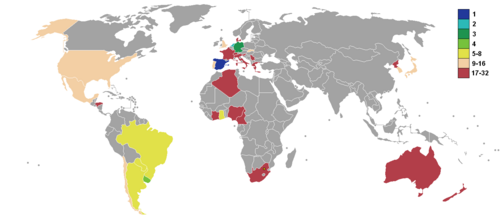
Shortly after the final, FIFA issued a final ranking of every team in the tournament. The ranking was based on progress in the competition, overall results and quality of the opposition. All 32 teams are ranked based on criteria which have been used by FIFA. The final ranking was as follows:[96]
Awards
Main awards
- Golden Boot: Thomas Müller[98]
- Golden Glove: Iker Casillas[4]
- Best Young Player: Thomas Müller[3]
- FIFA Fair Play Trophy: Spain[5]
All-Star Team
FIFA released an All-Star Team based on the Castrol performance index in its official website.[99]
Dream Team
For the first time, FIFA published a Dream Team decided by an online public vote. People were invited to select a team (in a 4–4–2 formation) and best coach; voting was open until 23:59 on 11 July 2010,[100] with entrants going into a draw to win a prize.
Six of the eleven players came from the Spanish team, as did the coach. The remainder of the team comprised two players from Germany, and one each from Brazil, the Netherlands and Uruguay.[101][102]
Marketing

Sponsorship
The sponsors of the 2010 World Cup are divided into three categories: FIFA Partners, FIFA World Cup Sponsors and National Supporters.[103][104][105][106]
Vuvuzelas

The 2010 finals amplified international public awareness of the vuvuzela, a long horn blown by fans throughout matches.[133][134][135][136] Many World Cup competitors complained about the noise caused by the vuvuzela horns, including France's Patrice Evra, who blamed the horns for the team's poor performance.[137] Other critics include Lionel Messi, who complained that the sound of the vuvuzelas hampered communication among players on the pitch,[138] and broadcasting companies, which complained that commentators' voices were drowned out by the sound.[139]
Others watching on television complained that the ambient audio feed from the stadium contained only the sounds of the vuvuzelas with the usual sounds of people in the stands drowned out.[140][141] A spokesperson for ESPN and other networks said that they were taking steps to minimise the ambient noise on their broadcasts.[142] The BBC also investigated the possibility of offering broadcasts without vuvuzela noise.[143]
Symbols
Mascot
The official mascot for the 2010 World Cup was Zakumi, an anthropomorphised African leopard with green hair, presented on 22 September 2008. His name came from "ZA" (the international abbreviation for South Africa) and the term kumi, which means "ten" in various African languages.[144] The mascot's colours reflected those of the host nation's playing strip – yellow and green.
Match ball
The match ball for the 2010 World Cup, manufactured by Adidas, was named the Jabulani, which means "bringing joy to everyone" in Zulu. It was the 11th World Cup match ball made by the German sports equipment maker; it featured 11 colours, representing each player of a team on the pitch and the 11 official languages of South Africa.[145][146] A special match ball with gold panels, called the Jo'bulani, was used at the final in Johannesburg.
The ball was constructed using a new design, consisting of eight thermally bonded, three-dimensional panels. These were spherically moulded from ethylene-vinyl acetate (EVA) and thermoplastic polyurethanes (TPU). The surface of the ball was textured with grooves, a technology developed by Adidas called GripnGroove[147] that was intended to improve the ball's aerodynamics. The design received considerable academic input, being developed in partnership with researchers from Loughborough University, United Kingdom.[148] The balls were made in China, using latex bladders made in India, thermoplastic polyurethane-elastomer from Taiwan, ethylene vinyl acetate, isotropic polyester/cotton fabric, and glue and ink from China.[149]
Some football stars complained about the new ball, arguing that its movements were difficult to predict.[150] Brazilian goalkeeper Júlio César compared it to a "supermarket" ball that favored strikers and worked against goalkeepers.[151] Argentinian coach Diego Maradona said: "We won't see any long passes in this World Cup because the ball doesn't fly straight."[152] However, a number of Adidas-sponsored[153][154][155] players responded favourably to the ball.
Music
The official song of the 2010 World Cup "Waka Waka (This Time for Africa)", was performed by the Colombian singer Shakira and the band Freshlyground from South Africa, and is sung in both English and Spanish.[156] The song is based on a traditional African soldiers' song, "Zangalewa".[157] Shakira and Freshlyground performed the song at the pre-tournament concert in Soweto on 10 June. It was also sung at the opening ceremony on 11 June and at the closing ceremony on 11 July.
The official mascot song of the 2010 World Cup was "Game On".
The official anthem of the 2010 World Cup was "Sign of a Victory" by R. Kelly with the Soweto Spiritual Singers, which was also performed at the opening ceremony.
Event effects

Social
Tournament organiser Danny Jordaan dismissed concerns that the attack on the Togo national team which took place in Angola in January 2010 had any relevance to the security arrangements for the World Cup.[158] There were also reports of thefts against visitors to the country for the World Cup. Tourists from China, Portugal, Spain, South Korea, Japan and Colombia had become victims of crime.[159] On 19 June after the match between England and Algeria, a fan was able to break through the FIFA-appointed security staff at Green Point stadium and gain access to the England team dressing room. The breach took place shortly after Prince William and Prince Harry had left the room. The trespasser was then released before he could be handed over to the Police. The Football Association lodged a formal complaint with FIFA and demanded that security be increased.[160]
Resettlement and eviction
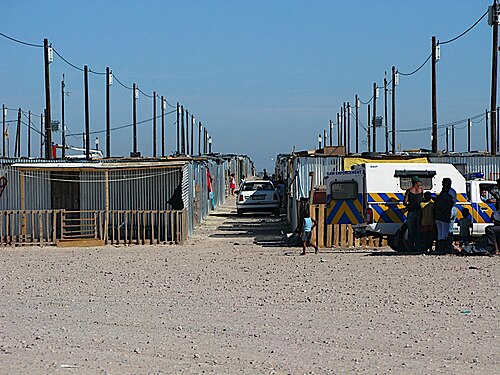
As with many "hallmark events" throughout the world,[161] the 2010 FIFA World Cup has been connected to evictions,[162][163][164][165][166] which many claim are meant to 'beautify the city', impress visiting tourists, and hide shackdwellers. On 14 May 2009, the Durban-based shack-dwellers' movement Abahlali baseMjondolo took the KwaZulu-Natal government to court over their controversial Elimination and Prevention of Re-Emergence of Slums Act, meant to eliminate slums in South Africa and put homeless shackdwellers in transit camps in time for the 2010 World Cup.[167][168]
Another prominent controversy surrounding preparations for the World Cup was the N2 Gateway housing project in Cape Town, which planned to remove over 20,000 residents from the Joe Slovo Informal Settlement along the busy N2 Freeway and build rental flats and bond-houses in its place in time for the 2010 World Cup.[169] NGOs, international human rights organisations, and the Anti-Eviction Campaign have publicly criticised the conditions in Blikkiesdorp and said that the camp has been used to accommodate poor families evicted to make way for the 2010 World Cup.[166][170][171][172]
However some have argued that evictions are ordinarily common in South Africa and that in the lead up to the tournament many evictions were erroneously ascribed to the World Cup.[173]
Economy
Some groups experienced complications in regards to scheduled sporting events, advertising, or broadcasting, as FIFA attempted to maximise control of media rights during the Cup. Affected parties included an international rugby union Test match, a South African airline and some TV networks, all of whom were involved in various legal struggles with World Cup organisers.[174][175][176]
During the tournament, group ticket-holders who did not utilise all their allotted tickets led to some early-round matches having as many as 11,000 unoccupied seats.[177]
While the event did help to boost the image of South Africa, it turned out to be a major financial disappointment.[178] Construction costs for venues and infrastructure amounted to £3 billion (€3.6 billion), and the government expected that increased tourism would help to offset these costs to the amount of £570 million (€680 million). However, only £323 million (€385 million) were actually taken in as 309,000 foreign fans came to South Africa, well below the expected number of 450,000.[178]
Local vendors were prohibited from selling food and merchandise within a 1.5 kilometre radius of any stadium hosting a World Cup match. For a vendor to operate within the radius, a registration fee of R60,000 (approximately US$7,888 or €6,200) had to be paid to FIFA. This fee was out of most local vendors' reach, as they are simple one-man-operated vendors. This prevented international visitors from experiencing local South African food. Some local vendors felt cheated out of an opportunity for financial gain and spreading South African culture in favour of multinational corporations.[179]
FIFA president Sepp Blatter declared the event "a huge financial success for everybody, for Africa, for South Africa and for FIFA," with revenue to FIFA of £2.24 billion (€2 billion).[180]
Quality
In a December 2010 Quality Progress, FIFA President Blatter rated South Africa's organisational efforts a nine out of 10 scale, declaring that South Africa could be considered a plan B for all future competitions. The South African Quality Institute (SAQI) assisted in facility construction, event promotion, and organisations. The main issue listed in the article was lack of sufficient public transportation.[181]
Media
Broadcasting

The 2010 FIFA World Cup was expected to be the most-watched television event in history.[182] Hundreds of broadcasters, representing about 70 countries, transmitted the Cup to a TV audience that FIFA officials expect to exceed a cumulative 26 billion people, an average of approximately 400 million viewers per match. FIFA estimated that around 700 million viewers would watch the World Cup final.[183]
New forms of digital media have also allowed viewers to watch coverage through alternative means. "With games airing live on cell phones and computers, the World Cup will get more online coverage than any major sporting event yet," said Jake Coyle of the Associated Press.[184]
In the United States, ABC, ESPN, and ESPN2 averaged a 2.1 rating, 2,288,000 households and 3,261,000 viewers for the 64 World Cup games. The rating was up 31 percent from a 1.6 in 2006, while households increased 32 percent from 1,735,000 and viewers rose from 2,316,000. The increases had been higher while the US remained in the tournament. Through the first 50 games, the rating was up 48 percent, households increased 54 percent and viewers rose 60 percent. Univision averaged 2,624,000 viewers for the tournament, up 17 percent, and 1,625,000 households, an increase of 11 percent.[185] An executive of the Nielsen Company, a leading audience research firm in the US, described the aggregate numbers for both networks' coverage of the match between the United States and Ghana as "phenomenal".[186] Live World Cup streaming on ESPN3.com pulled in some of the largest audiences in history, as 7.4 million unique viewers tuned in for matches. In total, ESPN3.com generated 942 million minutes of viewing or more than two hours per unique viewer. All 64 live matches were viewed by an average of 114,000 persons per minute. Most impressive were the numbers for the semi-final between Spain and Germany, which was viewed by 355,000 people per minute, making it ESPN3.com's largest average audience ever.[187]
Filming
Sony technology was used to film the tournament. 25 of the matches were captured using 3D cameras.[188] Footage was captured in 3D through Sony's proprietary multi-image MPE-200 processors, housed in specially designed 3D outside broadcast trucks.[189] It supplied its flagship HDC-1500 cameras as well as its new HDC-P1 unit, a compact, point-of-view (POV)-type camera with 3, 2/3-inch CCD sensors.[190] The 3D games were produced for FIFA by Host Broadcast Services.[191]
Video games
In PlayStation Home, Sony released a virtual space based on the 2010 FIFA World Cup in the Japanese version of Home on 3 December 2009. This virtual space is called the "FevaArena" and is a virtual stadium of the 2010 FIFA World Cup, featuring different areas for events, a FIFA mini-game, and a shop with FIFA related content.[192]
On 27 April 2010, EA Sports released the official 2010 World Cup video game.[193]
FIFA Fan Fest
FIFA expanded the FIFA Fan Fest, hosting in Sydney, Buenos Aires, Berlin, Paris, Rome, Rio de Janeiro, and Mexico City, as well as several venues around South Africa.[194] The Durban Fan Fest was the most popular in South Africa during the tournament followed by the Cape Town Fan Fest.[195]
See also

- July 2010 Kampala attacks, a series of terrorist bombings in Kampala, Uganda, timed to coincide with the final match
- Listen Up! The Official 2010 FIFA World Cup Album
- Paul the Octopus and Mani the parakeet, animals who predicted results of the matches
References
- ^ "Players – Top goals". FIFA.com. Fédération Internationale de Football Association. Archived from the original on 9 May 2014. Retrieved 6 July 2012.
- ^ "Adidas Golden Ball". FIFA.com. Fédération Internationale de Football Association. Archived from the original on 27 April 2015. Retrieved 6 July 2012.
- ^ a b "Hyundai Best Young Player". FIFA.com. Fédération Internationale de Football Association. Archived from the original on 27 April 2015. Retrieved 6 July 2012.
- ^ a b "Adidas Golden Glove". FIFA.com. Fédération Internationale de Football Association. Archived from the original on 30 March 2015. Retrieved 6 July 2012.
- ^ a b "Awards". FIFA.com. Fédération Internationale de Football Association. Archived from the original on 20 December 2013. Retrieved 6 July 2012.
- ^ "South Africa Is Named Host of 2010 World Cup". The New York Times. 13 May 2018. Archived from the original on 11 June 2020. Retrieved 13 May 2018.
- ^ "South Africa 2010 Stadiums". Sa-venues.com. Archived from the original on 6 December 2017. Retrieved 5 December 2017.
- ^ Smith, David (11 July 2010). "Nelson Mandela gives World Cup a dream finale with a wave and a smile". The Guardian. ISSN 0261-3077. Archived from the original on 25 May 2021. Retrieved 5 December 2017.
- ^ "Soccer City Stadium, Johannesburg: World Cup 2010 stadium guide". Daily Telegraph. 19 November 2009. ISSN 0307-1235. Archived from the original on 10 January 2022. Retrieved 5 December 2017.
- ^ FIFA.com (11 July 2010). "South Africa 2010: 32 teams, 32 stories". FIFA.com. Archived from the original on 29 October 2015. Retrieved 5 December 2017.
- ^ "FIFA end World Cup Rotation". Mail & Guardian Online. 29 October 2007. Archived from the original on 20 July 2010. Retrieved 20 June 2010.
- ^ "Host nation of 2010 FIFA World Cup – South Africa". FIFA. 15 May 2004. Retrieved 8 January 2006.[dead link]
- ^ "Nelson Mandela: How sport helped to transform a nation" Archived 4 January 2015 at the Wayback Machine. BBC. Retrieved 6 December 2013
- ^ "Blatter presents Mandela with a special FIFA World Cup Trophy" Archived 2 April 2015 at the Wayback Machine. FIFA.com. Retrieved 5 December 2013
- ^ a b Harding, Luke (12 June 2006). "Doubt over South Africa 2010". The Guardian. London. Archived from the original on 10 April 2008. Retrieved 29 August 2006.
- ^ Craig, Jermaine (3 July 2006). "Fifa denies SA may lose 2010 World Cup". The Star. Archived from the original on 27 August 2006. Retrieved 30 August 2006.
- ^ "Beckenbauer issues 2010 warning". BBC Sport. 20 September 2006. Archived from the original on 29 November 2018. Retrieved 19 October 2006.
- ^ Yoong, Sean (8 May 2007). "FIFA says South Africa 'definitely' will host 2010 World Cup". Associated Press. Archived from the original on 26 June 2008. Retrieved 15 May 2007.
- ^ "South Africa is shaken by FIFA corruption probe", Los Angeles Times, 28 May 2015.
- ^ Vicki Hodges, Giles Mole, JJ Bull, Luke Brown and Rob Crilly, "Fifa whistleblower Chuck Blazer – bribes accepted for 1998 and 2010 World Cups: as it happened", The Telegraph, 3 June 2015 Archived 15 January 2016 at the Wayback Machine. Retrieved 4 June 2015
- ^ Owen Gibson, Paul Lewis, "Fifa informant Chuck Blazer: I took bribes over 1998 and 2010 World Cups", The Guardian, 3 June 2015 Archived 11 April 2016 at the Wayback Machine. Retrieved 4 June 2015
- ^ "Fifa in crisis: 'Morocco won 2010 World Cup vote – not South Africa'". The Telegraph. London. 6 June 2015. Archived from the original on 10 January 2022. Retrieved 7 June 2015.
- ^ "FIFA statement on FAI request". FIFA. 20 November 2009. Archived from the original on 23 November 2009. Retrieved 20 November 2009.
- ^ "Blatter apologises over comments". Press Association. 2 December 2009. Archived from the original on 6 December 2009. Retrieved 3 December 2009.
- ^ "FAI tries to set record straight". The Irish Times. 2 December 2009. Archived from the original on 28 April 2011. Retrieved 3 December 2009.
- ^ "FIFA reject extra referees proposal". Press Association. 2 December 2009. Archived from the original on 12 January 2020. Retrieved 3 December 2009.
- ^ Harris, Nick (1 December 2009). "Blatter: we need goal line officials at World Cup President urges change as Fifa considers Ireland's appeal to be '33rd nation' at finals". The Independent. London. Archived from the original on 5 December 2009. Retrieved 5 January 2010.
- ^ "Fifa to investigate Thierry Henry handball". BBC Sport. 2 December 2009. Archived from the original on 3 December 2009. Retrieved 3 December 2009.
- ^ Rankings shown are those in May 2010, but the rankings used for selecting the seven non-host seeds were those of October 2009 FIFA
- ^ "SA faces R8.4bn stadium bill". News24. 1 October 2006. Archived from the original on 29 October 2006. Retrieved 13 October 2006.
- ^ "Joburg pursues bus rapid transit system in bid to ease gridlock by 2010". Engineering News. Creamer Media. 2 November 2007. Archived from the original on 2 November 2007. Retrieved 2 November 2008.
- ^ "SA 2010 venues 'ready by October'". BBC Sport. 26 March 2009. Archived from the original on 6 August 2010. Retrieved 26 March 2009.
- ^ "2010 FIFA World Cup South Africa Special Measures Act, 2006" (PDF). Republic of South Africa, Minister of Sport and Recreation – Online Government Gazette No. 28593. 10 March 2006. Archived from the original (PDF) on 3 November 2006. Retrieved 13 October 2006.
- ^ "Additional Aviation Coordination and Security measures during the 2010 World Cup" (PDF). South African Civil Aviation Authority. 7 May 2009. Archived from the original (PDF) on 24 October 2009. Retrieved 24 December 2009.
- ^ "SA marks 100 days to World Cup". Africa Review. 2 March 2010. Archived from the original on 15 July 2010. Retrieved 14 March 2010.
- ^ BBC and SABC report 70,000 while the AP, quoting the South African Federation of Civil Engineering Contractors, says 11,000
- ^ "World Cup construction workers strike in SAfrica". ESPN Soccernet. Associated Press. 8 July 2009. Archived from the original on 2 November 2012. Retrieved 8 July 2009.
- ^ "NUM members working on 2010 stadiums ready for massive strike action". SABC News. SABC. 7 July 2009. Archived from the original on 1 September 2010. Retrieved 8 July 2009.
- ^ "S Africa strike hits stadium work". BBC News. 8 July 2009. Archived from the original on 9 July 2009. Retrieved 8 July 2009.
- ^ "2010 construction strike ends". Sapa. South African Government. 15 July 2009. Archived from the original on 8 October 2011. Retrieved 1 December 2011.
- ^ a b "FIFA Executive Committee holds historic meeting in Robben Island". FIFA.com. FIFA. 3 December 2009. Archived from the original on 29 March 2013. Retrieved 11 August 2012.
- ^ a b c d e f g 1634–1699: McCusker, J. J. (1997). How Much Is That in Real Money? A Historical Price Index for Use as a Deflator of Money Values in the Economy of the United States: Addenda et Corrigenda (PDF). American Antiquarian Society. 1700–1799: McCusker, J. J. (1992). How Much Is That in Real Money? A Historical Price Index for Use as a Deflator of Money Values in the Economy of the United States (PDF). American Antiquarian Society. 1800–present: Federal Reserve Bank of Minneapolis. "Consumer Price Index (estimate) 1800–". Retrieved 29 February 2024.
- ^ "Fifa are adding insult to injury". The Journal. 1 March 2007. Archived from the original on 1 September 2010. Retrieved 3 July 2009.
- ^ "G14 starts legal fight with Fifa". BBC Sport. British Broadcasting Corporation. 6 September 2005. Archived from the original on 18 November 2006. Retrieved 31 December 2009.
- ^ "G-14 football group is disbanded". BBC Sport. British Broadcasting Corporation. 15 February 2008. Archived from the original on 18 February 2008. Retrieved 31 December 2009.
- ^ "2010 Soccer World Cup Fan Parks & 2010 Host Cities". Google Earth Community. 29 October 2007. Archived from the original on 2 June 2008. Retrieved 1 December 2011.
- ^ "Altitude will have impact on World Cup ball". NBC News. 4 December 2009. Archived from the original on 14 August 2020. Retrieved 13 June 2010.
- ^ "Altitude training and physical performance for high altitude football". Altitude.org. Archived from the original on 15 July 2010. Retrieved 29 June 2010.
- ^ Jackson, Jamie (7 June 2010). "World Cup 2010: England's altitude training will be tested against USA". The Guardian. London. Archived from the original on 10 June 2010. Retrieved 13 June 2010.
- ^ Edwards, Piers (23 February 2010). "Fifa medical chief downplays World Cup altitude effect". BBC Sport. BBC. Archived from the original on 13 April 2020. Retrieved 13 June 2010.
- ^ "Quick guide to the ten World Cup grounds". Racing Post. Archived from the original on 13 May 2011. Retrieved 13 June 2010.
- ^ "And the city to avoid..." Soccer America. 3 September 2009. Archived from the original on 1 June 2010. Retrieved 13 June 2010.
- ^ "Soccer City Stadium – Johannesburg". FIFA.com. FIFA. Archived from the original on 17 June 2007. Retrieved 1 December 2011.
- ^ a b c d e f "Venues". City of Johannesburg. Archived from the original on 4 August 2009. Retrieved 8 March 2010.
- ^ "Training Venues". Nelson Mandela Bay Municipality. Archived from the original on 13 April 2010. Retrieved 19 March 2010.
- ^ a b c "2010 FIFA World Cup Programme Office". City of Tshwane. Archived from the original on 20 October 2008. Retrieved 5 March 2010.
- ^ "Highlights 2010". South Africa 2010 FIFA World Cup. Archived from the original on 24 March 2010. Retrieved 5 March 2010.
- ^ "32 teams, 32 World Cup base camps". southafrica.info. Archived from the original on 13 August 2014.
- ^ "Base Camps FIFA 2010 Soccer World Cup - Base Camps Teams FIFA 2010". Archived from the original on 26 June 2014. Retrieved 6 May 2020.
- ^ "2010 FIFA World Cup South Africa Final Draw Procedure" (PDF). FIFA. 2009. Archived from the original (PDF) on 28 December 2009. Retrieved 4 December 2009.
- ^ "Cape Town to host 2010 final draw". City of Cape Town. 29 May 2008. Archived from the original on 20 November 2008. Retrieved 6 February 2009.
- ^ "Theron, Beckham and Gebrselassie to star at the Final Draw on 4 December". FIFA.com. FIFA. 2 December 2009. Archived from the original on 27 April 2015. Retrieved 15 June 2011.
- ^ "Draw ignites FIFA World Cup fever". FIFA.com. FIFA. 4 December 2009. Archived from the original on 27 April 2015. Retrieved 4 December 2009.
- ^ "Referees". FIFA.com. Fédération Internationale de Football Association. Archived from the original on 10 February 2010. Retrieved 11 February 2010.
- ^ "Englishman Howard Webb to referee final". BBC Sport. 9 July 2010. Archived from the original on 8 July 2010. Retrieved 9 July 2010.
- ^ FIFA. "2010 FIFA World Cup Regulations" (PDF). UEFA. Archived (PDF) from the original on 10 September 2008. Retrieved 1 December 2011.
- ^ "Where the players are based". The Global Herald. 8 June 2010. Archived from the original on 8 October 2011. Retrieved 1 December 2011.
- ^ a b c d e f "South Africa 2010 in numbers". FIFA.com. FIFA. 13 July 2010. Archived from the original on 16 July 2010. Retrieved 18 July 2010.
- ^ "2010 FIFA World Cup South Africa – Matches". FIFA. Archived from the original on 5 December 2010. Retrieved 25 December 2015.
- ^ "About the Concert". FIFA. Archived from the original on 25 December 2015. Retrieved 25 December 2015.
- ^ "World Cup set for colourful opening". FIFA. 9 June 2010. Archived from the original on 19 June 2015. Retrieved 25 December 2015.
- ^ a b "Shakira To Headline World Cup Closing Ceremony". Billboard. 7 July 2010. Archived from the original on 4 January 2016. Retrieved 25 December 2015.
- ^ "South Africa in world football spotlight from 22 to 25 November". FIFA. 13 November 2007. Archived from the original on 24 July 2020. Retrieved 17 January 2020.
- ^ "Official match schedule". FIFA.com. Fédération Internationale de Football Association. November 2007. Archived from the original on 25 November 2007. Retrieved 17 January 2020.
- ^ "Milla Disappointed With Africa". Soccer365.com. 9 July 2010. Archived from the original on 27 April 2011. Retrieved 1 December 2011.
- ^ Krishnan, Joe (18 June 2014). "World Cup 2014: Spain and the World Cup holders who crashed out at the group stage". The Independent. London. Archived from the original on 24 June 2014. Retrieved 18 April 2015.
- ^ "Fifa World Cup South Africa 2010 Regulations" (PDF). FIFA.com (Press release). Fédération Internationale de Football Association. July 2007. p. 41. Archived from the original (PDF) on 26 September 2007. Retrieved 1 December 2011.
The ranking of each team in each group will be determined as follows:...
- ^ a b c d e f g h i j k l "2010 FIFA World Cup South Africa Match Appointments" (PDF). FIFA.com. Fédération Internationale de Football Association. 24 June 2010. Archived from the original (PDF) on 5 July 2010. Retrieved 25 June 2010.
- ^ a b c d e f g h i j k "Referee designations for matches 1-16" (PDF). FIFA.com. Fédération Internationale de Football Association. 5 June 2010. Archived from the original (PDF) on 5 July 2010. Retrieved 5 June 2010.
- ^ a b c d e f "Referee designations for matches 17-24" (PDF). FIFA.com. Fédération Internationale de Football Association. 14 June 2010. Archived from the original (PDF) on 4 July 2010. Retrieved 15 June 2010.
- ^ "Algeria-Slovenia gets substitute ref". ESPNsoccernet.com. Associated Press. 8 June 2010. Archived from the original on 29 June 2011. Retrieved 9 June 2010.
- ^ "Regulations 2010 FIFA World Cup South Africa" (PDF). FIFA. 2010. Archived from the original (PDF) on 1 June 2010. Retrieved 1 December 2011.
- ^ "England's World Cup exit dominates papers". BBC News. 28 June 2010. Archived from the original on 17 April 2023. Retrieved 1 December 2011.
- ^ Jones, Grahame L. (27 June 2010). "There's no disputing that England deserved its loss to Germany". Los Angeles Times. Archived from the original on 17 April 2023. Retrieved 1 December 2011.
- ^ a b c "World Cup 2010: Blatter apologises for disallowed goal". BBC Sport. 29 June 2010. Archived from the original on 29 June 2010. Retrieved 29 June 2010.
- ^ In the 1962, 1970, 1994, and 2002 World Cups, Brazil finished as undefeated champions. In the 1978 competition, Brazil was eliminated by Argentina on goal difference without losing a match. In the 1986 competition, Brazil was eliminated in a penalty shoot-out with France, without having lost a match.
- ^ a b "Referee designations: matches 63 – 64". FIFA.com. FIFA. 8 July 2010. Archived from the original on 11 July 2010. Retrieved 8 July 2010.
- ^ a b "Roja, Oranje provide numbers aplenty". FIFA.com. FIFA. 12 July 2010. Archived from the original on 15 July 2010. Retrieved 18 July 2010.
- ^ Brazil won their first World Cup in Sweden. England, Argentina, and France each won it for the first time on home soil – "Previous FIFA World Cups". FIFA. Archived from the original on 18 December 2013. Retrieved 1 December 2011.
- ^ a b c Fletcher, Paul (11 July 2010). "Netherlands 0–1 Spain (aet)". BBC Sport. British Broadcasting Corporation. Archived from the original on 10 August 2017. Retrieved 20 February 2014.
- ^ "Spain beat Holland 1–0 to win World Cup". AFP. 11 July 2010. Archived from the original on 14 July 2010. Retrieved 11 July 2010.
- ^ "Mandela attends World Cup closing ceremony". BBC News. British Broadcasting Corporation. 11 July 2010. Archived from the original on 11 July 2010. Retrieved 11 July 2010.
- ^ "Higuain's hat-trick sinks South Koreans". FIFA.com. Archived from the original on 15 May 2010. Retrieved 10 October 2018.
- ^ "World Cup 1938 – Italy Defend Their Title". Planet World Cup. Archived from the original on 13 March 2014. Retrieved 20 February 2014.
- ^ "Golden Boot". FIFA. 11 July 2010. Archived from the original on 15 June 2010. Retrieved 11 July 2010.
- ^ "England slip to worst Cup ranking". BBC News. 13 July 2010. Archived from the original on 16 June 2018. Retrieved 1 December 2011.
- ^ Agencies (11 July 2010). "World Cup 2010: Diego Forlán voted best player". the Guardian. Archived from the original on 2 February 2023. Retrieved 2 February 2023.
- ^ "Golden Boot". FIFA.com. Fédération Internationale de Football Association. Retrieved 6 July 2012.[dead link]
- ^ "2010 FIFA World Cup South Africa statistics". FIFA. Archived from the original on 11 February 2011. Retrieved 2 September 2020.
- ^ "Dream Team Game – Rules". FIFA.com. FIFA. Archived from the original on 7 July 2010. Retrieved 15 July 2010.
- ^ "Spaniards dominate All-Star Team". FIFA.com. FIFA. 15 July 2010. Archived from the original on 18 July 2010. Retrieved 15 July 2010.
- ^ "Dream Team Game – Winners". FIFA.com. FIFA. Archived from the original on 7 July 2010. Retrieved 15 July 2010.
- ^ "The Official FIFA World Cup Partners & Sponsors since 1982" (PDF). Resources.fifa.com. Archived from the original (PDF) on 18 February 2018. Retrieved 9 July 2018.
- ^ "Spanish brilliance outshines Netherlands in Final". YouTube. 11 July 2012. Archived from the original on 13 April 2013.
- ^ "FIFA Sponsorship : A programme overview" (PDF). Brandsouthafrica.com. Archived from the original (PDF) on 10 July 2018. Retrieved 9 July 2018.
- ^ "2010 FIFA World Cup". Archived from the original on 15 August 2016. Retrieved 9 July 2018.
- ^ "Adidas extends World Cup sponsorship in $350m deal". Campaignlive.co.uk. Archived from the original on 10 July 2018. Retrieved 9 July 2018.
- ^ "Adidas extends World Cup soccer sponsorship until 2030". Reuters.com. 21 November 2013. Archived from the original on 10 July 2018. Retrieved 9 July 2018.
- ^ "Coca-Cola set for 2010 World Cup 'celebration'". Campaignlive.co.uk. Archived from the original on 10 July 2018. Retrieved 9 July 2018.
- ^ "Timeline: History of Coca-Cola and the FIFA World Cup". Coca-colacompany.com. Archived from the original on 10 July 2018. Retrieved 9 July 2018.
- ^ "Emirates Airlines signs up as sixth Fifa partner". Campaignlive.co.uk. Archived from the original on 10 July 2018. Retrieved 9 July 2018.
- ^ "Hyundai at FIFA World Cup 2010 – The Inspiration Room". Theinspirationroom.com. 18 June 2010. Archived from the original on 10 July 2018. Retrieved 9 July 2018.
- ^ "New Fifa sponsorship keeps Hyundai in the family". Sportspromedia.com. 24 November 2010. Archived from the original on 20 April 2021. Retrieved 9 July 2018.
- ^ "Sony Corp. signs its first global sponsorship deal as FIFA Partner from 2007–2014". FIFA.com. 6 April 2005. Archived from the original on 10 July 2018.
- ^ "Visa extends World Cup sponsorship to 2022". Reuters.com. 14 January 2014. Archived from the original on 10 July 2018. Retrieved 9 July 2018.
- ^ "Budweiser Sponsorship of 2010 FIFA World Cup South Africa to Unite Soccer Fans Worldwide". Newswire.ca. Archived from the original on 10 July 2018. Retrieved 10 January 2019.
- ^ "Continental FIFA World Cup sponsor until 2010". Bizcommunity.com. Archived from the original on 10 July 2018. Retrieved 9 July 2018.
- ^ "Castrol joins forces with FIFA World Cup until 2014". FIFA.com. 30 June 2008. Archived from the original on 6 March 2016.
- ^ "2018 FIFA World Cup Russia – News – Continental signs up again as FIFA World Cup Sponsor until 2010". FIFA.com. Archived from the original on 10 July 2018. Retrieved 9 July 2018.
- ^ "Castrol to become FIFA World Cup sponsor". Campaignlive.co.uk. Archived from the original on 10 July 2018. Retrieved 9 July 2018.
- ^ "2018 FIFA World Cup Russia – News – Satyam signs up as first Indian FIFA World Cup Sponsor". FIFA.com. Archived from the original on 10 July 2018. Retrieved 9 July 2018.
- ^ "Satyam to be FIFA World Cup's sponsor". The Hindu. 25 November 2007. Archived from the original on 24 July 2020. Retrieved 9 July 2018.
- ^ "2018 FIFA World Cup Russia – News – McDonald's renews as FIFA World Cup Sponsor until 2014". FIFA.com. Archived from the original on 23 November 2020. Retrieved 9 July 2018.
- ^ "2018 FIFA World Cup Russia – News – MTN signs global deal as first African FIFA World Cup Sponsor until 2010". FIFA.com. Archived from the original on 10 July 2018. Retrieved 9 July 2018.
- ^ "2018 FIFA World Cup Russia – News – Global food supplier Seara signs up as final FIFA World Cup Sponsor". FIFA.com. Archived from the original on 10 July 2018.
- ^ "FIFA signs first Chinese company as World Cup sponsor". Campaignlive.co.uk. Archived from the original on 10 July 2018. Retrieved 9 July 2018.
- ^ "China's Yingli Green Energy Will Shine At 2010 FIFA World Cup". Businessinsider.com. Archived from the original on 10 July 2018. Retrieved 9 July 2018.
- ^ "BP expands biggest sponsorship deal in its history". Sportspromedia.com. 16 June 2009. Archived from the original on 20 April 2021. Retrieved 9 July 2018.
- ^ "Shanduka-Aggreko Announced as Final National Supporter of the 2010 FIFA World Cup – Power Technology". Power-technology.com. Archived from the original on 10 July 2018. Retrieved 9 July 2018.
- ^ "2018 FIFA World Cup Russia – News – South Africa's First National Bank becomes first National Supporter". FIFA.com. Archived from the original on 10 July 2018. Retrieved 9 July 2018.
- ^ "Charting 2010 FIFA World Cup adspend growth". Bizcommunity.com. Archived from the original on 10 July 2018. Retrieved 9 July 2018.
- ^ "Telkom to provide telecoms infrastructure for 2010 FIFA World Cup". Mybroadband.co.za. Archived from the original on 10 July 2018. Retrieved 9 July 2018.
- ^ "15 Seconds of Vuvuzela" (Video). Archived from the original on 19 December 2011. Retrieved 1 December 2011. The Adult Swim cable network is among the highest rated in the US among adults 18–34.
- ^ Kincaid, Jason (23 June 2010). "BZZZZZZ: YouTube Gets A Vuvuzela Button (Seriously)". TechCrunch. Archived from the original on 13 January 2012. Retrieved 1 December 2011.
- ^ "Annoying World Cup horn comes to iPhone". CNET News. Archived from the original on 27 April 2011. Retrieved 16 June 2010.
- ^ "Furor por las vuvuzelas: ya hay un millón de descargas para celulares". Vanguardia. 16 June 2010. Archived from the original on 27 April 2011. Retrieved 16 June 2010.
- ^ "World Cup 2010: South Africa ponders vuvuzela ban". BBC Sport. 13 June 2010. Archived from the original on 14 June 2010. Retrieved 13 June 2010.
- ^ DPA (13 June 2010). "It is impossible to communicate, it's like being deaf: Messi". The Hindu. India. Archived from the original on 15 June 2010. Retrieved 13 June 2010.
- ^ AFP (14 June 2010). "World Cup organiser mulls vuvuzela ban". Archived from the original on 17 June 2010. Retrieved 18 June 2010.
- ^ Valenti, Elio (13 June 2010). "Buzz off, vuvuzelas!". New York Post. Archived from the original on 4 November 2012. Retrieved 1 December 2011.
- ^ Van Buskirk, Eliot (18 June 2010). "Should World Cup Broadcasters Mute Vuvuzela Horns?". Wired. Condé Nast Digital. Archived from the original on 21 June 2010. Retrieved 22 June 2010.
- ^ "Organizers consider silencing vuvuzelas". ESPN Soccernet. 14 June 2010. Archived from the original on 16 June 2010. Retrieved 14 June 2010.
- ^ Gibson, Owen; Morris, Steven (14 June 2010). "World Cup 2010: BBC may offer vuvuzela-free matches". The Guardian. London. Archived from the original on 16 October 2021. Retrieved 16 June 2010.
- ^ "Leopard takes World Cup spotlight". BBC Sport. 22 September 2008. Archived from the original on 23 September 2008. Retrieved 23 September 2008.
- ^ Bell, Jack (4 December 2009). "Meet Jabulani: 2010 World Cup Match Ball". The New York Times. Archived from the original on 5 December 2009. Retrieved 4 December 2009.
- ^ "2010 World Cup Jabulani Adidas ball". Shine2010. 4 December 2009. Archived from the original on 7 December 2009. Retrieved 6 December 2009.
- ^ "Jabulani Official World Cup Ball Review". Soccer Cleats 101. 13 January 2010. Archived from the original on 16 January 2010. Retrieved 12 January 2010.
- ^ "adidas Jabulani Official Match Ball of the 2010 FIFA World Cup". Archived from the original on 20 January 2010. Retrieved 29 January 2010.
- ^ "adidas unveils 'Jabulani' the Official Match Ball of the 2010 FIFA World CupTM". Dishtracking.com. 2009. Archived from the original on 18 August 2010. Retrieved 5 June 2010.
- ^ "Designer defends World Cup ball". ESPN Soccernet. 14 June 2010. Archived from the original on 17 June 2010. Retrieved 14 June 2010.
- ^ "Julio Cesar calls Jabulani 'supermarket ball'". The Soccer Room. 28 May 2010. Archived from the original on 21 June 2010. Retrieved 21 June 2010.
- ^ McDonell, David (25 June 2010). "Jabulani ball is reason Messi is struggling, says Maradona". Mirror Football. Archived from the original on 28 June 2010. Retrieved 1 December 2011.
- ^ "Players Dislike Adidas World Cup Ball". Soccer FanHouse. Archived from the original on 3 June 2010. Retrieved 17 June 2010.
- ^ "Adidas XI vs Nike XI: Which Brand Has the Best Football Team?". The Offside. Archived from the original on 9 October 2010. Retrieved 17 June 2010.
- ^ "Ricardo Kaka Endorsements". Ricardo Kaka. 26 October 2009. Archived from the original on 23 July 2010. Retrieved 21 June 2010.
- ^ "Shakira records official FIFA World Cup 2010 song". Shakira.com. 26 April 2010. Archived from the original on 30 April 2010. Retrieved 5 June 2010.
- ^ "Shakira, Waka waka (This time for Africa)". Musik Infos. Archived from the original on 9 July 2010. Retrieved 5 June 2010.
- ^ "World Cup boss Danny Jordaan allays security concerns". BBC Sport. 9 January 2010. Archived from the original on 28 August 2017. Retrieved 9 January 2010.
- ^ "Foreigners robbed in South Africa ahead of World Cup". Xinhua News. 11 June 2010. Archived from the original on 12 June 2010. Retrieved 13 June 2010.
- ^ Evans, Martin; Rayner, Gordon; Laing, Aislinn (19 June 2010). "World Cup 2010: Police hunt angry fan who entered England dressing room". The Daily Telegraph. London. Archived from the original on 20 June 2010. Retrieved 19 June 2010.
- ^ "Hallmark Events and Evictions". Worldpress. 7 February 2008. Archived from the original on 5 December 2018. Retrieved 1 December 2011.
- ^ Smith, David (12 June 2009). "World Cup 2010: Football brings defining moment for South Africa". The Guardian. UK. Archived from the original on 22 June 2012. Retrieved 5 June 2010.
- ^ Cowell, Alan (28 December 2009). "World Cup Whose Meaning Goes Beyond Soccer". The New York Times. Archived from the original on 8 July 2014. Retrieved 1 December 2011.
- ^ "'Economic cleansing' in BBC's World Cup backyard, Stewart Maclean". The Independent. UK. 22 March 2010. Archived from the original on 27 March 2019. Retrieved 5 June 2010.
- ^ Allie, Mohammed (2 June 2010). "South Africans fight eviction for World Cup car park". BBC News. Archived from the original on 24 June 2010. Retrieved 1 December 2011.
- ^ a b Worth, Christopher (4 June 2010). "Kicked Out for the Cup?". Newsweek. Archived from the original on 4 March 2016. Retrieved 1 December 2011.
- ^ "Shack Dwellers Fight Demolition in S. Africa Court". OneWorld.net. 15 May 2009. Archived from the original on 28 September 2011. Retrieved 1 December 2011.
- ^ "Pooh-slinging Slums Act showdown at Con Court". Mail & Guardian Online. 16 May 2009. Archived from the original on 15 June 2010. Retrieved 1 December 2011.
- ^ Newton, Caroline (10 February 2009). "The Reverse Side of the Medal: About the 2010 FIFA World Cup and the Beautification of the N2 in Cape Town". Urban Forum. 20. Springer Link: 93–108. doi:10.1007/s12132-009-9048-y. ISSN 1015-3802. S2CID 56043934.
- ^ Smith, David (1 April 2010). "Life in 'Tin Can Town' for the South Africans evicted ahead of World Cup". The Guardian. London. Archived from the original on 16 April 2010. Retrieved 23 April 2010.
- ^ "Centre on Housing Rights and Evictions ask City to reconsider Symphony Way's eviction to Blikkiesdorp". Pambazuka News. 8 October 2009. Archived from the original on 27 December 2011. Retrieved 1 December 2011.
- ^ Brooks, Courtney (3 December 2009). "Homeless S. Africans complain ahead of World Cup". Fox News. Associated Press. Archived from the original on 27 April 2011. Retrieved 25 June 2010.
- ^ Soccer World Cup will not boost South Africa's economy, Rukmini Shrinivasan, Times of India, 12 June 2010
- ^ "Boks' France Test moved?". SAPA. 30 November 2009. Archived from the original on 24 December 2012. Retrieved 19 March 2010.
- ^ "Kulula to continue with World Cup ad campaign". Mail & Guardian Online. 19 March 2010. Archived from the original on 22 March 2010. Retrieved 19 March 2010.
- ^ "Hear Us Roar: 2010 World Cup Broadcast Rights". REACH. Singapore: Ministry of Community Development, Youth and Sports, Government of Singapore. 6 May 2008. Archived from the original on 26 June 2010. Retrieved 12 May 2010.
- ^ Collett, Mike (15 June 2010). "Empty seats concern FIFA but attendances stay high". Reuters Africa. Archived from the original on 18 June 2010. Retrieved 1 December 2011.
- ^ a b Neate, Rupert (10 December 2010). "South Africa recoups just a tenth of the £3bn cost of staging World Cup 2010". The Daily Telegraph. UK. Archived from the original on 23 January 2011. Retrieved 11 December 2010.
- ^ "Corporate Social Responsibility in Asia" (PDF). Volume 6. 30 June 2010. Archived from the original (PDF) on 6 October 2011. Retrieved 16 November 2011.
- ^ De Luca, Max (4 March 2011). "Sepp Blatter: 2010 World Cup A Stunning Financial Success For South Africa & FIFA". Goal.com. Archived from the original on 1 May 2011. Retrieved 16 November 2011.
- ^ Harding, Paul. "Shining on the World Stage". Quality Progress. December 2010. pp. 56–61.
- ^ "Beaming 2010 to the world". FIFA.com. FIFA. 2 June 2010. Archived from the original on 5 June 2010. Retrieved 1 December 2011.
- ^ "700 million to watch World Cup Final". The Spy Report. Media Spy. 12 July 2010. Archived from the original on 15 July 2010. Retrieved 12 July 2010.
- ^ Coyle, Jake (9 June 2010). "World Cup coverage expands on the Web, cell phones". Associated Press. Archived from the original on 13 June 2010. Retrieved 1 December 2011.
- ^ "World Cup final sets ratings record". Associated Press. 12 July 2010. Archived from the original on 15 July 2010. Retrieved 12 July 2010.
- ^ Sandomir, Richard (29 June 2010). "World Cup Ratings Certify a TV Winner". The New York Times. Archived from the original on 1 May 2011. Retrieved 19 July 2010.
- ^ "World Cup 2010: ESPN3.com, ESPN Digital Draw in Massive Audiences". Sports Video Group. 15 July 2010. Archived from the original on 20 July 2010. Retrieved 19 July 2010.
- ^ "World Cup games to be filmed in 3D". BBC News. 3 December 2009. Archived from the original on 26 January 2019. Retrieved 5 June 2010.
- ^ Mistry, Bhavna (8 April 2010). "Sony providing HDC-1500 cameras for FIFA World Cup". AV Interactive. Archived from the original on 13 June 2010. Retrieved 5 June 2010.
- ^ "Sony Product Detail Page HDCP1". Sony. Archived from the original on 4 June 2010. Retrieved 11 July 2010.
- ^ "Sony Preps for World Cup 3D". Broadcasting & Cable. 22 March 2010. Archived from the original on 5 June 2010. Retrieved 5 June 2010.
- ^ "FevaArena (Fibaarina) entrance". Sony Computer Entertainment. Archived from the original on 18 April 2021. Retrieved 4 December 2009.
- ^ Ekberg, Brian (26 January 2010). "FIFA World Cup 2010 Q&A With Simon Humber – PlayStation 3 News at GameSpot". Gamespot UK. Retrieved 12 March 2010.[dead link]
- ^ "FIFA Fan Fest". FIFA. Archived from the original on 14 June 2010. Retrieved 15 June 2010.
- ^ Sikiti da Silva, Issa (5 June 2010). "FIFA Fan Fests: some facts and figures". Bizcommunity.com. Archived from the original on 3 October 2018. Retrieved 1 December 2011.
External links

Wikimedia Commons has media related to 2010 FIFA World Cup.

Wikiquote has quotations related to 2010 FIFA World Cup.

Wikivoyage has a travel guide for 2010 FIFA World Cup.
- 2010 FIFA World Cup Official Site (Archived)
- 2010 FIFA World Cup South Africa , FIFA.com
- The official 2010 host country website
- Official Technical Report
- RSSSF Archive of finals