Loading article…
ジョージ・フリードリヒ・ヘンデル | |
|---|---|
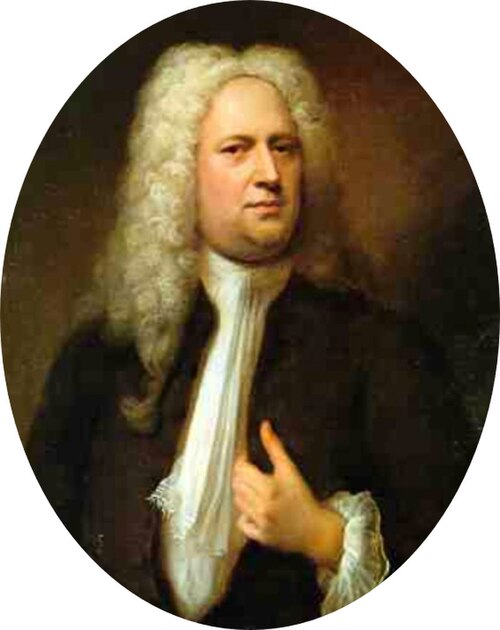
 ヘンデルの肖像画、1726-1728年 | |
| 生まれる | ゲオルク・フリードリヒ・ヘンデル 1685年3月5日[旧暦2月23日] |
| 死亡 | 1759年4月14日(74歳) ウェストミンスター、ミドルセックス、イングランド |
| 埋葬地 | ウェストミンスター寺院 |
| 作品 | 作品リスト |
| サイン | |
 | |
George Frideric (またはFrederick ) Handel ( / ˈ h æ n d əl / HAN -dəl ; [a]洗礼を受けたGeorg Fried [ e ] rich Händel、[b] ドイツ語: [ˈɡeːɔʁk ˈfʁiːdʁɪç ˈhɛndl̩] 、1685年2月23日 - 1759年4月14日)[3][c]は、ドイツ系イギリス人のバロック、オペラオラトリオ、賛美歌、協奏曲、オルガン協奏曲でよく知られているハレで教育を受けハンブルクで作曲家として活動した後、1712年にロンドンに定住し、そこでキャリアの大半を過ごし、1727年にイギリス国民となった。[5]彼は、中期ドイツの多声イタリア・バロックの作曲家の。その結果、ヘンデルの音楽は「盛期バロック」様式の頂点の1つを形成し、イタリアのオペラを最高の発展に導き、イギリスのオラトリオとオルガン協奏曲というジャンルを生み出し、イギリスの教会音楽に新しいスタイルをもたらした。彼は常に同時代で最も偉大な作曲家の1人として認められている。[6][7]
ヘンデルは、イギリス貴族にイタリアオペラを提供するため、3つの商業オペラ団体を設立した。1737年に体調を崩し、創作の方向性を変えて中流階級をターゲットにし、イギリスの合唱作品へと転向した。『メサイア』(1742年)で成功を収めた後、ヘンデルはイタリアオペラを二度と作曲しなかった。管弦楽曲『水上の音楽』と『王宮の花火の音楽』は、今でも不動の人気を誇っている。[8]ヘンデルが作曲した4つの戴冠式賛歌のうちの1つ『司祭ザドク』は、 1727年以来、イギリスの戴冠式で必ず演奏されている。ヘンデルはほぼ目が見えなくなり、1759年に尊敬され裕福なまま亡くなり、ウェストミンスター寺院で国葬が行われた。
ヘンデルは30年以上にわたって40以上のオペラ・セリエを作曲した。1960年代後半から、ヘンデルの音楽への関心が高まっている。音楽学者ウィントン・ディーンは「ヘンデルは偉大な作曲家であっただけでなく、第一級の劇的天才でもあった」と書いている。[9]彼の音楽は古典派の作曲家、特にモーツァルト、ハイドン、ベートーヴェンに賞賛された。
幼少期
家族

ヘンデルは1685年(ヨハン・セバスチャン・バッハやドメニコ・スカルラッティと同じ年)、当時ブランデンブルク=プロイセンの一部であったマクデブルク公国のハレで生まれた。両親は63歳のゲオルク・ヘンデルとドロテア・タウストであった。 [10]父親はザクセン=ヴァイセンフェルス宮廷やブランデンブルク辺境伯領に仕えた著名な理髪師兼外科医であった。[11] [d]
ハレは比較的繁栄した都市で、塩の採掘業が盛んで、貿易の中心地であり、ハンザ同盟のメンバーでもあった。[13]ブランデンブルク辺境伯は、改宗したマクデブルクを含むマインツ大司教区の行政官となり、17世紀初頭にはハレに宮廷を構え、有名な音楽家たちを惹きつけた。[e]小さな教会にさえ「有能なオルガン奏者と立派な聖歌隊」がおり、[f]人文科学と文学が栄えた(17世紀初頭には劇場でシェークスピアが上演された)。[15]三十年戦争はハレに広範囲にわたる破壊をもたらし、1680年代には貧困化した。[12]しかし、戦争中期からこの都市はザクセン公爵の統治下にあり、戦争が終わるとすぐにザクセン公爵はドレスデンで訓練を受けた音楽家をヴァイセンフェルスの宮廷に連れてきた。[16]

しかし、芸術と音楽は上流階級(ハレだけでなくドイツ全土)の間でのみ栄え、[17]ヘンデルの家族は上流階級に属していませんでした。ゲオルク・ヘンデル(父)は戦争の初めに生まれ、父親の死後、14歳でハレの理髪師の弟子になりました。[g] 20歳のとき、ハレ郊外の公認理髪師兼外科医の未亡人と結婚し、その診療所を継承しました。これにより、ゲオルクは自力で成功する決心を固め、彼の「保守的で、堅実で、倹約的で、冒険心のない」生活のおかげで[18]、アンナとの間に生まれた5人の子どもたち(政府の役人と結婚した末娘を除く)は成人し、医師の道に進みました。[19]アンナは1682年に亡くなった。1年以内にゲオルクは再婚したが、今度はギービヒェンシュタインの聖バルトロマイ教会のゲオルク・タウスト牧師の娘と結婚した。 [20]タウスト牧師自身も代々続くルター派牧師の家系の出身であった。[18]ゲオルク・フリードリヒはこの結婚で生まれた2番目の子供で、最初の息子は死産であった。[21]その後、1687年10月6日に生まれたドルテア・ゾフィアと1690年1月10日に生まれたヨハンナ・クリスティアーナという2人の妹が生まれた。[22]
早期教育

ヘンデルは若い頃、ハレのギムナジウムに通っていたと伝えられている。 [23]校長のヨハン・プレトリウスは熱心な音楽家として評判だった。[24]ヘンデルがそこにいたかどうか、いたとしたらどのくらいの期間だったかは不明だが、多くの伝記作家は、ヘンデルの最初の伝記作家であるジョン・メインヴァリングの描写に基づいて、父親によって学校から退学させられたと示唆している。メインヴァリングはヘンデルの子供時代に関するほぼすべての情報(わずかではあるが)の情報源であり、その多くはヘンデルの親友で写字生であった J.C. スミス・ジュニアから得たものである。[25]それがスミスからであろうと他の場所からであろうと、メインヴァリングは頻繁に誤った情報を述べている。[h]ヘンデルの父親がいかなる音楽教育にも容赦なく反対していたという描写は、メインヴァリングから得たものである。マインヴァリングは、ゲオルク・ヘンデルがヘンデルの音楽への非常に早い傾向に「驚愕」し、[i]「あらゆる手段を講じてそれに対抗した」と書いている。家の中に楽器を置くことを禁じ、楽器が置いてあるかもしれない家に行くことをヘンデルに禁じた。[27]これは若いヘンデルの音楽への傾向を弱めることにはならなかった。実際は逆効果だった。マインヴァリングはヘンデルの秘密の屋根裏部屋のスピネットの物語を語っている。ヘンデルは「小さなクラヴィコードを家の最上階の部屋にこっそり運ぶ方法を見つけた。家族が寝ている間に彼はいつもこの部屋に忍び込んだ」。[28]ジョン・ホーキンスとチャールズ・バーニーの両者がこの物語の信憑性を認めたが、ショルチャーはそれをほとんど「信じ難い」ものであり「詩的な想像力」の偉業とみなし[29]、ラングはこれをヘンデルの子供時代を取り巻く証明されていない「ロマンチックな物語」の1つとみなしている。[30]しかし、ヘンデルがヴァイセンフェルスで正式な音楽教育を受けるほどの印象を与えるには、鍵盤楽器を使った経験が多少はあったに違いない。[31]
音楽教育
7歳から9歳の間のどこかで、ヘンデルは父親に同行してヴァイセンフェルスに行き、そこで生涯恩人とみなす人物[32] 、 ヨハン・アドルフ1世公爵[j]の目に留まった。どういうわけかヘンデルは宮殿の聖三位一体礼拝堂の宮廷オルガンにたどり着き、演奏で皆を驚かせた。[35]この演奏を耳にした公爵は演奏者の若さに気づき、その提案を無視することはせず、ゲオルク・ヘンデルにヘンデルに音楽の指導を受けるよう勧めた。[36]ヘンデルの父はハレ教区教会のオルガン奏者で若きフリードリヒ・ヴィルヘルム・ツァホフを雇ってヘンデルの指導に当たらせた。ザホフはヘンデルが受けた唯一の教師となった。[30]教会に勤めていたため、ザッハウはフーガ、カノン、対位法を好んで演奏する「古いスタイルの」オルガン奏者だった。[32]しかし、彼はヨーロッパ全土の音楽の発展にも精通しており、彼自身の作品は「新しい協奏的でドラマティックなスタイルを取り入れていた」。[k]
ザッハウはヘンデルの才能を見出すと、ヘンデルに「彼が所有していた宗教音楽や俗音楽、様々な流派やスタイルのあらゆる巨匠による声楽や器楽作品の膨大なドイツ音楽とイタリア音楽のコレクション」を紹介した。[32]「ヘンデル的」とされる多くの特徴は、ザッハウの音楽に遡ることができる。[38]同時にヘンデルはチェンバロの練習を続け、ヴァイオリンとオルガンを学んだが、バーニーによれば、彼の特別な愛着はオーボエにあった。[39]ショルチャーは、ヘンデルがオーボエのために作曲した曲の数が多いのは、彼が若くしてこの楽器に傾倒していたためだと推測している。[40]
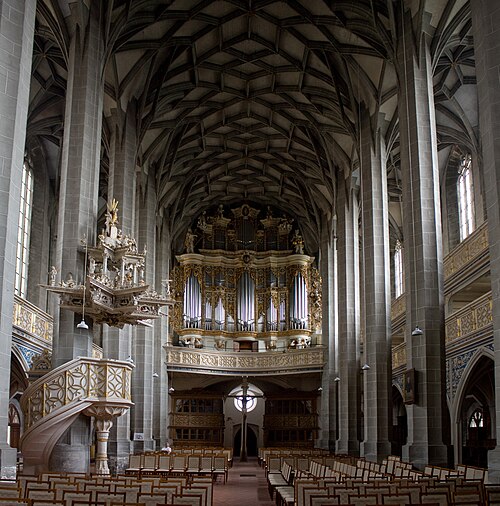
作曲の指導に関しては、ヘンデルに伝統的なフーガやカントゥス・フィルムスの練習をさせるだけでなく、ヘンデルの早熟な才能を認めていたザッハウは、ヘンデルに自身の膨大な蔵書に含まれる様々なスタイルや傑作を体系的に紹介した。彼はヘンデルに選りすぐりの楽譜を書き写すことを要求した。「あの頃は悪魔のように作曲していた」とヘンデルはずっと後に回想している。[41]
こうした模写の多くは、ヘンデルが生涯にわたって保管していたノートに記されていた。ノートはその後紛失してしまったが、そのノートには、ザッハウがヘンデルにどの曲を習わせたかったかが十分に記されている。この練習帳に収録されている主な作曲家には、フーガの「巨匠」で著名なオルガン作曲家ヨハン・クリーガー、師のジローラモ・フレスコバルディに倣い「南部様式」を代表するヨハン・カスパール・ケルル、ブクステフーデやバッハからも綿密に研究された「国際主義者」ヨハン・ヤコブ・フローベルガー、そしてフランスとイタリアのスタイルを融合させ音楽形式を統合したゲオルク・ムッファトなどがいた。[43]
マインヴァリングは、この時期にザッハウがヘンデルに教会の義務の一部を担わせ始めたと書いている。ザッハウは「仲間と楽しい時間を過ごすのが好きで」不在がちだったとマインヴァリングは主張しており、そのためヘンデルは頻繁にオルガンを演奏した。[44]さらに、マインヴァリングによると、ヘンデルは9歳の時に声楽と楽器のための教会礼拝曲を作曲し始め、「その時から3年間、毎週礼拝曲を作曲した」という。[45]マインヴァリングは、ヘンデルの生涯のこの章を、3、4年でヘンデルがザッハウを凌駕し、ヘンデルは「別の状況に焦りを感じていた」と結論付けて締めくくっている。「ベルリンが合意された場所だった」。[46]日付や順序の不注意(およびおそらくマインヴァリングの想像上の解釈)により、この時期は混乱している。[m]
ヘンデルの父の死後
ヘンデルの父は1697年2月11日に亡くなった。[47]ドイツでは、ゲオルクのような有力な市民のために友人や家族が葬儀の頌歌を作曲するのが習慣だった。 [48]若きヘンデルは、2月18日の日付で自分の名前を記した詩を書き、(父の遺志を尊重して)「自由芸術に捧げる」ことでその義務を果たした。[49]当時ヘンデルはハレのルーテル派ギムナジウムかラテン語学校で学んでいた。[48]
マインヴァリングはヘンデルが翌年の1698年にベルリンに旅行したとしている。[46]しかし、この日付の典拠としてのマインヴァリングの問題点は、ヘンデルの滞在中にヘンデルの父が「王」[n]と連絡を取り、ヘンデルをイタリアに奨学金付きで送るという宮廷の申し出を断ったと述べていることと[51]、そして「ベルリンから戻った後」に父が亡くなったと述べていることである[52] 。しかし、ゲオルク・ヘンデルは1697年に亡くなっているので、旅行の日付かヘンデルの父に関するマインヴァリングの記述のどちらかが間違っているに違いない。初期の伝記作家たちは、この旅の年を1696年とすることでこの問題を解決し、ヘンデルが11歳になると保護者が必要になると指摘し、ヘンデルの父親か家族の友人が同行することとした。その一方で、ヘンデルに弁護士になってほしいと思っていた父親が、なぜ息子を音楽の道に導くために大金を費やしたのか、不思議に思っていた。[53]例えばシェルヒャーは、ヘンデルが11歳でベルリンに旅し、ベルリンでボノンチーニとアッティリオ・アリオスティの両者に会い、その後父親の指示で戻ったとしている。[54]しかし、アリオスティはヘンデルの父の死の前にベルリンにはいなかったし、[55]ヘンデルが1702年以前にベルリンでボノンチーニに会うことはできなかった。[56]現代の伝記作家は、最も信頼できる古い権威者が同意している1698年をそのまま受け入れ、[o]マインヴァリングが旅行中に何が起こったかについて述べていることを無視するか、ヘンデルの後のヴェネツィア旅行でやったようにマインヴァリングが2回以上のベルリン訪問を混同したと仮定するかのどちらかである。[57]
大学
おそらく父との約束を果たすためか、あるいは単に自分が「リベラルアーツに身を捧げている」と考えていたためか、ヘンデルは1702年2月10日にハレ大学に入学した。[58]この大学は設立されたばかりだった。1694年、ブランデンブルク選帝侯フリードリヒ3世(後のプロイセン王フリードリヒ1世)が、自由主義的見解を理由にライプツィヒから追放されていた法律家クリスティアン・トマジウスに講義の場を提供する目的でこの大学を創設した。 [15]ヘンデルは法学部には入学しなかったが、講義には出席していたことはほぼ間違いない。[59]トマジウスは知識人であり学問の改革者で、ドイツ語で講義した最初のドイツ人学者であり、魔女裁判を非難した人物でもあった。ラングは、トマシウスがヘンデルに「人間の心の尊厳と自由、そして法の厳粛な威厳に対する尊敬」を植え付けたと信じている。この原則がヘンデルをイギリスに惹きつけ、半世紀もそこに留まらせたのである。[60]またヘンデルはそこで神学者で東洋言語の教授であるアウグスト・ヘルマン・フランケと出会った。フランケは子供たち、とりわけ孤児のことをとても気にかけていた。フランケが設立した孤児院はドイツのモデルとなり、ヘンデルが『メサイア』の権利をロンドンの孤児院に譲渡した際の慈善活動に間違いなく影響を与えた。[61]

大学教育を開始して間もなく、ヘンデルは(ルター派ではあったが[p] )1702年3月13日に、ハレのカルヴァン派大聖堂(ドムキルヒェ)のオルガン奏者の職に就いた。彼が助手を務めていたJ.C.レポリンの後任となった。 [63]この職は1年間の試用期間であったが、ザッハウから受けた基礎が明らかであった。教会のオルガン奏者とカントルは非常に名誉ある役職であったからである。この役職から、彼は年間5ターラーの報酬と、荒れ果てたモーリッツブルク城に下宿していた。[64]
同じ頃、ヘンデルはテレマンと知り合いになった。ヘンデルより4歳年上のテレマンはライプツィヒで法律を学び、聖歌隊長のヨハン・クーナウ(バッハの前任者)の助手をしていた。テレマンは40年後、マテゾンの『基礎』に寄稿した自伝の中で次のように回想している。「優れたヨハン・クーナウの作品は、フーガや対位法の手本となったが、ヘンデルと私は旋律の動きを作り上げ、それを研究することに常に忙しく、頻繁にお互いを訪問したり、手紙を書いたりしていた。」[65]
ハレ作曲
マインヴァリングは、ヘンデルがザッホの助手として、またドーム教会のオルガン奏者としての見習いとして、適切な音楽を提供することが職務の一部であったときに毎週作曲していたと記録しているが、[q]ハレ時代の宗教曲は今では特定できない。[67]しかし、マッテゾンは、ハレで書かれたヘンデルの教会カンタータについての意見を次のように要約している。「当時のヘンデルは、非常に長いアリアとまったく終わりのないカンタータを作曲したが、それらは適切な技巧や正しい趣味を持っていなかったが、ハーモニーに関する限り完璧だった。」[68]
初期の室内楽作品は存在するが、そのどれもがヘンデルがハレにいた時代に遡るのは難しい。最近まで多くの歴史家がクリサンダーに従い、2つのオーボエと通奏低音のための6つのトリオソナタをヘンデルの最初の作品とみなし、1696年(ヘンデルが11歳のとき)に書かれたとされている。[69]ラングは、手書きの写本(1700年)の日付と様式上の考慮に基づいて、その年代を疑っている。ラングは、これらの作品は「コレッリ流の凝縮されたソナタスタイルを熟知している」ことを示し、「形式上の安定性とテクスチャのクリーンさ」で注目に値すると書いている。[70]ホグウッドは、オーボエトリオソナタはすべて偽物とみなし、一部のパートはオーボエでは演奏できないとさえ示唆している。[71] 真正な手書きの資料が存在せず、ヘンデルがこれらの作品から素材を再利用したことがないため、真正性は疑わしい。[72]その他の初期の室内楽作品は1724年にアムステルダムで作品1として印刷されましたが、どれがヘンデルの頻繁な習慣である後年の改訂版ではなく、オリジナルの初期の作品であるかを判断することは不可能です。[70]
ハンブルクからイタリアへ
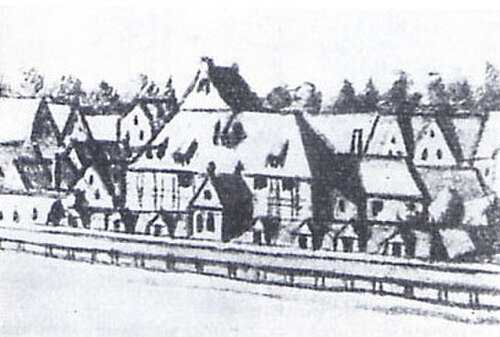
ヘンデルのドーム教会への試用期間は1703年3月に終了した。7月[r]までにヘンデルはハンブルクにいた。ヘンデルは移転の理由を何も説明していないため[s]、伝記作家たちは独自の推測を述べている。
ドナルド・バロウズは、マインヴァリングのベルリン旅行の混乱した年代を解読すれば答えが見つかると考えている。バロウズはこの旅行を1702年か1703年(父の死後)としており、ヘンデルが(ベルリン宮廷の「友人および親戚」を通じて)イタリアでの音楽教育を援助するというフリードリヒの申し出を断ったため(帰国後、宮廷音楽家になることを暗黙の了解としていた)、ヘンデルはブランデンブルク=プロイセン国内で(音楽家、弁護士、その他のいずれの立場でも)昇進を期待できなくなったと結論付けている。ヘンデルは(イタリア人のボノンチーニやアッティリオ・アリオスティとの出会いやテレマンの影響により)世俗的で劇的な音楽に惹かれていたため、定評のあるオペラ団のある自由都市ハンブルクが理にかなった選択だった。[76]
しかし、イタリアがオペラの中心地であったにもかかわらず、ヘンデルがなぜ王の申し出を断ったのかという疑問が残る。ラングは、トマシウスの教えの影響を受けたヘンデルの性格は、たとえ王であっても、誰にも従属できないものだったと示唆している。ラングは、ヘンデルは、自分を社会的に劣っているとみなすことを要求する階級差別を受け入れることができない人物だったと見ている。「ヘンデルが切望したのは、田舎の環境から抜け出して文化的な生活へと昇り詰める個人の自由だった」[77]バロウズは、父親のようにヘンデルは宮廷の召使と思わずに王室(および貴族)の好意を受け入れることができたと指摘している。 [78]そして、母親の困窮した経済状況を考慮して、[52]ヘンデルは自活しながら経験を積むためにハンブルクへ向かった。
1703年、彼はハンブルク歌劇場管弦楽団のヴァイオリン奏者とチェンバロ奏者の地位に就いた。[79]そこで作曲家のヨハン・マテゾン、クリストフ・グラウプナー、ラインハルト・カイザーと出会った。ヘンデルの最初の2つのオペラ『アルミラ』と『ネロ』は1705年に制作された。[80]彼はさらに2つのオペラ『ダフネ』と『フロリンド』を制作し、1708年に上演された。
マインヴァリングによると、1706年にヘンデルはフェルディナンド・デ・メディチの招待を受けてイタリアを訪れた。(他の資料では、ヘンデルは1703年から1704年にハンブルクで会っていたジャン・ガストーネ・デ・メディチに招待されたとされている。 [81])オペラに強い関心を持っていたフェルディナンドは、当時の一流の才能を引き付けることでフィレンツェをイタリアの音楽の中心地にしようとしていた。イタリアでヘンデルは台本作家の アントニオ・サルヴィと出会い、後に彼と共同制作することになる。ヘンデルはローマへ向かい、教皇領でオペラが(一時的に)禁止されていたため、ローマの聖職者のために宗教音楽を作曲した。有名な『主君の命令』(1707年)はこの時代の作品である。彼はまた、ナポリ王国で最も影響力のあるパトロンの一人であったアウローラ・サンセヴェリーノ公爵夫人(マインヴァリングは「ドンナ・ラウラ」と呼んだ)[82]や、ピエトロ・オットボーニ枢機卿、ベネデット・パンフィーリ枢機卿、カルロ・コロンナ枢機卿の宮殿での音楽会のために田園調のカンタータを作曲した。2つのオラトリオ『復活』と『テンポの勝利』は、それぞれ1709年と1710年にルスポリとオットボーニのために私的に上演された。彼の最初の全イタリア語オペラ『ロドリーゴ』は、1707年にフィレンツェのココメロ劇場で上演された。 [83] 『アグリッピーナ』は1709年にグリマーニ家が所有していたヴェネツィアのサン・ジョヴァンニ・グリゾストモ劇場で初演された。このオペラは、ヴィンチェンツォ・グリマーニ枢機卿の台本により、27夜連続で上演された。[84]聴衆はヘンデルのスタイルの壮大さと崇高さに驚愕し、[85]ヘンデルのドイツ出身を意味する「親愛なるザクセン人」というタイトル のオペラに拍手喝采を送った。
ロンドン
到着

1710年6月、ヘンデルはハノーヴァー選帝侯ゲオルクの楽長となったが、その年の終わりに辞職した。[86]元ヴェネツィア大使のシャルル・モンタギューからもイギリス訪問の招待を受けたと思われる。ロンドンへ向かう途中、デュッセルドルフでアンナ・マリア・ルイーザ・デ・メディチとその夫を訪問した。イタリアの詩人トルクァート・タッソの『解放されたエルサレム』に基づくオペラ『リナルド』は、急いで作曲されたにもかかわらず、多くの古いイタリアの作品からの借用があり、大成功を収めた。[87]この作品には、ヘンデルのお気に入りのアリアの一つ『愛する妻よ、愛しの妻よ』と有名な『小さな女よ』が含まれている。
ヘンデルは妹の結婚式と娘の洗礼式に出席するためにハレに2度戻ったが、1712年にイギリスに永住することを決意した。1713年の夏、彼はサリー州バーンエルムズにあるマシュー・アンドリュース氏の邸宅に住んでいた。 [88] [89]彼は1713年に初演されたユトレヒトの『テ・デウムとジュビレート』をアン女王のために作曲した後、女王から年間200ポンドの収入を得た。 [90] [91]
彼の最も重要なパトロンの一人は、第3代バーリントン伯爵と第4代コーク伯爵で、若く非常に裕福なイギリス系アイルランド 人貴族の一員でした。[92]バーリントン卿の邸宅に住んでいる間、ヘンデルはアントワーヌ・ウーダール・ド・ラ・モットの悲劇に基づいて、困っている乙女についての「魔法の」オペラ「アマディジ・ディ・ガウラ」を作曲しました。
オペラを一貫した構造としてとらえるという発想はヘンデルの想像力をなかなか捉えることができず[93]、彼は5年間オペラを作曲しなかった。1717年7月、ヘンデルの『水上の音楽』はテムズ川でジョージ1世とその客人のために3回以上演奏された。この曲は、ヘンデルがハノーヴァーの職を放棄したことに腹を立てていた国王とヘンデルの和解を促したと言われている[94] 。
キャノンズにて(1717–19)
1717年、ヘンデルはミドルセックスのキャノンズ社専属作曲家となり、そこで『シャンドス賛歌』で将来の合唱曲の基礎を築いた。[95]ロマン・ロランは、これらの賛歌(または詩篇)はヘンデルのオラトリオとの関係で、イタリアのカンタータがヘンデルのオペラとの関係とほぼ同じであると書いている。「より記念碑的な作品の素晴らしいスケッチ」である。[96]キャノンズの所有者である初代シャンドス公爵のためにヘンデルが書いた別の作品は『エイキスとガラテア』で、ヘンデルの生涯で最も上演された作品であった。ウィントン・ディーンは「音楽は息を呑み、記憶をかき乱す」と書いている。[97]
1719年、シャンドス公爵は作曲家の重要なパトロンの一人となり、彼の新しいオペラ団である王立音楽アカデミーの主要な会員となったが、1720年に歴史上最大の金融危機の一つとして崩壊した南海泡沫事件でシャンドスが多額の金を失った後、彼のパトロンは減少した。ヘンデル自身は1716年に株価が低かったときに南海会社に投資し[98]、1720年に「バブル」が崩壊する前に売却した[99] 。 1720年、ヘンデルはパトロンの足跡をたどり、奴隷貿易を行う 王立アフリカ会社(RAC)に投資した(シャンドス公爵はRACの主要投資家の一人であった)。音楽史家デイヴィッド・ハンターが指摘したように、王立音楽アカデミーの会員と投資家の32パーセント、またはその近親者はRACにも投資していた。[100] [101] [102]
王立音楽アカデミー(1719–34)

1719年5月、ニューカッスル公爵宮内長官はヘンデルに新しい歌手を探すよう命じた。[103]ヘンデルは新しく作られたオペラを観るためにドレスデンを訪れた。アントニオ・ロッティの『テオファーネ』を鑑賞し、キャストを王立音楽アカデミーに雇った。王立音楽アカデミーはバロックオペラやオペラ・セリアの継続的な供給を確保するために貴族たちが設立した団体である。ヘンデルはハレの同級生ジョン・スミスとその息子ヨハン・クリストフ・シュミットを秘書兼代筆係に招いた可能性がある。[104] 1723年までにヘンデルはブルック・ストリート25番地のジョージ王朝時代の家に引っ越し、その後終生そこを借りた。[105]ヘンデルがリハーサルや楽譜のコピー、チケット販売を行ったこの家は、現在ヘンデル・ハウス博物館となっている。[t] 1724年から1725年にかけての12か月間に、ヘンデルは『ジュリオ・チェーザレ』、『タメルラーノ』、『ロデリンダ』という3つの成功したオペラを書いた。ヘンデルのオペラには『心の中の聖歌』などのダ・カーポ・アリアが満載である。 『シレーテ・ベンティ』を作曲した後、ヘンデルはオペラに専念し、カンタータの執筆をやめた。イギリス近衛擲弾兵連隊のゆっくりとした行進曲の元となった『スキピオ』 [106]は、ファウスティーナ・ボルドーニの到着を待つ間に間に合わせとして上演された。
1727年、ヘンデルはジョージ2世の戴冠式のために4曲の賛美歌を書くよう依頼された。そのうちの一つ、『祭司ザドク』はそれ以来イギリスの戴冠式で必ず演奏されている。[107] 『祭司ザドク』の歌詞はジェームズ王欽定訳聖書から取られている。[108] 1728年、ヘンデルがロンドンで普及させたタイプのイタリアオペラを揶揄したジョン・ゲイの『乞食オペラ』がリンカーン法曹院フィールズ劇場で初演され、62回連続上演された。これは当時の劇場史上最長の公演であった。[109] 9年後、王立音楽アカデミーは機能を停止したが、ヘンデルはすぐに新しい劇団を設立した。
ヘイマーケットのクイーンズ劇場(現在のヒズ・マジェスティーズ劇場)は、建築家で劇作家のジョン・ヴァンブラによって1705年に設立され、すぐにオペラハウスになりました。[110] 1711年から1739年の間に、ヘンデルのオペラ25作以上がここで初演されました。[111] 1729年、ヘンデルはジョン・ジェームズ・ハイデッガーと劇場の共同支配人になりました。
ヘンデルは新しい歌手を雇うためにイタリアに旅行し、喜劇の傑作パルテノペや「魔法の」オペラ「オーランド」など、さらに7つのオペラを作曲した。[112]商業的に成功した2つの英国のオラトリオ「エステル」と「デボラ」の後、彼は再びサウスシーカンパニーに投資することができた。ヘンデルは「エイキス」と「ガラテア」を作り直し、これが彼の最大のヒット作となった。ヘンデルは、ヨハン・アドルフ・ハッセ、ニコロ・ポルポラ、有名なカストラートのファリネッリなどの音楽家を雇った貴族のオペラと競争することができなかった。ウェールズ公フレデリックの強力な支援は王室の対立を引き起こした。1734年3月、ヘンデルは結婚の賛歌「これは主が造られた日」とアン王女のためにセレナータ「パルナッソ・イン・フェスタ」を作曲した。[113]
当時、貴族オペラがヘンデルにさまざまな問題を引き起こしていたにもかかわらず、ブルック・ストリートに住むヘンデルの隣人メアリー・デラニーは、1734年4月12日にヘンデルを自宅に招いたパーティについて次のように報告している。ヘンデルは上機嫌だった。
リッチ夫人と娘のキャス夫人、ハンマー夫妻、パーシヴァル夫妻、ジョン・スタンレー卿と私の弟、ドネラン夫人、ストラーダ(ヘンデルのオペラのスターソプラノ)、クート氏。シャフツベリ卿はパーシヴァル氏に連れて来てくれるよう頼み、ヘンデル氏(彼もここにいました)の友人を自称していたので、招待されました。オペラでこんなに楽しませられたのは初めてです!ヘンデル氏は世界一機嫌がよく、7時から11時までストラーダと歌う女性全員の伴奏をし、レッスンをしてくれました。私は彼女たちに紅茶とコーヒーを出し、9時半ごろにチョコレート、ホットワイン、ビスケットの入った大皿を持ってきました。みんな落ち着いていて、満足しているようでした。[114]
コヴェントガーデンのオペラ(1734–41)

1733年、エセックス伯爵は次のような一文が書かれた手紙を受け取った。「ヘンデルはあまりにも気まぐれな王子様になったので、町は不満を漏らしている。」 主任投資家の委員会は契約が切れたらヘンデルは引退するものと予想したが、ヘンデルはすぐに別の劇場を探した。ジョン・リッチと協力して、コヴェント・ガーデン劇場に3番目の劇団を設立した。リッチは壮大な演出で有名だった。彼はヘンデルに自分の小合唱団を使い、ヘンデルがテルプシコーレを作曲したマリー・サレの踊りを取り入れるよう提案した。1735年、彼は幕間にオルガン協奏曲を導入した。ヘンデルは初めて、自分の役を練習する時間がなかったジョアッキーノ・コンティにアリアを代用することを許可した。 [115]経済的には『アリオダンテ』は失敗だったが、各幕の終わりにバレエ組曲を導入した。[116]魔術的な内容を持つ最後のオペラ『アルチーナ』、そしてジョン・ドライデンの『アレクサンダーの饗宴』を基にした『アレクサンダーの饗宴、あるいは音楽の力』では、アンナ・マリア・ストラーダ・デル・ポーとジョン・ビアードが主演した。
1737年初頭、ヘンデルは『アルミニオとジュスティーノ』を上演し、『ベレニス』を完成させ、『パルテノペ』を復活させ、続いて『祭のイル・パルナッソ』、 『アレクサンダーの饗宴』、改訂版『時間と真実の勝利』を上演し、3月23日に初演した。[117] 4月にヘンデルは軽い脳卒中、またはリウマチ性麻痺にかかり、右手と腕が一時的に麻痺した。一時的に回復の兆しがあったが、5月に再発し、それに伴い精神能力も低下した。ヘンデルはジョン・フレデリック・ランプとの強力なライバル関係にあった。『ウォントリーの竜』は1737年5月16日、ロンドンのヘイマーケットにあるリトル劇場で初演された。これはイタリアのオペラ・セリアのパロディであった。
1737年秋、疲労困憊のヘンデルは医師の助言にしぶしぶ従い、9月にロイヤル・タンブリッジ・ウェルズ、エクス・ラ・シャペル(ブルトシャイト)などの温泉街で療養した。 [117] 11月までに「病気」の症状はすべて消えた。クリスマスイブにヘンデルは『ファラモンド』の楽譜を完成させたが、カロリーヌ王妃の葬送歌の作曲で中断された。ボクシングデーにヘンデルはエリザベート・デュパルクと共演した唯一の喜劇オペラ『セルス』の作曲を開始した。
ハープとオルガンの協奏曲(HWV 294)と『アレクサンダーの饗宴』は1738年にジョン・ウォルシュによって出版された。ウォルシュはチャールズ・クレイが製作したパイプオルガン付きの音楽時計のために音楽を作曲した。このオルガンはヘリット・ブラームカンプによって購入され、2016年にユトレヒトのシュピールクロック博物館が収蔵した。 [118] [119]最後のオペラ 『デイダミア』はホルダーネス伯爵との共同制作で、[120] 1741年に3回上演された。ヘンデルはオペラの仕事を諦めたが、その代わりに英語オラトリオでより大きな成功を収めた。[121]
オラトリオ
ヘンデルの最初のオラトリオである寓話の『テンポとディスイングの勝利』 [123]は1707年にイタリアで作曲され、続いて聖書の題材を使った『復活』が1708年に作曲された。 『エステル』とその初演はおそらく1718年であるが、経緯は不明である。 [124]それから12年後、海賊行為がきっかけでヘンデルは再び『エステル』を取り上げることとなった。 [125]以前の3回の演奏が大きな関心を呼び、自然にもっと多くの聴衆に紹介するというアイデアが浮かんだ。次に続いたのは戴冠式の賛歌を強く感じさせる『デボラ』 [126]と、 3番目の英語オラトリオ『アタリア』 [127]である。これら3つのオラトリオでヘンデルは後のオラトリオを特徴付ける合唱の伝統的な使用法の基礎を築いた。 [128]ヘンデルは自信を深め、表現の幅を広げ、作曲の多様性も増していった。 [129]
ヘンデルがアルカンジェロ・コレッリから楽器のための作曲法を、アレッサンドロ・スカルラッティから独唱のための作曲法を学んだことは明らかであるが、合唱のための作曲法を彼に教えた作曲家は一人もいない。 [130]ヘンデルはイタリアのソリストをイギリスのソリストに代える傾向が強まった。この変化の最も重要な理由は、彼のオペラからの収益が減っていったことであった。[131]こうしてオラトリオの伝統が生まれ、それが将来の上演を左右することになった。上演は衣装や動きなしで行われ、歌手は私服で登場した。[132]
1736年、ヘンデルは『アレクサンダーの饗宴』を上演した。ジョン・ビアードはヘンデルの主席歌手の一人として初めて登場し、ヘンデルの生涯を通じてヘンデルの専属テノール独唱者となった。[133]この作品は大成功を収め、ヘンデルはイタリアのオペラからイギリスの合唱作品への移行を決意した。『サウル』では、ヘンデルはチャールズ・ジェンネンスと共同作業を行い、3本のトロンボーン、カリヨン、特大の軍用ケトルドラム(ロンドン塔のもの)を試用し、「...非常にうるさいものになるだろう」と確信していた。[134] 1739年の 『サウル』と『エジプトのイスラエル』は、ダ・カーポ・アリアが例外となり、規則ではなくなった、偉大で成熟したオラトリオのリストのトップを占めている。[135] 『エジプトのイスラエル』は、カロリーヌ王妃の葬儀賛歌から借用した合唱以外はほとんどない。次の作品ではヘンデルは方向性を変えた。これらの作品ではオーケストラとソリストの効果に重点を置き、合唱団は背景に退いた。[136] 『アレグロ、思い、モデラート』はむしろ面白い性格を持っており、軽妙で新鮮な作品である。

1741年の夏、第3代デヴォンシャー公爵はヘンデルをアイルランド王国の首都ダブリンに招き、地元の病院を支援するコンサートを行わせた。[137]ヘンデルの『メサイア』は1742年4月13日、フィッシャムブル通りのニュー・ミュージック・ホールで初演され、セント・パトリック大聖堂とクライスト・チャーチ大聖堂の合同聖歌隊から26人の少年と5人の男性が参加した。[138]ヘンデルは独唱と合唱のバランスを確保し、それを決して超えることはなかった。1747年、ヘンデルはオラトリオ『アレクサンダー・バルス』を書いた。この作品は1748年3月23日にロンドンのコヴェント・ガーデン劇場で上演され、アリア『聞け! 金の竪琴を鳴らす』に合わせてヘンデルはマンドリン、ハープ、ヴァイオリン、ヴィオラ、チェロの伴奏を書いた。[139]彼の別の英語オラトリオであるソロモンは、 1749年3月17日にコヴェントガーデン劇場で初演されました。[140]ソロモンには、第3幕に「シバの女王の到着」として知られる2つのオーボエと弦楽器のための短く活気のある器楽部分があります。[141]
イギリス人ソリストの使用は、サムソンの初演で最高潮に達した。この作品は非常に演劇的である。合唱の役割は、彼の後のオラトリオでますます重要になった。ジェフタは1752年2月26日に初演された。これは彼の最後のオラトリオであったが、初期の作品に劣らない傑作であった。[142]
晩年
.jpg/500px-Arms_of_the_Foundling_Hospital_with_an_admission_ticket_(BM_1858,0417.578).jpg)
1749年、ヘンデルは『王宮の花火の音楽』を作曲し、初演には1万2千人が集まった。[143] 1750年、ヘンデルはロンドンの孤児院であるファウンドリング病院のために『メサイア』の公演を企画した。この公演は大成功とされ、ヘンデルの生涯を通じて毎年コンサートが続いた。ヘンデルは後援者として最初のコンサートの翌日に病院の理事に就任した。ヘンデルは死去時に『メサイア』を1部遺贈した。 [144]ヘンデルのファウンドリング病院への関わりは、現在ロンドンのファウンドリング博物館で常設展示として記念されており、この博物館にはジェラルド・コーク・ヘンデル・コレクションも収蔵されている。ファウンドリング病院に加え、ヘンデルは貧しい音楽家とその家族を支援する慈善団体にも寄付を行った。
1750年8月、ヘンデルはドイツからロンドンへの帰途、オランダのハーグとハールレムの間で起きた馬車事故で重傷を負った。 [145] 1751年、片方の目が衰え始めた。原因は白内障で、偉大なペテン師、シュヴァリエ・テイラーが手術した。これによって視力は改善せず、むしろ悪化した可能性もあった。[121] 1752年までに完全に失明した。1759年、ブルック・ストリートの自宅で74歳で死去。ヘンデルが最後に観劇した公演は『メサイア』であった。ヘンデルはウェストミンスター寺院に埋葬された。[146]葬儀には3千人を超える会葬者が参列し、国葬で盛大に執り行われた。
ヘンデルは結婚せず、私生活を秘密にしていた。最初の遺言では財産の大半を姪のヨハンナに遺贈するとされていたが、4つの遺言補遺で財産の大半を他の親戚、使用人、友人、慈善団体に分配した。[147]
ヘンデルは美術コレクションを所有しており、1760年に死後にオークションにかけられた。 [148]オークションカタログには約70点の絵画と10点の版画が掲載されていた(その他の絵画は遺贈された)。[148]
作品

概要
Handel's compositions include 43 operas, 24 oratorios, more than 120 cantatas, trios and duets, numerous arias, odes and serenatas, solo and trio sonatas, 18 concerti grossi, and 12 organ concertos. His most famous work, the oratorio Messiah with its "Hallelujah" chorus, is among the most popular works in choral music. The Lobkowicz Palace in Prague holds Mozart's copy of Messiah, complete with handwritten annotations. Among the works with opus numbers published and popularised in his lifetime are the Organ concertos Op. 4 and Op. 7, together with the Opus 3 and Opus 6 Concerti grossi; the latter incorporates an earlier organ concerto, The Cuckoo and the Nightingale, in which birdsong is imitated in the upper registers of the organ. Also notable are his 16 keyboard suites, especially The Harmonious Blacksmith.
Catalogues
The first published catalogue of Handel's works appeared as an appendix to Mainwaring's Memoirs.[149] Between 1787 and 1797 Samuel Arnold compiled a 180-volume collection of Handel's works—however, it was far from complete.[150] Also incomplete was the collection produced between 1843 and 1858 by the English Handel Society (founded by Sir George Macfarren).[151]
The 105-volume Händel-Gesellschaft ("Handel Society") edition was published between 1858 and 1902 – mainly due to the efforts of Friedrich Chrysander. For modern performance, the realisation of the basso continuo reflects 19th-century practice. Vocal scores drawn from the edition were published by Novello in London, but some scores, such as the vocal score to Samson, are incomplete.
The continuing Hallische Händel-Ausgabe edition was first inaugurated in 1955 in the Halle region in Saxony-Anhalt, East Germany. It did not start as a critical edition, but after heavy criticism of the first volumes, which were performing editions without a critical apparatus (for example, the opera Serse was published with the title character recast as a tenor, reflecting pre-war German practice), it repositioned itself as a critical edition. Influenced in part by cold-war realities, editorial work was inconsistent: misprints were found in abundance and editors failed to consult important sources. In 1985, a committee was formed to establish better standards for the edition. The reunification of Germany in 1990 removed communication problems, and the volumes issued have since shown a significant improvement in standards.[121]
Between 1978 and 1986 the German academic Bernd Baselt catalogued Handel's works in his Händel-Werke-Verzeichnis publication. The catalogue has achieved wide acceptance and is used as the modern numbering system, with each of Handel's works designated an "HWV" number – for example, Messiah is catalogued as "HWV 56".[152]
Legacy

Handel's works were collected and preserved by two men: Sir Samuel Hellier, a country squire whose musical acquisitions form the nucleus of the Shaw–Hellier Collection,[153] and the abolitionist Granville Sharp.[154] The catalogue accompanying the National Portrait Gallery exhibition marking the tercentenary of the composer's birth calls them two men of the late eighteenth century "who have left us solid evidence of the means by which they indulged their enthusiasm".[155] With his English oratorios, such as Messiah and Solomon, the coronation anthems, and other works including Water Music and Music for the Royal Fireworks, Handel became a national icon in Britain, and featured in the BBC series The Birth of British Music: Handel – The Conquering Hero.[156]
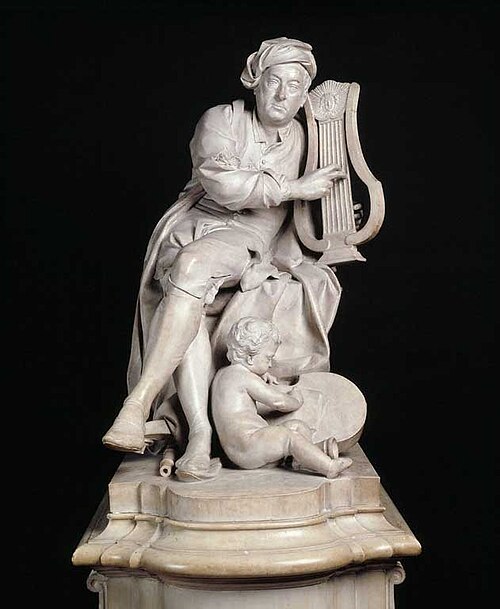
After his death, Handel's Italian operas fell into obscurity, except for selections such as the aria from Serse, "Ombra mai fu". The oratorios continued to be performed but not long after Handel's death they were thought to need some modernisation, and Mozart orchestrated German versions of Messiah and other works. Throughout the 19th century and first half of the 20th century, particularly in the Anglophone countries, his reputation rested primarily on his English oratorios, which were customarily performed by choruses of amateur singers on solemn occasions. The centenary of his death, in 1859, was celebrated by a performance of Messiah at The Crystal Palace, involving 2,765 singers and 460 instrumentalists, who played for an audience of about 10,000 people.[157]
Recent decades have revived his secular cantatas and what one might call 'secular oratorios' or 'concert operas'. Of the former, Ode for St. Cecilia's Day (1739) (set to texts by John Dryden) and Ode for the Birthday of Queen Anne (1713) are noteworthy. For his secular oratorios, Handel turned to classical mythology for subjects, producing such works as Acis and Galatea (1719), Hercules (1745) and Semele (1744). These works have a close kinship with the sacred oratorios, particularly in the vocal writing for the English-language texts. They also share the lyrical and dramatic qualities of Handel's Italian operas. As such, they are sometimes fully staged as operas. With the rediscovery of his theatrical works, Handel, in addition to his renown as instrumentalist, orchestral writer, and melodist, is now perceived as being one of opera's great musical dramatists.
Reception
Handel has generally been accorded high esteem by fellow composers, both in his own time and since.[158] Johann Sebastian Bach attempted, unsuccessfully, to meet Handel while he was visiting Halle.[159] (Handel was born in the same year as Bach and Domenico Scarlatti.) Mozart is reputed to have said of him, "Handel understands affect better than any of us. When he chooses, he strikes like a thunder bolt."[160] To Beethoven he was "the master of us all... the greatest composer that ever lived. I would uncover my head and kneel before his tomb."[160] Beethoven emphasised above all the simplicity and popular appeal of Handel's music when he said, "Go to him to learn how to achieve great effects, by such simple means."
Borrowings
Since 1831, when William Crotch raised the issue in his Substance of Several Lectures on Music, scholars have extensively studied Handel's "borrowing" of music from other composers. Summarising the field in 2005, Richard Taruskin wrote that Handel "seems to have been the champion of all parodists, adapting both his own works and those of other composers in unparalleled numbers and with unparalleled exactitude."[161] Among the composers whose music Handel apparently reused are Alessandro Stradella, Gottlieb Muffat, Alessandro Scarlatti, Domenico Scarlatti[162] Giacomo Carissimi, Georg Philipp Telemann, Carl Heinrich Graun, Leonardo Vinci, Jacobus Gallus, Francesco Antonio Urio, Reinhard Keiser, Francesco Gasparini, Giovanni Bononcini, William Boyce, Henry Lawes, Michael Wise, Agostino Steffani, Franz Johann Habermann, and numerous others.[163]
In an essay published in 1985, John H. Roberts demonstrated that Handel's borrowings were unusually frequent even for his own era, enough to have been criticised by contemporaries (notably Johann Mattheson); Roberts suggested several reasons for Handel's practice, including Handel's attempts to make certain works sound more up-to-date and, more radically, his "basic lack of facility in inventing original ideas" – though Roberts took care to argue that this does not "diminish Handel's stature", which should be "judged not by his methods, still less by his motives in employing them, but solely by the effects he achieves."[164]
Homages
After Handel's death, many composers wrote works based on or inspired by his music. The first movement from Louis Spohr's Symphony No. 6, Op. 116, "The Age of Bach and Handel", resembles two melodies from Handel's Messiah. In 1797, Ludwig van Beethoven published the 12 Variations in G major on "See the conqu’ring hero comes" from Judas Maccabaeus by Handel, for cello and piano. In 1822, Beethoven composed the overture The Consecration of the House, which also bears the influence of Handel. Guitar virtuoso Mauro Giuliani composed his Variations on a Theme by Handel, Op. 107 for guitar, based on Handel's Suite No. 5 in E major, HWV 430, for harpsichord.
In 1861, using a theme from the second of Handel's harpsichord suites, Johannes Brahms wrote the Variations and Fugue on a Theme by Handel, Op. 24, one of his most successful works (praised by Richard Wagner). Several works by the French composer Félix-Alexandre Guilmant use Handel's themes; for example, his March on a Theme by Handel uses a theme from Messiah. French composer and flautist Philippe Gaubert wrote his Petite marche for flute and piano based on the fourth movement of Handel's Trio Sonata, Op. 5, No. 2, HWV 397. Argentine composer Luis Gianneo composed his Variations on a Theme by Handel for piano. In 1911, Australian-born composer and pianist Percy Grainger based one of his most famous works on the final movement of Handel's Suite No. 5 in E major (just like Giuliani). He first wrote some variations on the theme, which he titled Variations on Handel's 'The Harmonious Blacksmith' . Then he used the first sixteen bars of his set of variations to create Handel in the Strand, one of his most beloved pieces, of which he made several versions (for example, the piano solo version from 1930). Arnold Schoenberg's Concerto for String Quartet and Orchestra in B-flat major (1933) was composed after Handel's Concerto Grosso, Op. 6/7.[165]
Veneration
In the Lutheran Calendar of Saints Handel and Bach share the date 28 July with Heinrich Schütz, and Handel and Bach are commemorated in the calendar of saints prepared by the Order of Saint Luke for the use of the United Methodist Church.[166] The Book of Common Worship of the Presbyterian Church (USA) (Westminster John Knox Press, 2018) commemorates him on 20 April.
Fictional depictions
In 1942, Handel was the subject of the British biographical film The Great Mr. Handel directed by Norman Walker and starring Wilfrid Lawson. It was made at Denham Studios by the Rank Organisation, and shot in Technicolor. He is also the central character in the television films God Rot Tunbridge Wells! (1985) and Handel's Last Chance (1996) and the stage play All the Angels (2015). Handel was portrayed by Jeroen Krabbé as the antagonist in the film Farinelli (1994).
See also
- Gottlieb Muffat
- Handel Reference Database
- Letters and writings of George Frideric Handel
- Publications by Friedrich Chrysander
- Valentine Snow
- Drexel 5856
Notes, references and sources
Notes
- ^ "Handel" entry in Collins English Dictionary gives the common variant "George Frederick" (used in his will and on his funeral monument) alongside the pronunciation of his last name. The spelling "Frideric" is used on his 1727 application for British citizenship.
- ^ According to baptismal records in Halle's parish church,[1] the Lutheran Marktkirche Unser Lieben Frauen, he used the form Friedrich, which is universally used in German. The records of that church also show that the family name was spelt on various occasions at least four other ways: Hendel, Händeler, Hendeler and Hendtler, but most commonly Händel. In Italy, he spelt it Hendel, as it is pronounced in German. From the time he arrived in England, however, he consistently signed his name as George Frideric Handel.[2]
- ^ Handel's tomb in Westminster has the Old Style birth date of February XXIIII, MDCLXXXIV, giving the day of his baptism and using its Annunciation style of counting the new year from 25 March.[4]
- ^ Georg Händel (senior) was the son of a coppersmith, Valentin Händel (1582–1636), who had emigrated from Eisleben in 1608 with his first wife Anna Belching, the daughter of a master coppersmith. They were Protestants and chose reliably Protestant Saxony over Silesia, a Habsburg possession, as religious tensions mounted in the years before the Thirty Years' War.[12]
- ^ Among the court musicians of Halle were Samuel Scheidt (who also was organist at the Moritzkirche), William Brade and Michael Praetorius.[14]
- ^ Halle also was noted for the quality of its organ-builders. In 1712, Bach was intrigued by the organ at Marktkirche, and applied for the position that Zachow, Handel's teacher, vacated. He decided on Weimar, however.[15]
- ^ This barber, Andreas Berger, happened to be the son-in-law of English émigré William Brade, court musician to Augustus in Weissenfels.[12]
- ^ Both Landon and Hogwood point out and to the extent possible correct the more obvious misstatements of facts and dates and inconsistencies of Mainwaring. See Landon 1984, pp. 9–19; Hogwood 1984, pp. 11–17.
- ^ Schoelcher suggests that Handel's "doctor" father observed Handel making musical sounds even before he could talk and this in the eyes of the son of a coppersmith "discovered instincts of so low an order …"[26]
- ^ The year and purpose of the visit and why the meeting occurred are variously given. Schoelcher and Bone have it that Handel was seven and they were visiting a son by Georg's first marriage, who was in service to the Duke.[33] Friedrich Chrysander states that they were visiting the younger Handel's nephew, Carl (ten years his senior) who was the Duke's valet.[34] Lang writes that Handel was nine and Handel's father, holding a court position, must have frequently travelled to Weissenfels, where the Duke had established a residence after Prussia had annexed the city of Halle. Young Handel was taken along because he could be cared for by relatives of his late wife.[30]
- ^ "His cantatas, often highly dramatic, are distinguished by very imaginative choral writing, colourful orchestration, and skilful handling of the concerted element."[37]
- ^ Handel not only applied Kerll's techniques and phrases in later compositions, he imported an entire movement composed by Kerll into Israel in Egypt.[42]
- ^ Both Landon and Hogwood point out and to the extent possible correct the more obvious misstatements of facts and dates and inconsistencies of Mainwaring. See Landon 1984, pp. 9–19; Hogwood 1984, pp. 11–17.
- ^ There was no "king" in Berlin until 18 January 1701 when Frederick III, the Elector of Brandenburg, became Frederick I, the first King in Prussia.[50]
- ^ Among the careful authorities who accepted the trip taking place in 1698 were Handel's friend Johann Mattheson[53] and Burney.[40]
- ^ Records of the Marktkirche show that he took communion there in April of the years 1701–03.[62]
- ^ Handel was required by the terms of his appointment, among other things, "to play the organ fittingly at Divine Service, and for this purpose to pre-intone the prescribed Psalms and Spiritual Songs, and to have due care to whatever might be needful to the support of beautiful harmony …"[66]
- ^ The first mention of Handel from the time he took his last communion at the Marktkirche on 23 April[66] is in Mattheson's annotated translation of Mainwaring (published in 1761) where he writes that he met Handel in the Organ loft of the Church of St. Mary Magdalena in Hamburg.[73] In his earlier Grunlage (published in 1740), he fixes the date as 9 July.[74]
- ^ Mainwaring gives the cryptic explanation that since he had to earn a living from his profession, he had to find a place less distant than Berlin. Given that Hamburg's opera house was second only to Berlin's in repute, "it was resolved to send him thither on his own bottom, and chiefly with a view to improvement".[75] The passage suggests that Handel had already determined on secular dramatic music as a career, but who it was "to send him thither" is not explained.
- ^ In 2000, the upper stories of 25 Brook Street were leased to the Handel House Trust, and after extensive restoration, the Handel House Museum opened to the public, with events including concerts of baroque music.
References
- ^ "Händel-Haus in Halle an der Saale – Handschriftliche Dokumente". Archived from the original on 19 May 2013.
- ^ Hogwood 1984, p. 1.
- ^ Hicks 1998, p. 614.
- ^ George Frederic Handel. Archived 29 May 2019 at the Wayback Machine. Westminster Abbey.
- ^ "British Citizen by Act of Parliament: George Frideric Handel". Parliament.uk. 14 April 2009. Archived from the original on 4 May 2012. Retrieved 13 April 2012.
- ^ Burrows 2007
- ^ Hicks 2013
- ^ Buelow 2004, p. 476.
- ^ Dean 1969, p. 19.
- ^ Deutsch 1955, p. 1
- ^ Adams & Hofestädt 2005, pp. 144–46.
- ^ a b c Adams & Hofestädt 2005, p. 144.
- ^ Adams & Hofestädt 2005, p. 144; Burrows 1994, p. 1.
- ^ Burrows 1994, p. 1.
- ^ a b c Lang 1966, p. 20.
- ^ Burrows 1994, pp. 1–2.
- ^ Lang 1966, pp. 25–26.
- ^ a b Lang 1966, p. 10.
- ^ Adams & Hofestädt 2005, pp. 144–45.
- ^ Landon 1984, p. 9.
- ^ Deutsch 1955, p. 6.
- ^ Deutsch 1955, p. 2; Landon 1984, p. 9.
- ^ Dreyhaupt 1755, p. 625.
- ^ Maitland & Squire 1890, p. 277.
- ^ Landon 1984, p. 10; Schoelcher 1857, p. 7 n.1.
- ^ Schoelcher 1857, p. 3.
- ^ Mainwaring 1760, pp. 4–5.
- ^ Mainwaring 1760, p. 5.
- ^ Schoelcher 1857, p. 4.
- ^ a b c Lang 1966, p. 11.
- ^ Dent 2004, pp. 3–4.
- ^ a b c Schoelcher 1857, p. 5.
- ^ Schoelcher 1857, p. 4; Bone 1914, p. 141.
- ^ Chrysander 1858: Buch 1: 2. Kindheit.
- ^ Schoelcher 1857, pp. 4–5; Bone 1914, p. 141; Lang 1966, p. 11.
- ^ Lang 1966, p. 11; Bone 1914, p. 141; Schoelcher 1857, p. 5.
- ^ Lang 1966, pp. 11–12.
- ^ Lang 1966, p. 12; Landon 1984, p. 15. See also Seiffert, Max (1905). "Preface to Volumes 21, 21 (Zachow)". Denkmäler deutscher Tonkunst. Leipzig: Breitkopf & Härte.
- ^ Schoelcher 1857, pp. 5–6. See also Bone 1914, pp. 141–42.
- ^ a b Schoelcher 1857, p. 6.
- ^ Lang 1966, p. 12.
- ^ Lang 1966, p. 14.
- ^ Lang 1966, pp. 13–16.
- ^ Mainwaring 1760, p. 15.
- ^ Mainwaring 1760, p. 16.
- ^ a b Mainwaring 1760, p. 18.
- ^ Schoelcher 1857, p. 6; Deutsch 1955, pp. 5–6 (inscription on Georg Händel's tombstone).
- ^ a b Lang 1966, p. 19.
- ^ Deutsch 1955, pp. 6–8 (containing the poem and English translation).
- ^ Landon 1984, p. 30 n.5.
- ^ Mainwaring 1760, pp. 24–25.
- ^ a b Mainwaring 1760, p. 29.
- ^ a b Lang 1966, p. 166.
- ^ Schoelcher 1857, pp. 6–7.
- ^ Landon 1984, p. 31 n.8.
- ^ Landon 1984, p. 31 n.7.
- ^ Landon 1984, pp. 31 n.7 & 53.
- ^ Dean 1982, p. 2; Deutsch 1955, p. 8.
- ^ Lang 1966, p. 20; Dent 2004, p. 2
- ^ Lang 1966, pp. 20–21.
- ^ Lang 1966, p. 21.
- ^ Burrows 1994, p. 10; Deutsch 1955, pp. 8, 9, 10.
- ^ Dent 2004, p. 2.
- ^ Burrows 1994, p. 20.
- ^ Burrows 1994, pp. 10–11 translating Mattheson 1740, p. 359.
- ^ a b Deutsch 1955, p. 9.
- ^ Lang 1966, p. 22 n.2.
- ^ Lang 1966, p. 22 translating Mattheson 1740, p. 93.
- ^ Deutsch 1955, p. 4 n.1.
- ^ a b Lang 1966, p. 23.
- ^ Hogwood 1984, p. 21.
- ^ Best 1985, pp. 486–89.
- ^ Deutsch 1955, p. 10.
- ^ Mattheson 1740, pp. 29, 191.
- ^ Mainwaring 1760, pp. 27–28.
- ^ Burrows 1994, pp. 11–13.
- ^ Lang 1966, p. 26.
- ^ Burrows 1994, p. 12.
- ^ Burrows 1994, p. 18
- ^ Burrows 1994, p. 19
- ^ Harris 2001, p. 37.
- ^ Annette Landgraf, David Vickers, The Cambridge Handel Encyclopedia, Cambridge University Press, 2009, p. 2
- ^ Burrows 1994, pp. 29–30
- ^ Mainwaring 1760, p. 52.
- ^ Dean & Knapp 1987, p. 129
- ^ Burrows 1994, p. 38
- ^ Dean & Knapp 1987, pp. 173, 180
- ^ "Handel, George Frederick". Archived from the original on 6 October 2016 – via Wikisource.
- ^ Burrows, Donald; Coffey, Helen; Greenacombe, John; Hicks, Anthony (20 February 2014). George Frideric Handel: Volume 1, 1609–1725: Collected Documents. Cambridge University Press. ISBN 9781107470118. Archived from the original on 22 February 2018 – via Google Books.
- ^ National Portrait Gallery, p. 88
- ^ There is a tantalising suggestion by Handel's biographer, Jonathan Keates, that he may have come to London in 1710 and settled in 1712 as a spy for the eventual Hanoverian successor to Queen Anne, George I. Day, Peter (12 April 2009). "How Handel played the markets". BBC News. Archived from the original on 5 March 2016.
- ^ National Portrait Gallery, p. 92
- ^ Dean & Knapp 1987, p. 286
- ^ Burrows 1994, p. 77.
- ^ Bukofzer 1947, pp. 333–35.
- ^ Rolland 1916, p. 71.
- ^ Dean & Knapp 1987, p. 209
- ^ Deutsch 1955, pp. 70–71
- ^ "Handel's Finances" Archived 19 April 2014 at the Wayback Machine, on bbc.co.uk
- ^ Hunter, David (14 June 2015). "Handel and the Royal African Company". Musicology Now. American Musicological Society. Archived from the original on 26 November 2021. Retrieved 26 November 2021.
- ^ "Royal Academy of Music to 'decolonise' collection as composer linked to slave trade". Classic FM. Archived from the original on 26 November 2021. Retrieved 26 November 2021.
- ^ Antonia Quirke, “In Search of the Black Mozart: A Revealing Look at Handel’s Investment in the Slave Trade,” New Statesman (4 June 2015), [1] Archived 1 December 2021 at the Wayback Machine; David Hunter, "Handel Manuscripts and the Profits of Slavery: The 'Granville' Collection at the British Library and the First Performing Score of Messiah Reconsidered," in Notes 76, no. 1 (Sept 2019): 27ff [2] Archived 21 March 2023 at the Wayback Machine; "Artists respond to Handel’s investment in the transatlantic slave trade," St Paul Chamber Orchestra Blog (11 December 2020) [3] Archived 1 December 2021 at the Wayback Machine
- ^ Deutsch 1955, p. 89
- ^ Dean 2006, p. 226 According to Dean they could not have reached London before 1716. In 1743, Smith wrote in a letter that he had been in Handel's service for 24 years.
- ^ Burrows 1994, p. 387
- ^ Deutsch 1955, p. 194
- ^ Imogen Levy (2 June 1953). "Guide to the Coronation Service". Westminster Abbey. Archived from the original on 5 December 2010. Retrieved 28 May 2012.
- ^ "George Frideric Handel – Zadok the Priest". BBC. Archived from the original on 16 April 2021. Retrieved 18 February 2021.
- ^ "Stage Beauty". www.stagebeauty.net. Archived from the original on 13 June 2020. Retrieved 26 January 2013.
- ^ theatrical monopoly in Banham, Martin The Cambridge guide to theatre p. 1105 (Cambridge University Press, 1995) ISBN 0-521-43437-8
- ^ Handel's Compositions Archived 30 January 2009 at the Wayback Machine GFHandel.org, Retrieved 21 December 2007
- ^ Dent 2004, p. [page needed].
- ^ Dent 2004, p. 33
- ^ "Synopsis of Arianna in Creta". Handelhouse.org. Handel House Museum. Archived from the original on 26 July 2014. Retrieved 23 July 2014.
- ^ Dean 2006, pp. 274–84
- ^ Dean 2006, p. 288
- ^ a b Chrissochoidis, I. (2008). Handel Recovering: Fresh Light on His Affairs in 1737. Eighteenth Century Music, 5(2), 237–44. doi:10.1017/S1478570608001504
- ^ "Koninklijke speelklok van wereldklasse aangekocht" Archived 1 August 2020 at the Wayback Machine, Museum Speelklok, 14 November 2016 (in Dutch); "Georg Friedrich Händel and the Braamcamp clock" Archived 1 August 2020 at the Wayback Machine by Erma Hermens, 22 November 2018
- ^ Ditto, Charles (July–September 1997). "Handel's Musical Clock Music". Fontes Artis Musicae. 44 (3): 266–280. JSTOR 23508494.
- ^ A New Chronology of Venetian Opera and Related Genres, 1660–1760 by Eleanor Selfridge-Field, p. 492
- ^ a b c Hicks 2013.
- ^ Michael Cole (1993). "A Handel harpsichord" (PDF). Early Music. XXI (February 1993): 99–110. doi:10.1093/em/XXI.1.99. Archived from the original on 12 December 2022. Retrieved 29 April 2022.
illus.1 Single-manual harpsichord by William Smith (Bate Collection, University of Oxford)
- ^ Marx 1998, p. 243.
- ^ National Portrait Gallery, p. 157
- ^ Larsen 1972, p. 15 Handels Messiah. A distinguished authority on Handel discusses the origins, composition, and sources of one of the great choral works of western civilization.
- ^ Larsen 1972, p. 26
- ^ Marx 1998, p. 48.
- ^ Larsen 1972, p. 66
- ^ Larsen 1972, p. 49
- ^ Larsen 1972, p. 40
- ^ Larsen 1972, p. 33
- ^ Burrows 1994, p. 217.
- ^ Larsen 1972, p. 37
- ^ National Portrait Gallery, p. 165
- ^ Larsen 1972, pp. 16, 39–41
- ^ Larsen 1972, p. 78
- ^ Dent 2004, pp. 40–41
- ^ Young 1966, p. 48
- ^ Bone 1914, pp. 142–44.
- ^ "G. F. Handel's Compositions". The Handel Institute. Archived from the original on 24 September 2013. Retrieved 28 September 2013.
- ^ "The Arrival of the Queen of Sheba". Britannica. Archived from the original on 1 August 2021. Retrieved 1 August 2021.
- ^ Burrows 1994, pp. 354–55
- ^ Burrows 1994, pp. 297–98
- ^ Young 1966, p. 56
- ^ Dent 2004, p. 63
- ^ Young 1966, p. 60
- ^ The Letters and Writings of George Frideric Handel by Erich H. Müller, 1935
- ^ a b McGeary, Thomas (November 2009). "Handel as art collector: art, connoisseurship and taste in Hanoverian Britain". Early Music. 37 (4). Oxford University Press: 533–76. doi:10.1093/em/cap107.
- ^ Mainwaring 1760, pp. 145–55.
- ^ Dean 1982, p. 116.
- ^ The Halle Handel Edition. "A short history of editing Handel". Archived from the original on 3 March 2012. Retrieved 3 December 2011.
- ^ Handel, George Freidrich. Schering, Arnold; Soldan, Kurt (eds.). Messiah: Oratorio in Three Parts, HWV 56. Leipzig: C.F. Peters. Archived from the original on 14 June 2022. Retrieved 23 June 2022.
- ^ Best, Terence, ed. Handel collections and their history, a collection of conference papers given by the international panel of distinguished Handel scholars. Clarendon Press, 1993
- ^ Prince Hoare, ed. (1820). Memoirs of Granville Sharp. Colburn. p. xii.
...he had a voluminous collection of Handel's scores...
- ^ Jacob Simon (1985). Handel, a celebration of his life and times, 1685–1759. p. 239. National Portrait Gallery (Great Britain)
- ^ "The Birth of British Music: Handel – The Conquering Hero". BBC. 24 September 2017. Archived from the original on 14 May 2017.
- ^ Blyth, Alan (2007). Choral Music on Record. Cambridge University Press. p. 82.
- ^ "BBC Press Release". Bbc.co.uk. 13 January 2009. Archived from the original on 27 November 2013. Retrieved 13 April 2012.
- ^ Dent 2004, p. 23
- ^ a b Young, Percy Marshall (1975) [1947]. Handel (Master Musician series). J.M. Dent & Sons. p. 177. ISBN 0-460-03161-9.
- ^ Richard Taruskin, The Oxford History of Western Music, Oxford University Press, 2005, vol. 2, ch. 26, p. 329, ISBN 0-19-522271-7
- ^ Alexander Silbiger, "Scarlatti Borrowings in Handel's Grand Concertos", The Musical Times, v. 125, 1984, pp. 93–94
- ^ A comprehensive bibliography through 2005 can be found in Mary Anne Parker, G. F. Handel: A Guide to Research, Routledge, 2005, ISBN 1-136-78359-8, pp. 114–135
- ^ John H. Roberts, "Why Did Handel Borrow?", in Handel: Tercentary Collection, edited by Stanley Sadie and Anthony Hicks, Royal Musical Association, 1985, pp. 83–92, ISBN 0-8357-1833-6
- ^ Auner Joseph H. (1996), "Schoenberg's Handel Concerto and the Ruins of Tradition", Journal of the American Musicological Society, and also Robert Schumann tried to compose an additional piece for a theme of Handel in his Album for the Young. 49: 264–313
- ^ For All the Saints: A Calendar of Commemorations for United Methodists, ed. by Clifton F. Guthrie (Order of Saint Luke Publications, 1995, ISBN 1-878009-25-7) p. 161.
Sources
- Adams, Aileen K.; Hofestädt, B. (August 2005). "Georg Händel (1622–97): The Barber-Surgeon Father of George Frideric Handel (1685–1759)". Journal of Medical Biography. 13 (3): 142–49. doi:10.1177/096777200501300308. PMID 16059526. S2CID 208323027.
- Best, Terence (November 1985). "Handel's Chamber Music: Sources, Chronology and Authenticity". Early Music. 13 (4): 476–99. doi:10.1093/em/13.4.476. JSTOR 3127226.
- Bone, Philip J. (1914). The Guitar and Mandolin: Biographies of Celebrated Players and Composers for these Instruments. London: Schott & Co.
- Buelow, George J. (2004). A History of Baroque Music. Bloomington, Indiana: Indiana University Press. ISBN 0-253-34365-8.
- Bukofzer, Manfred F. (1947). 'Music in the Baroque Era – From Monteverdi To Bach. New York: W.W. Norton. ISBN 0-393-09745-5.
- Burrows, Donald (1994). Handel. Oxford University Press. ISBN 0-19-816470-X.
- Burrows, Donald (2007). "Handel, George Frideric (1685–1759)". Oxford Dictionary of National Biography (online ed.). Oxford University Press. doi:10.1093/ref:odnb/12192. Retrieved 10 January 2022. (Subscription or UK public library membership required.)
- Chrysander, Friedrich (1858). G.F. Händel. Vol. 1. Leipzig: Breitkopf & Härtel. Archived from the original on 4 October 2009. Retrieved 24 January 2010. Consisting of three volumes (separately hosted online by zeno.org): Buch 1 Archived 15 December 2009 at the Wayback Machine: Jugendzeit und Lehrjahre in Deutschland (1685–1706); Buch 2 Archived 6 March 2016 at the Wayback Machine: Die große Wanderung (1707–1720).
- Dean, Winton (1969). Handel and the Opera Seria. Berkeley, California: University of California Press. ISBN 978-0-520-01438-1.
- Dean, Winton (1982). The New Grove Handel. New York: W.W. Norton & Co. ISBN 0-393-30086-2.
- Dean, Winton; Knapp, John Merrill (1987). Handel's Operas, 1704–1726. Vol. 1. Oxford: Clarendon Press. ISBN 0-19-816441-6.
- Dean, Winton (2006). Handel's Operas, 1726–1741. The Boydell Press. Archived from the original on 26 September 2009. Retrieved 13 November 2006.
- Dent, Edward Joseph (2004). Handel. R A Kessinger Publishing. ISBN 1-4191-2275-4.
- Deutsch, Otto Erich (1955). Handel: A Documentary Biography. London: Adam and Charles Black.
- Dreyhaupt, Johann Christoph von (1755). Pagus neletici et nudzici oder ausführliche diplomatisch-historische Beschreibun des … Saal-Creises. Vol. 2. Halle: Verlag des Waysenhauses. Archived from the original on 3 January 2017. Retrieved 3 January 2017.
- Harris, Ellen T. (2001). Handel as Orpheus. Voice and Desire in the Chamber Cantatas. Cambridge, Massachusetts: Harvard University Press. ISBN 0-674-00617-8.
- Hicks, Anthony (2013), "Handel, George Frideric", Grove Music Online, Oxford University Press, doi:10.1093/gmo/9781561592630.article.40060, ISBN 978-1-56159-263-0, archived from the original on 10 January 2022, retrieved 10 January 2022
- Hicks, Anthony (1998). "Handel, George Frederick". In Sadie, Stanley (ed.). The New Grove Dictionary of Opera. Vol. 2. London: Macmillan Publishers. pp. 614–26. ISBN 1-56159-228-5.
- Hogwood, Christopher (1984). Handel. London: Thames and Hudson. ISBN 0-500-01355-1.
- Landon, H.C. Robbins (1984). Handel and his World. London: Weidenfeld and Nicolson. ISBN 0-297-78498-6.
- Lang, Paul Henry (1966). George Frideric Handel. New York: W.W. Norton & Co. LCCN 66011793/MN/r842.
- Larsen, J.P. (1972). Handel's Messiah. London: Adams and Charles Black Limited.
- Leopold, Silke. Händel, Die Opern Bärenreiter 2009, ISBN 978-3-7618-1991-3
- Mainwaring, John (1760). Memoirs of the Life of the Late George Frederic Handel. London: Printed for R. and J. Dodsley.
- Maitland, J.A. Fuller; Squire, W. Barclay (1890). "Handel, George Friederick". In Stephen, Leslie; Lee, Sidney (eds.). Dictionary of National Biography. Vol. XXIV Haile–Harriott. New York: Macmillan and Co. pp. 277–91.
- Marx, Hans Joachim (1998). Händels Oratorien, Oden und Serenaten: Ein Kompendium. Göttingen: Vandenhoeck & Ruprecht. ISBN 3-525-27815-2.
- Mattheson, Johann (1740). Grundlage einer Ehren-pforte, woran der tüchtigsten Capellmeister, Componisten, Musikgelehrten, Tonkünstler &c. Leben, Wercke, Verdienste &c. erscheinen sollen. Hamburg: For the author. Archived from the original on 20 April 2017. Retrieved 1 February 2017.
- Meynell, Hugo. The Art of Handel's Operas, Lewiston, New York: Edwin Mellen Press (1986) ISBN 0-88946-425-1
- National Portrait Gallery. Handel. A Celebration of his Life and Times 1685–1759.
- Rolland, Romain (1916) [1910]. Handel. Translated by Hull, A. Eaglefield. London: Kegan Paul, Trench, Trubner & Co. Archived from the original on 3 December 2019. Retrieved 2 February 2017.
- Schoelcher, Victor (1857). The Life of Handel. Translated by Lowe, James. London: Robert Cocks & Co.
- Young, Percy Marshall (1966). Handel. New York: David White Company.
Further reading
- Burrows, Donald (1997). The Cambridge Companion to Handel. Cambridge Companions to Music. Cambridge University Press. ISBN 0-521-45613-4.
- Chrysander, Friedrich (1860). G. F. Händel. Vol. 2. Leipzig: Breitkopf & Härtel. Archived from the original on 7 March 2016. Retrieved 31 December 2016. Buch 3: Zwanzig Jahre bei der italienischen Oper in London.
- Chrysander, Friedrich (1867). G. F. Händel. Vol. 3. Leipzig: Breitkopf & Härtel. Archived from the original on 30 September 2017. Retrieved 31 December 2016. Buch 4: Übergang zum Oratorium.
- Cudworth, C. (1972). Handel. London. ISBN 9780208010681. Archived from the original on 21 March 2023. Retrieved 17 November 2021.
{{cite book}}: CS1 maint: location missing publisher (link) - Frosch, William A. (14 September 1989). "The Case of George Frideric Handel". The New England Journal of Medicine. 321 (11): 765–69. doi:10.1056/NEJM198909143211120. PMID 2671732.
- Frosch, William A. (1990). "Moods, Madness, and Music. II. Was Handel Insane?". The Musical Quarterly. 74 (1): 31–56. doi:10.1093/mq/74.1.31. JSTOR 741903.
- Hicks, Anthony (1976–1977). "Handel's Early Musical Development". Proceedings of the Royal Musical Association. 103: 80–89. doi:10.1093/jrma/103.1.80. JSTOR 765887.
- Hogg, Katharine (July–September 2008). "Handel and the Fundling Hospital: The Gerald Coke Handel Collection at the Foundling Museum". Fontes Artis Musicae. 55 (3): 435–47. JSTOR 23512496.
- Hume, Robert D. (October 1986). "Handel and Opera Management in London in the 1730s". Music & Letters. 67 (4): 347–62. doi:10.1093/ml/67.4.347. JSTOR 735134.
- Hunter, David (November 2001). "Handel among the Jacobites". Music & Letters. 82 (4): 543–56. doi:10.1093/ml/82.4.543. JSTOR 3526275.
- Joncus, Berta (2006). "Handel at Drury Lane: Ballad Opera and the Production of Kitty Clive". Journal of the Royal Musical Association. 131 (2): 179–226. doi:10.1093/jrma/fkl013. JSTOR 30161399. S2CID 154560136.
- Keates, Jonathan (1985). Handel: The Man and His Music. New York: St Martin's Press. ISBN 0-312-35846-6.
- Keynes, Milo (September 1982). "Handel and His Illnesses". The Musical Times. 123 (1675): 613–14. doi:10.2307/963285. JSTOR 963285.
- King, Richard G. (August 1991). "Handel's Travels in the Netherlands in 1750". Music & Letters. 72 (3): 372–86. doi:10.1093/ml/72.3.372. JSTOR 736214.
- MacArdle, Donald (January 1960). "Beethoven and Handel". Music & Letters. 41 (1): 33–37. doi:10.1093/ml/41.1.33. JSTOR 729686.
- McGeary, Thomas (2011). "Handel and Homosexuality: Burlington House and Cannons Revisited". Journal of the Royal Musical Association. 136 (1): 33–71. doi:10.1080/02690403.2011.562718. JSTOR 41300166. S2CID 161457448.
- McGeary, Thomas (2013). The Politics of Opera in Handel's Britain. Cambridge, UK: Cambridge University Press. ISBN 978-1-107-00988-2.
- Streatfeild, R. A. (1910). Handel (Second ed.). London: Methuen & Co.
- Winemiller, John T. (Autumn 1997). "Recontextualizing Handel's Borrowing". The Journal of Musicology. 15 (4): 444–70. doi:10.2307/764003. JSTOR 764003.
- White, Harry (1987). "Handel in Dublin: A Note". Eighteenth-Century Ireland / Iris an Dá Chultúr. 2: 182–86. doi:10.3828/eci.1987.14. JSTOR 30070846. S2CID 256131717.
External links
- Handel Reference Database
- "Discovering Handel". BBC Radio 3.
- Works by George Frideric Handel at Project Gutenberg
- Works by or about George Frideric Handel at the Internet Archive
- Works by George Frideric Handel at LibriVox (public domain audiobooks)

- Handel Houses:
- Händel-Haus in Halle, Saxony-Anhalt, Handel's birthplace (archived 5 December 2008)
- The Handel House Museum, Handel's home in London
Scores and recordings
- Free scores by George Frideric Handel at the International Music Score Library Project (IMSLP): includes Complete Works Edition (Ausgabe der Deutschen Händelgesellschaft)
- Free scores by George Frideric Handel in the Choral Public Domain Library (ChoralWiki)
- The Mutopia Project provides free downloading of sheet music and MIDI files for some of Handel's works.
- Digitized images of Old English Songs, containing works by Handel, housed at the University of Kentucky Libraries Special Collections
- George Frideric Handel cylinder recordings, from the UCSB Cylinder Audio Archive at the University of California, Santa Barbara Library.
- KunstDerFuge .mid files: George Frideric Handel – MIDI files