
Loading article…
| ヘリオス | |
|---|---|
 | |
| 主要なカルトの中心地 | ロードス、コリント |
| 住まい | 空 |
| 惑星 | 太陽 |
| 動物 | 馬、鶏、狼、牛 |
| シンボル | 太陽、戦車、馬、光輪、鞭、太陽神、球体、豊穣の角、[1]熟した果実[1] |
| 木 | フランキンセンス、ポプラ |
| 日 | 日曜日( hēméra Hēlíou ) |
| マウント | 4頭の白馬に引かれた戦車 |
| 性別 | 男 |
| フェスティバル | ハリア |
| 系譜 | |
| 両親 | ハイペリオンとテイア |
| 兄弟 | セレーネとエオス |
| 配偶者 | クリュメネ、クリュティエ、ペルセ、ロドス、レウコテア、その他多数 |
| 子供たち | アケロス、アケロン、アクティス、アイエテス、アエクス、エーグル、エセリア、アイトン、アロエウス、アストリス、アウギアス、ビサルテス、カンダルス、ケルカフス、カリテス、クリュソス、ケイモン、キルケ、クリュメヌス、コリバンテス、コス、ディオキシッペ、ディルケ、あー、エレクトリオーネ、ヘリア、ヘメラ、イクネア、ランペティア、レレックス、マカレウス、マウソルス、メローペ、オキムス、パシファエ、ペルセス、ファエトン、ファエトゥーサ、フェイシス、フィーベ、フォルバス、フチノポロン、ステロペ、テナゲス、テーロス、テルサノン、トリオパスとトリトパトレス |
| 同等物 | |
| カナン人の同等物 | シャパシュ |
| エトルリア語の同等物 | ウシル |
| ヒンドゥー教の同等物 | スーリヤ[2] |
| ノルウェー語の同義語 | ソル |
| ローマ字 | ソル、ソル・インヴィクタス |
| メソポタミアの同等物 | ウトゥ |
| エジプトの相当語 | ラ |
古代ギリシャの宗教と神話において、ヘリオス(/ ˈ h iː l i ə s , - ɒ s / ;古代ギリシャ語: Ἥλιος 発音 [hɛ̌ːlios]、直訳すると 「太陽」、ホメロス語: Ἠέλιος )は、太陽を擬人化した神である。彼の名前はラテン語化されてHeliusとも呼ばれ、しばしばヒュペリオン(「上にあるもの」)やファエトン(「輝くもの」)という形容詞が付けられている。 [a]ヘリオスは、芸術作品では光り輝く冠をかぶり、馬に引かれた戦車を空を駆ける姿で描かれることが多い。彼は誓いの守護者であり、視力の神でもあった。ヘリオスは古典ギリシャでは比較的マイナーな神であったが、ローマ時代のいくつかの主要な太陽神、特にアポロとソルと同一視されたため、古代後期にはその崇拝がより顕著になった。ローマ皇帝ユリアヌスは、西暦 4 世紀に、 短期間ではあったが伝統的なローマの宗教的慣習を復活させ、ヘリオスを中心神とした。
ヘリオスはギリシャ神話、詩、文学の多くの作品で重要な位置を占めており、ティターン神 ヒュペリオンとテイアの息子であり、女神セレーネ(月)とエオス(暁)の兄弟として描かれることが多い。ギリシャ神話におけるヘリオスの最も注目すべき役割は、彼の人間の息子パエトンの物語である。[3]
ホメロスの叙事詩の中で、彼の最も有名な役割は『オデュッセイア』で演じた役である。オデュッセウスの部下たちは、彼の警告を無視して、神が聖なる島トリナキアで飼っていた神聖な牛を不敬にも殺して食べる。彼らの悪行を知ったヘリオスは激怒し、ゼウスに自分を不当に扱った者たちを罰するよう求め、ゼウスは同意して彼らの船を雷で打ち、オデュッセウス以外の全員を殺した。オデュッセウスだけが牛に危害を加えず、生き延びることを許された。[4]
太陽としての位置から、彼はすべてを見通す証人であると信じられ、そのため誓いの際によく呼び出された。彼はまた、古代の魔術や呪文において重要な役割を果たした。芸術では、彼は通常、鞭を持ち、四輪馬車を操縦するキトンを着た髭のない若者として描かれ、セレーネ、エオス、星々などのさまざまな他の天の神々を伴っている。古代、彼は古代ギリシャのいくつかの場所で崇拝されていましたが、彼の主要な崇拝の中心地は、彼が守護神であったロードス島、コリントス、および大コリントス地域でした。巨大な神の像であるロードスの巨像は、地震で破壊されるまでロードスの港を飾っていました。その後、再建されることはありませんでした。
名前
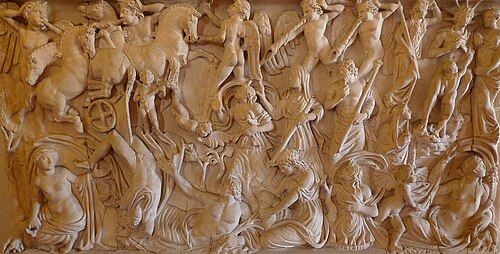
ギリシア語の名詞ἥλιος ( GEN ἡλίου、DAT ἡλίῳ、ACC ἥλιον、VOC ἥλιε ) (以前のἁϝέλιος /hāwelios/ に由来) は、インド・ヨーロッパ祖語の* seh₂u-el [5]から受け継がれた太陽を表す語であり、これはラテン語のsol、サンスクリット語のsurya、古期英語のswegl、古期ノルウェー語のsól、ウェールズ語のhaul、アヴェスター語のhvarなどと同源である。[6] [7]ドーリア語とエオリア語のこの名前の形式はἍλιος、Hálios である。ホメロスのギリシャ語では彼の名前はἨέλιος , Ēéliosと綴られ、ドーリア語ではἈέλιος , Aéliosと綴られる。クレタ島では Ἀβέλιος ( Abélios ) またはἈϝέλιος ( Awélios )であった。[8]ギリシャ人の性別観は彼らの言語にも存在した。古代ギリシャ語には3つの性 (男性、女性、中性) があったので、物や概念が神として擬人化された場合、それは関連する名詞の性別を継承した。ヘリオスは男性名詞なので、それを体現する神も必然的に男性である。[9]ヘリオスの雌の子孫はヘリアデス ( Heliade )、すなわち男性のヘリアダエと呼ばれた。
スーダ語辞典の著者は、ἥλιοςを、日中に集まるという意味のἀολλίζεσθαι、aollízesthaiという単語に語源的に関連づけようとした。あるいは、 ἀλεαίνειν、aleaínein、「温める」という意味から関連づけようとした。[10] プラトンは対話篇クラテュロスの中で、この単語の語源をいくつか示唆し、その中には、ドーリア語のhaliosという単語を介して、昇るときに人々を集めるという意味のἁλίζειν、halízeinという単語に関連づける説や、彼が常に地球を回転させるという意味のἀεὶ εἱλεῖν、aeí heileínという語句に関連づける説などがある。
ドーリア語ではギリシア語祖語の長音 *ā をαのままにしたが、アッティカ語ではこの語を含めほとんどの場合ηに変えた。 クラテュロスとプラトンの語源は現代の学問と矛盾している。[11] heliosから現代英語の接頭辞helio- が生まれ、「太陽に関する」という意味になり、 heliocentrism、aphelion、heliotropium、heliophobia (太陽恐怖症)、heliolatry (太陽崇拝)などの複合語に使われている。 [12]
起源
,_Helios-Relief,_mitte.jpg/500px-Mack,_Ludwig_(der_J%C3%BCngere),_Helios-Relief,_mitte.jpg)
ヘリオスはおそらくインド・ヨーロッパ祖語に由来する。ウォルター・バーカートは「太陽神ヘリオスと暁の女神エオス(オーロラ)は語源的にも神としての地位においても申し分のないインド・ヨーロッパ祖語の系譜に属している」と書き、インド・ヨーロッパ祖語の詩で役割を果たした可能性がある。[13]戦車を操縦する太陽神を取り巻くイメージはインド・ヨーロッパ祖語に由来する可能性が高い。[14] [15] [16]ギリシャの太陽のイメージは、兄妹であるヘリオス神とエオス神から始まる。この2人は昼夜のサイクルにおいて昼(ヘメラ)と夜(ヘスペラ)となり、エオスはヘリオスに同行して天空を旅する。夜になると、エオスは馬を放牧し、金の船で東へ旅する。そこには太陽神とその妹というインド・ヨーロッパ語族のグループ分けと、馬との関連が明らかである。[17]
トロイのヘレネーの名前はヘリオスと同じ語源を持つと考えられており、[18] [19] [20]、ギリシャ人の間で太陽の初期の別の擬人化を表している可能性があります。ヘレネーは卵から孵り、樹木崇拝を受けたため、もともと太陽の娘であると考えられていた可能性があります。これは、原インド・ヨーロッパ語の太陽の乙女に関連する特徴です。[21]しかし、生き残ったギリシャの伝統では、ヘレネーはヘリオスの娘ではなく、ゼウス の娘であるとは決して言われていません。[22]
フェニキア人は守護神バアルの信仰(アスタルトなど)をコリントスに持ち込み、アスタルトがアフロディーテとして崇拝されたのと同様に、コリントスも現地の名前/神ヘリオスとして崇拝され続けたとされている。また、フェニキアのメルカルトは海の神 メリケルテス/パライモンとして採用され、コリントス地峡でも重要な信仰があった。[23]
ヘリオスが昼間は戦車に乗って旅をし、夜は船で海を旅するのは、エジプトの太陽神ラーが帆船に乗って空を航海し、毎朝夜明けに新しく生まれ変わることを反映している可能性がある。さらに、両神は太陽と関連付けられており、「天の目」と見なされていた。[24]
説明

ヘリオスはヒュペリオンとテイア[25] [26] [27]あるいはエウリュパエッサ[28]あるいはバシレイア[29]の息子であり、女神エオスとセレネの唯一の兄弟である。3人兄弟の言及の順序を誕生順とみなすのであれば、ヘリオスと姉妹の誕生順を記した4人の著者のうち、2人は彼を長子、1人は次子、もう1人は末子としている。[b]ヘリオスは、通常より目立つ神々ではなく、オリンポスの神々の中ではより影の薄い存在であったが、[31]最も古い神々の1人であったという事実にもかかわらず。[32]彼の系譜から、ヘリオスは第二世代のタイタンと言えるかもしれない。[33]彼は、文字通り天体の動きという意味でも、また比喩的に社会に秩序をもたらすという意味でも、調和と秩序と関連している。[34]
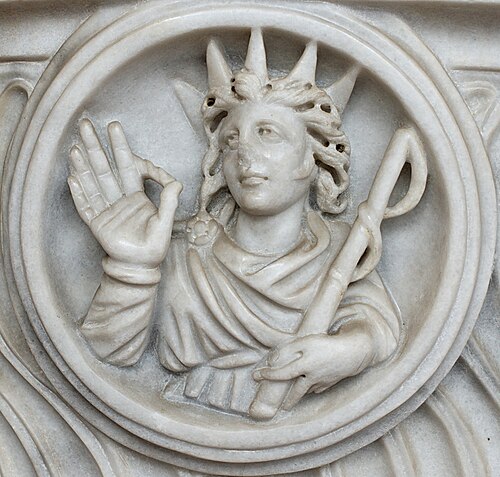
ヘリオスは、伝統的に12の光線を持ち、1年の12か月を象徴する輝く太陽の光輪を冠したハンサムな若者として描かれることが多い。 [35]ホメロスの賛歌以外では、彼の外見について記述している文献は多くない。エウリピデスは彼をχρυσωπός (khrysо̄pós) と表現し、「金色の目/顔」または「金のように輝く」という意味である。[36] クレタ島のメソメデスは、彼は金色の髪を持っていると書いている。 [37]アポロニウス・ロディウスは、彼は光を放つ金色の目を持っていると書いている。[38]アウグストゥス朝の詩人オウィディウスによると、彼はティリアの紫色のローブを着て、明るいエメラルドの玉座に座っていた。[39]古代の遺物(貨幣、花瓶、レリーフなど)では、彼は波打つ髪を持ち、[ 41]太陽の光で飾られた王冠をかぶった、美しく、ふくよかな青年として表現されています。[42]
ヘリオスは4頭の馬に引かれた黄金の戦車を操縦していると言われている:[43] [44]ピュロイス(「燃える者」)、アイオス(「暁の神」)、アイトーン(「燃える」)、フレゴン(「燃える」)。[45]ミトラ教の祈祷では、ヘリオスの出現は次のように伝えられている:
すると神が召喚される。その神は「見るも美しい若者で、燃えるような髪をしており、白いチュニックと緋色のマントを着て、燃えるような冠をかぶっている」と描写されている。その神は「天と地の支配者、神々の神、ヘリオス」と名付けられている。[46]
前述のように、戦車を操縦する太陽神を取り巻くイメージはインド・ヨーロッパ語族に由来する可能性があり、初期のギリシャと近東の宗教の両方に共通しています。[47] [48]
ヘリオスは太陽の擬人化と太陽の背後にある根本的な創造力の両方として見られ、[49]結果として生命と創造の神として崇拝されることが多い。彼の文字通りの「光」はしばしば比喩的な生命力と結び付けられ、[50]他の古代の文献では彼に「慈悲深い」( ἱλαρός ) という称号を与えている。喜劇作家アリストパネスはヘリオスを「馬の導き手、地上の平原を非常に明るい光線で満たす、神々と人間たちの間で強力な神」と表現している。[51]ギリシャの魔術パピルスに記録された一節ではヘリオスについて、「あなたが光り輝くと大地は栄え、あなたが笑うと植物は実り、あなたが許すと生き物に命が吹き込まれた」とある。[14]彼は太古の泥から動物を創造するのを手伝ったと言われている。[52]
神話
太陽の神
昇りと沈み

ヘリオスは毎日東から西へ戦車を駆り、オケアノス川から昇り西の地底に沈む神として描かれている。この旅が彼がタルタロスを旅することを意味するかどうかは不明である。[53]

アテナイオスは『デイプノソフィスタエ』の中で、日没時にヘリオスは純金の大きな杯に乗り、その中で西の果てのヘスペリデスからエチオピア人の地へと渡り、そこで暗い時間を過ごすと述べている。アテナイオスによると、ミンネルモスは、夜、ヘリオスは杯ではなくベッド(これもヘパイストスが作ったもの)を使って東へと旅し、その中で眠ったと語っており、[54]紀元前8世紀の『ティタノマキア』にもそのことが記されている。 [53] アイスキュロスは日没を次のように描写している。
「そこには聖なる波とエリュトライ海の珊瑚礁の海底があり、海の近くに位置するエチオピアの豊かな沼地は磨かれた真鍮のように輝いています。そこでは毎日、柔らかくぬるい流れの中で、すべてを見通す太陽が不滅の自身を洗い、疲れた馬を元気づけています。」
— アイスキュロス『縛られざるプロメテウス』[55]
アテナイオスは「ヘリオスは生涯を通じて労働の報いを受けた」と付け加えた。なぜなら彼自身も彼の馬も休む暇がないからだ。[56]
この戦車はヘパイストスの作品だとよく言われるが、[57] [58] ヒュギーヌスは、それを作ったのはヘリオス自身だと主張している。[59]彼の戦車は金色で[43]、時には「バラ色」で[60]、4頭の白馬に引かれていた。[61] [62] [63] [48]季節の女神であるホーラエは彼の従者の一部であり、戦車のくびきを締めるのを手伝っている。[ 64 ] [65] [66]彼の妹のエオスはヘリオスのために門を開けただけでなく、しばしば彼に同行していたと言われている。[67]東と西の果てには彼の馬の世話をする人々がいたと言われており、彼らにとって夏は永遠に続く実り豊かなものだった。[41]
スケジュールの乱れ
_Flaxman_Ilias_1795,_Zeichnung_1793,_188_x_255_mm.jpg/500px-(24)_Flaxman_Ilias_1795,_Zeichnung_1793,_188_x_255_mm.jpg)
神話では、太陽の通常の周期が乱れる例がいくつかある。ヘラクレスが妊娠しているときには3日間起きないように命じられ、レウコトエを見るために冬の日を長くした。アテナの誕生はあまりにも印象的な光景だったため、ヘリオスは馬を止めて長い間空に留まり、[68]天と地は生まれたばかりの女神の姿を見て震えた。[69]
イリアス では、ギリシア軍に味方するヘラが、戦闘中、彼の意に反して彼を通常より早く出発させ、[70]さらに後に同じ戦争で、彼の妹エオスの息子メムノンが殺された後、彼女は彼を落胆させて光を弱め、メムノンの死を悲しむ妹を慰めている息子の遺体を軍隊に見つからないように自由に盗むことができた。[71]
夏の日が長いのは、ヘリオスが夏の間、ニンフたちが踊るのを上空から眺めるためによく戦車を空中で止めるからと言われている。 [72] [73]また、ヘリオスは配偶者と長居するため、起きるのが遅くなることもある。[74]他の神々が望むなら、ヘリオスは夜になってほしいと願うときに、日々の行程を急がせることもできる。[75]

ゼウスはアルクメネと寝ることを望んだとき、ヘリオスに3日間起きないように命じて太陽の光を隠し、一夜を三倍にした。[76] [77]風刺作家のルキアノスはこの神話を『神々の対話』の中で劇的に表現した。[78] [c]
ヘラクレスは第十の功業のためにゲリュオーンの牛を取り戻すためにエリュテイアへ旅していたが、リビア砂漠を横切って暑さに苛立ち、太陽神ヘリオスに矢を放った。ヘラクレスはすぐに自分の過ちに気づき、深く謝罪した(ペレキュデスは、ヘラクレスが脅すように矢を差し出したが、ヘリオスは止めるよう命じ、ヘラクレスは恐れて止めたと書いている[54])。ヘリオスは同様に丁重にヘラクレスに金の杯を与え、ヘラクレスは毎晩それを使って西から東へ海を渡った。ヘラクレスの行動があまりにも大胆だと思ったからである。アポロドーロスとペレキュデスのバージョンでは、ヘラクレスはヘリオスを射ようとしただけであるが、パニャシスによると、彼は実際に射て神を負傷させた。[80]
日食

古代ギリシャでは日食は驚異であると同時に恐怖の現象で、太陽が人類を見捨てたものとみなされていた。[81]アルキロコスの断片によると、ヘリオスを妨害して空から姿を消したのはゼウスである。[82]抒情詩人ピンダロスは賛歌の一つで日食を太陽の光が世界から隠されること、破滅と破滅の不吉な前兆であると表現している。[83]
太陽の光よ!観察力に優れた者よ、瞳の母よ、最高の星よ、白昼に身を隠すとは、何を企んだのか?なぜ、暗い街道を駆け下りることで、無力な人々の力と知恵の道を作ったのか?前よりも奇妙な道を運転するのか?俊敏な馬の御者、ゼウスの名において、私はあなたに懇願する、この普遍的な前兆を、テーバイにとって痛みのない繁栄に変えてください…あなたは、戦争の兆しをもたらすのか、作物の枯渇、言い表せないほどの大量の雪、破滅的な争い、陸地の海水の枯渇、大地の霜、荒れ狂う水が流れる雨の多い夏をもたらすのか、それとも、土地を洪水に見舞い、最初から新しい人種を創り出すのか?
ヘリオスの馬

ヒュギヌスが引用した、ヘリオスの戦車を引いた馬の名前のリストは以下の通り。学者たちは、リストによって違いはあるものの、馬の名前は常に火、炎、光、その他の光の性質を指しているようだと認めている。[85]
- コリントスのエウメロス(紀元前 7 世紀後半から 6 世紀初頭)によると、雄の馬はエウス(彼によって空が回転する)とアイティオプス(まるで炎のように穀物を乾かす)で、雌のくびき持ちはブロンテ(「雷」)とステロペ(「稲妻」)です。
- オウィディウス(ローマ、紀元前1世紀)によると、ファエトンの騎乗馬は、ピュロイス(「燃える者」)、エウス(「夜明けの者」)、アイトン(「燃える」)、フレゴン(「燃える」)。[86] [87]
ヒュギヌスは、ホメロスによれば馬の名前はアブラクサスとテルビーオであると書いているが、ホメロスは馬や戦車については何も言及していない。[86]
アテナイオスに引用されているアイトリアのアレクサンダーは、この魔法のハーブはヘリオスの聖地であるトリナキア島に生えており、太陽神の馬の疲労回復に効いたと述べている。サモスのアイスリオンは、このハーブは「犬の歯」として知られ、クロノスが蒔いたと信じられていたと伝えている。[88]
ローズ勲章授与

ピンダロスによれば、[89]神々が大地を神々に分けたとき、ヘリオスは不在で、そのため土地をもらえなかった。彼はゼウスにそのことを訴え、ゼウスはもう一度土地の分配を申し出たが、ヘリオスは申し出を断った。なぜなら、彼は海の深みから新たな土地が出現するのを見たからである。それは人間にとっても家畜にとっても豊かで生産的な土地であった。ヘリオスはこの島を自分にくれるよう願い、ゼウスはラケシス(運命の三女神の一人) が両手を挙げて誓いを認め、これに同意した。あるいは別の伝承では、ヘリオス自身が海からあふれていた水を消し、島を海から浮かび上がらせたとされている。[90]彼は恋人のロードス(ポセイドンとアフロディーテ[91]またはアンフィトリテ[92]の娘) にちなんで、その島をロードスと名付け、そこは神の聖なる島となり、他のどの神よりも彼が尊敬された。ヘリオスはロードス島との間に、ヘリアダエ(太陽の息子たち)として知られる7人の息子をもうけ、彼らは島の最初の支配者となった。また、エレクトリオネという1人の娘もいた。 [90]彼らの孫のうち3人は、島にイアリソス、カミロス、リンドスという都市を建設し、自分たちの名前を冠した。 [89]こうしてロードスは彼とその一族のものとなり、ロードス島の先住民はヘリアダエの子孫であると主張した。[93]
フェートン

ヘリオスに関する最も有名な物語は、息子のパエトンがヘリオスに一日だけ戦車を操縦するよう頼んだ話です。どのバージョンも、パエトンがヘリオスに戦車を譲るよう説得し、その任務に失敗して悲惨な結果になったという点では一致していますが、パエトンの母親の正体、物語の舞台、パエトンの姉妹であるヘリアデスの役割、パエトンが父親にそのようなことを頼む決断をした動機、さらには神と人間の正確な関係など、バージョンによって異なる詳細が多数あります。
伝統的に、ファエトーンはヘリオスとオーケアニスのニンフであるクリュメネーとの子である[94]、あるいはロドス[95]、あるいは知られていないプロテ[96]である。物語のあるバージョンでは、ファエトーンはヘリオスの息子ではなく、父親のクリュメノスを通しての孫である。このバージョンでは、ファエトーンの母親はメロペという名のオーケアニスのニンフである。[97]
エウリピデスの失われた戯曲『パエトン』は12の断片のみが現存しているが、パエトンは母親のクリュメネー(現在はエチオピア王メロプスと結婚している)とヘリオスとの不倫関係から生まれた人物であるが、彼女は合法的な夫が全ての子供たちの父親であると主張していた。[98] [99]クリュメネーは息子に真実を明かし、ヘリオスは自分と寝れば子供の願いを何でも叶えると約束したと告げ、父親から確認を得るために東へ旅するよう促す。最初は気が進まなかったものの、パエトンは納得し、実の父親を探し始める。[100]劇中の現存する断片では、ヘリオスは息子の不運な天空の旅に同行し、シリウスという名の予備馬に乗りながら、戦車の操縦方法を教えようとしている。[101]おそらく教育者と思われる人物が、おそらく奴隷の女性たちを伴ったファエトンの運命をクリメネに伝える。

例えば、ヘリオスが息子に手綱を渡す際に言う一節を見てみましょう。
「運転を続けなさい。しかし、燃えるリビアの土地は避けなさい。
熱く乾燥した空気はあなたの車軸を下ろします。7
つのプレアデス星団に向かって、あなたの確固たる道を進み続けなさい。」
その後-
「そう言うと、息子は臆することなく手綱を掴み、
それから翼のある馬の脇腹を叩いた。馬は
虚空と洞窟のような空の天井へと飛び出した。
父親は別の馬に乗り、
警告の声で息子を導いて走る。『あっちへ行け!
曲がれ、お前の馬をこっちへ向けろ』」— エウリピデス『パエトン』断片779 [102]
もしこの使者が逃亡を目撃していたとしたら、ルクレティウスが描写したのと同じように、ヘリオスが暴走する馬を操ったと描写している箇所もあった可能性がある。[103]必然的にパエトーンは死ぬ。劇の終盤の断片では、クリュメネーが奴隷の娘たちに、まだくすぶっているパエトーンの遺体をメロプスから隠すよう命じ、ヘリオスが息子の死に関与したことを嘆き、自分も彼も滅ぼしたと語る。[104]劇の終盤では、メロプスがクリュメネーの情事とパエトーンの本当の親を知り、彼女を殺そうとする。彼女の最終的な運命は不明だが、何らかの神の力によって救われるのではないかと示唆されている。[105]この可能性のある神の正体として、ヘリオスを含む多くの神が提案されている。[105]

オウィディウスの記述では、ゼウスの息子エパポスは、自分が太陽神の息子だというパエトンの主張をあざ笑う。母親のクリュメネーはパエトンに、ヘリオスのもとへ行って父親であるかどうか確認するよう告げる。ヘリオスはステュクス川でパエトンに、父親である証拠として彼が求めるどんな贈り物でも与えると約束する。パエトンは、ヘリオスの戦車を 1 日操縦する特権を願い出る。ヘリオスは息子に、これがどれほど危険で悲惨なことになるかを警告するが、それでもパエトンの考えを変えたり、約束を撤回したりすることはできなかった。パエトンが手綱を握り、彼があまりに低く走ると大地が燃え、あまりに高く走ると大地が凍る。ゼウスはパエトンに雷を落として殺す。ヘリオスは仕事に戻ることを拒否するが、他の神々の懇願やゼウスの脅迫により、仕事と義務に戻る。そして彼は怒りを自分の4頭の馬にぶつけ、息子の死の原因となったことに激怒して馬を鞭打った。[106]
パノポリスのノンヌスは、ヘルメスが語るこの神話の少し異なるバージョンを提示した。彼によると、ヘリオスは大洋の娘であるクリュメネーと出会い恋に落ち、二人はすぐに彼女の父の祝福を受けて結婚した。成長して父の仕事に魅了されたヘリオスは、父に一日だけ馬車を運転するよう頼む。ヘリオスは、息子が必ずしも父親の跡を継ぐにふさわしいわけではないと主張して、彼を思いとどまらせようと全力を尽くす。しかし、パエトンとクリュメネーの懇願に圧力をかけられ、結局彼は屈服する。この神話の他のバージョンと同様、パエトンの騎行は悲惨で、彼の死で終わる。[107]

ヒュギーヌスは、パエトンが父に内緒で許可なく父の馬車にこっそり乗り込んだが、馬にくびきをかけたヘリアデス姉妹の助けがあったと書いている。[108]
すべての再話において、ヘリオスはやがて手綱を取り戻し、地球を救う。[109]複数のバージョンで一貫しているもう1つの詳細は、ファエトンの姉妹であるヘリアデスがエリダヌス座で彼を悼み、琥珀の涙を流す黒いポプラの木に変えられることである。クィントゥス・スミュルナエウスによると、ファエトンへの名誉のためにヘリオスが彼らを木に変えたという。[110]神話の1つのバージョンでは、ヘリオスは死んだ息子を星座(ぎょしゃ座)として星々に運んだ。[111]
ウォッチマン
ペルセポネ

しかし、女神よ、あなたの大きな嘆きは永久にやめてください。
あなたはむなしい飽くことのない怒りを抱き続けてはいけません。
神々の中では、アイドネウスは不相応な花婿ではありません
。多くのものの指揮官であり、ゼウスの同族である彼は。
名誉に関して言えば、彼は世界の最初の分割で3番目を獲得し
、彼の運命に支配された人々と共に住んでいます。
ヘリオスは、彼の光が照らされた場所で起こったすべての出来事を見て、目撃したと言われています。ハデスがペルセポネを誘拐したとき、それを目撃したのはヘリオスだけでした。[113]
オウィディウスの『ファスティ』では、デメテルはまず星にペルセポネの居場所を尋ね、ヘリオスに尋ねに行くように助言したのはヘリケーである。デメテルはためらうことなく彼に近づき、ヘリオスは時間を無駄にせず「第三世界の女王」を探しに行くようにと彼女に告げる。[114]
アレスとアフロディーテ

別の神話では、アフロディーテはヘパイストスと結婚していたが、彼の兄弟で軍神であるアレスと浮気をした。オデュッセイアの第8巻では、盲目の歌手デモドコスが、不倫の恋人たちが姦通を犯し、ある日ヘリオスが現場を押さえ、すぐにアフロディーテの夫ヘパイストスに知らせたことを述べている。それを知ったヘパイストスは、彼らを捕らえるために、ほとんど見えないほど薄い網を作った。そして、レムノス島へ出発すると告げた。それを聞いたアレスはアフロディーテのもとへ行き、2人の恋人は結ばれた。[115]ヘリオスは再びヘパイストスに知らせ、ヘパイストスは部屋に入ってきて彼らを網に閉じ込めた。そして、他の神々を呼んでこの屈辱的な光景を目撃させた。[116]
後世のバージョンでは、物語にアレクトリオンという名の戦士の若者が登場し、誰かが近づいたら見張りをするようアレスから命じられる。しかしアレクトリオンは眠ってしまい、ヘリオスが二人の恋人を発見してヘパイストスに知らせることになった。このため、アフロディーテはヘリオスとその一族を永遠に憎んだ。[117]いくつかのバージョンでは、彼女はヘリオスの娘パシパエに、復讐としてクレタ島の雄牛に恋をするように呪いをかけた。 [118] [119]パシパエの娘パイドラーが継子ヒッポリュトスに情欲を抱いたのも、同じ理由でアフロディーテに仕向けられたと言われている。[117]
レウコトエとクリュティエ

アフロディーテは、復讐を果たすために、ヘリオスを人間の王女レウコトエに惚れ込ませ、彼女のために以前の恋人であるオーケアネスの クリュティエを忘れさせようとします。ヘリオスは天から彼女を監視し、彼女をより長く眺められるように冬の日を長くします。ヘリオスは彼女の母親エウリュノメの姿をとって宮殿に入り、少女の部屋に入ってから姿を現します。
しかし、クリュティエはレウコトエの父オルカムスにこの件を告げ、オルカムスはレウコトエを生きたまま地中に埋めた。ヘリオスは彼女を救出するには遅すぎたため、代わりに大地にネクターを注ぎ、死んだレウコトエを乳香の木に変えた。ヘリオスに恋人の死に関与したとして拒絶されたクリュティエは、裸になり、食べ物も飲み物も受け取らず、9日間岩の上に座り、彼を慕い続け、最終的に太陽を見つめる紫色の花、ヘリオトロープに変わった。[120] [121]この神話は、ヘリオス崇拝で乳香の 芳香樹脂が使われたことを説明するために使われたのではないかという説もある。[122]レウコトエが男性の守護者によって罰として生き埋めにされたことは、アンティゴネ自身の運命とあまり変わらないが、これは植物崇拝における人間の犠牲を伴う古代の伝統を示しているのかもしれない。 [122]最初、レウコトエとクリュティエの物語は、ヘリオスに関する2つの異なる神話だったのかもしれないが、後に、ヘリオスがアレスとアフロディーテの情事を発見し、ヘパイストスに知らせるという3番目の物語と組み合わされ、オウィディウス自身またはその情報源によって1つの物語になった。[123]
他の
ソポクレスの劇『アイアース』では、アイアース大王は自殺する数分前に、アイアースの故郷サラミスに到着したら黄金の手綱を止めるようヘリオスに呼びかけ、年老いた父テラモンと母に息子の運命と死を告げ、自殺する前に最後にもう一度敬礼をします。[124]
戦争への関与

ヘリオスはいくつかの戦いで他の神々の側に立った。[125]ティタノマキアの現存する断片には、ティターン神族の中でヘリオスだけがオリンポスの神々への攻撃を控えた場面が暗示されている。[ 126]そして戦争が終わった後、神々はヘリオスに天空の場所を与え、戦車を授けた。[127] [128]
彼は巨人戦争にも参加している。偽アポロドーロスによると、巨人と神々の戦いの最中、巨人アルキュオネウスはヘリオスの牛を神が飼っていたエリュテイアから盗んだという。 [129]あるいは、アルキュオネウスが牛を盗んだことが戦争のきっかけになったとも言われている。[130] [131]巨人の母であり同盟者である大地の女神ガイアは、巨人が人間の手によって滅びるという予言を知り、巨人を守り実質的に不滅にする魔法の薬草を探した。そこでゼウスはヘリオスとその姉妹であるセレネ(月)とエオス(暁)に光らないように命じ、その植物をすべて自分のために収穫して、ガイアが巨人を不死にする機会を奪い、一方アテナは人間のヘラクレスを召喚して巨人側で戦わせた。[132]
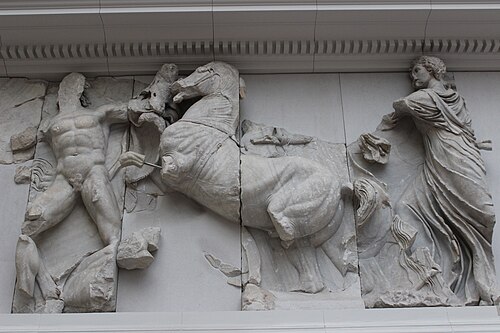
神々と巨人の戦いがプレグラで起こったある時点で、[133]ヘリオスは疲れ果てたヘパイストスを戦車に乗せた。[134]戦争が終わった後、巨人の一人ピコロオスはヘリオスの娘キルケーが住んでいたアイアイアに逃げた。彼はキルケーを島から追い出そうとしたが、ヘリオスに殺された。[135] [136] [137]殺された巨人の血が地面に滴り、新しい植物が生えた。戦いにちなんで名付けられたハーブのモリ (古代ギリシャ語で「マロス」 )。[138]
ヘリオスはペルガモン祭壇に描かれており、南側のフリーズではエオス、セレネ、テイアの隣で巨人と戦争をしている。[139] [140] [141] [128] [142]

衝突と罰
神々
コリントスの起源に関する神話は、次の通りである。ヘリオスとポセイドンは、どちらがこの都市を所有するかをめぐって対立した。ヘカトンケイルのブリアレオスは、2人の神々の間の争いを解決する任務を負い、ヘリオスにアクロコリントスを、ポセイドンにコリントス地峡を与えた。[143] [144]
アイリアノスは、ネリテスは海神ネレウスとオーケアネスのドリスの息子であると書いている。ネリテスがポセイドンの恋人になったバージョンでは、ヘリオスが彼を貝に変えたと言われているが、理由は不明である。アイリアノスは最初、ヘリオスが少年の速さに憤慨していたと書いているが、なぜ姿を変えたのかを説明しようとすると、ポセイドンとヘリオスは恋のライバルだったのではないかと示唆している。[145] [146]
イソップ物語では、ヘリオスと北風の神ボレアスは、どちらが強い神かを 議論した。彼らは、通りすがりの旅人のマントを脱がせた方が勝者となることに同意した。最初に運試しをしたのはボレアスだったが、どれだけ強く吹いても、旅人のマントを脱がすことはできず、むしろマントをきつく巻き付けてしまった。その時ヘリオスは明るく輝き、旅人は暑さに負けてマントを脱ぎ、勝利を収めた。説得は力よりも優れているという教訓である。[147]
人間

太陽としての彼の性質に関連して、[148]ヘリオスは人々の視力を回復したり奪ったりすることができる神として表現され、彼の光が視力を作り、目に見えるものを見ることを可能にしたと考えられていた。[149] [150]ある神話では、オリオンはオイノピオン王によって盲目にされた後、東へ旅し、そこでヘリオスに出会った。ヘリオスはその後オリオンの目を癒し、視力を回復させた。[151]ピネウスの物語 では、アポロニオス・ロディオスのアルゴナウティカに伝えられているように、彼が盲目にされたのは、ピネウスが人類に未来を明らかにしたことに対するゼウスの罰であった。 [152]しかし、別のバージョンの一つによると、ピネウスの視力を奪ったのはヘリオスであった。[153] 偽オッピアヌスは、ヘリオスの怒りは預言者の漠然とした勝利によるものだと書いた。カライスとゼテスがピネウスを苦しめていたハルピュイアを殺した後、ヘリオスは彼を盲目の生き物であるモグラに変えた。 [154]さらに別のバージョンでは、彼は息子のアイエーテースの要請でピネウスを盲目にした。[155]

別の物語では、アテネの発明家ダイダロスとその幼い息子イカロスが、鳥の羽を蝋で接着して翼を作り、飛び立った。[156]エウリピデスのスコリアによると、イカロスは若く無謀で、自分がヘリオスよりも偉いと考えていた。怒ったヘリオスは彼に光線を放ち、蝋を溶かしてイカロスを海に沈め、溺死させた。後にヘリオスは、その海を不運な若者にちなんでイカリア海と名付けることを命じた。[157] [158]
アルゲは、特に素早い雄鹿を狩る際に、太陽と同じくらい速い自分もいつかは追いつくと主張した女狩人であった。ヘリオスは少女の言葉に腹を立て、彼女の姿を雌鹿に変えた。[159] [160]
スミルナの物語のまれなバージョンでは、スミルナが父親であるキニュラスに対して犯した不特定の罪のために、怒ったヘリオスがスミルナに自分の父親であるキニュラスと恋に落ちるように呪いをかけたとされている。しかし、他のバージョンの大多数では、スミルナの呪いの犯人は愛の女神アフロディーテである。[161]
太陽の牛

ヘリオスは、聖なる島トリナキア、あるいはエリュテイアで羊や牛を飼っていたと言われている。[162]それぞれの群れは50頭の動物、合計で350頭の牛と350頭の羊を飼っていた。これは古代ギリシャの初期の暦における1年の日数であり、7つの群れは7日間の週に対応している。 [163]牛は繁殖もせず、死ぬこともなかった。[164]ホメロスのヘルメス賛歌第4番では、ヘルメスがアポロンの聖なる牛を盗んだことで怒ったアポロによってゼウスの前に連れて行かれた後、若い神は自分の行動を弁解し、父親に「私はヘリオスと他の神々を大いに尊敬しています」と言う。[165] [166]
いくつかのバージョンでは彼の息子であるアウゲアスは、神に捧げられた12頭の雄牛の群れを安全に飼育しています。 [167]さらに、アウゲアスの巨大な牛の群れは父親からの贈り物であると言われています。[168]
イリュリアのアポロニアも彼が羊の群れを飼っていた場所の1つで、ペイテニウスという男が羊の世話を任されていたが、羊は狼に食い尽くされてしまった。他のアポロニアテスはペイテニウスが怠慢だと思って、彼の両目をえぐり出した。この男の仕打ちに怒ったヘリオスは、大地を不毛にし、実りをなくした。アポロニアテスが策略でペイテニウスをなだめ、彼が選んだ2つの郊外と家を与えて神を喜ばせた後、大地は再び実り豊かになった。[169]この話はギリシャの歴史家ヘロドトスも証言しており、彼はこの男をエヴェニウスと呼んでいる。[170] [171]
オデッセイ

オデュッセウスが故郷へ帰る旅の途中、キルケー島に着く。キルケーは、トリナキアに着いたらヘリオスの聖牛に触れないように、さもないと神が帰国を阻むと警告する。オデュッセウスは部下たちに警告するが、物資が不足すると彼らは牛を殺して食べる。島の守護者であるヘリオスの娘、パイトゥサとランペティアは父にこのことを告げる。ヘリオスはゼウスに訴え、オデュッセウスの部下を処分するよう言い、イタカ島に新しい神殿を建てるという補償を拒否する。[172]ゼウスは稲妻で船を破壊し、オデュッセウス以外の部下を全員殺す。[173]
その他の作品
ヘリオスは、ルキアノスの『神々の対話』以外にも、いくつかの作品に登場している。ルキアノスの別の作品『イカロメニッポス』では、セレーネが、哲学者たちが自分とヘリオスの間に争いを起こそうとしていると、この主人公に不満を漏らしている。 [174]その後、ヘリオスはオリンポスで他の神々と宴会をしているところが見られ、メニッポスは自分がそこにいるのに、どうして天に夜が訪れるのかと不思議がる。[175]

シケリアのディオドロスは、この神話の異端のバージョンを記録している。それによると、父ウラノスから王位を継承したバシレイアは、兄ヒュペリオンと結婚し、息子ヘリオスと娘セレーネの2人の子供をもうけた。バシレイアの他の兄弟たちはこの子孫を妬み、ヒュペリオンを剣で殺し、ヘリオスをエリダノス川で溺死させ、セレーネは自ら命を絶った。虐殺の後、ヘリオスは悲嘆に暮れる母の夢に現れ、母と殺人者たちは罰せられ、自分と妹は不死の神性に変容するだろうと保証した。メネ[176]として知られていたものがセレーネと呼ばれ、天空の「聖なる火」は自分の名を冠するだろうと。[29] [177]
セレネは、死すべき神エンデュミオンへの情熱に夢中になっていたとき、[178]月の戦車をヘリオスに渡して運転させたと言われている。[179]
クラウディアヌスは、ヘリオスが幼少の頃、叔母のテテュスに育てられたと書いている。[180]
パウサニアスは、ティタネの人々はティタネの最初の住民で町の名前の由来となったヘリオスの兄弟であるティタネ人であると信じていたと書いている。 [181]しかし、ティタネは別個の人物ではなく、一般的にヘリオス自身であると考えられていた。[182]
紀元前6世紀の抒情詩人ステシコロスによれば、ヘリオスの宮殿には母親のテイアが住んでいたという。[183]
アポロンによる竜ピュトンの退治の神話では、殺された蛇の死体は「輝くヒュペリオン」の力で腐ったと言われている。[184]
配偶者と子供たち

ヘリオス神は典型的には大家族の長として描かれ、彼を最も崇拝する場所では、神話と系譜の両方で彼の子孫であると主張するのが典型的である。[148]例えば、クレタ人は彼らの王イドメネウスの祖先を、娘のパシパエを通じてヘリオスにまで遡った。[185]

伝統的に、オーケアニドのニンフであるペルセは太陽神の妻とみなされ[186]、太陽神には彼女との間にキルケー、アイエーテース、ミノスの妻パシパエー、ペルセース、そしていくつかのバージョンではコリントス王アロイオスなど、様々な子供がいる。[187] ヨハネス・ツェッツェスは、アトラスの娘であるカリプソをヘリオスがペルセとの間にもうけた子供のリストに加えているが、これはおそらくオデュッセイアでオデュッセウスの主人としてキルケーとカリプソが示す役割と性格の類似性によるものと思われる。[188]
_MET_DP225321.jpg/500px-Terracotta_lekythos_(oil_flask)_MET_DP225321.jpg)
ある時、ヘリオスはアイエーテースに、自分の子孫の一人(アイエーテースは娘のカルキオペーと、彼女がプリクソスとの間にもうけた子供たちのことだと解釈した)から裏切られるという予言があると警告した。[189] [190] ヘリオスは息子に、俊足の馬に乗った戦車、[191]四枚のプレートが付いた黄金の兜、[192]巨人の戦闘用鎧、[193]父性の証としてローブと首飾りなど、いくつかの贈り物も与えた。[194]娘のメディアが裏切り、黄金の羊毛を盗んだ後イアソンと共に逃亡すると、アイエーテースは父とゼウスに、自分と自分の民に対する不法行為の証人となるよう求めた。[195]
ヘリオスはアイエーテースの父であると同時にメディアの祖父でもあり、エウリピデスがコリントスでメディアが辿った運命を描写する中で重要な役割を果たしている。メディアがグラウケー王女に毒入りのローブと王冠を差し出すと、彼女はそれがヘリオスからの贈り物だと言う。[196]その後、メディアがグラウケーとクレオーン王、そして自分の子供たちを死なせた後、ヘリオスは彼女がコリントスとその夫から逃げるのを手助けする。[197] [198]セネカのこの物語の描写では、苛立ったメディアは祖父の無策を批判し、なぜそのような邪悪さを見て空を暗くしないのかと疑問を抱き、コリントスを焼き払うために燃える戦車を頼む。[199] [200]
しかし、彼はロドス伝承のロドスのような他の女性と結婚したとも言われており[201] 、ロドスとの間にヘリアダイ(オキムス、ケルカフス、マカル、アクティス、テナゲス、トリオパス、カンダロス)と少女エレクトリオーネの7人の息子がいた。
ノンヌスの『ディオニュソス物語』によると、ヘリオスとニンフのクリュメネーは神話の島ケルネで出会い、恋に落ちて結婚した。[202]すぐにクリュメネーはパエテオンを妊娠した。彼女とヘリオスは一緒に子供を育てたが、その子が父親に馬車を求めた不運な日までそうだった。[203]ギリシャのアンソロジーの一節には、ヘリオスがクリュメネーの部屋を訪れたことが記されている。[204]
エリス の人間の王アウゲアスはヘリオスの息子と言われていたが、パウサニアスは彼の本当の父親は人間の王エリオスであったと述べている。[205]
稀なバージョンでは、ヘリオスは姉妹のセレーネとエオスの兄弟ではなく父親であるとされている。エウリピデスの学者は、セレーネは太陽の光を浴び、太陽の位置に応じて姿を変えることから、ヘリオスの娘と言われていると説明した。[206]
- 偽プルタルコスによれば、インドの ナイアードであるアナクシビアはヘリオスに欲情させられたという。[259]
崇拝
カルト
古代アテネと古典アテネ

古代ギリシャのヘリオス信仰に対する学術的関心は、文学的および考古学的資料の不足もあって、概してあまり高くない。[148] L.R.ファーネルは、「太陽崇拝は、かつてはプレヘレニズム文化の人々の間で広く行われ、強力であったが、後期の歴史時代のコミュニティのごく一部が、それを国教の強力な要素として保持していた」と仮定した。[260]学者が用いた主にアッティカの文学的資料は、古代ギリシャの宗教をアテネ偏向で表現しており、J.バーネットによると、「アテネ人がヘリオスやセレネを崇拝するとは考えられないが、ヘリオスはロードスの偉大な神であり、セレネはエリスやその他の場所で崇拝されていたため、彼らを神と考えることはあったかもしれない」。[261]アリストパネスの『平和』(406–413)は、ヘリオスとセレネの崇拝を、より本質的なギリシャの十二オリンポスの神々と対比している。[262]

倫理的価値や詩的象徴主義で豊かになったヘリオスへの主流の伝統的宗教的崇拝と[263]イオニアの太陽の原科学的研究との間の緊張は、紀元前450年頃のアナクサゴラスの裁判で衝突し、アナクサゴラスは太陽は実際には巨大な赤熱した金属の球であると主張した[264] 。
ヘレニズム時代
ヘリオスは、古典期以降のヘレニズム時代までアテネでは崇拝されていなかった。 [265]ヘリオス崇拝はヘレニズム時代の産物と言えるかもしれないが、おそらくアレクサンドロス3世の治世中に宇宙や天体に関する信仰が広まったことが影響している。[266]ソポクレスの学者は、アテネ人はヘリオスに他の神々への供物としてワインを捧げず、代わりにネファリア、つまりワインを飲まない素面の供物を捧げたと書いている。 [267] [268]アテナイオスはまた、ヘリオスに供物を捧げる者はワインを捧げず、宇宙の秩序を保つ神は酔っ払ってはならないという理由で、祭壇に蜂蜜を持ってきたと報告している。[269]
紀元前1世紀または紀元後1世紀のリュシマキデスは、スキラの祭りについて次のように記録しています。
スキロンは大きな日よけであり、アテナの女司祭、ポセイドンの司祭、ヘリオスの司祭がアクロポリスからスキロンと呼ばれる場所まで運ぶ際にその下を歩く。[270]
アポロを称える祭りであるタルゲリア祭では、アテネ人はヘリオスとホラエに穀物を捧げた。[271]農業との明確なつながりと関連性から、彼らは行列で称えられた。[272] [273] [274] [275]ヘリオスとホラエは、アポロを称える別のアテネの祭りであるピュアノプシア祭でも祝宴とともに崇拝されていたようだ。[276] [273]タルゲリア祭で記録されたものとは別の行列が、彼らに敬意を表して行われた可能性もある。[277]
ピレウスのアスクレピオンのLSCG 21.B19のB面には、いくつかの神々へのケーキの供え物が規定されており、その中には夢を通じた孵化に関連する2人の神、ヘリオスとムネモシュネ[278]があり、 [279]、彼らにはアレスターと呼ばれる蜂蜜のケーキと蜂の巣が捧げられます。 [280] [281]供え物の間、ケーキは火で燃やされました。[282]小麦と大麦の粉で作られたオルトスタテス[283] [284]と呼ばれるケーキの一種が、彼とアワーズに捧げられました。[285] [286]チーズ、蜂蜜、小麦で作られた別の平らなケーキであるフトイス[287]も、他の多くの神々とともに彼に捧げられました。[286]
多くの場所で人々は彼を称えて赤と白の牛の群れを飼っており、数種類の白い動物、特に白い馬は彼にとって神聖なものと考えられていた。[42]オウィディウスは、素早い神に遅い動物を捧げるべきではないため、馬が彼に犠牲として捧げられたと書いている。[288]
プラトンの『国家』では、太陽ヘリオスは善の概念の象徴的な産物である。[289]
古代ギリシャ人は日曜日をヘリオスにちなんで「太陽の日」(ἡμέρα Ἡλίου)と呼んでいた。[290]紀元前3世紀のアテネの歴史家でありアテネ語学者であったフィロコロスによると、毎月1日はヘリオスに捧げられた神聖な日であった。[291]
ヘリオスが実際に重要な宗教的人物となり、公に崇拝されるようになったのはローマ時代のことでした。[292] [266]
ロードス
.jpg/500px-Colosse_de_Rhodes_(Barclay).jpg)
ロドス島はヘリオスの重要な信仰の中心地であり、古代ギリシャで彼が主要神として崇拝された数少ない場所の一つであった。[293] [294]ピンダロスの最も有名な頌歌の一つは、ロドス島のヘリオス信仰と人格に対する信仰を永遠に記念するものであり、あらゆる証拠が、彼がロドス人にとって、エリスにとってのゼウス、アテネ人にとってのアテナのような存在であったことを示している。彼らの地元の神話、特にヘリアダイに関するものは、ロドスのヘリオスが彼らの種族と文明の創始者として崇拝されていたことを示唆している。[295]

ロードス島におけるヘリオス崇拝には、ファエトン神話を再現して、四頭立て馬車、つまり四頭立て馬車を断崖から海に突き落とす儀式が含まれていた。ヘリオスを称えて毎年、体操競技大会が開催された。 [42]フェストゥス(エクウス十月記)によれば、毎年ハリア祭の期間中、ロードス島民はヘリオスに捧げられた四頭立て馬車を海に投げ込んだ。[296] [297] [298]ヘリオスに馬の犠牲が捧げられた場所は多かったが、ロードス島では四頭立てのみであった。イリュリクムではポセイドンにも四頭立て馬車が犠牲にされ、リンドスでも海神はヒッピオスという称号で崇拝されていたが、これはおそらく複数の信仰が融合したことを示している。[299]
一日の仕事を控えて日の出に犠牲を捧げる場合は、新鮮で輝く白い馬を捧げるのが適切だと信じられていた。[300]
ロドス島の巨像はヘリオスに捧げられた。エフェソスのクセノポンの小説『エフェソスのアンティアとハブロコメスの物語』では、主人公のアンティアがロドス島での祭りの際、自分の髪の一部を切り、ヘリオスに捧げる。[301]ロドス人はヘリオスの神殿をハレイオン(古代ギリシャ語:Ἄλειον)と呼んだ。[302]
彼を称えて建てられたこの神の巨大な像は、古代世界の七不思議の一つに数えられ、「ロドスの巨像」と呼ばれ、ロドス市の港を飾った。[303]
これらのうち最も優れたものは、まずヘリオスの巨像で、弱強詩の作者は「高さは10キュビトの7倍、リンディアのカレスの作品」と述べている。しかし、それは地震で倒壊し、膝のところが折れて、今は地面に横たわっている。ある神託によれば、人々はそれを再び建てることはなかった。[304]
当時のほとんどの記述によれば、巨像の高さは約70キュビト、つまり33メートル(108フィート)で、現代の自由の女神像の足から頭頂部までの高さとほぼ同じであり、古代世界で最も高い像であった。[305]紀元前226年にロードス島を襲った地震で倒壊し、ロードス島民は神託に従って再建しなかった。
ロードス島では、ヘリオスは島の英雄であり神話上の創始者であるトレポレモスの崇拝と信仰を吸収したようだ。 [ 306]古代ギリシャの都市建設において、政治体制または都市国家の創始者と祖先の両方の意味でアルケゲテスが使われたのはロードス島で、真の卓越性は地元の英雄トレポレモスから神ヘリオスに移され、適切な神話が彼の相対的な重要性の低さを説明している。そのため、もともとトレポレモスのために祝われていた競技会は、都市国家の祖先であり創始者でもあるヘリオスに与えられるようになった。[307]ヘリオスとニンフの聖域はリンドス近郊のロリマにあった。[308]
ヘリオスの神官職は、ある時点ではくじ引きで任命されていたが、大都市では、一人の男とその二人の息子が太陽神の神官職を代々務めていた。[309]
ペロポネソス
シキュオン、アルゴス、ヘルミオネ、エピダウロス、ラコニアに信仰が散在していることは、古代ギリシャの他の地域と比較して、ドーリア人の宗教においてヘリオスがかなり重要であったことを示唆しているようだ。彼の崇拝をロードス島にもたらしたのはドーリア人だったのかもしれない。[310] [311]

ヘリオスはコリントスとコリントス地方で重要な神であった。[312] パウサニアスは『ギリシア記』の中で、ヘリオスとポセイドンが都市をめぐって争い、ポセイドンがコリントス地峡を手に入れ、ヘリオスがアクロコリントスを与えられたと記している。[143]コリントスにおけるヘリオスの重要性は、ミケーネ時代まで遡り、ポセイドンの到来より前のことかもしれないし、[313]あるいは東洋からの移民によるものかもしれない。[314]シキュオンでは、ヘリオスはヘラの神殿の後ろに祭壇を持っていた。[315]コリントス人にとって、ヘリオスは雷さえも制御できるほど有名だったようである。雷は天空の神ゼウスの領域である。[148]
ラコニアにもヘリオス崇拝があった。タイゲトス山の頂上タレトスはヘリオスの聖地であった。[316] [317]タラメイでは、ヘリオスとその娘パシパエは神託において崇拝され、女神は夢の中で相談する人々に必要なことを明らかにした。[318] [313]スパルタにおけるヘリオスの優位性は現在不明であるが、ヘレネーが地元の太陽神であったと思われる。 [319]スパルタ近郊のギュテウムにおけるヘリオス(とセレネ)の崇拝は碑文(CIG 1392)によって証明されている。[320]
アルゴリスでは、ミケーネの近くにヘリオスに捧げられた祭壇があり、[321]トロイゼーンにも別の祭壇があり、トロイゼーン人がクセルクセス1世の手による奴隷状態から逃れたことから、ヘリオスは自由の神として崇拝されていました。[322]ヘルミオネにはヘリオスの神殿が建っていました。[313] [323] [324]彼はエピダウロスでも崇拝されていたようです。[325]
アルカディアでは、メガロポリスに救世主としての崇拝が行われ、マンティネイアの近くに祭壇があった。[326]
その他
ヘリオス崇拝の痕跡はクレタ島にも見られる。最古の時代、ロドスはクレタ島と密接な関係にあり、「タレトス」という名前はエテオクレタ語で太陽を意味する「タロス」と関連していると考えるのが比較的確実である。この言葉は、クレタ島の雷神の太陽の側面であるゼウスの称号タライオスに残っている。[313] [327] [328]ヘリオスは、クノッソスとドレロスの同盟の誓いにも登場している。[329]
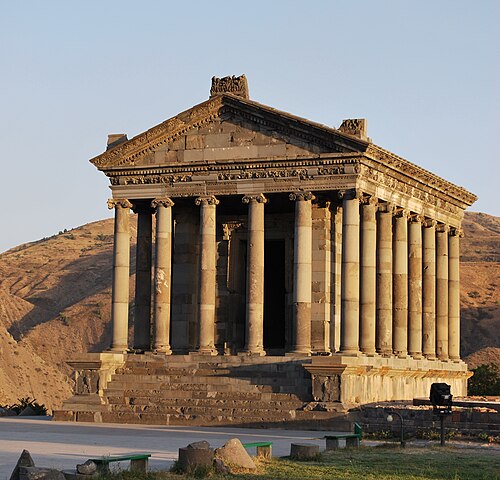
小アジアにおける彼の信仰はほとんど記録されていないが、その中でもアポロとの同一視が最も強かったようである。[330] [331] [332]アナトリアにおけるアポロンの信仰の太陽の要素は、ロードス島が小アジアの南西海岸のすぐ沖合にあることから、ロードス島のヘリオスの信仰に影響を受けた可能性がある。[333]
考古学的証拠により、コス島に昼と昼光の女神ヘリオスとヘメラの神殿が存在したことが判明しており[313] 、発掘調査によりシノペ、ポッツオーリ、オスティアなどでもヘリオス崇拝の痕跡が発見されている[266] 。ギリシャ中部フォキスのクレオナイ市で疫病が流行した後、住民はヘリオスに雄ヤギを犠牲として捧げたところ、疫病を免れたと伝えられている[334] 。
ヘリオスにはテッサリア地方にも信仰があった。[335]プラトンは著書『法律』の中で、マグネテスがヘリオスとアポロンの共同の供物を捧げていた様子について言及しており、この2神の信仰が密接な関係にあることを示している。 [336]しかし、テッサリアではこれら2つの神々は別個の神々であったことは明らかである。[335]

ヘリオスは紀元前1世紀の硬貨にも描かれており、ハリカルナッソス[337] 、 シチリア島のシラクサ[338]、ザキントス[339]で発見されています。ペルガモンからはエウリピデス風のヘリオスへの賛歌が生まれました。[340]
アポロニアでも神は崇拝されていた。ヘロドトスの記述によれば、エヴェニウスという男が、不注意から神に捧げられた羊の群れを狼に食べさせてしまったため、同胞から厳しく罰せられたという。[170]
アレクサンドロス物語には、アレクサンドリア市にヘリオス神殿の名が記されている。[341]
その他の機能
誓いを守る

ギリシャ人は誓いを立てるときに神々に頼ることが多かった。ヘリオスは『イリアス』でギリシャ人とトロイア人の休戦の証人として呼び出される三神の一人である。[342]また、古代劇では『オイディプス王』や『メディア』などにおいて、展開する出来事の証人として、あるいは行動を起こすためにしばしばヘリオスに頼まれる。[343]ヘリオスが誓いや誓約の証人であるという概念は、ヘリオスが不正行為の証人であるという見方にもつながった。[344] [345] [346]そのため、ヘリオスは宇宙秩序の保証人と見なされた。[347]

ヘリオスは、アテネとケトリポリス、パエオニアのリュッペウスとグラボスの同盟、コリントス同盟の誓約など、いくつかの同盟の証人として召喚された。[348]スミルナとマグネシアの都市間の条約では、マグネシア人は他の神とともにヘリオスに誓いを立てた。[349]ゼウス、ガイア、ヘリオスの組み合わせによる誓約は、マウソルスとファセリス(紀元前360年代)の協定や、ヘレニズム時代のアテネとスパルタの同盟を発表したクレモニデスの程度など、ギリシャ以外の「王家の神々」にも見られる。[348]
魔法の中で
彼は降霊術の魔術にも関わっていた。ギリシャの魔術パピルスには、降霊術のレシピがいくつか含まれている。例えば、非業の死を遂げた男の頭蓋骨の杯に太陽を捧げるというレシピがある。この儀式の後、ヘリオスは男の幽霊を術者に送り、術者が知りたいことをすべて伝えるという。[350]ヘリオスは呪いの魔術でもヘカテと関連づけられている。[351]小アジアの一部の地域では、ヘリオスは墓碑銘に墓を侵害するいかなる行為も許さず、潜在的な侵害者には墓を冒涜しないよう警告するよう命じられた。キリキアのエラウサ・セバステの例がそれである。
天の神[ゼウス]、ヘリオス、セレネ、そして我々を受け入れてくれる冥界の神々にかけて誓う。誰も[...]我々の骨の上にもう死体を投げ入れないで下さい。[352]
ヘリオスは葬儀の呪詛でも頻繁に呼び出された。[353]ヘリオスがこの種の魔術に選ばれたのは、全能の神として地上のすべて、隠された犯罪さえも見通すことができたため、復讐の祈りで呼び出される非常に人気のある神だったからかもしれない。[353]さらに、古代の魔術では、悪を避ける助けと厄除けの防御はヘリオスによるものと考えられていた。[354]いくつかの魔術の儀式は、像や石の彫刻と関連付けられており、ヘリオスに石を聖別して幸運、名誉、成功、強さで満たし、使用者に信じられないほどの力を与えるように求める呪文がある。[355]
ヘリオスはアフロディーテと同様に恋愛魔術とも関連付けられており、同性愛[357]や愛情の呪文のために彼を呼び出す魔法のレシピなど、恋愛問題に関して人々が彼に助けを求めたという、あまり文書化されていない別の伝統もあったようです。[358 ]
夢の中で
古代ギリシャでは、人々は夢の中で予言された悪を避けるために、夢をヘリオスや空や空気に明かしていたと言われています。[359] [360]
アルテミドロスの『オネイロクリティカ』によれば、金持ちが神に変身する夢を見るのは、変身に欠陥がない限り吉兆であり、自分がヘリオスである夢を見たが、わずか11本の光線の太陽冠をかぶっていた男の例を挙げている。[35]彼は、太陽神は貧しい人々にとっても吉兆であると書いている。[361]夢の中で、ヘリオスは「感覚的な」形(太陽の球体)または「理解可能な」形(人型の神)で現れることがある。[362]
後期古代

後期古代までに、ヘリオスは他の神々、特にアポロとローマの太陽神ソルから多くの宗教的、神話的、文学的要素を吸収していた。西暦274年12月25日、ローマ皇帝アウレリアヌスはソル・インウィクトゥス(またはヘリオス・メギストス、「偉大なるヘリオス」)への公式な国家崇拝を制定した。この新しい崇拝は、ヘリオスとソルに関連するイメージだけでなく、以前は別個の神として認識されていた他の神々からの多くの融合的要素も集めた。[363]これらの作品のヘリオスは、ミトラスやハルポクラテスなどの神々だけでなく、一神教のユダヤ・キリスト教の神とさえ頻繁に同一視されている。[364]

ローマ帝国最後の異教徒皇帝ユリアヌスは、ミトラ教と新プラトン主義の要素を組み合わせた、復活した異教の宗教の主神としてヘリオスを崇めた。ユリアヌスにとって、ヘリオスは三位一体であった。すなわち、唯一者、ヘリオス=ミトラス、そして太陽である。この体系におけるヘリオスの主な位置は「中間」の領域であったため、ユリアヌスは彼を、存在の3つの領域だけでなく、すべてのものの仲介者であり統合者であるとみなした。[49]ユリアヌスのヘリオスに関する神学的概念は、イアンブリコスのような初期の新プラトン主義者とは対照的に、「実質的に一神教的」であると評されている。[49]
バチカンのネクロポリス(霊廟M)で発見されたモザイク画には、太陽の光線を冠し、太陽の戦車を運転する、ソル/ヘリオスに非常によく似た人物像が描かれている。一部の学者は、アレクサンドリアのクレメンスがキリストが空を戦車を運転していると書いたことに注目し、これをキリストの描写であると解釈している。 [365]一部の学者はキリスト教との関連性を疑っており、[366]この人物像は単に太陽の非宗教的な表現であると示唆している。[367]
ギリシャの魔法のパピルス
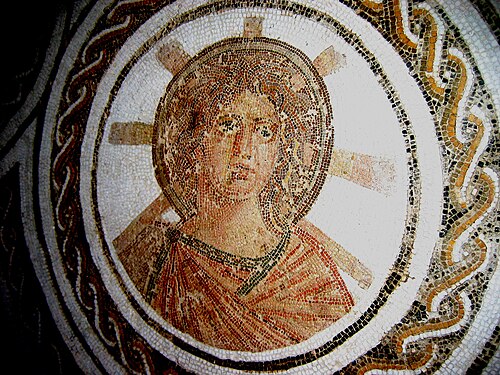
ヘリオスはギリシャ魔術パピルスに大きく登場する。このほとんどが断片的な文書では、ヘリオスは生命の創造者、天と宇宙の支配者、海の神として、広い領域を支配しているとされている。ヘリオスは1日の各時間を表す12の動物の姿をとると言われており、このモチーフは黄道12星座とも関連している。 [ 14]
パピルスではヘリオスが様々な関連神々と融合されていることが多い。ハルポクラテスが昇る太陽を表す蓮の花に座っている姿で描かれることが多かったのと同じように、ヘリオスは「光線で飾られた蓮の上に座って」いると描写されている。[368] [14]

ヘリオスは、ユリアヌス帝の時と同様に、パピルスの一部ではミトラスと同一視されている。ミトラス典礼では、ヘリオス=ミトラスとして両者が組み合わされ、この典礼書を書いた魔術師に不死の秘密を明かしたと言われている。いくつかの典礼書では、ヘリオス=ミトラスが戦車ではなく船で太陽の道を航行していると描写されており、エジプトの太陽神ラーと同一視されている。ヘリオスは「蛇を制止する」とも描写されており、これはおそらく、エジプト神話で、冥界を夜通し旅するラーの船を襲うと言われる蛇神アポフィスを指していると思われる。[14]
多くのパピルスでは、ヘリオスは、ヘブライの神ヤハウェの名前に由来するイアオとも強く同一視されており、サバオトやアドナイなど、いくつかの称号を共有している。[14]また、アガトス・デーモンとも同化されており、他の箇所では「最も偉大な神、ホルス・ハルポクラテス神」とも呼ばれている。[14]
新プラトン主義の哲学者プロクロスとイアンブリコスは、ギリシャの魔術パピルスやその他の文献に見られる、ヘリオスを他の多くの神々の属性を備えた包括的な存在とみなす多くの総合的概念を解釈しようとした。プロクロスは、ヘリオスを多くの形態と特徴から成る宇宙の神として描写した。これらは彼の存在の中に「巻き上げられ」、天使、デーモン、魂、動物、ハーブ、石など、「彼の性質に参加する」すべてのものにさまざまに分配されている。これらすべては、新プラトン主義の神術の実践、つまり神を呼び出して最終的に神との合一を達成することを目的とした魔術の儀式にとって重要だった。イアンブリコスは、神術には「石、植物、動物、芳香物質、その他の神聖で完全で神のような物」の使用が伴うことが多いと指摘した。[369]神学者にとって、特定の神々に捧げられたこれらのアイテムの元素の力は、一種の共感魔法として利用される。[14]
形容詞
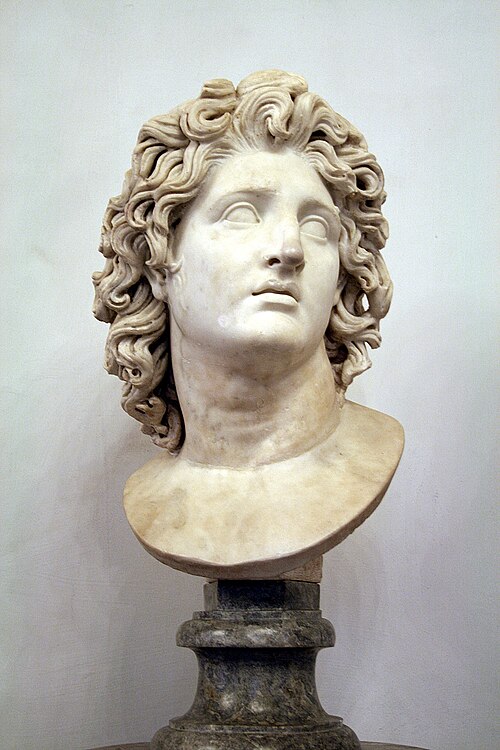
ギリシャの太陽神にはさまざまな別名や異名があり、時が経つにつれて、太陽と関連した別の神として考えられるようになった場合もあります。その中には次のようなものがあります。
アカマス( / ɑː ˈ k ɑː m ɑː s / ; ah- KAH -mahss ; Άκάμας、「アカマス」) は、「疲れを知らない、疲れを知らない」という意味で、彼は終わることのない日課を休みなく毎日繰り返します。
アポロ( / ə ˈ p ɒ l ə ʊ / ; ə- POL -oh ; Ἀπόλλων、「アポロオン」)はここでは「破壊者」を意味し、太陽はより破壊的な力を持っていると理解されている。 [104]
Callilampétes ( / k ə ˌ l iː l æ m ˈ p ɛ t iː z / ; kə- LEE -lam- PET -eez ; Καλλιλαμπέτης、「Kallilampétēs」)、「美しく輝く彼」。[370]
エラシッポス( / ɛ l ˈ æ s ɪ p ə s / ; el- AH -sip-əss ; Ἐλάσιππος、「エラシッポス」)、「馬を駆る」という意味。[371]
選帝侯(/ ə ˈ l ɛ k t ər / ; ə- LEK -tər ; Ἠλέκτωρ、「Ēléktōr」)の語源は不明(Electraを参照)で、特にĒlektōr Hyperiōnの組み合わせでは、「輝く」または「輝く」と翻訳されることが多い。[372]
エリューテリウス( / iː ˈ lj uː θ ər i ə s / ; ee- LOO -thər-ee-əs ; Ἐλευθέριος 、「エレウテリオス」) 「解放者」、アルゴリスのトロエゼンで彼が崇拝されたときの形容詞、[322]も共有ディオニュソスとエロスと一緒に。
ハグナス( / ˈ h æ ɡ n ə s / ; HAG -nəs ; Ἁγνός、 Hagnós)、「純粋」、「神聖」、または「浄化」を意味します。[89]
ヘカトゥス( / ˈ h ɛ k ə t ə s / ; HEK -ə-təs ; Ἕκατος、「ヘカトス」)、「遠くから」、ヘカテボルス( / h ɛ k ə ˈ t ɛ b ə ʊ l ə s / ; hek-ə- TEB -əʊ-ləs ; Ἑκατήβολος , "Hekatḗbolos") 「遠くを射る者」、つまり、太陽の光を矢とみなします。[373]
ホロトロファス( / h ɔːr ˈ ɔː t r ɔː f ə s / ; hor- OT -roff-əss ; Ὡροτρόφος、 "Hо̄rotróphos")、「季節/時間を育む者」、クーロス、「若者」と組み合わせて。[374]
ハイペリオン( / h aɪ ˈ p ɪər i ə n / ; hy- PEER -ree-ən ; Ὑπερίων , "Hyperíōn")とハイペリオンイデス( / h aɪ ˌ p ɪər i ə ˈ n aɪ d iː z / ; hy- PEER -ee-ə- NY -deez ; Ὑπεριονίδης , "Hyperionídēs")は、それぞれ「superus、高い」と「ハイペリオンの息子」を意味し、上にあるものとしての太陽である[375]。また、彼の父親の名前でもある。
イソダエテス(/ ˌ aɪ s ə ˈ d eɪ t iː z / ; EYE -sə- DAY -teez ; Ἰσοδαίτης、「イソダイテス」)、文字通り「平等に分配する者」、ディオニュソスにも共通する崇拝上の称号。[376]
パエアン( / ˈ p iː ə n / PEE -ən ; Παιάν、 Paiān )、医者、治療者、治癒の神、アポロとアスクレピオスの異名。 [377]
パノプテス(/ p æ ˈ n ɒ p t iː s / ; pan- OP -tees ; Πανόπτης , "Panóptēs")は「すべてを見通す者」、パンテポプテス(/ p æ n t ɛ ˈ p ɒ p t iː s / ; pan-tep- OP -tees ; Παντεπόπτης , "Pantepóptēs")は「すべてを監督する者」であり、地球上で起こるすべてのことを目撃した者として知られています。
パシファエス( / p ə ˈ s ɪ f i iː s / ; pah- SIF -ee-eess ; Πασιφαής、「Pasiphaḗs」)、「すべてが輝く」、また彼の娘の 1 人の名前。[378]
パトリウス(/ ˈ p æ t r i ə s / ; PAT -ree-əs ; Πάτριος、「パトリオス」)「父祖の、先祖の」は、いくつかの場所で王家の家系の始祖としての役割に関連しています。[352]
ファエトーン( / ˈ f eɪ θ ən / ; FAY -thən ; Φαέθων 、「Phaéthōn」) 「光り輝くもの」、「輝くもの」、また彼の息子と娘の名前でもある。
ファシムブロトス( / ˌ f æ s ɪ m ˈ b r ɒ t ə s / ; FASS -im- BROT -əs ; Φασίμβροτος、「ファシムブロトス」)「人間に光を当てる者」、太陽。
フィロナマトゥス(/ ˌ f ɪ l oʊ ˈ n æ m ə t ə s / ; FIL -oh- NAM -ə-təs ; Φιλονάματος、「フィロナマトス」)は「水を好む」という意味で、海から昇り、海に沈むことを意味している。[379]
フォイボス(/ ˈ f iː b ə s / FEE -bəs ; Φοῖβος 、 Phoîbos )は文字通り「明るい」という意味で、ローマの著述家数名はアポロンの別名を太陽神ソルに当てはめました。
シリウス( / ˈ s ɪ r ɪ ə s / ; SEE -ree-əss ; Σείριος 、「Seírios」)は文字通り「焼け付く」という意味で、犬の星の名前でもあります。 [380] [101]
ソテル( / ˈ s oʊ t ər / ; SOH -tər ; Σωτὴρ、「Sōtḗr」)「救世主」、アルカディアのメガロポリスで崇拝されていた称号。 [381]
テルプシムブロトゥス( / ˌ t ɜːr p s ɪ m ˈ b r ɒ t ə s / ; TURP -sim- BROT -əs ; Τερψίμβροτος、「テルプシムブロトス」)「暖かく、生命を与える光線で、人間を喜ばせる者」。
Titan(/ ˈ t aɪ t ən / ; TY -tən ; Τιτάν、「Titán」)は、おそらく「日」を意味するτιτώに関連しており、したがって「日の神」を意味します。[382]
アナフェ島のアポロンの異名であるアイグレテースとアスゲラタスはどちらも光に関連しているが、直接的か間接的にヘリオスの異名から借用されたのかどうかは不明である。[378]
他の神々との同一視
アポロ

ヘリオスはアポロと同一視されることがある。「異なる名前が同じ存在を指すこともあるし、あるいはアポロとヘリオスの場合のように意識的に同一視されることもある」とウォルター・バーカートは主張する。[383]アポロンは紀元前5世紀には太陽と関連づけられていたが、彼と太陽神との広範な混同は後世の現象であった。[384]アポロがヘリオスと同一視されているという最も古い確実な言及は、エウリピデスの戯曲『パエトン』の最後のほうの演説の現存する断片に見られる。[104]
ヘレニズム時代までに、アポロンは崇拝において太陽と密接に結び付けられるようになり、アポロに最も一般的に付けられた称号であるフォイボス(ギリシャ語 Φοῖβος、「明るい」)は、後にラテン語の詩人によって太陽神ソルに 当てはめられました。
この同一視は哲学書やオルペウスの文献では一般的なものとなった。偽エラトステネスは『星々の間の配置』第 24 節でオルフェウスについて次のように書いている。
- しかし、妻のために冥府に下り、そこにどんなものがあるかを見た後、彼はディオニュソスを崇拝し続けたが、彼はディオニュソスのおかげで有名になった。彼はヘリオスを神々の中で最も偉大な存在と考え、ヘリオスをアポロンとも呼んだ。彼は毎晩夜明けに起きてパンガイオンと呼ばれる山に登り、太陽が昇るのを待ち、最初に太陽を見ることにした。そのため、ディオニュソスは彼に腹を立て、悲劇作家アイスキュロスが言うように、バッサリデスを派遣した。彼らは彼を引き裂き、手足を散らした。[385]
ディオニュソスとアスクレピオスもこのアポロ・ヘリオスと同一視されることがある。[386] [387]
_-_Napoli_MAN_9449_-_02.jpg/500px-Wall_painting_-_Dionysos_with_Helios_and_Aphrodite_-_Pompeii_(VII_2_16)_-_Napoli_MAN_9449_-_02.jpg)
ストラボンは、アルテミスとアポロンは、それぞれセレネとヘリオスと関連付けられていると書いている。これは、この2つの天体が空気の温度に変化をもたらすためであり、双子の神々は疫病と突然の死の神だったからである。 [388] パウサニアスもまた、アポロンの職業が治癒神であることから、ヘリオスとアポロンの関連を関連付けた。[389]オルペウス賛歌では、ヘリオスはパエアン(「治癒者」)と呼ばれ、金色の竪琴を持っている。[390] [33]どちらもアポロンの一般的な表現である。同様に、アポロンは自身の賛歌の中で、ティタンと人間に光を当てていると表現されている。どちらもヘリオスの一般的な形容詞である。[391]
アテナイオスによれば、テレシラは、アポロを讃えて歌われる歌は「太陽を愛する歌」(φιληλιάς、philhēliás)と呼ばれていると書いている。 [392]つまり、悪天候のときに子供たちが歌う、太陽を雲から出現させることを意図した歌である。しかし、フィリヘリアスをより詳細に記述したユリウス・ポルックスは、アポロについては言及しておらず、ヘリオスについてのみ言及している。[393]テオスのスキティノスは、アポロンは太陽の明るい光(λαμπρὸν πλῆκτρον ἡλίου φάος)をハープの羽根として使っていると書いている[394]。また、ティモテウスの叙情詩の断片では、ヘリオスは弓兵としてἸὲ Παιάν (2人の医神を呼ぶ一般的な方法)という呼びかけで呼び出されているが、これはおそらく、広く信じられていた信仰というよりも、秘教的な教義の一部であったと思われる。[393]

古代ラテン詩人も太陽神の別名としてフォイボスを使用しており、これが後のヨーロッパの詩で太陽の隠喩としてフォイボスとその戦車がよく言及されるようになった理由である。 [395]古代ローマの作家で「フォイボス」を太陽とアポロの両方に使用した人物には、オウィディウス、[396] ウェルギリウス、[397] スタティウス、[398]セネカがいる。[399]芸術作品における太陽の光線を頭の周りに持つアポロンの表現も、ローマ帝国時代、特に西暦218-222年のヘリオガバルス皇帝の治世に属する。[400]
ウシル

エトルリアの太陽神はウシルである。彼の名前はピアチェンツァの青銅の肝臓に、月を表すティウルの隣に記されている。 [401]後期アルカイック様式のエトルリアの青銅鏡には、両手に火の玉を持ち、海から昇るウシルの姿が刻まれている。 [402]古典様式のエトルリアの鏡には、ウシルは光輪を伴って描かれている。古代の芸術作品では、ウシルは暁の女神テサンと密接に関連して描かれており、ヘリオスとエオスと一緒に描かれることはほとんどない。 [403]しかし、チェトーナとキウージの間の地域では石のオベリスクが発見されており、そのレリーフ装飾は太陽の聖域を指していると解釈されているようで、太陽船、ヘリオスとテサンの頭、そして同じく日の出を表す雄鶏のように見える。 [404]
ゼウス
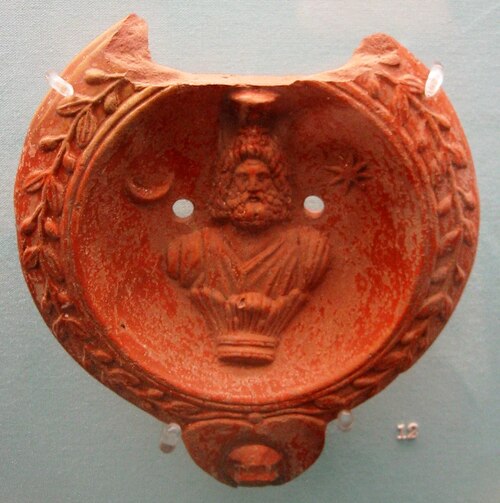
ヘリオスは古典文学ではオリンポスの最高神ゼウスと混同されることもある。ゼウスの公認の崇拝称号はアレイオス・ゼウス、つまり「太陽のゼウス」で、これはヘリオスのドーリア語名に由来する。[405]紀元前4世紀または3世紀のマミアによるヘリオスとゼウス・メイリキオスへの献呈の碑文入りの台座は、ヘリオスとゼウスの合同崇拝のかなり初期の異例の証拠である。[406]プルタルコスによると、ヘリオスは人間が対話できる物質的な形をしたゼウスであり、ゼウスが年を所有しているのはそのためである。[407]一方、エウリピデスの『メディア』の合唱団もヘリオスを「ゼウスから生まれた光」と呼んでゼウスと結び付けている。[408]彼のオルペウス賛歌では、ヘリオスは「不滅のゼウス」と呼ばれている。[390]クレタ島では、ゼウス・タライオスの崇拝に太陽の要素がいくつか取り入れられており、「タロス」は現地ではヘリオスに相当した。[327]ヘリオスは直接ゼウスの目と呼ばれたり、[409]明らかにそう示唆されたりしている。例えば、ヘシオドスはゼウスの目を太陽と表現している。[410]この認識は、太陽が* Dyḗus Pḥ a tḗrの目として考えられていたと考えられている、より初期の原インド・ヨーロッパ語族の宗教に由来している可能性がある( Hvare-khshaetaを参照)。アポロンの神託によって与えられたとされるオルペウスの格言は、次の通りである。
- 「ゼウス、ハデス、ヘリオス・ディオニュソス、三人の神が一つの神格の中にいる!」
ヘレニズム時代には、ギリシャ人によってゼウスの冥界の側面として考えられたギリシャ・エジプトの神セラピスが誕生した。セラピスの太陽の性質は、ギリシャ人が描いた太陽の冠と光線によって示されている。[411]地中海全域で、「ゼウス、セラピス、ヘリオス」への共同の奉納が頻繁に発見されている。[411] [412] [413] [414] [415]エーゲ海のアモルゴス 島ではゼウスが太陽神として崇拝されていたという証拠があり、これが正しければ、ゼウス崇拝における太陽の要素は紀元前5世紀にはすでに存在していた可能性がある。[416]
.png/500px-INC-3011-r_%D0%90%D1%83%D1%80%D0%B5%D1%83%D1%81._%D0%90%D0%B4%D1%80%D0%B8%D0%B0%D0%BD._%D0%9E%D0%BA._117_%D0%B3._(%D1%80%D0%B5%D0%B2%D0%B5%D1%80%D1%81).png)
ハデス
Helios seems to have been connected to some degree with Hades, the god of the Underworld. A dedicatory inscription from Smyrna describes a 1st–2nd century sanctuary to "God Himself" as the most exalted of a group of six deities, including clothed statues of Plouton Helios and Koure Selene, or in other words "Pluto the Sun" and "Kore the Moon".[417] Roman poet Apuleius describes a rite in which the Sun appears at midnight to the initiate at the gates of Proserpina; the suggestion here is that this midnight Sun could be Plouton Helios.[418] Pluto-Helios seems to reflect the Egyptian idea of the nocturnal Sun that penetrated the realm of the dead.[419]
An old oracle from Claros said that the names of Zeus, Hades, Helios, Dionysus and Jao all represented the Sun at different seasons.[420] Macrobius wrote that Iao/Jao is "Hades in winter, Zeus in spring, Helios in summer, and Iao in autumn."[421]
Cronus
Diodorus Siculus reported that the Chaldeans called Cronus (Saturnus) by the name Helios, or the Sun, and he explained that this was because Saturn was the "most conspicuous" of the planets.[422]
Mithras
Helios is frequently conflated with Mithras in iconography, as well as being worshipped alongside him as Helios-Mithras.[49] The earliest artistic representations of the "chariot god" come from the Parthian period (3rd century) in Persia where there is evidence of rituals being performed for the sun god by Magi, indicating an assimilation of the worship of Helios and Mithras.[14]
Iconography
Depiction and symbols

The earliest depictions of Helios in a humanoid form date from the late sixth and early fifth centuries BC in Attic black-figure vases, and typically show him frontally as a bearded man on his chariot with a sun disk. A red-figure on a polychrome bobbin by a follower of the Brygos painter already signifies a shift in the god's depiction, painting him as a youthful, beardless figure. In later art, he is consistently drawn as beardless and young. In it, he is typically depicted with a radiant crown,[423] with the right hand often raised, a gesture of power (which came to be a definitional feature of solar iconography), the left hand usually holding a whip or a globe.[424]
In Rhodian coins, he was shown as a beardless god, with thick and flowing hair, surrounded by beams.[425] He was also presented as a young man clad in tunic, with curling hair and wearing buskins.[426] Just like Selene, who is sometimes depicted with a lunar disk rather than a crescent, Helios too has his own solar one instead of a sun crown in some depictions.[427] It is likely that Helios' later image as a warrior-charioteer might be traced back to the Mycenaean period;[428] the symbol of the disc of the sun is displayed in scenes of rituals from both Mycenae and Tiryns, and large amounts of chariots used by the Mycenaeans are recorded in Linear B tablets.[429]

In archaic art, Helios rising in his chariot was a type of motive.[430] Helios in ancient pottery is usually depicted rising from the sea in his four-horse chariot, either as a single figure or connecting to some myth, indicating that it takes place at dawn. An Attic black-figure vase shows Heracles sitting on the shores of the Ocean river, while next to him a pair of arrows protrude from Helios, crowned with a solar disk and driving his chariot.[431]
Helios adorned the east pediment of the Parthenon, along with Selene.[432][433] Helios (again with Selene) also framed the birth of Aphrodite on the base of the Statue of Zeus at Olympia,[434][435] the Judgement of Paris,[436] and possibly the birth of Pandora on the base of the Athena Parthenos statue.[437] They were also featured in the pedimental group of the temple at Delphi.[438] In dynamic Hellenistic art, Helios along with other luminary deities and Rhea-Cybele, representing reason, battle the Giants (who represent irrationality).[439]

In Elis, he was depicted with rays coming out of his head in an image made of wood with gilded clothing and marble head, hands and feet.[440] Outside the market of the city of Corinth stood a gateway on which stood two gilded chariots; one carrying Helios' son Phaethon, the other Helios himself.[441]
Helios appears infrequently in gold jewelry before Roman times; extant examples include a gold medallion with its bust from the Gulf of Elaia in Anatolia, where he's depicted frontally with a head of unruly hair, and a golden medallion of the Pelinna necklace.
His iconography, used by the Ptolemies after representations of Alexander the Great as Alexander-Helios, came to symbolize power and epiphany, and was borrowed by several Egyptian deities in the Roman period.[442] Other rulers who had their portraits done with solar features include Ptolemy III Euergetes, one of the Ptolemaic kings of Egypt, of whom a bust with holes in the fillet for the sunrays and gold coins depicting him with a radiant halo on his head like Helios and holding the aegis exist.[443][444]
Late Roman era
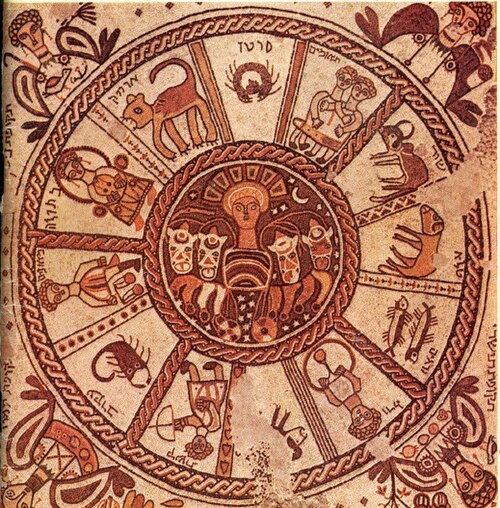
Helios was also frequently depicted in mosaics, usually surrounded by the twelve zodiac signs and accompanied by Selene. From the third and fourth centuries CE onwards, the sun god was seen as an official imperial Roman god and thus appeared in various forms in monumental artworks. The cult of Helios/Sol had a notable function in Eretz Israel; Helios was Constantine the Great's patron, and so that ruler came to be identified with Helios.[445] In his new capital city, Constantinople, Constantine recycled a statue of Helios to represent himself in his portrait, as Nero had done with Sol, which was not an uncommon practice among pagans.[446] A considerable portion if not the majority of Jewish Helios material dates from the 3rd through the 6th centuries CE, including numerous mosaics of the god in Jewish synagogues and invocation in papyri.[447]

The sun god was depicted in mosaics in three places of the Land of Israel; at the synagogues of Hammat Tiberias, Beth Alpha and Naaran. In the mosaic of the Hammat Tiberias, Helios is wrapped in a partially gilded tunic fastened with a fibula and sporting a seven-rayed halo[445] with his right hand uplifted, while his left holds a globe and a whip; his chariot is drawn as a frontal box with two large wheels pulled by four horses.[448] At the Beth Alpha synagogue, Helios is at the centre of the circle of the zodiac mosaic, together with the Torah shrine between menorahs, other ritual objects, and a pair of lions, while the Seasons are in spandrels. The frontal head of Helios emerges from the chariot box, with two wheels in side view beneath, and the four heads of the horses, likewise frontal, surmounting an array of legs.[449][445] In the synagogue of Naaran, the god is dressed in a white tunic embellished with gemstones on the upper body; over the tunic is a paludamentum pinned with a fibula or bulla and decorated with a star motif, as he holds in his hand a scarf, the distinctive symbol of a ruler from the fourth century onward, and much like all other mosaics he's seated in his four-horse chariot. Temporary writings record "the sun has three letters of [God's] name written at its heart and the angels lead it" and "[t]he sun is riding on a chariot and rises decorated like a bridegroom".[445] Both at Naaran and Beth Alpha the image of the sun is presented in a bust in frontal position, and a crown with nimbus and rays on his head.[448] Helios at both Hammath Tiberias and Beth Alpha is depicted with seven rays emanating from his head, it has been argued that those two are significantly different; the Helios of Hammath Tiberias possesses all the attributes of Sol Invictus and thus the Roman emperors, those being the rayed crown, the raised right hand and the globe, all common Helios-Sol iconography of the late third and early fourth centuries AD.[424]
Helios and Selene were also personified in the mosaic of the Monastery of Lady Mary at Beit She'an.[448] Here he is not shown as Sol Invictus, the Unconquered Sun, but rather as a celestial body, his red hair symbolizing the sun.[445]
The poplar tree was considered sacred to Helios, due to the sun-like brilliance its shining leaves have.[450] A sacred poplar in an epigram written by Antipater of Thessalonica warns the reader not to harm her because Helios cares for her.[451]
Aelian wrote that the wolf is a beloved animal to Helios;[452] the wolf is also Apollo's sacred animal, and the god was often known as Apollo Lyceus, "wolf Apollo".[453]
In post-antiquity art
In painting

Helios/Sol had little independent identity and presence during the Renaissance, where the main solar gods were Apollo, Bacchus and Hercules.[454][455] In post-antiquity art, Apollo assimilates features and attributes of both classical Apollo and Helios, so that Apollo, along with his own iconography, is many times depicted as driving the four-horse chariot, representing both of them.[456] In medieval tradition, each of the four horses had its own distinctive colour; in the Renaissance, however, all four are shown as white.[456][457] In Versailles, a gilded statue depicts Apollo as the god of the sun, driving his quadriga as he sinks in the ocean;[458] Apollo in this regard represents the king of France, le roi-soleil, "the Sun King".[459]


Additionally to the chariot, Apollo is often drawn with a solar halo around his head and depicted in scenes of Helios' mythology.[460][459] Accordingly, in depictions of Phaethon meeting his father and asking him the privilege of driving the sun chariot, artists gave to Phaethon's father the appearance and attributes of Apollo.[461][462]
In literature

A love affair between the Sun god and the Nereid Amphitrite is introduced by French playwright Monléon's L'Amphytrite (1630); in the denouement, the Sun, scorned by the nymph, sets the land and sea ablaze, before the king of gods Jupiter intervenes and restores peace.[463]
In Jean-Gilbert Durval's Le Travaux d'Ulysse (1631), after his men dine on the sacred sheep, the Sun appears in 'a chariot of light', accompanied by Jupiter; like in the myth, Jupiter kills Odysseus' crewmen with his lightning bolts when they put to sea again.[463]

French composer Jean-Baptiste Lully wrote in 1683 a tragédie en musique inspired by Ovid's handling of the tale of Helios' son, Phaëton, in which Phaëton obtains from his father the sun chariot in order to prove his divine origins to his rival Epaphus, but loses control and is instead struck and killed by Jupiter.[464] The luxury of the Sun and his palace was no doubt meant to connect to the Sun King, Louis XIV, who used the sun for his emblem.[465] This Apollo-Sun was frequently used to represent Louis XIV's reign, such as in Pierre Corneille's Andromède (1650).[466]
Gerhart Hauptmann's Helios und Phaethon omits entirely the cosmic disaster Phaethon caused in order to focus on the relationship between the divine father and his mortal son, as Phaethon tries to convince his father he is well-suited for his five steeds, while Helios tries to dissuade his ambitious child, but eventually consents and gives him his reins and steeds to drive for a single day.[467]
In James Joyce's book Ulysses, episode 14 is titled Oxen of the Sun, after the story of Odysseus' men and the cattle of Helios in book twelve of the Odyssey.[468]
In A True Story, the Sun is an inhabited place, ruled by a king named Phaethon, referencing Helios's mythological son.[469] The inhabitants of the Sun are at war with those of the Moon, ruled by King Endymion (Selene's lover), over colonization of the Morning Star (Aphrodite's planet).[470][471]
Namesakes
Helios is the Greek proper name for the Sun for both Ancient and Modern Greek,[472] and additionally Helios, one of the craters of Hyperion, a moon of Saturn which bears Helios' father's name, is named after this Greek god. Several words relating to the Sun derive from "helios", including the rare adjective heliac (meaning "solar"),[473] heliosphere, perihelion and aphelion among others.
The chemical element Helium, a colorless, odorless, tasteless, non-toxic, inert, monatomic gas, first in the noble gas group in the periodic table, was named after Helios by Norman Lockyer and Edward Frankland, as it was first observed in the spectrum of the chromosphere of the Sun.[474][475]
Helius is a genus of crane fly in the family Limoniidae that shares its name with the god.
A pair of probes that were launched into heliocentric orbit by NASA to study solar processes were called Helios A and Helios B.[476][477]
Modern reception
Helios often appears in modern and popular culture due to his status as the god of the sun.
A crime thriller named Helios, directed by Longman Leung, was released in 2015.[478][479][480]
Helios has been portrayed in many modern works of literature such as in Gareth Hinds' 2010 version of The Odyssey[481] and in 2018's The Burning Maze[482] in The Trials of Apollo series by Rick Riordan.
Helios has been portrayed in many video games, such as in Sony Computer Entertainment's God of War: Chains of Olympus, God of War II and God of War III where the character is a boss and plays an antagonist role against Kratos.[483] He also appears in the Wii game Metroid Prime 3: Corruption, where the second Seed guardian is named after Helios,[484] and as an AI in the Deus Ex series.[485]
Gallery
- Helios in art
-
 Helios statue by Johannes Benk (1873) at the Naturhistorisches Museum, Vienna.
 -
 Bronze statuette of Helios with a seven-pointed gloriole and breastplate.
 -
 Helios statuette, Antalya Museum.
 -
 Mithraic relief with original colors (reconstitution).
 -
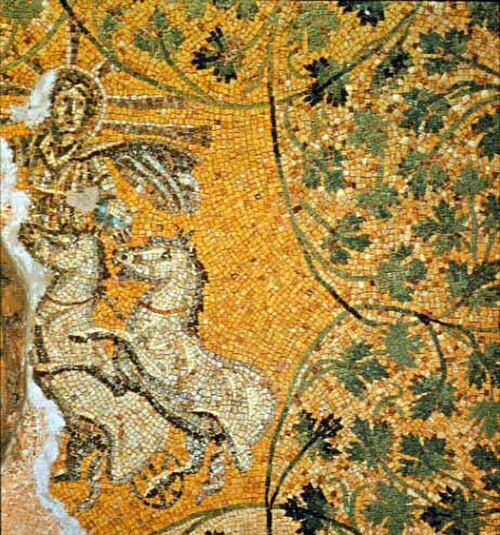 Jesus Christ-Helios mosaic.
 -
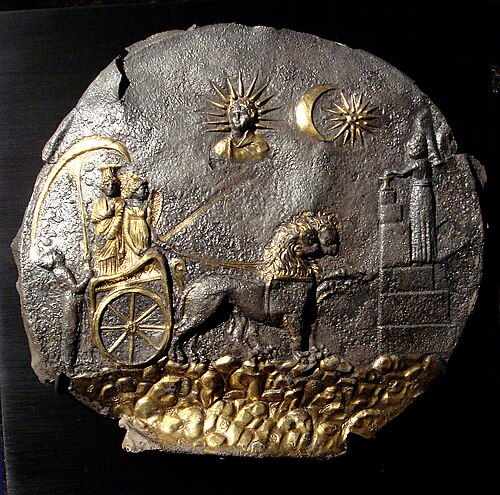 Helios on a plate with Cybele.
 -
 Helios on a Rhodian coin, München, Staatliche Münzsammlung.
 -
 Helios with a chlamys.
 -
 Horses of the Sun, Musée de Sens.
 -
 The Colossus of Rhodes.
 -
 Helios with Selene and Mithras.
 -
 The Departure of Phaethon, Jean Jouvenet, oil on canvas, 1680s.
_at_the_Naturhistorisches_Museum,_Wien-9958.jpg/500px-Helios,_Main_figure_(Johannes_Benk)_at_the_Naturhistorisches_Museum,_Wien-9958.jpg)

.jpg/500px-Le_d%C3%A9part_de_Phaton_(bgw17_1288).jpg)
Genealogy
See also


- Ah! Sun-flower
- Amaterasu
- Amshuman
- Five Suns (mythology)
- Guaraci
- Heliopolis, particularly
- Korouhanba
- Piltzintecuhtli (mythology)
- List of solar deities
- Solar Myths
Notes
- ^ Hyperion and Phaethon are also the names of his father and son respectively.
- ^ Hesiod and Hyginus both give their birth order as first Helios/Sol, then Selene/Luna and lastly Eos/Aurora,[25][30] pseudo-Apollodorus makes him the middle child (with Eos as the oldest)[26] and the author of his Homeric Hymn has him as the youngest of the three (with Eos again as the oldest).[28]
- ^ Helios (and Lucian) is wrong here; Cronus had Chiron by Philyra.[79]
- ^ Expert seafarers and astrologers from Rhodes island.[209]
References
- ^ a b Alexander Stuart Murray and William H. Klapp, Handbook of World Mythology, p. 117
- ^ Pande, Govind Chandra (2007). A golden chain of civilizations : Indic, Iranic, Semitic, and Hellenic up to c. 600 B.C. (1 publ. ed.). New Delhi: Project of History of Indian Science, philosophy, and Culture. p. 572. ISBN 978-8187586289. Retrieved 20 April 2018.
- ^ March, s.v. Helios
- ^ Homer, Odyssey, XII.262, 348, 363.
- ^ R.S.P. Beekes, Etymological Dictionary of Greek, Brill, 2009, p. 516.
- ^ helios. Online Etymology Dictionary.
- ^ Toorn et al, s.v. Helios pp 394–395
- ^ ἥλιος in Liddell & Scott (1940), A Greek–English Lexicon, Oxford: Clarendon Press
- ^ Hansen, William F. (2004). Handbook of classical mythology. Internet Archive. Santa Barbara, Calif. : ABC-CLIO. ISBN 978-1-57607-226-4.
- ^ "ToposText". topostext.org. Retrieved 2024-08-06.
- ^ Joseph, John Earl (2000). Limiting the Arbitrary. John Benjamins. p. 39. ISBN 1556197497.
- ^ Harper, Douglas. "helio-". Online Etymology Dictionary. Retrieved 2022-06-22.
- ^ Burkert, Walter (1985). Greek Religion. Harvard University Press. ISBN 978-0-674-36281-9.
- ^ a b c d e f g h i Pachoumi, Eleni. 2015. "The Religious and Philosophical Assimilations of Helios in the Greek Magical Papyri." Greek, Roman, and Byzantine Studies, 55: 391–413.
- ^ Gelling, P. and Davidson, H.E. The Chariot of the Sun and Other Rites and Symbols of the Northern Bronze Age. London, 1969.
- ^ Gamkrelidze, Thomas V.; Ivanov, Vjaceslav V. (2010-12-15). Indo-European and the Indo-Europeans: A Reconstruction and Historical Analysis of a Proto-Language and Proto-Culture. Part I: The Text. Part II: Bibliography, Indexes. Walter de Gruyter. ISBN 978-3-11-081503-0.
- ^ Mallory, J. P.; Adams, Douglas Q. (1997). Encyclopedia of Indo-European Culture. Taylor & Francis. ISBN 978-1-884964-98-5.
- ^ Euripides, Robert E. Meagher, Helen, Univ of Massachusetts Press, 1986
- ^ O'Brien, Steven. "Dioscuric Elements in Celtic and Germanic Mythology". Journal of Indo-European Studies 10:1 & 2 (Spring–Summer, 1982), 117–136.
- ^ Skutsch, Otto. "Helen, her Name and Nature". Journal of Hellenic Studies 107 (1987), 188–193.
- ^ Larson, Jennifer Lynn (1995). Greek Heroine Cults. Univ of Wisconsin Press. ISBN 978-0-299-14370-1.
- ^ West, M. L. (2007-05-24). Indo-European Poetry and Myth. OUP Oxford. ISBN 978-0-19-928075-9.
- ^ Jevons, Frank Byron (1903). The Makers of Hellas. C. Griffin, Limited. pp. 138–139.
- ^ Kilinski, Karl (2013). Greek Myth and Western Art: The Presence of the Past. Cambridge University Press. ISBN 978-1-107-01332-2.
- ^ a b "Hesiod, Theogony, line 371". www.perseus.tufts.edu. Retrieved 2024-08-06.
- ^ a b "Apollodorus, Library, book 1, chapter 2, section 2". www.perseus.tufts.edu. Retrieved 2024-08-06.
- ^ "Scaife Viewer | Scholia in Pindarum Isthmian Odes". scaife.perseus.org. Retrieved 2024-08-06.
- ^ a b "Hymn 31 to Helios, To Helios". www.perseus.tufts.edu. Retrieved 2024-08-06.
- ^ a b Diodorus Siculus, Historic Library 3.57.2–8; Grimal, s. v. Basileia
- ^ Hyginus, Fabulae preface
- ^ Gardner, Percy; Jevons, Frank Byron (1895). A Manual of Greek Antiquities. Charles Scribner's Sons.
- ^ Ogden, Daniel (2010-02-01). A Companion to Greek Religion. John Wiley & Sons. ISBN 978-1-4443-3417-3.
- ^ a b Powell, Barry B. (2021-04-30), "14 Sun, Moon, Earth, Hekatê, and All the Gods", Greek Poems to the Gods, University of California Press, pp. 240–252, doi:10.1525/9780520972605-017, ISBN 978-0-520-97260-5, retrieved 2024-08-06
- ^ Berg, Robbert Maarten van den (2001-12-01). Proclus' Hymns: Essays, Translations, Commentary. BRILL. ISBN 978-90-474-0103-2.
- ^ a b Thonemann, Peter (2020-01-16). An Ancient Dream Manual: Artemidorus' The Interpretation of Dreams. Oxford University Press. ISBN 978-0-19-258202-7.
- ^ West, M. L. (2007-05-24). Indo-European Poetry and Myth. OUP Oxford. ISBN 978-0-19-928075-9.
- ^ Phillips, Tom; D'Angour, Armand (2018-03-02). Music, Text, and Culture in Ancient Greece. Oxford University Press. ISBN 978-0-19-251328-1.
- ^ Apollonius, Rhodius (1889). "The Argonautica" of Apollonius Rhodius. University of California Libraries. London : George Bell.
- ^ "Metamorphoses (Kline) 2, the Ovid Collection, Univ. of Virginia E-Text Center". ovid.lib.virginia.edu. Retrieved 2024-08-06.
- ^ Stoll, Heinrich Wilhelm (1852). Handbook of the religion and mythology of the Greeks, tr. by R.B. Paul, and ed. by T.K. Arnold.
- ^ a b Mythology of Greece and Rome (Special Reference to Its Influence on Literature).
- ^ a b c Seyffert, Oskar (1901). A dictionary of classical antiquities : mythology, religion, literature & art. Wellcome Library. London : S. Sonnenschein ; New York : Macmillan.
- ^ a b "Hymn 31 to Helios, To Helios". www.perseus.tufts.edu. Retrieved 2024-08-08.
- ^ "Pindar, Olympian, Olympian 7 For Diagoras of Rhodes Boxing-Match 464 B. C." www.perseus.tufts.edu. Retrieved 2024-08-08.
- ^ Gordon MacDonald Kirkwood, A Short Guide to Classical Mythology, p. 88
- ^ Fear 2022, p. 173.
- ^ Burkert, W. Greek Religion: Archaic and Classical. Cambridge Mass., 1985, p. 175.
- ^ a b Vergados, Athanassios (2012-12-06). The "Homeric Hymn to Hermes": Introduction, Text and Commentary. Walter de Gruyter. ISBN 978-3-11-025970-4.
- ^ a b c d Julian, Emperor of Rome (2015-04-07). The Works of the Emperor Julian, Vol. 1. Translated by Wright, Wilmer Cave.
- ^ "ToposText". topostext.org. Retrieved 2024-08-08.
- ^ "Aristophanes, Clouds, line 563". www.perseus.tufts.edu. Retrieved 2024-08-08.
- ^ Apollonius, Rhodius; Seaton, R. C. (Robert Cooper) (1912). The Argonautica. Kelly - University of Toronto. London : Heinemann ; New York : G.P. Putnam.
- ^ a b Keightley, Thomas (1838). The Mythology of Ancient Greece and Italy. D. Appleton.
- ^ a b Athenaeus, Deipnosophistae 11.39
- ^ Strabo, Geographica 1.2.27, translation by H.C. Hamilton, Esq., W. Falconer, M.A., Ed.
- ^ Kirk, Raven & Schofield 1983, pp. 12–13: [F]or him does his lovely bed bear across the wave, [...] from the dwelling of the Hesperides to the land of the Aithiopes where his swift chariot and his horses stand till early-born Dawn shall come; there does the son of Hyperion mount his car."
- ^ Aeschylus in his lost play Heliades writes: "Where, in the west, is the bowl wrought by Hephaestus, the bowl of thy sire, speeding wherein he crosseth the mighty, swelling stream that girdleth earth, fleeing the gloom of holy night of sable steeds."
- ^ "Athenaeus: Deipnosophists - Book 11 (b)". www.attalus.org. Retrieved 2024-08-08.
- ^ "ToposText". topostext.org. Retrieved 2024-08-08.
- ^ Phillips, Tom; D'Angour, Armand (2018-03-02). Music, Text, and Culture in Ancient Greece. Oxford University Press. ISBN 978-0-19-251328-1.
- ^ Hansen, William F. (2004). Handbook of classical mythology. Internet Archive. Santa Barbara, Calif. : ABC-CLIO. ISBN 978-1-57607-226-4.
- ^ "A Dictionary of Greek and Roman biography and mythology, Habinnas, He'lios, He'lios". www.perseus.tufts.edu. Retrieved 2024-08-08.
- ^ Keightley, p. 56, 62
- ^ "ToposText". topostext.org. Retrieved 2024-08-08.
- ^ "ToposText". topostext.org. Retrieved 2024-08-08.
- ^ "C. Valerius Flaccus, Argonautica, C. Valeri Flacci Argonauticon Liber Quartus., line 58". www.perseus.tufts.edu. Retrieved 2024-08-08.
- ^ Bell, s. v. Eos
- ^ Homeric Hymn 28 to Athena 28.13 ; Waterfield, p. 53
- ^ Penglase 1994, p. 195.
- ^ Homer, Iliad 18.239–240
- ^ Philostratus of Lemnos, Imagines 1.7.2
- ^ Callimachus, Hymn to Artemis 181–182
- ^ Powell Barry, p. 182
- ^ Lucian, Dialogues of the Gods Aphrodite and Eros
- ^ Fairbanks, p. 39
- ^ Pseudo-Apollodorus, Library 2.4.8; Seneca, Hercules Furens 24; Argonautica Orphica 113.
- ^ Stuttard 2016, p. 114.
- ^ Lucian, Dialogues of the Gods Hermes and the Sun
- ^ Pseudo-Apollodorus, Bibliotheca 1.2.4
- ^ Matthews, p. 52
- ^ Glover, Eric. "The eclipse of Xerxes in Herodotus 7.37: Lux a non obscurando." The Classical Quarterly, vol. 64, no. 2, 2014, pp. 471–492. New Series. Accessed 12 Sept. 2021.
- ^ Archilochus frag 122; Rutherford, p. 193
- ^ Ian Rutherford, Pindar's Paeans: A reading of the fragments with a survey of the genre.
- ^ Rutherford, p. 191
- ^ Slim, Hédi. "La chute de Phaeton sur une mosaïque de Barrarus-Rougga en Tunisie". In: Comptes rendus des séances de l'Académie des Inscriptions et Belles-Lettres. 147e année, N. 3, 2003. p. 1121. DOI: https://doi.org/10.3406/crai.2003.22628; www.persee.fr/doc/crai_0065-0536_2003_num_147_3_22628
- ^ a b Hyginus, Fabulae 183
- ^ Dain, Philippe. Mythographe du Vatican III. Traduction et commentaire. Besançon: Institut des Sciences et Techniques de l'Antiquité, 2005. p. 156 (footnote nr. 33) (Collection "ISTA", 854). DOI: https://doi.org/10.3406/ista.2005.2854; www.persee.fr/doc/ista_0000-0000_2005_edc_854_1
- ^ Athenaeus, Scholars at Dinner 7.294C
- ^ a b c Pindar, Olympian Odes 7
- ^ a b Diodorus Siculus, Library of History 5.56.3
- ^ Scholia on Pindar's Olympian Odes 7.25
- ^ Pseudo-Apollodorus, Library 1.4.5
- ^ Conon, Narrations 47
- ^ Ovid, Metamorphoses; Euripides, Phaethon; Nonnus, Dionysiaca; Hyginus, Fabulae 152A
- ^ a b Scholia on Homer, Odyssey 17.208 Archived 2021-09-21 at the Wayback Machine
- ^ John Tzetzes, Chiliades 4.127
- ^ a b Hyginus, Fabulae 154
- ^ Gantz, pp 31–32 Archived 2023-09-24 at the Wayback Machine
- ^ Diggle, pp 7–8
- ^ Cod. Claromont. - Pap. Berl. 9771, Euripides fragment 773 Nauck
- ^ a b Diggle p. 138
- ^ Longinus, On the Sublime 15.4, with a translation by H. L. Havell.
- ^ Diggle, pp 42–43
- ^ a b c Euripides, Phaethon fr. 781 Collard and Cropp = fr. 781 N2.
- ^ a b Collard and Cropp, p. 202
- ^ Ovid, Metamorphoses 1.747–2.400
- ^ Nonnus, Dionysiaca 38.142–435
- ^ Gantz, p. 33
- ^ Bell, s. v. Phaethon
- ^ Quintus Smyrnaeus, Posthomerica 5.300, "The Daughters of the Sun, the Lord of Omens, shed (tears) for Phaethon slain, when by Eridanos' flood they mourned for him. These, for undying honour to his son, the god made amber, precious in men's eyes."
- ^ Hyginus, De Astronomica 2.42.2
- ^ Foley, p. 6
- ^ Penglase 1994, p. 124.
- ^ Ovid, Fasti 4.575
- ^ Homer, Odyssey 8. 266–295
- ^ Homer, Odyssey 8. 296–332
- ^ a b Seneca, Phaedra 124
- ^ Scholia on Euripides' Hippolytus 47
- ^ Libanius, Progymnasmata 2.21
- ^ a b c Ovid, Metamorphoses 4.167–273; Lactantius Placidus, Argumenta 4.5; Paradoxographers anonymous, p. 222
- ^ Hard, p. 45; Gantz, p. 34; Berens, p. 63; Grimal, s. v. Clytia
- ^ a b Κακριδής et al. 1986, p. 228.
- ^ Fontenrose, Joseph. The Gods Invoked in Epic Oaths: Aeneid, XII, 175-215. The American Journal of Philology 89, no. 1 (1968): pp 20–38.
- ^ Sophocles, Ajax 845-860
- ^ Diodorus Siculus, Historic Library 5.71.3
- ^ Fr. *4 Serv. in Aen. 6.580 (de Titanomachia; II 81.12–13 Thilo et Hagen) [= *4 GEF]
- ^ Titanomachy fragments 4.GEF, 11.EGEF and 12.EGEF in Tsagalis, p. 47
- ^ a b Madigan, pp 48–49
- ^ Pseudo-Apollodorus, Library 1.6.1
- ^ Scholia on Pindar, Isthmian Odes 6.47b
- ^ Gantz, pp. 419, 448–449
- ^ Pseudo-Apollodorus, Library 1.6.1; Hansen, p. 178; Gantz, 449
- ^ Aeschylus, Eumenides 294; Euripides, Heracles Gone Mad 1192–1194; Ion 987–997; Aristophanes, The Birds 824; Apollonius of Rhodes, Argonautica 3.232–234 (pp. 210–211), 3.1225–7 (pp. 276–277). See also Hesiod fragment 43a.65 MW (Most 2007, p. 143, Gantz, p. 446)
- ^ Apollonius Rhodius, Argonautica 3.220–234
- ^ Eustathius, Ad Odysseam 10.305; translation by Zucker and Le Feuvre p. 324: "Alexander of Paphos reports the following tale: Picoloos, one of the Giants, by fleeing from the war led against Zeus, reached Circe's island and tried to chase her away. Her father Helios killed him, protecting his daughter with his shield; from the blood which flowed on the earth a plant was born, and it was called μῶλυ because of the μῶλος or the battle in which the Giant aforementioned was killed."
- ^ The Argonautica of Apollonius Rhodius: Book III, p. 89 note 845
- ^ Le Comte, p. 75
- ^ Knight, p. 180
- ^ Picón and Hemingway, p. 47
- ^ LIMC 617 (Helios).
- ^ Faita, pp 202–203
- ^ Now housed in the Museum of Fine Arts, Boston and can be seen here.
- ^ a b Fowler 1988, p. 98 n. 5; Pausanias, Description of Greece 2.1.6, 2.4.6.
- ^ Dio Chrysostom, Discourses 37.11–12
- ^ Aelian, On Animals 14.28
- ^ Sanders et al. 2013, p. 86.
- ^ Aesop, Fables 183
- ^ a b c d Rea, Katherine A., The Neglected Heavens: Gender and the Cults of Helios, Selene, and Eos in Bronze Age and Historical Greece, (2014). Classics: Student Scholarship & Creative Works. Augustana College, PDF.
- ^ John Peter Anton and George L. Kustas, Essays in Ancient Greek Philosophy II, p. 236
- ^ Decharme, pp 241–242
- ^ Pseudo-Eratosthenes, Placings Among the Stars Orion; Pseudo-Apollodorus, Library 1.4.3; Hyginus, De Astronomica 2.34.3; Servius, Commentary on the Aeneid 10.763
- ^ Apollonius of Rhodes, Argonautica 2.178–86
- ^ Scholia on Homer's Odyssey 12.69
- ^ Pseudo-Oppian, Cynegetica 2.615
- ^ Fowler, p. 222, vol. II; Gantz, pp 352–353.
- ^ Apollodorus, Epitome 1.12
- ^ Mastronarde 2017, p. 150.
- ^ Apollodorus, Epitome 1.12–13
- ^ Hyginus, Fabulae 205
- ^ Alexander Stuart Murray and William H. Klapp, Handbook of World Mythology, p. 288
- ^ Servius Commentary on Virgil's Eclogues 10.18
- ^ Homeric Hymn 3 to Apollo 410–414
- ^ Chris Rorres, Archimedes' count of Homer's Cattle of the Sun, 2008, Drexel University, chapter 3
- ^ Homer, Odyssey 12.127–135
- ^ Homeric Hymn 4 to Hermes 383
- ^ Kimberley Christine Patton, Religion of the Gods: Ritual, Paradox, and Reflexivity p. 393
- ^ Theocritus, Idylls 28 Heracles the Lion-Slayer 28.129-130
- ^ Theocritus, Idylls 28 Heracles the Lion-Slayer 28.118–121
- ^ Conon, Narrations 40.
- ^ a b Herodotus, Histories 9.93 –94
- ^ Ustinova 2009, p. 170.
- ^ Loney, p. 92
- ^ Homer, Odyssey 12.352–388
- ^ Lucian, Icaromenippus 20; Lucian is parodying here Anaxagoras' theory that the sun was a piece of blazing metal.
- ^ Lucian, Icaromenippus 28
- ^ Hard, p. 46, another Greek word for the Moon.
- ^ Caldwell, p. 41, note on lines 207–210
- ^ Lucian, Dialogues of the Gods Aphrodite and Eros I
- ^ Seneca, Phaedra 309–314
- ^ Claudian, Rape of Persephone Book II
- ^ Pausanias, Description of Greece 2.11.5
- ^ Ugarit-Forschungen, Volume 31, Verlag Butzon & Bercker, 2000, p. 20
- ^ Athenaeus, Scholars at Dinner 11.38; "Now the Sun, begotten of Hyperion, was descending into his golden cup, that he might traverse the Ocean and come to the depths of dark and awful night, even to his mother and wedded wife and beloved children."
- ^ Homeric Hymn 3 363-369
- ^ Pausanias, Description of Greece 5.25.9
- ^ Hecataeus of Miletus, fr. 35A Fowler (p. 141); Hard, p. 44.
- ^ Bell, s. v. Perse
- ^ Tzetzes ad Lycophron, 174 (Gk text)
- ^ Apollonius Rhodius, Argonautica 3.597–600
- ^ Apollonius Rhodius, Argonautica 3.309–313
- ^ Apollonius Rhodius, Argonautica 4.220–221
- ^ Apollonius Rhodius, Argonautica 3.1229
- ^ Philostratus, Imagines 11
- ^ Seneca, Medea 570
- ^ Apollonius Rhodius, Argonautica 4.228–230
- ^ Euripides, Medea 956
- ^ Euripides, Medea 1322
- ^ Pseudo-Apollodorus, Bibliotheca 1.9.28
- ^ Seneca, Medea 32–41
- ^ Boyle, p. 98
- ^ Fowler 2013, pp. 14, 591–592; Hard, pp. 43, 105; Grimal, p. 404 "Rhode", pp. 404–405 "Rhodus"; Smith, "Rhode" , "Rhodos"; Pindar, Olympian Odes 7.71–74; Diodorus Siculus, 5.55
- ^ Nonnus, Dionysiaca 38.110-141, with a translation by William Henry Denham Rouse.
- ^ Nonnus, Dionysiaca 38.142-217
- ^ Greek anthology Macedonius the Consul 5.223
- ^ Pausanias, Description of Greece 5.1.9
- ^ Keightley, p. 61
- ^ Strabo, Geographica 10.3.19.
- ^ Daughter of Poseidon and Aphrodite or Amphitrite.
- ^ Diodorus Siculus, Historic Library 5.56.3; Nonnus, Dionysiaca 14.44
- ^ Epimenides in scholia on Apollonius Rhodius, Argonautica 3.242
- ^ Pausanias, Description of Greece 9.35.5 with a reference to Antimachus.
- ^ Hesychius of Alexandria s. v. Αἴγλης Χάριτες
- ^ Otherwise called daughters of Eurynome with Zeus (Hesiod Theogony 907) or of Aphrodite with Dionysus (Anacreontea fragment 38).
- ^ Diophantus in scholia on Apollonius Rhodius, Argonautica 3.242
- ^ Suidas (21 December 2000). "Tritopatores". Suda. Translated by David Whitehead. Suda On Line. Retrieved December 10, 2023.
- ^ Stephanus of Byzantium, Ethnica s.v. Bisaltia
- ^ Mostly represented as poplars mourning Phaethon's death beside the river Eridanus, weeping tears of amber in Ovid, Metamorphoses 2.340 & Hyginus, Fabulae 154
- ^ Hecateus fragment 378
- ^ Grimal s. v. Achelous
- ^ Scholia on Apollonius Rhodius, Argonautica 1.172
- ^ a b Tzetzes, Chiliades 4.361
- ^ Daughter of Amphidamas of Elis in Hyginus, Fabulae 14.3 & Apollonius Rhodius, Argonautica 1.172
- ^ Natalis Comes, Mythologiae 3.1; Smith s.v. Acheron
- ^ The son who borrowed the chariot of Helios, but lost control and plunged into the river Eridanus.
- ^ Hesiod, Theogony 956; Hyginus, Fabulae 27; Pseudo-Apollodorus, Bibliotheca 1.9.1 and Tzetzes ad Lycophron, Alexandra 174
- ^ In Suidas "Aithon", he chopped Demeter's sacred grove and was forever famished for that (compare the myth of Erysichthon).
- ^ In Nonnus Dionysiaca 17.269, wife of the river-god Hydaspes in India, mother of Deriades.
- ^ In Hyginus De Astronomica 2.13, a nymph with a beautiful body and a horrible face.
- ^ In Pausanias, Description of Greece 2.1.1, ruler over Asopia.
- ^ In Hyginus, Fabulae 275, founder of Camirus, a city in Rhodes.
- ^ John Tzetzes, Chiliades 4.363
- ^ Lycophron, Alexandra 128 (pp. 504, 505).
- ^ Pseudo-Plutarch, On Rivers 25
- ^ Hesychius of Alexandria s. v. Νέαιρα
- ^ Argonautica Orphica 1217
- ^ Stephanus of Byzantium, Ethnica s.v. Ambrakia
- ^ Guardians of the cattle of Thrinacia (Homer, Odyssey 12.128).
- ^ In Ovid's Metamorphoses 2.340, these two are listed among the children of Clymene.
- ^ John Tzetzes on Lycophron, 886
- ^ Scholia on Pindar, Pythian Odes 4.57, in which she is also described as "sister to Pasiphaë", perhaps implying they also share a mother as well, either Perse or Crete.
- ^ Pseudo-Plutarch, On Rivers 5.1
- ^ Nonnus, Dionysiaca 26.351, Nonnus calls her a Naiad, but says that her father is Oceanus.
- ^ Nonnus, Dionysiaca 26.351, contradicting his previous statement that has Clymene as Astris' mother.
- ^ Mesomedes, Hymn to the Sun 1. Eos, much like her sister Selene, is usually said to be Helios' sister instead in various other sources, rather than his daughter.
- ^ Ptolemaeus Chennus, New History Book IV, as epitomized by Patriarch Photius in Myriobiblon 190. Usually Helen is the daughter of Leda by Zeus; in some versions her mother is Nemesis, again by Zeus.
- ^ Hyginus, Fabulae 14.4. Either this Leucothoe or another is the mother of Thersanon according to Hyginus.
- ^ Euripides, The Phoenician Women 175 ff.; Nonnus, Dionysiaca 44.191. Just like her sister Eos, she's more commonly said to be Helios' sister rather than his daughter.
- ^ Hyginus, Fabulae 14.4. Either this Leucothoe or another is the mother of Thersanon according to Hyginus.
- ^ Pindar, O.2.32; Scholia on Pindar's Olympian Odes 2.58; more often the daughter of Nyx and Erebus.
- ^ Quintus Smyrnaeus, Fall of Troy 10.337
- ^ More commonly known as daughters of Zeus by Themis.
- ^ Diodorus Siculus, Bibliotheca historica 4.60.4
- ^ Bell, s. v. Dirce (1)
- ^ Diodorus Siculus, Historic Library 4.45.1
- ^ Beck, p. 59
- ^ Scholia on Pindar's Odes I.5.3; "The Sun came from Theia and Hyperion, and from the Sun came gold". Pindar himself described Chrysus/Gold as a son of Zeus.
- ^ Palaephatus, On Unbelievable Things 30
- ^ Meisner, p. 31
- ^ Pseudo-Plutarch, On Rivers 3.3. Pseudo-Plutarch attributes this story to Clitophon the Rhodian's Indica, perhaps recording an Indian tale using the names of the Greek gods.
- ^ Farnell, L.R. (1909) The Cults of the Greek States (New York/London: Oxford University Press) vol. v, p 419f.
- ^ J. Burnet, Plato: Euthyphro, Apology of Socrates, and Crito (New York/London: Oxford University Press) 1924, p. 111.
- ^ Notopoulos 1942:265.
- ^ Notopoulos 1942 instances Aeschylus' Agamemnon 508, Choephoroe 993, Suppliants 213, and Sophocles' Oedipus Rex 660 and 1425.
- ^ Anaxagoras biography
- ^ Ogden, p. 200
- ^ a b c Hoffmann, Herbert. "Helios." Journal of the American Research Center in Egypt 2 (1963): 117–24.
- ^ Scholia ad Sophocli Oedipus at Colonus 91; Xenis p. 72
- ^ Robert E. Meagher, p. 142
- ^ Athenaeus, Scholars at Dinner 25.48
- ^ Ogden, p. 200 [=FGrH 366 fr. 3].
- ^ Farnell, p. 19, 143. vol. IV
- ^ Parker, p. 417
- ^ a b Harrison, p. 79; a scholiast says "At the Pyanepsia and the Thargelia the Athenians hold a feast to Helios and the Horae, and the boys carry about branches twined with wool,"
- ^ Parker, p. 204
- ^ Gardner and Jevons, p. 294
- ^ Konaris 2016, p. 225.
- ^ Parker, p. 203, note 52: "Deubner [...] and Σ. vet. Ar. Plut. 1054c treat the Thargelia (and Pyanopsia) as festivals of the Sun and Seasons. Once could on that basis equally well link the Sun and Seasons processions with Pyanopsia, but it is neater to identify it with the attested Thargelia procession and leave the Pyanopsia free for the boys' roamings with the eiresione."
- ^ Lupu, p. 64
- ^ Miles, p. 112
- ^ Mnemosyne at the Asklepieia, Stephen P. Ahearne-Kroll, Classical Philology, Vol. 109, No. 2 (April 2014), pp. 99-118; The University of Chicago Press.
- ^ CGRN File 54
- ^ Bekker, p. 215, vol. I
- ^ Hesychius of Alexandria s. v. ὀρθοστάτης
- ^ Julius Pollux 6.74
- ^ Porphyry, On Abstinence from Animal Food 2.7
- ^ a b Allaire Brumfield, Cakes in the Liknon: Votives from the Sanctuary of Demeter and Kore on Acrocorinth, Hesperia: The Journal of the American School of Classical Studies at Athens Vol. 66, No. 1 (Jan. - Mar., 1997), pp. 147-172, The American School of Classical Studies at Athens.
- ^ Patriarch Photius s. v. Φθόις
- ^ Ovid, Fasti 1.385–386
- ^ Plato, The Republic 7.517b–7.517c
- ^ Martin, p. 302; Olderr, p. 98; Barnhart (1995:778).
- ^ Philochorus 181; Müller, s. v. Sol, Hyperionis
- ^ Oxford Classical Dictionary s.v. Helios, "But it was not until the later Roman empire that Helios/*Sol grew into a figure of central importance in actual cult."
- ^ Burkert, p. 174
- ^ Nilsson 1950, p. 355.
- ^ Farnell, p. 418, vol. V
- ^ Parker, p. 138
- ^ Farnell, p. 20, vol. IV
- ^ Gardner and Jevons, p. 247
- ^ Rhodes in Ancient Times, p. 73
- ^ Harrison, Jane E. "Helios-Hades." The Classical Review, vol. 22, no. 1, Classical Association, Cambridge University Press, 1908, pp. 12–16
- ^ Xenophon of Ephesus, Ephesian Tale pp. 107-108; Dillon 2002, p. 216
- ^ Suda, alpha, 1155
- ^ Hemingway, p. 36
- ^ Strabo, Geography 14.2.5
- ^ Higgins, Reynold (1988) "The Colossus of Rhodes" p. 130, in The Seven Wonders of the Ancient World, Peter A. Clayton and Martin Jessop Price (eds.). Psychology Press, ISBN 9780415050364.
- ^ Ekroth, p. 210
- ^ Malkin, p. 245
- ^ Larson 2001, p. 207
- ^ Rhodes in Ancient Times, p. 83
- ^ Larson, Jennifer. "A Land Full of Gods: Nature Deities in Greek Religion". In Ogden, Daniel. A Companion to Greek Religion. Malden, MA: Wiley-Blackwell, 2010, 56–70.
- ^ Larson, Jennifer. "A Land Full of Gods: Nature Deities in Greek Religion". In Ogden, Daniel. A Companion to Greek Religion. Malden, MA: Wiley-Blackwell, 2010, 56–70.
- ^ Ogden, p. 204
- ^ a b c d e Farnell, p. 419, vol. V
- ^ Harrison 1991, p. 609.
- ^ Pausanias, Description of Greece 2.11.1
- ^ Pausanias, Description of Greece 3.20.4
- ^ Nagy, p. 100 n. 70
- ^ Pausanias, Description of Greece 3.26.1
- ^ Euripides, Robert E. Meagher, Helen, Univ of Massachusetts Press, 1986
- ^ The Classical Review, p. 77, vol. 7
- ^ Pausanias, Description of Greece 2.18.3
- ^ a b Pausanias, Description of Greece 2.31.5
- ^ Pausanias, Description of Greece 2.34.10
- ^ Vermaseren, p. 150; CIG Pel. I = IG IV, 12, 700.
- ^ Vermaseren, p. 149
- ^ Farnell, p. 420, Vol. V; Pausanias, Description of Greece 8.9.4
- ^ a b Karl Kerenyi, The Gods of the Greeks 1951:110.
- ^ Hesychius of Alexandria s. v. Τάλως
- ^ Farnell, note 40, vol. V
- ^ Farnell, p. 138, vol. IV
- ^ Fontenrose 1988, p. 115.
- ^ Conon, Narrations 33
- ^ Fontenrose 1988, p. 113.
- ^ Pausanias, Description of Greece 10.11.5
- ^ a b Miller, pp 33–35
- ^ Plato, Laws 12.946b-e
- ^ British Museum Catalogue 'Caria'. pp 106-107
- ^ British Museum Catalogue 'Sicily'. p 229
- ^ British Museum Catalogue 'Peloponnese'. p 101
- ^ Farnell, note 44, vol. V
- ^ Nawotka, p. 109
- ^ Warrior, p. 10
- ^ Fletcher, pp 116 and 186
- ^ Aeschylus, Prometheus Bound 88–94
- ^ Smith Helaine, p. 42
- ^ van der Toorn et al, s.v. Helios, p. 396
- ^ Toorn et al, s.v. Helios p. 397
- ^ a b Sommerstein, Bayliss, p. 162
- ^ Gardner and Jevons, p. 232; A treaty between Smyrna and Magnesia-by-Sipylos OGIS: 229
- ^ Ogden 2001, p. 211
- ^ Sharynne MacLeod NicMhacha, Queen of the Night: Rediscovering the Celtic Moon Goddess, Weiser Books, 2005; pp 62-63; ISBN 1-57863-284-6.
- ^ a b Faraone and Obbink, p. 35
- ^ a b Faraone and Obbink, p. 46
- ^ Collins, p. 128
- ^ HALUSZKA, ADRIA. "SACRED SIGNIFIED: THE SEMIOTICS OF STATUES IN THE 'GREEK MAGICAL PAPYRI.'" Arethusa, vol. 41, no. 3, The Johns Hopkins University Press, 2008, pp. 479–94
- ^ Faraone, p. 139
- ^ Faraone, p. 141
- ^ Faraone, p. 105
- ^ Euripides, Iphigenia Among the Taurians 42–45: But the strange visions which the night brought with it, I will tell to the air, if that is any relief. I dreamed that I had left this land to live in Argos,
- ^ Cropp, p.176
- ^ Thonemann, p. 146
- ^ Thonemann, p. 151
- ^ Wilhelm Fauth, Helios Megistos: zur synkretistischen Theologie der Spätantike (Leiden:Brill) 1995.
- ^ Pachoumi, Eleni, "The Religious and Philosophical Assimilations of Helios in the Greek Magical Papyri", in Greek, Roman, and Byzantine Studies, vol. 55, pp. 391–413. PDF.
- ^ Webb, Matilda (2001). The Churches and Catacombs of Early Christian Rome. Sussex Academic Press. p. 18. ISBN 978-1-90221058-2.
- ^ Kemp, Martin (2000). The Oxford History of Western Art. Oxford University Press. p. 70. ISBN 978-0-19860012-1.
- ^ Hijmans 2009, pp. 567–578.
- ^ On the Mysteries of the Egyptians, Chaldeans, and Assyrians 7.2, 251–252.
- ^ (Myst. 5.23, 233)
- ^ Roscher, p. 927
- ^ A Greek-English Lexicon s.v. ἐλάσιππος
- ^ Homer, Iliad 19.398
- ^ Usener, p. 261
- ^ A Greek-English Lexicon s.v. ὡροτρόφος
- ^ Hesychius of Alexandria s. v. ὑπερίων
- ^ Versnel, p. 119, especially note 93.
- ^ See παιών in LSJ
- ^ a b Walton, p. 34
- ^ Orphic Hymn 8 to the Sun 16
- ^ Archilochus 61.3; Scholia on Euripides' Hecuba 1103
- ^ Pausanias, Description of Greece 8.31.7
- ^ See τιτώ and Τιτάν in LSJ
- ^ Walter Burkert, Greek Religion, p. 120.
- ^ Larson 2007, p. 158
- ^ Homer, William Cullen Bryant (1809). The Iliad of Homer. Ashmead.
- ^ G. Lancellotti, Attis, Between Myth and History: King, Priest, and God, BRILL, 2002
- ^ Guthrie, p. 43, says "The Orphics never had the power to bring it about, but it was their purpose to foster it, and in their syncretistic literature they identified the two gods [i.e. Apollo and Dionysus] by giving out that both alike were Helios, the Sun. Helios = supreme god = Dionysus = Apollo (cp. Kern, Orpheus, 7). So at least the later writers say. Olympiodoros (O.F. 212) speaks of 'Helios, who according to Orpheus has much in common with Dionysos through the medium of Apollo', and according to Proklos (O.F. 172) 'Orpheus makes Helios very much the same as Apollo, and worship the fellowship of these gods'. Helios and Dionysos are identified in Orphic lines (O.F. 236, 239)."
- ^ Strabo, Geographica 14.1.6
- ^ Pausanias, Description of Greece 7.23.8
- ^ a b Orphic Hymn 8 to the Sun 9–15 (Athanassakis and Wolkow, p. 11).
- ^ Orphic Hymn 34 to Apollo 3 and 8 (Athanassakis and Wolkow, pp 30–31).
- ^ Athenaeus, Scholars at Dinner 14.10
- ^ a b Farnell, p. 137, vol. IV
- ^ Scythinus fragment here in Plutarch's De Pythiae Oraculis 16.402a
- ^ O'Rourke Boyle Marjorie (1991). Petrarch's genius: pentimento and prophecy. University of California press. ISBN 978-0-520-07293-0.
- ^ Ovid, Metamorphoses 7.367
- ^ Virgil, Aeneid 4.6
- ^ Statius, Thebaid 8.271
- ^ Seneca, Hercules Furens 25
- ^ Mayerson, p. 146
- ^ Larissa Bonfante and Judith Swaddling, Etruscan Myths (Series The Legendary Past, British Museum/University of Texas) 2006:77.
- ^ Noted by Beazley, J.D. (1949). "The world of the Etruscan mirror". The Journal of Hellenic Studies. 69: 1–17, esp. p. 3, fig. 1. doi:10.2307/629458. JSTOR 629458. S2CID 163737209.
- ^ de Grummond, Nancy Thomson; Simon, Erika (2009-04-20). The Religion of the Etruscans. University of Texas Press.
- ^ Fischer-Hansen and Poulsen, p. 281
- ^ "Aleion." Suda On Line. Trans. Jennifer Benedict on 17 April 2000.
- ^ Lalonde, p. 82
- ^ Plutarch, Quaestiones Romanae Why do they believe that the year belongs to Jupiter, but the months to Juno?
- ^ Euripides, Medea 1258; The Play of Texts and Fragments: Essays in Honour of Martin Cropp by J. Robert C. Cousland, James, 2009, p. 161
- ^ Sick, David H. (2004) "Mit(h)ra(s) and the myths of the Sun", Numen, 51 (4): 432–467, JSTOR 3270454
- ^ Bortolani, Ljuba Merlina (2016-10-13) Magical Hymns from Roman Egypt: A study of Greek and Egyptian traditions of divinity, Cambridge University Press.
- ^ a b Cook, pp 188–189
- ^ Cook, p. 190
- ^ Cook, p. 193
- ^ Manoledakis, Manolis. "A Proposal Relating to a Votive Inscription to Zeus Helios from Pontus." Zeitschrift Für Papyrologie Und Epigraphik 173 (2010): 116–18.
- ^ Elmaghrabi, Mohamed G. "A Dedication to Zeus Helios Megas Sarapis on a 'Gazophylakion' from Alexandria." Zeitschrift Für Papyrologie Und Epigraphik 200 (2016): 219–28.
- ^ Cook, p. 194
- ^ Thompson, "ISmyrna 753," pp. 101ff
- ^ Thompson, "ISmyrna 753," pp. 111.
- ^ Nilsson 1906, p. 428
- ^ Inman, p. 29
- ^ Macrobius, Saturnalia 1.18.19; Dillon, p. 343
- ^ "epiphanestaton" – "most conspicuous" noted in Diodorus Siculus II. 30. 3–4. See also Franz Boll (1919) Kronos-Helios, Archiv für Religionswissenschaft XIX, p. 344.
- ^ Platt, p .387
- ^ a b Kraemer, p. 165
- ^ Collignon, p. 178
- ^ Classical Manual, p. 572
- ^ Savignoni, p. 270
- ^ Paipetis, p. 365
- ^ Paipetis, p. 357
- ^ Savignoni, p. 267
- ^ See the vase here.
- ^ Neils, pp 236–237
- ^ Palagia, pp 18–19
- ^ Robertson, Martin 1981, p. 96
- ^ Pausanias, Description of Greece 5.11.8
- ^ Robertson 1992, p. 255
- ^ Morris, p. 87
- ^ The Nineteenth Century Vol. 17, p. 671
- ^ Roberts, p. 215
- ^ Pausanias, Description of Greece 6.24.6
- ^ Pausanias, Description of Greece 2.3.2
- ^ Riggs, p. 449
- ^ British Museum, A Guide to the Principal Coins of the Greeks 60, no. 24, pl. 34
- ^ C. Vermeule and D. von Bothmer, "Notes on a New Edition of Michaelis: Ancient Marbles in Great Britain." American Journal of Archaeology vol. 63, no. 2 (1959): p. 146
- ^ a b c d e Steinberg, p. 144
- ^ Long, p. 314
- ^ Kraemer, p. 158
- ^ a b c Ḥaḵlîlî, pp 195-196
- ^ Dunbabin, pp 191-192
- ^ Decharme, pp 240–241
- ^ Hunt 2016, p. 234.
- ^ Aelian, On Animals 10.26
- ^ Stoneman, p. 28
- ^ Bull, p. 330
- ^ Bull, p. 352
- ^ a b Impelluso, p. 23
- ^ Hall, p. 66
- ^ Cosgrove, p. 168
- ^ a b Hall, p. 27
- ^ Impelluso, p. 24
- ^ Hall, p. 252
- ^ Seydle, p. 33
- ^ a b Powell, pp 236–237
- ^ Jean-Baptiste Lully, Phaëton
- ^ Miller and Newlands, p. 377
- ^ Powell, p. 266
- ^ Helios und Phaethon.
- ^ Ulysses Guide: 14. Oxen of the Sun
- ^ Lucian of Samosata, A True Story p. 23
- ^ Georgiadou & Larmour 1998, pp 100–101.
- ^ Casson 1962, p. 18.
- ^ "Helios". Lexico UK English Dictionary. Oxford University Press. Archived from the original on March 27, 2020.
- ^ "heliac". Oxford English Dictionary (Online ed.). Oxford University Press. (Subscription or participating institution membership required.)
- ^ Harper, Douglas. "helium". Online Etymology Dictionary.
- ^ Thomson, William (August 3, 1871). "Inaugural Address of Sir William Thomson". Nature. 4 (92): 261–278 [268]. Bibcode:1871Natur...4..261.. doi:10.1038/004261a0. PMC 2070380. Archived from the original on December 2, 2016. Retrieved February 22, 2016.
Frankland and Lockyer find the yellow prominences to give a very decided bright line not far from D, but hitherto not identified with any terrestrial flame. It seems to indicate a new substance, which they propose to call Helium
- ^ "Search Satellite Database: HELIOS 1". www.n2yo.com.; "Search Satellite Database: HELIOS 2". www.n2yo.com.
- ^ NASA Space Science Data Coordinated Archive and NASA Space Science Data Coordinated Archive Note that there is no "Epoch end" date given, which is NASA's way of saying it is still in orbit.
- ^ ""暴疯语""赤道"发布会撞车 张学友黄晓明"逗"幽默". People's Daily (in Chinese). 10 March 2015. Retrieved 10 March 2015.
- ^ "Principals of Movie Helios Meet with the Media". China Radio International. 10 March 2015. Archived from the original on 17 March 2015. Retrieved 16 March 2015.
- ^ Leung, Lok Man; Luk, Kim-Ching (2015-05-01), Helios (Chek dou) (Action, Crime, Drama), Chang Chen, Janice Man, Si Won Choi, Media Asia Films, Wanda Media Co., Sun Entertainment Culture, retrieved 2023-09-18
- ^ "The Odyssey – Gareth Hinds Illustration". Retrieved 2023-03-05.
- ^ "The Burning Maze | Rick Riordan". 2017-05-15. Retrieved 2023-03-05.
- ^ "God of War – Every Boss Fight in the Series, Ranked". GamingBolt. Retrieved 2023-03-05.
- ^ "Elysia - Destroy Leviathan Seed - Metroid Prime 3: Corruption Wiki Guide". IGN. 29 March 2012. Retrieved 2023-03-05.
- ^ "Deus Ex Walkthrough Ending 2 - Merge with Helios AI". Port Forward. 15 September 2021. Retrieved 2023-03-15.
- ^ Hesiod, Theogony 132–138, 337–411, 453–520, 901–906, 915–920; Caldwell, pp. 8–11, tables 11–14.
- ^ Although usually the daughter of Hyperion and Theia, as in Hesiod, Theogony 371–374, in the Homeric Hymn to Hermes (4), 99–100, Selene is instead made the daughter of Pallas the son of Megamedes.
- ^ According to Hesiod, Theogony 507–511, Clymene, one of the Oceanids, the daughters of Oceanus and Tethys, at Hesiod, Theogony 351, was the mother by Iapetus of Atlas, Menoetius, Prometheus, and Epimetheus, while according to Apollodorus, 1.2.3, another Oceanid, Asia was their mother by Iapetus.
- ^ According to Plato, Critias, 113d–114a, Atlas was the son of Poseidon and the mortal Cleito.
- ^ In Aeschylus, Prometheus Bound 18, 211, 873 (Sommerstein, pp. 444–445 n. 2, 446–447 n. 24, 538–539 n. 113) Prometheus is made to be the son of Themis.
Bibliography
Primary sources
- Aelian, On Animals, Volume II: Books 6-11, translated by A. F. Scholfield, Loeb Classical Library No. 450, Cambridge, Massachusetts, Harvard University Press, 1959. Online version at Harvard University Press.
- Aelian, On Animals, Volume III: Books 12-17, translated by A. F. Scholfield, Loeb Classical Library No. 449, Cambridge, Massachusetts, Harvard University Press, 1959. Online version at Harvard University Press. ISBN 978-0-674-99494-2.
- Aeschylus, Fragments. Edited and translated by Alan H. Sommerstein. Loeb Classical Library 505. Cambridge, MA: Harvard University Press, 2009. ISBN 978-0674996298.
- Aeschylus, Persians. Seven Against Thebes. Suppliants. Prometheus Bound. Edited and translated by Alan H. Sommerstein. Loeb Classical Library No. 145. Cambridge, MA: Harvard University Press, 2009. ISBN 978-0-674-99627-4. Online version at Harvard University Press.
- Aesop, Aesop's Fables. A new translation by Laura Gibbs. Oxford University Press (World's Classics): Oxford, 2002. Full text and index available at mythfolklore.net.
- Apollodorus, Apollodorus, The Library, with an English Translation by Sir James George Frazer, F.B.A., F.R.S. in 2 Volumes. Cambridge, MA, Harvard University Press; London, William Heinemann Ltd. 1921. Online version at the Perseus Digital Library.
- Apollonius of Rhodes, Argonautica; with an English translation by R. C. Seaton. William Heinemann, 1912.
- Apollonius Rhodius, The Argonautica of Apollonius Rhodius: Book III, edited with introduction and commentary by Marshall M. Gillies, Cambridge University Press, 1928.
- Archilochus in Elegy and Iambus. with an English Translation by. J. M. Edmonds. Cambridge, MA. Harvard University Press. London. William Heinemann Ltd. 1931. 2. Online text available at Perseus Online Library.
- Aristophanes, Clouds. The Comedies of Aristophanes. William James Hickie. London. Bohn. 1853?.
- Athenaeus, The Learned Banqueters, Volume V: Books 10.420e-11. Edited and translated by S. Douglas Olson. Loeb Classical Library 274. Cambridge, MA: Harvard University Press, 2009.
- Callimachus. Hymns, translated by Alexander William Mair (1875–1928). London: William Heinemann; New York: G.P. Putnam's Sons. 1921. Online version at the Topos Text Project.
- Claudian, Rape of Persephone in Claudian: Volume II. Translated by Platnauer, Maurice. Loeb Classical Library Volume 136. Cambridge, MA. Harvard University Press. 1922.
- Diodorus Siculus, Bibliotheca Historica. Vol 1-2. Immanel Bekker. Ludwig Dindorf. Friedrich Vogel. in aedibus B. G. Teubneri. Leipzig. 1888–1890. Greek text available at the Perseus Digital Library.
- Emperor Julian the Apostate, Against the Galileans: remains of the 3 books, excerpted from Cyril of Alexandria, Contra Julianum, (1923) pp. 319–433, translated by Wilmer Cave Wright, Ph.D.
- Euripides, Fragments: Oedipus-Chrysippus. Other Fragments. Edited and translated by Christopher Collard, Martin Cropp. Loeb Classical Library 506. Cambridge, MA: Harvard University Press, 2009.
- Euripides, Medea translated by Michael Collier and Georgia Machemer, Oxford University Press, 2006, ISBN 978-0-19-514566-3. Google books.
- Euripides, The Complete Greek Drama', edited by Whitney J. Oates and Eugene O'Neill, Jr. in two volumes. .1. Iphigenia in Tauris, translated by Robert Potter. New York. Random House. 1938.
- Euripides, The Complete Greek Drama', edited by Whitney J. Oates and Eugene O'Neill, Jr. in two volumes. 2. The Phoenissae, translated by E. P. Coleridge. New York. Random House. 1938.
- Herodotus, Herodotus, with an English translation by A. D. Godley. Cambridge. Harvard University Press. 1920. Online version available at The Perseus Digital Library.
- Hesiod, Theogony, in The Homeric Hymns and Homerica with an English Translation by Hugh G. Evelyn-White, Cambridge, MA., Harvard University Press; London, William Heinemann Ltd. 1914. Online version at the Perseus Digital Library.
- Hesychius of Alexandria, Alphabetical Collection of All Words: Vol. III (pi through sigma), Vol. IV (tau through omega)
- Homeric Hymn 2 to Demeter in The Homeric Hymns and Homerica with an English Translation by Hugh G. Evelyn-White. Homeric Hymns. Cambridge, Massachusetts, Harvard University Press; London, William Heinemann Ltd. 1914. Online version at the Perseus Digital Library.
- Homeric Hymn 3 to Apollo in The Homeric Hymns and Homerica with an English Translation by Hugh G. Evelyn-White. Homeric Hymns. Cambridge, Massachusetts, Harvard University Press; London, William Heinemann Ltd. 1914. Online version at the Perseus Digital Library.
- Homeric Hymn 4 to Hermes in The Homeric Hymns and Homerica with an English Translation by Hugh G. Evelyn-White. Homeric Hymns. Cambridge, Massachusetts, Harvard University Press; London, William Heinemann Ltd. 1914. Online version at the Perseus Digital Library.
- Homeric Hymn 28 to Athena in The Homeric Hymns and Homerica with an English Translation by Hugh G. Evelyn-White. Homeric Hymns. Cambridge, Massachusetts, Harvard University Press; London, William Heinemann Ltd. 1914. Online version at the Perseus Digital Library.
- Homeric Hymn 31 to Helios in The Homeric Hymns and Homerica with an English Translation by Hugh G. Evelyn-White. Homeric Hymns. Cambridge, Massachusetts, Harvard University Press; London, William Heinemann Ltd. 1914. Online version at the Perseus Digital Library.
- Homer, The Iliad with an English Translation by A.T. Murray, PhD in two volumes. Cambridge, MA., Harvard University Press; London, William Heinemann, Ltd. 1924. Online version at the Perseus Digital Library.
- Homer; The Odyssey with an English Translation by A.T. Murray, PH.D. in two volumes. Cambridge, MA., Harvard University Press; London, William Heinemann, Ltd. 1919. Online version at the Perseus Digital Library.
- Hyginus, Gaius Julius, Astronomica from The Myths of Hyginus translated and edited by Mary Grant. University of Kansas Publications in Humanistic Studies. Online version at the Topos Text Project.
- Hyginus, Gaius Julius, The Myths of Hyginus. Edited and translated by Mary A. Grant, Lawrence: University of Kansas Press, 1960.
- Greek Anthology, with an English Translation by. W. R. Paton. London. William Heinemann Ltd. 1916. 1. Full text available at topostext.org.
- Isthmian odes of Pindar, edited with introduction and commentary by J. B. Bury, M.A., London, Macmillan and Co., 1892.
- Lactantius Placidus, Argumenta in Lateinische Mythographen: Lactantius Placidus, Argumente der Metamorphosen Ovids, erstes heft, Dr. B. Bunte, Bremen, 1852, J. Kühtmann & Comp.
- Libanius, Libanius's Progymnasmata: Model Exercises in Greek Prose Composition and Rhetoric. With a translation and notes by Craig A. Gibson. Society of Biblical Literature, Atalanta. 2008. ISBN 978-1-58983-360-9
- Longinus, On the Sublime, translated into English by H. L. Havell, with an introduction by Andrew Lang, Macmillan Publishers, London, 1890. Online text available here.
- Lucian, Dialogues of the Gods; translated by Fowler, H W and F G. Oxford: The Clarendon Press. 1905.
- Lucian, Dialogues of the Dead. Dialogues of the Sea-Gods. Dialogues of the Gods. Dialogues of the Courtesans, translated by M. D. MacLeod, Loeb Classical Library No. 431, Cambridge, Massachusetts, Harvard University Press, 1961. ISBN 978-0-674-99475-1. Online version at Harvard University Press. Internet Archive.
- Lucian, Icaromenippus in The Downward Journey or The Tyrant. Zeus Catechized. Zeus Rants. The Dream or The Cock. Prometheus. Icaromenippus or The Sky-man. Timon or The Misanthrope. Charon or The Inspectors. Philosophies for Sale. Translated by A. M. Harmon. Loeb Classical Library 54. Cambridge, MA: Harvard University Press, 1915.
- Lucian, Lucian's A True Story: an Intermediate Greek reader, Greek text with running vocabulary and commentary, Evan Hayes, Stephen A. Nimis, 2011. ISBN 0983222800
- Lucian, The Dream or the Cock in The Downward Journey or The Tyrant. Zeus Catechized. Zeus Rants. The Dream or The Cock. Prometheus. Icaromenippus or The Sky-man. Timon or The Misanthrope. Charon or The Inspectors. Philosophies for Sale. Translated by A. M. Harmon. Loeb Classical Library 54. Cambridge, MA: Harvard University Press, 1915.
- Lycophron, Alexandra (or Cassandra) in Callimachus and Lycophron with an English translation by A. W. Mair ; Aratus, with an English translation by G. R. Mair, London: W. Heinemann, New York: G. P. Putnam 1921 . Internet Archive
- Maurus Servius Honoratus, In Vergilii carmina comentarii. Servii Grammatici qui feruntur in Vergilii carmina commentarii; recensuerunt Georgius Thilo et Hermannus Hagen. Georgius Thilo. Leipzig. B. G. Teubner. 1881. Online version at the Perseus Digital Library.
- Mesomedes in Lyra Græca: Specimens of the Greek Lyric Poets, from Callinus to Soutsos. Edited, with critical Notes, and a biographical Introduction, by James Donaldson (Edinburgh & London, 1854) p. 96f.
- Nonnus, Dionysiaca; translated by Rouse, W H D, I Books I-XV. Loeb Classical Library No. 344, Cambridge, Massachusetts, Harvard University Press; London, William Heinemann Ltd. 1940. Internet Archive
- Nonnus, Dionysiaca; translated by Rouse, W H D, II Books XVI-XXXV. Loeb Classical Library No. 345, Cambridge, Massachusetts, Harvard University Press; London, William Heinemann Ltd. 1940. Internet Archive
- Nonnus, Dionysiaca; translated by Rouse, W H D, III Books XXXVI–XLVIII. Loeb Classical Library No. 346, Cambridge, Massachusetts, Harvard University Press; London, William Heinemann Ltd. 1940. Internet Archive.
- Orphic Argonautica with a translation by Jason Calavito. Published by Jason Calavito, Albany, New York, 2011. Full text available online at argonauts-book.com.
- Ovid, Fasti: With an English translation by Sir James George Frazer, London: W. Heinemann LTD; Cambridge, Massachusetts, Harvard University Press, 1959. Internet Archive.
- Ovid. Metamorphoses, Volume I: Books 1-8. Translated by Frank Justus Miller. Revised by G. P. Goold. Loeb Classical Library No. 42. Cambridge, Massachusetts: Harvard University Press, 1977, first published 1916. ISBN 978-0-674-99046-3. Online version at Harvard University Press.
- Palaephatus in Early Greek Philosophy, Volume I: Introductory and Reference Materials. Edited and translated by André Laks, Glenn W. Most. Loeb Classical Library 524. Cambridge, MA: Harvard University Press, 2016.
- Palladas, in The Greek Anthology, Volume IV: Book 10: The Hortatory and Admonitory Epigrams. Book 11: The Convivial and Satirical Epigrams. Book 12: Strato's Musa Puerilis. Translated by W. R. Paton. Loeb Classical Library 85. Cambridge, MA: Harvard University Press, 1918.
- Paradoxographoe, by Anton Westermann, Harvard College Library, 1839, London.
- Pausanias, Pausanias Description of Greece with an English Translation by W.H.S. Jones, Litt.D., and H.A. Ormerod, M.A., in 4 Volumes. Cambridge, MA, Harvard University Press; London, William Heinemann Ltd. 1918. Online version at the Perseus Digital Library.
- Philostratus, Imagines, translated by A. Fairbanks, Loeb Classical Library No, 256. Harvard University Press, Cambridge, Massachusetts. 1931. ISBN 978-0674992825. Internet Archive
- Pindar, Odes, Diane Arnson Svarlien. 1990. Online version at the Perseus Digital Library.
- Pindar, The Odes of Pindar including the Principal Fragments with an Introduction and an English Translation by Sir John Sandys, Litt.D., FBA. Cambridge, MA., Harvard University Press; London, William Heinemann Ltd. 1937. Greek text available at the Perseus Digital Library.
- Plato, Laws in Plato in Twelve Volumes, Vols. 10 & 11 translated by R.G. Bury. Cambridge, MA, Harvard University Press; London, William Heinemann Ltd. 1967 & 1968. Online text available at Perseus Digital Library.
- Plato, Plato's statesman: A translation of The Politicus of Plato, with introductory essays and footnotes., & Skemp, J. B. (1952) New Haven: Yale University Press.
- Pliny the Elder, Pliny – Natural History, 10 volumes. Translated by Rackham, H.; Jones, W. H. S.; Eichholz, D. E. Loeb Classical Library. 1938–1962.
- Plutarch, Moralia. 16 vols. (vol. 13: 13.1 & 13.2, vol. 16: index), transl. by Frank Cole Babbitt (vol. 1–5) et al., series: "Loeb Classical Library" (LCL, vols. 197–499). Cambridge, Massachusetts: Harvard University Press et al., 1927–2004.
- Porphyry, On Abstinence From Animal Food in Select works of Porphyry: Containing his four books On abstinence from animal food; his treatise On the Homeric cave of the nymphs; and his Auxiliaries to the perception of intelligible natures. Translated by Thomas Taylor (1823). Several reprints; Prometheus Trust (1994).
- Quintus Smyrnaeus, Quintus Smyrnaeus: The Fall of Troy, translated by A.S. Way, Cambridge, Massachusetts, Harvard University Press, 1913. Internet Archive.
- Scholia Aristophanica; being such comments adscript to the text of Aristophanes as have been preserved in the Codex Ravennas, arr., emended, and translated by Rutherford, William Gunion, 1853–1907, ed. and tr; Biblioteca comunale classense (Ravenna, Italy).
- Seneca, Tragedies, translated by Miller, Frank Justus. Loeb Classical Library Volumes. Cambridge, Massachusetts, Harvard University Press; London, William Heinemann Ltd. 1917.
- Sophocles. Fragments. Edited and translated by Hugh Lloyd-Jones. Loeb Classical Library 483. Cambridge, MA: Harvard University Press, 1996.
- Sophocles, The Ajax of Sophocles. Edited with introduction and notes by Sir Richard Jebb. Sir Richard Jebb. Cambridge. Cambridge University Press, 1893.
- Sophocles, The Oedipus Plays of Sophocles: Oedipus the King, Oedipus at Colonos, Antigone, with a translation by Paul Roche. New York: Plume, 2004.
- Statius, Thebaid. Translated by Mozley, J H. Loeb Classical Library Volumes. Cambridge, Massachusetts, Harvard University Press; London, William Heinemann Ltd. 1928.
- Strabo, The Geography of Strabo. Edition by H.L. Jones. Cambridge, Mass.: Harvard University Press; London: William Heinemann, Ltd. 1924. Online version at the Perseus Digital Library.
- Theocritus in Greek Bucolic Poets. Edited and translated by Neil Hopkinson. Loeb Classical Library 28. Cambridge, MA: Harvard University Press, 1912. Online text available at theoi.com.
- Tzetzes, John, Book of Histories, Book II-IV translated by Gary Berkowitz from the original Greek of T. Kiessling's edition of 1826. Online version available at Theoi.com.
- Tzetzes, John, Chiliades, editor Gottlieb Kiessling, F.C.G. Vogel, 1826. Google Books. (English translation: Book I by Ana Untila; Books II–IV, by Gary Berkowitz; Books V–VI by Konstantino Ramiotis; Books VII–VIII by Vasiliki Dogani; Books IX–X by Jonathan Alexander; Books XII–XIII by Nikolaos Giallousis. Internet Archive).
- Valerius Flaccus, Argonautica translated by Mozley, J H. Loeb Classical Library Volume 286. Cambridge, MA, Harvard University Press; London, William Heinemann Ltd. 1928. Online version at Theoi.com.
- Vergil, Aeneid. Theodore C. Williams. trans. Boston. Houghton Mifflin Co. 1910. Online version at the Perseus Digital Library.
- Xenophon's Ephesian History: or the Love-Adventures of Abrocomas and Anthia, in Five Books''. Translated from the Greek by Mr. Rooke [the Second Edition], London: Printed for J. Millan at Locke's Head in Shug-Lane; 1727, pp. 87–112.
Secondary sources
- 1742 libretto: Phaeton, Tragedie représentée pour la première fois à Versailles devant le Roi, le mercredi 6 janvier 1683 et à Paris (...) Remise au théâtre le mardi 13 novembre 1742. Paris: Ballard.
- Athanassakis, Apostolos N., and Benjamin M. Wolkow, The Orphic Hymns, Johns Hopkins University Press, 2013) ISBN 978-1-4214-0882-8. Google Books.
- Barnhart, Robert K., The Barnhart Concise Dictionary of Etymology, 1995, HarperCollins, ISBN 978-0062700841.
- Beaulieu, Marie-Claire, The Sea in the Greek Imagination, University of California Press, 2016, ISBN 978-0-8122-4765-7. Google books.
- Beck, Hans, Localism and the Ancient Greek City-State, University of Chicago Press, 2020, ISBN 978-0-226-71134-8. Google books.
- Beekes, Robert S. P. (2009). Etymological Dictionary of Greek. Brill. ISBN 978-90-04-32186-1.
- Bell, Robert E., Women of Classical Mythology: A Biographical Dictionary, ABC-CLIO 1991, ISBN 0-87436-581-3. Internet Archive.
- Berens, E. M., The Myths and Legends of Ancient Greece and Rome, Blackie & Son, Old Bailey, E.C., Glasgow, Endinburgh and Dublin. 1880.
- Bonfant, Larissa, Swaddling, Judith, Etruscan myths. The legendary past. London and Austin, TX: University of Texas Press, 2006. 80 pages : illustrations, map ; 25 cm. ISBN 0292706065
- Bortolani, Ljuba Merlina, Magical Hymns from Roman Egypt: A Study of Greek and Egyptian Traditions of Divinity, Cambridge University Press, 2016, ISBN 978-1107108387.
- Boyle, A. J., Seneca: Medea: Edited with Introduction, Translation, and Commentary, Oxford University Press, Oxford, 2014, ISBN 978-0-19-960208-7
- Bull, Malcolm, The Mirror of the Gods, How Renaissance Artists Rediscovered the Pagan Gods, Oxford University Press, 2005, ISBN 978-0195219234.
- Burkert, Walter (1982). Greek Religion.
- Caldwell, Richard, Hesiod's Theogony, Focus Publishing/R. Pullins Company (June 1, 1987). ISBN 978-0-941051-00-2.
- Casson, Lionel, ed. (1962), Selected Satires of Lucian, New York: W.W. Norton & Co, doi:10.4324/9781315129105-4, ISBN 0-393-00443-0
- Chrystal, Paul, War in Greek Mythology, 2020, Pen & Sword Military, ISBN 978-1-52676-616-8.
- Classical Manual: Or a Mythological, Historical and Geographical Commentary on Pope's Homer and Dryden's Aeneid of Virgil, with a Copious Index, London, printed by A. J. Valpy, M. A. For Longman, Rees, Orme, Brown, and Green. 1827.
- Cohen, Beth, White Ground, in The Colors of Clay: Special Techniques in Athenian Vases, Getty Publications, 2006, ISBN 978-0-89236-942-3.
- Collard Christopher, Cropp Martin, Lee Kevin H.; Euripides: Selected Fragmentary Plays: Volume I, Oxbow Books, United Kingdom, 1995, ISBN 978-0-85668-619-1.
- Collignon, Maxime, Manual of Mythology, in Relation to Greek Art, University of Michigan, 1890.
- Collins, Derek, Magic in the Ancient Greek World, Blackwell Publishing, 2008, ISBN 978-1-4051-3238-1.
- Cook, Arthur Bernard, Zeus: A Study in Ancient Religion, Volume I: Zeus God of the Bright Sky, Cambridge University Press 1914. Internet Archive.
- Cosgrove, Denis E. and Cosgrove, Carmen P., Apollo's Eye: A Cartographic Genealogy of the Earth in the Western Imagination, the Johns Hopkins University Press, 2001, ISBN 0-8018-7444-0.
- Davidson, James, "Time and Greek Religion", in A Companion to Greek Religion, edited by Daniel Ogden, John Wiley & Sons, 2010, ISBN 9781444334173.
- Decharme, Paul, Mythologie de la Grèce antique, Garnier Frères, 1884. Google books (in French).
- Detienne, Marcel; Vernant, Jean-Pierre (1989). The Cuisine of Sacrifice Among the Greeks. University of Chicago Press. ISBN 0-226-14351-1.
- Diggle, James, Euripides: Phaethon, Cambridge University Press, Cambridge Classical Texts and Commentaries, Series Number 12, 1970, ISBN 978-0521604246.
- Dillon, Matthew, Girls and Women in Classical Greek Religion, Routledge, 2002, ISBN 0-415-20272-8.
- Dillon, Matthew, Omens and Oracles: Divination in Ancient Greece, Routledge, 2017, ISBN 978-1-4724-2408-2.
- Dunbabin, Katherine M. D., Mosaics of the Greek and Roman World, Cambridge University Press, Edinburgh, 1999, ISBN 978-0-521-00230-1.
- Ekroth, Gunnel, The Sacrificial Rituals of Greek Hero-Cults in the Archaic to the Early Hellenistic Period, Presses universitaires de Liège, 2013, ISBN 9782821829008.
- Fairbanks, Arthur, The Mythology of Greece and Rome. D. Appleton–Century Company, New York, 1907.
- Faita, Antonia-Stella, The Great Altar of Pergamon: The Monument in its Historical and Cultural Context, 2000, University of Bristol. Internet Archive.
- Faraone, Christopher A., Ancient Greek Love Magic, Harvard University Press, 1999, ISBN 0-674-03320-5.
- Faraone, Christopher A. and Obbink, Dirk, Magika Hiera: Ancient Greek Magic and Religion, Oxford University Press, 1991, ISBN 0-19-504450-9.
- Farnell, Lewis Richard, The Cults of the Greek States vol. ΙV, Cambridge University Press, 2010, ISBN 978-1-108-01546-2.
- Farnell, Lewis Richard, The Cults of the Greek States: Volume 5, January 1977, ThriftBooks-Baltimore, ISBN 978-1402192388
- Fear, Andrew T. (June 24, 2022). Mithras. New York City, New York: Routledge publications. pp. 172–173. ISBN 9781138499799.
- Fletcher, Judith, Performing Oaths in Classical Greek Drama, Cambridge University Press 2012, New York, ISBN 978-0-521-76273-1.
- Foley, Helene, The Homeric Hymn to Demeter: Translation, Commentary, and Interpretive Essays, Princeton University Press, Princeton, 1993, ISBN 978-0-691-01479-1.
- Fontenrose, Joseph Eddy (1988). Didyma: Apollo's Oracle, Cult, and Companions. Los Angeles, California: University of California Press. ISBN 0-520-05845-3.
- Fowler, R. L. (2000), Early Greek Mythography: Volume 1: Text and Introduction, Oxford University Press, Oxford, 2000. ISBN 978-0198147404.
- Fowler, R. L. (2013), Early Greek Mythography: Volume 2: Commentary, Oxford University Press, 2013. ISBN 978-0198147411.
- Gantz, Timothy, Early Greek myth: A Guide to Literary and Artistic Sources, 1993, The Johns Hopkins University Press, Baltimore, ISBN 0-8018-4410-X.
- Gantz, Timothy, Early Greek Myth: A Guide to Literary and Artistic Sources, Johns Hopkins University Press, 1996, Two volumes: ISBN 978-0-8018-5360-9 (Vol. 1), ISBN 978-0-8018-5362-3 (Vol. 2).
- Gardner, Percy; Jevons, Frank Byron, A Manual of Greek Antiquities, University of Wisconsin, 1895, Charles Scribner's Sons.
- Gelling, Peter; Davidson Hilda Ellis, Chariot of the Sun and Other Rites and Symbols of the Northern Bronze Age, Aldine Paperbacks, 1972, ISBN 978-0460021081.
- Georgiadou, Aristoula; Larmour, David H. J. (1998), Lucian's Science Fiction Novel True Histories: Interpretation and Commentary, Supplements to Mnemosyne, Leiden, The Netherlands: Brill, doi:10.1163/9789004351509, ISBN 90-04-10667-7
- Grimal, Pierre, The Dictionary of Classical Mythology, Wiley-Blackwell, 1996. ISBN 978-0-631-20102-1.
- de Grummond, Nancy T., From Pergamon to Sperlonga: Sculpture and Context. University of California Press, Los Angeles, United States, 2000. ISBN 0-520-22327-6
- Guillermier Pierre; Koutchmy Serge, Total Eclipses: Science, Observations, Myths and Legends, Praxis Publishing, 1999, ISBN 1-85233-160-7.
- Guthrie, W. K. C., Orpheus and Greek Religion: A Study of the Orphic Movement, Princeton University Press, 1935. ISBN 978-0-691-02499-8. Google books.
- Hamilton, Edith, Mythology. Grand Central Publishing. Chicago. Hamilton, Edith. 2011. Mythology. London, England: Grand Central Publishing.
- Hansen, William F., Handbook of Classical Mythology, ABC-CLIO, Inc. 2004. ISBN 9781576072264.
- Ḥaḵlîlî, Rāḥēl, Ancient Mosaic Pavements: Themes, Issues, and Trends: Selected Studies, Brill Publications, 2009, Boston, ISBN 978-90-04-16754-4.
- Hall, James, Dictionary of Subjects and Symbols in Art, second edition, 2018, Routledge publications, ISBN 978-0-8133-4393-8.
- Hard, Robin, The Routledge Handbook of Greek Mythology: Based on H.J. Rose's "Handbook of Greek Mythology", Psychology Press, 2004, ISBN 9780415186360. Google Books.
- Harrison, Jane Ellen (March 9, 1991). Prolegomena to the Study of Greek Religion. Princeton University Press. ISBN 978-0-691-01514-9.
- Harrison, Juliette, Dreams and Dreaming in the Roman Empire: Cultural Memory and Imagination, 2013, Bloomsbury, ISBN 978-1441176332.
- Harris-Warrick Rebecca, Dance and Drama in French Baroque Opera, Cambridge University Press, 2016, ISBN 978-1-107-13789-9.
- Hart, George (2005). The Routledge Dictionary of Egyptian Gods and Goddesses. Routledge. ISBN 0-415-34495-6.
- Hauptmann, Gerhart, Ährenlese, SAGA Egmont, 1939, ISBN 9788726956436.
- Hemingway, Seán, How to Read Greek Sculpture, published by the Metropolitan Museum of Art, New York City, 2021, ISBN 978-1-58839-723-2.
- Hijmans, Steven E. (2009). Sol: The Sun on the Art and Religions of Rome (PhD). University of Groningen.
- Hunt, Ailsa (September 12, 2016). Reviving Roman Religion: Sacred Trees in the Roman World. Cambridge, UK: Cambridge University Press. ISBN 978-1-107-15354-7.
- Impelluso, Lucia, Gods and Heroes in Art, translated by Thomas Michael Hartmann, 2002 (English translation), Getty Publications for the United States.
- Inman, Thomas, Ancient faiths embodied in ancient names: or, An attempt to trace the religious belief, sacred rites, and holy emblems of certain nations, volume 1, second edition, 1872, Trübner and Co.
- Konaris, Michael D. (2016). The Greek Gods in Modern Scholarship: Interpretation and Belief in Nineteenth and Early Twentieth Century Germany and Britain. Oxford University Press. ISBN 978-0-19-873789-6.
- Keightley, Thomas, The Mythology of Ancient Greece and Italy, second edition considerably enlarged and improved, London, Whittaker and Co., 1838.
- Kerenyi, Karl (1951). "Apollo: The Wind, the Spirit, and the God: Four Studies". The Gods of the Greeks.
- Kerenyi, Karl (1951). "The Sun, the Moon and their Family". The Gods of the Greeks. pp. 190–194. et passim.
- Kilinski, Karl, Greek Myth and Western Art: The Presence of the Past, Cambridge University Press, New York City, 2013, ISBN 978-1-107-01332-2.
- Kirk, Geoffrey S.; Raven, John E.; Schofield, Malcolm (1983). The Presocratic Philosophers: A Critical History with a Selection of Texts (2 ed.). Cambridge: Cambridge University Press. ISBN 0-521-09169-1.
- Knight, Virginia, The Renewal of Epic: Responses to Homer in the Argonautica of Apollonius, Brill Publishers, 1995, ISBN 90-04-10386-4.
- Kraemer, Ross Shepard, When Aseneth Met Joseph: A Late Antique Tale of the Biblical Patriarch and His Egyptian Wife, Reconsidered, Oxford University Press, New York City, 1998, ISBN 0-19-511475-2.
- Kristiansen, Kristian; Larsson, Thomas B. (2005). The Rise of Bronze Age Society: Travels, Transmissions and Transformations. Cambridge University Press. ISBN 0-521-84363-4
- Lalonde, Gerald V., Horos Dios: An Athenian Shrine and Cult of Zeus, Brill Publishers, Boston, 2006, ISBN 90-04-14741-1.
- Larson, Jennifer, A Land Full of Gods: Nature Deities in Greek Religion, In A Companion to Greek Religion, D. Ogden (Ed.), 2007.
- Larson, Jennifer, Ancient Greek Cults: A Guide, Routledge, 2007, ISBN 978-0-415-32448-9.
- Larson, Jennifer Lynn, Greek Heroine Cults, the University of Wisconsin Press, 1995, ISBN 0-299-14370-8.
- Larson, Jennifer, Greek Nymphs: Myth, Cult, Lore, Oxford University Press, 2001, ISBN 0-19-512294-1.
- Lecerf, Adrien, Iamblichus and Julian's "Third Demiurge": A Proposition in Afonasin, Eugene; Dillon, John M. Dillon; Finamore, John, Iamblichus and the Foundations of Late Platonism, Brill Publications, 2012, ISBN 978-90-04-18327-8.
- Le Comte, Edward, Poets' Riddles: Essays in Seventeenth-century Explication, Port Washington, N.Y. : Kennikat Press, 1975.
- Loney, Alexander C., The Ethics of Revenge and the Meanings of the Odyssey, Oxford University Press, 2018, ISBN 978-0-19-090967-3.
- Long, Charlotte R., The Twelve Gods of Greece and Rome with a frontispiece, 101 plates and two maps, Brill Publishers, 1987, ISBN 90-04-07716-2. Google books.
- Lupu, Eran, Greek Sacred Law: A Collection of New Documents (NGSL), Leiden, Brill Publications, Netherlands, 2005, ISBN 90-04-13959-1.
- MacDonald Kirkwood, Gordon, A Short Guide to Classical Mythology. Cornell University. 2000. Bolchazy-Carducci Publishers, Inc.
- Madigan, Brian Christopher, Monumenta Graeca et Romana: Corinthian and Attic vases in the Detroit Institute of Arts, Boston, Brill Publications, 2008. ISBN 978-90-04-16408-6.
- Mallory, J. P.; Adams, D. Q., Encyclopedia of Indo-European Culture, Fitzroy Dearborn Publishers, 1997, ISBN 1-884964-98-2.
- Malkin, Irad, Religion and Colonization in Ancient Greece, 1987, ISBN 978-90-04-29670-1.
- March, Jennifer R., Dictionary of Classical Mythology. Illustrations by Neil Barrett, Cassel & Co., 1998. ISBN 978-1-78297-635-6.
- Mastronarde, Donald J. (2017). Preliminary Studies On the Scholia to Euripides (PDF). Berkeley, California: California Classical Studies. ISBN 9781939926104.
- Matthews, Victor J., Panyassis of Halikarnassos: Text and Commentary, Brill Publications, Leiden, 1974, ISBN 90-04-04001-3.
- Mayerson, Philip, Classical Mythology in Literature, Art, and Music, Focus publishing, R. Pullins Company, 2001. ISBN 9781585100361.
- Meagher, Robert E., The Meaning of Helen: In Search of an Ancient Icon, Bolchazy-Carducci Publishers, 2002. ISBN 9780865165106.
- Meisner, Dwayne A., Orphic Tradition and the Birth of the Gods, Oxford University Press, 2018, ISBN 978-0-19-066352-0.
- Mikalson, Jon D., Honor Thy Gods: Popular Religion in Greek Tragedy, The University of North Carolina Press, 1991, ISBN 978-0-8078-2005-6.
- Miles, Margaret L., Autopsy in Athens: Recent Archaeological Research on Athens and Attica, Oxbow Books, London, 2015, ISBN 978-1-78297-856-5.
- Miller, John F. and Newlands, Carole E., A Handbook to the Reception of Ovid, Wiley Blackwell, 2014, ISBN 978-1-4443-3967-3.
- Miller, Stella G., Two Groups of Thessalian Gold, Volume 18, University of California Press, 1979, ISBN 0-520-09580-4.
- Mitchell, Lucy M., "Sculptures of the Great Pergamon Altar" in The Century Magazine, 1883.
- Morris, Ian, Classical Greece: Ancient Histories and Modern Archaeologies, Cambridge University Press, 1994. ISBN 9780521456784.
- Müller, Karl Wilhelm Ludwig, Fragmenta Historicorum Graecorum, Volume I, 1841. Internet Archive.* Müller, Karl Wilhelm Ludwig, Fragmenta Historicorum Graecorum, Volume I, 1841. Internet Archive.
- Murray, Alexander Stuart; Klapp William H., Handbook of World Mythology, Dover Publications, Inc. Mineola, New York. 2005. ISBN 0-486-44374-4
- Nagy, Gregory, Greek Mythology and Poetics, Cornell University Press, 1990, ISBN 0-8014-8048-5.
- Nawotka, Krzysztof, The Alexander Romance by Ps.-Callisthenes: A Historical Commentary, Brill Publishers, 2017, ISBN 978-90-04-33521-9. Google books.
- Neils, The Parthenon: From Antiquity to the Present, Cambridge University Press, 2005. ISBN 9780521820936.
- Nilsson, Martin, Griechische Feste von religiöser Bedeutung, mit Ausschluss der attischen, 1906. Internet Archive.
- Nilsson, Martin Persson (1950), The Minoan-Mycenaean Religion and Its Survival in Greek Religion (PDF) (second ed.), New York: Biblo & Tannen, ISBN 978-0-8196-0273-2
- Notopoulos, James A., Socrates and the Sun, The Classical Association of the Middle West and South, Inc., 1942.
- Numen: International Review for the History of Religions, vol. 51, no. 4, Brill, 2004, E. Thomassen, M. Despland and G. Benavides. Boston.
- Ogden, Daniel, Greek and Roman Necromancy, 2001, Princeton University Press, ISBN 0-691-00904-X.
- Olderr, Steven, Symbolism: A Comprehensive Dictionary, second edition, McFarland & Company, Inc 2012; United States ISBN 978-0-7864-6955-0.
- Oxford Classical Dictionary, fourth edition, Simon Hornblower and Anthony Spawforth (editors), Oxford University Press, 2012. ISBN 978-0-19-954556-8. Google books.
- Paipetis S. A., Science and Technology in Homeric Epics, University of Patras, 2008, Patras, Greece. ISBN 978-1-4020-8784-4.
- Palagia, Olga, The Pediments of the Parthenon, BRILL, 1998. ISBN 9789004111981.
- Parker, Robert, Polytheism and Society at Athens, Oxford University Press, 2005. ISBN 978-0-19-927483-3.
- Parvopassu, Clelia, Phaéton, in Gelli, Piero & Poletti, Filippo (ed), Dizionario dell'opera 2008, Milan, Baldini Castoldi Dalai, 2007, ISBN 978-88-6073-184-5.
- Patton, Kimberley Christine, Religion of the Gods: Ritual, Paradox, and Reflexivity, Oxford University Press, USA, 2009.
- Penglase, Charles (1994). Greek Myths and Mesopotamia: Parallels and Influence in the Homeric Hymns and Hesiod. New York City, New York: Routledge. ISBN 978-0-415-15706-3.
- Picón, Carlos A.; Hemingway, Seán, Pergamon and the Hellenistic Kingdoms of the Ancient World, Yale University Press, 2016, ISBN 978-1-58839-587-0.
- Platt, Verity; Squire, Michael, The Frame in Classical Art: A Cultural History, Cambridge University Press, 2017, ISBN 978-1-107-16236-5.
- Powell, Barry B., Greek Poems to the Gods: Hymns from Homer to Proclus, University of California Press, 2021, ISBN 978-0520302877.
- Powell, John Scott, Music and Theatre in France, 1600-1680, Oxford University Press, 2000.
- Rahner, Hugo, Greek Myths and Christian Mystery, Biblo-Moser, June 1, 1963, ISBN 978-0819602701.
- Ridgeway, Brunilde Sismondo, Hellenistic Sculpture II: The Styles of ca. 200–100 B.C., The University of Wisconsin Press, 2000.
- Riggs, Christina, The Oxford Handbook of Roman Egypt, Oxford University Press, 2012, ISBN 978-0-19-957145-1.
- Roberts, Helene E., Encyclopedia of Comparative Iconography: Themes Depicted in Works of Art. Volume I and II, Fitzroy Dearborn Publishers, London, Chicago, 1998. ISBN 1-57958-009-2.
- Robertson, Martin (1981), A Shorter History of Greek Art, Cambridge University Press. ISBN 9780521280846.
- Robertson, Martin (1992), The Art of Vase-Painting in Classical Athens, Cambridge University Press. ISBN 9780521338813.
- Roisman, Joseph; Worthington, Ian, A Companion to Ancient Macedonia, Blackwell Companions to the Ancient World, Wiley-Blackwell, 2010, ISBN 978-1405179362. Google books.
- Rose, H. J., A Handbook of Greek Mythology, Methuen and Co. Ltd. London and New York, 1928. ISBN 0-203-42176-0
- Roscher, Wilhelm Heinrich, Ausführliches Lexikon der griechischen und römischen Mythologie (Leipzig: Teubner, 1890–94), Volume II, part 1.
- Rutherford, Ian, Pindar's Paeans: A Reading of the Fragments with a Survey of the Genre, Oxford University Press, New York, 2001. ISBN 0-19-814381-8.
- Salatino, Kevin; Folds, Suzanne, Gray Collection: Pure Drawing, 2020, the Art Institute of Chicago, ISBN 978-0-300-25080-0.
- Sanders, Ed; Thumiger, Chiara; Carey, Christopher; Lowe, Nick J. (2013). Erôs in Ancient Greece. Oxford University Press. ISBN 978-0-19-960550-7.
- Savignoni, L. 1899. "On Representations of Helios and of Selene." The Journal of Hellenic Studies 19: pp. 265–272
- Schauenburg, Konrad (1955). Helios: Archäologisch-mythologische Studien über den antiken. Mann.
- Seaton, Beverly, The Language of Flowers: A History, University Press of Virginia, 1995, ISBN 0-8139-1556-2.Google books.
- Seydle, Jon L., Giambattista Tiepolo: Fifteen Oil Sketches, 2005, Getty Publications, ISBN 978-0-89236-812-9.
- Seyffert, Oskar, A Dictionary of Classical Antiquities, Mythology, Religion, Literature and Art, from the German of Dr. Oskar Seyffert, S. Sonnenschein, 1901. Internet Archive.
- Smith, Helaine L., Masterpieces of Classic Greek Drama, Greenwood Press, 2006, ISBN 0-313-33268-1.
- Smith, William; Dictionary of Greek and Roman Biography and Mythology, London (1873)."Helios".
- Sommerstein, Alan H.; Bayliss, Andrew James, Oath and State in Ancient Greece, Walter de Gruyter publications, Berlin, 2013, ISBN 978-3-11-028438-6.
- Steinberg, Aliza, Weaving in Stones: Garments and Their Accessories in the Mosaic Art of Eretz Israel in Late Antiquity, Archaeopress Publishing, 2020, ISBN 978-1-78969-321-8.
- Stoneman, Richard; Erickson, Kyle; Netton, Ian Richard, The Alexander Romance in Persia and the East, 2012, ISBN 9789491431043.
- Stoneman, Richard, Greek Mythology: An Encyclopedia of Myth and Legend, Diamond Books, 1995.
- Stoll, Heinrich Wilhelm, Handbook of the religion and mythology of the Greeks, With a Short Account of The Religious System of the Romans, tr. by R.B. Paul, and ed. by T.K. Arnold, London, Francis & John Rivington, 1852.
- Stuttard, David (2016). Greek Mythology: A Traveler's Guide. London and New York: Thames and Hudson. ISBN 978-0500518328.
- The Classical Review, volume VII, University of Illinois Library, 1893.
- The Nineteenth Century, Volume 17, edited by James Knowles, January–June 1885, London, Harvard College Library.
- Thonemann, Peter, An Ancient Dream Manual: Artemidorus' The Interpretation of Dreams, Oxford University Press, 2020, ISBN 978-0-19-884382-5.
- Toorn, Karel van der; Becking, Bob; Horst, Pieter Willem van der, eds. (1999), Dictionary of Deities and Demons in the Bible, 2nd ed., Grand Rapids: Wm. B. Eerdmans Publishing, pp. 394–401.
- Torr, Cecil, Rhodes in Ancient Times, Cambridge University Press, 1885.
- Tsagalis, Christos, Early Greek Epic Fragments I: Antiquarian and Genealogical Epic De Gruyter, 2017, ISBN 978-3-11-053153-4.
- Usener, Herman, Göttliche Synonyme in Kleine Schriften, Cambridge University Press, 2010, ISBN 978-1-108-01726-8. Google books.
- Ustinova, Yulia (2009). Caves and the Ancient Greek Mind: Descending Underground in the Search for Ultimate Truth. New York City, New York: Oxford University Press. ISBN 978-0-19-954856-9.
- van den Berg, Robbert Maarten, Proclus' Hymns: Essays, Translations, Commentary, 2001, ISBN 90-04-12236-2.
- Vergados, Athanassios, The "Homeric Hymn to Hermes": Introduction, Text and Commentary, Walter de Gruyter, 2012. ISBN 9783110259704.
- Vermaseren, M. J, Graecia atque Insulae, Brill Publications, Leiden, 1982, ISBN 90-04-05399-9.
- Versnel, H.S., Inconsistencies in Greek and Roman Religion: Transition and Reversal in Myth and Ritual: Volume 1: Ter Unus. Isis, Dionysos, Hermes. Three Studies in Henotheism, Brill Publications, 2015, ISBN 90-04-09266-8.
- Walters, Henry Beauchamp, History of ancient pottery, Greek, Etruscan, and Roman volume II, based on the work of Samuel Birch, 1905, London, J. Murray, New York.
- Walton, Alice, The Cult of Asclepius, Ginn and Company, 1894.
- Warrior, Valerie M., Greek Religion: A Sourcebook, 2009, ISBN 978-1-58510-031-6.
- Waterfield, Robin, The Greek Myths: Stories of the Greek Gods and Heroes Vividly Retold, 2011, Quercus, ISBN 9780857382887. Online text available at Internet Archive.
- West, M. L., Indo-European Poetry and Myth, Oxford University Press, 2007. ISBN 978-0-19-928075-9. Google Books.
- Xenis, Georgios A., Scholia vetera in Sophoclis "Oedipum Coloneum", De Gruyter, 2018. ISBN 978-3-11-044733-0.
- Zucker, Arnaud; Le Feuvre, Claire, Ancient and Medieval Greek Etymology: Theory and Practice I, De Gruyter, ISBN 978-3-11-071487-6.
- Κακριδής, Ιωάννης Θ.; Ρούσσος, Ε. Ν.; Παπαχατζής, Νικόλαος; Καμαρέττα, Αικατερίνη; Σκιαδάς, Αριστόξενος Δ. (1986). Ελληνική Μυθολογία: Οι Θεοί, τόμος 1, μέρος Β΄. Athens: Εκδοτική Αθηνών. p. 228. ISBN 978-618-5129-48-4.
Further reading
- Weitzmann, Kurt, ed., Age of spirituality : late antique and early Christian art, third to seventh century, no. 59, 1979, Metropolitan Museum of Art, New York, ISBN 978-0-87099-179-0; full text available online from The Metropolitan Museum of Art Libraries.
- The translation and reconstruction of Euripides' "Phaethon" made by Vlanes is now available as ebook on Amazon.
External links

Wikimedia Commons has media related to Helios.
Look up Ἥλιος in Wiktionary, the free dictionary.
- HELIOS on The Theoi Project
- HELIOS on Greek Mythology Link
- HELIOS in greekmythology.com
- HELIOS from Mythopedia
- TITAN from The Theoi Project