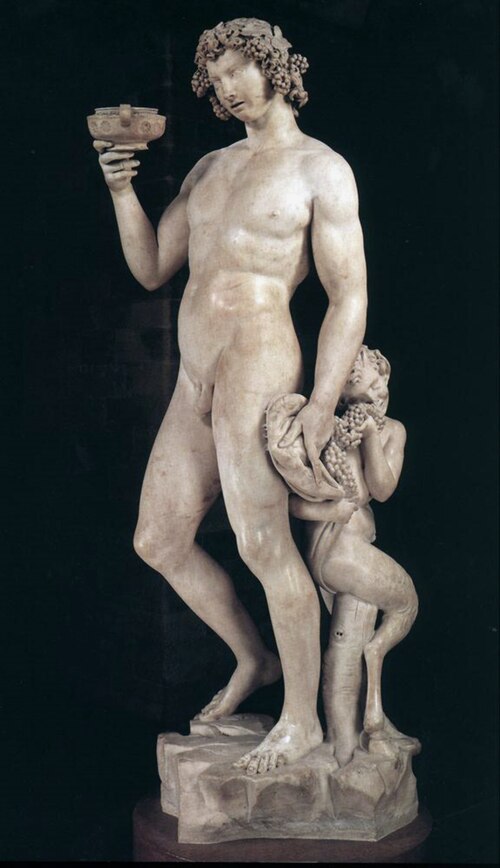
Bacchic subjects in art resumed in the Italian Renaissance, and soon became almost as popular as in antiquity, but his "strong association with feminine spirituality and power almost disappeared", as did "the idea that the destructive and creative powers of the god were indissolubly linked".[335] In Michelangelo's statue (1496–97) "madness has become merriment". The statue tries to suggest both drunken incapacity and an elevated consciousness, but this was perhaps lost on later viewers, and typically the two aspects were thereafter split, with a clearly drunk Silenus representing the former, and a youthful Bacchus often shown with wings, because he carries the mind to higher places.[336]
A common theme in art beginning in the sixteenth century was the depiction of Bacchus and Ceres caring for a representation of love – often Venus, Cupid, or Amore. This tradition derived from a quotation by the Roman comedian Terence (c. 195/185 – c. 159 BC) which became a popular proverb in the Early Modern period: Sine Cerere et Baccho friget Venus ("without Ceres and Bacchus, Venus freezes"). Its simplest level of meaning is that love needs food and wine to thrive. Artwork based on this saying was popular during the period 1550–1630, especially in Northern Mannerism in Prague and the Low Countries, as well as by Rubens. Because of his association with the vine harvest, Bacchus became the god of autumn, and he and his followers were often shown in sets depicting the seasons.[339]
Dionysus has remained an inspiration to artists, philosophers and writers into the modern era. In The Birth of Tragedy (1872), the German philosopher Friedrich Nietzsche proposed that a tension between Apollonian and Dionysian aesthetic principles underlay the development of Greek tragedy; Dionysus represented what was unrestrained chaotic and irrational, while Apollo represented the rational and ordered. This concept of a rivalry or opposition between Dionysus and Apollo has been characterised as a "modern myth", as it is the invention of modern thinkers like Nietzsche and Johann Joachim Winckelmann, and is not found in classical sources. However, the acceptance and popularity of this theme in Western culture has been so great, that its undercurrent has influenced the conclusions of classical scholarship.[340]
Nietzsche also claimed that the oldest forms of Greek Tragedy were entirely based upon the suffering Dionysus. In Nietzsche's 1886 work Beyond Good and Evil, and later The Twilight of the Idols, The Antichrist and Ecce Homo, Dionysus is conceived as the embodiment of the unrestrained will to power. Towards the end of his life, Nietzsche famously went mad. He was known to sign letters as both Dionysus and "The Crucified" in this period of his life. In The Hellenic Religion of the Suffering God (1904), and Dionysus and Early Dionysianism (1921), the poet Vyacheslav Ivanov elaborates the theory of Dionysianism, tracing the origins of literature, and tragedy in particular, to ancient Dionysian mysteries. Ivanov said that Dionysus's suffering "was the distinctive feature of the cult" just as Christ's suffering is significant for Christianity.[341]Karl Kerényi characterises Dionysus as representative of the psychological life force (Greek Zoê).[342] Other psychological interpretations place Dionysus's emotionality in the foreground, focusing on the joy, terror or hysteria associated with the god.[343][344][345][346][347]Sigmund Freud specified that his ashes should be kept in an Ancient Greek vase painted with Dionysian scenes from his collection, which remains on display at Golders Green Crematorium in London.
In 1969, an adaption of The Bacchae was performed, called Dionysus in '69. A film was made of the same performance. The production was notable for involving audience participation, nudity, and theatrical innovations.[348]
In 1974, Stephen Sondheim and Burt Shevelove adapted Aristophanes's comedy The Frogs into a modern musical, which hit broadway in 2004 and was revived in London in 2017. The musical keeps the descent of Dionysus into Hades to bring back a playwright; however, the playwrights are updated to modern times, and Dionysus is forced to choose between George Bernard Shaw and William Shakespeare.[349]
In 2019, the South Korean boy band BTS released a rap-rock-synth-pop-hip hop track.[217][350] named "Dionysus" as part of their album Map of the Soul: Persona. The naming of this song comes from the association of the namesake with debauchery and excess, this is reflected in its lyrics talking about "getting drunk on art" – playing on the Korean words for "alcohol" (술 sul) and "art" (예술 yesul) as an example – alongside expressions about their stardom, legacy, and artistic integrity.[351]
Some scholars of comparative mythology identify both Dionysus and Jesus with the dying-and-rising god mythological archetype.[355] On the other hand, it has been noted that the details of Dionysus's death and rebirth are starkly different both in content and symbolism from Jesus. The two stories take place in very different historical and geographic contexts. Also, the manner of death is different; in the most common myth, Dionysus was torn to pieces and eaten by the Titans, but "eventually restored to a new life" from the heart that was left over.[356][357]
Another parallel can be seen in The Bacchae where Dionysus appears before King Pentheus on charges of claiming divinity, which is compared to the New Testament scene of Jesus being interrogated by Pontius Pilate.[358][359][360] However, a number of scholars dispute this parallel, since the confrontation between Dionysus and Pentheus ends with Pentheus dying, torn into pieces by the mad women, whereas the trial of Jesus ends with him being sentenced to death.[361]
Dennis R. McDonald argues using mimesis criticism for a number of comparisons between the two. Indicating that the writer of the Gospel of John was familiar with TheBacchae, and may have made Jesus turn water into wine as a conscious engagement with the followers of Dionysus. He also draws attention to the words "I am the true vine" within the Gospel, and sees it as a direct challenge to the Dionysian religion.[362]
E. Kessler has argued that the Dionysian cult developed into strict monotheism by the fourth century AD; together with Mithraism and other sects, the cult formed an instance of "pagan monotheism" in direct competition with Early Christianity during Late Antiquity.[363] Scholars from the sixteenth century onwards, especially Gerard Vossius, also discussed the parallels between the biographies of Dionysus/Bacchus and Moses.[364]
John Moles has argued that the Dionysian cult influenced early Christianity, and especially how Christians understood themselves as a new religion centered around a savior deity.[355]
↑Another variant, from the Spanish royal collection, is at the Museo del Prado, Madrid: illustration.
↑Hedreen, Guy Michael. Silens in Attic Black-figure Vase-painting: Myth and Performance. University of Michigan Press. 1992. ISBN9780472102952. p. 1
↑James, Edwin Oliver. The Tree of Life: An Archaeological Study. Brill Publications. 1966. p. 234. ISBN9789004016125
↑In Greek "both votary and god are called Bacchus". Burkert, p. 162. For the initiate as Bacchus, see Euripides, Bacchae491. For the god, who alone is Dionysus, see Sophocles, Oedipus Rex 211 and Euripides, Hippolytus 560.
↑Csapo, Eric (3 August 2016). "The 'Theology' of the Dionysia and Old Comedy". In Eidinow, Esther (ed.). Theologies of Ancient Greek Religion. New York: Cambridge University Press. p.118. ISBN978-1-316-71521-5.
↑Olszewski, E. (2019). Dionysus’s enigmatic thyrsus. Proceedings of the American Philosophical Society, 163(2), 153–173.
↑Sutton, p. 2, mentions Dionysus as The Liberator in relation to the city Dionysia festivals. In Euripides, Bacchae379–385: "He holds this office, to join in dances, [380] to laugh with the flute, and to bring an end to cares, whenever the delight of the grape comes at the feasts of the gods, and in ivy-bearing banquets the goblet sheds sleep over men."
12345Hard, Robin, ed. (2020). Routledge Handbook of Greek Mythology. 2 Park Square, Milton Park, Abingdon, Oxon, OX14 4RN: Routledge. ISBN978-1-315-62413-6.{{cite book}}: CS1 maint: location (link)
↑Reginald Pepys Winnington-Ingram, Sophocles: an interpretation, Cambridge University Press, 1980, p. 109 Google Books preview
↑Zofia H. Archibald, in Gocha R. Tsetskhladze (Ed.) Ancient Greeks west and east, Brill, 1999, pp. 429 ff.Google Books preview
↑Thomas McEvilley, The Shape of Ancient Thought, Allsworth press, 2002, pp. 118–121. Google Books preview
↑Rosemarie Taylor-Perry, 2003. The God Who Comes: Dionysian Mysteries Revisited. Algora Press.
12Julian, trans. by Emily Wilmer Cave Wright. To the Cynic Heracleios. The Works of the Emperor Julian, volume II (1913) Loeb Classical Library.
12345678Isler-Kerényi, Cornelia; Watson, Wilfred G. E. (2007). "An Iconography in Process". Dionysos in Archaic Greece. Brill. pp.5–16. JSTOR10.1163/j.ctt1w76w9x.7.
12Brockett, Oscar Gross (1968). History of the Theatre. Boston: Allyn & Bacon. pp. 18–26.
↑Riu, Xavier (1999). Dionysism and Comedy. Rowman and Littlefield. p.105. ISBN9780847694426.
12345Corrente, Paola. 2012. Dioniso y los Dying gods: paralelos metodológicos. Tesis doctoral, Universidad Complutense de Madrid.
12Palaima, Thomas G. University of Texas at Austin, 1998
↑John Chadwick, The Mycenaean World, Cambridge University Press, 1976, pp. 99ff: "But Dionysos surprisingly appears twice at Pylos, in the form Diwonusos, both times irritatingly enough on fragments, so that we have no means of verifying his divinity."
↑"The Linear B word di-wo-nu-so". Palaeolexicon. Word study tool of ancient languages.
12Raymoure, K. A. (2 November 2012). "Khania Linear B Transliterations". Minoan Linear A & Mycenaean Linear B. Deaditerranean."Possible evidence of human sacrifice at Minoan Chania". Archaeology News Network. 2014. Archived from the original on 17 March 2014. Retrieved 17 March 2014.Raymoure, K. A. "Khania KH Gq Linear B Series". Minoan Linear A & Mycenaean Linear B. Deaditerranean."KH 5 Gq (1)". Dāmos: Database of Mycenaean at Oslo. University of Oslo.
↑Fox, p. 217, "The word Dionysos is divisible into two parts, the first originally Διος (cf. Ζευς), while the second is of an unknown signification, although perhaps connected with the name of the Mount Nysa which figures in the story of Lykourgos:... when Dionysos had been reborn from the thigh of Zeus, Hermes entrusted him to the nymphs of Mount Nysa, who fed him on the food of the gods, and made him immortal."
↑Testimonia of Pherecydes in an early fifth-century BC fragment, FGrH 3, 178, in the context of a discussion on the name of Dionysus: "Nũsas (acc. pl.), he [Pherecydes] said, was what they called the trees."
1234567Kerényi, Karl. 1976. Dionysus. Trans. Ralph Manheim, Princeton University Press. ISBN0691029156, 978-0691029153
↑Veronica Ions: The World's Mythology in Colour (1974). Hamlyn Publishing. ISBN0600313018
↑"dinos". The British Museum. British Museum. Retrieved 18 July 2022.
↑Janson, Horst Woldemar; Janson, Anthony F. (2004). Touborg, Sarah; Moore, Julia; Oppenheimer, Margaret; Castro, Anita (eds.). History of Art: The Western Tradition. Vol.1 (Revised 6thed.). Upper Saddle River, New Jersey: Pearson Education. p.105. ISBN0-13-182622-0.
↑Used thus by Ausonius, Epigrams, 29, 6, and in Catullus, 29; see Lee M. Fratantuono, NIVALES SOCII: CAESAR, MAMURRA, AND THE SNOW OF CATULLUS C. 57, Quaderni Urbinati di Cultura Classica, New Series, Vol. 96, No. 3 (2010), p. 107, Note 2.
↑Scaife, Ross (2 July 2000). "Androgynous". Suda On Line: Byzantine Lexicography. Suda On Line and the Stoa Consortium. Retrieved 17 February 2024. Dionysos, as one doing both active, male things and passive, female ones. [...] Sexual intercourse, specifically, is envisaged here.
↑Pequigney, Joseph (2002). "Classical Mythology". GLBTQ Encyclopedia. New England Publishing Associates. Archived from the original on 15 April 2014. Retrieved 4 April 2025. [He is willing] to accept anal penetration [...] to pay a debt.
↑"Greek Word Study Tool". Perseus.tufts.edu. Retrieved 6 February 2022.
↑Blackwell, Christopher W.; Blackwell, Amy Hackney (2011). Mythology For Dummies. John Wiley & Sons. ISBN9781118053874.
↑McKeown, J.C. A Cabinet of Greek Curiosities: Strange Tales and Surprising Facts from the Cradle of Western Civilization, Oxford University Press, New York, 2013, p. 210)
12Stephan, Christian. "Suidas". Religion in Geschichte und Gegenwart. doi:10.1163/2405-8262_rgg4_sim_025853.
↑Suidas s.v. Kistophoros: "Kistophoros (basket-bearer, ivy-bearer): It seems that baskets were sacred to Dionysos and the Two Goddesses [Demeter and Persephone]." [N.B. Derived from Harpocration s.v. kittophoros, the ivy-bearer.]
↑Hau, Lisa Irene (1 July 2016), "Diodorus Siculus", Moral History from Herodotus to Diodorus Siculus, Edinburgh University Press, doi:10.3366/edinburgh/9781474411073.003.0003, ISBN978-1-4744-1107-3
↑Diodorus Siculus, Library of History 3. 62. 5 (trans. Oldfather) (Greek historian C1st B.C.): "Dionysos was named twice-born (dimetor) by the ancients, counting it as a single and first birth when the plant is set in the ground and begins to grow, and as a second birth when it becomes laden with fruit and ripens its grape-clusters—the god thus being considered as having been born once from the earth and again from the vine."
↑A Dictionary of Greek and Roman biography and mythology, Dendrites
↑Hornblower, Simon (2014). "LYKOPHRON AND EPIGRAPHY: THE VALUE AND FUNCTION OF CULT EPITHETS IN THE ALEXANDRA". The Classical Quarterly. 64 (1): 116. doi:10.1017/S0009838813000578. ISSN0009-8388. JSTOR26546287.
↑Reece, Steve, "The Epithet ἐρίδρομος in Nonnus’ Dionysiaca," Philologus: Zeitschrift für antike Literatur und ihre Rezeption 145 (2001) 357–359, explains Nonnus' use of this epithet at Dionysiaca 23.28 as a translation of the moribund Homeric epithet ἐριούνιος, which in Cyprian means "good-running."
↑"SOL Search". Cs.uky.edu. Retrieved 6 February 2022.
↑"Greek Word Study Tool". Perseus.tufts.edu. Retrieved 6 February 2022.
↑"Greek Anthology, Volume III, book 9, chapter 524". Perseus.tufts.edu. Retrieved 6 February 2022.
↑Versnel, H.S. (2015). Inconsistencies in Greek and Roman Religion: Transition and Reversal in Myth and Ritual. Vol.1, Ter Unus. Isis, Dionysos, Hermes. Three Studies in Henotheism. Brill Publications. p.119. ISBN978-90-04-09266-2.
↑"Henry George Liddell, Robert Scott, A Greek-English Lexicon, κεμάς". Perseus.tufts.edu. Retrieved 6 February 2022.
↑Alkaeus: Temple of Zeus, Hera and "Dionysus Kemilius" (Ζόννυσος Κεμήλιος) Nilsson Vol I p. 575
↑"Greek Word Study Tool". Perseus.tufts.edu. Retrieved 6 February 2022.
↑"Arrian, Anabasis, book 5, chapter 1". www.perseus.tufts.edu.
↑"Arrian, Anabasis, book 5, chapter 2". www.perseus.tufts.edu.
↑Suidas (1705). Souidas.: Suidæ lexicon, Græce & Latine. Textum Græcum cum manuscriptis codicibus collatum a quamplurimis mendis purgavit, notisque perpetuis illustravit: versionem Latinam Æmilii Porti innumeris in locis correxit; indicesque auctorum & rerum adjecit Ludolphus Kusterus, Professor humaniorum literarum in Gymnasio Regio Berolinensi. Typis academicis. OCLC744697285.
↑Suidas s.v. Oinops (quoting Greek Anthology 6. 44. 5 and 7. 20. 2): "Oinops (wine-dark): 'to wine-dark [so-and-so],' to black [so-and-so]. In the Epigrams: '. . . from which we poured libations, as much [as is] right, to wine-dark Bakkhos and the Satyroi.' But ruddy (oinôpos) [means] wine-coloured, bright or black. 'Feeding on the ruddy grape-cluster of Bakkhos.'"
↑"Henry George Liddell, Robert Scott, A Greek-English Lexicon, ὠμάδιος". www.perseus.tufts.edu. Retrieved 8 June 2024. =ὠμηστής, because he had human sacrifices at Chios and Tenedos;"Henry George Liddell, Robert Scott, A Greek-English Lexicon, ὠμησ-τής". www.perseus.tufts.edu. Retrieved 8 June 2024. eating raw flesh... epith. of Dionysus, = ὠμάδιος
↑Orphic Hymns, xxx. 5 (Taylor), (Athanassakis and Wolkov), lii. 7 (Taylor), (Athanassakis and Wolkov).
↑Porphyry, On Abstinance from Animal Food, ii. 55 and note 23, p. 87 (also at Tertullian.org) (with citations to Orphic Hymns xxxix. 5 and li. 7 substituted for xxx. 5 and lii. 7).
↑"EUSEBE DE CESAREE: Préparation évangélique: livre IV (texte grec)". remacle.org.
↑"Henry George Liddell, Robert Scott, A Greek-English Lexicon, περικι_-όνιος". Perseus.tufts.edu. Retrieved 6 February 2022.
↑Opsomer, Jan. "La démiurgie des jeunes dieux selon Proclus". In: Études Classiques Tome 71, Nº. 1: Le "Timée" au fil des âges: son influence et ses lectures. 2003. pp. 18–19 (footnote nr. 47), 25 and 37–38 (footnote nr. 124). ISSN0014-200X
↑Georges, Karl Ernst. Ausführliches lateinisch-deutsches Handwörterbuch. Hannover: August 1918 (Nachdruck Darmstadt 1998). Band 2. Sp. 2582.
↑Harrison, Jane Ellen. Themis. Cambridge University Press. 1912. p. 421.
↑Naylor, H. Darnley. Horace Odes and Epodes: A study in word-order. Cambridge: Cambridge University Press. 1922. p. 37.
↑Putnam, Michael C. J. (1994). "Structure and Design in Horace "Odes" 1. 17". The Classical World. 87 (5): 357–375. doi:10.2307/4351533. JSTOR4351533.
↑Papaioannou, Sophia (2013). "Embracing Vergil’s 'Arcadia': Constructions and representations of a literary topos in the poetry of the Augustans". In: Acta Antiqua 53: 160–161. DOI: 10.1556/AAnt.53.2013.2-3.2.
↑Humphreys, S. C. The Strangeness of Gods: Historical perspectives on the interpretation of Athenian religion. Oxford University Press. 2004. p. 235 (footnote nr. 34). ISBN0-19-926923-8
↑Hesych. σκυλλίς, κληματίς. Nilsson Vol. I, p. 584.
↑"Henry George Liddell, Robert Scott, A Greek-English Lexicon, κλημα^τ-ίς". Perseus.tufts.edu. Retrieved 6 February 2022.
↑"Greek Word Study Tool". Perseus.tufts.edu. Retrieved 6 February 2022.
↑"Henry George Liddell, Robert Scott, A Greek-English Lexicon, ταυρο-φάγος". Perseus.tufts.edu. Retrieved 6 February 2022.
↑Euripides. (2019). The Bacchae. Neeland Media LLC. ISBN978-1-4209-6184-3. OCLC1108536627.
123(Photius, Lexicon, s.v. "Thyraze Kares.") To the doors, Kares, it is no longer Anthestria": some authorities contented that this is what is said to the crowd of Karian slaves, since at the Anthestria they join in the feast and do not do any work. Therefore, when the festival is over, they send them back out to work with the words, "To the doors, Keres, it is no longer Anthestria." since the souls [keres] wander about through the city at the Anthestria.
↑(Plutarch, Table-talk, 655e.) At Athens they inaugurate the new wine on the eleventh of the month, and they call the day pithoigia.
↑(Phanodemus, in Athenaeus, Deipnosophists XI. 456a; frag 12in FGrH 325.) At the temple of Dionysus in Limnai ["The Marshes"] the Athenians bring the new wine from the jars age mix it in honour of the god and then they drink it themselves. Because of this custom Dionysus is called Limnaios, because the wine was mixed with water and then for the first time drunk diluted.
12Rice, David G. Stambaugh, John E. (2014). Sources for the Study of Greek Religion Corrected Edition. Society of Biblical Literature. ISBN978-1-62837-067-6. OCLC893453849.{{cite book}}: CS1 maint: multiple names: authors list (link)
↑Pseudo-Apollodorus, BibliothecaLibrary and Epitome, 1.3.2. "Orpheus also invented the mysteries of Dionysus, and having been torn in pieces by the Maenads he is buried in Pieria."
↑Dickie, M.W. 1995. The Dionysiac Mysteries. In Pella, ZPE 109, 81–86.
↑Jiménez San Cristóbal 2012, p. 125; Bowie, A. M., p. 232; Harrison, pp. 540–542.
↑Jiménez San Cristóbal 2012, p. 127; Graf 2005, "Iacchus".
↑Jiménez San Cristóbal 2013, p. 279, Bowie, A. M., pp. 232–233; Sophocles, Antigone1115–1125, 1146–1154; Versnel, pp. 23–24. Jebb, in his note to line 1146 χοράγ᾽ ἄστρων, understands the Sophoclean use of the name "Iacchus" as specifically denoting the Eleusinian Dionysus.
↑Jiménez San Cristóbal 2013, pp. 279–280; Bowie, A. M., p. 233; Sophocles, fragment 959 Radt (Lloyd-Jones, pp. 414, 415).
↑Encinas Reguero, p. 350; Jiménez San Cristóbal 2013, p. 282, with n. 41; Bowie, A. M., p. 233; Euripides, Bacchae725. Jiménez San Cristóbal also sees possible associations between Iacchus and Dionysus in Euripides: Ion1074–1086, The Trojan Women1230, Cyclops68–71, and fr. 586 Kannicht (apudStrabo, 10.3.13) = fr. 586 Nauck (Collard and Cropp, pp. 56, 57).
↑Bowie, E. L., pp. 101–110; Fantuzzi, pp. 189, 190, 191; PHI Greek Inscriptions, BCH 19 (1895) 393.
↑Hard, p. 134; Grimal, s.v. Iacchus, p. 224; Tripp, s.v. Iacchus, p. 313; Rose, Oxford Classical Dictionary s.v. Iacchus; scholiast on Aristophanes, Frogs 324 (Rutherford 1896, p. 316).
↑Marcovich, p. 23; Parker 2005, p. 358; Graf 1974, p. 198.
↑Marcovich, p. 23; Bianchi, p. 18; Graf 1974, p. 198; Ashmolean Museum at Oxford, Inv. 1956-355.
↑Parker 2005, p. 358 n. 139; Lucretius, 4.1168–1169. Arnobius, Adversus Gentes3.10 (p. 157) referring to the Lucretius verse, lists "the full-breasted Cerses nursing Iaccus" as a sight "the mind longs" to see. Compare with Photius, s.v. Ἴακχος and Suda, s.v. Ἴακχος (iota,16), which identify Iacchus with Διόνυσος ἐπὶ τῷ μαστῷ ('Dionysus at the breast').
↑Parker 2005, p. 358 n. 139; scholiast on Aristides, Vol. 3, p. 648 213, 18 Dindorf.
↑Gantz, p. 118; Hard, p. 35; Grimal, s.v. Zagreus, p. 456.
↑McClelland, Norman C. (2010). Encyclopedia of Reincarnation and Karma. McFarland. pp.76–77. ISBN978-0-7864-5675-8.
↑Sommerstein, p. 237 n. 1; Gantz, p. 118; Smyth, p. 459.
↑McIntosh, Jane; Chrisp, Peter; Parker, Philip; Gibson, Carrie; Grant, R. G.; Regan, Sally (October 2014). History of the World in 1,000 Objects. New York: DK and the Smithsonian. p.83. ISBN978-1-4654-2289-7.
↑T. P. Wiseman, "Satyrs in Rome? The Background to Horace's Ars Poetica", The Journal of Roman Studies, Vol. 78 (1988), p. 7, note 52.
↑Grimal, Pierre, The Dictionary of Classical Mythology, Wiley-Blackwell, 1996, ISBN978-0-631-20102-1.
12Cicero, De Natura Deorum, 2.6O. See also St Augustine, De Civitatis Dei, 4.11.
↑See Pliny, Historia Naturalis, 7.57 (ed. Bostock) at Perseus: Tufts.edu
↑Russell, Bertrand. History of Western Philosophy.Routledge, 1996, p. 25
↑Kraemer, Ross S. "Ecstasy and Possession: The Attraction of Women to the Cult of Dionysus." The Harvard Theological Review, Vol. 72 60 Jan.–Apr. 1979.
↑... "the Bacchic passages in the Roman drama, taken over from their Greek models, presented a pejorative image of the Bacchic cult which predisposed the Romans towards persecution before the consul denounced the cult in 186." Robert Rouselle, Liber-Dionysus in Early Roman Drama, The Classical Journal, 82, 3 (1987), p. 193.
↑Wiseman, T.P. (1988). "Satyrs in Rome? The Background to Horace's Ars Poetica". The Journal of Roman Studies. 78: 1–13. doi:10.2307/301447. JSTOR301447. S2CID161849654. Certainly it is hard to imagine anything less consistent with Roman mos maiorum than the anarchic hedonism of satyrs. It was precisely libido, that morally subversive aspect of the Bacchic cult, that led to its brutal suppression...
↑Pliny attributes the invention of the triumph to "Father Liber" (who by Pliny's time was identified with Bacchus and Dionysus): see Pliny, Historia Naturalis, 7.57 (ed. Bostock) at Perseus: Tufts.edu
↑Concilium Constantinopolitanum a. 691/2 in Trullo habitum. Canon 62. H. Ohme (ed.) Acta conciliorum oecumenicorum, Series Secunda II: Concilium Universale Constantinopolitanum Tertium, Pars 4. ISBN978-3-11-030853-2. Berlin/Boston Oktober 2013.
↑Maxwell, Herbert (1913). The Chronicle of Lanercost, 1272–1346. Glasgow, Scotland: Glasgow: J. Maclehose. pp.29–30.
↑C. S. Watkins: History and the Supernatural in Medieval England, Cambridge University Press: Cambridge 2007, pp. 88–92.
↑Ashe, Geoffrey (2000). The Hell-Fire Clubs: A History of Anti-Morality. Gloucestershire: Sutton Publishing. p.114. ISBN9780750924023.
↑Bayles, Richard (1889). History of Windham County, Connecticut. New York, Preston.
↑Nasios, A. "Hearth of Hellenism: The Greek Wheel of the Year". www.ysee.gr. Retrieved 24 January 2009.
↑Heraclitus, encountering the festival of the Phallophoria, in which phalli were paraded about, remarked in a surviving fragment: "If they did not order the procession in honor of the god and address the phallus song to him, this would be the most shameless behavior. But Hades is the same as Dionysos, for whom they rave and act like bacchantes", Kerényi 1976, pp. 239–240.
↑Summary of Karl Kerényi: "The Hymn tells us that Persephone was abducted in Nysion pedion, or the Nysian Plain, a plain that was named after the Dionysian mountain of Nysa. Nysa was regarded as the birthplace and first home of Dionysus. The divine marriage of Plouton and Persephone was celebrated on 'the meadow'. The dangerous region that Kore let herself be lured to in search of flowers was likely not originally connected to Plouton but to Dionysus, as Dionysus himself had the strange surname of 'the gaping one', though despite this the notion that the wine god in his quality as the Lord of the Underworld does not appear on the surface of the hymn. People would not be able to detect the hidden meaning it if it wasn’t for archaic vase portrayals." Eleusis: Archetypal Image of Mother and Daughter [pp. 34, 35]. "The Hymn to Demeter later mentions that Queen Metaneira of Eleusis later offers the disguised Demeter a beaker of sweet wine, something that Demeter refuses on the grounds that it would be against themis, the very nature of order and justice, for her to drink red wine and she instead invents a new beverage called kykeon to drink instead. The fact that Demeter refuses to drink wine on the grounds that it would be against themis indicates that she is well aware of who Persephone's abductor is, that it is the Subterranean cover name of Dionysus. The critic of the mysteries, the severe philosopher Herakleitos once declared "Hades is the same as Dionysos." The subterranean wine god was the ravisher, so how could Demeter accept something that was his gift to mankind" [p. 40]
↑Summary of Karl Kerényi: "The book later refers to Herakles initiation into the Eleusinian Mysteries so that he may enter the Underworld. In the iconography after his initiation Herakles in shown wearing a fringed white garment with a Dionysian deerskin thrown over it. Kore is shown with her mother Demeter and a snake twined around the Mystery basket, foreshadowing the secret, as making friends with snakes was Dionysian [p. 58]. The god of the Anthesteria was Dionysus, who celebrated his marriage in Athens amid flowers, the opening of wine jars, and the rising up of the souls of the dead [p. 149]. There are two reliefs in a marble votive relief of the fourth century BC. One depicts Kore crowning her mother Demeter, the deities at the second altar are Persephone and her husband Dionysus as the recumbent god has the features of the bearded Dionysus rather than of Plouton. In his right hand, he raises not a cornucopia, the symbol of wealth, but a wine vessel and in his left, he bears the goblet for the wine. Over their heads an inscription reads "To the God and Goddess" [pp. 151, 152]. The fragments of a gilded jar cover of the Kerch type show Dionysus, Demeter, little Ploutos, Kore, and a curly-haired boy clad in a long garment, one of the first son's of the Eleusinian king who was the first to be initiated. On another vase, Dionysus sits on his omphalos with his thryrsos in his left hand, sitting opposite Demeter, looking at each other severely. Kore is shown moving from Demeter towards Dionysus, as if trying to reconcile them [p. 162]. Eleusis: Archetypal Image of Mother and Daughter
↑Summary of Karl Kerényi: Kore and Thea are two different duplications of Persephone; Plouton and Theos are duplications of the subterranean Dionysus. The duplication of the mystery god as subterranean father and subterranean son, as Father Zagreus and the child Zagreus, husband and son of Persephone, has more to do with the mysteries of Dionysus than with the Eleusinian Mysteries. But a duplication of the chthonian, mystical Dionysus is provided even by his youthful aspect, which became distinguished and classical as the son of Semele from the son of Persephone. Semele, though not of Eleusinian origin, is also a double of Persephone [p. 155]. Eleusis: Archetypal Image of Mother and Daughter
↑Loyd, Alan B (2009). What is a God?: Studies in the Nature of Greek Divinity. The Classical Press of Wales. ISBN978-1905125357. The identification of Hades and Dionysus does not seem to be a particular doctrine of Herakleitos, nor does it commit him to monotheism. The evidence for a cult connection between the two is quite extensive, particularly in Southern Italy, and the Dionysiac mysteries are associated with death rituals.
↑"Photographic image"(JPG). My-favourite-planet.de. Retrieved 6 February 2022.
↑"Photographic image"(JPG). My-favourite-planet.de. Retrieved 6 February 2022.
12Summary of Karl Kerényi: These attempts at a reconstruction would remain very fragmentary were we not, in conclusion, to look attentively into the face of the god Eubouleus. The Lord of the Underworld bore this name in the youthful form represented in the statue, ascribed to Praxiteles, which is now in the National Museum at Athens and probably stood originally in the place where it was found, the Ploutonion. This youth is Plouton himself – radiant but disclosing a strange inner darkness – and at the same time his double and servant, comparable to Hermes or Pais besides Kabeiros or Theos [p. 172]. ... The plentiful hair or long curls suggest rather Hades kyanochaites, Hades of the dark hair [p. 173].
↑"British Museum Collection". britishmuseum.org. Retrieved 6 March 2017.
↑"British Museum Collection". Britishmuseum.org. Retrieved 6 March 2017.
↑Sudas, under "Sabazios", "saboi"; Sider, David. "Notes on Two Epigrams of Philodemus". The American Journal of Philology, 103.2 (Summer 1982:208–213) pp. 209ff.
↑E.N. Lane has taken pains to dismiss this widespread conflation: Lane, "Towards a definition of the iconography of Sabazios", Numen27 (1980:9–33), and Corpus Cultis Jovis Sabazii:, in Études Préliminaires aux Religions Orientales dans l'Empire Romain: Conclusions100.3 (Leiden, etc: Brill) 1989.
↑Meisner, pp. 249–50; Graf and Johnston, pp. 195–6 n. 7 to p. 65.
↑According to Meisner, p. 238, "[o]ver the last two centuries, many scholars have considered this narrative of Dionysus and the Titans to have been the central, defining myth of Orphism". See, for example, Nilsson, p. 202, who calls it "the cardinal myth of Orphism", and Guthrie, p. 107, who describes the myth as "the central point of Orphic story". According to Linforth, p. 307, it is "commonly regarded as essentially and peculiarly Orphic and the very core of the Orphic religion", while Parker 2002, p. 495, writes that "it has been seen as the Orphic 'arch-myth'.
↑According to Gantz, p. 118, 'Orphic sources preserved seem not to use the name "Zagreus", and according to West 1983, p. 153, the 'name was probably not used in the Orphic narrative'. Edmonds 1999, p. 37 n. 6 says: 'Lobeck 1892 seems to be responsible for the use of the name Zagreus for the Orphic Dionysos. As Linforth noticed, "It is a curious thing that the name Zagreus does not appear in any Orphic poem or fragment, nor is it used by any author who refers to Orpheus" (Linforth 1941:311). In his reconstruction of the story, however, Lobeck made extensive use of the fifth-century epic of Nonnos, who does use the name Zagreus, and later scholars followed his cue. The association of Dionysos with Zagreus appears first explicitly in a fragment of Callimachus preserved in the Etymologicum Magnum (fr. 43.117 P), with a possible earlier precedent in the fragment from Euripides Cretans (fr. 472 Nauck). Earlier evidence, however, (e.g., Alkmaionis fr. 3 PEG; Aeschylus frr. 5, 228) suggests that Zagreus was often identified with other deities.'
↑West 1983, pp. 73–74, provides a detailed reconstruction with numerous cites to ancient sources, with a summary on p. 140. For other summaries see Morford, p. 311; Hard, p. 35; March, s.v. Zagreus, p. 788; Grimal, s.v. Zagreus, p. 456; Burkert, pp. 297–298; Guthrie, p. 82; also see Ogden, p. 80. For a detailed examination of many of the ancient sources pertaining to this myth see Linforth, pp. 307–364. The most extensive account in ancient sources is found in Nonnus, Dionysiaca5.562–70, 6.155 ff., other principal sources include Diodorus Siculus, 3.62.6–8 (= Orphic fr. 301 Kern), 3.64.1–2, 4.4.1–2, 5.75.4 (= Orphic fr. 303 Kern); Ovid, Metamorphoses6.110–114; Athenagoras of Athens, Legatio 20 Pratten (= Orphic fr. 58 Kern); Clement of Alexandria, Protrepticus2.15 pp. 36–39 Butterworth (= Orphic frs. 34, 35 Kern); Hyginus, Fabulae 155, 167; Suda s.v. Ζαγρεύς. See also Pausanias, 7.18.4, 8.37.5.
↑Damascius, Commentary on the Phaedo, I, 170, see in translation Westerink, The Greek Commentaries on Plato's Phaedo, vol. II (The Prometheus Trust, Westbury) 2009
↑Apollodorus, The Library, with an English Translation by Sir James George Frazer, F.B.A., F.R.S. in 2 Volumes. Cambridge, Massachusetts, Harvard University Press; London, William Heinemann Ltd. 1921. Includes Frazer's notes. ISBN0-674-99135-4, 0-674-99136-2
↑Conner, Nancy. "The Everything Book of Classical Mythology" 2ed
↑Homeric Hymn 1 to Dionysus: ‘There is a certain Nysa, mountain high, with forests thick, in Phoinike afar, close to Aigyptos' (Egypt's) streams.’
↑Diodorus Siculus, Library of History 4. 2. 3 (trans. Oldfather): "Zeus taking up the child [i.e. Dionysos from the dead body of his mother Semele], handed it over to Hermes, and ordered him to take it to the cave in Nysa, which lay between Phoinikia (Phoenicia) and the Neilos (the River Nile), where he should deliver it to the Nymphai (Nymphs) that they should rear it and with great solicitude bestow upon it the best of care.
↑Photius, Library; "Ptolemy Chennus, New History" Book 4
↑Homer., The Iliad, ISBN978-2-291-06449-7, OCLC1130228845
↑Homer, Iliad 6. 129 ff (trans. Lattimore): "I will not fight against any god of the heaven, since even the son of Dryas, Lykourgos the powerful, did not live long; he who tried to fight with the gods of the bright sky, who once drove the fosterers of Mainomenos (rapturous) Dionysos headlong down the sacred Nyseian hill, and all of them shed and scattered their wands on the ground, stricken with an ox-goad by murderous Lykourgos, while Dionysos in terror dived into the salt surf, and Thetis took him to her bosom, frightened, with the strong shivers upon him at the man's blustering. But the gods who live at their ease were angered with Lykourgos and the son of Cronus [Zeus] struck him to blindness, nor did he live long afterwards, since he was hated by all the immortals." [N.B. The reference to the Nyseian hill and the nurses of Dionysus suggests that Homer placed the story in Boeotia while the god was still a child—contrary to subsequent accounts of the myth in which Dionysus is a youth visiting Thrace.]
↑"British Museum – The Lycurgus Cup". Britishmuseum.org.
↑"Theoi.com" Homeric Hymn to Dionysus". Theoi.com. Retrieved 29 June 2014.
↑Corrente, Paola and Sidney Castillo. 2019. "Philology and the Comparative Study of Myths", The Religious Studies Project (Podcast Transcript). 3 June 2019. Transcribed by Helen Bradstock. Version 1.1, 28 May 2019. Available at: https://www.religiousstudiesproject.com/podcast/philology-and-the-comparative-study-of-myths/
↑Calasso, Roberto (25 July 2019). The Marriage of Cadmus and Harmony. UK: Penguin. p.22. ISBN978-0-141-99075-0.
↑Humphreys, S. C. The Strangeness of Gods: Historical perspectives on the interpretation of Athenian religion. Oxford University Press. 2004. pp. 264–265. ISBN978-0199269235
↑Beecroft, Alexander J. "Nine Fragments in Search of an Author: Poetic Lines Attributed to Terpander." The Classical Journal 103, no. 3 (2008): 225–41. http://www.jstor.org/stable/30037959.
↑Strabo, 10.3.13, quotes the non-extant play Palamedes which seems to refer to Thysa, a daughter of Dionysus, and her (?) mother as participants of the Bacchic rites on Mount Ida, but the quoted passage is corrupt.
↑Olszewski, Edward (June 2019). "Dionysus's Enigmatic Thyrsus"(PDF). Proceedings of the American Philosophical Society. 163 (2). University of Pennsylvania Press: 152–60.
↑Otto, Walter F. (1995). Dionysus Myth and Cult. Indiana University Press. ISBN0-253-20891-2.
↑Daniélou, Alain (1992). Gods of Love and Ecstasy. Rochester, Vermont: Inner Traditions. p.15. ISBN9780892813742.
↑Hansen, Dorian (2023). "An Androgynous God: Beardless Dionysus in Ancient Greek and Roman Art"(PDF). Retrieved 25 July 2026.{{cite web}}: CS1 maint: url-status (link)
↑Charlesworth, James (2010). The Good And Evil Serpent: How a Universal Symbol Became Christianized. Yale University Press. pp.222–223. ISBN978-0-300-14273-0.
↑Otto, Walter Friedrich; Palmer, Robert B. (1965). Dionysus: Myth and Cult. Indiana University Press. pp.164–166. ISBN978-0-253-20891-0.
↑Steinberg, Leo (2014). The Sexuality of Christ in Renaissance Art and in Modern Oblivion. University of Chicago Press. pp.47, 83 with footnotes. ISBN978-0-226-22631-6.
↑March, Jennifer R. (2014). Dictionary of Classical Mythology. Oxbow. pp.164, 296. ISBN978-1-78297-635-6.
↑Csapo, Eric (1997). "Riding the Phallus for Dionysus: Iconology, Ritual, and Gender-Role De/Construction". Phoenix. 51 (3/4): 256–257, 253–295. doi:10.2307/1192539. JSTOR1192539.
↑Dietrich, B. C. (1958). "Dionysus Liknites". The Classical Quarterly. 8 (3–4): 244–248. doi:10.1017/S000983880002190X. S2CID246876495.
↑Isler-Kerényi, C., & Watson, W. (2007). "Modern Mythologies: 'Dionysos' Versus 'Apollo'". In Dionysos in Archaic Greece: An Understanding through Images (pp. 235–254). Leiden; Boston: Brill. Retrieved from http://www.jstor.org/stable/10.1163/j.ctt1w76w9x.13
↑Rosenthal, Bernice Glatzer (2007). "Chapter 13. A New Spirituality: The Confluence of Nietzsche and Orthodoxy in Russian Religious Thought". In Steinberg, Mark D. and Heather J. Coleman (ed.). Sacred Stories: Religion and Spirituality in Modern Russia. Bloomington and Indianapolis: Indiana University Press. p.344. ISBN978-0-253-21850-6.
↑Kerenyi, K., Dionysus: Archetypal Image of Indestructible Life (Princeton/Bollingen, 1976).
↑Jeanmaire, H. Dionysus: histoire du culte de Bacchus, (pp. 106ff) Payot, (1951)
↑Johnson, R. A. 'Ecstasy; Understanding the Psychology of Joy' HarperColling (1987)
↑Hillman, J. 'Dionysus Reimagined' in The Myth of Analysis (pp. 271–281) HarperCollins (1972); Hillman, J. 'Dionysus in Jung's Writings' in Facing The Gods, Spring Publications (1980)
↑Thompson, J. 'Emotional Intelligence/Imaginal Intelligence' in Mythopoetry Scholar Journal, Vol 1, 2010
↑Lopez-Pedraza, R. 'Dionysus in Exile: On the Repression of the Body and Emotion', Chiron Publications (2000)
↑Greenspun, Roger (23 March 1970). "Screen::De Palma's 'Dionysus in 69'". New York Times. Retrieved 1 August 2017.
↑Murray, Matthew. "The Frogs". Talkin' Broadway. Retrieved 2 August 2017.
↑Lipshutz, Jason (17 April 2019). "How BTS' 'Dionysus' Demonstrates the Group's Musical Ambition". Billboard. Retrieved 22 April 2019.
↑Daly, Rhian (22 April 2019). "All the biggest talking points from BTS' global press conference: Jungkook's missing mixtape, Suga's next prophecy, and the meaning behind 'Map Of The Soul: Persona'". NME. Retrieved 17 April 2019.
↑Rose, Michel (27 July 2024). "Paris ceremony 'Last Supper' parody sparks controversy". Reuters.
↑"Paris Olympics organizers 'sorry' for any offense over opening ceremony". 28 July 2024. Retrieved 30 July 2024.
↑Kaloi, Stephanie (28 July 2024). "Paris Olympics Producers Say 'The Last Supper' Inspired That Opening Ceremony Scene: 'Many Have Done It Before'". TheWrap. Retrieved 31 July 2024.
12Moles, John (2006). "Jesus and Dionysus in "The Acts Of The Apostles" and early Christianity". Hermathena. 180 (180). Trinity College Dublin: 65–104. JSTOR23041662.
↑Evans, Arthur. The God of Ecstasy. New York: St. Martins' Press, 1989
↑Wick, Peter (2004). "Jesus gegen Dionysos? Ein Beitrag zur Kontextualisierung des Johannesevangeliums". Biblica. 85 (2). Rome: Pontifical Biblical Institute: 179–198. Retrieved 10 October 2007.
↑Powell, Barry B., Classical Myth. Second ed. With new translations of ancient texts by Herbert M. Howe. Upper Saddle River, New Jersey: Prentice-Hall, Inc., 1998.
↑Studies in Early Christology, by Martin Hengel, 2005, p. 331 (ISBN0567042804).
↑Dalby, Andrew (2005). The Story of Bacchus. London: British Museum Press.
↑MacDonald, Dennis Ronald (2017). The Dionysian gospel: the fourth gospel and Euripides. Internet Archive. Minneapolis: Fortress Press. pp.24–28. ISBN978-1-5064-2166-7.{{cite book}}: CS1 maint: publisher location (link)
↑E. Kessler, Dionysian Monotheism in Nea Paphos, Cyprus. Symposium on Pagan Monotheism in the Roman Empire, Exeter, 17–20 July 2006 AbstractArchived 21 April 2008 at the Wayback Machine)
↑This chart is based upon Hesiod's Theogony, unless otherwise noted.
↑According to Homer, Iliad1.570–579, 14.338, Odyssey8.312, Hephaestus was apparently the son of Hera and Zeus, see Gantz, p. 74.
↑According to Hesiod, Theogony927–929, Hephaestus was produced by Hera alone, with no father, see Gantz, p. 74.
↑According to Hesiod's Theogony886–890, of Zeus's children by his seven wives, Athena was the first to be conceived, but the last to be born; Zeus impregnated Metis then swallowed her, later Zeus himself gave birth to Athena "from his head", see Gantz, pp. 51–52, 83–84.
↑According to Hesiod, Theogony183–200, Aphrodite was born from Uranus's severed genitals, see Gantz, pp. 99–100.
↑According to Homer, Aphrodite was the daughter of Zeus (Iliad3.374, 20.105; Odyssey8.308, 320) and Dione (Iliad5.370–71), see Gantz, pp. 99–100.
References
Apollodorus, Apollodorus, The Library, with an English Translation by Sir James George Frazer, F.B.A., F.R.S. in 2 Volumes, Cambridge, Massachusetts, Harvard University Press; London, William Heinemann Ltd., 1921. ISBN0-674-99135-4. Online version at the Perseus Digital Library.
Aristides, Aristides ex recensione Guilielmi Dindorfii, Volume 3, Wilhelm Dindorf, Weidmann, G. Reimer, 1829. HathiTrust Digital Library.
Aristophanes, Frogs, Matthew Dillon, Ed., Perseus Digital Library, Tufts University, 1995. Online version at the Perseus Digital Library.
Arnobius of Sicca, The Seven Books of Arnobius Adversus Gentes, translated by Archibald Hamilton Bryce and Hugh Campbell, Edinburg: T. & T. Clark. 1871. Internet Archive.
Bowie, E. L., "Time and Place, Narrative and Speech in Philicus, Philodams and Limenius" in Hymnic Narrative and the Narratology of Greek Hymns, edited by Andrew Faulkner, Owen Hodkinson, Brill, 2015. ISBN9789004289512.
Bull, Malcolm, The Mirror of the Gods, How Renaissance Artists Rediscovered the Pagan Gods, Oxford UP, 2005, ISBN9780195219234
Campbell, David A., Greek Lyric, Volume II: Anacreon, Anacreontea, Choral Lyric from Olympus to Alcman, Loeb Classical Library No. 143, Cambridge, Massachusetts, Harvard University Press, 1988. ISBN978-0-674-99158-3. Online version at Harvard University Press. Internet Archive.
Clement of Alexandria, The Exhortation to the Greeks. The Rich Man's Salvation. To the Newly Baptized. Translated by G. W. Butterworth. Loeb Classical Library No. 92. Cambridge, Massachusetts: Harvard University Press, 1919. ISBN978-0-674-99103-3. Online version at Harvard University Press. Internet Archive 1960 edition.
Dalby, Andrew (2005). The Story of Bacchus. London: British Museum Press. ISBN0-7141-2255-6.
Diodorus Siculus, Diodorus Siculus: The Library of History. Translated by C. H. Oldfather. Twelve volumes. Loeb Classical Library. Cambridge, Massachusetts: Harvard University Press; London: William Heinemann, Ltd. 1989. Online version by Bill Thayer
Edmonds, Radcliffe (1999), "Tearing Apart the Zagreus Myth: A Few Disparaging Remarks On Orphism and Original Sin", Classical Antiquity18 (1999): 35–73. PDF.
Encinas Reguero, M. Carmen, "The Names of Dionysos in Euripides’ Bacchae and the Rhetorical Language of Teiresias", in Redefining Dionysos, Editors: Alberto Bernabé, Miguel Herrero de Jáuregui, Ana Isabel Jiménez San Cristóbal, Raquel Martín Hernández. Walter de Gruyter, 2013. ISBN978-3-11-030091-8.
Euripides, Bacchae, translated by T. A. Buckley in The Tragedies of Euripides, London. Henry G. Bohn. 1850. Online version at the Perseus Digital Library.
Euripides, Cyclops, in Euripides, with an English translation by David Kovacs, Cambridge. Harvard University Press. forthcoming. Online version at the Perseus Digital Library.
Euripides, Ion, translated by Robert Potter in The Complete Greek Drama, edited by Whitney J. Oates and Eugene O'Neill Jr. Volume 1. New York. Random House. 1938. Online version at the Perseus Digital Library.
Euripides, The Trojan Women, in The Plays of Euripides, translated by E. P. Coleridge. Volume I. London. George Bell and Sons. 1891. Online version at the Perseus Digital Library.
Fantuzzi, Marco, "Sung Poetry: The Case of Inscribed Paeans" in A Companion to Hellenistic Literature, editors: James J. Clauss, Martine Cuypers, John Wiley & Sons, 2010. ISBN9781405136792.
Farnell, Lewis Richard, The Cults of the Greek States vol 5, Clarendon Press, Oxford, 1909 Internet Archive; cf. Chapter IV, "Cults of Dionysos"; Chapter V, "Dionysiac Ritual"; Chapter VI, "Cult-Monuments of Dionysos"; Chapter VII, "Ideal Dionysiac Types".
Fowler, R. L. (2013), Early Greek Mythography: Volume 2: Commentary, Oxford University Press, 2013. ISBN978-0198147411.
Lightfoot, J. L. Hellenistic Collection: Philitas. Alexander of Aetolia. Hermesianax. Euphorion. Parthenius. Edited and translated by J. L. Lightfoot. Loeb Classical Library No. 508. Cambridge, Massachusetts: Harvard University Press, 2010. ISBN978-0-674-99636-6. Online version at Harvard University Press.
Fox, William Sherwood, The Mythology of All Races, v. 1, Greek and Roman, 1916, General editor, Louis Herbert Gray.
Gantz, Timothy, Early Greek Myth: A Guide to Literary and Artistic Sources, Johns Hopkins University Press, 1996, Two volumes: ISBN978-0-8018-5360-9 (Vol. 1), ISBN978-0-8018-5362-3 (Vol. 2).
Graf, F. (1974), Eleusis und die orphische Dichtung Athens in vorhellenistischer Zeit, Walter de Gruyter, 1974. ISBN9783110044980.
Graf, Fritz, and Sarah Iles Johnston, Ritual Texts for the Afterlife: Orpheus and the Bacchic Gold Tablets, Routledge, 2007. ISBN978-0-415-41550-7.
Grimal, Pierre, The Dictionary of Classical Mythology, Wiley-Blackwell, 1996, ISBN978-0-631-20102-1.
Guthrie, W. K. C., Orpheus and Greek Religion: A Study of the Orphic Movement, Princeton University Press, 1935. ISBN978-0-691-02499-8.
Hard, Robin, The Routledge Handbook of Greek Mythology: Based on H.J. Rose's "Handbook of Greek Mythology", Psychology Press, 2004, ISBN978-0-415-18636-0.
Harder, Annette, Callimachus: Aetia: Introduction, Text, Translation and Commentary, Oxford University Press, 2012. ISBN978-0-19-958101-6. (two volume set). Google Books
Henrichs, Albert, "Dionysos Dismembered and Restored to Life: The Earliest Evidence (OF 59 I–II)", in Tracing Orpheus: Studies of Orphic Fragments, pp.61–68, edited by Miguel Herrero de Jáuregui et al., De Gruyter, 2011. ISBN978-3-110-26053-3. Online version at De Gruyter. Google Books.
Hesiod, Theogony, in The Homeric Hymns and Homerica with an English Translation by Hugh G. Evelyn-White, Cambridge, MA, Harvard University Press; London, William Heinemann Ltd. 1914. Online version at the Perseus Digital Library.
Homer, The Iliad with an English Translation by A.T. Murray, PhD in two volumes. Cambridge, Massachusetts., Harvard University Press; London, William Heinemann, Ltd. 1924. Online version at the Perseus Digital Library.
Homer; The Odyssey with an English Translation by A.T. Murray, PH.D. in two volumes. Cambridge, Massachusetts., Harvard University Press; London, William Heinemann, Ltd. 1919. Online version at the Perseus Digital Library.
Hornblower, Simon (2014). "LYKOPHRON AND EPIGRAPHY: THE VALUE AND FUNCTION OF CULT EPITHETS IN THE ALEXANDRA". The Classical Quarterly. 64 (1): 91–120. doi:10.1017/S0009838813000578. ISSN0009-8388. JSTOR26546287.
Hyginus, Gaius Julius, Fabulae in Apollodorus' Library and Hyginus' Fabulae: Two Handbooks of Greek Mythology, Translated, with Introductions by R. Scott Smith and Stephen M. Trzaskoma, Hackett Publishing Company, 2007. ISBN978-0-87220-821-6.
Janda, Michael, Die Musik nach dem Chaos, Innsbruck 2010.
Jameson, Michael. "The Asexuality of Dionysus." Masks of Dionysus. Ed. Thomas H. Carpenter and Christopher A. Faraone. Ithaca: Cornell UP, 1993. ISBN0-8014-8062-0. 44–64.
Jiménez San Cristóbal, Anna Isabel, 2012, "Iacchus in Plutarch" in Plutarch in the Religious and Philosophical Discourse of Late Antiquity, edited by Fernando Lautaro Roig Lanzillotta and Israel Mu Oz Gallarte, Brill, ISBN9789004234741.
Jiménez San Cristóbal, Anna Isabel 2013, "The Sophoclean Dionysos" in Redefining Dionysus, Editors: Alberto Bernabé, Miguel Herrero de Jáuregui, Ana Isabel Jiménez San Cristóbal, Raquel Martín Hernández, Walter de Gruyter. ISBN978-3-11-030091-8.
Kern, Otto. Orphicorum Fragmenta, Berlin, 1922. Internet Archive
Lucretius, De Rerum Natura, William Ellery Leonard. E. P. Dutton. 1916. Online version at the Perseus Digital Library.
Marcovich, Miroslav, Studies in Graeco-Roman Religions and Gnosticism, Brill, 1988. ISBN9789004086241.
March, Jenny, Cassell's Dictionary of Classical Mythology, Casell & Co, 2001. ISBN0-304-35788-X. Internet Archive
McDonough, Sean M. (1999), YHWH at Patmos: Rev. 1:4 in Its Hellenistic and Early Jewish Setting, Wissenschaftliche Untersuchungen zum Neuen Testament 2. Reihe, vol.107, Tübingen, Germany: Mohr Siebeck, ISBN978-3-16-147055-4, ISSN0340-9570
Nonnus, Dionysiaca; translated by Rouse, W H D, III Books XXXVI–XLVIII. Loeb Classical Library No. 346, Cambridge, Massachusetts, Harvard University Press; London, William Heinemann Ltd. 1940. Internet Archive.
Ogden, Daniel, Drakōn: Dragon Myth and Serpent Cult in the Greek and Roman Worlds, Oxford University Press, 2013. ISBN978-0-19-955732-5.
Orphic Hymns, printed as The Mystic Hymns of Orpheus, Thomas Taylor, trans., Bertram Dobell, London (1894), and as The Orphic Hymns, Apostolos N. Athanassakis and Benjamin M. Wolkov, transs, Johns Hopkins University Press, Baltimore (2013).
Ovid, Metamorphoses, Brookes More. Boston. Cornhill Publishing Co. 1922. Online version at the Perseus Digital Library.
Parker, Robert (2002), "Early Orphism" in The Greek World, edited by Anton Powell, Routledge, 2002. ISBN978-1-134-69864-6.
Parker, Robert (2005) Polytheism and Society at Athens, OUP Oxford, 2005. ISBN9780191534522.
Pausanias, Pausanias Description of Greece with an English Translation by W.H.S. Jones, Litt.D., and H.A. Ormerod, M.A., in 4 Volumes. Cambridge, Massachusetts, Harvard University Press; London, William Heinemann Ltd. 1918. Online version at the Perseus Digital Library.
Sara Peterson, An account of the Dionysiac presence in Indian art and culture. Academia.edu, 2016
Pickard-Cambridge, Arthur, The Theatre of Dionysus at Athens, 1946.
Plutarch, Moralia, Volume V: Isis and Osiris. The E at Delphi. The Oracles at Delphi No Longer Given in Verse. The Obsolescence of Oracles. Translated by Frank Cole Babbitt. Loeb Classical Library No. 306. Cambridge, Massachusetts: Harvard University Press, 1936. ISBN978-0-674-99337-2. Online version at Harvard University Press.
Porphyry, in Select Works of Porphyry, Thomas Taylor, trans., J. Moyes, London (1823), and at Tertullian.org.
Powell, Barry B., Classical Myth, 5th edition, 2007.
Pseudo-Plutarch, De fluviis, in Plutarch's morals, Volume V, edited and translated by William Watson Goodwin, Boston: Little, Brown & Co., 1874. Online version at the Perseus Digital Library.
Ridgeway, William, The Dramas and Dramatic Dances of non-European Races in special reference to the origin of Greek Tragedy, with an appendix on the origin of Greek Comedy, 1915.
Riu, Xavier, Dionysism and Comedy, Rowman and Littlefield Publishers (1999). ISBN0-8476-9442-9.
Servius, Servii grammatici qui feruntur in Vergilii carmina commentarii, Volume I, edited by Georgius Thilo and Hermannus Hagen, Bibliotheca Teubneriana, Leipzig, Teubner, 1881. Internet Archive. Online version at the Perseus Digital Library.
Sophocles, The Antigone of Sophocles, Edited with introduction and notes by Sir Richard Jebb, Sir Richard Jebb. Cambridge. Cambridge University Press. 1891. Online version at the Perseus Digital Library
Strabo, Geography, translated by Horace Leonard Jones; Cambridge, Massachusetts: Harvard University Press; London: William Heinemann, Ltd. (1924). Books 6–14, at the Perseus Digital Library
Sutton, Dana F., Ancient Comedy, Twayne Publishers (August 1993). ISBN0-8057-0957-6.
Tripp, Edward, Crowell's Handbook of Classical Mythology, Thomas Y. Crowell Co; First edition (June 1970). ISBN069022608X.
Versnel, H. S., "ΙΑΚΧΟΣ. Some Remarks Suggested by an Unpublished Lekythos in the Villa Giulia", Talanta4, 1972, 23–38. PDF
Gianluca Viola (2022), "Il Dionisiaco nel pensiero contemporaneo. Da Nietzsche a Carmelo Bene, Mucchi Editore, ISBN9788870009583.
West, M. L. (1983), The Orphic Poems, Clarendon Press. ISBN978-0-19-814854-8.
Further reading
Doroszewski, F., Karłowicz D. (eds.). 2021. Dionysus and Politics. Constructing Authority in the Graeco-Roman World. Abingdon: Routledge. The volume contains contributions by C. Isler-Kerenyi, J.-M. Pailler, R. Seaford, R. Stoneman et al.
Livy, History of Rome, Book 39:13, Description of banned Bacchanalia in Rome and Italy
Detienne, Marcel, Dionysos at Large, tr. by Arthur Goldhammer, Harvard University Press, 1989. ISBN0-674-20773-4. (Originally in French as Dionysos à ciel ouvert, 1986)
Albert Henrichs, Between City and Country: Cultic Dimensions of Dionysus in Athens and Attica, (April 1, 1990). Department of Classics, UCB. Cabinet of the Muses: Rosenmeyer Festschrift. Paper festschrift18.
Sara Peterson, An account of the Dionysiac presence in Indian art and culture. Academia, 2016
Frazer, James "The Golden Bough"
Kern, O. Dionysos (2) in Paulys Realencyclopädie der classischen Altertumswissenschaft, tr. into English
Walter F. Otto "Dionysus: Myth and Cult"
Redefining Dionysos, a large collaborative academic study on Dionysus and his worship in antiquity.
H. S. Versnel "Heis Dionysus – One Dionysus? A polytheistic perspective" an examination of Greek religion and Dionysos himself.
External links
Media related to Dionysos at Wikimedia Commons
The dictionary definition of Dionysus at Wiktionary
The Warburg Institute Iconographic Database (ca 2000 images of Bacchus)











 Media related to Dionysos at Wikimedia Commons
 The dictionary definition of Dionysus at Wiktionary