
Loading article…
リバプール | |
|---|---|
| モットー: | |
 リバプールはマージーサイド内に表示される | |
| 座標: 53°24′26″N 2°59′30″W / 53.40722°N 2.99167°W / 53.40722; -2.99167 | |
| 主権国家 | イギリス |
| 国 | イングランド |
| 地域 | 北西 |
| 儀式郡 | マージーサイド |
| 都市地域 | リバプール |
| 設立 | 1207 |
| 都市のステータス | 1880 |
| 首都区 | 1974年4月1日 |
| 管理本部 | キュナードビル |
| 市内の地区 | |
| 政府 [1] | |
| • タイプ | 首都区 |
| • 体 | リバプール市議会 |
| • エグゼクティブ | リーダーと内閣 |
| • コントロール | 労働 |
| • リーダー | リアム・ロビンソン( L ) |
| • 市長 | メアリー・ラスムッセン |
| • 国会議員 | |
| エリア [2] | |
| • 合計 | 52平方マイル(134 km 2) |
| • 土地 | 43平方マイル(112 km 2) |
| • ランク | 185番目 |
| 人口 (2022年)[3] | |
| • 合計 | 496,770 |
| • ランク | 12日 |
| • 密度 | 11,500/平方マイル(4,442/km 2) |
| 異名 |
|
| 民族( 2021 ) [4] | |
| • 民族グループ | |
| 宗教(2021) [4] | |
| • 宗教 | |
| タイムゾーン | UTC+0 (グリニッジ標準時) |
| • 夏 ( DST ) | UTC+1 (イギリス標準時間) |
| 郵便番号エリア | |
| ダイヤルコード | 0151 |
| ISO 3166 コード | GB-LIV |
| GSSコード | E08000012 |
| Webサイト | リバプール |


.jpg/500px-LIVERPOOL_ANGLICAN_CATHEDRAL_SEP2012_(7916053494).jpg)

リバプールは、イングランドのマージーサイド州にある大聖堂都市、港湾都市、大都市圏の自治区です。2022年の人口は496,770人でした。[3]市はマージー川河口の東側、アイリッシュ海に隣接しており、ロンドンの北西約178マイル (286 km) に位置しています。リバプールはイギリスで5番目に大きな都市であり、マージーサイドで最大の集落です。人口150万人を超える複合自治体であるリバプール市域の一部です。[5]
1207年にランカシャーの自治区として設立されたリバプールは、近くのチェスターの港が土砂で埋まり始めた17世紀後半に重要な町となった。リバプール港は大西洋奴隷貿易に深く関わるようになり、最初の奴隷船が1699年にこの町を出港した。この港はまた、近隣のランカシャーの繊維工場が必要とする綿花の多くを輸入し、北アメリカへ向かうイギリス人とアイルランド人の移民の主要な出発点となった。リバプールは、19世紀の産業革命の最前線で世界的経済的重要性を増し、世界初の都市間鉄道、世界初の不燃性倉庫システム(ロイヤルアルバートドック)、先駆的な高架電気鉄道の本拠地となった。1880年に都市としての地位を与えられ、 1974年にランカシャーから新設のマージーサイド州に移転した。他の多くのイギリスの都市と同様、20世紀半ばに衰退期に入った。しかし、 2008年に欧州連合がヨーロッパ文化首都に選出して以来、大幅な再生が続いており、 [a] 1年以内に地元経済に8億ポンド以上の利益をもたらしたと報告されています。[6] [7]
リバプールの経済は多様化しており、観光、文化、海事、ホスピタリティ、ヘルスケア、ライフサイエンス、高度製造業、クリエイティブ、デジタルの各分野を網羅しています。[8] [9] [10]この都市には、英国で2番目に多くのアートギャラリー、国立博物館、重要文化財の建造物、公園やオープンスペースがあり、これを上回る数を有するのはロンドンだけです。[11]独特の建築物のため、映画の撮影場所としてよく使用され、2022年には外国人観光客が5番目に多く訪れた英国の都市でした。[12]イングランドで唯一のユネスコ音楽都市であり、数え切れないほどのミュージシャンを輩出しており、最も有名なのはビートルズで、史上最も影響力のあるバンドとして広く認められています。この都市のミュージシャンは、世界のどこよりも多くの英国No.1ヒットシングルをリリースしています。[13]また、多くの学者、俳優、芸術家、コメディアン、映画監督、詩人、科学者、スポーツ選手、作家を輩出しています。スポーツでは、プレミアリーグのサッカーチームであるエバートンFCとリバプールFCの本拠地として知られています。世界最古の現役の主要鉄道駅であるリバプール・ライム・ストリートは市内中心部にあり、地下鉄のマージーレールネットワークも利用できます。この都市の港は2023年に英国で4番目に大きく、多くの海運会社や貨物会社が本社やオフィスを置いています。[14]
リバプールの住民は、リバプールの船乗りたちによって人気を博した地元のシチューであるスカウスにちなんで「スカウザー」と呼ばれることが多い。また、「スカウス」は独特の地元のアクセントに付けられる最も一般的な名前でもある。この都市の文化的、民族的多様性は、特にアイルランド、スカンジナビア、ウェールズからの移民を惹きつけてきた歴史から生まれたものである。また、英国最古の黒人コミュニティ、ヨーロッパ最古の中国人コミュニティ、そしてイングランド初のモスクがある場所でもある。[15]
地名学
この名前は、古英語の 「濁った水」を意味するliferと、 「池や小川」を意味するpōlに由来し、1190年頃にLiuerpulとして初めて記録された。[16] [17] Cambridge Dictionary of English Place-Namesによると、「元々は、2つの川が流れ込んでいた、現在は埋め立てられた池または潮汐の入り江を指していた」とのこと。[18] 1418年の法的な記録にLeyrpoleとして登場する地名も、リバプールを指している可能性がある。[ 19]この地名の起源は他にも考えられており、マージー川にウナギがたくさんいることを指す「elverpool」などがある。[20]形容詞「Liverpudlian」は1833年に初めて記録された。[17]
リバプールの古英語起源については議論の余地はないが、リバプールの語源はウェールズ語だという主張が時々なされるが、これは根拠がない。リバプールのウェールズ語名はLerpwlであり、かつてのイングランドの地方語 Leerpool に由来する。これは「Leverpool」という語形から母音間動詞 [v] が消えた形である (他の英語の名前や単語にも見られる。例: Daventry (Northamptonshire) > Danetry、never-do-well > ne'er-do-well)。
19 世紀には、ウェールズの出版物で「Lle'r Pwll」(「池の場所」) という名前がいくつか使用されました。これは、おそらく「 Lle'r Pwll 」が元の形であると信じられていたため、Lerpwlを再解釈したものです。
現在でも広く知られている別の名前は、Llynlleifiadで、これも 19 世紀の造語です。「Llyn」はプールですが、「lleifiad」には明らかな意味はありません。ウェールズの科学的地名学の先駆者である G. Melville Richards (1910–1973) は、「北ウェールズの地名」[21]の中で、「 lleifiad 」がウェールズ語で「Liver」に相当する言葉として使用されていることを指摘する以外には、説明を試みていません。
ラテン語のlāma (沼地、湿地、沼地)を学術的に借用したウェールズ語( * llaf )の派生形として「 lleifiad 」が作られた可能性はあるが、証明されていない。
歴史


.jpg/500px-Bluecoat_Chambers,_Liverpool_(2).jpg)
初期の歴史
中世のリバプールは、最初はウェスト・ダービー・ハンドレッド内の農地として存在していましたが[22]、その後、農民、漁師、商人の小さな町、およびイングランド王ジョンの戦術的な軍事基地に成長しました。町は独自の城を計画していましたが、病気の発生と近くのローマの港チェスターへの従属により、町の成長と繁栄は17世紀後半から18世紀初頭まで停滞しました。町が大西洋奴隷貿易に最も関与するヨーロッパの港になった18世紀中期から後半にかけて、大幅な成長が見られました。[ 23]
1207年のジョン王の特許状は、リバプール自治区(当時はLiuerpulと綴られていた)の設立を宣言した。この場所が以前に何らかの貿易の中心地であったという証拠はない。自治区の創設は、おそらくジョン王が、特に1209年のアイルランド遠征のために兵士や物資を積み込むのに便利な場所であると判断したことによるものと思われる。[24] [25]リバプールの元々の街路計画は、自治区となる勅許状が与えられたのとほぼ同時にジョン王によって設計されたと言われている。元々の7つの通りは、二重十字形に配置されていた:バンク・ストリート(現在のウォーター・ストリート)、キャッスル・ストリート、チャペル・ストリート、デール・ストリート、ジャグラー・ストリート(現在のハイ・ストリート)、ムーア・ストリート(現在のタイザバーン・ストリート)、ホワイトエーカー・ストリート(現在のオールド・ホール・ストリート)。[25]リバプール城は1235年以前に建てられ、1720年代に取り壊されるまで残っていました。[26] 16世紀半ばまでに人口は依然として約600人でしたが、貿易の停滞とペストの影響により、以前のピーク時の1000人からは減少した可能性があります。[27] [28] [29]
17世紀には、貿易と人口増加はゆっくりとした進展を見せた。イングランド内戦の間、町の支配権をめぐる戦いが繰り広げられ、1644年には短期間の包囲戦もあった。[30] 1699年、記録に残る最初の奴隷船リバプール・マーチャント号がアフリカに向けて出航したのと同じ年に、 [31]リバプールは議会法により教区となった。しかし、おそらく、リバプール議会を改革した1695年の法律のほうが、その後の発展にとってより重要だった。[32]ローマ時代以来、ディー川沿いの近くの都市チェスターは、アイリッシュ海に面したこの地域の主要港であった。しかし、ディー川が堆積し始めると、チェスターからの海上貿易は次第に困難になり、隣接するマージー川沿いのリバプールへと移っていった。最初のリバプール港は1715年に建設され、港湾システムは徐々に相互接続された大規模なシステムへと成長しました。[33]
西インド諸島からの砂糖などの貿易がアイルランドやヨーロッパからの貿易を上回り、ディー川の堆積が進むにつれ、リバプールは急速に成長し始めた。最初の商業用ウェットドックは1715年にリバプールに建設された。[34] [35]奴隷貿易とタバコからの多額の利益が町の繁栄と急速な成長を助けたが、ウィリアム・ラスボーン、ウィリアム・ロスコー、エドワード・ラッシュトンなど数人の著名な地元民が地元の奴隷制度廃止運動の先頭に立っていた。[36]
19世紀

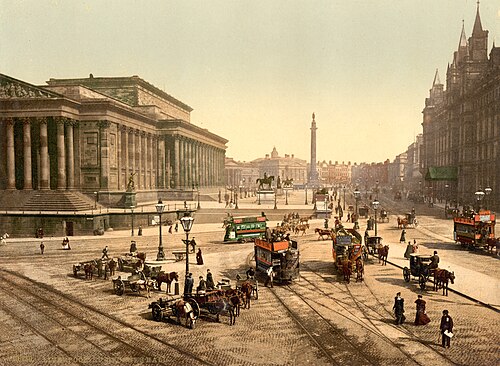
19 世紀には、リバプールは世界的に経済的に重要な都市となりました。世界中から流入する民族や宗教コミュニティによって加速的に増加する人口に対応するため、先駆的で世界初の技術と公共施設がこの都市で立ち上げられました。
19世紀初頭までに、大量の貿易がリバプールを通過するようになり、主要な建物の建設はこの富を反映していた。1830年、リバプールとマンチェスターは、リバプール・マンチェスター鉄道を通じて都市間鉄道接続を持つ最初の都市となった。人口は急速に増加し続け、特に1840年代には大飢饉の結果、アイルランドからの移民が数十万人単位で到着し始めた。この時期に多くのアイルランド人がリバプールに定住したが、かなりの割合が米国に移住するか、ランカシャー、ヨークシャー、ミッドランドの工業中心地に移動した。[37]

Wikisource にはこの記事に関連する原文があります:
LELによる詩的なイラスト「リバプール」
レティーシャ・エリザベス・ランドンは、都市の世界的な商業を讃えた詩的な挿絵「リバプール」(1832年)の中で、当時進行中だったマクレガー・レアードのニジェール川遠征について具体的に言及している。 [38]これは、サミュエル・オースティンのマージー川から見たリバプールの絵画である。[39]
イギリスは、アメリカのディープサウスから輸入された綿花の主要市場であり、国内の繊維産業の糧となっていた。綿花が都市経済において極めて重要な位置を占めていたことから、南北戦争中のリバプールは、歴史家スヴェン・ベッカートの言葉を借りれば、「南軍以外では世界で最も南軍寄りの場所」であった。[40]リバプールの商人たちは、北軍海軍によって封鎖された港から綿花を運び出すのを手伝い、南軍のために軍艦を建造し、南部に軍事装備と信用を供給した。[41]
戦争中、南軍の艦艇CSSアラバマはマージー川沿いのバーケンヘッドで建造され、 CSSシェナンドーはそこで降伏した(これが戦争終結時の最後の降伏となった)。この都市はまた、イギリスの封鎖突破船が南部に密輸する武器、弾薬、制服、海軍物資など、南軍の軍需品調達の中心地でもあった。[42]
19世紀の一時期、リバプールの富はロンドンを上回り[43]、リバプールの税関は英国国庫への最大の貢献者であった。[44]リバプールは、独自のホワイトホール事務所を構えた唯一の英国都市であった。 [45]この世紀には、世界の貿易全体の少なくとも40%がリバプールを通過した。[46]
19世紀初頭、リバプールは南極の アザラシ漁業で重要な役割を果たしており、その功績からサウス・シェトランド諸島のリバプール・ビーチは同市にちなんで名付けられました。[47]
1851年には、この都市は「ヨーロッパのニューヨーク」と評されていた。[48] 19世紀後半から20世紀初頭にかけて、リバプールはヨーロッパ全土からの移民を惹きつけていた。その結果、市内には新しい民族や宗教グループのための多様な宗教施設が建設され、その多くは今日でも使用されている。リバプール・ドイツ教会、聖ニコラス・ギリシャ正教会、グスタフ・アドルフ教会、プリンセス・ロード・シナゴーグは、いずれも1800年代に、それぞれリバプールの成長するドイツ、ギリシャ、北欧、ユダヤ人コミュニティのために設立された。リバプールで現存する最古の教会の一つである聖ペテロ・ローマ・カトリック教会は、その晩年には ポーランド人コミュニティの礼拝の場として機能していた。
20世紀

20 世紀には、世界経済大国としてのリバプールの地位が揺らぎました。国際海港としての戦略的な位置は、2 度の世界大戦で特に脆弱でした。経済不況(英国および世界全体)、住宅パターンの変化、海運業界のコンテナ化により、この都市の生産性と繁栄は下降傾向にありました。それにもかかわらず、この都市は世界の大衆文化に多大な影響を与え、世紀末までに都市再開発の継続的なプロセスが21 世紀の再定義された近代都市への道を開きました。
第一次世界大戦後の時期は、社会不安が顕著であった。社会は、大量の若者の戦争による死に対処し、退役軍人を民間生活や経済に再統合しようと努めていた。多くの元軍人が失業と劣悪な生活水準に直面した。リバプール市警察のストライキを含め、多くの場所で労働組合の組織化とストライキが行われた。アフリカやインドからイギリス軍に従軍した多数の植民地兵士や水兵が、リバプールや他の港湾都市に定住した。1919年6月、彼らは白人による人種暴動の攻撃を受けた。港湾住民にはスウェーデン移民も含まれており、両グループは仕事と住宅をめぐってリバプールの現地住民と競争しなければならなかった。この時期、他の港湾都市でも人種暴動が発生した。[49]
1919年の住宅法により、1920年代から1930年代にかけてリバプール市内各地に大量の公営住宅が建設された。1920年代から1930年代にかけて、リバプールの人口の15%(約14万人)が都心部から郊外の新しい低密度住宅団地へ移住した。これは生活水準が向上するとの考えに基づいていたが、全体的なメリットについては異論もある。[50] [51]この時代には多数の個人住宅も建設された。 1930年代初頭の大恐慌時には、リバプールの失業率は約30%に達した。リバプールには1930年から運営されている英国初の地方空港があった。
第二次世界大戦中、ヒトラーとチャーチルの両者はリバプールの極めて重要な戦略的重要性を認識していた。リバプールはドイツ軍の激しい爆撃を受け、ロンドンに次ぐ電撃攻撃を受けた。 [52]極めて重要な大西洋の戦いはリバプールで計画され、戦い、勝利を収めた。[53]
ドイツ空軍はマージーサイドに80回の空襲を仕掛け 、2,500人が死亡、首都圏の住宅のほぼ半数が損壊した。戦後は大規模な住宅団地や英国最大のドックプロジェクトであるシーフォース・ドックなど、大規模な再建が行われた。1952年以来、リバプールはドイツのケルンと姉妹都市となっているが、ケルンも戦時中に激しい空爆を受けた都市である。1950年代と1960年代には、市内中心部で行われた緊急再建の多くが非常に不評であった。ドイツの爆撃を生き延びた市内の歴史的部分は、都市再開発の際に広範囲にわたる破壊を受けた。都市計画家グレアム・シャンクランドにちなんで名付けられた1960年代のいわゆる「シャンクランド計画」は、妥協した都市計画と大規模な道路建設計画を招き、都心部を荒廃させ分断したと主張されている。コンクリートのブルータリズム建築、妥協した構想、失敗したプロジェクト、実現しなかった壮大なデザインは非難の対象となった。歴史家ラファエル・サミュエルはグレアム・シャンクランドを「リバプールの虐殺者」と呼んだ。[54] [55] [56] [57]
20世紀の最初の20年間、リバプールには西インド諸島系黒人コミュニティが数多く存在していた。ほとんどのイギリスの都市や工業化された町と同様に、リバプールには第一次世界大戦後にこの地域で勤務した植民地の兵士や水兵から始まり、相当数の英連邦移民が移住してきた。第二次世界大戦後にはさらに多くの移民が到着し、そのほとんどは住宅費が安いトクステスなどの古い都心部に定住した。リバプールの黒人人口は2011年に1.90%と記録された。 2021年の国勢調査では、5.2%が黒人アフリカ人、カリブ人、白人と黒人アフリカ人の混血、白人とカリブ人の混血、または「その他の黒人」と自らを称した。[58] [59]
.jpg/500px-Southern_side_view,_Mathew_Street,_intersection_with_Temple_Court,_Liverpool_(2019-05-25_14.35.34_by_HarshLight).jpg)
1960年代、リバプールは「マージービート」サウンドの中心地であり、ビートルズやリバプール出身のロックバンドの代名詞となった。アメリカのリズムアンドブルースやロックミュージックの影響を受け、彼らはアメリカの音楽にも強い影響を与えた。ビートルズは1960年代初頭に国際的に知られるようになり、世界中で一緒に演奏した。彼らはポピュラー音楽史上最も商業的に成功し、音楽的にも影響力のあるバンドであり続けている。彼らの共同創設者であり、歌手であり作曲家でもあるジョン・レノンは1980年にニューヨーク市で殺害された。リバプール空港は2002年に彼にちなんで改名され、個人に敬意を表して命名された最初のイギリスの空港となった。[60] [61]
かつてはランカシャー州の一部で、1889年からは州自治区であったリバプールは、1974年に新しく創設された都市圏であるマージーサイド内の都市自治区となった。1970年代半ば以降、リバプールの港湾と伝統的な製造業は海運業と重工業のリストラにより衰退し、大量の雇用が失われた。コンテナ化の到来により、市内の港湾は大部分時代遅れとなり、港湾労働者は失業した。1980年代初頭までに、リバプールの失業率は英国で最も高く、[62] 1982年1月には17%に達したが、これは約50年前の大恐慌時にリバプールを襲った失業率の約半分であった。[63]この期間中、リバプールはロンドンの中央政府に対する激しい左翼反対派の中心地となった。[64] 1980年代のリバプールは、英国の「ショックシティ」と呼ばれています。かつては世界的重要性において首都に匹敵する大英帝国第二の都市であったリバプールは、植民地時代後、産業革命後の英国のどん底で、その「どん底」に陥りました。[65] [66] 20世紀後半、リバプールの経済は回復し始めました。1980年代後半には、再生されたアルバートドックがオープンし、それがさらなる再生のきっかけとなりました。[67] 1990年代半ば、市は全国平均を上回る成長率を享受しました。20世紀末、リバプールは再生に注力しており、そのプロセスは今日も続いています。
21世紀
.jpg/500px-Liverpool_Cruise_Terminal_(2023).jpg)
国際的に重要なイベントの開催と相まって、リバプールは英国で最も訪問者が多く、観光客が集まる都市の 1 つとして生まれ変わりました。市の指導者たちは、市の人口と経済を成長させるための長期戦略に焦点を当てており、中央政府は市の権限委譲の継続的な可能性を模索しています。
2002年、エリザベス女王とエディンバラ公フィリップ王子は、建国50周年を記念してリバプールを訪れた。リバプール市庁舎で聴衆に語りかけた女王は、リバプールを「英国で最も特徴的でエネルギッシュな地域の一つ」と認め、この都市の「主要なオーケストラ、世界クラスの博物館やギャラリー」に敬意を表した。また、リバプールが欧州文化首都に立候補していることも認めた。[68] [69] 2002年のエリザベス女王建国50周年を祝うため、環境保護団体プラントライフは、郡の花を選ぶコンテストを開催した。リバプールは最終的にシーホリーを選んだ。この取り組みは、英国の花の種に対する脅威の高まりを強調し、どの花が郡を最もよく表しているかを国民に尋ねるために設計された。[70]
ビートルズなどの1960年代のロックグループの人気や、市内の世界クラスの美術館、博物館、ランドマークを活用して、観光と文化はリバプール経済の重要な要素となっている。

2004年、不動産開発業者グロブナーはパラダイス ストリートを拠点とする9億2000万ポンドの開発プロジェクト、パラダイスプロジェクトを開始しました。このプロジェクトは、戦後の復興以来、リバプールの市内中心部に最も大きな変化をもたらしました。このセンターは 「リバプール ワン」と改名され、2008年5月にオープンしました。
2007 年、リバプール市創設 800 周年を記念してイベントや祝賀会が開催されました。リバプールは 2008 年の共同欧州文化首都に指定されました。祝賀会では、高さ 20 メートル、重さ 37 トンの巨大な機械仕掛けの蜘蛛、ラ・プリンセスの設置が行われました。これは、名誉、歴史、音楽、マージー川、港、統治、太陽、文化というリバプールの「8 本の足」を表しています。ラ・プリンセスは祝賀会の間、市内の通りを歩き回り、最後にクイーンズウェイ トンネルに入りました。
数十億ポンド規模のリバプールワン開発を先頭に、再開発は2010年代を通じて継続された。最も重要な再開発プロジェクトには、商業地区、キングスドック、マンアイランド、ライムストリート周辺、バルティックトライアングル、ロープウォークス、エッジレーンの新しい建物が含まれていた。[71] [72] [73]

リバプールの統治に変化が起きたのが2014年。リバプール市議会の地方自治体は、権限委譲の形でリバプール市域統合当局を設立し、周辺の自治区と権限と資源を統合することを決定した。中央政府から付与された権限委譲予算により、当局は現在、大規模な再開発プロジェクトを含むリバプール市域全体の最重要戦略事項を監督し、投資している。当局はリバプール市議会とともに、都市の人口と経済を成長させるための長期計画に着手した。[74] [75] [76] [77]
2020年代までに、市内全域で都市再生が進む。リバプール・ウォーターズは、市内の使われていない北部のドックランドの複合開発であり、英国史上最大のメガプロジェクトの一つとされている。ブラムリー・ムーア・ドックにあるエバートンの新スタジアムは、建設当時、英国最大の単一敷地の民間開発とみなされていた。[78] [79]
市内では定期的に大規模なイベント、ビジネスおよび政治会議が開催され、経済の重要な部分を形成しています。2014年6月、デイビッド・キャメロン首相はリバプール国際ビジネスフェスティバルを立ち上げました。これは2014年の世界最大のビジネスイベントであり、[80] 1951年の英国フェスティバル以来英国最大のイベントです。 [81]労働党は2010年代半ば以来、毎年恒例の労働党大会の開催地に何度もリバプールを選んでいます。リバプールは2023年のユーロビジョン・ソング・コンテストの開催地となりました。
発明と革新

リバプールは発明と革新の中心地でした。鉄道、大西洋横断蒸気船、市営路面電車[82]、電車はすべて、大量輸送手段としてリバプールで開拓されました。1829年と1836年には、世界初の鉄道トンネルがリバプールの地下に建設されました(ワッピングトンネル)。1950年から1951年にかけて、世界初の定期旅客ヘリコプターサービスがリバプールとカーディフの間で運行されました。[83]
最初の盲学校[84] 、 [85]機械工学校[ 85]女子高等学校[86] [87]公営住宅[88]少年裁判所[ 89]はすべてリバプールで設立されました。 RSPCA [90] 、[91] NSPCC [91] Age Concern [ 92] Relate [93]などの慈善団体はすべてこの都市での活動から発展しました。
最初の救命艇ステーション、公衆浴場と洗濯場、[94]衛生法、[95]保健医官(ウィリアム・ヘンリー・ダンカン)、地区看護師、スラム街の一掃、[96]専用救急車、[97] X線診断、[98]熱帯医学学校(リバプール熱帯医学学校)、市営モーター消防車、[99]無料の学校給食、[100]ガン研究センター、[101] 人獣共通感染症研究センター[102]はすべてリバプールで誕生しました。英国初のノーベル賞は、1902年に熱帯医学学校の教授ロナルド・ロスに授与されました。同学校は世界初のこの種の学校でした。[103] 整形外科はヒュー・オーウェン・トーマスによってリバプールで開拓され、[104]現代の医療麻酔はトーマス・セシル・グレイによって開拓されました。
世界初の統合下水道システムは、1847年に英国初の自治体技術者に任命されたジェームズ・ニューランズによってリバプールに建設されました。 [105] [106]リバプールはまた、英国初の保険業者協会[107]と初の会計士協会を設立しました。西洋世界初の金融デリバティブ(綿花先物)は、1700年代後半にリバプール綿花取引所で取引されました。 [108]

芸術面では、リバプールには最初の貸し出し図書館(ライシーアム)、アセナエウム協会(リバプール・アセナエウム)、芸術センター(ブルーコート・チェンバーズ)[109]、公共芸術保存センター(国立保存センター) [110]がありました。また、英国最古の現存するクラシックオーケストラ(ロイヤル・リバプール・フィルハーモニー管弦楽団)[111]とレパートリーシアター(リバプール・プレイハウス)[112]の本拠地でもあります。
1864年、ピーター・エリスは世界初の鉄骨とカーテンウォールのオフィスビル、オリエル・チェンバーズを建設した。これは超高層ビルの原型となった。英国初の目的別デパートは、小売業者JRジェフリーのために1867年に完成したコンプトン・ハウスである。[113]当時、それは世界最大の店舗であった。[114]

1862年から1867年にかけて、リバプールでは毎年グランド・オリンピック・フェスティバルが開催された。ジョン・ハリーとシャルル・ピエール・メリーによって考案されたこの大会は、完全にアマチュアの性質を持ち、国際的な展望を持った最初の大会であった。[115] [116] 1896年にアテネで開催された最初の近代オリンピックのプログラムは、リバプールオリンピックのものとほぼ同じだった。[117] 1865年、ハリーはリバプールで英国オリンピック協会の前身となる全国オリンピック協会を共同設立した。その設立規約はオリンピック憲章の枠組みとなった。
小売起業家のデイビッド・ルイスが考案したコンセプトで、最初のクリスマス洞窟は1879年にリバプールのルイス百貨店にオープンしました。 [118]船主のサー・アルフレッド・ルイス・ジョーンズは、1884年にリバプールの港を経由してイギリスにバナナを持ち込みました。 [119] 1886年に開通したマージー鉄道には、世界初の潮汐河口の下のトンネル[ 120]と世界初の深層地下駅(リバプール・ジェームス・ストリート駅)が組み込まれました。

1889年、自治区の技術者ジョン・アレクサンダー・ブロディがサッカーゴールネットを発明した。彼はプレハブ住宅の使用の先駆者でもあり[122]、英国初の環状道路(A5058)と都市間高速道路(イーストランカシャーロード)の建設、リバプールとバーケンヘッドを結ぶクイーンズウェイトンネルの建設を監督した。建設当時は「世界第8の不思議」と評され、24年間にわたり世界最長の海底トンネルであった。
1897年、リュミエール兄弟はリバプールを撮影した[123] 。その中には世界初の高架電化鉄道であるリバプール・オーバーヘッド鉄道から撮影された世界初のトラッキングショット[124]も含まれている。オーバーヘッド鉄道は電車を使用し、自動信号を採用し、エスカレーターを設置した世界初の鉄道であった。
リバプールの発明家フランク・ホーンビーは玩具の開発と製造の先見の明があり、20世紀で最も人気のある玩具の3つのシリーズ、メカノ、ホーンビー鉄道模型、ディンキートイを製造した。 1933年にフィリップ・エラビー・クリーターによってリバプールに設立された英国惑星協会は、宇宙飛行の促進に専念する世界最古の現存する組織である。その機関誌である英国惑星協会誌は、世界で最も長く続いている宇宙飛行出版物である。[125]
1999年、リバプールはロンドン以外では初めて、イングリッシュ・ヘリテージから「あらゆる分野でその息子と娘が果たした多大な貢献」を称えられブルー・プラークを授与された都市となった。 [126]
政府
.jpg/500px-Cunard_and_Port_of_Liverpool_Building_Buildings_(2015-11-03_19.33.41_by_Bob_Edwards_-_22794131345).jpg)
地方自治の目的上、リバプール市は大都市自治区に分類されます。大都市自治区は、マージーサイド州とリバプール市域の両方に位置しています。これらの地理的領域はそれぞれ行政区域として扱われ、それぞれに異なるレベルの地方自治が適用されます。
リバプール市議会はリバプール市の首都圏自治区のみを管轄する統治機関であり、イングランドの単一自治体の標準的な機能を果たしている。リバプール市域統合当局とリバプール市域の市長は、リバプール市域の5つの周辺自治区とともに、リバプール市の交通、経済開発、再開発などに関する主要な戦略的権限を留保している。統合当局は、国から委譲された都市圏特有の領域に対する権限を有する。[127]
しかしながら、これら2つの構造以外にも地方自治には例外がいくつかあります。リバプールは1974年から1986年までマージーサイド州議会によって統治され、この時代に遡る組織の残存部分がいくつか残っています。1986年に州議会が解散すると、ほとんどの行政機能はリバプール市議会に移管されました。しかし、警察や消防救助サービスなどのいくつかの機関は、引き続き郡全体で運営されています。したがって、マージーサイド州は、限られたサービスのみを提供する行政区域として存続していますが、リバプール市域統合当局の能力と容量は、時間とともに進化しています。[128]
同市はまた、ウェストミンスター議会に国会議員5名を選出しており、2024年の総選挙時点で全員が労働党員となる。
市議会議長と閣僚

リバプール市議会は、4年ごとにリバプールの有権者によって直接選出され、さまざまな政党を代表する85人の市議会議員で構成される憲法に基づいて運営されています。市議会議員は、市の住民のための地域サービスに関する決定を下します。
各選挙で、85 議席の過半数を獲得した政党が、その後 4 年間市議会を率います。この政党の地方指導者が市議会議長の役割を担い、その後、9 人の市議会議員からなる内閣を率います。市議会議員には、「ポートフォリオ」と呼ばれる特定の責任が割り当てられます。
リバプール市議会の現議長は、 2023年の地方選挙で過半数を獲得した労働党を代表するリアム・ロビンソン議員である。[130]また、議長はリバプール市域市長内閣(市議会内閣とは別)のメンバーでもあり、現在ロビンソンはイノベーション担当閣僚のポストを務めている。
市議会の決定と活動の監視は、概観・監視委員会、監視パネル、規制委員会、その他の委員会を含むさまざまな委員会とパネルによって行われます。市議会の日常的な管理は、最高経営責任者と数人の理事と上級役員を含む管理チームによって行われます。管理チームは、予算や都市計画などの戦略的な方向性と優先事項を提供するために、内閣や市議会議員と協力します。[131] [132]
リバプール市議会選挙
市は4年ごとに64の地方議会区から85人の議員を選出します。[133]選挙区はアルファベット順で以下の通りです。
2023年のリバプール市議会選挙では、前回選挙に引き続き労働党がリバプール市議会の支配権を固めた。市議会の改選議席85のうち、労働党は61議席(有権者の総投票数の53.13%)、自由民主党は15議席(同21.61%)、緑の党は3議席(同9.76%)、リバプール地域無所属は3議席(同4.64%)、自由党は残りの3議席(同3.21%)を獲得した。国政で政権を握っている保守党はリバプール市議会に代表を送らなかった。リバプールの有権者の投票率はわずか27.27%だった。[134]
19世紀から20世紀初頭にかけて、リバプールはトーリー党の拠点都市だった。しかし、近年の保守党への支持は英国で最も低く、特にマーガレット・サッチャー元首相の金融政策以来その傾向が顕著だ。 1979年の総選挙後、サッチャーの勝利が長期にわたる高失業率とリバプールの衰退の一因になったと多くの人が主張している。[135]リバプールは労働党の主要拠点の1つであるが、労働党政権下では厳しい時期も経験した。特に不満の冬(1978年後半から1979年初頭)には、リバプールも英国の他地域と同様に公共部門のストライキに見舞われたが、墓掘り人がストライキを起こし、死者が長期間埋葬されないという特に屈辱的な不幸にも見舞われた。 [136]
市議会の批判と改善
近年、リバプール市議会は、当局が納税者のお金を効率的に使用し、市内のビジネスと投資を促進することを目的とした大規模な改善プログラムを開始しました。リバプールワンを担当する不動産会社グロブナーグループは、この変更を「リバプールにおける大胆な思考の機会」として称賛しました。[137]
2021年、リバプール市議会に対する政府の非常に批判的な査察とその後の報告書(コーラー報告書と呼ばれる)は、リバプール市議会の複数の欠陥を特定した。住宅・コミュニティ・地方自治大臣のロバート・ジェンリックは、市議会の高速道路、再開発、財産管理、統治、財政上の意思決定を監督するために政府の委員を派遣した。当局は、市議会の構造全体を徹底的に見直す3年間の改善計画に取り組むことを余儀なくされた。介入の結果、2023年のイギリス地方選挙までに市議会の大きな構造的変化が起こり、「市の歴史上最も予測不可能な選挙」と呼ばれた。市内の選挙区の数は30から64に倍増し、選挙対象となる市議会議員の総数は90人から85人に削減された。今後、市議会は4年ごとに「総選挙」に変更され、市議会議員全員が同時に再選される資格を得ることになる。市長選の役割も廃止され、市議会は以前のリーダーと内閣のリーダーシップスタイルに戻った。選挙の結果は、一般市民が市への政府の介入にどう反応するかだけでなく、リシ・スナック首相の政府全体に対する反応を試すものと見なされた。[138] [139] [140] [141]
リアム・ロビンソン議員は、2023年の市議会選挙でリバプール市議会の新しい議長に就任した。リバプール市域の スティーブ・ロザラム市長が議長を務め、地方自治体での経験を持つ著名人が数人参加するリバプール戦略未来諮問委員会が設立された。委員会は、政府の介入措置の外で市議会の長期的な将来を指揮し、市が追求すべき計画や優先事項について助言することを任務としている。[142]
2008年2月、リバプール市議会は国内で最もパフォーマンスの悪い議会であると報告され、わずか1つ星の評価(不十分と分類)を受けた。低評価の主な原因は、市が欧州文化首都の称号を保持している間に2,000万ポンドの不足が蓄積されるなど、議会の納税者のお金の不適切な取り扱いに起因していた。[143] 2024年4月、地方自治局は地方自治体のランキングを発表し、リバプール市議会は318の自治体のうち317位となった。[144]
リバプール市長
リバプール市長は、 古くからある儀礼的な役割である。リバプール市議会議員(一般市民ではない)が毎年市長を選出し、市長の任期は1年である。市長は「第一の市民」と称され、市政行事や行事で市を代表し、市を広く世界に宣伝し、地元の慈善団体やコミュニティグループを支援し、宗教行事に出席し、リバプールの姉妹都市の代表者と面会し、市議会の議長を務め、名誉市民や協会に名誉市民の称号を授与するために選出される。[145]市長は、リバプール市議会の本会議の議長でもある。

リバプール市市長
リバプール市は、リバプール都市圏を構成する6つの自治区の1つです。リバプール都市圏の市長は、これら6つの自治区の住民によって4年ごとに直接選出され、リバプール都市圏統合当局を監督します。統合当局は、都市圏の地方自治に関する最高レベルの行政機関であり、交通と投資、経済発展、雇用と技能、観光、文化、住宅、物理的インフラなどの問題に関する主要な戦略的決定を下す任務を負っています。現在のメトロ市長はスティーブ・ロザラムです。
選挙区と国会議員
リバプールは5つの選挙区に含まれており、ウェストミンスターで市を代表する国会議員が選出される:リバプール・リバーサイド、リバプール・ウォルトン、リバプール・ウェーヴァートリー、リバプール・ウェスト・ダービー、ガーストン・アンド・ヘイルウッド。[146]前回の総選挙では、キム・ジョンソン、ダン・カーデン、ポーラ・バーカー、イアン・バーンがそれぞれ代表を務め、労働党がこれらすべての選挙区で勝利した。 [147] 2010年の選挙前の境界変更により、リバプール・ガーストン選挙区はノーズリー・サウスの大部分と合併し、ガーストン・アンド・ヘイルウッドの境界を越えた選挙区となった。直近の2024年の選挙では、労働党のマリア・イーグルが勝利した。 [147]
地理
環境
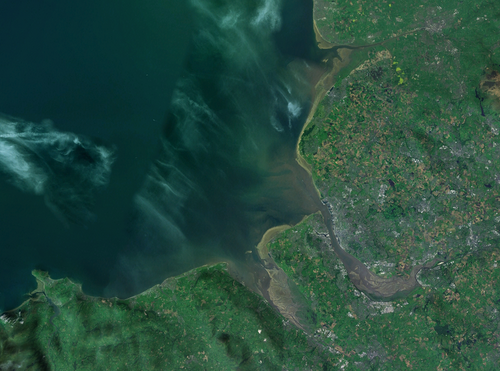
リバプールは「イングランドのどの都市よりも素晴らしい環境」を持っていると評されている。[148]北緯53度24分0秒 西経2度59分0秒 / 北緯53.40000度 西経2.98333度 / 53.40000; -2.98333 (53.4, −2.98)、ロンドンの北西176マイル (283 km)、アイリッシュ海のリバプール湾に位置するリバプール市は、西ランカシャー海岸平野の南の境界となるエバートン・ヒルの海抜約230フィート (70 m) の高さまでそびえる砂岩の丘陵の尾根に沿って建てられている。
マージー川の河口はリバプールとウィラル半島を隔てています。リバプールの境界は、北はセフトン南部のブートル、クロスビー、マグホール、東はノーズリー のカークビー、ハイトン、プレスコット、ヘイルウッドに隣接しています。
気候
| リバプール | ||||||||||||||||||||||||||||||||||||||||||||||||||||||||||||
|---|---|---|---|---|---|---|---|---|---|---|---|---|---|---|---|---|---|---|---|---|---|---|---|---|---|---|---|---|---|---|---|---|---|---|---|---|---|---|---|---|---|---|---|---|---|---|---|---|---|---|---|---|---|---|---|---|---|---|---|---|
| 気候図(説明) | ||||||||||||||||||||||||||||||||||||||||||||||||||||||||||||
| ||||||||||||||||||||||||||||||||||||||||||||||||||||||||||||
| ||||||||||||||||||||||||||||||||||||||||||||||||||||||||||||
リバプールは、イギリス諸島の多くの地域と同様に、比較的穏やかな夏、涼しい冬、年間を通じてほぼ均等に降雨量がある温帯 海洋性気候(ケッペンの気候区分:Cfb )です。降雨量と気温の記録は1867年以来ビッドストンヒルで保管されていましたが、気圧の記録は少なくとも1846年まで遡ります。[149]ビッドストンは2002年に閉鎖されましたが、英国気象庁はクロスビーにも気象観測所を置いています。記録が始まった1867年以降、気温は2010年12月21日の-17.6 °C(0.3 °F)から1990年8月2日の34.5 °C(94.1 °F)まで変動していますが、リバプール空港では2006年7月19日に35.0 °C(95.0 °F)を記録しました。[150]
記録上最も日照時間が少なかったのは1927年12月の16.5時間で、最も多かったのは2013年7月の314.5時間でした。[151] [152]
リバプール周辺では竜巻や漏斗雲の発生は非常に稀で、発生したとしても通常は弱い。マージーサイドで最近発生した竜巻や漏斗雲は1998年と2014年に観測されている。 [153] [154]
1981年から2010年にかけて、クロスビーでは年間平均32.8日の空気霜が記録されましたが、これは英国としては低い数値です。[155]冬には雪が降ることはよくありますが、大雪になることは稀です。雪は通常11月から3月の間に降りますが、時折早まったり遅れたりすることもあります。最近では、最も早い降雪は2008年10月1日で[156]、最も遅い降雪は2012年5月15日でした。[157]歴史的には、最も早い降雪は1908年9月10日で[158]、最も遅い降雪は1975年6月2日でした。[159]
リバプールでは降雨量は少ないものの、かなり一般的で、記録上最も雨量が多かったのは1956年8月の221.2 mm (8.71インチ) の降雨量で、最も少なかったのは1932年2月の0.9 mm (0.035インチ) でした。[160]記録上最も少なかったのは1991年の480.5 mm (18.92インチ) の降雨量で、最も多かったのは1872年の1,159.9 mm (45.67インチ) でした。[161]
- ^ ノルウェーのスタヴァンゲルと共有。
- ^ 気象観測所はリバプール市内中心部から7マイル(11 km)の場所にあります。
- ^ 日照時間は1971年から2000年までビッドストン天文台で記録されました。
- ^ 湿度は1975年から2002年6月までの期間、ビッドストン天文台で記録されました。1992年7月から9月までの期間は記録がなく、2001年1月から5月までのデータは信頼性が低いと報告されています。
- ^ 1867年から2002年まで、極値はウィラルのビッドストン天文台で記録されました。1983年以降、極値はセフトンのクロスビーで記録されました。
人間
郊外と地区
リバプールの郊外と地区には以下が含まれます。
グリーンリバプール
2010年、リバプール市議会とプライマリーケアトラストは、マージーフォレストに市の「グリーンインフラ戦略」の完成を委託した。[170]
グリーンベルト
リバプールは、周囲の郡にまで広がるグリーンベルト地域の中心都市であり、都市の無秩序な拡大を抑え、都市圏の町がさらに密集するのを防ぎ、郊外のコミュニティのアイデンティティを保護し、ブラウンフィールドの再利用を促進し、近くの田園地帯を保護するために設置されています。これは、指定された地域内での不適切な開発を制限し、許可された建築物に厳しい条件を課すことによって達成されます。[171]
すでに建物が密集しているため、この都市には、ファザカーリー、クロクステス・ホールとカントリー・パーク、ネザーリーのクレイブン・ウッド、ウッドフィールズ・パークと近くのゴルフコースなどの自治区全体の緑地、セント・アンブローズ小学校のそばのスピーク地区の東側の小さな緑地、そしてオグレットの小さな村落とリバプール空港の南の周辺地域内の限られた部分の保護された緑地帯が含まれています。[172]
グリーンベルトは1983年にマージーサイド州議会の下で初めて策定され[173]、市内の面積は530ヘクタール(5.3 km2; 2.0平方マイル)に達します。 [ 174]
異名
リバプール人
20世紀半ば以降、スカウサーはリバプールの住民の主な呼称となり、リバプールのスカウス方言や方言と強く結びついています。 [175]スカウス方言は19世紀後半にランカスター方言から徐々に分岐したと言われています。[176] [177] [178] [179] [180]
スカウザーの語源は、リバプールの港を通過する船乗りたちがこの地域にもたらした伝統的な料理スカウスに由来しています。 [181] [180] [182]
その他の異名
Scouser が設立される以前は、さまざまな人気と長寿を持つリバプールの住民を指すために、さまざまな用語が使用されていました。
- リバポルド(17世紀)[183]
- リーアプールトニアン(17世紀)[180]
- リバポリタン(19世紀)[184]
- リバプール人(19世紀から現在)[185]
トニー・クロウリー教授は、1950年代までリバプールの住民は一般的にいくつかの愛称で呼ばれていたと主張している。彼は、20世紀半ばに「リバポリタン」と「リバプール人」という2つの対立する用語の間で論争があったと主張している。その論争は、これらの用語の語彙学と社会階級の含意をめぐるものだった。[182] [186]
ジョン・ベルチェム教授は、「ディック・リバー」、「ディッキー・サム」、「ワッカー」などの一連のニックネームが使われていたが、徐々に使われなくなったと示唆している。ベルチェムとフィリップ・ボーランドは、コメディーラジオの司会者や芸能人がリバプールのアイデンティティを全国の聴衆に広め、それが今度は地元の人々が徐々に「スカウザー」として知られるようになったと示唆している。フランク・ショーの『マイ・リバプール、スカウズタウンの祝典』が1971年に出版された頃には、「スカウザー」が確実に支配的なニックネームになっていたとベルチェムは主張している。[175] [187] [188]
人口統計
人口
The city
The city of Liverpool is at the core of a much larger and more populous metropolitan area, however, at the most recent UK Census in 2021, the area governed by Liverpool City Council had a population of 486,100, a 4.2% increase from the previous Census in 2011. This figure increased to 500,500 people by 2022, according to data from Liverpool City Council.
Taking in to account how local government is organised within the cities and metropolitan areas of England, the city of Liverpool was the fifth largest of England's 'core cities' and had the second overall highest population density of those, by 2021.[200][201][202]
The population of the city has steadily risen since the 2001 Census. As well as having a growing population, the population density also grew at the 2021 Census compared to the previous Census. This makes Liverpool the second most densely populated local authority in North West England, after Manchester.
The population of the city is comparatively younger than that of England as a whole. Family life in the city is also growing at odds with the North West England region as a whole: At the 2021 Census, the percentage of households including a couple without children increased in Liverpool, but fell across the North West. The percentage of people aged 16 years and over (excluding full-time students) who were employed also increased in Liverpool compared to the overall North West region where it fell.
.jpg/500px-Asian_Tourists_at_Quayside_-_Albert_Dock_-_Liverpool_-_England_(28033157252).jpg)
The 2021 Census also showed that Liverpool's ethnic and international population was growing. The number of residents in the city born outside of England has increased since the previous Census, while the number of residents who did not identify with any national identity associated with the UK has also increased at a faster rate than England as a whole. The overall share of the city's population who identified as Asian and Black increased, while the percentage who identified as white decreased in the city compared with previous Census.[203]
It has been argued that the city can claim to have one of the strongest Irish heritages in the United Kingdom, with as many as 75 percent (estimated) of Liverpool's population with some form of Irish ancestry.[204]
The growing population of Liverpool in the 21st century reverses a trend which took place between the 1930s and 2001, when the population of the city proper effectively halved.
At the 1931 United Kingdom census, Liverpool's population reached an all-time high of 846,302. Following this peak, in response to central government policy, the Council authority of Liverpool then built and owned large several 'new town' council estates in the suburbs within Liverpool's metropolitan area. Tens of thousands of people were systematically relocated to new housing in areas such as Halton, Knowsley, St Helens, Sefton, Wirral, Cheshire West and Chester, West Lancashire, Warrington and as far as North Wales.
Such a mass relocation and population loss during this time was common practice for many British cities, including London and Manchester, In contrast, satellite towns such as Kirkby, Skelmersdale and Runcorn saw a corresponding rise in their populations (Kirkby being the fastest growing town in Britain during the 1960s).[205][206][203][207]
Urban and metropolitan area
Liverpool is typically grouped with the wider Merseyside (plus Halton) area for the purpose of defining its metropolitan footprint, and there are several methodologies. Sometimes, this metropolitan area is broadened to encompass urban settlements in the neighbouring counties of Lancashire and Cheshire.[208][209]
The Office for National Statistics in the United Kingdom uses the international standardised International Territorial Levels (ITLs) to divide up the economic territory of the UK. This enables the ONS to calculate regional and local statistics and data. The ONS uses a series of codes to identify these areas. In order of hierarchy from largest area to smallest area, Liverpool is part of the following regions:[210][211][212]
ITL 1 region
North West England (code TLD)
At the 2021 Census, the ITL 1 region of North West England had a usual resident population of 7,417,300.[213]
ITL 2 region
Merseyside (code TLD7)
The ITL 2 region of Merseyside is defined as the area comprising East Merseyside (TLD71) plus Liverpool (TLD72), Sefton (TLD73) and Wirral (TLD74).
At the 2021 Census, the population of this area was as follows:[214]
East Merseyside (TLD71):
- Halton = 128,200
- Knowsley = 154,500
- St. Helens = 183,200
Liverpool (TLD72) = 486,100
Sefton (TLD73) = 279,300
Wirral (TLD74) = 320,200
Therefore, the total population of the ITL 2 Merseyside region was 1,551,500 based on the 2021 Census.
ITL 3 region
The smallest ITL 3 area classed as Liverpool (code TLD72), therefore, had a population of 486,100 at the 2021 Census.
Other definitions
At the 2021 Census, the ONS used a refreshed concept of built-up areas (BUAs) based on the physical built environment, using satellite imagery to recognise developed land, such as cities, towns, and villages. This allows the ONS to investigate economic and social statistics based on actual settlements where most people live. Data from the 2021 Census is not directly comparable with 2011 Census data due to this revised methodology. Using the population figures of BUAs at the 2021 Census (excluding London), Liverpool Built-up Area is the third largest in England with some 506,565 usual residents (behind only Birmingham and Leeds). Liverpool's built-up area is, therefore, larger than the major English cities of Bristol, Manchester, Newcastle upon Tyne, Nottingham and Sheffield.[215]

Excluding London, the Liverpool City Region was the 4th largest combined authority area in England, by 2021. The population is approximately 1.6 million. The Liverpool City Region is a political and economic partnership between local authorities including Liverpool, plus the Metropolitan boroughs of Knowsley, Sefton, St Helens, Wirral and the Borough of Halton. The Liverpool City Region Combined Authority exercises strategic governance powers for the region in many areas. The economic data of the Liverpool city region is of particular policy interest to the Office for National Statistics, particularly as the British Government continuously explores the potential to negotiate increased devolved powers for each combined authority area.[216][217][218][219]
A 2011 report, Liverpool City Region – Building on its Strengths, by Lord Heseltine and Terry Leahy, stated that "what is now called Liverpool City Region has a population of around 1.5 million", but also referred to "an urban region that spreads from Wrexham and Flintshire to Chester, Warrington, West Lancashire and across to Southport", with a population of 2.3 million.[220]
In 2006, in an attempt to harmonise the series of metropolitan areas across the European Union, ESPON (now European Observation Network for Territorial Development and Cohesion) released a study defining a "Liverpool/Birkenhead Metropolitan area" with an estimated population of 2,241,000 people. The metro area comprised a functional urban area consisting of a contiguous urban sprawl, labour pool, and commuter Travel to work areas. The analysis defined this metropolitan area as Liverpool itself, combined with the surrounding areas of Birkenhead, Wigan/Ashton, Warrington, Widnes/Runcorn, Chester, Southport, Ellesmere Port, Ormskirk and Skelmersdale.[221]
Liverpool and Manchester are sometimes considered as one large polynuclear metropolitan area,[222][223][224] or megalopolis.
Ethnicity
In recent decades, Liverpool's population is becoming more multicultural. According to the 2021 census, 77% of all Liverpool residents described their ethnic group as White English, Welsh, Scottish, Northern Irish or British. The remaining 23% were described as non-White English/British. Between 2011 and 2021, there was population growth across all ethnic groups, except 'White English/British' and 'Any Other', where there were overall losses. The number of 'Other White residents' in Liverpool also increased by almost 12,000 people, with notable increases in the 'Other Asian', 'Arab', and 'Other Mixed/Multiple' population categories. The non-White English/British population as a percentage of the total population across the 'newly organised city electoral wards' ranged from 5% in the Orrell Park ward to 69% in the Princes Park ward. 9 out of 10 Liverpool residents regarded English as their main language. The highest non-English languages in the city were Arabic (5,743 main speakers) followed by Polish (4,809 main speakers). Overall, almost 45,000 residents had a main language that was not English.[225]
According to a 2014 survey, the ten most popular surnames of Liverpool and their occurrence in the population are:[226][227]
- 1. Jones – 23,012
- 2. Smith – 16,276
- 3. Williams – 13,997
- 4. Davies – 10,149
- 5. Hughes – 9,787
- 6. Roberts – 9,571
- 7. Taylor – 8,219
- 8. Johnson – 6,715
- 9. Brown – 6,603
- 10. Murphy – 6,495
Liverpool is home to Britain's oldest Black community, dating to at least the 1730s. Some Liverpudlians can trace their black ancestry in the city back ten generations.[228] Early Black settlers in the city included seamen, the children of traders sent to be educated, and freed slaves, since slaves entering the country after 1722 were deemed free men.[229] Since the 20th century, Liverpool is also noted for its large African-Caribbean,[4] Ghanaian,[230] and Somali[231] communities, formed of more recent African-descended immigrants and their subsequent generations.

The city is also home to the oldest Chinese community in Europe; the first residents of the city's Chinatown arrived as seamen in the 19th century.[232] The traditional Chinese gateway erected in Liverpool's Chinatown is the largest gateway outside China. Liverpool also has a long-standing Filipino community. Lita Roza, a singer from Liverpool who was the first woman to achieve a UK number one hit, had Filipino ancestry.
The city is also known for its large Irish and Welsh populations.[234] In 1813, 10 per cent of Liverpool's population was Welsh, leading to the city becoming known as "the capital of North Wales."[234]
During, and in the decades following, the Great Irish Famine in the mid-19th century, up to two million Irish people travelled to Liverpool within one decade, with many subsequently departing for the United States.[235] By 1851, more than 20 per cent of the population of Liverpool was Irish.[236] At the 2001 Census, 1.17 per cent of the population were Welsh-born and 0.75 per cent were born in the Republic of Ireland, while 0.54 per cent were born in Northern Ireland,[237] but many more Liverpudlians are of legacy Welsh or Irish ancestry.[238]
Other contemporary ethnicities include Indian,[4] Latin American,[239] Malaysian,[240] and Yemeni[241] communities, which number several thousand each.
Religion
The thousands of migrants and sailors passing through Liverpool resulted in a religious diversity that is still apparent today. This is reflected in the equally diverse collection of religious buildings,[243] including two Christian cathedrals.
Liverpool is known to be England's 'most Catholic city', with a Catholic population much larger than in other parts of England.[244] This is mainly due to high historic Irish migration to the city and their descendants since.[245]
The parish church of Liverpool is the Anglican Our Lady and St Nicholas, colloquially known as "the sailors church", which has existed near the waterfront since 1257. It regularly plays host to Catholic masses. Other notable churches include the Greek Orthodox Church of St Nicholas (built in the Neo-Byzantine architecture style), and the Gustav Adolf Church (the Swedish Seamen's Church, reminiscent of Nordic styles).
Liverpool's wealth as a port city enabled the construction of two enormous cathedrals in the 20th century. The Anglican Cathedral, which was designed by Sir Giles Gilbert Scott and plays host to the annual Liverpool Shakespeare Festival, has one of the longest naves, largest organs and heaviest and highest peals of bells in the world. The Roman Catholic Metropolitan Cathedral, on Mount Pleasant next to Liverpool Science Park, was initially planned to be even larger. Of Sir Edwin Lutyens's original design, only the crypt was completed. The cathedral was eventually built to a simpler design by Sir Frederick Gibberd. While this is on a smaller scale than Lutyens' original design, it still incorporates the largest panel of stained glass in the world. The road running between the two cathedrals is called Hope Street. The cathedral has long been colloquially referred to as "Paddy's Wigwam" due to its shape.[246]
Liverpool contains several synagogues, of which the Grade I listed Moorish Revival Princes Road Synagogue is architecturally the most notable. Princes Road is widely considered to be the most magnificent of Britain's Moorish Revival synagogues and one of the finest buildings in Liverpool.[247] Liverpool has a thriving Jewish community with a further two orthodox Synagogues, one in the Allerton district of the city and a second in the Childwall district of the city where a significant Jewish community reside. A third orthodox Synagogue in the Greenbank Park area of L17 has recently closed and is a listed 1930s structure. There is also a Lubavitch Chabad House and a reform Synagogue. Liverpool has had a Jewish community since the mid-18th century. The Jewish population of Liverpool is around 5,000.[248] The Liverpool Talmudical College existed from 1914 until 1990, when its classes moved to the Childwall Synagogue.[citation needed]
Liverpool also has a Hindu community, with a Mandir on Edge Lane, Edge Hill. The Shri Radha Krishna Temple from the Hindu Cultural Organisation in Liverpool is located there.[249] Liverpool also has the Guru Nanak Sikh Gurdwara in Wavertree[250] and a Baháʼí Centre in the same area.[251]
The city had the earliest Mosque in England and possibly the UK, founded in 1887 by William Abdullah Quilliam, a lawyer who had converted to Islam who set up the Liverpool Muslim Institute in a terraced house on West Derby Road.[252] Apart from the first mosque in England which now houses a museum,[253][254] the largest and main one, Al-Rahma mosque, was also the third purpose built mosque in the United Kingdom.[255] The second largest mosque in Liverpool is the Masjid Al-Taiseer.[256] Other mosques in the city include the Bait ul Lateef Ahmadiyya Mosque,[257] Hamza Center (Community Center),[258] Islamic community centre,[259] Liverpool Mosque and Islamic Institute,[260] Liverpool Towhid Centre,[261] Masjid Annour,[262] and the Shah Jalal Mosque.[263]
Economy
City and region

The Liverpool City Region GDP in 2021 was £40.479 billion. The 6 contributing boroughs to this GDP were as follows:[267]
The City of Liverpool forms an integral part of North West England's economy, the third largest regional economy in the United Kingdom. The city is also a major contributor to the economy of Liverpool City Region, worth over £40 billion per year.[268][269][270]
The local authority area governed by Liverpool City Council accounts for 39% of the Liverpool city region's total jobs, 40% of its total GVA and 35% of its total businesses. At the local authority level, the city's GVA (balanced) at current basic prices was £14.3 billion in 2021. Its GDP at current market prices was £15.9 billion. This equates to £32,841 per head of the population.[271][272]
At the 2021 United Kingdom census, 51.1% of Liverpool's population aged 16 years and over was classed as employed, 44.2% economically inactive and 4.8% unemployed. Of those employed, the most popular industries providing the employment were human health and social work activities (18.7%), wholesale and retail trade; repair of motor vehicles and motor cycles (15%), education (10.8%), public administration and defence; compulsory social security (7.3%), accommodation and food service activities (6.8%), construction (6.5%), transport and storage (5.8%), manufacturing (5.5%) and professional, scientific and technical activities (5.2%).[273]
According to the ONS Business Register and Employment Survey 2021, some industries within Liverpool perform strongly compared to other local authorities in Great Britain. In terms of absolute number of jobs per industry in Great Britain's local authority areas, Liverpool features in the national top 10 for human health and social work activities; arts, entertainment and recreation; public administration and defence; compulsory social security; accommodation and food service activities and real estate activities. Liverpool features in the national top 20 for number of jobs in education; construction; wholesale and retail trade; repair of motor vehicles and motorcycles; transportation and storage; financial and insurance activities and professional, scientific and technical activities.[274]
In 2023, Liverpool City Council set out an economic growth plan for the city over the following 20 years. The City Council will have particular focus on economic sectors such as the visitor economy (tourism), culture, life sciences, digital and creative sectors, and advanced car manufacturing.[275]
According to the International passenger Survey, from the ONS, Liverpool was one of the top 5 most visited cities in the UK by overseas tourists in 2022. As of the same year, the city's tourist industry was worth a total of £3.5 billion annually and was part of a larger city region tourist industry worth £5 billion. A consistent calendar of major events, as well as a plethora of cultural attractions, continue to provide a significant draw for tourists. Tourism related to the Beatles is worth an estimated £100m to the Liverpool economy each year alone. Liverpool One, as well as a growing retail offer overall, has led to the city being one of the most prominent destinations for shopping in the UK. Liverpool Cruise Terminal, which is situated close to the Pier Head, enables tourists to berth in the centre of the city.[276][277][278][279][280][281][282]
Liverpool is home to the Knowledge Quarter, a 450-acre city centre district that hosts some of the world's most influential institutions in science, health, technology, education, music and the creative performing arts. The UK government has also identified the city as a 'pharmaceutical production superpower' and one of the UK's leading regions for bioprocessing. The accolade led to the government choosing the city for England's second ever 'Investment Zone' in 2023. This will involve millions of pounds being invested over the coming years in to science orientated districts including the Knowledge Quarter and the so-called 'pharma cluster' in the city suburb of Speke. The two clusters form an internationally significant role in infectious disease control. Liverpool City Council also plan to invest in the city's Baltic Triangle, which is renowned in the creative and digital industries.[283][284][285][286][287][288]
Car manufacturing also takes place in the city at the Jaguar Land Rover Halewood plant, where the Range Rover Evoque model is assembled. In 2023, Jaguar Land Rover announced that the Halewood plant would begin to shift its focus to electric car production.[289][290]
Historically, the economy of Liverpool was centred on the city's port and manufacturing base. Today, the Port of Liverpool is the UK's fourth largest port by tonnage of freight, handling over 30 million tonnes in 2020. The city is also the UK's largest port for transatlantic trade, handling 45% of the country's trade from the United States. In 2023, the city was chosen by the British government to be a designated Freeport to encourage growing international commerce.
The Liverpool2 container terminal, completed in 2022, has greatly increased the volume of cargo which Liverpool is able to handle and has facilitated the world's biggest container vessels.[291][292][293][294][295][296][297]
Liverpool is also home to numerous UK headquarters, or the major strategic branch offices, of many shipping and freight lines including: Atlantic Container Line,[298] Bibby Line,[299] Borchard Lines Ltd,[300] CMA CGM,[301] Hapag-Lloyd,[302] Independent Container Line,[303] Irish Ferries,[304] Maersk Line,[305] Mediterranean Shipping Company[306] and Zim Integrated Shipping Services.[307]
Liverpool's rich architectural base has helped the city become the second most filmed city in the UK outside London. As well as being a featured location in its own right, it often doubles up for Chicago, London, Moscow, New York City, Paris and Rome. The Depot studios, close to the city centre, provide space for film and TV productions.[308][309]
Major economic projects planned for the city include the revitalisation of disused land in the North docks/Ten Streets area, Liverpool Waters and a new purpose built TV studio at the former Littlewoods Pools building, adjacent to the Depot.[310][311][312]
City region economy and devolution
The policy agenda of the British Government is to continuously monitor the economy and productivity of the UK's core cities within the context of their respective city regions. The government's longer-term plan is to assess each area's potential for increased devolution and transfer of additional powers and budgets from central government in Whitehall to their corresponding combined authorities. As such, official statistics about Liverpool's economy within the context of the Liverpool City Region, are closely monitored by the Office for National Statistics. This allows policy and decision makers to more accurately assess the 'functional economic area' of the city, which is not bound by traditional local government geographies.[313][314][315][316][317]
As of 2023, there are 10 city regions in England with Combined Authorities. The economy of Liverpool's combined authority area in comparison to the other city regions is as follows:
Landmarks
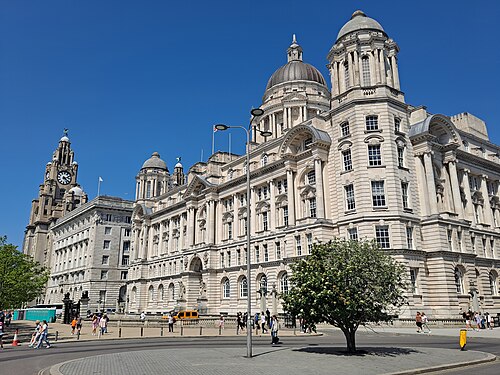
Liverpool's long commercial history has given rise to a considerable variety of architectural styles found within the city, ranging from 16th century Tudor buildings to modern-day contemporary architecture.[319] The majority of buildings in the city date from the late-18th century onwards, the period during which the city grew into one of the foremost powers in the British Empire.[320] There are over 2,500 listed buildings in Liverpool, of which 27 are Grade I listed[321] and 85 are Grade II* listed.[322] The city also has a greater number of public sculptures than any other location in the United Kingdom aside from Westminster[323] and more Georgian houses than the city of Bath.[324] This richness of architecture has subsequently seen Liverpool described by English Heritage, as England's finest Victorian city.[325]
The value of Liverpool's architecture and design was recognised in 2004, when several areas throughout the city were declared a UNESCO World Heritage Site. Known as the Liverpool Maritime Mercantile City, the sites were added in recognition of the city's role in the development of international trade and docking technology.[326] However, this status was revoked in July 2021, when UNESCO resolved that recent and proposed developments, such as the Bramley-Moore Dock Stadium and Liverpool Waters projects, had resulted in the "serious deterioration" of the area's significance.[327]
Waterfront and docks
.jpg/500px-Liverpool_Waterfront_(2023).jpg)

As a major British port, the docks in Liverpool have historically been central to the city's development. Several major docking firsts have occurred in the city including the construction of the world's first enclosed wet dock (the Old Dock) in 1715 and the first ever hydraulic lifting cranes.[328] The best-known dock in Liverpool is the Royal Albert Dock, which was constructed in 1846 and today comprises the largest single collection of Grade I listed buildings anywhere in Britain.[329] Built under the guidance of Jesse Hartley, it was considered to be one of the most advanced docks anywhere in the world upon completion and is often attributed with helping the city to become one of the most important ports in the world. Today, the Royal Albert Dock houses restaurants, bars, shops, two hotels as well as the Merseyside Maritime Museum, International Slavery Museum, Tate Liverpool and The Beatles Story. North of the city centre is Stanley Dock, home to the Stanley Dock Tobacco Warehouse, which was at the time of its construction in 1901, the world's largest building in terms of area[330] and today stands as the world's largest brick-work building.[331]
One of the most famous locations in Liverpool is the Pier Head, renowned for the trio of buildings – the Royal Liver Building, the Cunard Building and the Port of Liverpool Building – which sit upon it. Collectively referred to as the Three Graces, these buildings stand as a testament to the great wealth in the city during the late 19th and early 20th century. Built in a variety of architectural styles, they are recognised as being the symbol of 'maritime Liverpool' and are regarded by many as contributing to one of the most impressive waterfronts in the world.[332][333][334][335]
In the 21st century, several areas along Liverpool's waterfront have undergone significant redevelopment. Among the notable developments are the Museum of Liverpool, the construction of the Liverpool Arena, ACC Liverpool and Exhibition Centre Liverpool on King's Dock, Alexandra Tower and 1 Princes Dock on Prince's Dock and Liverpool Marina around Coburg and Brunswick Docks. The Wheel of Liverpool opened on 25 March 2010.[336][337]
However, plans to redevelop parts of Liverpool city centre have been marred by controversy. In December 2016, a newly formed company called North Point Global Ltd. was given the rights to develop part of the docks under the "New Chinatown" working name. Though heavily advertised in Liverpool, Hong Kong and Chinese cities with high profile advertisements and videos, the "New Chinatown" development failed to materialise.[338] In January 2018, the Liverpool Echo and Asia Times revealed that the site remained sans any construction. North Point Global as well as its subcontractor "Bilt" had both declared bankruptcy, and the small investors (mostly middle class couples) who had already paid money for the apartments had lost most of their savings in them.[339]
Commercial district and cultural quarter
.jpg/500px-St_Georges_Hall_Liverpool_3_(6727529617).jpg)

Liverpool's historic position as one of the most important trading ports in the world has meant that over time many grand buildings have been constructed in the city as headquarters for shipping firms, insurance companies, banks and other large firms. The great wealth this brought then allowed for the development of grand civic buildings, which were designed to allow the local administrators to 'run the city with pride'.[340]
The commercial district is centred on the Castle Street, Dale Street and Old Hall Street areas of the city, with many of the area's roads still following their medieval layout. Having developed predominantly over a period of three centuries, the area is regarded as one of the most important architectural locations in the city, as recognised by its inclusion in Liverpool's former World Heritage site.[341]
The oldest building in the area is the Grade I listed Liverpool Town Hall, which is located at the top of Castle Street and dates from 1754. Often regarded as the city's finest piece of Georgian architecture, the building is known as one of the most extravagantly decorated civic buildings anywhere in Britain.[342][343] Also on Castle Street is the Grade I listed Bank of England Building, constructed between 1845 and 1848, as one of only three provincial branches of the national bank.[342] Among the other buildings in the area are the Tower Buildings, Albion House (the former White Star Line headquarters), the Municipal Buildings and Oriel Chambers,[344] which is considered to be one of the earliest Modernist style buildings ever built.[345]
The area around William Brown Street is referred to as the city's 'Cultural Quarter', owing to the presence of numerous civic buildings, including the William Brown Library, Walker Art Gallery, Picton Reading Rooms and World Museum Liverpool. The area is dominated by neo-classical architecture, of which the most prominent, St George's Hall,[346] is widely regarded as the best example of a neo-classical building anywhere in Europe.[347] A Grade I listed building, it was constructed between 1840 and 1855 to serve a variety of civic functions in the city and its doors are inscribed with "S.P.Q.L." (Latin senatus populusque Liverpudliensis), meaning "the senate and people of Liverpool". William Brown Street is also home to numerous public monuments and sculptures, including Wellington's Column and the Steble Fountain. Many others are located around the area, particularly in St John's Gardens, which was specifically developed for this purpose.[348] The William Brown Street area has been likened to a modern recreation of the Roman Forum.[349]
Other notable landmarks


While the majority of Liverpool's architecture dates from the mid-18th century onwards, there are several buildings that pre-date this time. One of the oldest surviving buildings is Speke Hall, a Tudor manor house located in the south of the city, which was completed in 1598.[350] The building is one of the few remaining timber framed Tudor houses left in the north of England and is particularly noted for its Victorian interiors, which were added in the mid-19th century.[351] In addition to Speke Hall, many of the city's other oldest surviving buildings are also former manor houses including Croxteth Hall and Woolton Hall, which were completed in 1702 and 1704 respectively.[352]
The oldest building within the city centre is the Grade I listed Bluecoat Chambers,[353] which was built between 1717 and 1718. Constructed in British Queen Anne style architecture,[354][355] the building was influenced in part by the work of Christopher Wren[356] and was originally the home of the Bluecoat School (who later moved to a larger site in Wavertree in the south of the city). Since 1908, it has acted as a centre for arts in Liverpool.[354]
Liverpool is noted for having two Cathedrals, each of which imposes over the landscape around it.[357] The Anglican Cathedral, which was constructed between 1904 and 1978, is the largest Cathedral in Britain[358] and the fifth largest in the world. Designed and built in Gothic style, it is regarded as one of the greatest buildings to have been constructed during the 20th century[359] and was described by former British Poet Laureate, John Betjeman, as "one of the great buildings of the world".[360] The Roman Catholic Metropolitan Cathedral was constructed between 1962 and 1967 and is known as one of the first cathedrals to break the traditional longitudinal design.[361]
In the 21st century, many parts of Liverpool's city centre have undergone significant redevelopment and regeneration after years of decline. So far, the largest of these developments has been Liverpool One, which saw almost £1 billion invested in the redevelopment of 42 acres (17 hectares) of land, providing new retail, commercial, residential and leisure space.[362] Around the north of the city centre, several new skyscrapers have also been constructed including the RIBA award-winning Unity Buildings and West Tower, which at 140m is Liverpool's tallest building. Many redevelopment schemes are also in progress including Circus,[363] King's Dock,[364] Paddington Village[365] and Liverpool Waters.[366]
There are many other notable buildings in Liverpool, including the art deco former terminal building of Speke Airport, the University of Liverpool's Victoria Building, (which provided the inspiration for the term Red Brick University), and the Adelphi Hotel, which was in the past considered to be one of the finest hotels anywhere in the world.[367]
Parks and gardens
The Register of Historic Parks and Gardens of Special Historic Interest in England describes Merseyside's Victorian Parks as collectively the "most important in the country".[368] The city of Liverpool has ten listed parks and cemeteries, including two Grade I and five Grade II*, more than any other English city apart from London.[369]
Transport
Liverpool has an extensive transport infrastructure that connects the city with its metropolitan area, the rest of the United Kingdom, Europe and the world. Various modes of transport provide considerable connections by road, rail, air and sea. The local network of buses, trains and ferries is managed by Merseytravel on behalf of the Liverpool City Region Combined Authority and the Metro Mayor of the Liverpool City Region. The Mayor and Combined Authority have control of a devolved transport budget and associated transport powers for this local system. The city's major port and international airport provide global links for both passengers and freight.[370][371]
National and international travel
Roads
.jpg/500px-Queensway_Tunnel_(3).jpg)
The city of Liverpool proper sits at the centre of a much larger metropolitan area. The city's suburbs run contiguously in to the neighbouring boroughs of the Liverpool City Region, a heavily urbanised region with substantial road links to many other areas within England. The city is surrounded by a network of six motorways (M58 to the north, M56 to the south, M6 & M62 to the east and M53 to the west). The M57 also acts as an outer ring road and bypass for the city of Liverpool itself.
To the north, the M58 motorway runs 12 miles and provides links from Liverpool to the neighbouring counties of Lancashire and Greater Manchester.[372] To the south, Liverpool is connected to Widnes and Warrington via the A562 and across the River Mersey to Runcorn, via the Silver Jubilee and Mersey Gateway bridges. The M56 motorway then provides routes in to parts of the neighbouring counties of Cheshire and Greater Manchester, with connections to the Wirral and North Wales.[373] To the east, the M62 motorway connects Liverpool with Hull and along the route to several large cities including Manchester, Leeds and Bradford. The M62 also provides a connection to both the M6 and M1 motorways, providing indirect links to more distant areas including Birmingham, London, Nottingham, Preston and Sheffield.[374][375] To the west of the city, the Kingsway and Queensway Tunnels connect Liverpool with the Wirral Peninsula, including Birkenhead, and Wallasey. The A41 road and M53 motorway, which both begin in Birkenhead, link to Cheshire and Shropshire and via the A55, to North Wales.[376] The M57 acts as a 10 mile ring road for the city itself and links various towns east of the city with the M62 and M58 motorways.[377]
Railway
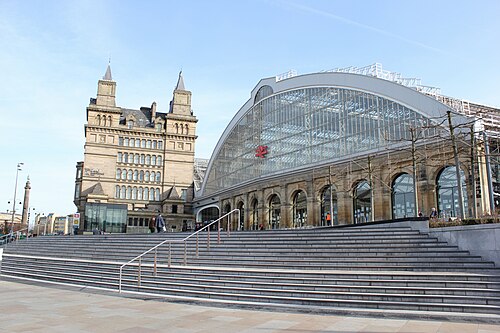
Liverpool is served by two separate rail networks. The local rail network is managed and run by Merseyrail and provides links throughout the Liverpool city region and beyond (see Local travel below). The national network, which is managed by Network Rail, provides Liverpool with connections to major towns and cities across England. The city's primary main line station is Lime Street station, which is the terminus for several lines into the city. The station is served by a number of different train operating companies including Avanti West Coast, East Midlands Railway, London North Eastern Railway, Northern Rail, TransPennine Express and West Midlands Trains.[379][380] Between them, the station is connected with direct train services to numerous destinations including London (in 2 hours 8 minutes with Pendolino trains), Birmingham, Glasgow, Hull, Leeds, Manchester, Newcastle upon Tyne, Norwich, Nottingham, Preston, Scarborough, Sheffield and York.[381][382][383][384] Opened in 1836, Lime Street station is the world's oldest mainline terminus station still in use.[385] In the south of the city, Liverpool South Parkway provides a connection to the city's airport.
Port
The Port of Liverpool connects passengers and freight to Liverpool from all around the world. Passenger ferry services depart from the city across the Irish Sea to Belfast and the Isle of Man. Services are provided by several companies, including the Isle of Man Steam Packet Company, P&O Ferries and Stena Line.
The Liverpool Cruise Terminal handles over 200,000 passengers and crew annually and is located alongside the Pier Head in the city centre. Berthing facilities for long-distance passenger cruises are provided and served by a large number of different cruise lines. Ports in Australia, France, Faroe Islands, Iceland, North America, Norway, Spain and the Caribbean are served by the facility.[386][387][388] The cruise lines that call at Liverpool cruise terminal include the following:
- Ambassador[389]
- Atlas Ocean Voyages[390]
- Azamara[391]
- Carnival Cruise Line[392]
- Celebrity Cruises[393]
- Cunard Line[394]
- Disney Cruise Line[395]
- Fred Olsen[396]
- Hapag-Lloyd cruises[397]
- Holland America Line[398]
- Noble Caledonia[399]
- Norwegian[400]
- P&O Cruises[401]
- Princess Cruises[402]
- Regent Seven Seas[403]
- Royal Caribbean[404]
- Saga Cruises[405]
- Silversea Cruises[406]
- Viking[407]
As of 2022[update], the Port of Liverpool is the fourth busiest port in the UK by freight tonnage, handling 33 million tonnes of freight cargo.[408] It is the main port in the country for transatlantic trade and the largest port on the west coast of the UK. The Royal Seaforth and Liverpool2 container terminals are the port's two main terminals and handle a wide variety of cargo including containers, liquid and dry bulk cargoes such as coal and grain, biomass and roll-on/roll-off cargoes such as cars and trucks.[409][410][411][412][413][414] Leeds and Liverpool Canal runs into Liverpool city centre via Liverpool Canal Link at Pier Head since 2009.[415]
Airport
.jpg/500px-Liverpool_John_Lennon_Airport_(Terminal_Exterior).jpg)
Liverpool John Lennon Airport, which is located in the south of the city, provides Liverpool with direct air connections across the United Kingdom and Europe. It offers direct services to over 60 airports worldwide and to over 100 destinations via one-stop connections in Frankfurt, Dublin and Reykjavík. The airport is primarily served by low-cost airlines namely Aer Lingus, easyJet, Jet2.com, Loganair, Lufthansa, Play, Ryanair, Widerøe and Wizz Air, although it does provide facilities for private aircraft. Jet2 have announced that new services to winter sun destinations will be starting from winter 2024 to destinations such as Lanzarote & Tenerife.[416][417][418][419][420][421]
Local travel
Trains

Liverpool's urban railway network, known as Merseyrail, is one of the busiest and most extensive in the country. The network provides approximately 30 million passenger journeys per year, across a system of 69 stations throughout Liverpool's metropolitan area, within the formal boundaries of the Liverpool city region and adjacent areas of Cheshire and Lancashire.[422][423][424][425]
The network consists of three lines: the Northern Line, which runs to Southport, Ormskirk, Headbolt Lane and Hunts Cross; the Wirral Line, which runs through the Mersey Railway Tunnel and has branches to New Brighton, West Kirby, Chester and Ellesmere Port; and the City Line, which begins at Lime Street, providing links to St Helens, Wigan, Preston, Warrington and Manchester.[426][427] The network is predominantly electric and covers 75 miles (120 kilometres) of track.[428][429] Trains are owned and operated by the Merseyrail franchise and managed by Merseytravel under the direction of the Liverpool City Region Combined Authority. Local services on the City Line are operated by Northern rather than Merseyrail, although the line itself remains part of the Merseyrail network. Within Liverpool city centre, four stations and over 6+1⁄2 miles (10.5 kilometres) of tunnels are underground.[428] Hamilton Square and Liverpool James Street are the oldest deep level underground stations in the world.[430] In 2023, for the first time in UK history, battery-powered passenger trains launched on Merseyrail tracks from the newly opened Headbolt Lane station in Kirkby. The Liverpool City Region Combined Authority's long term "Merseyrail for All" plan is to reduce dependency on live third rail and promote battery power in order to further expand Merseyrail to previously inaccessible places across the city region and as far as Manchester, Wrexham, Warrington and Preston.[431][432]
Buses

Local bus services within and around Liverpool are managed by Merseytravel[433] and are run by several different companies, including Arriva and Stagecoach. The two principal termini for local buses are Queen Square bus station (located near Lime Street railway station) for services north and east of the city, and Liverpool One bus station (located near the Royal Albert Dock) for services to the south and east.[434] Cross-river services to the Wirral use roadside terminus points in Castle Street and Sir Thomas Street. A night bus service also operates on Saturdays providing services from the city centre across Liverpool and wider region.[435] Tour bus services are provided by Maghull Coaches which allow tourists to hop-on-hop-off and view historical landmarks and attractions, as well as Liverpool F.C. and Beatles related locations.[436][437] National Express services operate from the Liverpool One bus station to and from destinations across the UK.[438] In 2023, the Liverpool city region confirmed plans to become the second place outside London to implement bus franchising. Local leaders have argued that it will improve services by transferring control over fares, ticketing and routes from bus companies to the Combined Authority. The full implementation of bus franchising will take place by the end of 2028.[439][440]
Mersey Ferry
.jpg/500px-Mersey_Ferry_Royal_Iris_and_HMS_Illustrious,_River_Mersey_(geograph_3786310).jpg)
The cross-river ferry service in Liverpool, known as the Mersey Ferry, is managed and operated by Merseytravel, with services operating between the Pier Head in Liverpool city centre and both Woodside in Birkenhead and Seacombe in Wallasey. Services operate at intervals ranging from 20 minutes, at peak times, to every hour during the middle of the day and at weekends.[441] Despite remaining an important transport link between the city and the Wirral Peninsula, the Mersey Ferry has become an increasingly popular tourist attraction within the city, with daytime River Explorer Cruises providing passengers with an historical overview of the River Mersey and surrounding areas.[442]
Cycling and scooters
A scooter-sharing system and electric bicycle scheme operates throughout Liverpool which allows residents and visitors to move around the city on rented scooters and bicycles. The scheme is operated by Swedish technology company Voi, and riders are able to pick up and drop off bikes and scooters at various locations around the city.[443][444][445] National Cycle Route 56, National Cycle Route 62 and National Cycle Route 810 run through Liverpool.
Culture
As with other large cities, Liverpool is an important cultural centre within the United Kingdom, incorporating music, performing arts, museums and art galleries, literature and nightlife among others. In 2008, the cultural heritage of the city was celebrated with the city holding the title of European Capital of Culture, during which time a wide range of cultural celebrations took place in the city, including Go Superlambananas! and La Princesse. Liverpool has also held Europe's largest music and poetry event, the Welsh national Eisteddfod, three times, despite being in England, in 1884, 1900, and 1929.
Music

Liverpool is internationally known for music and is recognised by Guinness World Records as the "World Capital City of Pop".[447] Musicians from the city have produced 58 No. 1 singles, more than any other city in the world.[448] Both the most successful male band and girl group in global music history have contained Liverpudlian members. Liverpool is most famous as the birthplace of the Beatles and during the 1960s was at the forefront of the Beat Music movement, which would eventually lead to the British Invasion. Many notable musicians of the time originated in the city including Billy J. Kramer, Cilla Black, Gerry and the Pacemakers and The Searchers. The influence of musicians from Liverpool, coupled with other cultural exploits of the time, such as the Liverpool poets, prompted American poet Allen Ginsberg to proclaim that the city was "the centre of consciousness of the human universe".[449] Other musicians from Liverpool include Billy Fury, A Flock of Seagulls, Echo & the Bunnymen, Frankie Goes to Hollywood, Frankie Vaughan, Anathema, Ladytron, The Zutons, Cast, Atomic Kitten and Rebecca Ferguson. The La's 1990 hit single "There She Goes" was described by Rolling Stone as a "founding piece of Britpop's foundation."[450]

The city is also home to the oldest surviving professional symphony orchestra in the UK, the Royal Liverpool Philharmonic Orchestra, which is based in the Philharmonic Hall.[451] The chief conductor of the orchestra is Vasily Petrenko.[452] Sir Edward Elgar dedicated his Pomp and Circumstance March No. 1 to the Liverpool Orchestral Society, and the piece had its first performance in the city in 1901.[453] Among Liverpool's curiosities, the Austrian émigré Fritz Spiegl is notable. He not only became a world expert on the etymology of Scouse, but composed the music to Z-cars and the Radio 4 UK Theme.
Well established festivals in the city include Africa Oyé and Brazilica which are the UK's largest free African and Brazilian music festivals respectively.[454][455] The dance music festival Creamfields was established by the Liverpool-based Cream clubbing brand which started life as a weekly event at Nation nightclub. There are numerous music venues located across the city, however, the Liverpool Arena is by far the largest. Opened in 2008, the 11,000-seat arena hosted the MTV Europe Music Awards the same year, and since then has played host to world-renowned acts such as Andrea Bocelli, Beyoncé, Elton John, Kanye West, Kasabian, The Killers, Lady Gaga, Oasis, Pink, Rihanna, and UB40.
On 7 October 2022, the BBC and the European Broadcasting Union (EBU) announced that Liverpool would host the Eurovision Song Contest 2023 on behalf of the previous year's winning country Ukraine, which was unable to meet the demands of hosting the event due to security concerns caused by the Russian invasion of the country. The contest was held at Liverpool Arena, and consisted of two semi-finals on 9 and 11 May and a final on 13 May 2023. This was the first time that the contest took place in the city, and was also a record-extending ninth time that the UK has hosted the contest, having last done so in Birmingham in 1998.[456]
Visual arts

Liverpool has more galleries and national museums than any other city in the United Kingdom apart from London.[11] National Museums Liverpool is the only English national collection based wholly outside London.[457] The Tate Liverpool gallery houses the modern art collection of the Tate in the North of England and was, until the opening of Tate Modern, the largest exhibition space dedicated to modern art in the United Kingdom. The FACT centre hosts touring multimedia exhibitions, while the Walker Art Gallery houses one of the most impressive permanent collections of Pre-Raphaelite art in the world.[458] Sudley House contains another major collection of pre-20th-century art.[459] Liverpool University's Victoria Building was re-opened as a public art gallery and museum to display the university's artwork and historical collections which include the largest display of art by Audubon outside the US.[460] A number of artists have also come from the city, including painter George Stubbs who was born in Liverpool in 1724.

The Liverpool Biennial festival of arts runs from mid-September to late November and comprises three main sections; the International, The Independents and New Contemporaries although fringe events are timed to coincide.[461] It was during the 2004 festival that Yoko Ono's work "My mummy was beautiful" invited controversy when photographs of a woman's breast and crotch were exhibited on the main shopping street.[462]
Literature
Felicia Hemans (née Browne) was born in Dale Street, Liverpool, in 1793, although she later moved to Flintshire, in Wales. Felicia was born in Liverpool, a granddaughter of the Venetian consul in that city. Her father's business soon brought the family to Denbighshire in North Wales, where she spent her youth. They made their home near Abergele and St. Asaph (Flintshire), and it is clear that she came to regard herself as Welsh by adoption, later referring to Wales as "Land of my childhood, my home and my dead". Her first poems, dedicated to the Prince of Wales, were published in Liverpool in 1808, when she was only fourteen, arousing the interest of Percy Bysshe Shelley, who briefly corresponded with her. [463]
An engraving of a painting of The Wishing Gate. by S. F. Serres was published in Fisher's Drawing Room Scrap Book, 1834 with a poetical illustration by Letitia Elizabeth Landon to which she adds the note 'I believe that to this haunted gate, a common superstition is attached, namely, that to wish, and to have that wish fulfilled, is the result of such wish being uttered while passing'. It stood on the North Shore before the docks were built and was a place where farewells could be waved to departing voyagers.[464]
A number of notable authors have visited Liverpool, including Daniel Defoe, Washington Irving, Thomas De Quincey, Herman Melville, Nathaniel Hawthorne, Charles Dickens, Gerard Manley Hopkins and Hugh Walpole. Daniel Defoe, after visiting the city, described it, as "one of the wonders of Britain in his 'Tour through England and Wales'".[465]
Herman Melville's novel Redburn deals with the first seagoing voyage of 19 years old Wellingborough Redburn between New York and Liverpool in 1839. Largely autobiographical, the middle sections of the book are set in Liverpool and describe the young merchantman's wanderings, and his reflections.[463] Hawthorne was stationed in Liverpool as United States consul between 1853 and 1856.[466] Charles Dickens visited the city on numerous occasions to give public readings.[467] Hopkins served as priest at St Francis Xavier Church, Langdale St., Liverpool, between 1879 and 81.[468] Although he is not known to have ever visited Liverpool, Jung famously had a vivid dream of the city which he analysed in one of his works.[469]

Of all the poets who are connected with Liverpool, perhaps the greatest[according to whom?] is Constantine P. Cavafy, a twentieth-century Greek cultural icon, although he was born in Alexandria. From a wealthy family, his father had business interests in Egypt, London and Liverpool. After his father's death, Cavafy's mother brought him in 1872 at the age of nine to Liverpool, where he spent part of his childhood. They lived first in Balmoral Road, then when the family firm crashed, they lived in poorer circumstances in Huskisson Street. In 1876, his family faced financial problems due to the Long Depression of 1873, so, by 1877, they had to move back to Alexandria.[463]
Her Benny, a novel telling the tragic story of Liverpool street urchins in the 1870s, written by Methodist preacher Silas K. Hocking, was a best-seller and the first book to sell a million copies in the author's lifetime.[470] The prolific writer of adventure novels, Harold Edward Bindloss (1866–1945), was born in Liverpool.
The writer, docker and political activist George Garrett was born in Seacombe, on the Wirral Peninsula in 1896 and was brought up in Liverpool's South end, around Park Road, the son of a fierce Liverpool–Irish Catholic mother and a staunch 'Orange' stevedore father. In the 1920s and 1930s, his organisation within the Seamen's Vigilance Committees, unemployed demonstrations, and hunger marches from Liverpool became part of a wider cultural force. He spoke at reconciliation meetings in sectarian Liverpool, and helped found the Unity Theatre in the 1930s as part of the Popular Front against the rise of fascism, particularly its echoes in the Spanish Civil War. Garrett died in 1966.[471]
The novelist and playwright James Hanley (1897–1985) was born in Kirkdale, Liverpool, in 1897 (not Dublin, nor 1901 as he generally implied) to a working-class family.[472] Hanley grew up close to the docks and much of his early writing is about seamen. The Furys (1935) is first in a sequence of five loosely autobiographical novels about working-class life in Liverpool. James Hanley's brother, novelist Gerald Hanley (1916–92) was also born in Liverpool (not County Cork, Ireland, as he claimed).[473] While he published a number of novels he also wrote radio plays for the BBC as well as some film scripts, most notably The Blue Max (1966).[474] He was also one of several scriptwriters for a life of Gandhi (1964).[475] Novelist Beryl Bainbridge (1932–2010) was born in Liverpool and raised in nearby Formby. She was primarily known for her works of psychological fiction, often set among the English working classes. Bainbridge won the Whitbread Awards prize for best novel in 1977 and 1996 and was nominated five times for the Booker Prize. The Times newspaper named Bainbridge among their list of "The 50 greatest British writers since 1945".[476]
J. G. Farrell was born in Liverpool in 1935 but left at the outbreak of war in 1939.[477] A novelist of Irish descent, Farrell gained prominence for his historical fiction, most notably his Empire Trilogy (Troubles, The Siege of Krishnapur and The Singapore Grip), dealing with the political and human consequences of British colonial rule. However, his career ended when he drowned in Ireland in 1979 at the age of 44.
.jpg/500px-CliveBarker_(cropped).jpg)
Helen Forrester was the pen name of June Bhatia (née Huband) (1919–2011),[478][479] who was known for her books about her early childhood in Liverpool during the Great Depression, including Twopence to Cross the Mersey (1974), as well as several works of fiction. During the late 1960s the city became well known for the Liverpool poets, who include Roger McGough and the late Adrian Henri. An anthology of poems, The Mersey Sound, written by Henri, McGough and Brian Patten, has sold well since it was first being published in 1967.
Liverpool has produced several noted writers of horror fiction, often set on Merseyside – Ramsey Campbell, Clive Barker and Peter Atkins among them. A collection of Liverpudlian horror fiction, Spook City was edited by a Liverpool expatriate, Angus Mackenzie, and introduced by Doug Bradley, also from Liverpool.[480] Bradley is famed for portraying Barker's creation Pinhead in the Hellraiser series of films.
Performing arts

Liverpool also has a long history of performing arts, reflected in several annual theatre festivals such as the Liverpool Shakespeare Festival, which takes place inside Liverpool Cathedral and in the adjacent historic St James' Gardens every summer; the Everyword Festival of new theatre writing, the only one of its kind in the country;[481] Physical Fest, an international festival of physical theatre;[482] the annual festivals organised by Liverpool John Moores University's drama department and the Liverpool Institute for Performing Arts; and other festivals by the large number of theatres in the city, such as the Empire, Everyman,[483][484] Playhouse,[485][486] Royal Court, and Unity theatres.
Notable actors and actresses from Liverpool include Arthur Askey, Tom Baker, Kim Cattrall, Jodie Comer, Stephen Graham, Rex Harrison, Jason Isaacs, Tina Malone, the McGann brothers (Joe, Mark, Paul, and Stephen), David Morrissey, Elizabeth Morton, Peter Serafinowicz, Elisabeth Sladen, Alison Steadman, and Rita Tushingham. Actors and actresses from elsewhere in the world have strong ties to the city, such as Canadian actor Mike Myers (whose parents were both from Liverpool) and American actress Halle Berry (whose mother was from Liverpool).
Nightlife
.jpg/500px-Mathew_Street,_intersection_with_Temple_Court,_Liverpool_(2017-11-18_00.12.15_by_Bj%C3%B6rn_Golda).jpg)
Liverpool has a thriving and varied nightlife. The majority of the city's late-night restaurants, bars, pubs, nightclubs, music venues and comedy clubs are located in a number of distinct districts.
In 2023, figures from global data company Square show that night-time spending in bars and restaurants in Liverpool city centre outperformed all major UK cities, including London.[487]
Figures by the Liverpool BID Company suggest that the busiest nights of the week in Liverpool city centre are Friday and Saturday. Using cameras to track the flow of people in key locations between 7 pm and 4 am, at least 1.5 million people pass through the city centre every Friday night and almost 2 million people on Saturday nights. The data demonstrates that Monday night is the quietest night of the week in the city centre and footfall then increases every single night to reach its peak on Saturday nights. 125,889 people worked in the city's night time economy as of 2022, according to the Liverpool BID Company.[488][489][490]
Liverpool's nightlife is concentrated in a number of districts including Ropewalks which comprises Concert Square, St. Peter's Square and the adjoining Seel Street and Duke Street. Other popular areas include Hardman Street, the Cavern Quarter, Baltic Triangle, Royal Albert Dock and the city's Pride Quarter, which is home to a large number of LGBT venues.[491][492]
In the city's suburbs, Lark Lane in Aigburth is noted for an abundance of bars and late-night venues.[493][494]
Education

In Liverpool primary and secondary education is available in various forms supported by the state including secular, Church of England, Jewish, and Roman Catholic. Islamic education is available at primary level, but there is no secondary provision. One of Liverpool's important early schools was The Liverpool Blue Coat School; founded in 1708 as a charitable school.
The Liverpool Blue Coat School is the top-performing school in the city with 100% 5 or more A*-C grades at GCSE resulting in the 30th best GCSE results in the country and an average point score per student of 1087.4 in A/AS levels.[495] Other notable schools include Liverpool College founded in 1840 Merchant Taylors' School founded in 1620.[496] Another of Liverpool's notable senior schools is St. Edward's College situated in the West Derby area of the city. Historic grammar schools, such as the Liverpool Institute High School and Liverpool Collegiate School—both closed in the 1980s—are still remembered as centres of academic excellence. Bellerive Catholic College is the city's top-performing non-selective school, based upon GCSE results in 2007.

Liverpool has three universities: the University of Liverpool, Liverpool John Moores University and Liverpool Hope University. Edge Hill University, founded as a teacher-training college in the Edge Hill district of Liverpool, is now located in Ormskirk in South-West Lancashire. Liverpool is also home to the Liverpool Institute for Performing Arts (LIPA).
The University of Liverpool was established in 1881 as University College Liverpool. In 1884, it became part of the federal Victoria University. Following a Royal Charter and Act of Parliament in 1903, it became an independent university, the University of Liverpool, with the right to confer its own degrees. It was the first university to offer degrees in biochemistry, architecture, civic design, veterinary science, oceanography and social science.

Liverpool Hope University, which was formed through the merger of three colleges, the earliest of which was founded in 1844, gained university status in 2005. It is the only ecumenical university in Europe.[497] It is situated on both sides of Taggart Avenue in Childwall and has a second campus in the city centre (the Cornerstone).
The Liverpool School of Tropical Medicine, founded to address some of the problems created by trade, continues today as a post-graduate school affiliated with the University of Liverpool and houses an anti-venom repository.
Liverpool John Moores University was previously a polytechnic, and gained status in 1992. It is named in honour of Sir John Moores, one of the founders of the Littlewoods football pools and retail group, who was a major benefactor. The institution was previously owned and run by Liverpool City Council. It traces it lineage to the Liverpool Mechanics' institute, opened in 1823, making it by this measure England's third-oldest university.
The city has one further education college, City of Liverpool College in the city centre. Liverpool City Council operates Burton Manor, a residential adult education college in nearby Burton, on the Wirral Peninsula.
There are two Jewish schools in Liverpool, both belonging to the King David Foundation. King David School, Liverpool, is the High School and the King David Primary School. There is also a King David Kindergarten, featured in the community centre of Harold House. These schools are all run by the King David Foundation located in Harold House in Childwall; conveniently next door to the Childwall Synagogue.
Sport
Football

Liverpool is one of the most successful footballing cities in England, and is home to two top flight Premier League teams. Everton F.C. was founded in 1878 and was one of the twelve founder members of the Football League. It plays at Goodison Park. Liverpool F.C. were founded in 1892 and play at Anfield. Between them, the clubs have won 28 English First Division titles, 12 FA Cup titles, 10 League Cup titles, 6 European Cup titles, 1 FIFA Club World Cup title, 1 European Cup Winners' Cup title, 3 UEFA Cup titles, and 24 FA Charity Shields.
The two clubs contest the Merseyside derby, dubbed the 'friendly derby'. Despite the name the fixture is known for its keen rivalry, having seen more sending-offs in this fixture than any other. Unlike many other derbies it is not rare for families in the city to contain supporters of both clubs.[498] Liverpool F.C. is the English and British club with the most European Cup titles with six, the latest in 2019.
.jpg/500px-Panorama_of_Anfield_with_new_main_stand_(29676137824).jpg)
Liverpool has played at Anfield since 1892, when the club was formed to occupy the stadium following Everton's departure due to a dispute with their landlord. Liverpool are still playing there 125 years later, although the ground has been completely rebuilt since the 1970s. The Spion Kop (rebuilt as an all-seater stand in 1994–95) was the most famous part of the ground, gaining cult status across the world due to the songs and celebrations of the many fans who packed onto its terraces. Anfield as capacity for 54,000 spectators in comfort and is a distinctive landmark in an area filled with smaller and older buildings. Liverpool club also has a multimillion-pound youth training facility called The Academy.
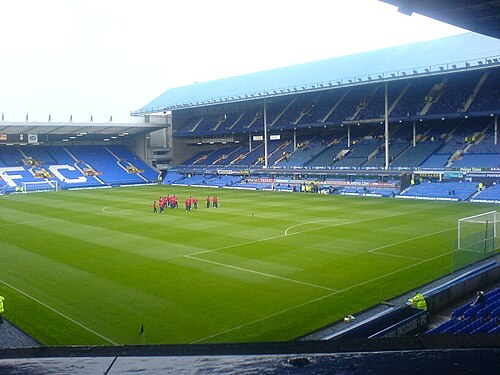
After leaving Anfield in 1892, Everton moved to Goodison Park on the opposite side of Stanley Park. The ground was opened on 24 August 1892, by Lord Kinnaird and Frederick Wall of the FA but the first crowds to attend the ground saw a short athletics meeting followed by a selection of music and a fireworks display. Everton's first game there was on 2 September 1892 when they beat Bolton 4–2. It was one of the host venues during the 1966 FIFA World Cup. It now has the capacity for just under 40,000 spectators all-seated, but the last expansion took place in 1994 when a new Park End Stand gave the stadium an all-seater capacity. The Goodison Road Stand dates back to the 1970s, while the Gwladys Street Stand and Bullens Road Stand are refurbished pre-Second World War structures.
Everton is currently in the process of relocating, with a stadium move first mooted as early as 1996.[499] In 2003, the club were forced to abandon plans for a 55,000-seat stadium at King's Dock due to financial constraints,[500] with further proposed moves to Kirkby (comprising part of Destination Kirkby, moving the stadium just beyond Liverpool's council boundary into Kirkby) and Walton Hall Park similarly scrapped.
The club will relocate to the multimillion-pound Everton Stadium designed by the American architect Dan Meis at the nearby Bramley-Moore Dock on the River Mersey waterfront during the 2024/25 season, with ground broken on the project in August 2021.[501] The new stadium will have a capacity of 52,888 which could be expanded to 62,000 demand permitting and it will be a host venue for the UEFA Euro 2028. Everton also have a multimillion-pound training facility based at Finch Farm. The Everton Women's Team play in the Women's Super League at the Walton Hall Park Stadium.
Boxing
Boxing is massively popular in Liverpool. The city has a proud heritage and history in the sport and is home to around 22 amateur boxing clubs, which are responsible for producing many successful boxers, such as Nel Tarleton, Alan Rudkin, John Conteh, Andy Holligan, Liam Smith, Paul Hodkinson, Tony Bellew and Robin Ried. The city also boasts a consistently strong amateur contingent which is highlighted by Liverpool being the most represented city on the GB Boxing team, as well as at the 2012 London Olympics, the most notable Liverpool amateur fighters include; Jimmy Lloyd, George Turpin, Tony Willis, Robin Reid and David Price who have all medalled at the Olympic Games. Boxing events are usually hosted at the Echo Arena and Liverpool Olympia within the city, although the former home of Liverpool boxing was the renowned Liverpool Stadium.
Horse racing

Aintree Racecourse in the adjacent Metropolitan Borough of Sefton is home to the world's most famous steeple-chase, the Randox Grand National which takes place annually in early April. The race meeting attracts horse owners/ jockeys from around the world to compete in the demanding 4-mile (6.5-kilometre) and 30-fence course. There have been many memorable moments of the Grand National, for instance, the 100/1 outsider Foinavon in 1967, the dominant Red Rum and Ginger McCain of the 1970s and Mon Mome (100/1) who won the 2009 meeting. In 2010, the National became the first horse race to be televised in high-definition in the UK.
Golf
The Royal Liverpool Golf Club, situated in the nearby town of Hoylake on the Wirral Peninsula, has hosted The Open Championship on a number of occasions, most recently in 2023. It also hosted the Walker Cup in 1983.

Greyhound racing
Liverpool once contained four greyhound tracks, Seaforth Greyhound Stadium (1933–1965), Breck Park Stadium (1927–1948), Stanley Greyhound Stadium (1927–1961) and White City Stadium (1932–1973). Breck Park also hosted boxing bouts and both Stanley and Seaforth hosted Motorcycle speedway.
Athletics
Wavertree Sports Park is home to the Liverpool Harriers athletics club, which has produced such athletes as Curtis Robb, Allyn Condon (the only British athlete to compete at both the Summer and Winter Olympics), and Katarina Johnson-Thompson; Great Britain was represented by Johnson-Thompson at the 2012 London Olympics in the women's heptathlon, and she would go on to win the gold medal at the 2019 World Championships, giving Liverpool its first gold medal and breaking the British record in the process.
Gymnastics
In August 2012, Liverpool gymnast Beth Tweddle won an Olympic bronze medal in London 2012 in the uneven bars at her third Olympic Games, thus becoming the most decorated British gymnast in history. Park Road Gymnastics Centre provides training to a high level.
Swimming
Liverpool has produced several swimmers who have represented their nation at major championships such as the Olympic Games. The most notable of which is Steve Parry who claimed a bronze medal at the 2004 Athens Olympics in the 200m butterfly. Others include Herbert Nickel Haresnape, Margaret Kelly, Shellagh Ratcliffe and Austin Rawlinson. There is a purpose-built aquatics centre at Wavertree Sports Park, which opened in 2008. The City of Liverpool Swimming Club has been National Speedo League Champions 8 out of the last 11 years.
Cricket

The city is the hub of the Liverpool and District Cricket Competition, an ECB Premier League.[502] Sefton Park and Liverpool are the league's founder members based in the city with Wavertree, Alder and Old Xaverians clubs having joined the league more recently.[503] Liverpool plays host Lancashire County Cricket Club as an outground most seasons, including six of eight home County Championship games during Lancashire's 2011[504] title winning campaign[505] while Old Trafford was refurbished.[506][507]
Tennis
Since 2014 Liverpool Cricket Club has played host[508] to the annual Tradition-ICAP Liverpool International tennis tournament, which has seen tennis stars such as Novak Djokovic, David Ferrer, Mardy Fish, Laura Robson and Caroline Wozniacki. Previously this had been held at Calderstones Park, situated in Allerton in the south of the city. Liverpool Tennis Development Programme at Wavertree Tennis Centre is one of the largest in the UK.
Basketball

Professional basketball came to the city in 2007 with the entry of Everton Tigers, later known as Mersey Tigers, into the elite British Basketball League. The club was originally associated with Everton F.C., and was part of the Toxteth Tigers youth development programme, which reached over 1,500 young people every year.[509] The Tigers began to play in Britain's top league for the 2007–08 season, playing at the Greenbank Sports Academy before moving into the newly completed Echo Arena during that season. After the 2009–10 season, Everton F.C. withdrew funding from the Tigers, who then changed their name to Mersey Tigers. The club were expelled from the British Basketball League in 2013 due to financial problems.[510]
Baseball
Liverpool is one of three cities which still host the traditional sport of British baseball and it hosts the annual England-Wales international match every two years, alternating with Cardiff and Newport. Liverpool Trojans are the oldest existing baseball club in the UK.
Cycling
The 2014 Tour of Britain cycle race began in Liverpool on 7 September, using a city centre circuit to complete 130 km (80.8 mi) of racing.[511] The Tour of Britain took nine stages and finished in London on 14 September.
Other
A 2016 study of UK fitness centres found that, of the top 20 UK urban areas, Liverpool had the highest number of leisure and sports centres per capita, with 4.3 centres per 100,000 of the city population.[512]
Media
The city has one daily newspaper: the Echo, published by Reach plc. The Liverpool Daily Post was also published until 2013. The UK's first online only weekly newspaper called Southport Reporter (Southport and Mersey Reporter), is also one of the many other news outlets that cover the city. The independent media organisation The Post[513] also covers Liverpool, while Nerve magazine publishes articles and reviews of cultural events.
Liverpool TV is a local television station serving Liverpool City Region and surrounding areas. The station is owned and operated by Made Television Ltd and forms part of a group of eight local TV stations. It broadcasts from studios and offices in Liverpool.

The ITV region which covers Liverpool is ITV Granada. In 2006, the Television company opened a new newsroom in the Royal Liver Building. Granada's regional news broadcasts were produced at the Royal Albert Dock News Centre during the 1980s and 1990s.[514] The BBC also opened a new newsroom on Hanover Street in 2006.
ITV's daily magazine programme This Morning was broadcast from studios at Royal Albert Dock until 1996, when production was moved to London. Granada's short-lived shopping channel "Shop!" was also produced in Liverpool until it was cancelled in 2002.[515]
Liverpool is the home of the TV production company Lime Pictures, formerly Mersey Television, which produced the now-defunct soap operas Brookside and Grange Hill. It also produces the soap opera Hollyoaks, which was formerly filmed in Chester and began on Channel 4 in 1995. All three series were/are largely filmed in the Childwall area of Liverpool.
Radio stations include BBC Radio Merseyside, Hits Radio Liverpool, Greatest Hits Radio, Capital Liverpool, In Demand Radio, Liverpool Live Radio,[516] and Melodic Distraction.[517] Hits Radio and Greatest Hits Radio are owned by Bauer and located in St Johns Beacon which, along with the two cathedrals, dominates the city's skyline.
Liverpool has also featured in films;[518] see List of films set in Liverpool for some of them. In films the city has "doubled" for London, Paris, New York, Chicago, Moscow, Dublin, Venice and Berlin.[43][519]
Notable people
- See Category:People from Liverpool
Quotes about Liverpool
- "Lyrpole, alias Lyverpoole, a pavid towne, hath but a chapel ... The king hath a castelet there, and the Earl of Darbe hath a stone howse there. Irisch merchants cum much thither, as to a good haven ... At Lyrpole is smaul custom payed, that causith marchantes to resorte thither. Good marchandis at Lyrpole, and much Irish yarrn that Manchester men do buy there ..." – John Leland, Itinerary, c. 1536–1539[520]
- "Liverpoole is one of the wonders of Britain ... In a word, there is no town in England, London excepted, that can equal [it] for the fineness of the streets, and the beauty of the buildings." – Daniel Defoe, A tour thro' the Whole Island of Great Britain, 1721–1726
- "[O]ne of the neatest, best towns I have seen in England." – John Wesley. Journal, 1755
- "I have not come here to be insulted by a set of wretches, every brick in whose infernal town is cemented with an African's blood." – George Frederick Cooke (1756–1812), an actor responding to being hissed at when he came onstage drunk during a visit to Liverpool[521]
- "That immense City which stands like another Venice upon the water ... where there are riches overflowing and every thing which can delight a man who wishes to see the prosperity of a great community and a great empire ... This quondam village, now fit to be the proud capital of any empire in the world, has started up like an enchanted palace even in the memory of living men." – Thomas Erskine, 1st Baron Erskine, 1791
- "I have heard of the greatness of Liverpool, but the reality far surpasses my expectation." – Prince Albert, speech, 1846
- "Liverpool ... has become a wonder of the world. It is the New York of Europe, a world city rather than merely British provincial." – Illustrated London News, 15 May 1886
- "The dream represented my situation at the time. I can still see the greyish-yellow raincoats, glistening with the wetness of the rain. Everything was extremely unpleasant, black and opaque – just as I felt then. But I had a vision of unearthly beauty, and that is why I was able to live at all. Liverpool is the "pool of life." The "liver," according to an old view, is the seat of life, that which makes to live." – C. G. Jung, Memories, Dreams, Reflections, 1928
- "The centre is imposing, dignified and darkish, like a city in a rather gloomy Victorian novel ... We had now arrived in the heart of the big city, and as usual it was almost a heart of darkness. But it looked like a big city, there was no denying that. Here, emphatically, was the English seaport second only to London. The very weight of stone emphasised that fact. And even if the sun never seems to properly rise over it, I like a big city to proclaim itself a big city at once..." – J. B. Priestley, English Journey, 1934
- "If Liverpool can get into top gear again, there is no limit to the city's potential. The scale and resilience of the buildings and people is amazing – it is a world city, far more so than London and Manchester. It doesn't feel like anywhere else in Lancashire: comparisons always end up overseas – Dublin, or Boston, or Hamburg. The city is tremendous, and so, right up to the First World War, were the abilities of the architects who built over it. The centre is humane and convenient to walk around in, but never loses its scale. And, in spite of the bombings and the carelessness, it is still full of superb buildings. Fifty years ago it must have outdone anything in England." – Ian Nairn, Britain's Changing Towns, 1967
International links
Twin cities
Liverpool is twinned[522] with:
- Surabaya, Indonesia (2017)
- Birmingham, Alabama, United States (2015)
- Cologne, Germany (1952)
- Dublin, Ireland (1997)
- Johor Bahru, Malaysia
- Medan, Indonesia
- Odesa, Odesa Oblast, Ukraine
- Penang, Malaysia
- Rio de Janeiro, Brazil (2003)
- Shanghai, China (1999)
Friendship links
Liverpool has friendship links (without formal constitution)[523] with the following cities:
- Givenchy-lès-la-Bassée, Pas-de-Calais, France
- Halifax, Nova Scotia, Canada
- Havana, La Habana, Cuba
- La Plata, Buenos Aires Province, Argentina
- Memphis, Tennessee, US
- Minamitane, Kagoshima Prefecture, Japan
- Naples, Campania, Italy
- New Orleans, Louisiana, US
- Ponsacco, Tuscany, Italy
- Râmnicu Vâlcea, Vâlcea County, Romania
- Valparaíso, Valparaíso Province, Chile
- Guadalajara, Jalisco, Mexico
Consulates
The first overseas consulate of the United States was opened in Liverpool in 1790, and it remained operational for almost two centuries.[524] Today, a large number of consulates are located in the city serving Chile, Denmark, Estonia, Finland, France, Germany, Hungary, Iceland, Italy, Netherlands, Norway, Romania, Sweden and Thailand. Tunisian & Ivory Coast Consulates are located in the neighbouring Metropolitan Borough of Sefton.
Freedom of the City
The following people and military units have received the Freedom of the City of Liverpool.
Individuals
Military units
- Duke of Lancaster's Regiment: 14 September 2008.[525]
- War Widows Association (Merseyside Branch): 1 December 2014.[526]
- 208 (3rd West Lancashire) Battery 103rd (Lancashire Artillery Volunteers) Regiment Royal Artillery: 14 October 2017.[527]
- 8th Engineer Brigade, RE: 11 December 2020.[528][529][530]
Organisations and groups
- The Pain Relief Foundation: 3 March 2010.[531]
- The Whitechapel Centre: 5 October 2016.[532]
- The Parachute Regiment Association (Liverpool Branch): 24 October 2021.[533]
- The Royal Signals Association (Liverpool Branch): 26 November 2021.[534]
See also

- 2008 European Amateur Boxing Championships
- Atlantic history
- Big Dig (Liverpool)
- Healthcare in Liverpool
- History of slavery
- International Garden Festival
- List of films and television shows set in Liverpool
- List of hotels in Liverpool
- Magistrates Courts, Liverpool
- Triangular
- Williamson Tunnels
- Category: Culture in Liverpool
- Liver bird
- 1911 Liverpool general transport strike
- 1345 Liverpool riot
References
- ^ "Council". Liverpool City Council. Archived from the original on 16 December 2023. Retrieved 16 December 2023.
- ^ "Mid-Year Population Estimates, UK, June 2022". Office for National Statistics. 26 March 2024. Retrieved 3 May 2024.
- ^ a b "Mid-Year Population Estimates, UK, June 2022". Office for National Statistics. 26 March 2024. Retrieved 3 May 2024.
- ^ a b c d UK Census (2021). "2021 Census Area Profile – Liverpool Local Authority (E08000012)". Nomis. Office for National Statistics. Retrieved 8 August 2023.
- ^ Fenton, Trevor (25 April 2023). "Regional gross domestic product: city regions". Office for National Statistics. Archived from the original on 1 September 2023. Retrieved 2 September 2023.
- ^ "Report on the Nominations from the UK and Norway for the European Capital of Culture 2008" (PDF). Archived from the original (PDF) on 19 August 2008. Retrieved 11 July 2008.
- ^ "Liverpool, European Capital of Culture: 2008 – 2018". 6 April 2018. Archived from the original on 27 May 2022.
- ^ "Liverpool to become £80m investment zone". www.lbndaily.co.uk. 15 March 2023. Archived from the original on 29 August 2023. Retrieved 3 January 2024.
- ^ "Economy of Liverpool". www.varbes.com. Archived from the original on 29 August 2023. Retrieved 3 January 2024.
- ^ "'Liverpool's economy will thrive' says Prof Parkinson". www.lbndaily.co.uk. 8 August 2022. Archived from the original on 8 August 2022. Retrieved 3 January 2024.
- ^ a b "Visit Liverpool". Archived from the original on 7 September 2008. Retrieved 16 April 2009.
- ^ "Inbound Tourism Spend & Trends By UK Town | VisitBritain.org". www.visitbritain.org. Archived from the original on 28 April 2024. Retrieved 14 May 2024.
- ^ "The Beatles' Now and Then success 'a landmark for Liverpool too'". BBC News. 13 November 2023. Archived from the original on 14 May 2024. Retrieved 14 May 2024.
- ^ "UK: leading sea ports for freight traffic 2023". Statista. Archived from the original on 14 May 2024. Retrieved 14 May 2024.
- ^ "Help Restore & Expand England's First Mosque". www.abdullahquilliam.org. Archived from the original on 18 November 2019. Retrieved 8 October 2023.
- ^ Hanks, Patrick; Hodges, Flavia; Mills, David; Room, Adrian (2002). The Oxford Names Companion. Oxford: The University Press. p. 1110. ISBN 978-0198605614.
- ^ a b Harper, Douglas. "Liverpool". The Online Etymology Dictionary. Archived from the original on 10 January 2021. Retrieved 15 September 2017.
- ^ The Cambridge Dictionary of English Place-Names, ed. by Victor Watts (Cambridge: Cambridge University Press, 2004), s.v. Liverpool.
- ^ "Plea Rolls of the Court of Common Pleas". National Archives. Archived from the original on 4 March 2016. Retrieved 25 November 2015. Third entry, the home of John Stanle, the defendant, in a plea of debt.
- ^ Crowley, Tony (2013). Scouse: A Social and Cultural History. Liverpool: Oxford University Press. ISBN 9781781389089. Retrieved 15 June 2014.
- ^ Richards, G. Melville (1953). "Place-Names of North Wales". A Scientific Survey of Merseyside. British Association. pp. 242–250.
- ^ "The Victoria history of the county of Lancaster. Edited by William Farrer and J. Brownbill". www.clickfind.com.au. Retrieved 8 October 2023.
- ^ "European traders". www.liverpoolmuseums.org.uk. Archived from the original on 19 June 2018. Retrieved 23 September 2023.
- ^ Picton, J.A. (1875). Memorials of Liverpool. Vol. 1. Historical (2nd ed.). London: Longmans, Green & Co. pp. 11–12. OCLC 10476612.
- ^ a b "West Derby hundred: The City of Liverpool". British History Online. Archived from the original on 18 September 2023. Retrieved 9 September 2023.
- ^ "Liverpool: The castle and development of the town". British History Online. Archived from the original on 31 July 2018. Retrieved 9 September 2023.
- ^ "History of Liverpool". www.history.co.uk. Archived from the original on 2 October 2023. Retrieved 20 September 2023.
- ^ "Medieval port". www.liverpoolmuseums.org.uk. Archived from the original on 2 October 2023. Retrieved 20 September 2023.
- ^ "Liverpool in the Middle Ages". www.localhistories.org. 14 March 2021. Archived from the original on 28 September 2023. Retrieved 20 September 2023.
- ^ "The York March, 1644". bcw-project.org. Archived from the original on 25 December 2022. Retrieved 1 May 2022.
- ^ "Liverpool's Slavery History Trail". Lodging-World.com. 16 August 2017. Archived from the original on 17 August 2017. Retrieved 16 August 2017.
- ^ Power, Michael (1999). "Creating a Port: Liverpool 1695–1715" (PDF). Transactions of the Historic Society of Lancashire and Cheshire. 149: 51–71. Archived from the original (PDF) on 31 August 2019. Retrieved 31 August 2019.
- ^ "Liverpool: The docks". www.british-history.ac.uk. Archived from the original on 18 September 2023. Retrieved 21 September 2023.
- ^ "The Lost Dock of Liverpool". Channel 4: Time Team, 21 April 2008. Archived from the original on 4 June 2011. Retrieved 2 June 2008.
- ^ "Liverpool Dock System". The New York Times. 2 January 1898. Archived from the original on 9 August 2016. Retrieved 2 June 2008. Note: "pdf" reader needed to see full article
- ^ "Roscoe circle". Oxford Dictionary of National Biography (online ed.). Oxford University Press. 2004. doi:10.1093/ref:odnb/101301. Retrieved 20 September 2023. (Subscription or UK public library membership required.)
- ^ "Irish cultural expression in Liverpool". www.bbc.co.uk. Archived from the original on 13 August 2023. Retrieved 20 September 2023.
- ^ Cope, Jonas (May 2012). "The Dissolution of Character in Late Romantic British Literature 1816–1837" (PDF). MOspace Institutional Repository. Dr. Noah Heringman, Dissertation Supervisor. p. 115. Archived (PDF) from the original on 9 May 2021. Retrieved 4 April 2021.
- ^ Landon, Letitia Elizabeth (1832). "picture". Fisher's Drawing Room Scrap Book, 1833. Fisher, Son & Co. Archived from the original on 14 November 2022. Retrieved 14 November 2022.Landon, Letitia Elizabeth (1832). "poetical illustration". Fisher's Drawing Room Scrap Book, 1833. Fisher, Son & Co. Archived from the original on 14 November 2022. Retrieved 14 November 2022.
- ^ Beckert, Sven (2014). Empire of Cotton: a Global History. New York: Knopf.
- ^ "Emancipation and Empire: Reconstructing the Worldwide Web of Cotton Production in the Age of the American Civil War". www.dash.harvard.edu. Archived from the original on 17 November 2023. Retrieved 23 September 2023.
- ^ "Liverpool's Abercromby Square and the Confederacy During the U.S. Civil War". Lowcountry Digital History Initiative. Archived from the original on 10 April 2023.
- ^ a b Ten facts about Liverpool Archived 9 May 2021 at the Wayback Machine The Daily Telegraph, 4 June 2003
- ^ Hatton, Brian (28 March 2011). "Shifted tideways: Liverpool's changing fortunes". The Architectural Review. Archived from the original on 8 March 2019. Retrieved 21 November 2015.
- ^ Henderson, W.O. (1933). The Liverpool office in London. Economica xiii. London School of Economics. pp. 473–479.
- ^ "A walk around maritime Livepool". www.discoveringbritain.org. Archived from the original on 2 October 2023. Retrieved 20 September 2023.
- ^ Liverpool Beach. Archived 25 April 2012 at the Wayback Machine SCAR Composite Gazetteer of Antarctica.
- ^ The Bankers' Magazine. v.11. London: Groombridge & Sons. 1851.
- ^ Dr Laura Tabili, "Review of Jacqueline Jenkinson, Black 1919: Riots, Racism and Resistance in Imperial Britain, Liverpool, Liverpool University Press, 2009 Archived 22 April 2016 at the Wayback Machine, ISBN 9781846312007", Reviews in History website, accessed 13 April 2016
- ^ "A legacy of the Great Depression". www.news.bbc.co.uk. 10 September 2009. Archived from the original on 2 October 2023. Retrieved 20 September 2023.
- ^ McKenna, Madeline (30 October 1989). "Municipal Suburbia in Liverpool, 1919–1939". The Town Planning Review. 60 (3): 287–318. doi:10.3828/tpr.60.3.4hk5074443483k74. ISSN 0041-0020. JSTOR 40112817. Archived from the original on 8 November 2023. Retrieved 20 September 2023.
- ^ "Spirit of the Blitz : Liverpool in the Second World War". Liverpool Museums. 2003. Archived from the original on 6 June 2010. Retrieved 13 September 2010.
- ^ "Merseyside Maritime Museum, Sheet No. 4: Battle of the Atlantic". Liverpoolmuseums.org.uk. 3 September 1939. Archived from the original on 3 March 2016. Retrieved 4 October 2012.
- ^ Dunmall, Giovanna (4 July 2017). "Unbuilt Liverpool: the city that might have been". The Guardian. Retrieved 20 September 2023.
- ^ Smith, Otto Saumarez (2014). "Graeme Shankland: a Sixties Architect-Planner and the Political Culture of the British Left". Architectural History. 57: 393–422. doi:10.1017/S0066622X00001477. Archived from the original on 2 October 2023. Retrieved 20 September 2023.
- ^ "Walkways in the Sky and the Liverpool 'masterplan' that was never built". www.liverpoolecho.co.uk. 20 June 2020. Archived from the original on 2 October 2023. Retrieved 20 September 2023.
- ^ "The Liverpool City Plan". www.udg.org.uk. April 2020. Archived from the original on 2 October 2023. Retrieved 20 September 2023.
- ^ "Ethnicity – Census 2021". www.liverpool.gov.uk. Archived from the original on 18 September 2023. Retrieved 29 September 2023.
- ^ "The ethnic population of England and Wales broken down by local authority". The Guardian. 18 May 2011. Archived from the original on 23 July 2021.
- ^ "Recent History and Current Developments". Friends of Liverpool Airport. Archived from the original on 24 June 2012. Retrieved 10 February 2013.
- ^ "Airports Named For Celebrities". Airport Parking Market. Archived from the original on 15 July 2019. Retrieved 10 July 2015.
- ^ "A History of Liverpool". Localhistories.org. Archived from the original on 9 May 2021. Retrieved 13 December 2011.
- ^ "Number of people unemployed at three-million mark in Britain". The Leader-Post (Google News Archive). 28 January 1982. Archived from the original on 9 May 2021. Retrieved 21 November 2015.
- ^ "The English city that wanted to 'break away' from the UK". BBC News. 8 November 2014. Archived from the original on 11 November 2014. Retrieved 17 June 2022.
- ^ "Shock City: Sailortown, Liverpool". www.historicengland.org.uk. Archived from the original on 8 December 2023. Retrieved 20 September 2023.
- ^ Beattie, Tom (29 July 2020). "Review: 'Ferocious Love' by Mikhail Karikis at Tate Liverpool". YM Liverpool. Archived from the original on 2 October 2023. Retrieved 20 September 2023.
- ^ "Regeneration". www.liverpoolmuseums.org.uk. Archived from the original on 2 October 2023. Retrieved 20 September 2023.
- ^ "Golden Jubilee visit to Liverpool, 25 July 2002". www.royal.uk. Archived from the original on 7 November 2023. Retrieved 21 September 2023.
- ^ "The life of Queen Elizabeth II – a timeline in Liverpool". www.liverpoolexpress.co.uk. 9 September 2022. Archived from the original on 2 October 2023. Retrieved 21 September 2023.
- ^ "UK counties choose floral emblems". www.news.bbc.co.uk. 5 May 2004. Archived from the original on 14 March 2006. Retrieved 21 September 2023.
- ^ "20 things that shaped Liverpool in the 2010's". www.theguideliverpool.com. Archived from the original on 2 October 2023. Retrieved 23 September 2023.
- ^ "Lime Street". www.murraywood.com. 22 July 2022. Archived from the original on 2 October 2023. Retrieved 23 September 2023.
- ^ "Raves, craft ale and the 'abandoned' square that shaped modern Liverpool". www.liverpoolecho.co.uk. 11 June 2022. Archived from the original on 2 October 2023. Retrieved 23 September 2023.
- ^ "Plam for prosperity". www.liverpoolcityregion-ca.gov.uk. Archived from the original on 3 October 2023. Retrieved 23 September 2023.
- ^ "Growing the Liverpool City Region Economy". www.liverpoolcityregion-ca.gov.uk. Archived from the original on 7 November 2023. Retrieved 23 September 2023.
- ^ "The Liverpool Local Plan 2013–2033". www.liverpool.gov.uk. Retrieved 23 September 2023.
- ^ "Liverpool set to launch new 20-year plan to maximise city's development & investment opportunities". www.investliverpool.com. 15 August 2023. Archived from the original on 31 August 2023. Retrieved 23 September 2023.
- ^ "Liverpool Waters". www.peellandp.co.uk. Archived from the original on 7 November 2023. Retrieved 23 September 2023.
- ^ "A year of progress on the new Everton Football Club stadium". www.laingorourke.com. Archived from the original on 27 September 2023. Retrieved 23 September 2023.
- ^ "QUICK GUIDE TO IFB 2014, IFB BUSINESS CLUB& BUSINESS BROKERAGE | International Festival for Business 2014". Archived from the original on 25 June 2014. Retrieved 5 May 2014.
- ^ Liverpool Echo Archived 15 May 2021 at the Wayback Machine, David Cameron's speech
- ^ "Victoria and Albert Museum. London". Vam.ac.uk. 1 June 2005. Archived from the original on 16 March 2010. Retrieved 3 August 2010.
- ^ Bagwell, Philip Sidney (2006). Transport in Britain 1750–2000. Continuum International Publishing Group. ISBN 978-1-85285-590-1.
- ^ "Royal School for the Blind, Liverpool". Rsblind.org.uk. 12 March 1999. Archived from the original on 9 May 2021. Retrieved 3 August 2010.
- ^ Speeches of Henry, Lord Brougham Archived 6 September 2023 at the Wayback Machine, Vol. II, 1841, Lea and Blanchard, Philadelphia
- ^ Bisson, Frederick (1884). Our schools and colleges. London: Simpkin, Marshall.
- ^ "Charles Dickens, speech, 26 Feb, 1844". Dickens.classicauthors.net. Archived from the original on 4 July 2010. Retrieved 3 August 2010.
- ^ "The Scottie Press". The Scottie Press. Archived from the original on 3 March 2010. Retrieved 3 August 2010.
- ^ Adler, N (1925). "The work of Juvenile Courts". Journal of Comparative Legislation and International Law. Third Series, Vol.7, No.4. 7 (4): 217–227. JSTOR 753176.
- ^ Garner, Robert (1993). Animals, politics, and morality. Manchester: University Press. ISBN 978-0-7190-3575-3.
- ^ Hendrick, Harry (2005). Child welfare and social policy – an essential reader. The Policy Press. ISBN 978-1-86134-566-0.
- ^ Hayes, Derren. "communitycare.co.uk". communitycare.co.uk. Archived from the original on 18 August 2009. Retrieved 3 August 2010.
- ^ Rand, Jackie (1 May 2009). "BBC Politics Show, 1 May 2009". BBC News. Retrieved 3 August 2010.
- ^ Wohl, Anthony S. (1984). Endangered Lives: Public Health in Victorian Britain. Taylor & Francis. ISBN 978-0-416-37950-1.
- ^ Brockington, C. F (1948). "The First M.O.H". Br Med J. 1 (4545): 298. doi:10.1136/bmj.1.4545.298-a. PMC 2092966.
- ^ Dennis, Richard (1986). English Industrial Cities of the Nineteenth Century: A Social Geography. Cambridge University Press. ISBN 978-0-521-33839-4. Archived from the original on 26 August 2024. Retrieved 19 October 2020.
- ^ "Liverpool Medical Institution". Lmi.org.uk. Archived from the original on 16 July 2011. Retrieved 3 August 2010.
- ^ Peltier, Leonard F. (1990). Fractures: a history and iconography of their treatment. Norman Publishing. ISBN 978-0-930405-16-8. Archived from the original on 26 August 2024. Retrieved 19 October 2020.
- ^ Wallington, Neil (2008). One Hundred Years of the British Fire Engine. Jeremy Mills Publishing. ISBN 978-1-906600-30-3. Archived from the original on 26 August 2024. Retrieved 19 October 2020.
- ^ "National Museums, Liverpool". Liverpoolmuseums.org.uk. Archived from the original on 7 June 2011. Retrieved 3 August 2010.
- ^ BBC News Archived 7 November 2015 at the Wayback Machine 12 May 1998
- ^ Liverpool University press release, 22 February 2006
- ^ "Liverpool School of Tropical Medicine". Liv.ac.uk. Archived from the original on 31 August 2009. Retrieved 3 August 2010.
- ^ Lord Cohen of Birkenhead (10 April 1965). "Liverpool's Contributions to Medicine". BMJ. 1 (5440): 945–948. doi:10.1136/bmj.1.5440.945. PMC 2165718. PMID 14260621.
- ^ Girling, Richard (2011). Rubbish!: Dirt on Our Hands And Crisis Ahead. London: Random House. ISBN 9781446436943.
- ^ Geher, Robert (2012). Complexity and Public Policy: A New Approach to 21st Century Politics, Policy And Society. Abingdon, Oxon: Routledge. ISBN 9780415556620.
- ^ 125 years of the International Union of Marine Insurance. Verlag Versicherungswirtsch. 1999. ISBN 9783884877760. Retrieved 14 July 2009.
- ^ Alexander, Carol; Sheedy, Elizabeth (2007). The Professional Risk Managers' Guide to Financial Markets. McGraw Hill Professional. ISBN 978-0-07-154648-5. Archived from the original on 26 August 2024. Retrieved 14 July 2009.
- ^ "BBC news, 13 May 2008". BBC News. 13 May 2008. Archived from the original on 17 May 2008. Retrieved 3 August 2010.
- ^ "Culture 24". Culture 24. 26 November 2006. Archived from the original on 15 May 2021. Retrieved 3 August 2010.
- ^ Henley, Darren; McKernan, Vincent (2009), The Original Liverpool Sound: The Royal Liverpool Philharmonic Society, Liverpool: Liverpool University Press, p. 68, ISBN 978-1-84631-224-3
- ^ Hartnoll, Phyllis; Found, Peter (1996), The Concise Oxford Companion to the Theatre (2nd ed.), Oxford: Oxford University Press, doi:10.1093/acref/9780192825742.001.0001, ISBN 978-0-19-282574-2
- ^ Pevsner Architectural Guides: Liverpool, Joseph Sharples, 2004, Yale University Press
- ^ Black's Guide to Liverpool and Birkenhead, 1871, Adam and Charles Black, Edinburgh
- ^ George R. Matthews (2005). America's First Olympics: The St. Louis Games of 1904 University of Missouri Press ISBN 978-0-8262-1588-8
- ^ Ingomar Weiler (2004). "The predecessors of the Olympic movement, and Pierre de Coubertin", European Review, Vol. 12, No. 3, Cambridge University Press
- ^ Craig Reedie, Jim Parry, Vassil Girginov (2005). The Olympic Games Explained: A Student Guide to the Evolution of the Modern Olympic Games, Routledge ISBN 978-0-415-34604-7
- ^ "Liverpool's record breaking Christmas grotto beloved by generations". Liverpool Echo. Archived from the original on 26 December 2023. Retrieved 16 April 2024.
- ^ Read, J. Gordon (23 September 2004). "Jones, Sir Alfred Lewis (1845–1909), shipping entrepreneur and colonial magnate". Oxford Dictionary of National Biography. Oxford Dictionary of National Biography (online ed.). Oxford University Press. doi:10.1093/ref:odnb/34222. (Subscription or UK public library membership required.)
- ^ "Disused Stations: Liverpool Central Low Level Station". Disused-stations.org.uk. Archived from the original on 26 February 2021. Retrieved 18 January 2018.
- ^ "Take a Blue Plaque tour of the homes of Liverpool's most notable residents". www.liverpoolecho.co.uk. 15 February 2017. Archived from the original on 26 September 2023. Retrieved 26 September 2023.
- ^ Hogan-O'Neill, William (22 February 2021). Prefabricated and Modular Architecture: Aligning Design with Manufacture and Assembly. The Crowood Press. p. 313. ISBN 978-1-78500-807-8. Archived from the original on 18 September 2023. Retrieved 18 September 2023.
- ^ Liverpool Scenes 1896/1897 Archived 28 October 2009 at the Wayback Machine YouTube
- ^ Liverpool City Council[permanent dead link] News, 14 October 2008
- ^ "Reaching for the Stars" Archived 16 November 2018 at the Wayback Machine, History Today, Volume: 63 Issue: 1 2013
- ^ BBC News Archived 7 November 2015 at the Wayback Machine, 26 May 1999
- ^ "Liverpool devolution deal". Gov.uk. 16 March 2016. Archived from the original on 16 May 2021. Retrieved 18 June 2021.
- ^ "Liverpool City Region explained and how it's different to Merseyside". Liverpool Echo. 28 December 2020. Archived from the original on 29 June 2021. Retrieved 18 June 2021.
- ^ "The Council Chamber". www.liverpooltownhall.co.uk. Archived from the original on 26 August 2024. Retrieved 29 September 2023.
- ^ "New Liverpool Council cabinet named as Labour leader picks new top team to run city". Liverpool Echo. 7 May 2023. Archived from the original on 18 May 2023. Retrieved 27 July 2023.
- ^ "How the council works". liverpool.gov.uk. Archived from the original on 27 July 2023. Retrieved 27 July 2023.
- ^ "The City of Liverpool (Scheme of Elections and Elections of Elected Mayor) Order 2021". legislation.gov.uk. Archived from the original on 27 July 2023. Retrieved 27 July 2023.
- ^ "Ward Maps". liverpool.gov.uk. Liverpool City Council. Archived from the original on 25 June 2023. Retrieved 25 June 2023.
- ^ "Councillors and committees: Municipal Elections – Thursday, 4th May, 2023". www.liverpool.gov.uk. 4 May 2023. Archived from the original on 25 September 2023. Retrieved 25 September 2023.
- ^ "The real legacy of Margaret Thatcher is a nation divided". Liverpool Echo. 21 July 2008. Archived from the original on 13 October 2012. Retrieved 5 August 2011.
- ^ Wilenius, Paul (5 March 2004). "Enemies within: Thatcher and the unions". BBC News. Archived from the original on 18 February 2020. Retrieved 6 May 2011.
- ^ "Grosvenor hopeful of return to 'bold' thinking in Liverpool". www.placenorthwest.co.uk. 28 September 2023. Archived from the original on 2 November 2023. Retrieved 8 October 2023.
- ^ "Why this month's local elections in Liverpool could the most unpredictable in the city's history". www.itv.com. Archived from the original on 25 September 2023. Retrieved 25 September 2023.
- ^ "Liverpool City Council: Volume 691: debated on Wednesday 24 March 2021". www.hansard.parliament.uk. Archived from the original on 25 September 2023. Retrieved 25 September 2023.
- ^ "Government decision on Best Value interventions announced". www.liverpoolexpress.co.uk. 10 June 2021. Archived from the original on 25 September 2023. Retrieved 25 September 2023.
- ^ "Government increases intervention in Liverpool after another critical report". www.independent.co.uk. 19 August 2022. Archived from the original on 25 September 2023. Retrieved 25 September 2023.
- ^ "Trio tasked with shaping Liverpool's long-term future meet for the first time". www.liverpoolcityregion-ca.gov.uk. Archived from the original on 25 September 2023. Retrieved 25 September 2023.
- ^ Coligan, Nick (7 February 2008). "Official: Liverpool city council is worst – yes, the WORST – in the country". Liverpool Echo. Archived from the original on 22 May 2012. Retrieved 23 September 2008.
- ^ Ellson, Andrew (30 April 2024). "Worst-performing councils in England revealed — where does yours rank?". The Times. ISSN 0140-0460. Archived from the original on 30 April 2024. Retrieved 30 April 2024.
- ^ "Lord Mayor of Liverpool". www.liverpool.gov.uk. Archived from the original on 25 September 2023. Retrieved 25 September 2023.
- ^ "Liverpool Members of Parliament". Liverpool City Council. Archived from the original on 7 September 2008. Retrieved 3 July 2008.
- ^ a b "Merseyside bucks national trend with Labour wins". 13 December 2019. Archived from the original on 9 May 2021. Retrieved 22 December 2019.
- ^ The Buildings of England – Lancashire: Liverpool and the Southwest By Richard Pollard, Nikolaus Pevsner, Yale University Press, 2006, p243
- ^ "Historical weather data for Bidston Observatory". Archived from the original on 24 February 2011. Retrieved 7 March 2019.
- ^ "Climate Liverpool Airport (Year 2006) – Climate data (33233)". En.tutiempo.net. Archived from the original on 9 May 2021. Retrieved 7 March 2019.
- ^ "Bidston Observatory recorded hours of sunshine" (PDF). Archived from the original (PDF) on 9 July 2011. Retrieved 7 March 2019.
- ^ "Liverpool Monthly Climate Averages". WorldWeatherOnline.com. Archived from the original on 9 May 2021. Retrieved 12 June 2019.
- ^ "Climate Liverpool Airport (Year 1998) – Climate data (33233)". En.tutiempo.net. Archived from the original on 9 May 2021. Retrieved 7 March 2019.
- ^ Morgan, Georgia (8 October 2014). "Official: Tornado spotted on M53 motorway in Wirral". Liverpool Echo. Archived from the original on 9 May 2021. Retrieved 17 February 2019.
- ^ "Crosby climate information". Met Office. 1 May 2014. Archived from the original on 10 January 2021. Retrieved 7 March 2019.
- ^ "Climate Liverpool Airport (October 2008) – Climate data (33233)". En.tutiempo.net. Archived from the original on 9 May 2021. Retrieved 7 March 2019.
- ^ "Climate Liverpool Airport (May 2012) – Climate data (33233)". En.tutiempo.net. Archived from the original on 9 May 2021. Retrieved 7 March 2019.
- ^ "Monthly Weather Report of the Official Meteorological Office". digital.nmla.metoffice.gov.uk. Archived from the original on 10 June 2021. Retrieved 10 June 2021.
- ^ S.L, Tutiempo Network. "Climate LIVERPOOL AIRPORT (June 1975) – Climate data (33230)". tutiempo.net. Archived from the original on 10 May 2021. Retrieved 12 June 2019.
- ^ "Bidston Observatory recorded hours of rainfall (mm)" (PDF). 9 July 2011. Archived from the original (PDF) on 9 July 2011. Retrieved 12 June 2019.
- ^ "TYRain_1677-1859_A_pt1". Met Office. Archived from the original on 30 May 2021. Retrieved 25 September 2020.
- ^ "Crosby 1991–2020 Averages". Met Office. Retrieved 17 December 2021.
- ^ "Historical weather data for Bidston Observatory". NOC. Archived from the original on 24 February 2011. Retrieved 9 April 2019.
- ^ "Monthly weather forecast and Climate – Liverpool, United Kingdom". Weather Atlas. Retrieved 24 September 2019.
- ^ "MIDAS Open: UK daily temperature data, v202007". Retrieved 24 June 2021.
- ^ "Population density". www.ons.gov.uk. Archived from the original on 18 September 2023. Retrieved 10 September 2023.
- ^ "Population and household estimates, England and Wales: Census 2021". www.ons.gov.uk. Archived from the original on 6 June 2023. Retrieved 10 September 2023.
- ^ "Census 2021 person and household estimates for Data Zones in Northern Ireland". www.nisra.gov.uk. 31 January 2023. Archived from the original on 18 September 2023. Retrieved 10 September 2023.
- ^ "Estimates of the population for the UK, England, Wales, Scotland and Northern Ireland". www.ons.gov.uk. Archived from the original on 12 July 2017. Retrieved 10 September 2023.
- ^ Liverpool Green Infrastructure Strategy – ginw.co.uk/liverpool
- ^ "The Draft Liverpool Local Plan September 2016" (PDF). liverpool.gov.uk. Archived from the original (PDF) on 15 May 2021. Retrieved 21 February 2018.
- ^ "Liverpool City Council – Draft Liverpool Local Plan – 12 Green Infrastructure". consult.liverpool.gov.uk.[permanent dead link]
- ^ "Knowsley and Sefton Green Belt Study Nov 2012" (PDF). knowsley.gov.uk. Archived from the original (PDF) on 8 March 2021. Retrieved 21 February 2018.
- ^ "Green belt statistics – GOV.UK". gov.uk. 16 September 2022. Archived from the original on 3 July 2018. Retrieved 21 February 2018.
- ^ a b Belchem, John (22 March 2024). Merseypride: Essays in Liverpool Exceptionalism. Liverpool University Press. doi:10.2307/j.ctt5vjdrr. ISBN 978-1-84631-010-2. JSTOR j.ctt5vjdrr. Archived from the original on 21 March 2024. Retrieved 21 March 2024.
- ^ "The Emergence of a Common Identity: The Integration of the Irish and the Harmony of 'Merseybeat'". www.academic.oup.com. Archived from the original on 23 March 2024. Retrieved 23 March 2024.
- ^ Liverpool Sectarianism: The Rise and Demise. Liverpool University Press. April 2017. ISBN 978-1-78138-875-4. Archived from the original on 26 August 2024. Retrieved 23 March 2024.
- ^ "The history and origins of the Scouse accent". www.theguideliverpool.com. 17 January 2024. Archived from the original on 23 March 2024. Retrieved 23 March 2024.
- ^ "New dialect formation in nineteenth century Liverpool: A brief history of Scouse" (PDF). www.lel.ed.ac.uk. Archived (PDF) from the original on 18 July 2021. Retrieved 23 March 2024.
- ^ a b c Crowley, Tony (30 September 2017). The Liverpool English Dictionary: A Record of the Language of Liverpool 1850–2015. Liverpool University Press. ISBN 978-1-78694-833-5. Archived from the original on 24 March 2024. Retrieved 20 March 2024.
- ^ "The 'Best' Scouse recipe". www.liverpoolmuseums.org.uk. Archived from the original on 21 March 2024. Retrieved 21 March 2024.
- ^ a b Crowley, Tony (January 2012). Scouse: A Social and Cultural History. Liverpool University Press. ISBN 978-1-84631-840-5. Archived from the original on 24 March 2024. Retrieved 19 March 2024.
- ^ "Memorials of Liverpool, historical and topographical; including a history of the dock estate". www.archive.org. 22 March 1873. Retrieved 20 March 2024.
- ^ "Merseypride: Essays in Liverpool Exceptionalism". www.academic.oup.com. Archived from the original on 20 March 2024. Retrieved 20 March 2024.
- ^ "How the Scouse accent developed from Irish immigrants, American LPs and a nosy dock worker". inews.co.uk. 6 February 2020. Archived from the original on 20 March 2024. Retrieved 20 March 2024.
- ^ "Paddy Shennan talks to Tony Crowley, the author of a new book about the language of Liverpool". www.liverpoolecho.co.uk. 8 October 2012. Archived from the original on 20 March 2024. Retrieved 19 March 2024.
- ^ Boland, Philip (January 2010). "Sonic geography, place and race in the formation of local identity: Liverpool and Scousers". Geografiska Annaler: Series B, Human Geography. 92: 1–22. doi:10.1111/j.1468-0467.2010.00330.x. Archived from the original on 24 March 2024. Retrieved 20 March 2024.
- ^ "The rise and fall of Liverpool sectarianism: An investigation into the decline of sectarian antagonism on Merseyside" (PDF). www.livrepository.liverpool.ac.uk. Archived (PDF) from the original on 20 March 2024. Retrieved 20 March 2024.
- ^ "Liverpool: Trade, population and geographical growth". www.british-history.ac.uk. Archived from the original on 18 September 2023. Retrieved 17 September 2023.
- ^ "Liverpool Population". www.visitnorthwest.com. Archived from the original on 18 September 2023. Retrieved 17 September 2023.
- ^ "'The Belfast of England'". www.bbc.co.uk. Archived from the original on 18 September 2023. Retrieved 17 September 2023.
- ^ "Liverpool Firsts". www.liverpoolhistorysociety.org.uk. Archived from the original on 18 September 2023. Retrieved 17 September 2023.
- ^ "Liverpool in the Middle Ages". www.localhistories.org. 14 March 2021. Archived from the original on 28 September 2023. Retrieved 17 September 2023.
- ^ "Liverpool District". www.visionofbritain.org.uk. Archived from the original on 30 September 2022. Retrieved 17 September 2023.
- ^ "Liverpool" (PDF). www.liverpoolmuseums.org.uk. Archived (PDF) from the original on 20 November 2021. Retrieved 17 September 2023.
- ^ "Online historical population reports: Census". www.histpop.org. Archived from the original on 18 September 2023. Retrieved 17 September 2023.
- ^ "Liverpool – A history of a city 12,000 years in 1200 words" (PDF). www.liverpoolmuseums.org.uk. Archived (PDF) from the original on 2 October 2023. Retrieved 24 September 2023.
- ^ "Introduction". www.liverpoolmuseums.org.uk. Archived from the original on 2 October 2023. Retrieved 24 September 2023.
- ^ "History of Liverpool". www.history.co.uk. Archived from the original on 2 October 2023. Retrieved 24 September 2023.
- ^ "How the population changed in Liverpool: Census 2021". www.ons.gov.uk. Archived from the original on 23 September 2023. Retrieved 3 September 2023.
- ^ "Demography – Census 2021". www.liverpool.gov.uk. Archived from the original on 3 September 2023. Retrieved 3 September 2023.
- ^ "What is the population of Liverpool and how big is it?". www.liverpoolecho.co.uk. 25 October 2022. Archived from the original on 3 September 2023. Retrieved 3 September 2023.
- ^ a b "How life has changed in Liverpool: Census 2021". www.ons.gov.uk. Archived from the original on 18 September 2023. Retrieved 8 September 2023.
- ^ "Liverpool is a city with deep Irish roots". www.irishecho.com. Archived from the original on 5 July 2022. Retrieved 8 September 2023.
- ^ "Was the decline in Liverpool's historic population really that unusual?". www.citymonitor.ai. Archived from the original on 18 September 2023. Retrieved 8 September 2023.
- ^ "Liverpool District". www.visionofbritain.org.uk. Archived from the original on 30 September 2022. Retrieved 8 September 2023.
- ^ Ravetz, Alison (2001). Council housing and culture (New ed.). London [u.a.]: Routledge. ISBN 978-0-415-23945-5.
- ^ "Rebalancing Britain: Policy of Slogan? Liverpool City Region – Building on its Strengths: An independent report" (PDF). www.assets.publishing.service.gov.uk. Archived (PDF) from the original on 28 January 2023. Retrieved 10 January 2024.
- ^ "Liverpool City Region Statement of Cooperation on Local Planning. Liverpool City Region Combined Authority" (PDF). www.api.liverpoolcityregion-ca.gov.uk. Archived (PDF) from the original on 11 January 2024. Retrieved 11 January 2024.
- ^ "International geographies". www.ons.gov.uk. Archived from the original on 18 September 2023. Retrieved 9 September 2023.
- ^ "International, regional and city statistics". www.ons.gov.uk. Archived from the original on 22 November 2021. Retrieved 9 September 2023.
- ^ "Open Geography Portal". www.geoportal.statistics.gov.uk. Archived from the original on 18 September 2023. Retrieved 9 September 2023.
- ^ "Population sizes and changes for regions and local authorities". www.ons.gov.uk. Archived from the original on 6 June 2023. Retrieved 9 September 2023.
- ^ "Population and household estimates, England and Wales: Census 2021". www.ons.gov.uk. Archived from the original on 6 June 2023. Retrieved 9 September 2023.
- ^ "Towns and cities, characteristics of built-up areas, England and Wales: Census 2021". www.ons.gov.uk. Archived from the original on 21 November 2023. Retrieved 9 September 2023.
- ^ "Population living in an area covered by a combined authority or regional governance body that has a devolution deal with a directly elected mayor, England, as of 13 January 2023". www.ons.gov.uk. Archived from the original on 18 September 2023. Retrieved 10 September 2023.
- ^ "Liverpool City Region". www.ons.gov.uk. Archived from the original on 18 September 2023. Retrieved 10 September 2023.
- ^ "Combined Authority economic indicators". www.ons.gov.uk. Archived from the original on 18 September 2023. Retrieved 10 September 2023.
- ^ "Compare Liverpool combined authority". www.nomisweb.co.uk. Archived from the original on 18 September 2023. Retrieved 10 September 2023.
- ^ "Liverpool City Region – Building on its Strengths" (PDF). Archived (PDF) from the original on 4 March 2016. Retrieved 10 August 2016.
- ^ "British urban pattern: population data" (PDF). ESPON project 1.4.3 Study on Urban Functions. European Spatial Planning Observation Network. March 2007. p. 119. Archived from the original (PDF) on 24 September 2015. Retrieved 14 May 2012.
- ^ "Shrinking cities and growing regions – emerging trends of new rural-urban relationships in the UK and Germany (Manchester eScholar – The University of Manchester)". Escholar.manchester.ac.uk. July 2005. Archived from the original on 25 April 2012. Retrieved 7 November 2012.
- ^ "World Gazetteer: United Kingdom – largest cities (per geographical entity)". Archive.is. Archived from the original on 5 January 2013. Retrieved 5 February 2015.
- ^ Wainwright, Martin (23 October 2006). "Seeking peace and quiet? Here's where to find it". The Guardian. London. Archived from the original on 15 December 2013. Retrieved 12 December 2016.
- ^ a b "Ethnicity – Census 2021". liverpool.gov.uk. Archived from the original on 18 September 2023. Retrieved 11 September 2023.
- ^ Gibbons, Lottie (20 March 2020). "100 most common surnames in Merseyside and how many have them". Liverpool Echo. Archived from the original on 19 November 2020. Retrieved 5 June 2020.
- ^ "The 100 most common surnames in Merseyside – are you on the list?". Wirral Globe. 15 March 2020. Archived from the original on 11 April 2021. Retrieved 5 June 2020.
- ^ Costello, Ray (2001). Black Liverpool: The Early History of Britain's Oldest Black Community 1730–1918. Liverpool: Picton Press. ISBN 978-1-873245-07-1.
- ^ McIntyre-Brown, Arabella; Woodland, Guy (2001). Liverpool: The First 1,000 Years. Liverpool: Garlic Press. p. 57. ISBN 978-1-904099-00-0.
- ^ "Ghana Mapping Exercise" (PDF). International Organization for Migration. Archived from the original (PDF) on 4 March 2012. Retrieved 13 September 2012.
- ^ "Liverpool City Council/Liverpool PCT Equality Impact Assessment Template". The National Archives. Archived from the original on 8 April 2010. Retrieved 16 November 2021.
- ^ "Culture and Ethnicity Differences in Liverpool – Chinese Community". Chambré Hardman Trust. Archived from the original on 24 July 2009. Retrieved 6 August 2008.
- ^ "Ethnic group, England and Wales: Census 2021". www.ons.gov.uk. Archived from the original on 22 September 2023. Retrieved 11 September 2023.
- ^ a b "Culture and Ethnicity Differences in Liverpool – European Communities". Chambré Hardman Trust. Archived from the original on 10 January 2009. Retrieved 6 August 2008.
- ^ "Coast Walk: Stage 5 – Steam Packet Company". BBC. Archived from the original on 15 May 2021. Retrieved 6 August 2008.
- ^ "Leaving from Liverpool". National Museums Liverpool. Archived from the original on 7 October 2008. Retrieved 6 August 2008.
- ^ "Neighbourhood Statistics: Country of Birth". Office for National Statistics. Archived from the original on 24 December 2012. Retrieved 24 August 2008.
- ^ Bounds, Andy (19 March 2020). "Liverpool holds fast to its Irish identity through Brexit and beyond". Financial Times. Archived from the original on 10 December 2022. Retrieved 1 June 2020.
- ^ "Liverpool's Latin quarter – just around the corner". Liverpool.com. Archived from the original on 11 October 2012. Retrieved 13 September 2012.
- ^ "Malaysia Mapping Exercise" (PDF). International Organization for Migration. Archived from the original (PDF) on 4 March 2012. Retrieved 13 September 2012.
- ^ "Islam and Britain". BBC. Archived from the original on 22 March 2021. Retrieved 13 September 2012.
- ^ "Religion, England and Wales: Census 2021". www.ons.gov.uk. Archived from the original on 29 November 2022. Retrieved 18 September 2023.
- ^ "Church, Mosque, Synagogue". Liverpool Street Gallery. 2 December 2007. Archived from the original on 18 November 2009. Retrieved 15 April 2010.
- ^ West, Ed. "Why does England not have sectarianism like Scotland and Northern Ireland? It's the demography, stupid". The Telegraph. Archived from the original on 24 April 2011. Retrieved 15 September 2014.
- ^ "About Liverpool". Archived from the original on 24 May 2022. Retrieved 17 June 2022.
- ^ "Cathedral celebrates anniversary". BBC News. Archived from the original on 16 May 2021. Retrieved 23 December 2019.
- ^ Sharples, Joseph, Pevsner Architectural Guide to Liverpool, Yale University Press, 2004, pg. 249
- ^ "Liverpool Jewry Today". Archived from the original on 21 August 2016. Retrieved 13 January 2013.
- ^ "Shri Radha Krishna Temple – (Hindu Cultural Organisation, Liverpool)". Hcoliverpool.com. Archived from the original on 7 February 2011. Retrieved 5 August 2011.
- ^ Wellington Ave (1 January 1970). "Google Maps – Guru Nanak Gurdwara & Sikh Community Centre, Wellington Avenue, Liverpool, Merseyside, L15 0EJ". Archived from the original on 2 November 2011. Retrieved 5 August 2011.
- ^ "Liverpool Baha'is Online – Liverpool Baha'i Centre and Community". Users.globalnet.co.uk. 14 April 1950. Archived from the original on 10 March 2021. Retrieved 5 August 2011.
- ^ Islam In British Stone Archived 30 May 2012 at the Wayback Machine website
- ^ "The Abdullah Quilliam Society". www.abdullahquilliam.org. Archived from the original on 28 September 2023. Retrieved 29 September 2023.
- ^ "Historic mosque ready to help city celebrate Eid". www.liverpoolecho.co.uk. 21 April 2023. Archived from the original on 2 October 2023. Retrieved 29 September 2023.
- ^ "Welcome to Liverpool's Central Mosque". www.liverpoolmuslimsociety.org.uk. Archived from the original on 2 October 2023. Retrieved 29 September 2023.
- ^ "Masjid Al-Taiseer". www.liverpoolislamiccentre.org.uk. Archived from the original on 2 October 2023. Retrieved 29 September 2023.
- ^ "'Our faith has been accepted here': starting again and finding acceptance in Liverpool". www.liverpoolecho.co.uk. 22 January 2023. Archived from the original on 5 July 2023. Retrieved 29 September 2023.
- ^ "Hamza Center (Community Center)". www.prayersconnect.com. Archived from the original on 2 October 2023. Retrieved 29 September 2023.
- ^ "Islamic community centre". www.prayersconnect.com. Archived from the original on 2 October 2023. Retrieved 29 September 2023.
- ^ "Liverpool Mosque & Islamic Institute". www.lmii.org. Archived from the original on 2 October 2023. Retrieved 29 September 2023.
- ^ "List of Shia Islamic Centres in the United Kingdom". www.majlis.org.uk. 5 December 2020. Archived from the original on 2 December 2023. Retrieved 29 September 2023.
- ^ "Masjid Annour". www.prayersconnect.com. Archived from the original on 2 October 2023. Retrieved 29 September 2023.
- ^ "Shah Jalal Mosque Liverpool". www.prayersconnect.com. Archived from the original on 2 October 2023. Retrieved 29 September 2023.
- ^ "Economy of Liverpool". www.varbes.com. Archived from the original on 29 August 2023. Retrieved 29 August 2023.
- ^ "Liverpool to become £80m investment zone". www.lbndaily.co.uk. 15 March 2023. Archived from the original on 29 August 2023. Retrieved 29 August 2023.
- ^ "'Liverpool's economy will thrive' says Prof Parkinson". www.lbndaily.co.uk. 8 August 2022. Archived from the original on 8 August 2022. Retrieved 29 August 2023.
- ^ "Regional gross domestic product: city regions". www.ons.gov.uk. Archived from the original on 1 September 2023. Retrieved 13 September 2023.
- ^ "Regional gross value added (balanced) by combined authority in the UK". www.ons.gov.uk. Archived from the original on 27 September 2023. Retrieved 29 August 2023.
- ^ "Gross domestic product of the United Kingdom in 2021, by region". www.statista.com/. Archived from the original on 29 August 2023. Retrieved 29 August 2023.
- ^ "Regional gross domestic product: city regions". www.ons.gov.uk. Archived from the original on 1 September 2023. Retrieved 1 September 2023.
- ^ "Regional gross domestic product: local authorities". www.ons.gov.uk. Archived from the original on 28 August 2023. Retrieved 28 August 2023.
- ^ "Liverpool City Council Plan 2022–25" (PDF). www.liverpool.gov.uk. Archived (PDF) from the original on 29 August 2023. Retrieved 29 August 2023.
- ^ "Employment in local authorities, England and Wales". www.ons.gov.uk. Archived from the original on 30 August 2023. Retrieved 30 August 2023.
- ^ "Labour Market Profile – Liverpool". Office for National Statistics. Archived from the original on 13 February 2019. Retrieved 16 December 2023.
- ^ "Liverpool set to launch new 20-year plan to maximise city's development & investment opportunities". www.investliverpool.com. 15 August 2023. Archived from the original on 31 August 2023. Retrieved 31 August 2023.
- ^ "Pioneers of Beatles tourism industry to be honoured by Liverpool". www.liverpoolexpress.co.uk. 10 August 2022. Archived from the original on 31 August 2023. Retrieved 31 August 2023.
- ^ "City's Tourism Sector Continues to Bounce Back". www.liverpoolexpress.co.uk. 8 August 2023. Archived from the original on 31 August 2023. Retrieved 31 August 2023.
- ^ "Inbound trends by UK town". www..visitbritain.org. 19 May 2015. Archived from the original on 15 August 2023. Retrieved 31 August 2023.
- ^ "Liverpool city region tourism value now above £5bn". www.lbndaily.co.uk. 8 August 2023. Archived from the original on 31 August 2023. Retrieved 31 August 2023.
- ^ "Welcome To Liverpool, You're In The Heart Of The City We Love". www.cruise-liverpool.com. Archived from the original on 31 August 2023. Retrieved 31 August 2023.
- ^ "Liverpool ranked the top UK city for high street spending". www.businessleader.co.uk. 26 September 2022. Archived from the original on 31 August 2023. Retrieved 31 August 2023.
- ^ "The best cities for shopping in the UK in 2022". www.which.co.uk. 5 September 2022. Archived from the original on 31 August 2023. Retrieved 31 August 2023.
- ^ "LCR announced as the UK's second Investment Zone". www.kqliverpool.co.uk. 27 July 2023. Archived from the original on 31 August 2023. Retrieved 31 August 2023.
- ^ "Everything you need to know about the Knowledge Quarter, Liverpool". www.theguideliverpool.com. 24 November 2020. Archived from the original on 31 August 2023. Retrieved 31 August 2023.
- ^ "Delivering Liverpool's development potential". www.liverpoolexpress.co.uk. 15 August 2023. Archived from the original on 31 August 2023. Retrieved 31 August 2023.
- ^ "Second Investment Zone for the North to unlock multi-million pound investments". www.gov.uk. Archived from the original on 31 August 2023. Retrieved 31 August 2023.
- ^ "Business leaders sought to shape Liverpool City Region's growth sectors". www.liverpoolcityregion-ca.gov.uk. 25 July 2023. Archived from the original on 31 August 2023. Retrieved 31 August 2023.
- ^ "Liverpool set to launch 20 year plan to maximise investment opportunities". www.theguideliverpool.com. 15 August 2023. Archived from the original on 31 August 2023. Retrieved 31 August 2023.
- ^ "Revealed: New Range Rover Evoque will secure future of THOUSANDS of Halewood workers". www.liverpoolecho.co.uk. 22 November 2018. Archived from the original on 31 August 2023. Retrieved 31 August 2023.
- ^ "Jaguar Halewood to go all-electric in £15bn project". www.lbndaily.co.uk. 19 April 2023. Archived from the original on 31 August 2023. Retrieved 31 August 2023.
- ^ "Port of Liverpool hails record-breaking achievements and 'landmark moment'". www.business-live.co.uk. 7 April 2022. Archived from the original on 31 August 2023. Retrieved 31 August 2023.
- ^ "Introducing Liverpool2". www.peelports.com. Archived from the original on 22 September 2023. Retrieved 31 August 2023.
- ^ "Inspiring connectivity". www.investliverpoolcityregion.com. Archived from the original on 31 August 2023. Retrieved 31 August 2023.
- ^ "Port Codes, Port Code Finder & Global Port Lookup". www.seabaycargo.com. Archived from the original on 31 August 2023. Retrieved 31 August 2023.
- ^ "Liverpool port: workers vote to strike for better wages". www.powercargo.co.uk. Archived from the original on 31 August 2023. Retrieved 31 August 2023.
- ^ "Peel Ports completes £140m port expansion". www.lbndaily.co.uk. 8 February 2022. Archived from the original on 19 August 2023. Retrieved 31 August 2023.
- ^ "Govt approves Liverpool City Region Freeport status". www.placenorthwest.co.uk. 10 January 2023. Archived from the original on 31 August 2023. Retrieved 31 August 2023.
- ^ "Where to Contact ACL". www.aclcargo.com. Archived from the original on 22 September 2023. Retrieved 31 August 2023.
- ^ "Bibby Line Group Head Office Contact". www.bibbylinegroup.co.uk. Archived from the original on 16 July 2023. Retrieved 31 August 2023.
- ^ "Local offices". www.borlines.com. Archived from the original on 21 August 2023. Retrieved 31 August 2023.
- ^ "Offices & Contacts". www.cma-cgm.com. Archived from the original on 17 September 2021. Retrieved 31 August 2023.
- ^ "United Kingdom". www.hapag-lloyd.com. Archived from the original on 21 August 2023. Retrieved 31 August 2023.
- ^ "Contact ICL". www.icl-ltd.com. Archived from the original on 21 August 2023. Retrieved 31 August 2023.
- ^ "Contact Us". www.irishferries.com. Archived from the original on 23 September 2023. Retrieved 31 August 2023.
- ^ "Shipping to and from United Kingdom". www.maersk.com. Archived from the original on 7 November 2023. Retrieved 31 August 2023.
- ^ "Connecting the UK with the world". www.msc.com. Archived from the original on 1 August 2023. Retrieved 31 August 2023.
- ^ "United Kingdom Contacts". www.zim.com. Archived from the original on 29 September 2023. Retrieved 31 August 2023.
- ^ "The Depot Liverpool". www.britishfilmcommission.org.uk. 7 July 2021. Retrieved 31 August 2023.
- ^ "Filming in Liverpool". www.liverpoolfilmoffice.tv. Archived from the original on 31 August 2023. Retrieved 31 August 2023.
- ^ "Ten Streets: dockland area in north Liverpool hoping to be the 'next Baltic Triangle'". www.liverpoolecho.co.uk/. 16 February 2020. Archived from the original on 31 August 2023. Retrieved 31 August 2023.
- ^ "Peel L&P to refresh £5.5bn Liverpool Waters vision". www.placenorthwest.co.uk. 13 April 2023. Archived from the original on 31 August 2023. Retrieved 31 August 2023.
- ^ "Liverpool Littlewoods building: First details of film studio plan revealed". BBC News. 16 June 2023. Archived from the original on 31 August 2023. Retrieved 31 August 2023.
- ^ "Combined Authorities and Regions (December 2017) Map in England". www.geoportal.statistics.gov.uk. Archived from the original on 18 September 2023. Retrieved 14 September 2023.
- ^ "English devolution: combined authorities and metro mayors". www.instituteforgovernment.org.uk. 15 July 2019. Archived from the original on 18 September 2023. Retrieved 14 September 2023.
- ^ "Levelling up the UK's regional economies". www.centreforcities.org. Archived from the original on 18 September 2023. Retrieved 14 September 2023.
- ^ "Briefing Paper: Number 06649, 17 December 2019: Combined authorities" (PDF). www.researchbriefings.files.parliament.uk. Archived (PDF) from the original on 7 May 2022. Retrieved 14 September 2023.
- ^ "A guide to devolution and why it matters". www.newlocal.org.uk. 24 January 2020. Archived from the original on 18 September 2023. Retrieved 14 September 2023.
- ^ "Regional gross domestic product: city regions". www.ons.gov.uk. Archived from the original on 1 September 2023. Retrieved 14 September 2023.
- ^ Hughes 1999, p. 10
- ^ Hughes 1999, p. 11
- ^ "Grade I listing for synagogue". BBC. 3 March 2008. Archived from the original on 21 June 2021. Retrieved 11 July 2009.
- ^ "Listed buildings". Liverpool City Council. Archived from the original on 17 October 2008. Retrieved 21 September 2008.
- ^ "Historic Britain: Liverpool". HistoricBritain.com. Archived from the original on 18 July 2011. Retrieved 13 July 2009.
- ^ "Merseyside Facts". The Mersey Partnership. 2009. Archived from the original on 19 September 2007. Retrieved 13 July 2009.
- ^ "Heritage map for changing city". BBC News. 19 March 2002. Archived from the original on 30 June 2006. Retrieved 11 July 2009.
- ^ "Liverpool – Maritime Mercantile City". Archived from the original on 6 August 2020. Retrieved 26 May 2008.
- ^ "Liverpool stripped of Unesco World Heritage status", BBC News, 21 July 2021 Archived 24 July 2021 at the Wayback Machine. Retrieved 21 July 2021
- ^ Jones, Ron (2004). Albert Dock, Liverpool. R.J. Associates Ltd. p. 46.
- ^ Carter, Helen (7 March 2003). "Glory of Greece, grandeur of Rome ... and docks of Liverpool". Guardian Unlimited. London. Archived from the original on 30 September 2023. Retrieved 27 March 2007.
- ^ Nicholls 2005, p. 38
- ^ "Trading Places: A History of Liverpool Docks (Stanley Dock)". Liverpool Museums. Archived from the original on 28 October 2008. Retrieved 12 April 2008.
- ^ Liverpool City Council 2005, p. 49
- ^ Moscardini 2008, p. 10
- ^ Nicholls 2005, p. 11
- ^ Sharples 2004, p. 67
- ^ Stewart, Gary (1 October 2012). "Will Liverpool get its very own London Eye?". Liverpool Echo. (Trinity Mirror). Archived from the original on 13 October 2012. Retrieved 24 July 2016.
- ^ Miles, Tina (11 March 2010). "Liverpool Echo wheel of Liverpool – get VIP tickets for launch day". Liverpool Echo. (Trinity Mirror). Archived from the original on 15 May 2021. Retrieved 24 July 2016.
- ^ Cook, Richard (31 August 2017). "How Liverpool's 'New Chinatown' became black hole for Asian money". Asia Times. Retrieved 16 March 2018.
- ^ Houghton, Alistair (21 January 2018). "New Chinatown site is a 'disgrace' with rats and litter say furious residents". Liverpool Echo. Archived from the original on 16 March 2018. Retrieved 16 March 2018.
- ^ Hughes 1999
- ^ Liverpool City Council 2005, p. 73
- ^ a b Liverpool City Council 2005, p. 74
- ^ Sharples 2004, p. 48
- ^ Manchester School of Architecture video Archived 29 October 2013 at the Wayback Machine YouTube
- ^ "Oriel Chambers". Liverpool Architectural Society. Archived from the original on 22 September 2008. Retrieved 14 July 2009.
- ^ Manchester School of Architecture video Archived 29 October 2013 at the Wayback Machine YouTube
- ^ Liverpool City Council 2005, p. 87
- ^ Liverpool City Council 2005, p. 93
- ^ "People's Palaces: The Golden Age of Civic Architecture – BBC Four". BBC. Archived from the original on 29 April 2021. Retrieved 18 January 2018.
- ^ Hughes 1999, p. 20
- ^ Cousens, Belinda Cousins (2006). Speke Hall. National Trust. p. 5.
- ^ Hughes 1999, p. 22
- ^ Manchester School of Architecture video Archived 24 July 2013 at the Wayback Machine YouTube
- ^ a b Liverpool City Council 2005, p. 97
- ^ Hughes 1999, p. 23
- ^ Sharples 2004, p. 7
- ^ "The Cathedrals of Britain: Liverpool's Cathedrals". BBC. Archived from the original on 30 January 2009. Retrieved 15 July 2009.
- ^ Brooks, John; Crampton, Malcolm (2007). Liverpool Cathedral. Jarold Publishing. p. 2.
- ^ Sharples 2004, p. 83
- ^ "Liverpool Cathedral". VisitLiverpool.com. Archived from the original on 19 July 2008. Retrieved 15 July 2009.
- ^ Sharples 2004, p. 73
- ^ "Key Facts". Grosvenor Group. Archived from the original on 11 June 2009. Retrieved 14 June 2009.
- ^ "'Department store of experiences' lined up for Lewis's". www.placenorthwest.co.uk. 23 August 2023. Archived from the original on 7 September 2023. Retrieved 8 October 2023.
- ^ "King's Dock set for "truly significant" waterfront development as new team appointed". www.liverpoolecho.co.uk. 6 February 2023. Archived from the original on 2 November 2023. Retrieved 8 October 2023.
- ^ "Liverpool outlines intentions for £80m investment zone cash". www.placenorthwest.co.uk. 31 August 2023. Archived from the original on 5 October 2023. Retrieved 8 October 2023.
- ^ "Peel L&P to refresh £5.5bn Liverpool Waters vision". www.placenorthwest.co.uk. 13 April 2023. Archived from the original on 31 August 2023. Retrieved 8 October 2023.
- ^ Coslett, Paul (20 June 2008). "Once Upon a Time at the Adelphi". BBC. Archived from the original on 15 May 2021. Retrieved 15 July 2009.
- ^ "Dr. Peter Brown, chair, Merseyside Civic Society" (PDF). Archived from the original (PDF) on 20 September 2013. Retrieved 25 January 2009.
- ^ Liverpool City Council Archived 4 March 2009 at the Wayback Machine News, 23 February 2009
- ^ "Devolution to the Liverpool City Region". www.instituteforgovernment.org.uk. 7 March 2022. Archived from the original on 8 October 2023. Retrieved 3 October 2023.
- ^ "Liverpool City Region Devolution Agreement" (PDF). www.gov.uk. Archived (PDF) from the original on 24 October 2023. Retrieved 3 October 2023.
- ^ "Motorway Database: M58". www.roads.org.uk. Archived from the original on 8 October 2023. Retrieved 4 October 2023.
- ^ "Motorway Database: M56". www.roads.org.uk. Archived from the original on 8 October 2023. Retrieved 4 October 2023.
- ^ "Motorway Database: M6". www.roads.org.uk. Archived from the original on 8 October 2023. Retrieved 4 October 2023.
- ^ "Motorway Database: M62". www.roads.org.uk. Archived from the original on 8 October 2023. Retrieved 4 October 2023.
- ^ "Motorway Database: M53". www.roads.org.uk. Archived from the original on 8 October 2023. Retrieved 4 October 2023.
- ^ "Motorway Database: M57 and A5300". www.roads.org.uk. Archived from the original on 8 October 2023. Retrieved 4 October 2023.
- ^ "The busiest UK train stations". www.railboard.com. Retrieved 16 September 2023.
- ^ "London North Eastern Railway runs trial train to Liverpool Street". www.railadvent.co.uk. 14 July 2023. Retrieved 5 October 2023.
- ^ "Liverpool Lime Street". www.britainrails.com. Archived from the original on 8 October 2023. Retrieved 5 October 2023.
- ^ "Trains to Liverpool". www.tpexpress.co.uk. Archived from the original on 8 October 2023. Retrieved 5 October 2023.
- ^ "Liverpool Lime Street Station". www.railway-technology.com. Archived from the original on 24 September 2023. Retrieved 5 October 2023.
- ^ "Liverpool to Glasgow Train". www.britainrails.com. Archived from the original on 8 October 2023. Retrieved 5 October 2023.
- ^ "Trains from Liverpool to Glasgow". www.thetrainline.com. Archived from the original on 8 October 2023. Retrieved 5 October 2023.
- ^ "Liverpool's Lime Street – the world's oldest mainline station". Archived from the original on 15 August 2023. Retrieved 15 August 2023.
- ^ "Full list of cruise ships coming to Liverpool in 2023". www.liverpoolecho.co.uk. 9 February 2023. Archived from the original on 8 October 2023. Retrieved 6 October 2023.
- ^ "About". www.cruise-liverpool.com. Archived from the original on 2 October 2023. Retrieved 6 October 2023.
- ^ "Liverpool 'sail-ebrates' 15 years in cruise control". www.cultureliverpool.co.uk. 5 September 2022. Archived from the original on 8 October 2023. Retrieved 6 October 2023.
- ^ "Gallery". www. Archived from the original on 8 October 2023. Retrieved 6 October 2023.
- ^ "Two 'pocket-sized' cruise ships to visit Liverpool for the first time". www.liverpoolecho.co.uk. 20 August 2022. Archived from the original on 8 October 2023. Retrieved 6 October 2023.
- ^ "Take a look inside the luxury cruise liner Azamara Journey during its stop-off in Liverpool". www.liverpoolecho.co.uk. 25 July 2019. Archived from the original on 8 October 2023. Retrieved 6 October 2023.
- ^ "Liverpool, England". www.carnival.com. Archived from the original on 8 October 2023. Retrieved 6 October 2023.
- ^ "Cruises to Liverpool, England". www.celebritycruises.com. Archived from the original on 8 October 2023. Retrieved 6 October 2023.
- ^ "Queen Mary 2 to run first Cunard Liverpool sailings in 45 years". www.cruise-liverpool.com. March 2013. Archived from the original on 8 October 2023. Retrieved 6 October 2023.
- ^ "Liverpool, England". www.disney.go.com. Archived from the original on 28 May 2022. Retrieved 6 October 2023.
- ^ "Liverpool Cruise Port". www.fredolsencruises.com. Archived from the original on 8 October 2023. Retrieved 6 October 2023.
- ^ "Cruise liner that's like a floating art gallery sails into Liverpool". www.liverpoolecho.co.uk. 25 June 2022. Archived from the original on 8 October 2023. Retrieved 6 October 2023.
- ^ "Liverpool, England, United Kingdom". www.hollandamerica.com. Archived from the original on 8 October 2023. Retrieved 6 October 2023.
- ^ "SCH awarded three-year extension for cruise handling in Liverpool". www.seatrade-cruise.com. 19 July 2023. Archived from the original on 8 October 2023. Retrieved 6 October 2023.
- ^ "Huge cruise liner named by Kim Cattrall docks in city". www.liverpoolecho.co.uk. 30 August 2023. Archived from the original on 8 October 2023. Retrieved 6 October 2023.
- ^ "Liverpool, United Kingdom cruise holidays". www.pocruises.com. Archived from the original on 8 October 2023. Retrieved 6 October 2023.
- ^ "Royal Princess's return to Liverpool". www.cruise-liverpool.com. 22 November 2016. Archived from the original on 8 October 2023. Retrieved 6 October 2023.
- ^ "Seven Seas Explorer sails to the UK and Ireland for the first time". www.cruisetradenews.com. June 2017. Archived from the original on 8 October 2023. Retrieved 6 October 2023.
- ^ "Let it be Liverpool". www.royalcaribbean.com. Archived from the original on 8 October 2023. Retrieved 6 October 2023.
- ^ "Spirit of Discovery Cruise Ship". www.ship-technology.com. Archived from the original on 8 October 2023. Retrieved 6 October 2023.
- ^ "New luxury cruise ship makes its maiden appearance in Liverpool". www.liverpoolecho.co.uk. 21 May 2022. Archived from the original on 8 October 2023. Retrieved 6 October 2023.
- ^ "Liverpool set for first international cruise visit since start of pandemic". www.liverpoolecho.co.uk. 11 August 2021. Archived from the original on 8 October 2023. Retrieved 6 October 2023.
- ^ "Statistical data set PORT01 – UK ports and traffic". Department for Transport. 17 July 2024. Retrieved 27 July 2024.
- ^ "The port of Liverpool". www.liverpoolmuseums.org.uk. Archived from the original on 12 November 2023. Retrieved 6 October 2023.
- ^ "Your gateway to transatlantic trade". www.peelports.com. Archived from the original on 2 October 2023. Retrieved 6 October 2023.
- ^ "The UK's Top 5 Busiest Shipping Ports". www.highway-logistics.co.uk. 31 March 2023. Archived from the original on 8 October 2023. Retrieved 6 October 2023.
- ^ "Top 5 Largest Ports in the UK". www.shipafreight.com. Archived from the original on 8 October 2023. Retrieved 6 October 2023.
- ^ "Sea freight tonnage arriving at Liverpool port in the United Kingdom (UK) between 2000 and 2020". www.statista.com. Archived from the original on 8 October 2023. Retrieved 6 October 2023.
- ^ "Port freight annual statistics 2022: Cargo information". www.gov.uk. Archived from the original on 8 October 2023. Retrieved 6 October 2023.
- ^ "Liverpool Canal Link | Canal & River Trust". canalrivertrust.org.uk. Archived from the original on 9 May 2021. Retrieved 19 July 2019.
- ^ "Jet2 announces eight winter holiday destinations from Liverpool John Lennon Airport". Liverpool Echo. 25 May 2023. Archived from the original on 19 June 2023. Retrieved 19 June 2023.
- ^ "Destination Map". www.liverpoolairport.com. Archived from the original on 22 August 2023. Retrieved 7 October 2023.
- ^ "Airlines". www.liverpoolairport.com. Archived from the original on 22 August 2023. Retrieved 7 October 2023.
- ^ "Liverpool connected to USA via Iceland as new airline arrives at John Lennon Airport". www.liverpoolecho.co.uk. 7 October 2022. Archived from the original on 8 October 2023. Retrieved 7 October 2023.
- ^ "Liverpool to Ireland and the US with Aer Lingus". www.liverpoolairport.com. Archived from the original on 8 October 2023. Retrieved 7 October 2023.
- ^ "Private Jets". www.liverpoolairport.com. Archived from the original on 8 October 2023. Retrieved 7 October 2023.
- ^ "Passenger rail usage". www.gov.uk. Archived from the original on 5 October 2023. Retrieved 8 October 2023.
- ^ "Corporate Information". www.merseyrail.org. Archived from the original on 3 October 2023. Retrieved 8 October 2023.
- ^ "New MerseyRail 'connected' trains". www.railengineer.co.uk. 29 June 2020. Retrieved 8 October 2023.
- ^ "Liverpool City Region Combined Authority Transport Plan: Executive Summary Facilitating Inclusive Economy" (PDF). www.liverpoolcityregion-ca.gov.uk. Archived from the original (PDF) on 5 June 2023. Retrieved 8 October 2023.
- ^ "Routes & Maps". www.merseytravel.gov.uk. Archived from the original on 3 December 2023. Retrieved 8 October 2023.
- ^ "Network Map". www.merseyrail.org. Archived from the original on 1 December 2023. Retrieved 8 October 2023.
- ^ a b "Who are Merseyrail". Merseyrail. Archived from the original on 26 June 2009. Retrieved 23 July 2009.
- ^ "Merseyrail reports record levels of performance" (PDF). Merseyrail. Archived from the original (PDF) on 5 March 2016. Retrieved 7 October 2018.
- ^ "RCHS NW Group 2017 Rail Tour, Thursday 30th March 2017: A Circular Tour from Manchester around Cheshire, The Wirral & The Mersey" (PDF). www.rchs.org.uk. Archived (PDF) from the original on 4 June 2023. Retrieved 8 October 2023.
- ^ "Rail history made yet again as Mayor hails the launch of the UKs first battery powered trains in the Liverpool City Region". www.liverpoolcityregion-ca.gov.uk. Retrieved 8 October 2023.[permanent dead link]
- ^ "UK's first battery-powered trains hit the tracks". BBC News. 5 October 2023. Archived from the original on 9 October 2023. Retrieved 8 October 2023.
- ^ "Bus Information". Merseytravel. Archived from the original on 13 July 2009. Retrieved 23 July 2009.
- ^ "Liverpool's £47m transport plan which includes new bus hub and Lime Street changes, enters next phase". www.theguideliverpool.com. Archived from the original on 2 November 2023. Retrieved 8 October 2023.
- ^ "Night Bus Network". Merseytravel. Archived from the original on 2 August 2009. Retrieved 23 July 2009.
- ^ "Hop On Hop Off Liverpool Tour Information". www.cityexplorerliverpool.co.uk. Archived from the original on 11 December 2023. Retrieved 8 October 2023.
- ^ "Tour Buses". www.maghullcoaches.co.uk. Archived from the original on 22 October 2023. Retrieved 8 October 2023.
- ^ "Liverpool One Bus Station". www.nationalexpress.com. Archived from the original on 28 September 2023. Retrieved 8 October 2023.
- ^ Topham, Gwyn (6 October 2023). "Liverpool announces it will bring buses back under public control". The Guardian. Retrieved 8 October 2023.
- ^ "Liverpool City Region embarks on 'new era' as it begins franchising bus network". www.placenorthwest.co.uk. 6 October 2023. Retrieved 8 October 2023.
- ^ "Complete Timetable". Mersey Ferries. Archived from the original on 22 July 2009. Retrieved 28 July 2009.
- ^ "River Explorer Cruises". Mersey Ferries. Archived from the original on 23 July 2010. Retrieved 28 July 2009.
- ^ "New e-bike hire scheme coming to Liverpool with Voi". www.theguideliverpool.com. 22 July 2022. Archived from the original on 27 September 2023. Retrieved 8 October 2023.
- ^ "City's new e-bike scheme launched". www.liverpoolexpress.co.uk. 2 November 2022. Archived from the original on 11 November 2023. Retrieved 8 October 2023.
- ^ "Oh Voi! Scooters are a hit but can Swedish tech transform Liverpool's e-bike scheme?". www.confidentials.com. Archived from the original on 2 November 2023. Retrieved 8 October 2023.
- ^ 100 Greatest Artists Of All Time: The Beatles (No.1) Archived 15 November 2012 at the Wayback Machine. Rolling Stone. Retrieved 29 March 2018
- ^ "Liverpool Rocks". VisitLiverpool.com. Archived from the original on 25 July 2008. Retrieved 9 March 2010.
- ^ "BLOG: The Beatles at No1 puts spotlight back on our city of music (again!)". Liverpool Express. 11 November 2023. Archived from the original on 14 November 2023. Retrieved 13 November 2023.
- ^ Hickling, Alfred (21 February 2007). "'It's like San Francisco – with greyer weather'". The Guardian. London. Archived from the original on 10 May 2021. Retrieved 9 March 2010.
- ^ "40 Greatest One-Album Wonders: 13. The La's, 'The La's' (1990)". Rolling Stone. 12 June 2019. Archived from the original on 30 June 2018. Retrieved 12 June 2019.
- ^ "The Orchestra". Liverpool Philharmonic. Archived from the original on 17 January 2010. Retrieved 10 March 2010.
- ^ "Royal Liverpool Philharmonic Orchestra". Liverpool Philharmonic. Archived from the original on 1 January 2016. Retrieved 10 March 2010.
- ^ "Elgar – His Music : Pomp and Circumstance – Introduction". Elgar.org. Archived from the original on 18 January 2018. Retrieved 18 January 2018.
- ^ "Africa Oyé the UK's largest free celebration of African music and culture". Africa Oyé. Archived from the original on 23 August 2012. Retrieved 29 August 2012.
- ^ "Brazilica samba festival in Liverpool this weekend". Click. Archived from the original on 2 January 2013. Retrieved 29 August 2012.
- ^ "Liverpool will host Eurovision 2023". Eurovision.tv. European Broadcasting Union (EBU). 7 October 2022. Archived from the original on 7 October 2022. Retrieved 7 October 2022.
- ^ "Museums and galleries". Culture.gov.uk. 11 October 2005. Archived from the original on 5 May 2011. Retrieved 18 January 2018.
- ^ The Pre-Raphaelite Collections Archived 9 September 2012 at the Wayback Machine Culture24 website
- ^ "National Museums Liverpool". Archived from the original on 21 February 2016. Retrieved 23 April 2007.
- ^ "John James Audubon – Victoria Gallery and Museum – University of Liverpool". Archived from the original on 11 August 2012. Retrieved 5 September 2010.
- ^ "Liverpool Biennial". Archived from the original on 28 January 2016. Retrieved 23 April 2007.
- ^ Coslett, Paul (16 September 2004). "BBC – Liverpool – Biennial – But is it art?". www.bbc.co.uk. Archived from the original on 1 May 2014. Retrieved 15 May 2024.
- ^ a b c "Inspidered". Inspidered.wordpress.com. 9 August 2012. Archived from the original on 17 May 2021. Retrieved 7 November 2012.
- ^ Landon, Letitia Elizabeth (1833). "poetical illustration". Fisher's Drawing Room Scrap Book, 1834. Fisher, Son & Co. Archived from the original on 23 November 2022. Retrieved 23 November 2022.Landon, Letitia Elizabeth (1833). "picture". Fisher's Drawing Room Scrap Book, 1834. Fisher, Son & Co. Archived from the original on 23 November 2022. Retrieved 23 November 2022.
- ^ "WordPress.com". Inspidered.wordpress.com. Archived from the original on 17 May 2021. Retrieved 7 November 2012.
- ^ Philip James McFarland, Hawthorne in Concord. (New York, NY : Grove Press, 2004), p.186
- ^ "Liverpool and Charles Dickens". BeatlesLiverpoolandMore. Archived from the original on 23 January 2013. Retrieved 7 November 2012.
- ^ "Gerard Manley Hopkins black plaque in Liverpool". Openplaques.org. Archived from the original on 10 April 2014. Retrieved 7 November 2012.
- ^ "Memories, Dreams, Reflections (1961)". Vintage Books. 1963. Retrieved 3 August 2010.
- ^ Her Benny Archived 22 November 2012 at the Wayback Machine Bluecoat Press
- ^ Michael Murphy, "Introduction" to The Collected George Garrett. (Nottingham: Trent Editions, 1999).
- ^ An important biographical source is Chris Gostick's "Extra Material on James Hanley's Boy", in the OneWorld Classics edition of Boy (2007), pp. 181–4.
- ^ Chris Gostick, "Extra Material on James Hanley's Boy" from the OneWorld Classics edition of Boy (2007).
- ^ Irishwriters online.
- ^ The Times, 29 November 1982; pg. 11; see also "Gandhi's Life As A Film", The Times 16 December 1964; pg. 7.
- ^ "The 50 greatest British writers since 1945". The Times. 5 January 2008. Archived from the original on 25 April 2011. Retrieved 19 February 2010.
- ^ Ralph Crane, "A Man from Elsewhere: The Liminal Presence of Liverpool in the Fiction of J. G. Farrell". Writing Liverpool:Essays and Interviews. (Liverpool: University of Liverpool Press, 2007), pp.88–9.
- ^ "June BHATIA Obituary". Edmonton Journal. 27 November 2011. Archived from the original on 13 December 2013. Retrieved 30 November 2011.
- ^ Bradley, Kate (2 December 2011). "Helen Forrester obituary". The Guardian. London: Guardian News and Media Limited. Archived from the original on 9 May 2021. Retrieved 9 December 2011.
- ^ Mackenzie, A. (2009), Spook City, PS Publishing, ISBN 978-1-84863-025-3
- ^ "Everyman and Playhouse Theatre, Liverpool – 2010". Everymanplayhouse.com. Archived from the original on 12 July 2010. Retrieved 3 August 2010.
- ^ "Tmesis Theatre Company – Physical Fest '05". Tmesistheatre.com. Archived from the original on 14 November 2010. Retrieved 3 August 2010.
- ^ Jones, Catherine (24 July 2009). "£28m Liverpool Everyman theatre redevelopment gets green light with £12.8m grant". Liverpool Echo. Archived from the original on 11 October 2012. Retrieved 3 August 2010.
- ^ Youngs, Paul (28 February 2014). "Liverpool Everyman reopens after £27m redevelopment". BBC News.
- ^ "Everyman and Playhouse Theatre". Archived from the original on 10 February 2016. Retrieved 23 April 2007.
- ^ "Unity Theatre Liverpool". Archived from the original on 12 March 2010. Retrieved 23 April 2007.
- ^ "Liverpool nightlife: night-time economy overtakes London in post pandemic recovery". www.theguideliverpool.com. 10 August 2023. Archived from the original on 28 August 2023. Retrieved 27 August 2023.
- ^ "Liverpool night-time economy shows strong recovery". www.lbndaily.co.uk. 7 April 2023. Archived from the original on 13 November 2023. Retrieved 27 August 2023.
- ^ "Liverpool night-time economy shows strong recovery". www.investliverpool.com. 12 April 2023. Archived from the original on 28 August 2023. Retrieved 27 August 2023.
- ^ "Liverpool nightlife sees post-COVID surge". www.lbndaily.co.uk. 10 August 2023. Archived from the original on 28 August 2023. Retrieved 27 August 2023.
- ^ "Bars in Liverpool". www.visitliverpool.com. Archived from the original on 27 August 2023. Retrieved 27 August 2023.
- ^ "LGBT+ Liverpool". www.visitliverpool.com. Archived from the original on 1 September 2023. Retrieved 27 August 2023.
- ^ "The Liverpool Foodie's guide to eating out in Lark Lane". www.theguideliverpool.com. 7 October 2022. Archived from the original on 27 August 2023. Retrieved 27 August 2023.
- ^ "Your ultimate guide to Lark Lane, the bohemian street in the heart of Liverpool". www.liverpoolworld.uk. Archived from the original on 27 August 2023. Retrieved 27 August 2023.
- ^ "Secondary schools in Liverpool". BBC News. Archived from the original on 24 March 2020. Retrieved 10 January 2008.
- ^ "Liverpool College". Archived from the original on 5 February 2005. Retrieved 23 April 2007.
- ^ Hodges, Lucy (28 June 2007). "Liverpool Hope – Europe's only ecumenical university – is resisting the urge to expand". The Independent. London. Archived from the original on 11 June 2009. Retrieved 8 February 2011.
- ^ "Everton vs. Liverpool FC". Footballderbies.com. 6 October 2006. Archived from the original on 2 May 2013. Retrieved 22 April 2013.
- ^ "ToffeeWeb – Kings Dock – Old Debate". Archived from the original on 30 August 2021. Retrieved 30 August 2021.
- ^ "Everton fail in King's Dock bid". 11 April 2003. Archived from the original on 28 June 2006. Retrieved 30 August 2021.
- ^ "Everton Breaks Ground on New Stadium". Archived from the original on 9 December 2021. Retrieved 30 August 2021.
- ^ "ECB Premier Leagues". England and Wales Cricket Board. Archived from the original on 20 December 2014. Retrieved 12 December 2014.
- ^ "Clubs". The Liverpool & District Cricket Competition. Archived from the original on 14 May 2021. Retrieved 21 November 2015.
- ^ "LV County Championship 2011". Cricket Archive. Archived from the original on 29 June 2021. Retrieved 21 November 2015.
- ^ "Lancashire win County Championship Division One title". BBC Sport. 15 September 2011. Archived from the original on 10 July 2015. Retrieved 21 November 2015.
- ^ "Lancashire under the spotlight". Manchester Evening News. 2 June 2011. Archived from the original on 16 August 2011. Retrieved 27 July 2011.
- ^ "Let There Be Lights". LCCC. Archived from the original on 9 August 2011. Retrieved 6 July 2011.
- ^ "Liverpool International Tennis Tournament 2014". Liverpool Tennis. Archived from the original on 27 August 2016. Retrieved 21 November 2015.
- ^ "Liverpool Toxteth Tigers website". Archived from the original on 5 August 2012. Retrieved 2 May 2008.
- ^ "Mersey Tigers expelled from the British Basketball League – Liverpool Echo". www.liverpoolecho.co.uk. Retrieved 27 June 2024.
- ^ "Tour of Britain 2014 route revealed". Cycling Weekly. 31 March 2014. Archived from the original on 24 September 2015. Retrieved 27 July 2014.
- ^ "Which City is the Fitness Capital of the UK?". treated.com. Archived from the original on 27 August 2016. Retrieved 16 September 2016.
- ^ Sharman, David (15 March 2022). "Editors urge tech giants to give more backing to 'tiny upstarts'". holdthefrontpage.co.uk. Archived from the original on 15 March 2022. Retrieved 5 April 2022.
- ^ "ITV North West News". TV Ark. 9 September 2006. Archived from the original on 13 October 2006.
- ^ Gibson, Owen (14 March 2002). "Shop! to close". The Guardian. ISSN 0261-3077. Archived from the original on 9 May 2021. Retrieved 4 January 2020.
- ^ "Liverpool Live Radio". Liverpool Live Radio. Archived from the original on 2 May 2022. Retrieved 19 April 2022.
- ^ Olufemi, Tope (2 September 2021). "Liverpool's Melodic Distraction has Launched its own Venue". Mixmag. Archived from the original on 8 May 2022. Retrieved 5 April 2022.
- ^ Movie City: Liverpool Archived 13 January 2010 at the Wayback Machine Film in Focus, 10 November 2009
- ^ City fights to preserve star quality Archived 9 May 2021 at the Wayback Machine The Guardian, 8 November 1999
- ^ The Itinerary of John Leland the Antiquary: Published from the Original MS. in the Bodleian, p. 47
- ^ "Time Team | Archaeology | Channel 4 | Tony Robinson". Channel 4. 21 April 2008. Archived from the original on 4 June 2011. Retrieved 15 April 2010.
- ^ "Liverpool's twin cities". Liverpoolecho.co.uk. 4 January 2012. Archived from the original on 16 May 2021. Retrieved 10 July 2015.
- ^ "Twinning and friendship links". Archived from the original on 26 August 2019. Retrieved 10 July 2015.
- ^ "U.S. consulate eagle lands in Liverpool Archived 27 September 2017 at the Wayback Machine", Discover Britain, circa Dec 2013, accessed 21 January 2017. Gives opening date as 1790 and closure as "after the Second World War".
- ^ Schofield, Ben (15 September 2008). "Regiment marches to salute Freedom of City". Liverpool Daily Post. Archived from the original on 20 April 2013.
- ^ Brennan, Christopher (1 December 2014). "War Widows Association given Freedom of the City in honour from Lord Mayor". Archived from the original on 15 May 2021. Retrieved 23 November 2019.
- ^ "Army Battery awarded Freedom of Liverpool". ITV News. 16 October 2017. Archived from the original on 16 May 2021. Retrieved 5 June 2020.
- ^ "Covid-19: Army test centre troops receive Freedom of Liverpool". BBC News. 11 December 2020. Archived from the original on 10 May 2021. Retrieved 4 January 2021.
- ^ Tyrrell, Nick (11 December 2020). "Army troops to get Freedom of City for mass testing support". Liverpool Echo. Archived from the original on 9 May 2021. Retrieved 4 January 2021.
- ^ Knuckey, James (11 December 2020). "Soldiers Given Freedom Of Liverpool After Mass COVID Testing Pilot". Forces Network. Archived from the original on 9 May 2021. Retrieved 4 January 2021.
- ^ "Freedom of the City". The Pain Relief Foundation. 28 August 2021. Archived from the original on 28 August 2021. Retrieved 28 August 2021.
- ^ Thomas, Joe (5 October 2016). "Homeless charity the Whitechapel Centre handed Freedom of the City". Liverpool Echo. Archived from the original on 15 May 2021. Retrieved 20 October 2020.
- ^ "Liverpool's Parachute Regimental Association will receive the Freedom of the City this weekend". The Guide Liverpool. 22 October 2021. Archived from the original on 9 November 2021. Retrieved 8 November 2021.
- ^ "Liverpool's Royal Signals Association will receive the Freedom of the City this weekend". The Guide Liverpool. 26 November 2021. Archived from the original on 21 December 2021. Retrieved 21 December 2021.
Notes
Bibliography
- Hughes, Quentin (1999). Liverpool: City of Architecture. Bluecoat Press. ISBN 978-1-872568-21-8.
- Liverpool City Council (2005). Maritime Mercantile City: Liverpool. Liverpool University Press. ISBN 978-1-84631-006-5.
- Moscardini, Anthony (2008). Liverpool City Centre: Architecture and Heritage. Bluecoat Press. ISBN 978-1-904438-64-9.
- Nicholls, Robert (2005). Curiosities of Merseyside. Sutton Publishing. ISBN 978-0-7509-3984-3.
- Sharples, Joseph (2004). Pevsner Architectural Guides: Liverpool. Yale University Press. ISBN 978-0-300-10258-1.
Further reading
- Burke, Tom (1910). Catholic History of Liverpool. Clack Press. ISBN 978-1408642504.
- Liverpool, Dixon Scott, 1907
- A History of Liverpool, Ramsay Muir, 1907
- Bygone Liverpool, Ramsay Muir, 1913
- Bygone Liverpool, David Clensy, 2008. ISBN 978-1-4357-0897-6
- Liverpool 800, John Belchem, 2006. ISBN 978-1-84631-035-5
- Beatle Pete, Time Traveller, Mallory Curley, 2005.
- Chinese Liverpudlians, Maria Lin Wong, 1989. ISBN 978-1-871201-03-1
- Writing Liverpool: Essays and Interviews, edited by Michael Murphy and Rees Jones, 2007. ISBN 978-1-84631-073-7
- Jenkinson, Jacqueline, Black 1919: Riots, Racism and Resistance in Imperial Britain (Liverpool: Liverpool University Press, 2009)
- May, Roy and Cohen, Robin, 'The Interaction between Race and Colonialism: A Case Study of the Liverpool Race Riots of 1919', Race and Class XVI.2 (1974), pp. 111–26

Wikimedia Commons has media related to Liverpool.

Wikiquote has quotations related to Liverpool.

Wikinews has news related to:
Liverpool

Wikivoyage has a travel guide for Liverpool.