Loading article…
ブリストル | |
|---|---|
 紋章 | |
| モットー: Virtute et industria (勇気と勤勉さをもって) | |
| 座標: 51°27′13″N 02°35′51″W / 51.45361°N 2.59750°W / 51.45361; -2.59750 | |
| 主権国家 | イギリス |
| 国 | イングランド |
| 地域 | 南西 |
| 王室勅許状 | 1155 [2] |
| 郡法人 | 1373 |
| 教区の創設による都市の地位 | 1542 |
| 儀式郡 | 1996年 |
| 状態 | 市、郡、単一自治体 |
| 政府 | |
| • タイプ | 単一統治 |
| • 統治 機関 | ブリストル市議会 |
| • エグゼクティブ | 労働 |
| • 国会議員 | カーラ・デニエ( G ) ケリー・マッカーシー( L ) ダレン・ジョーンズ( L ) カリン・スミス( L ) ダミアン・イーガン( L ) |
| エリア [3] [4] | |
| • 市と郡 | 40平方マイル(110 km 2) |
| 標高 [5] | 36フィート(11メートル) |
| 人口 (2021年)[7] | |
| • 市と郡 | 472,500 [1](第10地区、第43儀式郡にランクイン) |
| • 密度 | 11,000/平方マイル(4,248/km 2) |
| • 都会的な | 707,412 [6] |
| 異名 | ブリストル |
| 民族( 2021 ) [8] | |
| • 民族グループ | |
| 宗教(2021) [8] | |
| • 宗教 | |
| タイムゾーン | GMT ( UTC ) |
| • 夏 ( DST ) | UTC+1 (イギリス標準時間) |
| 郵便番号 | |
| 市外局番 | 0117、01275、01454 |
| ISO 3166 コード | GB-BST |
| グローバル付加価値税 | 2017 |
| • 合計 | 212億ポンド(269億ドル)(4位) |
| • 成長 |  1.6% 1.6% |
| • 一人当たり | £33,700 ($42,800) ( 4位) |
| • 成長 | 3.1% |
| Webサイト | ブリストル |
| 地図をクリックするとインタラクティブな全画面表示になります | |





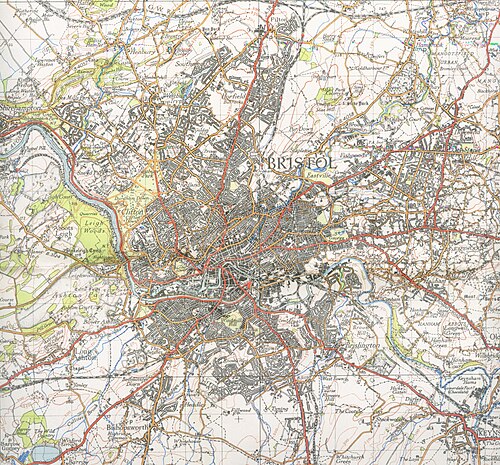
ブリストル( / ˈ b r ɪ s t əl / )はイングランド南西部の都市、単一自治体、儀礼郡、この地域で最も人口の多い都市である。[9][10]エイボン川の周囲に形成され北はグロスターシャー南はサマセットの儀礼郡に接しているグレーターブリストル地域(英国で11番目に人口の多いバース西イングランドの統合自治体地域。[7]
鉄器時代の 丘陵要塞やローマ時代の別荘が、フロム川とエイボン川の合流点近くに建てられました。ブリストルは1155年に勅許状を受け、1373年に法人化された郡になるまで、歴史的にはグロスターシャーとサマセットに分割されていました。13世紀から18世紀にかけて、ブリストルは税収でロンドンに次ぐイングランドの上位3都市に入っていました。主要港であるブリストルは、新世界への初期の探検航海の出発点でした。ブリストルの奴隷貿易の最盛期であった1700年から1807年には、2,000隻を超える奴隷船が推定50万人の人々をアフリカからアメリカ大陸への奴隷として運びました。ブリストル港はその後、市内中心部のブリストル港から、エイボンマウスのセヴァーン川河口とロイヤル ポートベリー ドックに移転しました。
市の現代経済は、クリエイティブメディア、エレクトロニクス、航空宇宙産業によって成り立っており、市中心部の埠頭は文化遺産センターとして再開発されました。ロイヤル・ウェスト・オブ・イングランド・アカデミー、アルノルフィーニ、アシュトン・ゲート、メモリアル・スタジアムなど、さまざまな芸術・スポーツ団体や会場があります。市内にはブリストル大学とウェスト・オブ・イングランド大学(UWEブリストル)の2つの大学があります。ブリストル空港によって世界とつながっており、ブリストル・テンプル・ミーズ駅とブリストル・パークウェイの主要鉄道駅によってイギリスの他の地域とつながっています。道路では、南西部からウェスト・ミッドランズに向かうM5とロンドンからサウス・ウェールズに向かうM4 (ポートウェイとM32によって市中心部に接続)の両方がつながっています。
ブリストルは2014年と2017年に英国で最も住みやすい都市に選ばれ、 2015年には欧州グリーン首都賞を受賞した。
地名学
この名前は古英語の Brycgstowに由来し、「橋のそばの集会所」または単に「橋の場所」を意味し、おそらくエイボン川を渡る橋を指していると思われる。[11] [12]最後のlは語源に基づかない付加語であり、12世紀に初めて登場した。この名前の古い形は、市に由来する姓Bristowとして残っている。 [13]
歴史
考古学的発見には、ルヴァロワ技法 で作られた30万年前から12万6千年前のものと考えられるフリント石器などがあり、中期旧石器時代にブリストルのシャイアハンプトンとセントアンズ地域にネアンデルタール人が存在したことを示している。[14]市近郊の鉄器時代の丘陵要塞は、リー・ウッズとクリフトン・ダウン、エイボン渓谷沿い、ヘンベリー近郊のキングス・ウェストン・ヒルにある。[15]ローマ人の居住地アボナ[16]は、現在のシー・ミルズ(ローマ街道でバースとつながっていた)に存在した。別の居住地は、現在のインズ・コートにあった。孤立したローマ人の別荘や小さな砦や居住地もこの地域全体に散在していた。[17]
中世
ブリストルは1000年までに創設され、1020年頃には貿易の中心地となり、町の名前を冠した銀貨を造幣局が造っていた。 [18] 1067年までにブリュッグストウは要塞化された城塞となり、その年、町民はハロルド・ゴドウィンソンの3人の息子が率いるアイルランドからの襲撃隊を撃退した。 [18]ノルマン人の支配下では、この町は南イングランドで最も強固な城の一つを有していた。[19]ブリストルは、打倒されたアイルランドのレンスター王、ディアマイト・マク・マーチャダの亡命先となった。ブリストルの商人はその後、リチャード・ストロングボウ・ド・クレアとノルマン人のアイルランド侵攻に資金を提供する上で重要な役割を果たした。[20]

港は11世紀にフロム川とエイヴォン川の合流点付近、町の壁のすぐ外側にあるブリストル橋に隣接して発展した。 [22] 12世紀までにブリストルには重要なユダヤ人コミュニティがあり、ユダヤ人が全員イングランドから追放された13世紀後半まで存続した。 [23] 1247年に建設された石橋は、1760年代に現在の橋に架け替えられた。[24]町は近隣の郊外を併合して1373年に郡となり、[25]イングランドでこの地位を与えられた最初の町となった。[26] [27] [28]この期間中、ブリストルは造船業と製造業の中心地となった。[29] 14世紀までに、ブリストル、ヨーク、ノリッジはロンドンに次ぐイングランド最大の中世の町となった。[30] 1348年から1349年にかけての黒死病で人口の3分の1から半分が死亡し[31] 、人口増加は抑制され、15世紀から16世紀のほとんどの期間、人口は10,000人から12,000人の間で推移しました。[32]
15世紀と16世紀
15世紀、ブリストルはイギリスで2番目に重要な港であり、アイルランド、[33]アイスランド[34]、ガスコーニュと貿易を行っていた。[29]ここは多くの航海の出発点となったが、その中にはロバート・スターミー(1457–58)による東地中海貿易におけるイタリアの独占を打ち破ろうとする失敗した試みもあった。 [35]新たな探検航海はベネチア人のジョン・カボットによって開始され、彼は1497年に北アメリカに上陸した。[36] 1499年の航海はブリストルの商人ウィリアム・ウェストンが率い、イギリス人が指揮した北アメリカへの最初の遠征となった。[37] 16世紀の最初の10年間、ブリストルの商人たちは北アメリカへの一連の探検航海を行い、その活動を支援するために商業組織「新発見地への冒険家会社」を設立した。[38]しかし、1509年以降、彼らは多額の費用をかけてほとんど利益を上げなかったため、北アメリカへの興味を失ってしまったようです。
16世紀、ブリストルの商人はスペインとそのアメリカ植民地との貿易の発展に力を注いだ。[39]これには、英西戦争(1585-1604)中にイベリア半島に食料や銃などの禁制品を密輸することが含まれていた。 [ 40 ] [41]ブリストルの違法貿易は1558年以降大幅に増加し、ブリストルの経済に不可欠なものとなった。[42]
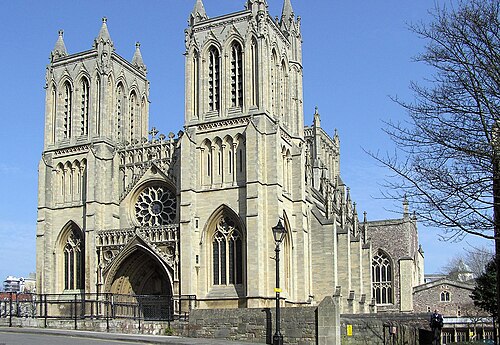
ブリストルの元々の主教区は1542年に設立されました[43]。その当時、旧セントオーガスティン修道院( 400年前にロバート・フィッツハーディングによって設立) [44]がブリストル大聖堂になりました。ブリストルはその年に市の地位も獲得しました[45]。1640年代のイングランド内戦中、ブリストルは王党派に占領され、議会派の要塞の跡地にロイヤルフォートハウスが建設されました[46]。
17世紀と18世紀

16世紀からニューファンドランド島のグランドバンクスで漁業を営んでいたブリストルの漁師たちは[47] 、 17世紀にはニューファンドランド島に定住する人数が増え、ブリストルズ・ホープとクーパーズ・コーブに植民地を築いた。17世紀にイギリスのアメリカ植民地が台頭すると、街と貿易が成長した。ブリストルはイギリスの西側に位置していたため、新世界との航海に有利で、商人たちはそれを最大限に活用し、18世紀半ばにはイングランド全土で二大港湾の1つとなった。[48]ブリストルはイングランドの奴隷貿易の中心地だった。1755年には、国内最多の奴隷商人が237人おり、ロンドンの147人に対してブリストルは最多だった。[49] 1750年以前はサウスカロライナへの奴隷の主要供給地だった。[50]

18世紀にはブリストルの人口が増加し(1750年には4万5千人)[51] 、アフリカ人を奴隷としてアメリカ大陸に連れて行く大西洋貿易でブリストルが果たした役割も目立った。ブリストル、後にリバプールは三角貿易の中心地となった。[52]製造品は西アフリカに出荷され、アフリカ人と交換された。奴隷とされた人々は過酷な環境の下、中間航路を通って大西洋を渡りアメリカ大陸へと移送された。 [53]砂糖、タバコ、ラム酒、米、綿などのプランテーション製品と少数の奴隷(貴族に家政婦として売られた)は、大西洋を渡ってイングランドに戻された。[53]家事奴隷の中には、解放されることを期待して洗礼を受けた者もいた。 1772年のサマーセット事件は、イングランドでは奴隷制度が違法であるということを明らかにした。[54] 1700年から1807年にかけてのブリストル奴隷貿易の最盛期には、2,000隻以上の奴隷船が、控えめに見積もっても50万人の人々をアフリカからアメリカ大陸の奴隷として運びました。[55]
1739年、ジョン・ウェスレーはブリストルに最初のメソジスト教会であるニュールームを創設した。[56]ウェスレーは、弟のチャールズ・ウェスレーやジョージ・ホワイトフィールドとともに、ブリストルや近隣のキングスウッド村の大規模な会衆に、しばしば野外で説教した。[57] [58]
ウェスレーは1774年に奴隷制度に関する小冊子「奴隷制度についての考察」を出版し[59]、友会は1783年にブリストルで奴隷制度反対のロビー活動を始めた。それでもなお、ブリストルの有力者たちは奴隷制度廃止に強く反対していた。トーマス・クラークソンは奴隷貿易を研究するためにブリストルを訪れ、マーチャントベンチャー協会の記録にアクセスした[60] 。彼の連絡先の1人はセブンスターズ パブのオーナーで、クラークソンが会おうとしていた船員たちを乗せていた。これらの船員たちを通じて、クラークソンは奴隷船の船長や一等航海士が船員たちに「酒を飲ませて酔わせ」て契約させる様子を観察することができた[60] 。 [61]他の情報提供者には船医や補償を求める船員も含まれていた。ウィリアム・ウィルバーフォースが1788年5月12日に議会で奴隷制度廃止運動を始めたとき、彼はブリストルのアイルランド奴隷貿易の歴史を振り返り、ヘンリー7世の治世まで続いたと挑発的に主張した。[60] ウィルバーフォースとクラークソンの良き友人で、もともとブリストル出身のハンナ・モアは、ウィルバーフォースが議会で運動を始めたちょうどその頃、1788年に「奴隷制、詩」を出版した。 [62] 1792年4月2日の彼の主要演説でも同様にブリストルの奴隷貿易について具体的に述べ、地元の奴隷船長キンバーの逮捕、裁判、そしてその後の無罪判決につながった。[60]
19世紀
この都市は、ブリストルとロンドン・パディントンを結ぶグレート・ウェスタン鉄道、ブリストルで建造された2隻の先駆的な外洋蒸気船(SS グレートブリテンとSS グレート・ウェスタン)、およびクリフトン吊り橋を設計したヴィクトリア朝の技術者イザムバード・キングダム・ブルネルとゆかりがある。新しい鉄道は、1810年に完全に開通したケネット・アンド・エイボン運河に代わるもので、ブリストルとロンドンの間の物資輸送の主要ルートであった。[63]リバプールとの競争(1760年頃から)、フランスとの戦争(1793年)による海上貿易の混乱、および奴隷貿易の廃止(1807年)により、ブリストルは北イングランドとウェスト・ミッドランズの新興製造拠点に遅れをとることになった。中世には港を安全に守っていた潮汐の影響を受けるエイボン渓谷は、足かせとなっていた。 1804年から1809年にかけてウィリアム・ジェソップが設計した浮き港で市の港湾を改良する計画は、高額な港湾使用料を必要とするという、費用のかかる間違いだった。[64]
,_BRO_Picbox-7-PBA-22,_1250x1250.jpg/500px-Bristol_Harbour_(St_Stephen's_Church,_St_Augustine_the_Less_Church,_Bristol_Cathedral),_BRO_Picbox-7-PBA-22,_1250x1250.jpg)
19世紀、 「船乗りの友」として知られるサミュエル・プリムソルは、海をより安全にするための運動を展開した。彼は船の過積載に衝撃を受け、船に満載喫水線を義務付ける運動に成功した。[65]
1867年までに船は大型化し、エイボン川の蛇行により全長300フィート(90メートル)以上の船は港に入港できなくなり、貿易は衰退した。[66]港湾施設は下流のエイボンマウスに移り、新たな工業団地がそこに設立された。[67]銅や真鍮の製造など一部の伝統的産業は衰退したが、[68] WD&HOウィルズの事業拡大に伴いタバコの輸入と加工が盛んになった。[69]
新しい産業と商業の発展に支えられ、ブリストルの人口(1801年には6万6000人)は19世紀の間に5倍に増加し、[70]クリフトンやコサムなどの新しい郊外地域が誕生した。これらはジョージ王朝時代から摂政時代様式までの建築例を提供しており、道路に面したり道路と直角に建つ素晴らしいテラスハウスやヴィラが数多く見られる。19世紀初頭には、部分的にはパラディオ主義のシンメトリーに対する反動として、ロマンチックな中世 ゴシック様式が登場し、ブリストル市立博物館・美術館、[71]や王立ウェスト・オブ・イングランド・アカデミー、[72]、ヴィクトリア・ルームなどの建物に見ることができる。[73] 1793年[74]と1831年には暴動が起こった。最初はブリストル橋の通行料の更新をめぐって、次は貴族院による第二次改革法案の否決に反対して起こった。[75] 1841年までに人口は140,158人に達した。[76]
ブリストル教区は1897年までに何度か境界変更が行われ、21世紀まで続く構成に「再構成」されました。[77]
20世紀
1901年の人口約33万人から、ブリストルは20世紀を通じて着実に成長し、1971年には428,089人に達しました。 [78]エイボンマウスのドックランドは、1900年代初頭にロイヤルエドワードドックによって拡張されました。[79]別の新しいドック、ロイヤルポートベリードックは、1970年代にエイボンマウスの川向こうにオープンしました。[80]世紀の前半に航空旅行が成長すると、航空機メーカーは工場を建設しました。[81]ブリストル国際博覧会は、1914年にバウアーアシュトン地域のアシュトンメドウズで開催されましたが、失敗に終わりました。 [82]博覧会が時期尚早に閉鎖された後、その場所は1919年まで第一次世界大戦中のグロスターシャー連隊の兵舎として使用されました。[83] [84]

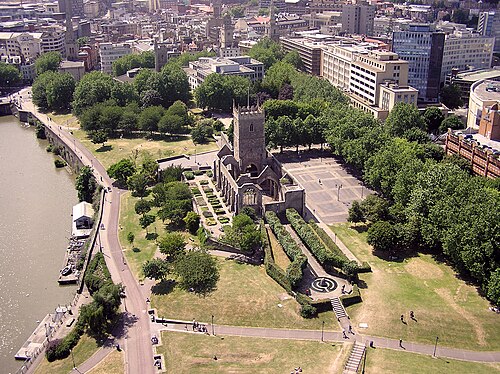
ブリストルは第二次世界大戦中、ドイツ空軍の空襲により大きな被害を受けた。市内に居住または勤務していた約1,300人が死亡、10万棟近くの建物が被害を受け、少なくとも3,000棟は修復不能となった。[85] [86]橋と城の近くにある元々の中心ショッピングエリアは現在、爆撃を受けた2つの教会と城の残骸がある公園になっている。近くにある爆撃で被害を受けた3つ目の教会、セント・ニコラス教会は修復され、博物館としてしばらく使われた後、現在は教会として再オープンしている。[87]この教会には、1756年にウィリアム・ホガースがセント・ メアリー・レッドクリフの主祭壇のために描いた三連祭壇画が収められている。教会にはまた、エドワード1世(アルノス宮廷凱旋門から移設)とエドワード3世(1760年頃に市壁が破壊された際にローフォーズ門から移設)の像、そしてブリストルのニューゲートから移設された13世紀のロバート・グロスター伯爵(ブリストル城の建設者)[88]とジェフリー・ド・モンブレイ(市の壁を建設した)の像もある。[89]

ブリストル市中心部の再建は、1960年代と1970年代の高層ビル、ミッドセンチュリーモダン建築、道路建設によって特徴づけられました。1980年代初頭には、いくつかの主要道路が閉鎖され、ジョージ王朝時代の クイーンスクエアとポートランドスクエアが修復され、ブロードミードショッピングエリアが再開発され、市中心部で最も高いミッドセンチュリータワーの1つが取り壊されました。[90]ブリストルの道路インフラは、1960年代と1970年代にM4とM5高速道路の開発により劇的に変化しました。これらの高速道路は、市のすぐ北にあるアーモンズベリーインターチェンジで交わり、ブリストルとロンドン(M4東行き)、スウォンジー(セヴァーン川河口を渡ってM4西行き)、エクセター(M5南行き)、バーミンガム(M5北行き)を結んでいます。[91]ブリストルは1974年と1978年にIRAによって2度爆破された。[92]
20世紀にドックが市中心部から下流7マイル(11km)のエイボンマウス・ドックとロイヤル・ポートベリー・ドックに移転されたことで、古いドックエリア(フローティング・ハーバー)の再開発が可能になった。 [93]ドックの存在はかつて危機に瀕していたが(そのエリアは廃墟となった工業用地と見なされていたため)、1996年にドック内および周辺で開催された第1回国際海洋フェスティバルにより、そのエリアが市のレジャー資産であることが確認された。[94]
21世紀
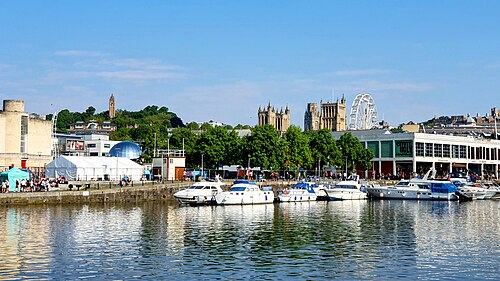
2018年から、17世紀と18世紀に市の主要な後援者の一人であったエドワード・コルストンの記念像の下に新しい説明板を設置することについて活発な議論がありました。この銘板は、エドワード・コルストンのロイヤル・アフリカ会社およびブリストル奴隷貿易での過去について何も言及していない元の銘板に代わるものでした。 [95] 2020年6月7日、コルストンの像が抗議者によって台座から引きずり下ろされ、ブリストル港に押し込まれました。[96]像は6月11日に回収され、博物館の展示品となっています。[97]
政府


ブリストル市議会は34の区を代表する70人の議員で構成され、1区あたり1人から3人の議員が4年の任期を務める。[98] 2024年5月現在、全体の過半数を支配する政党はないが、緑の党が市議会で最大のグループとなっている。
2012年から2024年まで、議会は直接選挙で選ばれた市長、ブリストル市長によって率いられていました。この役職は2022年の国民投票で廃止され、有権者は議会委員会制度に置き換えることを選択しました。[100] [101]
ブリストル市長は毎年5月に市議会によって選出される名目上の人物である。市長はポール・ゴギン議員である。[102]
下院では、ブリストルは東部、北東部、北西部、南部、中央の5つの選挙区で代表されている。[103]
この街には政治活動の伝統がある。1774年から6年間ブリストル選挙区の国会議員を務めたエドマンド・バークは、自分はまず国会議員であり、次に選挙区民の利益の代表であると主張した。 [104] [105]女性の権利運動家エメリン・ペシック=ローレンス(1867–1954)はブリストル生まれで、[106]左翼のトニー・ベンは1950–1960年と1963–1983年にブリストル南東選挙区の国会議員を務めた。 [107] 1963年、ブリストル・オムニバス会社が黒人の運転手と車掌の雇用を拒否したことに続くブリストル・バス・ボイコットが、英国の1965年人種関係法の成立につながった。[108] 1980年のセントポール暴動は人種差別と警察の嫌がらせに抗議するものであり、市内のアフリカ系カリブ系住民の社会経済的状況に対する不満の高まりを示した。フェアトレードに対する地元の支援は、2005年にブリストルがフェアトレード地域になったときに認められた。[109]
ブリストルは、1373年にエドワード3世から郡憲章を授与されて以来、都市であると同時に郡でもあります。[25]郡は1835年に拡大され、クリフトンなどの郊外が含まれるようになり、 1889年に郡自治区という名称が導入されたときには郡自治区と命名されました。[27]
旧エイボン州
1974年4月1日、ブリストルはエイボン州の地方自治体となった。[110] 1996年4月1日、エイボンは廃止され、ブリストルは単一自治体となった。[111]
かつてのエイボン地域は、サウスウェスト政府事務所(現在は廃止)などによってグレーターブリストルと呼ばれており、 [112]エイボン市と、以前はエイボン地域に属していたバース・アンド・ノース・イースト・サマセット、ノース・サマセット、サウス・グロスターシャーの3つの近隣地方自治体を指します。
ブリストルの北端は、ブリストル市境とM4、M5、M32高速道路(現在はサウスグロスターシャー州)の間にある開発された地域で、エイヴォン州のノーサヴォン地区議会が1987年に作成した計画の一環としてそのように命名されました。[113]
ウェスト・オブ・イングランド統合当局
ウェスト・オブ・イングランド統合当局は2017年2月9日に設立されました。[114]ブリストルと、ノース・サマセットを除く旧エイボン郡の残りの地域を管轄する新しい統合当局は、地域計画、道路、地方交通、そして程度は低いものの教育と企業投資についても責任を負っています。当局はウェスト・オブ・イングランド市長のダン・ノリスが率いています。
地理と環境
境界

ブリストルの境界は、市自体、開発された地域、またはグレーター・ブリストルなど、いくつかの方法で定義できます。
市議会の境界は、市自体の最も狭い定義である。しかし、異例なことに、フラットホルム島(ウェールズのカーディフ)とスティープホルム島で終わる(ただし、島は含まない)セヴァーン川河口西部の広い、ほぼ長方形の部分が含まれている。[115]この「海への延長」は、 1373年にエドワード3世によって市に与えられた憲章[116]に定められたブリストル郡の元の境界にまで遡ることができる。 [117]
英国国家統計局( ONS)はブリストル都市圏を定義しており、これにはキングスウッド、マンゴッツフィールド、ストーク・ギフォード、ウィンターボーン、アーモンズベリー、イーストン・イン・ゴルダノ、ウィッチチャーチ・ビレッジ、フィルトン、パッチウェイ、ブラッドリー・ストークなど、ブリストルに隣接しているが市議会境界の外側にある開発地域が含まれるが、その境界内の未開発地域は含まれない。[118]

地理
ブリストルは、南のメンディップ丘陵から北東のコッツウォルズまで続く石灰岩地帯にあります。 [119]エイボン川とフロム川は石灰岩を切り開いてその下の粘土層に達し、ブリストルの特徴的な丘陵地帯を形成しています。エイボン川は東のバースから流れ、市が発展する前は沼地だった氾濫原や地域を通ります。西では、エイボン川が石灰岩を切り開いてエイボン渓谷を形成しています。これは主に最終氷河期後の氷河の融解水によって形成されました。[120]
ブリストル港の防衛に役立ったこの渓谷は、都市建設のための石材として採掘され、その周囲の土地はダウンズとリー・ウッズとして開発から保護されてきた。エイボン川の河口と渓谷はノース・サマセットとの州境を形成し、川はエイボンマウスでセヴァーン川の河口に流れ込む。ヘイゼル・ブルックによって切り開かれた小さな渓谷は、トリム川に流れ込み、ブリストル北部のブレイズ城の敷地を横切っている。 [120]
ブリストルは、その住民によって、ローマのように7つの丘の上に建てられていると説明されることがあります。18世紀のガイドブックでは、これらの7つの丘は単にブリストル(旧市街)、キャッスルヒル、カレッジグリーン、キングスダウン、セントマイケルズヒル、ブランドンヒル、レッドクリフヒルとして知られていました。[121]その他の地元の丘には、レッドライオンヒル、バートンヒル、ローレンスヒル、ブラックボーイヒル、コンスティテューションヒル、ステイプルヒル、ウィンドミルヒル、マルバラヒル、ナインツリーヒル、タルボット、ブルックヒル、グランビーヒルがあります。
ブリストルはロンドンの西106マイル(171 km)、バーミンガムの南南西77マイル(124 km)、ウェールズの首都カーディフの東26マイル(42 km)に位置しています。市に隣接する地域は、グレーターブリストルと呼ばれる緩く定義された地域内にあります。バースは市の中心部から南東11マイル(18 km)、ウェストンスーパーメアは南西18マイル(29 km)、ウェールズの都市ニューポートは北西19マイル(31 km)に位置しています。
気候
気候は海洋性気候(ケッペンの気候区分:Cfb)で、イングランドや英国のほとんどの地域よりも温暖である。[122] [123]イングランド南部に位置するブリストルは、年間平均気温が約10.5 °C(50.9 °F)で、英国で最も暖かい都市の1つである。[124] [125] 最も日照時間が長い都市の1つで、年間の日照時間は1,541~1,885時間である。 [126]市は部分的にメンディップ丘陵に守られているが、セヴァーン川河口とブリストル海峡に面している。雨は年間を通じてほぼ均等に降り、秋と冬は雨の多い季節である。大西洋がブリストルの天候に影響を与え、年間を通じて平均気温が氷点以上であるが、冬の霜は頻繁に降り、11月上旬から4月下旬にかけては雪が降ることもある。夏は暖かく乾燥しており、日照、雨、曇りが変わりやすく、春の天候は不安定です。[127] [128]
ブリストルに最も近い気象観測所で長期気候データが入手できるのは、市内中心部のロング アシュトン (市中心部から南西に約 5 マイル (8 km)) とブリストル気象観測所です。これらの場所でのデータ収集はそれぞれ 2002 年と 2001 年に終了し、フィルトン飛行場の閉鎖後は、アルモンズベリーが市内に最も近い気象観測所となっています。[129]ロングアシュトンの1959年から2002年までの気温は、1976年7月の33.5℃(92.3°F)[130]から1982年1月の-14.4℃(6.1°F)までの範囲でした。 [131] 2002年以降、フィルトンで記録された月間最高気温は、ロングアシュトンの記録を上回ったのは、2003年4月の25.7℃(78.3°F)[132] 、 2006年7月の34.5℃(94.1°F)[133]、2011年10月の26.8℃(80.2°F)[134]です。フィルトンの最近の最低気温は、2010年12月の-10.1℃(13.8°F)でした。[135]大都市では一般的に、都市ヒートアイランド現象により周囲の農村部よりも気温が高くなるが、ブリストルではこの現象は最小限である。[136]
- ^ 気象観測所はブリストル市内中心部から 5 マイル (8 km) の場所にあります。
- ^ 1958年から2002年まで、ロングアシュトンで極端な気象が記録されました。2002年以降、フィルトンで極端な気象が記録されました。
環境
ブリストルは、環境パフォーマンス、生活の質、将来性、気候変動、リサイクル、生物多様性への取り組みに基づいて、英国で最も持続可能な都市にランクされ、環境慈善団体フォーラム・フォー・ザ・フューチャーの2008年持続可能な都市指数でトップになりました。[139] [140]地元の取り組みには、サストラン( 1977年にサイクルバッグとして設立されたナショナルサイクルネットワークの創設者)[141]や、エイボン・フレンズ・オブ・ジ・アースが1988年に設立した非営利ビジネスであるリソースセーバーなどがあります。[142] 2014年にサンデータイムズは、ブリストルを英国で最も住みやすい都市に選びました。[143]ブリストルは2015年のヨーロッパグリーンキャピタル賞を受賞し、この賞を受賞した最初の英国の都市となりました。[144]
2019年、ブリストル市議会は、市内中心部での個人所有のディーゼル車の走行を禁止することに賛成票を投じた。 [145]それ以来、計画はクリーンエアゾーンに有利になるように改訂され、より古く、より汚染物質を排出する車両は市内中心部を走行する際に料金を課せられるようになった。クリーンエアゾーンは2022年11月に発効した。[146]
グリーンベルト
市の緑地帯は主に南端に沿っており、アシュトン コート エステート、サウス ブリストル火葬場と墓地、ハイ リッジ コモン、ウィットチャーチ内の小さなエリア、さらにフレンチー ファーム周辺のエリアも含まれています。緑地帯は市境の外側、周辺の郡や地区まで、場所によっては数マイルにわたって広がっており、周辺の村や町を都市の無秩序な広がりから守っています。
人口統計
2011年の国勢調査によると、人口の84%は白人(77.9%が白人イギリス人、0.9%が白人アイルランド人、0.1%がジプシーまたはアイルランド旅行者、5.1%がその他の白人)、3.6%が混血(1.7%が白人と黒人のカリブ人、0.4%が白人と黒人のアフリカ人、0.8%が白人とアジア人、0.7%がその他の混血)、5.5%がアジア人(1.6%がパキスタン人、1.5 %がインド人、0.9%が中国人、0.5%がバングラデシュ人、1%がその他のアジア人)、6%が黒人(2.8%がアフリカ人、1.6%がカリブ人、1.6%がその他の黒人)、0.3%がアラブ人、0.6%がその他の血統である。ブリストルは、黒人人口がアジア人人口より多いという点で、イギリスの主要都市の中では珍しい。[151]これらの統計はブリストル統一自治体地域に適用され、サウスグロスターシャー、バース・アンド・ノースイーストサマセット(BANES)、ノースサマセットの都市部(2006年の推定人口587,400人)のキングスウッド、マンゴッツフィールド、フィルトン、ウォームリーなどの地域は除きます。[78]就労しているブリストル住民209,995人のうち56.2%は車、バン、バイク、タクシーで通勤し、2.2%は鉄道、9.8%はバスで通勤し、19.6%は歩いて通勤しています。[152]
ラニーメード・トラストは2017年に、ブリストルは「複合的不平等指数でイングランドとウェールズの348地区のうち7位(1=最悪)にランクされた」と報告した。[153]雇用に関しては、「全国的に少数民族は白人の英国人に比べて不利な立場にあるが、ブリストルでは特に黒人グループでそれが顕著である」と報告されている。ブリストルの黒人はイングランドとウェールズで3番目に高い教育格差を経験している。[153]
ブリストル都市圏
ブリストルの都市圏人口は、2001年の国勢調査データに基づき、ONSによって551,066人と推定されている。[154] 2006年にONSはブリストルの都市圏人口を587,400人と推定し、[155]これによりブリストルはイングランドで6番目に人口の多い都市となり、都市圏では10番目に人口の多い都市となった。[154]人口密度は 3,599人/km 2 (9,321/平方マイル)で、イングランドの地区の中で7番目に高い。[156] 2019年のデータによると、都市圏の人口は67万人で、英国で11番目に多い。[157]
In 2007 the European Spatial Planning Observation Network (ESPON) defined Bristol's functional urban area as including Weston-super-Mare, Bath and Clevedon with a total population of 1.04 million, the twelfth largest of the UK.[158]
Economy

Bristol has a long history of trade, originally exporting wool cloth and importing fish, wine, grain and dairy products;[159] later imports were tobacco, tropical fruits and plantation goods. Major imports are motor vehicles, grain, timber, produce and petroleum products.[160]
The city's economy also relies on the aerospace, defence, media, information technology, financial services and tourism industries.[161][162] The Ministry of Defence (MoD)'s Procurement Executive, later known as the Defence Procurement Agency and Defence Equipment and Support, moved to its headquarters to Abbey Wood, Filton, in 1995. This organisation, with a staff of 12,000 to 13,000, procures and supports MoD equipment.[163] One of the UK's most popular tourist destinations, Bristol was selected in 2009 as one of the world's top-ten cities by international travel publishers Dorling Kindersley in their Eyewitness guides for young adults.[164]
Bristol is one of the eight-largest regional English cities that make up the Core Cities Group, and is ranked as a Gamma level global city by the Globalization and World Cities Research Network, the fourth-highest-ranked English city.[165] In 2017 Bristol's gross domestic product was £88.448 billion.[166][167] Its per capita GDP was £46,000 ($65,106, €57,794), which was some 65% above the national average, the third-highest of any English city (after London and Nottingham) and the sixth-highest of any city in the United Kingdom (behind London, Edinburgh, Glasgow, Belfast and Nottingham).[166] According to the 2011 census, Bristol's unemployment rate (claiming Jobseeker's Allowance) was three per cent, compared with two per cent for South West England and the national average of four per cent.[168]
Although Bristol's economy no longer relies upon its port, which was moved to docks at Avonmouth during the 1870s[169] and to the Royal Portbury Dock in 1977 as ship size increased, it is the largest importer of cars to the UK. Until 1991, the port was publicly owned; it is leased, with £330 million invested and its annual tonnage increasing from 3.9 million long tons (4 million tonnes) to 11.8 million (12 million).[170] Tobacco importing and cigarette manufacturing have ceased, but the importation of wine and spirits continues.[171]
The financial services sector employs 59,000 in the city,[172] and 50 micro-electronics and silicon design companies employ about 5,000. In 1983 Hewlett-Packard opened its national research laboratory in Bristol.[173][174] In 2014 the city was ranked seventh in the "top 10 UK destinations" by TripAdvisor.[175]
During the 20th century, Bristol's manufacturing activities expanded to include aircraft production at Filton by the Bristol Aeroplane Company and aircraft-engine manufacturing by Bristol Aero Engines (later Rolls-Royce) at Patchway. Bristol Aeroplane was known for their World War I Bristol Fighter[176] and World War II Blenheim and Beaufighter planes.[176] During the 1950s they were a major English manufacturer of civilian aircraft, known for the Freighter, Britannia and Brabazon. The company diversified into automobile manufacturing during the 1940s, producing hand-built, luxury Bristol Cars at their factory in Filton, and the Bristol Cars company was spun off in 1960.[177] The city also gave its name to Bristol buses, which were manufactured in the city from 1908 to 1983: by Bristol Tramways until 1955, and from 1955 to 1983 by Bristol Commercial Vehicles.[178]

Filton played a key role in the Anglo-French Concorde supersonic airliner project during the 1960s. The British Concorde prototype made its maiden flight from Filton to RAF Fairford on 9 April 1969, five weeks after the French test flight.[179] In 2003 British Airways and Air France decided to discontinue Concorde flights, retiring the aircraft to locations (primarily museums) worldwide. On 26 November 2003 Concorde 216 made the final Concorde flight, returning to Bristol Filton Airport as the centrepiece of a proposed air museum which is planned to include the existing Bristol Aero collection (including a Bristol Britannia).[180]
The aerospace industry remains a major sector of the local economy.[181] Major aerospace companies in Bristol include BAE Systems, a merger of Marconi Electronic Systems and BAe (the latter a merger of BAC, Hawker Siddeley and Scottish Aviation). Airbus[182] and Rolls-Royce are also based at Filton, and aerospace engineering is an area of research at the University of the West of England. Another aviation company in the city is Cameron Balloons, who manufacture hot air balloons;[183] each August the city hosts the Bristol International Balloon Fiesta, one of Europe's largest hot-air balloon festivals.[184]
In 2005 Bristol was named by the UK government one of England's six science cities.[185][186] A £500 million shopping centre, Cabot Circus, opened in 2008 amidst predictions by developers and politicians that the city would become one of England's top ten retail destinations.[187] The Bristol Temple Quarter Enterprise Zone, focused on creative, high-tech and low-carbon industries around Bristol Temple Meads railway station,[188] was announced in 2011[189] and launched the following year.[188] The 70 ha (170-acre) Urban Enterprise Zone has streamlined planning procedures and reduced business rates. Rates generated by the zone are channelled to five other designated enterprise areas in the region:[190] Avonmouth, Bath, Bristol and Bath Science Park in Emersons Green, Filton, and Weston-super-Mare. Bristol is the only big city whose wealth per capita is higher than that of Britain as a whole. With a highly skilled workforce drawn from its universities, Bristol claims to have the largest cluster of computer chip designers and manufacturers outside Silicon Valley [citation needed]. The wider region has one of the biggest aerospace hubs in the UK, centred on Airbus, Rolls-Royce and GKN at Filton airfield.[191]
Between 2012 and 2020, the city had the largest circulating community currency in the UK, the Bristol Pound, which was pegged to the pound sterling before it ceased operation.

Culture
Arts

Bristol has a thriving arts scene. Some of the modern venues and modern digital production companies have merged with legacy production companies based in old buildings around the city. In 2008 the city was a finalist for the 2008 European Capital of Culture, although the title was awarded to Liverpool.[192] The city was designated "City of Film" by UNESCO in 2017 and has been a member of the Creative Cities Network since then.[193]
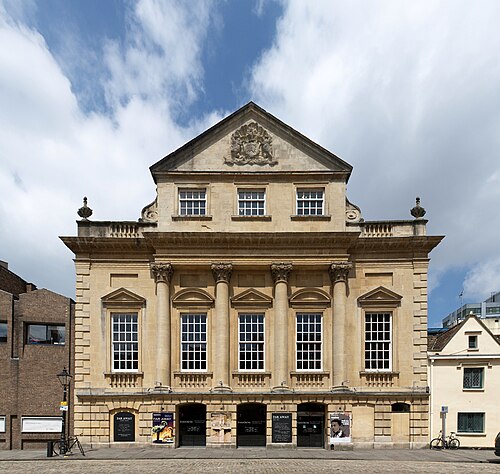
The Bristol Old Vic, founded in 1946 as an offshoot of The Old Vic in London, occupies the 1766 Theatre Royal (607 seats) on King Street; the 150-seat New Vic (a studio-type theatre), and a foyer and bar in the adjacent Coopers' Hall (built in 1743). The Theatre Royal, a grade I listed building,[194][195] is the oldest continuously operating theatre in England.[196] The Bristol Old Vic Theatre School (which originated in King Street) is a separate company, and the Bristol Hippodrome is a 1,951-seat theatre for national touring productions. Other smaller theatres include the Tobacco Factory, QEH, the Redgrave Theatre at Clifton College, The Wardrobe Theatre, Bristol Improv Theatre, and the Alma Tavern. Bristol's theatre scene features several companies as well as the Old Vic, including Show of Strength, Shakespeare at the Tobacco Factory and Travelling Light. Theatre Bristol is a partnership between the city council, Arts Council England and local residents to develop the city's theatre industry.[197] Several organisations support Bristol theatre; the Residence (an artist-led community) provides office, social and rehearsal space for theatre and performance companies,[198] and Equity has a branch in the city.[199]

The city has many venues for live music, its largest the 2,000-seat Bristol Beacon, previously Colston Hall, named after Edward Colston. Others include the Bristol Academy, The Fleece, The Croft, the Exchange, Fiddlers, the Victoria Rooms, Rough Trade, Trinity Centre, St George's Bristol and several pubs, from the jazz-oriented The Old Duke to rock at the Fleece and indie bands at the Louisiana.[200][201] In 2010 PRS for Music called Bristol the UK's most musical city, based on the number of its members born there relative to the city's population.[202]
Since the late 1970s Bristol has been home to bands combining punk, funk, dub and political consciousness. With trip hop and Bristol Sound artists such as Tricky,[203] Portishead[204] and Massive Attack,[205] the list of bands from Bristol is extensive. The city is a stronghold of drum and bass, with artists such as Roni Size's Mercury Prize-winning Reprazent,[206] as DJ Krust,[207] More Rockers[208] and TC.[209] Musicians were at the centre of the broader Bristol urban-culture scene which received international media attention during the 1990s.[210] The Downs Festival is also a yearly occurrence where both local and well-known bands play. Since its inception in 2016, it has become a major event in the city.
The Bristol Museum and Art Gallery houses a collection encompassing natural history, archaeology, local glassware, Chinese ceramics and art. The M Shed museum opened in 2011 on the site of the former Bristol Industrial Museum.[211] Both are operated by Bristol Culture and Creative Industries, which also runs three historic houses—the Tudor Red Lodge, the Georgian House and Blaise Castle House; and Bristol Archives.[212] The 18th- and 19th-century portrait painter Thomas Lawrence, 19th-century architect Francis Greenway (designer of many of Sydney's first buildings) were born in the city. The graffiti artist Banksy is believed to be from Bristol, and many of his works are on display in the city.

The Watershed Media Centre and Arnolfini gallery (both in dockside warehouses) exhibit contemporary art, photography and cinema, and the city's oldest gallery is at the Royal West of England Academy in Clifton.[213] The nomadic Antlers Gallery opened in 2010, moving into empty spaces on Park Street, on Whiteladies Road and in the Purifier House on Bristol's Harbourside.[214] Stop-motion animation films and commercials (produced by Aardman Animations) are made in Bristol, such as Wallace and Gromit and Chicken Run, while Aardman has also branched out into computer-animation, such as Arthur Christmas.[215][216] Robert Newton, Bobby Driscoll and other cast members of the 1950 Walt Disney film Treasure Island (some scenes were filmed along the harbourside) visited the city along with Disney himself. Bristol is home to the regional headquarters of BBC West and the BBC Natural History Unit.[217] Locations in and around Bristol have featured in the BBC's natural-history programmes, including Animal Magic (filmed at Bristol Zoo).[218]
Bristol is the birthplace of 18th-century poets Robert Southey[219] and Thomas Chatterton.[220] Southey (born on Wine Street in 1774) and his friend, Samuel Taylor Coleridge, married the Fricker sisters from the city.[221] William Wordsworth spent time in Bristol,[222] where Joseph Cottle published Lyrical Ballads in 1798. Actor Cary Grant was born in Bristol, and comedians from the city include Justin Lee Collins,[223] Lee Evans,[224] Russell Howard[225] and writer-comedian Stephen Merchant.[226]
The author John Betjeman wrote a poem called "Bristol".[227] It begins:
Green upon the flooded Avon shone the after-storm-wet-sky,
Quick the struggling withy branches let the leaves of autumn fly,
And a star shone over Bristol, wonderfully far and high.— John Betjeman, Bristol
Architecture


Bristol has 51 Grade I,[195] 500 Grade II* and over 3,800 Grade II listed buildings[228] in a variety of architectural styles, from medieval to modern. During the mid-19th century Bristol Byzantine, a style unique to the city, was developed, and several examples have survived. Buildings from most architectural periods of the United Kingdom can be seen in the city. Surviving elements of the fortifications and castle date to the medieval period,[229] and the Church of St James dates back to the 12th century.[230]
The oldest Grade I listed buildings in Bristol are religious. St James' Priory was founded in 1129 as a Benedictine priory by Earl Robert of Gloucester, the illegitimate son of Henry I.[231] The second-oldest is Bristol Cathedral and its associated Great Gatehouse.[232] Founded in 1140 as an Augustinian monastery, the church became the seat of the bishop and cathedral of the new Diocese of Bristol in 1542. Most of the medieval stonework, particularly the Elder Lady Chapel, is made from limestone taken from quarries around Dundry and Felton with Bath stone being used in other areas.[233] Amongst the other churches included in the list is the 12th-century St Mary Redcliffe which is the tallest building in Bristol. The church was described by Queen Elizabeth I as "the fairest, goodliest, and most famous parish church in England."[234]
Secular buildings include The Red Lodge, built in 1580 for John Yonge as a lodge for a larger house that once stood on the site of the present Bristol Beacon (previously known as Colston Hall). It was subsequently added to in Georgian times and restored in the early 20th century.[235] St Bartholomew's Hospital is a 12th-century town house which was incorporated into a monastery hospital founded in 1240 by Sir John la Warr, 2nd Baron De La Warr (c. 1277–1347), and became Bristol Grammar School from 1532 to 1767, and then Queen Elizabeth's Hospital 1767–1847. The round piers predate the hospital, and may come from an aisled hall, the earliest remains of domestic architecture in the city, which was then adapted to form the hospital chapel.[236] Three 17th-century town houses which were attached to the hospital were incorporated into model workers' flats in 1865, and converted to offices in 1978. St Nicholas's Almshouses were built in 1652[237] to provide care for the poor. Several public houses were also built in this period, including the Llandoger Trow[238] on King Street and the Hatchet Inn.[239]
Manor houses include Goldney Hall, where the highly decorated Grotto dates from 1739.[240] Commercial buildings such as the Exchange[241] and Old Post Office[242] from the 1740s are also included in the list. Residential buildings include the Georgian Portland Square[243] and the complex of small cottages around a green at Blaise Hamlet, which was built around 1811 for retired employees of Quaker banker and philanthropist John Scandrett Harford, who owned Blaise Castle House.[244] The 18th-century Kings Weston House, in northern Bristol, was designed by John Vanbrugh and is the only Vanbrugh building in any UK city outside London. Almshouses[245] and pubs from the same period[246] intermingle with modern development. Several Georgian squares were designed for the middle class as prosperity increased during the 18th century.[247] During World War II, the city centre was heavily bombed during the Bristol Blitz.[248] The central shopping area near Wine Street and Castle Street was particularly hard-hit, and the Dutch House and St Peter's Hospital were destroyed. Nevertheless, in 1961 John Betjeman called Bristol "the most beautiful, interesting and distinguished city in England".[249]
Sport
Bristol is represented by professional teams in all the major national sports. Bristol City and Bristol Rovers are the city's main football clubs. Bristol Bears (rugby union) and Gloucestershire County Cricket Club are also based in the city.
The two Football League clubs are Bristol City and Bristol Rovers—the former being the only club from the city to play in the precursor to the Premier League. Non-league clubs include Bristol Manor Farm, Hengrove Athletic, Brislington, Roman Glass St George and Bristol Telephones. Bristol City, formed in 1894, were Division One runners-up in 1907 and lost the FA Cup final in 1909. In the First Division in 1976, they then sank to the bottom professional tier before reforming after a 1982 bankruptcy. 28 October 2000 is a date of significance in the city as it is the last time Bristol Rovers were above Bristol City in the Football league. Bristol City were promoted to the second tier of English football in 2007, losing to Hull City in the playoff for promotion to the Premier League that season.[250] Bristol City Women were formerly based at Twerton Park, but now share Ashton Gate as a home venue with the men's team and occasionally relocate to The Robins High Performance Centre in Failand for cup games.[251]

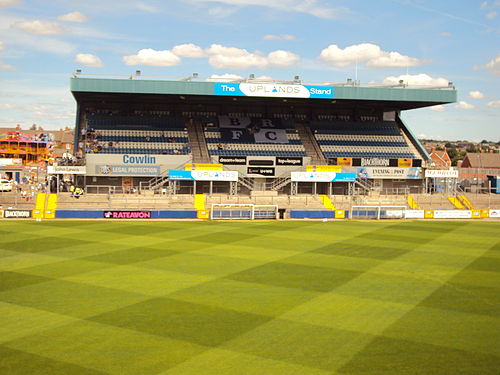
Bristol Rovers, the oldest professional football team in the city, were formed in 1883 and promoted back into the football league in 2015. They were third-tier champions twice (Division Three South in 1952–53 and Division Three in 1989–90), Watney Cup Winners (1972) and runners-up for the Johnstone's Paint Trophy (2006–07) although have never played in England's top Division. The club has planning permission for a new 21,700-capacity all-seater stadium at the University of the West of England's Frenchay campus. Construction was due to begin in mid-2014, but in March 2015 the sale of the Memorial Stadium site (needed to finance the new stadium) was in jeopardy.[252][253]
Bristol Manor Farm are the highest-ranked non-league club within the city boundaries. They play their games at The Creek, Sea Mills,[254] in the north of Bristol. Formed in 1960, the club play in the Southern League Division One South having finished the 2016–17 Western League season as champions. They reached the quarter-finals of the FA Vase in 2015–16.[255]
The city is also home to Bristol Bears,[256] formed in 1888 as Bristol Football Club by the merger of the Carlton club with rival Redland Park. Westbury Park declined the merger and folded, with many of its players joining what was then Bristol Rugby.[257] Bristol Rugby has often competed at the highest level of the sport since its formation in 1888.[258] The club played at the Memorial Ground, which it shared with Bristol Rovers from 1996. Although Bristol Rugby owned the stadium when the football club arrived, a decline in the rugby club's fortunes led to a transfer of ownership to Bristol Rovers. In 2014 Bristol Rugby moved to their new home, Ashton Gate Stadium (home to Bristol Rovers' rivals Bristol City), for the 2014–15 season.[259][260] They changed their name from Bristol Rugby to Bristol Bears to coincide with their return to Premiership Rugby in 2018–19.
Dating from 1901, the Bristol Combination and its 53 clubs promote rugby union in the city and help support Bristol Bears.[261] The most prominent of Bristol's smaller rugby clubs include Clifton Rugby, Dings Crusaders, and Cleve. Rugby league is represented in Bristol by the Bristol Sonics.[262]
The first-class cricket club Gloucestershire County Cricket Club[263] has its headquarters and plays the majority of its home games at the Bristol County Ground, the only major international sports venue in the south-west of England. It was formed by the family of W. G. Grace.[264] The club is arguably Bristol's most successful, achieving a period of success between 1999 and 2006 when it won nine trophies and became the most formidable one-day outfit in England, including winning a "double double" in 1999 and 2000 (both the Benson and Hedges Cup and the C&G Trophy), and the Sunday League in 2000. Gloucestershire CCC also won the Royal London One-Day Cup in 2015.
The Bristol Flyers basketball team have competed in the British Basketball League, the UK's premier professional basketball league, since 2014.[265] Bristol Aztecs play in Britain's premier American football competition, the BAFA National Leagues.[266] In 2009 ice hockey returned to Bristol after a 17-year absence, with the Bristol Pitbulls playing at Bristol Ice Rink; after its closure, it shared a venue with Oxford City Stars.[267] Bristol sponsors an annual half marathon and hosted the 2001 IAAF World Half Marathon Championships.[268] Athletic clubs in Bristol include Bristol and West AC, Bitton Road Runners and Westbury Harriers. Bristol has staged finishes and starts of the Tour of Britain cycle race[269] and facilities in the city were used as training camps for the 2012 London Olympics.[270] The Bristol International Balloon Fiesta, a major UK hot-air ballooning event, is held each summer at Ashton Court.[271]
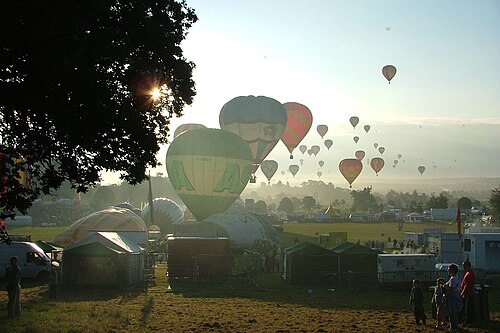
.
Bristol Underwater Hockey club are the city's competitive team for the sport.[272] They train at Hengrove Park Leisure Centre. In the 2023 Nationals Competition, Bristol came 4th in group C.[273] In the 2023 Nautilus Tournament, Bristol A finished 2nd in Division 2 with Bristol B finishing 4th in Division 6.[274]
Dialect
.jpg/500px-Cabot_Tower_(600px).jpg)
A dialect of English (West Country English), known as Bristolian, is spoken by longtime residents, who are known as Bristolians.[275] Bristol natives have a rhotic accent, in which the post-vocalic r in car and card is pronounced (unlike in Received Pronunciation). The city is regarded as one of the last locations in England, along with Blackburn, to preserve the traditional English rhotic R sound.[276] The unique feature of this accent is the 'Bristol (or terminal) l', in which l is appended to words ending in a or o.[277] Whether this is a broad l or a w is a subject of debate,[278] with area pronounced 'areal' or 'areaw'. The ending of Bristol is another example of the Bristol l. Bristolians pronounce -a and -o at the end of a word as -aw (cinemaw). To non-natives, the pronunciation suggests an l after the vowel.[279][280]
Until recently,[when?] Bristolian was characterised by retention of the second-person singular, as in the doggerel "Cassn't see what bist looking at? Cassn't see as well as couldst, casst? And if couldst, 'ouldn't, 'ouldst?" The West Saxon bist is used for the English art,[281] and children were admonished with "Thee and thou, the Welshman's cow". In Bristolian, as in French and German, the second-person singular was not used when speaking to a superior (except by the egalitarian Quakers). The pronoun thee is also used in the subject position ("What bist thee doing?"), and I or he in the object position ("Give he to I.").[282] Linguist Stanley Ellis, who found that many dialect words in the Filton area were linked to aerospace work, described Bristolian as "a cranky, crazy, crab-apple tree of language and with the sharpest, juiciest flavour that I've heard for a long time".[283]
Religion
Religion in Bristol (2021)[284]
No religion (51.4%)
Christianity (32.2%)
Islam (6.7%)
Hinduism (0.8%)
Buddhism (0.6%)
Sikhism (0.5%)
Judaism (0.3%)
Other religion (0.8%)
Not stated (6.9%)
In the 2011 United Kingdom census, 46.8% of Bristol's population identified as Christian and 37.4% said they were not religious; the English averages were 59.4% and 24.7%, respectively. Islam is observed by 5.1% of the population, Buddhism by 0.6%, Hinduism by 0.6%, Sikhism by 0.5%, Judaism by 0.2% and other religions by 0.7%; 8.1% did not identify with a religion.[285]
Among the notable Christian churches are the Anglican Bristol Cathedral and St Mary Redcliffe and the Roman Catholic Clifton Cathedral. Nonconformist chapels include Buckingham Baptist Chapel and John Wesley's New Room in Broadmead.[286] After St James' Presbyterian Church was bombed on 24 November 1940, it was never again used as a church;[287] although its bell tower remains, its nave was converted into offices.[288] The city has eleven mosques,[289] several Buddhist meditation centres,[290] a Hindu temple,[291] Reform and Orthodox-Jewish synagogues[292] and four Sikh temples.[293][294][295]
Nightlife
Bristol has been awarded Purple Flag status[296] on many of its districts, which shows that it meets or surpasses the standards of excellence in managing the evening and night-time economy.
DJ Mag's top 100 club list ranked Motion as the 19th-best club in the world in 2016.[297] This is up 5 spots from 2015.[297] Motion is a complex made up of different rooms, outdoor space and a terrace that looks over the river Avon.[298] In 2011, Motion was transformed from a skate park into the rave spot it is today.[299] Other famous clubs in the city include Lakota and Thekla.
The Attic Bar is a venue located in Stokes Croft.[300] Equipped with a sound system and stage which are used every weekend for gigs of every genre, the bar and the connected Full Moon Pub were rated by The Guardian, a British daily paper, as one of the top ten clubs in the UK.[301] In 2014, the Great British Pub Awards ranked The Apple as the best cider bar in the UK.[302]
Media

Bristol is home to the regional headquarters of BBC West and the BBC Natural History Unit based at Broadcasting House, which produces television, radio and online content with a natural history or wildlife theme. The city has a long association with David Attenborough's authored documentaries, including Life on Earth,[303] 'The Blue Planet and Planet Earth. The BBC announced in 2021 that it was moving the production of many of its programmes from Broadcasting House to Finzels Reach in the centre of Bristol.[304]
Bristol has two daily newspapers, the Western Daily Press and the Bristol Post (both owned by Reach plc); and a Bristol edition of the free Metro newspaper (owned by DMGT). The Bristol Cable specialises in investigative journalism with a quarterly print edition and website.
Aardman Animations is a Bristol-based animation studio, known for the characters Wallace and Gromit and Morph.
Local radio stations, including BBC Radio Bristol, Heart West, Greatest Hits Radio Bristol & The South West, Hits Radio Bristol, Kiss, and BCfm, a community based station. Television programmes produced in the city include Points West, Endemol productions such as Deal or No Deal, The Crystal Maze, and ITV News West Country. In October 2018, Channel 4 announced that Bristol would be home to one of its 'Creative Hubs', as part of their move to produce more content outside of London.[305]
Publishers in the city have included 18th-century Bristolian Joseph Cottle, who helped introduce Romanticism by publishing the works of William Wordsworth and Samuel Taylor Coleridge.[306] During the 19th century, J.W. Arrowsmith published the Victorian comedies Three Men in a Boat (by Jerome K. Jerome) and The Diary of a Nobody by George and Weedon Grossmith.[307] The contemporary Redcliffe Press has published over 200 books covering all aspects of the city.[308] Bristol is home to YouTube video developers and stylists The Yogscast, with founders Simon Lane and Lewis Brindley having moved their operations from Reading to Bristol in 2012.[309]
Education
.jpg/500px-Victoria_Rooms_(750px).jpg)
Bristol has two major institutions of higher education: the University of Bristol, a redbrick chartered in 1909;[310] and the University of the West of England, opened as Bristol Polytechnic in 1969, which became a university in 1992.[311] The University of Law also has a campus in the city. Bristol has two further education institutions (City of Bristol College and South Gloucestershire and Stroud College) and two theological colleges: Trinity College, and Bristol Baptist College. The city has 129 infant, junior and primary schools,[312] 17 secondary schools,[313] and three learning centres. After a section of north London, Bristol has England's second-highest number of private school places.[314] Independent schools in the city include Clifton College, Clifton High School, Badminton School, Bristol Grammar School, Queen Elizabeth's Hospital (the only all-boys school) and the Redmaids' School (founded in 1634 by John Whitson, which claims to be England's oldest girls' school).[315]

In 2005, Chancellor of the Exchequer Gordon Brown named Bristol one of six English 'science cities',[316] and a £300 million science park was planned at Emersons Green.[317] Research is conducted at the two universities, the Bristol Royal Infirmary and Southmead Hospital, and science outreach is practised at We The Curious, the Bristol Zoo, the Bristol Festival of Nature and the CREATE Centre.[318]
The city has produced a number of scientists, including 19th-century chemist Humphry Davy[319] (who worked in Hotwells). Physicist Paul Dirac (from Bishopston) received the 1933 Nobel Prize for his contributions to quantum mechanics.[320] Cecil Frank Powell was the Melvill Wills Professor of Physics at the University of Bristol when he received the 1950 Nobel Prize for, among other discoveries, his photographic method of studying nuclear processes. Colin Pillinger[321] was the planetary scientist behind the Beagle 2 project, and neuropsychologist Richard Gregory founded the Exploratory (a hands-on science centre which was the predecessor of At-Bristol/We The Curious).[322]
Initiatives such as the Flying Start Challenge encourage an interest in science and engineering in Bristol secondary-school pupils; links with aerospace companies impart technical information and advance student understanding of design.[323] The Bloodhound SSC project to break the land speed record is based at the Bloodhound Technology Centre on the city's harbourside.[324]
Transport
Rail
Bristol has two principal railway stations. Bristol Temple Meads (near the city centre) has Great Western Railway services which include high-speed trains to London Paddington and local, regional and CrossCountry trains. Bristol Parkway, north of the city in Gloucestershire, but within the conurbation, has high-speed Great Western Railway services to Swansea, Cardiff Central and London Paddington, and CrossCountry services reaching Birmingham, Manchester and Edinburgh. A limited service to London Waterloo, via Clapham Junction used to operate, from Temple Meads was operated by South Western Railway this service stopped in December 2021 because of a shortage of train drivers and there are scheduled coach links to most major UK cities.[325]
.jpg/500px-Bristol_Temple_Meads_station_(6466232797).jpg)
Bristol's principal surviving suburban railway is the Severn Beach Line to Avonmouth and Severn Beach. Although Portishead Railway's passenger service was a casualty of the Beeching cuts, freight service to the Royal Portbury Dock was restored from 2000 to 2002 with a Strategic Rail Authority rail-freight grant. The MetroWest scheme, formerly known as The Greater Bristol Metro, proposes to increase the city's rail capacity[326] including the restoration of a further 3 mi (5 km) of track on the line to Portishead (a dormitory town with one connecting road), and a further commuter rail line from Bristol Temple Meads to Henbury, on an existing freight line. Following numerous delays, the two lines are due to be opened in 2026.[327][328]
Roads
The M4 motorway connects the city on an east–west axis from London to West Wales, and the M5 is a north–south west axis from Birmingham to Exeter. The M49 motorway is a shortcut between the M5 in the south and the M4 Severn Crossing in the west, and the M32 is a spur from the M4 to the city centre.[325] The Portway connects the M5 to the city centre, and was the most expensive road in Britain when opened in 1926.[329][330]
As of 2019, Bristol is working on plans for a Clean Air Zone to reduce pollution, which could involve charging the most polluting vehicles to enter the city centre.[331][332]

Private car use is high in the city, leading to traffic congestion costing an estimated £350 million per year.[333] Bristol allows motorcycles to use most of the city's bus lanes and provides secure, free parking for them.[334]
Public transport
Public transport in the city consists primarily of a First West of England bus network. Other providers are Abus,[335] Stagecoach West, and Stagecoach South West.[336][337] Bristol's bus service has been criticised as unreliable and expensive, and in 2005 FirstGroup was fined for delays and safety violations.[338][339]
Although the city council has included a light rail system in its local transport plan since 2000, it has not yet funded the project; Bristol was offered European Union funding for the system, but the Department for Transport did not provide the required additional funding.[340] As of 2019, a four-line mass transit network with potential underground sections radiating from Bristol Temple Meads is proposed; a southern line to Bristol Airport, a northern line to Aztec West, a northeastern line Bristol & Bath Science Park and a southeastern line to Brislington or Keynsham.[341]
In 2006, a project to develop a bus rapid transit system (BRT) named MetroBus was started,[342] with the purpose of providing a faster and more reliable service than buses, improving transport infrastructure and reducing congestion.[343] The project was approved by the government in December 2013,[342] and in June 2017, it was announced that First would operate the buses,[344] and the service branding was restyled as 'metrobus'. metrobus services commenced in 2018, with the opening of a route between Emersons Green and Bristol City Centre (route m3).[345] Further routes were introduced between Cribbs Causeway and Hengrove Park (route m1), and between Long Ashton Park and Ride and Bristol City Centre (route m2).[346] In May 2022, it was announced that a fourth route would open in Spring the following year to connect Cribbs Causeway with Bristol Parkway Railway Station (route m4),[347] this route eventually began operating between Bristol City Centre and Cribbs Causeway via Bristol Parkway.[348]
Three park and ride sites serve Bristol.[349] The city centre has water transport operated by Bristol Ferry Boats, Bristol Packet Boat Trips and Number Seven Boat Trips, providing leisure and commuter service in the harbour.[350]
Cycling
Bristol was designated as England's first "cycling city" in 2008 and one of England's 12 "Cycling demonstration" areas.[351] It is home to Sustrans, the sustainable transport charity. The Bristol and Bath Railway Path links it to Bath, and was the first part of the National Cycle Network. The city also has urban cycle routes and links with National Cycle Network routes to The rest of the Country. Cycling trips increased by 21% from 2001 to 2005.[333]
Air

In 2023, Bristol Airport (BRS), located in neighbouring North Somerset, was ranked the eighth busiest airport in the United Kingdom. It handled 9.9 million passengers, an 14% increase compared with 2018.[352]
International relations
Bristol was among the first cities to adopt town twinning after World War II.[353][354] Twin towns include:
- Bordeaux, France[355][356] (since 1947)
- Hanover, Germany[357] (since 1947; one of the first post-war twinnings of British and German cities)
- Porto, Portugal (since 1984)[358]
- Tbilisi, Georgia (since 1988)[359]
- Puerto Morazán, Nicaragua (since 1989)[360]
- Beira, Mozambique (since 1990)[361]
- Guangzhou, China (since 2001)[362][363]
Freedom of the City
People and military units receiving the Freedom of the City of Bristol include:
- Billy Hughes: 20 May 1916.[364]
- Kipchoge Keino: 5 July 2012.[365]
- Peter Higgs: 4 July 2013.[366]
- Sir David Attenborough: 17 December 2013.[367]
- The Rifles: 2007, 2015.[368]
- 39 Signal Regiment: 20 March 2019.[369][370]
See also


- Atlantic history
- Bristol Christian Fellowship
- Bristol Pound
- Bristol power stations
- Healthcare in Bristol
- Parks of Bristol
- Subdivisions of Bristol
- Bristol Fish Project
References
- ^ "How life has changed in Bristol: Census 2021".
- ^ N. Dermott Harding. Bristol Charters 1155–1373 (PDF). Bristol Record Society. Archived (PDF) from the original on 9 October 2022. Retrieved 2 October 2021.
- ^ Bevis, Gavin (24 January 2020). "Is Rutland really England's smallest county?". BBC News Online. Retrieved 13 February 2022.
- ^ "Bristol". Encyclopædia Britannica. Retrieved 13 February 2022.
- ^ "Historical Weather for Bristol, England, United Kingdom". Weatherbase. Canty & Associates. Archived from the original on 4 March 2016. Retrieved 15 October 2015.
- ^ "Bristol Population 2024". Retrieved 11 February 2024.
- ^ a b "Mid-Year Population Estimates, UK, June 2022". Office for National Statistics. 26 March 2024. Retrieved 3 May 2024.
- ^ a b UK Census (2021). "2021 Census Area Profile – Bristol Local Authority (E06000023)". Nomis. Office for National Statistics. Retrieved 5 January 2024.
- ^ "The Lord-Lieutenant of the County & City of Bristol". The Lord-Lieutenant of the County & City of Bristol. Archived from the original on 22 October 2015. Retrieved 8 June 2015.
- ^ "The population of Bristol – bristol.gov.uk". www.bristol.gov.uk. Retrieved 11 February 2024.
- ^ Watts, Victor, ed. (2010). The Cambridge Dictionary of English Place-Names. Cambridge University Press. p. 88. ISBN 978-0-521-16855-7.
- ^ Ekwall, Eilert (1947). The Concise Oxford Dictionary of English Place-Names (3rd ed.). Oxford: Clarendon Press. p. 63.
- ^ Hanks, Patrick; Lenarčič, Simon; McClure, Peter, eds. (2022). "Bristow". Dictionary of American Family Names (2nd ed.). Oxford University Press. ISBN 978-0-19-024512-2.
- ^ Bates, M.R.; Wenban-Smith, F.F. "Palaeolithic Research Framework for the Bristol Avon Basin" (PDF). Bristol City Council. Archived from the original (PDF) on 4 April 2013. Retrieved 12 June 2014.
- ^ "Bristol in the Iron Age". Bristol City Council. Archived from the original on 20 May 2011. Retrieved 10 March 2007.
- ^ "Abona – Major Romano-British Settlement". Roman-Britain.co.uk.
- ^ "Bristol in the Roman Period". Bristol City Council. Archived from the original on 20 May 2011. Retrieved 10 March 2007.
- ^ a b Lobel & Carus-Wilson 1975, pp. 2–3.
- ^ "The Impregnable City". Bristol Past. Archived from the original on 15 June 2008. Retrieved 7 October 2007.
- ^ "Bristol merchants funded Anglo-Norman invasion". Irish Times. Archived from the original on 25 June 2016. Retrieved 7 October 2007.
- ^ Jean Manco (2006). "Ricart's View of Bristol". Bristol Magazine. Archived from the original on 14 September 2015. Retrieved 15 October 2015.
- ^ Brace 1976, pp. 13–15.
- ^ "The Jewish Community of Bristol". The Museum of the Jewish People at Beit Hatfutsot. Archived from the original on 2 July 2018. Retrieved 2 July 2018.
- ^ Historic England. "Bristol Bridge (1204252)". National Heritage List for England. Retrieved 27 August 2015.
- ^ a b Liddy 2005, p. 13.
- ^ Staff (2011). "High Sheriff – City of Bristol County History". High Sheriffs Association of England and Wales. Archived from the original on 26 May 2011. Retrieved 19 June 2011.
- ^ a b Rayfield 1985, pp. 17–23.
- ^ Myers, A. R. (1996). Douglas, David C. (ed.). English Historical Documents 1327–1485. Vol. IV (Second ed.). London and New York: Routledge. p. 560. ISBN 978-0-415-14369-1.
- ^ a b Carus-Wilson 1933, pp. 183–246.
- ^ Manco, Jean (25 July 2009). "The Ranking of Provincial Towns in England 1066–1861". Delving into building history. Jean Manco. Archived from the original on 4 December 2009. Retrieved 13 January 2010.
- ^ McCulloch 1839, pp. 398–399.
- ^ "History in Bristol". Discover Bristol. Archived from the original on 5 May 2014. Retrieved 5 May 2014.
- ^ Childs, Wendy R. (1982). "Ireland's trade with England in the Later Middle Ages". Irish Economic and Social History. IX: 5–33. doi:10.1177/033248938200900101. S2CID 165038092.
- ^ Carus-Wilson 1933, pp. 155–182.
- ^ Jenks 2006, p. 1.
- ^ Jones & Condon 2016.
- ^ Jones, Evan T. (August 2010). "Henry VII and the Bristol expeditions to North America: the Condon documents". Historical Research. 83 (221): 444–454. doi:10.1111/j.1468-2281.2009.00519.x.
- ^ Jones & Condon 2016, pp. 57–70.
- ^ Connell-Smith 1954, p. 10.
- ^ Jones, Evan T. (February 2001). "Illicit business: accounting for smuggling in mid-sixteenth-century Bristol" (PDF). The Economic History Review. 54 (1): 17–38. doi:10.1111/1468-0289.00182. hdl:1983/870. Archived (PDF) from the original on 9 October 2022.
- ^ Croft, Pauline (June 1989). "Trading with the Enemy 1585–1604". The Historical Journal. 32 (2): 281–302. doi:10.1017/S0018246X00012152. JSTOR 2639602. S2CID 162433225.
- ^ Jones 2012.
- ^ Horn, Joyce M (1996). "Bristol: Introduction". Fasti Ecclesiae Anglicanae 1541–1857: Volume 8: Bristol, Gloucester, Oxford and Peterborough Dioceses: 3–6. Archived from the original on 4 March 2016. Retrieved 8 June 2015.
- ^ Bettey 1996, pp. 1–5.
- ^ Appendix to the First Report of the Commissioners Appointed to inquire into the Municipal Corporations of England and Wales, Part 2: South-Eastern and Southern Cities. 1835. p. 1158. Retrieved 1 July 2024 – via Google Books.
- ^ "Royal Fort dig". University of Bristol. 21 April 2009. Archived from the original on 28 March 2012. Retrieved 21 July 2011.
- ^ Cathcart, Brian (19 March 1995). "Rear Window: Newfoundland: Where fishes swim, men will fight". The Independent. London. Archived from the original on 19 December 2013. Retrieved 27 January 2013.
- ^ Morgan, Kenneth (July 1989). "Shipping Patterns and the Atlantic Trade of Bristol, 1749–1770". The William and Mary Quarterly. 46 (3): 506–538. doi:10.2307/1922354. JSTOR 1922354. Retrieved 28 April 2022.
- ^ Horton, Richard (29 October 2022). "Offline: The slave trade—medicine's necessary remorse". The Lancet. 400 (10362): 1499. doi:10.1016/S0140-6736(22)02119-5. ISSN 0140-6736. PMID 36522200. S2CID 253176012.
- ^ Madge Dresser: Slavery Obscured: The Social History of the Slave Trade in an English Provincial Port. Bloomsbury Publishing, 2016, page 108.
- ^ Peal, Robert (8 July 2021). Meet the Georgians: Epic Tales from Britain's Wildest Century. HarperCollins Publishers. ISBN 978-0-00-843704-6.
- ^ David Richardson (1985). "Slave Traders: A Collective Portrait" (PDF). Bristol Record Society. University of Bristol. Archived (PDF) from the original on 9 October 2022.
- ^ a b "Triangular trade". National Maritime Museum. Archived from the original on 20 July 2011. Retrieved 22 March 2009.
- ^ "Black Lives in England : The Slave Trade and Abolition". English Heritage. Archived from the original on 24 November 2015. Retrieved 23 November 2015.
- ^ "Marking The End Of The Slave Trade – Abolition 200 Events In Bristol". Culture 24. Archived from the original on 28 September 2015. Retrieved 27 September 2015.
- ^ "Wesley's New Room". Looking at Buildings from the Pevsner Architectural Guides. Archived from the original on 27 September 2007. Retrieved 18 October 2015.
- ^ "Hanham Mount". Methodist Heritage. Archived from the original on 23 November 2015. Retrieved 22 November 2015.
- ^ Reist, Irwin W. (1975). "John Wesley and George Whitefield: A Study in the Integrity of Two Theologies of Grace" (PDF). Evangelical Quarterly. 47 (1): 26–40. doi:10.1163/27725472-04701006. S2CID 251871039. Archived (PDF) from the original on 27 October 2016.
- ^ Wesley, John (1774). Thoughts Upon Slavery. London: University of North Carolina.
- ^ a b c d Peter Marshall (1968). "The Anti-slave Trade Movement in Bristol" (PDF). Bristol Record Society. University of Bristol. Archived (PDF) from the original on 9 October 2022.
- ^ "The history of the Seven Stars". Seven Stars. Archived from the original on 27 September 2015. Retrieved 25 August 2015.
- ^ "Hannah More (1745–1833): The Poet & Writer". The Abolition Project. e2bn.org. 2009.
- ^ Clew 1970, pp. 79–80.
- ^ Buchanan & Cossons 1969, pp. 32–33.
- ^ "Samuel Plimsoll – the seaman's friend". BBC – Bristol – History. Archived from the original on 25 August 2011. Retrieved 16 March 2009.
- ^ Coules 2006, pp. 194–195.
- ^ Buchanan & Cossons 1969, pp. 224–225.
- ^ Day, Joan M. (1988). "The Bristol brass industry: Furnace structures and their associated remains" (PDF). Journal of the Historical Metallurgy Society. 22 (1): 24–. Archived (PDF) from the original on 22 November 2015.
- ^ "Bristol's early nineteenth century staple industries". University of the West of England. Archived from the original on 9 October 2014. Retrieved 18 October 2015.
- ^ Harvey, Charles; Press, Jon. "Industrial Change in Bristol Since 1800. Introduction". Bristol Historical Resource. University of the West of England. Archived from the original on 4 May 2014. Retrieved 29 March 2014.
- ^ Historic England. "City Museum and Art Gallery and attached front walls (1202478)". National Heritage List for England. Retrieved 10 March 2007.
- ^ Historic England. "Royal West of England Academy (1282156)". National Heritage List for England. Retrieved 9 May 2006.
- ^ Historic England. "Victoria Rooms and attached railings and gates (1202480)". National Heritage List for England. Retrieved 23 March 2007.
- ^ Hunt 1818.
- ^ "BBC – Made in Bristol – 1831 Riot facts". BBC News. Archived from the original on 22 April 2009. Retrieved 15 March 2009.
- ^ The National Cyclopaedia of Useful Knowledge, Vol III, (1847), London, Charles Knight, p.815
- ^ "No. 26871". The London Gazette. 9 July 1897. p. 3787.
- ^ a b c d e f g h i j k l m n o p q r s t u v w x "Bristol England through time – Population Statistics – Total Population". Great Britain Historical GIS Project. University of Portsmouth. Archived from the original on 10 May 2011. Retrieved 21 June 2009.
- ^ "Royal Edward Dock, Avonmouth". Engineering Timelines. Archived from the original on 21 May 2013. Retrieved 27 January 2013.
- ^ Wessex Archaeology (November 2008). "Appendix H Cultural_Heritage" (PDF). eon-uk. p. H–4. Archived (PDF) from the original on 6 January 2016. Retrieved 28 December 2015.
- ^ Staff (2011). "BAC 100: 2010–1910s". BAC 100. BCP. Archived from the original on 22 November 2015. Retrieved 15 October 2015.
- ^ "International exhibition became known as a city". Bristol Post. 9 July 2013. Archived from the original on 1 February 2014. Retrieved 5 April 2016.
- ^ "Ashton Gate Drill Hall". The Drill Hall Project. Retrieved 5 April 2016.
- ^ Burlton 2014, pp. 60–90.
- ^ Lambert, Tim. "A brief history of Bristol". Local Histories. Archived from the original on 15 June 2011. Retrieved 12 June 2011.
- ^ Penny, John. "The Luftwaffe over Bristol". Fishponds Local History Society. Archived from the original on 11 May 2011. Retrieved 12 June 2011.
- ^ "St Nicholas Church closed since World War Two to reopen". BBC News. 25 January 2018. Retrieved 25 January 2018.
- ^ Venning, Timothy (2014). Normans and Early Plantagenets. Pen and Sword. ISBN 978-1-4738-3457-6.
- ^ "Four figures on Arno's Gateway". National Recording Project. Public Monument and Sculpture Association. Archived from the original on 16 July 2011. Retrieved 19 March 2007.
- ^ "Demolition of city tower begins". BBC News. 13 January 2006. Archived from the original on 9 March 2008. Retrieved 10 March 2007.
- ^ "Almondsbury Interchange". SABRE. Archived from the original on 6 September 2015. Retrieved 25 August 2015.
- ^ "'Irish Car Bomb' drink ad censored". BBC News. 12 March 2014.
- ^ Norwood, Graham (30 October 2007). "Bristol: seemingly unstoppable growth". The Guardian. Archived from the original on 19 December 2013. Retrieved 18 December 2007.
- ^ Atkinson, David; Laurier, David (May 1998). "A sanitised city? Social exclusion at Bristol's 1996 international festival of the sea". Geoforum. 29 (2): 199–206. doi:10.1016/S0016-7185(98)00007-4.
- ^ Tristan Cork (25 March 2019). "Second Colston statue plaque not axed and will still happen but mayor steps in to order a re-write". Bristol Live.
- ^ BBC News, Moment that Colston statue ended in harbour dominates national front pages, accessed 8 June 2020
- ^ "Torn down Colston statue pulled out of harbour". BBC News. 11 June 2020. Retrieved 22 June 2020.
- ^ "Political makeup of the council". Voting and elections. Bristol City Council. Retrieved 5 May 2024.
- ^ "Local councillors election 2024". Council. Bristol City Council. Retrieved 5 May 2024.
- ^ Morris, Steven (16 November 2012). "Bristol mayoral election won by independent George Ferguson". The Guardian. Archived from the original on 5 May 2014. Retrieved 5 May 2014.
- ^ "Bristol mayor vote: City decides to abolish mayor post". BBC News. 6 May 2022. Retrieved 6 May 2022.
- ^ "Current Lord Mayor". Council. Bristol City Council. Retrieved 5 May 2024.
- ^ "Constituencies – MPs and Lords – UK Parliament". parliament.uk. 11 July 2024. Retrieved 11 July 2024.
- ^ "Edmund Burke, Speech to the Electors of Bristol". University of Chicago. Archived from the original on 8 July 2014. Retrieved 5 May 2014.
- ^ Wills, Garry (14 July 2011). "Edmund Burke Against Grover Norquist". The New York Review of Books. Archived from the original on 5 May 2014. Retrieved 5 May 2014.
- ^ Harrison, Brian H. (2004). "Lawrence, Emmeline Pethick-, Lady Pethick-Lawrence (1867–1954), suffragette". Oxford Dictionary of National Biography. Vol. 1 (online ed.). Oxford University Press. doi:10.1093/ref:odnb/37846. Archived from the original on 5 May 2014. Retrieved 5 May 2014. (Subscription or UK public library membership required.)
- ^ "Mr Tony Benn". Parliamentary Debates (Hansard). Archived from the original on 6 July 2014. Retrieved 5 May 2014.
- ^ Alan Rusbridger (10 November 2005). "In praise of ... the Race Relations Acts". The Guardian. London. Archived from the original on 29 August 2013. Retrieved 12 May 2007.
- ^ Morris, Steven (4 March 2005). "From slave trade to fair trade, Bristol's new image". The Guardian. London. Archived from the original on 29 August 2013. Retrieved 14 March 2009.
- ^ "Local Government Bill". Parliamentary Debates (Hansard). 16 November 1971. Archived from the original on 11 May 2011. Retrieved 7 March 2009.
- ^ "The Avon (Structural Change) Order 1995". www.opsi.gov.uk. Archived from the original on 13 November 2012. Retrieved 27 January 2013.
- ^ Atkins (2005). "Greater Bristol Strategic Transport Study" (PDF). South West Regional Assembly. Archived from the original (PDF) on 11 March 2012. Retrieved 27 January 2013.
- ^ "Town and Country Planning Acts" (PDF). London Gazette. 24 July 1987. Archived from the original (PDF) on 3 December 2013. Retrieved 29 March 2014.
- ^ "The West of England Combined Authority Order 2017". www.legislation.gov.uk. 8 February 2017.
- ^ "Area boundary for the Bristol unitary authority". NOMIS Labour market statistics. Office for National Statistics. Archived from the original on 15 August 2021. Retrieved 1 January 2009.
- ^ "Great charter of liberties including erection into a County". Bristol Archives online catalogue. Retrieved 7 March 2024.
- ^ Harding, N. Dermott, ed. (December 1930). "Bristol Charters 1155–1373" (PDF). Bristol Record Society's Publications. 1. Bristol Record Society: 149–165. Archived (PDF) from the original on 9 October 2022.
- ^ Pointer, Graham (2005). "The UK's major urban areas" (PDF). Focus on People and Migration. Office for National Statistics. Archived from the original (PDF) on 28 June 2011. Retrieved 21 June 2011.
- ^ "Cotswolds AONB". Cotswold AONB. Archived from the original on 10 May 2011. Retrieved 12 June 2011.
- ^ a b Hawkins, Alfred Brian (1973). "The geology and slopes of the Bristol region". Quarterly Journal of Engineering Geology and Hydrogeology. 6 (3–4): 185–205. doi:10.1144/GSL.QJEG.1973.006.03.02. S2CID 129044127.
- ^ Taylor, John (1872). A Book about Bristol: Historical, Ecclesiastical, and Biographical, from Original Research. Houlston and Sons. p. 10.
- ^ "Bristol climate and weather". www.wordtravels.com. Retrieved 13 November 2018.
- ^ "Bristol, England Köppen Climate Classification (Weatherbase)". Weatherbase. Retrieved 13 November 2018.
- ^ "Average annual temperature". Meteorological Office. 2000. Archived from the original on 1 August 2013. Retrieved 12 May 2007.
- ^ "South West England: climate". Metereological Office. Archived from the original on 25 February 2006. Retrieved 25 August 2015.
- ^ "Average annual sunshine". Meteorological Office. 2000. Archived from the original on 28 July 2014. Retrieved 12 May 2007.
- ^ "Average annual rainfall". Meteorological Office. 2000. Archived from the original on 19 July 2013. Retrieved 12 May 2007.
- ^ "National Meteorological Library and Archive Fact sheet 7 — Climate of South West England" (PDF). Meteorological Office. Archived from the original (PDF) on 24 May 2014. Retrieved 23 May 2014.
- ^ "Synoptic and climate stations". Met Office. Retrieved 14 July 2024.
- ^ "1976 temperature". Royal Netherlands Meteorological Institute. Archived from the original on 28 August 2013. Retrieved 27 January 2013.
- ^ "1982 temperature". Royal Netherlands Meteorological Institute. Archived from the original on 28 August 2013. Retrieved 27 January 2013.
- ^ "Filton April temperature". TuTiempo. Archived from the original on 28 August 2013. Retrieved 27 January 2013.
- ^ "Filton July temperature". TuTiempo. Archived from the original on 28 August 2013. Retrieved 27 January 2013.
- ^ "Filton Oct temperature". TuTiempo. Archived from the original on 28 August 2013. Retrieved 27 January 2013.
- ^ "Filton December temperature". TuTiempo. Archived from the original on 28 August 2013. Retrieved 27 January 2013.
- ^ Hughes, Karen (2006). "The impact of urban areas on climate in the UK: a spatial and temporal analysis, with an emphasis on temperature and precipitation effects". Earth and Environment. 2: 54–83.
- ^ "Filton 1991–2020 averages". Retrieved 2 May 2022.
- ^ "Indices Data – Long Ashton Station 1638". KNMI. Archived from the original on 9 July 2018. Retrieved 5 February 2019.
- ^ "Bristol is Britain's greenest city". Evening Post. Bristol News and Media. 9 November 2008. Archived from the original on 3 December 2013. Retrieved 27 January 2013.
- ^ "Sustainable Cities Index 2008". Forum for the Future. 25 November 2008. Archived from the original on 18 April 2009. Retrieved 5 July 2009.
- ^ Cotton & Grimshaw 2002.
- ^ "Resourcesaver: Home Page". Beehive. Bristol News and Media. Archived from the original on 19 July 2011. Retrieved 5 July 2009.
- ^ Goss, Alexandra (23 March 2014). "Best places to live in Britain". The Sunday Times. SundayTimes. Archived from the original on 17 November 2015. Retrieved 18 October 2015.
- ^ "2015-Bristol". European Commission. Archived from the original on 30 June 2014. Retrieved 22 April 2014.
- ^ "Bristol approves clean air diesel ban". BBC News. 5 November 2019. Retrieved 18 January 2020.
- ^ "Bristol Clean Air Zone launches". Bristol City Council. Retrieved 6 March 2023.
- ^ Russell 1948, pp. 142–143.
- ^ Latimer 1900, p. 34.
- ^ "Mid-2012 Population Estimates" (PDF). Bristol City Council. Archived from the original (PDF) on 24 June 2014. Retrieved 17 June 2014.
- ^ "The population of Bristol". bristol.gov.uk. 1 July 2018. Archived from the original on 24 July 2018. Retrieved 24 July 2018.
- ^ "2011 Census: Ethnic group, local authorities in England and Wales". Office for National Statistics. Archived from the original on 24 February 2016. Retrieved 12 December 2012.
- ^ "Method of Travel to Work". UK Census Data. UKCensusdata.com#sthash.umJUM2up.dpuf. Archived from the original on 12 May 2021. Retrieved 9 April 2017.
- ^ a b Runnymede Trust. "Bristol: a city divided?" (PDF). Archived (PDF) from the original on 9 October 2022.
- ^ a b "The UKs major urban areas" (PDF). Census 2001. Office for National Statistics. Archived from the original (PDF) on 28 June 2011. Retrieved 12 May 2007.
- ^ "The Population of Bristol". Bristol City Council. p. 5. Archived from the original (PDF) on 18 September 2010. Retrieved 12 June 2011.
- ^ "ONS 2005 Mid-Year Estimates". Office for National Statistics. 10 October 2006. Archived from the original on 2 March 2007. Retrieved 12 May 2007.
- ^ "United Kingdom: Urban Areas". Citypopulation.de. Retrieved 22 November 2020.
- ^ European Spatial Planning Observation Network, Study on Urban Functions (Project 1.4.3) Archived 24 September 2015 at the Wayback Machine, Final Report, Chapter 3, (ESPON, 2007)
- ^ Henry Bush (1828). "Chapter 3: Murage, keyage and pavage". Bristol Town Duties: A collection of original and interesting documents etc. Institute of Historical Research. Archived from the original on 12 May 2015. Retrieved 8 June 2015.
- ^ "UK Port Freight Statistics" (PDF). Department for Transport. pp. PORT0210, PORT0303. Archived (PDF) from the original on 24 December 2013. Retrieved 25 August 2015.
- ^ "Bristol Local Economic Assessment March 2011" (PDF). Bristol City Council. Archived from the original (PDF) on 17 November 2012. Retrieved 29 March 2014.
- ^ "Towns & Cities: VisitBritain Corporate Site". VisitBritain. Archived from the original on 5 June 2012. Retrieved 27 March 2015.
- ^ "History of the Ministry of Defence" (PDF). Ministry of Defence. Archived (PDF) from the original on 3 December 2013. Retrieved 27 January 2013.
- ^ Mrath (23 December 2008). "DK Eyewitness Travel top 10 cities of the world". Bristol Post. Archived from the original on 3 December 2013. Retrieved 12 June 2011.
- ^ "The World According to GaWC 2020". GaWC – Research Network. Globalization and World Cities. Retrieved 31 August 2020.
- ^ a b "Sub-regional: Gross value added1 (GVA) at current basic price". Office for National Statistics. Archived from the original (xls) on 11 May 2011. Retrieved 12 June 2011.
- ^ "Land Use Management for Sustainable European Cities (LUMASEC)". URBACT. European Union. Archived from the original on 5 September 2015. Retrieved 25 August 2015.
- ^ "Lead Key Figures". Office for National Statistics. Archived from the original on 29 July 2014.
- ^ Herbert, N. M., ed. (1988). "Gloucester, 1835–1985: Economic development to 1914". A History of the County of Gloucester: Volume 4: The City of Gloucester. Institute of Historical Research. Archived from the original on 23 June 2015. Retrieved 8 June 2015.
- ^ "Bristol (Avonmouth)". Ports and Harbours of the UK. Archived from the original on 16 April 2014. Retrieved 29 March 2014.
- ^ "About Averys Wine Merchants". Averys of Bristol. 2011. Archived from the original on 15 April 2012. Retrieved 27 January 2013.
- ^ "Professional Services". Invest in Bristol. Archived from the original on 24 April 2013. Retrieved 29 March 2014.
- ^ "About the Region". Silicon Southwest. Archived from the original on 23 November 2010. Retrieved 27 January 2013.
- ^ "HP Lab, Bristol, UK". Hewlett Packard. Archived from the original on 8 April 2009. Retrieved 22 March 2009.
- ^ "Top 10 cities global travellers most want to visit". ITV. 8 April 2014. Archived from the original on 30 January 2016. Retrieved 30 December 2015.
- ^ a b Boyne 2002, p. 105.
- ^ "A brief history of the Bristol Marque". Bristol Owners Club. Archived from the original on 7 October 2006. Retrieved 29 August 2007.
- ^ "A brief history of Bristol Tramways and Carriage Co, Bristol Omnibus Co and Bristol Commercial Vehicles". Bristol Vintage Bus Group. Archived from the original on 6 September 2015. Retrieved 25 August 2015.
- ^ Staff (2 March 1969). "BBC On This Day: 2 March 1969: Concorde flies for the first time". London: BBC. Archived from the original on 3 September 2011. Retrieved 22 June 2011.
- ^ "Concorde at Filton". Bristol Aero Collection. Archived from the original on 18 July 2015. Retrieved 8 June 2015.
- ^ "Dr Doug Naysmith – Bristol Northwest". ePolitix.com. Archived from the original on 3 June 2009. Retrieved 14 March 2008.
- ^ "Airbus in UK". Airbus. Archived from the original on 22 August 2008. Retrieved 20 March 2009.
- ^ "Balloon Fiesta: How to make a hot-air balloon". BBC Bristol. Archived from the original on 31 January 2009. Retrieved 31 December 2008.
- ^ "BBC – Bristol – Balloon Fiesta – Balloon Fiesta: Don Cameron". BBC News. Archived from the original on 1 February 2009. Retrieved 5 February 2009.
- ^ "What does 'Science City' mean?". BBC. Archived from the original on 6 October 2015. Retrieved 25 August 2015.
- ^ "Cities gather to plot scientific route to economic growth". University of York. 16 September 2005. Archived from the original on 6 September 2015.
- ^ "Bristol shopping centre Cabot Circus will lift city into top 10 say business leaders". Bristol Post. Archived from the original on 3 December 2013. Retrieved 12 June 2011.
- ^ a b "An enterprising idea with a radically new approach". Bristol Post. 8 July 2013. Archived from the original on 2 April 2015. Retrieved 18 March 2015.
- ^ "Aim to create 20,000 jobs by revitalising derelict land around Temple Meads, Bristol". Bristol Post. 8 June 2011. Archived from the original on 3 December 2013. Retrieved 18 August 2011.
- ^ "Land near Temple Meads named as Bristol enterprise zone". BBC. 7 June 2011. Archived from the original on 31 March 2014. Retrieved 18 March 2015.
- ^ Brown, John Murray (30 October 2014). "Bristol to become smart city laboratory". Financial Times. Archived from the original on 20 May 2016.
- ^ "Six Cities Make Short List For European Capital of Culture 2008". Department for Culture, Media and Sport. Archived from the original on 12 May 2010. Retrieved 12 June 2011.
- ^ "Bristol announced as a UNESCO City of Film". Bristol Vision Institute. University of Bristol. 2 November 2017. Archived from the original on 16 August 2021. Retrieved 3 October 2018.
- ^ Historic England. "The Theatre Royal (1209703)". National Heritage List for England. Retrieved 27 August 2015.
- ^ a b "Grade I Listed Buildings in Bristol" (PDF). Bristol City Council. Archived from the original (PDF) on 10 January 2012. Retrieved 27 January 2013.
- ^ Rowe, Mark (27 March 2005). "England special: In the footsteps of Bristol's slave traders" (fee required). The Independent on Sunday archived at Nexis. Independent News and Media. Archived from the original on 15 May 2011. Retrieved 21 July 2009.
- ^ "About Us". Theatre Bristol. Archived from the original on 17 May 2008. Retrieved 8 May 2008.
- ^ "About". Residence. 20 January 2013. Archived from the original on 17 March 2014. Retrieved 28 March 2014.
- ^ "Bristol and West General Branch". Equity. Archived from the original on 5 May 2008. Retrieved 8 May 2008.
- ^ Reid, Melanie (18 July 2007). "A student's guide to ... University of Bristol". The Times. UK. Archived from the original on 6 June 2010. Retrieved 14 March 2009.
- ^ "Bristol's music scene". PortCities Bristol. Archived from the original on 5 January 2017. Retrieved 4 January 2017.
- ^ "Bristol is Britain's 'most musical city'". BBC. 12 March 2010. Archived from the original on 16 March 2010. Retrieved 9 April 2010.
- ^ Erlewine, Stephen Thomas. "Tricky > Overview". All Music. Retrieved 15 March 2009.
- ^ Erlewine, Stephen Thomas. "Portishead > Biography". All Music. Retrieved 15 March 2009.
- ^ Ankeny, Jason. "Massive Attack > Biography". All Music. Retrieved 15 March 2009.
- ^ Cooper, Sean. "Roni Size > Biography". All Music. Retrieved 15 March 2009.
- ^ Bush, John. "Krust > Overview". All Music. Retrieved 15 March 2009.
- ^ Prato, Greg. "More Rockers > Overview". All Music. Archived from the original on 19 November 2002. Retrieved 15 March 2009.
- ^ "TC – New Songs, Playlists & Latest News – BBC Music". BBC. Retrieved 26 September 2017.
- ^ "Blagging and Boasting". Metroactive Music. Metro Publishing Inc. Archived from the original on 12 June 2011. Retrieved 16 June 2011.
- ^ "Bristol's £27 m M Shed museum opens". BBC News Bristol. 17 June 2011. Archived from the original on 28 August 2011. Retrieved 26 July 2013.
- ^ "Bristol City Council: Museums and galleries". Bristol City Council. 2013. Archived from the original on 1 April 2013. Retrieved 25 July 2013.
- ^ "A Short History of the RWA". Royal West of England Academy. 2009. Archived from the original on 16 July 2011. Retrieved 21 July 2011.
- ^ "Antlers gallery takes over Purifier House on Bristol Harbourside". Bristol Post. Archived from the original on 17 November 2015. Retrieved 24 October 2015.
- ^ "Aardman Animations Biography". Screen Online. Archived from the original on 2 December 2008. Retrieved 7 March 2009.
- ^ "First Look: Director Sarah Smith Talks Aardman's Arthur Christmas: Exclusive Photos". Indie Wire. Retrieved 8 December 2023.
- ^ Davies, Gail (1998). "Networks of nature: Stories of Natural History Film-Making from the BBC" (PDF). UCL ePrints: 11–15. Archived (PDF) from the original on 6 September 2015. Retrieved 22 August 2015.
- ^ "About Johnny". BBC. Archived from the original on 10 April 2016. Retrieved 29 March 2014.
- ^ "Southey, Robert (1774–1843)". Oxford Dictionary of National Biography (online ed.). Oxford Dictionary of National Biography. 2004. doi:10.1093/ref:odnb/26056. Archived from the original on 6 February 2016. Retrieved 18 April 2015. (Subscription or UK public library membership required.)
- ^ "Chatterton – Bristol's boy poet". BBC. Archived from the original on 8 January 2009. Retrieved 20 December 2008.
- ^ Webb, Samantha (2006). "'Not so pleasant to the taste': Coleridge in Bristol during the mixed bread campaign of 1795". Romanticism. 12 (1): 5–14. doi:10.1353/rom.2006.0009.
- ^ Newlyn 2001, p. 7.
- ^ Morris, Sophie (11 December 2006). "Justin Lee Collins: My Life in Media". The Independent. London. Archived from the original on 1 July 2015. Retrieved 7 March 2009.
- ^ "Lee Evans – Biography". IMDb. Retrieved 21 May 2024.
- ^ Cavendish, Dominic (1 March 2008). "Russell Howard: Russell who is not a brand". The Daily Telegraph. London. ISSN 0307-1235. OCLC 49632006. Archived from the original on 16 May 2012. Retrieved 21 July 2011.
- ^ Ellen, Barbara (5 November 2006). "Barbara Ellen meets the 6 ft 7in comedy giant Stephen Merchant". The Guardian. London. Archived from the original on 5 December 2013. Retrieved 7 March 2009.
- ^ J. Betjeman (3 July 2009). "Poem: Bristol by John Betjeman". BBC. Retrieved 13 August 2020.
- ^ "Bristol City Council: Listed buildings register: Listed buildings". Bristol City Council. Archived from the original on 6 January 2012. Retrieved 27 January 2013.
- ^ Burrough 1970, p. 3.
- ^ Historic England. "Church of St James (1282067)". National Heritage List for England. Retrieved 27 August 2015.
- ^ Historic England. "Church of St James (1282067)". National Heritage List for England. Retrieved 18 October 2015.
- ^ Historic England. "The Great Gatehouse (1202132)". National Heritage List for England. Retrieved 18 October 2015.
- ^ Historic England. "Cathedral Church of St Augustine, including Chapter House and cloisters (1202129)". National Heritage List for England. Retrieved 18 October 2015.
- ^ Burrough 1970, pp. 13–14.
- ^ Historic England. "Red Lodge (1202417)". National Heritage List for England. Retrieved 27 August 2015.
- ^ Historic England. "Nos.17, 18 AND 19 St Bartholomew's Hospital (1202066)". National Heritage List for England. Retrieved 18 October 2015.
- ^ Historic England. "St Nicholas' Almshouses, Nos.1–10 (1209635)". National Heritage List for England. Retrieved 21 February 2007.
- ^ Historic England. "Llandoger Trow (1202324)". National Heritage List for England. Retrieved 22 February 2007.
- ^ Historic England. "The Hatchet Public House, Frogmore Street (1372291)". National Heritage List for England. Retrieved 21 July 2024.
- ^ Historic England. "Grotto approximately 85 metres south of Goldney House (1202104)". National Heritage List for England. Retrieved 18 October 2015.
- ^ Historic England. "The Exchange (1298770)". National Heritage List for England. Retrieved 18 October 2015.
- ^ Historic England. "No.48 Old Post Office (1187390)". National Heritage List for England. Retrieved 18 October 2015.
- ^ Historic England. "Nos.1–6 (Consecutive) and attached area railings (1202443)". National Heritage List for England. Retrieved 18 October 2015. Historic England. "Nos.14–17 (Consecutive) and attached area railings (1282179)". National Heritage List for England. Retrieved 18 October 2015. Historic England. "Nos.18–21 (Consecutive) and attached area railings (1208823)". National Heritage List for England. Retrieved 18 October 2015. Historic England. "Nos.22–28 (Consecutive) and attached area railings (1202444)". National Heritage List for England. Retrieved 18 October 2015. Historic England. "Nos.31–34 (Consecutive) and attached area railings (1208879)". National Heritage List for England. Retrieved 18 October 2015. Historic England. "Nos.7–13 (Consecutive) and attached area railings (1208806)". National Heritage List for England. Retrieved 18 October 2015.
- ^ Historic England. "Circular Cottage (1202262)". National Heritage List for England. Retrieved 18 October 2015. Historic England. "Dial Cottage (1282246)". National Heritage List for England. Retrieved 18 October 2015. Historic England. "Diamond Cottage (1282285)". National Heritage List for England. Retrieved 18 October 2015. Historic England. "Double Cottage (1202260)". National Heritage List for England. Retrieved 18 October 2015. Historic England. "Dutch Cottage (1207760)". National Heritage List for England. Retrieved 18 October 2015. Historic England. "Oak Cottage (1207747)". National Heritage List for England. Retrieved 18 October 2015. Historic England. "Rose Cottage (1202261)". National Heritage List for England. Retrieved 18 October 2015. Historic England. "Sweetbriar Cottage (1282247)". National Heritage List for England. Retrieved 18 October 2015. Historic England. "Vine Cottage (1202263)". National Heritage List for England. Retrieved 18 October 2015.
- ^ Historic England. "St Nicholas' Almshouses (1209635)". National Heritage List for England. Retrieved 27 August 2015.
- ^ Historic England. "Llandoger Trow Public House (1202324)". National Heritage List for England. Retrieved 27 August 2015.
- ^ Foyle 2004, pp. 19–21.
- ^ "Pictorial Record of Bristol's History". Bristol History. Archived from the original on 22 March 2007. Retrieved 29 March 2014.
- ^ Winstone 1985, p. 124.
- ^ "Bristol City 0–1 Hull". BBC. Archived from the original on 26 May 2008. Retrieved 13 October 2015.
- ^ "Bristol Academy Women Club History". Bristol Academy Women. Archived from the original on 22 November 2015. Retrieved 27 October 2015.
- ^ "Potted History". Bristol Post. 20 March 2014. Archived from the original on 20 March 2014. Retrieved 21 March 2014.
- ^ McCormick, Ken (27 March 2015). "Bristol Rovers board asks fans to keep any anti-Sainsbury's protests "lawful and peaceful"". Bristol Post. Archived from the original on 18 April 2015. Retrieved 18 April 2015.
- ^ "Information". Manor Farm Online. 16 April 2018. Archived from the original on 5 July 2018. Retrieved 5 July 2018.
- ^ "Football Club History Database – Bristol Manor Farm". www.fchd.info. Retrieved 5 July 2018.
- ^ "Bristol Rugby : History Page". Bristol Rugby. Archived from the original on 31 July 2008. Retrieved 16 March 2009.
- ^ "1888–1910". Bristol Rugby. Archived from the original on 19 March 2012. Retrieved 27 September 2015.
- ^ "History". Bristol Rugby. Archived from the original on 9 June 2011. Retrieved 12 June 2011.
- ^ "Guide to Ashton Gate". Bristol Rugby. Archived from the original on 19 August 2014. Retrieved 25 August 2015.
- ^ "Safe standing: Bristol Rugby back Bristol City's Ashton Gate plans". BBC Sport. BBC. 13 February 2014. Archived from the original on 2 March 2014. Retrieved 25 August 2015.
- ^ "Bristol Combination History". Pitcheroo. Archived from the original on 19 January 2016. Retrieved 18 October 2015.
- ^ "About Us". Bristol Sonics. Archived from the original on 11 October 2015. Retrieved 18 October 2015.
- ^ "Gloucestershire County Cricket Club". Gloucestershire County Cricket Club. Archived from the original on 6 March 2009. Retrieved 16 March 2009.
- ^ "About Us". Gloucestershire Cricket. Archived from the original on 7 March 2016. Retrieved 5 March 2016.
- ^ "Bristol Flyers Awarded BBL Franchise for 2014". Hoopsfix. 18 June 2013. Archived from the original on 6 January 2016. Retrieved 27 October 2015.
- ^ "Bristol Aztecs". Britball Now. Archived from the original on 7 January 2009. Retrieved 27 October 2015.
- ^ "Rink-share arrangement with Bristol Pitbulls". Oxford City Stars. Archived from the original on 6 January 2016. Retrieved 27 October 2015.
- ^ "Bristol Half Marathon". Run Bristol. Archived from the original on 25 September 2015. Retrieved 27 October 2015.
- ^ Prideaux, Sophie (10 September 2014). "When will the Tour of Britain be in Bristol today?". Bristol Post. Archived from the original on 12 September 2014. Retrieved 27 October 2015.
- ^ "About the Centre for Sport". University of the West of England. Archived from the original on 7 October 2015. Retrieved 27 October 2015.
- ^ "Balloon Fiesta celebrates 30 years". BBC Bristol. 14 April 2008. Archived from the original on 31 January 2009. Retrieved 16 March 2009.
- ^ "Bristol Octopush Club – Bristol Under Water Hockey Club".
- ^ "Finals 2023 – Results".
- ^ "Nautilus 2023 Results".
- ^ "Famous Bristolians". Mintinit.com. Archived from the original on 25 April 2012. Retrieved 12 November 2011.
- ^ Pinkstone, Joe (16 December 2023). "The two remaining places where people have traditional English accents". The Telegraph. ISSN 0307-1235. Retrieved 19 December 2023.
- ^ Hughes 2012, pp. 86–88.
- ^ Staff (14 August 2003). "Calling All Bristolians". BBC. Archived from the original on 20 January 2012. Retrieved 19 June 2011.
- ^ Gick, Bryan (1999). "A gesture-based account of intrusive consonants in English" (PDF). Phonology. 16: 29–54. doi:10.1017/s0952675799003693. S2CID 61173209. Archived from the original (PDF) on 12 April 2013.
- ^ Trudgill, Peter. "Dialect Contact, Dialectology and Sociolinguistics" (PDF). University of Fribourg. Archived from the original (PDF) on 2 April 2015. Retrieved 12 March 2015.
- ^ Black 1996, p. 172.
- ^ Strohmeyer 2009, p. 13.
- ^ Elmes 2005, p. 39.
- ^ "How life has changed in Bristol: Census 2021".
- ^ "2011 Census: Religion, local authorities in England and Wales". United Kingdom Census 2011. Office for National Statistics. Archived from the original on 26 January 2013. Retrieved 12 December 2012.
- ^ "The New Room Bristol – John Wesley's Chapel in the Horsefair". The New Room Bristol. Archived from the original on 9 March 2009. Retrieved 15 March 2009.
- ^ Duncan & Webb 1990, p. 86.
- ^ Marchant, Neil. "The Presbyterian Churches of Bristol". Church Crawler. Archived from the original on 25 September 2013. Retrieved 5 May 2014.
- ^ "Mosques in Bristol". All Mosques Together. Archived from the original on 2 June 2013. Retrieved 27 January 2013.
- ^ "Bristol Buddhist Forum". Bristol Buddhist Forum. Archived from the original on 15 May 2011. Retrieved 15 March 2009.
- ^ "Bristol Hindu Temple". Culture 24. Archived from the original on 28 September 2015. Retrieved 27 September 2015.
- ^ "Synagogues in Bristol – Shuls in Bristol – Jewish Temples in Bristol". Maven Search. Archived from the original on 4 December 2008. Retrieved 15 March 2009.
- ^ "Sikhism". Bristol Multi Faith Forum. Archived from the original on 24 May 2014. Retrieved 23 May 2014.
- ^ "Ramgharia Sikh Temple (Gurwara)". England's Past for Everyone in Bristol. Victoria County History. Archived from the original on 5 March 2012. Retrieved 23 August 2009.
- ^ "UK Gurdwara List: Avon". British Organisation of Sikh Students. Archived from the original on 5 January 2012. Retrieved 23 August 2009.
- ^ "Our Values". www.atcm.org. Archived from the original on 21 September 2015. Retrieved 23 March 2017.
- ^ a b "Top 100 Clubs 2016". DJMag.com. Archived from the original on 7 March 2017. Retrieved 23 March 2017.
- ^ "Motion Bristol – West + Wales nightclub". Resident Advisor. Archived from the original on 7 January 2017. Retrieved 23 March 2017.
- ^ "Motion". Time Out Bristol. Archived from the original on 27 April 2016. Retrieved 23 March 2017.
- ^ "Attic Bar". Time Out Bristol. Archived from the original on 2 March 2016. Retrieved 23 March 2017.
- ^ Coldwell, Will (19 February 2015). "10 of the best UK clubs – chosen by the experts". The Guardian. Archived from the original on 18 March 2017. Retrieved 3 October 2017.
- ^ "Home – The Great British Pub Awards". The Great British Pub Awards. Archived from the original on 14 April 2017. Retrieved 23 March 2017.
- ^ "BBC Natural History Unit". BBC. Archived from the original on 9 December 2010. Retrieved 13 October 2015.
- ^ Gogarty, Conor (28 May 2021). "BBC Studios to leave historic Bristol HQ". BristolLive. Retrieved 12 August 2021.
- ^ "C4 confirms Leeds as National HQ, Bristol & Glasgow Creative Hubs – Channel 4 – Info – Press". www.channel4.com. Retrieved 5 November 2018.
- ^ Madden 1972, p. 419.
- ^ Jerome 1889.
- ^ "About Us". Redcliffe Press. 2012. Archived from the original on 19 February 2012. Retrieved 18 April 2012.
- ^ "Company profile: Yogscast". TechSpark. 11 June 2014. Archived from the original on 2 April 2015. Retrieved 12 March 2015.
- ^ Staff (2011). "How the University is run". Bristol University. Archived from the original on 6 July 2011. Retrieved 20 June 2011.
- ^ Staff (2011). "UWE history timeline". UWE Bristol. Archived from the original on 17 July 2011. Retrieved 20 June 2011.
- ^ "List of primary schools in Bristol". Bristol City Council. Archived from the original on 3 December 2013. Retrieved 27 January 2013.
- ^ "List of secondary schools in Bristol". Bristol City Council. Archived from the original on 3 April 2015. Retrieved 27 January 2013.
- ^ Polly, Curtis (29 January 2008). "To have and have not". The Guardian. London. Archived from the original on 4 December 2013. Retrieved 29 January 2008.
- ^ "A Brief History". Redmaids' High School. Archived from the original on 28 September 2015. Retrieved 27 September 2015.
- ^ "UK designates six 'Science Cities' to spearhead economic growth". Times Higher Education. 20 September 2005. Archived from the original on 18 April 2015. Retrieved 18 April 2015.
- ^ "City science park partner named". BBC News. 20 April 2006. Archived from the original on 11 January 2009. Retrieved 6 May 2007.
- ^ "Create Centre". Bristol City Council. Archived from the original on 7 January 2012. Retrieved 27 January 2013.
- ^ "Sir Humphry Davy (1778–1829)". BBC News. Archived from the original on 4 February 2009. Retrieved 7 March 2009.
- ^ "Dirac biography". www-groups.dcs.st-and.ac.uk. Archived from the original on 14 March 2009. Retrieved 7 March 2009.
- ^ "barnstormpr – The website of Professor Colin Pillinger, CBE FRS". colinpillinger.com. Archived from the original on 18 February 2012. Retrieved 27 January 2013.
- ^ "Professor Richard Gregory on-line". www.richardgregory.org. Archived from the original on 5 March 2009. Retrieved 7 March 2009.
- ^ "Flying Start Challenge". www.flyingstartchallenge.co.uk. Archived from the original on 5 February 2009. Retrieved 16 March 2009.
- ^ "Bloodhound Diary". BBC. 19 March 2012. Archived from the original on 22 March 2012. Retrieved 30 March 2012.
- ^ a b "West of England Joint Local Transport Plan 3 2O11 – 2O26" (PDF). West of England Partnership. Archived from the original (PDF) on 16 April 2014. Retrieved 29 March 2014.
- ^ "Greater Bristol Metro" (PDF). West of England Partnership. Archived (PDF) from the original on 15 May 2011. Retrieved 20 September 2009.
- ^ "Portishead to Bristol rail line gets final approval". BBC. 15 November 2022. Retrieved 15 November 2022.
- ^ "Bristol YTL Arena inaccessible by train until 2026". BBC. 31 October 2022. Retrieved 15 November 2022.
- ^ "New Bristol Road". The Times. Times Digital Archive. 3 July 1926. p. 11. Retrieved 10 August 2016.
- ^ "Avonmouth Bridge (J18 to J19)". The Motorway Archive. Archived from the original on 22 September 2016. Retrieved 10 August 2016.
- ^ "Mayor 'stalling on city clean air plan'". BBC News. 22 January 2019.
- ^ "Bristol threatened with legal action over lack of NOx plan". www.fleetnews.co.uk.
- ^ a b "Joint Local Transport Plan". B&NES, Bristol City, North Somerset and South Gloucestershire councils. 2006. Archived from the original on 24 October 2010. Retrieved 22 July 2009.
- ^ "Motorcycles". Bristol City Council. Archived from the original on 5 April 2013. Retrieved 27 January 2013.
- ^ "Abus". Abus. Archived from the original on 28 August 2015. Retrieved 29 August 2015.
- ^ "Ulink". University of the West of England. Archived from the original on 2 September 2014. Retrieved 29 August 2015.
- ^ "Wessex". Wessex. Archived from the original on 1 September 2015. Retrieved 29 August 2015.
- ^ "First Bus fined for late buses in Bristol and Somerset". BBC News. 21 January 2011. Archived from the original on 25 September 2015. Retrieved 18 April 2015.
- ^ "Bus firm must reduce city fleet". BBC News. 25 July 2005. Archived from the original on 9 March 2008. Retrieved 6 May 2007.
- ^ "Memorandum on Government Discrimination against Innovative Low-cost Light Rail in favour of Urban Diesel Buses" (PDF). Sustraco / H.M. Treasury. March 2006. Archived from the original (PDF) on 13 October 2008. Retrieved 1 January 2009.
- ^ "Final Draft Mass Transit Feasibility Study" (PDF). thebristolmayor.com. Retrieved 15 November 2022.
- ^ a b "Bristol Metrobus scheme 'could cut journey times by 75%'". BBC News. 15 August 2014. Retrieved 7 November 2022.
- ^ "MetroBus". Travelwest. Retrieved 24 April 2018.
- ^ "First Bristol named as Metrobus operator". BBC News. 20 June 2017. Retrieved 7 November 2022.
- ^ "Bristol's Metrobus routes to start running in May". BBC News. 5 April 2018. Retrieved 7 November 2022.
- ^ "metrobus". Travelwest. Retrieved 7 November 2022.
- ^ "Latest Bristol Metrobus service to open in Spring 2023". BBC News. 26 May 2022. Retrieved 7 November 2022.
- ^ "metrobus m4 timetable". Retrieved 7 December 2023.
- ^ "Park and Ride". Travel West. Archived from the original on 28 March 2014. Retrieved 29 March 2014.
- ^ "Ferry Services". Bristol City Council. Archived from the original on 3 July 2010. Retrieved 22 August 2010.
- ^ "Bristol named first cycling city". BBC News. 19 June 2008. Archived from the original on 19 June 2009. Retrieved 16 March 2009.
- ^ "CAA Airport Data 2023". caa.co.uk. UK Civil Aviation Authority. Retrieved 5 September 2024.
- ^ Langenohl, Andreas (2015). Town Twinning, Transnational Connections, and Trans-local Citizenship Practices in Europe. Palgrave Macmillan. p. 18. ISBN 978-1-137-02123-6.
- ^ "A history of town twinning". MDRT. Archived from the original on 22 January 2016. Retrieved 30 December 2015.
- ^ "Bordeaux – Rayonnement européen et mondial" (in French). Mairie de Bordeaux. Archived from the original on 7 February 2013. Retrieved 29 July 2013.
- ^ "British towns twinned with French towns". Archant Community Media Ltd. Archived from the original on 5 July 2013. Retrieved 11 July 2013.
- ^ "Hanover – Twinn Towns" (in German). Region of Hannover. Archived from the original on 24 July 2011. Retrieved 17 July 2009.
- ^ "International Relations of the City of Porto" (PDF). City of Porto. Archived from the original (PDF) on 13 January 2012. Retrieved 8 June 2015.
- ^ "Tbilisi Sister Cities". Tbilisi City Hall. Tbilisi Municipal Portal. Archived from the original on 24 July 2013. Retrieved 5 August 2013.
- ^ "UK twinning links with towns, communities, schools and universities in Nicaragua". Nicaragua Solidarity Campaign. Archived from the original on 5 May 2014. Retrieved 5 May 2014.
- ^ Sharp, David (September 2008). "Twinning, Cities, and Health: Opportunities Being Missed?". Journal of Urban Health. 85 (5): 637–638. doi:10.1007/s11524-008-9293-8. PMC 2527438. PMID 18563572.
- ^ "Sister Cities". Guangzhou International. The People's Government of Guangzhou Municipality. Archived from the original on 21 December 2019. Retrieved 18 November 2019.
- ^ "Bristol City – Town twinning". Bristol City Council. Archived from the original on 22 January 2013. Retrieved 27 January 2013.
- ^ "Freedom of the City of Bristol". www.aph.gov.au. Archived from the original on 18 May 2019.
- ^ "Kenyan athlete to be made freeman of Bristol". ITV News. 5 July 2012.
- ^ "Peter Higgs receives the freedom of the city of Bristol". BBC News. 4 July 2013.
- ^ "Sir David Attenborough awarded freedom of Bristol". BBC News. 17 December 2013.
- ^ "Rifles march through the streets of Bristol". ITV News.
- ^ "39 Signal Regiment exercise their Freedom of Bristo". www.army.mod.uk.
- ^ "Freedom of City of Bristol conferred on 39 Signal Regiment". Bristol City Council News.
Bibliography
- Bettey, Joseph (1996). St Augustine's Abbey, Bristol. Bristol: Bristol Branch of the Historical Association. ISBN 978-0-901388-72-8.
- Black, James R. (1996). Microparametric Syntax and Dialect Variation. John Benjamins Publishing. ISBN 978-90-272-3643-2. Archived from the original on 5 January 2016.
- Boyne, Walter J (1 July 2002). Air Warfare. ABC-Clio. ISBN 978-1-57607-345-2. Retrieved 15 March 2009.
- Brace, Keith (1976). Portrait of Bristol. London: Robert Hale. ISBN 978-0-7091-5435-8.
- Buchanan, R A; Cossons, Neil (1969). "2". The Industrial Archaeology of the Bristol Region. Newton Abbot: David & Charles. ISBN 978-0-7153-4394-4.
- Burlton, Clive (2014). Bristol's Lost City: Built to Inspire Transformed for War. Bristol Books. ISBN 978-1909446052.
- Burrough, THB (1970). Bristol. London: Studio Vista. ISBN 978-0-289-79804-1.
- Carus-Wilson, Eleanora Mary (1933). "The overseas trade of Bristol". In Power, Eileen; Postan, M.M. (eds.). Studies in English Trade in the Fifteenth Century. London: Routledge & Kegan Paul. ISBN 978-1-136-61971-7.
- Clew, Kenneth R. (1970). The Somersetshire Coal Canal and Railways. Newton Abbot, UK: David & Charles. ISBN 978-0-7153-4792-8.
- Connell-Smith, Gordon K. (1954). Forerunners of Drake: A Study of English Trade with Spain in the Early Tudor period. Published for the Royal Empire Society by Longmans, Green. ISBN 978-0-8371-8100-4.
- Cotton, Mick; Grimshaw, John (2002). The Official Guide to the National Cycle Network. Bristol: Sustrans. ISBN 978-1-901389-35-7.
- Coules, Victoria (2006). Lost Bristol. Birlinn Limited. ISBN 978-1-84158-533-8.
- Duncan, John; Webb, Edwin (1990). Blitz over Britain. Spellmount. ISBN 978-0-946771-89-9.
- Elmes, Simon (2005). Talking for Britain: A Journey Through the Nation's Dialects. Penguin Books. ISBN 978-0-14-051562-6.
- Foyle, Andrew (2004). Bristol (Pevsner Architectural Guides: City Guides). Yale University Press. ISBN 978-0-300-10442-4.
- Hunt, Henry (1818). Memoirs of Henry Hunt, Esq. Vol. 3. Project Gutenberg. Archived from the original on 28 September 2015. Retrieved 27 September 2015.
- Hughes, Arthur (2012). English Accents and Dialects: An Introduction to Social and Regional Varieties of English in the British Isles. Routledge. ISBN 978-1-4441-2138-4. Archived from the original on 5 January 2016.
- Jenks, S. (2006). Robert Sturmy's Commercial Expedition to the Mediterranean (1457/8). Vol. 58. Bristol Record Society Publications. ISBN 978-0-901538-28-4. Archived from the original on 6 May 2016.
- Jerome, Jerome K. (1889). Three Men in a Boat (To Say Nothing of the Dog). J. W. Arrowsmith. ISBN 978-0-7653-4161-7.
- Jones, Evan T. (2012). Inside the Illicit Economy: Reconstructing the Smugglers' Trade of Sixteenth Century Bristol. Ashgate. ISBN 978-1-4094-4019-2.
- Jones, Evan T.; Condon, Margaret M. (2016). Cabot and Bristol's Age of Discovery: The Bristol Discovery Voyages 1480–1508. Cabot Project Publications. ISBN 978-0995619302.
- Knowles, Elizabeth (2006). The Oxford Dictionary of Phrase and Fable. Oxford University Press. ISBN 978-0-19-860219-4.
- Latimer, John (1900). Annals of Bristol in the seventeenth century. Bristol: William George's Sons. ISBN 978-1-143-19839-7.
- Liddy, Christian Drummond (2005). War, Politics and Finance in Late Medieval English Towns: Bristol, York and the Crown, 1350–1400. Boydell & Brewer. ISBN 978-0-86193-274-0.
- Little, Bryan (1967). The City and County of Bristol. Wakefield: S. R. Publishers. ISBN 978-0-85409-512-4.
- Lobel, M. D.; Carus-Wilson, Eleanora Mary (1975). "Bristol". In M. D. Lobel (ed.). The Atlas of Historic Towns. Vol. 2. London. ISBN 978-0-85967-185-9.
{{cite book}}: CS1 maint: location missing publisher (link) - Madden, Lionel (1972). Robert Southey: The Critical Heritage. Routledge and Kegan Paul. ISBN 978-0-7100-7375-4.
- McCulloch, John Ramsay (1839). A Statistical Account of the British Empire. London: Charles Knight and Co.
- Newlyn, Lucy (2001). Coleridge, Wordsworth and the Language of Allusion. Oxford University Press. ISBN 978-0-19-924259-7.
- Poole, Steve, ed. (2013). A City Built Upon the Water: Maritime Bristol 1750–1900. Redcliffe Press. ISBN 978-1-908326-10-2.
- Rayfield, Jack (1985). Somerset & Avon. London: Cadogan. ISBN 978-0-947754-09-9.
- Russell, Joshiah Cox (1948). British Medieval Population. Albuquerque: University of New Mexico Press.
- Strohmeyer, Jens (2009). English in the Southwest of England. BoD – Books on Demand. ISBN 978-3-640-32022-6. Archived from the original on 5 January 2016.
- Watson, Sally (1991). Secret Underground Bristol. Bristol: The Bristol Junior Chamber. ISBN 978-0-907145-01-1.
- Williamson, J.A. (1962). The Cabot Voyages and Bristol Discovery Under Henry VII. Hakluyt Society, Second Series, No. 120, CUP.
- Winstone, Reece (1985). Bristol's Suburbs Long Ago. Reece Winstone. ISBN 978-0-900814-63-1.
External links
- Visit Bristol, tourism website
- Bristol Guide, tourism website
- Bristol City Council
- Bristol at Curlie
- Know your Place: Bristol, historic maps website.