Loading article…
サッチャー男爵夫人 | |||||||||||||||||||
|---|---|---|---|---|---|---|---|---|---|---|---|---|---|---|---|---|---|---|---|
.jpg/500px-Margaret_Thatcher_stock_portrait_(cropped).jpg) スタジオポートレート、 1995~96年頃 | |||||||||||||||||||
| 英国首相 | |||||||||||||||||||
| 在任期間 :1979年5月4日~1990年11月28日 | |||||||||||||||||||
| 君主 | エリザベス2世 | ||||||||||||||||||
| 副 | ジェフリー・ハウ (1989–90) | ||||||||||||||||||
| 先行 | ジェームズ・キャラハン | ||||||||||||||||||
| 後継者 | ジョン・メージャー | ||||||||||||||||||
| 野党党首 | |||||||||||||||||||
| 在任期間 :1975年2月11日~1979年5月4日 | |||||||||||||||||||
| 君主 | エリザベス2世 | ||||||||||||||||||
| 首相 |
| ||||||||||||||||||
| 副 | ウィリアム・ホワイトロー | ||||||||||||||||||
| 先行 | エドワード・ヒース | ||||||||||||||||||
| 後継者 | ジェームズ・キャラハン | ||||||||||||||||||
| 保守党党首 | |||||||||||||||||||
| 在任期間 :1975年2月11日~1990年11月28日 | |||||||||||||||||||
| 副 | ホワイトロー子爵 | ||||||||||||||||||
| 会長 | |||||||||||||||||||
| 先行 | エドワード・ヒース | ||||||||||||||||||
| 後継者 | ジョン・メージャー | ||||||||||||||||||
| |||||||||||||||||||
| |||||||||||||||||||
| |||||||||||||||||||
| 個人情報 | |||||||||||||||||||
| 生まれる | マーガレット・ヒルダ・ロバーツ 1925年10月13日イギリス、リンカンシャー州、 グランサム | ||||||||||||||||||
| 死亡 | 2013年4月8日(享年87歳) イギリス、ロンドン | ||||||||||||||||||
| 休憩所 | ロイヤル病院チェルシー 51°29′21″N 0°09′22″W / 51.489057°N 0.156195°W / 51.489057; -0.156195 | ||||||||||||||||||
| 政党 | 保守的 | ||||||||||||||||||
| 配偶者 | |||||||||||||||||||
| 子供たち | |||||||||||||||||||
| 親 |
| ||||||||||||||||||
| 母校 | |||||||||||||||||||
| 職業 | |||||||||||||||||||
| 受賞歴 | 全リスト | ||||||||||||||||||
| サイン |  | ||||||||||||||||||
| Webサイト | 財団 | ||||||||||||||||||
| ニックネーム | 「鉄の女」 | ||||||||||||||||||
マーガレット・ヒルダ・サッチャー、サッチャー男爵夫人、LG 、 OM 、 DStJ 、 PC 、 FRS 、 HonFRSC(旧姓 ロバーツ、1925年10月13日 - 2013年4月8日)は、イギリスの女性政治家、保守党政治家であり、1979年から1990年までイギリスの首相、 1975年から1990年まで保守党党首を務めた。彼女は20世紀で最長在任のイギリス首相であり、女性として初めて首相に就任した。首相として、彼女はサッチャー主義として知られる経済政策を実施した。ソ連のジャーナリストは彼女を「鉄の女」と名付け、このあだ名は彼女の妥協を許さない政治と指導スタイルに関連付けられた。
サッチャーはオックスフォード大学サマービル校で化学を学び、短期間化学研究員として働いた後、法廷弁護士になった。1959年にフィンチリー選挙区から国会議員に選出された。エドワード・ヒースは1970年から1974年の政権でサッチャーを教育科学大臣に任命した。1975年、サッチャーは保守党党首選挙でヒースを破り野党党首となり、英国で主要政党を率いる初の女性となった。
1979年の総選挙で勝利して首相に就任したサッチャーは、高インフレと不満の冬および迫りくる不況に伴う英国の苦境を反転させることを意図した一連の経済政策を導入した。[nb 2]彼女の政治哲学と経済政策は、個人の自由の拡大、国有企業の民営化、労働組合の力と影響力の削減を強調していた。在任中の彼女の人気は、不況と失業率の上昇の中で衰えていた。1982年のフォークランド紛争での勝利と経済の回復によって支持が復活し、1983年には圧倒的な勝利で再選された。 1984年のブライトンのホテル爆破事件ではIRA暫定派による暗殺未遂を生き延び、 1984~85年の炭鉱労働者ストライキでは全国炭鉱労働組合に対して政治的勝利を収めた。 1986年、サッチャーは英国金融市場の規制緩和を監督し、ビッグバンとして知られるようになる経済ブームをもたらした。
サッチャーは1987年に再び圧倒的な票差で3期目に再選されたが、その後の共同体課税(別名「人頭税」)への支持は広く不評で、欧州共同体に対する彼女のますます欧州懐疑的な見解は閣僚の他のメンバーに共有されなかった。1990年、彼女の指導力に異議が唱えられた後、彼女は首相と党首を辞任し、財務大臣のジョン・メージャーが後を継いだ。[注 3] 1992年に下院議員を引退した後、彼女はリンカンシャー州ケスティーブンのサッチャー男爵の終身貴族の称号を与えられ、貴族院議員となる資格を得た。2013年、彼女はロンドンのリッツホテルで脳卒中により87歳で亡くなった。
サッチャーは英国政治において賛否両論の人物であるが、それでもなお、英国首相の歴史的ランキングや世論では好意的に見られている。彼女の在任期間は英国における新自由主義政策への再編をもたらした。この転換に起因する複雑な遺産は、21世紀になっても議論され続けている。
幼少期と教育
家族と幼少時代(1925年~1943年)
マーガレット・ヒルダ・ロバーツは1925年10月13日にリンカンシャーのグランサムで生まれました。両親はノーサンプトンシャー出身のアルフレッド・ロバーツ(1892年 - 1970年)とリンカンシャー出身のベアトリス・エセル・スティーブンソン(1888年 - 1960年)です。[7]父方の祖母キャサリン・サリバンはアイルランドのケリー州で生まれました。[8]
ロバーツは、父親がタバコ屋と食料品店を経営していたグランサムで幼少時代を過ごした。1938年、第二次世界大戦前に、ロバーツ家はナチスドイツから逃れてきた10代のユダヤ人少女を一時的に保護した。マーガレットは文通していた姉のミュリエルとともに小遣いを貯めて、その少女の旅費を援助した。[9]
アルフレッドは市会議員で、メソジスト派の地方牧師でもあった。[10]彼は娘を厳格なウェスリアン・メソジストとして育て、[11]フィンキン・ストリート・メソジスト教会に通わせたが、[12]マーガレットは懐疑的だった。将来の科学者は、天使の翼を支えるには6フィート (1.8メートル) の胸骨が必要だと計算したため、天使の存在は信じられないと友人に語った。 [13]アルフレッドは自由党の家庭に生まれたが、(当時の地方自治体の慣例に従い)無所属で立候補した。1945年から1946年までグランサム市長を務め、 1950年に労働党がグランサム市議会で初めて過半数を獲得した後、1952年に市会議員の職を失った。[10]

ロバーツはハンティングタワー・ロード小学校に通い、文法学校であるケスティーヴン・アンド・グランサム女子校への奨学金を獲得した。 [14]彼女の成績表には勤勉さと継続的な向上が記されており、課外活動にはピアノ、フィールドホッケー、詩の朗読、水泳、ウォーキングなどがあった。[15]彼女は1942年から43年まで女子生徒会長を務め、[16]学校外では、第二次世界大戦が続く中、地元のARPサービスで自発的に火災監視員として働いていた。[17]他の生徒はロバーツを「スター科学者」とみなしていたが、寄木細工のインクの除去に関する誤ったアドバイスにより、危うく塩素ガス中毒になりかけた。6年生の時、ロバーツは1944年に女子大学であるオックスフォードのサマービル・カレッジで化学を学ぶ奨学金を獲得した。別の候補者が辞退したため、ロバーツは1943年10月にオックスフォードに入学した。 [18] [13]
オックスフォード(1943年~1947年)

オックスフォードに到着した後、ロバーツは1934年以来サマービル・カレッジの化学の講師を務めていたX線結晶学者 ドロシー・ホジキンの下で研究を始めた。 [19] [20]ホジキンはロバーツを「優秀な」学生とみなし、後に「彼女が書く論文はいつも理にかなった、読みやすいものだった」と回想している。[21]彼女は分類優等学位を取得することを選択し、さらに1年間の指導研究が必要となった。[21]論文指導教員として、ホジキンはロバーツに、ホジキンの研究室の研究者ゲルハルト・シュミットと共に抗生物質ペプチドである グラミシジンSの構造を決定するよう割り当てた。[22]研究はある程度進展したものの、ペプチドの構造は予想以上に複雑であることが判明し、シュミットが完全な構造を決定したのはずっと後のことであった。ロバーツ(当時はサッチャー)は1960年代に、かつての研究パートナーが働いていたワイツマン研究所を訪問した際にこのことを知りました。 [21]
ロバーツは1947年に化学で二級優等学位を取得し、1950年には文学修士号も取得した(オックスフォード大学でBAを取得していたため、入学から21学期で学位を取得する権利があった)。[23]ホジキンは後に元教え子の政治に批判的になったが、2人は1980年代まで文通を続け、ロバーツは回想録の中で、師匠を「いつも親切」「優秀な科学者であり、才能ある教師」と評している。[21]首相として、彼女はダウニング街10番地にホジキンの肖像画を飾った。[21]後年、彼女は女性初の首相になったことよりも、理学士号を持つ初の首相になったことのほうが誇りだったと伝えられている。[24]首相として、彼女はサマービルを女子大学として維持しようとした。[25]勉強以外では週に2回、地元の軍の食堂で働いた。[26]
オックスフォード在学中、ロバーツは孤立した真面目な態度で知られていた。[13]彼女の最初のボーイフレンドであるトニー・ブレイ(1926年 - 2014年)は、彼女が「とても思慮深く、会話が上手だった。それがおそらく私の興味を引いたのだろう。彼女は一般的な科目が得意だった」と回想している。[13] [27]
ロバーツの授業科目には化学以外の科目も含まれていた[28]。彼女はすでに法律と政治の道に進むことを考えていたからである[29] 。少女時代の彼女の政治に対する熱意は、ブレイにとって彼女を「普通ではない」、彼女の両親を「少し質素」で「とても礼儀正しい」と思わせるものであった[13] 。 [27]ロバーツは1946年にオックスフォード大学保守協会の会長となった[30]。彼女は大学時代に、フリードリヒ・ハイエクの『隷従への道』 (1944年)[31]などの政治書に影響を受けた。この本は政府による経済介入を独裁国家の前兆として非難した[32] 。
オックスフォード大学卒業後の経歴(1947年~1951年)
卒業後、ロバーツはオックスフォード大学が手配した一連の面接を経て、ブリティッシュ・キシロナイト( BXプラスチック)の研究化学者としての職を得た。その後、彼女は同社で働くためにエセックス州コルチェスターに引っ越した。 [33]そこでの彼女の短い期間についてはほとんど知られていない。[34]彼女自身の説明によると、彼女は当初その職に熱心だった。同社の研究開発責任者の個人秘書として働くことが意図されており、業務管理について学ぶ機会を提供してくれるはずだったからだ。「しかし、私が着任すると、その立場ではやることが十分ではないと判断されたのです。」[21]代わりに、彼女はポリ塩化ビニル(PVC)を金属に接着する方法を研究していたようだ。 [34]同社に在籍中、彼女は科学労働者協会に加入した。[34] 1948年、彼女はインペリアル・ケミカル・インダストリーズ(ICI)に就職を希望したが、人事部から「強情で、頑固で、危険なほど自己主張が強い」と評価され、不採用となった。[35]ジョン・アガーは著書『ノートと記録』の中で、彼女の現代科学研究に対する理解が後の首相としての彼女の考え方に影響を与えたと主張している。[34]
ロバーツは地元の保守協会に加わり、1948年にウェールズのランドゥドノで行われた党大会に大学卒業生保守協会の代表として出席した。[36] 一方、彼女はヴァーミン・クラブの幹部となった。 [ 37] [38]ヴァーミン・クラブは、アナイリン・ベヴァンによる侮辱的な発言に反応して結成された草の根保守派のグループである。[38]彼女のオックスフォード時代の友人の一人は、候補者を探していたケントのダートフォード保守協会の会長の友人でもあった。 [36]協会の役員は彼女に非常に感銘を受け、党の承認リストに載っていなかったにもかかわらず、彼女に応募するよう依頼した。彼女は1950年1月(24歳)に選ばれ、事後承認リストに加えられた。[39]
1949年2月にダートフォード選挙区の保守党候補として正式に採用された後の夕食会で、彼女は成功した裕福な実業家で離婚歴のあるデニス・サッチャーと出会い、エセックス行きの電車まで車で送ってもらった。 [40]初めて会った後、彼女はミュリエルに対してサッチャーのことを「あまり魅力的な人物ではない。とても控えめだが、なかなかいい人」と評した。[13]選挙に備えて、ロバーツはダートフォードに移り、ハマースミスのJ・ライオンズ・アンド・カンパニーで研究化学者として働き、アイスクリーム用の乳化剤を開発するチームの一員として働いたと伝えられている。[41]この仕事は、BXプラスチックスで以前働いていたときよりも理論的な性質のものであったため、ロバーツは「より満足」した。[21]ライオンズにいる間、彼女は同社の物理化学部門を率いていたハンス・イェリネックの指導の下で働いた。[42]イェリネック氏は彼女に、乳化剤、安定剤、食品保存料としての特性を持つα-モノステアリン(グリセロールモノステアレート)の鹸化の研究を任せた。アガー氏は、この研究がアイスクリームの乳化に関連していた可能性があると指摘しているが、それはあくまで可能性としてである。 [21] 1951年9月、彼らの研究は、化学工業協会が最近創刊した雑誌「食品農業科学ジャーナル」に「単分子膜中のα-モノステアリンの鹸化」として発表された。[ 43 ]これはロバーツ氏の唯一の科学出版物となる。[21] 1979年、元アシスタントが首相に選出された後、当時米国クラークソン大学の物理化学教授だったイェリネック氏は、ロバーツ氏がこのプロジェクトで「非常に良い仕事をした」、「大きな決意を示した」と述べた。 [44]彼女は1984年にイェリネック氏が引退した際に祝辞を述べ、その2年後に死去する直前にも祝辞を述べた。[45]
ロバーツはウェズリー礼拝堂で結婚し、子供たちはそこで洗礼を受けたが[46]、彼女と夫は英国国教会の礼拝に出席するようになり、後に英国国教会に改宗した。[47] [48]
初期の政治経歴
1950年と1951年の総選挙で、ロバーツは労働党の選挙区であるダートフォードの保守党候補だった。地元党が彼女を候補者に選んだのは、ロバーツは演説が得意ではなかったものの、受け答えはよく準備されていて大胆だったからである。候補者候補のビル・ディーデスは「彼女が口を開くと、私たちはむしろ二流に見え始めた」と回想している。[24]彼女は最年少で唯一の女性候補者としてメディアの注目を集めた。[49] 1950年には、国内で最年少の保守党候補者だった。[50]彼女は2回ともノーマン・ドッズに敗れたが、労働党の過半数を6,000票、さらに1,000票減らした。[51]選挙運動中、彼女は両親と、1951年12月に結婚した将来の夫デニス・サッチャーに支えられた。[51] [52]デニスは妻の弁護士資格取得のための学費を援助した。[53]彼女は1953年に弁護士資格を取得し、税務を専門としました。[54]同年後半、双子のキャロルとマークが帝王切開で早産で生まれました。[55]
国会議員(1959年~1970年)
1954年、サッチャーは1955年1月のオーピントン補欠選挙に保守党から立候補したが、落選した。後年、彼女は1955年の総選挙に立候補しないことを選択した。その理由は、「双子はまだ2歳だし、時期尚早だと思った。それはできなかった」と述べている。[56]その後、サッチャーは保守党の安泰な議席を探し始め、 1958年4月にフィンチリー選挙区の候補者に選ばれた(イアン・モンタギュー・フレイザーを僅差で破った)。 1959年の選挙で激しい選挙戦の末、彼女はこの議席から国会議員に選出された。[57] [58]バックベンチャー議員が新しい法律を提案する抽選で幸運な結果を得たことから、 [24]サッチャーの初演説は異例なことに、地方自治体に議会を公開で開催することを義務付ける1960年公共団体(会議参加)法案である私人議員法案を支持するものとなり、法案は可決され法律となった。[59] [60] 1961年、彼女は保守党の公式見解に反して、司法による体罰としてむち打ち刑を復活させることに賛成票を投じた。[61]
最前列のベンチで
サッチャーの才能と意欲により、20代前半で将来の首相候補として名前が挙がったが[24]、彼女自身はもっと悲観的で、1970年になっても「私が生きている間に女性首相は誕生しないでしょう。男性は偏見が強すぎるからです」と語っていた。 [62] 1961年10月、彼女はハロルド・マクミランによって年金省の政務次官として第一線に昇格した。[63]サッチャーは史上最年少で年金大臣に就任した女性であり、1959年に選出された国会議員の中では昇格した最初の一人だった。[64]保守党が1964年の選挙で敗北した後、彼女は住宅と土地問題に関するスポークスウーマンになった。その立場で彼女は、入居者に公営住宅を購入する権利を与えるという党の政策を主張した。 [ 65]彼女は1966年に影の財務省チームに移り、財務省のスポークスウーマンとして労働党の強制的な価格と所得の統制に反対し、それが意図せず経済を歪める効果を生み出すと主張した。[65]
ジム・プライアーは1966年の保守党の敗北後、サッチャーを影の内閣の閣僚に推薦したが、党首のエドワード・ヒースと院内幹事長のウィリアム・ホワイトローは最終的にマーヴィン・パイクを保守党影の内閣の唯一の女性閣僚に選んだ。 [64] 1966年の保守党大会で、サッチャーは労働党政権の高税率政策は「社会主義に向かうだけでなく共産主義に向かう」一歩であると批判し、税金の引き下げは勤勉のインセンティブとなると主張した。[65]サッチャーはレオ・アブスの男性同性愛の非犯罪化法案を支持した数少ない保守党議員の一人だった。 [66]彼女はデイヴィッド・スティールの中絶合法化法案と野ウサギ狩りの禁止に賛成票を投じた。[67]彼女は死刑の維持を支持し[70]、離婚法の緩和に反対票を投じた。[71] [72]
影の内閣
1967年、米国大使館はサッチャーを国際訪問者リーダーシッププログラム(当時は外国人リーダープログラムと呼ばれていた)の参加者に選んだ。これは職業交流プログラムで、彼女は約6週間、米国の様々な都市や政治家、国際通貨基金などの機関を訪問することができた。彼女はまだ影の内閣のメンバーではなかったが、大使館は彼女を将来の首相候補として国務省に説明したと伝えられている。この説明により、サッチャーは経済問題に焦点を当てた忙しい日程の中で、ポール・サミュエルソン、ウォルト・ロストウ、ピエール=ポール・シュバイツァー、ネルソン・ロックフェラーなど著名人と会うことができた。訪問後、ヒースはサッチャーを影の内閣に燃料・電力報道官として任命した[64]。[73] 1970年の総選挙前に、彼女は影の運輸報道官に昇進し、後に教育報道官となった。[74]
1968年、イーノック・パウエルは「血の川」演説を行い、イギリスへの連邦移民と当時提案されていた人種関係法案を強く批判した。ヒースがサッチャー首相に電話をかけ、影の内閣からパウエルを解任すると伝えたとき、彼女は「危機を高めるよりも、当面は事態を沈静化させる方が良いと本当に思った」と回想している。彼女は、パウエルの連邦移民に関する主な論点は正しく、演説から抜粋された部分は文脈から外れて引用されていると考えていた。[75] 1991年のトゥデイ誌 のインタビューで、サッチャー首相は「時には残念な表現ではあったが、パウエルは正当な主張をした」と考えていると述べた。[76]
この頃、彼女は影の運輸大臣として初めて下院で演説し、イギリス鉄道への投資の必要性を強調した。彼女は「より大きく、より良い道路を建設すれば、すぐに車両で飽和状態になり、問題の解決に近づくことはないだろう」と主張した。[77]サッチャーは1969年夏、野党運輸報道官として 初めてソ連を訪問し、10月には国会議員10周年を祝う演説を行った。1970年初頭、彼女はフィンチリー・プレス紙に対し、「寛容な社会の逆転」を見たいと語った。[78]
教育長官(1970年~1974年)

エドワード・ヒース率いる保守党は1970年の総選挙で勝利し、サッチャーは教育科学大臣として内閣に任命された。サッチャーは、就任からわずか数日で、協議プロセスを経ずに、総合化を強制しようとした労働党の通達10/65を撤回し、物議を醸した。彼女は、これを実行したスピードについて大いに批判された。[79] その結果、彼女は、地方自治体が総合化を強制されないことを保証した独自の新しい政策(通達10/70)を起草した。彼女の新しい政策は、新しい総合学校の発展を止めることを意図したものではなく、彼女は「私たちは、計画が総合主義の原則ではなく、教育上の考慮に基づいていることを期待します」と述べた。[80]
サッチャーは、ロスチャイルド卿が1971年に提案した、政府の研究資金に市場原理が影響するという提案を支持した。多くの科学者がこの提案に反対したが、サッチャーは研究者としての経歴から、部外者が資金に干渉すべきではないという科学者の主張に懐疑的だったと思われる。[29]同省は、より多くの地方教育当局が文法学校を閉鎖し、総合中等教育を採用するという提案を評価した。サッチャーは、中等教育の階層化近代文法学校制度に尽力し、文法学校を温存しようとしたが[81]、教育大臣在任中、学校を総合学校にするという提案3,612件のうち326件(約9%)[82]のみを却下した。その結果、総合学校に通う生徒の割合は32%から62%に上昇した。[83]それでも、彼女は94校の文法学校をなんとか救った。[80]
就任後最初の数か月、彼女は政府の支出削減の試みで世間の注目を集めた。彼女は学校の学業上のニーズを優先し、[81]州の教育制度に対する公的支出削減を実施し、その結果、7歳から11歳の学童への無料ミルクの廃止に至った。[84]彼女は、学校がミルクを有料化しても被害を受ける子供はほとんどいないと主張したが、栄養上の理由から低年齢の子供には毎日0.3英パイント(0.17リットル)を提供することに同意した。[84]彼女はまた、労働党政権が中学校への無料ミルクの提供を中止して以来、労働党政権が始めたことをそのまま続けているだけだと主張した。[85]健康上の理由でミルクを必要とする子供には引き続きミルクが提供され、学校は引き続きミルクを販売できる。[85]ミルク騒動の余波は彼女の決意を固めた。彼女はスペクテイターの編集長兼経営者のハロルド・クレイトンにこう語った。「私を侮らないで。彼らがキース(ジョセフ)を破滅させたのを見たが、彼らは私を破滅させることはできない。」[86]
閣議文書によると、彼女はこの政策に反対していたが、財務省に強制されたことが後に明らかになった。[87]彼女の決定は労働党とマスコミから猛烈な抗議を引き起こし、[88]彼女は「ミルク泥棒マーガレット・サッチャー」という悪名高いあだ名を付けられた。[84] [89]彼女はその後政界を去ることを考えたと伝えられ、後に自伝に「私は貴重な教訓を学びました。私は最小限の政治的利益のために最大限の政治的非難を被ったのです」と記した。[90]
野党党首(1975年~1979年)
| 外部オーディオ | |
|---|---|
| 1975年米国記者クラブでのスピーチ | |
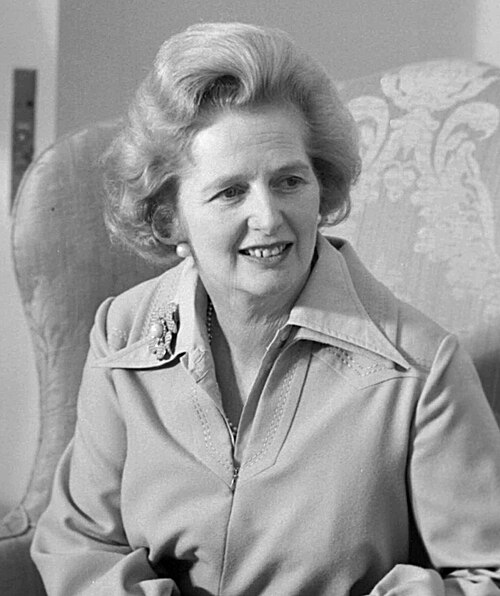 1975年後半のサッチャー | |
 ナショナル プレス クラブ昼食会のスピーカー: マーガレット サッチャー (スピーチ)。[91](7:39に開始、28:33に終了)[92] ナショナル プレス クラブ昼食会のスピーカー: マーガレット サッチャー (スピーチ)。[91](7:39に開始、28:33に終了)[92] |
ヒース政権は1973年も石油禁輸や労働組合の賃上げ要求で困難に直面し、1974年2月の総選挙で敗北した。[88]労働党は少数派政権を樹立し、 1974年10月の総選挙で辛うじて過半数を獲得した。ヒースが保守党を率いるかどうかは、ますます怪しくなった。サッチャーは当初明らかな後継者とは見られていなかったが、最終的に再出発を約束し、主要な対抗馬となった。[ 93]ヒースの主な支持者は議会の1922委員会[93]とザ・スペクテイター[94]だったが、サッチャーの在任期間は、イデオローグというよりは実用主義者という評判を彼女に与えた。[24]ヒースは第1回投票でヒースを破り、ヒースは党首を辞任した。 [95]第2回投票では、ヒースが後継者として望んでいたホワイトローを破った。サッチャーの選出は党内に分極化の影響を及ぼした。彼女への支持は右派議員の間で強かったが、南イングランド出身者やパブリックスクールやオックスブリッジに通ったことのない人々の間でも強かった。[96]
サッチャーは1975年2月11日に保守党党首および野党党首に就任した。 [97]彼女はホワイトローを副党首に任命した。ヒースはサッチャーの党首としての立場に決して納得しなかった。[98]
テレビ評論家のクライヴ・ジェイムズは、保守党党首に選出される前にオブザーバー紙に寄稿し、1973年のサッチャーの声を「黒板を滑り降りる猫」に例えた。 [nb 4]サッチャーはすでに、元テレビプロデューサーのゴードン・リースの助言を受けて、プレゼンテーションの準備をし始めていた。偶然、リースは俳優のローレンス・オリヴィエと出会い、オリヴィエは国立劇場の発声コーチとのレッスンを手配した。 [100] [101] [nb 5]
サッチャーは、ハイエク派の養鶏王アントニー・フィッシャーが設立したシンクタンク、経済問題研究所(IEA)の昼食会に定期的に出席し始めた。彼女は1960年代初頭からIEAを訪れ、その出版物を読んでいた。そこで彼女はラルフ・ハリスやアーサー・セルダンの思想に影響を受け、イギリスの福祉国家に反対する思想運動の顔となった。彼らはケインズ経済学がイギリスを弱体化させていると信じていた。研究所のパンフレットは、政府の縮小、税金の引き下げ、企業と消費者の自由の拡大を提案していた。[104]
サッチャーは、国内外で新自由主義経済の理念を推進しようとした。保守党政権の外交政策の方向性を定めたにもかかわらず、サッチャーは下院で何度も目立たなかったことに悩んだ。その結果、サッチャーは「国内で彼女の声はあまり影響力がない」ので、「より広い世界で彼女の声が聞かれるようになる」と決めた。[105]サッチャーは大西洋を渡って訪問し、国際的な知名度を確立し、経済政策と外交政策を推進した。1975年に米国を訪問し、ジェラルド・フォード大統領と会談し、[106] 1977年に再び訪問し、ジミー・カーター大統領と会談した。[107]その他の外国訪問では、1978年にイランを訪問した際にシャー・モハンマド・レザー・パフラヴィと会談した。 [108]サッチャーは、より大胆な個人的な影響を与えようと、影の外務大臣レジナルド・モードリングを同行させずに旅行することを選んだ。 [107]
内政では、サッチャーはスコットランドの権限委譲(自治)とスコットランド議会の創設に反対した。彼女は1976年12月に保守党議員にスコットランド・ウェールズ法案に反対票を投じるよう指示し、この法案は否決された。その後、新しい法案が提案されたとき、彼女は1979年のスコットランド権限委譲に関する国民投票でイングランド人が投票できるように法律を改正することを支持した。[109]
1970年代のイギリス経済は非常に弱く、当時の外務大臣ジェームズ・キャラハンは1974年に労働党の閣僚らに「民主主義の崩壊」の可能性を警告し、「私が若者だったら、国外へ移住するだろう」と語った。[110] 1978年半ば、経済は回復し始め、世論調査では労働党がリードし、同年後半に総選挙が予定されており、労働党が勝利する可能性が高まっていた。今や首相となったキャラハンは、9月7日にその年は総選挙を行わず、1979年まで投票を待つと発表し、多くの人を驚かせた。サッチャーはこれに反応して労働党政府を「臆病者」と呼び、自由党のリーダー、デイビッド・スティールもこれに加わり、労働党は「怯えている」と批判した。[111]
労働党政権はその後、国の方向性に関する国民の新たな不安と、1978年から1979年の「不満の冬」と呼ばれる冬の間に起こった一連のストライキに直面した。保守党は「労働党は機能していない」というスローガンを掲げた広告で労働党政権の失業記録を攻撃した。 1979年初頭、キャラハン内閣が不信任決議に敗れた後、総選挙が実施された。保守党は下院で44議席の過半数を獲得し、サッチャーは女性初の英国首相となった。[112]
「鉄の女」
| 外部ビデオ | |
|---|---|
| 1976年フィンチリー保守党への演説 | |
 フィンチリー保守党への演説(「鉄の女」であることを認める)(演説) – マーガレット・サッチャー財団経由。[113] フィンチリー保守党への演説(「鉄の女」であることを認める)(演説) – マーガレット・サッチャー財団経由。[113] |
今夜、私はレッドスターのシフォンイブニングドレスを着て、顔には軽く化粧をし、金髪を優しくウェーブさせながら、西洋世界の鉄の女として皆さんの前に立っています。[113]
— 1976年にソ連時代のニックネームを受け入れたサッチャー
1976年、サッチャーは「目覚めた英国」外交政策演説を行い、ソ連は「世界支配に固執している」と激しく非難した。[114]ソ連軍の機関紙レッドスターは「鉄の女が不安を募らせる」という見出しの記事で彼女の立場を伝え、[115]鉄のカーテンに関する彼女の発言をほのめかした。[114] 翌日、サンデータイムズはレッドスターの記事を取り上げ、 [116]サッチャーは1週間後にこの呼び名を受け入れた。フィンチリー保守党への演説で、彼女はそれをウェリントン公爵のあだ名「鉄の公爵」になぞらえた。 [113] 「鉄」の比喩はそれ以来ずっと彼女に付きまとい、[117]他の意志の強い女性政治家の一般的なあだ名となった。 [118]
イギリス首相(1979年~1990年)
| 外部ビデオ | |
|---|---|
| 1979年首相就任時の発言 | |
 ダウニング街10番地、 1979年頃 | |
| 首相就任にあたっての発言(聖フランシスの祈り)(スピーチ) – マーガレット・サッチャー財団経由。[119] |
サッチャーは1979年5月4日に首相に就任した。ダウニング街に到着した彼女は、聖フランシスの祈りを言い換えて次のように述べた。
不和があるところに調和をもたらしましょう。
誤りがあるところに真実をもたらしましょう。
疑いがあるところに信仰をもたらしましょう。
絶望があるところに希望をもたらしましょう。[119]
1980年代を通じて在任中、サッチャーは世界で最も影響力のある女性として頻繁に言及された。[120] [121] [122]
内政
少数民族
サッチャーは、英国で人種間の緊張が高まっていた時期に野党党首および首相を務めた。1977年の地方選挙の際、エコノミスト誌は「保守党の波が小政党を圧倒した。特に国民戦線[NF]は昨年より明らかに衰退した」と評した。[123] [124] 1978年にワールド・イン・アクション誌のインタビューで「英国人の気質は民主主義や法律のために、そして世界中で多くのことを成し遂げてきたので、圧倒されるかもしれないという恐れがあれば、人々は反応し、入ってくる人々に対してむしろ敵対的になるだろう」と述べ、さらに「多くの点で[少数派]はこの国の豊かさと多様性に貢献している。少数派が大きな少数派になりそうになると、人々は恐れる」と発言した後、彼女の支持率は11%上昇した。[125] [126] 1979年の総選挙では、保守党は支持がほぼ崩壊していたNFの票を集めた。[127] 1979年7月のキャリントン外務大臣およびウィリアム・ホワイトロー内務大臣との会談で、サッチャーは、英国に定住することを許可されたベトナム人ボートピープルの総数を2年間で1万人未満に制限するという文脈で、アジア系移民の数に異議を唱えた。 [128]
女王
サッチャー首相は毎週エリザベス女王と会って政府業務について話し合っており、その関係は精査された。[129]キャンベル(2011a、464ページ)は次のように述べている。
女性首相という現象について、世間を魅了し続けた疑問の 1 つは、彼女と女王の関係がどうだったかということである。その答えは、2 人の関係は几帳面なものだったが、どちら側にも愛情はほとんどなかったということだ。2 人の女性は非常に年齢が近く (サッチャー夫人は 6 か月年上)、一方が政府の長、他方が国家元首として社会ピラミッドの頂点で同等の地位を占めていたため、ある意味ではライバル関係になるのは当然だった。サッチャー夫人の女王に対する態度は相反するものだった。一方では、彼女は王室制度に対してほとんど神秘的なほどの畏敬の念を抱いていた [...] しかし同時に、彼女は国を近代化し、王室が永続させてきた価値観や慣習の多くを一掃しようとしていた。
女王の報道官マイケル・シーは1986年にサンデー・タイムズ紙に深い亀裂の話を漏らした。シーは女王がサッチャーの政策は「思いやりがなく、対立的で、社会的に分裂を招く」と感じていたと述べた。[130]サッチャーは後にこう書いている。「私は常に政府の仕事に対する女王の姿勢がまったく正しいと感じていた。[...] 『2人の強力な女性』の衝突の話は作り話にしないわけにはいかないほど素晴らしいものだった。」[131]
経済と課税
サッチャーの経済政策は、マネタリストの考え方や、ミルトン・フリードマンやアラン・ウォルターズなどの経済学者の影響を受けていた。[132]彼女は初代財務大臣ジェフリー・ハウとともに、所得に対する直接税を引き下げ、間接税を引き上げた。[133]彼女は金利を引き上げて通貨供給量の伸びを鈍らせ、それによってインフレを抑制した。[132]公的支出に現金制限を導入し、教育や住宅などの社会サービスへの支出を削減した。[133]高等教育への削減により、サッチャーは、統治議会の738対319の投票と学生の請願により、オックスフォード大学から名誉博士号を授与されていない戦後初のオックスフォード出身の首相となった。[134]
閣僚の一部のヒース派保守党員、いわゆる「ウェット派」はサッチャーの政策に疑問を表明した。[135] 1981年のイングランド暴動は、イギリスのメディアが政策の転換の必要性を議論する結果となった。1980年の保守党大会で、サッチャーは劇作家ロナルド・ミラーが書いた演説でこの問題に直接言及した。[136]その中で特に注目すべきは、次の一節である。
メディアでよく使われるキャッチフレーズ「Uターン」を息をひそめて待っている人たちに、私が言いたいことはただ一つ。「あなたが望むなら、Uターンすればいい。女性はUターンするものではない。」[137]
サッチャー首相の支持率は1980年12月までに23%に落ち込み、歴代首相の支持率を下回った。[138] 1980年代初頭の不況が深刻化すると、サッチャー首相は増税を実施した。[139] 1981年3月に364人の著名な経済学者が署名した声明で表明された懸念にもかかわらず、サッチャー首相は増税を実施した。 [140]この声明では、「需要を縮小させることでインフレを恒久的に抑制できるという政府の考えには経済理論上の根拠がない」と述べ、「現在の政策は不況を深刻化させ、我が国の経済の産業基盤を蝕み、社会的・政治的安定を脅かす」と付け加えた。[141]

1982年までに、英国は経済回復の兆しを見せ始めた。[142]インフレ率は最高値の18%から8.6%に低下したが、失業率は1930年代以来初めて300万人を超えた。[143] 1983年までに、全体的な経済成長はより強くなり、インフレと住宅ローン金利は13年ぶりの最低水準にまで低下したが、製造業の雇用が総雇用に占める割合は30%強にまで低下した。[144]総失業率は依然として高く、1984年には330万人でピークに達した。[145]
1982年の保守党大会でサッチャーは「我々はこれまでのどの保守党政権よりも社会主義の限界を押し戻すことに尽力してきた」と述べた。[146]彼女は翌年の党大会で、英国国民は国家社会主義を完全に拒否し、「国家には国民が自分で稼いだお金以外の資金源はない[...] 公的資金など存在しない。あるのは納税者のお金だけだ」と理解していると述べた。[147]
1987年までに失業率は低下し、経済は安定して好調で、インフレ率は低かった。世論調査では保守党が圧倒的にリードし、地方議会選挙の結果も良好だったため、サッチャー首相は選挙期限までまだ12か月あったにもかかわらず、同年6月11日に総選挙を実施した。この選挙でサッチャー首相は3期連続で再選された。[148]
サッチャー首相は、イギリスが為替レートメカニズム(ERM、欧州経済通貨同盟の前身)に加盟するとイギリス経済が制約されると考え、これに断固反対していたが、財務大臣ナイジェル・ローソンと外務大臣ジェフリー・ハウの両者の説得にもかかわらず[149] 、 1990年10月にローソンの後任の財務大臣ジョン・メージャーに説得され、高すぎるレートでERMに加盟した[151] 。
サッチャーは地方税を改革し、住宅税(住宅の名目賃貸価格に基づく税金)をコミュニティーチャージ(または人頭税)に置き換え、成人居住者それぞれに同額を課した。[152]この新しい税金は1989年にスコットランドで、翌年にはイングランドとウェールズで導入され、[153]彼女の首相時代の政策の中で最も不評であった。[152]国民の不安は頂点に達し、1990年3月にはロンドンで7万人から20万人の[154]デモが起きた。トラファルガー広場周辺のデモは暴動に発展し、113人が負傷し、340人が逮捕された。[155]コミュニティーチャージは1991年に後継者のジョン・メージャーによって廃止された。[155]その後、サッチャー自身もこの税金の登録を怠っており、登録用紙を返送しないと罰金を科すと脅されていたことが判明した。[156]
労使関係
サッチャーは、労働組合は一般の労働組合員と国民の両方に有害であると信じていた。[157]彼女は労働組合の力を弱めることに尽力し、ストライキによって議会制民主主義と経済活動を弱体化させていると非難した。[158]いくつかの労働組合は、その力を制限するために導入された法律に反発してストライキを起こしたが、抵抗は最終的に崩壊した。[159] 1983年の総選挙で労働党に投票した組合員はわずか39%だった。[160] 2004年のBBC政治記者によると、サッチャーは「ほぼ一世代にわたって労働組合の力を破壊することに成功した」という。[161] 1984年から85年にかけての炭鉱労働者のストライキは、労働組合とサッチャー政権の間で最大かつ最も壊滅的な対立だった。[162]

1984年3月、国立石炭公社(NCB)は、国営炭鉱174か所のうち20か所を閉鎖し、18万7000人のうち2万人の雇用を削減することを提案した。[163] [164] [165]アーサー・スカーギル率いる全国炭鉱労働組合(NUM)の指導の下、国内の炭鉱労働者の3分の2が抗議のストライキを行った。[163] [166] [167]しかし、スカーギルは、以前にも全国ストライキ(1982年1月と10月、1983年3月)で3回の投票に敗れていたため、ストライキの投票を拒否した。 [169]このため、高等法院はストライキを違法と宣言した。[170] [171]
サッチャー首相は労働組合の要求に応じることを拒否し、炭鉱労働者の紛争をフォークランド紛争に例え、1984年の演説で「我々はフォークランド諸島の外の敵と戦わなければならなかった。我々は常に内なる敵の存在を意識しなければならない。内なる敵との戦いははるかに困難で、自由にとってより危険である」と宣言した。 [172]サッチャー首相の反対派は、彼女の発言は労働者階級に対する軽蔑を示すものだと特徴づけ、それ以来ずっと彼女を批判してきた。[173]
1985年3月に1年間続いたストライキの後、NUMの指導部は合意なしに譲歩した。経済への損失は少なくとも15億ポンドと推定され、ストライキはポンドが米ドルに対して下落した大きな原因となった。[174]サッチャーはストライキの終結について「もし誰かが勝ったとすれば、それは仕事にとどまった炭鉱労働者と「英国を支えてきた人々」だ」と声明で振り返った。[175]
政府は1985年に採算の取れない炭鉱25ヶ所を閉鎖し、1992年までに合計97ヶ所の炭鉱が閉鎖された。[165]残った炭鉱は1994年に民営化された。[176]その結果、赤字を出していない炭鉱も含め150ヶ所の炭鉱が閉鎖され、数万人の雇用が失われ、地域社会全体が壊滅する結果となった。[165]ストライキはヒース政権の崩壊を後押しし、サッチャーはヒースが失敗したところで成功しようと決意した。燃料備蓄を準備し、強硬派のイアン・マクレガーをNCBのリーダーに任命し、警察が適切に訓練され暴動鎮圧用の装備を装備するようにするという彼女の戦略は、ストライキ中の炭鉱労働者に対する彼女の勝利に貢献した。[177]
英国全土でのストライキの件数は1979年に4,583件でピークに達し、2,900万日以上の労働日が失われた。炭鉱労働者のストライキが起きた1984年には1,221件で、2,700万日以上の労働日が失われた。その後、サッチャー首相の任期中はストライキは着実に減少し、1990年にはストライキは630件で労働日数は200万日未満となり、その後も減少し続けた。[178]サッチャー政権下では労働組合の組織率も急激に低下し、労働組合に加入している労働者の割合は1979年の57.3%から1985年には49.5%に低下した。 [179] 1979年からサッチャー政権最後の年まで、労働組合の会員数も1979年の1,350万人から1,000万人未満に減少した。[180]
民営化
民営化政策は「サッチャー主義の重要な要素」と呼ばれている。[181] 1983年の選挙後、国営公共事業の売却が加速し、[182]国有化された産業の売却で290億ポンド以上、公営住宅の売却でさらに180億ポンドが調達された。[183] 民営化のプロセス、特に国有化された産業の民営化に向けた準備は、特に労働生産性の面で業績の著しい向上と関連していた。[184]
ガス、水道、電気など、民営化された産業の中には、民営化しても競争がほとんど増加しない自然独占産業もあった。民営化されて改善がみられた産業は、国有化されていた間に改善がみられたこともあった。ブリティッシュ・スチール社は、政府任命のマクレガー会長のもと、国有化産業であった間に収益性を大幅に向上させ、労働組合の反対を押し切り工場を閉鎖し、従業員を半減させた。[185]政府の直接管理が失われたことを補うため、オフテル(1984年)、オフガス(1986年)、国立河川庁(1989年)などの規制機関が設立され、規制も大幅に拡大された。[186]民営化された産業間の競争、規制、業績の程度には明確なパターンはなかった。[184]
ほとんどの場合、民営化は消費者に価格低下と効率性向上の面で利益をもたらしたが、全体的な結果はまちまちであった。[187]民営化された企業のすべてが長期的に株価上昇に成功したわけではない。[188] 2010年のIEAのレビューでは、「競争や効果的な規制が導入されると、業績が著しく改善されたのは事実のようだが、文献は一致していないことを再度強調しておく」と述べられている。[189]
サッチャー首相はイギリス鉄道の民営化に常に抵抗し、運輸大臣ニコラス・リドリーに「鉄道の民営化はこの政権にとってのワーテルローとなるだろう。二度と鉄道のことは私に言わないでほしい」と語ったと言われている。1990年に辞任する直前、サッチャー首相は民営化の議論を受け入れ、後任のジョン・メージャー首相が1994年に民営化を実施した。[190]
公的資産の民営化は経済成長を促進するために金融規制緩和と組み合わされた。ジェフリー・ハウ財務大臣は1979年に英国の為替管理を廃止し[191] 、これによりより多くの資本が海外市場に投資されるようになり、 1986年のビッグバンによりロンドン証券取引所に対する多くの規制が撤廃された[191]。
北アイルランド

1980年と1981年、北アイルランドのメイズ刑務所に収監されていた暫定アイルランド共和軍(PIRA) とアイルランド民族解放軍(INLA) の囚人たちは、1976年に前労働党政権によって追放されていた政治犯の地位を取り戻すため、ハンガーストライキを実施した。[192]ボビー・サンズは、囚人たちが生活環境について譲歩を得られなければ死ぬまで断食すると述べ、1981年のストライキを開始した。[192]サッチャーは、「犯罪は犯罪であり、政治的なものではない」と宣言し、囚人たちの政治的地位への復帰を容認しなかった。[192]それにもかかわらず、英国政府は、ハンガーストライキを終わらせるために、共和党指導者たちに非公式に連絡を取った。[193]サンズと他の9人の死後、ストライキは終了した。準軍事的囚人たちにはいくらかの権利が回復されたが、政治的地位の公式な承認はされなかった。[194]北アイルランドでの暴力はハンガーストライキ中に大幅にエスカレートした。[195]
サッチャー首相は1984年10月12日の早朝、ブライトンのホテルでIRAによる暗殺未遂に遭い、かろうじて負傷を免れた。 [196]ジョン・ウェイクハム大臣の妻を含む5人が殺害された。サッチャー首相は翌日予定通り開会すべきだと主張した保守党大会の準備のためホテルに滞在していた。[196]彼女は当初の草稿から書き直したものの、予定通りの演説を行い、 [ 197]政治的立場を問わず支持され、国民の間での彼女の人気が高まった。[198]
1981年11月6日、サッチャー首相とアイルランド首相のギャレット・フィッツジェラルド氏は、両政府間の会合の場として、英愛政府間協議会を設立した。[194] 1985年11月15日、サッチャー首相とフィッツジェラルド氏はヒルズボロ英愛協定に署名した。これは、英国政府がアイルランド共和国に北アイルランドの統治に関する諮問機関としての役割を与えた初めての事例であった。これに抗議して、イアン・ペイズリー率いるアルスター・セイズ・ノー運動がベルファストで10万人の集会を開き、[200]後にPIRAに暗殺されたイアン・ガウ氏は財務大臣を辞任し、[ 201 ] [ 202 ]ユニオニスト派の国会議員15人全員が議席を辞した。1986年1月23日の補欠選挙では1人だけが当選しなかった。[203]
環境
サッチャーは積極的な気候保護政策を支持し、 1990年の環境保護法の成立、[204]ハドレー気候研究予測センターの設立、[205]気候変動に関する政府間パネルの設立、[206]オゾン層の保護に関するモントリオール議定書の批准に尽力した。[207]
サッチャーは1980年代後半に気候変動、酸性雨、一般的な汚染をイギリスの主流に据えることに貢献し、 [206] [208] 1989年に気候変動に関する世界条約の締結を求めた。[209]彼女の演説には1988年の王立協会での演説や[210] 1989年の国連総会での演説などがある。
外務
サッチャーは1979年、党の貴族院議員で元国防大臣のキャリントン卿を外務省長官に任命した。[211]キャリントン卿は「ウェット」とみなされていたが、国内問題を避け、サッチャーとうまくやっていた。問題の一つは、圧倒的な国際的批判に直面しながらも、繁栄し黒人が多数を占める分離独立植民地を統治することを決意した白人少数派がいたローデシアをどうするかだった。1975年に大陸でポルトガルが崩壊すると、(ローデシアの主な支援国であった)南アフリカは同盟国が重荷であると認識した。黒人による統治は避けられず、サッチャー政権は1979年12月にランカスター・ハウス合意を通じてローデシアのブッシュ戦争を終わらせる平和的解決を仲介した。ランカスター・ハウスでの会議には、ローデシアのイアン・スミス首相のほか、主要な黒人指導者であるムゾレワ、ムガベ、ンコモ、トンゴガラが出席した。その結果、1980年に黒人支配下の新しいジンバブエ国家が誕生した。[212]
冷戦
サッチャーの最初の外交政策の危機は、1979年のソ連のアフガニスタン侵攻だった。彼女はこの侵攻を非難し、デタント政策の破綻を示すものだと述べ、 1980年のモスクワオリンピックをボイコットするよう一部の英国選手を説得した。彼女は、ソ連を経済制裁で罰しようとしたジミー・カーター米大統領を弱々しく支持した。英国の経済状況は不安定で、NATOの大半は貿易関係の断絶に消極的だった。[213]それでもサッチャーは、ホワイトホールがMI6(SASと共に)にアフガニスタンでの「破壊的行動」を承認することを承認した。[214]彼らはサイクロン作戦でCIAと協力するだけでなく、ムジャヒディンに武器、訓練、諜報も提供した。[215]
フィナンシャル・タイムズは2011年に、彼女の政府が1981年以来、サダム・フセイン政権下のイラクに「非致死性」の軍事装備を秘密裏に供給していたと報じた。[216] [217]
1979年にポル・ポト政権の公式承認を撤回したサッチャー政権は、[218]カンボジア・ベトナム戦争でカンボジアの権力を追われたクメール・ルージュが国連議席を維持することを支持した。サッチャーは当時これを否定したが、[219] 1991年に、直接クメール・ルージュを訓練していなかったものの、[220] 1983年からベトナムが支援する傀儡政権との戦いでノロドム・シハヌーク王子と元首相ソン・サンに忠誠を誓い続けた「カンボジアの非共産主義抵抗軍」を秘密裏に訓練するために特殊空挺部隊(SAS)が派遣されていたことが明らかになった。[221] [222]
サッチャーは改革派ソ連指導者ミハイル・ゴルバチョフに温かく反応した最初の西側指導者の一人だった。レーガン・ゴルバチョフ首脳会談とソ連におけるゴルバチョフによる改革を受けて、彼女は1988年11月に「我々は今冷戦状態にあるのではなく、むしろ冷戦がかつて経験したよりもはるかに広範な新しい関係にある」と宣言した。[223]彼女は1984年にソ連を公式訪問し、ゴルバチョフと閣僚会議議長ニコライ・ルイシュコフと会談した。[224]
米国とのつながり
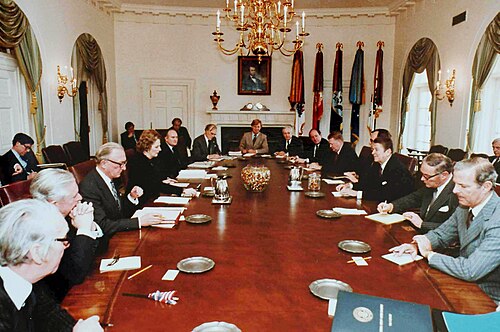
性格は正反対であったが、サッチャーはロナルド・レーガン米大統領とすぐに親交を深めた。[注 6]彼女は共産主義に対する共通の不信感に基づき、レーガン政権の冷戦政策を強く支持した。[159] 1983年、レーガンがグレナダ侵攻について彼女と相談しなかったとき、激しい意見の相違が生じた。[225] [226]
首相就任1年目、彼女はNATOによる米国の核巡航ミサイルとパーシングIIの西ヨーロッパへの配備決定を支持し、 [159]米国が1983年11月から160発以上の巡航ミサイルをイギリス空軍グリーナム・コモン基地に配備することを許可し、核軍縮キャンペーンによる大規模な抗議を引き起こした。[159]彼女はポラリスの後継として米国からトライデント核ミサイル潜水艦システムを購入し、英国の核戦力を3倍に増強した[227] が、最終的には120億ポンド以上(1996~97年の価格で)の費用がかかった。[228]サッチャーの米国との防衛関係重視の姿勢は、1985~86年のウェストランド事件で実証された。彼女は同僚らと行動を共にし、経営難に陥っていたヘリコプター製造会社ウェストランドがイタリアの企業アグスタからの買収提案を拒否し、代わりに経営陣が好む選択肢であるシコルスキー・エアクラフトとの提携を認めたのである。アグスタ協定を支持していたマイケル・ヘセルティン国防大臣は抗議して政府を辞任した。[229]
1986年4月、エリザベス女王は、リビアによるベルリンのディスコ爆撃疑惑への報復として、国連憲章第51条に基づく自衛権を根拠に、米軍F-111戦闘機によるリビア爆撃をイギリス空軍基地で許可した。[230] [231 ] [注7]世論調査によると、エリザベス女王の決定を支持した英国民は3人に1人にも満たなかった。[233]
1990年8月、イラクの指導者サダム・フセインがクウェートに侵攻したとき、サッチャーは米国を公式訪問していた。 [234] 1989年にレーガンの後を継いだジョージ・H・W・ブッシュ大統領との会談で、彼女は介入を勧告し、 [234]イラク軍をクウェートから追い出すために中東に軍隊を派遣するようブッシュに圧力をかけた。 [235]ブッシュはこの計画に不安を感じ、サッチャーは電話会談でブッシュに「今はぐらついている場合ではない」と述べた。[236] [237]サッチャー政権は湾岸戦争に向けて国際連合軍に軍隊を供給したが、1991年1月17日に戦闘が始まるまでに彼女は辞任していた。[238] [239]彼女はバックベンチで連合軍の勝利を称賛する一方で、「平和の勝利は戦争の戦いよりも時間がかかる」と警告した。[240] 2017年にサッチャーがクウェート侵攻後に化学兵器でサダムを脅迫することを示唆していたことが明らかになった。 [241] [242]
南大西洋の危機
1982年4月2日、アルゼンチンの軍事政権はイギリスの海外領土であるフォークランド諸島とサウスジョージア島への侵攻を命じ、フォークランド戦争が勃発した。[243]その後の危機は「[サッチャー]首相の任期を決定づける瞬間」となった。[244]ハロルド・マクミランとロバート・アームストロングの提案により、[244]彼女は戦争遂行を監督するために小規模な戦時内閣(正式にはODSA、南大西洋海外防衛委員会と呼ばれる)を設立して議長を務め、 [245] 4月5日から6日までに諸島奪還のために海軍機動部隊を承認し派遣した。 [246]アルゼンチンは6月14日に降伏し、 255人のイギリス軍人と3人のフォークランド諸島民が死亡したにもかかわらず、コーポレート作戦は成功と称賛された。アルゼンチンの死者は合計649人で、その半数は5月2日に原子力潜水艦HMS コンカラーが巡洋艦ARA ヘネラル・ベルグラーノを魚雷で撃沈したことによるものであった。[247]
サッチャーは、戦争につながったフォークランド諸島防衛の怠慢について、特に労働党議員タム・ダリエルからヘネラル・ベルグラノ号を魚雷で撃沈する決定について国会で批判されたが、全体としては有能で献身的な戦争指導者とみなされていた。[248]「フォークランド要因」、1982年初頭に始まった経済回復、そして激しく分裂した野党のすべてが、1983年のサッチャーの2度目の選挙勝利に貢献した。[249]サッチャーは戦後、「フォークランド精神」について頻繁に言及した。[250]ヘイスティングス&ジェンキンス(1983、329ページ)は、これは平時の内閣政府の骨の折れる交渉よりも、戦時内閣の合理化された意思決定を好んだことを反映していると示唆している。
香港との交渉
1982年9月、彼女は中国を訪問し、鄧小平と1997年以降の香港の主権について協議した。中国はサッチャー首相が首相として訪問した最初の共産主義国であり、彼女は中国を訪問した最初の英国首相であった。会談中、彼女は香港における英国の継続的な存在に対する中国の同意を求めた。鄧小平は、香港に対する中国の主権は交渉の余地がないと主張したが、正式な交渉を通じて英国政府と主権問題を解決する用意があると述べた。両政府は香港の安定と繁栄を維持することを約束した。[251] 2年間の交渉の後、サッチャーは中国政府に譲歩し、 1984年に北京で中英共同宣言に署名し、1997年に香港の主権を譲渡することに同意した。[252]
南アフリカのアパルトヘイト
サッチャー首相はアパルトヘイトを終わらせるための「平和的交渉」に賛成していると述べたにもかかわらず、[253] [254]英連邦および欧州経済共同体(EEC) が南アフリカに課した制裁に反対した。[255]彼女は南アフリカ政府にアパルトヘイトを放棄するよう説得しながら、同国との貿易を維持しようとした。これには「自らをボタ大統領の率直な友人と位置づけ」、1984年にボタ大統領を英国に招待したことも含まれていた。 [ 256]彼の政府に対する「避けられないデモ」にもかかわらず。[257]カナダの放送局BCTV ニュースのアラン・メリーデューはサッチャー首相に、「南アフリカの英国企業を標的にするという ANC の声明の報道に対して」どう反応したかと尋ねた。これに対して彼女は後にこう答えた。「ANCが英国企業を標的にすると言ったとき、これが典型的なテロ組織であることがわかります。私は生涯ずっとテロと戦ってきましたが、もっと多くの人がテロと戦い、私たち全員がもっと成功していれば、テロはなくなるはずです。このホールにいる皆さんがテロと戦い続けることが正しいと考えてくれることを願っています。」 [ 258]ネルソン・マンデラは、刑務所から釈放されてから5か月後に英国を訪問した際、サッチャーを称賛した。「彼女はアパルトヘイトの敵です。彼女には感謝すべきことがたくさんあります。」[256]
ヨーロッパ
| 外部ビデオ | |
|---|---|
| 1988年ヨーロッパ大学でのスピーチ | |
| ヨーロッパ大学での演説(「ブルージュ演説」)(演説) – マーガレット・サッチャー財団経由。[259] |
サッチャーと彼女の政党は、1975年の国民投票[260]と1986年の単一ヨーロッパ法 でイギリスのEEC加盟を支持し、イギリスの拠出金の払い戻しを獲得した[261]が、彼女はこの組織の役割は自由貿易と効果的な競争の確保に限定されるべきであると信じ、EECのアプローチが小さな政府と規制緩和に関する彼女の見解と相容れないことを恐れた。[262]単一市場は政治的統合をもたらすと信じていたため、[261]サッチャーのさらなるヨーロッパ統合への反対は、彼女の首相時代、特に1987年の第3次政権以降、より顕著になった。[263] 1988年のブリュージュ演説で、サッチャーは、連邦制と意思決定の集中化の強化を求めるEEC [259]の提案に反対する姿勢を表明した。
我々は英国における国家の境界線を撤回することに成功しておらず、ヨーロッパレベルで境界線が再び押し付けられ、ヨーロッパの超国家がブリュッセルから新たな支配力を行使しているのを目にしているだけである。[262]
サッチャー首相はフランソワ・ミッテラン仏大統領の懸念を共有し、[264]当初はドイツ再統一に反対し、[注 8]ゴルバチョフ氏に「ドイツ再統一は戦後の国境変更につながるため、国際情勢全体の安定を損ない、我が国の安全を危険にさらす可能性があるため、認めることはできない」と語った。彼女は統一ドイツがソ連とより緊密に連携し、NATOから離脱するのではないかと懸念を表明した。[266]
1990年3月、サッチャーはドイツ再統一をテーマにチェッカーズセミナーを開催し、閣僚やノーマン・ストーン、ジョージ・アーバン、ティモシー・ガートン・アッシュ、ゴードン・A・クレイグなどの歴史家が出席した。セミナー中、サッチャーは「不安、攻撃性、自己主張、いじめ、利己主義、劣等感、感傷性など、アーバンが「酒場の決まり文句」と呼んだドイツ人の性格」について説明した。出席者はサッチャーの発言に衝撃を受け、戦後のドイツの集団的罪悪感やドイツ人が過去を乗り越えようとしていることを「明らかに知らない」ことに「愕然とした」 。[267]会議の内容は外交政策顧問のチャールズ・パウエルによってリークされ、その後、彼女の発言は激しい反発と論争に見舞われた。[268]
同月、ドイツのヘルムート・コール首相はサッチャー首相に対し、「統一に関する彼の意図をすべて彼女に知らせ続ける」と保証し、[269] 「閣僚ですら知らない事柄」を明らかにする用意があると述べた[269]。
リーダーシップへの挑戦と辞任

首相在任中、サッチャーの平均支持率は戦後首相の中で2番目に低かった(40%)。1989年10月にナイジェル・ローソンが首相を辞任して以来、[270]世論調査では一貫して彼女の支持率は政党より低いことが示された。[271]自らを信念の政治家と称するサッチャーは、世論調査の支持率は気にしていないと常に主張し、その代わりに無敗の選挙記録を強調した。[272]
1989年12月、保守党の党首の座をめぐって、サッチャーは無名の野党議員サー・アンソニー・マイヤーに挑戦された。[273]投票資格のある保守党議員374人のうち、314人がサッチャーに、33人がマイヤーに投票した。党内のサッチャー支持者はこの結果を成功とみなし、党内に不満があるという主張を否定した。[273]
1990年9月の世論調査では、労働党が保守党に対して14%のリードを築いたと報告され、[274] 11月までに保守党は労働党に18か月遅れをとっていた。[271]これらの評価は、サッチャーの戦闘的な性格と同僚の意見を無視する傾向と相まって、党内の不満をさらに高めた。[275]
1989年7月、サッチャー首相は、ローソン首相とともに英国が欧州為替レートメカニズム(ERM)に加盟する計画にハウ外相が同意するよう強要した後、ハウ外相を解任した。英国は1990年10月にERMに加盟した。
1990年11月1日、1979年のサッチャー政権の最後の閣僚であったハウは、欧州通貨統合に向けた動きに対する公然たる敵意を理由に副首相を辞任した。[274] [276]サッチャー政権の失脚につながった11月13日の辞任演説で[277]、ハウは、既存の通貨と競合する新しい欧州通貨(「ハードECU 」)に対する政府の提案に対するサッチャーの公然たる否定的な態度を非難した。
いったい、財務大臣とイングランド銀行総裁は、ECU の努力を称賛しているのに、このような雑音が立ち込める中で、議論の真剣な参加者として受け止められるのだろうか。財務大臣も総裁もクリケット愛好家だと思うので、クリケットの比喩が独占されていないことを願う。それは、開幕打者を打席に送り出して、最初のボールが投げられた瞬間に、試合前にチームのキャプテンによってバットが折られていたことに気づくようなものだ。[278] [279]
11月14日、マイケル・ヘーゼルティンは保守党の党首に挑んだ。[280] [281]世論調査では、彼が保守党を労働党より全国的にリードさせると示されていた。[282]第1回投票では、サッチャーが保守党議員204名 (54.8%) の票を獲得し、ヘーゼルティンが152名 (40.9%) の票を獲得、棄権16名でリードしたものの、サッチャーは必要な15%の過半数に4票足りなかった。そのため、第2回投票が必要となった。[283]サッチャーは当初、第2回投票で「戦い続け、勝利するために戦う」と宣言したが、閣僚との協議の結果、撤退を決意した。[275] [284]女王に謁見し、他の世界の指導者に電話をかけ、下院で最後の演説を行った後、[285] 11月28日、涙ながらにダウニング街を去った。彼女は自身の追放を裏切りとみなしたと伝えられている。 [ 286]彼女の辞任は英国国外の多くの人々に衝撃を与え、ヘンリー・キッシンジャーやゴルバチョフなどの外国の観察者は個人的に驚愕を表明した。[287]
ジョン・メージャー財務大臣がサッチャーに代わって政府と党首に就任したが、第2回投票でメージャーはヘーゼルティンに十分なリードを奪い、ヘーゼルティンは脱落した。メージャーは1992年総選挙までの17か月で保守党の支持率上昇を監督し、1992年4月9日に同党を4連勝に導いた。[288]サッチャーはヘーゼルティンとの党首争いでメージャーを応援していたが、後年メージャーへの支持は薄れていった。[289]
晩年
バックベンチへの復帰(1990年~1992年)
サッチャーは首相を退任した後、選挙区議員として下院議員に復帰した。[290]辞任後、国内での支持率は回復したが、彼女の政権が国にとって良いものであったかどうかについては世論が分かれたままであった。[270] [291] 66歳で、彼女は下院を退くことで自分の意見をより自由に発言できるようになると述べ、1992年の総選挙で下院を引退した。[292]
ポストコモンズ(1992年~2003年)
下院議員を退任したサッチャーは、財団を設立した初の元英国首相となった。[293]マーガレット・サッチャー財団の英国支部は、財政難のため2005年に解散した。[294]彼女は回想録2巻を執筆しており、The Downing Street Years(1993年)とThe Path to Power (1995年)である。1991年、彼女と夫のデニスは、ロンドン中心部のベルグレイヴィア地区にある住宅街の庭園広場、チェスタースクエアに引っ越した。[295]
サッチャーは1992年7月にタバコ会社フィリップモリスに「地政学コンサルタント」として年俸25万ドルと財団への年間寄付25万ドルで雇われた。[296]サッチャーはスピーチ1回につき5万ドルを稼いだ。[297]
サッチャーはクロアチアとスロベニアの独立を主張するようになった。[298]ユーゴスラビア戦争についてコメントした彼女は、1991年にクロアチアのラジオテレビのインタビューで、西側諸国の政府がクロアチアとスロベニアの分離独立共和国を独立国として承認せず、セルビア主導のユーゴスラビア軍の攻撃後に武器を供給しなかったことを批判した。[299] 1992年8月、彼女はボスニア戦争中の民族浄化を終わらせるためにNATOにゴラジュデとサラエボへのセルビアの攻撃を止めるよう求め、ボスニア・ヘルツェゴビナの状況を「ヒトラーとスターリンの蛮行」に例えた。[300]
彼女は貴族院でマーストリヒト条約を批判する一連の演説を行い、[292]同条約を「行き過ぎた条約」と評し、「私はこの条約に署名することは決してできなかった」と述べた。[301]彼女はAVダイシーを引用し、主要3政党すべてが条約に賛成しているため、国民は国民投票で意見を述べるべきだと主張した。[302]
サッチャーは1993年から2000年までバージニア州のウィリアム・アンド・メアリー大学の名誉総長を務めた[303]一方、1992年から1998年まで私立大学バッキンガム大学の総長も務めた[304] [305]。この大学はサッチャーが前教育長官として1976年に正式に開校した大学である[305] 。
1994年にトニー・ブレアが労働党党首に選出されると、サッチャーはブレアを「おそらくヒュー・ゲイツケル以来最も手強い労働党党首」と称賛し、「彼らの最前列のベンチの後ろには社会主義的な人がたくさんいるが、ブレア氏にはそれがない。彼は本当に動いたと思う」と付け加えた。[306]ブレアも同じように応えた。「彼女は徹底的に決断力のある人であり、それは称賛に値する資質だ」[307]
1998年、スペインがチリの元独裁者アウグスト・ピノチェトを逮捕し、人権侵害の罪で裁判にかけようとした際、サッチャー首相はピノチェトの釈放を求めた。彼女はフォークランド紛争中にピノチェトがイギリスを支援したことを例に挙げた。[ 308] 1999年、彼女はロンドン近郊で自宅軟禁されていたピノチェトを訪ねた。[309]ピノチェトは2000年3月、ジャック・ストロー内務大臣によって健康上の理由で釈放された。[310]

2001年の総選挙では、サッチャーは1992年と1997年と同様に保守党の選挙運動を支持し、敗北後の保守党党首選挙では、ケネス・クラークではなくイアン・ダンカン・スミスを支持した。[311] 2002年には、ジョージ・W・ブッシュにサダム・フセイン政権下のイラクの「未完の仕事」に積極的に取り組むよう促し、 [312]イラク戦争でブッシュに味方したブレアの「強力で大胆なリーダーシップ」を称賛した。[313]
彼女は2002年4月に出版され、ロナルド・レーガンに捧げられた著書『Statecraft: Strategies for a Changing World 』でも同じテーマを取り上げ、サダムが倒されるまで中東に平和はないだろうと書いている。また、彼女の著書では、イスラエルは平和と引き換えに土地を手放さなければならないと述べ、欧州連合(EU)は「根本的に改革不可能な」「典型的なユートピア計画、知識人の虚栄心の記念碑、失敗が避けられない計画」であると述べた。[314]彼女は、英国は加盟条件を再交渉するか、さもなければEUを離脱して北米自由貿易地域に加盟すべきだと主張した。[315]
数回の軽い脳卒中を起こした後、医師は彼女にこれ以上の公の場での講演は控えるよう勧めた。[316] 2002年3月、彼女は医師の助言に従って、予定していた講演をすべてキャンセルし、これ以上の講演は受けないことを発表した。[317]
ダウニング街の年月より抜粋
首相は孤独な仕事です。ある意味、そうあるべきです。群衆の中からリーダーになることはできません。しかし、デニスがいれば、私は決して孤独ではありませんでした。なんと素晴らしい男、なんと素晴らしい夫、なんと素晴らしい友人でしょう。
サッチャー(1993年、23ページ)
2003年6月26日、サッチャーの夫であるサー・デニスが88歳で亡くなりました。[318]彼の遺体は7月3日にロンドンのモートレイク火葬場で火葬されました。 [319]
最終年(2003年~2013年)

2004年6月11日、サッチャーは(医師の指示に反して)ロナルド・レーガンの国葬に出席した。[320]彼女はビデオテープで弔辞を述べた。彼女の健康状態を考慮して、メッセージは数か月前に事前に録画されていた。[321] [322]サッチャーはレーガンの随行員とともにカリフォルニアに飛び、ロナルド・レーガン大統領図書館で行われた大統領の追悼式と埋葬式に出席した。[323]
2005年、サッチャーはブレアが2年前にイラク侵攻を決断したことを批判した。サッチャーはサダム・フセイン打倒のための介入を依然として支持していたが、(科学者として)軍事力を投入する前に常に「事実、証拠、証明」を探すと述べた。 [239]彼女は10月13日にロンドンのハイドパークにあるマンダリン・オリエンタル・ホテルで80歳の誕生日を祝った。ゲストには女王、エディンバラ公、アレクサンドラ王女、トニー・ブレアがいた。[324]アベラヴォンのハウ男爵ジェフリー・ハウも出席し、元リーダーについて次のように語った。「彼女の本当の勝利は、1つの政党だけでなく2つの政党に変革を起こしたことだ。その結果、労働党が最終的に復帰したとき、サッチャー主義の大部分は不可逆的なものとして受け入れられた。」[325]
米国では2006年
2006年、サッチャーは米国に対する9/11攻撃の5周年を記念するワシントンの公式追悼式に出席した。彼女はディック・チェイニー副大統領のゲストであり、訪問中にコンドリーザ・ライス国務長官と会談した。 [326] 2007年2月、サッチャーは国会議事堂に銅像が建てられた初の存命の英国首相となった。銅像は彼女の政治的英雄であるウィンストン・チャーチルの銅像の向かいに建てられ、[327] 2007年2月21日にサッチャーも出席して除幕された。彼女は下院議員ロビーで「鉄のほうがよかったかもしれないが、青銅でもいい [...] 錆びないから。」と述べた。[327]
サッチャーは、ヨーロッパの良心と共産主義に関するプラハ宣言とその結果としてのプラハ・プロセスの公的な支持者であり、その前の会議に支持の公開書簡を送った。[328]
サッチャー首相は貴族院の晩餐会で倒れた後、低血圧に苦しみ[329]、 2008年3月7日に検査のためロンドン中心部のセント・トーマス病院に入院した。2009年に彼女は転倒して腕を骨折し、再び入院した。[330]サッチャー首相は2009年11月下旬にダウニング街10番地に戻り、芸術家リチャード・ストーンによる公式肖像画の除幕式に出席した。[331]これは存命の元首相にとっては異例の栄誉である。ストーンは以前にも女王とエリザベス2世の母の肖像画を描くよう依頼されていた。[331]
2011年7月4日、サッチャーはロンドンの米国大使館前で行われた高さ10フィート(3.0メートル)のロナルド・レーガン像の除幕式に出席する予定だったが、健康状態が悪かったため出席できなかった。[332]彼女が最後に貴族院に出席したのは2010年7月19日であり、[333] 2011年7月30日には貴族院での彼女の事務所が閉鎖されたことが発表された。[1]その月の初め、サッチャーはイプソス・モリの世論調査で過去30年間で最も有能な首相に選ばれた。[334]
サッチャーの娘キャロルは2005年に初めて母親が認知症であることを明かし、[335]「母は記憶障害のため、もうほとんど本を読まない」と述べた。2008年の回想録でキャロルは、母親は「文章の終わりまで読む頃には、文章の始まりさえほとんど思い出せなかった」と書いている。[335]彼女は後に、会話の中でサッチャーがフォークランド紛争とユーゴスラビア紛争を混同していたときに初めて母親の認知症に襲われたことを語った。彼女は、夫のデニスが亡くなったことを母親に何度も伝えなければならなかった苦痛を思い出した。[336]
死と葬式(2013)
サッチャーは2013年4月8日、脳卒中を起こし87歳で亡くなった。彼女はベルグレイヴィアのチェスタースクエアにある自宅の階段を登るのが困難になったため、2012年12月からロンドンのリッツホテルのスイートルームに滞在していた。 [337]彼女の死亡証明書には、主な死因として「脳血管障害」と「反復性一過性脳虚血発作」と記載されていた。[338]二次的な死因として「膀胱癌」と認知症と記載されていた。 [338]
サッチャー首相の死去のニュースに対する反応は英国全土で様々であり、彼女を英国史上最高の平時首相と称賛する賛辞から、彼女の死を公に祝う声、憎悪や個人的な悪意のある表現まで多岐にわたりました。[339]
Details of Thatcher's funeral had been agreed upon with her in advance.[340] She received a ceremonial funeral, including full military honours, with a church service at St Paul's Cathedral on 17 April.[341][342]
Queen Elizabeth II and the Duke of Edinburgh attended her funeral,[343] marking only the second and final time in the Queen's reign that she attended the funeral of any of her former prime ministers, after that of Churchill, who received a state funeral in 1965.[344]
After the service at St Paul's, Thatcher's body was cremated at Mortlake, where her husband's had been cremated. On 28 September, a service for Thatcher was held in the All Saints Chapel of the Royal Hospital Chelsea's Margaret Thatcher Infirmary. In a private ceremony, Thatcher's ashes were interred in the hospital's grounds, next to her husband's.[345][346]
Legacy
Political impact
Thatcherism represented a systematic and decisive overhaul of the post-war consensus, whereby the major political parties largely agreed on the central themes of Keynesianism, the welfare state, nationalised industry, and close regulation of the economy, and high taxes. Thatcher generally supported the welfare state while proposing to rid it of abuses.[nb 9]
She promised in 1982 that the highly popular National Health Service was "safe in our hands".[347] At first, she ignored the question of privatising nationalised industries; heavily influenced by right-wing think tanks, and especially by Sir Keith Joseph,[348] Thatcher broadened her attack. Thatcherism came to refer to her policies as well as aspects of her ethical outlook and personal style, including moral absolutism, nationalism, liberal individualism, and an uncompromising approach to achieving political goals.[349][350][nb 10]
Thatcher defined her political philosophy, in a major and controversial break with the one-nation conservatism[351] of her predecessor Edward Heath, in a 1987 interview published in Woman's Own magazine:
I think we have gone through a period when too many children and people have been given to understand "I have a problem, it is the Government's job to cope with it!" or "I have a problem, I will go and get a grant to cope with it!" "I am homeless, the Government must house me!" and so they are casting their problems on society and who is society? There is no such thing! There are individual men and women and there are families and no government can do anything except through people and people look to themselves first. It is our duty to look after ourselves and then also to help look after our neighbour and life is a reciprocal business and people have got the entitlements too much in mind without the obligations.[352]
Overview
The number of adults owning shares rose from 7 per cent to 25 per cent during her tenure, and more than a million families bought their council houses, increasing from 55 per cent to 67 per cent in owner-occupiers from 1979 to 1990. The houses were sold at a discount of 33–55 per cent, leading to large profits for some new owners. Personal wealth rose by 80 per cent in real terms during the 1980s, mainly due to rising house prices and increased earnings. Shares in the privatised utilities were sold below their market value to ensure quick and wide sales rather than maximise national income.[353][354]
The "Thatcher years" were also marked by periods of high unemployment and social unrest,[355][356] and many critics on the left of the political spectrum fault her economic policies for the unemployment level; many of the areas affected by mass unemployment as well as her monetarist economic policies remained blighted for decades, by such social problems as drug abuse and family breakdown.[357] Unemployment did not fall below its May 1979 level during her tenure,[358] only falling below its April 1979 level in 1990.[359] The long-term effects of her policies on manufacturing remain contentious.[360][361]
Speaking in Scotland in 2009, Thatcher insisted she had no regrets and was right to introduce the poll tax and withdraw subsidies from "outdated industries, whose markets were in terminal decline", subsidies that created "the culture of dependency, which had done such damage to Britain".[362] Political economist Susan Strange termed the neoliberal financial growth model "casino capitalism", reflecting her view that speculation and financial trading were becoming more important to the economy than industry.[363]
Critics on the left describe her as divisive[364] and say she condoned greed and selfishness.[355] Leading Welsh politician Rhodri Morgan,[365] among others,[366] characterised Thatcher as a "Marmite" figure. Journalist Michael White, writing in the aftermath of the 2007–2008 financial crisis, challenged the view that her reforms were still a net benefit.[367] Others consider her approach to have been "a mixed bag"[368][369] and "[a] Curate's egg".[370]
Thatcher did "little to advance the political cause of women" within her party or the government.[371] Some British feminists regarded her as "an enemy".[372] June Purvis in Women's History Review says that, although Thatcher had struggled laboriously against the sexist prejudices of her day to rise to the top, she made no effort to ease the path for other women.[373] Thatcher did not regard women's rights as requiring particular attention as she did not, especially during her premiership, consider that women were being deprived of their rights. She had once suggested the shortlisting of women by default for all public appointments and proposed that those with young children should leave the workforce.[374]
Thatcher's stance on immigration in the late 1970s was perceived as part of a rising racist public discourse,[375] which Martin Barker terms "new racism".[376] In opposition, Thatcher believed that the National Front (NF) was winning over large numbers of Conservative voters with warnings against floods of immigrants. Her strategy was to undermine the NF narrative by acknowledging that many of their voters had serious concerns in need of addressing. In 1978 she criticised Labour's immigration policy to attract voters away from the NF to the Conservatives.[377] Her rhetoric was followed by increased Conservative support at the expense of the NF. Critics on the left accused her of pandering to racism.[378][nb 11]
Many Thatcherite policies influenced the Labour Party,[382][383] which returned to power in 1997 under Tony Blair. Blair rebranded the party "New Labour" in 1994 with the aim of increasing its appeal beyond its traditional supporters,[384] and to attract those who had supported Thatcher, such as the "Essex man".[385] Thatcher is said to have regarded the "New Labour" rebranding as her greatest achievement.[386] In contrast to Blair, the Conservative Party under William Hague attempted to distance himself and the party from Thatcher's economic policies in an attempt to gain public approval.[387]
Shortly after Thatcher died in 2013, Scottish first minister Alex Salmond argued that her policies had the "unintended consequence" of encouraging Scottish devolution.[388] Lord Foulkes of Cumnock agreed on Scotland Tonight that she had provided "the impetus" for devolution.[389] Writing for The Scotsman in 1997, Thatcher argued against devolution on the basis that it would eventually lead to Scottish independence.[390]
Reputation
Margaret Thatcher was not merely the first woman and the longest-serving Prime Minister of modern times, but the most admired, most hated, most idolised and most vilified public figure of the second half of the twentieth century. To some she was the saviour of her country who [...] created a vigorous enterprise economy which twenty years later was still outperforming the more regulated economies of the Continent. To others, she was a narrow ideologue whose hard-faced policies legitimised greed, deliberately increased inequality [...] and destroyed the nation's sense of solidarity and civic pride. There is no reconciling these views: yet both are true.[nb 12]
Biographer John Campbell (2011b, p. 499)
Thatcher's tenure of 11 years and 209 days as British prime minister was the longest since Lord Salisbury in the late 19th century (13 years and 252 days, in three spells) and the longest continuous period in office since Lord Liverpool in the early 19th century (14 years and 305 days).[391][392]
Having led the Conservative Party to victory in three consecutive general elections, twice in a landslide, she ranks among the most popular party leaders in British history regarding votes cast for the winning party; over 40 million ballots were cast in total for the party under her leadership.[393][394][395] Her electoral successes were dubbed a "historic hat trick" by the British press in 1987.[396]
Thatcher ranked highest among living persons in the 2002 BBC poll 100 Greatest Britons.[397] In 1999, Time deemed Thatcher one of the 100 most important people of the 20th century.[398] In 2015 she topped a poll by Scottish Widows, a major financial services company, as the most influential woman of the past 200 years;[399] and in 2016 topped BBC Radio 4's Woman's Hour Power List of women judged to have had the biggest impact on female lives over the past 70 years.[400][401] In 2020, Time magazine included Thatcher's name on its list of 100 Women of the Year. She was chosen as the Woman of the Year in 1982 when the Falklands War began under her command, resulting in the British victory.[402]
In contrast to her relatively poor average approval rating as prime minister,[291] Thatcher has since ranked highly in retrospective opinion polling and, according to YouGov, is "see[n] in overall positive terms" by the British public.[403] Just after her death in 2013, according to a poll by The Guardian, about half of the public viewed her positively while one third viewed her negatively.[404] In a 2019 opinion poll by YouGov, most Britons rated her as Britain's greatest post-war leader (with Churchill coming second).[405] According to the poll, more than four in ten Britons (44%) think that Thatcher was a "good" or "great" prime minister, compared to 29% who think she was a "poor" or "terrible" one.[405] She was voted the fourth-greatest British prime minister of the 20th century in a 2011 poll of 139 academics organised by MORI.[406] In a 2016 University of Leeds survey of 82 academics specialising in post-1945 British history and politics, she was voted the second-greatest British prime minister after the Second World War.[407]
Cultural depictions
According to theatre critic Michael Billington,[408] Thatcher left an "emphatic mark" on the arts while prime minister.[409] One of the earliest satires of Thatcher as prime minister involved satirist John Wells (as writer and performer), actress Janet Brown (voicing Thatcher) and future Spitting Image producer John Lloyd (as co-producer), who in 1979 were teamed up by producer Martin Lewis for the satirical audio album The Iron Lady, which consisted of skits and songs satirising Thatcher's rise to power. The album was released in September 1979.[410][411] Thatcher was heavily satirised on Spitting Image, and The Independent labelled her "every stand-up's dream".[412]
Thatcher was the subject or the inspiration for 1980s protest songs. Musicians Billy Bragg and Paul Weller helped to form the Red Wedge collective to support Labour in opposition to Thatcher.[413] Known as "Maggie" by supporters and opponents alike, the chant song "Maggie Out" became a signature rallying cry among the left during the latter half of her premiership.[414]
Wells parodied Thatcher in several media. He collaborated with Richard Ingrams on the spoof "Dear Bill" letters, which ran as a column in Private Eye magazine; they were also published in book form and became a West End stage revue titled Anyone for Denis?, with Wells in the role of Thatcher's husband. It was followed by a 1982 TV special directed by Dick Clement, in which Thatcher was played by Angela Thorne.[415]
Since her premiership, Thatcher has been portrayed in a number of television programmes, documentaries, films and plays.[416] She was portrayed by Patricia Hodge in Ian Curteis's long unproduced The Falklands Play (2002) and by Andrea Riseborough in the TV film The Long Walk to Finchley (2008). She is the protagonist in two films, played by Lindsay Duncan in Margaret (2009) and by Meryl Streep in The Iron Lady (2011),[417] in which she is depicted as suffering from dementia or Alzheimer's disease.[418] She is a main character in the fourth season of The Crown, played by Gillian Anderson.[419] Thatcher has a supporting role in the 2024 biographical film Reagan, played by Lesley-Anne Down.[420]
Titles, awards and honours

Thatcher became a privy counsellor (PC) on becoming a secretary of state in 1970.[421] She was the first woman entitled to full membership rights as an honorary member of the Carlton Club on becoming Conservative Party leader in 1975.[422]
As prime minister, Thatcher received two honorary distinctions:
- 24 October 1979: Honorary Fellowship (Hon.) of the Royal Institute of Chemistry (FRIC),[423] which was merged into the Royal Society of Chemistry (FRSC) the following year;[424]
- 1 July 1983: Fellowship of the Royal Society (FRS), a point of controversy among some of the then-existing Fellows.[425]
Shown are the ribbons for each order bestowed on Thatcher.
Two weeks after her resignation, Thatcher was appointed Member of the Order of Merit (OM) by the Queen. Her husband Denis was made a hereditary baronet at the same time;[426] as his wife, Thatcher was entitled to use the honorific style "Lady",[427] an automatically conferred title that she declined to use.[428][429][430] She would be made Lady Thatcher in her own right on her subsequent ennoblement in the House of Lords.[431]
In the Falklands, Margaret Thatcher Day has been marked each 10 January since 1992,[432] commemorating her first visit to the Islands in January 1983, six months after the end of the Falklands War in June 1982.[433]
Thatcher became a member of the House of Lords in 1992 with a life peerage as Baroness Thatcher, of Kesteven in the County of Lincolnshire.[292][434] Subsequently, the College of Arms granted her use of a personal coat of arms; she was allowed to revise these arms on her appointment as Lady Companion of the Order of the Garter (LG) in 1995, the highest order of chivalry.[435]
In the US, Thatcher received the Ronald Reagan Freedom Award from the Reagan Presidential Foundation in 1998;[436] she was designated a patron of the Heritage Foundation in 2006,[437][438] where she established the Margaret Thatcher Center for Freedom.[439]
Published works
- The Downing Street Years. HarperCollins. 1993. ISBN 978-0-00-255049-9.
- The Path to Power. HarperCollins. 1995. ISBN 978-0-00-255050-5.
- Statecraft: Strategies for a Changing World. Harper Perennial. 2003. ISBN 978-0-06-095912-8.
See also
- Cadby Hall
- Economic history of the United Kingdom
- List of elected and appointed female heads of state and government
- Political history of the United Kingdom (1979–present)
- Social history of the United Kingdom (1979–present)
References
Explanatory notes
- ^ On 30 July 2011 it was announced that her office in the Lords had been closed.[1]
- ^ In her foreword to the Conservative manifesto of 1979, she wrote of "a feeling of helplessness, that we are a once great nation that has somehow fallen behind".[2]
- ^ Winning support from a majority of her party in the first round of votes, Thatcher fell four votes short of the required 15% margin to win the contest outright. Her fall has been characterised as "a rare coup d'état at the top of the British politics: the first since Lloyd George sawed Asquith off at the knees in 1916."[3]
- ^ James (1977, pp. 119–120):
The hang-up has always been the voice. Not the timbre so much as, well, the tone – the condescending explanatory whine which treats the squirming interlocutor as an eight-year-old child with personality deficiencies. It has been fascinating, recently, to watch her striving to eliminate this. BBC2 News Extra on Tuesday night rolled a clip from May 1973 demonstrating the Thatcher sneer at full pitch. (She was saying that she wouldn't dream of seeking the leadership.) She sounded like a cat sliding down a blackboard.
[99] - ^ Thatcher succeeded in completely suppressing her Lincolnshire dialect except when under stress, notably after provocation from Denis Healey in the Commons in 1983, when she accused the Labour frontbench of being frit.[102][103]
- ^ Cannadine (2017):
In many ways they were very different figures: he was sunny, genial, charming, relaxed, upbeat, and with little intellectual curiosity or command of policy detail; she was domineering, belligerent, confrontational, tireless, hyperactive, and with an unrivalled command of facts and figures. But the chemistry between them worked. Reagan had been grateful for her interest in him at a time when the British establishment refused to take him seriously; she agreed with him about the importance of creating wealth, cutting taxes, and building up stronger defences against Soviet Russia; and both believed in liberty and free-market freedom, and in the need to outface what Reagan would later call 'the evil empire'.
- ^
The United States has more than 330,000 members of her forces in Europe to defend our liberty. Because they are here, they are subject to terrorist attack. It is inconceivable that they should be refused the right to use American aircraft and American pilots in the inherent right of self-defence, to defend their own people.
[232] - ^ She was decidedly cool towards reunification prior to 1990, but made no attempt to block it.[265]
- ^ Moore (2013, p. 87):
Neither at the beginning of her career nor when she was prime minister, did Margaret Thatcher ever reject the wartime foundations of the welfare state, whether in health, social policy or education. In this she was less radical than her critics or some of her admirers supposed. Her concern was to focus more on abuse of the system, on bureaucracy and union militancy, and on the growth of what later came to be called the dependency culture, rather than on the system itself.
- ^ Lawson (1992, p. 64) lists the Thatcherite ideals as "a mixture of free markets, financial discipline, firm control over public expenditure, tax cuts, nationalism, 'Victorian values' (of the Samuel Smiles self-help variety), privatisation and a dash of populism".
- ^ Mitchell & Russell (1989) posits that she had been misinterpreted and that race was never a focus of Thatcherism. By the 1980s, both the Conservatives and Labour had taken similar positions on immigration policy;[379] the British Nationality Act 1981 was passed with cross-party support.[380] There were no policies passed or proposed by ministers to restrict legal immigration, nor would Thatcher highlight the subject of race in any of her later remarks.[381]
- ^ Campbell (2011a, p. 800) also writes about a third view that can be argued: Thatcher "achieved much less" than she and her "dries" would claim; she failed to curb public spending, diminish or privatise the welfare state, change fundamental attitudes of the general public, or "enhance" freedom where she had instead centralised control over "many areas of national life".
Citations
- ^ a b Walker, Tim (30 July 2011). "Baroness Thatcher's office is closed". The Telegraph. Archived from the original on 31 July 2011. Retrieved 21 August 2011.
- ^ "1979 Conservative Party General Election Manifesto". PoliticalStuff.co.uk. Archived from the original on 22 October 2019. Retrieved 28 July 2009.
- ^ Heffer, Simon (29 October 2019). "The rats and cowards who brought down a Titan". The Critic. Archived from the original on 3 August 2020. Retrieved 18 July 2020.
- ^ Beckett (2006), p. 3.
- ^ Historic England. "Details from listed building database (1062417)". National Heritage List for England. Lincolnshire. Retrieved 7 August 2022.
- ^ Plaque #10728 on Open Plaques
- ^ Beckett (2006), p. 1.
- ^ O'Sullivan, Majella (10 April 2013). "Margaret Thatcher's Irish roots lie in Co Kerry". Belfast Telegraph. Archived from the original on 3 August 2020. Retrieved 18 July 2020.
- ^ Campbell (2011a), pp. 38–39.
- ^ a b Beckett (2006), p. 8.
- ^ Johnson, Maureen (28 May 1988). "Bible-Quoting Thatcher Stirs Furious Debate". Associated Press.
- ^ Filby, Eliza (31 October 2015). "God and Mrs. Thatcher: The Battle for Britain's Soul". National Review. Archived from the original on 12 December 2019. Retrieved 21 April 2018.
- ^ a b c d e f Moore, Charles (19 April 2013). "A side of Margaret Thatcher we've never seen". The Telegraph. Archived from the original on 20 April 2018. Retrieved 25 July 2017.
- ^ Beckett (2006), p. 5.
- ^ Beckett (2006), p. 6; Blundell (2008), pp. 21–22.
- ^ "School aims". Kesteven and Grantham Girls' School. Archived from the original on 28 January 2013. Retrieved 9 April 2013.
- ^ Moore (2019), p. 929.
- ^ Beckett (2006), p. 12; Blundell (2008), p. 23.
- ^ Blundell (2008), pp. 25–27; Beckett (2006), p. 16; Agar (2022).
- ^ "Dorothy Crowfoot Hodgkin". Somerville College, Oxford. 10 June 2021. Retrieved 25 July 2024.
- ^ a b c d e f g h i j Agar (2022).
- ^ Campbell (2000), p. 65; Agar (2022).
- ^ Whittaker, Freddie; Waite, Debbie & Culliford, Elizabeth (9 April 2013). "Thatcher: college will honour its former student". Oxford Mail. Archived from the original on 28 October 2021. Retrieved 26 October 2021.
- ^ a b c d e Runciman, David (6 June 2013). "Rat-a-tat-a-tat-a-tat-a-tat". London Review of Books. Archived from the original on 9 March 2019. Retrieved 11 June 2013.
- ^ Bowcott, Owen (30 December 2016). "Thatcher fought to preserve women-only Oxford college". The Guardian. Archived from the original on 1 January 2017. Retrieved 31 December 2016.
- ^ Dougill (1987), p. 4.
- ^ a b "Tony Bray – obituary". The Telegraph. 5 August 2014. Archived from the original on 5 February 2019. Retrieved 25 July 2017.
- ^ Campbell (2000), p. 47.
- ^ a b Lecher, Colin (8 April 2013). "How Thatcher The Chemist Helped Make Thatcher The Politician". Popular Science. Archived from the original on 17 February 2017. Retrieved 22 November 2014.
- ^ Beckett (2006), pp. 20–21; Blundell (2008), p. 28.
- ^ Blundell (2008), p. 30.
- ^ Reitan (2003), p. 17.
- ^ Beckett (2006), p. 17; Agar (2011).
- ^ a b c d Agar (2011).
- ^ "In quotes: Margaret Thatcher". BBC News. 8 April 2013. Archived from the original on 8 April 2019. Retrieved 12 April 2013.
- ^ a b Beckett (2006), p. 22.
- ^ Moore, Charles (5 February 2009). "Golly: now we know what's truly offensive". The Telegraph. Archived from the original on 5 February 2019. Retrieved 29 April 2017.
- ^ a b J.C. (21 October 2012). "Gaffe-ology: why Mitchell had to go". The Economist. Archived from the original on 21 October 2019. Retrieved 29 April 2017.
In 1948 Aneurin Bevan called the Conservative Party 'lower than vermin' [...] The Tories embraced the phrase; some formed the Vermin Club in response (Margaret Thatcher was a member).
- ^ Blundell (2008), p. 36.
- ^ Beckett (2006), p. 22; Blundell (2008), p. 36.
- ^ Beckett (2006), p. 22; New Scientist (1983).
- ^ Agar (2022); Jellinek (1979).
- ^ Jellinek & Roberts (1951).
- ^ Jellinek (1979).
- ^ Kerker (1987).
- ^ "Death of a Member: Baroness Thatcher". Parliamentary Debates (Hansard). Vol. 744. House of Lords. 10 April 2013. p. 1154. Retrieved 22 October 2020.
- ^ Belz, Mindy (4 May 2013). "Weather maker". World. Archived from the original on 3 February 2019. Retrieved 10 January 2017.
- ^ Filby, Eliza (14 April 2013). "Margaret Thatcher: her unswerving faith shaped by her father". The Telegraph. Archived from the original on 5 February 2019. Retrieved 10 January 2017.
- ^ Beckett (2006), pp. 23–24; Blundell (2008), p. 37.
- ^ Jackson & Saunders (2012), p. 3.
- ^ a b Beckett (2006), pp. 23–24.
- ^ "Sir Denis Thatcher, Bt". The Telegraph. 27 June 2003. Archived from the original on 14 January 2012. Retrieved 6 January 2012.
- ^ Beckett (2006), p. 25.
- ^ Blundell (2008), p. 35.
- ^ Ogden (1990), p. 70; Beckett (2006), p. 26; Aitken (2013), p. 74.
- ^ Campbell (2000), p. 100.
- ^ Beckett (2006), p. 27.
- ^ "No. 41842". The London Gazette. 13 October 1959. p. 6433.
- ^ "HC S 2R [Public Bodies (Admission of the Press to Meetings) Bill] (Maiden Speech)". Margaret Thatcher Foundation. 5 February 1960. Archived from the original on 9 November 2013. Retrieved 8 April 2013.
- ^ Aitken (2013), p. 91.
- ^ Campbell (2000), p. 134.
- ^ Sandbrook, Dominic (9 April 2013). "Viewpoint: What if Margaret Thatcher had never been?". BBC News Magazine. Archived from the original on 8 June 2013. Retrieved 16 June 2013.
- ^ Reitan (2003), p. 4.
- ^ a b c Scott-Smith (2003).
- ^ a b c Wapshott (2007), p. 64.
- ^ "Sexual Offences (No. 2)". Parliamentary Debates (Hansard). Vol. 731. House of Commons. 5 July 1966. p. 267. Retrieved 22 October 2020.
- ^ Thatcher (1995), p. 150.
- ^ "Medical Termination of Pregnancy Bill". Parliamentary Debates (Hansard). Vol. 732. House of Commons. 22 July 1966. p. 1165. Retrieved 22 October 2020.
- ^ "Hare Coursing Bill". Parliamentary Debates (Hansard). Vol. 801. House of Commons. 14 May 1970. pp. 1599–1603. Retrieved 22 October 2020.
- ^ "Capital Punishment". Parliamentary Debates (Hansard). Vol. 785. House of Commons. 24 June 1969. p. 1235. Retrieved 22 October 2020.
- ^ "Divorce Reform Bill". Parliamentary Debates (Hansard). Vol. 758. House of Commons. 9 February 1968. pp. 904–907. Retrieved 22 October 2020.
- ^ Thatcher (1995), p. 151.
- ^ "Margaret Thatcher's timeline: From Grantham to the House of Lords, via Arthur Scargill and the Falklands War". The Independent. 8 April 2013. Archived from the original on 4 November 2016. Retrieved 2 November 2016.
- ^ Wapshott (2007), p. 65.
- ^ Aitken (2013), p. 117.
- ^ Sandford, Christopher (4 December 2017) [June 2012 issue]. "To See and to Speak". Chronicles. Archived from the original on 27 October 2020. Retrieved 23 October 2020.
- ^ Campbell (2000), p. 189.
- ^ Campbell (2000), pp. 190–191.
- ^ Campbell (2000), p. 222.
- ^ a b Moore (2013), p. 215.
- ^ a b Reitan (2003), p. 14.
- ^ Campbell (2000), p. 224.
- ^ Marr (2007), pp. 248–249.
- ^ a b c Wapshott (2007), p. 76.
- ^ a b Campbell (2000), p. 231.
- ^ Campbell (2000), p. 288.
- ^ Hickman, Martin (9 August 2010). "Tories move swiftly to avoid 'milk-snatcher' tag". The Independent. Archived from the original on 17 May 2013. Retrieved 9 April 2013.
- ^ a b Reitan (2003), p. 15.
- ^ Smith, Rebecca (8 August 2010). "How Margaret Thatcher became known as 'Milk Snatcher'". The Sunday Telegraph. Archived from the original on 18 January 2012. Retrieved 9 April 2013.
- ^ Reitan (2003), p. 15; Thatcher (1995), p. 182.
- ^ "National Press Club Luncheon Speakers: Margaret Thatcher (Recorded Sound Research Center, Library of Congress)". Library of Congress. Archived from the original on 27 September 2018.
- ^ "Speech to the National Press Club". Margaret Thatcher Foundation. 19 September 1975. Archived from the original on 29 October 2016. Retrieved 28 October 2016.
- ^ a b Reitan (2003), p. 16.
- ^ Cosgrave, Patrick (25 January 1975). "Clear choice for the Tories". The Spectator (published 13 April 2013). Archived from the original on 25 October 2017. Retrieved 13 July 2017.
- ^ Naughton, Philippe (18 July 2005). "Thatcher leads tributes to Sir Edward Heath". The Times. Archived from the original on 13 September 2021. Retrieved 23 October 2020.
- ^ Cowley & Bailey (2000).
- ^ "Press Conference after winning Conservative leadership (Grand Committee Room)". Margaret Thatcher Foundation. 11 February 1975. Archived from the original on 18 February 2012. Retrieved 29 September 2007.
- ^ Moore (2013), pp. 394–395, 430.
- ^ James, Clive (9 February 1975). "Getting Mrs T into focus". The Observer. p. 26. Archived from the original on 11 January 2021. Retrieved 23 October 2020 – via Newspapers.com.
- ^ Thatcher (1995), p. 267.
- ^ Moore, Charles (December 2011). "The Invincible Mrs. Thatcher". Vanity Fair. Archived from the original on 18 February 2012. Retrieved 25 February 2012.
- ^ Johnson, Frank (22 April 1983). "A miracle recovery for Finchley mother of two". News. The Times. No. 61513. London. p. 28.
- ^ "PM taunts Labour over early election". The Guardian. 20 April 1983. p. 5.
Amid uproar from both sides of the house, Mrs Thatcher shouted: 'So you are afraid of an election are you? Afraid, Afraid, Afraid. Frightened, frit – couldn't take it. Couldn't stand it.'
- ^ Beckett (2010), chpt. 11.
- ^ Campbell (2000), p. 344.
- ^ . 18 September 1975 – via Wikisource.
- ^ a b Cooper (2010), pp. 25–26.
- ^ "Press Conference concluding visit to Iran" (Press release). Margaret Thatcher Foundation. 1 May 1978. Archived from the original on 14 April 2018. Retrieved 13 April 2018.
- ^ "How Thatcher tried to thwart devolution". The Scotsman. 27 April 2008. Archived from the original on 16 October 2015. Retrieved 20 April 2013.
- ^ Beckett (2010), chpt. 7.
- ^ "7 September 1978: Callaghan accused of running scared". On This Day 1950–2005. Archived from the original on 10 April 2012. Retrieved 13 January 2012 – via BBC News Online.
- ^ Butler & Kavanagh (1980), p. 199.
- ^ a b c "Speech to Finchley Conservatives (admits to being an 'Iron Lady')". Margaret Thatcher Foundation. 31 January 1976. Archived from the original on 24 September 2016. Retrieved 17 October 2016.
- ^ a b "Speech at Kensington Town Hall ('Britain Awake') (The Iron Lady)". Margaret Thatcher Foundation. 19 January 1976. Archived from the original on 17 October 2010. Retrieved 2 November 2008.
At Helsinki we endorsed the status quo in Eastern Europe. In return we had hoped for the freer movement of people and ideas across the Iron Curtain. So far we have got nothing of substance.
- ^ Gavrilov, Yuri (24 January 1976). "The 'Iron Lady' Sounds the Alarm". Red Star. Vol. 28, no. 1–13. Translated by The Current Digest of the Soviet Press. pp. 3, 17.
- ^ "Maggie, the 'Iron Lady'" (PDF). The Sunday Times. 25 January 1976. Archived from the original (PDF) on 29 October 2016. Retrieved 28 October 2016.
- ^ Atkinson (1984), p. 115; Kaplan (2000), p. 60.
- ^ Macpherson, Fiona (10 April 2013). "The Iron Lady: Margaret Thatcher's linguistic legacy". OxfordDictionaries.com. Archived from the original on 16 June 2018. Retrieved 20 May 2018.
While it has been applied to other women since (from politicians to tennis players), the resonance with Margaret Thatcher remains the strongest.
- ^ a b "Remarks on becoming Prime Minister (St Francis's prayer)". Margaret Thatcher Foundation. 4 May 1979. Archived from the original on 22 March 2017. Retrieved 21 March 2017.
- ^ Bern (1987), p. 43; Ogden (1990), pp. 9, 12.
- ^ Sheehy, Gail (1989). "Gail Sheehy on the most powerful woman in the world". Vanity Fair. Vol. 52. p. 102.
- ^ Eisner, Jane (7 June 1987). "The most powerful woman in the world". The Philadelphia Inquirer Magazine. p. 1. ASIN B006RKBPBK.
- ^ "Votes go to Tories, and nobody else". The Economist. Vol. 263, no. 6976. 14 May 1977. pp. 24–28.
- ^ "Conservative Campaign Guide Supplement 1978". Margaret Thatcher Foundation. 1 March 1978. p. 270. Archived from the original on 19 October 2020. Retrieved 22 October 2020.
- ^ "TV Interview for Granada World in Action ('rather swamped')". Margaret Thatcher Foundation. 27 January 1978. Archived from the original on 17 July 2017. Retrieved 23 July 2017.
- ^ "Mrs Thatcher fears people might become hostile if immigrant flow is not cut". News. The Times. No. 60224. London. 31 January 1978. p. 2.
- ^ Reitan (2003), p. 26; Ward (2004), p. 128.
- ^ Swaine, Jon (30 December 2009). "Margaret Thatcher complained about Asian immigration to Britain". The Telegraph. Archived from the original on 25 May 2010. Retrieved 20 January 2011.
- ^ Reitan (2003), p. 28; Seward (2001), p. 154.
- ^ Pimlott (1996), pp. 460–463, 484, 509–514.
- ^ Thatcher (1993), p. 18.
- ^ a b Childs (2006), p. 185.
- ^ a b Reitan (2003), p. 30.
- ^ "29 January 1985: Thatcher snubbed by Oxford dons". On This Day 1950–2005. Archived from the original on 24 July 2013. Retrieved 9 April 2007 – via BBC News Online.
- ^ "10 October 1980: Thatcher 'not for turning'". On This Day 1950–2005. Archived from the original on 24 July 2013. Retrieved 21 December 2008 – via BBC News Online.
- ^ Jones (2007), p. 224.
- ^ "Speech to Conservative Party Conference ('the lady's not for turning')". Margaret Thatcher Foundation. 10 October 1980. Archived from the original on 5 January 2018. Retrieved 31 March 2018.
- ^ Thornton (2004), p. 18.
- ^ Reitan (2003), p. 31.
- ^ "An avalanche of economists". The Times. 31 March 1981. p. 17. Archived from the original on 14 July 2012. Retrieved 12 January 2011.
- ^ "Economy: Letter of the 364 economists critical of monetarism (letter sent to academics and list of signatories)". Margaret Thatcher Foundation. 13 March 1981. Archived from the original on 1 April 2018. Retrieved 31 March 2018.
- ^ Floud & Johnson (2004), p. 392.
- ^ "26 January 1982: UK unemployment tops three million". On This Day 1950–2005. Archived from the original on 21 February 2018. Retrieved 16 April 2010 – via BBC News Online.
- ^ Rowthorn & Wells (1987), p. 234.
- ^ O'Grady, Sean (16 March 2009). "Unemployment among young workers hits 15 per cent". The Independent. Archived from the original on 24 July 2013. Retrieved 21 November 2010.
- ^ "Speech to Conservative Party Conference". Margaret Thatcher Foundation. 8 October 1982. Archived from the original on 8 April 2018. Retrieved 7 April 2018.
- ^ "Speech to Conservative Party Conference". Margaret Thatcher Foundation. 14 October 1983. Archived from the original on 8 April 2018. Retrieved 7 April 2018.
- ^ "11 June 1987". Politics 97. Archived from the original on 3 December 2011. Retrieved 14 November 2011 – via BBC News Online.
- ^ Riddell, Peter (23 November 1987). "Thatcher stands firm against full EMS role". Financial Times. Archived from the original on 20 April 2008. Retrieved 8 October 2008.
- ^ Thatcher (1993), p. 712.
- ^ Marr (2007), p. 484.
- ^ a b Passell, Peter (23 April 1990). "Furor Over British Poll Tax Imperils Thatcher Ideology". The New York Times. Archived from the original on 2 June 2013. Retrieved 30 October 2008.
- ^ Reitan (2003), pp. 87–88.
- ^ Graham, David (25 March 2010). "The Battle of Trafalgar Square: The poll tax riots revisited". The Independent. Archived from the original on 19 January 2018. Retrieved 8 April 2013.
- ^ a b "31 March 1990: Violence flares in poll tax demonstration". On This Day 1950–2005. Archived from the original on 9 April 2013. Retrieved 30 October 2008 – via BBC News Online.
- ^ Narwan, Gurpreet (30 December 2016). "Threat of fine for unpaid poll tax sent to No 10". The Times. Archived from the original on 21 August 2021. Retrieved 22 October 2020.
- ^ Campbell (2011a), pp. 89–90.
- ^ Thatcher (1993), pp. 97–98, 339–340.
- ^ a b c d "Margaret Thatcher". CNN. Archived from the original on 3 July 2008. Retrieved 29 October 2008.
- ^ Revzin, Philip (23 November 1984). "British Labor Unions Begin to Toe the Line, Realizing That the Times Have Changed". The Wall Street Journal.
- ^ Wilenius, Paul (5 March 2004). "Enemies within: Thatcher and the unions". BBC News. Archived from the original on 30 April 2009. Retrieved 29 October 2008.
- ^ Henry, John (5 March 2009). "When miners took on the government". BBC News. Yorkshire. Archived from the original on 21 May 2018. Retrieved 20 May 2018.
- ^ a b Glass, Robert (16 December 1984). "The Uncivilized Side of Britain Rears its Ugly Head". The Record. p. 37.
- ^ Black, David (21 February 2009). "Still unbowed, ex-miners to mark 25 years since the start of the strike". The Journal. Archived from the original on 12 August 2017. Retrieved 5 July 2017.
- ^ a b c "Watching the pits disappear". BBC News. 5 March 2004. Archived from the original on 2 July 2008. Retrieved 20 November 2008.
- ^ Hannan, Patrick (6 March 2004). "Iron Lady versus union baron". BBC News. Archived from the original on 26 February 2009. Retrieved 20 November 2008.
- ^ Jones, Alan (3 March 2009). "A History of the Miners' Strike". Press Association.
- ^ Adeney & Lloyd (1988), pp. 88–89.
- ^ Adeney & Lloyd (1988), p. 169.
- ^ Adeney & Lloyd (1988), p. 170.
- ^ "28 September 1984: Pit dispute 'illegal' says judge". On This Day 1950–2005. Archived from the original on 2 October 2018. Retrieved 26 December 2012 – via BBC News Online.
- ^ Khabaz (2006), p. 226.
- ^ Moore (2015), p. 164.
- ^ Harper, Timothy (5 March 1985). "Miners return to work today. Bitter coal strike wrenched British economy, society". The Dallas Morning News. p. 8.
- ^ Moore (2015), p. 178.
- ^ "UK Coal sees loss crumble to £1m". BBC News. 4 March 2004. Archived from the original on 31 January 2011. Retrieved 20 November 2008.
- ^ Marr (2007), p. 411.
- ^ Butler (1994), p. 375.
- ^ Laybourn (1992), p. 208.
- ^ Barrell (1994), p. 127.
- ^ Seldon & Collings (2000), p. 27.
- ^ Feigenbaum, Henig & Hamnett (1998), p. 71.
- ^ Marr (2007), p. 428.
- ^ a b Parker & Martin (1995).
- ^ Kirby (2006).
- ^ Veljanovski (1990), pp. 291–304.
- ^ McAleese (2004), pp. 169–70.
- ^ Simon, Emma (12 April 2013). "Thatcher's legacy: how has privatisation fared?". The Telegraph. Archived from the original on 15 October 2017. Retrieved 5 July 2017.
- ^ "A Review of Privatisation and Regulation Experience in Britain". Institute of Economic Affairs. 7 November 2000. Archived from the original on 20 February 2018. Retrieved 19 February 2018.
- ^ Marr (2007), p. 495.
- ^ a b Robertson, Jamie (27 October 2016). "How the Big Bang changed the City of London for ever". BBC News. Archived from the original on 16 August 2017. Retrieved 19 June 2017.
- ^ a b c "3 October 1981: IRA Maze hunger strikes at an end". On This Day 1950–2005. Archived from the original on 13 January 2018. Retrieved 5 January 2008 – via BBC News Online.
- ^ Clarke, Liam (5 April 2009). "Was Gerry Adams complicit over hunger strikers?". The Sunday Times. Archived from the original on 11 November 2020. Retrieved 23 October 2020 – via the Margaret Thatcher Foundation.
- ^ a b "The Hunger Strike of 1981 – A Chronology of Main Events". Conflict Archive on the Internet. Ulster University. Archived from the original on 6 December 2010. Retrieved 27 January 2011.
- ^ English (2005), pp. 207–08.
- ^ a b "12 October 1984: Tory Cabinet in Brighton bomb blast". On This Day 1950–2005. Archived from the original on 8 March 2017. Retrieved 29 October 2008 – via BBC News Online.
- ^ Thatcher (1993), pp. 379–383.
- ^ Travis, Alan (3 October 2014). "Thatcher was to call Labour and miners 'enemy within' in abandoned speech". The Guardian. Archived from the original on 28 February 2017. Retrieved 25 May 2017.
- ^ Lanoue & Headrick (1998).
- ^ "Anglo Irish Agreement Chronology". Conflict Archive on the Internet. Ulster University. Archived from the original on 6 December 2010. Retrieved 27 January 2011.
- ^ "15 November 1985: Anglo-Irish agreement signed". On This Day 1950–2005. Archived from the original on 7 March 2008. Retrieved 4 May 2010 – via BBC News Online.
- ^ Moloney (2002), p. 336.
- ^ Cochrane (1997), p. 143.
- ^ Tewdwr-Jones (2003), p. 47.
- ^ "Speech opening Hadley Centre for Climate Prediction and Research". Margaret Thatcher Foundation. 25 May 1990. Archived from the original on 13 June 2017. Retrieved 17 June 2017.
- ^ a b Harrabin, Roger (8 April 2013). "Margaret Thatcher: How PM legitimised green concerns". BBC News. Archived from the original on 10 August 2017. Retrieved 17 June 2017.
- ^ Bourke, India (14 October 2016). "Will Margaret Thatcher and Ronald Reagan be the unlikely saviours of the world from climate change?". New Statesman. Archived from the original on 6 December 2018. Retrieved 6 December 2018.
- ^ Campbell (2011a), p. 642.
- ^ "A brief history of climate change". BBC News. 20 September 2013. Archived from the original on 26 July 2017. Retrieved 17 June 2017.
- ^ "Speech to the Royal Society". Margaret Thatcher Foundation. 27 September 1988. Archived from the original on 6 April 2016. Retrieved 27 April 2016.
- ^ Sked & Cook (1993), pp. 364–422.
- ^ Lewis (1980); Soames (1980).
- ^ Lahey (2013).
- ^ Dorril (2002), p. 752
 .
.
- ^ Cormac (2018), pp. 233–36.
- ^ Stothard, Michael (30 December 2011). "UK secretly supplied Saddam". Financial Times. Archived from the original on 1 July 2016. Retrieved 11 October 2015.
- ^ Leigh, David & Evans, Rob (27 February 2003). "How £1bn was lost when Thatcher propped up Saddam". The Guardian. Archived from the original on 11 August 2017. Retrieved 2 August 2017.
- ^ "Kampuchea". Parliamentary Debates (Hansard). Vol. 79. House of Commons. 16 May 1985. col. 486–490. Retrieved 22 October 2020.
- ^ "Cambodia". Parliamentary Debates (Hansard). House of Commons. 26 October 1990. col. 655–667. Retrieved 22 October 2020.
- ^ Neville (2016), p. 20.
- ^ "Cambodia". Parliamentary Debates (Hansard). Vol. 195. House of Commons. 22 July 1991. col. 863–883. Retrieved 22 October 2020.
- ^ "Butcher of Cambodia set to expose Thatcher's role". The Observer. 9 January 2000. Archived from the original on 12 June 2018. Retrieved 26 May 2011.
- ^ "Gorbachev Policy Has Ended The Cold War, Thatcher Says". The New York Times. Associated Press. 18 November 1988. Archived from the original on 11 January 2021. Retrieved 30 October 2008.
- ^ Zemcov & Farrar (1989), p. 138.
- ^ Williams (2001).
- ^ "Ronald Reagan". The Times (Obituary). 6 June 2004. Archived from the original on 28 June 2017. Retrieved 5 July 2017 – via the Margaret Thatcher Foundation.
- ^ "Trident is go". Time. 28 July 1980. Archived from the original on 4 September 2008. Retrieved 16 January 2011.
- ^ "Vanguard Class Ballistic Missile Submarine". Federation of American Scientists. 5 November 1999. Archived from the original on 23 November 2010. Retrieved 16 January 2011.
- ^ Marr (2007), p. 419.
- ^ Cannon, Lou (15 April 1986). "Reagan Acted Upon 'Irrefutable' Evidence". The Washington Post. Archived from the original on 6 September 2017. Retrieved 5 July 2017.
- ^ Riddell, Peter (16 April 1986). "Thatcher Defends US Use Of British Bases in Libya bombing raid". Financial Times. p. 1.
- ^ "Engagements". Parliamentary Debates (Hansard). Vol. 95. House of Commons. 15 April 1986. pp. 723–728. Retrieved 22 October 2020.
- ^ Lejeune, Anthony (23 May 1986). "A friend in need". National Review. Vol. 38, no. 1. p. 27.
- ^ a b "Oral History: Margaret Thatcher". PBS. Archived from the original on 2 December 2008. Retrieved 1 November 2008.
- ^ Lewis, Anthony (7 August 1992). "Abroad at Home; Will Bush Take Real Action?". The New York Times. Archived from the original on 11 January 2021. Retrieved 1 November 2008.
- ^ "Gulf War: Bush–Thatcher phone conversation (no time to go wobbly)". Margaret Thatcher Foundation. 26 August 1990. Archived from the original on 20 April 2008. Retrieved 1 November 2008.
- ^ Tisdall, Simon (8 April 2013). "No-nonsense Iron Lady punched above UK's weight on world stage". The Guardian. Archived from the original on 31 July 2017. Retrieved 18 June 2017.
- ^ Aitken (2013), pp. 600–601.
- ^ a b Grice, Andrew (13 October 2005). "Thatcher reveals her doubts over basis for Iraq war". The Independent. Archived from the original on 25 October 2017. Retrieved 22 September 2016.
- ^ "The Gulf". Parliamentary Debates (Hansard). House of Commons. 28 February 1991. col. 1120. Retrieved 28 October 2020.
- ^ "Margaret Thatcher suggested threatening Saddam with chemical weapons". BBC News. 20 July 2017. Archived from the original on 22 July 2017. Retrieved 22 July 2017.
- ^ Mance, Henry (20 July 2017). "Thatcher wanted to threaten Saddam with chemical weapons". Financial Times. Archived from the original on 20 July 2017. Retrieved 31 July 2017.
- ^ Smith (1989), p. 21.
- ^ a b Jackling (2005), p. 230.
- ^ Hastings & Jenkins (1983), pp. 80–81.
- ^ Hastings & Jenkins (1983), p. 95.
- ^ Evans, Michael (15 June 2007). "The Falklands: 25 years since the Iron Lady won her war". The Times. Archived from the original on 13 September 2021. Retrieved 5 July 2017.
- ^ Hastings & Jenkins (1983), pp. 335–336.
- ^ Sanders, Ward & Marsh (1987).
- ^ Jenkins, Simon (1 April 2012). "Falklands war 30 years on and how it turned Thatcher into a world celebrity". The Guardian. Archived from the original on 5 September 2017. Retrieved 26 May 2017.
- ^ Yahuda (1996), p. 155.
- ^ Reitan (2003), p. 116.
- ^ "Engagements". Parliamentary Debates (Hansard). Vol. 128. House of Commons. 25 February 1988. col. 437. Retrieved 22 October 2020.
- ^ "South Africa". Parliamentary Debates (Hansard). Vol. 137. Written Answers HC Deb. 11 July 1988. col. 3–4W. Retrieved 22 October 2020.
- ^ Campbell (2011a), p. 322.
- ^ a b Hanning, James (8 December 2013). "The 'terrorist' and the Tories: What did Nelson Mandela really think of Margaret Thatcher?". The Independent. Archived from the original on 8 December 2013. Retrieved 24 October 2017.
- ^ Campbell (2011a), p. 325.
- ^ Plaut, Martin (29 August 2018). "Did Margaret Thatcher really call Nelson Mandela a terrorist?". New Statesman. Archived from the original on 6 September 2018. Retrieved 6 September 2018.
- ^ a b "Speech to the College of Europe ('The Bruges Speech')". Margaret Thatcher Foundation. 20 September 1988. Archived from the original on 13 May 2012. Retrieved 31 October 2008.
- ^ "Conservatives favor remaining in market". Wilmington Morning Star. United Press International. 4 June 1975. p. 5. Archived from the original on 31 October 2020. Retrieved 26 December 2011.
- ^ a b Kuper, Simon (20 June 2019). "How Oxford university shaped Brexit – and Britain's next prime minister". Financial Times. Archived from the original on 21 June 2019. Retrieved 23 October 2020.
- ^ a b Senden (2004), p. 9.
- ^ Pylas, Pan (23 January 2020). "Britain's EU Journey: When Thatcher turned all euroskeptic". Associated Press News. Archived from the original on 30 October 2020. Retrieved 22 October 2020.
- ^ Blitz, James (9 September 2009). "Mitterrand feared emergence of 'bad' Germans". Financial Times. Archived from the original on 31 January 2019. Retrieved 14 May 2017.
- ^ Ratti (2017), chpt. 4.
- ^ Görtemaker (2006), p. 198.
- ^ Campbell (2011a), p. 634.
- ^ Low, Valentine (30 December 2016). "Germans seen as self-pitying, egotistical and bullying race". The Times. Archived from the original on 21 August 2021. Retrieved 17 December 2020.
- ^ a b Bowcott, Owen (30 December 2016). "Kohl offered Thatcher secret access to reunification plans". The Guardian. Archived from the original on 17 May 2019. Retrieved 18 June 2017.
- ^ a b Crewe (1991).
- ^ a b Ridley, Matt (25 November 1990). "Et Tu, Heseltine?; Unpopularity Was a Grievous Fault, and Thatcher Hath Answered for It". The Washington Post. Archived from the original on 31 August 2017. Retrieved 5 July 2017.
- ^ "The poll tax incubus". Editorials/Leaders. The Times. No. 63872. London. 24 November 1990. p. 13.
- ^ a b "5 December 1989: Thatcher beats off leadership rival". On This Day 1950–2005. Archived from the original on 7 March 2008. Retrieved 1 November 2008 – via BBC News Online.
- ^ a b "1 November 1990: Howe resigns over Europe policy". On This Day 1950–2005. Archived from the original on 7 March 2008. Retrieved 1 November 2008 – via BBC News Online.
- ^ a b Whitney, Craig R. (23 November 1990). "Change in Britain; Thatcher Says She'll Quit; 11½ Years as Prime Minister Ended by Party Challenge". The New York Times. Retrieved 1 November 2008.
- ^ Millership, Peter (1 November 1990). "Thatcher's Deputy Quits in Row over Europe". Reuters.
- ^ Walters, Alan (5 December 1990). "Sir Geoffrey Howe's resignation was fatal blow in Mrs Thatcher's political assassination". News. The Times. No. 63881. London. p. 12.
- ^ "Personal Statement". Parliamentary Debates (Hansard). Vol. 180. House of Commons. 13 November 1990. col. 461–465. Retrieved 22 October 2020.
- ^ "Sir Geoffrey Howe savages Prime Minister over European stance in resignation speech". Politics and Parliament. The Times. No. 63863. London. 14 November 1990. p. 3.
- ^ Frankel, Glenn (15 November 1990). "Heseltine challenges Thatcher for her job". The Washington Post. Archived from the original on 10 August 2017. Retrieved 2 August 2017.
- ^ Marr (2007), p. 473.
- ^ Lipsey, David (21 November 1990). "Poll swing followed downturn by Tories; Conservative Party leadership". News. The Times. No. 63869. London. p. 2.
- ^ Williams (1998), p. 66.
- ^ "22 November 1990: Thatcher quits as prime minister". On This Day 1950–2005. Archived from the original on 7 March 2008. Retrieved 1 November 2008 – via BBC News Online.
- ^ "HC S: [Confidence in Her Majesty's Government]". Margaret Thatcher Foundation. 22 November 1990. Archived from the original on 7 April 2017. Retrieved 21 March 2017.
- ^ Marr (2007), p. 474.
- ^ Travis, Alan (30 December 2016). "Margaret Thatcher's resignation shocked politicians in US and USSR, files show". The Guardian. Archived from the original on 8 November 2020. Retrieved 22 October 2020.
- ^ Kettle, Martin (4 April 2005). "Pollsters taxed". The Guardian. Archived from the original on 9 November 2013. Retrieved 23 January 2011.
- ^ "Major attacks 'warrior' Thatcher". BBC News. 3 October 1999. Archived from the original on 11 October 2003. Retrieved 1 November 2008.
- ^ Reitan (2003), p. 118.
- ^ a b "Margaret Thatcher (1925–2013)". Ipsos MORI. 8 April 2013. Archived from the original on 22 July 2017. Retrieved 25 May 2017.
At the time of her resignation [...] 52% of the public said that they thought her government had been good for the country and 40% that it had been bad.
- ^ a b c "30 June 1992: Thatcher takes her place in Lords". On This Day 1950–2005. Archived from the original on 7 March 2008. Retrieved 1 November 2008 – via BBC News Online.
- ^ "Thatcher Archive". Margaret Thatcher Foundation. Archived from the original on 26 September 2013. Retrieved 26 August 2013.
- ^ Barkham, Patrick (11 May 2005). "End of an era for Thatcher foundation". The Guardian. Archived from the original on 28 September 2013. Retrieved 27 April 2013.
Mystery surrounds the future of the Margaret Thatcher Foundation after it emerged that the British wing of the high-profile organisation set up by the former prime minister in 1991 was formally dissolved at Companies House two days before the general election.
- ^ Taylor, Matthew (9 April 2013). "Margaret Thatcher's estate still a family secret". The Guardian. Archived from the original on 28 September 2013. Retrieved 14 April 2013.
- ^ "Tobacco Company Hires Margaret Thatcher as Consultant". Los Angeles Times. Associated Press. 19 July 1992. Archived from the original on 30 June 2017. Retrieved 25 May 2017.
- ^ Harris, John (3 February 2007). "Into the void". The Guardian. Archived from the original on 25 December 2013. Retrieved 16 January 2011.
- ^ "TV Interview for HRT (Croatian radiotelevision)". Margaret Thatcher Foundation. 22 December 1991. Archived from the original on 1 July 2011. Retrieved 21 March 2011.
- ^ Whitney, Craig R. (24 November 1991). "Thatcher Close to Break With Her Replacement". The New York Times. Archived from the original on 11 January 2021. Retrieved 21 March 2011.
- ^ Thatcher, Margaret (6 August 1992). "Stop the Excuses. Help Bosnia Now". The New York Times. Archived from the original on 11 January 2021. Retrieved 2 December 2007.
- ^ "House of Lords European Communities (Amendment) Bill Speech". Margaret Thatcher Foundation. 7 June 1993. Archived from the original on 13 May 2012. Retrieved 9 April 2007.
- ^ "House of Commons European Community debate". Margaret Thatcher Foundation. 20 November 1991. Archived from the original on 27 September 2007. Retrieved 9 April 2007.
- ^ "Chancellor's Robe". College of William & Mary. Archived from the original on 19 January 2012. Retrieved 18 January 2010.
- ^ Oulton, Charles (1 October 1992). "Thatcher installed as chancellor of private university". The Independent. Archived from the original on 28 January 2012. Retrieved 12 January 2010.
- ^ a b Kealey, Terence (8 April 2013). "University mourns death of Lady Thatcher". University of Buckingham. Archived from the original on 19 August 2013. Retrieved 25 May 2017.
- ^ Castle, Stephen (28 May 1995). "Thatcher praises 'formidable' Blair". The Independent. Archived from the original on 28 December 2017. Retrieved 5 July 2017.
- ^ Woodward, Robert (15 March 1997). "Thatcher seen closer to Blair than Major". The Nation. London, UK. Reuters. Archived from the original on 11 January 2021. Retrieved 25 May 2017.
- ^ "Pinochet – Thatcher's ally". BBC News. 22 October 1998. Archived from the original on 10 November 2011. Retrieved 15 January 2010.
- ^ "Thatcher stands by Pinochet". BBC News. 26 March 1999. Archived from the original on 17 February 2010. Retrieved 15 January 2010.
- ^ "Pinochet set free". BBC News. 2 March 2000. Archived from the original on 16 October 2009. Retrieved 15 January 2010.
- ^ "Letter supporting Iain Duncan Smith for the Conservative leadership published in the Daily Telegraph". Margaret Thatcher Foundation. 21 August 2001. Archived from the original on 18 February 2012. Retrieved 9 April 2007.
- ^ Thatcher, Margaret (11 February 2002). "Advice to a Superpower". The New York Times. Archived from the original on 16 October 2015. Retrieved 11 October 2015.
- ^ Harnden, Toby (11 December 2002). "Thatcher praises Blair for standing firm with US on Iraq". The Telegraph. Archived from the original on 13 September 2021. Retrieved 11 October 2015.
- ^ Glover & Economides (2010), p. 20.
- ^ Wintour, Patrick (18 March 2002). "Britain must quit EU, says Thatcher". The Guardian. Archived from the original on 12 May 2014. Retrieved 8 May 2014.
- ^ "Statement from the office of the Rt Hon Baroness Thatcher LG OM FRS" (Press release). Margaret Thatcher Foundation. 22 March 2002. Archived from the original on 7 October 2008. Retrieved 9 November 2008.
- ^ Campbell (2003), pp. 796–798.
- ^ Tempest, Matthew (26 June 2003). "Sir Denis Thatcher dies aged 88". The Guardian. Archived from the original on 8 August 2017. Retrieved 8 August 2017.
- ^ "Lady Thatcher bids Denis farewell". BBC News. 3 July 2003. Archived from the original on 8 August 2017. Retrieved 20 January 2011.
- ^ "Thatcher: 'Reagan's life was providential'". CNN. 11 June 2004. Archived from the original on 9 November 2017. Retrieved 1 November 2008.
- ^ "Thatcher's final visit to Reagan". BBC News. 10 June 2004. Archived from the original on 30 March 2012. Retrieved 1 November 2008.
- ^ Russell, Alec & Sparrow, Andrew (7 June 2004). "Thatcher's taped eulogy at Reagan funeral". The Telegraph. Archived from the original on 7 July 2016. Retrieved 18 July 2016.
- ^ "Private burial for Ronald Reagan". BBC News. 12 June 2004. Archived from the original on 16 October 2008. Retrieved 1 November 2008.
- ^ "Thatcher marks 80th with a speech". BBC News. 13 October 2005. Archived from the original on 8 February 2009. Retrieved 1 November 2008.
- ^ "Birthday tributes to Thatcher". BBC News. 13 October 2005. Archived from the original on 12 November 2006. Retrieved 1 November 2008.
- ^ "9/11 Remembrance Honors Victims from More Than 90 Countries". US Department of State. 11 September 2006. Archived from the original on 22 September 2006. Retrieved 1 November 2008.
- ^ a b "Iron Lady is honoured in bronze". BBC News. 21 February 2007. Archived from the original on 7 March 2009. Retrieved 9 April 2007.
- ^ "Prague Declaration on European Conscience and Communism" (Press release). Victims of Communism Memorial Foundation. 9 June 2008. Archived from the original on 18 May 2011. Retrieved 24 October 2011.
- ^ Moore, Charles (9 March 2008). "Thatcher risks becoming a national treasure". The Telegraph. Archived from the original on 20 October 2017. Retrieved 31 May 2017.
- ^ "Lady Thatcher treated after fall". BBC News. 12 June 2009. Archived from the original on 11 January 2021. Retrieved 20 April 2013.
- ^ a b "Margaret Thatcher returns to Downing Street". The Telegraph. 23 November 2009. Archived from the original on 26 November 2009. Retrieved 22 October 2020.
- ^ "Ronald Reagan statue unveiled at US Embassy in London". BBC News. 4 July 2011. Archived from the original on 11 November 2020. Retrieved 22 October 2020.
- ^ Journals of the House of Lords (2012),
Thatcher, B.
- ^ Stacey, Kiran (3 July 2011). "Thatcher heads poll of most competent PMs". Financial Times. Archived from the original on 12 July 2012. Retrieved 23 October 2020.
- ^ a b Langley, William (30 August 2008). "Carol Thatcher, daughter of the revolution". The Telegraph. Archived from the original on 12 November 2012. Retrieved 11 February 2013.
- ^ Elliott, Francis (25 August 2008). "Margaret Thatcher's struggle with dementia revealed in daughter's memoir". The Times. Archived from the original on 31 May 2017. Retrieved 7 July 2017 – via the Margaret Thatcher Foundation.
- ^ Swinford, Steven (8 April 2013). "Margaret Thatcher: final moments in hotel without her family by her bedside". The Telegraph. Archived from the original on 30 November 2020. Retrieved 22 October 2020.
- ^ a b Mason, Rowena (16 April 2013). "Margaret Thatcher described as 'retired stateswoman' on death certificate". The Telegraph. Archived from the original on 19 April 2013. Retrieved 11 January 2021.
- ^ Burns, John F. & Cowell, Alan (10 April 2013). "Parliament Debates Thatcher Legacy, as Vitriol Flows Online and in Streets". The New York Times. Archived from the original on 20 April 2013. Retrieved 25 April 2013.
- ^ Wright, Oliver (8 April 2013). "Funeral will be a 'ceremonial' service in line with Baroness Thatcher's wishes". The Independent. Archived from the original on 12 April 2013. Retrieved 12 April 2013.
- ^ "Ex-Prime Minister Baroness Thatcher dies, aged 87". BBC News. 8 April 2013. Archived from the original on 31 October 2020. Retrieved 22 October 2020.
- ^ "Margaret Thatcher funeral set for next week". BBC News. 9 April 2013. Archived from the original on 21 October 2020. Retrieved 22 October 2020.
- ^ "Margaret Thatcher: Queen leads mourners at funeral". BBC News. 17 April 2013. Archived from the original on 4 May 2013. Retrieved 4 May 2013.
- ^ Davies, Caroline (10 April 2013). "Queen made personal decision to attend Lady Thatcher's funeral". The Guardian. Archived from the original on 9 November 2013. Retrieved 3 May 2013.
- ^ "Baroness Thatcher's ashes laid to rest". The Telegraph. 28 September 2013. Archived from the original on 13 April 2019. Retrieved 22 October 2020.
- ^ "Margaret Thatcher's ashes laid to rest at Royal Hospital Chelsea". BBC News. 28 September 2013. Archived from the original on 24 September 2017. Retrieved 22 October 2020.
- ^ Klein (1985).
- ^ Marr (2007), p. 358.
- ^ Young, Hugo (n.d.). "Margaret Thatcher profile". Encyclopædia Britannica. Archived from the original on 31 October 2011. Retrieved 30 October 2008.
- ^ Bootle, Roger (8 April 2013). "Margaret Thatcher: the economic achievements and legacy of Thatcherism". The Telegraph. Archived from the original on 4 July 2017. Retrieved 24 July 2017.
- ^ Campbell (2011a), pp. 530–532.
- ^ "Interview for Woman's Own ('no such thing as society') with journalist Douglas Keay". Margaret Thatcher Foundation. 23 September 1987. Archived from the original on 27 April 2006. Retrieved 10 April 2007.
- ^ Marr (2007), p. 430.
- ^ "What is Thatcherism?". BBC News. 10 April 2013. Archived from the original on 11 August 2017. Retrieved 2 August 2017.
- ^ a b "Evaluating Thatcher's legacy". BBC News. 4 May 2004. Archived from the original on 9 February 2009. Retrieved 11 April 2013.
- ^ "The Thatcher years in statistics". BBC News. 9 April 2013. Archived from the original on 24 December 2018. Retrieved 6 January 2019.
- ^ Richards (2004), p. 63.
- ^ "Margaret Thatcher: How the economy changed". BBC News. 8 April 2013. Archived from the original on 14 October 2016. Retrieved 5 November 2016.
- ^ Denman, James & McDonald, Paul (January 1996). "Unemployment statistics from 1881 to the present day" (PDF). Government Statistical Service. p. 7. Archived (PDF) from the original on 25 September 2015. Retrieved 16 May 2017.
- ^ "Industrialists split over Thatcher legacy". Financial Times. 12 April 2013. Archived from the original on 12 September 2021. Retrieved 13 November 2016.
- ^ Campbell (2011a), p. 79.
- ^ Allardyce, Jason (26 April 2009). "Margaret Thatcher: I did right by Scots". The Sunday Times. Archived from the original on 12 September 2021. Retrieved 5 July 2017.
- ^ Gamble (2009), p. 16.
- ^ "Who has been UK's greatest post-war PM?". BBC News. 16 September 2008. Archived from the original on 6 September 2017. Retrieved 16 April 2011.
- ^ "Margaret Thatcher: A 'Marmite' prime minister, says Rhodri Morgan". BBC News. 8 April 2013. Archived from the original on 9 June 2013. Retrieved 11 April 2017.
- ^ West (2012), p. 176; Blundell (2013), p. 88.
- ^ White, Michael (26 February 2009). "The making of Maggie". New Statesman. Archived from the original on 12 April 2017. Retrieved 11 April 2017.
Her 'freer, more promiscuous version of capitalism' (in Hugo Young's phrase) is reaping a darker harvest.
- ^ Rothbard (1995), chpt. 63.
- ^ Van Reenen, John (10 April 2013). "The economic legacy of Mrs. Thatcher is a mixed bag". London School of Economics. Archived from the original on 12 April 2017. Retrieved 11 April 2017.
- ^ Johnson (1991), chpt. 8.
- ^ Evans (2004), p. 25.
- ^ Burns (2009), p. 234.
- ^ Purvis (2013).
- ^ Gelb (1989), pp. 58–59.
- ^ Witte (2014), p. 54.
- ^ Barker (1981); Chin (2009), p. 92.
- ^ Witte (2014), pp. 53–54.
- ^ Friedman (2006), p. 13.
- ^ Ward (2004), p. 128; Vinen (2009), pp. 227, 279.
- ^ Hansen (2000), pp. 207–208.
- ^ Anwar (2001).
- ^ Kampfner, John (17 April 2008). "Margaret Thatcher, inspiration to New Labour". The Telegraph. Archived from the original on 19 October 2018. Retrieved 12 May 2017.
- ^ Seldon (2007), p. 14.
- ^ Assinder, Nick (10 May 2007). "How Blair recreated Labour". BBC News. Archived from the original on 12 March 2017. Retrieved 18 May 2017.
- ^ Smith, Jodie (30 March 2015). "'Essex Man' 2015: Does the Thatcher-era stereotype still pack a political punch?". BBC News. Archived from the original on 14 March 2017. Retrieved 17 May 2017.
- ^ McSmith, Andy; Chu, Ben & Garner, Richard (8 April 2013). "Margaret Thatcher's legacy: Spilt milk, New Labour, and the Big Bang – she changed everything". The Independent. Archived from the original on 30 December 2016. Retrieved 30 December 2016.
- ^ Campbell (2011a), p. 790.
- ^ Dinwoodie, Robbie (9 April 2013). "First Minister: Her policies made Scots believe that devolution was essential". The Herald. Archived from the original on 9 November 2013. Retrieved 22 October 2020.
- ^ "Scotland Tonight". STV Player. 8 April 2013. Archived from the original on 11 April 2013. Retrieved 9 April 2013.
- ^ "Article for the Scotsman (devolution referendum)". Margaret Thatcher Foundation. 9 September 1997. Archived from the original on 31 May 2017. Retrieved 11 June 2017.
- ^ Gardiner & Thompson (2013), p. 12.
- ^ Mackay, Robert (28 December 1987). "Thatcher longest serving British prime minister". United Press International. Archived from the original on 3 March 2016. Retrieved 26 June 2017.
- ^ Kimber, Richard (n.d.). "UK General Election May 1979: Results and statistics". Political Science Resources. Archived from the original on 28 April 2017. Retrieved 19 March 2017.
- ^ "General Election Results" (PDF). UK Parliament. 9 June 1983. Archived (PDF) from the original on 29 October 2016. Retrieved 31 December 2016.
- ^ "General Election Results" (PDF). UK Parliament. 11 June 1987. Archived (PDF) from the original on 7 January 2017. Retrieved 31 December 2016.
- ^ UK General Election Results on YouTube. Retrieved 21 March 2017 (Broadcast 12 June 1987).
- ^ "Great Britons – Top 100". BBC History. Archived from the original on 4 December 2002. Retrieved 11 April 2013.
- ^ Quittner, Joshua (14 April 1999). "Margaret Thatcher – Time 100 People of the Century". Time. Archived from the original on 8 March 2013. Retrieved 22 December 2012.
- ^ Boult, Adam (1 December 2015). "Margaret Thatcher voted most influential woman of past 200 years". The Telegraph. Archived from the original on 31 December 2016. Retrieved 30 December 2016.
- ^ "Woman's Hour – The 7 women who've changed women's lives – BBC Radio 4". BBC. Archived from the original on 11 January 2021. Retrieved 15 December 2016.
Topping the 2016 Power List – in our only ranked position – is the UK's first female Prime Minister Margaret Thatcher.
- ^ "Margaret Thatcher tops Woman's Hour Power List". BBC News. 14 December 2016. Archived from the original on 4 April 2018. Retrieved 22 October 2020.
- ^ "1982: Margaret Thatcher". Time. 5 March 2020. Archived from the original on 7 March 2020. Retrieved 7 March 2020.
- ^ Smith, Matthew (10 August 2016). "David Cameron was the best Prime Minister since Thatcher". YouGov. Archived from the original on 11 January 2021. Retrieved 7 December 2018.
- ^ Clark, Tom (9 April 2013). "Opinion on Margaret Thatcher remains divided after her death, poll finds". The Guardian. Archived from the original on 2 December 2016. Retrieved 5 December 2021.
- ^ a b Smith, Matthew (3 May 2019). "Margaret Thatcher: the public view 40 years on". YouGov. Archived from the original on 5 December 2021. Retrieved 5 December 2021.
- ^ "Rating British Prime Ministers". Ipsos MORI. Archived from the original on 12 September 2011. Retrieved 24 August 2012.
- ^ Cowburn, Ashley (13 October 2016). "David Cameron rated the third worst Prime Minister of the past 71 years". The Independent. Retrieved 16 May 2022.
- ^ "Events: Michael Billington: 'State of the Nation'". Archived from the original on 7 February 2008. Retrieved 8 June 2008.
- ^ Billington, Michael (8 April 2013). "Margaret Thatcher casts a long shadow over theatre and the arts". The Guardian. Archived from the original on 13 January 2017. Retrieved 8 May 2017.
- ^ "'I'm There' song reissue mocks Margaret Thatcher on day of funeral". USA Today. 16 April 2013. Archived from the original on 22 April 2013. Retrieved 25 April 2013.
- ^ Lewis, Randy (16 April 2013). "Album skewering Margaret Thatcher to be reissued on April 17". Los Angeles Times. Archived from the original on 20 April 2013. Retrieved 25 April 2013.
- ^ Sherwin, Adam (1 September 2012). "Margaret Thatcher: Let's hear it for the Iron Lady, comedy's greatest straight man". The Independent. Archived from the original on 29 September 2019. Retrieved 29 September 2019.
- ^ Heard, Chris (4 May 2004). "Rocking against Thatcher". BBC News. Archived from the original on 11 March 2009. Retrieved 2 August 2011.
- ^ Vinen (2009), pp. 1947–1948; Barr (2013), pp. 178, 235.
- ^ "Anyone for Denis?". British Film Institute. Archived from the original on 24 July 2013. Retrieved 19 January 2011.
- ^ Chilton, Martin (8 February 2011). "People who have played Margaret Thatcher". The Telegraph. London, UK. Archived from the original on 24 April 2017. Retrieved 15 April 2017.
- ^ "Image of Meryl Streep as Margaret Thatcher unveiled". BBC News. 8 February 2011. Archived from the original on 9 February 2011. Retrieved 9 February 2011.
- ^ Steinberg, Julie (22 December 2011). "'The Iron Lady' Draws Fire For Depicting Margaret Thatcher With Alzheimer's". The Wall Street Journal. Archived from the original on 8 January 2012. Retrieved 28 February 2012.
- ^ Thorpe, Vanessa (7 September 2019). "Gillian Anderson to play Thatcher in fourth series of The Crown". The Guardian. Archived from the original on 16 December 2019. Retrieved 16 December 2019.
- ^ Kay, Jeremy (11 November 2020). "Voltage Pictures' 'Reagan' finds its Margaret Thatcher (exclusive)". Screen. Retrieved 3 September 2024.
- ^ Gay, Oonagh & Rees, Anwen (5 July 2005). "The Privy Council" (PDF). Parliament and Constitution Centre. Archived from the original (PDF) on 27 December 2011. Retrieved 27 February 2009 – via the House of Commons Library.
- ^ Ungoed-Thomas, Jon (8 February 1998). "Carlton Club to vote on women". The Sunday Times.
- ^ "Speech to the Chemical Society and the Royal Institute of Chemistry (honorary fellowship)". Margaret Thatcher Foundation. 24 October 1979. Archived from the original on 30 May 2016. Retrieved 25 April 2016.
- ^ "Our origins". Royal Society of Chemistry. 18 March 2016. Archived from the original on 2 July 2018. Retrieved 11 September 2018.
- ^ New Scientist (1983); Agar (2022).
- ^ "No. 52360". The London Gazette. 11 December 1990. p. 19066.
- ^ "Family of a Baronet". Debrett's. Archived from the original on 15 March 2015. Retrieved 2 February 2015.
- ^ Tuohy, William (8 December 1990). "It's Now 'Lady Thatcher', but She'll Stick With 'Mrs.'". Los Angeles Times. London, UK. Archived from the original on 6 March 2017. Retrieved 5 March 2017.
- ^ "Headliners; Call Her Mrs". The New York Times. 9 December 1990. Archived from the original on 4 March 2019. Retrieved 23 April 2017.
- ^ Orth, Maureen (June 1991). "Maggie's Big Problem". Vanity Fair. Archived from the original on 4 November 2018. Retrieved 11 April 2017.
Since he was now a baronet, might she care to be known as Lady Thatcher?
- ^ Tuohy, William (6 June 1992). "'Iron Lady' Is Made Baroness Thatcher". Los Angeles Times. London, UK. Archived from the original on 12 April 2017. Retrieved 11 April 2017.
- ^ "Falklands to make 10 January Thatcher Day". Reuters. 6 January 1992.
- ^ "Margaret Thatcher in Falkland Islands after Argentina's surrender, 1983". Rare Historical Photos. 8 August 2014. Archived from the original on 16 October 2016. Retrieved 9 October 2016.
- ^ "No. 52978". The London Gazette. 26 June 1992. p. 11045.
- ^ "No. 54017". The London Gazette. 25 April 1995. p. 6023.
- ^ "The Ronald Reagan Freedom Award". Ronald Reagan Presidential Foundation. Archived from the original on 4 January 2018. Retrieved 19 July 2017.
- ^ Jim DeMint on Lady Thatcher (Report). The Heritage Foundation. Archived from the original on 30 June 2016. Retrieved 27 April 2016.
- ^ "Baroness Thatcher". The Heritage Foundation. Archived from the original on 25 June 2013. Retrieved 20 July 2017.
- ^ Ros-Lehtinen, Ileana (13 September 2006). "Honoring the Iron Lady". The Washington Times. Archived from the original on 23 April 2018. Retrieved 22 April 2018.
General bibliography
- Adeney, Martin & Lloyd, John (1988). The Miners' Strike 1984–85: Loss Without Limit. Routledge. ISBN 978-0-7102-1371-6.
- Agar, Jon (2011). "Thatcher, scientist". Notes and Records. 65 (3): 215–232. doi:10.1098/rsnr.2010.0096. ISSN 0035-9149. S2CID 202575335.
- (2022). "Margaret Hilda Thatcher. 13 October 1925 – 8 April 2013" (PDF). Biographical Memoirs of Fellows of the Royal Society. 74: 403–418. doi:10.1098/rsbm.2022.0036. S2CID 253246959.
- Aitken, Jonathan (2013). Margaret Thatcher: Power and Personality. A & C Black. ISBN 978-1-4088-3186-1.
- Anwar, Muhammad (2001). "The participation of ethnic minorities in British politics". Journal of Ethnic and Migration Studies. 27 (3): 533–549. doi:10.1080/136918301200266220. S2CID 144867334.
- Atkinson, Max (1984). Our Masters' Voices: The Language and Body Language of Politics. Psychology Press. ISBN 978-0-415-01875-3.
- Barker, Martin (1981). The New Racism: Conservatives and the Ideology of the Tribe. London: Junction Books. ISBN 978-0-86245-031-1.
- Barr, Damian (2013). Maggie and Me. A & C Black. ISBN 978-1-4088-3806-8.
- Barrell, Ray, ed. (1994). The UK Labour Market: Comparative Aspects and Institutional Developments. Cambridge University Press. ISBN 978-0-521-46825-1.
- Beckett, Andy (2010). When the Lights Went Out: Britain in the Seventies. Faber and Faber. ISBN 978-0-571-25226-8.
- Beckett, Clare (2006). The 20 British Prime Ministers of the 20th Century: Thatcher. Haus. ISBN 978-1-904950-71-4.
- Bern, Paula (1987). How to Work for a Woman Boss, Even If You'd Rather Not. New York: Dodd Mead. ISBN 978-0-396-08839-4.
- Blundell, John (2008). Margaret Thatcher: A Portrait of the Iron Lady. Algora. ISBN 978-0-87586-632-1.
- (2013). Remembering Margaret Thatcher: Commemorations, Tributes, and Assessments. Algora. ISBN 978-1-62894-017-6.
- Burns, William E. (2009). A Brief History of Great Britain. Infobase. ISBN 978-1-4381-2737-8.
- Butler, David; et al. (1980). The British General Election of 1979. Palgrave Macmillan. ISBN 978-1-349-04755-0.
- (1994). British Political Facts 1900–1994. Macmillan. ISBN 978-0-333-52616-3.
- Campbell, John (2000). Margaret Thatcher: The Grocer's Daughter. Vol. 1. Pimlico. ISBN 978-0-7126-7418-8.
- (2003). Margaret Thatcher: The Iron Lady. Vol. 2. Pimlico. ISBN 978-0-7126-6781-4.
- (2011a). Margaret Thatcher: The Iron Lady. Vol. 2. Random House. ISBN 978-1-4464-2008-9.
- (2011b). Freeman, David (ed.). The Iron Lady: Margaret Thatcher, from Grocer's Daughter to Prime Minister. Penguin Books. ISBN 978-1-101-55866-9.
- Cannadine, David (2017). "Thatcher [née Roberts], Margaret Hilda, Baroness Thatcher (1925–2013), prime minister". Oxford Dictionary of National Biography (online ed.). Oxford University Press. doi:10.1093/ref:odnb/106415. (Subscription or UK public library membership required.)
- Childs, David (2006). Britain Since 1945: A Political History. Taylor & Francis. ISBN 978-0-415-39326-3.
- Chin, Rita (2009). "Guest Worker Migration and the Unexpected Return of Race". After the Nazi Racial State: Difference and Democracy in Germany and Europe. University of Michigan Press (published 2010). ISBN 978-0-472-02578-7.
- Cochrane, Feargal (1997). Unionist Politics and the Politics of Unionism Since the Anglo-Irish Agreement. Cork University Press. ISBN 978-1-85918-138-6.
- Cooper, James (2010). "The Foreign Politics of Opposition: Margaret Thatcher and the Transatlantic Relationship before Power". Contemporary British History. 24 (1): 23–42. doi:10.1080/13619460903565358. S2CID 144038789.
- Cormac, Rory (2018). Disrupt and Deny: Spies, Special Forces, and the Secret Pursuit of British Foreign Policy. Oxford University Press. ISBN 978-0-19-878459-3.
- Cowley, Philip & Bailey, Matthew (2000). "Peasants' Uprising or Religious War? Re-examining the 1975 Conservative Leadership Contest". British Journal of Political Science. 30 (4): 599–630. doi:10.1017/s0007123400000260. JSTOR 194287. S2CID 154834667.
- Crewe, Ivor (1991). "Margaret Thatcher: As the British Saw Her" (PDF). The Public Perspective: 15–16. Archived from the original (PDF) on 5 January 2019.
- Dorril, Stephen (2002). MI6: Inside the Covert World of Her Majesty's Secret Intelligence Service. Simon and Schuster. ISBN 978-0-7432-1778-1.
- Dougill, John (1987). Oxford's Famous Faces (New ed.). Oxford: Oxface (published 2007). ISBN 978-0-9512388-0-6.
- English, Richard (2005). Armed Struggle: The History of the IRA. Oxford University Press. ISBN 978-0-19-517753-4.
- Evans, Eric J. (2004). Thatcher and Thatcherism. Routledge (published 2013). ISBN 978-0-415-66018-1.
- Feigenbaum, Harvey; Henig, Jeffrey & Hamnett, Chris (1998). Shrinking the State: The Political Underpinnings of Privatization. Cambridge University Press. ISBN 978-0-521-63918-7.
- Floud, Roderick & Johnson, Paul, eds. (2004). The Cambridge Economic History of Modern Britain: Structural Change and Growth, 1939–2000. Vol. 3. Cambridge University Press. ISBN 978-0-521-52738-5.
- Friedman, Lester D., ed. (2006). Fires Were Started: British Cinema and Thatcherism. Wallflower Press. ISBN 978-1-904764-71-7.
- Gamble, Andrew (2009). The Spectre at the Feast: Capitalist Crisis and the Politics of Recession. Basingstoke: Palgrave Macmillan. ISBN 978-0-230-23074-3.
- Gardiner, Nile & Thompson, Stephen (2013). Margaret Thatcher on Leadership: Lessons for American Conservatives Today. Regnery. ISBN 978-1-62157-179-7.
- Gelb, Joyce (1989). Feminism and Politics: A Comparative Perspective. University of California Press. ISBN 978-0-520-07184-1.
- Glover, Peter C. & Economides, Michael J. (2010). Energy and Climate Wars: How Naive Politicians, Green Ideologues, and Media Elites are Undermining the Truth about Energy and Climate. Bloomsbury. ISBN 978-1-4411-5307-4.
- Görtemaker, Manfred, ed. (2006). Britain and Germany in the Twentieth Century. Berg. ISBN 978-1-85973-842-9.
- Hansen, Randall (2000). Citizenship and Immigration in Post-war Britain. Oxford University Press. ISBN 978-0-19-158301-8.
- Hastings, Max & Jenkins, Simon (1983). The Battle for the Falklands. Macmillan (published 2012). ISBN 978-0-330-53676-9.
- Jackling, Roger (2005). "The Impact of the Falklands Conflict on Defence Policy". In Badsey, Stephen; Grove, Mark & Havers, Rob (eds.). The Falklands Conflict Twenty Years On: Lessons for the Future. Routledge. ISBN 978-0-415-35029-7.
- Jackson, Ben & Saunders, Robert, eds. (2012). Making Thatcher's Britain. Cambridge University Press. ISBN 978-1-107-01238-7.
- James, Clive (1977). "Thatcher takes command". Visions Before Midnight. Macmillan (published 2017). ISBN 978-1-5098-3244-6.
- Jellinek, H. H. G.; et al. (1951). "The saponification of α-monostearin in a monolayer". Journal of the Science of Food and Agriculture. 2 (9): 391–394. Bibcode:1951JSFA....2..391J. doi:10.1002/jsfa.2740020904.
- (1979). "Letters: Thatcher the chemist". Chemical & Engineering News. 57 (36): 5. doi:10.1021/cen-v057n036.p004.
- Johnson, Christopher (1991). The Grand Experiment: Mrs. Thatcher's Economy and How It Spread. Westview Press. ISBN 978-0-8133-1913-1.
- Jones, Bill (2007). "Media organisations and the political process". In Jones, Bill; Kavanagh, Dennis & Moran, Michael (eds.). Politics UK. Pearson Education. ISBN 978-1-4058-2411-8.
- [Journals of the House of Lords] (2012). "Session 2010–12" (PDF). Journals of the House of Lords. 244: 217. Archived (PDF) from the original on 29 May 2013.
- Kaplan, Morton (2000). Character and Identity: The Sociological Foundations of Literary and Historical Perspectives. Vol. 2. Professors World Peace Academy. ISBN 978-1-885118-10-3. OL 8702932M.
- Kerker, Milton (1987). "In Memoriam: Hans Jellinek (1917–1986)". Journal of Colloid and Interface Science. 116 (2): 604–605. doi:10.1016/0021-9797(87)90159-7.
- Khabaz, David V. (2006). Manufactured Schema: Thatcher, the Miners and the Culture Industry. Troubador. ISBN 978-1-905237-61-6.
- Kirby, M. W. (2006). "MacGregor, Sir Ian Kinloch (1912–1998), metallurgical engineer and industrialist". Oxford Dictionary of National Biography (online ed.). Oxford University Press. doi:10.1093/ref:odnb/69687. (Subscription or UK public library membership required.)
- Klein, Rudolf (1985). "Why Britain's conservatives support a socialist health care system". Health Affairs. 4 (1): 41–58. doi:10.1377/hlthaff.4.1.41. PMID 3997046. S2CID 10254793.
- Lahey, Daniel James (2013). "The Thatcher government's response to the Soviet invasion of Afghanistan, 1979–1980". Cold War History. 13 (1): 21–42. doi:10.1080/14682745.2012.721355. S2CID 153081281.
- Lanoue, David J. & Headrick, Barbara (1998). "Short-Term political Events and British Government Popularity: Direct and Indirect Effects". Polity. 30 (3): 417–433. doi:10.2307/3235208. JSTOR 3235208. S2CID 155204417.
- Lawson, Nigel (1992). The View from No. 11: Memoirs of a Tory Radical. Bantam Books. ISBN 978-0-593-02218-4.
- Laybourn, Keith (1992). A History of British Trade Unionism, c. 1770–1990. Stroud: Alan Sutton. ISBN 978-0-86299-785-4.
- Lewis, Roy (1980). "From Zimbabwe-Rhodesia to Zimbabwe: The Lancaster House conference". The Round Table: The Commonwealth Journal of International Affairs. 70 (277): 6–9. doi:10.1080/00358538008453415.
- Marr, Andrew (2007). A History of Modern Britain. Pan Books (published 2009). ISBN 978-0-330-51329-6.
- McAleese, Dermot (2004). Economics for Business: Competition, Macro-stability, and Globalisation. FT Press. ISBN 978-0-273-68398-8.
- Mitchell, Mark & Russell, Dave (1989). "Race, the new right and state policy in Britain". Immigrants & Minorities. 8 (1–2): 175–190. doi:10.1080/02619288.1989.9974714.
- Moloney, Ed (2002). A Secret History of the IRA. Penguin Books (published 2007). ISBN 978-0-14-190069-8.
- Moore, Charles (2013). Margaret Thatcher: From Grantham to the Falklands. Vol. 1. Knopf Group. ISBN 978-0-307-95894-5.
- Neville, Leigh (2016). The SAS 1983–2014. Bloomsbury. ISBN 978-1-4728-1404-3.
- [New Scientist] (1983). "Cream of the crop at Royal Society". New Scientist. 99 (1365): 5. Archived from the original on 4 April 2023.
- Ogden, Chris (1990). Maggie: An Intimate Portrait of a Woman in Power. Simon & Schuster. ISBN 978-0-671-66760-3. OL 2002988W.
- Parker, David & Martin, Stephen (1995). "The impact of UK privatisation on labour and total factor productivity". Scottish Journal of Political Economy. 42 (2): 216–217. doi:10.1111/j.1467-9485.1995.tb01154.x.
- Pimlott, Ben (1996). The Queen: Elizabeth II and the Monarchy (Text Only). HarperCollins (published 2012). ISBN 978-0-00-749044-8.
- Purvis, June (2013). "What Was Margaret Thatcher's Legacy for Women?" (PDF). Women's History Review. 22 (6): 1014–1018. doi:10.1080/09612025.2013.801136. S2CID 143720143.
- Ratti, Luca (2017). Not-So-Special Relationship: The US, The UK and German Unification, 1945–1990. Edinburgh University Press. ISBN 978-0-7486-8016-0.
- Reitan, Earl A. (2003). The Thatcher Revolution: Margaret Thatcher, John Major, Tony Blair, and the Transformation of Modern Britain, 1979–2001. Rowman & Littlefield. ISBN 978-0-7425-2203-9.
- Richards, Howard (2004). Understanding the Global Economy. Peace Education Books. ISBN 978-0-9748961-0-6.
- Rothbard, Murray (1995). Making Economic Sense. Ludwig von Mises Institute (published 2006). ISBN 978-1-61016-401-6.
- Rowthorn, Robert & Wells, John R. (1987). De-Industrialization and Foreign Trade. CUP Archive. ISBN 978-0-521-26360-3.
- Sanders, David; Ward, Hugh & Marsh, David (1987). "Government Popularity and the Falklands War: A Reassessment". British Journal of Political Science. 17 (3): 281–313. doi:10.1017/s0007123400004762. S2CID 153797546.
- Scott-Smith, Giles (2003). "'Her Rather Ambitious Washington Program': Margaret Thatcher's International Visitor Program Visit to the United States in 1967". British Contemporary History. 17 (4): 65–86. doi:10.1080/13619460308565458. ISSN 1743-7997. S2CID 143466586.
- Seldon, Anthony; et al. (2000). Britain under Thatcher. Taylor & Francis (published 2014). ISBN 978-1-317-88291-6.
- (2007). Blair's Britain, 1997–2007. Cambridge University Press. ISBN 978-1-139-46898-5.
- Senden, Linda (2004). Soft Law in European Community Law. Hart. ISBN 978-1-84113-432-1.
- Seward, Ingrid (2001). The Queen and Di: The Untold Story. Arcade. ISBN 978-1-55970-561-5.
- Sked, Alan & Cook, Chris (1993). Post-War Britain: A Political History, 1945–1992 (Fourth ed.). Harmondsworth: Penguin. ISBN 978-0-14-017912-5.
- Smith, Gordon (1989). Battles of the Falklands War. Ian Allan. ISBN 978-0-7110-1792-4. Archived from the original on 3 January 2018.
- Soames, The Lord (1980). "From Rhodesia to Zimbabwe". International Affairs. 56 (3): 405–419. doi:10.2307/2617389. JSTOR 2617389.
- Stewart, Graham (2013). Bang!: A History of Britain in the 1980s. Atlantic Books. ISBN 978-1-78239-137-1.
- Tewdwr-Jones, Mark (2003). The Planning Polity: Planning, Government and the Policy Process. Routledge (published 2005). ISBN 978-1-134-44789-3.
- Thatcher, Margaret (1993). The Downing Street Years. HarperCollins. ISBN 978-0-00-745663-5.
- (1995). The Path to Power. HarperCollins. ISBN 978-0-00-638753-4.
- Thornton, Richard C. (2004). The Reagan Revolution II: Rebuilding the Western Alliance (Second ed.). Trafford. ISBN 978-1-4120-1356-7.
- Veljanovski, Cento (1990). "The Political Economy of Regulation". In Dunleavy, Patrick; Gamble, Andrew & Peele, Gillian (eds.). Developments in British Politics. Vol. 3. Macmillan. ISBN 978-0-312-04844-0.
- Vinen, Richard (2009). Thatcher's Britain: The Politics and Social Upheaval of the Thatcher Era. Simon & Schuster (published 2013). ISBN 978-1-4711-2828-8.
- Wapshott, Nicholas (2007). Ronald Reagan and Margaret Thatcher: A Political Marriage. Sentinel. ISBN 978-1-59523-047-8.
- Ward, Paul (2004). "A new way of being British". Britishness Since 1870. Psychology Press. ISBN 978-0-415-22016-3.
- West, Chris (2012). First Class: A History of Britain in 36 Postage Stamps. Random House. ISBN 978-1-4481-1437-5.
- Williams, Andy (1998). UK Government & Politics. Heinemann. ISBN 978-0-435-33158-0.
- Williams, Gary (2001). "'A Matter of Regret': Britain, the 1983 Grenada Crisis, and the Special Relationship". Twentieth Century British History. 12 (2): 208–230. doi:10.1093/tcbh/12.2.208.
- Witte, Rob (2014). Racist Violence and the State: A Comparative Analysis of Britain, France and the Netherlands. Routledge. ISBN 978-1-317-88919-9.
- Yahuda, Michael B. (1996). Hong Kong: China's Challenge. Psychology Press. ISBN 978-0-415-14071-3.
- Zemcov, Ilya & Farrar, John (1989). Gorbachev: The Man and the System. Transaction (published 2009). ISBN 978-1-4128-1382-2.
External links
Margaret Thatcher at Wikipedia's sister projects
 Definitions from Wiktionary
 Media from Commons
 News from Wikinews
 Quotations from Wikiquote
 Texts from Wikisource
 Textbooks from Wikibooks
 Resources from Wikiversity
- Margaret Thatcher Centre at the Wayback Machine (archived 5 February 2020)
- Margaret Thatcher Foundation, with thousands of online documents and primary sources
- Hansard 1803–2005: contributions in Parliament by Margaret Thatcher
- Works by or about Margaret Thatcher at the Internet Archive
- Library resources in your library and in other libraries about Margaret Thatcher
- Works by Margaret Thatcher at LibriVox (public domain audiobooks)

- "Archival material relating to Margaret Thatcher". UK National Archives.
- Appearances on C-SPAN
- Margaret Thatcher at IMDb
- Margaret Thatcher collected news and commentary at The Guardian
- Margaret Thatcher collected news and commentary at The New York Times
- Portraits of Margaret Thatcher at the National Portrait Gallery, London
- Obituary (BBC News Online) at the Wayback Machine (archived 8 April 2013)
- History of Baroness Margaret Thatcher (Gov.uk) at the Wayback Machine (archived 5 October 2013)