After a few years of on-and-off negotiations, the Palestinians began an uprising against Israel. This was known as the Al-Aqsa Intifada. The events were highlighted in world media by Palestinian suicide bombings in Israel that killed many civilians, and by Israeli Security Forces full-fledged invasions into civilian areas[520] along with some targeted killings of Palestinian militant leaders and organizers. Israel began building a complex security barrier to block suicide bombers crossing into Israel from the West Bank in 2002.
Also in 2002, the Road map for peace calling for the resolution of the Israeli–Palestinian conflict was proposed by a "quartet": the United States, European Union, Russia, and United Nations. U.S. president George W. Bush in a speech on 24 June 2002, called for an independent Palestinian state living side by side with Israel in peace. Bush was the first U.S. president to explicitly call for such a Palestinian state.
Following Israel's unilateral disengagement plan of 2004, it withdrew all settlers and most of the military presence from the Gaza strip, but maintained control of the air space and coast. Israel also dismantled four settlements in northern West Bank in September 2005.
Gaza-West Bank split
The Gaza Strip with Israeli-controlled borders and limited fishing zone, December 2012A map of the West Bank, May 2021, showing Palestinian and Israeli control.
On 25 January 2006, Palestinian legislative elections were held in order to elect the second Palestinian Legislative Council, the legislature of the Palestinian Authority (PA). Hamas won the election, securing 74 of the 132 seats while its rival Fatah only won 45 seats. The outcome of the election shocked the world and meant that Hamas would take over most of PA's institutions.[521] Hamas tried to form a unity government with Fatah, but the offer was rebuffed. Meanwhile, Israel and the US imposed sanctions on the PA in order to destabilize the Palestinian government so that it would fail and new elections would be called. Those efforts were ultimately unsuccessful but lead to a rift between Hamas and Fatah.
In June 2006, Palestinian militants affiliated with Hamas carried out a cross-border raid from Gaza into Israel through a tunnel dug for the purpose of attacking Israel. An Israeli soldier, Gilad Shalit, was captured and taken to Gaza by the militants.[522] He would be held for five years until he was released in 2011 in exchange for over 1,000 Palestinian prisoners imprisoned by Israel.[523] The raid caused Israel to make several large-scale invasions of Gaza in the summer and autumn of 2006 attempting to rescue their captured soldier. Over 500 Palestinians and 11 Israelis were killed during the hostilities but ultimately they were unsuccessful in retrieving Shalit.[522]
Relations between Hamas and Fatah deteriorated further as Palestinian President Mahmoud Abbas attempted to dismiss the Hamas-led coalition government in June 2007. Hamas objected to this move being illegal and street battles between Hamas and Fatah members broke out in what came to be known as the 2007 Battle of Gaza. Hamas emerged victorious and took control of the Gaza Strip.[520][524]
From that point on, governance of the Palestinian territories were split between Hamas and Fatah. Hamas, branded an Islamist terror organization by the EU and several Western countries, in control of Gaza and Fatah in control of the West Bank.
In July 2009, approximately 305,000 Israelis lived in 121 settlements in the West Bank.[525] The 2.4million West Bank Palestinians (according to Palestinian evaluations) live primarily in four blocs centered in Hebron, Ramallah, Nablus, and Jericho.
Observer status of State of Palestine
On 23 September 2011, President Mahmoud Abbas on behalf of the Palestine Liberation Organisation submitted an application for membership of Palestine in the United Nations. The campaign, dubbed "Palestine 194",[526] was formally backed by the Arab League in May,[527] and was officially confirmed by the PLO on 26 June.[528] The decision was labelled by the Israeli government as a unilateral step, while the Palestinian government countered that it is essential to overcoming the current impasse. Several other countries, such as Germany and Canada, have also denounced the decision and called for a prompt return to negotiations. Many others, however, such as Norway and Russia, have endorsed the plan, as has UN secretary-General Ban Ki-moon, who stated, "UN members are entitled whether to vote for or against the Palestinian statehood recognition at the UN."[529]
In July 2012, it was reported that Hamas Government in Gaza was considering declaring the independence of the Gaza Strip with the help of Egypt.[530] In August 2012, Foreign Minister of the PNA Riyad al-Malki told reporters in Ramallah that PNA would renew effort to upgrade the Palestinian (PLO) status to "full member state" at the U.N. General Assembly on 27 September 2012.[531] By September 2012, with their application for full membership stalled due to the inability of Security Council members to "make a unanimous recommendation", Palestine had decided to pursue an upgrade in status from "observer entity" to "non-member observer state".
On 27 November, it was announced that the appeal had been officially made, and would be put to a vote in the General Assembly on 29 November, where their status upgrade was expected to be supported by a majority of states. In addition to granting Palestine "non-member observer state status", the draft resolution "expresses the hope that the Security Council will consider favourably the application submitted on 23 September 2011 by the State of Palestine for admission to full membership in the United Nations, endorses the two state solution based on the pre-1967 borders, and stresses the need for an immediate resumption of negotiations between the two parties".
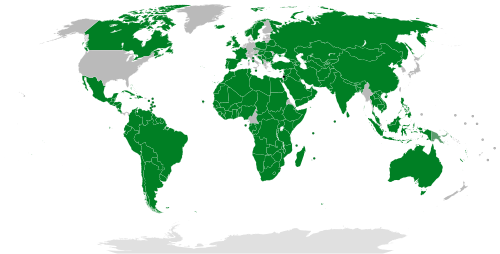
Countries that have recognised the State of Palestine
Countries that have not recognised the State of Palestine
On 29 November 2012, in a 138–9 vote (with 41 abstaining), General Assembly resolution 67/19 passed, upgrading Palestine to "non-member observer state" status in the United Nations.[532] The new status equates Palestine's with that of the Holy See. The change in status was described by The Independent as "de facto recognition of the sovereign state of Palestine".[533]
The UN has permitted Palestine to title its representative office to the UN as "The Permanent Observer Mission of the State of Palestine to the United Nations",[534] and Palestine has started to re-title its name accordingly on postal stamps, official documents and passports,[532][535] whilst it has instructed its diplomats to officially represent "The State of Palestine", as opposed to the "Palestine National Authority".[532] Additionally, on 17 December 2012, UN Chief of Protocol Yeocheol Yoon decided that "the designation of "State of Palestine" shall be used by the Secretariat in all official United Nations documents",[536] thus recognising the PLO-proclaimed State of Palestine as being sovereign over the territories Palestine and its citizens under international law.
By February 2013, 131 (67.9%) of the 193 member states of the United Nations had recognised the State of Palestine. Many of the countries that do not recognise the State of Palestine nevertheless recognise the PLO as the "representative of the Palestinian people".
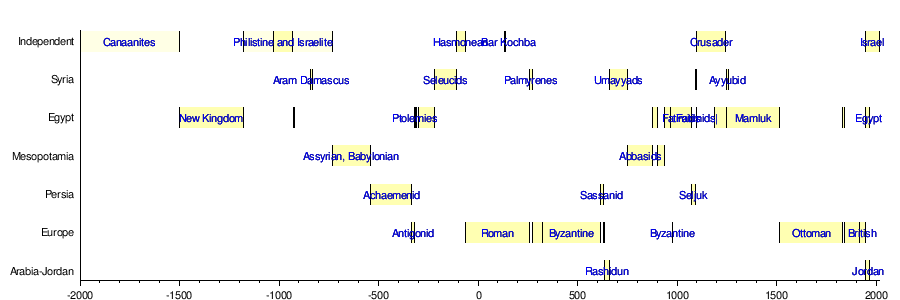
Graphical overview of Palestine's historical sovereign powers
↑The independent Canaanite city-states of the early Bronze age (3000–2200BCE) were situated mostly in plains or coastal regions, surrounded by defensive walls built of mud brick and guarded by watchtowers. Most of the cities were surrounded by agricultural hamlets, which supplied their food needs (Shahin 2005, p.4).
↑The late 13th, the 12th and the early 11th centuriesBCE. were witnessing the foundations of scores if not hundreds of insignificant and unprotected village settlements, not least in the mountains of Palestine. Life must have become pretty safe. From at least the 11th centuryBCE, a certain reduction of the number of villages took place. This demographic change was counterbalanced by the rise of certain settlements to the status of sometimes heavily fortified townships (Lemche 2001, 9.3).
↑The commerce-minded Philistines introduced new ways to ferment wine, as well as tools and weapons and chariots made with iron (Shahin 2005, p.6).
↑by the time the Assyrians ruled Palestine in 722BCE, the Philistine had become part and parcel of the local population and the "kingdom of Israel" had been destroyed (Shahin 2005, p.6).
↑The Philistines disappear from written history during the 6th centuryBCE (Jarus 2016).
↑Put simply, while Judah was still economically marginal and backward, Israel was booming. ... In the next chapter we will see how the northern kingdom suddenly appeared on the ancient Near Eastern stage as a major regional power (Finkelstein & Silberman 2002, pp.146–147)
↑By the high point of this settlement wave in the eighth century BCE, after the establishment of the kingdoms of Judah and Israel, it encompassed over five hundred sites, with a population of about 160,000 (Finkelstein & Silberman 2002, p.106).
↑The kingdom of Israel under the Omrides stretched from the vicinity of Damascus throughout the central highlands and valleys of Israel, all the way to the southern territory of Moab, ruling over considerable populations of non-Israelites (Finkelstein & Silberman 2002, pp.162–163).
↑In the year 853BCE, Shalmaneser led a major Assyrian invasion force westward to intimidate and possibly conquer the smaller states of Syria, Phoenicia, and Israel. His advancing armies were confronted by an anti-Assyrian coalition near Qarqar ... Ahab was the strongest member of the anti-Assyrian coalition. ... Shalmaneser quickly returned to Assyria, and at least for a while the Assyrian march to the west was blocked (Finkelstein & Silberman 2002, p.163).
↑The events recorded in the inscription took place in the ninth century BCE ... The inscription goes on to relate how Mesha gradually expanded his territory in rebellion against Israel, destroying the main settlements of the Israelites east of the Jordan, while fortifying and embellishing his own capital (Finkelstein & Silberman 2002, p.162).
↑Mesha was really the king of Moab and Moab was, before Mesha's revolt, a vassal of Israel (Lemche 2001, 3.5).
↑Hazael's incursion into the territory formerly controlled by Israel was clearly devastating and did much to weaken the power of the northern kingdom. ... Hazael's prime target was control of the fertile and strategic borderland between the two kingdoms, and he apparently not only conquered the Aramean lands formerly taken by the Omrides but also devastated some of Israel's most fertile agricultural region (Finkelstein & Silberman 2002, pp.182–183)
↑Jehu – who bought this security to the throne by becoming an Assyrian vassal (Schneider 2011, pp.9–10)
↑And while Jehu, ..., the famous "black obelisk" of Shalmaneser shows him bowing low to the ground at the feet of the great Assyrian king. Shalmaneser also notes: "The tribute of Jehu, son of Omri; ..." (Finkelstein & Silberman 2002, pp.187–188)
↑This new king, Tiglathpileser III ..., began ... a thorough revamping of the Assyrian empire – primarily in its relations to its former vassals, which would now be much more directly controlled. ... In the era of Assyrian imperialism that Tiglath pileser had inaugurated, vassaldom would soon give way to conquest and annexation (Finkelstein & Silberman 2002, p.194)
↑The conquest of Palestine began in 734BCE. with Tiglath-pileser III and lasted to about 645 (Bagg 2013, p.122).
↑Tiglath-pileser conquered the strongest and largest kingdoms in the region, inflicting heavy damage. He deported large parts of the populations, replacing them with exiles from remote regions, and annexed their territory to Assyria, turning them into Assyrian provinces (Lipschits 2006, p.19).
↑After the fall of Samaria, the capital of the Israelite kingdom, in 720BCE, the Assyrian expansion under Sargon II and Sennacherib was reoriented southward, (Schipper 2011, p.270)
↑There is some debate on whether Ashurbanipal died in 631 or 627, see Lipschits 2005, p.13 for details.
↑When Assurbanipal died in 627BCE, ... struggles over succession led to a weakening of centralized power. ... Babylon revolted and went on the offensive against Assyria. ... All of the nations of Syria-Israel had become colonies of the Neo-Babylonian Empire by 601BCE (Perdue & Carter 2015, p.69).
↑During this period – by 612BCE at the latest – Psammetichus I created a system of vassal states in the Southern Levant in which local chiefs were required to pay taxes to the Egyptians in exchange for military protection, according to the Ekron letter (Schipper 2011, p.279).
↑Egypt decided to intervene on the side of the Assyrians, and in 616 its army marched to the north. But this move did not stop the Assyrian collapse. The great Assyrian capital of Nineveh fell in 612, ..., in 610, ... the Babylonians took Haran (Finkelstein & Silberman 2002, p.259).
↑..., Josiah, the Judean Egyptian vassal, went to meet the new pharaoh on the latter's first march to Syria-Palestine in 609. Necho II met Josiah at the traditional Egyptian base of Meggido, killed him for unknown reasons, ... Necho II deposed him and instead enthroned the older son of Josiah, Eliakim, and gave him the name Jehoiakim (Schipper 2011, p.282).
↑In 605BCE, the Babylonian crown prince later known as Nebuchadnezzar crushed the Egyptian army at Carchemish in Syria (an event recorded in Jeremiah 46:2), causing the Egyptian forces to flee (Finkelstein & Silberman 2002, pp.260–261)
↑it seems that Nebuchadrezzar used the destruction of the region as a lever for rebuilding the parts of Babylonia that had been damaged during the long years of war, devastation, and deportation inflicted by the Assyrians. Large groups of exiles from the ruling, economic, and religious elite of the local kingdoms were sent to Babylon and settled in the devastated areas to develop them (Lipschits 2005, p.24).
↑On the last occasion (601/600), Nebuchadnezzar clashed with an Egyptian army, with heavy losses; this reverse was followed by the defection of certain vassal states, Judah among them. This brought an intermission in the series of annual campaigns in 600/599, while Nebuchadnezzar remained in Babylonia repairing his losses of chariots (Saggs 2010).
↑He attacked Judah a year later and captured Jerusalem on 16 March 597 (Saggs 2010)
↑The semi-independent kingdoms in southern Palestine (Judah and the Philistine kingdoms of Gaza, Ashkelon, Ashdod and Ekron) ... were dissolved during Nebuchadnezzar's reign and they too were incorporated into the Chaldaean provinces (Ephal 2000, p.142)
↑a province with its capital at Mizpah, just north of Jerusalem. ... Throughout this era, the province was called Yehud (Noll 2013, p.338)
↑in October 539, the Persian king took Babylon and captured its king Nabonidus. ...The Babylonian Empire had been large, and Cyrus now became ruler of Syria and Palestine as well (Lendering: Cyrus the Great).
↑Cyrus' Edict ... indicate that Cyrus and his successors maintained a policy of repatriation for some 80 years (Ephal 2000, p.151).
↑One developing consensus of the past couple of decades is that ancient Israel was basically a polytheistic society, though Yhwh functioned in some way as a national/ethnic god (much as Chemosh did for the Moabites and Qaus/Qos for the Edomites) for both Israel and Judah (Grabbe 2006).
↑Norms of behaviour, as well as social patterns, that were to characterize the Jewish people for many generations to come began to crystallize during the Persian period (Ephal 1998, p.119).
↑Furthermore, the temple rested on foundations ... from a temple built no later than the mid-fifth century BCE (Hjelm 2010, p.26).
↑which he had received from the king of Persia ("the lord of Kings") as a reward for "the important deeds which I did" (Ephal 2000, p.144)
↑We may also accept the Idea that in the early fifth century BCE. the Achaemenids granted Upper Galilee and the area east of Tyre to the Tyrians (Lipschits 2006, p.27).
↑around the middle of the fourth century, Phoenicians were occupying the entire coast ... as far as Ascalon in southern Palestine (Ephal 2000, p.150)
↑All that can be said with certainty is that the Nabataeans are known in the sources since the fourth century B.C. Up to that time the Qedarites, the dominant Arab tribe of the Persian period, controlled the south from the Hejaz and all of the Negev (Wenning 2007, p.26)
↑The earliest coins found in Palestine are of Greek origin: archaic and early classicial coinage of the late sixth and early fifth centuries BCE (Hübner 2014, p.161)
↑it did not take long for local potters to imitate those fine wares, though they could not duplicate the high quality of manufacture for which the Greeks were known (Meyers & Chancey 2012, pp.3–4)
↑The so-called Philisto-Arabian coins are among the oldest in Palestine. The mints were located in Gaza, Ashkelon, and Ashdod (Hübner 2014, p.162).
↑Since the second quarter of the fourth century, coins were also minted in the province of Judah (Hübner 2014, p.165)
↑Judea's level of independence under the Hasmoneans has been discussed at length. Schwartz writes that "the period of truly independent rule by the Hasmonean dynasty was very brief and, even then, the Jewish rulers never fully ceased being vassals of their stronger neighbors".[142] Schäfer writes that by 111BCE, due to internal struggles for the Seleucid throne "Judaea was effectively an independent state and John Hyrcanus a sovereign ruler."[143]
↑Herod ... who built many ... public buildings and generally raised the prosperity of his land but who was the centre of political and family intrigues in his later years (Perowne 1999).
↑As soon as Herod the Great died in 4BCE, a wave of unrest surged through Palestine. Herod's son Archelaus quickly put down the demonstrations, with the aid of Roman troops as well as Herod's army (Grabbe 2010, p.71).
↑It is not known whether Judea was a Roman province in the full sense of its meaning or only a part of the province of Syria with separate administration. Current knowledge of so-called "equestrian administration" points towards the second possibility (Haensch 2010, p.2).
↑The reason for the reorganization and renaming is not known. Many historians have asserted that the renaming was an attempt by emperor Hadrian to disassociate Jews from Judea.[171] Other historians dispute that theory.[172]
↑"It seems clear that by choosing a seemingly neutral name – one juxtaposing that of a neighboring province with the revived name of an ancient geographical entity (Palestine), already known from the writings of Herodotus – Hadrian was intending to suppress any connection between the Jewish people and that land." Lewin 2005, p.33
↑Even Geva's minimalist estimate of a population of 4,000 or fewer for Aelia Capitolina may be high (Seligman 2017, p.116)
↑Christian and Rabbinic sources claim that Roman law now forbade Jews to resettle the area around Jerusalem – an area that covered almost the entire historic district of Judaea (Schwartz 2016, p.248).
↑At Antioch and at Emesa he scored a decisive victory against the Palmyrene army and in 272 he forced Palmyra to surrender (Dignas & Winter 2007, p.161).
↑In late February of 303, the emperor Diocletian and his imperial colleagues issued an edict ordering churches to be destroyed, scriptures to be burned, and Christians to be dismissed from government service and stripped of civil rights. ... This marked the formal opening of the Great Persecution, the last and most brutal assault on Christians by the pagan Roman state (Gaddis 1999, p.29).
↑Theodosius's great contribution to the empire came when he made Roman Christianity the official state religion in 380 (Middleton 2015, p.937).
↑in the fourth century, when it seems likely that more than half the inhabitants of the Roman world converted to Christianity (Mitchell 2014, p.242)
↑Constantine began issuing laws conveying upon the church and its clergy fiscal and legal privileges and immunities from civic burdens (Britannica: Constantine I – Commitment to Christianity)
↑In a sense Constantine becomes the embodiment of the righteous king. ... The bishops now have basically federal funding to have sponsored committee meetings so they can try to iron out creeds and get everybody to sign up (Cohen 2015).
↑no fewer than 140 Byzantine monasteries flourished within the relatively small area of Palestine (McGuckin 2008, p.614)
↑It also became a great centre of the eremitic life (idiorrhythmic monasticism); men flocked from all quarters to become hermits in the Judaean wilderness, which was soon dotted with monasteries (Britannica: Palestine – Roman Palestine).
↑Membership in the exclusive club of Pentarchy provided the Church of All Palestine with an added international prestige and further clout at home (Masalha 2018, p.111).
↑towns increasingly acquired new civic basilicas and porticoed streets with spaces for shops. ... a vigorous boost from the erection of many churches and other religious buildings (Lewin 2005, p.41).
↑in effect, Caesarea-Palaestina and Gaza superseded and replaced both Athens and Alexandria as the premier centres of learning for the whole Mediterranean region (Masalha 2018, pp.40–41).
↑Jerome and Eusebius, rather than Herodotus' actual history of Palestine which formed the basis of Western religio‑social toponymic memory and the reimagining of Palestine as a Christian Holy Land (Masalha 2018, p.49)
↑After settling in Palaestina Tertia and Palaestina Secunda, the Ghassanids created client (buffer) states ... and fought alongside the Byzantines against the Persian Sassanids and Arab Lakhmid tribes of southern Iraq. ... the Ghassanid Arabs, who acted as a buffer zone and a source of troops for the Byzantine army and controlled (Masalha 2018, pp.137–140)
↑Although Emperor Trajan defeated the Nabataeans ... the culture did not diminish until changing political ties and economic disruptions moved trade routes away from Petra (Lawler 2011, p.220).
↑Greek eventually replaced Aramaic as an official idiom for bureaucracy after the fourth century C.E (Gzella 2015, p.242).
↑And for the many Nabataeans (probably most) who became Christians, the language of their liturgy was neither Arabic nor Aramaic but the less familiar Greek (Taylor 2002, p.213).
↑Little is known about this uprising. Reinhard Pummer characterizes the events as two riots – one in Neapolis and one in Caesarea – rather than an uprising, but acknowledges that the majority of sources speak of it as a revolt (Pummer 2016, p.139).
↑It will be remembered that in the suppression of the dangerous Samaritan revolt that broke out in Palestine in 529, it was the Arab Ghassanid phylarch Arethas, Abu Karib, or both that finally crushed the revolt mercilessly and, captured, according to the chronographer, twenty thousand Samaritans, who were sold as slaves (Shahid 2002, p.364)
↑The decisive battle that delivered Palestine to the Muslims took place on 20 August 636. Only Jerusalem and Caesarea held out, the former until 638, when it surrendered to the Muslims, and the latter until October 640. Palestine, and indeed all of Syria, was then in Muslim hands (Britannica: Palestine – Roman Palestine).
↑At first there were four districts, but a fifth, Jund Qinnasrin in the north was added in about 680 (Hawting 2000, p.38).
↑Later, about 680, a fifth district was added, Qinnasrin in the north (Hawting 2000, p.38)
↑For several centuries Aylah, the present‑day Jordanian port city of al-'Aqabah on the Red Sea, was part of the Islamic administrative province of Jund Filastin (Masalha 2018, pp.158–160)
↑It was expanded further by the Tulunids, ... The province of Filastin was enlarged ... eastwards and southwards, at the expense of Jund Dimashq, to include Bilad al‑Sharat, ... in modern‑day southern Jordan and north‑western Saudi Arabia (Salibi 1993: 18‒20; le Strange 1890: 28) (Masalha 2018, p.169).
↑For example, around the turn of the 9th century, the Frankish king Charlemagne founded a hostel, a library, and a church for pilgrims coming to Jerusalem.[241]
↑For example, in the Great German Pilgrimage of 1064–65 between seven and twelve thousand German pilgrims descended upon the Holy Land, by far the most important pilgrimage of its day.[243]
↑the Cluniac Reforms popularized pilgrimage to the Holy Sites as a means to expiate sin (Tejirian & Spector Simon 2012, p.26)
↑Mu'awiya became caliph and founder of the Umayyad dynasty as a result of the events of a period of about five years, between 656 and 661, during which the Arabs were divided into several camps each hostile to the others. ... Muslim tradition knows this period as the Fitna ("time of trial") (Hawting 2002, p.24)
↑According to an account from later centuries, the Caliph Umar was led to the Temple Mount reluctantly by the Christian patriarch Sophronius.[250] Umar found it covered with rubbish, but the sacred Rock was found with the help of a converted Jew, Ka'b al-Ahbar.[251] Al-Ahbar advised Umar to build a mosque to the north of the rock, so that worshippers would face both the rock and Mecca, but instead Umar chose to build it to the south of the rock.[251] The first known eyewitness testimony of the mosque the pilgrim Arculf's from about 670, recorded by Adomnán as follows: "A square prayer house which they [the Muslims] built in a crude form, placing wooden boards and broad beams on some ruins. It is said that the building can contain three thousand persons."[252]
↑The milestones, all containing inscriptions crediting Abd al-Malik for the road works, were found, from north to south, in or near Fiq, Samakh, St. George's Monastery of Wadi Qelt, Khan al-Hathrura, Bab al-Wad and Abu Ghosh. The milestone found in Samakh dates to 692, the two milestones at Fiq both date to 704 and the remaining milestones are undated.[260] The fragment of an eighth milestone, likely produced soon after Abd al-Malik's death, was found at Ein Hemed, immediately west of Abu Ghosh.[261]
↑As yet the feud between the Qays and Yaman which was to plague Syria for so many centuries was not a major problem (Kennedy 2004, p.86).
↑One of the prominent tribes in Yaman were the Quda'a.[264] The Qays were commonly known as Mudar.[265]
↑the conflict was between two factions, based on tribal loyalties, which sought to control access to military power and the privileges that went with it. The prizes were the favour of the ruling caliph and the lucrative governorships in the provinces (Kennedy 2004, p.105).
↑Although this shift of focus away from Palestine did not cause an immediate decline in the region, it did put an end to the extravagant investments that characterized Umayyad rule (Burke & Peilstocker 2011, p.114).
↑The most drastic and basic change effected by this revolution throughout the caliphate-the decline of the Arab tribes' glory-was strongly felt in Palestine. From that time onwards, after the initial shocks were over, one hears no longer of the tribes participating in its political affairs, but only of their rebellions (Gil 1997, p.279)
↑There is some debate on how the Abbasids rule affected Syria. Paul M. Cobb writes: "However unhappy some Syrians may have been, the large-scale political breakdown and socio-economic collapse of 'Abbasid Syria that modern scholarship has posited for so long has no historical basis. Indeed, in certain cases, contention – especially interelite competition like that of Syria's ashraf–can be seen as a kind of backhanded compliment to the success of the 'Abbasid state-building and an affirmation of its legitimacy. Political life in 'Abbasid Syria was certainly different from that under the Umayyads, but, all things considered, it showed little change for the worse." (Cobb 2001, p.128)
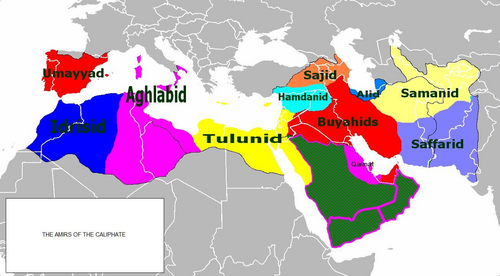
↑During the second half of the 9th century, however, signs of internal decay began to appear in the 'Abbāsid empire. Petty states, and some indeed not so petty, emerged in different parts of the realm (Britannica: Palestine – Roman Palestine).
↑In 327/939, Muhammad ibn Tughj obtained from the Caliph al-Radi confirmation of his appointment as military and fiscal governor, receiving the laqab of al-Ikhshid or "servant," a princely title from Farghana. After three decades of costly disorders in an Egypt administered by appointed governors, the caliphate had reached the conclusion that only an autonomous prince who, along with his descendants, ..., would be capable of defending it effectively against the Fatimids (Bianquis 1998, p.112).
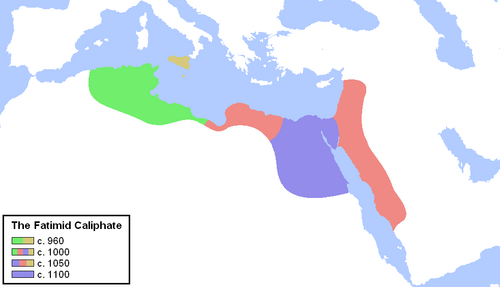
↑Finally, in 969, under the caliph al-Muʿizz, the first stage in the advance to the East was completed. Fāṭimid troops conquered the Nile Valley and advanced across Sinai into Palestine and southern Syria (Britannica: Fatimid Dynasty).
↑For a period of some fourteen years (997–1010), the Banu Jarrah enjoyed almost unlimited power in Palestine, evidently with the consent of Caliph al-Hakim (Gil 1997, p.370).
↑The 1020s were particularly harrowing. The outrages perpetrated by the Bedouins "were unlike anything experienced in the countries of Islam since its inception" (Geniza letter, in Mann, Jews in Egypt, ii, 181, l. 22). The details reported in the Geniza letters are revolting ... the population must have considerably shrunk, possibly an outcome of the catastrophic tribulations by the Bedouins in the 1020 (Goitein & Grabar 2007, pp.232–234)
↑By and large, however, the Turcoman period, which lasted less than thirty years, was one of slaughter and vandalism, of economic hardship and the uprooting of populations (Gil 1997, p.420).
↑In return for a ten-year truce between the kingdom of Jerusalem and the Muslims, al-Kamil would give to Frederick Jerusalem, Bethlehem, and Nazareth, as well as a thin strip of land connecting the holy sites to the coast (Madden 2014, pp.150–151).
↑Certain that the crusaders would accept the proposal, al-Mu'azzam ordered the destruction of the walls of Jerusalem in March 1219 (Madden 2014, p.141).
↑Pooling the resources of the Frankish nobility and the Military Orders, the Christians managed to muster around two thousand knights and perhaps a further 10,000 infantrymen. This host–the largest field army amassed in the East since the Third Crusade–represented the Latin kingdom's full fighting manpower (Asbridge 2010, p.474).
↑On 18 October 1244 they launched an attack and battle was joined on the sandy plains near the village of La Forbie (north-east of Gaza). For the Franks and their allies, the mêlée that followed was an unmitigated disaster (Asbridge 2010, pp.474–475).
↑Overall the Latin Kingdom lasted in Palestine nearly 200 years, from 1099 until 1291, when the last stronghold and capital, Acre, was destroyed by the Mamluks (Masalha 2018, p.167).
↑Frank Heynick, commenting on Maimonides's decision not to settle there a century later (Heynick 2002, p.103).
↑Haim Gerber (1998) referring to fatwas by two Hanafite Syrian jurists.
↑See for example the incident on 14 March 1937 when Arieh Yitzhaki and Benjamin Zeroni tossed a bomb into the Azur coffee house outside Tel Aviv, as reported in Bell 1996, pp.35–36.
↑6 Arab states, Egypt, Iraq, Lebanon, Saudi Arabia, Syria, Yemen: 4 Moslem states, Afghanistan, Iran, Pakistan, Turkey: Greece, Cuba and India also voted against (Cattan 1988, p.36).
Citations
↑The Ancient Levant, UCL Institute of Archaeology, May 2008
↑Steiner & Killebrew, p. 9Archived 1 November 2022 at the Wayback Machine: "The general limits ..., as defined here, begin at the Plain of 'Amuq in the north and extend south until the Wâdī al-Arish, along the northern coast of Sinai. ... The western coastline and the eastern deserts set the boundaries for the Levant ... The Euphrates and the area around Jebel el-Bishrī mark the eastern boundary of the northern Levant, as does the Syrian Desert beyond the Anti-Lebanon range's eastern hinterland and Mount Hermon. This boundary continues south in the form of the highlands and eastern desert regions of Transjordan."
↑Egyptian Journal of Geology, Volume 42, Issue 1, p. 263, 1998
↑Bar-Yosef, O. (1986). "The Walls of Jericho: An Alternative Interpretation". Current Anthropology. 27 (2): 157–162. doi:10.1086/203413. ISSN0011-3204.
↑Cohen, Rudolph (1983). "The Mysterious MBI People". Biblical Archaeology Society. Archived from the original on 14 March 2024.
↑Richard, Suzanne (1987). "Archaeological Sources for the History of Palestine: The Early Bronze Age: The Rise and Collapse of Urbanism". The Biblical Archaeologist. 50 (1): 22–43. doi:10.2307/3210081. JSTOR3210081. Archived from the original on 31 October 2023. Retrieved 19 April 2024.
↑Zevit, Ziony (2003). The Religions of Ancient Israel: A Synthesis of Parallactic Approaches. Bloomsbury. p.101 (footnote 32). ISBN9780826463395. Retrieved 27 January 2017. Israelite house" or a "pillared house" is the name given to the mud and stone houses characteristic of the Iron Age of Levant. Although sometimes considered particularly Israelite, this idea has been challenged. Ziony Zevit writes that "The Iron Age pillared houses, the "four-room house," are not uniquely Israelite. They are found in Iron Age non-Israelite sites such as Tell Kaisan, Tell Abu Hawam IV, and Tell Qasile X, Tell esh-Sharia' VII, but they are unlike the Late Bronze II pillared house discovered at Tel Batash and they are characteristic of Israelite sites (Mazar, 1985a: 67–68; Finkelstein, 1988: 237-59).
↑Paul Goldberg. "Deir el-Balah: A geological, archaeological, and historical reassessment of an Egyptianizing 13th and 12th century BCE center".
↑Kletter 2003, p.17.: "Perhaps the worst case of antiquities robbery by Dayan happened at Deir el Balah in the Gaza strip and concerned dozens of Late Bronze Age anthropoid coffins and their contents". Note that a recent reassessment of the chronology of the site places it no earlier than the 13th century, right at the beginning of the Iron Age.
↑Assaf Yasur-Landau (2014). The Philistines and Aegean Migration at the End of the Late Bronze Age. Cambridge University Press. p.283. ISBN978-1-139-48587-6.
↑Mogens Herman Hansen, ed. (2000). A Comparative Study of Thirty City-state Cultures: An Investigation. Kgl. Danske Videnskabernes Selskab. pp.136–. ISBN9788778761774. OCLC1000873699.
↑Naʾaman, Nadav (2004). "The Boundary System and Political Status of Gaza under the Assyrian Empire". Zeitschrift des Deutschen Palästina-Vereins. 120 (1): 55–72. JSTOR27931733.
↑Graf, David (2015). "ARABS IN PALESTINE FROM THE NEO-ASSYRIAN TO THE PERSIAN PERIODS". ARAM. 27 (1&2): 283–299. It is in this context that Arabs first appear in Philistia, but only in the so-called 'Display' or 'Summary' inscriptions from Nimrud (Calah), where tribute of gold, silver, camels and 'all kinds of 'spices' is received from the Arabs, specifically the Arab tribes of 'Massa', Tema, Saba, Hayappa, Badanu, Hatte, and Idiba'ilu, 'who dwell on the border of the western lands'.51 Of these, Idiba'ilu was appointed as the 'Gatekeeper' facing Egypt, perhaps displacing Siruati the king of the Men'unites, who formerly resided 'below Egypt.'52 Although these Arab tribute-bearers follow the episode of Samsi queen of the Qedarite Arabs, it should be stressed that they are unrelated to this account. The Summary texts are arranged geographically, and not chronologically, some as mere drafts on clay tablets prepared for permanent stone slabs used for display.53 The line drawn between Samsi and the Arab tribute bearers on the clay tablets demarcates the episodes as separate episodes involving Arabs.54 The campaign against Samsi was in 733 BCE, and the list of the Arab subjects is probably the result of the earlier Philistia campaign in 734 BCE conducted against the rebel king of Gaza. The identity of 'Tema' with the toponym of Taymā' in northwest Arabia, and 'Saba' with the South Arabian kingdom are clear, and Massa', Hayappa and Idiba'ilu, are all located in northwest Arabia, and appear in the biblical genealogy of Ismael; only Badanu and Hatte are unidentified.55 All the rest are located in Northwest Arabia or North Sinai. There is no evidence that Tiglath-Pileser's campaign extended into the Arabian Peninsula, so it may be assumed these Arabs were component parts of a multi-ethnic commercial community residing at Gaza, where their agents facilitated the long-distance Arabian incense trade. After his conquest of the region, Tiglath-Pileser III established an emporium (bīt kāri) at the port city of Gaza, such as he did in Phoenicia.56 The objective ostensibly was to control commerce and trade in the west.57 The Arabs from the Arabian Peninsula, including the distant Sabaeans, were now tributaries under Assyrian imperial administration.
↑Saggs 2010: deporting King Jehoiachin to Babylon. Finkelstein & Silberman 2002, p.261: The Jerusalem aristocracy and priesthood ... were taken off into exile,
↑Saggs 2010: The siege of Jerusalem ended in its capture in 587/586; Finkelstein & Silberman 2002, p.262: In 587 BCE Nebuchadnezzar arrived with his formidable army and laid siege to Jerusalem. It was the beginning of the end. With the Babylonian forces rampaging through the countryside, the outlying cities of Judah fell one by one.
↑Ephal 1998, pp.114–115: One or two generations before the destruction of the kingdom of Judah in 586 BCE, Edomites began to infiltrate into southern Palestine. ... Idumaea, south and west of the province of Judah; Magness 2012, p.75: After 586 BCE, Edomites settled in the southern part of the former kingdom of Judah (the northern Negev). Their descendants were known as Idumaeans, and the area was called Idumaea.
↑Shahin 2005, p.6: the Nabataenas (400 BCE–160 CE), with their capital in Petra (Jordan), made inroads into southern Palestine and built a separate and flourishing civilization in the Negev. Wenning 2007, p.26: Beside the establishment of Idumaea, which meant the loss of a large territory, the Qedarites obviously lost of their privileges of the frankincense trade. It can be assumed that they were replaced by the Nabataeans. Masalha 2018, p.153
↑Meyers & Chancey 2012, p.3: despite ... the devastating wars between Greece and Persia in the fifth century, Greek cultural influence rose steadily; Ephal 1998, p.118
↑Schäfer 2003, p.1; Hengel 1984, pp.35–36: For a long time the western districts of the empire, especially Phoenicia, had been oriented in economic, cultural and military affairs towards Greece and the Aegean. ... No well-to-do household in Palestine would have lacked Greek pottery, terracottas and other luxury items; Greek coins and their local imitations had long been an important medium of exchange. Schwartz 2009, p.24: By the fifth century, Greek goods predominated over all other imports in the cities of the Syro-Palestinian coast. ... the trickle of Greek imports now turned into a flood
↑Ephal 2000, p.145: it would appear that the Egyptians seized control of the entire coastal strip of Palestine and Phoenicia for a time. Stern 1984, p.75: They seized the northern part of the coastal plain of Palestine and for a brief period also held Tyre and Sidon. Meyers & Chancey 2012, p.7: the Egyptians rebelled ... taking control of the northern part of the coastal plain and for a short time part of the Phoenician coast including Akko and Sidon as well.
↑Kraeling, E. G. (1948). "Two Place Names of Hellenistic Palestine". Journal of Near Eastern Studies. 7 (3). The University of Chicago Press: 199–201. doi:10.1086/370879. ISSN0022-2968. S2CID162286814. Archived from the original on 5 June 2023. Retrieved 6 June 2024.
↑Berlin, A. M. (1997). "Archaeological Sources for the History of Palestine: Between Large Forces: Palestine in the Hellenistic Period". The Biblical Archaeologist. 60 (1). The University of Chicago Press: 2–51. doi:10.2307/3210581. JSTOR3210581. S2CID163795671.
↑Baesens, V. (2006). "Royal Taxation and Religious Tribute in Hellenistic Palestine". Ancient Economies, Modern Methodologies: Archaeology, Comparative History, Models and Institutions. Pragmateiai (Bari). Edipuglia. pp.179. ISBN9788872284889. Archived from the original on 21 November 2023. Retrieved 6 June 2024.
↑Hengel 1984, p.52: With the exception of the fourth Syrian war (219–217) it was for most of the land a time of peace.Meyers & Chancey 2012, p.16: Despite the high tension between the rival factions for control of Palestine, the third century may be viewed as a time of relative prosperity and quiet.
↑Grabbe 2010, p.18; Schäfer 2003, p.58: The Maccabees had achieved their main political objective and freed Judaea de facto (though not de jure) from the Seleucid confederation.
↑Schwartz 2009, p.43: He then named Hyrcanus high priest (but not king; Sartre 2005, p.41: Hyrcanos II was confirmed as high priest but denied a royal title
↑Sartre 2005, p.41; Gabba 2008, p.97: The re-establishment of the traditional aristocratic-religious government was a consequence of the reduction in territory of the Jewish state, which was now deprived of (a) the whole coastal zone, ..., together with the Hellenized cities ..., (b) western Idumaea with Marisa, (c) the city of Samaria, (d) the town of Gaba and the royal possessions in the plain of Esdraelon, (e) the Samaritan toparchies ..., (f) the five non-Jewish cities in the northern Transjordanian region,
↑Schwartz 2009, p.43: He ... removed the Greek cities conquered by Alexander Yannai from Jewish rule, and restored their Greek constitutions. Sartre 2005, p.42: Pompey restored damaged and destroyed cities everywhere. Above all, he guaranteed the independence of cities formerly occupied by the Hasmoneans; Butcher 2003, p.112: Many of the cities further south had fallen under the influence of the Hasmoneans ... Pompey and his successors restored the "freedom" of the subject cities; Gabba 2008, p.97: Pompey, and Gabinius after him, restored many of the liberated cities which the Hasmonaean kings had destroyed
↑Butcher 2003, p.113: To commemorate their restoration they sometimes adopted the names of those governors who had honoured them; Sartre 2005, p.43: a new era known as "Pompeian," an indication that the city-states considered Pompey's achievements, ..., as amounting to a rebirth. Chancey 2004, pp.109–110: It did not take long after Rome's arrival ... for cities to acknowledge their new rulers on their coins. For some cities, this acknowledgment took the form of adopting a new dating system commemorating Rome's advent. ... a few cities renamed themselves after Roman officials.
↑Schwartz 2009, p.46: The other twin star of Herod's construction was Jerusalem, which was re-built from top to bottom.
↑Schwartz 2009, p.46; Perowne 1999: His most grandiose creation was the Temple, which he wholly rebuilt. ... The great outer court, 35 acres (14ha) (14 hectares) in extent, is still visible as Al-Ḥaram al-Sharīf. Grabbe 2010, p.23: Yet the end product was for practical purposes a new temple, a magnificent structure which paled by comparison the previous temples.
↑Schwartz 2009, p.46: the city ... became ... the main point of entry for the burgeoning Jewish pilgrim traffic
↑Grabbe 2010, p.25; Gabba 2008, p.130: His ethnarchy was transformed into a Roman province of the equestrian rank; Shahin 2005, p.7; Haensch 2010, p.2: It was only after the expulsion of Archelaus in 6 CE that direct Roman rule was established in Judaea and Samaria.
↑Lewin 2005, p.33: It seems clear that by choosing a seemingly neutral name ... of an ancient geographical entity (Palestine), ... Hadrian was intending to suppress any connection between the Jewish people and that land. Safrai 1976, p.334: In an effort to wipe out all memory of the bond between the Jews and the land
↑Jacobson 2001, pp.44–45: commonly viewed as a move intended to sever the connection of the Jews to their historical homeland. ... Hadrian's choice of Syria Palaestina may be more correctly seen as a rationalization of the name of the new province, in accordance with its area being far larger than geographical Judea. Foster 2017, pp.95–110: the name change had little to do with Jew hatred ... he called the place what it was called. ... The decision to change the name to Palestine may have been a banal bureaucratic choice. ... If the administrative reorganization was indeed banal, then we might have expected both names to have persisted after the change, which is exactly what happened.
↑Britannica: Palestine – Roman Palestine: Although this ban was officially still in force as late as the 4th century CE, there is some evidence that from the Severan period onward (after 193) Jews visited the city more frequently, especially at certain festival times, and even that there may have been some Jews in residence. Seligman 2017, p.114: there seems to have been a slow trickle into the city over subsequent centuries, although the actual numbers probably remained rather insignificant. Towards the beginning of the 4th c., sources identify a synagogue in Jerusalem
↑Shahin 2005, p.7: new cities were founded at Eleutheropolis (Beit Jibrin), Diospolis (Lydd), and Nicopolis (Emmaus). Britannica: Palestine – Roman Palestine
↑Shahin 2005, p.8; Britannica: Palestine – Roman Palestine: The emperor ... built a ... church on the site of the Holy Sepulchre, the most sacred of Christian holy places; his mother, Saint Helena, built two others – at the place of the Nativity at Bethlehem and of the Ascension in Jerusalem – and his mother-in-law, Eutropia, built a church at Mamre.
↑Shahin 2005, p.8: Thus Palestine became the world's greatest pilgrimage site. It became the center for ascetic life for men and women from all over the world, who came to the Palestinian wilderness to become hermits. Soon it was dotted with monasteries, many of which can still be visited today. They include St. George Monastery in Wadi al-Qilt, Deir Quruntul and Deir Hijle next to Jericho, and Deir Mar Saba and Deir Theodosius east of Bethlehem, as well as the remains of many others in the Negev and Gaza. Masalha 2018, p.99
123Britannica: Palestine – Roman Palestine.
↑Masalha 2018, p.110: This decree of elevating the Palestine Church led to the Church of Aelia Capitolina not only becoming an independent Patriarchate, but also to becoming ... one of the five Patriarchates of Christendom, ... the five major Patriarchs of the empire: Constantinople, Rome, Alexandria, Antioch and Aelia Capitolina. Horn & Phenix 2008, p.lxxxviii: Council of Chalcedon ..., at which Jerusalem was granted the status of patriarchate; Britannica: Palestine – Roman Palestine: Juvenal, bishop of Jerusalem from 421 to 458 ... was recognized by the Council of Chalcedon (451) as patriarch of the three provinces of Palestine.
↑Schwartz 2009, p.214: In sum, it is not unlikely that late antiquity was a period of unprecedented prosperity in Palestine, as in Syria. Masalha 2018, p.99: The Christian era of Byzantine Palestine ..., was an extraordinary time of cultural flourishing and of great expansion and prosperity in Late Antiquity. Lewin 2005, p.41: Palaestina reached a peak of prosperity in the late fifth and early sixth century
↑Masalha 2018, p.99: New areas were brought under cultivation, urban development increased
↑Masalha 2018, p.40: the diverse population of the "Three Palestines" may have reached as many as one and a half million. Goodblatt 2008, p.406: the country reached its highest population density ever (until the twentieth century) precisely in the Byzantine period.
↑Hughes 2020, p.15; Harries 2012, p.50: Diocletian sought to head off potential threats to his personal security but he also saw the potential for improving efficiency by operating through smaller provincial units. Larger provinces were therefore divided, on an ad hoc basis, into smaller entities, each with its own provincial governor, usually called a praeses – but in Italy a corrector, later a consularis – and administrative capital.
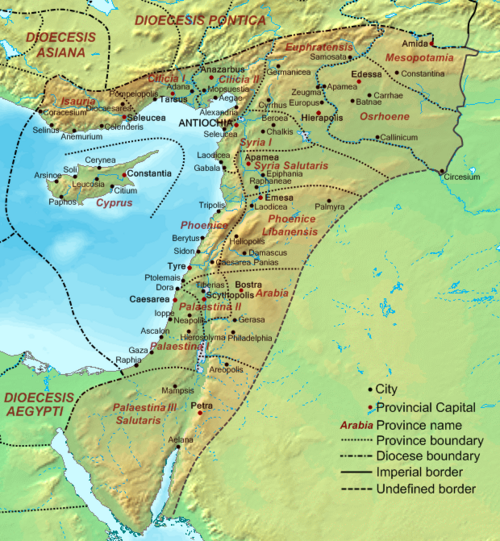
↑Lewis 2011, p.155; Britannica: Palestine – Roman Palestine: At the end of the 4th century, an enlarged Palestine was divided into three provinces: Prima, with its capital at Caesarea; Secunda, with its capital at Scythopolis (Bet Sheʾan); and Salutaris, with its capital at Petra or possibly for a time at Elusa. Shahin 2005, p.8
↑Masalha 2018, p.136: The Ghassanid Arabs ... were the biggest Arab group in Palestine.
↑Masalha 2018, p.136: in the early 3rd century from the Arabian Peninsula to Palestine and the southern Levant region
↑Chancey 2005, p.62: In 106, the Romans annexed the Nabatean territory, apparently without bloodshed. They reorganized it as the province of Arabia; Butcher 2003, p.84
↑Pummer 2016, p.139; Sivan 2008, p.119: Zeno punished those responsible for the bishop's mutilation and banished all Samaritans from Mount Gerizim, ... He ordered the erection of a church honouring Mary on top of the mountain.
↑Pummer 2016, p.141: The result of the oppressive legislation by the Byzantine authorities and the rebellions ... was that at the end of the Byzantine period the Samaritans were left diminished in numbers; Masalha 2018, p.146: However, the Samaritan revolts during the 5th and 6th centuries in Palaestina Prima were marked by great ... and their brutal suppression at the hands of the Byzantines and their Ghassanid Arab allies ... contributed to ... making the Christians the dominant group in the province of Palaestina Prima for many decades.
↑Schäfer 2003, p.195: the Jews appear to have risked an open revolt ... and to have allied themselves with the Persians. Jewish requests for (above all) the return of Jerusalem met with a positive response from the Persians; Magness 2012, p.322: The Sasanids were aided by the local Jewish population, who had suffered under Byzantine Christian rule and hoped for permission to rebuild the Jerusalem temple.
↑Mitchell 2014, p.452: Caesarea Maritima, ..., and, ..., Jerusalem, fell to the Persians in 614. ... huge numbers of Jerusalem's Christian population were slaughtered ..., and the relic of the Cross itself was removed as a trophy; Haldon 2002, p.2: in 614 Jerusalem fell – the church of the Holy Sepulchre was destroyed and the relic of the Cross taken; Reinik 2002, pp.81–82: the bloody sack and destruction of Jerusalem in 614, including the loss of the relic of the True Cross; Schäfer 2003, p.195: The Persians conquered Jerusalem ... and ... they destroyed a large number of churches, ransacked the city and caused carnage amongst the Christian population.
12Schäfer 2003, p.198; Balfour 2012, p.112: In March 629, the "True Cross" was carried in splendid procession into Jerusalem by the Emperor Heraclius.
↑Schäfer 2003, p.198: He had promised the Jews ... amnesty ..., but was unable to hold to this. At the insistence of the leaders of the Christians, who had not forgotten the period of Jewish rule from 614 to 617, he once more expelled the Jews from Jerusalem and had to allow large numbers of them to be executed. Balfour 2012, p.112: The patriarch of Jerusalem executed those who were known to have taken part in the killings.
↑Dignas & Winter 2007, p.49: Although the Romans celebrated a triumphant success ..., the continuous struggle with Persia had taken its toll. Soon after the Romans had re-conquered Syria, Palestine and Egypt, these territories were lost once more, this time to the Arabs. Lendering: Arabia Deserta: Both empires were exhausted and an easy target for the great Arab conquests that started in the second quarter of the seventh century.
↑Shahin 2005, p.10: Jews were allowed to return to Jerusalem after a 500-year ban stipulated by the Romans and maintained by the Christian rulers. Gil 1997, pp.68–69: The Jews felt that the injunction against their entry into Jerusalem, not to speak of their settling there-...-had come to an end. Slavik 2001, p.33: Jews were even allowed back into the city to live.
↑Masalha 2018, p.180; Lev 2006, p.590: Ramla, the capital of Jund Filastin, was founded ... in 715; Gil 1997, p.106: It became the capital of jund Filastin and actually the most important city in Palestine. Hawting 2002, p.38
↑Gil 1997, p.145: Palestine was, during the entire period we are dealing with, a sort of gold mine for the central government, whether headquartered in Damascus, Baghdad or Cairo. Shahin 2005, p.10: historians of the period noted that Palestine was among the most prosperous and fertile regions of the Muslim empire at this juncture.
↑Masalha 2018, p.173: The economy of Palestine was boosted by the country's strategic location and its international trade; Gil 1997: Palestine's wealth came from its natural resources, especially its excellent crop of fruits and ... from the various types of craftsmanship that developed there, from its network of ports and not a little, from its influx of pilgrims.
↑Shahin 2005, p.11: Spices, silks, soap, olive oil, glassware, and sugar were traded for European products. Gil 1997, pp.230–239
↑Gil 1997, p.107: The Umayyads invested great efforts in developing a Muslim fleet and in renovating seaports in Palestine and Syria. Restoration and fortification works were carried out in Tyre, Acre, Caesarea, Jaffa and Ascalon. Arab army units were garrisoned at these ports. Masalha 2018, p.166: new Arab naval bases and shipyards were established in Palestine; Shahin 2005, p.11
↑Burke & Peilstocker 2011, p.113: Jaffa acted as the port of Ramla and thus became the principal port of Palestine.
↑Kennedy 2004, p.146: Charlemagne was interested in the Holy Places in Jerusalem, where he founded a hostel and library for pilgrims; Gil 1997, p.245: The monk Bernard, who visited Jerusalem shortly after the middle of the ninth century, mentions the hostel which Charlemagne built there, where any western pilgrim ('the Latins') is welcomed; the Church of St Mary, with its library established with Charlemagne's help
↑Gil 1997, p.87; Hawting 2002, p.98: First, in the summer of 745, a revolt which seems to have begun among the Kalb in the south ... spread to engulf most of Syria
↑Gil 1997, p.87: This rebellion, drowned in rivers of blood, once again included the tribes of Palestine, and during its course, as Theophanes tells us, Marwan destroyed the walls of Jerusalem, as he did in Hims, Damascus and other cities. Hawting 2002, p.99: Marwan's anger ... led him to raze the walls not only of Hims but also of other important Syrian towns including Damascus and, reportedly, Jerusalem. As Wellhausen expressed it, "in the summer of 128 (746) he had finished with Syria; it lay in fragments at his feet".
↑Gil 1997, p.295: a widespread rebellion broke out in Palestine; ... the rebellion of Abu Harb, .... Arab tribes and farmers from the south of Palestine took part in this uprising and their leader was said to be a "Yamahi"; Britannica: Palestine – Roman Palestine: In 840/841 Abū Ḥarb, a Yemenite, ... succeeded in recruiting ... peasant followers, mainly among the Palestinian population, who regarded him as the saviour whose appearance was to save the land from the hated 'Abbāsids. Though the insurrection was put down, unrest persisted.
↑Levy-Rubin & Kedar 2001, p.65; Gil 1997, p.283: considerable destruction in Palestine as a result of the civil war in 788, in the days of the patriarch Elias (II), telling of the utter devastation of Bet Guvrin (Eleutheropolis), Ascalon, Gaza and Sariphaea. The St Chariton monastery was robbed and the Mar Saba monastery was attacked.
↑Britannica: Tulunid Dynasty: the state finally reverted to the ʿAbbāsids in 905. Burke & Peilstocker 2011, p.114: The Abbasids regained control of Palestine in 906
↑Britannica: Palestine – Roman Palestine: The Fāṭimids seized Egypt from the Ikhshīdids in 969 and in less than a decade were able to establish a precarious control over Palestine, where they faced Qarmaṭian, Seljuq, Byzantine, and periodic Bedouin opposition. Palestine was thus often reduced to a battlefield. Gil 1997, p.336: it was an almost unceasing war which destroyed Palestine
↑Saunders 2002, pp.137–138; Gil 1997, p.376: The Christians had to wear a cross the length of a cubit and weighing five ratfs around their necks; the Jews were obliged to wear a block of wood of similar weight.
↑Goitein & Grabar 2007, p.233: The local population rose against the barbarian conquerors and Atsiz had to take Jerusalem a second time, putting the inhabitants to the sword, even those who had fled into the Aqsa mosque. Gil 1997, p.412
↑Brett 2017, p.231; Britannica: Palestine – Roman Palestine: The Fatimids recaptured the city in 1098
↑Britannica: Crusades: By September 1187 he and his lieutenants had occupied most of the major strongholds in the kingdom and all the ports south of Tripoli Jubayl and Botron (Al-Batrūn) in the county of Tripoli and Tyre in the kingdom. Shahin 2005, p.12
↑Madden 2014, pp.156–157: When the Khorezmians poured into the region in 1244, they easily captured it, massacred the Christians, and burned their churches, including the Church of the Holy Sepulcher. Asbridge 2010, p.474: On 11 July 1244 Berke Khan's men broke into Jerusalem and went on the rampage. ... it was said that "they committed far more acts of shame, filth and destruction against Jesus Christ and the Holy Places and Christendom than all the unbelievers who had been in the land had ever done in peace or war".
↑Boas 2001, p.91: The Dome of the Rock became a church and, ..., the al-Aqsa Mosque was first ... used as a royal palace and ... became the headquarters of the Order of the Knights of the Temple. Britannica: Dome of the Rock
↑Little, Donald P. (April–June 1995). "Mujīr al-Dīn al-'Ulaymī's Vision of Jerusalem in the Ninth/Fifteenth Century". Journal of the American Oriental Society. 115 (2). American Oriental Society: 238. doi:10.2307/604667. JSTOR604667.
↑Marom, Dr Roy (2024). "The Palestinian Rural Notables' Class in Ascendency: The Hannun Family of Tulkarm (Palestine)". Journal of Holy Land and Palestine Studies. 23 (1): 77–108. doi:10.3366/hlps.2024.0327. ISSN2054-1988. Archived from the original on 2 July 2025.
↑One American diplomat wrote that "Extraordinary privileges and immunities had become so embodied in successive treaties between the great Christian Powers and the Sublime Porte that for most intents and purposes many nationalities in the Ottoman Empire formed a state within the state." (Thayer 1923, pp.207–233)
↑Alon, Yoav. The Shaykh of Shaykhs: Mithqal Al-Fayiz and Tribal Leadership in Modern Jordan. Stanford University Press, 2016.
↑Kitchener, H.H (7 September 1877). "Journal of the Survey"(PDF). Palestine Exploration Quarterly. 10: 11. Archived(PDF) from the original on 9 May 2015. Retrieved 10 December 2023.
↑Finn, James (1868). Byeways in Palestine. James Nisbet. pp.80–81.
↑Guarmani, Carlo (1938). Northern Najd. London, England: The Argonaut Press. pp.109–110.
↑Marom, Roy (2026). Settled Land: The Arab Countryside in Israel/Palestine (in Hebrew). Ra'anana: Lamda Scholarship, The Open University of Israel Press. p. 7. ISBN 978-965-06-1769-1.
↑Marom, Roy; Taxel, Itamar (2024). "Ḥamāma: The Palestinian Countryside in Bloom (1750–1948)". Journal of Islamic Archaeology. 11 (1): 83–110. doi:10.1558/jia.26586.
↑Marom, Roy; Fantalkin, Alexander (2025). "Vines Among the Dunes: Sand/Dune Agriculture in Rimāl Isdūd/Ashdod-Yam during the Late Ottoman and British Mandate Periods". Contemporary Levant. 10 (1): 19–42. doi:10.1080/20581831.2025.2475263.
↑Marom, Roy (3 March 2024). "Hadera: transnational migrations from Eastern Europe to Ottoman Palestine and the glocal origins of the Zionist-Arab conflict". Middle Eastern Studies. 60 (2): 250–270. doi:10.1080/00263206.2023.2183499. ISSN0026-3206.
↑Marom, Roy (1 January 2023). "The Abu Hameds of Mulabbis: an oral history of a Palestinian village depopulated in the Late Ottoman period". British Journal of Middle Eastern Studies. 50 (1): 87–106. doi:10.1080/13530194.2021.1934817. ISSN1353-0194.
↑Rabbi Silver's request regarding the formation of a Jewish militia and the dissolution of the mandate in S/PV.262, Minutes 262nd Meeting of the UN Security Council, 5 March 1948
↑see The Middle East Journal, Middle East Institute, 1949, p. 78, 1 October): Robert A. Lovett, Acting Secretary of State, announced the U.S. would not recognize the new Arab Government in Palestine, and Foreign relations of the United States, 1948. The Near East, South Asia, and Africa, Volume V, Part 2, p. 1448Archived 27 November 2011 at the Wayback Machine
↑S/RES/242 (1967), United Nations, 22 November 1967, retrieved 25 September 2025
↑Guy S. Goodwin-Gill, “The Legal Status of the UN Security Council’s ‘Land for Peace’ Resolution (242),” Review of International Studies 3, no. 1 (1977): 25–45.
↑"Milestones: 1969-1976: The 1973 Arab-Israeli War". U.S. State Department Office of the Historian. Retrieved 25 September 2025.
Ahren, Raphael (30 November 2017). "Jerusalem ignores the UN's forgotten partition plan of 2012 at its peril". The Times of Israel. Archived from the original on 22 June 2020. Retrieved 19 May 2020.
Al-Tahhan, Zena (2 November 2018). "More than a century on: The Balfour Declaration explained". Al Jazeera. Archived from the original on 7 November 2023. Retrieved 7 June 2022.
"Arab League Requests Palestinian Statehood from U.N". Palestine News Network. 6 July 2011. Archived from the original on 14 August 2014. Retrieved 19 July 2011.
Ashkar, Alaa; Bannoura, Saed (9 September 2011). "UN Secretary-General Supports Full Palestinian Membership". IMEMC News. International Middle East Media Center. Archived from the original on 15 October 2011. Retrieved 9 September 2011.
Ateeq, Mounir (31 July 2012). "Report of possible Gaza independence stirs debate". Al Arabiya. Archived from the original on 14 October 2012. Retrieved 26 November 2012.
Baroud, Ramzy (July 2007). "Gaza: chaos foretold". Le Monde diplomatique. Archived from the original on 3 January 2010. Retrieved 26 July 2009.
Ben Zion, Ilan (9 April 2014). "Egyptian coffin, gold seal with king's name found in Israel". The Times of Israel. Archived from the original on 11 April 2014. Retrieved 9 April 2014.
Cohen, Shaye I.D. (18 November 2015). "Legitimization Under Constantine". PBS. Archived from the original on 14 January 2021. Retrieved 31 December 2020.
Ein-Gil, Ehud (4 December 2015). "Revisiting the UN Partition Plan: Is It Still Relevant?". Haaretz. Archived from the original on 16 May 2020. Retrieved 18 May 2020. The leadership of the Yishuv – the Zionist settlement enterprise in Palestine – and the Jewish Agency – the executive body of the World Zionist Organization – seemingly accepted the partition plan, but did not come to terms with the international status that was to be bestowed on Jerusalem, an inseparable part of the plan, nor accept the proposed borders of the partitioned states.
Levinson, Chaim (27 July 2009). "IDF: More than 300,000 settlers live in West Bank". Haaretz. Archived from the original on 3 December 2009. Retrieved 9 May 2010.
"Palestine: What is in a name (change)?". Inside Story. Al Jazeera. 8 January 2013. Archived from the original on 21 March 2020. Retrieved 22 June 2022.
"Palestinian Authority officially changes name to 'State of Palestine'". Haaretz. Associated Press. 5 January 2013. Archived from the original on 8 February 2015. Retrieved 12 January 2015.
Perry, Mark; Crooke, Alastair (9 January 2007). "No-goodniks and the Palestinian shootout". Asia Times. Archived from the original on 9 January 2007. Retrieved 26 July 2009.
Sawafta, A. (14 July 2011). "Arabs to seek full Palestinian upgrade at UN". Reuters. Archived from the original on 15 September 2011. Retrieved 19 July 2011.
Sawafta, Ali (4 August 2012). "Palestinians to renew U.N. statehood drive in September". Al Arabiya. Reuters. Archived from the original on 1 March 2013. Retrieved 26 November 2012.
Schell, Bernhard (31 July 2011). "UN will count 194 members if Palestine gets in". InDepthNews. Archived from the original on 3 August 2017. Retrieved 1 August 2011.
Steiman, Daniel (29 December 2013). "The settlements are illegal under international law". The Jerusalem Post. Archived from the original on 15 January 2015. Retrieved 12 January 2015.
Williams, Dan (1 December 2012). "Israel defies UN after vote on Palestine with plans for 3,000 new homes in the West Bank". The Independent. Archived from the original on 18 October 2017. Retrieved 29 August 2017.
"Zionist Aspirations: Dr Weizmann on the Future of Palestine". The Times. 8 May 1920. p.15.
Online sources
"1941 The Palmach formed". History Central. n.d. Archived from the original on 13 April 2023. Retrieved 29 June 2022.
Bar-Ilan, Meir (2013). "Major trends in Jewish Society in the Land of Israel: From the 5th century BCE till the 7th century CE". Bar-Ilan University. Archived from the original on 21 May 2022. Retrieved 30 June 2022.
Ben-Arieh, Alex (n.d.). "Uniform (and History) of Jewish Palestine Police "Noter"". The Historama. Archived from the original on 11 August 2022. Retrieved 28 June 2022.
Ben-Ghedalia, Yochai (2009). "The Habsburgs and the Jewish Philanthropy in Jerusalem during the Crimean War (1853–6)"(PDF). Jerusalem: The Hebrew University of Jerusalem. Archived from the original(PDF) on 5 September 2012. Retrieved 11 April 2022.
"The Crusades (1095–1291)". Heilbrunn Timeline of Art History. New York: Department of Medieval Art and The Cloisters at the Metropolitan Museum of Art. February 2014. Archived from the original on 23 March 2022. Retrieved 31 March 2022.
"Etzel – The Establishment of Irgun". The Irgun Site. n.d. Archived from the original on 7 November 2020. Retrieved 24 June 2011.
Gee, John (February 2000). "The borders between Syria and Israel". CAABU Focus. Vol.6, no.1. CAABU. Archived from the original on 22 January 2001. Retrieved 16 June 2009.
Gharib, Ali (20 December 2012). "U.N. Adds New Name: "State of Palestine"". The Daily Beast. Archived from the original on 21 December 2012. Retrieved 10 January 2013.
Harrison, Timothy P. (2009). "'The land of Medeba' and Early Iron Age Mādabā". In Bienkowski, Piotr (ed.). Studies on Iron Age Moab and Neighbouring Areas: In Honour of Michèle Daviau(PDF). Leuven – Paris – Walpole, MA: Peeters. pp.27–45. Archived(PDF) from the original on 16 May 2018. Retrieved 16 June 2018.
"The Hazor Excavations Project". The Hebrew University of Jerusalem. 12 January 2017. Archived from the original on 7 May 2019. Retrieved 3 January 2022.
Jarus, Owen (16 July 2016). "Who Were the Philistines?". livescience.com. Archived from the original on 26 January 2021. Retrieved 15 November 2020.
Kimmerling, Baruch (n.d.). "Benny Morris's Shocking Interview". History News Network. Archived from the original on 30 March 2019. Retrieved 18 May 2020. they officially accepted the partition plan, but invested all their efforts towards improving its terms and maximally expanding their boundaries while reducing the number of Arabs in them.
"Land Registration in Palestine before 1948 (Nakba): Table 2". Palestine Remembered. n.d. Archived from the original on 18 June 2021. Retrieved 13 June 2022.
Lapidot, Yehuda (9 September 2015). "Why Italian Planes Bombed Tel-Aviv?". IsraCast. Archived from the original on 29 October 2020. Retrieved 24 August 2010.
Lawler, Andrew (28 May 2020). "DNA from the Bible's Canaanites lives on in modern Arabs and Jews". National Geographic. Archived from the original on 1 June 2020. Retrieved 1 June 2020.
"Lion reliefs". The Israel Museum, Jerusalem. 7 October 2021. Archived from the original on 3 January 2022. Retrieved 3 January 2022.
"New Aliyah – Modern Zionist Aliyot (1882–1948)". Jewish Agency for Israel. n.d. Archived from the original on 23 June 2009. Retrieved 26 October 2008.
"The Palestine Mandate". Yale Law School – The Avalon Project. n.d. Retrieved 24 August 2010.{{cite web}}: CS1 maint: deprecated archival service (link)
"Remains of Minoan-Style Painting Discovered During Excavations of Canaanite Palace". ScienceDaily. 7 December 2009. Archived from the original on 4 February 2019. Retrieved 9 March 2018.
"Restraint and Retaliation". The Irgun Site. n.d. Archived from the original on 27 April 2011. Retrieved 24 August 2010.
"The Second Aliyah (1904–1914)". Gov.il. Ministry of Aliyah and Integration. 2 December 2020. Archived from the original on 13 June 2022. Retrieved 13 June 2022.
"Who were the Canaanites? New insight from 73 ancient genomes". ScienceDaily. 28 May 2020. Archived from the original on 31 May 2020. Retrieved 1 June 2020.
"A/RES/181(II): 29 November 1947: Resolution 181 (II): Future government of Palestine". United Nations General Assembly. Archived from the original on 24 May 2012. Retrieved 26 April 2012.
"Declaration of Establishment of State of Israel: 14 May 1948". Israeli Ministry of Foreign Affairs. Archived from the original on 21 March 2012. Retrieved 26 April 2012.
No. 565. – Exchange of Notes * Constituting an Agreement Between the British and French Governments Respecting the Boundary Line Between Syria and Palestine from the Mediterranean to El Hammé(PDF). Paris: British and French governments. 7 March 1923. p.7. Archived from the original(PDF) on 9 September 2008.
"Permanent Observer Mission of the State of Palestine to the United Nations". 2012. Archived from the original on 31 January 2013. Retrieved 12 January 2015.
General
Ben Yosef, Avraham (1981). מבוא לתולדות הלשון העברית[Introduction to the History of the Hebrew Language] (in Hebrew). Tel Aviv: אור־עם. p.38.
Ben-Sasson, H.H. (1976). A History of the Jewish People. Harvard University Press. ISBN0-674-39731-2. In an effort to wipe out all memory of the bond between the Jews and the land, Hadrian changed the name of the province from Iudaea to Syria-Palestina, a name that became common in non-Jewish literature.
Elayi, Josette (2017). Sargon II, King of Assyria. Atlanta: Society of Biblical Literature Press. ISBN978-1-62837-177-2.
Filiu, Jean-Pierre (2014). Gaza: A History. Oxford University Press. ISBN978-0-19-020189-0. Archived from the original on 17 April 2023. Retrieved 18 October 2020.
Heynick, Frank (2002). Jews and medicine, An Epic Saga. KTAV Publishing House. ISBN978-0-88125-773-1.
Kletter, Raz (2003). "A very general archaeologist: Moshe Dayan and Israeli archaeology"(PDF). The Journal of Hebrew Scriptures. 4. doi:10.5508/jhs.2002.v4.a5. Archived from the original(PDF) on 3 December 2013.
Krämer, Gudrun (2011). A History of Palestine: From the Ottoman Conquest to the Founding of the State of Israel. Princeton University Press. ISBN978-0-691-15007-9.
Mattar, Phillip (2005). Encyclopedia of the Palestinians. Facts on File. ISBN978-0-8160-6986-6.
Magness, Jodi (2024). Jerusalem Through The Ages: From Its Beginnings To The Crusades. Oxford University Press. ISBN978-0-19-093780-5. Archived from the original on 8 December 2024. Retrieved 8 December 2024.
Noonan, Benjamin J. (2019). Non-Semitic Loanwords in the Hebrew Bible: A Lexicon of Language Contact. Penn State Press. ISBN978-1-64602-039-3. Archived from the original on 19 December 2023. Retrieved 28 June 2020.
Philipp, Thomas (1998). The Syrian Land: Processes of Integration and Fragmentation: Bilād Al-Shām from the 18th to the 20th Century. Franz Steiner Verlag. ISBN978-3-515-07309-7. Archived from the original on 19 December 2023. Retrieved 18 October 2020.
Pletcher, Kenneth (n.d.). "Sea of Galilee". Encyclopædia Britannica. Archived from the original on 21 June 2022. Retrieved 30 June 2022.
Sáenz-Badillos, Angel (1993). A History of the Hebrew Language. Cambridge University Press. ISBN978-0-521-55634-7.
Scharfstein, Sol (1997). Chronicle of Jewish History: From the Patriarchs to the 21st Century. Ktav Publishing House. p.231. ISBN0-88125-545-9.
Shahin, Mariam (2005). Palestine: A Guide. Interlink Books. ISBN1-56656-557-X– via Internet Archive.
Sharon, Moshe (2009). Handbook of Oriental Studies: The Near and Middle East. Corpus inscriptionum Arabicarum Palaestinae. Vol.4. Leiden; Boston: Brill. ISBN978-90-04-17085-8. Archived from the original on 19 December 2023. Retrieved 18 October 2020.
Silberman, Neil Asher; Levy, Thomas E.; Wisthoff, Bonnie L.; Tappy, Ron E.; Meloy, John L. (1996). "Near East". In Fagan, Brian M. (ed.). The Oxford Companion to Archaeology. Oxford Companions. Oxford University Press. ISBN978-0-19-507618-9.
Sluglett, Peter, ed. (2014). The Urban Social History of the Middle East, 1750–1950. Syracuse University Press. ISBN978-0-8156-5063-8. Archived from the original on 19 December 2023. Retrieved 18 October 2020.
Steiner, Margreet L.; Killebrew, Ann E. (2013). The Oxford Handbook of the Archaeology of the Levant: c. 8000–332 BCE. OUP Oxford. pp.2, 9. doi:10.1093/oxfordhb/9780199212972.001.0001. ISBN978-0-19-921297-2.
Ancient history
Adams, Samuel L. (2014). Social and Economic Life in Second Temple Judea. Presbyterian Publishing Corp. pp.150–. ISBN978-0-664-23703-5. Archived from the original on 19 December 2023. Retrieved 16 December 2020.
Agranat-Tamir, Lily; Waldman, Shamam; Martin, Mario A.S.; Gokhman, David; Mishol, Nadav; Eshel, Tzilla; etal. (28 May 2020). "The Genomic History of the Bronze Age Southern Levant". Cell. 181 (5): 1146–1157. doi:10.1016/j.cell.2020.04.024. PMC10212583. PMID32470400. S2CID219105441.
Ahlström, Gösta Werner (1994). The history of ancient Palestine. Fortress Press. ISBN0-8006-2770-9. OCLC704333266. Archived from the original on 19 December 2023. Retrieved 16 February 2022.
"Amud". Encyclopædia Britannica. n.d. Archived from the original on 19 November 2021. Retrieved 30 June 2022.
Avni, Gideon (2014). The Byzantine-Islamic Transition in Palestine: An Archaeological Approach. OUP Oxford. pp.325ff. ISBN978-0-19-968433-5. Archived from the original on 19 December 2023. Retrieved 26 April 2022.
Belfer-Cohen, A.; Bar-Yosef, O. (2000). "Early Sedentism in the Near East – A Bumpy Ride to Village Life". In Kuijt, Ian (ed.). Life in Neolithic Farming Communities. Social Organization, Identity, and Differentiation. Kluwer Academic/Plenum Publishers. pp.19–37. ISBN978-0-306-47166-7.
Ben-Shlomo, David (2010). Philistine Iconography: A Wealth of Style and Symbolism. Saint-Paul. ISBN978-3-525-54360-3. Archived from the original on 19 December 2023. Retrieved 16 November 2020.
Cline, Eric H. (2015). 1177 B.C.: the year civilization collapsed. Princeton: Princeton University Press. p.93. ISBN978-0-691-14089-6. OCLC861542115.
Dever, William G. (2001). What Did the Biblical Writers Know and When Did They Know It?: What Archeology Can Tell Us About the Reality of Ancient Israel. Wm. B. Eerdmans Publishing. pp.118–119. ISBN978-0-8028-2126-3. Archived from the original on 19 December 2023. Retrieved 15 February 2022.
Dothan, Trude (1978). Excavations at the cemetery of Deir el-Balah. Qedem. Vol.10. Institute of Archaeology, Hebrew University of Jerusalem. JSTOR43587093.
Ember, Melvin; Peregrine, Peter Neal, eds. (2002). "Encyclopedia of Prehistory: Volume 8: South and Southwest Asia". Encyclopedia of Prehistory. Vol.8: South and Southwest Asia. New York; London: Kluwer Academic/Plenum. p.103. ISBN0-306-46262-1.
Faust, Avraham (2009). "How Did Israel Become a People?". Biblical Archaeology Review. 35 (6): 62–69. Archived from the original on 19 December 2023. Retrieved 29 August 2021.
Faust, Avraham (2016). Israel's Ethnogenesis: Settlement, Interaction, Expansion and Resistance. Routledge. ISBN978-1-134-94208-4. Archived from the original on 1 July 2023. Retrieved 15 February 2022.
Finkelstein, Israel (2014). "The Southern Steppe of the Levant ca. 1050–750 BCE: a Framework for a Territorial History". Palestine Exploration Quarterly. 146 (2): 89–104. doi:10.1179/0031032814z.00000000092. ISSN0031-0328. S2CID162245680. Archived from the original on 19 December 2023. Retrieved 15 February 2022.
Finkelstein, Israel; Lipschits, Oded; Koch, Ido (2012). "The Biblical Gilead: Observations on Identifications, Geographic Divisions and Territorial History". In Kottsieper, Ingo; Dietrich, Manfried (eds.). Ugarit-Forschungen: Internationales Jahrbuch Für Die Altertumskunde Syrien-Palästinas. 2011. Band 43. Ugarit Verlag. p.151. ISBN978-3-86835-086-9. OCLC1101929531. Archived from the original on 11 May 2023. Retrieved 21 March 2023.
Finkelstein, Israel; Mazar, Amihai (2007). Schmidt, Brian B. (ed.). The Quest for the Historical Israel: Debating Archaeology and the History of Early Israel. Invited Lectures Delivered at the Sixth Biennial Colloquium of the International Institute for Secular Humanistic Judaism, Detroit, October 2005. Atlanta: Society of Biblical Literature. ISBN978-1-58983-277-0. Archived from the original on 11 May 2023. Retrieved 21 March 2023.
Finkelstein, Israel; Silberman, Neil Asher (2002). The Bible Unearthed: Archaeology's New Vision of Ancient Israel and the Origin of Sacred Texts. Simon and Schuster. ISBN978-0-7432-2338-6. Archived from the original on 1 July 2023. Retrieved 15 November 2020.
Grabbe, Lester L. (2010). An Introduction to Second Temple Judaism: History and Religion of the Jews in the Time of Nehemiah, the Maccabees, Hillel, and Jesus. A&C Black. ISBN978-0-567-55248-8. Archived from the original on 19 December 2023. Retrieved 18 December 2020.
Greenberg, Raphael (2019). The Archaeology of the Bronze Age Levant: From Urban Origins to the Demise of City-States, 3700–1000 ВСЕ. Cambridge World Archaeology. Cambridge University Press. doi:10.1017/9781316275993. ISBN9781107111462.
Haralson Hayes, John; Mandell, Sara (1998). The Jewish People in Classical Antiquity: From Alexander to Bar Kochba. Westminster John Knox Press. pp.13–. ISBN978-0-664-25727-9. Archived from the original on 19 December 2023. Retrieved 14 December 2020.
Hjelm, Ingrid (2010). "Mt. Gerizim and Samaritans in Recent Research". In Winkler, Waltraud (ed.). Samaritans: Past and Present: Current Studies. Walter de Gruyter. pp.25–44. ISBN978-3-11-019497-5. Archived from the original on 19 December 2023. Retrieved 25 December 2020.
Killebrew, Ann E. (2005). Biblical Peoples and Ethnicity: An Archaeological Study of Egyptians, Canaanites, Philistines, and Early Israel, 1300–1100 BCE. Archaeology and Biblical Studies. Society of Biblical Literature. p.230. ISBN978-1-58983-097-4.
Knapp, A. Bernard; Manning, Sturt W. (1 January 2016). "Crisis in Context: The End of the Late Bronze Age in the Eastern Mediterranean". American Journal of Archaeology. 120 (1): 130. doi:10.3764/aja.120.1.0099. ISSN0002-9114. S2CID191385013. Archived from the original on 3 July 2024. Retrieved 22 February 2022.
Lemche, Niels Peter (31 December 2001). "On The Problems of Reconstructing Pre-Hellenistic Israelite (Palestinian) History". The Journal of Hebrew Scriptures. 3. doi:10.5508/jhs.2000.v3.a1.
Lewis, Bernard (1980). "Palestine: On the History and Geography of a Name". The International History Review. 2 (1): 1–12. doi:10.1080/07075332.1980.9640202.
Lynwood Smith, Daniel (2015). Into the World of the New Testament: Greco-Roman and Jewish Texts and Contexts. Bloomsbury Publishing. pp.133–. ISBN978-0-567-65742-8. Archived from the original on 3 July 2024. Retrieved 25 December 2020.
Magness, Jodi (2012). The Archaeology of the Holy Land: From the Destruction of Solomon's Temple to the Muslim Conquest. Cambridge University Press. ISBN978-0-521-12413-3. Archived from the original on 3 July 2024. Retrieved 14 December 2020.
Masalha, Nur (2018). Palestine: A Four Thousand Year History. Bloomsbury Academic. ISBN978-1-78699-274-1. Archived from the original on 3 July 2024. Retrieved 6 January 2021.
Mazar, Benjamin (1975). The Mountain of the Lord. Garden City, New York: Doubleday & Company. p.45. ISBN0-385-04843-2.
McNutt, Paula (1999). Reconstructing the Society of Ancient Israel. Westminster John Knox Press. ISBN978-0-664-22265-9. Archived from the original on 9 October 2023. Retrieved 16 February 2022.
Meyers, Eric M.; Chancey, Mark A. (2012). Alexander to Constantine: Archaeology of the Land of the Bible. Vol.III. Yale University Press. ISBN978-0-300-14179-5. Archived from the original on 19 December 2023. Retrieved 15 December 2020.
de Miroschedji, Pierre; Sadeq, Moain (2005), "The frontier of Egypt in the Early Bronze Age: preliminary soundings at Tell es-Sakan (Gaza Strip)", in Clarke, Joanne (ed.), Archaeological Perspectives on the Transmission and Transformation of Culture in the Eastern Mediterranean, Council for British Research in the Levant, pp.155–169, ISBN978-1-84217-168-4, JSTORj.ctv310vqks.24
Noll, K. L. (2001). Canaan and Israel in Antiquity: An Introduction. London: Sheffield Academic Press. p.164. ISBN978-1-84127-318-1. Archived from the original on 1 July 2023. Retrieved 16 February 2022. It would seem that, in the eyes of Merneptah's artisans, Israel was a Canaanite group indistinguishable from all other Canaanite groups... It is likely that Merneptah's Israel was a group of Canaanites located in the Jezreel Valley.
Noll, K. L. (2013). Canaan and Israel in Antiquity: A Textbook on History and Religion. Bloomsbury Publishing. pp.340–. ISBN978-0-567-18258-6. Archived from the original on 19 December 2023. Retrieved 16 November 2020.
Olson, Steve (2003). Mapping Human History: Discovering the Past through Our Genes. New York: Houghton Mifflin. pp.74–75. ISBN978-0-7475-6174-3.
"Palestine: Middle Bronze Age". Encyclopædia Britannica. Archived from the original on 14 September 2007. Retrieved 11 August 2007.
Perdue, Leo G.; Carter, Warren (2015). Israel and Empire: A Postcolonial History of Israel and Early Judaism. Bloomsbury Publishing. ISBN978-0-567-28051-0. Archived from the original on 19 December 2023. Retrieved 15 November 2020.
Propp, William H. (1993). "Amarna Letters". In Metzger, Bruce M.; Coogan, Michael D. (eds.). The Oxford Companion to the Bible. Oxford Companions. Oxford University Press. ISBN978-0-19-504645-8.
Schäfer, Peter (2003). The History of the Jews in the Greco-Roman World. Psychology Press. ISBN978-0-415-30585-3.
Schipper, Bernd U. (2011). "Egyptian Imperialism After The New Kingdom: The 26th Dynasty and the Southern Levant". Egypt, Canaan and Israel: History, Imperialism, Ideology and Literature. BRILL. pp.268–290. doi:10.1163/ej.9789004194939.i-370.99. ISBN978-90-04-21069-1.
Schwartz, Seth (2009). Imperialism and Jewish Society: 200 B.C.E. to 640 C.E. Princeton University Press. ISBN978-1-4008-2485-4. Archived from the original on 19 December 2023. Retrieved 16 December 2020.
Škerlj, B. (1960). "Human Evolution and Neanderthal Man"(PDF). Antiquity. 34 (134): 90–99. doi:10.1017/S0003598X00035377. S2CID163810659. Archived from the original on 19 December 2023. Retrieved 14 March 2011.
Tesch, Noah (2017). "Aramaic language". Encyclopædia Britannica. Archived from the original on 27 April 2015. Retrieved 8 December 2020.
Tubb, Jonathan N. (1998). Canaanites. University of Oklahoma Press. p.40. ISBN0-8061-3108-X– via Internet Archive. The Canaanites and Their Land.
Wenning, Robert (2007). "The Nabataeans in History (Before AD 106)". In Politis, Konstantinos D. (ed.). The World of the Nabataeans. Vol.2 of the International Conference, The World of the Herods and the Nabataeans, Held at the British Museum, 17–19 April 2001. Franz Steiner Verlag. ISBN978-3-515-08816-9. Archived from the original on 19 December 2023. Retrieved 13 December 2020.
Assyrian period
Bagg, Ariel M. (2013). "Palestine under Assyrian Rule: A New Look at the Assyrian Imperial Policy in the West". Journal of the American Oriental Society. 133 (1): 119–144. doi:10.7817/jameroriesoci.133.1.0119. JSTOR10.7817/jameroriesoci.133.1.0119. GaleA337529852ProQuest1398770895.
Finkelstein, Israel (28 June 2015). "Migration of Israelites into Judah after 720 BCE: An Answer and an Update". Zeitschrift für die alttestamentliche Wissenschaft. 127 (2): 188–206. doi:10.1515/zaw-2015-0011. ISSN1613-0103. S2CID171178702. Archived from the original on 4 January 2022. Retrieved 15 February 2022.
Pritchard, James B., ed. (1965). Ancient Near Eastern Texts Related to the Old Testament. Princeton, NJ: Princeton University Press. pp.287–288.
Schneider, Tammi J. (31 October 2011). "Through Assyria's Eyes: Israel's Relationship with Judah". Expedition Magazine. Vol.44, no.3. Archived from the original on 18 July 2022. Retrieved 4 April 2022.
Younger, K. Lawson (1998). "The Deportations of the Israelites". Journal of Biblical Literature. 117 (2): 201–227. doi:10.2307/3266980. ISSN0021-9231. JSTOR3266980.
Babylonian period
Lipschits, Oled (2005). The Fall and Rise of Jerusalem: Judah under Babylonian Rule. Winona Lake: Eisenbrauns. ISBN978-1-57506-095-8. Archived from the original on 19 December 2023. Retrieved 8 December 2020.
Saggs, Henry W.F. (2010). "Nebuchadnezzar II – Biography, Accomplishments, & Facts". Encyclopædia Britannica. Archived from the original on 18 January 2020. Retrieved 16 November 2020.
Persian period
Bowman, Alan K. (2020). "Ancient Egypt – Egypt under Achaemenid rule". Encyclopædia Britannica. Archived from the original on 20 June 2015. Retrieved 4 December 2020.
Crotty, Robert Brian (2017). The Christian Survivor: How Roman Christianity Defeated Its Early Competitors. Springer. p.25 f.n. 4. ISBN978-981-10-3214-1. Archived from the original on 19 December 2023. Retrieved 15 February 2022. The Babylonians translated the Hebrew name [Judah] into Aramaic as Yehud Medinata ('the province of Judah') or simply 'Yehud' and made it a new Babylonian province. This was inherited by the Persians. Under the Greeks, Yehud was translated as Judaea and this was taken over by the Romans. After the Jewish rebellion of 135 CE, the Romans renamed the area Syria Palaestina or simply Palestine. The area described by these land titles differed to some extent in the different periods.
Ephal, Israel (1998). "Changes in Palestine during the Persian Period in Light of Epigraphic Sources". Israel Exploration Journal. 48 (1/2): 106–119. JSTOR27926503. Archived from the original on 1 October 2021. Retrieved 8 December 2020.
Ephal, Israel (2000). "Syria-Palestine under Achaemenid Rule". The Cambridge Ancient History. Vol.11. Cambridge University Press. pp.139–. ISBN978-0-521-22804-6. Archived from the original on 19 December 2023. Retrieved 16 November 2020.
Grabbe, Lester L. (2004). A History of the Jews and Judaism in the Second Temple Period: Yehud – A History of the Persian Province of Judah v. 1. T & T Clark. p.355. ISBN978-0-567-08998-4. Archived from the original on 19 December 2023. Retrieved 15 February 2022.
Grabbe, Lester L. (2006). A History of the Jews and Judaism in the Second Temple Period (vol. 1): The Persian Period (539–331BCE). Bloomsbury Academic. pp.85–. ISBN978-0-567-04352-8. Archived from the original on 19 December 2023. Retrieved 13 December 2020.
Hübner, Ulrich (2014). "The development of monetary systems in Palestine during the Achaemenid and Hellenistic Eras". In Hagen, Jürgen von; Welker, Michael (eds.). Money as God?: The Monetisation of the Market and its Impact on Religion, Politics, Law and Ethics. Cambridge University Press. pp.164–. ISBN978-1-107-04300-8. Archived from the original on 19 December 2023. Retrieved 16 November 2020.
Lendering, Jona. "Cyrus the Great". Livius. Archived from the original on 12 November 2020. Retrieved 16 November 2020.
Lipschits, Oded (2006). "Achaemenid Imperial Policy and the Status of Jerusalem". In Lipschits, Oded; Oeming, Manfred (eds.). Judah and the Judeans in the Persian Period. Pennsylvania State University Press. pp.19–52. ISBN978-1-57506-250-1. Archived from the original on 19 December 2023. Retrieved 8 December 2020.
Shen, Peidong; Lavi, Tal; Kivisild, Toomas; Chou, Vivian; Sengun, Deniz; Gefel, Dov; etal. (2004). "Reconstruction of patrilineages and matrilineages of Samaritans and other Israeli populations from Y-Chromosome and mitochondrial DNA sequence Variation". Human Mutation. 24 (3): 248–260. doi:10.1002/humu.20077. ISSN1059-7794. PMID15300852. S2CID1571356. Archived from the original on 1 July 2023. Retrieved 15 February 2022.
Stern, Ephraim (1984). "The Persian Empire and the Political and Social History of Palestine in the Persian Period". In Davies, William Donald; Finkelstein, Louis (eds.). The Cambridge History of Judaism: Volume 1, Introduction: The Persian Period. Cambridge University Press. pp.70–87. ISBN978-0-521-21880-1.
Hellenistic period
Atkinson, Kenneth (2018). The Hasmoneans and Their Neighbors. Jewish and Christian texts in contexts and related studies. London; New York: T&T Clark. ISBN978-0-567-68082-2. Archived from the original on 19 December 2023. Retrieved 5 June 2022.
Bevan, Edwyn (2014). A History of Egypt under the Ptolemaic Dynasty. Taylor & Francis. pp.44–. ISBN978-1-317-68224-0. Archived from the original on 19 December 2023. Retrieved 14 December 2020.
Collins, John J. (2016). "Temple or Taxes? What Sparked the Maccabean Revolt?". Revolt and Resistance in the Ancient Classical World and the Near East: In the Crucible of Empire. Brill. pp.189–201. ISBN978-90-04-33018-4. Archived from the original on 19 December 2023. Retrieved 17 December 2020.
Dąbrowa, Edward (2010). The Hasmoneans and Their State: A Study in History, Ideology, and the Institutions. Jagiellonian University Press. ISBN978-83-233-2837-7. Archived from the original on 19 December 2023. Retrieved 17 December 2020.
Gruen, Erich S. (2016). "When is a Revolt not a Revolt? A Case for Contingency". Revolt and Resistance in the Ancient Classical World and the Near East: In the Crucible of Empire. Brill. pp.10–37. ISBN978-90-04-33018-4. Archived from the original on 19 December 2023. Retrieved 17 December 2020.
Hengel, Martin (1984). "The political and social history of Palestine from Alexander to Antiochus III". In Davies, William David; Finkelstein, Louis (eds.). The Cambridge History of Judaism: Volume 2, The Hellenistic Age. Cambridge University Press. pp.35–78. ISBN978-0-521-21929-7. Archived from the original on 19 December 2023. Retrieved 14 December 2020.
Levin, Yigal (24 September 2020). "The Religion of Idumea and Its Relationship to Early Judaism". Religions. 11 (10): 487. doi:10.3390/rel11100487. ISSN2077-1444.
Lundahl, Mats (2002). "The Attraction of Extraction: Three Cases of State Versus Peasantry". Politics or Markets?: Essays on Haitian Underdevelopment. Routledge. pp.200–221. ISBN978-1-134-95099-7. Archived from the original on 19 December 2023. Retrieved 16 December 2020.
Myles, Jack (2010). "The Greatest Translation of All Time: The Cultural Importance of the Septuagint". In Dijkstra, Jitse; Kroesen, Justin; Kuiper, Yme (eds.). Myths, Martyrs, and Modernity: Studies in the History of Religions in Honour of Jan N. Bremmer. Brill. pp.343–357. ISBN978-90-04-19365-9. Archived from the original on 19 December 2023. Retrieved 8 January 2021.
Roman period
"Christianity – The history of Christianity". Encyclopædia Britannica. 2020. Archived from the original on 25 January 2021. Retrieved 28 December 2020.
"Jesus – The context of Jesus' career". Encyclopædia Britannica. Archived from the original on 11 November 2020. Retrieved 27 December 2020.
"Jesus – The Jewish religion in the 1st century". Encyclopædia Britannica. Archived from the original on 11 December 2020. Retrieved 27 December 2020.
"Palestine – Roman Palestine". Encyclopædia Britannica. Archived from the original on 30 October 2023. Retrieved 24 December 2020.
Perowne, Stewart Henry (1999). "Herod". Encyclopædia Britannica. Archived from the original on 25 June 2015. Retrieved 19 December 2020.
"The relation of the early church to the career and intentions of Jesus". Encyclopædia Britannica. 2020. Archived from the original on 18 January 2021. Retrieved 27 December 2020.
Allen, Joel S. (2013). Jewish Biblical Legends: Rabbinic Wisdom for Christian Readers. Wipf and Stock Publishers. ISBN978-1-62189-890-0. Archived from the original on 19 December 2023. Retrieved 30 December 2020.
Bibliowicz, Abel M. (2019). Jewish-Christian Relations-The First Centuries. WA: Mascarat. ISBN978-1-5136-1648-3. Archived from the original on 16 November 2021. Retrieved 31 December 2020.
Butcher, Kevin (2003). Roman Syria and the Near East. Getty Publications. ISBN978-0-89236-715-3.
Chancey, Mark A. (2004). "City Coins and Roman Power in Palestine: from Pompey to the Great Revolt". In Edwards, Douglas R. (ed.). Religion and Society in Roman Palestine: Old Questions, New Approaches. Taylor & Francis. ISBN978-0-203-40956-5. Archived from the original on 19 December 2023. Retrieved 19 December 2020.
Chancey, Mark A. (2005). Greco-Roman Culture and the Galilee of Jesus. Cambridge University Press. ISBN978-1-139-44798-0. Archived from the original on 19 December 2023. Retrieved 22 December 2020.
Dignas, Beate; Winter, Engelbert (2007) [First published 2001]. Rome and Persia in Late Antiquity: Neighbours and Rivals. Cambridge University Press. ISBN978-0-521-84925-8. Archived from the original on 19 December 2023. Retrieved 25 December 2020.
Eshel, Hanan (2008). "The Bar Kochba Revolt, 132–135". In Katz, Steven T. (ed.). The Cambridge History of Judaism: Volume 4, The Late Roman-Rabbinic Period. Cambridge University Press. pp.105–127. ISBN978-0-521-77248-8. Archived from the original on 19 December 2023. Retrieved 24 December 2020.
Foster, Zachary (2017). The Invention of Palestine (thesis). Princeton University. p.278. ISBN978-0-355-48023-8. Docket 10634618. Archived from the original on 29 July 2021. Retrieved 9 February 2018.
Gabba, Emilio (2008). "The social, economic and political history of Palestine 63 BCE – CE 70". In Davies, William David; Finkelstein, Louis; Horbury, William (eds.). The Cambridge History of Judaism: The early Roman period. Cambridge University Press. pp.94–167. ISBN978-0-521-24377-3. Archived from the original on 3 July 2024. Retrieved 20 December 2020.
Goldenberg, Robert (2008). "The Destruction of the Jerusalem Temple: its Meaning and its Consequences". In Katz, Steven T. (ed.). The Cambridge History of Judaism: Volume 4, The Late Roman-Rabbinic Period. Cambridge University Press. pp.191–205. ISBN978-0-521-77248-8. Archived from the original on 19 December 2023. Retrieved 24 December 2020.
Haensch, Rudolf (2010). "The Roman Provincial Administration". In Hezser, Catherine (ed.). The Oxford Handbook of Jewish Daily Life in Roman Palestine. OUP Oxford. pp.1–13. ISBN978-0-19-921643-7. Archived from the original on 3 July 2024. Retrieved 21 December 2020.
Har-El, Menashe (1977). This Is Jerusalem. Canaan Publishing House. pp.68–95. ISBN0-86628-002-2.
Jacobson, David (1999). "Palestine and Israel". Bulletin of the American Schools of Oriental Research. 313 (313): 65–74. doi:10.2307/1357617. JSTOR1357617. S2CID163303829.
Jacobson, David (2001), "When Palestine Meant Israel", Biblical Archaeology Review, 27 (3), archived from the original on 25 July 2011
Kimelman, Reuven (2008). "Rabbinic Prayer in Late Antiquity". In Katz, Steven T. (ed.). The Cambridge History of Judaism: Volume 4, The Late Roman-Rabbinic Period. Cambridge University Press. pp.573–611. ISBN978-0-521-77248-8. Archived from the original on 19 December 2023. Retrieved 24 December 2020.
Köstenberger, Andreas J.; Kellum, L. Scott; Quarles, Charles L (2016). The Cradle, the Cross, and the Crown: An Introduction to the New Testament. B&H Publishing Group. ISBN978-1-4336-8401-2. Archived from the original on 19 December 2023. Retrieved 31 December 2020.
Lehmann, Clayton Miles (2007). "Palestine: History". The On-line Encyclopedia of the Roman Provinces. University of South Dakota. Archived from the original on 10 March 2008. Retrieved 18 April 2007.
Lendering, Jona (28 April 2020). "Fiscus Judaicus". Livius. Archived from the original on 27 November 2022. Retrieved 31 December 2020.
Lendering, Jona (10 October 2020). "Herod the Great". Livius. Archived from the original on 26 November 2020. Retrieved 19 December 2020.
Levine, Amy-Jill, ed. (2006). The Historical Jesus in Context. Princeton University Press. ISBN1-4008-2737-X. Archived from the original on 19 December 2023. Retrieved 27 December 2020.
Lewin, Ariel (2005). The Archaeology of Ancient Judea and Palestine. Getty Publications. ISBN978-0-89236-800-6. Archived from the original on 19 December 2023. Retrieved 23 December 2020.
Neusner, Jacob (2003). Understanding Rabbinic Judaism: From Talmudic to Modern Times. Wipf and Stock Publishers. ISBN978-1-59244-213-3. Archived from the original on 19 December 2023. Retrieved 28 December 2020.
Safrai, Schmuel (1976). "The Jews in the Land of Israel (70–335)". In Ben-Sasson, H. H. (ed.). A History of the Jewish People. Harvard University Press. pp.314–342. ISBN978-0-674-39731-6. Archived from the original on 19 January 2023. Retrieved 23 December 2020.
Sartre, Maurice (2005). The Middle East Under Rome. Harvard University Press. ISBN978-0-674-01683-5.
Scheindlin, Raymond P. (2000). A Short History of the Jewish People: From Legendary Times to Modern Statehood. Oxford University Press. ISBN978-0-19-513941-9. Archived from the original on 19 December 2023. Retrieved 30 December 2020.
Schwartz, Seth (2016). "The Impact of the Jewish Rebellions, 66–135 CE: Destruction or Provincialization?". Revolt and Resistance in the Ancient Classical World and the Near East: In the Crucible of Empire. Brill. pp.234–252. ISBN978-90-04-33018-4. Archived from the original on 19 December 2023. Retrieved 17 December 2020.
Seligman, Jon (2017). "'Absence of Evidence' or 'Evidence of Absence' Was Jerusalem the Legionary Camp and Where Was Civilian Aelia Capitolina?". In Avni, Gideon; Stiebel, Guy (eds.). Roman Jerusalem: A New Old City. Journal of Roman Archaeology. pp.107–116. ISBN978-0-9913730-9-3. Archived from the original on 19 December 2023. Retrieved 24 December 2020.
Taylor, Joan E. (2012). The Essenes, the Scrolls, and the Dead Sea. Oxford University Press. ISBN978-0-19-955448-5. Archived from the original on 19 December 2023. Retrieved 16 February 2022. Up until this date the Bar Kokhba documents indicate that towns, villages and ports where Jews lived were busy with industry and activity. Afterwards there is an eerie silence, and the archaeological record testifies to little Jewish presence until the Byzantine era, in En Gedi. This picture coheres with what we have already determined in Part I of this study, that the crucial date for what can only be described as genocide, and the devastation of Jews and Judaism within central Judea, was 135 CE and not, as usually assumed, 70 CE, despite the siege of Jerusalem and the Temple's destruction
Young, Gary K. (2003) [2001]. Rome's Eastern Trade: International Commerce and Imperial Policy 31 BC – AD 305. Routledge. ISBN978-1-134-54793-7.
Zissu, Boaz (2018). "Interbellum Judea 70–132 CE: An Archaeological Perspective". In Schwartz, Joshua J; Tomson, Peter J. (eds.). Jews and Christians in the First and Second Centuries: The Interbellum 70‒132 CE. Leiden, The Netherlands: Brill. pp.19–49. ISBN978-90-04-34986-5. OCLC988856967. Archived from the original on 11 May 2023. Retrieved 21 March 2023.
Zucker, David J. (2005). The Torah: An Introduction for Christians and Jews. Paulist Press. ISBN978-0-8091-4349-8. Archived from the original on 3 July 2024. Retrieved 30 December 2020.
Middle Ages
Byzantine period
Balfour, Alan (2012). Solomon's Temple: Myth, Conflict, and Faith. John Wiley & Sons. pp.112–. ISBN978-0-470-67495-6.
Browning, Robert (1976). The Emperor Julian. University of California Press. ISBN978-0-520-03731-1. Archived from the original on 19 December 2023. Retrieved 3 January 2021.
"Constantine I – Commitment to Christianity". Encyclopædia Britannica. 2020. Archived from the original on 15 April 2017. Retrieved 3 January 2021.
Drijvers, Jan Willem (2002). "Heraclius and the Restitutio Crucis: Notes on Symbolism and Ideology". In Reinink, G. J.; Stolte, Bernard H. (eds.). The Reign of Heraclius (610–641): Crisis and Confrontation. Peeters Publishers. pp.175–190. ISBN978-90-429-1228-1. Archived from the original on 19 December 2023. Retrieved 4 January 2021.
Foss, Clive (July 2003). "The Persians in the Roman Near East (602–630 AD)". Journal of the Royal Asiatic Society of Great Britain & Ireland. 13 (2): 149–170. doi:10.1017/S1356186303003055. S2CID162252154.
Fredriksen, Paula; Irshai, Oded (2008). "Christian anti-Judaism: polemics and policies". In Katz, Steven T. (ed.). The Cambridge History of Judaism: Volume 4, The Late Roman-Rabbinic Period. Cambridge University Press. pp.997–1034. ISBN978-0-521-77248-8. Archived from the original on 19 December 2023. Retrieved 24 December 2020.
Gaddis, Michael (1999). There is No Crime for Those who Have Christ: Religious Violence in the Christian Roman Empire. Princeton University. ISBN978-0-520-24104-6. Archived from the original on 19 December 2023. Retrieved 5 January 2021.
Goodblatt, David (2008). "The political and social history of the Jewish community in the Land of Israel, c. 235–638". In Katz, Steven T. (ed.). The Cambridge History of Judaism: Volume 4, The Late Roman-Rabbinic Period. Cambridge University Press. pp.404–430. ISBN978-0-521-77248-8. Archived from the original on 19 December 2023. Retrieved 24 December 2020.
Gzella, Holger (2015). A Cultural History of Aramaic: From the Beginnings to the Advent of Islam. Brill. ISBN978-90-04-28510-1. Archived from the original on 19 December 2023. Retrieved 7 January 2021.
Hahn, Johannes; Menze, Volker (2020). The Wandering Holy Man: The Life of Barsauma, Christian Asceticism, and Religious Conflict in Late Antique Palestine. Univ of California Press. ISBN978-0-520-30414-7. Archived from the original on 19 December 2023. Retrieved 4 January 2021.
Haldon, John (2002). "The Reign of Heraclius: a Context for Change?". In Reinink, G. J.; Stolte, Bernard H. (eds.). The Reign of Heraclius (610-641): Crisis and Confrontation. Peeters Publishers. pp.1–16. ISBN978-90-429-1228-1. Archived from the original on 19 December 2023. Retrieved 4 January 2021.
Harries, Jill (2012). Imperial Rome AD 284 to 363: The New Empire. Edinburgh University Press. ISBN978-0-7486-2052-4. Archived from the original on 19 December 2023. Retrieved 2 January 2021.
Horn, Cornelia B.; Phenix, Robert R. Jr. (2008). The Lives of Peter the Iberian, Theodosius of Jerusalem, and the Monk Romanus. Society of Biblical Lit. ISBN978-1-58983-200-8. Archived from the original on 19 December 2023. Retrieved 7 January 2021.
Hughes, Ian (2020). A Military Life of Constantine the Great. Pen and Sword Military. ISBN978-1-5267-2426-7. Archived from the original on 3 July 2024. Retrieved 2 January 2021.
Janin, Hunt (2015). Four Paths to Jerusalem: Jewish, Christian, Muslim, and Secular Pilgrimages, 1000 BCE to 2001 CE. McFarland. ISBN978-1-4766-0880-8. Archived from the original on 19 December 2023. Retrieved 8 January 2021.
Kazhdan, Aleksandr Petrovich (1991). The Oxford Dictionary of Byzantium. Oxford University Press. ISBN978-0-19-504652-6. Archived from the original on 19 December 2023. Retrieved 8 January 2021.
Lawler, Jennifer (2011). Encyclopedia of the Byzantine Empire. McFarland. ISBN978-0-7864-6616-0. Archived from the original on 19 December 2023. Retrieved 7 January 2021.
Lendering, Jona (12 October 2020). "Arabia Deserta". Livius. Archived from the original on 25 December 2020. Retrieved 7 January 2021.
Lewis, Bernard (2011). Islam in History: Ideas, People, and Events in the Middle East. Open Court. ISBN978-0-8126-9757-5. Archived from the original on 19 December 2023. Retrieved 2 January 2021.
McGuckin, John (2008). "Monasticism and Monasteries". In Jeffreys, Elizabeth; Haldon, John F.; Cormack, Robin (eds.). The Oxford Handbook of Byzantine Studies. Oxford University Press. pp.611–620. ISBN978-0-19-925246-6.
Marsham, Andrew (2013). "The Architecture of Allegiance in Early Islamic Late Antiquity: The Accession of Mu'awiya in Jerusalem, ca. 661 CE". In Beihammer, Alexander; Constantinou, Stavroula; Parani, Maria (eds.). Court Ceremonies and Rituals of Power in Byzantium and the Medieval Mediterranean. Leiden and Boston: Brill. pp.87–114. ISBN978-90-04-25686-6. Archived from the original on 31 January 2024. Retrieved 14 June 2024.
Middleton, John (2015). World Monarchies and Dynasties. Routledge. ISBN978-1-317-45158-7.
Mitchell, Stephen (2014). A History of the Later Roman Empire, AD 284–641. Wiley. ISBN978-1-118-34106-3.
Neusner, Jacob (2008). Judaism and Christianity in the Age of Constantine: History, Messiah, Israel, and the Initial Confrontation. University of Chicago Press. ISBN978-0-226-57647-3.
Pummer, Reinhard (2016). The Samaritans: A Profile. Wm. B. Eerdmans Publishing. pp.132–. ISBN978-0-8028-6768-1.
Reinik, Gerrit J. (2002). "Heraclius, the New Alexander: Apocalyptic Prophecies during the Reign of Heraclius". In Reinink, G. J.; Stolte, Bernard H. (eds.). The Reign of Heraclius (610–641): Crisis and Confrontation. Peeters Publishers. pp.81–94. ISBN978-90-429-1228-1. Archived from the original on 19 December 2023. Retrieved 4 January 2021.
Shahid, Irfan (2002). Byzantium and the Arabs in the Sixth Century. Vol.II. Dumbarton Oaks. ISBN978-0-88402-214-5.
Sivan, Hagith (2008). Palestine in Late Antiquity. OUP Oxford. ISBN978-0-19-160867-4.
Taylor, Jane (2002). Petra and the Lost Kingdom of the Nabataeans. Harvard University Press. ISBN978-0-674-00849-6. Archived from the original on 19 December 2023. Retrieved 7 January 2021.
"Vulgate". Encyclopædia Britannica. Archived from the original on 13 March 2022. Retrieved 8 January 2021.
Early Muslim period
"Ahl al-Kitāb – Islam". Encyclopædia Britannica. Archived from the original on 21 November 2020. Retrieved 12 January 2021.
"Dome of the Rock". Encyclopædia Britannica. Archived from the original on 15 June 2008. Retrieved 8 January 2021.
"Fāṭimid Dynasty – Islamic dynasty". Encyclopædia Britannica. Archived from the original on 1 September 2022. Retrieved 16 January 2021.
"Ṭūlūnid Dynasty". Encyclopædia Britannica. Archived from the original on 16 April 2008. Retrieved 16 January 2021.
Adler, Philip J.; Pouwels, Randall L. (2006). World Civilizations (4thed.). Thomson Wadsworth. ISBN0-534-59933-8.
Al-Salim, Farid (2015). Palestine and the Decline of the Ottoman Empire: Modernization and the Path to Palestinian Statehood. Bloomsbury Publishing. ISBN978-1-78673-967-4. Archived from the original on 19 December 2023. Retrieved 14 January 2021.
Bacharach, Jere L. (2010). "Signs of Sovereignty: The "Shahāda", the Qurʾanic Verses, and the Coinage of ʿAbd al-Malik". Muqarnas Online. 27. Brill: 1–30. doi:10.1163/22118993_02701002. ISSN2211-8993. JSTOR25769690.
Bahat, Dan (1990). The Illustrated Atlas of Jerusalem. Carta. ISBN978-965-220-348-9. Archived from the original on 19 December 2023. Retrieved 9 January 2021.
Bianquis, Thierry (1998). "Autonomous Egypt from Ibn Ṭūlūn to Kāfūr, 868–969". In Petry, Carl F. (ed.). The Cambridge History of Egypt, Volume 1: Islamic Egypt, 640–1517. Vol.1. Cambridge University Press. pp.86–119. doi:10.1017/CHOL9780521471374. ISBN0-521-47137-0.
Blankinship, Khalid Yahya (1994). The End of the Jihad State: The Reign of Hisham Ibn 'Abd al-Malik and the Collapse of the Umayyads. SUNY Press. ISBN978-0-7914-1827-7. Archived from the original on 19 December 2023. Retrieved 14 January 2021.
Brett, Michael (2017). The Fatimid Empire. Edinburgh University Press. ISBN978-1-4744-2151-5. Archived from the original on 19 December 2023. Retrieved 21 January 2021.
Burke, Aaron A; Peilstocker, Martin (2011). The History and Archaeology of Jaffa 1. Cotsen Institute of Archaeology Press. ISBN978-1-938770-56-2. Archived from the original on 19 December 2023. Retrieved 12 January 2021.
Cobb, Paul M. (2001). White Banners: Contention in 'Abbasid Syria, 750–880. SUNY Press. ISBN978-0-7914-4880-9. Archived from the original on 19 December 2023. Retrieved 16 January 2021.
Crone, Patricia (1994). "Were the Qays and Yemen of the Umayyad Period Political Parties?". Der Islam. 71 (1): 1–57. doi:10.1515/islm.1994.71.1.1. S2CID154370527.
Elad, Amikam (1999). Medieval Jerusalem and Islamic Worship: Holy Places, Ceremonies, Pilgrimage (2nded.). Leiden: Brill. ISBN90-04-10010-5. Archived from the original on 6 January 2024. Retrieved 10 June 2024.
Faizer, Rizwi (1998). "The Shape of the Holy: Early Islamic Jerusalem". Rizwi's Bibliography for Medieval Islam. Archived from the original on 9 June 2007. Retrieved 14 July 2007.
Gil, Moshe (1997). A History of Palestine, 634–1099. Cambridge University Press. ISBN978-0-521-59984-9.
Goitein, S.D.; Grabar, O. (2007). "Jerusalem". In Bosworth, Clifford Edmund (ed.). Historic Cities of the Islamic World. Brill. pp.224–255. ISBN978-90-04-15388-2. Archived from the original on 29 June 2023. Retrieved 19 January 2021.
Hawting, Gerald R. (2000). The First Dynasty of Islam: The Umayyad Caliphate AD 661–750 (2nded.). London; New York: Routledge. ISBN0-415-24072-7. Archived from the original on 19 December 2023. Retrieved 26 April 2022.
Hawting, Gerald R. (2002). The First Dynasty of Islam: The Umayyad Caliphate AD 661–750 (2nded.). Routledge. ISBN978-1-134-55059-3.
Jotischky, Andrew (2016). Kedar, Benjamin Z.; Phillips, Jonathan; Riley-Smith, Jonathan (eds.). Crusades. Vol.7. Taylor & Francis. ISBN978-1-351-98557-4. Archived from the original on 3 July 2024. Retrieved 16 January 2021.
Kennedy, Hugh N. (2004). The Prophet and the Age of the Caliphates: The Islamic Near East from the 6th to the 11th Century (2nded.). Harlow: Pearson Education Limited. ISBN0-582-40525-4.
Lev, Yaacov (2006). "Palestine". In Meri, Josef W. (ed.). Medieval Islamic Civilization: L–Z, index. Taylor & Francis. pp.590–592. ISBN978-0-415-96692-4. Archived from the original on 3 July 2024. Retrieved 10 January 2021.
Levy-Rubin, Milka; Kedar, Benjamin Z (2001). "A Spanish Source on mid-Ninth Century Mar Saba and a Neglected Sabaite Martyr". In Patrich, Joseph (ed.). The Sabaite Heritage in the Orthodox Church from the Fifth Century to the Present. Peeters Publishers. pp.63–83. ISBN978-90-429-0976-2. Archived from the original on 3 July 2024. Retrieved 15 January 2021.
Mourad, Suleiman Ali (2008). "The symbolism of Jerusalem in early Islam". In Mayer, Tamar; Mourad, Suleiman A. (eds.). Jerusalem: Idea and Reality. Routledge. ISBN978-1-134-10287-7. Archived from the original on 3 July 2024. Retrieved 9 January 2021.
Peters, F. E. (1985). Jerusalem: The Holy City in the Eyes of Chroniclers, Visitors, Pilgrims, and Prophets from the Days of Abraham to the Beginnings of Modern Times. Princeton University Press. ISBN978-1-4008-8616-6– via Internet Archive.
Rihan, Mohammad (2014). The Politics and Culture of an Umayyad Tribe: Conflict and Factionalism in the Early Islamic Period. London: I.B. Tauris and Company Limited. ISBN978-1-78076-564-8. Archived from the original on 3 July 2024. Retrieved 14 January 2021.
Rivlin, Paul (2009). Arab Economies in the Twenty-First Century. Cambridge University Press. ISBN978-0-521-89500-2. Archived from the original on 3 July 2024. Retrieved 12 January 2021.
Saunders, John Joseph (2002). A History of Medieval Islam. Routledge. pp.109–. ISBN978-1-134-93005-0. Archived from the original on 19 December 2023. Retrieved 18 January 2021.
Sharon, Moshe (June 1966). "An Arabic Inscription from the Time of the Caliph 'Abd al-Malik". Bulletin of the School of Oriental and African Studies. 29 (2): 367–372. doi:10.1017/S0041977X00058900.
Sharon, Moshe (2004). Corpus Inscriptionum Arabicarum Palaestinae (CIAP): D-F. Volume Three. Leiden and Boston: Brill. ISBN90-04-13197-3. Archived from the original on 3 July 2024. Retrieved 10 June 2024.
Cytryn-Silverman, Katia (2007). "The Fifth Mīl from Jerusalem: Another Umayyad Milestone from Southern Bilād al-Shām". Bulletin of the School of Oriental and African Studies. 70 (3). Cambridge University Press: 603–610. doi:10.1017/S0041977X07000857. JSTOR40378940.
Silverstein, Adam J. (2010). Islamic History: A Very Short Introduction. OUP Oxford. ISBN978-0-19-160934-3. Archived from the original on 19 December 2023. Retrieved 14 January 2021.
Slavik, Diane (2001). Daily Life in Ancient and Modern Jerusalem. Lerner Publications. ISBN978-0-8225-3218-7. Archived from the original on 19 December 2023. Retrieved 8 January 2021.
Taxel, Itamar (May 2013). "Rural Settlement Processes in Central Palestine, ca. 640–800 C.E.: The Ramla-Yavneh Region as a Case Study". Bulletin of the American Schools of Oriental Research. 369 (369). The American Schools of Oriental Research: 157–199. doi:10.5615/bullamerschoorie.369.0157. JSTOR10.5615/bullamerschoorie.369.0157.
Tejirian, Eleanor H.; Spector Simon, Reeva (2012). Conflict, Conquest, and Conversion: Two Thousand Years of Christian Missions in the Middle East. Columbia University Press. ISBN978-0-231-51109-4. Archived from the original on 19 December 2023. Retrieved 17 January 2021.
Wilkinson, John (2002). Jerusalem Pilgrims before the Crusades. Aris & Phillips. ISBN978-0-85668-746-4.
Crusader period
Abulafia, David (1999). "Part V: The Mediterranean Frontiers – The thirteenth-century crusades in the Mediterranean". The New Cambridge Medieval History, Volume 5: c. 1198–c. 1300. Cambridge and New York: Cambridge University Press. pp.569–589. doi:10.1017/CHOL9780521362894.027. ISBN978-1-139-05573-4. Archived from the original on 19 December 2023. Retrieved 31 March 2022.
Asbridge, Thomas (2010). The Crusades: The Authoritative History of the War for the Holy Land. HarperCollins e-books. ISBN978-0-06-198136-4. Archived from the original on 19 December 2023. Retrieved 25 January 2021.
Boas, Adrian J. (2001). Jerusalem in the Time of the Crusades: Society, Landscape and Art in the Holy City Under Frankish Rule. Routledge. ISBN978-1-134-58272-3. Archived from the original on 19 December 2023. Retrieved 24 January 2021.
"Crusades". Encyclopædia Britannica. 2020. Archived from the original on 17 August 2020. Retrieved 24 January 2021.
Ekdahl, Sven (2005). "Part II: Approaches to the Evidence – Crusades and Colonization in the Baltic". In Nicholson, Helen J. (ed.). Palgrave Advances in the Crusades. London: Palgrave Macmillan. pp.172–203. doi:10.1057/9780230524095_9. ISBN978-0-230-52409-5. ISSN2947-6658.
Fuller, Thomas (1639). The Historie of the Holy Warre. Thomas Buck. p.248. Archived from the original on 19 December 2023. Retrieved 3 February 2018.
Izzeddin, Nejla M. Abu (1993). The Druzes: A New Study of Their History, Faith, and Society. Brill. p.192. ISBN90-04-09705-8. Archived from the original on 19 December 2023. Retrieved 13 February 2016.
Khalidi, Walid (1984). Before Their Diaspora. Institute for Palestine Studies, Washington DC. pp.28–29. ISBN0-88728-144-3.
The London Magazine, and Monthly Chronologer. Edward Ekshaw. 1741. p.206– via Internet Archive.
Madden, Thomas F. (2014). The Concise History of the Crusades. Rowman & Littlefield Publishers. ISBN978-1-4422-3116-0. Archived from the original on 19 December 2023. Retrieved 26 January 2021.
Milner, John (1688). A Collection of the Church-history of Palestine: From Birth of Christ. Dring. Archived from the original on 19 December 2023. Retrieved 3 February 2018.
Nicolle, David (2005). Crusader Castles in the Holy Land 1192–1302. Osprey. ISBN978-1-84176-827-4. Archived from the original on 27 September 2007.
Salmon, Thomas (1744). Modern History, Or, The Present State of All Nations: Describing Their Respective Situations, Persons, Habits, and Buildings, Manners, Laws and Customs ... Plants, Animals, and Minerals. Vol.1. London: Printed for T. Longman. T. Osborne. J. Shuckburgh. C. Hitch. S. Austen. And J. Rivington. p.461. Archived from the original on 18 February 2023. Retrieved 3 February 2018.
Shṿartsfuḳs, Shimʿon; Schwarzfuchs, Simon (1979). Napoleon, the Jews, and the Sanhedrin. Routledge & Kegan Paul. ISBN978-0-7100-8955-7.
Renaissance and early modern history
Gerber, Haim (1998). "'Palestine' and other Territorial Concepts in the 17th Century". International Journal of Middle East Studies. 30 (4): 563–572. doi:10.1017/s0020743800052569. S2CID162982234.
Gershoni, I. (1997). Rethinking Nationalism in the Arab Middle East. Columbia University Press. p.174. ISBN978-0-231-10695-5.
Herold, J. Christopher (2009). Bonaparte in Egypt. Fireship Press. ISBN978-1-934757-76-5. Archived from the original on 19 December 2023. Retrieved 18 October 2020.
Joudah, Ahmad Hasan (1987). Revolt in Palestine in the Eighteenth Century: The Era of Shaykh Zahir Al-ʻUmar. Kingston Press. ISBN978-0-940670-11-2. Archived from the original on 19 December 2023. Retrieved 18 October 2020.
Kark, Ruth (1994). American Consuls in the Holy Land, 1832–1914. Wayne State University Press. p.139. ISBN0-8143-2523-8. Archived from the original on 19 December 2023. Retrieved 7 December 2017.
Labat, Jean Baptiste (1735). Mémoires du Chevalier d'Arvieux (in French). Charles Jean Baptiste Delespine. Archived from the original on 19 December 2023. Retrieved 15 November 2020.
Mishaqah, Mikha'il (1988). Thackston, William McIntosh (ed.). Murder, Mayhem, Pillage, and Plunder: The History of the Lebanon in the 18th and 19th Centuries by Mikhayil Mishaqa (1800–1873). Translated by W. M. Thackston, Jr. SUNY Press. ISBN978-0-88706-712-9.
Philipp, Thomas (2013). Acre: The Rise and Fall of a Palestinian City, 1730–1831. Columbia University Press. ISBN978-0-231-50603-8. Archived from the original on 19 December 2023. Retrieved 18 October 2020.
Rosen-Ayalon, Myriam (1998). "Between Cairo and Damascus: Rural Life and Urban Economics in the Holy Land During the Ayyuid, Maluk and Ottoman Periods". In Levy, Thomas Evan (ed.). The Archaeology of Society in the Holy Land. Leicester University Press. ISBN978-0-7185-0165-5.
Schölch, Alexander (1986). "Was There a Feudal System in Ottoman Lebanon and Palestine?". In Kushner, David (ed.). Palestine in the Late Ottoman Period: Political, Social, and Economic Transformation. Jerusalem; Leiden: Yad Izhak Ben-Zvi Press / E.J. Brill. pp.130–145. ISBN90-04-07792-8.
Ze'evi, Dror (1996). An Ottoman century: the district of Jerusalem in the 1600s. SUNY Press. ISBN0-7914-2915-6.
Modern history
Bedjaoui, Mohammed, ed. (1991). International law: achievements and prospects. Paris and Dordrecht/Boston/London: UNESCO and Martinus Nijhoff Publishers. p.7. ISBN92-3-102716-6.
Bell, J. Bowyer (1996). Terror Out of Zion. Transaction Publishers. pp.35–36. ISBN1-56000-870-9.
Bentwich, Norman (1923). "The Abrogation of the Turkish Capitulations". Journal of Comparative Legislation and International Law. Third Series. 5 (4): 182–188. JSTOR752966. Archived from the original on 19 December 2023. Retrieved 31 August 2017.
Bickerton, Ian J. (2009). The Arab–Israeli Conflict: A History. Reaktion Books. p.106. ISBN978-1-86189-527-1.
Biger, Gideon (1981). "Where was Palestine? Pre-World War I perception". Area. 13 (2): 153–160.
Biger, Gideon (2004). The Boundaries of Modern Palestine, 1840–1947. Routledge. pp.13–15. ISBN0-7146-5654-2.
Black, Ian; Morris, Benny (1991). Israel's Secret Wars: A History of Israel's Intelligence Services. Grove Weidenfeld. pp.3–. ISBN978-0-8021-3286-4. Archived from the original on 19 December 2023. Retrieved 19 November 2020.
Bovis, H. Eugene (1971). The Jerusalem Question, 1917–1968. Hoover Press. p.40. ISBN978-0-8179-3293-0.
Carroll, K. B. (2003). Business As Usual?: Economic Reform in Jordan. Lexington Books. p.108. ISBN978-0-7391-0505-4.
Cattan, Henry (1988). The Palestine Question. Croom Helm. p.36. ISBN978-0-7099-4878-0. Archived from the original on 31 July 2023. Retrieved 21 March 2023.
Charrett, Catherine (2019). The EU, Hamas and the 2006 Palestinian Elections: A Performance in Politics. Taylor & Francis. pp.237–. ISBN978-1-351-61179-4. Archived from the original on 19 December 2023. Retrieved 14 August 2020.
Gelber, Yoav (2006). Palestine, 1948: War, Escape and the Emergence of the Palestinian Refugee Problem. Sussex Academic Press. p.364. ISBN978-1-84519-075-0. Archived from the original on 19 December 2023. Retrieved 13 February 2016.
Gelvin, James L. (2007). The Israel-Palestine conflict. Cambridge University Press. p.120. ISBN978-0-521-88835-6.
"Israel and the Palestinians: Key terms". BBC. 12 October 2006. Archived from the original on 22 October 2009.
James, Lawrence (1997). The Rise and fall of the British Empire. Macmillan. p.562. ISBN0-312-16985-X.
"Jericho Declaration". The Palestine Post. Associated Press, Reuters and UP. 14 December 1948. Front page. Retrieved 25 May 2013.{{cite news}}: CS1 maint: deprecated archival service (link)
Kabahā, Muṣṭafá (2014). The Palestinian People: Seeking Sovereignty and State. Lynne Rienner Publishers, Incorporated. ISBN978-1-58826-882-2. Archived from the original on 19 December 2023. Retrieved 19 November 2020.
Khalidi, Rashid (2006). The Iron Cage: The Story of the Palestinian Struggle for Statehood. Beacon Press. ISBN978-0-8070-0309-1. Archived from the original on 19 January 2023. Retrieved 13 February 2016.
Khalidi, Rashid I. (1 November 2017). "Historical Landmarks in the Hundred Years' War on Palestine". Journal of Palestine Studies. 47 (1): 6–17. doi:10.1525/jps.2017.47.1.6.
Kumaraswamy, P R (2015). Historical Dictionary of the Arab-Israeli Conflict. Rowman & Littlefield Publishers. p.368. ISBN978-1-4422-5170-0. Archived from the original on 19 December 2023. Retrieved 14 August 2020.
Laurens, Henry (2000). La Question de Palestine: Une mission sacrée de civilisation (1922–1947) (in French). Vol.2. Paris: Fayard. p.101. ISBN978-2-213-61251-5.
Lenk, R.S.; Lenk, Karl (1991). The Mauritius Affair, The Boat People of 1940/41. London: R.S. Lenk. ISBN978-0-9518805-2-4.
Lustick, Ian (20 November 2009). "Has Israel Annexed East Jerusalem?". Middle East Policy Council. Archived from the original on 20 November 2009.
Lutfiyya, A. M.; Baytin (1966). A Jordanian Village. A Study of Social Institutions and Social Change in a Folk Community. Walter de Gruyter. pp.13–14.
Mandel, Neville (1976). The Arabs and Zionism before World War I. Berkeley: University of California Press. p.xviii.
McGregor, Andrew James (2006). A Military History of Modern Egypt: From the Ottoman Conquest to the Ramadan War. Greenwood Publishing Group. ISBN978-0-275-98601-8.
Meṣer, Yaʿaqov; Metzer, Jacob (1998). The Divided Economy of Mandatory Palestine. Cambridge University Press. pp.15–. ISBN978-0-521-46550-2. Archived from the original on 19 December 2023. Retrieved 19 November 2020.
Morgenthau, Henry (2009). Ambassador Morgenthau's Story: Chapter X. Cornell University Library. p.70. ISBN978-1-112-30638-9. Archived from the original on 24 September 2012. Retrieved 24 June 2011.
Morris, Benny (2008). 1948: A History of the First Arab-Israeli War. Yale University Press. p.396. ISBN978-0-300-12696-9. The immediate trigger of the 1948 War was the November 1947 UN partition resolution. The Zionist movement, except for its fringes, accepted the proposal.
Palva, Heikki (2004). "Negations in the dialect of es-Salt, Jordan". In Haak, Martine; de Jong, Rudolf; Versteegh, Kees (eds.). Approaches to Arabic dialects: A collection of articles presented to Manfred Woidich on the occasion of his sixtieth birthday. Koninklijke Brill NV. ISBN978-90-04-13206-1.
Plascov, Abraham Ozer; Plascov, Avi (1981). The Palestinian Refugees in Jordan 1948–1957. Psychology Press. p.2. ISBN978-0-7146-3120-2.
Porath, Yehoshua (1974). The Emergence of the Palestinian-Arab National Movement, 1918–1929. Cass. ISBN0-7146-2939-1.
Porath, Zipporah (2015) [1987]. Letters from Jerusalem, 1947–1948. Jerusalem: Association of Americans and Canadians in Israel. p.26. ISBN978-965-91987-2-6.
Saleh, Dr Mohsen M. (2014). The Palestinian Issue: Historical Background & Contemporary Developments. al-Zaytouna Center for Studies and Consultations. p.135. ISBN978-9953-572-25-3. Archived from the original on 19 December 2023. Retrieved 14 August 2020.
Segev, Tom (2013). One Palestine, Complete: Jews and Arabs Under the British Mandate. Henry Holt and Company. ISBN978-1-4668-4350-9. Archived from the original on 19 December 2023. Retrieved 19 November 2020.
Shehadeh, Raja (1997). From Occupation to Interim Accords: Israel and the Palestinian Territories. Kluwer Law International. p.75. ISBN978-90-411-0618-6.
Shlaim, Avi (2007). "The debate about 1948". In Pappé, Ilan (ed.). The Israel/Palestine Question (2nded.). Routledge. pp.139–160. ISBN978-0-415-41096-0. Archived from the original on 2 September 2022. Retrieved 5 August 2022.
Sicker, Martin (1999), Reshaping Palestine: From Muhammad Ali to the British Mandate, 1831–1922, Greenwood Publishing Group, ISBN978-0-275-96639-3
Snetsinger, John (1974). Truman, The Jewish Vote, and the Creation of Israel. Hoover Press. p.107. ISBN978-0-8179-3393-7. Archived from the original on 19 December 2023. Retrieved 3 February 2018.
Strawson, John (2010). Partitioning Palestine: Legal Fundamentalism in the Palestinian-Israeli Conflict. Pluto Press. ISBN978-0-7453-2324-4.
Tessler, Mark A. (1994). A History of the Israeli-Palestinian conflict. Indiana University Press. pp.155–156. ISBN0-253-20873-4.
Thayer, Lucius Ellsworth (April 1923). "The Capitulations of the Ottoman Empire and the Question of their Abrogation as it Affects the United States". The American Journal of International Law. 17 (2): 207–233. doi:10.2307/2188106. JSTOR2188106. S2CID147139601.
Thomas, Baylis (1999). How Israel was Won: A Concise History of the Arab-Israeli Conflict. Lexington Books. p.9. ISBN978-0-7391-0064-6– via Internet Archive.
Tsimhoni, Daphne (1993). Christian communities in Jerusalem and the West Bank since 1948. Praeger. p.xv. ISBN0-275-93921-9.
Tucker, Spencer C.; Roberts, Priscilla (2008). The Encyclopedia of the Arab-Israeli Conflict: A Political, Social, and Military History [4 volumes]: A Political, Social, and Military History. ABC-CLIO. p.464. ISBN978-1-85109-842-2.
Whiteman, Marjorie M. (1963). Digest of International Law. Vol.1. Washington, DC: U.S. Government Printing Office. pp.650–652.
Yazbak, M. (1998). Haifa in the Late Ottoman Period, A Muslim Town in Transition, 1864–1914. Brill. ISBN90-04-11051-82023年4月17日にオリジナルからアーカイブされました。2022年5月5日に取得。