
Loading article…
Antiochus III the Great (/ænˈtaɪəkəs/; Ancient Greek: Ἀντίοχος ὁ Μέγας, Antíokhos ho Mégas; c. 241 BC – 3 July 187 BC)[2] was the sixth ruler of the Seleucid Empire, reigning from 223 BC to 187 BC.[3][4][5]
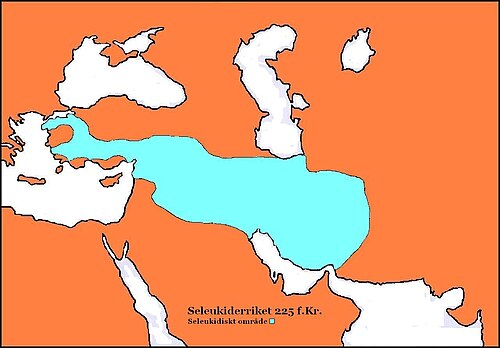
Ascending to the throne at the age of eighteen, Antiochus inherited an empire in turmoil after the death of his brother, Seleucus III Ceraunus. While his initial campaigns against Ptolemaic Egypt ended in failure, he spent the decade that followed successfully reasserting Seleucid authority over territory such as central Asia Minor, Parthia and Bactria. Pressing as far as the Kabul valley, he renewed a friendship with the Indian king Sophagasenus and earned himself the epithet "the Great" (Antiochos Megas). He also assumed the title Basileus Megas (Greek for 'Great King'), the traditional title of the Persian kings. Upon his return to the west, Antiochus launched another campaign against the Ptolemies and brought Coele-Syria, Phoenicia and Judea under Seleucid control.
Antiochus's designs on the Greek city-states earned him the antagonism of the Roman Republic. Declaring himself the "champion of Greek freedom against Roman domination", he waged a four-year war against Rome beginning in mainland Greece in the autumn of 192 BC, advised by the exiled Carthaginian general Hannibal and supported by an alliance with the Aetolian League.[6][7] He was resoundingly defeated at the battles of Thermopylae (191 BC) and Magnesia (190 BC), resulting in the loss of much of the Seleucid lands in Asia Minor to Rome's allies. Renewed rebellions ensued, and Antiochus died three years later on another expedition to the east.
アンティオコス3世はヘレニズム時代のセレウコス朝の一員であった。[ 8 ] [ 9 ] [ 10 ] [ 11 ]彼はセレウコス2世カリニコスとセレウコスの叔母であるラオディケ2世の息子で、紀元前242年頃、ペルシアのスーサ近郊で生まれた。[ 12 ]バビロニアの年代記によれば、彼は当初、王朝名ではない名前(Ly-で始まる)を名乗っていた可能性がある。彼は、兄セレウコス3世ケラウノスがアナトリアで殺害された後、アンティオコスという名で後を継いだ。当時、彼はバビロンにいた。[ 13 ]
アンティオコス3世は、混乱した国家を継承した。小アジアが分離しただけでなく、最東端の属州も分離しており、バクトリアはセレウコス朝のディオドトスが、パルティアは紀元前247年から245年にかけて反乱を起こしたサトラップのアンドラゴラスが支配していたが、アンドラゴラス自身も後に遊牧民の首長アルサケスに敗れた。紀元前222年、アンティオコスの即位後まもなく、メディアとペルシスは、総督である兄弟モロンとアレクサンドロスの下で反乱を起こした。若い王は、大臣ヘルメイアスの影響を受け、自ら反乱軍と対峙する代わりに、プトレマイオス朝シリアへの攻撃を指揮した。プトレマイオス朝への攻撃は失敗に終わり、モロンとアレクサンドロスに差し向けられた将軍たちは惨敗を喫した。王の従兄弟であるアカイオスがセレウコス朝の立場を代表していた小アジアにおいてのみ、その威信が回復し、ペルガモンの勢力は以前の限界まで押し戻された。[ 14 ]
In 221 BC Antiochus at last went far east, and the rebellion of Molon and Alexander collapsed which Polybius attributes in part to his following the advice of Zeuxis rather than Hermeias.[15] The submission of Lesser Media, which had asserted its independence under Artabazanes, followed. Antiochus conspired with his physician and allies to have Hermeias assassinated,[16] and then returned to Syria (220 BC). Meanwhile, Achaeus himself had revolted and assumed the title of king in Asia Minor. Though, due to the brewing mutiny of his troops arising from their dissatisfaction over his rebellion against their king, Achaeus desisted from his attempted coup and retreated.[17] While sending additional threats to Achaeus, Antiochus left him for the time being and renewed his attempts on Ptolemaic Syria.[18][14]
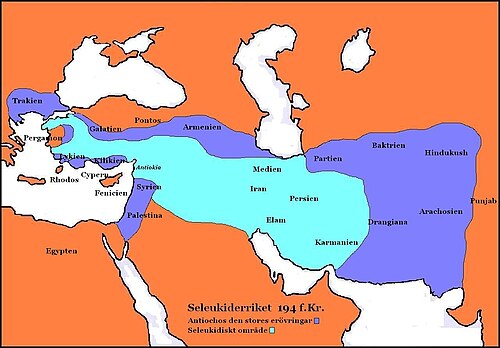
The campaigns of 219 BC and 218 BC carried the Seleucid armies almost to the confines of the Ptolemaic Kingdom, but in 217 BC Ptolemy IV defeated Antiochus at the Battle of Raphia. This defeat nullified all Antiochus's successes and compelled him to withdraw north of Lebanon. In 216 BC his army marched into western Anatolia to suppress the local rebellion led by Antiochus's own cousin Achaeus, and had by 214 BC driven him from the field into Sardis. Capturing Achaeus, Antiochus had him executed. The citadel managed to hold out until 213 BC under Achaeus's widow Laodice who surrendered later.[14]
Having thus recovered the central part of Asia Minor (for the Seleucid government had perforce to tolerate the dynasties in Pergamon, Bithynia and Cappadocia), Antiochus turned to recovering the outlying provinces of the north and east. He besieged Xerxes of Sophene in 212 BC, who had refused to pay tribute.[19] During the siege of Arsamosata, some of Antiochus's advisors proposed deposing Xerxes and installing Mithridates, a nephew of Antiochus, in his place.[20][21] Antiochus declined this counsel. He summoned Xerxes, waived the bulk of the tribute arrears his father, Arsames I, had accumulated, and accepted a reduced immediate settlement in silver, horses, and mules. He allowed Xerxes to continue ruling Sophene and gave him his sister Antiochis in marriage. In 209 BC Antiochus invaded Parthia, occupied the capital Hecatompylos and pushed forward into Hyrcania, winning the Battle of Mount Labus. The Parthian king Arsaces II apparently successfully sued for peace.[14]

The year 209 BC saw Antiochus in Bactria, where the Greco-Bactrian king Euthydemus I had supplanted the original rebel. Antiochus again met with success.[22] Euthydemus was defeated by Antiochus at the Battle of the Arius, but after resisting the Seleucid king in the Siege of Bactra, he obtained an honourable peace by which Antiochus promised Euthydemus's son Demetrius the hand of Laodice, his daughter, and allowed Euthydemus himself to keep his royal title.[14][23]
Antiochus next, following in the steps of Alexander, crossed into the Kabul valley, reaching the realm of Indian king Sophagasenus and returned west by way of Seistan and Kerman (206/5).[14] According to Polybius:
彼はコーカサス山脈を越えてインドに下り、インド王ソファガセノスとの友情を再確認し、象をさらに受け取り、その数を合計150頭に増やし、その場で再び軍隊に物資を補給した。彼は自ら軍隊とともに陣営を撤収し、キュジコスのアンドロステネスを、この王(ソファガセノス)が彼に与えることに同意した財宝を持ち帰るために残した。[ 24 ] [ 23 ]

ティグリス川沿いのセレウキアから、彼はペルシャ湾を下ってアラビア沿岸のゲラエ人に対する短い遠征を率いた(紀元前205/204年)。アンティオコスは東方のセレウコス朝帝国を復興したようで、これにより「大王」(アンティオコス・メガ)の称号を得た。[ 25 ]紀元前205/204年に、幼いプトレマイオス5世エピファネスがエジプトの王位を継承し、アンティオコスは(特にポリュビオスによって)マケドニアのフィリッポス5世とプトレマイオス朝の領土の分割に関する秘密協定を結んだと言われている。 [ 14 ]この協定の条件では、マケドニアはエーゲ海とキュレネ周辺のプトレマイオス朝の領土を受け取り、アンティオコスはキプロスとエジプトを併合することになっていた。
アンティオコスは再びプトレマイオス朝のコイレ・シリアとフェニキアの属州を攻撃し、紀元前199年までに、アイトリアの指導者スコパスがプトレマイオスのために奪還する前に、その領土を占領していたようである。しかし、その奪還は短期間で終わり、紀元前198年、アンティオコスはヨルダン川源流近くのパニウムの戦いでスコパスを破り、この戦いはユダヤにおけるプトレマイオス朝の支配の終焉を告げるものとなった。[ 14 ]
Antiochus then moved to Asia Minor, by land and by sea, to secure the coast towns which belonged to the remnants of Ptolemaic overseas dominions and the independent Greek cities. This enterprise earned him the antagonism of the Roman Republic, since Smyrna and Lampsacus appealed to the Republic, which at the time acted as a defender of Greek freedom. The tension grew when Antiochus in 196 BC established a footing in Thrace. The evacuation of Greece by the Romans gave Antiochus his opportunity, and he now had the fugitive Hannibal at his court to urge him on.[14][26]
In 192 BC Antiochus invaded Greece with a 10,000-man army, and was elected the commander in chief of the Aetolian League.[27] In 191 BC, however, the Romans under Manius Acilius Glabrio routed him at Thermopylae, forcing him to withdraw to Asia Minor. The Romans followed up their success by invading Anatolia, and the decisive victory of Scipio Asiaticus at Magnesia ad Sipylum (190 BC), following the defeat of Hannibal at sea off Side, delivered Asia Minor into their hands.[14]
By the Treaty of Apamea (188 BC) Antiochus abandoned all the country north and west of the Taurus Mountains, most of which the Roman Republic gave either to Rhodes or to the Attalid ruler Eumenes II, its allies (many Greek cities were left free). As a consequence of this blow to the Seleucid power, the outlying provinces of the empire, recovered by Antiochus, reasserted their independence.[14] Antiochus mounted a fresh eastern expedition in Luristan, where he was killed while pillaging a temple of Bel at Elymaïs, Persia, in 187 BC.[7]

In 222 BC, Antiochus III married Princess Laodice of Pontus, a daughter of King Mithridates II of Pontus and Princess Laodice of the Seleucid Empire. The couple were first cousins through their mutual grandfather, Antiochus II Theos. Antiochus and Laodice had eight children (three sons and five daughters):[28]
In 191 BC, Antiochus III married a girl from Chalcis, whom he named "Euboea". They had no children. Laodice III may have fallen in disgrace; however, she clearly survived Antiochus III, and appears in Susa in 183 BC.[29]
Antiochus III resettled 2000 Jewish families from Babylonia into the Hellenistic Anatolian regions of Lydia and Phrygia.[30]Josephus portrays him as friendly towards the Jews of Jerusalem and cognizant of their loyalty to him (see Antiquities of the Jews, Book XII, Chapter 3),[31] in stark contrast to the attitude of his son. In fact, Antiochus III lowered taxes, granted subventions to the Temple, and let the Jews live, as Josephus puts it, "according to the law of their forefathers."[32]
Antiochus III is mentioned in the deuterocanonicalBooks of the Maccabees. The subject of Maccabees is the Maccabean Revolt against Antiochus's son, Antiochus IV Epiphanes. Antiochus III is first mentioned in 1 Maccabees 1:10, when Antiochus IV is introduced as "son of King Antiochus [Antiochus III]". Antiochus III is mentioned later in 1 Maccabees 8, which describes Judas Maccabeus's knowledge of the deeds of the Roman Republic, including an allusion to the defeat of Antiochus III by the Romans. The NRSV says "They [the Romans] also had defeated Antiochus the Great, king of Asia, who went to fight against them with one hundred twenty elephants and with cavalry and chariots and a very large army. He was crushed by them; they took him alive and decreed that he and those who would reign after him should pay a heavy tribute and give hostages and surrender some of their best provinces, the countries of India, Media, and Lydia. These they took from him and gave to King Eumenes." (1 Maccabees 8:6–8)
The difference is that from the perspective of Antiochus III, the Greek king of a Greek empire, or from the later point of view of a head of state communicating with a Greek city-state
Antiochus III the Great. Greek king who ruled an empire including Syria and western Asia (including Mesopotamia and Iran) towards the end of the 3rd century BC. It was during his time that Bactria became independent under Euthydemos. Shortly afterwards Antiochus III crossed the Hindu Kush and attacked an Indian prince named Subhagasena (Sophagasenas of the classical writers) who ruled over the Kabul valley. Antiochus III defeated Subhagasena, extorted from him a large cash indemnity and many elephants before he went back to his country. This invasion produced no permanent effect.
Antiochus III, the Greek king of Syria (the dynasty there was called 'Seleucid'), was busily expanding in Asia Minor and in 196 BC even crossed into Europe to annex part of Thrace.
... in the autumn of 192 BC they heard that Antiochus III had crossed over to Greece with his army and declared himself the champion of Greek freedom against Roman domination.
ANTIOCHUS III THE GREAT c. 242–187 BC Seleucid king Antiochus III the Great was the sixth king (223–187 BC) ... Antiochus landed on the mainland of Greece posing as a champion of Greek freedom against the Romans (192 BC).
Antiochus III (222–187 BC) A member of the Hellenistic Seleucid dynasty
Antiochus III, the Greek Seleucid Dynasty of Greater Syria captures Judea. 172 or 171–163
The wars between the two most prominent Macedonian Generals dynasties, the Ptolemies of Egypt and the Seleucids of Syria, unalterably change the history of the land of Israel ... As a result the land of Israel became part of the empire of the Syrian Greek Seleucids.
Although the Ptolemies and the Seleucids were perpetual rivals, both dynasties were Macedonian and ruled by means of Macedonian officials and Macedonian soldiers. Both governments made great efforts to attract immigrants from Macedonia and Greek city states, thereby adding yet another racial element to the population.
Antiochus III was born in 242 BC, the son of Seleucus II, near Susa, Persia.
The Aetolians called on Antiochus the 'liberate' Greece and to act as arbitrator between them and the Romans. Thereupon the king landed in Demetrias in the late autumn of 192 with a small army, and the Aetolian assembly elected him supreme strategos. His attempt to gather together al those who were dissatisfied with the peace agreement of 196 under the banner of Greek freedom had some success but proved a failure overall.
Jewish settlements in the interior of Asia Minor were known as early as the 3rd century BC when Antiochus III resettled 2000 Jewish families from Babylonia into Lydia and Phrygia