
Loading article…
イロコイ連邦 ハウデノサニー | |
|---|---|
 | |
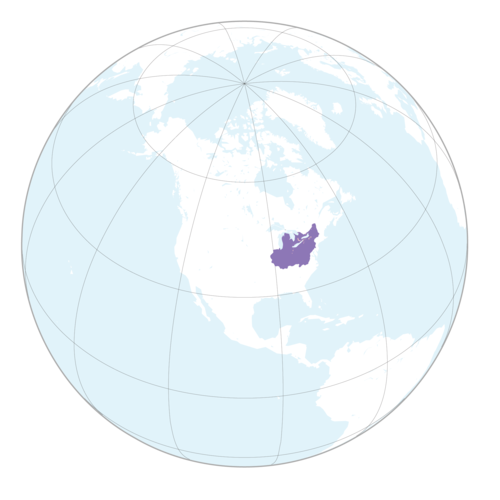 歴史的(紫色)および現在認められている(ピンク色)イロコイ族の領土主張を示す地図 | |
| 状態 | 承認された連邦制、後に非承認政府となった[1] [2] |
| 資本 | オノンダガ(村)、オノンダガ族(現代のさまざまな場所:
|
| 共通言語 | イロコイ語族 |
| 政府 | 連合 |
| 立法府 | 六つの国からなる大評議会 |
| 歴史 | |
• 設立 | 1450年から1660年の間(推定) |
イロコイ族(/ ˈ ɪr ə k w ɔɪ , - k w ɑː / IRR -ə -kwoy, -kwah )は、ファイブ・ネーションズとも呼ばれ、1722年以降はシックス・ネーションズとも呼ばれた。また、ハウデノサニー[a](/ ˌ h oʊ d ɪ n oʊ ˈ ʃ oʊ n i / HOH -din-oh- SHOH -nee ; [8]直訳 すると「ロングハウスを建てている人々」 )というエンドニムでも呼ばれる。北アメリカ北東部に住むイロコイ語を話すネイティブアメリカンと先住民族の連合体である。植民地時代のフランス人にはイロコイ連盟、後にイロコイ連邦として知られ、イギリス人は単に「ファイブ・ネーションズ」と呼んでいた。イロコイ族には、東から西に、モホーク族、オナイダ族、オノンダガ族、カユガ族、セネカ族が含まれていた。1722年以降、南東部のイロコイ語を話すタスカローラ族が連合に受け入れられ、その時点から「6部族」として知られるようになった。
連合は、偉大なる平和の使者デガナウィダ、ハイアワサ、諸国民の母ジゴンサセによって作られたと言われる大平和法の結果として、西暦1450年から1660年の間に生まれたものと考えられる。200年近くもの間、シックス・ネイションズ/ハウデノサニー連合は北米の植民地政策において強力な要因であり、一部の学者は中道の概念を主張した。[9]つまり、ヨーロッパ人がイロコイ族を利用したのと同程度に、ヨーロッパの勢力はイロコイ族によって利用されたというものである。[10] 1700年頃の最盛期には、イロコイ族の勢力は現在のニューヨーク州から、北は五大湖下流、セントローレンス川上流に沿って現在のオンタリオ州とケベック州まで、南はアレゲニー山脈の両側に沿って現在のバージニア州とケンタッキー州、そしてオハイオ渓谷まで広がっていた。
セントローレンス川のイロコイ族、ウェンダット(ヒューロン)、エリー、サスケハノックはいずれもヨーロッパの入植者に知られた独立民族であり、イロコイ語も話していた。彼らはより広い文化的意味でイロコイ族とみなされており、すべて原イロコイ語族の人々と言語の子孫である。しかし歴史的には、彼らはイロコイ連邦諸国の競争相手であり敵であった。[11]
2010年には、45,000人以上のシックス・ネーションズのメンバーがカナダに住み、81,000人以上が米国に住んでいた。[12] [13]
名前
ハウデノサニー(「ロングハウスの人々」)は、6つの部族が自分たちを指す自称である。 [14]正確な語源は議論されているが、イロコイという用語は植民地時代に由来する。ネイティブアメリカンの歴史を研究する学者の中には、「イロコイ」はハウデノサニーの伝統的な敵から採用された軽蔑的な名前であると考える者もいる。[15]連合のあまり一般的ではない古い自称は、オングウェオンウェで、「元々の人々」を意味する。[16] [17] [18]
ハウデノサニーは、セネカ語の音声的に似ているが語源的に異なる2つの単語、すなわち「拡張された家の人たち」を意味するHodínöhšö : ni:h と「家を建てる人」を意味する Hodínöhsö:ni:hに由来する。[19] [20] [21]「ハウデノサニー」という名前が英語で初めて登場するのは、ルイス・ヘンリー・モーガンの著作 (1851) で、そこでは Ho-dé-no-sau-nee と書かれている。19世紀後半には、「Hotinnonsionni」という綴りも確認されている。[19] [22]代替の呼称であるGanonsyoniも時折見られるが、[23] これはモホーク語のkanǫhsyǫ́·ni「拡張された家」、または関連するイロコイ語の同源表現から来ている。初期の文献では、「Kanosoni」、「akwanoschioni」、「Aquanuschioni」、「Cannassoone」、「Canossoone」、「Ke-nunctioni」、「Konossioni」など様々な綴りが用いられている。[19]より分かりやすく言えば、ハウデノサニー連合は6部族(または、1722年にタスカローラ族が入植する前の時代は5部族)と呼ばれることが多い。[19] [b]この単語はモホーク語でRotinonshón:niである。[4]
イロコイという名の起源はやや不明瞭だが、この語は歴史的に英語の文献ではハウデノサニー語よりも一般的である。「イロコイ」という語が初めて文献に登場するのは、1603年にサミュエル・ド・シャンプランがタドゥサックに旅した際の記述である。 [24]その他の初期のフランス語の綴りには、「エロコイズ」、「ヒロコイ」、「ヒロコイ」、「イレコイズ」、「イリコイ」、「イロクエイズ」、「イロコイ」、「イロコイ」などがあり、[19]当時は [irokwe] または [irokwɛ] と発音されていた。[c]この語の起源については競合する説が提唱されているが、いずれも広く受け入れられていない。1978年までにアイブス・ゴダードは次のように書いている。「このような形は、どのインディアン言語にもイロコイ族のグループの名前として確認されておらず、この名前の最終的な起源と意味は不明である。」[19]
イエズス会の司祭であり宣教師であったピエール・フランソワ・ザビエ・ド・シャルルボワは1744 年に次のように書いています。
イロコイという名前は純粋にフランス語で、[イロコイ語の]「私は言った」という意味の「ヒロ」または「ヒーロー」から形成され、ラテン人が昔ディクシで行ったように、これらのインディアンはすべての挨拶をこれで締めくくります。また、 「クエ」から形成され、長く発音されると悲しみの叫びとなり、短く発音されると喜びの叫びとなります。[24]
1883年、ホレイショ・ヘイルは、シャルルボワの語源は疑わしく、「我々が知る限り、これほど風変わりな名前を持つ民族や部族は他にはいない」と記した。[24]ヘイルは、この語はヒューロン語に由来し、モホーク語のierokwa「煙草を吸う者」、またはカユガ語の iakwai「熊」と同語源であると示唆した。1888年、JNB ヒューイットは、これらの語がそれぞれの言語に存在するかどうか疑問を表明した。彼は、モンタニエ語の irin「真実の、本物の」とako「蛇」、およびフランス語の-ois接尾辞を語源とする説を好んだ。後に、彼はこれをアルゴンキン語の Iriⁿakhoiwを語源と修正した。[24] [25]
1968年、ゴードン・M・デイは1880年のシャルル・アルノーの考えを基に、より現代的な語源を提唱した。アルノーは、この語はモンタニェ方言の「恐ろしい男」を意味する irnokué から派生した irokue から来ていると主張した。デイは、この語の語源として、仮説上のモンタニェ方言のフレーズirno kwédač (「男、イロコイ族」の意味) を提案した。最初の要素irnoについて、デイは他の証明されたモンタニェ方言の同義語であるirinou、iriniȣ、およびilnuを挙げている。そして2番目の要素kwédačについては、近隣のアルゴンキン語族がイロコイ族、ヒューロン族、ローレンシャン族を指すために使用した名前であるkouetakiou、kȣetat-chiȣin、goéṭètjgとの関連を示唆している。[24]
ゲイル多文化アメリカ百科事典は、イロコイ族の起源がアルゴンキン語で「ガラガラヘビ」を意味するイロク語であることを証明している。[26]フランス人は最初にアルゴンキン語を話す部族に遭遇し、イロコイ族の競争相手に対するアルゴンキン語の名前を学んだであろう。
連合

イロコイ連邦は、1450年から1660年の間の不明な時期に、グレート・ピースメーカーによって設立されたと考えられており、五大湖南部地域の5つの異なる民族を「大平和同盟」に統合しました。 [27]しかし、他の研究では、設立は1142年に起こったと示唆しています。[28]このイロコイ連邦内の各民族は、独自の言語、領土、および同盟内での役割を持っていました。
リーグは、各国家の一族を代表する50人の首長または酋長からなる大評議会によって統治されている。 [29]
ヨーロッパ人が初めて北アメリカに到着したとき、ハウデノサニー族(フランスにとってはイロコイ同盟、イギリスにとっては五大部族)は、フィンガーレイクス地域を含む現在のニューヨーク州中央部と西部に拠点を置き、北はセントローレンス川、東はモントリオールとハドソン川、南は現在のペンシルベニア州北西部に至る広大な地域を占領していました。1700年頃の最盛期には、イロコイ族の勢力は現在のニューヨーク州から、北は五大湖下流、セントローレンス川上流に沿って現在のオンタリオ州とケベック州、南はアレゲニー山脈の両側に沿って現在のバージニア州とケンタッキー州、そしてオハイオ渓谷にまで及んでいました。同盟は東から西にかけて、モホーク族、オナイダ族、オノンダガ族、カユガ族、セネカ族で構成されていました。 1722年頃、白人入植者との血なまぐさい衝突の後、カロライナから北方へ移住してきたイロコイ語を話すタスカローラ族が同盟に加わった。イロコイ族の五部族と共通の文化的背景(およびオナイダ族の支援)により、タスカローラ族は1722年に連合の6番目の部族として認められ、その後イロコイ族はシックス・ネーションズとして知られるようになった。[30] [31]
エリー族、サスケハノック族、ヒューロン族(ウェンダット族)、ワイアンドット族など、イロコイ語を話す他の独立した部族は、セントローレンス川沿いや五大湖の周辺に様々な時期に住んでいた。アメリカ南東部では、チェロキー族がイロコイ語を話す部族で、ヨーロッパ人と接触する何世紀も前にその地域に移住していた。これらの部族はいずれもハウデノサニー連盟には属していなかった。五大湖地域のハウデノサニー領土の境界付近の人々は、連盟の諸国と競争し、戦争をしていた。
ヌーベルフランス(カナダ)と13植民地となった地域の両方にいたフランス、オランダ、イギリスの入植者たちは、植民地の西側の土地のかなりの部分を占領していたイロコイ族の好意を得る必要があると認識していました。彼らの最初の関係は毛皮取引であり、これは双方にとって非常に利益の大きいものとなりました。入植者たちはまた、入植地の境界を守るために友好関係を築こうとしました。
ほぼ 200 年にわたって、イロコイ族は北アメリカの植民地政策において強力な要因となっていた。イロコイ族との同盟はヨーロッパ列強に政治的、戦略的利点をもたらしたが、イロコイ族は相当の独立性を維持した。イロコイ族の一部はセントローレンス川沿いの伝道村に定住し、フランスとの結びつきが強まった。モホーク族や他のイロコイ族の一部が定住したオランダとイギリスの植民地開拓地に対するフランス主導の襲撃には参加したが、イロコイ族は一般に自らの民族を攻撃することに抵抗した。
イロコイ族は、アメリカ独立戦争まで政治的に統一された大きなネイティブアメリカンの政体であり続けたが、独立戦争でイギリスからの援助要請にどう対応するかという相反する見解により、同盟は分裂した。[32]敗北後、イギリスは協議なしにイロコイ族の領土を割譲し、多くのイロコイ族はモホーク渓谷やその他の土地を放棄し、イギリスが保持する北部の土地に移住しなければならなかった。イギリスは南部で失った500万エーカーの補償として彼らに土地を与えたが、それは以前の領土と同等ではなかった。
現代のイロコイ学者は、リーグと連邦を区別している。[33] [34] [35]この解釈によれば、イロコイリーグとは、現在も存在する大評議会に体現された儀式と文化の組織を指す。イロコイ連邦は、ヨーロッパの植民地化に反応して出現した分散型の政治外交組織であり、アメリカ独立戦争でのイギリスの敗北後に解散した。[33]今日のイロコイ/シックス・ネーションズの人々はそのような区別をせず、これらの用語を互換的に使用し、ハウデノサニー連邦という名前を好んでいる。
大多数がカナダに移住した後、ニューヨークに残ったイロコイ族は主に居留地で暮らすことを余儀なくされた。1784年、土地に飢えたニューイングランド人が西へ移住しようとしていたため、合計6,000人のイロコイ族が24万人のニューヨーク人と対峙した。「わずか600人しかいなかったオナイダ族だけで、600万エーカー、つまり約240万ヘクタールの土地を所有していた。イロコイアでは土地争奪戦がいつ起ころうとしていた。」[36] 1812年の戦争までに、イロコイ族はかなりの領土を失っていた。
歴史
歴史学
イロコイの歴史に関する知識は、ハウデノサニー族の口承、考古学的証拠、イエズス会宣教師の記録、そしてその後のヨーロッパの歴史家たちから生まれたものである。歴史家スコット・スティーブンスは、口承よりも文書資料を重視した初期近代ヨーロッパ人の価値観が、19世紀を通じてイロコイ族に対する人種差別的、偏見的な見方につながったと考えている。[37]イロコイ族の歴史学は、特にアメリカ植民地時代に関して多くの議論の的となっている。[38] [39]
フランスのイエズス会によるイロコイ族に関する記述では、彼らは政府、法律、文字、宗教を持たない野蛮人として描かれている。[40]しかしイエズス会は彼らの言語と文化を研究するためにかなりの努力を払い、彼らを尊敬する者もいた。家父長制社会から来たヨーロッパの資料にとって混乱の原因となったのは、イロコイ族社会の母系血縁制度とそれに関連する女性の権力であった。 [41]カナダの歴史家D.ピーター・マクラウドは、七年戦争時代のカナダのイロコイ族とフランス人について次のように書いている。
最も重大なのは、カナダのイロコイ族社会でかなりの経済的、政治的権力を持っていた氏族の母親の重要性が、家父長制のヨーロッパの筆記者によって軽々しく無視されたことである。現存する記録には、氏族の母親が戦争と平和に関する決定を下すために男性と会議を開き、モントリオールのオノンティオ(イロコイ語でフランス総督を意味する)とフランス指導部と対峙する代表団に参加したことが記されているが、これらの女性が実際に行使した影響力についてはほのめかしているにすぎない。[41]
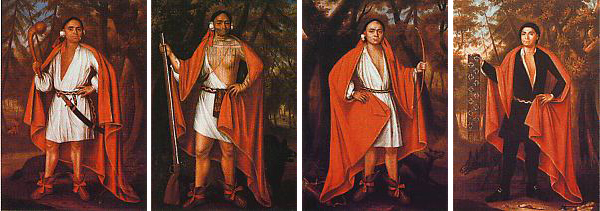
18世紀のイギリスの歴史学は、イロコイ族との外交関係に焦点を当てており、ジョン・ヴェレルストの「 モホーク族の4人の王」などの図像や、ベンジャミン・フランクリンが印刷したアングロ・イロコイ条約議事録などの出版物によって補足されている。[42] 19世紀と20世紀に定着した物語では、イロコイ族は「強大な軍事力と政治力を持つ勢力であり、暴力によって敵を征服し、ほぼ2世紀にわたって植民地北アメリカの勢力均衡の支点として機能した」とされている。[43]
歴史家スコット・スティーブンスは、19世紀にはジョセフ・ブラント(モホーク)やデイヴィッド・キュージック(タスカローラ、 1780年頃- 1840年)などイロコイ族自身が歴史の記述に影響を与え始めたと指摘している。ジョン・アーサー・ギブソン(セネカ、1850年 - 1912年)は、ピースメーカーの叙事詩でイロコイ族の歴史を語る同世代の重要人物だった。[44]その後数十年間に、ローラ・「ミニー」・ケロッグ(オナイダ、1880年 - 1949年)やアリス・リー・ジェミソン(セネカ、1901年 - 1964年)など、イロコイ族の著名な女性歴史家が登場した。 [45]
リーグの結成
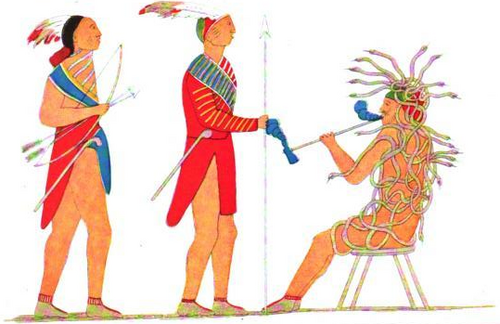
イロコイ同盟は、ヨーロッパ人との接触以前に、五大湖の南に出現した多くのイロコイ族のうち5つの部族が団結して設立された。[46] [d]多くの考古学者や人類学者は、同盟が1450年頃に結成されたと考えているが、[47] [48]もっと早い時期だという議論もある。[49]一説によると、同盟は1142年8月31日の日食の直後に結成され、この出来事は同盟の起源に関する口承で表現されていると考えられている。 [50] [51] [52]いくつかの情報源は、イロコイ連邦の初期の起源を、主食としてのトウモロコシの採用に結び付けている。 [53]
人類学者ディーン・スノーは、考古学的証拠は1450年より前の日付を支持していないと主張している。スノーは、もっと古い日付を主張する最近の主張は「現代の政治的目的によるものかもしれない」と述べている。[54]他の学者は、人類学者が男性の情報提供者だけに相談したため、女性による独特の口承で伝えられる歴史物語の半分が失われていると指摘している。[55]このため、起源物語はデガナウィダとヒアワサという2人の男性に重点を置く傾向があり、女性の伝承で重要な役割を果たす女性ジゴンサセはほとんど知られていない。 [55]
リーグの創設者は、伝統的に、偉大なる平和の使者デカナウィダ、ハイアワサ、そして故郷が一種の国際連合として機能した諸国民の母ジゴンサシーであると考えられている。彼らは、アルゴンキン族とイロコイ族の両方の他の部族と、互いに、そして襲撃と反目していた口論ばかりしていたイロコイ族の諸部族に、平和の使者の偉大なる平和の法則をもたらした。リーグには当初5つの部族が参加しており、「イロコイの5部族」という多くの歴史的言及が生まれた。[e] [46] 18世紀に南部のタスカローラ族が加わり、これらの元々の5つの部族、モホーク族、オノンダガ族、オナイダ族、カユガ族、セネカ族は、21世紀初頭でもハウデノサニー族を構成している。
伝説によると、タドダホという名の邪悪なオノンダガ族の酋長は、グレート・ピースメーカーとハイアワサによって平和の道に改宗させられた最後の人物である。彼は、リーグのすべての国の統一を代表して、リーグ評議会の名誉議長の地位を提供された。[56]これは、現在のニューヨーク州シラキュース近くのオノンダガ湖で起こったと言われている。タドダホという称号は、リーグの議長、つまり評議会でオノンダガ族と共に座る50番目の酋長に今でも使われている。[57]
その後、イロコイ族は極めて平等主義的な社会を築き上げた。1749年、あるイギリス植民地行政官は、イロコイ族は「絶対的な自由観念を持ち、いかなる優越性も認めず、領土から奴隷制を追放する」と宣言した。[58]部族間の襲撃がなくなり、イロコイ族が競争相手と戦争を始めると、イロコイ族の数は増加し、ライバルは減少した。イロコイ族の政治的結束は急速に、17世紀と18世紀の北アメリカ北東部で最も強力な勢力の一つとなった。
同盟の五十人評議会は紛争を裁定し、合意を求めた。しかし、同盟は五部族すべてを代弁したわけではなく、各部族は独立して行動し、独自の戦闘部隊を結成し続けた。1678年頃、評議会はペンシルベニアとニューヨークの植民地政府との交渉でより大きな力を発揮し始め、イロコイ族は外交に非常に長け、個々の部族がスウェーデン、オランダ、イギリスと対立していたのと同じように、フランスとイギリスを対立させた。[46]
イロコイ語族は、近隣のイロコイ連盟のメンバーと戦争や交易を行っていた。[46] 17世紀の探検家ロバート・ラ・サールは、モソペレア族が1670年代初頭にイロコイ族に敗れたオハイオ渓谷の人々の中にいると特定した。[59]エリー族とアレゲニー渓谷上流の人々は、ビーバー戦争の間に衰退した。1676年までに、サスケハノック族[f]の勢力は、3年間続いた伝染病、イロコイ族との戦争、および開拓者らが弱体化した部族を利用したため、衰退した。[46]
イロコイ族の初期の歴史に関する一説によると、イロコイ族は同盟を結成した後、新たな狩猟地を求めてオハイオ川流域の東オハイオ地方となる地域、現在のケンタッキー州にまで侵入した。彼らはオハイオ川流域のスー語を話す部族約1,200人をこの地域から追い出した。その中にはクアポー族(アカンシア族)、オフォ族(モソペレア族)、トゥテロ族などがあり、他の近縁種族もいた。これらの部族はミシシッピ川周辺の地域や東海岸のピエモンテ地域に移住した。 [60]
その他のイロコイ語族[61]は、人口の多いワイアンドット族(ヒューロン族)を含め、関連する社会組織と文化を持っていたが、病気と戦争の結果、部族としては絶滅した。[g]彼らは招待されてもリーグに参加せず、ビーバー戦争とユーラシアの伝染病による高い死亡率の後は大幅に減少した。先住民族は植民地の辺境戦争で中立を保とうとすることもあったが、七年戦争の北米戦線であるフレンチ・インディアン戦争のように、ヨーロッパ人と同盟を結んだ者もいた。この戦争では、六部族はフランスとイギリスの間で同盟を組むことに分裂した。
拡大
歴史家ダイアナ・ミュアは著書『 Bullough's Pondの反射』の中で、接触以前のイロコイ族は帝国主義的、拡張主義的な文化であり、トウモロコシ、豆、カボチャの複合農業によって大規模な人口を養うことができたと主張している。彼らは主に近隣のアルゴンキン語族と戦争をした。ミュアは考古学的データを用いて、アルゴンキン語族の土地へのイロコイ族の拡大はアルゴンキン語族が農業を採用したことで阻止されたと主張している。これにより、彼らはイロコイ族の征服に抵抗できるほどの人口を養うことができた。[62]連合の人々は、大平和連盟を彼らの遺産の基盤とみなし、この歴史的解釈に異議を唱えている。[63]
イロコイ族は、カナダ東部のミクマク族の口承伝説に登場するクウェデック族である可能性がある。これらの伝説によると、ミクマク族は先接触期後期に敵であるクウェデック族を徐々に西に追い払い、ニューブランズウィック州を横切り、最終的にセントローレンス川下流地域から追い出した。ミクマク族は最後に征服した土地を「最後の土地」、つまり「最後の土地」と名付け、フランス語ではガスペと名付けられた。「クウェデック族」は一般にイロコイ族、特にモホーク族であると考えられており、ミクマク族によるガスペからの追放は、1535年から1600年頃に起こったと推定されている。[64] [ページが必要]
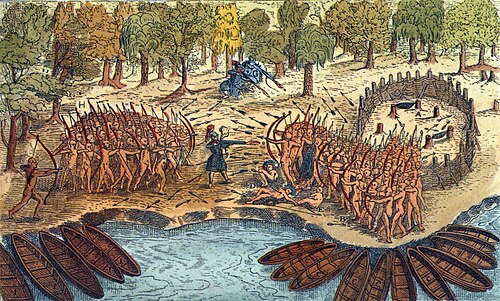
1535年頃、ジャック・カルティエはガスペ半島とセントローレンス川沿いにイロコイ語を話す集団がいると報告している。考古学者と人類学者はセントローレンス川のイロコイ族を、カルティエが訪れたオシュラガ村やその付近(現在のモントリオール付近)に住む、別個の集団(おそらくは複数の個別集団)と定義している。1608年にサミュエル・ド・シャンプランがこの地域を訪れた時には、セントローレンス川渓谷のその部分には集落はなく、モホーク族が狩猟場として支配していた。カルティエが遭遇したイロコイ族の運命は謎のままであり、確実に言えることは、シャンプランが到着したときには彼らはいなくなっていたということだけである。[65]ガスペ半島でシャンプランはアルゴンキン語を話す集団に遭遇した。これらの集団の正確な正体については、いまだに議論が続いている。 1609年7月29日、シャンプランは同盟軍を支援し、現在シャンプラン湖と呼ばれる湖畔でモホーク族の戦闘部隊を打ち破り、1610年6月にもモホーク族と戦った。[66]
イロコイ族は、この頃までに 17 世紀に南部の植民地でよく知られるようになった。バージニア州ジェームズタウン(1607 年) に最初のイギリス人が定住した後、17 世紀の多数の記録には、ポウハタン連合ではマッサウォメック族、フランスではアントゥオノロン族として知られる強力な民族が記述されている。彼らはサスケハノック領土の北から来たと言われている。歴史家は、マッサウォメック / アントゥオノロン族をハウデノサニー族と 同一視することが多い。
1649年、主にセネカ族とモホーク族からなるイロコイ族の戦闘部隊がヒューロン族のウェンデイク村を破壊した。その結果、ヒューロン族の国家は最終的に分裂した。北方に敵がいなくなったイロコイ族は、南の隣人であるエリー湖とオンタリオ湖の北岸にある中立国サスケハノック族に軍を向けた。そして1654年、毛皮貿易をめぐる競争で、西方のエリー族を含む他のイロコイ語族を滅ぼした。 [67] [要ページ]次にモヒカン族を滅ぼした。勝利の後、イロコイ族はミシシッピ川から大西洋、セントローレンス川からチェサピーク湾に至る地域で覇権を握った。
マイケル・O・ヴァーホラは、周辺諸国を征服し従わせることに成功したことで、逆説的に先住民のヨーロッパ人の成長に対する反応が弱まり、その結果先住民が自らの成功の犠牲者になったと主張している。
連盟の五部族はオレンジ砦(現在のニューヨーク州アルバニー)でオランダ人と貿易関係を築き、毛皮とヨーロッパの品物を交換した。この経済関係はオランダ人の生活様式を大きく変え、ビーバーの乱獲につながった。[68]
1665年から1670年にかけて、イロコイ族は現在のオンタリオ州にあるオンタリオ湖の北岸に7つの村を建設した。これらは総称して「イロコイ・デュ・ノール」村と呼ばれている。これらの村はすべて1701年までに放棄された。[69]
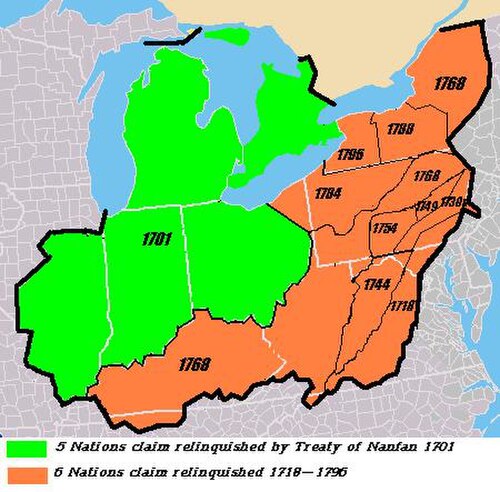
1670年から1710年にかけて、五部族は瀑布線の西側からオハイオ川流域(現在のウェストバージニア州とケンタッキー州)まで、バージニア州の大部分を政治的に支配した。ビーバー戦争の結果、五部族はスー語を話す部族を追い出し、征服権によってその地域を狩猟場として確保した。五部族は最終的に、1768年のスタンウィックス砦条約でオハイオ川以南の土地に対する残りの権利をイギリス人入植者に売却した。
歴史家ペッカ・ハメライネンは、この同盟について次のように書いている。「北アメリカには五部族同盟のようなものは存在しなかった。他のどの先住民族国家や連合も、これほど遠くまで到達したことはなく、これほど野心的な外交政策を実施したこともなく、これほどの恐怖と尊敬を集めたこともない。五部族は状況に応じて外交、脅迫、暴力を組み合わせ、彼らにしか対処できない慎重な不安定さを生み出した。彼らの指針は、選択肢を制限し、外部からの操作にさらされるリスクとなる単一の植民地に執着することを避けることだった。」[70]

ビーバー戦争
1609年から、リーグはフランス、その同盟ヒューロン族、ペトゥン族、エリー族、サスケハノック族を含む他の近隣部族との数十年に及ぶビーバー戦争に従事した。[68] 彼らは、儲かる毛皮貿易のために狩猟動物へのアクセスをコントロールしようと、大西洋岸のアルゴンキン語族(レナペ族、またはデラウェア族)、北方カナダ楯状地のアニシナベ族、そしてしばしばイギリス植民地も侵略した。ビーバー戦争の間、彼らはヒューロン族(1649年)、ペトゥン族(1650年)、中立国(1651年)、[71] [72]エリー族(1657年)、サスケハノック族(1680年)を打ち負かし、同化したと言われている。[73]伝統的な見解では、これらの戦争は彼らが依存していたヨーロッパの商品を購入するために、利益の多い毛皮貿易を支配する手段であったとされています。 [74] [75] [ページが必要]スターナはこの見解に疑問を投げかけています。[76]
最近の研究ではこの見解がさらに詳しく述べられており、ビーバー戦争はイロコイ族の「哀悼戦争」の伝統が拡大したものだと論じられている。[77]この見解は、イロコイ族が戦闘や天然痘の流行で亡くなった多くの人々の復讐や補充のために近隣の部族に対して大規模な攻撃を仕掛けたことを示唆している。
1628年、モホーク族はマヒカン族を破り、ニューネーデルラントのフォートオレンジ(現在のアルバニー)でオランダ人との毛皮貿易の独占権を獲得した。モホーク族は北部の先住民がオランダ人と貿易することを許可しなかった。[68] 1640年までに彼らの土地にはビーバーがほとんどいなくなり、イロコイ族は西と北のインディアンと、価値の高い厚いビーバーの毛皮を欲しがるヨーロッパ人との間の毛皮貿易の仲買人になってしまった。[68] 1645年、イロコイ族とヒューロン族、アルゴンキン族、フランス人の間で暫定的な和平が結ばれた。
1646年、ヒューロン族のサントマリーにいたイエズス会宣教師たちは、不安定な平和を守るため、モホーク族の土地へ特使として赴いた。イエズス会が旅をしている間に、モホーク族の和平に対する態度は悪化し、その戦士たちが途中で一行を襲撃した。宣教師たちはカニエンケ(モホーク族)のオッセルノン村(現在のニューヨーク州オーリーズヴィル付近)に連れて行かれ、そこで穏健派のタートル族とウルフ族は宣教師たちの解放を勧告したが、怒ったベア族のメンバーが1646年10月18日にジャン・ド・ラランドとイザック・ジョグを殺害した。 [78]カトリック教会は、2人のフランス人司祭とイエズス会の平信徒であるルネ・グーピル(1642年9月29日殺害)[79]を8人の北米殉教者の一人として追悼している。
1649年のビーバー戦争の際、イロコイ族はフランスの同盟者であるヒューロン族を攻撃するために、購入したばかりのオランダ製の大砲を使用した。これらの攻撃は、主にヒューロン族の町であるタエンハテンタロン(セントイグナス[80])とセントルイス[81](現在のオンタリオ州シムコー郡)に対して行われ、ヒューロン連合を事実上壊滅させた最後の戦いとなった。[82]ジョージアン湾岸のヒューロニアにあるイエズス会の伝道所はイロコイ族の攻撃に直面して放棄され、イエズス会は生き残ったヒューロン族を東のセントローレンス川沿いのフランス人入植地へと導いた。[78]イエズス会関係者は、五部族が「その数は非常に少ないにもかかわらず、周囲500リーグにわたって」この地域を支配できたことに驚きを表明した。[78] 1651年から1652年にかけて、イロコイ族は現在のペンシルベニア州の南にある サスケハノック川を攻撃したが、持続的な成功は得られなかった。
1653年、オノンダガ族はヌーベルフランスに和平の招待を差し伸べた。シモン・ル・モワン率いるイエズス会の遠征隊は1656年、彼らの領土内にサント・マリー・ド・ガネンタを建設した。彼らは1658年までに敵対行為が再開したため、宣教を放棄せざるを得なくなった。おそらく、免疫のないヨーロッパの伝染病である天然痘の流行で500人の原住民が突然死亡したためだろう。
1658年から1663年まで、イロコイ族はサスケハノック族とその同盟者であるレナペ族およびメリーランド州と戦争状態にあった。1663年、イロコイ族の大規模な侵略軍がサスケハノック族の主要砦で敗れた。1663年、イロコイ族はコネチカット川上流のソコキ族と戦争状態にあった。天然痘が再び流行し、病気、飢餓、戦争の影響でイロコイ族は絶滅の危機に瀕した。1664年、オナイダ族の一団がチェサピーク湾でサスケハノック族の同盟者を襲撃した。
1665年、五部族のうち3部族がフランスと和平を結んだ。翌年、ヌーベルフランスの総督、トレーシー侯爵はカリニャン連隊を派遣してモホーク族とオナイダ族と対決させた。[83]モホーク族は戦闘を避けたが、フランス軍は彼らの村(彼らは「城」と呼んでいた)と作物を焼き払った。[83] 1667年、残りの2つのイロコイ族はフランスと和平条約を結び、宣教師が村を訪問することを認めた。フランスのイエズス会宣教師はイロコイ族から「黒衣の者」と呼ばれ、カトリック改宗者はモントリオール郊外のカニエンケ、カウナワガに移住するよう促し始めた。 [83]この条約は17年間続いた。
1670–1701
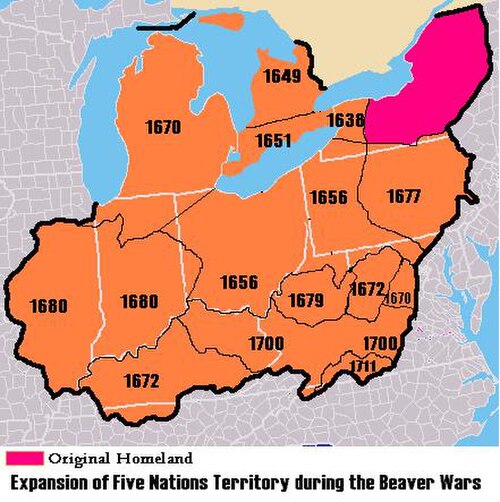
1670 年頃、イロコイ族はスー語を話すマナホアック族をバージニア北部のピエモンテ地方から追い出し、その領土の所有権を主張し始めた。1672 年、イロコイ族はサスケハノック族の戦闘部隊に敗れ、フランス総督フロンテナックに支援を求めた。
彼にとって、子供たちが打ち負かされるのを許すのは恥ずべきことだっただろう。彼らは、非常に強固な砦を攻撃する手段も、他の者が村を攻撃しに来た場合に自分たちを守る手段も持っていないのだ。[84]
いくつかの古い歴史書ではイロコイ族がサスケハノック族を破ったとされているが、これは文書化されておらず疑わしい。[85] 1677年、イロコイ族はイロコイ語を話すサスケハノック族の大部分を自分たちの国に迎え入れた。[86]
1676年1月、ニューヨーク植民地総督エドマンド・アンドロスはイロコイ族の酋長に手紙を送り、フィリップ王戦争での援助を求めた。ニューイングランドのイギリス人入植者はメタコム率いるワンパノアグ族との戦いに苦戦していた。イギリス人から貴重な銃と引き換えに、イロコイ族の戦闘部隊は1676年2月にワンパノアグ族を壊滅させ、村や食料貯蔵庫を破壊し、多くの捕虜を捕らえた。[87]
1677年までに、イロコイ族は盟約の鎖として知られる協定を通じてイギリスと同盟を結んだ。1680年までにイロコイ連邦はサスケハノック族とワンパノアグ族を排除し、人口を増やすために膨大な数の捕虜を取り、銃と弾薬を供給することでイギリスとの同盟を確保し、強い立場を築いた。[88]同盟国は協力して、連邦の伝統的な敵であるフランスとその同盟者であるヒューロン族と膠着状態になるまで戦った。イロコイ族はオンタリオ湖の北岸に植民地を築き、西のイリノイ地方まで襲撃隊を送った。イリノイの部族は最終的にイロコイ族ではなくポタワトミ族によって敗北した。
1679年、サスケハノック族はイロコイ族の助けを借りて、メリーランドのピスカタウェイ族とマタウーマン族の同盟を攻撃した。[89]和平は1685年まで達成されなかった。同時期に、フランスのイエズス会宣教師がイロコイで活動し、多くのハウデノサニー族がモントリオール近郊のカナワケとカネサタケのセントローレンス渓谷に自発的に集団移住した。フランス人の意図は、セントローレンス渓谷のカトリックのハウデノサニー族を緩衝地帯として利用し、現在のニューヨーク州北部に住むイギリスと同盟を組むハウデノサニー族を、モントリオールのフランス毛皮貿易の中心地から遠ざけることだった。ハウデノサニー族の同盟者を利用しようとするイギリス人とフランス人の両方の試みは、ハウデノサニー族の2つのグループが「お互いを殺すことに深い抵抗」を示したため、失敗した。[90]カトリックのイロコイ族がセントローレンス渓谷に移住した後、歴史家はモントリオール郊外に住むイロコイ族をカナダのイロコイ族と呼び、現代のニューヨーク州北部の歴史的中心地に住むイロコイ族をリーグ・イロコイ族と呼ぶことが多い。[91]
1684年、ヌーベルフランスの総督ジョセフ・アントワーヌ・ル・フェーブル・ド・ラ・バールは、ミシシッピ川流域でフランス人とアルゴンキン族の毛皮商人を攻撃していたセネカ族に対する懲罰遠征を開始することを決定し、カトリック教徒のオデノサニー族に戦闘員の派遣を要請した。[92]ラ・バールの遠征は、1684年9月にフランス海軍部隊の間でインフルエンザが流行し、カナダのイロコイ族戦士が戦闘を拒否し、代わりにセネカ族戦士との侮辱的な戦いに巻き込まれたことで、大失敗に終わった。[93]フランス国王ルイ14世はラ・バールの失敗を聞いて面白くなかったため、ジャック=ルネ・ド・ブリゼー・ド・デノンヴィル侯爵(総督 1685-1689)が後任となり、8月に太陽王からの命令を持って到着し、オーデノソーニー族の同盟を粉砕し、北アメリカの荒野でもフランスの名誉を守るよう命じた。[93]同年、イロコイ族は再びバージニアとイリノイの領土に侵入し、後者のフランス軍前哨基地を攻撃したが失敗した。バージニア植民地は、バージニアのシェナンドー渓谷での戦闘を減らすため、その年の後半にオールバニーでの会議で、ブルーリッジ山脈の東を通るグレート・ウォーパスとして知られる南北の道を使用するイロコイ族の権利を認めることに合意した。ただし、瀑布線の東にあるイギリス人入植地に侵入しないことを条件とした。
1687年、デノンヴィル侯爵はよく組織された軍隊を率いてフロンテナック砦(現在のオンタリオ州キングストン)に向けて出発した。1687年7月、デノンヴィルは海兵隊、フランス系カナダ人民兵、イエズス会宣教師の入植地から来た353人のインディアン戦士(220人のハウデノサニー族を含む)の混成部隊を遠征に同行させた。[93]彼らは、現在のオンタリオ州南部にあるオンタリオ湖北岸で、オノンダガ評議会の火事から来た50人の世襲酋長と休戦旗の下で会談した。 [93]デノンヴィルはヌーベルフランスのために砦を奪還し、50人のイロコイ族の酋長を捕らえて鎖につなぎ、ガレー船の奴隷として使うためにフランスのマルセイユへ送った。[93]外交団に対するこの裏切りにカトリック教徒のオデノサニー族の何人かは激怒し、少なくとも100人がセネカ族のもとへ逃亡した。[94]デノンヴィルは、自分が「文明化されたヨーロッパ人」として「野蛮人」の習慣を尊重せず、彼らの好きなように扱うと言って、出会った人々を奴隷にすることを正当化した。1687年8月13日、フランス軍の先遣隊がセネカ族の待ち伏せに遭遇し、ほぼ全員が殺されたが、フランス軍の主力が到着するとセネカ族は逃げた。残ったカトリック教徒のオデノサニー族の戦士たちは、撤退するセネカ族の追撃を拒否した。[93]
デノンヴィルはセネカ族の土地を荒らし、アイロンデコイト湾にフランス艦隊を上陸させ、セネカ族の勢力の中心地を直撃し、多くの村を破壊した。攻撃前に逃げたセネカ族は、サスケハナ川を下ってさらに西、東、南に移動した。故郷に大きな損害が与えられたにもかかわらず、セネカ族の軍事力は目立って弱体化していなかった。同盟とセネカ族は、東部に定住していたイギリス人と同盟を結んだ。セネカ族の土地が破壊されたことは、イロコイ連邦のメンバーを激怒させた。1689年8月4日、彼らは報復として、モントリオールに隣接する小さな町ラシーンを焼き払った。それより前の数か月間、1,500人のイロコイ族戦士がモントリオールの防衛を妨害していた。
彼らは最終的にデノンヴィルとその軍を疲弊させ、打ち負かした。彼の在任期間のあと、フロンテナックが9年間(1689年から1698年)復帰した。フロンテナックはイロコイ族を弱体化させる新しい戦略を立てていた。和解の一環として、彼は捕らえた50人のうち生き残った13人の酋長を探し出し、1689年10月に彼らを連れてヌーベルフランスに戻った。1690年、フロンテナックはスケネクタディ、カニエンケを破壊し、1693年にはモホーク族の村3つを焼き払い、300人を捕虜にした。[95]
1696年、フロンテナックは76歳であったにもかかわらず、イロコイ族と戦うことを決意した。彼は、フランス人の好敵手であったモホーク族ではなく、オナイダ族とオノンダガ族を標的にすることを決めた。[95] 7月6日、彼はかなりの軍勢を率いてラシーンを出発し、首都オノンダガに向かい、1か月後に到着した。フランスの支援を受けて、アルゴンキン語族は、ビーバー戦争中に征服したエリー湖の北と現在のオハイオ州クリーブランドの西の領土からイロコイ族を追い出した。 [86]その間に、イロコイ族は村を放棄していた。追撃は不可能だったため、フランス軍は8月10日に帰還行軍を開始した。フロンテナックの指揮の下、カナダ民兵はゲリラ戦にますます熟達し、イロコイ族の領土にまで戦いを挑み、イギリス人入植地のいくつかを攻撃した。イロコイ族が再びフランス植民地を脅かすことはなかった。[96]
ウィリアム王戦争(大同盟戦争の北アメリカ部分)の間、イロコイ族はイギリスと同盟を結んでいた。1701 年 7 月、彼らは「南藩条約」を締結し、オハイオ川の北の広大な土地をイギリスに譲渡した。イロコイ族は、この領土を 80 年前に征服したと主張した。フランスは、当時この地域に入植地があったのに対し、イギリスにはほとんど入植地がなかったため、この条約を認めなかった。一方、イロコイ族はフランスと和平交渉を行っており、同年、 両国はモントリオール大和平条約に調印した。
フレンチ・インディアン戦争
1701年にフランスとの和平条約が結ばれた後、イロコイ族はほぼ中立を保った。17世紀の間に、イロコイ族はヨーロッパ人の間で恐ろしい評判を得ており、この評判を利用してフランスをイギリスに対抗させ、最大限の物質的報酬を引き出すのがシックス・ネーションズの方針だった。[97] 1689年、イギリス王室はフランスに対抗する支援と引き換えにシックス・ネーションズに100ポンド相当の品物を提供し、1693年にはイロコイ族は600ポンド相当の品物を受け取っており、1701年にはシックス・ネーションズは800ポンド相当の品物を受け取っている。[98]
アン女王戦争(スペイン継承戦争の北アメリカ部分)の間、彼らはフランスに対する計画的な攻撃に関与していた。アルバニー市長のピーター・スカイラーは、3人のモホーク族の酋長と1人のマヒカン族の酋長(誤って4人のモホーク族の王として知られる)が1710年にロンドンに行き、アン女王と会ってイギリスとの同盟を結ぶよう手配した。アン女王は訪問者に非常に感銘を受け、宮廷画家のジョン・ヴェレルストに彼らの肖像画を依頼した。この肖像画は、実物を描いたアボリジニの人々の油絵肖像画としては現存する最古のものと考えられている。[99]
18世紀初頭、タスカローラ族はノースカロライナ州とサウスカロライナ州で白人入植者と血なまぐさい衝突を起こした後、徐々に北のペンシルベニアやニューヨークへと移住した。言語や文化の類似点を共有していたため、タスカローラ族は徐々にイロコイ族と連携し、オナイダ族の後援を受けて1722年に6番目のインディアン国家として連邦に加盟した。[31]
イロコイ族の敗北した部族に対する計画は、大量虐殺よりも「盟約の鎖」と平和の大法則への同化を好んだ。レニ・レナペ族とショーニー族はともに短期間シックス・ネイションズに貢納したが、支配下のイロコイ族は次の時期にオハイオ州でミンゴ族として出現し、セネカ族のような方言を話した。アメリカ人には「アン女王戦争」として知られるスペイン継承戦争の間、イロコイ族はイギリス寄りで中立を保った。[95]英国国教会の宣教師はイロコイ族とともに活動し、彼らのために文字体系を考案した。[95]

1721年と1722年に、バージニア副総督アレクサンダー・スポッツウッドは、オールバニーでイロコイ族と新たな条約を締結し、盟約の鎖を更新し、ブルーリッジ山脈をバージニア植民地とイロコイ族の境界線として認めることに同意した。しかし、1730年代にヨーロッパ人入植者がブルーリッジ山脈を越えてシェナンドー渓谷に移住し始めると、イロコイ族は反対した。バージニアの役人は、境界線はイロコイ族がブルーリッジ山脈の東側に侵入するのを防ぐためのもので、イギリス人が西に拡大するのを防ぐものではないと彼らに伝えた。その後数十年で緊張が高まり、イロコイ族はバージニア植民地と戦争寸前になった。1743年、ウィリアム・グーチ総督は、イロコイ族が領有権を主張する渓谷内の入植地1つにつき100ポンドをイロコイ族に支払った。翌年のランカスター条約で、イロコイ族はシェナンドー渓谷に残っていた領有権をすべて金200ポンドでバージニアに売却した。[100]
フレンチ・インディアン戦争(七年戦争の北米戦線)の間、イロコイ同盟は、伝統的な敵であったフランスとその同盟アルゴンキン族に対してイギリス側についた。イロコイ族は、イギリスを支援することで戦後も恩恵が得られると期待した。この作戦に参加したイロコイ族の戦士は少数だった。対照的に、カナダのイロコイ族はフランスを支持した。
1711年、現在のドイツ南西部、パラティン族として知られる地域からの難民が、イロコイ族の母親たちに土地に定住する許可を求めました。[101] 1713年の春までに、約150のパラティン族の家族がイロコイ族から土地を借りていました。[102]イロコイ族はパラティン族に、豆、トウモロコシ、カボチャという彼らの主食である「スリーシスターズ」の栽培方法と、食用の木の実、根菜類、ベリー類の見つけ方を教えました。[102]そのお返しに、パラティン族はイロコイ族に小麦とオート麦の栽培方法、鉄製の鋤と鍬を使った農業の方法を教えました。[102]パラティン族に土地を貸して得たお金のおかげで、イロコイ族のエリートたちはロングハウスでの暮らしをやめ、中流のイギリス人家庭と同等の収入を得て、ヨーロッパ風の家に住み始めました。[102] 18世紀半ばまでに、イロコイ族がドイツ人やスコットランド・アイルランド人の入植者と共存する多文化世界が出現した。[103]パラティーノの入植地はイロコイ族の村と混在していた。[104] 1738年、毛皮商人として成功したアイルランド人のウィリアム・ジョンソン卿がイロコイ族のもとに定住した。 [105]毛皮貿易と土地投機で大金持ちになったジョンソンはイロコイ族の言語を学び、イギリスとリーグの主な仲介者となった。[105] 1745年、ジョンソンは北部インディアン担当長官に任命され、その地位が正式に確立された。[106]
.jpg/500px-thumbnail.jpg)
1755年7月9日、オハイオ川流域に進軍していたエドワード・ブラドック将軍率いるイギリス正規軍とバージニア民兵隊は、モノンガヒラ川の戦いでフランス軍とその同盟インディアンによりほぼ完全に壊滅した。[106]イギリス側にイロコイ連盟を招集する任務を負っていたジョンソンは、アングロ・イロコイ混成軍を率いて、イギリス人にはジョージ湖として知られていたサン・サクラメント湖で勝利を収めた。[106]ジョージ湖の戦いでは、カトリック教徒のモホーク族(カナワケ出身)とフランス軍が、モホーク族が率いるイギリス軍の部隊を待ち伏せした。モホーク族は、民族間の平和のために同盟を結成し、互いに戦争をしたことがなかったため、深く動揺した。ジョンソンは、ディエスコー男爵の指揮下にある1,000人のフランス軍と700人のカナダ人イロコイ族の軍を待ち伏せしようとしたが、男爵はこれを撃退し、モホーク族の老軍長ピーター・ヘンドリックスを殺害した。[106] 1755年9月8日、ディエスコーはジョンソンの陣営を攻撃したが、大きな損失を被って撃退された。 [106]ジョージ湖の戦いはイギリスの勝利であったが、この戦いでモホーク族とオナイダ族が大きな損失を被ったため、リーグは戦争で中立を宣言した。[106]ジョンソンの最善の努力にもかかわらず、リーグ・イロコイはその後数年間中立を守り、オスウェゴ、ルイスバーグ、フォート・ウィリアム・ヘンリー、フォート・カリヨンでのフランスの一連の勝利により、リーグ・イロコイは負けそうな側で戦うことはなかった。[107]
1756 年 2 月、フランス軍はオナイダ族の酋長オラトリーのスパイから、イギリス軍がオナイダ運搬所に物資を備蓄していることを知った。そこは、現在のオンタリオ州への春の攻勢を支援するために、アルバニーとオスウェゴを結ぶ重要な陸路だった。オンタリオ湖の南側の凍った水は、平均してオンタリオ湖の北側の水よりも 2 週間早く解けたため、イギリス軍は、モントリオールのフランス軍が救援に来る前に、フロンテナック砦とナイアガラ砦のフランス軍基地に攻め込むことができた。フランス軍の見地からすると、冬の間にオナイダ運搬所を先制攻撃する必要があるとされた。[108]この攻撃を実行するために、ヌーベルフランス総督のヴォードルイユ侯爵は、海軍部隊の士官であるガスパール=ジョセフ・ショセグロ・ド・レリーにその任務を与えた。レリーはカナダのイロコイ族にオナイダ運搬所への案内を依頼し、その援助を得た。[109]カナダのイロコイ族は、1756年2月29日にモントリオールを出発したこの遠征隊に加わったが、その際、彼らはイギリス軍とのみ戦い、イロコイ同盟とは戦わないこと、砦を襲撃しないことを了承していた。[110]
1756年3月13日、オスウェガッチ・インディアンの旅行者が遠征隊に、イギリス軍がオナイダ・キャリーイング・プレイスに2つの砦を築いたと知らせた。このため、カナダのイロコイ族の大半は砦を襲撃するリスクは犠牲者が多すぎると主張して引き返すことを望み、実際に多くが遠征隊を放棄した。[111] 1756年3月26日、2日間何も食べていなかったレリーの海軍部隊とフランス系カナダ人民兵は、カナダのイロコイ族がウィリアム砦とブル砦に物資を運んでいたイギリスの幌馬車隊を待ち伏せした際に、大いに必要としていた食糧を受け取った。[112]カナダのイロコイ族にとって、襲撃は成功であり、物資を満載した荷馬車9台を捕獲し、10人の捕虜を取ったが、一人の死者も出なかった。彼らにとって、レリーが望んだように2つの木造砦に正面攻撃を仕掛けることは非合理的だった。[113]カナダのイロコイ族はレリーに「もし私が絶対に死にたければ、私はフランス人の主人だが、彼らは私に従うつもりはない」と告げた。[114]結局、1756年3月27日の朝、フランス人とそのインディアン同盟軍が砦を襲撃し、正午に破城槌で正門を破壊して侵入したとき、約30人のカナダのイロコイ族がしぶしぶレリーのブル砦攻撃に参加した。[115]フォート・ブルにいた63人のうち、半数が民間人だったが、フォート・ブルの戦いで生き残ったのは兵士3人と大工1人と女性1人だけだった。レリーは「兵士とカナダ人の激怒を抑えることができなかった。彼らは出会った者すべてを殺した」と報告している。[116]その後、フランス軍はイギリス軍の物資とフォート・ブル自体をすべて破壊し、ヌーベルフランスの西側を守っていた。同日、カナダのイロコイ族の主力はフォート・ブルの救援に来たウィリアム砦からの救援部隊を待ち伏せしたが、フランス軍がフォート・ブルで行ったように捕虜を虐殺することはなかった。イロコイ族にとって捕虜は部族の規模を拡大させるため非常に貴重だったからである。[117]
ヨーロッパ人と先住民族の戦争方法の決定的な違いは、ヨーロッパには数百万人の人々がいたため、イギリスとフランスの将軍は勝利を確実にするために自軍の兵士数千人が戦死しても構わないと考えていたことです。なぜなら、損失は常に補うことができたからです。対照的に、イロコイ族の人口ははるかに少なく、コミュニティを麻痺させるほどの大きな損失は許容できませんでした。捕虜を捕らえてイロコイ族になる「哀悼戦争」というイロコイ族の習慣は、イロコイ族コミュニティに常により多くの人材が必要であったことを反映しています。イロコイ族の戦士は勇敢でしたが、通常は女性や子供を守るために、必要な場合にのみ死ぬまで戦いました。それ以外の場合、イロコイ族の首長にとって重要な関心事は常に人員の節約でした。[118]カナダの歴史家D・ピーター・マクラウドは、イロコイ族の戦争方法は狩猟哲学に基づいており、成功したハンターは狩猟隊に損失を与えることなく効率的に動物を仕留め、同様に成功した戦争指導者は敵に損失を与えてもそれに対する損失は受けないと書いている。[119]
イロコイ族がイギリス軍側として再び参戦したのは、1758年後半、イギリス軍がルイブールとフロンテナック砦を占領した後のことである。[107] 1758年10月のイーストン砦条約で、イロコイ族はフランス軍のために戦っていたレナペ族とショーニー族に中立を宣言するよう強制した。[107] 1759年7月、イロコイ族はジョンソン軍のナイアガラ砦占領を支援した。[107]続く作戦では、イロコイ連盟はジェフリー・アマースト将軍を支援し、モントリオールへ進軍する途中、五大湖とセントローレンス川流域の様々なフランスの砦を占領し、1760年9月にモントリオールを占領した。[107]イギリスの歴史家マイケル・ジョンソンは、七年戦争におけるイギリス軍の最終的な勝利において、イロコイ族が「主要な支援役を果たした」と書いている。[107] 1763年、ジョンソンは古い住居であるフォートジョンソンを離れ、ジョンソンホールと名付けた豪華な邸宅に移り、そこは地域の社交の中心地となった。[107 ]ジョンソンはバトラー家とクロガン家という2つの白人家族と、ブラント家、ヒルズ家、ピーターズ家という3つのモホーク族家族と親しかった。[107]
戦後、同盟関係を守るため、イギリス政府は1763年の勅令を発布し、アパラチア山脈の向こう側への白人の入植を禁じた。アメリカの入植者たちはこの命令をほとんど無視し、イギリス軍にはそれを強制する兵士が足りなかった。[120]
対立に直面したイロコイ族は、スタンウィックス砦条約(1768年)で再び境界線を調整することに同意した。北部地区の英国インディアン担当長官で初代準男爵のウィリアム・ジョンソン卿は、ニューヨーク州西部でイロコイ族の部族を招集し、合計3,102人のインディアンが出席した大会議を開いた。[36]彼らはジョンソンと長らく良好な関係を築いており、ジョンソンは彼らと貿易を行い、彼らの言語や習慣を学んでいた。アラン・テイラーが歴史書『分断された地:アメリカ独立戦争におけるインディアン、入植者、北部国境地帯』(2006年)で指摘しているように、イロコイ族は創造的で戦略的な思考の持ち主だった。彼らは、オハイオ川とテネシー川の間に残っていた未占拠の土地の権利をすべて英国王室に売却することを選択した。そうすることで、ニューヨーク州の領土に対する英国の圧力を緩和できると期待したのである。[36]
アメリカ独立戦争
_by_Charles_Bird_King.jpg/500px-Joseph_Brant_(Mohawk)_by_Charles_Bird_King.jpg)
アメリカ独立戦争中、イロコイ族は最初中立を保とうとした。宣教師として活動していた会衆派教会の牧師サミュエル・カークランドはオナイダ族とタスカローラ族に親米中立を迫り、一方ガイ・ジョンソンと従兄弟のジョン・ジョンソンはモホーク族、カユーガ族、セネカ族にイギリスのために戦うよう圧力をかけた。[121]どちらかの側につくよう圧力をかけられたタスカローラ族とオナイダ族は入植者の側についたが、モホーク族、セネカ族、オノンダガ族、カユーガ族はイギリスとのより強い関係にあったためイギリスに忠誠を誓った。ジョセフ・ルイス・クックはアメリカに協力を申し出て、議会から中佐に任命された。これは戦争中ネイティブ・アメリカンが保持した最高位だった。[122]モホーク族の戦争酋長ジョセフ・ブラントはジョン・バトラー、ジョン・ジョンソンとともに、国王のために戦うために人種の混ざった不正規軍を組織した。[123] モリー・ブラントはウィリアム・ジョンソン卿の内縁の妻であり、彼女の後援により彼女の兄弟ジョセフは戦争の指導者となった。[124]
モホーク族の戦争酋長ジョセフ・ブラント、その他の戦争酋長、およびイギリスの同盟者は、チェリーバレー虐殺を含むモホーク渓谷の辺境の開拓地に対して多くの作戦を実行し、多くの村や作物を破壊し、住民を殺害または捕らえた。ブラントと他のロイヤリストによる破壊的な襲撃は、議会に援助を求めることにつながった。[124]大陸軍は報復し、1779年にジョージ・ワシントンはダニエル・ブロッドヘッド大佐とジョン・サリバン将軍に率いられたサリバン方面作戦を命じ、イロコイ族に対してイギリスとインディアンの同盟を「単に制圧するだけでなく破壊する」ことを命じた。彼らはニューヨーク州西部の多くのイロコイ族の村や店を焼き払い、避難民は北のカナダへ避難した。戦争の終わりまでに、渓谷の家屋や納屋で戦争を生き延びたものはほとんどなかった。サリバン遠征の余波で、ブラントはケベック市を訪れ、フレデリック・ハイルドマン将軍に、イギリスが負けた場合、モホーク族と他のロイヤリスト・イロコイ族は王室への忠誠の代償としてカナダに新たな故郷を与えるという確約を求めた。[124]
アメリカ独立戦争は、植民地の人々を愛国者とロイヤリスト、そして大部分(30~35%)の中立派に分裂させた。植民地とイギリスの間にも分裂を招き、イロコイ連邦を分裂させる亀裂も生じた。独立戦争が始まったとき、イロコイ連邦の6部族は中立の立場を取ろうとした。しかし、ほぼ必然的に、イロコイ部族は最終的に紛争でどちらかの側に立たなければならなかった。アメリカ独立戦争が6部族の間でどのように対立と混乱を引き起こしたかは容易に想像できる。彼らは長年、イギリス人と植民地人を同じ人々として考えることに慣れていた。アメリカ独立戦争で、イロコイ連邦は2つの政府間の関係に対処しなければならなくなった。[125]
イロコイ連邦の人口は、ヨーロッパ人が到着して以来、大きく変化していた。病気のせいで、人口は過去のほんの一部にまで減少していた。[126]そのため、戦争で勝利する側の味方になることが、彼らにとって最大の利益だった。なぜなら、勝利した側が、北アメリカのイロコイとの将来の関係を左右するからである。2つの政府を相手にすると、中立的な立場を維持するのが難しくなる。なぜなら、連合が一方と他方よりも多く交流したり貿易したりしていたりすると、あるいは単にえこひいきをしていると認識されただけでも、政府は簡単に嫉妬する可能性があるからだ。この困難な状況のため、6つの部族はどちらかの側を選ばなければならなかった。オナイダ族とタスカローラ族はアメリカの入植者を支持することにし、イロコイ連盟の残りの部族(カユガ族、モホーク族、オノンダガ族、セネカ族)はイギリスと入植者の中でロイヤリストの側についた。
6部族が独立戦争に中立で関与しないでいられなかった理由は数多くあった。その1つは単純に近さである。イロコイ連邦は戦争に関与しないには近すぎた。6部族はイギリス人とその入植者が自分たちの土地を侵略したことに非常に不満を抱いていた。彼らは特に1763年の宣言と1768年のスタンウィックス砦条約で定められた国境を懸念していた。[127]
アメリカ独立戦争中、イギリス政府のフロンティアに対する権限は激しく争われた。植民地の人々は、自分たちの利益を追求し、新しい土地を主張することで、この状況をできるだけ利用しようとした。1775年、6部族はまだ中立だったが、「モホーク族の人が大陸軍の兵士に殺された」。[128]このような事例は、6部族が戦争に近かったために戦争に巻き込まれたことを示している。彼らは殺されることや、土地を奪われることを心配していた。彼らは弱みを見せることができず、植民地の人々やイギリス人のやりたいことをただ許していた。イギリス人や植民地の人々の多くは、過去に結ばれた条約を尊重しなかった。「アメリカ植民地の陛下の臣民の多くは、この宣言を、すぐにこの地域の開拓に取って代わられる一時的な禁止令と見なし、単にインディアンの心を静めるための合意に過ぎないと考えた」。[127]六部族はそのような扱いを受け入れないという態度を示し、自らの領土を尊重する政府との関係構築を目指した。
戦争のすぐ近くにいたことに加え、北アメリカにヨーロッパ人が到着して以来のイロコイ連邦の新しい生活様式と経済により、イロコイ族が紛争から孤立することはほぼ不可能だった。この頃までに、イロコイ族はイギリス人と入植者との商品貿易に依存するようになり、多くのヨーロッパの習慣、道具、武器を取り入れていた。例えば、彼らは狩猟にますます銃器に依存するようになった。[125]これほど依存するようになると、日常生活の中心となる商品をもたらす貿易を断つことは考えることさえ困難だっただろう。
バーバラ・グレイモントは次のように述べている。「彼らの任務は中立を維持することなど不可能なことだった。彼らの経済と生活は、商品や利益の取引で互いに大きく依存するようになり、対立を無視することは不可能だった。一方で、彼らは両グループとの交流のバランスを取るよう努めなければならなかった。彼らは、どちらかのグループを他方より優遇しているようには見えたくなかった。なぜなら、どちらの側からも嫉妬や疑念を抱かれるからだ」。さらに、イギリス人は長年にわたりシックス・ネーションズと多くの協定を結んでいたが、イロコイ族の日常的な交流のほとんどは入植者との交流だった。このため、イロコイ族にとって混乱した状況となった。なぜなら、協定の真の継承者が誰なのかわからず、入植者が独立を勝ち取った場合にイギリスとの協定が引き続き尊重されるかどうかもわからなかったからである。
独立戦争でどちらの側を支持するかは複雑な決断だった。各国はそれぞれ選択肢を検討し、最終的に中立を破り連合の集団的合意を終わらせる最終的立場を決めた。イギリスは明らかに最も組織化されており、最も強力に見えた。多くの場合、イギリスはイロコイ族に対し、入植者たちは単に「悪い子」であるとして状況を提示した。一方、イロコイ族は「イギリス政府は3000マイルも離れている。このため、土地に飢えた開拓民に対して1763年の宣言と1768年のスタンウィックス砦条約の両方を施行しようとすると不利になる」と考えていた。[129]言い換えれば、イギリスが最強で最も組織化された派閥であったにもかかわらず、6部族は遠く離れた場所から協定を本当に施行できるかどうか懸念していた。
イロコイ族も入植者を懸念していた。イギリスは戦争でイロコイ族の支援を求めた。「1775年、大陸会議はアルバニーのイロコイ族に代表団を派遣し、イギリスとの戦争で中立を保つよう求めた」[128] 。入植者が1763年と1768年に結ばれた土地協定を尊重していなかったことは、以前から明らかだった。イロコイ連合は入植者が戦争に勝つ可能性を特に懸念していた。革命軍が勝利した場合、イロコイ族は、もはやイギリス王室の統制がなくなり、勝利した入植者によって土地が奪われる前兆であると強く考えていたからである。[22]ジョージ・ワシントンなどの大陸軍将校はイロコイ族を滅ぼそうとした。[126]
対照的に、イロコイ族と最も直接的な関係を築いたのは、近さと貿易関係のおかげで、入植者たちでした。1世紀半前にイギリス人が大陸に到着して以来、入植者たちとイロコイ族は概ね比較的平和に暮らしていました。イロコイ族は、入植者たちとの関係が信頼できるものなのか、それともイギリス人の方が自分たちの利益にかなうのかを判断する必要がありました。また、イギリス人と入植者たちが自分たちを扱う方法に本当に違いがあるのかどうかも判断する必要がありました。
戦争が起こり、イロコイ族は連合を破った。何百年も続いた前例と集団政府は、アメリカ独立戦争の規模の大きさに打ち負かされた。オナイダ族とタスカローラ族は入植者を支持することを決定し、イロコイ族同盟の残りの部族(カユガ族、モホーク族、オノンダガ族、セネカ族)はイギリスとロイヤリストの側についた。戦争の終結時に、入植者がイロコイ族の嘆願を尊重しないのではないかという懸念が現実となった。特に、6部族の大半がイギリス側につくことを決定し、新たに独立したアメリカ人から信頼されなくなった後、それはさらに顕著になった。1783年、パリ条約が調印された。この条約には、戦争に関与したすべてのヨーロッパ諸国と新生アメリカ合衆国の間の和平協定が含まれていたが、イロコイ族に関する規定はなく、イロコイ族は新生アメリカ合衆国政府が適切と考える扱いを受けることになった。[125]
戦後
独立戦争後、リーグの古代の中央暖炉がバッファロークリークに再建された。米国とイロコイ族は1784年にスタンウィックス砦条約に調印し、イロコイ族は歴史的な故郷の多くを米国に譲渡した。続いて1794年にはカナンデイグアで別の条約が締結され、イロコイ族はさらに多くの土地を米国に譲渡した。[130]ニューヨーク州知事のジョージ・クリントンは、イロコイ族に土地を白人入植者に売却するよう絶えず圧力をかけており、アルコール依存症がイロコイ社会で大きな問題となったため、多くのイロコイ族がより多くの酒類を購入するために土地を売却した。売却先は土地会社の悪徳代理店だった。[131]同時に、アメリカ人開拓者はオハイオ川の向こうの土地に押し寄せ続け、西部連合とアメリカとの戦争につながった[130]イロコイ族の酋長の一人、コーンプランターは、ニューヨーク州に残っていたイロコイ族に中立を保ち、西部連合に加わらないように説得した。[130]同時に、イロコイ族をより定住させるためのアメリカの政策がいくらか効果を発揮し始めた。伝統的に、イロコイ族にとって、農業は女性の仕事で、狩猟は男性の仕事であった。19世紀初頭までに、男性に土地を耕させ、狩猟をやめさせるというアメリカの政策が効果を発揮した。[132]この間、ニューヨーク州に住むイロコイ族は、土地投機家に土地が売却されるにつれて士気が低下し、一方でアルコール依存症、暴力、家庭崩壊が居留地での大きな問題となった。[132]オナイダ族とカユガ族はほぼ全ての土地を売却し、伝統的な故郷を去った。[132]
1811 年までに、メソジスト派と聖公会の宣教師がニューヨーク州西部のオナイダ族とオノンダガ族を支援するために伝道所を設立しました。しかし、白人入植者はこの地域に引き続き移住しました。1821 年までに、モホーク族女性の息子であるエリザー・ウィリアムズが率いるオナイダ族の集団がウィスコンシン州に行き、メノミニー族とホーチャンク族から土地を購入して、彼らの人々をさらに西へ移住させました。[133] 1838年、ホランド土地会社は偽造文書を使ってセネカ族からニューヨーク州西部の土地のほとんどを奪ったが、クエーカー教徒の宣教師アッシャー・ライトが訴訟を起こし、1842年にセネカ族の居留地の1つが返還され、1857年には別の1つが返還された。[132]しかし、1950年代になっても、米国政府とニューヨーク州政府は、道路、ダム、貯水池の建設のためにシックス・ネーションズの土地を没収し、1790年代にイロコイ族が西部連合に加わるのを阻止した見返りにコーンプランターに与えられた土地は、強制的に土地収用権によって買収され、キンズーア・ダムのために水没させた。[132]
ジョセフ・ブラント船長とイロコイ族の一団がニューヨークを離れ、ケベック州(現在のオンタリオ州)に移住した。イギリス王室との運命的な同盟のせいでモホーク渓谷などで失った土地を部分的に埋め合わせるため、ハルディマンド宣言によってグランド川沿いのグランド・リバー・ファースト・ネーションのシックス・ネーションズに広大な土地が与えられた。ブラントが川を渡ったことから、この地域はブランツ・フォードという元の名前が付けられた。1847年までにヨーロッパからの移住者が近くに定住し始め、村をブラントフォードと名付けた。最初のモホーク族の居住地は、現在のカナダの都市の南端にあり、カヌーの出入りにまだ適した場所だった。1830年代には、さらに多くのオノンダガ族、オナイダ族、セネカ族、カユガ族、タスカローラ族がインディアン準州、アッパー・カナダ州、ウィスコンシン州に移住した。
西側では
ローワー・カナダ(主にカナワケ)に住んでいた多くのイロコイ族(ほとんどがモホーク族)とイロコイ族の子孫であるメティス族は、1779年から1821年まで存在していたモントリオールを本拠地とするノースウエスト会社に雇用され、西はロッキー山脈にまで及ぶ北米の毛皮貿易に従事する航海者または自由貿易業者となった。彼らはジャスパーズ・ハウス[134]の周辺地域、おそらく西はフィンレー川[135] 、北はプース・クーペやダンヴェガン地域[136]にまで定住したことが知られており、そこで彼らは新しいアボリジニのコミュニティを設立し、今日までファースト・ネーションズまたはメティスのアイデンティティと先住民族の権利を主張しながら存続している。アルバータ州のミシェル・バンド、マウンテン・メティス[137]、カナダのアセニウチェ・ワイナワク・ネーション[138]、ブリティッシュ・コロンビア州のケリー・レイク・コミュニティはすべてイロコイ族の祖先であると主張している 。
カナダのイロコイ族
18世紀、モントリオール郊外に住んでいたカトリック教徒のカナダ人イロコイ族は、イロコイ同盟との関係を再構築した。[ 139]アメリカ独立戦争の間、カナダ人イロコイ族は中立を宣言し、ケベック州知事サー・ガイ・カールトンの申し出にもかかわらず、国王のために戦うことを拒否した。[139] 多くのカナダ人イロコイ族は、18世紀後半から19世紀初頭にかけて、ハドソン湾会社とノースウェスト会社の両方で毛皮貿易の航海者として働いた。 [139] 1812年の米英戦争では、カナダ人イロコイ族は再び中立を宣言した。[139]オカとカナウェケのカナダ人イロコイ族のコミュニティは19世紀には繁栄した集落であり、農業と、そり、かんじき、ボート、バスケットの販売で生計を立てていた。[139] 1884年、約100人のカナダ人イロコイ族が英国政府に雇われ、スーダンのハルツームで包囲されたチャールズ・ゴードン将軍の救援遠征に水先案内人と船頭として従事した。この遠征は、ウォルズリー元帥の指揮する部隊をカイロからハルツームまでナイル川を遡上させた。[139]カナダへの帰途、カナダ人イロコイ族の水先案内人と船頭はロンドンに立ち寄り、そこでヴィクトリア女王から女王と祖国への貢献に対して直接感謝された。[139] 1886年、セントローレンス川に橋が架けられていたとき、カナウク出身のイロコイ族の男性が数人雇われて建設を手伝い、イロコイ族の労働者は鉄骨の組み立て工として非常に熟練していたため、それ以来、カナダと米国の多くの橋や高層ビルがイロコイ族の鉄鋼労働者によって建設されてきた。[139]
20世紀
第一次世界大戦
第一次世界大戦中、カナダの政策では先住民族の男性にカナダ遠征軍(CEF)への入隊を奨励していた。彼らは狩猟の技術を活かして狙撃手や斥候として優秀だった。[140]イロコイ六部族はカナダの先住民族の中で最も好戦的であり、モホーク族も六部族の中で最も好戦的であると考えられていたため、カナダ政府は特にイロコイ族、とりわけモホーク族の入隊を奨励した。[141] CEFに入隊した約4,000人の先住民族の男性のうち約半数がイロコイ族だった。[142]ブラントフォードのシックス・ネーションズ保留地の男性は、CEFの第114ハルディマンド大隊(別名「ブロックのレンジャーズ」)に参加するよう奨励された。この大隊の2個中隊は、士官を含めすべてイロコイ族だった。第114大隊は1915年12月に結成され、1916年11月に他の大隊の増援として解散した。[140]ブラントフォード出身のモホーク族、ウィリアム・フォースター・リッカーズは、1914年9月にCEFに入隊したが、1915年4月の第二次イーペルの戦いで捕らえられ、ドイツ人将校の1人が「インディアンが痛みを感じることができるか」を確かめようとしたため、捕虜に残酷に殴打された。[143]リッカーズはひどく殴打され、その後一生麻痺したままになったが、士官はインディアンが確かに痛みを感じることを証明できて喜んだ。[143]
ブラントフォードのシックス・ネイションズ評議会は、自分たちを17世紀に遡る盟約の鎖を通じて英国王室と同盟を結び、カナダの権威の下にあるのではなくジョージ5世と個人的に同盟を結んでいる主権国家とみなす傾向があった。[144]あるイロコイ族の母親は、10代の息子が未成年であるという理由でカナダ戦線への入隊を拒否した募集軍曹に1916年8月に送った手紙の中で、シックス・ネイションズはカナダの法律の対象ではなく、カナダの法律は彼らには適用されないので息子を拒否する権利はないと主張した。[144]彼女の説明によると、イロコイ族は盟約の鎖がまだ有効であると見なしており、つまりイロコイ族が戦争に参加しているのは、同盟国であるジョージ5世からカナダ戦線への入隊を求められたからに過ぎないということである。[144]
国際連盟
ハウデノサニー族のカナダにおける複雑な政治環境は、ヨーロッパ植民地化のアングロ・アメリカン時代から生まれた。1812年の戦争の終わりに、英国はインディアン問題を軍事から文民管理に移行した。 1867年にカナダ連邦が設立されると、文民権限、つまりインディアン問題はカナダ当局に移り、英国は軍事と安全保障の問題の管理を維持した。世紀の変わり目に、カナダ政府は一連の法案を可決し始めたが、イロコイ連邦はこれに激しく反対した。第一次世界大戦中には、シックス・ネーションズの男性を兵役に徴兵する法案が提出された。兵士再定住法の下で、先住民の土地を再分配する法律が導入された。最終的に1920年、同意の有無にかかわらず「インディアン」に市民権を強制する法案が提案され、これにより部族の土地の持ち分は部族信託から自動的に取り除かれ、土地と個人はカナダの法律の対象となった。[145]
ハウデノサニー族は、カナダ最高裁判所で自分たちの権利を守るために弁護士を雇った。最高裁判所は、シックス・ネイションズのメンバーは英国市民であると宣言し、この訴訟を受理することを拒否した。事実上、カナダは当時英国政府の一部門であったため、国際法で定義される国際国家ではなかった。対照的に、イロコイ連邦は1643年以来条約を締結し、国家として機能しており、そのすべての条約はカナダではなく英国と交渉されていた。[145]その結果、1921年に代表団を派遣してジョージ5世に請願する決定が下され、[146]カナダの外務部はパスポートの発行を阻止した。これに応じて、イロコイ族は独自のパスポートを発行し始め、レヴィ将軍[145]、カユガ族の酋長「デスカヘ」[146]を弁護士とともにイギリスに派遣した。ウィンストン・チャーチルは、彼らの苦情はカナダの管轄権の範囲内であるとして却下し、カナダ当局に訴えを差し戻した。
1922年12月4日、カナダ先住民省のチャールズ・スチュワート長官とダンカン・キャンベル・スコット副長官は、シックス・ネイションズとの諸問題の和解交渉のためブラントフォードを訪れた。会合後、先住民代表団は、ハウデノサニー族の法律の慣例に従い、部族評議会に提案を持ち込んだ。評議会は提案を受け入れることに同意したが、彼らが返答する前に、王立カナダ騎馬警察がイロコイ族のグランド・リバー領土で酒類の強襲を行った。包囲は3日間続き[145]、ハウデノサニー族はデスカヘをワシントンD.C.に派遣し、オランダの臨時代理大使と会わせ、オランダ女王に国際連盟への加盟を後援するよう要請した。[146]イギリスからの圧力を受け、オランダは渋々後援を断った。[147]
デスカヘと部族の弁護士はジュネーブに赴き、支持を集めようとした。「1923年9月27日、エストニア、アイルランド、パナマ、ペルシャを代表する代表が、6部族の請願を連盟の集会に伝えるよう求める書簡に署名した」が、その努力は阻止された。[145] 6部族の代表はハーグに行き、ジュネーブに戻って支持者と承認を得ようとしたが、[146]カナダでは、政府が伝統的なハウデノサニー連邦評議会を、カナダインディアン法の下で選出される評議会に置き換える命令を起草していた。1924年9月17日の非公開の調印式で、マッケンジー・キング首相とヴィミー総督のビング卿が枢密院命令に署名し、6部族保留地の選挙を10月21日に設定した。投票はわずか26票だった。
この命令の長期的な影響は、カナダ政府がイロコイ連邦からハウデノサニー信託基金の管理権を奪い、数十年にわたる訴訟が続くことだった。[145] 1979年、300人以上のインディアン酋長がロンドンを訪れ、カナダ憲法の帰化に反対した。1763年の王室宣言で認められる権利が危うくなることを恐れたのだ。1981年、英国と締結した条約の司法責任がカナダに移譲されていないことを再度明確にしたいと考えたアルバータ州のインディアン酋長数名が、英国高等裁判所に請願書を提出した。彼らは訴訟に敗訴したが、条約上の権利の保護を扱った憲法上の議論に参加するようカナダ政府から招待された。[146]
岡危機
1990年、ケベック州オカの土地の所有権をめぐる長きにわたる紛争が暴力的な対立を引き起こした。オカのモホーク族居留地は、モホーク戦士協会と呼ばれる集団によって支配されていた。この集団は、アメリカとカナダの当局が米加国境を越えた密輸とみなす行為に従事し、アサルトライフルで武装していた。1990年7月11日、モホーク戦士協会は、モホーク族が領有権を主張する土地でのゴルフ場建設を阻止しようとしたが、このことが戦士協会とケベック州警察の間で銃撃戦を引き起こし、警官1人が死亡した。[148]その結果生じたオカ危機で、戦士協会は、モホーク族の所有であると主張する土地と、モントリオール島とセントローレンス川南岸を結ぶメルシエ橋の両方を占拠した。 [148] 1990年8月17日、ケベック州首相ロバート・ブラッサは「公共の安全」を維持するためにカナダ軍に介入するよう要請し、その結果、王立第22連隊がオカとモントリオールに派遣された。[148] 1990年9月26日、兵士と戦士の乱闘で対立は終わった。[148]オカの土地の所有権をめぐる争いは続いている。[現在? ]
米国のインド人解雇政策
第二次世界大戦から60年代にかけて、米国政府は先住民に対するインディアン排除政策をとった。一連の法律で部族の人々を社会に主流化しようと試み、政府は米国政府による部族主権の承認を終わらせ、インディアン居留地の信託統治を廃止し、先住民に州法を適用するよう努めた。一般的に、これらの法律は、先住民がこれまで免除されていた州税と連邦税、および法律の対象となる納税者市民を生み出すことが期待されていた。[149]
1946年8月13日、インディアン請求委員会法(1946年、公布L番号79-726、第959章)が可決された。その目的は、条約違反、土地の無許可の取得、不名誉または不公正な取引、不十分な補償などについて、部族が米国に対して抱く未解決の苦情や請求を永久に解決することであった。請求は5年以内に提出する必要があり、提出された370件の苦情の大半[150]は、5年の期限が迫る1951年8月に提出された。[151]
1948 年 7 月 2 日、議会は [公法 881] 62 法令 1224 を制定し、これは「インディアン」による、または「インディアン」に対する犯罪に対する刑事管轄権をニューヨーク州に移譲した。これは州内のすべての保留地の土地を対象とし、「インディアンの部族、集団、またはコミュニティ、またはその構成員」に保証されていた狩猟および漁業の権利の剥奪を禁止した。さらに、州が部族の構成員に漁業および狩猟の許可証を取得することを義務付けることを禁止した。[152] 2 年以内に、議会は [公法 785] 64 法令 845 を 1950 年 9 月 13 日に可決し[153]、これはニューヨーク州の権限をインディアンまたはインディアンと州内の他の人々との間の民事紛争にまで拡大した。これは部族に慣習の保持を許可し、保留地への課税を禁止し、[154]狩猟および漁業の権利を再確認した。また、この法律は1952年9月13日の発効日より前に、州が土地紛争に関する判決を執行したり、部族の土地や請求に州法を適用したりすることを禁じた。 [153]この法律に関する議会公聴会で、部族は州が彼らの居留地を奪うことを恐れ、その可決に強く反対した。ニューヨーク州は、部族から居留地を分割したり奪ったりする意図を否定し、そうする能力はないと主張した。[155]
On August 1, 1953, U.S. Congress issued a formal statement, House Concurrent Resolution 108, which was the formal policy presentation announcing the official federal policy of Indian termination. The resolution called for the "immediate termination of the Flathead, Klamath, Menominee, Potawatomi, and Turtle Mountain Chippewa, as well as all tribes in the states of California, New York, Florida, and Texas." All federal aid, services, and protection offered to these Native peoples were to cease, and the federal trust relationship and management of reservations would end.[156] Individual members of terminated tribes were to become full U.S. citizens with all the rights, benefits and responsibilities of any other U.S. citizen. The resolution also called for the Interior Department to quickly identify other tribes who would be ready for termination in the near future.[157]
Beginning in 1953, a Federal task force began meeting with the tribes of the Six Nations. Despite tribal objections, legislation was introduced into Congress for termination.[158] The proposed legislation involved more than 11,000 Indians of the Iroquois Confederation and was divided into two separate bills. One bill dealt with the Mohawk, Oneida, Onondaga, Cayuga and Tuscarora tribes, and the other dealt with the Seneca.[159] The arguments the Six Nations made in their hearings with committees were that their treaties showed that the U.S. recognized that their lands belonged to the Six Nations, not the U.S., and that "termination contradicted any reasonable interpretation that their lands would not be claimed or their nations disturbed" by the federal government.[160] The bill for the Iroquois Confederation died in committee without further serious consideration.[158]
On August 31, 1964,[161] H. R. 1794 An Act to authorize payment for certain interests in lands within the Allegheny Indian Reservation in New York was passed by Congress and sent to the president for signature. The bill authorized payment for resettling and rehabilitation of the Seneca Indians who were being dislocated by the construction of the Kinzua Dam on the Allegheny River. Though only 127 Seneca families (about 500 people) were being dislocated, the legislation benefited the entire Seneca Nation, because the taking of the Indian land for the dam abridged a 1794 treaty agreement. In addition, the bill provided that within three years, a plan from the Interior Secretary should be submitted to Congress withdrawing all federal supervision over the Seneca Nation, though technically civil and criminal jurisdiction had lain with the State of New York since 1950.[162]
Accordingly, on September 5, 1967 a memo from the Department of the Interior announced proposed legislation was being submitted to end federal ties with the Seneca.[163][164] In 1968 a new liaison was appointed from the BIA for the tribe to assist the tribe in preparing for termination and rehabilitation.[165] The Seneca were able to hold off termination until President Nixon issued[166] his Special Message to the Congress on Indian Affairs in July 1970.[167] No New York tribes then living in the state were terminated during this period.
One tribe that had formerly lived in New York did lose its federal recognition. The Emigrant Indians of New York included the Oneida, Stockbridge-Munsee, and Brothertown Indians of Wisconsin.[168] In an effort to fight termination and force the government into recognizing their outstanding land claims in New York, the three tribes filed litigation with the Claims Commission in the 1950s.[169] They won their claim on August 11, 1964.[168] Public Law 90-93 81 Stat. 229 Emigrant New York Indians of Wisconsin Judgment Act established federal trusteeship to pay the Oneida and Stockbridge-Munsee, effectively ending Congressional termination efforts for them. Though the law did not specifically state the Brothertown Indians were terminated, it authorized all payments to be made directly to each enrollee, with special provisions for minors to be handled by the Secretary. The payments were not subject to state or federal taxes.[170]
Beginning in 1978, the Brothertown Indians submitted a petition to regain federal recognition.[169] In 2012 the Department of the Interior, in the final determination on the Brothertown petition, found that Congress had terminated their tribal status when it granted them citizenship in 1838 and therefore only Congress could restore their tribal status.[171] They are still[when?] seeking Congressional approval.[172]
Society
War
For the Haudenosaunee, grief for a loved one who died was a powerful emotion. They believed that if it was not attended to, it would cause all sorts of problems for the grieving who would go mad if left without consolation.[173] Rituals to honor the dead were very important and the most important of all was the condolence ceremony to provide consolation for those who lost a family member or friend.[174] Since it was believed that the death of a family member also weakened the spiritual strength of the surviving family members, it was considered crucially important to replace the lost family member by providing a substitute who could be adopted, or alternatively could be tortured to provide an outlet for the grief.[175] Hence the "mourning wars".
One of the central features of traditional Iroquois life were the "mourning wars", when their warriors would raid neighboring peoples in search of captives to replace those Haudenosaunee who had died.[176] War for the Haudenosaunee was primarily undertaken for captives. They were not concerned with such goals as expansion of territory or glory in battle, as were the Europeans.[177] They did, however, go to war to control hunting grounds, especially as the fur trade became more lucrative.
A war party was considered successful if it took many prisoners without suffering losses in return; killing enemies was considered acceptable if necessary, but disapproved of as it reduced the number of potential captives.[177] Taking captives were considered far more important than scalps. Additionally, war served as a way for young men to demonstrate their valor and courage. This was a prerequisite for a man to be made a chief, and it was also essential for men who wanted to marry. Haudenosaunee women admired warriors who were brave in war.[178] In the pre-contact era, war was relatively bloodless, as First Nations peoples did not have guns and fought one another in suits of wooden armor.[179] In 1609, the French explorer Samuel de Champlain observed several battles between the Algonquin and the Iroquois that resulted in hardly any deaths. This seemed to be the norm for First Nations wars.[179] At a battle between the Algonquin and the Iroquois by the shores of Lake Champlain, the only people killed were two Iroquois warriors hit by bullets from Champlain's musket, in a demonstration to his Algonquin allies.
The clan mothers would demand a "mourning war" to provide consolation and renewed spiritual strength for a family that lost a member to death. Either the warriors would go on a "mourning war" or would be marked by the clan mothers as cowards forever, which made them unmarriageable.[176] At this point, the warriors would usually leave to raid a neighboring people in search of captives.[180] The captives were either adopted into Haudenosaunee families to become assimilated, or were to be killed after bouts of ritualized torture as a way of expressing rage at the death of a family member. The male captives were usually received with blows, passing through a kind of gantlet as they were brought into the community. All captives, regardless of their sex or age, were stripped naked and tied to poles in the middle of the community. After having sensitive parts of their bodies burned and some of their fingernails pulled out, the prisoners were allowed to rest and given food and water. In the following days, the captives had to dance naked before the community, when individual families decided for each if the person was to be adopted or killed. Women and children were more often adopted than were older men. If those who were adopted into the Haudenosaunee families made a sincere effort to become Haudenosaunee, then they would be embraced by the community, and if they did not, then they were swiftly executed.[181]
Those slated for execution had to wear red and black facial paint and were "adopted" by a family who addressed the prisoner as "uncle", "aunt", "nephew" or "niece" depending on their age and sex, and would bring them food and water. The captive would be executed after a day-long torture session of burning and removing body parts, which the prisoner was expected to bear with stoicism and nobility (an expectation not usually met) before being scalped alive. Hot sand was applied to the exposed skull and they were finally killed by cutting out their hearts. Afterward, the victim's body was cut and eaten by the community. The practice of ritual torture and execution, together with cannibalism, ended some time in the early 18th century. By the late-18th-century, European writers such as Filippo Mazzei and James Adair were denying that the Haudenosaunee engaged in ritual torture and cannibalism, saying they had seen no evidence of such practices during their visits to Haudenosaunee villages.[182]
In 1711, Onondaga chief Teganissorens told Sir Robert Hunter, governor of New York: "We are not like you Christians, for when you have prisoners of one another you send them home, by such means you can never rout one another".[177] The converse of this strategy was that the Iroquois would not accept losses in battle, as it defeated the whole purpose of the "mourning wars", which was to add to their numbers, not decrease them. The French during their wars with the Haudenosaunee were often astonished when a war party that was on the verge of victory over them could be made to retreat by killing one or two of their number. The European notion of a glorious death in battle had no counterpart with the Haudenosaunee.[177]
Death in battle was accepted only when absolutely necessary, and the Iroquois believed the souls of those who died in battle were destined to spend eternity as angry ghosts haunting the world in search of vengeance.[183] For this reason, those who died in battle were never buried in community cemeteries, as it would bring the presence of unhappy ghosts into the community.[184]
The Haudenosaunee engaged in tactics that the French, the British, and the Americans all considered to be cowardly, until the Americans adopted similar guerrilla tactics. The Haudenosaunee preferred ambushes and surprise attacks, would almost never attack a fortified place or attack frontally, and would retreat if outnumbered. If Kanienkeh was invaded, the Haudenosaunee would attempt to ambush the enemy, or alternatively they would retreat behind the wooden walls of their villages to endure a siege. If the enemy appeared too powerful, as when the French invaded Kanienkeh in 1693, the Haudenosaunee burned their villages and their crops, and the entire population retreated into the woods to wait for the French to depart.[184] The main weapons for the Iroquois were bows and arrows with flint tips and quivers made from corn husks.[185] Shields and war clubs were made from wood.[186] After contact was established with Europeans, the Native Americans adopted such tools as metal knives and hatchets, and made their tomahawks with iron or steel blades.[186] It has been posited that the tomahawk was not used extensively in battle, but instead became associated with the Haudenosaunee through European depictions that sought to portray natives as savage and threatening.[187] Before taking to the field, war chiefs would lead ritual purification ceremonies in which the warriors would dance around a pole painted red.[186]
European infectious diseases such as smallpox devastated the Five Nations in the 17th century, causing thousands of deaths, as they had no acquired immunity to the new diseases, which had been endemic among Europeans for centuries. The League began a period of "mourning wars" without precedent; compounding deaths from disease, they nearly annihilated the Huron, Petun and Neutral peoples.[188] By the 1640s, it is estimated that smallpox had reduced the population of the Haudenosaunee by least 50%. Massive "mourning wars" were undertaken to make up these losses.[189] The American historian Daniel Richter wrote it was at this point that war changed from being sporadic, small-scale raids launched in response to individual deaths, and became "the constant and increasing undifferentiated symptom of societies in demographic crisis".[189] The introduction of guns, which could pierce the wooden armor, made First Nations warfare bloodier and more deadly than it had been in the pre-contact era. This ended the age when armed conflicts were more brawls than battles as Europeans would have understood the term.[179] At the same time, guns could only be obtained by trading furs with the Europeans. Once the Haudenosaunee exhausted their supplies of beaver by about 1640, they were forced to buy beaver pelts from Indians living further north, which led them to attempt to eliminate other middlemen in order to monopolize the fur trade in a series of "beaver wars".[190] Richter wrote
the mourning war tradition, deaths from disease, dependence on firearms, and the trade in furs combined to produce a dangerous spiral: epidemics led to deadlier mourning wars fought with firearms; the need for guns increased the need for pelts to trade for them; the quest for furs provoked wars with other nations; and deaths in those wars began the mourning war cycle anew.[190]
From 1640 to 1701, the Five Nations was almost continuously at war, battling at various times the French, Huron, Erie, Neutral, Lenape, Susquenhannock, Petun, Abenaki, Ojibwa, and Algonquin peoples, fighting campaigns from Virginia to the Mississippi and all the way to what is now northern Ontario.[191]
Despite taking thousands of captives, the Five Nations populations continued to fall, as diseases continued to take their toll. French Jesuits, whom the Haudenosaunee were forced to accept after making peace with the French in 1667, encouraged Catholic converts to move to mission villages in the St. Lawrence river valley near Montreal and Quebec.[192] In the 1640s, the Mohawk could field about 800 warriors. By the 1670s, they could field only 300 warriors, indicating population decline.[193]
Melting pot
The Iroquois League traditions allowed for the dead to be symbolically replaced through captives taken in "mourning wars", the blood feuds and vendettas that were an essential aspect of Iroquois culture.[194] As a way of expediting the mourning process, raids were conducted to take vengeance and seize captives. Captives were generally adopted directly by the grieving family to replace the member(s) who had been lost.
This process not only allowed the Iroquois to maintain their own numbers, but also to disperse and assimilate their enemies. The adoption of conquered peoples, especially during the period of the Beaver Wars (1609–1701), meant that the Iroquois League was composed largely of naturalized members of other tribes. Cadwallader Colden wrote,
It has been a constant maxim with the Five Nations, to save children and young men of the people they conquer, to adopt them into their own Nation, and to educate them as their own children, without distinction; These young people soon forget their own country and nation and by this policy the Five Nations make up the losses which their nation suffers by the people they lose in war.
Those who attempted to return to their families were harshly punished; for instance, the French fur trader Pierre-Esprit Radisson was captured by an Iroquois raiding party as a teenager, was adopted by a Mohawk family, and ran away to return to his family in Trois-Rivières. When he was recaptured, he was punished by having his fingernails pulled out and having one of his fingers cut to the bone.[195] But Radisson was not executed, as his adoptive parents provided gifts to the families of the men whom Radisson had killed when he escaped, given as compensation for their loss. Several Huron who escaped with Radisson and were recaptured were quickly executed.[195]
By 1668, two-thirds of the Oneida village[which?] were assimilated Algonquian and Huron. At Onondaga there were Native Americans of seven different nations, and among the Seneca eleven.[86] They also adopted European captives,[196] as did the Catholic Mohawk in settlements outside Montreal. This tradition of adoption and assimilation was common to native people of the Northeast.
Settlement

At the time of first European contact the Iroquois lived in a small number of large villages scattered throughout their territory. Each nation had between one and four villages at any one time, and villages were moved approximately every five to twenty years as soil and firewood were depleted.[197] These settlements were surrounded by a palisade and usually located in a defensible area such as a hill, with access to water.[198] Because of their appearance with the palisade, Europeans termed them castles. Villages were usually built on level or raised ground, surrounded by log palisades and sometimes ditches.[199]
Within the villages the inhabitants lived in longhouses. Longhouses varied in size from 15 to 150 feet long and 15 to 25 feet in breadth.[199] Longhouses were usually built of layers of elm bark on a frame of rafters and standing logs raised upright.[199] In 1653, Dutch official and landowner Adriaen van der Donck described a Mohawk longhouse in his Description of New Netherland:
Their houses are mostly of one and the same shape, without any special embellishment or remarkable design. When building a house, large or small,—for sometimes they build them as long as some hundred feet, though never more than twenty feet wide—they stick long, thin, peeled hickory poles in the ground, as wide apart and as long as the house is to be. The poles are then bent over and fastened one to another, so that it looks like a wagon or arbor as are put in gardens. Next, strips like split laths are laid across these poles from one end to the other. ... This is then well covered all over with very tough bark. ... From one end of the house to the other along the center they kindle fires, and the area left open, which is also in the middle, serves as a chimney to release the smoke. Often there are sixteen or eighteen families in a house ... This means that often a hundred or a hundred and fifty or more lodge in one house.
Usually, between 2 and 20 families lived in a single longhouse with sleeping platforms being 2 feet above the ground and food left to dry on the rafters.[199] A castle might contain twenty or thirty longhouses. In addition to the castles the Iroquois also had smaller settlements which might be occupied seasonally by smaller groups, for example for fishing or hunting.[198] Living in the smoke-filled longhouses often caused conjunctivitis.[185]
Total population for the five nations has been estimated at 20,000 before 1634. After 1635 the population dropped to around 6,800, chiefly due to the epidemic of smallpox introduced by contact with European settlers.[197] The Iroquois lived in extended families divided clans headed by clan mothers that grouped into moieities ("halves"). The typical clan consisted of about 50 to 200 people.[200] The division of the Iroquois went as follows:
- Cayuga
- Moiety (A) clans: Bear, Beaver, Heron, Turtle, Wolf
- Moiety (B) clans: Turtle, Bear, Deer
- Tuscarora
- Moiety (A) clans: Bear, Wolf
- Moiety (B) clans: Eel, Snipe, Beaver, Turtle, Deer
- Seneca
- Moiety (A) clans: Heron, Beaver, Bear, Wolf, Turtle
- Moiety (B) clans: Deer, Hawk, Eel, Snipe
- Onondaga
- Moiety (A) clans: Tortoise, Wolf, Snipe, Eagle, Beaver
- Moiety (B) clan: Bear, Hawk, Eel, Deer
- Oneida
- Moiety (A) clan: wolf
- Moiety (B) clans: Bear, Turtle
- Mohawk
- Moiety (A) clans: Wolf, Bear
- Moiety (B) clan: Turtle.[200]
Government was by the 50 sachems representing the various clans who were chosen by the clan mothers.[200] Assisting the sachems were the "Pinetree Chiefs" who served as diplomats and the "War Chiefs" who led the war parties; neither the "Pinetree Chiefs" or the "War Chiefs" were allowed to vote at council meetings.[201]
By the late 1700s The Iroquois were building smaller log cabins resembling those of the colonists, but retaining some native features, such as bark roofs with smoke holes and a central fireplace.[202] The main woods used by the Iroquois to make their utensils were oak, birch, hickory and elm.[199] Bones and antlers were used to make hunting and fishing equipment.[203]
Food production
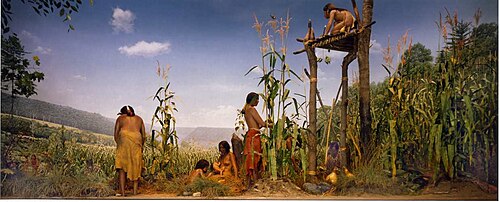
The Iroquois are a mix of horticulturalists, farmers, fishers, gatherers and hunters, though traditionally their main diet has come from farming. For the Iroquois, farming was traditionally women's work and the entire process of planting, maintaining, harvesting and cooking was done by women.[185] Gathering has also traditionally been the job of women and children. Wild roots, greens, berries and nuts were gathered in the summer. During spring, sap is tapped from the maple trees and boiled into maple syrup, and herbs are gathered for medicine. After the coming of Europeans, the Iroquois started to grow apples, pears, cherries, and peaches.[185]
Historically, the main crops cultivated by the Iroquois were corn, beans, and squash, which were called the three sisters (De-oh-há-ko) and in Iroquois tradition were considered special gifts from the Creator.[185] These three crops could be ground up into hominy and soups in clay pots (later replaced by metal pots after contact with Europeans).[185] Besides the "Three Sisters", the Iroquois diet also included artichokes, leeks, cucumbers, turnips, pumpkins, a number of different berries such blackberries, blueberries, gooseberries, etc. and wild nuts.[185] Ramson, a species of wild onion, is also a part of traditional Iroquois cuisine,[204] as well as northern redcurrant,[205] American groundnut,[206] and broadleaf toothwort.[207]
Using these ingredients they prepared meals of boiled cornbread and cornmeal sweetened with maple syrup, known today as Indian pudding. Cornmeal was also used to make samp, a type of porridge with beans and dried meat. Reports from early American settlers mention Iroquois extracting corn syrup that was used as a sweetener for cornmeal dumplings.[208]
The Iroquois hunted mostly deer but also other game such as wild turkey and migratory birds. Muskrat and beaver were hunted during the winter. Archaeologists have found the bones of bison, elk, deer, bear, raccoon, and porcupines at Iroquois villages.[185] Fishing was also a significant source of food because the Iroquois had villages mostly in the St.Lawrence and Great Lakes areas. The Iroquois used nets made from vegetable fiber with weights of pebbles for fishing.[185] They fished salmon, trout, bass, perch and whitefish until the St. Lawrence became too polluted by industry. In the spring the Iroquois netted, and in the winter fishing holes were made in the ice.[209] Starting about 1620, the Iroquois started to raise pigs, geese and chickens, which they had acquired from the Dutch.[185]
Dress

In 1644 Johannes Megapolensis described Mohawk traditional wear.
In summer they go naked, having only their private parts covered with a patch. The children and young folks to ten, twelve and fourteen years of age go stark naked. In winter, they hang about them simply an undressed deer or bear or panther skin; or they take some beaver and otter skins, wild cat, racoon, martin, otter, mink, squirrel or such like skins ... and sew some of them to others, until it is a square piece, and that is then a garment for them; or they buy of us Dutchmen two and a half ells [about 170 centimetres (5.6 ft)] of duffel, and that they hang simply about them, just as it was torn off, without sewing it.[198]
On their feet the Iroquois wore moccasin, "true to nature in its adjustment to the foot, beautiful in its materials and finish, and durable as an article of apparel."[22]
The moccason is made of one piece of deer-skin. It is seamed up at the heel, and also in front, above the foot, leaving the bottom of the moccasin without a seam. In front the deer-skin is gathered, in place of being crimped; over this part porcupine quills or beads are worked, in various patterns. The plain moccasin rises several inches above the ankle ... and is fastened with deer strings; but usually this part is turned down, so as to expose a part of the instep, and is ornamented with bead-work.[22]
Moccasins of a sort were also made of corn husks.
In 1653 Dutch official Adriaen van der Donck wrote:
Around their waist they all [i.e.both men and women] wear a belt made of leather, whalefin, whalebone, or wampum. The men pull a length of duffel cloth—if they have it—under this belt, front and rear, and pass it between the legs. It is over half an ell [35 centimetres (14 in)] wide and nine quarter-ells [155 centimetres (61 in)] long, which leaves a square flap hanging down in front and back ... Before duffel cloth was common in that country, and sometimes even now when it cannot be had, they took for that purpose some dressed leather or fur—The women also wear a length of woolen cloth of full width [165 centimetres (65 in)] and an ell and a quarter [90 centimetres (35 in)] long, which comes halfway down the leg. It is like a petticoat, but under it, next to the body, they wear a deerskin which also goes around the waist and ends in cleverly cut pointed edging and fringes. The wealthier women and those who have a liking for it wear such skirts wholly embroidered with wampum ... As for covering the upper part of the body both men and women use a sheet of duffel cloth of full width, i.e. nine and a half quarter-ells, and about three ells 210 centimetres (83 in) long. It is usually worn over the right shoulder and tied in a knot around the waist and from there hangs down to the feet.[198]
During the 17th century, Iroquois clothing changed rapidly as a result of the introduction of scissors and needles obtained from the Europeans, and the British scholar Michael Johnson has cautioned that European accounts of Iroquois clothing from the latter 17th century may not have entirely reflected traditional pre-contact Iroquois clothing.[186] In the 17th century women normally went topless in the warm months while wearing a buckskin skirt overlapping on the left while in the winter women covered their upper bodies with a cape-like upper garment with an opening for the head.[210] By the 18th century, cloth colored red and blue obtained from Europeans became the standard material for clothing with the men and women wearing blouses and shirts that usually decorated with beadwork and ribbons and were often worn alongside silver brooches.[211]
By the late 18th century, women were wearing muslin or calico long, loose-fitting overdresses.[211] The tendency of Iroquois women to abandon their traditional topless style of dressing in the warm months reflected European influence.[211] Married women wore their hair in a single braid held in place by a comb made of bone, antler or silver while unmarried wore their hair in several braids.[211] Warriors wore moccasins, leggings and short kilts and on occasion wore robes that were highly decorated with painted designs.[211] Initially, men's clothing was made of buckskin and were decorated with porcupine quill-work and later on was made of broadcloth obtained from Europeans.[211] The bodies and faces of Iroquois men were heavily tattooed with geometric designs and their noses and ears were pieced with rings made up of wampun or silver.[211] On the warpath, the faces and bodies of the warriors were painted half red, half black.[211] The men usually shaved most of their hair with leaving only a tuft of hair in the center, giving the name Mohawk to their hair style.[211] A cap made of either buckskin or cloth tied to wood splints called the Gus-to-weh that was decorated with feathers was often worn by men.[211] Buckskin ammunition pouches with straps over the shoulder together with belts or slashes that carried powder horn and tomahawks were usually worn by warriors.[211] Quilled knife cases were worn around the neck.[212] Chiefs wore headdresses made of deer antler.[211] By the 18th century, Iroquois men normally wore shirts and leggings made of broadcloth and buckskin coats.[211] In the 17th and 18th centuries silver armbands and gorgets were popular accessories.[211]
By the 1900s most Iroquois were wearing the same clothing as their non-Iroquois neighbors. Today most nations only wear their traditional clothing to ceremonies or special events.[213]

Men wore a cap with a single long feather rotating in a socket called a gustoweh. Later, feathers in the gustoweh denote the wearer's tribe by their number and positioning. The Mohawk wear three upright feathers, the Oneida two upright and one down. The Onondaga wear one feather pointing upward and another pointing down. The Cayuga have a single feather at a 45-degree angle. The Seneca wear a single feather pointing up, and the Tuscarora have no distinguishing feathers.[214][215]

Writing in 1851 Morgan wrote that women's outfits consisted of a skirt (gä-kä'-ah) "usually of blue broadcloth, and elaborately embroidered with bead-work. It requires two yards of cloth, which is worn with the selvedge at the top and bottom; the skirt being secured about the waist and descending nearly to the top of the moccasin." Under the skirt, between the knees and the moccasins, women wore leggings (gise'-hǎ), called pantalettes by Morgan, "of red broadcloth, and ornamented with a border of beadwork around the lower edge ... In ancient times the gise'-hǎ was made of deer-skin and embroidered with porcupine-quill work." An over-dress (ah-de-a'-da-we-sa) of muslin or calico was worn over the skirt, it is "gathered slightly at the waist, and falls part way down the skirt ... In front it is generally buttoned with silver broaches." The blanket (e'yose) is two or three yards of blue or green broadcloth "it falls from the head or neck in natural folds the width of the cloth, as the selvedges are at the top and bottom, and it is gathered round the person like a shawl."[22]
The women wore their hair very long and tied together at the back, or "tied at the back of the head and folded into a tress of about a hand's length, like a beaver tail ... they wear around the forehead a strap of wampum shaped like the headband that some was worn in olden times." "The men have a long lock hanging down, some on one side of the head, and some on both sides. On the top of their heads they have a streak of hair from the forehead to the neck, about the breadth of three fingers, and this they shorten until it is about two or three fingers long, and it stands right on end like a cock's comb or hog's bristles; on both sides of this cock's comb they cut all the hair short, except for the aforesaid locks, and they also leave on the bare places here and there small locks, such as aree in sweeping brushes and then they are in fine array."[198] This is the forerunner to what is today called a "Mohawk hairstyle".
The women did not paint their faces. The men "paint their faces red, blue, etc."[198]
Societies

Societies, often called "medicine societies", "medicine lodges",[216] or "curing societies",[217] played an important role in Iroquois social organization. Lewis H. Morgan says that each society "was a brotherhood into which new members were admitted by formal initiation."[218] Originally the membership seems to have been on the basis of moiety, but by 1909 all societies seems to have been open to all men regardless of kinship.
It is believed that "most of the societies are of ancient origin and that their rituals have been transmitted with little change for many years." "Each society has a legend by which its origin and peculiar rites are explained."[216] As part of his religious revolution, Handsome Lake "sought to destroy the societies and orders that conserved the older religious rites."[216] A council of chiefs proclaimed, some time around 1800, that all animal and mystery societies should immediately dissolve, but through a defect in the form of the order the societies decided it was not legally binding and "went underground" becoming secret societies.[218] Reviled by the "New Religion" of Handsome Lake, they were also rejected by the Christian Iroquois as holding pagan beliefs. Gradually, however, the societies came more into the open as hostility lessened.[216]
A number of societies are known, of which the False Face Society is the most familiar. Others were the Little Water Society, the Pygmy Society, the Society of Otters, the Society of Mystic Animals, the Eagle Society, the Bear Society, the Buffalo Society, the Husk Faces, and the Woman's Society—which despite its name had male membership. The Sisters of the Deo-ha-ko was an organization of women.[216]
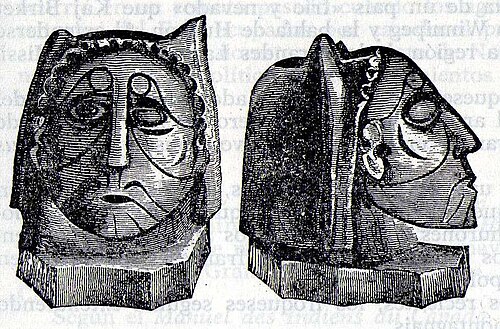
During healing ceremonies, a carved "False Face Mask" is worn to represent spirits in a tobacco-burning and prayer ritual. False Face Masks are carved in living trees, then cut free to be painted and decorated.[219] False Faces represent grandfathers of the Iroquois, and are thought to reconnect humans and nature and to frighten illness-causing spirits.[220]
The Iroquois today have several different medicine societies.[221] The False Face Company conducts rituals to cure sick people by driving away spirits; the Husk Face Society is made up of those who had dreams seen as messages from the spirits and the Secret Medicine Society likewise conducts rituals to cure the sick.[203] There are 12 different types of masks worn by the societies.[203] The types of masks are:
- The Secret Society of Medicine Men and the Company of Mystic Animals:
- Divided mask that painted half black and half red;
- Masks with exaggerated long noses;
- Horn masks;
- Blind masks without eye sockets.
- Husk Face Society:
- Masks made of braided corn.
- False Face Society:
- Whistling masks;
- Masks with smiling faces;
- Masks with protruding tongues;
- Masks with exaggerated hanging mouths;
- Masks with exaggerated straight lops;
- Masks with spoon-lips;
- Masks with a disfigured twisted mouth.
The "crooked face" masks with the twisted mouths, the masks with the spoon lips and the whistling masks are the "Doctor" masks.[203] The other masks are "Common Face" or "Beggar" masks that are worn by those who help the Doctors.[185]
The Husk Face Society performs rituals to communicate with the spirits in nature to ensure a good crop, the False Face Society performs rituals to chase away evil spirits, and the Secret Medicine Society performs rituals to cure diseases.[222] The grotesque masks represent the faces of the spirits that the dancers are attempting to please.[203] Those wearing Doctor masks blow hot ashes into the faces of the sick to chase away the evil spirits that are believed to be causing the illness.[203] The masked dancers often carried turtle shell rattles and long staffs.[185]
Medicine
Both male and female healers were knowledgeable in the use of herbs to treat illness, and could dress wounds, set broken bones, and perform surgery. Illness was believed to have a spiritual as well as a natural component, so spells, dances, ceremonies were used in addition to more practical treatments.[223] There are three types of practitioners of traditional medicine: The "Indian doctor" or healer, who emphasizes the physical aspect of curing illness, the fortune-teller, who uses spiritual means to determine the cause of the patient's ailments and the appropriate cure, and the witch.[224]
It was believed that knowledge of healing was given by supernatural creatures in the guise of animals.[225]
In recent times, traditional medicine has co-existed with western medicine, with traditional practices more prevalent among followers of the Gaihwi:io (Longhouse Religion). People may resort to traditional practices for certain types of ailments, and to western medicine for other types, or they may use both traditional and western medicine to treat the same ailment as a form of double security.
The Iroquois societies are active in maintaining the practice of traditional medicine.[224]
Women in society
The Iroquois have historically followed a matriarchal system. Men and women have traditionally had separate roles but both hold real power in the Nations. No person is entitled to 'own' land, but it is believed that the Creator appointed women as stewards of the land. Traditionally, the Clan Mothers appoint leaders, as they have raised children and are therefore held to a higher regard. By the same token, if a leader does not prove sound, becomes corrupt or does not listen to the people, the Clan Mothers have the power to strip him of his leadership.[226] The chief of a clan can be removed at any time by a council of the women elders of that clan. The chief's sister has historically been responsible for nominating his successor.[227] The clan mothers, the elder women of each clan, are highly respected.
The Iroquois have traditionally followed a matrilineal system, and hereditary leadership passes through the female line of descent, that is, from a mother to her children. The children of a traditional marriage belong to their mother's clan and gain their social status through hers. Her brothers are important teachers and mentors to the children, especially introducing boys to men's roles and societies. If a couple separates, the woman traditionally keeps the children.[227] It is regarded as incest by the Iroquois to marry within one's matrilineal clan, but considered acceptable to marry someone from the same patrilineal clan.[228]
The teachings of Handsome Lake also expanded to influence the wider Iroquois society. The power centered around the mode of food production and the social sphere in general. Handsome Lake's teaching tried to center the nuclear family and transferred the women's sphere to be relegated to the home while the men's sphere focused on horticulture. Also, the Handsome Lake code shifted from the family structure from the maternal one to one that centers around the patriarch.[229]
Moreover, several other factors influenced the position of Iroquois women. The exhaustion of the beavers' population led to men traveling for longer distances; this resulted in women having a more influential role in their societies because of the long absence of men. Another factor that influenced women's position shift was the reorganization of the political structure. The changes were influential as elected representatives instead of women-appointed sachems.[230]
The status of Iroquois women inspired and had an impact on the early Feminist American movement. This was seen in the Seneca Fall Convention of 1848, the first feminist convention. For example, Matilda Gage, a prominent member of the convention, wrote extensively about the Iroquois throughout her life. Elizabeth Cady lived in close proximity to the Seneca tribe of the Iroquois and had a relative and a neighbor who was adopted by the Seneca tribe as well.[231]
Women also held an important position to be Agoianders or to elect them. The Agoianders positions was to watch over the public treasury and hold the chief accountable.[232]
Historically women have held the dwellings, horses and farmed land, and a woman's property before marriage has stayed in her possession without being mixed with that of her husband. The work of a woman's hands is hers to do with as she sees fit.
Historically, at marriage, a young couple lived in the longhouse of the wife's family (matrilocality). A woman choosing to divorce a shiftless or otherwise unsatisfactory husband is able to ask him to leave the dwelling and take his possessions with him.[233]
Spiritual beliefs

Like many cultures, the Iroquois' spiritual beliefs changed over time and varied across tribes. Generally, the Iroquois believed in numerous deities, including the Great Spirit, the Thunderer, and the Three Sisters (the spirits of beans, maize, and squash). The Great Spirit was thought to have created plants, animals, and humans to control "the forces of good in nature", and to guide ordinary people.[219] Orenda was the Iroquoian name for the magical potence found in people and their environment.[234] The Iroquois believed in the orenda, the spiritual force that flowed through all things, and believed if people were respectful of nature, then the orenda would be harnessed to bring about positive results.[235] There were three types of spirits for the Iroquois: 1) Those living on the earth 2) Those living above the earth and 3) the highest level of spirits controlling the universe from high above with the highest of those beings known variously as the Great Spirit, the Great Creator or the Master of Life.[235]
Sources provide different stories about Iroquois creation beliefs. Brascoupé and Etmanskie focus on the first person to walk the earth, called the Skywoman or Aientsik. Aientsik's daughter Tekawerahkwa gave birth to twins, Tawiskaron, who created vicious animals and river rapids, while Okwiraseh created "all that is pure and beautiful".[236] After a battle where Okwiraseh defeated Tawiskaron, Tawiskaron was confined to "the dark areas of the world", where he governed the night and destructive creatures.[236] Other scholars present the "twins" as the Creator and his brother, Flint.[237] The Creator was responsible for game animals, while Flint created predators and disease. Saraydar (1990) suggests the Iroquois do not see the twins as polar opposites but understood their relationship to be more complex, noting "Perfection is not to be found in gods or humans or the worlds they inhabit."[238]
Descriptions of Iroquois spiritual history consistently refer to dark times of terror and misery prior to the Iroquois Confederacy, ended by the arrival of the Great Peacemaker. Tradition asserts that the Peacemaker demonstrated his authority as the Creator's messenger by climbing a tall tree above a waterfall, having the people cut down the tree, and reappearing the next morning unharmed.[238] The Peacemaker restored mental health to a few of the most "violent and dangerous men", Ayonhwatha and Thadodaho, who then helped him bear the message of peace to others.[239]
After the arrival of the Europeans, some Iroquois became Christians, among them the first Native American Saint, Kateri Tekakwitha, a young woman of Mohawk-Algonquin parents. The Seneca sachem Handsome Lake, also known as Ganeodiyo,[220] introduced a new religious system to the Iroquois in the late 18th century,[240] which incorporated Quaker beliefs along with traditional Iroquoian culture.[219] Handsome Lake's teachings include a focus on parenting, appreciation of life, and peace.[220] A key aspect of Handsome Lake's teachings is the principle of equilibrium, wherein each person's talents combined into a functional community. By the 1960s, at least 50% of Iroquois followed this religion.[219]
Dreams play a significant role in Iroquois spirituality, providing information about a person's desires and prompting individuals to fulfill dreams. To communicate upward, humans can send prayers to spirits by burning tobacco.[219]
Condolence ceremonies are conducted by the Iroquois for both ordinary and important people, but most notably when a hoyane (sachem) died. Such ceremonies were still held on Iroquois reservations as late as the 1970s.[219] After death, the soul is thought to embark on a journey, undergo a series of ordeals, and arrive in the sky world. This journey is thought to take one year, during which the Iroquois mourn for the dead. After the mourning period, a feast is held to celebrate the soul's arrival in the skyworld.
"Keepers of the faith" are part-time specialists who conduct religious ceremonies. Both men and women can be appointed as keepers of the faith by tribe elders.[219]
Haudenosaunee thanksgiving address
The Haudenosaunee thanksgiving address is a central prayer in Haudenosaunee tradition recited daily in the beginning of school days as well as social, cultural, and political events.[241] The address gives thanks to the parts of nature necessary to ecosystem sustainability and emphasizes the ideology that all animals and plants within an ecosystem are connected and each plays a vital role in it.[242]
The phrasing of the address may vary depending on the speaker but is usually composed of 17 main sections and ends with a closing prayer. The 17 main sections are: 1) The people, 2) The Earth Mother, 3) The waters, 4) The fish, 5) plants, 6) food plants,7) medicine herbs, 8) animals, 9) trees, 10) birds, 11) four winds, 12) The Thunderers, 13) The Sun, 14) Grandmother Moon, 15) The stars, 16) The Enlightened Teachers, and 17) The Creator. Within each section, gratitude is given for the gifts that section provides to humanity.
The address serves as a pledge of gratitude as well as a "scientific inventory of the natural world".[243] By describing living and non-living elements of the ecosystem and their functions, uses and benefits, the pledge instills early concepts of traditional ecological knowledge within grade school children and onward.
Festivals
The Iroquois traditionally celebrate several major festivals throughout the year.[22] These usually combine a spiritual component and ceremony, a feast, a chance to celebrate together, sports, entertainment and dancing. These celebrations have historically been oriented to the seasons and celebrated based on the cycle of nature rather than fixed calendar dates.
For instance, the Mid-winter festival, Gi'-ye-wä-no-us-quä-go-wä ("The supreme belief") ushers in the new year. This festival is traditionally held for one week around the end of January to early February, depending on when the new moon first occurs that year.[244]
Iroquois ceremonies are primarily concerned with farming, healing, and thanksgiving. Key festivals correspond to the agricultural calendar, and include Maple, Planting, Strawberry, Green Maize, Harvest, and Mid-Winter (or New Year's), which is held in early February.[219] The ceremonies were given by the Creator to the Iroquois to balance good with evil.[238] In the 17th century, Europeans described the Iroquois as having 17 festivals, but only 8 are observed today. The most important of the ceremonies were the New Year Festival, the Maple Festival held in late March to celebrate spring, the Sun Shooting Festival which also celebrates spring, the Seed Dance in May to celebrate the planting of the crops, the Strawberry Festival in June to celebrate the ripening of the strawberries, the Thunder Ceremony to bring rain in July, the Green Bean Festival in early August, the Green Corn Festival in late August and the Harvest Festival in October. Of all the festivals, the most important were the Green Corn Festival to celebrate the maturing of the corn and the New Year Festival. During all of the festivals, men and women from the False Face Society, the Medicine Society and the Husk Face Society dance wearing their masks in attempt to humor the spirits that controlled nature. The most important of the occasions for the masked dancers to appear were the New Year Festival, which was felt to be an auspicious occasion to chase the malevolent spirits that were believed to cause disease.[235]
Art
,_made_most_probably_by_Haudenosaunee_(Iroquois)._From_Canada,_early-mid_19th_century_CE._National_Museum_of_Scotland.jpg/500px-thumbnail.jpg)
Iroquois art from the 16th and 17th centuries as found on bowls, pottery and clay pipes show a mixture of animal, geometrical and human imagery.[212] Moose hair was sometimes attached to tumplines or burden straps for decorative effect.[212] Porcupine quillwork was sewn onto bags, clothing and moccasins, usually in geometrical designs.[212] Other designs included the "great turtle" upon North America was said to rest; the circular "skydome" and wavy designs.[212] Beads and clothes often featured semi-circles and waves which meant to represent the "skydome" which consisted of the entire universe together with the supernatural world above it, parallel lines for the earth and curved lines for the "celestial tree".[212] Floral designs were first introduced in the 17th century, reflecting French influence, but did not become truly popular until the 19th century.[212] Starting about 1850 the Iroquois art began to frequently feature floral designs on moccasins, caps, pouches and pincushions, which were purchased by Euro-Americans.[245] The British historian Michael Johnson described the Iroquois artwork meant to be sold to whites in the 19th century as having a strong feel of "Victoriana" to them.[245] Silver was much valued by the Iroquois from the 17th century onward, and starting in the 18th century, the Iroquois became "excellent silversmiths", making silver earrings, gorgets and rings.[245]
At harvest time, Iroquois women would use corn husks to make hats, dolls, rope and moccasins.[185]
Games and sports
The favorite sport of the Iroquois is lacrosse (O-tä-dä-jish′-quä-äge in Seneca).[22] Historically, a version was played between two teams of six or eight players, made up of members of two sets of clans (Wolf, Bear, Beaver, and Turtle on one side vs. Deer, Snipe, Heron, and Hawk on the other among the Senecas). The goals were two sets of poles roughly 450 yards (410 m) apart.[note 1] The poles were about 10 feet (3.0 m) high and placed about 15 feet (4.6 m) apart.[note 2] A goal was scored by carrying or throwing a deer-skin ball between the goal posts using netted sticks—touching the ball with hands was prohibited. The game was played to a score of five or seven. The modern version of lacrosse remains popular among the Haudenasaunee to this day.[246]
The First Nations Lacrosse Association is recognized by World Lacrosse as a sovereign state for international lacrosse competitions. It is the only sport in which the Iroquois field national teams and the only indigenous people's organization sanctioned for international competition by any world sporting governing body.
A popular winter game was the snow-snake game.[22] The "snake" was a hickory pole about 5–7 feet (1.5–2.1 m) long and about .25 inches (0.64 cm) in diameter, turned up slightly at the front and weighted with lead. The game was played between two sides of up to six players each, often boys, but occasionally between the men of two clans. The snake, or Gawa′sa, was held by placing the index finger against the back end and balancing it on the thumb and other fingers. It was not thrown but slid across the surface of the snow. The side whose snake went the farthest scored one point. Other snakes from the same side which went farther than any other snake of the opposing side also scored a point; the other side scored nothing. This was repeated until one side scored the number of points which had been agreed to for the game, usually seven or ten.
The Peach-stone game (Guskä′eh) was a gambling game in which the clans bet against each other.[22] Traditionally it was played on the final day of the Green Corn, Harvest, and Mid-winter festivals. The game was played using a wooden bowl about one foot in diameter and six peach-stones (pits) ground to oval shape and burned black on one side. A "bank" of beans, usually 100, was used to keep score and the winner was the side who won them all. Two players sat on a blanket-covered platform raised a few feet off the floor. To play the peach stones were put into the bowl and shaken. Winning combinations were five of either color or six of either color showing.
Players started with five beans each from the bank. The starting player shook the bowl; if he shook a five the other player paid him one bean, if a six five beans. If he shook either he got to shake again. If he shook anything else the turn passed to his opponent. All his winnings were handed over to a "manager" or "managers" for his side. If a player lost all of his beans another player from his side took his place and took five beans from the bank. Once all beans had been taken from the bank the game continued, but with the draw of beans now coming from the winnings of the player's side, which were kept out of sight so that no one but the managers knew how the game was going. The game was finished when one side had won all the beans.
The game sometimes took quite a while to play, depending on the starting number of beans, and games lasting more than a day were common.
Naming conventions
Each clan has a group of personal names which may be used to name members. The clan mother is responsible for keeping track of those names not in use, which may then be reused to name infants. When a child becomes an adult he takes a new "adult" name in place of his "baby" name. Some names are reserved for chiefs or faith keepers, and when a person assumes that office he takes the name in a ceremony in which he is considered to "resuscitate" the previous holder. If a chief resigns or is removed he gives up the name and resumes his previous one.[247]
Cannibalism
Although the Iroquois are sometimes mentioned as examples of groups who practiced cannibalism, the evidence is mixed as to whether such a practice could be said to be widespread among the Six Nations, and to whether it was a notable cultural feature. Some anthropologists have found evidence of ritual torture and cannibalism at Iroquois sites, for example, among the Onondaga in the sixteenth century.[248] However, other scholars, such as anthropologist William Arens in his controversial book, The Man-Eating Myth, have challenged the evidence, suggesting the human bones found at sites point to funerary practices, asserting that if cannibalism was practiced among the Iroquois, it was not widespread.[249] Modern anthropologists seem to accept the probability that cannibalism did exist among the Iroquois,[250] with Thomas Abler describing the evidence from the Jesuit Relations and archaeology as making a "case for cannibalism in early historic times ... so strong that it cannot be doubted."[250] Scholars are also urged to remember the context for a practice that now shocks the modern Western society. Sanday reminds us that the ferocity of the Iroquois' rituals "cannot be separated from the severity of conditions ... where death from hunger, disease, and warfare became a way of life".[251]
The missionaries Johannes Megapolensis, François-Joseph Bressani, and the fur trader Pierre-Esprit Radisson present first-hand accounts of cannibalism among the Mohawk. A common theme is ritualistic roasting and eating the heart of a captive who has been tortured and killed.[198] "To eat your enemy is to perform an extreme form of physical dominance."[252]
Slavery
Haudenosaunee peoples participated in "mourning wars" to obtain captives. Leland Donald suggests in "Slavery in Indigenous North America" that captives and slaves were interchangeable roles.[253] There have been archaeological studies to support that Haudenosaunee peoples did in fact have a hierarchal system that included slaves.[254] Note that the term 'slave' in Haudenosaunee culture is identified by spiritual and revengeful purposes, not to be mistaken for the term in the African slave trade.[255] However, once African slavery was introduced into North America by European settlers, some Iroquois, such as Mohawk chief Joseph Brant, did own African slaves.[256]
Capture
To obtain captives, Haudenosaunee peoples fought "mourning wars".[257][258][98] After the wars were over, Haudenosaunee warriors journeyed back to their villages with the enemies taken captive. During these journeys, captives were routinely tortured or even killed by their captors.[258][259] Leland Donald writes that captives "were killed if they could not keep up, tried to escape, or members of the attacking party could not restrain their emotions".[258] Daniel Richter suggests that keeping the pace may not have been an easy task, writing that "warriors might slowly lead prisoners by a rope between the lines of men, women and children [captives]".[260] If a prisoner survived all the obstacles on the march back to a Haudenosaunee village, the torture did not end. Captives were mutilated and beaten for several days upon arrival by Haudenosaunee warriors.[261] After the initiation process, they were either killed, or welcomed into the nation where they would be replacing a deceased member of that community.[262]
Adoption policy
The Iroquois have absorbed many other individuals from various peoples into their tribes as a result of adopting war captives and giving refuge to displaced peoples. When such adoptees become fully assimilated, they are considered full members of their adoptive families, clans, and tribes. Historically, such adoptees have married into the tribes, and some have become chiefs or respected elders.
Slaves brought onto Haudenosaunee territory were mainly adopted into families or kin groups that had lost a person.[258] Although if that person had been vital for the community they "were usually replaced by other kin-group members" and "captives were ... adopted to fill lesser places".[263] During adoption rituals, slaves were to reject their former life and be renamed as part of their "genuine assimilation".[264] The key goal of Haudenosaunee slavery practices was to have slaves assimilate to Haudenosaunee culture to rebuild population after one or many deaths.[263] Children[265] and Indigenous peoples of neighbouring villages[266] to the Haudenosaunee are said to have been good slaves because of their better ability to assimilate. That being said, the role of a slave was not a limited position and whenever slaves were available for capture they were taken, no matter their age, race, gender etc.[267]
Once adopted, slaves in Haudenosaunee communities had potential to move up in society.[268] Since slaves were replacing dead nation members, they took on the role of that former member if they could prove that they could live up to it.[268] Their rights within the aforementioned framework were still limited though, meaning slaves performed chores or labor for their adoptive families.[265] Also, there are a few cases where slaves were never adopted into families and their only role was to perform tasks in the village.[258] These types of slaves may have been used solely for exchange.[269] Slave trade was common in Haudenosaunee culture and it aimed to increase Haudenosaunee population.[270]
Torture
Slaves were often tortured once captured by the Haudenosaunee. Torture methods consisted of, most notably, finger mutilation, among other things.[271][272] Slaves endured torture not only on their journey back to Haudenosaunee nations, but also during initiation rituals and sometimes throughout their enslavement.[262] Finger mutilation was common as a sort of marking of a slave.[273] In "Northern Iroquoian Slavery", Starna and Watkins suggest that sometimes torture was so brutal that captives died before being adopted.[274] Initial torture upon entry into the Haudenosaunee culture also involved binding, bodily mutilation with weapons, and starvation, and for female slaves: sexual assault.[275][276][262] Starvation may have lasted longer depending on the circumstance. Louis Hennepin was captured by Haudenosaunee peoples in the 17th century and recalled being starved during his adoption as one of "Aquipaguetin's" replacement sons.[277] Indigenous slaves were also starved by their captors, such as Hennepin was.[276] The brutality of Haudenosaunee slavery was not without its purposes; torture was used to demonstrate a power dynamic between the slave and the "master" to constantly remind the slave that they were inferior.[278][279]
Language
Language played another role in Haudenosaunee slavery practices. Slaves were often referred to as "domestic animals" or "dogs" which were equivalent to the word to "slave".[280] This use of language suggests that slaves were dehumanized, that slaves were "domesticated" and another that slaves were to be eaten as Haudenosaunee peoples ate dogs.[281][282] Jacques Bruyas wrote a dictionary of the Mohawk language where the word gatsennen is defined as "Animal domestique, serviteur, esclave" (English: "domestic animal, butler, slave").[283] There are also more language accounts of slaves being compared to animals (mostly dogs) in Oneida and Onondaga language.[280] This language serves as a proof not only that slavery did exist, but also that slaves were at the bottom of the hierarchy.[284]
Changes after contact
Inevitably, Haudenosaunee slavery practices changed after European contact. With the arrival of European-introduced infectious diseases came the increase in Haudenosaunee peoples taking captives as their population kept decreasing.[285][286] During the 17th century, Haudenosaunee peoples banded together to stand against settlers.[287] By the end of the century, Haudenosaunee populations were made up mostly of captives from other nations.[269] Among the Indigenous groups targeted by the Haudenosaunee were the Wyandot who were captured in such large numbers that they lost their independence for a large period of time.[269][288] "Mourning wars" became essential to rebuilding their numbers, while at the same time Haudenosaunee warriors began launching raids on European colonial settlements.[269][289] Similarly to Indigenous slaves, European slaves were tortured by the Haudenosaunee using finger mutilation and sometimes cannibalism.[271] European captives did not make good slaves because they resisted even more than Indigenous captives and did not understand rituals such as renaming and forgetting their past.[290] For this reason most European captives were either used as ransom or murdered upon arrival to Haudenosaunee territory.[269] Many Europeans who were not captured became trading partners with the Haudenosaunee.[285] Indigenous slaves were now being traded amongst European settlers and some slaves even ended up in Quebec households.[285] Eventually, European contact led to adoptees outnumbering the Haudenosaunee in their own communities. The difficulty of controlling these slaves in large numbers ended Haudenosaunee slavery practices.[269]
Government

The Grand Council of the Six Nations is an assembly of 56 Hoyenah (chiefs) or sachems. Sachemships are hereditary within a clan. When a position becomes vacant a candidate is selected from among the members of the clan and "raised up" by a council of all sachems. The new sachem gives up his old name and is thereafter addressed by the title.
Today, the seats on the Council are distributed among the Six Nations as follows:
- 14 Onondaga
- 10 Cayuga
- 9 Oneida
- 9 Mohawk
- 8 Seneca
- 6 Tuscarora
When anthropologist Lewis Henry Morgan studied the Grand Council in the 19th century, he interpreted it as a central government. This interpretation became influential, but Richter argues that while the Grand Council served an important ceremonial role, it was not a government in the sense that Morgan thought.[33][34][35] According to this view, Iroquois political and diplomatic decisions are made on the local level and are based on assessments of community consensus. A central government that develops policy and implements it for the people at large is not the Iroquois model of government.
Unanimity in public acts was essential to the Council. In 1855, Minnie Myrtle observed that no Iroquois treaty was binding unless it was ratified by 75% of the male voters and 75% of the mothers of the nation.[291] In revising Council laws and customs, a consent of two-thirds of the mothers was required.[291] The need for a double supermajority to make major changes made the Confederacy a de facto consensus government.[292]
The women traditionally held real power, particularly the power to veto treaties or declarations of war.[291] The members of the Grand Council of Sachems were chosen by the mothers of each clan. If any leader failed to comply with the wishes of the women of his tribe and the Great Law of Peace, the mother of his clan could demote him, a process called "knocking off the horns". The deer antlers, an emblem of leadership, were removed from his headgear, thus returning him to private life.[291][293]
Councils of the mothers of each tribe were held separately from the men's councils. The women used men as runners to send word of their decisions to concerned parties, or a woman could appear at the men's council as an orator, presenting the view of the women. Women often took the initiative in suggesting legislation.[291]
Wampum belts

The term "wampum" refers to beads made from purple and white mollusk shells on threads of elm bark.[186] Species used to make wampum include the highly prized quahog clam which produces the famous purple colored beads. For white colored beads the shells from the channeled whelk, knobbed whelk, lightning whelk, and snow whelk are used.[294]
Wampum was primarily used to make wampum belts by the Iroquois, which Iroquois tradition claims was invented by Hiawatha to console chiefs and clan mothers who lost family members to war.[186] Wampum belts played a major role in the Condolence Ceremony and in the raising of new chiefs.[186] Wampum belts are used to signify the importance of a specific message being presented. Treaty making often involved wampum belts to signify the importance of the treaty.[186] A famous example is "The Two Row Wampum" or "Guesuenta", meaning "it brightens our minds", which was originally presented to the Dutch settlers, and then French, representing a canoe and a sailboat moving side-by-side along the river of life, not interfering with the other's course. All non-Native settlers are, by associations, members of this treaty. Both chiefs and clan mothers wear wampum belts as symbol of their offices.[186]
"The Covenant Belt" was presented to the Iroquois at the signing of the Canandaigua Treaty. The belt has a design of thirteen human figures representing symbolically the Thirteen Colonies of the U.S. The house and the two figures directly next to the house represent the Iroquois people and the symbolic longhouse. The figure on the left of the house represent the Seneca Nation who are the symbolic guardians of the western door (western edge of Iroquois territory) and the figure to the right of the house represents the Mohawk who are the keepers of the eastern door (eastern edge of Iroquois territory).[294]
The Hiawatha belt is the national belt of the Iroquois and is represented in the Iroquois Confederacy flag. The belt has four squares and a tree in the middle which represents the original Five Nations of the Iroquois. Going from left to right the squares represent the Seneca, Cayuga, Oneida and Mohawk. The Onondaga are represented by an eastern white pine which represents the Tree of Peace. Traditionally the Onondaga are the peace keepers of the confederacy. The placement of the nations on the belt represents the actually geographical distribution of the six nations over their shared territory, with the Seneca in the far west and the Mohawk in the far east of Iroquois territory.[294]
The Haudenosaunee flag created in the 1980s is based on the Hiawatha Belt ... created from purple and white wampum beads centuries ago to symbolize the union forged when the former enemies buried their weapons under the Great Tree of Peace."[295] It represents the original five nations that were united by the Peacemaker and Hiawatha. The tree symbol in the center represents an Eastern White Pine, the needles of which are clustered in groups of five.[296]
Influence on the United States
Historians in the 20th century have suggested the Iroquois system of government influenced the development of the U.S. government,[297][298] although the extent and nature of this influence has been disputed.[299] Bruce Johansen proposes that the Iroquois had a representative form of government.[300]
Consensus has not been reached on how influential the Iroquois model was to the development of U.S. documents such as the Articles of Confederation and the U.S. Constitution.[301] The influence thesis has been discussed by historians such as Donald Grinde[302] and Bruce Johansen.[303] In 1988, the U.S. Congress passed a resolution to recognize the influence of the Iroquois League upon the Constitution and Bill of Rights.[304] In 1987, Cornell University held a conference on the link between the Iroquois' government and the U.S. Constitution.[305]
Scholars such as Jack N. Rakove challenge this thesis. Stanford University historian Rakove writes, "The voluminous records we have for the constitutional debates of the late 1780s contain no significant references to the Iroquois" and notes that there are ample European precedents to the democratic institutions of the U.S.[306] In reply, journalist Charles C. Mann wrote that while he agreed that the specific form of government created for the U.S. was "not at all like" that of the Iroquois, available evidence does support "a cultural argument – that the well-known democratic spirit had much to do with colonial contact with the Indians of the eastern seaboard, including and especially the Iroquois," and (quoting Rakove) "that prolonged contact between the aboriginal and colonizing populations were important elements [sic] in the shaping of colonial society and culture."[307] Historian Francis Jennings noted that supporters of the thesis frequently cite the following statement by Benjamin Franklin, made in a letter from Benjamin Franklin to James Parker in 1751:[300] "It would be a very strange thing, if six Nations of ignorant savages should be capable of forming a Scheme for such a Union ... and yet that a like union should be impracticable for ten or a Dozen English Colonies," but he disagrees that it establishes influence. Rather, he thinks Franklin was promoting union against the "ignorant savages" and called the idea "absurd".[86]
The anthropologist Dean Snow has stated that although Franklin's Albany Plan may have drawn inspiration from the Iroquois League, there is little evidence that either the Plan or the Constitution drew substantially from that source. He argues that "... such claims muddle and denigrate the subtle and remarkable features of Iroquois government. The two forms of government are distinctive and individually remarkable in conception."[308]
Similarly, the anthropologist Elisabeth Tooker has concluded that "there is virtually no evidence that the framers borrowed from the Iroquois." She argues that the idea is a myth resulting from a claim made by linguist and ethnographer J.N.B. Hewitt that was exaggerated and misunderstood after his death in 1937.[309] According to Tooker, the original Iroquois constitution did not involve representative democracy and elections; deceased chiefs' successors were selected by the most senior woman within the hereditary lineage in consultation with other women in the tribe.[309]
International relations
The Grand Council of the Iroquois Confederacy declared war on Germany in 1917 during World War I and again in 1942 in World War II.[310]
The Haudenosaunee government has issued passports since 1923, when Haudenosaunee authorities issued a passport to Cayuga statesman Deskaheh (Levi General) to travel to the League of Nations headquarters.[311]
More recently, passports have been issued since 1997.[312] Before 2001 these were accepted by various nations for international travel, but with increased security concerns across the world since the September 11 attacks, this is no longer the case.[313] In 2010, the Iroquois Nationals lacrosse team was allowed by the U.S. to travel on their own passports to the 2010 World Lacrosse Championship in England only after the personal intervention of Secretary of State Hillary Clinton. However, the British government refused to recognize the Iroquois passports and denied the team members entry into the United Kingdom.[314][315]
The Onondaga Nation spent $1.5 million on a subsequent upgrade to the passports designed to meet 21st-century international security requirements.[316]
People
| |
 Photo of an Iroquois woman in 1898. | |
| Total population | |
|---|---|
| 125,000 (2010, est.) | |
| Regions with significant populations | |
| North America | |
 United States United States | 80,000 |
.svg/500px-Flag_of_Canada_(Pantone).svg.png) Canada Canada | 45,000 |
| Languages | |
| Northern Iroquoian languages (including Mohawk, Oneida, Onondaga, Cayuga, Seneca, Tuscarora), English, French | |
| Religion | |
| Longhouse Religion, Karihwiio,[clarification needed] Kanoh'hon'io,[clarification needed] Kahni'kwi'io,[clarification needed] Christianity, others | |
Nations
The first five nations listed below formed the original Five Nations (listed from east to west, as they were oriented to the sunrise); the Tuscarora became the sixth nation in 1722.
Clans
Within each of the six nations, people belonged to a number of matrilineal clans. The number of clans varies by nation, currently from three to eight, with a total of nine different clan names.
Population history
Modern scholarly estimates of the 17th century population of the Iroquois have ranged from 5,500[318] to more than 100,000.[319] When it comes to eye-witness estimates (that is, contemporary estimates) Marc Lescarbot estimated the Iroquois in year 1609 at 8,000 warriors (that is around 40,000 people) and baron L. A. de Lahontan estimated the Iroquois population around year 1690 at 70,000 people (on average 14,000 in each of five tribes).[320] Iroquois territory in the 16th century and at the beginning of the 17th century was over 75,000 square km (over 29,000 square mi).[321] John R. Swanton enumerated a total of 226 Iroquois villages and towns (but most were not occupied at the same time as the Iroquois moved villages every five to twenty years).[322][323] On the contrary Lewis H. Morgan in his 1851 book estimated the Iroquois population in year 1650 at 25,000 people, including 10,000 Seneca, 5,000 Mohawk, 4,000 Onondaga, 3,000 Oneida and 3,000 Cayuga.[320] The Seneca were also estimated at 13,000 in year 1672 and 15,000 in year 1687.[320] In 1713–1722, the Iroquois population was augmented when the Tuscarora migrated north to New York and joined them as the sixth nation.[324]
More recent estimates by Snow and Jones of the Iroquois population have been about 20,000. Jones' estimate applies to the period preceding the first known epidemics of Old World diseases impacting the Iroquois in the mid-17th century. After an archaeological investigation and dating of all 125 Iroquois villages known to have been occupied between 1500 and 1700 (fewer than 226 listed by Swanton occupied at any time), Jones estimated the total pre-epidemic Iroquois population at 20,000 in 1620-1634. In the post-epidemic period from 1634-1660 he estimates the total Iroquois population at 8,000. The latter figure does not include the thousands of people adopted into the Iroquois from conquered ethnic groups.[325] The Iroquois had a liberal and successful adoption policy that allowed them to recoup their population losses and gave them an adaptive advantage over their foes who were unable to do the same. In 1658, the Jesuits noted that the Iroquois contained more adopted foreigners than natives of the country.[326]
In 1779 between 40 and 60 Iroquois towns and villages were destroyed by the Sullivan Expedition in a scorched earth operation. More than 5,000 Iroquois fled to British Canada and an unknown number remained in the U.S. According to one estimate 4,500 died in the aftermath of the expedition, including many who fled to Canada.[327][328][329]
In 1907 there were 17,630 Iroquois[330] and in 1923 there were 8,696 Iroquois in the USA and 11,355 in Canada, for a total of 20,051.[331]
According to data compiled in 1995 by Doug George-Kanentiio, a total of 51,255 Six Nations people lived in Canada. These included 15,631 Mohawk in Quebec; 14,051 Mohawk in Ontario; 3,970 Oneida in Ontario; and a total of 17,603 of the Six Nations at the Grand River Reserve in Ontario.[332] More recently according to the Six Nations Elected Council, some 12,436 on the Six Nations of the Grand River reserve, the largest First Nations reserve in Canada,[333] as of December 2014 and 26,034 total in Canada.[334]
In 1995, tribal registrations among the Six Nations in the U.S. numbered about 30,000 in total, with the majority of 17,566 in New York. The remainder were more than 10,000 Oneida in Wisconsin, and about 2200 Seneca-Cayuga in Oklahoma.[332] As the nations individually determine their rules for membership or citizenship, they report the official numbers. (Some traditional members of the nations refuse to be counted.)[332] There is no federally recognized Iroquois nation or tribe, nor are any Native Americans enrolled as Iroquois.
In the 2000 U.S. census, 80,822 people identified as having Iroquois ethnicity (which is similar to identifying as European), with 45,217 claiming only Iroquois ancestry. There are the several reservations in New York: Cayuga Nation of New York(~450,[335]) St. Regis Mohawk Reservation (3,288),[335] Onondaga Reservation (468),[335] Oneida Indian Nation (~ 1000[335]), Seneca Nation of New York (533[335]) and the Tuscarora Reservation (1,138 in 2000[335]). Some lived at the Oneida Nation of Wisconsin: some 21,000, according to the 2000 census. Seneca-Cayuga Nation in Oklahoma has more than 5,000 people in 2011.[336] In the 2010 Census, 81,002 persons identified as Iroquois, and 40,570 as Iroquois only across the U.S.[337] Including the Iroquois in Canada, the total population numbered over 125,000 as of 2009.[11]
In the 2020 U.S. census in total 113,814 people identified as Iroquois.[338]
Modern communities

Several communities exist to this day of people descended from the tribes of the Iroquois confederacy.
Recognized lands of modern Iroquois communities.
Canada
- Kahnawake Mohawk in Quebec
- Kanesatake Mohawk in Quebec
- Mohawk Nation of Akwesasne in Ontario and Quebec
- Oneida Nation of the Thames in Ontario
- Six Nations of the Grand River Territory in Ontario
- Tyendinaga Mohawk Territory in Ontario
- Wahta Mohawk Territory in Ontario
United States
- Cayuga Nation in New York
- Ganienkeh Mohawk — not federally recognized
- Kanatsiohareke Mohawk
- Onondaga Nation in New York
- Oneida Indian Nation in New York
- Oneida Nation of Indians in Wisconsin
- St. Regis Band of Mohawk Indians in New York
- Seneca Nation of New York
- Seneca-Cayuga Tribe of Oklahoma
- Tonawanda Seneca Nation of New York
- Tuscarora Reservation of New York
Prominent individuals

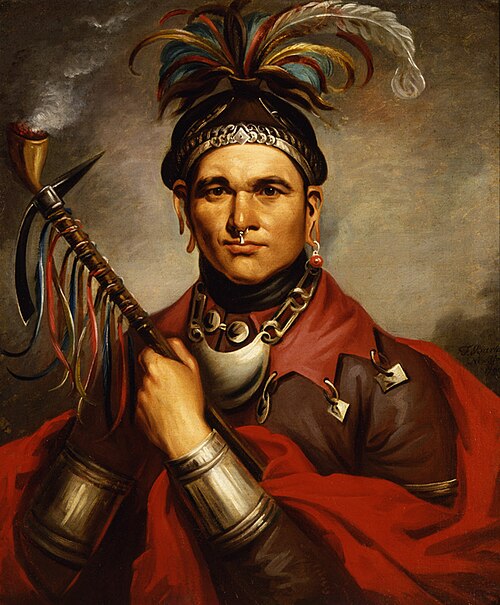

- Frederick Alexcee, artist (also of Tsimshian ancestry)
- Henry Armstrong, boxer, #2 in Ring Magazine's list of the 80 Best Fighters of the Last 80 Years
- Joseph Louis Cook or Akiatonharónkwen, a Mohawk leader born to Abenaki and African-American parents and adopted by the Mohawk
- Chief John Big Tree, Seneca chief and actor
- Governor Blacksnake (Chainbreaker) Thaonawyuthe, Seneca war chief
- Joseph Brant or Thayendanegea, Mohawk leader
- Canassatego, Onondaga leader, diplomat and spokesperson known for his speech at the 1744 Treaty of Lancaster, where he recommended that the British colonies emulate the Iroquois by forming a confederacy.
- Polly Cooper, Oneida who aided the Continental Army during the American Revolution and was a friend of George Washington
- Cornplanter or Kaintwakon, Seneca chief
- Jesse Cornplanter, Seneca artist and author
- David Cusick, Tuscarora artist and author
- Deganawida or The Great Peacemaker, the traditional founder, along with Hiawatha, of the Haudenosaunee Confederacy
- John Deseronto or Deserontyon, prominent Mohawk war chief
- Gary Farmer, Cayuga actor
- Graham Greene, Oneida and award-winning Canadian actor
- Handsome Lake (Ganioda'yo), Seneca religious leader
- Cornelius Hill (Onangwatgo), last hereditary Oneida chief, also Episcopal priest
- Lillie Rosa Minoka Hill, Mohawk physician who was the second female American Indian doctor in the U.S.
- Little Beard Si-gwa-ah-doh-gwih ("Spear Hanging Down"), Seneca chief
- John Smoke Johnson (Sakayengwaraton), Mohawk chief
- Pauline Johnson, Canadian writer and performer popular in the late 19th century, of Mohawk-European ancestry
- Stan "Bulldog" Jonathan, Mohawk professional hockey left winger
- Ki Longfellow, novelist
- Tom Longboat (Cogwagee), Onondaga distance runner
- Oren Lyons, Onondaga, traditional Faithkeeper of the Turtle clan
- Shelley Niro, Mohawk filmmaker, photographer, and installation artist
- John Norton (Teyoninhokovrawen), Mohawk warrior and leader of Cherokee-Scottish ancestry (adopted by Mohawk)
- Skenandoa ("pine tree chief"), Oneida chief
- Ely S. Parker, also known as Donehogawa or Häsanoan′da, Seneca, Union Army officer during American Civil War; appointed Commissioner of Indian Affairs by President Ulysses S. Grant
- Sanford Plummer, Seneca artist
- Red Jacket, Seneca orator and chief of the Wolf clan
- Robbie Robertson, Mohawk, songwriter, guitarist and singer who was part of The Band.
- Sayenqueraghta, Seneca war chief
- August Schellenberg, Mohawk-Métis actor
- Jay Silverheels, actor, Canadian Mohawk, portrayed Tonto the companion to the Lone Ranger on the US TV series The Lone Ranger
- Joanne Shenandoah, Oneida singer, songwriter, actress and educator
- Tanacharison (Half-king), Seneca war leader during the Seven Years' War
- Kateri Tekakwitha, Mohawk-Algonquin, first Catholic Native American saint
- Lyle Thompson, professional lacrosse player
- Miles Thompson, professional lacrosse player
- Billy Two Rivers, Mohawk professional wrestler
See also

- Covenant Chain
- David Cusick
- Delaware/Lenape
- Economy of the Iroquois
- Ely S. Parker
- First Nations Lacrosse Association
- Flying Head
- Ganondagan State Historic Site
- Gideon Hawley
- Great Law of Peace
- Handsome Lake
- Heritage Minutes
- History of New York (state)
- History of Ontario
- Iroquois mythology
- Iroquois settlement of the north shore of Lake Ontario
- Kahnawake Iroquois and the Rebellions of 1837–38
- Mohawk Chapel
- Red Jacket
- Seven Nations of Canada
- Sir William Johnson, 1st Baronet
- Six Nations of the Grand River
- Sketches of the Ancient History of the Six Nations
- Sullivan Expedition
- Town Destroyer
- Urban Indian
Notes
- ^ Morgan: "eighty rods"
- ^ "three rods"
- ^
- ^ This is frequently used on the official Haudenosaunee Confederacy website.[14]
- ^ [e] pronunciation according to Goddard (1978). [ɛ] pronunciation according to Day (1968).
- ^ The American Heritage encyclopedia relates that the Europeans learned about many of the interior tribes through the names given to them by the coastal tribes whom they first encountered. As the tribes were competitors and often enemies, the coastal peoples referred to the other tribes in terms that reflected their relations. The coastal tribes were among the large family of Algonquian language speakers, such as the Eastern Amerindians of Canada (M'ik Maq and others), and the Lenape of the mid-Atlantic and Powhatan Confederacy of Virginia. The editors add, that Iroquois was a polite name from such people, and its meaning is 'from the south', people of the south, or such similar name.
- ^ The American Heritage Book of Indians states that oral tradition recounts that other Iroquoian peoples were given the opportunity to join the league.
- ^ The 'fierce' Susquehannock declined rapidly following three years of epidemic disease in 1670–1672. They had been a regional military power, having subjugated several Delaware tribes and defeated two tribes of the Iroquois between 1665 and 1667.
- ^ extinct in part, but their surviving members sometimes were adopted by the Iroquois. The Editors of American Heritage Book of Indians said that one French observer hypothesized that by the end of 1678, the adopted Iroquois may have outnumbered native-born tribesmen due to the decades of intertribal warfare. During that time frame, the Iroquois had repeated clashes with French-supported Algonquian tribes, seeking control over the fur trade. In addition they defeated the Erie people, and the Susquehannock suffered defeats, as well as high mortality from infectious disease.
Citations
- ^ "Stateless Society | Encyclopedia.com". www.encyclopedia.com.
- ^ Morgan, Lewis Henry (1881). Houses and House-Life of the American Aborigines. Chicago and London: University of Chicago Press.
- ^ Dyck, Carrie, Froman, Frances, Keye, Alfred & Keye, Lottie. 2024. A grammar and dictionary of Gayogo̱hó:nǫˀ (Cayuga). (Studies of Amerindian Linguistics). Berlin: Language Science Press. DOI: 10.5281/zenodo.10473483. Pg 3 [1]
- ^ a b "Rotinonsionni, which is the Kanienkehaka (Mohawk) word for Haudenosaunee". Kanienkehaka Lifeways – Mohawk Valley, circa 1500. Retrieved August 27, 2017.
- ^ Woodbury, Hanni (2003). "Iroquois Confederacy". Onondaga-English / English-Onondaga Dictionary. Toronto: University of Toronto Press. p. 1182. ISBN 9781442623637.
- ^ Chafe, Chafe (2014). "Iroquois." (PDF). English-Seneca Dictionary. Onöndowa'ga:' Gawë:nö' (Seneca Language) Department. p. 88.
- ^ Rudes, Blair A. (2015). "Akunęhsyę̀·niˀ". Oneida–English/English–Oneida Dictionary. Toronto: University of Toronto Press. p. 42. ISBN 9781442628809.
- ^ Keh, Andrew; Kiehart, Pete (July 27, 2022). "How Indigenous Athletes Are Reclaiming Lacrosse". The New York Times. ISSN 0362-4331. Retrieved July 27, 2022.
Haudenosaunee (hoe-dee-no-SHOW-nee)
- ^ White, Richard (1991). The middle ground: Indians, empires, and republics in the Great Lakes region, 1650–1815. Cambridge. ISBN 0-521-37104-X. OCLC 22344887.
{{cite book}}: CS1 maint: location missing publisher (link) - ^ Barr, Daniel P. (2006). Unconquered : the Iroquois League at war in colonial America. Westport, Conn.: Praeger. ISBN 0-313-03820-1. OCLC 230726514.
- ^ a b Daeg de Mott 2009.
- ^ Marques, Nicole Terese Capton (2011). "Divided We Stand: The Haudenosaunee, Their Passport and Legal Implications of Their Recognition in Canada and the United States". Retrieved October 28, 2020.
- ^ "The American Indian and Alaska Native Population: 2010" (PDF). January 2012. Retrieved June 5, 2021.
- ^ a b "Home". Haudenosaunee Confederacy. Retrieved August 10, 2018.
- ^ Kasak, Ryan M. (2016). "A distant genetic relationship between Siouan-Catawban and Yuchi". In Rudin, Catherine; Gordon, Bryan J. (eds.). Advances in the Study of Siouan Languages and Linguistics. pp. 5–38.
- ^ "Haudenosaunee Guide for Educators" (PDF). The Smithsonian National Museum of the American Indian. 2009.
- ^ National Park Service U.S. Department of the Interior. "Finger Lakes National Heritage Area Feasibility Study". US National Park Service. Retrieved April 6, 2022.
- ^ "Cultural Misconceptions".
- ^ a b c d e f Goddard, I. (1978). "Synonymy". In G. Trigger (ed.). Handbook of North American Indians: Northeast. Vol. 15. pp. 319–321.
- ^ "Haudenosaunee". Your Dictionary. Archived from the original on August 9, 2020. Retrieved January 27, 2017.
- ^ Chafe, Wallace. English – Seneca Dictionary (PDF). p. 88.
- ^ a b c d e f g h i Morgan, 1904
- ^ E.g. in Graymont (1972), pp. 14–15; Rausch, David A.; Blair, Schlepp (1994). Native American Voices. p. 45.; and Wolf, Eric R. (1982). Europe and the People Without History. p. 165.
- ^ a b c d e Day 1968.
- ^ Hewitt, J. N. (1907). "Iroquois". In Hodge, Frederick Webb (ed.). Handbook of American Indians North of Mexico. pp. 617–620.
- ^ Hall, Loretta (2014). "Iroquois Confederacy". Gale Encyclopedia of Multicultural America (3rd ed.) – via Credo.
- ^ Graymont 1972, pp. 14–15.
- ^ Mann & Fields 1997.
- ^ Johansen & Mann 2000, p. 135.
- ^ Wallace, Anthony F.C. (2012). Tuscarora: A History. Albany: SUNY Press. ISBN 9781438444314.
- ^ a b Bruce Trigger, ed., Handbook of American Indians; Volume 15, 1978, pp. 287–288
- ^ "The Six Nations Confederacy During the American Revolution (U.S. National Park Service)". www.nps.gov. Retrieved June 5, 2024.
- ^ a b c Richter. "Ordeals of the Longhouse". In Richter; Merrill (eds.). Beyond the Covenant Chain. pp. 11–12.
- ^ a b Fenton 1998, pp. 4–5.
- ^ a b Shannon 2008, pp. 72–73.
- ^ a b c Brookhiser, Richard (May 19, 2006). ""Iroquoia: A land lost in push by British empire and U.S. settlers," Book Review of Alan Taylor's The Divided Ground: Indians, Settlers, and the Northern Borderland of the American Revolution". The New York Times. Archived from the original on July 9, 2017. Retrieved December 16, 2014.
- ^ Stevens 2013, p. 149.
- ^ Stevens 2013, p. [page needed].
- ^ Johansen, Bruce (1999). "Notes from the "culture wars": more annotations on the debate regarding the Iroquois and the origins of democracy". American Indian Culture & Research Journal. 23 (1): 165–175. doi:10.17953/aicr.23.1.x7035734612286m5 (inactive September 28, 2024).
{{cite journal}}: CS1 maint: DOI inactive as of September 2024 (link) - ^ Stevens 2013, p. 153.
- ^ a b MacLeod 2012, p. xiv.
- ^ Stevens 2013, p. 161.
- ^ Stevens 2013, p. 148.
- ^ Gibson, John Arthur; Woodbury, Hanni; Henry, Reginald; Webster, Harry; Goldenweiser, Alexander (1992). Nichols, John D.; Wolfart, H. C. (eds.). Concerning the League: The Iroquois League Tradition as Dictated in Onondaga by John Arthur Gibson. Algonquian and Iroquoian Linguistics. p. xii. ISBN 978-0-921064-09-1.
- ^ Stevens 2013, p. 162.
- ^ a b c d e Josephy, Alvin M. Jr., ed. (1961). The American Heritage Book of Indians. American Heritage Publishing, Co., Inc.
- ^ Fenton 1998, p. 69.
- ^ Shannon 2008, p. 25.
- ^ Graymont (1972), pp. 14–15. "It was a confederation based on kinship—a symbolic household. They called their confederation Ganonsyoni, which means "The Lodge Extended Lengthwise", that is, a lodge that is "spread out far". All individuals and all the tribes of the Confederacy were considered as one family living together in one lodge. The Mohawks, dwelling furthest east, were Keepers of the Western Door. The Onondagas, situated in the center, were the Fire Keepers as well as the Wampum Keepers. Onondaga was therefore, the capital, where the Grand Council was held and wampum records were kept. The local clan chiefs of each tribe meeting together as a unit were the federal chiefs of the League. The Mohawks, Onondagas, and Senecas were the Elder Brothers; The Oneidas and Cayugas, the Younger Brothers. The younger and elder brethren sat on opposite sides of the lodge and counseled across the fire with each other. The Onondagas sat in the middle and kept the balance between the two sides."
- ^ Johansen, Bruce (1995). "Dating the Iroquois Confederacy". Akwesasne Notes. New Series. 1 (3): 62–63. Retrieved December 12, 2008.
- ^ Johansen & Mann 2000, p. 105, "Ganondagan".
- ^ Mann 2005, p. 333.
- ^ Mann, Barbara A.; Fields, Jerry L. (1997). "A Sign in the Sky: Dating the League of the Haudenosaunee". American Indian Culture and Research Journal. 21 (2): 105–163. doi:10.17953/aicr.21.2.k36m1485r3062510 (inactive September 28, 2024).
{{cite journal}}: CS1 maint: DOI inactive as of September 2024 (link) - ^ Snow 1994, p. 231.
- ^ a b Johansen, Bruce (2010). The Iroquois. New York: Chelsea House. p. 29. ISBN 978-1-60413-794-1.
- ^ "The History of Onondage'ga'". Onondaga Nation School. Archived from the original on June 13, 2008.
- ^ "Chiefs". Onondaga Nation. February 18, 2014. Retrieved June 6, 2024.
- ^ Mann 2005, p. 334.
- ^ Hanna, Charles Augustus (1911). The Wilderness Trail. New York: Putnam Brothers. p. 97.
- ^ Burns, Louis F. "Osage". Oklahoma Historical Society's Encyclopedia of Oklahoma History and Culture. Archived from the original on January 2, 2011. Retrieved March 2, 2009.
- ^ See history of Erie people, Susquehannock, Tuscarora people and the Wyandot (Huron) peoples.
- ^ Muir, Diana. Reflections in Bullough's Pond. University Press of New England. p. 13.
- ^ "Oneida Nation | Kayanlaˀ Kówa – Great Law of Peace". Retrieved June 6, 2024.
- ^ Hoffman, Bernard G. (1955). Souriquois, Etechemin, and Kwedech – – A Lost Chapter in American Ethnography.
- ^ Johnson 2003, p. 7.
- ^ Johnson 2003, pp. 7–8.
- ^ Pendergast, James F. (1991). The Massawomeck.
- ^ a b c d Johnson 2003, p. 8.
- ^ Jordan (2013), p. 37.
- ^ Hämäläinen, Pekka (2022). Indigenous continent : the epic contest for North America. Liveright. ISBN 978-1-63149-699-8. OCLC 1330712844.
- ^ Reville, F. Douglas. The History of the County of Brant. p. 20.
- ^ "The Hurons". Catholic Encyclopedia. Newadvent.org. June 1, 1910. Retrieved February 27, 2011.
- ^ Steele, Ian K. (1994). Warpaths: Invasions of North America. Oxford: Oxford University Press. p. 64.
- ^ Richter 1992, p. [page needed].
- ^ Taylor, Alan (2001). American Colonies. Penguin Books.
- ^ Starna, William A.; Brandao, Jose Antonio (2004). "From the Mohawk—Mahican War to the Beaver Wars: Questioning the Pattern". Ethnohistory. 51 (4): 725–750. doi:10.1215/00141801-51-4-725. ISSN 1527-5477. S2CID 162639176.
- ^ Brandão, José A. (1997). Your Fyre Shall Burn No More: Iroquois Policy towards New France and Its Allies to 1701. Lincoln: University of Nebraska Press. pp. 19–20.
- ^ a b c Johnson 2003, p. 9.
- ^ "home". puffin.creighton.edu. August 11, 2014. Archived from the original on December 6, 2006. Retrieved August 10, 2018.
- ^ "HistoricPlaces.ca – HistoricPlaces.ca". www.historicplaces.ca. Retrieved August 10, 2018.
- ^ "HistoricPlaces.ca – HistoricPlaces.ca". www.historicplaces.ca. Retrieved August 10, 2018.
- ^ Trigger, Bruce G. (1987). The Children of Aataentsic: A History of the Huron People to 1660. Kingston and Montreal: McGill-Queen's University Press. p. 751.
- ^ a b c Johnson 2003, p. 10.
- ^ Jennings, p. 135.<--Jennings, F. (1988). Empire of fortune: crown, colonies, and tribes in the Seven Years War in America. New York: Norton. pp. 95, 111, 160, 259n15. ISBN 978-0-393-30640-8.-->
- ^ Jennings, F. (1988). Empire of fortune: crown, colonies, and tribes in the Seven Years War in America. New York: Norton. pp. 95, 111, 135, 160, 259n15. ISBN 978-0-393-30640-8.
- ^ a b c d Jennings, F. (1988). Empire of fortune: crown, colonies, and tribes in the Seven Years War in America. New York: Norton. pp. 95, 111, 160, 259n15. ISBN 978-0-393-30640-8.
- ^ Parmenter 2007, p. 42.
- ^ Parmenter 2007, p. 43.
- ^ "SRBC Pamphlet - The Susquehannock". www.srbc.gov. Retrieved June 6, 2024.
- ^ Parmenter 2007, p. 44.
- ^ MacLeod 2012, p. xi.
- ^ Parmenter 2007, pp. 44–45.
- ^ a b c d e f Parmenter 2007, p. 46.
- ^ Parmenter 2007, pp. 45–46.
- ^ a b c d Johnson 2003, p. 11.
- ^ Chisholm, Hugh, ed. (1911). . Encyclopædia Britannica. Vol. 11 (11th ed.). Cambridge University Press. pp. 249–250.
- ^ Parmenter 2007, pp. 40–41.
- ^ a b Parmenter 2007, pp. 39–76.
- ^ "The Four Indian Kings". Library and Archives Canada. Archived from the original on January 26, 2019. Retrieved September 25, 2007.
- ^ Walton, Joseph Solomon (1900). Conrad Weiser and the Indian Policy of Colonial Pennsylvania. pp. 76–121.
- ^ Paxton 2008, p. 12.
- ^ a b c d Paxton 2008, p. 13.
- ^ Paxton 2008, p. 14.
- ^ Johnson 2003, p. 12.
- ^ a b Johnson 2003, pp. 12–13.
- ^ a b c d e f Johnson 2003, p. 13.
- ^ a b c d e f g h Johnson 2003, p. 14.
- ^ MacLeod 2012, p. 23.
- ^ MacLeod 2012, pp. 23–25.
- ^ MacLeod 2012, pp. 24–25.
- ^ MacLeod 2012, pp. 26–27.
- ^ MacLeod 2012, p. 30.
- ^ MacLeod 2012, pp. 30–31.
- ^ MacLeod 2012, p. 31.
- ^ MacLeod 2012, pp. 31–32.
- ^ MacLeod 2012, p. 32.
- ^ MacLeod 2012, pp. 32–33.
- ^ MacLeod 2012, p. 35.
- ^ MacLeod 2012, p. 27.
- ^ Fenge, Terry; Aldridge, Jim (November 1, 2015). Keeping promises : the Royal Proclamation of 1763, aboriginal rights, and treaties in Canada. McGill–Queen's University Press. pp. 4, 38, 51, 201, 212, 257. ISBN 978-0-7735-9755-6. Retrieved October 6, 2019.
- ^ Johnson 2003, p. 15.
- ^ "Oneida Nation of New York Conveyance of Lands Into Trust" (PDF). Bureau of Indian Affairs. pp. 3–159. Archived from the original (PDF) on April 20, 2009.
- ^ Johnson 2003, pp. 15–16.
- ^ a b c Johnson 2003, p. 16.
- ^ a b c Graymont 1972, p. [page needed].
- ^ a b Crawford 1994.
- ^ a b Del Papa, Eugene M. (1975). "The Royal Proclamation of 1763: Its Effect upon Virginia Land Companies". The Virginia Magazine of History and Biography. Vol. 83. pp. 406–411.
- ^ a b Crawford 1994, p. 370.
- ^ Graymont 1972, p. 49.
- ^ a b c Johnson 2003, p. 17.
- ^ Johnson 2003, pp. 16–18.
- ^ a b c d e Johnson 2003, p. 19.
- ^ Keen Bloomfield, Julia (1908). The Oneidas. pp. 145 et seq.
- ^ "Southesk". Archived from the original on March 10, 2014.
- ^ Calverley, Dorthea. "The Iroquois of the Rocky Mountain Trench". South Peace Historical Society. Retrieved June 18, 2019.
- ^ "The Iroquois in the Peace River Area". Archived from the original on April 17, 2014.
- ^ "Mountain Métis Story". Archived from the original on March 1, 2014. Retrieved April 16, 2014.
- ^ "Ancestral History – Aseniwuche Winewak Nation of Canada – Canada's Rocky Mountain Aboriginal People". Archived from the original on July 21, 2014. Retrieved April 16, 2014.
- ^ a b c d e f g h Johnson 2003, p. 20.
- ^ a b Chartrand 2007, p. 6.
- ^ Winegard 2012, p. 30.
- ^ Winegard 2012, pp. 76–77.
- ^ a b Winegard 2012, p. 112.
- ^ a b c Winegard 2012, p. 128.
- ^ a b c d e f Woo, Grace Li Xiu (April 30, 2003). "Canada's Forgotten Founders: The Modern Significance of the Haudenosaunee (Iroquois) Application for Membership in the League of Nations". Law Social Justice & Global Development Journal. Archived from the original on March 16, 2015. Retrieved December 27, 2014.
- ^ a b c d e Léger, Marie, ed. (1994). Aboriginal peoples: toward self-government. Translated by Bennett, Arnold. Montréal: Black Rose Books. pp. 3–6. ISBN 978-1-551640-11-2. Retrieved December 27, 2014.
- ^ "Un Chicanery". mohawknationnews.com. April 24, 2013. Archived from the original on April 26, 2021.
- ^ a b c d Morton 1999, p. 273.
- ^ "U.S. House of Representatives Resolution 108, 83rd Congress, 1953. (U.S. Statutes at Large, 67: B132.)". Digital History. Archived from the original on June 8, 2007. Retrieved May 1, 2007.
- ^ "Lead Up To The Indian Claims Commission Act Of 1946". www.justice.gov. April 13, 2015. Archived from the original on April 15, 2021.
- ^ Philip 2002, pp. 21–33.
- ^ "Chapter 809 July 2, 1948 [S. 1683] | [Public Law 881] 62 Stat. 1224". digital.library.okstate.edu. Archived from the original on July 1, 2017. Retrieved August 10, 2018.
- ^ a b "Chapter 947 September 13, 1950 [S. 192] | [Public Law 785] 64 Stat. 845". digital.library.okstate.edu. Archived from the original on July 1, 2017. Retrieved August 10, 2018.
- ^ Shattuck 1991, pp. 168–169.
- ^ Shattuck 1991, p. 169.
- ^ Wilkinson, Charles (2005). Blood Struggle: The Rise of Modern Indian Nations. New York: W. W. Norton & Company.
- ^ "House Concurrent Resolution 108". Digital History. Archived from the original on June 8, 2007.
- ^ a b "Saint Regis Mohawk Tribe – Culture and History". Archived from the original on December 20, 2014.
- ^ "Legislation terminating federal controls over eight Indian groups submitted to congress" (PDF). Department of the Interior. January 21, 1954. Archived from the original (PDF) on June 10, 2014. Retrieved April 18, 2017.
- ^ Johansen & Mann 2000, p. 42.
- ^ "Text of H.R. 1794 (88th): An Act to authorize payment for certain interests in lands within the Allegheny ... (Passed Congress/Enrolled Bill version)". GovTrack.us.
- ^ "CQ Almanac Online Edition". cqpress.com. December 17, 2014. Archived from the original on December 17, 2014. Retrieved August 10, 2018.
- ^ "Bill submitted to end federal ties with Seneca Indians" (PDF). Department of the Interior. September 5, 1967. Archived from the original (PDF) on May 2, 2017. Retrieved April 18, 2017.
- ^ "Warren Times-Mirror and Observer from Warren, Pennsylvania p.9". Newspapers.com. September 7, 1967. Archived from the original on April 16, 2021.
- ^ "NEW BUREAU OF INDIAN AFFAIRS ASSIGNMENTS ANNOUNCED FOR SENECAS AND OSAGE" (PDF) (Press release). Department of the Interior. February 28, 1968. Archived from the original (PDF) on May 2, 2017. Retrieved April 18, 2017.
- ^ Hauptman, Laurence Marc (2013). In the Shadow of Kinzua: The Seneca Nation of Indians Since World War II. Syracuse University Press. p. 32.
- ^ "Richard Nixon: Special Message to the Congress on Indian Affairs". Archived from the original on March 3, 2016. Retrieved December 28, 2014.
- ^ a b "Indian claims commission awards over $38.5 Million to Indian tribes in 1964" (PDF). Department of the Interior. January 20, 1965. Archived from the original (PDF) on June 10, 2014. Retrieved April 18, 2017.
- ^ a b "Efforts have gone on for years to get Brothertown recognition". www.iwantthenews.com. Archived from the original on October 29, 2013. Retrieved December 28, 2014.
- ^ "Public Law 90-93 September 27, 1967 | [S. 1972] 81 Stat. 229". dc.library.okstate.edu. Archived from the original on March 3, 2016.
- ^ "Laverdure Issues a Final Determination Regarding Brothertown Indian Nation Petition for Federal Acknowledgment" (PDF). Washington DC: Department of the Interior. September 7, 2012. Archived from the original (PDF) on May 2, 2017. Retrieved April 18, 2017.
- ^ "Town action surprises tribe, county". www.iwantthenews.com. Archived from the original on December 17, 2014. Retrieved December 28, 2014.
- ^ Richter 1983, p. 531.
- ^ Richter 1983, pp. 531–532.
- ^ Richter 1983, pp. 530–532.
- ^ a b Richter 1983, p. 532.
- ^ a b c d Richter 1983, p. 535.
- ^ Richter 1983, p. 530.
- ^ a b c Richter 1983, p. 538.
- ^ Richter 1983, pp. 532–533.
- ^ Richter 1983, p. 533.
- ^ Richter 1983, p. 534.
- ^ Richter 1983, pp. 535–536.
- ^ a b Richter 1983, p. 536.
- ^ a b c d e f g h i j k l m Johnson 2003, p. 35.
- ^ a b c d e f g h i Johnson 2003, p. 36.
- ^ Stevens, Scott Manning (2018). "Tomahawk: Materiality and Depictions of the Haudenosaunee". Early American Literature. 53 (2): 475–511. doi:10.1353/eal.2018.0046. S2CID 165993798.
- ^ Richter 1983, pp. 537–538.
- ^ a b Richter 1983, p. 537.
- ^ a b Richter 1983, p. 539.
- ^ Richter 1983, p. 541.
- ^ Richter 1983, pp. 542–543.
- ^ Richter 1983, p. 542.
- ^ Richter 1992, p. 32.
- ^ a b Fournier, Martin (2002). Pierre-Esprit Radisson: Merchant Adventurer, 1636–1701. Montreal: McGill University Press. pp. 33–34.
- ^ Ebhardt, W. (2001). Captive Women among the Iroquois (MA thesis). College of William & Mary. doi:10.21220/s2-6xw2-3m64.
- ^ a b Jones, Eric E. (December 2008). Iroquois Population History and Settlement Ecology, AD 1500–1700. The Pennsylvania State University. Retrieved May 27, 2016.
- ^ a b c d e f g Snow, Dean R.; Gehring, Charles T.; Starna, William A. (1996). In Mohawk Country. Syracuse University Press. pp. xix–xx. ISBN 978-0-8156-2723-4. Retrieved April 27, 2016.
- ^ a b c d e Johnson 2003, p. 33.
- ^ a b c Johnson 2003, p. 21.
- ^ Johnson 2003, p. 22.
- ^ Jordan, Kurt A. (2007). "An Eighteenth-Century Seneca Iroquois Short Longhouse from the Townley-Read Site, ca. A.D. 1715–1754". In Kerber, Jordan E. (ed.). Archaeology of the Iroquois: Selected Readings and Research Sources. Syracuse University Press. p. 247. ISBN 9780815631392.
- ^ a b c d e f Johnson 2003, p. 34.
- ^ Waugh 1916, p. 118.
- ^ Waugh 1916, p. 128.
- ^ Beardsley, Gretchen (1939). "The Groundnut as used by the Indians of Eastern North America". Papers of the Michigan Academy of Sciences Arts and Letters. 25: 507–525.
- ^ Waugh 1916, p. 120.
- ^ Keoke, Emory Dean. Food, Farming and Hunting. p. 103.
- ^ Bial, Raymond (1999). Lifeways: The Iroquois. New York: Benchmark Books. ISBN 978-0-7614-0802-4.
- ^ Johnson 2003, pp. 36–37.
- ^ a b c d e f g h i j k l m n Johnson 2003, p. 37.
- ^ a b c d e f g Johnson 2003, p. 38.
- ^ "Traditional Appearance". Haudenosaunee Confederacy. Archived from the original on July 30, 2016. Retrieved May 20, 2016.
- ^ "Language Index". www.ohwejagehka.com. Retrieved June 6, 2024.
- ^ Colleen (July 19, 2017). "Gustoweh Headdress Instructions". The Wandering Bull, LLC. Retrieved June 6, 2024.
- ^ a b c d e Parker, Arthur C. (April–June 1909). "Secret Medicine Societies of the Seneca". American Anthropologist. II (2): 161–185. doi:10.1525/aa.1909.11.2.02a00010. JSTOR 659460. Retrieved July 7, 2022.
- ^ Gadacz, René R. "False Face Society". Canadian Encyclopedia. Retrieved July 7, 2022.
- ^ a b Assembly, New York (State) Legislature (1914). Documents of the Assembly of the State of New York. E. Croswell. pp. 113–5.
- ^ a b c d e f g h Reid 1996, p. 167.
- ^ a b c Brascoupé & Etmanskie 2006, p. 1329.
- ^ "Iroquois Traditional Ceremonies -- Oneida Nation | Oneida History" (PDF). 2017. Retrieved June 6, 2024.
- ^ Johnson 2003, p. 24.
- ^ "Medicine". Haudenosaunee Confederacy. Retrieved July 6, 2022.
- ^ a b Rioux, Marcel (May 1951). "Some medical beliefs and practices of the contemporary Iroquois Longhouses of the Six Nations Reserve". Journal of the Washington Academy of Sciences. 41 (5): 152–158. JSTOR 24531234. Retrieved July 6, 2022.
- ^ Smith, Erminnie A. (1883). Myths of the Iroquois. U.S. Government Printing Office. pp. 70–71. Retrieved July 6, 2022.
- ^ Thomas, Katsithawi. "Gender Roles among the Iroquois". Archived from the original on September 17, 2021.
- ^ a b Wagner, Sally Roesch (1999). "Iroquois Women Inspire 19th Century Feminists". National NOW Times. National Organization for Women. Archived from the original on August 16, 2000. Retrieved March 21, 2009.
- ^ Charlton 1968, pp. 30–34.
- ^ Holly, Marilyn (June 1990). "Handsome Lake's teachings: The shift from female to male agriculture in Iroquois culture. An essay in ethnophilosophy". Agriculture and Human Values. 7 (3–4): 80–94. doi:10.1007/BF01557313. ISSN 0889-048X. S2CID 144792686.
- ^ Ezzo, David. "Female Status and roles among the Iroquois". Whispering Wind.
- ^ Hagan, Willow. "Iroquois Native American Cultural Influences in Promoting Women's Rights Ideologies Leading Up to the First Women's Rights Convention in Seneca Falls on the 19th and 20th of July, 1848". Center of the American West.
- ^ Reed, Patricia (January 1, 1992). "The Role of Women in Iroquoian Society". NEXUS: The Canadian Student Journal of Anthropology. 10 (1). doi:10.15173/nexus.v10i1.131. ISSN 0707-3771.
- ^ Benokraitis, Nijole V. (2011). Marriages & Families (7 ed.). New Jersey: Pearson Education Inc. pp. 58–59.
- ^ Hewitt, J. N. B. (1902). "Orenda and a Definition of Religion". American Anthropologist. 4 (1): 33–46. doi:10.1525/aa.1902.4.1.02a00050. JSTOR 658926.
- ^ a b c Johnson 2003, p. 23.
- ^ a b Brascoupé & Etmanskie 2006, p. 1328.
- ^ Saraydar 1990, p. 21.
- ^ a b c Saraydar 1990, p. 22.
- ^ Saraydar 1990, p. 23.
- ^ Wallace, Anthony (April 12, 1972). Death and Rebirth of the Seneca. Vintage. ISBN 978-0-394-71699-2.
- ^ "Thanksgiving Address". Indigenous Values Initiative. June 6, 2017. Archived from the original on November 26, 2021.
- ^ Goodness, Valerie (January 30, 2015). "Idle no more: Decolonizing water, food and natural resources with tek". Indian Country Today. Archived from the original on August 18, 2021. Retrieved April 5, 2021.
- ^ Kimmerer, R.W. (2013). Braiding Sweetgrass: Indigenous Wisdom, Scientific Knowledge, and the Teachings of Plants. Milkweed Editions. p. 110. ISBN 978-1-57131-335-5.
- ^ Morgan, Thomas, 1995, pp. 200–201
- ^ a b c Johnson 2003, p. 39.
- ^ Demirel, Evin (July 21, 2014). "A Millennium after inventing the game, the Iroquois are lacrosse's new superpower". The Daily Beast. Archived from the original on September 27, 2019. Retrieved June 14, 2015.
- ^ Tooker, Elisabeth (1970). The Iroquois Ceremonial of Midwinter. Syracuse University Press. ISBN 978-0815621492. Retrieved June 8, 2015.
- ^ Bradley 1987, pp. 37, 54.
- ^ Arens, William (1980). The Man-Eating Myth: Anthropology and Anthropophagy. Oxford. ISBN 978-0195027938.
- ^ a b Abler, Thomas S. (1980). "Iroquois Cannibalism: Fact not Fiction". Ethnohistory. 27 (4): 309–316. doi:10.2307/481728. JSTOR 481728.
- ^ Sanday, Peggy Reeves (1986). Divine Hunger: Cannibalism as a Cultural System. Cambridge University Press. ISBN 978-0521311144.
- ^ Sugg, Richard (July 2008). "Eating Your Enemy". History Today. 58 (7).
- ^ Donald 2011, pp. 218–219.
- ^ Donald 2011, p. 234.
- ^ Starna & Watkins 1991, pp. 35–36.
- ^ "Sophia Burthen Pooley: Part of the Family?". Ontario Ministry of Government and Consumer Services. Retrieved June 18, 2019.
- ^ Starna & Watkins 1991, p. 37.
- ^ a b c d e Donald 2011, p. 218.
- ^ Richter 1992, p. 66.
- ^ Richter 1992, p. 67.
- ^ Starna & Watkins 1991, p. 46.
- ^ a b c Richter 1992, p. 68.
- ^ a b Donald 2011, p. 220.
- ^ Starna & Watkins 1991, p. 42.
- ^ a b Starna & Watkins 1991, p. 51.
- ^ Richter 1992, p. 65.
- ^ Richter 1992, p. 60.
- ^ a b Starna & Watkins 1991, p. 41.
- ^ a b c d e f Donald 2011, p. 222.
- ^ Starna & Watkins 1991, p. 39.
- ^ a b Lalemant 1899, p. 243.
- ^ Starna & Watkins 1991, p. 43.
- ^ Starna & Watkins 1991, pp. 44, 47.
- ^ Starna & Watkins 1991, p. 44.
- ^ Starna & Watkins 1991, pp. 43, 50.
- ^ a b Rushforth 2012, p. 17.
- ^ Hennepin 1820, pp. 87–88.
- ^ Starna & Watkins 1991, p. 47.
- ^ Rushforth 2012, p. 41.
- ^ a b Starna & Watkins 1991, pp. 48–49.
- ^ Rushforth 2012, pp. 19, 38.
- ^ Starna & Watkins 1991, pp. 47–49.
- ^ Bruyas, Jacques (1863). Radical Words of the Mohawk Language with Their Derivatives [microform]. Canadiana.org. [Albany, New York? : s.n.] pp. 105. ISBN 9780665502699.
- ^ Rushforth 2012, p. 19.
- ^ a b c Donald 2011, p. 221.
- ^ Richter 1992, p. 53.
- ^ Parmenter 2007, p. 40.
- ^ Richter 1992, p. 61.
- ^ Richter 1992, p. 64.
- ^ Richter 1992, pp. 71–72.
- ^ a b c d e Wagner, Sally Roesch (1993). "The Iroquois Influence on Women's Rights". In Sakolsky, Ron; Koehnline, James (eds.). Gone To Croatan: Origins of North American Dropout Culture. Brooklyn, New York: Autonomedia. pp. 240–247. ISBN 978-0-936756-92-9. Retrieved September 23, 2015.
- ^ Morden, Michael. "Treaty Federalism as Conflict Management: Indigenous- Settler Power Sharing in Canada" (PDF). Retrieved June 14, 2015.
- ^ Eldridge, Larry D. (1997). Women and freedom in early America. New York: New York University Press. p. 15. ISBN 978-0-8147-2198-8.
- ^ a b c "Wampum & Wampum Belts". Ganondagan. Archived from the original on July 21, 2012. Retrieved January 13, 2013.
- ^ "From beads to banner". Indian Country Today. Retrieved May 4, 2009.
- ^ "Haudenosaunee Flag". First Americans. Archived from the original on June 21, 2011. Retrieved September 25, 2007.
- ^ Johansen, Bruce E.; Grinde, Donald A. Jr. (1991). Exemplar of Liberty: Native America and the Evolution of Democracy. Native American Politics Series. Vol. 3.
- ^ "Iroquois Constitution: A Forerunner to Colonists' Democratic Principles". The New York Times. June 28, 1987.
- ^ Payne, Samuel B. Jr. (1996). "The Iroquois League, the Articles of Confederation, and the Constitution". The William and Mary Quarterly. 53 (3): 605–620. doi:10.2307/2947207. JSTOR 2947207.
- ^ a b Johansen, Bruce E. (1981). Forgotten Founders: Benjamin Franklin, The Iroquois, And The Rationale For The American Revolution. Ipswich, MA: Gambit.
- ^ Armstrong, V. I. (1971). I Have Spoken: American History Through the Voices of the Indians. Swallow Press. p. 14. ISBN 978-0-8040-0530-2.
- ^ Grinde, D. (1992). "Iroquois political theory and the roots of American democracy". In Lyons, O. (ed.). Exiled in the land of the free: democracy, Indian nations, and the U. S. Constitution. Santa Fe, NM: Clear Light Publishers. ISBN 978-0-940666-15-3.
- ^ Johansen, Bruce E.; Grinde Jr., Donald A. (1991). Exemplar of liberty: native America and the evolution of democracy. [Los Angeles]: American Indian Studies Center, University of California, Los Angeles. ISBN 978-0-935626-35-3.
- ^ "H. Con. Res. 331, October 21, 1988" (PDF). United States Senate. Retrieved November 23, 2008.
- ^ "The Tree of Peace The Great Law of Peace: New World Roots of American Democracy by David Yarrow© September 1987". Archived from the original on July 3, 2012. Retrieved May 20, 2012.
- ^ Rakove, J. (July 21, 2005). "Did the Founding Fathers Really Get Many of Their Ideas of Liberty from the Iroquois?". History News Network. George Mason University. Retrieved January 5, 2011.
- ^ Response by Charles C. Mann 7–21–05 in Rakove, J. (July 21, 2005). "Did the Founding Fathers Really Get Many of Their Ideas of Liberty from the Iroquois?". History News Network. George Mason University. Retrieved February 2, 2019.
- ^ Snow, D. R. (1996). The Iroquois (The Peoples of America Series). Cambridge, MA: Blackwell Publishers. p. 154. ISBN 978-1-55786-938-8.
- ^ a b Tooker, E. (1990). "The United States Constitution and the Iroquois League". In Clifton, J. A. (ed.). The Invented Indian: Cultural Fictions and Government Policies. New Brunswick, NJ: Transaction Publishers. pp. 107–128. ISBN 978-1-56000-745-6.
- ^ Morgan, Thomas, 1995, pp. 22–27
- ^ Toensing, Gale Courey (July 16, 2010). "Iroquois Nationals forfeits first game". Indian Country Today Media Network.com. Archived from the original on October 12, 2010. Retrieved February 27, 2011.
- ^ The Economist, July 24, 2010.
- ^ MacAskill, Ewen (July 15, 2010). "Iroquois lacrosse team cleared to travel by America – then blocked by Britain". The Guardian. Guardian News & Media Limited. Retrieved July 25, 2019.
- ^ Gross, Samantha (July 14, 2010). "UK won't let Iroquois lacrosse team go to tourney". Yahoo! News. Yahoo!. Archived from the original on July 20, 2010.
- ^ Kaplan, Thomas (July 16, 2010). "Iroquois Defeated by Passport Dispute". The New York Times. p. D1. Retrieved July 25, 2019.
- ^ Benny, Michael (July 19, 2010). "Iroquois spend $1.5 million to upgrade passports". CNYCentral.com. Barrington Broadcasting Group, LLC. Archived from the original on July 19, 2011. Retrieved February 27, 2011.
- ^ "Iroquois". Catholic Encyclopedia. October 1, 1910. Retrieved February 27, 2011.
- ^ Swanton, John R. (1974). The Indian Tribes of North America (Fourth Reprint ed.). Washington, D.C.: Smithsonian Institution Press. p. 40.
- ^ Jones 2008, p. 85.
- ^ a b c Krzywicki, Ludwik (1934). Primitive society and its vital statistics. Publications of the Polish Sociological Institute. London: Macmillan. pp. 534, 533, 396, 418, 421, 422, 471, 472.
- ^ "Indigenous America Maps". February 1, 2022. Retrieved May 19, 2024.
- ^ Swanton, John R. (1952). The Indian tribes of North America. Smithsonian Institution Bureau of American Ethnology. pp. 34–39. hdl:10088/15440.
- ^ Jones 2008, p. 14.
- ^ Trigger, Bruce (1978). Handbook of American Indians, Vol. 15. Washington, D.C.: Smithsonian Institution Press. pp. 287–288.
- ^ Jones 2008, pp. iii–v, 84–86.
- ^ Keener, Craig S (1999). "An Ethnohistorical Analysis of Iroquois Assault Tactics Used against Fortified Settlements of the Northeast in the Seventeenth Century". Ethnohistory. 46 (4): 777–807. ISSN 1527-5477.
- ^ "Not Merely Overrun but Destroyed. The Sullivan Expedition Against the Iroquois Indians, 1779".
- ^ Graymont 1972, p. 220.
- ^ Koehler, Rhiannon (Fall 2018). "Hostile Nations: Quantifying the Destruction of the Sullivan-Clinton Genocide of 1779". American Indian Quarterly. 42 (4): 427–453. doi:10.5250/amerindiquar.42.4.0427. S2CID 165519714.
- ^ Mooney, James (1928). The aboriginal population of America north of Mexico. Smithsonian Miscellaneous Collections. p. 4. hdl:10088/23978.
- ^ Swanton, John R. (1952). The Indian tribes of North America. Smithsonian Institution Bureau of American Ethnology. p. 40. hdl:10088/15440.
- ^ a b c George-Kanentiio, Doug (Fall–Winter 1995). "Iroquois population 1995". Akwesasne Notes. New Series. 1 (3 & 4): 61. Retrieved February 27, 2011.
- ^ Community Profile Archived June 18, 2017, at the Wayback Machine, Six Nations Elected Council, December 2014
- ^ Lands/Membership Department Archived September 6, 2015, at the Wayback Machine, Six Nations Elected Council, December 2014
- ^ a b c d e f New York Native Americans Language & Culture (PDF). NY: NEW YORK STATE EDUCATION DEPARTMENT. 2012. pp. 11–12.
- ^ "2011 Oklahoma Indian Nations Pocket Pictorial Directory" (PDF). Oklahoma Indian Affairs Commission, Barbara A. Warner (Ponca Nation) Executive Director 1993 to Present. April 10, 2011. p. 33. Archived from the original (PDF) on May 12, 2012. Retrieved September 18, 2015.
- ^ "American Indian and Alaska Native Population by Tribal Grouping, 2010" (PDF). Census Bureau.
- ^ "Distribution of American Indian tribes: Iroquois People in the US".
Bibliography
- Brascoupé, Simon; Etmanskie, Jenny (2006). "Iroquois". In Birx, James (ed.). Encyclopedia of Anthropology. Thousand Oaks, CA: Sage Publications. pp. 1328–1333. doi:10.4135/9781412952453.n483. ISBN 9780761930297.
- Bradley, James (1987). Evolution of the Onondaga Iroquois: Accommodating Change, 1500-1655. University of Nebraska Press. ISBN 978-0803262362.
- Carpenter, Roger M. (2004). The Renewed, the Destroyed, and the Remade: The Three Thought Worlds of the Iroquois and the Huron, 1609-1650.
- Charlton, Thomas (1968). "On Iroquois Incest". Anthropologica. 10 (1): 29–43. doi:10.2307/25604757. JSTOR 25604757.
- Chartrand, René (2007). The Canadian Corps in World War I. Oxford: Osprey.
- Crawford, Neta (1994). "A Security Regime among Democracies: Cooperation among Iroquois Nations". International Organization. 48 (3): 345–385. doi:10.1017/S002081830002823X. JSTOR 2706963. S2CID 154534808.
- Daeg de Mott, D. K. (2009). "Iroquois". In Gall, Timothy L.; Hobby, Jeneen (eds.). Worldmark Encyclopedia of Cultures and Daily Life, Vol. 2 (2nd ed.). Detroit: Gale. pp. 304–310. ISBN 978-1414448909. Retrieved April 12, 2015.
- Day, Gordon M. (1968). "Iroquois: An Etymology". Ethnohistory. 15 (4): 389–402. doi:10.2307/480418. JSTOR 480418.
- Donald, Leland (2011). "Slavery in Indigenous North America". In Eltis, David; Engerman, Stanley (eds.). The Cambridge World History of Slavery. Vol. 3. Cambridge: Cambridge University Press. ISBN 978-0-511-97540-0.
- Fenton, William N. (1998). The Great Law and the Longhouse: A Political History of the Iroquois Confederacy. Norman: University of Oklahoma Press. ISBN 0-8061-3003-2.
- Graymont, Barbara (1972). The Iroquois in the American Revolution (1st Paperback ed.). Syracuse University Press. ISBN 978-0-8156-0116-6.
- Graymont, Barbara (2005). The Iroquois. Chelsea House Publishers. ISBN 978-0-7910-7993-5.
- Hauptman, Laurence M. (2008). Seven Generations of Iroquois Leadership: The Six Nations Since 1800. (Iroquois and Their Neighbors) excerpt and text search
- Hennepin, Louis (1820). A New Discovery of a Large Country in the Northern America, Extending Above Four Thousand Miles. Worcester, MA?. ISBN 9780665183294.
- Jennings, Francis (1984). The Ambiguous Iroquois Empire: the Covenant Chain Confederation of Indian Tribes with English Colonies from Its Beginnings to the Lancaster Treaty of 1744. New York: Norton. ISBN 0-393-01719-2.
- Jennings, Francis, ed. (1985). The History and Culture of Iroquois Diplomacy: An Interdisciplinary Guide to the Treaties of the Six Nations and Their League. Syracuse, NY: Syracuse University Press. ISBN 0-8156-2650-9.
- Johansen, Bruce Elliott; Mann, Barbara Alice (2000). Encyclopedia of the Haudenosaunee. Greenwood Publishing Group. ISBN 978-0-313-30880-2.
- Johnson, Michael (2003). Tribes of the Iroquois Confederacy. Osprey. ISBN 978-1-84176-490-0.
- Jones, Eric E. (2010). "Population History of the Onondaga and Oneida Iroquois, A.D. 1500-1700". American Antiquity. 75 (2): 387–407. doi:10.7183/0002-7316.75.2.387. S2CID 161342917.
- Jordan, Kurt A. (2013). "Incorporation and Colonization: Postcolumbian Iroquois Satellite Communities and Processes of Indigenous Autonomy". American Anthropologist. 115 (1): 29–43. doi:10.1111/j.1548-1433.2012.01533.x.
- Lalemant, Hierosme (1899). "Of the Treachery of the Hiroquois". In Thwaites, Reuben Gold; Blair, Emma Helen (eds.). Jesuit Relations and Allied Documents (in French, Latin, and Italian). Vol. 30. Translated by Alexander, Finlow; Bicknell, Percy Favor; Giese, William Frederic; Lindsay, Crawford; Price, William; Sober, Hiram Allen. Cleveland: The Burrows Brothers Company.
- MacLeod, D. Peter (2012). The Canadian Iroquois and the Seven Years' War. Toronto: Dundurn Press.
- Mann, Charles C. (2005). 1491 New Revelations of the Americas Before Columbus. New York: Alfred A. Knopf. ISBN 978-1-4000-4006-3.
- Morgan, Lewis H. (1904). League of the Ho-dé-no-sau-nee or Iroquois. New York: Dodd, Mead.
- Morgan, Thomas D. (Fall 1995). "Native Americans in World War II". Army History: The Professional Bulletin of Army History (35): 22–27. Archived from the original on March 27, 2017. Retrieved April 17, 2013 – via www.shsu.edu.
- Morton, Desmond (1999). A Military History of Canada. Toronto: McClelland & Stewart.
- Otis, Melissa (2018). Rural Indigenousness: A History of Iroquoian and Algonquian Peoples of the Adirondacks. Syracuse, NY: Syracuse University Press.
- Parmenter, Jon (January 2007). "After the Mourning Wars: The Iroquois as Allies in Colonial North American Campaigns, 1676–1760". The William and Mary Quarterly. 64 (1): 39–76. JSTOR 4491596.
- Parmenter, Jon (2010). The Edge of the Woods: Iroquoia, 1534–1701.
- Paxton, James (2008). Joseph Brant and His World: 18th Century Mohawk Warrior and Statesmen. Toronto: James Lormier & Company. ISBN 978-1-55277-023-8.
- Philip, Kenneth R. (2002) [1999]. Termination Revisited: American Indians on the Trail to Self-Determination, 1933-1953. Lincoln: University of Nebraska Press. ISBN 0-8032-3723-5.
- Preston, David L. (2009). The Texture of Contact: European and Indian Settler Communities on the Frontiers of Iroquoia, 1667–1783. (The Iroquoians and Their World) excerpt and text search
- Reid, Gerald (1996). "Iroquois". Encyclopedia of World Cultures. Vol. 1: North America. New York: Macmillan Reference USA. pp. 164–167.
- Richter, Daniel (October 1983). "War and Culture: The Iroquois Experience". The William and Mary Quarterly. 40 (4): 528–559. doi:10.2307/1921807. JSTOR 1921807.
- Richter, Daniel K. (1992). The Ordeal of the Longhouse: The Peoples of the Iroquois League in the Era of European Colonization. Chapel Hill: University of North Carolina Press. ISBN 0-8078-2060-1.
- Richter, Daniel K.; Merrell, James H. (2003). Beyond the Covenant Chain: the Iroquois and Their Neighbors in Indian North America, 1600–1800. University Park, Pa.: Pennsylvania State University Press. ISBN 0-271-02299-X.
- Rushforth, Brett (2012). Bonds of Alliance: Indigenous and Atlantic Slaveries in New France. Chapel Hill: The University of North Carolina Press. ISBN 978-1-4696-0135-9.
- Santiemma, Adriano (1999). "Towards a Monocultural Future through a Multicultural Perspective. The Iroquois Case". Canadian Issues. XXI.
- Saraydar, Stephen (1990). "No Longer Shall You Kill: Peace, Power, and the Iroquois Great Law". Anthropology and Humanism Quarterly. 15 (1): 20–28. doi:10.1525/ahu.1990.15.1.20.
- Shannon, Timothy J. (2008). Iroquois Diplomacy on the Early American Frontier. New York: Viking. ISBN 978-0-670-01897-0.
- Shattuck, George C. (1991). The Oneida Land Claims: A Legal History. Syracuse University Press. ISBN 9780815625254. Retrieved December 19, 2014.
- Snow, Dean R. (1994). The Iroquois. Oxford, UK and Cambridge, MA: Blackwell. ISBN 1-55786-225-7.
- Starna, William; Watkins, Ralph (Winter 1991). "Northern Iroquoian Slavery". Ethnohistory. 38 (1): 34–57. doi:10.2307/482790. JSTOR 482790.
- スティーブンス、スコット・マニング(2013)。「ヌーベルフランスの歴史学とイロコイ国際主義の遺産」比較アメリカ研究。11 (2):148–165。doi :10.1179 / 1477570013Z.00000000037。S2CID 153786051 。
- トゥーカー、エリザベス編(1985-1986)。イロコイ資料集。ニューヨーク:ガーランド。ISBN 0-8240-5877-1。3巻
- Waugh, FW (1916)。『イロキスの食品と食品調理』オタワ:カナダ鉱山省。
- ワインガード、ティモシー C. (2012)。『キングとカナタのために:カナダインディアンと第一次世界大戦』。ウィニペグ:マニトバ大学出版局。ISBN 978-0-88755-728-6。
さらに読む
- モーガン、ルイス H. (1870)。人類家族の血縁と親族関係のシステム。
外部リンク
ウィキメディア・コモンズには、ハウデノサニー連邦に関連するメディアがあります。
- ハウデノサニー連邦、公式ウェブサイト
- イロコイインディアン博物館
- カナダの系譜(イロコイ族)
- 。ブリタニカ百科事典(第 11 版)。 1911年。
- 「アメリカ独立戦争中の六部族連合 - スタンウィックス砦国定公園(米国国立公園局)」www.nps.gov 。 2019年9月13日閲覧。