
Loading article…
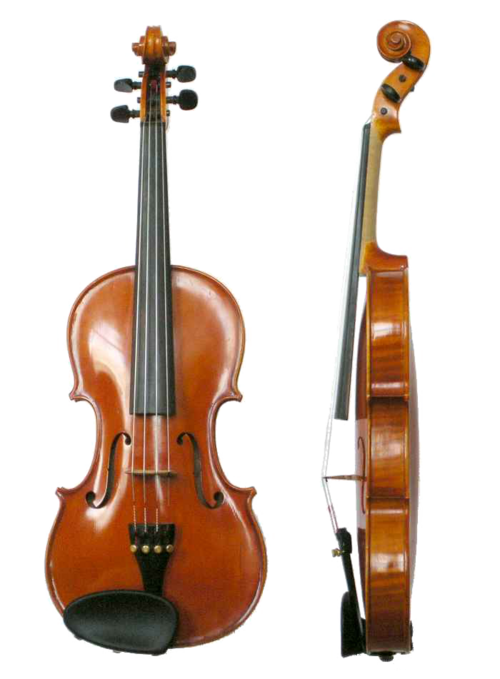 標準的な現代のバイオリンを上面と側面から見た図 | |
| 弦楽器 | |
|---|---|
| その他の名前 | フィドル |
| ホルンボステル・ザックス分類 | 321.322-71 (弓で鳴らす 複合弦楽器) |
| 発展した | 16世紀初頭 |
| プレイ範囲 | |
 | |
| 関連機器 | |
| ミュージシャン | |
| ビルダー | |
| サウンドサンプル | |
|
バイオリニストがバイオリンのさまざまな音を演奏する録音 | |
ヴァイオリン(またはフィドル)は木製の弦楽器で、ヴァイオリン属の中では最も小型で、最も高音域の楽器 (ソプラノ) として日常的に使用されています。ヴァイオリン型の小型楽器としては、ヴィオリーノ・ピッコロやポシェットなどがありますが、ほとんど使用されていません。ほとんどのヴァイオリンは木製の中が空洞になっており、一般的には 4 本の弦( 場合によっては5 本) が張られており、通常はG3、D4、A4、E5 の完全 5 度に調律され、最も一般的には弓で弦を弾いて演奏されます。また、ヴァイオリンは指で弦をはじいて演奏することもでき (ピチカート)、特殊な場合には弓の木の側で弦を叩いて演奏することもできます (コル・レーニョ)。
バイオリンは、幅広い音楽ジャンルにおいて重要な楽器です。西洋のクラシック音楽の伝統においては、アンサンブル(室内楽からオーケストラまで)としてもソロ楽器としても最もよく使用されています。また、バイオリンは、カントリー ミュージック、ブルーグラス ミュージック、ジャズなど、さまざまな民族音楽でも重要な役割を果たしています。ソリッド ボディと圧電ピックアップを備えたエレクトリック バイオリンは、ロック ミュージックやジャズ フュージョンの一部で使用され、ピックアップを楽器のアンプやスピーカーに接続して音を出します。バイオリンは、インド音楽やイラン音楽など、多くの非西洋音楽文化に組み込まれるようになりました。演奏する音楽の種類に関係なく、フィドルという名前がよく使用されます。
ヴァイオリンは16世紀のイタリアで初めて知られ、18世紀と19世紀にはさらに改良が加えられ、より力強い音と音の広がりを実現しました。ヨーロッパでは、ヴァイオリンがビオラなどの西洋クラシック音楽で使用される他の弦楽器の発展の基礎となりました。 [ 1] [2] [3]
バイオリニストやコレクターは、16世紀から18世紀にかけてイタリアのブレシアとクレモナでストラディヴァリ、グァルネリ、グァダニーニ、アマティ一族が製作した、またオーストリアのヤコブ・シュタイナーが製作した、優れた歴史的楽器を特に高く評価している。評判によれば、その音質は説明も同等のものでもなく、また説明も不可能だというが、この考えには異論もある。[4] [5]あまり有名でない製作者の手から出た楽器が多数あるほか、ザクセン、ボヘミア、ミルクールなどの家内工業で大量生産された商業用「トレードバイオリン」もさらに多い。これらのトレード楽器の多くは、かつてシアーズ・ローバック社やその他の量販店 で販売されていた。
バイオリンの部品は通常、さまざまな種類の木材から作られています。バイオリンには、ガット弦、ペルロン弦などの合成弦、またはスチール弦が張られます。バイオリンを製作または修理する人は、弦楽器製作者またはバイオリン製作者と呼ばれます。弓を製作または修理する人は、弓製作者または弓職人と呼ばれます。
語源
英語で「バイオリン」という言葉が初めて使われたのは1570年代です。[6]「バイオリン」という言葉は「イタリア語のviolino (ビオラの縮小形) 」に由来しています。「ビオラ」という用語は、1797年の「テナーバイオリン」という表現から来ており、イタリア語と古代プロヴァンス語の violaから来ています。これは中世ラテン語の vitulaから来ており、 「弦楽器」を意味する用語で、おそらくローマの喜びの女神ヴィトゥラから来ています...、または関連するラテン語の動詞vitulari ( 「喜びや高揚感で叫ぶ」 )から来ています。 [7] 「低音ヴァイオリン」を意味する関連用語Viola da gamba(1724年)はイタリア語から来ており、文字通り「脚用のヴィオラ」(脚の間に挟む)です。[7]バイオリンは「中世の小型のヴィオラ・ダ・ブラッチョ(腕用ヴィオラ)の現代形です。」 [6]
バイオリンはしばしばフィドルと呼ばれる。「フィドル」は、民族音楽では楽器の慣習的な名前として、また他の音楽スタイルでは楽器の非公式な名前として使用される。[8]「フィドル」という言葉は、14世紀後半に英語で初めて使用された。[8] 「フィドル」という言葉は、「fedele、fydyll、fidel、以前はfithele、古英語の fiðele 「フィドル」から来ており、これは古ノルド語の fiðla、中期オランダ語の vedele、オランダ語のvedel、古高ドイツ語の fidula、ドイツ語のFiedel「フィドル」と関連しているが、いずれも起源は不明である」から来ている。「フィドル」という言葉の起源については、「...音と意味の類似性に基づく通常の推測は、中世ラテン語のvitulaから来ているということです。」[8]
歴史

最古の弦楽器は、ほとんどが撥弦楽器だった(例えば、ギリシャのリラ)。2弦の弓奏楽器は、直立して演奏され、弦と弓は馬の毛で張られ、中央アジアの遊牧騎馬文化に起源を持つと考えられており、現代のモンゴルの モリン・フールやカザフスタンの コビズによく似た形をしている。類似のタイプやその変種が、おそらく東西交易路に沿ってアジアから中東、[9] [10]およびビザンチン帝国に広まったと思われる。[11] [12]
ブリタニカ百科事典によると、ヨーロッパのすべての擦弦楽器の直接の祖先は、アラビアの レバブ(ربابة)であり、これが9世紀までにビザンチンのリラに発展し、その後ヨーロッパのレベックになった。[13] [14] [15] [16]いくつかの資料は、バイオリンの起源について、北ヨーロッパや西ヨーロッパなど別の可能性を示唆している。[17] [18] [19]最初のバイオリン製作者は、おそらくビザンチンのリラのさまざまな発展形を借用した。これらには、ヴィエレ(フィデルまたはヴィウオラとしても知られる)やリラ・ダ・ブラッチョが含まれていた。[11] [20] 現在の形のバイオリンは、16世紀初頭の北イタリアで登場した。ヴァイオリンの最古の絵は、3本の弦ではあるものの、1530年頃に北イタリアで見られ、イタリア語とフランス語の文書に「violino」と「vyollon」という言葉が見られるのとほぼ同時期である。楽器の調律を含む最も古い明確な説明の1つは、1556年にリヨンで出版されたジャンブ・ド・フェールの楽譜「Epitome」にある。 [21]この頃には、ヴァイオリンはすでにヨーロッパ全土に広まり始めていた。
ヴァイオリンがストリートミュージシャンと貴族の間で非常に人気があったことが証明され、フランス王シャルル9世は1560年にアンドレア・アマティに24台のヴァイオリンを製作するよう命じた。[22]これらの「高貴な」楽器の1つであるシャルル9世は、現存する最古のヴァイオリンである。世界で最も優れたルネッサンス時代の彫刻と装飾が施されたヴァイオリンであるガスパロ・ダ・サロ(1574年頃)は、オーストリア大公フェルディナンド2世が所有し、後に1841年からはノルウェーの名手オーレ・ブルが所有し、グァルネリに似た非常に力強く美しい音色のため、40年間何千回ものコンサートで使用した。[23] アントニオ・ストラディバリが1716年に製作した「メサイア」または「ル・メッシー」(「サラビュー」としても知られる)は、新品同様の状態で残っている。現在はオックスフォードのアシュモリアン博物館に所蔵されている。[24]
16 世紀から 18 世紀にかけて 最も有名なバイオリン製作者(弦楽器製作者) は次のとおりです。
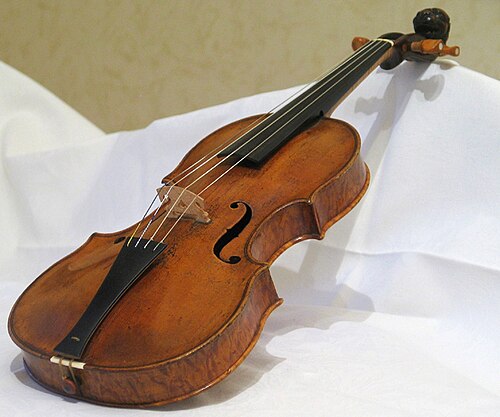
- ブレシア流派は、14世紀後半にリラ、ヴィオレッタ、ヴィオラで始まり、16世紀前半にはヴァイオリンの分野で活躍しました。
- ダッラコルナ家、1510 ~ 1560 年にブレシアとヴェネツィアで活動
- ミケーリ家は1530年から1615年までブレシアで活動した。
- インヴェラルディ家は1550年から1580年までブレシアで活動した
- ガスパロ・ダ・サロ家、1530 年から 1615 年までブレシアとサロで活動
- ジョヴァンニ・パオロ・マッジーニ、ガスパロ・ダ・サロの弟子、1600年から1630年までブレシアで活動
- ロジェリ家、 1661年から1721年までブレシアで活動
- クレモナ流派は、16世紀後半にビオラとヴィオローネで始まり、16世紀後半にはヴァイオリンの分野でも活躍した。
- アマティ家は1550年から1740年までクレモナで活動した。
- グァルネリ家は、1626年から1744年までクレモナとヴェネツィアで活動した。
- ストラディヴァリ家、 1644年から1737年までクレモナで活動[25]
- ルジェリ家、1650年から1740年までクレモナで活動
- カルロ・ベルゴンツィ (弦楽器製作者) (1683-1747) クレモナ
- ヴェネツィア流派は、1490年から1630年の間に登録された140人以上の弦楽器製作者のうち、16世紀初頭から数人の擦弦楽器製作者が存在した。[26]
- リナローロ家は1505年から1640年までヴェネツィアで活動した
- マッテオ・ゴフリラーはチェロ奏者で知られ、1685年から1742年までヴェネツィアで活動した。
- ピエトロ・グアルネリ、ジュゼッペ・ジョヴァンニ・バッティスタ・グアルネリの息子、クレモナ出身、1717年から1762年までヴェネツィアで活動
- ドメニコ・モンタニャーナ、1700 ~ 1750 年頃にヴェネツィアで活動
- サント・セラフィン、1741年以前から1776年までヴェネツィアで活動
18世紀にはバイオリンの構造に大きな変化が起こり、特に以前のものよりも楽器の後ろ側に角度をつけた長いネック、より重い弦、より重いベースバーが採用されました。古い楽器のほとんどはこれらの改造を受けており、そのため製作者の手を離れたときとは大きく異なる状態になっており、音色や反応に違いがあることは間違いありません。[27]しかし、現在の(改造された)状態において、これらの楽器はバイオリンの職人技と音色の完璧さの基準を確立しており、世界中のバイオリン製作者はこの理想にできるだけ近づこうとしています。
今日に至るまで、ヴァイオリン製作の黄金時代と呼ばれる時代の楽器、特にストラディヴァリ、グァルネリ・デル・ジェズ、モンタニャーナが製作した楽器は、コレクターと演奏家の両方から最も求められている楽器である。ストラディヴァリのヴァイオリンの現在の最高落札額は、 2011年6月20日にタリシオ・オークションズがオンラインオークションで「レディ・ブラント」として知られる楽器を販売した際の980万ポンド(当時のレートで1590万米ドル)である。 [28]
建設と機械
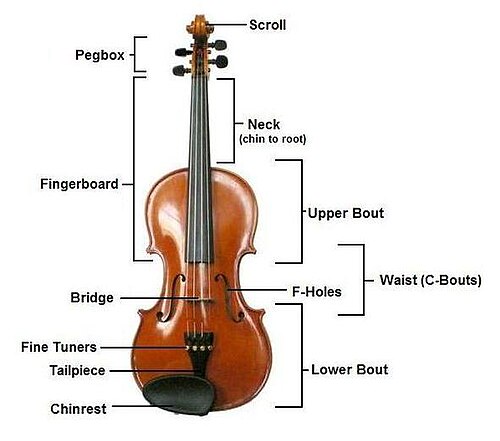
バイオリンは一般に、スプルース材のトップ(響板、トッププレート、テーブル、またはベリーとも呼ばれる)、メープル材のリブとバック、2 つのエンドブロック、ネック、ブリッジ、魂柱、4 本の弦、およびさまざまな付属品で構成され、オプションで顎当てが含まれます。顎当ては、テールピースの真上または左側に取り付けられます。バイオリンのボディの特徴は、砂時計のような形状と、トップとバックのアーチです。砂時計の形状は、2 つの上部バウト、2 つの下部バウト、および弓のためのスペースを確保するウエストの 2 つの凹型 C バウトで構成されています。バイオリンの「音色」またはサウンドは、その形状、材料となる木材、トップとバックの両方の段階(厚さのプロファイル)、外側の表面をコーティングするニス、およびこれらすべての手順を実行する弦楽器製作者のスキルによって決まります。ニス、特に木材は年月とともに良くなり続けるため、有名な弦楽器製作者が作った古くてよくできたバイオリンが定期的に供給され、非常に人気があります。
楽器の接着ジョイントの大部分には、一般的な白色接着剤ではなく動物性皮革接着剤が使用されていますが、これにはいくつかの理由があります。皮革接着剤は、他のほとんどの接着剤よりも薄いジョイントを作ることができます。分解が必要な場合、可逆性があります (慎重に力を加えると割れるほど脆く、お湯で取り除くことができます)。新しい皮革接着剤は古い皮革接着剤に付着するため、ジョイントを修理する際に元の木材をより多く保存できます。(最近の接着剤は、新しいジョイントを健全にするために完全に洗浄する必要があり、通常は古い接着剤とともに木材の一部を削り取る必要があります。) 一般的な修理ではこれらの部品を取り外す必要があるため、トップをリブに、ナットを指板に固定するには、通常、より弱い希釈接着剤が使用されます。スプルース材のトップのエッジを囲む縁飾りは、エッジから生じる亀裂に対してある程度の保護を提供します。また、リブ構造から独立してトップをより柔軟に曲げることができます。トップに塗装された偽の縁飾りは、通常、劣った楽器の兆候です。背面とリブは通常メープル材で作られており、ほとんどの場合、フレイムストライプ、フィドルバックストライプ、またはタイガーストライプと呼ばれる、一致する縞模様が施されています。
ネックは通常、リブとバックと調和した炎模様のメープル材です。ネックには指板が付いており、通常は黒檀で作られていますが、安価な楽器では他の木材を黒く染めたり塗装したりすることも多いです。黒檀は硬く、美しく、耐摩耗性に優れているため、好まれる素材です。指板は特定の横方向の曲線に仕上げられ、縦方向に小さな「スクープ」または凹みがあり、特にガット弦または合成弦の場合は、低弦でわずかに顕著になります。古いバイオリンの中には (古く見えるように作られたものもいくつかあります)、ペグボックスとネックの間の接着ジョイントでわかるように、接ぎ木されたスクロールがあります。本物の古い楽器の多くは、ネックの角度をわずかに大きくして、約 1 センチメートル長くし直されています。ネックの接ぎ木により、バロックバイオリンのネックを現代の基準に適合させる際に、オリジナルのスクロールを残すことができます。
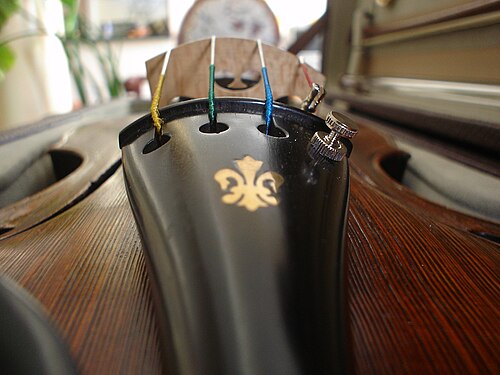

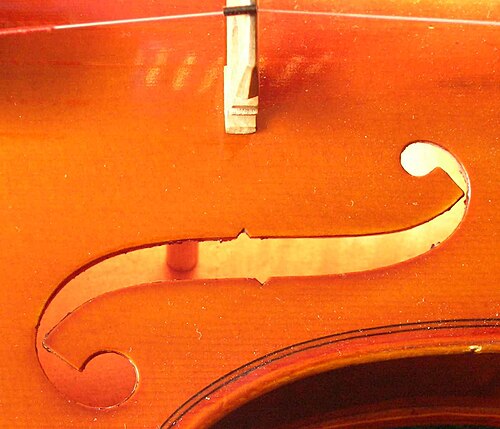
ブリッジは、弦の振動長の下部アンカー ポイントを形成する、正確にカットされたメープル材で、弦の振動を楽器本体に伝えます。ブリッジの上部のカーブにより、弦は指板から弧を描くように適切な高さに保たれ、弓で各弦を別々に鳴らすことができます。サウンドポスト(ソウル ポスト) は、楽器の背面とトップの間に、慎重に選ばれたブリッジの高音部近くの位置に正確に収まり、ブリッジを支える役割を果たします。また、楽器のトップと背面の振動モードにも影響を及ぼします。

テールピースは、テイルガットによってバイオリンの下側のバウトに弦を固定します。テイルガットは、テールピン (チェロのスパイクのように、エンドピンと呼ばれることもありますが、紛らわしいです) と呼ばれる黒檀のボタンに巻き付いており、ボトムブロックの先細りの穴に収まります。 E 弦には、指で回す小さなネジで操作する微調整レバーが付いていることがよくあります。ファインチューナーは、特に学生用楽器では他の弦にも使用でき、テールピースに組み込まれている場合もあります。ファインチューナーを使用すると、演奏者は弦のピッチを少し変更することができます。スクロールエンドでは、弦はペグボックス内の木製のチューニングペグに巻き付いています。チューニングペグは先細りになっており、ペグボックスの穴に収まります。チューニングペグは、木と木の摩擦によって所定の位置に保持されます。弦は金属製ですが、あまり一般的ではないがガットまたは金属で包まれたガットでできていることもあります。弦の両端には通常、弦の識別 (G 弦、D 弦、A 弦、E 弦など) とペグとの摩擦力を高めるために、色付きの絹の包装が施されています。ペグが先細りになっているため、演奏者はペグを回しながらペグの軸に沿って適切な圧力をかけることで、摩擦力の増減を調節できます。
文字列
弦は最初、羊の腸(一般にキャットガットとして知られているが、名前にもかかわらず猫から採取されたものではない)または単にガット(腸)を伸ばし、乾燥させ、撚ったものから作られていた。20世紀初頭には、弦はガットかスチールで作られていた。現代の弦は、ガット、ソリッドスチール、ストランドスチール、またはパーロンなどのさまざまな合成材料でできており、さまざまな金属で巻かれ、銀でメッキされていることもある。ほとんどのE弦は巻かれておらず、プレーンスチールまたはメッキスチールである。ガット弦はかつてほど一般的ではないが、多くの演奏者が、特に歴史的に知識のあるバロック音楽の演奏で特定の音を出すために使用している。弦の寿命は限られている。最終的に、油、汚れ、腐食、松脂が蓄積すると、弦の質量が長さに沿って不均一になることがある。弦の巻きが摩耗によりほどけるなどの明らかな場合を除いて、演奏者が弦を交換するのは、通常、弦が「本来の」音色(倍音のイントネーションが良好)を奏でられなくなり、望ましい音色、輝き、イントネーションが失われる場合です。弦の寿命は、弦の品質と演奏の強度によって決まります。
ピッチ範囲
バイオリンは、 G 3、 D 4、 A 4、 E 5の5度に調律されます。通常に調律されたバイオリンの最低音はG 3、つまり中央の C (C4)より G です。(まれに、最低弦が4度も下げられて D 3になることもあります。) 演奏可能な最高音はそれほど明確に定義されていません。 E 7 、つまり開放弦 ( E 5に調律されている) の2オクターブ上の E が、オーケストラのバイオリンパートの実際的な限界と考えられますが、[29]指板の長さとバイオリニストの技術に応じて、より高い音を演奏することもしばしば可能です。しかし、弦を止めたり、指板の限界に達したり、人工倍音を使用したりすることで、より高い音 ( C 8まで) を鳴らすことができます。
音響

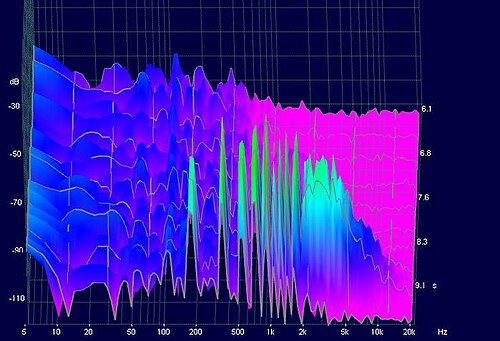
バイオリンの音色は、アーチ型の形状、木材の厚さ、そしてその物理的性質によって左右される。特定の周波数で振動するプレートに砂やグリッターをまき散らして作られる節のパターンはクラドニパターンと呼ばれ、楽器製作者が楽器を組み立てる前に作業を確認するために時々使用される。 [30]
サイズ
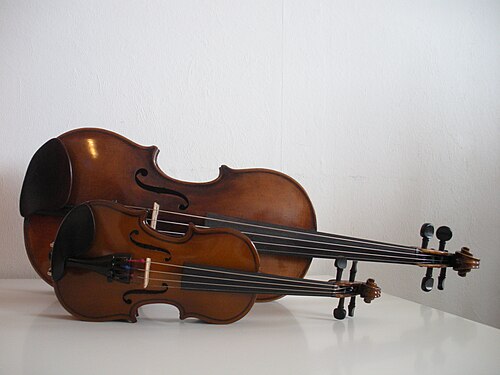
標準的なフルサイズ( 4 ⁄ 4 )の他に、バイオリンは7 ⁄ 8、3 ⁄ 4、1 ⁄ 2 、 1 ⁄ 4、1 ⁄ 8、1 ⁄ 10、1 ⁄ 16、1 ⁄ 32 、さらには1 ⁄ 64といった分数サイズでも作られています。これらの小型の楽器は、指が長くなくフルサイズの楽器の正しい位置に届かない若い演奏者によく使用されます 。
ある意味では楽器の寸法に関連していますが、分数サイズは相対的な比率を文字通り説明することを意図したものではありません。たとえば、3 ⁄ 4サイズの楽器は、フルサイズの楽器の 4 分の 3 の長さではありません。フルサイズ、つまり4 ⁄ 4 のバイオリンのボディの長さ (ネックを含まない) は 356 mm (14.0 インチ) で、17 世紀のモデルの中にはこれより短いものもあります。3 ⁄ 4バイオリンのボディの長さは 335 mm (13.2 インチ) で、1 ⁄ 2サイズは 310 mm (12.2 インチ) です。バイオリンに最も近い楽器であるビオラでは、サイズは分数サイズではなく、インチまたはセンチメートル単位のボディの長さで指定されます。フルサイズのビオラの平均は 40 cm (16 インチ) です。ただし、どのサイズのビオラを使用するかは、大人ごとに決まります。
時々、小柄な大人は、フルサイズの楽器の代わりに、いわゆる7 ⁄ 8サイズのバイオリンを使用する場合があります。レディース バイオリンと呼ばれることもあるこれらの楽器は、フルサイズのバイオリンよりもわずかに短いですが、高級なフルサイズのバイオリンに匹敵する音を出すことができる高品質の楽器である傾向があります。5 弦バイオリンのサイズは、通常の 4 弦バイオリンのサイズとは異なる場合があります。
メゾバイオリン
ヴァイオリン八重奏曲のヴァイオリンに相当する楽器はメゾヴァイオリンで、ヴァイオリンと同じように調律されているが、本体がわずかに長い。メゾヴァイオリンの弦の長さは、標準的なヴァイオリンと同じである。この楽器は一般的には使用されていない。[31]
チューニング
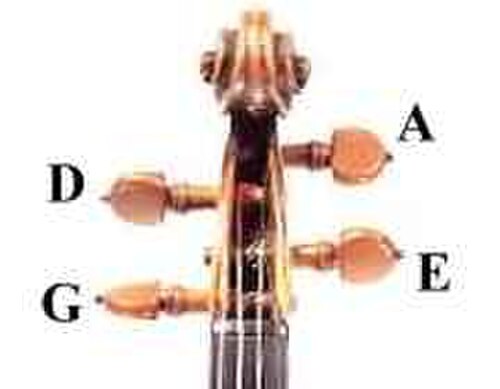

バイオリンのチューニングは、スクロールの下のペグボックスのペグを回すか、テールピースのファインチューナーネジを調整することで行います。すべてのバイオリンにはペグが付いています。ファインチューナー (ファインアジャスターとも呼ばれる) はオプションです。ほとんどのファインチューナーは、弦の端に取り付けられたレバーを動かす金属製のネジで構成されています。ペグよりもはるかに簡単に、微調整が可能です。ファインチューナーを時計回りに回すとピッチが鋭くなり (弦の張力が増すため)、反時計回りに回すとピッチが平らになります (弦の張力が弱まるため)。4本の弦すべてに付いているファインチューナーは、スチール芯の弦を使用するときに非常に役立ち、合成弦で使う奏者もいます。現代のE弦はスチール製なので、その弦にはほぼ常にファインチューナーが取り付けられています。ガット弦はスチール弦や合成芯弦よりも弾力性があり、ファインチューナーの微調整に適切に反応しないため、ファインチューナーは使用されません。
バイオリンを調律するには、まず A 弦を標準 ピッチ(通常は A=440 Hz ) に調律します。(ピアノやアコーディオンなどの固定ピッチの楽器を伴奏または演奏する場合、バイオリンは他の調律基準ではなく、その楽器の対応する音に調律されます。オーボエは音が浸透性があり、他の木管楽器よりもよく聞こえるため、バイオリンがいるオーケストラの調律に一般的に使用されます。) 次に、他の弦を 2 本ずつ弓で弾くことで、完全 5 度間隔で互いに調律します。ソロ演奏では、楽器の音を明るくするために、わずかに高い調律が使用されることがあります。逆に、バロック音楽では、バイオリンの音をより穏やかにするために、低い調律が使用されることがあります。調律後、楽器のブリッジが真っ直ぐに立っていて、 f 字孔の内側の切れ込みの中央にあることを確認します。ブリッジが曲がっていると、それ以外はよくできたバイオリンの音に大きな影響を与える可能性があります。
長時間演奏すると、チューニング ペグとその穴が磨耗し、張力によってペグが滑りやすくなります。ペグが滑ると、弦のピッチが多少下がります。また、ペグが完全に緩むと、弦の張力が完全に失われます。チューニング ペグが滑るバイオリンは、弦楽器製作者またはバイオリン修理担当者に修理してもらう必要があります。ペグ ドープまたはペグ コンパウンドを定期的に使用すると、ペグがスムーズに回転するようになり、磨耗の進行を遅らせることができます。
G–D–A–E の調律は、クラシック音楽、ジャズ、フォーク音楽など、ほとんどのヴァイオリン音楽で使用されています。他の調律も時々使用され、たとえば G 弦を A に調律することができます。クラシック音楽で非標準の調律を使用することはスコルダトゥーラとして知られており、一部のフォーク音楽ではクロスチューニングと呼ばれています。クラシック音楽におけるスコルダトゥーラの有名な例としては、カミーユ・サン=サーンスの「死の舞踏」が挙げられます。この曲では、ソロヴァイオリンの E 弦を E ♭に調律して、不気味な不協和音を楽曲に与えています。他の例としては、バルトーク・ベーラの「コントラスト」の第 3 楽章では E 弦を E ♭に調律し、G を G ♯に調律しています。また、ニコロ・パガニーニの「ヴァイオリン協奏曲第 1 番」では 4 本の弦すべてを半音高く調律するよう指定しています。ビーバーの「神秘ソナタ」では、各楽章でスコルダトゥーラの調律が異なります。
インド古典音楽とインド軽音楽では、南インドスタイルではバイオリンは D ♯ –A ♯ –D ♯ –A ♯に調律されることが多い。インド古典音楽には絶対音感の概念がないので、ミュージシャンは弦間の相対的な音程を維持するために都合の良い調律をどれでも使用できる。これらの音程でのもう一つの一般的な調律は B ♭ –F–B ♭ –F で、これはインドのカルナータカ古典音楽スタイルの Sa–Pa–Sa–Pa に相当します。北インドのヒンドゥスターニー音楽スタイルでは、調律は通常 Sa–Pa–Sa–Pa ではなく Pa-Sa-Pa-Sa です。これは、たとえば F–B ♭ –F–B ♭に相当する可能性があります。イラン古典音楽とイラン軽音楽では、バイオリンはDastgahごとに異なる調律が用いられます。ダストガー・フ・エスファハーンでは (E–A–E–A) に調律される可能性が高いですし、ダストガー・エ・シュールでは (E–A–D–E) と (E–A–E–E)、ダストガー・エ・マフールでは(E–A–D–A) に調律されます。アラビアの古典音楽では、 A 弦と E 弦は全音下げられ、つまり G–D–G–D です。これは、アラビアのマカーム、特に四分音を含むマカームの演奏を容易にするためです。
ほとんどのバイオリンは4本の弦を持っていますが、弦が追加されているバイオリンもあり、中には7本もの弦を持つものもあります。7本は、擦弦楽器で実用的な最大の弦数であると一般に考えられています。7本を超える弦では、特定の内側の弦を個別に弓で弾くことは不可能です。7本の弦を持つバイオリンは非常にまれです。そのようなバイオリンの追加弦は通常、G弦よりもピッチが低く、これらの弦は通常(追加された最高弦から最低弦に向かって)C、F、およびB ♭に調律されます。楽器の演奏長さ、つまりナットからブリッジまでの弦の長さが通常のフルスケールのバイオリンの長さ、つまり13インチ(33cm)より少し短い場合は、適切にバイオリンと呼ぶことができます。そのような楽器の中にはやや長いものもあり、ビオラと見なすべきものです。5弦以上のバイオリンは、通常、ジャズやフォークミュージックで使用されます。一部の特注楽器には、弓で弾くのではなく、弓で弾いた弦の振動によって共鳴音を出す追加の弦が付いています。
弓

バイオリンは通常、弓を使って演奏されます。弓はスティックと、その先端とフロッグ (またはナット、ヒール) の両端の間に張られた馬毛のリボンで構成されます。一般的なバイオリンの弓は、全長が 75 cm (30 インチ)、重さが約 60 g (2.1 オンス) です。ビオラの弓は、約 5 mm (0.20 インチ) 短く、10 g (0.35 オンス) 重い場合があります。フロッグの端にあるネジ調整器で、毛を締めたり緩めたりします。フロッグのすぐ前には、革製の親指クッション (グリップと呼ばれる) と巻き線があり、スティックを保護し、演奏者の手をしっかりと保持します。伝統的な巻き線は、ワイヤー (多くの場合、銀またはメッキされた銀)、絹、またはヒゲヒゲ(「鯨の骨」、現在は黄褐色と黒のプラスチックの交互になったストリップに置き換えられています) です。一部のグラスファイバー製の学生用弓では、グリップと巻き線の両方にプラスチックのスリーブが使用されています。
弓の毛は伝統的に灰色の雄馬(主に白い毛)の尻尾から取られます。安価な弓の中には合成繊維を使用しているものもあります。固形の松脂を毛に塗り、わずかに粘着性を持たせます。弓を弦に引くと、弦と弓の間の摩擦により弦が振動します。より高価な弓のスティックの伝統的な材料には、スネークウッドやブラジルウッド(ペルナンブコ材としても知られています)などがあります。最近の弓のデザイン革新では、あらゆるレベルの職人技において、スティックにカーボンファイバー(CodaBows)を使用しています。学生用の安価な弓は、より安価な木材、またはグラスファイバー(Glasser)で作られています。
遊ぶ
姿勢

ヴァイオリンは座って演奏することも、立って演奏することもできます。ソロ奏者(一人で演奏する場合でも、ピアノと共演する場合でも、オーケストラと共演する場合でも)は、主に立って演奏します(イツァーク・パールマンの場合のように身体的な障害によってそれができない場合を除く)。対照的に、オーケストラや室内楽では通常座って演奏されます。2000年代と2010年代には、バロック音楽を演奏する一部のオーケストラ(フライブルク・バロック管弦楽団など)では、ソロとアンサンブルを問わず、すべてのヴァイオリンとビオラが立って演奏していました。
バイオリンの標準的な持ち方は、左側のあごをバイオリンのあご当てに乗せ、左肩で支える方法です。肩当てを使うこともよくありますが、肩当てが苦手な若い演奏者にはスポンジとゴムバンドが役立ちます。あごと肩でバイオリンをしっかりと支えて、左手が高い位置(指板のかなり上の高音)から低い位置(糸巻き箱に近い位置)に移ったときにバイオリンが安定するようにする必要があります。インド式姿勢では、バイオリンのスクロール部分が足の側面に当たることで安定性が確保されます。
教師たちは、演奏の質のため、また反復運動障害のリスクを減らすために良い姿勢が極めて重要であると指摘していますが、良い姿勢とは何か、そしてそれをどのように実現するかについてのアドバイスは細部において異なります。しかし、緊張や硬直のない自然でリラックスした姿勢の重要性については、すべての教師が強調しています。ほぼ例外なく推奨されていることは、左手首をまっすぐ(またはほぼまっすぐ)に保ち、左手の指が自由に動いて怪我のリスクを減らすこと、両肩を自然にリラックスした位置に保ち、どちらかの肩を過度に上げないようにすることです。これは、他の不必要な緊張と同様に、動きの自由度を制限し、怪我のリスクを高めます。
猫背は体のバランスを崩し、肩が上がるため、良い演奏を妨げることがあります。不健康な緊張から生じるもう 1 つの兆候は左手の痛みで、これはバイオリンを持つときに圧力がかかりすぎていることを示します。
左手とピッチの演出

左手は、指先で弦を指板に押し当てて「止める」(押さえる)ことで、弦の音の長さ、つまり音程を決め、さまざまな音程を生み出します。バイオリンには、ギターでよくあるように弦を止めるフレットがないため、演奏者は、良いイントネーション(チューニング)で演奏するために、弦のどこに指を置くべきかを正確に知っていなければなりません。バイオリニストの初心者は、開放弦と、ナットに最も近い最低音の位置を演奏します。生徒は、AメジャーやGメジャーなどの比較的簡単なキーから始めることがよくあります。生徒は、音階と簡単なメロディーを教わります。音階とアルペジオの練習と耳のトレーニングを通じて、バイオリニストの左手は、筋肉の記憶によって、最終的に音を直感的に「見つける」ようになります。
初心者は、左手の指の正しい配置を知るために、指板に貼られたテープに頼ることもありますが、上達するにつれてすぐにテープを使わなくなります。よく使われる別のマーキング技法は、指板にホワイトアウトの点を付ける方法ですが、数週間の定期的な練習で効果が薄れます。残念ながら、この方法は、耳ではなく目で指の配置をガイドする適切な耳のトレーニングの代わりに使われることがあります。特に、演奏を学ぶ初期段階では、いわゆる「リンギング トーン」が役立ちます。第 1 ポジションには、そのような音が 9 つあり、そこでは、止められた音が別の (開放) 弦とユニゾンまたはオクターブで鳴り、共鳴します。生徒は、これらのリンギング トーンを使用して、止められた音が開放弦と調和しているかどうかで、その音調をチェックすることがよくあります。たとえば、G 弦で止められた音程「A」を演奏する場合、バイオリニストは同時に開放弦の D を弾いて、止められた「A」の音調をチェックすることができます。 「A」が調律されていれば、「A」と開放弦の「D」は調和のとれた完全4度音を生み出すはずです。
バイオリンは、コントラバスを除くすべてのオーケストラ弦楽器(バイオリン、ビオラ、チェロ)と同様に完全五度に調律されている。コントラバスは完全四度に調律されている。後続の各音は、演奏者が最も調和的であると認識するピッチで停止され、「無伴奏の場合、[バイオリニスト]は平均律または自然[純正]音階のいずれかで一貫して演奏するのではなく、全体的にピタゴラス音階に従う傾向がある。」[32]バイオリニストが弦楽四重奏団または弦楽オーケストラで演奏する場合、弦は通常、演奏しているキーに合わせて調律を「甘く」する。ピアノなどの平均律に調律された楽器で演奏する場合、熟練したバイオリニストは不協和音を避けるためにピアノの平均律に一致するように調律を調整する。
楽譜や練習曲集などの音楽記譜法では、指には通常 1 (人差し指) から 4 (小指) までの番号が付けられています。特にバイオリンの教則本では、音符の上の数字がどの指を使うかを示し、 0またはO が開放弦を示します。右の表は、第 1 ポジションで届く音符の配置を示しています。この表には、指がナットから上 (ピッチ) に移動すると音符の位置の間隔が狭くなる様子は示されていません。表の横のバーには、初心者がテープを貼る通常の可能性 (第 1 指、第 2 指の高、第 3 指、第 4 指) が示されています。
ポジション
指板上の左手の配置は、「ポジション」によって特徴付けられます。ほとんどの初心者が始める第 1 ポジション (一部のメソッドでは第 3 ポジションから始めます) は、弦楽器音楽で最も一般的に使用されるポジションです。初心者のユース オーケストラ向けに作曲された音楽は、多くの場合、ほとんどが第 1 ポジションです。標準チューニングでこのポジションで使用できる最低音はオープン G3 です。第 1 ポジションの最高音は、E 弦の 4 指で演奏され、B5 の音になります。手をネックに沿って上に動かすと、最初の指が 2 番目の指の位置になり、演奏者は第 2 ポジションになります。最初の指が 3 番目の指の最初の位置になるようすると、演奏者は第 3 ポジションになります。以下同様に続きます。ポジションの変更とそれに伴う手の動きはシフトと呼ばれ、正確なイントネーションとスムーズなレガート (連続した) サウンドを維持する効果的なシフトは、すべてのレベルのテクニックの重要な要素です。多くの場合、「ガイド フィンガー」が使用されます。古い位置で最後に音を弾いた指は、シフトの過程で弦に軽く触れ続け、新しい位置で正しい位置に戻ります。基本的なシフト練習では、弦を上下に滑らせながら「ガイド フィンガー」の音を発声することが多く、演奏者は耳で正しい位置を見つけることができます。これらの練習以外では、ガイド フィンガーの音が聞こえることはほとんどありません (演奏者が表現上の理由で意識的にポルタメント効果を適用している場合を除く)。
低いポジションへのシフトの過程で、左手の親指は、指に対して同じ位置を保つように楽器のネックを上下に動きます (ただし、親指の動きは指の動きよりわずかに前またはわずかに後に発生することがあります)。このようなポジションでは、親指は、その位置によって演奏者のポジションが決まる「アンカー」であると考えられることがよくあります。非常に高いポジションでは、楽器本体が邪魔になるため、親指は指と一緒に動くことができません。代わりに、親指は楽器のネックの周りを動き、ネックと本体の右側の境界が接する位置に位置し、指がハイポジション間を移動する間、そこに留まります。
A note played outside of the normal compass of a position, without any shift, is referred to as an extension. For instance, in third position on the A string, the hand naturally sits with the first finger on D♮ and the fourth on either G♮ or G♯. Stretching the first finger back down to a C♯, or the fourth finger up to an A♮, forms an extension. Extensions are commonly used where one or two notes are slightly out of an otherwise solid position, and give the benefit of being less intrusive than a shift or string crossing. The lowest position on the violin is referred to as "half position". In this position the first finger is on a "low first position" note, e.g. B♭ on the A string, and the fourth finger is in a downward extension from its regular position, e.g. D♮ on the A string, with the other two fingers placed in between as required. As the position of the thumb is typically the same in "half position" as in first position, it is better thought of as a backwards extension of the whole hand than as a genuine position.
The upper limit of the violin's range is largely determined by the skill of the player, who may easily play more than two octaves on a single string, and four octaves on the instrument as a whole. Position names are mostly used for the lower positions and in method books and etudes; for this reason, it is uncommon to hear references to anything higher than seventh position. The highest position, practically speaking, is 13th position. Very high positions are a particular technical challenge, for two reasons. Firstly, the difference in location of different notes becomes much narrower in high positions, making the notes more challenging to locate and in some cases to distinguish by ear. Secondly, the much shorter sounding length of the string in very high positions is a challenge for the right arm and bow in sounding the instrument effectively. The finer (and more expensive) an instrument, the better able it is to sustain good tone right to the top of the fingerboard, at the highest pitches on the E string.
All notes (except those below the open D) can be played on more than one string. This is a standard design feature of stringed instruments; however, it differs from the piano, which has only one location for each of its 88 notes. For instance, the note of open A on the violin can be played as the open A, or on the D string (in first to fourth positions) or even on the G string (very high up in sixth to ninth positions). Each string has a different tone quality, because of the different weights (thicknesses) of the strings and because of the resonances of other open strings. For instance, the G string is often regarded as having a very full, sonorous sound which is particularly appropriate to late Romantic music. This is often indicated in the music by the marking, for example, sul G or IV (a Roman numeral indicating to play on the fourth string; by convention, the strings are numbered from thinnest, highest pitch (I) to the lowest pitch (IV)). Even without an explicit instructions in the score, an advanced violinist will use her/his discretion and artistic sensibility to select which string to play specific notes or passages.
Open strings
If a string is bowed or plucked without any finger stopping it, it is said to be an open string. This gives a different sound from a stopped string, since the string vibrates more freely at the nut than under a finger. Further, it is impossible to use vibrato fully on an open string (though a partial effect can be achieved by stopping a note an octave up on an adjacent string and vibrating that, which introduces an element of vibrato into the overtones). In the classical tradition, violinists will often use a string crossing or shift of position to allow them to avoid the change of timbre introduced by an open string, unless indicated by the composer. This is particularly true for the open E which is often regarded as having a harsh sound. However, there are also situations where an open string may be specifically chosen for artistic effect. This is seen in classical music which is imitating the drone of an organ (J. S. Bach, in his Partita in E for solo violin, achieved this), fiddling (e.g., Hoedown) or where taking steps to avoid the open string is musically inappropriate (for instance in Baroque music where shifting position was less common). In quick passages of scales or arpeggios an open E string may simply be used for convenience if the note does not have time to ring and develop a harsh timbre. In folk music, fiddling and other traditional music genres, open strings are commonly used for their resonant timbre.
Playing an open string simultaneously with a stopped note on an adjacent string produces a bagpipe-like drone, often used by composers in imitation of folk music. Sometimes the two notes are identical (for instance, playing a fingered A on the D string against the open A string), giving a ringing sort of "fiddling" sound. Playing an open string simultaneously with an identical stopped note can also be called for when more volume is required, especially in orchestral playing. Some classical violin parts have notes for which the composer requests the violinist to play an open string, because of the specific sonority created by an open string.
Double stops, triple stops, chords and drones
Double stopping is when two separate strings are stopped by the fingers and bowed simultaneously, producing two continuous tones (typical intervals include 3rds, 4ths, 5ths, 6ths, and octaves). Double-stops can be indicated in any position, though the widest interval that can be double-stopped naturally in one position is an octave (with the index finger on the lower string and the pinky finger on the higher string). Nonetheless, intervals of tenths or even more are sometimes required to be double-stopped in advanced repertoire, resulting in a stretched left-hand position with the fingers extended. The term "double stop" is often used to encompass sounding an open string alongside a fingered note as well, even though only one finger stops the string.
Where three or four simultaneous notes are indicated, the violinist will typically "split" the chord, choosing the lower one or two notes to play first before immediately continuing onto the upper one or two notes, with the natural resonance of the instrument producing an effect similar to if all four notes had been voiced simultaneously. In some circumstances, a "triple stop" is possible, where three notes across three strings can be voiced simultaneously. The bow will not naturally strike three strings at once, but if there is sufficient bow speed and pressure when the violinist "breaks" (sounds) a three note chord, the bow hair can be bent temporarily onto three strings, allowing each to sound simultaneously. This is accomplished with a heavy stroke, typically near the frog, and produces a loud and aggressive tone. Double stops in orchestra are occasionally marked divisi and divided between the players, with some division of the musicians playing the lower note and some division playing the higher note. Double stops (and divisi) are common in orchestral repertoire when the violins play accompaniment and another instrument or section plays melodically.
In some genres of historically informed performance (usually of Baroque music and earlier), neither split-chord nor triple-stop chords are thought to be appropriate; some violinists will arpeggiate all chords (including regular double stops), playing all or most notes individually as if they had been written as a slurred figure. However, with the development of modern violins, triple-stopping has become more natural due to the bridge being less curved. In some musical styles, a sustained open string drone can be played during a passage mainly written on an adjacent string, to provide a basic accompaniment. This is more often seen in folk traditions than in classical music.
Vibrato
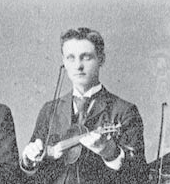
Vibrato is a technique of the left hand and arm in which the pitch of a note varies subtly in a pulsating rhythm. While various parts of the hand or arm may be involved in the motion, the result is a movement of the fingertip bringing about a slight change in vibrating string length, which causes an undulation in pitch. Most violinists oscillate below the note, or lower in pitch from the actual note when using vibrato, since it is believed that perception favors the highest pitch in a varying sound.[35] Vibrato does little, if anything, to disguise an out-of-tune note; in other words, misapplied vibrato is a poor substitute for good intonation. Scales and other exercises meant to work on intonation are typically played without vibrato to make the work easier and more effective. Music students are often taught that unless otherwise marked in music, vibrato is assumed. However, it has to be noted that this is only a trend; there is nothing on the sheet music that compels violinists to add vibrato. This can be an obstacle to a classically trained violinist wishing to play in a style that uses little or no vibrato at all, such as baroque music played in period style and many traditional fiddling styles.
Vibrato can be produced by a proper combination of finger, wrist and arm motions. One method, called hand vibrato (or wrist vibrato), involves rocking the hand back at the wrist to achieve oscillation. In contrast, another method, arm vibrato, modulates the pitch by movement at the elbow. A combination of these techniques allows a player to produce a large variety of tonal effects. The "when" and "what for" and "how much" of violin vibrato are artistic matters of style and taste, with different teachers, music schools and styles of music favouring different styles of vibrato. For example, overdone vibrato may become distracting. In acoustic terms, the interest that vibrato adds to the sound has to do with the way that the overtone mix[36] (or tone color, or timbre) and the directional pattern of sound projection change with changes in pitch. By "pointing" the sound at different parts of the room[37][38] in a rhythmic way, vibrato adds a "shimmer" or "liveliness" to the sound of a well-made violin. Vibrato is, in a large part, left to the discretion of the violinist. Different types of vibrato will bring different moods to the piece, and the varying degrees and styles of vibrato are often characteristics that stand out in well-known violinists.
Vibrato trill
A vibrato-like motion can sometimes be used to create a fast trill effect. To execute this effect, the finger above the finger stopping the note is placed very slightly off the string (firmly pressed against the finger stopping the string) and a vibrato motion is implemented. The second finger will lightly touch the string above the lower finger with each oscillation, causing the pitch to oscillate in a fashion that sounds like a mix between wide vibrato and a very fast trill. This gives a less defined transition between the higher and lower note, and is usually implemented by interpretative choice. This trill technique only works well for semi-tonal trills or trills in high positions (where the distance between notes is lessened), as it requires the trilling finger and the finger below it to be touching, limiting the distance that can be trilled. In very high positions, where the trilled distance is less than the width of the finger, a vibrato trill may be the only option for trill effects.
Harmonics

Lightly touching the string with a fingertip at a harmonic node, but without fully pressing the string, and then plucking or bowing the string, creates harmonics. Instead of the normal tone, a higher pitched note sounds. Each node is at an integer division of the string, for example half-way or one-third along the length of the string. A responsive instrument will sound numerous possible harmonic nodes along the length of the string. Harmonics are marked in music either with a little circle above the note that determines the pitch of the harmonic, or by diamond-shaped note heads. There are two types of harmonics: natural harmonics and artificial harmonics (also known as false harmonics).
Natural harmonics are played on an open string. The pitch of the open string when it is plucked or bowed is called the fundamental frequency. Harmonics are also called overtones or partials. They occur at whole-number multiples of the fundamental, which is called the first harmonic. The second harmonic is the first overtone (the octave above the open string), the third harmonic is the second overtone, and so on. The second harmonic is in the middle of the string and sounds an octave higher than the string's pitch. The third harmonic breaks the string into thirds and sounds an octave and a fifth above the fundamental, and the fourth harmonic breaks the string into quarters sounding two octaves above the first. The sound of the second harmonic is the clearest of them all, because it is a common node with all the succeeding even-numbered harmonics (4th, 6th, etc.). The third and succeeding odd-numbered harmonics are harder to play because they break the string into an odd number of vibrating parts and do not share as many nodes with other harmonics.
Artificial harmonics are more difficult to produce than natural harmonics, as they involve both stopping the string and playing a harmonic on the stopped note. Using the octave frame (the normal distance between the first and fourth fingers in any given position) with the fourth finger just touching the string a fourth higher than the stopped note produces the fourth harmonic, two octaves above the stopped note. Finger placement and pressure, as well as bow speed, pressure, and sounding point are all essential in getting the desired harmonic to sound. And to add to the challenge, in passages with different notes played as false harmonics, the distance between stopping finger and harmonic finger must constantly change, since the spacing between notes changes along the length of the string.
The harmonic finger can also touch at a major third above the pressed note (the fifth harmonic), or a fifth higher (a third harmonic). These harmonics are less commonly used; in the case of the major third, both the stopped note and touched note must be played slightly sharp otherwise the harmonic does not speak as readily. In the case of the fifth, the stretch is greater than is comfortable for many violinists. In the general repertoire fractions smaller than a sixth are not used. However, divisions up to an eighth are sometimes used and, given a good instrument and a skilled player, divisions as small as a twelfth are possible. There are a few books dedicated solely to the study of violin harmonics. Two comprehensive works are Henryk Heller's seven-volume Theory of Harmonics, published by Simrock in 1928, and Michelangelo Abbado's five-volume Tecnica dei suoni armonici published by Ricordi in 1934.
Elaborate passages in artificial harmonics can be found in virtuoso violin literature, especially of the 19th and early 20th centuries. Two notable examples of this are an entire section of Vittorio Monti's Csárdás and a passage towards the middle of the third movement of Pyotr Ilyich Tchaikovsky's Violin Concerto. A section of the third movement of Paganini's Violin Concerto No. 1 consists of double-stopped thirds in harmonics.
When strings are worn, dirty and old, the harmonics may no longer be accurate in pitch. For this reason, violinists change their strings regularly.
Right hand and tone color
The strings may be sounded by drawing the hair of the bow held by the right hand across them (arco) or by plucking them (pizzicato) most often with the right hand. In some cases, the violinist will pluck strings with the left hand. This is done to facilitate transitions from pizzicato to arco playing. It is also used in some virtuoso showpieces. Left hand pizzicato is usually done on open strings. Pizzicato is used on all of the violin family instruments; however, the systematic study of advanced pizzicato techniques is most developed in jazz bass, a style in which the instrument is almost exclusively plucked.
The right arm, hand, and bow and the bow speed are responsible for tone quality, rhythm, dynamics, articulation, and most (but not all) changes in timbre. The player draws the bow over the string, causing the string to vibrate and produce a sustained tone. The bow is a wooden stick with tensioned horsetail hair, which has been rosined with a bar of rosin. The natural texture of the horsehair and the stickiness of the rosin help the bow to "grip" the string, and thus when the bow is drawn over the string, the bow causes the string to sound a pitch.
Bowing can be used to produce long sustained notes or melodies. With a string section, if the players in a section change their bows at different times, a note can seem to be endlessly sustainable. As well, the bow can be used to play short, crisp little notes, such as repeated notes, scales and arpeggios, which provide a propulsive rhythm in many styles of music.
Bowing techniques
The most essential part of bowing technique is the bow grip. It is usually with the thumb bent in the small area between the frog and the winding of the bow. The other fingers are spread somewhat evenly across the top part of the bow. The pinky finger is curled with the tip of the finger placed on the wood next to the screw. The violin produces louder notes with greater bow speed or more weight on the string. The two methods are not equivalent, because they produce different timbres; pressing down on the string tends to produce a harsher, more intense sound. One can also achieve a louder sound by placing the bow closer to the bridge.
The sounding point where the bow intersects the string also influences timbre (or "tone colour"). Playing close to the bridge (sul ponticello) gives a more intense sound than usual, emphasizing the higher harmonics; and playing with the bow over the end of the fingerboard (sul tasto) makes for a delicate, ethereal sound, emphasizing the fundamental frequency. Shinichi Suzuki referred to the sounding point as the Kreisler highway; one may think of different sounding points as lanes in the highway.
Various methods of attack with the bow produce different articulations. There are many bowing techniques that allow for every range of playing style. Many teachers, players, and orchestras spend a lot of time developing techniques and creating a unified technique within the group. These techniques include legato-style bowing (a smooth, connected, sustained sound suitable for melodies), collé, and a variety of bowings which produce shorter notes, including ricochet, sautillé, martelé, spiccato, and staccato.
Pizzicato
A note marked pizz. (abbreviation for pizzicato) in the written music is to be played by plucking the string with a finger of the right hand rather than by bowing. (The index finger is most commonly used here.) Sometimes in orchestra parts or virtuoso solo music where the bow hand is occupied (or for show-off effect), left-hand pizzicato will be indicated by a + (plus sign) below or above the note. In left-hand pizzicato, two fingers are put on the string; one (usually the index or middle finger) is put on the correct note, and the other (usually the ring finger or little finger) is put above the note. The higher finger then plucks the string while the lower one stays on, thus producing the correct pitch. By increasing the force of the pluck, one can increase the volume of the note that the string is producing. Pizzicato is used in orchestral works and in solo showpieces. In orchestral parts, violinists often have to make very quick shifts from arco to pizzicato, and vice versa.
Col legno
A marking of col legno (Italian for "with the wood") in the written music calls for striking the string(s) with the stick of the bow, rather than by drawing the hair of the bow across the strings. This bowing technique is somewhat rarely used, and results in a muted percussive sound. The eerie quality of a violin section playing col legno is exploited in some symphonic pieces, notably the "Witches' Dance" of the last movement of Berlioz's Symphonie Fantastique. Saint-Saëns's symphonic poem Danse Macabre includes the string section using the col legno technique to imitate the sound of dancing skeletons. "Mars" from Gustav Holst's "The Planets" uses col legno to play a repeated rhythm in 5
4 time signature. Benjamin Britten's The Young Person's Guide to the Orchestra demands its use in the "Percussion" Variation. Dmitri Shostakovich uses it in his Fourteenth Symphony in the movement 'At the Sante Jail'. Some violinists, however, object to this style of playing as it can damage the finish and impair the value of a fine bow, but most of such will compromise by using a cheap bow for at least the duration of the passage in question.
Detaché
A smooth and even stroke during which bow speed and weight are the same from beginning of the stroke to the end.[39]
Martelé
Literally hammered, a strongly accented effect produced by releasing each bowstroke forcefully and suddenly. Martelé can be played in any part of the bow. It is sometimes indicated in written music by an arrowhead.
Tremolo
Tremolo is the very rapid repetition (typically of a single note, but occasionally of multiple notes), usually played at the tip of the bow. Tremolo is marked with three short, slanted lines across the stem of the note. Tremolo is often used as a sound effect in orchestral music, particularly in the Romantic music era (1800-1910) and in opera music.
Mute or sordino
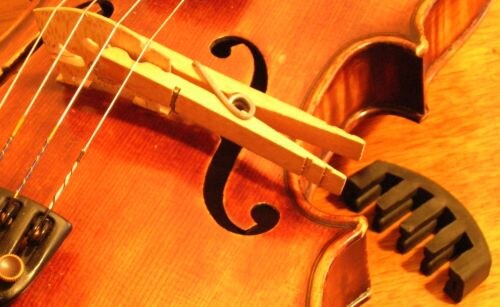
Attaching a small metal, rubber, leather, or wooden device called a mute, or sordino, to the bridge of the violin gives a softer, more mellow tone, with fewer audible overtones; the sound of an entire orchestral string section playing with mutes has a hushed quality. The mute changes both the loudness and the timbre ("tone colour") of a violin. The conventional Italian markings for mute usage are con sord., or con sordino, meaning 'with mute'; and senza sord., meaning 'without mute'; or via sord., meaning 'mute off'.
Larger metal, rubber, or wooden mutes are widely available, known as practice mutes or hotel mutes. Such mutes are generally not used in performance, but are used to deaden the sound of the violin in practice areas such as hotel rooms. (For practicing purposes there is also the mute violin, a violin without a sound box.) Some composers have used practice mutes for special effect, for example, at the end of Luciano Berio's Sequenza VIII for solo violin.
Musical styles
Classical music
Since the Baroque era, the violin has been one of the most important of all instruments in classical music, for several reasons. The tone of the violin stands out above other instruments, making it appropriate for playing a melody line. In the hands of a good player, the violin is extremely agile, and can execute rapid and difficult sequences of notes.
Violins make up a large part of an orchestra, and are usually divided into two sections, known as the first and second violins. Composers often assign the melody to the first violins, typically a more difficult part using higher positions. In contrast, second violins play harmony, accompaniment patterns or the melody an octave lower than the first violins. A string quartet similarly has parts for first and second violins, as well as a viola part, and a bass instrument, such as the cello or, rarely, the double bass.
Jazz
The earliest references to jazz performance using the violin as a solo instrument are documented during the first decades of the 20th century. Joe Venuti, one of the first jazz violinists, is known for his work with guitarist Eddie Lang during the 1920s. Since that time there have been many improvising violinists including Stéphane Grappelli, Stuff Smith, Eddie South, Regina Carter, Johnny Frigo, John Blake, Adam Taubitz, Leroy Jenkins, and Jean-Luc Ponty. While not primarily jazz violinists, Darol Anger and Mark O'Connor have spent significant parts of their careers playing jazz. The Swiss-Cuban violinist Yilian Cañizares mixes jazz with Cuban music.[40]
Violins also appear in ensembles supplying orchestral backgrounds to many jazz recordings.
Indian classical music
The Indian violin, while essentially the same instrument as that used in Western music, is different in some senses.[41] The instrument is tuned so that the IV and III strings (G and D on a western-tuned violin) and the II and I (A and E) strings are sa–pa (do–sol) pairs and sound the same but are offset by an octave, resembling common scordatura or fiddle cross-tunings such as G3–D4–G4–D5 or A3–E4–A4–E5. The tonic sa (do) is not fixed, but variably tuned to accommodate the vocalist or lead player. The way the musician holds the instrument varies from Western to Indian music. In Indian music the musician sits on the floor cross-legged with the right foot out in front of them. The scroll of the instrument rests on the foot. This position is essential to playing well due to the nature of Indian music. The hand can move all over the fingerboard and there is no set position for the left hand, so it is important for the violin to be in a steady, unmoving position.
Popular music

Up through at least the 1970s, most types of popular music used bowed string sections. They were extensively used in popular music throughout the 1920s and early 1930s. With the rise of swing music, however, from 1935 to 1945, the string sound was often used to add to the fullness of big band music. Following the swing era, from the late 1940s to the mid-1950s, strings began to be revived in traditional pop music. This trend accelerated in the late 1960s, with a significant revival of the use of strings, especially in soul music. Popular Motown recordings of the late 1960s and 1970s relied heavily on strings as part of their trademark texture.
With the rise of electronically created music in the 1980s, violins declined in use, as synthesized string sounds played by a keyboardist with a synthesizer took their place. However, while the violin has had very little usage in mainstream rock music, it has some history in progressive rock (e.g., Electric Light Orchestra, King Crimson, Kansas, Gentle Giant). The instrument has a stronger place in modern jazz fusion bands, notably The Corrs.
The popularity of crossover music beginning in the last years of the 20th century has brought the violin back into the popular music arena, with both electric and acoustic violins being used by popular bands. Dave Matthews Band features violinist Boyd Tinsley. The Flock featured violinist Jerry Goodman who later joined the jazz-rock fusion band, The Mahavishnu Orchestra. James' Saul Davies, who is also a guitarist, was enlisted by the band as a violinist.
The folk metal band Ithilien use violin extensively along their discography.[42] Progressive metal band Ne Obliviscaris feature a violin player, Tim Charles, in their line-up.[43]
Independent artists, such as Owen Pallett, The Shondes, and Andrew Bird, have also spurred increased interest in the instrument.[44] Indie bands have often embraced new and unusual arrangements, allowing them more freedom to feature the violin than many mainstream musical artists. Lindsey Stirling plays the violin in conjunction with electronic/dubstep/trance rifts and beats.[45]
Eric Stanley improvises on the violin with hip hop music/pop/classical elements and instrumental beats.[46][47] The successful indie rock and baroque pop band Arcade Fire use violins extensively in their arrangements.[48]
Folk music and fiddling
.jpg/500px-Anders_Zorn_-_Hins_Anders_(1904).jpg)
Like many other instruments used in classical music, the violin descends from remote ancestors that were used for folk music. Following a stage of intensive development in the late Renaissance, largely in Italy, the violin had improved (in volume, tone, and agility), to the point that it not only became a very important instrument in art music, but proved highly appealing to folk musicians as well, ultimately spreading very widely, sometimes displacing earlier bowed instruments. Ethnomusicologists have observed its widespread use in Europe, Asia, and the Americas.
When played as a folk instrument, the violin is usually referred to in English as a fiddle (although the term fiddle can be used informally no matter what the genre of music). Worldwide, there are various stringed instruments such as the wheel fiddle and Apache fiddle that are also called "fiddles". Fiddle music differs from classical in that the tunes are generally considered dance music,[49] and various techniques, such as droning, shuffling, and ornamentation specific to particular styles are used. In many traditions of folk music, the tunes are not written but are memorized by successive generations of musicians and passed on[49] in what is known as the oral tradition. Many old-time pieces call for cross-tuning, or using tunings other than standard GDAE. Some players of American styles of folk fiddling (such as bluegrass or old-time) have their bridge's top edge cut to a slightly flatter curve, making techniques such as a "double shuffle" less taxing on the bow arm, as it reduces the range of motion needed for alternating between double stops on different string pairs. Fiddlers who use solid steel core strings may prefer to use a tailpiece with fine tuners on all four strings, instead of the single fine tuner on the E string used by many classical players.
Arabic music
As well as the Arabic rababah, the violin has been used in Arabic music.
Electric violins
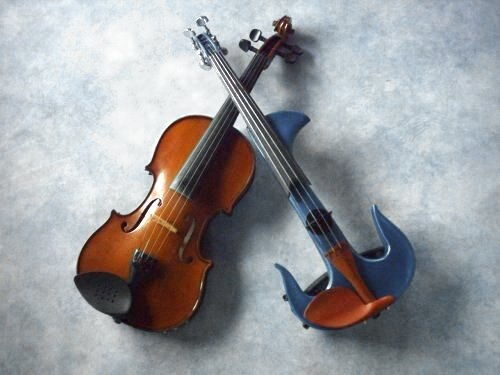
Electric violins have a magnetic or piezoelectric pickup that converts string vibration to an electric signal. A patch cable or wireless transmitter sends the signal to an amplifier of a PA system. Electric violins are usually constructed as such, but a pickup can be added to a conventional acoustic violin. An electric violin with a resonating body that produces listening-level sound independently of the electric elements can be called an electro-acoustic violin. To be effective as an acoustic violin, electro-acoustic violins retain much of the resonating body of the violin, and often resemble an acoustic violin or fiddle. The body may be finished in bright colors and made from alternative materials to wood. These violins may need to be hooked up to an instrument amplifier or PA system. Some types come with a silent option that allows the player to use headphones that are hooked up to the violin. The first specially built electric violins date back to 1928 and were made by Victor Pfeil, Oskar Vierling, George Eisenberg, Benjamin Miessner, George Beauchamp, Hugo Benioff and Fredray Kislingbury. These violins can be plugged into effect units, just like an electric guitar, including distortion, wah-wah pedal and reverb. Since electric violins do not rely on string tension and resonance to amplify their sound they can have more strings. For example, five-stringed electric violins are available from several manufacturers, and a seven string electric violin (with three lower strings encompassing the cello's range) is also available.[50] The majority of the first electric violinists were musicians playing jazz fusion (e.g., Jean-Luc Ponty) and popular music.
Violin authentication
Violin authentication is the process of determining the maker and manufacture date of a violin. This can be an important process as significant value may be attached to violins made either by specific makers or at specific times and locations. Analysis on design, model, wood characteristics, and varnish texture can be used to authenticate a violin.[51] Forgery and other methods of fraudulent misrepresentation can be used to inflate the value of an instrument.
See also
Notes
- ^ In short, the difference between a fiddle and a violin is simply in the style of music they are used to play. Violin players are typically used to perform classical music, such as in orchestras and string quartets. Fiddle players, on the other hand, typically perform country music, and other folk music.
References
- ^ Singh, Jhujhar. "Interview: Kala Ramnath". News X. YouTube. Archived from the original on 2014-06-03. Retrieved 5 September 2015.
- ^ Allen, Edward Heron (1914). Violin-making, as it was and is: Being a Historical, Theoretical, and Practical Treatise on the Science and Art of Violin-making, for the Use of Violin Makers and Players, Amateur and Professional. Preceded by An Essay on the Violin and Its Position as a Musical Instrument. E. Howe. Accessed 5 September 2015.
- ^ Choudhary, S.Dhar (2010). The Origin and Evolution of Violin as a Musical Instrument and Its Contribution to the Progressive Flow of Indian Classical Music: In search of the historical roots of violin. Ramakrisna Vedanta Math. ISBN 978-9380568065. Retrieved 5 September 2015.
- ^ Belluck, Pam (April 7, 2014). "A Strad? Violinists Can't Tell". New York Times. Retrieved April 9, 2014.
- ^ Joyce, Christopher (2012). "Double-Blind Violin Test: Can You Pick The Strad?". NPR. Retrieved 2012-01-02.
- ^ a b "Violin". www.etymonline.com. Online Etymology Dictionary. Retrieved 20 May 2017.
- ^ a b "Viola". www.etymonline.com. Online Etymology Dictionary. Retrieved 20 May 2017.
- ^ a b c "Fiddle". www.etymonline.com. Online Etymology Dictionary. Retrieved 20 May 2017.
- ^ The Silk Road: Connecting Cultures, Creating Trust, Silk Road Story 2: Bowed Instruments, Smithsonian Center for Folk life and Cultural Heritage [1] Archived 2008-10-13 at the Wayback Machine (accessed 2008-09-26)
- ^ Hoffman, Miles (1997). The NPR Classical Music Companion: Terms and Concepts from A to Z. Houghton Mifflin Harcourt. ISBN 978-0618619450.
- ^ a b Grillet 1901, p. 29
- ^ Margaret J. Kartomi: On Concepts and Classifications of Musical Instruments. Chicago Studies in Ethnomusicology, University of Chicago Press, 1990
- ^ "rebec". Encyclopedia Britannica. Retrieved 24 November 2022.
- ^ "Lira | musical instrument". Encyclopedia Britannica. Retrieved 6 April 2019.
- ^ "Rabab". Encyclopedia Britannica. Retrieved 6 April 2019.
- ^ Panum, Hortense (1939). The stringed instruments of the Middle Ages, their evolution and development. London: William Reeves. p. 434.
- ^ Schlesinger, Kathleen (May 29, 1914). "The Precursors of the Violin Family: Records, Researches & Studies". W. Reeves. p. 221 – via Google Books.
- ^ Sandys, William; Forster, Simon Andrew (May 29, 1864). "The history of the violin, and other instruments played on with the bow from the remotest times to the present. Also, an account of the principal makers, English and foreign, with numerous illustrations. By William Sandys and Simon Andrew Forster". London W. Reeves. p. 28 – via Internet Archive.
- ^ Riemann, Hugo (May 29, 1892). "Catechism of musical history". Augener & Company, printed in Germany. p. 27 – via Google Books.
- ^ Arkenberg, Rebecca (October 2002). "Renaissance Violins". Metropolitan Museum of Art. Retrieved 2006-09-22.
- ^ Deverich, Robin Kay (2006). "Historical Background of the Violin". ViolinOnline.com. Retrieved 2006-09-22.
- ^ Bartruff, William. "The History of the Violin". Archived from the original on 2007-02-08. Retrieved 2006-09-22.
- ^ It is now in the Vestlandske Kunstindustrimuseum in Bergen, Norway.
- ^ "Violin by Antonio Stradivari, 1716 (Messiah; la Messie, Salabue)". Cozio.com. Archived from the original on 2008-10-08. Retrieved 2008-09-26.
- ^ Kennedy, Michael (2017). The Oxford Dictionary of Music. Oxford University Press.
- ^ Pio Stefano (2012). Viol and Lute Makers of Venice 1490 -1630. Venice, Italy: Venice Research. p. 441. ISBN 9788890725203.
- ^ Perras, Richard. "Violin changes by 1800". Retrieved 2006-10-29.
- ^ "Stradivarius violin sold for £9.8m at charity auction". BBC News. 2011-06-21. Retrieved 2011-06-21.
- ^ Piston, Walter (1955). Orchestration, p.45.
- ^ Laird, Paul R. "Carleen Maley Hutchins' Work With Saunders". Violin Society of America. Retrieved 2008-09-26.
- ^ The New Violin Family Association, Inc (2020-04-04). "The New Violin Family". The New Violin Family.
- ^ Seashore, Carl (1938). Psychology of Music, 224. quote in Kolinski, Mieczyslaw (Summer - Autumn, 1959). "A New Equidistant 12-Tone Temperament", p.210, Journal of the American Musicological Society, Vol. 12, No. 2/3, pp. 210-214.
- ^ Eaton, Louis (1919). The Violin. Jacobs' Band Monthly, Volume 4. p. 52. Retrieved November 16, 2012.
- ^ Bissing, Petrowitsch. Cultivation of the Violin Vibrato Tone. Central States Music Publishing Company. Retrieved November 16, 2012.
- ^ Applebaum, Samuel (1957). String Builder, Book 3: Teacher's Manual. New York: Alfred Publishing. p. 4. ISBN 978-0-7579-3056-0.. "Now we will discipline the shaking of the left hand in the following manner: Shake the wrist slowly and evenly in 8th notes. Start from the original position and for the second 8th note the wrist is to move backward (toward the scroll). Do this in triplets, dotted 8ths and 16ths, and 16th notes. A week or two later, the vibrato may be started on the Violin. ... The procedure will be as follows: 1. Roll the finger tip from this upright position on the note, to slightly below the pitch of this note."
- ^ Schleske, Martin. "The psychoacoustic secret of vibrato". Archived from the original on 7 February 2010. Retrieved 11 February 2010.
Accordingly, the sound level of each harmonic will have a periodically fluctuating value due to the vibrato.
- ^ Curtin, Joseph (April 2000). "Weinreich and Directional Tone Colour". Strad Magazine. Archived from the original on May 29, 2009. Retrieved May 23, 2009.
In the case of string instruments, however, not only are they strongly directional, but the pattern of their directionality changes very rapidly with frequency. If you think of that pattern at a given frequency as beacons of sound, like the quills of a porcupine, then even the slight changes in pitch created by vibrato can cause those quills to be continually undulating.
- ^ Weinreich, Gabriel (December 16, 1996). "Directional tone color" (PDF). Acoustical Society of America.
The effect can be visualized in terms of a number of highly directional sound beacons, all of which the vibrato causes to undulate back and forth in a coherent and highly organized fashion. It is obvious that such a phenomenon will help immensely in fusing sounds of the differently directed partials into a single auditory stream; one may even speculate that it is a reason why vibrato is used so universally by violinists—as compared to wind players, from the sound of whose instruments directional tone color is generally absent.
- ^ Fischer, Simon (1999). "Detache". Strad. 110: 638 – via Music Index.
- ^ "Die Sängerin und Geigerin Yilian Cañizares in Moods". Neue Zürcher Zeitung. 16 September 2013. Retrieved 12 June 2015.
- ^ Bhattacharya, Suryasarathi (December 10, 2017). "Violin virtuoso Dr L Subramaniam on how Indian classical music took on the world stage". First Post.
- ^ "Ithilien - discography, line-up, biography, interviews, photos". www.spirit-of-metal.com. Retrieved 2017-03-12.
- ^ "Ne Obliviscaris". Facebook.
- ^ Golden, Brian (December 5, 2017). "Andrew Bird Brings His Sweeping Symphony of Sounds to Chicago". Chicago Magazine.
- ^ Self, Brooke (April 9, 2011). "Lindsey Stirling—hip hop violinist". Her Campus. Archived from the original on 2014-12-05.
- ^ Tietjen, Alexa. "Get Your Life From This Violin Freestyle Of Fetty Wap's "Trap Queen"". vh1.com. VH1. Archived from the original on April 10, 2015. Retrieved May 13, 2016.
- ^ Martinez, Marc (October 3, 2010). "Eric Stanley: Hip Hop Violinist". Fox 10 News (Interview). Phoenix: KTSP-TV. Archived from the original on 2021-10-29. Retrieved December 11, 2014.
- ^ "Arcade Fire – 10 of the best". The Guardian. Retrieved 2019-12-12.
- ^ a b Harris, Rodger (2009). "Fiddling". okhistory.org. The Encyclopedia of Oklahoma History and Culture. Retrieved 9 February 2018.
- ^ "7String Violin Harlequin finish". Jordan Music. Archived from the original on 2009-02-27. Retrieved 2009-02-27.
- ^ Institution, Smithsonian. "General Information on Violin Authentication and Appraisals". Smithsonian Institution. Retrieved 2023-05-27.
Bibliography
- Viol and Lute Makers of Venice 1490–1630, by Stefano Pio (2012), Venezia Ed. Venice research, ISBN 978-88-907252-0-3
- Violin and Lute Makers of Venice 1640–1760, by Stefano Pio (2004), Venezia Ed. Venice research, ISBN 978-88-907252-2-7
- Liuteri & Sonadori, Venice 1750–1870, by Stefano Pio (2002), Venezia Ed. Venice research, ISBN 978-88-907252-1-0
- The Violin Forms of Antonio Stradivari, by Stewart Pollens (1992), London: Peter Biddulph. ISBN 0-9520109-0-9
- Principles of Violin Playing and Teaching, by Ivan Galamian (1999), Shar Products Co. ISBN 0-9621416-3-1
- The Contemporary Violin: Extended Performance Techniques, by Patricia and Allen Strange (2001), University of California Press. ISBN 0-520-22409-4
- The Violin: Its History and Making, by Karl Roy (2006), ISBN 978-1-4243-0838-5
- The Fiddle Book, by Marion Thede (1970), Oak Publications. ISBN 0-8256-0145-2
- Latin Violin, by Sam Bardfeld, ISBN 0-9628467-7-5
- The Canon of Violin Literature, by Jo Nardolillo (2012), Scarecrow Press. ISBN 0-8108-7793-7
- The Violin Explained - Components Mechanism and Sound by James Beament (1992/1997), Clarendon Press. ISBN 0-19-816623-0
- Antonio Stradivari, his life and work, 1644-1737', by William Henry Hill; Arthur F Hill; Alfred Ebsworth Hill (1902/1963), Dover Publications. 1963. OCLC 172278. ISBN 0-486-20425-1
- An Encyclopedia of the Violin, by Alberto Bachmann (1965/1990), Da Capo Press. ISBN 0-306-80004-7
- Violin - And Easy Guide, by Chris Coetzee (2003), New Holland Publishers. ISBN 1-84330-332-9
- The Violin, by Yehudi Menuhin (1996), Flammarion. ISBN 2-08-013623-2
- The Book of the Violin, edited by Dominic Gill (1984), Phaidon. ISBN 0-7148-2286-8
- Violin-Making as it was, and is, by Edward Heron-Allen (1885/1994), Ward Lock Limited. ISBN 0-7063-1045-4
- Violins & Violinists, by Franz Farga (1950), Rockliff Publishing Corporation Ltd.
- Viols, Violins and Virginals, by Jennifer A. Charlton (1985), Ashmolean Museum. ISBN 0-907849-44-X
- The Violin, by Theodore Rowland-Entwistle (1967/1974), Dover Publications. ISBN 0-340-05992-3
- The Early Violin and Viola, by Robin Stowell (2001), Cambridge University Press. ISBN 0-521-62555-6
- The Complete Luthier's Library. A Useful International Critical Bibliography for the Maker and the Connoisseur of Stringed and Plucked Instruments by Roberto Regazzi, Bologna: Florenus, 1990. ISBN 88-85250-01-7
- The Violin, by George Dubourg (1854), Robert Cocks & Co.
- Violin Technique and Performance Practice in the Late 18th and Early 19th Centuries, by Robin Stowell (1985), Cambridge University Press. ISBN 0-521-23279-1
- History of the Violin, by William Sandys and Simon Andrew (2006), Dover Publications. ISBN 0-486-45269-7
- The Violin: A Research and Information Guide, by Mark Katz (2006), Routledge. ISBN 0-8153-3637-3
- Per gli occhi e 'l core. Strumenti musicali nell'arte by Flavio Dassenno, (2004) a complete survey of the brescian school defined by the last researches and documents.
- Gasparo da Salò architetto del suono by Flavio Dassenno, (2009) a catalogue of an exhibition that gives information on the famous master life and work, Comune di Salò, Cremonabooks, 2009.
- Grillet, Laurent (1901). Les ancetres du violon v.1. Paris.
Further reading
- Lalitha, Muthuswamy (2004). Violin techniques in Western and South Indian classical music: a comparative study. Sundeep Prakashan. ISBN 9788175741515. OCLC 57671835.
- Schoenbaum, David, The Violin: A Social History of the World's Most Versatile Instrument, New York, New York : W.W. Norton & Company, December 2012. ISBN 9780393084405.
- Templeton, David, Fresh Prince: Joshua Bell on composition, hyperviolins, and the future, Strings magazine, October 2002, No. 105.
- Young, Diana. A Methodology for Investigation of Bowed String Performance Through Measurement of Violin Bowing Technique. PhD Thesis. M.I.T., 2007.
External links
Violin at Wikipedia's sister projects
 Definitions from Wiktionary
 Media from Commons
 Data from Wikidata
- English-speaking violin organizations
- European String Teachers Association
- Violin Society of America
- Beare's International Violin Society
- ハリソン、ロバート・ウィリアム・フレデリック (1911)。。ブリタニカ百科事典。第 28 巻 (第 11 版)。pp. 102–107。
- バイオリン:由来、価値、鑑定
- 弦楽器と弓の配送ガイド