Loading article…
シカゴ | |
|---|---|
 シール | |
| 語源:マイアミ-イリノイ州:シカアクワ( 「野生のタマネギ」または「野生のニンニク」 ) | |
| ニックネーム: | |
| モットー: ラテン語:Urbs in Horto(庭の中の都市); 私は | |
 シカゴのインタラクティブマップ | |
  シカゴ  シカゴ | |
| 座標: 41°52′55″N 87°37′40″W / 41.88194°N 87.62778°W / 41.88194; -87.62778 [1] | |
| 国 | アメリカ合衆国 |
| 州 | イリノイ州 |
| 郡 | クック(多数派)とデュページ(少数派) |
| 解決した | 1780年頃; |
| 法人化(町) | 1833年8月12日 |
| 法人化(市) | 1837年3月4日 |
| 設立者 | ジャン・バティスト・ポワン・デュ・サブル |
| 政府 | |
| • タイプ | 市長と議会 |
| • 体 | シカゴ市議会 |
| • 市長 | ブランドン・ジョンソン( D ) |
| • 市書記官 | アンナ・バレンシア(D) |
| • 市財務官 | メリッサ・コニアーズ・アービン(D) |
| エリア [2] | |
| • 市 | 234.53平方マイル(607.44 km 2) |
| • 土地 | 227.73平方マイル(589.82 km 2) |
| • 水 | 6.80平方マイル(17.62 km 2) |
| 標高 [1] (平均) | 597.18 フィート (182.02 メートル) |
| 最高標高 – ブルーアイランドの近く | 672 フィート (205 メートル) |
| 最低標高 – ミシガン湖にて | 578 フィート (176 メートル) |
| 人口 (2020年)[3] | |
| • 市 | 2,746,388 |
| • 見積もり (2022年)[3] | 2,665,039 |
| • ランク | |
| • 密度 | 12,059.84/平方マイル (4,656.33/km 2 ) |
| • 都会的な [4] | 8,671,746 (米国: 3位) |
| • 都市の密度 | 3,709.2/平方マイル (1,432.1/km 2 ) |
| • メトロ [5] | 9,618,502 (米国: 3位) |
| 異名 | シカゴ人 |
| 国内総生産 [6] | |
| • シカゴ(MSA) | 8,329億ドル(2022年) |
| タイムゾーン | UTC−06:00 (中部標準時) |
| • 夏 ( DST ) | UTC−05:00 ( CDT ) |
| 郵便番号のプレフィックス | 606xx、607xx、608xx |
| 市外局番 | 312 , 773 , 872 |
| FIPSコード | 17-14000 |
| GNISフィーチャ ID | 0428803 |
| Webサイト | シカゴ政府 |
.jpg/500px-Chicago_Skyline_in_September_2023_(cropped).jpg)


.jpg/500px-Art_Institute_of_Chicago_(51575570710).jpg)


シカゴ[a]は、アメリカ合衆国イリノイ州およびアメリカ中西部で最も人口の多い都市である。 2020年の国勢調査によると、人口は2,746,388人であり、[9]ニューヨーク市とロサンゼルスに次いで米国で3番目に人口の多い都市である。米国で2番目に人口の多い郡であるクック郡の郡庁所在地であるシカゴは、シカゴ都市圏の中心地であり、俗に「シカゴランド」と呼ばれることが多く、960万人の住民が住んでいる。
ミシガン湖畔に位置するシカゴは、1837年に五大湖とミシシッピ川流域を結ぶ陸路の近くに市制が敷かれ、19世紀半ばに急速に発展した。[10] [11] 1871年、シカゴ大火で数平方マイルが焼失し、10万人以上が家を失ったが、[12]シカゴの人口は増え続けた。[11]シカゴは、シカゴ学派、美しい都市運動の発展、鉄骨造の超高層ビルなど、都市計画と建築に顕著な貢献をした。[13] [14]
シカゴは金融、文化、商業、産業、教育、技術、通信、輸送の国際的拠点です。世界最大かつ最も多様な金融デリバティブ市場を有し、商品と金融先物だけで全取引量の20%を占めています。[15] オヘア国際空港は、旅客数で常に世界トップ6の空港にランクされており、[16]この地域は米国の鉄道の中心地でもあります。[17]シカゴ地域は、世界の都市地域の中で最も高い国内総生産(GDP)を誇り、2018年には6,890億ドルを生み出しました。 [18] シカゴの経済は多様で、単一の産業が労働力の14%以上を雇用していることはありません。[15]
シカゴは、文化施設やミシガン湖のビーチを訪れる観光客を含め、主要な観光地です。シカゴの文化は、視覚芸術、文学、映画、演劇、コメディ(特に即興コメディ)、料理、ダンス、音楽(特にジャズ、ブルース、ソウル、ヒップホップ、ゴスペル、[19]、ハウスミュージックを含むエレクトロニックダンスミュージック)に大きく貢献しています。シカゴはシカゴ交響楽団とシカゴ・リリック・オペラの本拠地であり、シカゴ美術館は影響力のある視覚芸術の博物館と美術学校を提供しています。シカゴ地域には、シカゴ大学、ノースウェスタン大学、イリノイ大学シカゴ校などの教育機関もあります。シカゴのプロスポーツには、2つのメジャーリーグベースボールチーム を含むすべての主要なプロリーグが含まれます。
語源と愛称
シカゴという名前は、タマネギの野生種を意味するマイアミ ・イリノイ語の「shikaakwa」のフランス語訳に由来する。植物学者の間ではアリウム・トリコッカムとして知られ、一般的には「ランプス」として知られている。現在のシカゴ市の位置を「シェカグー」と呼んだ最初の記録は、 1679年頃のロバート・ド・ラサールの回想録である。[20]アンリ・ジュテルは1688年の日記で、この地域に同名の野生の「ニンニク」が豊富に生えていると記している。[21] 1687年9月下旬の彼の日記によると:
...私たちが「シカゴ」と呼ばれる場所に到着したとき、私たちが知る限り、この地域の森林にニンニクが豊富に生育していることからこの名前が付けられたそうです。[21]
この都市は歴史を通じて、ウィンディ・シティ、シカゴ・タウン、セカンド・シティ、ビッグ・ショルダーズ・シティなど、いくつかのニックネームを持っていました。 [22]
歴史
始まり

18世紀半ば、この地域にはマイアミ族、ソーク族、メスクワキ族の後継者である先住民族のポタワトミ族が住んでいた。[23]

シカゴに最初に定住した人物として知られているのは、貿易商のジャン・バティスト・ポワン・デュ・サブルである。デュ・サブルはアフリカ系で、おそらくフランス領サン=ドマング(ハイチ)で生まれ、1780年代にこの地を開拓した。彼は一般に「シカゴの創設者」として知られている。[24] [25] [26]
1795年、新アメリカ合衆国が北西インディアン戦争で勝利した後、グリーンビル条約に基づき、シカゴの一部となるはずだった地域がアメリカに引き渡され、先住民部族の軍事基地となった。1803年、アメリカ陸軍はディアボーン砦を建設したが、米英戦争中のディアボーン砦の戦いでポタワトミ族に破壊され、その後再建された。[27]
1812年の戦争後、オタワ族、オジブウェ族、ポタワトミ族は1816年のセントルイス条約でアメリカに追加の土地を割譲した。ポタワトミ族は1833年のシカゴ条約後に強制的に土地から追い出され、連邦政府のインディアン追放政策の一環としてミシシッピ川の西に送られた。[28] [29] [30]
19世紀
1833年8月12日、シカゴ町は人口約200人で組織されました。[30] 7年以内に人口は6,000人以上に増加しました。1835年6月15日、エドマンド・ディック・テイラーが公金管理人として最初の公有地の売却が始まりました。シカゴ市は1837年3月4日土曜日に法人化され、[31]数十年間、世界で最も急速に成長する都市でした。[32]
シカゴ・ポーテージの所在地として[33]、この都市はアメリカ東部と西部を結ぶ重要な交通拠点となった。シカゴ初の鉄道であるガリーナ・アンド・シカゴ・ユニオン鉄道とイリノイ・アンド・ミシガン運河は1848年に開通した。この運河により、五大湖の蒸気船や帆船がミシシッピ川とつながるようになった。[34] [35] [36] [37]
経済が繁栄し、農村地域からの住民や海外からの移民が流入した。製造業、小売業、金融業が支配的となり、アメリカ経済に影響を与えた。[38]シカゴ商品取引所( 1848年設立)は、先物契約と呼ばれる、史上初の標準化された「取引所取引」先渡契約を上場した。[39]
1850年代、シカゴは、カンザス・ネブラスカ法と奴隷制度拡大問題に対する「国民主権」アプローチの擁護者であったスティーブン・ダグラス上院議員の故郷として、全国的な政治的重要性を獲得した。 [40]これらの問題は、もう一人のイリノイ州出身者、エイブラハム・リンカーンを全国的な舞台に押し上げるのにも役立った。リンカーンは、ウィグワムと呼ばれる特別に建設された講堂で開催された1860年の共和党全国大会で、シカゴで米国大統領候補に指名された。リンカーンは総選挙でダグラスを破り、これがアメリカ南北戦争の舞台を整えた。
急速な人口増加と衛生改善の需要に応えるため、シカゴ市はインフラを整備した。1856年2月、シカゴ市議会はチェスブローの米国初の総合下水道システム建設計画を承認した。[41]この計画では、建物をかさ上げするためのジャッキスクリューを使用して、シカゴ中心部の大部分を新しいレベルに嵩上げした。 [42]シカゴを嵩上げし、当初は市の健康状態が改善されたが、未処理の下水と産業廃棄物がシカゴ川に流れ込み、その後ミシガン湖に流れ込み、市の主要な淡水源を汚染するようになった。
市はこれに対応して、ミシガン湖まで2マイル(3.2 km)のトンネルを掘り、新しく水場を建設した。1900年、市が大きな技術的偉業を成し遂げたことで、下水汚染の問題はほぼ解決した。シカゴ川の流れを逆転させ、水がミシガン湖に流れ込むのではなく、湖から流れ出るようになったのだ。このプロジェクトはイリノイ・ミシガン運河の建設と改良から始まり、ミシシッピ川に流れ込むイリノイ川につながるシカゴ衛生船舶運河で完了した。 [43] [44] [45]
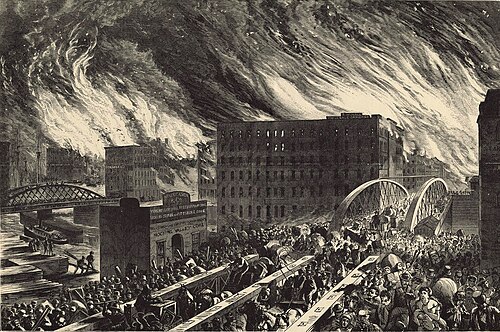
1871年、シカゴ大火は長さ約4マイル(6.4 km)、幅約1マイル(1.6 km)の地域を破壊しました。これは当時のシカゴ市の大きな部分でした。[46] [47] [48]鉄道や畜産場を含む市内の大部分はそのまま残り、[49]以前の木造建築の廃墟から、より現代的な鉄鋼と石の建築物が生まれました。これらは世界中の建築の先例となりました。[50] [51]シカゴは再建期に、1885年に鉄骨構造を使用して世界初の超高層ビルを建設しました。[52] [53]
シカゴは1851年から1920年の間に近隣の多くの郡区を併合することで規模と人口が大幅に増加し、1889年には最大の併合が行われ、現在シカゴのサウスサイドの大部分とシカゴ南東部を占めるハイドパーク郡区と、現在シカゴのノースウェストサイドの大部分を占めるジェファーソン郡区を含む5つの郡区がシカゴに加わった。[54]シカゴが市に加わりたいという願望は、市が住民に提供できる行政サービスによって推進された。
シカゴの繁栄した経済は、ヨーロッパからの膨大な数の移民と米国東部からの移民を引き付けた。1900年の総人口のうち、77%以上が外国生まれか、米国で外国人の両親のもとに生まれた人々であった。ドイツ人、アイルランド人、ポーランド人、スウェーデン人、チェコ人が外国生まれの人口のほぼ3分の2を占めた(1900年までに、白人は市の人口の98.1%を占めた)。[55] [56]
産業ブームと労働力の急速な拡大に続いて労働紛争が起こり、 1886年5月4日のヘイマーケット事件や1894年のプルマンストライキなどが起こった。無政府主義者や社会主義者のグループが、大規模で高度に組織化された労働運動を生み出す上で重要な役割を果たした。シカゴの移民貧困層の社会問題に対する懸念から、ジェーン・アダムズとエレン・ゲイツ・スターは1889年にハルハウスを設立した。 [57]ここで開発されたプログラムは、新しい社会福祉分野のモデルとなった。[58]
1870年代から1880年代にかけて、シカゴは公衆衛生の改善運動のリーダーとして全国的に名声を獲得しました。医療従事者の基準を向上させ、コレラ、天然痘、黄熱病などの都市部の流行と闘う市法、そして後に州法が可決され、施行されました。これらの法律は他の都市や州における公衆衛生改革のテンプレートとなりました。[59]
シカゴは、美しく整備された大規模な市営公園を数多く設立し、公共衛生施設も備えていた。シカゴの公衆衛生改善の主唱者は、ジョン・H・ラウチ医学博士であった。ラウチは、1866年にシカゴの公園システムの計画を策定した。浅い墓で埋め尽くされた墓地を閉鎖してリンカーン公園を創設し、1867年にはコレラの発生を受けて、新しいシカゴ保健委員会の設立に尽力した。10年後、彼はイリノイ州保健委員会の書記、そして委員長となり、委員会の活動のほとんどをシカゴで行った。[60]
1800年代、シカゴはアメリカの鉄道の中心地となり、1910年までに20以上の鉄道会社がダウンタウンの6つのターミナルから旅客サービスを運営していました。[61] [62] 1883年、シカゴの鉄道管理者は一般的な時間協定を必要としていたため、北米の時間帯の標準化されたシステムを開発した。[63]この時間表示システムは大陸全体に広まりました。
1893年、シカゴは現在のジャクソン公園の元湿地帯で世界コロンビアン博覧会を開催した。この博覧会は2,750万人の来場者を集め、歴史上最も影響力のある万国博覧会とみなされている。[64] [65]シカゴ大学は以前は別の場所にあったが、1892年に同じサウスサイドの場所に移転した。フェアやカーニバルの「ミッドウェイ」という用語は、もともとミッドウェイ・プラザンスを指していた。これは現在もシカゴ大学のキャンパスを通り、ワシントン公園とジャクソン公園を結ぶ細長い公園である。[66] [67]
20世紀と21世紀
1900年から1939年
第一次世界大戦と1920年代には産業が大きく拡大した。仕事の豊富さから、アメリカ南部からアフリカ系アメリカ人が集まってきた。1910年から1930年の間に、シカゴのアフリカ系アメリカ人の人口は44,103人から233,903人に劇的に増加した。[68]この大移動は、芸術、文学、音楽の分野で新黒人運動の一部であるシカゴ・ブラック・ルネッサンスと呼ばれる計り知れない文化的影響を及ぼした。 [69] 1919年のシカゴ人種暴動など、人種間の緊張と暴力も続いた。[70]
1919年に憲法修正第18条が批准され、米国ではアルコール飲料の製造と販売(輸出を含む)が違法となった。これにより、1919年から禁酒法が廃止された1933年までの、いわゆるギャング時代の幕開けとなった。1920年代には、アル・カポネ、ディオン・オバニオン、バグズ・モラン、トニー・アッカードなどのギャングが、禁酒法時代のシカゴの路上で法執行機関やギャング同士で争った。[71]シカゴは1929年の悪名高いバレンタインデーの虐殺の舞台であり、アル・カポネはバグズ・モラン率いるライバルギャング、ノースサイドのメンバーを銃殺するために部下を派遣した。[72]

1920年から1921年にかけて、シカゴでは一連の借家人家賃ストライキが起こりました。このストライキによりシカゴ借家人保護協会が結成され、ケッセンジャー借家人法が可決され、冬季に家主がアパートを華氏68度以上に保つことを法的に義務付ける暖房条例が制定されました。[73] [74] [75] [76] [77] [78]
シカゴはアメリカで初めて同性愛者の権利を擁護する団体が設立された都市である。1924年に設立されたこの団体は「人権協会」と呼ばれ、アメリカで初めて同性愛者向けの出版物「友情と自由」を出版した。警察と政治の圧力により、この団体は解散した。[79]

大恐慌はシカゴに前例のない苦難をもたらしたが、それはシカゴが重工業に大きく依存していたことに少なからず起因している。特にシカゴ川の南側と両支流沿いの工業地帯は壊滅的な被害を受けた。1933年までにシカゴの工業雇用の50%以上が失われ、黒人とメキシコ人の失業率は40%を超えた。シカゴの共和党政治機構は経済危機によって完全に崩壊し、1931年以降の市長はすべて民主党員であった。[80]
1928年から1933年にかけて、シカゴでは税金反対運動が起こり、市は給与の支払いや救済活動を行うことができませんでした。財政危機は1933年までに解決され、同時に連邦の救済資金がシカゴに流れ込み始めました。[80]シカゴは労働運動の温床でもあり、失業者協議会は不況初期に貧困者のための連帯を作り救済を要求するために大きく貢献しました。これらの組織は社会主義グループと共産主義グループによって設立されました。1935年までにアメリカ労働者同盟は貧困者、労働者、失業者を組織し始めました。1937年の春、リパブリック製鉄所はイーストサイド地区で 1937年の戦没者追悼記念日の虐殺を目撃しました。
1933年、シカゴ市長アントン・セルマックは、フロリダ州マイアミでフランクリン・D・ルーズベルト次期大統領暗殺未遂事件に巻き込まれ、致命傷を負った。1933年と1934年、シカゴは100周年を記念して世紀の進歩国際博覧会を開催した。[81]この博覧会のテーマは、シカゴ創設以来の100年間の技術革新であった。[82]
1940年から1979年
.jpg/500px-Chicago_Blackhawks_-_Chicago_Picaso_(4838269639).jpg)
第二次世界大戦中、シカゴ市だけで1939年から1945年にかけて毎年イギリスよりも多くの鉄鋼を生産し、1943年から1945年にかけてはナチスドイツよりも多くの鉄鋼を生産した。 [83]

大恐慌により中断していた大移動は、第二波でさらに速いペースで再開し、南部から数十万人の黒人が製鉄所、鉄道、船舶の操業のために市内にやって来た。[84]
1942年12月2日、物理学者エンリコ・フェルミは極秘のマンハッタン計画の一環としてシカゴ大学で世界初の制御された核反応を実施した。これによりアメリカは原子爆弾を開発し、1945年に第二次世界大戦で使用した。 [85]
リチャード・J・デイリー市長は民主党員で、1955年、マシン政治の時代に選出された。1956年、市はオヘア空港の地下の土地を併合し、デュページ郡の一部を含む最後の大規模な拡張を行った。[86]
1960年代までに、多くのアメリカの都市では白人の逃避として知られるプロセスが起こり、多くの地区の白人住民は都市を離れて郊外へと移住し、黒人はブラックベルトを越えて移動し続けた。[87]黒人に対する住宅ローン差別的なレッドライニングが続く一方で、不動産業界はブロックバスティングとして知られるようになる慣行を行い、地区全体の人種構成を完全に変えた。[88]グローバル化や仕事のアウトソーシングなどの産業構造の変化は、低技能労働者の大規模な失業を引き起こした。 1960年代のピーク時には、シカゴの鉄鋼業界で約25万人の労働者が雇用されていましたが、1970年代と1980年代の鉄鋼危機により、この数は2015年にはわずか2万8千人にまで減少しました。1966年、マーティン・ルーサー・キング・ジュニアとアルバート・ラビーがシカゴ自由運動を主導し、リチャード・J・デイリー市長と運動指導者の間で合意が成立しました。[89]
2年後、この都市は騒乱に満ちた1968年民主党全国大会を開催した。この大会では、会場の内外で物理的な衝突が起こり、反戦デモ参加者、ジャーナリスト、傍観者が警察に殴打された。[90]リチャード・J・デイリーの在任期間中に、シアーズタワー(現在はウィリスタワーとして知られ、1974年に世界で最も高いビルとなった)、イリノイ大学シカゴ校、マコーミックプレイス、オヘア国際空港などの主要な建設プロジェクトが行われた。[91] 1979年、市初の女性市長であるジェーン・バーンが選出された。彼女は、犯罪が蔓延するカブリニ・グリーン住宅プロジェクトに一時的に入居したことや、シカゴの学校制度を財政危機から救い出したことで注目された。 [92]
1980年から現在
1983年、ハロルド・ワシントンがシカゴ初の黒人市長に就任した。ワシントンの初任期は、貧困層やこれまで無視されてきた少数民族地区への配慮に注力した。1987年に再選されたが、その直後に心臓発作で亡くなった。[93]ワシントンの後任は、シカゴ市議会によって選出された第6区市会議員ユージン・ソーヤーで、特別選挙までその職を務めた。
リチャード・J・デイリーの息子であるリチャード・M・デイリーは1989年に選出された。彼の功績には、公園の改良や持続可能な開発へのインセンティブの創出、真夜中にメイグス・フィールドを閉鎖して滑走路を破壊することなどがある。リチャード・M・デイリーは5回の再選に成功し、シカゴで最も長く市長を務めた後、7期目の立候補を辞退した。 [94] [95]
1992年、キンジー・ストリート橋付近の建設工事で事故が発生し、シカゴ川とその下のトンネルを結ぶ橋が決壊した。この橋は、ダウンタウンのループ地区全体に広がる、放棄された貨物トンネルシステムの一部であった。トンネルには2億5千万米ガロン(1,000,000 m 3 )の水が溜まり、地区全体の建物に影響を及ぼし、電力供給が停止した。 [ 96]当該地域は3日間閉鎖され、一部の建物は数週間再開されなかった。損失は19億5千万ドルと推定されている。[96]
2011年2月23日、元ホワイトハウス首席補佐官で下院議員のラーム・エマニュエルが市長選挙に勝利した。[97]エマニュエルは2011年5月16日に市長に就任し、2015年に再選された。 [98]ロリ・ライトフットは、シカゴ初のアフリカ系アメリカ人女性市長であり、LGBTQであることを公表した初の市長であり、2019年にエマニュエルの後任として市長に選出された。[99]シカゴ史上初めて、市全体の選挙で選ばれる3つの役職すべてが女性(および有色人種の女性)によって務められた。ライトフットに加えて、市書記はアンナ・バレンシア、市財務官はメリッサ・コニアーズ・アービンであった。[100]
2023年5月15日、ブランドン・ジョンソンがシカゴの第57代市長に就任しました。
地理

地形
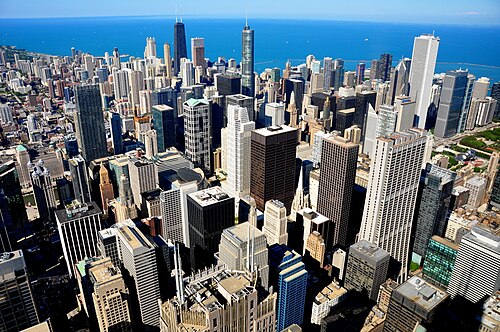

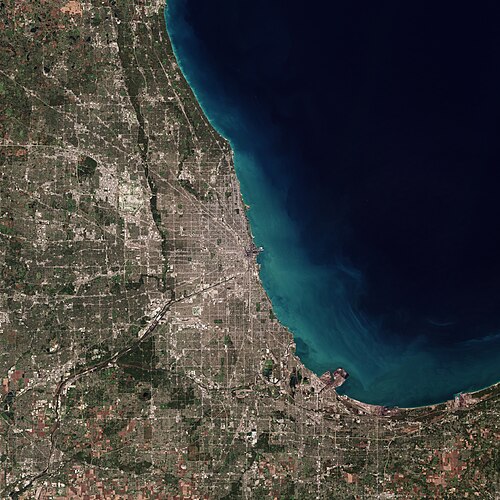
シカゴはイリノイ州北東部、淡水ミシガン湖の南西岸に位置する。シカゴ大都市圏の主要都市であり、アメリカ中西部と五大湖地域の両方に位置する。シカゴ市はミシシッピ川と五大湖流域を結ぶシカゴ・ポーテージの大陸分水嶺に位置している。ミシガン湖のそばにあるほか、ダウンタウンのシカゴ川と工業地帯の南側を流れるカルメット川の2つの川が市内を全部または一部流れている。[101] [102]
シカゴの歴史と経済は、ミシガン湖に近いことと密接に結びついています。シカゴ川は歴史的にこの地域の水上貨物の多くを扱ってきましたが、今日の巨大な湖上貨物船はシカゴの南側にあるカルメット湖の港を利用しています。湖には、シカゴの気候を和らげ、湖畔の地区を冬は少し暖かく、夏は少し涼しくするという、もう1つの良い効果もあります。[103]
シカゴが1837年に創設されたとき、初期の建物のほとんどはシカゴ川の河口付近にあり、市の元々の58ブロックの地図にそれが表れている。[104]市の中心部の市街地の全体的な傾斜は、市全体の自然の地形の平坦さと比較的一致しており、一般的にその他の点でわずかな差異しか見られない。平均的な土地の標高は海抜579フィート(176.5メートル)である。測定値は多少異なるが、[105]最低地点は湖岸沿いの578フィート(176.2メートル)で、最高地点は市の南端にあるブルーアイランドのモレーンの尾根で672フィート(205メートル)である。 [106]
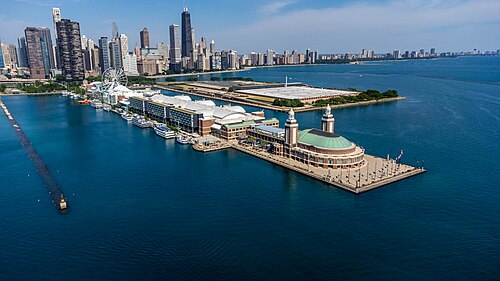
レイクショアドライブはシカゴのウォーターフロントの大部分に隣接しています。ウォーターフロント沿いの公園には、リンカーンパーク、グラントパーク、バーナムパーク、ジャクソンパークなどがあります。ウォーターフロントの26マイル(42 km)にわたって24の公共ビーチがあります。 [107]埋め立て地は湖の一部まで広がっており、ネイビーピア、ノーザリーアイランド、ミュージアムキャンパス、マコーミックプレイスコンベンションセンターの大部分のためのスペースを提供しています。市内の高層商業ビルや住宅ビルのほとんどはウォーターフロントの近くにあります。
シカゴ都市圏全体の非公式な名称は「シカゴランド」であり、一般的にはシカゴ市とその郊外全体を指すが、組織によって定義が若干異なる。[108] [109] [110]
コミュニティ
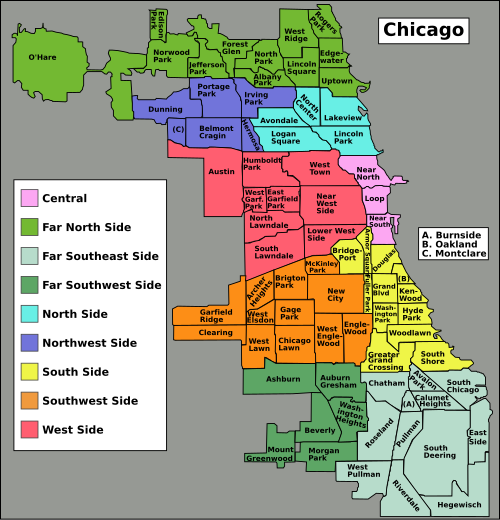
市の主要なセクションには、ループと呼ばれる中心業務地区と、ノースサイド、サウスサイド、ウェストサイドがあります。[111]市の3つの側面は、シカゴの旗に3本の白い横縞で表されています。[112]ノースサイドは市内で最も人口密度の高い住宅地区で、多くの高層ビルが湖岸沿いのこの側に立っています。[113]サウスサイドは市内で最大のセクションで、市の土地面積の約60%を占めています。サウスサイドにはシカゴ港の施設のほとんどがあります。[114]
1920年代後半、シカゴ大学の社会学者はシカゴ市を77の異なるコミュニティエリアに分割し、さらに200以上の非公式に定義された近隣地域に細分化しました。[115] [116]
街並み
シカゴの通りは、市の元々の町の区画から広がった街路網に沿って配置されており、東はミシガン湖、北はノースアベニュー、西はウッドストリート、南は22番街に囲まれていた。 [117]公有地測量システムの区画線に沿った通りは、後に郊外の幹線道路となった。市内に新たに追加される地区が区画分けされるにつれ、市の条例により、一方向に1マイルあたり8本の通り、他方向に16本の通りを配置することが義務付けられ、一方向に約200メートルごとに1本の通り、他方向に約100メートルごとに1本の通りとなった。この街路網の規則性は、新しい不動産を開発する効率的な手段となった。また、市内を横切る斜めの通りも点在しており、その多くは元々ネイティブアメリカンの道であった(エルストン、ミルウォーキー、オグデン、リンカーンなど)。シカゴ計画ではさらに多くの斜めの通りが推奨されたが、建設されたのはオグデンアベニューの延長のみであった。[118]
2021年、シカゴは米国で4番目に歩きやすい大都市にランクされました。[119]市内の住宅街の多くでは、道路と歩道の間に広い芝生や木々が植えられています。これにより、歩道上の歩行者が道路交通から遠ざかることができます。シカゴのウエスタンアベニューは、世界最長の連続した都市道路です。[120]その他の注目すべき道路には、ミシガンアベニュー、ステートストリート、95番街、シセロアベニュー、クラークストリート、ベルモントアベニューなどがあります。シティビューティフル運動は、シカゴの大通りや公園道路に影響を与えました。[121]
建築

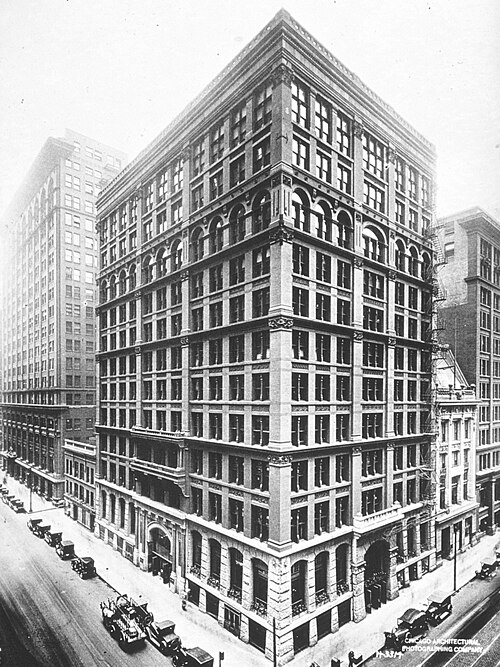
シカゴ大火による破壊は、アメリカ史上最大の建築ブームを招いた。1885年、シカゴに初の鉄骨造高層ビルであるホーム・インシュアランス・ビルが建てられ、超高層ビル時代が到来した。[53]その後、世界中の多くの都市がこれに追随した。[122]今日、シカゴのスカイラインは世界で最も高く、最も密集しているものの1つである。[123]
アメリカで最も高いタワーのいくつかはシカゴにあります。ウィリスタワー(旧シアーズタワー)はワンワールドトレードセンターに次いで西半球で2番目に高いビルであり、トランプインターナショナルホテルアンドタワーは国内で3番目に高いビルです。[124]ループの歴史的建造物には、シカゴ商品取引所ビル、ファインアーツビル(35イーストワッカー)、ミースファンデルローエによるシカゴビル(860-880レイクショアドライブアパートメンツ)があります。ダニエルバーナム、ルイスサリバン、チャールズB.アトウッド、ジョンルート、ヘルムートヤーンなど、他の多くの建築家もシカゴのスカイラインに影響を与えています。[125] [126]
かつて世界最大の建物のリストで1位だったマーチャンダイズマートは、2013年9月9日現在、2013年で44番目に大きい建物としてリストされています。2008年まで独自の郵便番号があり、シカゴ川の北支流と南支流の合流点の近くに立っています。[127]現在、市内で最も高い4つの建物は、ウィリスタワー(旧シアーズタワー、これも独自の郵便番号を持つ建物)、トランプインターナショナルホテルアンドタワー、エーオンセンター(旧スタンダードオイルビル)、ジョンハンコックセンターです。サウスサイドの一部の地域、シカゴ衛生船舶運河沿いの地域、北西インディアナ地域などの工業地区が集まっています。[128]
シカゴはシカゴ派にその名を与え、建築における2つの運動であるプレーリー派の本拠地であった。 [129]シカゴのいたるところで、様々な種類と規模の住宅、タウンハウス、マンション、アパートの建物が見られる。湖から離れた住宅街の大部分は、20世紀初頭から第二次世界大戦の終わりまでに建てられたレンガ造りのバンガローが特徴である。シカゴはまた、ポーランド大聖堂様式の教会建築の著名な中心地でもある。シカゴ郊外のオークパークは、シカゴ大学近くにあるロビーハウスを設計した有名な建築家フランク・ロイド・ライトの故郷であった。 [130] [131]
人気のある観光アクティビティは、シカゴ川沿いの建築物ボートツアーに参加することです。[132]
記念碑とパブリックアート
.jpg/500px-Replica_of_the_Statue_of_the_Republic_(cropped).jpg)
シカゴは屋外のパブリックアートで有名で、寄付者らが1905年のベンジャミン・ファーガソン信託にまで遡る資金援助を行っている。 [133]シカゴのパブリックアート作品の多くは、現代の具象芸術家によるものである。その中には、シャガールの「四季」、シカゴ・ピカソ、ミロの「シカゴ」、カルダーの 「フラミンゴ」、オルデンバーグの 「バットコラム」、ムーアの 「大きな内部形態」(1953-54年)、「人間が宇宙に入る」および「原子力エネルギー」、デュビュッフェの 「立つ野獣の記念碑」、アバカノヴィッツの 「アゴラ」、そして街の象徴となっているアニッシュ・カプーアの「クラウド・ゲート」などがある。街の歴史を形作ったいくつかの出来事も、芸術作品によって記念されており、それには大北部移住(ザール)やイリノイ州の州昇格100周年などがある。最後に、ループ近くの2つの噴水も記念碑的な芸術作品として機能しています。プレンサの クラウン噴水とバーナムとベネットのバッキンガム噴水です。[134] [135]
気候

ケッペンの気候は典型的な高温多湿の大陸性気候(ケッペン:Dfa)に属し、四季がはっきりしている。[136] [137] [138] 夏は高温多湿で、熱波が頻繁に発生する。7月の日中平均気温は75.4 °F(24.1 °C)で、午後の最高気温は84.5 °F(29.2 °C)である。通常の夏には、気温が少なくとも90 °F(32 °C)に達する日は17日あるが、湖畔の場所は湖から風が吹くため涼しい。冬は比較的寒く雪が降る。2011年の冬のように吹雪も起こる。[139]晴れていても寒い日が多い。12月から3月までの通常の冬の最高気温は約36 °F(2 °C)である。1月と2月は最も寒い月である。2019年1月の極渦は、 1985年1月20日に記録された市内の最低気温−27°F(−33°C)をほぼ破りました。[140] [141] [142]測定可能な降雪は4月の第1週または第2週まで続く可能性があります。[143]
春と秋は穏やかで短い季節で、湿度が低いのが一般的です。夏の露点温度は、6月の平均55.8°F(13.2°C)から7月の61.7°F(16.5°C)までの範囲です。 [144] 2019年7月の熱波の際には、露点温度が80°F(27°C)近くに達することもあります。この都市はUSDA植物耐寒性ゾーン6aに属し、郊外では5bに移行しています。[145]
アメリカ国立気象局によると、シカゴの最高気温は1934年7月24日の105°F(41°C)である。 [146] ミッドウェイ空港は前日に109°F(43°C)に達し、1995年の熱波の間に熱指数125°F(52°C)を記録した。[147]最低気温は1985年1月20日にオヘア空港で−27°F(−33°C)を記録した。[144] [147]シカゴの降雨量のほとんどは雷雨によるもので、年間平均38回発生する。この地域は春と夏に激しい雷雨が発生しやすく、大きな雹、破壊的な風、時には竜巻を引き起こすことがある。[148]
他の大都市と同様に、シカゴはヒートアイランド現象に見舞われており、特に夜間と冬は、シカゴ市とその郊外は周辺の田舎よりも温暖です。ミシガン湖に近いため、シカゴの湖岸は夏はやや涼しく、冬は湖から離れたシカゴ市内や郊外の内陸部よりもそれほど寒くありません。[149]冬季のサイクロンによる北東風がこの地域の南から吹き出し、市に湖効果雪をもたらすことがあります。[150]
タイムゾーン
イリノイ州の他の地域と同様に、シカゴは中央時間帯の一部を形成しています。ミシガン州とインディアナ州の一部で使用されている東部時間帯との境界は、東に少し離れたところにあります。
人口統計
最初の100年間、シカゴは世界で最も急速に成長した都市の1つでした。1833年に建設されたとき、当時のアメリカの開拓地に定住した人は200人未満でした。7年後の最初の国勢調査の時点で、人口は4,000人を超えました。1850年から1890年の40年間で、シカゴの人口は3万人弱から100万人以上に増加しました。19世紀末には、シカゴは世界で5番目に人口の多い都市となり、[161]世紀初頭には存在していなかった都市の中では最大の都市でした。1871年のシカゴ大火から60年以内に、人口は約30万人から300万人を超え、[162] 1950年の国勢調査では過去最高の人口360万人に達しました。
19世紀最後の20年間から、シカゴはアイルランド、南ヨーロッパ、中央ヨーロッパ、東ヨーロッパからの移民の波の目的地となり、イタリア人、ユダヤ人、ロシア人、ポーランド人、ギリシャ人、リトアニア人、ブルガリア人、アルバニア人、ルーマニア人、トルコ人、クロアチア人、セルビア人、ボスニア人、モンテネグロ人、チェコ人が含まれていた。[163] [164]シカゴの工業労働者階級の基礎をなすこれらの民族グループに、アメリカ南部からのアフリカ系アメリカ人の流入が加わり、シカゴの黒人人口は1910年から1920年の間に倍増し、1920年から1930年の間にさらに倍増した。 [163]シカゴにはボスニア人の人口が多く、その多くは1990年代と2000年代に到着した。[165]
1920年代から1930年代にかけて、シカゴに移住したアフリカ系アメリカ人の大部分は、シカゴ市の南側にあるいわゆる「ブラックベルト」に定住した。[163]多数の黒人が西側にも定住した。1930年までに、シカゴの黒人人口の3分の2は、人種構成の90%が黒人である地区に住んでいた。[163]その頃、北側のアフリカ系アメリカ人についてあまり知られていない事実は、アップタウンのウィンスロップアベニュー4600番地のブロックが、アフリカ系アメリカ人が住むか、または店を開くことができる唯一のブロックだったということである。[166] [167]シカゴの南側は、ニューヨークのハーレムに次いで、米国で2番目に大きな都市部黒人集中地として浮上した。1990年、シカゴの南側と隣接する南郊外は、米国全体で最大の黒人多数派地域を構成していた。[163] 1980年代以降、シカゴでは(主に南部と西部から)アフリカ系アメリカ人が郊外や都市圏外へ大量に流出した。[168]平均以上の犯罪率と生活費の高さが、シカゴのアフリカ系アメリカ人人口が急速に減少している主な理由であった。[169] [170] [171]
シカゴの外国生まれの人口のほとんどはメキシコ、ポーランド、インドで生まれました。[172]
シカゴの人口は20世紀後半に減少し、1950年の360万人以上から2010年には270万人以下にまで減少した。1990年の公式国勢調査の時点では、シカゴはロサンゼルスに追い抜かれ、米国第2位の都市となった。[173]
2000年の国勢調査では市の人口が増加し、2010年に減少した後、2020年の国勢調査では再び増加しました。[174]
2019年7月時点の米国国勢調査の推計によると[update]、シカゴの最大の人種または民族グループは、非ヒスパニック系白人が人口の32.8%、黒人が30.1%、ヒスパニック系が人口の29.0%となっている。[175] [176] [177] [178]

.png/500px-Race_and_ethnicity_2010-_Chicago_(5560488484).png)
シカゴは米国で3番目にLGBT人口が多い都市です。2018年、シカゴ保健局は、成人人口の7.5%、約146,000人のシカゴ市民がLGBTQであると推定しました。 [183] 2015年には、人口の約4%がLGBTであると認識されていました。[184] [185] 2013年にイリノイ州で同性婚が合法化されて以来、10,000組を超える同性カップルがクック郡で結婚しており、その大半はシカゴで行われています。[186] [187]
シカゴは2012年にラーム・エマニュエル市長と市議会が歓迎都市条例を可決し、「法的に」聖域都市となった。 [188]
米国国勢調査局の2022年のアメリカコミュニティ調査データ推定によると、市内の世帯の平均所得は70,386ドル、一人当たりの所得は45,449ドルだった。男性のフルタイム労働者の平均所得は68,870ドル、女性は60,987ドルだった。[189]人口の約17.2%が貧困線以下の生活を送っていた。[190] 2018年、シカゴは超富裕層の数が世界で7番目に多く、資産額が3,000万ドルを超える住民が約3,300人いた。[191]
2022年のアメリカのコミュニティ調査によると、シカゴで10,000人以上の先祖を持つ特定のグループは次のとおりです。[192] [193] [194]
- メキシコ人 (586,906)
- ドイツ語 (200,726)
- アイルランド人 (184,983)
- ポーランド語 (129,468)
- イタリア語 (100,915)
- プエルトリコ人 (101,625)
- 英語 (87,282)
- 中国語 (67,951)
- インド人 (48,535)
- フィリピン語 (39,048)
- フランス語 (25,629)
- ロシア語 (24,707)
- スウェーデン語 (21,795)
- アラブ人 (19,432)
- 西インド諸島 (18,636)
- グアテマラ (18,205)
- スコットランド (17,121)
- 韓国語 (16,224)
- エクアドル人 (15,935)
- ナイジェリア人 (15,064)
- ギリシャ語 (14,946)
- ノルウェー語 (13,391)
- コロンビア (13,785)
- ウクライナ語 (12,956)
- ベトナム語 (12,280)
- キューバ人 (11,765)
- チェコ語 (11,313)
- ルーマニア語 (11,237)
- リトアニア語 (11,235)
- オランダ語 (11,196)
祖先を報告または分類しなかった人は548,790人でした。
宗教
ピュー研究所の2014年の調査によると、キリスト教はシカゴで最も広く信仰されている宗教(71%)であり、[196]この都市はダラス、アトランタ、ヒューストンに次いで米国で4番目に宗教的な大都市となっている。[196] ローマカトリックとプロテスタントが最大の宗派(それぞれ34%と35%)であり、東方正教会とエホバの証人がそれぞれ1%で続いている。[195]シカゴには非キリスト教徒の人口もかなり多い。非キリスト教徒のグループには、無宗教(22%)、ユダヤ教(3%)、イスラム教(2%)、仏教(1%)、ヒンズー教(1%)が含まれる。[195]
シカゴは、米国福音盟約教会や米国福音ルーテル教会など、いくつかの宗教宗派の本拠地であり、いくつかの教区の所在地でもある。第四長老派教会は、会員数で米国最大の長老派教会の一つである。 [197] 20世紀以降、シカゴは東方アッシリア教会の本拠地でもある。[198] 2014年、カトリック教会は最大の個別キリスト教宗派(34%)であり、シカゴのローマカトリック大司教区が最大のカトリック管轄区域であった。福音派プロテスタントは、最大の神学的プロテスタント支部(16%)を形成し、主流プロテスタント(11%)、歴史的に黒人教会(8 % )が続いている。宗派プロテスタント支部の中では、バプテスト派がシカゴで最大のグループ(10%)を形成し、ペンテコステ派(3%)[195]
2014年、非キリスト教信仰は宗教人口の7%を占めた。ユダヤ教には少なくとも261,000人の信者がおり、これは人口の3%にあたり、2番目に多い宗教となっている。[199] [195] 2020年の調査では、シカゴ都市圏のユダヤ人人口は、宗教的および非宗教的を問わず、合計319,500人と推定されている。[200]
1893年と1993年の最初の2回の世界宗教会議はシカゴで開催されました。 [201]マザー・テレサ、ダライ・ラマ[202]、1979年の教皇ヨハネ・パウロ2世[203]など、多くの国際的な宗教指導者がシカゴを訪れています。
経済
.jpg/500px-Federal_Reserve_Bank_of_Chicago_(51574643886).jpg)

シカゴは、米国で3番目に大きな都市圏総生産を誇り、2017年9月の推計によると約6,705億ドルである。 [204]また、シカゴは多様化のレベルが高いため、米国で最もバランスの取れた経済を持っていると評価されている。[205]シカゴ都市圏は、米国の都市圏の中で3番目に大きい科学および工学の労働力を擁している。[206]シカゴは、ジョン・クレラー、ジョン・ホイットフィールド・バン、リチャード・テラー・クレイン、マーシャル・フィールド、ジョン・ファーウェル、ジュリアス・ローゼンワルドなどの実業家や、中西部および世界の産業の基礎を築いた多くの商業的先見者たちの商業活動の拠点であった。
シカゴは世界有数の金融センターであり、米国ではミッドタウン・マンハッタンに次いで2番目に大きな中心業務地区を有している。[207]この都市はシカゴ連邦準備銀行の本拠地であり、同銀行の第7管区である。市内にはシカゴ証券取引所、シカゴ・オプション取引所(CBOE)、シカゴ・マーカンタイル取引所(「メルク」)などの主要な金融取引所と先物取引所があり、シカゴ・マーカンタイル取引所はシカゴ商品取引所(CBOT)とともにシカゴのCMEグループが所有している。2017年、シカゴの取引所では47億ドルのデリバティブ取引が行われた。[要出典]チェース銀行はシカゴのチェースタワーに商業銀行と個人向け銀行の本部を置いている。[208]学術的には、シカゴは12人のノーベル賞受賞者を輩出したシカゴ学派経済学を通じて影響力を持っている。
シカゴ市とその周辺の都市圏には、約463万人の労働者を抱え、米国で3番目に大きな労働力プールがある。[209]イリノイ州には、シカゴを含む66のフォーチュン1000企業が拠点を置いている。 [210]シカゴ市には、フォーチュン・グローバル500企業が12社、フィナンシャル・タイムズ500企業が17社ある。同市には、ダウ平均株価300社のうち、航空宇宙大手のボーイングが3社あり、同社は2001年に本社をシアトルからシカゴ・ループ地区に移転した。 [211] マクドナルド、ウォルグリーン・ブーツ・アライアンス。[212]シカゴは、2013年から2018年まで6年連続で、企業移転先として国内トップの都市圏にランクされた。[213]しかし、2022年にはフォーチュン500企業3社がシカゴを離れ、シカゴの企業は35社となり、ニューヨーク市に次ぐ2位となった。[214]
製造業、印刷業、出版業、食品加工業もシカゴ経済で大きな役割を果たしている。バクスターインターナショナル、ボーイング、アボットラボラトリーズ、ゼネラルエレクトリックのヘルスケア部門など、医療製品やサービスを扱う企業がシカゴ地域に本社を置いている。シカゴに本社を置く著名な食品企業には、コナグラ、フェラーラキャンディカンパニー、クラフトハインツ、マクドナルド、モンデリーズインターナショナル、クエーカーオーツの世界本社などがある。[215]シカゴはモンゴメリーワード、シアーズ、マーシャルフィールドなどがあり、発展の初期から小売業の中心地となっている。今日、シカゴ都市圏にはウォルグリーン、シアーズ、エースハードウェア、クレアーズ、ULTAビューティー、クレートアンドバレルなど、いくつかの小売業者の本社がある。[216]
19世紀後半、シカゴは自転車ブームの一端を担い、ウェスタン・ホイール社が製造工程にスタンピングを導入し、コストを大幅に削減した。 [217]一方、20世紀初頭には自動車革命の一端を担い、1907年に設立されたブラス時代の自動車メーカー、バグモービル社が拠点を構えた。 [218]シカゴにはシュウィン・バイシクル・カンパニーもあった。
シカゴは世界の主要な会議開催地です。この都市の主要コンベンションセンターはマコーミック・プレイスです。4つの建物が連結されたこのコンベンションセンターは、国内最大、世界でも3番目に大きいコンベンションセンターです。[219]また、シカゴは毎年開催される会議の数でも米国で3位(ラスベガスとオーランドに次ぐ)です。[220]
シカゴのチップなし従業員の最低賃金は全米で最も高い水準の一つであり、2021年には15ドルに達した。[221] [222]
文化と現代生活

市のウォーターフロントの立地とナイトライフは、住民と観光客の両方を魅了しています。市の人口の3分の1以上が、北はロジャースパークから南はサウスショアまでの湖畔地区に集中しています。 [223]市内には多くの高級レストランやエスニックレストラン街があります。これらの地区には、18番街沿いのピルセンや26番街沿いのラビリタなどのメキシコ系アメリカ人地区、フンボルトパーク地区のプエルトリコ人居住区パセオボリクア、ダウンタウンのすぐ西にあるサウスハルステッドストリート沿いのグリークタウン、[224]テイラーストリート沿いのリトルイタリー、アーマースクエアのチャイナタウン、ウェストタウンのポリッシュパッチ、ローレンスアベニュー周辺のアルバニーパークのリトルソウル、アップタウンのブロードウェイ近くのリトルベトナム、ウェストリッジのデボンアベニュー沿いのデシエリアなどがあります。[225]
ダウンタウンは、シカゴの金融、文化、政府、商業機関の中心地であり、グラント パークや市内の高層ビルの多くが建っている場所です。シカゴ銀行やシカゴ連邦準備銀行など、市内の金融機関の多くは、ダウンタウンの「ループ」と呼ばれる一角にあります。ループは、高架鉄道で囲まれた 8 ブロック x 5 ブロックの市街地のエリアです。「ループ」という用語は、地元の人々によってダウンタウン エリア全体を指す場合にも広く使用されています。中心エリアには、ループのほか、ニア ノース サイド、ニア サウス サイド、ニア ウェスト サイドが含まれます。これらのエリアには、有名な高層ビル、豊富なレストラン、ショッピング、美術館、ソルジャー フィールド、コンベンション施設、公園、ビーチがあります。[要出典]
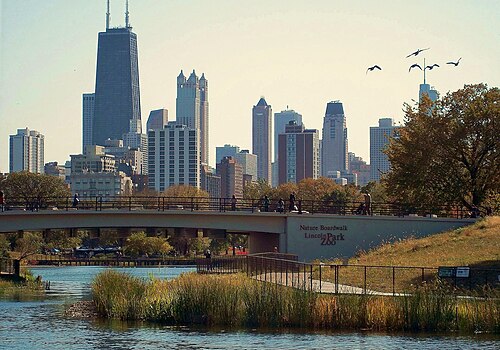
リンカーンパークには、リンカーンパーク動物園とリンカーンパーク温室があります。リバーノースギャラリー地区には、ニューヨーク市以外では国内最大の現代アートギャラリーが集まっています。[要出典] レイクビューには、市内の大規模なLGBTナイトライフと文化の中心地であるボーイズタウンがあります。6月の最終日曜日に開催されるシカゴプライドパレードは、100万人を超える人々が参加する世界最大級のパレードです。[226] ノースハルステッドストリートはボーイズタウンのメインストリートです。[227]
ハイドパークのサウスサイド地区は、元アメリカ大統領バラク・オバマの故郷である。また、世界のトップ10大学の一つにランクされているシカゴ大学[228]と科学産業博物館がある。6マイル(9.7キロメートル)の長さのバーナム公園は、サウスサイドのウォーターフロントに沿って広がっている。市内で最も大きな公園のうち2つも市のこちら側にある。ウォーターフロントに隣接するジャクソン公園は、1893年に世界コロンビアン博覧会の会場となり、前述の博物館がある。そして少し西にはワシントン公園がある。2つの公園自体は、シカゴ大学に隣接するミッドウェイプラザンスと呼ばれる広い公園地でつながっている。サウスサイドでは、市内で最も大きなパレードの一つである、毎年恒例のアフリカンアメリカンバドビリケンパレード&ピクニックがブロンズビルからワシントンパークまで行われる。フォード・モーター社はサウスサイドのヘーゲヴィッシュに自動車組立工場を構えており、シカゴ港の施設のほとんどもサウスサイドにある。[要出典]
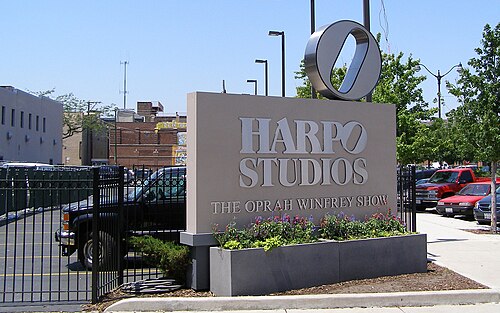
ウエストサイドには、米国のどの都市でも最大級の熱帯植物コレクションを誇るガーフィールドパーク温室がある。ここで見られる有名なラテン系文化施設には、フンボルトパークのプエルトリコ芸術文化研究所や毎年恒例のプエルトリコ人民パレード、国立メキシコ美術館、ピルゼンの聖アダルベルト教会などがある。ニアウエストサイドにはイリノイ大学シカゴ校があり、かつてはオプラ・ウィンフリーのハーポ・スタジオがあったが、その跡地はマクドナルドのグローバル本社として再建された。[要出典]
この都市の独特のアクセントは、ブルース・ブラザーズのような古典的な映画や、サタデー・ナイト・ライブの寸劇「ビル・スウェルスキーのスーパーファン」のようなテレビ番組で使われて有名になったが、これは内陸部北アメリカ英語の発展形である。この方言は、クリーブランド、ミルウォーキー、デトロイト、ニューヨーク州ロチェスターなど五大湖に面した他の都市でも見られ、最も顕著な特徴は、特定の母音の音の並べ替えである。例えば、 「cat」の短い「a」音は、部外者には「kyet」のように聞こえる。このアクセントは、今でもこの都市と深く結びついている。[229]
エンターテインメントと芸術

シカゴの有名な劇団には、ループ地区のグッドマン劇場、リンカーンパークのステッペンウルフ劇団とビクトリーガーデンズ劇場、ネイビーピアのシカゴシェイクスピア劇場などがある。ブロードウェイ・イン・シカゴでは、ネダーランダー劇場、CIBC劇場、キャデラック・パレス劇場、ルーズベルト大学オーディトリアムビル、ウォータータワープレイスのブロードウェイプレイハウスの5つの劇場でブロードウェイスタイルのエンターテイメントを提供している。シカゴの多数のポーランド語話者人口向けのポーランド語作品は、ジェファーソンパークの歴史あるゲートウェイ劇場で鑑賞できる。1968年以来、ジョセフ・ジェファーソン賞はシカゴ地域の優れた演劇を表彰するために毎年授与されている。シカゴの演劇界は現代の即興演劇を生み出し、セカンドシティやIO(旧ImprovOlympic)などの著名なグループが含まれる。 [要出典]
シカゴ交響楽団(CSO)はシンフォニー・センターで公演を行っており、世界でも有数のオーケストラとして知られています。[230]また、シンフォニー・センターではシカゴ・シンフォニエッタも定期的に公演を行っています。シカゴ・シンフォニエッタは、CSOよりも多様で多文化な団体です。夏には、グラント・パークやミレニアム・パークで多くの野外コンサートが開催されます。シカゴの北25マイル(40 km)に位置するラヴィニア・フェスティバルは、CSOの夏の本拠地であり、多くのシカゴ市民のお気に入りの目的地です。シビック・オペラ・ハウスは、シカゴ・リリック・オペラの本拠地です。[231]シカゴ・リトアニア・オペラ・カンパニーは、1956年にシカゴのリトアニア人によって設立され、[232]リトアニア語でオペラを上演しています。
ジョフリー・バレエ団とシカゴ・フェスティバル・バレエ団は、ミレニアム・パークのハリス劇場など、さまざまな会場で公演を行っています。シカゴには、ハバード・ストリート・ダンス・シカゴやシカゴ・ダンス・クラッシュなど、他にもコンテンポラリーダンスやジャズダンスの団体がいくつかあります。[要出典]

シカゴの文化遺産となっているその他のライブ音楽のジャンルには、シカゴ・ブルース、シカゴ・ソウル、ジャズ、ゴスペルなどがある。シカゴはハウスミュージック(エレクトロニック・ダンス・ミュージックの一般的な形式)とインダストリアル・ミュージックの発祥地であり、影響力のあるヒップホップ・シーンの本拠地でもある。1980年代から90年代にかけて、シカゴはシカゴで生まれた2つの形式の音楽であるハウスとインダストリアル・ミュージックの世界的な中心地であり、オルタナティヴ・ロック、パンク、ニューウェーブでも人気があった。シカゴは1980年代からレイブ文化の中心地となっている。インディーズ・ロック音楽文化の繁栄により、シカゴ・インディーズが誕生した。毎年開催されるフェスティバルでは、ロラパルーザやピッチフォーク・ミュージック・フェスティバルなど、さまざまなアーティストが出演する。[要出典]ロラパルーザは1991年にシカゴで始まり、最初は多くの都市を巡回したが、2005年現在はシカゴが本拠地となっている。[233]シカゴ大学文化政策センターによる2007年のシカゴ音楽産業に関する報告書では、シカゴは「音楽産業の規模」で米国の大都市圏の中で第3位、「コンサートや公演の数」で米国の都市の中で第4位にランクされました。[234]
シカゴには独特の美術の伝統がある。20世紀の大半、シカゴはイヴァン・オルブライトやエド・パシュケの作品に見られるような具象的シュルレアリスムの強いスタイルを育んだ。1968年と1969年には、ロジャー・ブラウン、レオン・ゴルブ、ロバート・ロスタッター、ジム・ナット、バーバラ・ロッシなどのシカゴ・イマジストのメンバーが奇妙な具象絵画を制作した。ヘンリー・ダーガーはアウトサイダー・アートの最も有名な人物の一人である。[235]
観光
.jpg/500px-Chicago_River_Morning_(44455011711).jpg)
2014年[update]、シカゴは5017万人の国内観光客、1109万人の国内ビジネス旅行者、130万8000人の海外旅行者を魅了した。[236]これらの訪問者はシカゴの経済に137億ドル以上の貢献をした。 [236]マグニフィセントマイルとステートストリート沿いの高級ショッピング、何千ものレストラン、そしてシカゴの著名な建築物は、観光客を惹きつけ続けている。 この都市は米国で3番目に大きな会議の開催地である。ウォークスコアによる2017年の調査では、シカゴは米国の50大都市の中で6番目に歩きやすい都市にランクされた。 [237]ほとんどの会議はソルジャーフィールドのすぐ南にあるマコーミックプレイスで開催されます。ストリータービルのすぐ東にあるネイビーピアは、長さ3,000フィート(910メートル)で、小売店、レストラン、博物館、展示ホール、講堂があります。 シカゴは世界で初めて観覧車を設置した都市です。ウィリスタワー(旧称シアーズタワー)は観光客に人気のスポットです。[238]
博物館
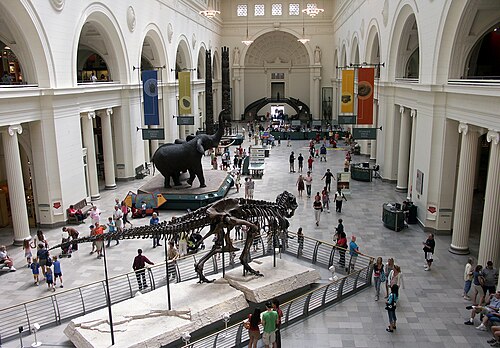
市内の博物館には、アドラー天文館・天文学博物館、フィールド自然史博物館、シェッド水族館などがある。博物館キャンパスは、有名なシカゴ美術館があるグラントパークの南側につながっている。バッキンガム噴水は、湖畔沿いのダウンタウンの公園の中心にある。シカゴ大学の古代文化・西アジア・北アフリカ研究所には、古代エジプトと近東の考古学的遺物の大規模なコレクションがある。シカゴの他の博物館やギャラリーには、シカゴ歴史博物館、ドリーハウス博物館、ダッセイブル・アフリカンアメリカン歴史博物館、現代美術館、ペギー・ノテバート自然博物館、ポーランド博物館、放送通信博物館、シカゴ建築財団、科学産業博物館などがある。[239] [240] [241]
料理

Chicago lays claim to a large number of regional specialties that reflect the city's ethnic and working-class roots. Included among these are its nationally renowned deep-dish pizza; this style is said to have originated at Pizzeria Uno.[242] The Chicago-style thin crust is also popular in the city.[243] Certain Chicago pizza favorites include Lou Malnati's and Giordano's.[244]
The Chicago-style hot dog, typically an all-beef hot dog, is loaded with an array of toppings that often includes pickle relish, yellow mustard, pickled sport peppers, tomato wedges, dill pickle spear and topped off with celery salt on a poppy seed bun.[245] Enthusiasts of the Chicago-style hot dog frown upon the use of ketchup as a garnish, but may prefer to add giardiniera.[246][247][248]

A distinctly Chicago sandwich, the Italian beef sandwich is thinly sliced beef simmered in au jus and served on an Italian roll with sweet peppers or spicy giardiniera. A popular modification is the Combo—an Italian beef sandwich with the addition of an Italian sausage. The Maxwell Street Polish is a grilled or deep-fried kielbasa—on a hot dog roll, topped with grilled onions, yellow mustard, and hot sport peppers.[249]
Chicken Vesuvio is roasted bone-in chicken cooked in oil and garlic next to garlicky oven-roasted potato wedges and a sprinkling of green peas. The Puerto Rican-influenced jibarito is a sandwich made with flattened, fried green plantains instead of bread. The mother-in-law is a tamale topped with chili and served on a hot dog bun.[250] The tradition of serving the Greek dish saganaki while aflame has its origins in Chicago's Greek community.[251] The appetizer, which consists of a square of fried cheese, is doused with Metaxa and flambéed table-side.[252] Chicago-style barbecue features hardwood smoked rib tips and hot links which were traditionally cooked in an aquarium smoker, a Chicago invention.[253] Annual festivals feature various Chicago signature dishes, such as Taste of Chicago and the Chicago Food Truck Festival.[254]
One of the world's most decorated restaurants and a recipient of three Michelin stars, Alinea is located in Chicago. Well-known chefs who have had restaurants in Chicago include: Charlie Trotter, Rick Tramonto, Grant Achatz, and Rick Bayless. In 2003, Robb Report named Chicago the country's "most exceptional dining destination".[255]
Literature

Chicago literature finds its roots in the city's tradition of lucid, direct journalism, lending to a strong tradition of social realism. In the Encyclopedia of Chicago, Northwestern University Professor Bill Savage describes Chicago fiction as prose which tries to "capture the essence of the city, its spaces and its people." The challenge for early writers was that Chicago was a frontier outpost that transformed into a global metropolis in the span of two generations. Narrative fiction of that time, much of it in the style of "high-flown romance" and "genteel realism", needed a new approach to describe the urban social, political, and economic conditions of Chicago.[256] Nonetheless, Chicagoans worked hard to create a literary tradition that would stand the test of time,[257] and create a "city of feeling" out of concrete, steel, vast lake, and open prairie.[258] Much notable Chicago fiction focuses on the city itself, with social criticism keeping exultation in check.
At least three short periods in the history of Chicago have had a lasting influence on American literature.[259] These include from the time of the Great Chicago Fire to about 1900, what became known as the Chicago Literary Renaissance in the 1910s and early 1920s, and the period of the Great Depression through the 1940s.
What would become the influential Poetry magazine was founded in 1912 by Harriet Monroe, who was working as an art critic for the Chicago Tribune. The magazine discovered such poets as Gwendolyn Brooks, James Merrill, and John Ashbery.[260] T. S. Eliot's first professionally published poem, "The Love Song of J. Alfred Prufrock", was first published by Poetry. Contributors have included Ezra Pound, William Butler Yeats, William Carlos Williams, Langston Hughes, and Carl Sandburg, among others. The magazine was instrumental in launching the Imagist and Objectivist poetic movements. From the 1950s through 1970s, American poetry continued to evolve in Chicago.[261] In the 1980s, a modern form of poetry performance began in Chicago, the poetry slam.[262]
Sports
The city has two Major League Baseball (MLB) teams: the Chicago Cubs of the National League play in Wrigley Field on the North Side; and the Chicago White Sox of the American League play in Guaranteed Rate Field on the South Side. The two teams have faced each other in a World Series only once, in 1906.[263]
The Cubs are the oldest Major League Baseball team to have never changed their city;[264] they have played in Chicago since 1871.[265] They had the dubious honor of having the longest championship drought in American professional sports, failing to win a World Series between 1908 and 2016. The White Sox have played on the South Side continuously since 1901. They have won three World Series titles (1906, 1917, 2005) and six American League pennants, including the first in 1901.
The Chicago Bears, one of the last two remaining charter members of the National Football League (NFL), have won nine NFL Championships, including the 1985 Super Bowl XX. The Bears play their home games at Soldier Field.
The Chicago Bulls of the National Basketball Association (NBA) is one of the most recognized basketball teams in the world.[266] During the 1990s, with Michael Jordan leading them, the Bulls won six NBA championships in eight seasons.[267][268]
The Chicago Blackhawks of the National Hockey League (NHL) began play in 1926, and are one of the "Original Six" teams of the NHL. The Blackhawks have won six Stanley Cups, including in 2010, 2013, and 2015. Both the Bulls and the Blackhawks play at the United Center.[269]

Chicago Fire FC is a member of Major League Soccer (MLS) and plays at Soldier Field. The Fire have won one league title and four U.S. Open Cups, since their founding in 1997. In 1994, the United States hosted a successful FIFA World Cup with games played at Soldier Field.[270]
The Chicago Red Stars are a team in the National Women's Soccer League (NWSL). They previously played in Women's Professional Soccer (WPS), of which they were a founding member, before joining the NWSL in 2013. They play at SeatGeek Stadium in Bridgeview, Illinois.
The Chicago Sky is a professional basketball team playing in the Women's National Basketball Association (WNBA). They play home games at the Wintrust Arena. The team was founded before the 2006 WNBA season began.[271]
The Chicago Marathon has been held each year since 1977 except for 1987, when a half marathon was run in its place. The Chicago Marathon is one of six World Marathon Majors.[272]
Five area colleges play in Division I conferences: two from major conferences—the DePaul Blue Demons (Big East Conference) and the Northwestern Wildcats (Big Ten Conference)—and three from other D1 conferences—the Chicago State Cougars (Northeast Conference); the Loyola Ramblers (Atlantic 10 Conference); and the UIC Flames (Missouri Valley Conference).[273]
Chicago has also entered into esports with the creation of the OpTic Chicago, a professional Call of Duty team that participates within the CDL.[274]
Parks and greenspace

When Chicago was incorporated in 1837, it chose the motto Urbs in Horto, a Latin phrase which means "City in a Garden". Today, the Chicago Park District consists of more than 570 parks with over 8,000 acres (3,200 ha) of municipal parkland. There are 31 sand beaches, a plethora of museums, two world-class conservatories, and 50 nature areas.[275] Lincoln Park, the largest of the city's parks, covers 1,200 acres (490 ha) and has over 20 million visitors each year, making it third in the number of visitors after Central Park in New York City, and the National Mall and Memorial Parks in Washington, D.C.[276]
There is a historic boulevard system,[277] a network of wide, tree-lined boulevards which connect a number of Chicago parks.[278] The boulevards and the parks were authorized by the Illinois legislature in 1869.[279] A number of Chicago neighborhoods emerged along these roadways in the 19th century.[278] The building of the boulevard system continued intermittently until 1942. It includes nineteen boulevards, eight parks, and six squares, along twenty-six miles of interconnected streets.[280] The Chicago Park Boulevard System Historic District was listed on the National Register of Historic Places in 2018.[281][282]
With berths for more than 6,000 boats, the Chicago Park District operates the nation's largest municipal harbor system.[283] In addition to ongoing beautification and renewal projects for the existing parks, a number of new parks have been added in recent years, such as the Ping Tom Memorial Park in Chinatown, DuSable Park on the Near North Side, and most notably, Millennium Park, which is in the northwestern corner of one of Chicago's oldest parks, Grant Park in the Chicago Loop.[citation needed]
The wealth of greenspace afforded by Chicago's parks is further augmented by the Cook County Forest Preserves, a network of open spaces containing forest, prairie, wetland, streams, and lakes that are set aside as natural areas which lie along the city's outskirts,[284] including both the Chicago Botanic Garden in Glencoe and the Brookfield Zoo in Brookfield.[285] Washington Park is also one of the city's biggest parks; covering nearly 400 acres (160 ha). The park is listed on the National Register of Historic Places listings in South Side Chicago.[286]
Law and government
Government

The government of the City of Chicago is divided into executive and legislative branches. The mayor of Chicago is the chief executive, elected by general election for a term of four years, with no term limits. The current mayor is Brandon Johnson. The mayor appoints commissioners and other officials who oversee the various departments. As well as the mayor, Chicago's clerk and treasurer are also elected citywide. The City Council is the legislative branch and is made up of 50 alderpersons, one elected from each ward in the city.[287] The council takes official action through the passage of ordinances and resolutions and approves the city budget.[288]
The Chicago Police Department provides law enforcement and the Chicago Fire Department provides fire suppression and emergency medical services for the city and its residents. Civil and criminal law cases are heard in the Cook County Circuit Court of the State of Illinois court system, or in the Northern District of Illinois, in the federal system. In the state court, the public prosecutor is the Illinois state's attorney; in the Federal court it is the United States attorney.
Politics
During much of the last half of the 19th century, Chicago's politics were dominated by a growing Democratic Party organization. During the 1880s and 1890s, Chicago had a powerful radical tradition with large and highly organized socialist, anarchist and labor organizations.[290] For much of the 20th century, Chicago has been among the largest and most reliable Democratic strongholds in the United States; with Chicago's Democratic vote the state of Illinois has been "solid blue" in presidential elections since 1992. Even before then, it was not unheard of for Republican presidential candidates to win handily in downstate Illinois, only to lose statewide due to large Democratic margins in Chicago. The citizens of Chicago have not elected a Republican mayor since 1927, when William Thompson was voted into office. The strength of the party in the city is partly a consequence of Illinois state politics, where the Republicans have come to represent rural and farm concerns while the Democrats support urban issues such as Chicago's public school funding.[citation needed]
Chicago contains less than 25% of the state's population, but it is split between eight of Illinois' 17 districts in the United States House of Representatives. All eight of the city's representatives are Democrats; only two Republicans have represented a significant portion of the city since 1973, for one term each: Robert P. Hanrahan from 1973 to 1975, and Michael Patrick Flanagan from 1995 to 1997.[citation needed]
Machine politics persisted in Chicago after the decline of similar machines in other large U.S. cities.[291] During much of that time, the city administration found opposition mainly from a liberal "independent" faction of the Democratic Party. The independents finally gained control of city government in 1983 with the election of Harold Washington (in office 1983–1987). From 1989 until May 16, 2011, Chicago was under the leadership of its longest-serving mayor, Richard M. Daley, the son of Richard J. Daley. Because of the dominance of the Democratic Party in Chicago, the Democratic primary vote held in the spring is generally more significant than the general elections in November for U.S. House and Illinois State seats. The aldermanic, mayoral, and other city offices are filled through nonpartisan elections with runoffs as needed.[292]
The city is home of former United States President Barack Obama and First Lady Michelle Obama; Barack Obama was formerly a state legislator representing Chicago and later a U.S. senator. The Obamas' residence is located near the University of Chicago in Kenwood on the city's south side.[293]
Crime
_b.jpg/500px-Chicago_Police_Ford_Police_Interceptor_Utility_7905_(Front_left_view)_b.jpg)
Chicago's crime rate in 2020 was 3,926 per 100,000 people.[294] Chicago experienced major rises in violent crime in the 1920s, in the late 1960s, and in the 2020s.[295][296] Chicago's biggest criminal justice challenges have changed little over the last 50 years, and statistically reside with homicide, armed robbery, gang violence, and aggravated battery. Chicago has a higher murder rate than the larger cities of New York and Los Angeles. However, while it has a large absolute number of crimes due to its size, Chicago is not among the top-25 most violent cities in the United States.[297][298]
Murder rates in Chicago vary greatly depending on the neighborhood in question.[299] The neighborhoods of Englewood on the South Side, and Austin on the West side, for example, have homicide rates that are ten times higher than other parts of the city.[300] Chicago has an estimated population of over 100,000 active gang members from nearly 60 factions.[301][302] According to reports in 2013, "most of Chicago's violent crime comes from gangs trying to maintain control of drug-selling territories,"[303] and is specifically related to the activities of the Sinaloa Cartel, which is active in several American cities.[304] Violent crime rates vary significantly by area of the city, with more economically developed areas having low rates, but other sections have much higher rates of crime.[303] In 2013, the violent crime rate was 910 per 100,000 people;[305] the murder rate was 10.4 per 100,000 – while high crime districts saw 38.9 murders, low crime districts saw 2.5 murders per 100,000.[306]
Chicago has a long history of public corruption that regularly draws the attention of federal law enforcement and federal prosecutors.[307] From 2012 to 2019, 33 Chicago alderpersons were convicted on corruption charges, roughly one third of those elected in the time period. A report from the Office of the Legislative Inspector General noted that over half of Chicago's elected alderpersons took illegal campaign contributions in 2013.[308] Most corruption cases in Chicago are prosecuted by the U.S. Attorney's office, as legal jurisdiction makes most offenses punishable as a federal crime.[309]
Education
Schools and libraries
.jpg/500px-Harold_Washington_Library,_Chicago,_Illinois_(9181548762).jpg)
Chicago Public Schools (CPS) is the governing body of the school district that contains over 600 public elementary and high schools citywide, including several selective-admission magnet schools. There are eleven selective enrollment high schools in the Chicago Public Schools, designed to meet the needs of Chicago's most academically advanced students. These schools offer a rigorous curriculum with mainly honors and Advanced Placement (AP) courses.[310] Walter Payton College Prep High School is ranked number one in the city of Chicago and the state of Illinois.[311]
Chicago high school rankings are determined by the average test scores on state achievement tests.[312] The district, with an enrollment exceeding 400,545 students (2013–2014 20th Day Enrollment), is the third-largest in the U.S.[313] On September 10, 2012, teachers for the Chicago Teachers Union went on strike for the first time since 1987 over pay, resources, and other issues.[314] According to data compiled in 2014, Chicago's "choice system", where students who test or apply and may attend one of a number of public high schools (there are about 130), sorts students of different achievement levels into different schools (high performing, middle performing, and low performing schools).[315]
Chicago has a network of Lutheran schools,[316]and several private schools are run by other denominations and faiths, such as the Ida Crown Jewish Academy in West Ridge. The Roman Catholic Archdiocese of Chicago operates Catholic schools, that include Jesuit preparatory schools and others. A number of private schools are completely secular. There are also the private Chicago Academy for the Arts, a high school focused on six different categories of the arts and the public Chicago High School for the Arts, a high school focused on five categories (visual arts, theatre, musical theatre, dance, and music) of the arts.[317]
The Chicago Public Library system operates three regional libraries and 77 neighborhood branches, including the central library.[318]
Colleges and universities
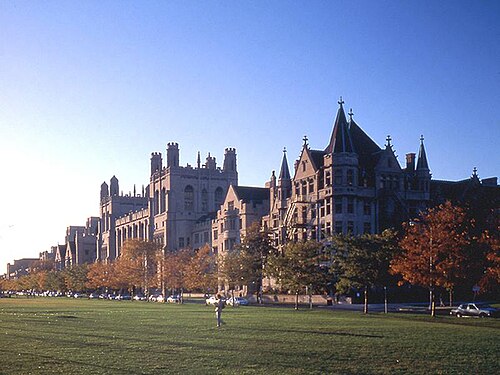
Since the 1850s, Chicago has been a world center of higher education and research with several universities. These institutions consistently rank among the top "National Universities" in the United States, as determined by U.S. News & World Report.[319] Highly regarded universities in Chicago and the surrounding area are the University of Chicago; Northwestern University; Illinois Institute of Technology; Loyola University Chicago; DePaul University; Columbia College Chicago and the University of Illinois at Chicago. Other notable schools include: Chicago State University; the School of the Art Institute of Chicago; East–West University; National Louis University; North Park University; Northeastern Illinois University; Robert Morris University Illinois; Roosevelt University; Saint Xavier University; Rush University; and Shimer College.[320]
William Rainey Harper, the first president of the University of Chicago, was instrumental in the creation of the junior college concept, establishing nearby Joliet Junior College as the first in the nation in 1901.[321] His legacy continues with the multiple community colleges in the Chicago proper, including the seven City Colleges of Chicago: Richard J. Daley College, Kennedy–King College, Malcolm X College, Olive–Harvey College, Truman College, Harold Washington College, and Wilbur Wright College, in addition to the privately held MacCormac College.[citation needed]
Chicago also has a high concentration of post-baccalaureate institutions, graduate schools, seminaries, and theological schools, such as the Adler School of Professional Psychology, The Chicago School of Professional Psychology, the Erikson Institute, The Institute for Clinical Social Work, the Lutheran School of Theology at Chicago, the Catholic Theological Union, the Moody Bible Institute, and the University of Chicago Divinity School.[citation needed]
Media
.jpg/500px-W-G-N_Studios_Tribune_Square,_Chicago_(60792).jpg)
Television
The Chicago metropolitan area is a major media hub and the third-largest media market in the United States, after New York City and Los Angeles.[322] Each of the big four U.S. television networks, CBS, ABC, NBC and Fox, directly owns and operates a high-definition television station in Chicago (WBBM 2, WLS 7, WMAQ 5 and WFLD 32, respectively). Former CW affiliate WGN-TV 9, which was owned from its inception by Tribune Broadcasting (now owned by the Nexstar Media Group since 2019), is carried with some programming differences, as "WGN America" on cable and satellite TV nationwide and in parts of the Caribbean. WGN America eventually became NewsNation in 2021.
Chicago has also been the home of several prominent talk shows, including The Oprah Winfrey Show, Steve Harvey Show, The Rosie Show, The Jerry Springer Show, The Phil Donahue Show, The Jenny Jones Show, and more. The city also has one PBS member station (its second: WYCC 20, removed its affiliation with PBS in 2017[323]): WTTW 11, producer of shows such as Sneak Previews, The Frugal Gourmet, Lamb Chop's Play-Along and The McLaughlin Group. As of 2018[update], Windy City Live is Chicago's only daytime talk show, which is hosted by Val Warner and Ryan Chiaverini at ABC7 Studios with a live weekday audience. Since 1999, Judge Mathis also films his syndicated arbitration-based reality court show at the NBC Tower. Beginning in January 2019, Newsy began producing 12 of its 14 hours of live news programming per day from its new facility in Chicago.[citation needed]
Television stations
Most of Chicago's television stations are owned and operated by the big television network companies. They are:
- WBBM-TV (2), owned and operated by CBS.
- WMAQ-TV (5), owned and operated by NBC.
- WLS-TV (7), owned and operated by ABC.
- WGN-TV (9), a CW station owned and operated by network majority owner Nexstar Media Group.
- WTTW (11), a PBS member station owned by Window to the World Communications, Inc.
- WCIU-TV (26), an independent station (with a secondary MeTV affiliation) owned by Weigel Broadcasting.
- WFLD (32), owned and operated by Fox.
- WWTO-TV (35), owned and operated by TBN, licensed in Naperville.
- WCPX-TV (38), owned and operated by Ion Television.
- WSNS-TV (44), owned and operated by Telemundo.
- WPWR-TV (50), owned and operated by MyNetworkTV (Fox), licensed to Gary, Indiana.
- WYIN (56), a PBS member station owned by Northwest Indiana Public Broadcasting, Inc., licensed in Gary, Indiana.
- WTVK (59), an independent station owned by Venture Technologies Group, licensed in Oswego, Illinois.
- WXFT-DT (60), owned and operated by Unimas.
- WJYS (62), an independent station owned by Millennial Telecommunications, Inc., licensed to Hammond, Indiana.
- WGBO-DT (66), owned and operated by Univision.
Newspapers
Two major daily newspapers are published in Chicago: the Chicago Tribune and the Chicago Sun-Times, with the Tribune having the larger circulation. There are also several regional and special-interest newspapers and magazines, such as Chicago, the Dziennik Związkowy (Polish Daily News), Draugas (the Lithuanian daily newspaper), the Chicago Reader, the SouthtownStar, the Chicago Defender, the Daily Herald, Newcity,[324][325] StreetWise and the Windy City Times. The entertainment and cultural magazine Time Out Chicago and GRAB magazine are also published in the city, as well as local music magazine Chicago Innerview. In addition, Chicago is the home of satirical national news outlet, The Onion, as well as its sister pop-culture publication, The A.V. Club.[326]
Movies and filming
Radio
Chicago has five 50,000 watt AM radio stations: the Audacy-owned WBBM and WSCR; the Tribune Broadcasting-owned WGN; the Cumulus Media-owned WLS; and the ESPN Radio-owned WMVP. Chicago is also home to a number of national radio shows, including Beyond the Beltway with Bruce DuMont on Sunday evenings.[citation needed]
Chicago Public Radio produces nationally aired programs such as PRI's This American Life and NPR's Wait Wait...Don't Tell Me!.[citation needed]
Infrastructure
Transportation
_4-1-22.jpg/500px-Jane_M._Byrne_Interchange_(1)_4-1-22.jpg)
Chicago is a major transportation hub in the United States. It is an important component in global distribution, as it is the third-largest inter-modal port in the world after Hong Kong and Singapore.[327]
The city of Chicago has a higher than average percentage of households without a car. In 2015, 26.5 percent of Chicago households were without a car, and increased slightly to 27.5 percent in 2016. The national average was 8.7 percent in 2016. Chicago averaged 1.12 cars per household in 2016, compared to a national average of 1.8.[328]
Parking
Due to Chicago's Wheel Tax,[329] residents of Chicago who own a vehicle are required to purchase a Chicago City Vehicle Sticker.[330] In established Residential Parking Zones, only local residents can purchase Zone-specific parking stickers for themselves and guests.[331][332]
Chicago since 2009 has relinquished rights to its public street parking.[333] In 2008, as Chicago struggled to close a growing budget deficit, the city agreed to a 75-year, $1.16 billion deal to lease its parking meter system to an operating company created by Morgan Stanley, called Chicago Parking Meters LLC. Daley said the "agreement is very good news for the taxpayers of Chicago because it will provide more than $1 billion in net proceeds that can be used during this very difficult economy."[334]
The rights of the parking ticket lease end in 2081, and since 2022 have already recouped over $1.5 billion in revenue for Chicago Parking Meters LLC investors.[335]
Expressways
Seven mainline and four auxiliary interstate highways (55, 57, 65 (only in Indiana), 80 (also in Indiana), 88, 90 (also in Indiana), 94 (also in Indiana), 190, 290, 294, and 355) run through Chicago and its suburbs. Segments that link to the city center are named after influential politicians, with three of them named after former U.S. Presidents (Eisenhower, Kennedy, and Reagan) and one named after two-time Democratic candidate Adlai Stevenson.
The Kennedy and Dan Ryan Expressways are the busiest state maintained routes in the entire state of Illinois.[336]
Transit systems

The Regional Transportation Authority (RTA) coordinates the operation of the three service boards: CTA, Metra, and Pace.
- The Chicago Transit Authority (CTA) handles public transportation in the City of Chicago and a few adjacent suburbs outside of the Chicago city limits. The CTA operates an extensive network of buses and a rapid transit elevated and subway system known as the Chicago "L" or just the "L" (short for "elevated"), with lines designated by colors. These rapid transit lines also serve both Midway and O'Hare Airports. The CTA's rail lines consist of the Red, Blue, Green, Orange, Brown, Purple, Pink, and Yellow lines. Both the Red and Blue lines offer 24‑hour service which makes Chicago one of a handful of cities around the world (and one of two in the United States, the other being New York City) to offer rail service 24 hours a day, every day of the year, within the city's limits.
- Metra, the nation's second-most used passenger regional rail network, operates an 11-line commuter rail service in Chicago and throughout the Chicago suburbs. The Metra Electric Line shares its trackage with Northern Indiana Commuter Transportation District's South Shore Line, which provides commuter service between South Bend and Chicago.
- Pace provides bus and paratransit service in over 200 surrounding suburbs with some extensions into the city as well. A 2005 study found that one quarter of commuters used public transit.[337]
Greyhound Lines provides inter-city bus service to and from the city at the Chicago Bus Station, and Chicago is also the hub for the Midwest network of Megabus (North America).
Passenger rail

Amtrak long distance and commuter rail services originate from Union Station.[338] Chicago is one of the largest hubs of passenger rail service in the nation.[339] The services terminate in the San Francisco area, Washington, D.C., New York City, New Orleans, Portland, Seattle, Milwaukee, Quincy, St. Louis, Carbondale, Boston, Grand Rapids, Port Huron, Pontiac, Los Angeles, and San Antonio. Future service will terminate at Moline. An attempt was made in the early 20th century to link Chicago with New York City via the Chicago – New York Electric Air Line Railroad. Parts of this were built, but it was never completed.
Bicycle and scooter sharing systems
In July 2013, the bicycle-sharing system Divvy was launched with 750 bikes and 75 docking stations[340] It is operated by Lyft for the Chicago Department of Transportation.[341] As of July 2019, Divvy operated 5800 bicycles at 608 stations, covering almost all of the city, excluding Pullman, Rosedale, Beverly, Belmont Cragin and Edison Park.[342]
In May 2019, The City of Chicago announced its Chicago's Electric Shared Scooter Pilot Program, scheduled to run from June 15 to October 15.[343] The program started on June 15 with 10 different scooter companies, including scooter sharing market leaders Bird, Jump, Lime and Lyft.[344] Each company was allowed to bring 250 electric scooters, although both Bird and Lime claimed that they experienced a higher demand for their scooters.[345] The program ended on October 15, with nearly 800,000 rides taken.[346]
Freight rail
Chicago is the largest hub in the railroad industry.[347] All five Class I railroads meet in Chicago. As of 2002[update], severe freight train congestion caused trains to take as long to get through the Chicago region as it took to get there from the West Coast of the country (about 2 days).[348] According to U.S. Department of Transportation, the volume of imported and exported goods transported via rail to, from, or through Chicago is forecast to increase nearly 150 percent between 2010 and 2040.[349] CREATE, the Chicago Region Environmental and Transportation Efficiency Program, comprises about 70 programs, including crossovers, overpasses and underpasses, that intend to significantly improve the speed of freight movements in the Chicago area.[350]
Airports

Chicago is served by O'Hare International Airport, the world's busiest airport measured by airline operations,[351] on the far Northwest Side, and Midway International Airport on the Southwest Side. In 2005, O'Hare was the world's busiest airport by aircraft movements and the second-busiest by total passenger traffic.[352] Both O'Hare and Midway are owned and operated by the City of Chicago. Gary/Chicago International Airport and Chicago Rockford International Airport, located in Gary, Indiana and Rockford, Illinois, respectively, can serve as alternative Chicago area airports, however they do not offer as many commercial flights as O'Hare and Midway. In recent years the state of Illinois has been leaning towards building an entirely new airport in the Illinois suburbs of Chicago.[353] The City of Chicago is the world headquarters for United Airlines, the world's third-largest airline.
Port authority
The Port of Chicago consists of several major port facilities within the city of Chicago operated by the Illinois International Port District (formerly known as the Chicago Regional Port District). The central element of the Port District, Calumet Harbor, is maintained by the U.S. Army Corps of Engineers.[354]
- Iroquois Landing Lakefront Terminal: at the mouth of the Calumet River, it includes 100 acres (0.40 km2) of warehouses and facilities on Lake Michigan with over 780,000 square meters (8,400,000 sq ft) of storage.
- Lake Calumet terminal: located at the union of the Grand Calumet River and Little Calumet River 6 miles (9.7 km) inland from Lake Michigan. Includes three transit sheds totaling over 29,000 square meters (310,000 sq ft) adjacent to over 900 linear meters (3,000 linear feet) of ship and barge berthing.
- Grain (14 million bushels) and bulk liquid (800,000 barrels) storage facilities along Lake Calumet.
- The Illinois International Port district also operates Foreign trade zone No. 22, which extends 60 miles (97 km) from Chicago's city limits.
Utilities
Electricity for most of northern Illinois is provided by Commonwealth Edison, also known as ComEd. Their service territory borders Iroquois County to the south, the Wisconsin border to the north, the Iowa border to the west and the Indiana border to the east. In northern Illinois, ComEd (a division of Exelon) operates the greatest number of nuclear generating plants in any U.S. state. Because of this, ComEd reports indicate that Chicago receives about 75% of its electricity from nuclear power. Recently, the city began installing wind turbines on government buildings to promote renewable energy.[355][356][357]
Natural gas is provided by Peoples Gas, a subsidiary of Integrys Energy Group, which is headquartered in Chicago.
Domestic and industrial waste was once incinerated but it is now landfilled, mainly in the Calumet area. From 1995 to 2008, the city had a blue bag program to divert recyclable refuse from landfills.[358] Because of low participation in the blue bag programs, the city began a pilot program for blue bin recycling like other cities. This proved successful and blue bins were rolled out across the city.[359]
Health systems
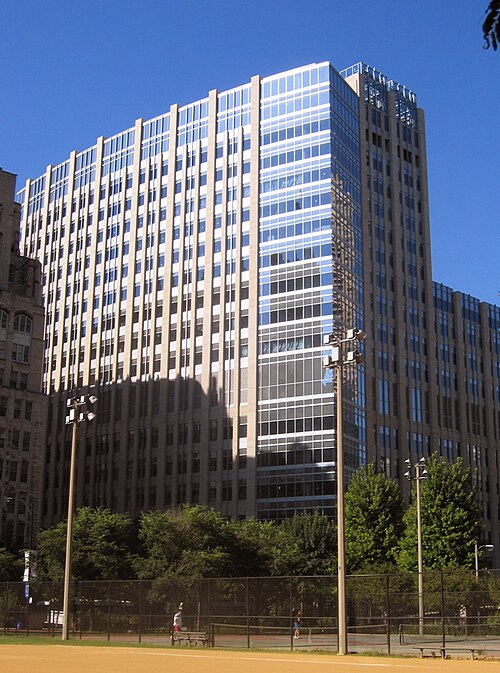
The Illinois Medical District is on the Near West Side. It includes Rush University Medical Center, ranked as the second best hospital in the Chicago metropolitan area by U.S. News & World Report for 2014–16, the University of Illinois Medical Center at Chicago, Jesse Brown VA Hospital, and John H. Stroger Jr. Hospital of Cook County, one of the busiest trauma centers in the nation.[360]
Two of the country's premier academic medical centers reside in Chicago, including Northwestern Memorial Hospital and the University of Chicago Medical Center. The Chicago campus of Northwestern University includes the Feinberg School of Medicine; Northwestern Memorial Hospital, which is ranked as the best hospital in the Chicago metropolitan area by U.S. News & World Report for 2017–18;[361] the Shirley Ryan AbilityLab (formerly named the Rehabilitation Institute of Chicago), which is ranked the best U.S. rehabilitation hospital by U.S. News & World Report;[362] the new Prentice Women's Hospital; and Ann & Robert H. Lurie Children's Hospital of Chicago.
The University of Illinois College of Medicine at UIC is the second-largest medical school in the United States (2,600 students, including those at campuses in Peoria, Rockford and Urbana–Champaign).[363]
In addition, the Chicago Medical School and Loyola University Chicago's Stritch School of Medicine are located in the suburbs of North Chicago and Maywood, respectively. The Midwestern University Chicago College of Osteopathic Medicine is in Downers Grove.
The American Medical Association, Accreditation Council for Graduate Medical Education, Accreditation Council for Continuing Medical Education, American Osteopathic Association, American Dental Association, Academy of General Dentistry, Academy of Nutrition and Dietetics, American Association of Nurse Anesthetists, American College of Surgeons, American Society for Clinical Pathology, American College of Healthcare Executives, the American Hospital Association, and Blue Cross and Blue Shield Association are all based in Chicago.
Sister cities
See also
- Chicago area water quality
- Chicago Wilderness
- Gentrification of Chicago
- Index of Illinois-related articles
- List of cities with the most skyscrapers
- National Register of Historic Places listings in Central Chicago
- National Register of Historic Places listings in North Side Chicago
- National Register of Historic Places listings in West Side Chicago
- USS Chicago, four ships
Explanatory notes
- ^ /ʃɪˈkɑːɡoʊ/ shih-KAH-goh, locally also /ʃɪˈkɔːɡoʊ/ shih-KAW-goh;[7] Miami-Illinois: Shikaakwa; Ojibwe: Zhigaagong[8]
- ^ a b Mean monthly maxima and minima (i.e. the expected highest and lowest temperature readings at any point during the year or given month) calculated based on data at said location from 1991 to 2020.
- ^ Official records for Chicago were kept at various locations in downtown from January 1871 to December 31, 1925, University of Chicago from January 1, 1926 to June 30, 1942, Midway Airport from July 1, 1942 to January 16, 1980, and at O'Hare Airport since January 17, 1980.[154][155]
- ^ a b From 15% sample
- ^ The total for each race includes those who reported that race alone or in combination with other races. People who reported a combination of multiple races may be counted multiple times, so the sum of all percentages will exceed 100%.
- ^ Hispanic and Latino origins are separate from race in the U.S. Census. The Census does not distinguish between Latino origins alone or in combination. This row counts Hispanics and Latinos of any race.
References
Citations
- ^ a b "City of Chicago". Geographic Names Information System. United States Geological Survey, United States Department of the Interior.
- ^ "2020 U.S. Gazetteer Files". United States Census Bureau. Archived from the original on March 15, 2022. Retrieved March 15, 2022.
- ^ a b "QuickFacts: Chicago city, Illinois". census.gov. United States Census Bureau. Archived from the original on December 18, 2023. Retrieved February 29, 2024.
- ^ "List of 2020 Census Urban Areas". census.gov. United States Census Bureau. Archived from the original on January 14, 2023. Retrieved January 8, 2023.
- ^ "2020 Population and Housing State Data". United States Census Bureau. Archived from the original on August 24, 2021. Retrieved August 22, 2021.
- ^ "Total Gross Domestic Product for Chicago-Naperville-Elgin, IL-IN-WI (MSA)". fred.stlouisfed.org.
- ^ Wells, John C. (1982). Accents of English. Vol. 3: Beyond the British Isles (pp. i–xx, 467–674). Cambridge University Press. p. 476. doi:10.1017/CBO9780511611766. ISBN 0-52128541-0.
- ^ Carrico, Natalya (March 18, 2019). "'We're still here'". Chicago Reader. Archived from the original on December 13, 2020. Retrieved January 12, 2021.
- ^ a b "QuickFacts: Chicago city, Illinois". United States Census Bureau. Archived from the original on October 7, 2021. Retrieved August 19, 2021.
- ^ Keating, Ann Durkin. "Metropolitan Growth". In Grossman, Keating & Reiff (2004).
- ^ a b "Demography: Chicago as a Modern World City". Encyclopedia of Chicago. Archived from the original on October 12, 2022. Retrieved March 4, 2022.
- ^ Cohen, Jennie (October 7, 2011). "Urban Infernos Throughout History". History. Archived from the original on February 25, 2021. Retrieved June 24, 2017.
- ^ "Skyscrapers". Encyclopedia of Chicago. Retrieved June 24, 2017.
- ^ Glancey, Jonathan (October 5, 2015). "The city that changed architecture forever". BBC News. Archived from the original on May 11, 2020. Retrieved April 30, 2018.
- ^ a b "Economy". World Business Chicago. Archived from the original on February 12, 2017. Retrieved May 3, 2018.
- ^ "2017 Passenger Summary – Annual Traffic Data". ACI World. Archived from the original on May 29, 2020. Retrieved November 16, 2019.
- ^ Rodriguez, Alex (January 26, 2014). "Chicago takes on the world". Chicago Tribune. Sec. 1 p. 15.
- ^ "CAGDP2 Gross domestic product (GDP) by county and metropolitan area". Bureau of Economic Analysis. December 12, 2019. Archived from the original on October 23, 2018. Retrieved December 15, 2019.
- ^ Marovich, Robert M. (2015). A City Called Heaven: Chicago and the Birth of Gospel Music. Urbana, IL: University of Illinois Press. p. 7. ISBN 978-0-252-08069-2.
- ^ Quaife, Milo M. (1933). Checagou: From Indian Wigwam to Modern City, 1673–1835. Chicago, IL: University of Chicago Press. OCLC 1865758.
- ^ a b Swenson, John F. (Winter 1991). "Chicagoua/Chicago: The origin, meaning, and etymology of a place name". Illinois Historical Journal. 84 (4): 235–248. ISSN 0748-8149. OCLC 25174749.
- ^ Marcus, Sarah S. "Chicago's Twentieth-Century Cultural Exports". In Grossman, Keating & Reiff (2004).
- ^ Keating, Ann Durkin (2005). Chicagoland: City and Suburbs in the Railroad Age. The University of Chicago Press. p. 25. ISBN 0-226-42882-6. LCCN 2005002198.
- ^ Genzen (2007), pp. 10–11, 14–15.
- ^ Keating (2005), pp. 30–31, 221.
- ^ Swenson, John W (1999). "Jean Baptiste Point de Sable—The Founder of Modern Chicago". Early Chicago. Early Chicago, Inc. Archived from the original on January 16, 2005. Retrieved August 8, 2010.
- ^ Genzen (2007), pp. 16–17.
- ^ Buisseret (1990), pp. 22–23, 68, 80–81.
- ^ Keating (2005), pp. 30–32.
- ^ a b "Timeline: Early Chicago History". Chicago: City of the Century. WGBH Educational Foundation And Window to the World Communications, Inc. 2003. Archived from the original on March 25, 2009. Retrieved May 26, 2009.
- ^ "Act of Incorporation for the City of Chicago, 1837". State of Illinois. Archived from the original on March 7, 2011. Retrieved March 3, 2011.
- ^ Walter Nugent. "Demography Archived October 12, 2022, at the Wayback Machine" in Encyclopedia of Chicago. Chicago Historical Society.
- ^ Keating (2005), p. 27.
- ^ Buisseret (1990), pp. 86–98.
- ^ Condit (1973), pp. 30–31.
- ^ Genzen (2007), pp. 24–25.
- ^ Keating (2005), pp. 26–29, 35–39.
- ^ Conzen, Michael P. "Global Chicago". Encyclopedia of Chicago. Chicago Historical Society. Archived from the original on November 12, 2015. Retrieved December 6, 2015.
- ^ "Timeline-of-achievements". CME Group. Archived from the original on January 7, 2012. Retrieved January 20, 2013.
- ^ "Stephen Douglas". University of Chicago. Archived from the original on June 9, 2011. Retrieved May 29, 2011.
- ^ "Chicago Daily Tribune, Thursday Morning, February 14". nike-of-samothrace.net. Archived from the original on March 25, 2014. Retrieved May 4, 2009.
- ^ Addis, Cameron (August 22, 2015). "5 Bull Moose From a Bully Pulpit". Austin Community College. Archived from the original on February 27, 2021. Retrieved March 21, 2021.
- ^ Condit (1973), pp. 15–18, 243–245.
- ^ Genzen (2007), pp. 27–29, 38–43.
- ^ Buisseret (1990), pp. 154–155, 172–173, 204–205.
- ^ Buisseret (1990), pp. 148–149.
- ^ Genzen (2007), pp. 32–37.
- ^ Lowe (2000), pp. 87–97.
- ^ Lowe (2000), p. 99.
- ^ Bruegmann, Robert (2005). "Built Environment of the Chicago Region". Encyclopedia of Chicago. Chicago Historical Society. Archived from the original on May 5, 2021. Retrieved December 5, 2013.
- ^ Condit (1973), pp. 9–11.
- ^ Allen, Frederick E. (February 2003). "Where They Went to See the Future". American Heritage. 54 (1). Archived from the original on February 20, 2007. Retrieved December 5, 2013.
- ^ a b Lowe (2000), pp. 121, 129.
- ^ Cain, Louis P. (2005). "Annexations". The Electronic Encyclopedia of Chicago. Chicago Historical Society. Retrieved December 14, 2015.
- ^ Chisholm, Hugh, ed. (1911). . Encyclopædia Britannica. Vol. 6 (11th ed.). Cambridge University Press. pp. 118–125, see page 124, first para.
Population.—Of the total population in 1900 not less than 34.6% were foreign-born; the number of persons either born abroad, or born in the United States of foreign parentage (i.e. father or both parents foreign), was 77.4% of the population, and in the total number of males of voting age the foreign-born predominated (53.4%).
- ^ "Race and Hispanic Origin for Selected Cities and Other Places: Earliest Census to 1990". U.S. Census Bureau. Archived from the original on August 12, 2012.
- ^ "Hull House Maps Its Neighborhood". Encyclopedia of Chicago. Chicago Historical Society. Archived from the original on May 9, 2013. Retrieved April 11, 2013.
- ^ Johnson, Mary Ann. "Hull House". Encyclopedia of Chicago. Chicago Historical Society. Archived from the original on March 28, 2013. Retrieved April 12, 2013.
- ^ Sandvick, Clinton (2009). "Enforcing Medical Licensing in Illinois: 1877–1890". Yale Journal of Biology and Medicine. 82 (2): 67–74. PMC 2701151. PMID 19562006.
- ^ Beatty, William K. (1991). "John H. Rauch – Public Health, Parks and Politics". Proceedings of the Institute of Medicine of Chicago. 44: 97–118.
- ^ Condit (1973), pp. 43–49, 58, 318–319.
- ^ Holland, Kevin J. (2001). Classic American Railroad Terminals. Osceola, WI: MBI. pp. 66–91. ISBN 9780760308325. OCLC 45908903.
- ^ United States. Office of the Commissioner of Railroads (1883). Report to the Secretary of the Interior. U.S. Government Printing Office. p. 19. Archived from the original on July 9, 2023. Retrieved July 8, 2020.
- ^ "Chicago's Rich History". Chicago Convention and Tourism Bureau. Archived from the original on June 10, 2011. Retrieved June 10, 2011.
- ^ Lowe (2000), pp. 148–154, 158–169.
- ^ "Exhibits on the Midway Plaisance, 1893". Encyclopedia of Chicago. Chicago Historical Society. Archived from the original on October 29, 2012. Retrieved April 12, 2013.
- ^ Harper, Douglas. "midway". Chicago Manual Style (CMS). Online Etymology Dictionary. Archived from the original on June 16, 2013. Retrieved April 12, 2013.
- ^ Martin, Elizabeth Anne (1993). "Detroit and the Great Migration, 1916–1929". Bentley Historical Library Bulletin. 40. University of Michigan. Archived from the original on June 15, 2008. Retrieved December 5, 2013.
- ^ Darlene Clark Hine (2005). "Chicago Black Renaissance". Encyclopedia of Chicago. Chicago Historical Society. Archived from the original on October 17, 2022. Retrieved August 6, 2013.
- ^ Essig, Steven (2005). "Race Riots". Encyclopedia of Chicago. Chicago Historical Society. Archived from the original on June 23, 2021. Retrieved August 6, 2013.
- ^ "Gang (crime) – History". Britannica Online Encyclopedia. 2009. Archived from the original on April 16, 2009. Retrieved June 1, 2009.
- ^ O'Brien, John. "The St. Valentine's Day Massacre". Chicago Tribune. Archived from the original on May 10, 2013. Retrieved April 12, 2013.
- ^ Robbins, Mark W. (2017). "5. Rent War! Middle-Class Tenant Organizing". Middle Class Union: Organizing the 'Consuming Public' in Post-World War I America. University of Michigan Press. doi:10.3998/mpub.9343785. ISBN 978-0-472-13033-7. JSTOR 10.3998/mpub.9343785. Archived from the original on April 4, 2024. Retrieved April 4, 2024.
{{cite book}}: CS1 maint: bot: original URL status unknown (link) - ^ "U.S. Lists Rent War Flats; Tax Dodgers Hunted: Some Landlords Admit "Error" in Income". Chicago Daily Tribune. March 24, 1921. Retrieved April 5, 2024.
- ^ "Rent Hog Gets Wallop in Bills Passed in Senate: One Measure Gives Tenants 60 Days In Which to Vacate Property". wikipedialibrary.wmflabs.org. Belleville Daily Advocate. March 30, 1921. Retrieved April 5, 2024.
- ^ "Love Flees Cold Flats, Tenants' Leader Argues: Heated Charges Fly in Heat Ordinance Fight". Chicago Tribune. December 28, 1921. Retrieved April 11, 2024.
- ^ "Fine Landlord $25 In Test Case on New Heat Law". Chicago Tribune. December 7, 1922. Retrieved April 11, 2024.
- ^ "Progress by Degrees: A History of the Chicago Heat Ordinance - The RentConfident Blog - RentConfident, Chicago IL". April 30, 2021. Archived from the original on April 30, 2021. Retrieved April 11, 2024.
{{cite web}}: CS1 maint: bot: original URL status unknown (link) - ^ "Timeline: Milestones in the American Gay Rights Movement". PBS. Archived from the original on May 22, 2013. Retrieved April 12, 2013.
- ^ a b "Great Depression". Encyclopedia of Chicago. Chicago History Museum. Archived from the original on April 11, 2018. Retrieved April 27, 2018.
- ^ "Century of Progress World's Fair, 1933–1934 (University of Illinois at Chicago) : Home". Collections.carli.illinois.edu. Archived from the original on July 18, 2011. Retrieved July 3, 2011.
- ^ Robert W. Rydell. "Century of Progress Exposition". Encyclopedia of Chicago. Chicago Historical Society. Archived from the original on May 14, 2011. Retrieved July 3, 2011.
- ^ "Chicago's Long and Extraordinary Labor History". ibew.org. Retrieved October 24, 2023.
- ^ "World War II". Encyclopedia of Chicago. Chicago History Museum. Archived from the original on March 28, 2018. Retrieved April 27, 2018.
- ^ "CP-1 (Chicago Pile 1 Reactor)". Argonne National Laboratory. U.S. Department of Energy. Archived from the original on May 8, 2019. Retrieved April 12, 2013.
- ^ Szymczak, Patricia (June 18, 1989). "O'Hare suburbs under fire". Chicago Tribune. Archived from the original on July 20, 2022. Retrieved July 20, 2022.
- ^ Steffes, Tracey L (2015). "Managing School Integration and White Flight: The Debate over Chicago's Future in the 1960's". Journal of Urban History. 42 (4). doi:10.1177/0096144214566970. ISSN 0096-1442. S2CID 147531740. Archived from the original on July 9, 2023. Retrieved June 24, 2022.
- ^ Mehlhorn, Dmitri (December 1998). "A Requiem for Blockbusting: Law, Economics, and Race-Based Real Estate Speculation". Fordham Law Review. 67: 1145–1161.
- ^ Lentz, Richard (1990). Symbols, the News Magazines, and Martin Luther King. LSU Press. p. 230. ISBN 0-8071-2524-5.
- ^ Mailer, Norman. "Brief History Of Chicago's 1968 Democratic Convention". Facts on File, CQ's Guide to U.S. Elections. CNN. Archived from the original on March 18, 2022. Retrieved May 5, 2013.
- ^ Cillizza, Chris (September 23, 2009). "The Fix – Hall of Fame – The Case for Richard J. Daley". The Washington Post. Archived from the original on February 1, 2013. Retrieved April 22, 2013.
- ^ Dold, R. Bruce (February 27, 1979). "Jane Byrne elected mayor of Chicago". Chicago Tribune. Archived from the original on July 15, 2014. Retrieved April 17, 2020.
- ^ Rivlin, Gary; Larry Bennett (November 25, 2012). "The legend of Harold Washington". Chicago Tribune. Archived from the original on May 10, 2013. Retrieved April 12, 2013.
- ^ "Chicago and the Legacy of the Daley Dynasty". Time. September 9, 2010. Archived from the original on September 11, 2010. Retrieved April 12, 2013.
- ^ "National Building Museum to honor Daley for greening of Chicago". Chicago Tribune. April 8, 2009. Archived from the original on May 10, 2013. Retrieved April 12, 2013.
- ^ a b "1992 Loop Flood Brings Chaos, Billions In Losses". CBS2 Chicago. April 14, 2007. Archived from the original on September 27, 2007. Retrieved January 11, 2008.
- ^ "News: Rahm Emanuel wins Chicago mayoral race". NBC News. February 23, 2011. Archived from the original on June 1, 2020. Retrieved July 3, 2011.
- ^ Tareen, Sophia; Burnett, Sarah (April 7, 2015). "Chicago Mayor Rahm Emanuel wins 2nd term in runoff victory". Business Insider. Archived from the original on April 3, 2019. Retrieved April 3, 2019.
- ^ Bosman, Julie; Smith, Mitch; Davey, Monica (April 2, 2019). "Lori Lightfoot Is Elected Chicago Mayor, Becoming First Black Woman to Lead City". The New York Times. Archived from the original on January 1, 2022. Retrieved April 3, 2019.
- ^ Perez, Juan Jr. "With Mayor Lori Lightfoot's inauguration, 3 women of color now hold top citywide offices: 'Chicago was ready for this'". Chicago Tribune. MSN. Archived from the original on July 13, 2019. Retrieved May 21, 2019.
- ^ Condit (1973), pp. 5–6.
- ^ Genzen (2007), pp. 6–9.
- ^ Angel, Jim. "State Climatologist Office for Illinois". Illinois State Water Survey. Prairie Research Institute. Archived from the original on July 24, 2013. Retrieved August 4, 2013.
- ^ "Thompson's Plat of 1830". Chicago Historical Society. 2004. Archived from the original on April 23, 2007. Retrieved July 3, 2011.
- ^ "The Elevation of Chicago: A Statistical Mystery". Chicago Public Library. September 29, 2014. Archived from the original on June 9, 2022. Retrieved November 22, 2018.
- ^ "Chicago Facts" (PDF). Northeastern Illinois University. p. 46. Archived from the original (PDF) on November 10, 2013. Retrieved August 28, 2013.
- ^ Fulton, Jeff. "Public Beaches in Chicago". USA Today. Archived from the original on March 4, 2016. Retrieved August 28, 2013.
- ^ "Chicago Tribune Classifieds map of Chicagoland". Chicago Tribune. Archived from the original on July 13, 2022. Retrieved May 4, 2009.
- ^ "Chicagoland Region". EnjoyIllinois.com. Illinois Department of Tourism. Archived from the original on September 28, 2011. Retrieved August 14, 2009.
- ^ "Fast Facts About The Chicagoland Chamber of Commerce". Chicagoland Chamber of Commerce. Archived from the original on February 9, 2009. Retrieved January 6, 2014.
- ^ "South Side". Encyclopedia.chicagohistory.org. August 1, 1971. Archived from the original on October 17, 2007. Retrieved June 10, 2013.
- ^ "Municipal Flag of Chicago". Chicago Public Library. Archived from the original on June 15, 2013. Retrieved March 22, 2013.
- ^ "Lakeview (Chicago, Illinois)". Chicago Tribune. Archived from the original on September 28, 2013. Retrieved September 25, 2013.
- ^ "CPS Teacher Housing: Chicago Communities". Chicago Public Schools. Archived from the original on March 21, 2013. Retrieved March 22, 2013.
- ^ "List of Chicago Neighborhoods – Chicago". StreetAdvisor. Archived from the original on July 30, 2011. Retrieved June 10, 2013.
- ^ "Chicago and its Neighborhoods". articlecell. Archived from the original on April 10, 2013. Retrieved March 22, 2013.
- ^ "Gulp! How Chicago Gobbled Its Neighbors". Archived from the original on January 15, 2016. Retrieved April 20, 2016.
- ^ Condit (1973), pp. 31, 52–53.
- ^ "Chicago neighborhoods on Walk Score". walkscore.com. Retrieved July 16, 2024.
- ^ Rodolphe El-Khoury; Edward Robbins (June 19, 2004). Shaping the City: Studies in History, Theory and Urban Design. Taylor & Francis. pp. 60–. ISBN 978-0-415-26189-0. Archived from the original on July 9, 2023. Retrieved May 9, 2013.
- ^ Lopez, Russell (2012). "Nineteenth-Century Reform Movements". Building American Public Health: Urban Planning, Architecture, & the Quest for Better Health in the United States. The 1893 Columbian Exhibition. Palgrave Macmillan. p. 41. ISBN 978-1-137-00243-3. Archived from the original on July 9, 2023. Retrieved September 19, 2019.
- ^ "The Home Insurance Building". Chicago Architecture Info. Archived from the original on September 17, 2014. Retrieved September 23, 2014.
- ^ World's Tallest Cities Archived March 8, 2007, at the Wayback Machine. UltrapolisProject.com.
- ^ "U.S.A.'s tallest buildings – Top 20". Emporis. Archived from the original on June 3, 2013. Retrieved September 14, 2013.
{{cite web}}: CS1 maint: unfit URL (link) - ^ Bach (1980), p. 9.
- ^ Lowe (2000), pp. 118–127.
- ^ Pridmore, Jay (2003). The Merchandise Mart. Pomegranate Communications. ISBN 0-7649-2497-4. LCCN 2003051164.
- ^ Bach (1980), pp. 70, 99–100, 146–147.
- ^ Condit, Carl W. (1998). The Chicago School of Architecture. University of Chicago Press. ISBN 0-226-11455-4.
- ^ Hoffmann, Donald (1984). Frank Lloyd Wright's Robie House: The Illustrated Story of an Architectural Masterpiece. New York: Dover Publications. pp. 19–25. ISBN 0-486-24582-9.
- ^ "Frederick C. Robie House". Frank Lloyd Wright Trust. Archived from the original on September 10, 2014. Retrieved September 23, 2014.
- ^ "Chicago Architecture Foundation River Cruise Aboard Chicago's First Lady Cruises". Chicago Architecture Foundation – CAF. Archived from the original on June 19, 2018. Retrieved May 29, 2018.
- ^ "The Public Art Scene You're Missing in Chicago". Conde Nast Traveler. October 1, 2013. Archived from the original on October 16, 2013. Retrieved November 18, 2013.
- ^ "Crown Fountain in Millennium Park". chicago.gov. Retrieved October 24, 2023.
- ^ "Clarence F. Buckingham Memorial Fountain | Chicago Park District". www.chicagoparkdistrict.com. Retrieved October 24, 2023.
- ^ "Climate of Chicago – Illinois State Climatologist". Archived from the original on March 24, 2020. Retrieved March 24, 2020.
- ^ Mölders, Nicole; Kramm, Gerhard (July 5, 2014). Lectures in Meteorology. Springer. ISBN 978-3-319-02144-7. Archived from the original on July 9, 2023. Retrieved November 9, 2020.
- ^ "Chicago, Illinois Köppen Climate Classification (Weatherbase)". Weatherbase. Archived from the original on May 19, 2020. Retrieved March 24, 2020.
- ^ Photos: The blizzard of 2011 Archived April 22, 2019, at the Wayback Machine Chicago Tribune
- ^ Extreme cold in Midwest will finally begin to ease grasp Archived January 31, 2019, at the Wayback Machine CNN, Holly Yan and Madeline Holcombe, January 31, 2019
- ^ At 23 below, Wednesday marked Chicago's 4th coldest temperature recorded Archived April 23, 2019, at the Wayback Machine Chicago Tribune, Jonathon Berlin and Kori Rumore, January 31, 2019
- ^ University of Iowa student dies during polar vortex; 7 other deaths linked to wintry blast Archived January 31, 2019, at the Wayback Machine Fox News, Stephen Sorace, January 31, 2019
- ^ Weather History: When Does Chicago Typically See Its Final Snow of the Season? Archived March 13, 2023, at the Wayback Machine NBC, April 11, 2022
- ^ a b c d "NowData – NOAA Online Weather Data". NWS Romeoville, IL. Retrieved May 14, 2021.
- ^ "USDA Plant Hardiness Zone Map". USDA/Agricultural Research Center, PRISM Climate Group Oregon State University. Archived from the original on February 27, 2014. Retrieved June 16, 2014.
- ^ Chicago's Official Records Archived October 28, 2012, at the Wayback Machine. National Weather Service. Retrieved November 25, 2012.
- ^ a b c "Top 20 Weather Events of the Century for Chicago and Northeast Illinois 1900–1999". NWS Romeoville, IL. Retrieved June 16, 2014.
- ^ "A Study of Chicago's Significant Tornadoes". National Weather Service. NOAA. Archived from the original on November 5, 2013. Retrieved May 10, 2013.
- ^ "Heat Island Effect" (PDF). Archived (PDF) from the original on November 1, 2008. Retrieved April 20, 2016.
- ^ "Ask Tom: Does Chicago Get Lake-Effect Snow?". Chicago Tribune. Archived from the original on March 7, 2018. Retrieved January 6, 2018.
- ^ "Station: Chicago Midway AP 3SW, IL". U.S. Climate Normals 2020: U.S. Monthly Climate Normals (1991–2020). National Climatic Data Center. Retrieved May 14, 2021.
- ^ "Chicago Midway AP 3 SW, Illinois". Western Regional Climate Center. Retrieved June 12, 2014.
- ^ "Chicago, IL - Detailed climate information and monthly weather forecast". Weather Atlas. Yu Media Group. Retrieved June 29, 2019.
- ^ "History of the Chicago and Rockford Weather Observation Sites". weather.gov. Retrieved November 9, 2021.
- ^ ThreadEx
- ^ "Station: Chicago Ohare Intl AP, IL". U.S. Climate Normals 2020: U.S. Monthly Climate Normals (1991–2020). National Oceanic and Atmospheric Administration. Retrieved May 14, 2021.
- ^ "Chicago/O'Hare, IL Climate Normals 1961–1990". National Oceanic and Atmospheric Administration. Retrieved July 18, 2020.
- ^ "Chicago, Illinois, USA – Monthly weather forecast and Climate data". Weather Atlas. Archived from the original on April 15, 2019. Retrieved February 7, 2019.
- ^ "City and Town Population Totals: 2020-2023". United States Census Bureau. Retrieved May 20, 2024.
- ^ "Census of Population and Housing". U.S. Census Bureau. Archived from the original on July 17, 2022. Retrieved March 19, 2007.
- ^ "Top 10 Cities of the Year 1900". Geography.about.com. Archived from the original on September 20, 2005. Retrieved May 4, 2009.
- ^ "Chicago Growth 1850–1990: Maps by Dennis McClendon". University Illinois Chicago. Archived from the original on December 11, 2012. Retrieved August 19, 2007.
- ^ a b c d e Lizabeth Cohen, Making a New Deal: Industrial Workers in Chicago, 1919–1939. Cambridge, England: Cambridge University Press, 1990; pp. 33–34.
- ^ "Russians". encyclopedia.chicagohistory.org. Archived from the original on March 18, 2022. Retrieved January 6, 2022.
- ^ "Bosnians". encyclopedia.chicagohistory.org. Archived from the original on March 19, 2023. Retrieved July 2, 2023.
- ^ Giles, Sharon (2023). "Uptown Girl". In Sha, Mandy; Lee, Cassandra (eds.). If we can do it, you can, too!. Amazon Digital Services LLC - Kdp. pp. 44–46. ISBN 9798379235413.
- ^ Reddy, Gayatri (November 2, 2021). "Winthrop Family and Black Resilience on the North Side of Chicago". The Chicago Reporter. Retrieved December 20, 2023.
- ^ "Fact Sheet: Black Population Loss in Chicago" (PDF). Great Cities Institute University of Illinois at Chicago. July 2019. Retrieved April 3, 2024.
- ^ Loury, Alden (June 13, 2023). "Chicago areas with steep Black population decline see more violence and job loss". WBEZ Chicago.
- ^ "As the Black population continues to drop in Chicago and Illinois, few regret their move: 'I have peace'". Chicago Tribune. November 22, 2021.
- ^ Schamisso, Ben (February 7, 2022). "Chicago is Seeing an Exodus of Black Americans". Scripps News. Retrieved April 3, 2024.
- ^ "Chicago's Immigrants Break Old Patterns". September 2003.
- ^ Marshall Ingwerson (April 13, 1984). "It's official: Los Angeles ousts Chicago as No. 2 city". The Christian Science Monitor. Archived from the original on August 16, 2017. Retrieved January 28, 2017.
- ^ "U.S. Census website". United States Census Bureau. Archived from the original on July 9, 2021. Retrieved September 1, 2014.
- ^ "Comparative Demographic Estimates – 2019 American Community Survey 1-Year Estimates Chicago". U.S. Census Bureau. Archived from the original on July 9, 2021. Retrieved September 20, 2019.
- ^ Armentrout, Mitchell (September 14, 2017). "Census: Hispanics surpass blacks as Chicago's 2nd-largest racial group". Chicago Sun-Times. Archived from the original on September 29, 2017.
- ^ Ross, Jeremy (September 15, 2017). "Hispanic Population Surges In Chicago, New Census Data Shows". CBS News. Archived from the original on March 4, 2022.
- ^ a b c d "Illinois – Race and Hispanic Origin for Selected Cities and Other Places: Earliest Census to 1990". U.S. Census Bureau. Archived from the original on August 12, 2012. Retrieved April 22, 2012.
- ^ "2020: DEC Redistricting Data (PL 94-171)". US Census Bureau. Archived from the original on July 12, 2022. Retrieved February 4, 2022.
- ^ "Chicago (city), Illinois". State & County QuickFacts. U.S. Census Bureau. Archived from the original on December 31, 2014.
- ^ "Explore Census Data". data.census.gov. Retrieved October 27, 2023.
- ^ "Explore Census Data". data.census.gov. Retrieved October 27, 2023.
- ^ "Healthy Chicago databook: Lesbian, Gay, Bisexual & Transgender Health" (PDF). Chicago Department of Public Health. March 2018. Archived (PDF) from the original on December 30, 2020. Retrieved November 9, 2021.
- ^ "San Francisco Metro Area Ranks Highest in LGBT Percentage". gallup.com. March 20, 2015. Archived from the original on October 22, 2015. Retrieved August 15, 2016.
- ^ "The Metro Areas With the Largest, and Smallest, Gay Populations". The New York Times. March 21, 2015. Archived from the original on January 1, 2022.
- ^ Leonor Vivanco (April 18, 2016). "Same-sex marriage licenses could hit 10,000 in Cook County this summer". Chicago Tribune. Archived from the original on June 9, 2022. Retrieved April 17, 2020.
- ^ Shields, Nick (August 31, 2016). "10,000th same-sex couple issued marriage license in Cook County". Cook County Clerk. Archived from the original (Press release) on December 13, 2016. Retrieved January 6, 2017.
- ^ "Chapter 2–173 Welcoming City Ordinance" (PDF). Municipal Code of Chicago. Archived (PDF) from the original on February 2, 2017. Retrieved January 25, 2017.
- ^ "Grid View: Table B19326 - Census Reporter". censusreporter.org. Retrieved June 29, 2024.
- ^ "Census profile: Chicago, IL". Census Reporter. Retrieved June 29, 2024.
- ^ "These are the cities with the most ultra-rich people". Crain's Chicago Business. September 6, 2018. Archived from the original on June 11, 2022. Retrieved September 10, 2018.
- ^ "Grid View: Table B04006 - Census Reporter". censusreporter.org. Retrieved June 29, 2024.
- ^ "Grid View: Table B03001 - Census Reporter". censusreporter.org. Retrieved June 29, 2024.
- ^ "Grid View: Table B02018 - Census Reporter". censusreporter.org. Retrieved June 29, 2024.
- ^ a b c d e "Religious Landscape Study". Pew Research Center. May 11, 2015. Archived from the original on March 26, 2022. Retrieved October 24, 2020.
- ^ a b c Major U.S. metropolitan areas differ in their religious profiles Archived June 9, 2021, at the Wayback Machine, Pew Research Center
- ^ "Table 6 Fifteen Largest PC(USA) Congregations Based on Membership Size, 2014" (PDF). Research Services, Presbyterian Church (U.S.A.). Archived (PDF) from the original on August 1, 2016. Retrieved January 8, 2017.
- ^ Baum, Wilhelm; Winkler, Dietmar W. (2003). The Church of the East: A Concise History. London-New York: Routledge-Curzon. ISBN 978-1-134-43019-2. Archived from the original on July 9, 2023. Retrieved October 24, 2020.
- ^ "World Jewish Population". SimpleToRemember.com. Archived from the original on July 25, 2005. Retrieved October 24, 2020.
- ^ "Metropolitan Chicago Jewish Population Study (MCJPS) Interactive Mapping Tool". Jewish United Fund. Retrieved December 29, 2023.
- ^ Avant, Gerry (September 11, 1993). "Parliament of World's Religions". Archived from the original on June 11, 2022. Retrieved September 25, 2018.
- ^ Watts, Greg (2009). Mother Teresa: Faith in the Darkness. Lion Books. pp. 67–. ISBN 978-0-7459-5283-3. Archived from the original on July 9, 2023. Retrieved June 16, 2015.
- ^ Davis, Robert (October 5, 1979). "Pope John Paul II in Chicago". Chicago Tribune. Archived from the original on July 8, 2014. Retrieved September 27, 2013.
- ^ "Gross Domestic Product by Metropolitan Area, 2016". bea.gov. Archived from the original on January 11, 2018. Retrieved June 7, 2018.
- ^ "Moody's: Chicago's Economy Most Balanced in US (January 23, 2003)" (PDF). Archived from the original (PDF) on November 29, 2003.. Accessed from World Business Chicago.
- ^ "Washington area richest, most educated in US: report". The Washington Post. June 8, 2006. Archived from the original on December 22, 2017. Retrieved April 17, 2010.
- ^ "The ten largest US central business districts | Modern Cities". moderncities.com. Archived from the original on July 27, 2020. Retrieved February 1, 2020.
- ^ "JPMorgan History | The History of Our Firm". Jpmorganchase.com. Archived from the original on January 17, 2010. Retrieved November 6, 2010.
- ^ "Chicago Area Employment — February 2018". bls.gov/regions/midwest. U.S. Bureau of Labor Statistics. Archived from the original on September 22, 2018. Retrieved May 3, 2018.
- ^ "FORTUNE 500 2007: States – Illinois". CNNMoney.com. Archived from the original on September 8, 2007. Retrieved September 13, 2007.
- ^ "The World According to GaWC 2008". Globalization and World Cities Research Network. GaWC Loughborough University. Archived from the original on August 26, 2011. Retrieved April 29, 2009.
- ^ "Dow 30 Companies". CNNMoney. Archived from the original on April 24, 2013. Retrieved July 21, 2019.
- ^ "Chicago Named Nation's Top Metro Area for Corporate Relocation For the Sixth Straight Year". World Business Chicago. March 25, 2019. Archived from the original on July 21, 2019. Retrieved July 21, 2019.
- ^ Dylan Sharkey (October 17, 2022). "Chicago's Fortune 500 headquarters are shrinking". Illinois Policy. Archived from the original on November 15, 2022. Retrieved November 9, 2022.
Chicago has lost three Fortune 500 headquarters in 2022.
- ^ "Why Chicago is the nation's capital of food and beverage manufacturing". Food Dive. Retrieved September 27, 2024.
- ^ "75 Companies in Chicago Pushing the City to New Heights 2024 | Built In Chicago". Built In. Retrieved September 27, 2024.
- ^ Norcliffe 2001, p. 107
- ^ Clymer 1950, p. 178
- ^ "Retrieved January 26, 2010". Exhibitorhost.com. September 26, 1987. Archived from the original on March 15, 2010. Retrieved April 17, 2010.
- ^ Carpenter, Dave (April 26, 2006). "Las Vegas rules convention world". USA Today. Associated Press. Archived from the original on April 27, 2019. Retrieved January 6, 2014.
- ^ "Minimum Wage". chicago.gov. Archived from the original on July 24, 2020. Retrieved July 24, 2020.
- ^ Elejalde-Ruiz, Alexia. "Chicago City Council raises minimum wage to $15 by 2021, but restaurant servers still will get lower tipped wage". Chicago Tribune. Archived from the original on November 27, 2019. Retrieved February 1, 2020.
- ^ "Chicago Demographics" (PDF). City of Chicago. Archived (PDF) from the original on October 14, 2013. Retrieved August 21, 2013.
- ^ Zeldes, Leah A. (August 27, 2009). "Opaa! Chicago Taste of Greece flies this weekend". Dining Chicago. Chicago's Restaurant & Entertainment Guide, Inc. Archived from the original on May 24, 2016. Retrieved September 14, 2013.
- ^ "Ethnic Dining in Chicago". Frommers. Archived from the original on July 1, 2017. Retrieved September 14, 2013.
- ^ "How Chicago's Pride Parade Grew from a Small March to a Big Event". WTTW Chicago. June 28, 2019. Archived from the original on June 9, 2022. Retrieved October 9, 2019.
- ^ Peregrin, Tony (April 25, 2012). "Instagreeter Program Launches in Boystown". Chicago Tribune. Archived from the original on April 9, 2022. Retrieved April 1, 2019.
- ^ "The World University Rankings". Times Higher Education. Archived from the original on May 29, 2015. Retrieved September 2, 2013.
- ^ Gordon, Matthew J. (2004). "New York, Philadelphia, and other northern cities: phonology". Kortmann, Bernd, Kate Burridge, Rajend Mesthrie, Edgar W. Schneider and Clive Upton (eds). A Handbook of Varieties of English Archived July 9, 2023, at the Wayback Machine. Volume 1: Phonology, Volume 2: Morphology and Syntax. Berlin / New York: Mouton de Gruyter. p. 297.
- ^ Huizenga, Tom (November 21, 2008). "Chicago Symphony Tops U.S. Orchestras". NPR. Archived from the original on October 28, 2021. Retrieved December 31, 2008.
- ^ "Lyric Opera House history". lyricopera.org. Retrieved October 24, 2023.
- ^ "About the Lithuanian Opera Company, Inc. in Chicago". Lithuanian Opera Co. Archived from the original on December 21, 2005. Retrieved September 14, 2006.
- ^ "Lollapalooza | History & Facts". Encyclopædia Britannica. Archived from the original on October 13, 2022. Retrieved October 13, 2022.
- ^ Lawrence Rothfield; Don Coursey; Sarah Lee; Daniel Silver; Wendy Norri (November 21, 2007). "Chicago Music City: A Summary Report on the Music Industry in Chicago" (PDF). The Cultural Policy Center at the University of Chicago. Archived from the original (PDF) on January 16, 2013. Retrieved November 8, 2012.
- ^ June Skinner Sawyers (2012). Chicago Portraits New Edition. Northwestern University Press. p. 84. ISBN 978-0-8101-2649-7.
- ^ a b "2014 Chicago Tourism Profile" (PDF). Choose Chicago. 2015. Archived from the original (PDF) on January 16, 2016. Retrieved June 10, 2015.
- ^ "2017 City and Neighborhood Rankings". Walk Score. 2017. Archived from the original on January 31, 2017. Retrieved August 10, 2019.
- ^ "Skydeck Chicago at Willis Tower". Skydeck Chicago. Archived from the original on November 21, 2022. Retrieved November 21, 2022.
- ^ Glusac, Elaine (February 27, 2018). "14 Best Museums in Chicago". Condé Nast Traveler. Retrieved September 27, 2024.
- ^ Messner, Matthew (December 29, 2017). "Chicago's DuSable Museum of African American History converts a horse stable into a powerful space". The Architect’s Newspaper. Retrieved September 27, 2024.
- ^ "Museum of Science and Industry changing name after $125M gift from Ken Griffin". Chicago Sun-Times. October 3, 2019. Retrieved September 27, 2024.
- ^ Bendersky, Ari (May 8, 2012). "Chicago's Deep Dish History: It All Started With Uno's". Eater.com. Archived from the original on July 22, 2012. Retrieved April 27, 2013.
- ^ Fischer, MD, Stuart J. "Chicago: Landmarks, Pizza, Politics, and Jazz". American Academy of Orthopaedic Surgeons. Archived from the original on April 2, 2013. Retrieved April 27, 2013.
- ^ Gemignani, Tony. (2014). The pizza bible : the world's favorite pizza styles, from Neapolitan, deep-dish, wood-fired, Sicilian, calzones and focaccia to New York, New Haven, Detroit, and more (First ed.). Clarkson Potter/Ten Speed. ISBN 978-1-60774-605-8. OCLC 879642419.
- ^ "Classic Chicago Hot Dog". Emril Lagasse. 1999. Archived from the original on April 15, 2003. Retrieved September 3, 2007.
- ^ "Recipe Detail: Chicago Style Hot Dog". Archived from the original on August 15, 2008.
- ^ Gibson, Kelly; Portia Belloc Lowndes (2008). The Slow Food guide to Chicago: Restaurants, markets, bars. Chelsea Green Publishing. p. 384. ISBN 978-1-931498-61-6. Archived from the original on July 9, 2023. Retrieved February 18, 2010.
no self-respecting Chicagoan would think of using ketchup as a condiment ...
- ^ Fodor's (2009). Fodor's Chicago 2010. Fodor's. p. 352. ISBN 978-1-4000-0860-5. Retrieved February 18, 2010.
Make sure to never add ketchup to your Chicago-style hot dog: a major no-no among hot dog aficionados.
- ^ Zeldes, Leah A. (January 22, 2010). "City of the big sandwiches: Four uncommon Chicago meals on a bun". Dining Chicago. Chicago's Restaurant & Entertainment Guide, Inc. Archived from the original on May 11, 2011. Retrieved June 16, 2010.
- ^ Sula, Mike (December 26, 1996). "Omnivorous: On the Trail of the Delta Tamale". Chicago Reader. Archived from the original on May 5, 2009. Retrieved July 3, 2011.
- ^ "History". The Parthenon. Archived from the original on June 8, 2002. Retrieved May 30, 2011.
- ^ Zeldes, Leah A (September 30, 2002). "How to Eat Like a Chicagoan". Chicago's Restaurant Guide. Archived from the original on October 1, 2002. Retrieved September 30, 2002.
- ^ "Don't forget South Side barbecue in Chicago as Texas-style ascends". Chicago Tribune. September 26, 2022. Retrieved July 27, 2023.
- ^ Raymond, Marcella (June 22, 2019). "Weekend festival celebrates food trucks in Chicago". Chicago's Very Own WGN 9. Archived from the original on June 21, 2021. Retrieved March 14, 2021.
- ^ "Robb Report Editors Name Chicago As Country's Finest Dining Destination". Robb Report. Archived from the original on January 7, 2014.
- ^ "Fiction". chicagohistory.org. Archived from the original on January 18, 2022. Retrieved August 9, 2012.
- ^ "Literary Cultures". chicagohistory.org. Archived from the original on October 11, 2022. Retrieved August 9, 2012.
- ^ "Literary Images of Chicago". chicagohistory.org. Archived from the original on October 8, 2022. Retrieved August 9, 2012.
- ^ "Chicago Literary Renaissance". chicagohistory.org. Archived from the original on September 21, 2022. Retrieved August 9, 2012.
- ^ Goodyear, Dana, "The Moneyed Muse: What can two hundred million dollars do for poetry?" Archived June 30, 2014, at the Wayback Machine, article, The New Yorker, February 19 and 26 double issue, 2007
- ^ Diggory, Terence (April 22, 2015). Encyclopedia of the New York School Poets. Infobase Learning. ISBN 978-1-4381-4066-7. Archived from the original on July 9, 2023. Retrieved April 20, 2018.
- ^ Rodriguez, Luis (January 4, 2011). Hearts and Hands: Creating Community in Violent Times. Seven Stories Press. ISBN 978-1-60980-057-4. Archived from the original on July 9, 2023. Retrieved April 20, 2018.
- ^ "When will the White Sox and Cubs meet in the World Series? Sooner than you think". ESPN. July 26, 2017. Retrieved October 24, 2023.
- ^ Santo, Ron; Pepe, Phil (April 1, 2005). "Preface by Phil Pepe". Few and Chosen Cubs: Defining Cubs Greatness Across the Eras. Chicago, IL: Triumph Books. p. xxi. ISBN 978-1-57243-710-4.
- ^ "MLB Teams and Baseball Encyclopedia". Baseball-Reference.com. Archived from the original on May 16, 2018. Retrieved April 20, 2016.
- ^ Cahill, Dan (December 22, 2015). "Bulls are second-most popular U.S. team on Facebook". Chicago Sun-Times. Archived from the original on August 16, 2017. Retrieved December 21, 2016.
- ^ Martin, Clare. "The Bulls Dynasty". National Basketball Association. Archived from the original on December 9, 2013. Retrieved November 10, 2013.
- ^ Markovits, Andrei S.; Rensmann, Lars (2010). Gaming the World: How Sports Are Reshaping Global Politics and Culture. Princeton: Princeton University Press. p. 89. ISBN 978-0-691-13751-3. Archived from the original on July 9, 2023. Retrieved November 9, 2020.
- ^ "Frequently Asked Questions | United Center". www.unitedcenter.com. Retrieved October 24, 2023.
- ^ "World Cup 2014 countdown: Diana Ross and the opening ceremony of USA". The Independent. March 4, 2014.
- ^ "Chicago Tribune 07 Oct 2005, page Page 4-12". Retrieved July 17, 2023 – via Newspapers.com.
- ^ "World Marathon Majors" (PDF). The LaSalle Bank Marathon. Archived from the original (PDF) on October 20, 2006. Retrieved July 25, 2007.
- ^ "NCAA Members By Division". NCAA. Archived from the original on April 15, 2013. Retrieved September 25, 2013.
- ^ "OpTic Chicago officially confirmed for CDL 2021". Charlie INTEL. November 11, 2020. Retrieved September 27, 2024.
- ^ "History". Chicago Park District. Archived from the original on December 19, 2016. Retrieved September 23, 2014.
- ^ "City Park Facts Report" (PDF). The Trust for Public Land. February 2014. p. 30. Archived from the original (PDF) on September 20, 2016. Retrieved September 23, 2014.
- ^ "Chicago Park Boulevard System Historic District" map Archived September 28, 2015, at the Wayback Machine, City of Chicago. Retrieved March 31, 2016.
- ^ a b "Biking the Boulevards with Geoffrey Baer". WTTW. Archived from the original on March 22, 2016. Retrieved March 31, 2016.
- ^ Bledstein, Burton J. "Chicago's Park & Boulevard System" (PDF). University of Illinois at Chicago. Archived from the original (PDF) on June 12, 2010. Retrieved April 7, 2016.
- ^ "Chicago Park Boulevard System Historic District" Archived March 22, 2016, at the Wayback Machine, The Cultural Landscape Foundation. Retrieved March 31, 2016.
- ^ "Weekly List of Actions Taken on Properties: 02/01/2019 Through 2/7/2019". National Park Service. Archived from the original on February 10, 2019. Retrieved February 17, 2019.
- ^ "National Register of Historic Places Registration Form: Chicago Park Boulevard System Historic District" (PDF). gis.hpa.state.il.us. November 9, 2018. Archived from the original (PDF) on February 18, 2019. Retrieved February 18, 2019.
- ^ "Harbors". Chicago Park District. Archived from the original on June 6, 2016. Retrieved October 9, 2013.
- ^ "Forest Preserve District of Cook County". University of Illinois at Chicago. Archived from the original on May 5, 2012. Retrieved August 28, 2013.
- ^ "Affiliates". Forest Preserve District of Cook County. Archived from the original on March 8, 2012. Retrieved August 28, 2013.
- ^ National Park Service (2004). "National Register of Historic Places". Archived from the original on May 9, 2023. Retrieved May 24, 2023.
- ^ "City Council, Your Ward & Alderperson". chicago.gov. Retrieved December 10, 2023.
- ^ "Chicago Government". City of Chicago. Archived from the original on November 11, 2018. Retrieved October 13, 2013.
- ^ "Dave's Redistricting". Archived from the original on February 28, 2023. Retrieved June 7, 2023.
- ^ Schneirov (1998), pp. 173–174.
- ^ Montejano (1999), pp. 33–34.
- ^ "7 big ideas for making Illinois more (small-d) democratic – CHANGE Illinois". March 28, 2022. Archived from the original on August 16, 2022. Retrieved June 18, 2022.
- ^ Blakley, Derrick (July 27, 2016). "With Michelle Obama In Town, Speculation About Future For Their Home". cbslocal.com. Archived from the original on July 30, 2016. Retrieved July 30, 2016.
- ^ "2021 Year End Summary Crime Statistics". Chicago Police Department. Archived from the original on July 15, 2022. Retrieved July 15, 2022.
- ^ "Chicago Police Annual Report 1967" (PDF). Chicago Police Department. Archived from the original (PDF) on March 4, 2016. Retrieved July 26, 2015.
- ^ "Chicago Police Annual Report 2017" (PDF). chicagopolice.org. Chicago Police Department. p. 68. Archived from the original (PDF) on December 3, 2018. Retrieved December 24, 2018.
- ^ Monkovic, Toni; Asher, Jeff (June 16, 2021). "Why People Misperceive Crime Trends (Chicago Is Not the Murder Capital)". The New York Times. ISSN 0362-4331. Archived from the original on April 25, 2023. Retrieved July 9, 2023.
- ^ Fieldstadt, Elisha (February 23, 2022). "Highest murder rates in the U.S. - The most deadly cities". CBS News. Archived from the original on November 7, 2021. Retrieved July 9, 2023.
- ^ Moser, Whet (August 14, 2012). "Gawker Glosses Chicago's Murder Problem". Chicago (August 2012). Chicago Tribune Media Group. Archived from the original on September 3, 2014. Retrieved August 28, 2014.
- ^ Christensen, Jen (March 14, 2014). "Tackling Chicago's 'crime gap'". CNN. Archived from the original on August 27, 2014. Retrieved August 28, 2014.
- ^ "Chicago Gang Violence: By The Numbers". ABC News. Archived from the original on December 22, 2015. Retrieved December 17, 2015.
- ^ "Chicago Most Gang-Infested City in U.S., Officials Say". NBC Chicago. January 26, 2012. Archived from the original on January 2, 2016. Retrieved December 17, 2015.
- ^ a b Lippert, John; Cattan, Nacha; Parker, Mario (September 17, 2013). "Heroin Pushed on Chicago by Cartel Fueling Gang Murders". Bloomberg News. Archived from the original on October 6, 2013. Retrieved October 12, 2013.
- ^ "Probing Ties Between Mexican Cartel And Chicago's Violence". Morning Edition. NPR. September 17, 2013. Archived from the original on October 14, 2013. Retrieved October 12, 2013.
- ^ Hinz, Greg; Corfman, Thomas. "Rahm Emanuel's performance as Chicago mayor". Crain's Chicago Business. Archived from the original on April 19, 2016. Retrieved April 20, 2016.
- ^ Hinz, Greg; Corfman, Thomas. "Rahm Emanuel's performance as Chicago mayor". Crain's Chicago Business. Archived from the original on April 19, 2016. Retrieved April 20, 2016.
- ^ "Chicago's 'hall of shame'". Chicago Tribune. February 24, 2012. Archived from the original on June 21, 2020. Retrieved June 20, 2020.
- ^ Austin Berg (November 16, 2015). "More than half of Chicago aldermen took illegal campaign cash in 2013 | City Limits". Chicagonow.com. Archived from the original on May 27, 2017. Retrieved December 17, 2015.
- ^ "Northern District of Illinois – Department of Justice". November 13, 2014. Archived from the original on June 14, 2023. Retrieved July 9, 2023.
- ^ "Chicago Public Schools : Selective enrollment". Chicago Public Schools. Archived from the original on August 27, 2010. Retrieved August 30, 2010.
- ^ "These Are the Best High Schools in Illinois". usnews.com. Archived from the original on June 28, 2018.
- ^ "Top 100 Chicago-area high schools". Chicago Sun-Times. Archived from the original on November 1, 2010. Retrieved October 30, 2010.
- ^ "At-a-glance: Stats and Facts". Chicago Public Schools. September 17, 2014. Archived from the original on July 30, 2020. Retrieved October 2, 2014.
- ^ "Chicago teachers on strike". Time Out Chicago Kids. Archived from the original on September 16, 2012. Retrieved September 10, 2012.
- ^ Lutton, Linda; Metzger, Brendan (July 16, 2014). "The Big Sort". WBEZ. Archived from the original on October 6, 2014. Retrieved October 2, 2014.
- ^ Pogorzelski & Maloof 2008, p. 58
- ^ "Chicago High School for the Arts". chiarts.org. Archived from the original on September 26, 2016. Retrieved September 26, 2016.
- ^ "Chicago Public Library". chicago.gov. Archived from the original on July 9, 2023. Retrieved May 23, 2022.
- ^ "2024 Best Colleges in Illinois". U.S. News & World Report. Retrieved October 4, 2023.
- ^ "Chicago, Illinois Colleges and Universities". Free-4u.com. Archived from the original on October 16, 2016. Retrieved January 8, 2017.
- ^ "History". Joliet Junior College. 2009. Archived from the original on August 1, 2009. Retrieved July 19, 2009.
- ^ "Nielsen Media 2009–2010 Local Market Estimates". Nielsen Media Research. Broadcast Employment Services. September 27, 2009. Archived from the original on August 28, 2008. Retrieved May 17, 2010.
- ^ "Window to The World Communications presents WYCC MHz Worldview beginning April 23, 2018 | WTTW Chicago". Window To The World Communications. WTTW. April 23, 2018. Archived from the original on March 30, 2019. Retrieved March 29, 2019.
- ^ Hollingsworth, Chauncey (May 10, 1995). "Shakey Ground: Arts Magazines Find Chicago's Landscape Still Hostile To New Ventures". Chicago Tribune. Archived from the original on December 4, 2010. Retrieved October 31, 2010.
A vast expanse of the local cultural landscape lay unexplored between the realm of free arts weeklies like NewCity and the Reader and commercial ventures like Chicago magazine ... NewCity wasn't quite as sophisticated two years ago as it is now.
- ^ "Chicago Daily News II: This Time It's Digital". Chicago Tribune. December 9, 2005. Archived from the original on December 6, 2010. Retrieved October 31, 2010.
The competition ... Newcity are in the digital space, ...
- ^ "The Onion celebrates controversial Chicago move with banjo playing, steak tartare". Crain's Chicago Business. August 2012. Archived from the original on July 9, 2023. Retrieved June 11, 2013.
- ^ Madigan (2004), p. 52.
- ^ "Car Ownership in U.S. Cities Data and Map". Governing. December 9, 2014. Archived from the original on May 11, 2018. Retrieved May 4, 2018.
- ^ "Chicago Wheel Tax Administrative Rules" (PDF). City of Chicago Office of the City Clerk. January 27, 2021. Retrieved February 1, 2024.
- ^ "Vehicle Stickers". City of Chicago Office of the City Clerk. 2024. Retrieved February 1, 2024.
- ^ "Residential Zone Parking". City of Chicago Office of the City Clerk. December 12, 2018. Retrieved February 1, 2024.
- ^ "Chicago Residential Parking Zones". jkalov.carto.com. 2015. Retrieved February 1, 2024.
- ^ "Paying for Parking: It's Snow Joke". NBC 5 Chicago. January 7, 2010. Archived from the original on August 12, 2023. Retrieved August 12, 2023.
- ^ "FAIL: The Reader's Parking Meter Investigation; Ben Joravsky and Mick Dumke's report on the privatization of Chicago's parking meters, how the deal went down, and its fallout". Chicago Reader. December 10, 2009. Joravsky, Ben; Dumke, Mick (April 9, 2009). "FAIL, Part One: Chicago's Parking Meter Lease Deal; How Daley and his crew hid their process from the public, ignored their own rules, railroaded the City Council, and screwed the taxpayers on the parking meter lease deal". Chicago Reader. Joravsky, Ben; Dumke, Mick (May 21, 2009). "FAIL, Part Two: One BILLION Dollars! New evidence suggests Chicago leased out its parking meters for a fraction of what they're worth". Chicago Reader. Joravsky, Ben; Dumke, Mick (June 18, 2009). "FAIL, Part Three: The Insiders; Who benefited from the parking meter fiasco". Chicago Reader.
- ^ "Parking meter deal gets even worse for Chicago taxpayers, annual audit shows". Chicago Sun-Times. May 26, 2022. Archived from the original on May 26, 2022. Retrieved August 12, 2023.
- ^ "Illinois Department of Transportation". Dot.il.gov. Archived from the original on May 28, 2010. Retrieved April 17, 2010.
- ^ "New Yorkers are top transit users" Archived May 16, 2008, at the Wayback Machine, by Les Christie,CNNmoney.com, June 29, 2007. Retrieved September 21, 2009.
- ^ "Amtrak". Chicago Union Station. Archived from the original on June 30, 2023. Retrieved June 30, 2023.
- ^ Garcia, Evan (February 23, 2017). "Chicago Highlighted as the US Railroad Capital by Trains Magazine". WTTW News. Archived from the original on April 17, 2023. Retrieved June 30, 2023.
- ^ "Chicago Welcomes Divvy Bike Sharing System" (Press release). Mayor of Chicago. July 1, 2013. Retrieved December 1, 2019.
- ^ Buckley, Madeline (March 12, 2019). "Divvy to get $50 million upgrade from Lyft investment in exchange for ride revenue under contract proposal". Chicago Tribune. Archived from the original on May 13, 2019. Retrieved December 1, 2019.
- ^ Wisniwski, Mary (June 8, 2019). "City gets ready to spread Divvy bikes to Far South Side". Chicago Tribune. Archived from the original on October 28, 2019. Retrieved October 28, 2019.
- ^ "City Of Chicago Announces E-Scooter Pilot Program And Call For Vendors". CBS 2. May 2, 2019. Archived from the original on March 5, 2020. Retrieved December 1, 2019.
- ^ Wiesniewski, Mary (June 17, 2019). "Electric shared scooters have arrived in Chicago: Here's what you need to know". Chicago Tribune. Archived from the original on September 5, 2019. Retrieved December 1, 2019.
- ^ Freund, Sara (August 16, 2019). "Just like Lime, Bird says biggest rider complaint is not enough scooters". Curbed Chicago. Archived from the original on August 16, 2019. Retrieved December 1, 2019.
- ^ Hofmann, Eva (December 1, 2019). "Should Chicago keep e-scooter program going?". The London Gazette. Archived from the original on November 8, 2019. Retrieved December 1, 2019.
- ^ "About". March 19, 2012. Archived from the original on April 19, 2016. Retrieved April 20, 2016.
- ^ Winsor, Jeromie (July 14, 2003). "Metropolitan Planning Council". Metroplanning.org. Archived from the original on May 30, 2012. Retrieved May 4, 2009.
- ^ "CREATE Program Benefits Fact Sheets". CREATE. Archived from the original on August 14, 2015. Retrieved July 20, 2015.
- ^ "CREATE projects". CREATE. CREATE.org. Archived from the original on August 13, 2015. Retrieved July 20, 2015.
- ^ "Annual Traffic Data – 2015 Preliminary". Airports Council International. Archived from the original on April 5, 2016. Retrieved May 6, 2015.
- ^ "Preliminary Traffic Results for 2005 Show Firm Rebound (March 14, 2006)" (PDF). Archived from the original (PDF) on June 23, 2006. (520 KB). Airports Council International.
- ^ Metsch, Steve. "Top IDOT official says third airport will be built". Chicago Sun-Times. Archived from the original on August 1, 2012. Retrieved June 11, 2013.
- ^ "Calumet Harbor and River". US Army Corps of Engineers. Archived from the original on June 10, 2013. Retrieved June 12, 2013.
- ^ "IIT.edu". IIT.edu. June 20, 2003. Archived from the original on June 5, 2008. Retrieved May 4, 2009.
- ^ "KentLaw.edu". KentLaw.edu. Archived from the original on September 27, 2007. Retrieved May 4, 2009.
- ^ Martin LaMonica Staff Writer; CNET News. "'Micro' wind turbines are coming to town | CNET News.com". CNET. Archived from the original on July 9, 2023. Retrieved May 4, 2009.
- ^ "Waste Disposal". Encyclopedia.chicagohistory.org. Archived from the original on June 5, 2012. Retrieved March 31, 2012.
- ^ Bentley, Chris (July 1, 2015). "What really happens to Chicago's blue cart recycling?". WBEZ91.5 Chicago Public Media. Chicago Public Media. Archived from the original on December 11, 2015. Retrieved December 10, 2015.
- ^ Havertz, Rieke. "Counting Bullets: A Night at a Chicago Trauma Unit". Pulitzer Center on Crisis Reporting. Archived from the original on August 23, 2013. Retrieved September 2, 2013.
- ^ "Rankings". health.usnews.com. Archived from the original on February 13, 2021. Retrieved April 12, 2021.
- ^ "Rehabilitation Institute of Chicago". U.S. News & World Report. Archived from the original on August 19, 2013. Retrieved September 2, 2013.
- ^ "Fact sheet" (PDF). aamc.org. Archived (PDF) from the original on October 16, 2016. Retrieved October 11, 2016.
Cited references
- Bach, Ira J. (1980), Chicago's Famous Buildings, The University of Chicago Press, ISBN 0-226-03396-1, LCCN 79023365
- Buisseret, David (1990), Historic Illinois From The Air, The University of Chicago Press, ISBN 0-226-07989-9, LCCN 89020648
- Clymer, Floyd (1950), Treasury of Early American Automobiles, 1877–1925, New York: Bonanza Books, OCLC 1966986
- Condit, Carl W. (1973), Chicago 1910–29: Building, Planning, and Urban Technology, The University of Chicago Press, ISBN 0-226-11456-2, LCCN 72094791
- Genzen, Jonathan (2007), The Chicago River: A History in Photographs, Westcliffe Publishers, Inc., ISBN 978-1-56579-553-2, LCCN 2006022119
- Grossman, James R.; Keating, Ann Durkin; Reiff, Janice L., eds. (2004), The Encyclopedia of Chicago, University of Chicago Press, ISBN 0-226-31015-9, OCLC 54454572
- Holli, Melvin G., and Jones, Peter d'A., eds. Biographical Dictionary of American Mayors, 1820-1980 (Greenwood Press, 1981) short scholarly biographies each of the city's mayors 1820 to 1980. online; see index at pp. 406–411 for list.
- Lowe, David Garrard (2000), Lost Chicago, New York: Watson-Guptill Publications, ISBN 0-8230-2871-2, LCCN 00107305
- Madigan, Charles, ed. (2004), Global Chicago, Urbana: University of Illinois Press, ISBN 0-252-02941-0, OCLC 54400307
- Montejano, David, ed. (1999), Chicano Politics and Society in the Late Twentieth Century, Austin: University of Texas Press, ISBN 0-292-75215-6, OCLC 38879251
- Norcliffe, Glen (2001), The Ride to Modernity: The Bicycle in Canada, 1869–1900, Toronto: University of Toronto Press, ISBN 0-8020-4398-4, OCLC 46625313
- Pogorzelski, Daniel; Maloof, John (2008), Portage Park, Arcadia Publishing, ISBN 978-0-7385-5229-3, archived from the original on July 9, 2023, retrieved November 9, 2020
- Schneirov, Richard (1998), Labor and urban politics: class conflict and the origins of modern liberalism in Chicago, 1864–97, Urbana: University of Illinois Press, ISBN 0-252-06676-6, OCLC 37246254
Further reading
- Cronon, William (1992) [1991], Nature's Metropolis: Chicago and the Great West, New York: W.W. Norton, ISBN 0-393-30873-1, OCLC 26609682
- Granacki, Victoria (2004), Chicago's Polish Downtown, Arcadia Pub, ISBN 978-0-7385-3286-8, LCCN 2004103888
- Jirasek, Rita Arias; Tortolero, Carlos (2001), Mexican Chicago, Arcadia Pub, ISBN 978-0-7385-0756-9, LCCN 2001088175
- Miller, Donald L. (1996), City of the Century: The Epic of Chicago and the Making of America, New York: Simon & Schuster, ISBN 0-684-80194-9, OCLC 493430274
- Pacyga, Dominic A. (2009), Chicago: A Biography, Chicago: University of Chicago Press, ISBN 978-0-226-64431-8, OCLC 298670853
- Sampson, Robert J. (2012), Great American City: Chicago and the Enduring Neighborhood Effect, Chicago: University of Chicago Press, ISBN 978-0-226-73456-9
- Sawyer, R. Keith (2002), Improvised dialogue: emergence and creativity in conversation, Westport, Conn.: Ablex Pub., ISBN 1-56750-677-1, OCLC 59373382
- Slaton, Deborah, ed. (1997), Wild Onions: A Brief Guide to Landmarks and Lesser-Known Structures in Chicago's Loop (2nd ed.), Champaign, IL: Association for Preservation Technology International, OCLC 42362348
- Smith, Carl S. (2006), The Plan of Chicago: Daniel Burnham and the Remaking of the American City, Chicago visions + revisions, Chicago: University of Chicago Press, ISBN 0-226-76471-0, OCLC 261199152
- Spears, Timothy B. (2005), Chicago dreaming: Midwesterners and the city, 1871–1919, Chicago: University of Chicago Press, ISBN 0-226-76874-0, OCLC 56086689
- Swanson, Stevenson (1997), Chicago Days: 150 Defining Moments in the Life of a Great City, Chicago Tribune (Firm), Chicago: Cantigny First Division Foundation, ISBN 1-890093-03-3, OCLC 36066057
- Zurawski, Joseph W. (2007), Polish Chicago: Our History—Our Recipes, G. Bradley Pub, Inc., ISBN 978-0-9774512-2-7
External links
- Encyclopedia of Chicago (2004), comprehensive coverage of city and suburbs, past and present
- Official website (Website archives at the Wayback Machine (archive index))
- Choose Chicago—Official tourism website
- Chicago History Archived June 9, 2022, at the Wayback Machine
- Maps of Chicago from the American Geographical Society Library
- Historic American Landscapes Survey (HALS) No. IL-10, "Chicago Cityscape, Chicago, Cook County, IL", 45 photos, 4 photo caption pages
- Chicago – LocalWiki Local Chicago Wiki
- . Encyclopædia Britannica. Vol. 6 (11th ed.). 1911. pp. 118–125.
- . Encyclopædia Britannica. Vol. 30 (12th ed.). 1922.